Regency Intensive Dance Weekend 2019

It’s been two years since I last did a post covering the entirety of one of the Commonwealth Vintage Dancers’ annual Regency Intensive Dance Weekends. I thought this year would be a good year to bring back that tradition, so I made sure to capture moments throughout the weekend (or I helped friends make that goal happen!). So… prepare for a long post with lots of photos!

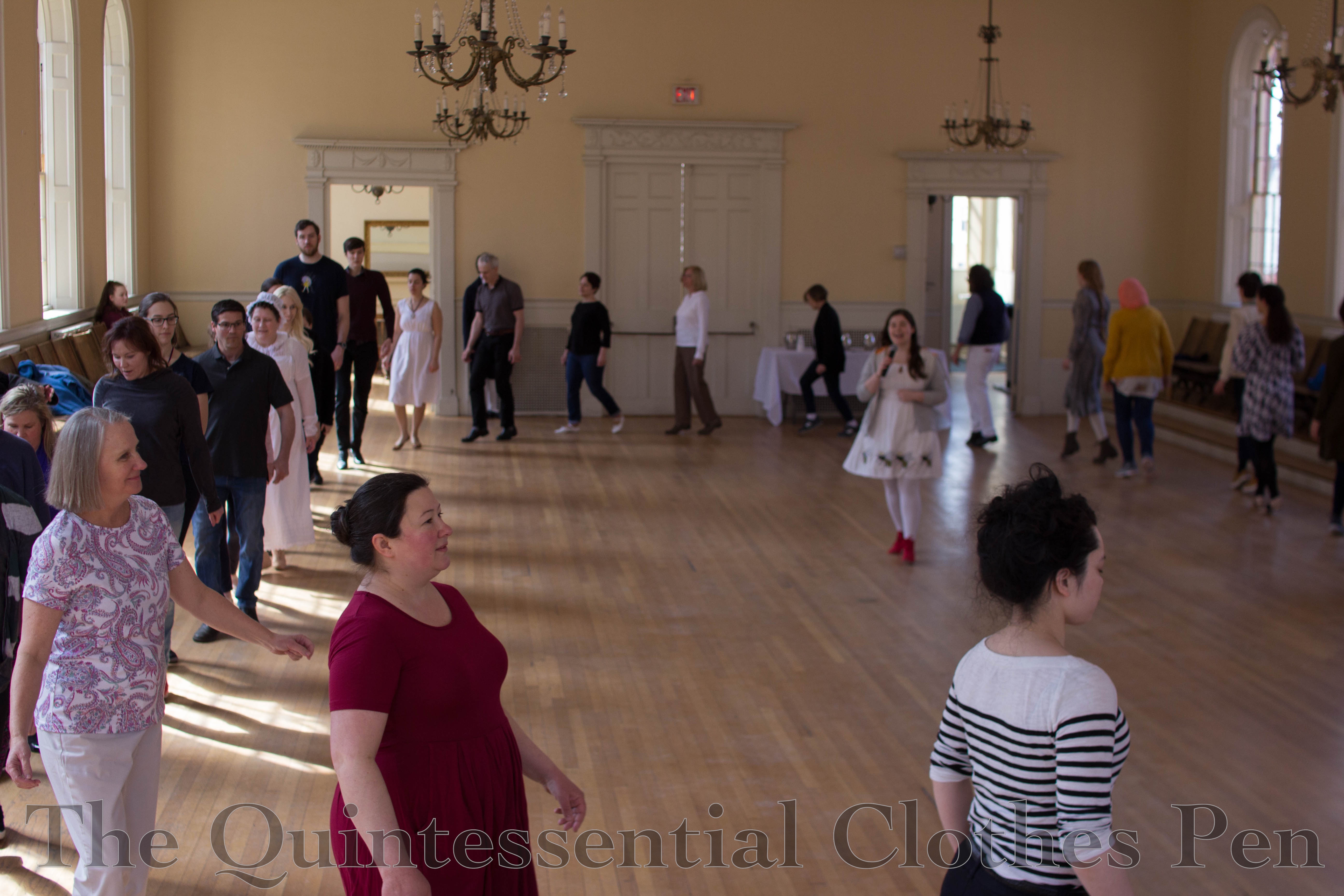
Saturday is a day full of dance classes. The name of the weekend does include the word ‘intensive’, right? The level of dancing achieved at this event is quite a step above a stand alone ball and I love how special that is. Here we are in the morning, learning the special steps that are particular to Regency dancing.

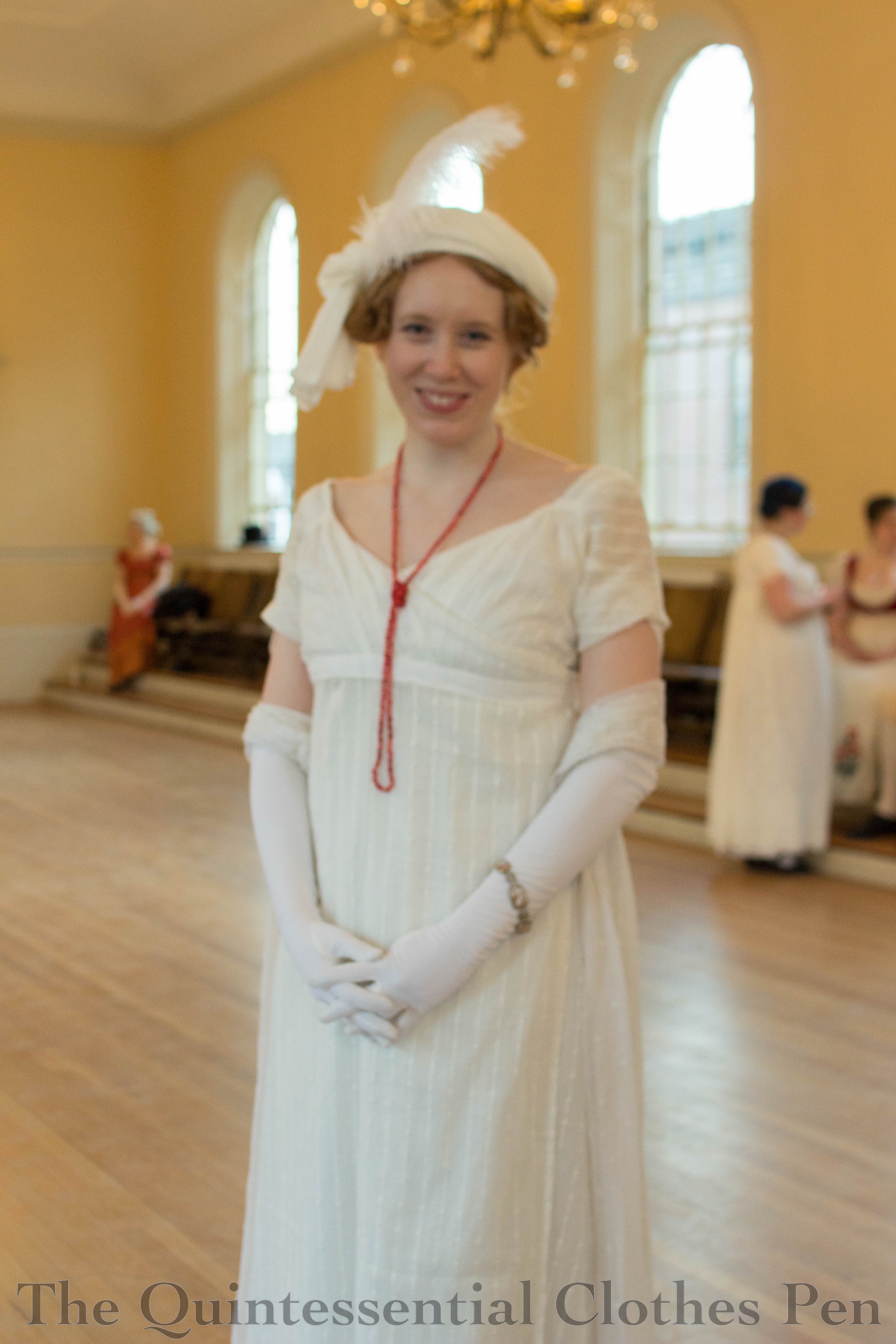
Saturday evening brings a ball to practice all the dance steps learned throughout the day. This year I decided to wear my red and gold 1813 evening gown and red and gold tiara with my red and gold reticule. I enjoy how well these different pieces coordinate with each other!

Amusingly, two other ladies were also wearing red and gold dresses. With cross fronts! Isn’t it neat how a description such as ‘red cross front short sleeve gown with gold trimming‘ can be the same but each dress is unique?

I find it pleasant to observe lovely clothing on elegant people during the course of ball. New dresses and accessories add a bit of excitement to a gathering! I enjoyed seeing this dress because I also have a dress made from the same Ikea curtain fabric.

Sunday morning we have more dance classes followed by a mixture of tea, promenade, and games in the afternoon. The activities have varied over the last seven years but we’ve always had an afternoon of non-dance fun incorporating at least a few of these activities each year. This year we started with a promenade. Thankfully we had good weather: a reasonable temperature with just a little bit of sun that accommodated pelisses, shawls, and spencers.

We ended on the town common and stopped for photos. Isn’t this one lovely?

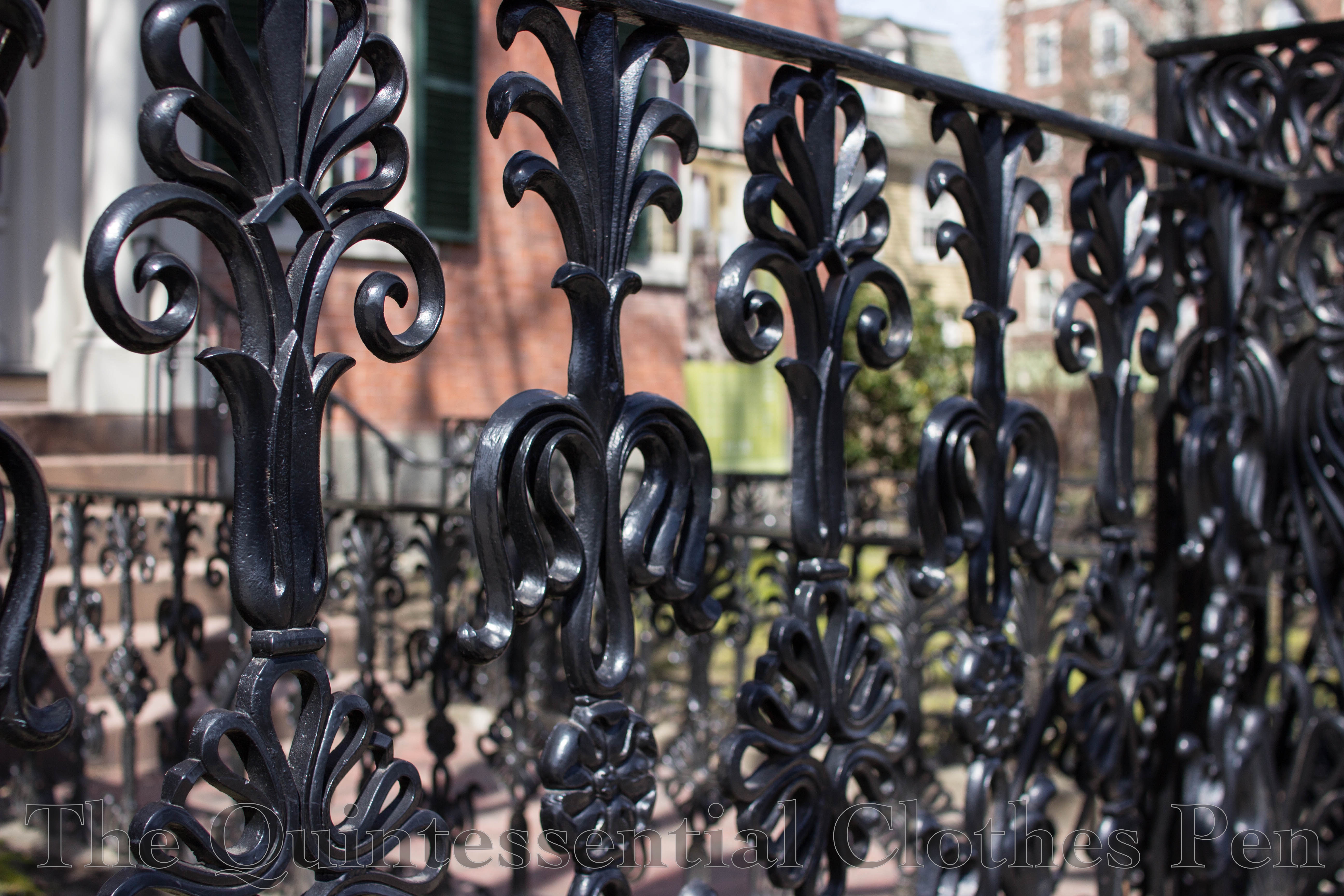
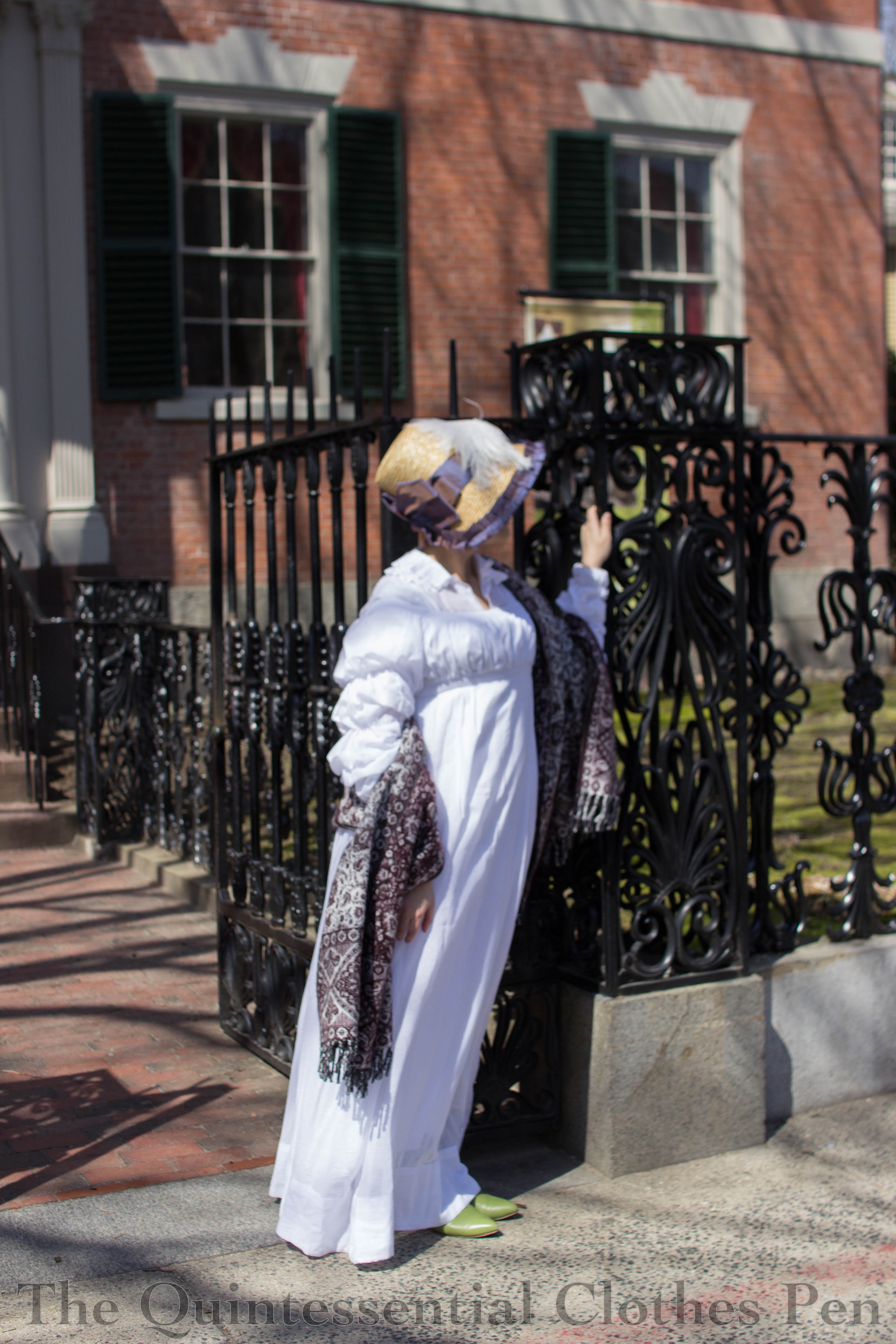
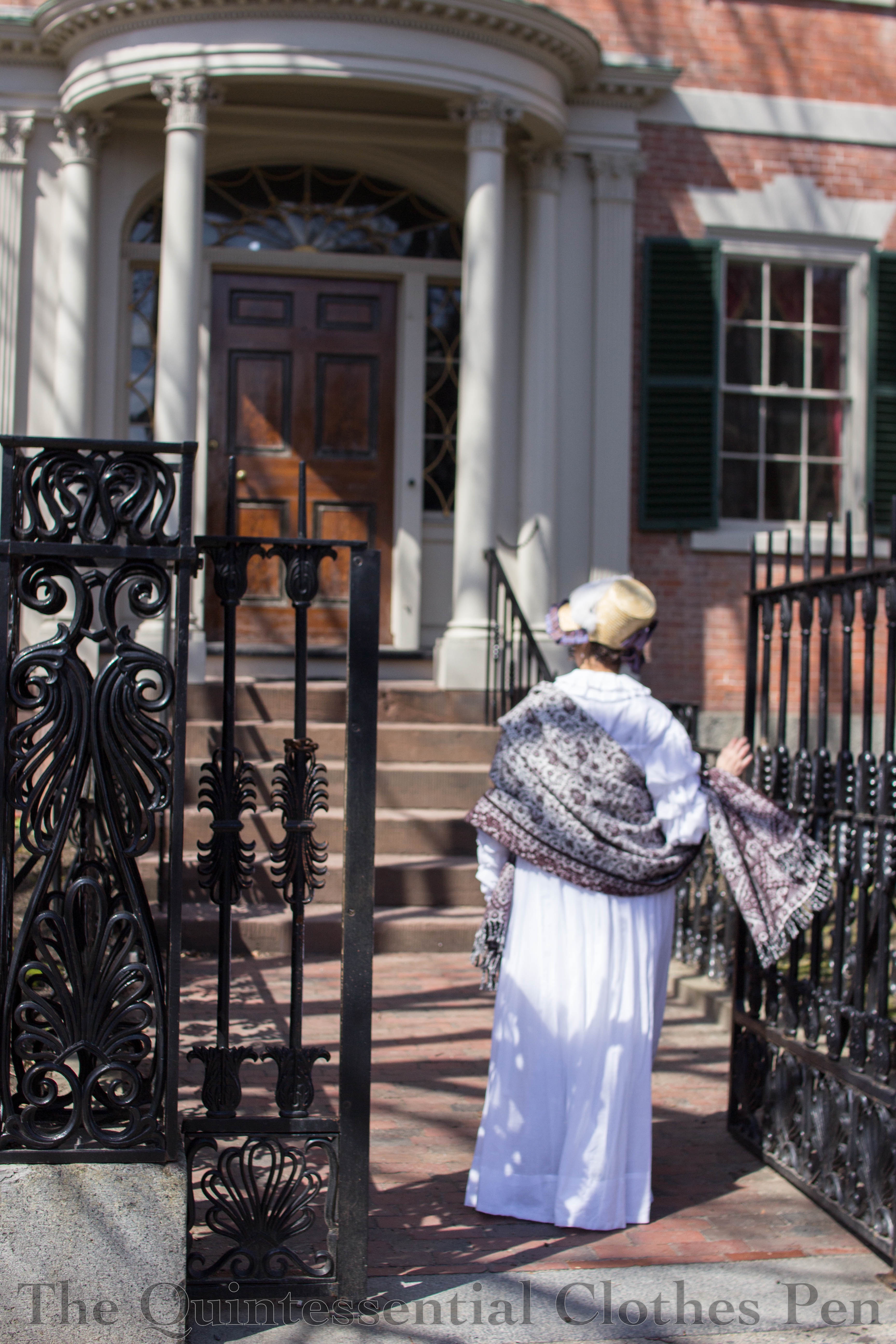
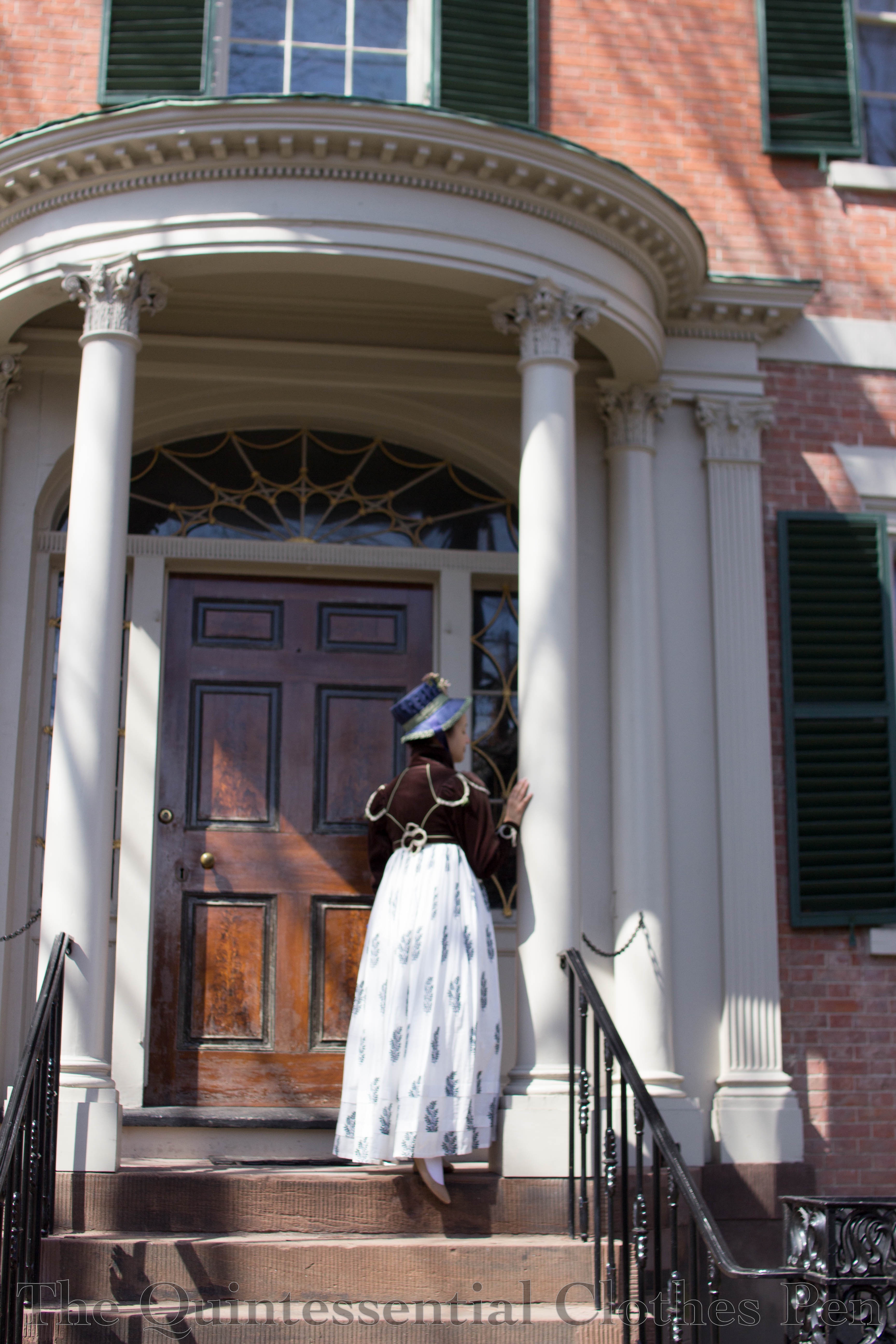
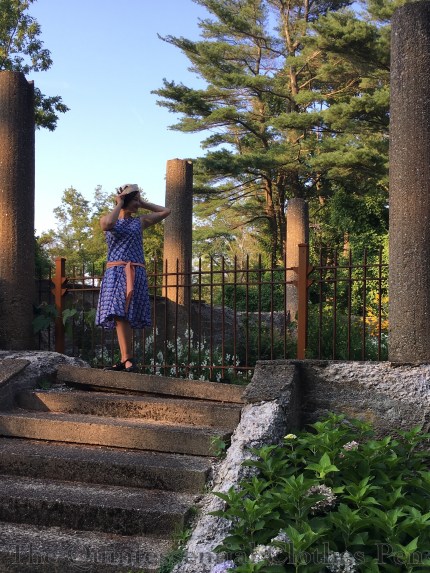
On our return stroll, I might have become distracted by one of the historic houses owned by one of the museums in town… The property had a fabulous wrought iron fence that I insisted we take photos with. Lots of photos… These are just a few!

As you can see, I wore my 1815 tree gown, 1819 spencer, and 1815 bonnet. Plus, I finally made use of a muff I made back in 2012 at Dress U! The scale of this muff is generally for the 18th century so I really haven’t used it since I made it, but the color matched my accessories so well that I decided to wear it with this outfit and I love the result. It’s super cozy and warm and the cover is completely separate from the down stuffed pillow inside so that in theory I can make other covers for it someday. This lovely item is the result of a class I took with LadyDetalle. (She has an Etsy shop that often stocks muffs like this as well as many other beautiful and historically inclined goodies.)

Back at the hall, tea was well underway. This year’s group really enjoyed chatting with each other and playing games. It was charming to observe such enjoyment.

Not too long after tea comes the grand ball across town. We have always started this ball with a reception that includes champagne sabering in a little park just near the hall.

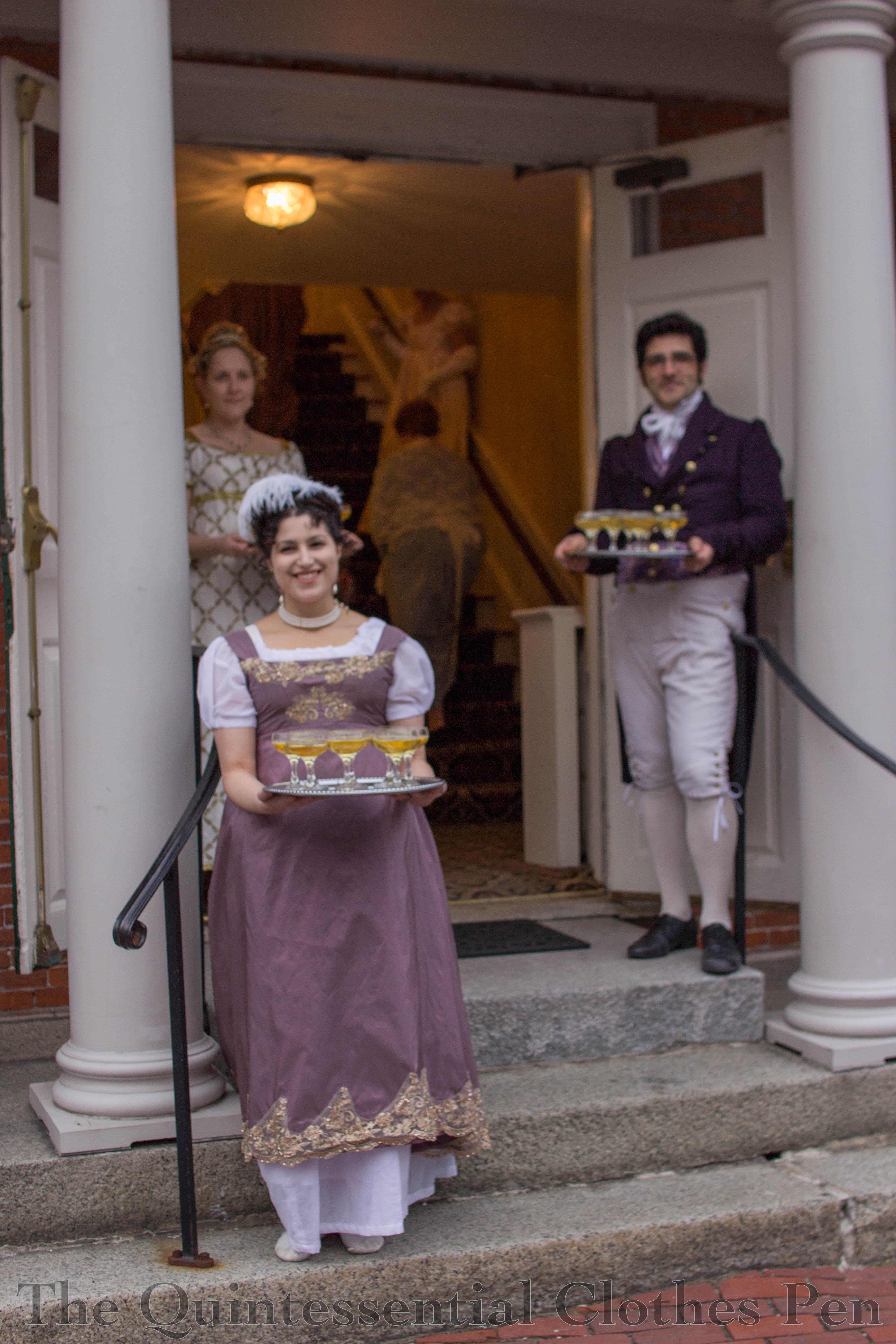
Arriving back at the hall, guests are greeted with sparkling cider.

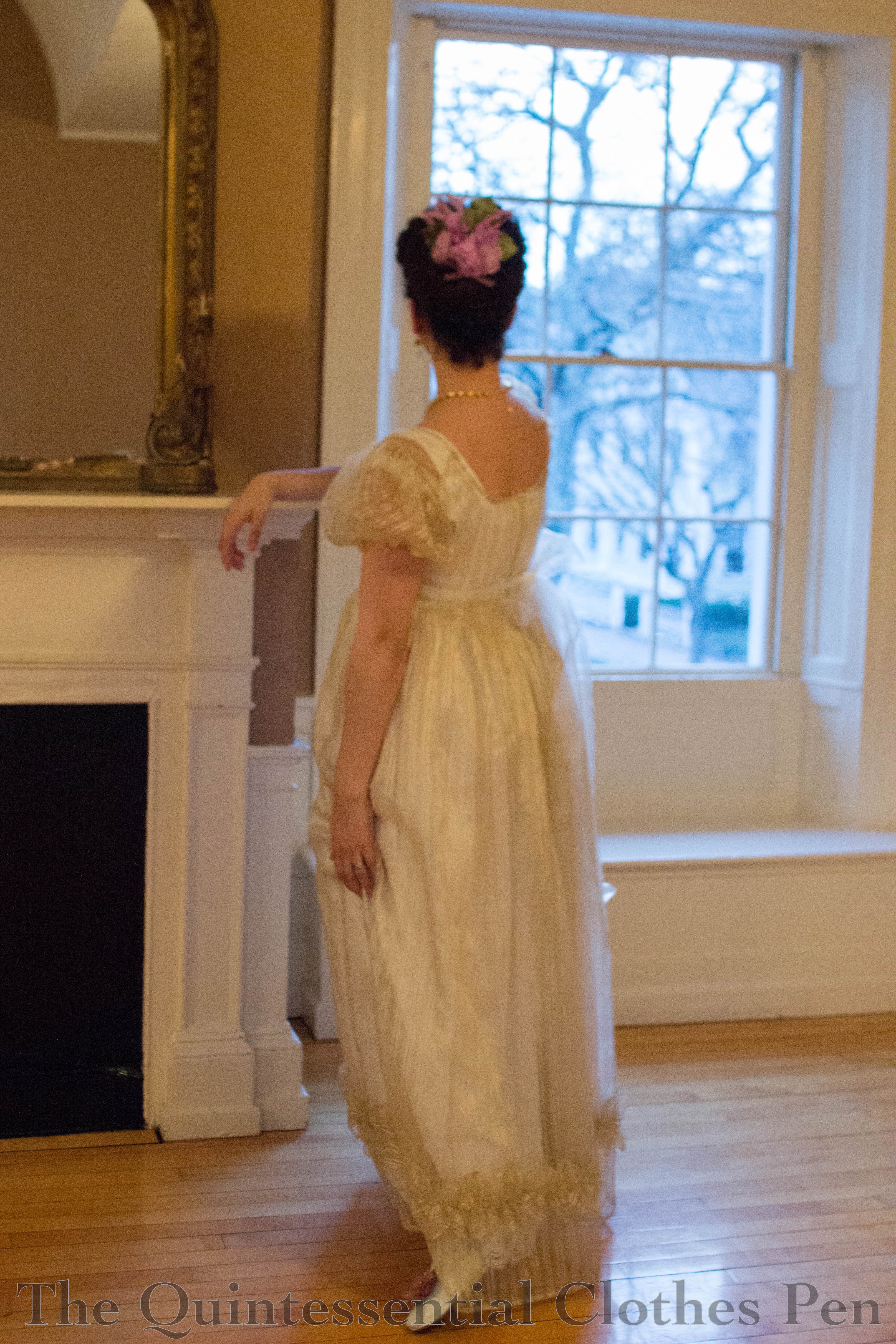
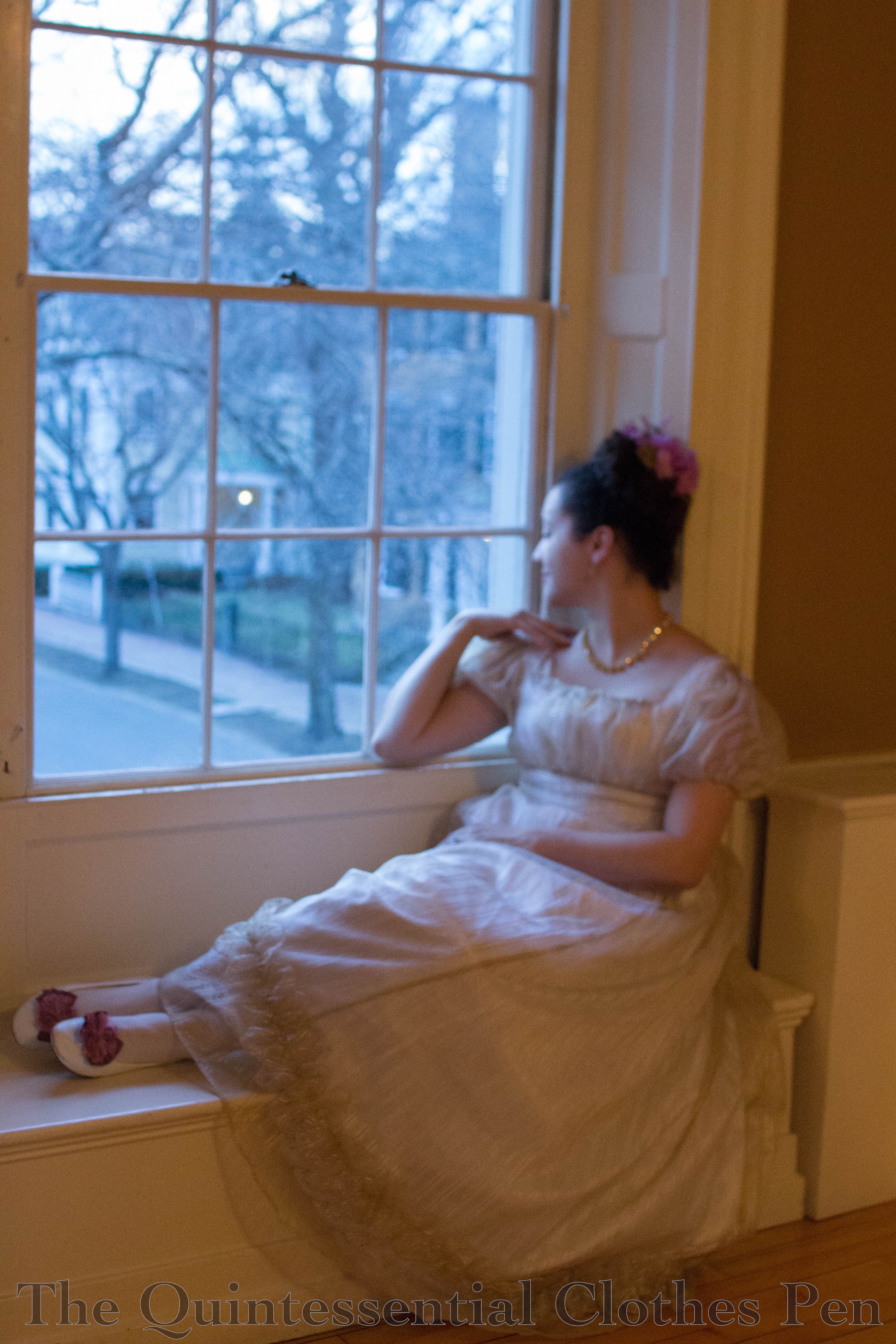
We took a few minutes out of the evening to document our clothing, as one does. I wore my 1817 Gold Stripe Duchess evening gown again (I just wore it in February as well), but with different accessories. I love how these accessories changed up the dress to have a different feel. This wearing included my 1819 purple hair flowers, purple shoe clips, the new necklace and earring set from the wearing of this dress in February that is from In The Long Run Designs and a white organza sash just like the green one I wore in February. The white really didn’t show on this dress except for a hint of fluff at the bow, but the two purple accessories stood out and of course the jewelry was sparkly and wonderful!

Purple and gold seemed to be a theme at this ball, just as red and gold was the night before! Raven of Plaid Petticoats had a new dress that fit the theme very well. She and lots of helping hands were working on the dress all weekend in order to finish it for the ball!

It’s quite grand, seeing everyone dressed in their Regency best for this ball. And I think many people are surprised by how well the dancing goes! It’s a special treat to have such advanced dancing.

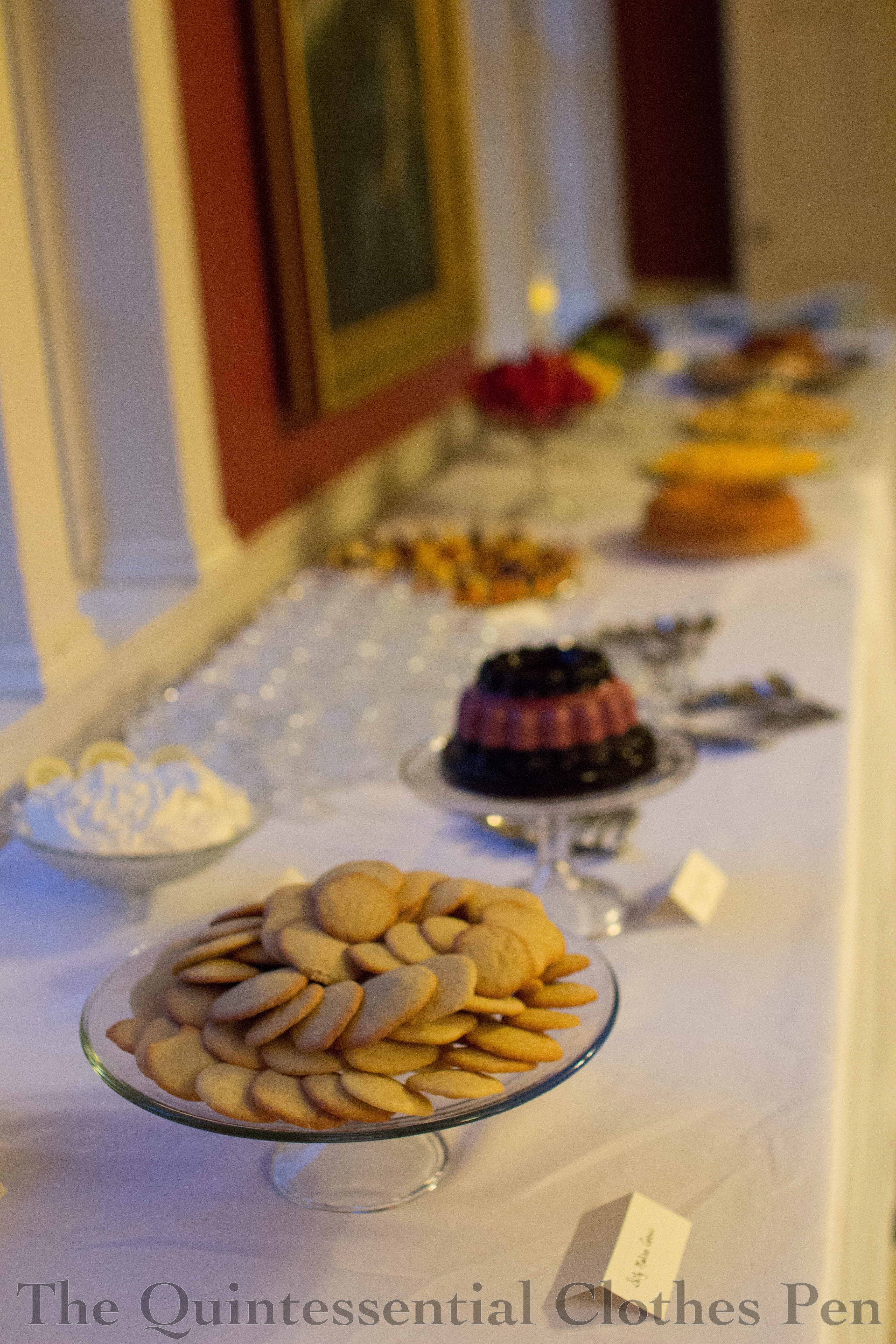
This ball is always accompanied by lavish refreshments carefully arranged to impress.

And at the end of two wonderfully long days of dancing I’m always exhausted! I hope that reading through this post was exciting and not exhausting! If you’d like to read more about the magic of previous years, I posted about the Regency Intensive Dance Weekend in 2013, 2014, 2016, and 2017 as well.

1817 Gold Stripes And Face Framing Curls

Back in February, I was able to re-wear my 1817 Gold Stripe Duchess Gown to The Commonwealth Vintage Dancers’ annual Regency Ball.

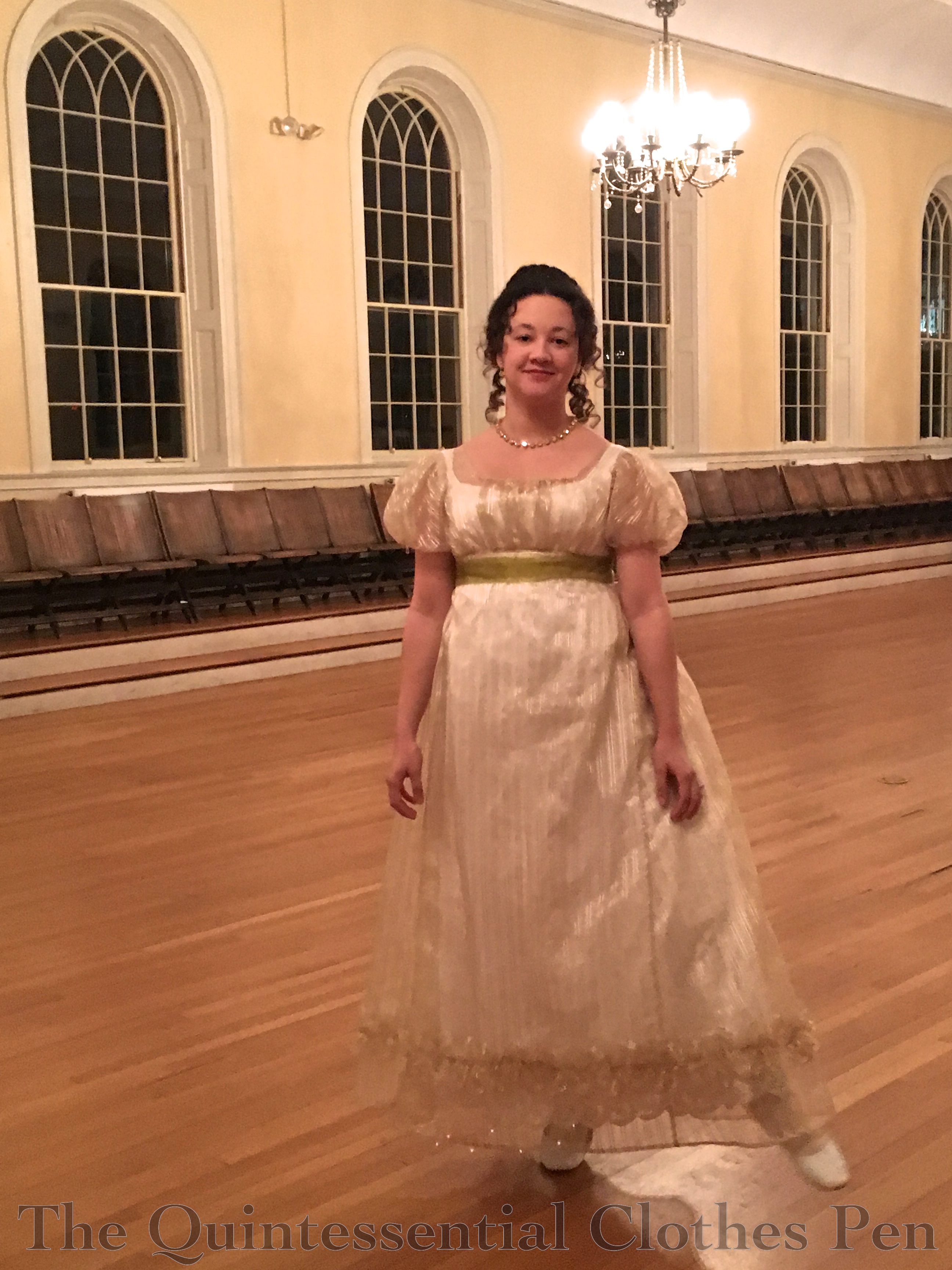
I love this dress! The sheer fabric is unusual to see in modern recreation settings and has lots of body, making for a lovely shape that is fun to dance in. It turns out that the gold stripe is rather neutral, so I’ve had fun accessorizing it in different ways this spring. We’ll start with this wearing, but there’s another one to blog about as well!

This time I decided to add a bit of color to the dress by adding a wide chartreuse organza sash with a simple bow in the back and rather long ends. (I’m all for variation in ribbon sashes for Regency dresses. In fact, I wrote a post detailing different sash styles a number of years ago!)

I also added lovely new jewelry from In The Long Run Designs. The color I chose, jonquil, is a light yellow color . It compliments my skin tone and adds quite a bit of neutral-toned sparkle to my ensembles (the goal was to match as many dresses as possible so I can get the most use out of the set).

The day of the ball I thought I had lots of time and so I decided on a whim to do a complicated hair style with face curls. It turns out I was off by an hour but I didn’t realize it until I was in the car! Thankfully I arrived in time and didn’t cause anyone else issues with my lateness. Oops! But I was very pleased with my hair (and the fact that it was done before I arrived to get dressed definitely helped offset the fact that I was late).

The hairstyle is directly inspired by the following image of Maria Leopoldine of Austria from 1815 (source). I have a note that it was painted by Friedrich Johann Gottlieb Lieder but I can’t find documentation for that detail outside of my note-to-self. Maria Leopoldine caught my eye because I love big braid buns (my hair does volume so well!) and I thought it was high time to try face curls again (see my 2014 attempt and a different narrower circumference of curl in 2016 to see other attempts I’ve posted about).

So off I went with a curling iron to try and reproduce this hairstyle. Given that I thought I had lots of time, I even took photos of the process so I could share it with you!

Let me start by saying that yes, even though my hair is curly I still use a curling iron (or other curling method) to get precise curls. To show the difference, here’s my hair at a partially done stage. You can see the curling iron curls to the left of my forehead and chin with my natural curls being held sideways in between them and on the right side of my face.

How did I get to that point? I’ve determined that great looking historical hairstyles are often styled in many parts. The complicated thing about face framing curls with my hair is that it’s all quite long: past my shoulders when it’s curly and almost to the middle of my back when it’s straight. I don’t have short lengths around my face to curl, so I have to fake it with long lengths that are pinned up to be shorter.

To begin, I split each half of my hair into sections–a front top section, a back top section, a section behind my ear, and the rest of the hair on the back of my head. In the photo above, I’ve already used the curling iron to curl the top back section of hair, pinned up some of the length, and used the front top section of hair to smooth out and cover up the pinned up length. I’ve also curled the back section behind my ear and pinned the curls up to shorten them as well. The rest of the hair is being held out to the side so you can see the different sections I’m referring to.

I realized after taking that photo that I should show a better example of what all of those words mean. So in the next photo I’ve let go of the back section and put a loose hair tie around it to keep it separate from my nicely curled sections. And I’ve curled the back top section of the other side of my hair, but I haven’t pinned those curls up to shorten or arrange them. I’m holding the front top section up in the air so you can see how untamed the curling iron curls look before being arranged.

The curls are the hard part. After arranging the top front sections and pinning them down around the back of my head it was a matter of wrapping and pinning up the back sections to look nice and make a big bun on the top of my head. I’m pretty sure I used a big bun form under there (the medium one from my Versailles hair in 2016–and for reference that post pretty clearly shows how long my hair is–it’s great for volume but can be a lot to wrangle), but it’s hard to remember as that was now almost three months ago and I didn’t take photos of those steps!

The final step was to wrap and pin my trusty (and yikes, 15 years old!) faux braid around the bun and give the whole thing a liberal dose of hairspray!

I love that I’ve found a new look for this dress and a new historical hairstyle. Looking at the photos, it doesn’t look like my braid bun is quite as large or wide as Maria Leopoldine’s (I’ll have to try again someday!). Despite that, I was very pleased with the face framing curls and the bouncing curls behind my ears. The style felt very regal!

1926 Silver Robe de Style Second Styling

Today I have a new dress adventure to share with you: the second wearing of my 1926 Silver Lace Robe de Style to a Gatsby Ball in January. The last time I wore this dress was last August, so it was fun to bring it out again. I thought it fit in nicely with the idea of blue and silver for the new year, even though it wasn’t technically a new year themed event.

The robe de style dress was popularized during the 1920s particularly by the designer Lanvin. This alternative to the popular straight silhouette dresses of the 1920s is characterized by a dropped waist with wide skirts. Many of these dresses have panniers in them that are borrowed from the style of 18th century court dresses. Here is a little more information about the robe de style from the FIDM museum if you’d like to read more.

I have another more dramatic robe de style already, so this lace one is more of a nod to the robe de style, with softly gathered sections at the hips and no panniers or other understructure.

(My 1924 Golden Robe de Style is the more dramatic one. I made that dress in 2015 and posted about the construction of it this past post. Since then I have updated the trim on it to be much better suited to the dress. You can see the new trimming in these two past posts: in 2016 and in 2017.)

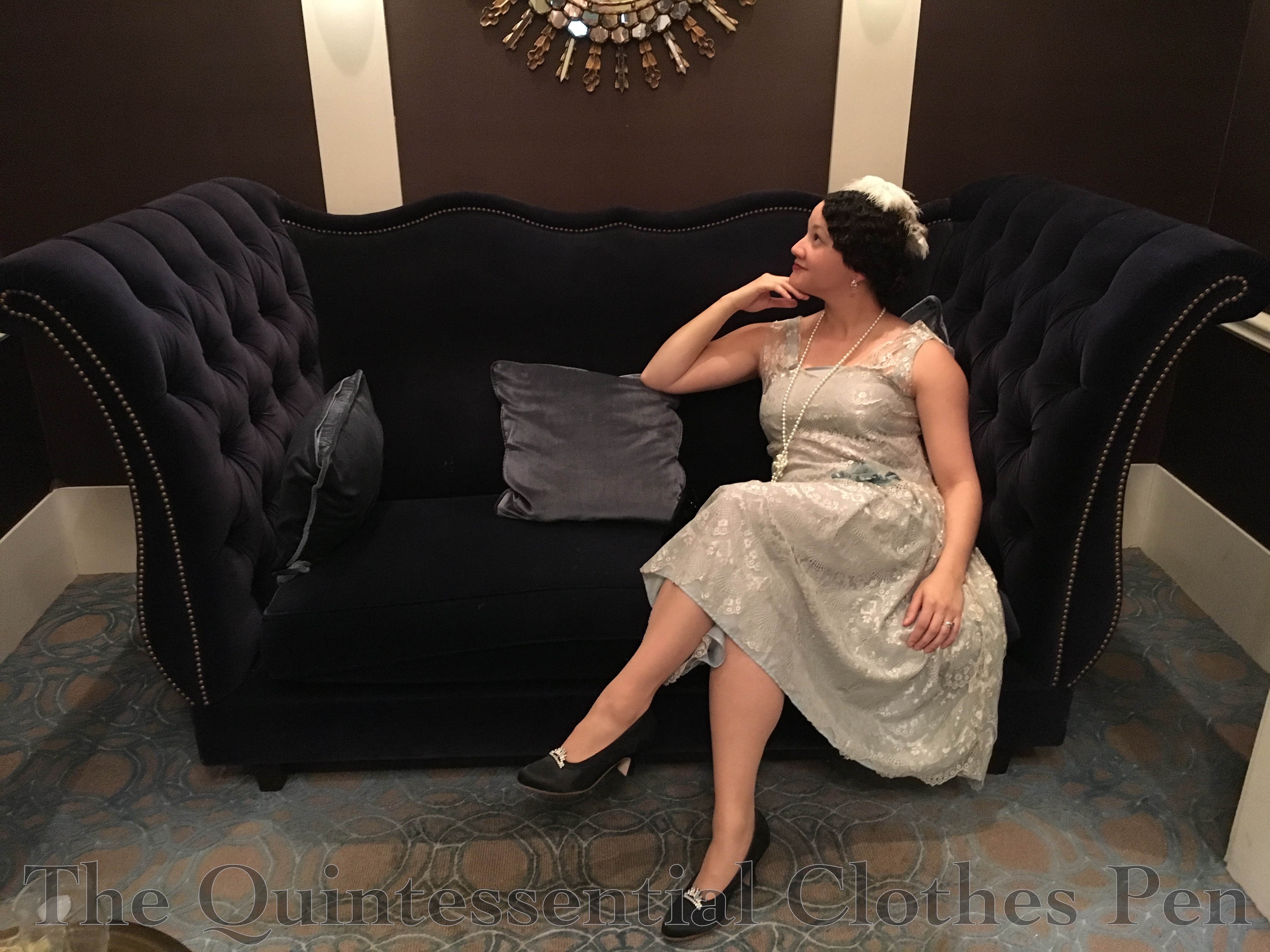
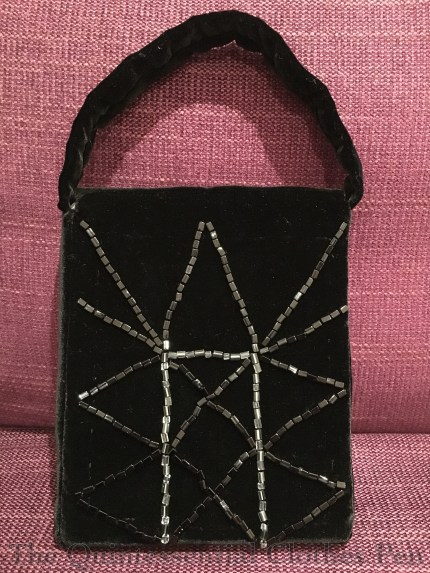
Last August I wore this dress with silver accessories: silver American Duchess Seaburys and silver hairpins. This time I decided to try my black Seaburys with silver rhinestone shoe clips, an ostrich feather/rhinestone hairpin (this is the same decoration I had in my hair for my 2016 Versailles look–how fitting to wear it again with a dress that has a nod to the shape of the gown I wore that night!), and my newly made black velvet handbag. It’s a bit hard to see the handbag in these photos, but if you look for it you can spot it in one hand or the other in most photos. Trying to show it off and not look ridiculous was a bit of a challenge.

(As a another side note, that same hairpin works really well for the 1890s, too! Who knew it could so easily shift between not only decades, but centuries!)

While packing and getting dressed, I couldn’t decide which dress to wear to the ball: this silver robe de style or my 1927 Blush Sparkle Dress. I brought both of them with me to the event and only made a decision when I realized that a friend hadn’t brought a sparkly dress to wear. (Never fear, she had a dress, just not a sparkly one!) The fabulous architecture of the The Fairmont Copley Plaza Hotel really called for some sparkle, so I wore the robe de style and loaned her the blush sparkle dress. It was fun to see it sparkling around the ballroom!

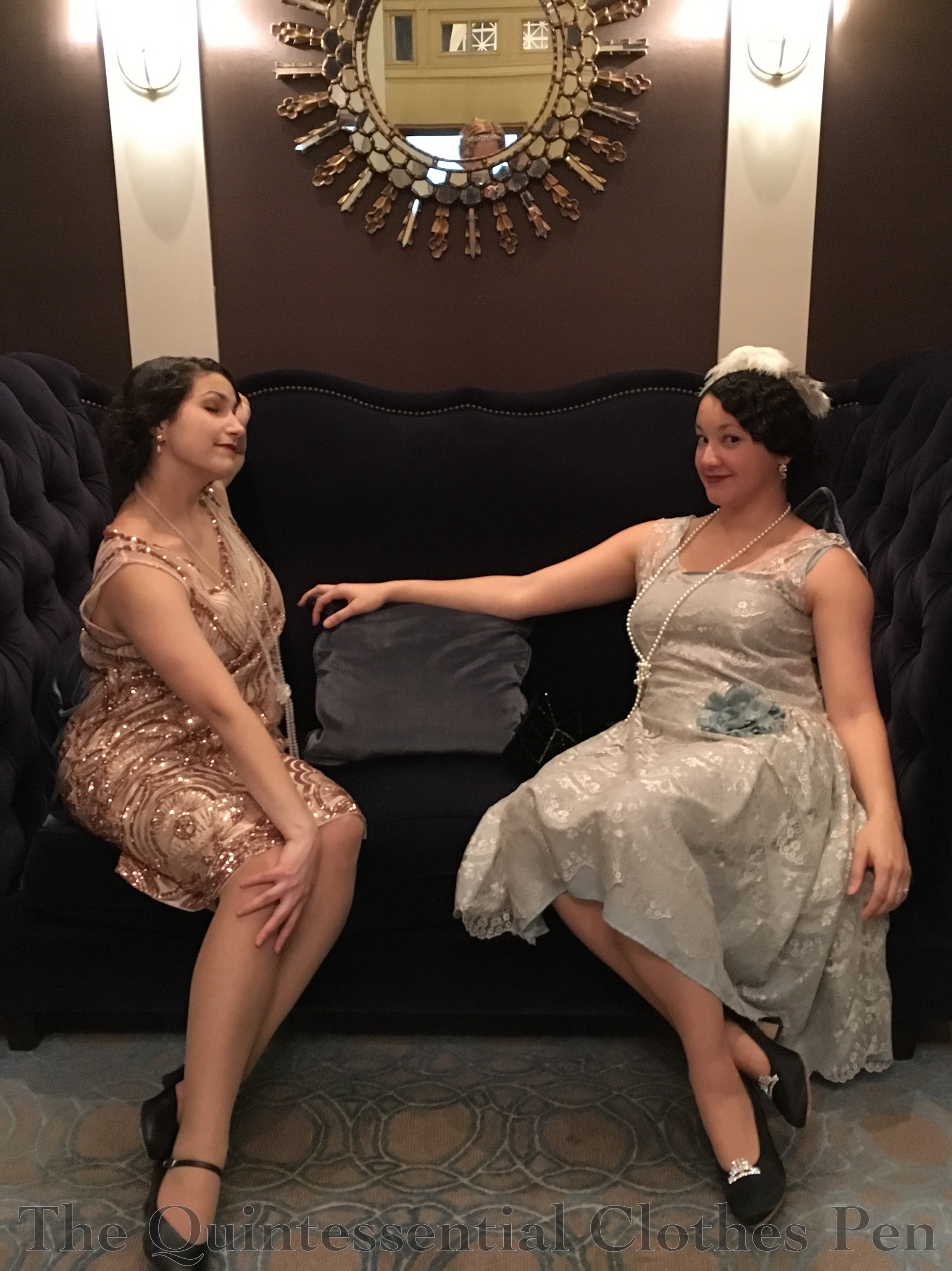
Showing off two different styles of 1920s dresses. Blush Sparkle on the left and Silver Robe de Style on the right. It’s hard to lounge and not look silly. This was one of the best we got!

After the second wearing, I am still pleased with this dress. It’s fun to dance in and a bit unusual in style: qualities that suit me perfectly.

I think I like this dramatic black and ostrich styling best so far. Do you have a preference between the first styling with silver accessories and this second wearing?


1896 Bicycling Ensemble: Construction Details

As promised, I have quite a few words and photos to share with you about the construction of my 1896 Bicycling Ensemble, so prepare yourself for a long post! This post is a great reference for me to have all the details in one place, but I also hope that some of my details might be helpful for other people who want to build 1890s cycling outfits as well.

If you want to read a bit more about the social history of the bicycle ensemble, see more finished ensemble photos than the few in this post, or read more about the accessories I’m wearing with this ensemble, check out my first post about it (this is the same as the first link). I also have a post looking specifically at patents and advertisements for women’s bicycling clothing from this time. It’s a great supplement to some of the information I mention in that first post.
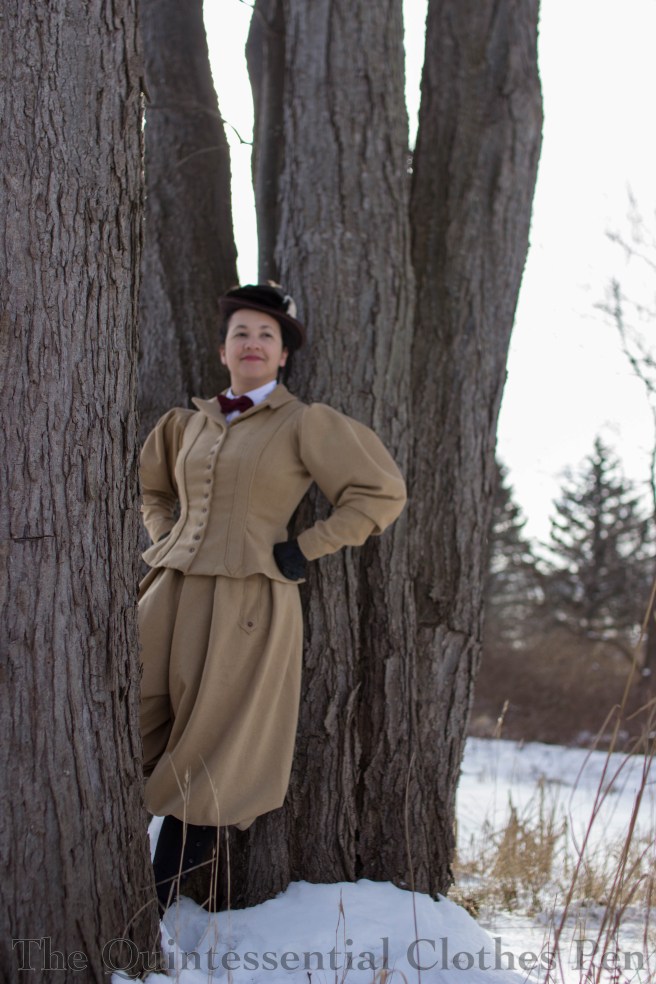
This post is going to focus on the main garments that make up this ensemble: the jacket and bloomers. We’ll start with the two main similarities between these garments.

#1 Both garments are mostly machine sewn, with hand sewing for the tailoring steps of the jacket as well as much of the finishing of each garment.

#2 Both jacket and bloomers are made from a drab colored wool that has been in my stash since 2012. I purchased it from the remnant table at the local discount fabric store for the amazing price of $3/yard! I bought every piece they had, so I have about 10 yards broken up in about 6 different pieces. I used less than half of what I purchased for this project, leaving me plenty to use this for an 1880s dress as well. (That one has been in progress for the last 18 months… I hope to finish it this year!)

The drab colored wool is perfect for this cycling outfit, not only because I already owned it and it has been taking up space for years, but also because drab was a popular color for cycling outfits because it successfully hid dirt and dust. Other recommended colors were brown, black, and navy.

The Bloomers

Now that we’ve looked at the similarities let’s look at the differences, starting with the bloomers.

These are entirely self drafted. While that might sound intimidating, these are actually quite simple! Each leg is the full width of the fabric, 60″ wide, and 33″ in length. On my 5’6″ frame that provides plenty of pouf in the legs when they are held in place around the tops of my calves. The only shaping is in the crotch seam, which is a curve ~5.5″ wide and ~12″ deep. The crotch curve is deep enough and the bloomers are full enough that I made the crotch curve the same for the front and back. Here’s a photo of the crotch curve drawn out before I cut it.

The fullness of the 60″ wide legs is pleated into the waistband with knife pleats folded towards center front and center back. Knife pleats are documented in sporting bloomers from the 1890s and are specially mentioned as being folded this way in order to help the bloomers maintain the full look of a skirt, in keeping with the social convention that skirts were acceptable wear for women but bifurcated bloomers were not. I experimented and decided I liked just a few deep knife pleats as they helped the bloomers fall nicely on my body.

I debated about how to gather in the fullness at the bottom of the legs, especially since I couldn’t find specific instructions on how this was accomplished or see this particular detail given the way extant bloomers are displayed. I decided on gathering each leg into a band that hooks so that it stays in place at the top of my calf. There is a 3″ slit in the leg as well. The raw edges of this are turned under ¼” and whip stitched by hand. There is also a small reinforcing bar sewn across the top of the slit to keep it from ripping. Here’s a closeup of the leg opening.

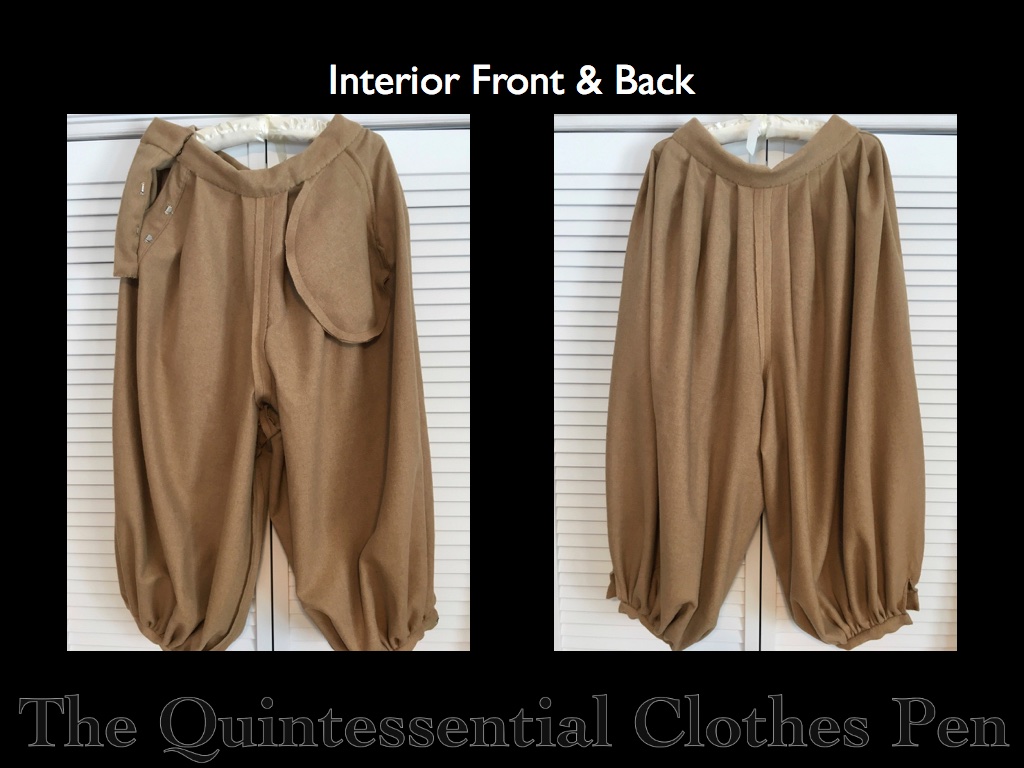
The inside of the bloomers looks like this. There are two decorative strapping details on the front of the bloomers (more on that when I get to the jacket). These conceal a placket opening on one hip (visible on the far left) and a pocket on the other! The crotch seam and inseams are left unfinished. This wool did a pretty good job of not fraying at the edges so there was no need to finish these seam allowances.
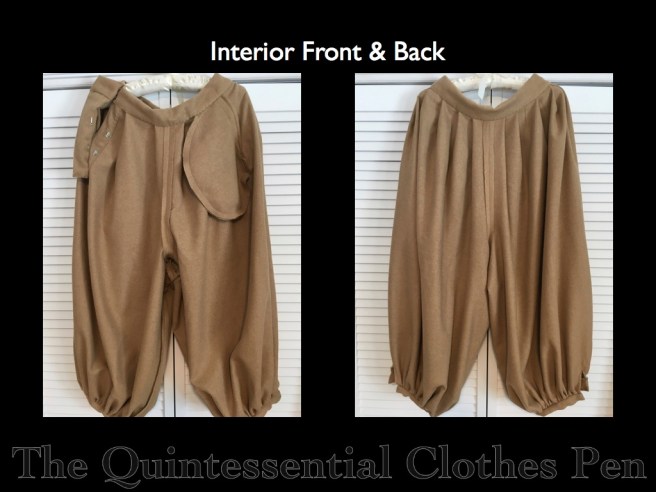
Here is a closeup of the placket opening that is hidden behind one of the strapping details. You can also see the interior of the waistband, which is whip stitched to hold it in place. To be entirely fair, I could have made bloomers on a waistband without the strapping and pocket and saved a fair bit of time. Stitching the strapping bits on and hiding the placket and pocket behind them required some extra brain somersaults and time to figure out and execute. But I really like the strapping detail on this extant bicycling ensemble from 1896 at The Met and really wanted to include that detail in my own garments, so here we are.

Here’s what the bloomers look like when the wind filled them out during our photoshoot. This gives a better idea of how much fabric is in each leg of the bloomers.

The Jacket

I wanted to have a tailor-made style with a lapel and collar that would follow the general style of men’s jackets in the 19th century. Most bicycling ensembles are of this style, due in part to the fact that this type of activity was traditionally a male pastime. The specialty clothing produced for men’s active pursuits was made by a tailor, so it follows that women’s clothing began to be tailor-made as well as they joined in these male activities in the later part of the 19th century.

I started with the pattern for my 1895 Skating Ensemble because I knew it had the general shape of the mid-1890s and that it already fit. That pattern was made by me, based on my inspiration jacket for that ensemble as well as patterns published in Authentic Victorian Fashion Patterns. I had already modified it to get the shape of the skating jacket, but I modified it even more to create this new jacket. I made these further changes:

  • Created princess seams on the front and back that run down from the shoulders instead of the armsceye
  • Joined the side back pieces to make a single wider piece instead of two narrower pieces
  • Moved the new side back seam towards the side seam
  • Added back pleats, front darts, and a lapel and collar
  • Shortened the length

At this point it’s really not close to the original pattern at all!

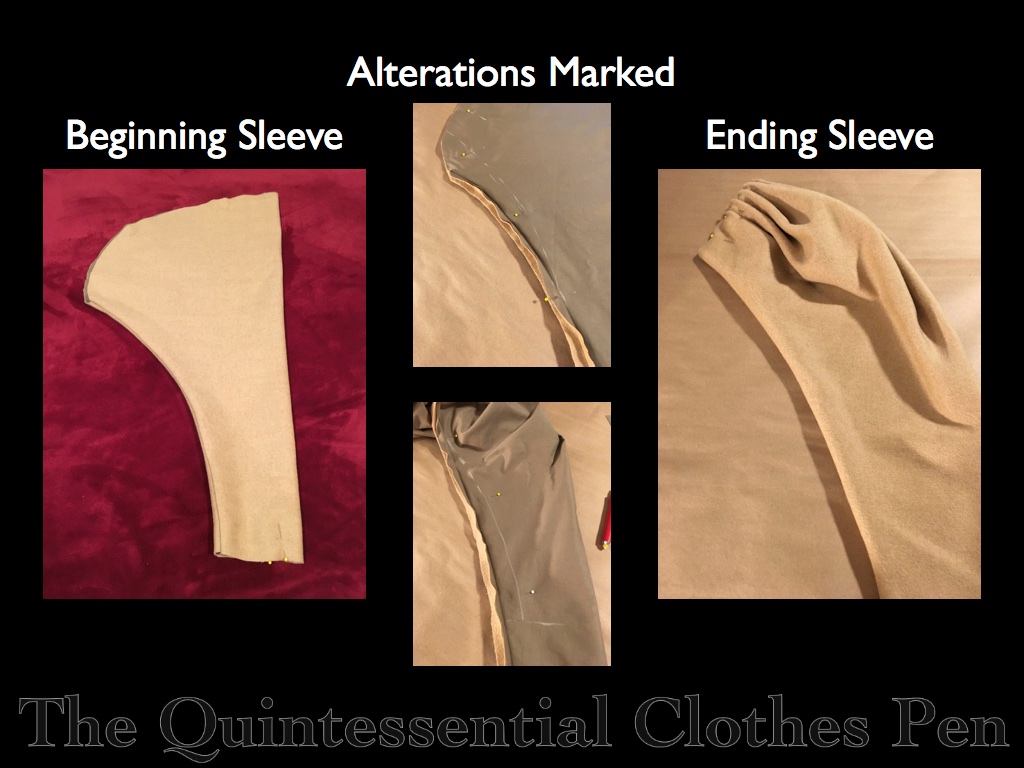
The sleeves are my standard 1890s gigot sleeve that originally came from Period Costumes For Stage and Screen. I wound up making a number of changes to the pattern to get a slightly different shape. Below you can see my progress.

After trying out the original sleeve I made two major changes to the shape, angling the underarm seam at the top/making the top less full and angling the underarm seam at the bottom towards the wrist/shortening the length. After pleating each side of the new sleeve towards center I ended up with the sleeve shape on the right.

After I had a pattern I was confident with I started cutting my pieces. Each exterior piece was cut in wool and cotton in order to be flatlined. The front and collar facings are single layers of wool. There are also canvas interlining pieces for the front and collar.

The proper way to flatline is to pin your layers together and then (preferably) hand baste around each piece to hold the layers together while working with them. I opted to eliminate the basting step, using pins to hold the layers together until they were sewn. My fabrics were pretty sticky so this time-saving shortcut worked pretty well. You can see the pins holding the non-sewn edges together in this photo of the exterior after assembling the front and back pieces.

This is also one of the only steps that show the front darts, as those were hidden under the decorative strapping I added to the jacket later on. The other amusing thing here is that because I was cutting my garment pieces from multiple pieces of wool you can see a color difference here between the center back pieces and the other pieces. But it’s not noticeable in the finished jacket, so that’s good!
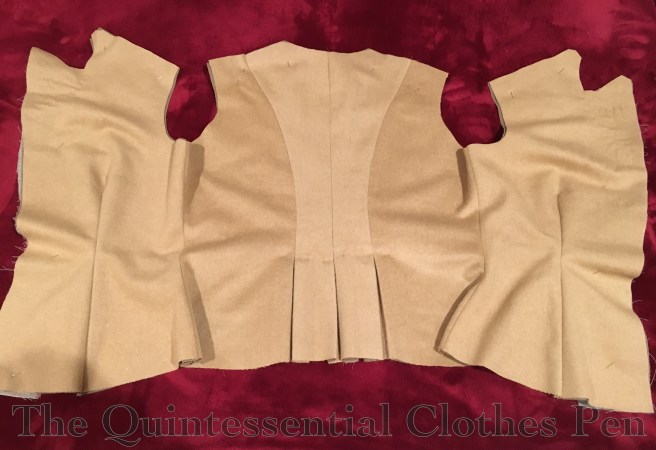
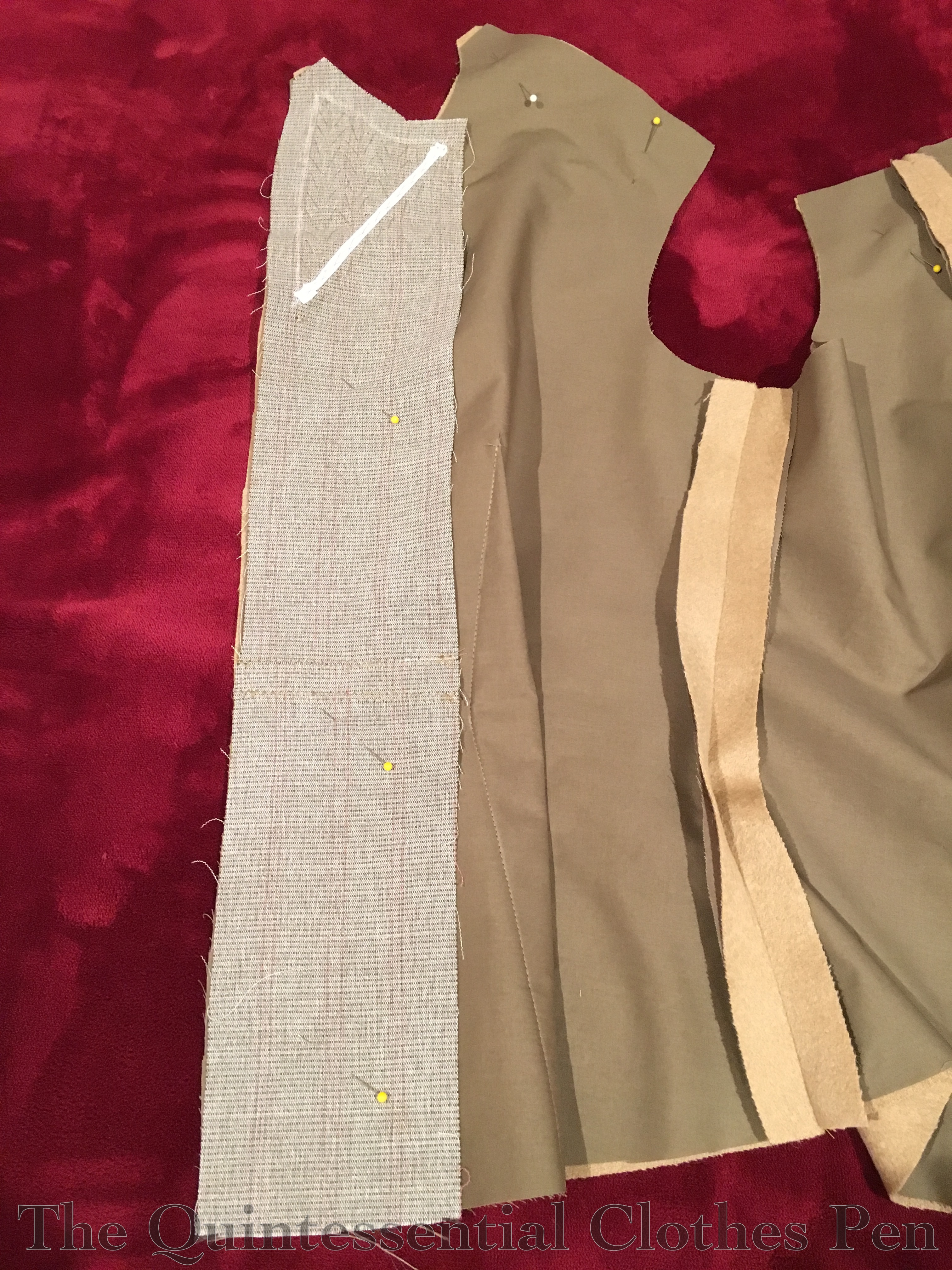
And here’s the jacket at the same point in the process, turned over to see the inside. Now the flat lining is clearly visible, as are the box pleats along the back seams. You can also see the canvas that runs down the fronts.

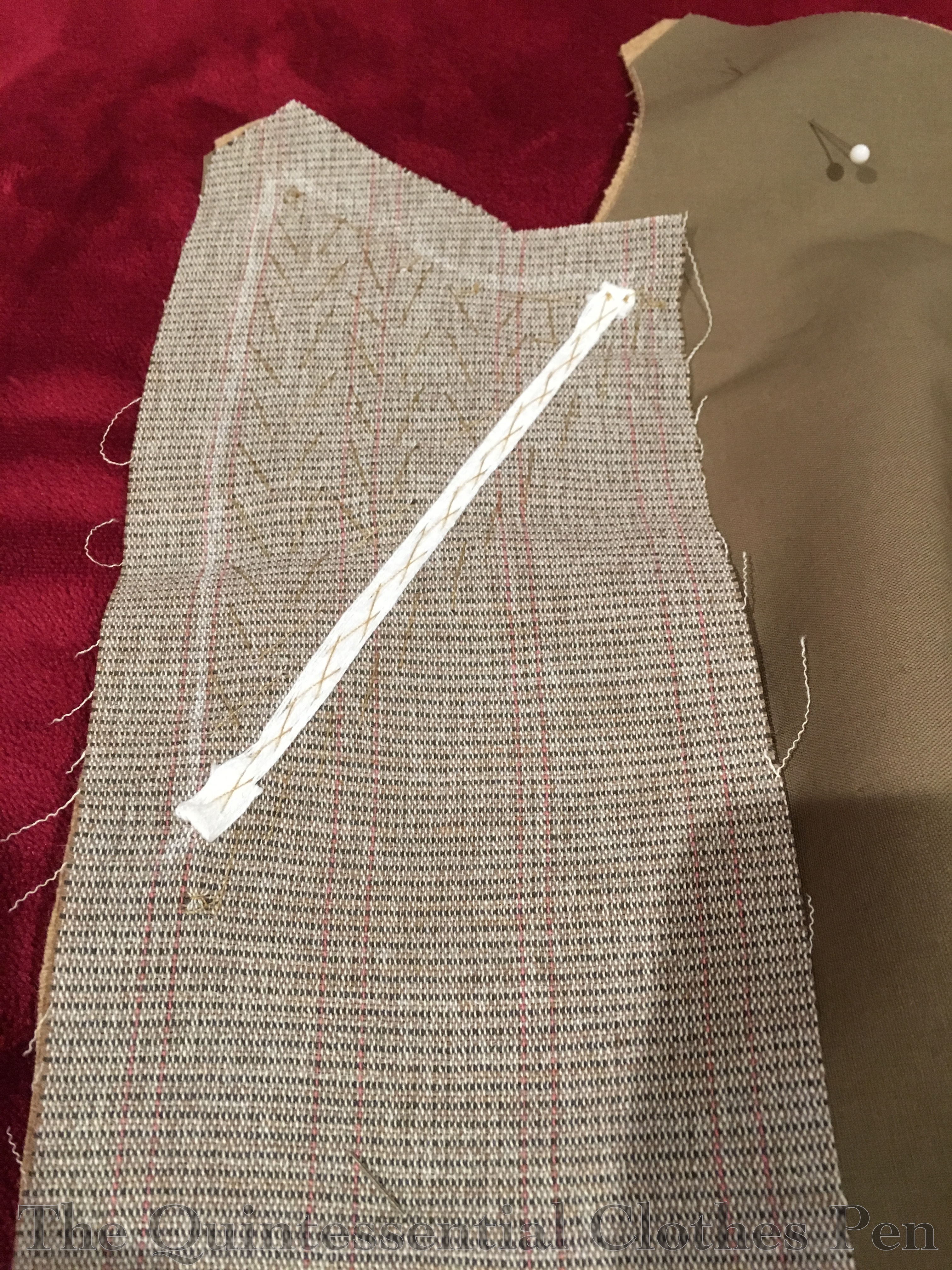
Here is just one side of the front. It gives a clearer view of the front dart and the canvas that supports the lapel and front edge.
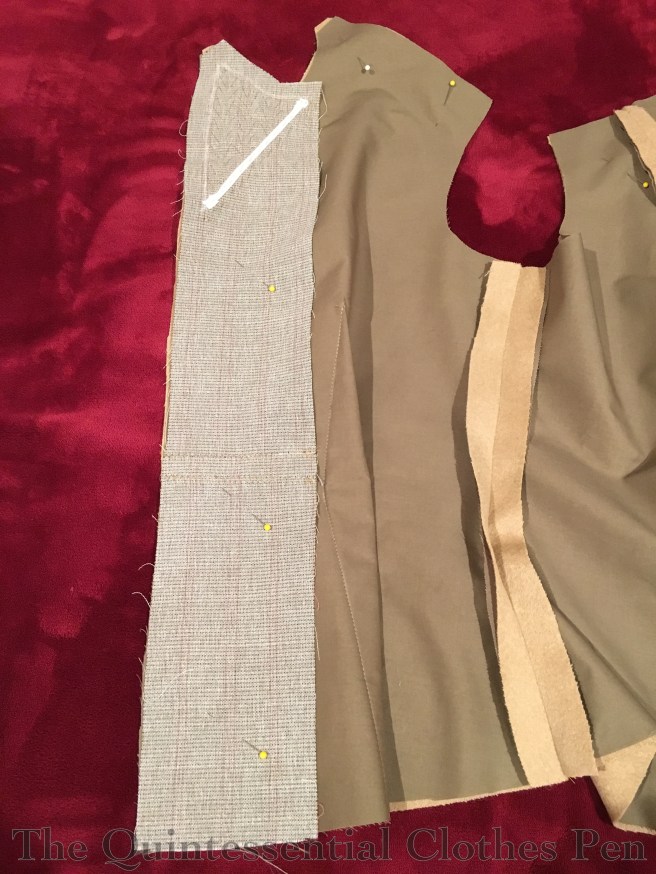
I pad stitched the lapel and taped the roll line in men’s tailoring fashion. These stitches help to support the roll of the collar. The tape running across the roll line snugs that distance in just a bit which helps the collar roll in exactly that spot.

I decided not to try to pattern the strapping with the main body pieces. It just seemed too complicated to wrap my head around. I knew they wouldn’t be straight, as my body is curved, and I knew that making them on the bias would be a disaster to try and manage the edges of… I decided to deal with this step when I got there in the construction process.

Accordingly, when the jacket had all of the vertical seams assembled it was time to consider the strapping. I did this at this step, before sewing the shoulder seams, as I wanted the strapping front and back pieces to perfectly match along that seam. Easier to pattern flat than if I’d already sewn the shoulder seams!

I laid the jacket out on the table with a scrap piece of wool on top of it, put pins along the seam line to mark the location (so my strapping would hide the seam), and then drew a strapping shape I liked around that. As you can see, I didn’t follow the curve of the seam perfectly. That was an intentional choice, as I wanted the strapping to have a similar curve as the curve on the strapping of my inspiration jacket (here is the link to that again, in case you want to take a look and not scroll all the way up to the first link).
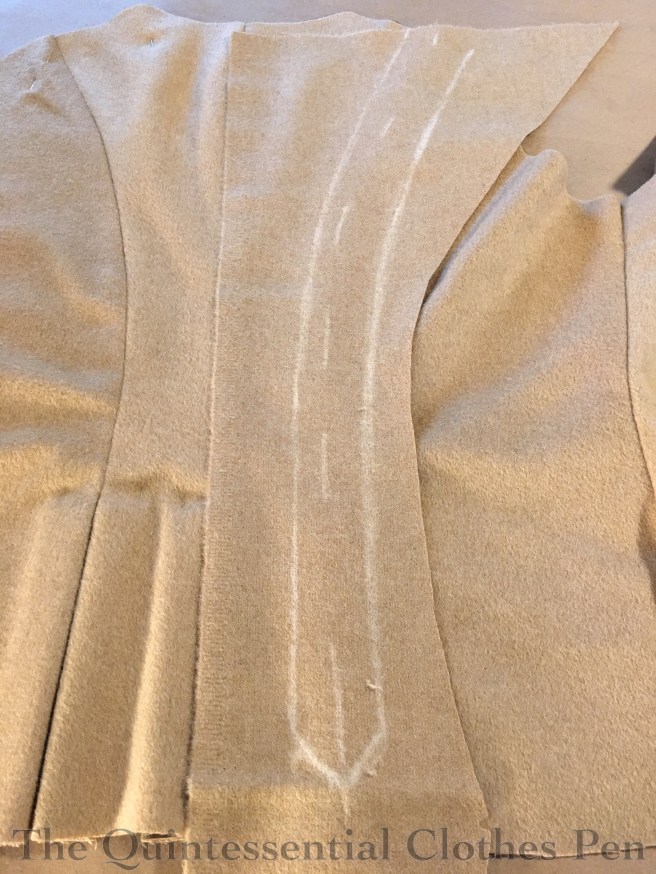
I repeated this process for the front (which was trickier with the shaping that dart creates!) then cut out four of each piece. I decided to finish the edges by making a tube that was topstitched by machine before being hand sewn to the jacket

I can’t imagine how horrible it would have been to try to topstitch the straps onto the jacket! Bad… very, very bad! And trying to turn the edges under and then topstitch would not have provided enough stability for crisp edges and would also have been a frustrating experience. Thank goodness I avoided those potential problems!

Here are two of the four straps, pinned and ready to be stitched together. The only edge I left open is the straight edge (at the right) that would go into the shoulder seam. After being sewn and trimmed these were turned right side out, pressed, topstitched, and carefully placed at the shoulder seam so that they would match up perfectly when the seam was stitched. The edges of the straps were then invisibly hand sewn to the jacket.
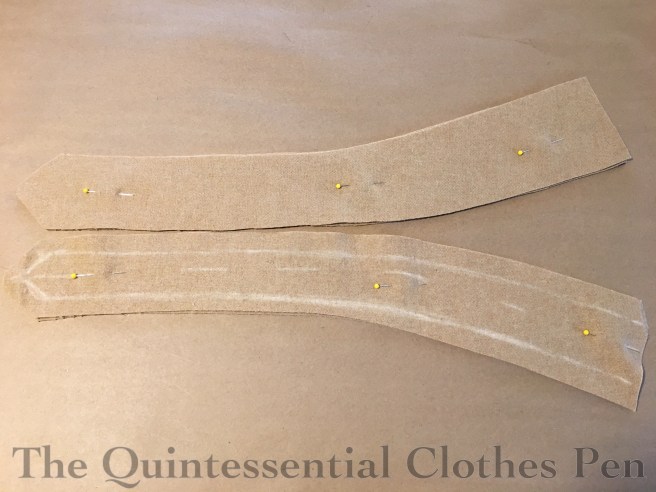
Here’s the end result. The straps look topstitched onto the jacket, but they are actually finished pieces that are fully sewn down in front but only attached above the pleats in the back, allowing the bottoms to flap amusingly! This detail is again taken from my inspiration jacket (and here is the link to that again).

As I mentioned earlier, the bloomers also have a strapping detail taken directly from my inspiration bicycle outfit at The Met. Those were carefully patterned–they look straight at first glance but are actually slightly angled and tapered. They are made in the same way as the jacket strapping pieces, though as I mentioned earlier, they were more complicated to put onto the bloomers as they conceal a placket on one side and a pocket on the other. That was a figure it out as I go experiment that required precision and quite a bit of puzzle-solving!

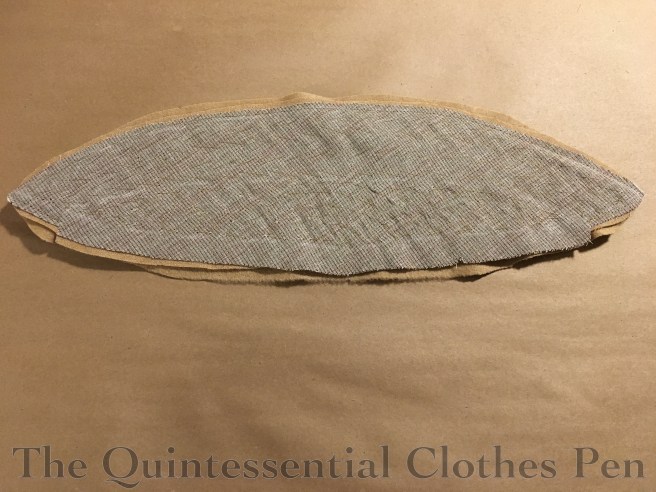
The collar was interlined with canvas and pad-stitched to provided stability for the shape. Then it was sewn around the edge by the machine and the seam allowances were graded before I turned it right side out.
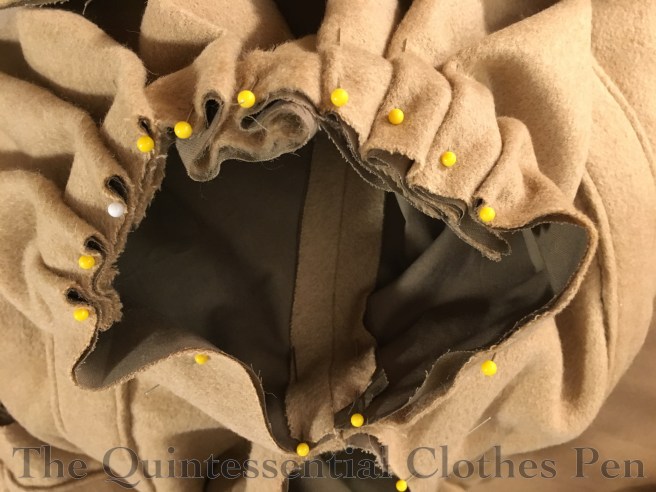
The sleeves are pleated to take in the fullness to fit the armsceye. There are 10 pleats total, each about ½” (1″ total) in depth. Here’s a photo looking down into the sleeve with all the pleats pinned in place. The box pleat (that is slightly off center in the photo) is the top of the sleeve when it’s set into the armhole of the jacket.
In this next photo we’ve progressed quite a few steps! The sleeves are set, the collar is on, the front wool facings are on, the collar edge and facing edges are turned under and hand sewn in place. I’ve finished the bottom edge of the jacket with a bias strip of cotton that was machine sewn then pressed to the inside and hand sewn into place (this is also how I finished the sleeve cuffs). The buttons are on and the buttonholes sewn by machine. I’ve whip stitched all of the seam allowances to keep them from fraying and added some extra support for the sleeve caps. I’ve also added a waist stay. Quite a few hours of work to condense into one paragraph!

The waist stay is a grosgrain ribbon sewn to the seam allowances that hooks in the front. Its purpose is to keep the jacket tight against my lower back and to keep the jacket from riding up as I use my arms. The photo below shows a close up of this as well as a number of other details–the bias binding at the bottom, the whip stitched seam allowances, and the pleats tacked to the lining along the top edges.

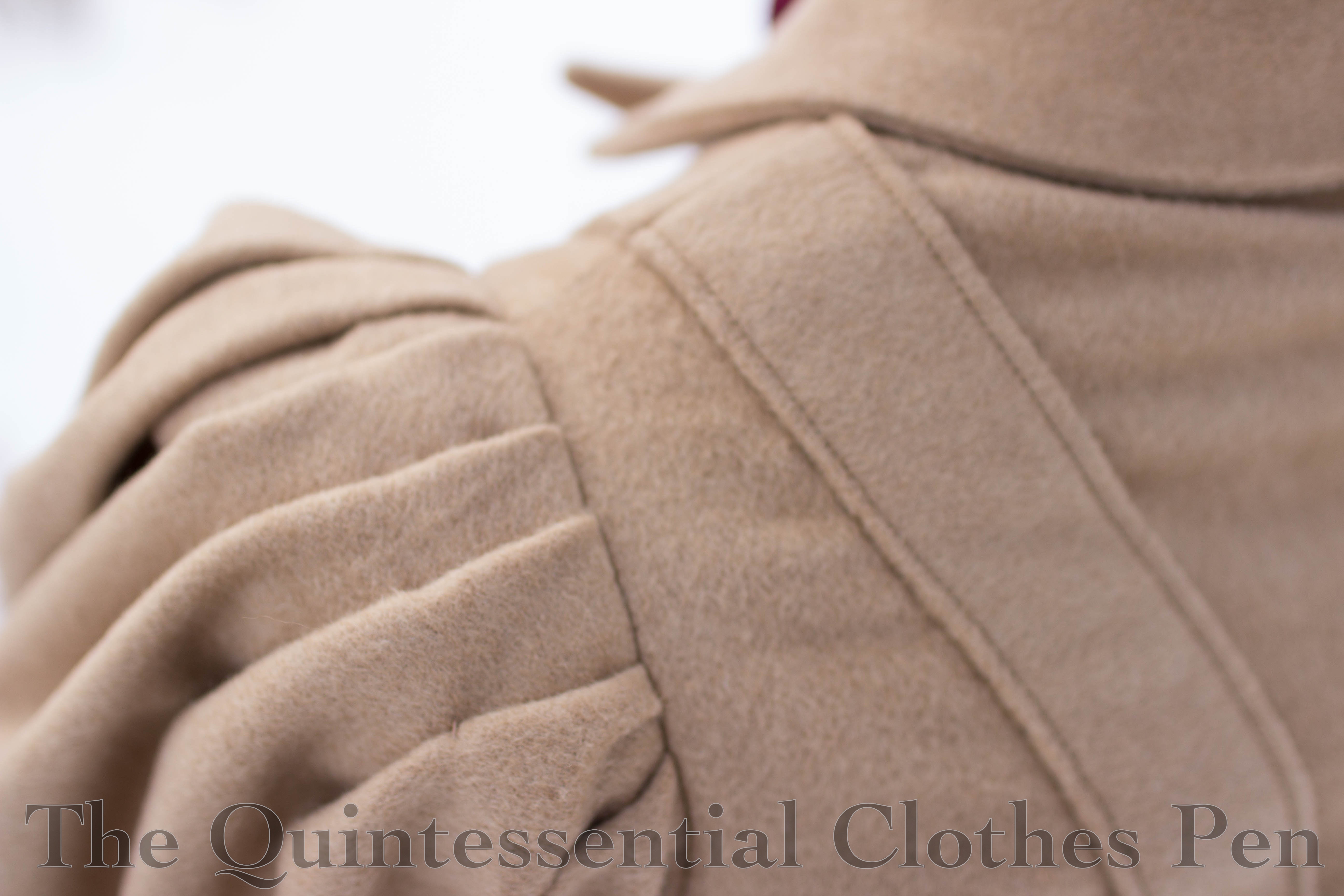
The sleeve pleats wouldn’t stand up on their own which made me a bit sad. My solution was to give them a bit of support… in this case I reused stiff net sleeve headers removed from 1980s dresses that I have a whole bag of in my stash. Each jacket sleeve has two of these sewn into the armsceye such that they stand up off my shoulder and help to support the pleats. In this photo I’ve just flipped them out to make them easier to see, but normally they’re tucked up inside the sleeve.

I also tacked the pleats together by hand about 1.5″ away from the seam. This helps keep the pleats nicely arranged and pointing up, which helps keep the fullness of the sleeves in check. In the end, this sleeve isn’t quite the same shape as my Met inspiration (here’s the link one more time), but that’s because it would have taken a lot more patterning time to determine exactly how the Met sleeve is shaped. I wanted to use my existing sleeve pattern and so I’ve decided to be happy with the sleeves I have.

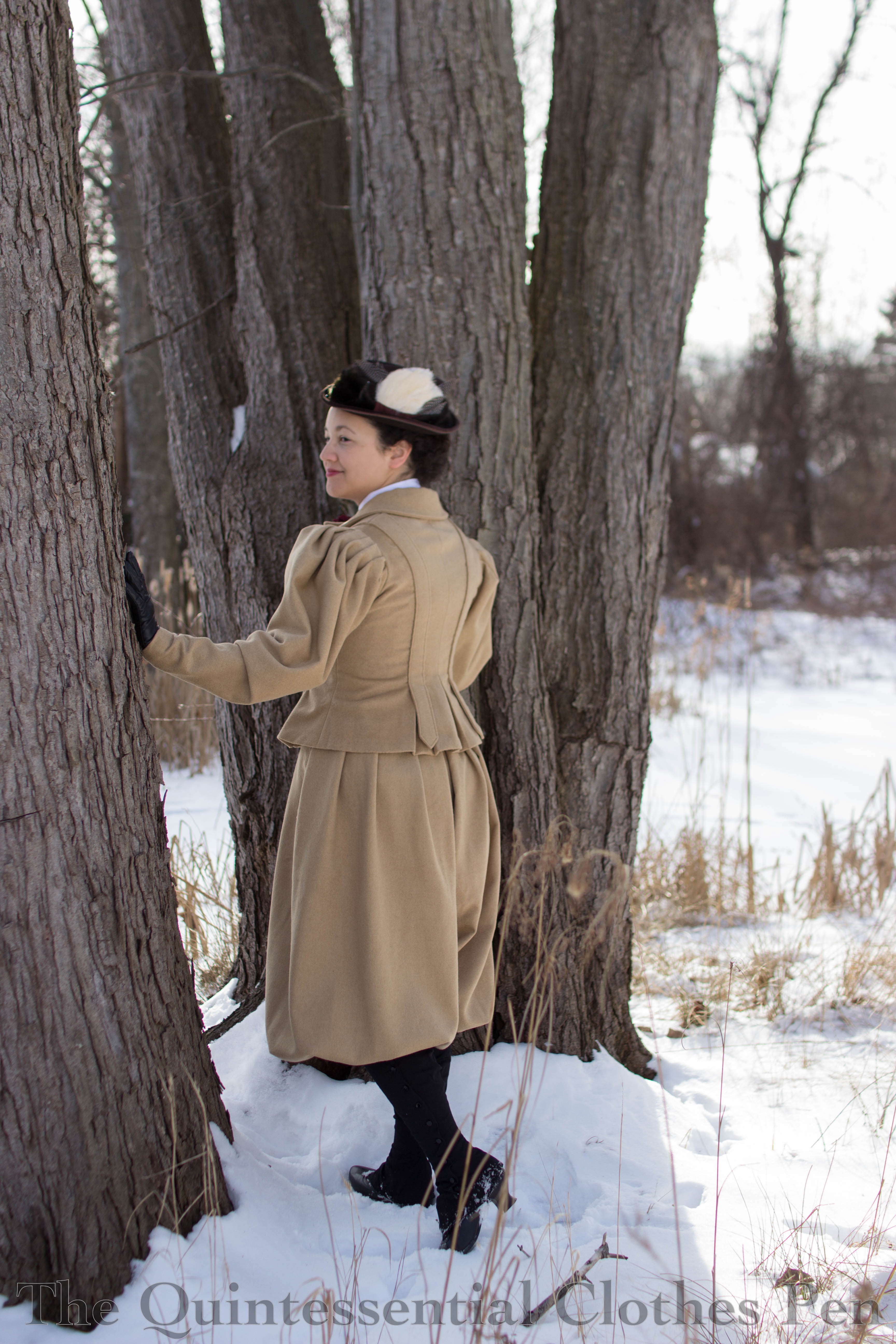
To recap, all these details and construction steps produce this! Slightly subdued 1890s puff sleeves, tailored jacket details, interesting strapping patterns, and bloomers!

People sometimes ask me how long it takes to make my garments and often I don’t have a good answer as I don’t actually pay attention. I’m in it for the enjoyment of sewing and unless something is going wrong and I’m frustrated I generally enjoy the process. For this ensemble I kept track, though, and I can report that it took me 22 hours to pattern, fit, cut, tailor, sew, and finish this jacket and bloomer ensemble.

I’ve collected some (but by no means all!) images of bicycling ensembles on my 1890s Sportswear Pinterest board if you want to see more of my visual research and inspiration. Thanks for sticking with me for a lengthy post!

1890s Women’s Bicycling Clothing: Patents & Advertisements

There’s still a post coming soon about the construction details of my 1896 Cycling Ensemble, but I have quite a bit to say so it’s taking a bit of time to write. While working on it I found some great examples of other ingenious bicycling clothing for women patented and advertised around this time.

I mentioned the skirt variations in the introduction post for the cycling ensemble:

“Most women in the 1890s stuck to the traditional, socially acceptable silhouette of an ankle length skirt for bicycling, but this could be dangerous as the skirt could become entangled in the spokes and chain while riding. Solutions to this problem included adaptations to the bicycle, such as a ‘skirt guard’ that sat over the rear wheel and kept the skirt from entangling itself, and adaptations to the clothing, including skirts with cords that could allow them to be raised while riding and skirts that were one piece in the front but split into legs in the back, as with a modern ‘skort’ (a skirt/short combination garment).” 

I thought it would be fun to share the patents I found that illustrate these other styles of skirts!

First, an example of a bicycle ‘skirt guard.’ The ‘skirt guard’ is visible on the back wheel on the bicycle. Here is a patent from 1898 showing a skirt guard, as well.

Next, I have a patent from 1896 for a skirt with an ‘elevator’ which would allow the skirt to be raised with cords to make cycling safer. You can see the bloomers she is wearing underneath when her skirt is raised. This would allow the cyclist to be appropriately clothed while not riding and safely clothed while on the bicycle.

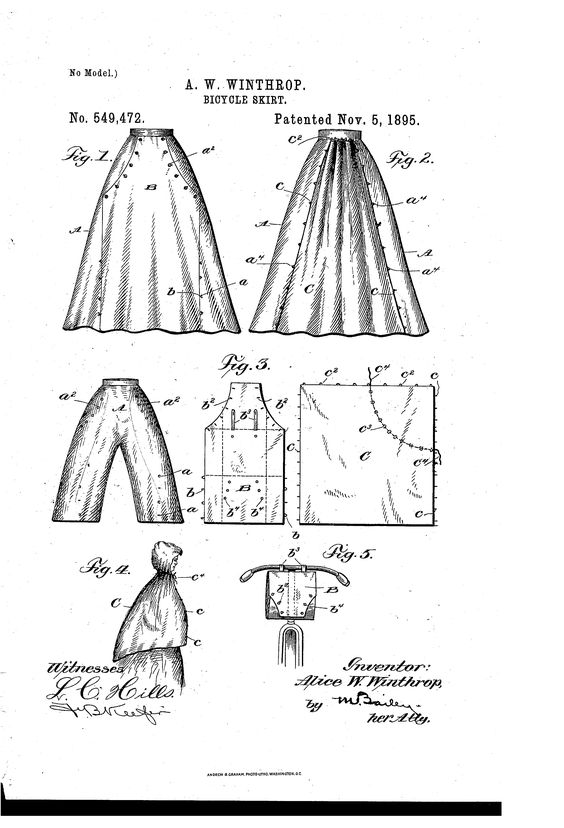
The next patent from 1895 shows the ‘skort’ style. This looks like a skirt in the front but is split in the back. The back is quite full, so that the appearance is that of a skirt.

Then I also came across this unusual method of a skirt with pieces that button on and off in front and back to reveal a bifurcated style underneath from 1895. It looks like this was designed so that the folded up pieces will hang from the front of your bicycle so you have them handy when you arrive at your destination. But I wonder how hard it would be to twist and bend in your corset to button and unbutton all of these connection points? My guess based on personal experience twist and bending in a corset is that it would be quite a challenge to do by yourself!

Here’s another interesting patent from 1896. These very full ankle length trousers that look like a skirt can be buttoned up around the knees to turn into knee length bloomers.

This image shows a women clearly wearing bloomers, but with a knee length skirt on top to still give a nod to the 19th century aversion to women opening wearing trousers (or bloomers).

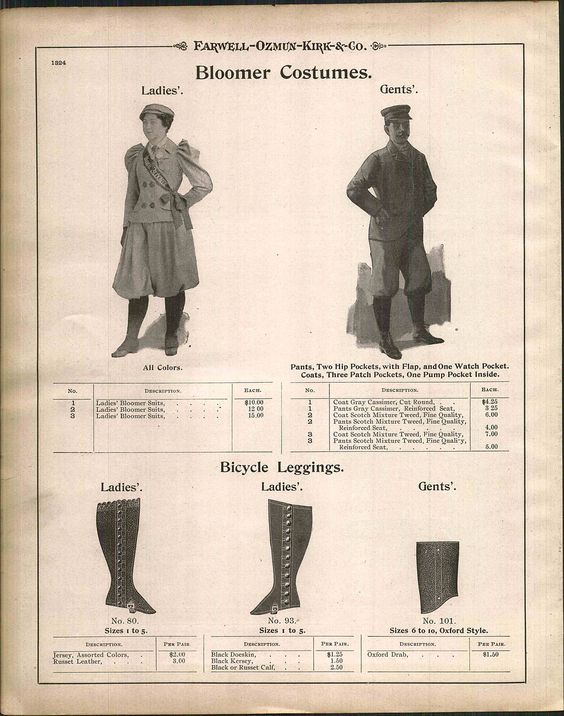
I love that most of these women are shown wearing their gaiters! It’s justification for my own pair. I came across this advertisement for ‘bicycle leggings’ as well. Neat!

Finally, here’s an example of a corset intended specifically for sportswear and athletic pursuits. It makes use of some stiffness as well as some elastic and is expressly made for activities such as bicycling.

Daring & Dedicated: My 1896 Cycling Ensemble

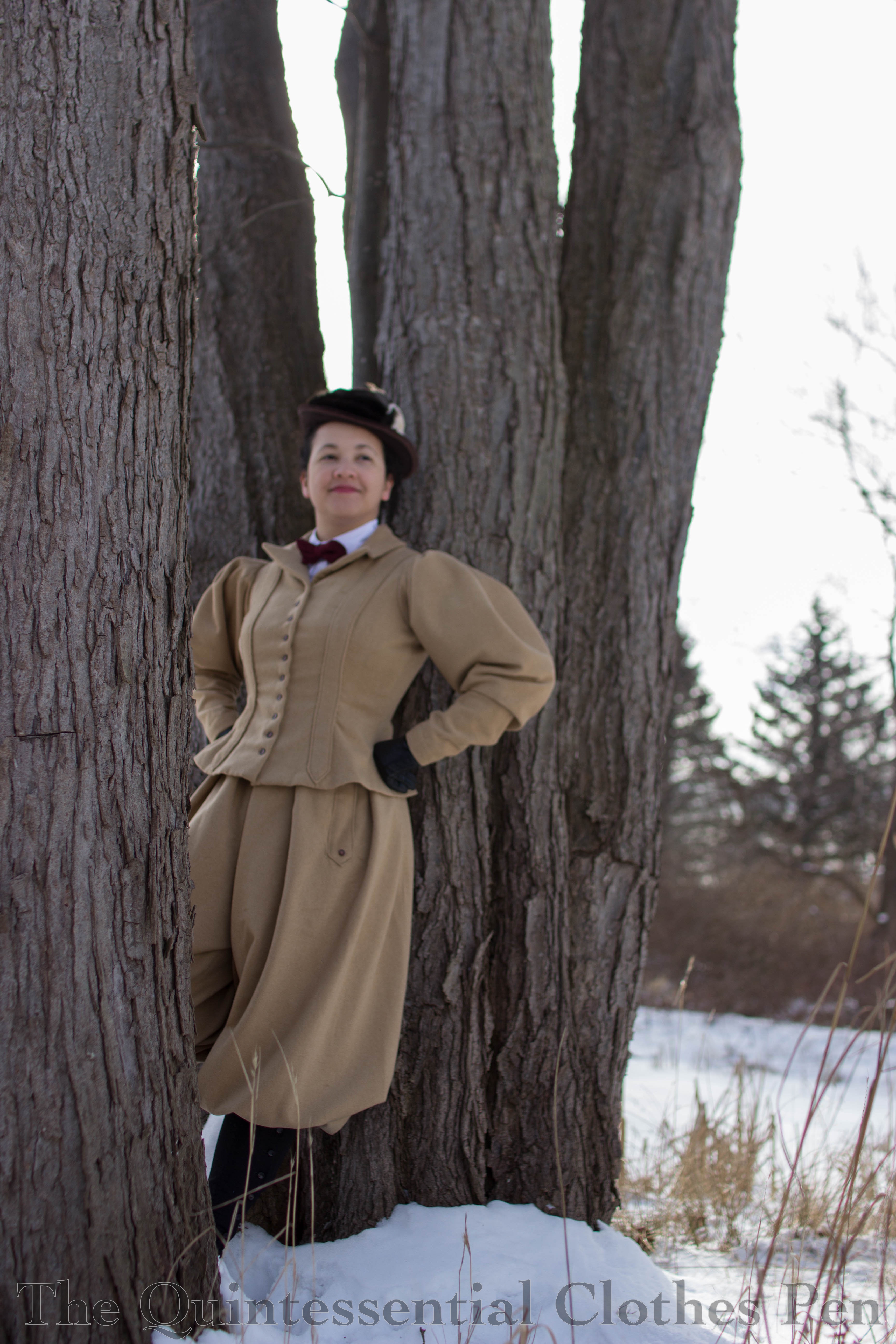
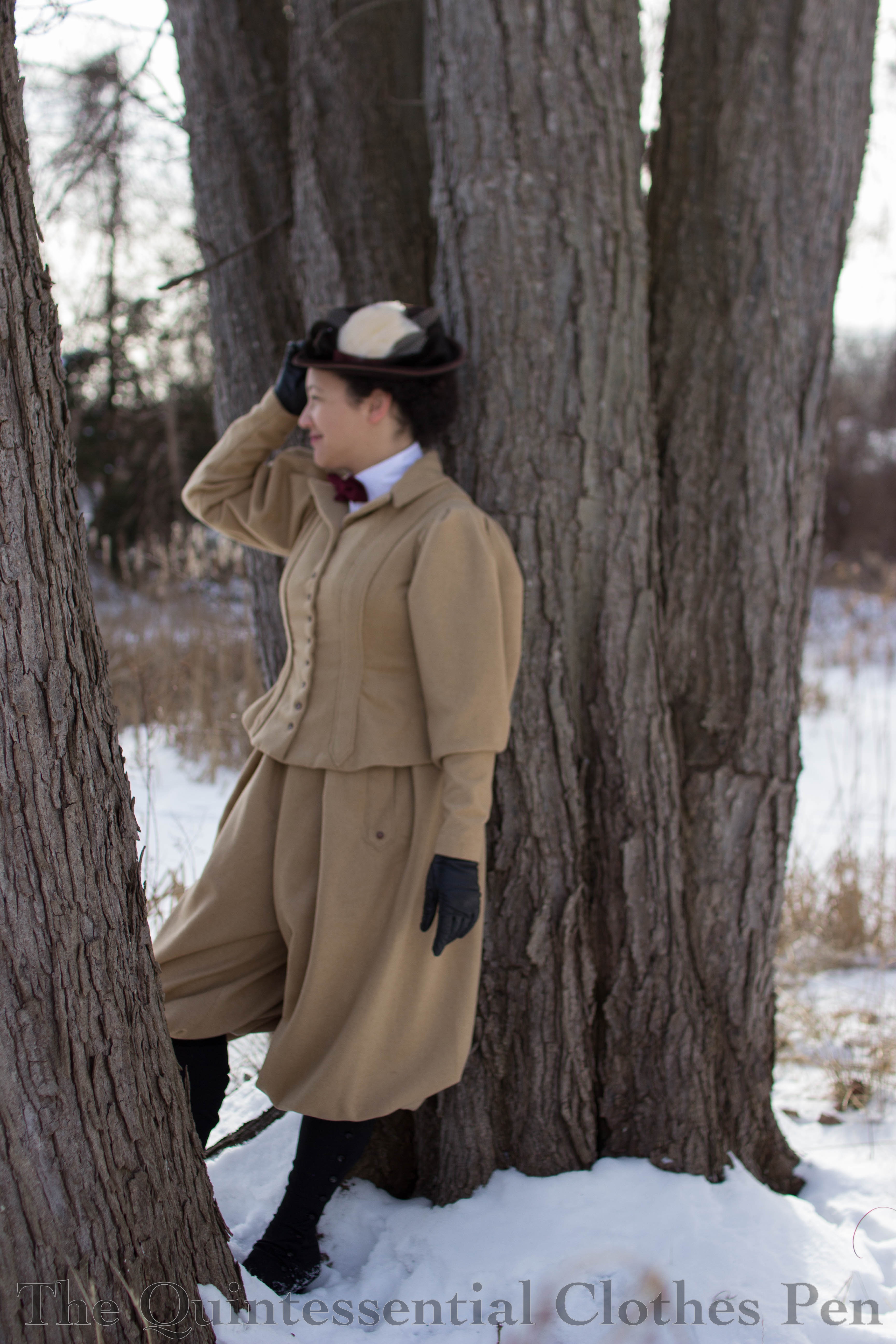
I’ve been hinting at the 1896 Cycling Ensemble I’ve been working on since December, first by sharing the black gaiters I made as part of the ensemble, then by sharing my deliberation and eventual decision to take a shortcut with two of the other accessories for the ensemble, and most recently by sharing photos of the shortcut accessories: a dickie and bow tie. Now it’s time for the reveal of the finished outfit in its entirety!
My inspiration for creating this ensemble is a talk I’ve been invited to give at both the Rhode Island Historical Society and the Newport Historical Society. The talk, titled Undressing History: Active Pursuits, Women’s Sportswear c.1900, will take a look at the clothing women wore to participate in sports and athletic activities during the late 19th and early 20th centuries. I’ll be actively dressing in multiple of my sportswear ensembles from 1885 to 1925, including clothing that could be worn for tennis, ice skating, bicycling, croquet, and swimming. I’ll discuss the cultural context of women’s participation in athletic activities during this time as well as the garments themselves: how they functioned while being worn for active pursuits, what they were made from, and how the silhouettes compared to non-sports clothing. I’ll be presenting this talk twice: on February 28 in Providence, RI and on March 28 in Newport, RI. If you’re interested in joining me, you can find more details about the event here.

As you might have noticed from my links to other sportswear ensembles I already own, I was missing a cycling ensemble. Bicycling became hugely popular for women in the 1890s, with a peak in 1896, so I felt that I must include this form of sportswear in my talk. And while I could use my 1895 skating ensemble as an example of the silhouette that would have been worn for bicycling while wearing a skirt, I felt it would be fun to show what the more daring and dedicated sportswomen of the 1890s wore: a bloomer suit. Full they might be, but those are pants!

Daring and dedicated, that’s me in this outfit. Most women in the 1890s stuck to the traditional, socially acceptable silhouette of an ankle length skirt for bicycling, but this could be dangerous as the skirt could become entangled in the spokes and chain while riding. Solutions to this problem included adaptations to the bicycle, such as a ‘skirt guard’ that sat over the rear wheel and kept the skirt from entangling itself, and adaptations to the clothing, including skirts with cords that could allow them to be raised while riding and skirts that were one piece in the front but split into legs in the back, as with a modern ‘skort’ (a skirt/short combination garment).

While that is amusing, I thought it would be more fun to make the most socially daring option: fully bifurcated bloomers. Some women wore these under a skirt while riding in order to maintain modesty. And some women, daring in terms of breaking the social conventions of the time and dedicated in terms of taking advantage of the newfound freedom a bicycle afforded, wore skirts that they would remove while riding, with bifurcated bloomers such as mine underneath.

Interestingly, a fashionable, tailor-made wool jacket like this could cost as much as $50 in 1896. Calculated in today’s dollars, that would be over $1,000. Quite a sum, and that doesn’t even include the bloomers or accessories! For those who had less disposable income, a linen suit provided a more economical option. With cheaper fabric, a dressmaker instead of a tailor, and patterns shared amongst customers, a full linen suit could be obtained for $7. That’s down to just about $150 in today’s dollars.

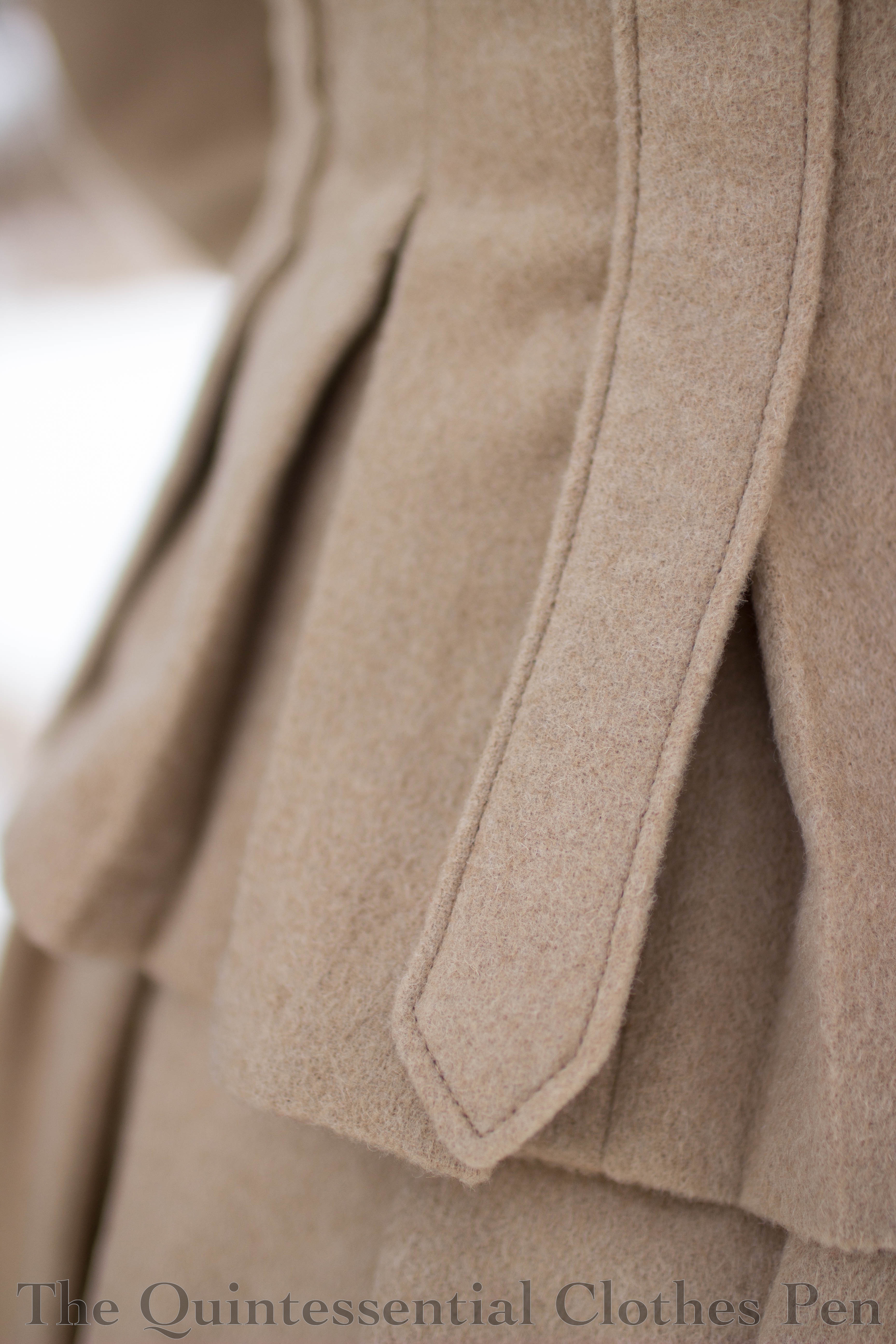
I have lots of construction details to share from making the bloomers and jacket, so there will be a detailed post focused on that soon. For now, here are a few close up photos of details, including my hidden pocket!
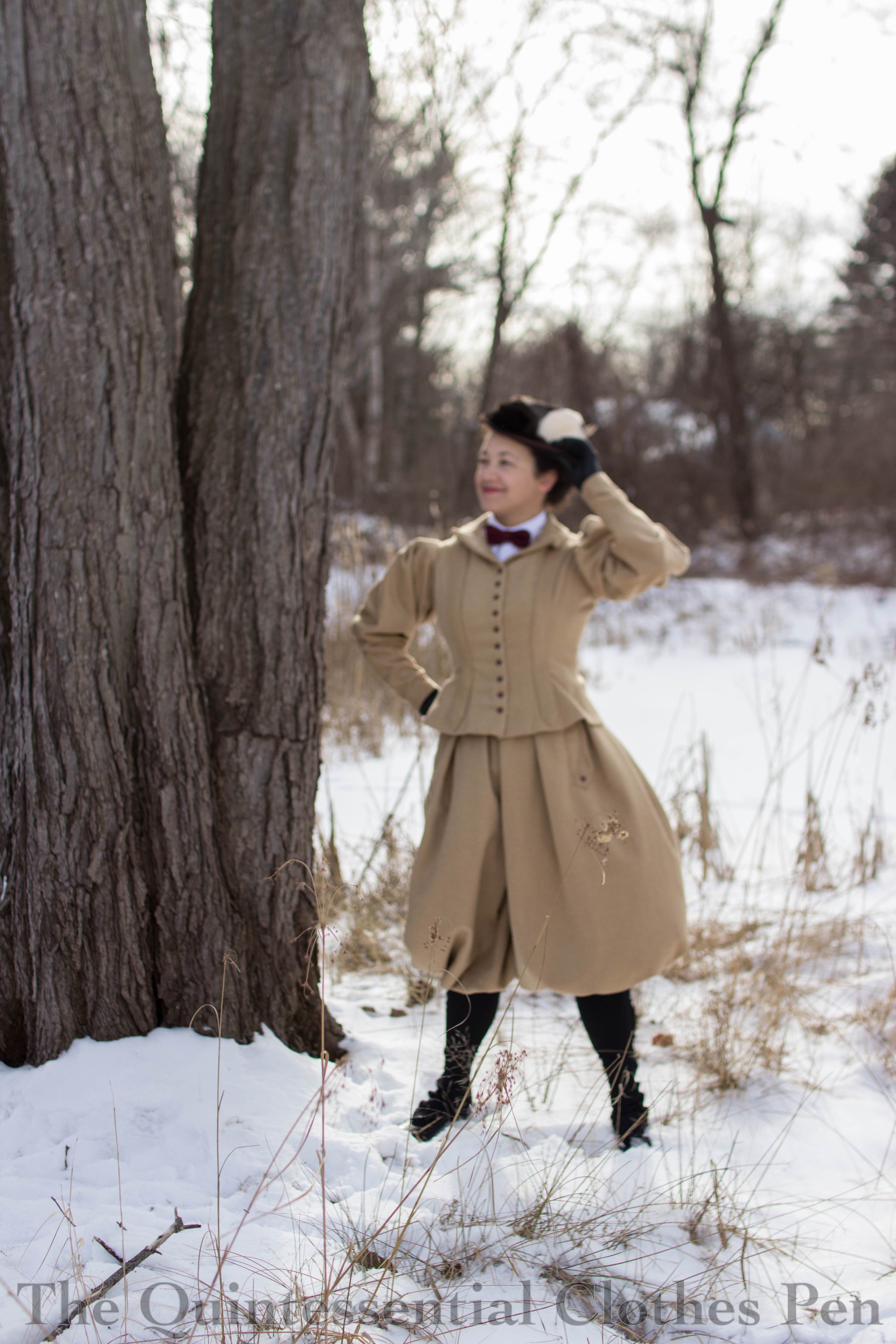
It was an exciting adventure to get photos of this outfit. In order to get timely photos I had to take the outdoors as I found it, snow and all. I valiantly tromped around, but I’ll admit that my feet were getting pretty wet and cold by the time we were done! Here’s a behind-the-scenes action shot on the way to getting the more finished photos–following my photographer’s path in the snow in a rather futile effort to keep the snow out of my shoes.

Sometime in the spring, perhaps, I’ll be able to ride a bike in my ensemble and get photos that give more context. In the meantime, we got some lovely winter-y photos and had some good laughs! Thanks to my intrepid photographer for making the time to take photos!


Summary Of 2018: Looking Forward To 2019

2019 feels awfully close to 2020 to me… and 2020 sounds like it should still be far away! Luckily, my feelings about how far away a year feels have nothing to do with how much sewing and fun I have in each year! So I’ll leave my feelings aside and recap my sewing adventures from 2018 instead.

To start, projects I completed!

January: Third re-do of 1928 Green Silk Evening Dress (HSM #1)

February: c. 1955 Evening Gown with Queen Of Hearts sash

March: 1934 Metallic Evening Gown

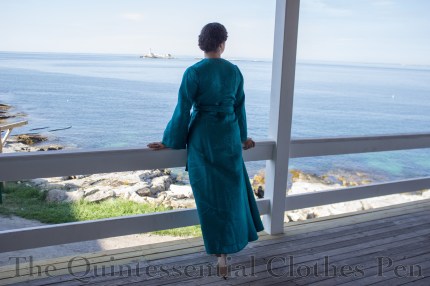
March: c. 1935 Dressing Gown & Slip

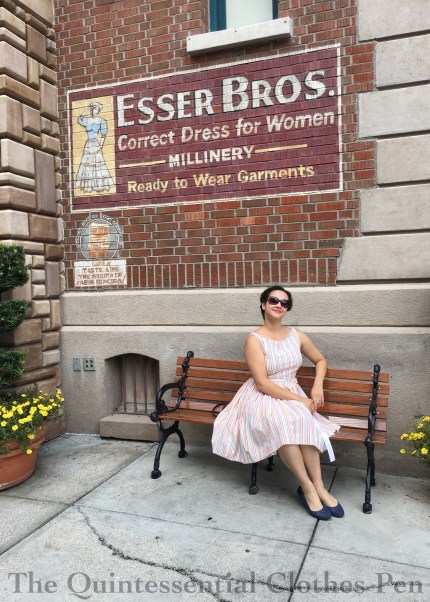
July: A New Old(er) Dress

August: 1925 Blue Coral Day Dress (HSM #8)

September: 1925 Lace Cloche

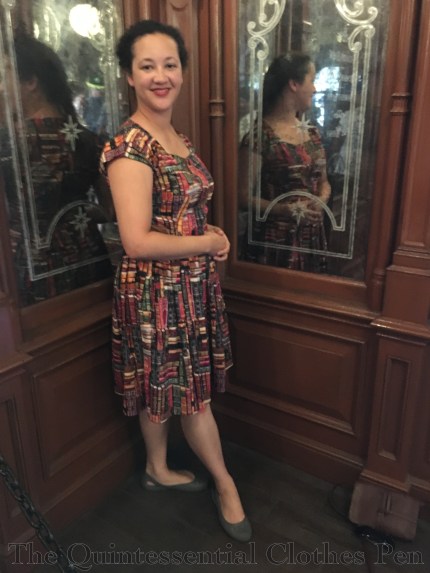
October: Vintage Inspired Book Dress

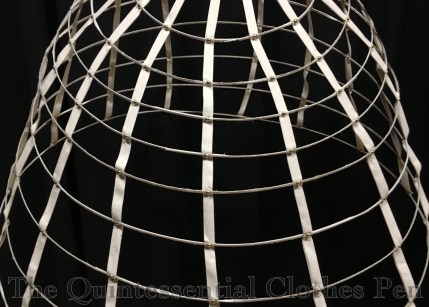
October: Gave My Old Hoops New Spots

November: A Fortescue Frock

December: 1920s Beaded Bag (HSM #11)

December: 1926 Silver Robe de Style

December: 1896 Black Gaiters

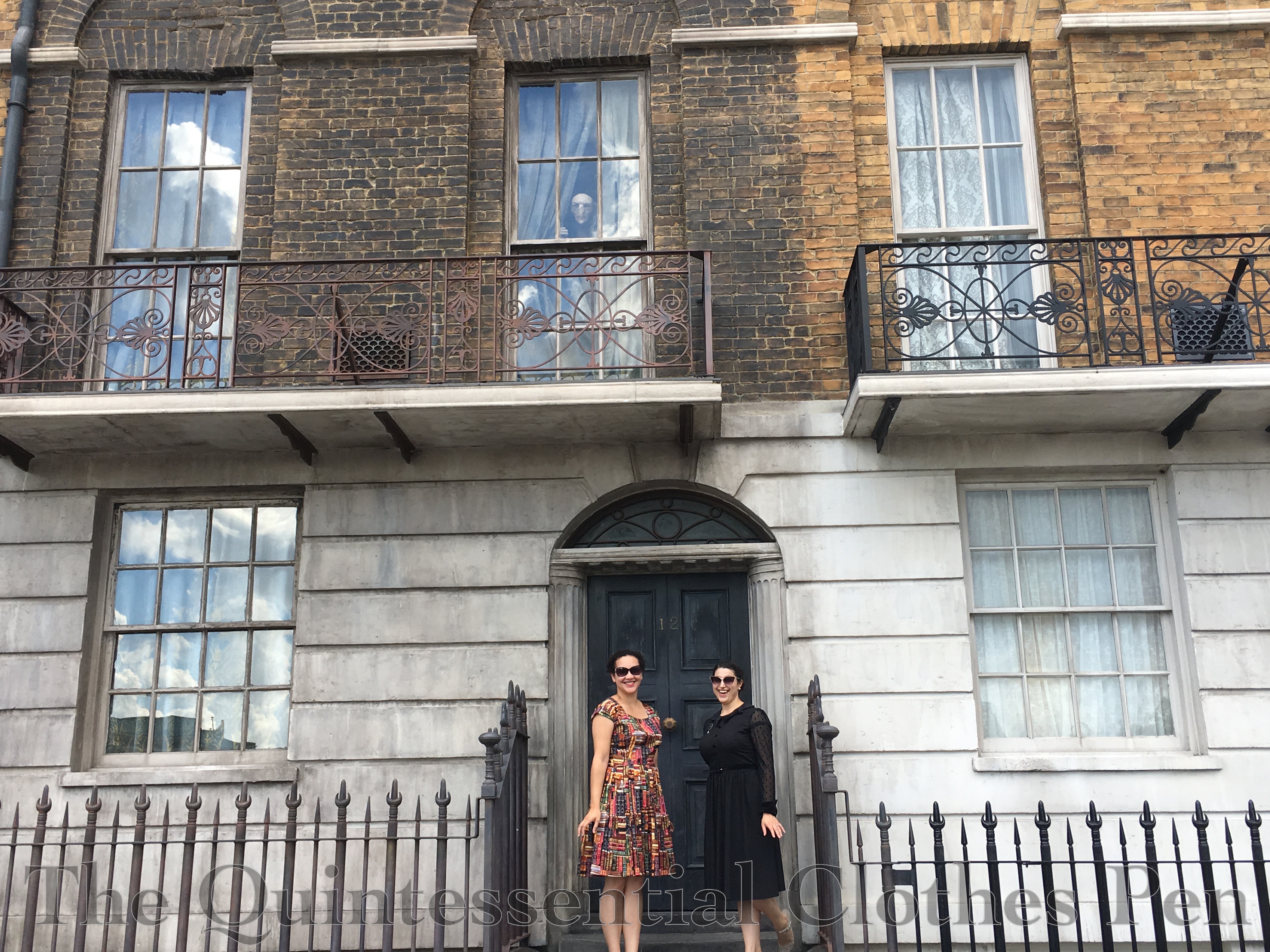
In May and June, I finally posted about my trip to Denmark in 2017 to attend a vintage dance week. That was three separate installments: Part I an introduction to the trip, Part II photos of the events, and Part III documentation of our sightseeing adventures. I also passed along the Mystery Blogger Award and the Liebster Blog Award in June. I appreciate all of my readers and am grateful that you’re interested in sharing my sewing adventures with me! In August, I started a new adventure, #virtualsewingcircle, a livestream of my sewing via Twitch; however, I realized that this format of sharing my sewing did not work for me at this time with my other life activities. I’ve still been plugging away at the projects I announced and I’m still using the hashtag for them on Instagram, but the live sewing is currently on a break. In September, I had the great fortune of going to The Wizarding World of Harry Potter in Florida, which allowed me to photograph two new dresses seen above. The Fortescue Frock was sewn live on Twitch over the summer and the Vintage Inspired Book Dress was made awhile ago but took me this long to photograph!

I participated in my sixth year of the Historical Sew Monthly in 2018. This year I completed only 4 of 12 challenges since I had a lot of other sewing on my plate that did not count but kept my hands quite busy. Hopefully next year I’ll participate a bit more.

In 2018, I attended 10 balls, 7 other events (teas, picnics, outings etc.), and 4 vintage dance performances. That’s generally in line with my numbers from last year.

Last year’s deinfitely-to-do list was intentionally conservative so I could feel like I actually accomplished it. And… I’m proud to say that it was done by March! Of the things on the ‘maybe’ list, I finished one modern dress, made two more, and made a modern wool skirt. The only one of those that hasn’t made it to the blog is the skirt. I wear it all the time and really need to get photos! It’s a lovely cranberry color!

I also have a number of things that I made towards the end of last year but haven’t posted about yet–all made while I was sewing live on Twitch. I couldn’t keep up with photographing all the things I was producing! These include a new Henrietta Maria, a 1933 summer dress and hat, and another modern dress–the Autumn Plaid dress. So one of my goals is to share about those early in 2019. In addition, my definitely-to-do list for 2019 includes:

  • finishing an 1896 cycling ensemble I started at the end of last year
  • finishing a 1925 coat that I announced I would be making at the end of last year

And of course there are maybes. Many of these are the same as last year!

  • a new 1860s evening dress
  • finishing the 1884 plaid wool day dress I started in November 2017
  • 1880s wool mantle
  • sewing the 1790s stays I started in the winter of 2018
  • 1790s petticoat
  • 1790s dress
  • modern dresses, pants, and skirts (I have lots of fabrics and patterns, I just need time…)

Wishing you a very happy new year!
(I think Kreacher wishes us a happy new year, too!)

1896 Black Gaiters For A Sporting Look

Five years ago (yikes, where did the time go?!?), I made ivory gaiters. They were made to wear over heeled shoes, giving the look of two tone boots. Unfortunately, the ivory gaiters I already have don’t work for the the 1896 cycling ensemble on my sewing table! Ivory gaiters would show dirt and be rather impractical for the sporting look, so I decided to make utilitarian black ones for this outfit.

I used the same pattern as for the ivory gaiters with only a few modifications: the top edge curves in a bit more over my calf and the back heel is longer so it stays on top of my shoe (in my blog post about the ivory gaiters I share about how they were riding up over my shoe–I solved this with a little piece I added in after the photos were taken, but for the new pair the pattern was cut longer instead). It was lovely to have a pattern ready to go!

I’m pleased that I squeezed this small project into 2018. I can count it for the HSM Challenge #12: Neglected! This challenge is sort of a catch-all for making something that fits into a previous challenge either from this year or a previous year. I chose the September 2018 challenge, Hands and Feet, for this December challenge.

Just the facts:

Fabric: About ¼ yard slightly stretchy black cotton.

Pattern: Created by me.

Year: 1896.

Notions: Thread, ¼” and ½” cotton twill tape in various widths, and plastic buttons.

How historically accurate?: 90%. The look is right but the materials are a mix and match of right and modern.

Hours to complete: Approximately 5.

First worn: Not yet!

Total cost: $5 for the buttons. The fabric and twill tapes were in my stash!

These are constructed in the same way as my previous pair. The seams are covered with ½” twill tape, the edges are bound with ¼” twill tape, there is a strap (in this case made of the exterior fabric), and then buttons and buttonholes finish it off.

The great thing about my gaiter pattern is that they work for a few different decades. The ivory pair was made for a 1917 outfit, but I feel perfectly confidant that the pattern works for the 1890s and 1900s as well. I’m looking forward to trying these on with my cycling ensemble once that is far enough along to put all the pieces together!

1926 Silver Lace Robe de Style

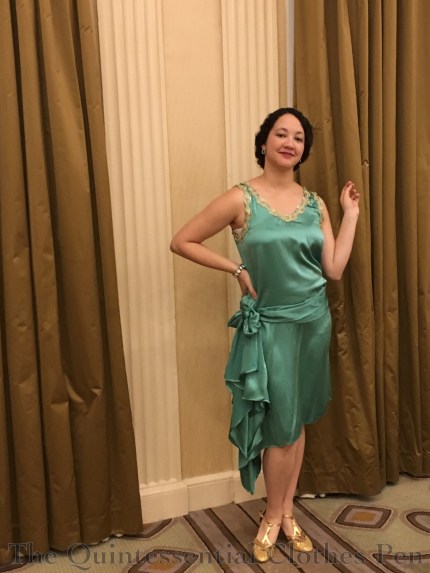
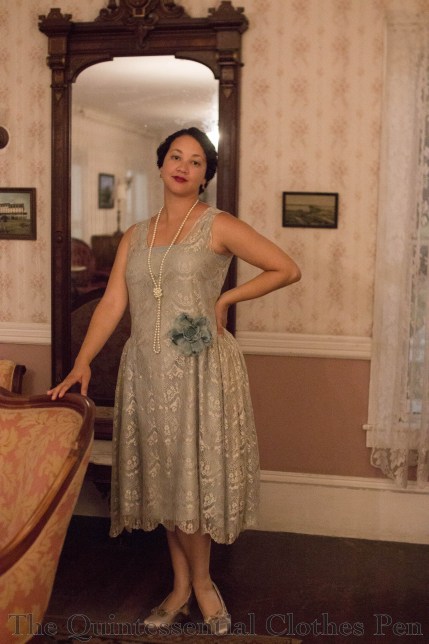
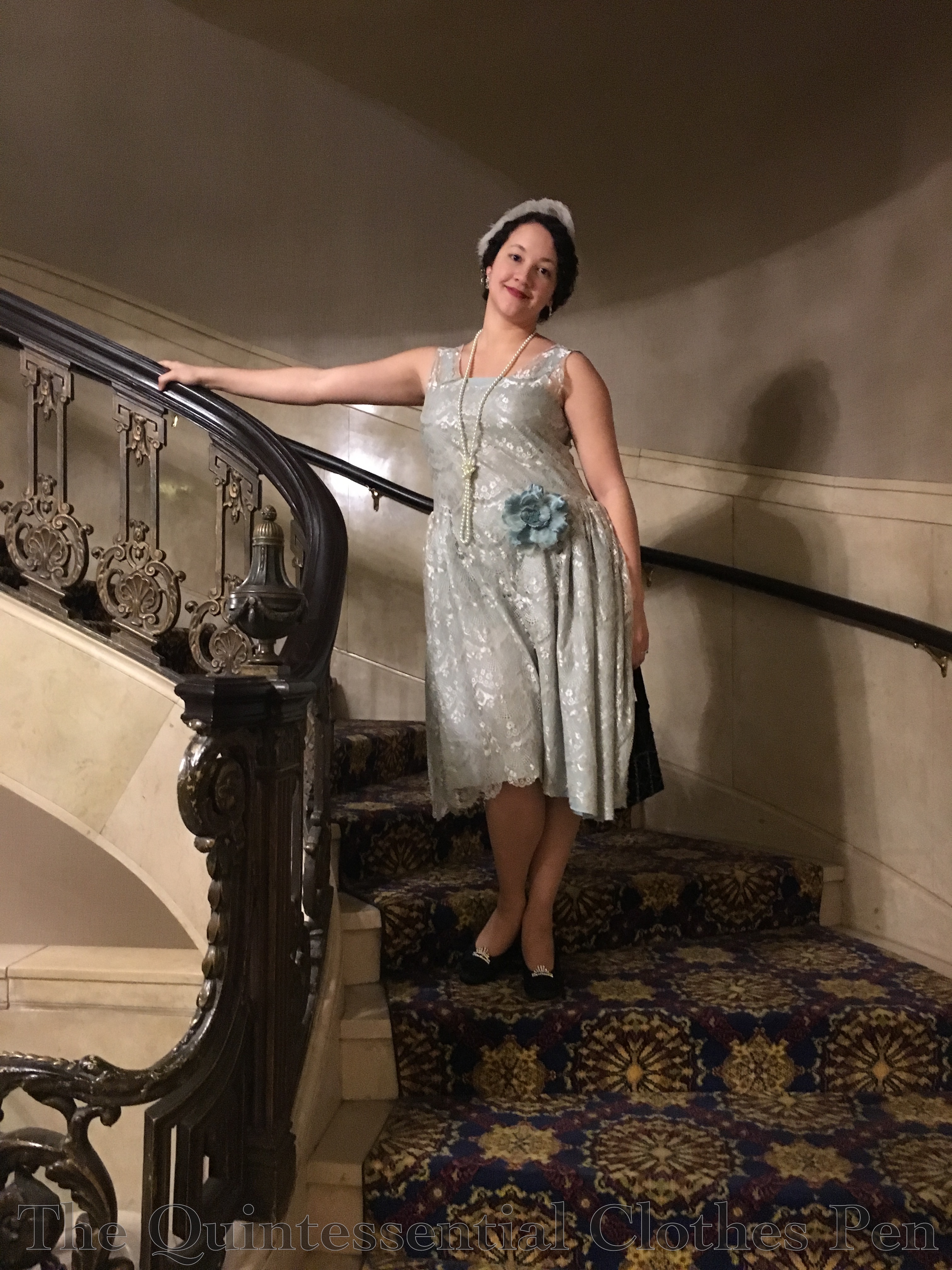
One of my summer sewing projects was a new 1920s robe de style. (And yes, I am clearly delayed in posting about it!) I already have one (my 1924 Golden Robe de Style) but I stumbled across a lovely lace at Joann Fabrics in the spring that called to join my wardrobe as a second dress in this category. I attend enough 1920s evening events that I can never seem to have enough dresses. Doesn’t that sound grand written out? I actually do have plenty of dresses, but it’s nice to have variety and cycle through different styles, types of fabrics, weights, etc.

I’ve enjoyed wearing my first robe de style and wanted to try another one with different characteristics. The 1924 golden one is made of silk taffeta and has an ankle length skirt, but I wanted this one to be much lighter weight and shorter in length. I also wanted a different neckline. After looking through my Robe de Style Pinterest board for inspiration I settled on this dress, a Boué Soeurs robe de style from fall/winter 1925-6. This is where my date of 1926 for my new robe de style comes from.

Obviously the lace is not opaque so as with the original dress I needed a lining. I settled on the icy blue because it was from my stash. (You’ve seen this fabric before, in my 1899 evening gown.) It was great to use a stash fabric for cost saving and stash-diminishing purposes as well as the fact that the colors coordinate. And, I was able to accessorize with a large flower pin in a very similar color that has been in my stash since before I had a fabric stash! Isn’t it wonderful to find good homes for odds and ends like this?

In addition to the flower pin, I also wore my extra long strand of faux pearls, my American Duchess silver Seabury shoes, and vintage silver hair pins. Oh, and earrings. But I can’t remember which ones and I can’t tell from the photos which pair they are. I’ll have to figure that out again next time I wear this dress!

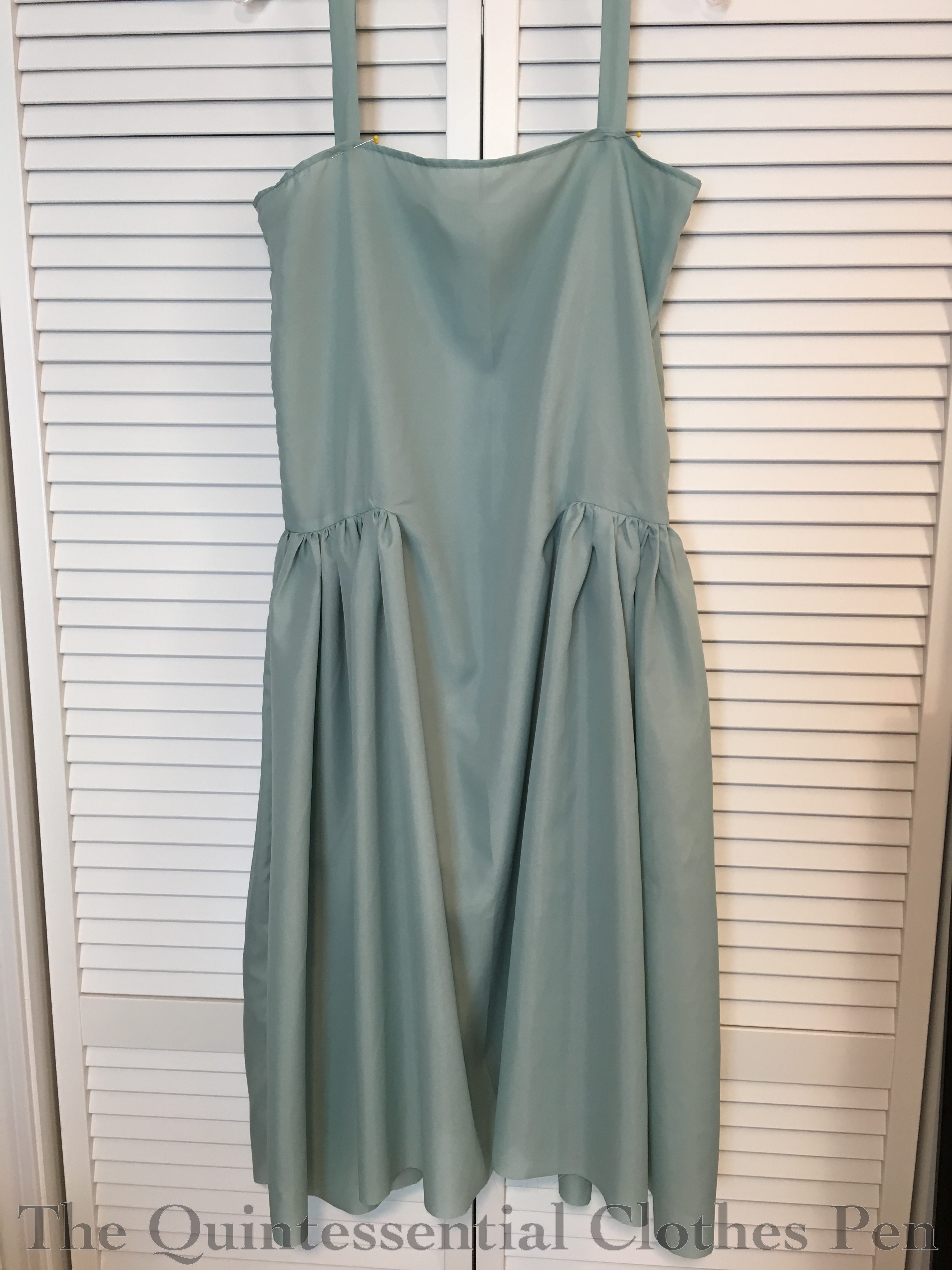
The pattern for this dress is me-made, composed of mostly rectangular shapes based on my measurements. The body of the lining is basically an upside down T shape, where the sides are gathered into a slit that extends into the main body on each side by a few inches. (You can see what I’m talking about in the photo below.) The lining has a straight top edge with rectanglur straps attached. The hem angles down slightly on the sides intentionally. I still wanted an uneven hem as with my 1924 dress, but I wanted a less dramatic difference than with that dress.

The lace layer was a little more complicated. I wanted an uneven hem to match the lining, but I also wanted to keep the hem following the scallops across the fabric. So… I had to keep my hem straight. That means I had to make the tops of the sides curve up since the bottom couldn’t curve down, but that meant I couldn’t cut my lace layers as a T, because the curve up would cut into the sides of the dress.

My solution was to add a seam across the lace pieces at the height of the gathers. To do this I perfectly matched the scallops, carefully layered and stitched them with a narrow zig zag, and then trimmed away the excess fabric to make the seam almost entirely invisible. Can you spot it in this photo?

I also had to trim away the ‘eyelash’ bits left over after cutting along the scalloped pattern along the hem. This photo shows that step in progress. A bit tedious, but worth it!

Unlike the lining with its straight top edge, the lace has a v neck on one side and a scoop on the other. This layer is interchangeable in terms of which is front and back, since they’re the same with no special shaping. The edges of the lining are finished by machine while the neckline and the armholes of the lace are narrow hemmed by hand.

This new dress can be worn with or without panniers, but for the first wearing I went without in order to make the full skirt more subtle and to differentiate the dress from my 1924 Golden Robe de Style (which needs to be worn with panniers).

While this dress could be worn at any time of year, I am particularly enchanted with the idea of it being perfectly suited to a 1920s New Year party. The colors and silver lace seem well suited to that theme.

And on that note, in case I don’t get another post in before 2019… happy new year!

Giving Old Hoops New Spots

Spots are this nifty piece of hardware that can be used to secure interlocking pieces together. They’re similar to a brad in that they have two prongs on the back of a circular top. The difference I see is that they have a domed top and the prongs come out from other side rather than the center.

Back in April, I posted about the dimensions of my large hoops and how I made my new smaller hoops and stated the goal of adding spots to my old hoops just like I had done for the new hoops. Over the last six months I’ve been slowly adding the spots to my old hoops and I’m pleased to report that the process is complete! My ten year old hoops have reinvigorated life!

For the new smaller hoops I used brass colored spots, but I decided to change it up for my older hoops and used gold colored spots instead. (Both of the spots were purchased from this seller on eBay, who I would certainly recommend.) I’d originally intended the vertical tapes on these old hoops to be able to slide around when needed so that I could force the hoops into an elliptical shape, but since I haven’t done that even once in the last ten years I figured that if/when I want elliptical hoops I’ll make a new support structure and will reinforce these hoops in their current cupcake shape instead of contingent to allow them to be adjustable.

My spots are positioned so that the prongs are at the top and bottom of each horizontal wire. I poked the prongs through the twill tape then used pliers to bend the prongs towards each other to secure them in place. The nice thing about the spots is that as they are folded back you have control over how tightly they are attached. So technically they are still loose enough that I can scoot the vertical tapes around if I really want to. But will I? Probably not.