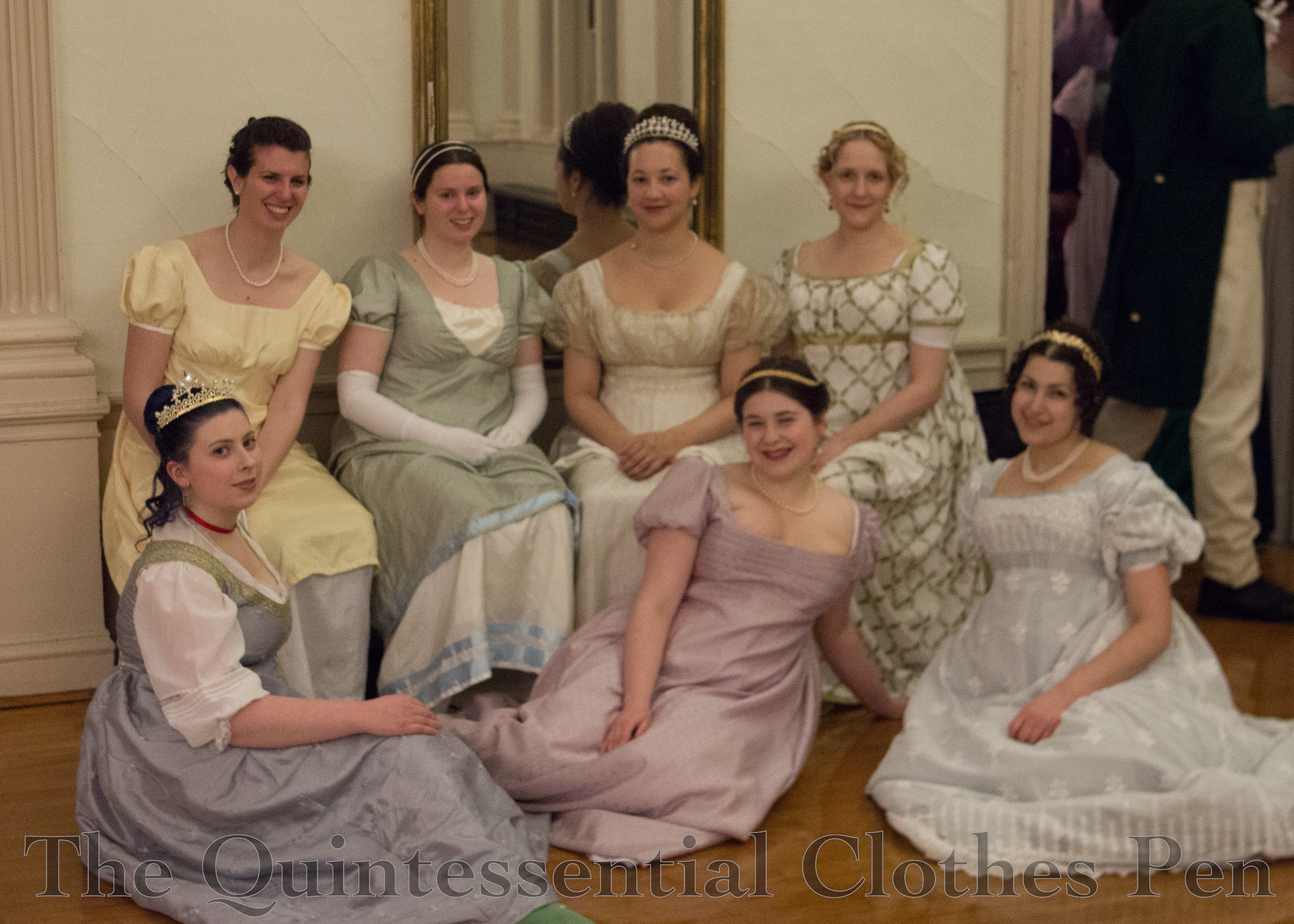
Croquet At Roseland Cottage

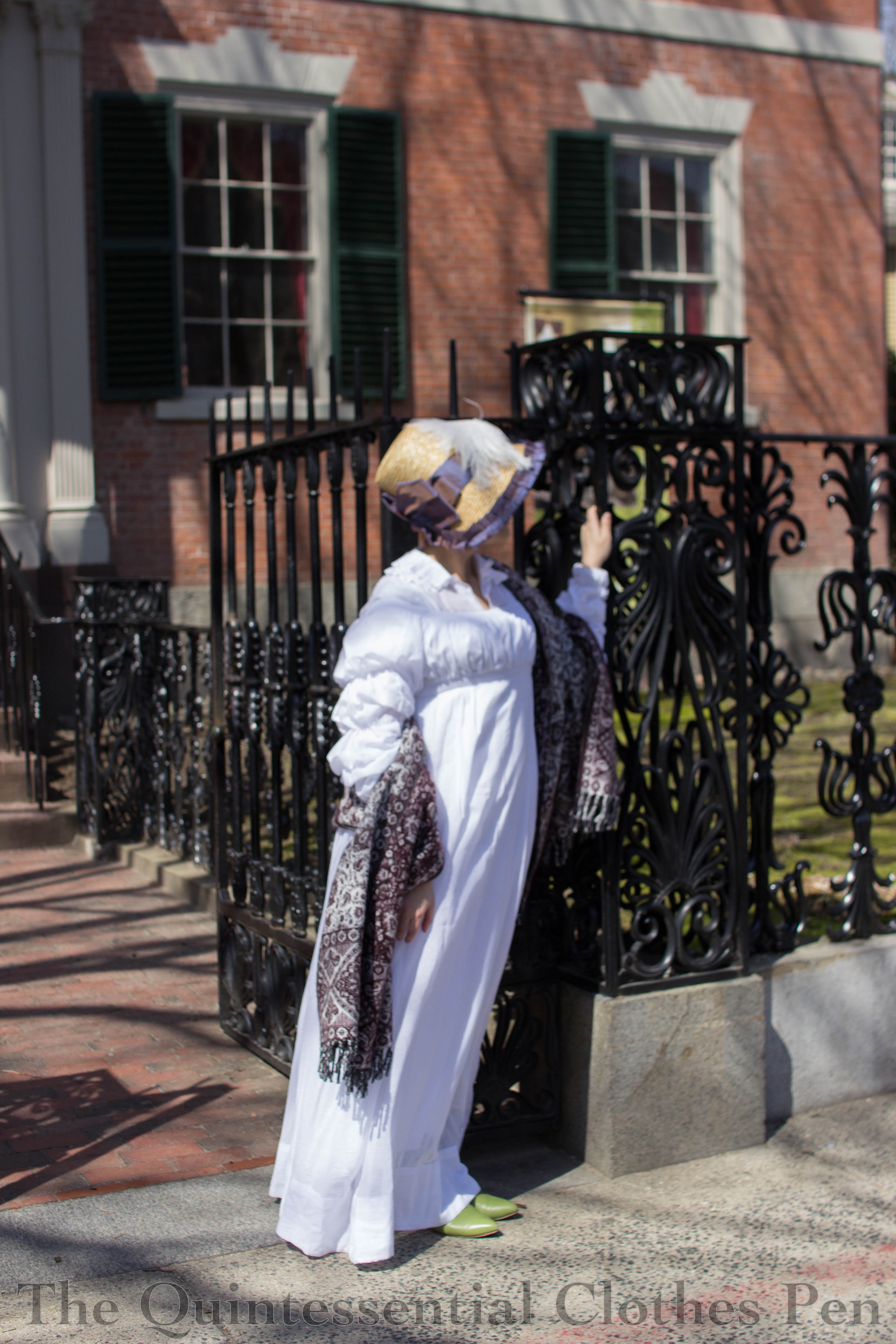
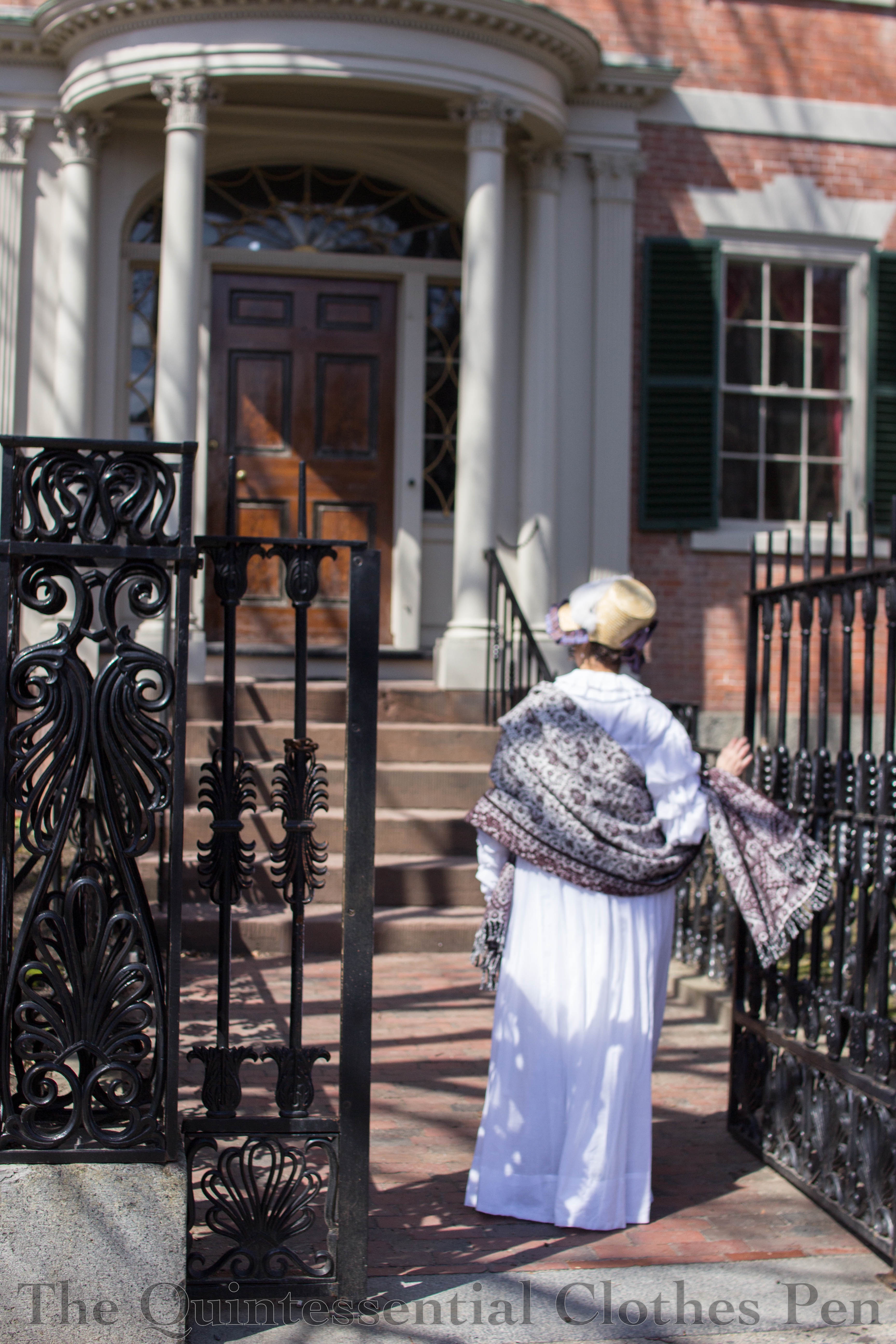
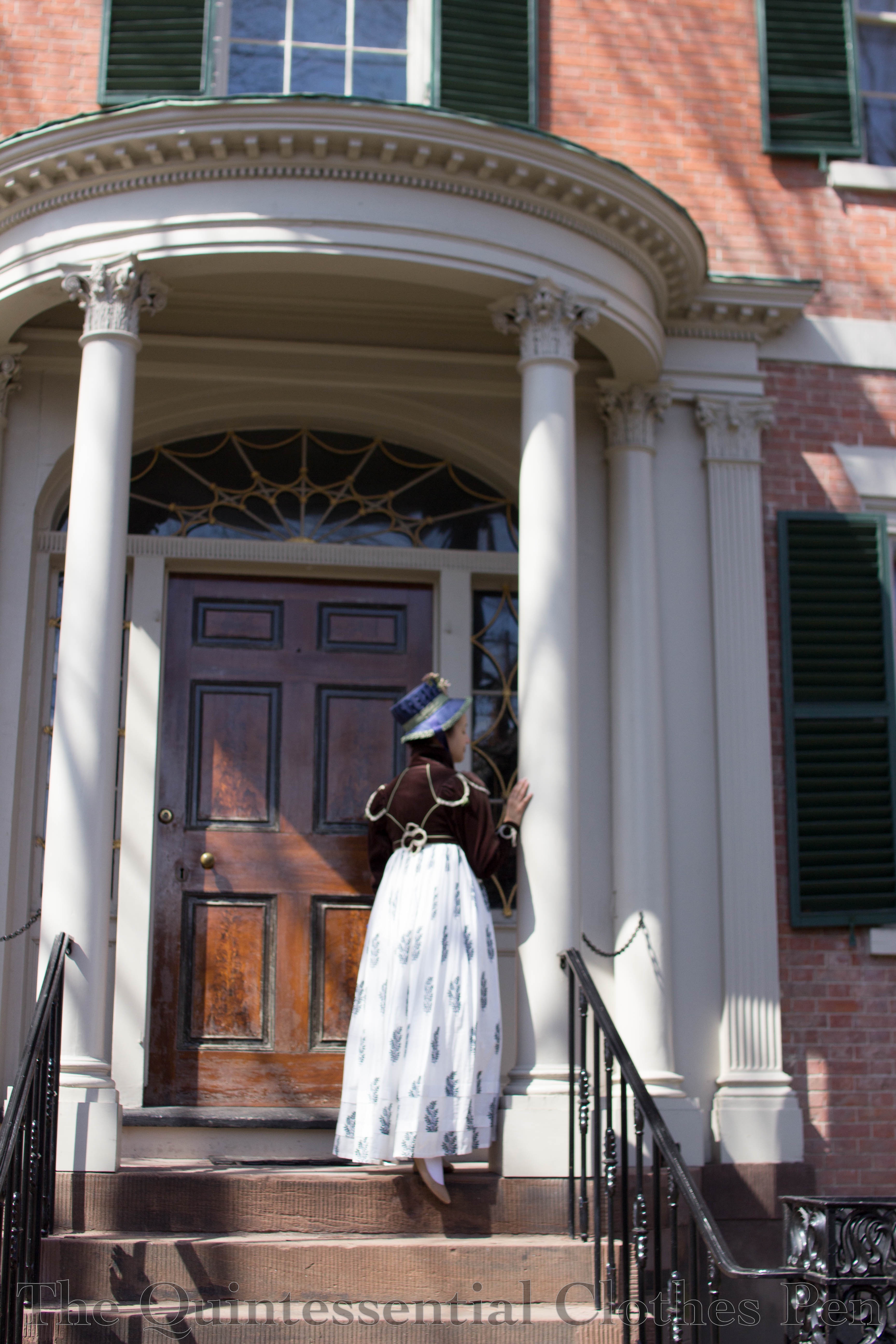
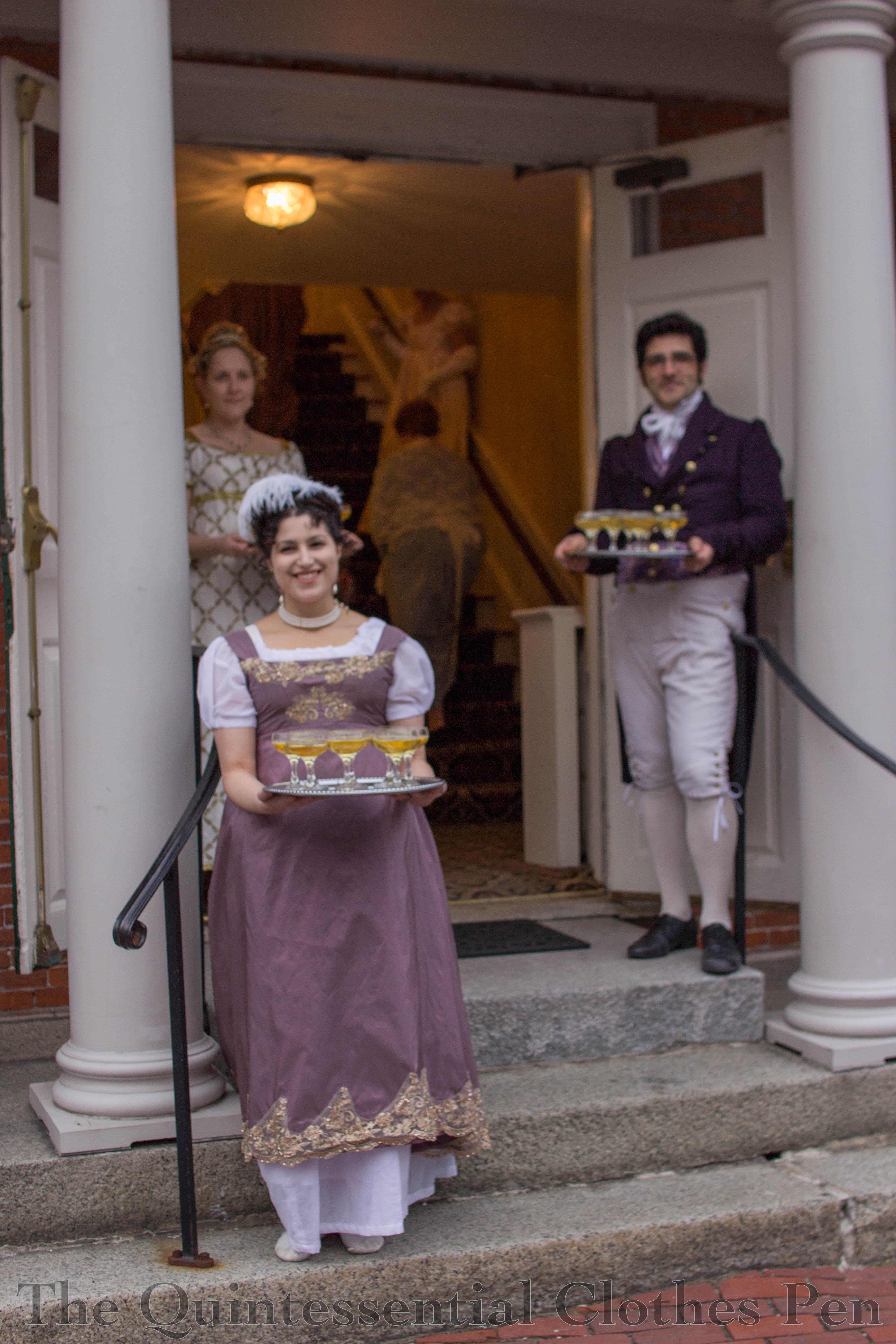
The outing for which I planned to wear my updated 1815 Tree Gown was an afternoon of croquet and house tours at Roseland Cottage: a joint event hosted by The Footwork & Frolick Society and Historic New England (the organization that runs Roseland Cottage).

Roseland Cottage is a lovely pink house in Woodstock, CT that was built in 1846 by the Bowen family (you can read more about thr history of the house here on the Historic New England website). I’ve been to the house before and posted about it on the blog — in a different post about playing croquet! That outing, which you can read about in this past post, was in 1860s clothes.

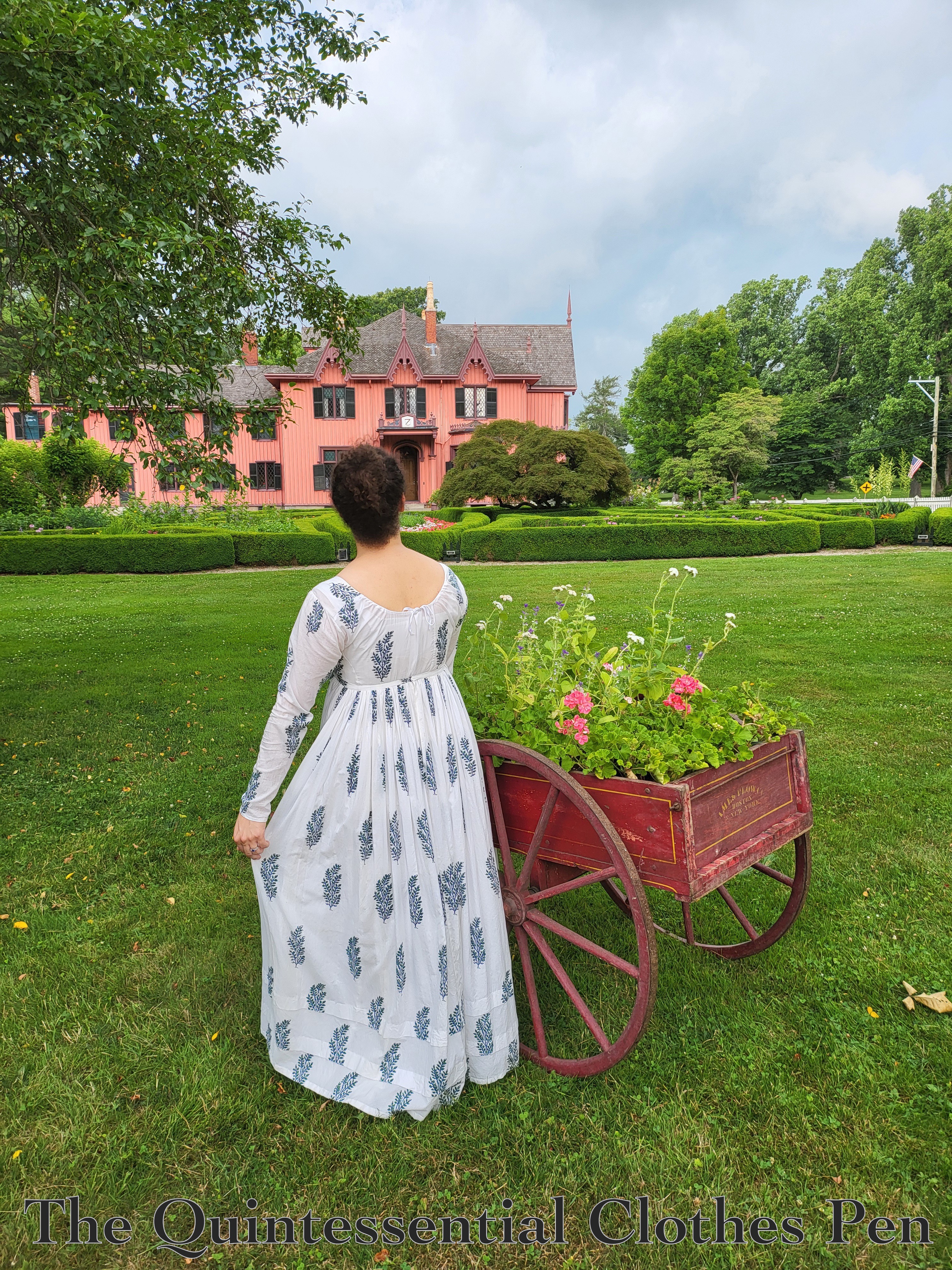
A rather moody looking Roseland Cottage on the day of this year’s outing is pictured below. It was overcast, which was nice because it wasn’t super hot, but we did have a fantastic rain and thunder storm roll through halfway through the event. Lightening struck the lawn outside of the house! Luckily, we knew it was coming and were able to transition indoors to play tabletop croquet and have tea. No one was rained on!

And I was pleased, because Roseland is lovely, the company was delightful, and my updated Tree Gown was freshly revived and very comfortable!

It felt important to show off the updated back of my gown for documentation here on the blog!

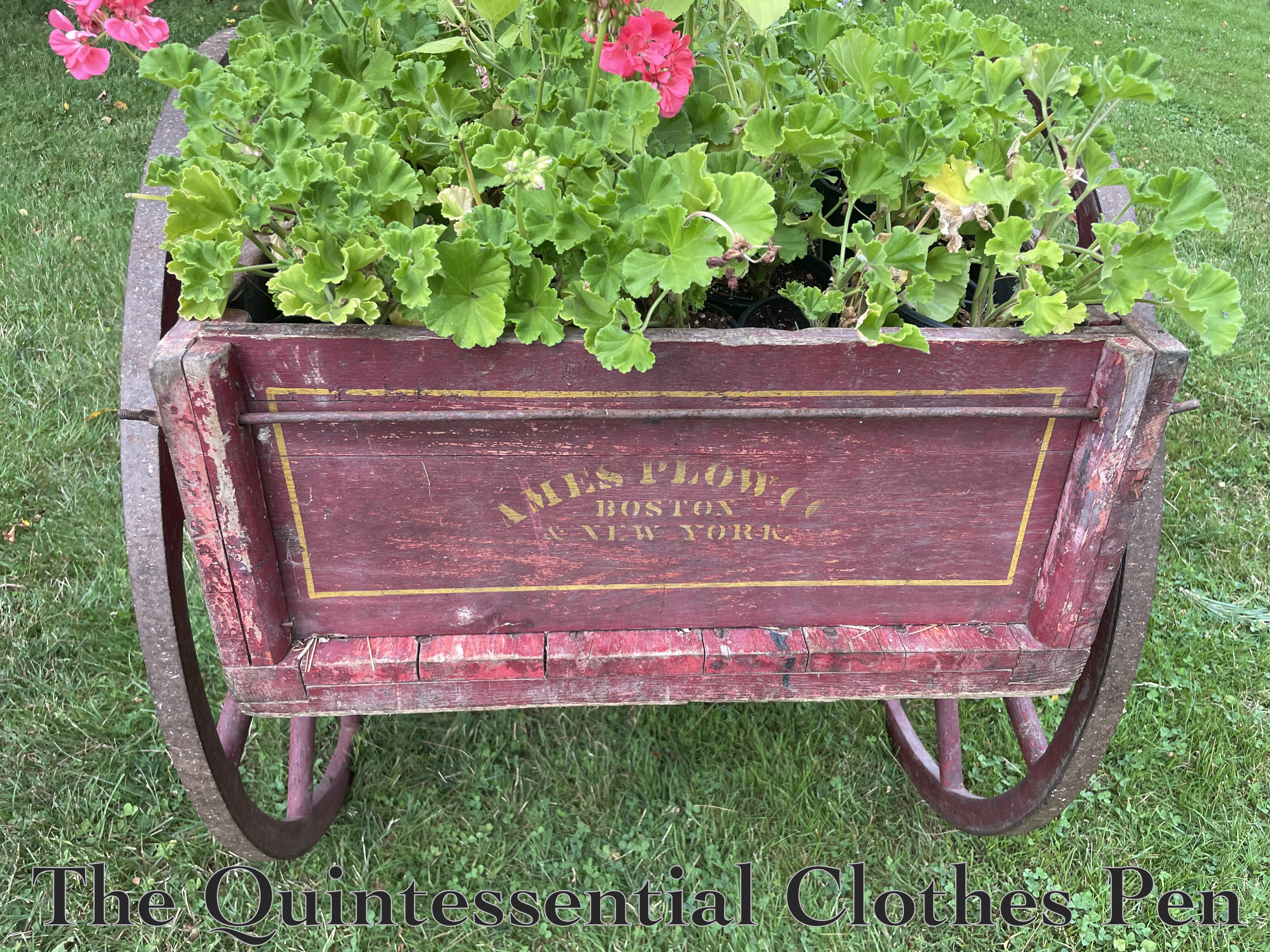
Roseland has a beautiful and well maintained garden, and in addition to that, I also appreciated the cute cart (detail photo below) full of additional flowers that was situated on the lawn. It made for a wonderful photo accessory, as you can see in the photo above!

As I mentioned in my post about altering the gown (linked at the top of this post), I’m so pleased to be able to give this dress extended life!

When The Dress No Longer Fits (1815 Tree Gown)

I’ve loved my 1815 Tree Gown ever since I made it in 2013 (here is the link to the original post about making the dress) and have worn it many times, most recently last summer for a Regency picnic which I posted about here. It was clear at that point that this dress needed to be updated to fit my current shape!

Making a plan

I finally had the brain space to deal with it this summer (and the added encouragement of wanting to be able to wear it in June). So, accordingly, I dug out the small bit of fabric I had leftover from originally making the dress.

Then, I took stock of what was needed. In a fitting, I realized that not only were the sleeves now a bit too tight, but the shoulders were also not quite wide enough for my now-broader shoulder width, which was also contributing to the dress wanting to fall off of my shoulders. Ugh!

There was no easy way to deal with that second problem except to make the back wider… So, I took a deep breath and decided to replace the back panels.

Making it happen: taking the dress apart

I had seam ripped the arm seams last year after realizing they needed to be let out, so the sleeves were already in that taken-apart state.

As I was taking apart the back, I remembered that I had taken a tuck in the finished dress to make the armsceye a little smaller. Alas, letting this out was not nearly enough to prevent me from needing to replace the back panels.

Making it happen: forming a new plan

Fast forward through a bit of seam ripping (French seams make for a lovely finish, but also mean double the seam ripping!), and I had a bunch of loose panels flopping around. I used the original back pieces and my desired new measurements to cut mockup pieces of what I thought the back should become. I safety pinned those in and tried the dress on to make sure I was on the right track.

Here is the old back piece laid over the mockup. It’s not a huge difference, but that 1″ or so on most edges made a huge difference in terms of fit.

I also made a pattern piece for the arm gusset I needed based on the measurements I wanted the new sleeve size to be. In the end, I decided to extend the gusset all the way down to the cuff opening, as I figured a little extra room for my hand to get through was a reasonable idea (it was a tight squeeze otherwise!).

Then, I used my minimal scraps to cut out the new pieces. I’m super pleased that even with small scraps I was able to match up the block printed areas!

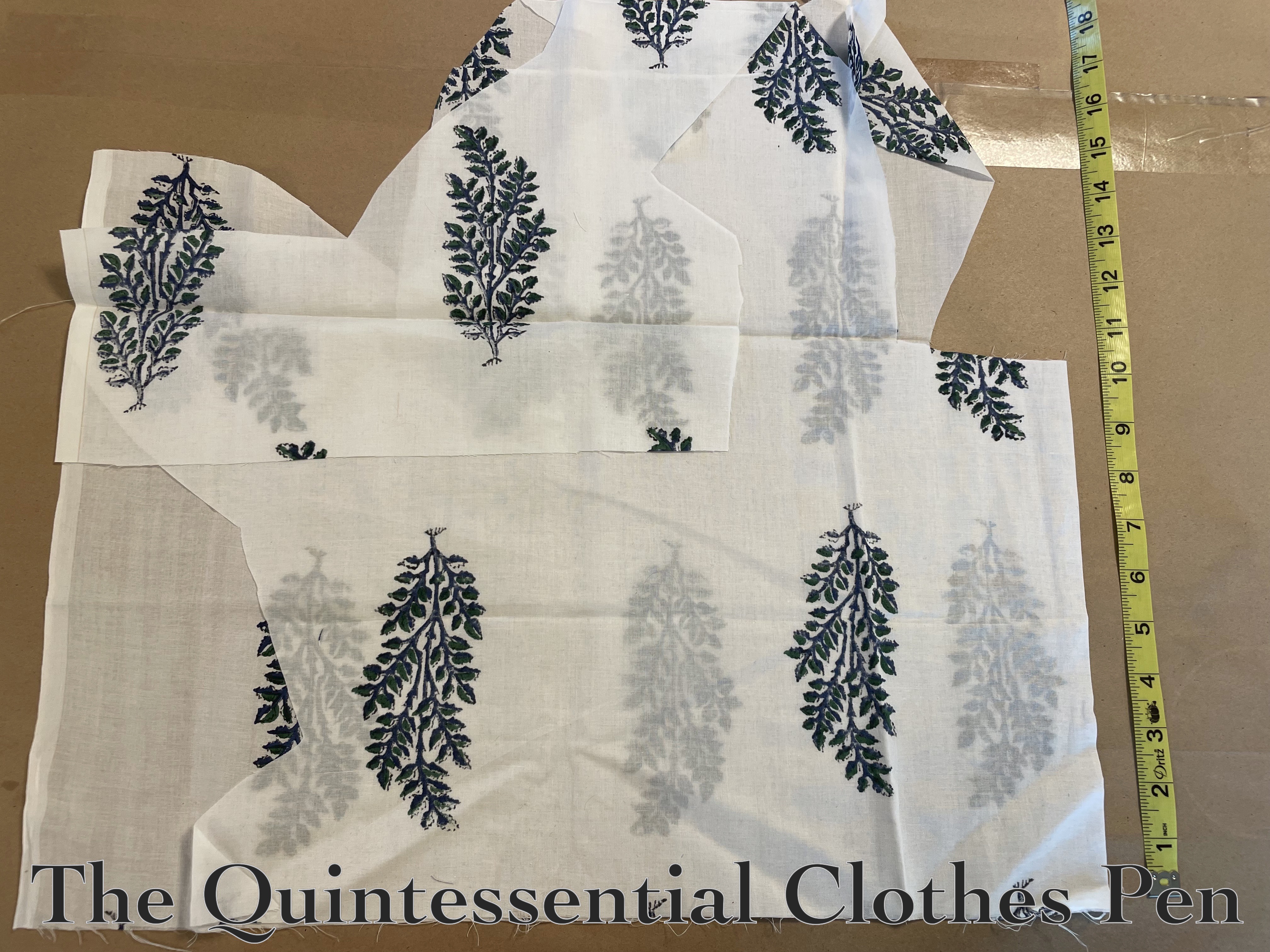
For the back pieces, the image below shows what I had to work with. Not much! I could fit both pieces if I didn’t maintain symmetry in the block print, but… I did such a nice job matching it up when the dress was made! I just couldn’t bring myself not to make the re-do match, too! But I couldn’t get two pieces with matched patterns out of what was left.

It was too much to think about late at night and I knew I only had one chance at cutting to get it right…

So I took a break and came back to it another day. And I had a brainstorm! The way to make my goal happen was to piece one of the pieces somewhere. I could have placed an extra seam in a shoulder area, but that seemed more obvious than my second option given the sheer fabric of the dress. The second option that I decided on is a vertical seam in the white space near the center back opening. There was just enough fabric to make it happen!
Making it happen: putting the dress back together

With my new back pieces cut, it was just a matter of putting them back into all of the seams (including the armsceyes, shoulders, side back, and waist). I was able to reset the sleeves without any of the original gathers, which allowed for the extra circumference my new back pattern had created. Then, I created a new drawstring channel along the neckline and re-applied my closures… and the update was complete!

Here is the new back view of this dress, with the pieced seam on right (but with symmetrical block printing!).
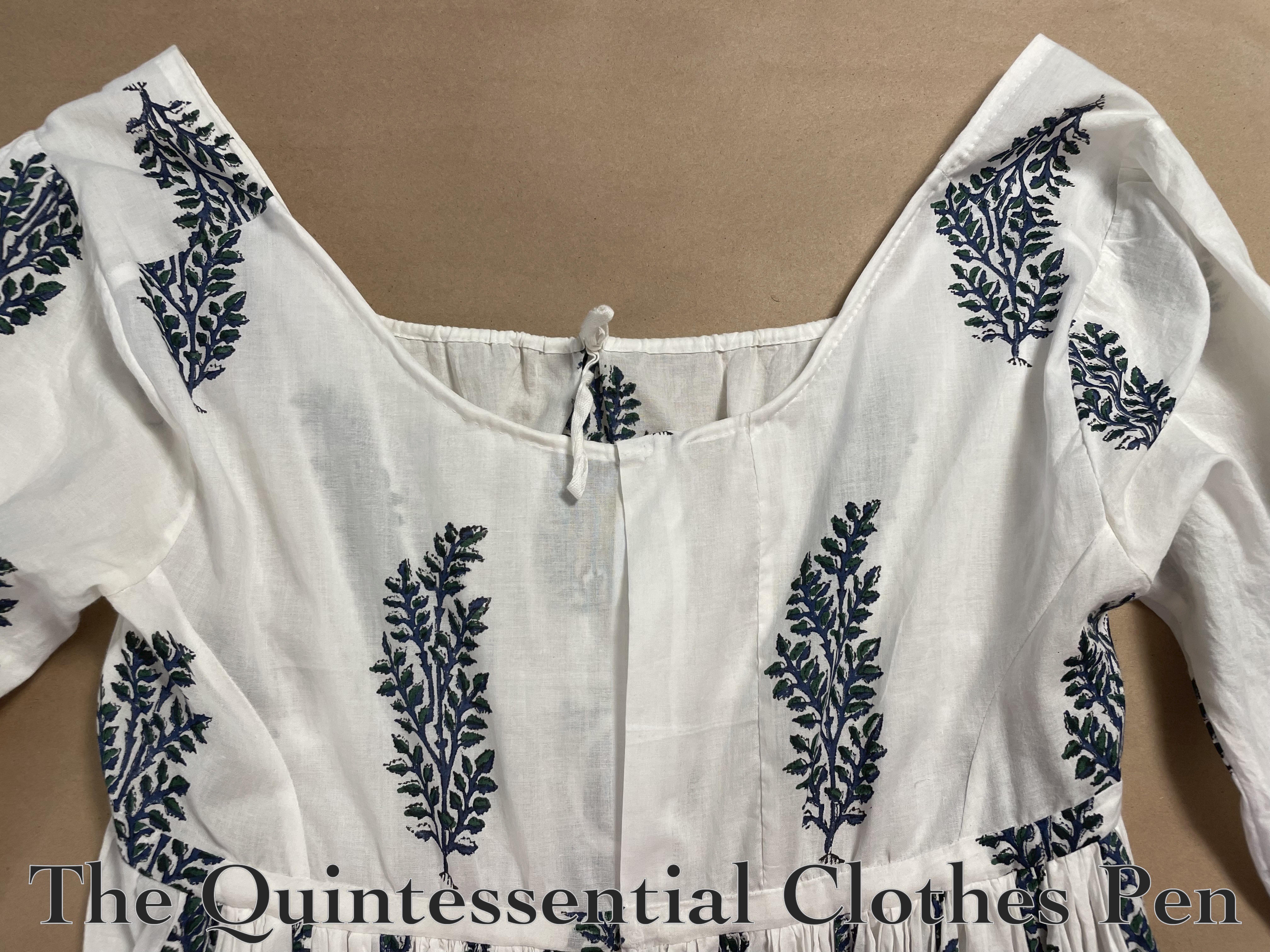
I used a French seam to attach the pieced bit, so that it would match all of the other seams in the dress and stay nice and tidy with no fraying edges.

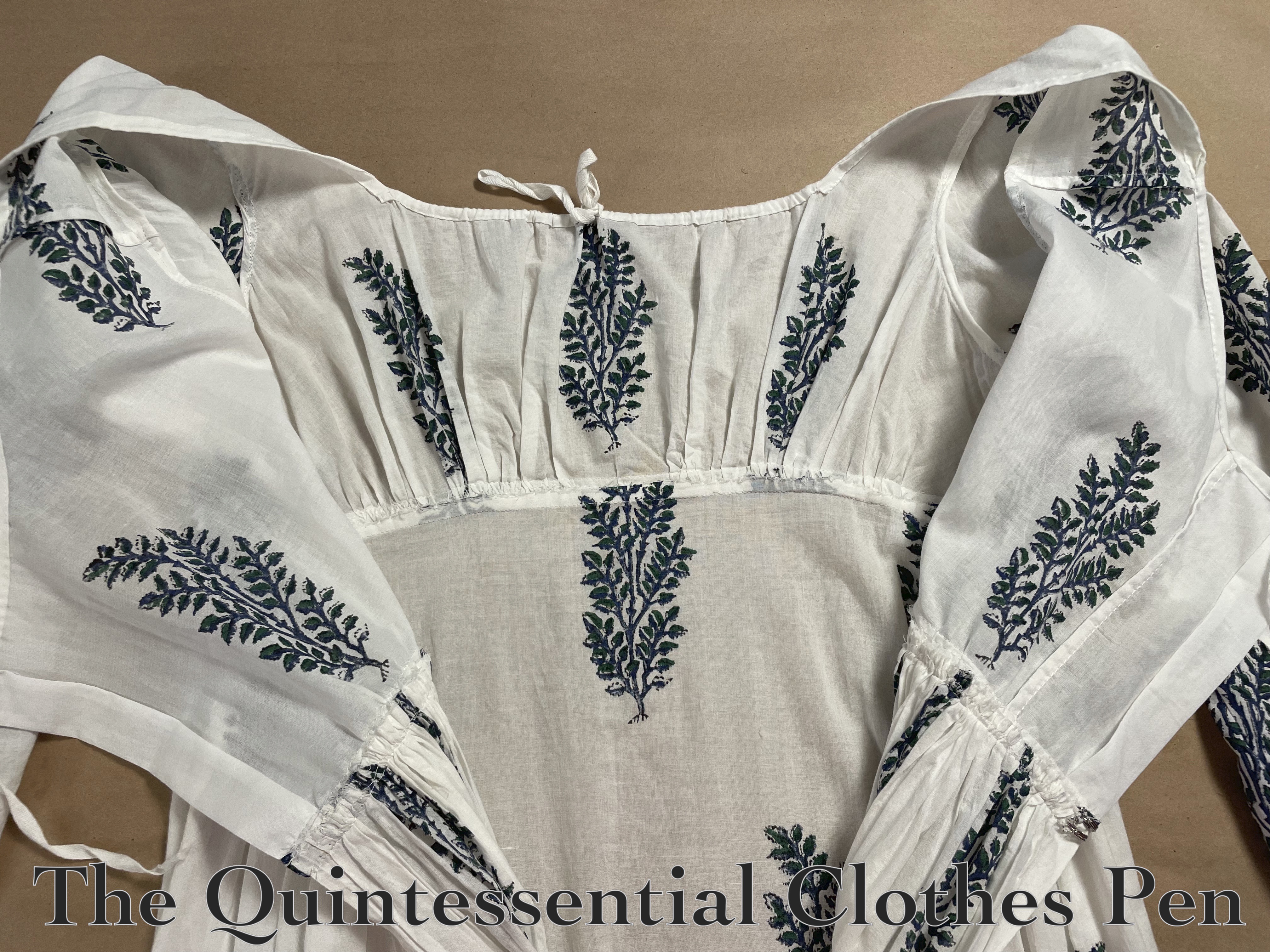
I also made the right side of the drawstring come out before the center back edge, so that the overlap with the hook can still function properly while the drawstring pulls up the excess width across my shoulders that I included. (There was extra in the original version, too… but I maxed that out years ago!)

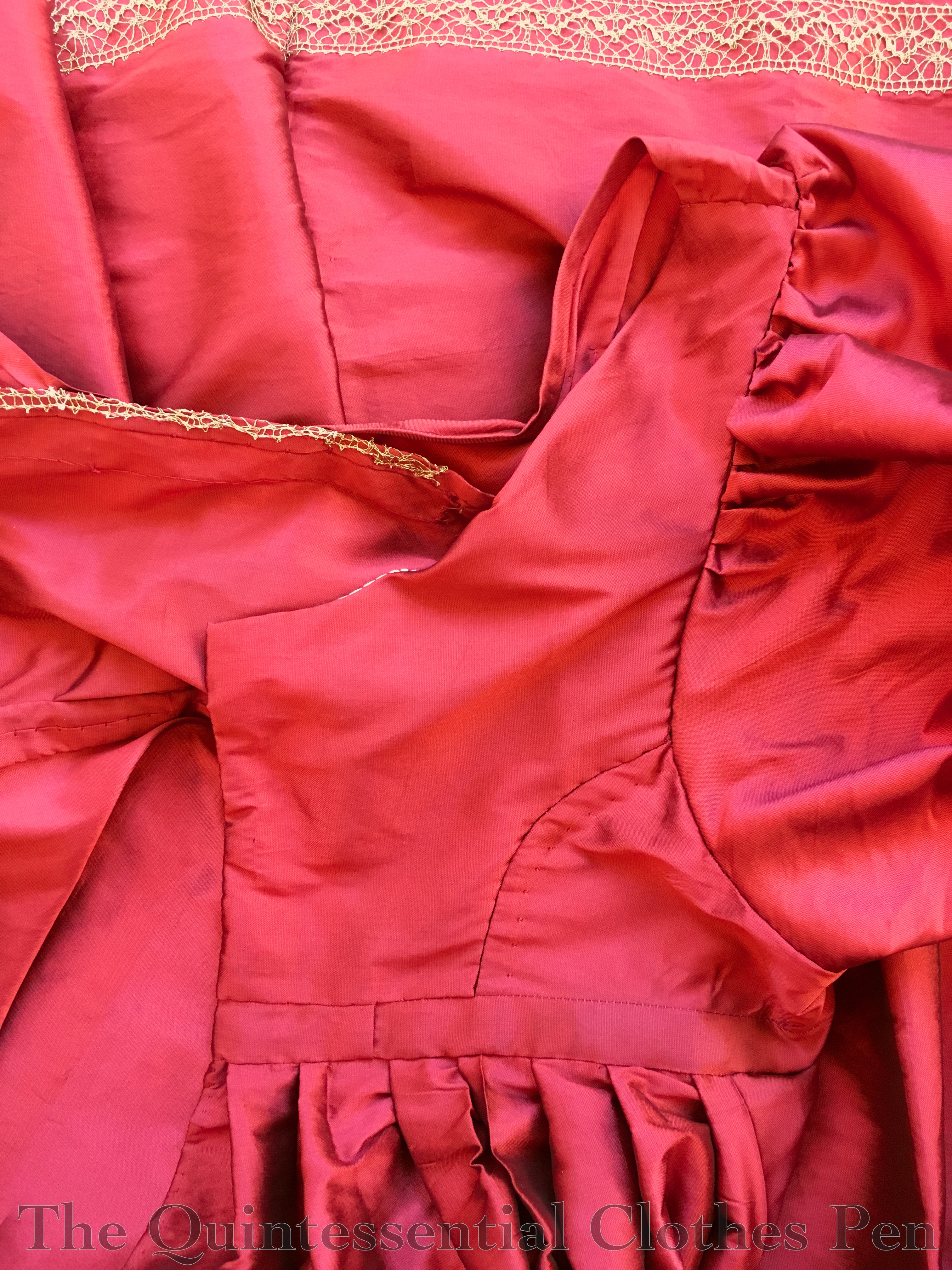
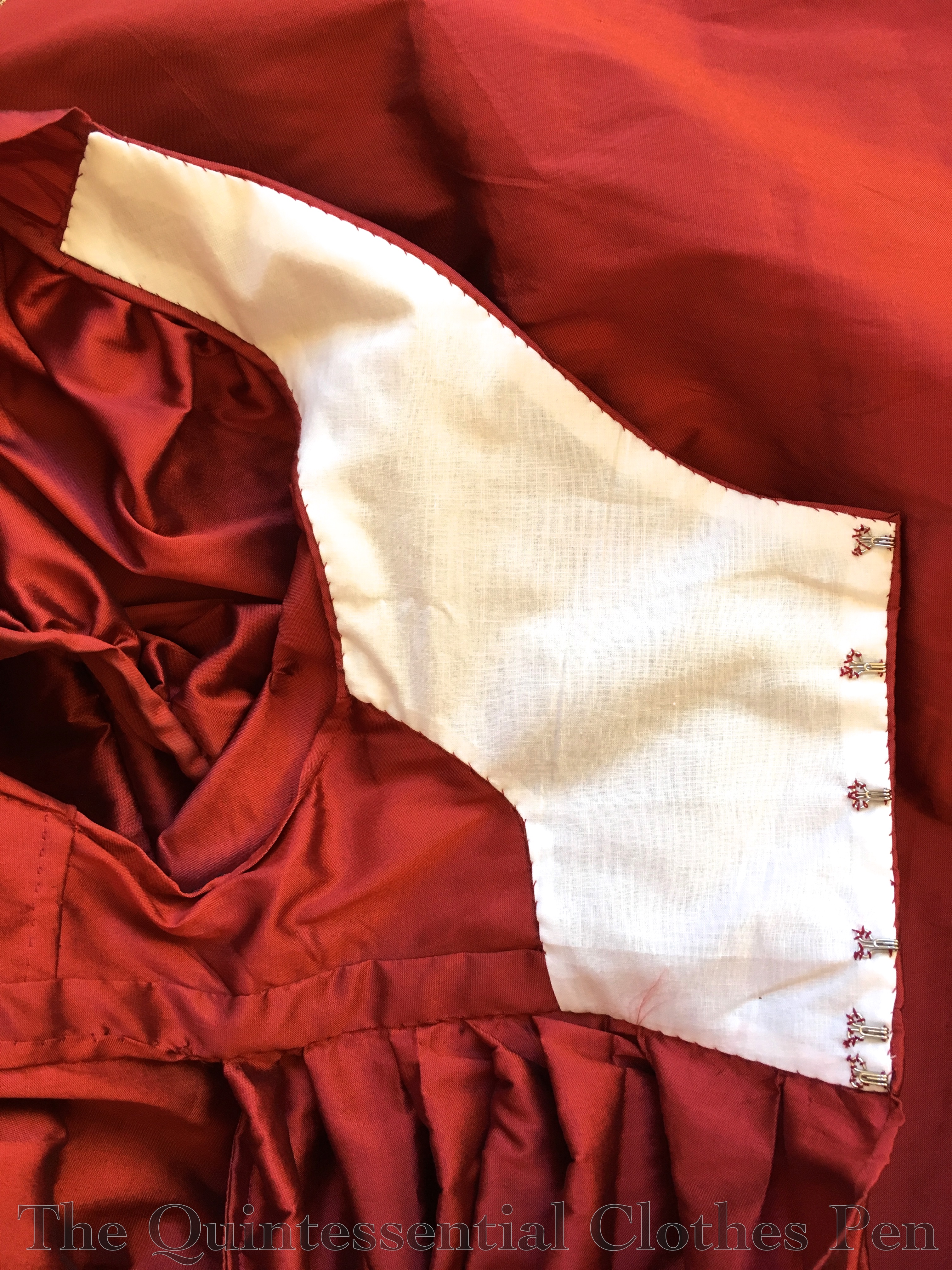
Here’s another view of the lovely, tidy interior of the dress with the updated back.
And finally, here is a photo of the finished sleeves with the added gussets. Where the block printing is located the seams blend so well you can’t even see them! It makes my heart pitter-patter with glee!

The final step after putting in the gussets was to re-hem the cuff openings.

And then… this dress was updated! Now it’s a story of ‘when the dress fits again!’

1817 Duchess Gown in Bridgerton Style

The Footwork and Frolick Society hosted a Bridgerton themed ball in May! Here are a few atmospheric shots.

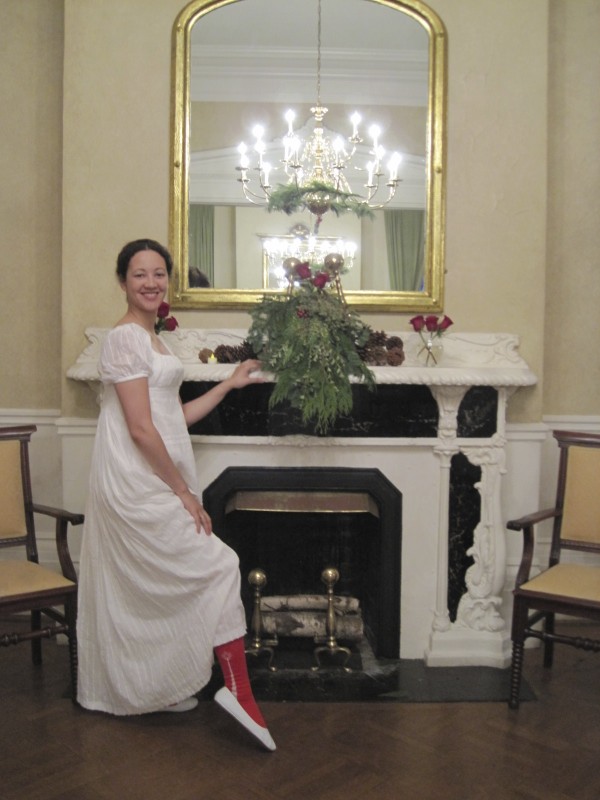
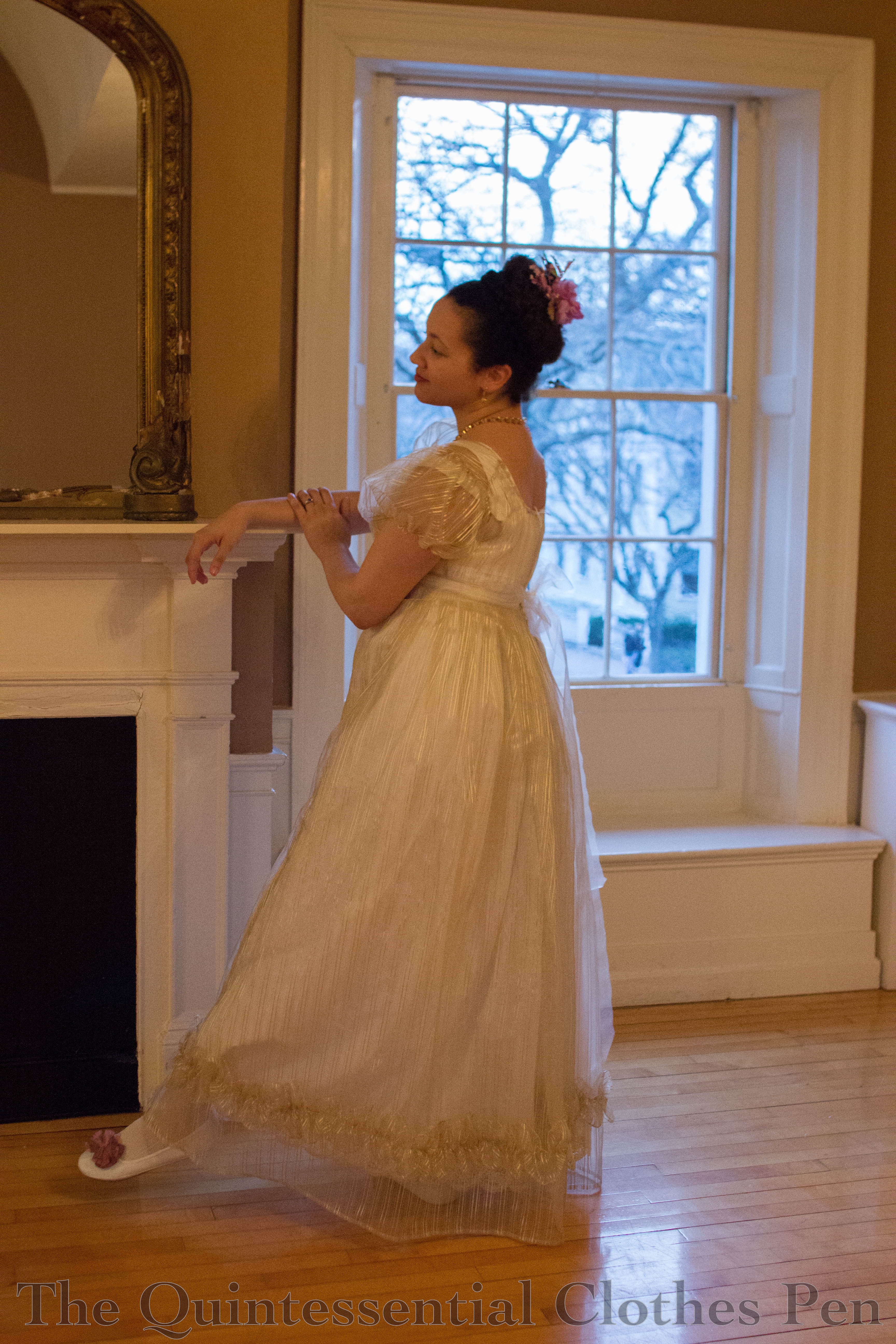
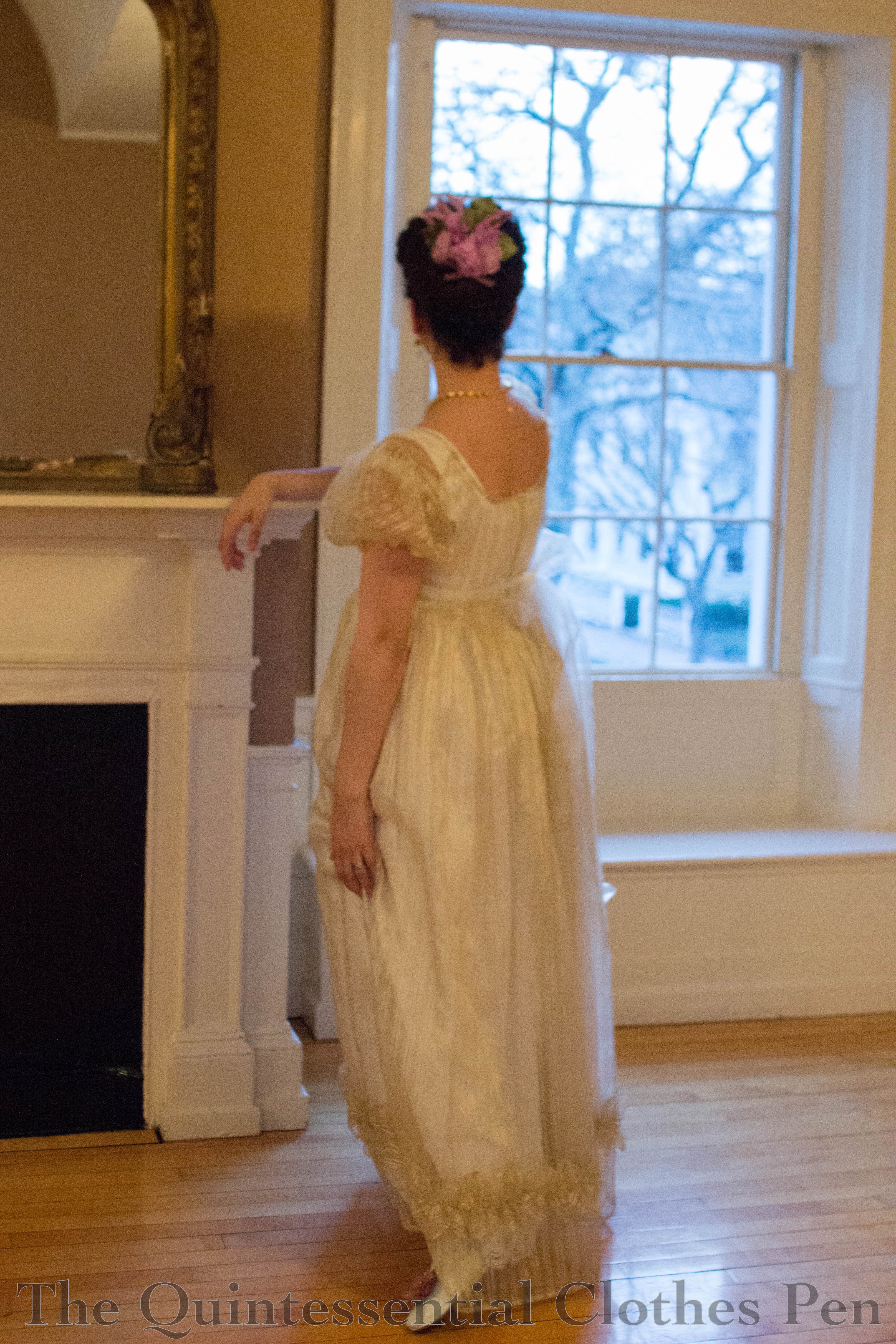
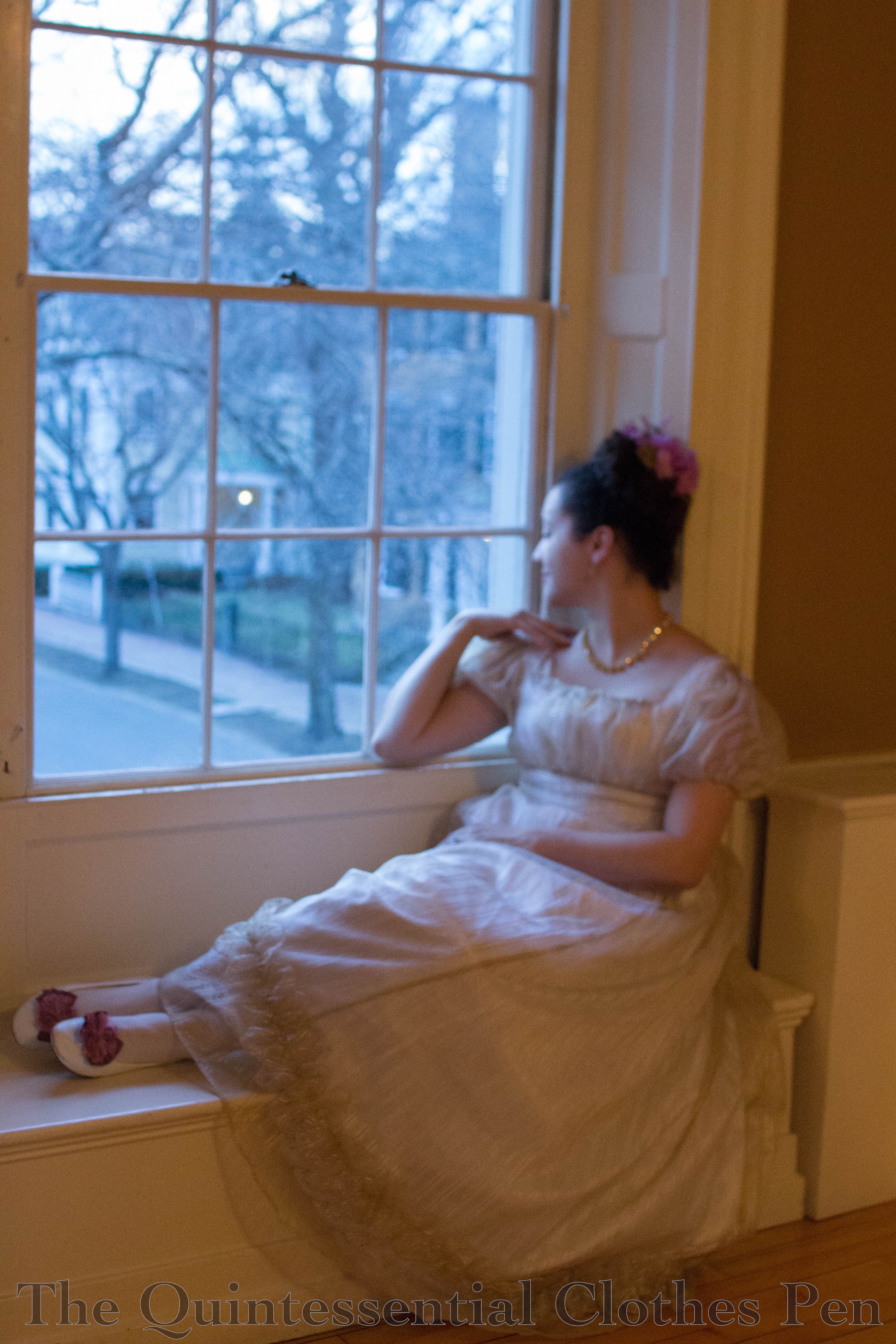
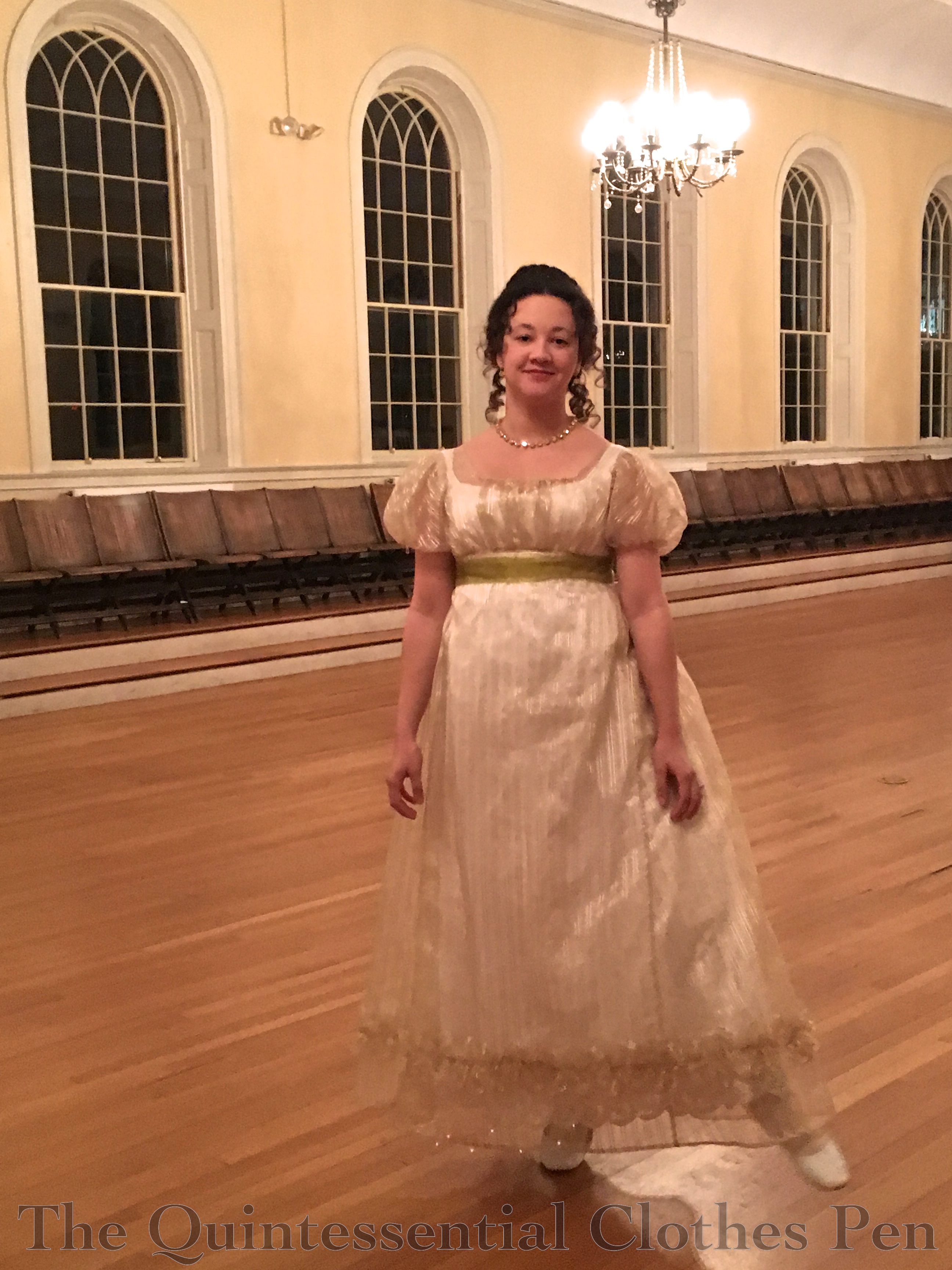
For this event, I chose to wear my 1817 Duchess Gown (you can read about the inspiration and making of the dress, here). I love this dress and haven’t had a reason to wear it in years. Plus, I figured the neutral color would pair well with a few nods to the colorful style of Bridgerton costumes.

In the past, I’ve had fun pairing this gown with other colors and accessories, as well! You can read another past post where I show multiple wearings together here.

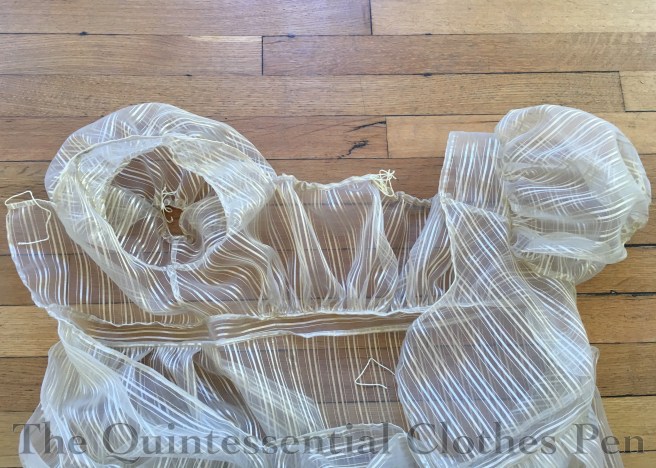
The dress is a sheer striped organza, which is fun because I can show off fancy historical underwear with it! I usually wear my 1814 Vernet petticoat so that the fancy trim around the bottom can be shown off (in addition to a second petticoat to make the ensemble fully opaque.) The second petticoat is functional more than decorative, and is the one I recently posted about that needed a size update to fit properly again!. Wearing it with this sheer dress for the ball was the push I needed to make the petticoat fit really well–I didn’t want odd lines showing under the sheer Duchess Gown!

In addition to the decorative Vernet petticoat, other accessories for this wearing included clocked silk stockings from American Duchess, white flats purchased from a consignment store about ten years ago, a gold bead necklace that ties with a ribbon that I don’t wear often (I usually gravitate towards other more sparkly jewelry), and three nods to the colorful style of Bridgerton.

My nods to color included a green organza sash (that I’ve worn with this dress before–see images in this past post from 2019), green and gold earrings (from the Downton Abbey collection a number of years ago), and flowers in my hair, including some vivid pink ones. I’ve had these flowers for about 25 years and rarely wear them. They’re pretty bright! But for the Bridgerton theme they made perfect sense!

The company at the ball was charming and the dancing was enthusiastic! My Duchess Gown even had an old friend visit in the form of my 1811 Elusive Blue Gown worn by a friend! I love that these garments are getting to be worn again!

Photo credit for this last photo: Lucas Clauser

Regency Shoe Revive (HSM #2)

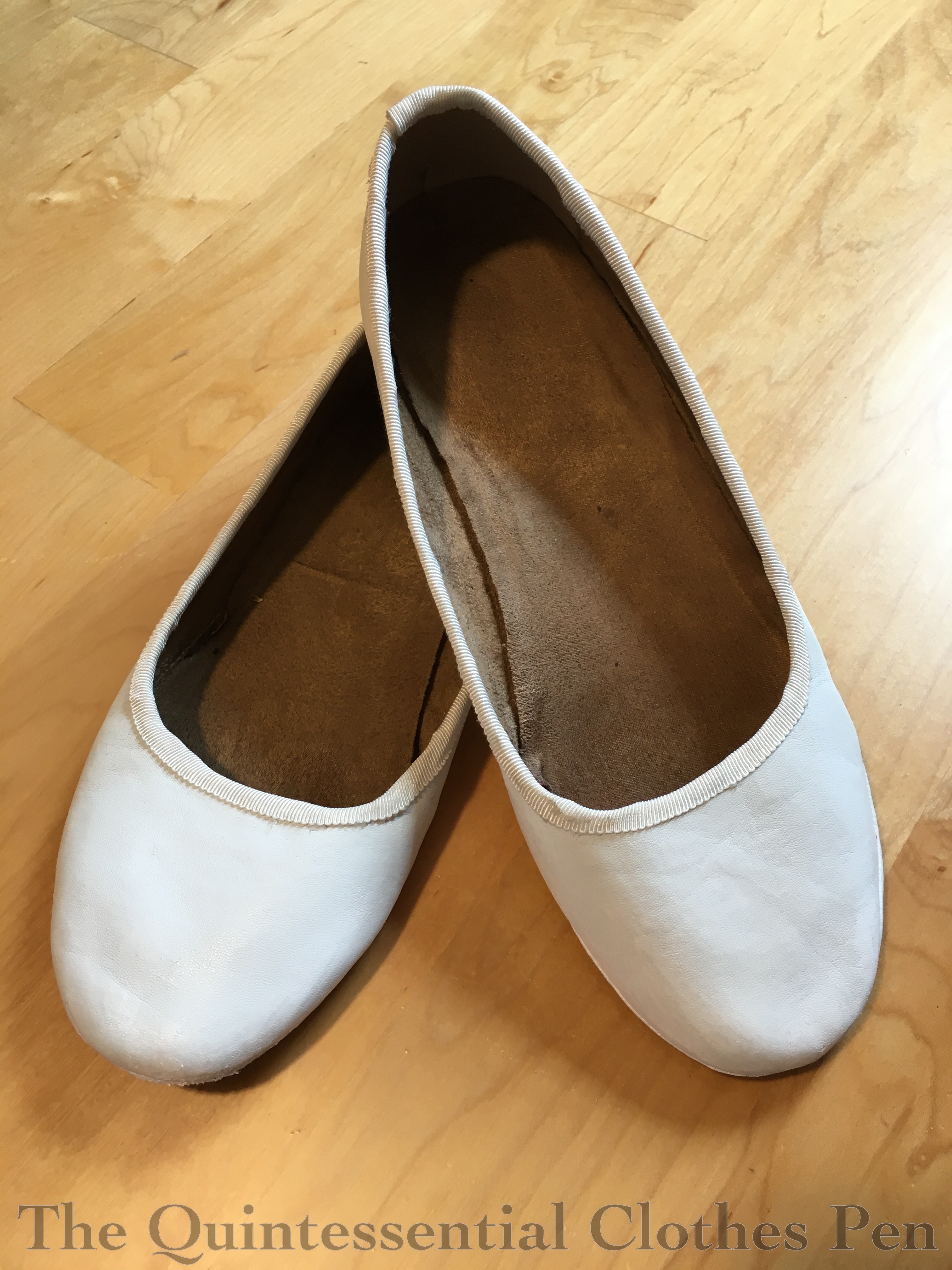
Back in 2012, I happened upon an unusual pair of shoes in a small clothing store. They were quite flat, with little support or durable sole and a slightly square but still rounded toe. The price was great–$10 per pair. I thought the shoes would make excellent Regency dancing shoes, so I bought two pairs, an 8.5 and a 9. The 8.5 were a little tight on my feet which was perfect for dancing as they stayed on my heels even when I rose onto my toes, but the 9 also fit and was great for walking around.

I’ve kept the size 9 nice looking over the last eight years. They have a surprising mid-20th century vintage look in addition to the Regency look, so they are most often worn with 1950s inspired dresses (you’ll spot them with my vintage inspired Happy Clover Dress and 1953 Dot Dress, both pictured below).

But while the size 9 pair hasn’t been worn all that often, the size 8.5 pair have been worn almost anytime I’ve been dancing in Regency clothes for the last eight years. You’ll spot them in all of the posts below (with a few of those highlighted with photos, as well), but of course this is only a small portion of the times these shoes have been worn.

1817 Duchess Gown In Three Stylings
Regency Intensive Dance Weekend 2019
1817 Gold Stripes And Face Framing Curls
Regency Dance Weekend 2017
A Gown Worthy Of A Duchess
Regency Dance Weekend 2016
Regency Shoe Poms!
A Turban Fillet, 1811
Regency Dancing At The Salem Maritime Festival
Refreshing Proof (Chelmsford Regency Ball 2013)
Regency Dance Weekend Part IV: Reception
Lovely Clothes, Lovely Ball: Part I (Pride And Prejudice Ball 2013)
Regency Christmas Party At The Commandant’s House
1812 Guerriere Weekend Part IV: A New 1812 Gown

All that wear has caused the shoes to show their age. While still functional, the exteriors were cracking and peeling around the top and the toes/sides/back were worn and scratched.

But I’m not ready to let these shoes go! So I decided to revive them with a few touch up treatments.

The first touch up step was to glue petersham ribbon around the top edge to bind it off, as well as down the center back seam, for an additional historical touch. I wanted to be done quickly, so I used hot glue, but this really wasn’t the best choice of glue, as it is a bit lumpy under the ribbon in some places.

I purchased the grosgrain from The Sewing Place. They have a beautiful selection of colors, reasonable prices, and low shipping charges.

The second touch up was a bit of white Angelus leather paint to cover the scuffs. (Thinking back, I should have cleaned my shoes before painting them… But I didn’t. So, there’s that.) Again, I was just trying to be quick. I figure these shoes are going to get banged up again as soon as I wear them, so I didn’t need to be too fussy. The white paint didn’t perfectly match my shoes, so I did thin coats and buffed the edges with scraps of cotton to get them to blend. It’s not perfect, but it looks reasonable from standing height.

This was a simple project, but it qualifies for this year’s HSM challenge #2: Re-Use.

Use thrifted materials or old garments or bedlinen to make a new garment.  Mend, re-shape or re-trim an existing garment to prolong its life.

Just the facts:

Fabric/Materials:  1 pair of soft soled flats and white Angelus leather paint.

Pattern: None.

Year: c. 1810.

Notions: Approximately 1 yd of petersham ribbon.

How historically accurate is it?: 50%. In general, the silhouette and style works, but of course these shoes are not perfectly historical in style and the materials are modern.

Hours to complete:  1 hour.

First worn: November 23, 2019.

Total cost: If we’re only counting the revive and not the original cost of the shoes, then approximately $5 for the ribbon. (The glue and paint were in the stash.)

Here’s another view of the completed shoes.

It was my goal to revive these before this year’s Regency Dance Weekend (an annual event each April). I achieved that goal in terms of the date, though sadly the weekend was cancelled this year. But even though I didn’t get to use these for that event, at least now they’re ready for more years of adventure (and I can return them to the closet–they’ve been sitting out since last year to remind me to deal with them!). I’m quite pleased with the end result and the small amount of effort required to update these shoes.

Check out the following links if you’d like to see tutorial-like photos and descriptions of the painting and ribbon-ing process:

Lauren, of American Duchess, wrote a very helpful blog post tutorial back in 2012 showing how to paint shoes as well as the petersham ribbon edging.

Chelsea, of A Sartorial Statement, wrote a blog post about her freshly painted and ribbon-trimmed flats in 2019.

1817 Duchess Gown In Three Stylings

A few years ago, I made my 1817 Duchess Gown. I started out wearing it rather plainly (if wearing a tiara count as a plain ensemble…), but since then I’ve worn it multiple times and accessorized it different ways. I thought it would be fun to pull some of these wearings together in one place, to look at how accessories can change the look and feel of a dress.

First, a side by side comparison. Do you have a favorite amongst these?

The first year I made the dress I was furiously sewing the hem trim on the night before the ball, so I didn’t have too much time to think about accessories. I wanted the dress to be regal looking and so I decided on the tiara to wear with it, as well as a pearl necklace and earrings.


Fast forward to February 2019, when I’d worn the dress a few times and wanted to change it up with more color than just white and gold. For this wearing, I added a green sash as well as new sparkly jewelry from In The Long Run Designs.

I loved the green sash look, but wearing the dress just a few months later in April 2019 I wanted something different. I decided to pull out some older accessories, purple shoe clips and purple hair flowers, and pair them with a white sash.

You really can’t see the white sash much, but the purple accessories give the dress a different feel than the previous wearings, I think. (This might be a stronger statement with a purple sash. Hm… But I don’t have wide purple organza ribbon, as I did with the green and white. Maybe that’s something to keep my eyes open for!)

The neat thing is that this dress is also captured on video! At the Regency ball last February, The Commonwealth Vintage Dancers (CVD) did a performance of the type of advanced dancing taught at CVD’s Regency Weekend every April. Check out this blog post by another CVD member showing the Duchess Gown in action as well as great information about the dance we are performing, Paine’s First Set.

Are you ever able to wear the same outfit (modern, vintage, or historical) styled in different ways and with different accessories? I choose to do this with some of my modern clothes in addition to my historical ones and I can think of a few of you who are definitely subscribers to this idea, too!

Regency Intensive Dance Weekend 2019

It’s been two years since I last did a post covering the entirety of one of the Commonwealth Vintage Dancers’ annual Regency Intensive Dance Weekends. I thought this year would be a good year to bring back that tradition, so I made sure to capture moments throughout the weekend (or I helped friends make that goal happen!). So… prepare for a long post with lots of photos!

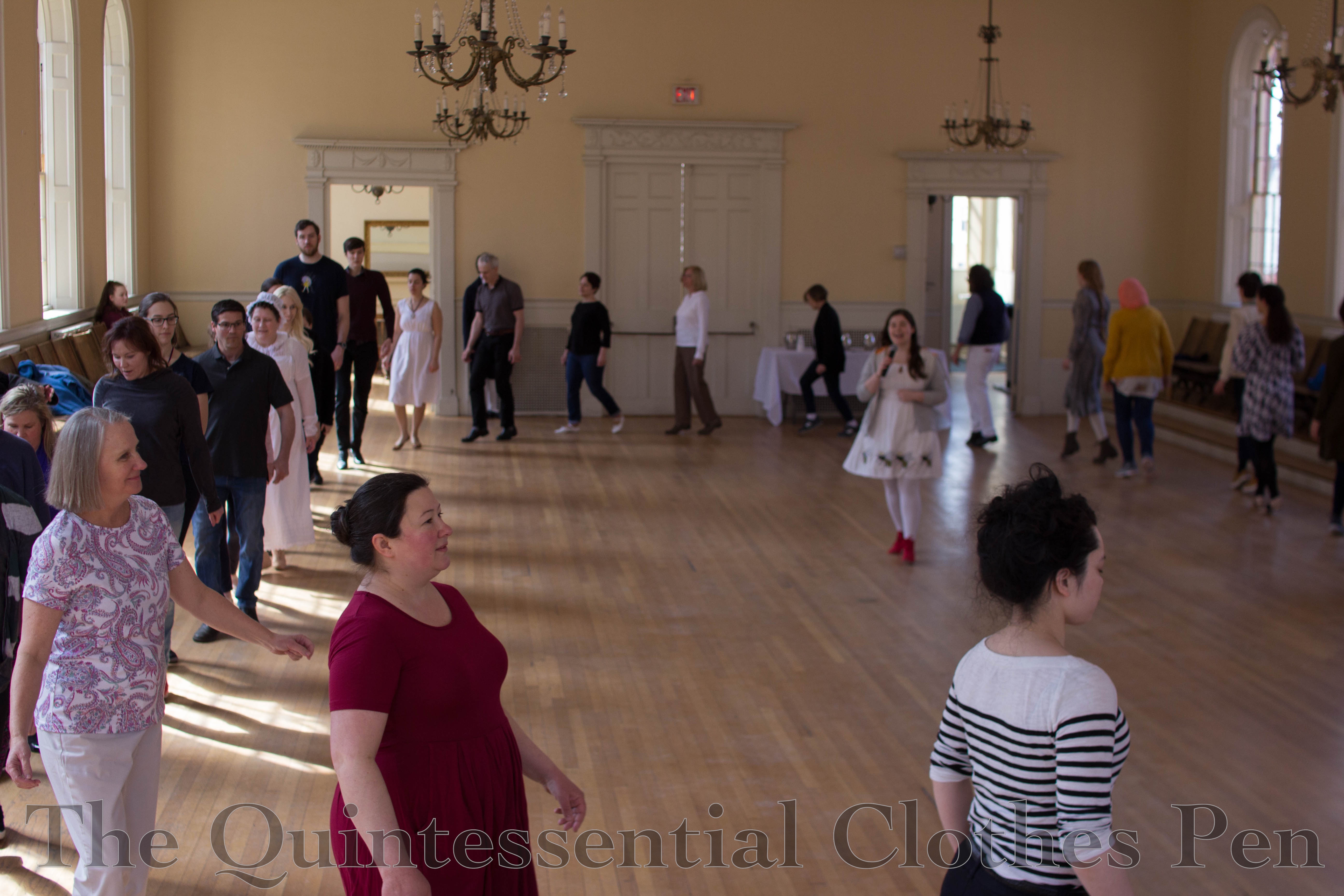
Saturday is a day full of dance classes. The name of the weekend does include the word ‘intensive’, right? The level of dancing achieved at this event is quite a step above a stand alone ball and I love how special that is. Here we are in the morning, learning the special steps that are particular to Regency dancing.

Saturday evening brings a ball to practice all the dance steps learned throughout the day. This year I decided to wear my red and gold 1813 evening gown and red and gold tiara with my red and gold reticule. I enjoy how well these different pieces coordinate with each other!

Amusingly, two other ladies were also wearing red and gold dresses. With cross fronts! Isn’t it neat how a description such as ‘red cross front short sleeve gown with gold trimming‘ can be the same but each dress is unique?

I find it pleasant to observe lovely clothing on elegant people during the course of ball. New dresses and accessories add a bit of excitement to a gathering! I enjoyed seeing this dress because I also have a dress made from the same Ikea curtain fabric.

Sunday morning we have more dance classes followed by a mixture of tea, promenade, and games in the afternoon. The activities have varied over the last seven years but we’ve always had an afternoon of non-dance fun incorporating at least a few of these activities each year. This year we started with a promenade. Thankfully we had good weather: a reasonable temperature with just a little bit of sun that accommodated pelisses, shawls, and spencers.

We ended on the town common and stopped for photos. Isn’t this one lovely?

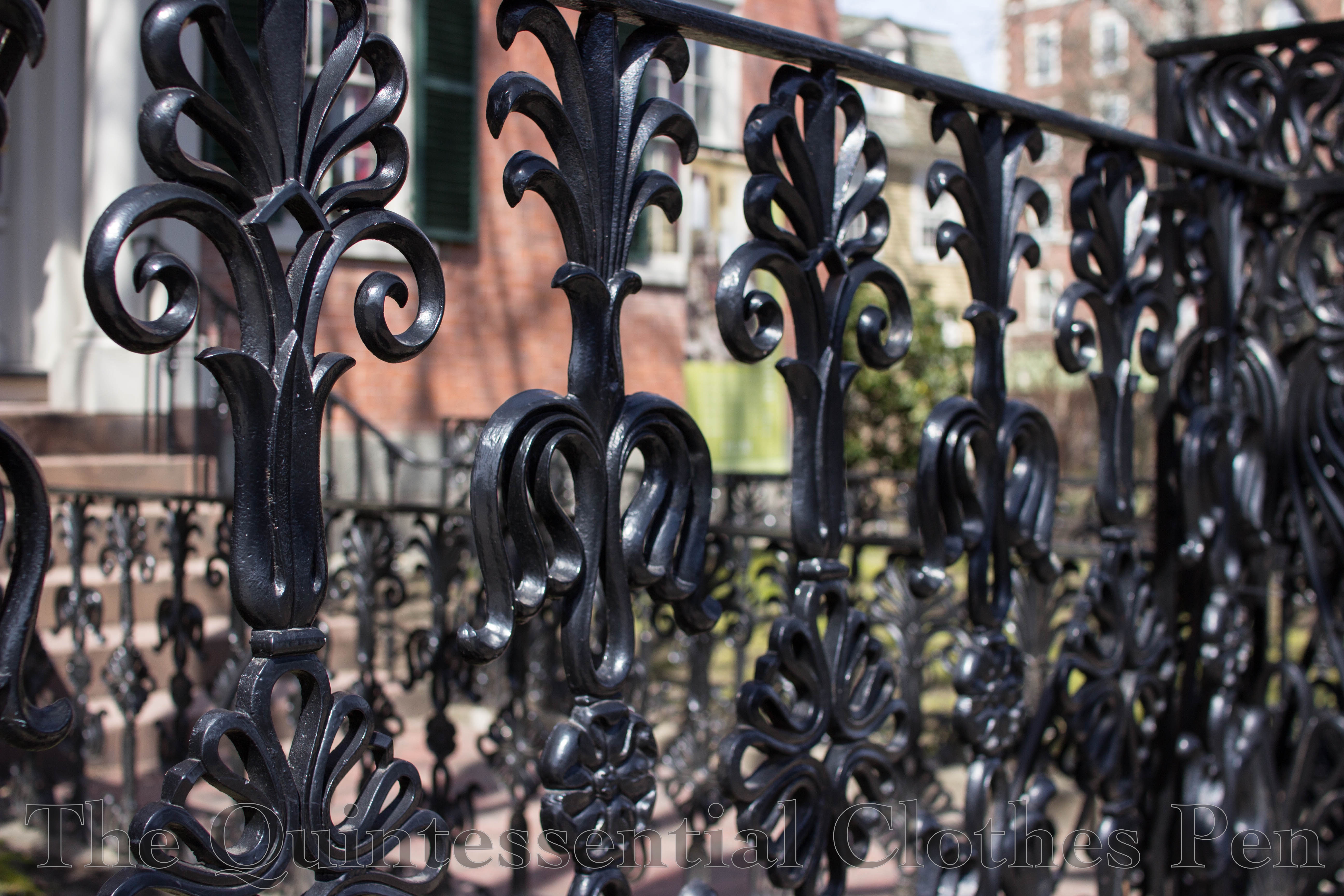
On our return stroll, I might have become distracted by one of the historic houses owned by one of the museums in town… The property had a fabulous wrought iron fence that I insisted we take photos with. Lots of photos… These are just a few!

As you can see, I wore my 1815 tree gown, 1819 spencer, and 1815 bonnet. Plus, I finally made use of a muff I made back in 2012 at Dress U! The scale of this muff is generally for the 18th century so I really haven’t used it since I made it, but the color matched my accessories so well that I decided to wear it with this outfit and I love the result. It’s super cozy and warm and the cover is completely separate from the down stuffed pillow inside so that in theory I can make other covers for it someday. This lovely item is the result of a class I took with LadyDetalle. (She has an Etsy shop that often stocks muffs like this as well as many other beautiful and historically inclined goodies.)

Back at the hall, tea was well underway. This year’s group really enjoyed chatting with each other and playing games. It was charming to observe such enjoyment.

Not too long after tea comes the grand ball across town. We have always started this ball with a reception that includes champagne sabering in a little park just near the hall.

Arriving back at the hall, guests are greeted with sparkling cider.

We took a few minutes out of the evening to document our clothing, as one does. I wore my 1817 Gold Stripe Duchess evening gown again (I just wore it in February as well), but with different accessories. I love how these accessories changed up the dress to have a different feel. This wearing included my 1819 purple hair flowers, purple shoe clips, the new necklace and earring set from the wearing of this dress in February that is from In The Long Run Designs and a white organza sash just like the green one I wore in February. The white really didn’t show on this dress except for a hint of fluff at the bow, but the two purple accessories stood out and of course the jewelry was sparkly and wonderful!

Purple and gold seemed to be a theme at this ball, just as red and gold was the night before! Raven of Plaid Petticoats had a new dress that fit the theme very well. She and lots of helping hands were working on the dress all weekend in order to finish it for the ball!

It’s quite grand, seeing everyone dressed in their Regency best for this ball. And I think many people are surprised by how well the dancing goes! It’s a special treat to have such advanced dancing.

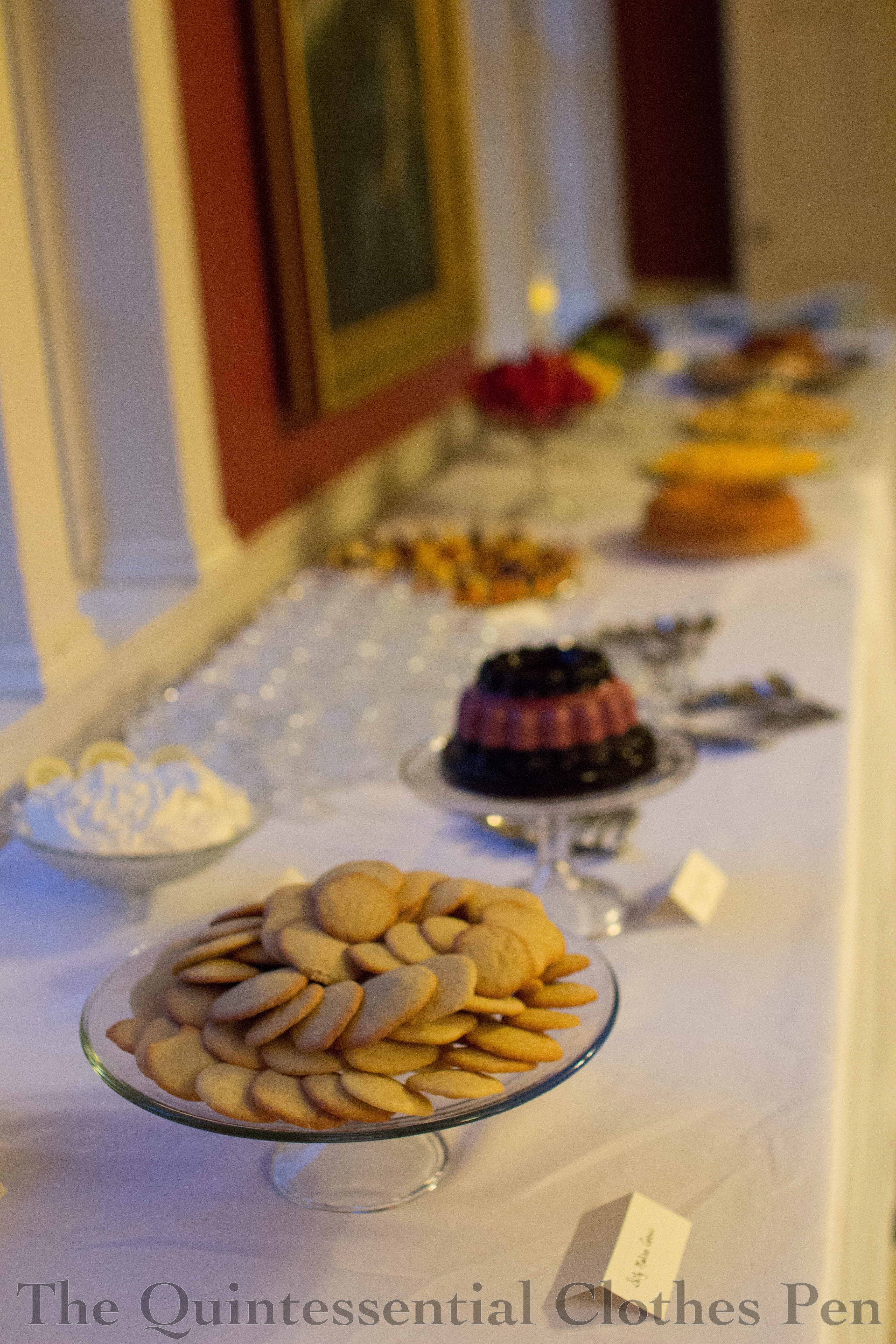
This ball is always accompanied by lavish refreshments carefully arranged to impress.

And at the end of two wonderfully long days of dancing I’m always exhausted! I hope that reading through this post was exciting and not exhausting! If you’d like to read more about the magic of previous years, I posted about the Regency Intensive Dance Weekend in 2013, 2014, 2016, and 2017 as well.

1817 Gold Stripes And Face Framing Curls

Back in February, I was able to re-wear my 1817 Gold Stripe Duchess Gown to The Commonwealth Vintage Dancers’ annual Regency Ball.

I love this dress! The sheer fabric is unusual to see in modern recreation settings and has lots of body, making for a lovely shape that is fun to dance in. It turns out that the gold stripe is rather neutral, so I’ve had fun accessorizing it in different ways this spring. We’ll start with this wearing, but there’s another one to blog about as well!

This time I decided to add a bit of color to the dress by adding a wide chartreuse organza sash with a simple bow in the back and rather long ends. (I’m all for variation in ribbon sashes for Regency dresses. In fact, I wrote a post detailing different sash styles a number of years ago!)

I also added lovely new jewelry from In The Long Run Designs. The color I chose, jonquil, is a light yellow color . It compliments my skin tone and adds quite a bit of neutral-toned sparkle to my ensembles (the goal was to match as many dresses as possible so I can get the most use out of the set).

The day of the ball I thought I had lots of time and so I decided on a whim to do a complicated hair style with face curls. It turns out I was off by an hour but I didn’t realize it until I was in the car! Thankfully I arrived in time and didn’t cause anyone else issues with my lateness. Oops! But I was very pleased with my hair (and the fact that it was done before I arrived to get dressed definitely helped offset the fact that I was late).

The hairstyle is directly inspired by the following image of Maria Leopoldine of Austria from 1815 (source). I have a note that it was painted by Friedrich Johann Gottlieb Lieder but I can’t find documentation for that detail outside of my note-to-self. Maria Leopoldine caught my eye because I love big braid buns (my hair does volume so well!) and I thought it was high time to try face curls again (see my 2014 attempt and a different narrower circumference of curl in 2016 to see other attempts I’ve posted about).

So off I went with a curling iron to try and reproduce this hairstyle. Given that I thought I had lots of time, I even took photos of the process so I could share it with you!

Let me start by saying that yes, even though my hair is curly I still use a curling iron (or other curling method) to get precise curls. To show the difference, here’s my hair at a partially done stage. You can see the curling iron curls to the left of my forehead and chin with my natural curls being held sideways in between them and on the right side of my face.

How did I get to that point? I’ve determined that great looking historical hairstyles are often styled in many parts. The complicated thing about face framing curls with my hair is that it’s all quite long: past my shoulders when it’s curly and almost to the middle of my back when it’s straight. I don’t have short lengths around my face to curl, so I have to fake it with long lengths that are pinned up to be shorter.

To begin, I split each half of my hair into sections–a front top section, a back top section, a section behind my ear, and the rest of the hair on the back of my head. In the photo above, I’ve already used the curling iron to curl the top back section of hair, pinned up some of the length, and used the front top section of hair to smooth out and cover up the pinned up length. I’ve also curled the back section behind my ear and pinned the curls up to shorten them as well. The rest of the hair is being held out to the side so you can see the different sections I’m referring to.

I realized after taking that photo that I should show a better example of what all of those words mean. So in the next photo I’ve let go of the back section and put a loose hair tie around it to keep it separate from my nicely curled sections. And I’ve curled the back top section of the other side of my hair, but I haven’t pinned those curls up to shorten or arrange them. I’m holding the front top section up in the air so you can see how untamed the curling iron curls look before being arranged.

The curls are the hard part. After arranging the top front sections and pinning them down around the back of my head it was a matter of wrapping and pinning up the back sections to look nice and make a big bun on the top of my head. I’m pretty sure I used a big bun form under there (the medium one from my Versailles hair in 2016–and for reference that post pretty clearly shows how long my hair is–it’s great for volume but can be a lot to wrangle), but it’s hard to remember as that was now almost three months ago and I didn’t take photos of those steps!

The final step was to wrap and pin my trusty (and yikes, 15 years old!) faux braid around the bun and give the whole thing a liberal dose of hairspray!

I love that I’ve found a new look for this dress and a new historical hairstyle. Looking at the photos, it doesn’t look like my braid bun is quite as large or wide as Maria Leopoldine’s (I’ll have to try again someday!). Despite that, I was very pleased with the face framing curls and the bouncing curls behind my ears. The style felt very regal!

Orange Boven Pelisse At A Promenade

These photos are rather belated in being posted, as they are from a Regency event that occurred last September, but better late than never, right? The event was a promenade, for which we had beautiful weather with temperatures that were just right for this type of event. It’s a bit cloudy today, so these blue skies look extra beautiful to me.

I took the opportunity to wear my 1814 Orange Boven pelisse ensemble (which includes the pelisse and matching hat as well as the chemisette and my Vernet petticoat). I also carried the red & gold reticule I posted about back in 2014. It was only the second wearing of this finished ensemble and the first one where I actually wore it to promenade in outdoors rather than being indoors. I’m happy to report that it’s great for its purpose–comfortable, suitably warm, and with the ability to blow in the wind nicely, as you can see.

It was lovely to meet some new people at the event. We had lots to chat about as we wandered down towards this lighthouse: sewing, clothes, accessories…

It was quite an enjoyable afternoon. I believe this event will be held again this year, so I hope to have an equally lovely experience in a few months.

SaveSave

SaveSave

SaveSave

SaveSave

SaveSave

SaveSave

When The Dress No Longer Fits (Regency Edition)

Whether you sew historical clothing or not, I think it’s likely you’ve experienced the following phenomenon: You buy or make a lovely dress or other garment and wear it once (or maybe you wear it a lot). The season changes and you put said lovely garment away in the closet to await the next year’s season. When you next go to wear it, you realize that the garment no longer fits. It has obviously shrunk in the closet! I find that circumferences are the worst culprits for closet shrinking: waists, ribcage, arms… How dare they?!?

This has happened to me with both modern ready-made clothes and historical ones. Unlike modern ones, which usually hang around for a few years until I feel emotionally ready to donate them to someone else who might actually fit into them, my historical clothing has the benefit of being able to be resized with relatively little effort (certainly much less than making a new garment!). Depending on how I’ve constructed the garment, seams might be able to be let out or, being the pack rat that I am, I have more of the fabric hanging around and I can cut new pieces or add to what is there to expand at the necessary areas.

The more often I come across this problem in my wardrobe, the more I realize the benefit of making my clothing more adjustable from the start, with things like drawstrings and lots of overlap on opaque garments. (Did you notice that most of the closures on my recent 1817 Duchess Regency Gown were drawstrings? There might be an intentional rationale there… My 1811 Elusive Blue Gown also closes with ties and drawstrings, another intentional decision.)

1817 gown with mostly drawstring closures.

In the past year or two, I realized that two of my older and oft-worn Regency dresses had experienced closet shrinkage. I wanted to continue to be able to wear them and so I started thinking of the best ways to alter the size to make them wearable again. Luckily, both of these dresses fall into the category of ‘I kept the extra fabric and have plenty to play with to resize them.’

I used a different method on each dress. The first is my 1813 Red Dress, which I made in 2013. It’s seen lots of wear since I made it (yay for actually making good use of something I’ve made!) as well as a pretty major revamp when I accidentally tore a hole in the skirt.

It’s always closed with hooks and eyes, but when I went to wear it last year it wouldn’t close! With some safety pins, we got it to this point, but I was afraid for the integrity of the fabric because it was stretched so tightly.

I was able to use someone’s small scissors to take out the stitches along the back edge with the loops on it to get a bit more fabric across and we used the safety pins for bars with a piece of ribbon folded behind to stabilize the now-only-one-layer of fabric. But I wasn’t willing to let people see it looking like this!

Thankfully, I had a shawl with me and I wore it the entire evening to cover the back. I was apparently nonchalant enough that no one realized I was wearing a shawl to cover the fact that my dress wouldn’t close, but I was awfully warm while dancing! Something had to be done before I would wear the dress again.

I pondered multiple ideas, but the one I settled on was to cut new center back pieces with more width to them and sew them over the current, too-small pieces. I also had to piece the waistband to extend it as well as re-pleating the skirt to fit the larger size waistband, but it looks pretty good, I’d say.

The inside of the dress now looks like this. Previously, it was unlined (I did a post about the original inside finishing of this dress, which you can see here). Now, the center back panel has a lining to help stabilize it and encase the original back panels and waistband extension. Still tidy, yay!

In addition, the armhole openings had become quite tight. I wanted a little more space to be comfortable, so I also added underarm gussets (the upside down triangle). I simply opened up the seam and added a diamond shaped piece. It’s diamond shaped and folded in the center to hide the raw edges inside and out. I didn’t bother to add a band at the bottom, as I figured this gusset was in a place no one was likely to see such detail.

The other dress is my 1812 white square neck Ikea gown. I made this in 2012and have also worn it many times. Before the recent changes, I had made no other alterations to the dress since I first made it.

This dress also had a panel added to center back, but I had to more carefully follow the details of the dress, including the small seams (because of the sheer fabric) and the tucked waistband. This dress has spent a lot of time in the sun, and between that and being gently washed a few times, the fabric has become a much brighter white than it started out. It’s not noticeable, until I add a piece of the same fabric that has been sitting in my stash and the light hits it just right. (It’s convenient for pointing out the new fabric though, because it’s pretty obvious in the picture below!)

Sometimes, this would bother me. But it’s only noticeable in some light and I hope that eventually the pieces will also brighten. Plus, it’s entirely historically reasonable to piece a gown using more of the fabric that hasn’t faded in the same way as the rest of the garment to adjust the size. It’s much more practical than making an all new garment!

I had to regather the skirt on this dress (like I had to repleat the red one) to accommodate the new waistband size. I also added an underarm gusset on this dress to help the arm openings be more comfortable.

While the red dress fit pretty perfectly after the alterations, the white dress alterations proved to be too much (it’s hard to fit these things on yourself when the closures are in the back!) and I now need to move my eyes over and add a drawstring to the top of the back neckline to keep my undergarments from showing. Sometimes it seems like some garments will never leave the to-do list. Oh well! Does that happen to you? You think a garment is done until you wear it and realize it needs something changed or added? (I’m proud to report that between the time I started writing this post and the time I finished writing this post I completed those final two notes–drawstring and bars–and now the dress is done and ready to get put away! Hooray for getting rid of UFOs!)

Do you ever resize your modern or historical clothing after closet shrinkage? What methods have you used?

SaveSave

SaveSave

SaveSave

SaveSave

SaveSave

SaveSave

SaveSave

Regency Dance Weekend 2017

My last few posts have been about the new Regency clothes I made earlier this year: Orange Boven Pelisse and Hat from 1814 as well as a look at the history behind the description Orange Boven and 1817 Gold Stripe Duchess Evening Gown. Now that I’ve got all the details about the construction and history of these garments recorded, it’s time for a look at the Regency Dance Weekend that provided an opportunity to wear these clothes in the company of other fabulously dressed people and in historical halls built in the early 19th century.

This annual Regency Dance Weekend is organized and run by the Commonwealth Vintage Dancers. If you want to see more pictures and read more about the amazing Regency moments I’ve had in past years, I have posts about them here: 2013, 2014, and 2016.

Saturday always begins with dance classes in modern clothes. The hard work we all put in during the day pays off at the evening ball, when we are able to dance with quick reminders of the figures but without full teaching. It’s a very special experience every year!

After a final class on Sunday morning, we take the afternoon off from dancing for a bit of leisure. Often it has been tea, though in some years we’ve had promenades, or even archery! This year we focused on tea, games, and chatting.

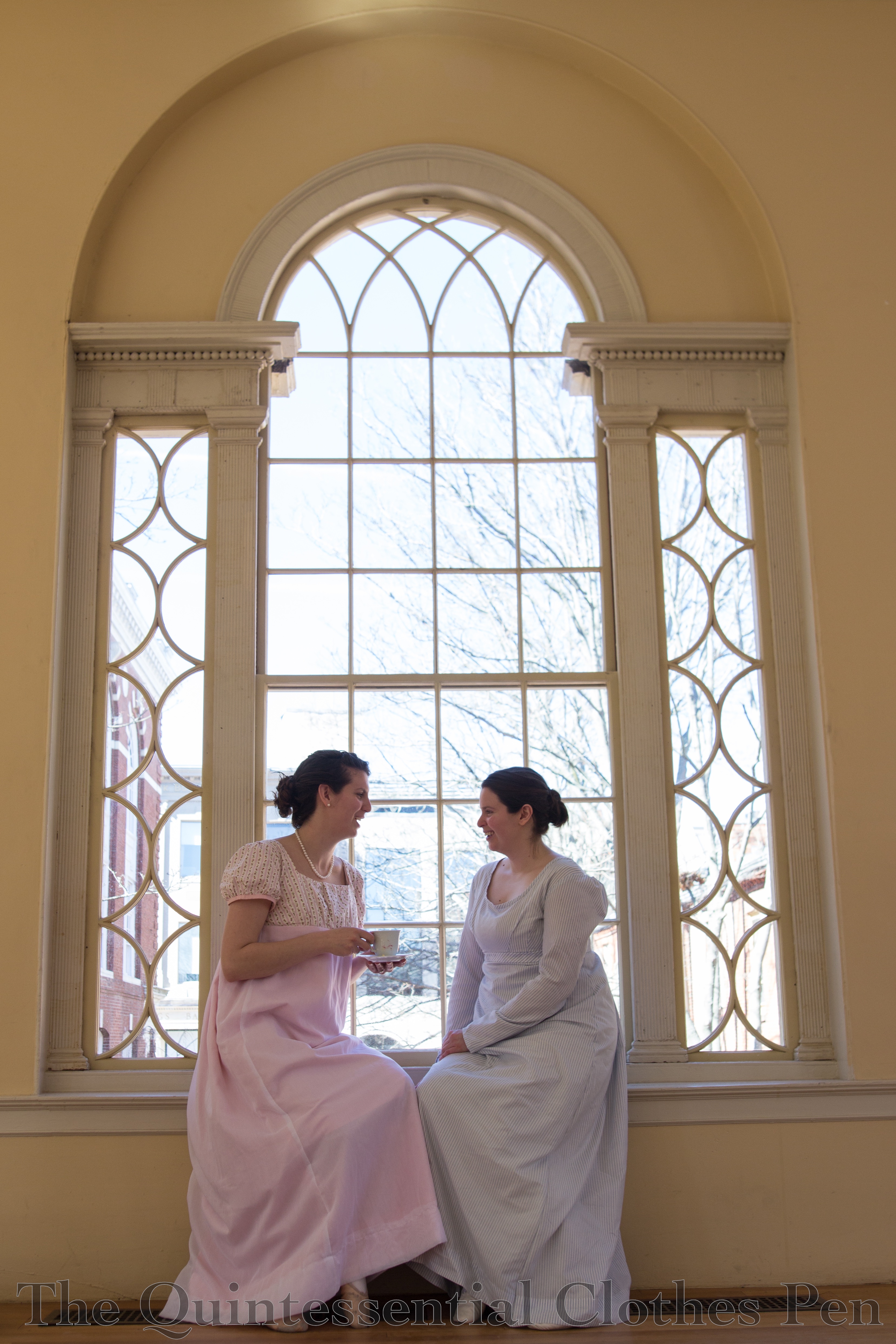
This venue, Old Town Hall, has lovely windows that make perfect frames for picture taking!

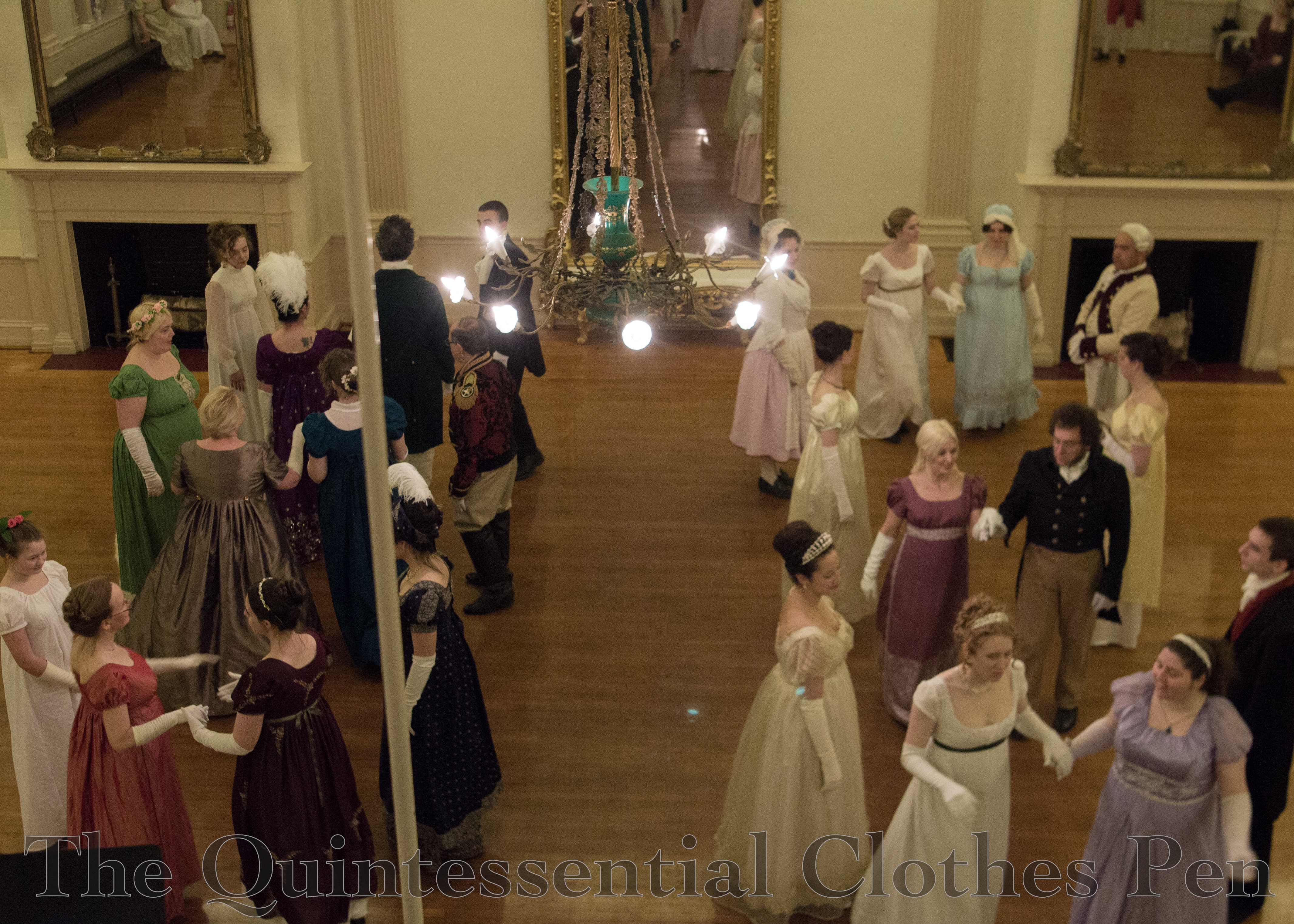
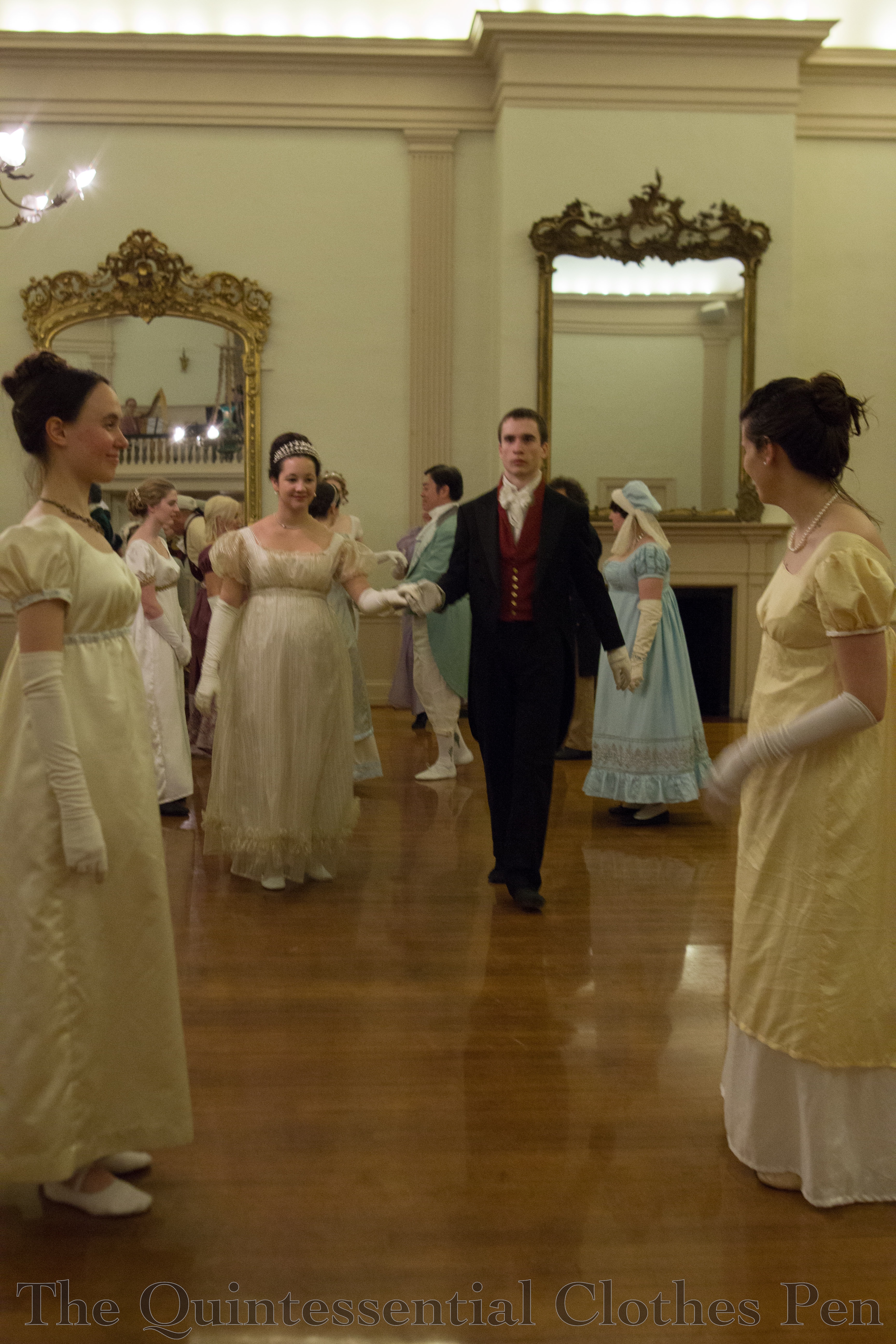
After tea, those of us running the weekend calmly (well, probably with a lot of scurrying) switch venues to the more elegant Hamilton Hall, where we have a formal ball with a lavish reception. Hamilton Hall is special, with a gleaming sprung floor, musicians balcony, and gorgeous gilt framed mirrors.

Sometimes, though, silliness ensues! I couldn’t resist making a face in the picture below… After that is a face that often happens after I run out of pose ideas…

There is lovely dancing on that evening. The things we’ve all learned have had time to sink in and people dance marvelously, again without teaching.

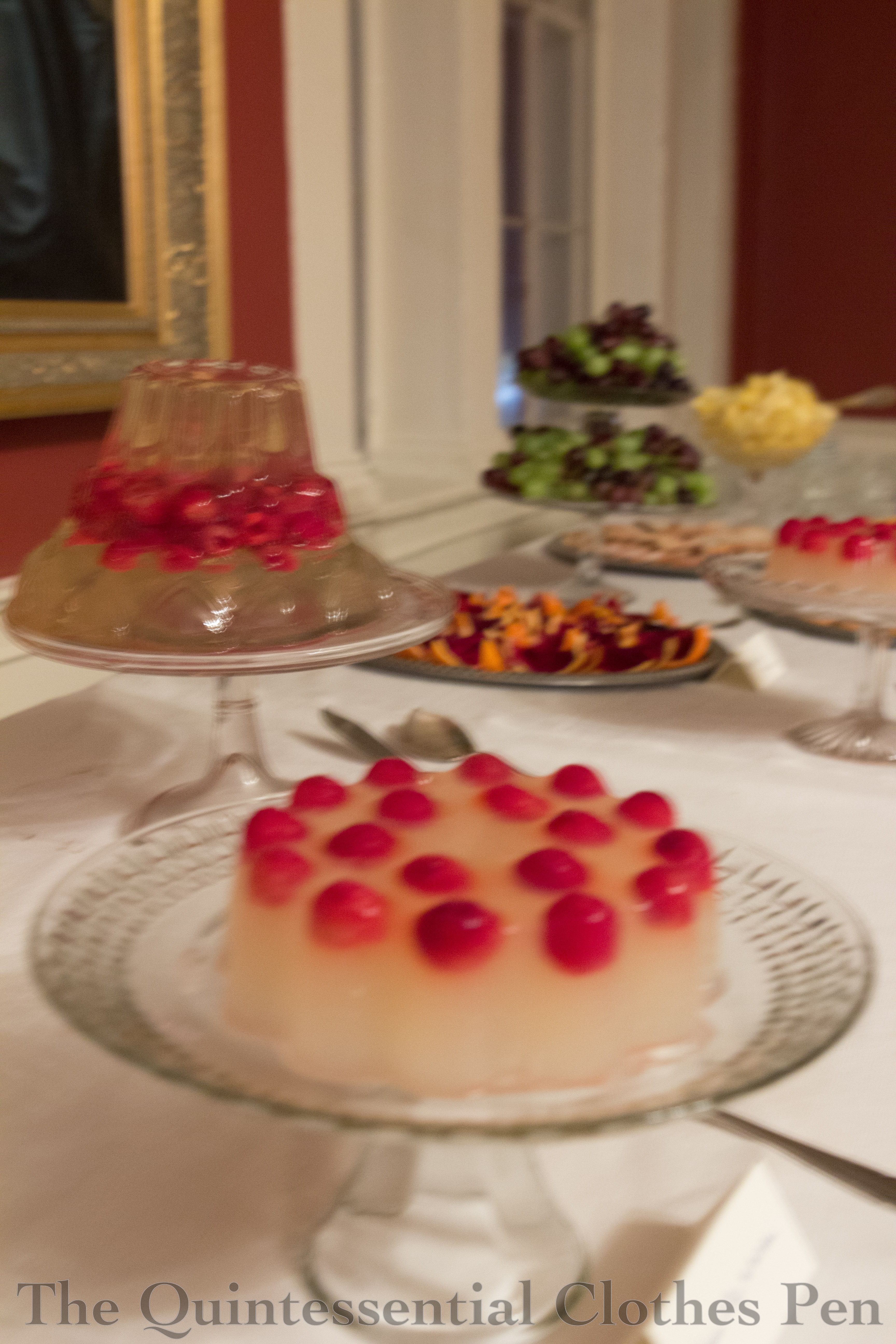
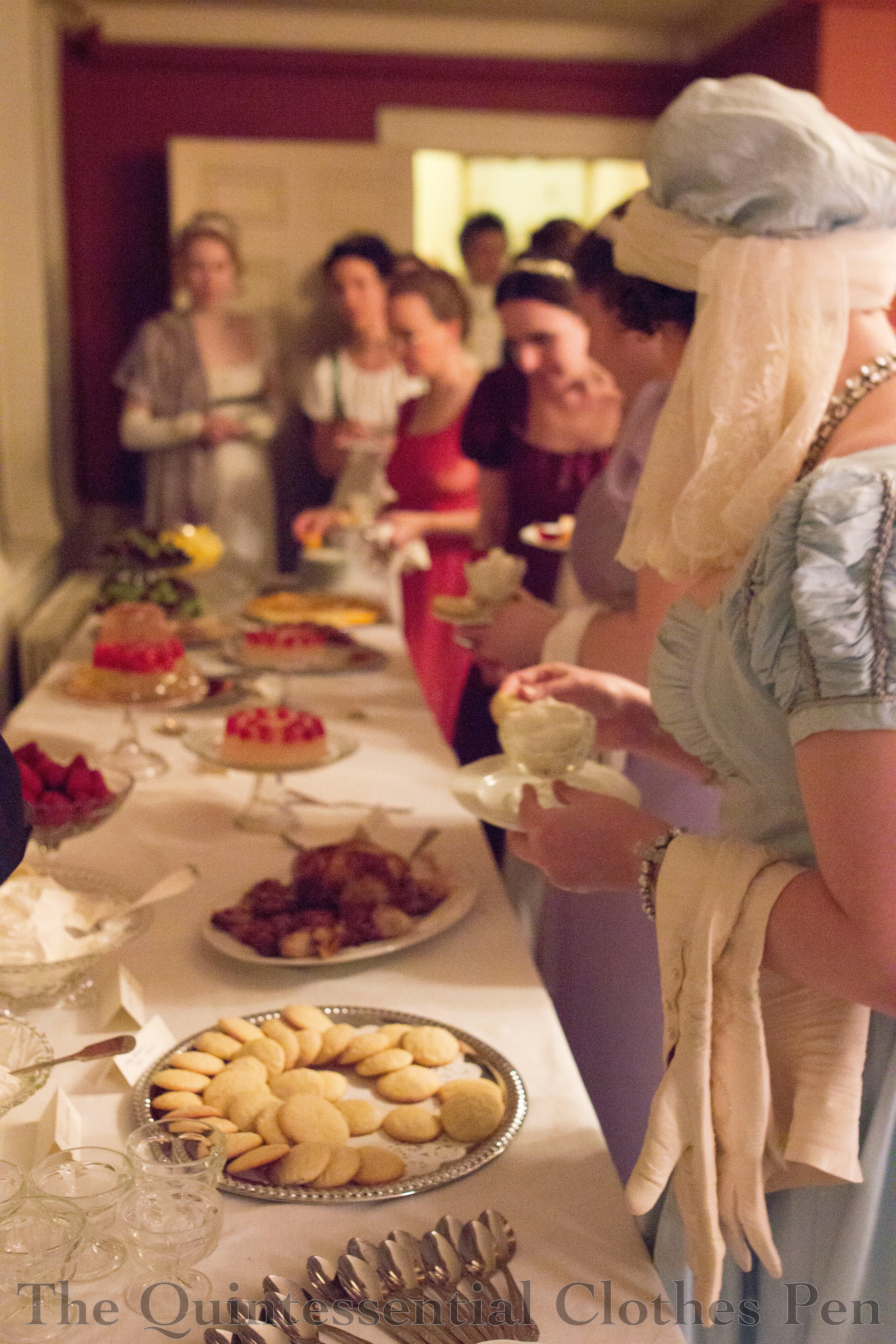
There are lots of yummy and beautiful foods to tempt everyone away from the ballroom, as well. This year we had some successful fruit filled jellies, a popular dessert in the 19th century.

After lots of dancing (and dish washing–lovely spreads like this with real dishes don’t appear without a fair bit of work behind the scenes) a much needed sitting break provided a nice opportunity for a group photo.

As usual, it was a lovely weekend full of great dancing and meeting lots of lovely new people from around the country, the more local New England area, and even Canada! Maybe some year I’ll get to meet you, too!

SaveSave

SaveSave

SaveSave

SaveSave