Vernet Project: Witzchoura Construction

This is the last post about the construction of my amazing 1814 Vernet Project. I really enjoyed doing the research and making the parts of this project. It was great fun and such a lovely learning experience to be part of the group of people making Vernet ensembles. And I was able to wear most of the ensemble for more than just pictures! I hope to find future reasons to wear these again!

I’ve been saving the best for last–the construction of the main piece, the witzchoura itself. As with all the other pieces in this ensemble, the witzchoura is entirely hand sewn. It is made up of a faux fur lining and an exterior of silk taffeta flat lined with cotton flannel and trimmed with more faux fur. Here are some in progress photos.

img_2202-1
Faux fur lining made up but not set in.
img_2205-1
A seam and bust darts in the faux fur lining. The edges were cut without seam allowance, butted together, and whip stitched.
img_0264-1
An interior view of the in progress witzchoura, showing the back pleats and cotton flannel interlining. I believe at this point I had attached the hood/collar as well as the faux fur lining at the neck but had not yet sewn the center front edges together.
img_0278-1
The exterior silk/flannel layer was pleated, but the fur was gathered (it wound up resembling cartridge pleats) to the bodice.
img_0274-1
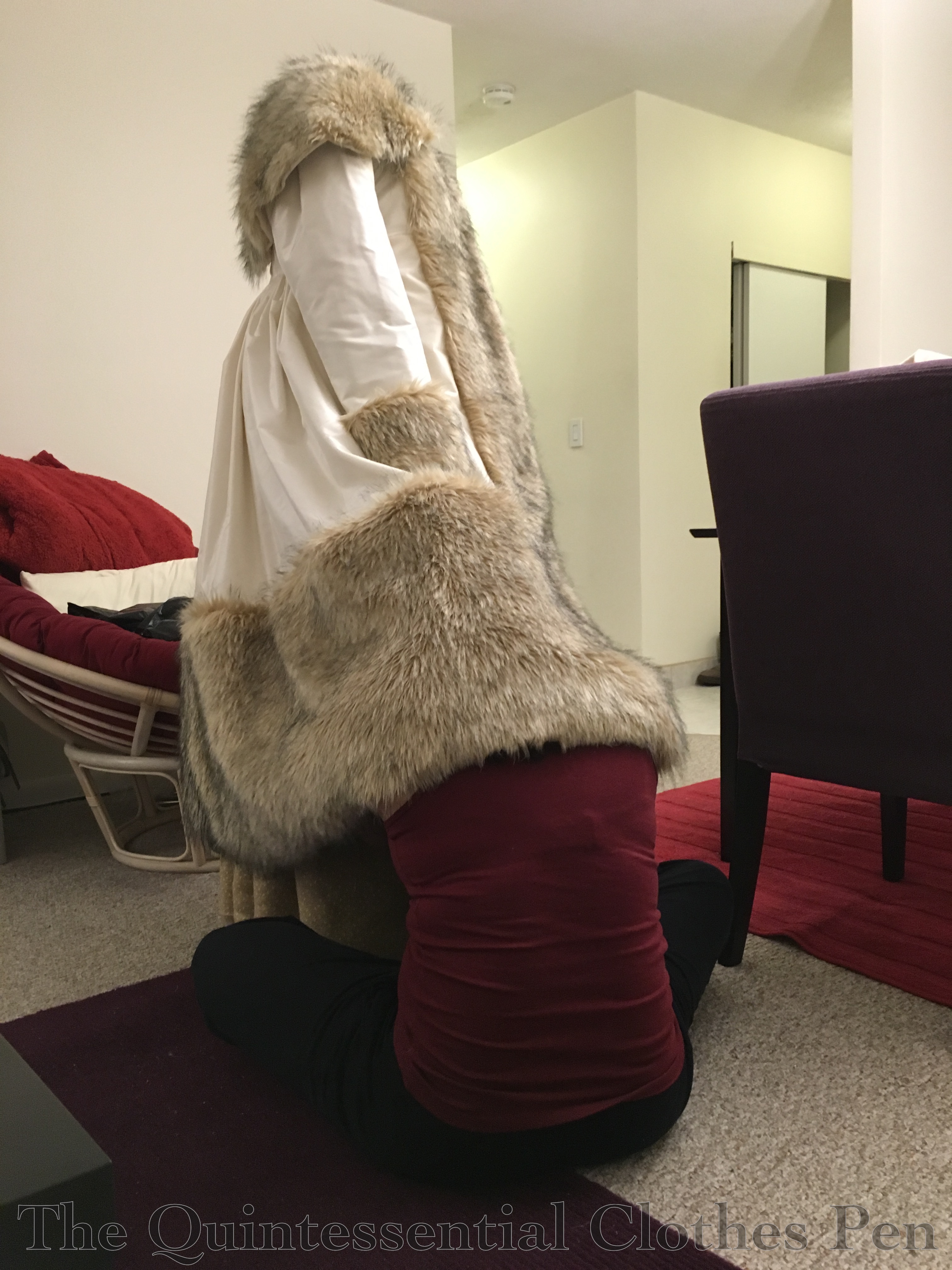
After attaching the front edges of the exterior and lining I put the witzchoura on squishy to look at the hem lengths. In doing so, I found a few places where the exterior needed to be invisibly tacked to the lining, which is why I’ve got my head between the layers!

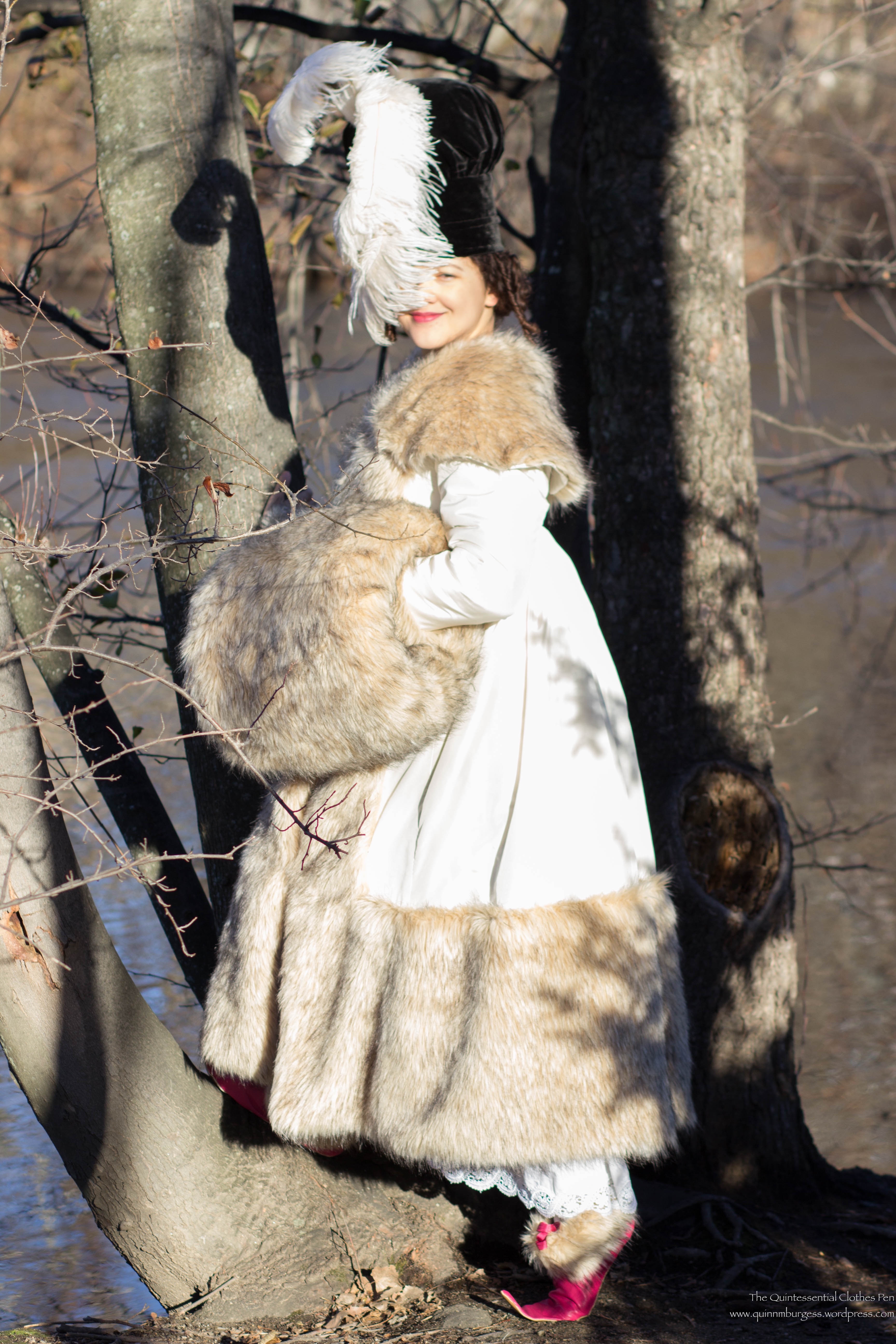
Ta da! The finished witzchoura with all of the lovely accessories. It certainly is a luxurious looking and feeling ensemble!

img_1860-1

I thought I would address a few other points as well. Some people have been waiting for answers to these questions for a long time! Thank you for your patience as I waited to answer your questions until now in order to keep everything together in terms of information.

Is it heavy to wear?

No, once dressed, the ensemble does not feel heavy. But, when holding it, or hanging it, or putting it on, YES, it feels quite heavy! It’s a fair bit of fabric, with three layers, and the faux fur gets heavy quickly with such yardage.

What is the weight? How does it compare to a heavy wool winter coat, for example?

Oh dear. I’m very bad at estimating this. I like the comparison question better! If you’ve ever held a very heavy, thick, full length winter coat, I think this is probably similar in weight. But compared to anything less, it would feel heavier.

Is it easy to walk and move with such an enveloping set of objects?

This is the sort of question I would want to know the answer to! Yes, it’s easy to walk. The ensemble does not restrict leg movement. I can also move my head with ease, because the hat sits low enough that it is well anchored and not going anywhere. However, the witzchoura does restrict arm movement some. For example, putting it on without just the right movement (which is lifting it up and behind and then sliding both arms in at the same time) doesn’t really work. And once it’s on, there’s only so much forward and backward arm movements that are possible. Lifting arms is better, but still not full range of movement. Each layer by itself has more possibilities, but the faux fur fills a lot of space inside the silk exterior. This makes it quite warm, but feels a little bit like wearing a marshmallow.

I hope you’ve enjoyed my Vernet journey! If you have any other questions about the ensemble please let me know. I would be happy to answer them!

Vernet Project: A Witzchoura Tangent

I started this post soon after joining the Vernet Project, so I think it must have been in my drafts for close to two years at this point. I didn’t want to leave it in the drafts folder forever, though, so I thought I’d include it as I’m wrapping up my Vernet posts.

Throughout my research, I’ve looked through many hundreds of pins on my Pinterest boards from the 1810s, 1820s, and 1830s and have found only a handful of plates that show outerwear specifically labeled as witzchouras (these can be seen in this past post showing examples). There are a much larger number of other, similar, types of outerwear.

(If you’ve missed out, this post explores the origins and qualities of a witzchoura, while this past post explores witzchouras in even more depth, with multiple excepts from the first part of the 19th century mentioning them.)

Examples of garments similar to witzchouras

Common garments in this category are labeled using words such as pelisse and pardessus. Then there are also carriage dresses (example), promenade dresses (example), and redingotes (example) trimmed in fur, but it seems clear in the fashion plate descriptions that these garments were not considered witzchouras.

ac27bb830f63f1673e45316d0e18f87d
Fashion plate showing a Pardessus from 1811.

Here is another similar garment, a Russian mantle, described in The Ladies Pocket Magazine in 1838 under the chapter English Fashions and Novelties: Remarks On The Prevailing London Fashions.

content

Descriptions of garments similar to witzchouras

In 1849, La Belle Assembleé addresses this for us (while also mentioning yet another type of outer wear, a burnous. The Dreamstress defines and explores this garment specifically as it relates to historical fashion, which is excellent and full of images!). The author of this reflection of fashion specifically mentions the weight of a witzchoura and how that compares to the weight of a pardessus, as well as the types of outings that these garments would have been worn for. Interesting that they would be worn for carriage dress, when, alternatively, one could also wear a ‘carriage dress’.

content

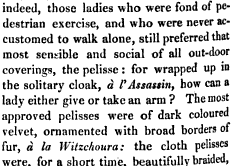
This next excerpt, from La Belle Assembleé in 1825, tells us one distinctive quality of a pelisse which is that the arms were not encased in the garment and could be freely moved about.

content-1

a94e6fc37e3582c81ab22797c3c06b78
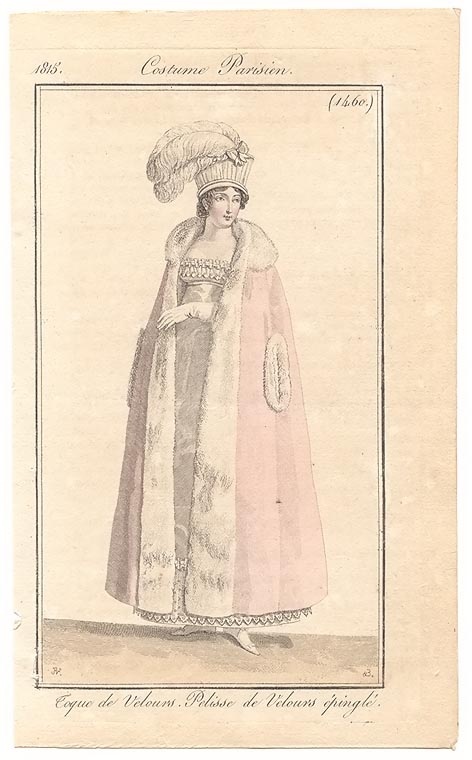
Example of a Pelisse from 1815, showing the armholes that would allow movement.
004c2dc3370c00425fcfd044369a9d53
A slightly later example of a Pelisse in a similar style. This is from 1821.

Examples of out of the ordinary witzchouras

Then there are garments labeled as witzchouras, but which are odd in a variety of ways. For example, take a look at the interesting witzchoura mentioned in The Lady’s Monthly Museum in 1817, seen below.

content

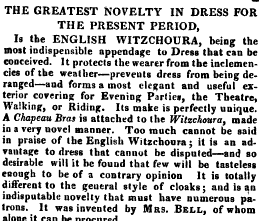
I’m not really sure what qualities allow a witzchorua to keep one’s dress from being rumpled, but what strikes me as odd is that the witzchoura mention is lined with silk and that is has a chapeau bras attached! Also in 1817, La Belle Assembleé mentions this exact garment twice! The first is a description of the garment. The second is about the inventor, Mrs. Bell, who, if you care to read more, has a long list of other interesting things that she supplies.

content

content-1

In this next case, the witzchoura is described as being lined with sarsnet (a fine plain or sometimes twill weave usually silk fabric) and only trimmed with fur rather than being lined entirely with fur. Haven’t we seen conclusively that a witzchoura should be lined and trimmed in fur? This witzchoura is also interesting because of its colors. It is quite likely a garment made for the general mourning of the death of Queen Charlotte, who passed away in November 1818.

“For out-door costume nothing can be reckoned more completely elegant than the Witchoura pelisse of black velvet lined with white sarsnet, and trimmed with real ermine.”

La Belle Assembleé  in January 1818

Finally, there is this fashion plate at the LACMA which is labeled as being a witzchoura but with nothing witzchoura-like about it! A mistake perhaps? This looks like a summer garment, not a heavy winter garment.

What a rabbit hole of obscure information the witzchoura is. I’m rather glad to say that I’ve now exhausted my currnet list of historical references to the witzchoura!

Vernet Project: Petticoat and Muff Details

As the end of this year draws nearer, I feel the urge to complete my plan to share all the details of my 1814 Vernet Ensemble before the end of 2016. In order to do that, I have the smaller garments to discuss (petticoat and muff) and the witzchoura itself, which I know some people have had questions about for probably about a year. Sorry to keep you waiting!

As I’m saving the witzchoura to be the grand finale, today I want to share some details about the petticoat and muff. First, here are some repeat pictures of the full ensemble in case you’ve started reading since this project was unveiled. Both of these pictures are from my Vernet Project photo shoot in 2015. They give you a good glimpse at the petticoat and the muff.

IMG_1985

The muff exterior is the same faux fur as the trim on the witzchoura. The lining is an ivory cotton flannel, which feels warmer on the hands than a silk lining and which I don’t think is out of the realm of possibility in terms of historical reasonability (a theory I have tested out with multiple muffs over the last few years).

In order to get the distinctly Regency style of a beehive style muff, the inner flannel lining is substantially smaller in dimension than the exterior fur. Layers of high loft polyester batting fill in the shape and the fur actually wraps to the inside of the lining for a few inches on each side and is gathered to fit the smaller circumference of the lining. The result is a very large and very cozy muff. (This method is different than making the interior and exterior the same or similar in dimensions, resulting a muff that looks like my 1822 one. The blog post sharing details about that muff has lots of great images of both types of muffs from this period, if you want to see more. Also, it’s worth noting that polyester batting would not have been used to keep one’s hands warm in the early 19th century, but that I chose that materials because I had it on hand and it is not visible.)

IMG_2004

The petticoat is the only piece of my Vernet project that existed before I agreed to participate. It started life as part of a dress, but was removed and languished for years. Turns out I had made it too narrow to dance in, which isn’t very useful in my life. On the bright side, I had just enough of the cotton fabric left to add another panel, thus making the hem circumference much more wearable.

The petticoat had an attached sleeveless bodice before the addition of extra fabric in the skirt, so after adding fullness I was able to simply reattach the bodice. The edges of the bodice are narrow hemmed and it closes at center front with a tie at the waist and a button and loop at the bust. This past blog post discusses extant sleeveless underdresses or petticoats such as this. As with everything else in this project, both this petticoat and the muff are entirely hand sewn.

img_1632-1

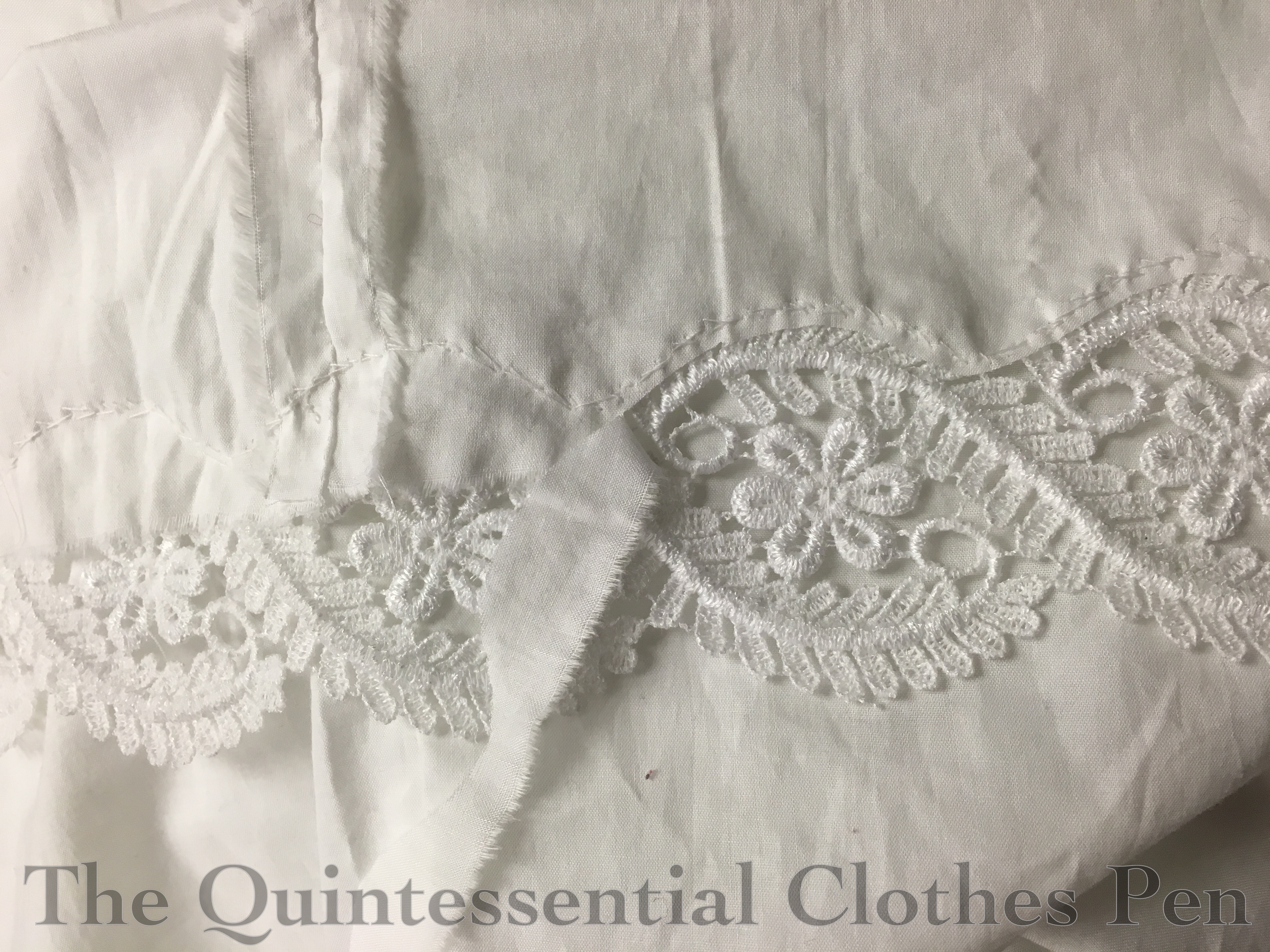
The only other changes I needed to make to the petticoat to use it for the Vernet Project were at the hem. I started by adding lace that mimicked the shape of the embroidery seen in my Vernet fashion plate. I whip stitched the lace on with small stitches and then cut away the fabric behind the lace, creating a lovely scalloped hem.

img_0284-1

After trying on the petticoat with the finished hem, I decided it was too long and took a tuck above the hem to shorten it. You can see the tuck in one of the photo shoot pictures early in this post.

This final picture is from when I was hemming the witzchoura. While I had that garment on the dress form I also put the petticoat on to determine the placement  of the lace on the previously hemmed petticoat.

img_0279-1

And that’s it! Those two garments were minor in scale compared to the toque de velours, silly shoes, and the witzchoura itself, both in terms of materials and sheer volume of work involved.

Sophie, 1861 Cotton Print (HSM #8)

Last week, I introduced Eleanor, a newly made plaid gown from 1862. Today’s introduction is to Eleanor’s friend, Sophie. Sophie actually came first, back during the summer when I was intending to participate in the same dance performance for which I’ve worn Georgina in the past (here are a selection of past posts about Georgina: the construction which is similar in some ways to Sophie, Georgina in action, and Georgina with a new collar).

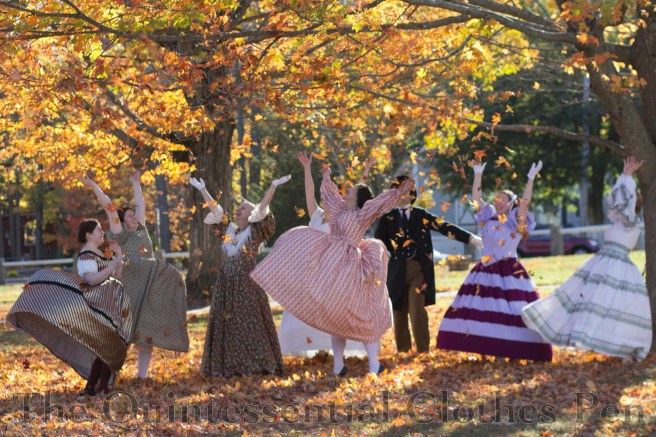
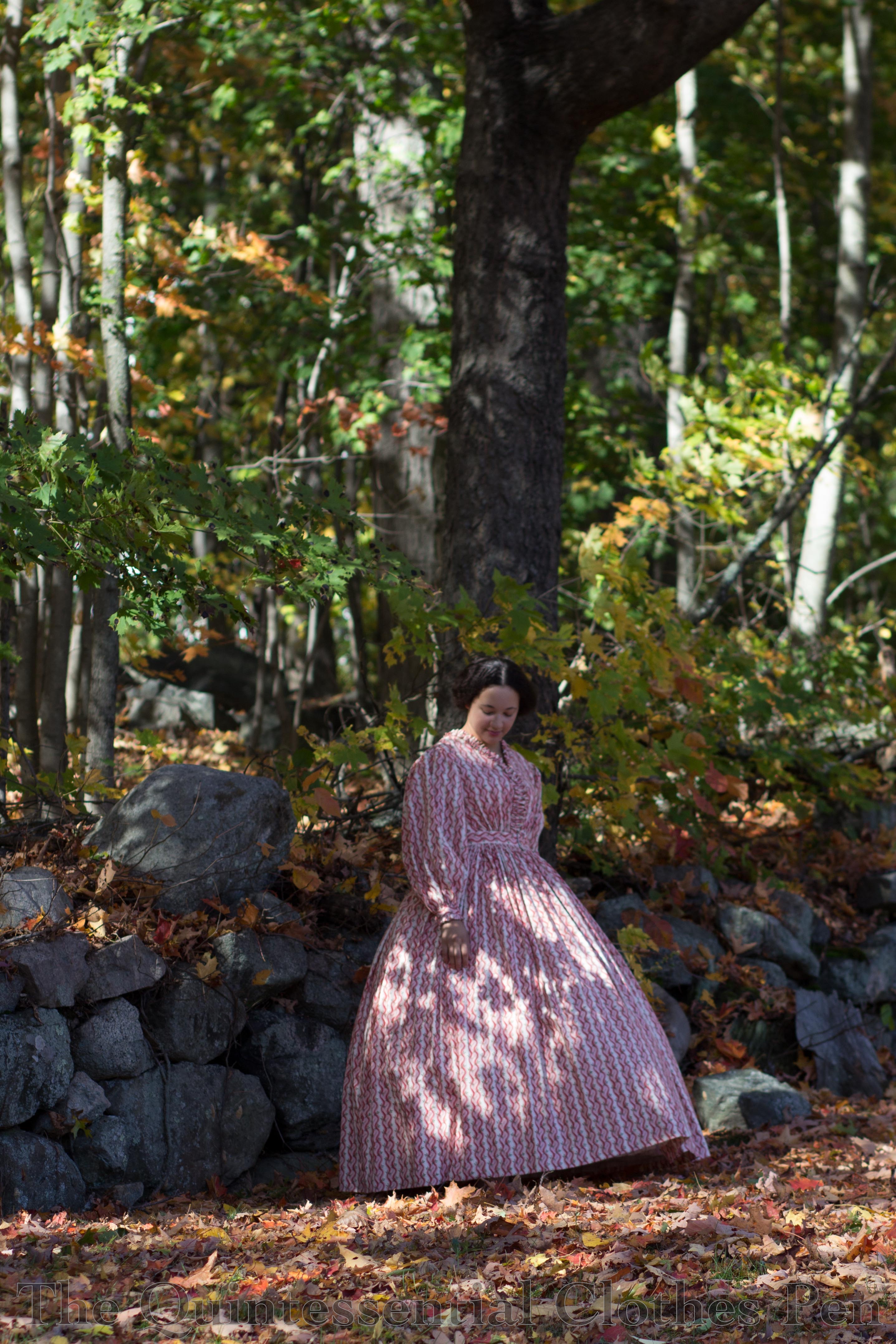
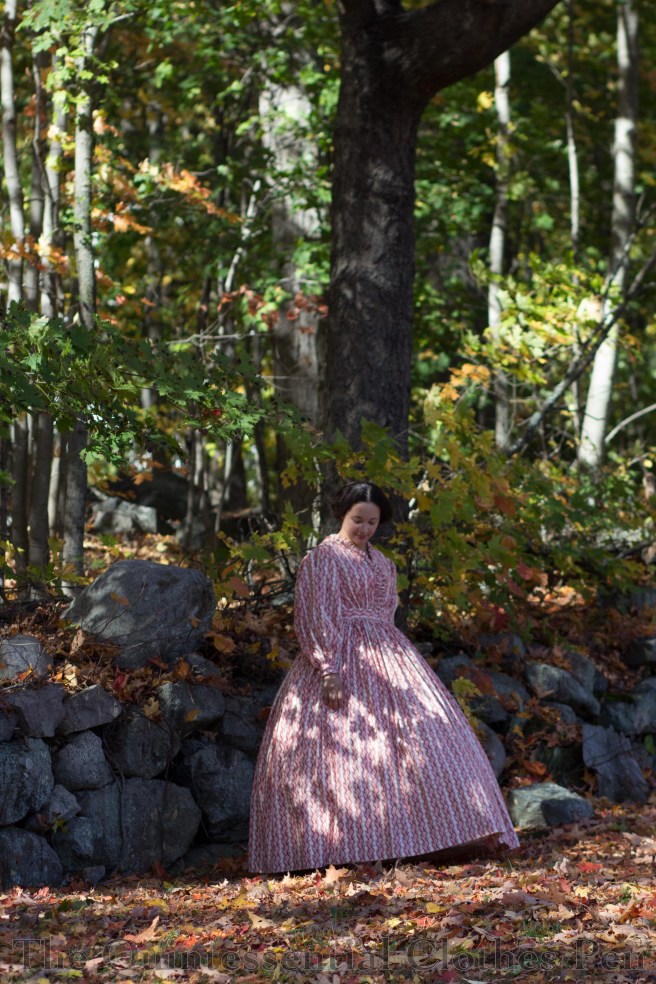
This year, the performance was rescheduled due to rain and I couldn’t attend the new date, meaning that the new dress, Sophie, languished until October, when I was able to wear it during part of a recent mid-19th century dance weekend. The nice thing about the delay is that the pictures all have stunning fall leaves, which would not have been in the case in the summer.
img_3450-1

Also, had I worn this dress on the first intended date, it would not have been entirely completed. Having extra time allowed me to officially finish all the trim and closures which made this dress the perfect entry for the Historical Sew Monthly challenge #8 “Pattern – make something in pattern, the bolder and wilder the better.” I didn’t have any pictures of the dress on a body at that point, so I submitted a rather sad picture of the dress on a hanger at that time. It’s exciting to have real pictures now!

Just the facts:

Fabric: 7.5 yards cotton print.

Pattern: Adapted from Past Patterns #701, 1850-1867 Gathered and Fitted Bodices.

Year: 1860-1863 based on my extant inspiration, but I’m calling it 1861.

Notions: Thread, hooks and bars, muslin scraps, and narrow yarn for cording.

How historically accurate is it?: I’m going to go with 95% on this one. This is as accurate as I can be given the research I have done and the materials I used, though the use of a facing on the front edges is guesswork. Regardless, this would be entirely recognizable in its time.

Hours to complete: Unknown. A fair bit.

First worn: October 23 for an afternoon tea and dance games.

Total cost: $23.

img_3451-1

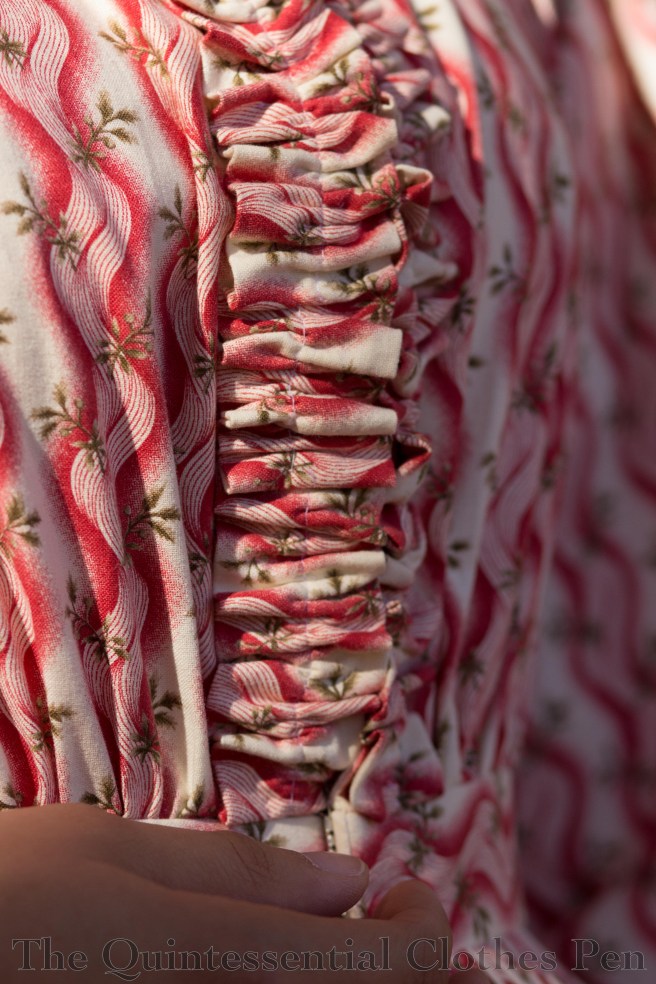
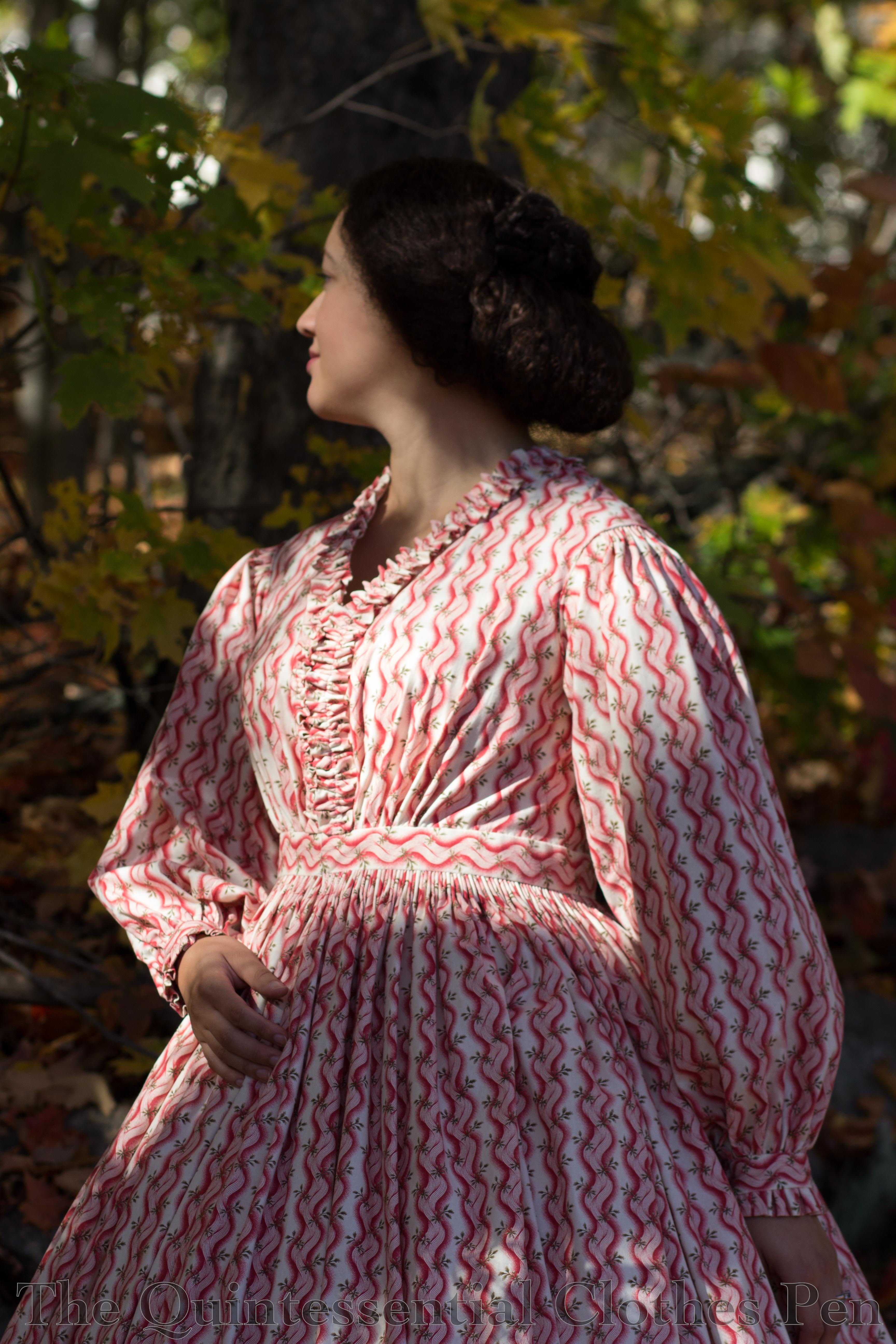
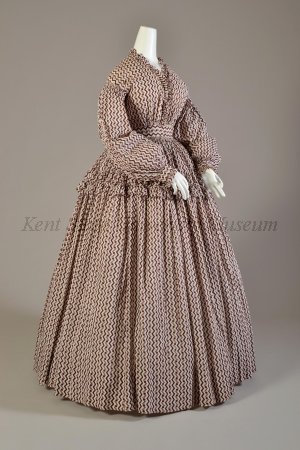
Sophie was directly inspired by this extant dress at the Kent State University Museum. I was considering what to wear for the performance, thinking that I’d worn Georgina enough to want something new, that I’d had an 1860s cotton print fabric in my stash for a few years, and then I remembered this dress. I decided to leave off the ruffle on the skirt (and also didn’t have enough fabric), but was so pleased that my cotton print is so perfectly suited for playing with the pattern in the same way as the extant dress!
19861270001

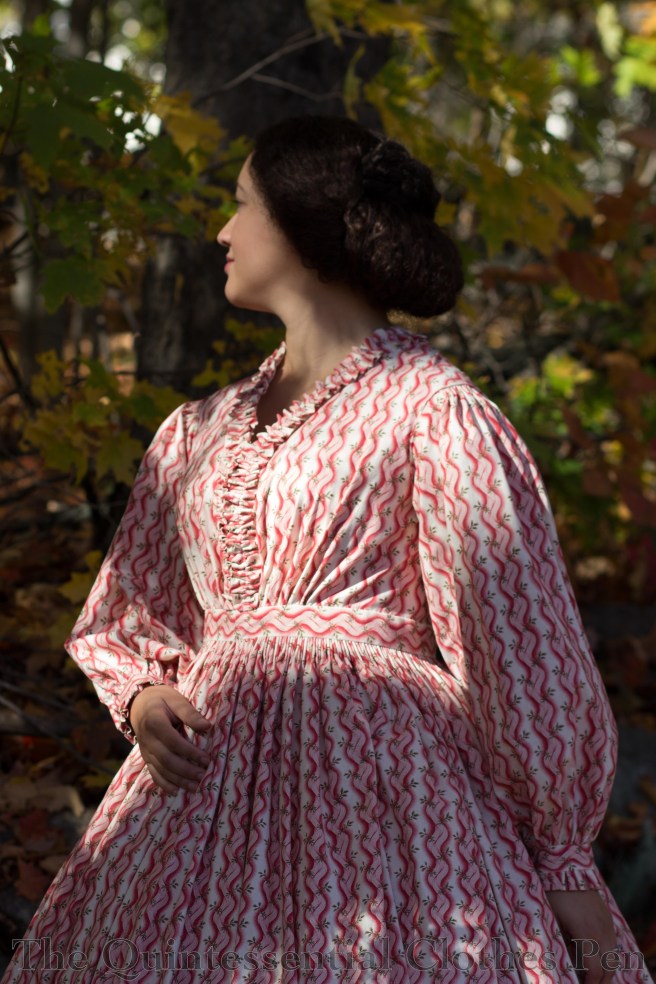
Dresses from this period with v necks are not common, but they do exist. This Pinterest board has lots of examples. My Pinterest board has a few other dresses that helped move me along as well.

As I mentioned in my post about Eleanor, finding and making use of subtle differences between dresses from similar years brings me joy. For example, Sophie has a v neck, no boning, cartridge pleated sleeves, gathered trim, and is actually sewn together as a dress, rather than hooking together at the waistband as with all my other dresses from this period.
img_3461-1

img_3464-1

img_3467-1

In other ways, Sophie is similar to Georgina, being partially machine and partially hand sewn, having a cartridge pleated skirt, cuffs with little ruffles at the ends, and pockets.

img_3462-1

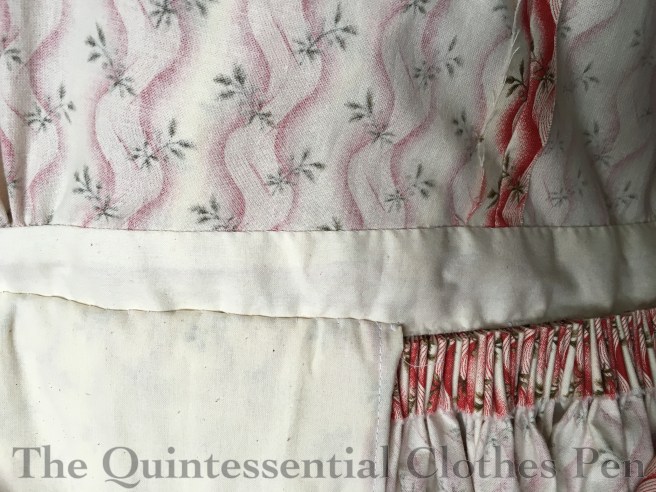
Personally, I love having pockets in day dresses. It brings me peace of mind to know that modern things like my keys are close by and not sitting around somewhere. Plus, chapstick, fan, gloves, etc. are also excellent choices for stashing in pockets. These pockets, which you can see the top of in the picture below, are sewn in the same way as Georgina’s pockets, shown here. I love this collection of references to pockets from the 1840s, 50s, and 60s that Anna Worden Bauersmith put together. I’ve been waiting for just the right moment to share it for what seems like ages.
img_1871

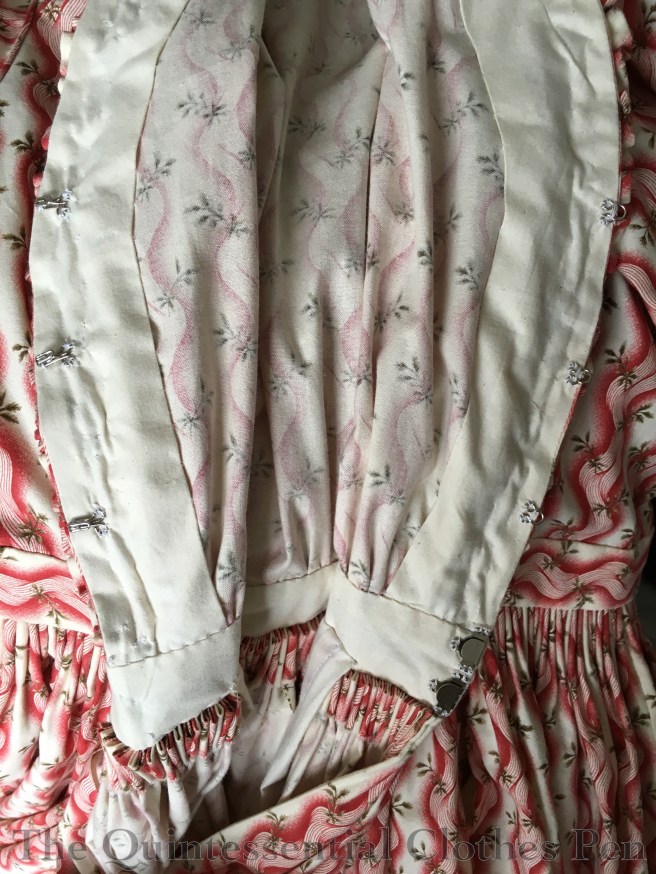
Here are two more interior shots of the dress. The first shows the muslin facings. I don’t have documentation for this method being used to finish a lightweight summer cotton dress, but it makes sense that this method might have been used to finish the edges nicely while keeping the main body of the dress breathable and light. The second picture shows in the inside of the top of the sleeve, particularly to show the cartridge pleats.
img_1874

img_1872

In addition to the dress, I also made a new cage crinoline. I’ve been wanting a slightly smaller, less bell shaped one, particularly to wear with cotton dresses. I love my old cage crinoline (seen here) for evening dresses, but it is just a bit too much for a more practical daytime look. The new crinoline shape just looks ‘right’ with the cotton dress. The difference is subtle, but pleasing. Unfortunately, it did not perform well in its first wearing. The vertical tapes were sliding all over the place and causing the hoops to drop and be tripped on. Not good! It needs revision before being finished and shared, so for now you’ll just have to believe that I’m wearing it with this dress.

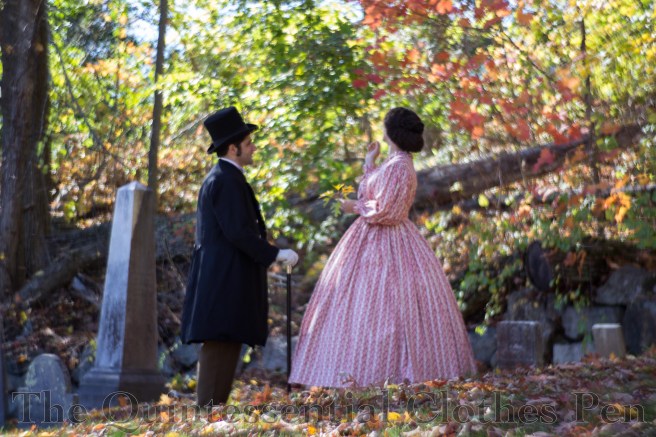
Now that you’ve heard all about the dress itself, here are some pretty pictures of it in action. These first ones are in the spirit of the development of rural cemeteries in the mid-19th century, which you can read more about in this blog post at Plaid Petticoats.
img_3492-1

img_3480-1

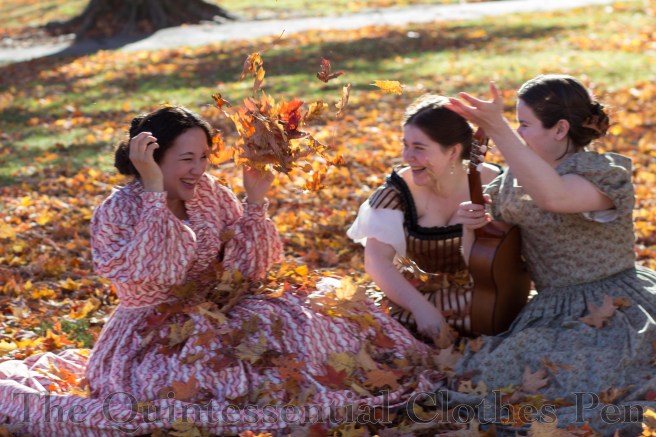
The next few are a celebration of the autumn season. The gorgeous leaves were beckoning us to have some laughs. Incidentally, I tend to jump in the air with my arms up whenever I’m having an amazing time in this period. Take this memory, for example. I’m doing pretty much the exact same thing!

img_3522-1

img_3525-1

img_3526-1

img_3543-1

We have so many things to be grateful for. I am always thankful for the many blessings in my life, particularly at this time of year. I hope that your life is also overflowing with blessings and reasons to give thanks, in autumn and always.

img_1956-1

An Introduction To Eleanor (HSM #10)

The Historical Sew Monthly challenge for October is Heroes – Make a garment inspired by your historical hero, or your historical costuming hero.

img_3400-1

You may or may not know that one of my favorite movies is Gone With The Wind. (I posted about this topic years ago when the blog was in its infancy–most of what I claimed then is still true and the 1860s will always have a special place in my heart, but I can now say that other periods give me excited wiggles too!) You can read the old blog post to get more specifics, but the essential point is that despite her personal shortcomings and the turbulent and controversial history of the period, Scarlett reminds me of the clothing that I love and therefore is an historical costuming hero to me.

And this gown has an added historical hero, Eleanor ‘Felcie’ Bull, who came to my rescue when I was contemplating what sleeve style to give my dress.

b9d863448d33e96ca7ce04a041dfd005
Eleanor “Felicie” Bull. 1863.
Prior to finding her image, I had been planning to name this dress Johanna, in honor of the friend who convinced me that I needed the fabric a few years ago. But I had sort of decided this was weird, since all my other dresses from this period have names that I like, but that are not from a specific living person. Once I found this image I was completely overtaken with excitement–I love the name Eleanor and there she was, helping me out! The choice was obvious.

img_3382

I made a new hair decoration to go with Eleanor. I had the perfect stem of purple velvet leaves, but no flowers to match the dress. So I dyed some white millinery flowers to a golden yellow. They have a fluffier texture than before being dyed, but the color is perfect. Using millinery flowers brings me so much joy, because it’s easy to shape any section since each stem is fully wired. And I couldn’t pass up the opportunity to wear my Dames a la Mode purple earrings and necklace.

img_3384

Regarding dress construction, we must start with a bit of a personal habit, or perhaps a theory, though I’m not sure it’s as thought out as that. When the opportunities arise for me to make multiple garments from the same period that could be carbon copies of each other in different fabrics (so much speedier on the patterning and planning front!), I hardly ever take that easy road. I am drawn to exploring the small variations.

So it is with Eleanor. I decided to: knife pleat her skirt instead of box pleating, cartridge pleating, or gathering; to make a plain darted bodice instead of using seams or gathers; to make the bodice straight across all around, which is more unusual for evening gowns made of silk than having points in front and back; to overlap and topstitch her side back seams; to omit the oft-seen bertha around the neckline; and to have single puff bias cut sleeves. These things all make this dress just slightly different than my others from this period, adding a bit of thought and time to the process. And if we’re talking about time, let’s just mention how mind-boggling cutting plaid pieces with curved seams and darts is when the pattern matching is important to you!

I collected images of plaid gowns with a focus on evening bodices and noticed these features, which is why I decided on them. The most useful images are in one place here, on my Pinterest board for the project. I was contemplating the sleeve type when I came across Eleanor ‘Felcie’ Bull. Interestingly, she shows all of those traits I’d decided on. I loved her simple sleeves and restrained bodice trimming, which then set me on an extensive Ebay and Etsy hunt to find just the right brooches to replicate her style. Yes, I did look through about 150 pages of bow brooches to find just the right one for less than $15. Plus many pages of gold oval brooches. I couldn’t have wished for better results! Remember the look I gave you a look a few posts ago? The only thing I did was to brush the oval brooch (which is new, not vintage) with a bit of brown acrylic paint to bring it down to the old gold color of the bow brooch.

img_3403-1

Other construction details include flatlining the bodice and facing the skirt in a remnant of dusty mauve cotton from my stash (used it up, yay!), creating boning channels in the darts to keep the front nicely shaped, and finishing the neck and bottom edge of the bodice as well as the armholes with very narrow cording.

Just the facts:

Fabric: About 6 yards of silk taffeta and 1 yard of cotton.

Pattern: Adapted from Past Patterns #702, 1850s-1863 Dart Fitted Bodices and Period Costumes for Stage and Screen as a reference for the sleeves.

Year: 1862, given the details that I decided on.

Notions: Thread, hooks and bars, canvas to interline the belt, narrow yarn for cording, and plastic wire ties for boning the bodice.

How historically accurate is it?: I’m going to go with 99% on this one. Materials and methods are well researched and executed. This would be entirely recognizable in its time.

Hours to complete: I really didn’t keep track. But I can safely say many!

First worn: October 22 for a ball.

Total cost: $98 total: $68 for the silk, $10 for bow brooch, and $18 for the oval brooch.

I’ll end this with my photographic homage to Eleanor ‘Felcie’ Bull.

img_3386-2-1

1899 Elusive Blue With Train

My last post recounted a fun event that I recently attended which explored the Victorian fascination with ancient Egypt. The event was unusual in topic, quite well done, and interesting, especially as I rather like ancient Egyptian history myself. I felt that I knew a good portion of the information in the lecture, but I also learned some new things.

I decided to leave my outfit for the event for this separate post so I could go into detail without getting too long winded. As sometimes happens, I committed just about two weeks before the event to having a new garment. A trained skirt! This event seemed very suitable–dramatic surroundings and no dancing being the biggest factors.

I had started a second, trained, skirt to go with my 1899 dress back in January, but it had languished at the point of needing hemming. Despite all the other projects also needing to be completed around this time, I decided to furiously work to hem the trained skirt so I could wear it to this event.

img_1993-1

img_1995-1

Success! The construction of the trained skirt is based on this gorgeous green gown at The Met. There is a side view of the skirt which shows just a bit of the under layers that support the hem. With that in mind, I scrounged for other extant examples of trained hem finishes and included them on my inspiration Pinterest board. This example, also from the Met, shows a clear view of the hem finishing on the inside of the skirt.

To replicate the wide and stiffened hem of the exterior I purchased polyester organza in a closely matching color and used it cut on the bias. The width of organza was folded in half to add an extra bit of support before being hand hemmed. The lining is hemmed with a bias band of an ivory cotton/poly blend that has a gathered section of lace machine sewn to the top edge prior to the hand hemming so the machine stitching doesn’t show. (Given that the whole dress is mystery fabric, I had no qualms about continuing to use polyester to keep the cost down on this project.) After hemming, I put the skirt on a dress form and pinned the lining and exterior together at five strategic points, then swing tacked the layers together. These tacks keep the exterior perfectly positioned over the lining.

img_2001-1

All of the extra work to support the hem layers was worth it. Along with my super silk petticoat to support the skirt, they nicely support the train, allowing it to elegantly float behind or swirl around me with just a small movement. It was quite fun to swish through the lovely rooms at the Castle with a dramatic train without it being so long that it becomes a nuisance. I’ll have to find more opportunities to wear this fabulous ensemble!

Picturesque Regency Moments

During this year’s Regency Dance Weekend, we captured some of my all time absolute favorite shots of my Tree Gown. I saved them for this post rather than including them in the overview of the weekend.

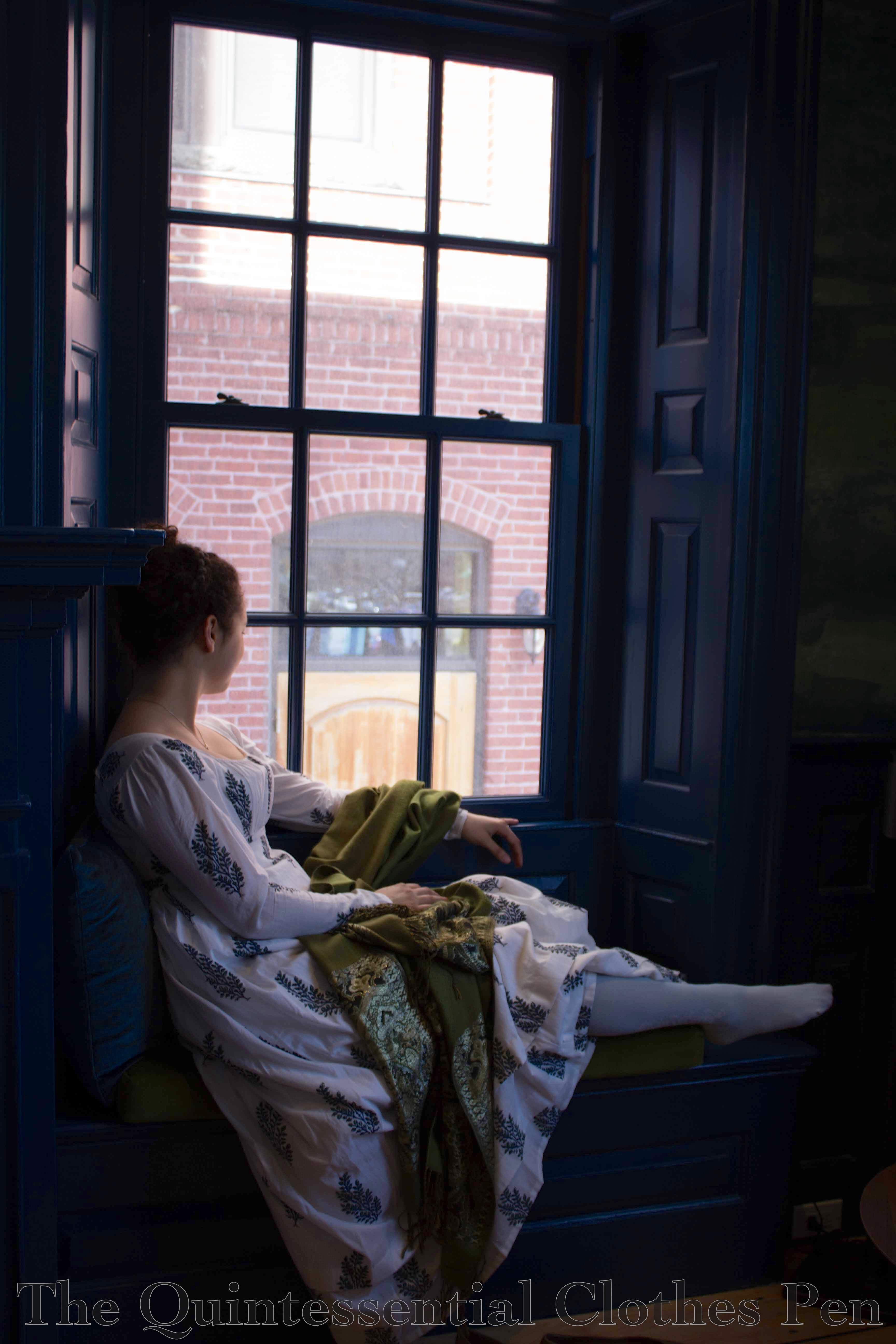
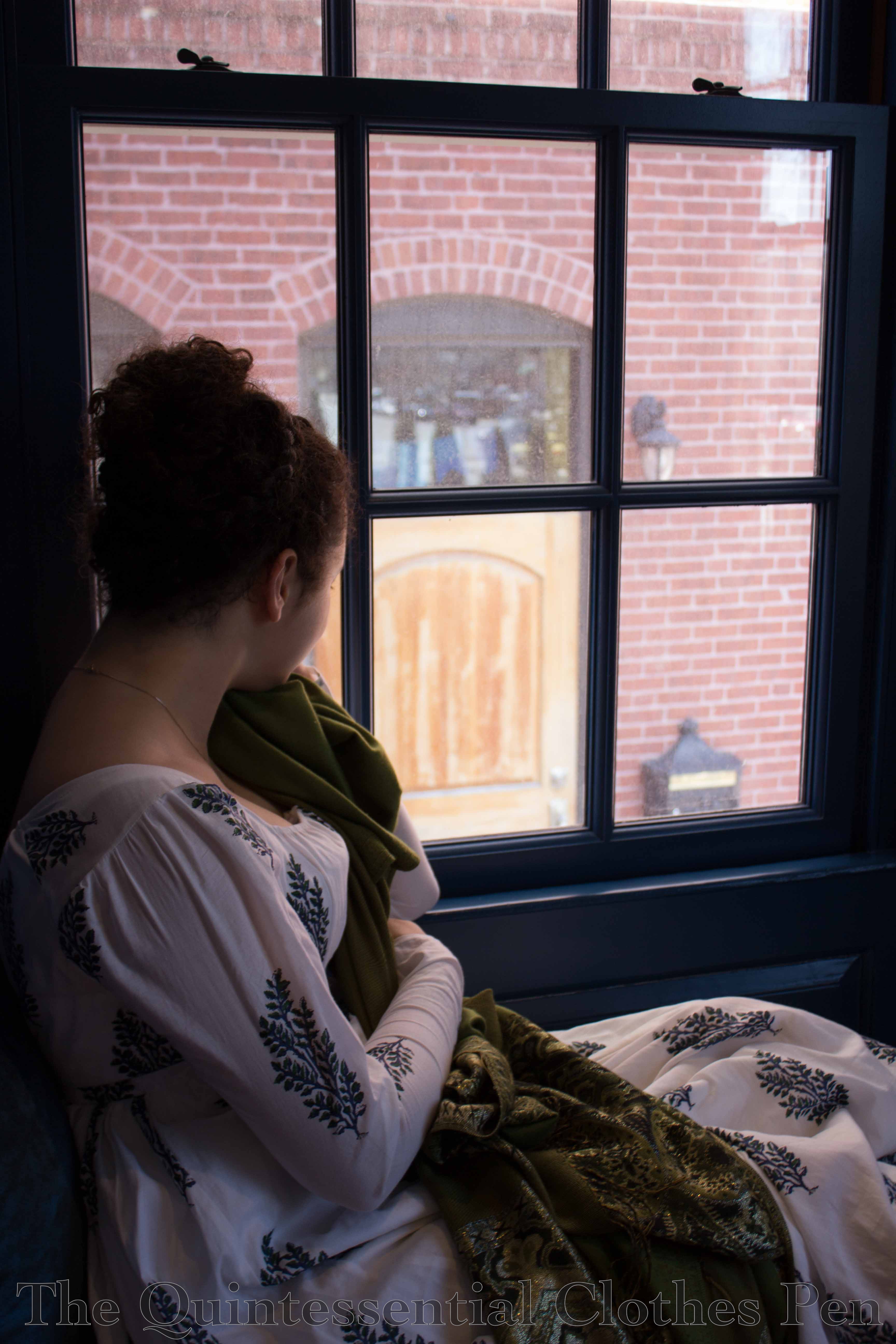
These first few were taken at our hotel. While the blue walls don’t scream Regency to me, they do coordinate nicely with my dress and make for a stunning background. The idea behind these is along Lizzy Bennet lines–lounging in a windowsill while comfortably contemplating life. This gown has the most beautiful drape to the skirt! It’s soft and full without being too fluffy.

img_2579-1

img_2583-1

img_2591-1

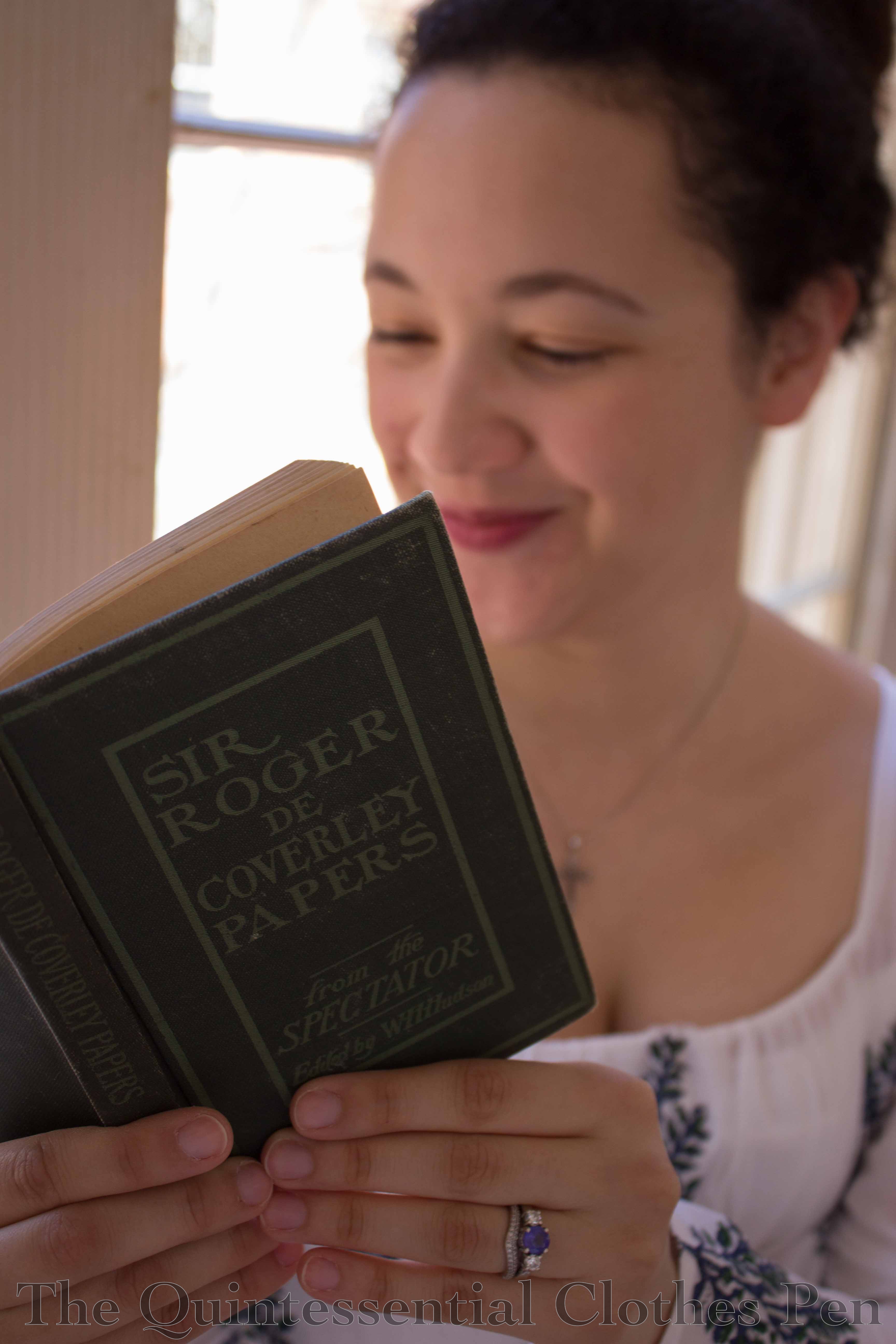
The next batch was taken at tea. One of my friends had brought the book and it is perfect for us, since we know a dance called Sir Roger de Coverley that was danced during this period. I had to pose with it!

img_2627-1

img_2630-1

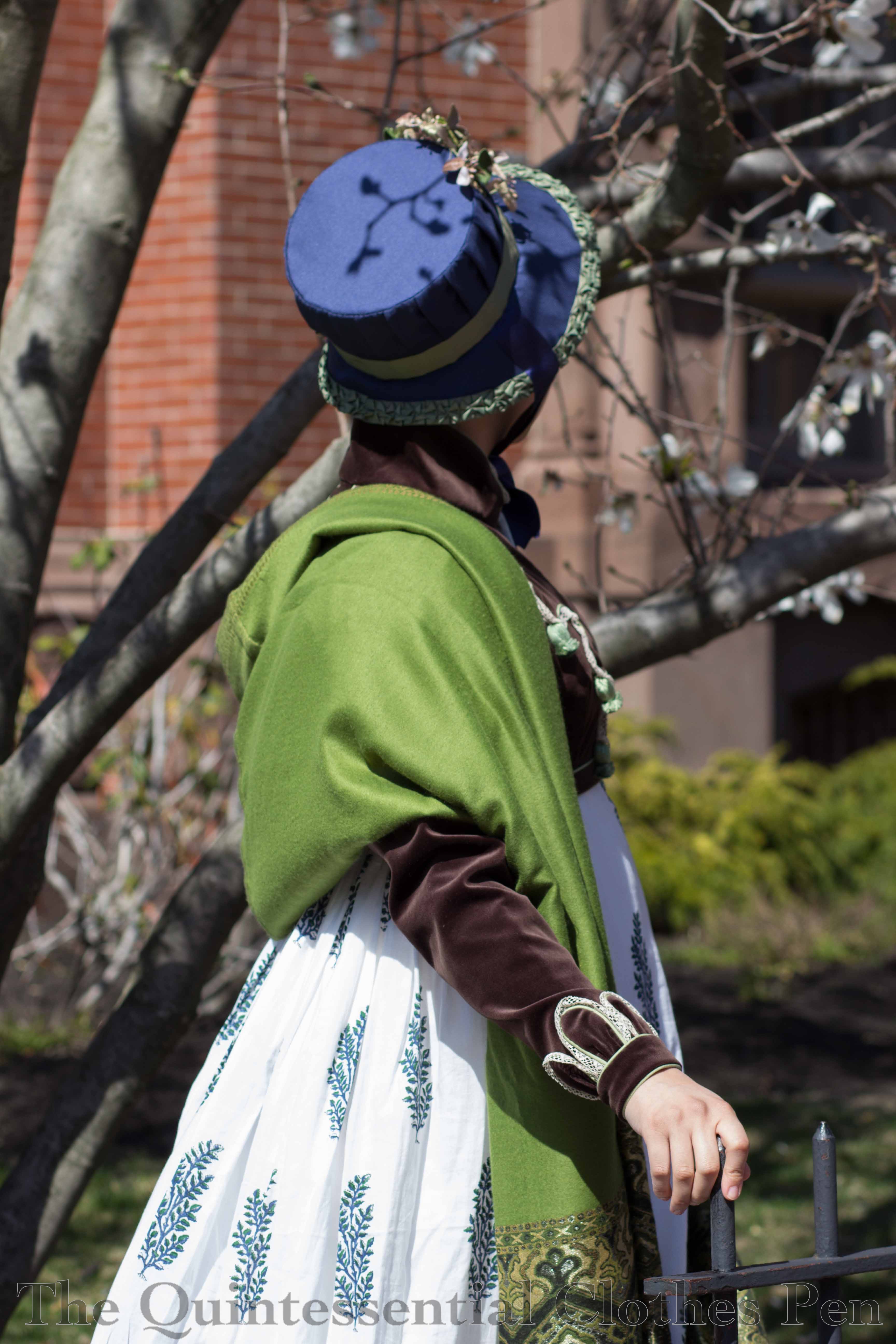
Then we went on our promenade, where we got some excellent photos of the gown with accessories: shawl, spencer, and bonnet. I like how the tree mimics the flowers on my bonnet.

img_2652-1

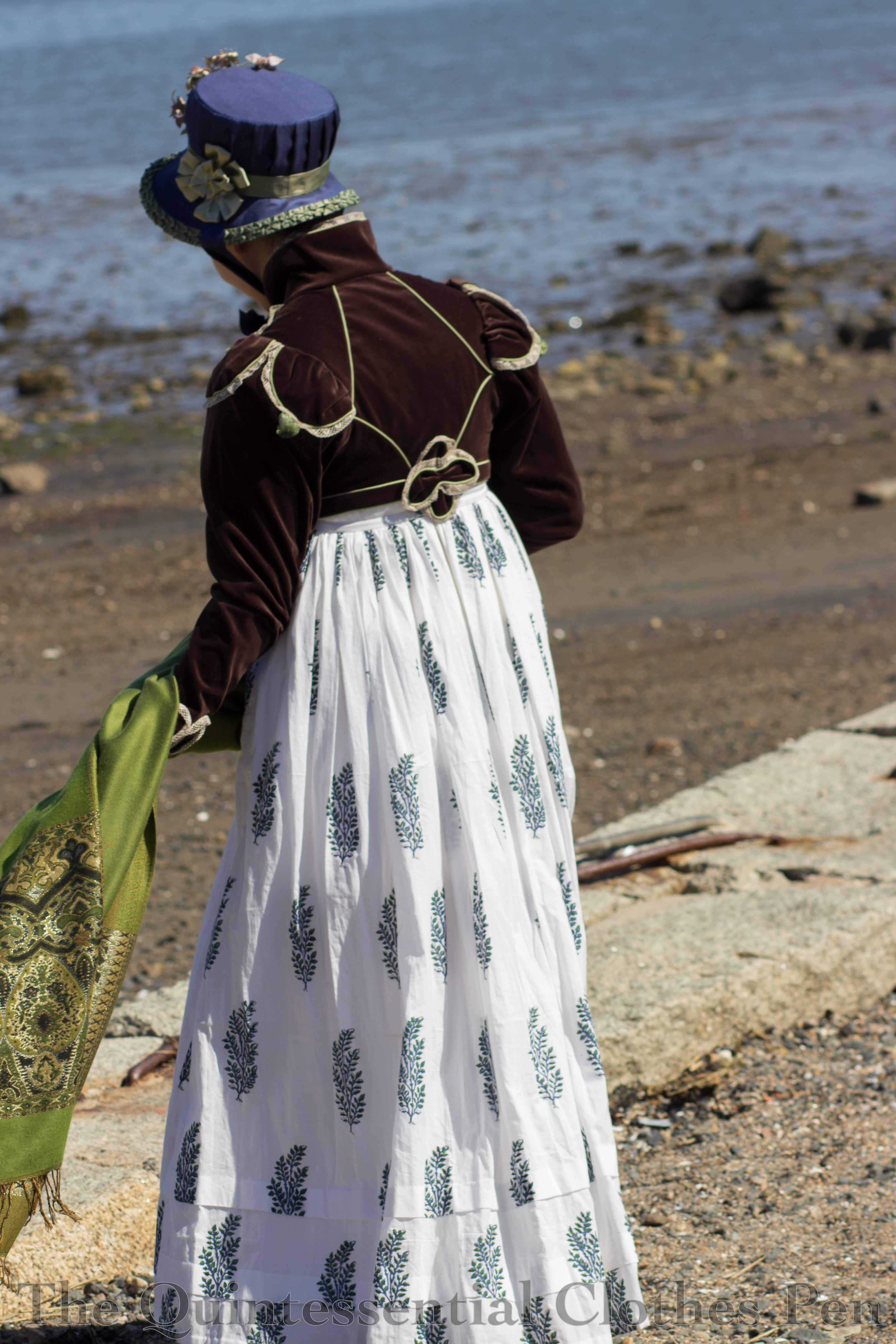
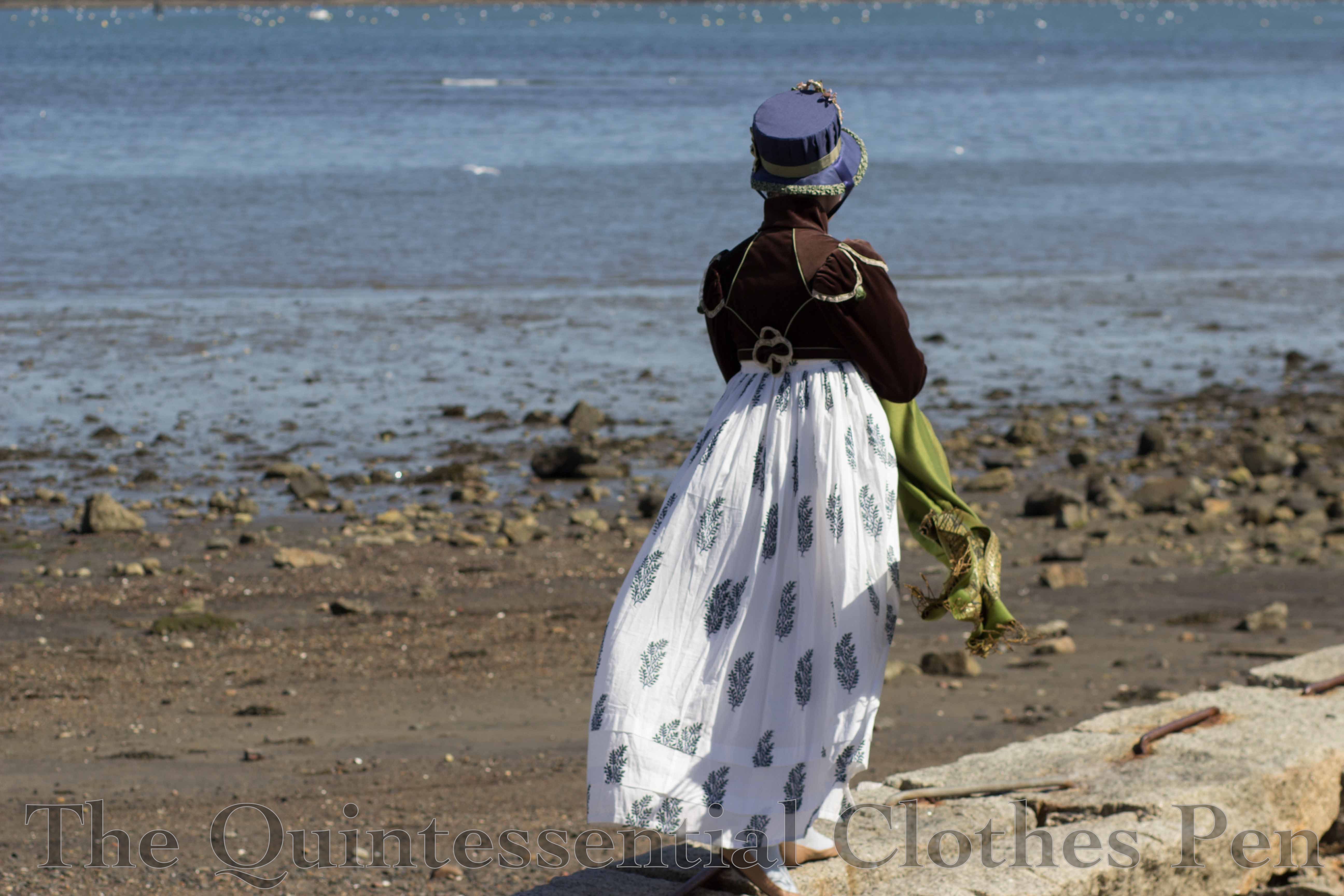
Mixing up my Jane Austen stories, these pictures by the water remind me so much of Persuasion and the unfortunate visit to Lyme. I just love everything about this outfit! The fabrics, the details in the trimmings… it all coordinates so well without being perfectly matching!

img_2703-1

img_2712-1

img_2706-1

Regency Dance Weekend 2016

Way back in April, I was excited to be part of the Commonwealth Vintage Dancers’ annual Regency Dance Weekend again. As usual, there were lots of dance classes, an informal ball, an afternoon tea and promenade, and a formal ball. It’s always a joy to do Regency dancing in Salem in historical halls built during this period.

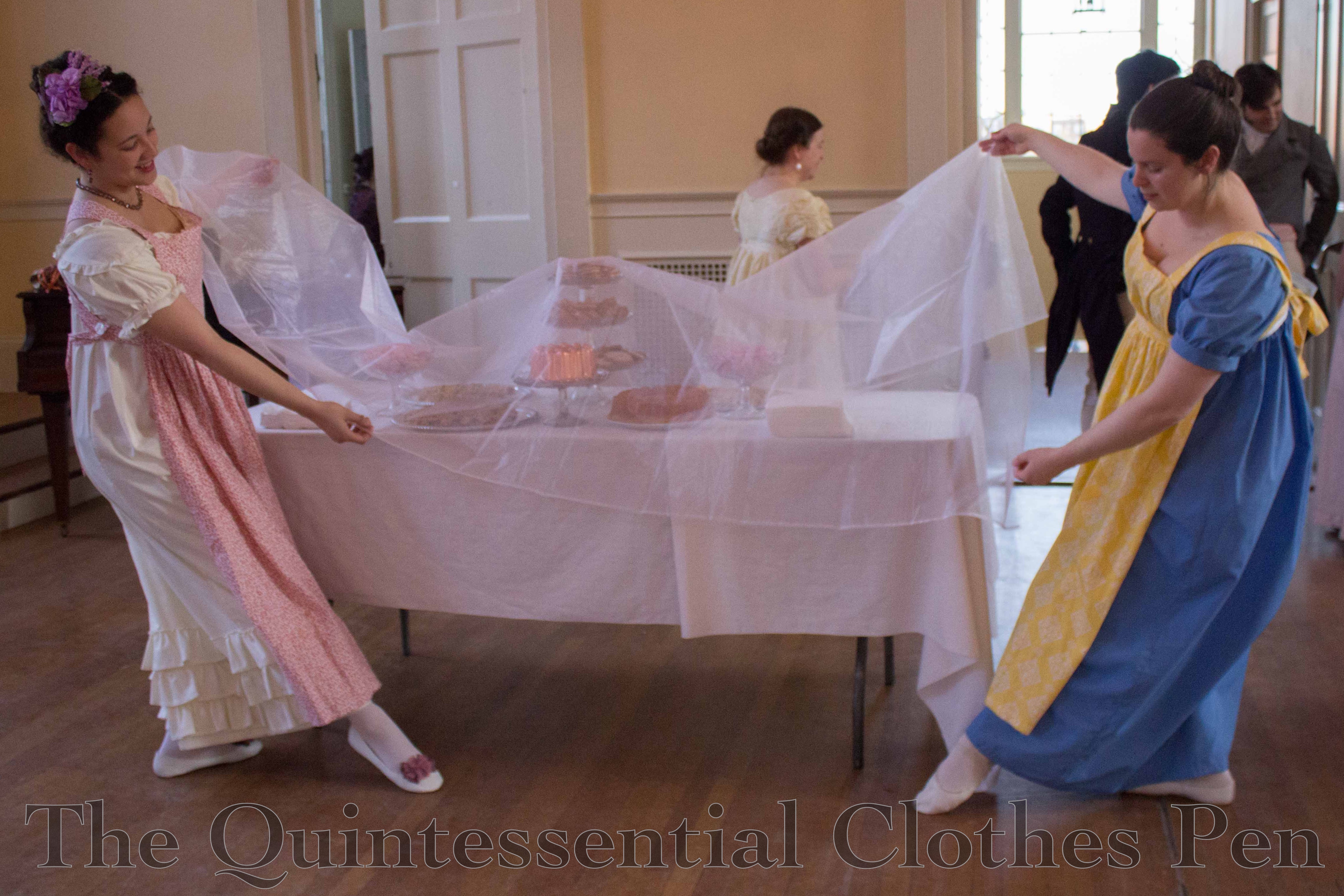
I thought I would share an overview of the weekend to start off my six-months-late sharing of the event. I did actually post about one thing from the Regency Weekend a few months ago. My new shoe poms! Here I am showing them off while artfully covering our refreshment table at the beginning of Saturday evening.

img_2461-1

I’m wearing my Refreshing Apron and 1819 Ruffle Gown with flowers I made for it back in 2014. I’ve inspired a friend to make an apron as well, so we had to showcase them together!

img_2455-1

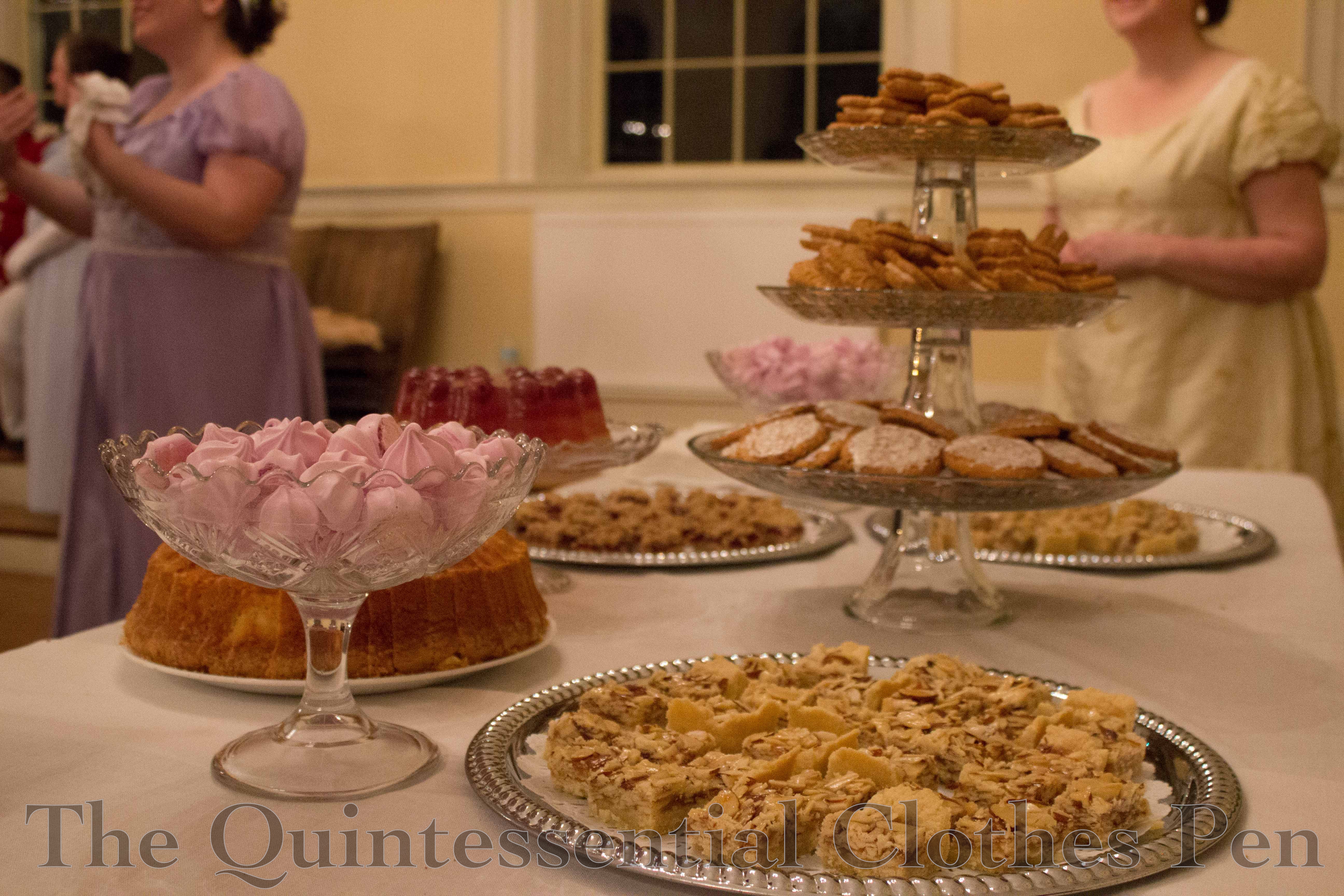
Unveiled, here is the refreshment table from the informal ball. Yummy! There was even a homemade jelly (visible in the back).

img_2553-1

On Sunday, we took the opportunity to take a group picture in our lovely hotel. The building is quite full of history, though the hotel is new in that building. We enjoyed our stay very much. It was great to have a common living room to relax in as a group. Plus, who can complain with having historical paintings on the walls?

img_2564-1

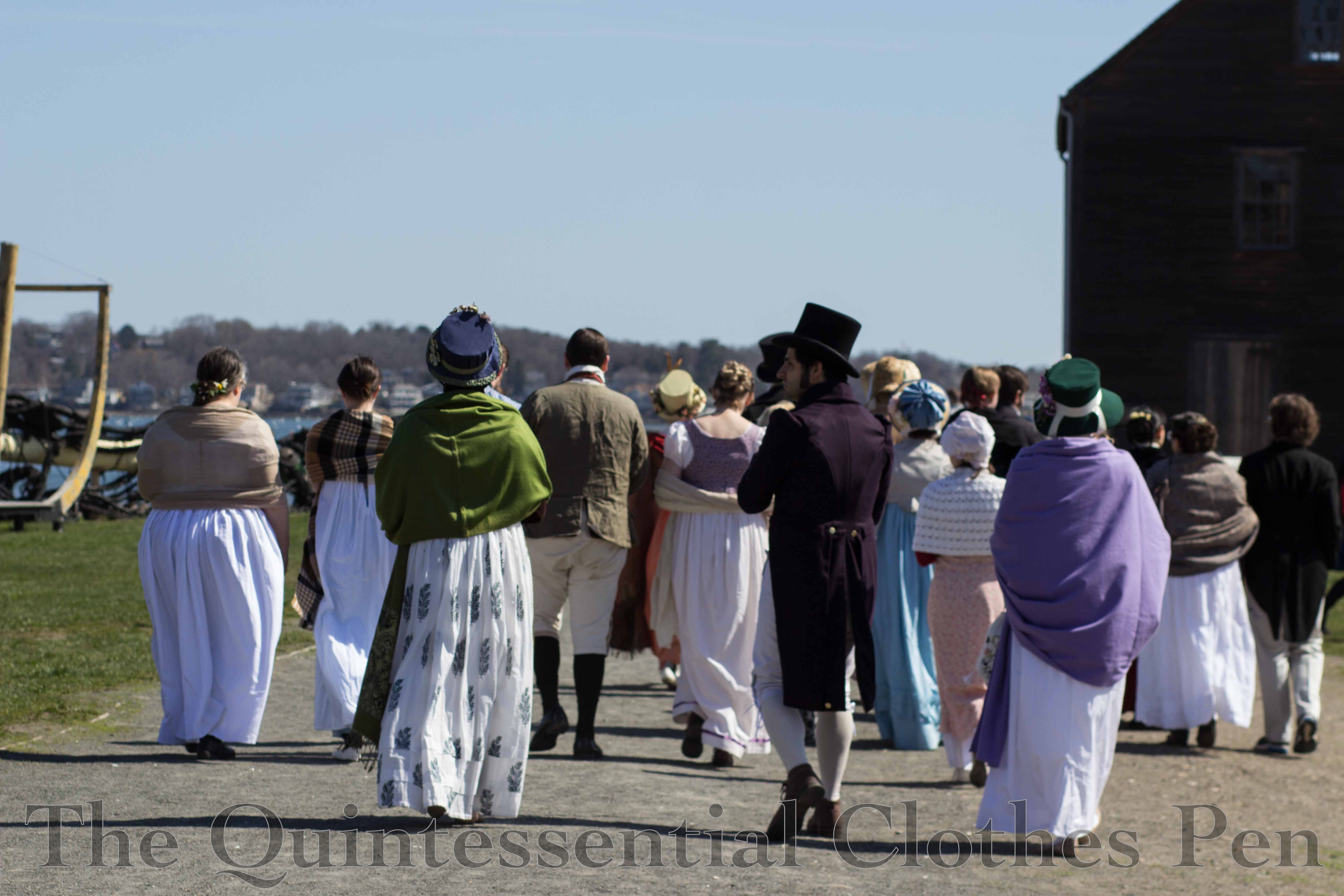
After group pictures, we headed to Salem Old Town Hall, where we were meeting for tea and as a starting point for a promenade to the water. It was a bit chilly for April this year, making shawls rather welcome to stay warm.

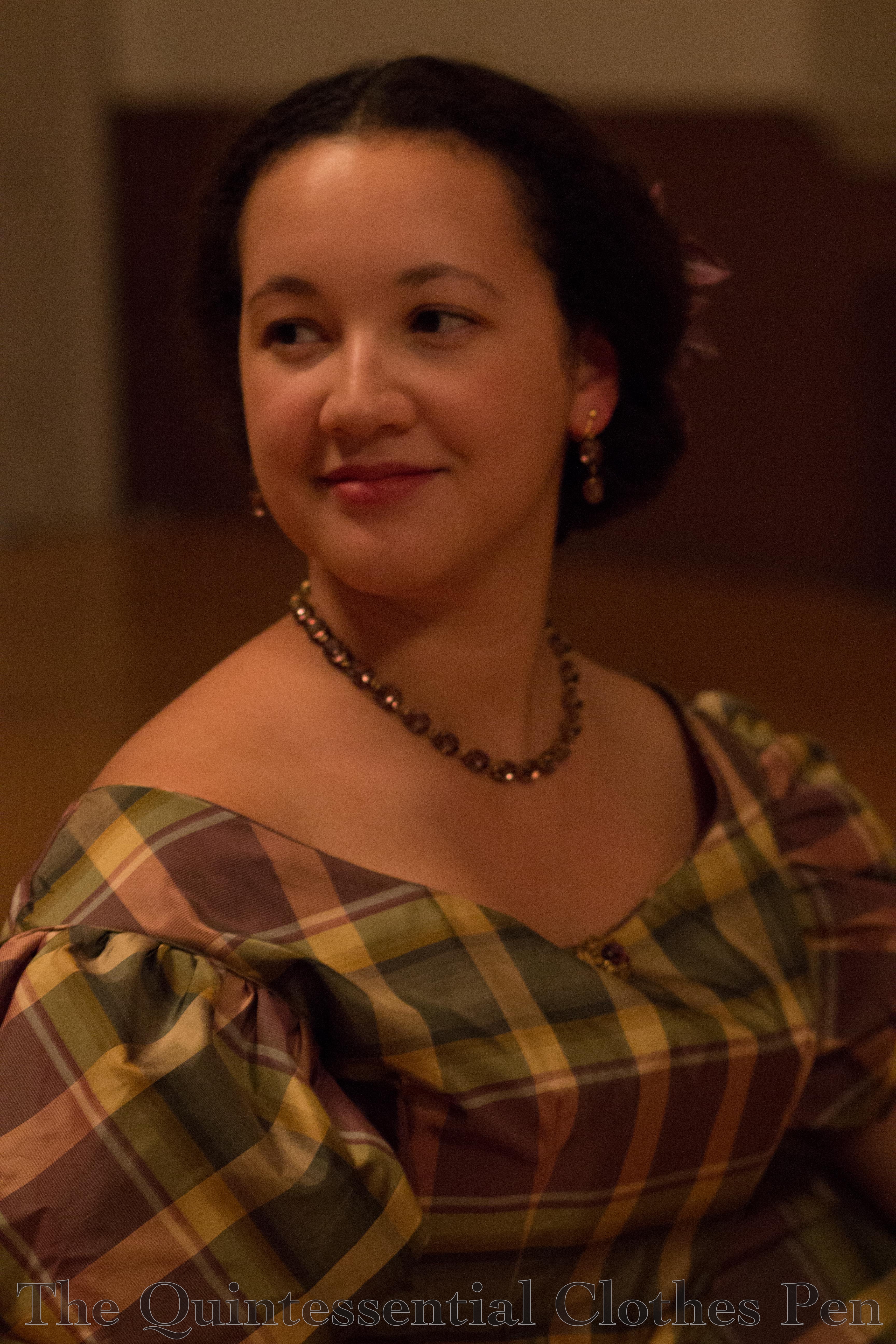
I wore one of my all time favorite dresses, my 1815 Tree Gown, with my 1819 brown spencer, green shawl, and 1815 Tree Bonnet.

img_2669-1

img_2728-1

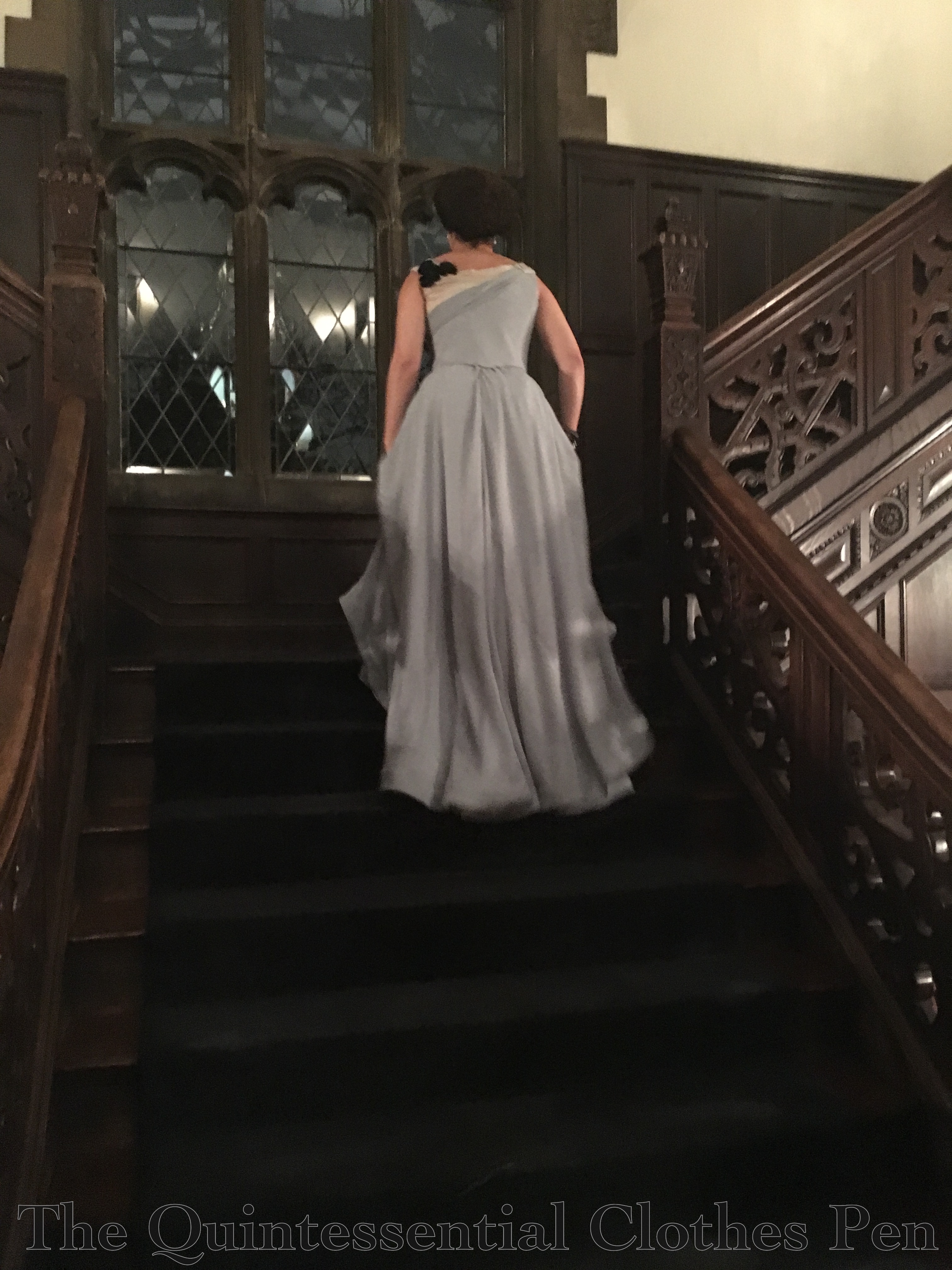
Sunday evening was the grand ball, held in Hamilton Hall. I wore my 1811 Elusive Blue Gown with the turban fillet.

img_2820-1

Hamilton Hall is lovely with a sprung floor intended for dancing and large mirrors around the walls. Here are the dancers all lined up and ready to go!

img_2813-1

Another neat feature of Hamilton Hall is that the dance floor is actually on the second floor, meaning that every guest is able to ascend and descend the stairway to get to the ballroom–perfect for pictures!

img_2824-1

All in all it was a lovely weekend. I’m really looking forward to next one in April 2017! It’s really special to have a weekend to get in such depth for one period. Here are my accounts of past years: 2013 and 2014. In particular, 2014 had blog posts which really express the special quality of this event.

Gibson Girl Vignette

In September, my friends and I had a last picnic of the season to take advantage of the summer weather before it faded into fall. Along with other picnics we’ve had in the past, we again met up in the Boston Public Garden with our picnic blankets, food, drink, and croquet set.

img_1882

We’d decided on a turn of the 20th century theme for our clothing and I took the opportunity to dig a 1903 outfit out of the closet that I don’t think I’ve worn since 2012, at Dress U and Newport Vintage Dance Week. It’s an orchid lawn skirt (and a bolero I didn’t wear this time) and a white silk and cotton lace blouse.

img_1879

This wearing, my hat had been re-trimmed in a more pleasing fashion than when I wore it in 2012 (in fact, all the lovely millinery flowers are only pinned on so it’s easy to change, not that I’ve bothered since I put the flowers on about two years ago) and I had practiced my Gibson Girl hair in January and now know how to achieve the look with minimal effort.

img_1889

I was very pleased with the result! Next time I plan to wear a hat with a Gibson Girl style I’ll put the opening of my hair pad at the top of my head rather than the bottom, and likely leave a little space to make the front a bit more flat so my hat doesn’t tilt up. Where’s the fun if I don’t learn something new every time I wear historical clothing?

Vernet Project: Silly Shoes

One of the five pieces of my Vernet Project was creating the silly up-turned-toe elf shoes in the fashion plate. Clearly, these are not shoes that could be purchased, as they are so specific in style, so I set out to make my own!

IMG_1920 (1)

In the beginning, I was thankful to have another Vernet project maker’s experience making her boots before mine to work from. Jenni posted a two part tutorial showing how she made her boots as well as sharing information behind-the-scenes with project participants earlier in the process (Part 1 and Part 2). She closely referenced Every Lady Her Own Shoemaker, published in 1855 (a little late relative to the date of the project, but still useful for construction advice), for construction methods and carefully documented her process. In fact, she did a much better job at documenting the actual sewing than I did… I also read Anna’s information about making mid-19th century shoes multiple times to help get my mind acquainted with the project (again, a little later than the period of the project, but still helpful). She also has lots of great construction pictures.

I started by creating a pattern for my shoe using patterns in Every Lady Her Own Shoemaker. Given that my shoe has the unusual turned-up-toe, I necessarily needed to make adjustments to the general slipper pattern. Here is my shoe at the mockup stage. The upper pieces fit pretty well! I adjusted the width of the sole as well as the shape of the turned-up section before moving on to cut out the final pieces.

Mockups.001

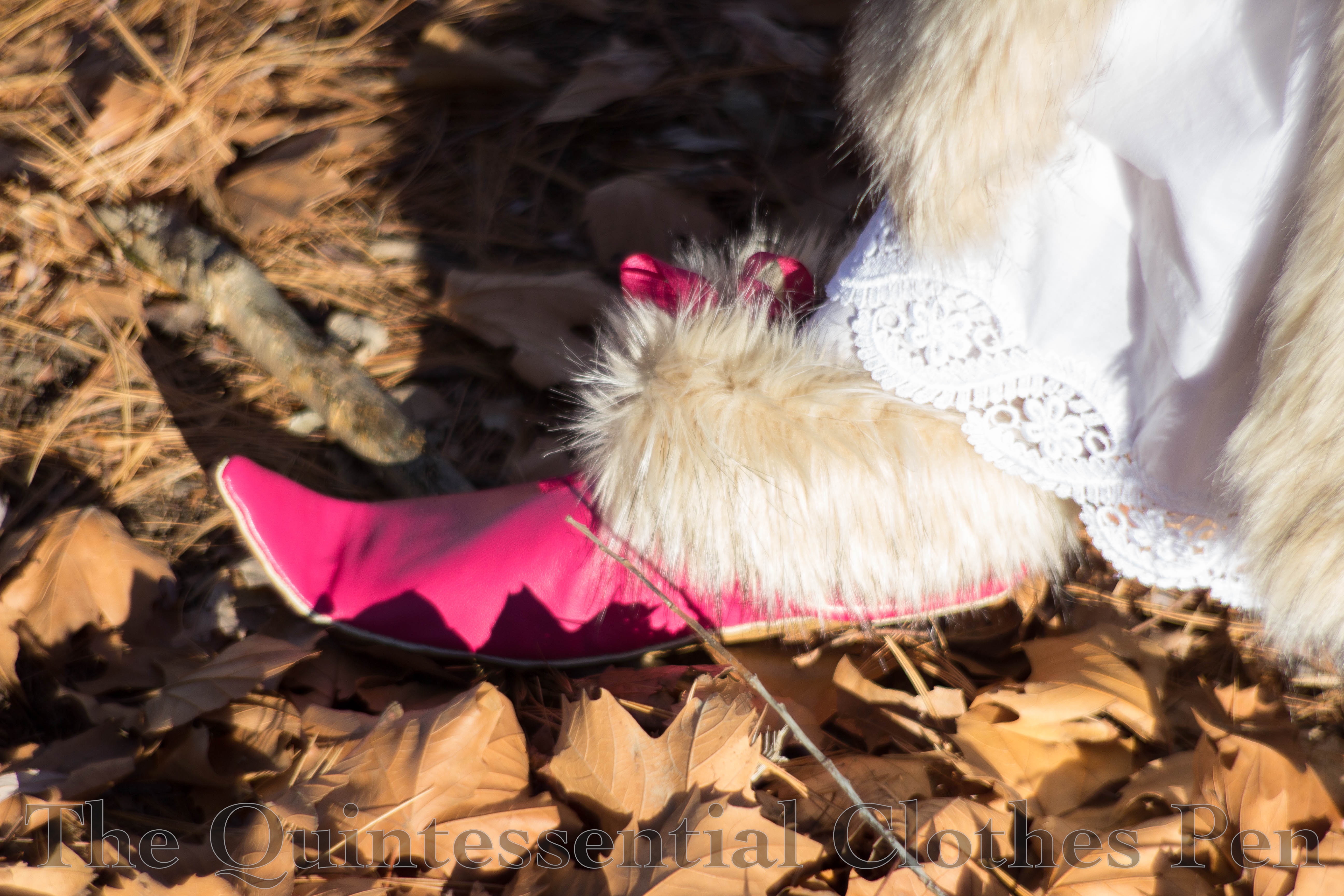
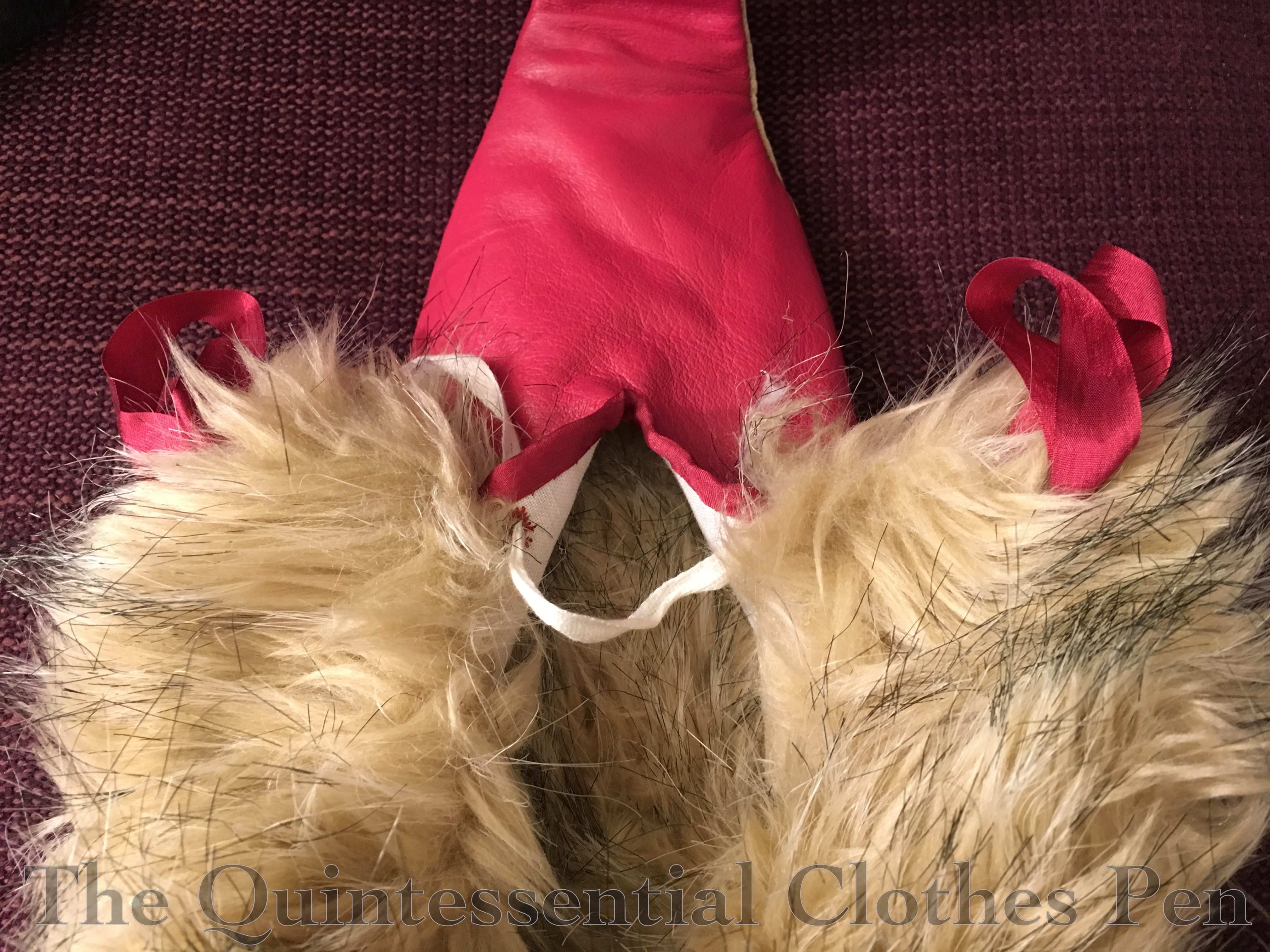
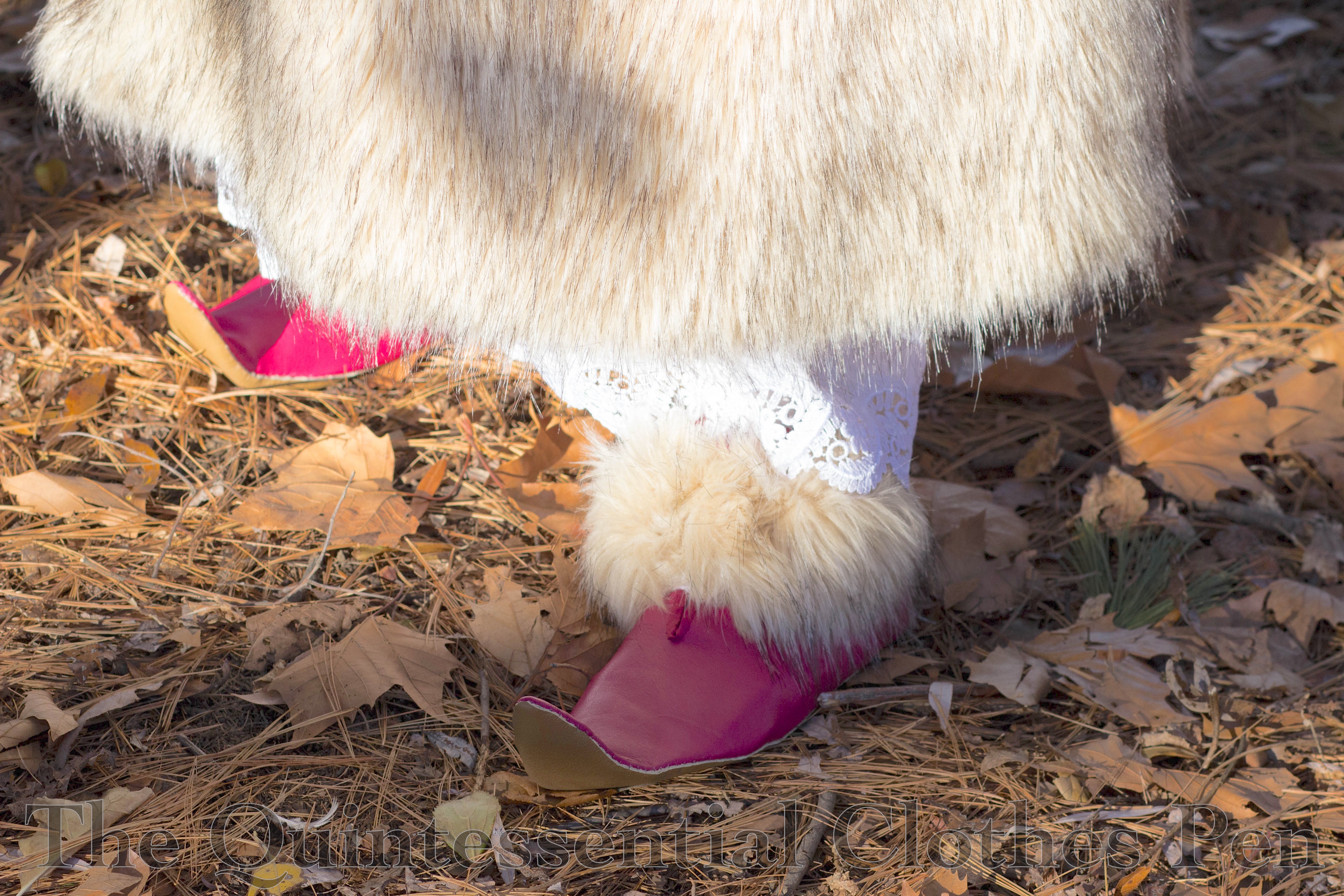
Here are all of the final pieces cut out and ready to assemble. The soles have three layers: heavier tan leather for the outer sole, cardboard for the inner sole structure, and white linen to cover the cardboard insole. The uppers have two layers: lightweight raspberry leather for the exterior and white linen for the interior. Later in the process I also added a faux fur cuff.

IMG_0239 (1)

To help the shoes keep their turned-up-toe shape I soaked the leather soles in water, taped them to a lysol wipe container, and let them dry. You can see the results below. Not perfectly curved up, but still helpful. I also tried boiling leather soles to thicken them before shaping, but found that the leather shrank unevenly which created soles that wouldn’t work for this project. I did save them, though, and hopefully will get to use them for a future shoe making endeavor. I repeated the soaking and shaping for the cardboard insoles before gluing the linen to them. There’s a picture of the insoles at this stage in this past post.

Soles in progress.001

After shaping the soles it was time to construct the uppers. I did the interior and exterior separately, then basted them together around the top opening and around the bottoms. Then I sewed the bottom edges of the uppers to the soles, using the slanting stitch through the side of the sole that Jenni shows in Part 2 of her tutorial. She used all sorts of nifty leather tools as well as a wooden last during construction. I purchased the nifty leather tools but found that they didn’t work for me and a simple non-leather needle worked just fine. (I think my leather was too thin and soft for these to be needed). As for the last, I looked online for a wooden one, never found one in my size foot, and eventually decided to give it a go without one, especially since I had to do the turned-up toe. In the end, I don’t think it was a problem not to have a last.

IMG_2253 (1)

Once the soles were attached, I bound the front slit with matching silk ribbon. Then I cut a piece of faux fur for each shoe that went around just the top of the foot opening and could double over on itself. There are non-functional silk ribbon loops that are sewn to the front of the fur that encases the top edge of the shoe. The shoes actually close with a twill tape threaded through hand sewn eyelets on each side of the opening.

IMG_1684

They’re actually quite comfortable for walking around in. I have very flat feet, so don’t really need arch support to be comfortable. The only thing is that my feet did get cold during our photoshoot due to the freezing ground only separated from my feet by a few thin layers of fabric. So, for the second wearing, while caroling at Christmastime, I added a faux fur insole. Problem solved! They were toasty and even more comfortable!

IMG_1884 - Version 2

Interestingly, witzchouras are mentioned as being popular in Paris during the year 1827 by La Belle Assembleé, after a mention of other popular pelisses and mantles (well worth checking out!), and are are described as being worn with boots laced in front and with fur around the leg.

335d382370bd68a719024c208ffeff0c

Doesn’t that description sound oddly familiar? It reminds me so very much of the Vernet fashion plate and my silly shoes!