c. 1785 Stays Of Success Part VII: Conclusions, Reflections, & Resources

Did you notice the change in the name of these stays??? I’ve decided to call them the Stays of Success instead of the Stays of Fail!

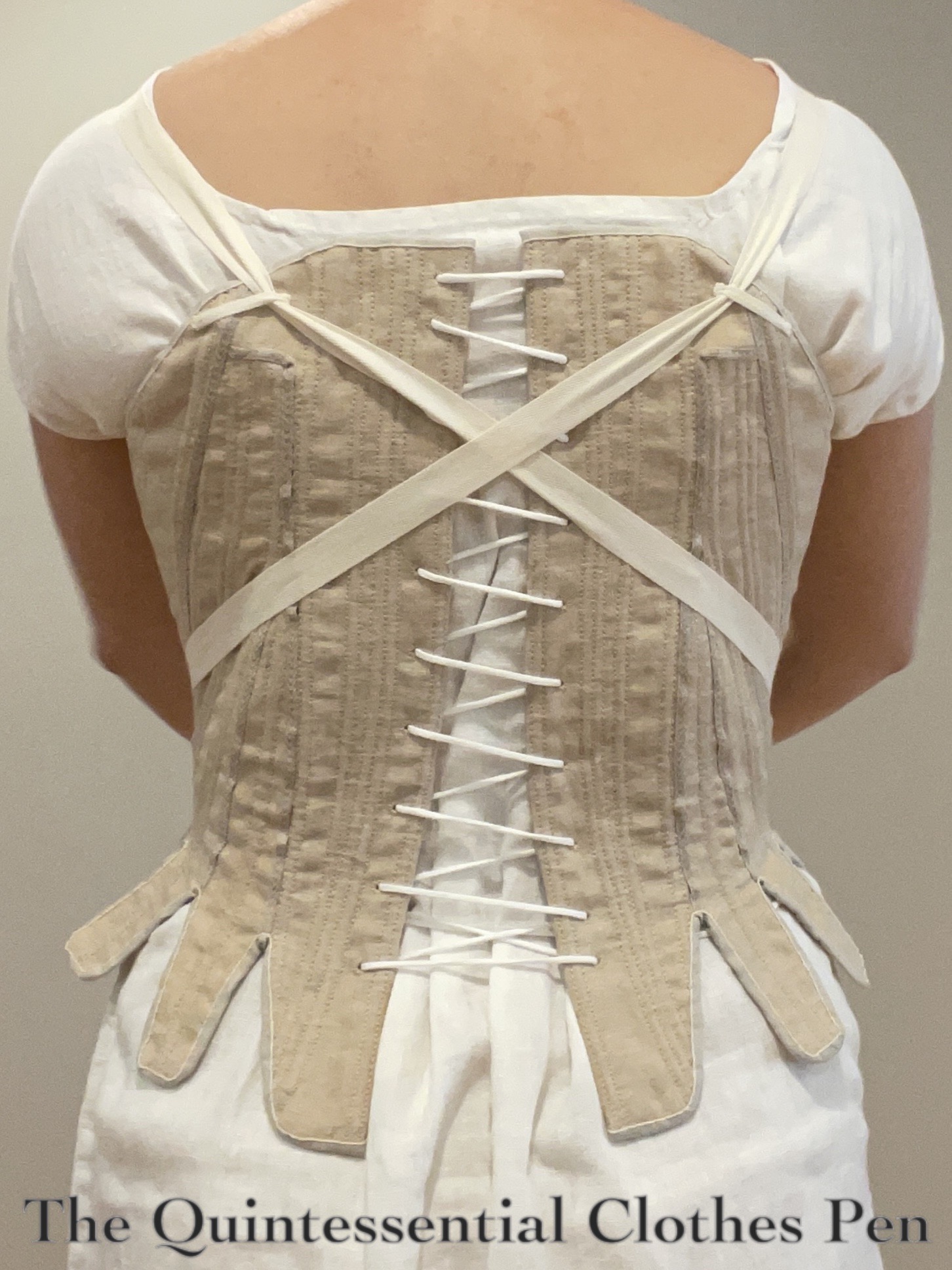
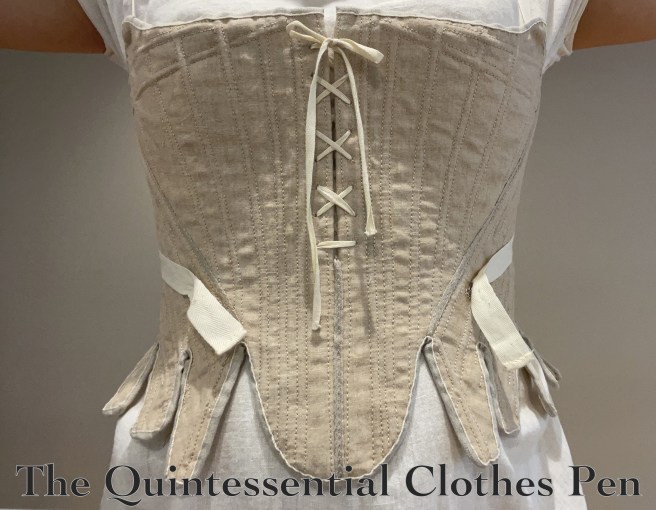
This is partly to give them a more uplifting name that brings joy instead of disappointment, but also because I finally took photos of them… and then proceeded to wear them around the house for a number of hours because they were actually quite comfortable! Success!
Conclusions and Musings

I want to start by exploring why I originally named this pair of stays the ‘Stays of Fail’. That is because, until very recently, I felt that this attempt at stays was a failure in terms of comfort. The comfort is what I based the original name of them on.

By the time the construction was almost done, I felt slightly better and that they were a (very struggle-y) learning opportunity. After adapting them, I was thinking that ‘Stays of Fail’ maybe should turn into ‘Stays of Learning’ (although isn’t that every project?!?) or maybe just c. 1785 Hand Sewn Natural Linen Stays (but that’s not very exciting!).

Stays of Success is more entertaining!

Reflections On The Process

Would I use the book Stays and Corsets: Historical Patterns Translated for the Modern Body by Mandy Barrington again?

My experience, as I moved forward with the construction process, was that I regularly lamented the focus of the book on modern theatrical methods, as I was aiming to produce historical stays. When I wanted to go back and get detailed information about the materials, construction methods, measurements of bindings, etc. I found that information just wasn’t included. It was especially frustrating when information was just missing–such as the locations of the front eyelets–even on a pattern taken from the original.

At one point, I thought I could get around the problem of lack of historical detail in the book by looking for the online record of the Chertsey stays that the pattern was based on. Clever, I thought! However, I can only find two images of them and it seems that aside from that they aren’t available to view online in full. (The back lacing can be seen here and a front view can be seen by Google image searching ‘Chertsey museum stays’, but clicking through to the museum website doesn’t lead to the image.)

This lack of information is why I heavily relied on Patterns of Fashion 5 (PoF5)–because all of the detailed information I wanted (and more!) is there. (I did have to extrapolate and make decisions based on the information in PoF5 since it is all for similar stays but not for the exact pair that I’ve patterned.)

So, while using this book was a valuable experiment, I don’t think I would be inclined to use it to create another historical support garment for myself. However, I can see the benefit of drafting a pattern with similar proportions for someone who is vastly different than the original pattern size, for theatrical purposes in particular. For that purpose, I wouldn’t be interested in replicating the historical details and so the omissions I mentioned would not be a detriment to the garment I would be intending to produce.

In the end, I’ve learned a lot about what this book can, and can’t, do and that is helpful even if I’ve been a bit frustrated along the way due to my goals being different than what the book is aimed at.

Further Experiments

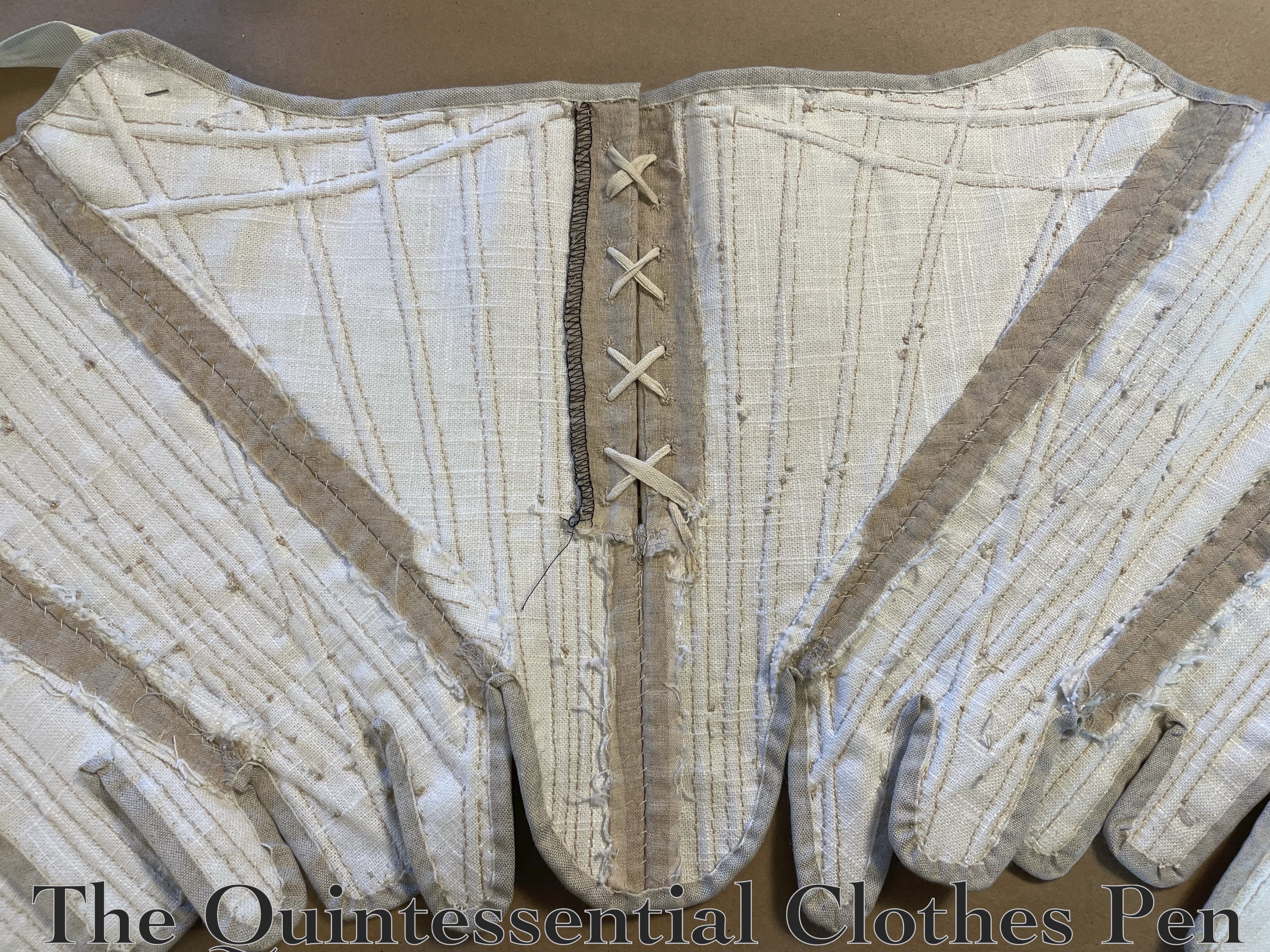
Unfortunately, one of the fitting problems I encountered might be due to an alteration I made in the mockup to take in the waist (I’m taking ownership of my actions!). This inside photo of the mockup shows the center front and side area alterations I made.
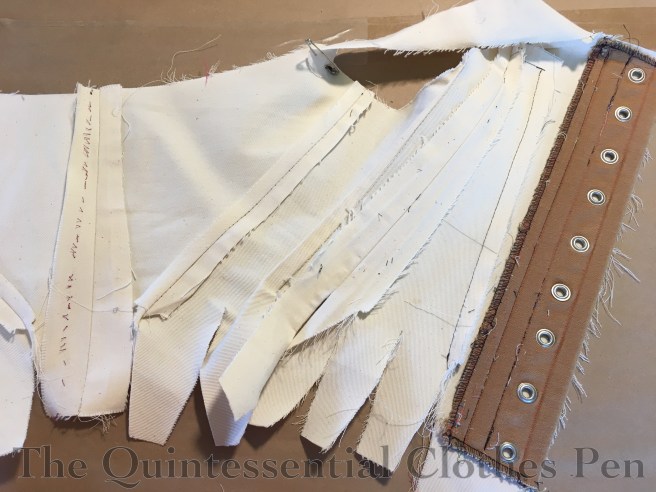
After finishing the stays, I was curious to see how the mockup would fit if I compared it to the finished stays. It turns out that I basically had to add in the width I’d taken out in the mockup when I added my back gusset. Sigh!

In theory, my alterations should have made the mockup slightly smaller than the finished stays with the added gusset, but the odd thing is that the mockup dimensions (with the alterations) are pretty similar to the finished stays (with the back gusset added in). So perhaps the real fabric stay pieces shrunk or wound up being smaller than I thought? Who knows?!? I’m done puzzling on this one!

In The Meantime…

While wrestling with these stays, I decided that I didn’t want my lack of stays to hold me back from making dresses any further and so I decided to start a whole new pair of stays instead off dealing with this pair (at least for a short time).

I held off sharing about them for quite awhile because I wanted to finish the saga of these stays… but eventually I gave up, and at the end of 2022 had great fun sharing the success and construction of my c. 1785 Green Linen Stays.

Resources

This is not comprehensive by any standards, but I thought it might be helpful to collect some links that I’ve found useful for anyone who wants to know more, see other people’s stays, or people who are making stays themselves. (These sites were especially useful for seeing the process when I didn’t have PoF5 on my cutting table!)

You can read previous posts in this series here:

c. 1785 Stays (Of Fail), Part VI: Finishing Construction Details
c. 1785 Stays (Of Fail), Part V: Middle Construction Details
c. 1785 Stays (Of Fail), Part IV: Early Construction Details
c. 1785 Stays (Of Fail), Part III: The Pattern
c. 1785 Stays (Of Fail), Part II: Fitting Update
c. 1785 Stays (Of Fail), Part I: Beginnings

c. 1785 Stays (Of Fail), Part VI: Finishing Construction Details

This project was on hiatus for a number of months (the last post about it was in October 2022!), but the time has come to wrap it up!

After the progress made in the last post, there weren’t that many steps left to complete. Yay! Below are details about those steps.

Binding

I used ½” natural linen tape. It is whip stitched onto the right side and then wrapped around to the inside and more roughly whipped. The inside stitches will be covered with the lining, so making them invisible and pretty is less important. Below is a photo of the inside of the stays after the binding was sewn on.

Lining

At this point, the stays were almost done. The lining serves to cover up all of the interior construction. To make it, I laid my stays out wrong side face up (as in the above photo) with my lining fabric on top. I pinned in a few strategic places and then roughly penciled where I wanted the cutting lines to be. Then, I cut the lining pieces out.

Once cut, I pinned the center lining piece in place, then pinned the piece next to it, turning under my raw edges at the places I wanted the seam to be and around the edges. Those edges were all pinned in place and then each edge was whip stitched. Additionally, each tab has a separate, small piece of lining whose edges are also whip stitched in place.

Straps

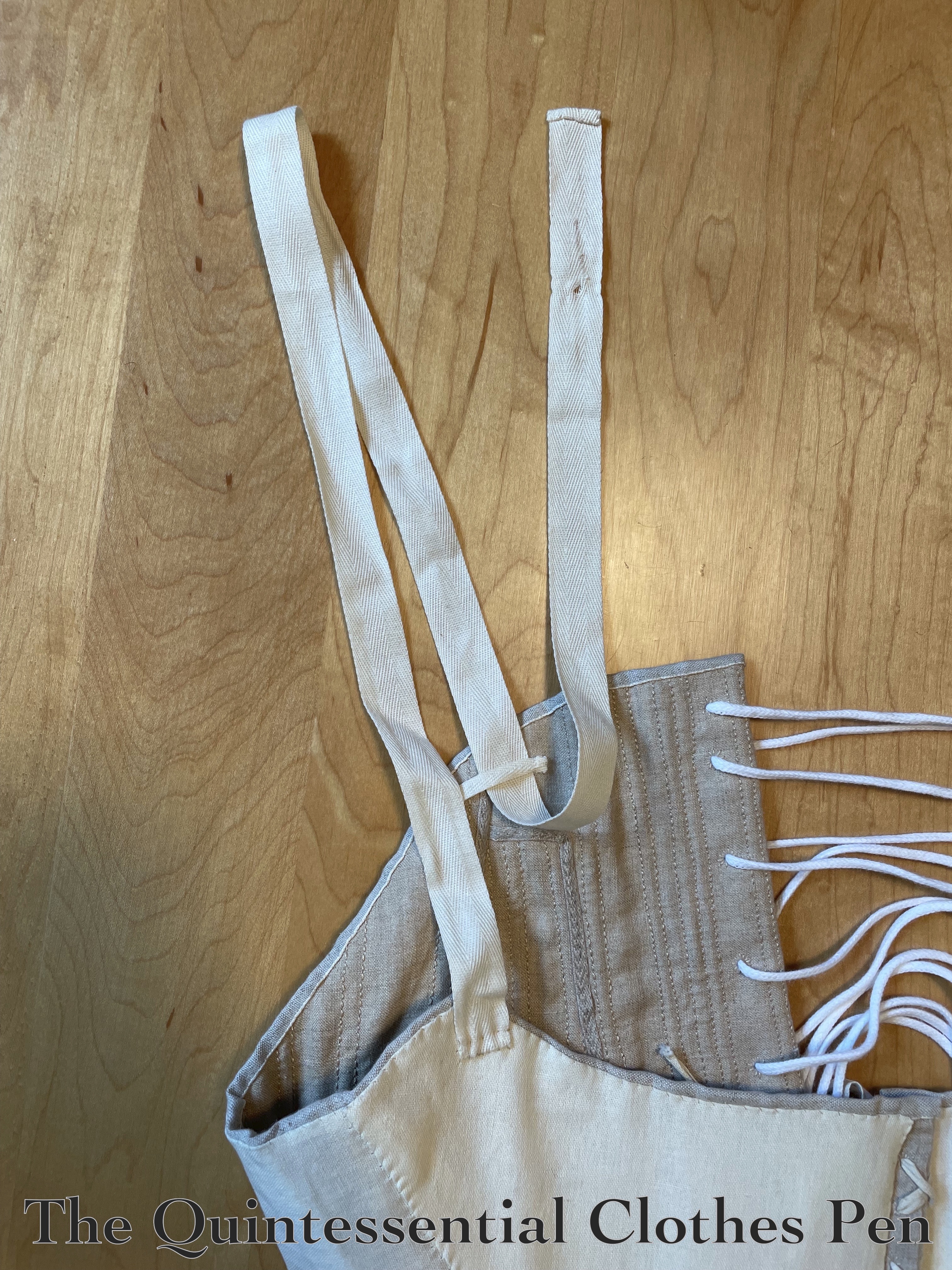
The truly final step was to add straps! I used ¾” ivory cotton twill tape. Each strap was sewn to the front points of the stays and the short raw end hemmed. A scrap of ¼” twill tape was also sewn on each of the side backs for the wider tape to run through.

Then, I tried on the stays and determined where I needed to place the hooks that the straps would attach to. Below is a photo of one of the straps held in place by the sideways hook. The straps are long enough to wrap over the shoulder, cross in back, and wrap around towards the front to catch on the hooks.

After that, all I had to do was attach the hooks… and… after many years… the stays were finally, finally… finally…. DONE! They were finished in April 2023.

You can read previous posts in this series here:

c. 1785 Stays (Of Fail), Part V: Middle Construction Details
c. 1785 Stays (Of Fail), Part IV: Early Construction Details
c. 1785 Stays (Of Fail), Part III: The Pattern
c. 1785 Stays (Of Fail), Part II: Fitting Update
c. 1785 Stays (Of Fail), Part I: Beginnings
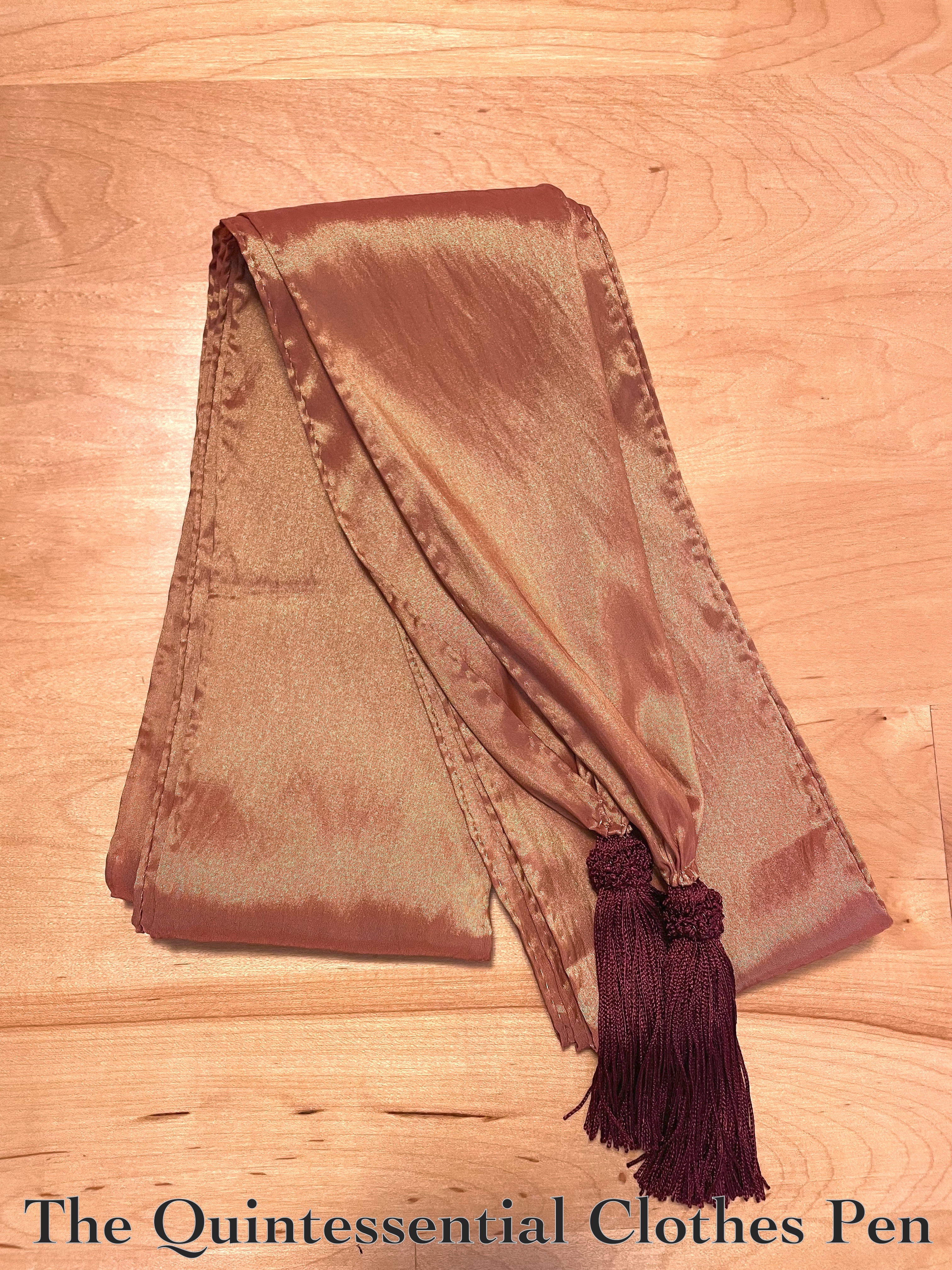
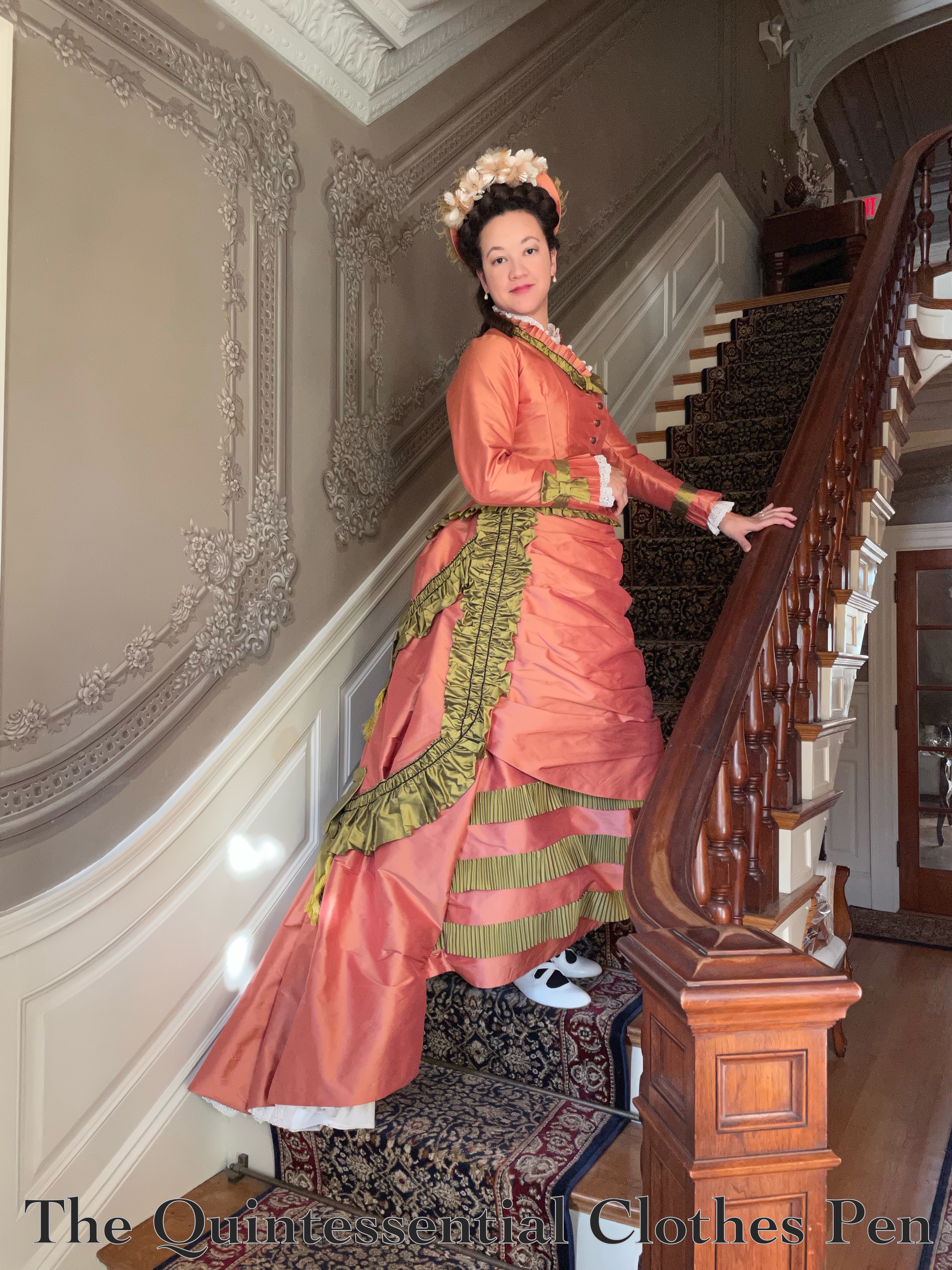
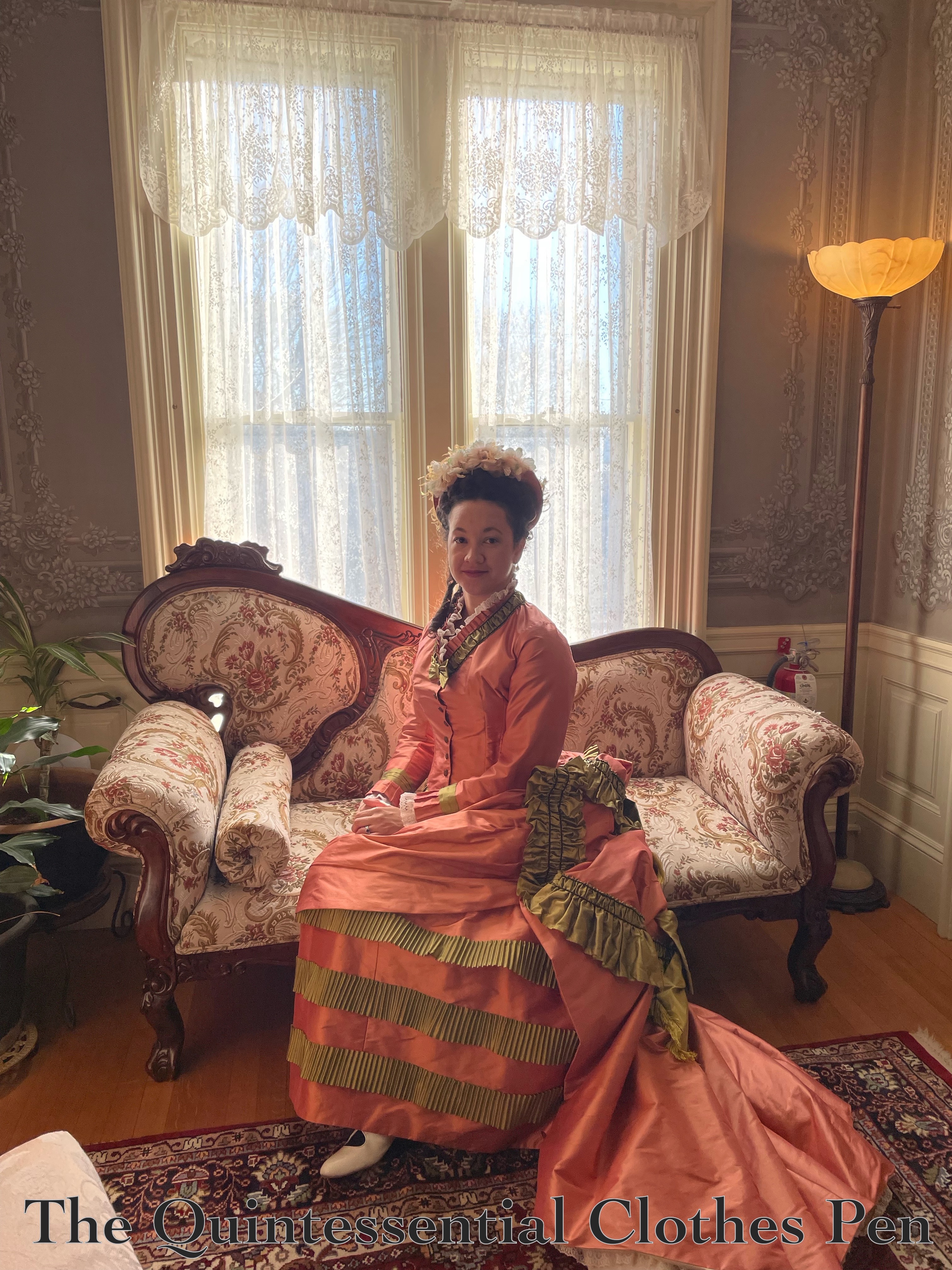
1875 Reception Dress Photo Shoot

I was really excited to spend lots of time working on and finally completing this dress during the summer of 2020.

At that time, there was no option of finding a fabulous indoor place to take photos, so I had to make do with the outdoors. Don’t get me wrong, I have lovely photos from that short outing, but they didn’t have as much background ambiance as I was hoping to find, someday.

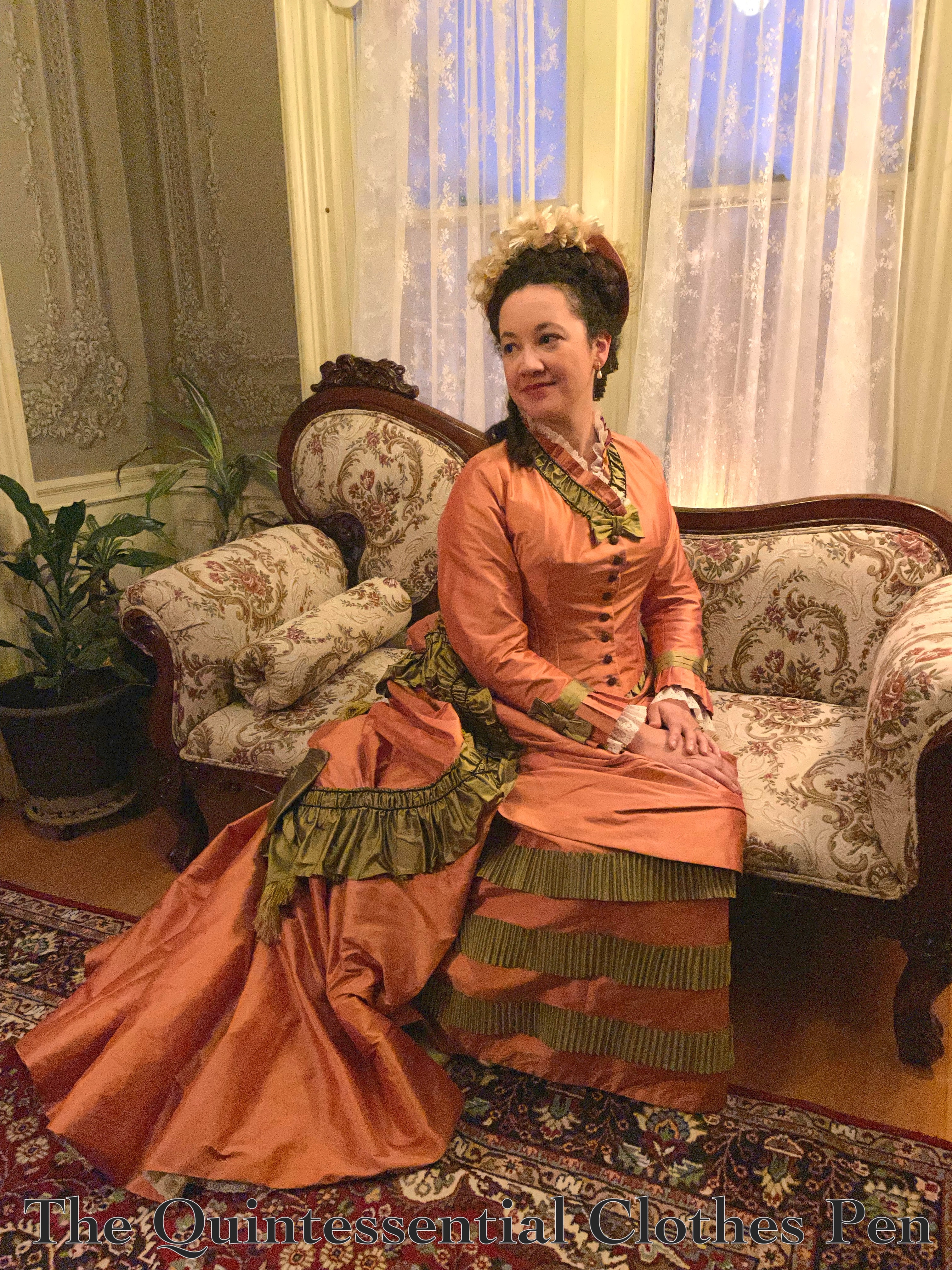
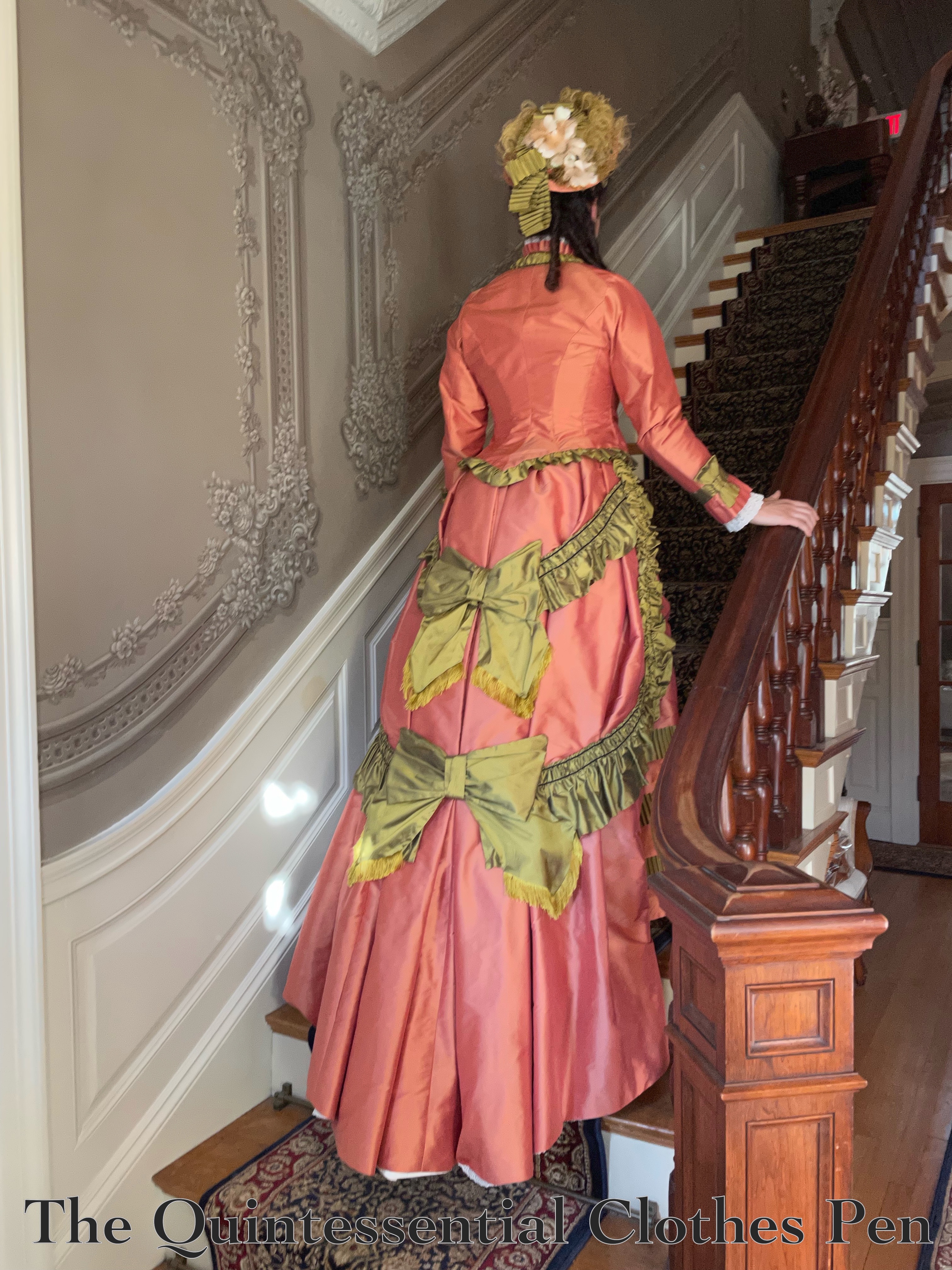
But last year, I had the opportunity to actually wear this dress for an activity! And I was able to convince friends to take oodles of photos so I could better document the dress in appropriate surroundings for its reception status. So now, I present many photos of this dress.
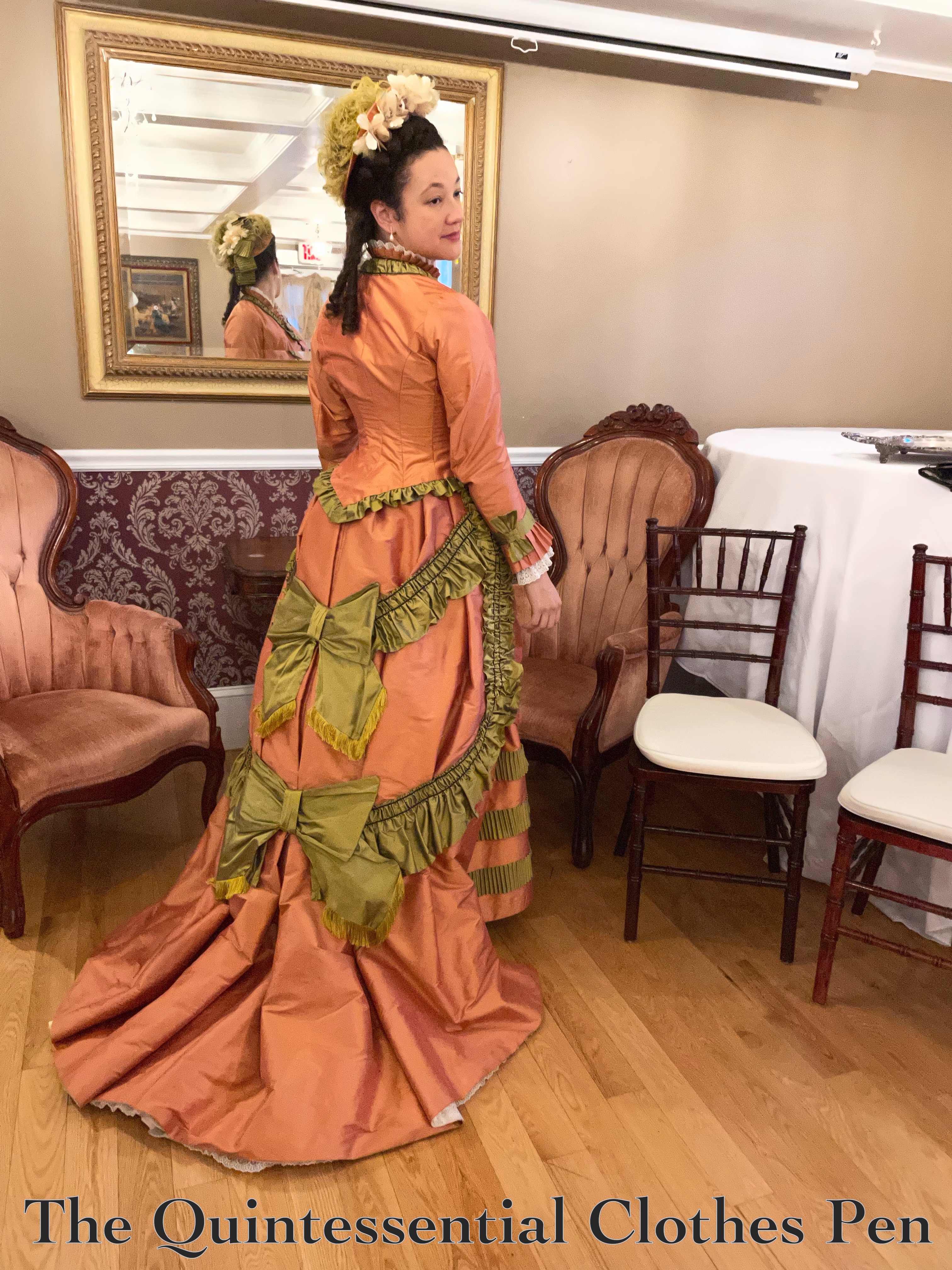
There are dramatic back views, of course.

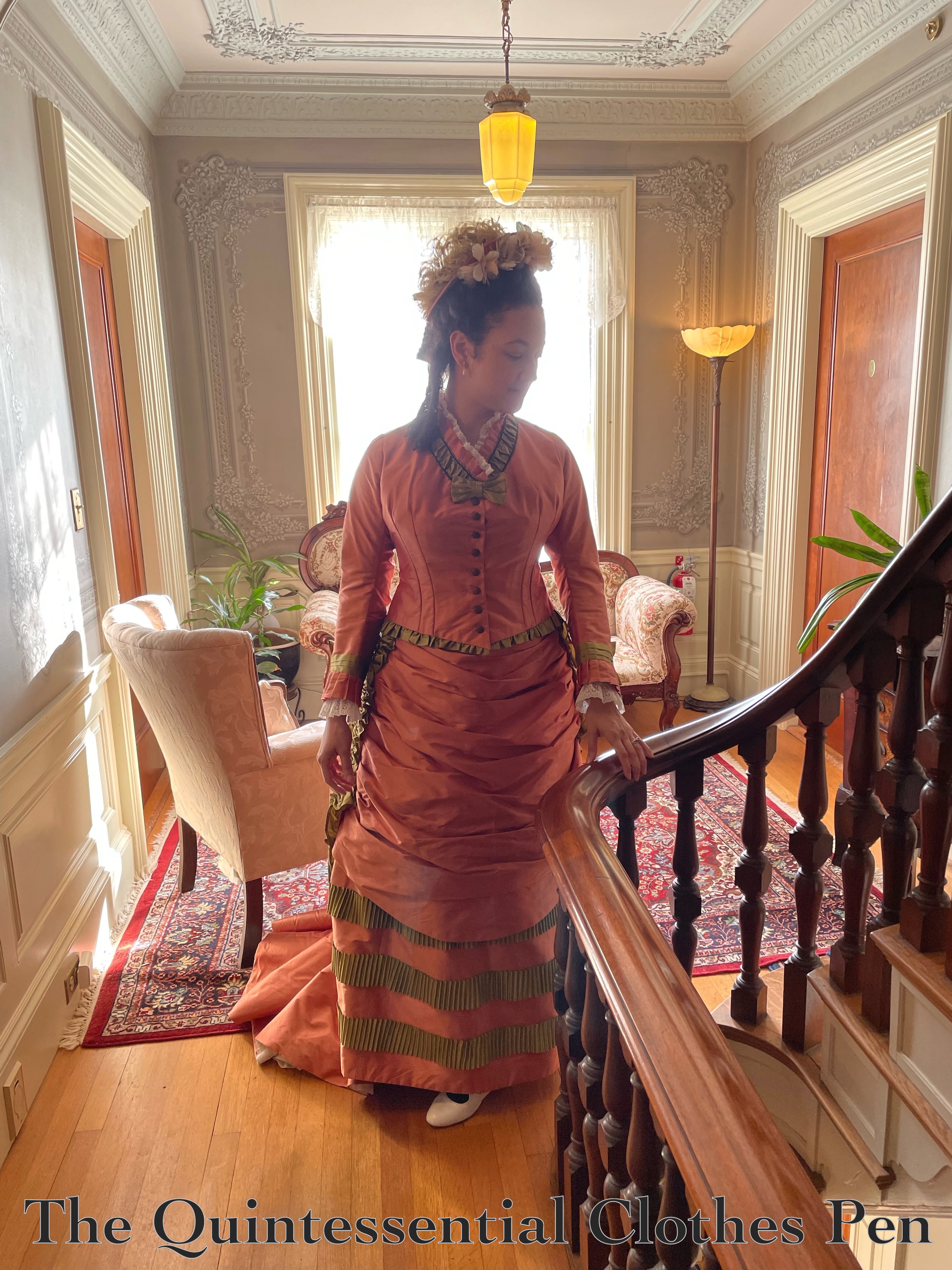
And front views showing the bust, waist, hip dimensions I worked very hard at in the patterning stages. This is created/augmented with padding. You can read more about that in this past post.

There are also views trying to show both the front and back. A side front view, if you will. This also captures the hat very well. I wrote a detailed post about making it, which you can read here.

And a few more sitting photos, as well. These are great for showing off the train and the layers that support it (this is my past post about constructing the skirt and this is about the balayeuse that supports the skirt, if you’d like to know more).

It was hard to choose favorites! I’m very pleased to have so many photos that capture the glory of this dress in an appropriate location.

Gilded Age Weekend Portraits

As I shared in my last post, friends and I planned a historical weekend away that had a Gilded Age theme. Part of the idea was to document some of our older and recently made clothing in a fabulous setting. To that end, I have many photos of our outfits that I would like to share!

To start, some daytime outfits, worn for afternoon tea and amusements.

So much detail! Fabulous fabrics, beautiful trims, eye catching hats and hair ornaments… the list goes on and on!

And to follow that, a few of our evening outfits.

Thanks for appreciating and enjoying these with me!

Gilded Age Weekend Highlights

Last year, friends and I decided to treat ourselves to a historical weekend away. With a number of bustle (1870s and 1880s) and 1890s dresses languishing in our closets, the chosen theme was the Gilded Age. We planned a very busy weekend of parlour games, afternoon tea and amusements, informal dance practice, and a formal ball.

Regular blog readers already saw a hint of this event in my last post, When The Dress No Longer Fits (1896 Evening Gown), but I have a few more posts to share, as well. Today’s post captures some of the amusing highlights from the various weekend activities.

To start, a behind the scenes shot of partially completed hair for my 1875 dress (which you can see in the photo after the one below). The photo below also shows off My Favorite Winter Things Skirt! Yes, I continue to wear this during the winter. The penguins, polar bears, and foxes participating in winter activities–skiing, ice skating, sledding, etc–continues to bring me amusement and joy.
And here, a still of theatre-adjacent people trying to create an amusing atmosphere while not making absolutely ridiculous faces. It brings me such joy to have well dressed friends!
Friends who also enjoy creative pursuits, such as creating homemade tabletop croquet! Not only is this absolutely adorable, but it’s also playable!
Our afternoon amusements also included a stereoscope.

Here is another view of the lovely ensembles at the ball.

I wore my 1896 dress, as you can see in the photo below. This is a classic for us. Moose pose!

And, to wrap it up, this is the bronze 1896 skirt after being stepped out of. The canvas is so stiff it literally stands up on its own, a fact which I’ve found to be amusing ever since I first made this over 10 years ago.

Thanks for joining me in the adventure!

There are more photos to come… a selection of outfit portraits and better-than-my-backyard documentation of my 1875 Reception Ensemble.

When The Dress No Longer Fits (1893 Evening Gown)

Way back in 2012, I made a Bronze and Pink 1893 evening gown. The original construction information can be found in the original post. I updated it in 2013 (documented in this past post) and continued to wear it for a number of years. Then my shape changed, and in 2016 I made my 1899 Elusive Blue dress, which was a fun new thing to wear from a similar period.

And so, my 1893 dress languished in the closet. For an event last year, however, I decided to pull it out instead of wearing the Elusive Blue dress. Below, successful re-wearing of my now-eleven-year-old 1893 dress.

After initially trying the dress on, it was clear that my change in shape meant that the original dress would no longer fit, but I decided to persevere and update the dress to make it wearable again. This involved:

  • Adding a panel to the back to extend the circumference of the bodice (saving fabric extras pays off!)
  • Adjusting the circumference of the pink sash to match the new width in the bodice

The skirt closure didn’t need an adjustment, as I had originally made it with two sets of hooks and bars and was able to simply hook the closure on the looser bar for the updated wearing

Below, a photo of the updated dress from the back, where the additional back panel is visible.

While the dress was wearable and I was pleased with my updated accessories, I was not as pleased with the dress as I was when I first made it, nor was I as happy with it as I am with my 1899 dress. I’d like to update it a bit more some day and see if it brings me more joy for a future wearing. Specifically:

  • I’d like to add net and gold sequin trim to the back neckline to help add interest and distract from the added panel (the original in Patterns of Fashion is unadorned and makes an elegant V, as mine originally did, but I like the plain look less with the size adjustment)
  • The tall section of canvas I’d added to them hem of the skirt when I originally made the dress made sense at the time to add stiffness, but over the years I’ve realized that it’s also heavy and actually reduces the size of the silhouette. I think I’d like to remove the canvas (or drastically reduce its height)
  • I’d want to wear my chemise tucked lower! I’m sad that it’s poking out in the photos

Despite some quibbles, I am pleased overall with the fact that I was able to update this dress to make it fit again.

Plum Pants Photo Shoot

When I made my vintage-inspired Plum Pants With Pointed Pockets in 2020, I didn’t have a great opportunity to get photos of them right away. I made do with photos taken in my yard, with my phone balanced on my lawn mower in lieu of a tripod!

Since then, I’ve worn them relatively often in warm months for ‘real’ life and historical events. I thought I would intentionally wear them for the GBVS Newport Weekend in 2022 because of their comfortable nature but also in order to get pictures of them in fabulous places that have far more glamour than my backyard!

The opportunity presented itself on the grounds of Rosecliff. The grand windows and patio with the lion statue were too much not to pass up!

Accordingly, there is a whole serious of photos showing off the wide legs of pants in the bright summer sunlight.

I can’t decide which pose is my favorite! I do like the ones where the points of the pockets are in the sun rather than the shade, such that you can see them. But some of the photos with the points in the shade have such great attitude!

The side of Rosecliff is beautiful as well, in terms of architectural details and gardens. It was also a lovely place to get photos.

And a closer view with the sun highlighting the pocket points.

Thanks for enjoying this summer-y photo shoot with me!

GBVS Newport Weekend 2022, Part II (Mansion Tours)

One of the add-ons to the GBVS Newport Weekend in 2022 was the opportunity to visit a number of the mansions for tours. I took advantage of this and visited The Breakers, Rosecliff, Marble House, and Chateau-Sur-Mer.

The Breakers
One of the grandest of the Newport mansions, The Breakers was designed by Richard Morris Hunt and modeled on Italian Renaissance palaces. Completed in 1895, it was the summer home of Cornelius II and Alice Vanderbilt. The house totals 138,300 square feet.

Here are a selection of photos, starting with the grand front gate and continuing through a few of the indoor vistas.


Rosecliff
Rosecliff was built for Theresa Fair Oelrichs and ‘modeled after Grand Trianon, the garden retreat of French kings at Versailles’.

I’ve been inside in the past (in fact, a much-younger-looking-me was able to dance in this mansion back in 2012!), but on this occasion I just visited the exterior and gardens for a lovely picnic.


Marble House
The 50-room Marble House was built by another Vanderbilt — Ava Vanderbilt — between 1888 and 1892.  As one might imagine given the name, there is quite a bit of marble to be seen in this house!

One of the facts that stuck with me relates to the chairs in the dining room. They are made of bronze and covered in gold and silk velvet. Each chair weighs 75 to 100 pounds! Just imagine being in an 1890s dress and wanting to get up from the table. It’s no wonder that someone needed to help with the chair!


Chateau sur Mer
Compared to the Gilded Age Newport mansions, Chateau sur Mer feels somewhat modest. However, when it was completed in 1852 it was the most ‘palatial residence in Newport’. This house was built for William Shepard Wetmore, who made his money in commercial shipping.

I enjoyed the details, including the large owl on the library table. I asked the docent, who let me know that it is, in fact, a humidor, and that owls had no particular significance to the family that is known about.

Ta da! Thanks for joining me on this excursion!

GBVS Newport Weekend 2022, Part I (Overview)

It’s 2023 now, so that alone is an indication that is post is belated. It will seem even more belated when I share that this event happened in Summer of 2022. Better late than never, though, and I am actually quite excited to share my adventures at this event hosted by the Greater Boston Vintage Society.

To start, a short post sharing some outfits and a brief overview of the weekend’s events. The next post I’ll devote to Newport mansion tour highlights.

The Newport Weekend is a recurring event that takes place in Newport, Rhode Island. In 2022, participants could choose to attend for a single day or stay overnight in the dorms at Salve Regina University. I chose to stay overnight, which allowed for a lengthier stay and therefore more adventures.

On Saturday, I wore my 1925 Blue Coral Dress, a tried and true favorite for hot summer days. Being made of opaque lightweight cotton that doesn’t show wrinkles, it’s an excellent choice for lounging, picnicking, dancing, and being swept about in the occasional breeze. With this dress I wore my Royal Vintage/American Duchess Ginger shoes and 1920s Wide Brim Hat. It’s been awhile since I wore any of these things and the hat, in particular. The large brim is dramatic and enjoyable!

These photos were taken inside and outside the Fairlawn Estate at Salve Regina, which was built in 1852-1853. You can read more about it at the Salve Regina Library site, here.

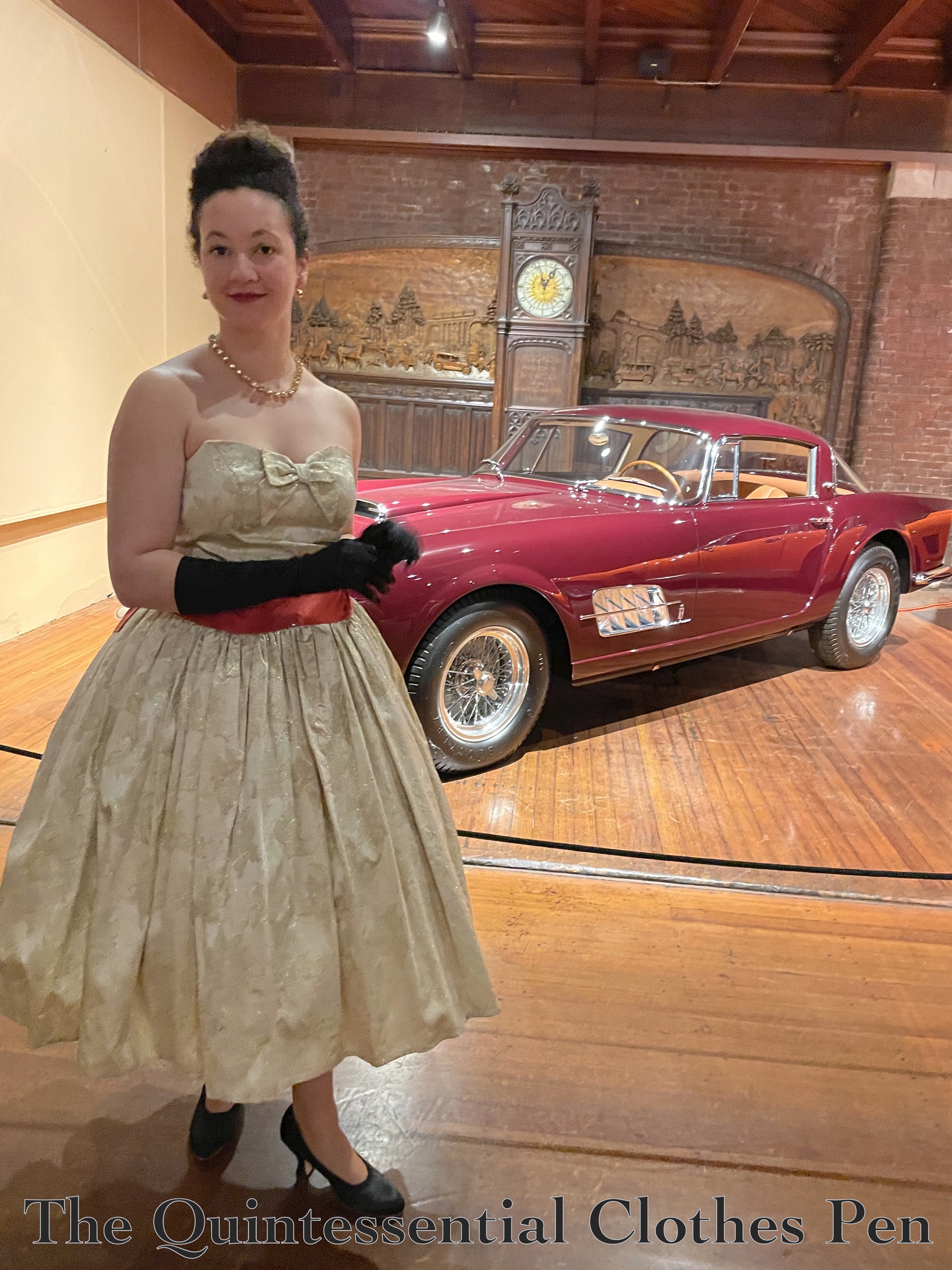
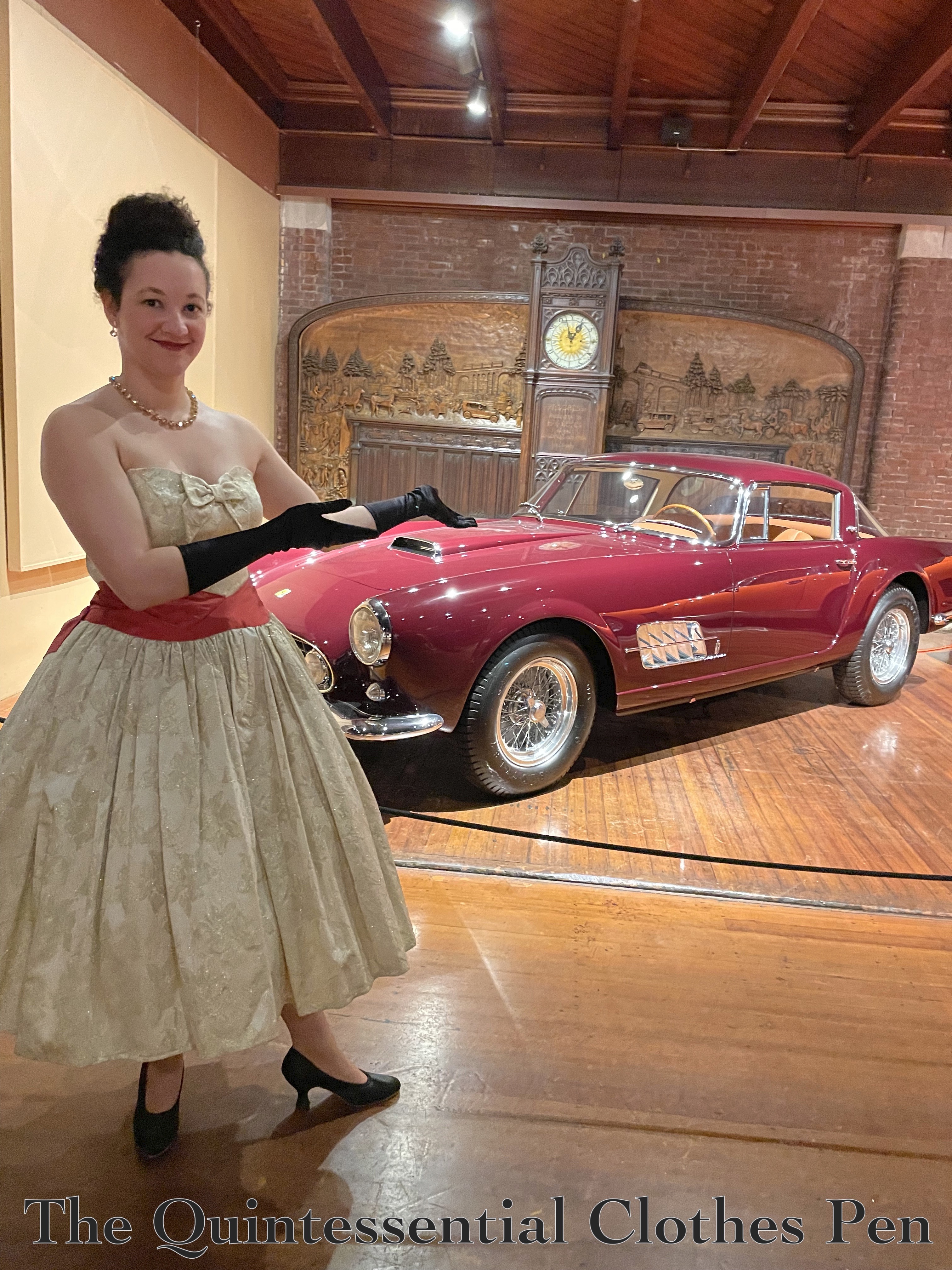
After various hijinks and shenanigans during the day, I changed into my 1950 Baroness Dress for the evening ball, which I accessorized with sparkly silver jewelry and my silver American Duchess Seabury shoes. I love the dramatic color and massive bow feature on this dress! It was fun to get it out of the closet and wear it again!

Sunday had a bit of picnicking as well as Newport mansion tours. It’s been years since I toured The Breakers, pictured below, so that was fun to do again. The immense expense of Newport ‘cottages’ is jaw dropping, every time. I also chose to visit some of the other mansions that I haven’t visited before. I’ll share photos of those in a separate post.

For now,  here’s an outfit photo as though I’m ‘visiting’ The Breakers. I wore my 1930s vintage-inspired Plum Pants with Pointed Pockets, paired with a modern blouse and my Gingers, again. I’ll admit that it was a lot of walking for heels, even comfortable ones… but, they go so well with my outfit that I couldn’t resist!

And that was the weekend! It was fun to see old friends, meet new acquaintances, and make new memories with everyone. Plus, fabulous locations and historical clothes!

Summary of 2022: Looking Forward To 2023

Another year of life and blogging has passed… and wow was it busy! It was actually less busy here on the blog on my end due to the immense busyness of ‘real’ life. I didn’t post as much as I wanted to in an ideal world, but I did maintain a pace of 1-2 posts a month, which feels like a small accomplishment. I really appreciate each of you who has read and commented on my posts with encouragement and appreciation.

Projects I completed in 2022

February: DIY Weighted Pillow Doorstop Tutorial and a doorstop for friends!

March: 1837 Blue Cotton Print Dress #1

May: Snowshoe Pads

June: 1850s Ivory Quilted Winter Hood (HSM #5)

June: Homemade Slippers

December: c. 1785 Green Stays (HSM #11)

General Blog News

I participated in the Historical Sew Monthly for the tenth year! This year, I only completed 2 out of 12 challenges, due mostly to the fact that I just didn’t sew as much as I wanted to or have done in the past, and that some of my sewing projects were modern.

Additional Opportunities 

I finally posted about an invitation to visit to the Lippitt House in Providence, Rhode Island in historical clothing. I say ‘finally’ because the visit occured in 2019!

Event Recap

Small and medium sized events started to occur again, which is really exciting! I attended 3 balls (some as part of a weekend event), 4 other events (picnic, croquet, outings, etc.), and participated in 3 weekend events (that included dancing, games, teas, picnics, winter activities, and grand house tours).

To Do Lists

Last year, I only posted a ‘maybe’ to do list. Of that list, I finished the c.1785 Green Stays that were intended to replace the Stays of Fail. Yay! And I mostly finished the 1790s Stays of Fail (started early in 2018). I also started assembling the 1836 Blue Print Cotton Day Dress #2, though it is by no means complete.

This year, my ‘definitely-do’ list includes:

  • Finishing the Stays of Fail!
  • Completing updates to my 1933 Dramatic Evening Gown (started in December 2022 but worn with safety pins… I’d like to sew the things that are pinned!)

The ‘maybe’ list includes:

  • 1790s petticoat
  • 1790s dress
  • 1930s burgundy crepe blouse
  • Finishing the 1836 Blue Print Cotton Day Dress #2

Who knows what else I’ll be inspired by. Mostly, I’d just like to find (or make, I suppose) the time to slow down, relax, and sew something… anything, really.

I hope that you, too, find and/or make time to slow down, relax, and find beauty in the little things in 2023.