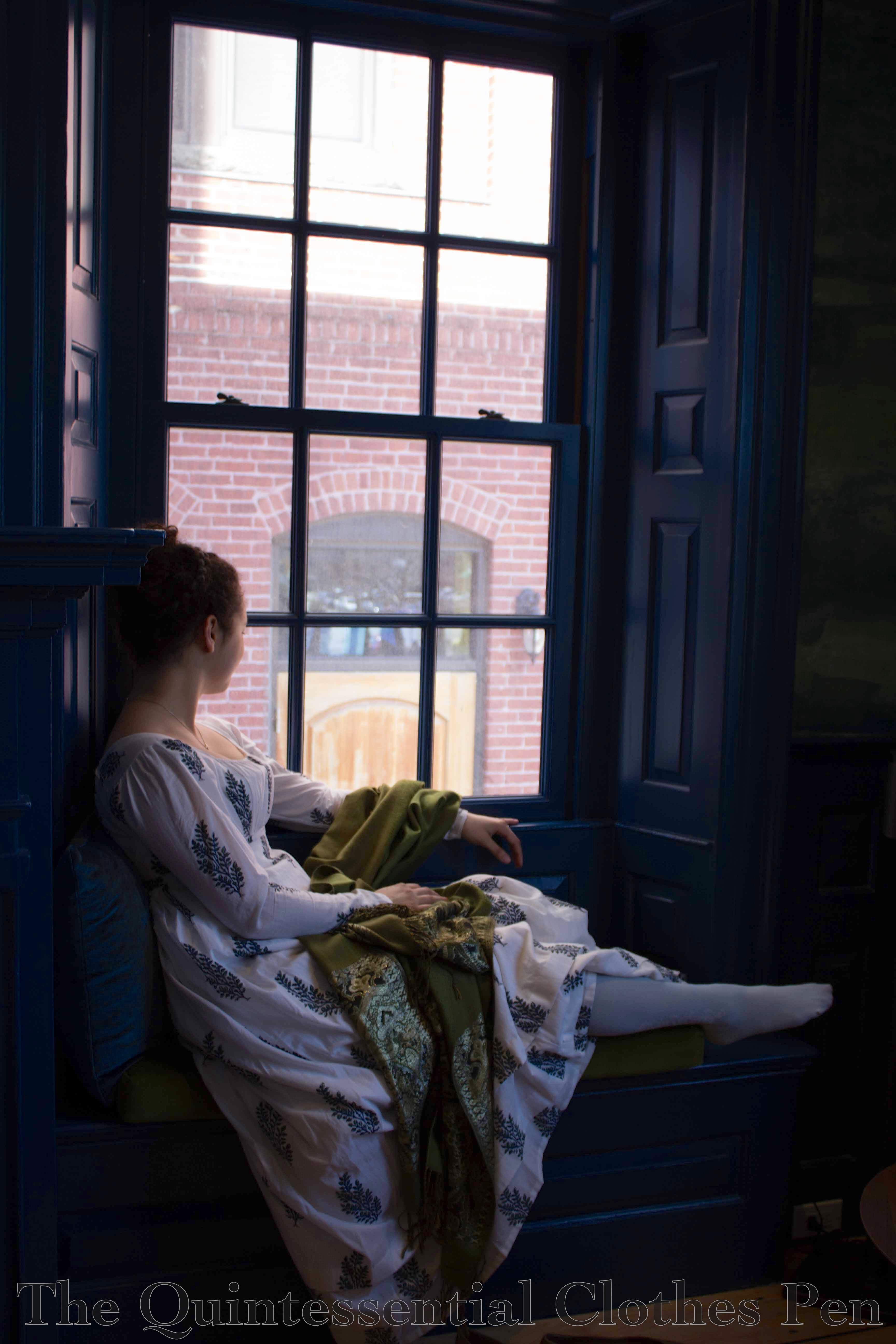
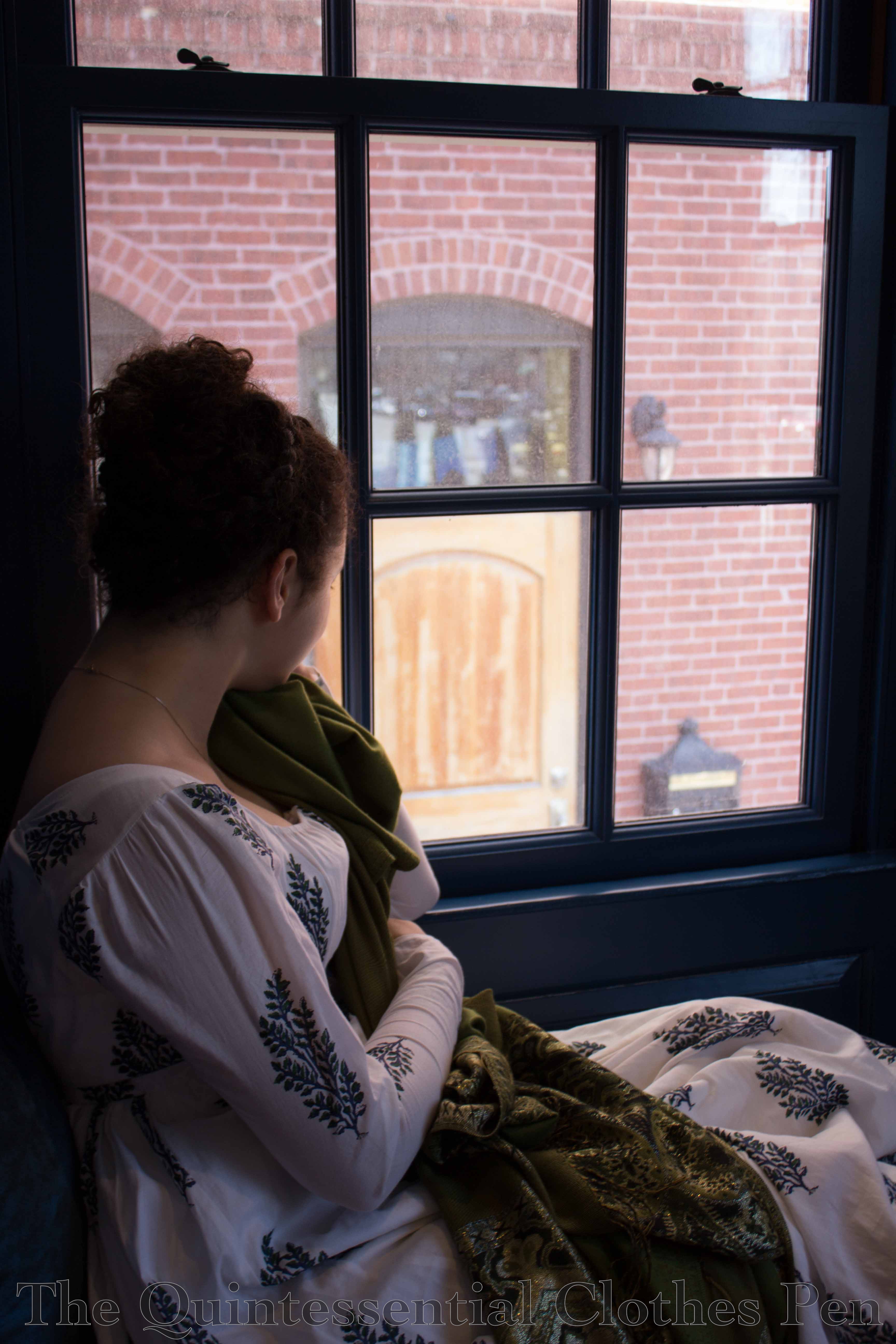
During this year’s Regency Dance Weekend, we captured some of my all time absolute favorite shots of my Tree Gown. I saved them for this post rather than including them in the overview of the weekend.
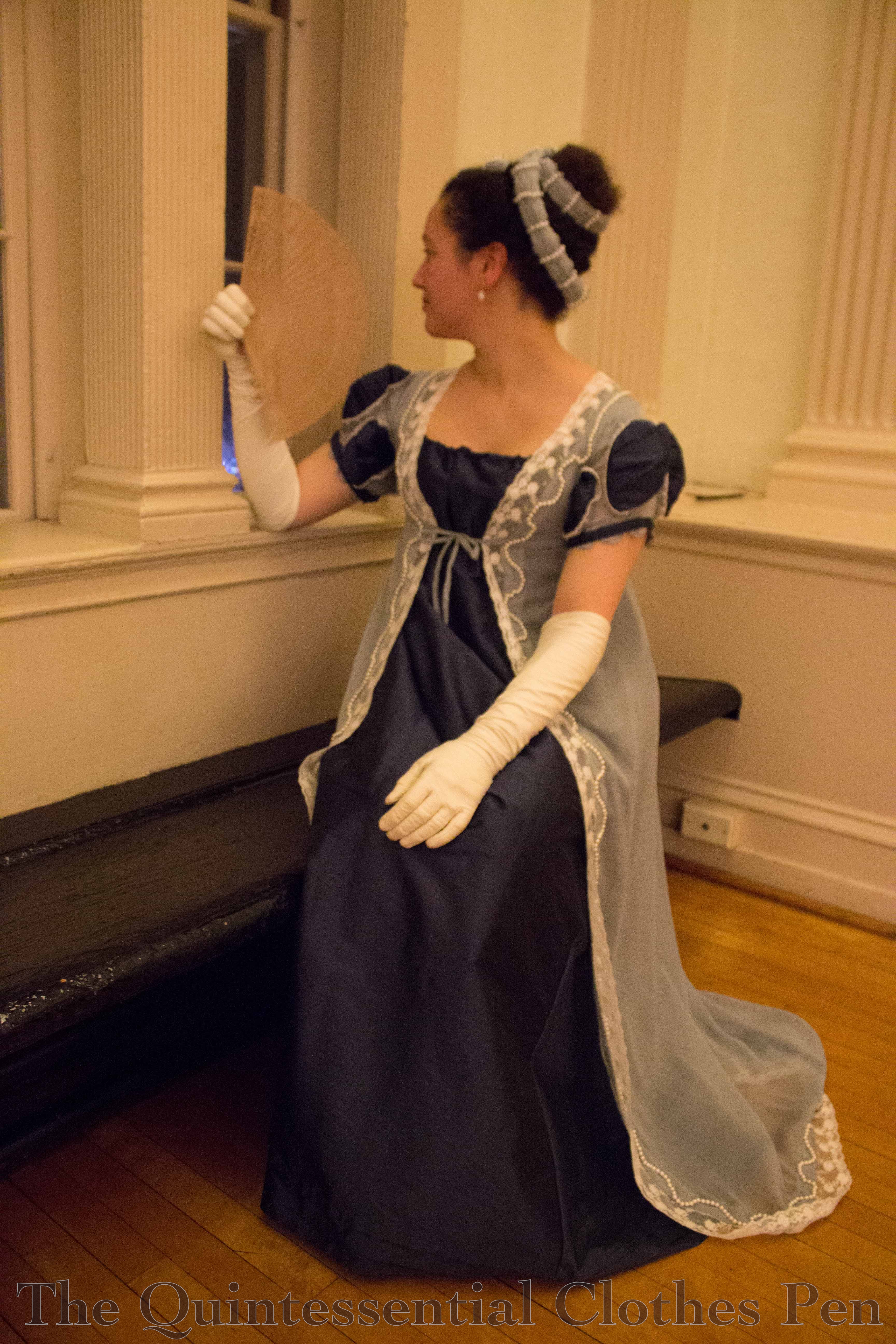
These first few were taken at our hotel. While the blue walls don’t scream Regency to me, they do coordinate nicely with my dress and make for a stunning background. The idea behind these is along Lizzy Bennet lines–lounging in a windowsill while comfortably contemplating life. This gown has the most beautiful drape to the skirt! It’s soft and full without being too fluffy.
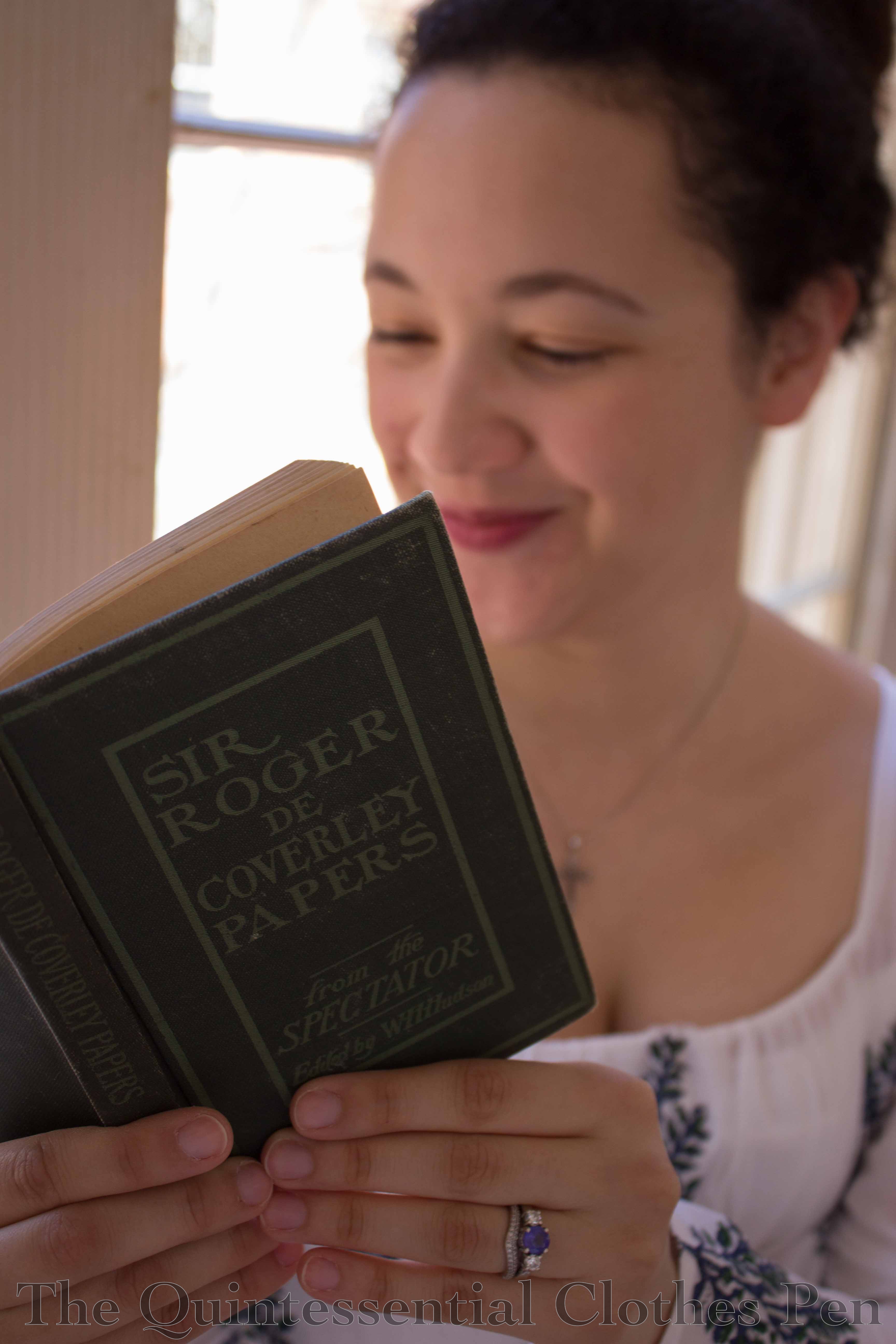
The next batch was taken at tea. One of my friends had brought the book and it is perfect for us, since we know a dance called Sir Roger de Coverley that was danced during this period. I had to pose with it!
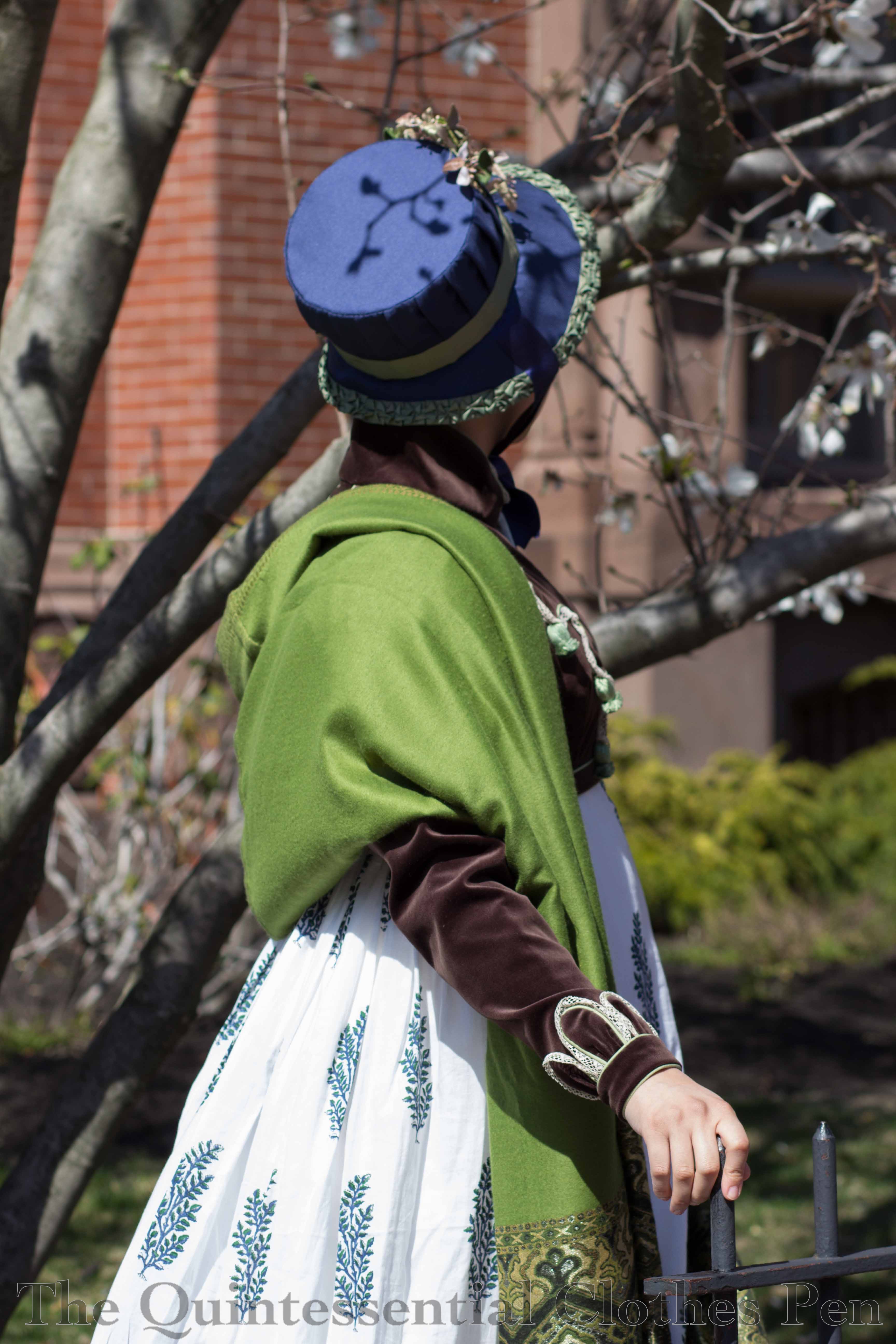
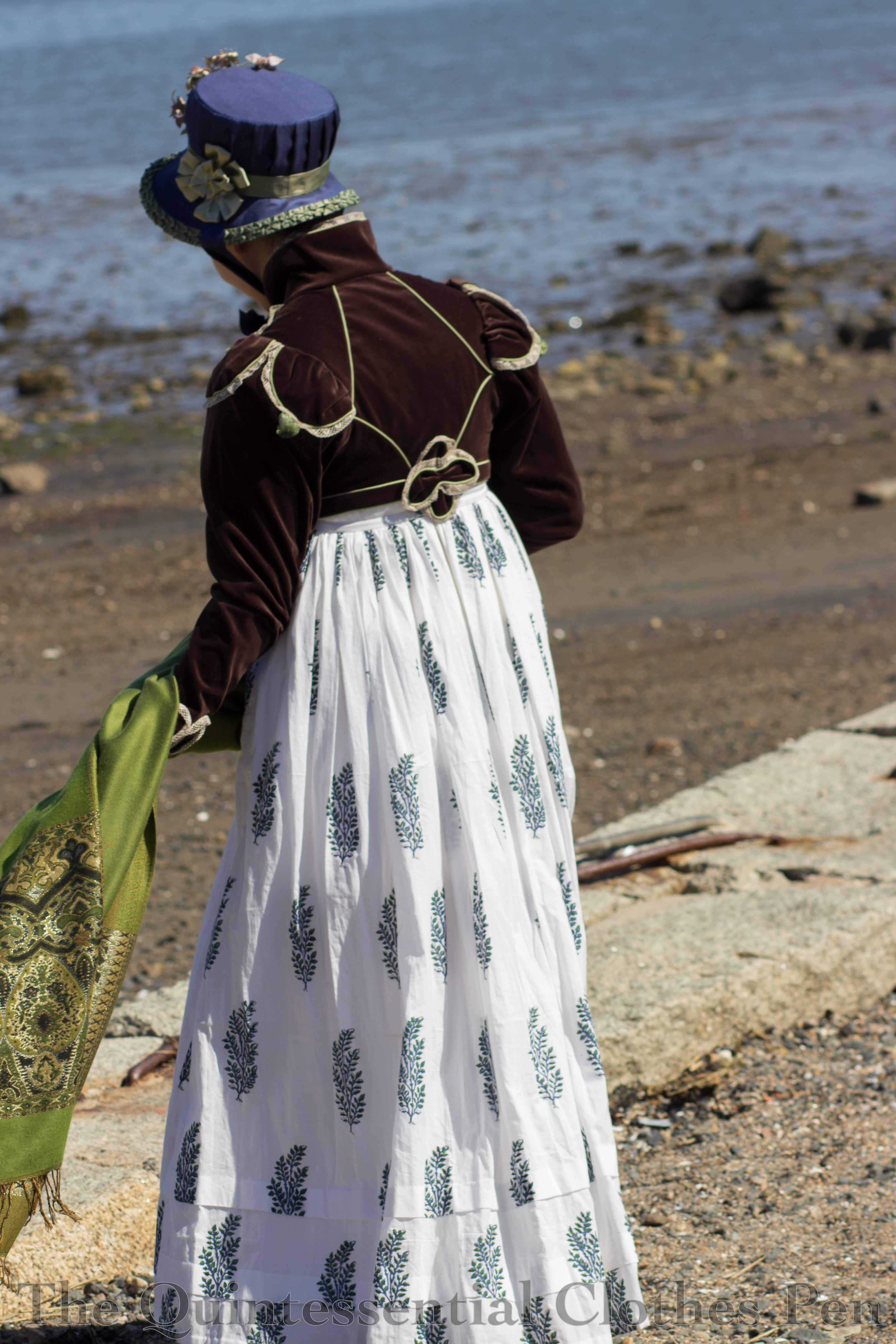
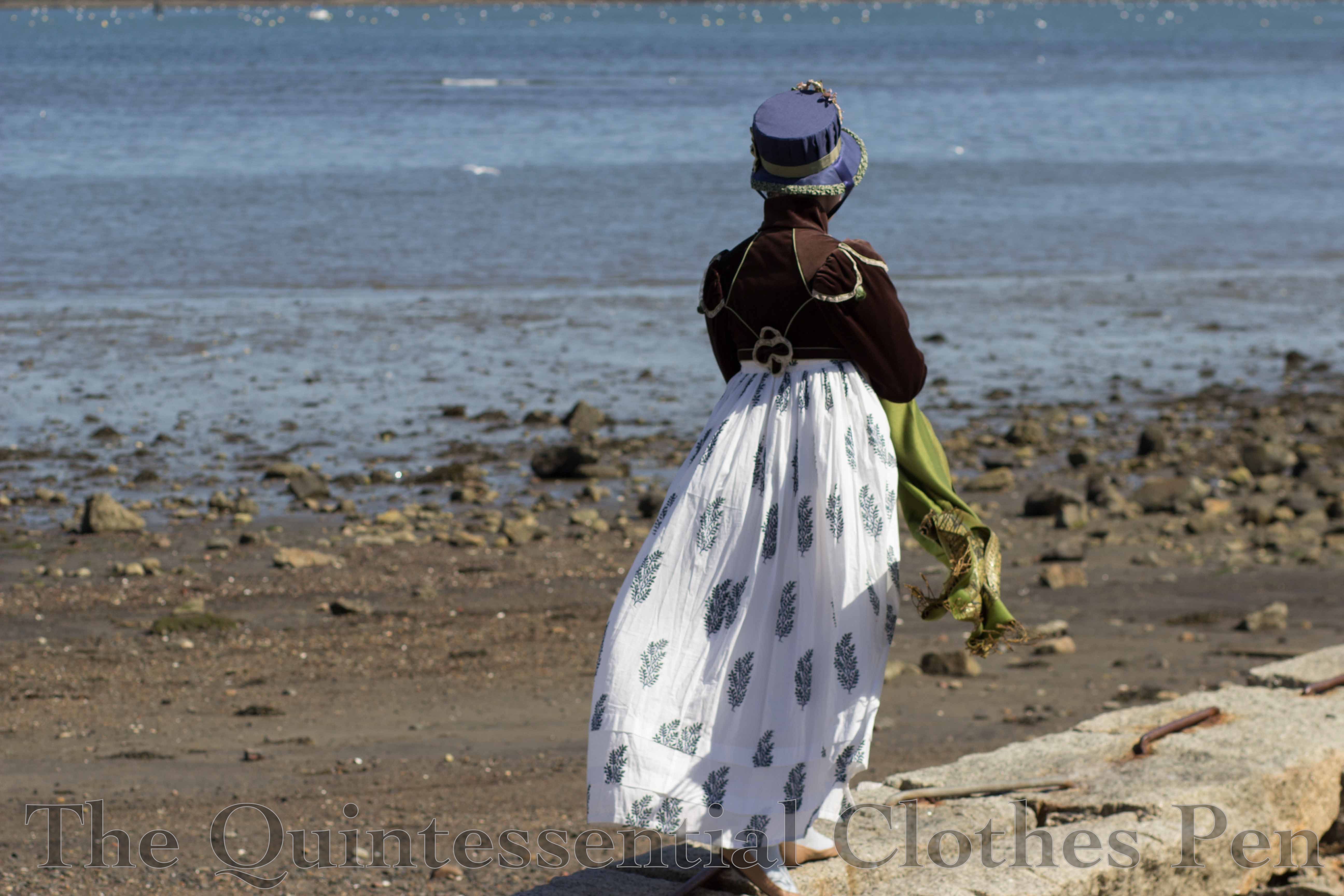
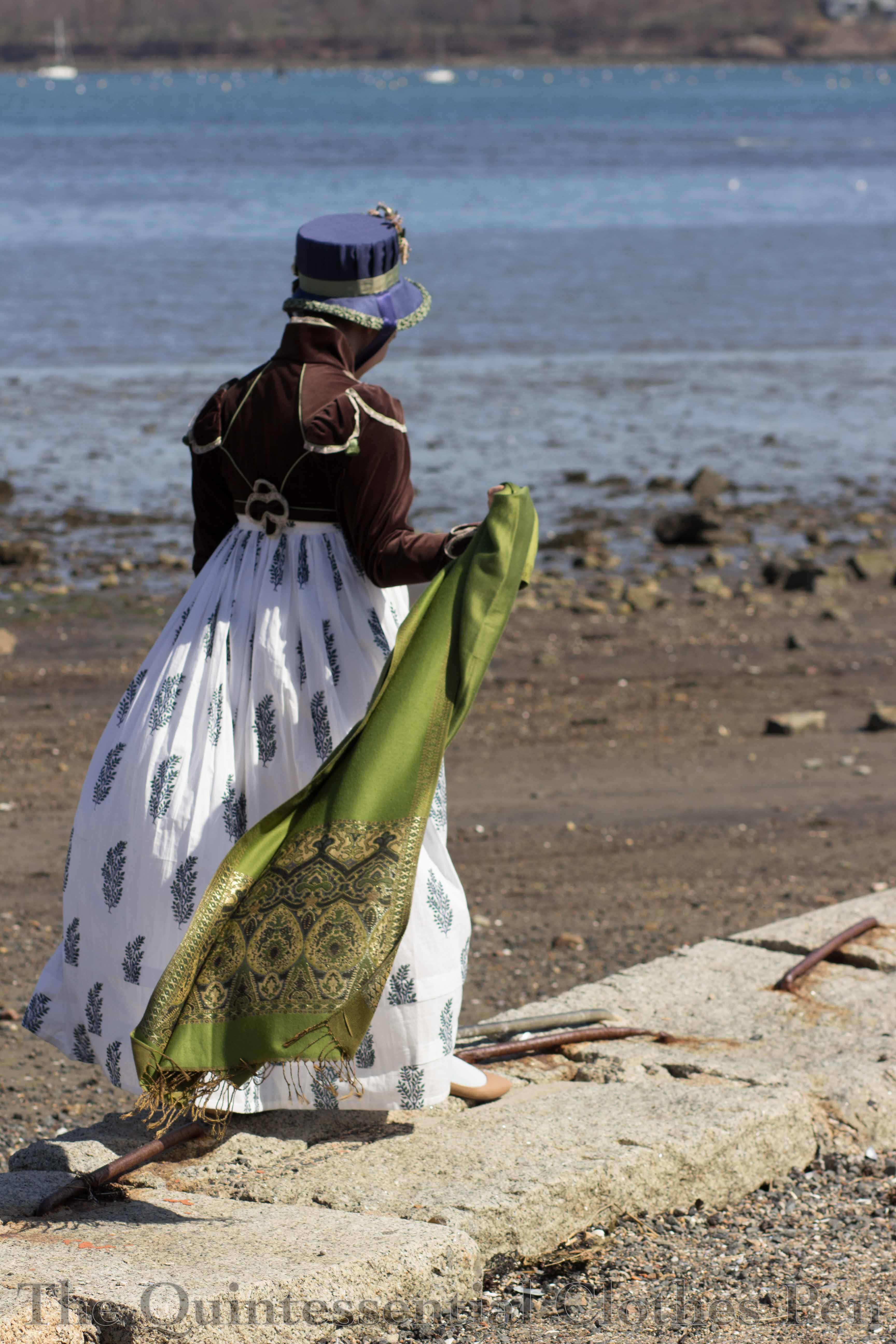
Then we went on our promenade, where we got some excellent photos of the gown with accessories: shawl, spencer, and bonnet. I like how the tree mimics the flowers on my bonnet.
Mixing up my Jane Austen stories, these pictures by the water remind me so much of Persuasion and the unfortunate visit to Lyme. I just love everything about this outfit! The fabrics, the details in the trimmings… it all coordinates so well without being perfectly matching!
Way back in April, I was excited to be part of the Commonwealth Vintage Dancers’ annual Regency Dance Weekend again. As usual, there were lots of dance classes, an informal ball, an afternoon tea and promenade, and a formal ball. It’s always a joy to do Regency dancing in Salem in historical halls built during this period.
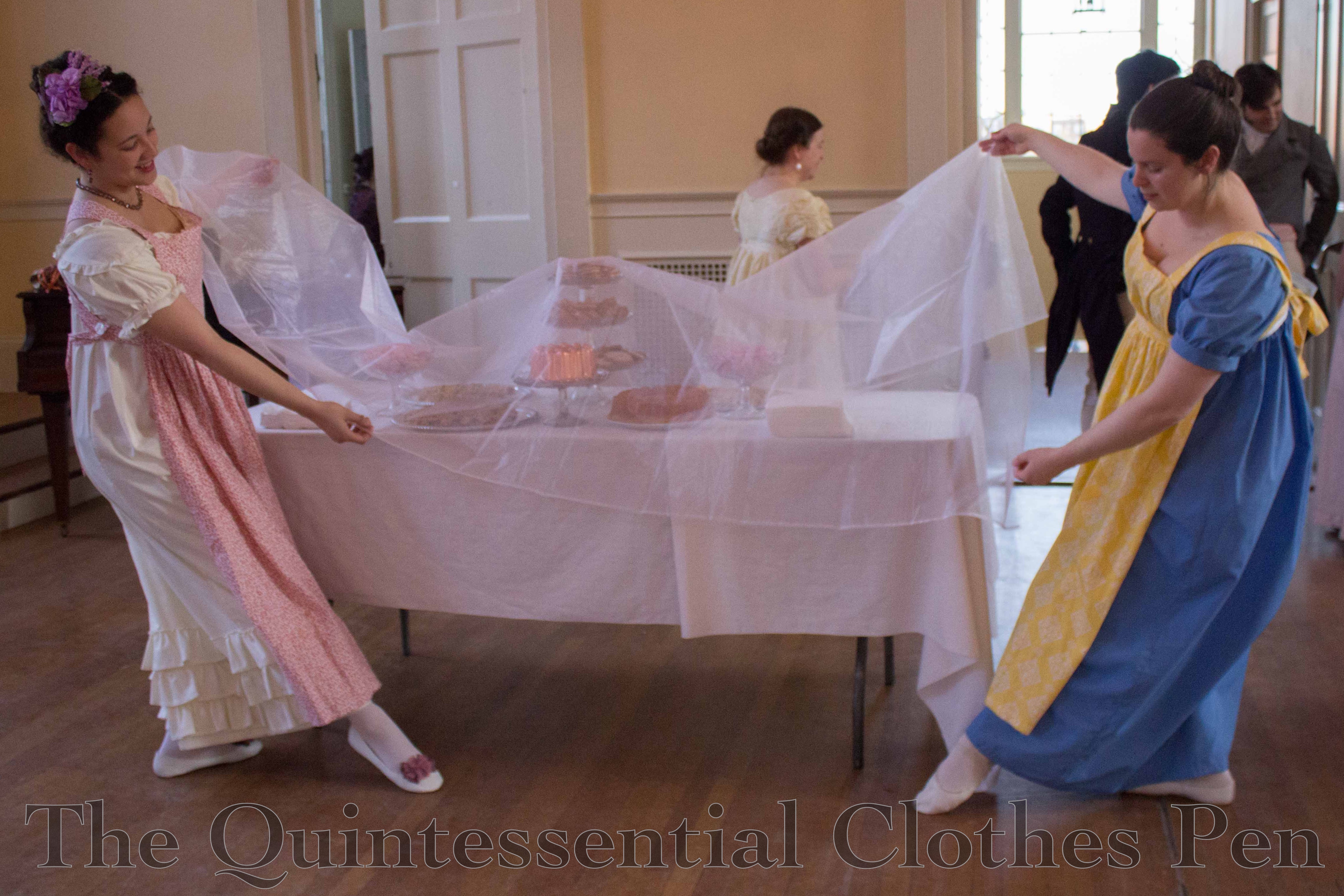
I thought I would share an overview of the weekend to start off my six-months-late sharing of the event. I did actually post about one thing from the Regency Weekend a few months ago. My new shoe poms! Here I am showing them off while artfully covering our refreshment table at the beginning of Saturday evening.
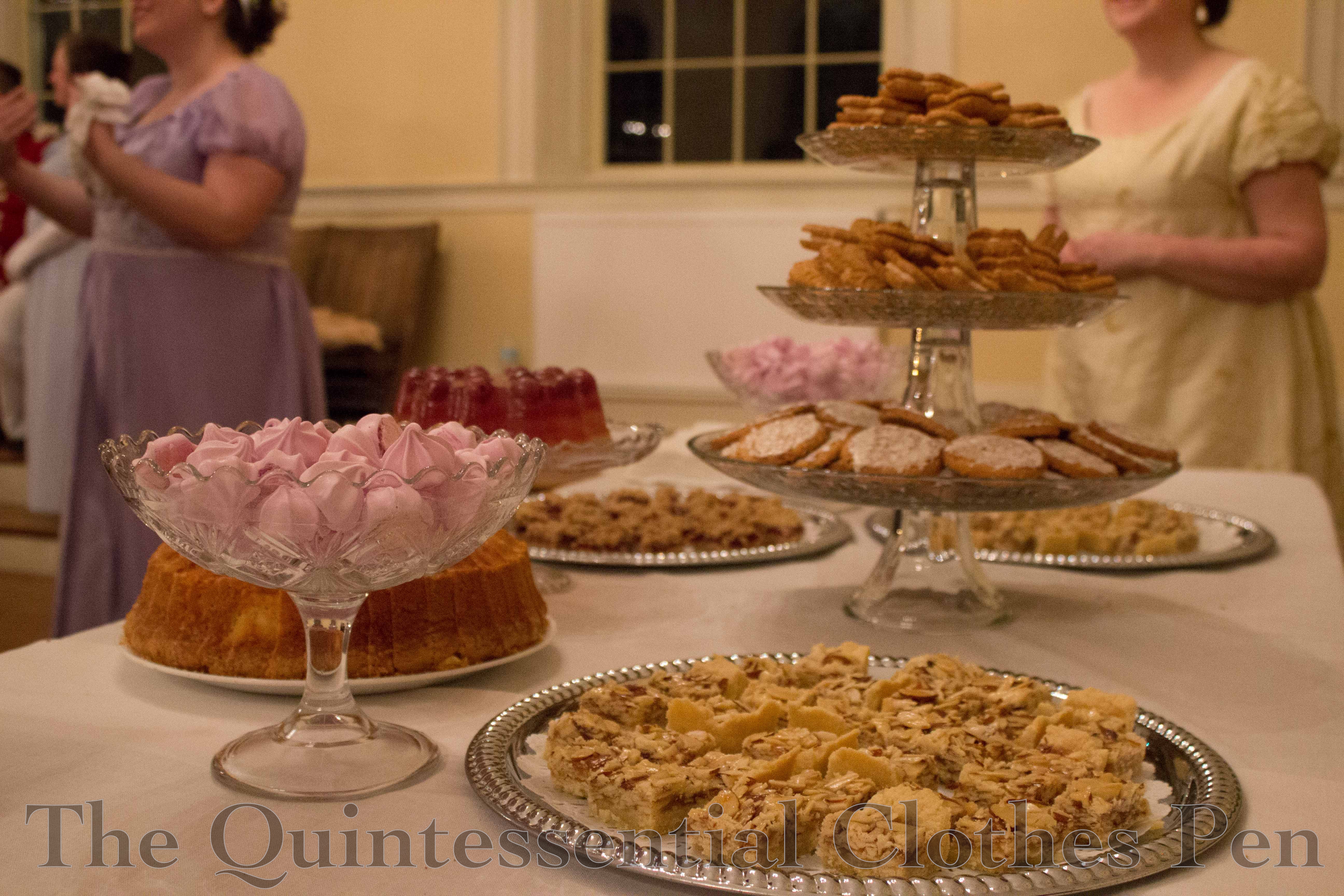
Unveiled, here is the refreshment table from the informal ball. Yummy! There was even a homemade jelly (visible in the back).
On Sunday, we took the opportunity to take a group picture in our lovely hotel. The building is quite full of history, though the hotel is new in that building. We enjoyed our stay very much. It was great to have a common living room to relax in as a group. Plus, who can complain with having historical paintings on the walls?
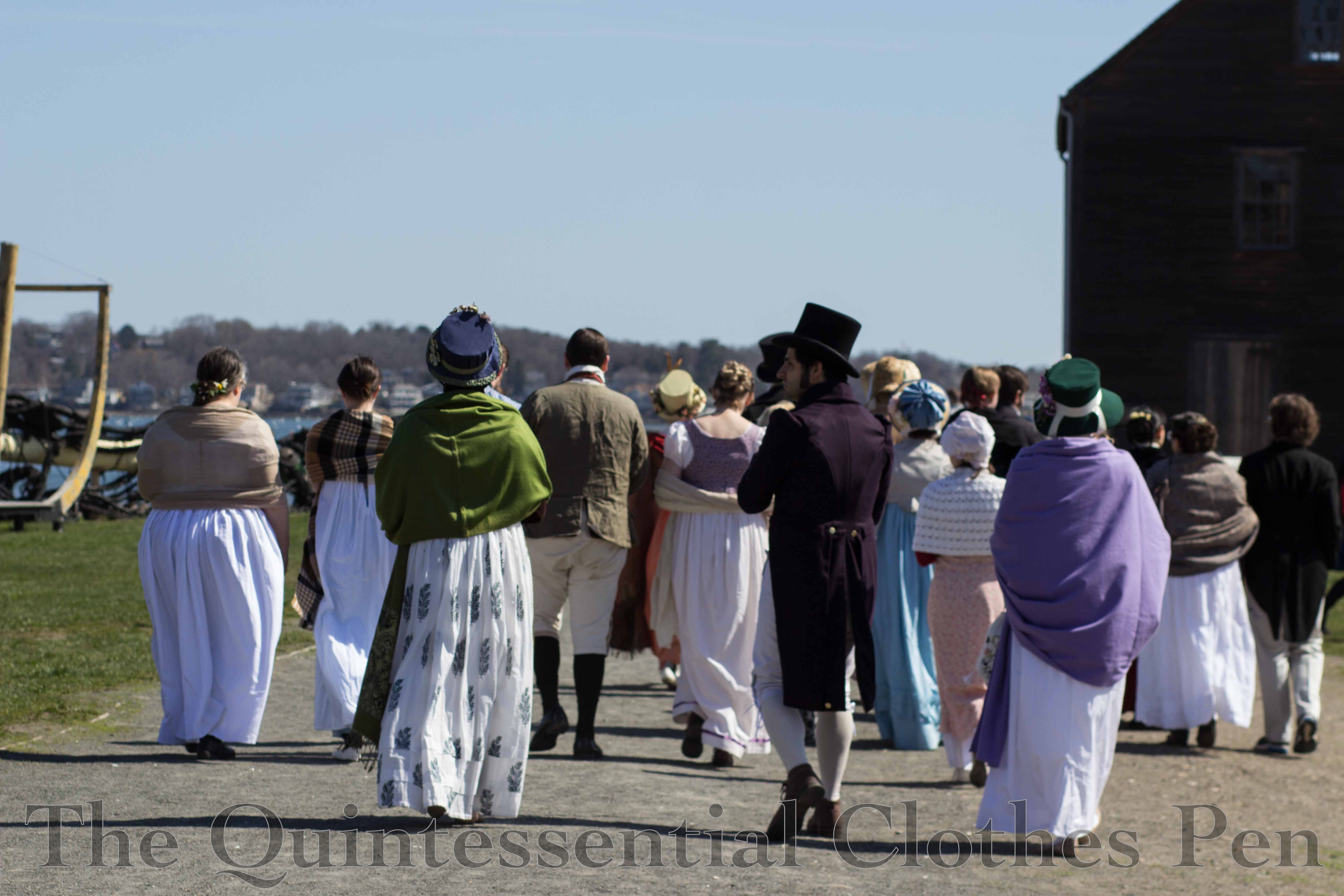
After group pictures, we headed to Salem Old Town Hall, where we were meeting for tea and as a starting point for a promenade to the water. It was a bit chilly for April this year, making shawls rather welcome to stay warm.
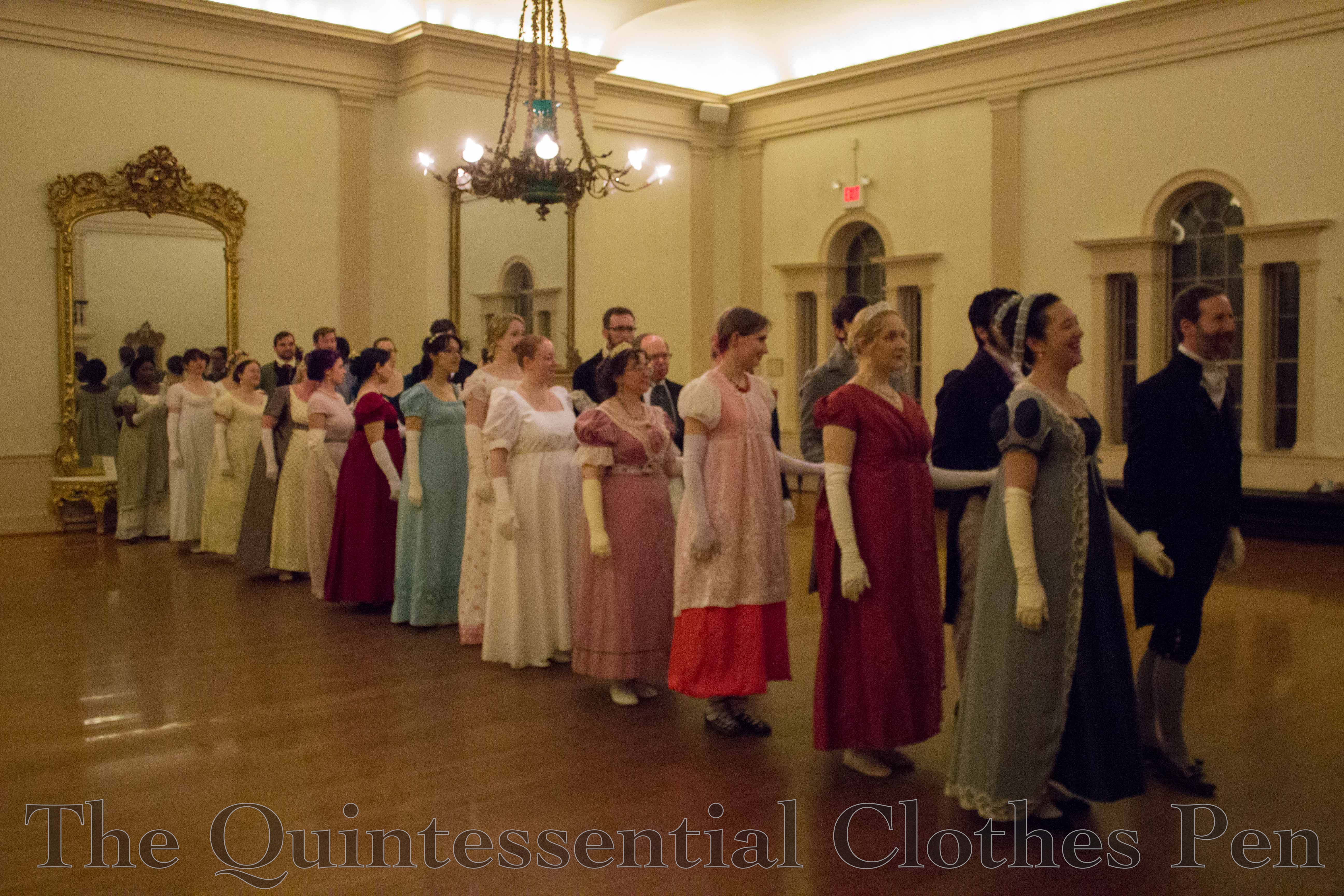
Hamilton Hall is lovely with a sprung floor intended for dancing and large mirrors around the walls. Here are the dancers all lined up and ready to go!
Another neat feature of Hamilton Hall is that the dance floor is actually on the second floor, meaning that every guest is able to ascend and descend the stairway to get to the ballroom–perfect for pictures!
All in all it was a lovely weekend. I’m really looking forward to next one in April 2017! It’s really special to have a weekend to get in such depth for one period. Here are my accounts of past years: 2013 and 2014. In particular, 2014 had blog posts which really express the special quality of this event.
In September, my friends and I had a last picnic of the season to take advantage of the summer weather before it faded into fall. Along with other picnics we’ve had in the past, we again met up in the Boston Public Garden with our picnic blankets, food, drink, and croquet set.
We’d decided on a turn of the 20th century theme for our clothing and I took the opportunity to dig a 1903 outfit out of the closet that I don’t think I’ve worn since 2012, at Dress U and Newport Vintage Dance Week. It’s an orchid lawn skirt (and a bolero I didn’t wear this time) and a white silk and cotton lace blouse.
This wearing, my hat had been re-trimmed in a more pleasing fashion than when I wore it in 2012 (in fact, all the lovely millinery flowers are only pinned on so it’s easy to change, not that I’ve bothered since I put the flowers on about two years ago) and I had practiced my Gibson Girl hair in January and now know how to achieve the look with minimal effort.
I was very pleased with the result! Next time I plan to wear a hat with a Gibson Girl style I’ll put the opening of my hair pad at the top of my head rather than the bottom, and likely leave a little space to make the front a bit more flat so my hat doesn’t tilt up. Where’s the fun if I don’t learn something new every time I wear historical clothing?
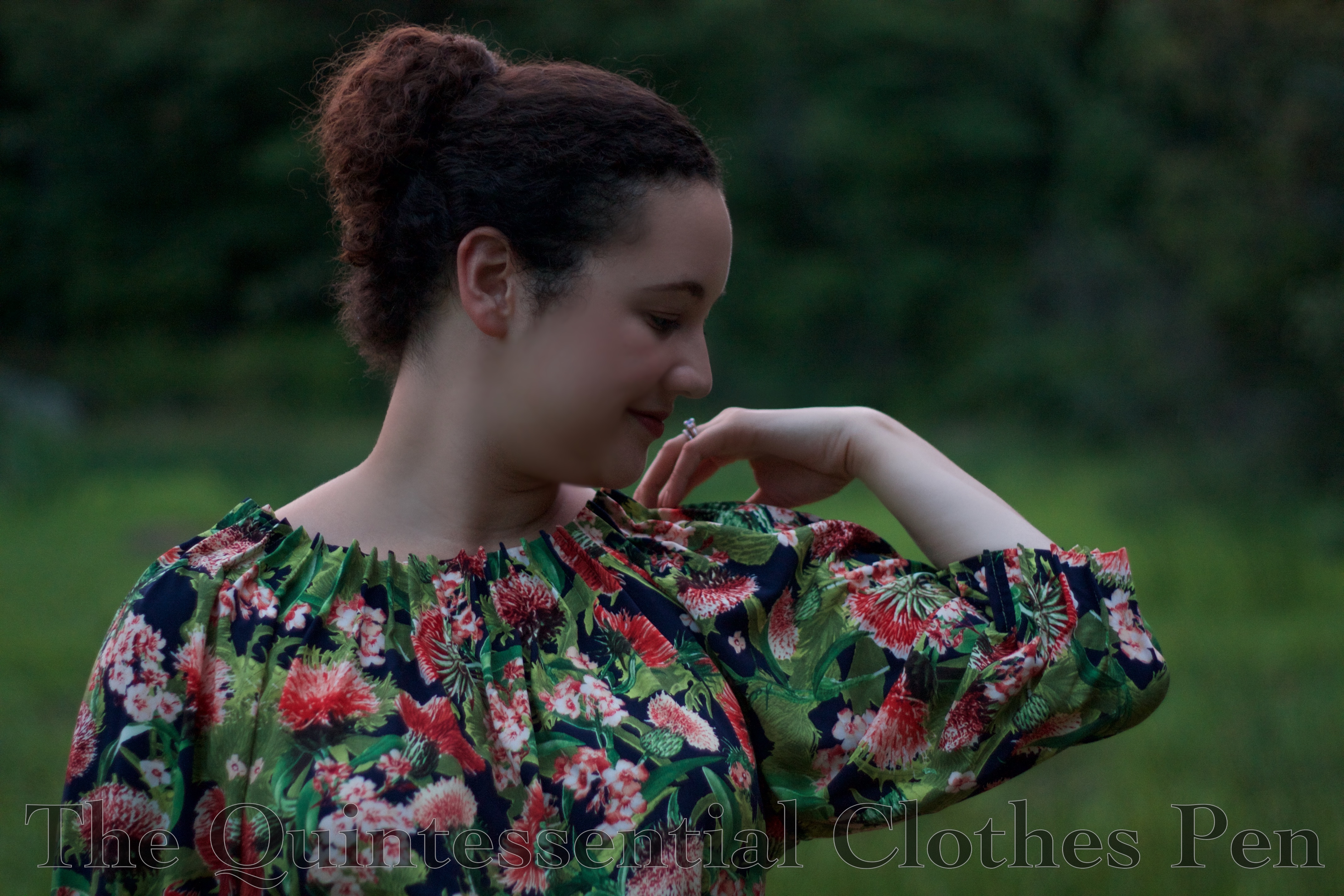
Where I grew up in the Pacific Northwest, we would often have stunning summer sunsets that would bathe our western facing house with vibrant red-orange light. We get far fewer of these dazzling endings to summer evenings here in New England, especially with such depth as those Northwest sunsets. Honestly, until we had parked at the chosen location for this photo shoot, which happened to have a western view, I hadn’t realized how orange the sunset on this particular day was.
The day had been a busy one and I had to hurry to look presentable and throw on the dress to catch these photos before the light faded. I wasn’t sure there was enough light left to get good photos, but I actually really love the unusual orange sunset light.
I purchased the rayon print fabric I used to make this dress last winter from Blackbird Fabrics. I have an ongoing effort to try to add pattern to my modern wardrobe, which is mostly solid color garments. I didn’t know what I was going to do with the fabric, but then in the spring Leimomi (the Dreamstress) asked if I would be willing to do a favor for her relating to her soon-to-be released first ever Scroop Pattern, the Henrietta Maria. Squee! Of course! And my thank you from her was the pattern itself! Perfect!
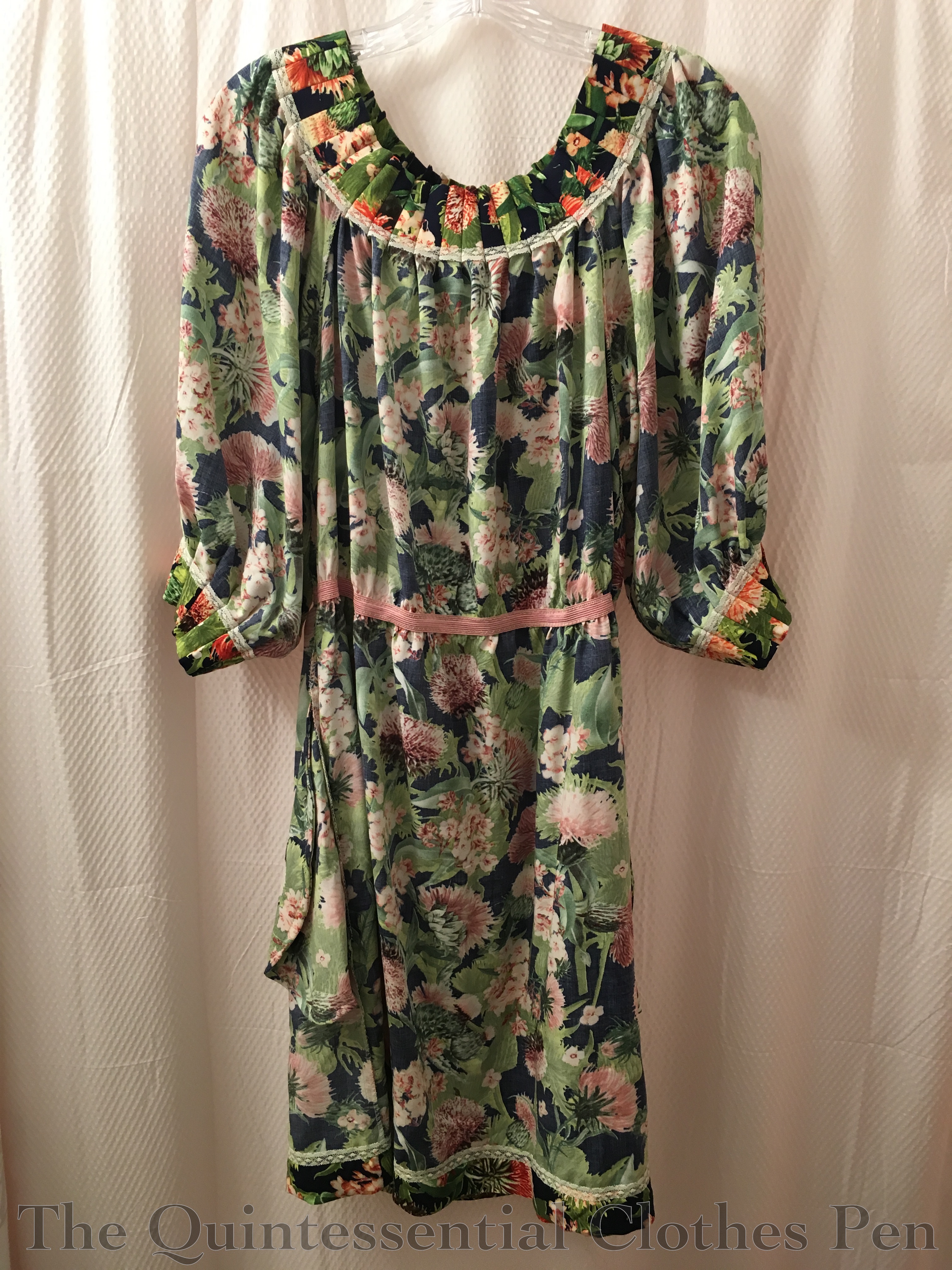
So this is a Henrietta Maria. The pattern is great, with clear directions and helpful tips. Leimomi has also posted some extra tutorials for the dress on her blog. I took advantage of the suggestion of adding elastic to control the waistline because without it the dress was looking like a bit of a muumuu, what with the busy floral print and the straight shape.
The construction is straight forward, with the only time consuming part being the 44 tucks that make the dress particularly unique. They’re not hard, and their placement is clearly marked on the pattern, but they are time consuming. I think they took me about 3 hours to sew all by themselves. They could probably take less time, but I was very careful to match each guide line and sew them with precision. And the end result is worth it.
The inside of the dress looks like this. I used the lace edging method that Leimomi also blogged about. It provides such a nice, tidy finish without any visibility on the exterior. And all the tucks keep the lace in place perfectly.
Like the tucked edges, the hem edge is also edged with lace that is machine sewn onto the raw edge. The hem is sewn with a cross stitch that is pretty much invisible on the exterior.
Here are a few more pictures from the sunset photo shoot. I’m not sure why there was a worn statue of a frog in the midst of the trees.
You can see more lovely versions of this dress on Leimomi’s blog here. Click back through previous posts with the tag to see more. There’s also a shirt version. Check them out!
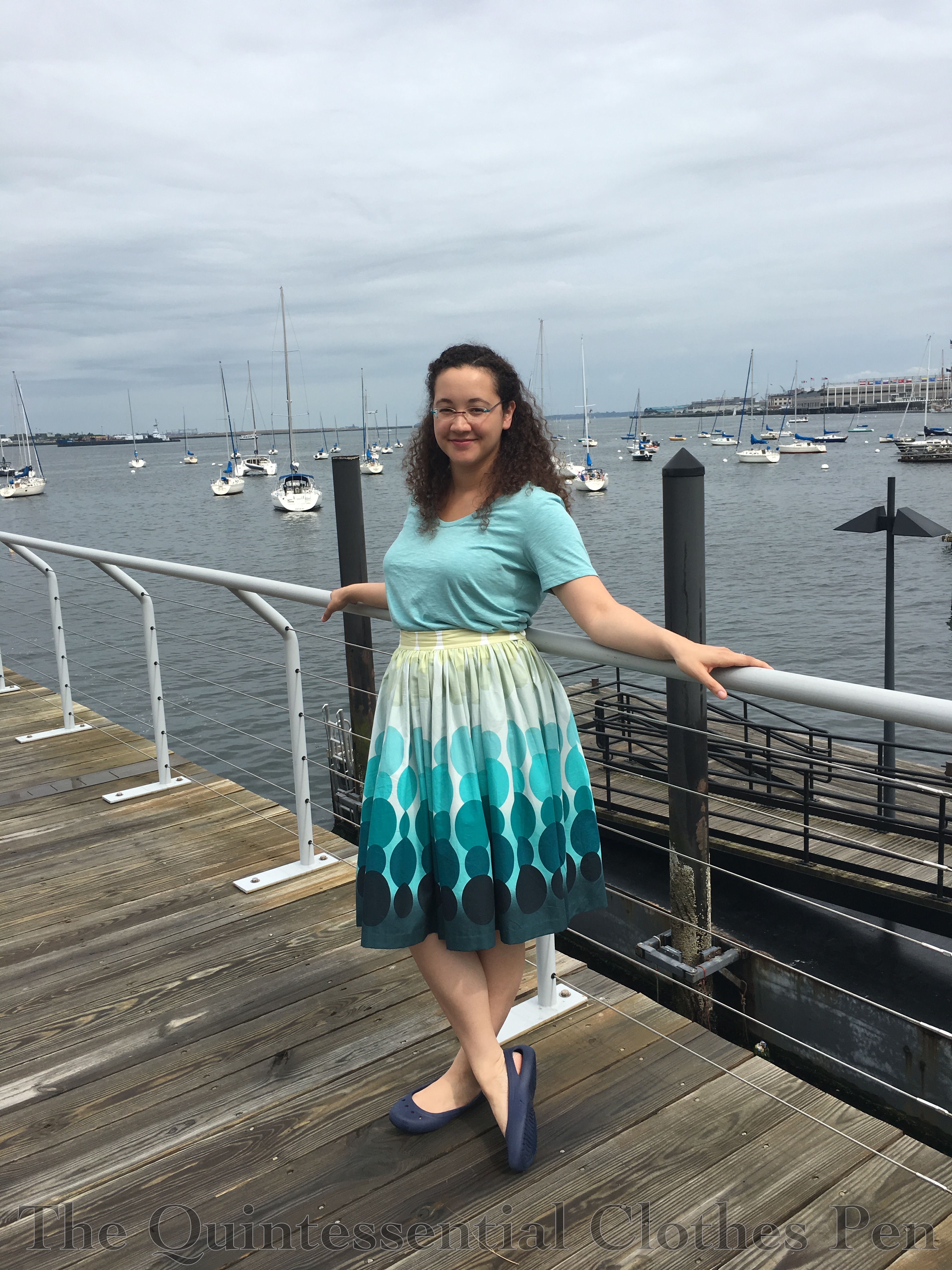
This summer I found some time to make some everyday modern clothes. Here’s one of those garments, a simple gathered skirt made interesting due to the ombre printed fabric, which reminds me of rising bubbles.
I’d seen this fabric at the store, didn’t buy it, then saw it again about a month later and decided (or was convinced by friends…) to purchase it. I finished off the bolt with somewhere around 3 yards, which was perfect for a full hem.
It looks pretty snazzy with a petticoat under it, so I’m hoping to have some excuse to wear it someday as 1950s instead of modern. In the meantime, I’ve worn it with a variety of white and oatmeal colored tanks and tees, both of which are nice continuations of the ombre effect of the skirt pattern.
The skirt is a mix of hand and machine sewing. The only seam is serged. The hem is hand sewn to be invisible. The zipper is hand picked because I didn’t feel like dealing with a machine zipper foot. The buttonhole is hand sewn because I didn’t feel like dealing with a buttonhole foot. And the inside of the waistband is sewn down by hand to keep things tidy.
Hand picked zipper. Cute curved tab on the waistband to echo the dots with a lone vintage button from the stash.Look at that pattern matching!Tidy seam and hem.
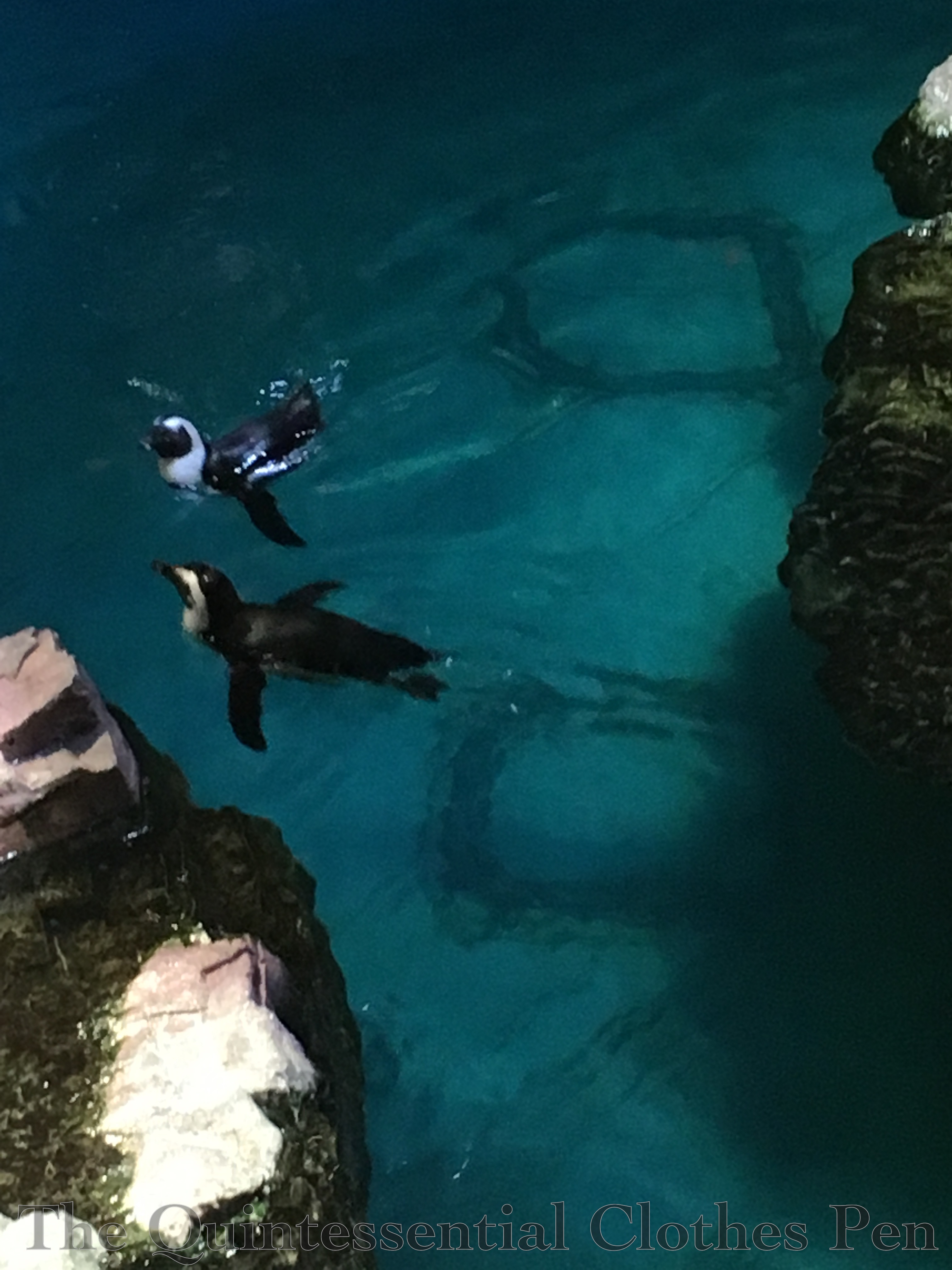
For pictures, I wore this to the aquarium. It seemed fitting, with the bubble dots! I greatly enjoyed the larger animals–penguins of three types, seals, and sea turtles. I went with Mr. Q, who remembers going to see Myrtle the sea turtle when he was young and on school field trips. Sea turtles have long life spans, so Myrtle is still there, floating around. The aquarium has this to say about her:
Myrtle, our green sea turtle, lives in the Giant Ocean Tank. She has lived at the Aquarium since June 1970. She is approximately 80 years old, weighs more than 500 pounds, and eats lettuce, cabbage, squids, and brussels sprouts.
Yikes!
Hi Myrtle!
There was another large turtle in the giant ocean tank as well, named Ari.
And penguins! They are so cute and funny!
All the water in the tanks came out looking like the same colors in my skirt in these pictures. Perfect!
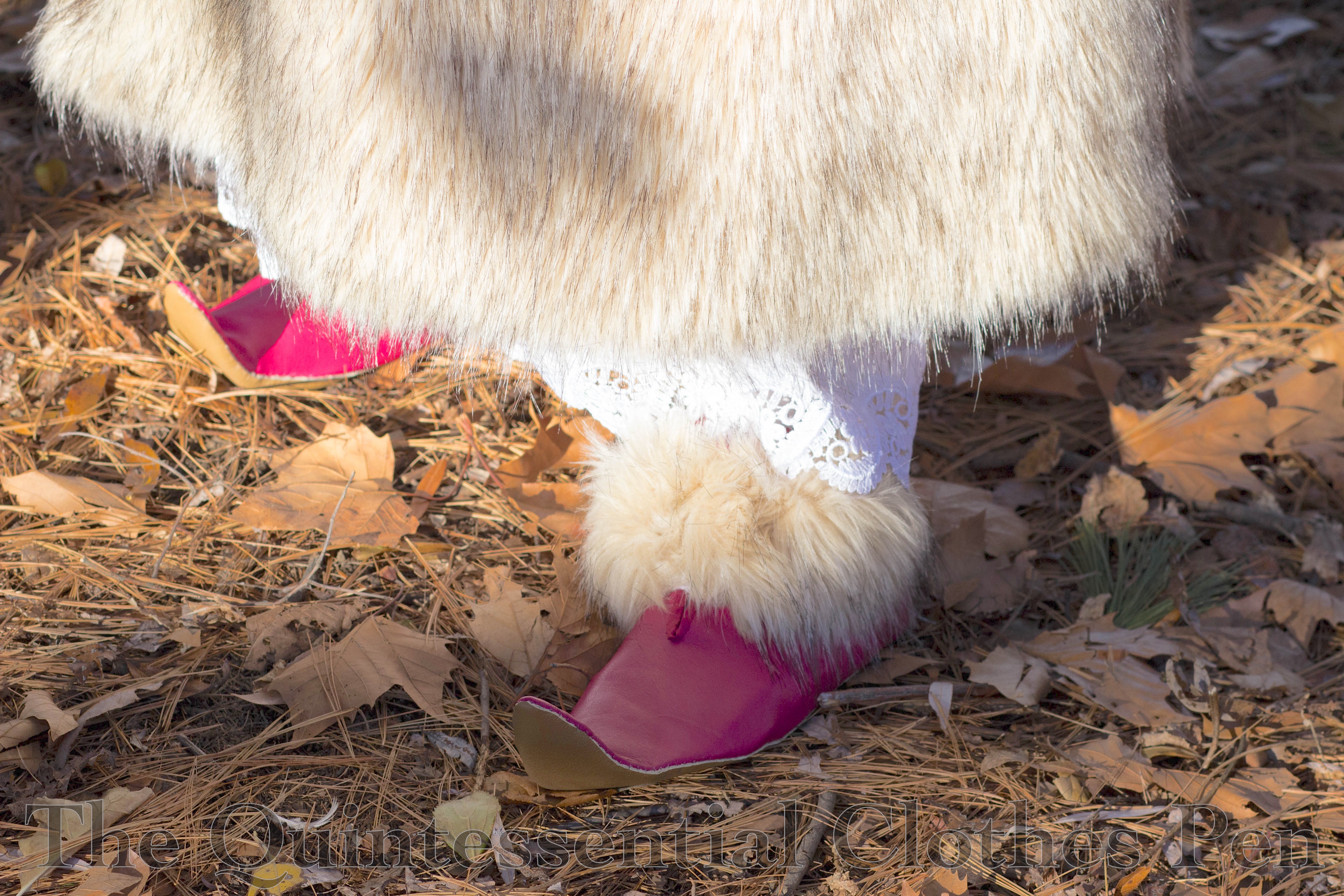
One of the five pieces of my Vernet Project was creating the silly up-turned-toe elf shoes in the fashion plate. Clearly, these are not shoes that could be purchased, as they are so specific in style, so I set out to make my own!
In the beginning, I was thankful to have another Vernet project maker’s experience making her boots before mine to work from. Jenni posted a two part tutorial showing how she made her boots as well as sharing information behind-the-scenes with project participants earlier in the process (Part 1 and Part 2). She closely referenced Every Lady Her Own Shoemaker, published in 1855 (a little late relative to the date of the project, but still useful for construction advice), for construction methods and carefully documented her process. In fact, she did a much better job at documenting the actual sewing than I did… I also read Anna’s information about making mid-19th century shoes multiple times to help get my mind acquainted with the project (again, a little later than the period of the project, but still helpful). She also has lots of great construction pictures.
I started by creating a pattern for my shoe using patterns in Every Lady Her Own Shoemaker. Given that my shoe has the unusual turned-up-toe, I necessarily needed to make adjustments to the general slipper pattern. Here is my shoe at the mockup stage. The upper pieces fit pretty well! I adjusted the width of the sole as well as the shape of the turned-up section before moving on to cut out the final pieces.
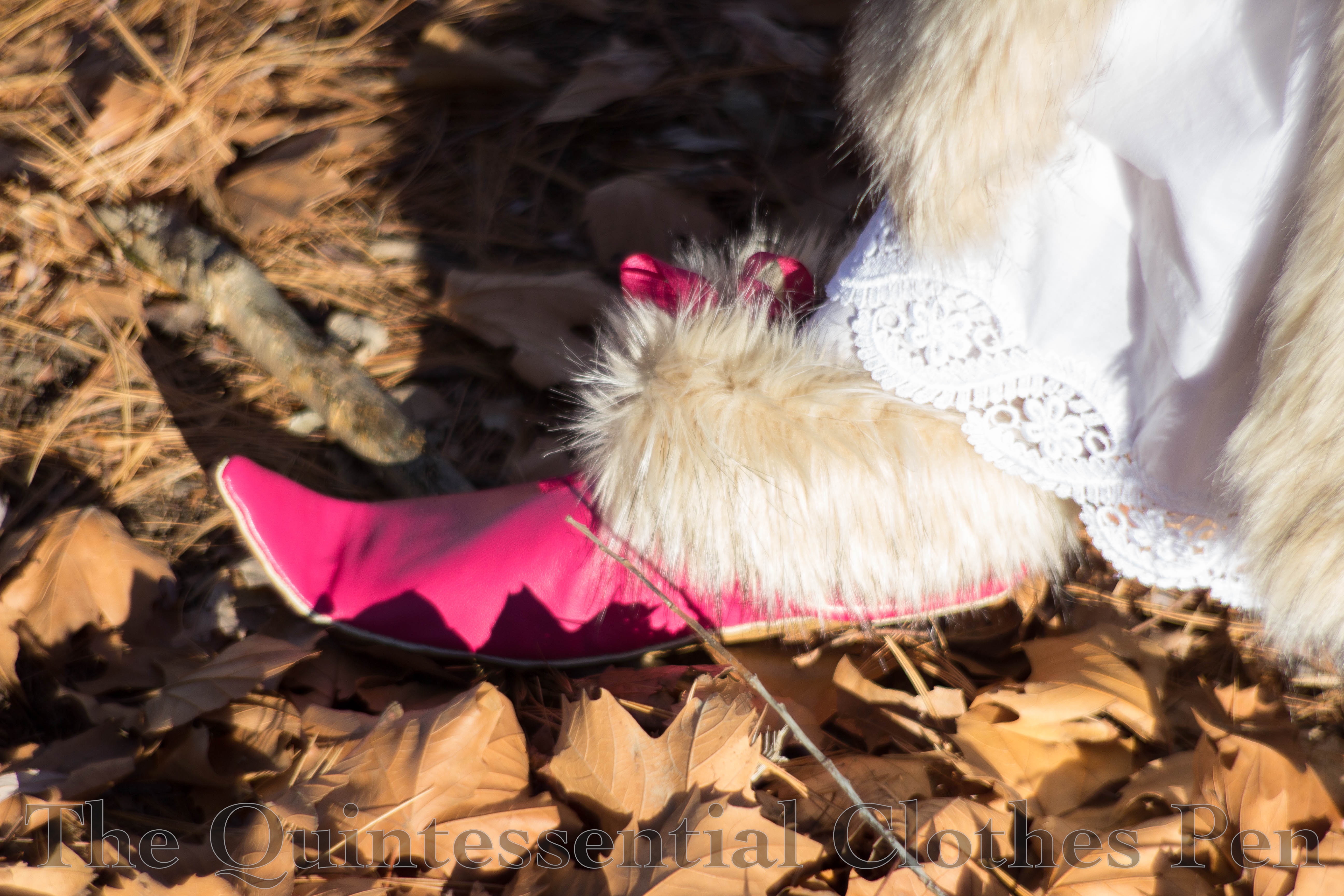
Here are all of the final pieces cut out and ready to assemble. The soles have three layers: heavier tan leather for the outer sole, cardboard for the inner sole structure, and white linen to cover the cardboard insole. The uppers have two layers: lightweight raspberry leather for the exterior and white linen for the interior. Later in the process I also added a faux fur cuff.
To help the shoes keep their turned-up-toe shape I soaked the leather soles in water, taped them to a lysol wipe container, and let them dry. You can see the results below. Not perfectly curved up, but still helpful. I also tried boiling leather soles to thicken them before shaping, but found that the leather shrank unevenly which created soles that wouldn’t work for this project. I did save them, though, and hopefully will get to use them for a future shoe making endeavor. I repeated the soaking and shaping for the cardboard insoles before gluing the linen to them. There’s a picture of the insoles at this stage in this past post.
After shaping the soles it was time to construct the uppers. I did the interior and exterior separately, then basted them together around the top opening and around the bottoms. Then I sewed the bottom edges of the uppers to the soles, using the slanting stitch through the side of the sole that Jenni shows in Part 2 of her tutorial. She used all sorts of nifty leather tools as well as a wooden last during construction. I purchased the nifty leather tools but found that they didn’t work for me and a simple non-leather needle worked just fine. (I think my leather was too thin and soft for these to be needed). As for the last, I looked online for a wooden one, never found one in my size foot, and eventually decided to give it a go without one, especially since I had to do the turned-up toe. In the end, I don’t think it was a problem not to have a last.
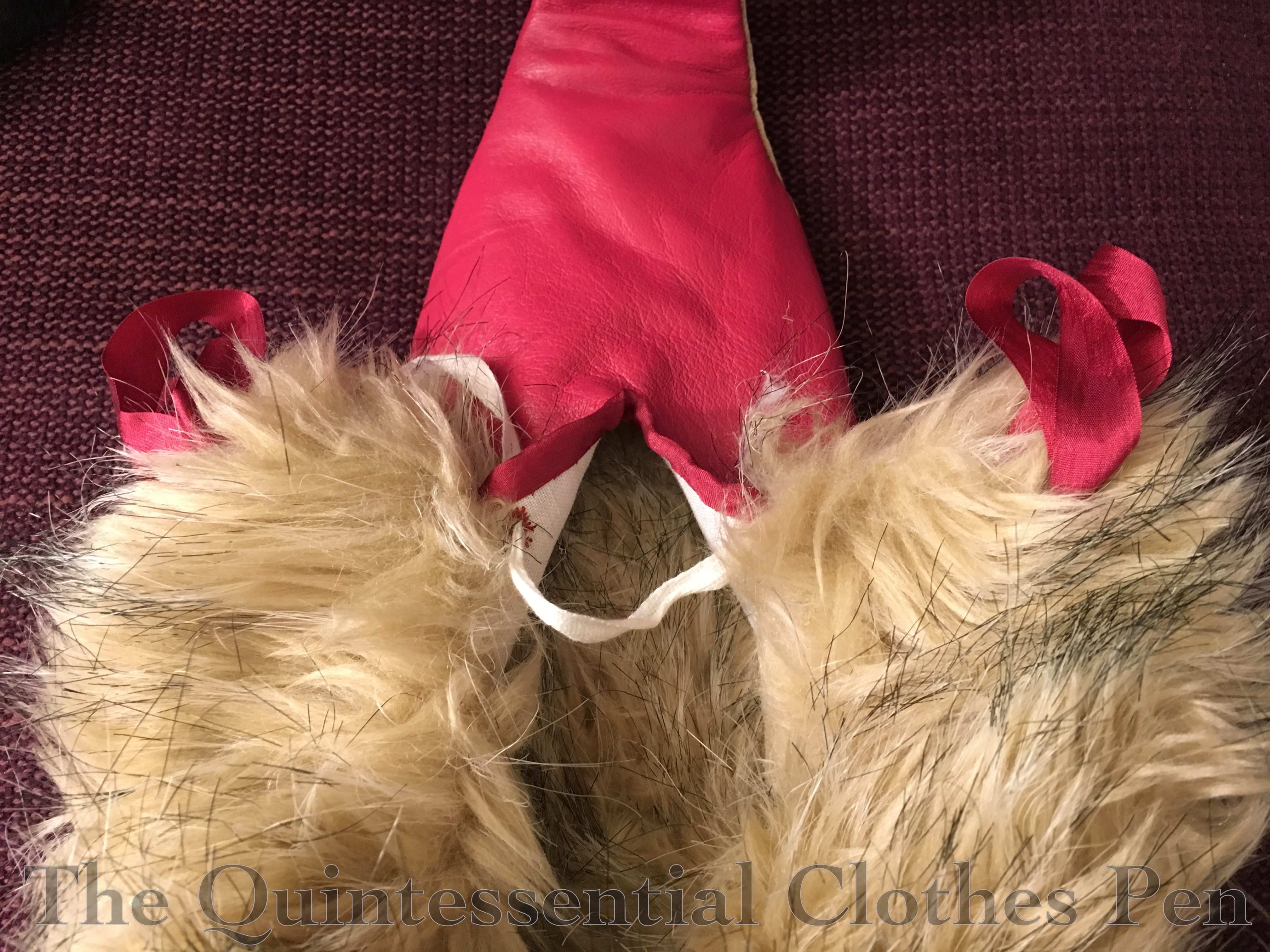
Once the soles were attached, I bound the front slit with matching silk ribbon. Then I cut a piece of faux fur for each shoe that went around just the top of the foot opening and could double over on itself. There are non-functional silk ribbon loops that are sewn to the front of the fur that encases the top edge of the shoe. The shoes actually close with a twill tape threaded through hand sewn eyelets on each side of the opening.
They’re actually quite comfortable for walking around in. I have very flat feet, so don’t really need arch support to be comfortable. The only thing is that my feet did get cold during our photoshoot due to the freezing ground only separated from my feet by a few thin layers of fabric. So, for the second wearing, while caroling at Christmastime, I added a faux fur insole. Problem solved! They were toasty and even more comfortable!
Interestingly, witzchouras are mentioned as being popular in Paris during the year 1827 by La Belle Assembleé, after a mention of other popular pelisses and mantles (well worth checking out!), and are are described as being worn with boots laced in front and with fur around the leg.
Doesn’t that description sound oddly familiar? It reminds me so very much of the Vernet fashion plate and my silly shoes!
On my to-do list for this summer was a 1920s bathing suit. At first I thought I might knit one, but I wanted a smaller project than that, and also, a friend who hand knit a swimsuit last year reported a fair bit of sagging happening when she wore hers in the water. So I decided to try a different approach and make my suit from wool jersey fabric, a historically accurate option in terms of weave and fiber for a 1920s suit, as far as I can tell from my research.
After spending lots of time looking at inspirational images on Pinterest and compiling this board of the most inspirational images, I decided on the year 1925, when suits were getting shorter and often sported built in shorts. My main inspiration was this extant suit from 1925 at Abiti Antichi. It’s where my decorative inspiration came from and also justified the visible seam where the shorts attach to the dress. I also referenced this 1920s extant suit at All The Pretty Dresses, which shows interior finishing (serging!) and has narrower straps.
I knew there was no chance of finding wool jersey at a local fabric store, so I searched around the internet for sources. I believe I found only three–a company in New Zealand, New Zealand Merino and Fabrics, that makes gorgeous colors and sells through their own website and through Etsy; Denver Fabrics, which had wool double knit fabric; and Nature’s Fabrics, which I had never ordered from before, but which had lovely colors. I decided on bottle green from Nature’s Fabrics and vowed to get the whole project out of just one yard.
For a pattern, I used a tank top from Old Navy as a starting point since I liked the straps, adding length (and width since my wool jersey was less stretchy than the tank). I cut the dress pieces first, then used the extra bits to cut the shorts.
I wanted to use the pattern from my dotty tap pants for the shorts, but I didn’t have it handy, so I pulled out a finished pair of the shorts and used that instead. Unfortunately, I was a few inches shy of being able to cut all four shorts pieces out of my leftover fabric. My solution was to cut the two fronts out and then piece the back pieces with a seam about 4″ below the waist, hoping that it wouldn’t be noticeable in the finished suit. There’s a slight line, but it’s not something I’m worried about, especially since I basically used up all the fabric I had–no adding to the stash on this project!
The white trim came from the stash. It’s a lightweight knit terrycloth I bought at JoAnn’s when I first started sewing. I made a robe, but didn’t love it. I did, however, keep it and am happy to have repurposed the fabric.
This would have been a really speedy project if it wasn’t for the trim. I used a serger with four threads to sew/finish the seams all at once, making the construction super speedy (I think I cut and assembled the whole thing in an evening). However, the white lines took a long time to carefully machine sew on and then I still had to bind the arm and neck holes, turning the project into a multi-evening size. The time spent was worth it though, because I love the finished product!
I love the images of the bathing suit contests here from the 1920s, in particular this one from 1926. All the bathing beauties are wearing their nice pumps with their bathing suits!
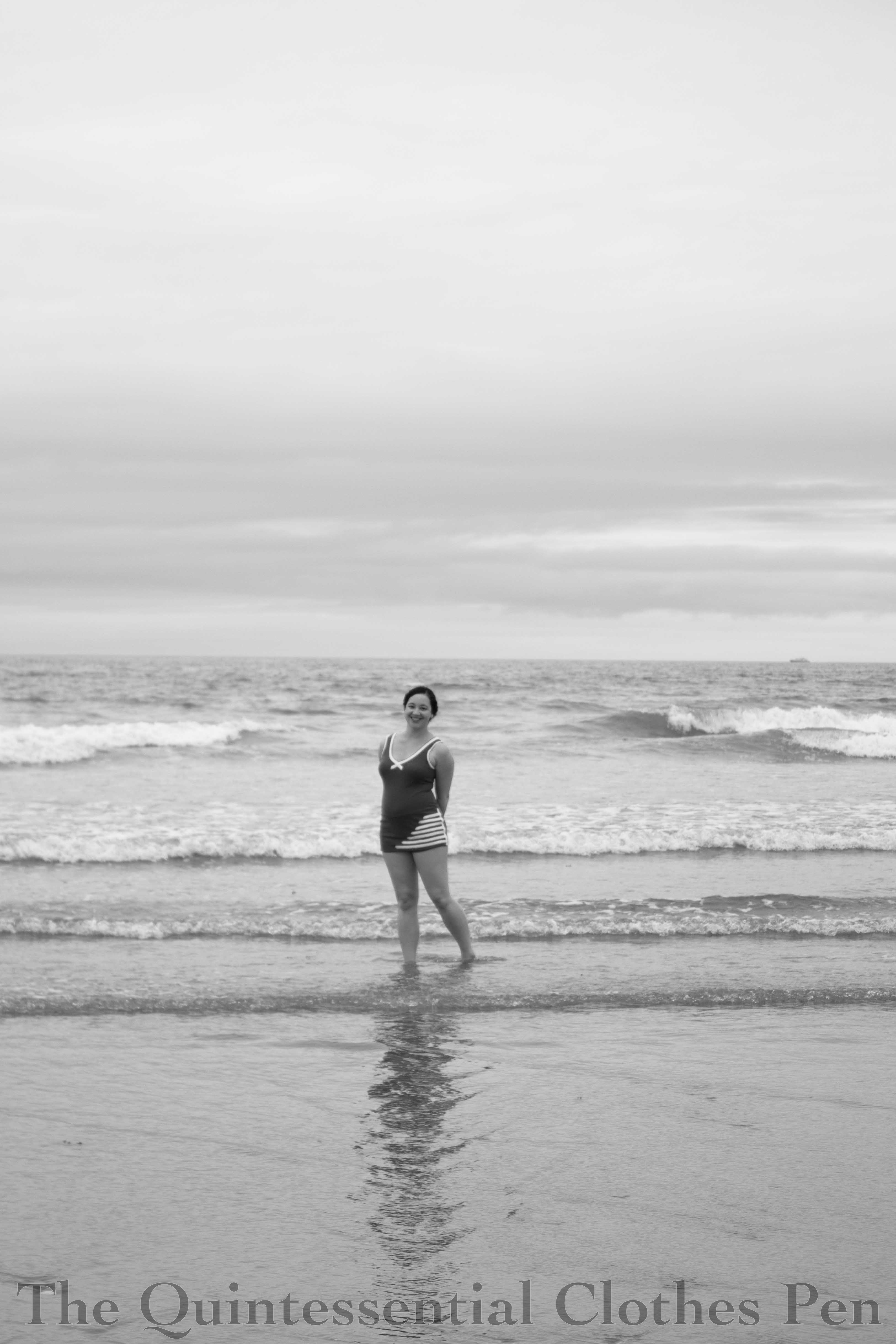
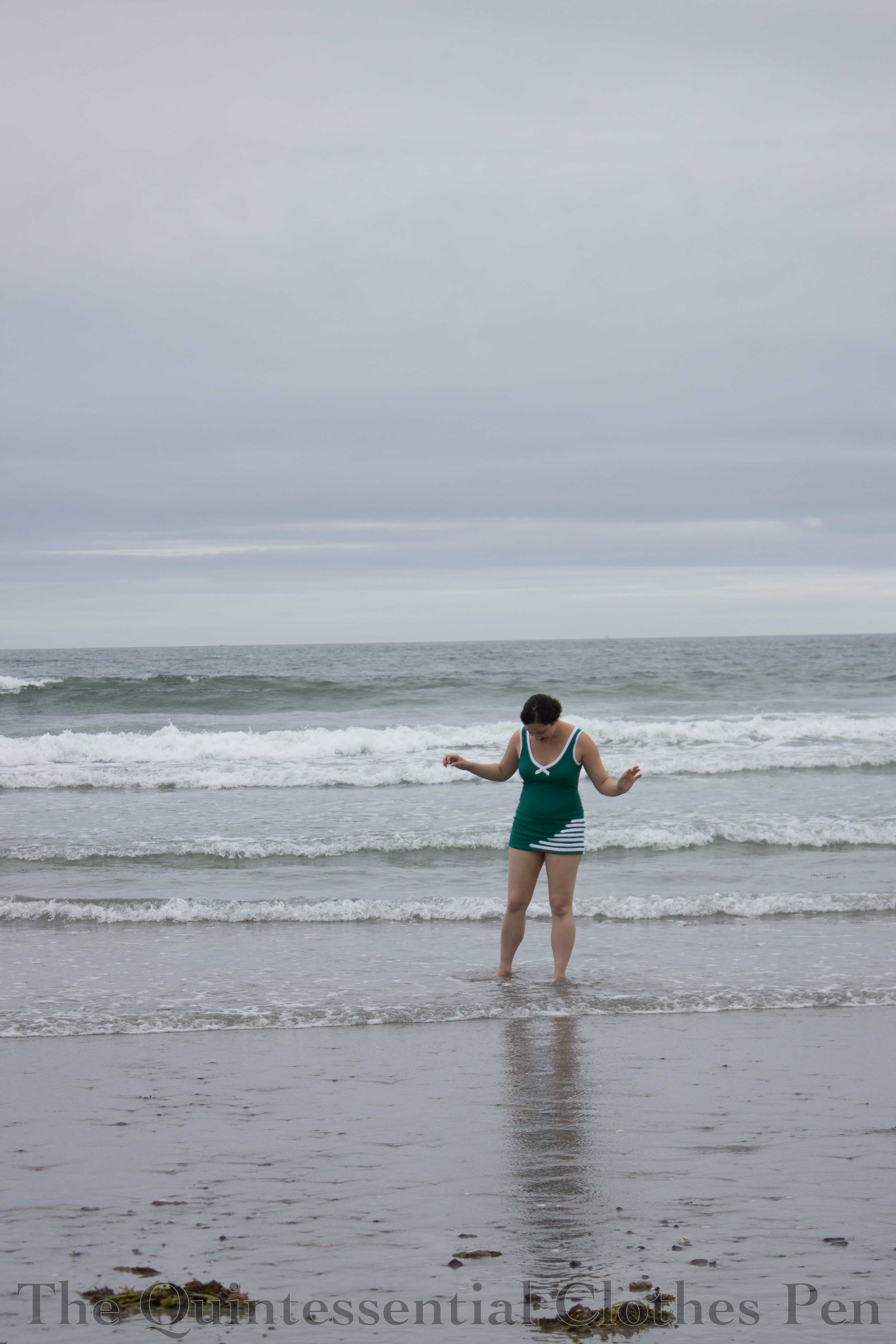
I didn’t have time to get a sash together, but the bathing beauty look is what I was aiming for in this picture, wearing my American Duchess Seaburys with my swimsuit.
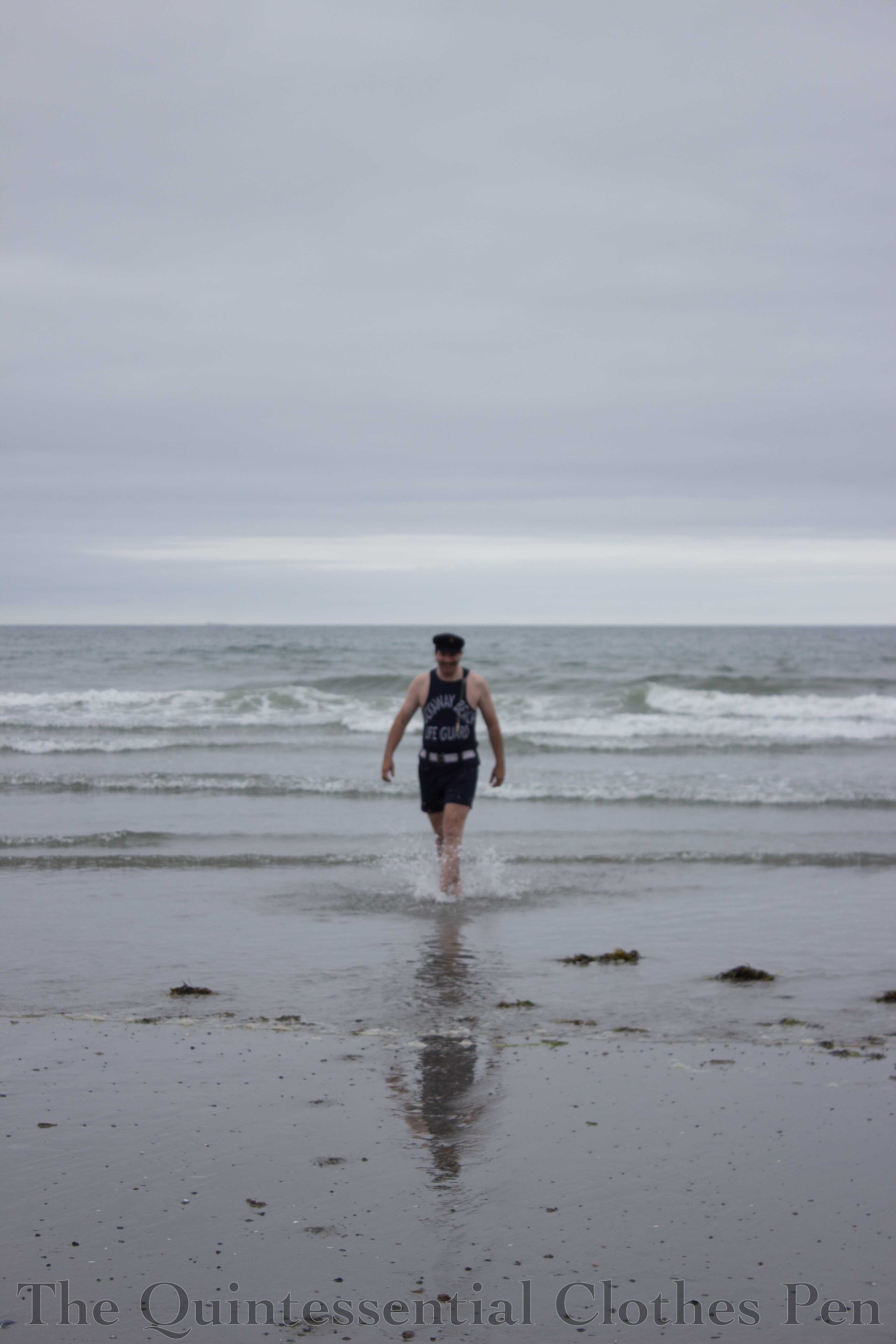
My main goal was to have the suit for an event at the end of August, but it was done in time for a vintage beach outing in July! It was an unusually cold day and therefore the beach was pretty empty, but it meant we had the beach basically to ourselves and got some great pictures! In August, I’m planning for the whole suit to get wet, so we’ll see how that goes! In the meantime, here are a few more fun pictures from the July beach day.
I have a three evening gowns from the 1920s, but only two daytime ensembles. For summer events from the Ragtime dance period and the 1920s in general, I wanted a new addition in the daywear lineup, so I kept my eyes open while out shopping for other projects. I came across the fabric for this dress a few months ago before I had time to sew, but with a general plan in mind.
Fast forward to about a month ago and I started actually planning the dress. I had thought to make a dress from about 1916 with a distinct a-line shape (a silhouette like this), but reconsidered that plan when considering the very linear effect of the tucks in the fabric. The linear fabric was much more suited to the period from 1919 to 1922 and so down that road I went.
Year: 1919, explained in detail further along in the post.
Notions: Thread, snaps, and a hook and bar.
How historically accurate is it?: 95%. Accurate pattern from the period, reasonable fabric, and accurate finishing methods. Woo!
Hours to complete: 30? I took my time to enjoy the process, hand sewed more than was absolutely necessary in order to watch Netflix and not dig out the sewing machine, and fiddled with the bodice for awhile to get a style I was satisfied with.
First worn: July 17 for a Ragtime tea dance.
Total cost: $30 for the fabric.
(Edit: I forgot to mention what HSF challenge this was for when I originally published the post. It’s for challenge #7: Monochrome.)
Why did I decide on 1919 for the year of my dress? The pattern dates to 1918-1920, putting my dress squarely in the middle, but I also looked at the details that changed with each year from 1918-1922 to confirm the plan.
1918. Skirts have just ceased being the A-line shape of the prior three years, but they still have fullness and waists remain high.1919. Still some full skirts, but the silhouette is narrowing.1920. Slimmer skirts with high waists.1921. Slimmer skirts with a dropping waistline.1922. The waistline has dropped to hip level and drape effects are fashionable.
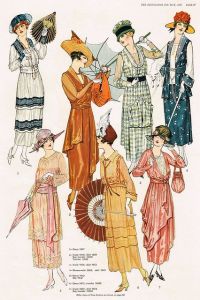
1919 is the year when the features I most wanted all come together: full skirt, high waist, playing with the linear nature of my fabric going both vertically and horizontally, and skirt tucks. These features can be seen in the following most inspirational images.
c. 1915c. 1915c. 19201919
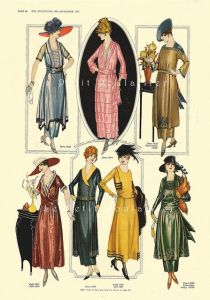
Plus, these two fashion plates, from 1920 and 1921.
And construction? I kept it simple, with a few unfinished edges in the skirt (gasp!), pinking on the seams and exposed edges in the bodice, and as few closures as possible. No fuss. The bodice closes off center in front but the skirt closes in back because I was originally planning to make a separate blouse and skirt. When I decided I didn’t feel like dealing with a peplum, and that even with a peplum a blouse was likely to come untucked (as happens with my 1917 blouse when I wear it), I just hand sewed the now-bodice to the inside of the waistband and sewed snaps around the other side to keep it together, as you can see. This way, it’s easy to separate the two pieces in the future.
All in all, a pretty quick project as my projects go. Comfortable, flattering, easy to alter (a component of sewing projects I am trying to incorporate more often as I move forward with projects), satisfying to wear, plus it goes well with my Astoria shoes. Win!
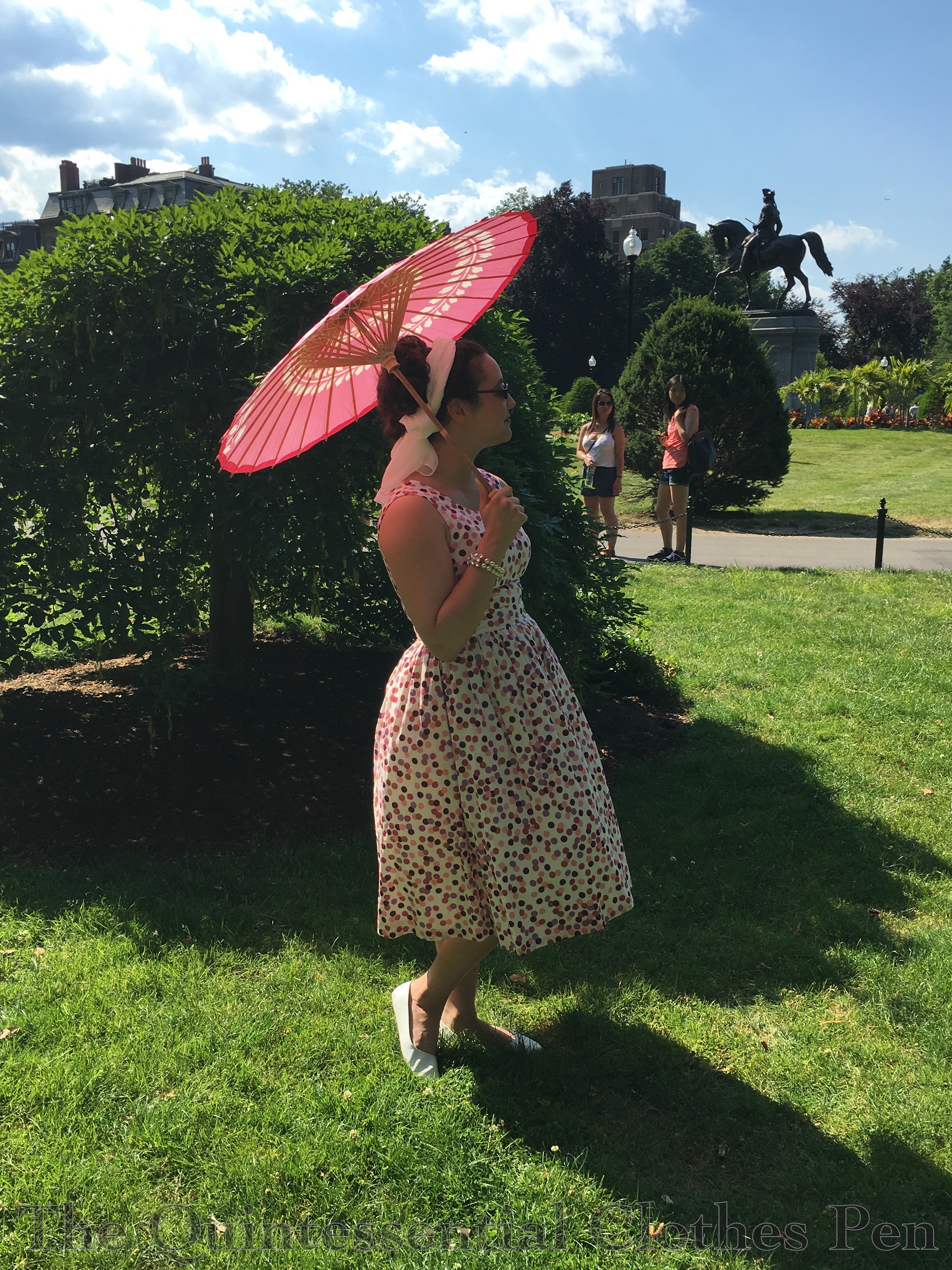
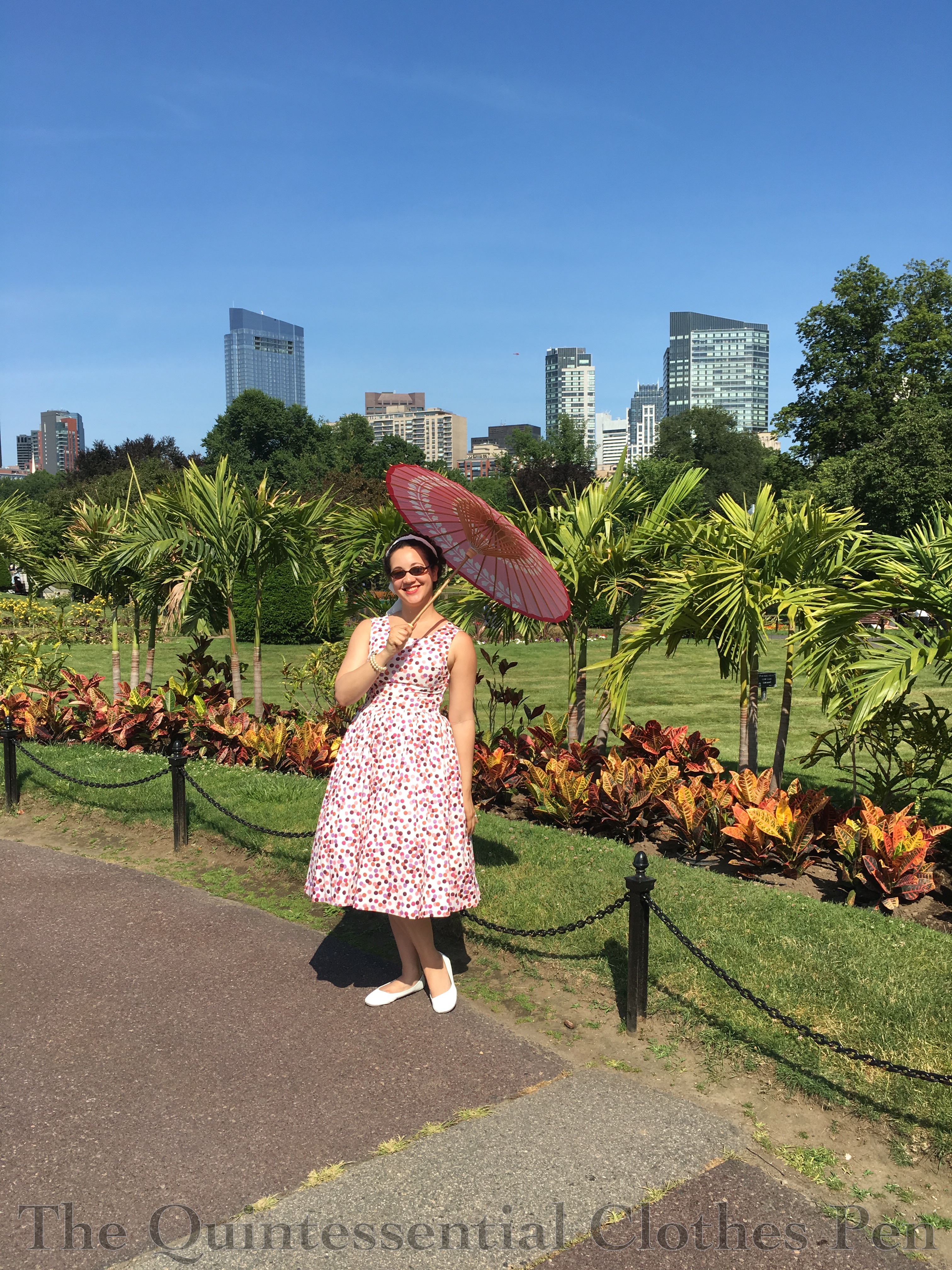
In June, I went to a picnic in the Boston Public Garden. As it was an open era event, I decided to wear my 1953 dot dress because it is easy and cool to wear in the summer heat.
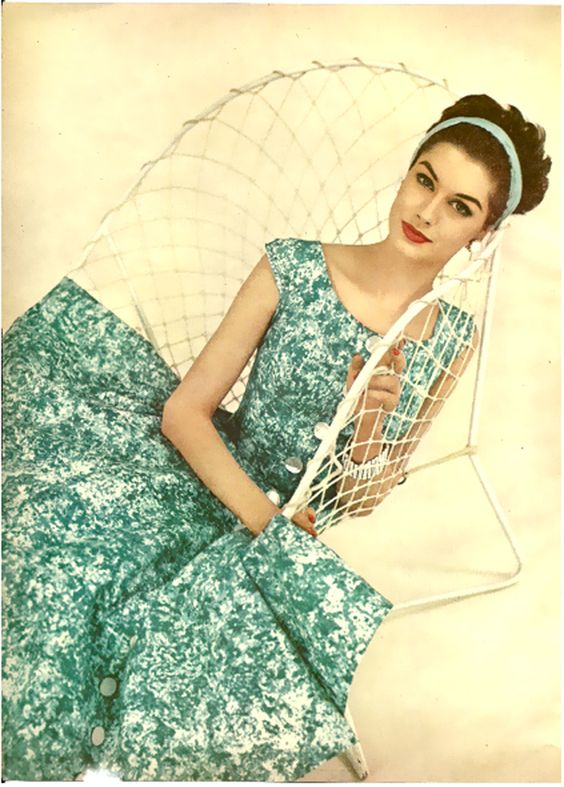
I took a long time styling my hair to look like this image from 1954. It’s quite a feat to tame the frizz and there was a moment of woe and frustration, but I didn’t have time to start again, so I continued on and was happy with the end result despite the angst in the middle of the process. Looking effortless is so much work!
Charm Magazine, 1954
Picnicking! I plopped down to eat and then didn’t move much until picture time.
I love how the pictures turned out! I purchased a new parasol to use this summer for 1920s events, but it matched this dress very nicely so I brought it along to the picnic. Raspberry is one of my favorite colors.
There was a crowd of people watching the picnic most of the day, but we managed to get a lot of pictures without them. Yay! I don’t mind being gawked at (I’m rather used to it actually) but I do usually like images that don’t have modern dressed people in the background better.
The palms remind me of Florida, and this picture’s story in my head is that I’m on vacation there in the 1950s.
I may look composed in these pictures, but when I run out of pre-thought pose ideas chaos ensures. I often start waving my arms around wildly, talking (producing odd faces when captured as a picture), and flinging my legs around. Here’s an example. There are a a range of caption ideas that pop into my head here: ‘hi-ya!’ and ‘at the bat’ most often.
I hope you’re enjoying your summer, too! It’s so nice that the days are long and there are lovely days for sitting in the park or other outdoor activities!
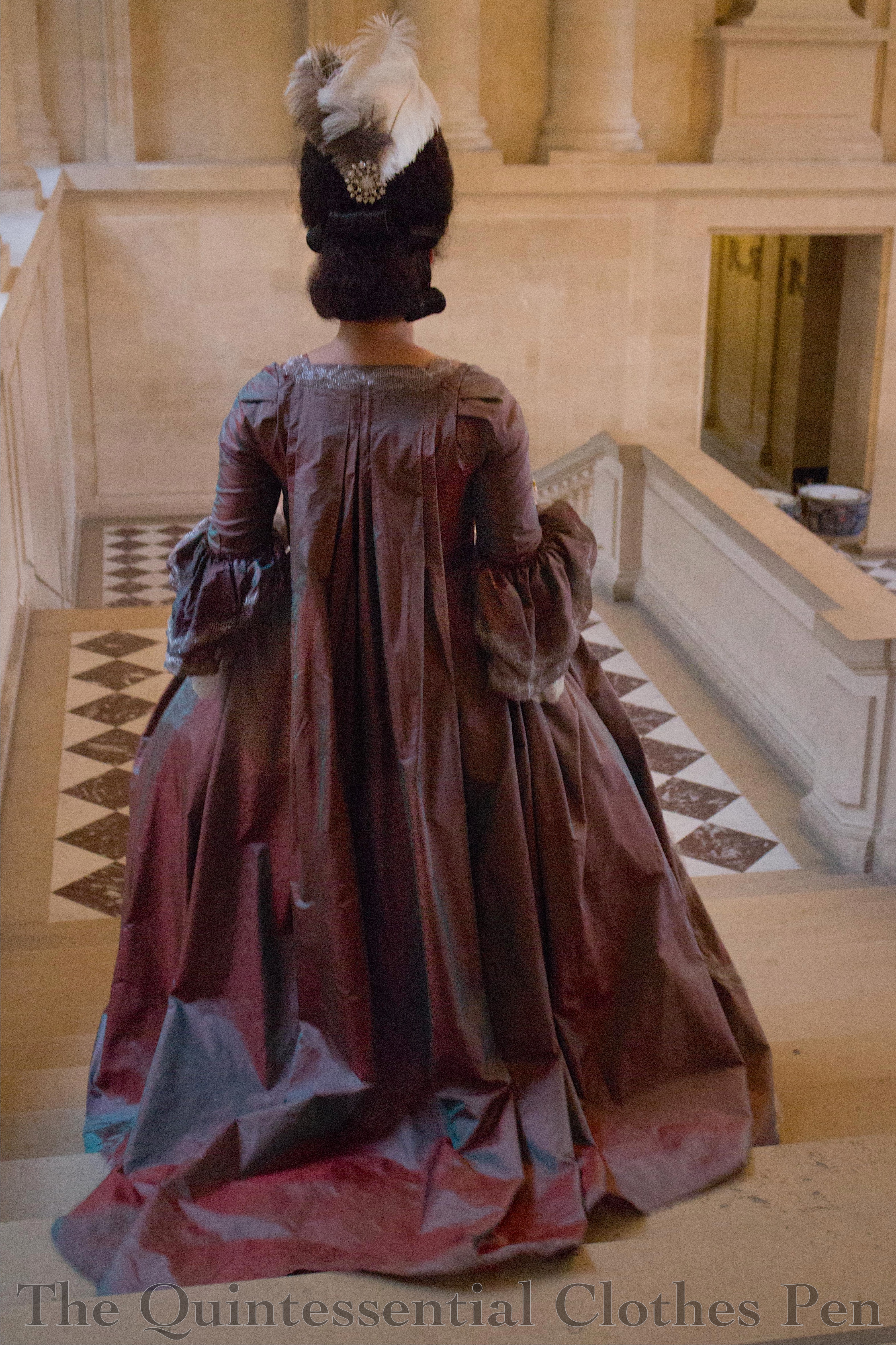
The change in plan resulted in new fabric and a new plan. I stuck with the decade of the 1770s, but decided to make a robe a la francaise, or sacque, instead of a robe de cour as it seemed like a garment I might be more likely to wear again in the future. Accordingly, I found and ordered new fabric: 11 yards of a very lightweight changeable silk ‘lutestring’ from Burnley and Trowbridge. Luckily, the new fabric still worked with the metallic silver net I’d purchased for trim. It’s the same metallic silver net that is on my 1885 Night Sky Fancy Dress, just cut into strips.
Regarding the pattern, I found some of the directions to be confusing. For example, making the petticoat seemed way overcomplicated. You can read more details about how I made my petticoat here. Also, I found the directions for pleating the front robings/facing and the back pleats quite confusing. There, I was saved by this post written by AJ who also used the JP Ryan pattern, got confused, and posted about the confusing bits. Very helpful! Aside from the confusing directions, the gown pieces went together perfectly with no trouble. I did have to alter the front strap area to make the front sit flat against my body. Two friends who used this same pattern did not have to make that adjustment, so I chalk it up to differing body shapes but do not think it negatively affects the pattern.
The lining of the gown is made from a one yard piece of cotton/linen blend from my stash. Also from my stash and used inside the gown were a scrap of medium blue linen and a scrap of medium blue cotton twill used to interface the stomacher. These were all the bits left of those three stash fabrics–yay! I was also amused that all of the random non-silk fabrics in this gown and petticoat wound up being blue. I used my lining as my mockup, meaning that I had to take a dart in the front strap area, but was able to adjust the pattern to eliminate the dart before cutting out the silk.
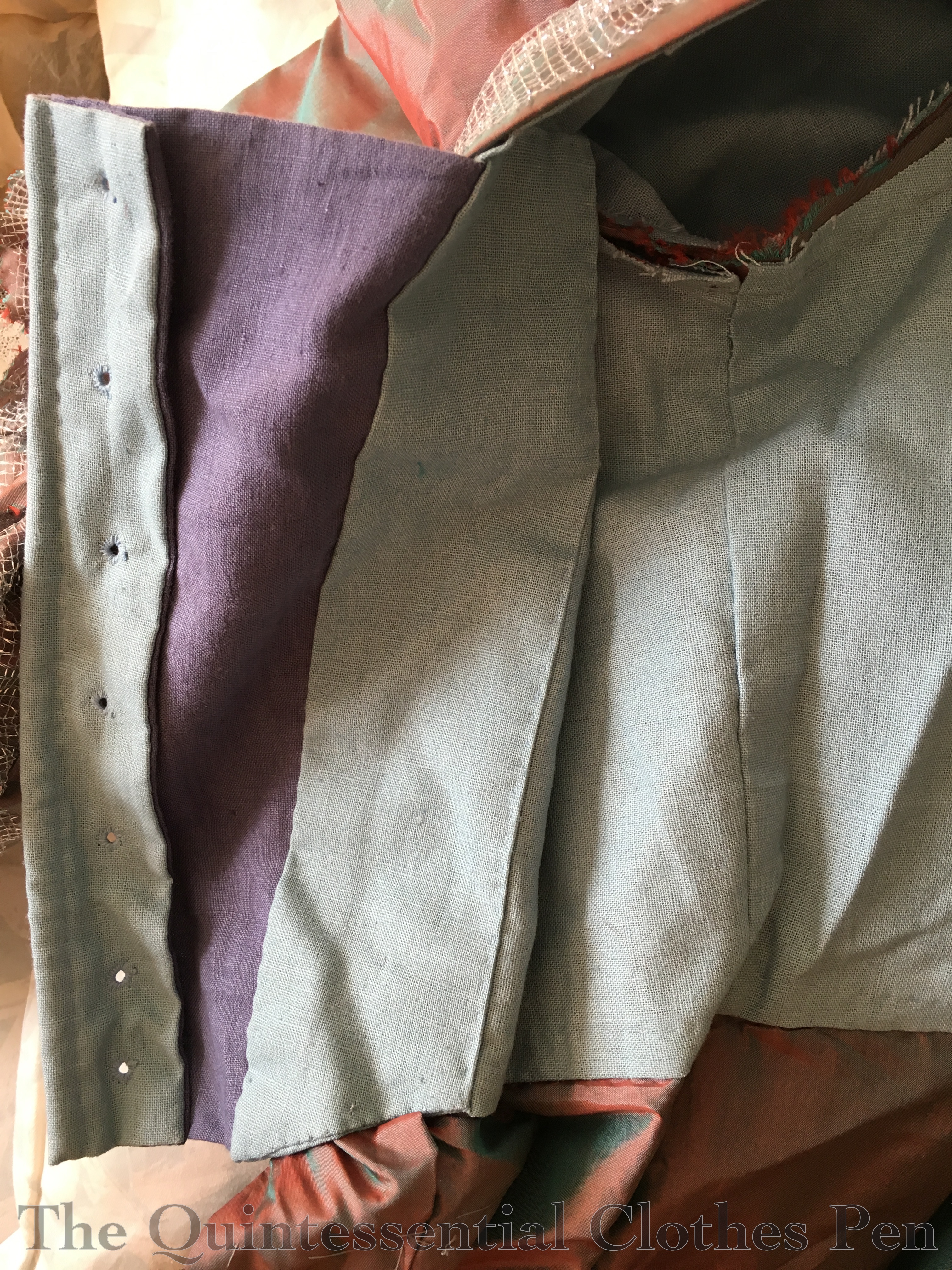
The back of the lining is adjustable using a tie threaded through eyelets. The edges are boned with reed. The pattern suggests ties, but you also see lacing in extant garments and this seemed easier to adjust and that it would use less length for the tie(s). There are examples of both ties and lacing on my Pinterest board for this project. The tie is a 1/4″ cotton twill tape. It’s not accurate, but did the job.
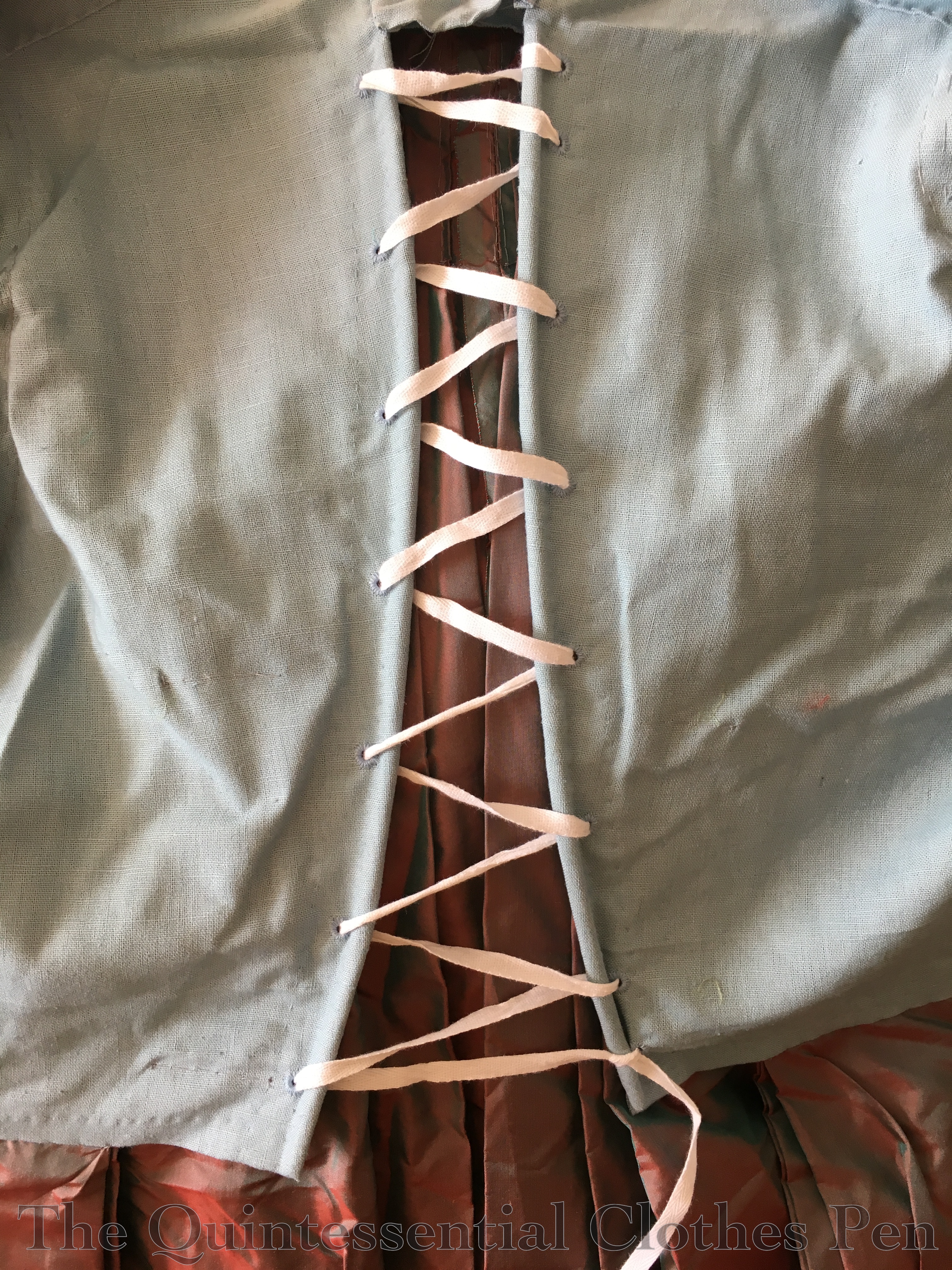
Underneath the decorative stomacher, the gown closes with lacing panels attached to the lining. Again, mine laces closed using twill tape.
This is the inside of the front lacing panels. You can see the medium blue linen backing. I think I had run out of the cotton/linen blend at that point. As is usual with 18th century garments, the armhole is left unfinished.
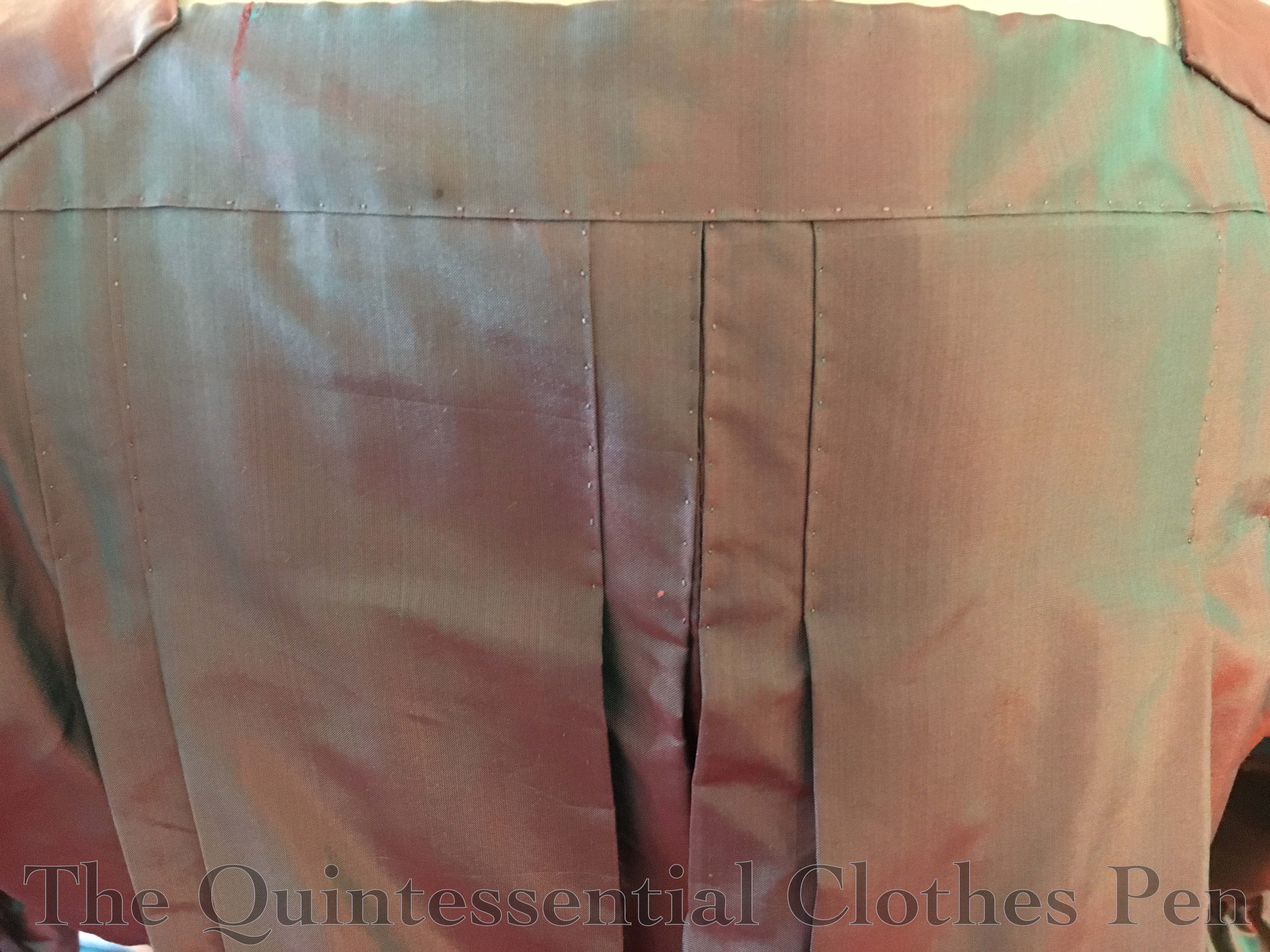
Here’s a close up of the back pleats. These are stitched all the way through to the lining. The directions for the pleats were slightly confusing, but made sense once I started fiddling with my fabric. It was important that I had transferred all the markings from the pattern to make the pleating easier to understand. The pattern uses another four pleats pleats, underneath these, that you can’t see to add volume to the back.
Due to the unexpected nature of the purchase of the silk fabric for this gown, I decided to do that fabric justice by hand sewing the entire garment. So in addition to the exterior stitching like that anchoring the pleats on the back, all of the interior seams are also hand sewn. I rather enjoy hand sewing and it makes a lot more sense given the way 18th century garments were constructed.
Here is the gown mostly sewn in its essential elements, but lacking trim. The sleeve flounces were individually gathered and sewn to the arm openings. They are pinked with scalloped shears on the top and bottom edges.
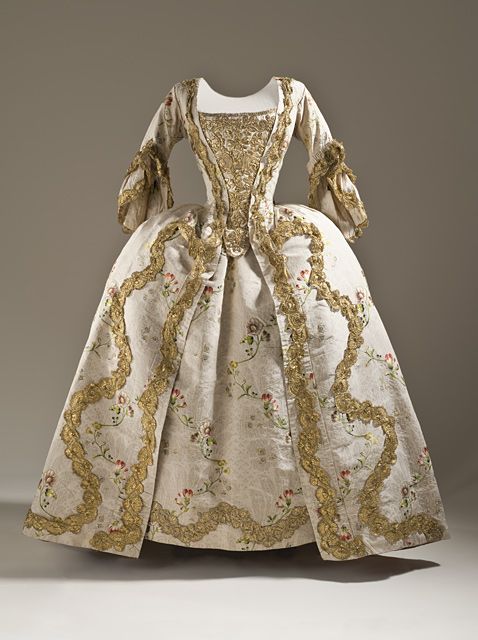
The following image is the gown that I followed in terms of trim placement. It took many more hours than I thought it would to pin the trim on. Those big waves are more complicated than they look, plus I had the challenge of creating the smaller scallops as I went along as well. All of the trim had to be sewn along both sides and tacked at each scrunch after it had been pinned.
Robe a la Francaise. 1765. LACMA.
You can see that I pressed my robings down all the way to the hem, though once the trim was applied on top it was really not very noticeable. I like the finished result, but I think it’s worth pointing out that this pattern is designed to have a wide stomacher. I was envisioning it coming out a little narrower at the waist. But I think adjusting the back opening enough to make a noticeable difference would only create awkward wrinkles under the arms.
The finished stomacher was covered in scalloped trim and finished off with a sparkly brooch. I went to France with an untrimmed stomacher and no clear idea about how I wanted to trim it except that I wanted it to be an all over metallic feast for the eyes. Luckily, early in the trip I was able to go see the 300 Centuries of Fashion exhibit at Les Arts Decoratifs. In addition to being amazing (I got to stand within 6 feet of Dior’s Bar Suit and see many garments I’ve only ever seen on Pinterest!), I also took a picture of a stomacher that was inspirational in terms of the overall wavy patterns and filler shapes. That picture is below.
Trimming the stomacher took place in the evenings in the few days before the special event. Here is the stomacher in progress. I took it specifically to show the amazing green color that the fabric can appear from some angles. I was hoping to get a picture of the finished gown looking this color, but had to be content with seeing shades of green in some of the pictures as we didn’t capture any where the whole gown was this color.
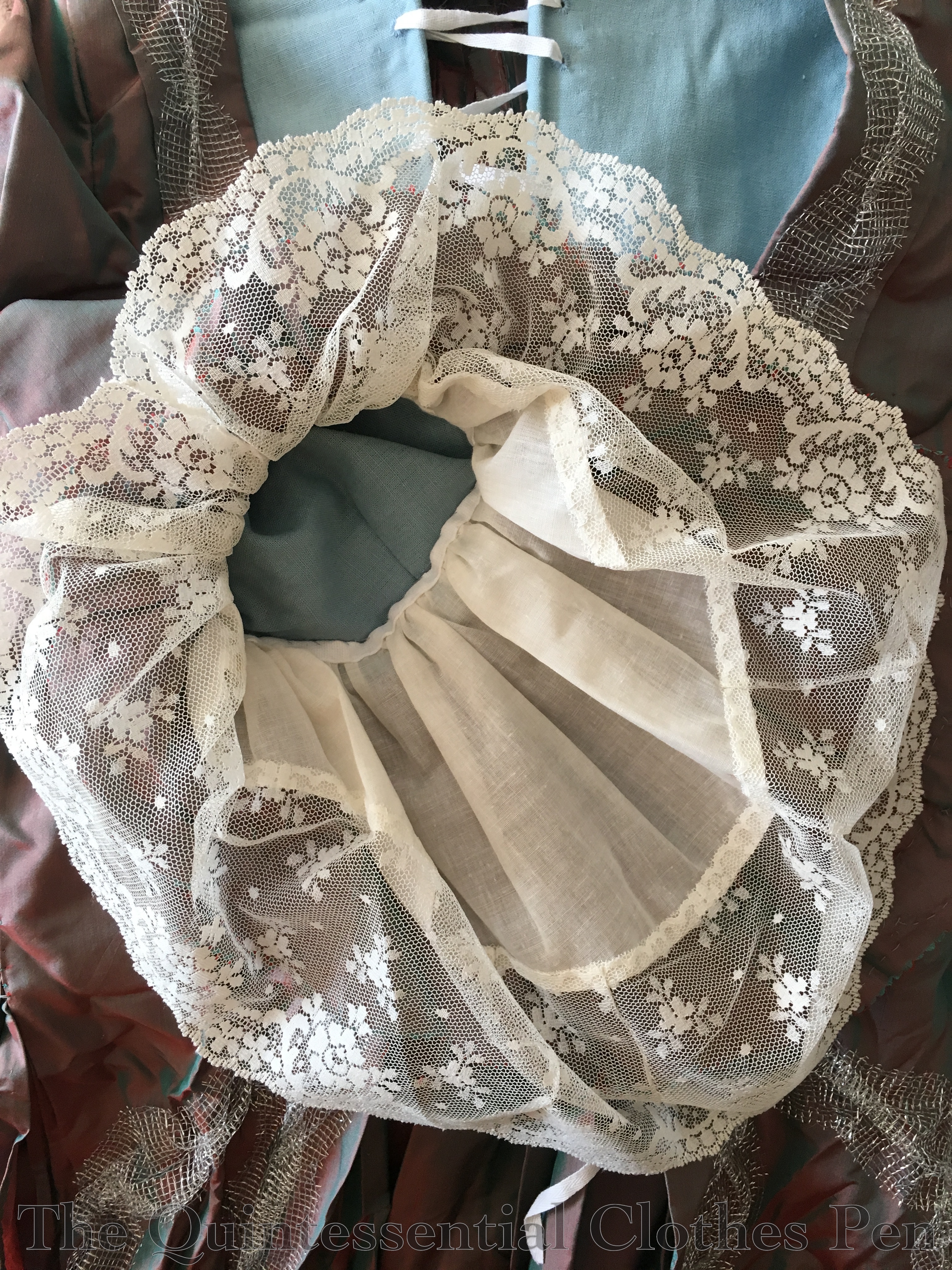
Another part of the dress that was finished in France were my engageants. The pattern includes flounces of two lengths to be made of silk and then one longer flounce for an under flounce or engageant. I sacrificed some lace I’ve been intending for another project, threw some darts in at the longest section to get the scalloped edge to be the right shape, and filled in the length with a bit of mystery ivory sheer. The resulting flounce was gathered and sewn to a cotton tape that was basted into the arm opening.
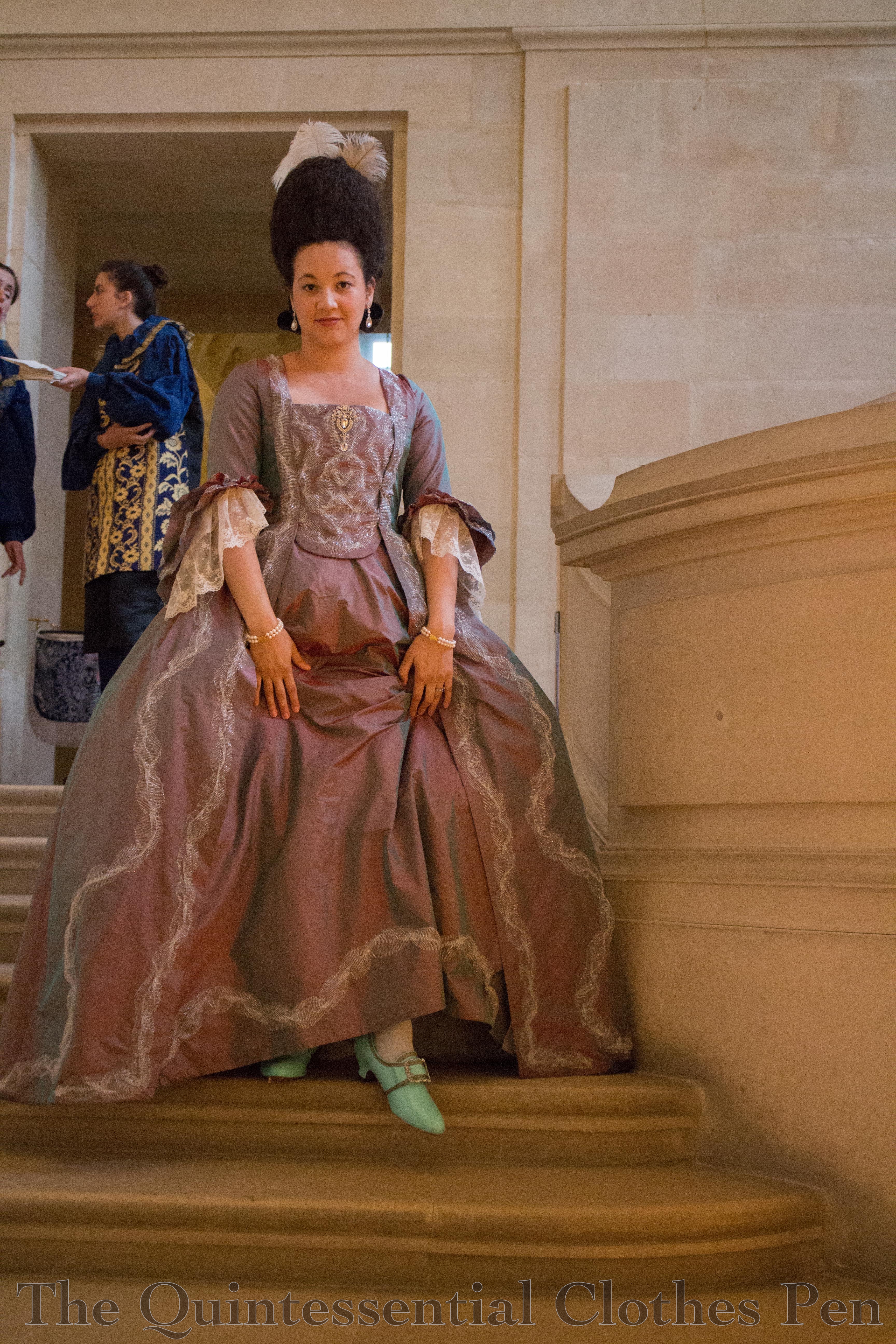
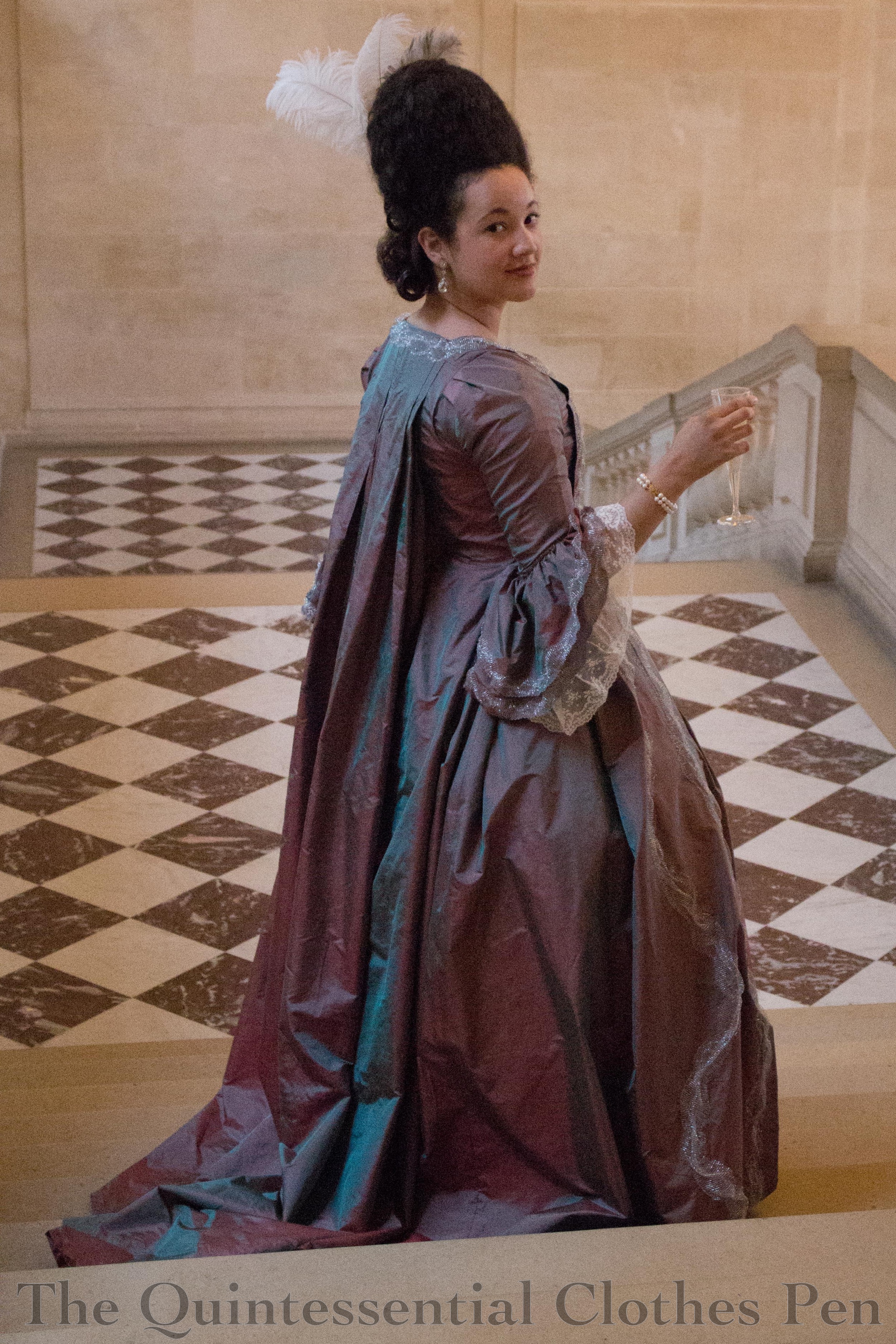
It sure sounds like a lot of work, recounting these bits of the process. It was! And it paid off. I’m very pleased with the gown. And very pleased that this picture captures some of the stunning green in the fabric!





































 The Quintessential Clothes Pen