Re-Imagined 1885 Fancy Dress (HSM #9)

The Backstory

In 2016, I made a dress for a Fancy Dress Ball inspired by a dress worn by Alice Gwynn Vanderbilt in 1883. Alice’s now-famous dress, made by The House Of Worth, celebrated Electric Light as its theme. The dress uses beading and metallic elements (as well as an electric torch, for the original wearing!) to visually reflect light as well as communicate the electric light theme via decorative motifs. I posted an image of the inspiration gown and a link to more information about it in my original post about my dress in 2016, which you can view here.

I was inspired by the trimmings on the gown, but needed to create a dress with little expenditure (much different than the budget for a Worth dress!). To achieve this, the goal when I made my dress in 2016 was to use as many materials as I could that I already owned. The main dress fabrics were already in the stash from old projects and the silver net was leftover from trimming the Versailles sacque I posted about wearing recently.

Below, a photo of the dress in 2016, with a lantern standing in for “electric light.”
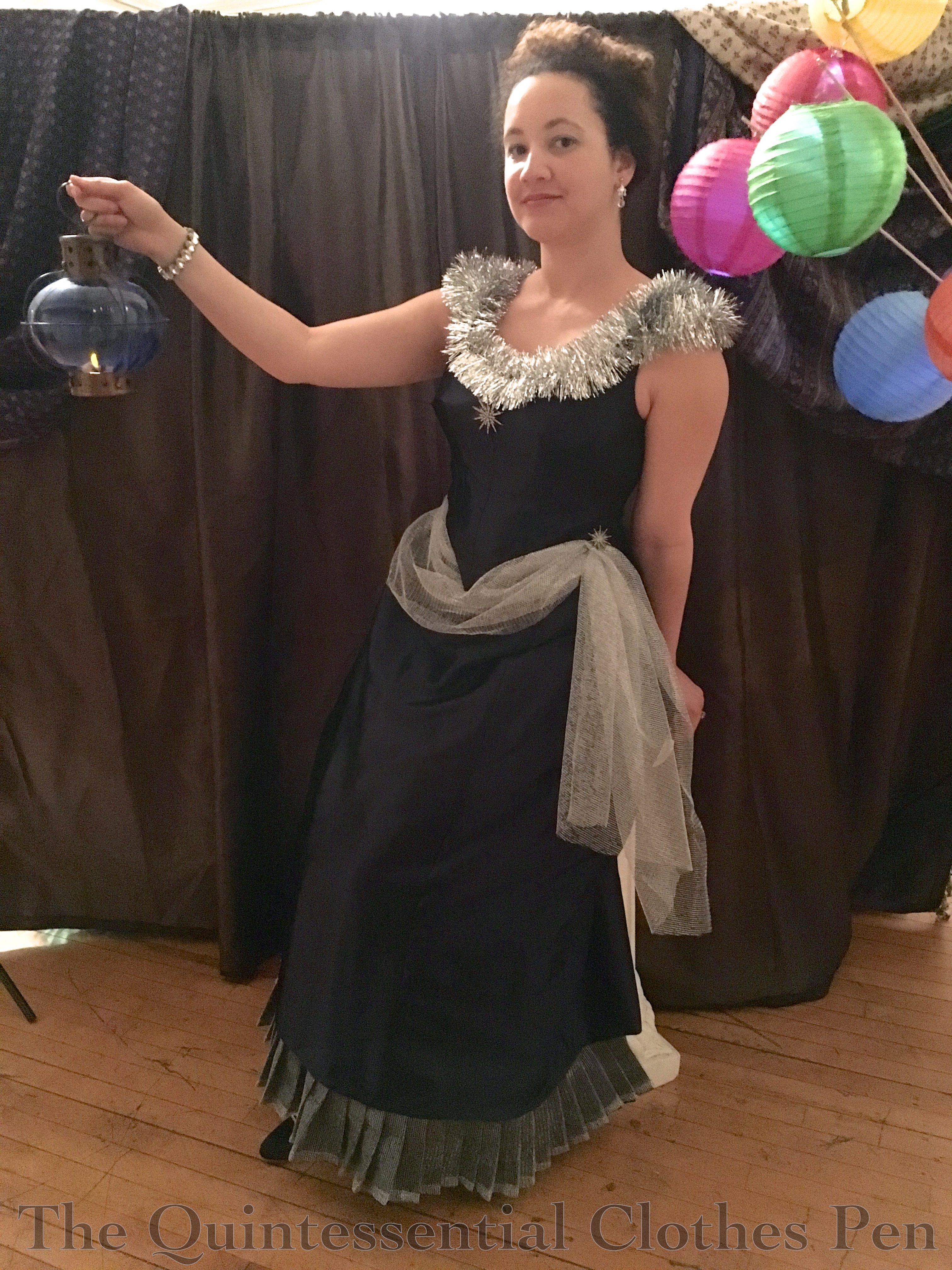
There were a few small changes I wanted to make after the first wearing of the dress, but I didn’t have a need to wear it again for years. Fancy Dress events are not all that common even within the already limited realm of historically clothed events! And with the original trimmings I didn’t like the dress for regular wear. Plus, for a number of years after making the dress the events I was attending did not encompass the 1880s.

More recently, however, I have had more opportunities to wear clothing from this period, as The Footwork and Frolick Society has hosted a few events with themes that can include the 1880s. Therefore, I decided to re-trim the Fancy Dress dress into a more regular, less Fancy Dress, ballgown style for the Yuletide Ball in 2024.

Inspiration

This time, my inspiration was a mashup of ideas from a variety of images.

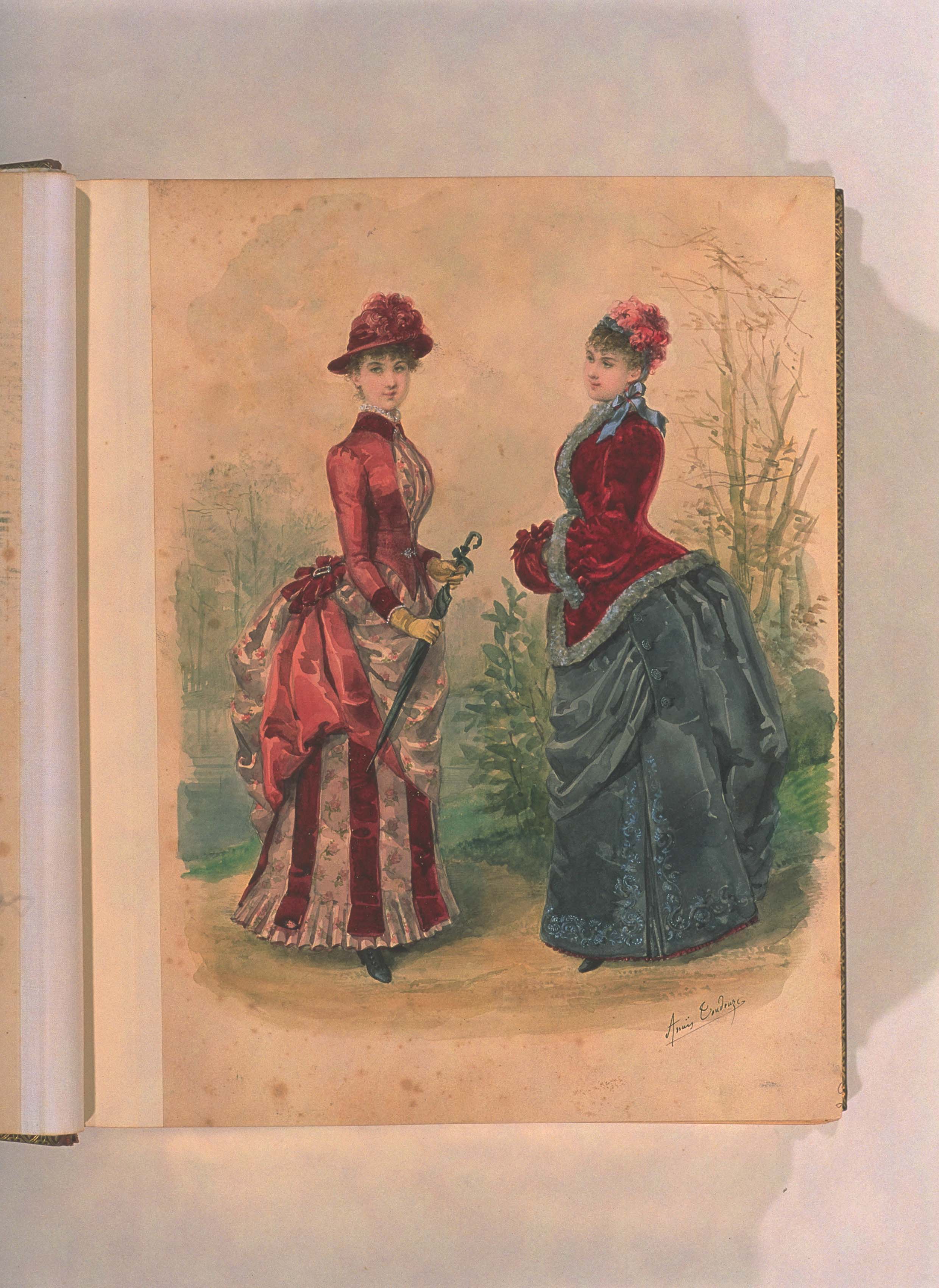
From the fashion plate below, published in the Revue de la Mode in February 1886, I pulled information from the gown on the right, with the pleated fabric along the v-shaped neckline and asymmetrical decorations (which I guess are feathers) on the shoulder and skirt.

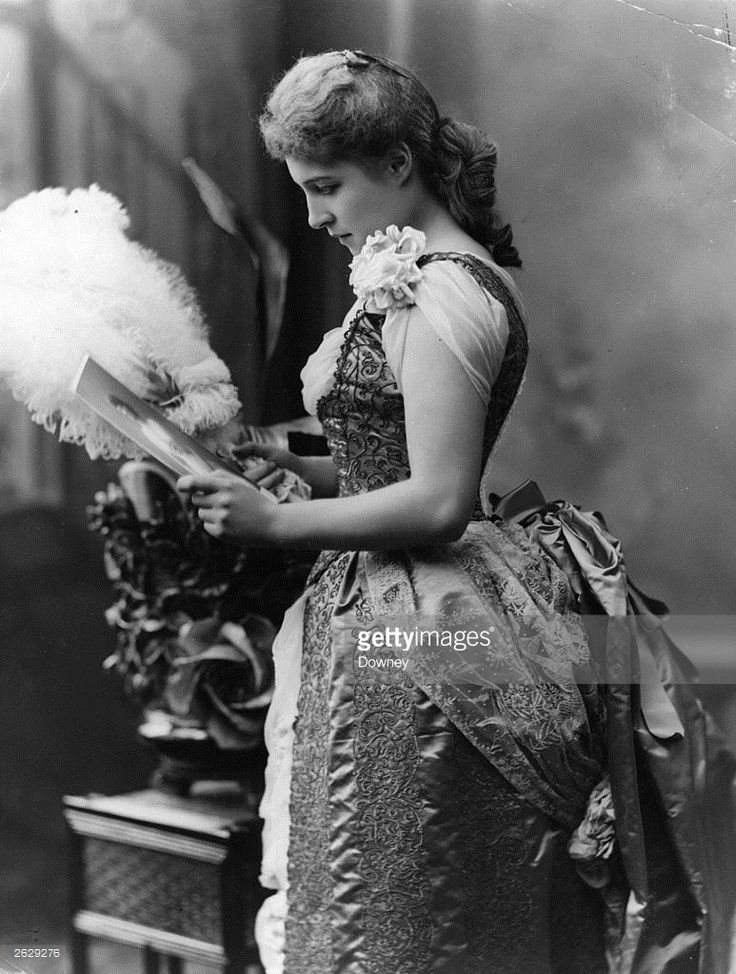
From the photo below of British actress Lillie Langtry (Original Publication: People Disc – HU0206. Photo by Downey/Getty Images), I pulled inspiration for the “sleeve” idea I wanted to incorporate. The pattern of the fabric used for the bodice in this photo was also reminiscent of one of the fabrics I used to update my dress.
And finally, I was also inspired by the beaded swags (and chiffon “sleeves”) on the c. 1887 dress in the collection of the Kent State University Museum in the photo below.

Dress Update Overview

For the re-make of the dress, I wanted to maintain my goal of using materials already on hand. I still had small scraps of the navy blue satin in my stash as well as the silver net. I also went through my fabric stash binder to see what other fabrics and trimmings might work and found that the best bets were a piece of polyester velvet flocked with silver swirls that I’d purchased at Joann Fabrics probably twenty years ago when I had just started sewing and loads of silver ribbon that I had been gifted to me. The blue and silver colors fit the colors of the existing dress perfectly and I thought there was a sort of New Year’s aspect to the color scheme, as well. (I also purchased the Joann fabric in burgundy and green (both with gold swirls) and had made Christmas decorations out those, but I don’t think I ever used the piece of blue, so this was a great opportunity!)

With my materials decided, I moved on to the sewing part of the project, starting with unpicking the original trim from the dress. I had made it knowing I might someday want to change the trimmings, so they were not sewn into seams and were pretty easy to remove. That left me with an almost entirely navy blue dress, relieved only by the silver pleats at the bottom of the skirt.

Then I went back and considered my original list of changes, which included:

  • Boning the center back edges so they would lie flat when laced closed
  • Adding a matching piece of satin behind the lacing holes to hide any white fabric of undergarments
  • Making sure that my chemise wouldn’t poke out of the armholes

Quoting myself, from 2016… “these are minor changes and I’m not sure when I’ll have the opportunity to wear this again so it might be awhile before they happen.” I’ll say! It only took 9 years!

Historical Sew Monthly

My goal of using stash-only materials for this dress re-do makes it fit into the Historical Sew Monthly 2025 Challenge #9 Blue:

Make an item that features blue, in any shade from azure to zaffre.

Just the facts:

Fabric/Materials: Approximately ¾ yard silver net, just over 1 yard of navy velvet with silver motifs, and scraps of navy polyester satin.

Pattern: My own.

Year: c. 1885.

Notions: Approximately 23.5 yards of ¼” silver ribbon.

How historically accurate is it?: 90%. Polyester and modern synthetic ribbon do not have accurate fiber content. And my patterning is conjecture. But the overall idea is pretty good.

Hours to complete: I didn’t keep track.

First worn: December 7, 2024.

Total cost: Free, since everything came from the stash and was either gifted to me or purchased ages ago!

Dress Update: Back Closure

Following the original list of changes, I added a placket behind the lacing holes and added plastic bones along the very back edges, to help hide undergarments (the white color really does pop against the navy blue of the dress!) and keep the back laying flat when laced closed.

Dress Update: Sleeves

When re-examining the dress in 2024 with fresh eyes, one of my biggest desires for change was to better fill in the armholes of the dress and provide a decorative element. Yes, evening dresses in the 1880s were often sleeveless, but when really looking closely at them again, I found that while not having sleeves, they do almost always have something that obscures the armhole and even the upper arm. I am more likely to call these styles swags or drapes of fabric, as they aren’t really proper sleeves, but they are certainly set into the armhole in some way. I wanted something like that for the re-do of this dress.

I haven’t had a need to pattern something like this for this period before, so I looked through my historical pattern books for places to start. Interestingly, I didn’t find much. There was one sleeve that seemed like a possible starting place, but when I mocked it up it didn’t really do what I was hoping for at all!

So that left me with the decision to create a pattern from scratch. Thinking about what didn’t work in the mockup and my inspiration image, I proceeded to drape a mockup that achieved what I was hoping for. I didn’t have my dress form handy, so it required a fair bit of going back and forth between pinning and trying on the bodice to get the right shape. But I did! It’s a strange shape, for any sort of sleeve pattern. But that makes sense, since the sleeve drape is a not-really-sleeve!

Dress Update: Apron, Sleeve Swags, and Ribbon Flowers

I pondered creating some sort of beaded fringe for the armhole (and maybe even the waist, as can be seen in the third inspiration photo, above), but decided against it for time and material reasons. I really did want to stick to the stash!

Even if the beaded fringe wasn’t going to happen, I liked the idea of something to set off the wonderfully pointed bodice so that it would show up and not blend into the skirt. So in the end I decided to use some of the velvet from the stash to make an apron layer for the skirt, as was very common on dresses from the 1880s.

I started with making the pleated neck swag, so I wouldn’t run out of fabric, and then used all of the leftover fabric to make the apron. Due to this fabric restriction, I patterned the apron based on what was possible with my fabric, using a general understanding of the how these skirt elements were patterned in this period. The front of the apron is a curved piece that is pleated into the back on each side. The back piece is a bit scant, but has a few pleats along the top to give volume and descends to a point at the center back, since that was the shape of the fabric that was available! I used up pretty much all of the blue velvet!

For the sleeves, I made flower shaped sprays from lengths of ribbon that were tied into loose knots close to each end and then folded into quarters to make one loop and two ends. These individual elements were then combined and sewn together to make the flower-like formations, with larger scale ones on the skirt and smaller ones on the bodice.

The sleeve dangles were made from the same ribbon, knotted in the same way, that was folded to make a longer and shorter side and then tucked under the sprays on the shoulders.

Below, you can see the individual spray elements and a length of ribbon ready to be added as a sleeve dangle.

Finished Updates

Here is the updated dress! The blue velvet pleated v-shaped neck swag completely ignores the neck shape of the bodice underneath, which is more of a square shape. The same fabric is used again to create an apron, stitched to the outside of the waistband of the skirt to reduce bulk.

The silver net is used over the blue satin scraps to create “sleeves” that are pleated into the armhole and decorated with sprays and dangles of silver ribbon.

The “sleeves” wound up looking a little odd where the meet the back of the bodice, but that’s more due to my original patterning of a very inset armhole in the back than it is the sleeve pattern. It’s a lesson/change for the next bustle period evening gown I make, whenever that is!

I didn’t know what to do with the back of the velvet swag, because I wanted it to be easily adjustable depending on how tightly the back was laced. I ended up with this pointed arrangement that accomplished the goal of flexibility.
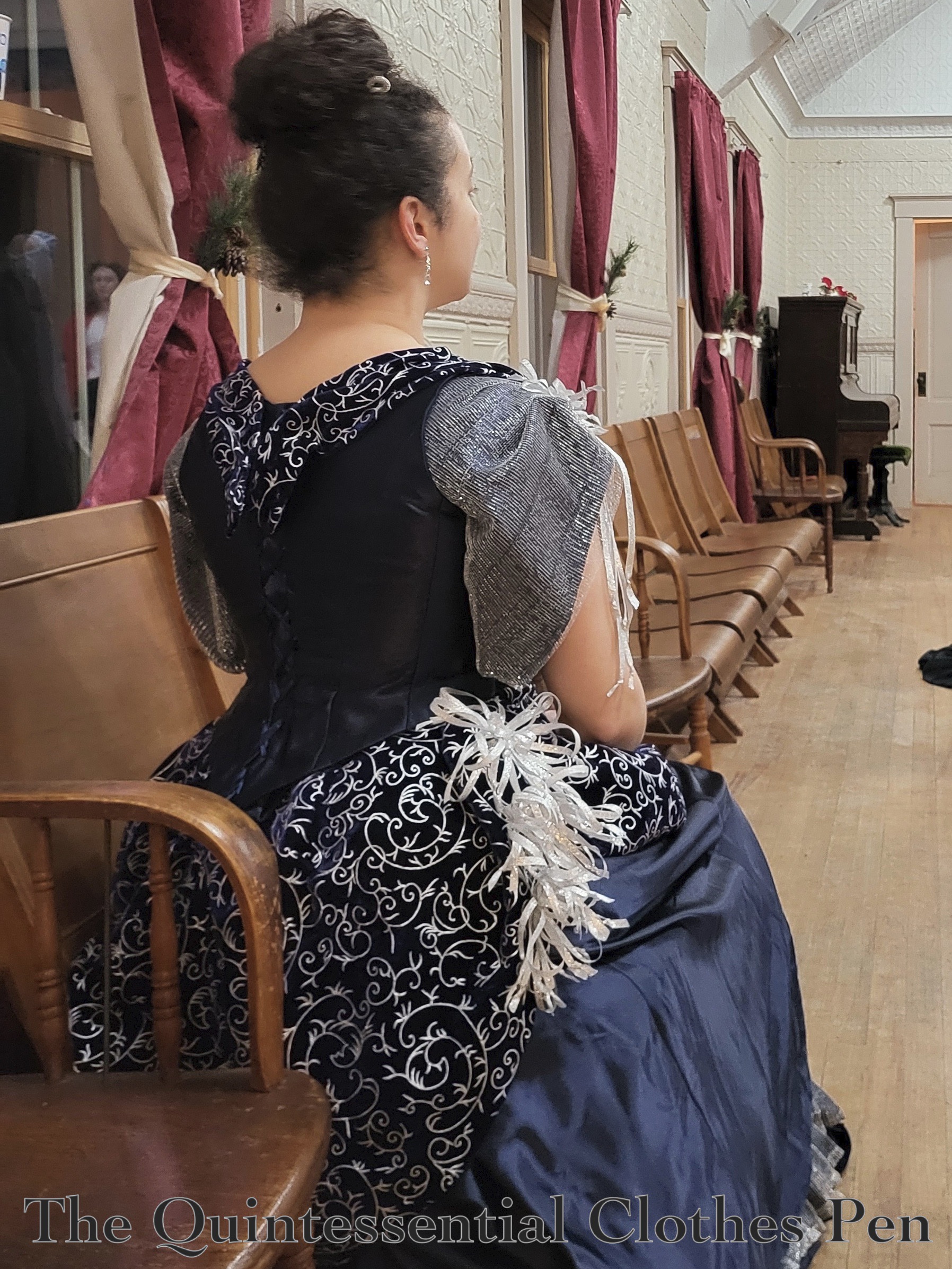
The armholes, left side front of the bodice, and right side front of the skirt are decorated with the sprays of looped silver ribbon. I used x4 — 4 yard spools of ribbon and half each of x3 more spools that were 5 yards each.

I calculated how many sprays and dangles I wanted for each section, but in the end I was running out of ribbon and started to just combine and move things around until they looked reasonable. Sadly, that means I don’t have a good record of how much ribbon went into each element or how long each piece of ribbon ended up being. I think that the smaller sprays were made of piece of ribbon that were 10″, the larger sprays on the skirt were made of pieces of ribbon that were 16″, and the arm dangles were 11″ before being folded.

Wearing

I wanted to find a simple but still 1880s hair style for this wearing, so I was pleased when I came across a photo of women in 1880s evening dresses with their hair drawn back and pulled up into simple large chignons on the backs of their heads. I wore that style with the addition of a few silver hair pins to tie everything together.

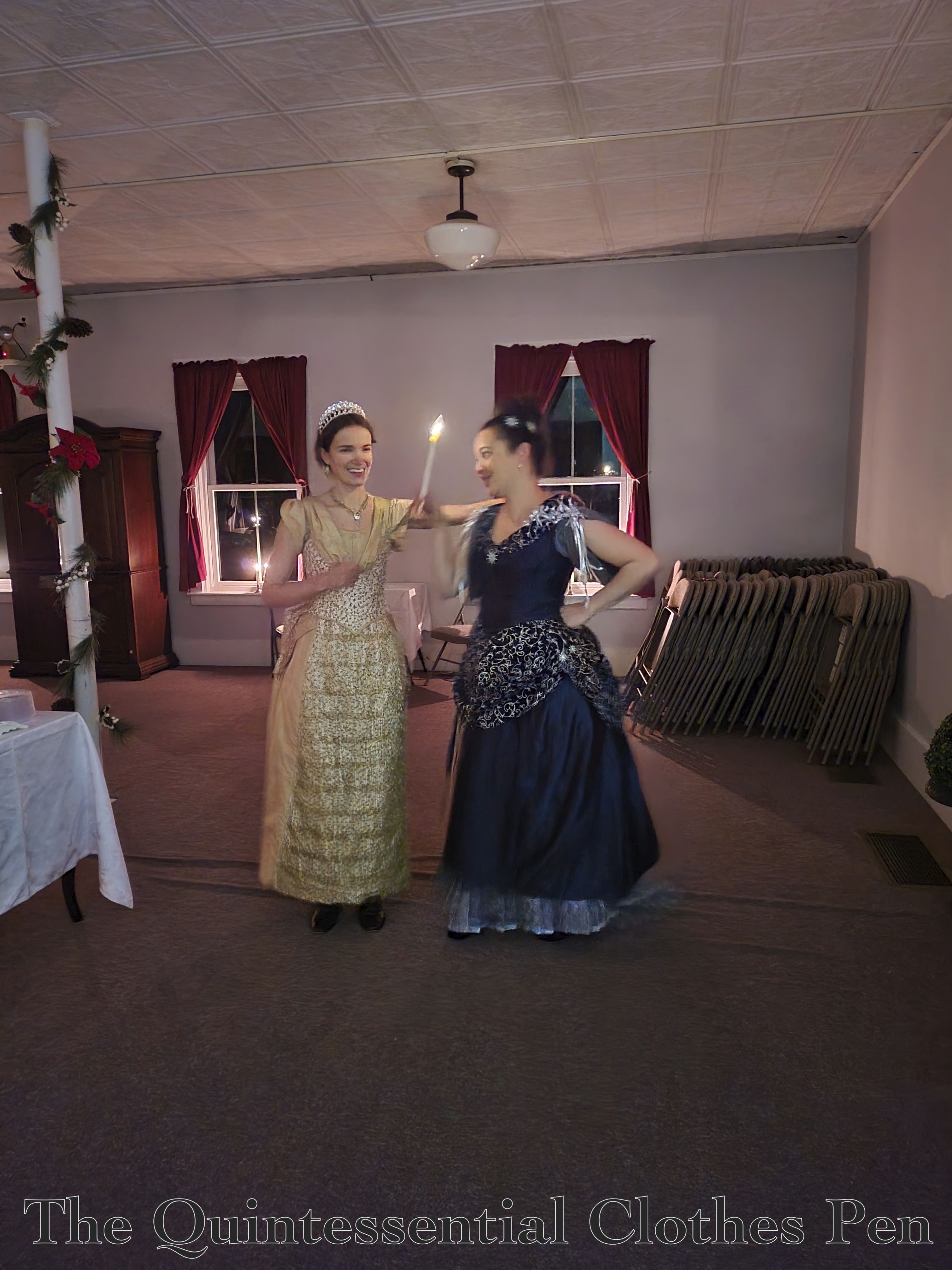
I also reused some of the star brooches from the first iteration of this dress, adding one at the center from of the bodice, two on the left side of the skirt, and some on the left side of my hair. They stand out well in the photo below, in which the two of us are bobbling about, making the ribbons on my dress and beaded trim on the dress on the left shimmer, sparkle, and sway.
Other Photos From The Event

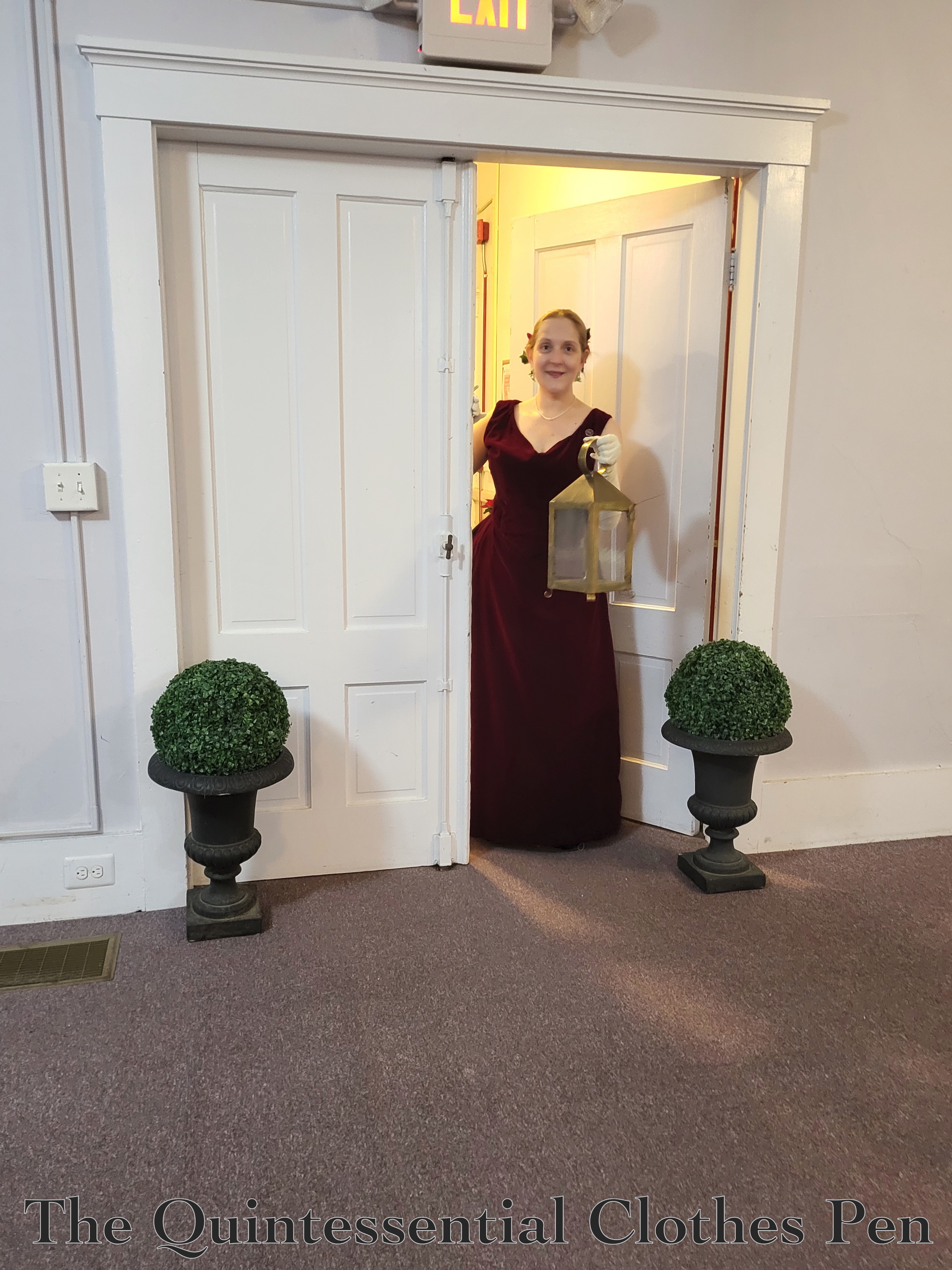
This was a ball for bustles! There were multiple people wearing dresses with this feature, including the dress above, as well as the burgundy velvet dress below.
Finally, a cheerful holiday view into the ballroom. I wasn’t feeling my best at this event and therefore didn’t dance, but everyone else had a grand time! I look forward to the next event in which I can participate in dancing with the bustle! It’s really quite fun to experience the movement of dancing with all of your dress behind you!

Gilded Age Weekend Portraits

As I shared in my last post, friends and I planned a historical weekend away that had a Gilded Age theme. Part of the idea was to document some of our older and recently made clothing in a fabulous setting. To that end, I have many photos of our outfits that I would like to share!
To start, some daytime outfits, worn for afternoon tea and amusements.

So much detail! Fabulous fabrics, beautiful trims, eye catching hats and hair ornaments… the list goes on and on!
And to follow that, a few of our evening outfits.

Thanks for appreciating and enjoying these with me!

Gilded Age Weekend Highlights

Last year, friends and I decided to treat ourselves to a historical weekend away. With a number of bustle (1870s and 1880s) and 1890s dresses languishing in our closets, the chosen theme was the Gilded Age. We planned a very busy weekend of parlour games, afternoon tea and amusements, informal dance practice, and a formal ball.

Regular blog readers already saw a hint of this event in my last post, When The Dress No Longer Fits (1896 Evening Gown), but I have a few more posts to share, as well. Today’s post captures some of the amusing highlights from the various weekend activities.

To start, a behind the scenes shot of partially completed hair for my 1875 dress (which you can see in the photo after the one below). The photo below also shows off My Favorite Winter Things Skirt! Yes, I continue to wear this during the winter. The penguins, polar bears, and foxes participating in winter activities–skiing, ice skating, sledding, etc–continues to bring me amusement and joy.

And here, a still of theatre-adjacent people trying to create an amusing atmosphere while not making absolutely ridiculous faces. It brings me such joy to have well dressed friends!

Friends who also enjoy creative pursuits, such as creating homemade tabletop croquet! Not only is this absolutely adorable, but it’s also playable!

Our afternoon amusements also included a stereoscope.

Here is another view of the lovely ensembles at the ball.

I wore my 1896 dress, as you can see in the photo below. This is a classic for us. Moose pose!

And, to wrap it up, this is the bronze 1896 skirt after being stepped out of. The canvas is so stiff it literally stands up on its own, a fact which I’ve found to be amusing ever since I first made this over 10 years ago.

Thanks for joining me in the adventure!

There are more photos to come… a selection of outfit portraits and better-than-my-backyard documentation of my 1875 Reception Ensemble.

1880s Blush Duchess Satin Corset

In 2015 and 2016, I posted a ‘project journal’ series of blog posts about making a yellow duchess satin c. 1880 Steam Molded Corset (this link will take you to the whole series, which includes specific posts about the plan, inspiration, mockups and patterning, the final pattern, construction, steaming, and finished garment photo shoot). Late last year, I made another one as a commission for a friend, this time in a blush pink duchess satin I picked up at the fabric store with no particular purpose, but thinking it would be really good for this specific use (in fact, I mention this exact idea in the fabric stash additions post where I shared about the purchase of this fabric in 2020).

Having already figured it out once, I used my old blog posts as a guide for making the new corset. This post is intended to document the new corset and the changes and updates I made from the yellow one.

To start, I adjusted the pattern I’d developed for size as well as some of the boning patterns to accomodate the adjusted seam lines and to simplify some of the boning patterns, especially in the back. The yellow corset has a whole bunch of bones… It’s great and based directly off my inspiration image, but time consuming and unnecessary for this purpose.

Once I had a solid pattern, I cut out all my pieces: one layer of silk satin for the exterior and two layers of white coutil for the inner layers. For the most part, the layers for each piece are exactly the same, but there are some differences at front and back panels.

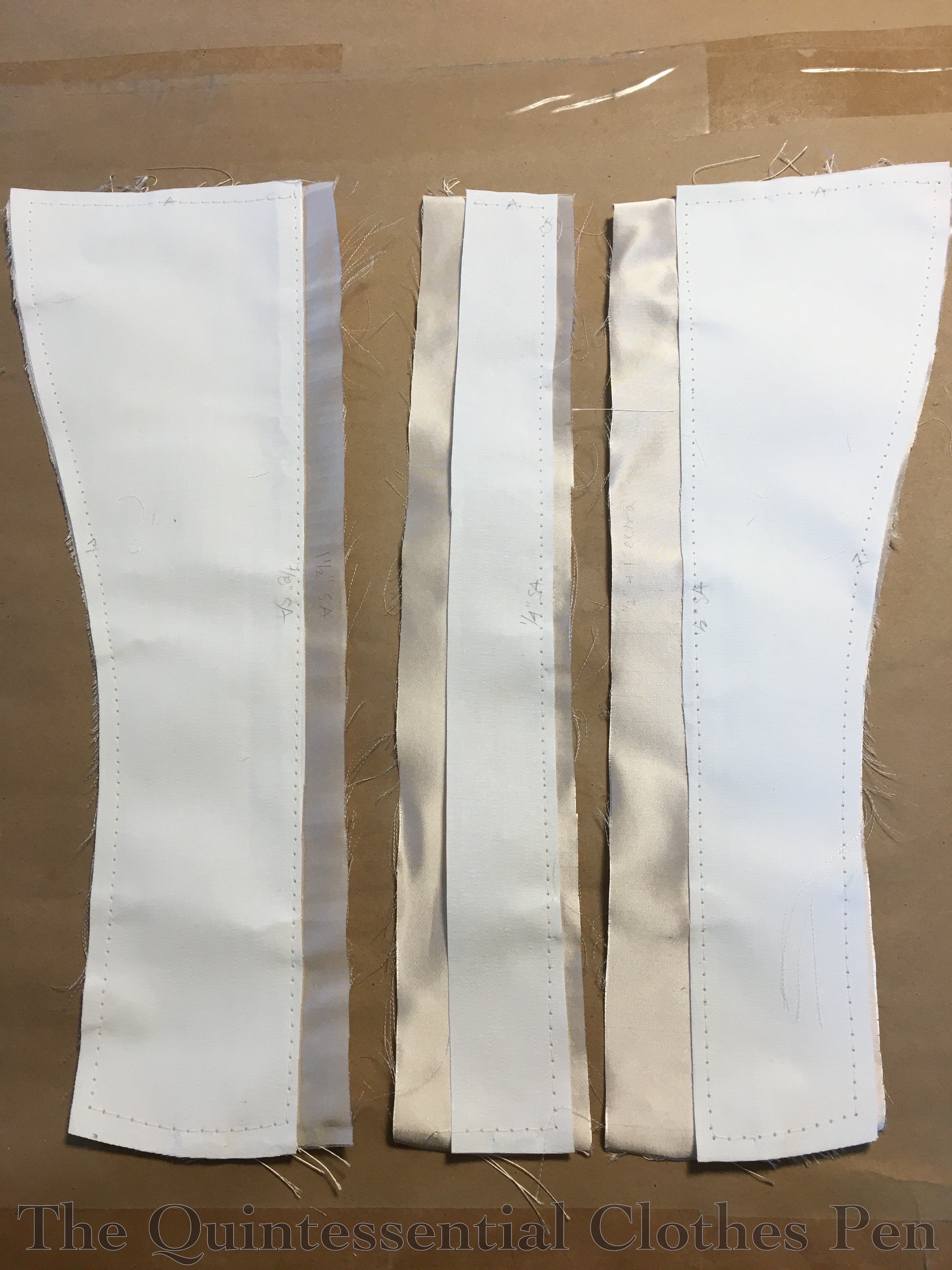
Below are the front panels, where I’ve intentionally cut the coutil to be smaller than the silk. This allows for the seam allowances to be less bulky and therefore more crisp as they fold inward around the busk. The piece on the left is for the proper left side of the corset while the two other pieces are both for the proper right side of the corset. I’ll show how these pieces are put together later in this post.

Next are the back panels, again showing that all of the layers are not cut to be exactly the same. The cut edge of the narrowest coutil layer provides a crisp edge over which to turn the other piece of coutil for the back edge. It also creates 3 layers of coutil where the grommets will be while allowing the silk to fold under the outermost edge of the coutil for a crisp line there as well.

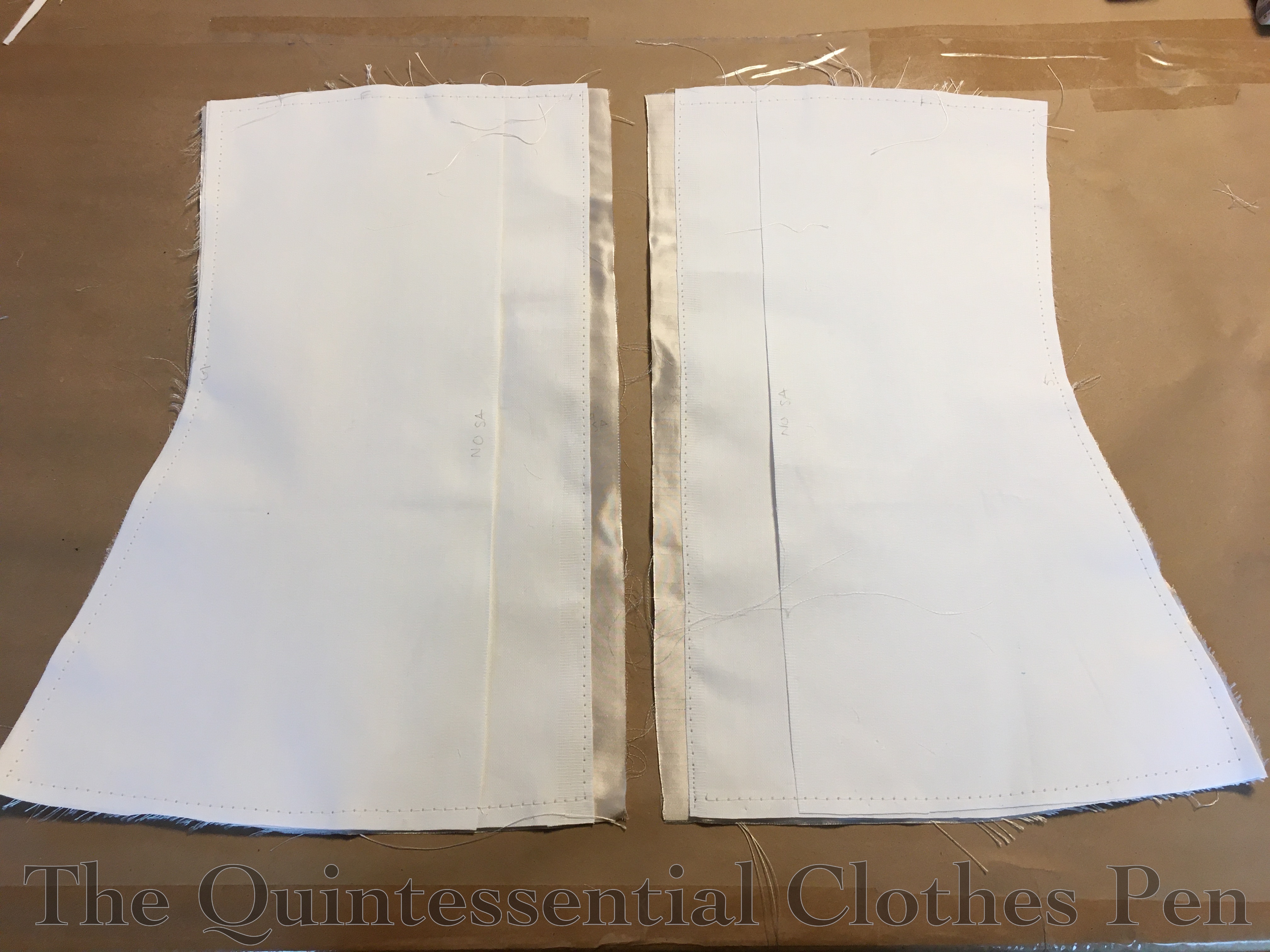
You can see in both of the above images that I machine flat lined the layers for each piece together on almost every edge (some were strategically left alone).

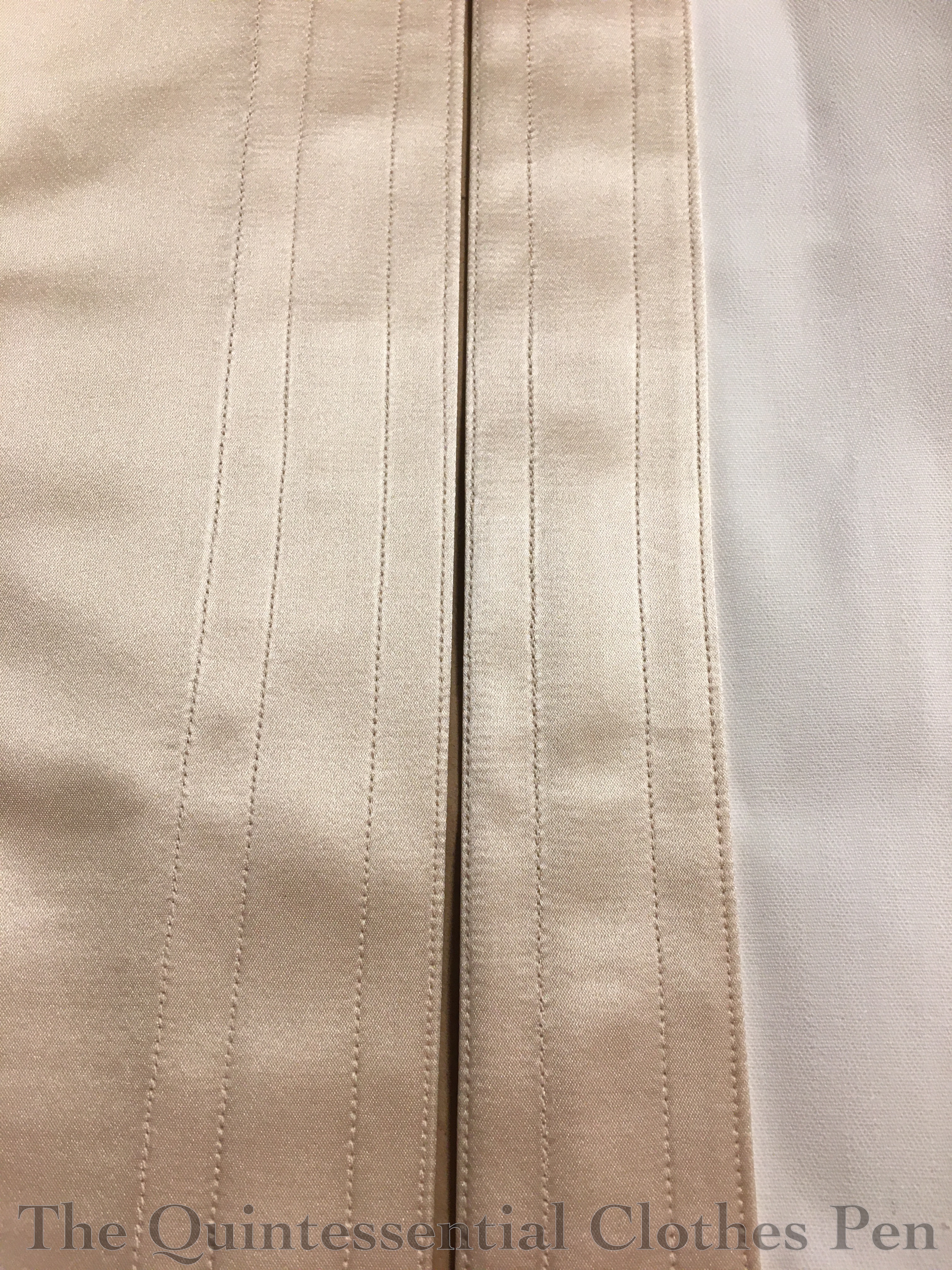
Next, I prepared the center back grommet areas. The silk only seam allowance was crisply turned back over the straight cut edge of the coutil, then the coutil was crisply pressed back over the narrower layer of coutil. You can see the folds opened on the right and the resulting crisp panel on the left.

These were very carefully pinned in place (duchess satin does not hide pin marks!) and then the channels were stitched. I made sure to make them wide enough to not struggle when putting in bones (the last corset had boning channels that were a bit narrow for the bones and it was terribly hard to put them in!).

I used an edge stitch foot to get the lines of stitching right along the folds. Edge stitch feet are magical! I discovered mine while making masks last summer and have since started using it for all kinds of projects–any time I need to stitch close to the edge of a fold! My machine, which is pretty basic, came with one (though I hadn’t used it in, oh… 12 years???). I encourage you to it out if you haven’t before!

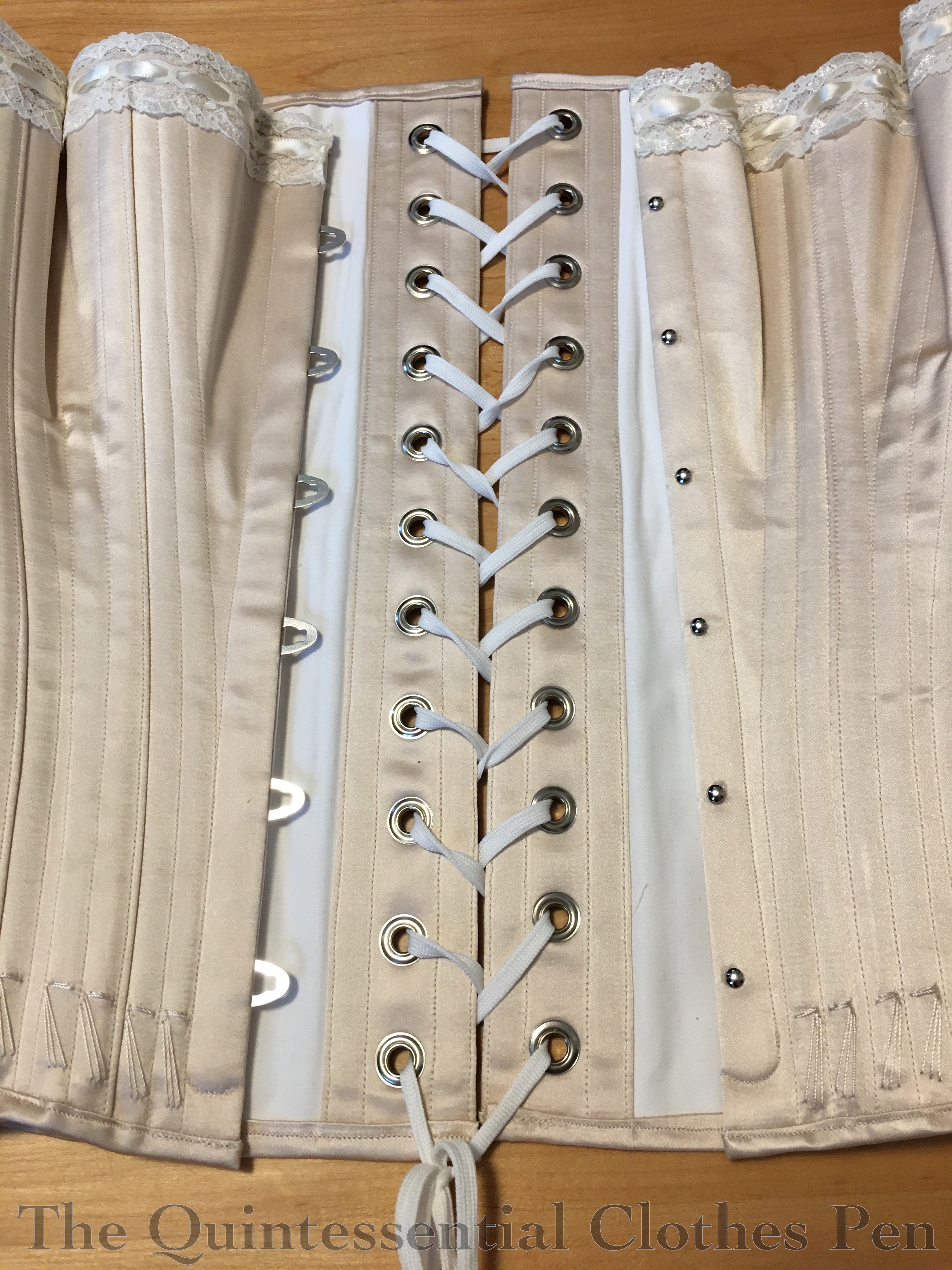
Here you can see the exterior of the grommet panels on the left and the interior on the right.

Later, I added size 0 silver grommets. Skipping ahead in construction, here’s a finished image of the corset, showing the finished grommets in place.

After preparing the grommet area, I assembled each side of the corset. No photos of that here, since I did this in the same way as my last corset: grading my seams, binding them with ⅝” cotton twill tape, and then stitching these down to create channels for the bones. (My original construction post has detailed pictures and explanation of this method. The part of the post discussing this also has some images showing the many bones on the back of that yellow corset that I mentioned earlier.)

Next, I put in the busk, starting with the socket side, which is the proper right side of the corset. I used a different method on this corset than on my yellow one. Further inspection of originals shows a seam that the busk sockets are pushed through, rather than reinforced holes without a seam, so that’s what I wanted to do!

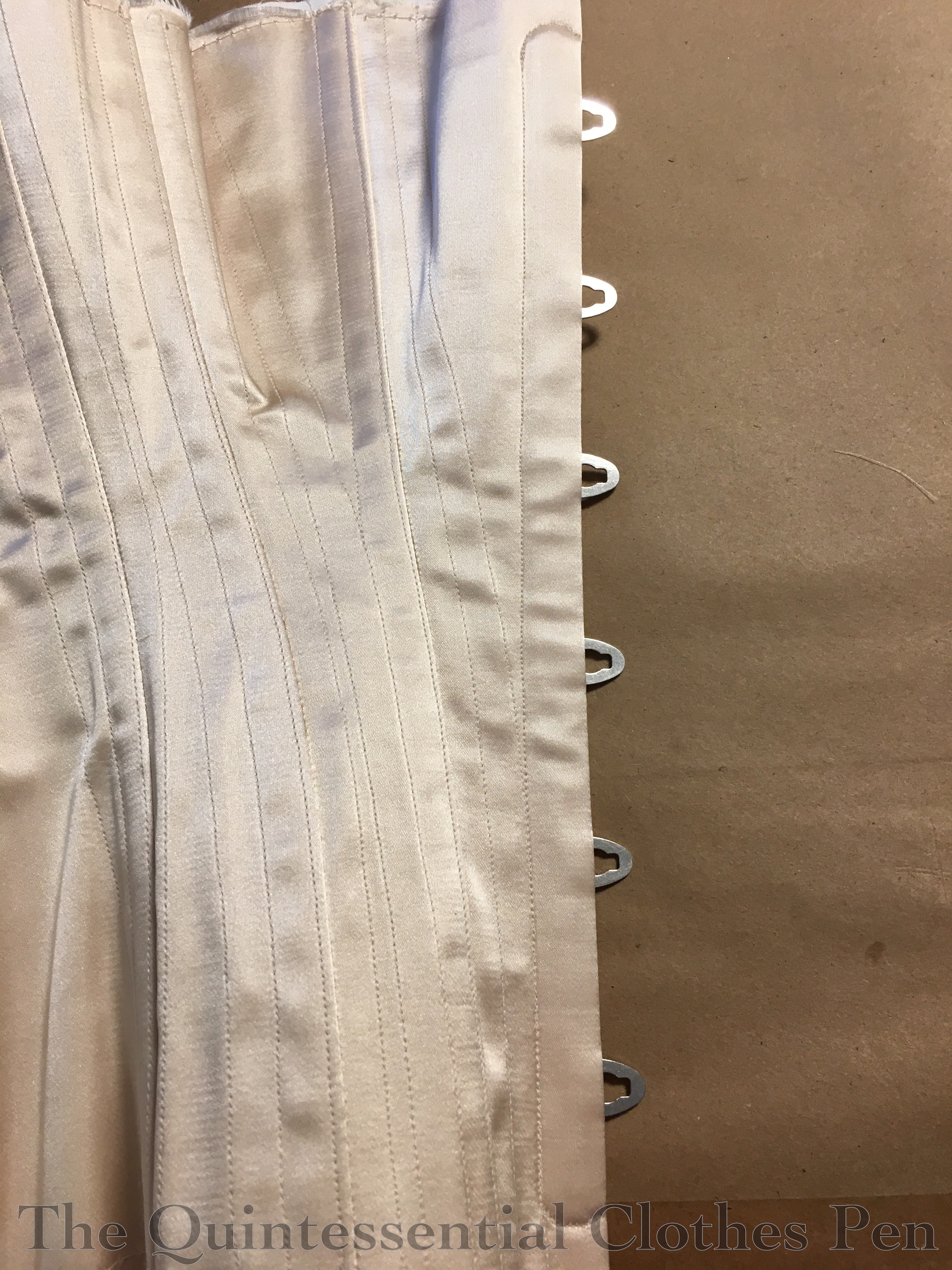
This is where I used the two pieces I cut. In the photo below you can see that the two pieces are pinned together (pin heads are on the underside, in case you’re wondering) and I’ve marked small lines where the sockets will land on the seam. This allows me to leave openings in the seam for each socket. The openings need to be snug, but not too tight. The seam is sewn just outside of the coutil, so that the layers fold crisply. As you can see, my seam allowance is uneven. I left the side of the silk that will be visible as the busk is pulled on a little wider to make a solid facing even after years of use.

Here is the finished seam, pressed open. If you look carefully you can see the gaps in the seam that I left for the sockets of the busk. My ruler at the bottom shows the scale. (This photo also shows some of the finished seam allowances and boning channels on the other seams, as well.)

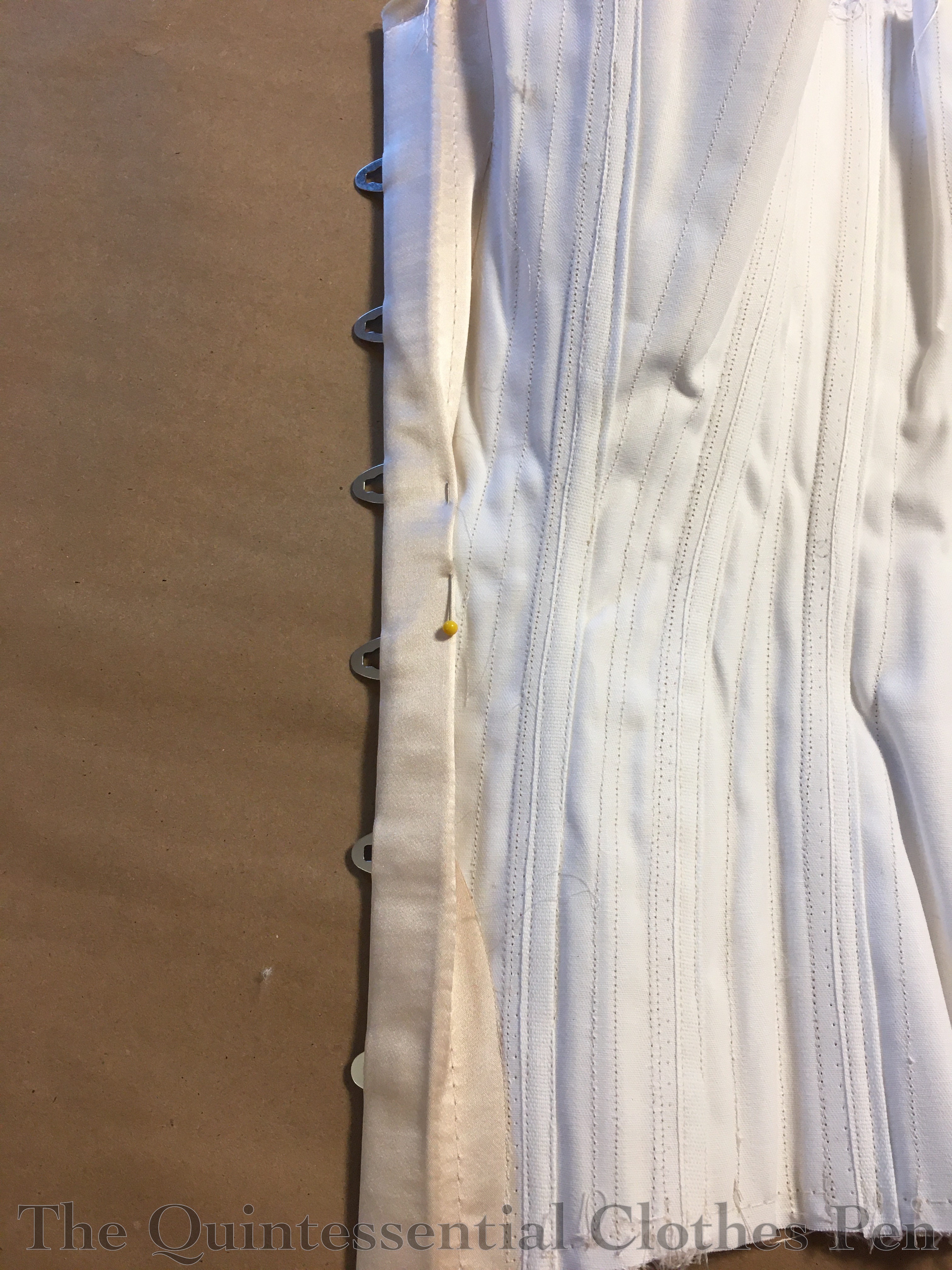
Now the socket half of the busk is pushed into place. The single layer of silk seam allowance is pressed over the cut edge of the coutil and the whole thing is carefully pinned in place. I made sure that the busk is quite snug, so that it can’t shift in any direction.

To do this, I started with pinning the inside, to ensure that the silk is perfectly wrapped under the busk–no gaps or bubbles there! Then, I very carefully pinned from the outside. As you can see, I only pushed the pins through the silk once (they come up through the coutil again, but not through the satin) to minimize holes.

After that, some very careful stitching with a zipper foot was in order. I curved my stitching around the top and bottom of the busk (a detail from extant garments). It’s tricky to make the curves look nice, but it’s a small detail that helps elevate the finished garment, I think.

On the inside, it looks like this. I was able to keep the stitching a consistent distance from the fold in the silk due to my careful pinning. I’ll admit that this turned out better than my yellow corset! The yellow corset has a few bubbles and variation in the width of the turned under seam allowance.

Here is the busk from the side. You can see the seam and the snug openings, with solid back stitching, which leave space for the sockets to push through.

Ok, on to the stud side of the busk! This is the proper left side. Here, you can see the marks I’ve made to show where the studs will poke through and where the edge of the busk will fall. It is intentionally set back from the cut edge of the coutil.

One thing I was very careful about was poking my holes for the studs, because I found that on my yellow corset the silk pulled where I used an awl to make the holes. No one but me would probably see this, but I wanted to do better with this corset. I believe I used very sharp snips to cut small holes rather than using an awl to push the fibers apart. This is fiddly work, because a hole too big can’t be saved and will fray and cause the stud to move around, but it produced better end results, I think.

After making my holes and getting all the studs through, I carefully pinned and then stitched around the busk just like I did on the socket side.

Ta da! Busk!

Next up was binding the top and bottom edges. I used almost the same method as on my last corset. To quote myself:

The bottom binding is bias strips cut 1″ wide. I stitched them first to the right side of the corset with ⅛” seam allowance on my bias, trimmed my corset seam allowance to just about ⅛”, folded the bias over the edge, turned the raw edge under on the wrong side, [basted the seam allowance in place on the inside instead of hand whip stitching the bias down on the inside (slow, but a more effective method than pinning in this case)], then turned the corset back to the right side and topstitched very close to the edge of the first fold. This narrow topstitched binding seems to be common on late 19th century extant corsets and looks very tidy.

Below you can see the bias turned to the inside, pinned, and being basted in place. On the right are finished edges from the inside and outside.

This corset is boned with spiral steel for the bulk of the seams and flat steel on either side of the grommets.

I usually apply the bottom binding first, then put in my bones, and then bind the top. It’s a bit trickier sometimes to bind the corset after the bones are in, and if the top will have decorative lace then it can help hide any struggles that occur. (Thankfully, I learned from my last experience and made a test sample of the boning channel width that was perfect, so it was relatively easy to bone this corset!)

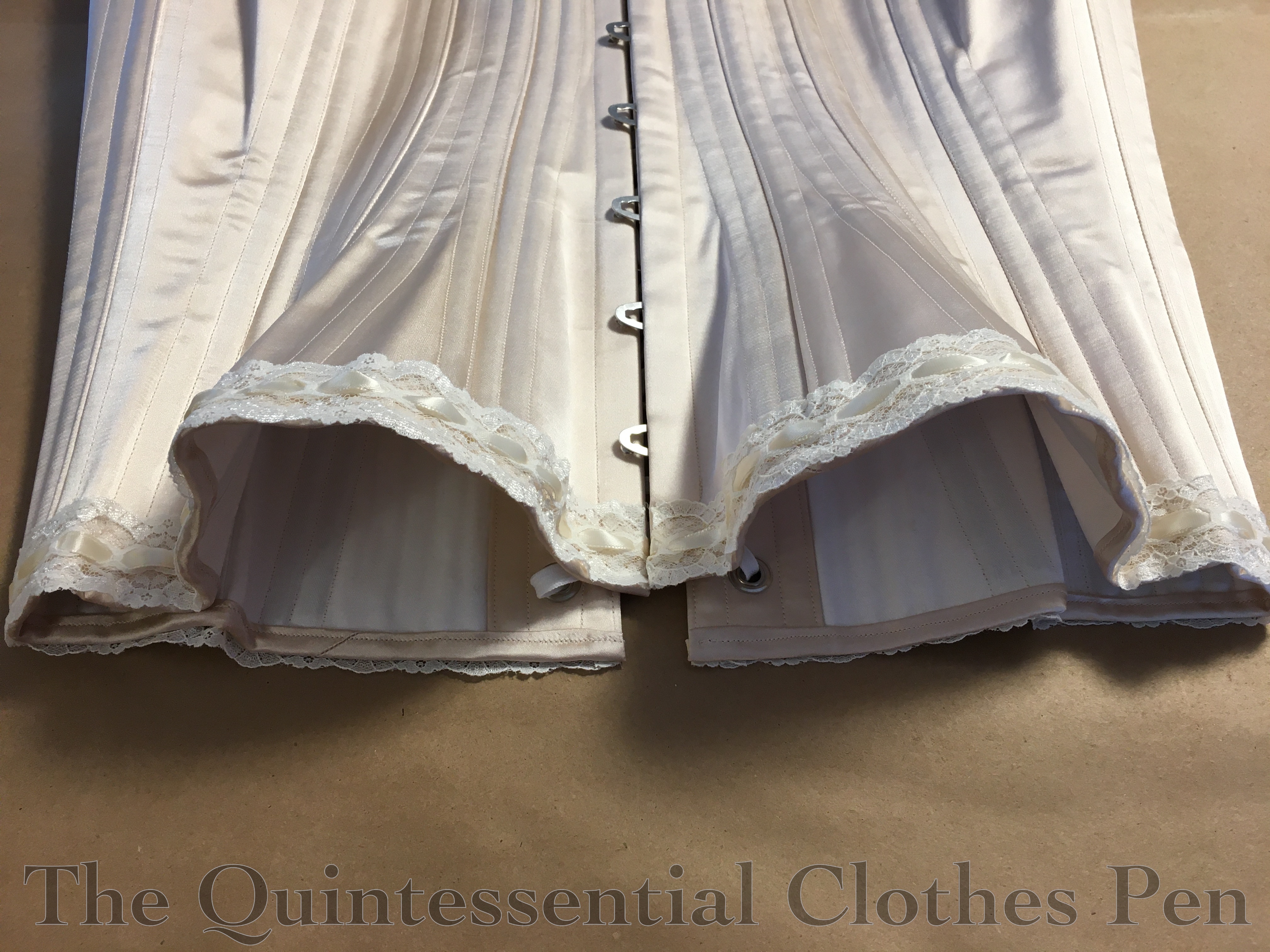
At this point the corset was basically done! The only things left were to add ivory beading lace and ribbon around the top and silk flossing along the bottom of the boning channels.

I was excited that I had all of the necessary materials in the stash, including the silk thread in the perfect ivory color.

I’m very pleased with the end result. It takes all the struggles and things I learned along the way with my yellow corset and perfects them, creating crisper folds and finishes and a comfortable garment with a great silhouette.

There’s no trickery in the next photo, this corset holds its shape with no support other than what is built in!

Over The Creek And Through The Woods, In A Bustle!

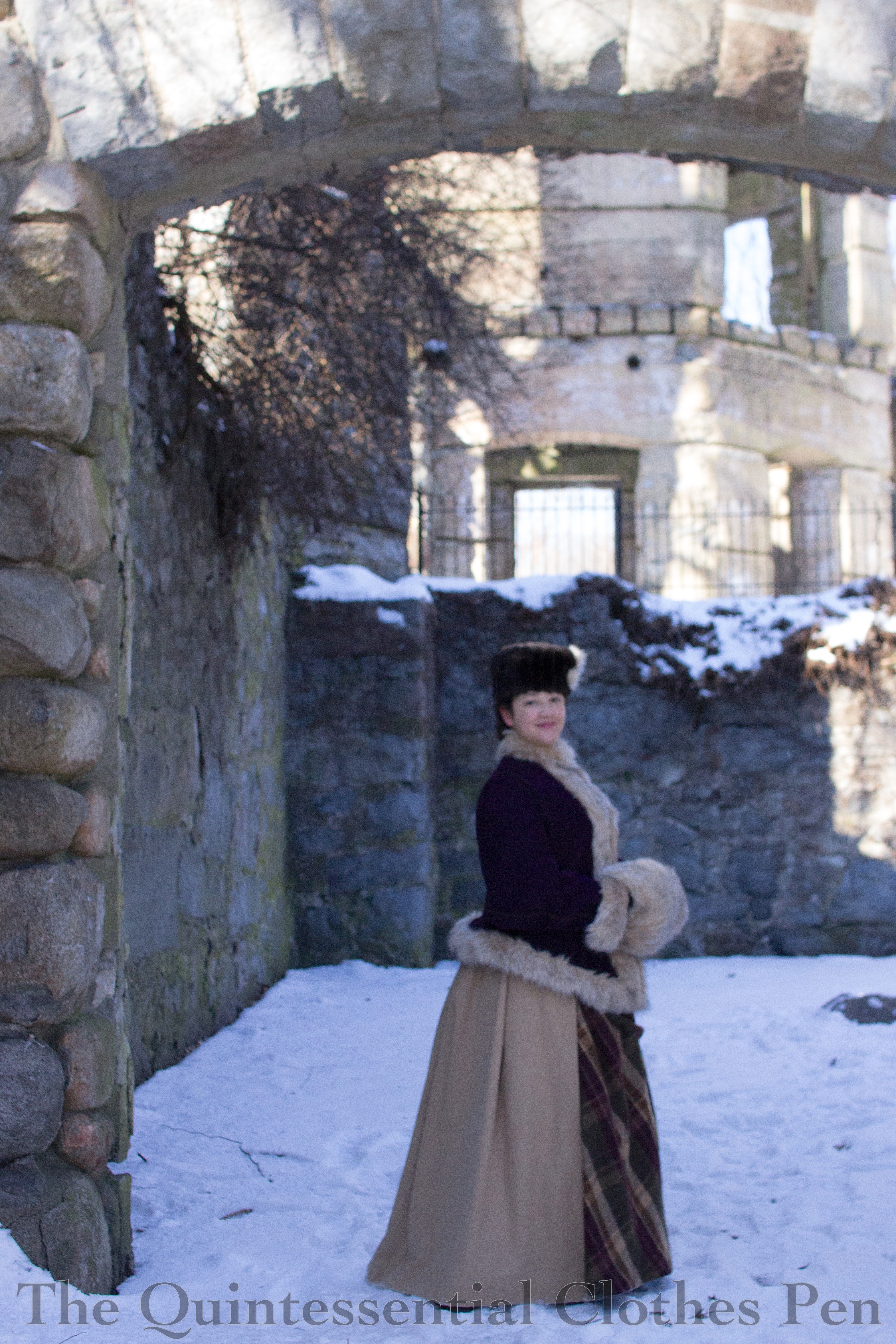
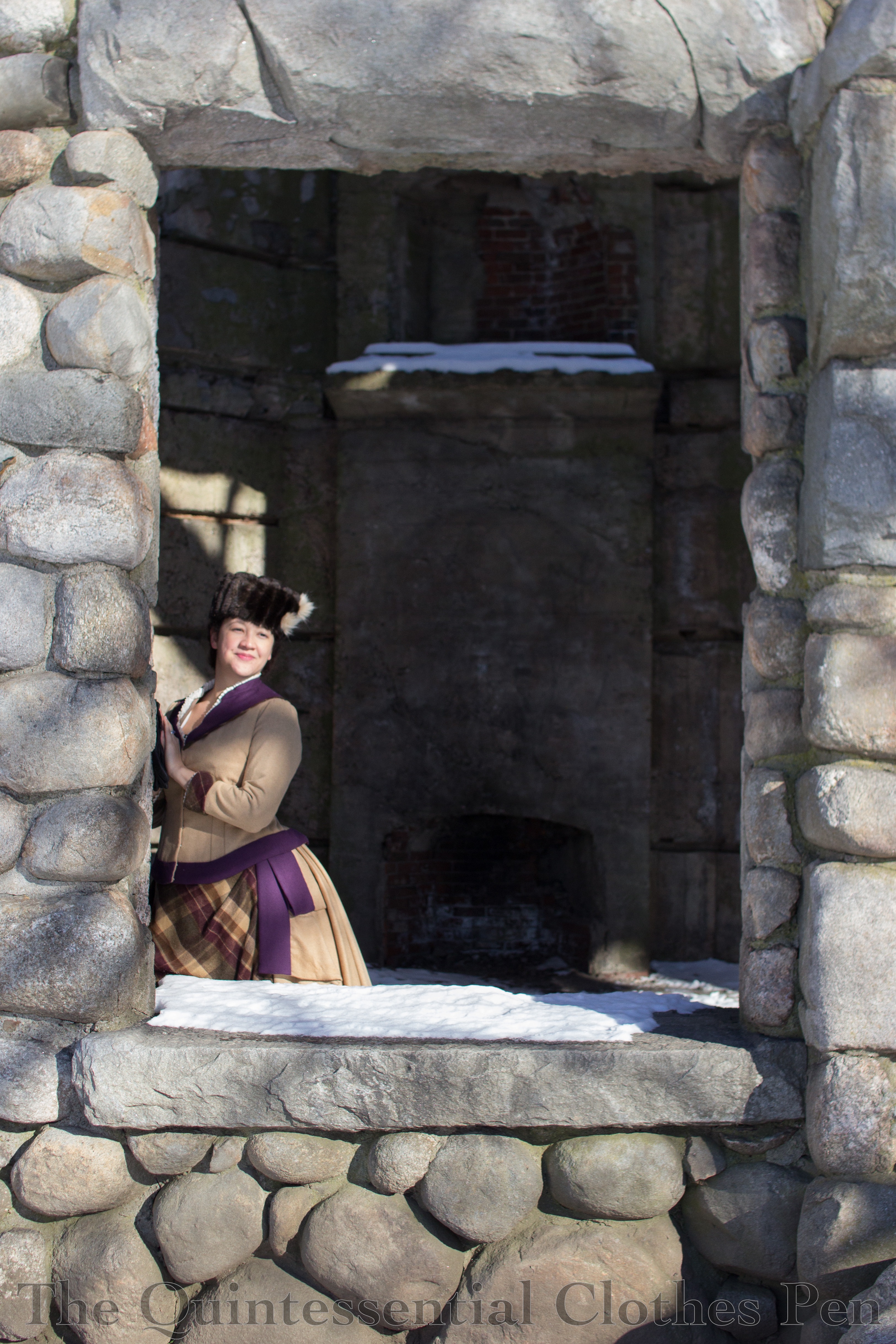
Long before winter had arrived, I had a vision for getting atmospheric winter woodland photos of my recently posted about 1884 Wool Plaid Dress and 1885 Wool Mantle. (The links are to previous posts about these garments that have tons of inspiration, patterning, construction, and finishing details–check them out if you want to see more details up close or learn about how these garments were made.) I was joined in my plans by a friend (who blogs at Plaid Petticoats) who also had a winter-y bustle dress that, like my ensemble, needed to be appropriately documented and photographed. In this post, I’d like to take you with us on our photographic ramble to show you some of the beautiful winter sights that didn’t make it into the detailed construction posts.

We began our adventure with photos at a local ruined estate called Bancroft’s Castle. We’ve walked up the long, steep hill to this location multiple times in modern clothes, but wanted to prove it was possible in corsets, bustles, and snow, as well as having the wonderful setting for some of our photos.

Bancroft’s Castle was built in the early 20th century but destroyed by fire within a few decades. Now, the only parts left standing are the stone walls and fireplaces. The site is open to the public and often quite crowded, but in the freezing temperatures we had it pretty much to ourselves. I love this photo, which captures the ruined walls, open levels, and stark trees. Even the iron fence seems to suit the mood!

There are lots of other photos with Bancroft’s Castle as the background in my details posts about my dress and mantle, if you want to see more.

After taking advantage of the different sections of the castle, we moved on to a path along the nearby river .The path meanders across fields, up and down hills, along the river, through the woods… and more!

It was a beautiful, sunny, very cold day. There was relatively new snow that covered everything. Being just a few inches, it was not deep enough to be a hassle to walk through in a long skirt.

The open field trekking felt very much in the spirit of adventuring women of the late nineteenth century, though it was made slightly easier by the fact that we could follow existing tracks rather than having to blaze our own trail.

After crossing the fields, we arrived in the woods along the river. The bare trees made wonderful views for musing as they stood in the snow.

The river is large enough to not freeze over entirely, though the shallow edges were covered with ice. I appreciated the bands of interest provided in this view. Snow, bare shrubs, ice, wonderfully reflective water, grey trees, green pines, and very blue sky.

In particular, I was struck by these trees with their curved trunks artfully reflected in the river. The bursting silhouette of the trees is fun all on its own but even more pleasant to look at when joined by the reflection. It feels exuberant, despite the bare branches.

The wooded area was soon interrupted by a stand of pine trees. I could easily envision them being foreboding, in an Anne of Green Gables way, but they were also bathed in golden sunlight which brought a certain magic that was cheery and bright.

It was a great place to stop and take photos. I love the next one for the depth, but if you look carefully you can also see that both bustle ensembles made it into the shot, which amuses me.

A bit of post-production on the part of my Plaid Petticoats friend produced this Harry Potter patronus image. Her dress is Slytherin inspired!

After the stand of pine trees was a small creek that fed into the main river. We looked into going around it, but of course finding the end wasn’t really feasible and the other side had a river. So… It was over the creek time!

Other trekkers had laid logs and branches across the creek to create a makeshift bridge. With the help of the ‘bridge’ we made it across with no problems!

After that it was easy going along the river and then back through the woods and fields. Both of our dresses were none the worse for wear, though part of my hem facing had been pulled loose on a branch and then collected quite a bit of snow inside. Getting all the snow out was a bit challenging, but it was easy to resew the hem once the more difficult task was completed.

I had a great time tromping about in my dress–proving that climbing hills and scrambling down ravines and across creeks is completely do-able in a bustle!

1885 Mantle (HSM #5) & Accessories

Last post was a detailed look at the 1884 Plaid Wool Bustle Dress that I completed last year. This post is going to look at the details of the accessories I made and wore to stay warm while taking photos of the 1884 dress: a mantle, a new muff cover, and a quick mention of the hat.

First, the mantle, which qualifies for the Historical Sew Monthly 2021 Challenge #5:

Purple: Make an item in any shade of purple.

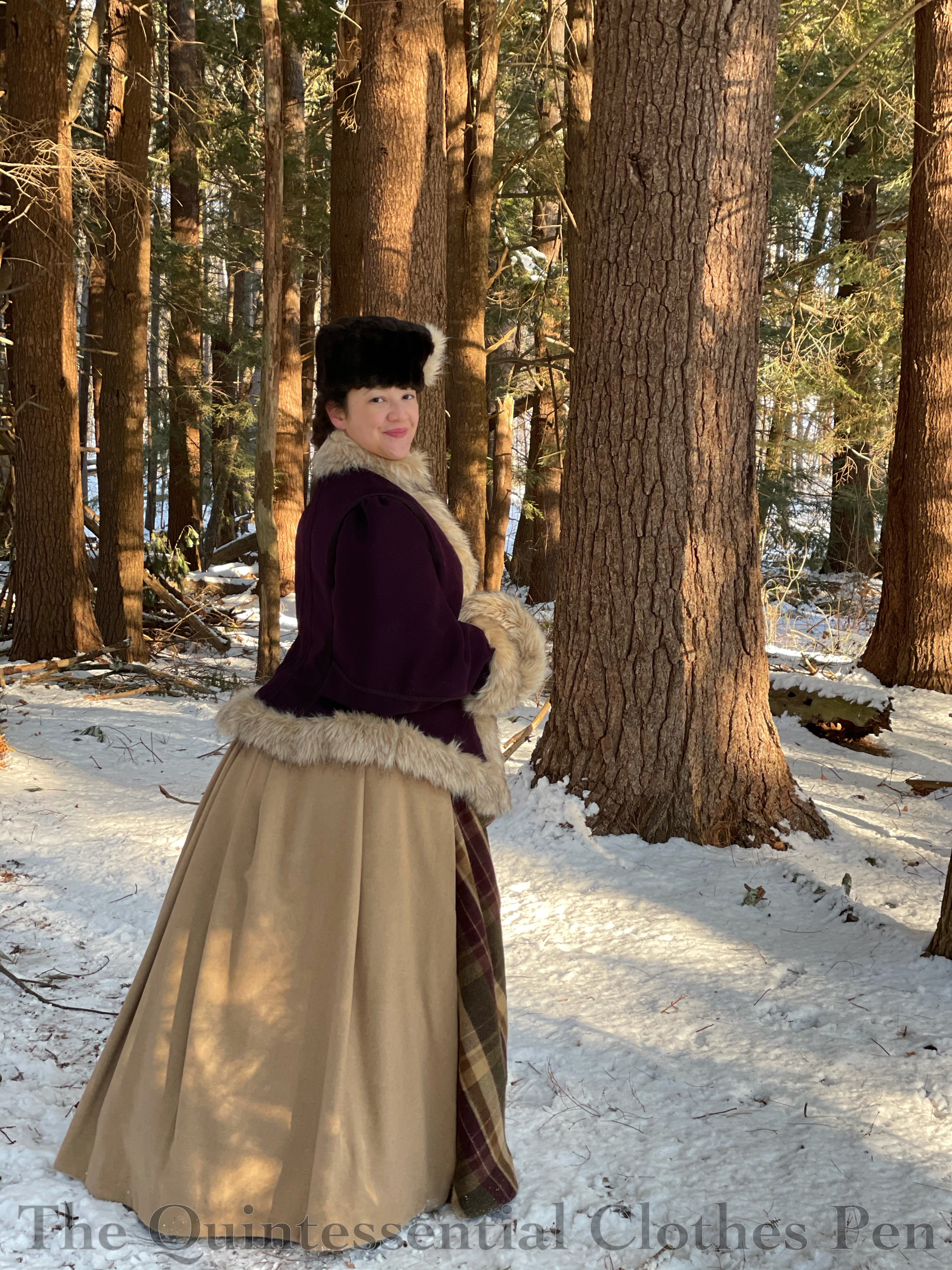
Easier to see the color in the next photo! Purple!

Just the facts:

Fabric/Materials: 1 ½ yards purple wool, 2 ¾ yards drab polyester lining, and about 1 yard of faux fur.

Pattern: Adapted from a pattern on page 33 of The National Garment Cutter Book Of Diagrams.

Year: 1888.

Notions: 4 ¼ yards brown braid trim and 4 coat size hook and loops.

How historically accurate is it?: 85%. The pattern and silhouette are good, but the polyester lining and faux fur are not accurate. I’ve also never examined an extant 1880s mantle up close, so the construction methods are guesses that made sense to me.

Hours to complete: 18.5 hours.

First worn: In January, for a ramble and photos!

Total cost: Approximately $40.

Mantle: Beginnings

This accessory adventure started with a passionate desire to make a specifically 1880s shaped mantle to go with my new dress. I don’t remember the details exactly, but it’s possible that I fell in love with the red mantle on the right in the fashion plate below even before I fell in love with the shape of the bustle dress that I’m wearing underneath my mantle.

The shape! The fur! The matching muff! So cute! It seemed like it would go very well with my dress.

Mantle: Patterning

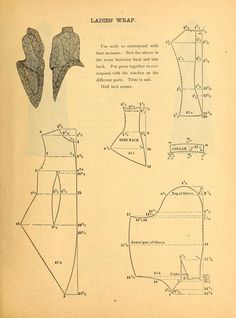
I started the mantle soon after finishing the 1884 dress last year, beginning with the pattern. The pattern is from The National Garment Cutter Book Of Diagrams published in 1888 (the entire book is digitized and available here).

The pattern I started with is on page 33: Ladies’ Wrap. It has the same general shape as my inspiration plate, including the very specific-to-the-1880s outerwear sleeve set into the side back seam. Figuring those out was an eagerly anticipated part of the challenge.

The brief instructions are to use the scale corresponding to the bust measure to enlarge the pattern. I didn’t feel like finding the right scale in the book, so instead I guessed at a scale that generated proportions that made sense for my size. I think it was somewhere in the realm of ⅛” to 1″.

After the pattern was enlarged, life became busy and I put this project on hold. Fast forward to the first days of 2021 and I decided to knock this project off the to-do list so it would be ready at the first sign of snow for photos!

I made a mockup from my pattern, adjusted a few things including the length of the front piece (it was much longer than my inspiration!), then altered the mockup to check the changes. At that point, I was satisfied and ready to move on to real fabric!

Mantle: Sleeve Puzzling

Along the way in this process I had to figure out the sleeves. Below is what the sleeve pattern piece looks like when cut out. It’s not your usual sleeve shape. The top looks mostly reasonable, but what’s with a dart on the bottom edge? And the point at the bottom? Odd! Folding this in half (as you would normally do for a sleeve) would produce a strange sleeve, indeed.

I pondered this… looked up extant garments (there are a number of mantles with sleeves like this on my general 1880s outerwear Pinterest board) and did some searching for other people who had made this type of garment before.

The thing that suddenly made the sleeve click for me was a series of posts from Caroline (who blogs at The Modern Mantua Maker) showing the construction of an 1880s dolman that she made. This post, in particular, contains a photo showing the sleeve before it was set into the body of the garment. Ah ha! I realized that the bottom of my sleeve folds up and the dart goes against the body. That creates the right shape!

This post from Caroline shows her finished dolman. It was also very helpful as I tried to wrap my brain around these unusual sleeves. And, Caroline has another dolman she made as well, which I also looked at as I was figuring out my pattern.

Mantle: Materials

I had the fashion plate to reference for the overall design of the mantle, but I needed a bit more detail to confirm my material choices. Many 1880s mantles are made from fancier fabrics: silks, velvets, brocades… I only had a heavy purple wool in my stash in a quantity I thought would be just the right amount for the mantle and I didn’t want to buy something new (especially something likely to be expensive, as many of those fancier fabrics would be).

After some searching, I found this c. 1880 opera cloak at the Metropolitan Museum of Art that seems to be made of a plain wool. I decided to use some of the details from it, like the braid trim, to upgrade my mantle from plain to more interesting.

I had the braid trim in my stash already, purchased a few years ago from Deb’s Lace and Trims because I liked the look of it and thought it would be useful someday (I love Deb’s Lace and Trims–you absolutely can’t beat the prices and the products are lovely–I’ve been using them for historical projects for the last ten years!). It was great to find a use for this braid.  With just five yards on hand I had to reduce the amount used relative to the Met inspiration mantle, but I think the end result is in keeping with the simple style of the dress. The braid highlights the shape of the mantle but doesn’t distract or seem too gaudy for the plain wool base.

After creating my first mockup I did have a very justified fear that my purple wool would not be enough for the mantle. Thankfully, after altering the pattern to suit my taste and size I was just able to eke out all of the pieces. Whew!

I love the quilted lining of the Met opera cloak and I considered quilting silk myself to do it. My stash didn’t have any appropriately colored silk, though, so that idea was out if I was to stay on the stash busting course. I thought of buying pre-quilted silk (completely abandoning my stash busting idea), but the colors I could find were bland and the dark brown I eventually decided on after months of indecision was sold out.

In the end, I decided I just wanted the project to be finished, so I would go the low-cost route of purchasing a polyester lining from the $3 per yard store. It helped me use other stash materials, so it seemed a reasonable trade off.

Mantle: Construction

Here’s that polyester lining. It’s unintentionally the same greyish-brown drab color as the cotton lining of the 1884 bustle dress. The mantle is fully lined, as you can see.

In order to make the lining of my mantle tidy, the sleeves were fully lined before being set into the side back seams. Here is one sleeve assembled and ready to be set in.

The assembled/lined sleeves were set into the exterior wool side back seams while the lining side back seams were sewn plain. After attaching the sleeves around the armsceyes in the exterior wool, the lining was turned under and whip stitched to finish the edges.

All of the braid trim is machine sewn on using a zipper foot. I was able to sew it in place on the wool before setting in the lining, so none of the attaching sew lines are visible.

The lining was machine sewn around the edges with the neck left open to turn right sides out. After that was completed, I machine sewed the collar lining (interfaced with cotton) to the neck edge by machine. Then I sewed the exterior fur collar on the neck edge by hand (shown in the next photo).

After that I flipped the lining up, turned all of the seam allowances in, and whip stitched the lining to the fur edge. It seemed easier to do it this way rather than machine sewing the fur.

The faux fur trim around the bottom edge is pieced where there are seams in the wool. This allows the fur to have the exact same shape as the wool underneath. These edges have no seam allowance. The edges are just butted together and then (roughly) whip stitched, as in the photo below. From the right side of the fur the seams are completely invisible.

The top and bottom edges of the fur trim have seam allowances that are turned in and hand sewn along both edges. The outer (bottom) edges are sewn right sides together with the bottom of the purple wool. Then, the inner (top) edges are turned under and stitched. Here is that process in progress.

The mantle closes with 4 coat weight hook and loops spaced down the front edges. They kept popping open while being worn, so when I got home I pinched them with a pair of pliers to make the hooks grab onto the loops better. I haven’t been out wearing this again since then, but I’m confident this solves the problem, as I’ve used this trick in the past.

New Muff (Cover)

Next, I want to share a bit about the muff I have in these photos.

Despite having a number of muffs, none of them are the right size and material to match my new mantle. I have a dark muff that matches the hat I wound up wearing and I have a muff made from the same fur I used to trim the mantle, but the dark muff didn’t match my mantle and the one that does match is an intentionally oversized early 19th century muff. Neither would do!

But I didn’t want to make an entirely new muff. Instead, I decided to make a new cover for a muff I’ve had since 2012 (you can see it in this post from 2019, when I used it with an early 19th century outfit). The muff is from a workshop I took with LadyDetalle. (She has an Etsy shop that often stocks muffs like this as well as many other beautiful and historically inclined goodies.)

The base is essentially a pillow (stuffed with real down–quite luxurious!) that can be rolled into a tube and have a cover put on. The idea is that the muff cover can be changed out so that you can have all sorts of beautiful muffs and only need to store the one base. The muff is sized for the 18th century, but I thought it just might work for my 1880s look, too.

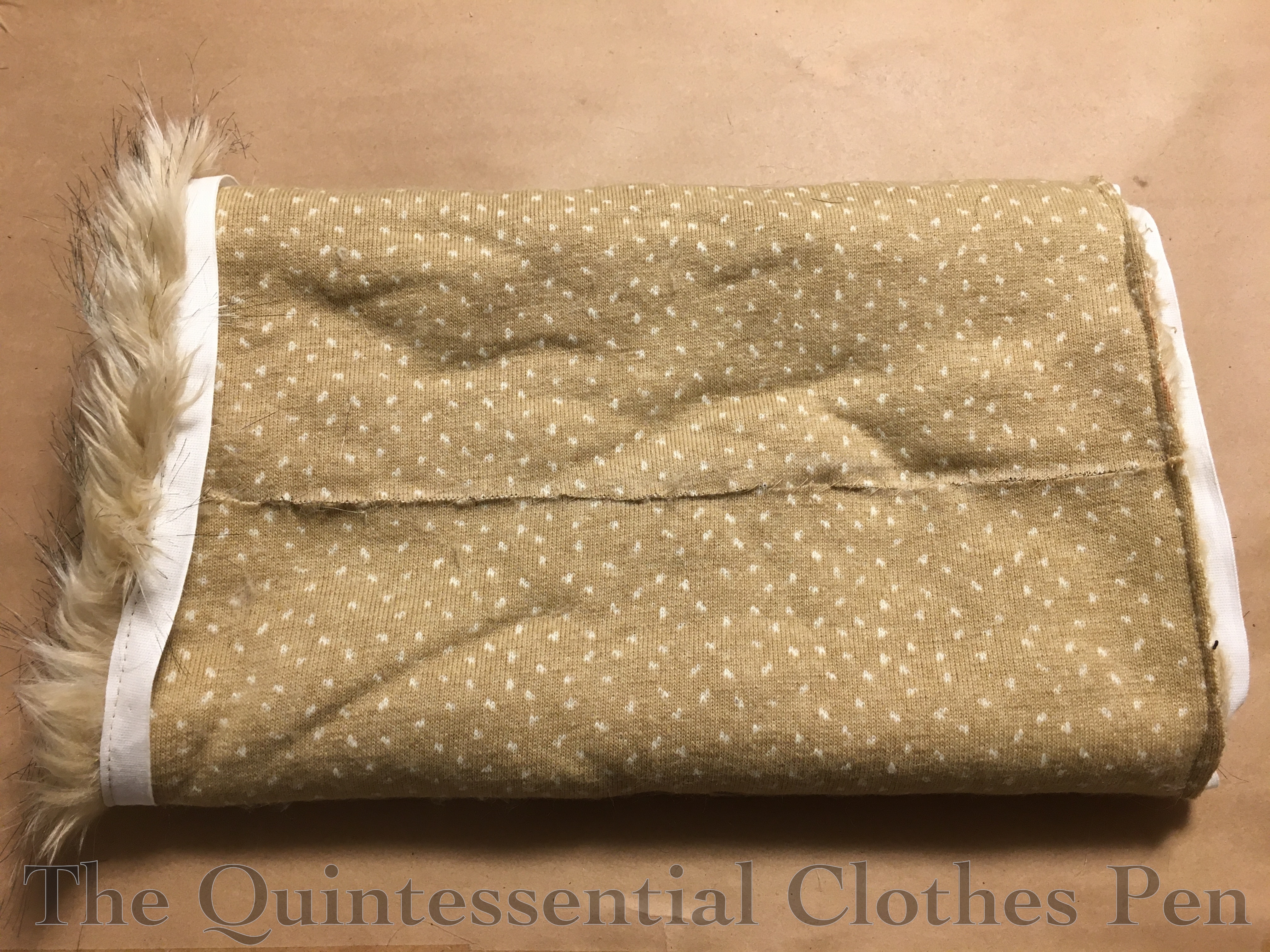
Accordingly, I measured my existing muff cover and cut a rectangle of faux fur that size. I butted my edge to make a tube and whip stitched it, in the same way as I whip stitched the mantle trim. Next, I machine sewed twill tape on the tube ends. (I had no worries about the fur getting caught in the machine sewing because that whole edge turns into the muff in the end anyway, so none of that will show.)

Once whip stitched in place the twill tape covers the raw edge of the fur and also provides a casing for the ribbons at each end. I used tobacco brown polyester ribbon that was gifted to me. By way of justification for the polyester ribbon, I’d already used polyester for the mantle lining and this seemed like a good use for this particular ribbon.

Below is the muff cover after those steps were completed.

And here is a closeup of the twill tape with machine stitching on one side and whip stitching on the other. The ends of the twill tape are just turned under and butted together, leaving an opening for the ribbon ends to come through.

And ta da! A muff that is the right size and perfectly matched to the mantle! The additional muff cover takes up hardly any storage space and now I have more versatility in my wardrobe.

Hat Baubles

While making my mantle and debating how to stay warm, I figured I would need something to keep my head warm. I’d already made the dress and the mantle and I didn’t feel like creating something all new for my head, as well. And I loved this image from the McCord Museum of 1880s ladies curling in the cold with their hats.

I thought I could repurpose my 1917 faux fur hat to suit the purpose, as it has a generally similar tall, straight shape. That hat is nice and warm, being lined in flannel and interlined with layers of batting to insulate the head.

The look of it was a little bland with this outfit, though, and not really coordinated with everything else.  I liked the idea of bringing in some of the mantle fur to make the hat look like it belonged. After fussing with various ideas I decided on fur poms, or baubles.

The baubles are sort of like large-scale cloth stuffed buttons. They are a circle that is gathered, the edges turned into provide stuffing, and the backs sewn together to close up the opening. (This tutorial shows how to make these types of buttons, though I started with a circle of fabric rather than a square.)

I like that the finished baubles pull in the look of the tan fur, that they are silly and amusing, and that they are easily removable. In fact, they are attached with safety pins on the inside of the hat! You can’t get much more easily removable than that!

I’m very pleased with my stash-busting-and-using-things-I-have-on-hand winter bustle ensemble. It’s warm. It was a great patterning challenge. It’s really fun to wear (it feels super elegant!). And it (mostly) reduced my fabric stash.

Thanks for sticking with me through this second detailed (and rather long) post! Next post will be further photos of the bustle dress in action on a woodland adventure.

1884 Plaid Wool Dress Details

I’m very excited to share the details of my (somewhat) new 1884 Plaid Wool Dress! It’s ‘somewhat new’ because I actually finished it 8 months ago, but at that point it was July and the temperature was absolutely not acceptable for wearing a wool dress for photos! Instead of putting the dress away, I kept it out, waiting for colder weather and the opportunity for a photo shoot. I was hoping for snow… and this winter, I got it!

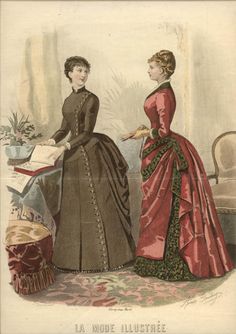
This dress is entirely inspired by the dress on the right in the fashion plate below from La Mode Illustree. I love the relative simplicity of the overall design and the waterfall of folded fabric on the skirt. Unfortunately, I don’t have an official source of the fashion plate or the year it is from, though my best guess is 1884.

I thought the design would be a great use of the tan and plaid wools that have been in my stash since 2012 (wow… that’s longer than I remembered!).  In addition to those, a small piece of plain purple wool had made its way into my stash over the last eight or nine years and when I started this dress in November 2017 I decided it would be a nice addition to the tan and plaid wools in the form of trim. While not an exact match to the purple in the plaid, I think it helps to perk up the plaid and bring out the non-tan tones (the green and purple).

Skirt Construction

I started the process of this dress with the skirt. I wanted the fabric to hang just like the fashion plate, so I decided to drape a custom pattern as opposed to starting with anything that already existed. The only exception to that (in the skirt) is a base of drab greyish-brown cotton. The base pieces were adapted from a Janet Arnold pattern.

I used the skirt base for the front and side areas, in order to have something for the wool layers to be attached to. In the back of the skirt there is nothing but the tan wool.

Here is a look at the inside of the finished skirt. You can see the tan waistband along the top and the drab cotton base with tacking stitches all over it. The tacking stitches are holding the plaid fabric in place–you can just see the plaid selvedge poking out on the right side.

The pleats in the plaid aren’t part of the original fashion plate, which instead has a draped apron-type front. I tried that, putting my plaid with a vertical grain and a tan apron over top, but I really hated how it looked in wool–too heavy and rather unattractive. I played with the fabrics until I settled on the bias plaid. I hinted at the draping in the fashion plate by adding tucks to the plaid to help it drape just slightly rather than just being flat. You can see the resulting folds pretty clearly in the next photo.

The various overlapping pleats of the plaid front, waterfall side, and back were complicated. I was trying to achieve a back that looked like this dress held by the Met, in addition to the various lovely folds shown in the fashion plate.

It’s easy to draw things, but sometimes they don’t really work in actual fabric… I found that with the waterfall, especially. There’s actually an added loop of fabric tucked between the folds that isn’t part of the side piece at all! It’s just a little fake bit to help create the look of the fashion plate. I couldn’t figure out any other way to do it!

Given these various challenges and lots of other things to keep me busy in life, this poor skirt sat in a half finished state on the dress form in my sewing room for at least a year. I couldn’t remove it without marking everything… and I couldn’t make up my mind about what I wanted! (I say poor skirt, but it was sort of poor me, as I definitely reached a point of wanting the dress to get put away!)

Eventually, I did make up my mind and remove the skirt, but the partially finished skirt still sat around for ages before I finished it. Part of marking the skirt also meant figuring out the facings of the waterfall bits, because the fully finished edges had to be set into the waistband. Mr. Q actually asked at one point after the skirt was off the dress form whether I had intended it as decoration in my sewing room because it was there for so long… Nope!

All the various pleats on the skirt wound up making for a rather thick layer of things to sew through for the waistband. Here’s what the side with the waterfall trim looks like on the inside. I count at least 9 layers of wool in one spot! Given that, I decided to cut the inner side of my waistband on the selvedge of the fabric and leave it hanging down into the skirt instead of turning the seam allowances up as you would normally do for a waistband.

Setting the hems on the skirt was another challenge, though this was due to the fact that I did it by myself. It involved dressing in my corset, bustle, petticoat, and skirt, twisting and contorting while putting pins in the hem to mark the floor, then standing to look in the mirror to see if they were even, then adjusting… many times!

I eventually had everything marked to my satisfaction and could move on with the sewing. All sections of the hem are finished with wide bias strips of the drab cotton, the goal being to make the hems durable and less likely to catch on twigs, etc. than if they had more textured wool exposed (and I can say, after romping about the woods in this dress, that the hems did an admirable job!).

After using the drab cotton for both my 1896 Bicycling Ensemble and to line my 1863 Apricot Evening Gown I was starting to run low for this project. I cut the skirt base pieces, cut the bodice lining pieces, and then used pieced scraps to make the wide bias to hem the skirt. As you can see in the above photo, some of my bias pieces were only 6″ or so in length. And in the photo below, you can see the only bit of wide bias that was leftover when I was finished!

The final skirt detail to share is a hidden patch pocket! The skirt opens on the side front, along one side of the plaid, and underneath that opening is a pocket, perfectly sized to fit a cell phone and keys. The pocket is oddly low, near the knees, but that is because I wanted to make sure that any bulk from items in the pocket would press in towards my legs and not make an unsightly bulge on the exterior of the dress.

The photo below shows the pocket, as well as some of the hooks and thread loops that allow the tan fabric to attach to the plaid wool.

Bodice Construction

In addition to this rather complicated skirt, there was also a bodice to be made! The bodice is actually pretty straightforward. The pattern is adapted from the one I used for my 1885 Frills and Furbelows summer dress which in turn was adapted from a Janet Arnold pattern.

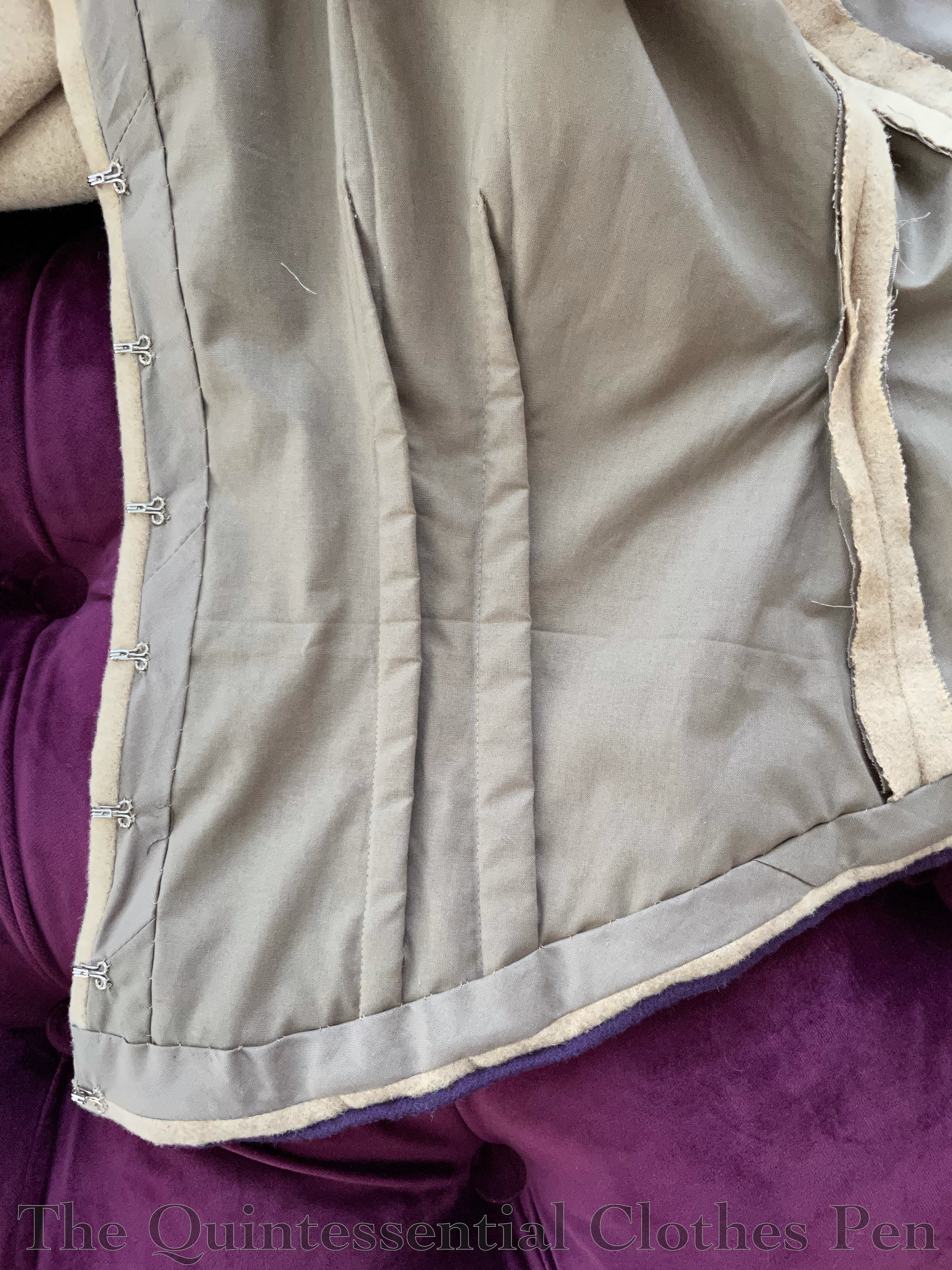
The bodice is completely flat lined in the drab cotton. There is a ribbon waist tape to help keep the back of the bodice tight against the body and to keep the bodice from riding up while being worn.

The bottom and front/neck edges are finished with bias strips of the drab cotton. The seam allowances are unfinished. The bodice closes in front with hooks and loops.

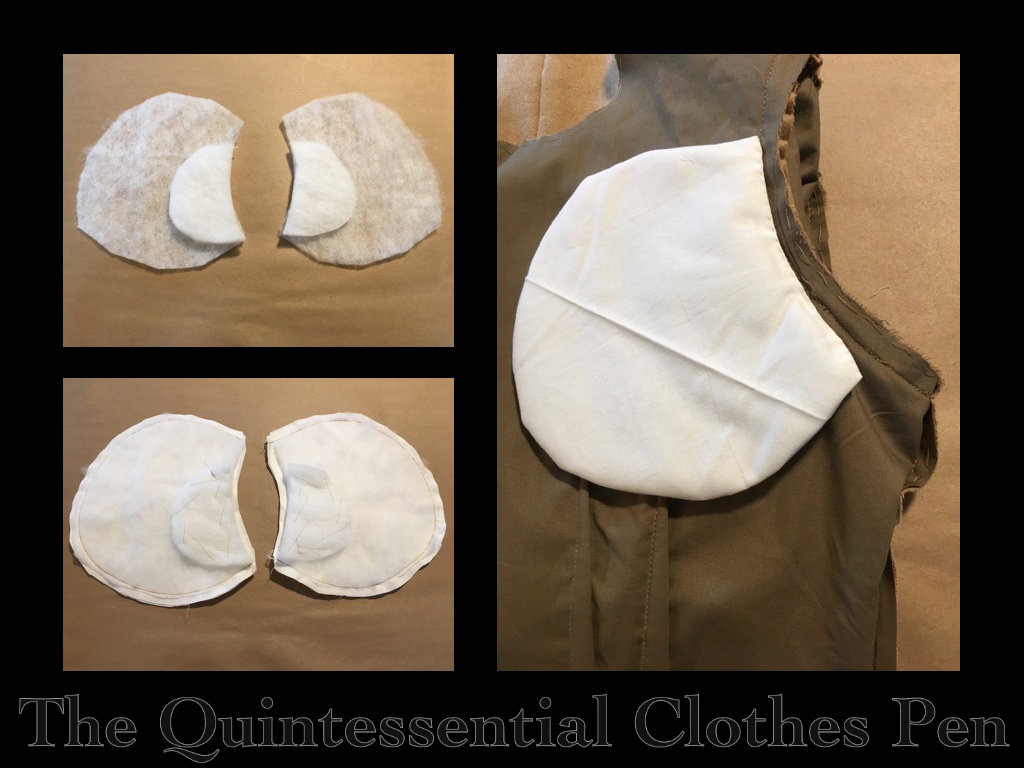
There are two other details I want to discuss, as well. First, there are the bust pads! I came across these in this c. 1885 extant dress and decided I wanted to give them a try to see if I could get that really exaggerated bust to waist ratio in my inspiration fashion plate (here’s the link to it again).

Turns out… no. I did not achieve that bust to waist ratio… but I think that’s more a factor of my waist size than anything. (It’s not as small as it was 10 years ago…) To keep the proportions of the fashion plate I would drastically need to increase the bust size. Perhaps in another dress.

In the meantime, this dress tried out the bust pads. They are made from cotton scraps with shaped batting layers inside. Below you can see the steps to creating the pads. Once sewn, these were tacked inside the bodice to keep them in place.

The second detail still to discuss is the neck ruffle. I finished this dress shortly after completing my 1875 Reception Dress last summer and I had my antique fluting iron on the brain. After pondering the fashion plate neck and sleeve ruffles for awhile I decided to use my fluting iron to ruffle some cotton to use for my dress’s neckline and cuffs.

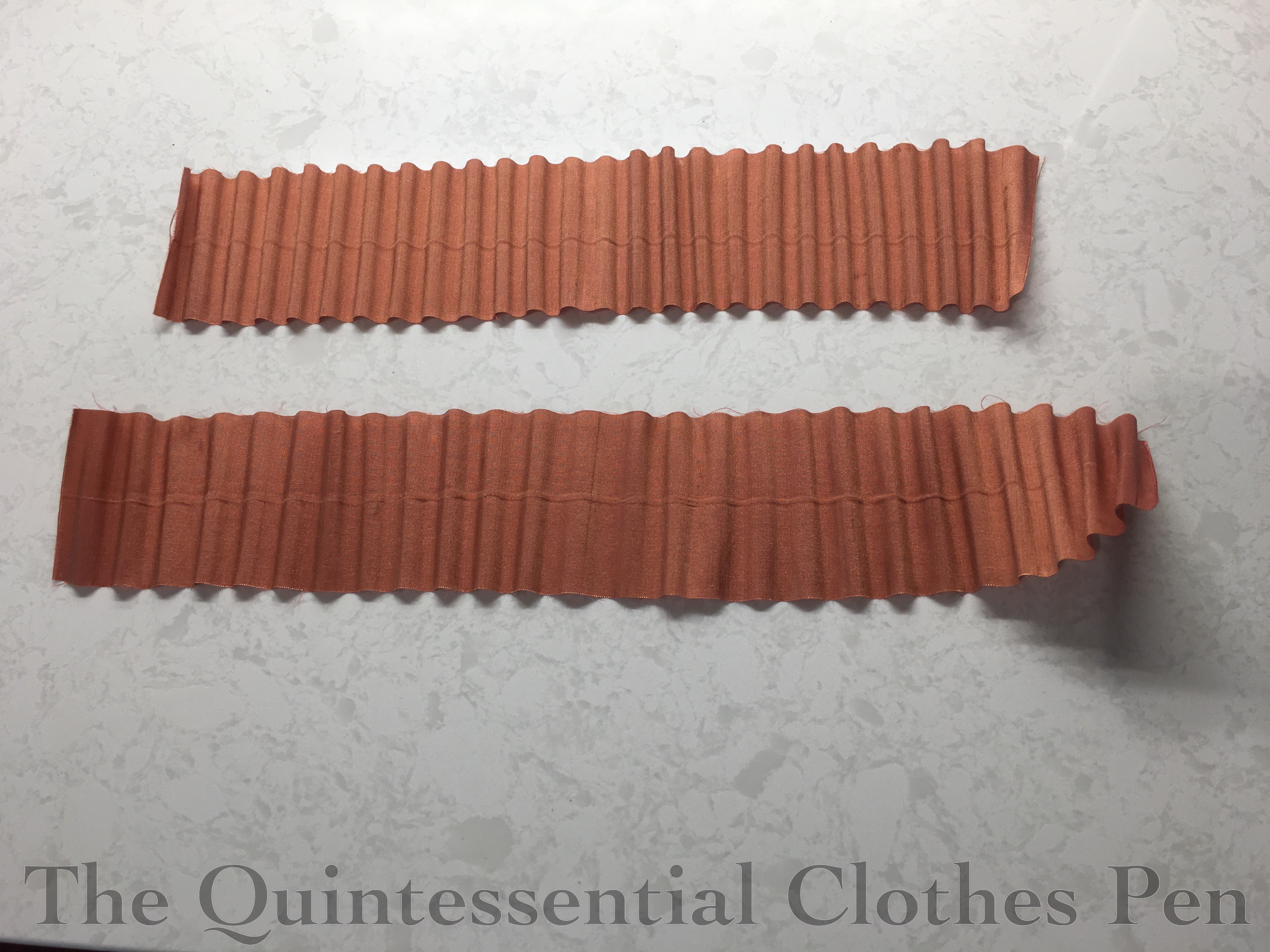
I was well practiced by this point, having fluted lots of silk for the 1875 dress, so away I went! The cotton strips are cut on the grain and folded along the long edge–no hemming required!

Attached to the neckline the trim looks like this. The waves are a little crushed where they are tacked down, but the folded edge maintains a nice wavy shape. I found that my cotton frayed more than I wanted it to, so I went back and whip stitched over the raw edge to keep it tidy.

I used the same cotton for small ruffles on each cuff, as well. Like the neck ruffle, these are hand sewn inside the finished sleeve openings.

You can see the finished effect of the ruffles in the next photo! Subtle, but adding a nice edge finish.

While the ruffles are sewn to the inside of the finished bodice, the purple bodice trim and plaid cuffs are sewn similarly but on the outside of the finished bodice. I didn’t want them to add bulk by turning all the way under into the bias edging, so they have the raw edges turned under and then they are hand sewn to the outside of the bodice.

I decided the purple trim around the neck wasn’t quite interesting enough and so I added a narrow fold of bias cut plaid to help transition between the two solid colors. This also helps the bodice to feel that it belongs with the skirt, so that the only plaid isn’t just on the skirt front and cuffs.

Final details

Both skirt and bodice are mostly assembled by machine with hand finishing, including trimming, hemming/facing, closures, etc.

I used about 8 yds of the different wools and drab cotton for the ensemble. These materials, plus notions etc., cost just under $30. This was definitely helped by the fact that most of the fabrics were purchased for just $3 per yard at the local discount fabric store!

The skirt is a bit heavy, being made of about six yards of wool and cotton, but it’s not unreasonable. And, it’s quite warm! I was perfectly warm in the approximately 20 degree Fahrenheit cold for all of these photos except for my nose, chest, and hands. Never fear, though, I was wearing the additional layers of my newly completed mantle and muff except for during these photos! (And there will be posts coming up about them as well, with lots more photos!) With all my layers the only part of me that was cold was my nose!

In the end, I’m more pleased with the overall dress than I expected to be! I was always excited about the skirt and the purple swoop of the upper bodice trim, but once I started making the dress in wool I was worried the bodice might be too plain and maybe even boring… but I like the fit and shaping very much (especially in the back!) and I think that helps balance out the relatively simple style. It makes sense for a wool dress to be well tailored but more simple in decoration and style than its silk counterparts.

Also, I’m very pleased that my idea from 2012, to use these fabrics for a bustle dress, has finally been achieved! I think there’s still a yard or so of tan wool in my stash, but I’ve sewn my way through a good 8 yards of it. That’s great stash busting!

Fabric Stash Additions: Summer 2020

I’ve accumulated a few new fabrics over the last few months and I thought it would be fun to share them in a stash addition post!

Fabric for new sweatpants

I have a favorite pair of sweatpants that I’ve had for almost 20 years. They’ve seen a lot of wear. After 20 years, the hems are pretty worn out and they’re starting to develop holes in the fabrics near the seams. I’ve been on the lookout for similar ones to replace them for years, but the fit is hard to find: wide-ish legs with a bit of a flare, diagonal pockets, and wide hems. I’ve never come across another pair with quite the same styling. (And they’re not currently in style, being 20 years old, so that’s part of the challenge.)

While wearing them quite a bit in March and April I had the thought that “I could make myself a new pair of these pants!”

This idea was spurred in part by the lovely fleece fabrics that Blackbird Fabrics has stocked over the last eight months or so. Every time they popped up in an email I considered purchasing some, but couldn’t make up my mind about color and dragged my feet. Blackbird’s fabrics sell out quickly and I kept missing the boat with my indecision, but then they restocked the bamboo/cotton stretch fleece and matching ribbing and I decided to make a decision, go for it, and order some!

Doesn’t the fleece side of this fabric look soft? I love that new fleece feeling!

I ordered 1.5 meters of the fleece and .5 meters of the ribbing. I’m sure I’ll have leftover ribbing, as it’s only used for the band at the top of the pants, but I’ll find a use for it again someday, I hope.

Of course, right around the time I purchased my new sweatpant fabrics the weather warmed and I lost my motivation to make the pants. But the fabric isn’t going anywhere and in theory the weather is getting cooler soon, so maybe these will make it onto my sewing table sometime in the next few months.

I do congratulate myself on taking the time to take a pattern from the old pants before I lost motivation so that when I decide to move forward I’m ready to go!

Two block printed fabrics

I keep a running list of sewing projects, in order to remind myself what steps projects are at, what fabrics are marked for certain projects, and what projects I have in mind. Occasionally, while looking at this list, I get swept away with ideas for new projects.

Earlier this summer, this feeling of wanting new projects was compounded by a friend updating me on the status of her current 1830s day dress project using a lovely block print cotton. It’s been a few years since I’ve seriously looked at what’s on offer for block print cottons on places like Etsy and eBay, so I decided to check things out.

Oops! Because, of course, I found pretty things! And then my brain went into overdrive, thinking of all the amazing projects I could make with the beautiful things!

I confess that I gave in to temptation and purchased two block printed fabrics.

I feel somewhat justified in that I have very clear ideas in mind for them!

I intend for the green and red print to become a gown like this one, from about c. 1785. I have 10 yards, enough to make the dress and a matching petticoat, but I thought that someday I might also be interested in having a contrast petticoat as well.

In terms of timeline, I have no clear plans for when I might make this. I am working on stays from this period, so that will be a great help, but that’s not really a solid plan. And the stays are going slowly, as I’ve been distracted from them by other projects. So, no deadline or timeline in mind.

I also bought 9 yards of the pink print in order to make a day dress from 1843/44. But then I remembered a fabric already in my stash that would also make a lovely dress from these years (I actually posted about it in this past stash addition post in 2018–it’s the cream woven plaid). So… I’m not exactly sure which fabric I would pick for this project, though I’m leaning towards the new pink block print (whichever one I don’t pick doesn’t have a clear plan).

I have a new corded petticoat that would help with the 1840s silhouette and I already have the rest of the undergarments, so it’s not out of the realm of possibility that I could tackle this project in the not-too-distant future. (What does that actually mean? Next year, maybe?)

Discount duchess satin

This is the standard ‘I happened upon it’ story. This blush duchess silk satin was in the discount bin at a local store.

Of all of the fabrics I’ve acquired recently, this is the one that is the most ‘stash addition’.  I don’t need the 1.5 yards that I bought for anything in particular, but I thought that for the low price it was worth picking some up.

I think it would make a gorgeous 19th century corset (like my 1880s steam molded corset, which is also made from duchess silk satin). I also have vague plans to someday make a 1920s corset/girdle and I think it might be useful for that as well.

In conclusion…

I’ve been doing well at using stash fabrics to make things recently, which is great, but I’m not sure if I’ve offset that by buying new things… Oh well! Sometimes you have to buy things when you see them!

c. 1880 Petticoat (HSM #5)

I decided I needed a new petticoat as part of the 1875 ensemble I’ve been working on for the last few months. I have a very ruffly petticoat from 1883 (shown in this past post) that helps with the shelf backside shape that became popular in that year, but I wanted a different shape for 1875… something to produce a more rounded silhouette and support the train I was expecting to include on my new dress.

My original thought was that my balayeuse would button to this new petticoat to create the support for the train of my dress (as opposed to making a trained petticoat and then potentially needing an additional petticoat without a train in the future). The idea is that the balayeuse + new petticoat will provide lots of wearing options for the future.

Along those lines, this new petticoat is able to fit over my large bustle from 1883 as well as having the ability to contain the back fullness so that it can also be used for the Natural Form years of approximately 1877-1882 (you can see the bustle in the same past post as the super ruffle-y petticoat). I don’t have a Natural Form dress yet, but it is on the to-do-someday list and in the spirit of reusing garments and saving time, this seemed like a reasonable decision.

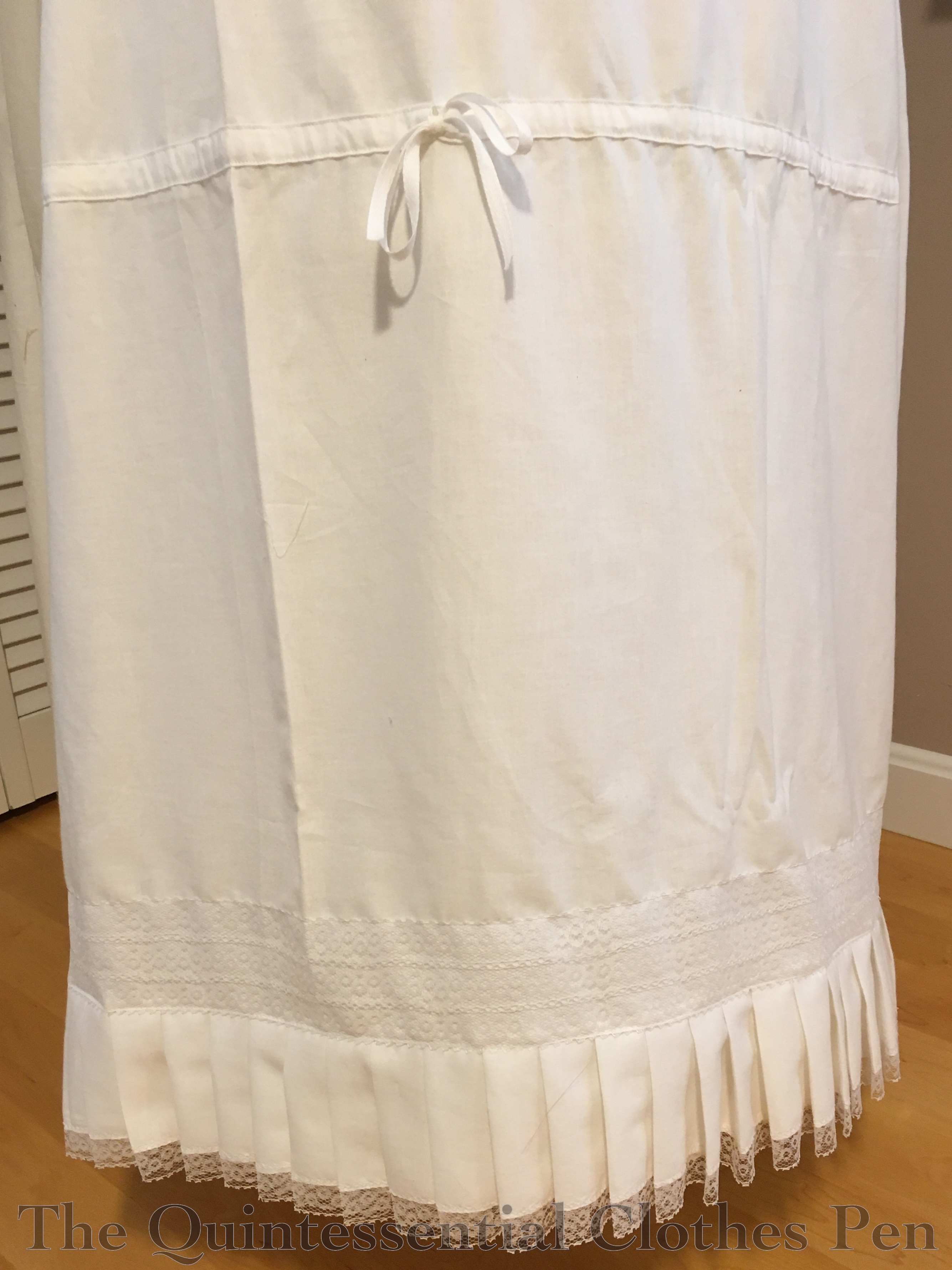
Here is the new petticoat over my large bustle. The drawstring partway down the back allows for the adjustment for different bustle shapes. It is anchored in the side seams.

Here is the petticoat without the large bustle. This is approximating the Natural Form look. While the hem pulls up a bit over the large bustle (above), it is pretty even for the Natural Form look (below). The great thing is that once there is a dress over the petticoat you can’t tell what the hem is doing!

The pattern for my petticoat is from Frances Grimble’s Fashions Of The Gilded Age Volume 1, page 107. It’s a pretty simple shape. Accordingly, I made mine using straightforward details and machine sewing/finishing.

The petticoat has a drawstring at the waist, for adjustability. The drawstrings run through the waistband and are anchored along the sides with a line of machine stitching.

At center back the drawstring closes the top of the placket. The placket is just a slit that is bound with a strip of cotton cut on the grain. No bias here–this saves fabric and makes things easier to sew! The waistband and placket biding are finished by stitching in the ditch.

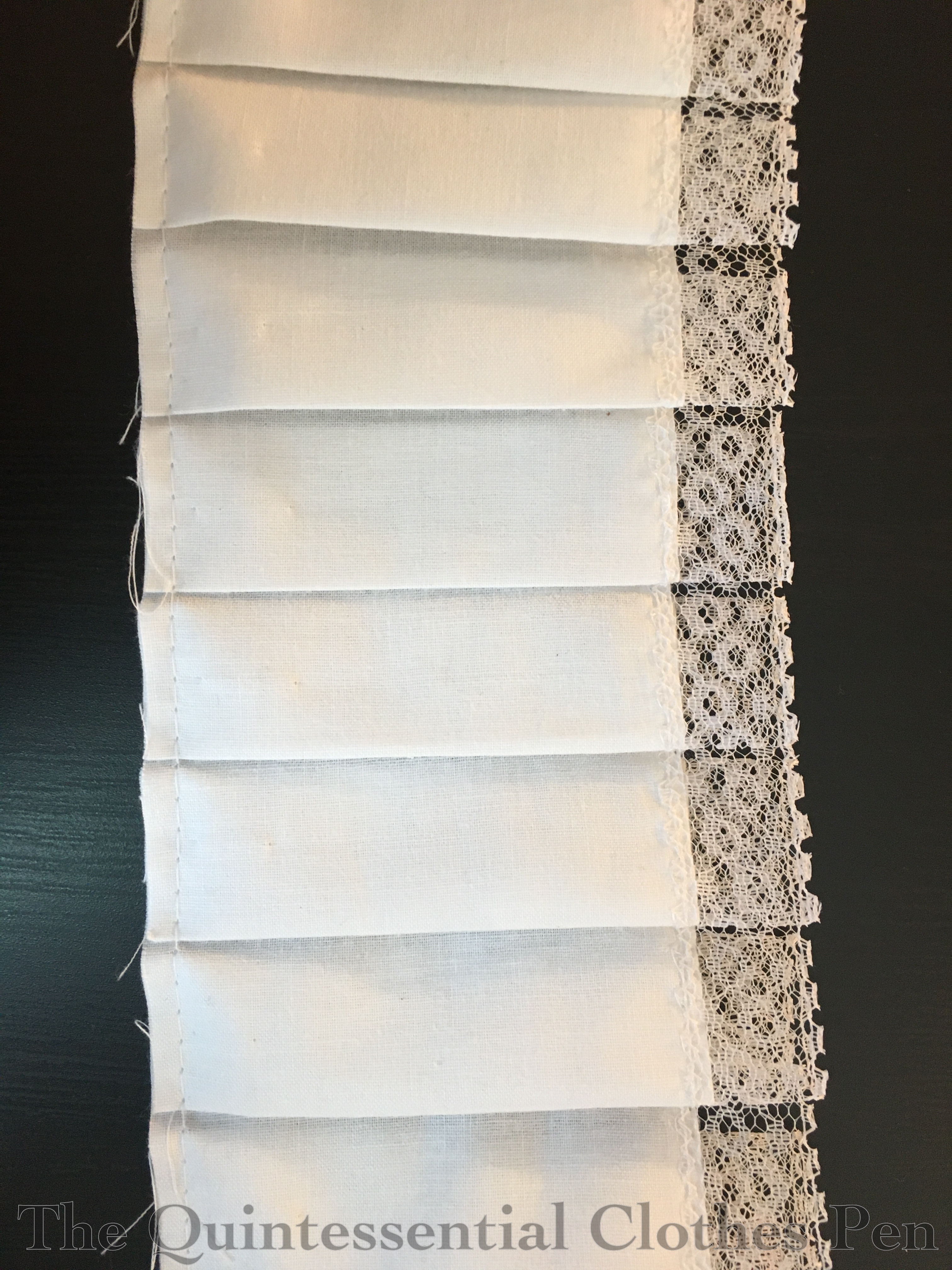
I decided on a medium width pleated ruffle for the bottom edge of this petticoat. I used a fork to help space the pleats, eyeballing and ironing as I went along.

The ruffle is edged with a stiff lace from my stash. I’ve had this for nine years and always wondered what to do with it, because it is so stiff. Turns out it was perfect for a petticoat, when a little stiffness is helpful! The lace comes in the stack of three that I used to top the ruffle. To get the single width I simply cut apart sections of the stack.

Here’s another view of the stack of three lace, the pleated ruffle, and the drawstring. Both this drawstring and the one in the waist are cotton twill tape.

This simple garment qualifies for the Historical Sew Monthly challenge #5: Basic. I imagine it will be used for any project I make, day or evening, from about 1875 through 1882.

Make a garment that can be used for many occasions (like a shift, or the classic ‘Regency white dress’), or a simple accessory that will help you stretch the use of an already existing garment.

Just the facts:

Fabric/Materials:  3.5 yards plain cotton.

Pattern: From Frances Grimble’s Fashions Of The Gilded Age Volume 1.

Year: c. 1880.

Notions: 1 yard ⅝” cotton twill tape, 1 yard ¼” cotton twill tape, 5 yards lace, and thread.

How historically accurate is it?: I’m going to give this one 95%. It’s good on shape, materials, and methods. I believe would be recognizable and plausible for its time.

Hours to complete:  8 ¼ hours.

First worn: In May, for photos with my 1875 ensemble!

Total cost: This was a stash project, so free, but the original cost of the materials were $10.50 for the fabric, $2 for the lace, and about $2 for the twill tapes, so $14.50 total.

While not the most exciting project, this was a great start on the way to making my 1875 ensemble. I’m pleased to have made a garment that is easily adjustable, useful for multiple types of events and silhouettes, and is functional but still pretty!

A Practical Experiment: How To Use A Fluting Iron

Way back in 2012, I posted with great excitement about a new to me sewing tool that Mr. Q called the Cast Iron Crinkle Cutter. These antique specialty irons are actually called fluting irons.

Here is mine, in action!


Despite my best intentions of actually creating trim with my fluting iron, instead it has been used as a door stop and decorative item (near my modern iron in my sewing room!) since I’ve owned it. I’m currently working on a project from 1875 that has pleated trim around the skirt and I thought that perhaps instead of knife pleating I would try a sample with my fluting iron! I figured that if I liked it (and I could get it to work) I’d use it for the trim on the dress.

Brief History

Specialty irons have been used for hundreds of years to create different types of ruffles and trims. I came across two sites that had really interesting information about the fluting iron I have as well as many other types of irons from around the world and for the last few thousand years. This one is summary of ironing throughout history. This one is more about types of historical irons. Also, this video from the Oshawa Community Museum looks specifically at some ironing tools that were used to create late Victorian ruffles, including various types of fluting irons.

Along the way to learning more about fluting irons, I also learned that flat cast iron irons are called sad irons. (I might have read that before but didn’t remember the term, so it feels like new information!) They’re called that not because they’re melancholy, but because in the past ‘sad iron’ meant the iron was solid as opposed to hollow (to be filled with heating devices, such as charcoal). The word ‘sad’ also meant heavy and a sad iron could weigh up to 15 pounds. That only further reinforces the fact that laundering in the 19th century was strenuous work (hand scrubbing, hauling buckets of water to heat, maintaining the stove or fire, harsh soaps, refreshing the rinsing water… hard work!). *This is edited from my original description of sad iron. To read all about the etymology of the terms ‘sad’, ‘sad iron’, and ‘box iron’ (the term for a hollow iron), check out this post, published after the one you are currently reading.

Practical thoughts about getting started

In terms of my fabric, I had the strips I wanted to flute prepared and ready to go before ironing them. I had hemmed one long side and just pressed the other edge under (that would become the top edge). With the crisp silk I’m using I probably could have gotten away with just pressing under both the hem and the top edge, but oh well. I prepared and hemmed these long before I officially decided to flute them.

In terms of the fluting iron, I followed these steps (or considered them, anyway):

Cleaning: I used dish soap and a toothbrush, to really get into all the grooves on both pieces of my fluting iron and remove the accumulated dust and grime (I don’t want those on my silk fabric!).

Drying: To prevent rust from forming, I carefully dried the iron and then also let it air dry overnight (though I realized that if I were to immediately use it the heat would cause all of the water to evaporate anyway…).

Seasoning: This is done on non-coated cast iron pans to keep them from rusting. I chose not do this with my iron at this time. I might do it later (I read that well-seasoned cast iron will not release oil onto your fabrics), but right now I just wanted to get started on my experiment.

Supplies

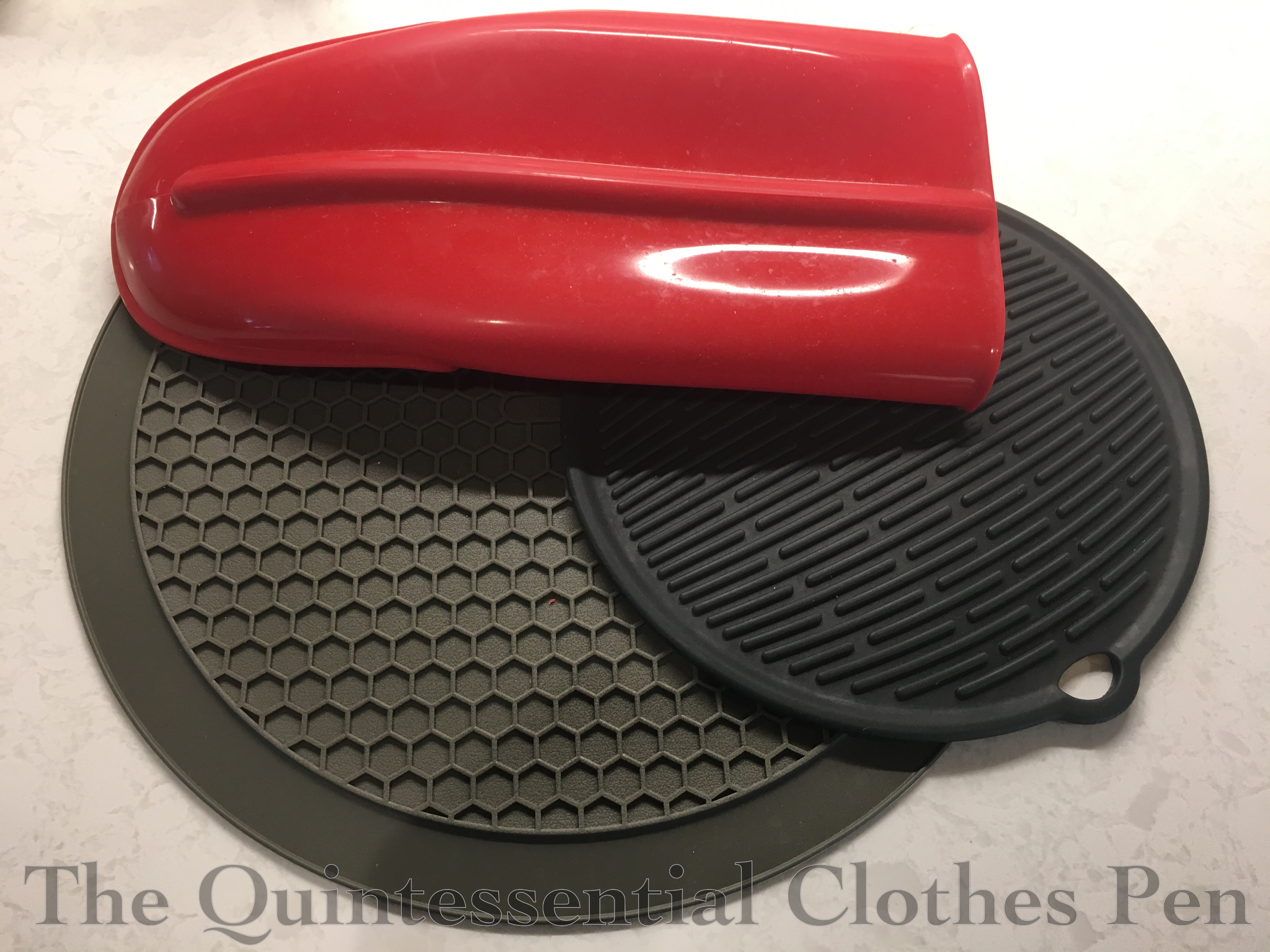
It’s worth noting that the cast iron gets much too hot to hold with bare hands or put directly on the counter to use, so in addition to the two parts of the iron, I also used a variety of other kitchen tools in this experiment.

I used the baking sheet, cookie drying rack, and cast iron frying pan you’ll see in photos at various points, as well as the silicone baking supplies pictured below: a hefty mitt, a small trivet, and a large trivet.

I also used a spatula to help get a grip on the base of the iron while lifting it out the frying pan, a small spray bottle, white vinegar from my pantry, and tap water.

Method #1 (the slow and steady way to heat the fluting iron)

Heating/Using: I used my conventional oven to heat both parts of my fluting iron on a baking sheet. I could not find specific directions for temperature or length of time, so I started conservatively with 175 F for 15 minutes. (Partly due to the basic information on Wikipedia about specific temperatures for different types of fabrics, but also check out the image of the tailor’s stove on the right side of the page: a multi-sided stove to heat sad irons simultaneously makes so much sense if you’re ironing a lot, as tailors would be!).

When tested on my silk this hardly made an impact. So I put the iron pieces back in the 175 F oven for another 10 minutes. This was better, but not as effective at getting tight flutes as I wanted. On the left are the barely visible results from the first 10 minutes of heating and on the right after the second 10 minutes of heating.

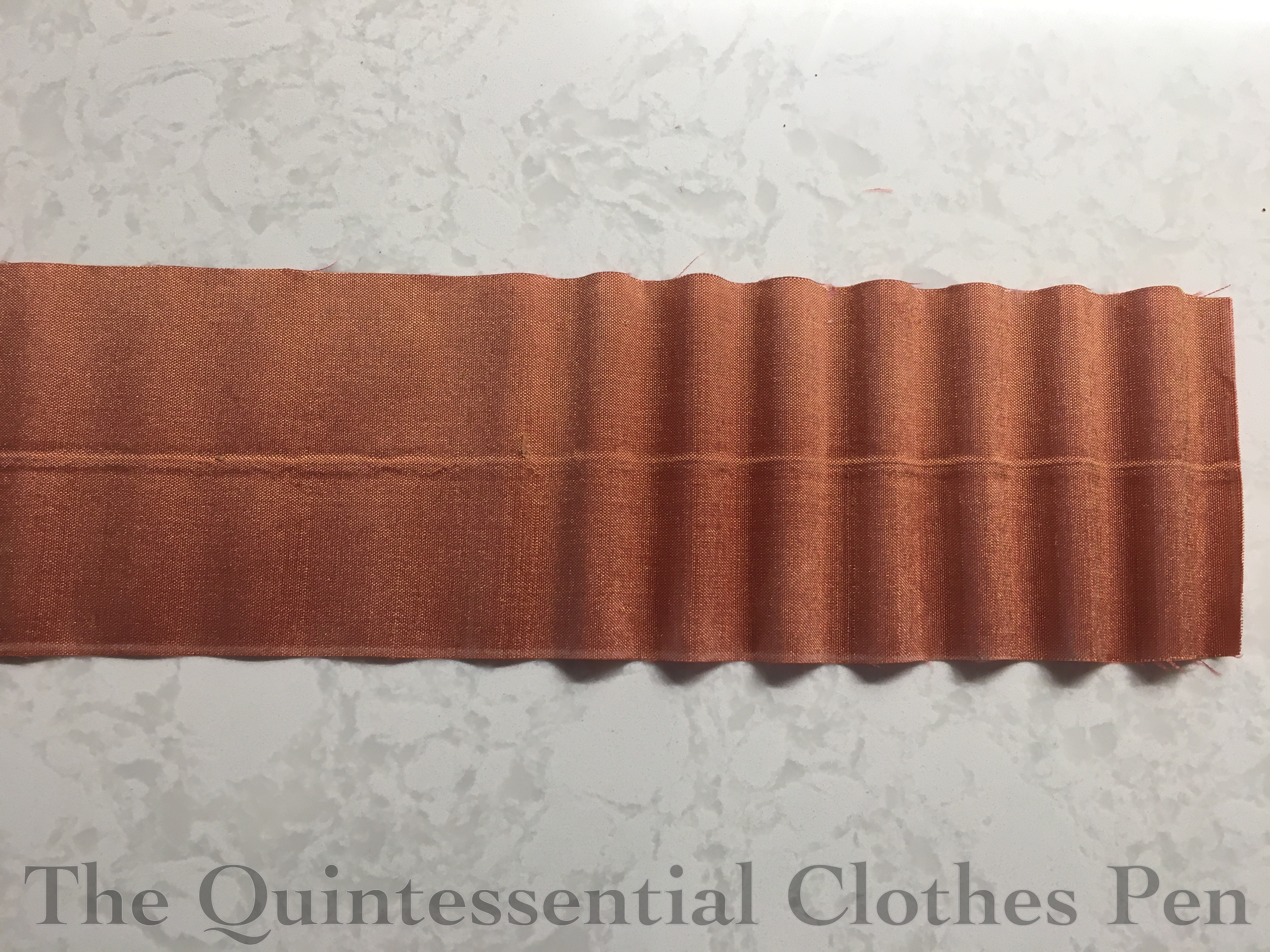
I increased the temperature to 225 F and put the iron pieces back in the oven for 10 more minutes. This time I also decided to use vinegar to help set the flutes. I mixed ½ white vinegar and ½ water in a spray bottle and then sprayed the section of silk I intended to iron. Here you can see the sprayed silk ready to feed into the iron on the left and the results coming out on the right.

This worked much better, but still feeling like I needed more heat to get a good sizzle and press, I increased the oven to 275 F and put the pieces in for another 10 minutes. This seemed like the right temperature! A bit of sizzle from the evaporating liquid on the silk and tight flutes as a final result.

Here is a comparison of two silk samples. The one on the bottom used vinegar and lower heat: 175 F and 225F. The one on the top is the sample that used vinegar and 275 F for heating.

Reheating: I found that the iron lost heat pretty quickly. I reheated it for 10 minutes after every 5 minutes of use. It wasn’t the most efficient process (I can really understand why you would have a set with multiple irons to keep them heating while not in use), but it got the job done on a Saturday afternoon. Experimenting with temperature and fluting 106″ of fabric took about 4 hours.

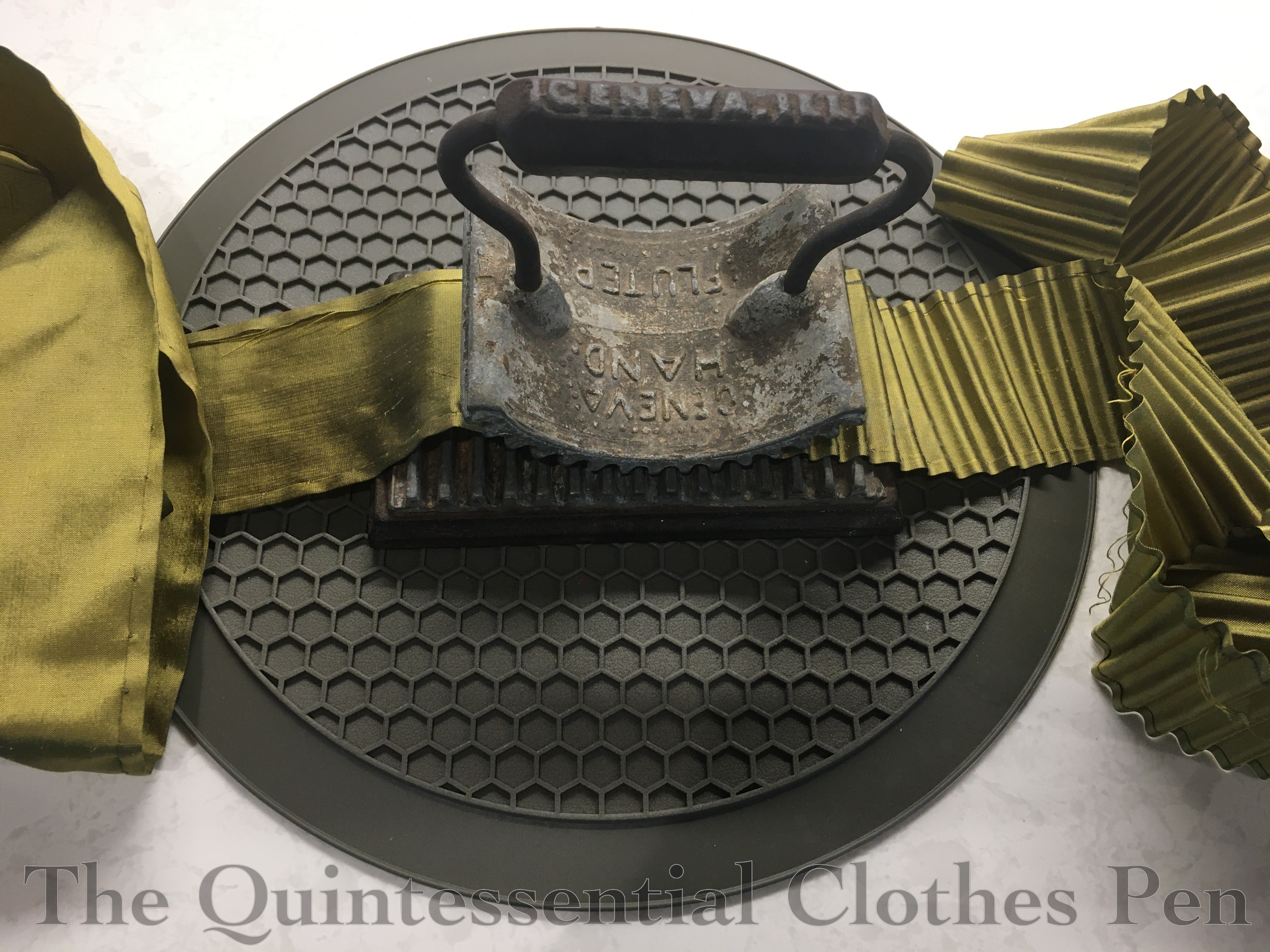
Setting: In addition to using vinegar (which made huge difference in terms of getting crisp flutes!), I also found it quite important to move the iron very slowly over the base to create the flutes. A quick pass did not do the job and getting each and every flute to line up perfectly to go over it multiple times is much easier to say than to do! I rocked the iron from one side to the other, trying to hold each little section in place for at least a few seconds before moving to the next. I got through about two full rocks with the iron before needing to reheat it.

Method #2 (the much more efficient way)

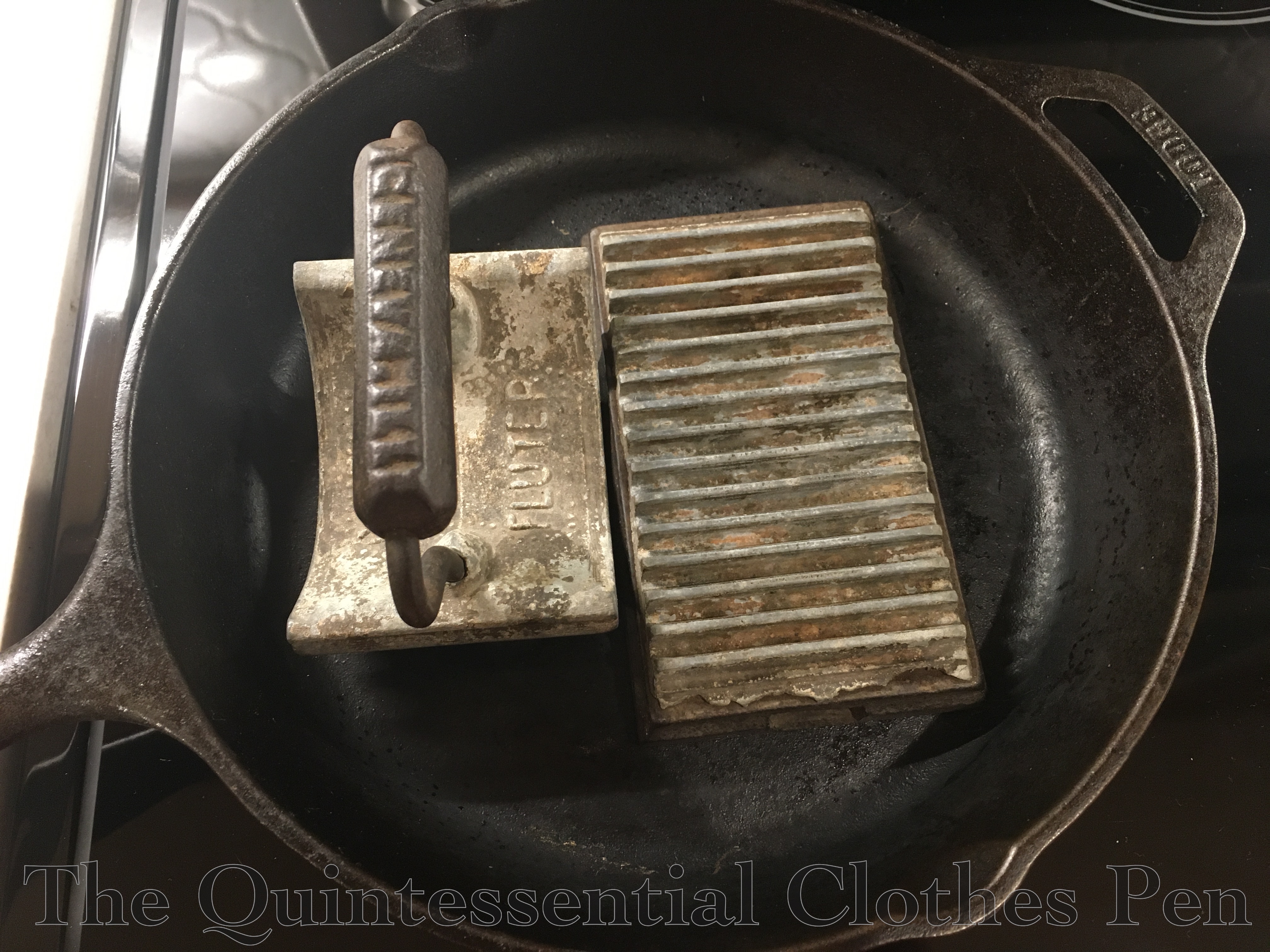
Heating: After I completed the first of three 106″ sections of trim, a science-minded friend suggested that I would have much more efficient transfer of heat to the iron pieces if I were to heat them directly on my stove in a cast iron pan. This was genius!

I started with my pan on pretty low, as it’s much easier to heat cast iron up than cool it down. This particular burner on my stove gets super hot, so I kept the pan around 2 out of 10 in terms of heat. Harder to translate for other people, but I let the iron heat up for about 10 minutes, until I could feel radiant heat coming from the base when it was out of the pan and I held my hand 1″-2″ away. Another way I tested the head was with a drop of water. At this temperature it quickly evaporated when dripped onto the cast iron.

Reheating: Using the cast iron pan was much more efficient than the oven! I still reheated the iron after about 5 minutes of use, but now I only had to let it reheat for 5 minutes. And because I wasn’t lifting a pan in and out of the oven it was much easier to let the top part of the iron sit on the pan while I moved the fabric along the base piece of the iron. Because the iron was warmer than with the oven, and I’d had more practice at using it, I was able to do three or four full rocks of the iron before needing to reheat it. That meant that my second and third 106″ lengths of fabric only took about 1 hour each. So much faster than with the oven!

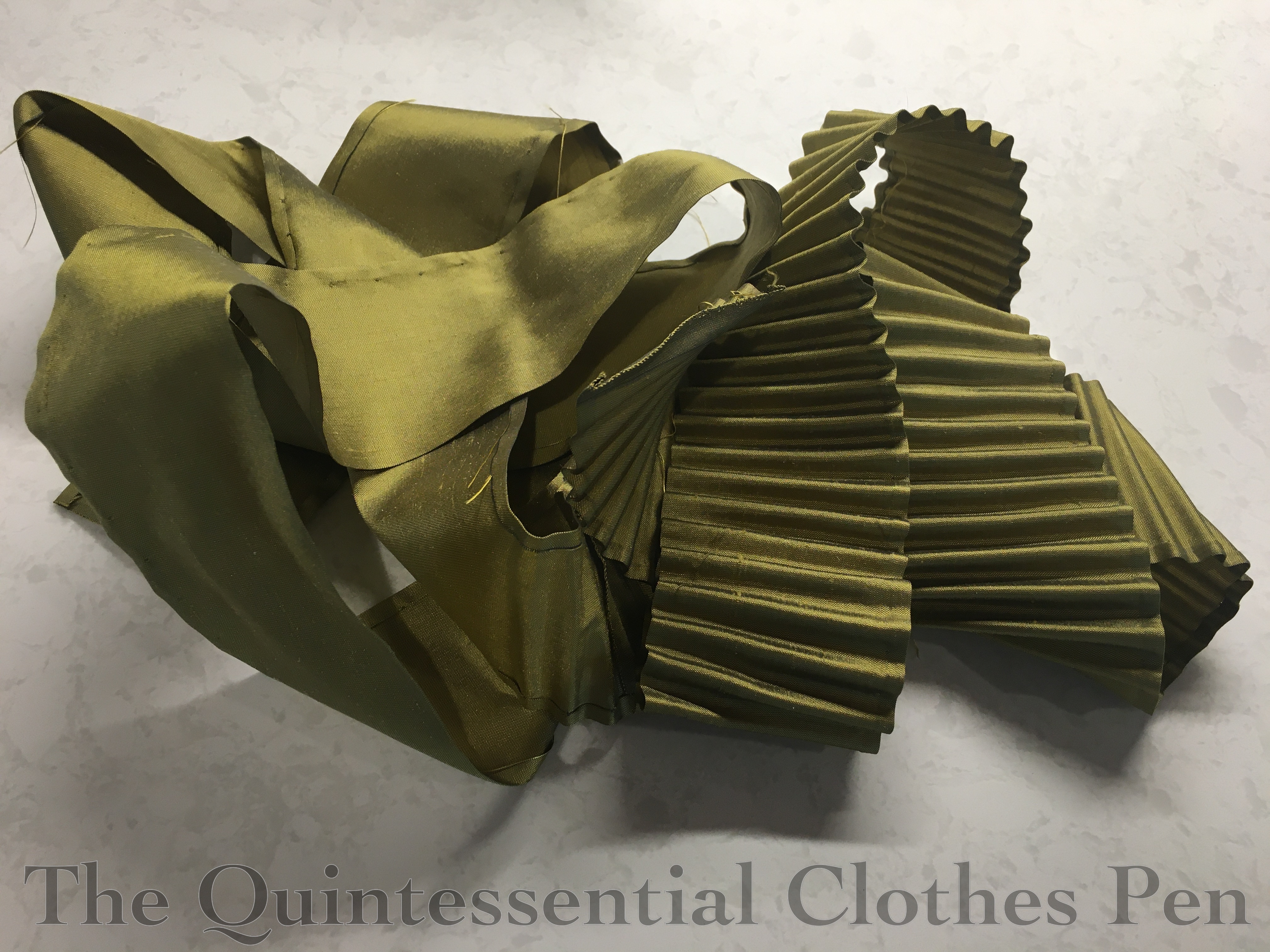
You can see the crisp flutes that this method acheieved.

Setting: I used the vinegar/water spray to help set all of these flutes. It should help the fabric to keep this shape permanently (short of me completely soaking the fabric). I experimented with a light spritzing, but the heat quickly evaporated the liquid so I started just making it pretty soaked. Sometimes I even sprayed a bit on the fabric right under the iron if it evaporated before I reached that section of the rocking motion.

Here’s another view of the half finished strip of fabric.

Post Experiment Thoughts

This was fun! I would definitely like to use my fluting iron for more projects–and it should be easier now that I’ve figured out how.

I will say that practice makes a huge difference in terms of being able to flute quickly, so that the iron doesn’t cool down. You don’t have too long to think once you take the iron off the heat source!

A finished pile of about 318″ of fluted trim! I’m curious about how I will sew this on. I think that a sewing machine would crush the flutes (and I don’t think I want a line of machine stitches anyway), so I will likely sew it on by hand, catching only the valleys and not the hills in the fabric. Good thing I like hand sewing!


I came across few people trying out antique fluting irons while looking for information to get started on this experiment. For the sake of anyone else who might be looking, here are a few other practical experiments to check out:

Katherine of The Fashionable Past tried out a fluting iron in 2011 and posted about it on her blog here, including a video.

@isabel.northwode tried out a fluting iron in 2018 and posted about it on Instagram here.