1797 Watermelon Sleeveless Bodice, Part II: Patterning & Construction

This story begins in my previous post (which you can read here) in which I share the backstory and inspiration for this garment. I’ll be carrying on from where I left off. But first, a quick side story!

Mr. Q saw the title of this post and asked “What is a watermelon sleeve?” An excellent question, I think! I explained that watermelon is my description fpr the colors of the garment I’m discussing. But… I do rather wonder what a “watermelon” sleeve might look like…! After all, there are many historical sleeves with fun names (bishop, bell, pagoda, beret, gigot, and mameluke all come to mind quickly, though I can’t think of any that are named after fruit. If you can, let me know!).

Leaving that tangent behind… back to the story!

Patterning

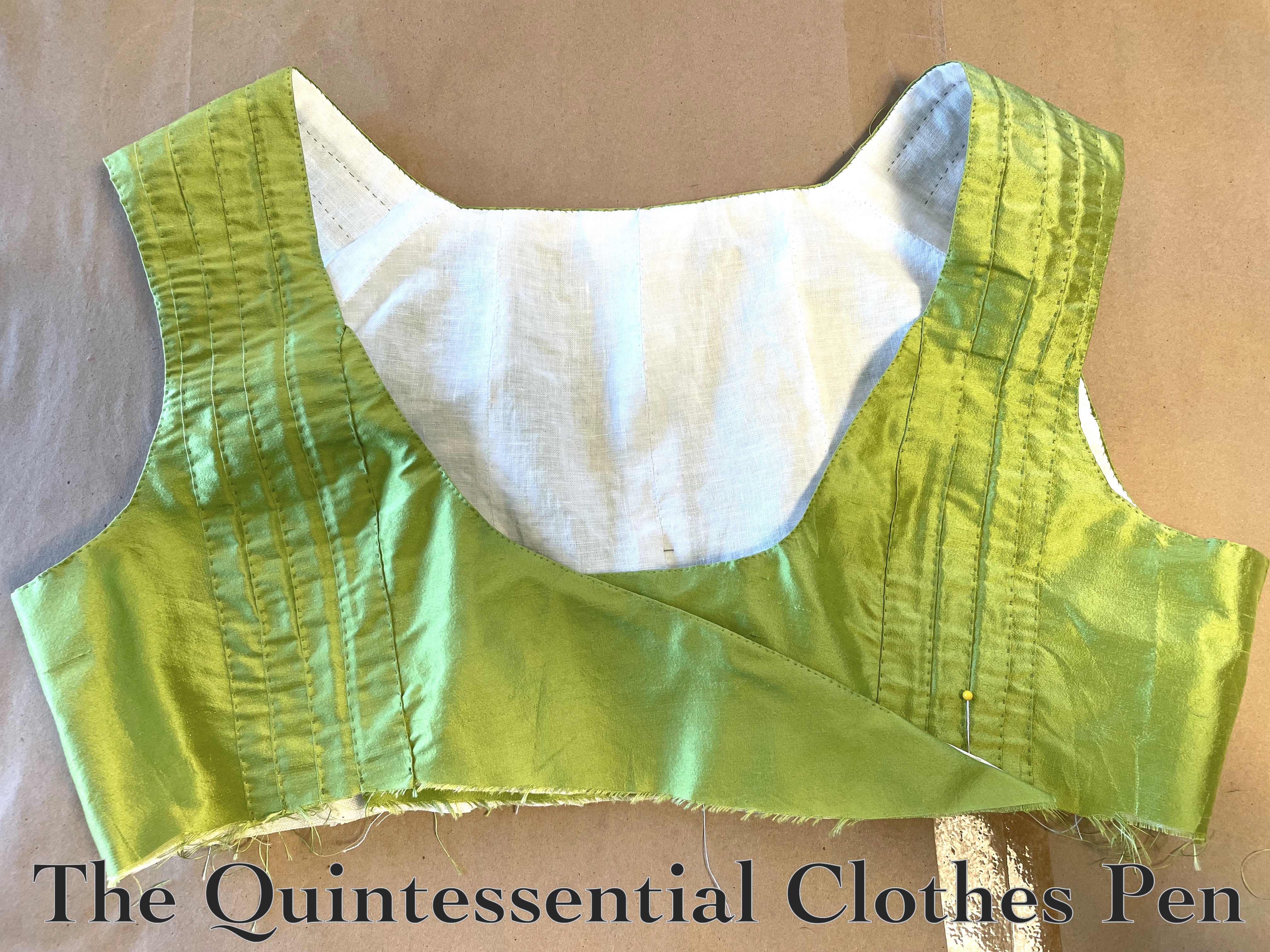
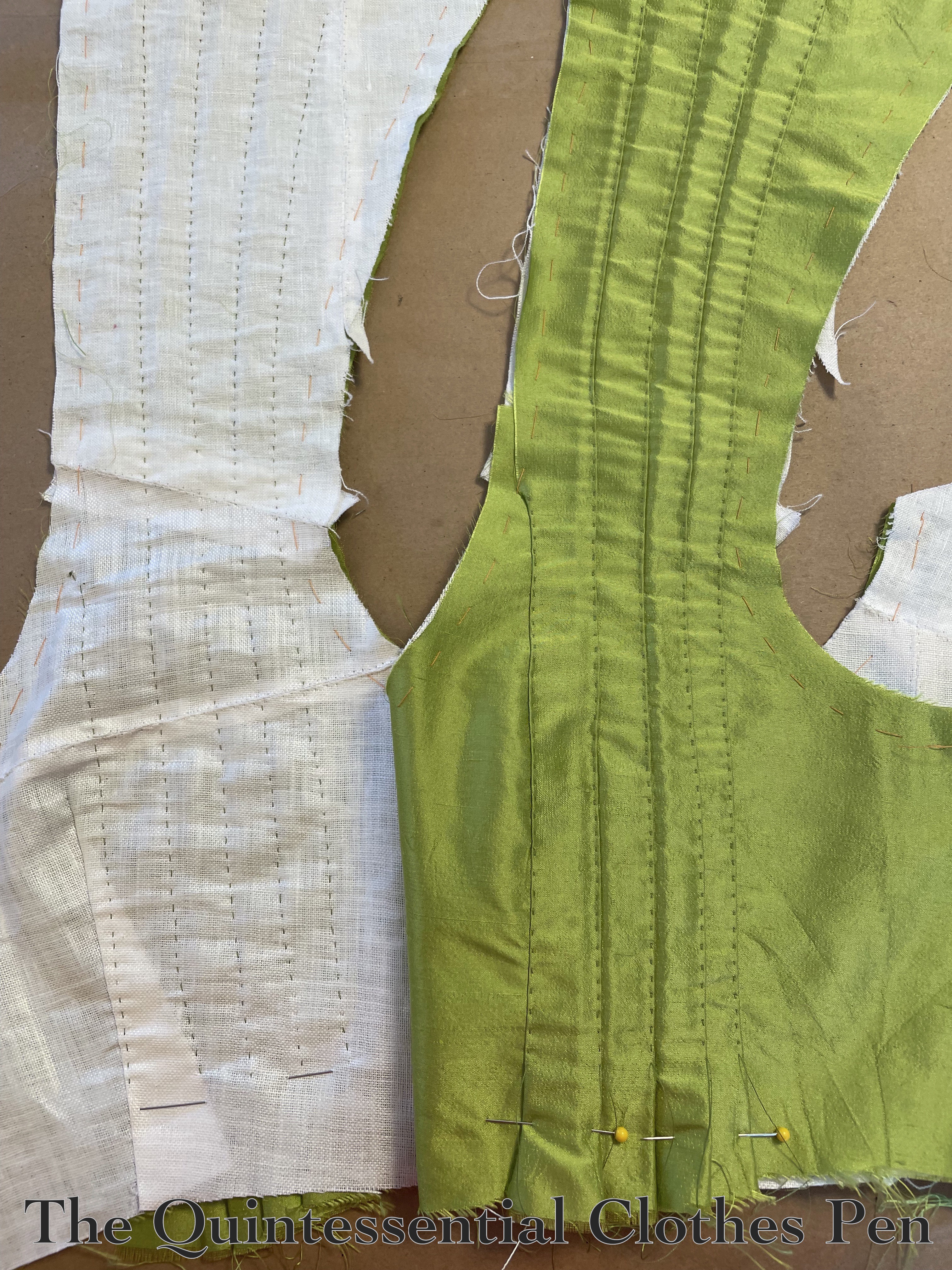
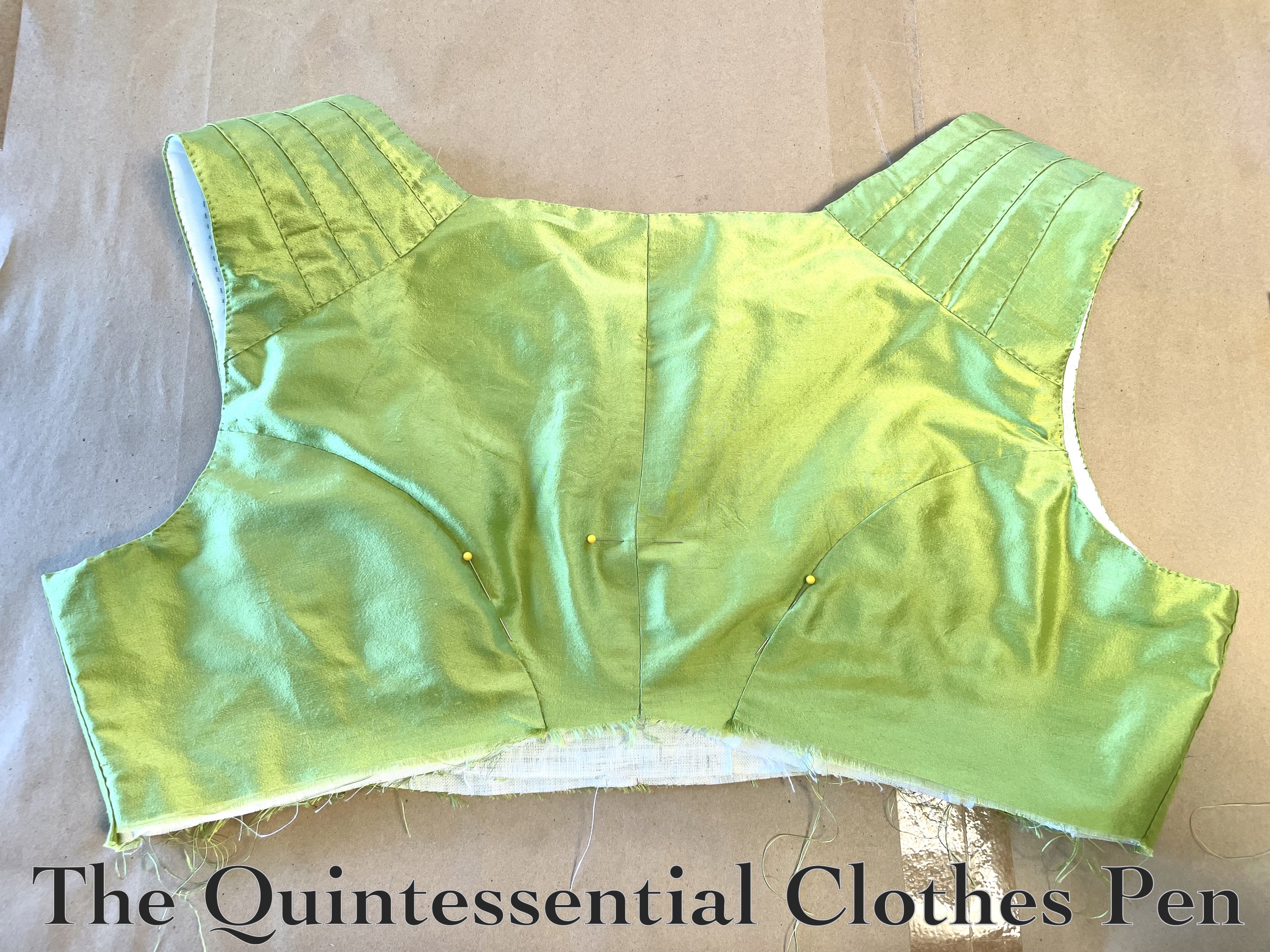
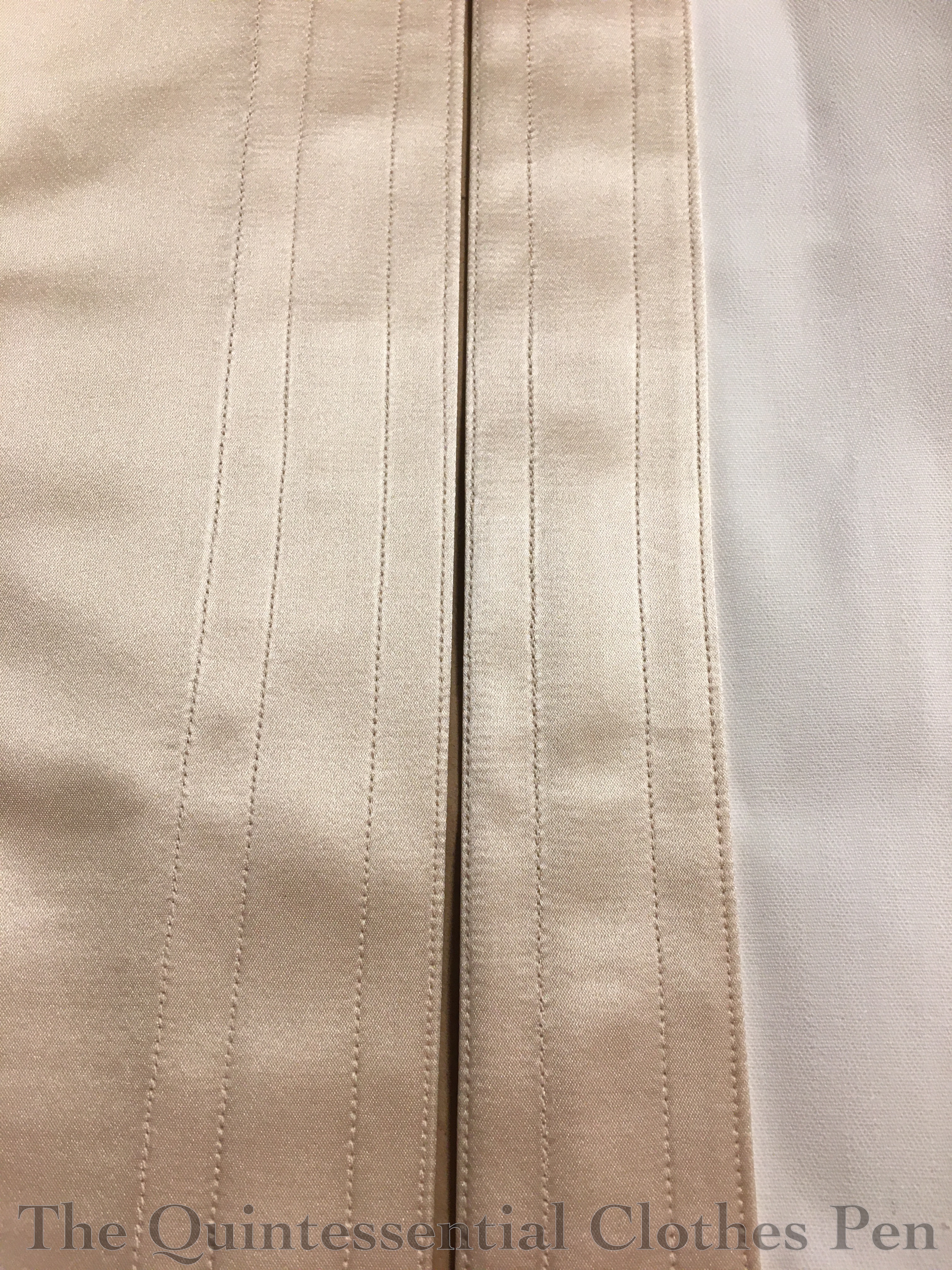
The pattern started with the lining pattern for the dress that I knew fit and would be worn under the sleeveless bodice as well as the bodice of “A Robe c. 1795 – 1803” on pages 44 and 45 of the original printing of Janet Arnold’s Patterns of Fashion 2. I liked the idea of the pleats on the exterior to provide interest on my otherwise solid fabric. It didn’t occur to me until very late in the process of making this garment that most of the pleats would be covered by the neck trim. Oops! Oh well! Below, a photo of the front of the bodice. The pleats are the topstitched lines running downwards from the shoulders.

I ended up with separate patterns for the exterior and lining front pieces, but the side back and back pieces were cut from the same pattern. I’ll explain how I made them.

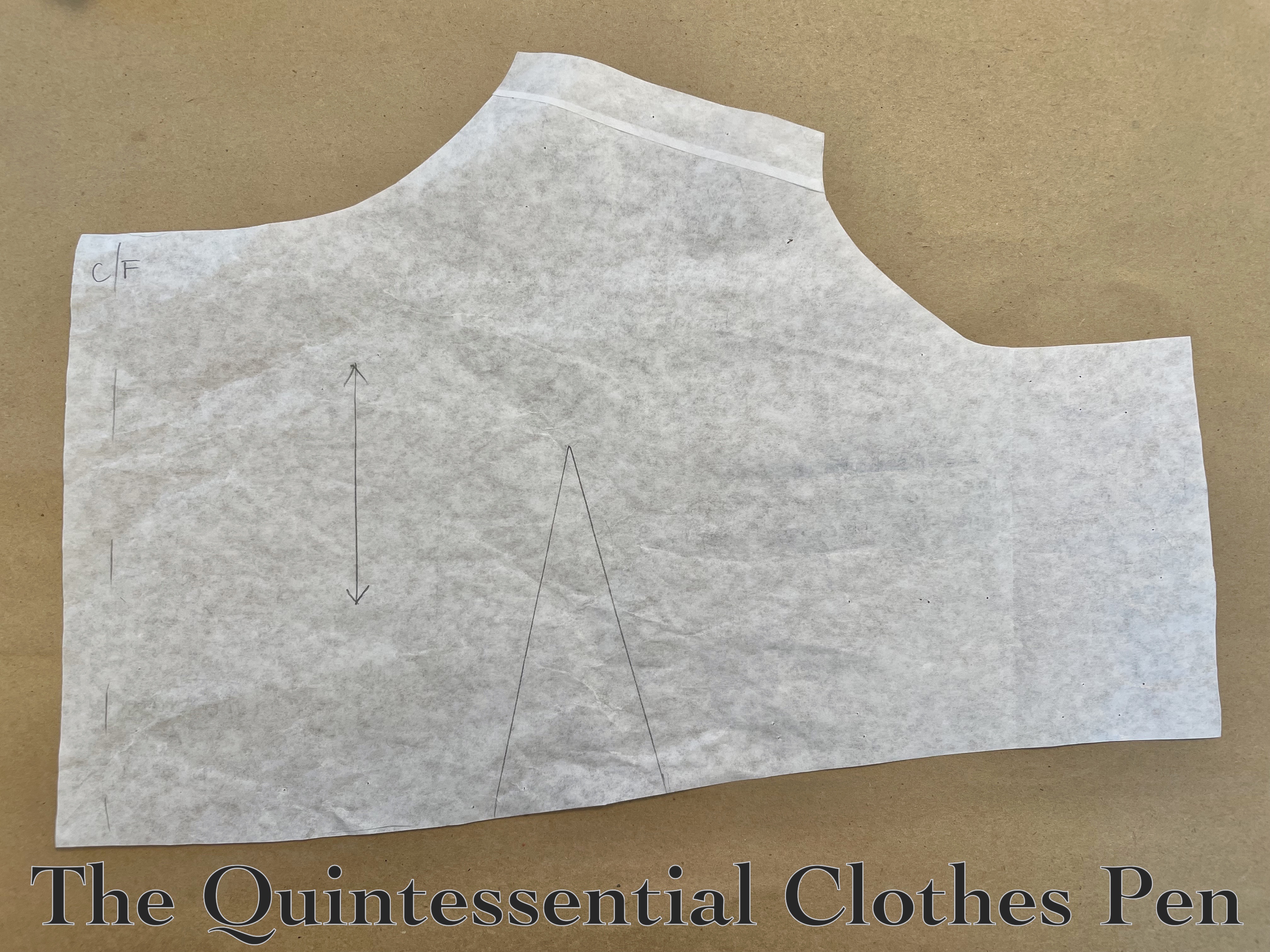
For the front lining piece, I started with the dress lining, as pictured below. By starting with this, I knew that the sleeveless bodice would easily fit over the dress and have similar seam lines.

I adjusted this pattern to have a little bit of wearing ease by adding ¼” to the bottom edge, ¼” to the neck edge, ½” across the center back piece, and ¼” across the side back pieces.

To that, I superimposed the PoF robe because it had a very low front bodice (clearly intended to be worn with a dress underneath) and it had a front pattern piece that curved downward towards the front, with a separate side front piece. Ah ha! I could create a dart going towards the waist in the area between these two pieces and have a one piece lining while also easily having a two piece exterior to make the pleats easier! This would reduce bulk in the finished garment and allow for the necklines of the exterior and lining to be exactly the same.

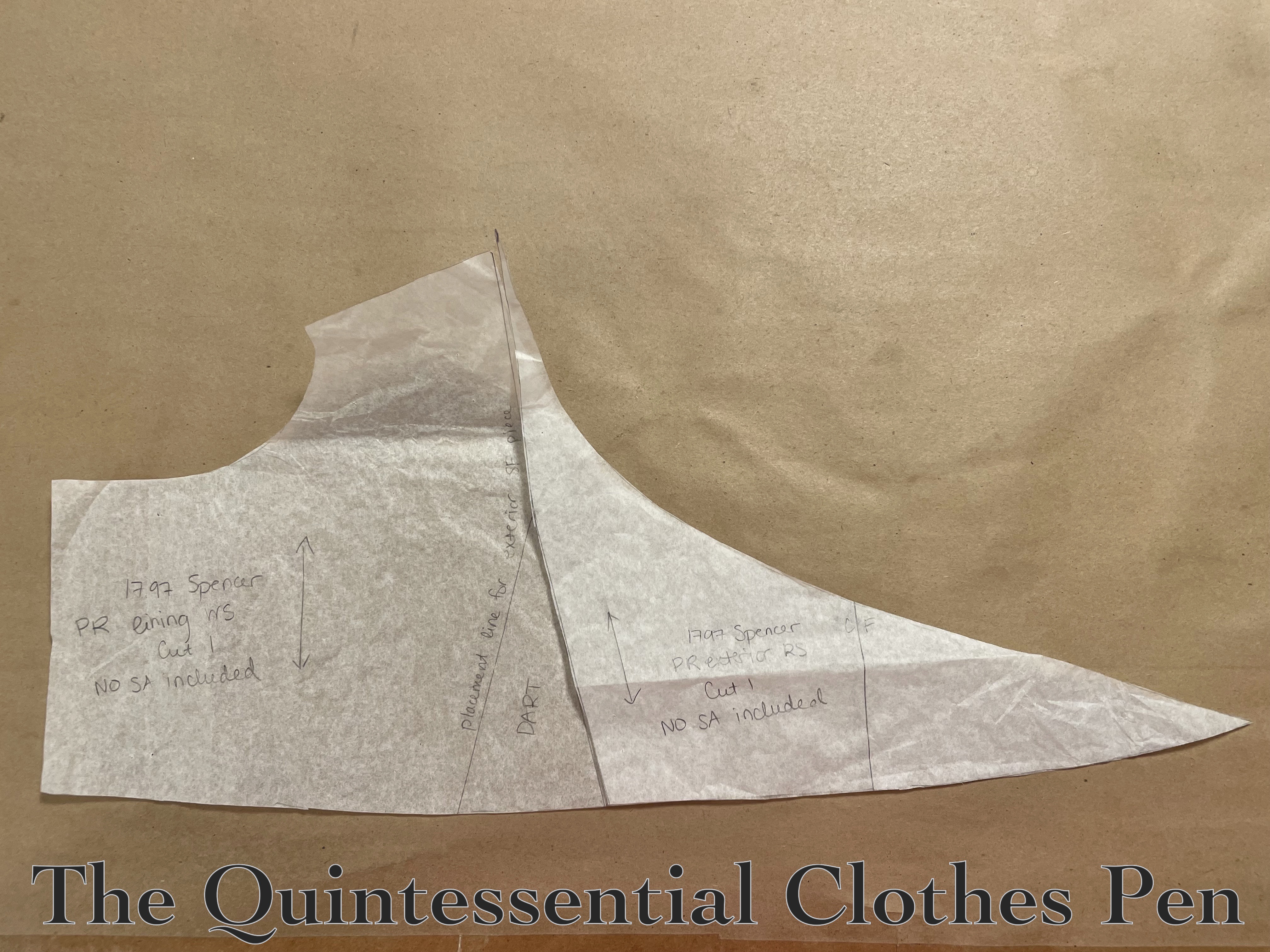
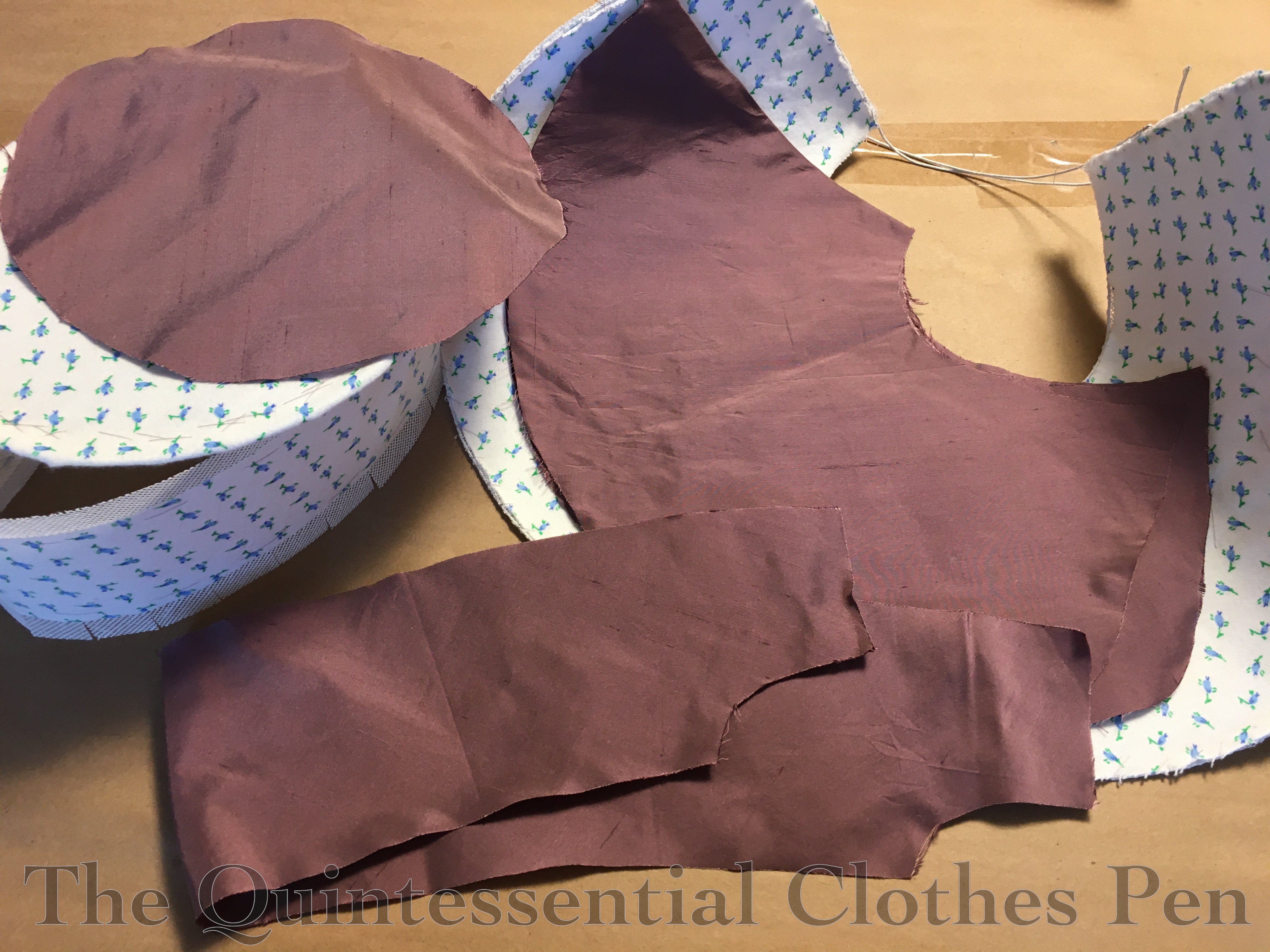
The photo below shows the front pieces I ended up with. On the left is the lower part of the front lining (the shoulder area is extended with a separate shoulder piece in the lining) and the center front part of the lining. For the lining, these were cut as one piece (with the dart marked).

If you look carefully, you might notice that the grainline on the center front piece is off relative to the side piece. Why is that, you might wonder?

Well, for the front exterior I started with the lining piece but changed the single dart to be the pleats I’ve previously mentioned. I didn’t see bust darts in my inspiration fashion plate or observations of 1790s overdresses, but in 18th century dresses pleats are used used in varying depths to adjust a flat piece of fabric to fit the curves of a body, so I used that method.

First, I traced the lining pattern onto a new piece of paper, including the dart. Then, as you can see in the photo below, I cut along the dart edge closer to Center Front, then up a line that continued to the neck edge I wanted. (I also cut down to the bust point from two other points along the neckline, but later realized I didn’t need those cuts.)

Next, as you can see in the photo below, I rotated the center front piece down towards the dart, making that area a little narrower and creating space (essentially another dart) going up towards the shoulder. Then I drew my new grainline on the front piece for the exterior, heading up towards the shoulder. This is why it looks off relative to center front. When worn, those ‘darts’ are closed when the exterior is fitted over the lining and center front is pulled into its proper place on the body.

These exterior darts — hidden in the seam line — are what creates that downward curve to the pattern pieces that I observed in PoF.

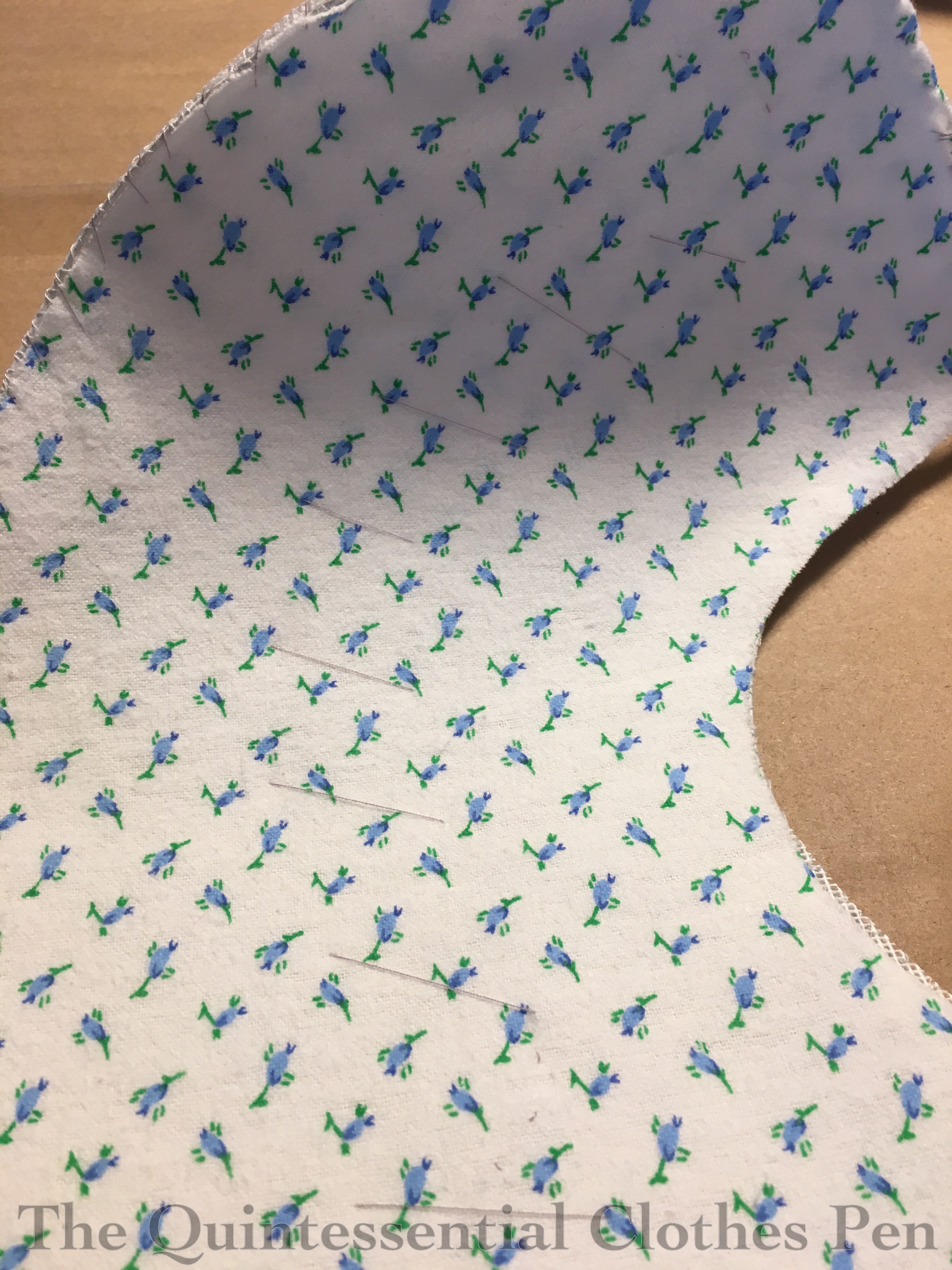
The two ‘darts’ are taken up in the pleated side front piece of the exterior, which is fitted over the center front piece and the darted bodice lining. In the photo below, the dart in the lining is visible on the left and the silk is pleated to fit and visible on the right.

After creating the paper pattern, I made a mockup and did a fitting to see how well my adjustments worked. They were pretty good, but I did have a few notes — I extended the bottom edge by a little more across the front, set the overlap shape I wanted (based on the fashion plate), set my armhole seam allowance, decided on the height of the peplum, and adjusted the front neckline to sit nicely over the dress.

I made these adjustments to my paper pattern and then moved on to cutting out my pieces in real fabric:

  • A proper left front lining
  • A proper right front lining
  • Proper left side front and center front exteriors
  • Proper right side front and center front exteriors
  • Straps in lining fabric
  • Side back pieces for lining and exterior
  • Center back pieces for lining and exterior

The Backstory: Construction

With a pattern established, I went down the rabbit hole of figuring out construction methods.
I had been reading Patterns of Fashion 6: The Content, Cut, Construction & Content of European Women’s Dress c. 1695-1795 and my mind was full of details and excitement about 18th century construction methods, so I happily went down a path of sewing in an 18th century manner! But… at some point in the middle of things I realized that I would need to combine some early 19th century construction methods into what I was doing, too, since my sleeveless bodice idea does span two different eras of construction styles.
For example, from an 18th century perspective turning seam allowances of the lining and exterior towards each other and whipping the pieces together made perfect sense. From a 19th century perspective, however, finishing the armholes with this method seemed odd (usually in the 18th century the seam allowance would have been left raw on the inside when the sleeve was attached, but I wasn’t adding sleeves!) and inserting a peplum into the bottom edge seemed odd, too (often a ruffle was applied on top of an edge, rather than being sandwiched between the exterior and lining, but that wasn’t the look I wanted). After many brain somersaults, I wound up mashing these two methods of construction together to create a transitional garment (which does actually make sense, since this was a transitional period for construction methods!).

Actually Making The Spencer

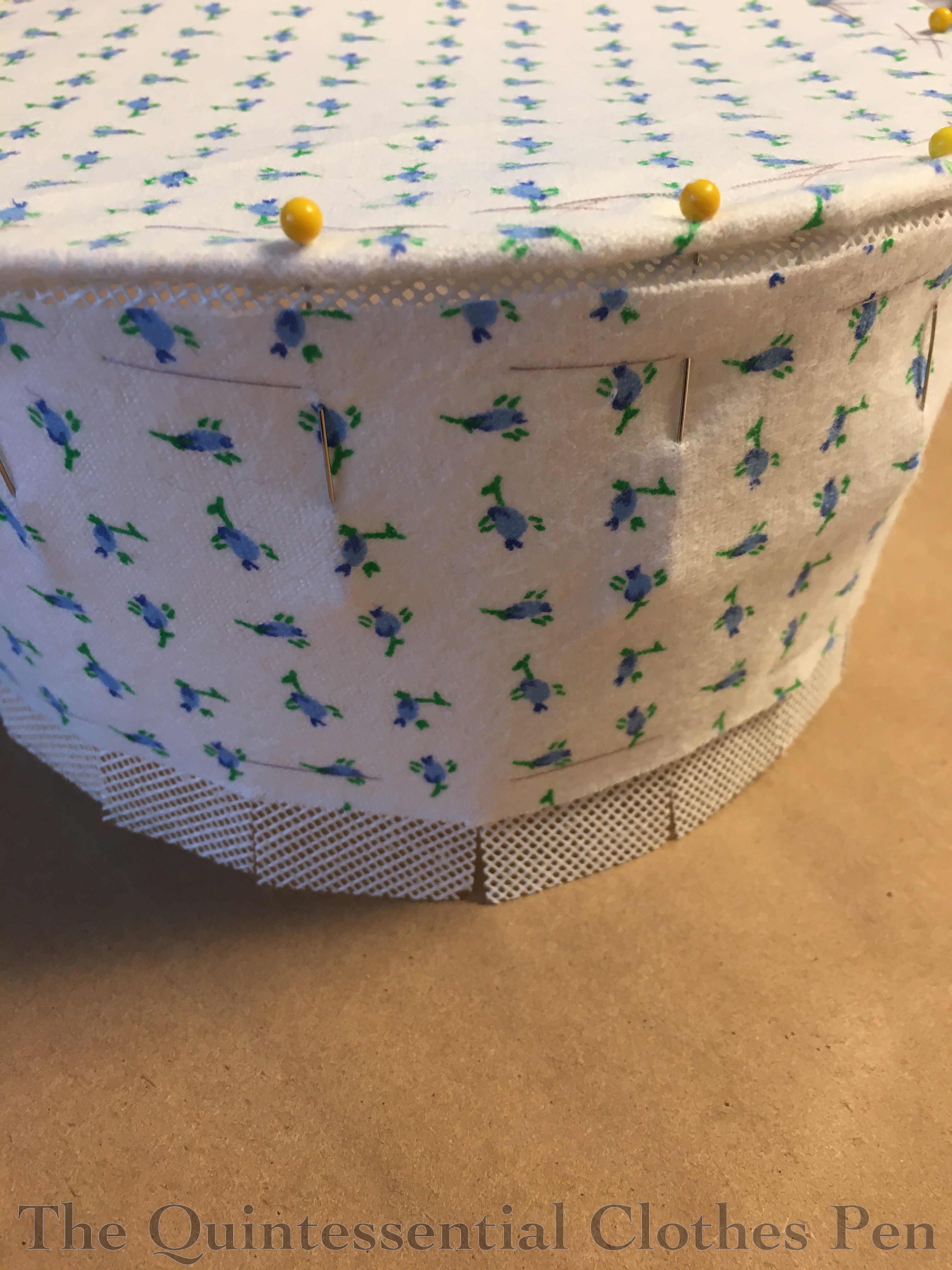
I thought it would be fun to use up linen scraps for the lining, rather than cutting into yardage from my stash. The lining pieces weren’t that big, right? Well, it turns out they were bigger than I thought. I ended up using 3 or 4 different types of white linen and adding in a fair number of piecing seams to get the shapes I needed for these lining pieces (you can see some extra seams in the lining in the previous photos). It definitely added time, but I had time while making this garment, so it was fine.

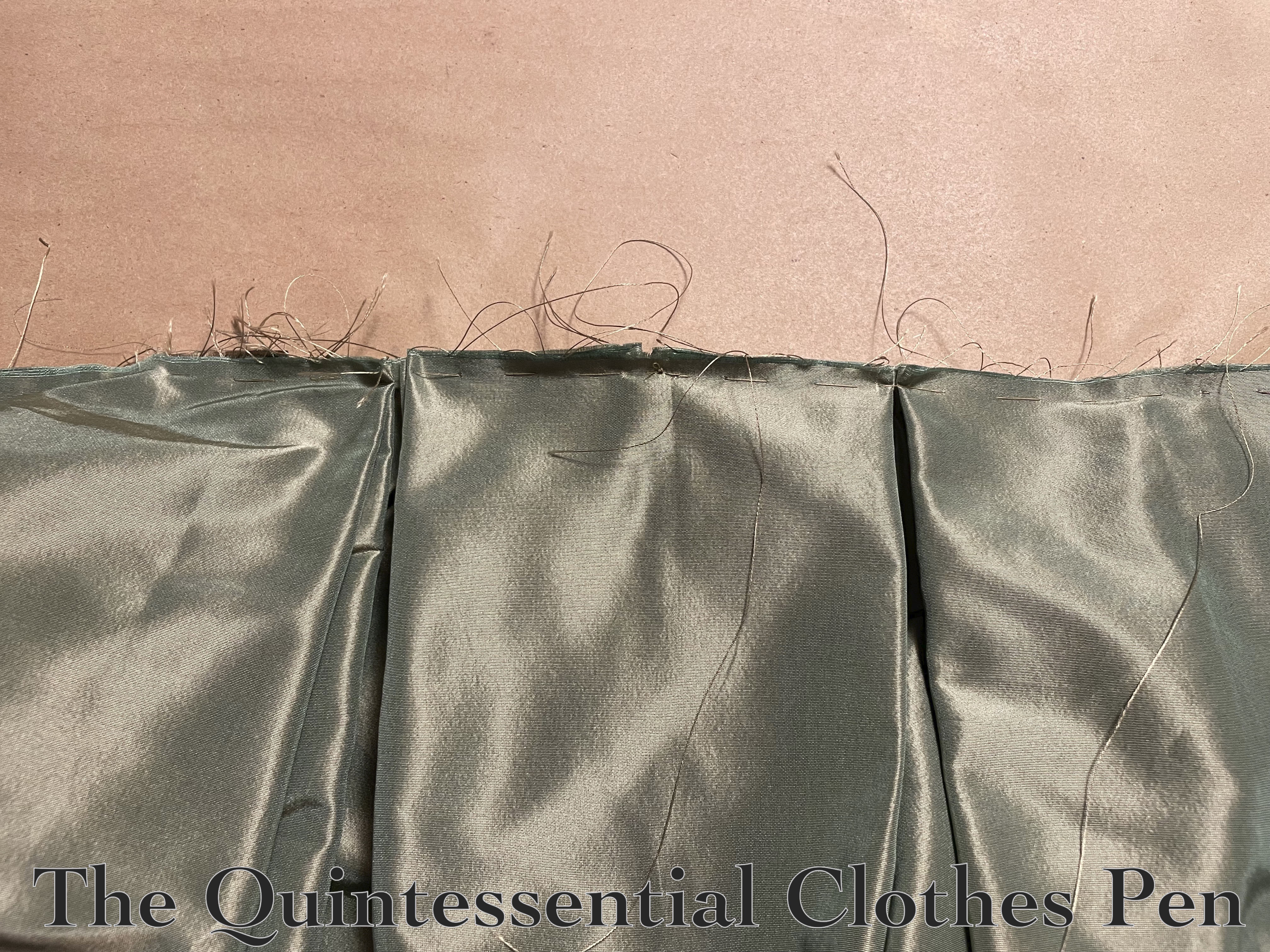
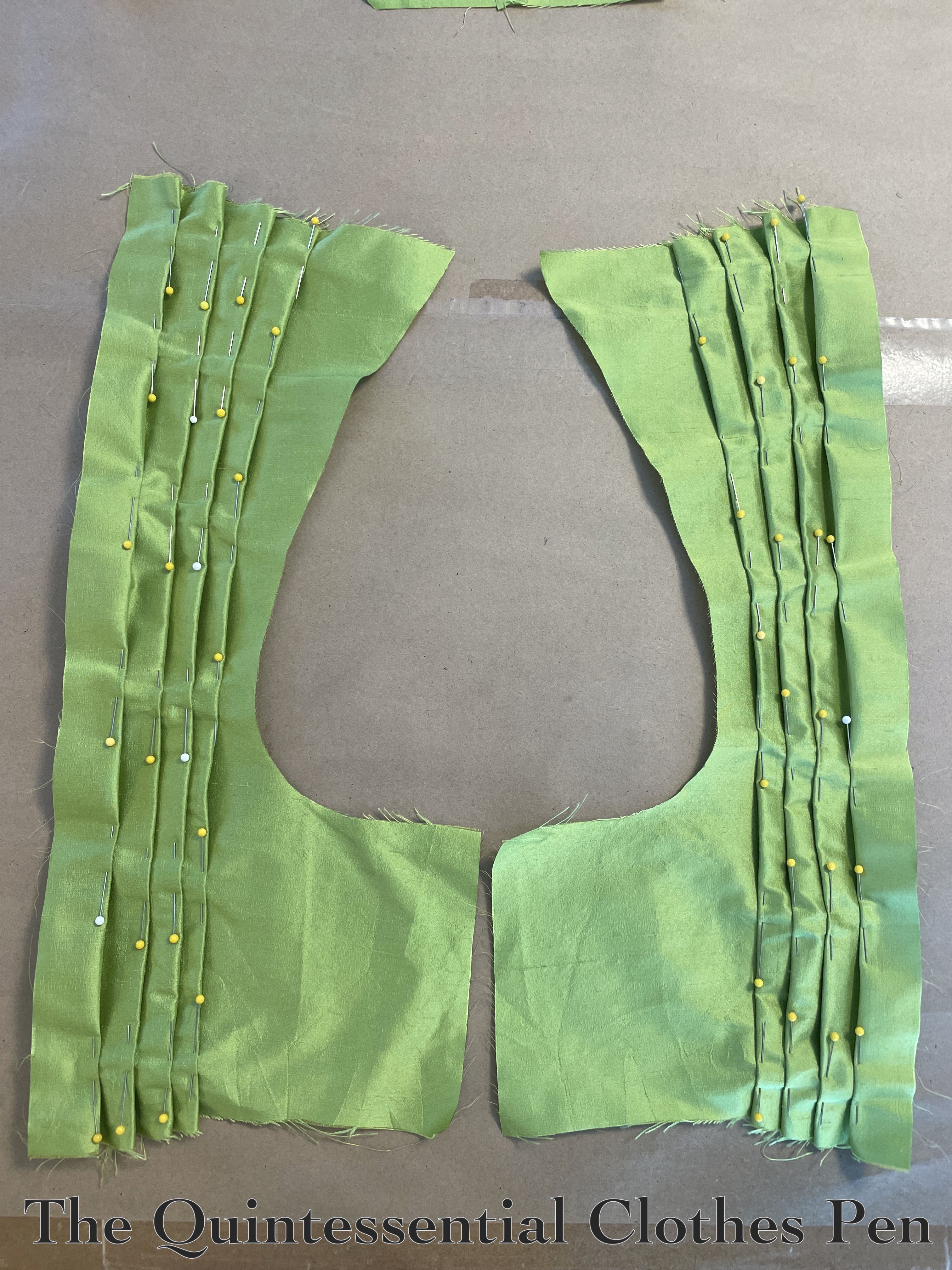
Once the lining pieces were ready to go I could cut the silk layers. The side front of the silk exterior had the shoulder straps included and was extra wide in order to create those all-important pleats. Below is a photo of what the pleats looked like before they were topstitched flat. They are not quite all the same depth and slowly spread out as they move towards the shoulder seam in the back (at the top of the photo).

Here is a summary of the 18th century elements I used in the construction of this garment: much piecing of the lining fabrics, whipping the lining pieces together along the seams, whipping the lining into the exterior around the edges, topstitched pleats in the front exterior for shaping over the bust, a shoulder seam that is topstitched onto the back piece, many edges bound in narrow strips of silk, and the neckline trim being tucked to shape around the neckline curve.

Here is a summary of the 19th century elements I used in the construction of this garment: gathering the peplum and sewing it to the bodice with right sides together then whipping the lining seam allowance on top and turning in the seam allowance of the armholes and whipping the lining into place.

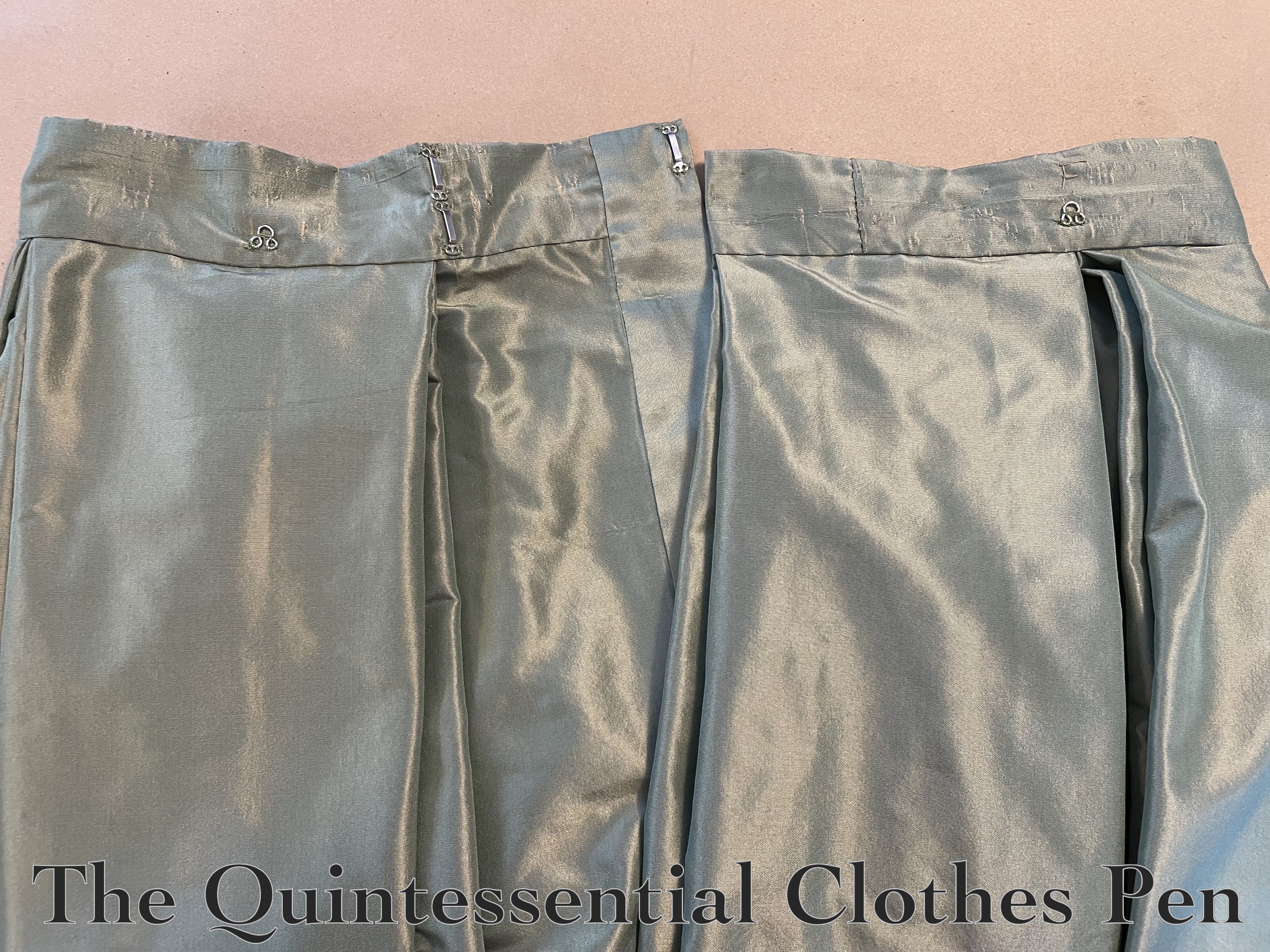
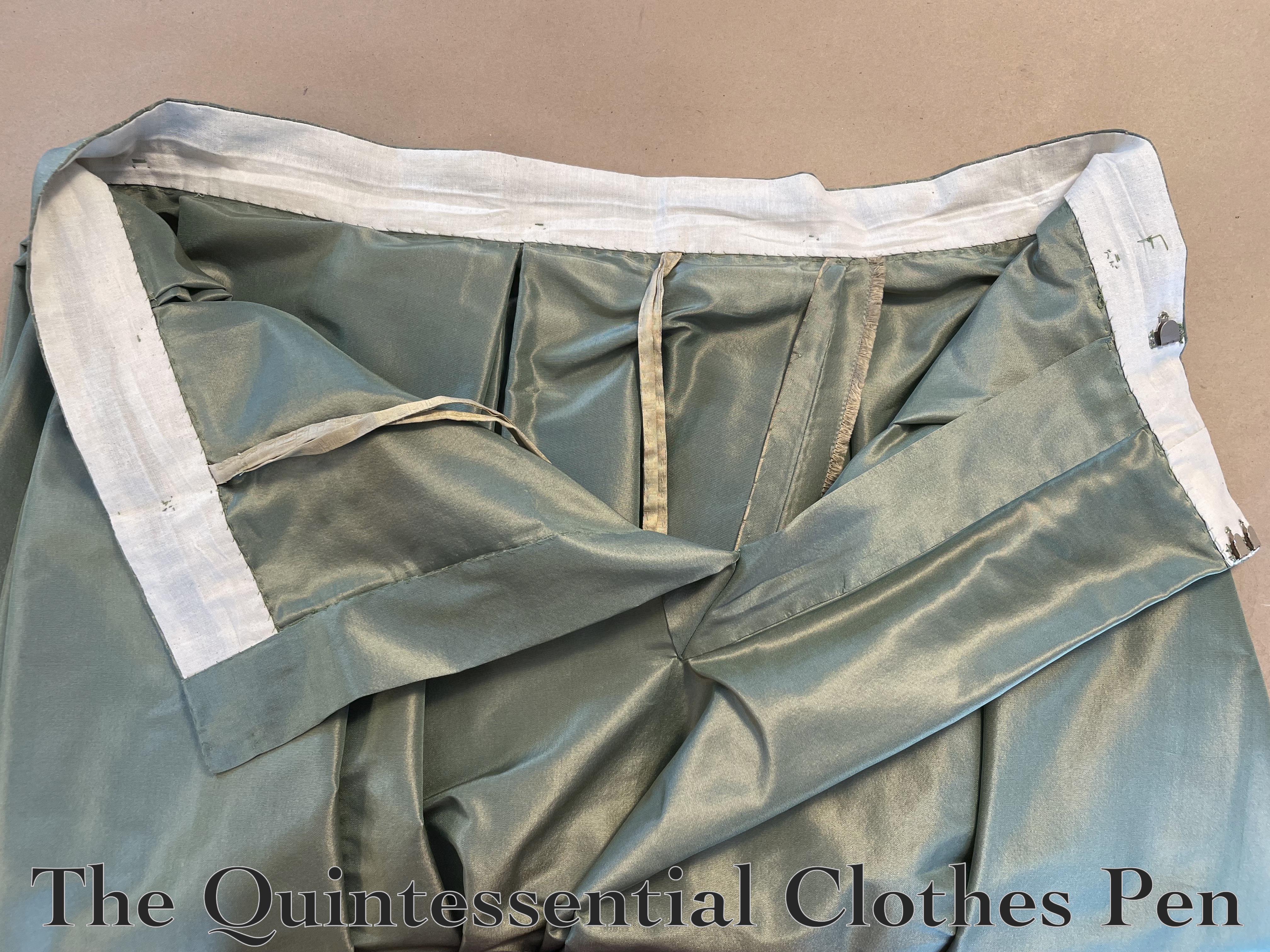
In the photo below, most of those methods have been employed to get the bodice to this state, which is basically finished aside from the peplum, neck trim, and closures.

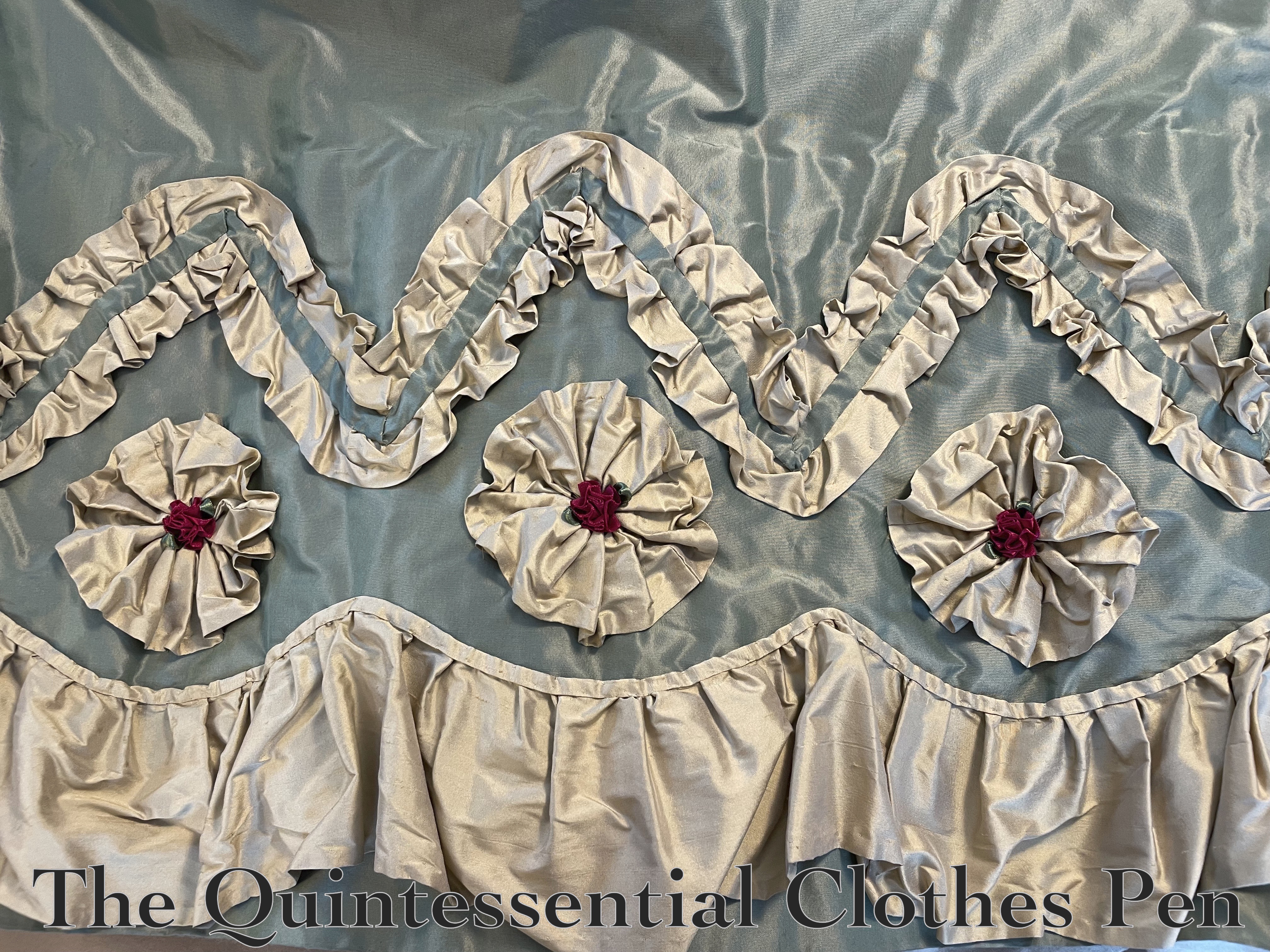
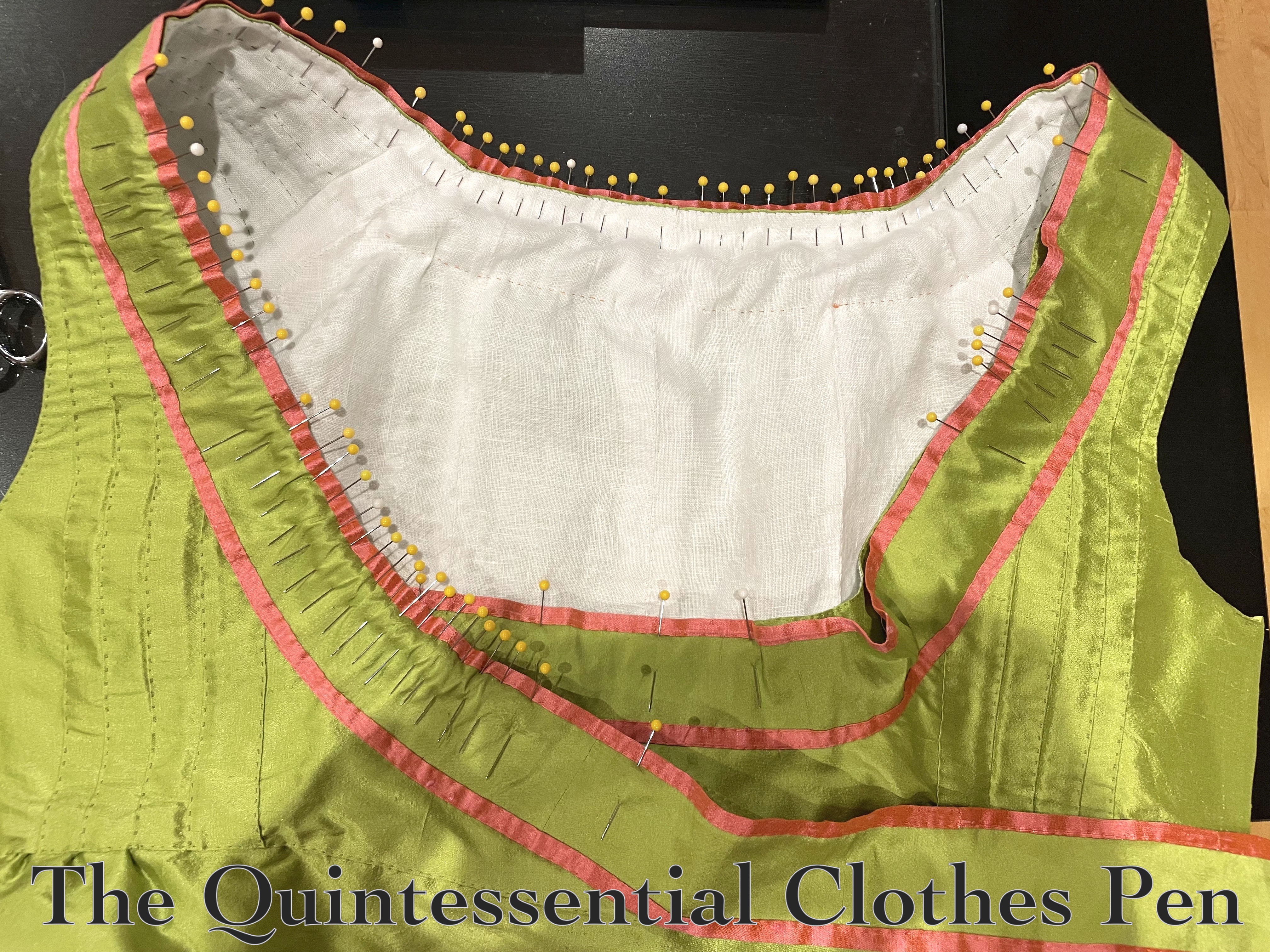
The neck trim is a pieced strip of the green silk bound in running stitched ¼” wide strips of pink silk (hence the watermelon name!). The assembled band was running stitched along the outer edge and then eased into place around the neck edge. Below is the easing in progress. It took many pins!

And here is a closeup. You can see some of the whip stitched piecing seams in the lining and the minute easing of the neckline edge of the trim.

And that was it…! Entirely hand sewn, with many small details, lots of justifying and research, and, in the end, a relatively small garment! Next time, photos of the finished garment being worn!

The New Yellow Sacque: Construction Details

Photos of the finished yellow sacque are on their way, but before I get to posting those I’d like to discuss the construction details of the dress. I’ve already posted about the accessories and other parts of the ensemble. You can view those blog posts at the links below.

c. 1770 Pink Panniers
18th Century Blue Foundation Petticoat
A White 1780s Petticoat
Yellow Sacque Petticoat
Engageants For The New Yellow Sacque
A Stomacher for the Yellow Sacque

Overall Goal

Whereas my goal for the Versailles Sacque was to hand sew everything and use historically accurate materials and methods, my overall goal for this new sacque was to machine sew as much as possible and use materials from the stash. This pair of goals influenced my choices for patterning and constructing the new dress. (If you’d like more information about the Versailles Sacque, you can read all of the posts about this project here.)

Patterning

The sacque itself is made from the JP Ryan Pet-en-l’air pattern. This is the same pattern I used for my Versailles Sacque. For the new Yellow Sacque, I used a larger size than I previously did. I also tweaked some of the dimensions to fit the measurements of the two friends I knew I wanted to be able to wear the new dress. This included things like increasing the back shoulder width and the bicep circumference.

I started with a mockup, which allowed me to check and see if the changes I made to the paper pattern worked on a real body. And they did! I only had minimal changes to make — some of which was taking out a little bit of the ease I’d added in. Oh well! That happens.

Early Construction, With The Dress In Pieces

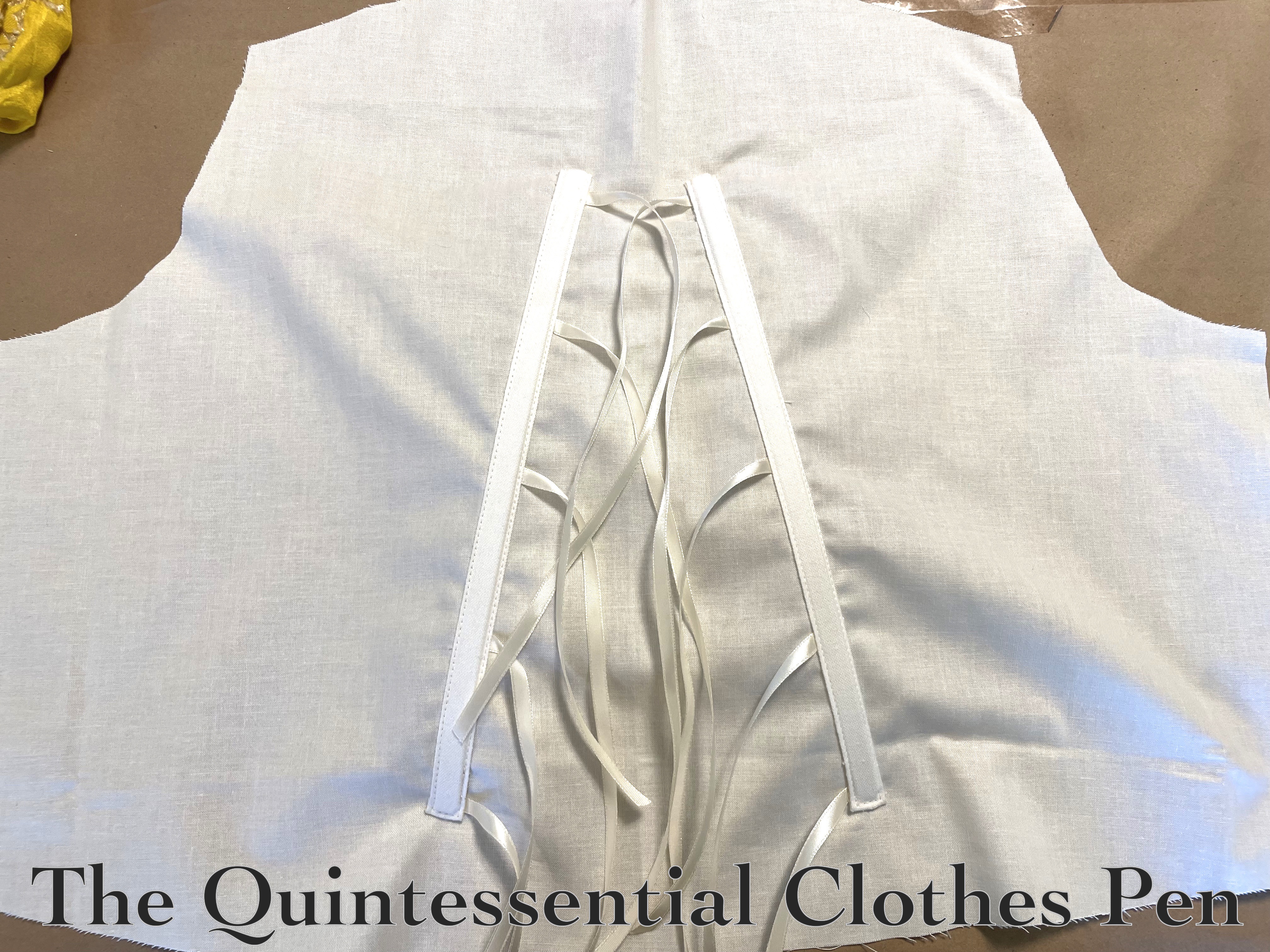
After cutting out all of the pieces, there were some steps that were easier to do before attaching things together. For example, I added boning and ties at the back of the lining in order to add adjustability underneath the back pleats of the dress. Ties or lacing like this was common for sacque style dresses in the 18th century.

I was pleased to reuse bones and bone casing from an old deconstructed corset as well as ivory ribbon that was gifted to me. Using things from the stash!

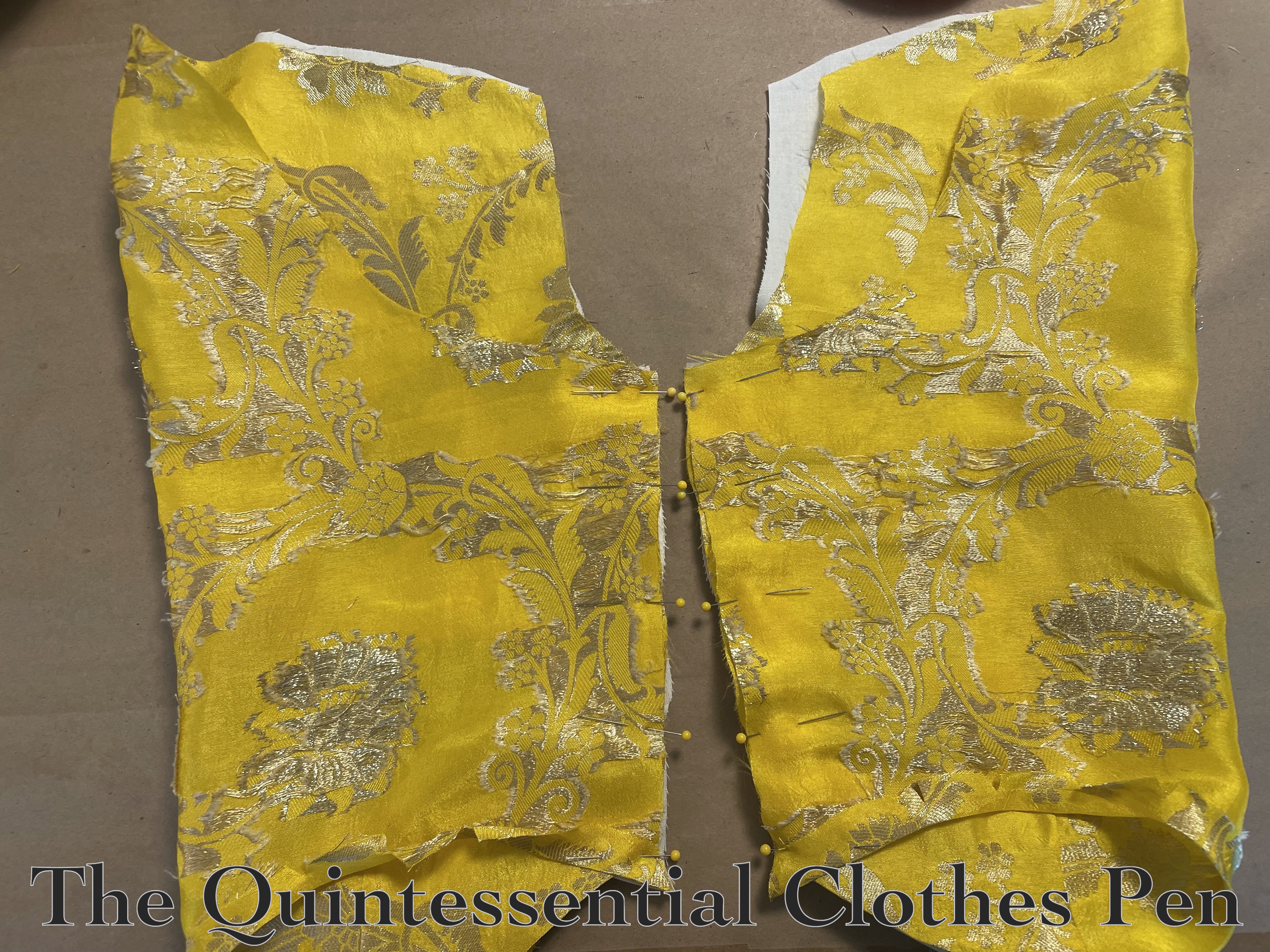
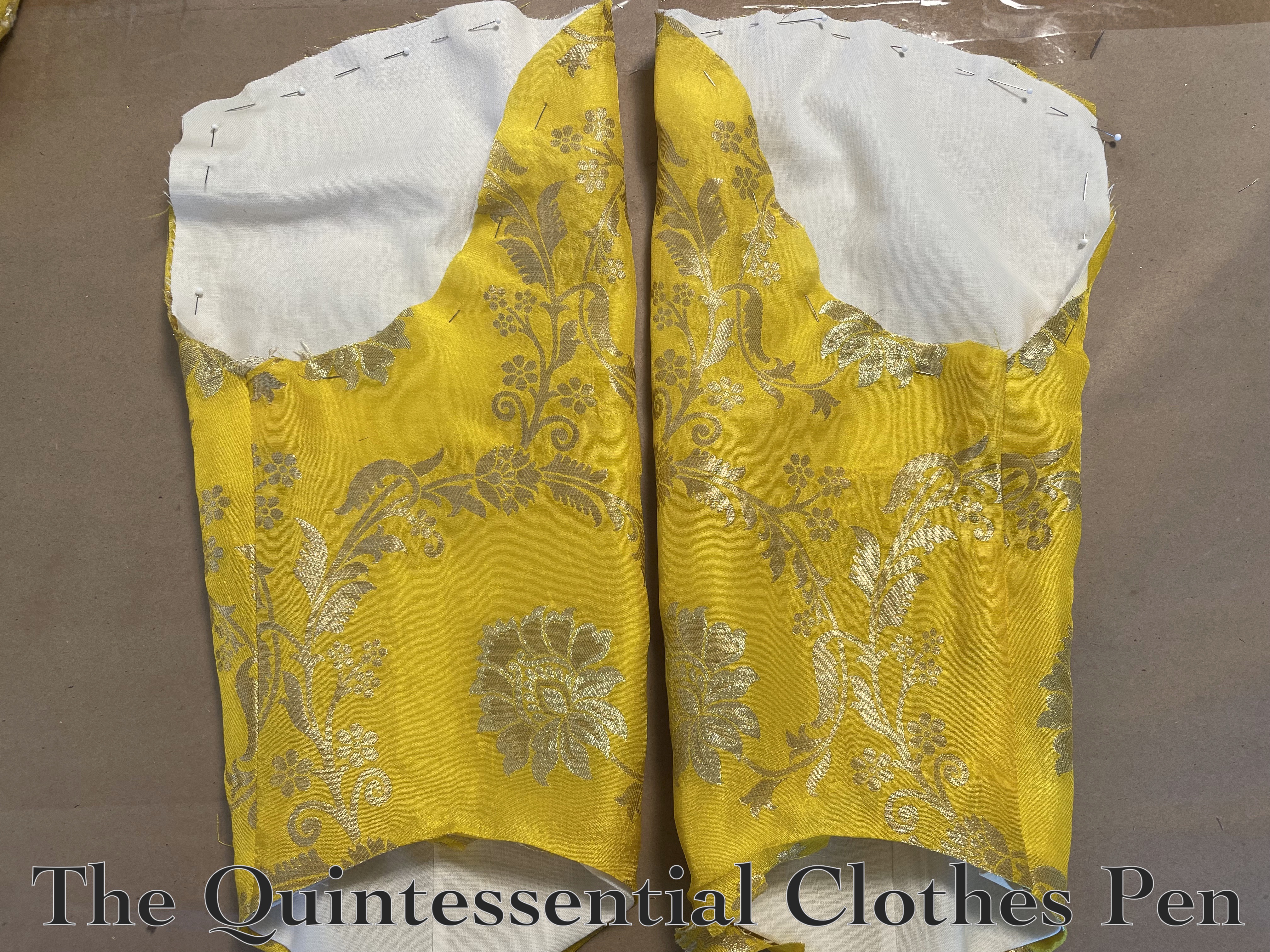
I also assembled the sleeves, with their linings, before attaching them to the dress. Below are the sleeves with the sleeve inseams pinned and ready to sew. By folding the lining and exterior right sides together and stacking them, there is a neat trick by which you can sew once to get both lining and exterior inseams sewn with one go (and all of the raw edges hidden between the layers.

Here are the sleeves turned right sides out. The bottom edges are already pressed under in preparation for being hand sewn later in the process. The top edges are pinned and ready for basting, so that they can be set into the arm opening as one layer.

Back Pleats

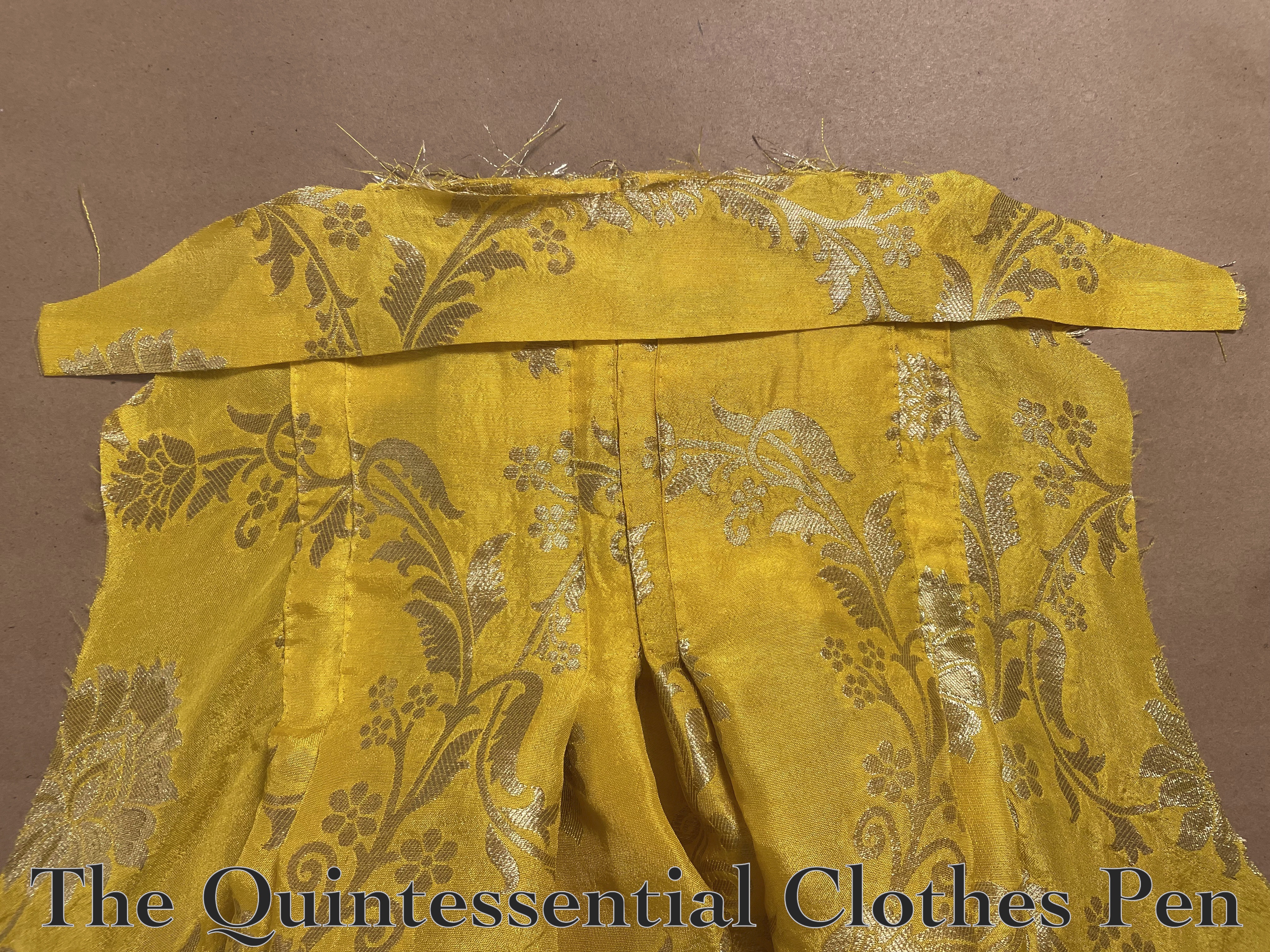
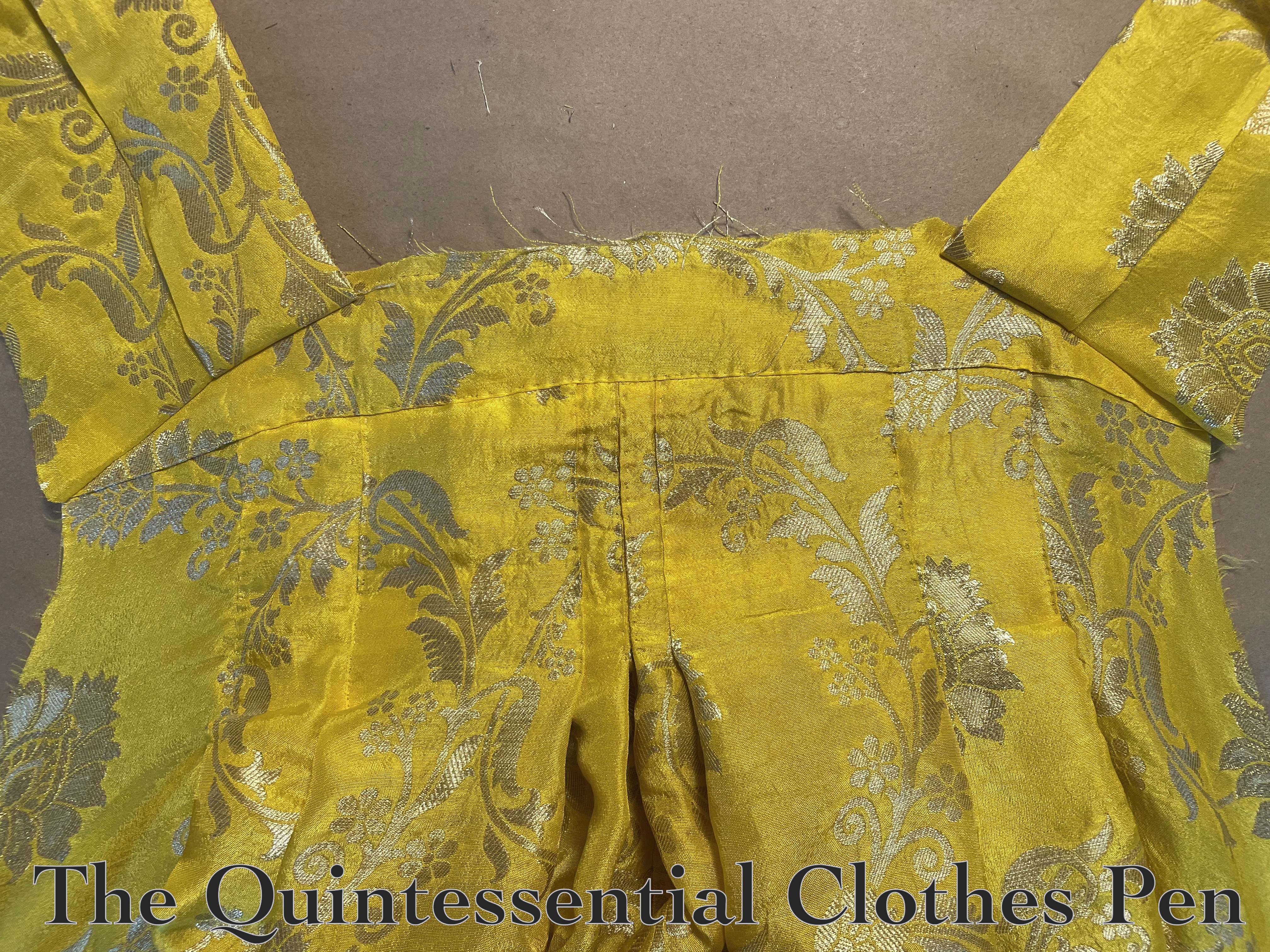
Eventually the process moved on to the back pleats — the signature feature of a sacque! I carefully followed the pleating instructions and hand stitched the various stacked box pleats in place. Then I went to put the back neck piece on… Oops!

They widths didn’t match! This was not a pattern problem. This was my problem! When I adjusted the pieces (the backs and the back neck piece) for a body shape with wider shoulders I didn’t remember to adjust the spacing of the pleats across the back accordingly.

So, I carefully removed the stitching holding the pleats and re-organized them to make the back wider. I didn’t want to change the center due to the depths of the pleats, but I was able to move the side pleats over towards the arm holes. I don’t think the change is noticeable. And extant garments show a variety of pleating patterns and widths, so I feel perfectly justified from that perspective.

Sleeve Ruffles

Before I started this dress, I’d been looking through my new copy of Patterns of Fashion 6, from The School of Historical Dress (information and purchasing information about the book is available here, on The School of Historical Dress website). In the book (on pages 15 and 16, to be precise), there are diagrams of sacque patterns laid out in the most economical way possible. This includes various pieced seams for some parts of the garment as well as a way of cutting the sleeve ruffles that nestles them together to save fabric. I was intrigued! And I decided that for this yellow sacque I wanted to try out this method.

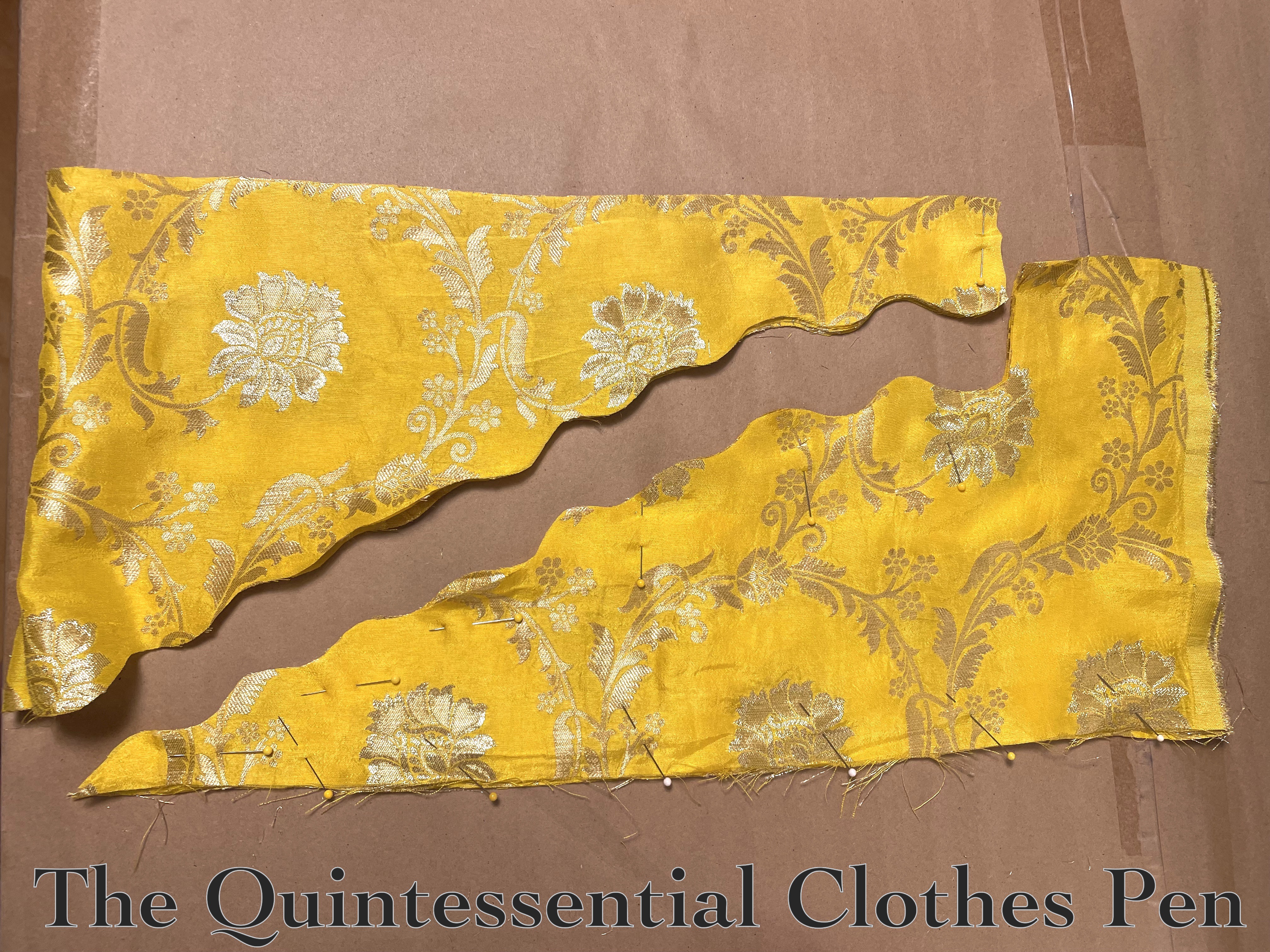
Essentially, a rectangle is cut on a diagonal with each diagonal portion making up a flounce. With the rectangle folded along a short side, this results in one triangle that can be cut on the fold while the other one ends up with a seam in the middle. Additionally, one of the flounces ends up being upside down in terms of the pattern on the fabric. I think this is a fun, historical quirk (as compared to what we would likely find on a modern garment) and I also don’t think it’s noticeable once the flounce with the upside down pattern and seam is placed underneath the other flounce.

So, I cut my flounces accordingly, with a wavy edge! Below is the result, with the two pieces separated slightly to show the geometry.

After the first diagonal separation, I also updated the scallops a little further to make each layer of flounces slightly different in shape than the other. The extra bits I cut off to do this are pictured below.

Hemming

Other steps were completed and eventually the dress looked like a dress! It was time to think about hemming it!

I wanted a narrow hem of about ½”. That’s easy to do, but I was worried about the metallic threads on the wrong side of the yellow fabric snagging on the train while being worn. I’ve seen this happen and know it can create pulls in the fabric that I wanted to avoid. But I didn’t want to put on a linen facing (as might have been used in the 18th century on what seem to be rare occasions), because I didn’t want an obvious line of stitching along the top or the weight and drape of that part of the lightweight silk dress to be different than the rest of the garment.

One trick I know of to help with this is to put a facing of tulle over the underside of the train. This makes a smooth surface to drag on the floor while not adding weight or making an obvious line along the top at whatever point the facing stops.

I looked in my stash and found a one yard piece of ivory tulle that would be just the right size for this purpose. A single layer of the ivory blends very well with the yellow silk!

The tulle facing tapers away to nothing around the side seams of the dress and extends up about 6″ above floor level at the center back.

Below is a photo showing part of the hem of the dress with the ivory tulle pinned in place. I pieced the tulle where needed, which was not in the same places as the seams of the yellow silk.

And here is a closeup of the wrong side of the fabric, where the metallic threads are clearly visible on the left and the tulle is just noticeable on the right. One it was all pinned in place I used a sort of running prick stitch to catch the tulle to the yellow silk. This resulted in very small stitches on the yellow silk (or where possible, I caught the metallic threads so that the stitches wouldn’t be visible at all). The stitches are not at all noticeable when the dress is being worn.

Materials & Time Spent

This dress (accounting for all of the individual parts of the ensemble) used:

  • 10.75 yards of the yellow figured silk
  • 3.25 yards of cream cotton (1.25 yards for for the sacque lining and 2 yards for the petticoat)
  • Scraps of ivory silk
  • Scraps of natural canvas
  • 1 yard ivory tulle
  • Embroidered/sequin bits from approximately ½ yard of gold lace

As well as small notions such as ivory ribbon, bones and bone casings, and thread.

I didn’t keep track of how much time I spent on this project, which was a relief in some ways. It was nice to just make it and not count. My photos show that I started patterning and mocking up the pattern in fall of 2023. I know I cut the pieces out in the winter of 2024 while my notes were still fresh. And then I was busy and didn’t start sewing until summer of 2024. I finished the dress on September 28, 2024. So it took me about a year of not-at-all consistent work — a Saturday here, a day or two of vacation there, and some hand sewing in the evenings. For this project, I’m not going to try and estimate the hours, but just bask in the knowledge of not keeping time.

And that’s it! This dress is made of pretty wonderful fabric that steals the show without additional trimmings, so I didn’t add any aside from accessories (such as the stomacher). Photos of the finished garment will be coming soon!

A Stomacher For The Yellow Sacque (HSM #12)

One of the many parts of the new c. 1770 Yellow Sacque ensemble that I’ve been slowly posting about is the stomacher. This is the triangular shaped piece that fills in the front of the dress, covering the undergarments worn underneath.

18th century stomachers come in a variety of shapes and styles. Some are more pointy and triangular, some are more wide and rounded. Some match the dress exactly and others contrast with the dress fabric.

The stomacher that goes with my Versailles sacque (which you can read about in the past post discussing the construction details for that dress) is more of the wide, rounded, and matching-the-dress variety. So for this new dress I decided to go in the opposite direction and make a stomacher that is more pointy, triangular, and made of contrasting fabric.

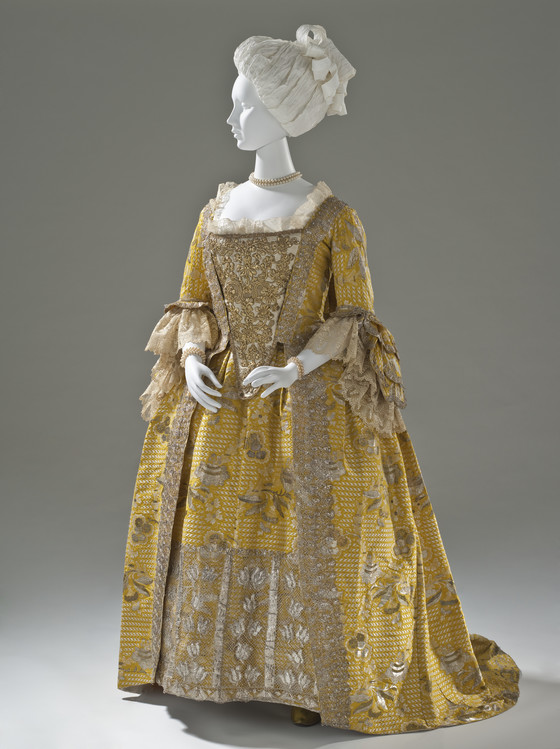
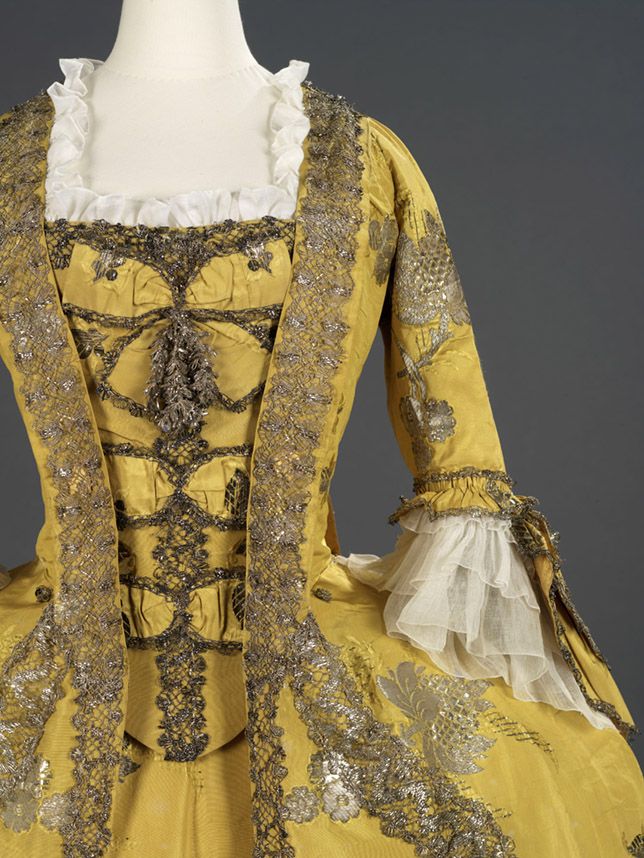
I was particularly inspired by the dress and stomacher combination below, which is in the collection of the LA County Museum of Art. I love that the gold embroidery on the stomacher is completely different than the trim on the dress and that is completed on an ivory colored base that is also completely different than the dress fabric itself.

Woman’s Dress and Petticoat (Robe à la française). England, circa 1760. Silk plain weave with weft-float patterning and silk with metallic-thread supplementary-weft patterning, and metallic lace. Gift of Mrs. Henry Salvatori (M.79.118a-b).

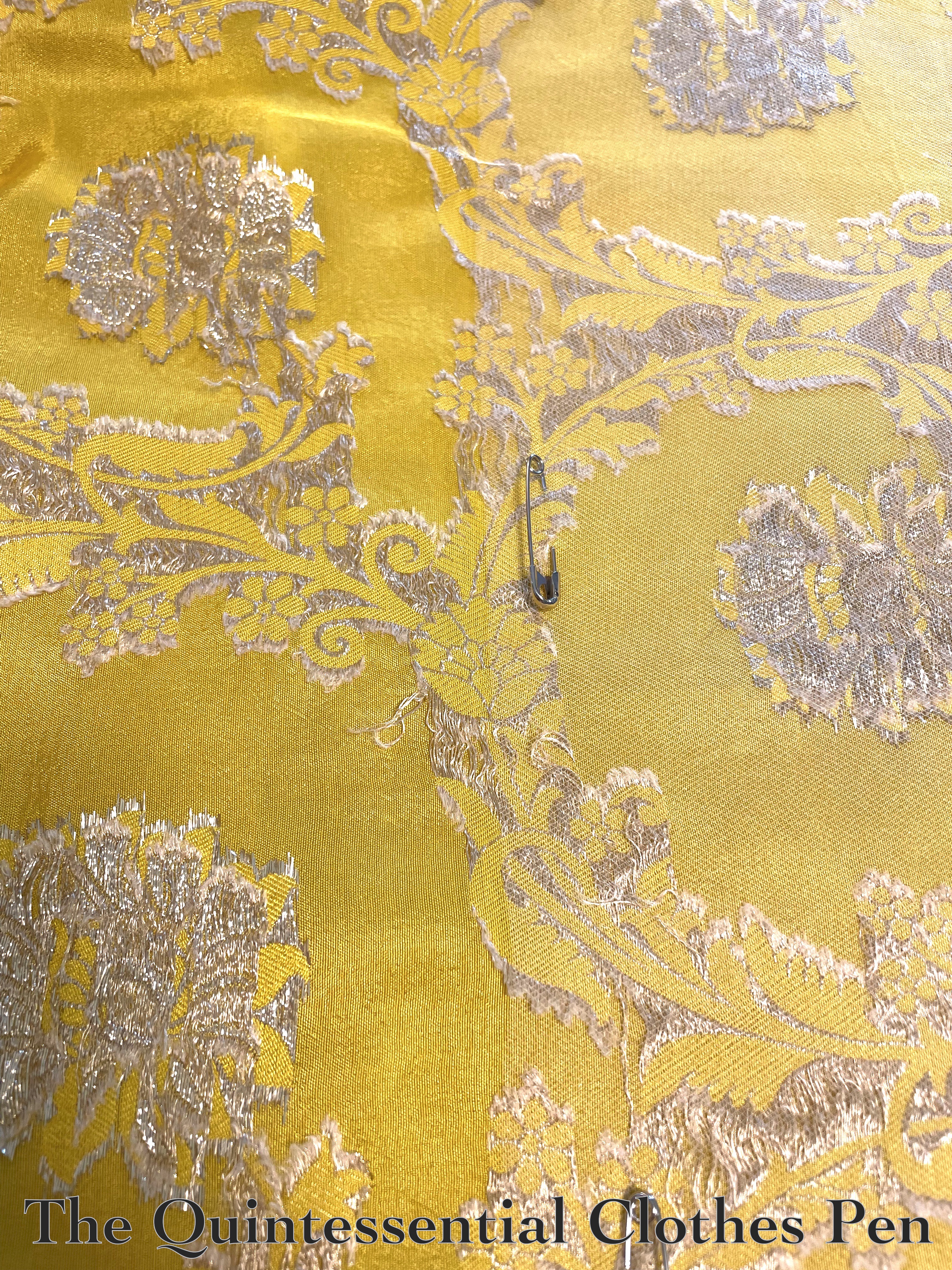
With that idea in mind, it was time to figure out how to achieve that look! I dabbled in embroidery in 2020, but definitely not enough to feel up to the elaborate style and cost of materials to achieve this look from scratch. I did have a fabric in my stash, however, that has lovely gold embroidered motifs on a bronze net background. I’ve cut out the motifs and used them before with fantastic results, so I figured I could do that again for this purpose. (The full net fabric was used in my 1912 Burgundy and Gold Evening Gown made in 2012 and the motifs were used as appliqués in my 1893 Bronze and Pink Evening Gown in 2012, as well.)

For this project, some of the helpful motifs from the lace were along the edges of the fabric. Others were in the middle. The motifs were not always symmetrical, so in many cases I had to piece them together to make them look reasonable for this purpose — especially in the central budding/dripping areas of the stomacher. I used approximately 30 individual sequin/embroidered bits, some as small as a single leaf!

Below is a photo of the stomacher with all of the individual gold bits pinned in place.

After that, all I had to do was use an appliqué stitch to attach them around each edge! I like that sort of work (it’s the same process I used for my 1940 Schiaparelli Evening Dress last year). It’s not hard, but just takes patience. The most patience is needed when the thread gets caught on a pin!

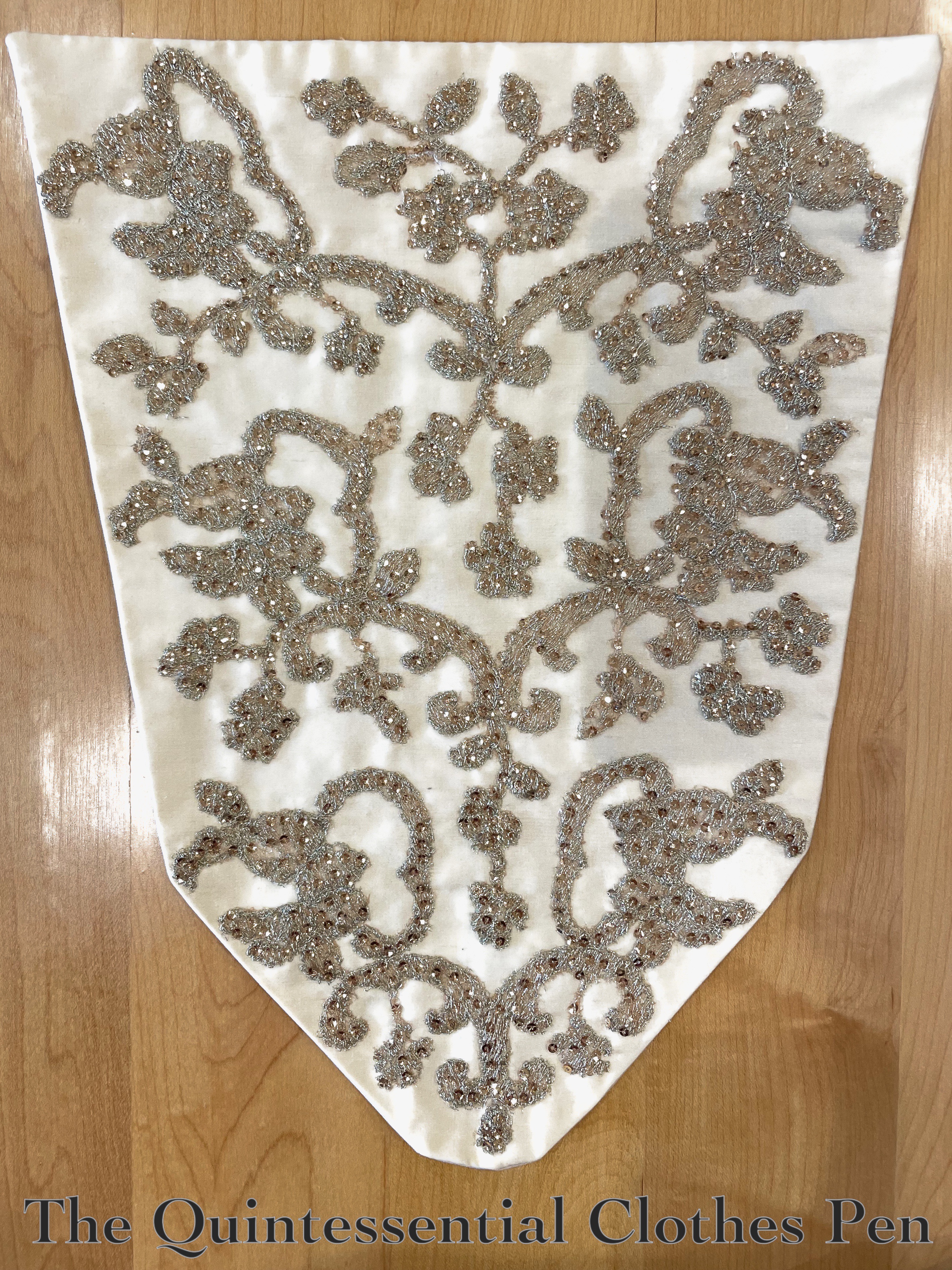
Below is the completed stomacher.

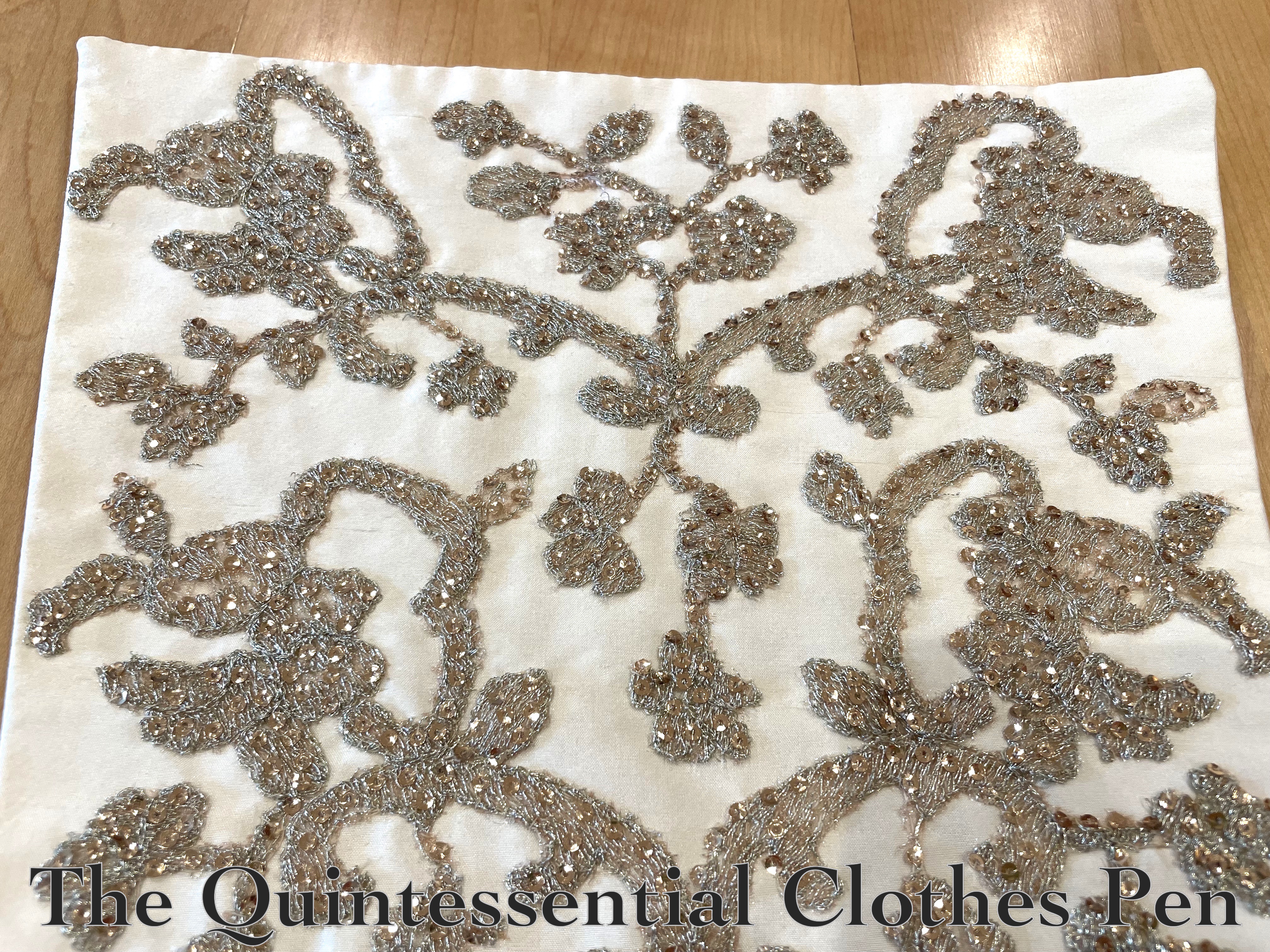
It really sparkles in the light, as the gold embroidery also has gold sequins on it. That lovely sparkly element was hard to capture in a photo. I did try! Below is a view that shows the sequins a little bit better.

I know that spangles (flat metal discs) were in use long before the 18th century. So while my sequined modern lace appliqués may not be perfect on a historical-reproduction scale, I do think it’s reasonable to think that something similar would have been used in the 18th century to help reflect light in the halls of Versailles or other palaces of the period.

In addition to the gold bits, I also had scraps of ivory silk shantung in the stash leftover from making my fluffy 1903 petticoat back in 2011. I used one of these scraps for the visible ivory section of the stomacher. The back of the stomacher is made of a scrap of unbleached cotton canvas, also from the stash (this is not historically correct, but it did the job of stiffening the stomacher very well!). A photo showing these fabrics up close is below.

The canvas and silk layers were bagged out, the opening edge whipped closed, and then the appliqué stitches applied only through the silk. The cotton canvas provides stability for stiffening the stomacher as well as pinning into the dress.

This stomacher qualifies for the Historical Sew Monthly Challenge #12 The Final Touch:

Make an accessory or garment that is the finishing touch to an outfit.

Just the facts:

Fabric/Materials: Scrap of ivory silk, scrap of natural canvas, and embroidered/sequin bits from approximately ½ yard of gold lace.

Pattern: The base was adapted from the JP Ryan Pet-en-l’air pattern.

Year: c. 1770

Notions: Thread.

How historically accurate is it?: 90%. Entirely hand sewn. The construction methods are historically plausible, though I believe this would have been embroidered in the 18th century rather than appliquéd. The fiber content and weave of the base fabrics are not accurate.

Hours to complete: I didn’t keep track. Let’s say 6.

First worn: October 5, 2024.

Total cost: I’m going to call the scraps free. My guess is that I spent about $10 per yard on the lace over ten years ago. So let’s say approximately $5.

Engageants For The New Yellow Sacque (HSM #6)

I’m trying to get in all of my Historical Sew Monthly 2024 posts before the new year! So in that spirit, here is another one!

Above is a closeup of the fluff that makes up the arm openings of the new yellow sacque I mentioned in my last post (where I shared details about the petticoat for the new sacque) as well as my Versailles dress from 2016. Part of the fluff is the sleeve ruffles on the dresses and part of the fluff is the engageants — lace for the Versailles dress and a double layer of ivory silk for the new yellow sacque!

Engageants are sleeve ruffles. The Oxford English Dictionary traces the word back to the 16th century with its origins in French.

These new engageants are made of two layers of silk gauze, inspired by the ones displayed with the lovely yellow dress below by the Royal Ontario Museum.

Robe à la française Spitalfields (London), England. Silk extended tabby (gros de Tours) with liseré self-patterning and brocading in silver lamella and filé Georgian Rococo. 1750s. Gift of the Fashion Group Inc. of Toronto in memory of Gwen Cowley. ROM2009_10909_22.

I specifically wanted the semi-sheer quality as a change from the lace engageants that accompany my Versailles sacque (which you can read about in this past post detailing construction information about that dress).

I looked through my stash and realized that the best fabric I had for this project was salvaged from an old ballroom dancing dress I’d made. Here is a blast from the past for you! The elusive Mr. Q is even hiding there, behind my head… But back to the dress. It was made pre-blog, so no photos of it have made it here before.

I was so proud of it! But after a fair bit of wearing this dress, I moved on to creating new ballroom dresses and sacrificed this one for parts. The rhinestoned lace was re-used in a dress that did make it onto the blog in 2013 (documented in this past post), but the float — that dangling piece hanging from my wrist that floats in the breeze while dancing — was simply put into my fabric stash, which is where I found it when looking for engageant material!

The float was an odd triangular piece, so I had to do some piecing (adding center seams, for example) to make my engageant pieces fit. But that’s fine! In all the fluff you can’t see the seams.

And in fact, the pattern I used, from 1769, was intended to create zero fabric waste, which intentionally added seams, as well. The scalloped pieces are stacked together with the scallops facing each other to efficiently use a single rectangle of fabric.

Completed engageants are below. The seams are not obvious!

Every individual silk piece for these was narrow hemmed on all the edges and then the seams were butted, whipped, laid flat, and pressed. Below is a close up of a seam and a scalloped bottom edge.

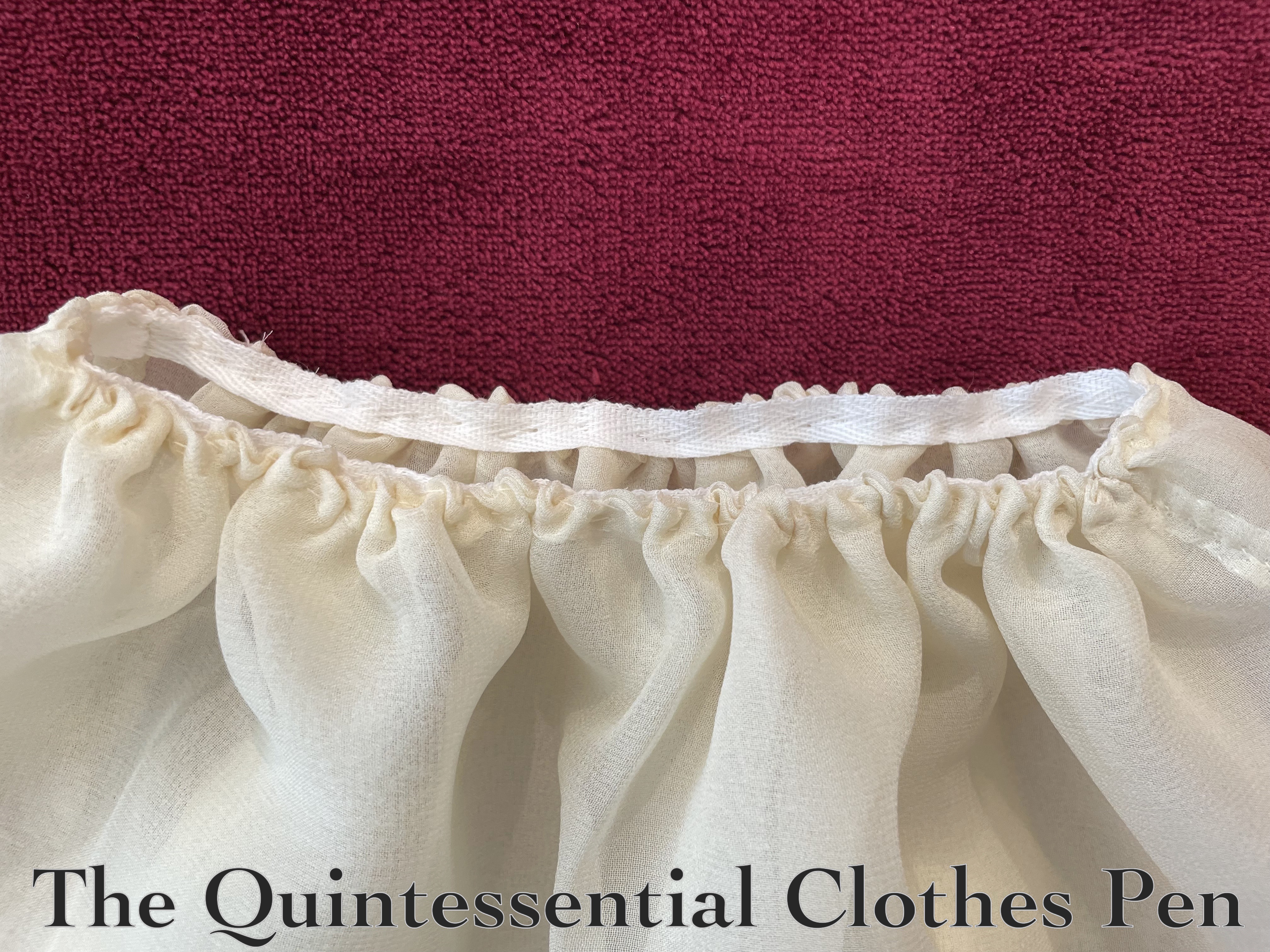
Once all of that was done, the two layers were laid on top of each other and whip gathered along the top edge. This was then sewn to a ¼” cotton tape. This allows for the engageants to be removed to be cleaned or used with another dress someday.

And that’s it! These qualify for the Historical Sew Monthly Challenge #6 Up Your Sleeve:

Level up your sleeve game by making a garment where the focus is on the sleeves.

Just the facts:

Fabric/Materials: Approximately ½ yard of ivory silk gauze.

Pattern: From page 14 in Patterns of Fashion 6 (written by Janet Arnold, Sébastien Passot, Claire Thornton, & Jenny Tiramani).

Year: 1769.

Notions: Approximately ⅔ yard of ¼” white cotton twill tape and thread.

How historically accurate is it?: 95%. Entirely hand sewn. The construction methods are historically sound. The fiber content and weave may not be perfect.

Hours to complete: 8 ¾.

First worn: October 5, 2024.

Total cost: I have no recollection of what I paid for the silk gauze many years ago. Plus, at this point this fabric is being re-used, so might be called free regardless. The twill tape was bought in bulk and cost less than $1 per yard. So let’s say approximately $5.

Eleanor At The Boutwell House

My 1860s evening gowns have had far fewer outings in the last few years than they used to, which it made having a reason to wear one a few months ago particularly exciting!

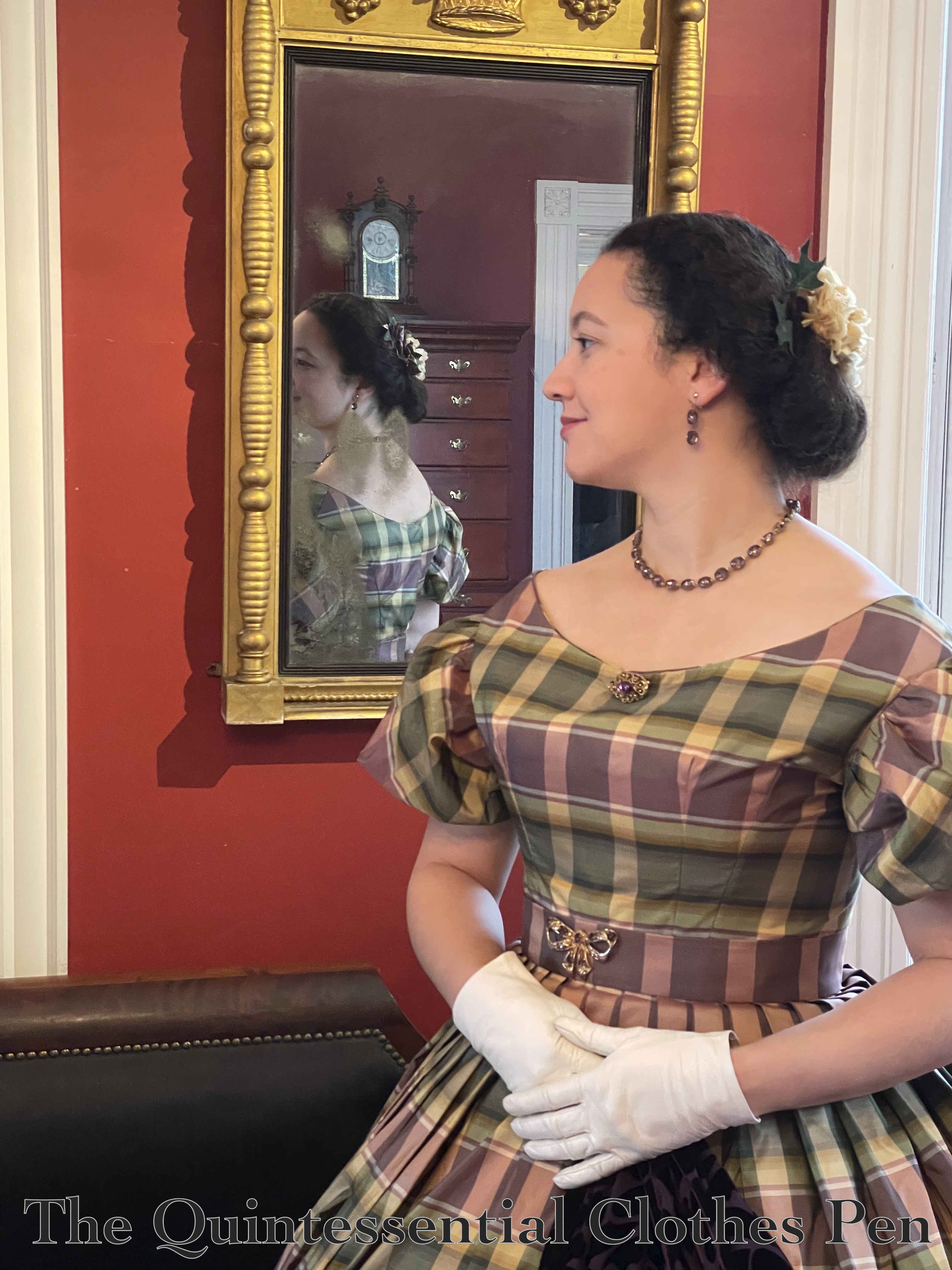
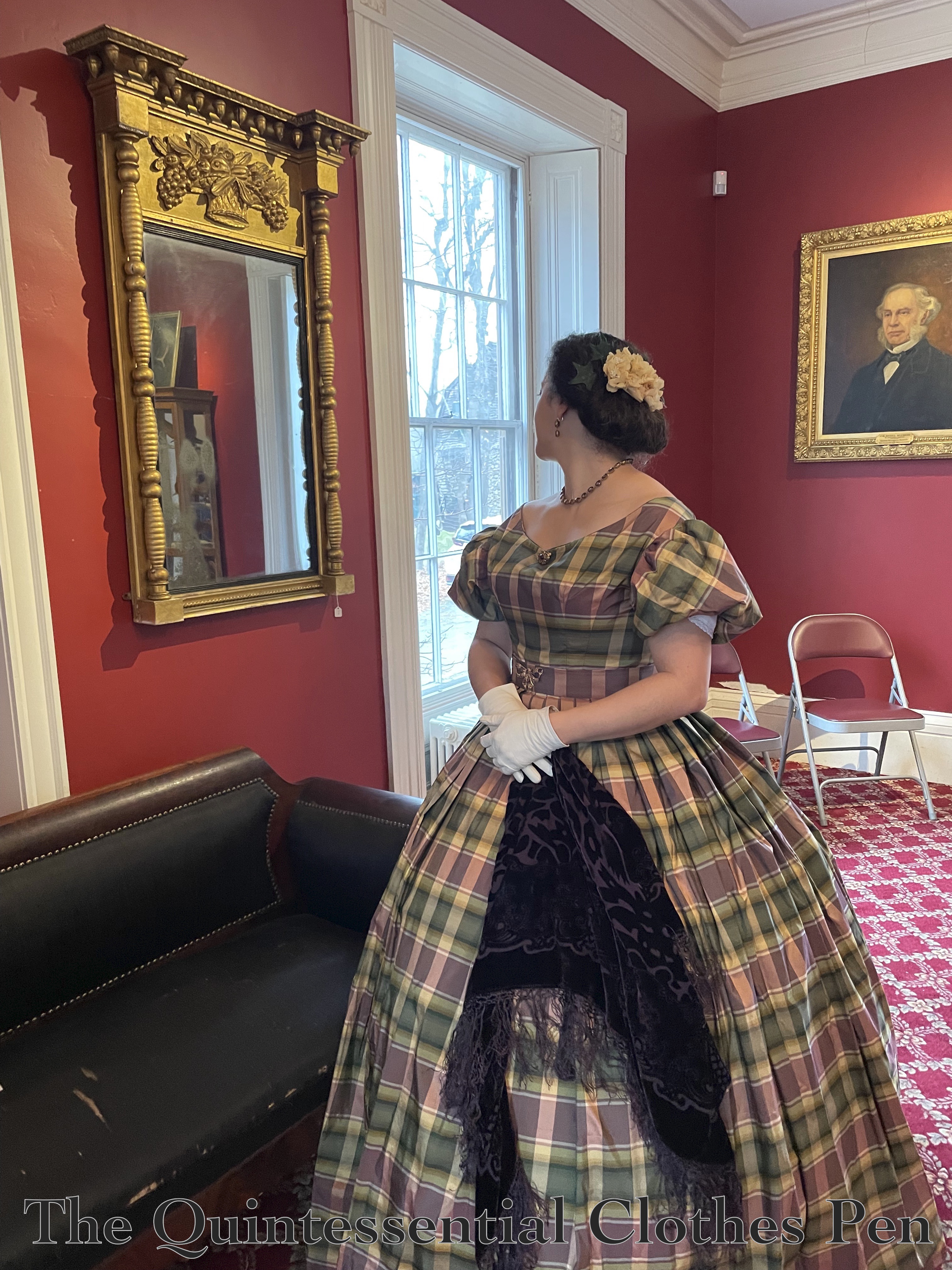
The question was which to choose??? I wore Genevieve (my 1863 apricot-colored covered in lace and pleats silk gown) sort of recently, in April 2022. Other dresses in my historical closet that might still fit (Georginia from 1859, Annabelle from 1859, and Evie from 1864) haven’t been worn recently, but for some reason, plaid was sounding like fun… So I chose to wear Eleanor (my 1862 purple and green silk plaid dress)!

I’m still very pleased with the fabric of this dress and the way I cut the pieces to create interest in an otherwise pretty basic dress. The little details like tiny piping on the bodice, matching hair flowers, and a well matched set of jewelry (earrings and necklace from In The Long Run Designs, as well as a mix of modern and vintage brooches) also bring me joy.

I also had a lovely setting in which to wear the dress. The Boutwell House in Groton, MA was built in 1851 and is now home to the Groton History Center. The Footwork & Frolick Society partnered with them for the town of Groton’s annual WinterFest activities, which included inhabiting the house for an afternoon to give visitors a small view into activities from the period.

I enjoyed being able to wear an 1860s dress again. I’ve always loved the magic of a cupcake shaped hoop skirt–and this was no exception!

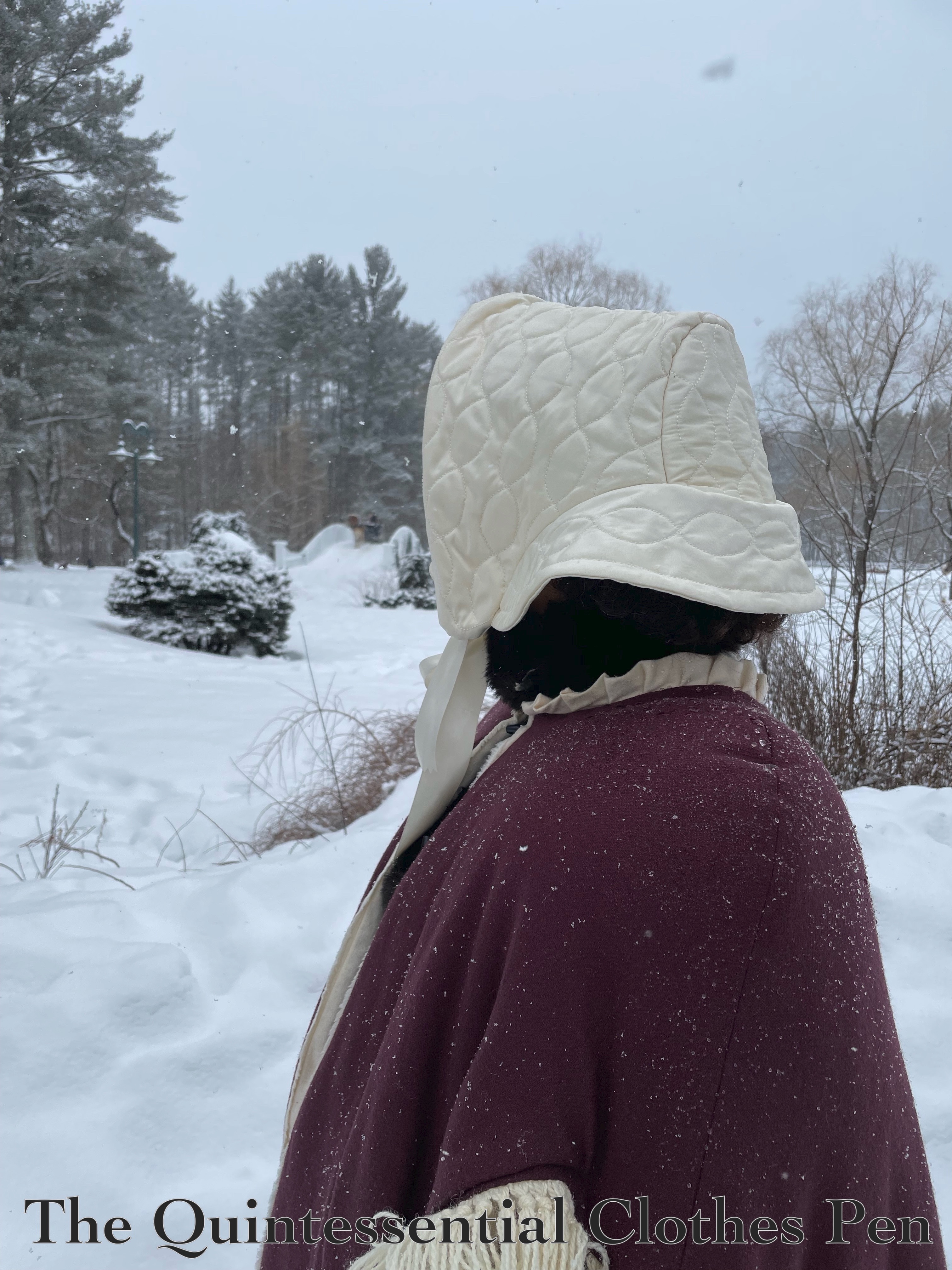
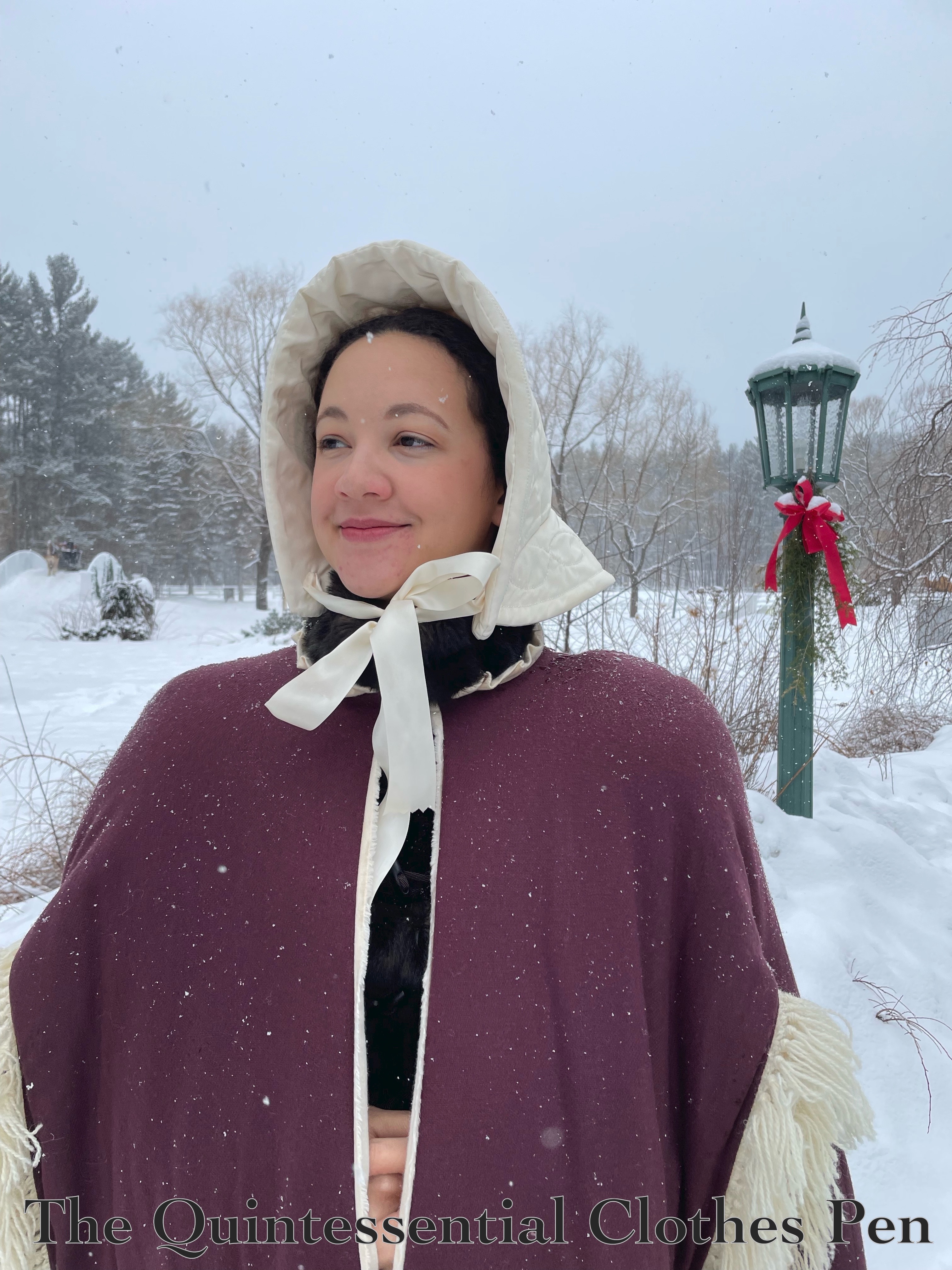
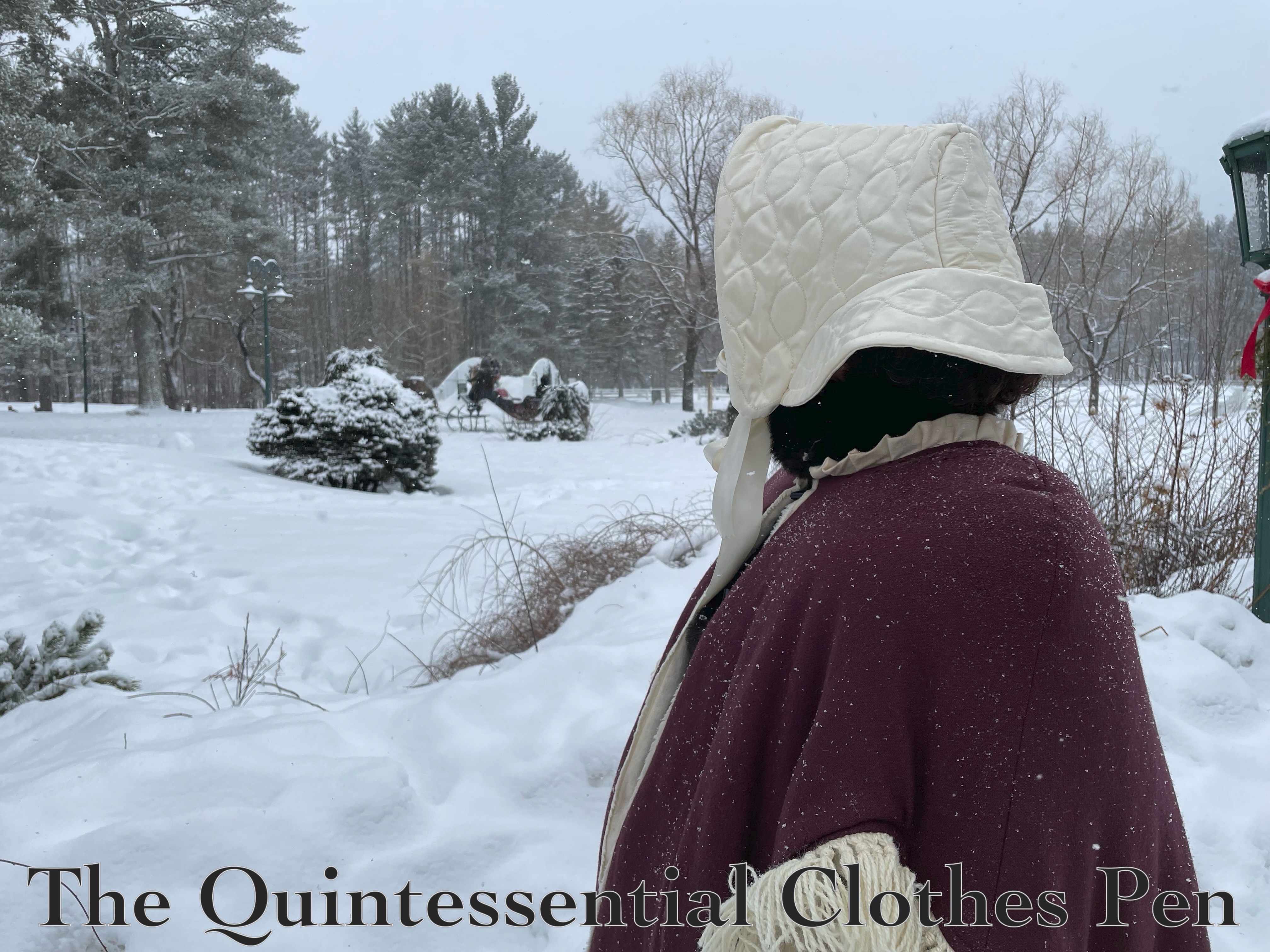
1850s Ivory Quilted Winter Hood (HSM #5)

I was mentally preparing for my 19th century winter adventure a few months ago by taking note of the suitable warm winter outerwear in my historic closet. One of the warmest garments I have is my 1855 Wool Cape; however, my thoughts ran along the lines of “I don’t have any 1850s winter appropriate headwear to go with the cape….”

That was easily remedied!

Last fall, I’d purchased Anna Worden Bauersmith’s Quilted Winter Hood pattern on a whim (the pattern was being discontinued for the moment and I didn’t want to miss out). I hadn’t had a project with a deadline in awhile and so I decided to quickly make up the Quilted Winter Hood for the winter adventure… by hand (including the quilting!), of course, because I can be a bit crazy sometimes.

Since the goal of the hood was to keep me warm, it is a perfect garment for the Historical Sew Monthly 2022 May Challenge! Protection: Create a garment that protects you from something: weather, dirt, wear, weapons, etc.

As such, here are the facts:

Fabric/Materials: ½ yd of ivory silk taffeta, ¾ yd  ivory cotton, and 1 yd cotton batting.

Pattern: Anna Worden Bauersmith’s Quilted Winter Hood.

Year: c. 1850.

Notions: 1 ¼ yds 1 ½” ivory satin ribbon, 1 yd millinery wire, approximately 45 yards of silk quilting thread, and regular sewing thread.

How historically accurate is it?: 90%. The pattern, construction methods, and fabric are all quite good and it is entirely hand sewn. I’m sure it’s not quite the same as an original, though.

Hours to complete: 13.

First worn: February 2022.

Total cost: $27 (approximately $17 for the materials and $10 for the pattern).

The pattern offers ideas for quilting patterns as well as detailed observations on extant hoods and their common features. While straight lines of various sorts seem more common for quilting patterns, I decided to go with the scalloped suggestion taken from a period magazine.

This front view photo looks like a little silly to me because of the very square shouldered silhouette (that isn’t 1850s at all!). It’s due to the 1890s sleeves that are underneath the 1855 cape…

A woman has to stay warm!

Some of my favorite inspiration hoods are on my Pinterest board for this project. (Many more quilted hoods can be found on Anna Worden Bauersmith’s Winter Hoods Millinery Pinterest board, as well.)

In the process of creating my board, I was drawn to a few other winter hoods and cloaks. That set me off down a brainstorming path to see what else I have in my too-full wool stash that could be made into more 1850s and 1860s winter outerwear!

Not that I need more… I’m only one person, after all, and how many wool capes can one person reasonably wear at once? But… there are at least two other hoods and another cape that I’m now seriously pondering. So this quilted hood (and the cape I already have) might just be the beginning of a whole series of mid-19th century winter outerwear someday. (And maybe I should eventually take a photo layering all of it at once, just to be silly!)

1880s Blush Duchess Satin Corset

In 2015 and 2016, I posted a ‘project journal’ series of blog posts about making a yellow duchess satin c. 1880 Steam Molded Corset (this link will take you to the whole series, which includes specific posts about the plan, inspiration, mockups and patterning, the final pattern, construction, steaming, and finished garment photo shoot). Late last year, I made another one as a commission for a friend, this time in a blush pink duchess satin I picked up at the fabric store with no particular purpose, but thinking it would be really good for this specific use (in fact, I mention this exact idea in the fabric stash additions post where I shared about the purchase of this fabric in 2020).

Having already figured it out once, I used my old blog posts as a guide for making the new corset. This post is intended to document the new corset and the changes and updates I made from the yellow one.

To start, I adjusted the pattern I’d developed for size as well as some of the boning patterns to accomodate the adjusted seam lines and to simplify some of the boning patterns, especially in the back. The yellow corset has a whole bunch of bones… It’s great and based directly off my inspiration image, but time consuming and unnecessary for this purpose.

Once I had a solid pattern, I cut out all my pieces: one layer of silk satin for the exterior and two layers of white coutil for the inner layers. For the most part, the layers for each piece are exactly the same, but there are some differences at front and back panels.

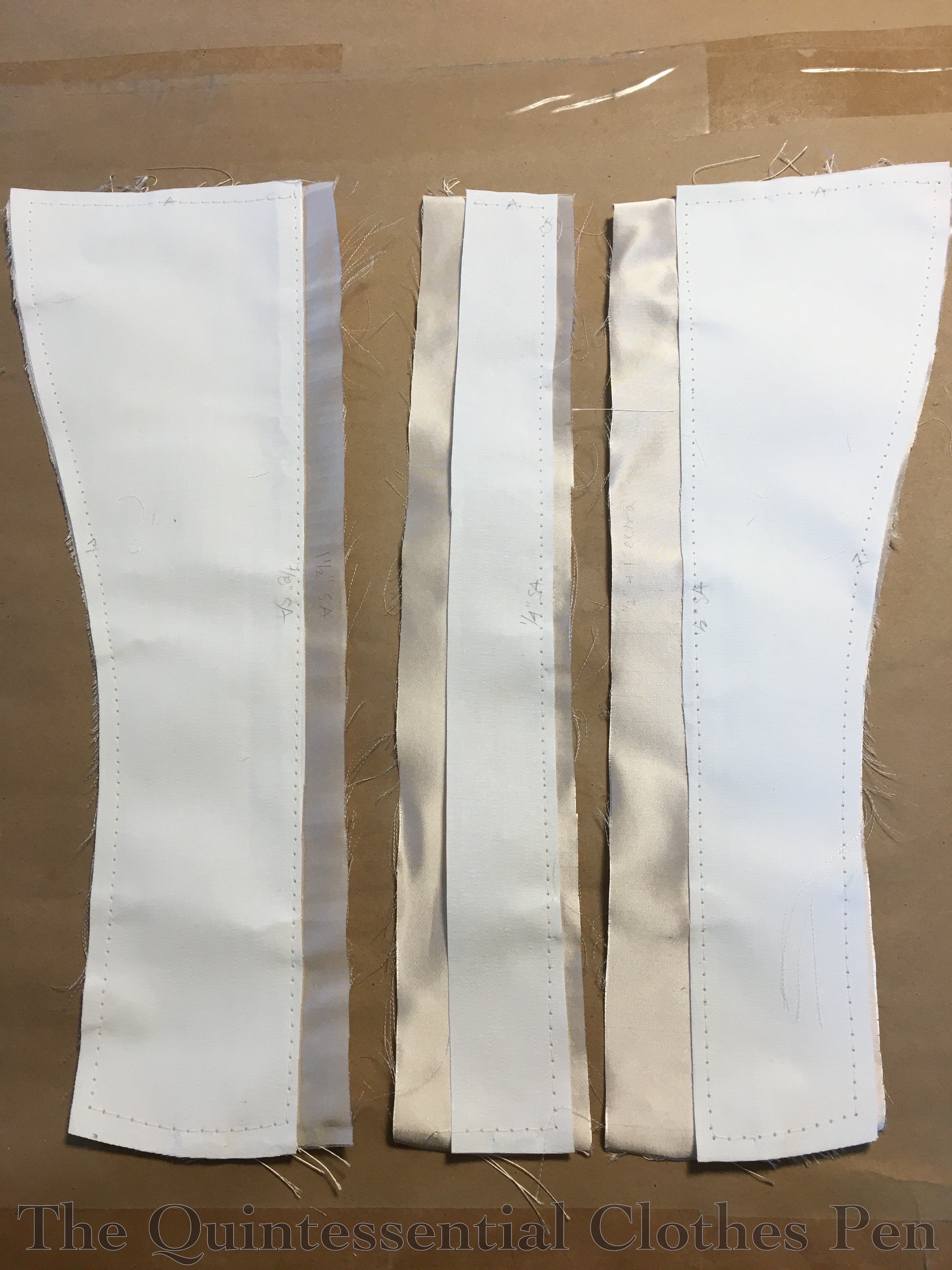
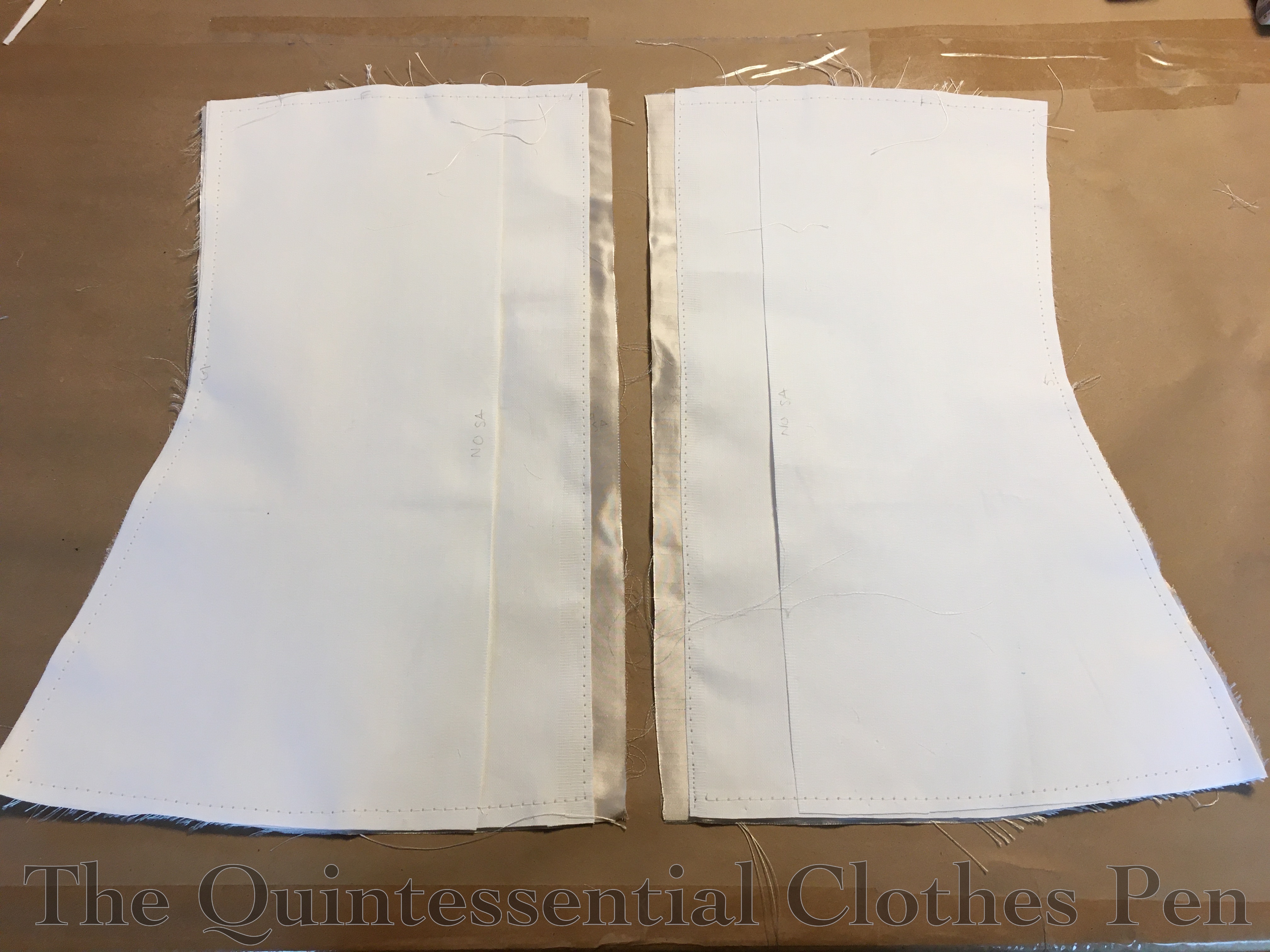
Below are the front panels, where I’ve intentionally cut the coutil to be smaller than the silk. This allows for the seam allowances to be less bulky and therefore more crisp as they fold inward around the busk. The piece on the left is for the proper left side of the corset while the two other pieces are both for the proper right side of the corset. I’ll show how these pieces are put together later in this post.

Next are the back panels, again showing that all of the layers are not cut to be exactly the same. The cut edge of the narrowest coutil layer provides a crisp edge over which to turn the other piece of coutil for the back edge. It also creates 3 layers of coutil where the grommets will be while allowing the silk to fold under the outermost edge of the coutil for a crisp line there as well.

You can see in both of the above images that I machine flat lined the layers for each piece together on almost every edge (some were strategically left alone).

Next, I prepared the center back grommet areas. The silk only seam allowance was crisply turned back over the straight cut edge of the coutil, then the coutil was crisply pressed back over the narrower layer of coutil. You can see the folds opened on the right and the resulting crisp panel on the left.

These were very carefully pinned in place (duchess satin does not hide pin marks!) and then the channels were stitched. I made sure to make them wide enough to not struggle when putting in bones (the last corset had boning channels that were a bit narrow for the bones and it was terribly hard to put them in!).

I used an edge stitch foot to get the lines of stitching right along the folds. Edge stitch feet are magical! I discovered mine while making masks last summer and have since started using it for all kinds of projects–any time I need to stitch close to the edge of a fold! My machine, which is pretty basic, came with one (though I hadn’t used it in, oh… 12 years???). I encourage you to it out if you haven’t before!

Here you can see the exterior of the grommet panels on the left and the interior on the right.

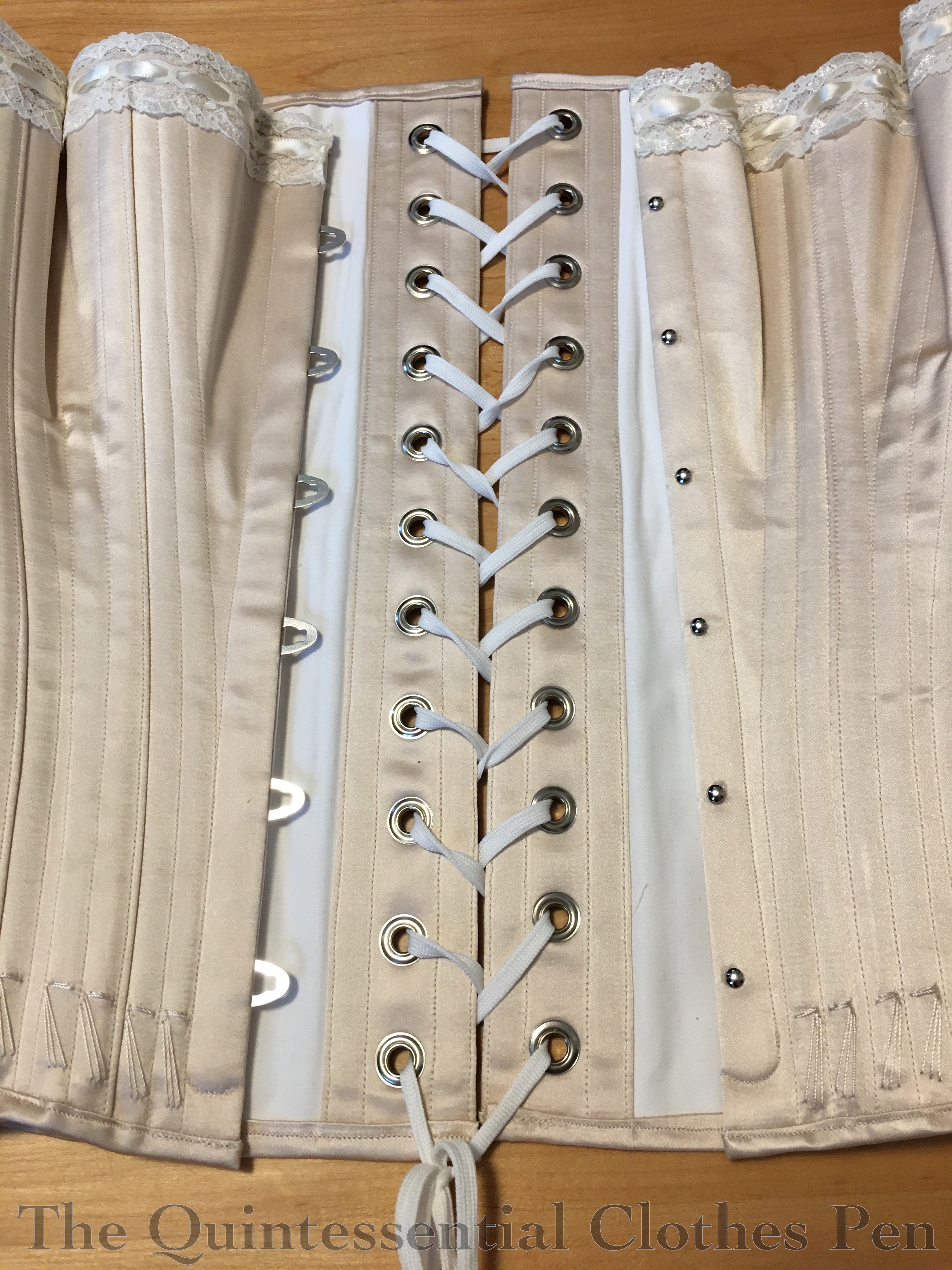
Later, I added size 0 silver grommets. Skipping ahead in construction, here’s a finished image of the corset, showing the finished grommets in place.

After preparing the grommet area, I assembled each side of the corset. No photos of that here, since I did this in the same way as my last corset: grading my seams, binding them with ⅝” cotton twill tape, and then stitching these down to create channels for the bones. (My original construction post has detailed pictures and explanation of this method. The part of the post discussing this also has some images showing the many bones on the back of that yellow corset that I mentioned earlier.)

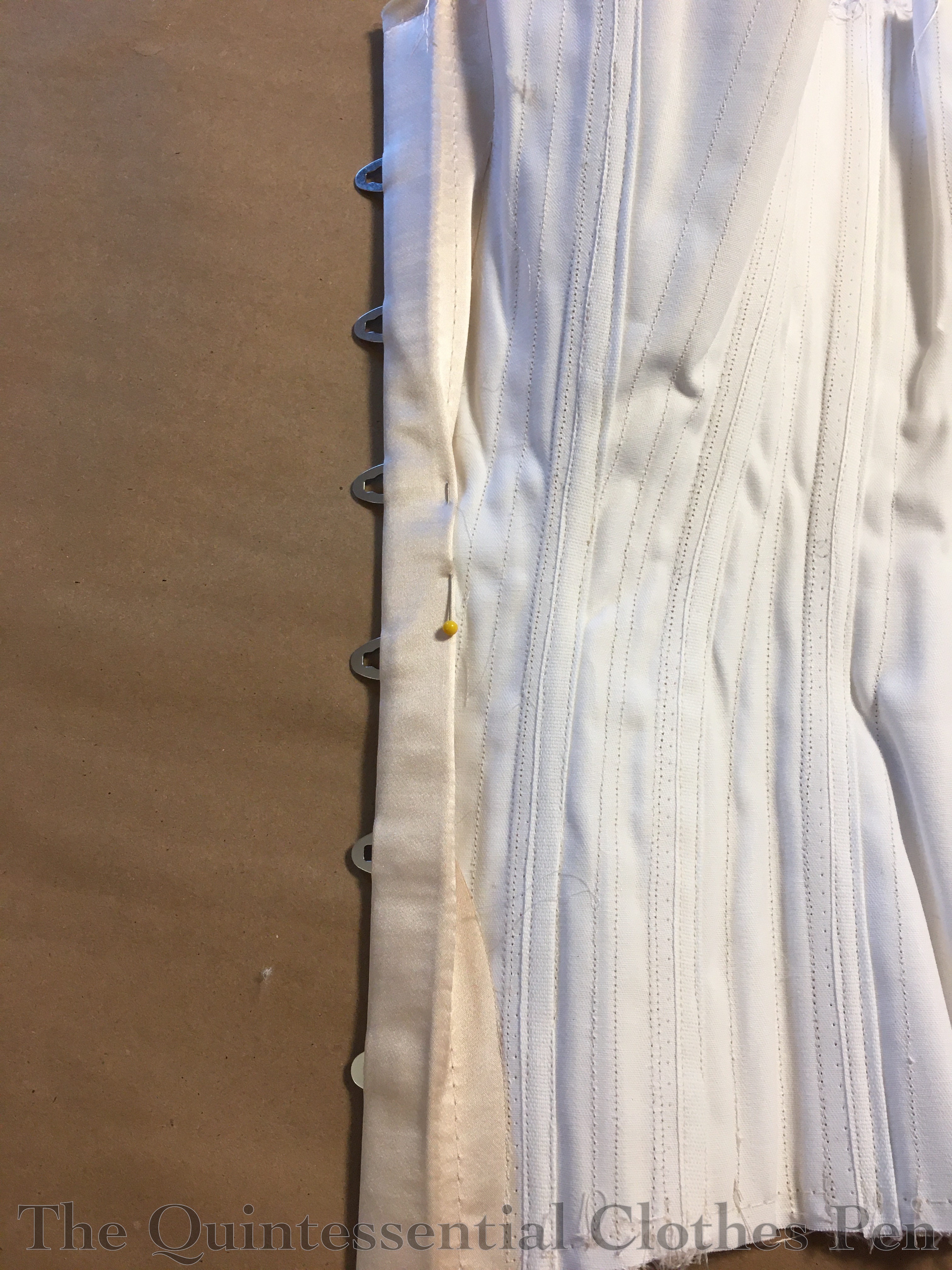
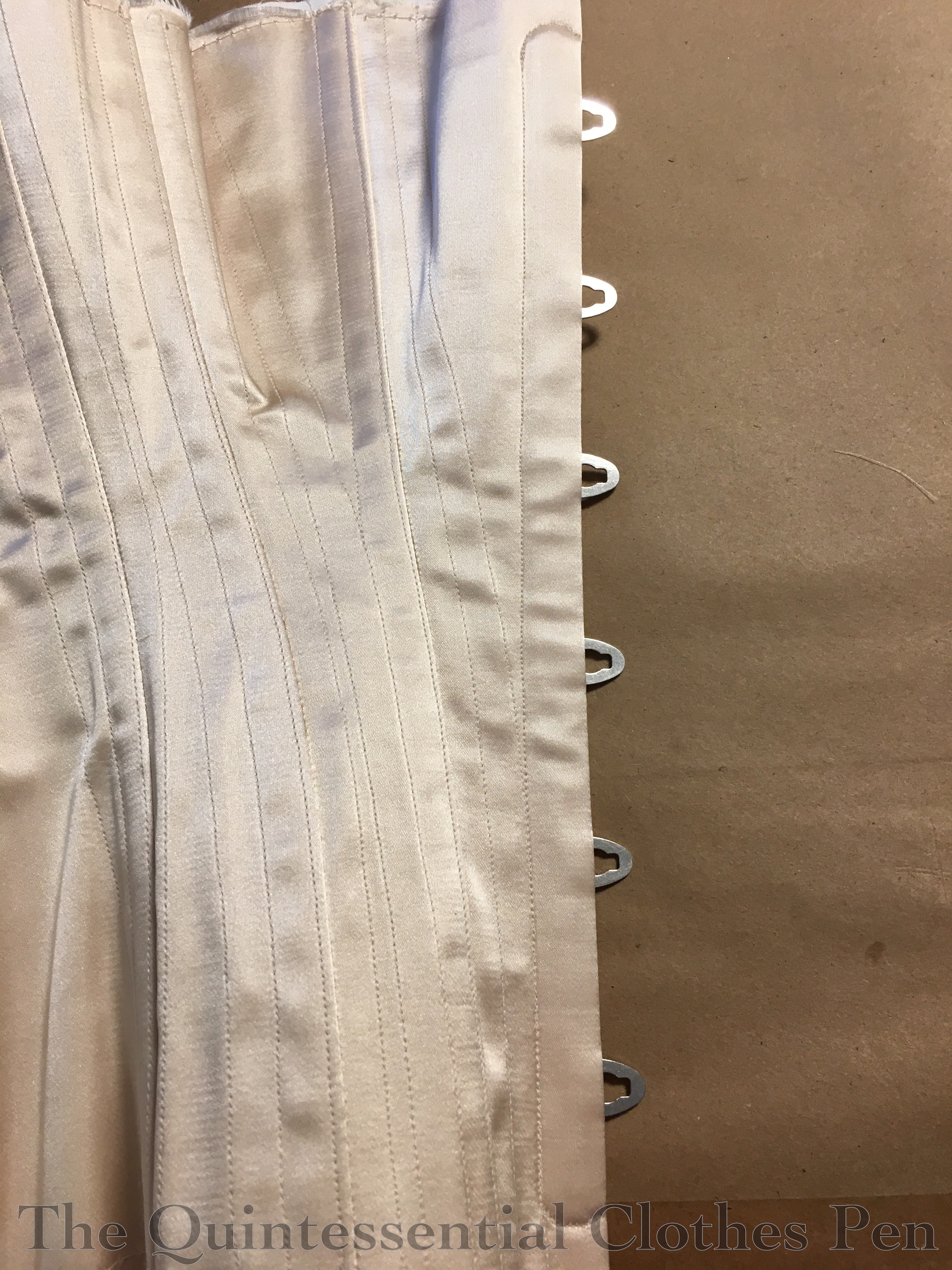
Next, I put in the busk, starting with the socket side, which is the proper right side of the corset. I used a different method on this corset than on my yellow one. Further inspection of originals shows a seam that the busk sockets are pushed through, rather than reinforced holes without a seam, so that’s what I wanted to do!

This is where I used the two pieces I cut. In the photo below you can see that the two pieces are pinned together (pin heads are on the underside, in case you’re wondering) and I’ve marked small lines where the sockets will land on the seam. This allows me to leave openings in the seam for each socket. The openings need to be snug, but not too tight. The seam is sewn just outside of the coutil, so that the layers fold crisply. As you can see, my seam allowance is uneven. I left the side of the silk that will be visible as the busk is pulled on a little wider to make a solid facing even after years of use.

Here is the finished seam, pressed open. If you look carefully you can see the gaps in the seam that I left for the sockets of the busk. My ruler at the bottom shows the scale. (This photo also shows some of the finished seam allowances and boning channels on the other seams, as well.)

Now the socket half of the busk is pushed into place. The single layer of silk seam allowance is pressed over the cut edge of the coutil and the whole thing is carefully pinned in place. I made sure that the busk is quite snug, so that it can’t shift in any direction.

To do this, I started with pinning the inside, to ensure that the silk is perfectly wrapped under the busk–no gaps or bubbles there! Then, I very carefully pinned from the outside. As you can see, I only pushed the pins through the silk once (they come up through the coutil again, but not through the satin) to minimize holes.

After that, some very careful stitching with a zipper foot was in order. I curved my stitching around the top and bottom of the busk (a detail from extant garments). It’s tricky to make the curves look nice, but it’s a small detail that helps elevate the finished garment, I think.

On the inside, it looks like this. I was able to keep the stitching a consistent distance from the fold in the silk due to my careful pinning. I’ll admit that this turned out better than my yellow corset! The yellow corset has a few bubbles and variation in the width of the turned under seam allowance.

Here is the busk from the side. You can see the seam and the snug openings, with solid back stitching, which leave space for the sockets to push through.

Ok, on to the stud side of the busk! This is the proper left side. Here, you can see the marks I’ve made to show where the studs will poke through and where the edge of the busk will fall. It is intentionally set back from the cut edge of the coutil.

One thing I was very careful about was poking my holes for the studs, because I found that on my yellow corset the silk pulled where I used an awl to make the holes. No one but me would probably see this, but I wanted to do better with this corset. I believe I used very sharp snips to cut small holes rather than using an awl to push the fibers apart. This is fiddly work, because a hole too big can’t be saved and will fray and cause the stud to move around, but it produced better end results, I think.

After making my holes and getting all the studs through, I carefully pinned and then stitched around the busk just like I did on the socket side.

Ta da! Busk!

Next up was binding the top and bottom edges. I used almost the same method as on my last corset. To quote myself:

The bottom binding is bias strips cut 1″ wide. I stitched them first to the right side of the corset with ⅛” seam allowance on my bias, trimmed my corset seam allowance to just about ⅛”, folded the bias over the edge, turned the raw edge under on the wrong side, [basted the seam allowance in place on the inside instead of hand whip stitching the bias down on the inside (slow, but a more effective method than pinning in this case)], then turned the corset back to the right side and topstitched very close to the edge of the first fold. This narrow topstitched binding seems to be common on late 19th century extant corsets and looks very tidy.

Below you can see the bias turned to the inside, pinned, and being basted in place. On the right are finished edges from the inside and outside.

This corset is boned with spiral steel for the bulk of the seams and flat steel on either side of the grommets.

I usually apply the bottom binding first, then put in my bones, and then bind the top. It’s a bit trickier sometimes to bind the corset after the bones are in, and if the top will have decorative lace then it can help hide any struggles that occur. (Thankfully, I learned from my last experience and made a test sample of the boning channel width that was perfect, so it was relatively easy to bone this corset!)

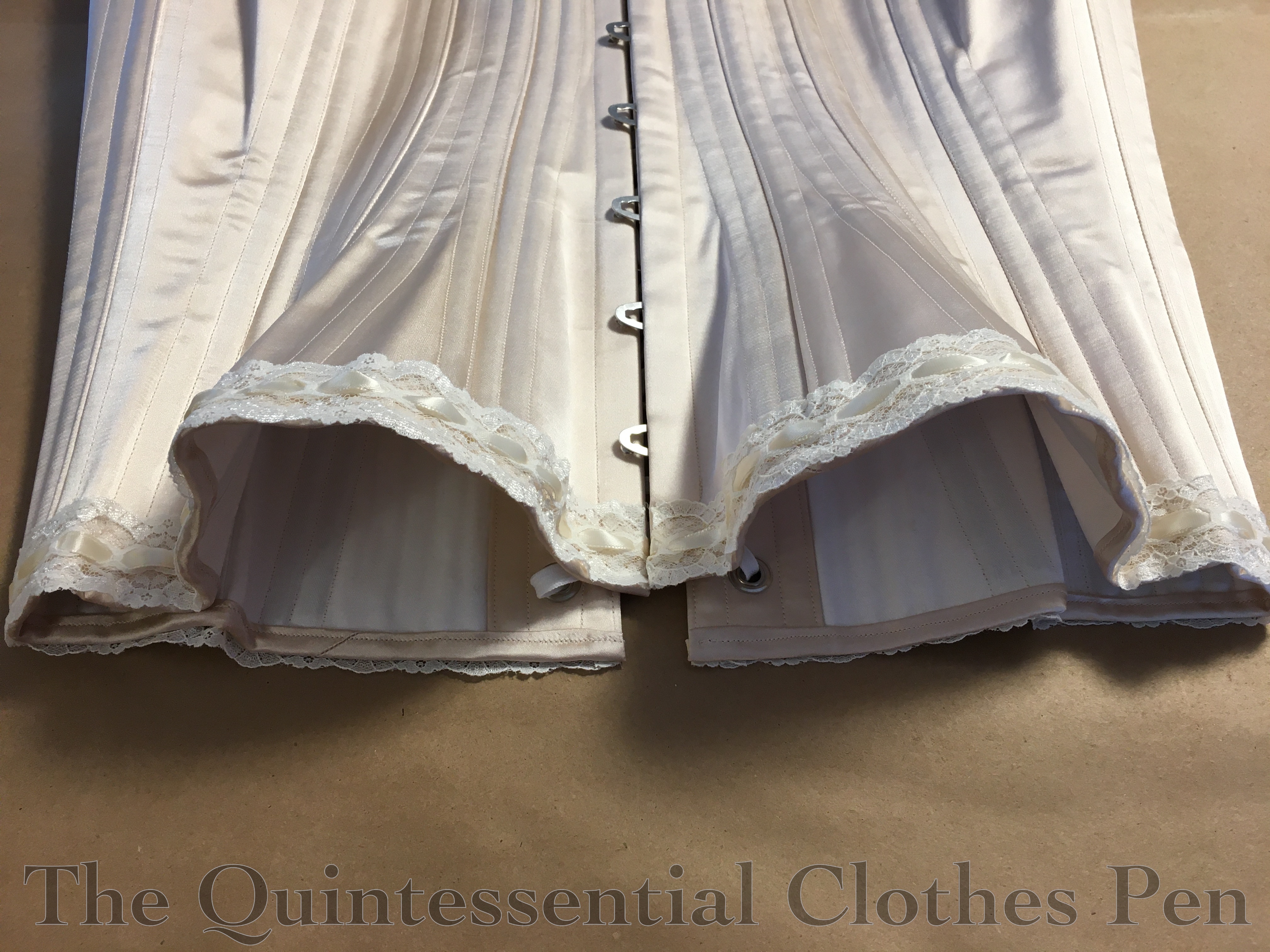
At this point the corset was basically done! The only things left were to add ivory beading lace and ribbon around the top and silk flossing along the bottom of the boning channels.

I was excited that I had all of the necessary materials in the stash, including the silk thread in the perfect ivory color.

I’m very pleased with the end result. It takes all the struggles and things I learned along the way with my yellow corset and perfects them, creating crisper folds and finishes and a comfortable garment with a great silhouette.

There’s no trickery in the next photo, this corset holds its shape with no support other than what is built in!

Finally Finishing My 1831 Bonnet

Many years ago (well, in 2012), I started a bonnet that was intended to match my 1822 Walking Dress. I was making a whole ensemble, with the dress, a muff and tippet, and also a bonnet and chemisette. It was more than I had time to complete for the deadline at the time. The chemisette was not even started, but the bonnet was patterned, cut out, started, and then abandoned.

In the intervening years, the bonnet pieces have sat in my UFO box, patiently waiting for me to come back to them. This year, as I was making my 1834 yellow dress and thinking about how to accessorize it, I remembered the bonnet and wondered if the shape and color might work for the 1830s. It seemed more useful to use something that already existed, and was already partly finished, as opposed to starting something new, so I decided to go for it!

This is the state of the bonnet when I picked this project up again this fall. It’s not bad progress, actually. All the pieces were cut out of buckram, flannel, and slightly slubby silk; the buckram assembly was started; the flannel was basted on; and the edges of the pieces were wired.

All of that turned into this!

In this post, we’ll follow along with my construction process. Future posts will have more finished ensemble photos as well.

Inspiration

First, let’s go back to the inspiration for this bonnet.

The Metropolitan Museum of Art has a bonnet that is dated c. 1820, pictured below. It is silk and appears to be satin edged in velvet. It looks brown to me, but it’s also possible that it is black and that lighting and fading from age cause it to appear brown.

Bonnet, c. 1820, The Met, 2009.300.1615

This is what I was aiming for when I started patterning in 2012. However, after finishing my bonnet, I realized that my brim shape is more open and high, and less forward, than the shape of this bonnet. This surprised me! And actually, it worked out in my favor, as the shape I patterned is more 1830s than 1820s.

Despite the shape not being quite like The Met bonnet (maybe someday I’ll alter the pattern and try again for the 1820s shape), I still took much color and material inspiration from it. I liked the tone on tone silk with velvet trim, the edges trimmed in velvet, and liked the lightweight silk ties (plus, I had all of these materials in the stash in perfectly coordinating purples!).

The trim needed to be different for the 1830s, though. I liked this 1830 bonnet, particularly for the inside of the brim trim, and this 1826-1830 bonnet for the fabric loop trim. There are other inspirational fashion plates showing floral trim inside and outside the brim on my Pinterest board for this project, as well. My bonnet is a melding of all of these sources of inspiration.

Construction

With my half finished pieces in hand, I decided to attach the tip of the bonnet to the side. Here is that step, pinned in place. These pieces were hand sewn together.

I’d decided to baste my flannel in place in order to help it follow the contours of the shapes instead of pulling away. On some bonnets (such as one covered in transparent fabric) these stitches might be seen, but I was confident that my silk would hide these quite well. The alternative would be to use spray adhesive to hold the flannel in place, but I didn’t have that at my fingertips 8 years ago.

In addition to the basting stitches in the middle, I also roughly whip stitched over the outside edge of the brim to hold the flannel in place.

I took this brim piece and basted it to my assembled crown, then stitched those two layers together using a Z stitch. Pinning this was fiddly, as I had to get the buckram seam allowance of the side to slip under the flannel of the brim smoothly.

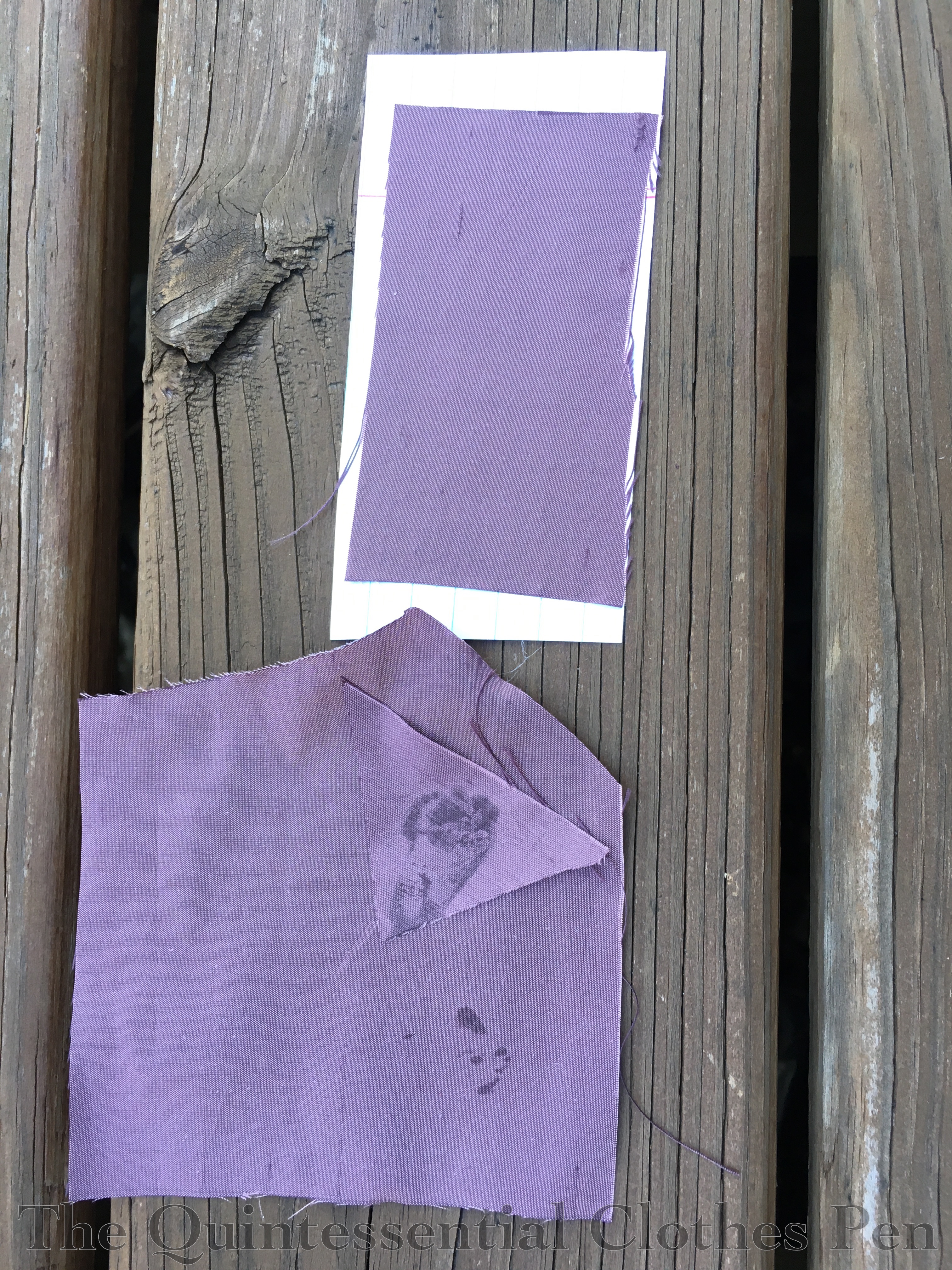
The next thing to do was cover the brim with my silk, but I still had the problem of getting the fabric to follow the contours of the curves without pulling away. When I started on this step I only had rubber cement on hand. I (smartly!) tried a sample to see if it would show through the silk. It definitely did! The rubber cement sample is on the bottom of the photo below. Not what I wanted! So, I ordered Krylon spray adhesive, which I knew would do the job. When it arrived, I tried another sample. The spray adhesive sample is on the top of the photo below. Success!

I used the spray adhesive for the inner and outer layers of the brim covering. It worked wonderfully, just as I had expected it to. The only exception is that I accidentally left a mark on one of my brim pieces where I’d let too much spray build up and had to recut that piece. So if you try this, make sure to do very light coats with the spray adhesive if your fabric is thin enough for it to show through!

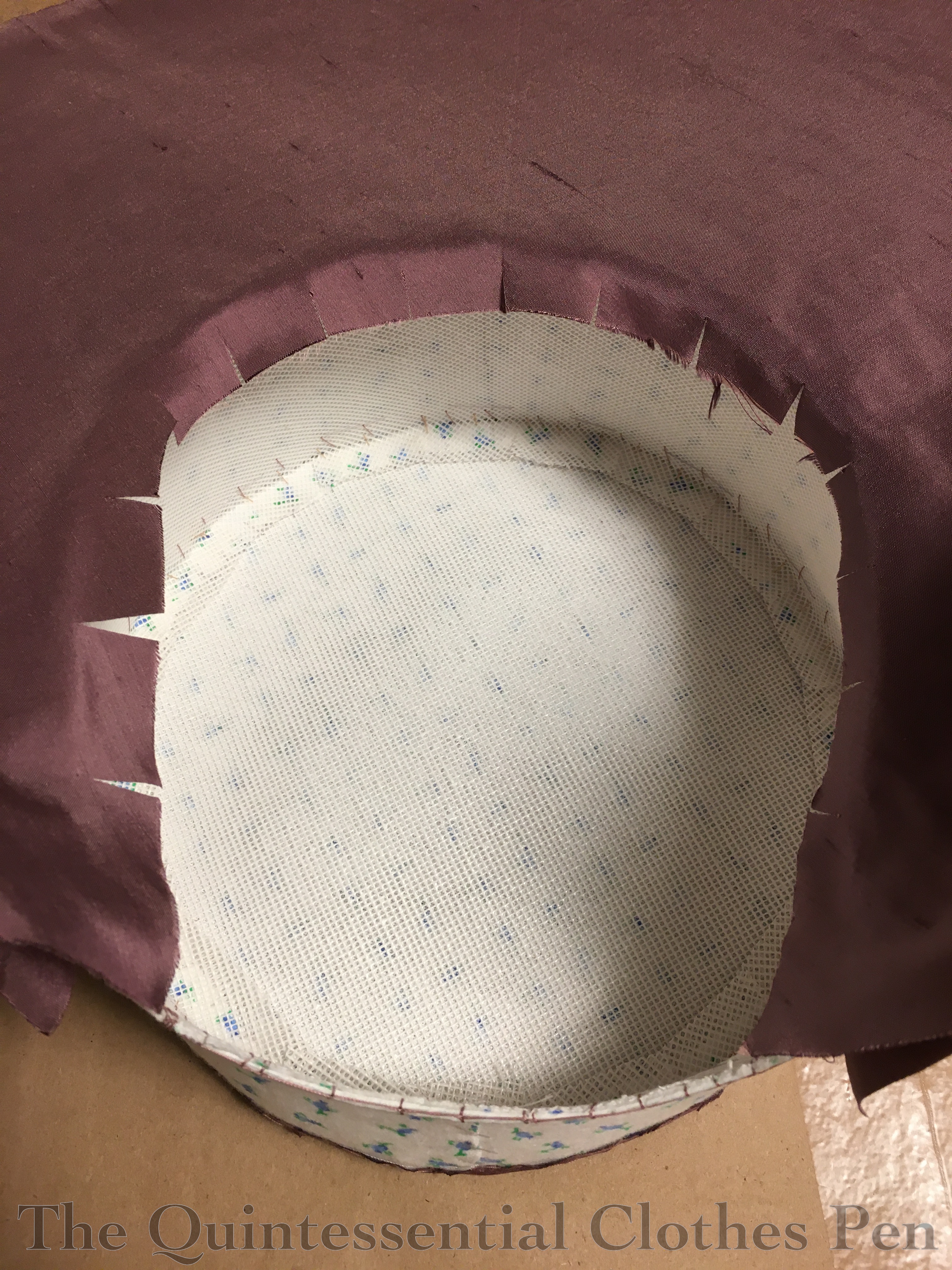
Here is the inside of the brim, with the seam allowance clipped where it meets the crown.

And here is the outside of the brim, with the seam allowance clipped so it can lay along the outside of the side band. You can see the interior of the brim showing on the extreme left of the photo, on the other side of the wired edge of the buckram. You can also see that by this point I’d put the silk covering on the tip of the bonnet. The seam allowances of that piece are clipped and then stitched over onto the side band through all the layers.

This photo shows the Z stitches holding the silk tip piece in place a little better than the last photo. It also shows the side band. For this piece, I pressed under the brim side seam allowance ahead of time, pinned it in place, and then turned the top edge under as I went along, so it would be just the right width. Stitching this piece on covered all of the seam allowances you can see in this photo.

In the next photo ,a few more steps have been completed. The side band was sewn on, the silk edges were trimmed and bound with bias velvet, I cut bavolet pieces (out of my glue stained brim piece!), edged the bavolet with bias velvet, and attached the bavolet. The great thing about the spray adhesive is that it’s not so glue-y that it gums up a needle or makes things hard to sew through, so I had no problem with any of these sewing steps.

As a side note, what is a bavolet? Interestingly, my go-to source for definitions, the Oxford English Dictionary, does not have an entry for this word! I believe that is because it is actually French, not English. I would define bavolet as ‘the curtain piece at the back of the bonnet’. There is more information about this word, including examples of the word in use from the 19th century, in this French Vocabulary Illustrated blog post. If you know of other good places to find a definition or etymology of the word bavolet I would love for you to share!

Back to the photos! All the long purple stitches around the side band are from attaching trim. I find that double thread makes it much easier to attach trimmings such as feathers and flowers, as you can double back through your looped thread to hold things in place and it makes it a little extra sturdy. The nice thing about doing all of that before lining the hat is that it makes for a really elegant interior when all is finished!

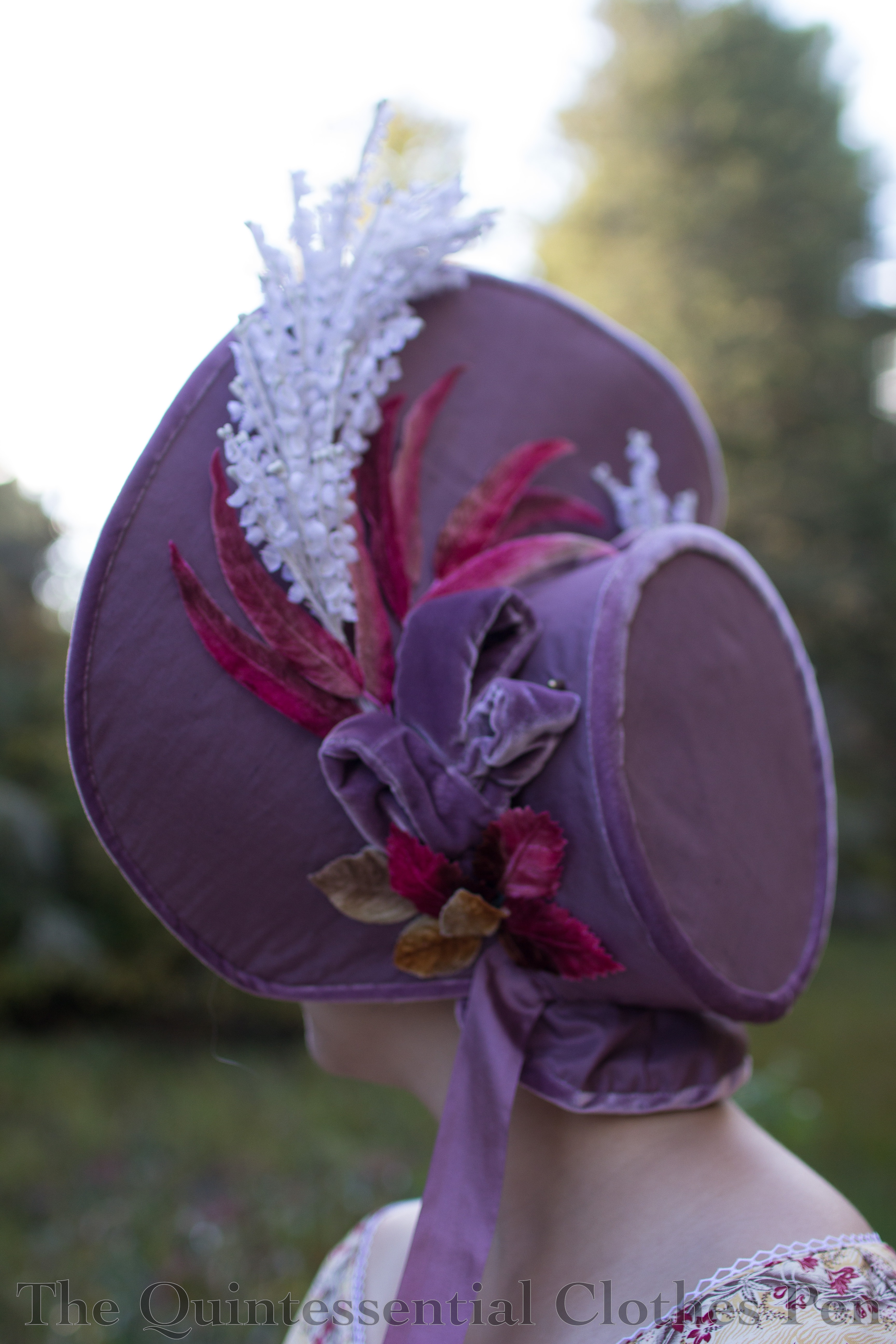
Below, you can see what that trim looks like from the exterior. I used some scraps of velvet to make loops and a variety of vintage paper and velvet millinery flowers and leaves in white, pink, and gold.

I’m super pleased with how it turned out, but it took hours to decide on the placement and then sew everything in place. It was finicky… The trim kept causing the bonnet to fall over as I was trying to place it and when sewing it the thread kept getting wrapped around the different elements and getting stuck. Plus, to make the stitches on the brim invisible they had to catch just one layer of the silk (as opposed to being stitched all the way through all of the layers) without pulling the silk away from the flannel.

Finally, it was time to make a lining! This used the same pattern pieces as the tip and side band and was cut from scraps of ivory shantung. The seams for the lining were machine sewn.

After I put the lining inside the crown of the bonnet, I covered most of the raw edges of the purple and ivory silk with a band of brown cotton velvet. This blends with my hair and provides a bit of a velcro effect to help keep the bonnet in place, in addition to providing nice finishing! This is the same process that I used when making my 1875 hat earlier this year.

At the bavolet edge, where there is no brown velvet, the ivory silk was turned under and sewn in place. I also added lightweight silk ribbon ties as a finishing step.

Finished!

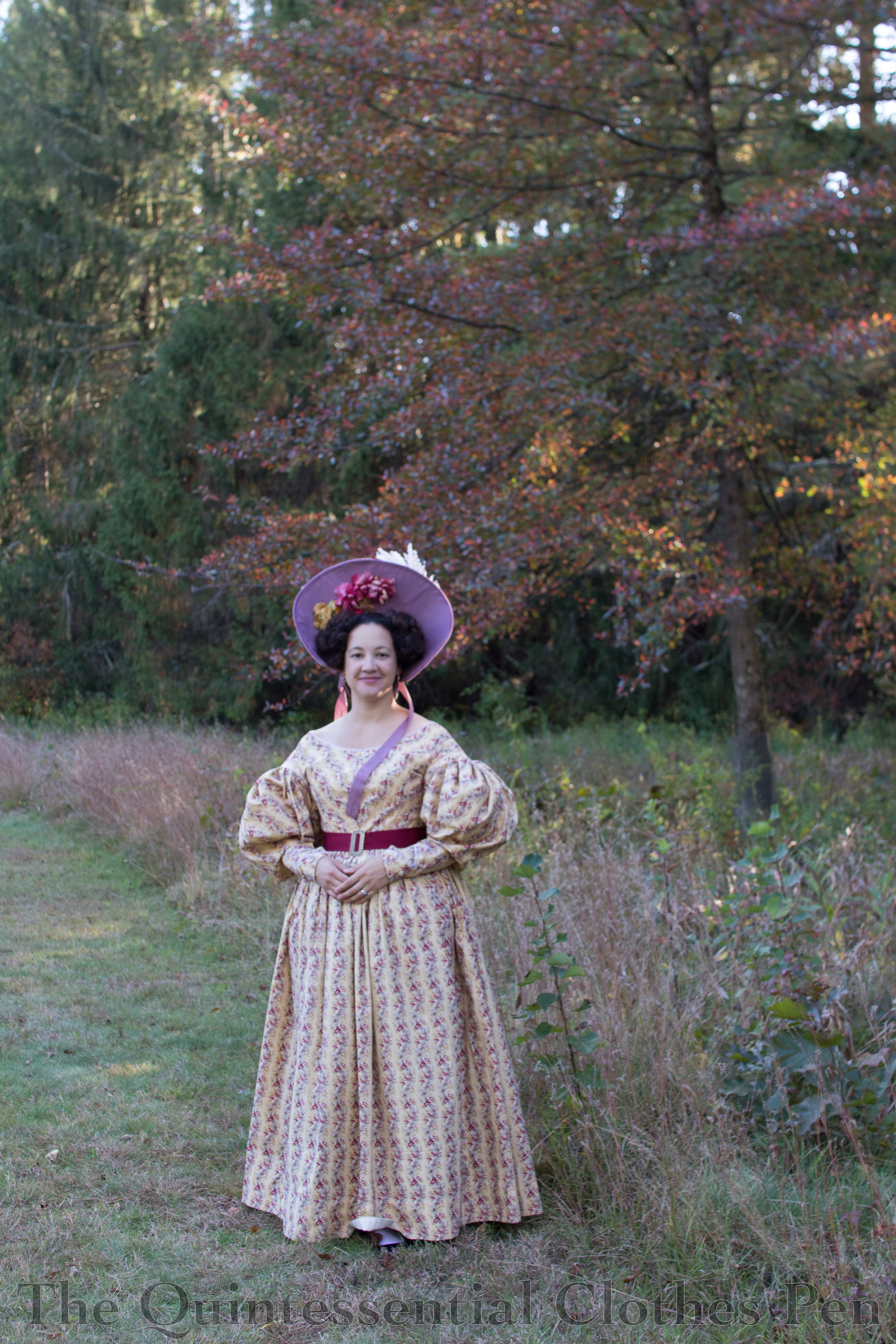
Here is the finished bonnet, being worn with my 1834 yellow dress! I love that the purple coordinates with my yellow print dress fabric without directly matching any of the colors in the print. It was also fun to choose white, pink, and gold floral trimmings for the bonnet to echo the colors in the print. I think the combination is anchored well while still being distinctive parts.

This photo clearly shows that the ties are purely decorative. I left them hanging free so that they could elegantly (usually!) move around. So what keeps this giant sail in place on my head? (Because I can say with certainty that a bonnet this big is basically just a wind catcher on the top of your head!) It will stay on its own… until moving around. I used the back section of my hair to make a bun, at just the right height so it would sit in the crown of the bonnet, and then used two hat pins at different angles to anchor the hat in place through the bun

I found that I placed the curl bunches too far back on the sides of my head when I tried to put on the bonnet and had to push them forward to get it to sit in the right place. It was unexpected how far forward the curls needed to be. As I’ve done in the past for 1830s side curls (explained here in 2016 and again in 2019), I used my own hair on top of mesh poufs to create the side curls. The combination of my hair getting very long and the curls needing to sit in front of the bonnet means that these curls are larger looking vertically than what I’ve had in the past. It seems to fill in the shape of the bonnet well, so I guess it’s good!

The other thing that the above photo does a good job of showing is the trim on the inside of the bonnet, which was also finicky to place. I had to get it in the right location so that it would organically grow out of my planned side curls hairstyle. The bonnet looks quite silly without the 1830s hair to go with it (and one might argue that it looks silly, in scale at least, even with 1830s hair!).

Speaking of scale, this bonnet is quite large. With the trim, it stands more than 8″ high on top of my head. I had to hold the brim when wind picked up while wearing it–the hat pins kept it in place but it would pull at my hair which wasn’t comfortable. Also, it required a pretty severe slouch in the car in order to not hit the roof! Thankfully, I was able to be a passenger while wearing the bonnet, so that I could arrange it, with the hat pins, in front of a mirror and then not need to sit up or look around while driving. Pretty silly! A carriage would have made so much more sense!

Just The Facts

While this bonnet does not qualify for any of the remaining challenges of the Historical Sew Monthly this year, I would still like to share the facts about this bonnet in the format I would use for an HSM garment. So, without further ado, the facts!

Fabric/Materials: ½ to ¾ yard each of floral cotton flannel and purple silk shantung, scraps of purple polyester velvet and ivory silk shantung, about ½ yard of buckram, about 3 yards of millinery wire, and a small piece of brown cotton velvet.

Pattern: My own.

Year: 1831.

Notions: Vintage millinery flowers, thread, and about 1 ½ yards lightweight silk ribbon.

How historically accurate is it?: 90%. Pretty good in terms of silhouette, construction methods, and materials; however, there are a few modern materials mixed in (such as spray adhesive).

Hours to complete: 15.75 hours to finish, plus maybe 6-8 from years ago.

First worn: In early October, 2020.

Total cost: Approximately $35.

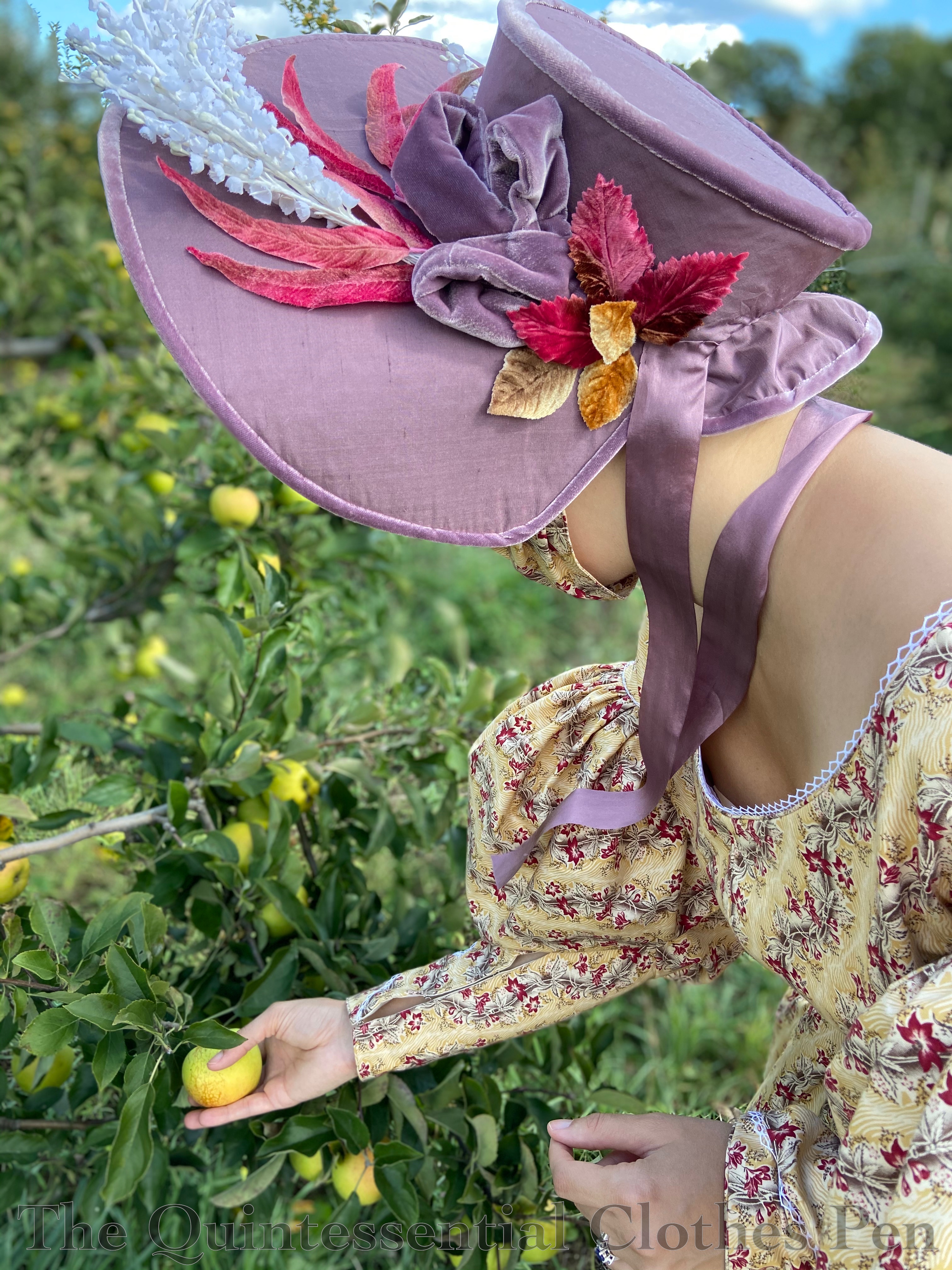
Thanks for sticking with me through another long construction post! I have one final photo that also hints at an upcoming post… 1830s apple picking adventure photos! Happy autumn!

Fabric Stash Additions: Summer 2020

I’ve accumulated a few new fabrics over the last few months and I thought it would be fun to share them in a stash addition post!

Fabric for new sweatpants

I have a favorite pair of sweatpants that I’ve had for almost 20 years. They’ve seen a lot of wear. After 20 years, the hems are pretty worn out and they’re starting to develop holes in the fabrics near the seams. I’ve been on the lookout for similar ones to replace them for years, but the fit is hard to find: wide-ish legs with a bit of a flare, diagonal pockets, and wide hems. I’ve never come across another pair with quite the same styling. (And they’re not currently in style, being 20 years old, so that’s part of the challenge.)

While wearing them quite a bit in March and April I had the thought that “I could make myself a new pair of these pants!”

This idea was spurred in part by the lovely fleece fabrics that Blackbird Fabrics has stocked over the last eight months or so. Every time they popped up in an email I considered purchasing some, but couldn’t make up my mind about color and dragged my feet. Blackbird’s fabrics sell out quickly and I kept missing the boat with my indecision, but then they restocked the bamboo/cotton stretch fleece and matching ribbing and I decided to make a decision, go for it, and order some!

Doesn’t the fleece side of this fabric look soft? I love that new fleece feeling!

I ordered 1.5 meters of the fleece and .5 meters of the ribbing. I’m sure I’ll have leftover ribbing, as it’s only used for the band at the top of the pants, but I’ll find a use for it again someday, I hope.

Of course, right around the time I purchased my new sweatpant fabrics the weather warmed and I lost my motivation to make the pants. But the fabric isn’t going anywhere and in theory the weather is getting cooler soon, so maybe these will make it onto my sewing table sometime in the next few months.

I do congratulate myself on taking the time to take a pattern from the old pants before I lost motivation so that when I decide to move forward I’m ready to go!

Two block printed fabrics

I keep a running list of sewing projects, in order to remind myself what steps projects are at, what fabrics are marked for certain projects, and what projects I have in mind. Occasionally, while looking at this list, I get swept away with ideas for new projects.

Earlier this summer, this feeling of wanting new projects was compounded by a friend updating me on the status of her current 1830s day dress project using a lovely block print cotton. It’s been a few years since I’ve seriously looked at what’s on offer for block print cottons on places like Etsy and eBay, so I decided to check things out.

Oops! Because, of course, I found pretty things! And then my brain went into overdrive, thinking of all the amazing projects I could make with the beautiful things!

I confess that I gave in to temptation and purchased two block printed fabrics.

I feel somewhat justified in that I have very clear ideas in mind for them!

I intend for the green and red print to become a gown like this one, from about c. 1785. I have 10 yards, enough to make the dress and a matching petticoat, but I thought that someday I might also be interested in having a contrast petticoat as well.

In terms of timeline, I have no clear plans for when I might make this. I am working on stays from this period, so that will be a great help, but that’s not really a solid plan. And the stays are going slowly, as I’ve been distracted from them by other projects. So, no deadline or timeline in mind.

I also bought 9 yards of the pink print in order to make a day dress from 1843/44. But then I remembered a fabric already in my stash that would also make a lovely dress from these years (I actually posted about it in this past stash addition post in 2018–it’s the cream woven plaid). So… I’m not exactly sure which fabric I would pick for this project, though I’m leaning towards the new pink block print (whichever one I don’t pick doesn’t have a clear plan).

I have a new corded petticoat that would help with the 1840s silhouette and I already have the rest of the undergarments, so it’s not out of the realm of possibility that I could tackle this project in the not-too-distant future. (What does that actually mean? Next year, maybe?)

Discount duchess satin

This is the standard ‘I happened upon it’ story. This blush duchess silk satin was in the discount bin at a local store.

Of all of the fabrics I’ve acquired recently, this is the one that is the most ‘stash addition’.  I don’t need the 1.5 yards that I bought for anything in particular, but I thought that for the low price it was worth picking some up.

I think it would make a gorgeous 19th century corset (like my 1880s steam molded corset, which is also made from duchess silk satin). I also have vague plans to someday make a 1920s corset/girdle and I think it might be useful for that as well.

In conclusion…

I’ve been doing well at using stash fabrics to make things recently, which is great, but I’m not sure if I’ve offset that by buying new things… Oh well! Sometimes you have to buy things when you see them!

When The Dress No Longer Fits (Mid-20th Century Edition, Part II)

…turn it into a skirt! That’s the take-away from today’s When The Dress No Longer Fits project.

This skirt started life in 2014 as a dress inspired by a 1940s Anne Adams sewing pattern. I don’t actually have the pattern, but I was inspired enough to try patterning my own version based on the pattern envelope image. You can read all about the creation of the dress in this past post.

Since this photo was taken my shape has changed, making the dress a garment that could no longer be worn.

I’ve also never worn this dress all that much. It’s easy to draw a seam along the bust, but hard to pattern it so that the stripes are straight and it actually follows a curved body comfortably. It was ok, but not the most comfortable dress I’ve ever made. And it was a lot of purple.

I have limited fabric leftovers from this dress–certainly not enough to make a whole new front bodice, which is what would be necessary– and not being completely sold on the idea of the dress as a whole, I decided to turn it into a skirt! This eliminated the bodice problem and instantly cut down on the quantity of purple in one seam-ripping swoop.

I started by removing the bodice and taking out the zipper where it crossed the waistband, as well as down into the skirt just past the seam that connects the waistband to the top of the skirt, as you can see below.

My waist is larger now than it was when I made the dress, but I was saved by the fact that the waist of the skirt had been a few inches too big when I originally made the dress. Whew!

At the time I made the dress, I’d solved the problem of the skirt being too big by adding tucks on the back. This kept me from needing to alter the side seams, which I didn’t want to do because I’d matched the stripes perfectly.

To alter the dress now, all I had to do was take out the tucks and the waist fit! (I’m reminded that I had a similar problem/good fortune while letting out the waist of my 1904 Anne of Green Gables skirt–I mentioned it in this past post. Interesting that they’re both inspired by Annes!)

Luckily, I had enough extra waistband length to accomodate letting out the tucks. It was a little annoying to do, because I had to take the waistband off entirely to reset it with the extra across the back and I had serged the skirt and waistband seam allowances together. It was a bit of extra seam ripping, but that was better than trying to piece the waistband and match the stripes.

The next step was adding a waistband facing. I used a scrap of white striped cotton for the facing. It is machine sewn on the top edge, understitched (to keep the facing from rolling out and being seen), and then hand whip stitched on the inside.

Here’s a closeup view of the waistband. I shorted the zipper so it stops below the waistband, but I did not re-sew the whole zipper length–I still didn’t want to mess up the stripe matching on the side seam!

The final step was a hook and bar to close the waistband.

Ta da! The dress is now a skirt.

I’m not completely sold on the skirt. I like it, but I don’t know if I love it.

And I still feel it’s a lot of purple.

I thought it would go with more tops in my wardrobe, but it doesn’t really. I like it with white. I think it would look nice with yellow, but the yellow top I had in mind is horizontally striped and that just seems like too much with a vertically striped purple skirt!

I think I need to try wearing it for awhile and see how I like it. I haven’t really had a chance to wear it this summer given that I haven’t been going out, or wearing real clothes (as opposed to comfy clothes) very much. So a judgement about whether I like the dress-turned-skirt is on hold. That being said, I’m still excited that at least the garment is wearable now, whereas when it was a dress it was not.