Re-Imagined 1885 Fancy Dress (HSM #9)

The Backstory

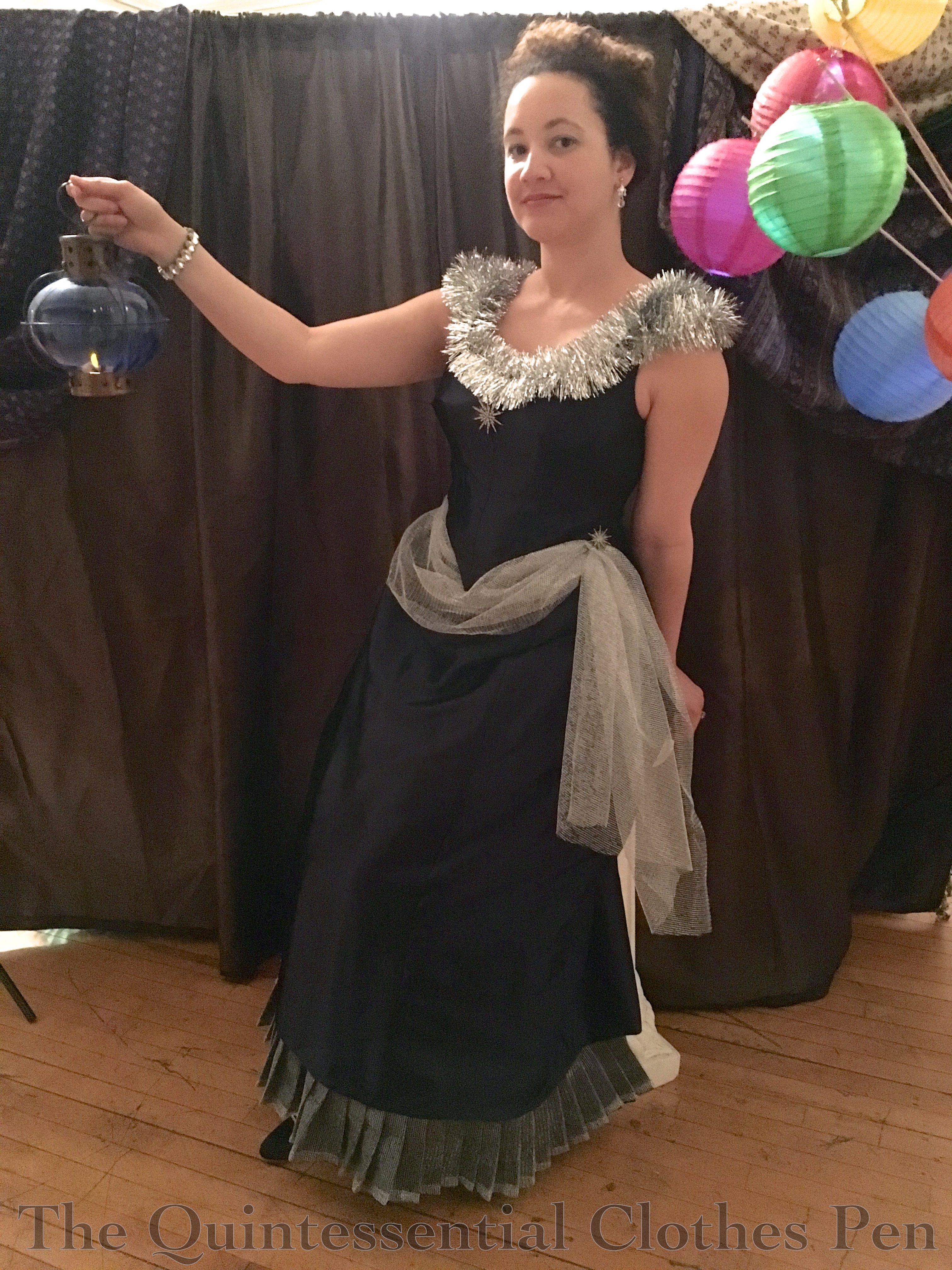
In 2016, I made a dress for a Fancy Dress Ball inspired by a dress worn by Alice Gwynn Vanderbilt in 1883. Alice’s now-famous dress, made by The House Of Worth, celebrated Electric Light as its theme. The dress uses beading and metallic elements (as well as an electric torch, for the original wearing!) to visually reflect light as well as communicate the electric light theme via decorative motifs. I posted an image of the inspiration gown and a link to more information about it in my original post about my dress in 2016, which you can view here.

I was inspired by the trimmings on the gown, but needed to create a dress with little expenditure (much different than the budget for a Worth dress!). To achieve this, the goal when I made my dress in 2016 was to use as many materials as I could that I already owned. The main dress fabrics were already in the stash from old projects and the silver net was leftover from trimming the Versailles sacque I posted about wearing recently.

Below, a photo of the dress in 2016, with a lantern standing in for “electric light.”

There were a few small changes I wanted to make after the first wearing of the dress, but I didn’t have a need to wear it again for years. Fancy Dress events are not all that common even within the already limited realm of historically clothed events! And with the original trimmings I didn’t like the dress for regular wear. Plus, for a number of years after making the dress the events I was attending did not encompass the 1880s.

More recently, however, I have had more opportunities to wear clothing from this period, as The Footwork and Frolick Society has hosted a few events with themes that can include the 1880s. Therefore, I decided to re-trim the Fancy Dress dress into a more regular, less Fancy Dress, ballgown style for the Yuletide Ball in 2024.

Inspiration

This time, my inspiration was a mashup of ideas from a variety of images.

From the fashion plate below, published in the Revue de la Mode in February 1886, I pulled information from the gown on the right, with the pleated fabric along the v-shaped neckline and asymmetrical decorations (which I guess are feathers) on the shoulder and skirt.

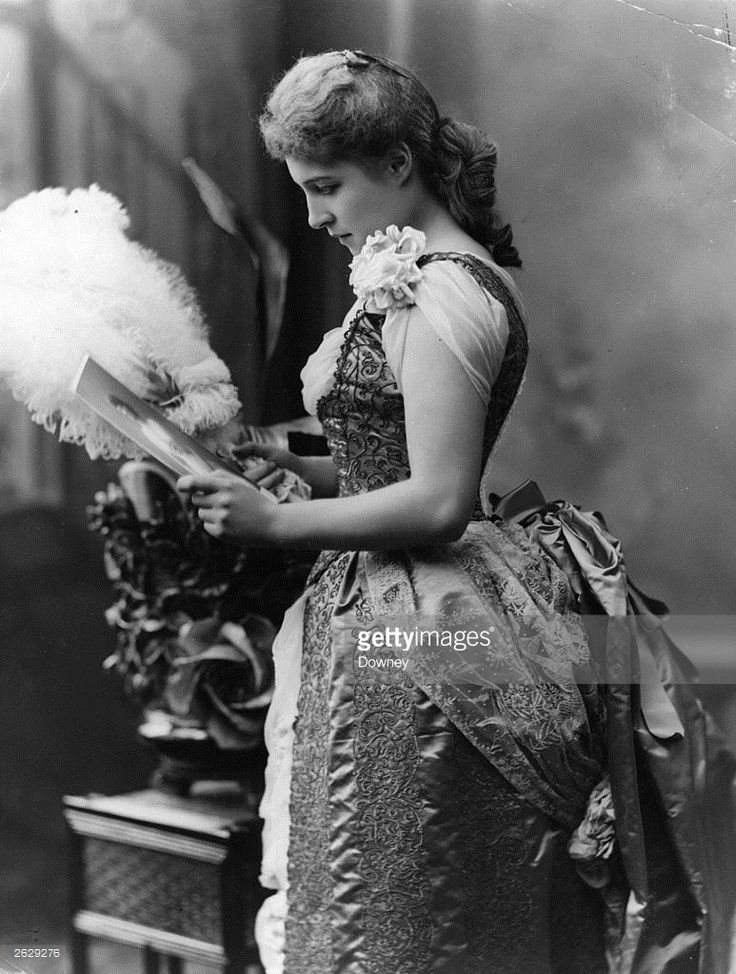
From the photo below of British actress Lillie Langtry (Original Publication: People Disc – HU0206. Photo by Downey/Getty Images), I pulled inspiration for the “sleeve” idea I wanted to incorporate. The pattern of the fabric used for the bodice in this photo was also reminiscent of one of the fabrics I used to update my dress.

And finally, I was also inspired by the beaded swags (and chiffon “sleeves”) on the c. 1887 dress in the collection of the Kent State University Museum in the photo below.

Dress Update Overview

For the re-make of the dress, I wanted to maintain my goal of using materials already on hand. I still had small scraps of the navy blue satin in my stash as well as the silver net. I also went through my fabric stash binder to see what other fabrics and trimmings might work and found that the best bets were a piece of polyester velvet flocked with silver swirls that I’d purchased at Joann Fabrics probably twenty years ago when I had just started sewing and loads of silver ribbon that I had been gifted to me. The blue and silver colors fit the colors of the existing dress perfectly and I thought there was a sort of New Year’s aspect to the color scheme, as well. (I also purchased the Joann fabric in burgundy and green (both with gold swirls) and had made Christmas decorations out those, but I don’t think I ever used the piece of blue, so this was a great opportunity!)

With my materials decided, I moved on to the sewing part of the project, starting with unpicking the original trim from the dress. I had made it knowing I might someday want to change the trimmings, so they were not sewn into seams and were pretty easy to remove. That left me with an almost entirely navy blue dress, relieved only by the silver pleats at the bottom of the skirt.

Then I went back and considered my original list of changes, which included:

  • Boning the center back edges so they would lie flat when laced closed
  • Adding a matching piece of satin behind the lacing holes to hide any white fabric of undergarments
  • Making sure that my chemise wouldn’t poke out of the armholes

Quoting myself, from 2016… “these are minor changes and I’m not sure when I’ll have the opportunity to wear this again so it might be awhile before they happen.” I’ll say! It only took 9 years!

Historical Sew Monthly

My goal of using stash-only materials for this dress re-do makes it fit into the Historical Sew Monthly 2025 Challenge #9 Blue:

Make an item that features blue, in any shade from azure to zaffre.

Just the facts:

Fabric/Materials: Approximately ¾ yard silver net, just over 1 yard of navy velvet with silver motifs, and scraps of navy polyester satin.

Pattern: My own.

Year: c. 1885.

Notions: Approximately 23.5 yards of ¼” silver ribbon.

How historically accurate is it?: 90%. Polyester and modern synthetic ribbon do not have accurate fiber content. And my patterning is conjecture. But the overall idea is pretty good.

Hours to complete: I didn’t keep track.

First worn: December 7, 2024.

Total cost: Free, since everything came from the stash and was either gifted to me or purchased ages ago!

Dress Update: Back Closure

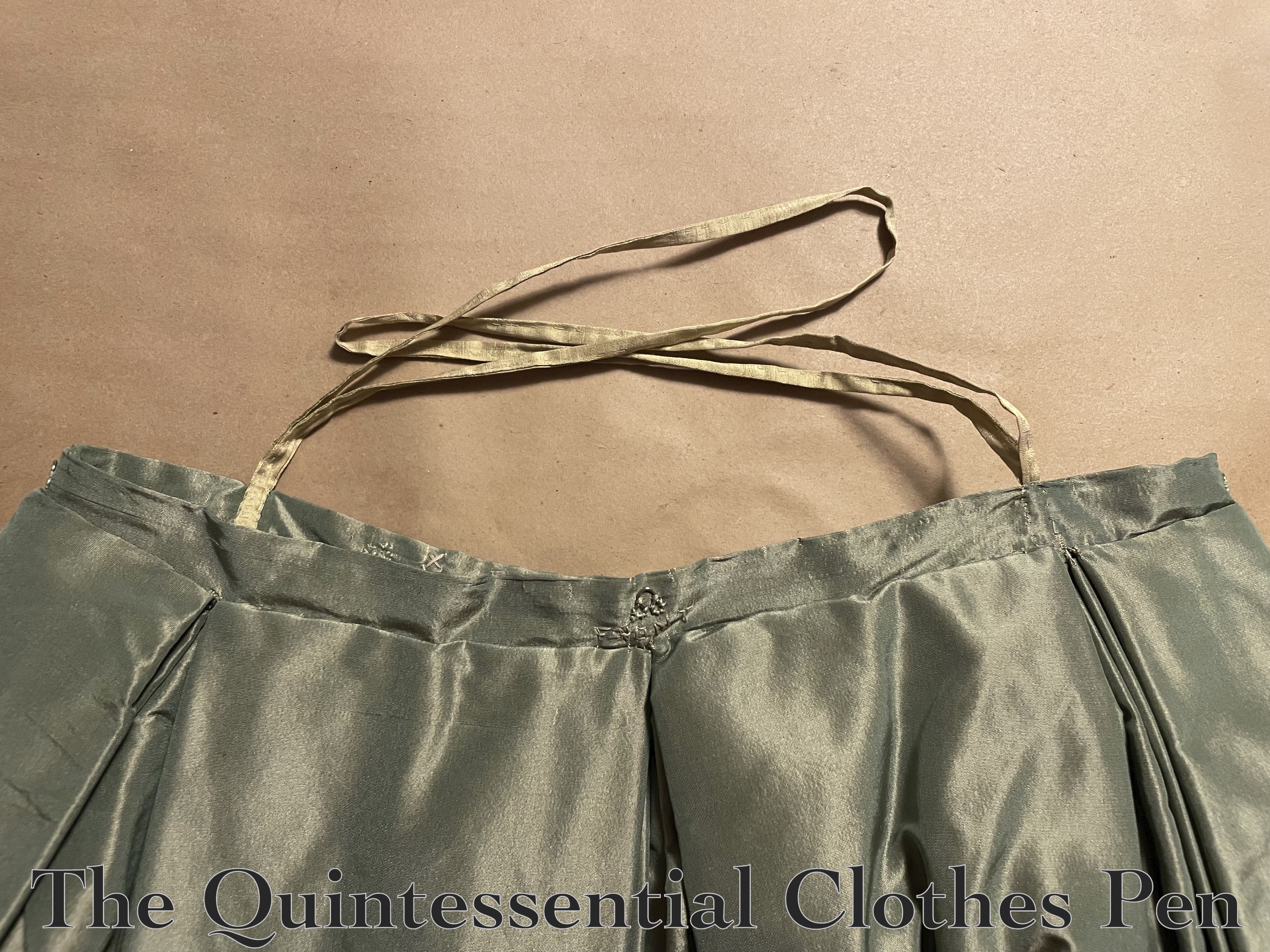
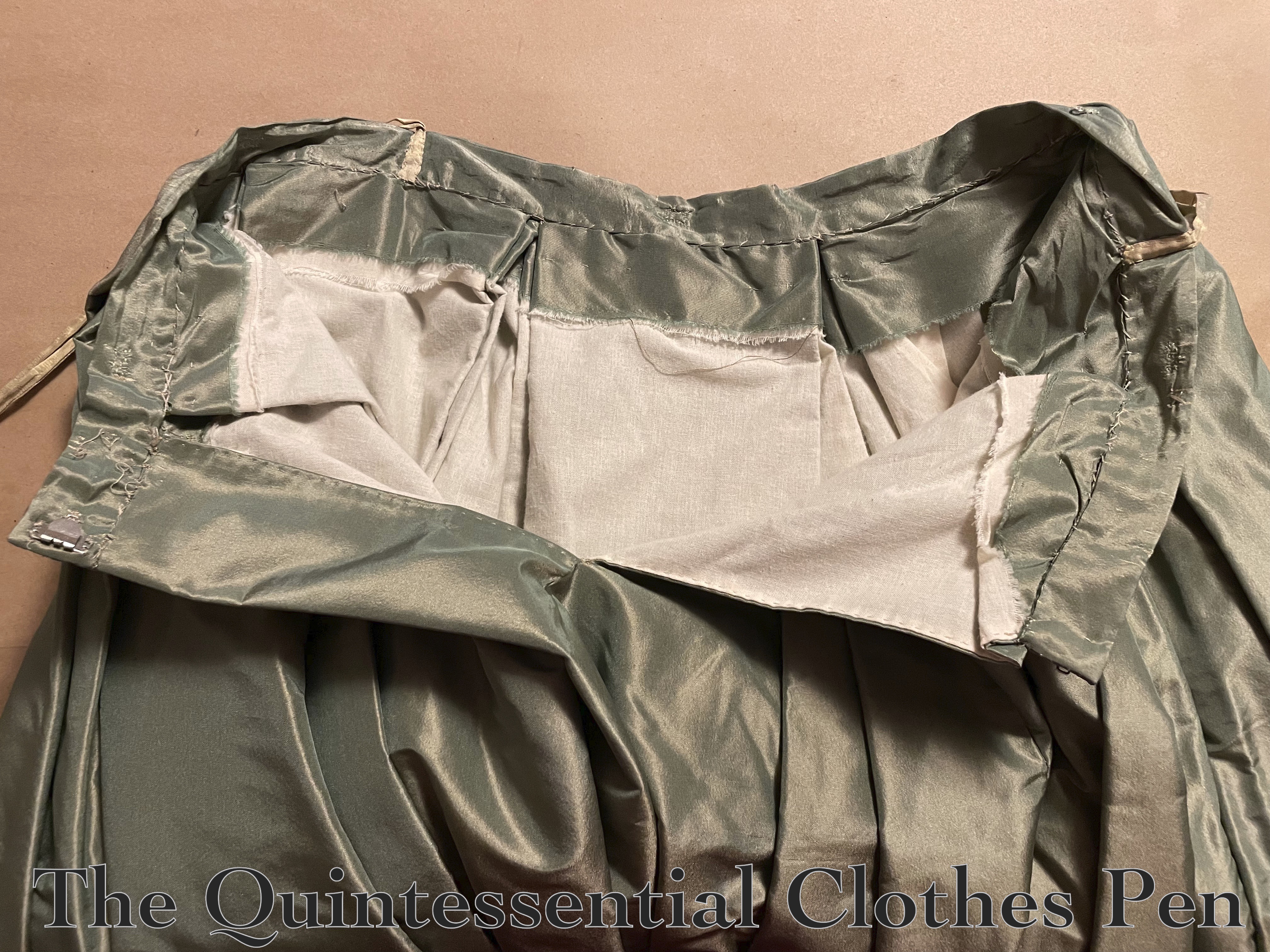
Following the original list of changes, I added a placket behind the lacing holes and added plastic bones along the very back edges, to help hide undergarments (the white color really does pop against the navy blue of the dress!) and keep the back laying flat when laced closed.

Dress Update: Sleeves

When re-examining the dress in 2024 with fresh eyes, one of my biggest desires for change was to better fill in the armholes of the dress and provide a decorative element. Yes, evening dresses in the 1880s were often sleeveless, but when really looking closely at them again, I found that while not having sleeves, they do almost always have something that obscures the armhole and even the upper arm. I am more likely to call these styles swags or drapes of fabric, as they aren’t really proper sleeves, but they are certainly set into the armhole in some way. I wanted something like that for the re-do of this dress.

I haven’t had a need to pattern something like this for this period before, so I looked through my historical pattern books for places to start. Interestingly, I didn’t find much. There was one sleeve that seemed like a possible starting place, but when I mocked it up it didn’t really do what I was hoping for at all!

So that left me with the decision to create a pattern from scratch. Thinking about what didn’t work in the mockup and my inspiration image, I proceeded to drape a mockup that achieved what I was hoping for. I didn’t have my dress form handy, so it required a fair bit of going back and forth between pinning and trying on the bodice to get the right shape. But I did! It’s a strange shape, for any sort of sleeve pattern. But that makes sense, since the sleeve drape is a not-really-sleeve!

Dress Update: Apron, Sleeve Swags, and Ribbon Flowers

I pondered creating some sort of beaded fringe for the armhole (and maybe even the waist, as can be seen in the third inspiration photo, above), but decided against it for time and material reasons. I really did want to stick to the stash!

Even if the beaded fringe wasn’t going to happen, I liked the idea of something to set off the wonderfully pointed bodice so that it would show up and not blend into the skirt. So in the end I decided to use some of the velvet from the stash to make an apron layer for the skirt, as was very common on dresses from the 1880s.

I started with making the pleated neck swag, so I wouldn’t run out of fabric, and then used all of the leftover fabric to make the apron. Due to this fabric restriction, I patterned the apron based on what was possible with my fabric, using a general understanding of the how these skirt elements were patterned in this period. The front of the apron is a curved piece that is pleated into the back on each side. The back piece is a bit scant, but has a few pleats along the top to give volume and descends to a point at the center back, since that was the shape of the fabric that was available! I used up pretty much all of the blue velvet!

For the sleeves, I made flower shaped sprays from lengths of ribbon that were tied into loose knots close to each end and then folded into quarters to make one loop and two ends. These individual elements were then combined and sewn together to make the flower-like formations, with larger scale ones on the skirt and smaller ones on the bodice.

The sleeve dangles were made from the same ribbon, knotted in the same way, that was folded to make a longer and shorter side and then tucked under the sprays on the shoulders.

Below, you can see the individual spray elements and a length of ribbon ready to be added as a sleeve dangle.

Finished Updates

Here is the updated dress! The blue velvet pleated v-shaped neck swag completely ignores the neck shape of the bodice underneath, which is more of a square shape. The same fabric is used again to create an apron, stitched to the outside of the waistband of the skirt to reduce bulk.

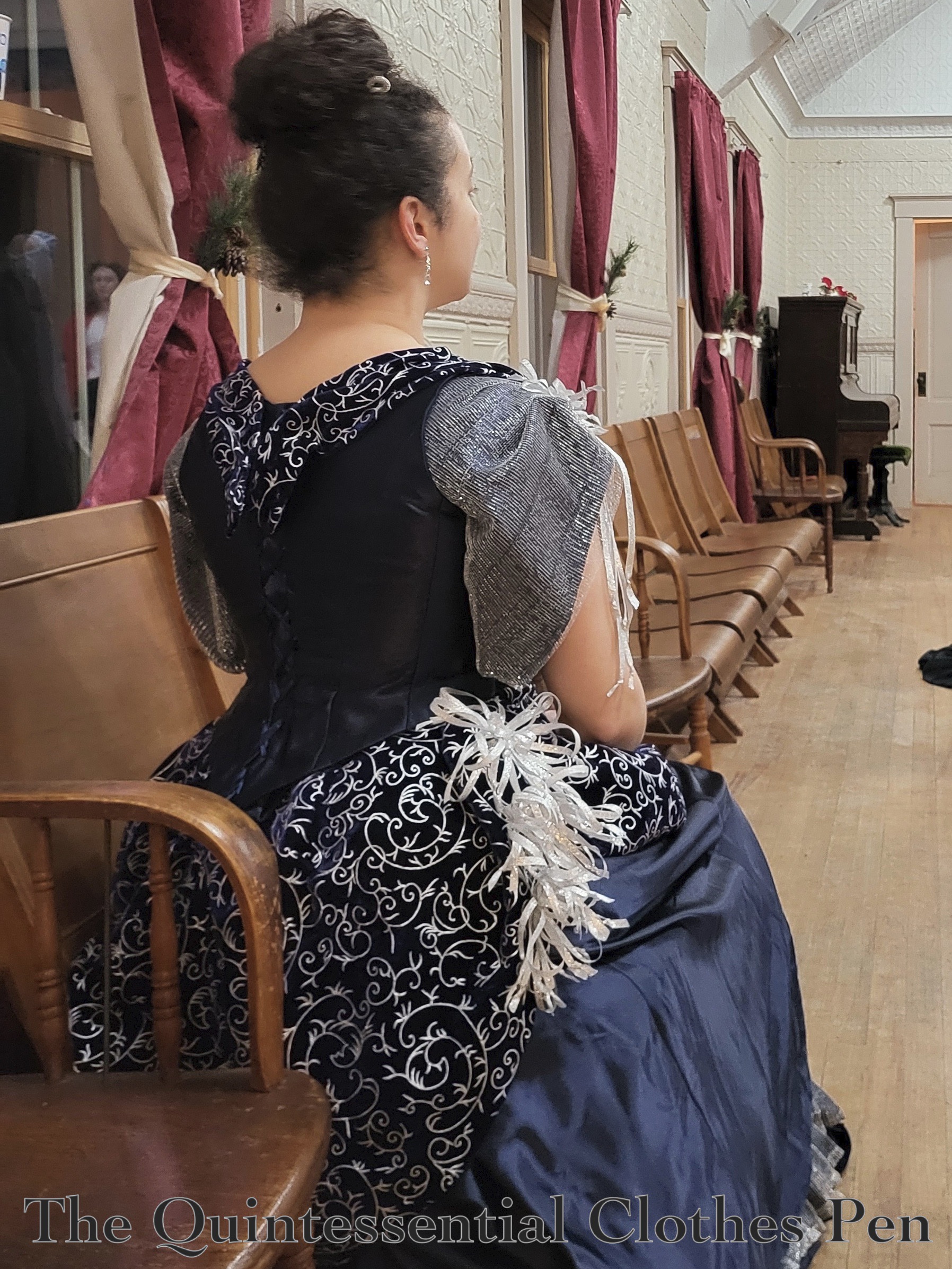
The silver net is used over the blue satin scraps to create “sleeves” that are pleated into the armhole and decorated with sprays and dangles of silver ribbon.

The “sleeves” wound up looking a little odd where the meet the back of the bodice, but that’s more due to my original patterning of a very inset armhole in the back than it is the sleeve pattern. It’s a lesson/change for the next bustle period evening gown I make, whenever that is!

I didn’t know what to do with the back of the velvet swag, because I wanted it to be easily adjustable depending on how tightly the back was laced. I ended up with this pointed arrangement that accomplished the goal of flexibility.

The armholes, left side front of the bodice, and right side front of the skirt are decorated with the sprays of looped silver ribbon. I used x4 — 4 yard spools of ribbon and half each of x3 more spools that were 5 yards each.

I calculated how many sprays and dangles I wanted for each section, but in the end I was running out of ribbon and started to just combine and move things around until they looked reasonable. Sadly, that means I don’t have a good record of how much ribbon went into each element or how long each piece of ribbon ended up being. I think that the smaller sprays were made of piece of ribbon that were 10″, the larger sprays on the skirt were made of pieces of ribbon that were 16″, and the arm dangles were 11″ before being folded.

Wearing

I wanted to find a simple but still 1880s hair style for this wearing, so I was pleased when I came across a photo of women in 1880s evening dresses with their hair drawn back and pulled up into simple large chignons on the backs of their heads. I wore that style with the addition of a few silver hair pins to tie everything together.

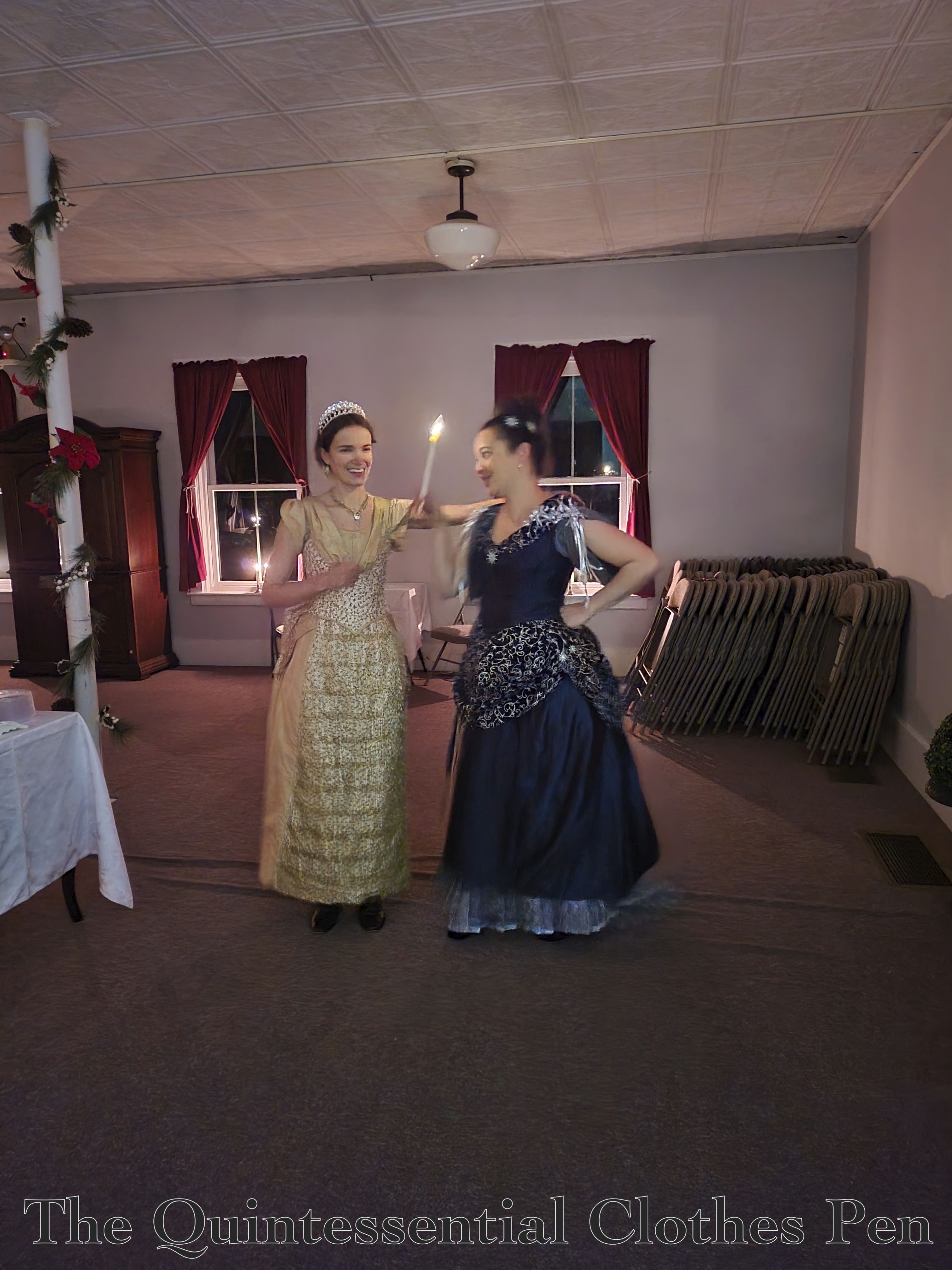
I also reused some of the star brooches from the first iteration of this dress, adding one at the center from of the bodice, two on the left side of the skirt, and some on the left side of my hair. They stand out well in the photo below, in which the two of us are bobbling about, making the ribbons on my dress and beaded trim on the dress on the left shimmer, sparkle, and sway.

Other Photos From The Event

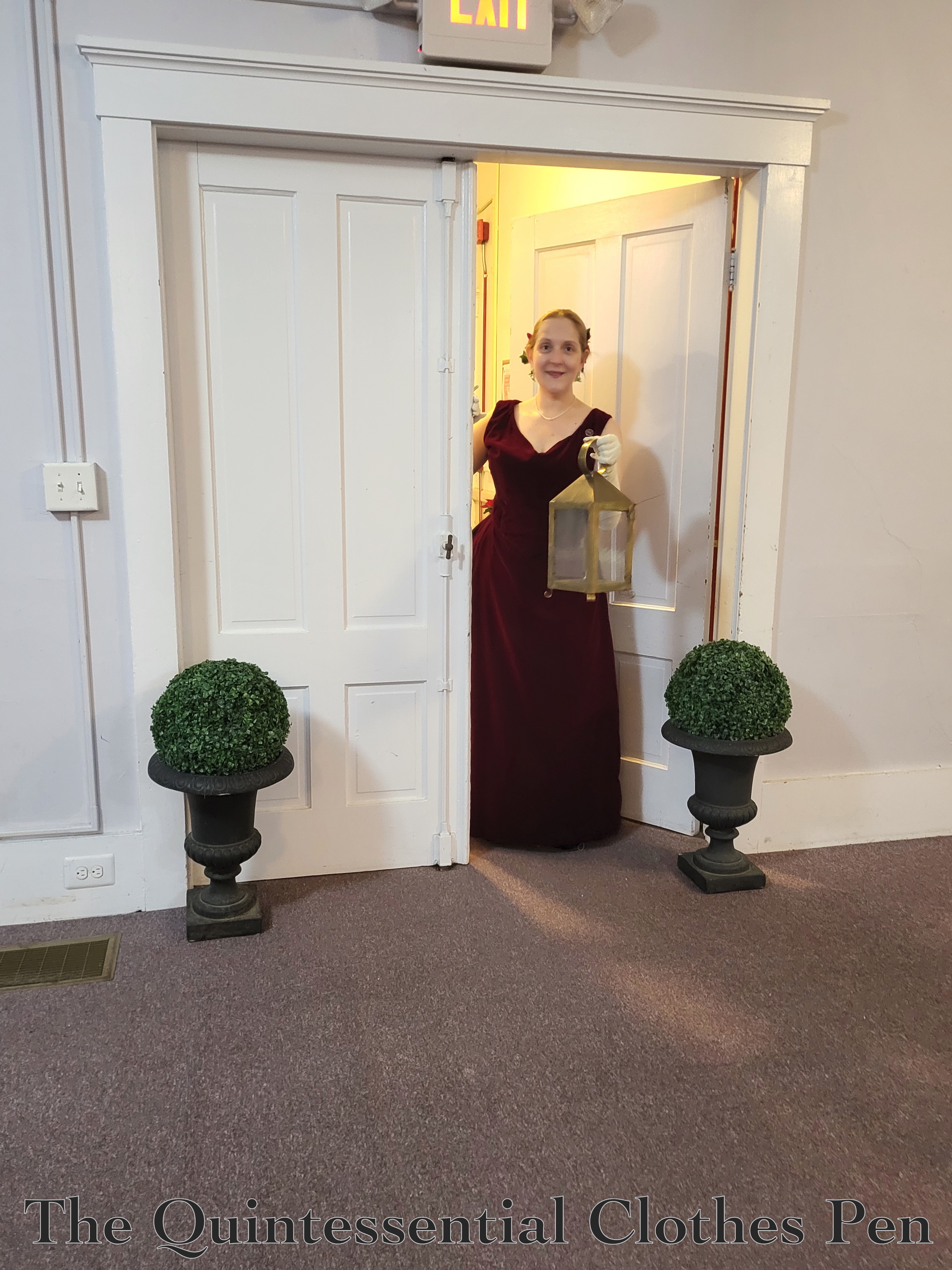
This was a ball for bustles! There were multiple people wearing dresses with this feature, including the dress above, as well as the burgundy velvet dress below.

Finally, a cheerful holiday view into the ballroom. I wasn’t feeling my best at this event and therefore didn’t dance, but everyone else had a grand time! I look forward to the next event in which I can participate in dancing with the bustle! It’s really quite fun to experience the movement of dancing with all of your dress behind you!

1863 Fancy Dress: Genevieve As The Queen Of Hearts

Back in September, The Footwork and Frolick Society hosted a Wonderland-themed 19th century fancy dress ball. The idea was inspired by the whimsy of Lewis Carroll’s Alice In Wonderland (published in 1865) and Through The Looking Glass (published in 1871).

There were so many fabulous interpretations of Alice In Wonderland! You can get a sense of the fun in the gallery from the event on the Footwork & Frolick website, here.

I chose to re-use an idea I’d executed in 2018 when I turned a 1980s dress into a 1950s dress and style it as The Queen of Hearts. You can read about the dress re-make and original fancy dress styling here, in a past blog post. For this new wearing in 2024 I chose to use The Queen of Hearts theme and accessories again, but with one of my 1860s dresses to suit the mid-19th century goal of the Wonderland Ball!

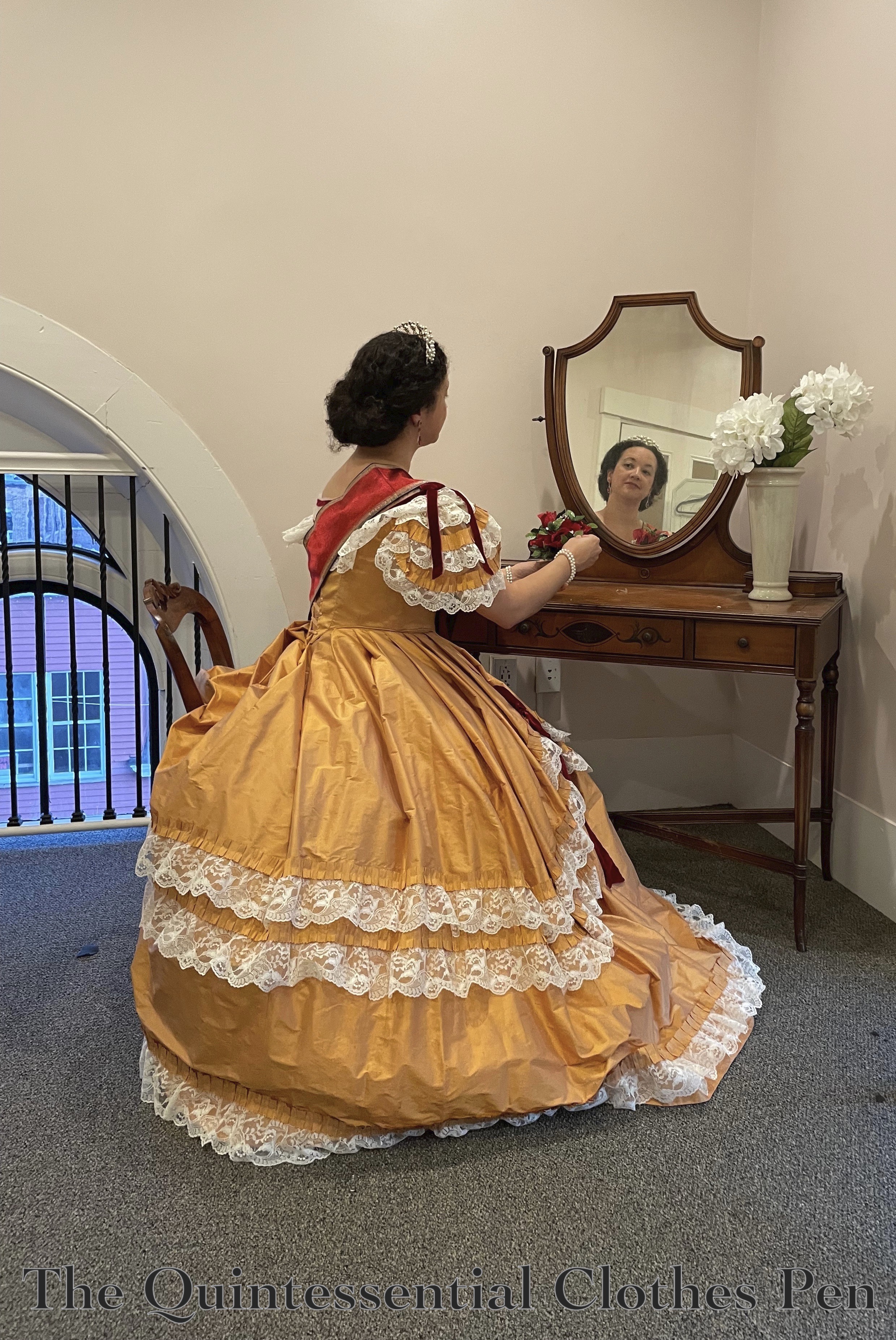
Genevieve, the name of my apricot ballgown from 1863, seemed to be the most fitting choice for a Queen of Hearts theme. (You can read all about the making of this dress in this Project Journal series of posts.) The two main elements of my fancy dress ensemble were a tiara and a royal order sash. I figured that could easily work again.

We captured a series of photos of The Queen of Hearts elegantly (and somewhat aloofly!) preparing for the ball!

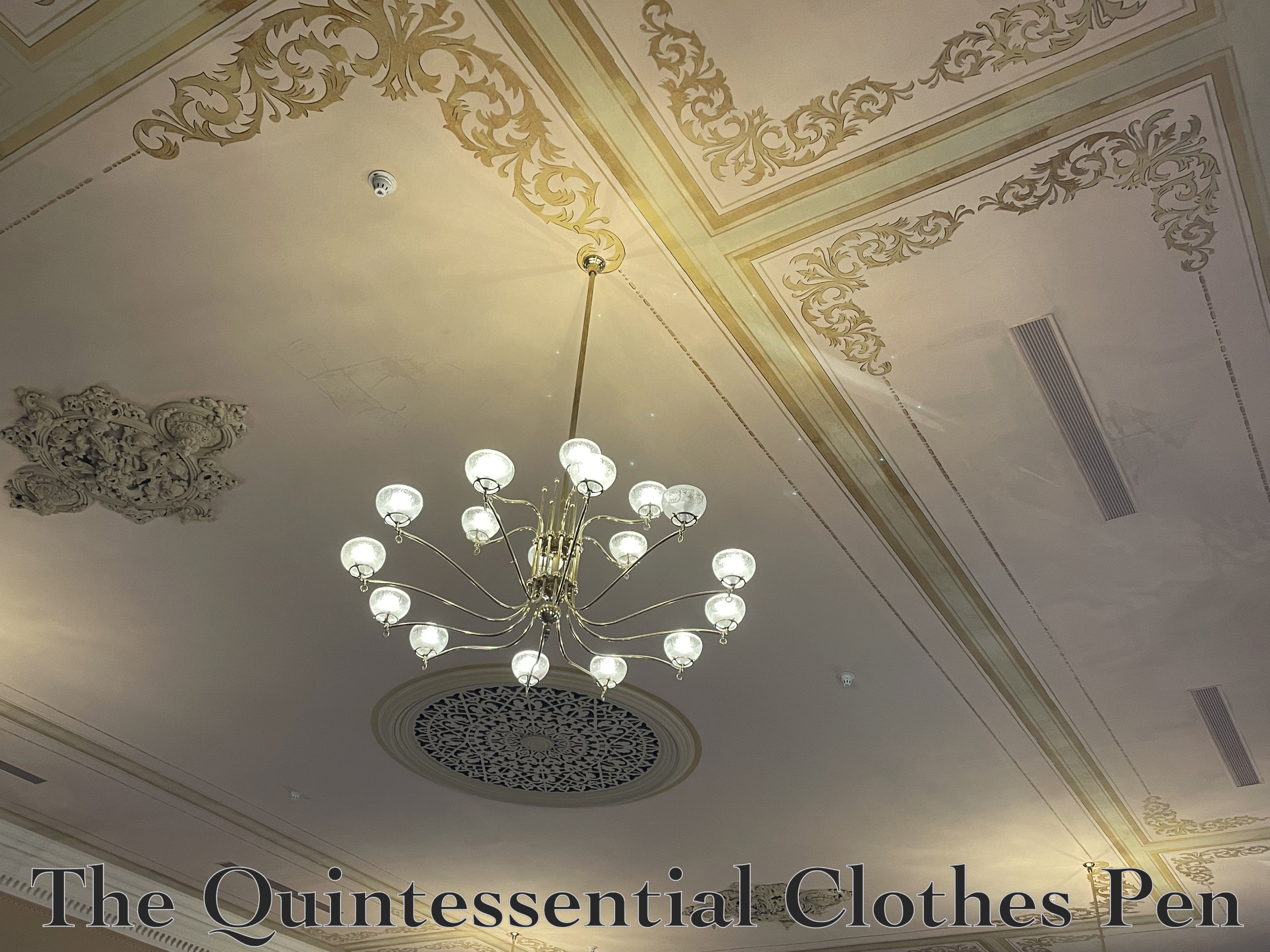
The ball itself took place in the lovely Andover town hall. It has all sort of beautiful details. Look at the ceiling!

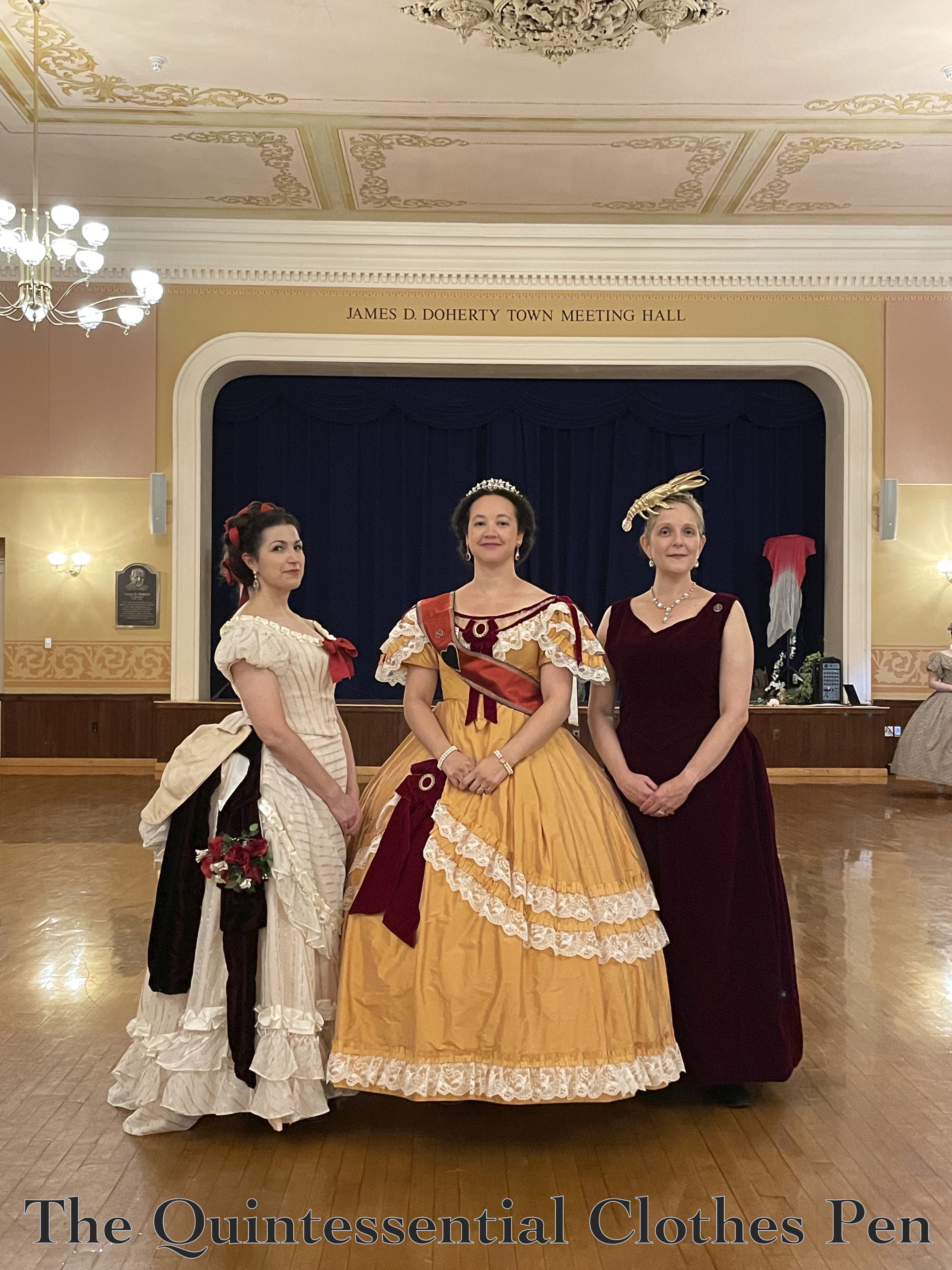
And the company was lively! I met charming new acquaintances and reconnected with creative friends. Below are a few of them… and we are joined by a golden lobster! (The lobster wanted to participate in the Lobster Quadrille, but had to step up the bling-factor to be ball appropriate!)
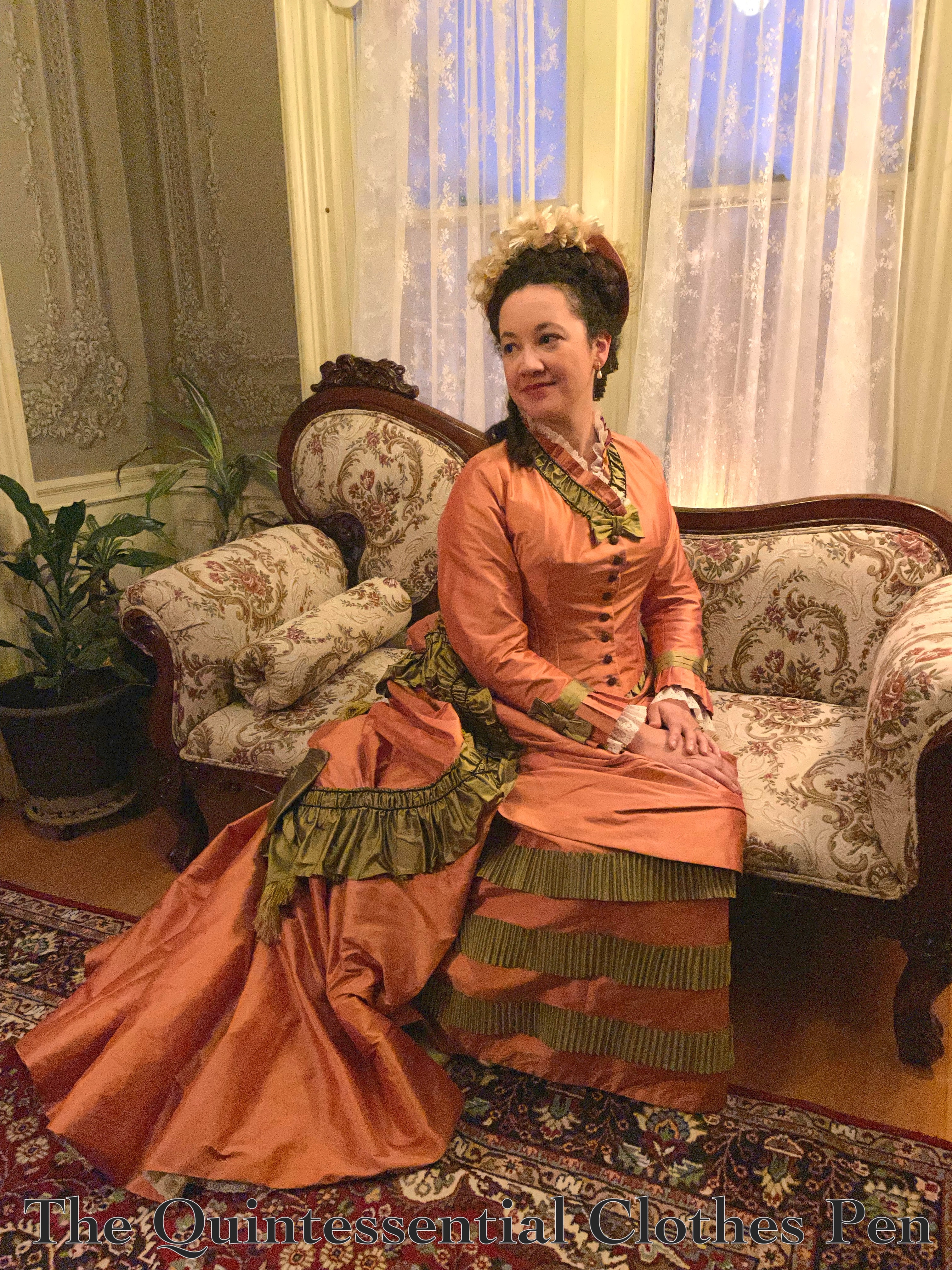
Playing Parlor Games

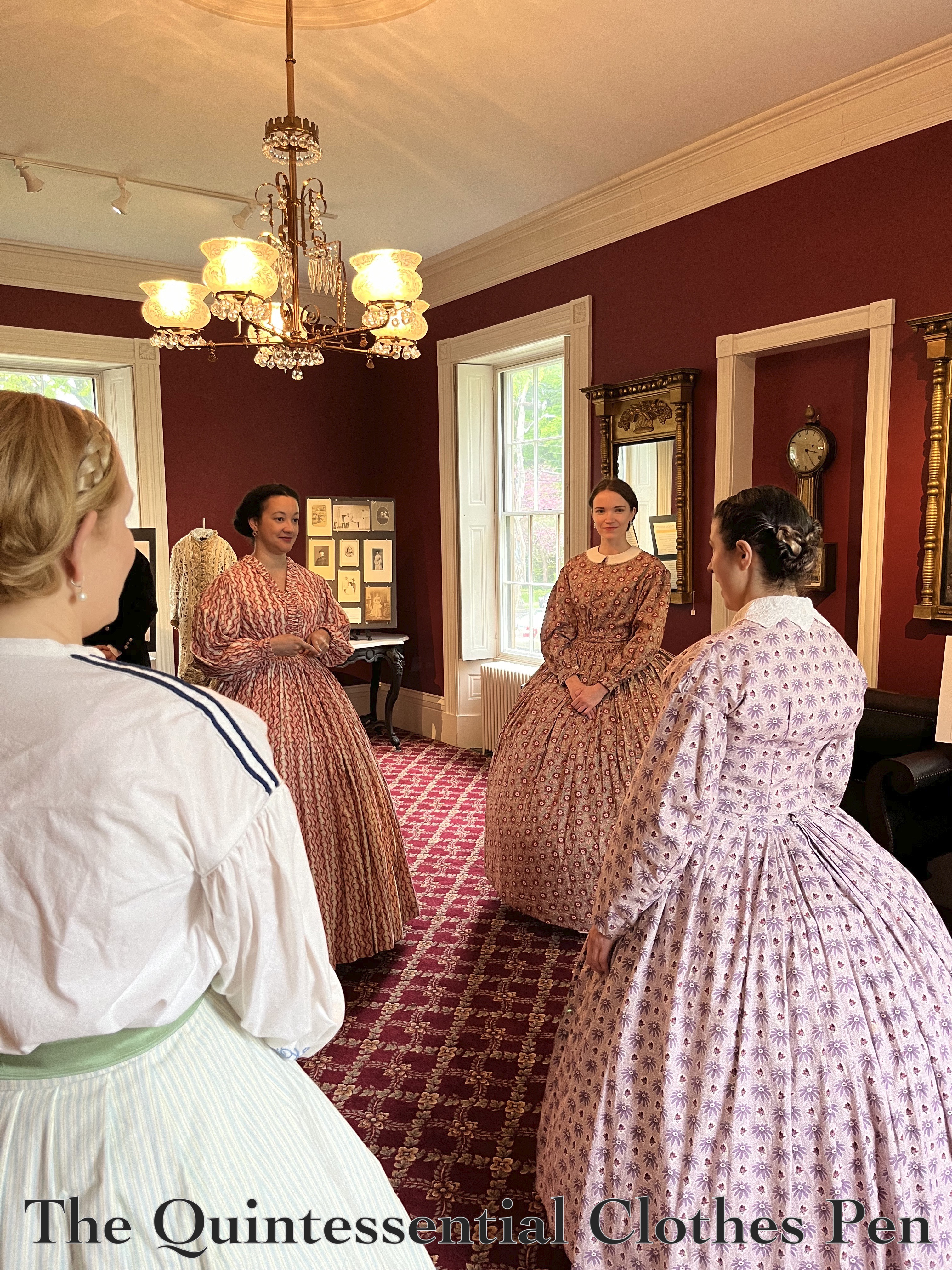
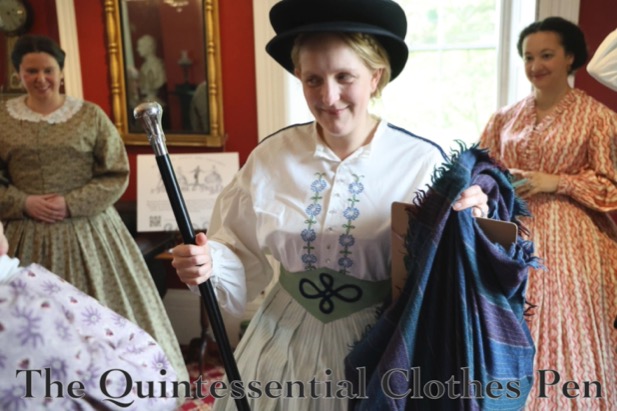
Part of the goal of the spring outing I recently posted about was to play parlor games with The Footwork & Frolick Society at the Boutwell House in Groton, MA. This was a fun public outreach event during which we invited guests at the open house to join us in parlor games from the mid-19th century.

Many parlor games from this period are somewhat sedate and word based. Others are more active, such as passing a ring around a ribbon in a circle while someone in the middle tries to guess who is hiding the ring.

There is also a game in which a person has to go around to everyone in the room and ask for something to take on an imaginary journey. It can get a bit silly as people add items to the imaginary traveling trunk.

I didn’t participate in every game, but I greatly enjoyed observing guests having fun even when I wasn’t actively participating.

A second dress of mine made it out of the closet to attend this event, too! You can read all about the construction of Georgina (a cotton print dress from 1858 pictured below) in this past post from 2013.

Even the volunteers at Boutwell House enthusiastically joined in with our games, providing a wonderful atmosphere for guests.

I had great fun, and even laughed myself into tears trying to do a quadrille figure ‘blindfolded’ (we did it with our eyes closed). There is video evidence of this amusing attempt here, on the F&F Instagram page. Yes, dancing a quadrille blindfolded is, in fact, an official published parlor amusement from the mid-19th century!

Photo credit for the last four photos: Steve Lieman

When The 1860s Drawers No Longer Fit (HSM #11: Worn By All)

I have a series of posts called When The Dress No Longer Fits that document how I’ve updated the size of various dresses I’ve made to fit better as my size changes over time (or as the dresses shrink in the closet, which is how I usually describe it!).

In this case, I’ve adapted that post-naming-style for another garment I recently updated. In this case, I altered an old pair of 1860s drawers rather than a dress!

It brings me joy to be able to extend the life of garments I already have in my closet. For these drawers, being able to adjust the size of the waistband has allowed me to continue to use them for many years. Proof: I documented these drawers on the blog in 2013 (and I’m pretty sure I made them in 2011 or 2012) so they have being faithfully serving their duty for over 10 years!

In that time, they’ve seen lots of use. I’m pleased that they have held up very well. About 8 years ago, I let down some tucks to make the legs a little longer (so that the top of my stockings/knees wouldn’t show–because, gasp, that would be shocking!) and I also increased the waistband size about 6 years ago. Below, a photo of the drawers with those first round of alterations made.

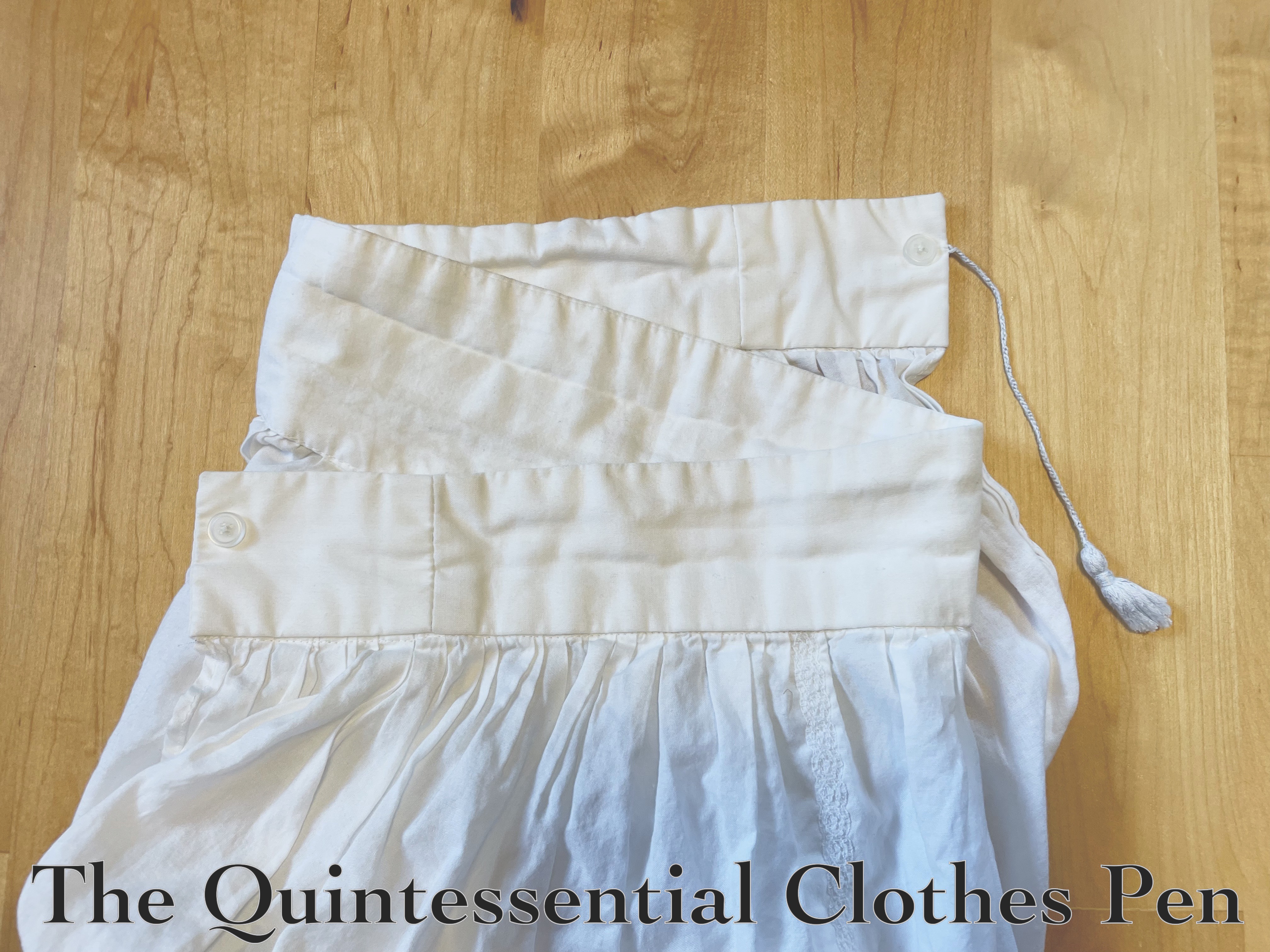
And below is a closeup of the waistband after that first round of alterations. I don’t remember why I thought a closure method of a cord looped in a figure eight around two buttons made sense. I can’t remember a source for this idea… but it has worked for many years. It’s been wonderful because it allows for adjustability (up to a point of running out of cord length to loop between the buttons securely, of course).

But recently, even with the increased waistband size, there was still a gap at the waist and the gathering of the legs into the waistband was no longer distributed in a way that helped the back edges stay closed when being worn. That’s not the end of the world in terms of modesty, as I always have a chemise on underneath, but it wasn’t my favorite look, either.

So I decided to do something about it. I added yet another extendo to the waistband. “Why remake the entire waistband?” I mused. The would need a bigger section of fabric and be more work. No one sees the waistband of my drawers except me, friends getting dressed near me, and you readers on the blog!

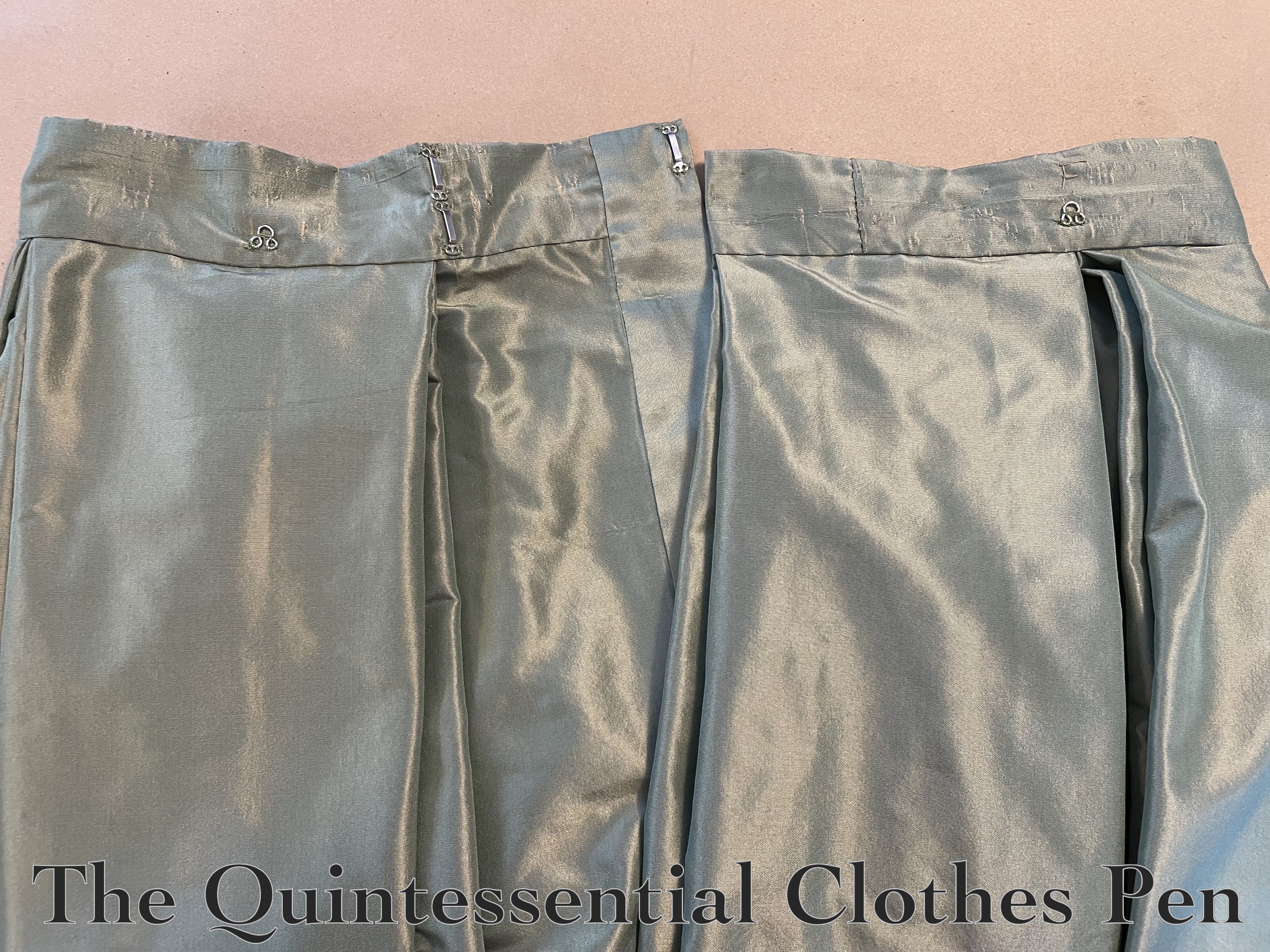
So now, here are the most recent updates to these old drawers, with a second extendo added to the waistband. Taking the waistband apart to add the new pieces reminded me that I’d stiffened the waistband lightly by adding a layer of linen in between the two layers of cotton. This is a note to self that this method has worked well, creating a waistband that doesn’t collapse and wrinkle horribly around the waist while also not being super stiff.

I also decided to change the closure method to a button and button hole. The old wrapping the cord in a figure eight method had the added challenge of being a bit tricky to do behind my own back. I decided that while a button would be less adjustable (without resewing it), the larger size button would be easier to do up than the cord wrapping.

I also made a bit of extra waistband for the day when I might need to increase the waist size even more (but I’ll pretend that day isn’t coming). And I decided to hand sew the buttonhole, because it was being fussy on my machine and I figured it would be faster to sew it by hand than fight the machine!

Here is a closeup of what the waistband looks like with the most recent extendo. For this round of alterations, I also completely removed the waistband and redistributed the gathers and side points to better match the new waistband size (these alterations are machine sewn). This makes the drawers more effectively lay in place.

I’m calling this my entry for the Historical Sew Monthly 2024 Challenge #11: Worn by All:

Make a garment that would be worn as everyday clothing by most social classes during your chosen time period and/or place.

Just the facts:

Fabric/Materials: Scraps of white cotton and linen (Is it the same white cotton and linen as the original drawers? Nope, but that’s ok with me for this project!)

Pattern: None. I just added rectangles.

Year: c. 1860.

Notions: 1 shell button and thread.

How historically accurate is it?: 98%. It’s completely reasonable to extend the life of a garment like this by altering it. The only non-accurate thing might be the machine sewing–although it is pretty subtle!

Hours to complete: 2? I didn’t really keep track.

First worn: Worn on May 19 with an 1860s ensemble.

Total cost: Free! Materials were scraps left over from other projects.

This was one of the small sewing tasks on my Maybe-To-Do list for 2024 as well as being one of the small projects that was stacking up on my alterations-and-mending pile. I’m so pleased to have checked it off!

Eleanor At The Boutwell House

My 1860s evening gowns have had far fewer outings in the last few years than they used to, which it made having a reason to wear one a few months ago particularly exciting!

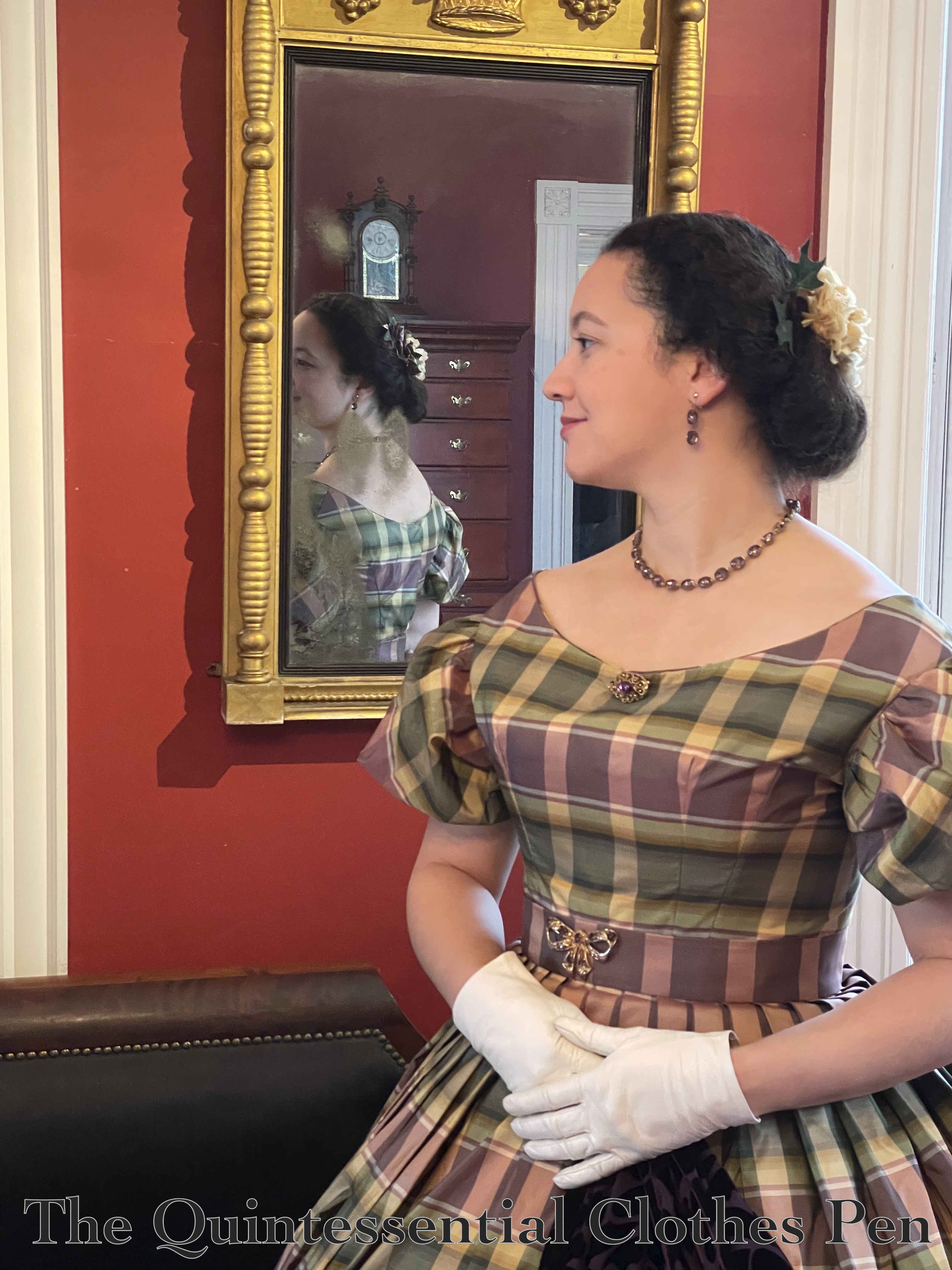
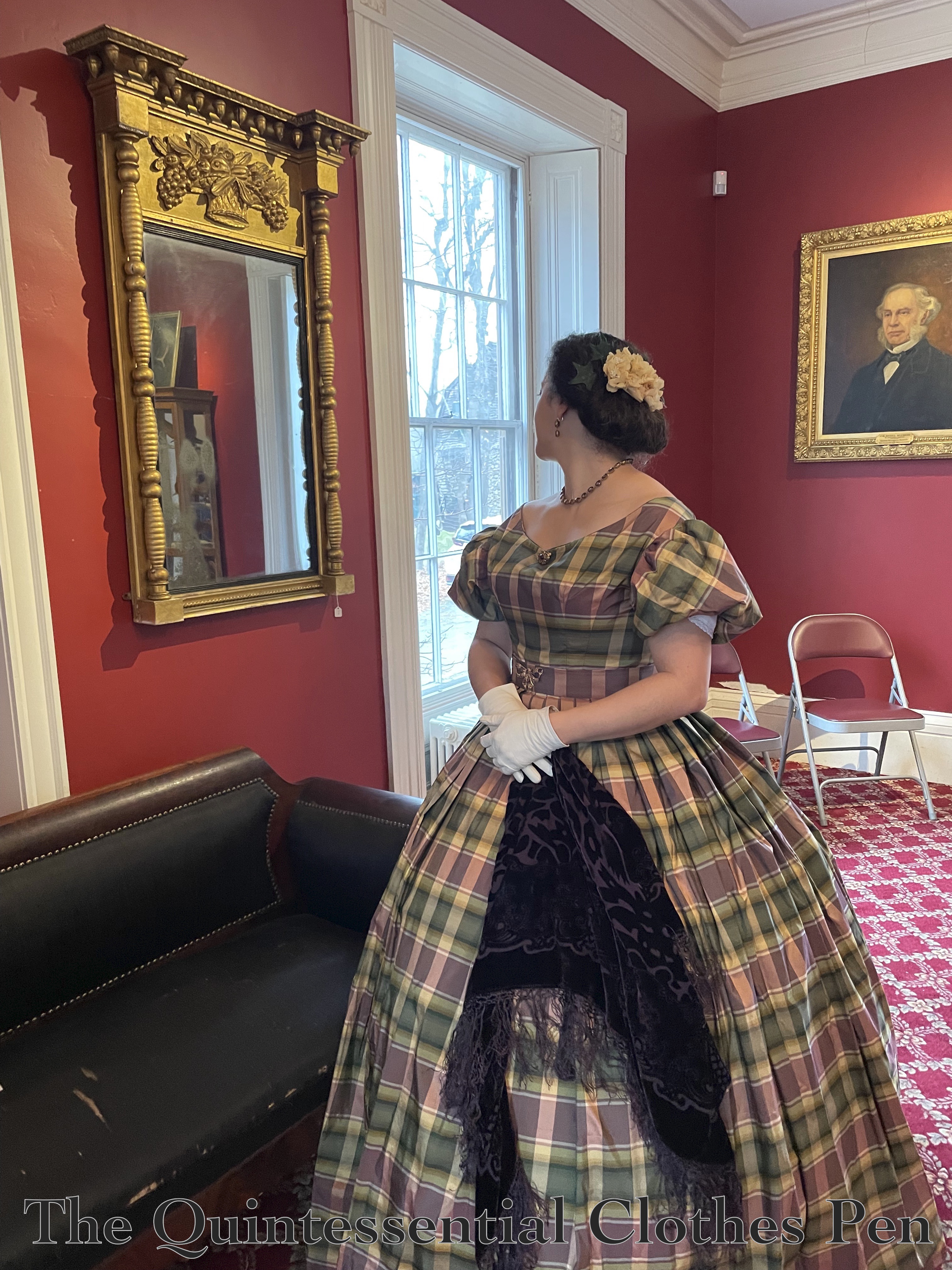
The question was which to choose??? I wore Genevieve (my 1863 apricot-colored covered in lace and pleats silk gown) sort of recently, in April 2022. Other dresses in my historical closet that might still fit (Georginia from 1859, Annabelle from 1859, and Evie from 1864) haven’t been worn recently, but for some reason, plaid was sounding like fun… So I chose to wear Eleanor (my 1862 purple and green silk plaid dress)!

I’m still very pleased with the fabric of this dress and the way I cut the pieces to create interest in an otherwise pretty basic dress. The little details like tiny piping on the bodice, matching hair flowers, and a well matched set of jewelry (earrings and necklace from In The Long Run Designs, as well as a mix of modern and vintage brooches) also bring me joy.

I also had a lovely setting in which to wear the dress. The Boutwell House in Groton, MA was built in 1851 and is now home to the Groton History Center. The Footwork & Frolick Society partnered with them for the town of Groton’s annual WinterFest activities, which included inhabiting the house for an afternoon to give visitors a small view into activities from the period.

I enjoyed being able to wear an 1860s dress again. I’ve always loved the magic of a cupcake shaped hoop skirt–and this was no exception!

1875 Reception Dress Photo Shoot

I was really excited to spend lots of time working on and finally completing this dress during the summer of 2020.

At that time, there was no option of finding a fabulous indoor place to take photos, so I had to make do with the outdoors. Don’t get me wrong, I have lovely photos from that short outing, but they didn’t have as much background ambiance as I was hoping to find, someday.

But last year, I had the opportunity to actually wear this dress for an activity! And I was able to convince friends to take oodles of photos so I could better document the dress in appropriate surroundings for its reception status. So now, I present many photos of this dress.

There are dramatic back views, of course.

And front views showing the bust, waist, hip dimensions I worked very hard at in the patterning stages. This is created/augmented with padding. You can read more about that in this past post.

There are also views trying to show both the front and back. A side front view, if you will. This also captures the hat very well. I wrote a detailed post about making it, which you can read here.

And a few more sitting photos, as well. These are great for showing off the train and the layers that support it (this is my past post about constructing the skirt and this is about the balayeuse that supports the skirt, if you’d like to know more).

It was hard to choose favorites! I’m very pleased to have so many photos that capture the glory of this dress in an appropriate location.

Mid-Century Birthday Croquet At Roseland Cottage

Finally, a break from stay-related blog posts! (Slow sewing progress is being made, but not enough to post about…)

In the meantime, I have an armchair peep into a lovely birthday outing with friends on a gorgeous autumn afternoon.

The location of the outing is Roseland Cottage, in Woodstock, Connecticut.

Built in 1846 in the newly fashionable Gothic Revival style, Roseland Cottage was the summer home of Henry and Lucy Bowen and their young family. While the house is instantly recognizable for its pink exterior, Roseland Cottage has an equally colorful interior, featuring elaborate wall coverings, heavily patterned carpets, and stained glass, much of which survives unchanged from the Victorian era. The house is a National Historic Landmark.
(from the Historic New England website)

We made special arrangements with the staff to picnic and croquet on the lawn in mid-19th century clothing, followed by a house tour. Some of us had seen the house before, but the details never cease to amaze and hold our interest. If you’re ever in the area, I highly recommend a visit!

The grounds of the house are well maintained and provided an excellent area to set up croquet.

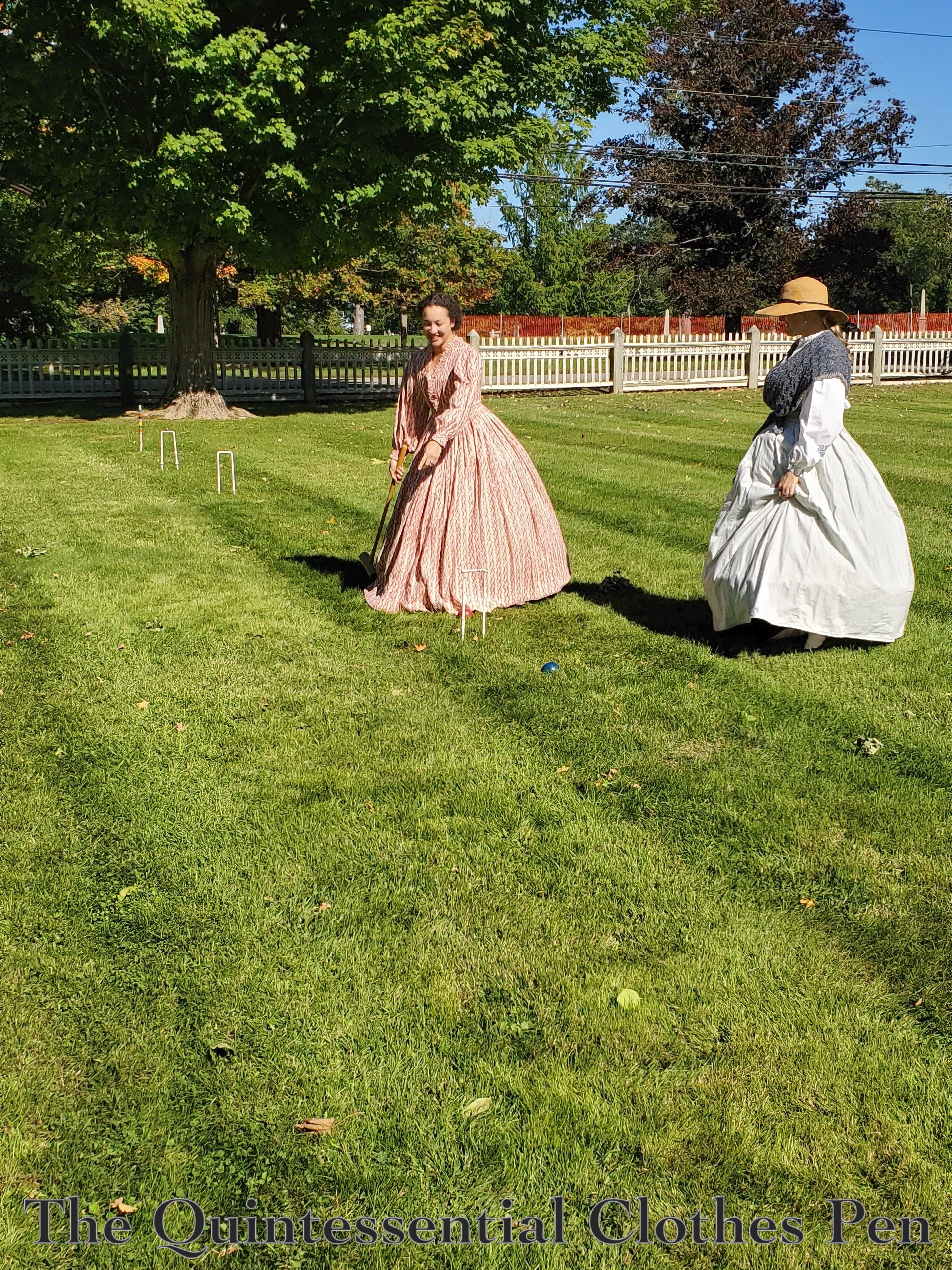
We enjoyed serious croquet as well as a few silly rounds of our own invention. The shadows made for fun photos, too!

The day was sunny and beautiful. There was a slight bit of chill to the air, but it was quite comfortable in full length sleeves and long dresses.

One zealous croquet ball whacked me in the ankle and caused a small scene. Thankfully, it wasn’t too bad after the initial pain wore off (no bruises or anything worse!)

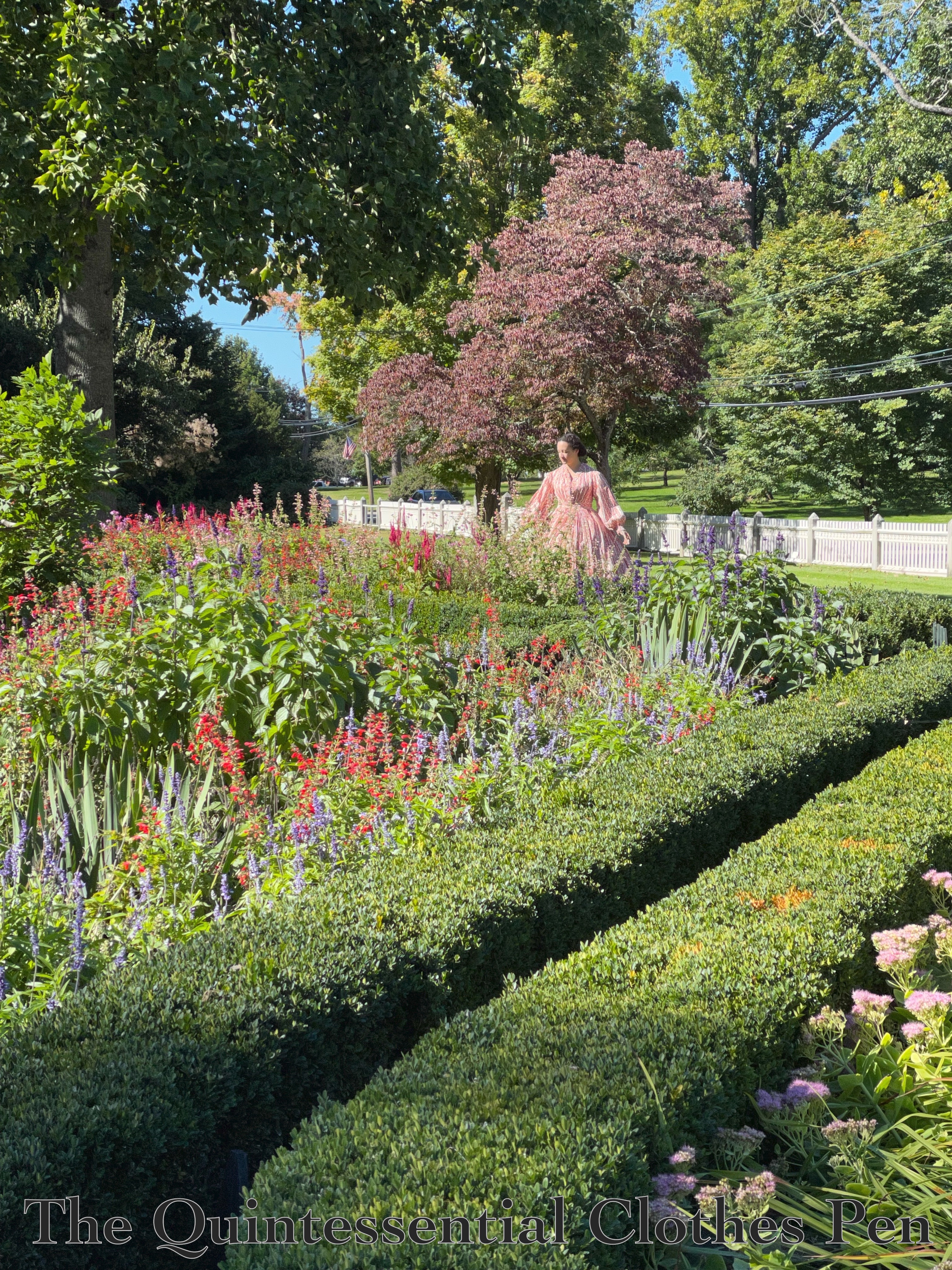
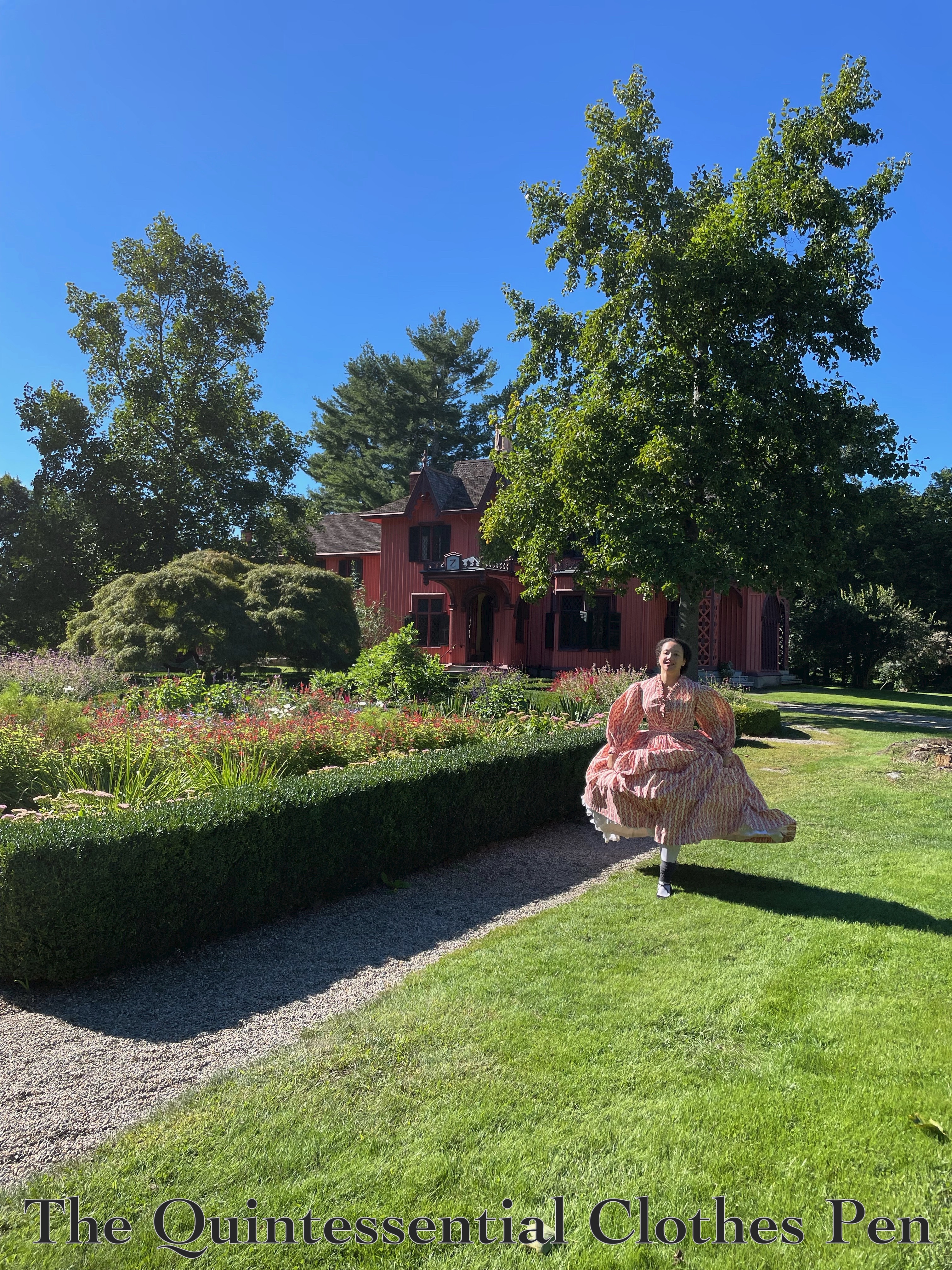
In fact, the croquet ball whack didn’t stop me from enjoying the gardens in Sophie, my 1861 reproduction cotton print dress.

The gardens are maintained with the same plan and variety of plants that would have been evident in the 19th century. They were in full color during our visit!

I greatly enjoy this photo, which was completely unintentional. I just started running around because it was fun, and then was told to go back and do it again because the photo opportunity was so exciting. So I suppose in a way it was intentional?

Croquet was followed by a house tour, during which the staff invited us to remain in historical clothes and take photos. This was my favorite! There’s a little built-in seat with a bay window in one room. It was well suited to sitting in hoops. Looking for friends arriving, perhaps?

An exciting, beautiful day! Thanks for enjoying it with me!

Genevieve At A Spring Fete

Genevieve, the name I gave to my most recently constructed mid-19th century sewing project back in 2019, was only able to be worn once before all events ceased. So when friends and I decided to gather for a private ball earlier this spring, I knew that of the multiple ball gowns from this period in my closet Genevieve was the one I most wanted to wear.

I was having such a lovely time dancing that I didn’t take any photos of that activity, and the dress had already been documented, so I didn’t take photos specifically for that purpose, either. Refreshments, however, were definitely worth taking photos of, because we decided to cut our cake with a sword.

Why? Because it is amusing! We had been at a ball a number of years ago in which no one had a knife, but someone did have a sword! We used it at that time and it’s been a running joke ever since. In this case, we did have knives… but swords are far more dramatic!

The beautiful and delicious cake was made for us by a local bakery, Dolce Amar. Friends contributed flowers and vessels to add to our springtime theme.

If you’re interested in learning more about Genevieve, my 1863 apricot silk dress, I documented the creation of the dress in nine separate blog posts over the course of 2019. All of those posts can be viewed here in the project journal for the dress.

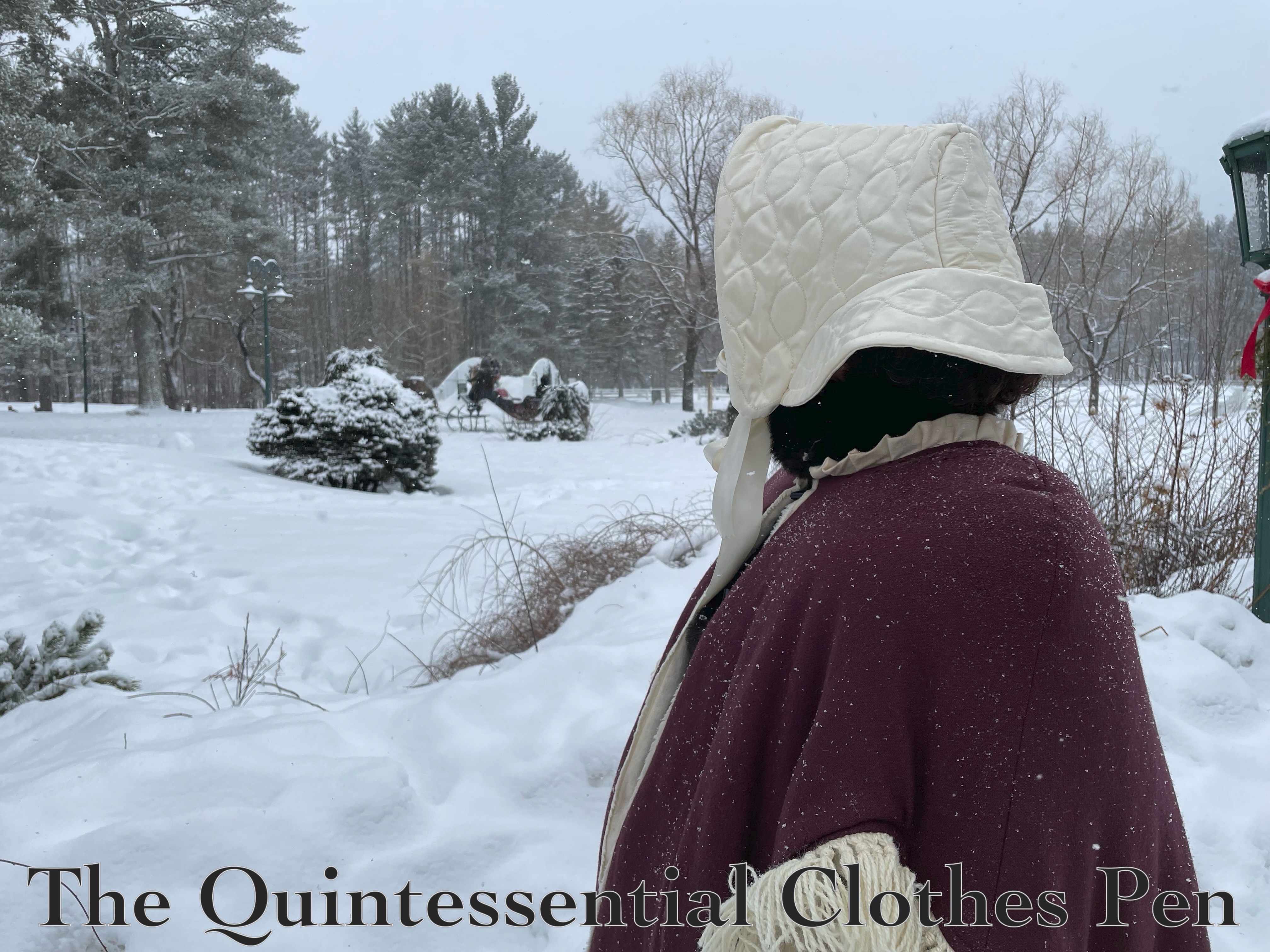
1850s Ivory Quilted Winter Hood (HSM #5)

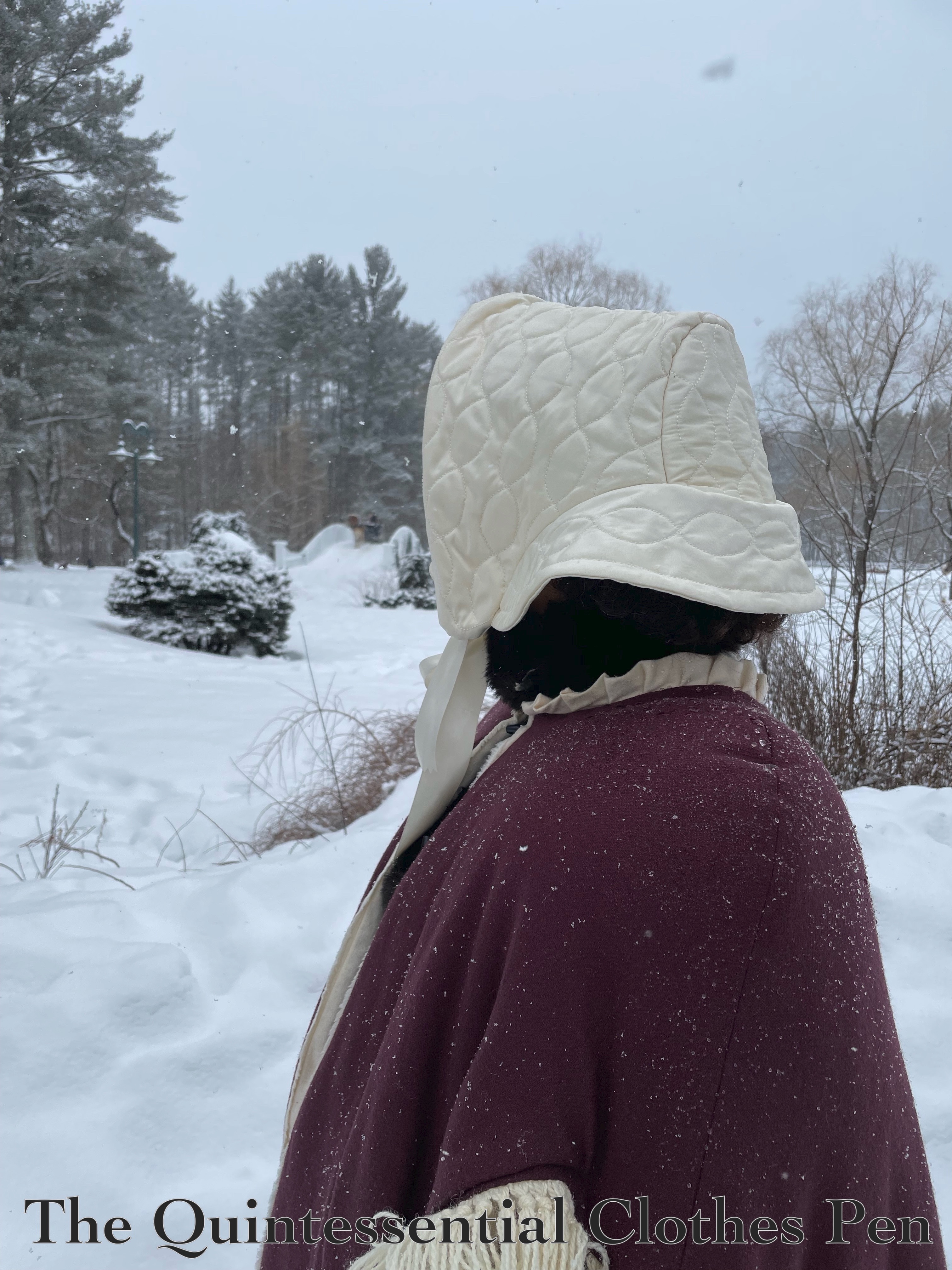
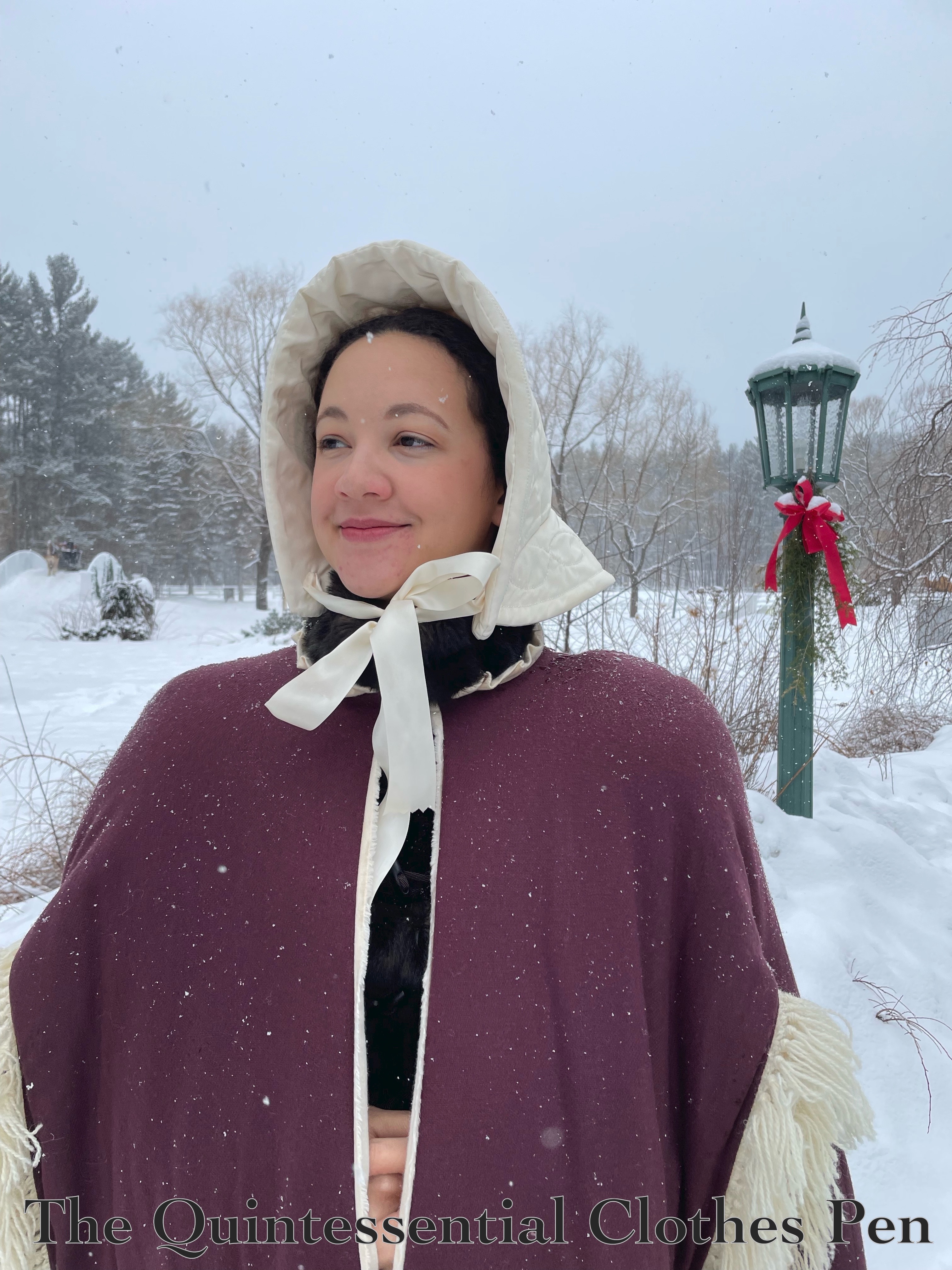
I was mentally preparing for my 19th century winter adventure a few months ago by taking note of the suitable warm winter outerwear in my historic closet. One of the warmest garments I have is my 1855 Wool Cape; however, my thoughts ran along the lines of “I don’t have any 1850s winter appropriate headwear to go with the cape….”

That was easily remedied!

Last fall, I’d purchased Anna Worden Bauersmith’s Quilted Winter Hood pattern on a whim (the pattern was being discontinued for the moment and I didn’t want to miss out). I hadn’t had a project with a deadline in awhile and so I decided to quickly make up the Quilted Winter Hood for the winter adventure… by hand (including the quilting!), of course, because I can be a bit crazy sometimes.

Since the goal of the hood was to keep me warm, it is a perfect garment for the Historical Sew Monthly 2022 May Challenge! Protection: Create a garment that protects you from something: weather, dirt, wear, weapons, etc.

As such, here are the facts:

Fabric/Materials: ½ yd of ivory silk taffeta, ¾ yd  ivory cotton, and 1 yd cotton batting.

Pattern: Anna Worden Bauersmith’s Quilted Winter Hood.

Year: c. 1850.

Notions: 1 ¼ yds 1 ½” ivory satin ribbon, 1 yd millinery wire, approximately 45 yards of silk quilting thread, and regular sewing thread.

How historically accurate is it?: 90%. The pattern, construction methods, and fabric are all quite good and it is entirely hand sewn. I’m sure it’s not quite the same as an original, though.

Hours to complete: 13.

First worn: February 2022.

Total cost: $27 (approximately $17 for the materials and $10 for the pattern).

The pattern offers ideas for quilting patterns as well as detailed observations on extant hoods and their common features. While straight lines of various sorts seem more common for quilting patterns, I decided to go with the scalloped suggestion taken from a period magazine.

This front view photo looks like a little silly to me because of the very square shouldered silhouette (that isn’t 1850s at all!). It’s due to the 1890s sleeves that are underneath the 1855 cape…

A woman has to stay warm!

Some of my favorite inspiration hoods are on my Pinterest board for this project. (Many more quilted hoods can be found on Anna Worden Bauersmith’s Winter Hoods Millinery Pinterest board, as well.)

In the process of creating my board, I was drawn to a few other winter hoods and cloaks. That set me off down a brainstorming path to see what else I have in my too-full wool stash that could be made into more 1850s and 1860s winter outerwear!

Not that I need more… I’m only one person, after all, and how many wool capes can one person reasonably wear at once? But… there are at least two other hoods and another cape that I’m now seriously pondering. So this quilted hood (and the cape I already have) might just be the beginning of a whole series of mid-19th century winter outerwear someday. (And maybe I should eventually take a photo layering all of it at once, just to be silly!)

1885 Mantle (HSM #5) & Accessories

Last post was a detailed look at the 1884 Plaid Wool Bustle Dress that I completed last year. This post is going to look at the details of the accessories I made and wore to stay warm while taking photos of the 1884 dress: a mantle, a new muff cover, and a quick mention of the hat.

First, the mantle, which qualifies for the Historical Sew Monthly 2021 Challenge #5:

Purple: Make an item in any shade of purple.

Easier to see the color in the next photo! Purple!

Just the facts:

Fabric/Materials: 1 ½ yards purple wool, 2 ¾ yards drab polyester lining, and about 1 yard of faux fur.

Pattern: Adapted from a pattern on page 33 of The National Garment Cutter Book Of Diagrams.

Year: 1888.

Notions: 4 ¼ yards brown braid trim and 4 coat size hook and loops.

How historically accurate is it?: 85%. The pattern and silhouette are good, but the polyester lining and faux fur are not accurate. I’ve also never examined an extant 1880s mantle up close, so the construction methods are guesses that made sense to me.

Hours to complete: 18.5 hours.

First worn: In January, for a ramble and photos!

Total cost: Approximately $40.

Mantle: Beginnings

This accessory adventure started with a passionate desire to make a specifically 1880s shaped mantle to go with my new dress. I don’t remember the details exactly, but it’s possible that I fell in love with the red mantle on the right in the fashion plate below even before I fell in love with the shape of the bustle dress that I’m wearing underneath my mantle.

The shape! The fur! The matching muff! So cute! It seemed like it would go very well with my dress.

Mantle: Patterning

I started the mantle soon after finishing the 1884 dress last year, beginning with the pattern. The pattern is from The National Garment Cutter Book Of Diagrams published in 1888 (the entire book is digitized and available here).

The pattern I started with is on page 33: Ladies’ Wrap. It has the same general shape as my inspiration plate, including the very specific-to-the-1880s outerwear sleeve set into the side back seam. Figuring those out was an eagerly anticipated part of the challenge.

The brief instructions are to use the scale corresponding to the bust measure to enlarge the pattern. I didn’t feel like finding the right scale in the book, so instead I guessed at a scale that generated proportions that made sense for my size. I think it was somewhere in the realm of ⅛” to 1″.

After the pattern was enlarged, life became busy and I put this project on hold. Fast forward to the first days of 2021 and I decided to knock this project off the to-do list so it would be ready at the first sign of snow for photos!

I made a mockup from my pattern, adjusted a few things including the length of the front piece (it was much longer than my inspiration!), then altered the mockup to check the changes. At that point, I was satisfied and ready to move on to real fabric!

Mantle: Sleeve Puzzling

Along the way in this process I had to figure out the sleeves. Below is what the sleeve pattern piece looks like when cut out. It’s not your usual sleeve shape. The top looks mostly reasonable, but what’s with a dart on the bottom edge? And the point at the bottom? Odd! Folding this in half (as you would normally do for a sleeve) would produce a strange sleeve, indeed.

I pondered this… looked up extant garments (there are a number of mantles with sleeves like this on my general 1880s outerwear Pinterest board) and did some searching for other people who had made this type of garment before.

The thing that suddenly made the sleeve click for me was a series of posts from Caroline (who blogs at The Modern Mantua Maker) showing the construction of an 1880s dolman that she made. This post, in particular, contains a photo showing the sleeve before it was set into the body of the garment. Ah ha! I realized that the bottom of my sleeve folds up and the dart goes against the body. That creates the right shape!

This post from Caroline shows her finished dolman. It was also very helpful as I tried to wrap my brain around these unusual sleeves. And, Caroline has another dolman she made as well, which I also looked at as I was figuring out my pattern.

Mantle: Materials

I had the fashion plate to reference for the overall design of the mantle, but I needed a bit more detail to confirm my material choices. Many 1880s mantles are made from fancier fabrics: silks, velvets, brocades… I only had a heavy purple wool in my stash in a quantity I thought would be just the right amount for the mantle and I didn’t want to buy something new (especially something likely to be expensive, as many of those fancier fabrics would be).

After some searching, I found this c. 1880 opera cloak at the Metropolitan Museum of Art that seems to be made of a plain wool. I decided to use some of the details from it, like the braid trim, to upgrade my mantle from plain to more interesting.

I had the braid trim in my stash already, purchased a few years ago from Deb’s Lace and Trims because I liked the look of it and thought it would be useful someday (I love Deb’s Lace and Trims–you absolutely can’t beat the prices and the products are lovely–I’ve been using them for historical projects for the last ten years!). It was great to find a use for this braid.  With just five yards on hand I had to reduce the amount used relative to the Met inspiration mantle, but I think the end result is in keeping with the simple style of the dress. The braid highlights the shape of the mantle but doesn’t distract or seem too gaudy for the plain wool base.

After creating my first mockup I did have a very justified fear that my purple wool would not be enough for the mantle. Thankfully, after altering the pattern to suit my taste and size I was just able to eke out all of the pieces. Whew!

I love the quilted lining of the Met opera cloak and I considered quilting silk myself to do it. My stash didn’t have any appropriately colored silk, though, so that idea was out if I was to stay on the stash busting course. I thought of buying pre-quilted silk (completely abandoning my stash busting idea), but the colors I could find were bland and the dark brown I eventually decided on after months of indecision was sold out.

In the end, I decided I just wanted the project to be finished, so I would go the low-cost route of purchasing a polyester lining from the $3 per yard store. It helped me use other stash materials, so it seemed a reasonable trade off.

Mantle: Construction

Here’s that polyester lining. It’s unintentionally the same greyish-brown drab color as the cotton lining of the 1884 bustle dress. The mantle is fully lined, as you can see.

In order to make the lining of my mantle tidy, the sleeves were fully lined before being set into the side back seams. Here is one sleeve assembled and ready to be set in.

The assembled/lined sleeves were set into the exterior wool side back seams while the lining side back seams were sewn plain. After attaching the sleeves around the armsceyes in the exterior wool, the lining was turned under and whip stitched to finish the edges.

All of the braid trim is machine sewn on using a zipper foot. I was able to sew it in place on the wool before setting in the lining, so none of the attaching sew lines are visible.

The lining was machine sewn around the edges with the neck left open to turn right sides out. After that was completed, I machine sewed the collar lining (interfaced with cotton) to the neck edge by machine. Then I sewed the exterior fur collar on the neck edge by hand (shown in the next photo).

After that I flipped the lining up, turned all of the seam allowances in, and whip stitched the lining to the fur edge. It seemed easier to do it this way rather than machine sewing the fur.

The faux fur trim around the bottom edge is pieced where there are seams in the wool. This allows the fur to have the exact same shape as the wool underneath. These edges have no seam allowance. The edges are just butted together and then (roughly) whip stitched, as in the photo below. From the right side of the fur the seams are completely invisible.

The top and bottom edges of the fur trim have seam allowances that are turned in and hand sewn along both edges. The outer (bottom) edges are sewn right sides together with the bottom of the purple wool. Then, the inner (top) edges are turned under and stitched. Here is that process in progress.

The mantle closes with 4 coat weight hook and loops spaced down the front edges. They kept popping open while being worn, so when I got home I pinched them with a pair of pliers to make the hooks grab onto the loops better. I haven’t been out wearing this again since then, but I’m confident this solves the problem, as I’ve used this trick in the past.

New Muff (Cover)

Next, I want to share a bit about the muff I have in these photos.

Despite having a number of muffs, none of them are the right size and material to match my new mantle. I have a dark muff that matches the hat I wound up wearing and I have a muff made from the same fur I used to trim the mantle, but the dark muff didn’t match my mantle and the one that does match is an intentionally oversized early 19th century muff. Neither would do!

But I didn’t want to make an entirely new muff. Instead, I decided to make a new cover for a muff I’ve had since 2012 (you can see it in this post from 2019, when I used it with an early 19th century outfit). The muff is from a workshop I took with LadyDetalle. (She has an Etsy shop that often stocks muffs like this as well as many other beautiful and historically inclined goodies.)

The base is essentially a pillow (stuffed with real down–quite luxurious!) that can be rolled into a tube and have a cover put on. The idea is that the muff cover can be changed out so that you can have all sorts of beautiful muffs and only need to store the one base. The muff is sized for the 18th century, but I thought it just might work for my 1880s look, too.

Accordingly, I measured my existing muff cover and cut a rectangle of faux fur that size. I butted my edge to make a tube and whip stitched it, in the same way as I whip stitched the mantle trim. Next, I machine sewed twill tape on the tube ends. (I had no worries about the fur getting caught in the machine sewing because that whole edge turns into the muff in the end anyway, so none of that will show.)
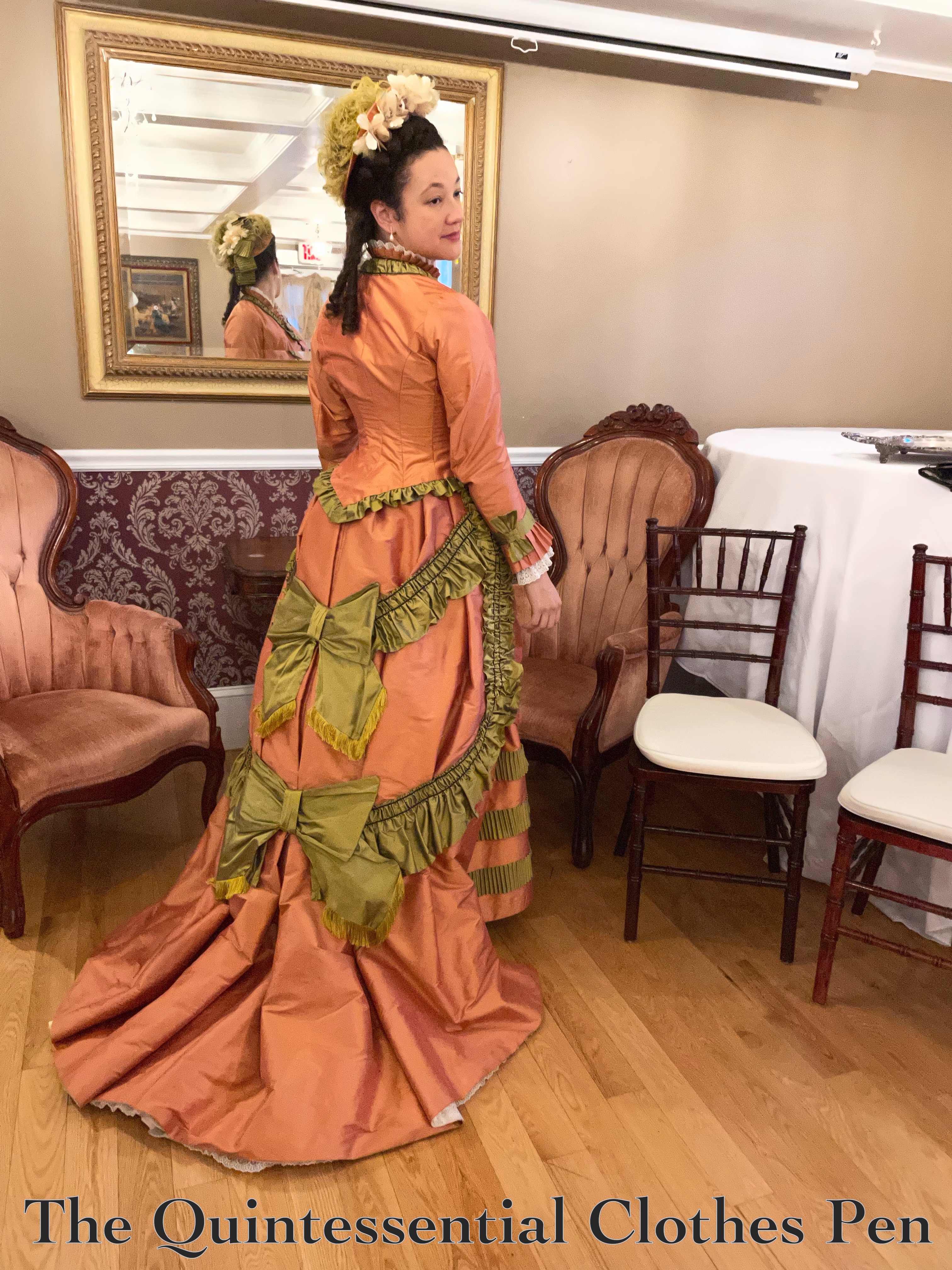
Once whip stitched in place the twill tape covers the raw edge of the fur and also provides a casing for the ribbons at each end. I used tobacco brown polyester ribbon that was gifted to me. By way of justification for the polyester ribbon, I’d already used polyester for the mantle lining and this seemed like a good use for this particular ribbon.

Below is the muff cover after those steps were completed.

And here is a closeup of the twill tape with machine stitching on one side and whip stitching on the other. The ends of the twill tape are just turned under and butted together, leaving an opening for the ribbon ends to come through.

And ta da! A muff that is the right size and perfectly matched to the mantle! The additional muff cover takes up hardly any storage space and now I have more versatility in my wardrobe.

Hat Baubles

While making my mantle and debating how to stay warm, I figured I would need something to keep my head warm. I’d already made the dress and the mantle and I didn’t feel like creating something all new for my head, as well. And I loved this image from the McCord Museum of 1880s ladies curling in the cold with their hats.
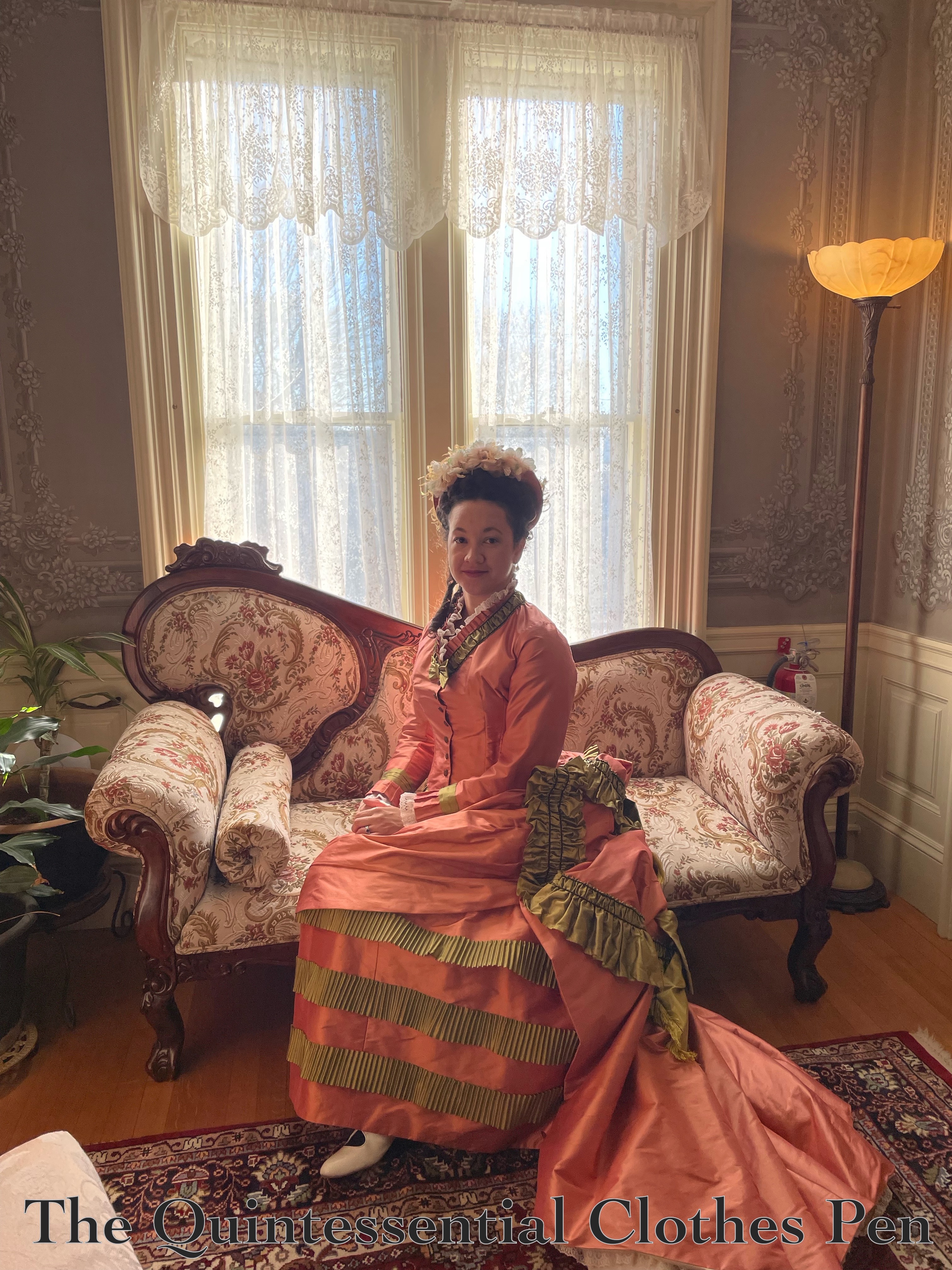
I thought I could repurpose my 1917 faux fur hat to suit the purpose, as it has a generally similar tall, straight shape. That hat is nice and warm, being lined in flannel and interlined with layers of batting to insulate the head.

The look of it was a little bland with this outfit, though, and not really coordinated with everything else.  I liked the idea of bringing in some of the mantle fur to make the hat look like it belonged. After fussing with various ideas I decided on fur poms, or baubles.

The baubles are sort of like large-scale cloth stuffed buttons. They are a circle that is gathered, the edges turned into provide stuffing, and the backs sewn together to close up the opening. (This tutorial shows how to make these types of buttons, though I started with a circle of fabric rather than a square.)

I like that the finished baubles pull in the look of the tan fur, that they are silly and amusing, and that they are easily removable. In fact, they are attached with safety pins on the inside of the hat! You can’t get much more easily removable than that!

I’m very pleased with my stash-busting-and-using-things-I-have-on-hand winter bustle ensemble. It’s warm. It was a great patterning challenge. It’s really fun to wear (it feels super elegant!). And it (mostly) reduced my fabric stash.

Thanks for sticking with me through this second detailed (and rather long) post! Next post will be further photos of the bustle dress in action on a woodland adventure.