Today’s post is going to share more details about and photos of my new 1834 yellow dress. If you missed my last post about this dress, it was a lengthy one sharing oodles of construction details and photos. You can read that past post here.
Here is a reminder image of the fully accessorized dress!
The biggest accessory is my newly completed 1831 bonnet. There is a recent (lengthy) post about the construction of that here, if you want to learn more about it.
I also added smaller accessories, in the form of a petersham belt and brand new reproduction buckle. The wide petersham is a length of ribbon I purchased from The Sewing Place–I highly recommend their many colors and widths! The buckle is a fabulous reproduction buckle from Ensembles of the Past. It’s a bit hard to see the wonderful detail in this photo, but there’s a photo later in the post that shows the detail much better! The Ensembles of the Past blog also has a post sharing how to easily use ribbon to make an endlessly (and easily) adjustable belt out of ribbon! I highly recommend both the buckles and a read through the blog post!
Back to the dress itself. Let’s start off with the Historical Sew Monthly details. Challenge #9 is Sewing Secrets:
Hide something in your sewing, whether it is an almost invisible mend, a make-do or unexpected material, a secret pocket, a false fastening or front, or a concealed message (such as a political or moral allegiance).
In this dress, I have two secrets, both of which I mentioned in the dress construction details post. One is pockets in the skirt and the other is that the bodice of this dress is detachable.
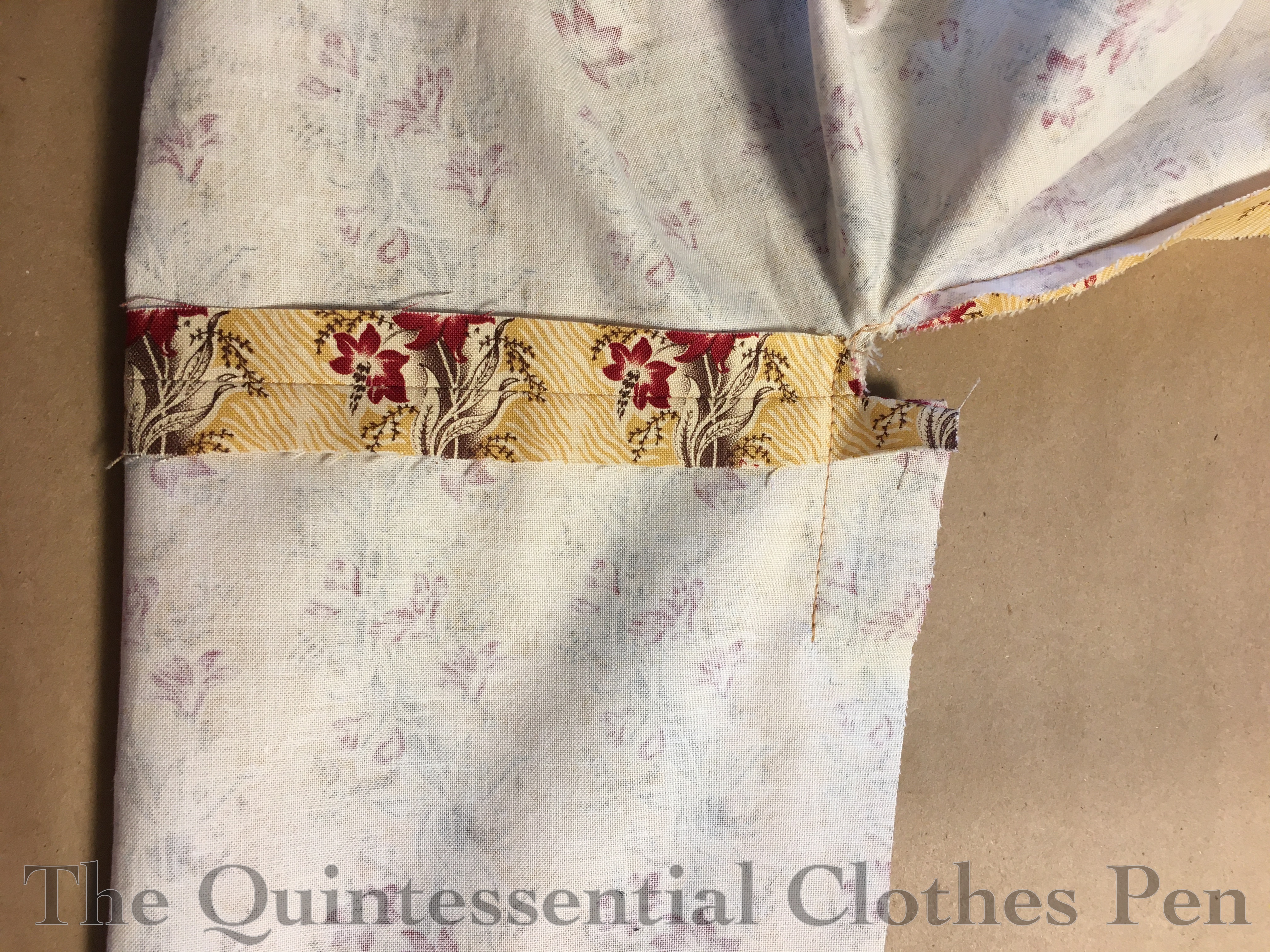
First, the pockets. Yay! My pockets are made from the dress fabric. They are French seamed and set into the side front seams of the skirt. On the inside, they look like this.
On the outside, they look like this. They’re a secret because they camouflage so well that you really can’t see them at all unless I pull them open or my hand is disappearing inside!
Second, the bodice detaches. This is very unusual (and possibly unheard of) for the 1830s, though it becomes common practice by the 1850s and 1860s. This system allows me to attach the current bodice, which I’ve dated 1834, or a second bodice that I have in the works which is dated 1838. That opens a whole world of possibilities in terms of showing changing bodice and sleeve styles without needing to create an entire second dress!
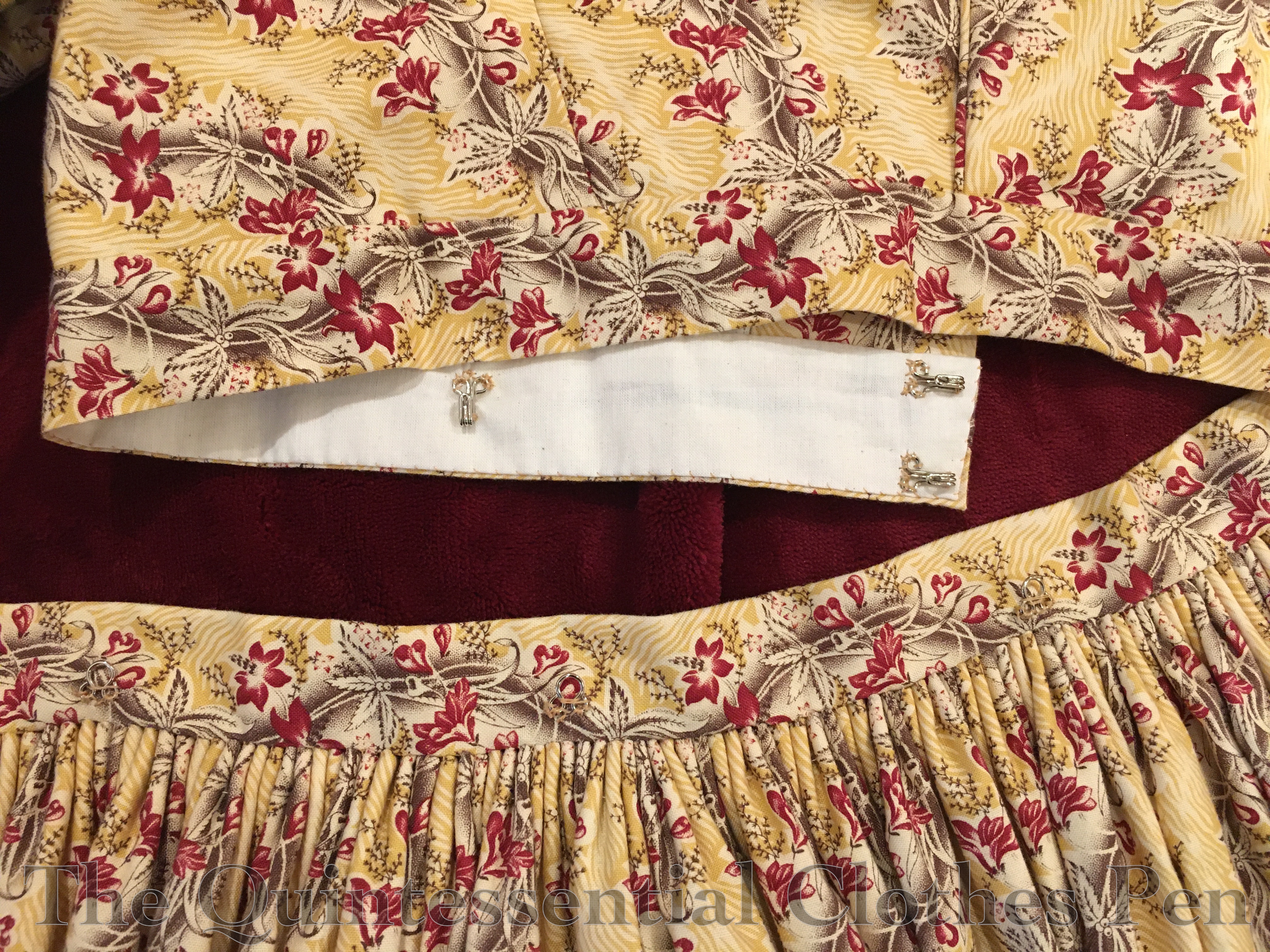
A bit closer up, you can just barely make out a loop on the skirt waistband that connects to a hook at center front. There are hooks and loops all around the skirt and bodice waistbands to connect them together.
Now that we’ve seen the relevant dress features, let’s look at the other HSM facts:
Fabric/Materials: 7 ¼ yds of reproduction print cotton, 1 yd muslin, a scrap of canvas for the waistband of the bodice, and a scrap of flannel for the cartridge pleats.
Pattern: Adapted from Janet Arnold’s Patterns of Fashion 1, with adjustments for fit and style, as well as The Workwoman’s Guide.
Year: 1834.
Notions: 2 ½ yds narrow cotton yarn for cording, 2 ½ yds of narrow white lace, and about 23 hooks and loops.
How historically accurate is it?: 95%. The pattern, silhouette, construction methods, and fabric are all quite good, but there is machine sewing on the interior seams.
Hours to complete: 25.75 hours.
First worn: In early October, for an apple picking outing, picnic, and photos!
Total cost: Approximately $60.
In addition to the HSM details, I want to share some more photos as well. These photos were taken during an all day outing in October. There’s still a post coming that will share apple picking photos from the outing, but there were many good ones from our later in the day photo shoot as well.
These next photos were taken in a neat conservation area that has beautiful, varied scenery that includes a pond area, open fields, wooded paths, huge rhododendrons, a meandering river, and this lovely row of pine trees.
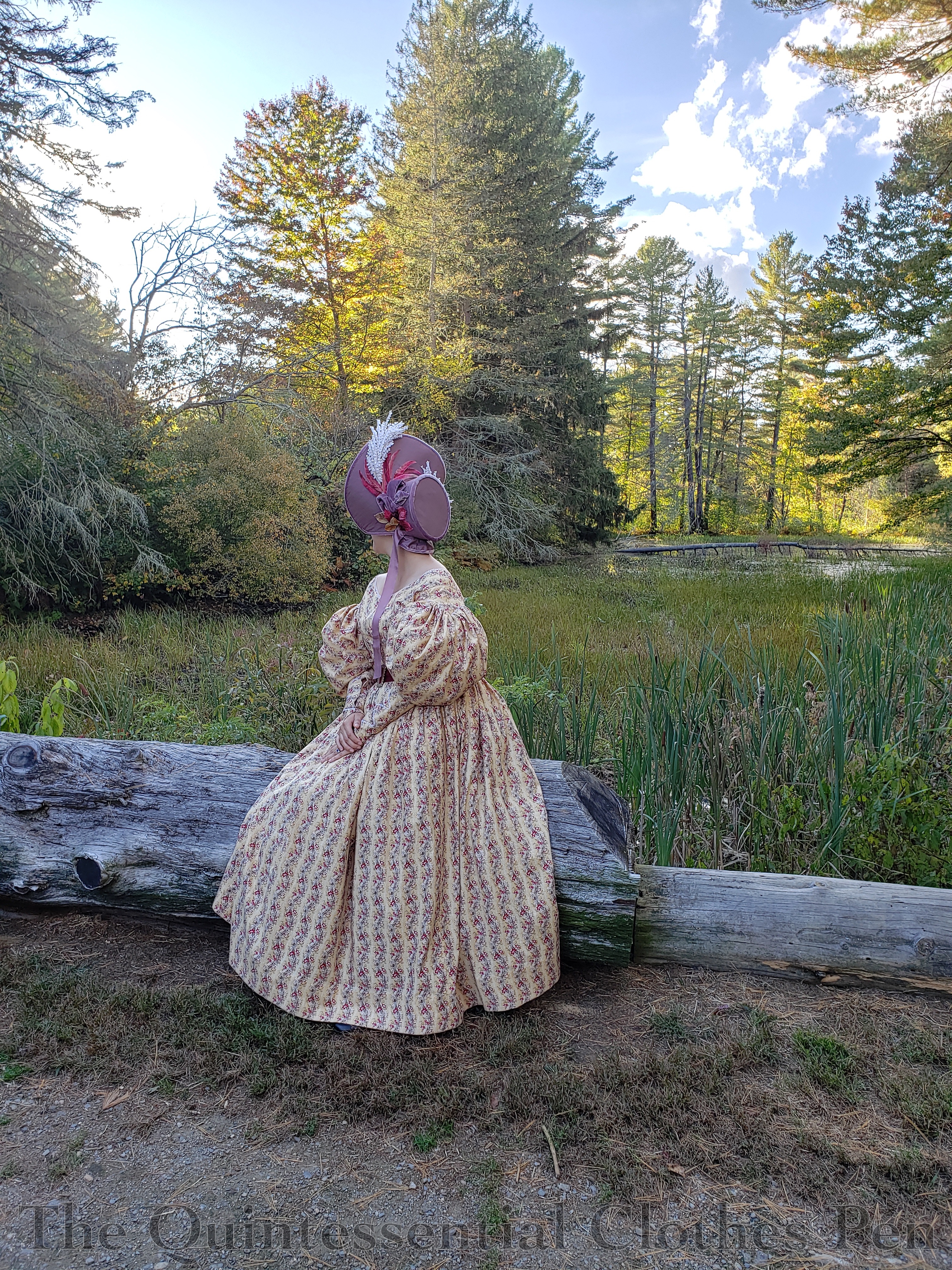
I enjoy the line of trees and the interesting perspective they provide. So here you go, a front and back view of this ensemble.
Farther along our walk through this beautiful area we stopped to take some artistic detail shots of the sleeves of this dress. First up, the mancheron on the shoulder of the dress. There’s some pretty good pattern matching to admire and it’s fun to see the gathers up close, too.
Here’s another view of the mancheron and sleeve puff, with the zig zag cuff trim in the background.
I can’t decide if I like that photo or this next one best! The next one is similar, but the focus of the photo is on the zig zag cuff trim instead of the mancheron.
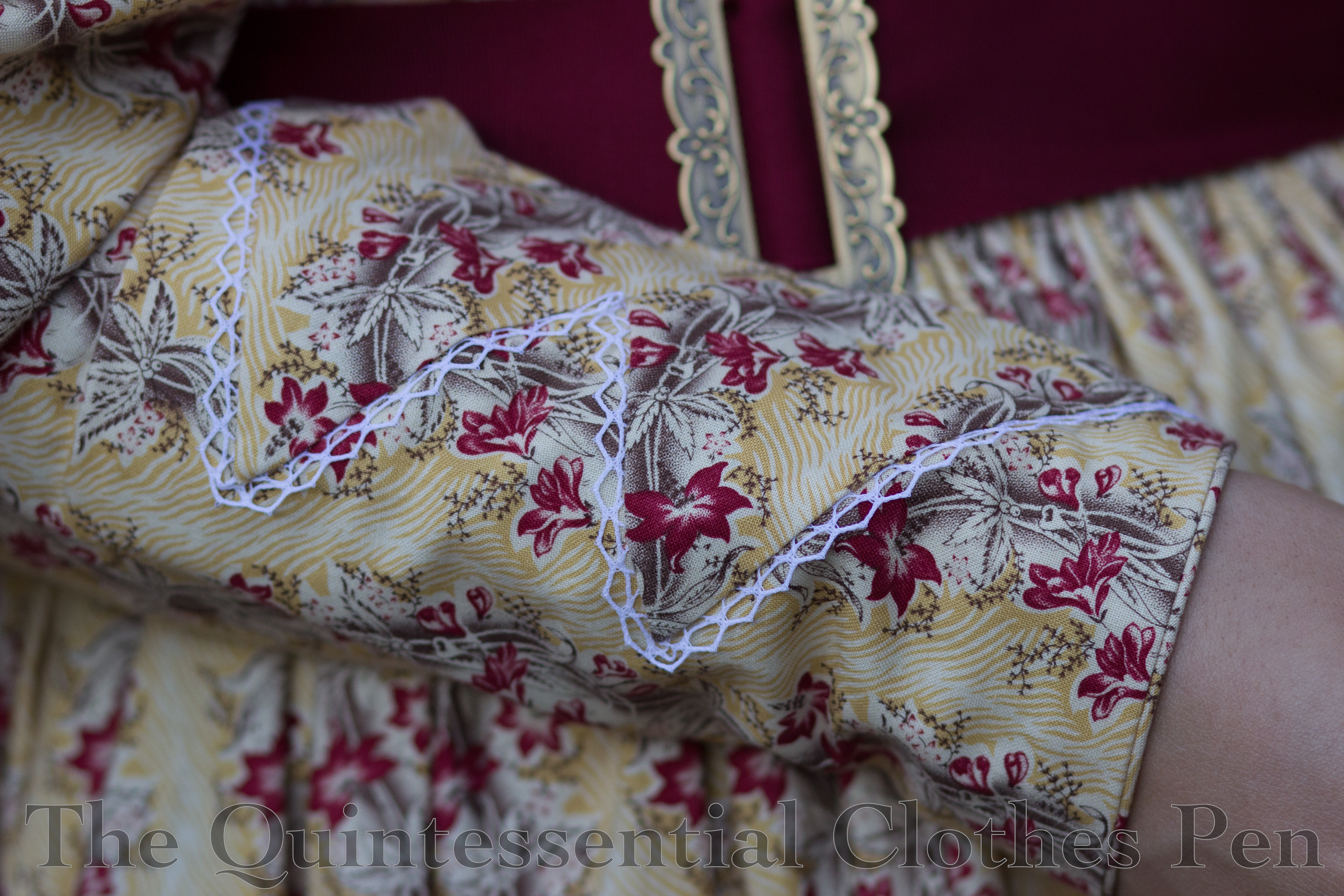
The last detail photo shows the cuff trim in even greater detail, as well as my new belt buckle from Ensembles of the Past!
I purchased the ‘antique gold’ color. I love it! It’s substantial in weight, has precise and delicate details, and will probably outlast me in terms of durability. (This is just my opinion–I’m not paid to say these nice things!)
The last photos I have to show you are a bit of a teaser for the apple picking photos that are still to come. We had the most gorgeous autumn New England day!
The sky was a brilliant blue. The temperature was wonderfully comfortable–neither hot nor cold. The leaves were changing and were starting to crown the trees in vibrant red, yellow, and orange.
And a fresh breeze lifted our spirits and our bonnet ribbons! I’ve so missed events and outings. This was much needed (socially distanced) relief for weary souls. I hope that you have also found relief and joy in these trying times!
Some of my recent posts have mentioned my excursion into sewing clothing from the 1830s. Most recently, in September, I posted about making a corded petticoat to help support a fashionable 1830s silhouette. I also shared a reminder about the fabric I’ve had in mind for an 1830s dress since I bought it seven years ago. It’s finally time to share the finished ensemble created with that fabric!
Today’s post is going to focus on the construction of this dress, but, never fear, upcoming posts will share more finished garment photos as well as construction details about the bonnet.
There is a lot of information about this dress to share and many photos of the process, so I hope you’re ready for a lengthy post!
Inspiration
As you probably guessed from the title of this post, this dress is from the year 1834. The trimming details and shape are directly inspired by the dress pictured below, which is in the collection of the Victoria and Albert Museum.
The V & A Dress is dated to 1830-1834. From a style perspective, this makes sense as these are the years from this decade with the largest sleeves, but it is also around this point in the decade that sleeve fullness starts to slide down the arm. This look that is just beginning to show in the V & A dress, which achieves the falling look with the addition of the mancherons at the top. The mancherons both practically and visually push the fullness of the sleeve off the shoulder.
What is a mancheron? The Oxford English Dictionary has the following entry):
mancheron, n. 1.French Heraldry. A sleeve used as a charge. Obsolete. 2. A piece of trimming on the upper part of a sleeve on a woman’s dress. Now historical.
Patterning
The pattern for this bodice is based on patterns contained in Janet Arnold’s Patterns of Fashion 1 and Norah Waugh’s The Cut of Women’s Clothes. I was able to start with my basic darted 1860s bodice and adapt it for the 1830s using information about grain line, dart placement, etc. from the books. This worked well because I know the basic darted bodice fits in areas that can be fussy to fit such as neckline, armhole, etc. and those things (in the 1860s) are still very similar to the shapes from the 1830s.
The sleeve pattern is from Plate 12 (page 84) in The Workwoman’s Guide (published in 1838), which can be viewed on Google Books here. I used the big circle sleeve (Figure 8–shown made up in Figure 7) and varied the top shape so that it forms a downward V shape to allow for my mancherons, which are patterned based on the V & A inspiration dress.
The ladies at American Duchess created a very helpful video discussing sleeve shapes from the 1830s, including showing mockups of a few different sleeve patterns from The Workwoman’s Guide. It is wonderful for seeing how the flat patterns turn into 3D shapes, which I found to be very helpful as I dithered about sleeve patterns.. You can view the video here. Lauren also has a blog post talking about 1830s sleeves, which shows the pattern I chose to use in various stages of its construction, from being flat to being made-up.
The skirt is based on information from the same books as the bodice pattern. It is made of 3 panels of my 45″ wide cotton fabric.
Construction Method Disclaimer
I chose to construct this dress in the mid-19th century way of separate bodice and skirt. This is odd for the 1830s (in fact, I can’t think of any examples that are done this way) as they are usually sewn together to make a one piece dress. However, as I was pondering sleeve options and considering my yardage I was faced with an exciting prospect.
There are so many sleeve variations in the 1830s–super poof, takes-a-while-to-get-used-to-looking-at elbow poof, meticulous pleated details as the poofs are reduced and contained… I wanted to make more than one! Also, I had 10 yards of my beautiful reproduction cotton and I expected my 1834 dress to only use about 7. What would I do with the last 3 yards? That’s not enough to make another dress. But… it is enough to make another bodice, even with giant 1830s sleeves that use a full yard for each arm!
I decided to make one skirt with two bodices, so in addition to this 1834 dress I also have an 1838 bodice halfway completed. It is a variation on a theme, using mostly the same bodice pieces, but with a different front style and different sleeves. More on that in the future, but for the purposes of this post it is an explanation for the fact that the skirt of my 1830s dress hooks to the bodice in a way that is common in the mid-19th century, as you can see below. (The loops on the skirt waistband blend really well with the pattern on the fabric, but you can see them if you look really carefully.)
Skirt Construction
As I mentioned earlier, my skirt is made up of 3 panels of my 45″ wide cotton. They are carefully pattern matched to keep the scrolling consistent across the panels and to help hide the seam lines. They’re not perfect, but they are pretty darn close.
Two seams are on each side of center front and one is at center back. The two front seams have french seamed pockets set into them below the cartridge pleats. This is wonderfully helpful while wearing the dress! I made sure to make the pockets big enough to hold a phone, keys, etc.
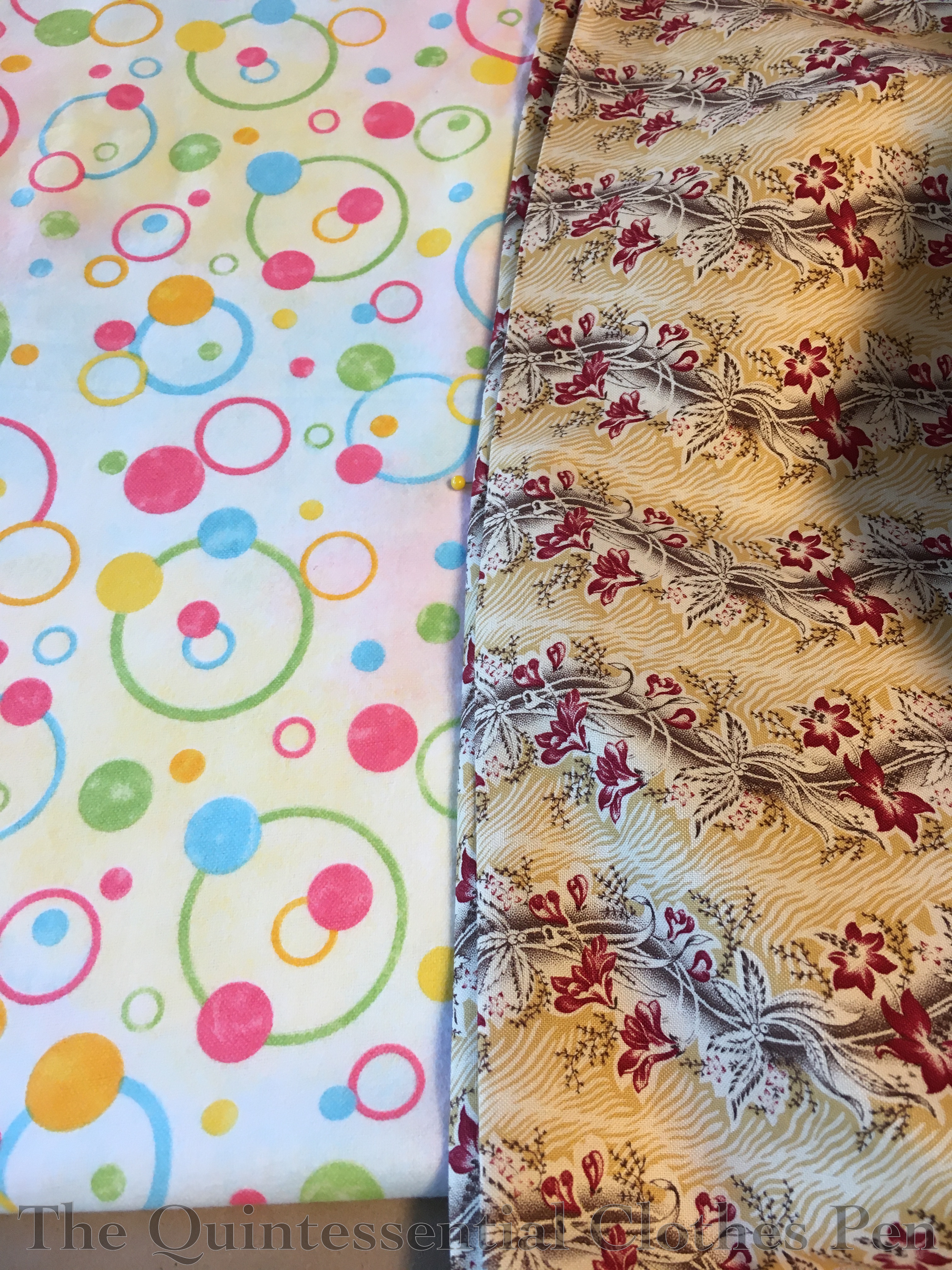
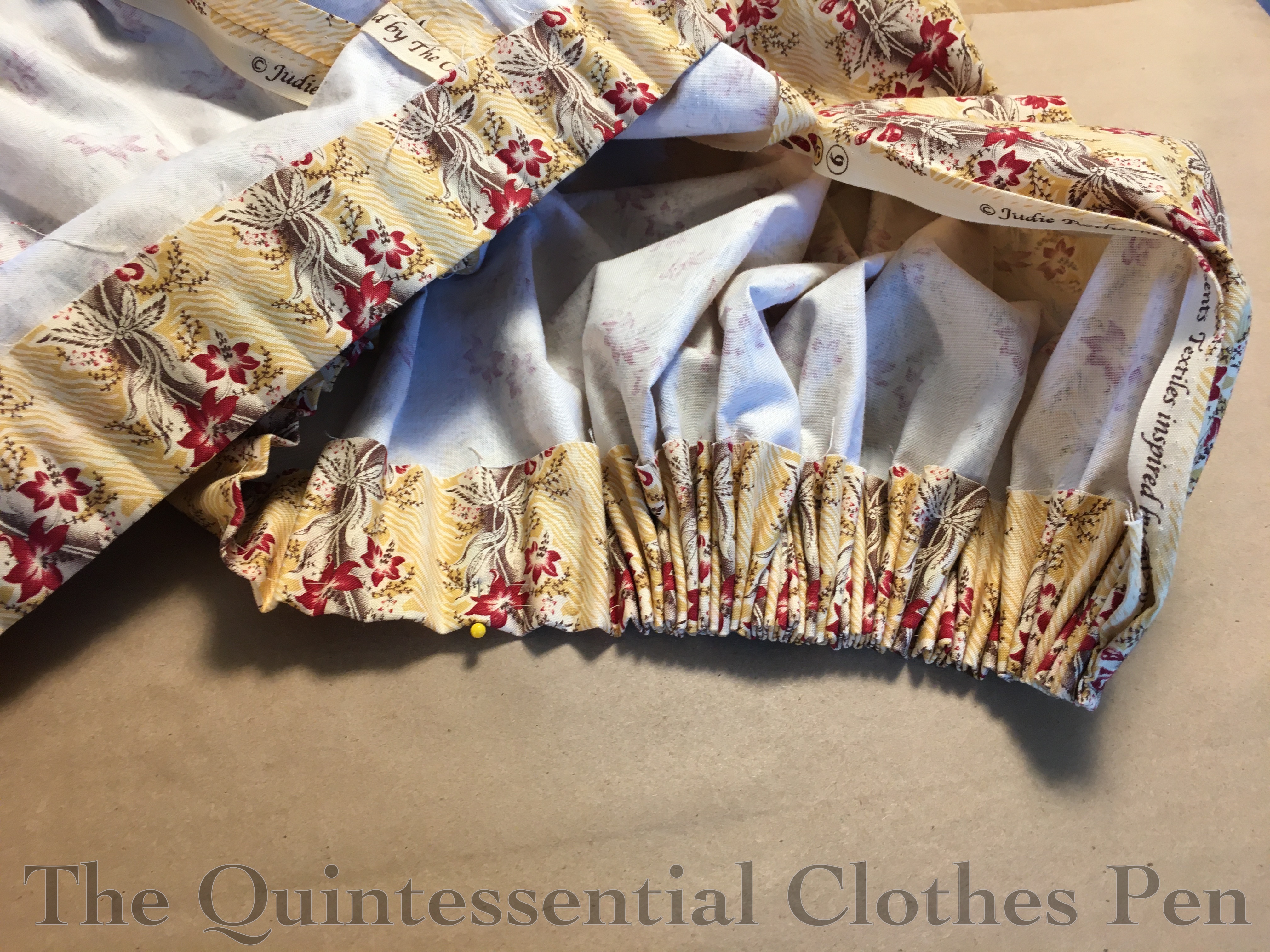
The fullness of the skirt is cartridge pleated to the waistband. I find that this quantity of cotton is weeny looking when cartridge pleated to a waistband without a little help to create loft, so I sandwiched a single layer of cotton flannel into the pleats to help them have a little bit of puff. I just used scrap flannel from my stash for this–the fun dot print pictured below. This is the top of my skirt pressed and ready for pleating!
Here is the skirt in the process of being pleated. The top edge is left raw and folded over the flannel before I ran two rows of parallel stitches to form the pleats.
I absolutely eyeball my cartridge pleats! My stitches are vaguely even but I really don’t worry too much about that. I mark the quarter points of the skirt and waistband and then adjust the pleats to fit. No math for this process!
The waistband has a single layer of canvas inside (a scrap from a decorating project) to help stiffen it and provide stability for the cartridge pleats and closures. This is machine stitched to the cotton where it will not show.
The cotton is then wrapped around the canvas and whip stitched in place. I finished the waistband entirely before whip stitching the cartridge pleats in place.
Bodice Construction
The construction of this bodice is pretty straightforward as 19th century bodices go, though I spent a bit of time searching out photos of extant dress interiors from this decade so I could see how they were finished (or left with unfinished edges!). I found these dresses featured on All The Pretty Dresses very helpful, especially as they have interior views: late 1830s green/blue/red cotton print dress and early 1830s brown dress.
There are other inspirational dresses on my Pinterest board for this project, as well. Many of them are held by the Metropolitan Museum of Art. Those are excellent because you can really zoom in on the photos to look at details, but unfortunately they don’t often show interior views of the dresses.
The hardest part about this bodice was the pattern matching! It was mind boggling to keep the flowers growing upwards, match the wave, keep the dark pink flowers at corresponding places, and keep some parts on the bias and some on the straight.
For example, here is my first attempt at the front bodice, which is cut on the bias. It’s not awful… but it’s just not quite right, and that bothers my eyes.
I very carefully tried again…
And was able to get this, which I was much happier with!
And I was able to use the reject front piece to cut out a pocket piece (and later a bit of bias as well)… no waste here!
Here is the front piece after flatlining (the fronts, side backs, and backs of the bodice are all flat lined with muslin), stitching the darts, and putting cording down the center front seam.
Ah yes, the cording! There is 1/16″ cotton cording in most of the bodice seams (front, side back, shoulders, armholes, neckline, and to finish the cuffs). This detail is taken directly from extant 1830s dresses.
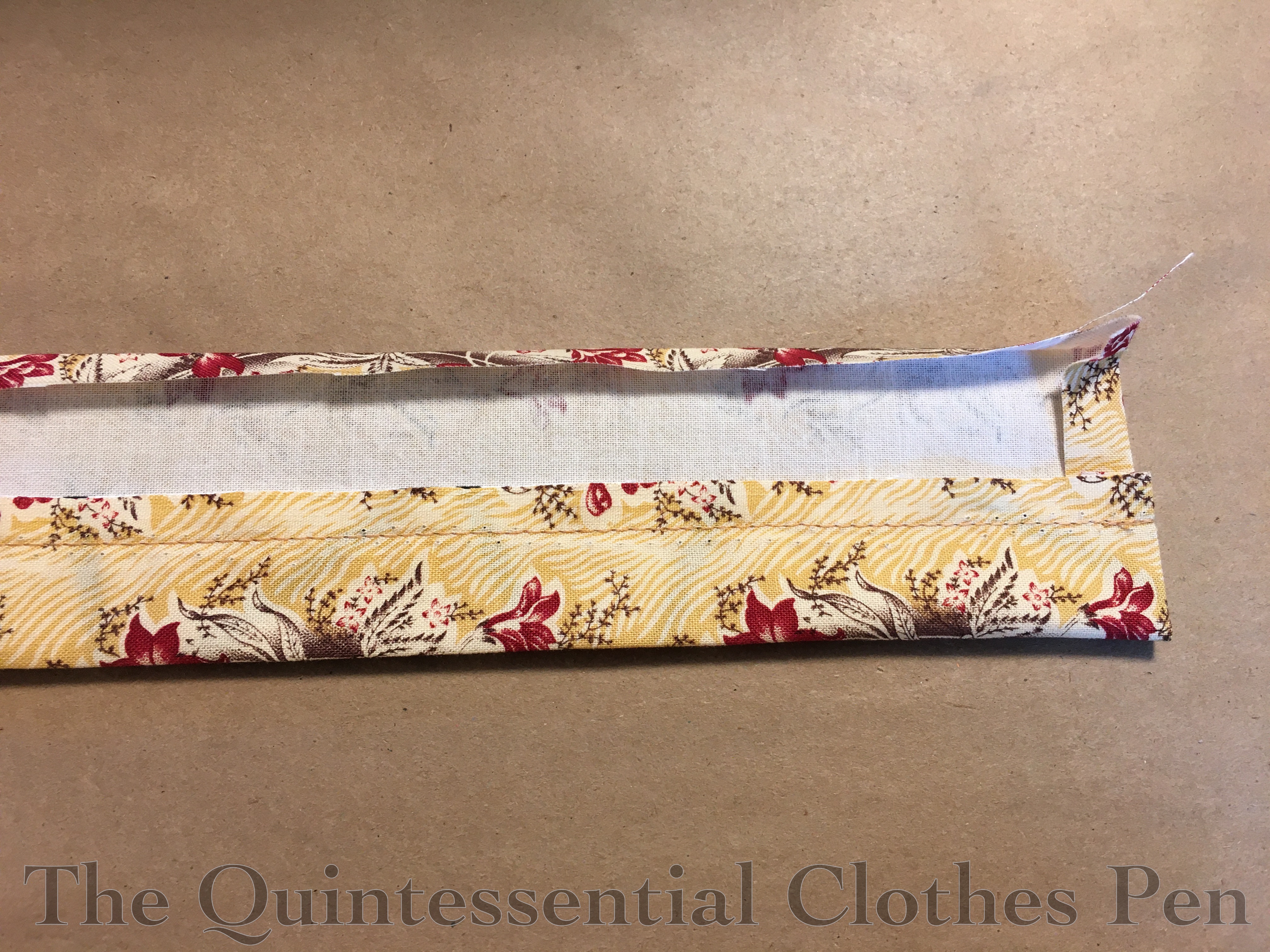
My cording is made up of bias scraps, some as small as about 4″ long, that are pieced together. The cording is machine stitched. I made it with even seam allowances for most of the seams, but thought ahead and offset the seam allowance for the neckline cording, to make it easier to turn it under and whip stitch later. The photo below shows the neckline cording (on the top) and regular seam cording (on the bottom).
Here are the side back pieces with the cording attached, before being sewn to the back pieces. As you can see, I carefully matched my pattern across these two pieces as well.
And here is one side back sewn to its corresponding back, with the cording in the seam. Even across these pieces my pattern matching is pretty good, especially at the bottom!
And the back! It also makes me very happy, but was a super mind boggle to figure out! I have a flap that overlaps past center back, covering a pleat on the other side that will anchor my loops. I found this detail on a number of 1830s dresses, including this 1835-1836 dress at The Met and this c. 1837 dress at The Met.
It doesn’t look like much until it’s lined up to be closed… and then it’s perfect!
The final step was to finish the bottom. I wanted to have a self fabric waistband on this bodice, as with the bodice at the V & A, so that I would have the option of wearing my dress with or without a belt, while still having the visual change of pattern in the fabric.
The outer waistband and inner muslin facing encase the bottom seam allowance of the bodice. They are machine stitched at the top, have graded seam allowances, and then the muslin is whip stitched along the bottom.
Sleeve Construction
With the bodice mostly assembled, I moved on to the sleeves. These are not flat lined.
I upgraded my sleeve puffs for this ensemble by giving them ties to attach to the armsceye of the dress so I can control the height that they sit at. This is essential for getting the right shape poof with this sleeve style. Looking into a sleeve, here is one sleeve puff tied in place.
I edged my decorative mancheron and cuff zig zag with narrow lace before attaching them to my sleeve. The cuff zig zags are sewn on by hand, while the full tops of the sleeves are gathered and machine sewn to the mancherons (you can see a the seam allowance from this seam in the photo above).
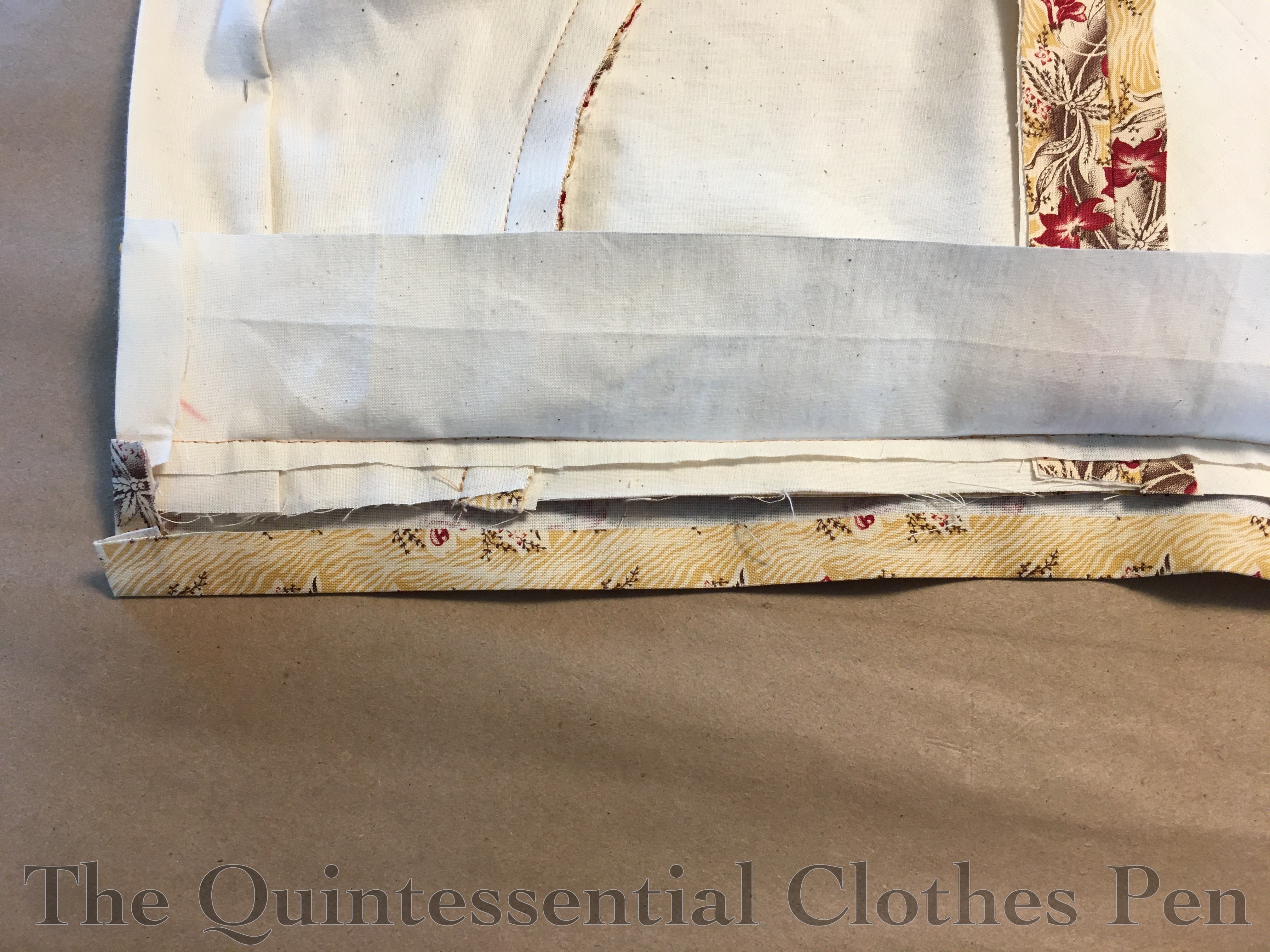
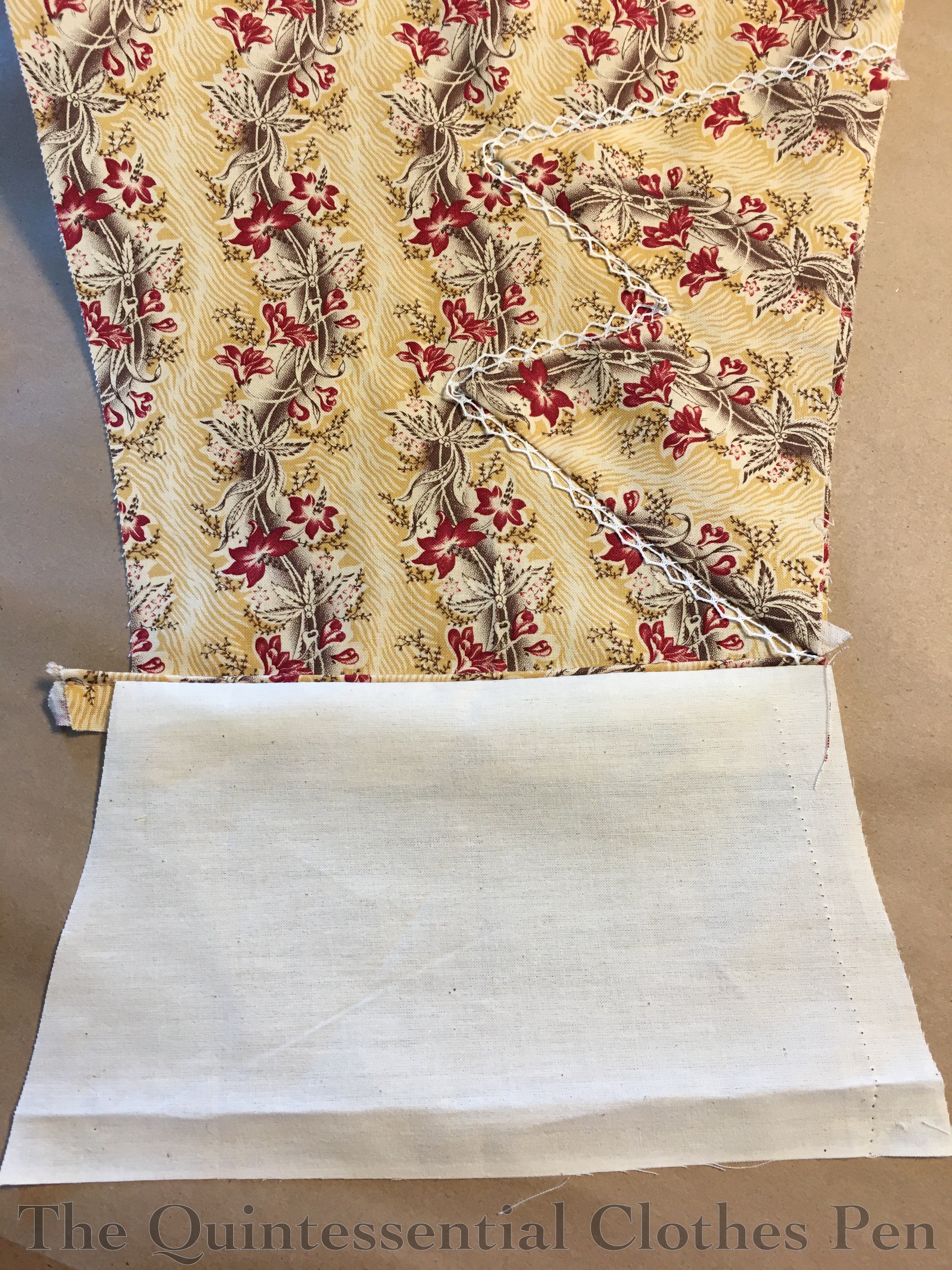
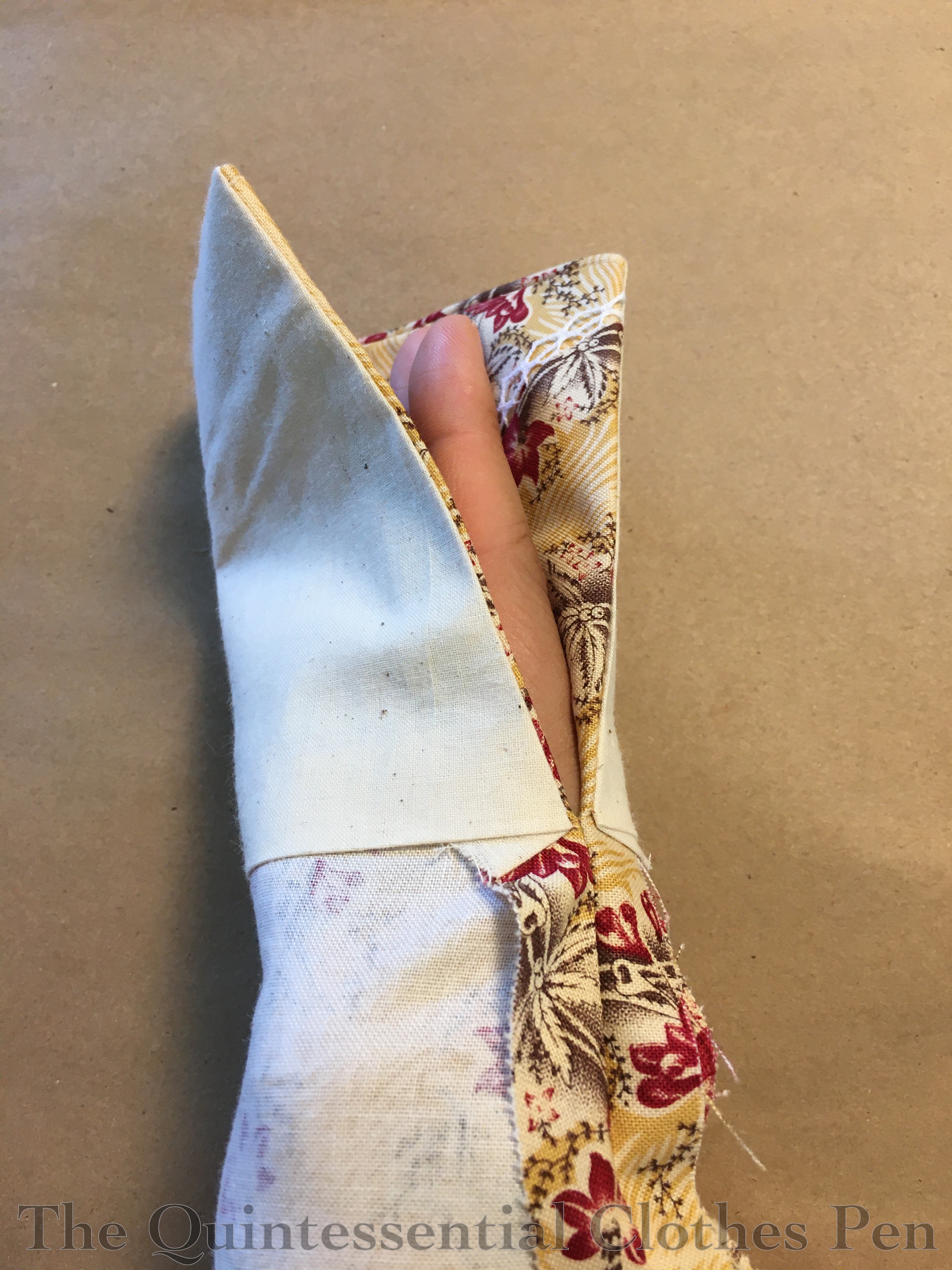
After the trim was added to the cuffs, I sewed cording to the bottom edge and then a muslin facing to finish everything off. This allows me to have nicely finished edges for the sleeve openings, which extend up about 8″ and allow for the tight fit of the forearms.
Here’s what that looks like flipped up and ready to be slip stitched along the top edge. You can see my hand sewing from attaching the cuff zig zag.
So… I got this far and realized that my sleeve was too narrow (even though I’d had no trouble in my mockup!) and my hand wouldn’t fit through the opening! Even if I made the opening higher, the sleeve edges wouldn’t butt, but would have a gap!
It’s good to have extra fabric… Having extra allowed me to make the decision to cut off the old forearm pieces and piece on new ones (with careful pattern matching, of course!). This meant redoing the cuff trim and finishing, but I couldn’t find a better solution. The seam hides under the crazy big sleeves, so it’s really not noticeable at all (even if I hadn’t pattern matched the seam!).
Finishing
Finally, after these various successes and challenges… the dress was done! Here are some more photos of it in its finished state.
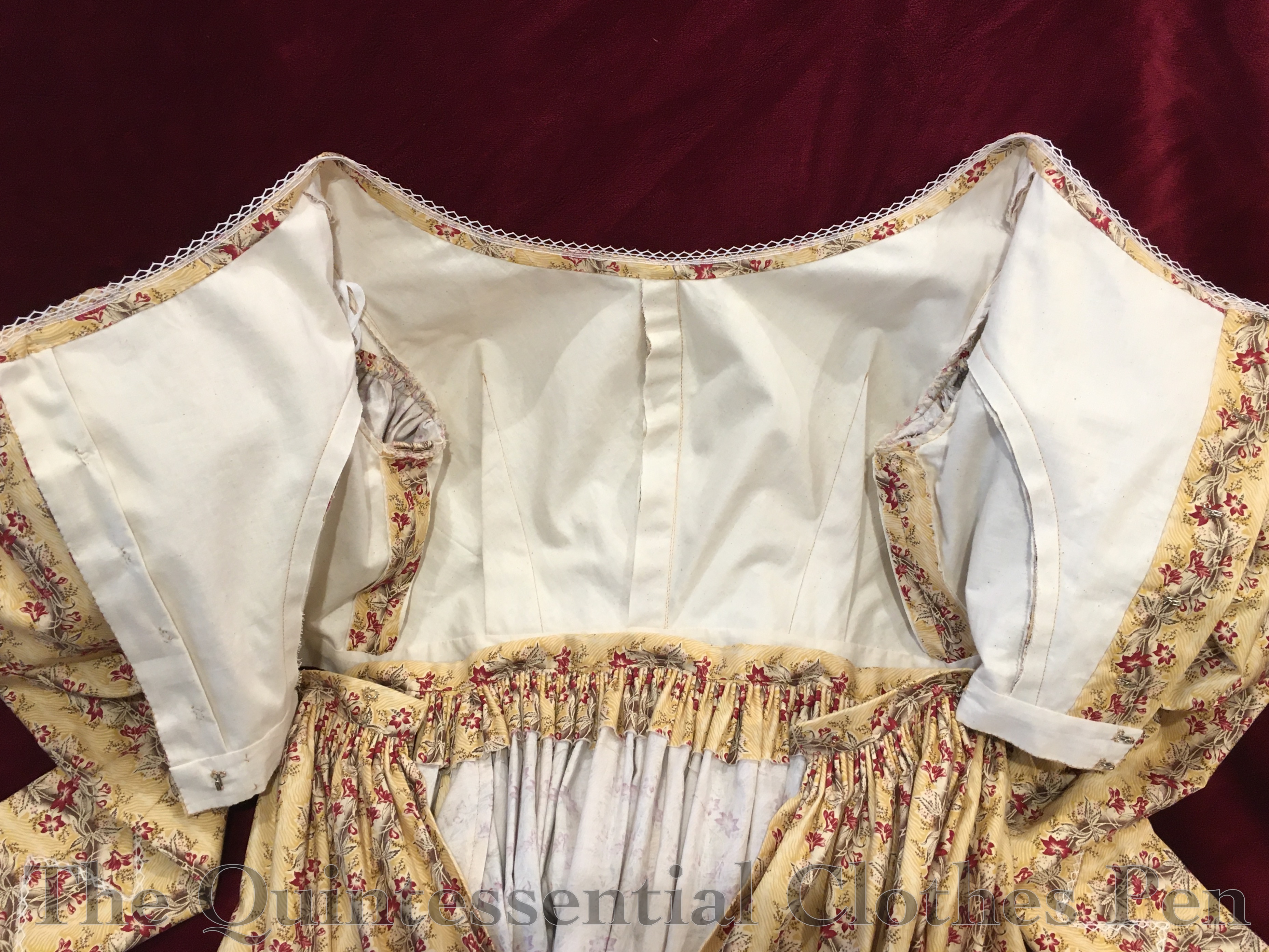
This is the inside of the bodice with the skirt attached. You can see machine stitching, seam allowances mostly left unfinished (they really don’t fray at all), neck binding, closures, etc.
This closeup shows a shoulder seam, as well as the neckline and armhole finishing. The bias on the neck is turned under and whip stitched. The lace is sewn on top of that. The armhole seam allowances were trimmed and then roughly whip stitched to hold the layers together. You can also see a little square of the twill tape tie for the sleeve puff (it is sewn to the armsceye seam allowance below the shoulder seam).
Here is the finished cuff opening. Hidden under the zig zag are the hooks that correspond to the loops on the muslin facing.
This is the center back opening with all of the closures in place. Those hooks really do camouflage well on the brown scroll, don’t they? Doing the closures this way leaves lots of seam allowance at center back for me to make alterations in the future if I need to.
This photo shows the inside of the skirt and bodice. Specifically, you can see the raw edge of the top edge skirt seam allowance folded to the inside (the skirt is intentionally shorter in the front than in the back, which you can see in the varied top edge seam allowanced length), the french seam of the pocket, and the skirt opening, which is simply an opening in the back seam (no placket on this skirt, the fullness of the cartridge pleats easily hides the opening).
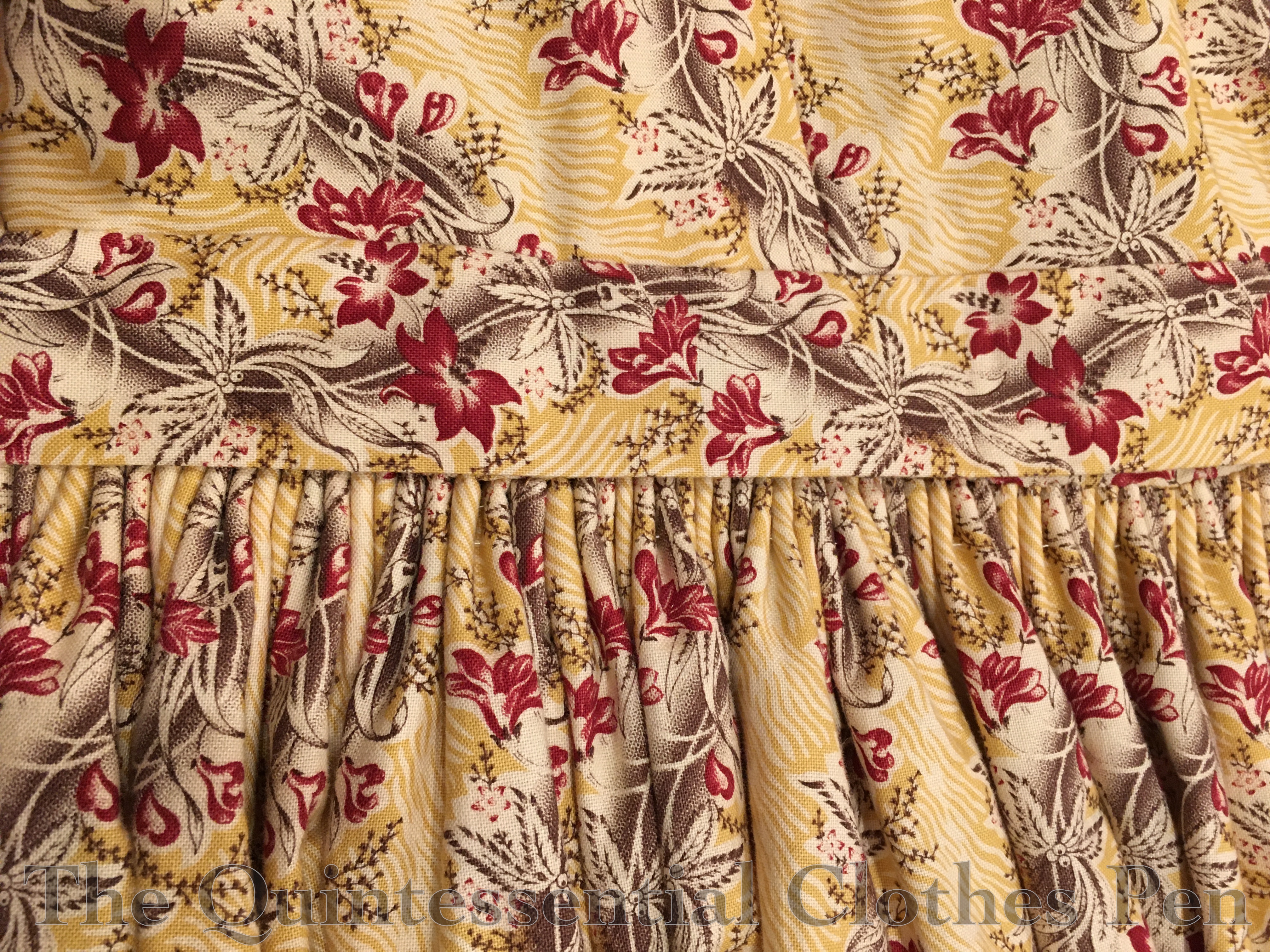
One last photo! This is the cartridge pleats and bodice waistband from the exterior. Cartridge pleats are always visually intriguing to me and I also love how the waistband of the bodice is perfectly cut to show off the scroll and flower pattern.
After so many construction photos, here is a reminder of what the completed dress looks like from the exterior. I’m looking forward to sharing more photos in future posts!
Thanks for sticking with me through this very long post!
My sewing has taken a sharp turn into the 1830s in the last two months or so. It’s an exciting detour that has been on the horizon for a long time–ever since I purchased this yellow block print cotton back in 2013, in fact.
I wanted to up my silhouette game for the 1830s and achieve a fuller looking skirt than I’ve been able to do with my 1832 velvet gown in the past. To that end, I decided to make a corded petticoat.
I followed the directions from American Duchess in this video and only changed the cording pattern to suit my materials. If you’re interested in making a corded petticoat yourself I definitely recommend the American Duchess video. I found it easy to follow along with the steps and appreciated the mentions of pitfalls and tips along the way.
I was super excited to get started and maintained my enthusiasm for the first 4 sections of cording, but by the top 2 sections I was definitely feeling ready to be done! By that point the petticoat was unruly and difficult to turn as I sewed around each channel. Despite being less fun than when I started, I pushed on, and I was quite grateful when I finished the last section of cording!
Here’s a closeup photo of the cording sections. I used a continuous piece of cord for each section, as suggested in the American Duchess video.
My opening is just a portion of one seam left open just above the top section of cording. This is what it looks like from the outside. I made the waistband extra long to allow for future adjustment (just in case!), which is why the button is set over so far from the edge of the waistband.
On the inside, that opening looks like this. The second layer of fabric is just turned back from the edge and top stitched in place. The other seam allowance edges are selvedges, so they didn’t require finishing. Easy and tidy!
The ivory cotton waistband is whip stitched on the inside finish it all off nicely. Hidden underneath is a layer of cotton canvas that helps to stiffen the waistband a bit.
This petticoat is almost entirely machine sewn and took 8.5 hours to make. I used 4 ¼ yards of ivory cotton, 13 ¼ yards of 5/16″ cording from Wawak, 39 ¼ yards of 7/32″ cording also from Wawak, the canvas scrap for the waistband, and a lone ivory button from the stash. The materials cost about $33.
When I started this petticoat, I thought that it would only be worn with the 1832 velvet gown I mentioned earlier, but since then 1830s daywear using the yellow print cotton has made it onto my sewing table… and this will definitely get worn with the new dress. I also hope to be able to wear it with 1840s dresses that will someday make it onto my sewing table. It’s a great step towards improving my silhouette!
Last fall, I had the opportunity to take part in a presentation focused on the clothing of middle and upper class African Americans in Providence, RI around the turn of the 20th century (you can see photos of and information about this event here). In order to generate some promotional materials that incorporated both of the presenters (as opposed to having separate photos of each of us), my co-presenter, Lady Estelle Barada, suggested that we schedule a photo shoot together and so we spent a beautiful, sunny summer morning traipsing around a state park, accompanied by photographer David Cruz.
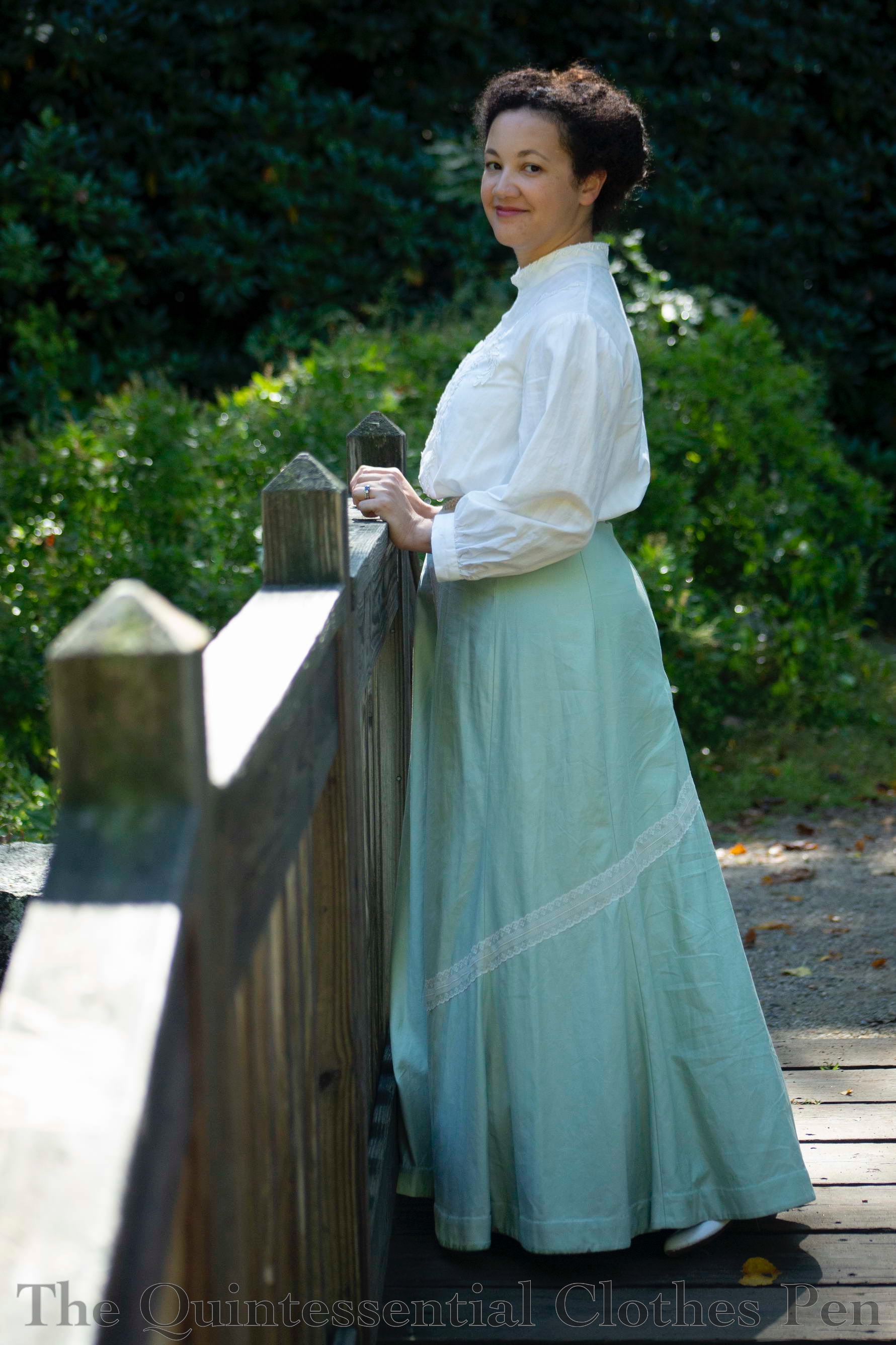
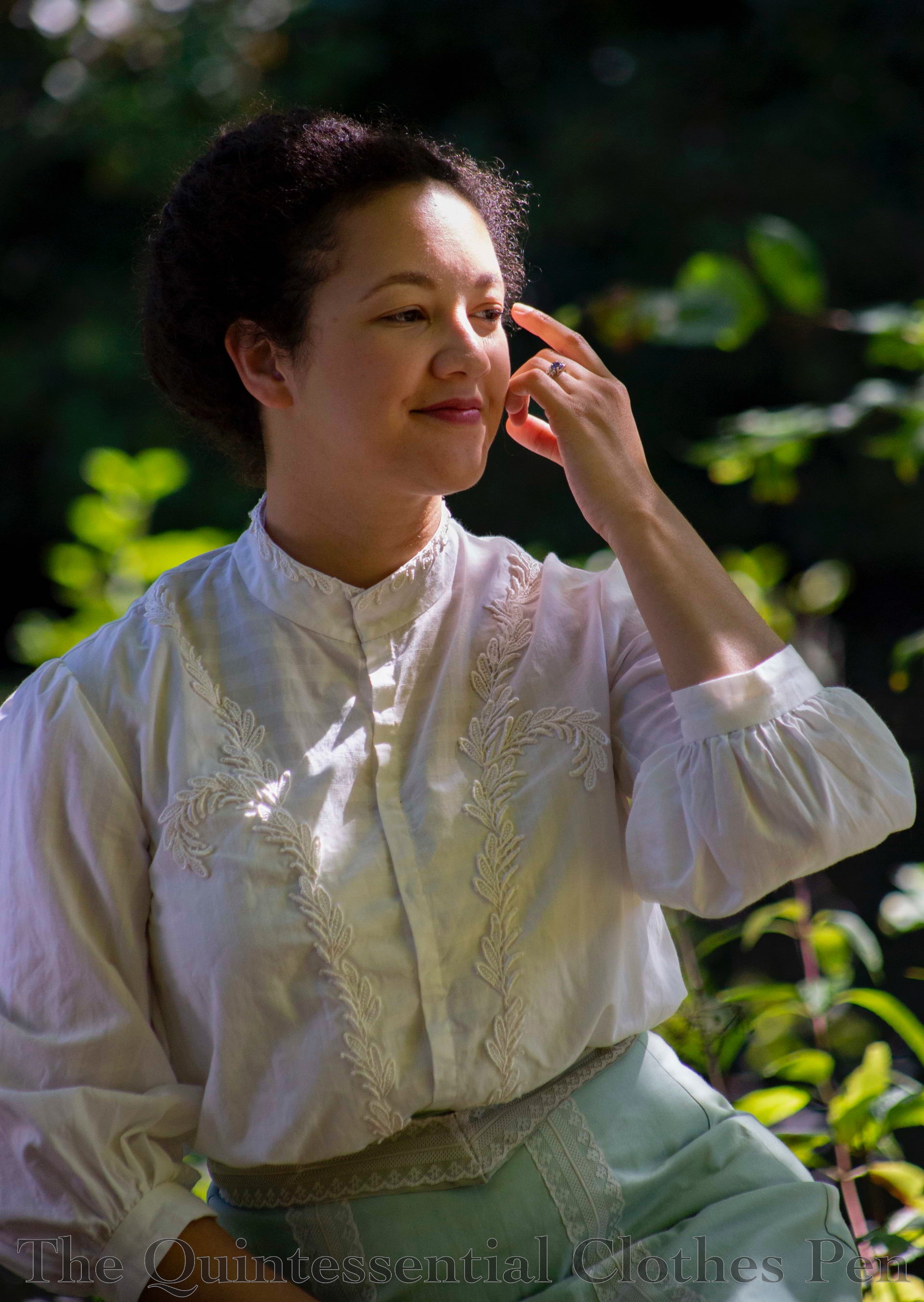
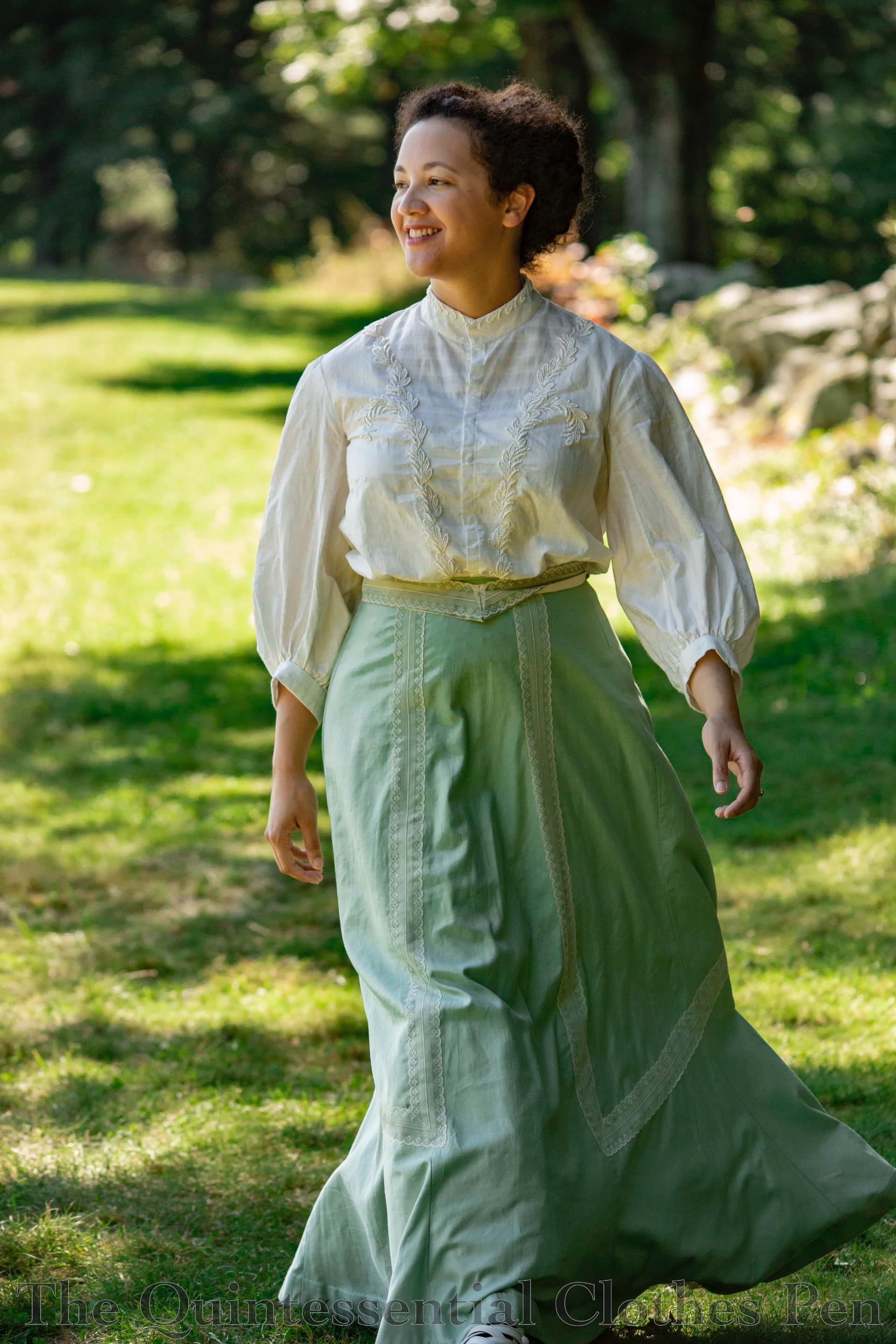
The outfit I chose to wear, my 1904 Anne of Green Gables Ensemble, has been a difficult outfit to photograph in the past, especially the blouse with its white-on-white lace trim and the subtle changes in the direction of the stripes. Given that challenge, I was extra excited when I saw the results of David’s work. He clearly captured the small details of our clothing, including the blouse details!
There are many wonderful photos from our shoot and I enjoy the captivating liveliness that each photo shares–you can just image that movement will continue as soon as you blink or look away.
On the outfit front, I love how comfortable my ‘Anne Ensemble’ is. I had no difficulty tromping through tall grass, climbing over rock walls, sitting on a picnic blanket, and more!
I was also pleased with how my hair turned out. I was able to achieve Edwardian volume around the face while maintaining a side part that gave me two separate poufs on the top/side of my face.
I’m very grateful that David graciously gave permission for me to share these photos with you. As always, please do not share these photos without appropriate photographer credit and a link back to this source.
Yay! This project is complete and photographed! I’m so excited to be able to share more finished project photos with you.
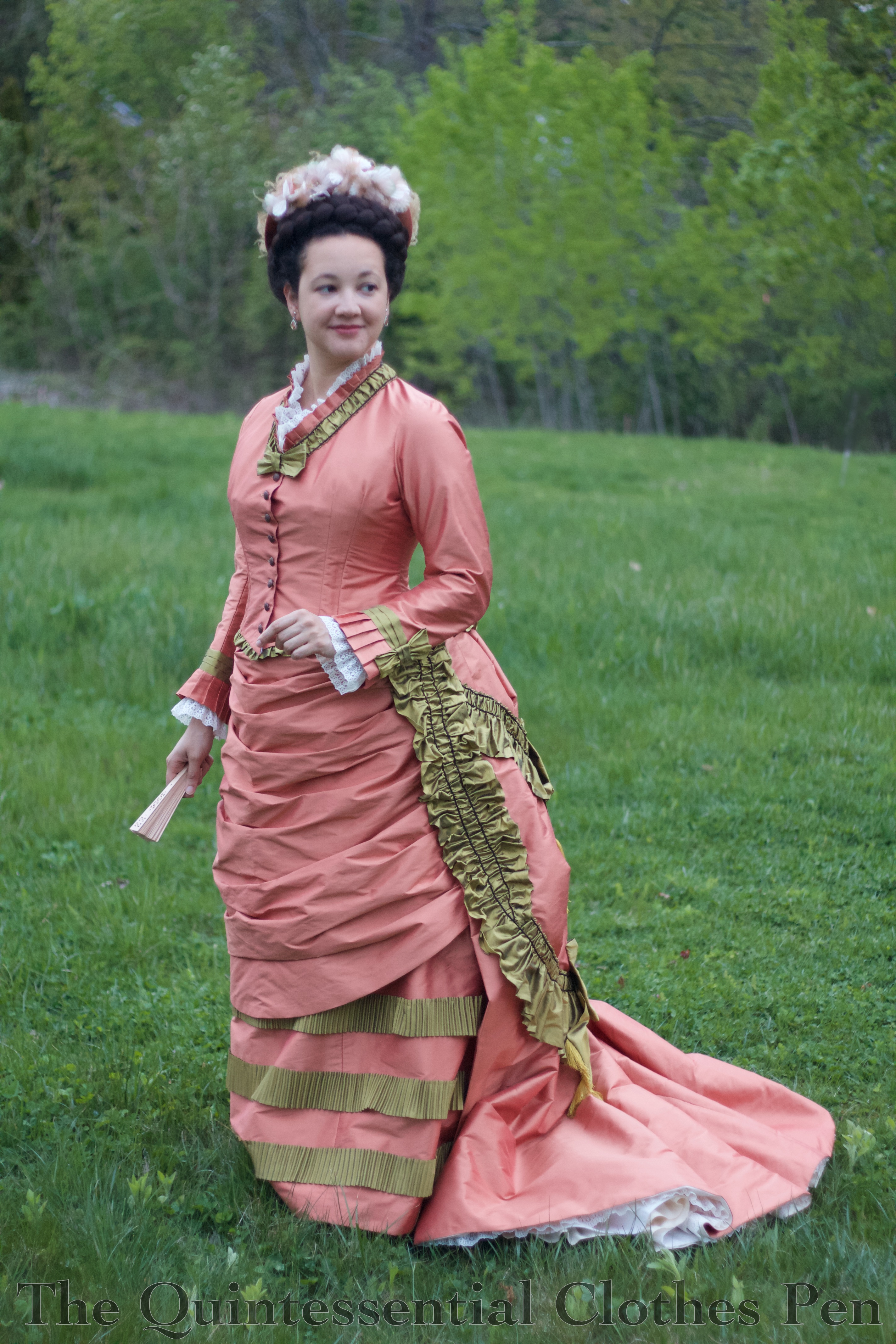
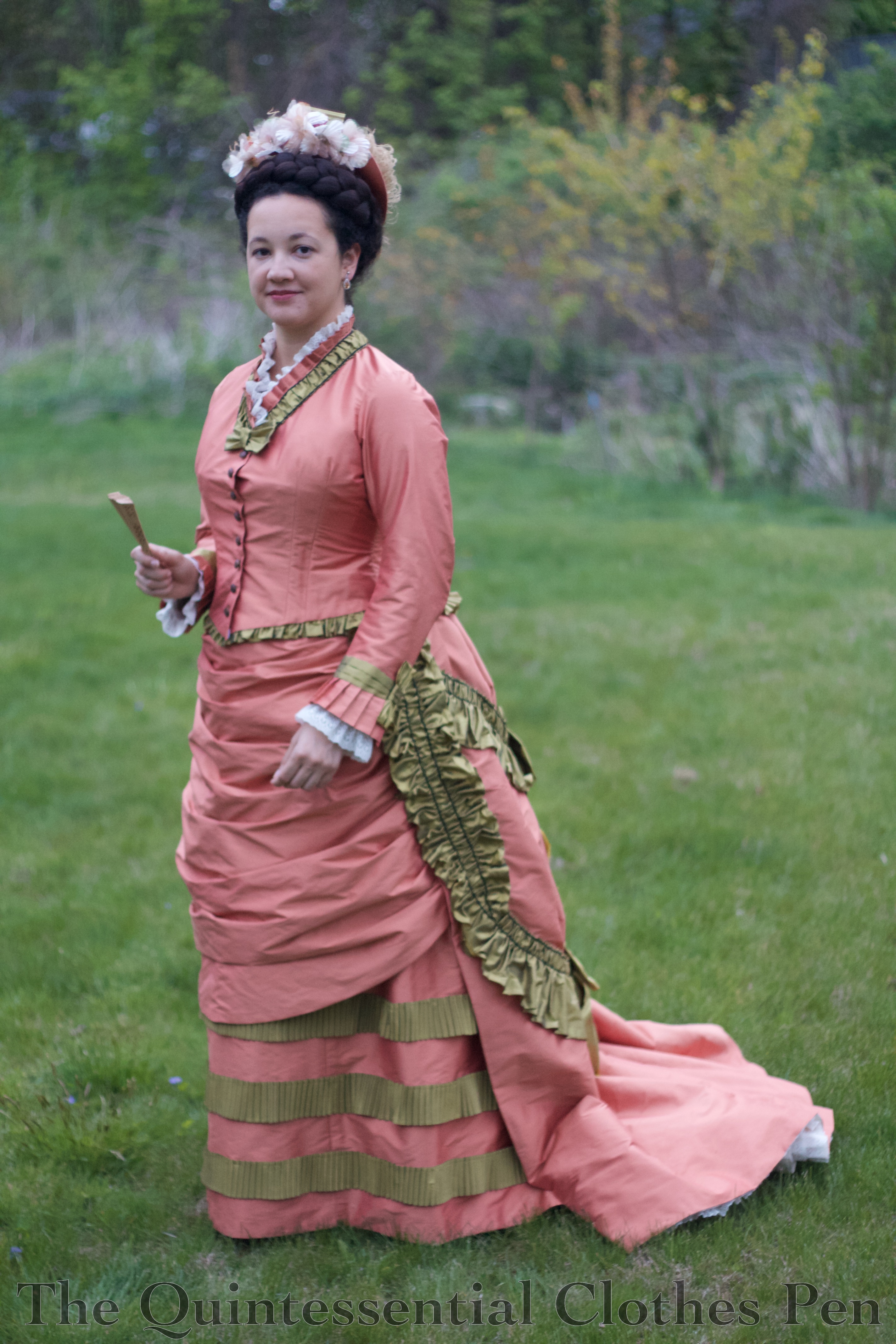
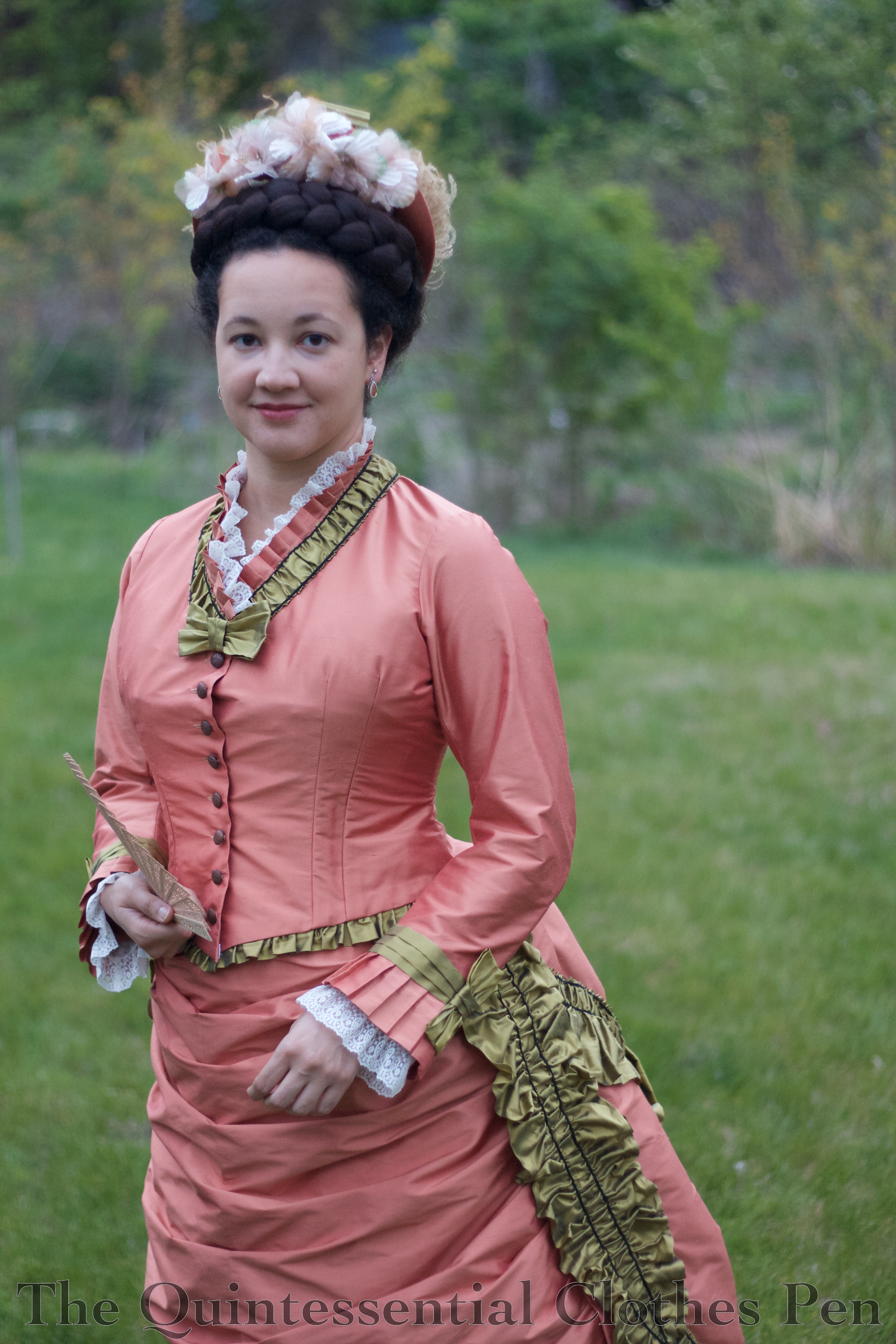
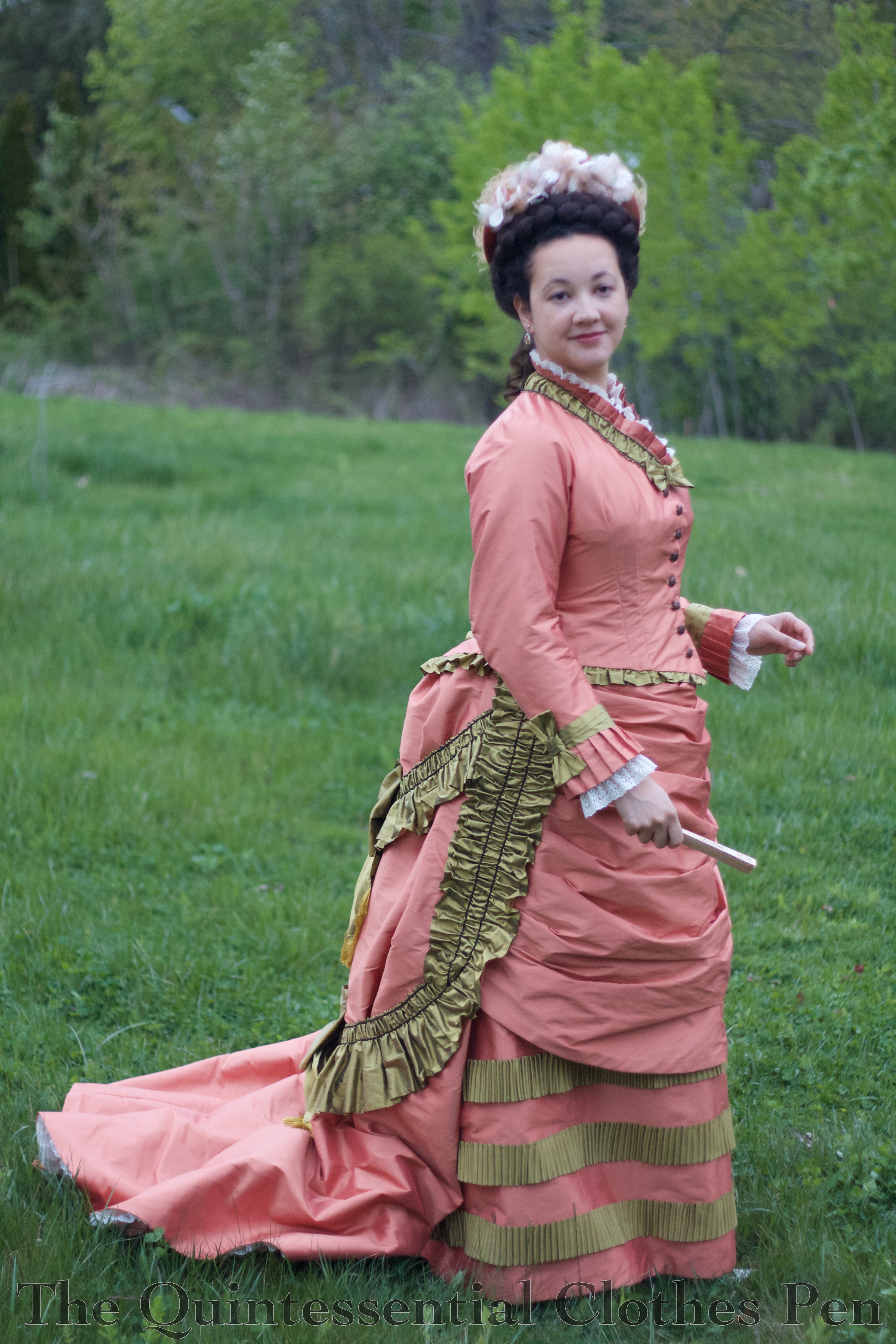
This is my 1875 Reception Dress. I’ve been documenting its construction over the last few blog posts and have been documenting the construction of the undergarments and accessories to accompany it since early this year.
To recap, if you would like to learn more about the individual parts of the ensemble you might want to visit the following links to past posts:
This dress qualifies for the Historical Sew Monthly challenge #10: Get Crafty.
Make use of your own skills or learn a new one to make something from scratch rather than buy material. The possibilities for learning and applying new skills and techniques are endless. Lace, pleated self-fabric trim, knotted fly trim, embroidery, dyeing, knitting your own corset laces, hand painting your own fabric
Since this dress qualifies for the HSM, here are the facts:
Fabric/Materials: 7 yds pink silk taffeta, 2 ⅜ yds green silk taffeta, 1 yd yellow polyester organza, 3 ½ yds pink polyester organza, 5 ½ yds muslin, 15 ¼ yds ivory lace, 8 ½ yds black rayon soutache, scraps of old green cotton bedding, a bit of polyester batting, and scraps of white cotton.
Pattern: Many of the pieces came from Patterns of Fashion 2, though they were tweaked for fit and style. Other pieces were draped to imitate the inspiration fashion plate.
Year: 1875.
Notions: 2 yds 1″ grosgrain ribbon, ¾ yd ⅜” petersham ribbon, 1 yd ½” twill tape, ¾ yd ⅝” twill tape, 1 ¼ yd ⅝” bone casing, 4 18″ long ⅜” wide plastic zip ties, regular as well as skirt hooks and bars, 8 plastic buttons, and 1 Canadian quarter.
How historically accurate is it?: 90%. Pretty good in terms of silhouette, construction methods, and materials; however, there are a few modern materials mixed in.
Hours to complete: 80.5 hours.
First worn: In May, for photos!
Total cost: $138.46.
Here are a few more photos. Every time I look at a new angle or view of the dress my eyes are drawn to different details–perhaps you will notice new details, too.
I’m very glad to be finished with this large project, while also being bummed that the event that I was planning to wear it to was cancelled. That just means I need to find a reason in the future to wear the dress, I guess. I’m not sure what that will be, but I’m hoping for a fabulous historical house or museum, or something else suitably grand and indoors, as that seems to be the appropriate setting for a reception dress.
This is a rather long post, so I hope you’re ready to settle in and take a close look!
Skirts from this period are often confections crafted from fabrics and trims–and this one is no different. The inspiration came from a fashion plate from L’Elegance Parisienne (June 1875) that is held by the LAPL.
I think I stayed pretty true to the fashion plate for this portion of the project. Slight changes include leaving off the black trim around the bottom apron edge and at the top of the green fluted bands of trim on the skirt base, as well as choosing to stitch one row of soutache in most places instead of two.
(Also …huh… You know what? I just realized, as I am comparing the photo above to the fashion plate, that I sewed the top green bands of trim on upside down. They are supposed to have the black trim at the bottom. Oops! I know I patterned them to follow the fashion plate. Well… they’re probably not changing now.)
So where was I with the skirt construction?
Base Layers
The base of the skirt is cotton muslin, with the bottom front portion covered by silk, as you can see in the photo below. This drastically saves the amount of expensive fabric used and provides a stable base for the following layers.
I started with a pattern I’ve used for my other bustle dresses for the front skirt panels (I think at some point it came from Janet Arnold’s Patterns of Fashion, but I’ve tweaked it since then). It is closer in shape to 1880 than 1870, but I think it works for this particular 1875 dress, since so much of the back fullness is contained in the waterfall of silk underneath the bows and ruffled trim.
The back panel was draped as opposed to flat patterned. I started as double width of muslin with no shaping, but as I tried to figure out how to pleat or gather the top into the waist I realized I should add some shaping along the center back seam. I think I took out about 16″ at the top, tapering to nothing at the hem.
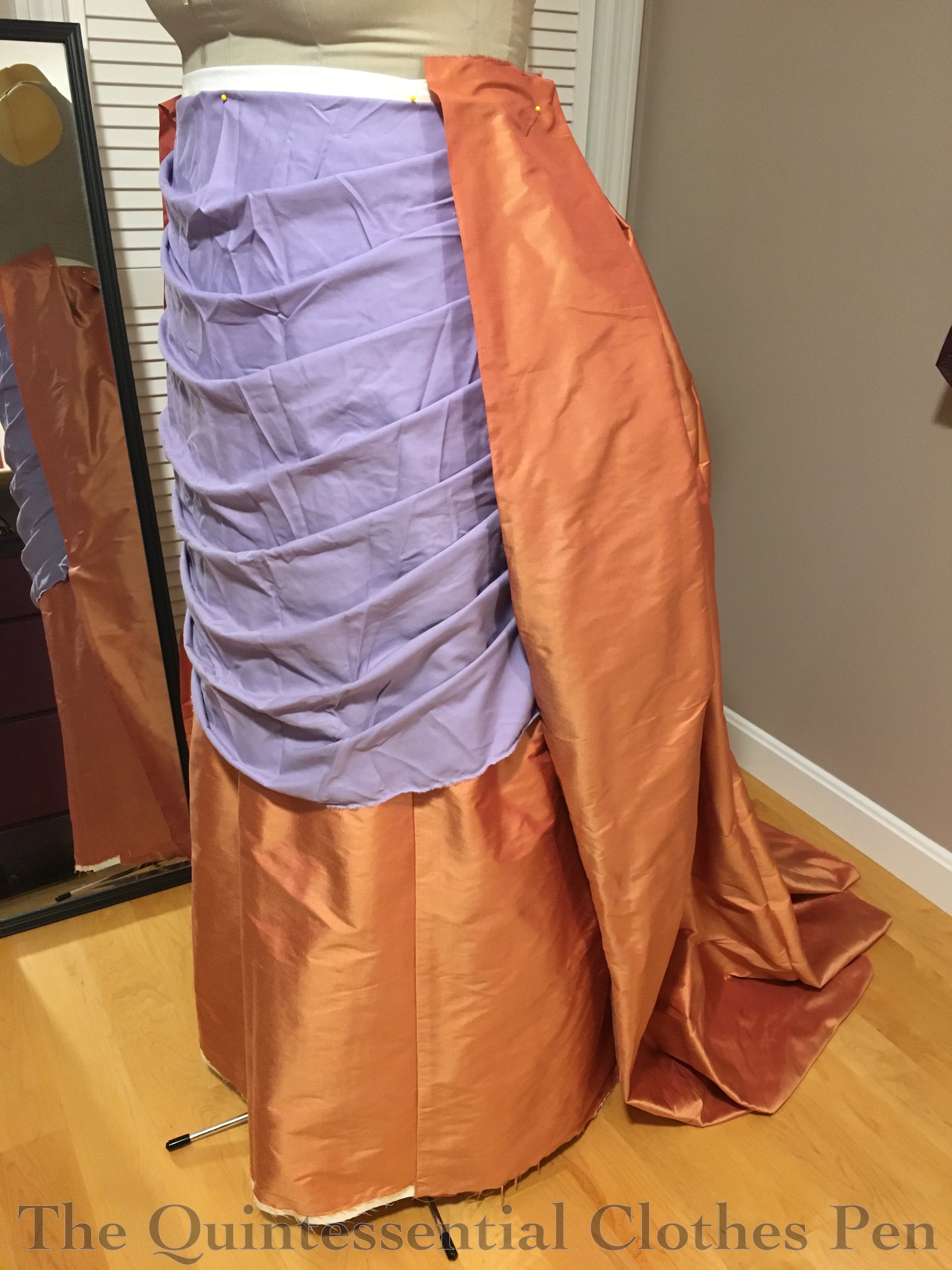
This next photo shows my silk panels on top of the base as I tried to figure out what they were doing. Since this was an entirely draped process it’s not likely to ever be repeated in exactly the same way. I have notes documenting what I was up to, but no actual pattern.
It was important to me to achieve both the gathered look at the top of the skirt and the wonderfully waterfall-ing pleats at the bottom, just as you see in the fashion plate. It turns out that was easier said than done–one of those things that’s easy to draw but not thought out in terms of actually being made up.
After getting a little farther with the back of the skirt, I moved on to the apron. Here, we have a (very wrinkly) old sheet being draped to create the apron pattern. My apron is not quite as long as the one in the fashion plate because I had limited silk fabric to work with.
Waistband & Closures
Many dresses from this period have the skirt base on one waistband and the apron and/or back draping layer on a second waistband. Essentially they are two separate skirts. I decided that I didn’t want to have to arrange the layers separately so I put them all on one waistband. This is a little bulky at the back, where both the muslin base layer and silk drape are gathered, but that’s all hidden by the point on the back of the bodice. The other thing (I realized later) is that this decision made the closures extra complicated. Let’s start there.
First, the muslin base edges hook together at the waistband (that hook is done up in the photo below). The apron layer then hooks onto the loops on the muslin layer (this layer is open in the photo below so you can see the hooks and loops).
After that, the skirt drape hooks forward, covering the muslin layer completely (this is not done up in the photo below). This completely hides all of the previous closures. To help keep this layer of closures invisible, the hooks attach to thread bars instead of metal loops. You can make them out below if you take a close look.
Pretty neat! It took a waistband extend-o to make it work, and a few brain somersaults, but we got there in the end.
In order to be sturdy enough to attach all of the skirt layers, the waistband is flat lined with muslin and also encases a grosgrain ribbon. That adds a bit of bulk, but it also creates a very sturdy finished product and, again, you can’t see the bulk under the bodice.
Flat Lining & Apron Folds
In the photo above, you might have noticed the rather bold pink organza showing on the back drape panel. That’s just a small portion of what’s actually back there–the entirety of the back panels are flat lined with this pink polyester organza. Polyester organza is not what they would have used in 1875. But other stiff, lightweight fabrics such as silk organza or cotton organdy would have been used to help the silk maintain pouf. I chose the pink because I had the perfect amount in my stash (and both it and the dress are shades of pink, so… it’s not that far off?).
Similarly, I used up some light yellow polyester organza from my stash to flat line the apron. The color was harmonious with the silk and again, I had the perfect amount sitting around, so I think it was meant to be. The polyester organza is springy enough that it keeps the silk from creating tight creases, which helps to maintain the apron folds and the back drape pouf. It’s really quite magical! Both the pink and yellow organzas were left over from old projects and I was happy to be able to use them up. You can see the yellow organza at the top of the next photo.
The next photo is also showing you the quarter bag that is hidden under the apron. You see, I wanted to make sure that all of those folds I took the time to drape for the apron would stay in place and not need to be fussed with to lay nicely with each wearing. My solution was to run a length of twill tape down from the waistband to just above the hem of the apron. The silk is tacked to the twill tape to help keep the folds just so, and the bottom of the twill tape has this small pocket of silk, containing a Canadian quarter (perfect, because I’m not in Canada so it’s not very useful as currency) to help weight it and keep the folds from springing up.
Secret Pocket
Next, I want to share a hidden detail I added to this skirt. A pocket! This is stitched into the muslin base layer at the left side opening. It’s only accessible when the skirt is partially or completely unhooked, but that makes it a perfect place to stash a phone, keys, etc. if I wear this and don’t want to carry a purse or bag.
I made the size quite generous and placed the pocket low enough that anything in it hides under the skirt without adding a bulge.
Hems
There are multiple hems and hem finishing methods used in this skirt. The next photo shows most of the layers of the skirt and their varying hem methods.
Top in this photo is the front base layer of the skirt (that’s the pink with green trim). The pink silk is hemmed with bias strips of muslin that are machine sewn, pressed to the inside, and then hand stitched to the muslin base. This creates an invisible finish. (The apron, though not pictured here, is finished in the same manner, with the bias facing hand stitched to the yellow organza flat lining.)
The middle layer in this photo is the back skirt base. This muslin layer is also finished with bias strips of muslin, but in this case I’ve sewn the bias up by machine since it is always covered by the back drape and will not be seen. I amused myself by using a small stitch length to mimic the machine stitching I’ve seen on extant late 19th century clothing as well as the same bronze thread that I used on the silk.
The bottom hem layer you can see is pretty fabulous and the most involved to make in terms of research and sewing.
The back drape hem is finished with a muslin facing that ranges from about 12″ high at the sides to 20″ high at center back. This completely covers the portion of the train that drags on the ground, effectively keeping dirt off of the silk and organza layers. After piecing the muslin, but before attaching it to the skirt, I machine sewed the three rows of lace to the facing. I didn’t bother gathering, inside I just eyeballed tucks in the lace as I went along to create fullness.
This creates another form of a balayeuse. Remember that word, from May? I have a whole post about the amazing detachable balayeuse I made for my petticoat for this dress, but a balayeuse can also be an inside frill on the hem of a skirt.
I’ve had fun reading a series of blog posts by Natalie at A Frolic Through Time about creating an 1895 ensemble and her research about the support structures and methods that help maintain the fashionable silhouette. Along the way there have been mentions of the balayeuse! I’m going to include them here, because I am intrigued by them, even though their time period is a little later than this 1875 dress.
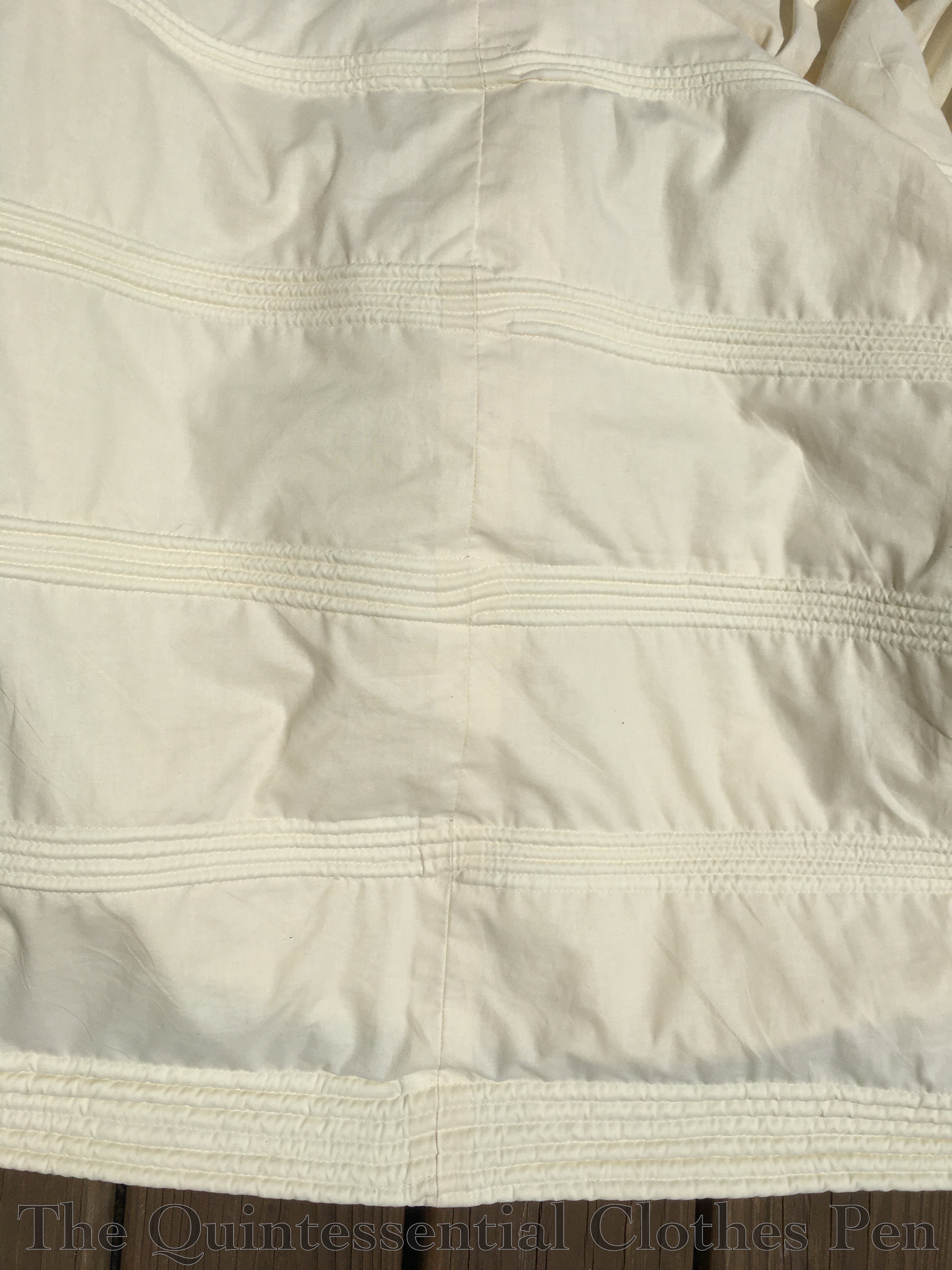
The lace balayeuse extends past the finished hem by just a little bit, so that it peeps out while the dress is being worn, as you can see in the photo below.
In addition to being pretty, trailing white garments on the ground show off that you have the resources to keep the garments clean and also that you have the resources to pay for the extra materials to make them. More practically speaking, the lace helps grip the balayeuse that is attached to my petticoat, which helps to keep the skirt folds in place even with movement. I found that moving forward, backward, sideways, and turning all caused no disruptions to the folds of my skirt while being worn.
Trimmings
The final step of making this dress was trimming! Lots of it!
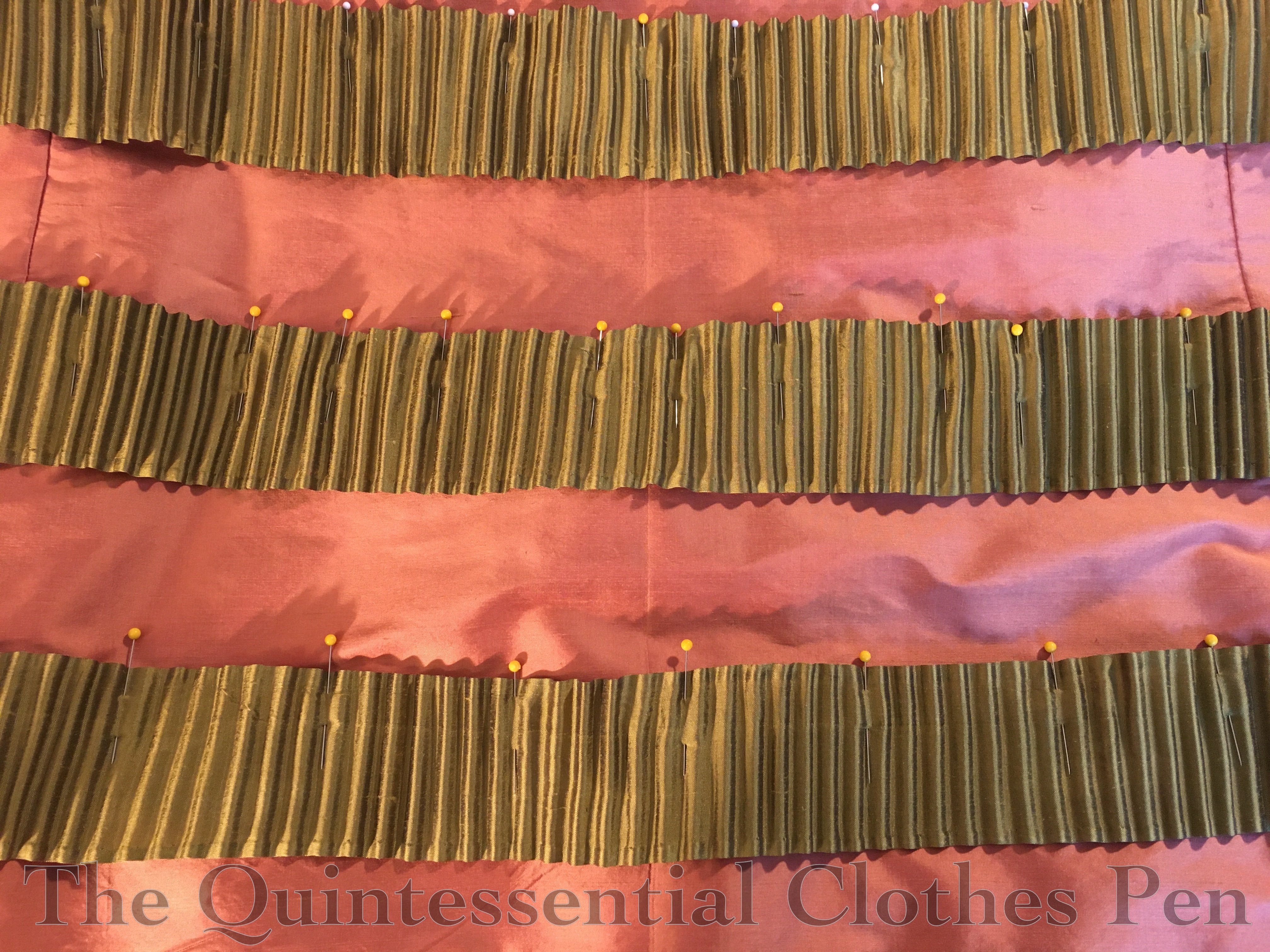
The first bit of trim I tackled was the trim on the front base section of the skirt. In the inspiration fashion plate this looks like knife pleats, but I was inspired to use my antique fluting iron instead. You can read all about making the fluted trim in this past post.
Here is the fluted trim pinned in place on the skirt base.
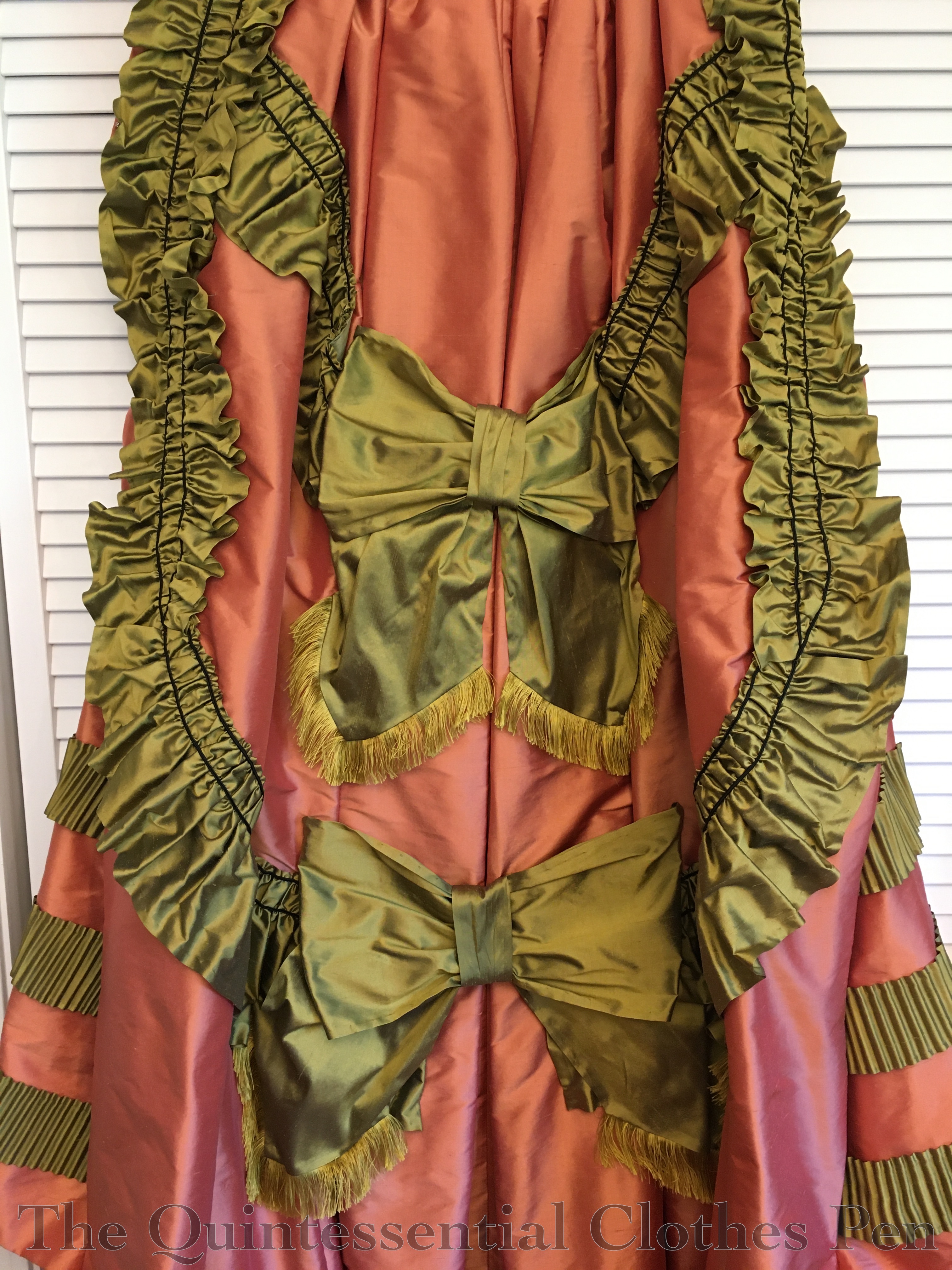
After sewing the fluted trim on, it was time to consider the back trim–all those gathers and the massive bows.
The gathers are strips of silk, some shaped, that are hemmed by hand along one edge. Here are my six pieces of green silk: hemmed, gathered, and ready to go.
The non-hemmed edge was pressed under but not stitched: it was stitched down as I attached to the green cotton bands you can see in the photo below. These are made from old bedding (not the perfect color, but green, and you can’t see them, so I’m pleased to be able to re-use old fabric). The cotton bands are shaped and the ruffles sewn to them so that they can float on top of the gathered pink silk.
The gathering threads in the green panels were sewn my machine. After the green cotton bands were hand tacked in place, the gathering threads were covered by the black soutache trim, which was also hand sewn in place. This image shows this part of the process in progress.
The end result looks like this. It reminds me of heirloom lettuce. Not in terms of color (hopefully!) but in terms of the ruffle-y ness. The edges are all nicely finished, the gathers are covered by black soutache, and the whole thing is invisibly held in place.
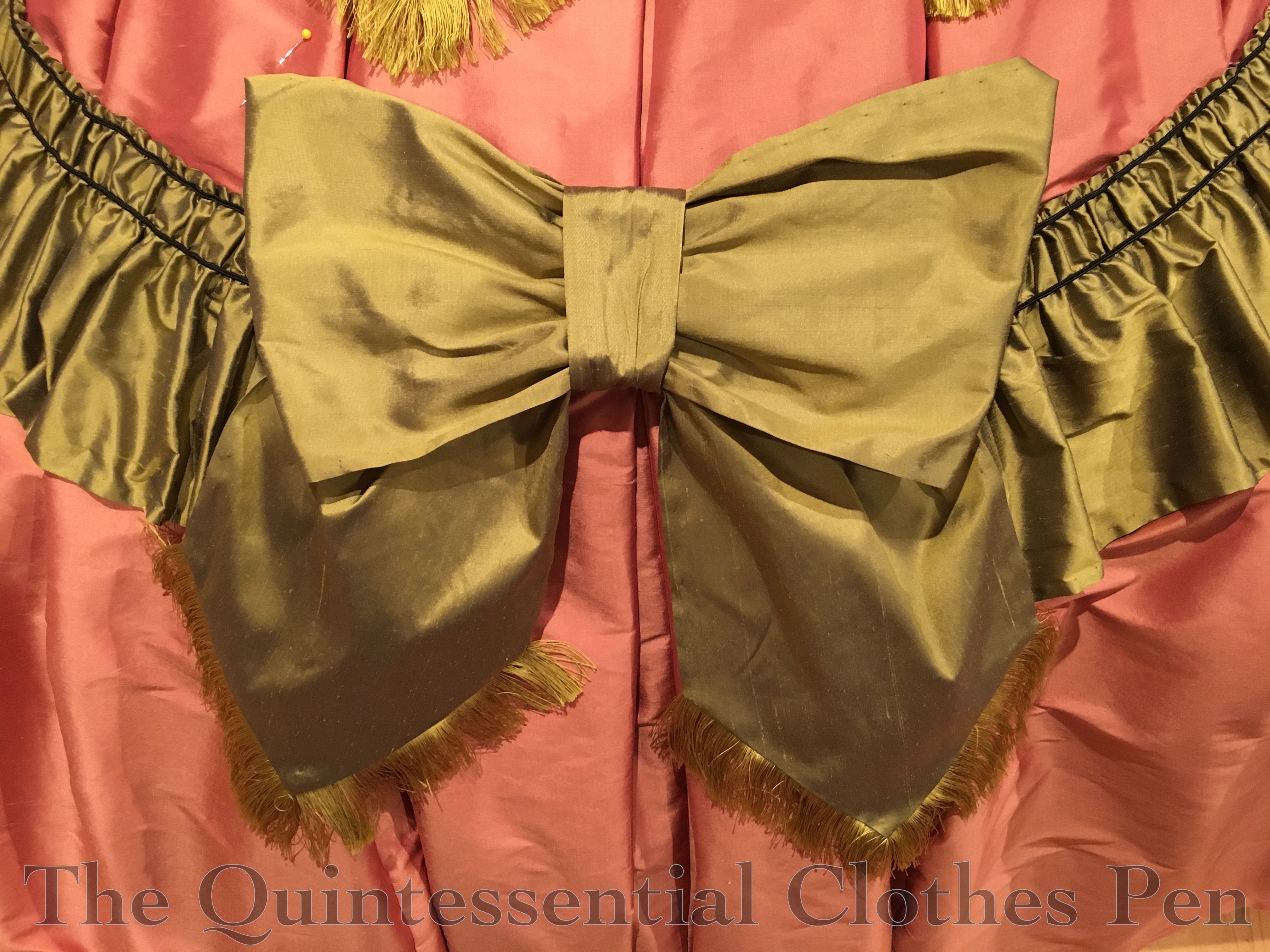
Then there are the bows. I love these massive bows! Here’s a photo showing the wonderful acid green color of the silk. The bow pieces were cut out, hemmed, and assembled by hand. The bottom edges of the bow ends have the edges pressed under (but not hemmed) and finished with self fabric fringe.
Yes, self fabric fringe. I cut strips of the silk and spent a few hours watching Netflix and shredding the silk to remove the black threads, leaving only the green. Here’s my test piece.
On each fringed piece of silk I left a border of non-fringed fabric at the top. I used this to attach the fringe pieces to the pressed under edges of each bow end. It keeps the fringe looking organic and part of the fabric, without any stitches showing.
Here is one of the bows pinned in place. The bows are tacked at multiple points to keep them permanently in place.
And here is the skirt with all those layers of trim added on!
Whew! That was a long post. There are lots of details in this skirt. Next time, I have more finished ensemble photos for you as well as the HSM facts–quantity of materials used, time spent, etc. Thanks for sticking with me through the details of this construction post!
Recently, I’ve been hinting about my new 1875 reception dress. We’ve looked at the hat that I made to accompany it as well as how the hat was made. Now, I’d like to share focused details about the construction of the bodice of the dress.
Here is the finished bodice!
I did a lot of Pinterest scanning to choose a style for the dress (as one does, of course!). There are a number of dresses from 1875/76 that appeal to me, with their swags of fabric, elaborate trimmings, and sweeping trains, but I decided on the fashion plate below partly because I had fabrics in my stash that I thought would work in terms of yardage as well as complementing each other in terms of colors.
If you’re looking carefully, I imagine you’ll notice pretty quickly that my finished bodice does not have the pleated sleeve trim and large cuff shown in the fashion plate. I ran out of fabric! Oops. So I decided to eliminate these details and focus on all the other trimmings on the dress. For example, if you look at the neckline and hem of the finished bodice you will notice that those two edges have similar treatments as in the fashion plate. However, not using the sleeve style in the inspiration fashion plate left me with a style decision to make. How to trim, or finish, the sleeves? Back to Pinterest!
I settled on the sleeve style of the fabulous burgundy and tan dress on the right. This would use less fabric but maintain a similar feeling as other parts of the dress.
Revue de la Mode, c. 1875
Below are my partially finished sleeves.
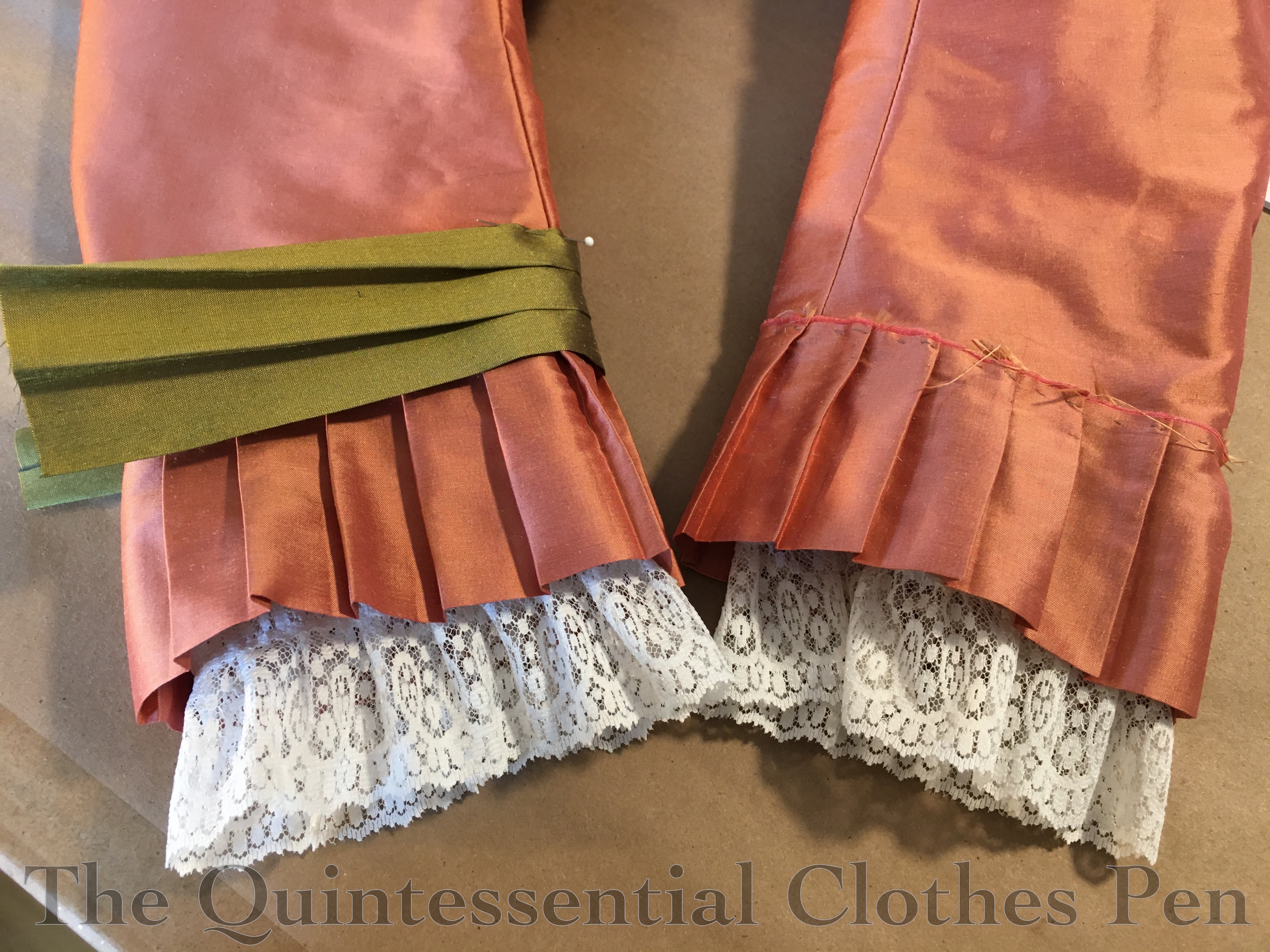
I started by cutting them off at a length that made sense with the addition of the pleats and hemming them. The pleats are pressed in the center so that no hemming is needed and the top edges are left raw. These raw edges are then covered by the green pleated bands. The lace is actually two rows of lace (to make the lace twice as wide) that are gathered and then sewn into sleeves. The final step that you can’t see here is a green bow to finish off the back sleeve seam area. The bow covers the raw edges of the green pleated band.
The bodice pieces of silk are flat lined with muslin. The seam allowances are whip stitched to keep them tidy. The bottom edge of the bodice is finished with self bias. The bodice is boned–at the point of this photo only the center back seam has a bone stitched in.
In addition to the center back, I added bones to the side back seams as well. I also added a waist stay. That is the grosgrain ribbon that is stitched to the boning channels. This helps to keep the bodice anchored around the waist if I raise my arms and to keep the back tight against my body. It also takes some strain off of the buttons.
At this point you can also see the green ruffle has been added to the bottom of the bodice. Like the pleats on the sleeves, the ruffle is pressed in half so that no hemming is needed. The top raw edge is hidden by the twill tape.
Here’s another view of the inside of the bodice that shows the green ruffle a little bit more. It also shows the bones on the side seams and a hint of the lace around the neck opening, the edge of which is also covered with ribbon–in this case, petersham. I found the lace too scratchy against my neck on it’s own, even though it feels relatively soft against my hand.
The photo below also shows the bust pads. These are graduated crescents of batting that are stitched together and then covered with cotton. They help to fill out the area just in front of the arm, which often has a natural dip without assistance of this sort. Filling the dip in creates a fashionable rounded shape. Adding the pads is an experiment I was trying out. (Here is an example of a c. 1885 extant dress that has bust pads.)
Here’s an up close shot of the seam allowances of the bodice, also showing the lace and petersham around the neck a little more. You can just barely see the armsceye seam allowances, which are trimmed and whip stitched to keep them tidy.
Finally, here is a view of the front of the bodice in a half finished state.
The two front darts have boning channels stitched into them. All of the ‘bones’ in this bodice are plastic zip ties. The front zip ties are split in half to make them narrower.
This photo also shows the pleats around the neck opening (finished as with the sleeves and bottom ruffle). There are facings on the front edges. This photo was taken before I stitched the buttonholes. They were eventually machine sewn.
After all the internal construction was complete, I added the buttons (they are rubbed bronze looking plastic shank buttons) and the green trim around the neck. The neck trim is a strip of silk that has the long edges pressed under and gathered. The long edges are tacked to the neckline and then black soutache is sewn on top to cover the machine stitching lines. The finishing touch is the bow at center front.
Ta da! Next time, I’ll do an in depth post about the skirt construction, including back views that show off the giant bows, which are probably my favorite part of the skirt.
I decided I needed a new petticoat as part of the 1875 ensemble I’ve been working on for the last few months. I have a very ruffly petticoat from 1883 (shown in this past post) that helps with the shelf backside shape that became popular in that year, but I wanted a different shape for 1875… something to produce a more rounded silhouette and support the train I was expecting to include on my new dress.
My original thought was that my balayeuse would button to this new petticoat to create the support for the train of my dress (as opposed to making a trained petticoat and then potentially needing an additional petticoat without a train in the future). The idea is that the balayeuse + new petticoat will provide lots of wearing options for the future.
Along those lines, this new petticoat is able to fit over my large bustle from 1883 as well as having the ability to contain the back fullness so that it can also be used for the Natural Form years of approximately 1877-1882 (you can see the bustle in the same past post as the super ruffle-y petticoat). I don’t have a Natural Form dress yet, but it is on the to-do-someday list and in the spirit of reusing garments and saving time, this seemed like a reasonable decision.
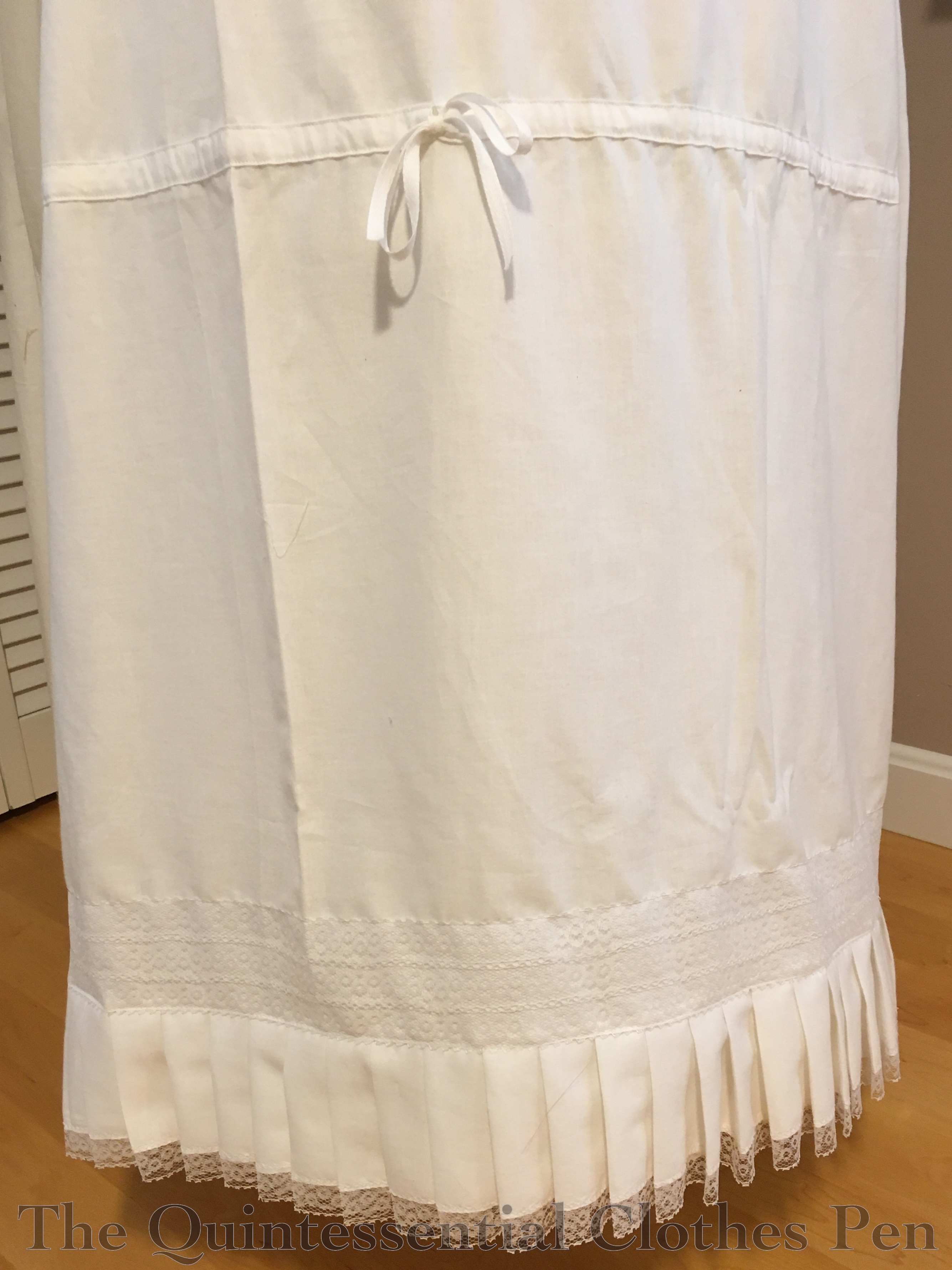
Here is the new petticoat over my large bustle. The drawstring partway down the back allows for the adjustment for different bustle shapes. It is anchored in the side seams.
Here is the petticoat without the large bustle. This is approximating the Natural Form look. While the hem pulls up a bit over the large bustle (above), it is pretty even for the Natural Form look (below). The great thing is that once there is a dress over the petticoat you can’t tell what the hem is doing!
The pattern for my petticoat is from Frances Grimble’s Fashions Of The Gilded Age Volume 1, page 107. It’s a pretty simple shape. Accordingly, I made mine using straightforward details and machine sewing/finishing.
The petticoat has a drawstring at the waist, for adjustability. The drawstrings run through the waistband and are anchored along the sides with a line of machine stitching.
At center back the drawstring closes the top of the placket. The placket is just a slit that is bound with a strip of cotton cut on the grain. No bias here–this saves fabric and makes things easier to sew! The waistband and placket biding are finished by stitching in the ditch.
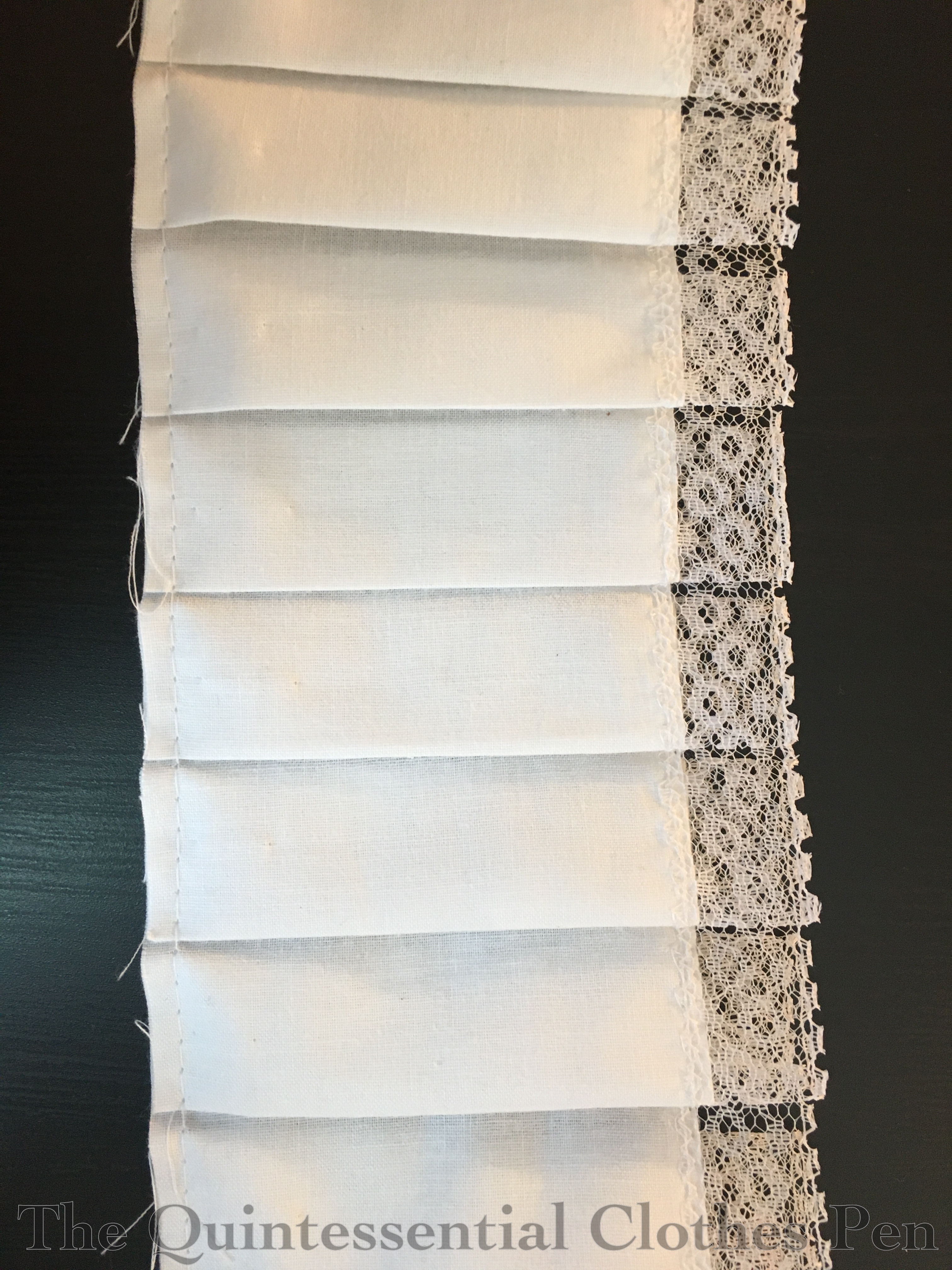
I decided on a medium width pleated ruffle for the bottom edge of this petticoat. I used a fork to help space the pleats, eyeballing and ironing as I went along.
The ruffle is edged with a stiff lace from my stash. I’ve had this for nine years and always wondered what to do with it, because it is so stiff. Turns out it was perfect for a petticoat, when a little stiffness is helpful! The lace comes in the stack of three that I used to top the ruffle. To get the single width I simply cut apart sections of the stack.
Here’s another view of the stack of three lace, the pleated ruffle, and the drawstring. Both this drawstring and the one in the waist are cotton twill tape.
This simple garment qualifies for the Historical Sew Monthly challenge #5: Basic. I imagine it will be used for any project I make, day or evening, from about 1875 through 1882.
Make a garment that can be used for many occasions (like a shift, or the classic ‘Regency white dress’), or a simple accessory that will help you stretch the use of an already existing garment.
Just the facts:
Fabric/Materials: 3.5 yards plain cotton.
Pattern: From Frances Grimble’s Fashions Of The Gilded Age Volume 1.
How historically accurate is it?: I’m going to give this one 95%. It’s good on shape, materials, and methods. I believe would be recognizable and plausible for its time.
Hours to complete: 8 ¼ hours.
First worn: In May, for photos with my 1875 ensemble!
Total cost: This was a stash project, so free, but the original cost of the materials were $10.50 for the fabric, $2 for the lace, and about $2 for the twill tapes, so $14.50 total.
While not the most exciting project, this was a great start on the way to making my 1875 ensemble. I’m pleased to have made a garment that is easily adjustable, useful for multiple types of events and silhouettes, and is functional but still pretty!
I don’t know about you, but I have most certainly been dreaming of historical and vintage summer adventures lately.
For this post, I don’t even need to dream! Instead, I can review my memories from the fun of Gatsby On The Isles last year. This is a lovely 1920s getaway on Star Island, off the coast of Portsmouth, New Hampshire.
The weekend’s events include the boat trips to and from the island, exploring, picnic-ing, games, an evening dance party, fabulous live music for the dance party and picnic, and more. If this post’s photos aren’t enough fun, check out these past posts about this event: 2018 and 2016.
Normally, being August, it’s super hot and rather sweaty. Last year, though, we had unusual weather. It was very windy and rather chilly. It wasn’t necessarily cold, it was just slightly warm and windy, which felt chilly when I was prepared (and dressed) for quite hot temperatures.
The wind made rather large swells and rolling rides both to and from the island. Thankfully I didn’t feel motion sick, just in awe of the waves around us, but unfortunately others didn’t fare as well. For me, the wind made it harder than usual to get good photos, both on the boat and on the island. And it made me feel much less interested in lounging about outside–I generally stayed indoors so I didn’t feel cold.
Look at my skirt blowing around in the wind… This was Saturday after our arrival. I think I was headed to the hotel to get my sweater because I was cold standing up on the rocks without it!
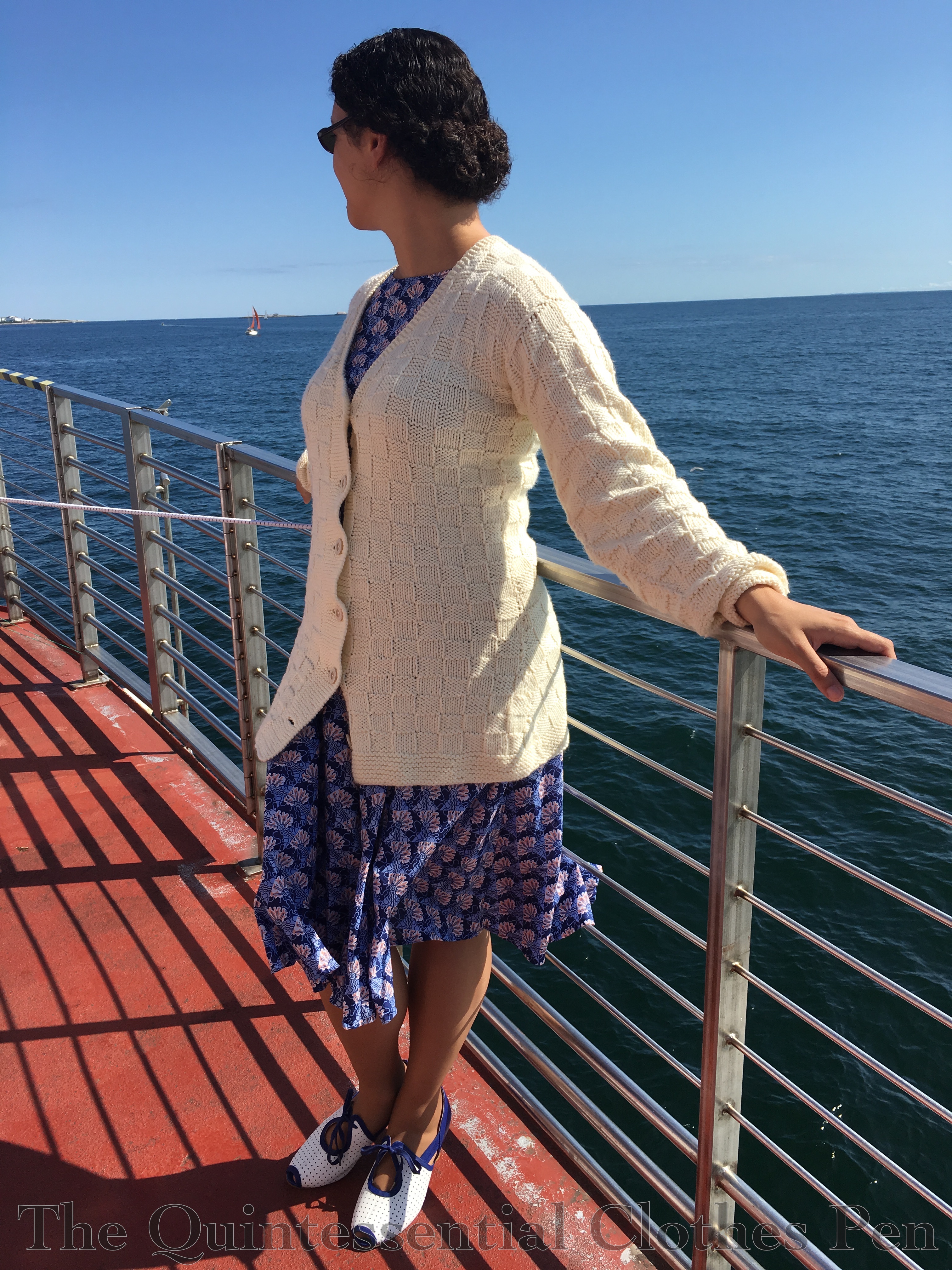
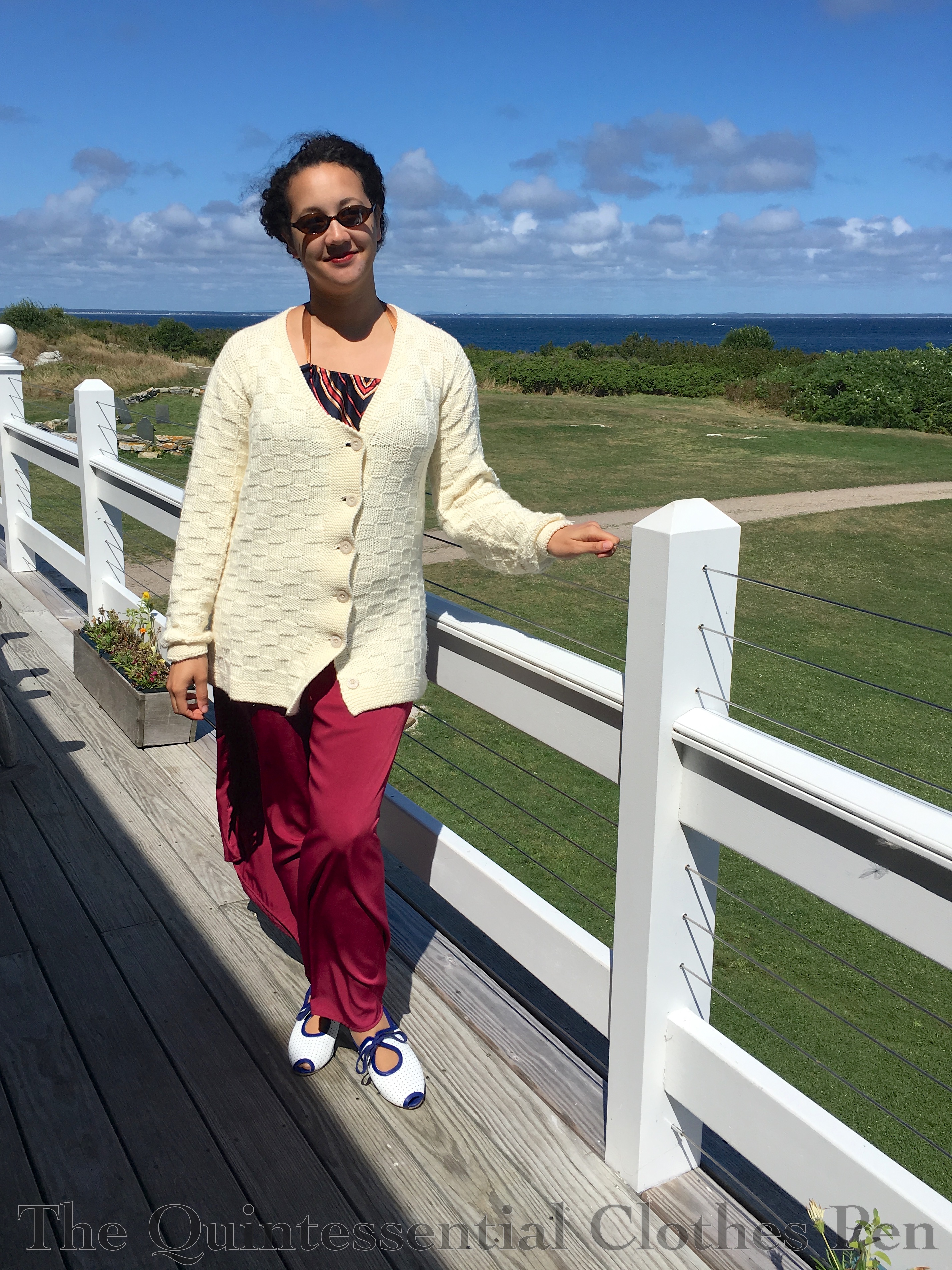
I did go out on the porch to document my Sunday afternoon outfit: my 1930s beach pajamas with my Gingers! The windy weather meant that I spent the entire day in my sweater, again (and that it was hard to get a photo of my pants that wasn’t absurd looking!).
We also went out for a walk on Saturday evening before dinner. It’s fun to explore all of the different paths around the island (as long as I put on LOTS of bug spray–the mosquitos LOVE to bite me… ugh!).
The views are lovely as well! No matter which direction you look there is a gorgeous view!
Sunday morning is traditionally pajama croquet. I didn’t participate this year, but that didn’t stop me wearing my 1935 dressing gown to lounge about in! The usual camera-toting-suspect had fun playing with her Petzval lens for the robe photo, as well as some others. They do a great job capturing the ambiance of the weekend. (Check out this post for a little bit of information about the Petzval lens and a link to a blog post with lots more information.)
I particularly enjoy the live and recorded music that our host provides for the weekend. Having a ‘soundtrack’ for an adventure only makes it that much more magical.
I also enjoyed these potted arrangements outside the hotel. The mixture of textures, colors, and shapes appeals to me, and I love how there are unusual colors mixed in, like the deep purple and very bright green.
What wonderful memories! Of sunshine, warmth, and fun with friends. It was very rainy and unseasonably cold in April, so these warm memories are especially appreciated!
I am super pleased with a recently completed addition to my historical closet, my brand new balayeuse! Practical, utilitarian, and still managing to be a little frivolous looking, this thing is amazing!
I’ll tell you all about it, but first… what is a balayeuse? Our go-to source for etymology, the Oxford English Dictionary (OED), has the following information.
balayeuse, n. Pronunciation: /balɛˈjəːz/ Frequency (in current use) Etymology: French, feminine of balayeur sweeper. Dressmaking. 1882 S. F. A. Caulfeild & B. C. Saward Dict. Needlework 18/2Balayèuse, or Sweeper.—A French term to signify the frilling of material or lace which lines the extreme edge of a dress skirt to keep the train clean as it sweeps along the floor. The balayèuse is allowed to project beyond the edge of the dress, so as to form a decorative as well as a useful trimming. 1894 Daily News 20 Jan. 5/7 Three flounces of..silk forming a richly-rustling balayeuse beneath the hem.
Please note: The Oxford English Dictionary is only available by subscription, therefore I have not included links to this definition as you will not be able to access it simply by clicking a link. Many libraries have subscriptions to the OED, so I suggest you start there for access.
Are you curious how to pronounce balayeuse? The OED provides us with the correct pronunciation, but the official pronunciation notes don’t mean too much to me. I think of the word as bal-ay-yuhz.
Ok, so now we know what this thing is and how to pronounce it. We even have an idea of the purpose, from the OED definition.
As you saw in the first photo, my balayeuse is it’s own garment. But there is another type of balayeuse mentioned in the first OED quote, from 1882. Also called a ‘dust ruffle’, this type of balayeuse is directly attached to the skirt. I’ve had great luck with this in the past and I really like the look of lace peeking out from under a late 19th century skirt, so I included that type of balayeuse on the pink skirt as well, but that alone was not enough to keep its shape.
I decided to make a second type of balayeuse–one that, in addition to the wonderful job of keeping the underside of the skirt’s train from becoming soiled, also helps the train to keep its shape and not collapse on itself. Caroline (of the blog Dressed In Time) mentions this function in a blog post showing her own balayeuse. Here is the train of my skirt laid out (sneak peak!).
I felt I had to make my skirt before the balayeuse, in order to make the balayeuse the right shape to hide under the skirt when it was finished, and so I’ve tried it on a few times without the balayeuse. The train is great looking when I twist and turn in my corset to get the skirt to lay just right, but it doesn’t stay that way when I move around.
But with the balayeuse it was so different! The skirt just magically lays exactly how it should as soon as I put it on and it stays that way no matter how I move–backing up, turning, it is amazing!
So how does this balayeuse really help keep the shape? Well, the main thing is that the base is a double layer of stiff cotton poplin (from Dharma Trading–I love them for my natural fiber, white, black, and unbleached fabric needs). This photo of the balayeuse with the ruffle side face down (as it would be worn) shows the poplin off nicely.
The poplin base is basically a big rectangle with the bottom edge curved up at the sides. I used the full width of the poplin, which was a little less than 60″ wide. The center is 17″ tall and the sides taper to about 9″. The base is gathered to a band that is 28″ wide and 2″ tall. I didn’t add extra stiffening to the band, as the poplin is pretty hardy all by itself. This blog post at Atelier Nostalgia has an image that was great inspiration for my shape (though my balayeuse is wider than this) and the button attachment method I’ll show you below.
The poplin base has three rows of ruffles attached to it. I decided to use unbleached muslin for the ruffles for a few reasons: #1 gathering three rows of stiff poplin didn’t sound like fun (and the base is plenty stiff enough as it is), #2 I figured that the muslin would be less obviously dirty looking, already being unbleached as opposed to very white, and #3 the muslin will be easy and cheap to replace someday, if needed.
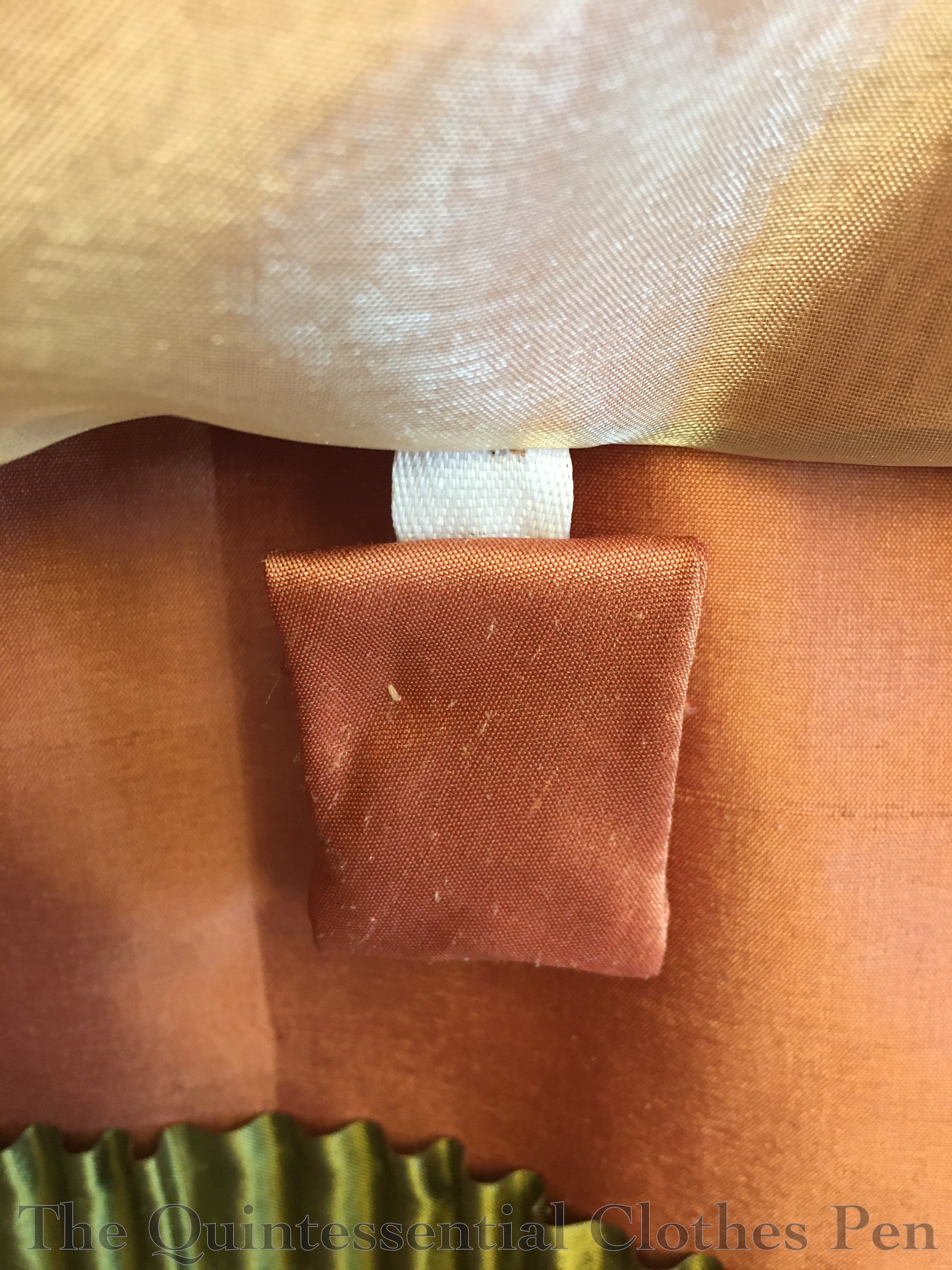
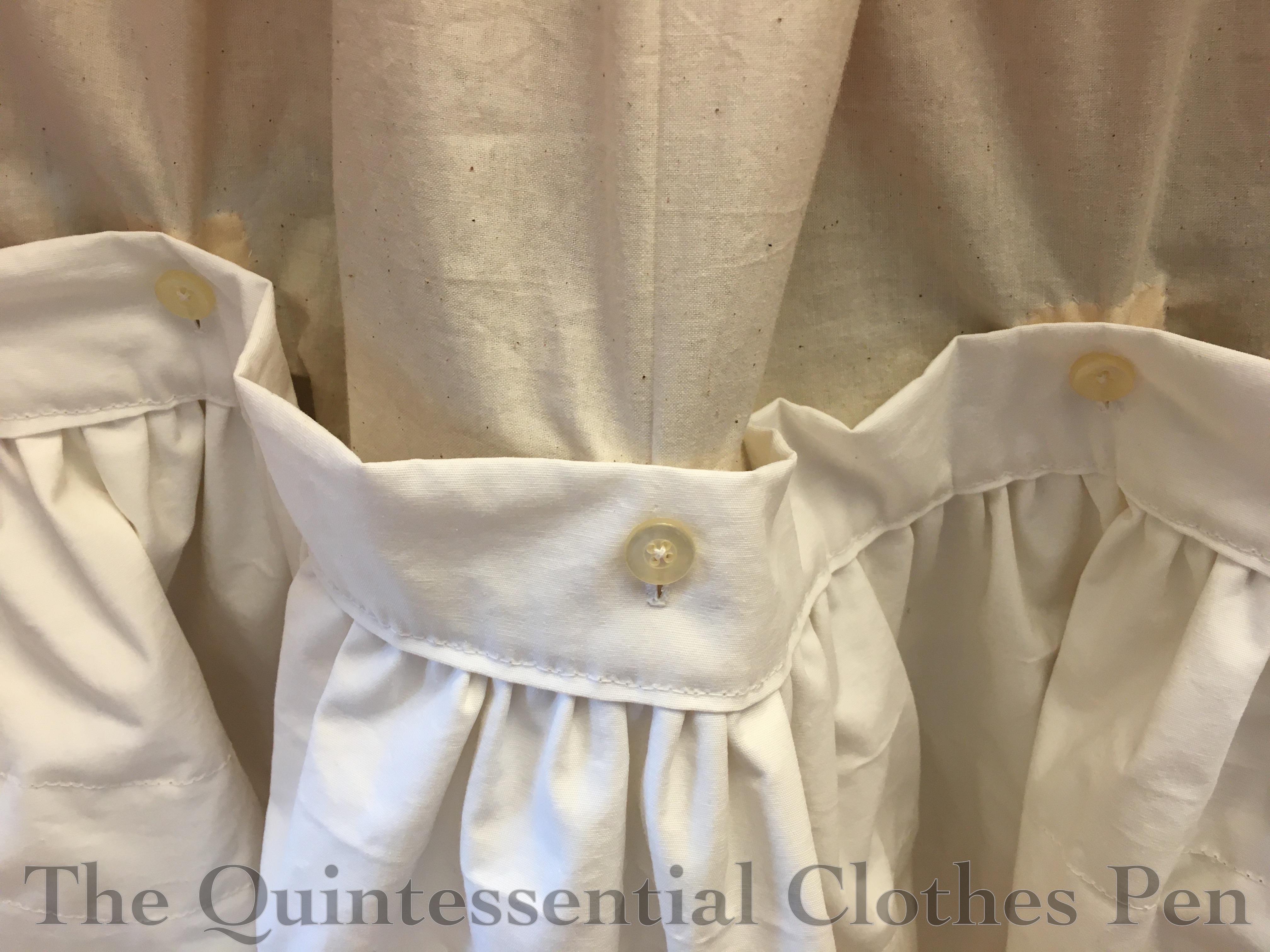
As you can see in the photo above, the band of the balayeuse has buttonholes in it. This allows the balayeuse to be easily removed for cleaning and storage, or use with a different dress (thinking ahead, here!). To accommodate the buttonholes, there are buttons sewn to the lining of the skirt.
The buttons are reinforced with extra squares of muslin whipped to the lining, as you can see in the photo below.
It seemed too much to ask the buttons to hang on to a single layer of muslin while dragging the balayeuse around. Here’s what those whipped on squares look like on the other side.
The end result is this. As you can see, the non-ruffled top of the balayeuse overlaps with the skirt lining and would not be dragging on the ground. The muslin ruffles actually continue the muslin underskirt nicely, I think, though no one is likely to ever see that!
It might not seem super stiff, but this ruffle-y contraption spreads out beautifully when it hits the floor. For comparison, here is a photo of my mockup balayeuse, made from an old sheet (and without ruffles). It’s spread out for the photo, but you can imagine how an old sheet would collapse on itself when picked up.
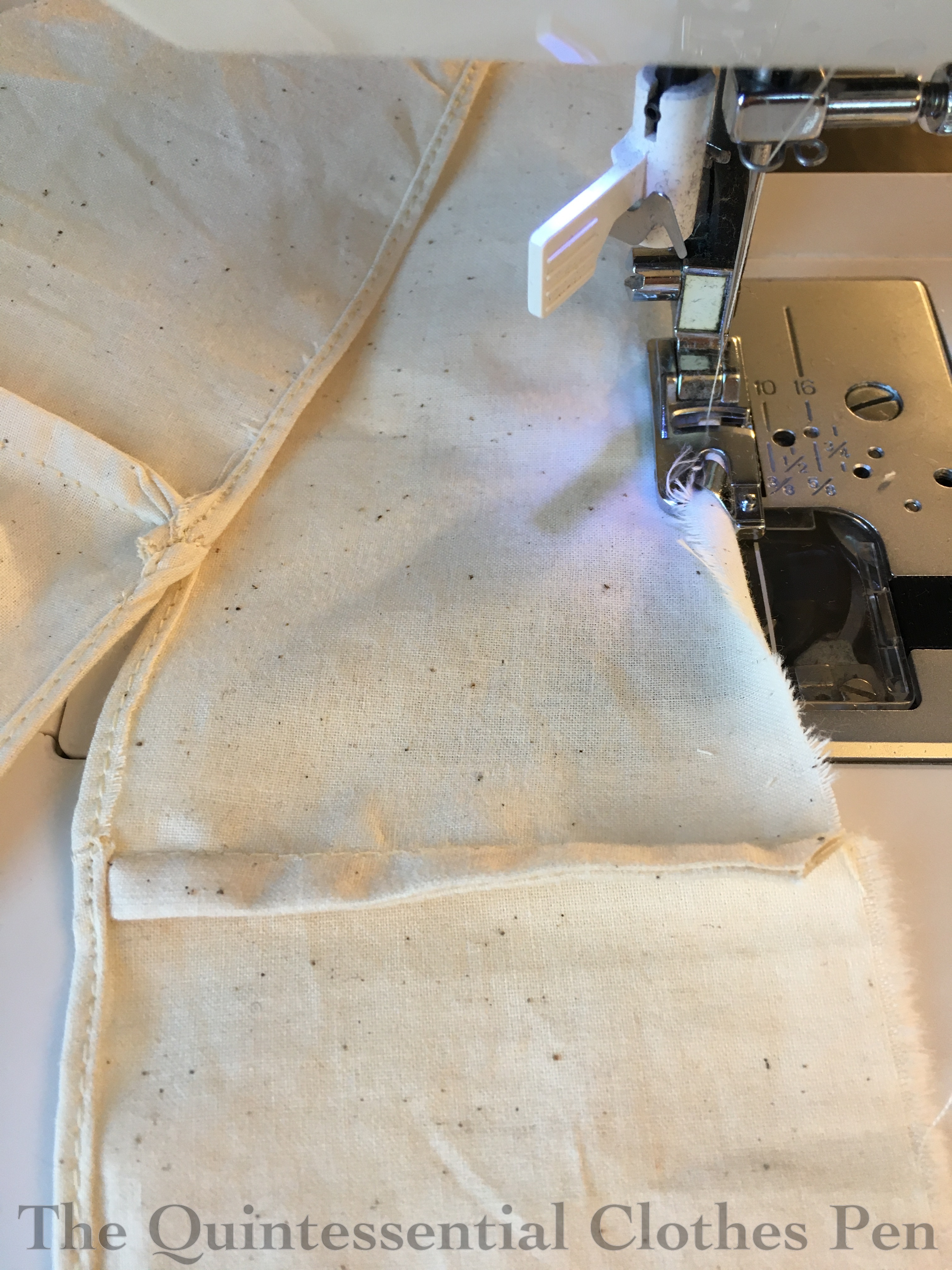
One last thought… the ruffles! I decided to try out a new tool for these ruffles: a narrow hem foot. This is one of those things I should have tried before but haven’t ever used for a project, but miles of ruffle edges seemed like the perfect opportunity to practice!
I can report that practice definitely helped! For example, I had some trouble going over my french seamed joins in the ruffles. In the photo below, my first try is on the left, my fifth try is in the middle, and my last try is just coming up on the right. The french seam was just too bulky to fit through the hook on the presser foot that turns under the hemmed edge. I discovered that if I eliminated some bulk with a diagonal cut of the seam allowance it worked so much better!
I didn’t bother to go back and fix my first few sad-looking french seam crossings. I figured this was going to drag around on the ground, and who would be looking? Also, it’s more fun to make beautifully colored dresses than muslin ruffles… There was a bit of ‘done is good’ on that front for this project.
Yay for learning things! I also found I needed to move my needle just a tad bit to the right of center to easily (and speedily) stitch the narrow hems.
The mention of the narrow hem foot reminds me that this project qualifies for the HSM challenge #8: Celebration.
Make something for a specific historical celebration, make something generally celebration worthy, make something that celebrates a historical hero, or just make something that celebrates some new skills you’ve learned.
Just the facts:
Fabric/Materials: 1 yard cotton poplin and 1 yard cotton muslin.
Pattern: My own.
Year: c. 1875.
Notions: 5 light yellow plastic buttons and thread.
How historically accurate is it?: I haven’t seen an extant stand-alone balayeuse before, so I can’t be sure, but I would say 90%. Materials and style completely recognizable and plausible for their time.
Hours to complete: 5 ¼ hours.
First worn: In May, for fittings. I need to complete my ensemble (only the hat is left!) so I can wear it with the dress it was made for to get photos.
Total cost: $6.25 for the poplin and $4 for the muslin. The buttons were gifted to me. And the thread was negligible. There was a bit of shipping to get the poplin, so let’s say $15 total.
Further information I found helpful as I made my balayeuse included this blog post at Yesterday’s Thimble. It’s also worth mentioning that if this idea sounds great, but patterning your own balayeuse is too much, Truly Victorian has a pattern for a petticoat with detachable train that you can check out.











































 The Quintessential Clothes Pen