The Amazing Balayeuse (HSM #8)

I am super pleased with a recently completed addition to my historical closet, my brand new balayeuse! Practical, utilitarian, and still managing to be a little frivolous looking, this thing is amazing!

I’ll tell you all about it, but first… what is a balayeuse? Our go-to source for etymology, the Oxford English Dictionary (OED), has the following information.

balayeuse, n.
Pronunciation:  /balɛˈjəːz/
Frequency (in current use)
Etymology: French, feminine of balayeur sweeper.
Dressmaking.
1882   S. F. A. Caulfeild & B. C. Saward Dict. Needlework 18/2   Balayèuse, or Sweeper.—A French term to signify the frilling of material or lace which lines the extreme edge of a dress skirt to keep the train clean as it sweeps along the floor. The balayèuse is allowed to project beyond the edge of the dress, so as to form a decorative as well as a useful trimming.
1894   Daily News 20 Jan. 5/7   Three flounces of..silk forming a richly-rustling balayeuse beneath the hem.

Please note: The Oxford English Dictionary is only available by subscription, therefore I have not included links to this definition as you will not be able to access it simply by clicking a link. Many libraries have subscriptions to the OED, so I suggest you start there for access.

Are you curious how to pronounce balayeuse? The OED provides us with the correct pronunciation, but the official pronunciation notes don’t mean too much to me. I think of the word as bal-ay-yuhz.

Ok, so now we know what this thing is and how to pronounce it. We even have an idea of the purpose, from the OED definition.

As you saw in the first photo, my balayeuse is it’s own garment. But there is another type of balayeuse mentioned in the first OED quote, from 1882. Also called a ‘dust ruffle’, this type of balayeuse is directly attached to the skirt. I’ve had great luck with this in the past and I really like the look of lace peeking out from under a late 19th century skirt, so I included that type of balayeuse on the pink skirt as well, but that alone was not enough to keep its shape.

I decided to make a second type of balayeuse–one that, in addition to the wonderful job of keeping the underside of the skirt’s train from becoming soiled, also helps the train to keep its shape and not collapse on itself. Caroline (of the blog Dressed In Time) mentions this function in a blog post showing her own balayeuse. Here is the train of my skirt laid out (sneak peak!).

I felt I had to make my skirt before the balayeuse, in order to make the balayeuse the right shape to hide under the skirt when it was finished, and so I’ve tried it on a few times without the balayeuse. The train is great looking when I twist and turn in my corset to get the skirt to lay just right, but it doesn’t stay that way when I move around.

But with the balayeuse it was so different! The skirt just magically lays exactly how it should as soon as I put it on and it stays that way no matter how I move–backing up, turning, it is amazing!

So how does this balayeuse really help keep the shape? Well, the main thing is that the base is a double layer of stiff cotton poplin (from Dharma Trading–I love them for my natural fiber, white, black, and unbleached fabric needs). This photo of the balayeuse with the ruffle side face down (as it would be worn) shows the poplin off nicely.

The poplin base is basically a big rectangle with the bottom edge curved up at the sides. I used the full width of the poplin, which was a little less than 60″ wide. The center is 17″ tall and the sides taper to about 9″. The base is gathered to a band that is 28″ wide and 2″ tall. I didn’t add extra stiffening to the band, as the poplin is pretty hardy all by itself. This blog post at Atelier Nostalgia has an image that was great inspiration for my shape (though my balayeuse is wider than this) and the button attachment method I’ll show you below.

The poplin base has three rows of ruffles attached to it. I decided to use unbleached muslin for the ruffles for a few reasons: #1 gathering three rows of stiff poplin didn’t sound like fun (and the base is plenty stiff enough as it is), #2 I figured that the muslin would be less obviously dirty looking, already being unbleached as opposed to very white, and #3 the muslin will be easy and cheap to replace someday, if needed.

As you can see in the photo above, the band of the balayeuse has buttonholes in it. This allows the balayeuse to be easily removed for cleaning and storage, or use with a different dress (thinking ahead, here!). To accommodate the buttonholes, there are buttons sewn to the lining of the skirt.
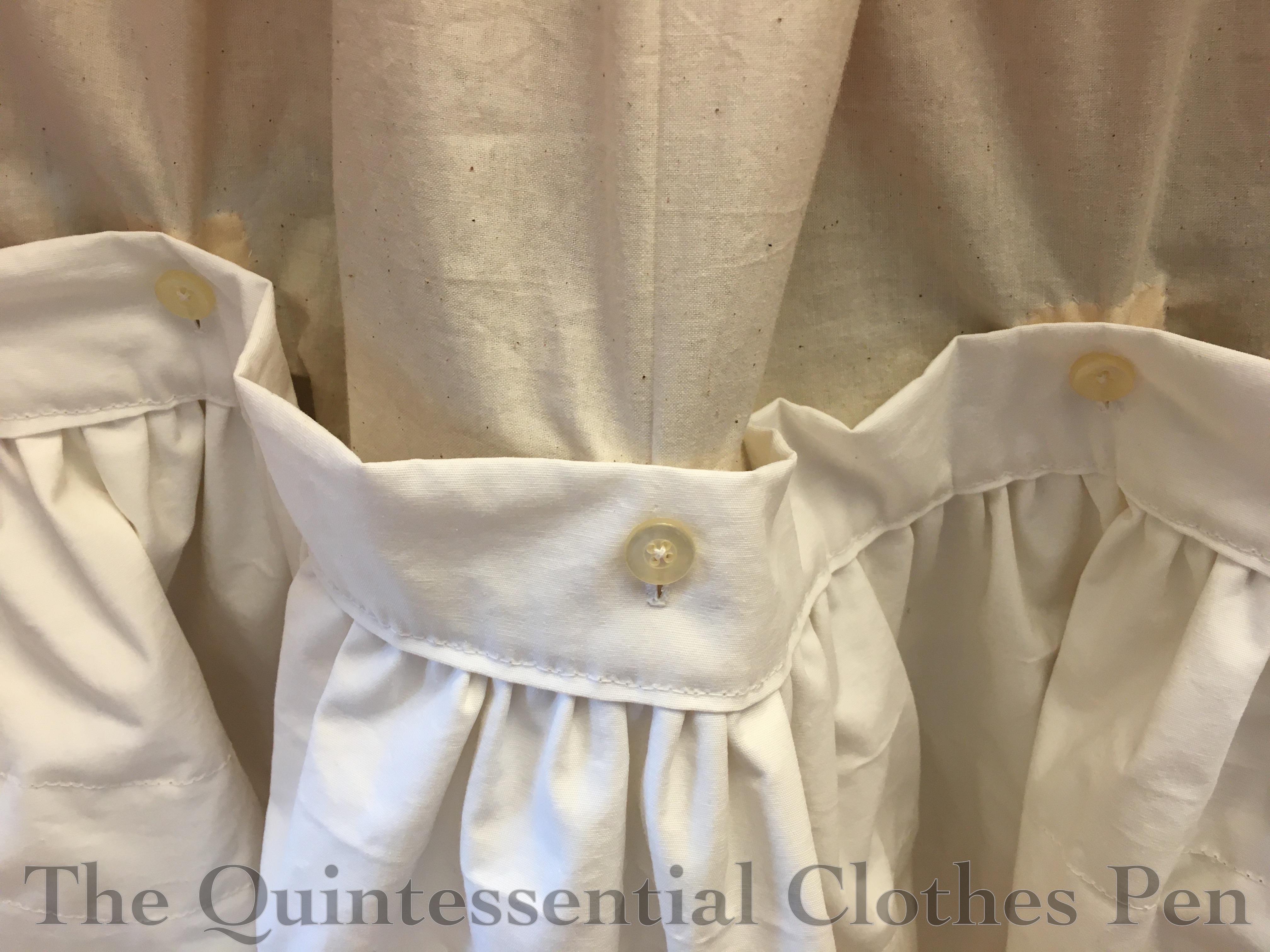
The buttons are reinforced with extra squares of muslin whipped to the lining, as you can see in the photo below.

It seemed too much to ask the buttons to hang on to a single layer of muslin while dragging the balayeuse around. Here’s what those whipped on squares look like on the other side.

The end result is this. As you can see, the non-ruffled top of the balayeuse overlaps with the skirt lining and would not be dragging on the ground. The muslin ruffles actually continue the muslin underskirt nicely, I think, though no one is likely to ever see that!

It might not seem super stiff, but this ruffle-y contraption spreads out beautifully when it hits the floor. For comparison, here is a photo of my mockup balayeuse, made from an old sheet (and without ruffles). It’s spread out for the photo, but you can imagine how an old sheet would collapse on itself when picked up.

One last thought… the ruffles! I decided to try out a new tool for these ruffles: a narrow hem foot. This is one of those things I should have tried before but haven’t ever used for a project, but miles of ruffle edges seemed like the perfect opportunity to practice!

I can report that practice definitely helped! For example, I had some trouble going over my french seamed joins in the ruffles. In the photo below, my first try is on the left, my fifth try is in the middle, and my last try is just coming up on the right. The french seam was just too bulky to fit through the hook on the presser foot that turns under the hemmed edge. I discovered that if I eliminated some bulk with a diagonal cut of the seam allowance it worked so much better!

I didn’t bother to go back and fix my first few sad-looking french seam crossings. I figured this was going to drag around on the ground, and who would be looking? Also, it’s more fun to make beautifully colored dresses than muslin ruffles… There was a bit of ‘done is good’ on that front for this project.
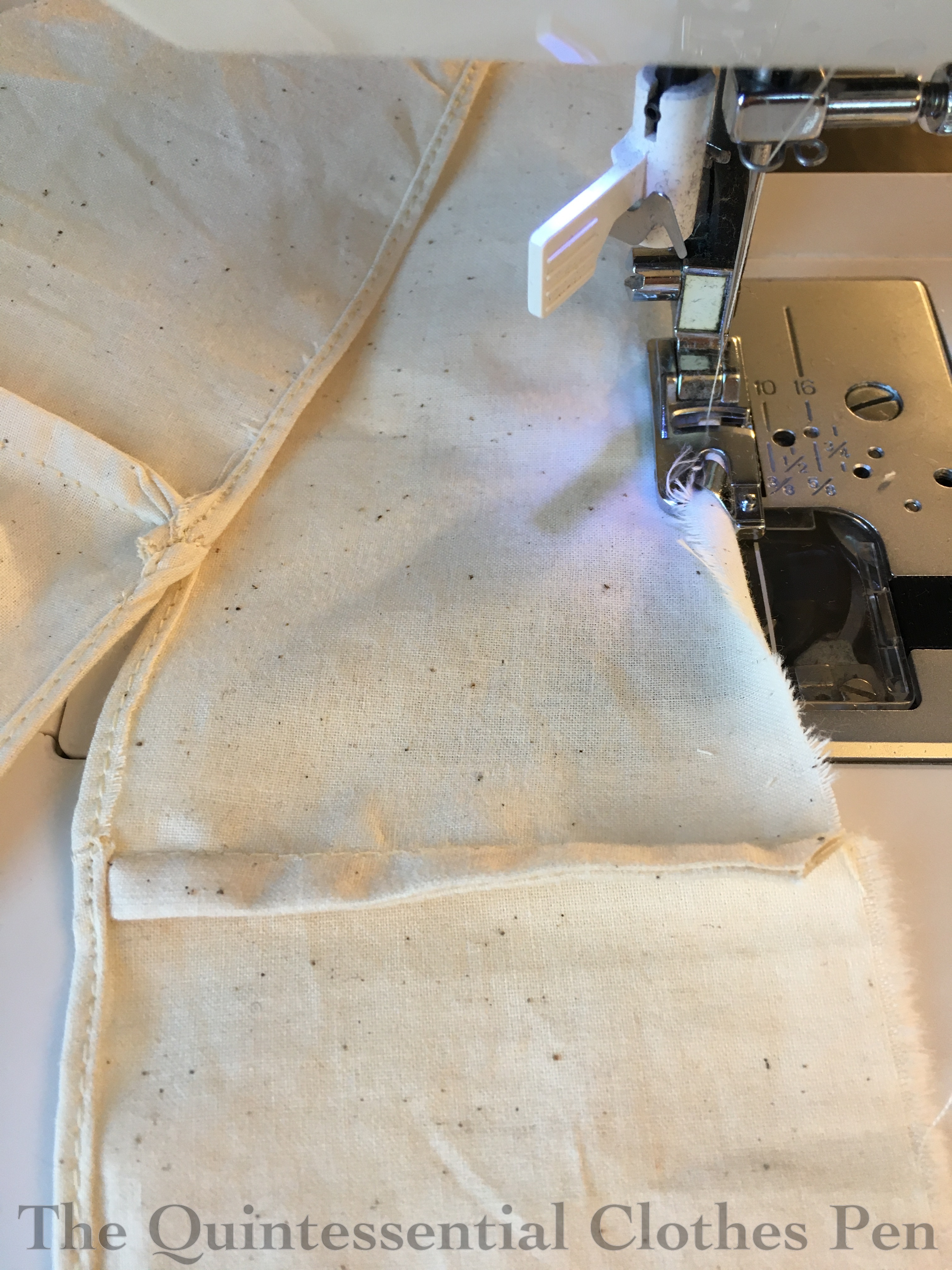
Yay for learning things! I also found I needed to move my needle just a tad bit to the right of center to easily (and speedily) stitch the narrow hems.

The mention of the narrow hem foot reminds me that this project qualifies for the HSM challenge #8: Celebration.

Make something for a specific historical celebration, make something generally celebration worthy, make something that celebrates a historical hero, or just make something that celebrates some new skills you’ve learned.

Just the facts:

Fabric/Materials:  1 yard cotton poplin and 1 yard cotton muslin.

Pattern: My own.

Year: c. 1875.

Notions: 5 light yellow plastic buttons and thread.

How historically accurate is it?: I haven’t seen an extant stand-alone balayeuse before, so I can’t be sure, but I would say 90%. Materials and style completely recognizable and plausible for their time.

Hours to complete:  5 ¼ hours.

First worn: In May, for fittings. I need to complete my ensemble (only the hat is left!) so I can wear it with the dress it was made for to get photos.

Total cost: $6.25 for the poplin and $4 for the muslin. The buttons were gifted to me. And the thread was negligible. There was a bit of shipping to get the poplin, so let’s say $15 total.

Further information I found helpful as I made my balayeuse included this blog post at Yesterday’s Thimble. It’s also worth mentioning that if this idea sounds great, but patterning your own balayeuse is too much, Truly Victorian has a pattern for a petticoat with detachable train that you can check out.

Fezziwig’s Ball 2019

I’m a bit slow to post about it, but last December I again attended The Commonwealth Vintage Dancers’ annual holiday event: Fezziwig’s Ball. (You can check out posts about past years here.)

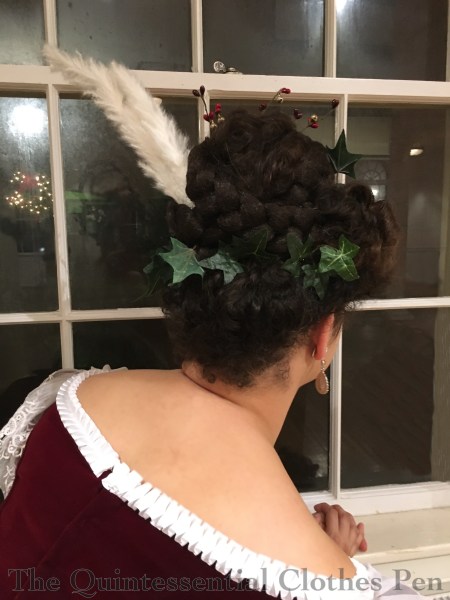
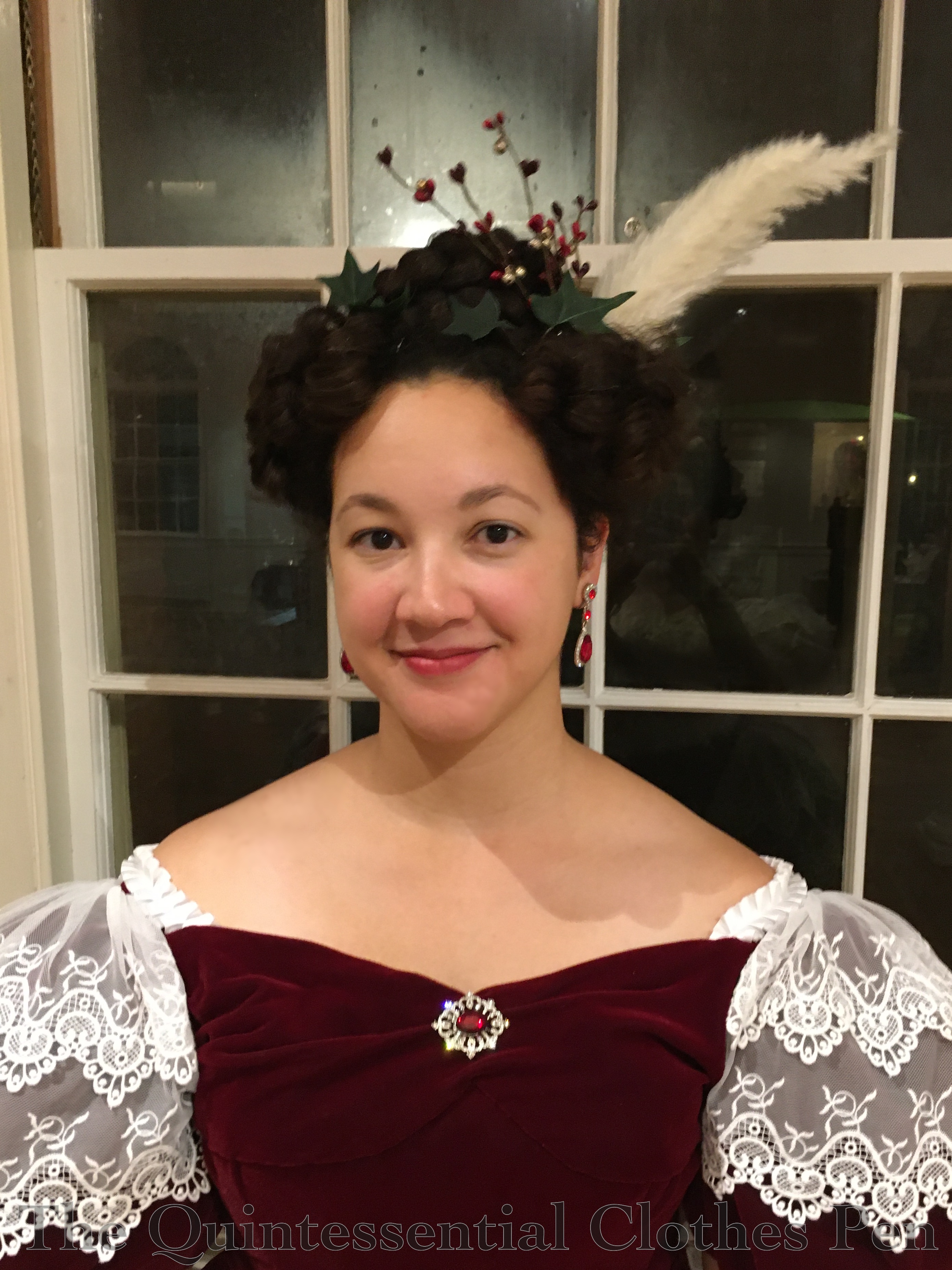
This year, I decided to wear my 1832 Burgundy Velvet Gown again, but I changed up my hairstyle slightly by adding a new element, since I was wearing a dress I’ve worn before. In addition to some new decorations, I also added a faux hair braid to make a giant swirly bun on the back part of my head. I wrote a blog post in January focusing on the hairstyle and my new faux hair braid that you can read here.

1830s hair is absurd and very fun. I enjoy the challenge of trying to style my own hair into these crazy styles. This year I had the faux braid and a few mesh supports under the front curls, but all the rest of the hair is my own. Those front curls are different each year… this year they have a sort of marching-in-a-line look that is interesting and different than in the past, but still documentable. Check out these curls from 1826 and these from 1829.

It’s fun to wear 1830s, as it’s a decade I don’t get to wear the clothes for as often as some others. The giant sleeves take a bit of getting used to but are entertaining in the end.

Looking festive with the addition of my Refreshing Apron, cranberry punch, hot apple cider, some real and faux fruit lurking near the punch bowls, and another 1830s-clad friend wearing a Refreshing-Apron-sibling.

1830s is more in fun (and maybe less ridiculous looking?) in groups. Here is a contingent of even more 1830s ladies from this holiday ball! It’s as though we sprouted from the column!


A 1925 Oldie But Goodie

Do you ever have an older, well-liked garment that you’ve stopped wearing for some reason or other, but then decided to wear again and were very pleased that: 1) it still fit (though perhaps differently) and 2) brought you more joy to wear than you remembered? It’s a great feeling for both self-made and store bought items!

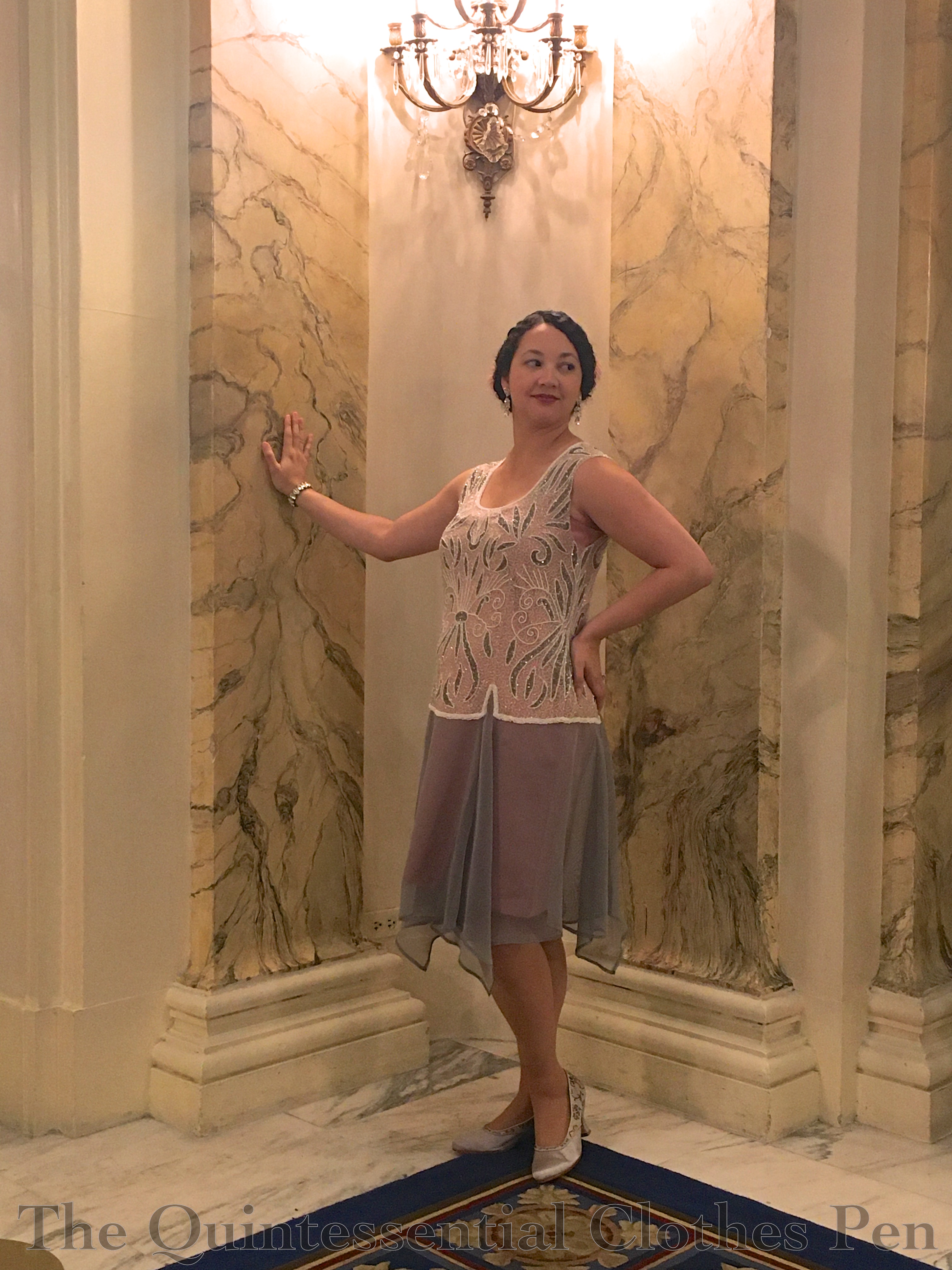
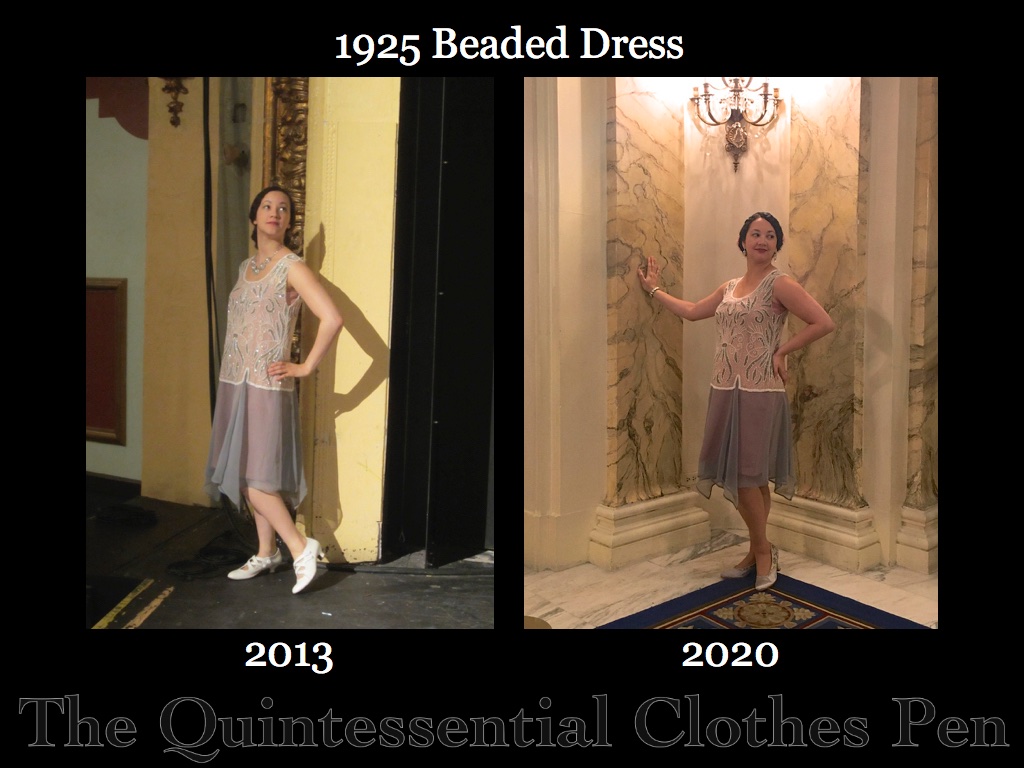
I had that experience back in January with my 1925 beaded evening gown. With a ‘made’ date in 2013, it’s one of the older 1920s dresses in my closet. It’s not that I didn’t continue to like the dress, it’s just that I’ve been choosing to wear newer dresses to 1920s evening events for the last few years.

My decision to wear it this year was encouraged by the fact that I wanted new photos. My current photos are mostly from this wearing in 2013 and while they’ve done the job for the last 7 years I feel that I’ve upped my photo game in that time.

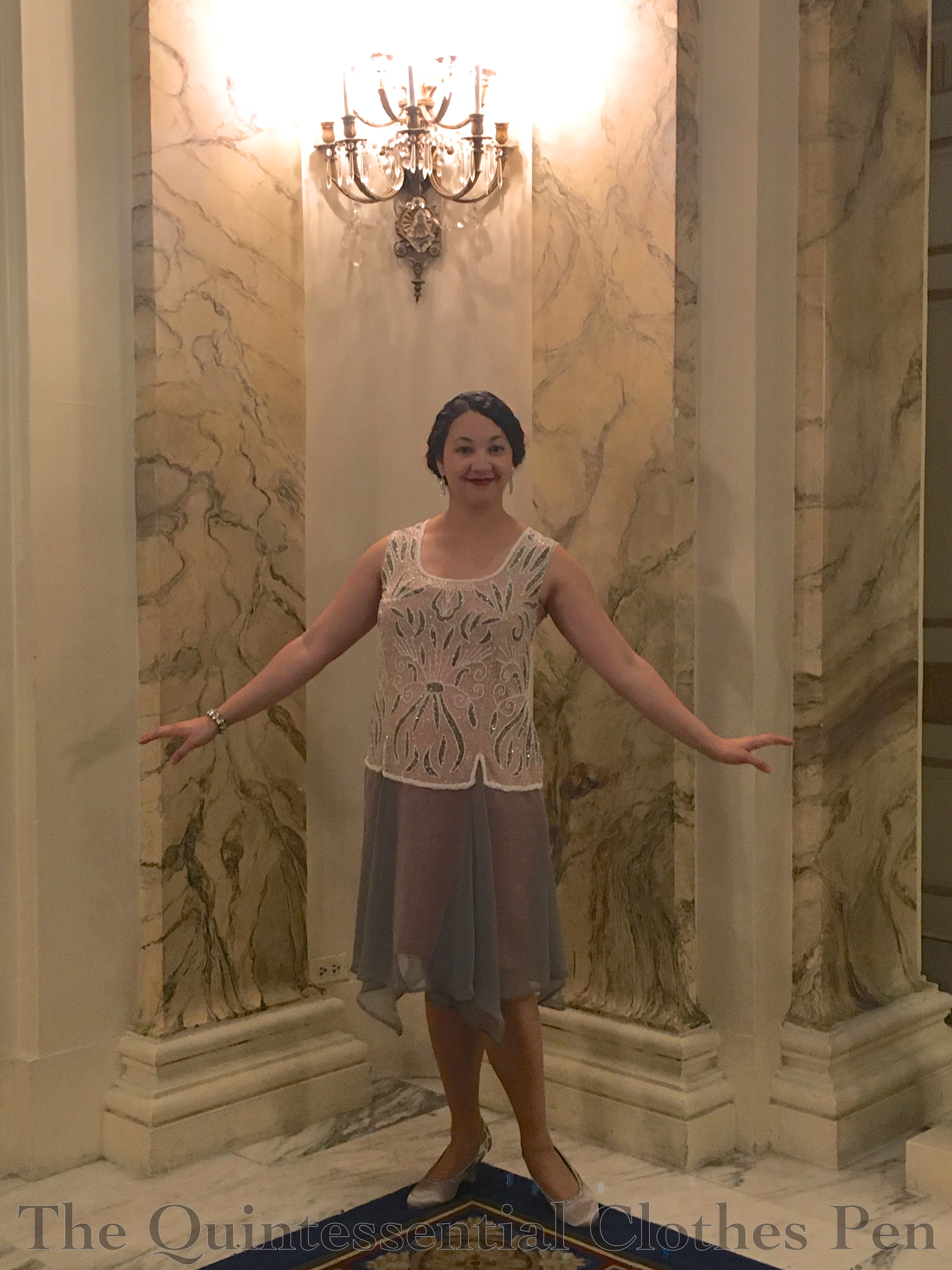
To start, it was fun to style the dress with different accessories than in the past. The new photos have my silver American Duchess Seaburies (a better match for the colors and evening style of my dress than my American Duchess Astorias in 2013), a thrifted, jeweled bracelet, and sparkly, dramatic clip earrings gifted to me by a friend.

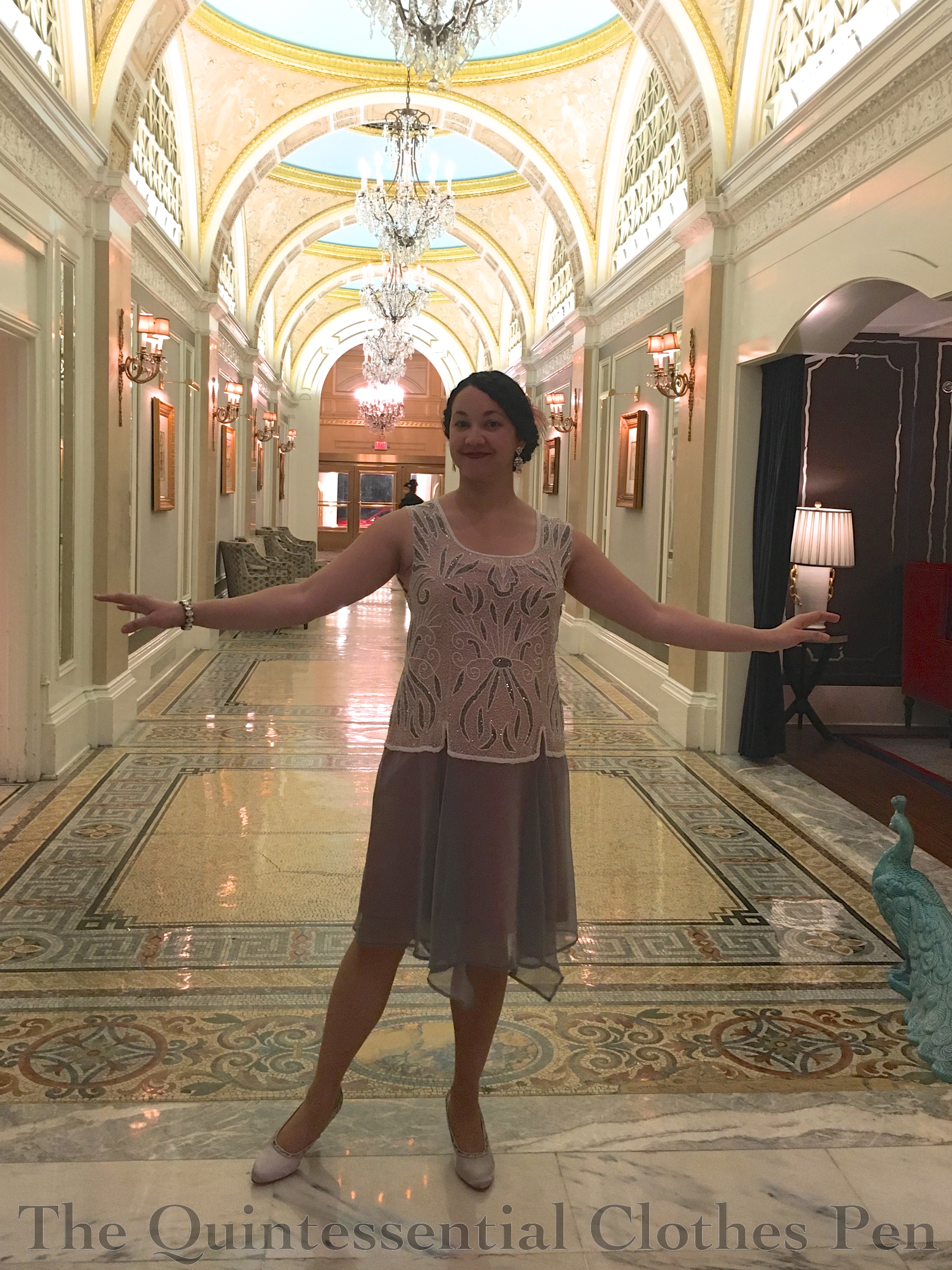
In addition to updated accessories and more confidence with my photo poses (that’s just from practice!), it was wonderful to have the fabulous lobby of the Fairmont Copley Plaza Hotel as my background for these new photos.

The holiday decorations were still up and they are lovely, but even without them I think we can all agree this is a pretty snazzy lobby. I believe it is still true to its original design from the opening of the hotel in 1912, with 21′ high gilded coffered ceilings, Empire style crystal chandeliers, and Italian marble columns (according to Wikipedia).

In addition to the traditional tree decorations, the lobby also had this unusual and gorgeous flower display with a nod towards traditional holiday colors in a more contemporary way.

Look at the green lilies!

It was a pretty fabulous background for updated photos of this dress. I’m so glad it still fits and continues to bring joy!


1817 Duchess Gown In Three Stylings

A few years ago, I made my 1817 Duchess Gown. I started out wearing it rather plainly (if wearing a tiara count as a plain ensemble…), but since then I’ve worn it multiple times and accessorized it different ways. I thought it would be fun to pull some of these wearings together in one place, to look at how accessories can change the look and feel of a dress.

First, a side by side comparison. Do you have a favorite amongst these?

The first year I made the dress I was furiously sewing the hem trim on the night before the ball, so I didn’t have too much time to think about accessories. I wanted the dress to be regal looking and so I decided on the tiara to wear with it, as well as a pearl necklace and earrings.


Fast forward to February 2019, when I’d worn the dress a few times and wanted to change it up with more color than just white and gold. For this wearing, I added a green sash as well as new sparkly jewelry from In The Long Run Designs.

I loved the green sash look, but wearing the dress just a few months later in April 2019 I wanted something different. I decided to pull out some older accessories, purple shoe clips and purple hair flowers, and pair them with a white sash.

You really can’t see the white sash much, but the purple accessories give the dress a different feel than the previous wearings, I think. (This might be a stronger statement with a purple sash. Hm… But I don’t have wide purple organza ribbon, as I did with the green and white. Maybe that’s something to keep my eyes open for!)

The neat thing is that this dress is also captured on video! At the Regency ball last February, The Commonwealth Vintage Dancers (CVD) did a performance of the type of advanced dancing taught at CVD’s Regency Weekend every April. Check out this blog post by another CVD member showing the Duchess Gown in action as well as great information about the dance we are performing, Paine’s First Set.

Are you ever able to wear the same outfit (modern, vintage, or historical) styled in different ways and with different accessories? I choose to do this with some of my modern clothes in addition to my historical ones and I can think of a few of you who are definitely subscribers to this idea, too!

My Interview With Maureen Taylor, The Photo Detective

As you probably know if you read my blog on a regular basis, I love making and wearing historical clothing. It’s rather common for me to pull historical clothing out of my closet and wear it to lovely places.

Below, I’m wearing my 1885 summer ensemble at the Lippitt House in Providence, RI. Look at that wallpaper! It’s fantastic! If you’re ever in Providence and the house is open I highly suggest a visit. The details are absolutely stunning and I found the guides to be engaging, knowledgeable, and truly invested in the information they were sharing.

While at the Lippitt House, I met a woman who was incredibly interested in my clothing, how it feels to wear, how I make it, and where my inspiration comes from. She eagerly asked lots of questions and shared about her own fascination with history as well.

I learned that Maureen Taylor is a genealogist and historian who now focuses on photo identification, photograph preservation, and family history through her work as the Photo Detective. In addition to being an engaging person who loves history, she has extensive experience and has had opportunities to share her knowledge in prominent publications. When she asked if I would like to be a guest on her podcast I very readily agreed.

A number of months later and here we are: my interview with Maureen is available for a listen on her podcast! We discuss the 1885 ensemble I was wearing when we met, the 1863 dress I made last fall, and other historical clothing topics as well. Check it out and enjoy!

You can find Maureen Taylor around the internet in these places:

Web Maureen Taylor
Facebook @MaureenPhotoDetective
Instagram @photodetective
Twitter @PhotoDetective

c. 1855 Wool Cape

Finally, I actually have photos of a garment I made back in 2011!

The story starts with my desire to be warm for caroling at the Christmas ball, so I went looking through my books and came across the image below in ‘Victorian Fashions: A Pictorial Archive’ by Carol Belanger Grafton. It looked warm and I liked the fringe, so off I went on my sewing adventure!

Since then, I’ve managed to wear my cape a number of times, often for Christmas caroling. Even though its date is c. 1855, I’ve found that the loose shape is perfect for wearing over the large sleeves of my 1830s dress as well. Here’s proof, from 2017:


That’s really the only photo I have that looks nice and shows the cape. Other photos that show the cape are washed out or blurry.

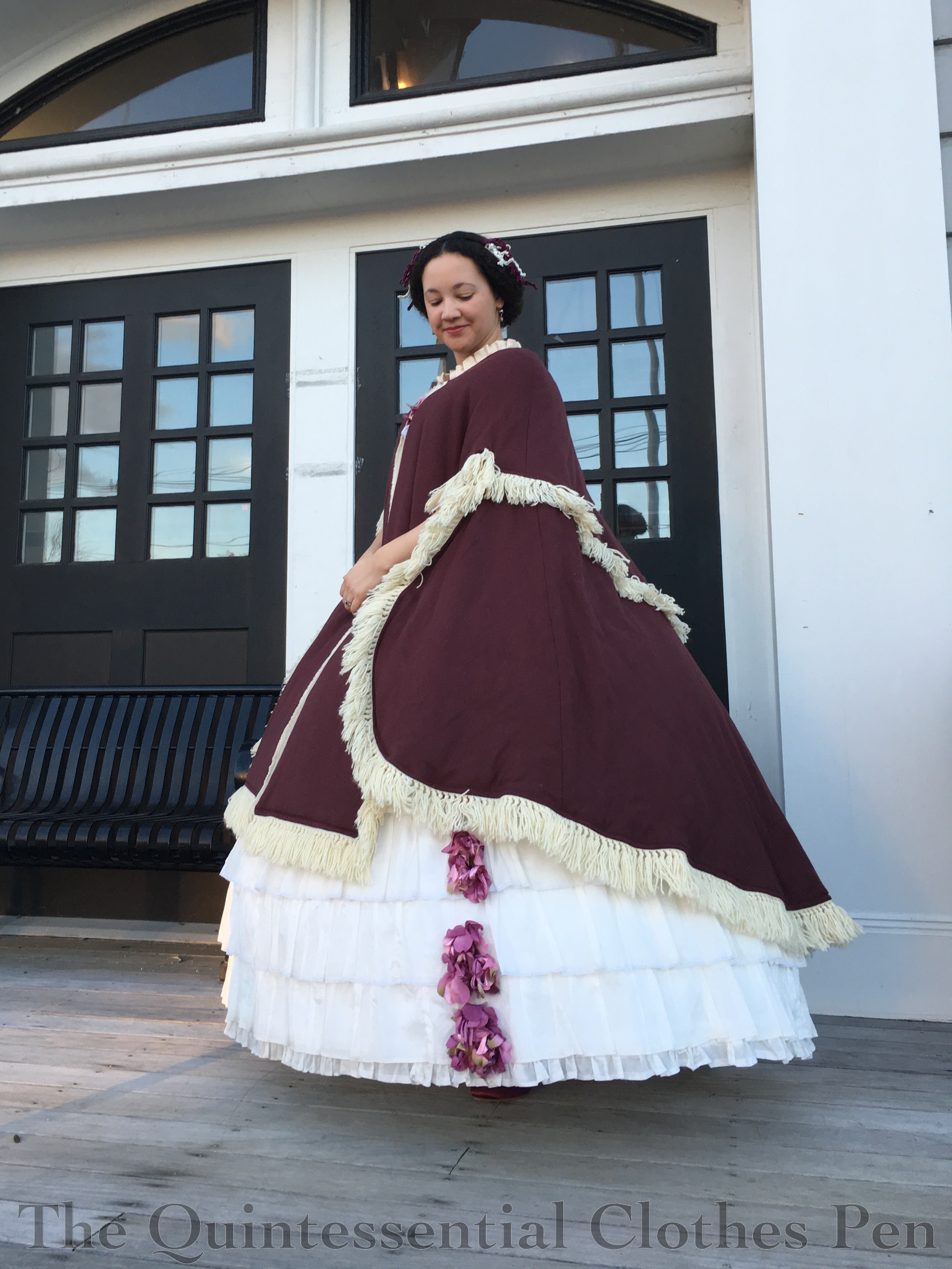
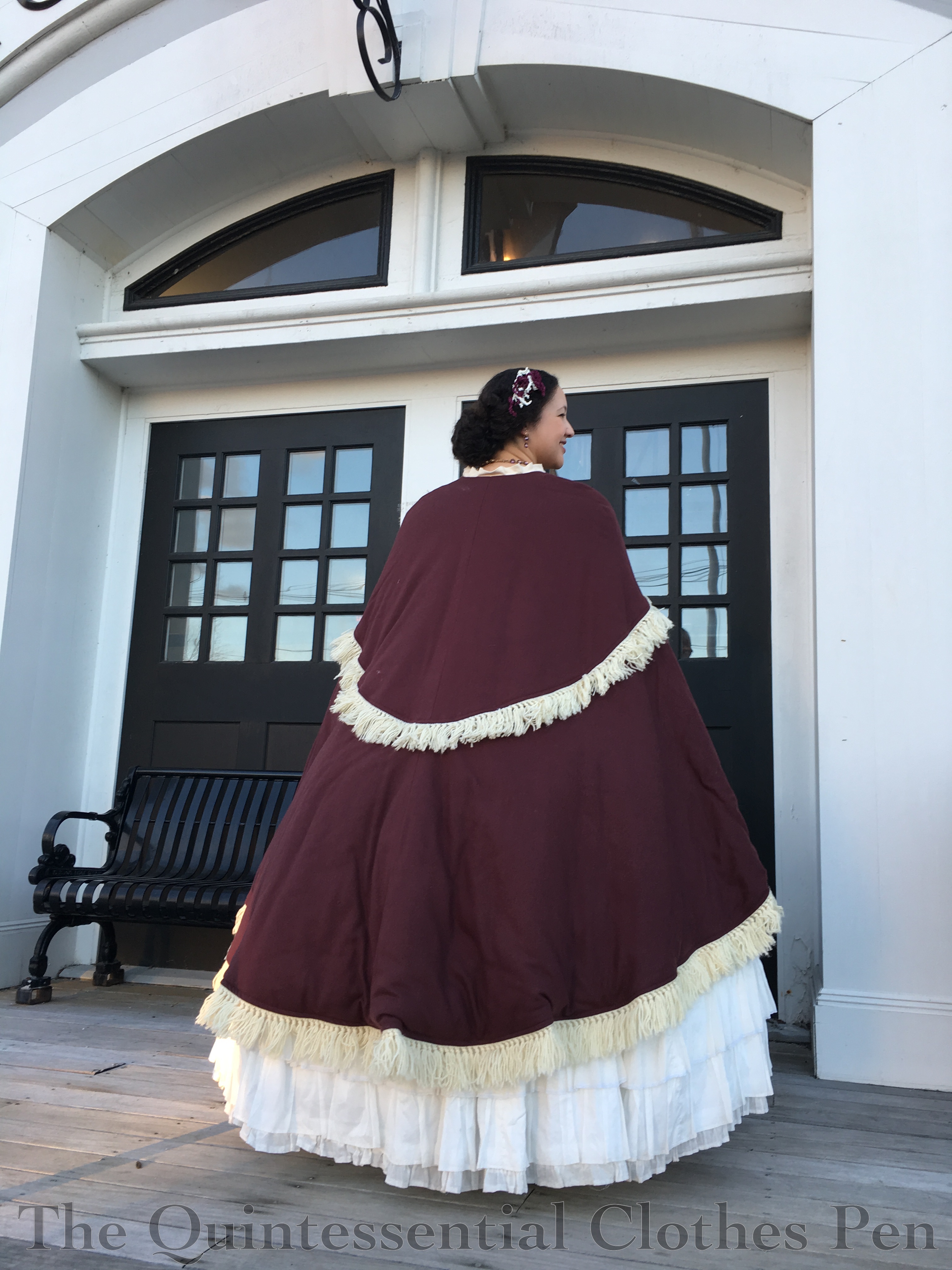
Last year I decided it was time to get pictures. I settled on a day I’d already be wearing 1850s (Annabelle is my dress and I’m also wearing a matching chenille headdress). It was important that there would be daylight (that’s the other problem with some of the photos I have, they’re taken during dark winter evenings–that’s usually when I’ve been caroling). Then I brought the cape (despite not actually needing to be outside for the event) and coerced the usual camera toting suspect into taking photos.

I made the pattern by looking at the inspiration image and drawing the shapes I thought would make it up, although I did take a bit of liberty in terms of closure and arm openings. I also referenced shapes and proportions in ‘The Cut of Women’s Clothes’ by Norah Waugh and ‘Patterns of Fashion 2’ by Janet Arnold.

I wanted simplicity for the closure, so my cape has a single heavyweight hook and loop at the neck. For the arm openings, the fronts are simply separate from the curve that wraps around to the back of the cape.

For warmth, I decided on a wool exterior (also good for shedding moisture). To add even more warmth, I also added a layer of high loft polyester batting to the entire cape. That may not be the most accurate choice (at least in terms of fiber content), but it is quite practical. I thought of quilting the lining to the batting but decided it would be too time consuming. I’m sure the batting extends to the edges and is stitched down, but honestly I don’t remember exactly how that was accomplished.

I loved the fringe in the image and wanted fringe on my cape, too. But not just any fringe. Wool fringe. That was a hunt! I eventually found it at an upholstery company called The Fringe Factory.

To keep the lining soft against my skin,  I decided to line the entire cape with natural cotton flannel  to match the fringe as well as including a stand up ruffle of the flannel at the neck.

As you can see, the cape is quite long. That’s quite a bit of wool, batting, and flannel! I achieved my goal of warmth, but this cape weighs quite a bit!

Looking back at my notes, this cape was more expensive than I remembered (though that’s not actually surprising, given the yardage I needed and my desire for 100% wool). I didn’t record the yardages, but I did record the costs. I spent $58.67 on the flannel at JoAnn, $81.00 on the wool at Dorr Mill (I love their wools! They are gorgeous!), and $96.36 on the fringe at The Fringe Factory. The total is $236.03. That’s way more than I often spend on a single historical garment! I had better keep wearing this to get the cost-per-wear down!

Despite the cost, I’ve been very pleased with my cape over the last 9 years and I’m extra pleased to finally have well lit, full length photos so this garment can make an official appearance on the blog!

Summary of 2019: Looking Forward To 2020

2020 seemed unattainably far away for a long time, but here we are. As with many others in blog-land, I’m ready to look back on 2019’s achievements and set some goals for the coming year. So, without further ado…

Projects I completed in 2019

January: Sunshine Yellow 1933
&
February: 1930s Hat

February: 1890s Shortcut Dickie

February: 1896 Cycling Ensemble

April: Ikat Print Henrietta Maria

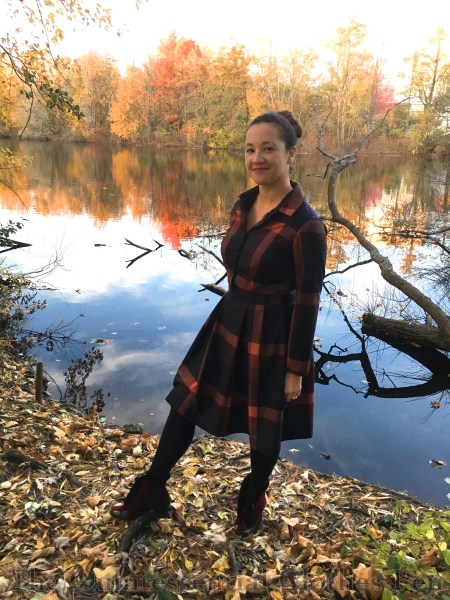
May: Autumn Plaid Dress

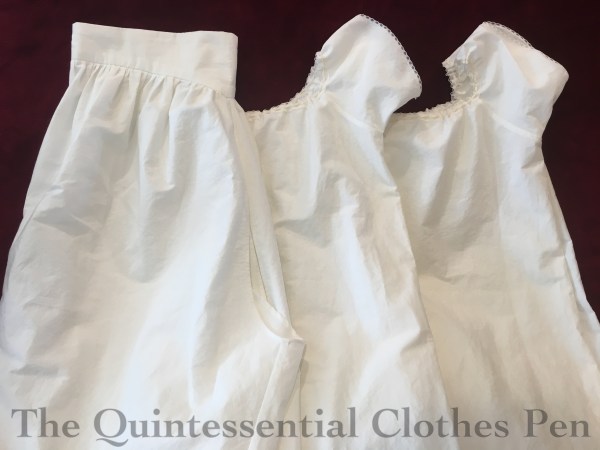
June: HSM #6, Mid-19th Century Underclothes

October: HSM #10, 1863 Ball Gown ‘Genevieve’

November: HSM #11, 1920 Deauville Sweater (The Sweater Of Determination)

December: HSM #12, Faux Hair Braid

General Blog News

I updated the blog design pretty substantially in June. And the blog passed 300 followers in 2019! Thank you all for sharing my adventures!

I participated in the Historical Sew Monthly for the seventh year, completing 4 out of 12 challenges. (That’s the same as last year.) I love to participate, but often my sewing doesn’t fit into the challenges which is why I only completed ⅓ of the challenges this year and last.

Additional Opportunities 

I was invited to give 3 historical dressing lectures during the course of 2019.  Each one was an excellent occasion to share my passion for bringing history to life with others! Two of the lectures were about women’s sportswear around the turn of the 20th century (one of these was filmed, and can be seen here, on YouTube) and the third was about African American middle and upper class clothing in Providence, RI around the turn of the 20th century (you can see photos of and information about this event here). The sportswear lectures led to interviews on NPR’s WBUR in Boston (you can listen to it here) as well as Providence’s NBC channel (you can view it here, my segment runs from :55-6:54).

Event Recap

In 2019, I attended 8 balls, 5 other events (teas, picnics, outings etc.), 1 vintage dance performance, and delivered 3 lectures (and 2 interviews). That’s fewer events than last year, but an increase in ‘work’ engagements, so the total stayed consistent. This year was full of many other life adventures as well, which kept me quite busy!

To Do Lists

I intentionally kept last year’s to do list short. And I’m pleased to say that I was done with most of it by May! The only outstanding thing is the 1925 coat… that’s been sitting in my sewing room since last January…

On the ‘maybe’ list from last year, I completed the new 1860s dress (boy did I–it took a long time! 57 hours, if you’re counting…) and made serious progress on the 1884 plaid wool day dress. I’ve also made steady progress on the 1790s stays. I didn’t actually make many modern garments… though I acquired more fabric for them. I guess that should stay on the to-do list!

Next year’s ‘definitely’ to do list:

  • That 1925 coat that has been half finished for over a year
  • Finishing the 1884 plaid wool day dress I started in November 2017
  • 1875 petticoat, balyeuse, bodice, and skirt

Next year’s ‘maybe’ to do list:

  • 1875 hat to go with new ensemble
  • 1880s wool mantle
  • 1880s hat to go with plaid wool day dress
  • 1830s cotton day dress
  • The 1790s stays I started in the winter of 2018
  • 1790s petticoat
  • 1790s dress
  • Modern dresses, pants, and skirts (I really should stop acquiring fabric for more until I start actually making these!)

Wishing wonderful adventures to all of us in 2020!


(Very Belated) Fezziwig’s Ball 2018

So, um, I’m about to attend this year’s Christmas ball… but I didn’t ever get around to posting about last year’s ball! So very belated-y, but in the spirit of getting ready for the holidays, here is a quick look at last year’s Fezziwig’s Ball, hosted by The Commonwealth Vintage Dancers.

Bedecked with garlands, the hall was ready for guests…

…while jingle bells waited for the arrival of eager carolers.

During this quiet lull, I was getting ready with other hosts.

Fully dressed, I was ready to show off my hair. Braids, curls, puffs… it wasn’t huge in terms of size but it had a lot of parts despite that.

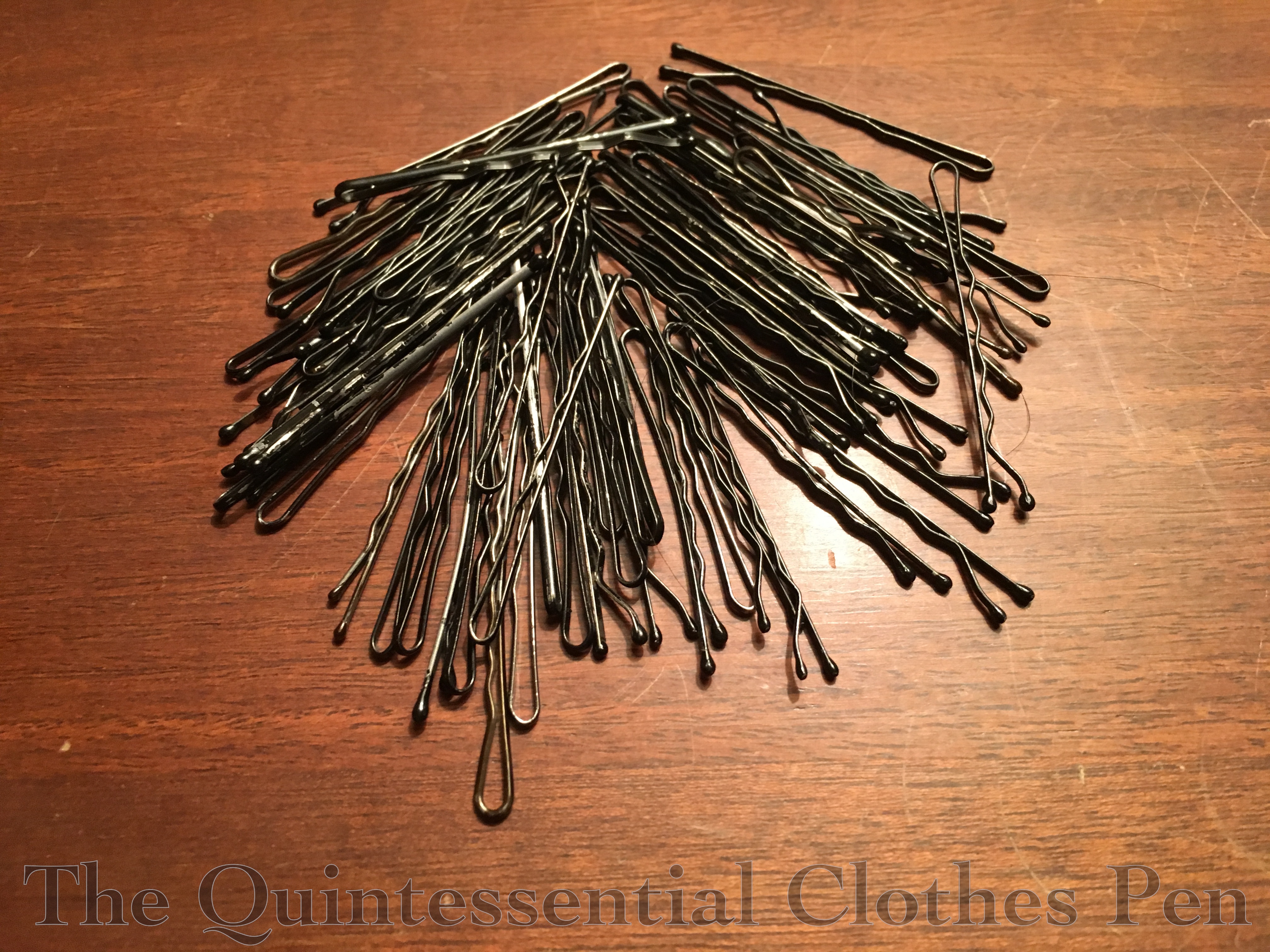
I counted the number of bobby pins it took to create this style at the end of the night when I took my hair down (and even kept the information in an easy to find spot for the last 12 months…).

The final count: 63 bobby pins.

The usual crew, fully outfitted for the early 19th century.

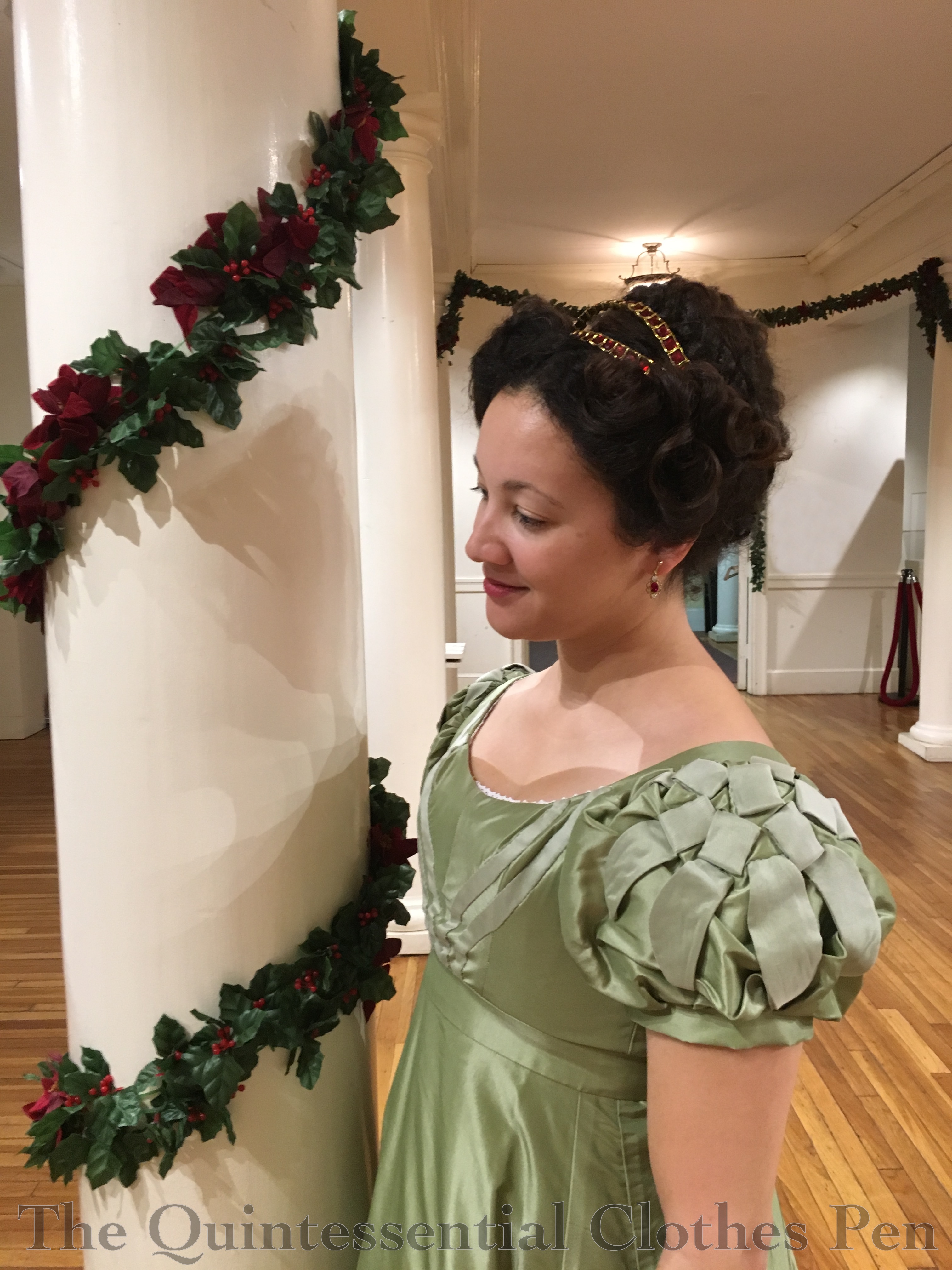
For the last few years I’ve worn my 1832 red velvet dress, so last year I changed it up and wore my 1824 green dress. I added a bit of holiday spirit with my red and gold tiara and other red and gold accessories.

This last one isn’t the best photo in some ways, but it captures the movement of my dress and the overall silhouette quite well!

This year it’s back to the 1830s with my red velvet dress. I’m looking forward to it after two years away! Maybe I’ll even post about before next December…!

The Sweater Of Determination, Or The Deauville (HSM #11)

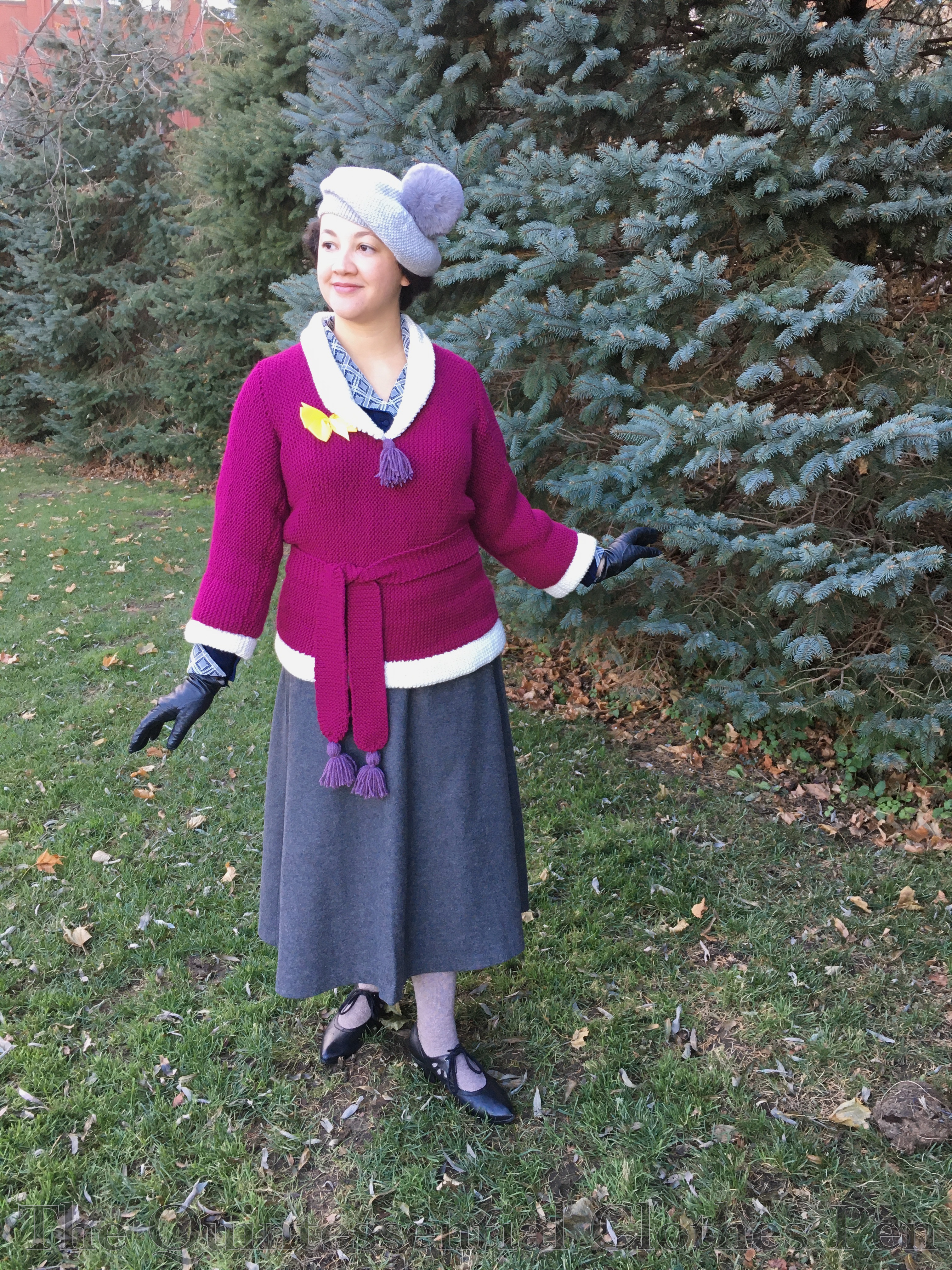
I’m really excited to have finished this sweater and even more excited that I like the finished product! It’s been a bumpy road to completion… but more on that later in this post.

First, I’m excited that this sweater qualifies for the Historical Sew Monthly challenge #11: Above The Belt!

No hitting low! Let’s keep things on the up and up as the year closes, and make something worn above the belt.

Before I go into the story of this sweater, here are just the facts:

Fabric:  1 ¾ skeins of Red Heart with Love acrylic yarn in Boysenberry, ¾ skein of Red Heart with Love acrylic yarn in Eggshell, & ¼ skein of Lion Brand Vanna’s Choice acrylic yarn in Dusty Purple.

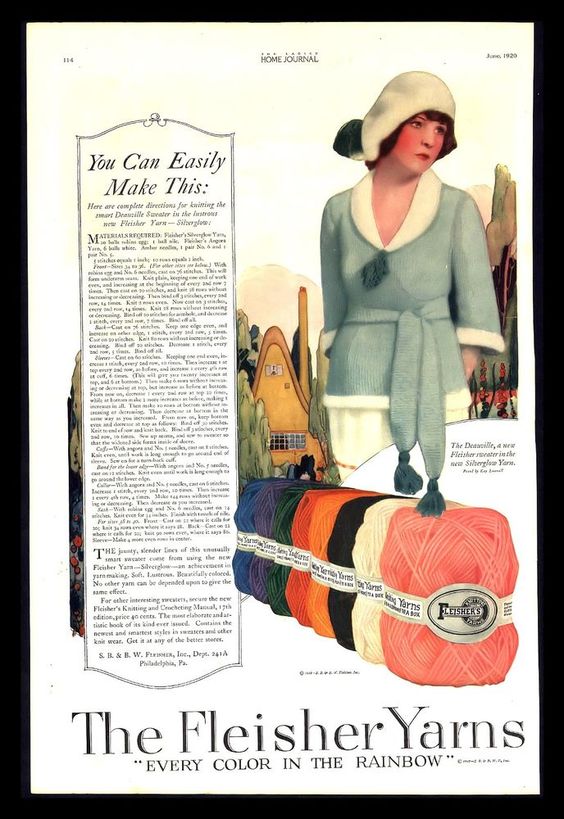
Pattern: An ad for Fleischer Yarn published in The Ladies Home Journal.

Year: June 1920.

Notions: None!

How historically accurate is it?: 90%. The weight of the yarn is a bit heavy, though the fiber content and color are plausible. My crazy alterations make sense but of course the goal would have been to avoid their necessity.

Hours to complete: So, so many. At least 100, I would think.

First worn: November 23, 2019.

Total cost: Approximately $39.

Inspiration

The story of this sweater starts with inspiration I found on Pinterest for 1920s sweaters. I think I came across these while making my last sweater in 2013, the 1917 Sweater of Angorina. Fast forward a few years to the summer of 2016 when I got all excited and ordered tons of yarn. Enough for three sweaters…

(Let’s get side tracked for a moment to tally my successes at using all that yarn. The 1st of those three sweaters is made but has never been photographed (it’s on the list of things to do!). The 2nd sweater is the Deauville this post is about. The 3rd sweater hasn’t been started… the yarn is still sitting in my stash. But after making two quite thick sweaters out of this weight of yarn, I’m pretty sure that the yarn I have for the 3rd sweater will not make what I want. Here’s the inspiration for the 3rd sweater–despite knitting rather often I’m not confident in my ability to pick the right weight of yarn and size knitting needles for a project like a sweater. I think that a sport weight yarn might be better for that 3rd inspiration, but I’m not sure. I’ll have to do more research!)
But back to this sweater: below is the inspiration for The Deauville sweater, including the instructions provided by Fleischer Yarns (this advertisement was listed on eBay). It is dated June 1920.

Making and Remaking

So I think I started on The Deauville in 2016. That means it’s been on my knitting needles for about three years… which is not to say that I’ve been working on it that whole time. Oh, no! This was definitely an on-and-off (mostly off) project–partly due to the fact that I just don’t pick up my knitting needles that often, but also because I encountered problems with this sweater that were demoralizing and time consuming.

I tried to follow the instructions as best I could. I think I did pretty well with the back and front. Then I started on the sleeves. But it became apparent as the first sleeve took shape that the sleeve I was knitting was not going to make a sleeve shape that made sense for the shape of the sweater. The top of the sleeves would have had three separate curves and the bottom of the sleeve would have curved down like a bishop sleeve. What???

Here’s the point in knitting that sleeve when I stopped. The top of the sleeve is the top of the photo. You can see that’s started to go downhill, but that was only about ⅓ of the way across rather than about ½, as you would expect for a sleeve. And the bottom curves down… why? I have no idea. It doesn’t make sense given the illustration of the finished sweater.

I could not see how the directions would produce usable sleeves, so I took apart what I had knitted and created my own instructions that made an expected sleeve shape. The sleeves took a really long time to knit… because it turns out that I had made them much wider and longer than they needed to be! I had lovely bell shaped sleeves, but that wasn’t the shape in the inspiration… ugh! (No photos, because I was frustrated at this point and just wanted to keep moving.)

I discovered the sleeve shape after having sewn up the sleeve inseams, the shoulder and side seams of the body, and attaching one sleeve. I was not inspired to re-knit two sleeves again, so I had to think of other solutions. In addition, I’d discovered other problems during my first fitting… I realized that the back of the sweater was 5″ smaller across than the front. What??? This pulled the side seams to the back and also made the sweater waaaay too tight around my body. That’s not the right style at all! It also explained why it was hard to set the sleeves in nicely–there was way more sleeve than armsceye!

If you look carefully at my shoulders in this photo you can see that the armsceye seam sits pretty far back on my shoulders in the back, due to the narrow back panel. Luckily the sleeves have a shape that accommodates being pulled so far back.

It was my goal to wear this for an event in November and by now it was mid-October, so I had to come up with solutions that wouldn’t take too much time to execute (or add too much frustration). I’d put in so much time already–I was annoyed with the sweater but determined to carry on! I decided that I could take in the sleeves, hem them, add in two 2.5″ panels to the body, and hem the very long bottom of the sweater. That would solve most of the problems, but it required taking apart most of the seams I had just sewn. Ugh!

Oh, and one other problem from that first fitting? The v-neck was unreasonably deep! It went all the way down to the middle of my ribcage. And there was really nothing to do about that in terms of knitting something new. I decided to stitch it partway shut, hoping that the tassel in the front would hide my Frankenstein seam.

Happier Progress and Finishing

I unstitched my seams and knit my new panels, hoping that my side panel additions would look intentional or mostly not noticeable. (Luckily, from the outside they’re really not noticeable, are hidden under my arms, and symmetrical, so vaguely intentional looking. Yay!) After making the new panels, I sewed up all the seams again. I found that the sleeve to armsceye ratio was much better, so that was positive.

Here’s the inside of the sweater, showing one of the added-in side panels, as well as the hemmed bottom edge, and the white contrast band.

The next step was to take in the sleeves (more unstitching and restitching). Finally, I hemmed the sleeves and bottom edge, making for rather thick edges, especially at the sleeve hems, where the seam was taken in and then the sleeve was hemmed! Luckily it’s not too visible, just a little bulky when you can feel it–which I didn’t really notice while wearing the sweater, so that’s good.

Here’s the inside of one sleeve, showing the taken-in-seam (which was whipped down to keep the bulk in place), the hem of the sleeves (also whipped down), and the white contrast band.

At some point along the way I’d made the long rectangle for the belt, so that was done. It was an easy no-stress step to add in during the midst of all the frustrating sleeve/side/seam ripping business.

The final steps were to make and add the white bands of trim as well as the collar and tassels. At this point I threw the instructions out the window, using them for general guidelines but making it up as I went along. I decided that my rounded hemmed bottom edges wouldn’t look proportional with a single layer of white knit band, so I decided on the final widths I wanted, knit them double wide, sewed them into a tube, and then sewed the tube to the sleeves and bottom edge. I like the result!

I mostly followed the collar directions (I changed the length to match my neck opening and changed the curve slightly), but wanted a rounded, doubled collar look to match the bands. To do that, I made the collar a bit wider than I intended for it to be, turned under the outside edge, and whip stitched it down. The instructions gave no information on how to attach the collar, so I whip stitched that, too. (In addition to the collar, this photo also shows the inside of the v-neck that was stitched together. I finished those stitches off with a bow, to offset the frustration of the sweater.)

Done!

And that was it! It was a bit of a rush at the end, but I got it done in time to wear to the event–a Thanksgiving parade in which friends and I represented support for women’s suffrage. The 19th amendment granting women’s suffrage was ratified in 1920, but did you that it was approved by the House of Representatives and the Senate in 2019? Any year is a year worth celebrating suffrage, in my opinion, whether it’s a 100th anniversary year or not!

About Fleisher Yarns

I did a bit of research on Fleisher yarns, and Silverglow in particular (as that is the specific line of yarn that my inspiration advertisement is promoting). This blog has compiled an amazing resource, listing Fleisher Yarns from the 1890s through the 1970s, with photos. Here is the listing from that resource for Silverglow:

Silverglow

1904: ​​ “A soft and lofty two-fold yarn, a mixture of wool and art silk, having a rich, lustrous appearance. ​​ Adapted for light weight sweater’s, scarfs, sportswear, etc.”

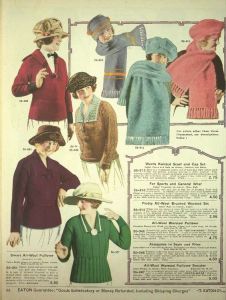
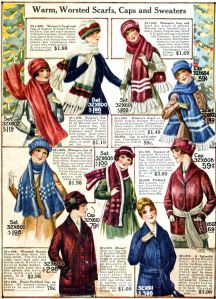
Back to my thoughts about the weight of my yarn, this description pushes me towards the thought that my yarn was a bit heavy for the original intentions. Although, I was thinking of this sweater as being on the sporty side of things (hence my accessories of the pom pom hat and wide scarf with tassels–inspired by ads such as those below), so I think it is still tangentially possible for this yarn weight to make sense–and it certainly did a great job of keeping me warm!

Interestingly, you can still find Fleischer Yarn. Here is one example, and though it’s not clear exactly when these skeins are from, I bet that a bit of looking at the labels on the first resource I linked might answer that question.

About The Color Of My Sweater

The color of my sweater color is one that I love. Berries of all kinds are yummy and pretty! But is it a reasonable choice for 1920? Well, I did a bit of researching that, too. Here is a color chart for Fleisher Yarns from 1929. My boysenberry color isn’t represented, but there are yarns with a similar depth of color and saturation, so I don’t think it’s out of the realm of possibility for a color like this to have existed at that time. For example, combine Wild Aster and Cardinal on the color chart and you might get a color similar to my yarn.

A Few More Photos

To finish off, here are a few more photos of my Deauville sweater, which was most definitely an exercise in determination!

Project Journal: 1863 Apricot Evening Gown Part X: Photos From The Ball

I was able to wear my new 1863 dress, Genevieve, to the Commonwealth Vintage Dancers’ Victoria and Albert Ball in September. I’ve spent a very long time sharing all about the dress and you’ve seen some photos of the wonderful staircases in the hall as I’ve shared finished construction photos, but I thought it would be fun to share a few photos of the ball as well, for context.

On the night of the ball, there were many dresses and tailcoats to admire in a range of years focused on the 1840s through 1860s. There was also the lovely ballroom to admire, with a famed organ at one end and many pretty details and portraits along the walls.

The guests of the evening filled the ballroom with dancing and socializing, while, in a side room, a spread of delicious refreshments was waiting to be devoured by hungry guests.

While getting more serious documenting-sewing photos, a few silly photos made their way in as well. They started off staged but reasonably not silly…

Then we tried to point at a non-existent something…

And that turned into silly-ness! I think this last one was: ‘Oh no! We’ve made the invisible object disappear with our magical powers!’

Thanks for sticking with me through so many posts about one dress!