Re-Imagined 1885 Fancy Dress (HSM #9)

The Backstory

In 2016, I made a dress for a Fancy Dress Ball inspired by a dress worn by Alice Gwynn Vanderbilt in 1883. Alice’s now-famous dress, made by The House Of Worth, celebrated Electric Light as its theme. The dress uses beading and metallic elements (as well as an electric torch, for the original wearing!) to visually reflect light as well as communicate the electric light theme via decorative motifs. I posted an image of the inspiration gown and a link to more information about it in my original post about my dress in 2016, which you can view here.

I was inspired by the trimmings on the gown, but needed to create a dress with little expenditure (much different than the budget for a Worth dress!). To achieve this, the goal when I made my dress in 2016 was to use as many materials as I could that I already owned. The main dress fabrics were already in the stash from old projects and the silver net was leftover from trimming the Versailles sacque I posted about wearing recently.

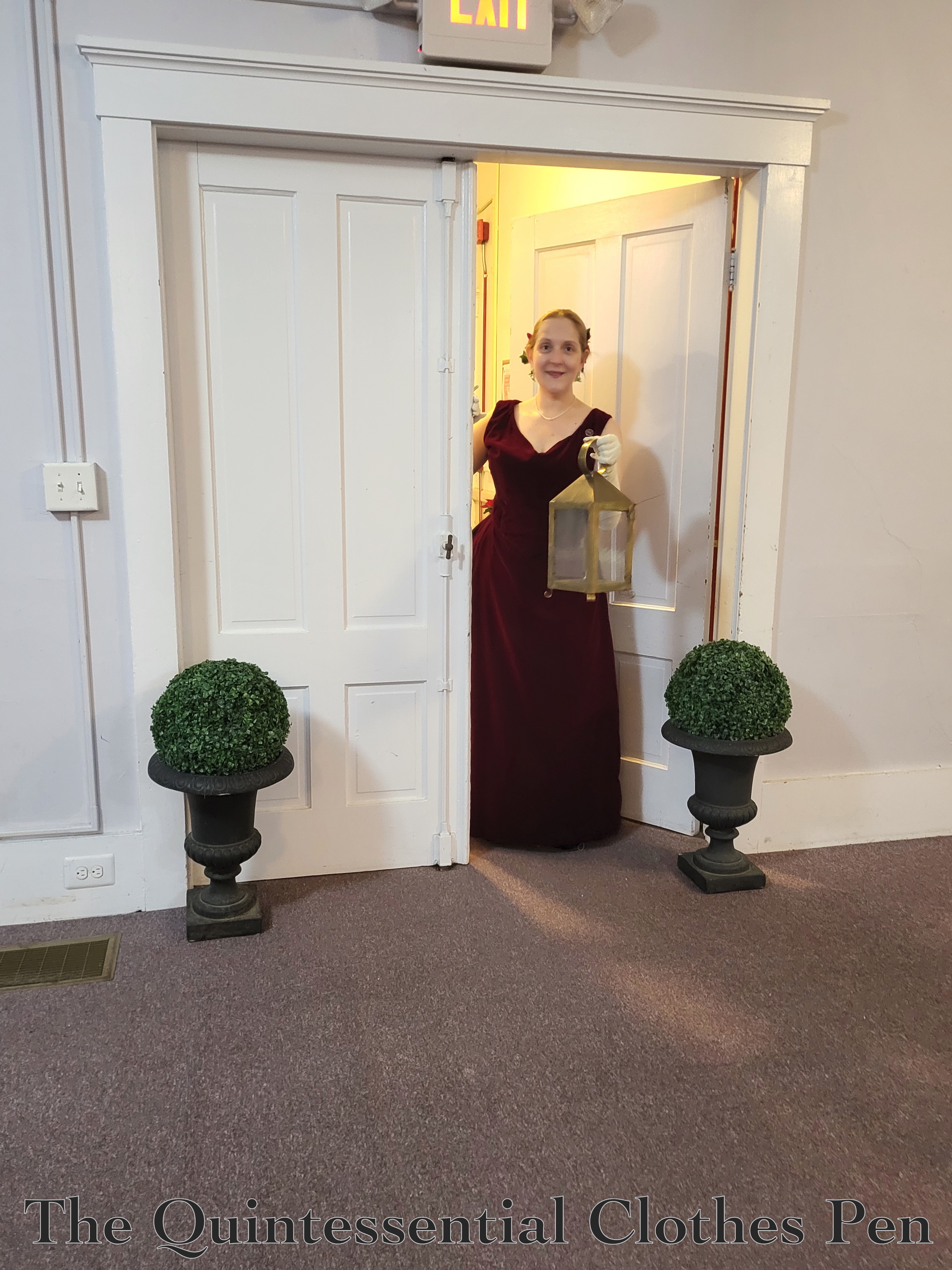
Below, a photo of the dress in 2016, with a lantern standing in for “electric light.”
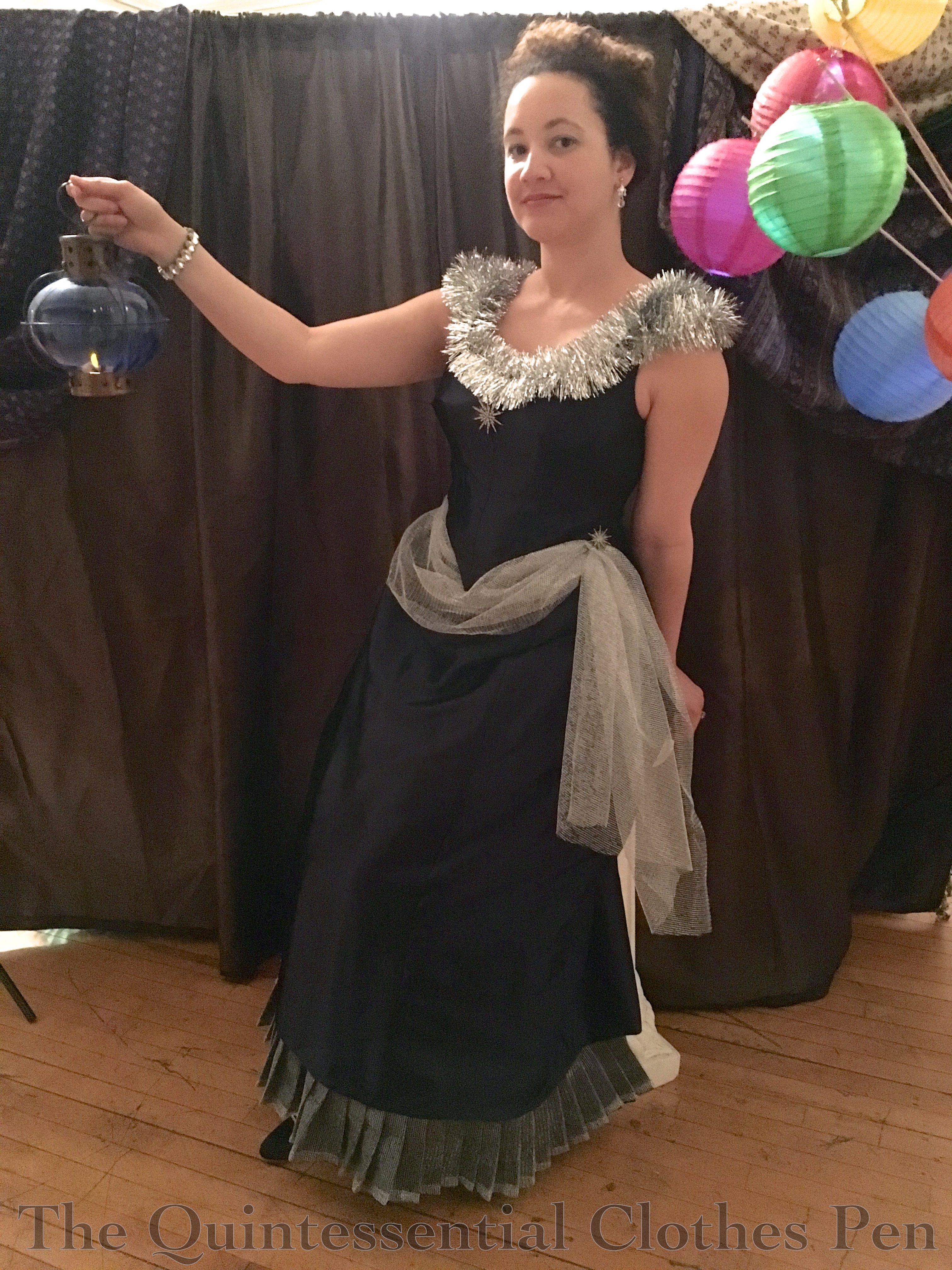
There were a few small changes I wanted to make after the first wearing of the dress, but I didn’t have a need to wear it again for years. Fancy Dress events are not all that common even within the already limited realm of historically clothed events! And with the original trimmings I didn’t like the dress for regular wear. Plus, for a number of years after making the dress the events I was attending did not encompass the 1880s.

More recently, however, I have had more opportunities to wear clothing from this period, as The Footwork and Frolick Society has hosted a few events with themes that can include the 1880s. Therefore, I decided to re-trim the Fancy Dress dress into a more regular, less Fancy Dress, ballgown style for the Yuletide Ball in 2024.

Inspiration

This time, my inspiration was a mashup of ideas from a variety of images.

From the fashion plate below, published in the Revue de la Mode in February 1886, I pulled information from the gown on the right, with the pleated fabric along the v-shaped neckline and asymmetrical decorations (which I guess are feathers) on the shoulder and skirt.

From the photo below of British actress Lillie Langtry (Original Publication: People Disc – HU0206. Photo by Downey/Getty Images), I pulled inspiration for the “sleeve” idea I wanted to incorporate. The pattern of the fabric used for the bodice in this photo was also reminiscent of one of the fabrics I used to update my dress.
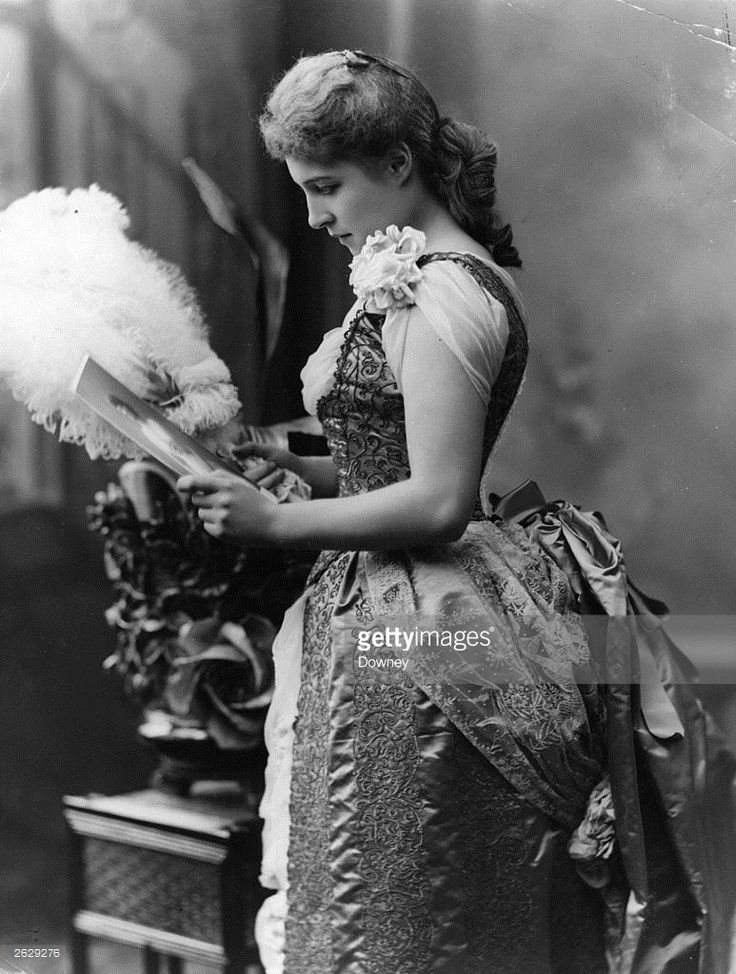
And finally, I was also inspired by the beaded swags (and chiffon “sleeves”) on the c. 1887 dress in the collection of the Kent State University Museum in the photo below.

Dress Update Overview

For the re-make of the dress, I wanted to maintain my goal of using materials already on hand. I still had small scraps of the navy blue satin in my stash as well as the silver net. I also went through my fabric stash binder to see what other fabrics and trimmings might work and found that the best bets were a piece of polyester velvet flocked with silver swirls that I’d purchased at Joann Fabrics probably twenty years ago when I had just started sewing and loads of silver ribbon that I had been gifted to me. The blue and silver colors fit the colors of the existing dress perfectly and I thought there was a sort of New Year’s aspect to the color scheme, as well. (I also purchased the Joann fabric in burgundy and green (both with gold swirls) and had made Christmas decorations out those, but I don’t think I ever used the piece of blue, so this was a great opportunity!)

With my materials decided, I moved on to the sewing part of the project, starting with unpicking the original trim from the dress. I had made it knowing I might someday want to change the trimmings, so they were not sewn into seams and were pretty easy to remove. That left me with an almost entirely navy blue dress, relieved only by the silver pleats at the bottom of the skirt.

Then I went back and considered my original list of changes, which included:

  • Boning the center back edges so they would lie flat when laced closed
  • Adding a matching piece of satin behind the lacing holes to hide any white fabric of undergarments
  • Making sure that my chemise wouldn’t poke out of the armholes

Quoting myself, from 2016… “these are minor changes and I’m not sure when I’ll have the opportunity to wear this again so it might be awhile before they happen.” I’ll say! It only took 9 years!

Historical Sew Monthly

My goal of using stash-only materials for this dress re-do makes it fit into the Historical Sew Monthly 2025 Challenge #9 Blue:

Make an item that features blue, in any shade from azure to zaffre.

Just the facts:

Fabric/Materials: Approximately ¾ yard silver net, just over 1 yard of navy velvet with silver motifs, and scraps of navy polyester satin.

Pattern: My own.

Year: c. 1885.

Notions: Approximately 23.5 yards of ¼” silver ribbon.

How historically accurate is it?: 90%. Polyester and modern synthetic ribbon do not have accurate fiber content. And my patterning is conjecture. But the overall idea is pretty good.

Hours to complete: I didn’t keep track.

First worn: December 7, 2024.

Total cost: Free, since everything came from the stash and was either gifted to me or purchased ages ago!

Dress Update: Back Closure

Following the original list of changes, I added a placket behind the lacing holes and added plastic bones along the very back edges, to help hide undergarments (the white color really does pop against the navy blue of the dress!) and keep the back laying flat when laced closed.

Dress Update: Sleeves

When re-examining the dress in 2024 with fresh eyes, one of my biggest desires for change was to better fill in the armholes of the dress and provide a decorative element. Yes, evening dresses in the 1880s were often sleeveless, but when really looking closely at them again, I found that while not having sleeves, they do almost always have something that obscures the armhole and even the upper arm. I am more likely to call these styles swags or drapes of fabric, as they aren’t really proper sleeves, but they are certainly set into the armhole in some way. I wanted something like that for the re-do of this dress.

I haven’t had a need to pattern something like this for this period before, so I looked through my historical pattern books for places to start. Interestingly, I didn’t find much. There was one sleeve that seemed like a possible starting place, but when I mocked it up it didn’t really do what I was hoping for at all!

So that left me with the decision to create a pattern from scratch. Thinking about what didn’t work in the mockup and my inspiration image, I proceeded to drape a mockup that achieved what I was hoping for. I didn’t have my dress form handy, so it required a fair bit of going back and forth between pinning and trying on the bodice to get the right shape. But I did! It’s a strange shape, for any sort of sleeve pattern. But that makes sense, since the sleeve drape is a not-really-sleeve!

Dress Update: Apron, Sleeve Swags, and Ribbon Flowers

I pondered creating some sort of beaded fringe for the armhole (and maybe even the waist, as can be seen in the third inspiration photo, above), but decided against it for time and material reasons. I really did want to stick to the stash!

Even if the beaded fringe wasn’t going to happen, I liked the idea of something to set off the wonderfully pointed bodice so that it would show up and not blend into the skirt. So in the end I decided to use some of the velvet from the stash to make an apron layer for the skirt, as was very common on dresses from the 1880s.

I started with making the pleated neck swag, so I wouldn’t run out of fabric, and then used all of the leftover fabric to make the apron. Due to this fabric restriction, I patterned the apron based on what was possible with my fabric, using a general understanding of the how these skirt elements were patterned in this period. The front of the apron is a curved piece that is pleated into the back on each side. The back piece is a bit scant, but has a few pleats along the top to give volume and descends to a point at the center back, since that was the shape of the fabric that was available! I used up pretty much all of the blue velvet!

For the sleeves, I made flower shaped sprays from lengths of ribbon that were tied into loose knots close to each end and then folded into quarters to make one loop and two ends. These individual elements were then combined and sewn together to make the flower-like formations, with larger scale ones on the skirt and smaller ones on the bodice.

The sleeve dangles were made from the same ribbon, knotted in the same way, that was folded to make a longer and shorter side and then tucked under the sprays on the shoulders.

Below, you can see the individual spray elements and a length of ribbon ready to be added as a sleeve dangle.

Finished Updates

Here is the updated dress! The blue velvet pleated v-shaped neck swag completely ignores the neck shape of the bodice underneath, which is more of a square shape. The same fabric is used again to create an apron, stitched to the outside of the waistband of the skirt to reduce bulk.

The silver net is used over the blue satin scraps to create “sleeves” that are pleated into the armhole and decorated with sprays and dangles of silver ribbon.

The “sleeves” wound up looking a little odd where the meet the back of the bodice, but that’s more due to my original patterning of a very inset armhole in the back than it is the sleeve pattern. It’s a lesson/change for the next bustle period evening gown I make, whenever that is!

I didn’t know what to do with the back of the velvet swag, because I wanted it to be easily adjustable depending on how tightly the back was laced. I ended up with this pointed arrangement that accomplished the goal of flexibility.
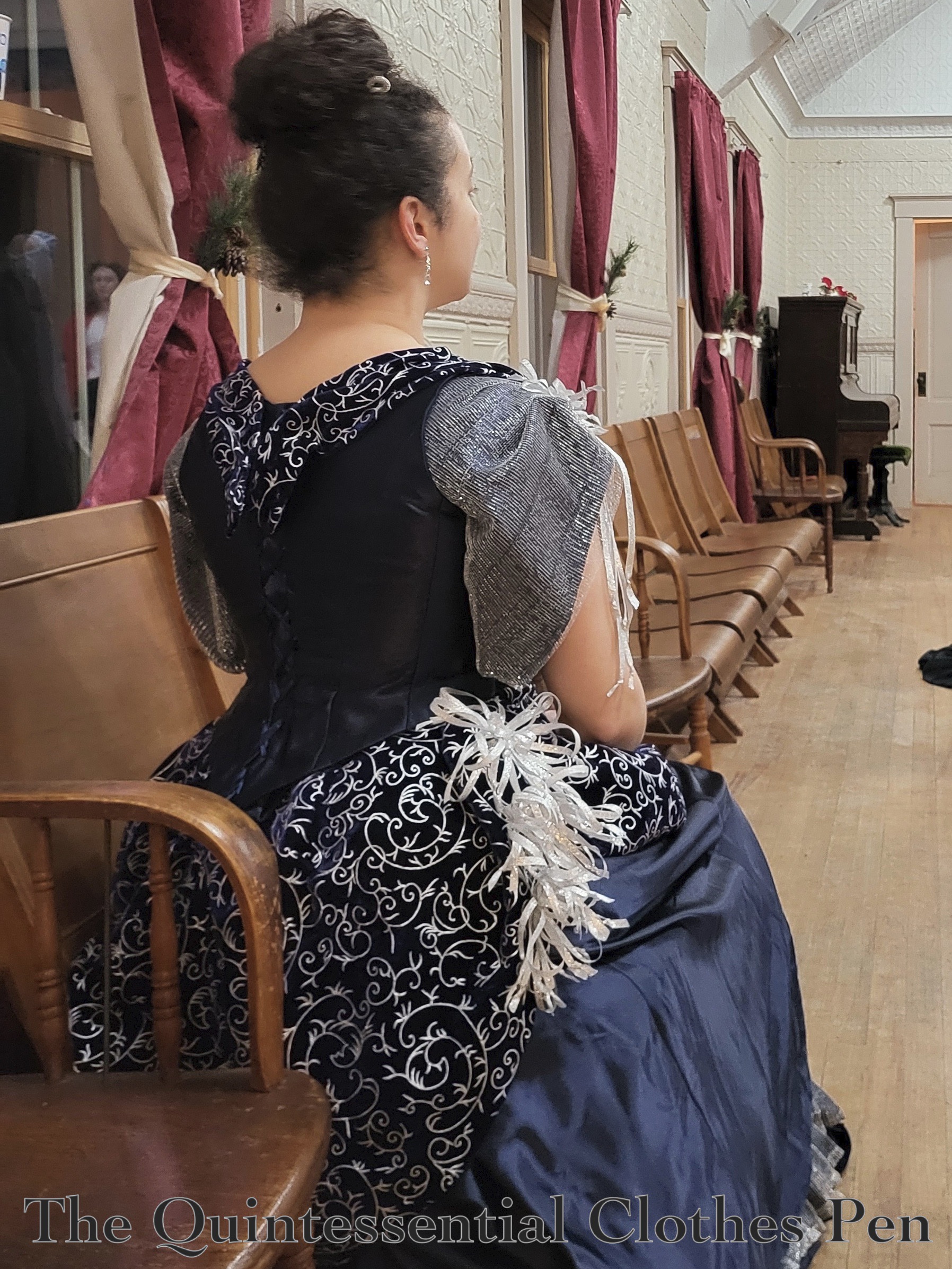
The armholes, left side front of the bodice, and right side front of the skirt are decorated with the sprays of looped silver ribbon. I used x4 — 4 yard spools of ribbon and half each of x3 more spools that were 5 yards each.

I calculated how many sprays and dangles I wanted for each section, but in the end I was running out of ribbon and started to just combine and move things around until they looked reasonable. Sadly, that means I don’t have a good record of how much ribbon went into each element or how long each piece of ribbon ended up being. I think that the smaller sprays were made of piece of ribbon that were 10″, the larger sprays on the skirt were made of pieces of ribbon that were 16″, and the arm dangles were 11″ before being folded.

Wearing

I wanted to find a simple but still 1880s hair style for this wearing, so I was pleased when I came across a photo of women in 1880s evening dresses with their hair drawn back and pulled up into simple large chignons on the backs of their heads. I wore that style with the addition of a few silver hair pins to tie everything together.

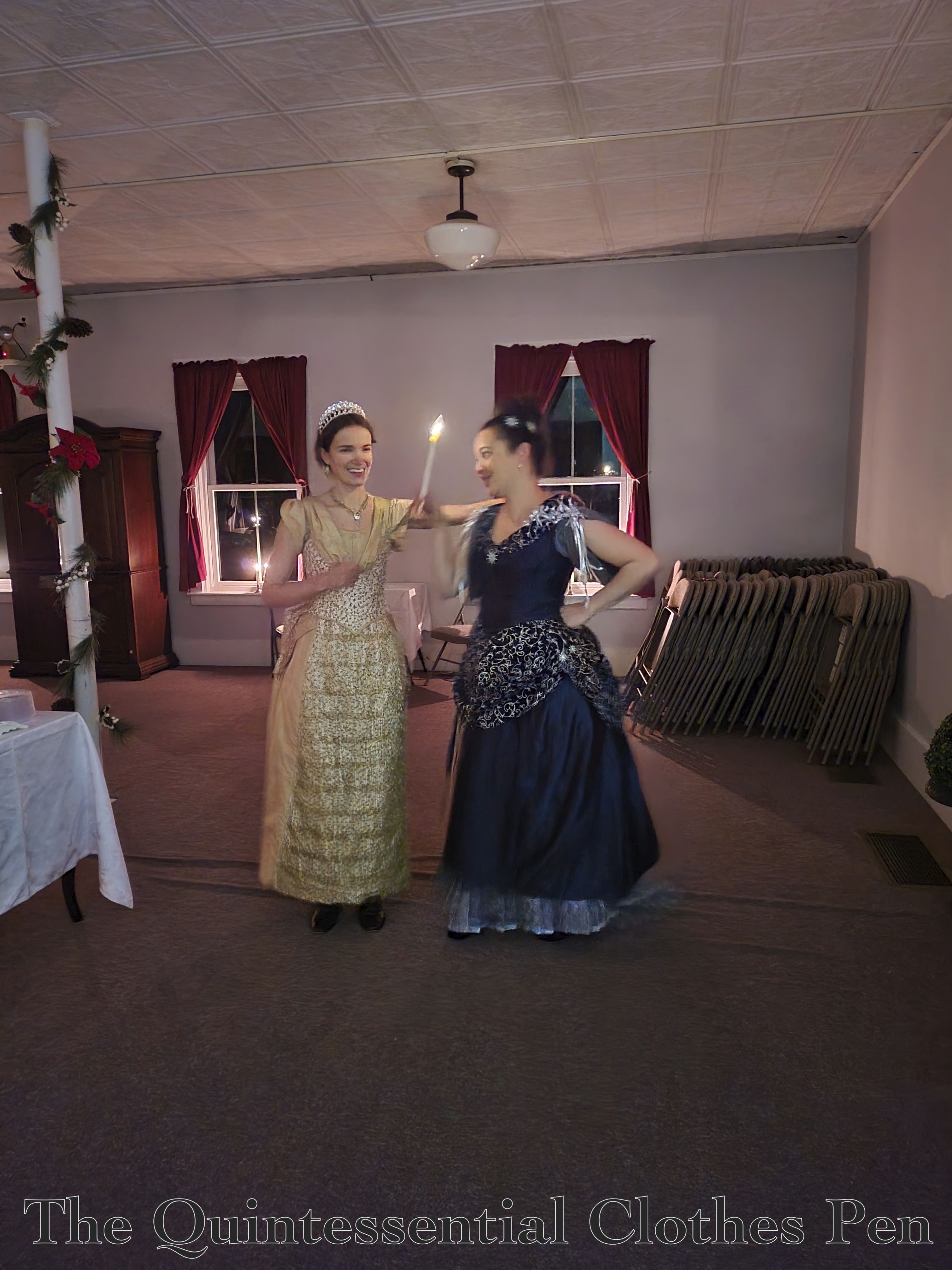
I also reused some of the star brooches from the first iteration of this dress, adding one at the center from of the bodice, two on the left side of the skirt, and some on the left side of my hair. They stand out well in the photo below, in which the two of us are bobbling about, making the ribbons on my dress and beaded trim on the dress on the left shimmer, sparkle, and sway.
Other Photos From The Event

This was a ball for bustles! There were multiple people wearing dresses with this feature, including the dress above, as well as the burgundy velvet dress below.
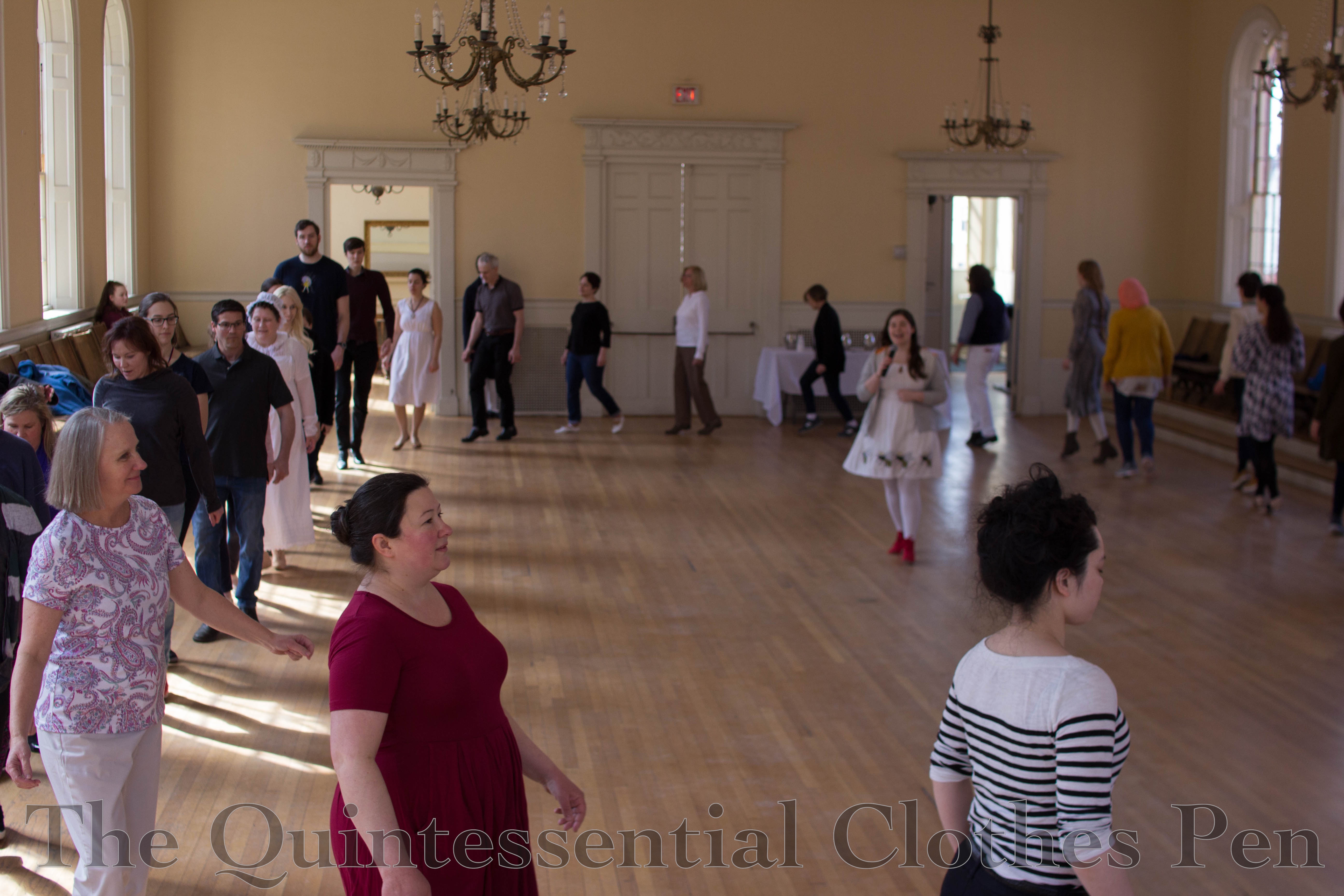
Finally, a cheerful holiday view into the ballroom. I wasn’t feeling my best at this event and therefore didn’t dance, but everyone else had a grand time! I look forward to the next event in which I can participate in dancing with the bustle! It’s really quite fun to experience the movement of dancing with all of your dress behind you!

1863 Fancy Dress: Genevieve As The Queen Of Hearts

Back in September, The Footwork and Frolick Society hosted a Wonderland-themed 19th century fancy dress ball. The idea was inspired by the whimsy of Lewis Carroll’s Alice In Wonderland (published in 1865) and Through The Looking Glass (published in 1871).

There were so many fabulous interpretations of Alice In Wonderland! You can get a sense of the fun in the gallery from the event on the Footwork & Frolick website, here.

I chose to re-use an idea I’d executed in 2018 when I turned a 1980s dress into a 1950s dress and style it as The Queen of Hearts. You can read about the dress re-make and original fancy dress styling here, in a past blog post. For this new wearing in 2024 I chose to use The Queen of Hearts theme and accessories again, but with one of my 1860s dresses to suit the mid-19th century goal of the Wonderland Ball!

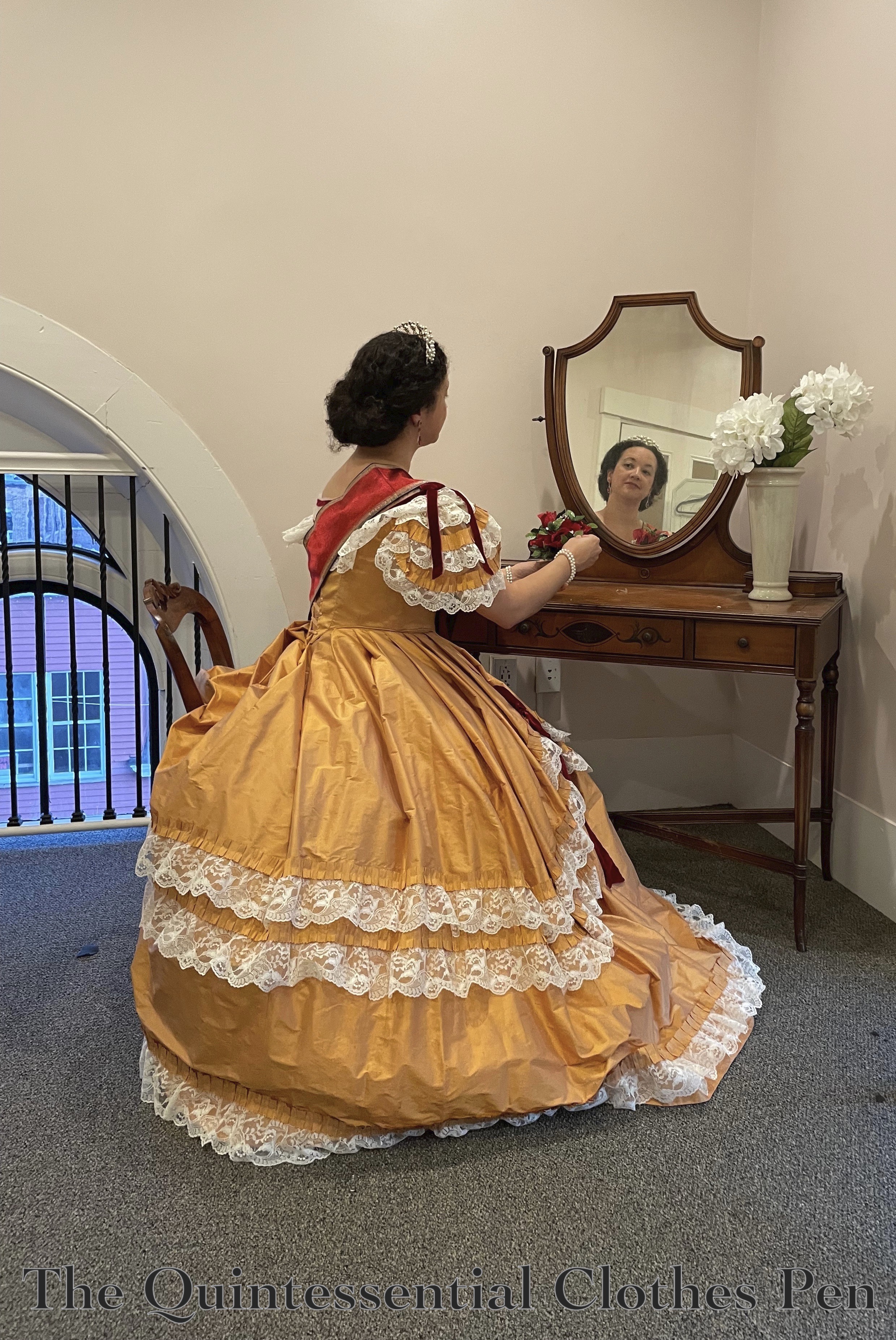
Genevieve, the name of my apricot ballgown from 1863, seemed to be the most fitting choice for a Queen of Hearts theme. (You can read all about the making of this dress in this Project Journal series of posts.) The two main elements of my fancy dress ensemble were a tiara and a royal order sash. I figured that could easily work again.

We captured a series of photos of The Queen of Hearts elegantly (and somewhat aloofly!) preparing for the ball!

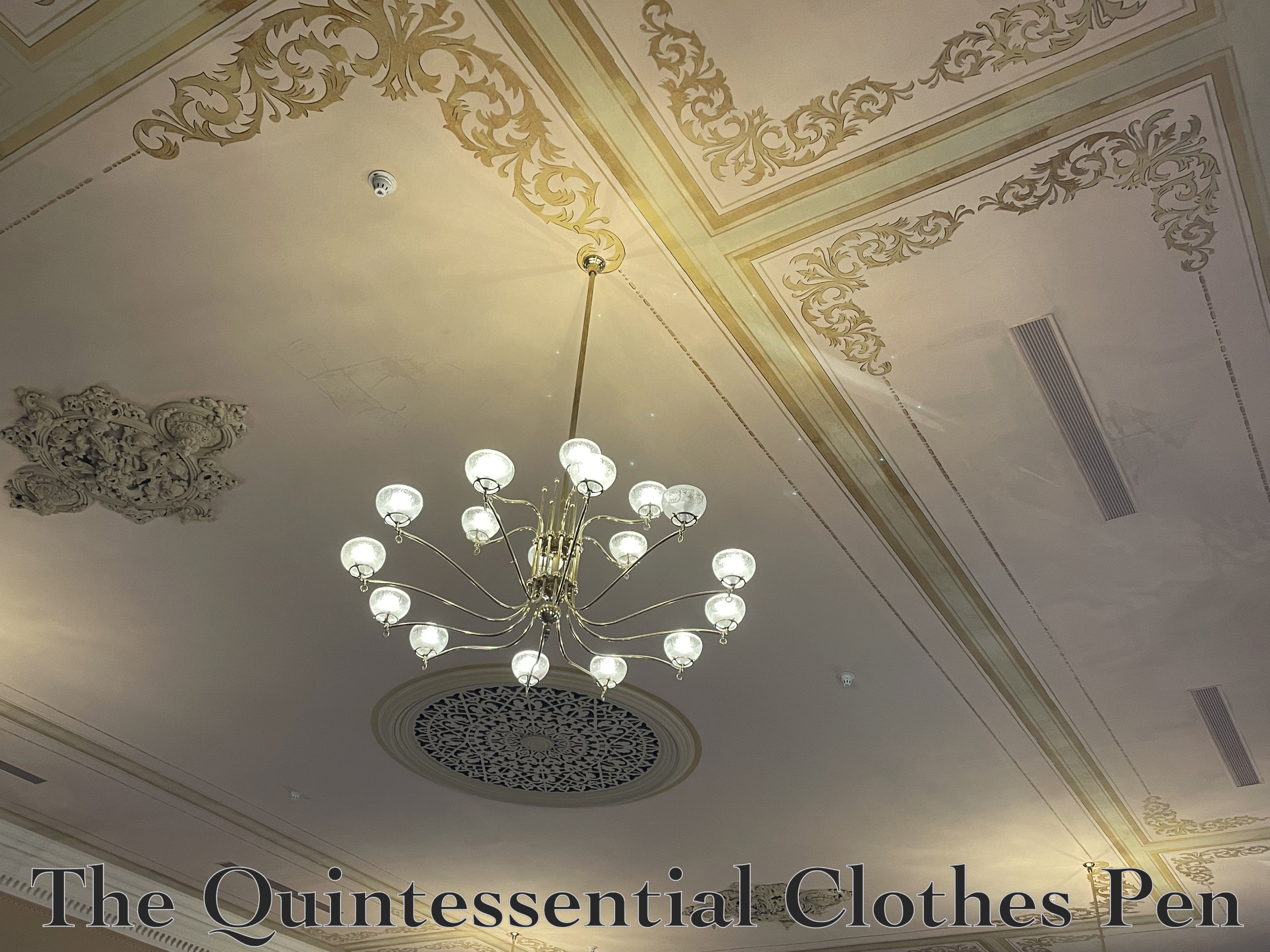
The ball itself took place in the lovely Andover town hall. It has all sort of beautiful details. Look at the ceiling!

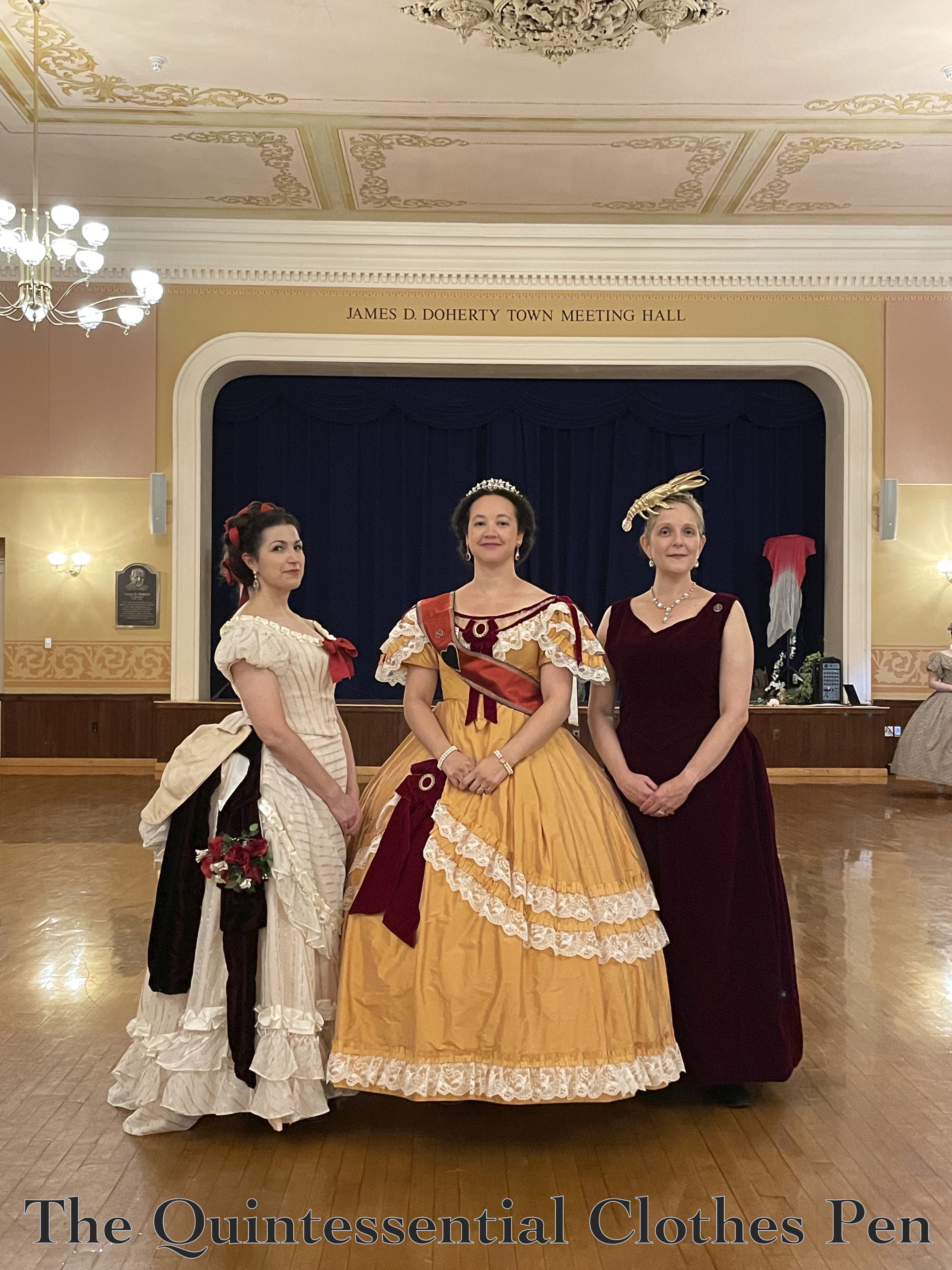
And the company was lively! I met charming new acquaintances and reconnected with creative friends. Below are a few of them… and we are joined by a golden lobster! (The lobster wanted to participate in the Lobster Quadrille, but had to step up the bling-factor to be ball appropriate!)

1817 Duchess Gown in Bridgerton Style

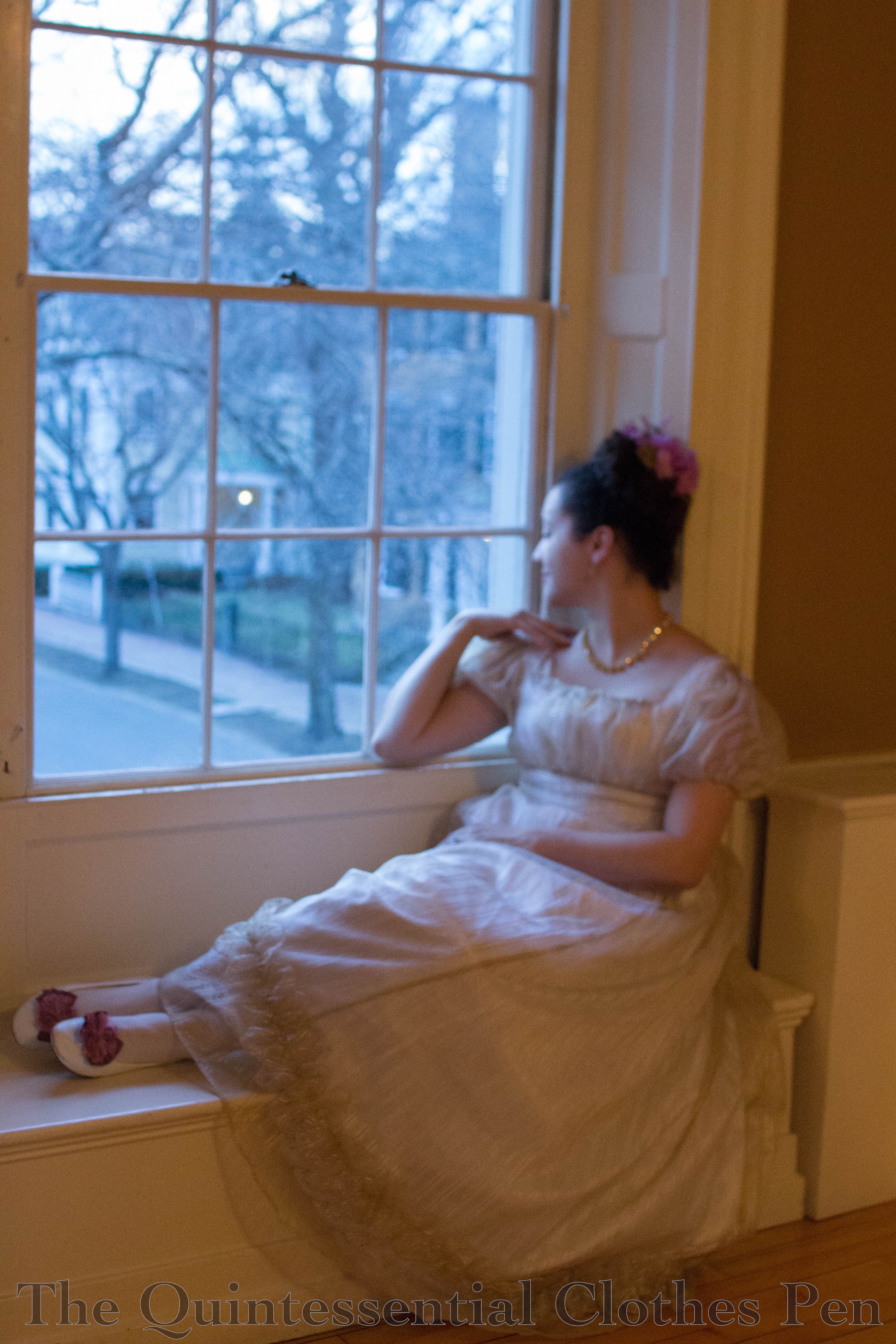
The Footwork and Frolick Society hosted a Bridgerton themed ball in May! Here are a few atmospheric shots.

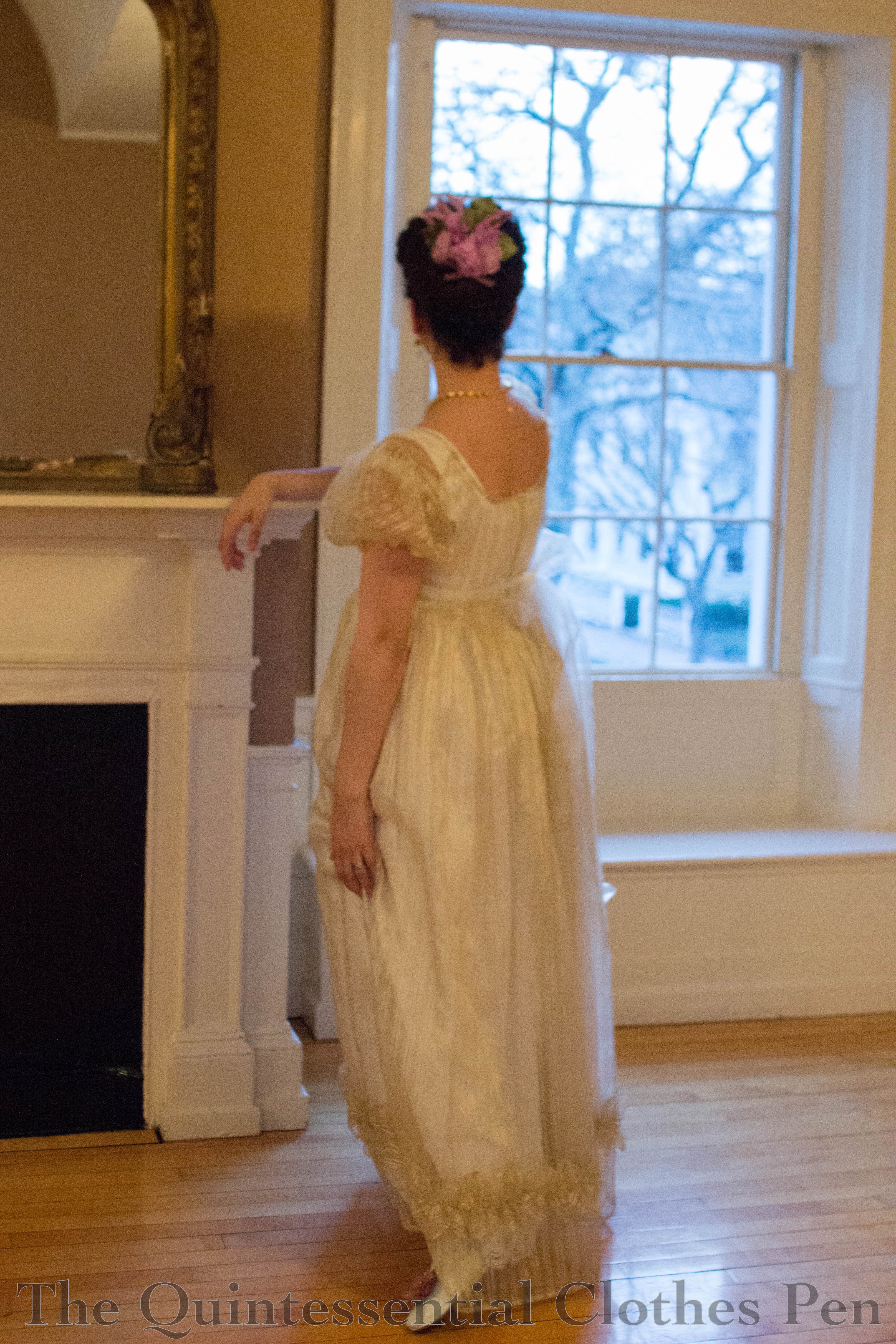
For this event, I chose to wear my 1817 Duchess Gown (you can read about the inspiration and making of the dress, here). I love this dress and haven’t had a reason to wear it in years. Plus, I figured the neutral color would pair well with a few nods to the colorful style of Bridgerton costumes.

In the past, I’ve had fun pairing this gown with other colors and accessories, as well! You can read another past post where I show multiple wearings together here.

The dress is a sheer striped organza, which is fun because I can show off fancy historical underwear with it! I usually wear my 1814 Vernet petticoat so that the fancy trim around the bottom can be shown off (in addition to a second petticoat to make the ensemble fully opaque.) The second petticoat is functional more than decorative, and is the one I recently posted about that needed a size update to fit properly again!. Wearing it with this sheer dress for the ball was the push I needed to make the petticoat fit really well–I didn’t want odd lines showing under the sheer Duchess Gown!

In addition to the decorative Vernet petticoat, other accessories for this wearing included clocked silk stockings from American Duchess, white flats purchased from a consignment store about ten years ago, a gold bead necklace that ties with a ribbon that I don’t wear often (I usually gravitate towards other more sparkly jewelry), and three nods to the colorful style of Bridgerton.

My nods to color included a green organza sash (that I’ve worn with this dress before–see images in this past post from 2019), green and gold earrings (from the Downton Abbey collection a number of years ago), and flowers in my hair, including some vivid pink ones. I’ve had these flowers for about 25 years and rarely wear them. They’re pretty bright! But for the Bridgerton theme they made perfect sense!

The company at the ball was charming and the dancing was enthusiastic! My Duchess Gown even had an old friend visit in the form of my 1811 Elusive Blue Gown worn by a friend! I love that these garments are getting to be worn again!

Photo credit for this last photo: Lucas Clauser

Gilded Age Weekend Highlights

Last year, friends and I decided to treat ourselves to a historical weekend away. With a number of bustle (1870s and 1880s) and 1890s dresses languishing in our closets, the chosen theme was the Gilded Age. We planned a very busy weekend of parlour games, afternoon tea and amusements, informal dance practice, and a formal ball.

Regular blog readers already saw a hint of this event in my last post, When The Dress No Longer Fits (1896 Evening Gown), but I have a few more posts to share, as well. Today’s post captures some of the amusing highlights from the various weekend activities.

To start, a behind the scenes shot of partially completed hair for my 1875 dress (which you can see in the photo after the one below). The photo below also shows off My Favorite Winter Things Skirt! Yes, I continue to wear this during the winter. The penguins, polar bears, and foxes participating in winter activities–skiing, ice skating, sledding, etc–continues to bring me amusement and joy.

And here, a still of theatre-adjacent people trying to create an amusing atmosphere while not making absolutely ridiculous faces. It brings me such joy to have well dressed friends!

Friends who also enjoy creative pursuits, such as creating homemade tabletop croquet! Not only is this absolutely adorable, but it’s also playable!

Our afternoon amusements also included a stereoscope.

Here is another view of the lovely ensembles at the ball.

I wore my 1896 dress, as you can see in the photo below. This is a classic for us. Moose pose!

And, to wrap it up, this is the bronze 1896 skirt after being stepped out of. The canvas is so stiff it literally stands up on its own, a fact which I’ve found to be amusing ever since I first made this over 10 years ago.

Thanks for joining me in the adventure!

There are more photos to come… a selection of outfit portraits and better-than-my-backyard documentation of my 1875 Reception Ensemble.

Fezziwig’s Ball 2019

I’m a bit slow to post about it, but last December I again attended The Commonwealth Vintage Dancers’ annual holiday event: Fezziwig’s Ball. (You can check out posts about past years here.)

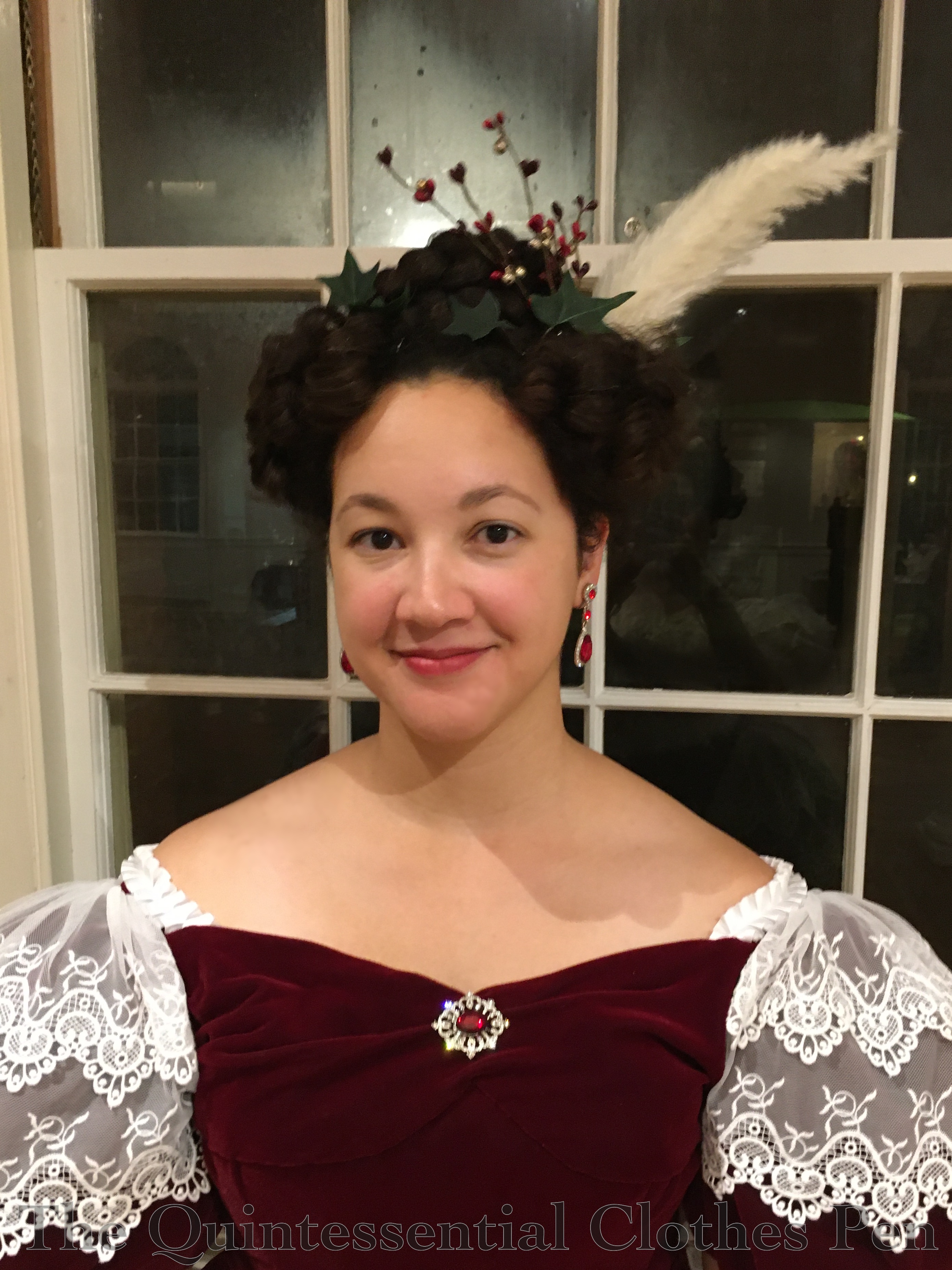
This year, I decided to wear my 1832 Burgundy Velvet Gown again, but I changed up my hairstyle slightly by adding a new element, since I was wearing a dress I’ve worn before. In addition to some new decorations, I also added a faux hair braid to make a giant swirly bun on the back part of my head. I wrote a blog post in January focusing on the hairstyle and my new faux hair braid that you can read here.

1830s hair is absurd and very fun. I enjoy the challenge of trying to style my own hair into these crazy styles. This year I had the faux braid and a few mesh supports under the front curls, but all the rest of the hair is my own. Those front curls are different each year… this year they have a sort of marching-in-a-line look that is interesting and different than in the past, but still documentable. Check out these curls from 1826 and these from 1829.

It’s fun to wear 1830s, as it’s a decade I don’t get to wear the clothes for as often as some others. The giant sleeves take a bit of getting used to but are entertaining in the end.

Looking festive with the addition of my Refreshing Apron, cranberry punch, hot apple cider, some real and faux fruit lurking near the punch bowls, and another 1830s-clad friend wearing a Refreshing-Apron-sibling.

1830s is more in fun (and maybe less ridiculous looking?) in groups. Here is a contingent of even more 1830s ladies from this holiday ball! It’s as though we sprouted from the column!


(Very Belated) Fezziwig’s Ball 2018

So, um, I’m about to attend this year’s Christmas ball… but I didn’t ever get around to posting about last year’s ball! So very belated-y, but in the spirit of getting ready for the holidays, here is a quick look at last year’s Fezziwig’s Ball, hosted by The Commonwealth Vintage Dancers.

Bedecked with garlands, the hall was ready for guests…

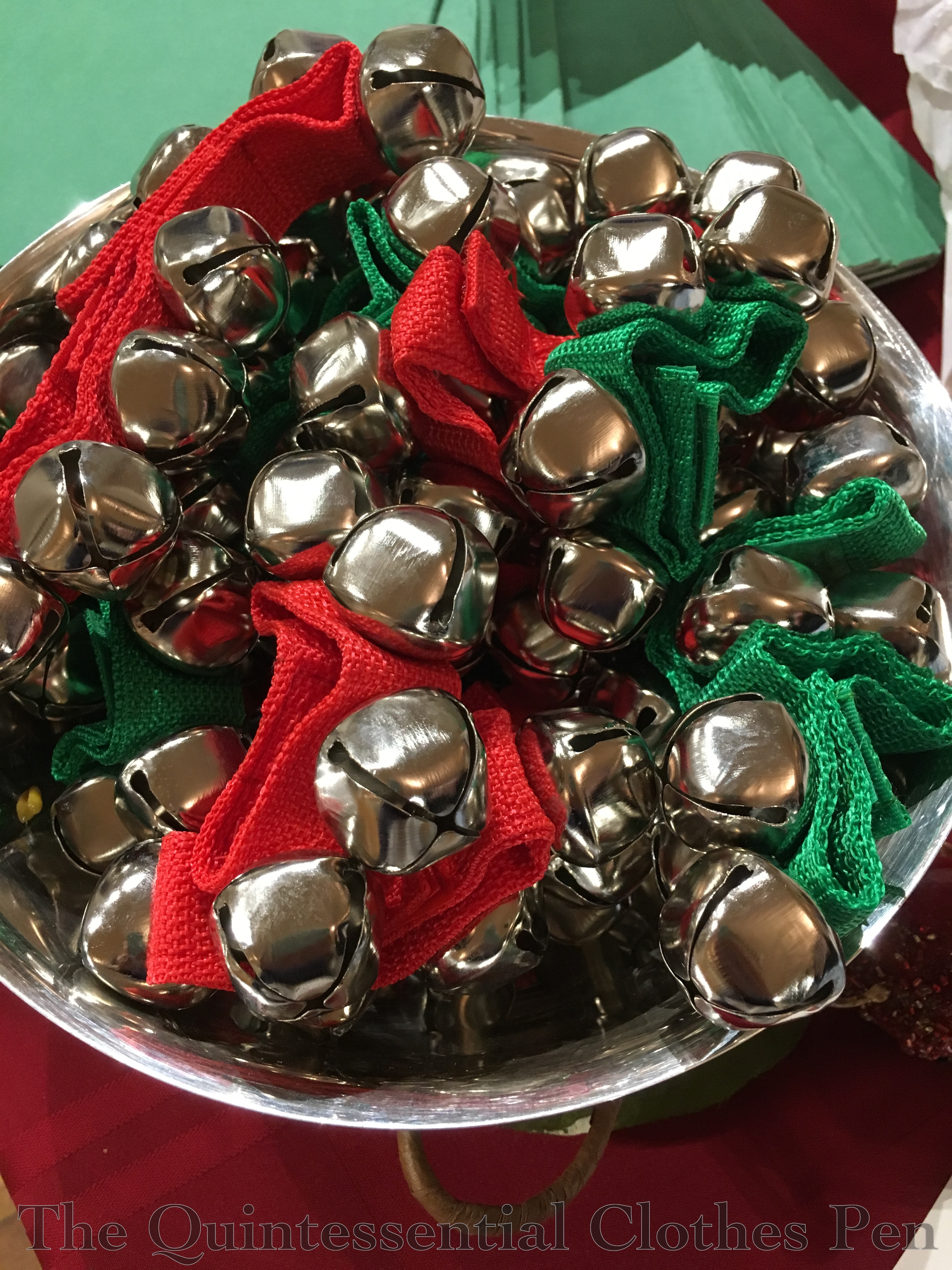
…while jingle bells waited for the arrival of eager carolers.

During this quiet lull, I was getting ready with other hosts.

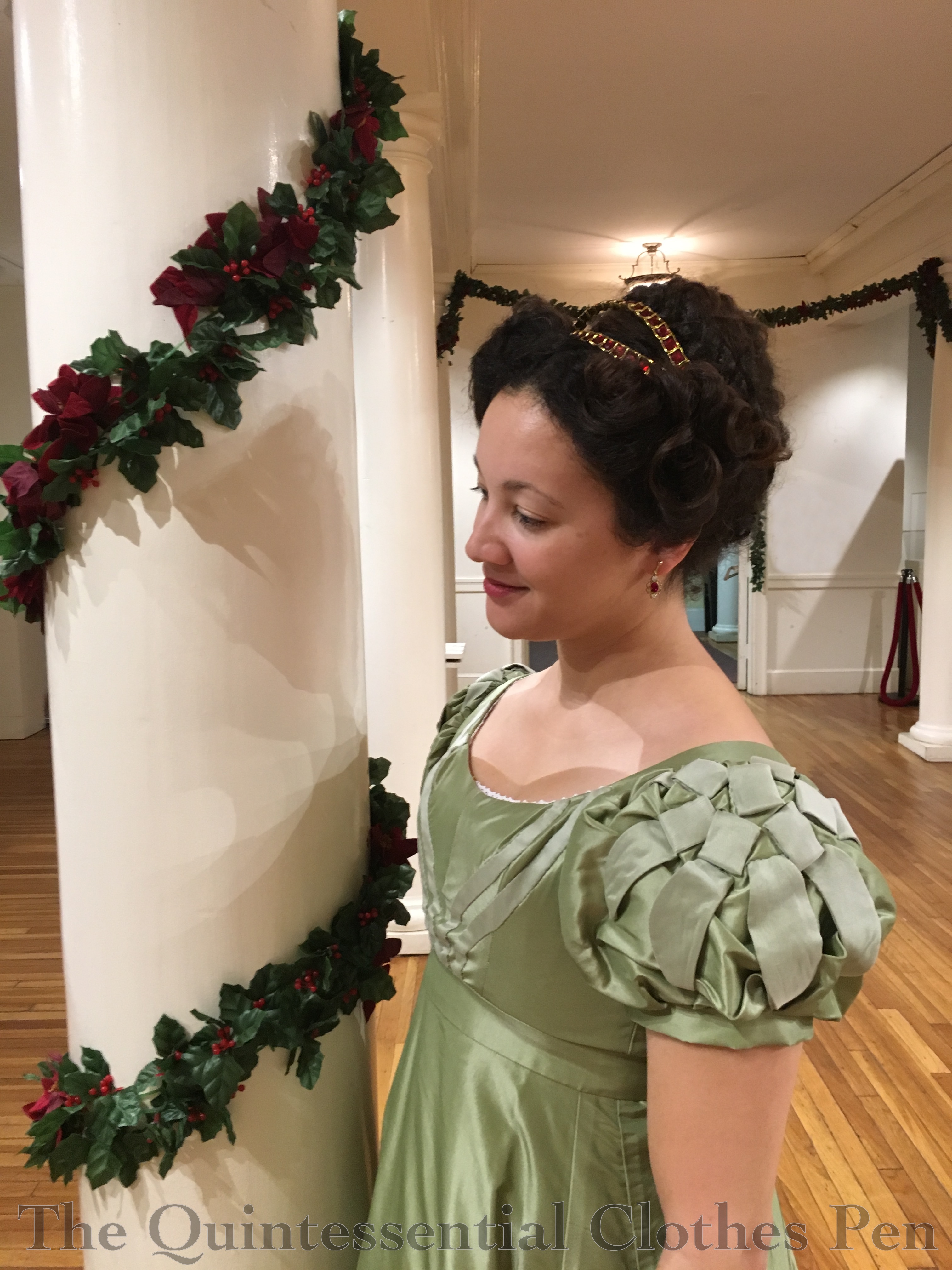
Fully dressed, I was ready to show off my hair. Braids, curls, puffs… it wasn’t huge in terms of size but it had a lot of parts despite that.

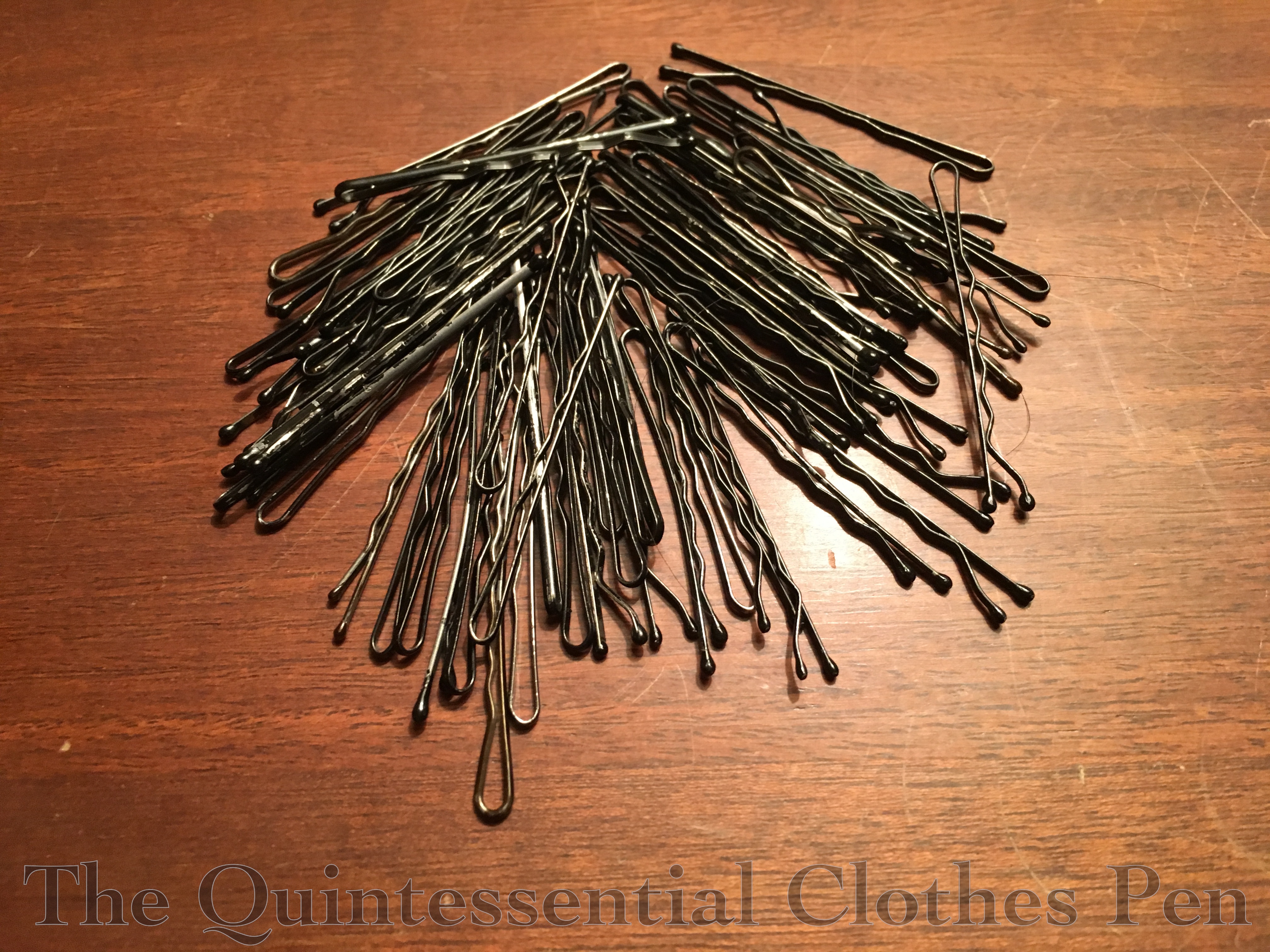
I counted the number of bobby pins it took to create this style at the end of the night when I took my hair down (and even kept the information in an easy to find spot for the last 12 months…).

The final count: 63 bobby pins.

The usual crew, fully outfitted for the early 19th century.

For the last few years I’ve worn my 1832 red velvet dress, so last year I changed it up and wore my 1824 green dress. I added a bit of holiday spirit with my red and gold tiara and other red and gold accessories.

This last one isn’t the best photo in some ways, but it captures the movement of my dress and the overall silhouette quite well!

This year it’s back to the 1830s with my red velvet dress. I’m looking forward to it after two years away! Maybe I’ll even post about before next December…!

Project Journal: 1863 Apricot Evening Gown Part X: Photos From The Ball

I was able to wear my new 1863 dress, Genevieve, to the Commonwealth Vintage Dancers’ Victoria and Albert Ball in September. I’ve spent a very long time sharing all about the dress and you’ve seen some photos of the wonderful staircases in the hall as I’ve shared finished construction photos, but I thought it would be fun to share a few photos of the ball as well, for context.

On the night of the ball, there were many dresses and tailcoats to admire in a range of years focused on the 1840s through 1860s. There was also the lovely ballroom to admire, with a famed organ at one end and many pretty details and portraits along the walls.

The guests of the evening filled the ballroom with dancing and socializing, while, in a side room, a spread of delicious refreshments was waiting to be devoured by hungry guests.

While getting more serious documenting-sewing photos, a few silly photos made their way in as well. They started off staged but reasonably not silly…

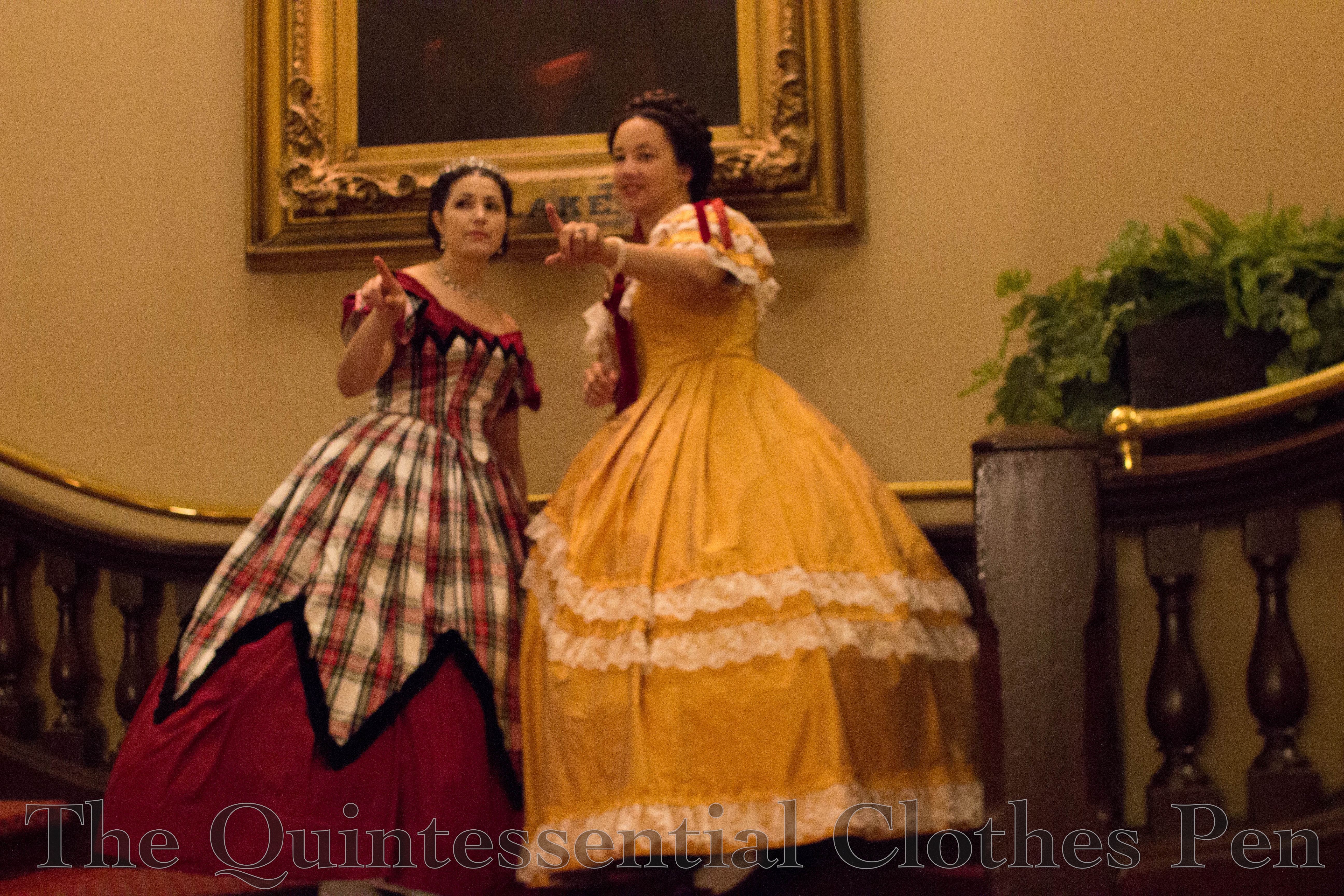
Then we tried to point at a non-existent something…

And that turned into silly-ness! I think this last one was: ‘Oh no! We’ve made the invisible object disappear with our magical powers!’

Thanks for sticking with me through so many posts about one dress!

19CBRE: Prudent Dance Planning

In 2014, I started a series of posts using the acronym 19CBRE, meaning “19th Century Ball Room Etiquette”. (You can read about my reasons for starting this series of posts in the original post here.) I’ve been on-and-off-again posting in this category (the last post was in 2016…), but I’ve had some further ideas in mind despite not actually posting them.

This quote reminds me of the final ball I attended at a mid-19th century dance week in Denmark in 2017. It is sound advice if you prefer to maintain calm composure and not follow an evening’s ball with a day of recovery!

“If you are prudent you will not dance every dance, nor, in fact, much more than half the number on the list; you will then escape that hateful redness of face at the time, and that wearing fatigue the next day which are among the worst features of a ball.

The Habits of Good Society: A Handbook of Etiquette for Ladies and Gentlemen. London: Hogg and Sons, 1859. 343. (Available online here)

The reason the quote reminds me of Denmark is because I most certainly did not escape “that hateful redness of face”! That’s a tall order in a warm room. I was also exhausted the next day, but that was due in part to a wonderfully long week of dancing all day each day. As evidenced in this case, sometimes these evils are worth facing… and sometimes I find that I would rather conserve my energy for the dances I really enjoy and not dance every single dance. My choice often depends on the venue, the special qualities of the ball, and the skill level of my partners. Facing a challenging set of dances in a special ball at a special place is more likely to lead me away from the etiquette manual’s guidance. What choice would you make?

If you’d like to read more of the snippets of etiquette I’ve highlighted over the years you can do so here.

Regency Intensive Dance Weekend 2019

It’s been two years since I last did a post covering the entirety of one of the Commonwealth Vintage Dancers’ annual Regency Intensive Dance Weekends. I thought this year would be a good year to bring back that tradition, so I made sure to capture moments throughout the weekend (or I helped friends make that goal happen!). So… prepare for a long post with lots of photos!

Saturday is a day full of dance classes. The name of the weekend does include the word ‘intensive’, right? The level of dancing achieved at this event is quite a step above a stand alone ball and I love how special that is. Here we are in the morning, learning the special steps that are particular to Regency dancing.

Saturday evening brings a ball to practice all the dance steps learned throughout the day. This year I decided to wear my red and gold 1813 evening gown and red and gold tiara with my red and gold reticule. I enjoy how well these different pieces coordinate with each other!

Amusingly, two other ladies were also wearing red and gold dresses. With cross fronts! Isn’t it neat how a description such as ‘red cross front short sleeve gown with gold trimming‘ can be the same but each dress is unique?

I find it pleasant to observe lovely clothing on elegant people during the course of ball. New dresses and accessories add a bit of excitement to a gathering! I enjoyed seeing this dress because I also have a dress made from the same Ikea curtain fabric.

Sunday morning we have more dance classes followed by a mixture of tea, promenade, and games in the afternoon. The activities have varied over the last seven years but we’ve always had an afternoon of non-dance fun incorporating at least a few of these activities each year. This year we started with a promenade. Thankfully we had good weather: a reasonable temperature with just a little bit of sun that accommodated pelisses, shawls, and spencers.

We ended on the town common and stopped for photos. Isn’t this one lovely?

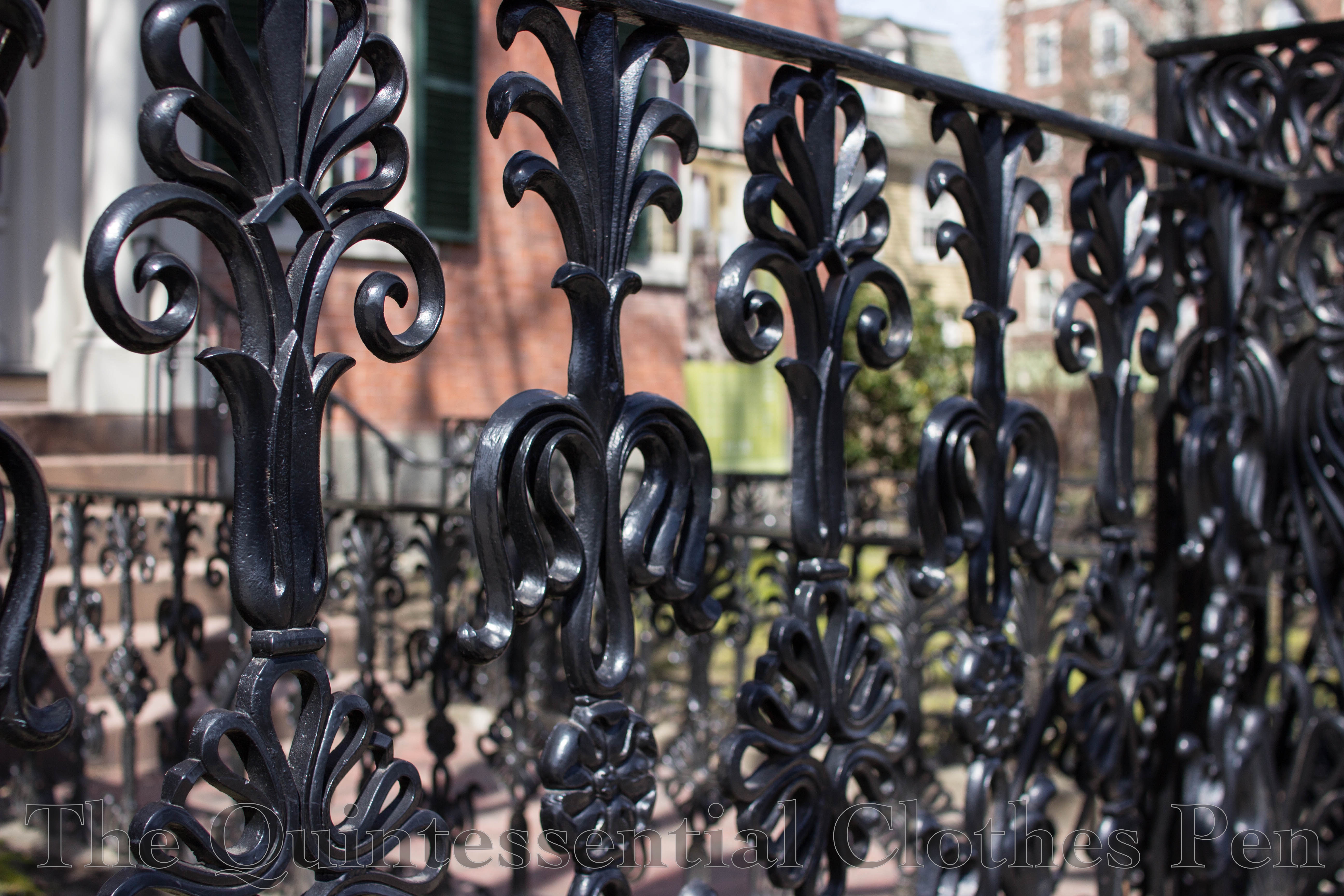
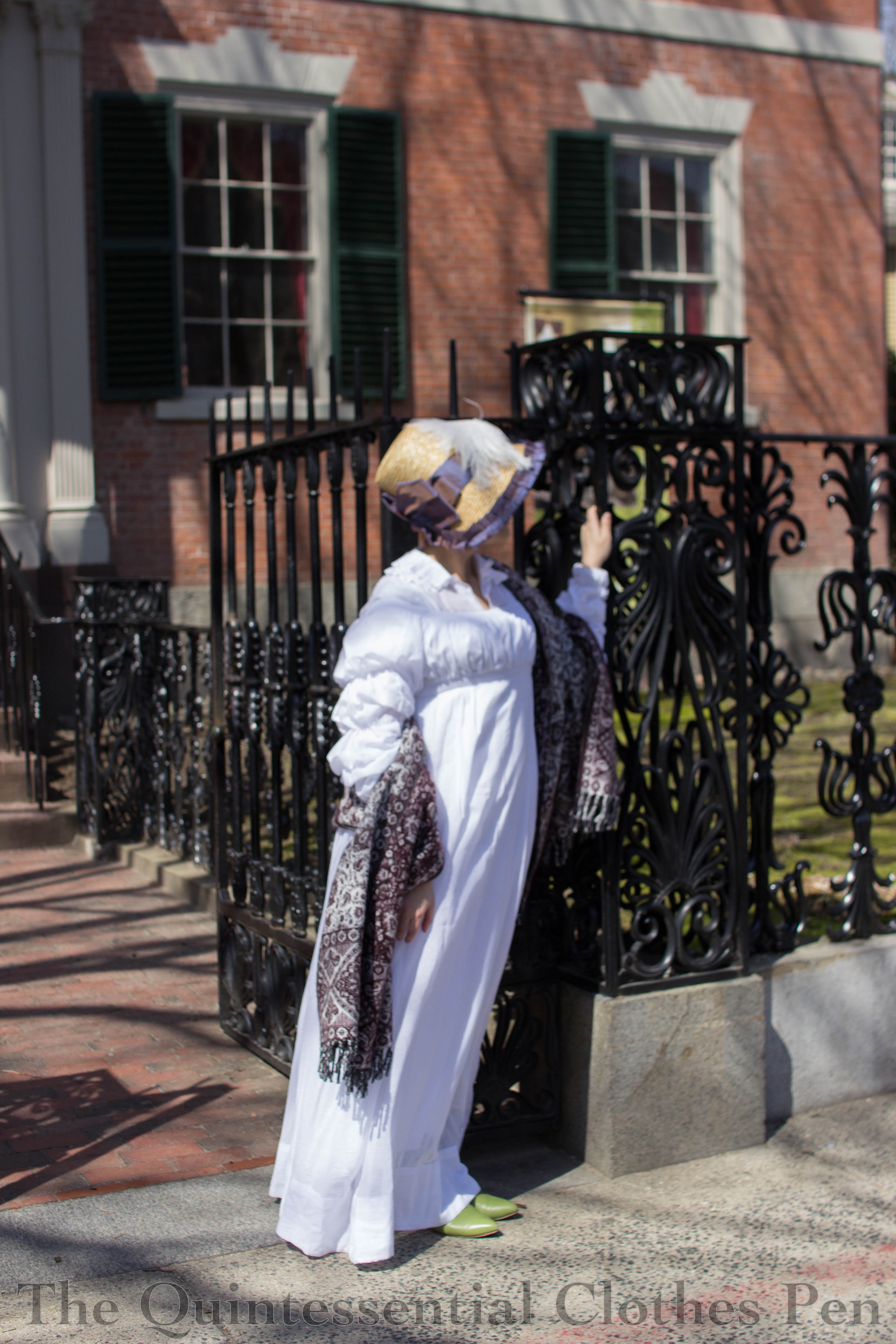
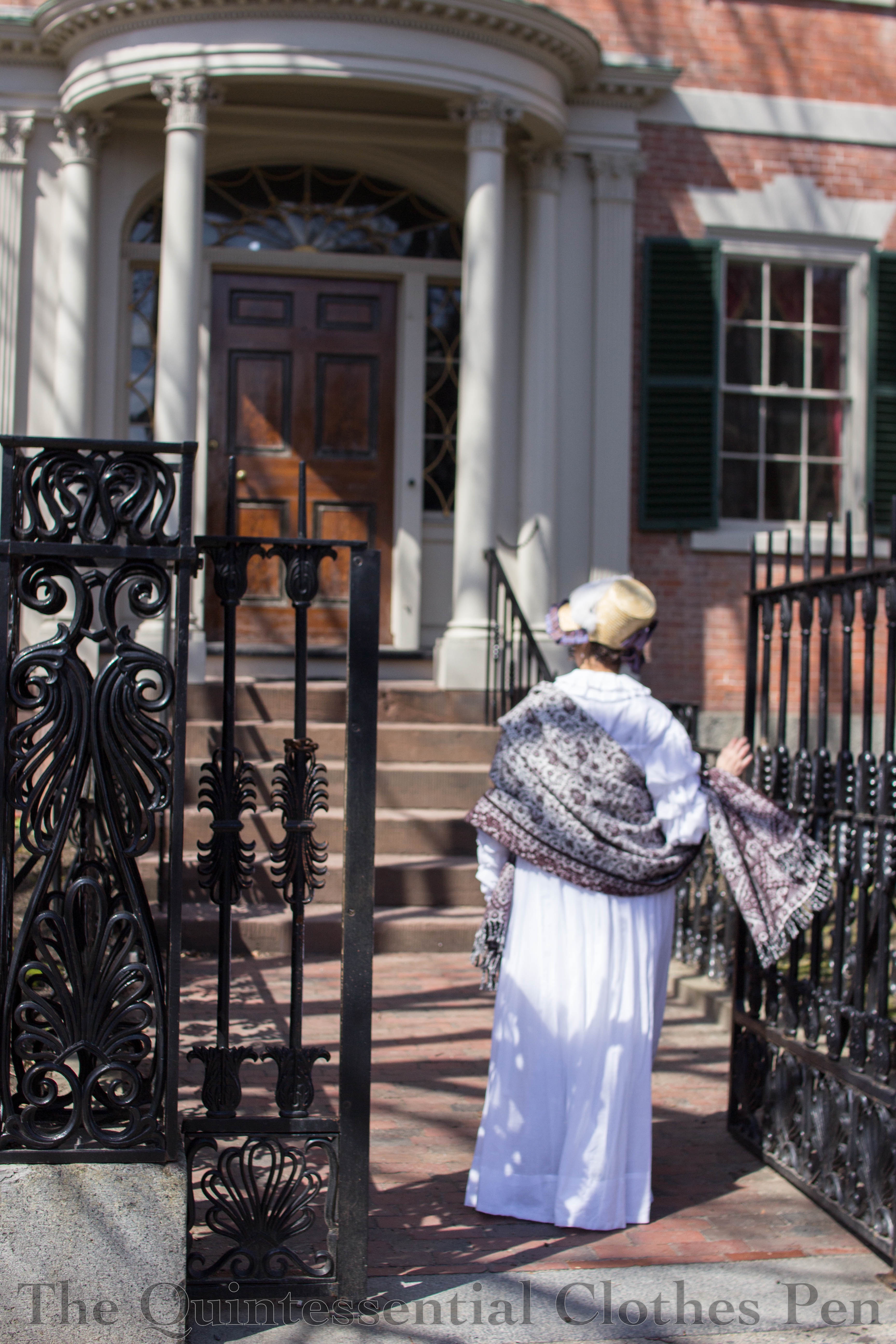
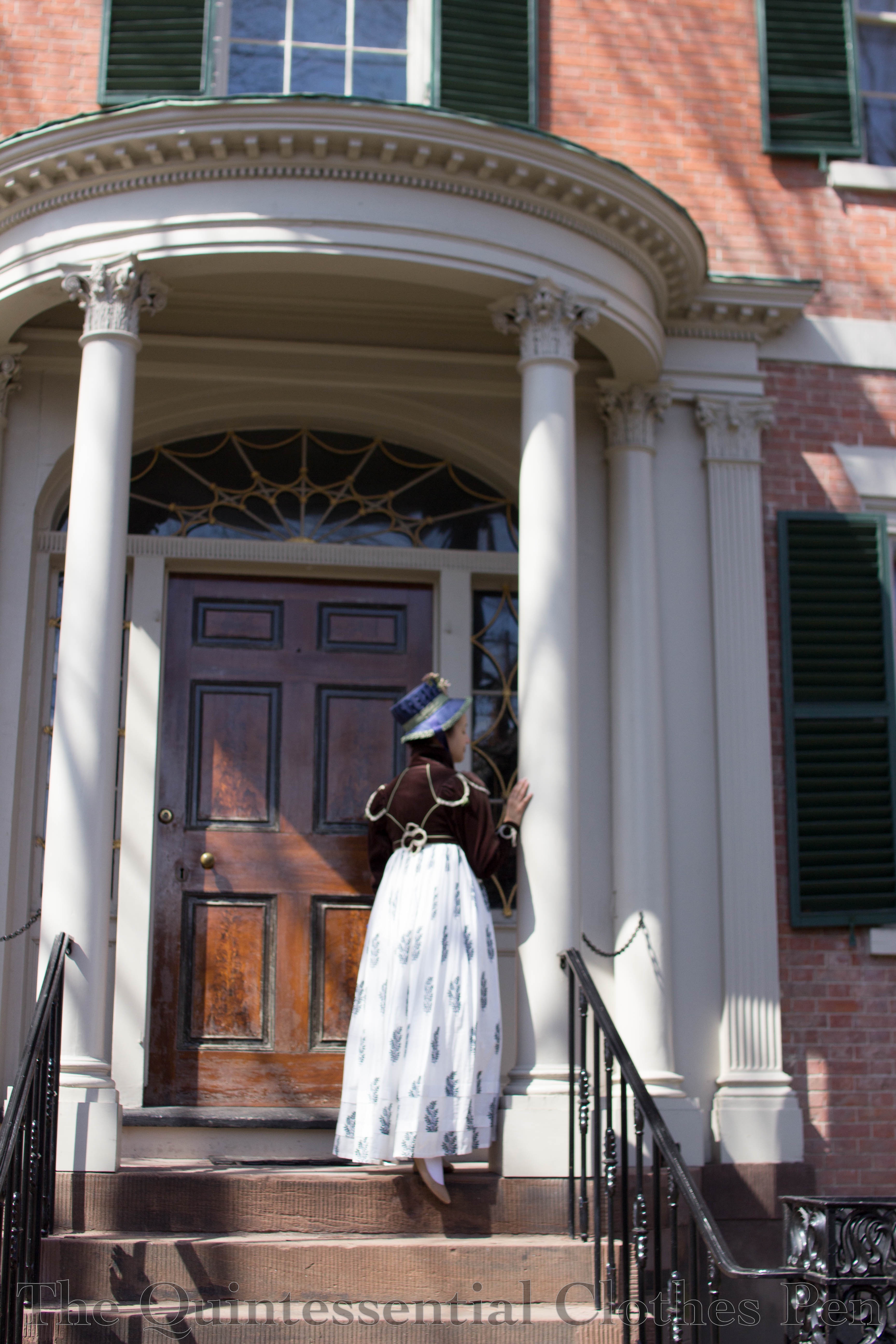
On our return stroll, I might have become distracted by one of the historic houses owned by one of the museums in town… The property had a fabulous wrought iron fence that I insisted we take photos with. Lots of photos… These are just a few!

As you can see, I wore my 1815 tree gown, 1819 spencer, and 1815 bonnet. Plus, I finally made use of a muff I made back in 2012 at Dress U! The scale of this muff is generally for the 18th century so I really haven’t used it since I made it, but the color matched my accessories so well that I decided to wear it with this outfit and I love the result. It’s super cozy and warm and the cover is completely separate from the down stuffed pillow inside so that in theory I can make other covers for it someday. This lovely item is the result of a class I took with LadyDetalle. (She has an Etsy shop that often stocks muffs like this as well as many other beautiful and historically inclined goodies.)

Back at the hall, tea was well underway. This year’s group really enjoyed chatting with each other and playing games. It was charming to observe such enjoyment.

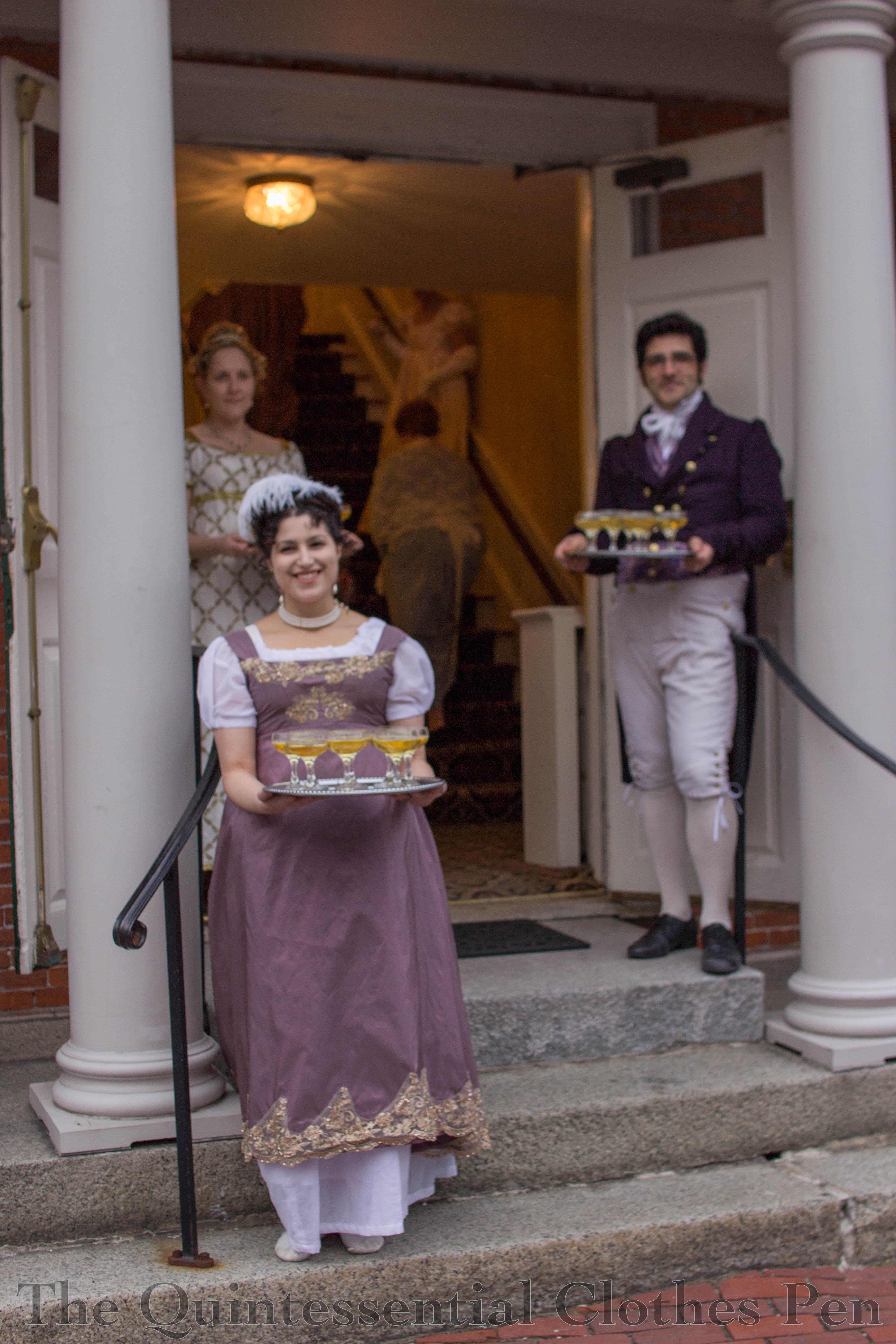
Not too long after tea comes the grand ball across town. We have always started this ball with a reception that includes champagne sabering in a little park just near the hall.

Arriving back at the hall, guests are greeted with sparkling cider.

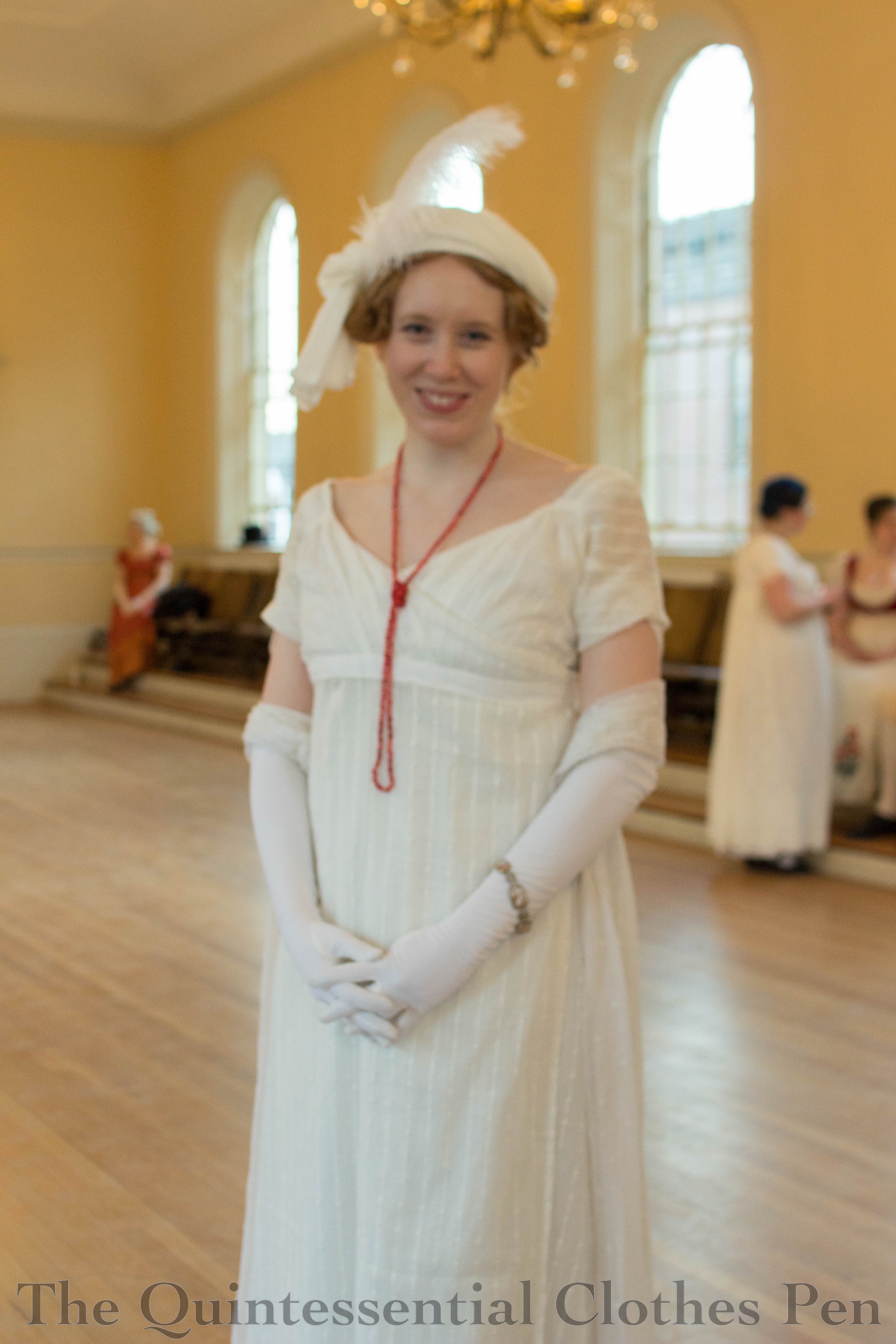
We took a few minutes out of the evening to document our clothing, as one does. I wore my 1817 Gold Stripe Duchess evening gown again (I just wore it in February as well), but with different accessories. I love how these accessories changed up the dress to have a different feel. This wearing included my 1819 purple hair flowers, purple shoe clips, the new necklace and earring set from the wearing of this dress in February that is from In The Long Run Designs and a white organza sash just like the green one I wore in February. The white really didn’t show on this dress except for a hint of fluff at the bow, but the two purple accessories stood out and of course the jewelry was sparkly and wonderful!

Purple and gold seemed to be a theme at this ball, just as red and gold was the night before! Raven of Plaid Petticoats had a new dress that fit the theme very well. She and lots of helping hands were working on the dress all weekend in order to finish it for the ball!

It’s quite grand, seeing everyone dressed in their Regency best for this ball. And I think many people are surprised by how well the dancing goes! It’s a special treat to have such advanced dancing.

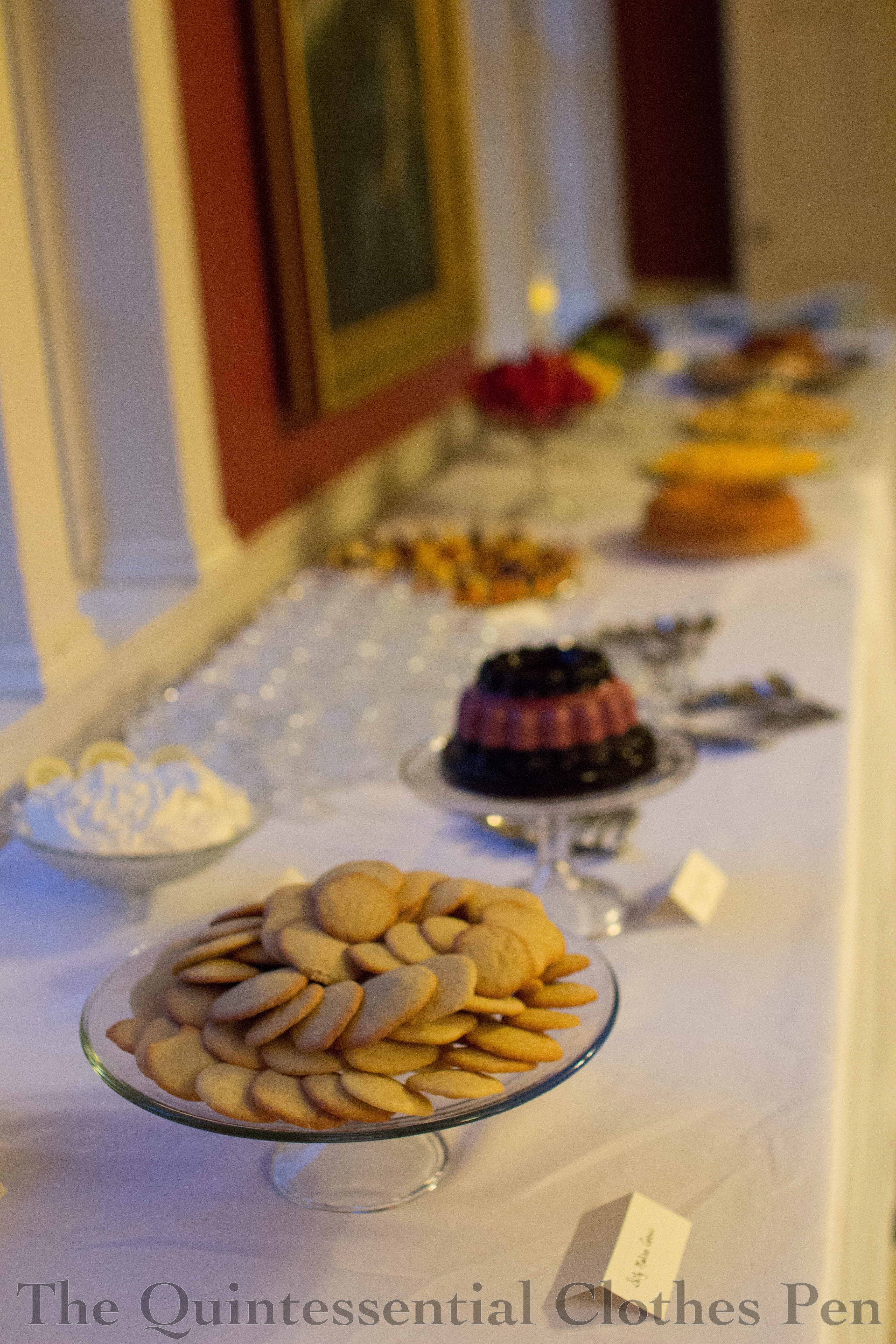
This ball is always accompanied by lavish refreshments carefully arranged to impress.

And at the end of two wonderfully long days of dancing I’m always exhausted! I hope that reading through this post was exciting and not exhausting! If you’d like to read more about the magic of previous years, I posted about the Regency Intensive Dance Weekend in 2013, 2014, 2016, and 2017 as well.

1817 Gold Stripes And Face Framing Curls

Back in February, I was able to re-wear my 1817 Gold Stripe Duchess Gown to The Commonwealth Vintage Dancers’ annual Regency Ball.

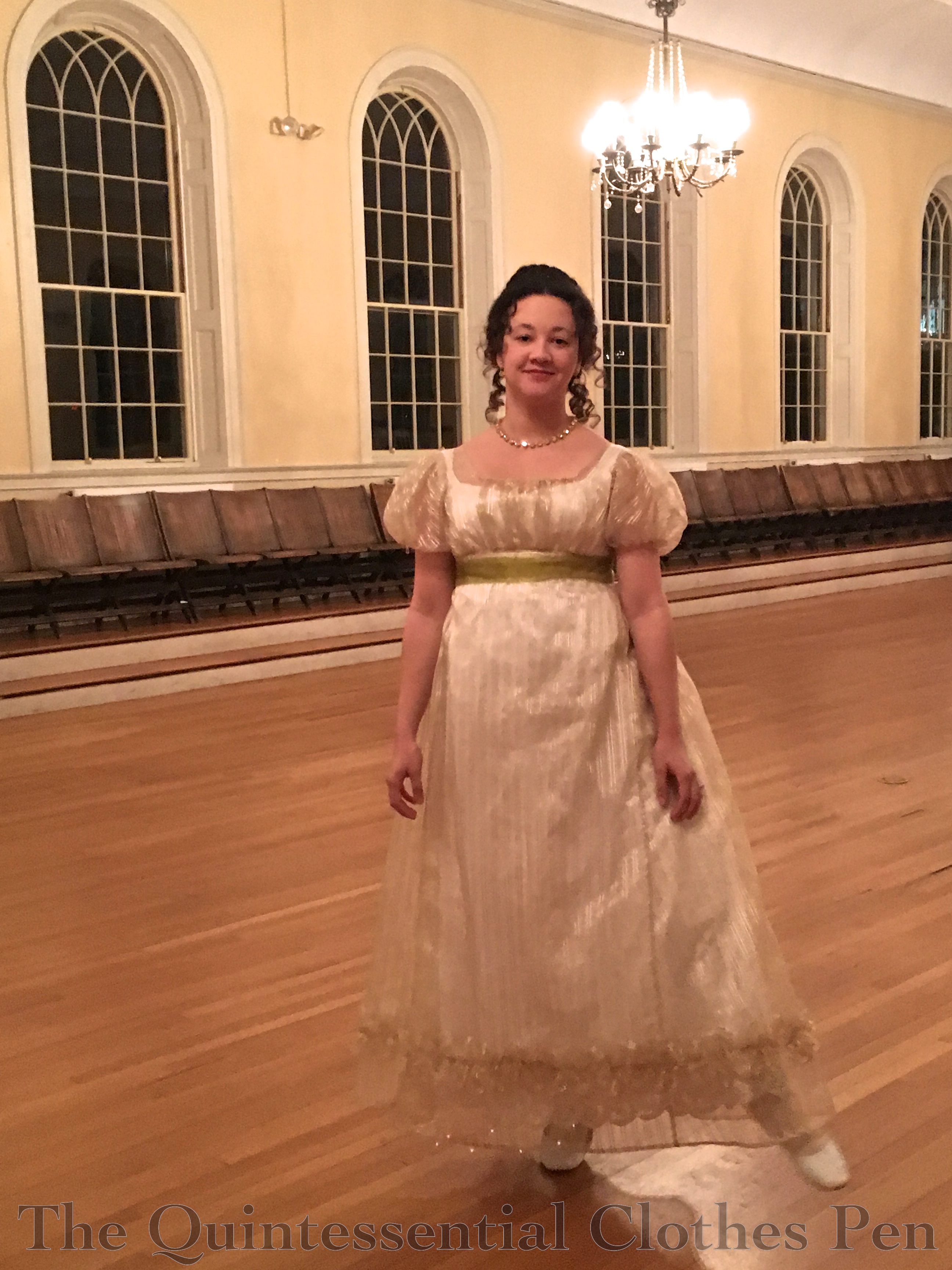
I love this dress! The sheer fabric is unusual to see in modern recreation settings and has lots of body, making for a lovely shape that is fun to dance in. It turns out that the gold stripe is rather neutral, so I’ve had fun accessorizing it in different ways this spring. We’ll start with this wearing, but there’s another one to blog about as well!

This time I decided to add a bit of color to the dress by adding a wide chartreuse organza sash with a simple bow in the back and rather long ends. (I’m all for variation in ribbon sashes for Regency dresses. In fact, I wrote a post detailing different sash styles a number of years ago!)

I also added lovely new jewelry from In The Long Run Designs. The color I chose, jonquil, is a light yellow color . It compliments my skin tone and adds quite a bit of neutral-toned sparkle to my ensembles (the goal was to match as many dresses as possible so I can get the most use out of the set).

The day of the ball I thought I had lots of time and so I decided on a whim to do a complicated hair style with face curls. It turns out I was off by an hour but I didn’t realize it until I was in the car! Thankfully I arrived in time and didn’t cause anyone else issues with my lateness. Oops! But I was very pleased with my hair (and the fact that it was done before I arrived to get dressed definitely helped offset the fact that I was late).

The hairstyle is directly inspired by the following image of Maria Leopoldine of Austria from 1815 (source). I have a note that it was painted by Friedrich Johann Gottlieb Lieder but I can’t find documentation for that detail outside of my note-to-self. Maria Leopoldine caught my eye because I love big braid buns (my hair does volume so well!) and I thought it was high time to try face curls again (see my 2014 attempt and a different narrower circumference of curl in 2016 to see other attempts I’ve posted about).

So off I went with a curling iron to try and reproduce this hairstyle. Given that I thought I had lots of time, I even took photos of the process so I could share it with you!

Let me start by saying that yes, even though my hair is curly I still use a curling iron (or other curling method) to get precise curls. To show the difference, here’s my hair at a partially done stage. You can see the curling iron curls to the left of my forehead and chin with my natural curls being held sideways in between them and on the right side of my face.

How did I get to that point? I’ve determined that great looking historical hairstyles are often styled in many parts. The complicated thing about face framing curls with my hair is that it’s all quite long: past my shoulders when it’s curly and almost to the middle of my back when it’s straight. I don’t have short lengths around my face to curl, so I have to fake it with long lengths that are pinned up to be shorter.

To begin, I split each half of my hair into sections–a front top section, a back top section, a section behind my ear, and the rest of the hair on the back of my head. In the photo above, I’ve already used the curling iron to curl the top back section of hair, pinned up some of the length, and used the front top section of hair to smooth out and cover up the pinned up length. I’ve also curled the back section behind my ear and pinned the curls up to shorten them as well. The rest of the hair is being held out to the side so you can see the different sections I’m referring to.

I realized after taking that photo that I should show a better example of what all of those words mean. So in the next photo I’ve let go of the back section and put a loose hair tie around it to keep it separate from my nicely curled sections. And I’ve curled the back top section of the other side of my hair, but I haven’t pinned those curls up to shorten or arrange them. I’m holding the front top section up in the air so you can see how untamed the curling iron curls look before being arranged.

The curls are the hard part. After arranging the top front sections and pinning them down around the back of my head it was a matter of wrapping and pinning up the back sections to look nice and make a big bun on the top of my head. I’m pretty sure I used a big bun form under there (the medium one from my Versailles hair in 2016–and for reference that post pretty clearly shows how long my hair is–it’s great for volume but can be a lot to wrangle), but it’s hard to remember as that was now almost three months ago and I didn’t take photos of those steps!

The final step was to wrap and pin my trusty (and yikes, 15 years old!) faux braid around the bun and give the whole thing a liberal dose of hairspray!

I love that I’ve found a new look for this dress and a new historical hairstyle. Looking at the photos, it doesn’t look like my braid bun is quite as large or wide as Maria Leopoldine’s (I’ll have to try again someday!). Despite that, I was very pleased with the face framing curls and the bouncing curls behind my ears. The style felt very regal!