1896 Bicycling Ensemble: Construction Details

As promised, I have quite a few words and photos to share with you about the construction of my 1896 Bicycling Ensemble, so prepare yourself for a long post! This post is a great reference for me to have all the details in one place, but I also hope that some of my details might be helpful for other people who want to build 1890s cycling outfits as well.

If you want to read a bit more about the social history of the bicycle ensemble, see more finished ensemble photos than the few in this post, or read more about the accessories I’m wearing with this ensemble, check out my first post about it (this is the same as the first link). I also have a post looking specifically at patents and advertisements for women’s bicycling clothing from this time. It’s a great supplement to some of the information I mention in that first post.
This post is going to focus on the main garments that make up this ensemble: the jacket and bloomers. We’ll start with the two main similarities between these garments.

#1 Both garments are mostly machine sewn, with hand sewing for the tailoring steps of the jacket as well as much of the finishing of each garment.

#2 Both jacket and bloomers are made from a drab colored wool that has been in my stash since 2012. I purchased it from the remnant table at the local discount fabric store for the amazing price of $3/yard! I bought every piece they had, so I have about 10 yards broken up in about 6 different pieces. I used less than half of what I purchased for this project, leaving me plenty to use this for an 1880s dress as well. (That one has been in progress for the last 18 months… I hope to finish it this year!)

The drab colored wool is perfect for this cycling outfit, not only because I already owned it and it has been taking up space for years, but also because drab was a popular color for cycling outfits because it successfully hid dirt and dust. Other recommended colors were brown, black, and navy.

The Bloomers

Now that we’ve looked at the similarities let’s look at the differences, starting with the bloomers.

These are entirely self drafted. While that might sound intimidating, these are actually quite simple! Each leg is the full width of the fabric, 60″ wide, and 33″ in length. On my 5’6″ frame that provides plenty of pouf in the legs when they are held in place around the tops of my calves. The only shaping is in the crotch seam, which is a curve ~5.5″ wide and ~12″ deep. The crotch curve is deep enough and the bloomers are full enough that I made the crotch curve the same for the front and back. Here’s a photo of the crotch curve drawn out before I cut it.

The fullness of the 60″ wide legs is pleated into the waistband with knife pleats folded towards center front and center back. Knife pleats are documented in sporting bloomers from the 1890s and are specially mentioned as being folded this way in order to help the bloomers maintain the full look of a skirt, in keeping with the social convention that skirts were acceptable wear for women but bifurcated bloomers were not. I experimented and decided I liked just a few deep knife pleats as they helped the bloomers fall nicely on my body.

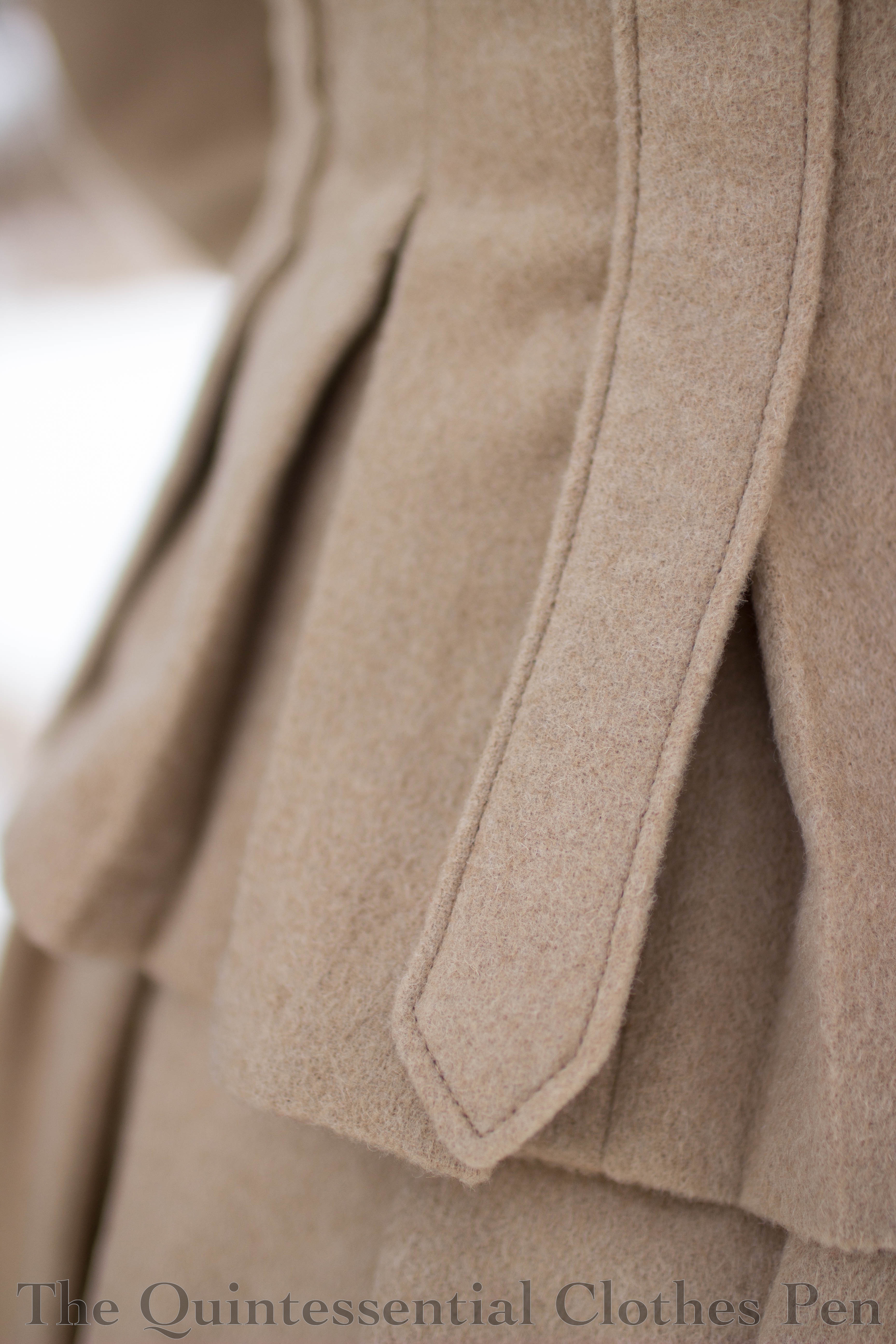
I debated about how to gather in the fullness at the bottom of the legs, especially since I couldn’t find specific instructions on how this was accomplished or see this particular detail given the way extant bloomers are displayed. I decided on gathering each leg into a band that hooks so that it stays in place at the top of my calf. There is a 3″ slit in the leg as well. The raw edges of this are turned under ¼” and whip stitched by hand. There is also a small reinforcing bar sewn across the top of the slit to keep it from ripping. Here’s a closeup of the leg opening.

The inside of the bloomers looks like this. There are two decorative strapping details on the front of the bloomers (more on that when I get to the jacket). These conceal a placket opening on one hip (visible on the far left) and a pocket on the other! The crotch seam and inseams are left unfinished. This wool did a pretty good job of not fraying at the edges so there was no need to finish these seam allowances.
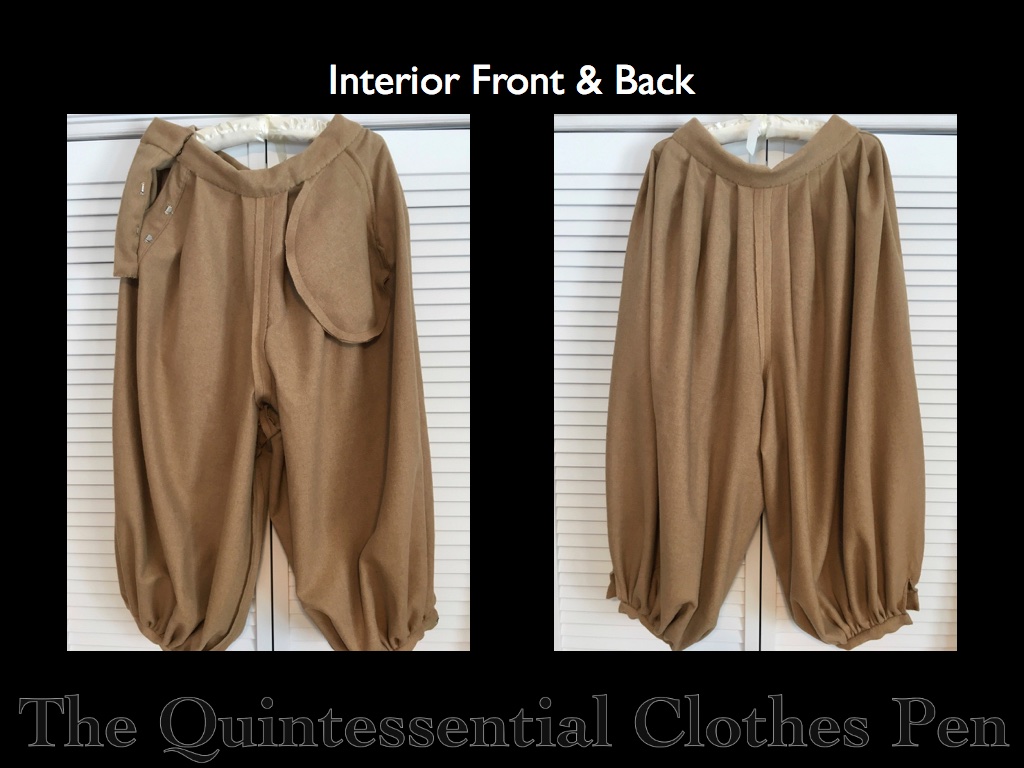
Here is a closeup of the placket opening that is hidden behind one of the strapping details. You can also see the interior of the waistband, which is whip stitched to hold it in place. To be entirely fair, I could have made bloomers on a waistband without the strapping and pocket and saved a fair bit of time. Stitching the strapping bits on and hiding the placket and pocket behind them required some extra brain somersaults and time to figure out and execute. But I really like the strapping detail on this extant bicycling ensemble from 1896 at The Met and really wanted to include that detail in my own garments, so here we are.

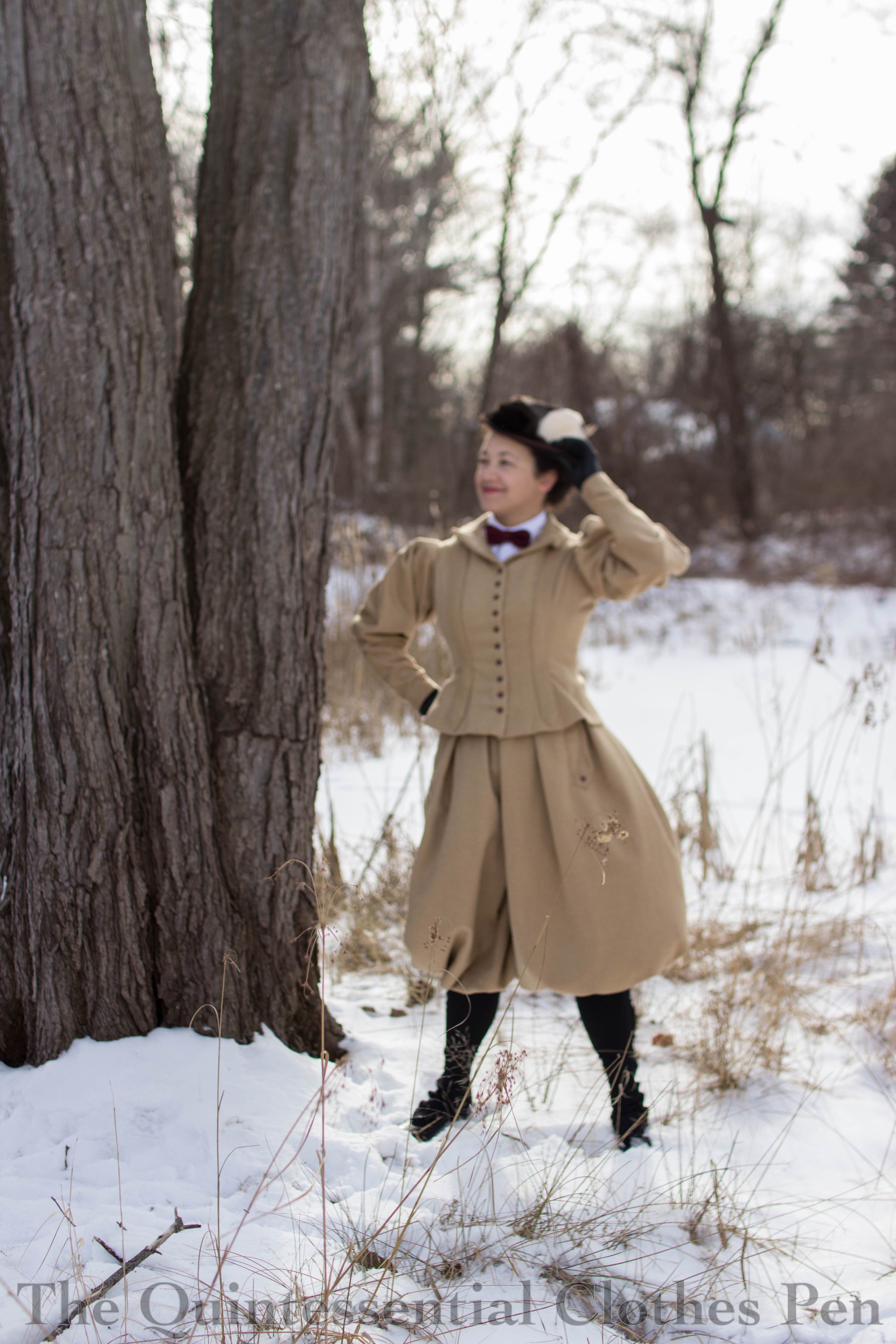
Here’s what the bloomers look like when the wind filled them out during our photoshoot. This gives a better idea of how much fabric is in each leg of the bloomers.
The Jacket

I wanted to have a tailor-made style with a lapel and collar that would follow the general style of men’s jackets in the 19th century. Most bicycling ensembles are of this style, due in part to the fact that this type of activity was traditionally a male pastime. The specialty clothing produced for men’s active pursuits was made by a tailor, so it follows that women’s clothing began to be tailor-made as well as they joined in these male activities in the later part of the 19th century.

I started with the pattern for my 1895 Skating Ensemble because I knew it had the general shape of the mid-1890s and that it already fit. That pattern was made by me, based on my inspiration jacket for that ensemble as well as patterns published in Authentic Victorian Fashion Patterns. I had already modified it to get the shape of the skating jacket, but I modified it even more to create this new jacket. I made these further changes:

  • Created princess seams on the front and back that run down from the shoulders instead of the armsceye
  • Joined the side back pieces to make a single wider piece instead of two narrower pieces
  • Moved the new side back seam towards the side seam
  • Added back pleats, front darts, and a lapel and collar
  • Shortened the length

At this point it’s really not close to the original pattern at all!

The sleeves are my standard 1890s gigot sleeve that originally came from Period Costumes For Stage and Screen. I wound up making a number of changes to the pattern to get a slightly different shape. Below you can see my progress.
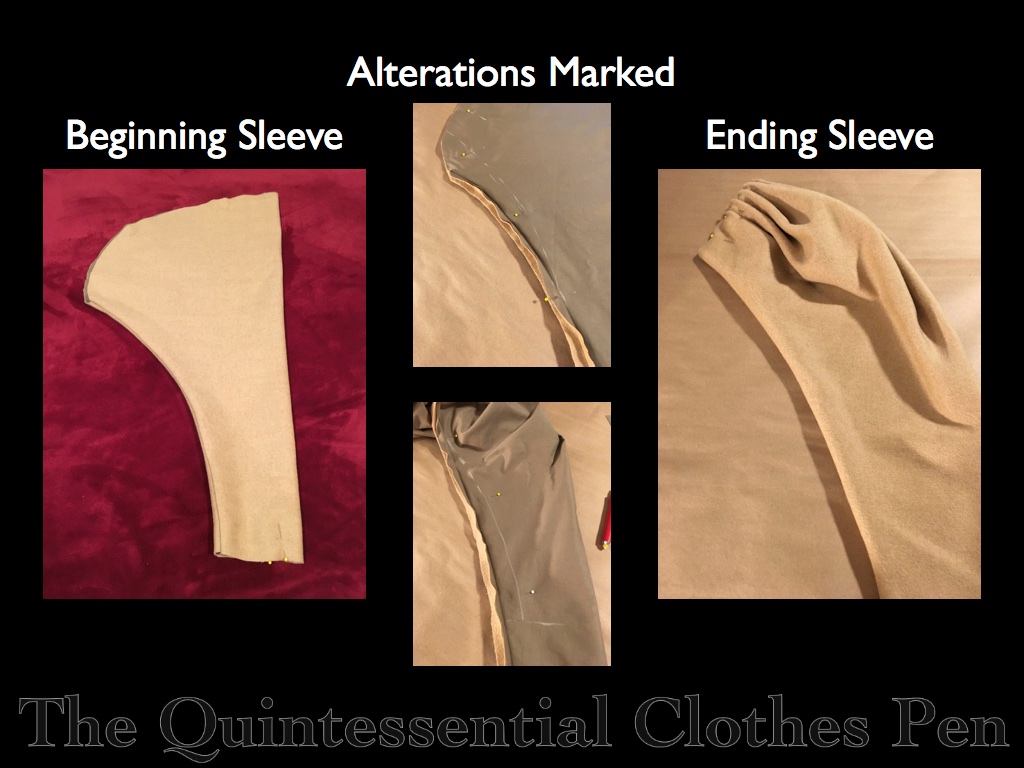
After trying out the original sleeve I made two major changes to the shape, angling the underarm seam at the top/making the top less full and angling the underarm seam at the bottom towards the wrist/shortening the length. After pleating each side of the new sleeve towards center I ended up with the sleeve shape on the right.

After I had a pattern I was confident with I started cutting my pieces. Each exterior piece was cut in wool and cotton in order to be flatlined. The front and collar facings are single layers of wool. There are also canvas interlining pieces for the front and collar.

The proper way to flatline is to pin your layers together and then (preferably) hand baste around each piece to hold the layers together while working with them. I opted to eliminate the basting step, using pins to hold the layers together until they were sewn. My fabrics were pretty sticky so this time-saving shortcut worked pretty well. You can see the pins holding the non-sewn edges together in this photo of the exterior after assembling the front and back pieces.

This is also one of the only steps that show the front darts, as those were hidden under the decorative strapping I added to the jacket later on. The other amusing thing here is that because I was cutting my garment pieces from multiple pieces of wool you can see a color difference here between the center back pieces and the other pieces. But it’s not noticeable in the finished jacket, so that’s good!

And here’s the jacket at the same point in the process, turned over to see the inside. Now the flat lining is clearly visible, as are the box pleats along the back seams. You can also see the canvas that runs down the fronts.

Here is just one side of the front. It gives a clearer view of the front dart and the canvas that supports the lapel and front edge.
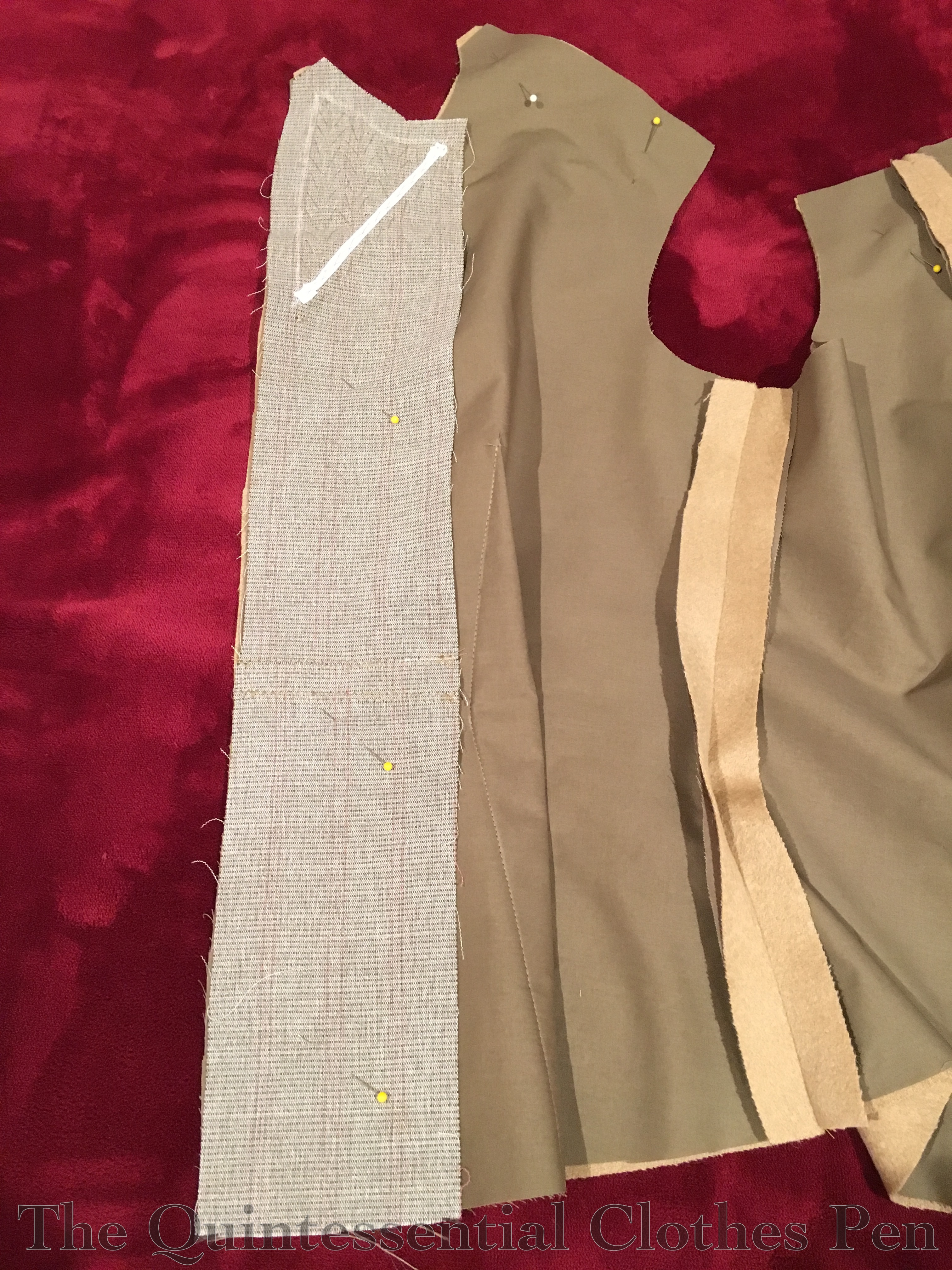
I pad stitched the lapel and taped the roll line in men’s tailoring fashion. These stitches help to support the roll of the collar. The tape running across the roll line snugs that distance in just a bit which helps the collar roll in exactly that spot.
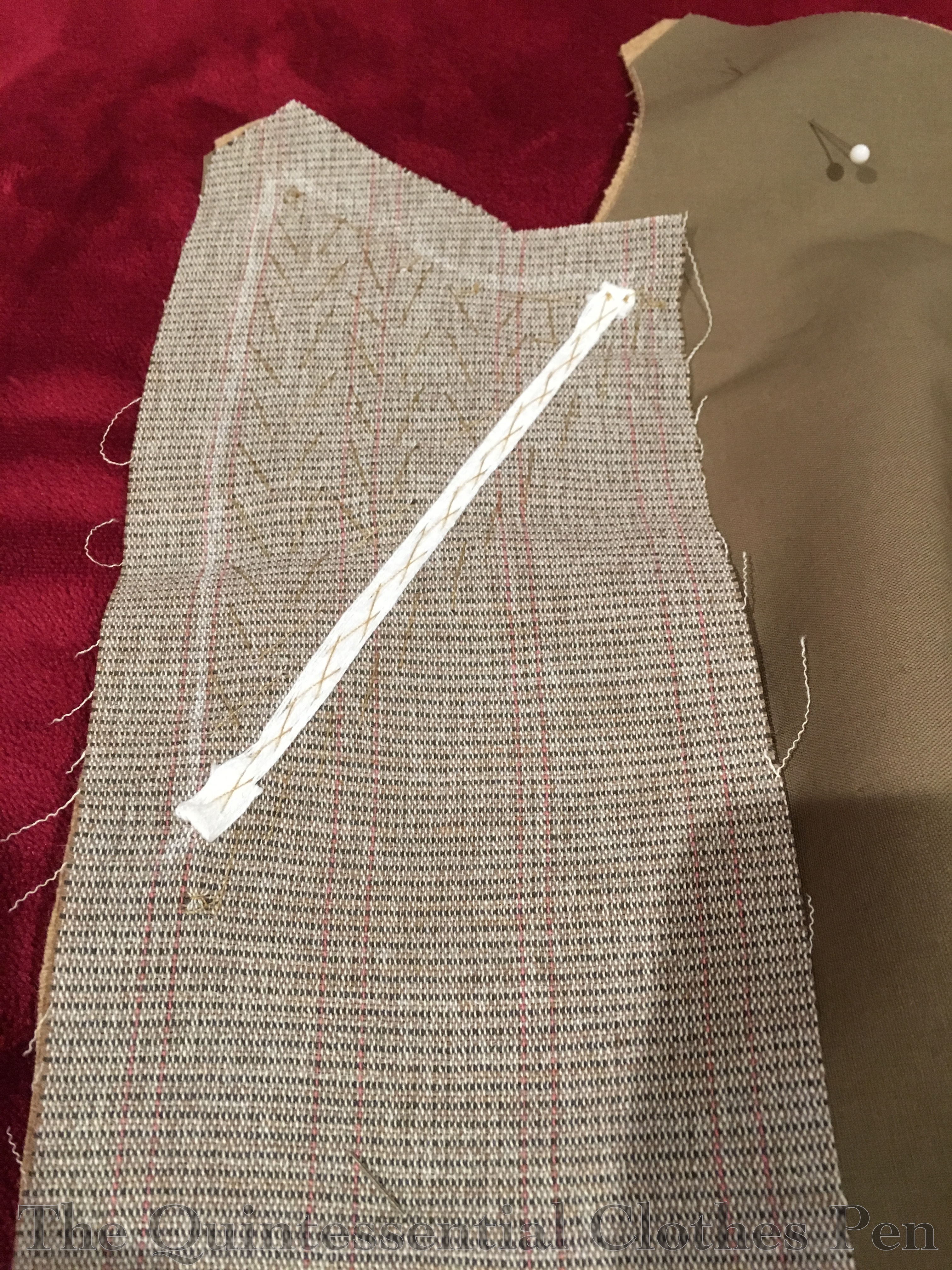
I decided not to try to pattern the strapping with the main body pieces. It just seemed too complicated to wrap my head around. I knew they wouldn’t be straight, as my body is curved, and I knew that making them on the bias would be a disaster to try and manage the edges of… I decided to deal with this step when I got there in the construction process.

Accordingly, when the jacket had all of the vertical seams assembled it was time to consider the strapping. I did this at this step, before sewing the shoulder seams, as I wanted the strapping front and back pieces to perfectly match along that seam. Easier to pattern flat than if I’d already sewn the shoulder seams!

I laid the jacket out on the table with a scrap piece of wool on top of it, put pins along the seam line to mark the location (so my strapping would hide the seam), and then drew a strapping shape I liked around that. As you can see, I didn’t follow the curve of the seam perfectly. That was an intentional choice, as I wanted the strapping to have a similar curve as the curve on the strapping of my inspiration jacket (here is the link to that again, in case you want to take a look and not scroll all the way up to the first link).

I repeated this process for the front (which was trickier with the shaping that dart creates!) then cut out four of each piece. I decided to finish the edges by making a tube that was topstitched by machine before being hand sewn to the jacket

I can’t imagine how horrible it would have been to try to topstitch the straps onto the jacket! Bad… very, very bad! And trying to turn the edges under and then topstitch would not have provided enough stability for crisp edges and would also have been a frustrating experience. Thank goodness I avoided those potential problems!

Here are two of the four straps, pinned and ready to be stitched together. The only edge I left open is the straight edge (at the right) that would go into the shoulder seam. After being sewn and trimmed these were turned right side out, pressed, topstitched, and carefully placed at the shoulder seam so that they would match up perfectly when the seam was stitched. The edges of the straps were then invisibly hand sewn to the jacket.

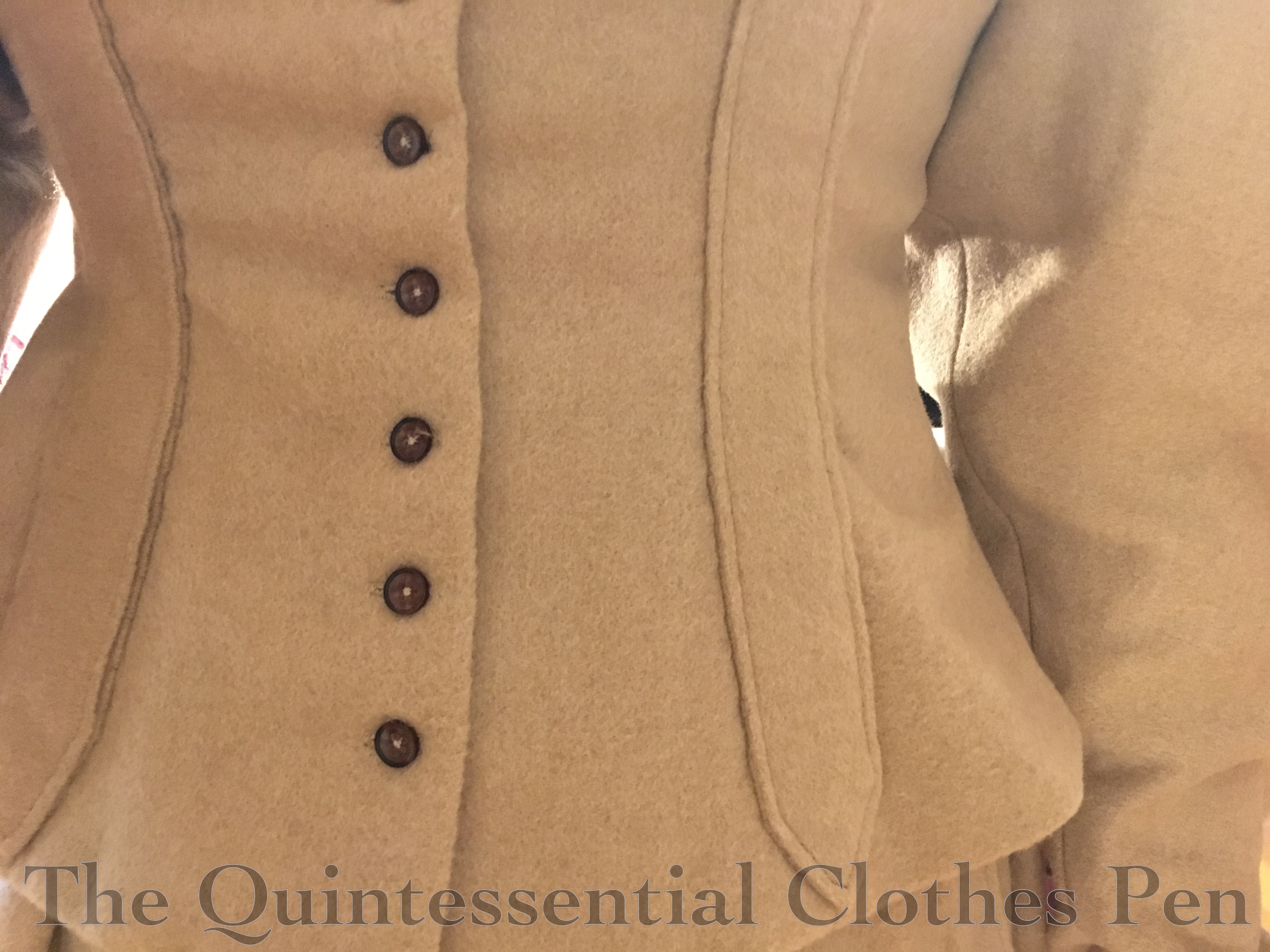
Here’s the end result. The straps look topstitched onto the jacket, but they are actually finished pieces that are fully sewn down in front but only attached above the pleats in the back, allowing the bottoms to flap amusingly! This detail is again taken from my inspiration jacket (and here is the link to that again).

As I mentioned earlier, the bloomers also have a strapping detail taken directly from my inspiration bicycle outfit at The Met. Those were carefully patterned–they look straight at first glance but are actually slightly angled and tapered. They are made in the same way as the jacket strapping pieces, though as I mentioned earlier, they were more complicated to put onto the bloomers as they conceal a placket on one side and a pocket on the other. That was a figure it out as I go experiment that required precision and quite a bit of puzzle-solving!

The collar was interlined with canvas and pad-stitched to provided stability for the shape. Then it was sewn around the edge by the machine and the seam allowances were graded before I turned it right side out.

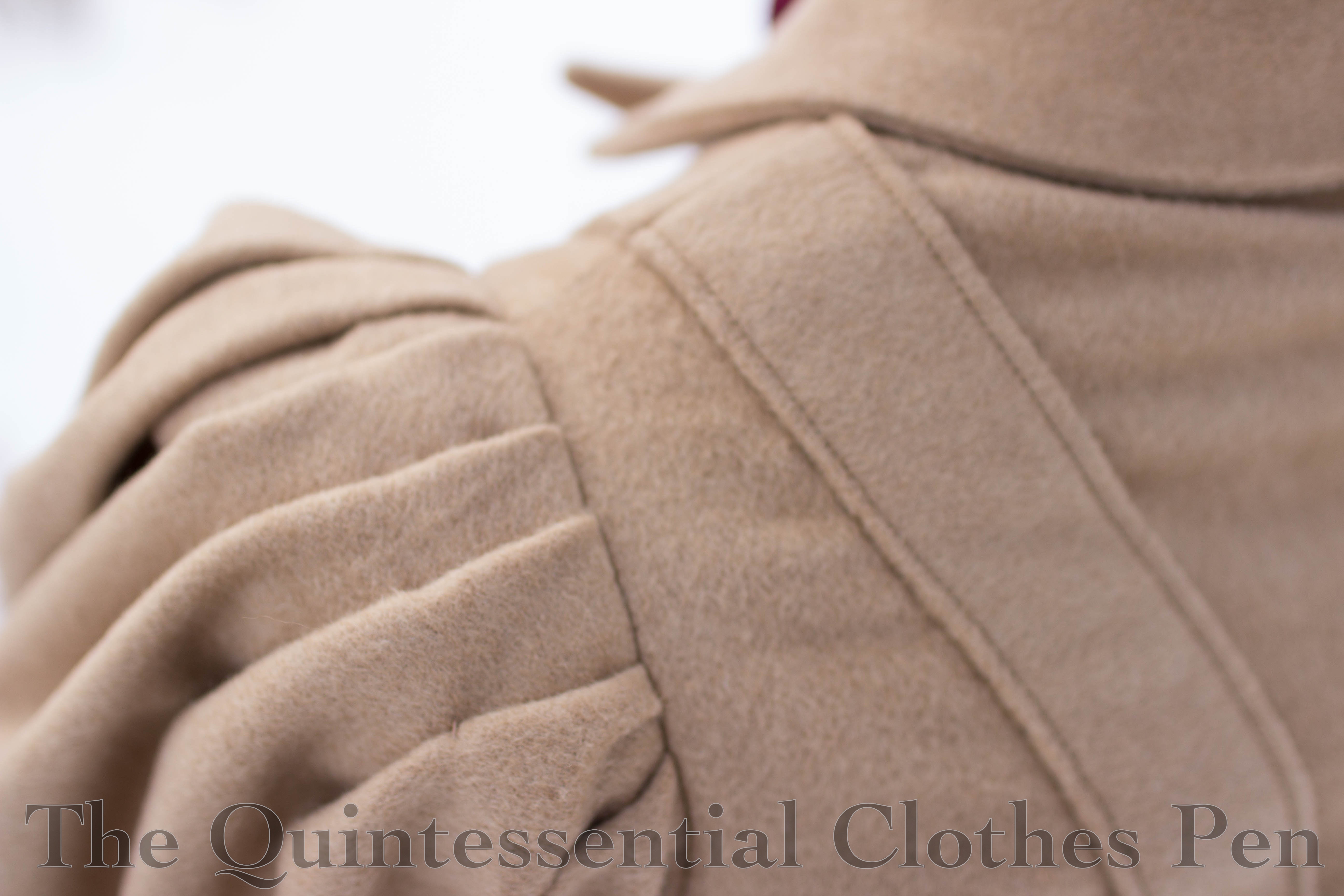
The sleeves are pleated to take in the fullness to fit the armsceye. There are 10 pleats total, each about ½” (1″ total) in depth. Here’s a photo looking down into the sleeve with all the pleats pinned in place. The box pleat (that is slightly off center in the photo) is the top of the sleeve when it’s set into the armhole of the jacket.

In this next photo we’ve progressed quite a few steps! The sleeves are set, the collar is on, the front wool facings are on, the collar edge and facing edges are turned under and hand sewn in place. I’ve finished the bottom edge of the jacket with a bias strip of cotton that was machine sewn then pressed to the inside and hand sewn into place (this is also how I finished the sleeve cuffs). The buttons are on and the buttonholes sewn by machine. I’ve whip stitched all of the seam allowances to keep them from fraying and added some extra support for the sleeve caps. I’ve also added a waist stay. Quite a few hours of work to condense into one paragraph!

The waist stay is a grosgrain ribbon sewn to the seam allowances that hooks in the front. Its purpose is to keep the jacket tight against my lower back and to keep the jacket from riding up as I use my arms. The photo below shows a close up of this as well as a number of other details–the bias binding at the bottom, the whip stitched seam allowances, and the pleats tacked to the lining along the top edges.

The sleeve pleats wouldn’t stand up on their own which made me a bit sad. My solution was to give them a bit of support… in this case I reused stiff net sleeve headers removed from 1980s dresses that I have a whole bag of in my stash. Each jacket sleeve has two of these sewn into the armsceye such that they stand up off my shoulder and help to support the pleats. In this photo I’ve just flipped them out to make them easier to see, but normally they’re tucked up inside the sleeve.

I also tacked the pleats together by hand about 1.5″ away from the seam. This helps keep the pleats nicely arranged and pointing up, which helps keep the fullness of the sleeves in check. In the end, this sleeve isn’t quite the same shape as my Met inspiration (here’s the link one more time), but that’s because it would have taken a lot more patterning time to determine exactly how the Met sleeve is shaped. I wanted to use my existing sleeve pattern and so I’ve decided to be happy with the sleeves I have.

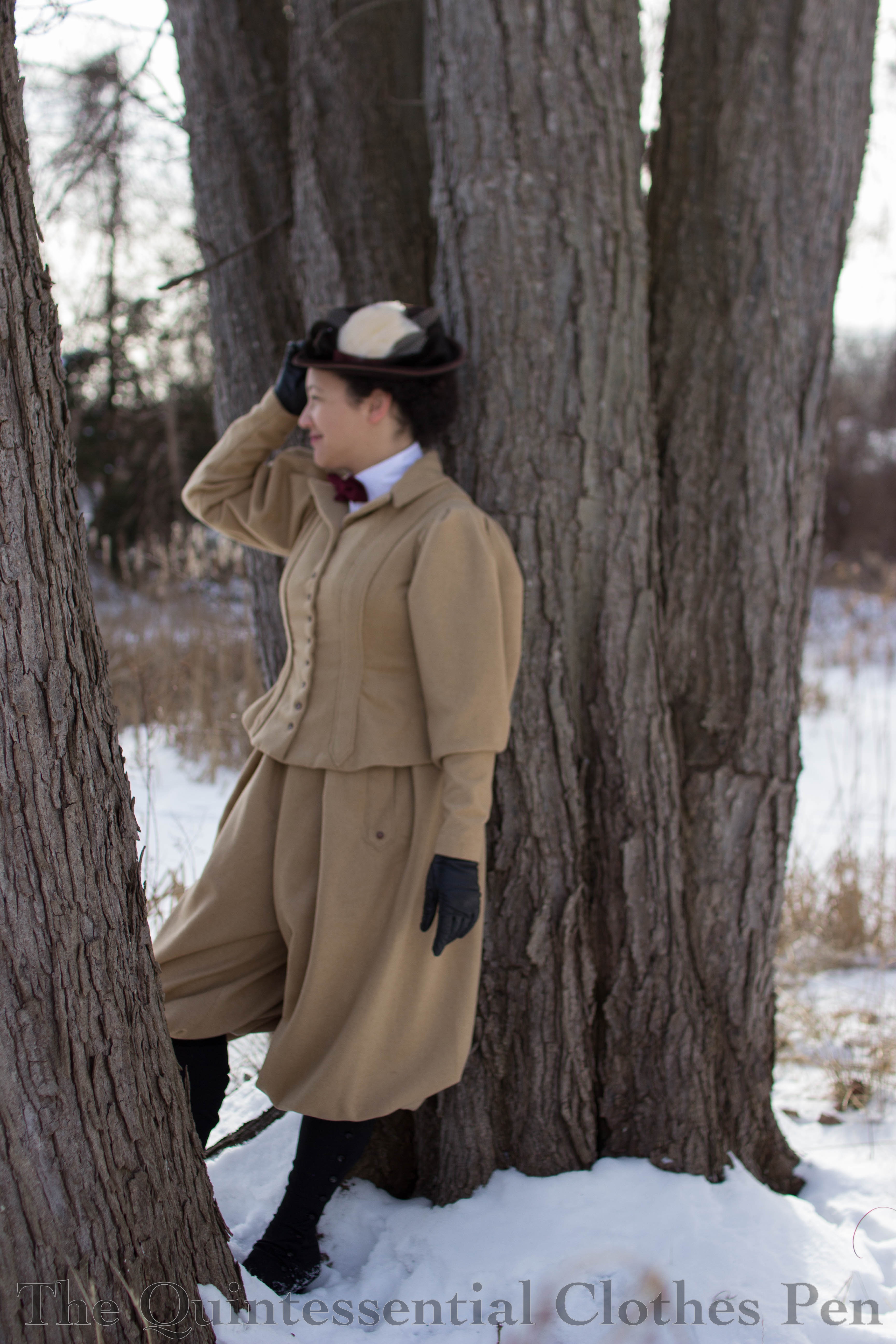
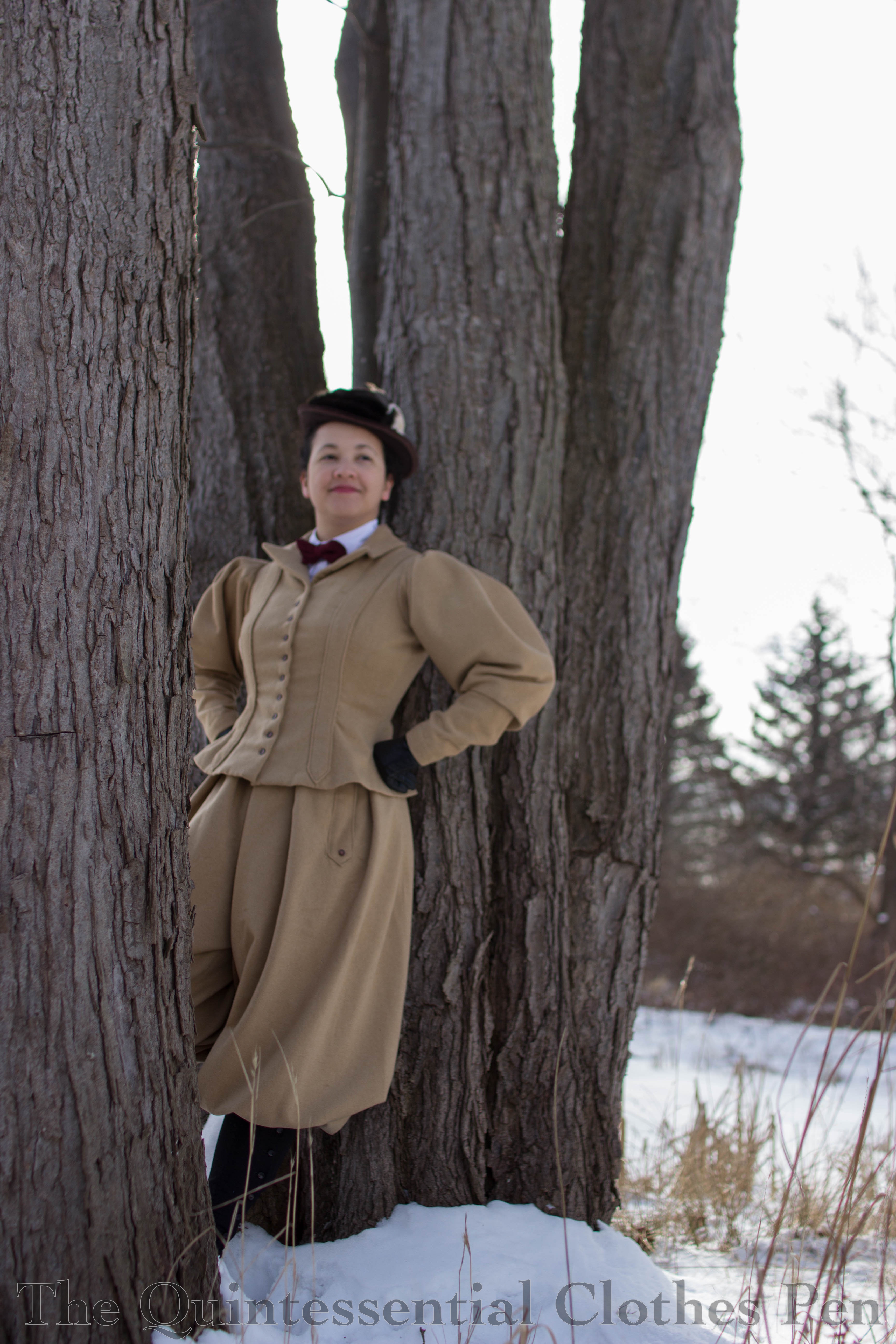
To recap, all these details and construction steps produce this! Slightly subdued 1890s puff sleeves, tailored jacket details, interesting strapping patterns, and bloomers!
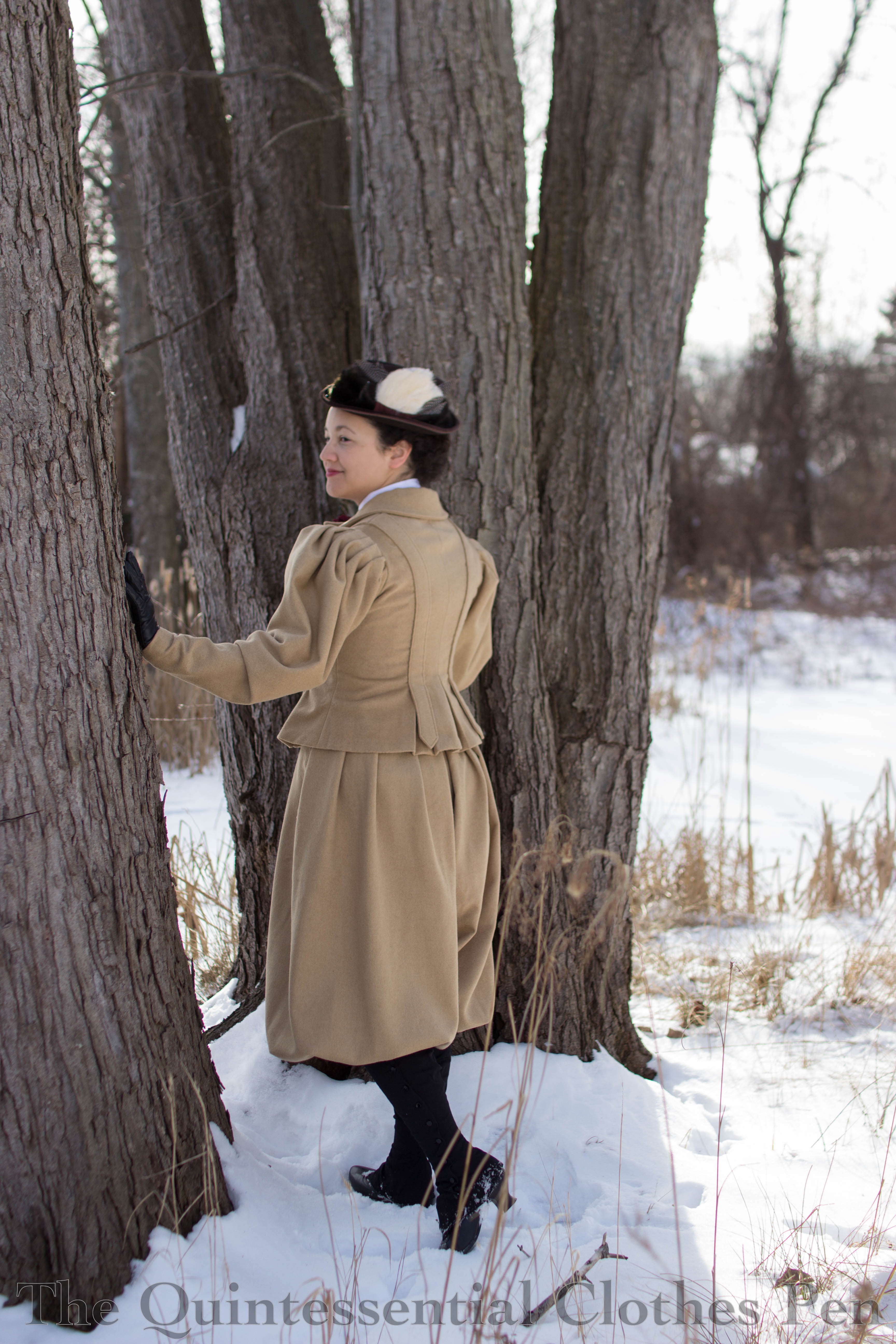
People sometimes ask me how long it takes to make my garments and often I don’t have a good answer as I don’t actually pay attention. I’m in it for the enjoyment of sewing and unless something is going wrong and I’m frustrated I generally enjoy the process. For this ensemble I kept track, though, and I can report that it took me 22 hours to pattern, fit, cut, tailor, sew, and finish this jacket and bloomer ensemble.

I’ve collected some (but by no means all!) images of bicycling ensembles on my 1890s Sportswear Pinterest board if you want to see more of my visual research and inspiration. Thanks for sticking with me for a lengthy post!

1890s Women’s Bicycling Clothing: Patents & Advertisements

There’s still a post coming soon about the construction details of my 1896 Cycling Ensemble, but I have quite a bit to say so it’s taking a bit of time to write. While working on it I found some great examples of other ingenious bicycling clothing for women patented and advertised around this time.

I mentioned the skirt variations in the introduction post for the cycling ensemble:

“Most women in the 1890s stuck to the traditional, socially acceptable silhouette of an ankle length skirt for bicycling, but this could be dangerous as the skirt could become entangled in the spokes and chain while riding. Solutions to this problem included adaptations to the bicycle, such as a ‘skirt guard’ that sat over the rear wheel and kept the skirt from entangling itself, and adaptations to the clothing, including skirts with cords that could allow them to be raised while riding and skirts that were one piece in the front but split into legs in the back, as with a modern ‘skort’ (a skirt/short combination garment).” 

I thought it would be fun to share the patents I found that illustrate these other styles of skirts!

First, an example of a bicycle ‘skirt guard.’ The ‘skirt guard’ is visible on the back wheel on the bicycle. Here is a patent from 1898 showing a skirt guard, as well.

Next, I have a patent from 1896 for a skirt with an ‘elevator’ which would allow the skirt to be raised with cords to make cycling safer. You can see the bloomers she is wearing underneath when her skirt is raised. This would allow the cyclist to be appropriately clothed while not riding and safely clothed while on the bicycle.

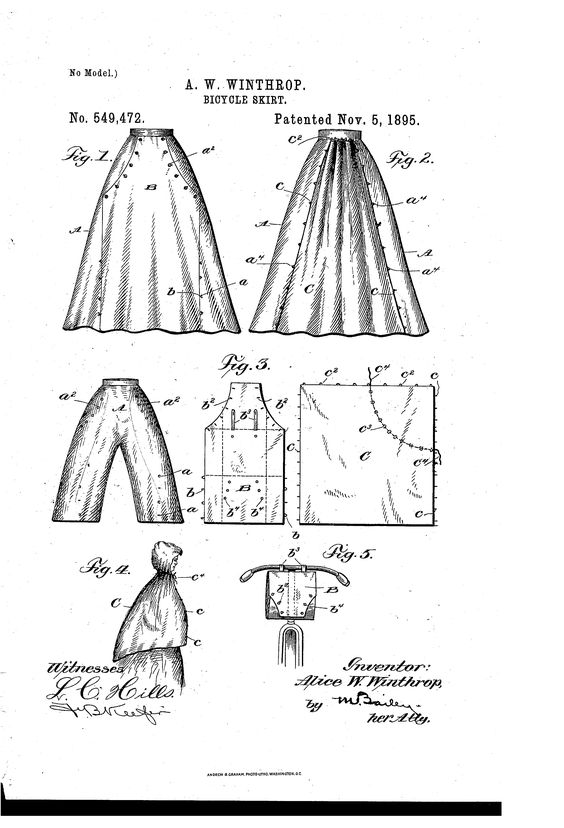
The next patent from 1895 shows the ‘skort’ style. This looks like a skirt in the front but is split in the back. The back is quite full, so that the appearance is that of a skirt.

Then I also came across this unusual method of a skirt with pieces that button on and off in front and back to reveal a bifurcated style underneath from 1895. It looks like this was designed so that the folded up pieces will hang from the front of your bicycle so you have them handy when you arrive at your destination. But I wonder how hard it would be to twist and bend in your corset to button and unbutton all of these connection points? My guess based on personal experience twist and bending in a corset is that it would be quite a challenge to do by yourself!

Here’s another interesting patent from 1896. These very full ankle length trousers that look like a skirt can be buttoned up around the knees to turn into knee length bloomers.

This image shows a women clearly wearing bloomers, but with a knee length skirt on top to still give a nod to the 19th century aversion to women opening wearing trousers (or bloomers).

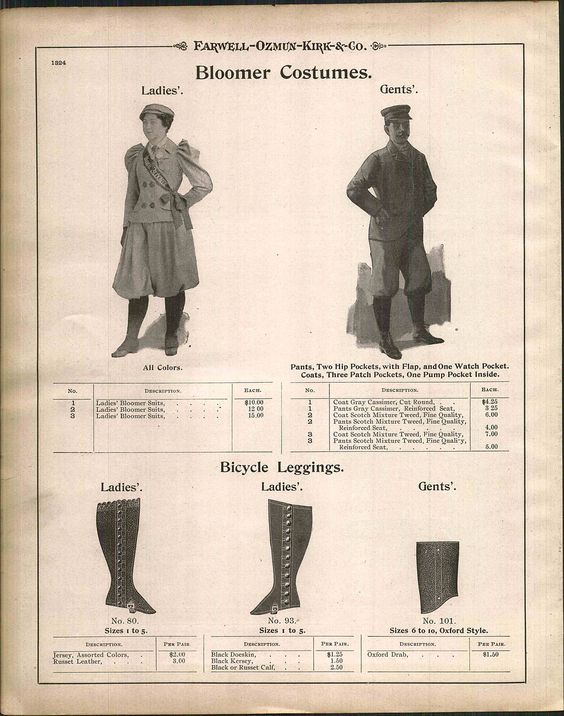
I love that most of these women are shown wearing their gaiters! It’s justification for my own pair. I came across this advertisement for ‘bicycle leggings’ as well. Neat!

Finally, here’s an example of a corset intended specifically for sportswear and athletic pursuits. It makes use of some stiffness as well as some elastic and is expressly made for activities such as bicycling.

Daring & Dedicated: My 1896 Cycling Ensemble

I’ve been hinting at the 1896 Cycling Ensemble I’ve been working on since December, first by sharing the black gaiters I made as part of the ensemble, then by sharing my deliberation and eventual decision to take a shortcut with two of the other accessories for the ensemble, and most recently by sharing photos of the shortcut accessories: a dickie and bow tie. Now it’s time for the reveal of the finished outfit in its entirety!
My inspiration for creating this ensemble is a talk I’ve been invited to give at both the Rhode Island Historical Society and the Newport Historical Society. The talk, titled Undressing History: Active Pursuits, Women’s Sportswear c.1900, will take a look at the clothing women wore to participate in sports and athletic activities during the late 19th and early 20th centuries. I’ll be actively dressing in multiple of my sportswear ensembles from 1885 to 1925, including clothing that could be worn for tennis, ice skating, bicycling, croquet, and swimming. I’ll discuss the cultural context of women’s participation in athletic activities during this time as well as the garments themselves: how they functioned while being worn for active pursuits, what they were made from, and how the silhouettes compared to non-sports clothing. I’ll be presenting this talk twice: on February 28 in Providence, RI and on March 28 in Newport, RI. If you’re interested in joining me, you can find more details about the event here.

As you might have noticed from my links to other sportswear ensembles I already own, I was missing a cycling ensemble. Bicycling became hugely popular for women in the 1890s, with a peak in 1896, so I felt that I must include this form of sportswear in my talk. And while I could use my 1895 skating ensemble as an example of the silhouette that would have been worn for bicycling while wearing a skirt, I felt it would be fun to show what the more daring and dedicated sportswomen of the 1890s wore: a bloomer suit. Full they might be, but those are pants!

Daring and dedicated, that’s me in this outfit. Most women in the 1890s stuck to the traditional, socially acceptable silhouette of an ankle length skirt for bicycling, but this could be dangerous as the skirt could become entangled in the spokes and chain while riding. Solutions to this problem included adaptations to the bicycle, such as a ‘skirt guard’ that sat over the rear wheel and kept the skirt from entangling itself, and adaptations to the clothing, including skirts with cords that could allow them to be raised while riding and skirts that were one piece in the front but split into legs in the back, as with a modern ‘skort’ (a skirt/short combination garment).

While that is amusing, I thought it would be more fun to make the most socially daring option: fully bifurcated bloomers. Some women wore these under a skirt while riding in order to maintain modesty. And some women, daring in terms of breaking the social conventions of the time and dedicated in terms of taking advantage of the newfound freedom a bicycle afforded, wore skirts that they would remove while riding, with bifurcated bloomers such as mine underneath.

Interestingly, a fashionable, tailor-made wool jacket like this could cost as much as $50 in 1896. Calculated in today’s dollars, that would be over $1,000. Quite a sum, and that doesn’t even include the bloomers or accessories! For those who had less disposable income, a linen suit provided a more economical option. With cheaper fabric, a dressmaker instead of a tailor, and patterns shared amongst customers, a full linen suit could be obtained for $7. That’s down to just about $150 in today’s dollars.

I have lots of construction details to share from making the bloomers and jacket, so there will be a detailed post focused on that soon. For now, here are a few close up photos of details, including my hidden pocket!

It was an exciting adventure to get photos of this outfit. In order to get timely photos I had to take the outdoors as I found it, snow and all. I valiantly tromped around, but I’ll admit that my feet were getting pretty wet and cold by the time we were done! Here’s a behind-the-scenes action shot on the way to getting the more finished photos–following my photographer’s path in the snow in a rather futile effort to keep the snow out of my shoes.

Sometime in the spring, perhaps, I’ll be able to ride a bike in my ensemble and get photos that give more context. In the meantime, we got some lovely winter-y photos and had some good laughs! Thanks to my intrepid photographer for making the time to take photos!


Sometimes A Shortcut

…is ok. This is a moment of shortcut-ing for me.

I was going to call this post ‘Sometimes A Cheat’, but then I realized that ‘cheat’ isn’t the right word. It’s too unfair and generally harsh. What I wanted to communicate is that it can be ok to start somewhere other than at the very beginning with uncut fabric waiting to be turned into a project.

You see, I need to have the 1896 cycling outfit I’ve been hinting at and sharing accessories for done by early February. This is a project that started at the very beginning. I made my own pattern and started with an uncut pile of fabric. I’ve already put a lot of time into tailoring the jacket (a progress photo is above–it fits!), making the bloomers, and making gaiters to accessorize the ensemble… all from the very beginning. One of the finishing touches that my ensemble needs is a shirt collar and some sort of neck tie to finish it off. I don’t need a full shirt under the jacket and I don’t want the bulk, so I debated about making a dickie (from the beginning…). I also thought about making a neck tie (from the beginning…).

After a bit of deliberation, I decided that I want a shortcut for these pieces and I’m ok with that. Accordingly, I’ve ordered a ready-made dickie on Amazon, re-confirmed that neckties look stupid on me (a thought I’ve had since I needed to wear one 13 years ago, though I thought that might have changed, haha), followed the necktie-looking-stupid-on-me thought with the decision to go with a bow tie, and ordered a knit bow tie, also on Amazon. (I’m hoping the quality of these items is acceptable. Thankfully they come via Prime and have free returns, so if I don’t like them there’s still time to come up with Plan B. If I’d thought of this a month ago I could have saved at least half the price and purchased these exact items on eBay. Now that I’ve made up my mind the shipping would take too long. Oh well!)

Do you ever take shortcuts like this? How do you feel about them? I feel rather relieved that I don’t need to cut, sew, and finish a collared dickie and a bow tie!

Giving Old Hoops New Spots

Spots are this nifty piece of hardware that can be used to secure interlocking pieces together. They’re similar to a brad in that they have two prongs on the back of a circular top. The difference I see is that they have a domed top and the prongs come out from other side rather than the center.

Back in April, I posted about the dimensions of my large hoops and how I made my new smaller hoops and stated the goal of adding spots to my old hoops just like I had done for the new hoops. Over the last six months I’ve been slowly adding the spots to my old hoops and I’m pleased to report that the process is complete! My ten year old hoops have reinvigorated life!

For the new smaller hoops I used brass colored spots, but I decided to change it up for my older hoops and used gold colored spots instead. (Both of the spots were purchased from this seller on eBay, who I would certainly recommend.) I’d originally intended the vertical tapes on these old hoops to be able to slide around when needed so that I could force the hoops into an elliptical shape, but since I haven’t done that even once in the last ten years I figured that if/when I want elliptical hoops I’ll make a new support structure and will reinforce these hoops in their current cupcake shape instead of contingent to allow them to be adjustable.

My spots are positioned so that the prongs are at the top and bottom of each horizontal wire. I poked the prongs through the twill tape then used pliers to bend the prongs towards each other to secure them in place. The nice thing about the spots is that as they are folded back you have control over how tightly they are attached. So technically they are still loose enough that I can scoot the vertical tapes around if I really want to. But will I? Probably not.

Eleanor ‘On The Continent’

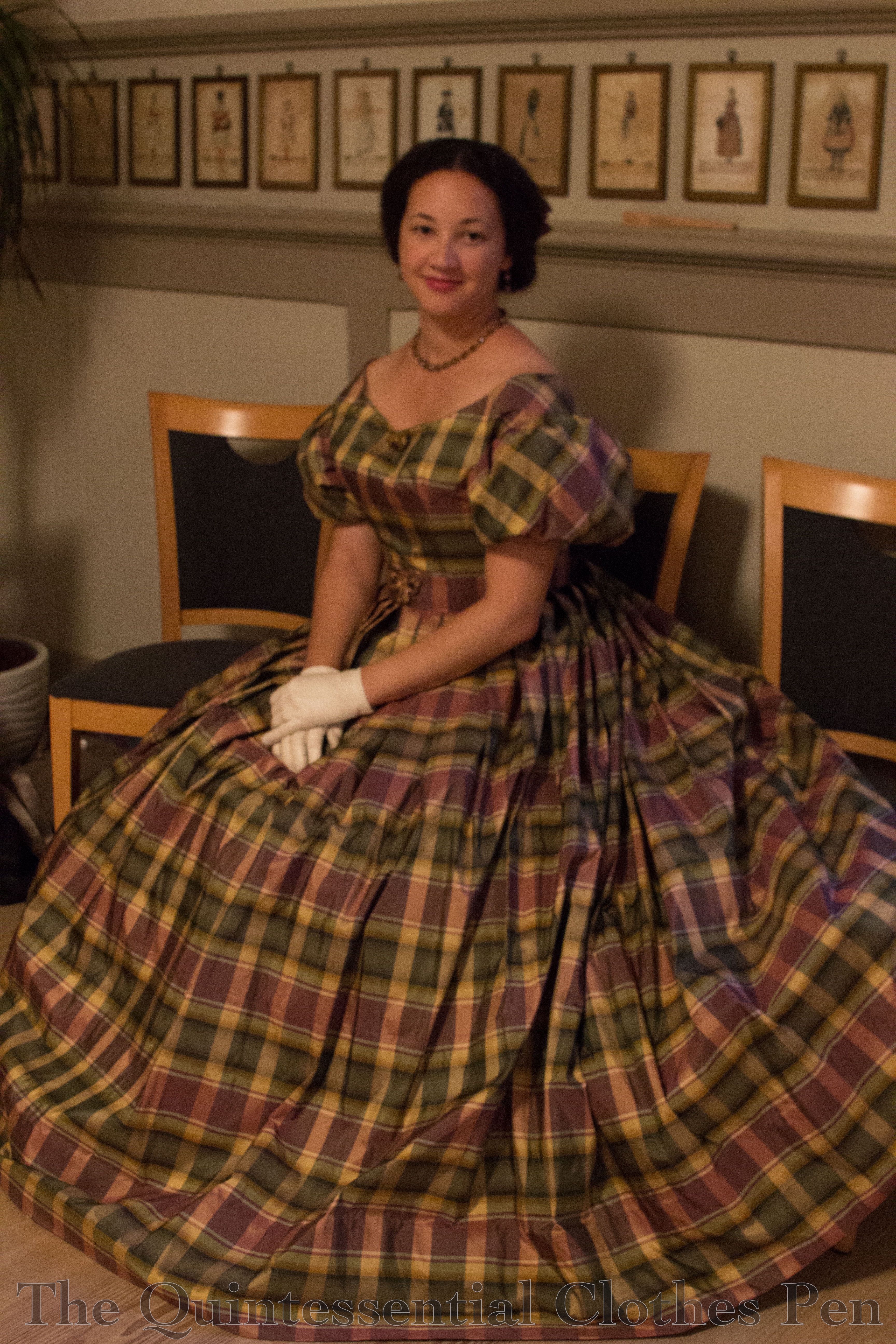
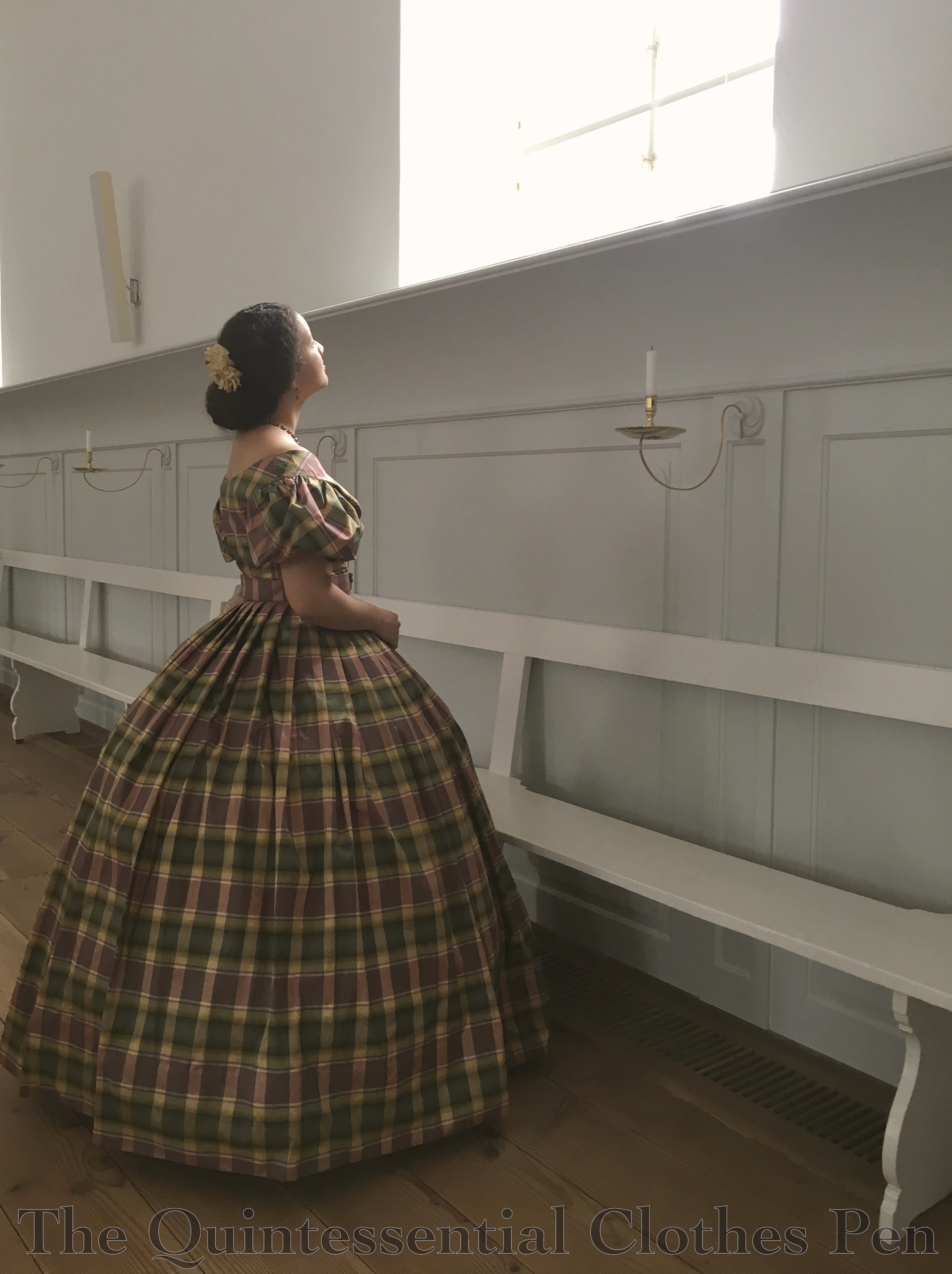
When I was in Denmark last year, we got some lovely show-off-the-dress shots of Eleanor (my 1862 plaid ballgown) that I haven’t shared yet. This is the gown that I wore to the grand ball at the end of the week. I decided on it because I appreciate its simplicity and understated elegance: the only real decorations, aside from the interest provided by the large scale plaid, are the coordinating brooches on the neckline and belt.

I absolutely love how this gown looks wonderfully historical without being flashy. Don’t get me wrong, I am all for flash in some instances, but for traveling on a plane and being squashed into a suitcase, this seemed like an option that would travel well and still look elegant, especially when paired with my coordinating necklace and earrings.

Before the ball we took a short walking tour during which were able to capture these cooler-toned photos in addition to the warmer first photo (that first one was taken in the ballroom).

Looking at these photos reminds of the trip, which brings smiles. It was fun to attend a ball ‘on the continent!’

SaveSave

The Simple, The Complicated, & The Continent Part II

In Part I of The Simple, The Complicated, & The Continent, I shared casual pictures from the mid-19th century dance week I attended last August. Now it’s time for the (mostly) more elegant pictures of the formal balls from the week. You’ll see why I say mostly elegant… there are some silly pictures, too!

On the Wednesday of the dance week we had an informal ball at the school. In terms of dancing, it went generally well. We’d had two days of dance classes and we weren’t completed exhausted yet. Everyone looked lovely so it was fun, as always, to admire other people’s ensembles. We were informed that the social custom of Denmark is to only post photos of other people if you have their permission, so I don’t have too many photos I can share of the informal ball, in particular. It’s a reasonable custom, I think, just quite different from what we’re used to in America. It really is the Wild West of willy-nilly picture posting here! Maybe the Wild West village on the grounds of the school made more sense than I thought…

So here I am dressed for the informal ball. My hair was frizzy and big by the evening of the day so I decided to run with it! Big round hair is perfect for the 1858 anyway. I wore Georgina, with her evening bodice. Actually, all of the Americans wore our mid-19th century cotton ballgowns (many of which you can see in this past post), which quite impressed many of the other attendees. We were told that fabrics like these are difficult to find in and around Denmark.

After another two days of classes, the week ended with a formal dinner and ball. We were bussed to the town where these events were to be held (and it was quite an adventure, getting all the large dresses onto the tour buses and into the seats!) and then did a small walking tour of the town before dinner. A new friend snapped this photo of me traipsing across the street after getting some photos taken. I chose my matching crocs to wear around the town before going into dinner and the ball, but I didn’t think anyone would see them!

OLYMPUS DIGITAL CAMERA

Dinner was lovely and then it was time for the ball. It was quite exciting to be attending a formal ball on ‘the continent!’ It sounds so fashionable in a 19th century way!

The ballroom contained actual candles! These are forbidden in many of the halls I normally get to dance in, so that was a nice novelty. They were especially lovely as the light faded outside.

Our hosts provided us with dance cards, which had a convenient hook for hanging the dance card off of a belt or waistband. In my case, the belt on my dress was perfect!

The ballroom was rather small for the number of people we squashed into it, but I suppose that is probably rather accurate for some events in the 19th century. It did mean that the room became quite hot, so I spent a fair bit of time enjoying the lovely garden outside.

As you can see, I wore Eleanor, my plaid silk ball gown. It was a good choice for traveling and it was fun to be elegantly simple in my clothing choice.

Capturing the photographer in a photo! Isn’t it lovely how well their dresses coordinate with the colors in the garden?

Why was I lifting my skirt so scandalously? I think to see how high I could easily lift my leg in my dress. Or perhaps to check my balance? Doesn’t really matter, does it? Silly photos are fun!

I did get permission to share this photo of me with two new friends. Our colors coordinated so well and that uniform was absolutely stunning! And it had fur on the cuffs. Such soft fur! I bet it was boiling hot, but it was also quite dashing!

Unfortunately, by this point in the week we were all brain-dead, so the room in general didn’t do a great job of executing all the dancing we had been working on without many mistakes. That felt like rather a let down, sadly, as it would have been nice to dance at a ball on ‘the continent’ with perfect execution. I guess this gives me another reason to go back and try again some day!

SaveSave

SaveSave

SaveSave

c. 1860 Crinoline Size Comparison & Tutorial

Back in October of 2016, I made a new, smaller crinoline (also called a hoop skirt) than the one I’d had for about the last 10 years. I thought it would be great, and it was… in terms of shape. Unfortunately, the new crinoline had a fatal flaw: the channels for the hoops were too wide for the slippery-ness of the hoops and therefore all the tapes would slide to one side while being worn, causing the hoops to drop down and create a trip hazard for the wearer. I had loaned these to a friend at a ball and was horrorstruck as I realized the problem and she attempted to dance without realizing the problem. It was such an awful feeling! We solved the problem for the night, but I resolved to fix the hoops before wearing them again and I learned a good lesson about trying out new garments myself before loaning them! I’ll get to my solution for the sliding hoops in a bit, but first I’ll start at the beginning.

The new crinoline was an experiment to see if I could use the hooping from a cheap Amazon hoop skirt like this to create a cage crinoline with smaller dimensions than my usual crinoline, the super-cupcake, which has a decidedly high fashion silhouette. The answer to that question is ‘yes’ it was easy to reuse the hoop steel from the Amazon crinoline to make a cage crinoline.

You see, the super-cupcake looks great with the right circumference of skirt and the right environment (high fashion daywear or a ballroom); however, under a cotton day dress I wanted a more subtle, practical, reasonable shape. I have to admit to liking a big skirt though, so a reasonable crinoline for me still has a larger circumference than what it might be for others. Also, at 5’6″ I am taller than the average woman, which allows me to carry off a larger circumference while staying within reasonable looking proportions. (For more thoughts on practical sized crinolines, Maggie May has shared useful research and an equation to help determine crinoline circumferences.)

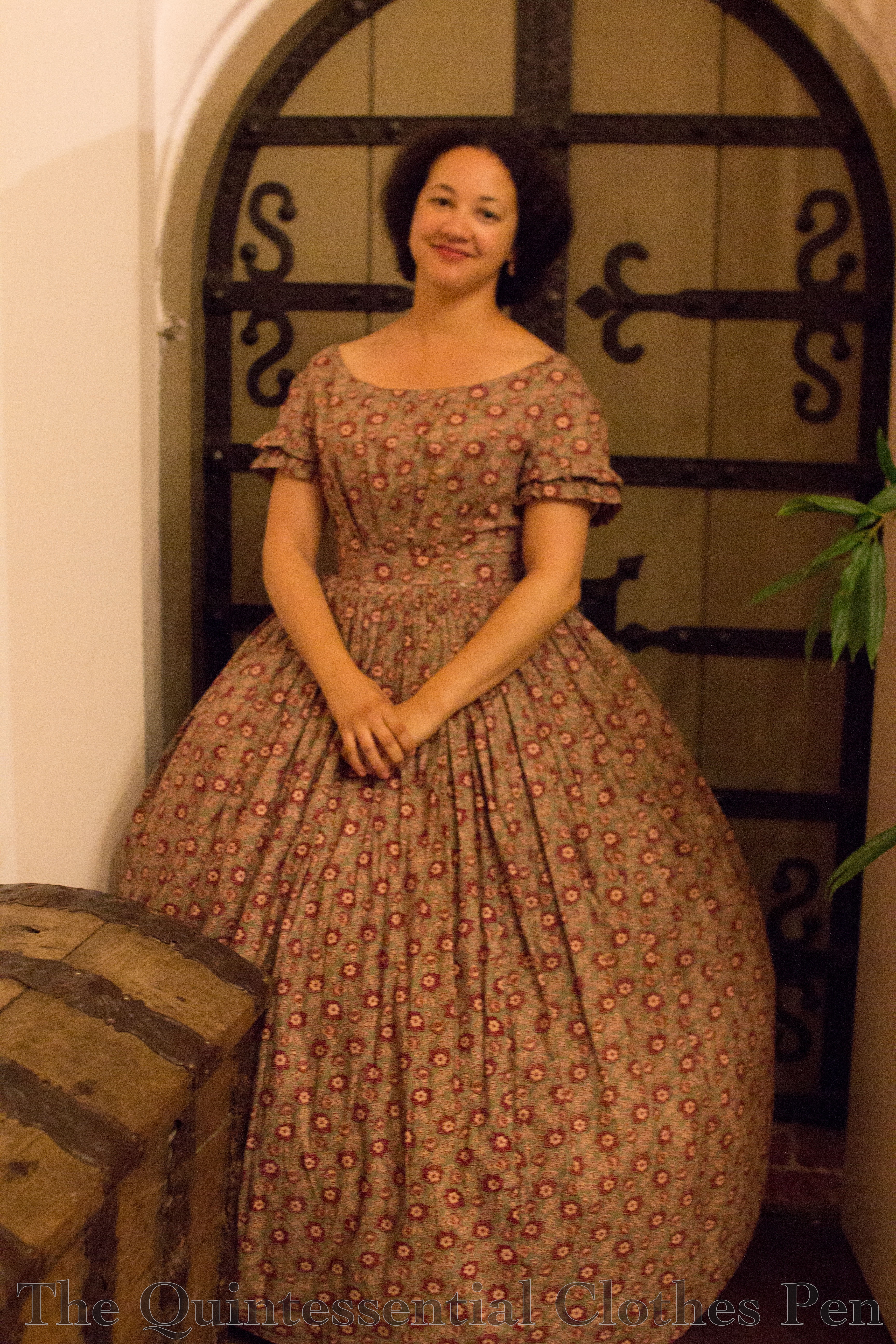
Here’s a comparison of my two crinolines worn with cotton dresses: the super-cupcake is on the left and the newer reasonable crinoline is on the right.

Interestingly, the dimensions of these two crinolines aren’t terribly different. The lowest hoop is only about 8″ smaller  on the new crinoline. The biggest difference (and what alters the silhouette most) is that the new crinoline has a more tapered shape in the upper hoops.

I’ve provided the following size chart in an effort to help those who might be making or adjusting their own crinolines. Even if you don’t want to deal with all the vertical tapes, you can use these dimensions to adjust the hoop sizes in a ready-made modern crinoline to achieve the same effect.

Interestingly, both of these crinolines have the same vertical tape length that is short enough to keep the bottom hoop decidedly above the floor. The lowest hoop on these is about at my mid-calf height. This keeps my feet from getting tangled–especially useful while dancing! In order to keep my dresses from folding under the bottom hoop as I move, I have a cotton petticoat with a substantial ruffle around the hem which provides stability for the dress worn on top. You can see the length of the super-cupcake on me as well as the ruffled petticoat that I wear over both crinolines in this post.

Here are my two crinolines next to each other while the new one was still in progress. They have an overall similar construction (although I did simplify the new ones, using fewer hoops and fewer vertical tapes).

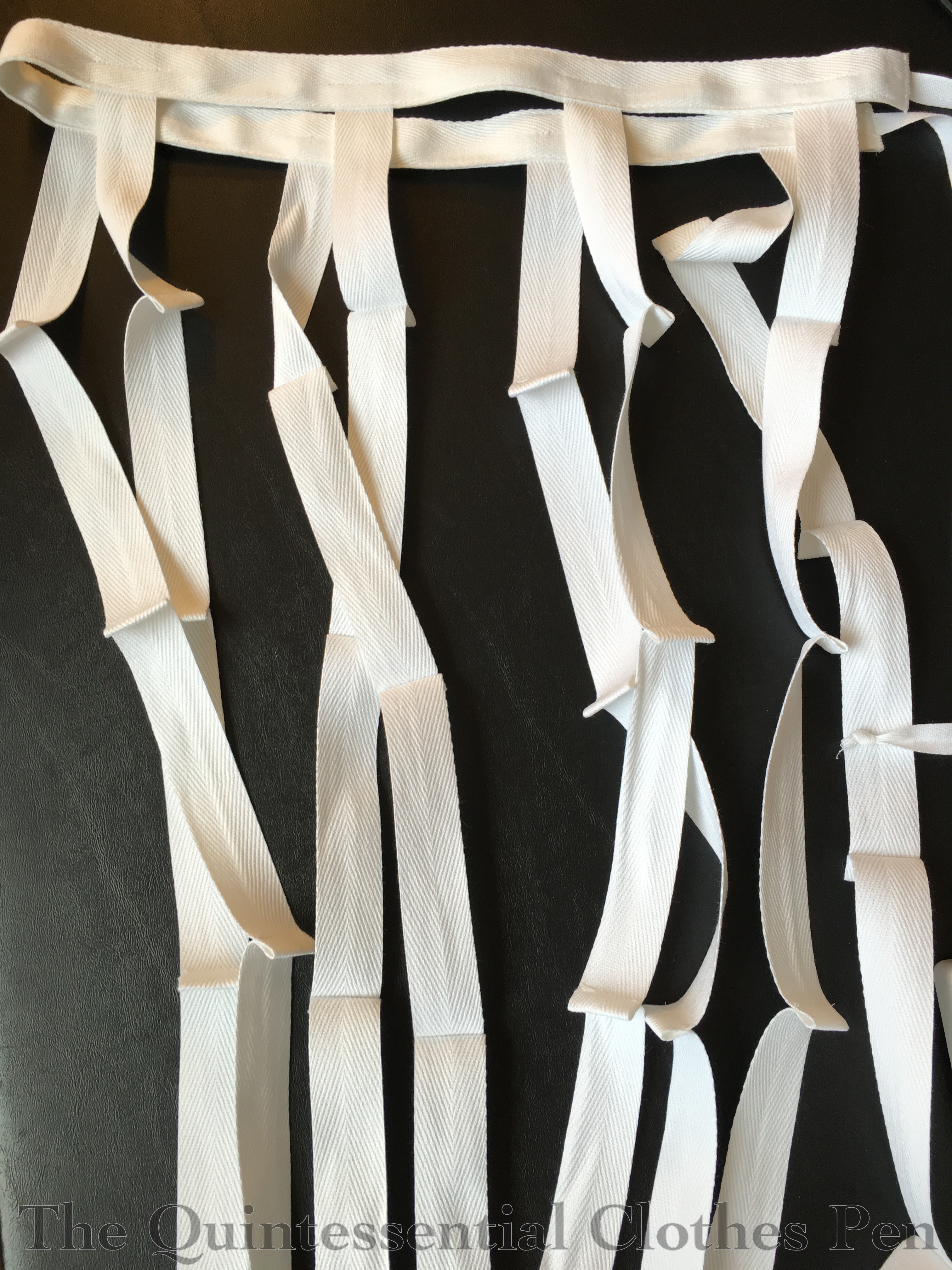
My old crinoline used ivory twill tape for the vertical supports. There are actually two layers of it that are hand sewn together to make channels for the hoops, creating channels along the lines of those seen in this 1859 hoop skirt patent filed by James Draper of New York (while the hoop circumferences are not provided in the patent, the silhouette of Draper’s hoop skirt is similar to that of my super-cupcake). This method used a ridiculous amount of twill tape, so I came up with a way to make the new channels that would use only one layer of twill tape for each vertical support. More on that in a moment.

The old crinoline’s hoops are made from cotton covered steel that was in a ribbon form originally. I had cut each ribbon in half (and over time, the fabric covering started to fall off, which caused me to painstakingly wrap each hoop all the way around with thread to make it more durable–a caution to anyone else using this to make a crinoline, although I’m not sure where you’d source this type of material these days as I believe this type of ribbon wire is no longer being produced). The fabric covering combined with the narrow channels in the twill tape means that the vertical ribbons only slide when I want them to, but that they otherwise stay in place nicely.

For the new crinoline, I machine sewed tucks into a single layer of twill tape to create channels for the hoops. You can see those tucks in the photo below.

I also machine sewed the vertical tapes to the twill tape waistband, because why not–I was machine sewing anyway. The waistband is two layers of twill tape sandwiched together.

That’s basically it for the construction before the awful incident of loaning them out. I cut the hoops to be the dimensions I wanted, slid them through the channels, and used the plastic joiners that had come with crinoline to secure the ends. Done! Or so I thought…

After realizing that these hoops were going to slide horribly, I went back to research to figure out how this problem was solved in the past. What I noticed are little metal dots on each join of hoop to vertical support. That makes so much sense! I wanted to add these to my hoops but I didn’t know what to call them while searching for materials.

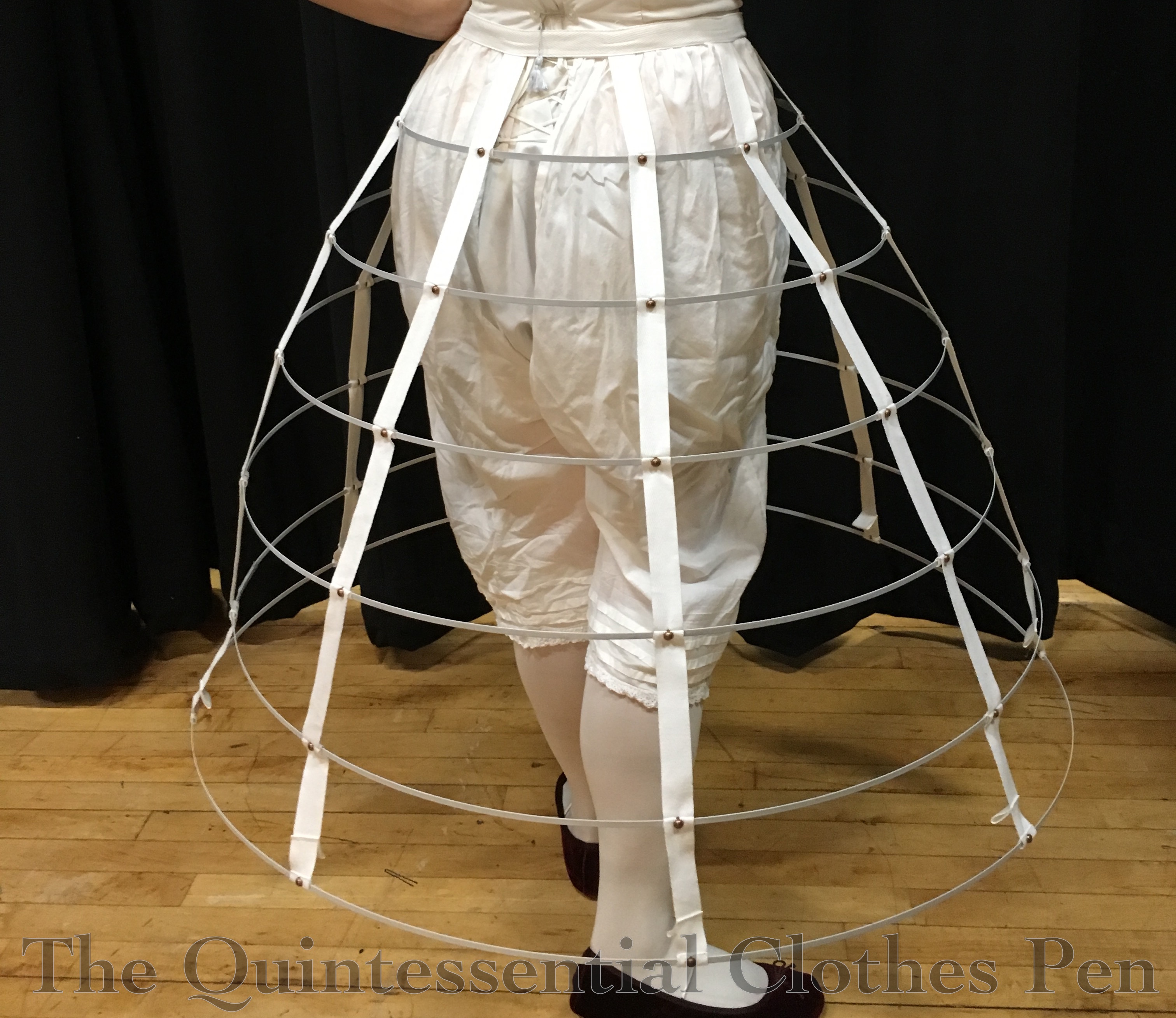
It took me a little research to figure it out, but I did and now I’ll share that with you. They are called spots! Once you realize that then a whole world of spots becomes available to you. Decorative ones, bronze, copper, nickel, black… so many options! I got plain domed copper from this seller on eBay and am very happy with them. They’re easy to apply with a pair of pliers and seem quite durable. Now my hoops and tapes stay in place–no more sliding around!

And here is the finished result of the spots on the reasonable crinoline. I like the look as well as the practicality. I’m planning to add gold ones to the super-cupcake as well, for looks more than anything else.

SaveSave

SaveSave

SaveSave

SaveSave

SaveSave

SaveSave

SaveSave

SaveSave

SaveSave

SaveSave

1864 Evie Hair (Returning Heroes Ball 2018)

In March, I again had the pleasure of attending The Commonwealth Vintage Dancers‘ annual Returning Heroes Ball (you can read about other years I’ve attended here). I decided to wear Evie, my 1864 ballgown, simply because it had been a year or so since the last time I wore that particular gown.

In order to change things up I did two things differently with this wearing: I wore different earrings and did my hair differently. Small changes, but it makes wearing an old dress feel new and exciting!

I don’t think I’ve ever worn these earrings for mid-19th century events before (only for things later and earlier than this period), though now that I’ve tried it I think they work quite well. I made them from triple drop earrings that I bought from a modern store (I forget now, but I think it was New York and Company). I just took off the bottom drop and attached them to clip hardware. They catch the light and sparkle nicely.

1860s and earrings together reminds me of the scene in Gone With The Wind in which a straggling soldier try to steal ‘ear bobs’ from the house. Not that these look at all similar (and luckily my story ends on a happier note than that scene), but a GWTW reference generally makes me smile.

I was going to do a simple hairstyle (my usual go-to c.1860 style with a center part and the hair in a low mass at the back of my head), but as I was getting ready I chanced a look at Pinterest and got excited about trying a more complicated style than I usually do. In particular, I liked the puffed fronts on some of these styles from 1864 and the curls on the sides like some of these from 1861.

I sort of mashed these two looks together, using small rats to puff the front sections of hair and a curling iron to get smooth curls for the sides. My hair is getting to be so long that I had to pin the hanging curls up to shorten them! The rest of my hair was just twisted and pinned on my neck without too much attention paid to it. I was running out of time and knew I’d be adding my hair piece on top, which would cover most of the back of my hair anyway.

I really like the end result for this particular dress of mine. I feel it compliments the hair piece and the silk dress nicely. Isn’t it lovely when all these little details come together to create one cohesive end result? Yay!

SaveSave