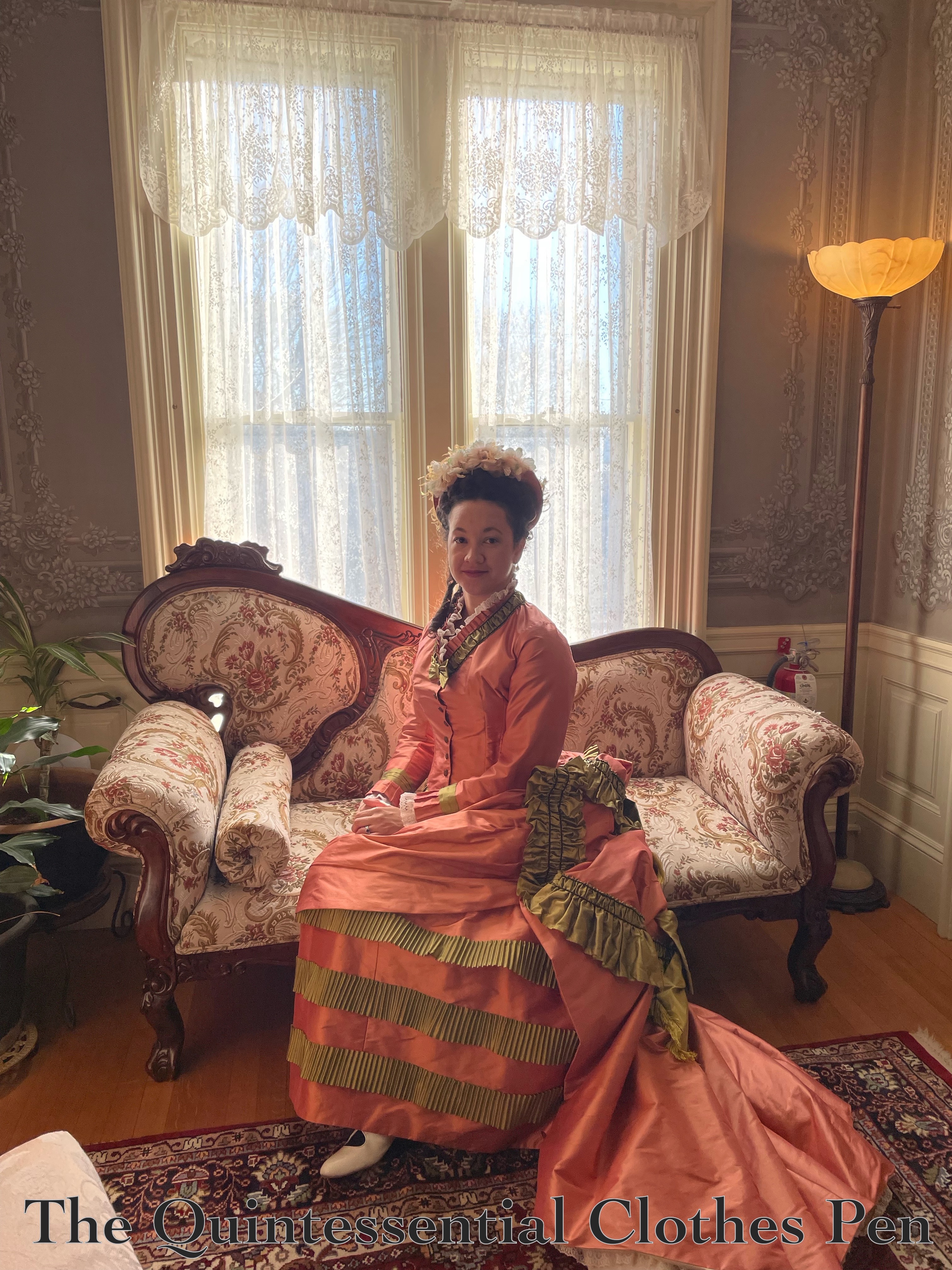
Summary of 2023: Looking Forward To 2024

Time just keeps flying! It feels like 2023 started with a bang and the momentum hardly let up. All of a sudden it’s time to look back on this year’s accomplishments and start looking ahead to next year. Crazy!

Projects I completed in 2023

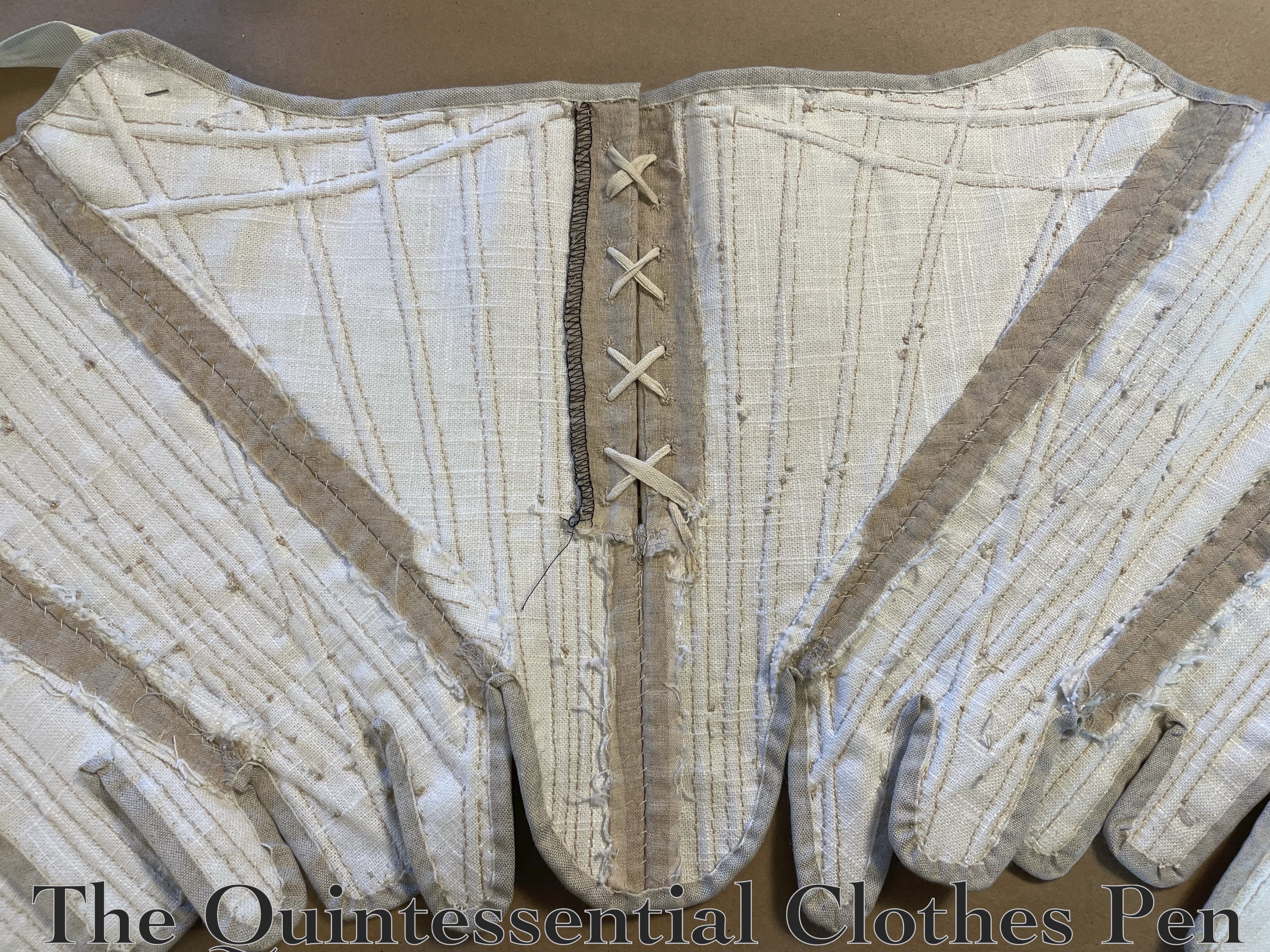
July: c. 1785 Hand Sewn Natural Linen Stays of Success!

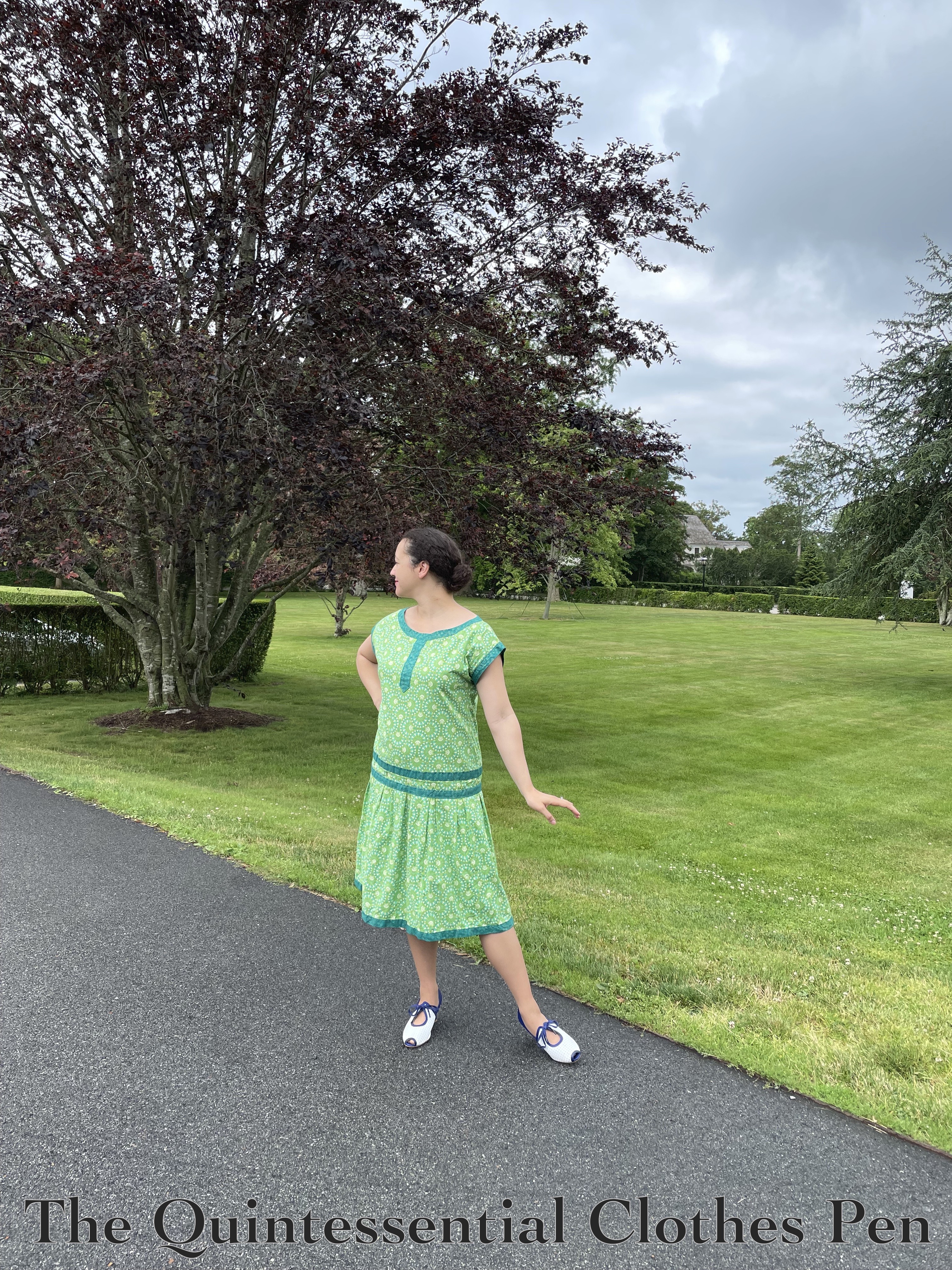
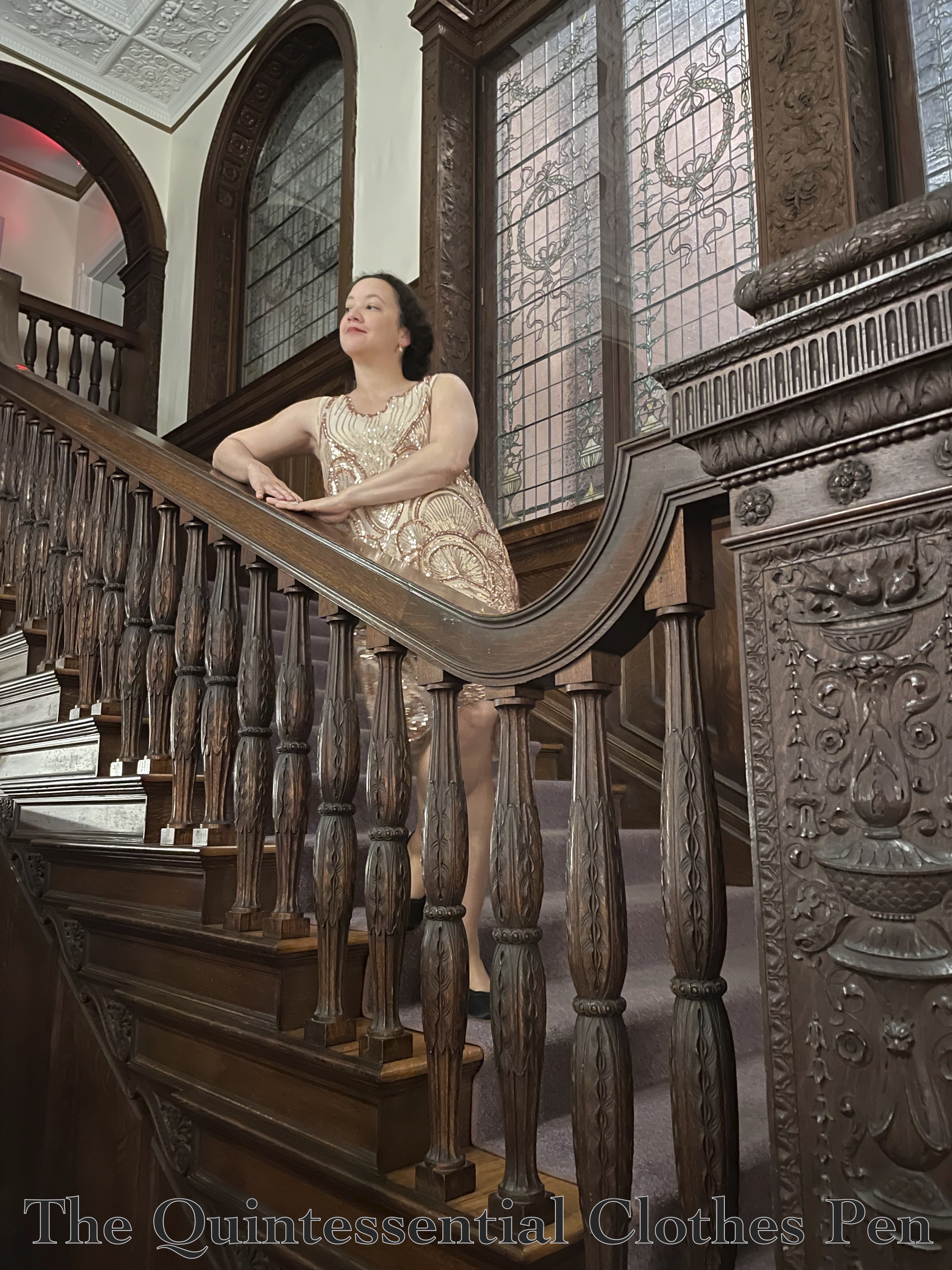
August: Updates To The 1933 Dramatic Evening Dress

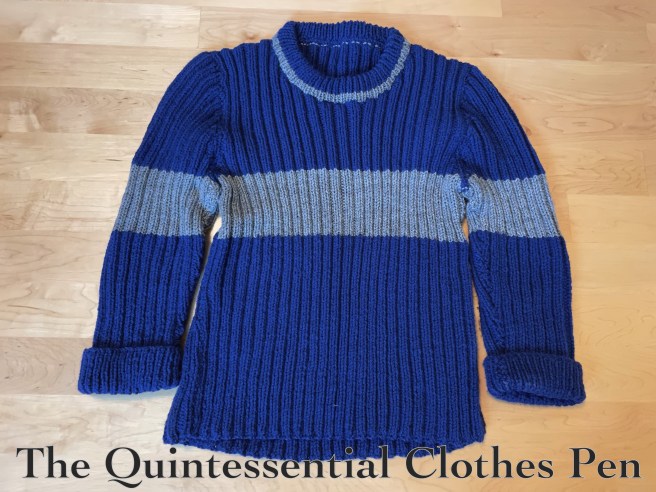
September: Ravenclaw Quidditch Sweater

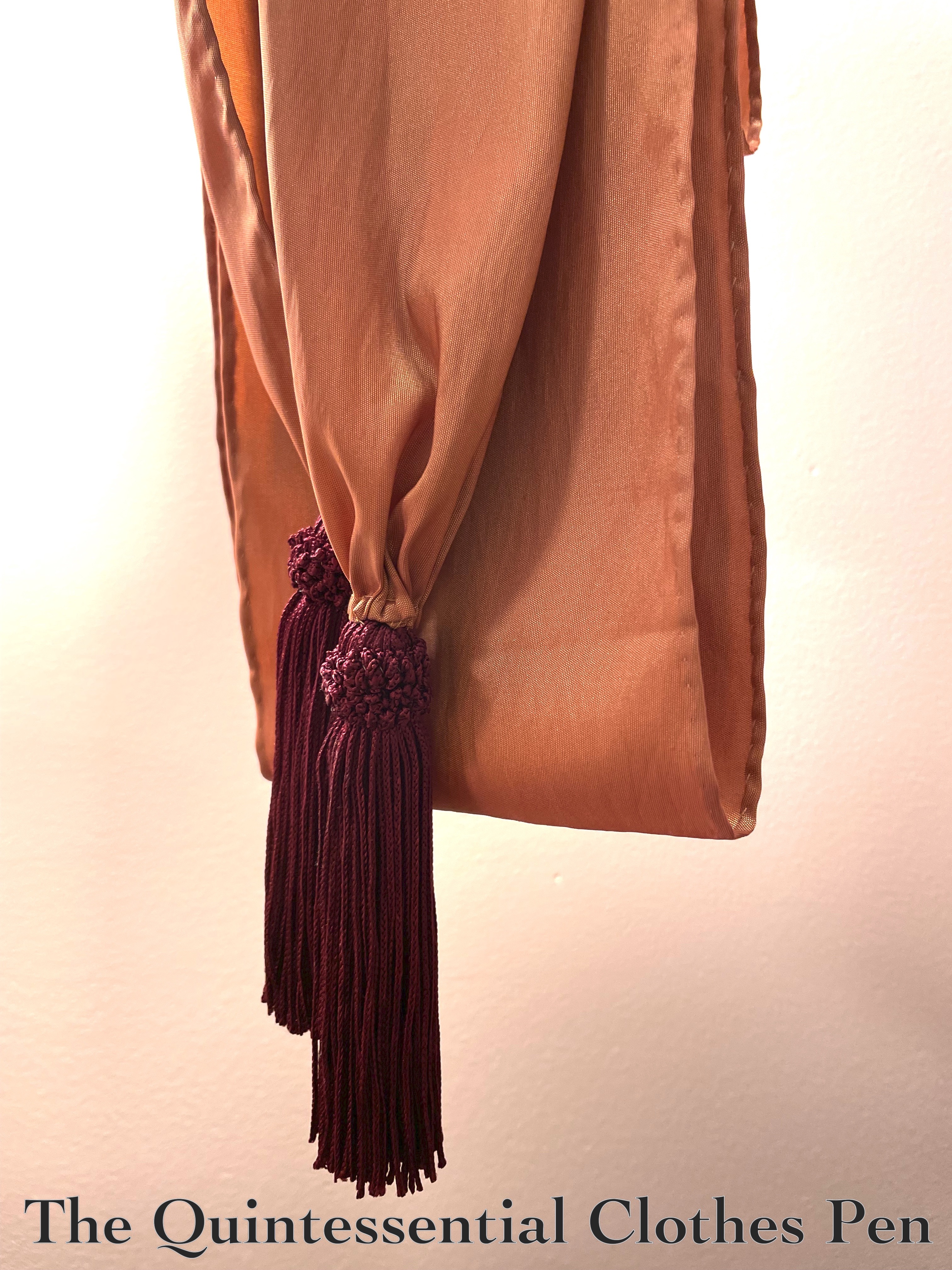
October: Copper Colored 1790s Sash (HSM #3)

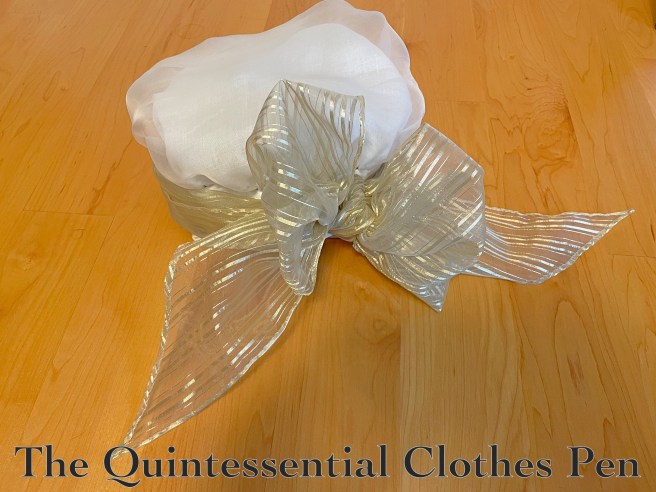
November: 1790s Organza Cap With Gold Stripe Trimming (HSM #5)

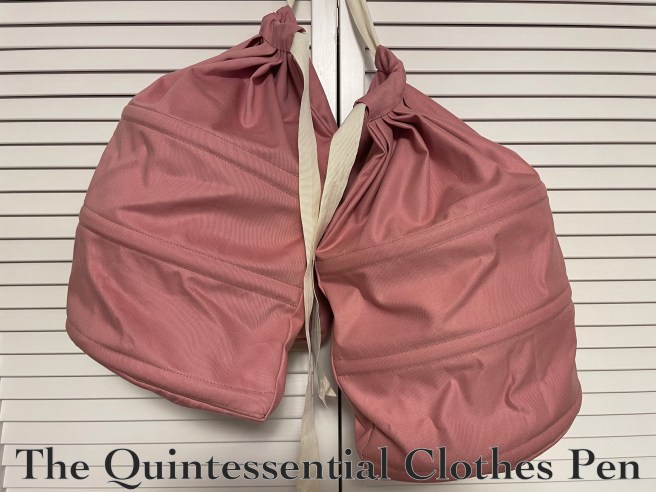
December: c. 1770 Pink Panniers (HSM #12)

December: 18th Century Blue Petticoat (HSM #8)

General Blog News

I participated in my 11th year of the Historical Sew Monthly. This year I completed 5 of the 12 challenges. That’s three more challenges than last year! It’s been wonderful to have a little bit more time to sew.

Also, in May the blog hit 500,000 all time views! Wow!

Event Recap

I attended 1 ball (as part of a weekend event), 3 other events (picnic, croquet, outings, etc.), 1 dance performance, and participated in 1 weekend event (that included dancing, games, teas, picnics, winter activities, and grand house tours).

To Do Lists

I kept last year’s Definitely To Do list quite short, so that I could feel accomplished when completing it. And success! I completed both of the things on that last (The Stays of Fail/Success and updating my 1933 Dramatic Evening Gown).

I didn’t fully complete any of the items on the Maybe list from last year, but I did make substantial progress on two of the four items. In fact, they’re almost done! A new 1790s petticoat and dress… and they just need hems! I was derailed from finishing those at the end of the year because I was inspired to start (and finish!) a new 1940 dress that I’ll be blogging about early in 2024.

So, my ‘definitely-do’ list for 2024 includes:

  • Finishing a 1790s petticoat and bum pad (started and mostly finished in 2023)
  • Finishing a 1790s dress (started and mostly finished in 2023)
  • 1770s yellow sacque/Robe à la Française (started in 2023)
  • Under petticoat for the yellow sacque
  • Stomacher for the yellow sacque
  • Shortening the hem of Eleanor, my 1862 Plaid Dress
  • Updating the waist size of my 1860s drawers
  • Updating the trimming on my 1893 Bronze and Pink Ballgown to better go with the size updates I made in 2022 and posted about in 2023
  • Replacing the zipper in my Happy Clover Dress

And my ‘maybe’ list includes:

I’m very pleased to have achieved my goal of finding more time to sew. I hope to continue that next year. That seems reflected in my to-do lists!

I’m very grateful for the many kindnesses and gifts in my life. Thanks to all of you who have continued to read, comment on, and appreciate this blog. Wishing you the very best in 2024!

18th Century Blue Foundation Petticoat (HSM #8)

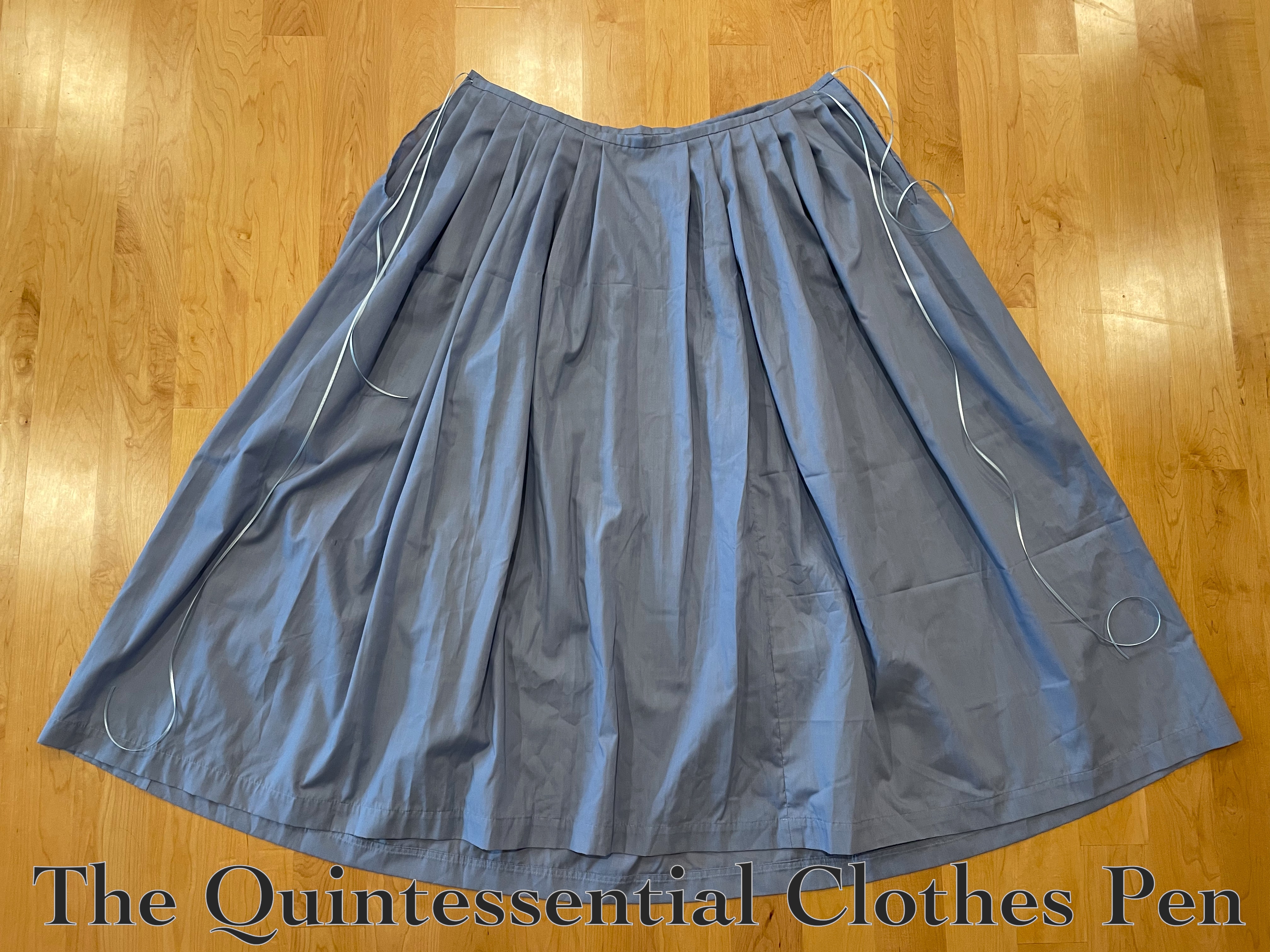
In addition to the c. 1770 Pink Panniers that I recently posted about, the blue foundation petticoat pictured below (front view) is also intended to be easily loaned to friends.

I’m super pleased with this for a few reasons:

1 – I was able to easily replicate the construction steps that I used for my Apricot Petticoat in 2013, ten years ago!

2 – I was able to re-make the petticoat from an old project: the 1812 Blue Under Dress I also made in 2013. I was never very happy with this color under my 1812 Striped White Gown (it was blah) and within even a few years of being made it no longer fit the width of my back, anyway.

3 – This remake qualifies for the HSM Challenge # 8, All Tied Up:

Make something that closes with ties, or something that uses knots/bows as a decorative feature.

Just the facts:

Fabric/Materials: Approximately 3-4 yards blue cotton/polyester blend fabric (salvaged from an old dress).

Pattern: None, but I referenced both of these tutorials on constructing 18th century petticoats. Katherine’s tutorial is for a petticoat with an uneven length (to go over panniers, or a bum roll, for example). Rebecca’s tutorial is for a petticoat with an even length (the same length all the way around, to be worn without extra supports). Both tutorials have construction information, Rebecca’s includes a bit more detail in terms of which stitches and methods to use.

Year: Loosely 1700-1790.

Notions: 3ish yards of 1/8″ blue polyester ribbon and thread.

How historically accurate is it?: 70%. Accuracy gets knocked down because: 1- all unseen seams are machine sewn, 2- I used polyester ribbon for ties, 3- I haven’t seen research that shows cotton being used at this time for a single plain petticoat of this sort.

Hours to complete: 5? I didn’t really keep track.

First worn: Has not been worn yet.

Total cost: Free! Materials were either in the stash/gifted to me or re-used from other projects.

Here are more photos of the petticoat, starting with a back view.

And, close-up evidence of weird things, such as the twice-stitched machine hem, which could be useful if I ever want to lengthen this petticoat. These hems are leftovers from the salvaged dress–no hemming required for this petticoat. Perfect!

I followed the instructions as indicated in Just The Facts earlier in this post. This leads to tidily finished waistbands, as you can see here (along with a randomly located vertical seam).

(Another weird thing about this petticoat is where the seams landed on this, now that it is a petticoat and not the skirt of a dress, and that each seam is finished in a different method!)

And here’s a the same view, but with the front folded down to show how the petticoat is made shorter at center from than it is anywhere else.

Below, a final closeup of the extra length at the front folded down and left raw. The top fold is encased in the waistband, which is machine sewn and whip stitched down on the inside.

I was super pleased to just barely fit this petticoat length out of the skirt length of the old dress. The hem circumference was just about perfect, too! And, I was able to cut the waistband strips from the front bodice pieces of the original dress!

All in all, a quick and satisfying project! I’m much more pleased with this as a petticoat than I ever was with it as a dress.

1830s Holiday Cheer

For the holidays last year, friends and I decided to have an 1830s-clothed dinner at a local historical inn. We had a lovely meal, enjoyed the company, and had fun looking around at all of the lovely seasonal decorations!

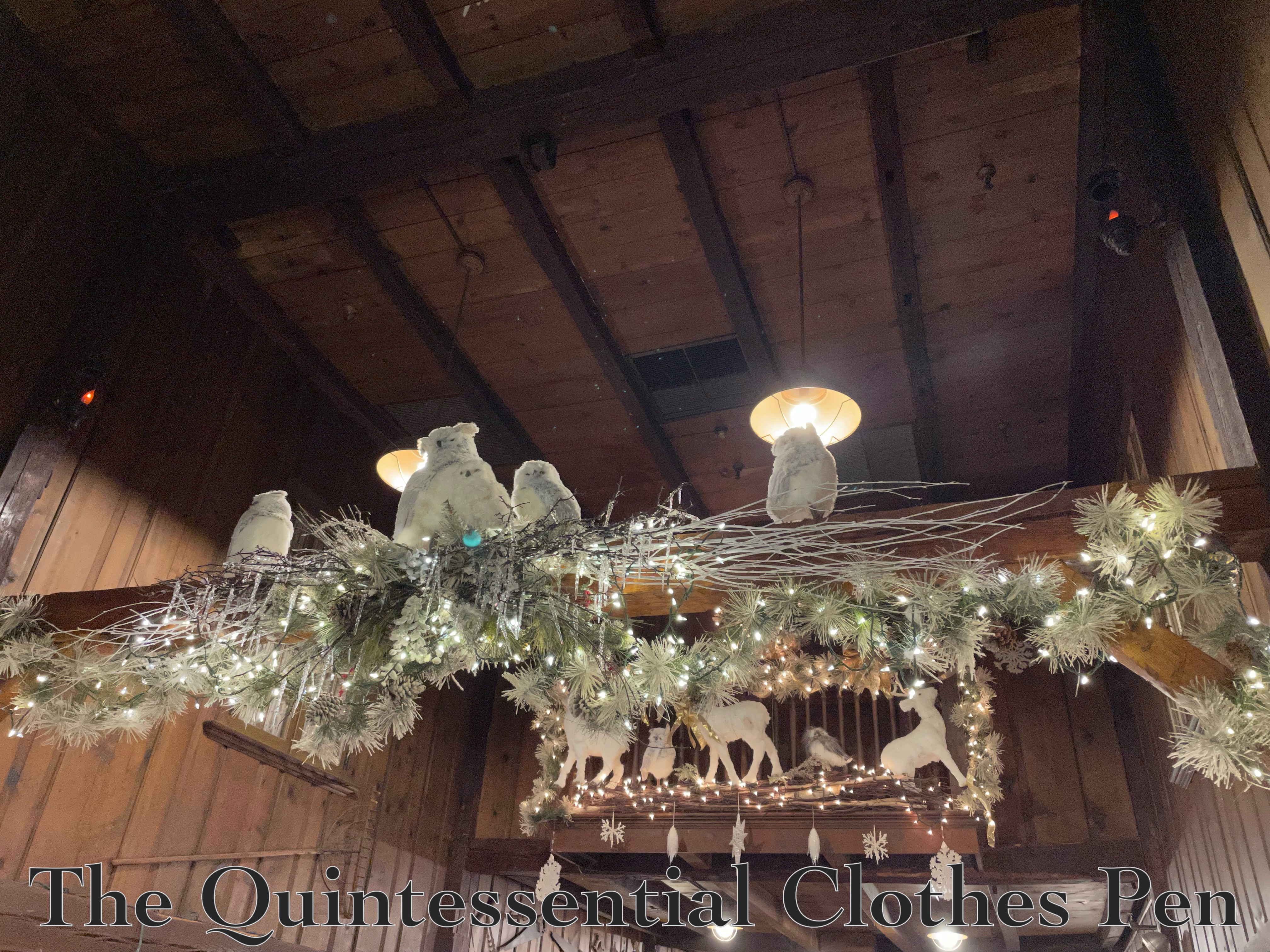
There were new vignettes around every corner, with everything from human-sized nutcrackers to animals and greenery. These owls, perched up on a rafter, amused me very much!

In another, more modern part of the building, we paused to take photos with a tree whose decorations matched my 1832 Velvet Gown and 12 Days Of Christmas bells & berries hair accessory. This dress is always fun to wear–lightweight, despite the velvet, and with a silhouette that is always entertaining.

I hope your holidays are full of joy, friendship, and gratitude!

HSM #3: Copper Colored 1790s Sash

I finished a project! It’s small, but I’m very pleased with it.

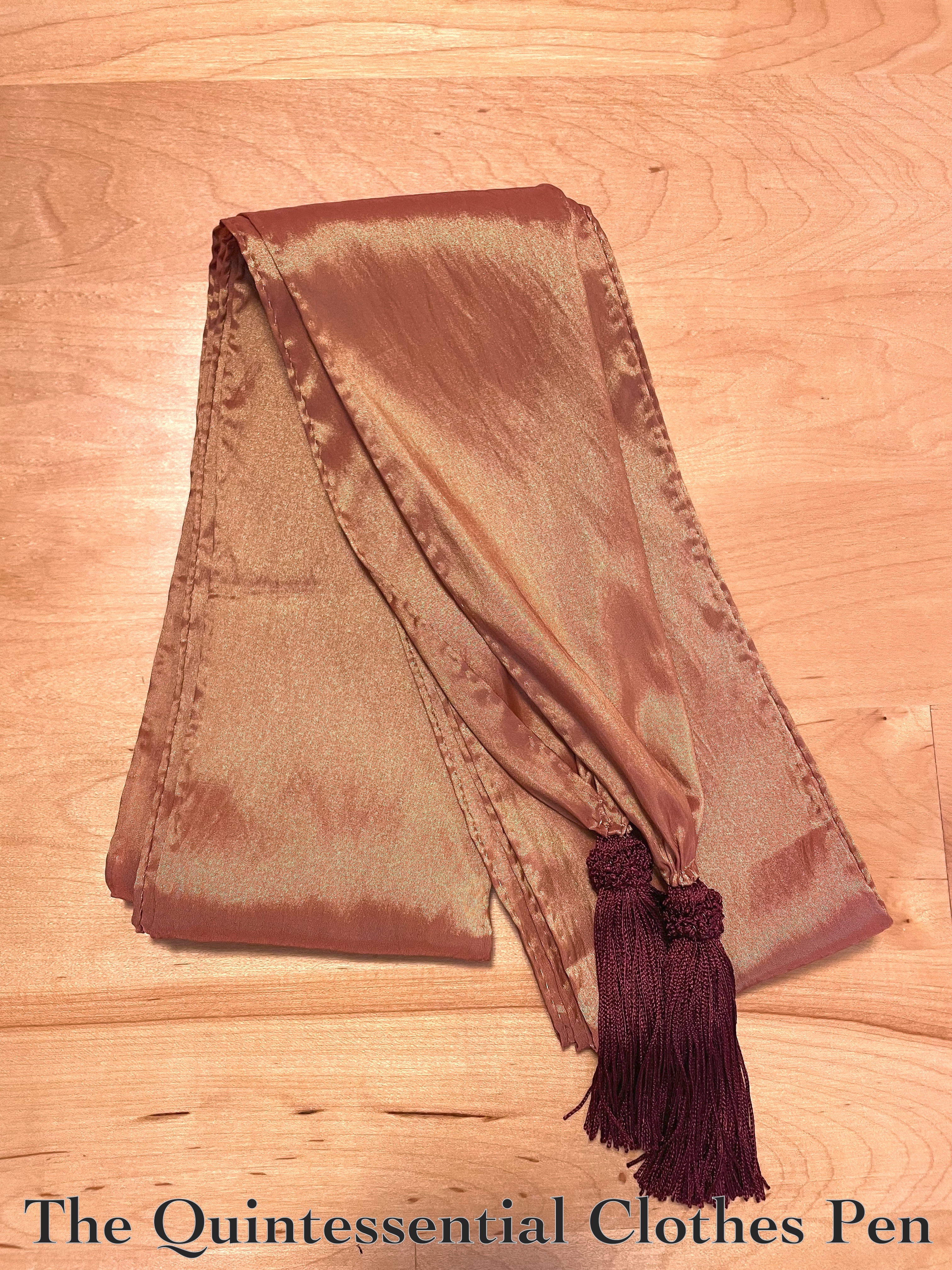
The project is a sash to be worn with an in-progress 1790s dress. The goal is to be slowly progressing towards an entire 1790s outfit, with all of the appropriate accessories.

I’ve enjoyed making lists of what those accessories might be and getting them cut out and lined up for mindless hand sewing. That way, even when life is busy and I don’t have time to think about a project, I can still make progress and have something to sew, which brings me great joy and a sense of calm.

This project takes its inspiration and instruction from The American Duchess Guide To 18th Century Dressmaking, by Lauren Stowell and Abby Cox.

I’m excited that the sash qualifies for the Historical Sew Monthly Challenge #3, Focus on the Fabric:

Make something in which the fabric colour/ texture/print/material etc. is the central feature of the design.

This fits the challenge in that the sash really isn’t at all about the construction details… The only cuts to the fabric were to make strips, and the only sewing is joining them and finishing the edges. So it really is all about the fabric!

Just the facts:

Fabric/Materials: ½ yard or so orange/gold shot polyester taffeta leftover from a very old project and 2 burgundy tassels.

Pattern: 1790s Sash in the book The American Duchess Guide To 18th Century Dressmaking, by Lauren Stowell and Abby Cox.

Year: c. 1790.

Notions: Thread.

How historically accurate is it?: 90%. Polyester is obviously not historically accurate, but the dimensions and hand sewing method are.

Hours to complete: 5.

First worn: Has not been worn yet.

Total cost: $2 for the tassels and let’s say $.50 for the thread. We’ll count the fabric as free. So, $2.50.

HSM #11: c. 1785 Hand Sewn Natural Linen Stays (Of Success!)

I recently finished up a series of blog posts that document the trials, tribulations, and triumphs of a new pair of 18th century stays. Here is the link to the most recent post (and I’ll include a link to all of the posts in the series at the end of this post).

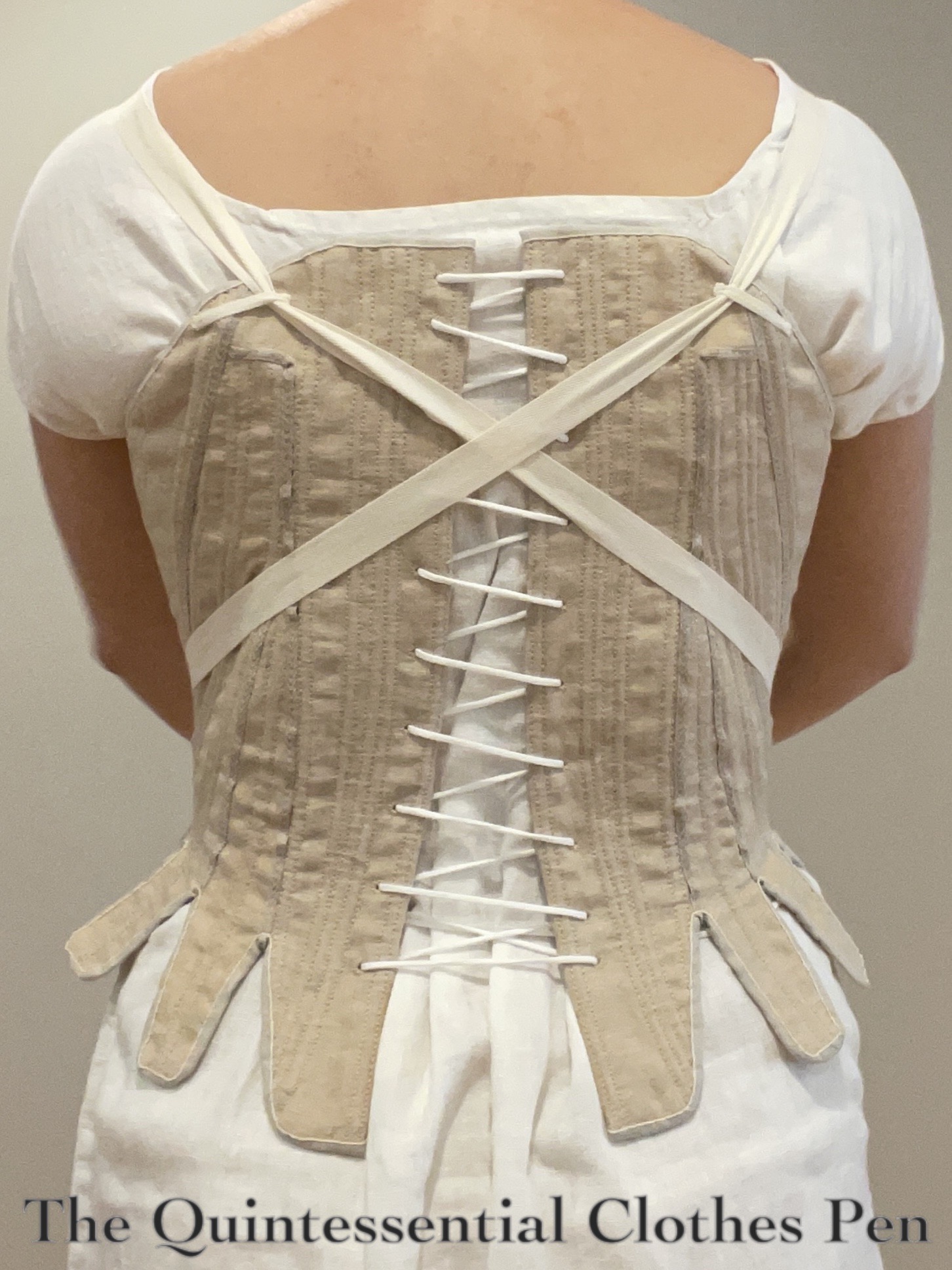
I’m really, really excited that this pair of stays is complete! They are entirely hand sewn, which took quite a bit of time. And, they were a struggle to fit that ended in success. For both of those reasons, I’m excited that these qualify for the HSM Challenge #11: Style Starts At Home:

Make something which would generally be seen only within the household (ex: informal at-home wear, nightwear, undergarments)

How do these fit the challenge? Well, stays are an undergarment that would generally only be seen at home!

Just the facts:

Fabric/Materials: ⅔ yard natural linen for exterior (scraps from another project), 1 ⅓ yards thick/heavy white linen for interlining (scraps from another project), and ½ yard cream linen/cotton blend for lining

Pattern: 1785-1788 Half-Boned Stays from Mandy Barrington’s book Stays and Corsets: Historical Patterns Translated for the Modern Body

Year: c. 1785-1788

Notions: 29 10″-14″ zip ties that I cut to be 3/16″ wide for boning, 2 ½ yards 3/16″ wide natural linen twill tape for seam covering, 4 yards 1/2″ wide natural linen plain weave tape for binding, 3 yards white cotton cord for lacing, 1 yard ¼” wide cotton twill tape for front lacing, 2 yards ¾” wide cream cotton twill tape for straps, regular weight thread, and heavy weight thread

How historically accurate is it?: 90%. The pattern and methods are based on historical examples. The materials are pretty close, though the zip ties and cotton/linen blend aren’t perfect replicas of 18th century materials.

Hours to complete: I only kept track of about 50 hours, but my guess is that I spent at least 70-80 on these stays.

First worn: In May 2023 for photos.

Total cost: Approximately $40.

And, a few more photos: side and back view, as well as a view of the stays folded in half from the inside.

You can read previous posts in this series here:

c. 1785 Stays of Success, Part VII: Conclusion, Reflections, and Resources
c. 1785 Stays (Of Fail), Part VI: Finishing Construction Details
c. 1785 Stays (Of Fail), Part V: Middle Construction Details
c. 1785 Stays (Of Fail), Part IV: Early Construction Details
c. 1785 Stays (Of Fail), Part III: The Pattern
c. 1785 Stays (Of Fail), Part II: Fitting Update
c. 1785 Stays (Of Fail), Part I: Beginnings

c. 1785 Stays Of Success Part VII: Conclusions, Reflections, & Resources

Did you notice the change in the name of these stays??? I’ve decided to call them the Stays of Success instead of the Stays of Fail!

This is partly to give them a more uplifting name that brings joy instead of disappointment, but also because I finally took photos of them… and then proceeded to wear them around the house for a number of hours because they were actually quite comfortable! Success!
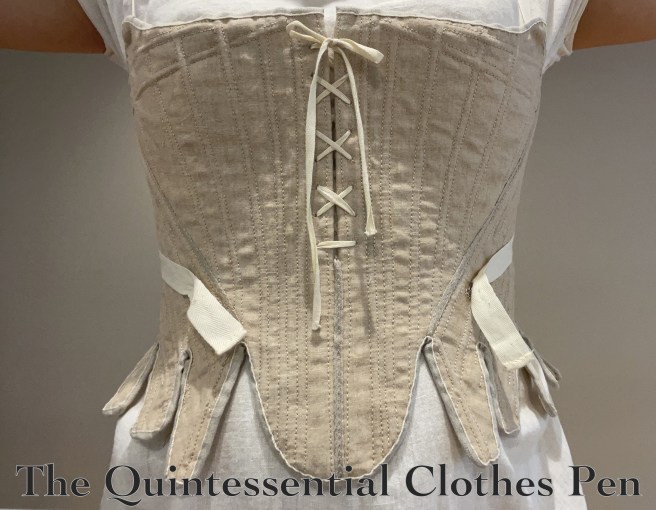
Conclusions and Musings

I want to start by exploring why I originally named this pair of stays the ‘Stays of Fail’. That is because, until very recently, I felt that this attempt at stays was a failure in terms of comfort. The comfort is what I based the original name of them on.

By the time the construction was almost done, I felt slightly better and that they were a (very struggle-y) learning opportunity. After adapting them, I was thinking that ‘Stays of Fail’ maybe should turn into ‘Stays of Learning’ (although isn’t that every project?!?) or maybe just c. 1785 Hand Sewn Natural Linen Stays (but that’s not very exciting!).

Stays of Success is more entertaining!

Reflections On The Process

Would I use the book Stays and Corsets: Historical Patterns Translated for the Modern Body by Mandy Barrington again?

My experience, as I moved forward with the construction process, was that I regularly lamented the focus of the book on modern theatrical methods, as I was aiming to produce historical stays. When I wanted to go back and get detailed information about the materials, construction methods, measurements of bindings, etc. I found that information just wasn’t included. It was especially frustrating when information was just missing–such as the locations of the front eyelets–even on a pattern taken from the original.

At one point, I thought I could get around the problem of lack of historical detail in the book by looking for the online record of the Chertsey stays that the pattern was based on. Clever, I thought! However, I can only find two images of them and it seems that aside from that they aren’t available to view online in full. (The back lacing can be seen here and a front view can be seen by Google image searching ‘Chertsey museum stays’, but clicking through to the museum website doesn’t lead to the image.)

This lack of information is why I heavily relied on Patterns of Fashion 5 (PoF5)–because all of the detailed information I wanted (and more!) is there. (I did have to extrapolate and make decisions based on the information in PoF5 since it is all for similar stays but not for the exact pair that I’ve patterned.)

So, while using this book was a valuable experiment, I don’t think I would be inclined to use it to create another historical support garment for myself. However, I can see the benefit of drafting a pattern with similar proportions for someone who is vastly different than the original pattern size, for theatrical purposes in particular. For that purpose, I wouldn’t be interested in replicating the historical details and so the omissions I mentioned would not be a detriment to the garment I would be intending to produce.

In the end, I’ve learned a lot about what this book can, and can’t, do and that is helpful even if I’ve been a bit frustrated along the way due to my goals being different than what the book is aimed at.

Further Experiments

Unfortunately, one of the fitting problems I encountered might be due to an alteration I made in the mockup to take in the waist (I’m taking ownership of my actions!). This inside photo of the mockup shows the center front and side area alterations I made.
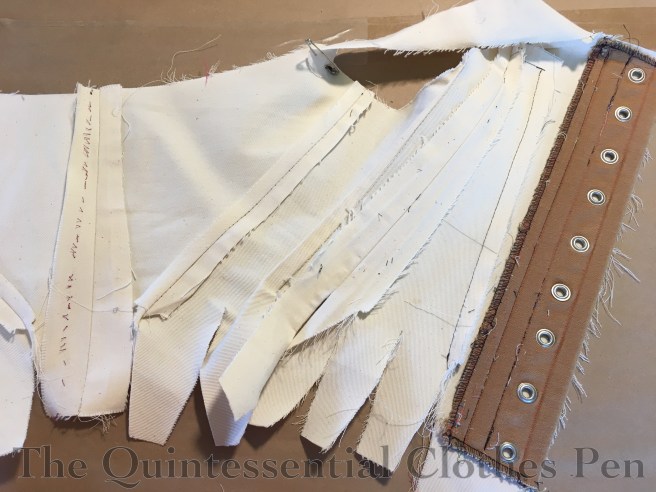
After finishing the stays, I was curious to see how the mockup would fit if I compared it to the finished stays. It turns out that I basically had to add in the width I’d taken out in the mockup when I added my back gusset. Sigh!

In theory, my alterations should have made the mockup slightly smaller than the finished stays with the added gusset, but the odd thing is that the mockup dimensions (with the alterations) are pretty similar to the finished stays (with the back gusset added in). So perhaps the real fabric stay pieces shrunk or wound up being smaller than I thought? Who knows?!? I’m done puzzling on this one!

In The Meantime…

While wrestling with these stays, I decided that I didn’t want my lack of stays to hold me back from making dresses any further and so I decided to start a whole new pair of stays instead off dealing with this pair (at least for a short time).

I held off sharing about them for quite awhile because I wanted to finish the saga of these stays… but eventually I gave up, and at the end of 2022 had great fun sharing the success and construction of my c. 1785 Green Linen Stays.

Resources

This is not comprehensive by any standards, but I thought it might be helpful to collect some links that I’ve found useful for anyone who wants to know more, see other people’s stays, or people who are making stays themselves. (These sites were especially useful for seeing the process when I didn’t have PoF5 on my cutting table!)

You can read previous posts in this series here:

c. 1785 Stays (Of Fail), Part VI: Finishing Construction Details
c. 1785 Stays (Of Fail), Part V: Middle Construction Details
c. 1785 Stays (Of Fail), Part IV: Early Construction Details
c. 1785 Stays (Of Fail), Part III: The Pattern
c. 1785 Stays (Of Fail), Part II: Fitting Update
c. 1785 Stays (Of Fail), Part I: Beginnings

c. 1785 Stays (Of Fail), Part VI: Finishing Construction Details

This project was on hiatus for a number of months (the last post about it was in October 2022!), but the time has come to wrap it up!

After the progress made in the last post, there weren’t that many steps left to complete. Yay! Below are details about those steps.

Binding

I used ½” natural linen tape. It is whip stitched onto the right side and then wrapped around to the inside and more roughly whipped. The inside stitches will be covered with the lining, so making them invisible and pretty is less important. Below is a photo of the inside of the stays after the binding was sewn on.

Lining

At this point, the stays were almost done. The lining serves to cover up all of the interior construction. To make it, I laid my stays out wrong side face up (as in the above photo) with my lining fabric on top. I pinned in a few strategic places and then roughly penciled where I wanted the cutting lines to be. Then, I cut the lining pieces out.

Once cut, I pinned the center lining piece in place, then pinned the piece next to it, turning under my raw edges at the places I wanted the seam to be and around the edges. Those edges were all pinned in place and then each edge was whip stitched. Additionally, each tab has a separate, small piece of lining whose edges are also whip stitched in place.

Straps

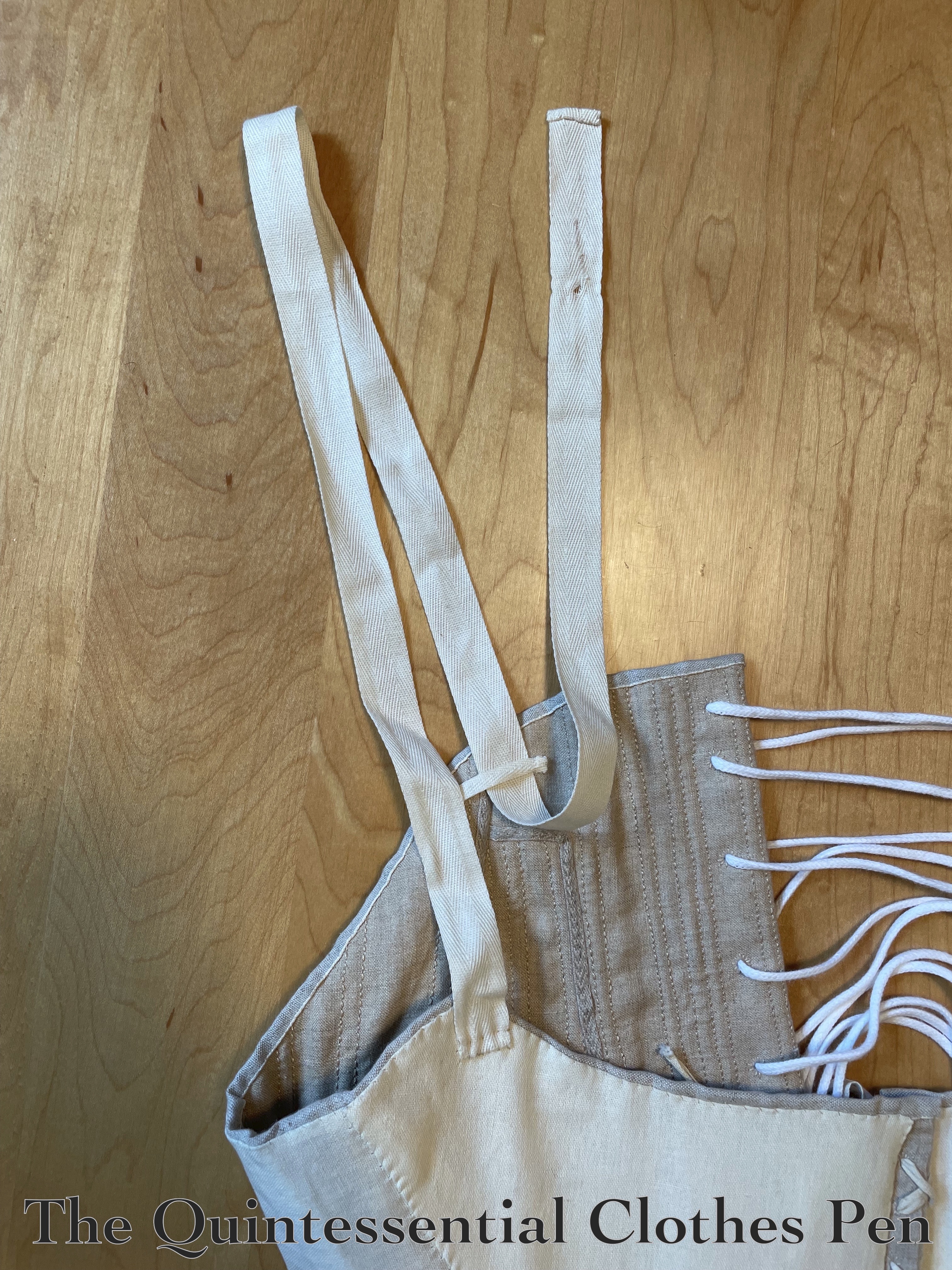
The truly final step was to add straps! I used ¾” ivory cotton twill tape. Each strap was sewn to the front points of the stays and the short raw end hemmed. A scrap of ¼” twill tape was also sewn on each of the side backs for the wider tape to run through.

Then, I tried on the stays and determined where I needed to place the hooks that the straps would attach to. Below is a photo of one of the straps held in place by the sideways hook. The straps are long enough to wrap over the shoulder, cross in back, and wrap around towards the front to catch on the hooks.

After that, all I had to do was attach the hooks… and… after many years… the stays were finally, finally… finally…. DONE! They were finished in April 2023.

You can read previous posts in this series here:

c. 1785 Stays (Of Fail), Part V: Middle Construction Details
c. 1785 Stays (Of Fail), Part IV: Early Construction Details
c. 1785 Stays (Of Fail), Part III: The Pattern
c. 1785 Stays (Of Fail), Part II: Fitting Update
c. 1785 Stays (Of Fail), Part I: Beginnings
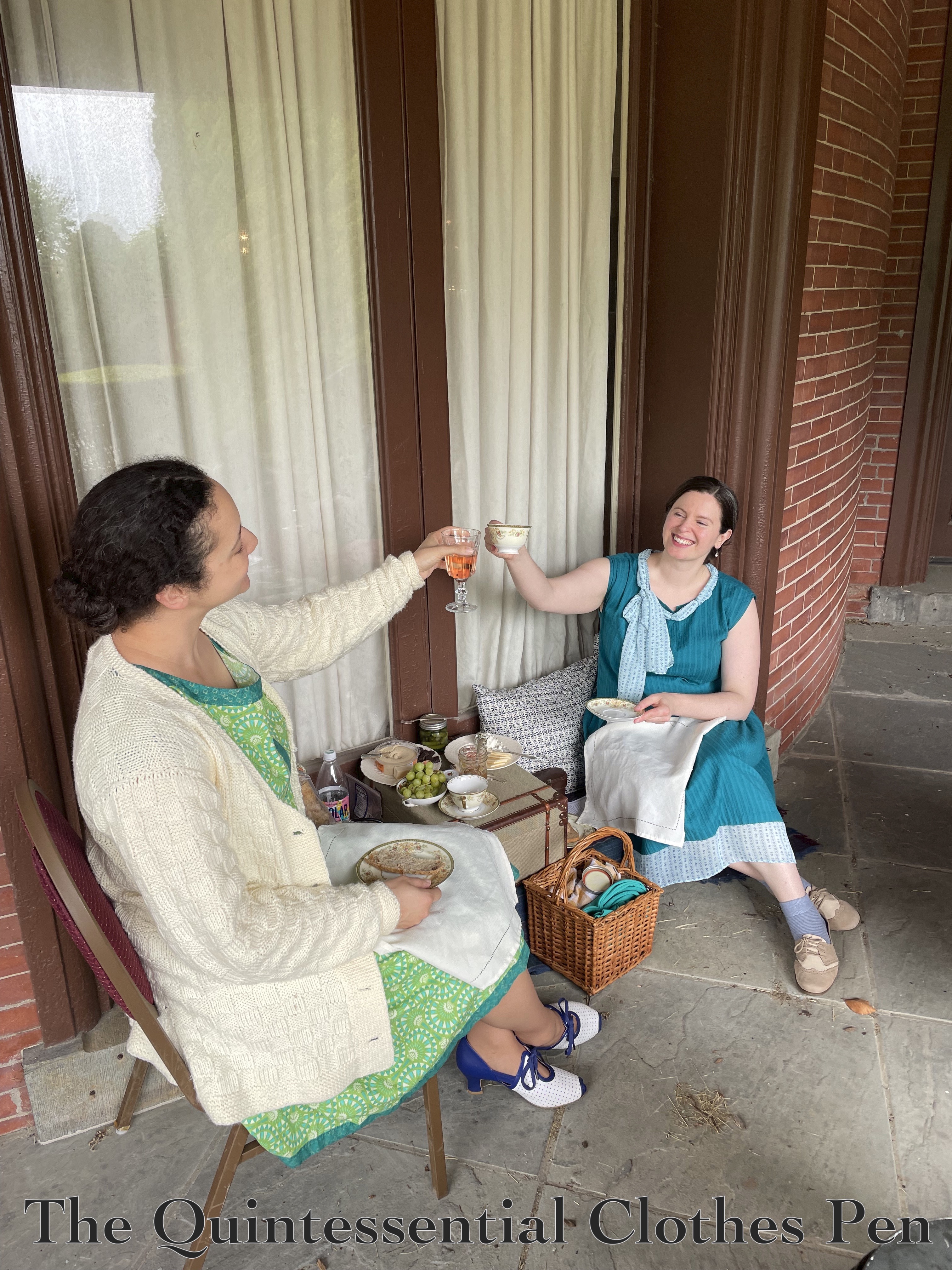
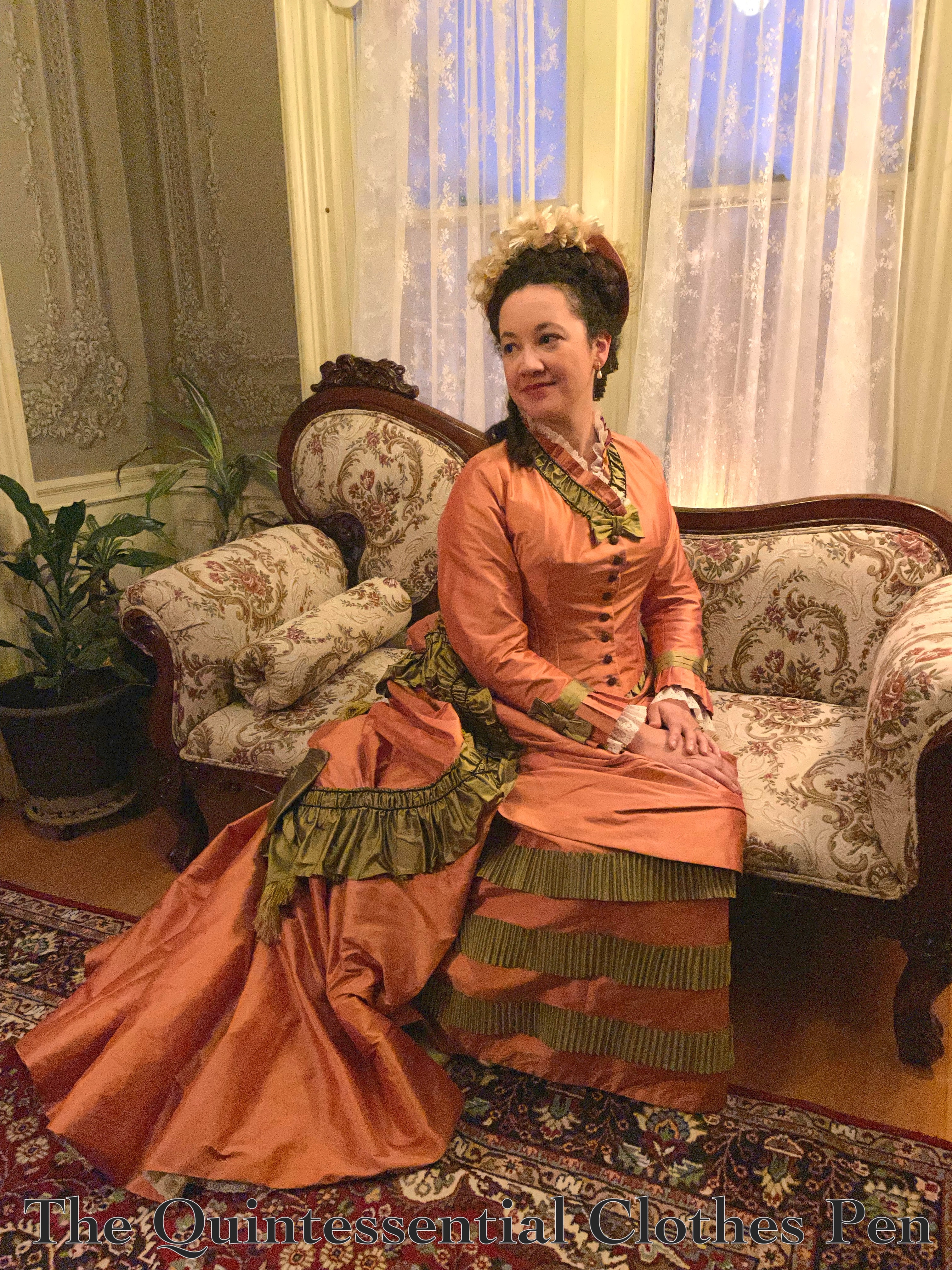
1875 Reception Dress Photo Shoot

I was really excited to spend lots of time working on and finally completing this dress during the summer of 2020.

At that time, there was no option of finding a fabulous indoor place to take photos, so I had to make do with the outdoors. Don’t get me wrong, I have lovely photos from that short outing, but they didn’t have as much background ambiance as I was hoping to find, someday.

But last year, I had the opportunity to actually wear this dress for an activity! And I was able to convince friends to take oodles of photos so I could better document the dress in appropriate surroundings for its reception status. So now, I present many photos of this dress.

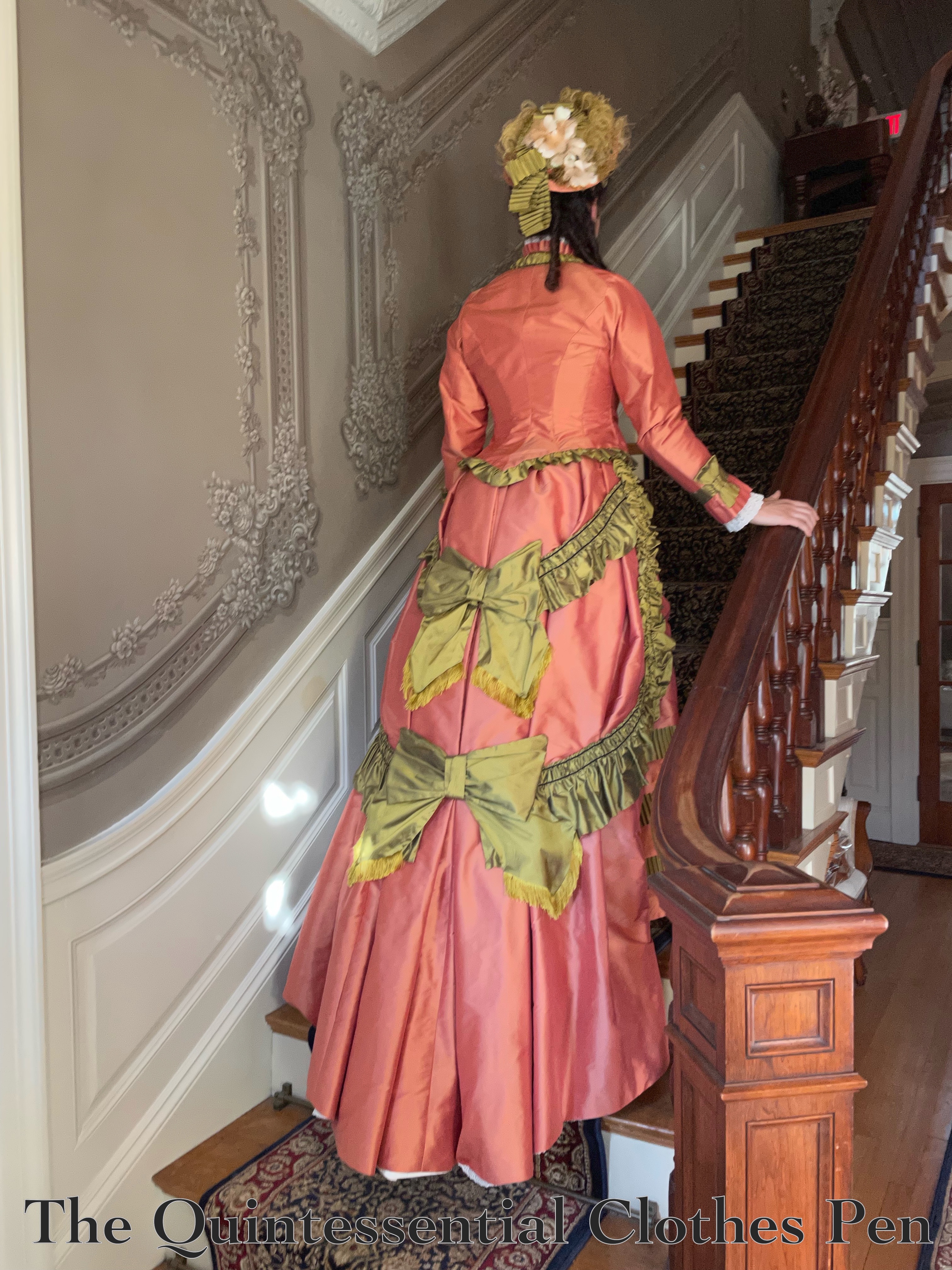
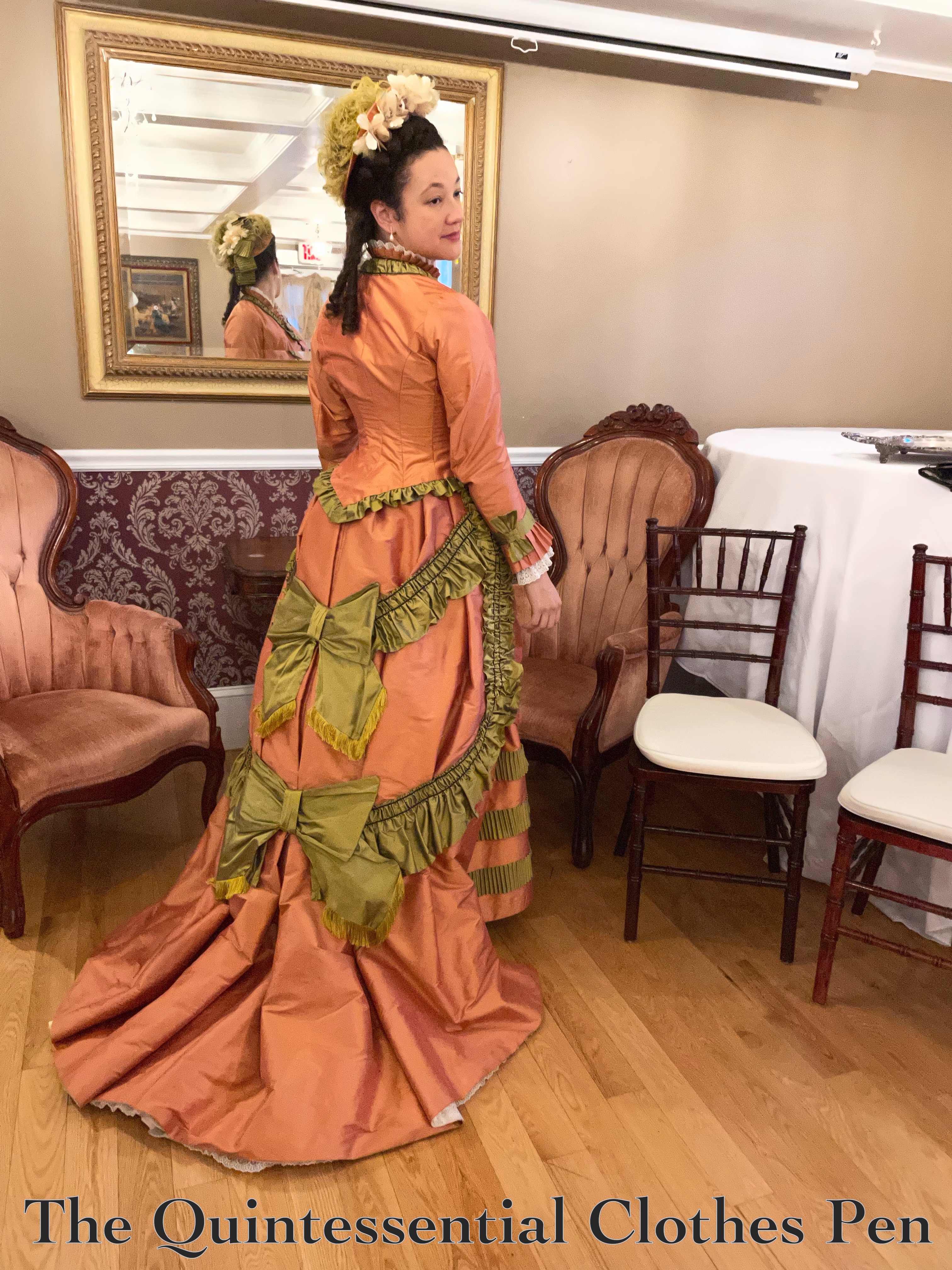
There are dramatic back views, of course.

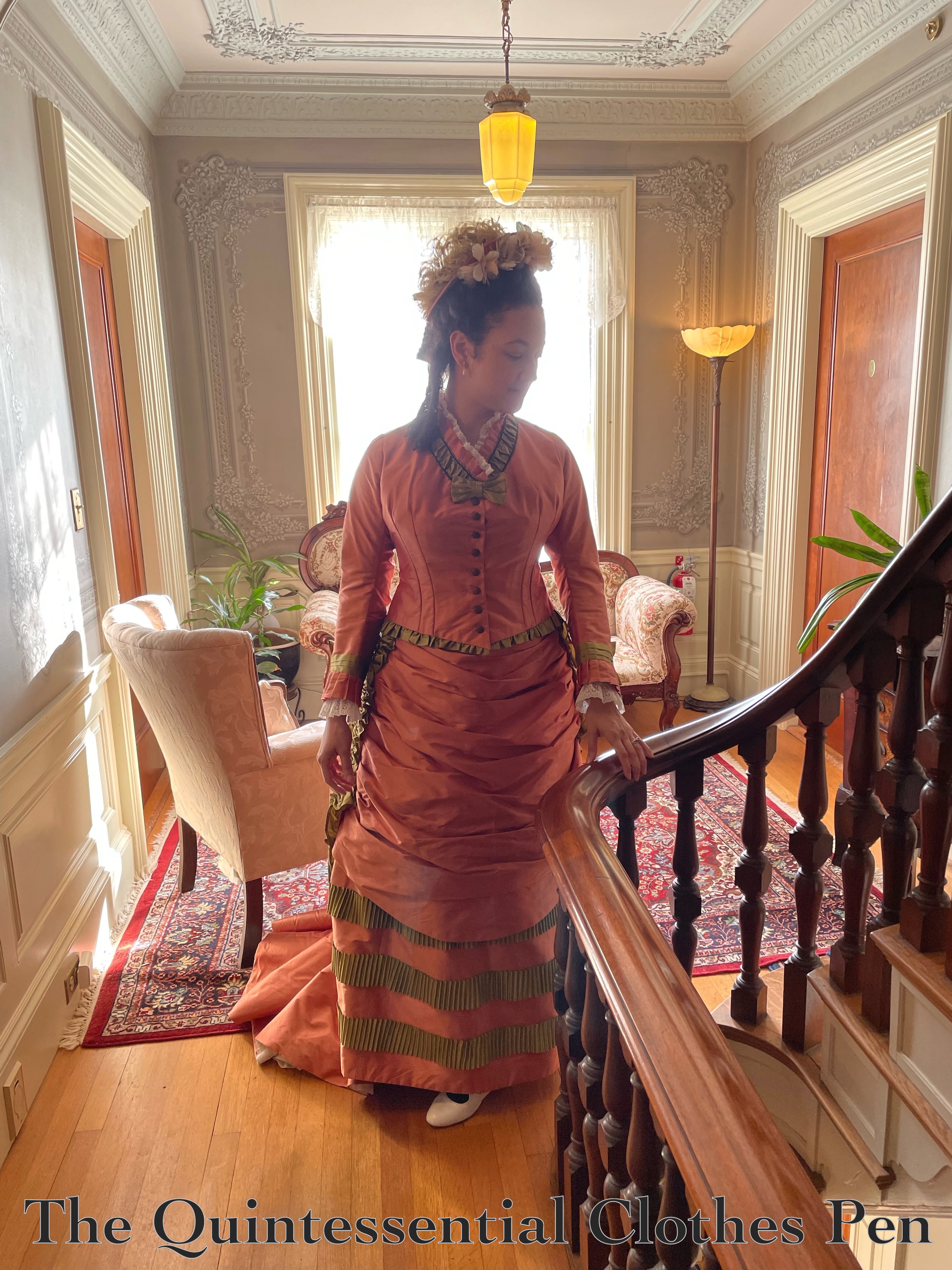
And front views showing the bust, waist, hip dimensions I worked very hard at in the patterning stages. This is created/augmented with padding. You can read more about that in this past post.

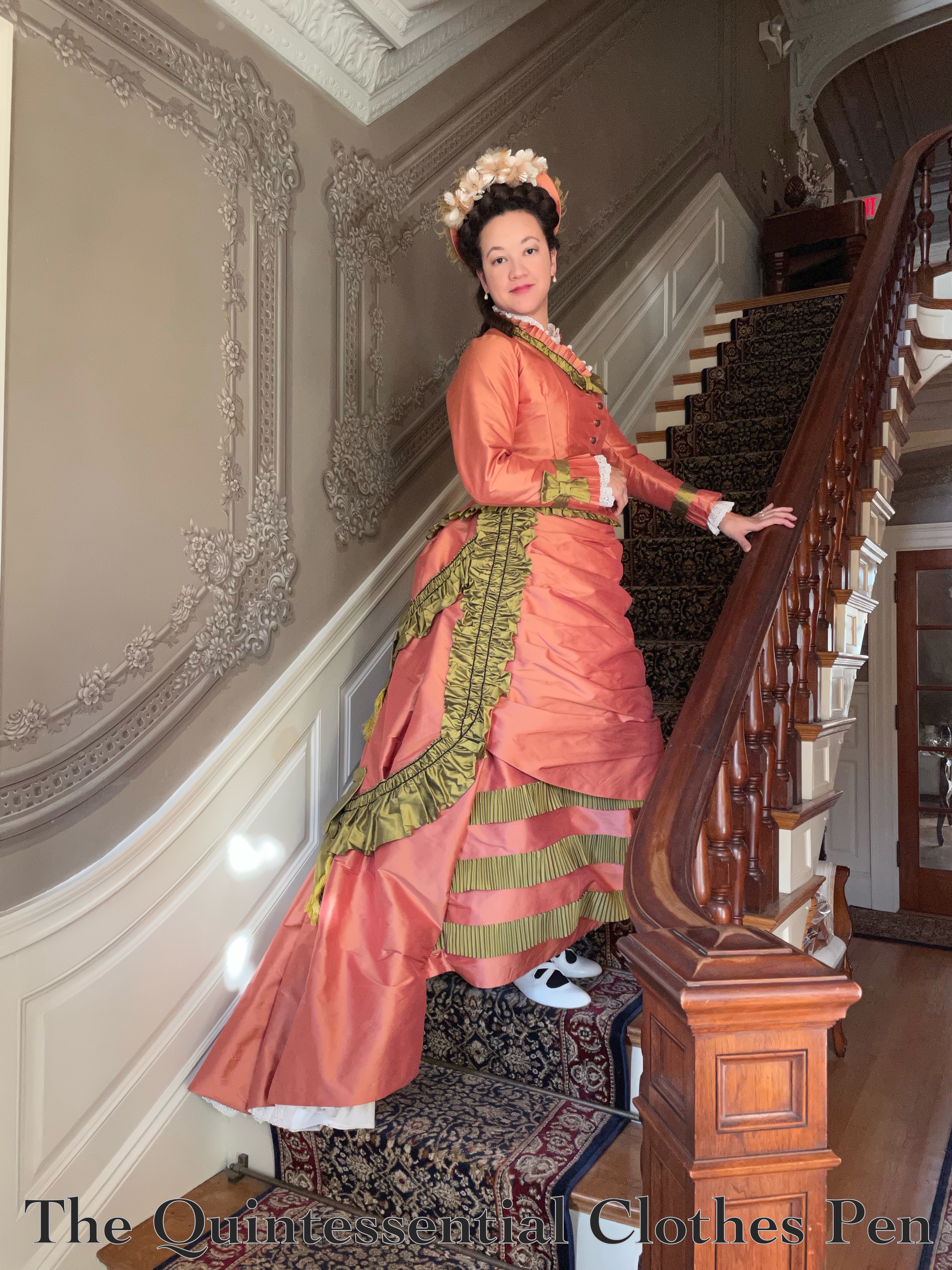
There are also views trying to show both the front and back. A side front view, if you will. This also captures the hat very well. I wrote a detailed post about making it, which you can read here.

And a few more sitting photos, as well. These are great for showing off the train and the layers that support it (this is my past post about constructing the skirt and this is about the balayeuse that supports the skirt, if you’d like to know more).

It was hard to choose favorites! I’m very pleased to have so many photos that capture the glory of this dress in an appropriate location.

Gilded Age Weekend Portraits

As I shared in my last post, friends and I planned a historical weekend away that had a Gilded Age theme. Part of the idea was to document some of our older and recently made clothing in a fabulous setting. To that end, I have many photos of our outfits that I would like to share!

To start, some daytime outfits, worn for afternoon tea and amusements.

So much detail! Fabulous fabrics, beautiful trims, eye catching hats and hair ornaments… the list goes on and on!

And to follow that, a few of our evening outfits.

Thanks for appreciating and enjoying these with me!

Gilded Age Weekend Highlights

Last year, friends and I decided to treat ourselves to a historical weekend away. With a number of bustle (1870s and 1880s) and 1890s dresses languishing in our closets, the chosen theme was the Gilded Age. We planned a very busy weekend of parlour games, afternoon tea and amusements, informal dance practice, and a formal ball.

Regular blog readers already saw a hint of this event in my last post, When The Dress No Longer Fits (1896 Evening Gown), but I have a few more posts to share, as well. Today’s post captures some of the amusing highlights from the various weekend activities.

To start, a behind the scenes shot of partially completed hair for my 1875 dress (which you can see in the photo after the one below). The photo below also shows off My Favorite Winter Things Skirt! Yes, I continue to wear this during the winter. The penguins, polar bears, and foxes participating in winter activities–skiing, ice skating, sledding, etc–continues to bring me amusement and joy.
And here, a still of theatre-adjacent people trying to create an amusing atmosphere while not making absolutely ridiculous faces. It brings me such joy to have well dressed friends!

Friends who also enjoy creative pursuits, such as creating homemade tabletop croquet! Not only is this absolutely adorable, but it’s also playable!

Our afternoon amusements also included a stereoscope.

Here is another view of the lovely ensembles at the ball.

I wore my 1896 dress, as you can see in the photo below. This is a classic for us. Moose pose!

And, to wrap it up, this is the bronze 1896 skirt after being stepped out of. The canvas is so stiff it literally stands up on its own, a fact which I’ve found to be amusing ever since I first made this over 10 years ago.

Thanks for joining me in the adventure!

There are more photos to come… a selection of outfit portraits and better-than-my-backyard documentation of my 1875 Reception Ensemble.