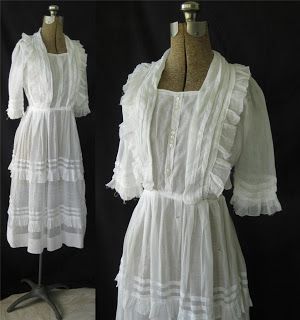
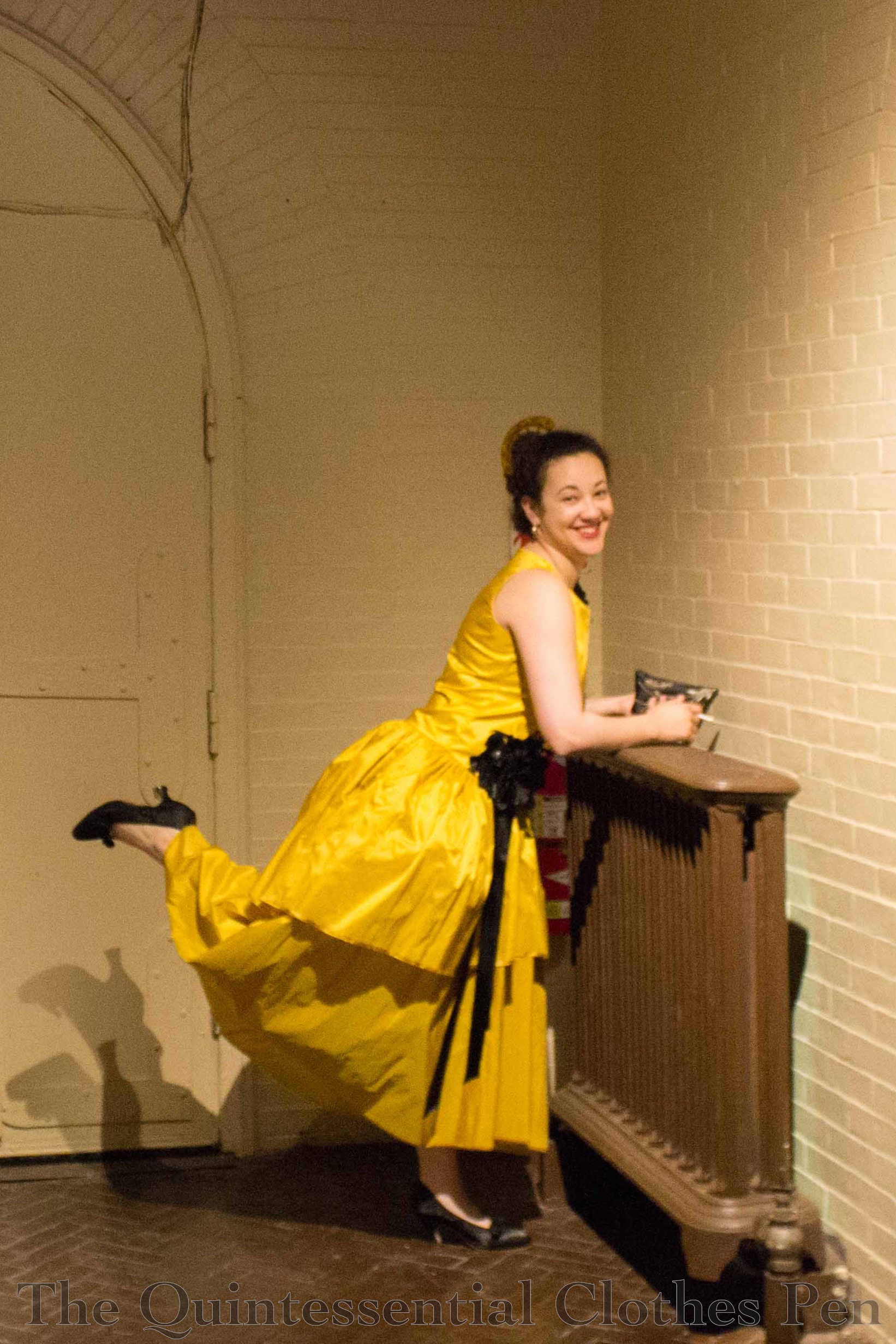
1919 Ivory Eyelet Dress (HSF #7)

I have a three evening gowns from the 1920s, but only two daytime ensembles. For summer events from the Ragtime dance period and the 1920s in general, I wanted a new addition in the daywear lineup, so I kept my eyes open while out shopping for other projects. I came across the fabric for this dress a few months ago before I had time to sew, but with a general plan in mind.

IMG_1622

Fast forward to about a month ago and I started actually planning the dress. I had thought to make a dress from about 1916 with a distinct a-line shape (a silhouette like this), but reconsidered that plan when considering the very linear effect of the tucks in the fabric. The linear fabric was much more suited to the period from 1919 to 1922 and so down that road I went.

IMG_1628

Just the facts:

Fabric: 4.5 yards pre-tucked ivory cotton.

Pattern: Adapted from Past Patterns #9127, Ladies’ Dress 1918-1920.

Year: 1919, explained in detail further along in the post.

Notions: Thread, snaps, and a hook and bar.

How historically accurate is it?: 95%. Accurate pattern from the period, reasonable fabric, and accurate finishing methods. Woo!

Hours to complete: 30? I took my time to enjoy the process, hand sewed more than was absolutely necessary in order to watch Netflix and not dig out the sewing machine, and fiddled with the bodice for awhile to get a style I was satisfied with.

First worn: July 17 for a Ragtime tea dance.

Total cost: $30 for the fabric.

(Edit: I forgot to mention what HSF challenge this was for when I originally published the post. It’s for challenge #7: Monochrome.)

IMG_1626

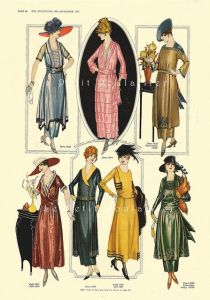
Why did I decide on 1919 for the year of my dress? The pattern dates to 1918-1920, putting my dress squarely in the middle, but I also looked at the details that changed with each year from 1918-1922 to confirm the plan.

3a57a53918caa3169851de5ee4e07f00
1918. Skirts have just ceased being the A-line shape of the prior three years, but they still have fullness and waists remain high.
c7f197805c10c37b29edb75dc9474571
1919. Still some full skirts, but the silhouette is narrowing.
42a3c1119c5fe26a015e785a9c6ce956
1920. Slimmer skirts with high waists.
6f15eba27b2b6312a8cc5d2e5851dc39
1921. Slimmer skirts with a dropping waistline.
8fa6917ee7b0b47dc885ad5c3fada90c
1922. The waistline has dropped to hip level and drape effects are fashionable.

1919 is the year when the features I most wanted all come together: full skirt, high waist, playing with the linear nature of my fabric going both vertically and horizontally, and skirt tucks. These features can be seen in the following most inspirational images.

fb02413f850f398dc842e2f9628c33ec
c. 1915
def974fc2efd8f1405bc5f1789b45392
c. 1915
0c121e6a1372e33bef4ca33340f96061
c. 1920
090083175fa5efb1cb137c925c241252
1919

Plus, these two fashion plates, from 1920 and 1921.

And construction? I kept it simple, with a few unfinished edges in the skirt (gasp!), pinking on the seams and exposed edges in the bodice, and as few closures as possible. No fuss. The bodice closes off center in front but the skirt closes in back because I was originally planning to make a separate blouse and skirt. When I decided I didn’t feel like dealing with a peplum, and that even with a peplum a blouse was likely to come untucked (as happens with my 1917 blouse when I wear it), I just hand sewed the now-bodice to the inside of the waistband  and sewed snaps around the other side to keep it together, as you can see. This way, it’s easy to separate the two pieces in the future.

IMG_1637

All in all, a pretty quick project as my projects go. Comfortable, flattering, easy to alter (a component of sewing projects I am trying to incorporate more often as I move forward with projects), satisfying to wear, plus it goes well with my Astoria shoes. Win!

SaveSave

Summer Dots

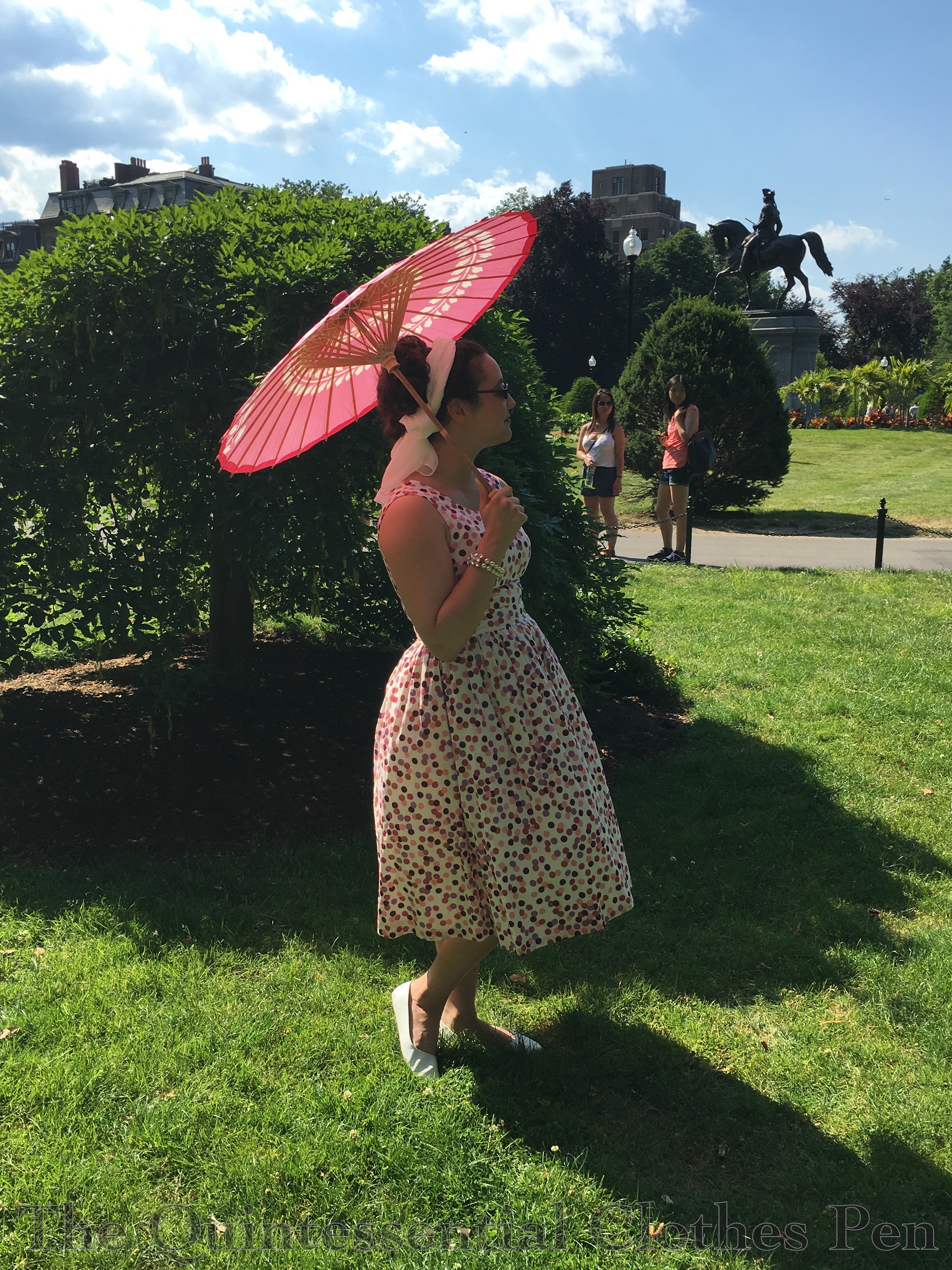
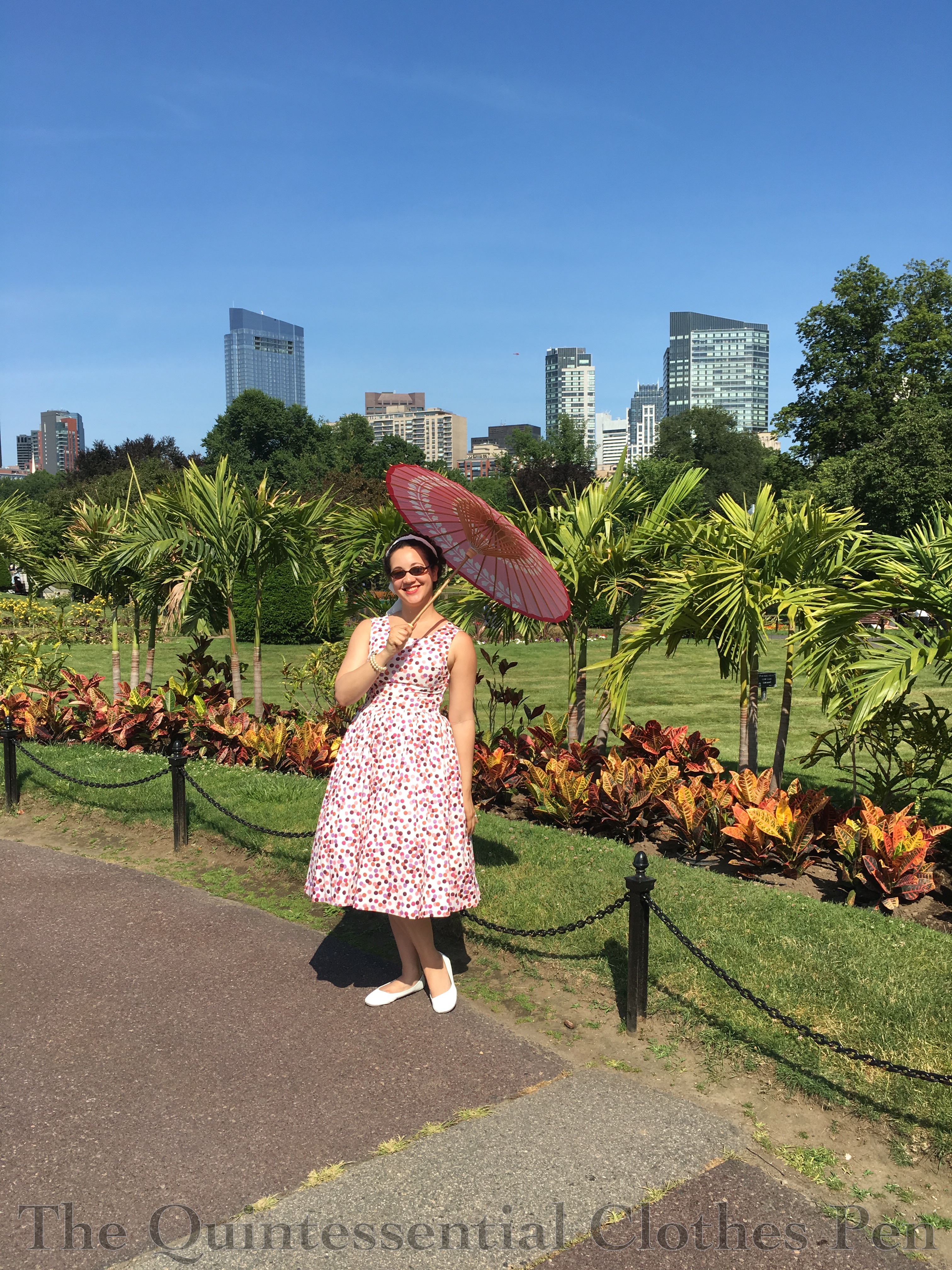
In June, I went to a picnic in the Boston Public Garden. As it was an open era event, I decided to wear my 1953 dot dress because it is easy and cool to wear in the summer heat.

IMG_1556

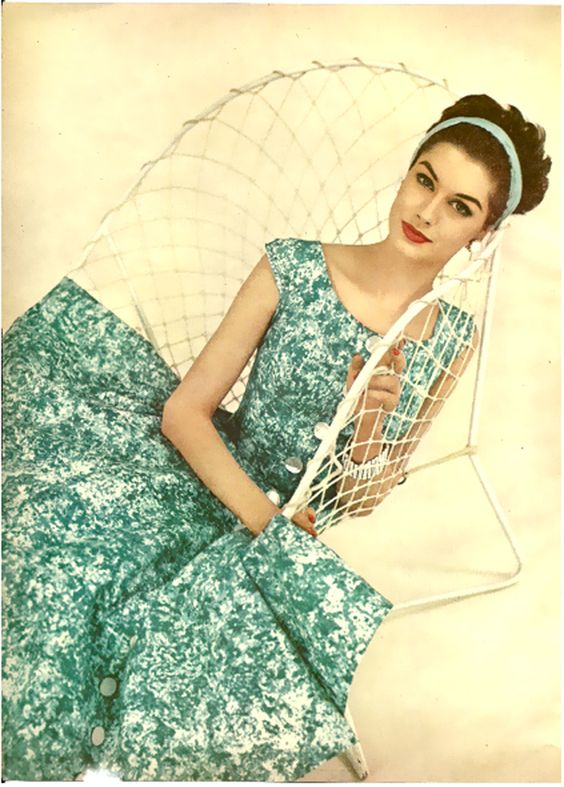
I took a long time styling my hair to look like this image from 1954. It’s quite a feat to tame the frizz and there was a moment of woe and frustration, but I didn’t have time to start again, so I continued on and was happy with the end result despite the angst in the middle of the process. Looking effortless is so much work!

7fa0cbf8bff4d8f948ea829a5dd44fd4
Charm Magazine, 1954

Picnicking! I plopped down to eat and then didn’t move much until picture time.

IMG_1534

I love how the pictures turned out! I purchased a new parasol to use this summer for 1920s events, but it matched this dress very nicely so I brought it along to the picnic. Raspberry is one of my favorite colors.

IMG_1540

There was a crowd of people watching the picnic most of the day, but we managed to get a lot of pictures without them. Yay! I don’t mind being gawked at (I’m rather used to it actually) but I do usually like images that don’t have modern dressed people in the background better.

IMG_1553

The palms remind me of Florida, and this picture’s story in my head is that I’m on vacation there in the 1950s.

IMG_1559

I may look composed in these pictures, but when I run out of pre-thought pose ideas chaos ensures. I often start waving my arms around wildly, talking (producing odd faces when captured as a picture), and flinging my legs around. Here’s an example. There are a a range of caption ideas that pop into my head here: ‘hi-ya!’ and ‘at the bat’ most often.

IMG_1554

I hope you’re enjoying your summer, too! It’s so nice that the days are long and there are lovely days for sitting in the park or other outdoor activities!

Regency Shoe Poms!

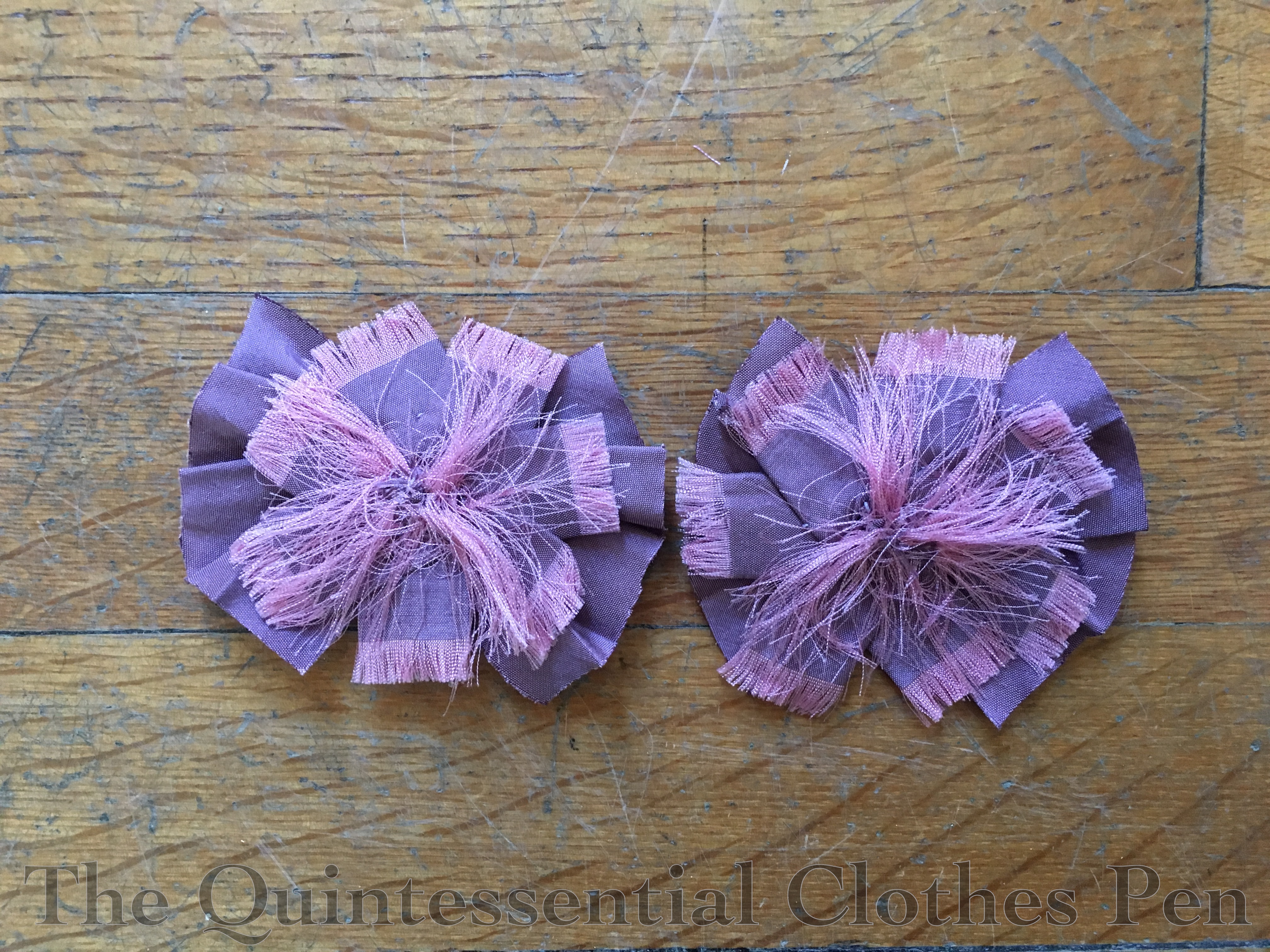
I was very excited when Gina posted a tutorial for making shoe pom poms in September 2014. I decided then and there, while reading the post, that I needed some of my own. It only took me about 18 months to get around to it… but I am happy to report that in April 2016, I finally used Gina’s tutorial to finish making my very own!

IMG_2477 (1)

What prompted me to really go ahead with making the poms is that I wanted to have something to spruce up an older outfit I wore to the 4th Annual CVD Regency Dance Weekend, but didn’t have the time to create a new dress, as the Versailles sacque and 1885 Fancy Dress were all consuming. I suppose what I should really say is that what prompted me to finish the poms is the opportunity to wear them. I think I actually started them in late 2015.

Let me start by saying that Gina’s tutorial is clear and easy to follow. I highly recommend it!

My issues were all self inflicted… I carefully followed Gina’s instructions, got partway through the process and realized that the scale was much bigger than I remembered and that I didn’t like it at all on top of my foot. Oh no! (But in going back to link to Gina’s tutorial for this post I have realized that of course her poms are not the scale I wanted, because her poms are bigger than I ever intended! Oops! Totally my fault!)

The only solution I could see at the time was to cut off the ends of each pieces and re-fray the silk ends! UGH! It was not a fun process to fray the ends and I could not face the idea of doing it again. So I refused to work on the poms for months because I was so frustrated. Then, in March or April, I had the brainstorm to make the pieces shorter by cutting out the middle so I wouldn’t need to re-fray the ends. Duh! From there it was smooth sailing to finish up the poms.

IMG_0769 (1)
Partially finished pom on top (using Gina’s original dimensions). My completed pom on the bottom (smaller in scale). The pin is for scale.

I used a purple silk shantung from my stash for this project so it would match my other purple accessories. The back of the poms have American Duchess shoe clips attached so that I can easily clip the poms to any shoes.

IMG_0770 (1)

I was inspired by extant shoes with poms on the toes, such as these. You can also take a look through my Pinterest board to spot more pom-like shoe decorations.

IMG_2491 (1)
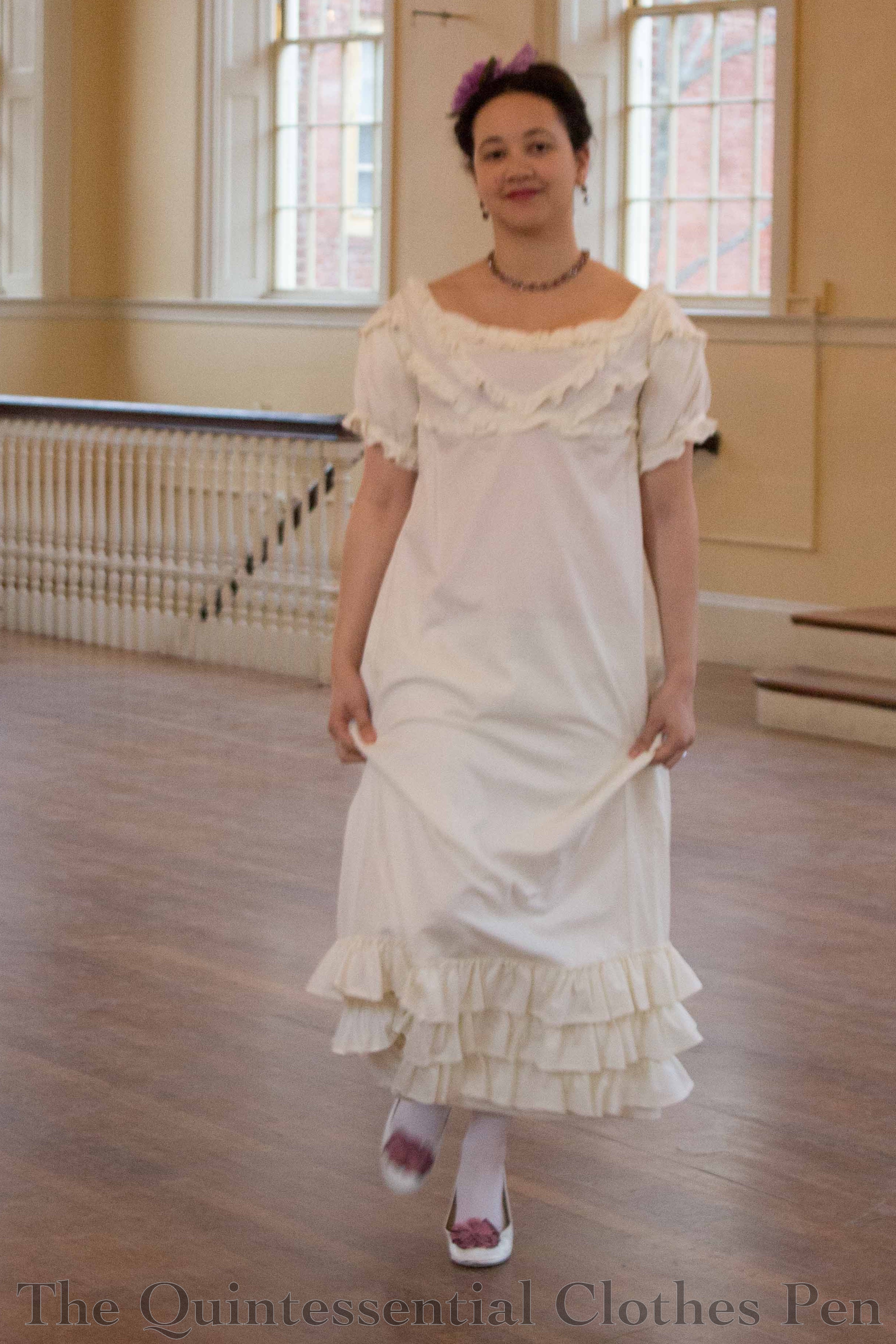
Poms in action! I really like the look of the neutral dress with the purple accessories.

Project Journal: Versailles Sacque: Construction Details

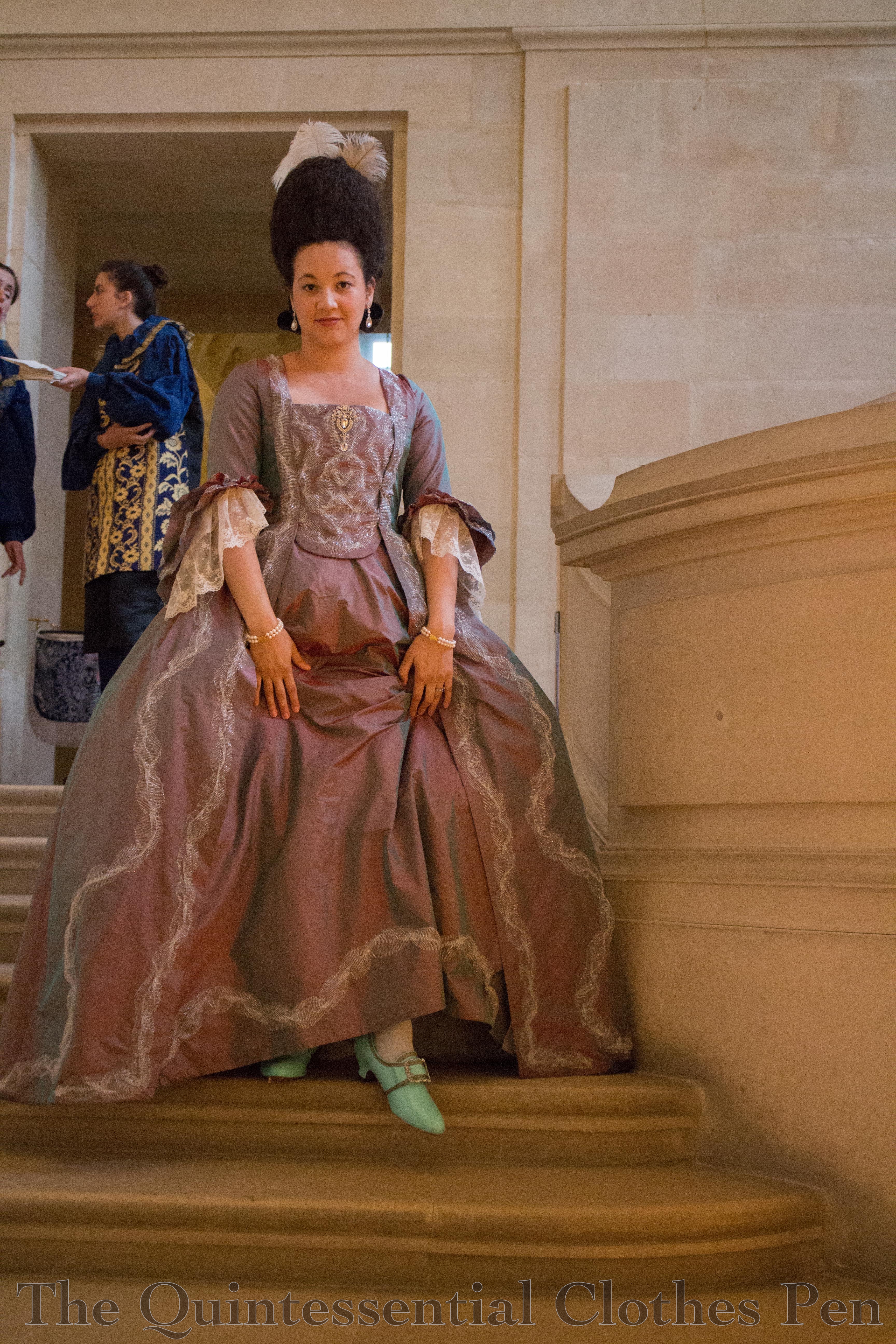
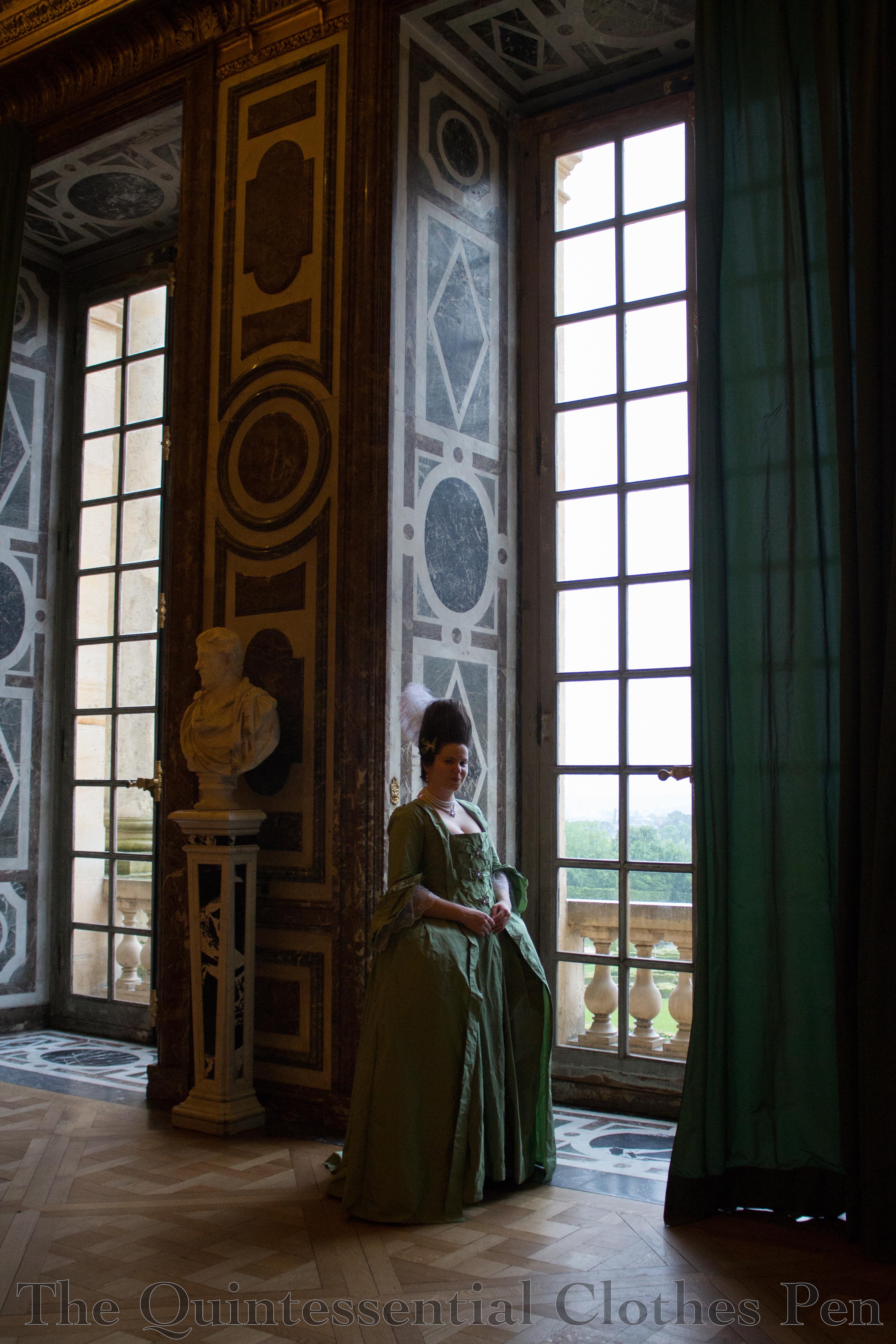
It’s time for some in depth detail about the construction of the robe a la francaise I wore to Versailles in May. My original plan was to use pink silk in my fabric stash to create a robe de cour inspired by Maria Federovna, but I realized when I went to cut out the pieces that I did not have enough fabric.

The change in plan resulted in new fabric and a new plan. I stuck with the decade of the 1770s, but decided to make a robe a la francaise, or sacque, instead of a robe de cour as it seemed like a garment I might be more likely to wear again in the future. Accordingly, I found and ordered new fabric: 11 yards of a very lightweight changeable silk ‘lutestring’ from Burnley and Trowbridge. Luckily, the new fabric still worked with the metallic silver net I’d purchased for trim. It’s the same metallic silver net that is on my 1885 Night Sky Fancy Dress, just cut into strips.

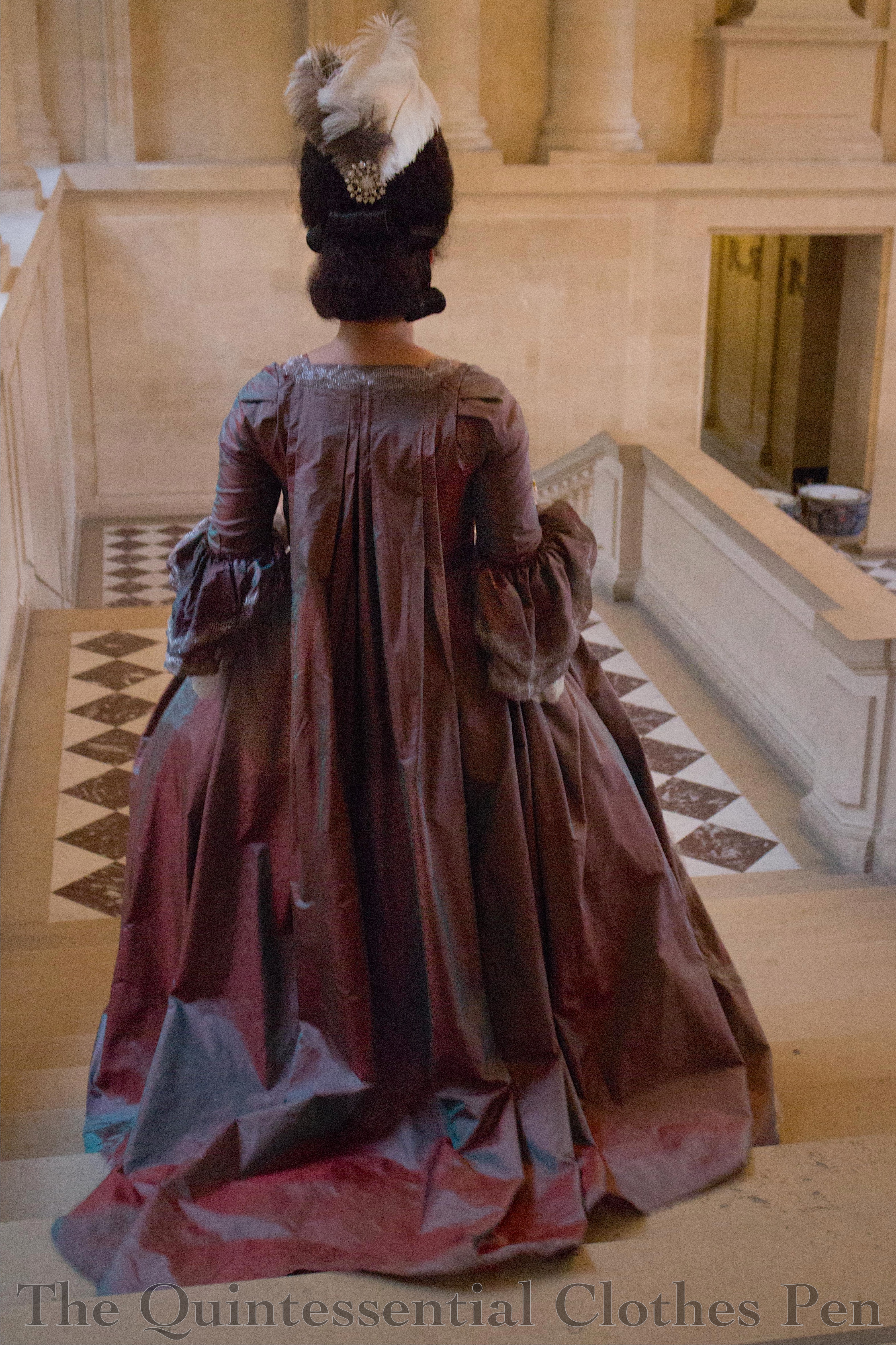
The pattern is from JP Ryan: it’s the Pet en Lair pattern, lengthened to create a gown as they suggest. Underneath I’m wearing a shift, stays, pocketsMr. Panniers, a generic 18th century petticoat, and the petticoat that matches the gown. I also have American Duchess clocked stockings and embellished American Duchess Kensingtons. All my jewelry is from eBay. You can read more about how I created my hairstyle and the hair ornament in this past post.

IMG_0258

Regarding the pattern, I found some of the directions to be confusing. For example, making the petticoat seemed way overcomplicated.   You can read more details about how I made my petticoat here. Also, I found the directions for pleating the front robings/facing and the back pleats quite confusing. There, I was saved by this post written by AJ who also used the JP Ryan pattern, got confused, and posted about the confusing bits. Very helpful! Aside from the confusing directions, the gown pieces went together perfectly with no trouble. I did have to alter the front strap area to make the front sit flat against my body. Two friends who used this same pattern did not have to make that adjustment, so I chalk it up to differing body shapes but do not think it negatively affects the pattern.

IMG_0687 (1)The lining of the gown is made from a one yard piece of cotton/linen blend from my stash. Also from my stash and used inside the gown were a scrap of medium blue linen and a scrap of medium blue cotton twill used to interface the stomacher. These were all the bits left of those three stash fabrics–yay! I was also amused that all of the random non-silk fabrics in this gown and petticoat wound up being blue. I used my lining as my mockup, meaning that I had to take a dart in the front strap area, but was able to adjust the pattern to eliminate the dart before cutting out the silk.

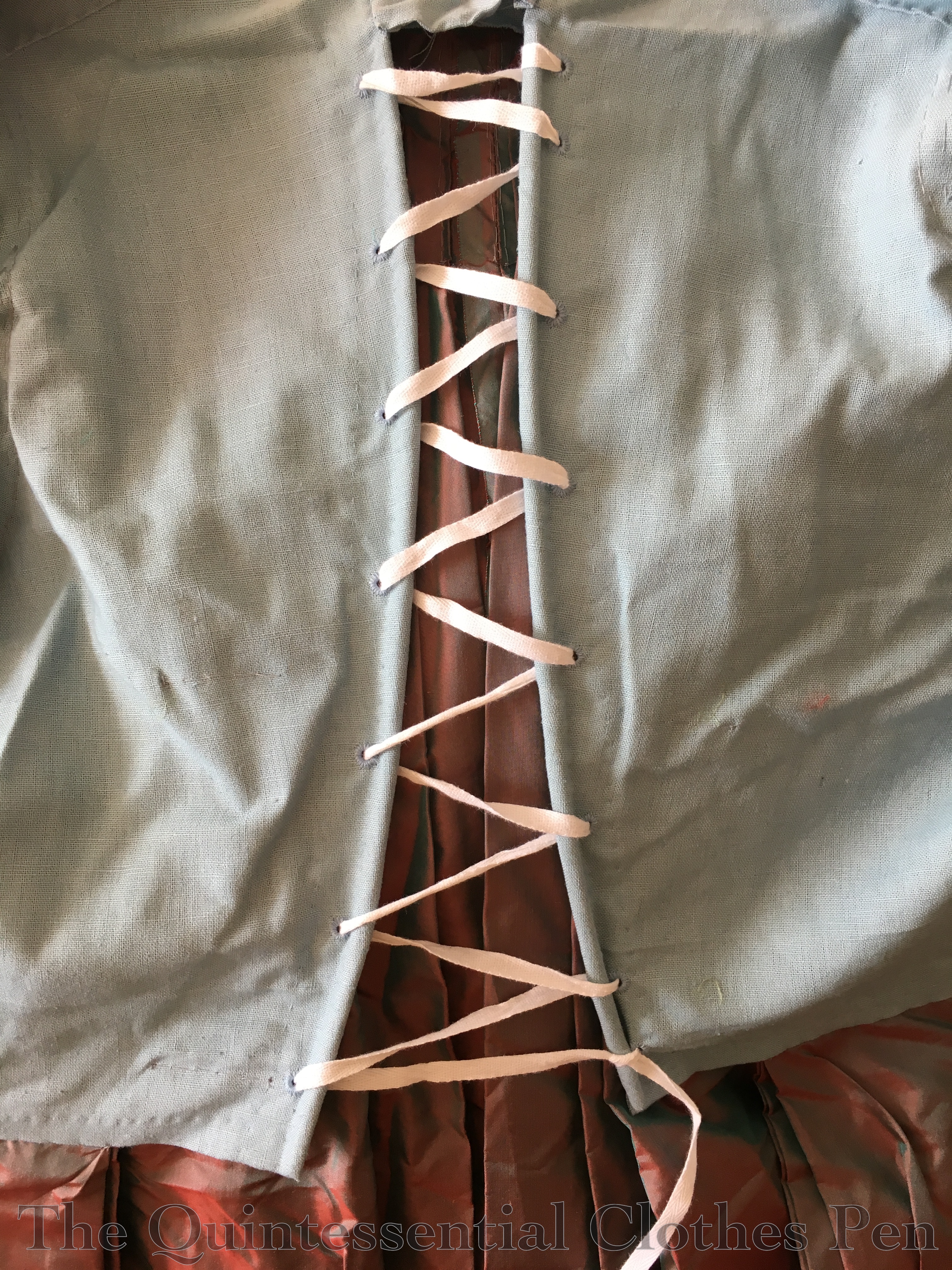
The back of the lining is adjustable using a tie threaded through eyelets. The edges are boned with reed. The pattern suggests ties, but you also see lacing in extant garments and this seemed easier to adjust and that it would use less length for the tie(s). There are examples of both ties and lacing on my Pinterest board for this project. The tie is a 1/4″ cotton twill tape. It’s not accurate, but did the job.

IMG_1476 (1)

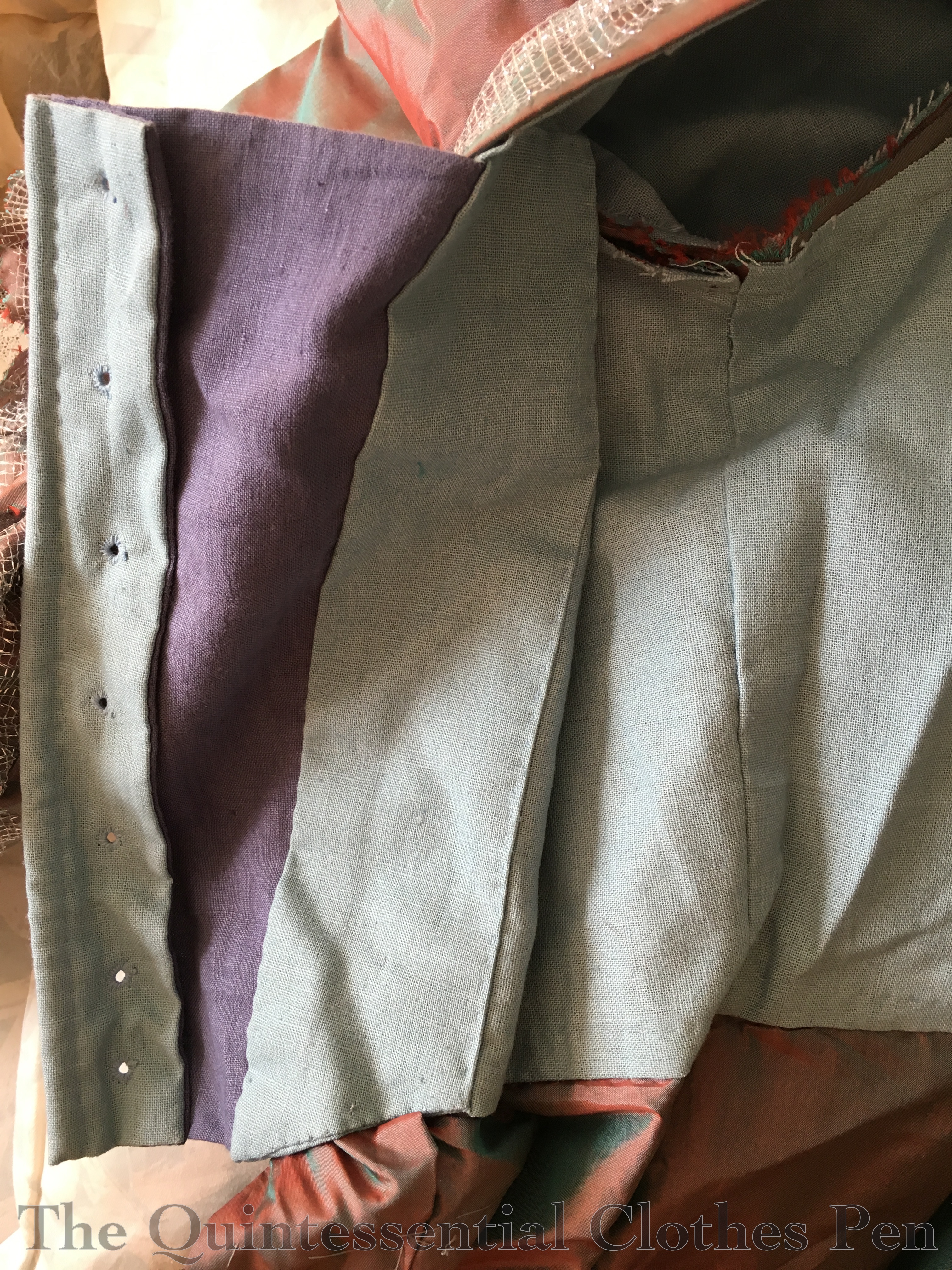
Underneath the decorative stomacher, the gown closes with lacing panels attached to the lining. Again, mine laces closed using twill tape.

IMG_1477 (1)

This is the inside of the front lacing panels. You can see the medium blue linen backing. I think I had run out of the cotton/linen blend at that point. As is usual with 18th century garments, the armhole is left unfinished.

IMG_1478 (1)

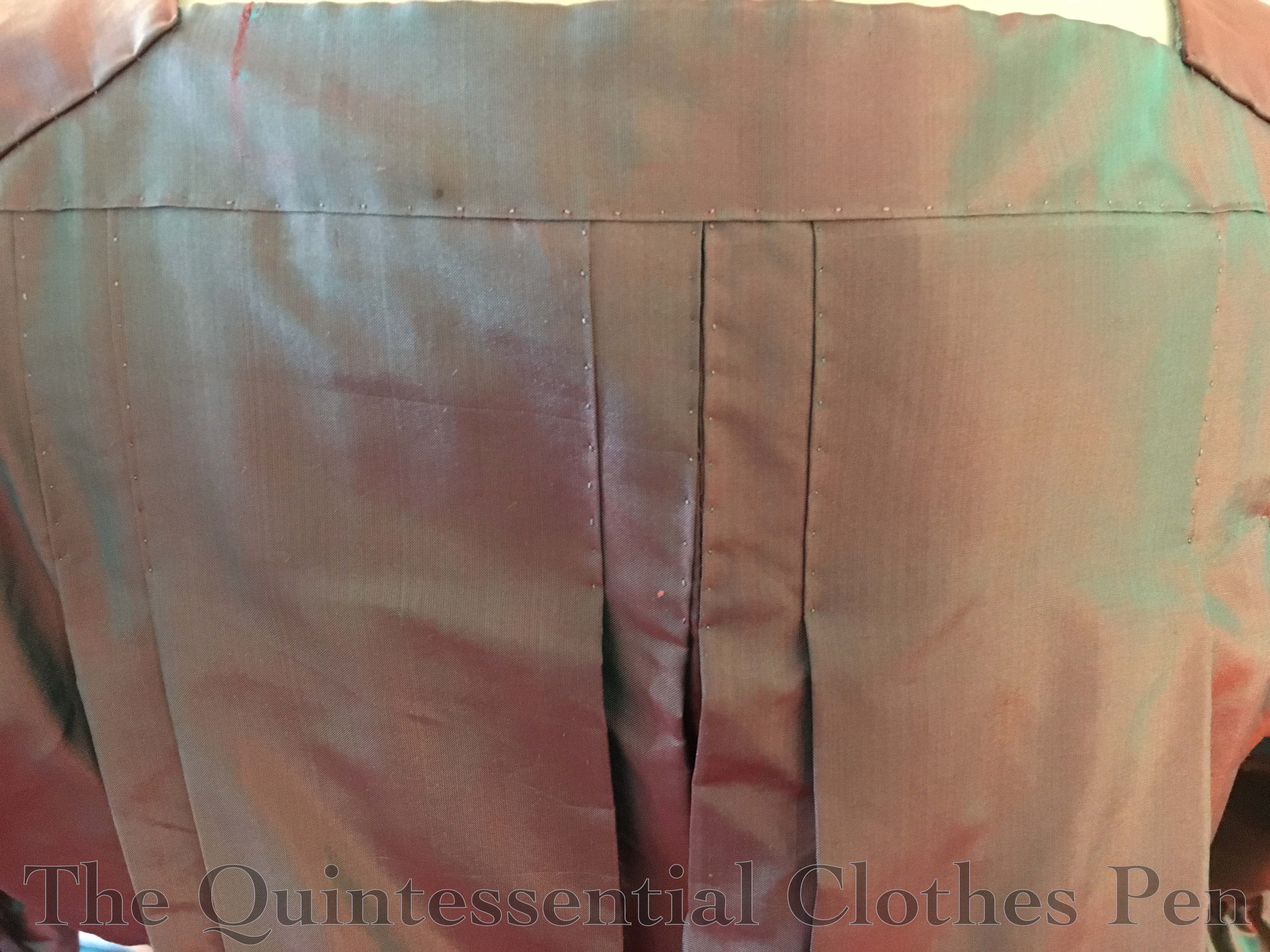
Here’s a close up of the back pleats. These are stitched all the way through to the lining. The directions for the pleats were slightly confusing, but made sense once I started fiddling with my fabric. It was important that I had transferred all the markings from the pattern to make the pleating easier to understand. The pattern uses another four pleats pleats, underneath these, that you can’t see to add volume to the back.

IMG_0922 (1)

IMG_0286 (1)

Due to the unexpected nature of the purchase of the silk fabric for this gown, I decided to do that fabric justice by hand sewing the entire garment. So in addition to the exterior stitching like that anchoring the pleats on the back, all of the interior seams are also hand sewn. I rather enjoy hand sewing and it makes a lot more sense given the way 18th century garments were constructed.

Here is the gown mostly sewn in its essential elements, but lacking trim. The sleeve flounces were individually gathered and sewn to the arm openings. They are pinked with scalloped shears on the top and bottom edges.

The following image is the gown that I followed in terms of trim placement. It took many more hours than I thought it would to pin the trim on. Those big waves are more complicated than they look, plus I had the challenge of creating the smaller scallops as I went along as well. All of the trim had to be sewn along both sides and tacked at each scrunch after it had been pinned.

IMG_0919 (1)

8423a2253758be21b68f0141235eadb1
Robe a la Francaise. 1765. LACMA.

You can see that I pressed my robings down all the way to the hem, though once the trim was applied on top it was really not very noticeable. I like the finished result, but I think it’s worth pointing out that this pattern is designed to have a wide stomacher. I was envisioning it coming out a little narrower at the waist. But I think adjusting the back opening enough to make a noticeable difference would only create awkward wrinkles under the arms.

The finished stomacher was covered in scalloped trim and finished off with a sparkly brooch. I went to France with an untrimmed stomacher and no clear idea about how I wanted to trim it except that I wanted it to be an all over metallic feast for the eyes. Luckily, early in the trip I was able to go see the 300 Centuries of Fashion exhibit at Les Arts Decoratifs. In addition to being amazing (I got to stand within 6 feet of Dior’s Bar Suit and see many garments I’ve only ever seen on Pinterest!), I also took a picture of a stomacher that was inspirational in terms of the overall wavy patterns and filler shapes. That picture is below.

IMG_0419 (1)

IMG_1153 (1)

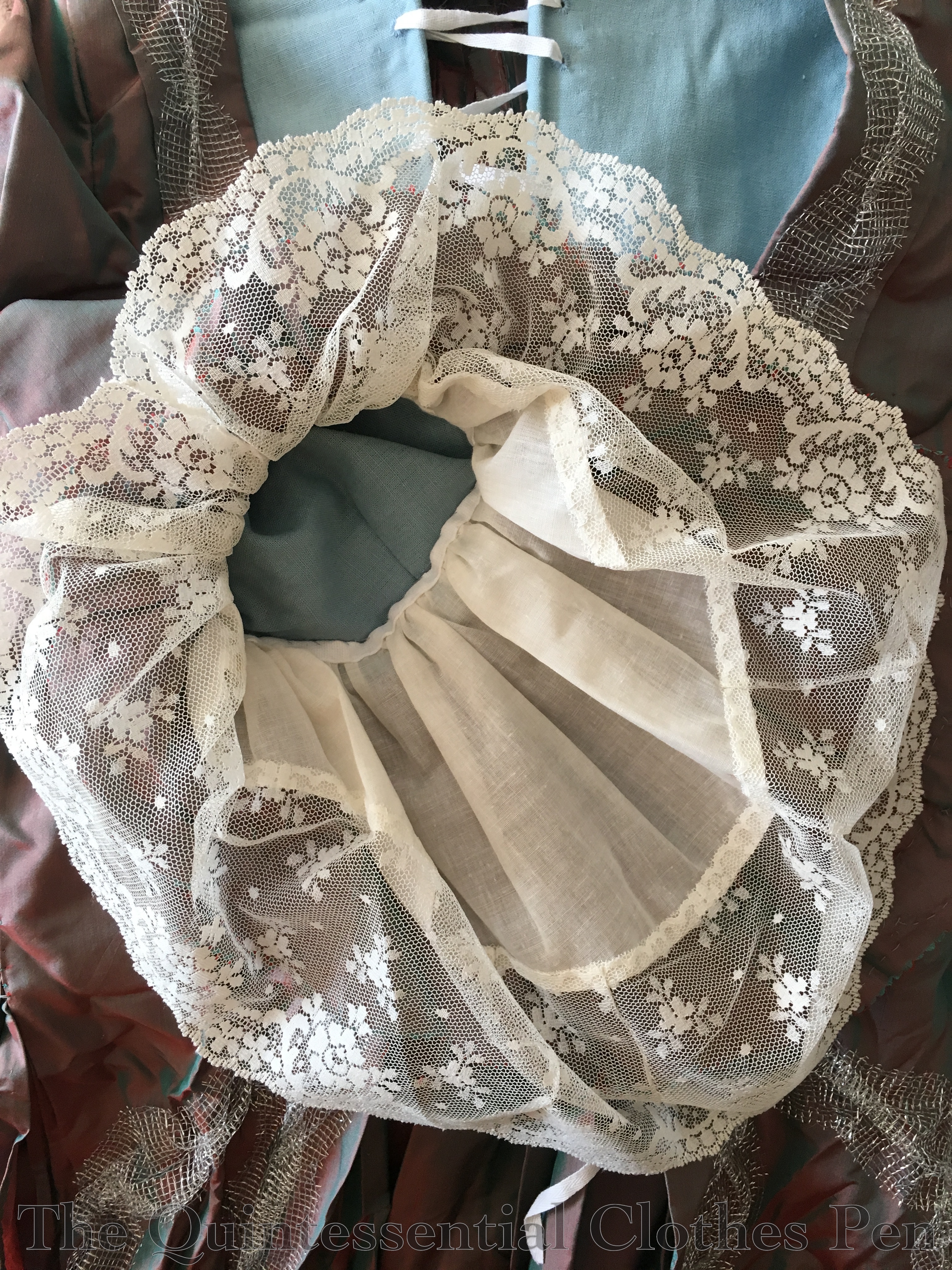
Trimming the stomacher took place in the evenings in the few days before the special event. Here is the stomacher in progress. I took it specifically to show the amazing green color that the fabric can appear from some angles. I was hoping to get a picture of the finished gown looking this color, but had to be content with seeing shades of green in some of the pictures as we didn’t capture any where the whole gown was this color.

IMG_1339 (1)

Another part of the dress that was finished in France were my engageants. The pattern includes flounces of two lengths to be made of silk and then one longer flounce for an under flounce or engageant. I sacrificed some lace I’ve been intending for another project, threw some darts in at the longest section to get the scalloped edge to be the right shape, and filled in the length with a bit of mystery ivory sheer. The resulting flounce was gathered and sewn to a cotton tape that was basted into the arm opening.

IMG_1481 (1)

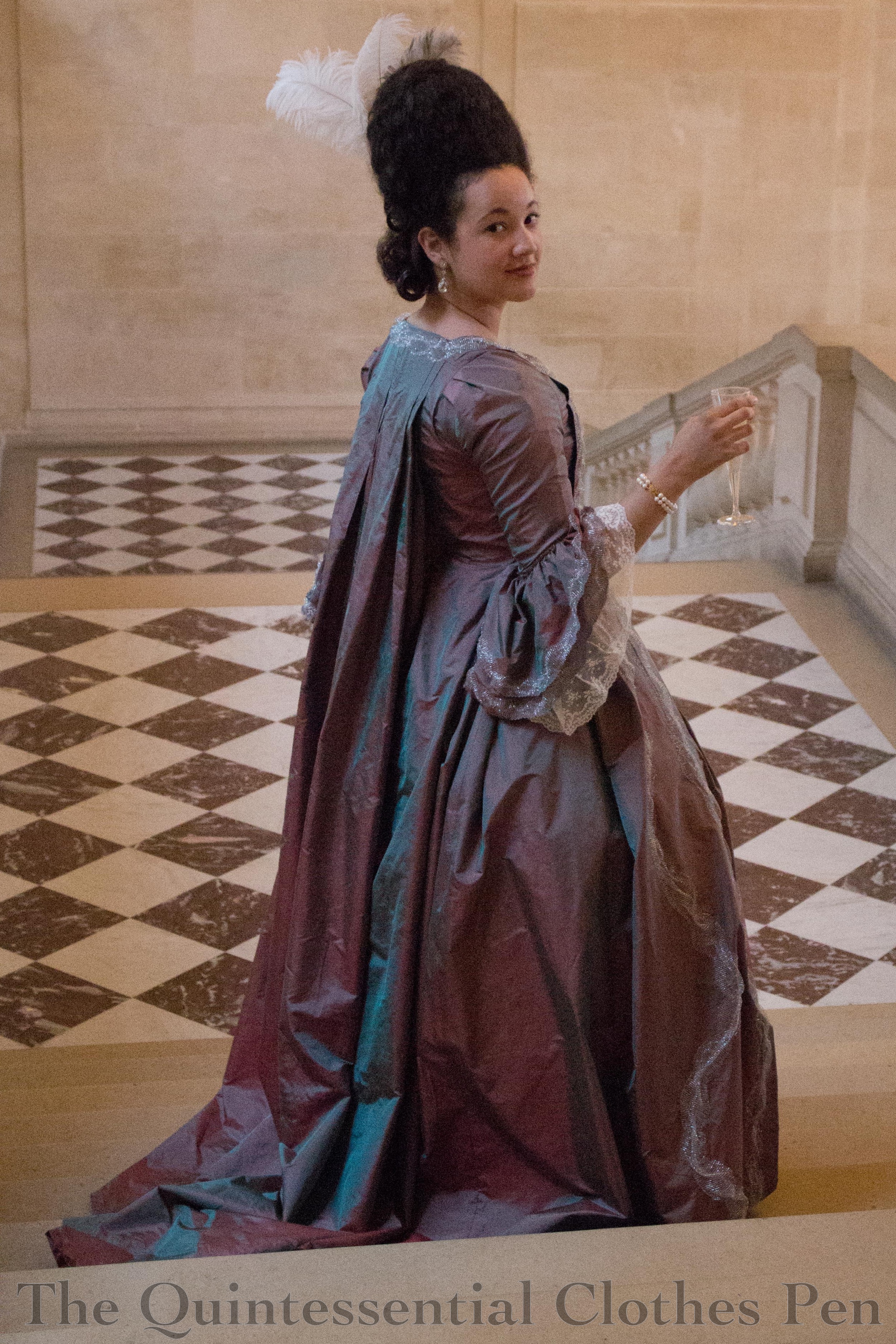
It sure sounds like a lot of work, recounting these bits of the process. It was! And it paid off. I’m very pleased with the gown. And very pleased that this picture captures some of the stunning green in the fabric!

IMG_0287 (1)

Project Journal: Versailles Sacque: Hair In Detail

Part of the work of getting ready for my trip to Versailles was hair: figuring out how I wanted to style my hair, obtaining or creating all of the necessary pieces and accessories, and practicing ahead of time. After looking at lots of inspiring images with a variety of hair shapes, I settled on creating a high slightly egg shaped style c. 1770.

I did two trial hair sessions in the month or so before I left. The first was rather frustrating, as I was learning what I liked (or didn’t like), and the end result was less than satisfactory. The progress was slow because I was creating hair pieces as I went along. The second day was much quicker and ended in success! At the time of the success post there was no time to post about how I achieved my look, but now there is, so here we go.

The pictures I took were for myself so that I could remember each successful step on the day of the event while getting ready. It worked quite well! And it means I have step by step pictures to share here. Once I had the plan down, I think styling took about 45 minutes with all the steps including trim and powder.

IMG_0887
One of my first hair pad contraptions. This wasn’t tall enough or large enough around.
IMG_1341
My final hair pad contraption with the addition of my Gibson Girl hair pad for bulk.
IMG_0923
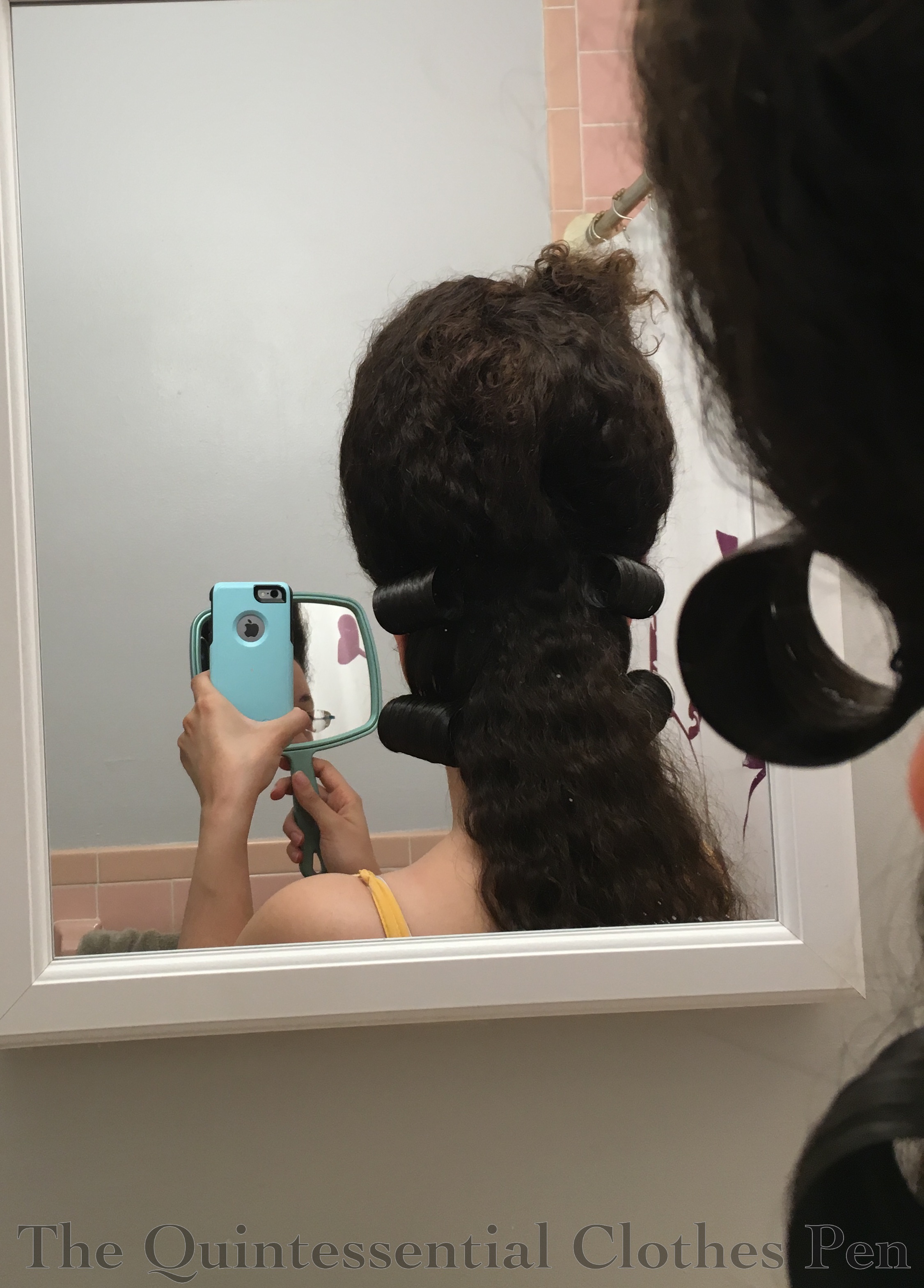
I started by anchoring the pad to my head in about eight different places using crossed bobby pins. Then the front section of hair was brought up over the front of the hair pad, and pinned in place.
IMG_0927
I may look crazed, but I used my fluffy ends to help fill out the sides of my hairstyle even more. This is the middle of the back of my hair pulled up, crossed to help hide the hair pad and pinned in place.
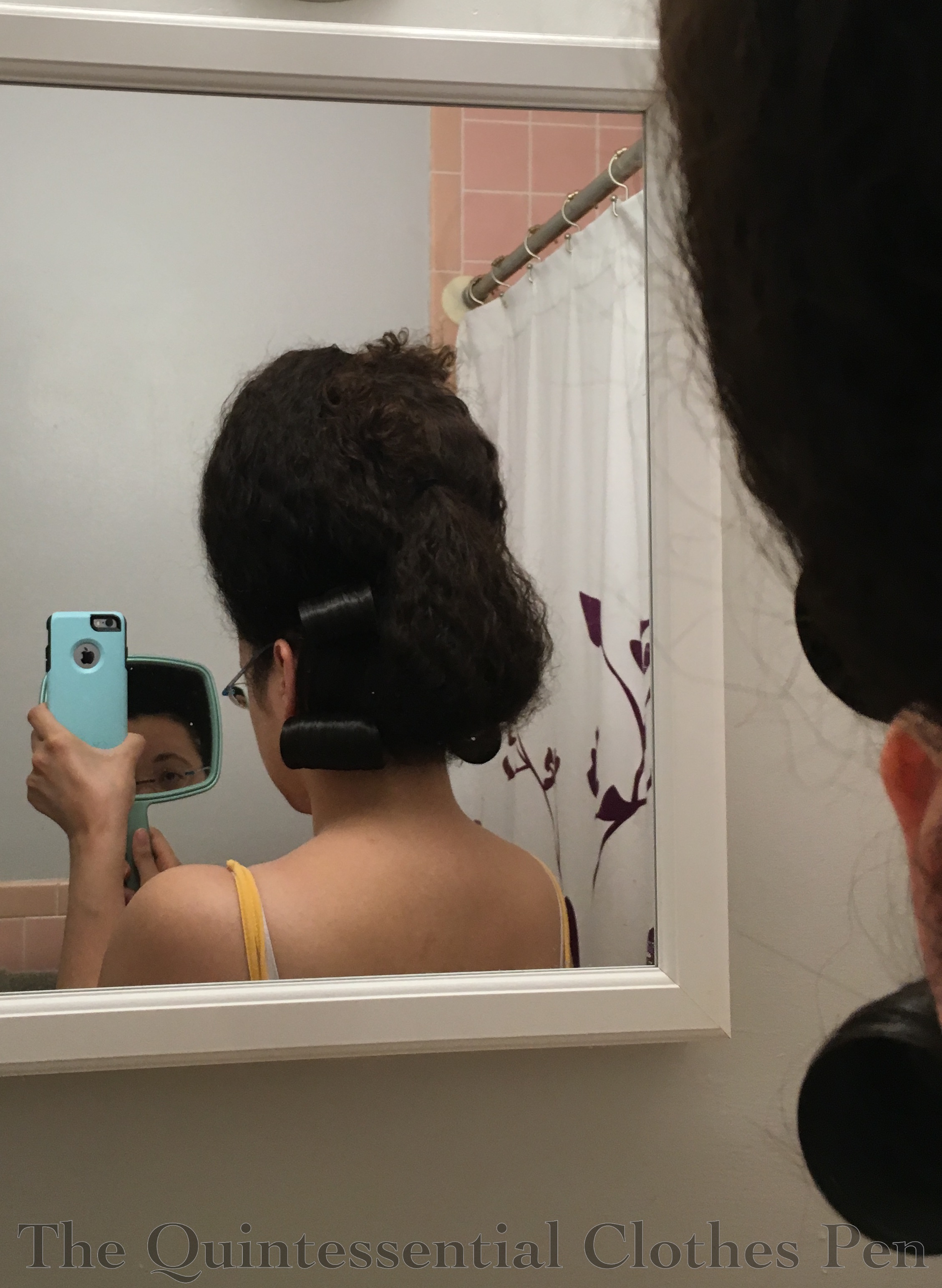
IMG_0928
The sides were smoothed up and over the crazed side curls and pinned so the ends helped cover the hair pad in back. The curly bit sticking out on top was later tucked in and hidden.
IMG_0935
From the back. At this point I had clipped in four of the five permanently glued buckles.
IMG_0945
The remaining back section was loosely looped up. The fifth buckle was placed over the pins holding the loop of hair in place.

Then, for the actual event, I used baby powder to powder my hair. It was easy to use, required no extra products to hold in place, and smelled fresh. (I forgot to powder my hair on the trial days, so your eyes aren’t deceiving you if my hair looks darker in those step by step photos. There is a picture of my hair half powdered in this post taken while I was getting ready on the day of the event.)

IMG_0328
The finished result! My ornament is the one I made for my 1899 evening gown with some extra white feathers.

My buckles were made using synthetic hair. I purchased a ‘full head’ clip in set, 20″ long, that came with sections of various widths already attached to wig clips (similar to this). I purchased color #4, which matches the darker brown parts of my hair nicely, aside from being super shiny. I used the narrower widths for the buckles, but I still have the wider ones leftover. (I’m thinking I might be able to use them to create some 1830s clip in hair pieces…)

I am very grateful that Kendra Van Cleave did an immense amount of research into 18th century hair and wigs and shared it. An excellent taste is available on her blog and she’s also compiled her knowledge into a very detailed, picture-filled book that was quite helpful along my path to creating 18th century hair. Amongst lots of other information, there are instructions for creating temporary and permanent curls and buckles (including the instructions I used to create my buckles), lots of background about types of wigs and hair pieces, a discussion about powder options, and step-by-step tutorials showing ways to create a variety of styles from throughout the 18th century. Very useful!

A Quick ‘Behind The Scenes’ Of My Versailles Evening

All those pictures of Versailles look amazing, but a lot of work went into looking effortlessly elegant. Some of the work I’ll be sharing in posts specifically about my hair and gown, but I also have a few pictures from the day along the same lines that didn’t quite fit into main post. They’re more ‘behind the scenes’. Enjoy!

IMG_1340
This is Mr. Panniers after escaping my suitcase and before having his bones inserted for the big event. Hard to recognize without his proper shape, I think!
IMG_1343
Getting ready. My half finished hair is half powdered, to show the difference in color. As you can see, I only did a light bit of powder.
IMG_1437
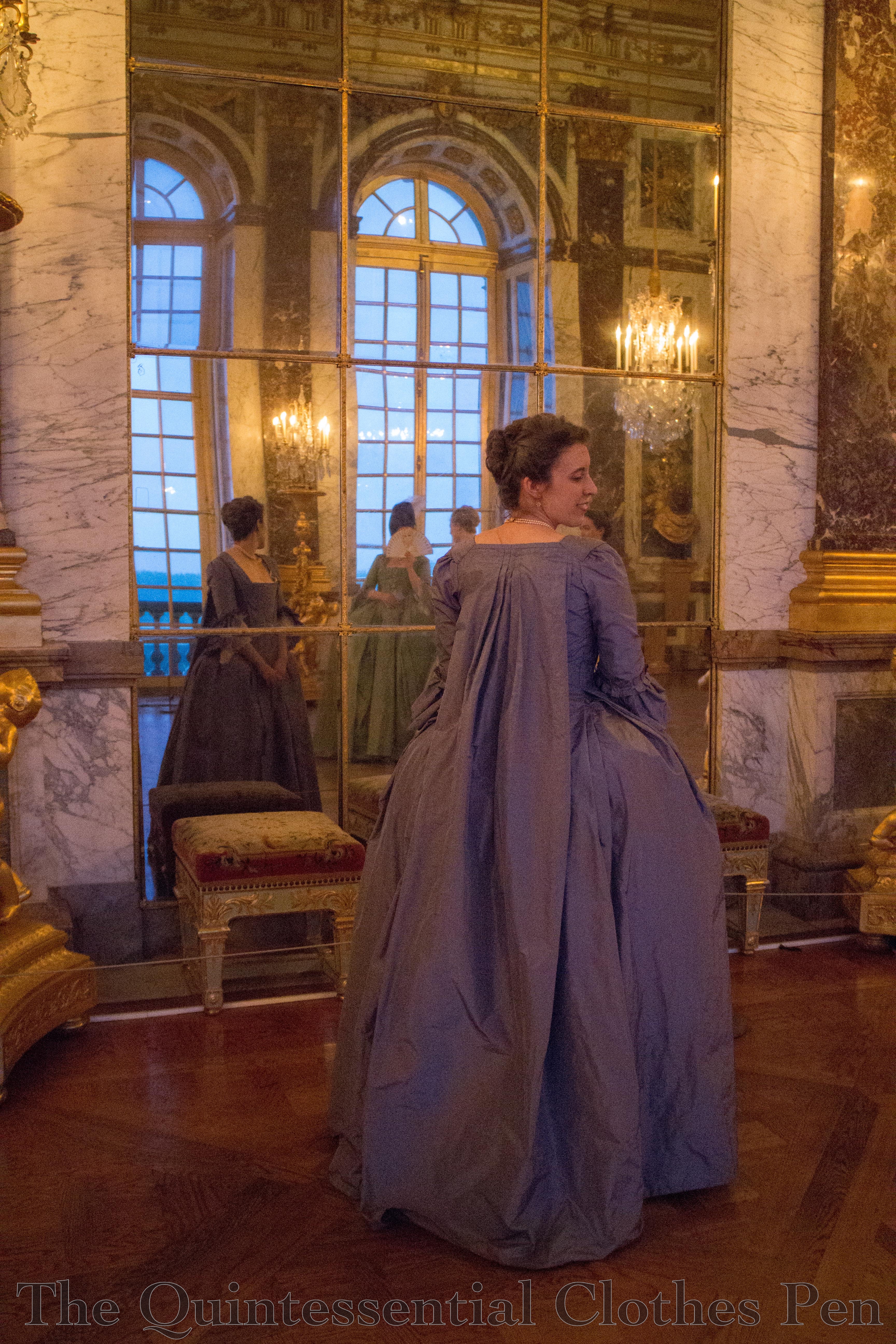
A final graceful pose in the Hall of Mirrors as the staff was very slowly herding us out.

An Evening At Versailles

I am blessed to have had many amazing opportunities to wear beautiful historical clothing in stunning historical spaces while doing fun historical activities. Newport Vintage Dance Week in 2012 was full of them, most notably the mid-century ball at Ochre Court. But I’ve had these moments in other time periods as well, for example while wearing Regency clothing at numerous balls in historic halls, such as at the first CVD Regency Weekend in 2013 and at the second CVD Regency Weekend in 2014, and at the Commandant’s House in the Charlestown Navy Yard in 2012.

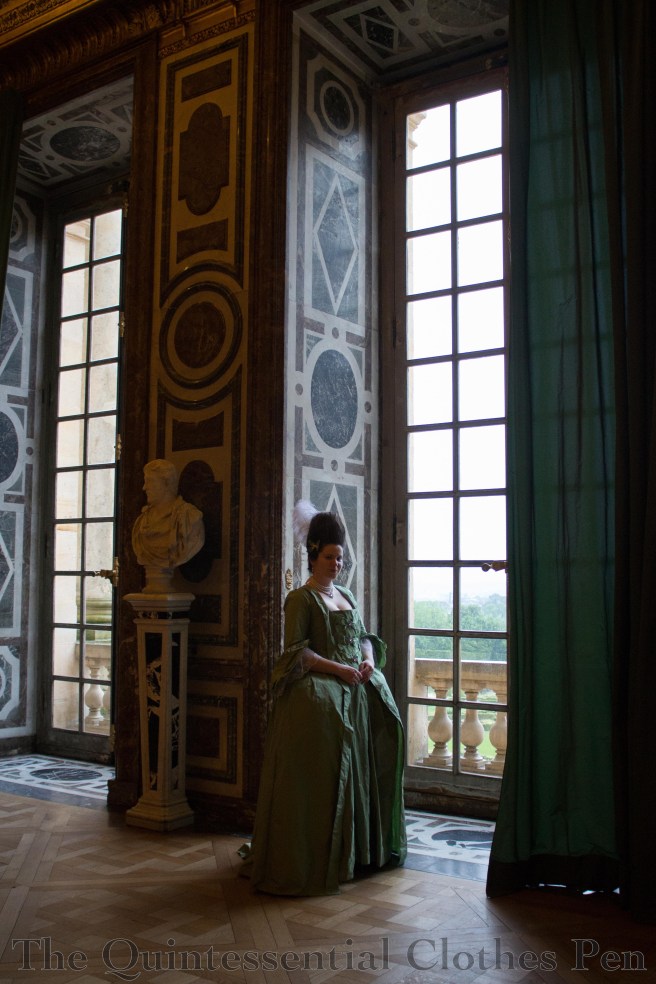
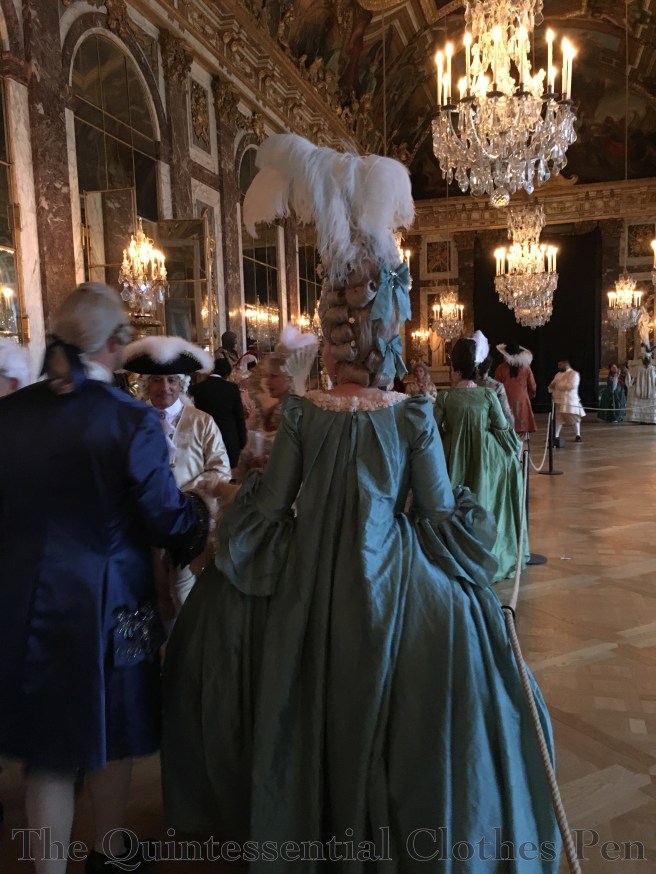
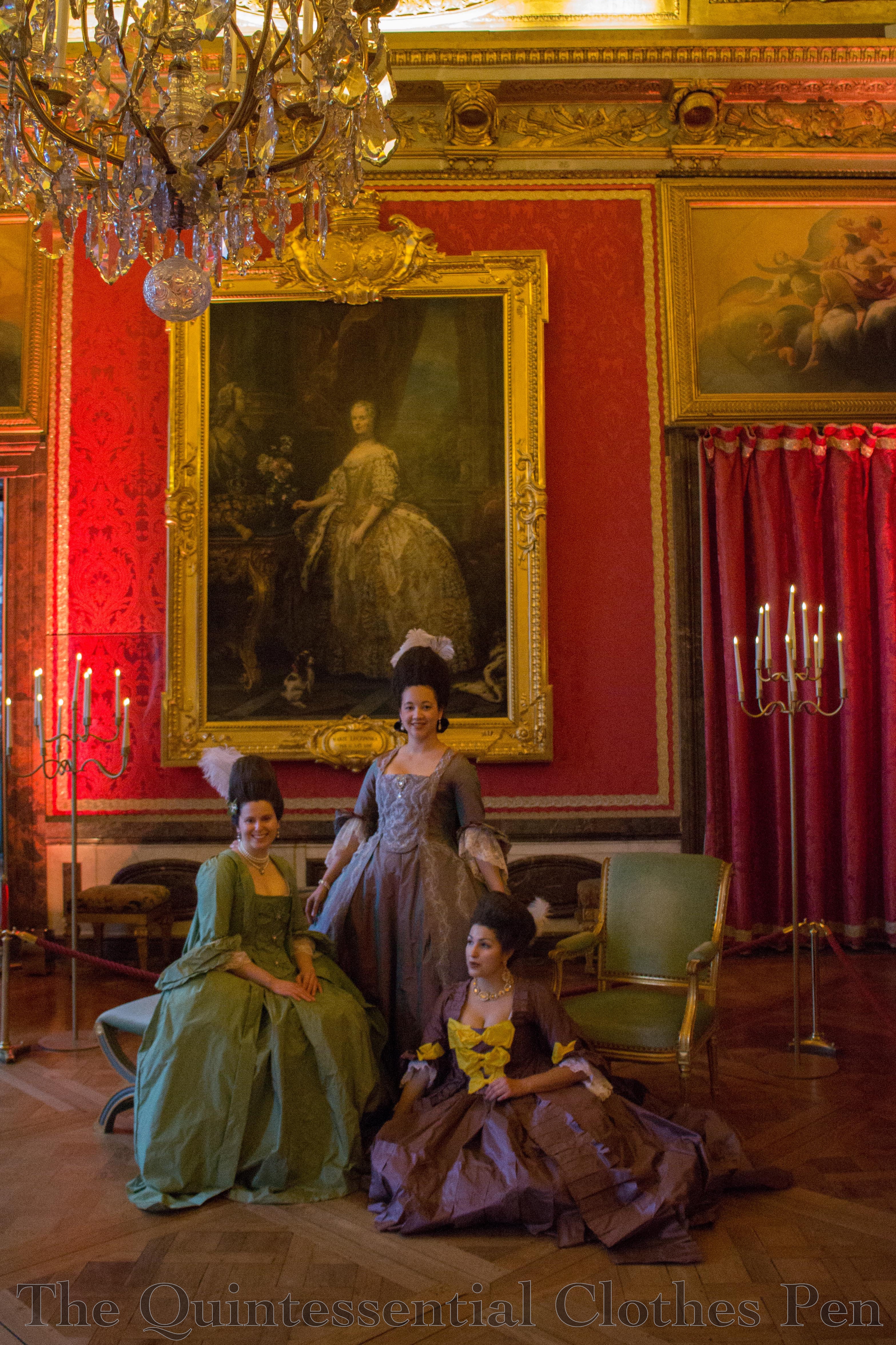
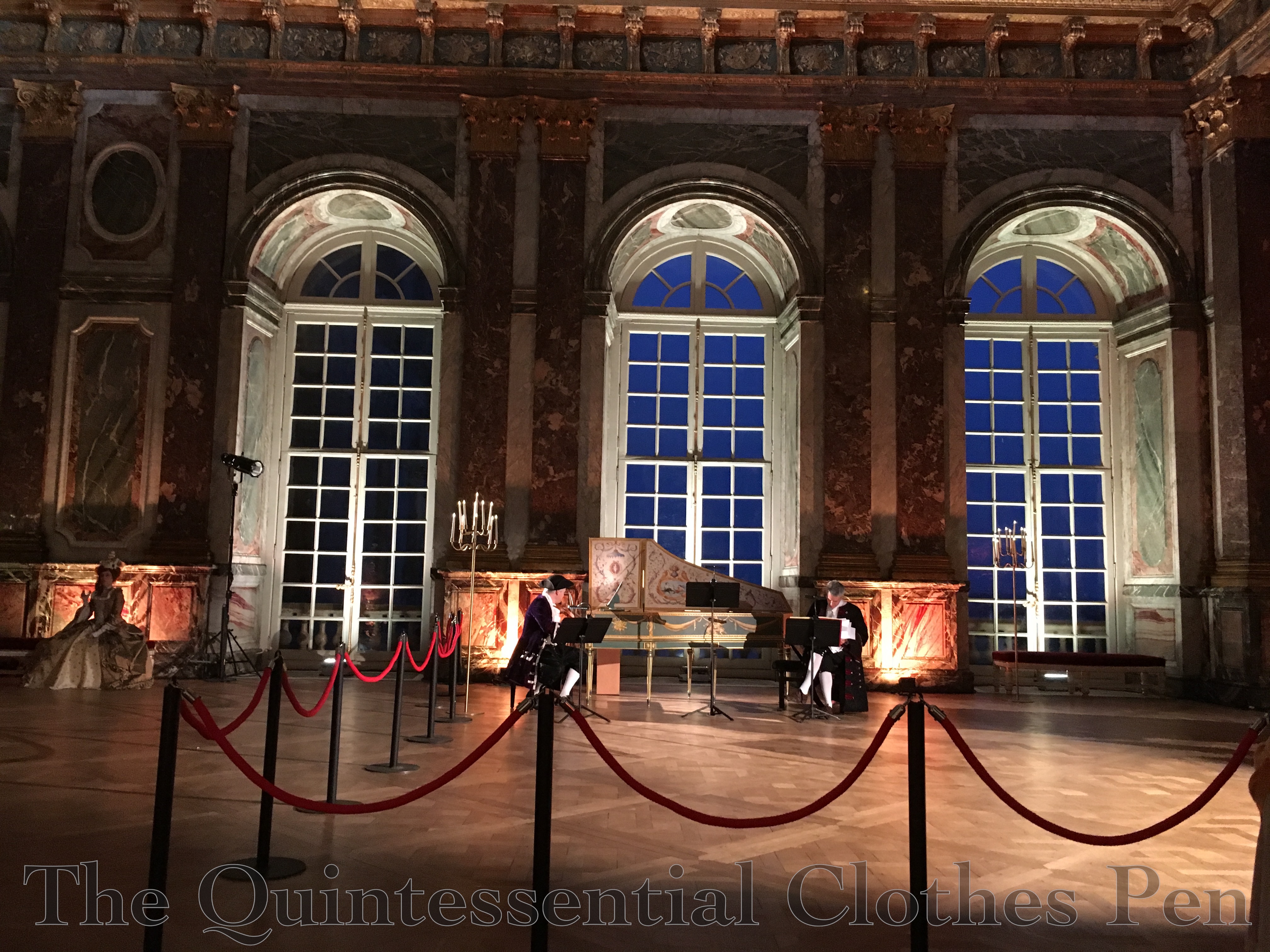
My recent trip to Versailles was right up there in terms of these amazing opportunities. It was staggering to be comfortably lounging with friends as often happens in other places and then remember that this venue was indeed Versailles! It almost required pinching to make sure it was real. The pictures prove the reality, I think. Come join me for a pictorial review of a (likely) once in a lifetime evening at Versailles for the 2016 Fetes Gallants.

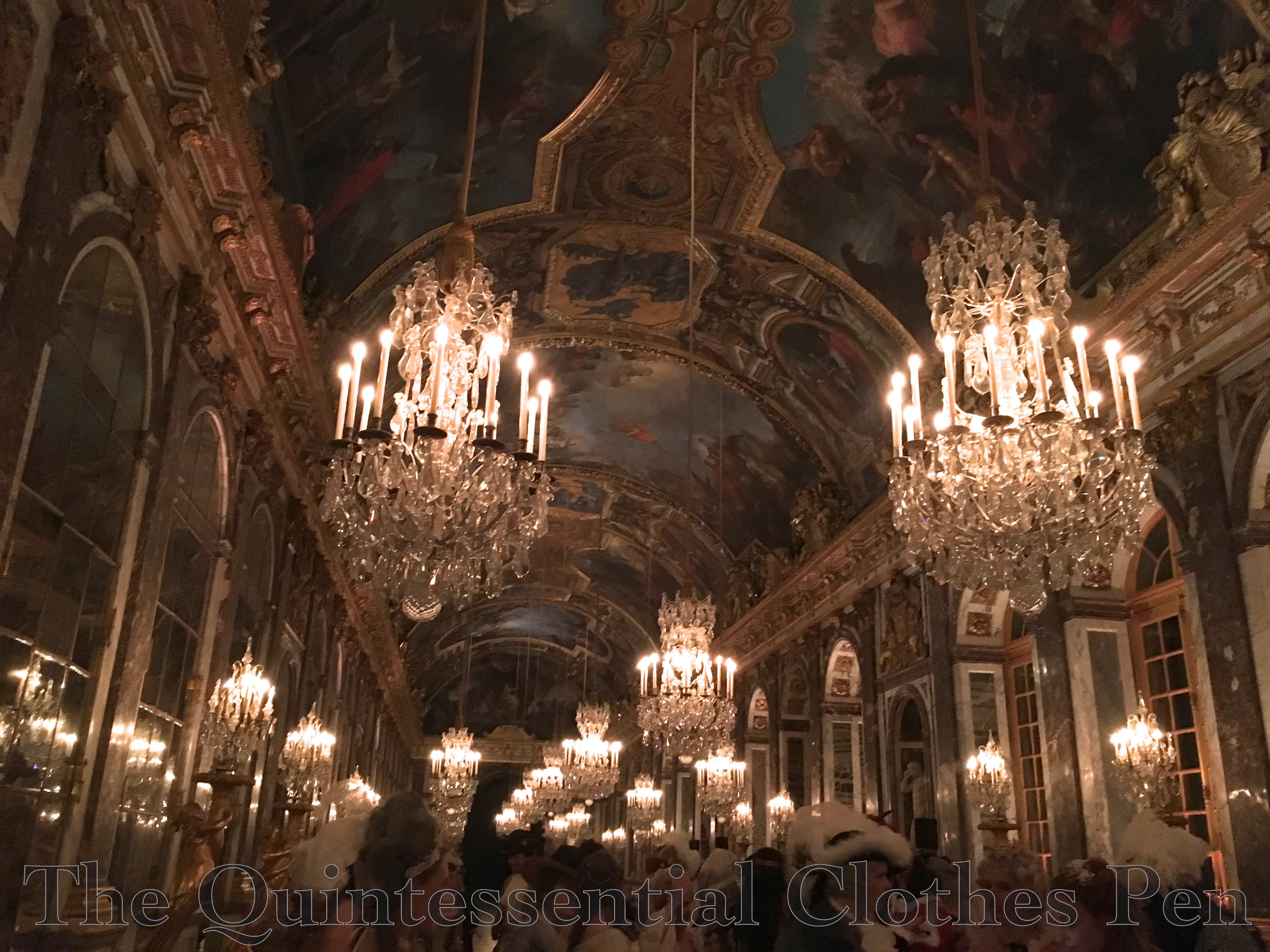
The weekend before the event it rained. Hard. And rained some more. By the Monday of the event it was still raining and did not appear to be letting up. It’s hard to capture rain in photos, but here’s a view of Versailles from the Hall of Mirrors towards the beginning of the event while it was still light outside.

IMG_1351 (1)

As you know from my posts before leaving for the trip, I’ve been sewing a silk robe a la francaise for this event since January. I wasn’t about to walk through the streets of Versailles and let it get wet in the rain. Neither were the friends I was staying with. The plan: to go out midday to the grocery store and pick up trash bags to make dress covers. Well, entire body covers, really.

13346273_1745066749108952_2351170953101628418_o (1)

When we arrived, people looked at us like we were crazy (well, we are, I suppose), but when we left people were looking at us enviously and asked if we had extra bags to share! What a change. Each of us is wearing about four trash bags taped together with masking tape I’d brought along.

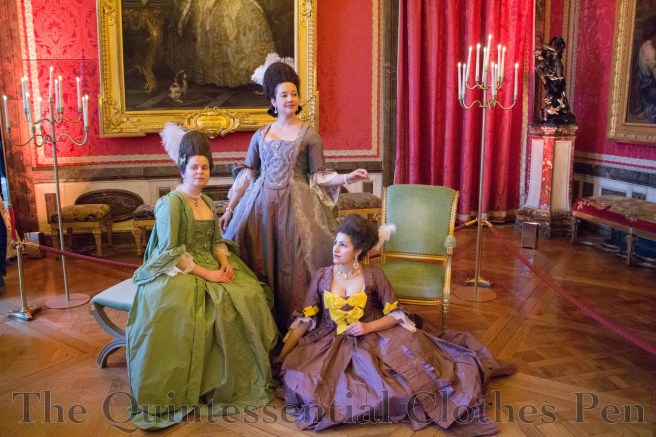
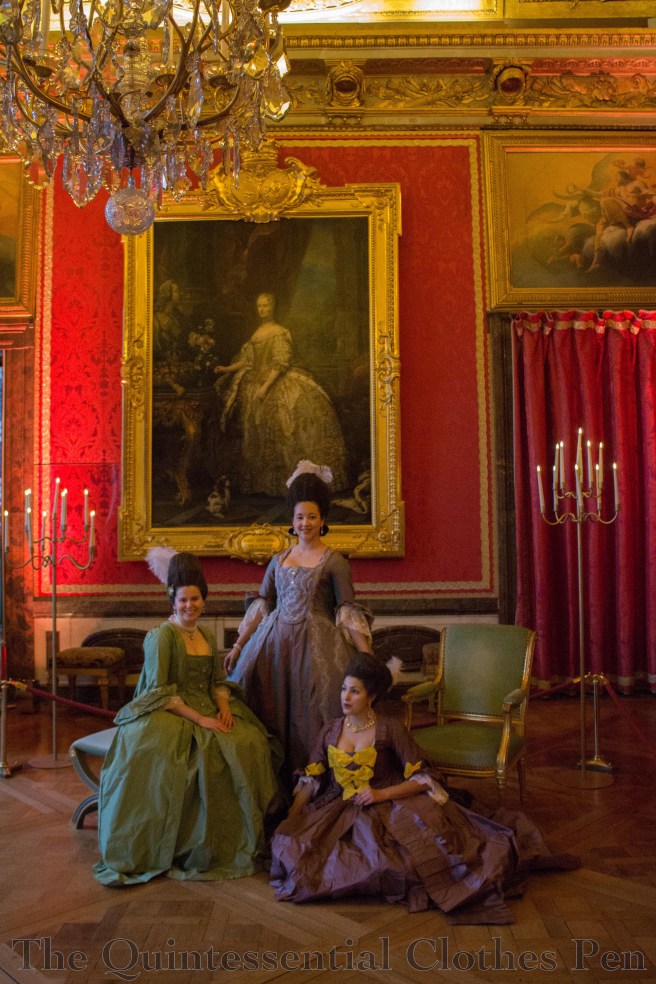
Luckily, there was a coat check, where we checked a reusable shopping bag full of our wet trash bags. Then it was on to get our complimentary glass of champagne, arrange ourselves for the first pictures of the evening, and head upstairs to the King’s Apartments and Hall of Mirrors.

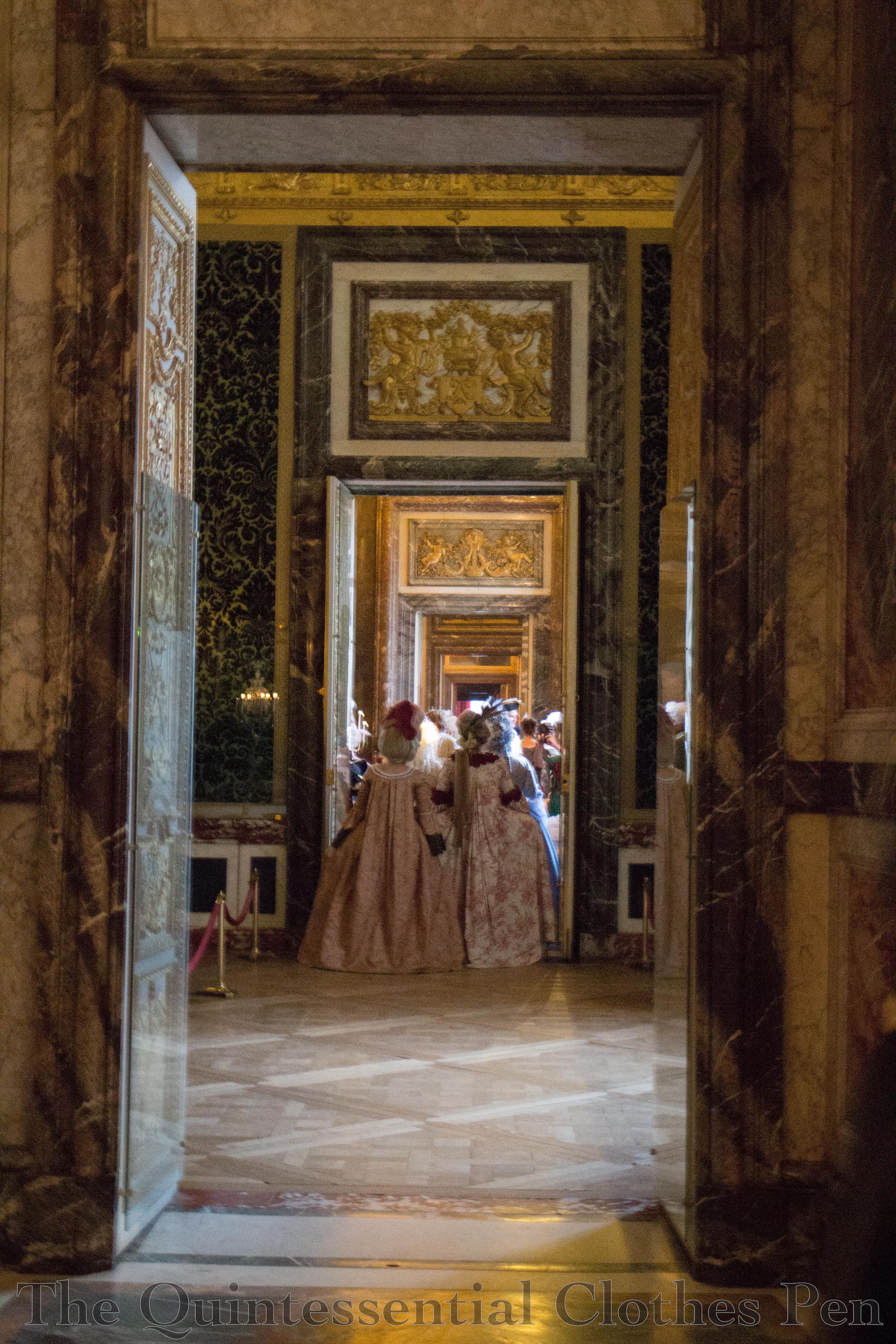
This is the Hercules Drawing Room. It’s one of the first rooms we entered as regular tourists during our day visit as well as one of the first rooms we entered during the event. And my, what a stunning change between one visit and the other! During the day this room (and the rest of them) are absolutely stuffed with large tour groups and tourists. There is a constant movement to the flow such that you can’t really stop and have time to admire everything. Plus, it is so full of people that you rather want to keep moving to escape them. Not so at this event! You can see the floor!

IMG_1362 (1)

From the Hercules Drawing Room you can proceed through another six drawing rooms towards the back of the palace and the Hall of Mirrors. These drawing rooms are all arranged in a line such that you can look from one end to the other. They are named after various gods: Apollo, Diana, Mars, etc.

IMG_0288 (1)

You walk the same path during the day, but it was such a better experience at the event. There was a steady stream of people, but there was space to stop and look around, have a conversation, enjoy the spaces, and get pictures. The scale of the ceilings, the windows, the paintings… it all seems that much more grand and impressive when there is empty space to balance out the grandeur.

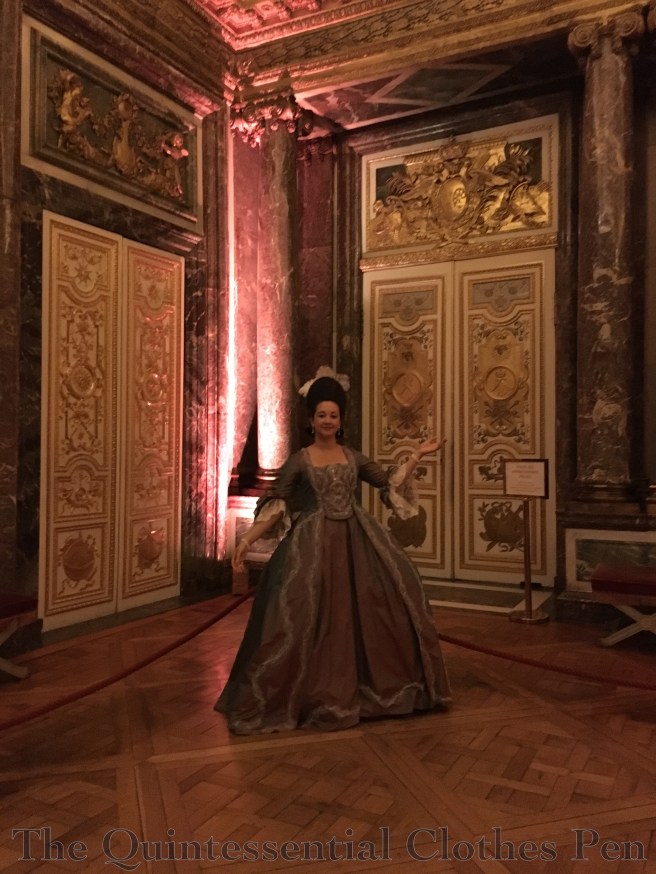
IMG_0296 (1)

IMG_1447 (1)

IMG_0303 (1)

IMG_0313 (1)

IMG_0317 (1)

IMG_0323 (1)

IMG_0322 (1)

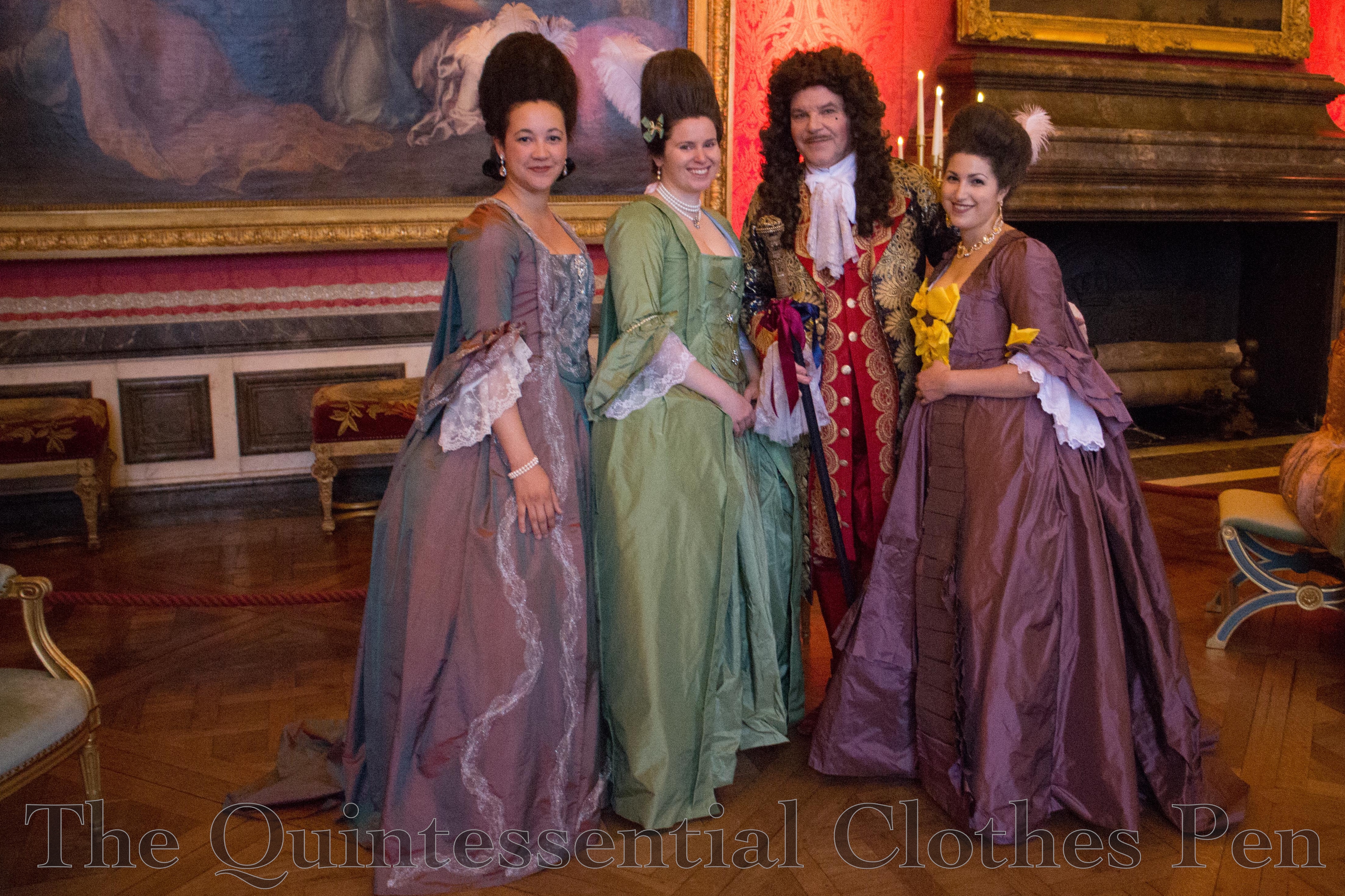
In one room, we had a picture with the “king.” Which king, you ask? I think we was supposed to be Louis XIV or XV, but I can’t remember.

IMG_0321 (1)

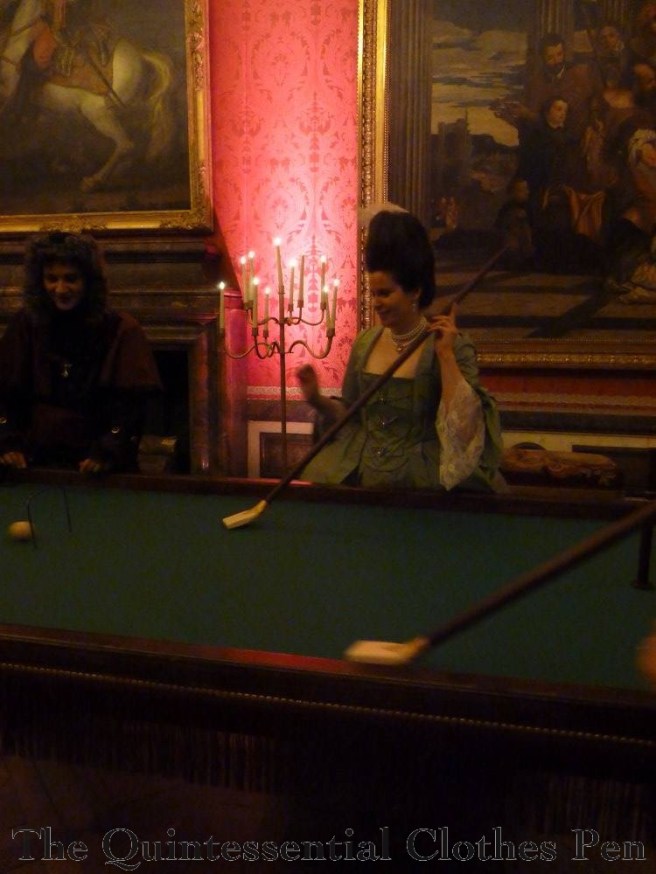
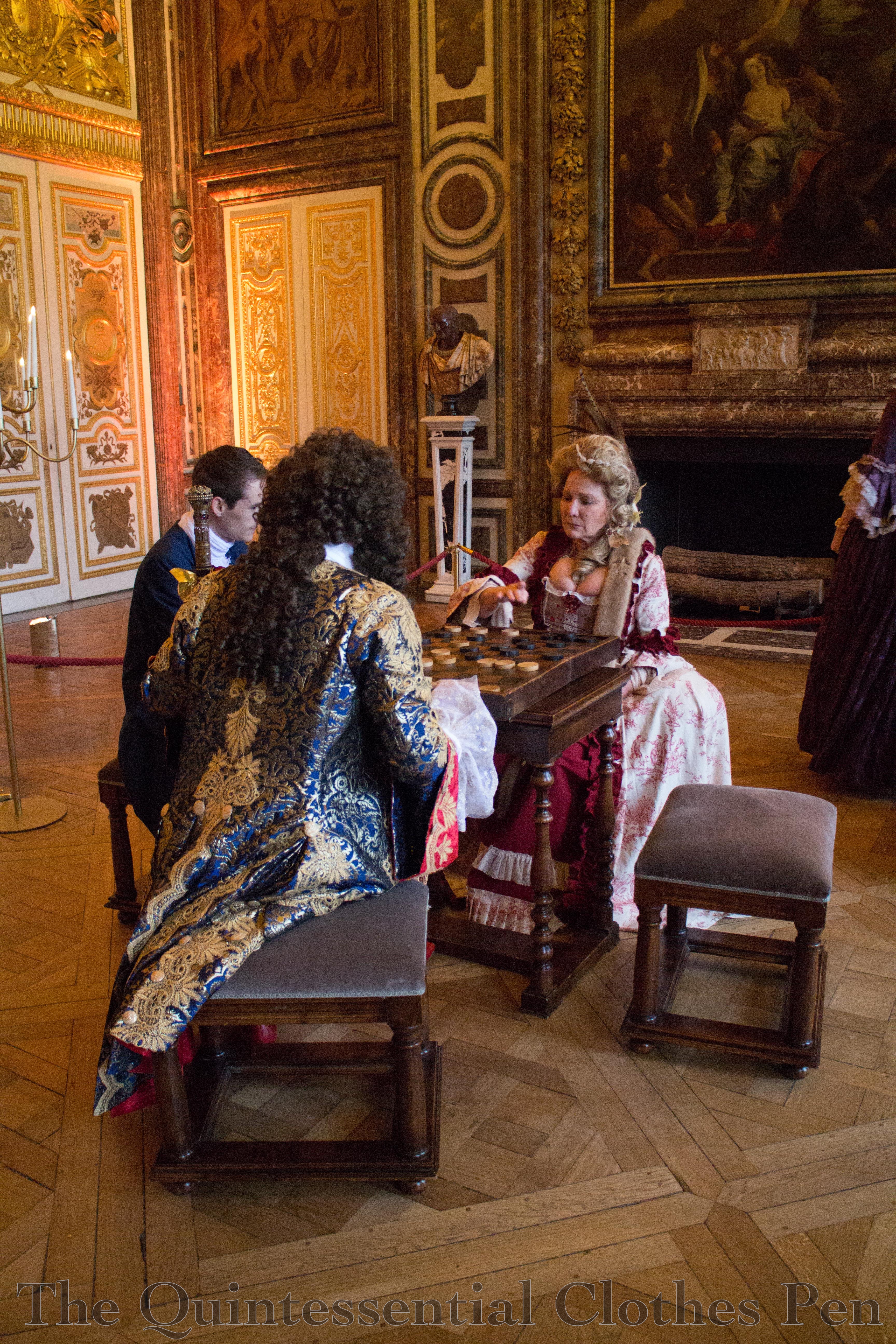
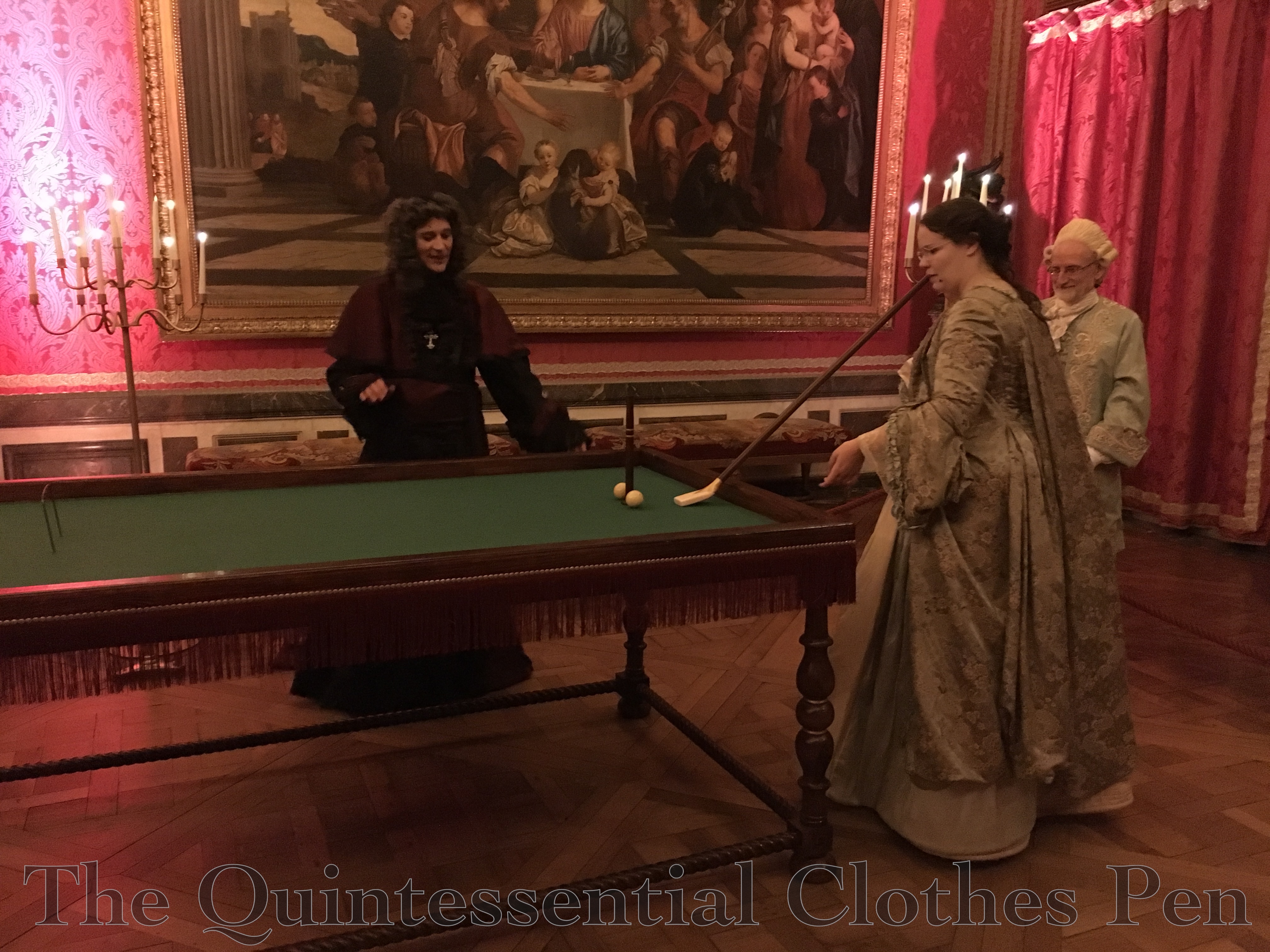
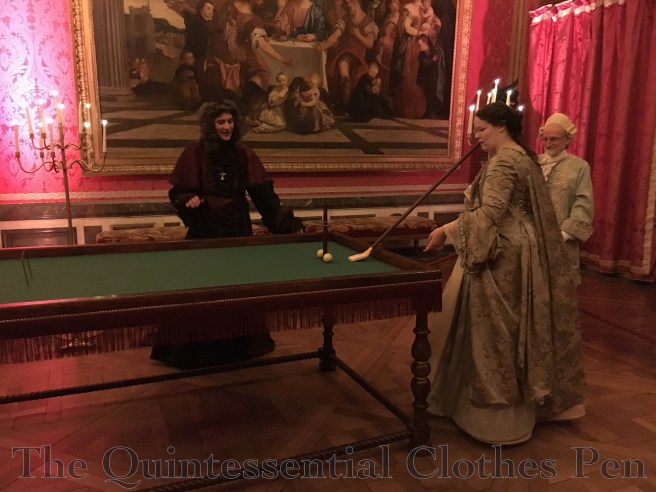
There were interactive period games set up in multiple rooms. The king himself was not above the entertainment. Neither were we! In one room we took the opportunity a few times to play each other at the billiard-like game. (If you know what this is called, please share.)

IMG_0309 (1)

IMG_1385 (1)

13329512_10154201444329110_7241591894756174364_o (1)

13308162_10154201444729110_7018204184378752156_o (1)

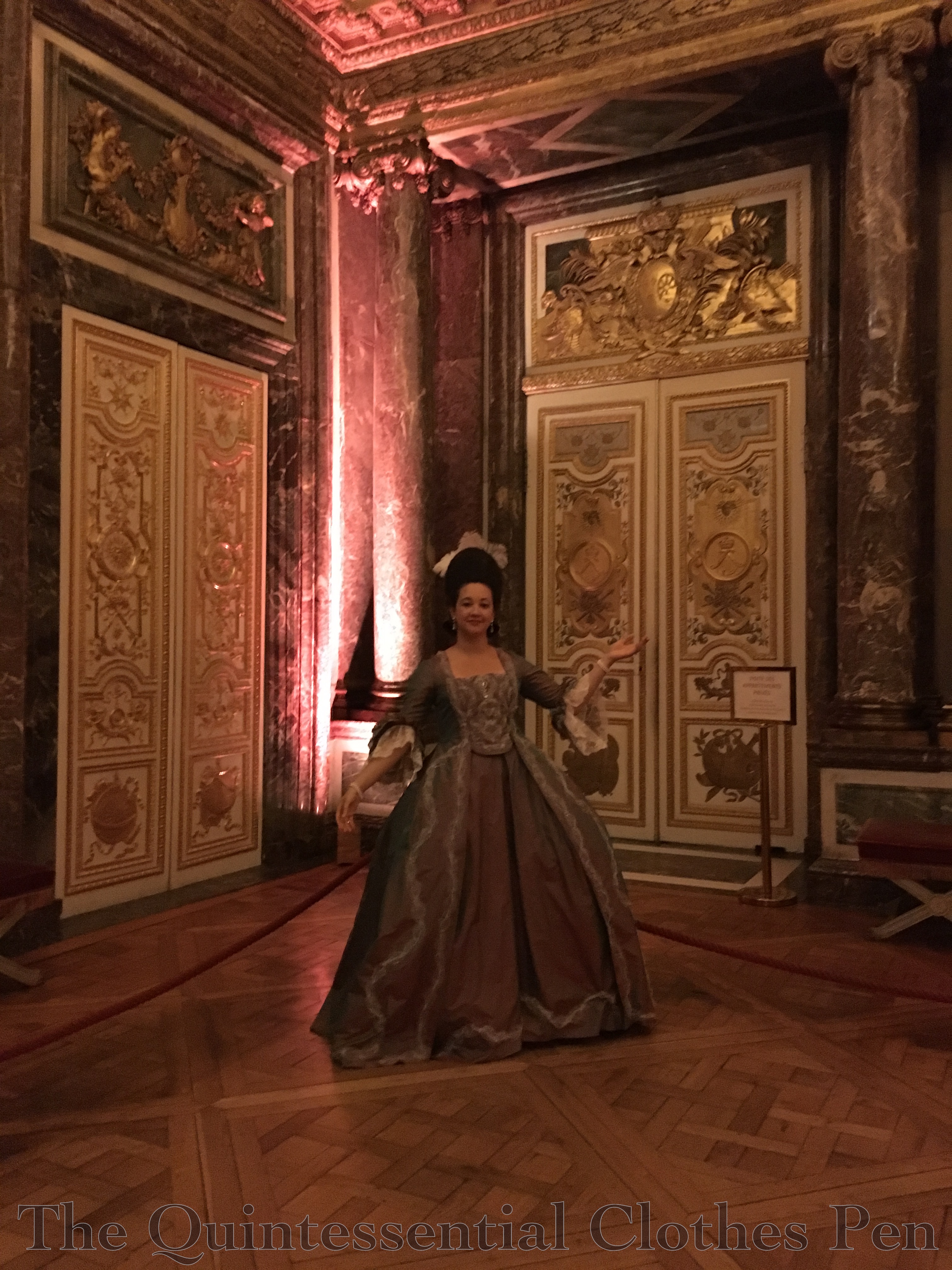
Proceeding along, we reached the War Drawing Room, on the corner between the long line of drawing rooms and the Hall of Mirrors.
IMG_0409 (1)

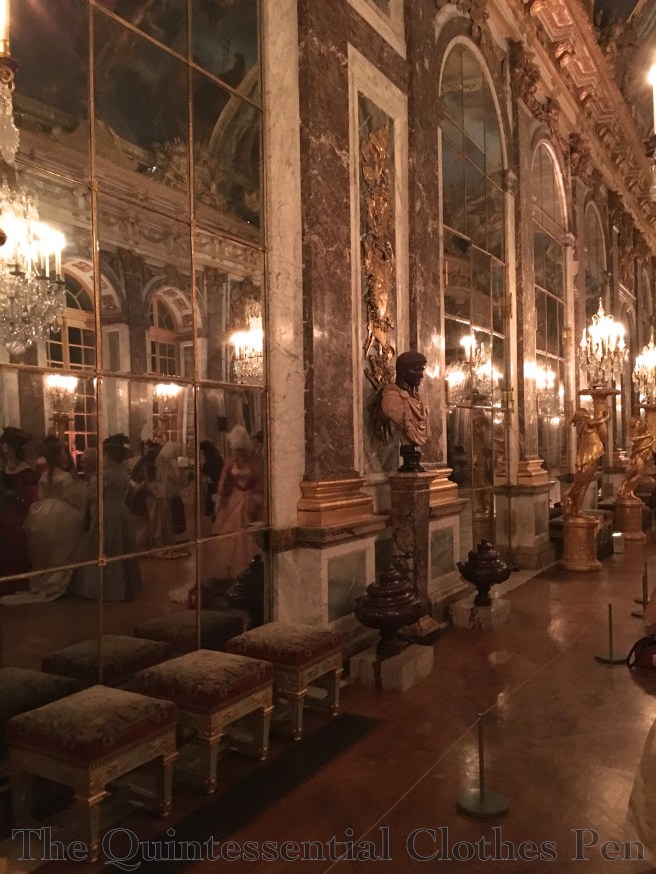
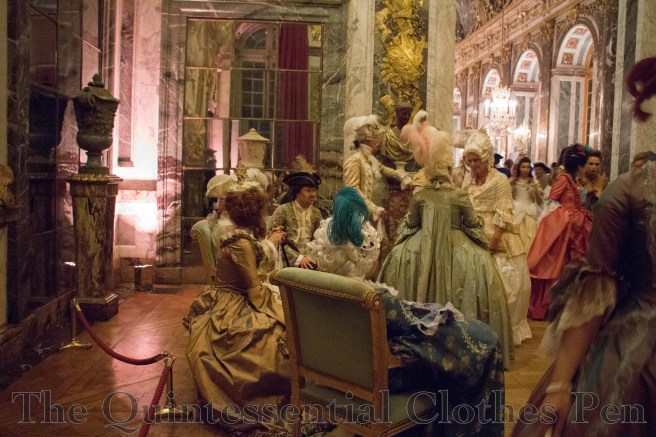
Turning the corner is the Hall of Mirrors. I wasn’t much impressed with the Hall of Mirrors when I visited Versailles about 10 years ago as a tourist. It’s crowded and the mirrors are not what a 21st century mindset is likely envisioning in terms of elegance. And visiting it again as a tourist on the trip I was still not over-the-top impressed. Beautiful, of course, but that’s about where my praise stopped.

However, seeing the room full of people in 18th century clothing and illuminated once the sun had set, the room became the spectacle that I learned of while studying art history. This is how Versailles should be seen.

The next two pictures are from early in the evening while natural light was still pouring through the windows along one side. The two pictures after that were taken later, after the sun had set and it was dark outside.

IMG_0333 (1)

IMG_1348 (1)

IMG_1434 (1)

IMG_1435 (1)

One friend had felt that our sacques were rather unflattering… until she saw herself in a mirror in the Hall of Mirrors! I think it might be impossible to wear a robe a la francaise in the Hall of Mirrors and not feel the elegance of the clothing and of the space.

IMG_1386 (1)

IMG_0361 (1)

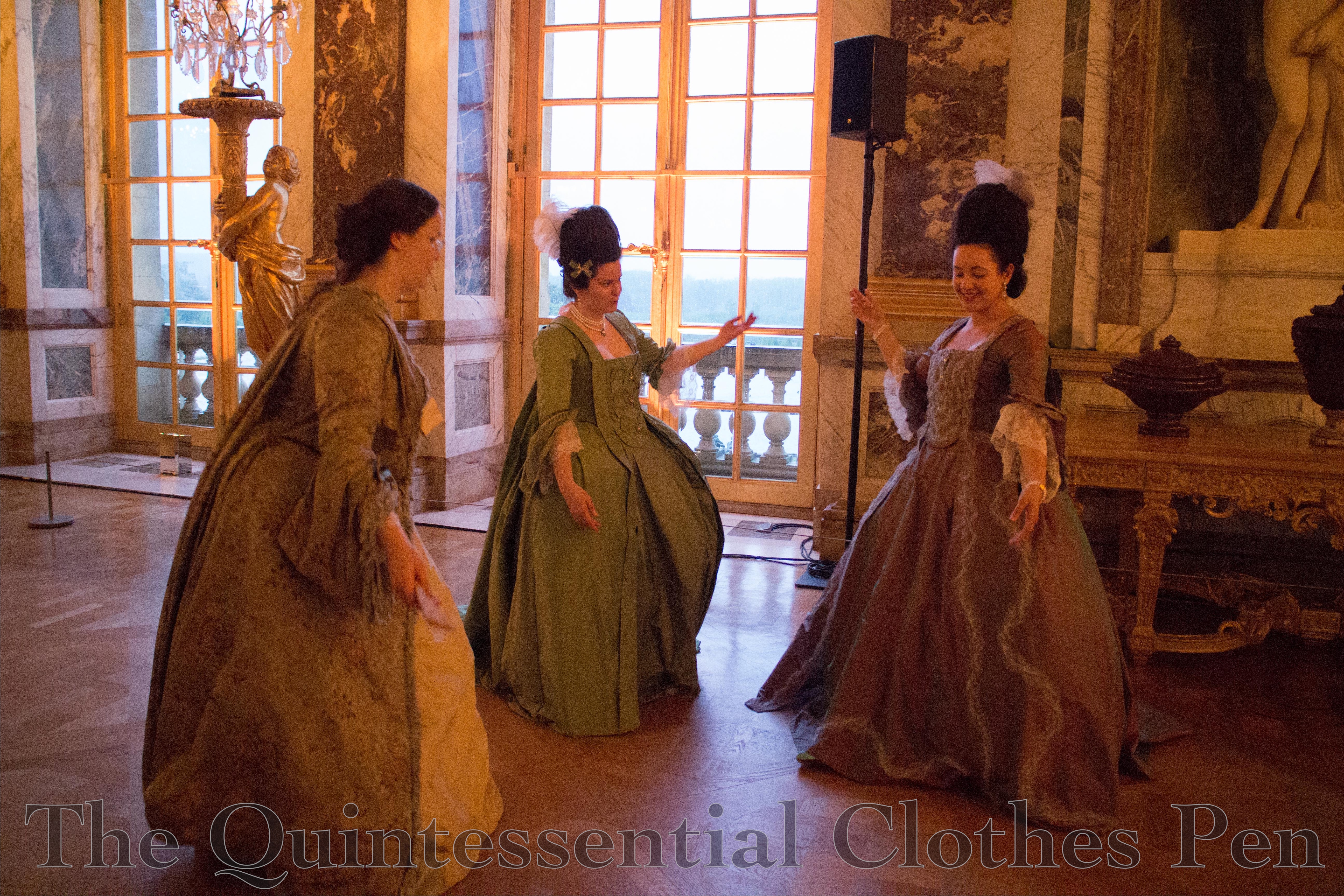
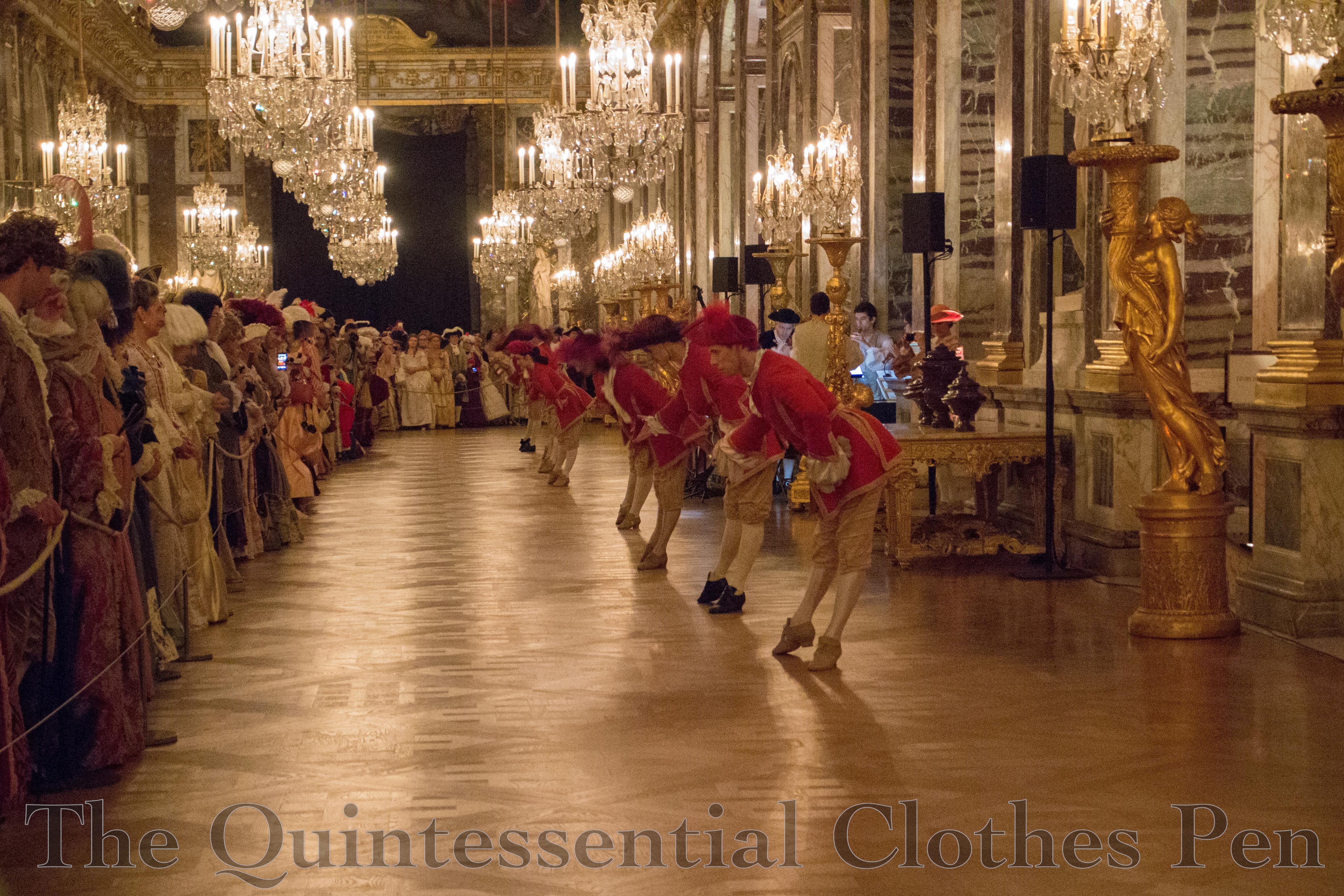
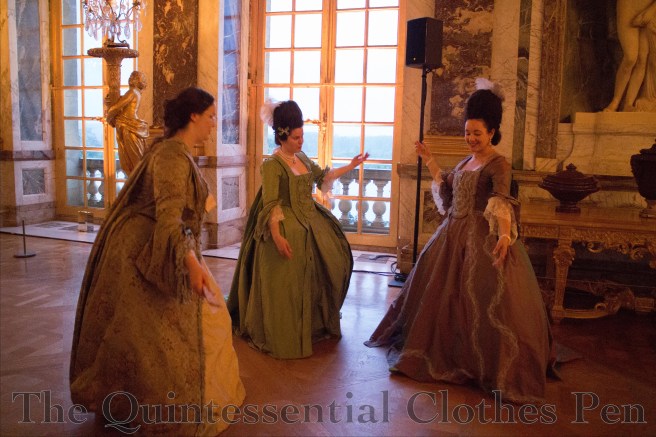
Our tickets included two activities (chosen at the time of purchase) out of about four options. My first activity is not hard to guess. Dancing! And where else, but in the Hall of Mirrors?

Along the way to the Hall of Mirrors we found a friend of a friend who had been introduced online. It was lovely to meet her and it turned out we had the same activities on our tickets so we chatted and took part in activities all evening! In fact, she was my dance partner! Being French, she was able to help translate the dancing instructions that I didn’t pick up from watching the instructors. Unfortunately, while we were learning all my friends were either dancing or attending other activities, so the only picture of me dancing is a staged one.
IMG_0343 (1)

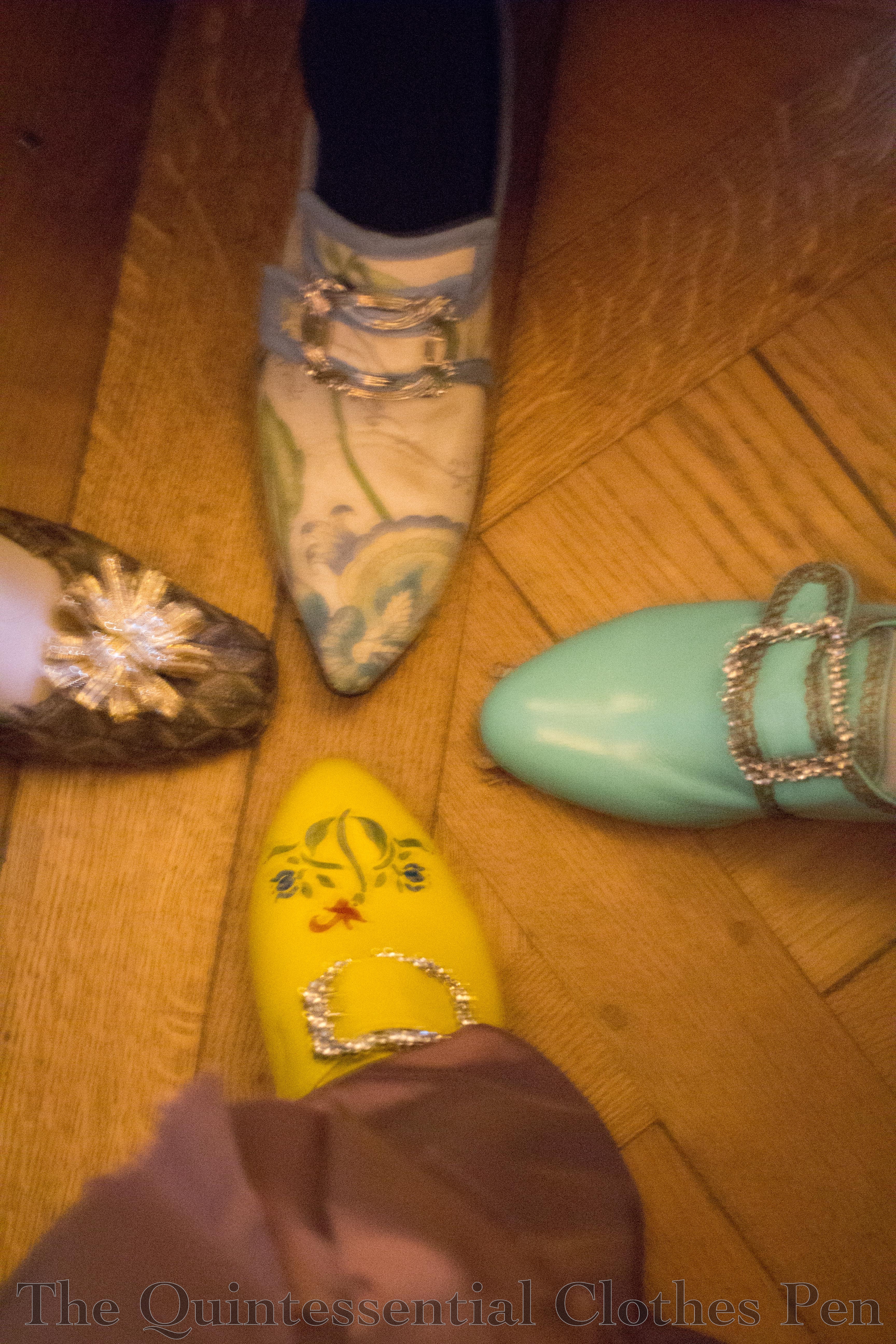
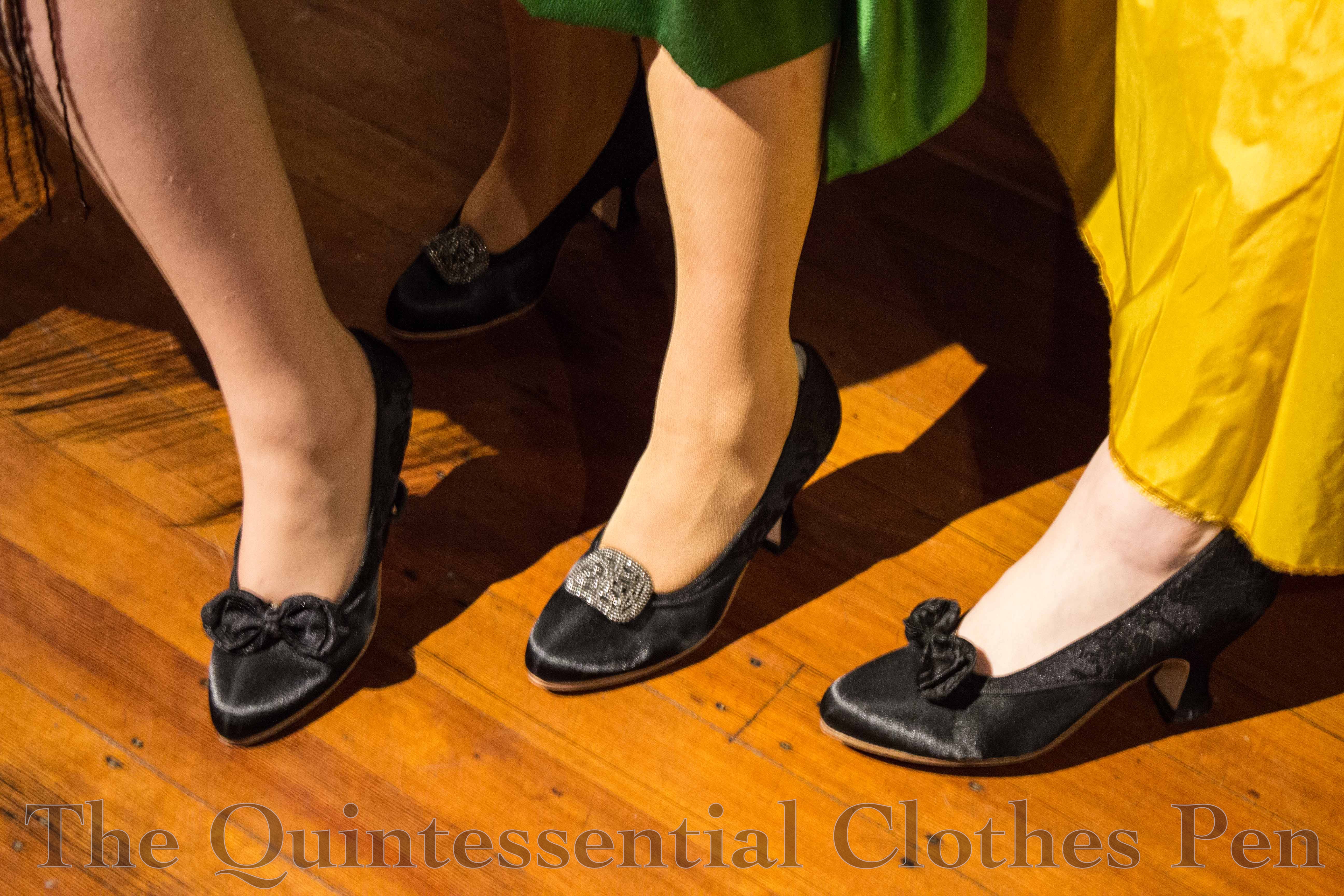
Here are our shoes: my two traveling companions and our new friend. We all made or embellished our shoes. Neat!

IMG_0310 (1)

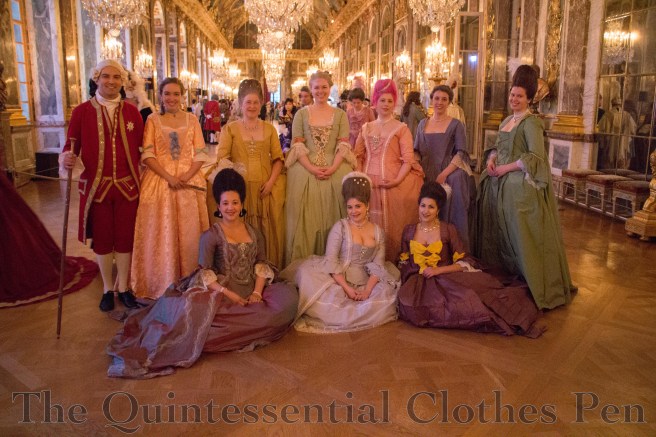
We also found more friends! In fact, there was a group of seven of us from Boston who met up at the event, as well as a group of four we knew who traveled from Scotland, and the friend we met who is French. We didn’t all make it into one picture, but here’s most of us. The impressive thing is that we’re all dressed. I’m pretty sure most if not all of us were still sewing the day of.
IMG_0345 (1)

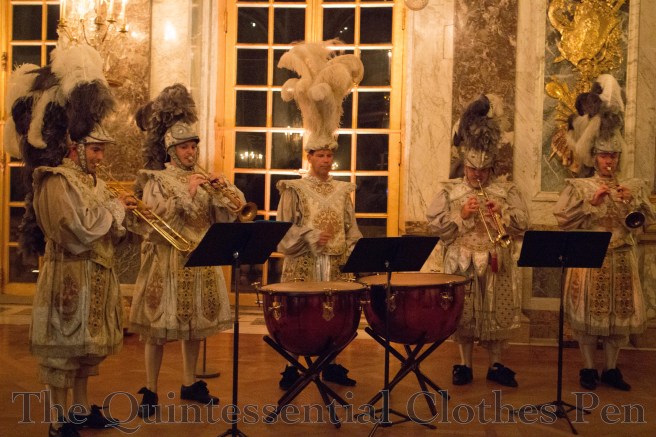
Every time the king entered the Hall of Mirrors this special unit of musicians would play a fanfare. You could certainly tell something was happening even at the other end of the hall. And wow, did these guys have great hats! They rival the ones worn by Buckingham Palace Guards in awesomeness.
IMG_0392 (1)

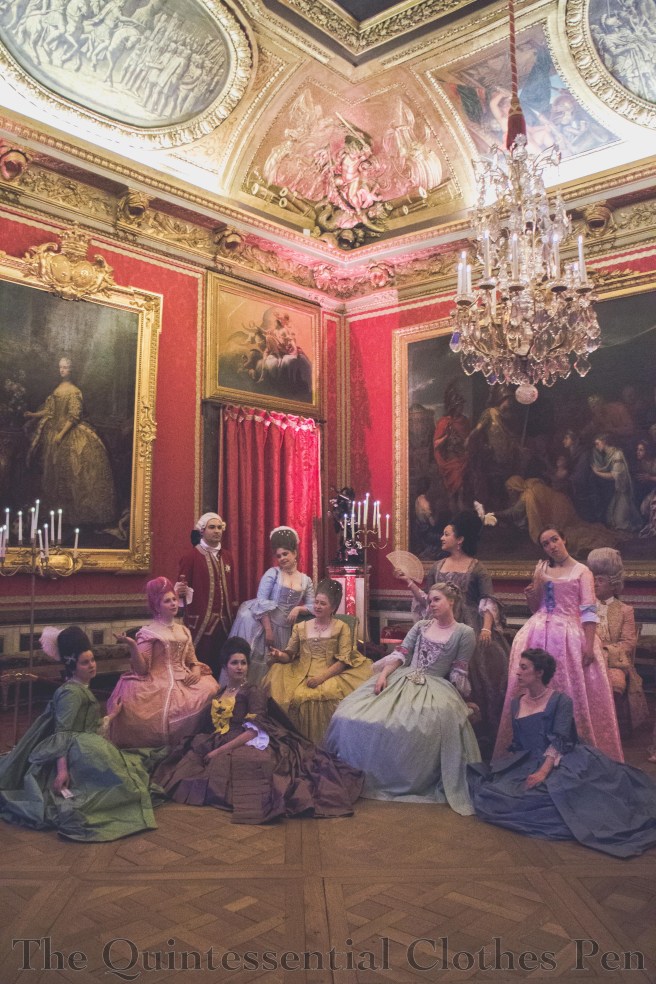
My next activity was back at the other end of the line of drawing rooms. As the group meandered our way through we were wrangled into another group picture, this one intended to be in the style of  Annie Leibovitz’s Marie Antoinette photos.
IMG_0372-2

Then it was actually off to my second activity, a concert of sacred music in the Royal Chapel. We had to wait a bit to enter as the previous concert hadn’t yet finished when we arrived, but that gave us time to look around the Hercules Drawing Room a bit more than we did upon first entering it. Part of the room was cordoned off to provide space for a dance and music performance, a portion of which we were able to watch while waiting.

IMG_1363 (1)

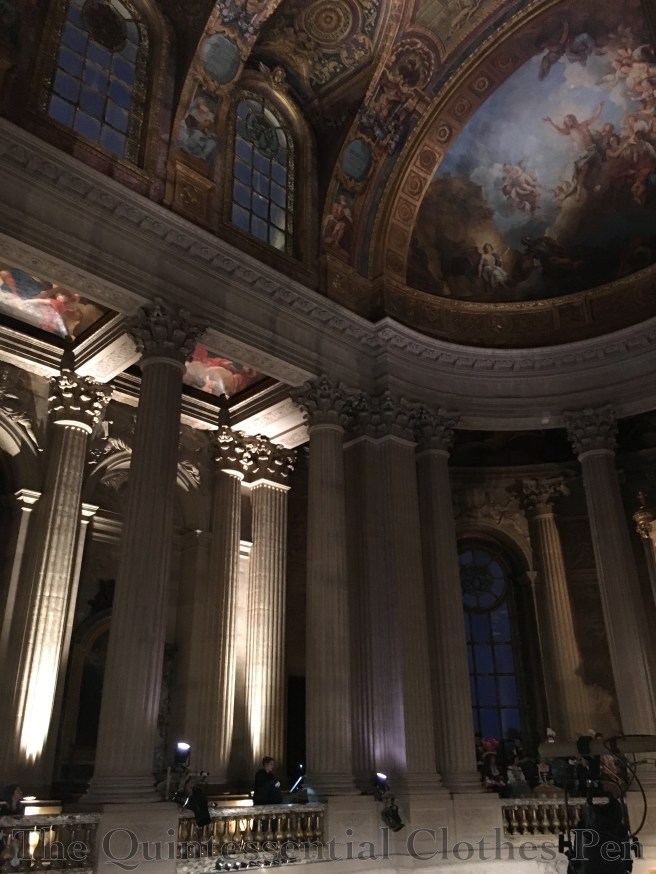
As a daytime tourist, we were only able to look through the doorway into the Royal Chapel, so it felt like quite a treat to be allowed to enter and sit for the concert. We were all seated on the second level of the chapel. And to my great delight, the concert’s music was provided on the organ! How exquisite, to listen to the music fill the room and fade away in echoes between songs. Some pieces also included singers. It was a lovely rest for the feet and quite a stunning and special experience.
IMG_1374 (1)

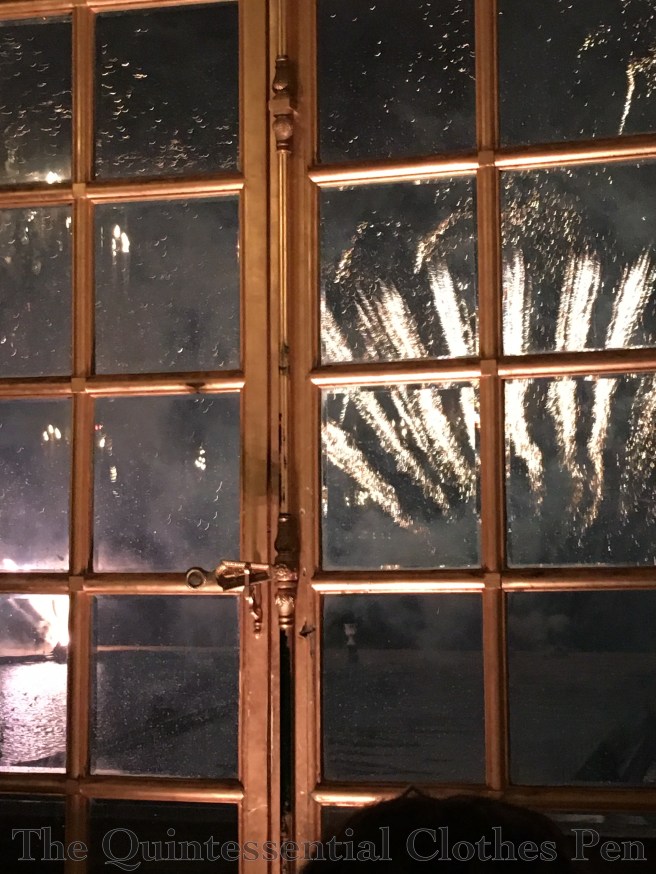
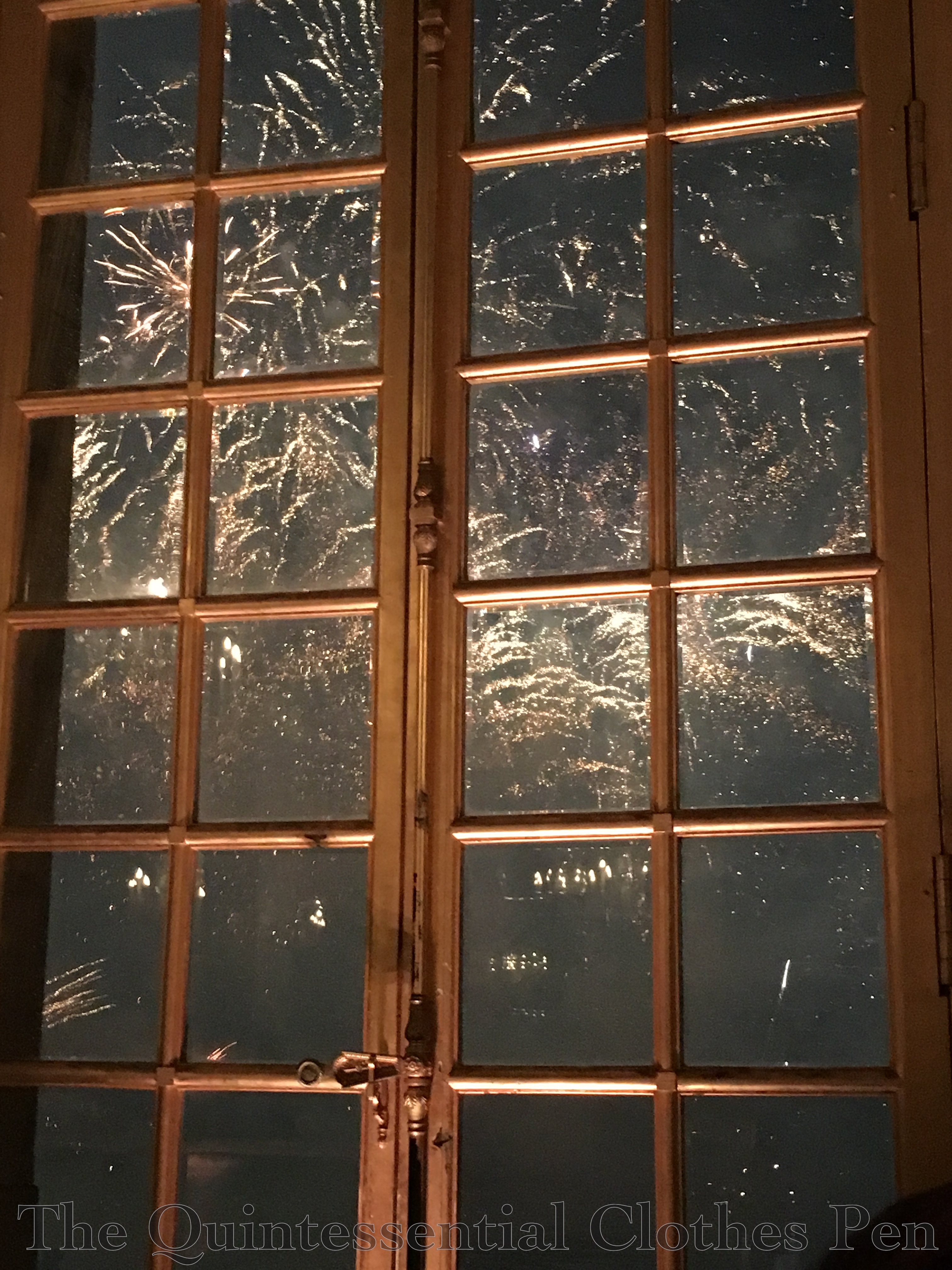
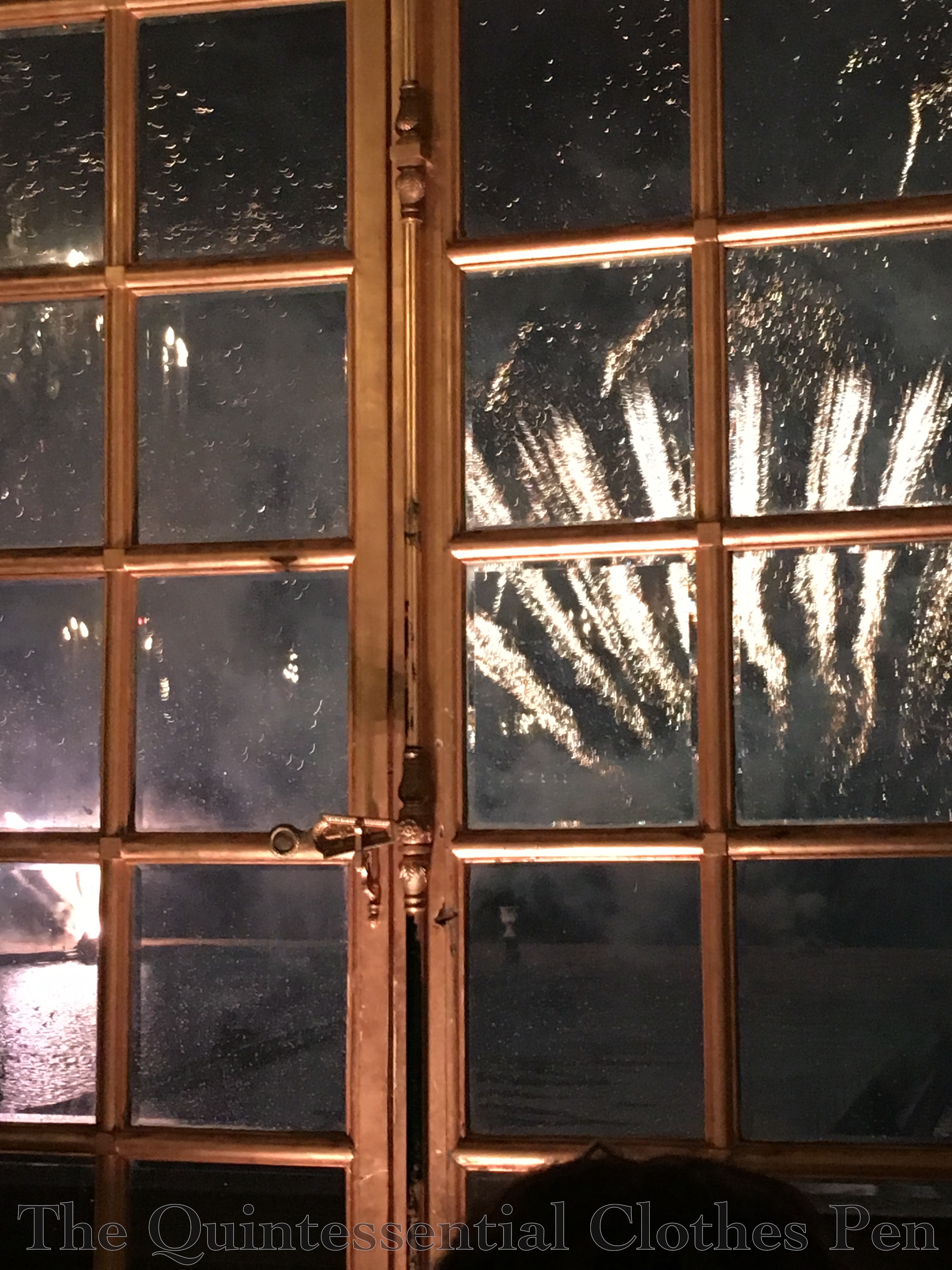
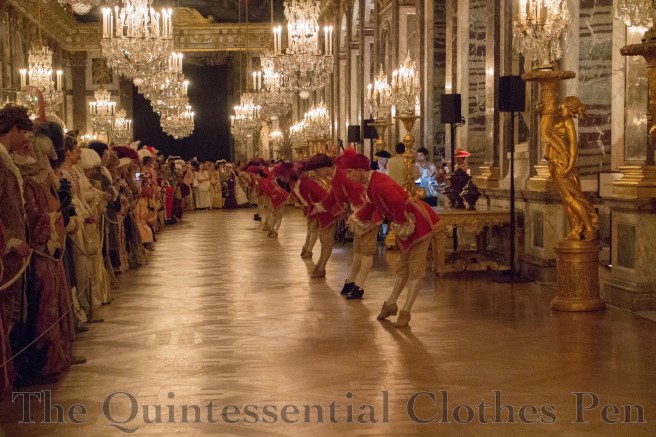
I was starting to feel tired, but the event was not ready to conclude. We headed back to the Hall of Mirrors for a dance performance and for fireworks! We weren’t sure they would do the fireworks with all the rain, but they did!
IMG_0399 (1)

IMG_1416 (1)

IMG_1415 (1)

IMG_1412 (1)

The fireworks were the finale of the evening, but the event staff didn’t rush us out. In fact, we stayed and lounged for another hour after the fireworks ended. There was a line of event staff very slowly moving through the rooms and herding people, but it was a very civilized and non-intrusive herding.

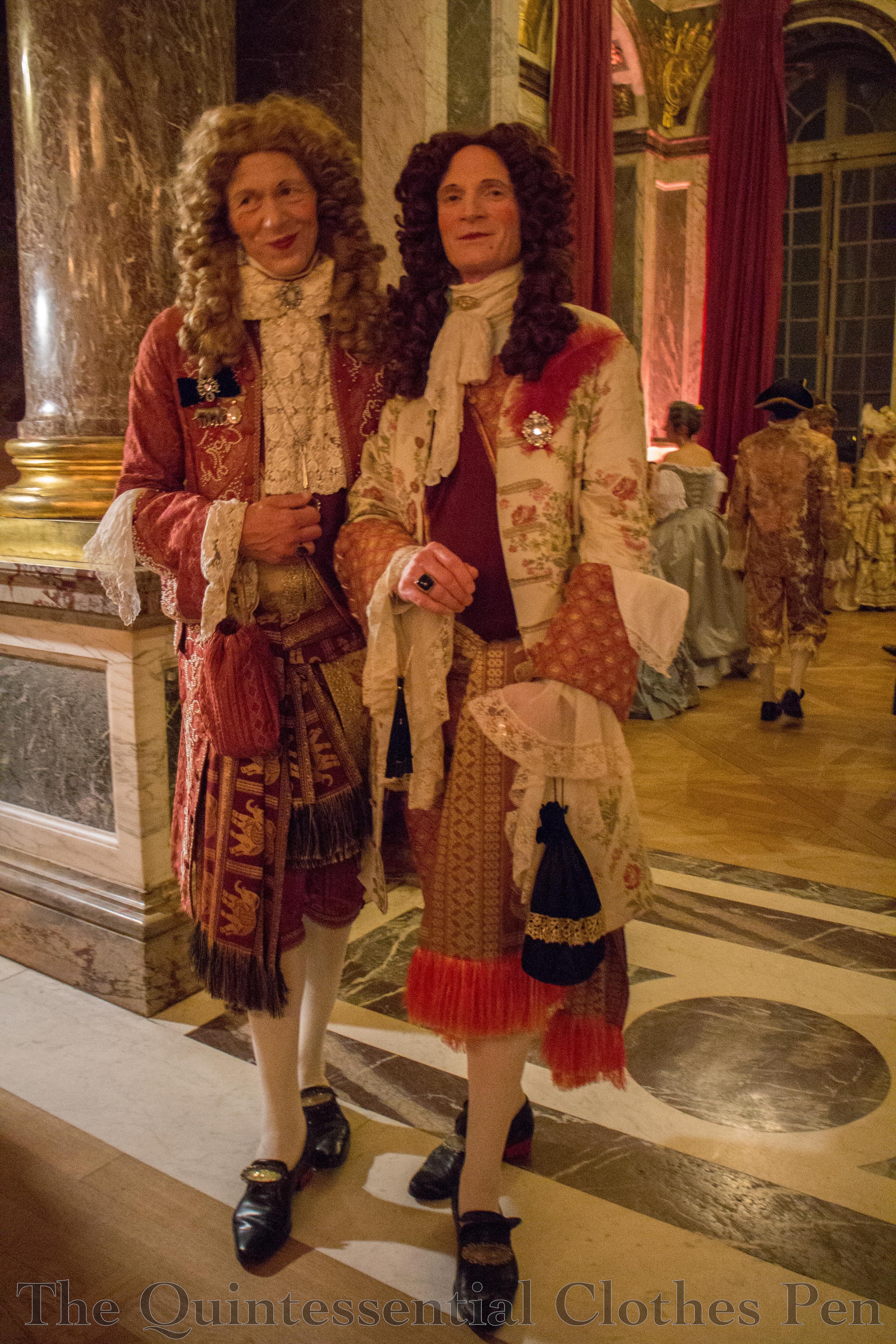
It gave us more time to admire other people’s clothing, including these two, and to be admired. I was impressed with myself when I understood a compliment given to me in French!
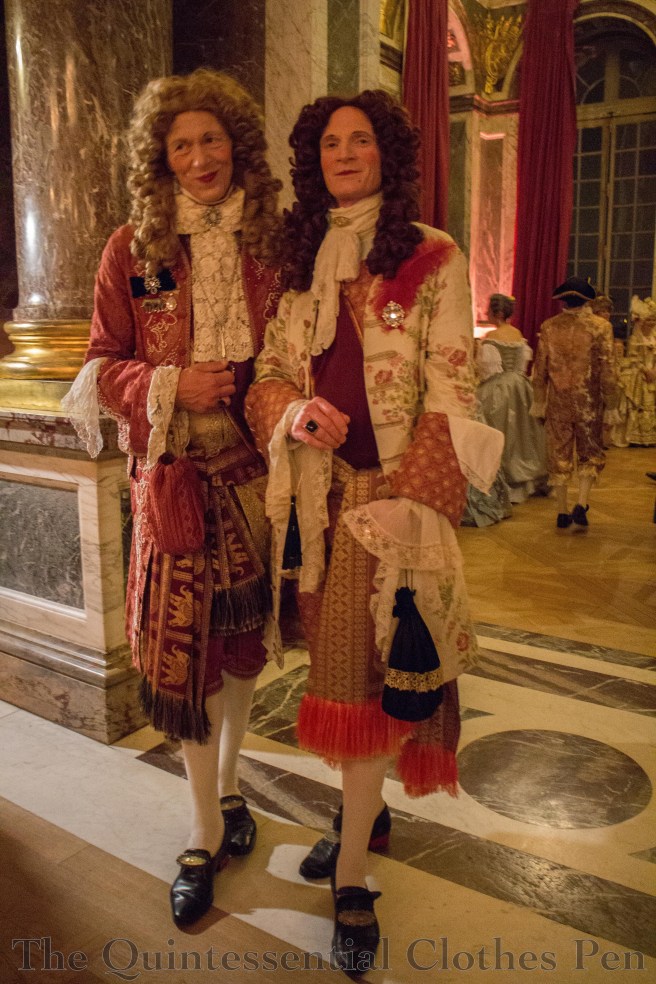
IMG_0428 (1)

We slowly walked back through the line of drawing rooms, not wanting to leave because it meant the end of the evening. This is back in the Hercules Drawing Room before we headed down to get suited up in our trash bags.
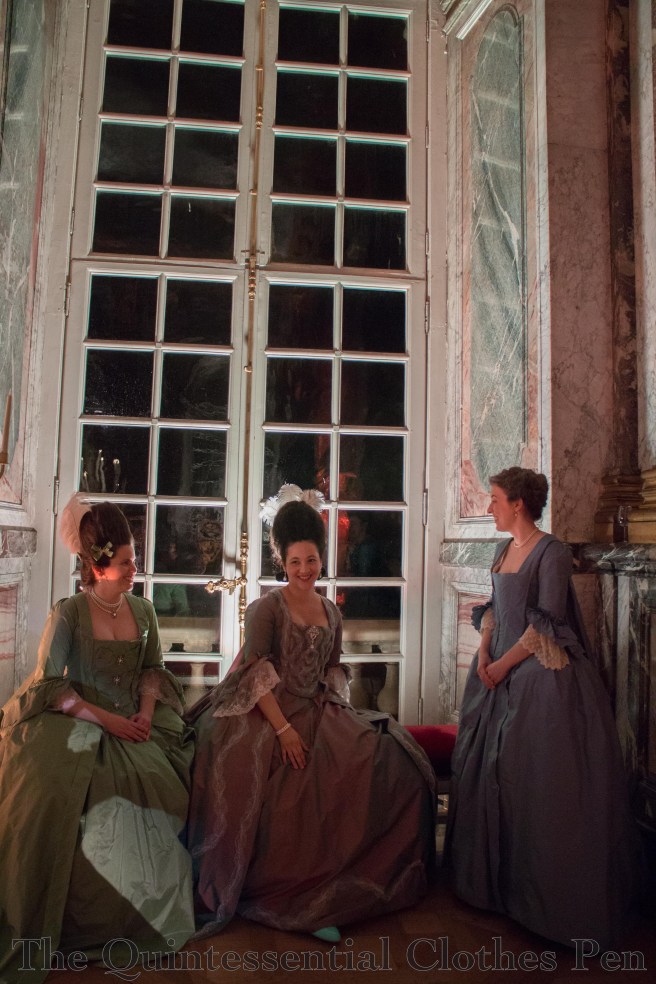
IMG_0439 (1)

If you appreciate stepping into history and you ever get the chance to attend this event, you should. It was stunning and special. This is how Versailles should be not only seen, but experienced.

IMG_1451 (1)

1885 Night Sky Fancy Dress

It has been a goal to make a specifically fancy dress outfit for years, but particularly since I made a makeshift 1860s flower basket fancy dress outfit in 2015. This May I had the perfect opportunity in the form of a fancy dress ball!

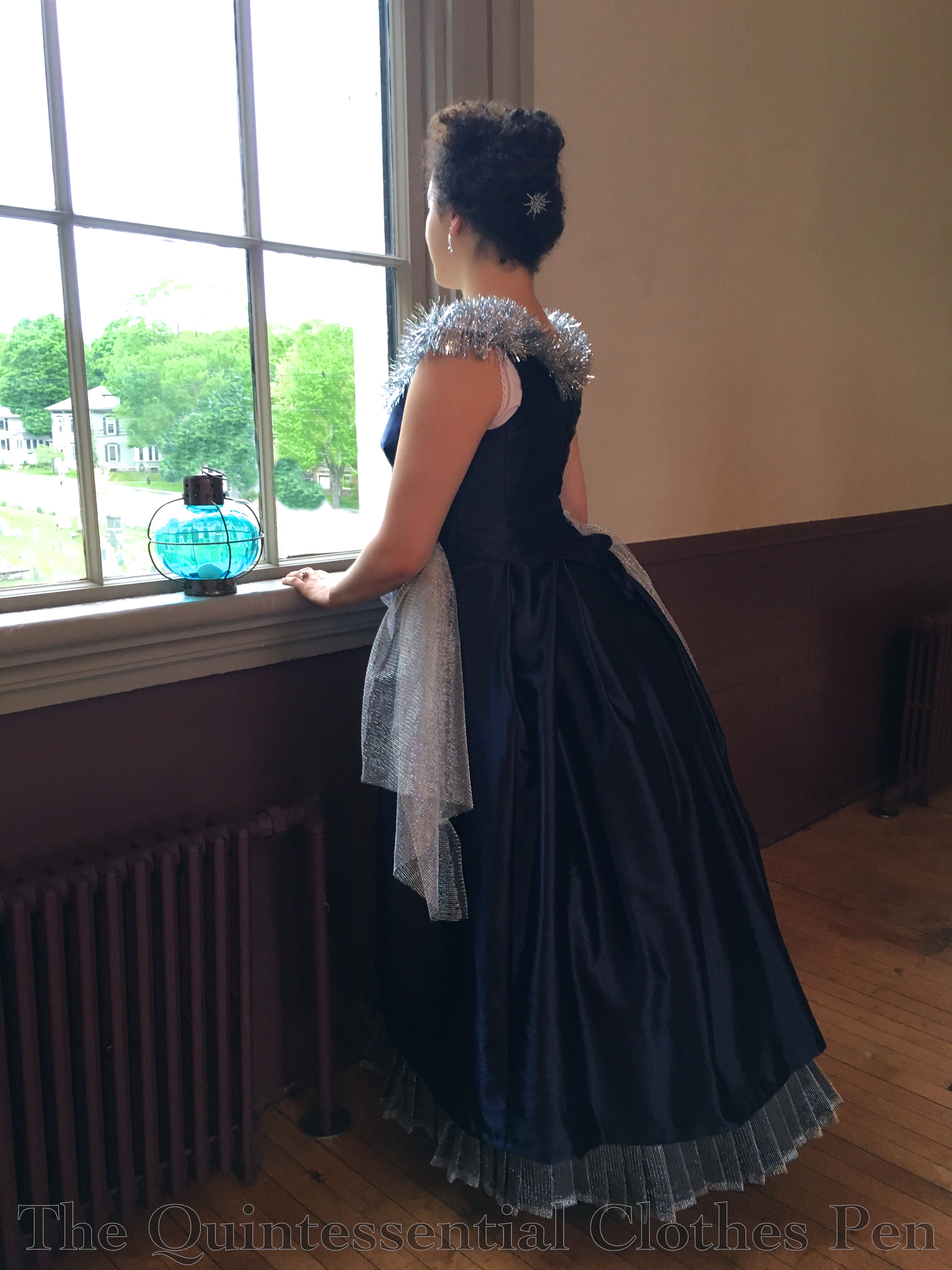
I decided to make an 1880s bustle dress because I already had all the undergarments, including my still-new-feeling 1880s steam molded corset, and because it’s a period of dress that I rarely wear, especially for dancing. I wanted to experiment with dancing in a bustle to see how it worked and what it felt like.

Design-wise, I was inspired by Mrs. Alice Gwynn Vanderbilt’s Electric Light fancy dress outfit made by Worth in 1883, but wanted to adapt the idea to fabrics I already had on hand. Since the fabric I came up with was navy blue, I decided on Night Sky as my inspiration.

2753c5268e0e74e0fc49e0c0d77e3053
Mrs. Alice Gwynn Vanderbilt’s Electric Light fancy dress outfit, 1883

I started my outfit in January and worked on it over the next four months or so, but despite all that preparation time I was still working on it right up until the day before the event. Luckily, I did the vast majority of the work of cutting, sewing, and fitting before March and April when I became super busy. Tasks left at that point included finishing the bodice edges, trimming, and closures.

IMG_0999 (1)

In addition to the Mrs. Vanderbilt’s inspiration I also looked at other 1880s skirts for draping ideas and other 1880s fancy dress outfits for trimming ideas. You can see the most inspiring images and extant garments on my Pinterest board for this project here.

For ease of documentation, I’ll do the facts as with the HSF:

Fabric: 2-3 yards of navy blue cotton twill for underskirt, 6ish yards of navy blue polyester charmeuse, 1ish yard of pink cotton twill for flat lining, and 1-2yds of silver net.

Pattern: My 1885 Frills and Furbelows Bustle Dress pattern, adapted for evening and for the style of skirt desired.

Year: 1885.

Notions: A 3yd tinsel garland, 6 star brooches, 3yds of navy polyester ribbon for lacing, hook and bar closures for the skirt, and thread.

How historically accurate is it?: 90%. Recognizable in it’s own time, certainly. Reasonable construction, certainly. Materials, not so much. It was much more important to use what was on hand than to purchase new fabrics, especially since this is an outfit that I don’t see getting a lot of use.

Hours to complete: Tons. I didn’t keep track. Bustles are fussy and require lots of time with a dress form to achieve an elegant drape.

First worn: May 21.

Total cost: Most of the fabrics were in the stash with the exception of the silver net and most of the notions were purchased cheaply on eBay. Let’s say $20.

IMG_1011 (1)

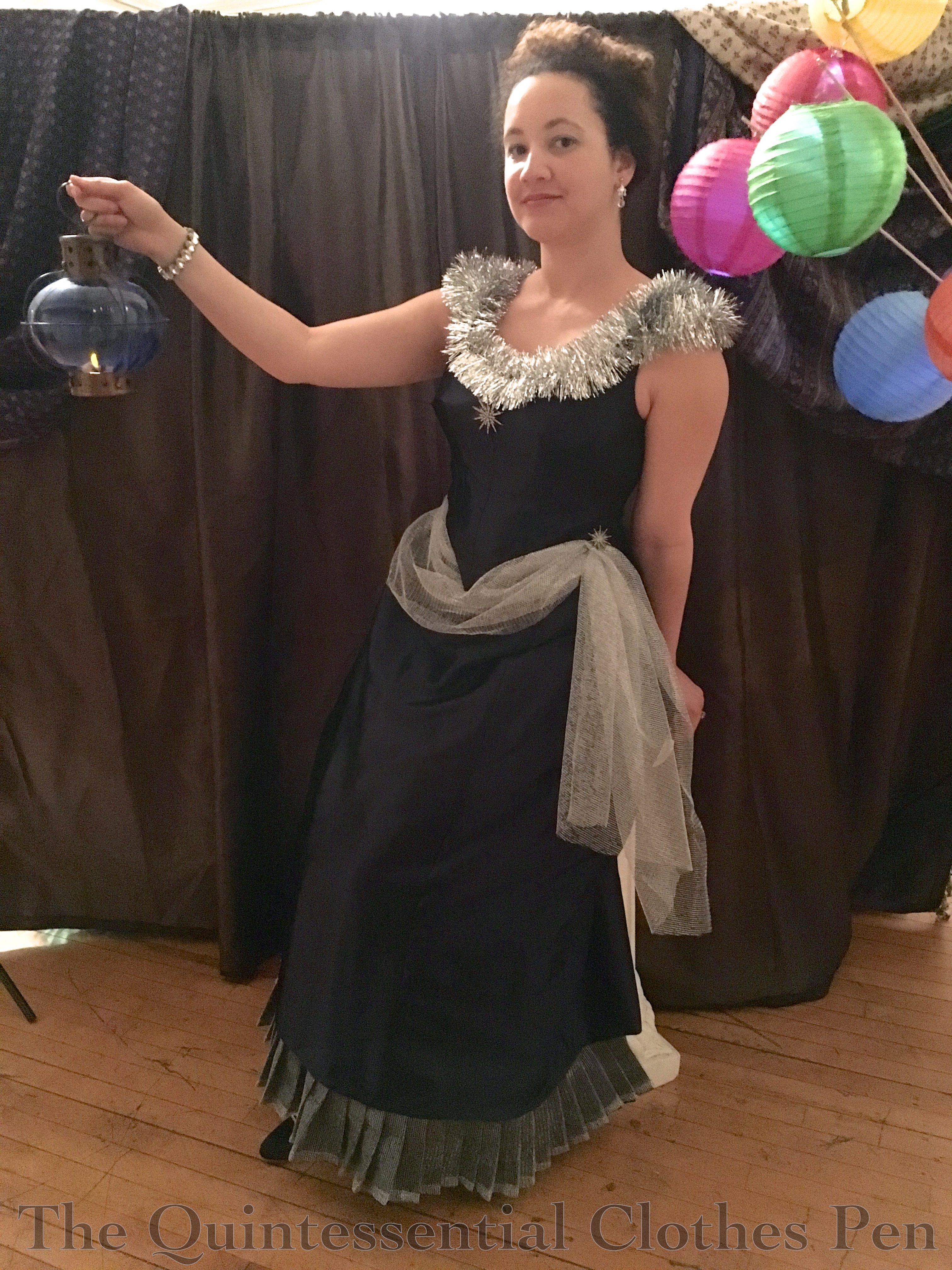
For the photos I wore the dress with my black Seaburys and the new rhinestone shoe clips that I purchased in March. It was quite sparkly and elegant, but for dancing I changed into navy blue velvet flats. They were just as cute but did not get the special treatment of being shown off in photos.

I had the grand idea to use my curly hair ends flipped up on top of my head like the curled fringe popular in the 1880s. It’s also long enough that I was able to make the bun shape on the back also using only my natural hair. I pinned in star brooches to match those on my dress as decoration.

IMG_1034 (1)

All in all I’m quite happy with the final result! Dancing in the bustle was just as easy as any other Victorian style. The differences were that all the extra fabric was behind me making some movements more challenging due to space such as during a quadrille, and that the bustle and layers of fabric on the back gathered a fair bit of momentum when turning, creating quite a swish!

Construction wise the only change I would like to make after one wearing is to bone the center back edges so that the back lies flat when laced onto my body and to sew in a matching fabric piece behind the lacing holes to hide any white from undergarments that wants to peak out. I’ll also need to wear a different chemise or tuck the top down so there’s not white cotton poking out at the armholes. However, these are minor changes and I’m not sure when I’ll have the opportunity to wear this again so it might be awhile before they happen.

IMG_1023 (1)

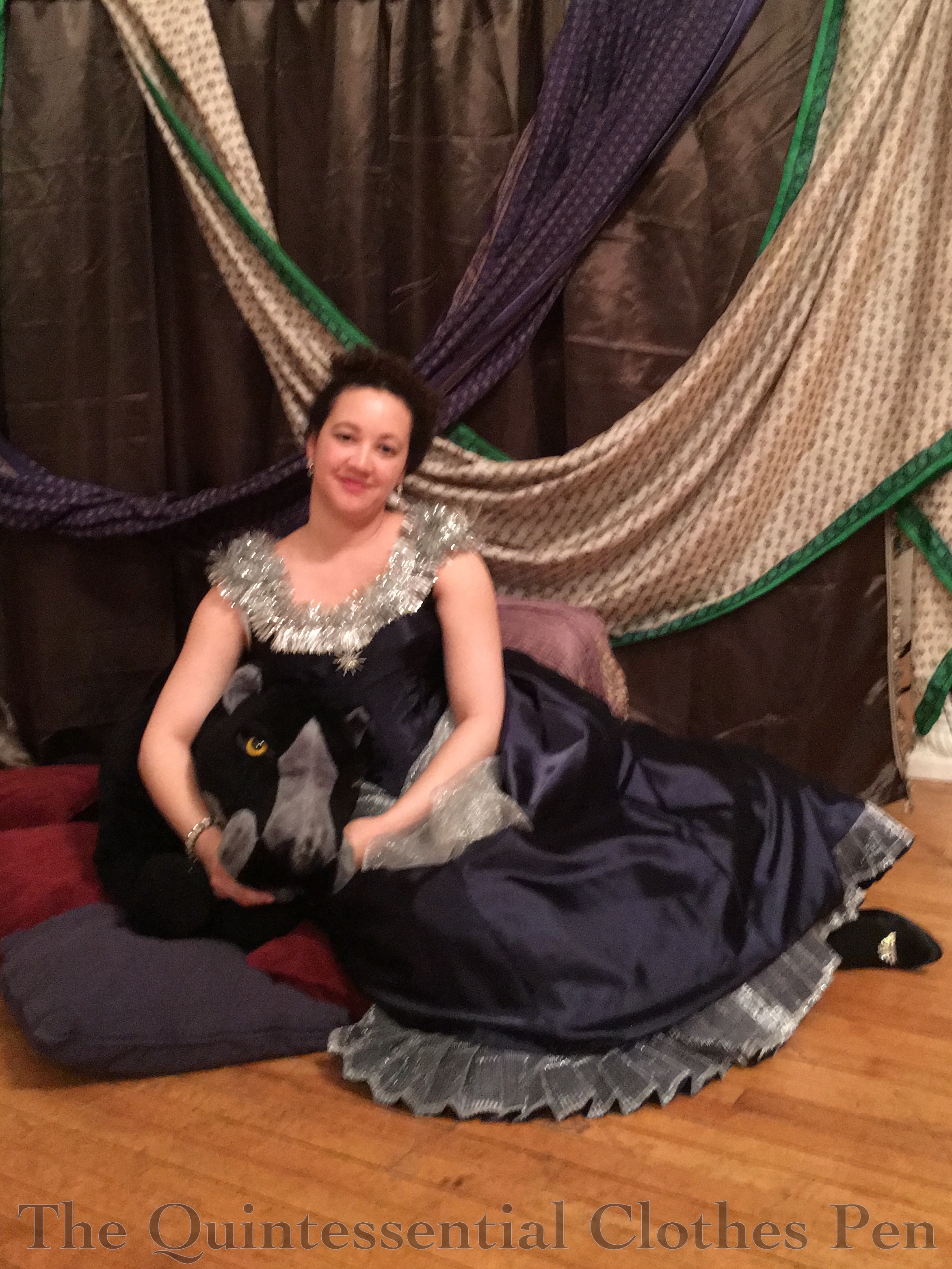
For this ball we set up a double sided picture backdrop, one side of which you’ve already seen. The other side included a large stuffed jaguar/panther I dubbed Jaggy for the night. You often see backdrops in regular Victorian photos as well as fancy dress photos. Unfortunately, with my heels on I was too tall for them! Oops! Being too tall inspired me to take some fun sitting photos.

IMG_1094 (1)
Hanging out with Jaggy.
IMG_1097 (1)
Tired after a night of dancing.

For decoration out of the ordinary, we had the lucky and unexpected use of the fabulous blue and turquoise lanterns in many of the pictures as well as multicolored paper lanterns with lights inside. We put the lanterns around the room in glass vases as bouquets. First, a picture from the set up part of the evening. Second, a picture with some lanterns creeping into the photo.

IMG_0973 (1)

IMG_1080 (1)

Fancy dress outfit, check!

Springtime In 1895

Part of my super busy April included a few historical adventures and for one of them I made a new skirt! I was lucky to be able to squeeze it in between working on things for Versailles and for my other event in May–a fancy dress ball!

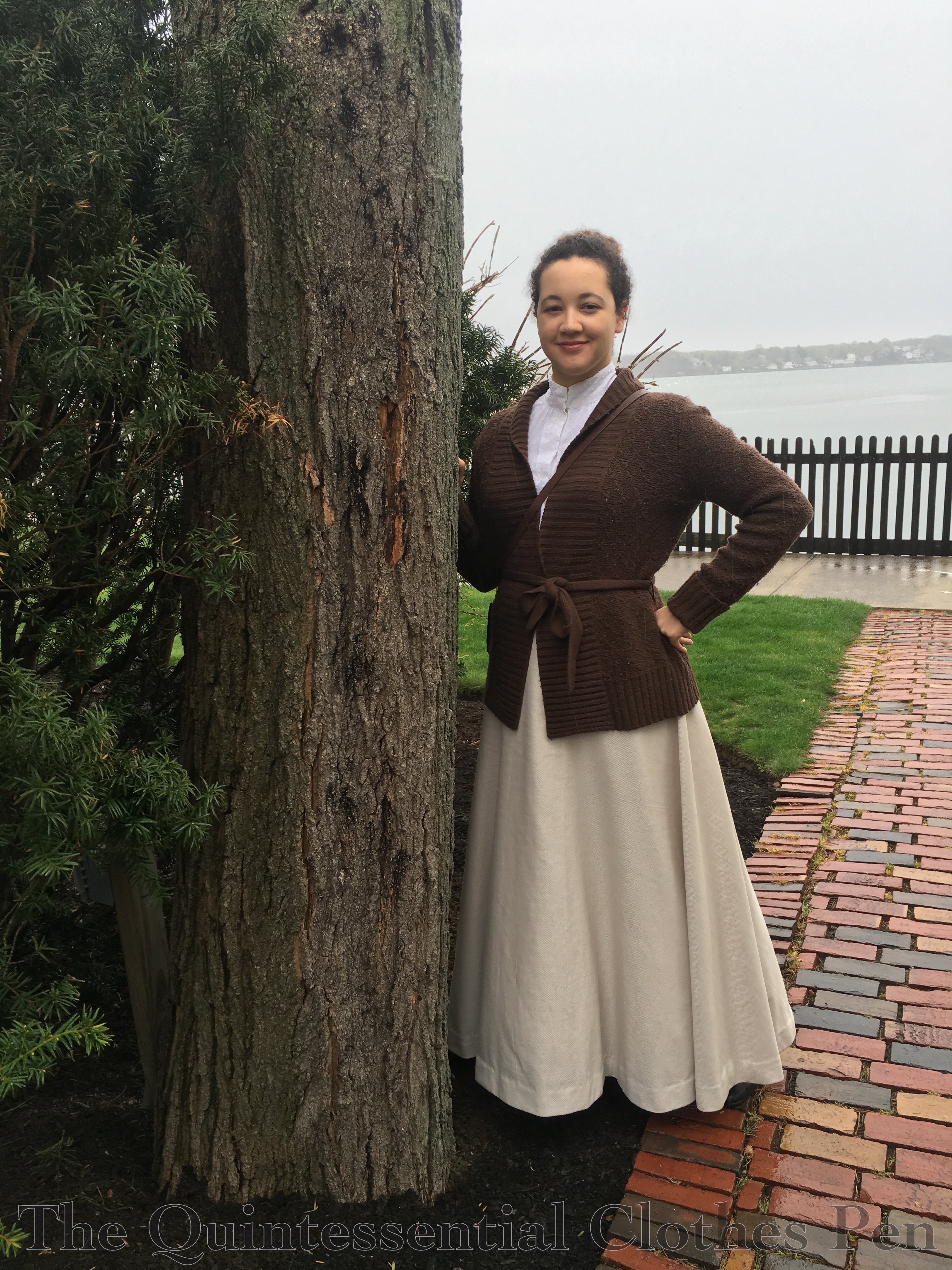
The morning was rainy and cold and so I threw on a sweater to keep warm. I rather fancied that I looked like an 1890s adventurer, sort of 1890s-lady-does-Indiana-Jones-in-the-rain-without-the-hat. (I really want to make an adventuring/archeologist outfit and find a great place for pictures…! Someday…)

IMG_0796 (1)

IMG_0803 (1)

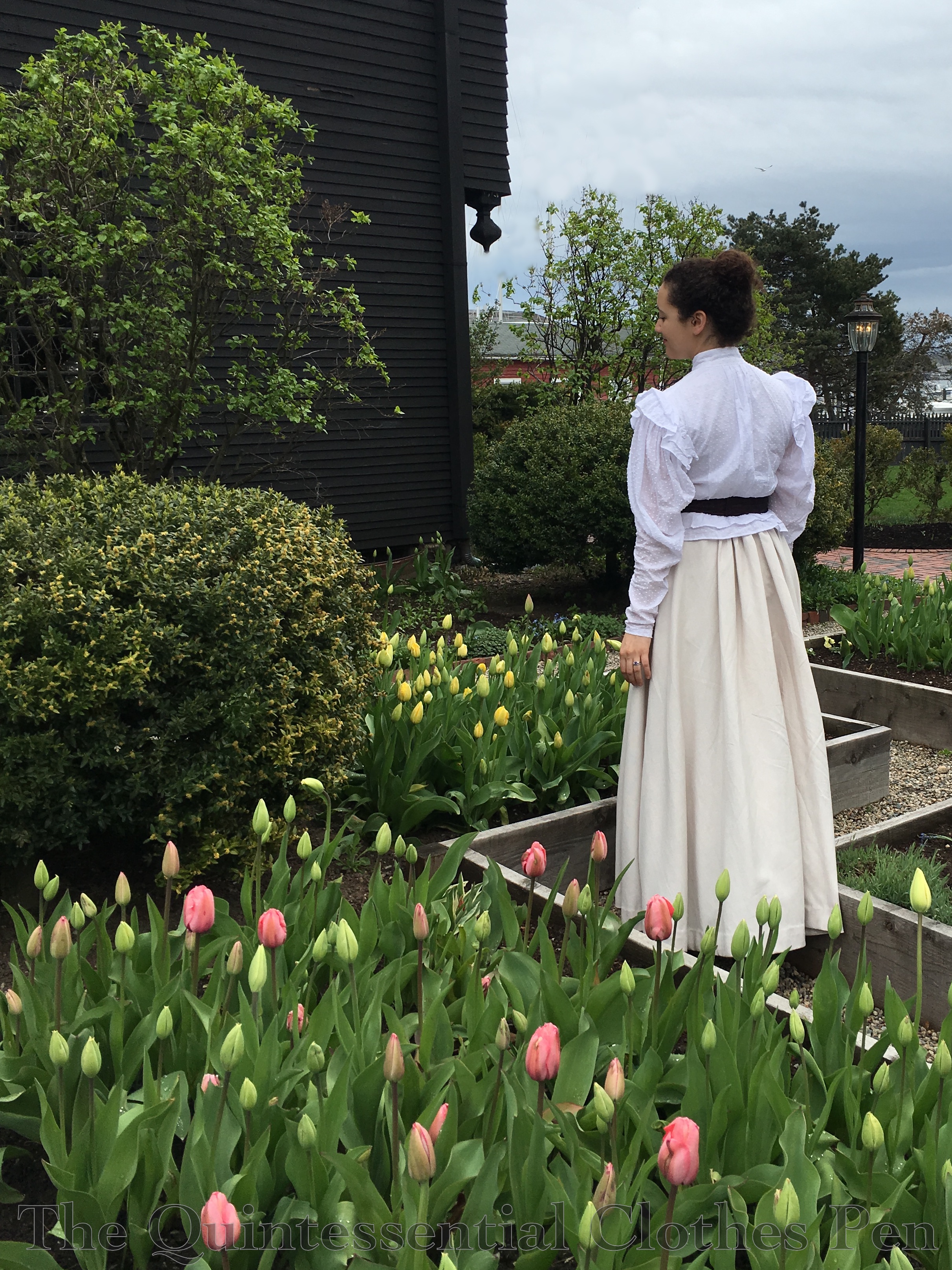
By the afternoon the rain and ceased and the sun came out, which was a perfect opportunity to take some pictures of my ensemble without the sweater. I find I don’t have many outfit pictures taken in the springtime and this seemed like a perfect opportunity to counteract that problem.

IMG_0819 (1)

The new 1895 skirt is being worn with an 1895 blouse I made in 2012 as well as a silk taffeta belt and my super silk petticoat for volume. The last few times I wore this blouse I was wearing a skirt from about five years later. Not out of the question in terms of plausibility, but not as perfect in silhouette as I was hoping for. This time though, I was excited to have springtime pictures with an outfit in which all the clothing was from the right period!

IMG_0820 (1)

The skirt is an umbrella shape, meaning that it is all one piece with only a center back seam, just like my 1895 skating skirt. It is hand sewn simply because it was easier to sew it by hand than get out the machine to do it. It’s made from a rayon blend herringbone weave fabric which has a lovely drape, but wrinkles very easily. I like that it is neutral without being white and that it has a subtle pattern.

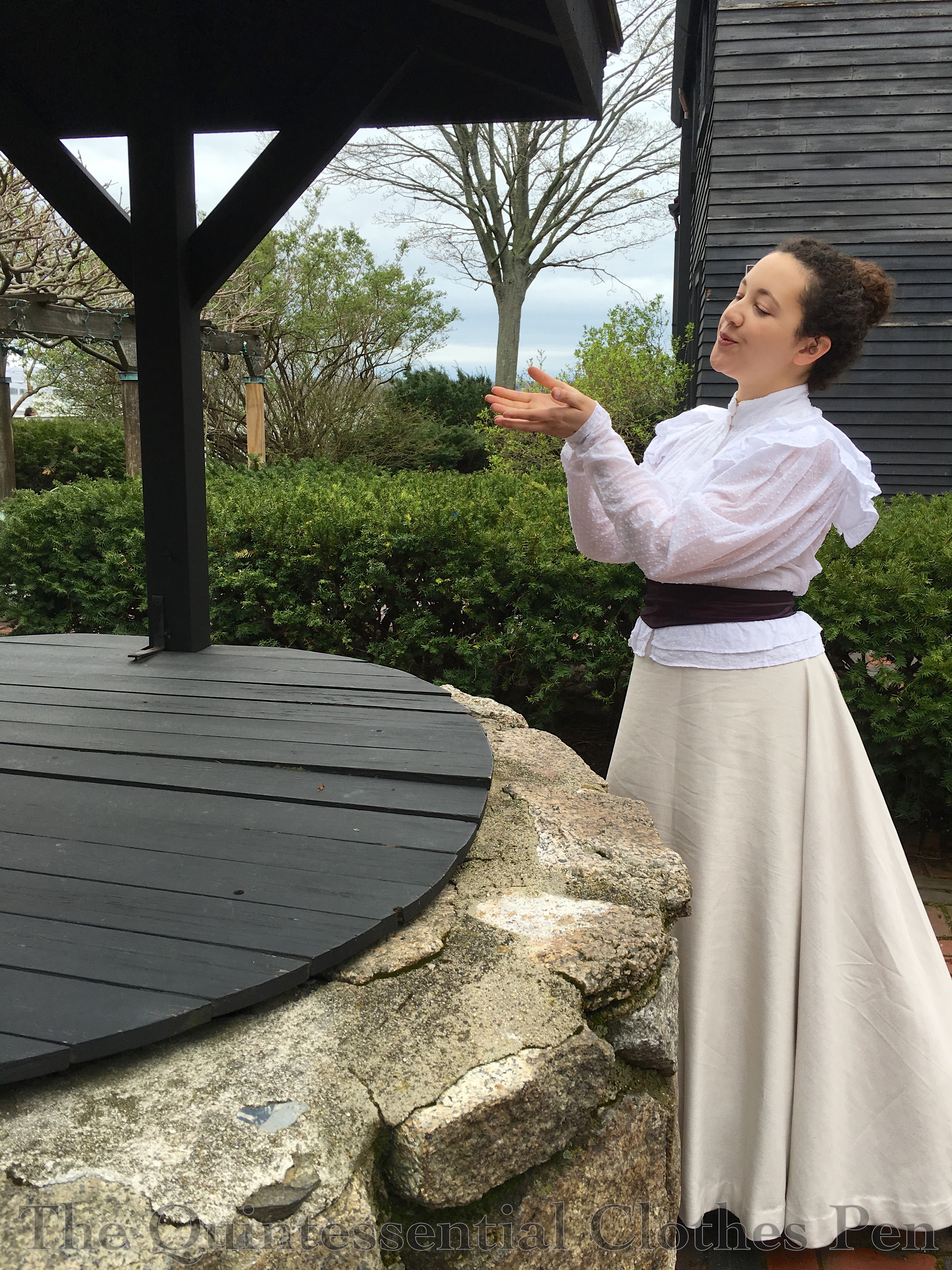
There was also a covered well that seemed cute for taking pictures until I stopped to think about how to pose. Most of my pictures are extra silly looking, but these two are reasonable and my favorite.

IMG_0832 (1)

IMG_0836 (1)

Thank goodness spring is finally here! The flowers and green on the trees is lovely and such a change from the dull brown and grey of winter.

A Post About Seaburys

I mentioned in my last post that I am the happy owner of a pair of black American Duchess Seaburys. What I didn’t mention in that post is that I am also the happy owner of a pair of dove gray Seaburys!

I bought the black ones first, around Christmas-time, and picked that color because of the versatility of black shoes. Once I received them and was able to fully appreciate the gorgeous materials, elegant design, and sturdy construction I started raving about them to friends. During one conversation in particular, I managed to inadvertently talk myself into buying the dove grey Seaburys as well… They’re being discontinued and are such lovely shoes with such a distinctive shape that they’re worth having in two different colors.

I’ve only worn the gray ones once so far, when I decided to wear them with modern clothes to the ballet. I found them to be just as elegant for modern dress as for historical dress, which was great! It’s hard to find gorgeous modern heels that meet all my various criteria.

IMG_0660

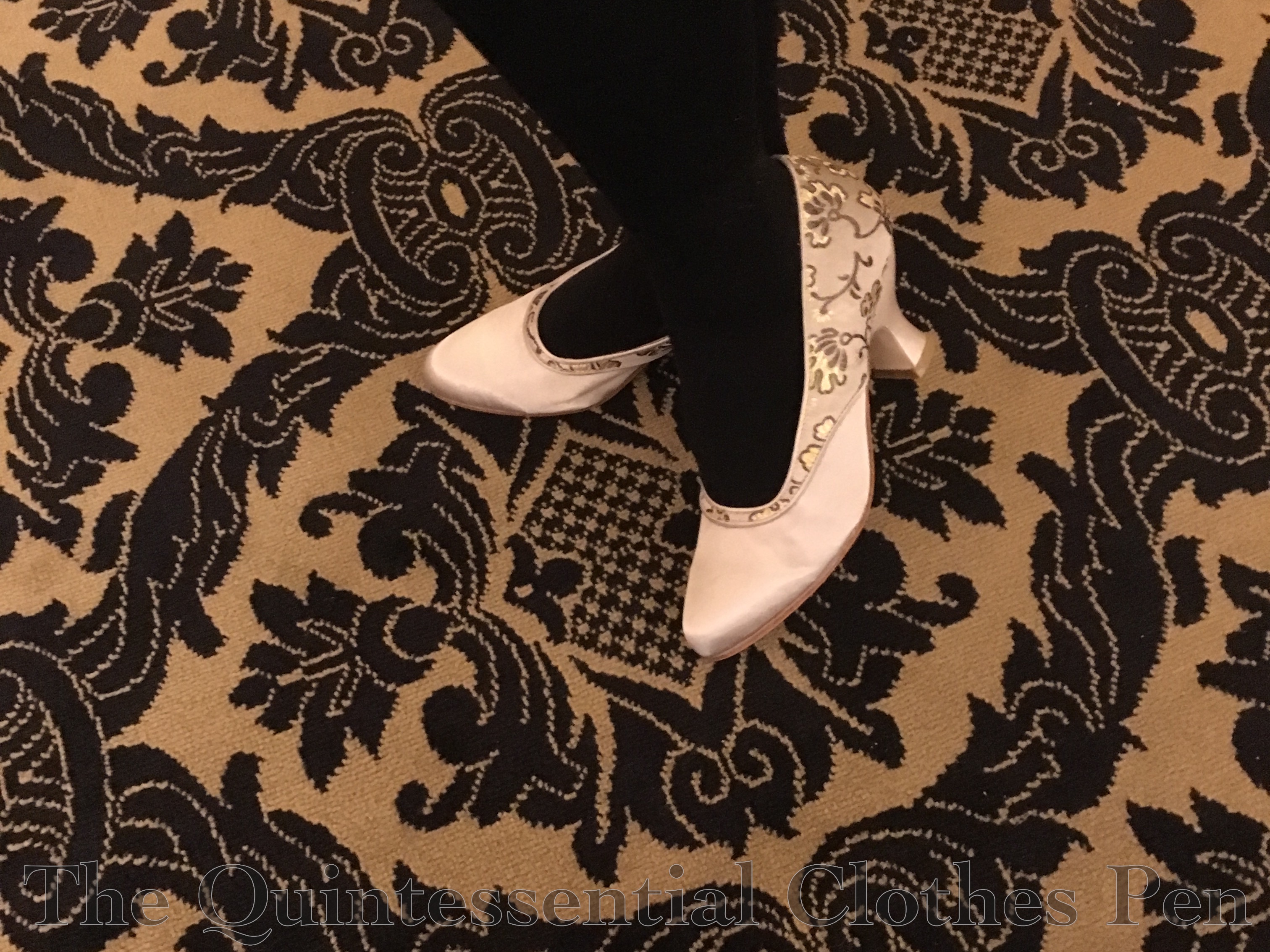
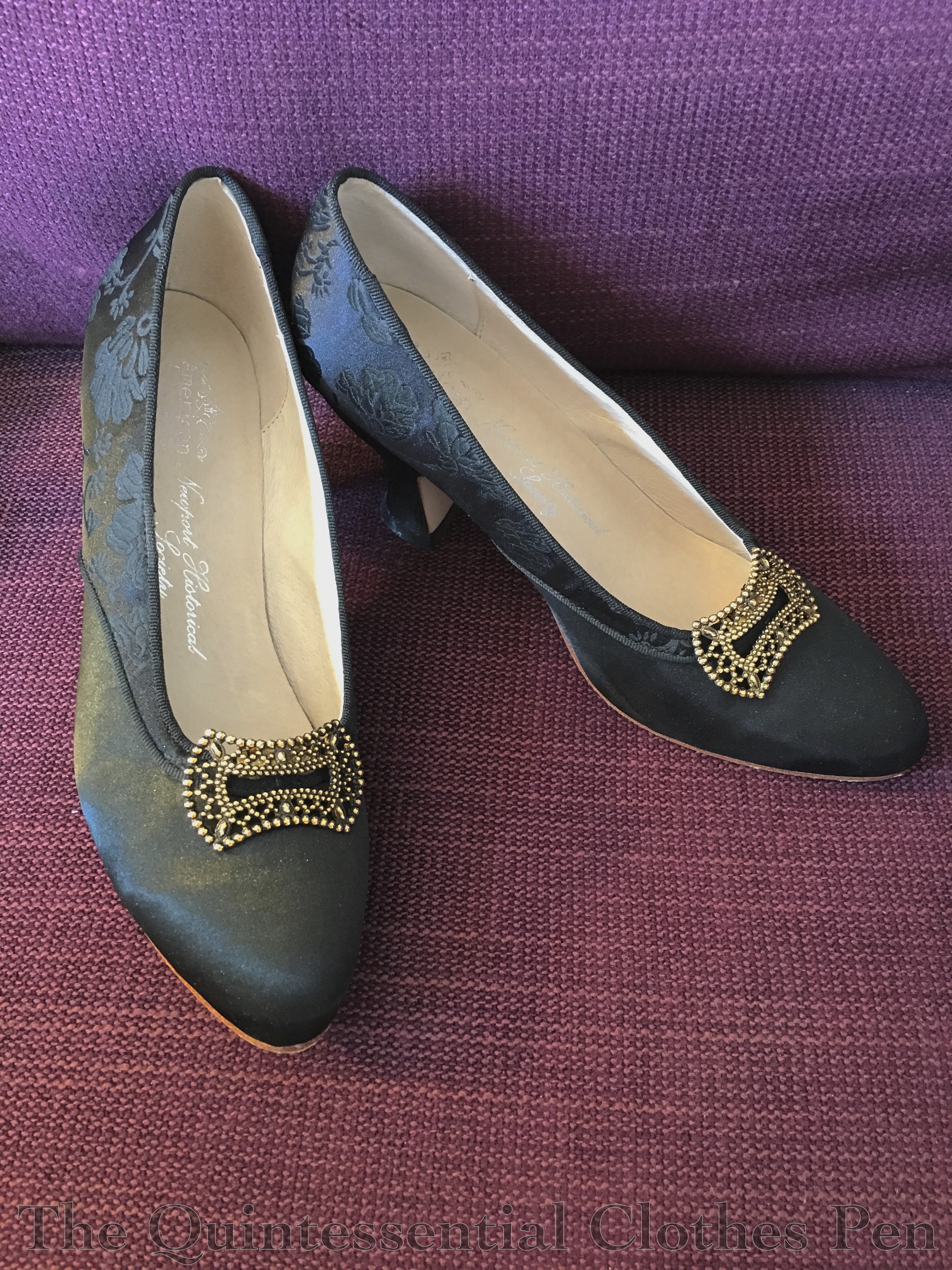
I decided to try this pair without the shoe clip bows. The gray silk gleamed and the custom designed brocade was much more obvious in this color than in the black, as I expected.

IMG_0659

The black pair I wore most recently with my 1924 robe de style at the GBVS White Lightning Ball. Here I am showing them off!

IMG_2369 (1)

In fact, there were three of us at that event wearing black Seaburys. The nice thing is that they looked elegant and unique on each of us. Emily, in the center, got creative with hers and changed out the removable bows for vintage shoe clips… and it blew my mind!

IMG_2295 (1)

The idea of shoe clips with different decorations for Regency shoes is standard to me at this point, but I had never considered the idea for 20th century shoes. I loved the look of Emily’s and immediately came home and started searching for some that I liked so I could vary my shoes more. Since then, I have acquired two different pairs of shoe clips. Now I need places to wear them!

IMG_0728

The gold buckle ones are my favorite of the two styles. I love the color and the curved edges! The rhinestone ones are a nice bit of bling, but aren’t quite as exciting as the gold. I haven’t tried them on my grey Seaburys, but I’m curious if they might match better. I also like them flipped over so the rhinestones spread over the toes, but wearing them that way would require some finagling, since the clips on the back would be upside down.

IMG_0730

The verdict is that after wearing Seaburys multiple times in different situations, I can say with certainty that they are stunning shoes. They’re quite comfortable for standing around and light walking, with a well balanced, elegantly shaped heel. I have a narrow foot and I am pleased that these pumps stay on the back of my heels without a problem and without extra assistance. I wouldn’t plan to walk too far in mine especially outdoors, partly because the uppers are silk and I wouldn’t want to ruin them with scrapes and scratches.

For dancing, however, these are not the most comfortable shoes. They work pretty well, but as with most heels, my toes started to feel a bit pinched and tight after a few Charlestons and my feet were much more relieved to take off the shoes after wearing them while dancing vs. wearing them while just standing. Also, with nylons, I was more afraid that while dancing my heels might slip out of the back of the pumps.

But as I said at the beginning, these shoes are worth raving about. Both the solid silk and the silk brocade are gorgeous, Lauren created an incredibly elegant design with an attractive toe box and beautiful French heel, and they are sturdy and carefully crafted.

Unfortunately, Seaburys are no longer being produced. However, the new American Duchess Amelie shoes have the same gorgeous silk exteriors (without the brocade). They have a lower heel but are still a unique, historical shape, and they come in a variety of beautiful colors in addition to black and silver.
Product links in this post contain an affiliate code, which provides a small benefit to my shoe fund. This does not affect my impressions and reviews of this product.

SaveSave