When The Dress No Longer Fits (1864 Green And Gold Dress, Evie) (HSM #11)

(HSM #111Today, I have another installment of a When The Dress No Longer Fits story. I share these posts as I update older dresses to fit my current body size. You can read all of the posts in this series here.

The Back Story For Evie, My 1864 Green And Gold Dress

Back in 2013, I decided to prove to myself that a hand sewn 1860s dress could stand up to lots of wear by making a new dress and wearing it to many social engagements. Thirteen years later, I can say with confidence that the green and gold silk dress has held up well to many wearings, just as I knew it would!

Here is a past blog post with many images showing this dress, which I named Evie, when it was first made. And below, a photo from that past blog post showing the dress. Looking closely, it even has extra space at the waist…

Well that isn’t the case anymore! I haven’t worn it in the last few years because it no longer fit, particularly in the waist. I changed sizes around 2015, and at some point around there I was able to extend the life of the dress by adding a placket under the bodice lacing so it didn’t quite need to meet to fit. And the waistband was just tight.

But more recently… the waistband would not close. And given how the dress is made, with 6 perfectly even stacked box pleats around the waist, one of which concealed the opening, there was no wiggle room for adjustment without a full re-pleating. When I finally made the decision to make a new waistband and re-do the pleating, I had forgotten how old this dress is. Built in 2013? No wonder it no longer fit!

Documenting My Updates

The first step to the remake was to take note of my original pleating math. Below, a photo of the outside of the skirt with the original waistband.
Then, seam ripping the old waistband to remove it from the skirt.

I decided that while the skirt was taken apart anyway, I would do a couple of additional things:

1 – I shortened the skirt by about 2″. It had always been a bit long for dancing, but given that there was so much trim near the hem it wasn’t possible to easily hem it. But with the waistband taken apart it was easy to shorten the skirt from the top.
2 – I removed the top portion of the muslin flat lining from the skirt, leaving only about ⅓ of it around the bottom to support all of the trim and provide a facing for the silk. When I made the skirt flatlining the entire thing felt supportive, but I realized that it was unnecessarily heavy and made the stacked box pleats at the waist extra thick and annoying to deal with. So no more of that on this second version of the skirt!

Below is a photo showing the inside of the skirt in its original form, with the muslin extending all the way up to the waistband. The box pleats were so thick there was no way to sew the waistband in a conventional way, so I turned all of the raw edges of the skirt to the inside and whipped the waistband to the top edges of the folded down pleats.
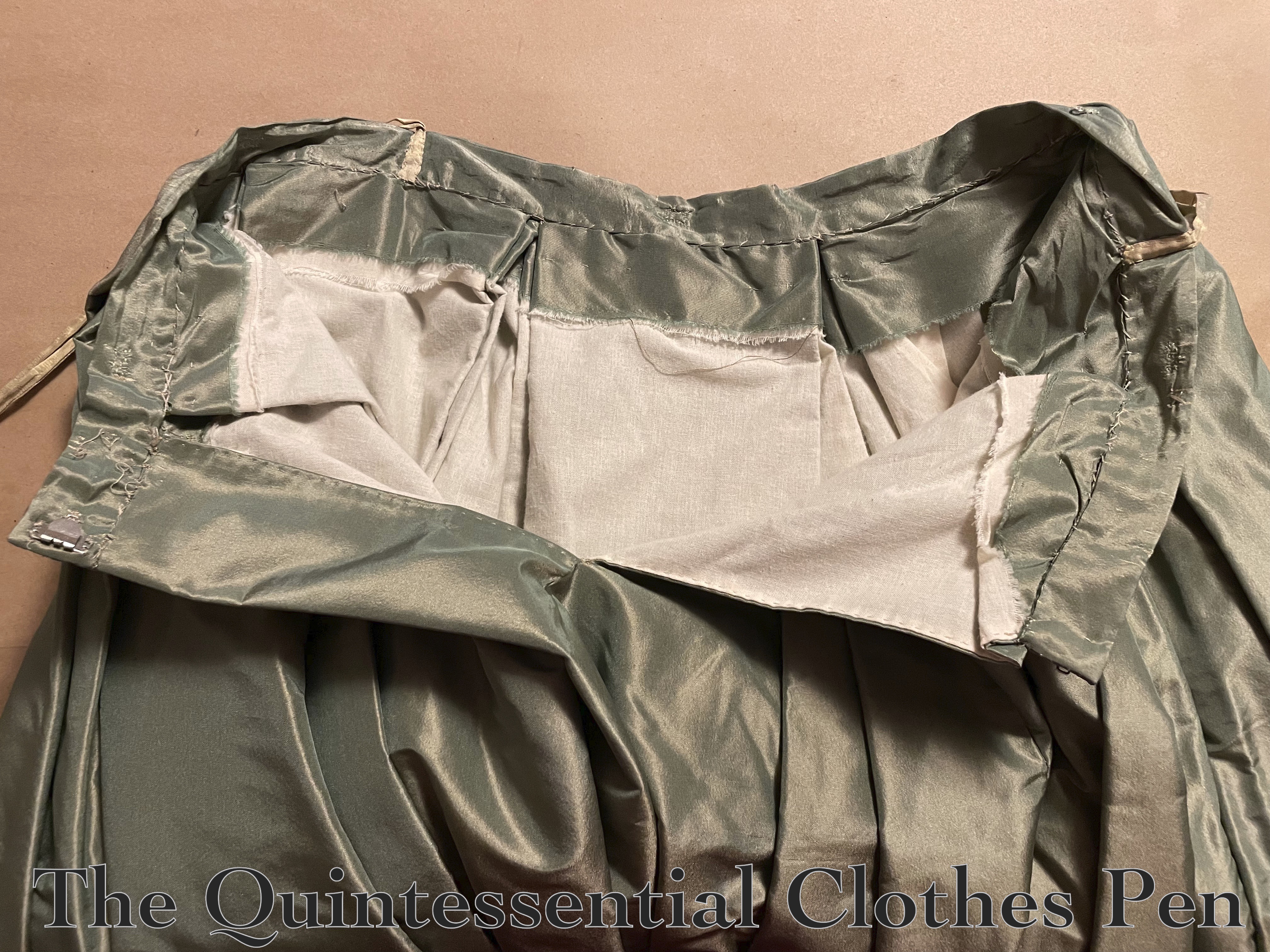
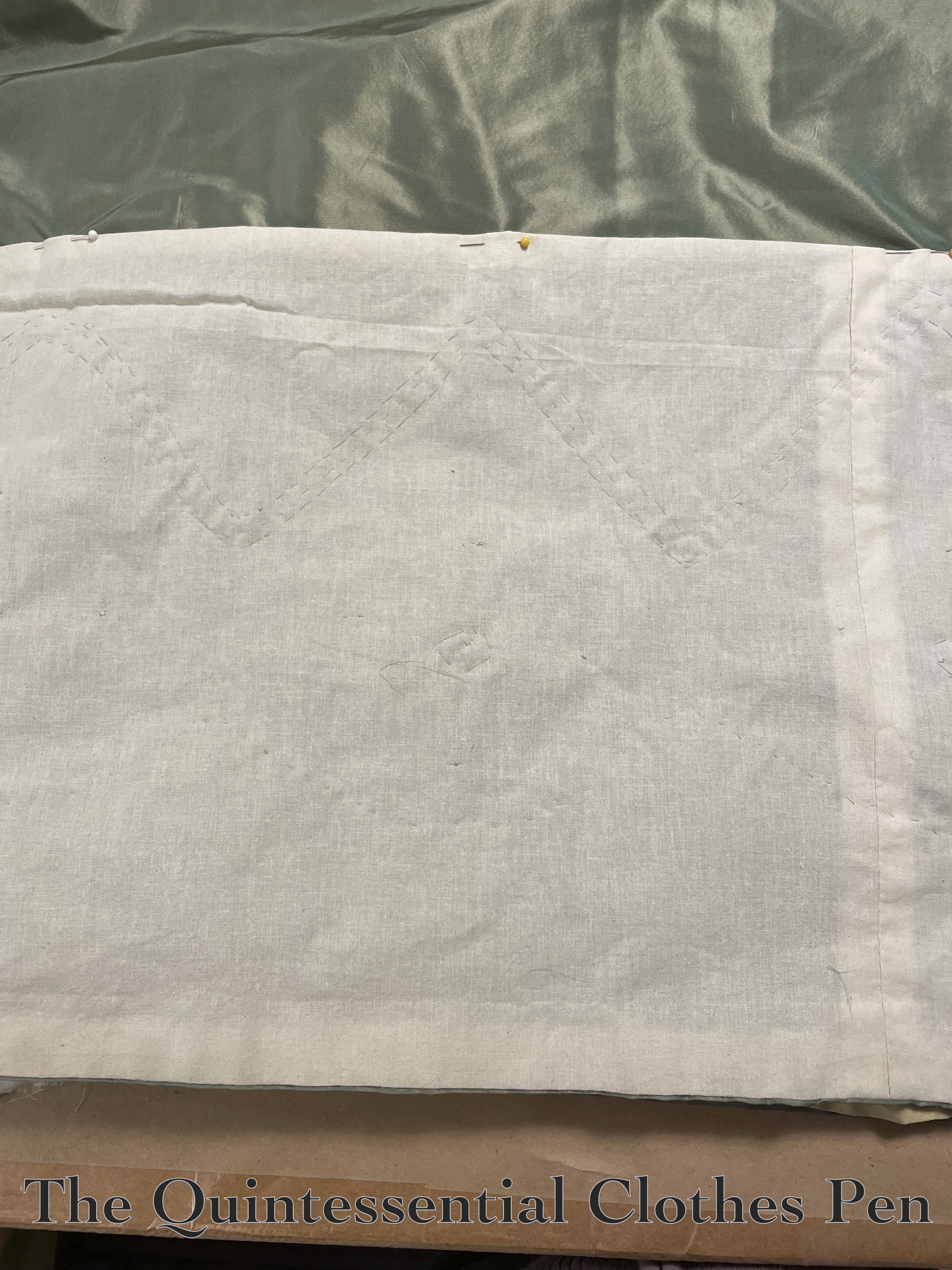
Below, a photo of the inside of the skirt with the muslin cut off to end just above the trim stitch lines. It’s pinned in place and ready to be slip stitched to become a wide facing.
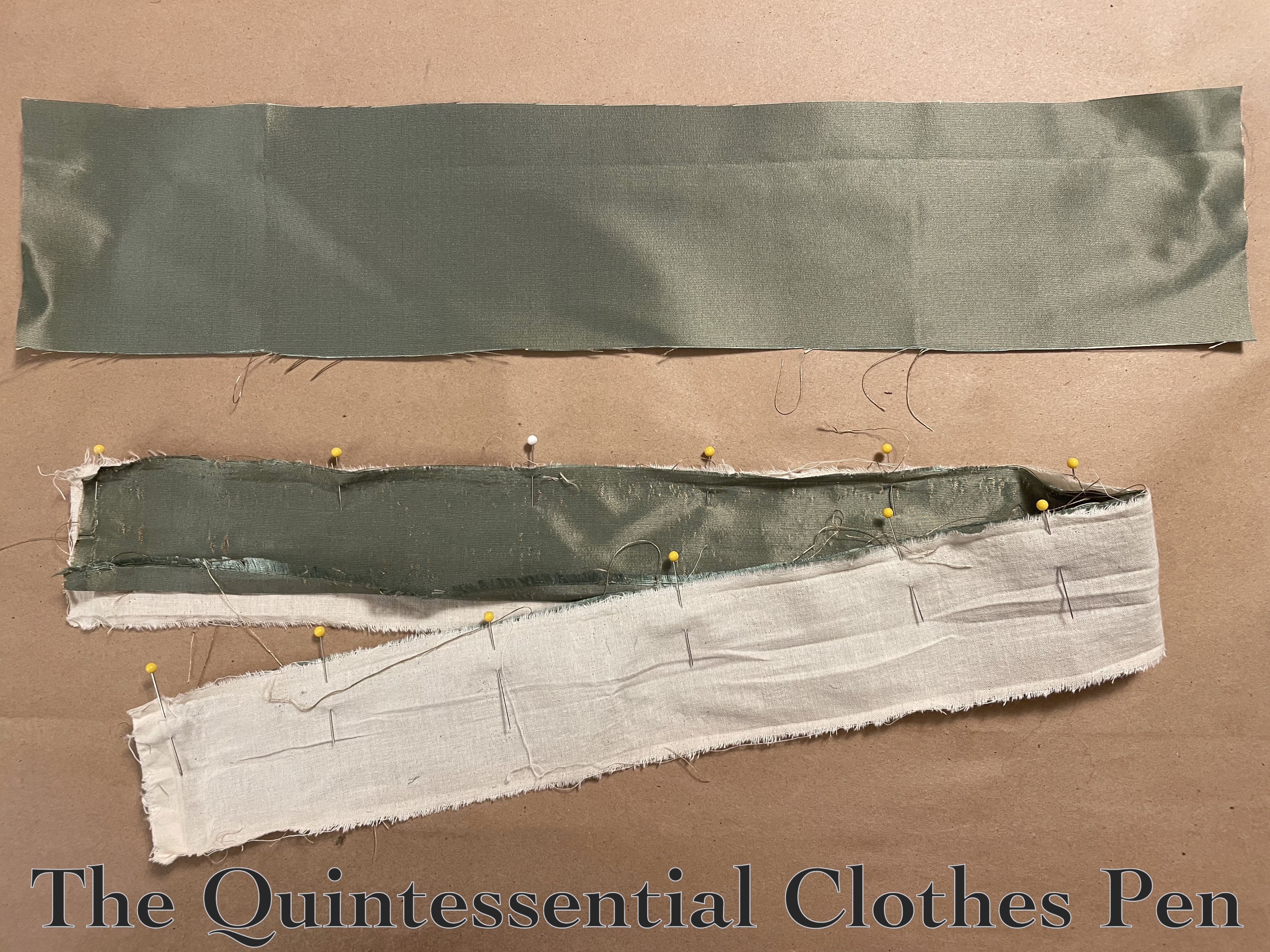
Next, I dug out my fabric scraps and cut an extension piece to make the new waistband larger. I also cut a piece to put a formal placket into the new skirt (to replace the previous opening, which had the raw edges of the silk and muslin turned towards each other and running stitched — that method wouldn’t work with the new all silk upper). You can see the old opening in one of the earlier photos.

Below, the old waistband, before adding extensions, and the new placket piece (laid sideways).
Once I had my new pieces cut and ready to go, it was just a matter of stitching the placket in place and then pleating the skirt to the new waistband dimensions. I don’t enjoy doing pleat math, so this step took a lot of fiddling. I’d rather pleat by trial and error… a time consuming method, but it works for my brain. It was extra brain-boggling because I was trying to hide the placket inside of the double stacked box pleats of the skirt folds, such that it landed in the middle of one of the pleated areas.

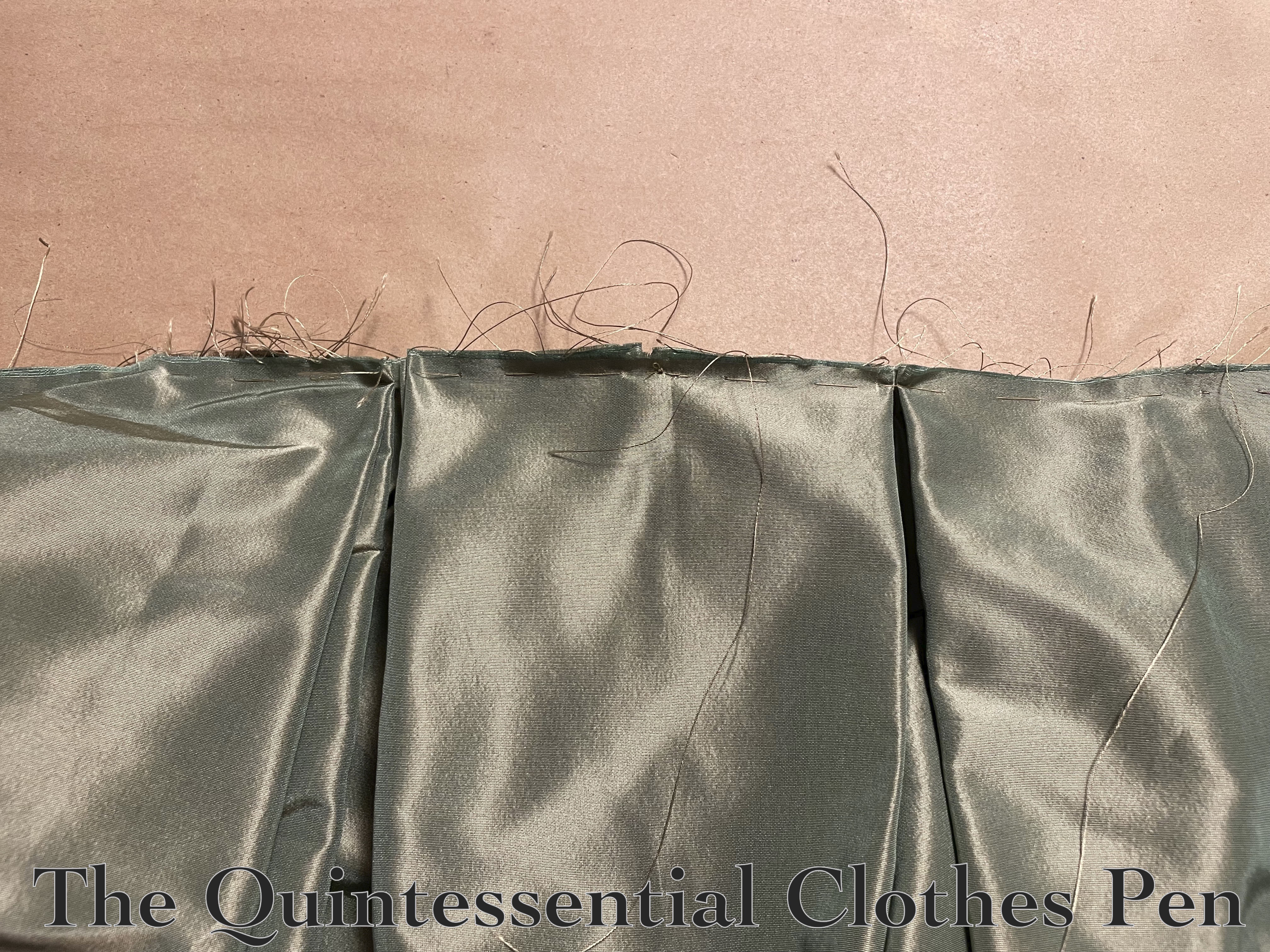
Below, the new top edge of the skirt. Shortened, pleated, and basted in place.
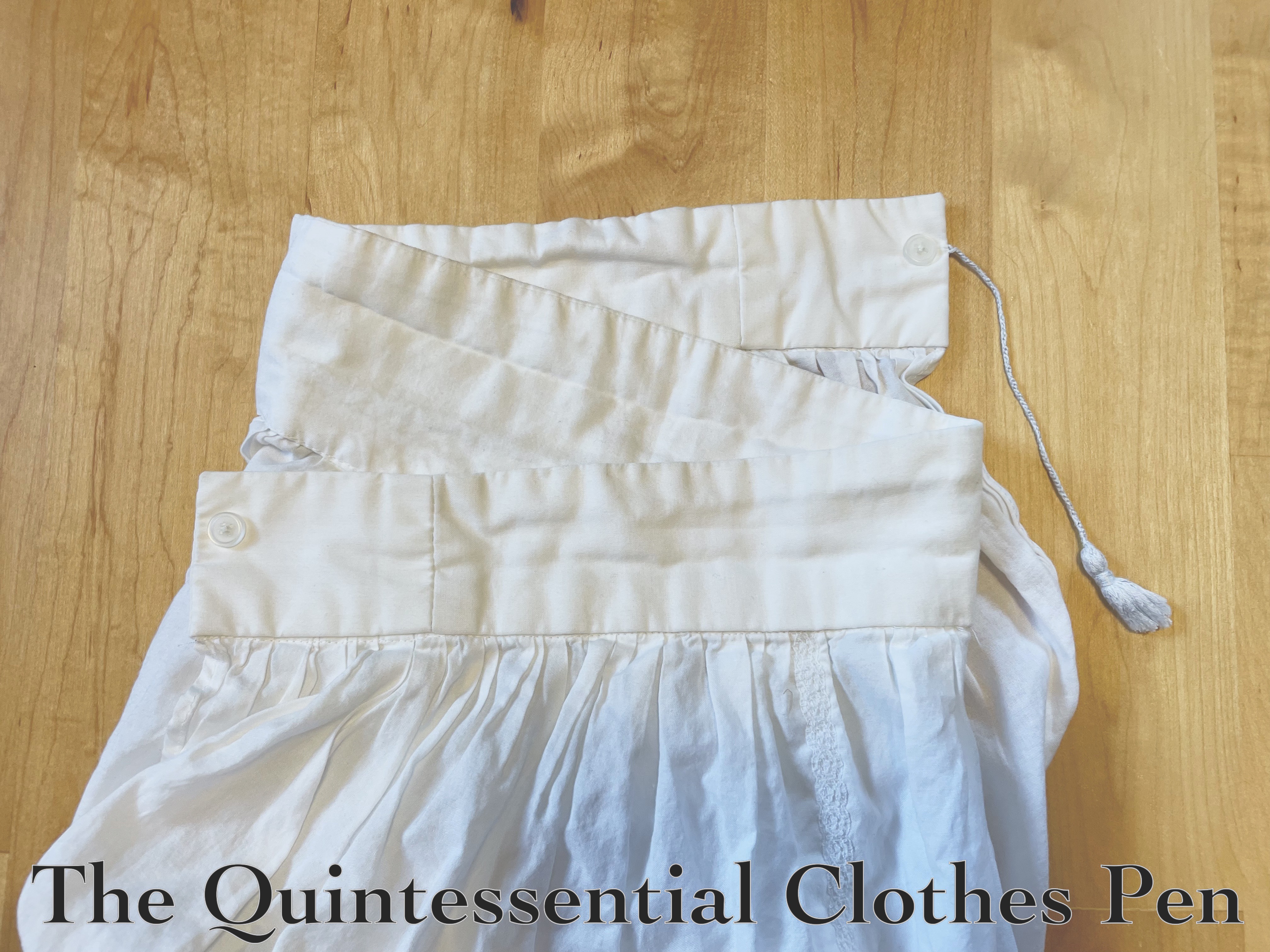
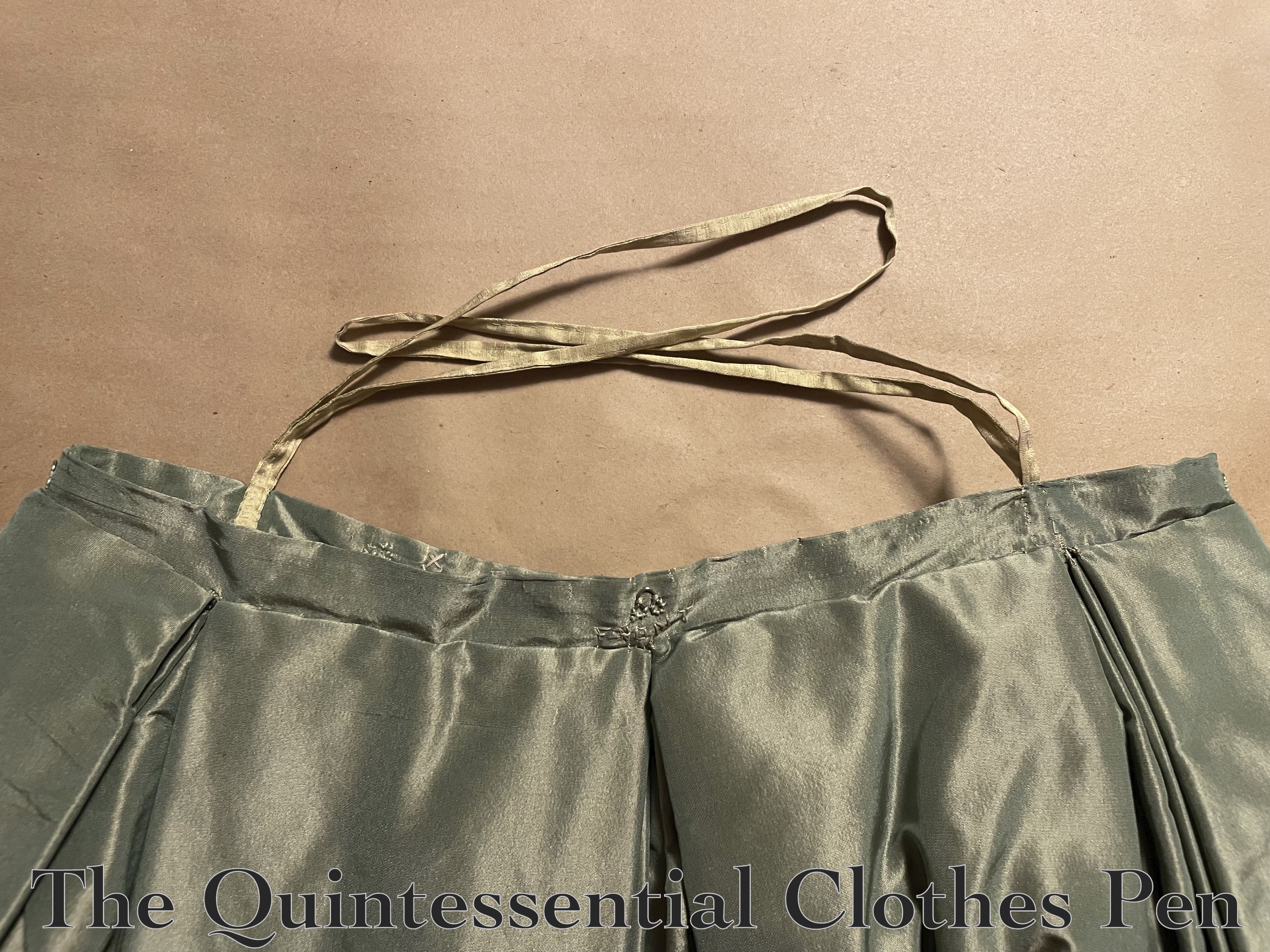
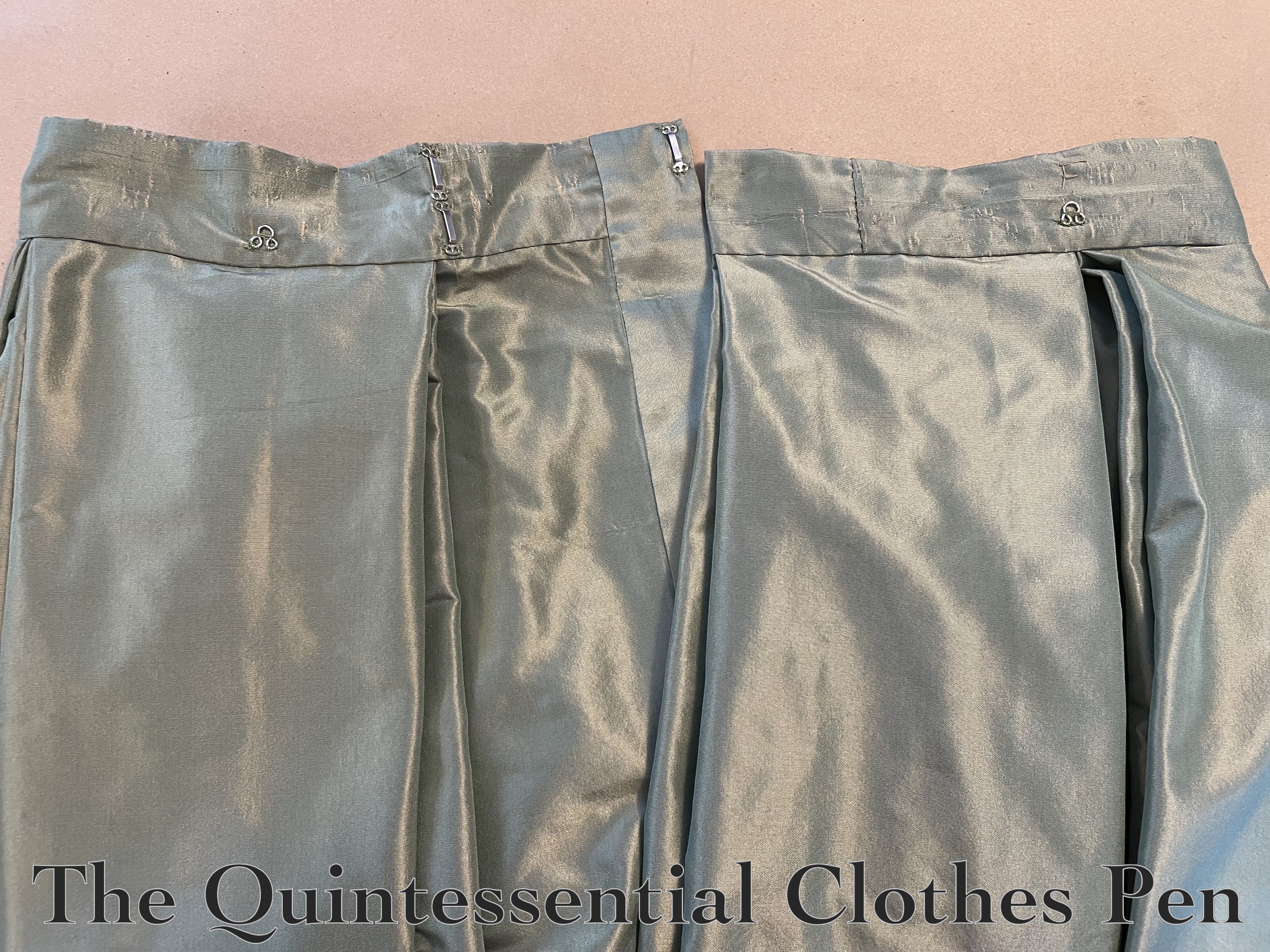
Once pleated, the sewing part was easy. All that remained was putting the waistband closures back on! Below is the updated waistband and placket from the outside of the skirt, with the placket hidden under one of the stacked box pleats. I reused the old waistband, even though it is a bit worn, because way not? It’s recycling and has patina!
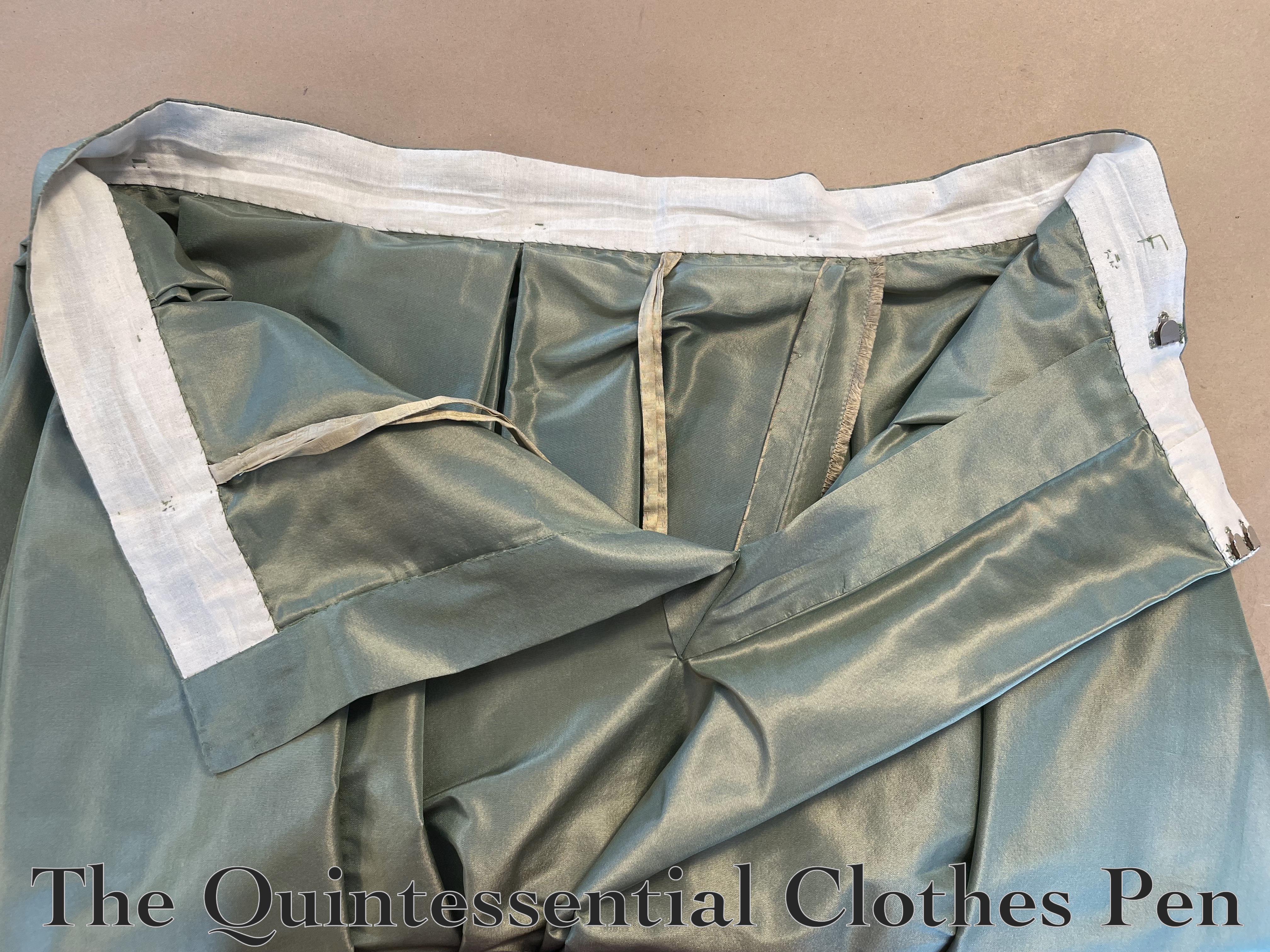
And here is the updated skirt from the inside. The only muslin in this area now is on the waistband facing. The location of the placket, hidden under a pleat, is a little more clear.
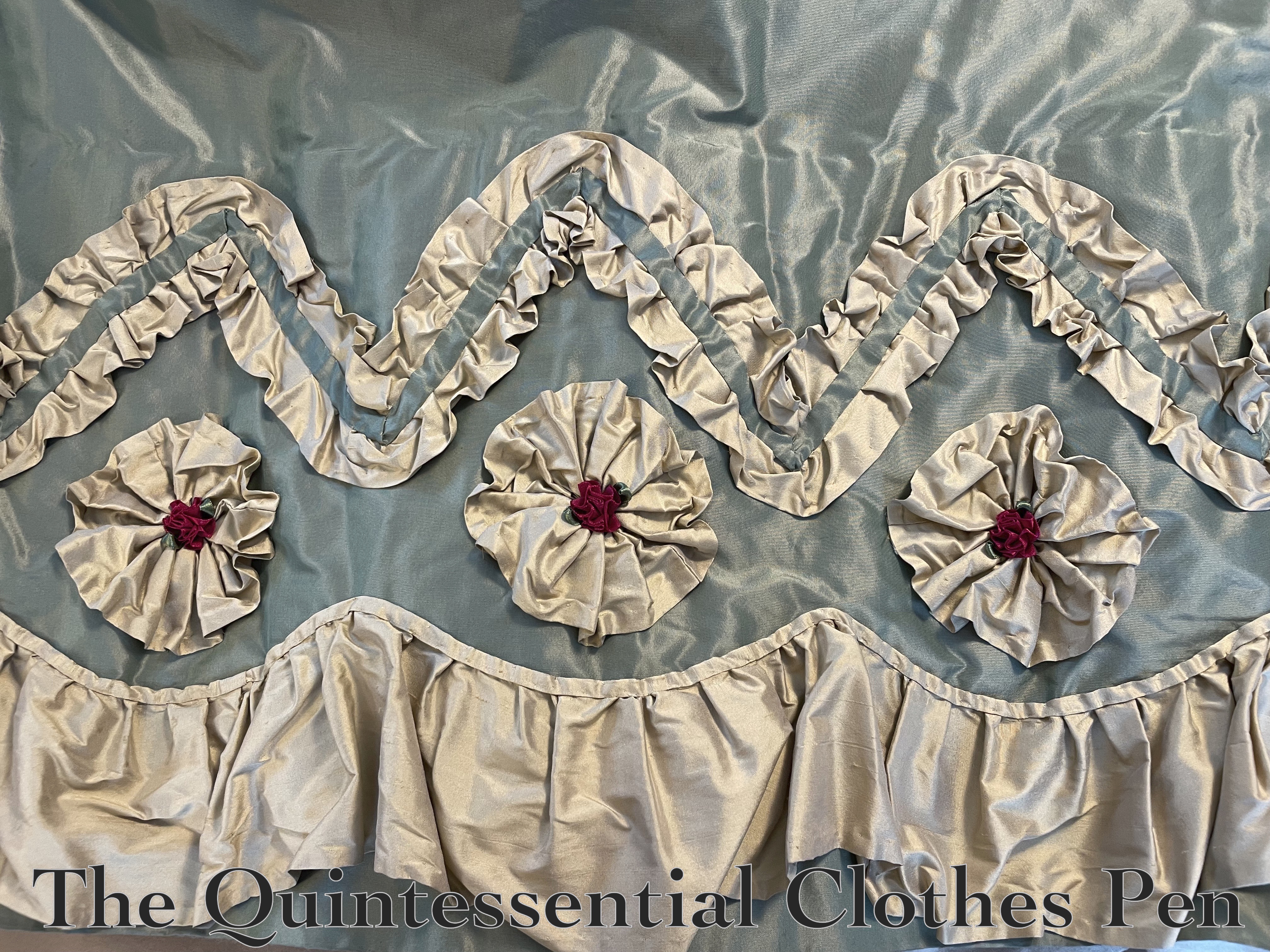
As a bonus, I decided to stitch down the gold skirt trim a little more securely, so that it would always stay in the correct place and look tidy, rather than needing a fluff for every wearing. And, I thought that a small bit of contrast would be nice, so I added some burgundy ribbon rosettes in the middle of the gold rosettes on the skirt, too. These were gifted to me about twenty years ago (along with the beads for my snowflakes last year) and I have never known what to do with them. This worked well! I just safety pinned them from the back so they are easy to remove if/when I decide to change things up.
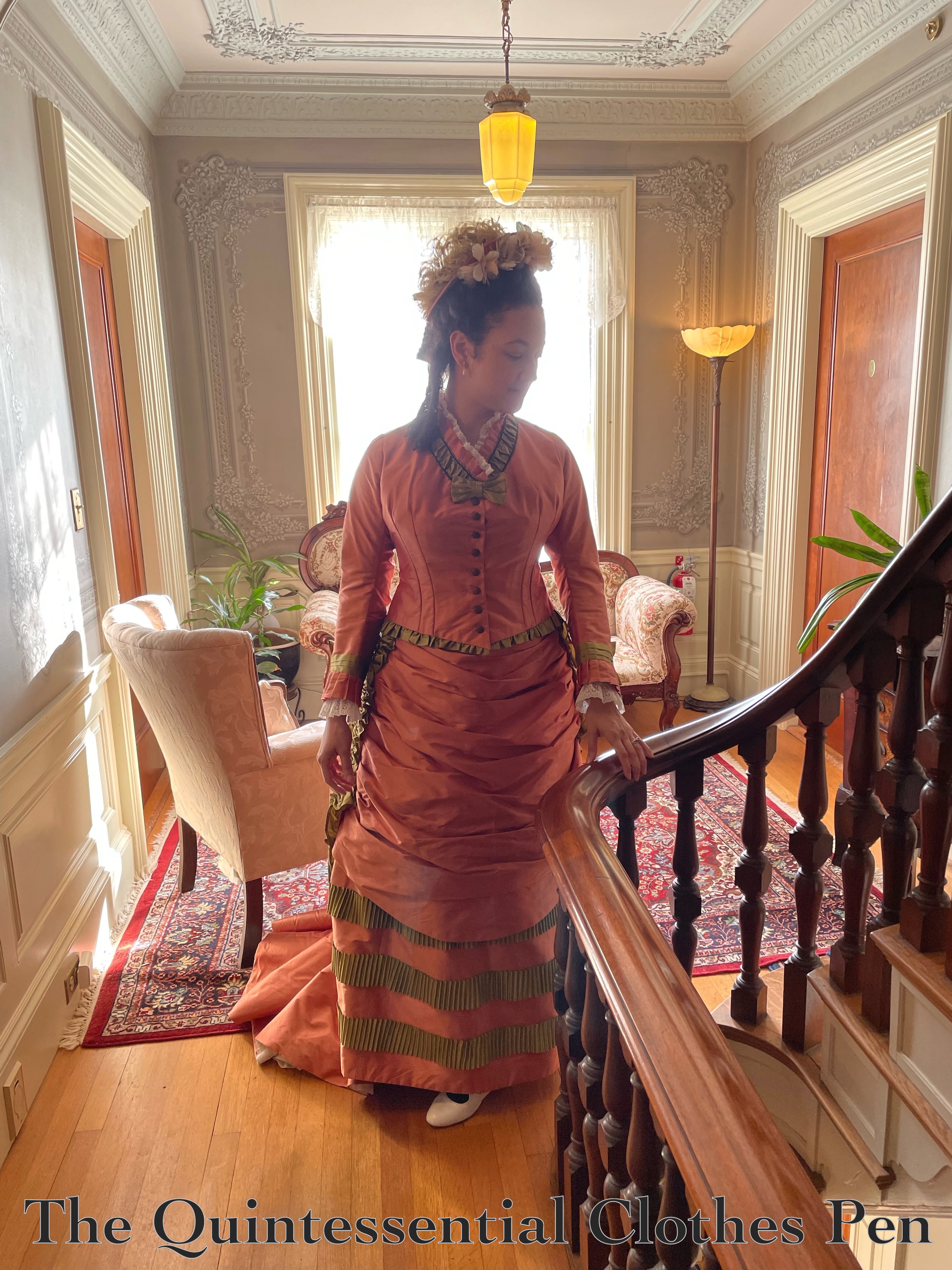
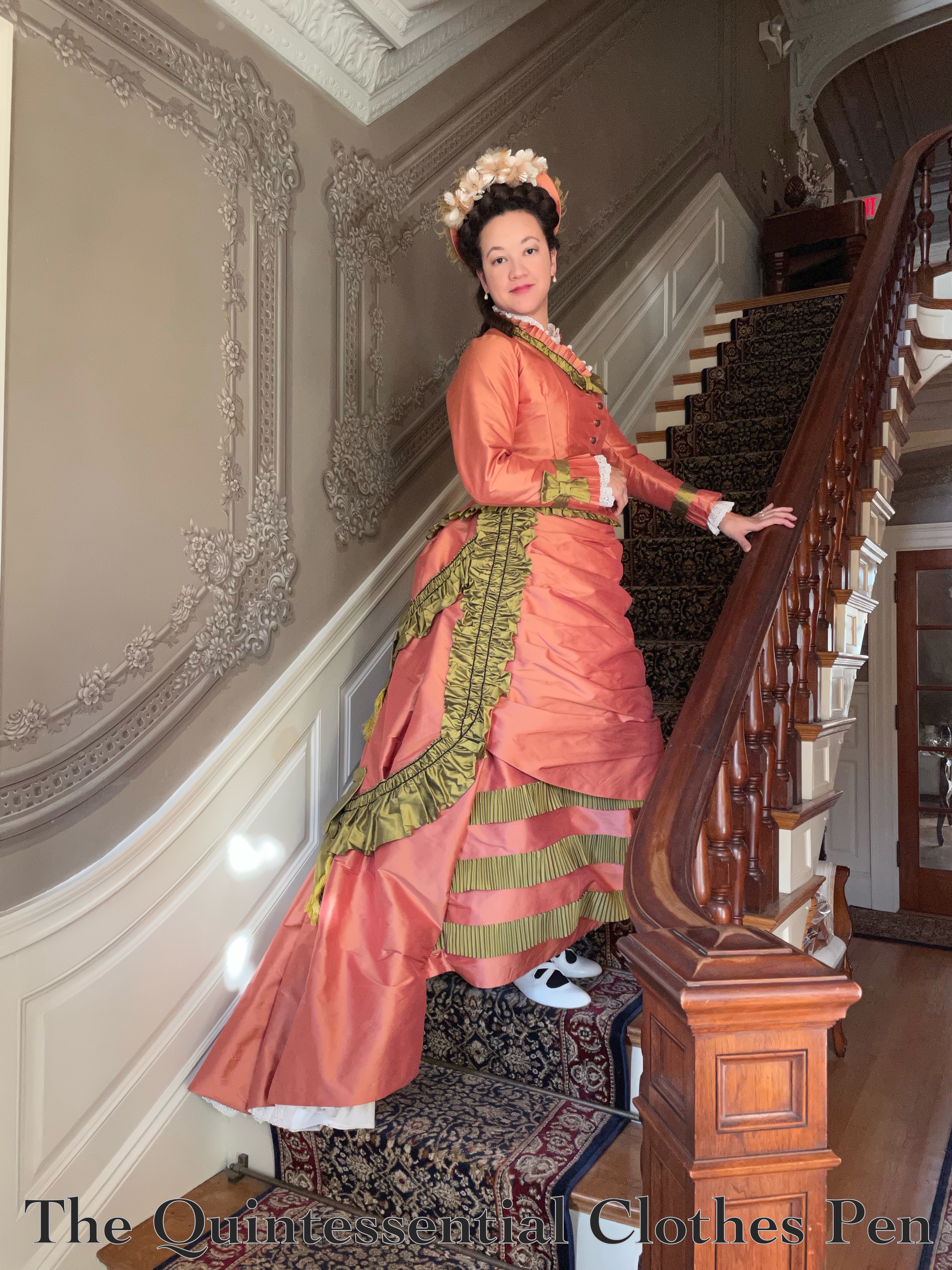
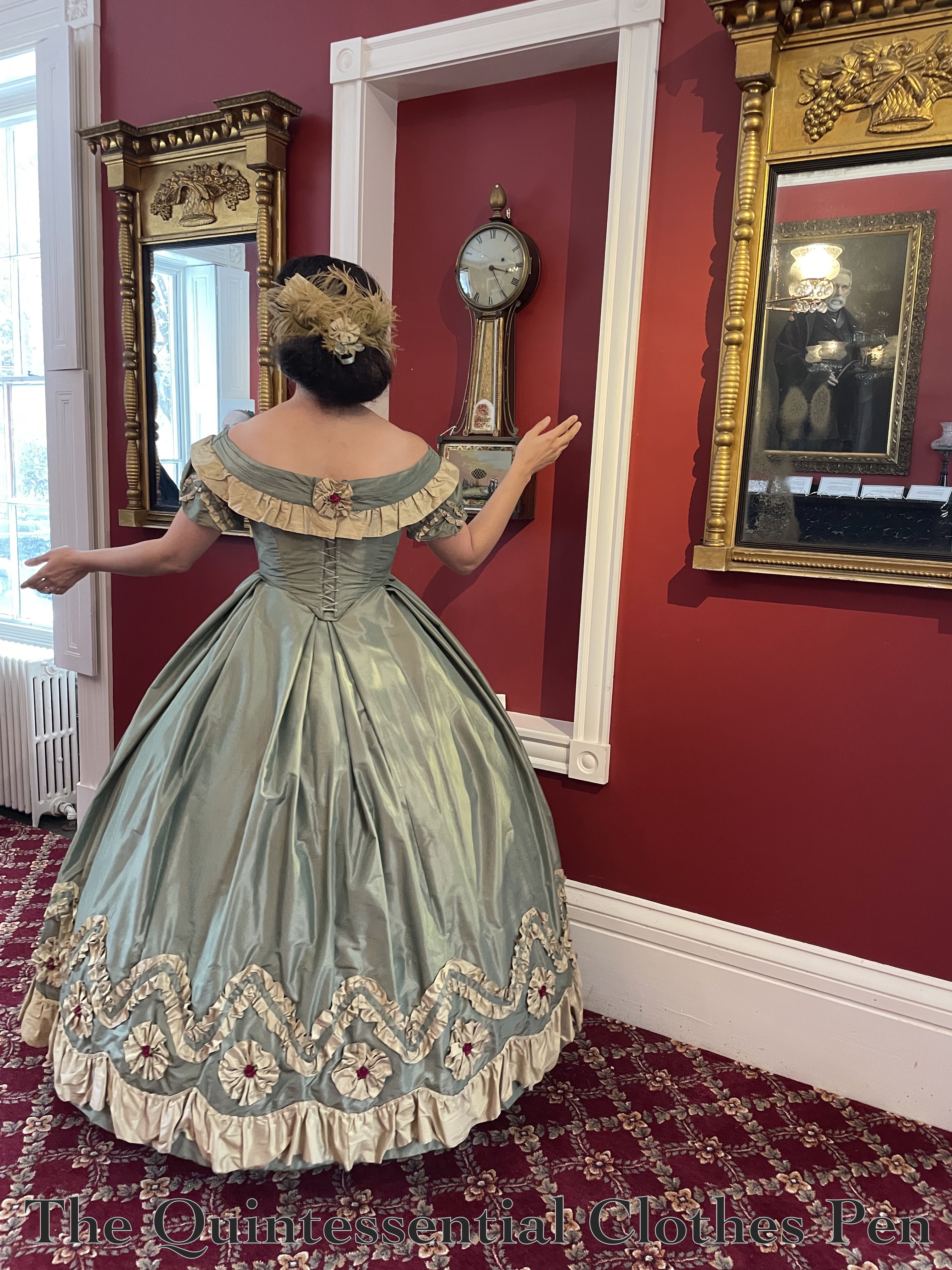
And that’s it! Evie is now wearable again! And the red rosettes match the paint on the walls very nicely, I think.
Historical Sew Monthly Information

I’m calling this my entry for the 2026 HSM Challenge #11: Green:

Make something that has the color green in it, or that is “green” in that it upcycles materials or resources from something else.

This fits the challenge in terms of color and in terms of reusing materials from an old dress and from gifted trimming bits!

Just the facts:

Fabric/Materials: Scraps of green silk and cotton muslin.

Pattern: My own.

Year: 1864.

Notions: Thread, hooks, bars, and ribbon rosettes.

How historically accurate is it?: 99%. Accurate materials, reasonable upgrades and hand stitching, I think this one is pretty good.

Hours to complete: I didn’t keep track.

First worn: January 1, 2026.

Total cost: Free, since everything came from the stash and was either gifted to me or purchased ages ago!

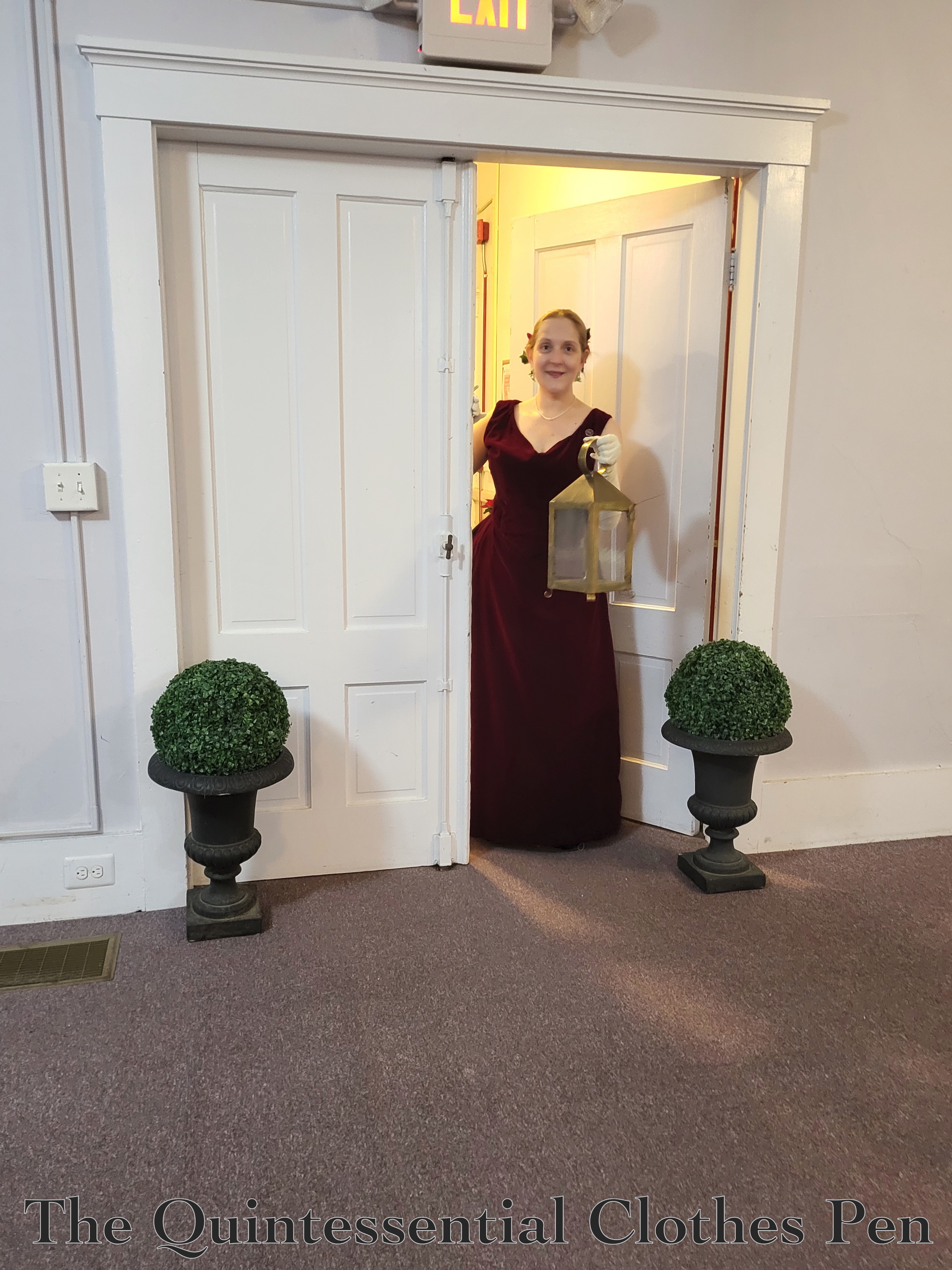
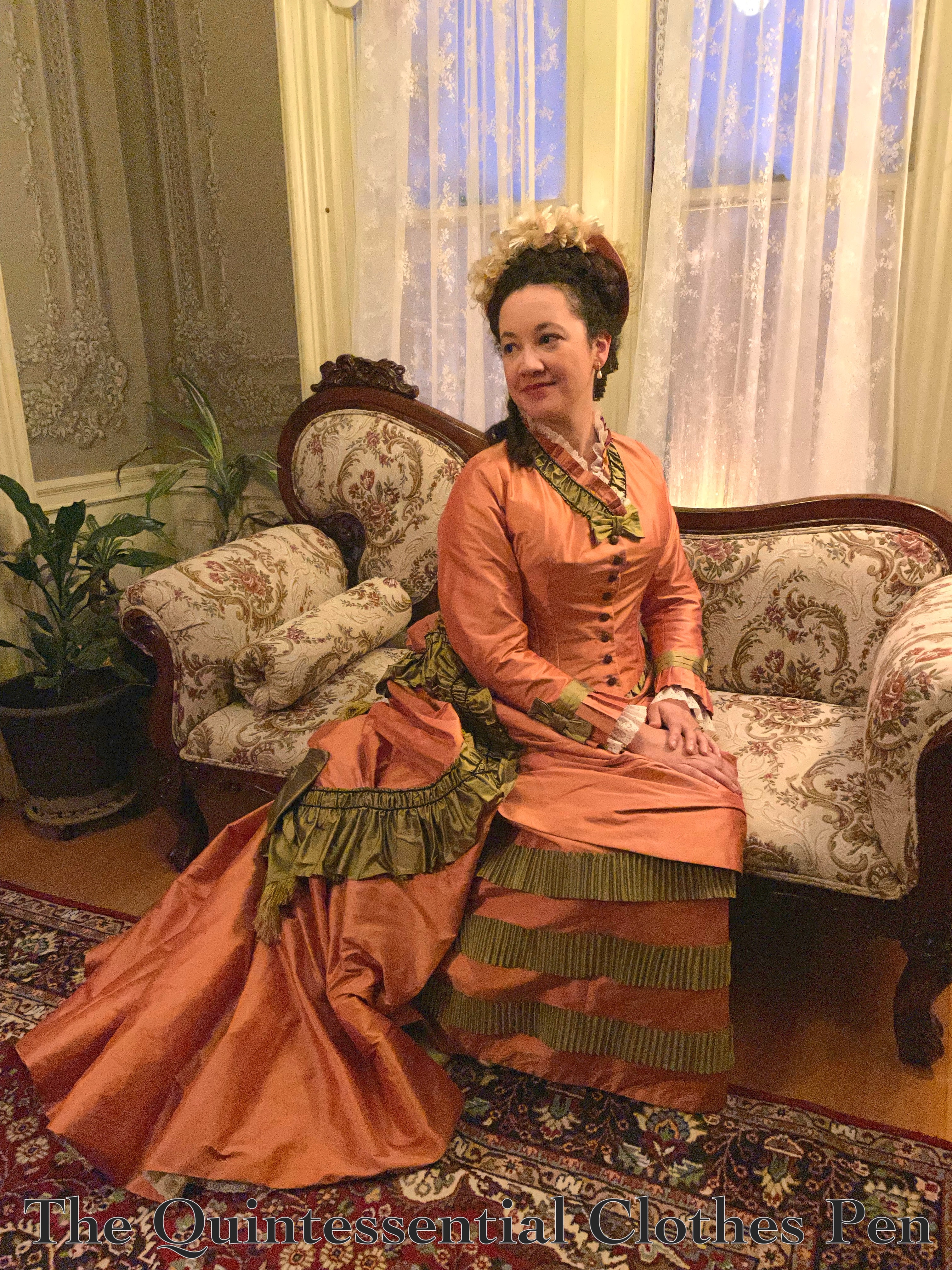
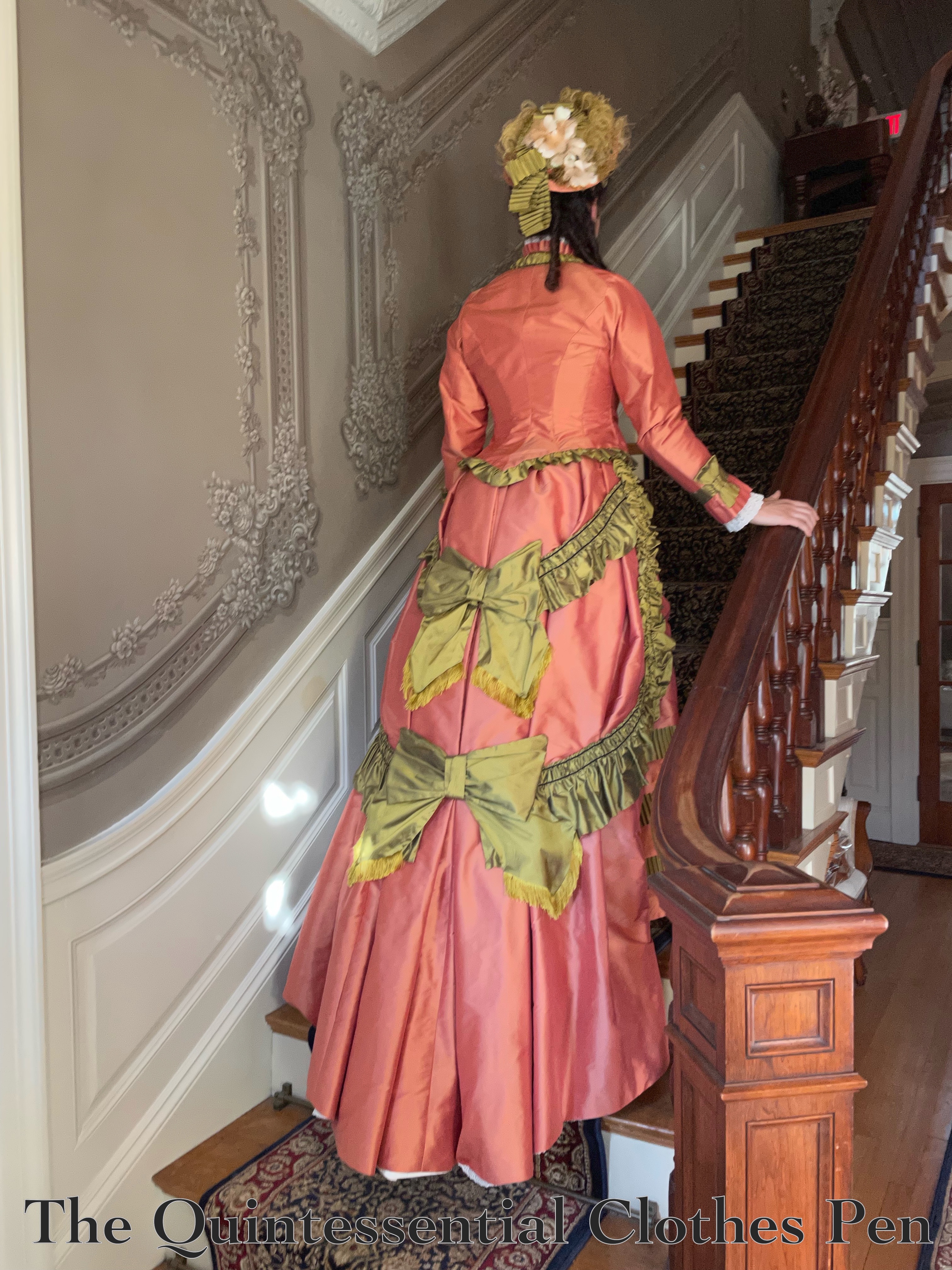
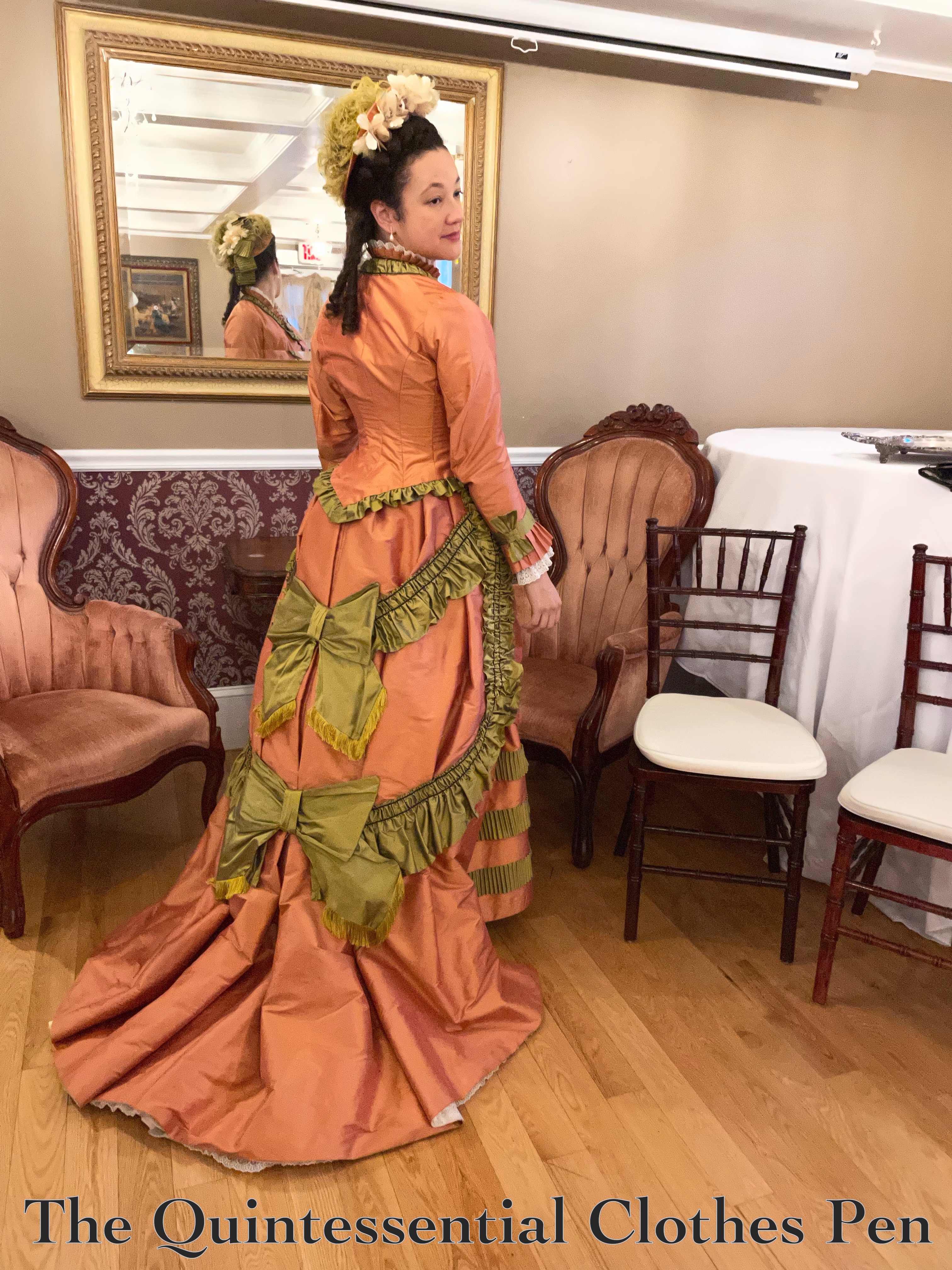
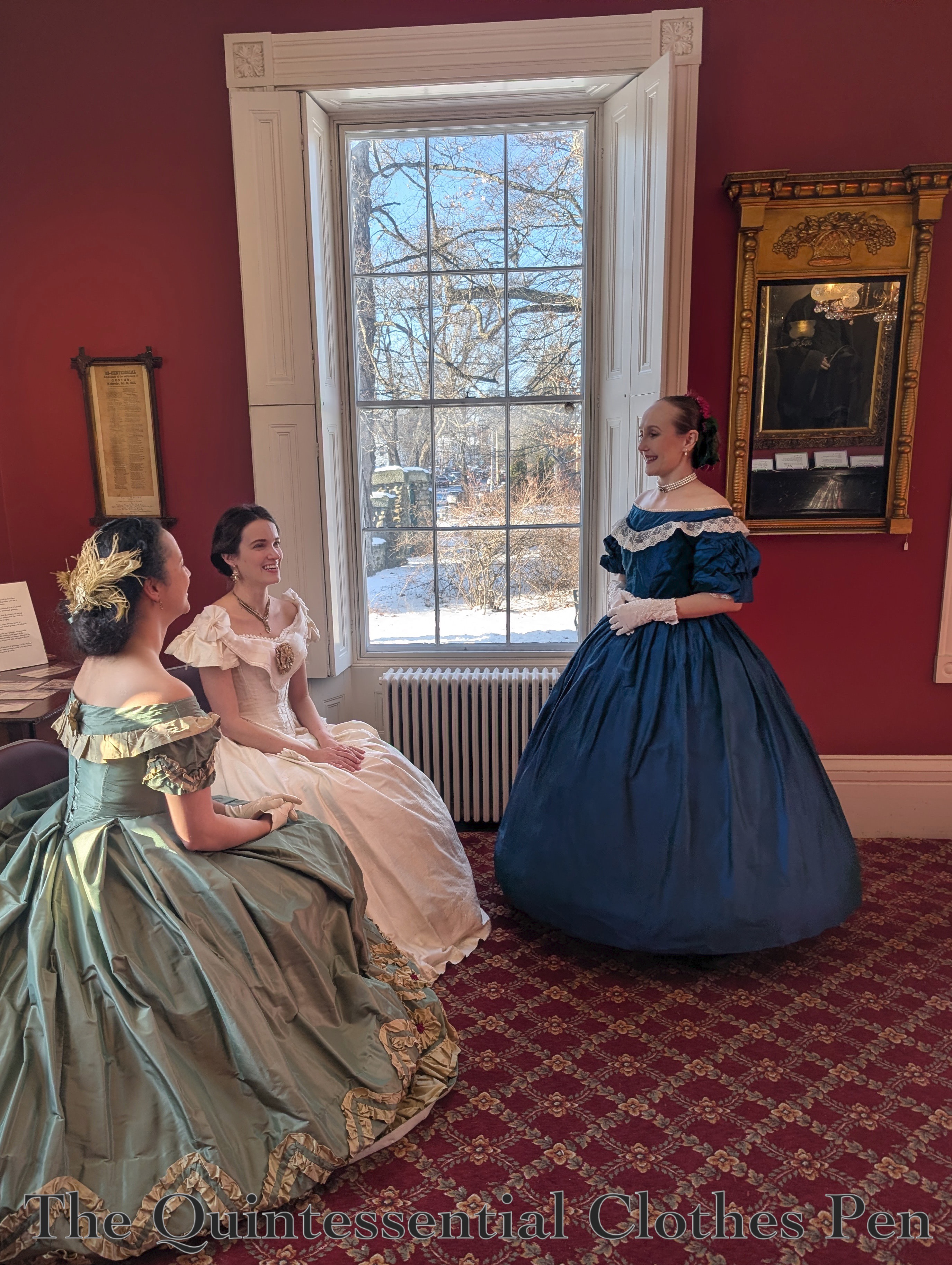
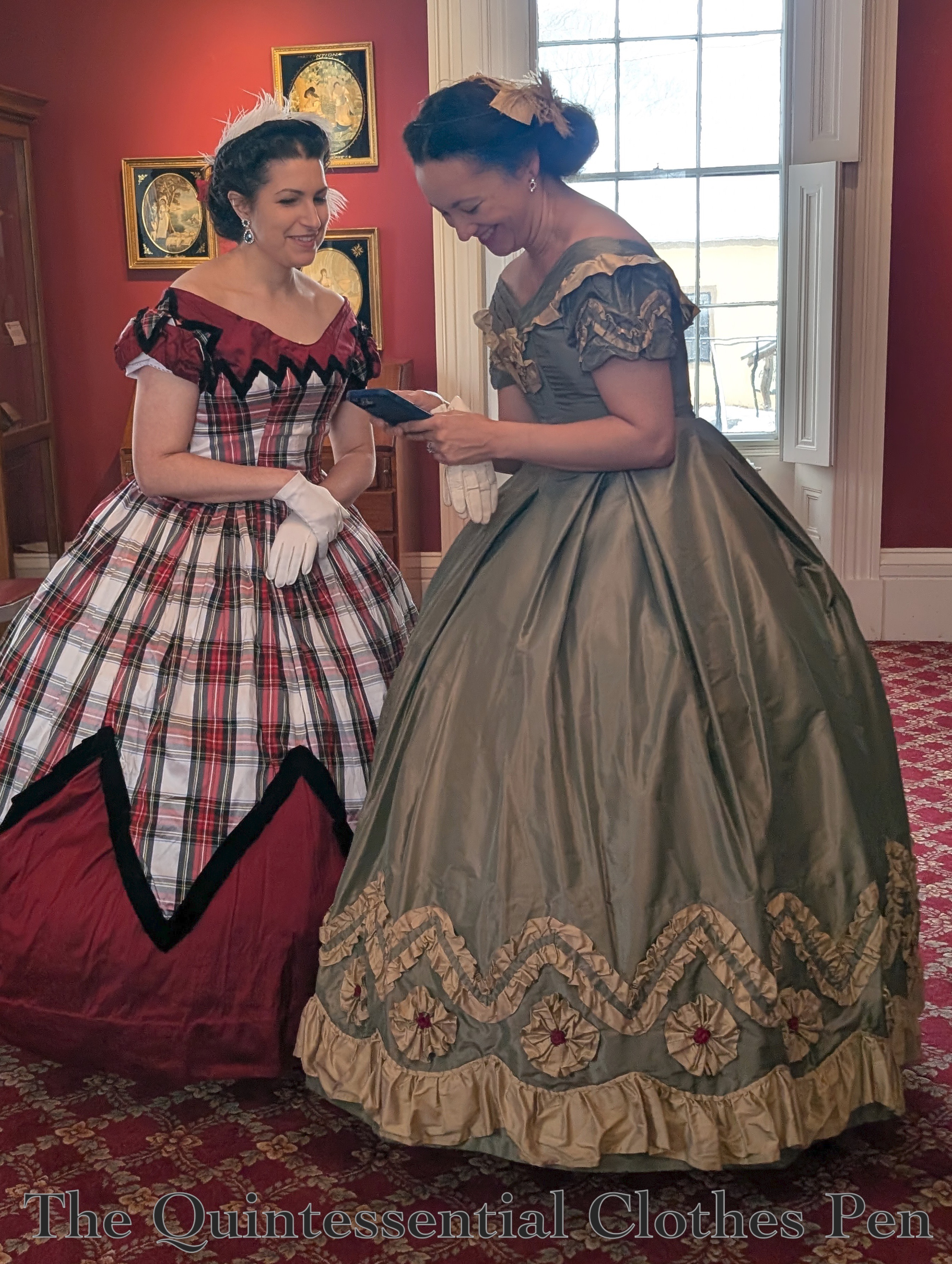
For a fun finish, here are a few more atmosphere photos showing off Evie and her well dressed friends.
Re-Imagined 1885 Fancy Dress (HSM #9)

The Backstory

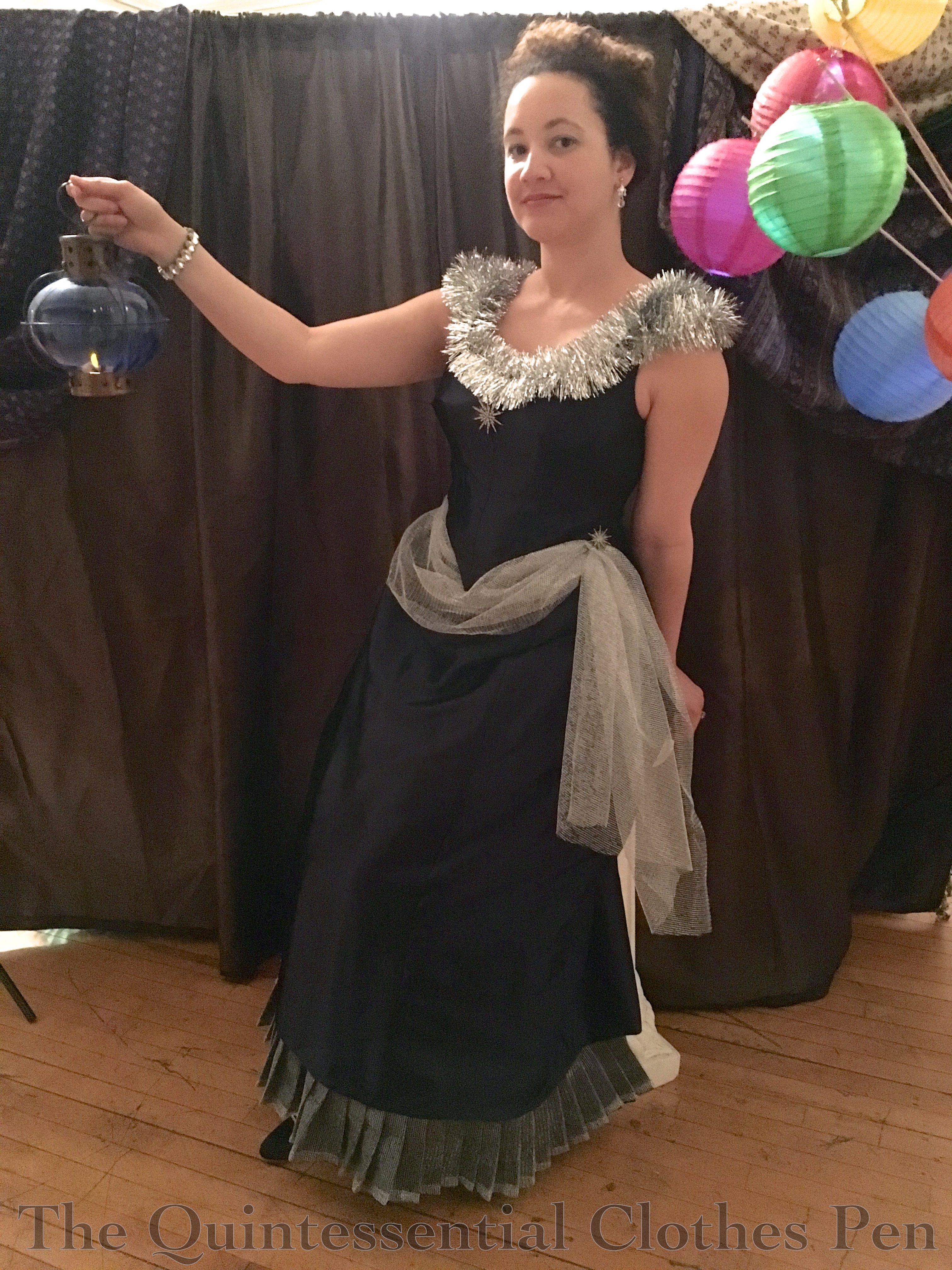
In 2016, I made a dress for a Fancy Dress Ball inspired by a dress worn by Alice Gwynn Vanderbilt in 1883. Alice’s now-famous dress, made by The House Of Worth, celebrated Electric Light as its theme. The dress uses beading and metallic elements (as well as an electric torch, for the original wearing!) to visually reflect light as well as communicate the electric light theme via decorative motifs. I posted an image of the inspiration gown and a link to more information about it in my original post about my dress in 2016, which you can view here.

I was inspired by the trimmings on the gown, but needed to create a dress with little expenditure (much different than the budget for a Worth dress!). To achieve this, the goal when I made my dress in 2016 was to use as many materials as I could that I already owned. The main dress fabrics were already in the stash from old projects and the silver net was leftover from trimming the Versailles sacque I posted about wearing recently.

Below, a photo of the dress in 2016, with a lantern standing in for “electric light.”

There were a few small changes I wanted to make after the first wearing of the dress, but I didn’t have a need to wear it again for years. Fancy Dress events are not all that common even within the already limited realm of historically clothed events! And with the original trimmings I didn’t like the dress for regular wear. Plus, for a number of years after making the dress the events I was attending did not encompass the 1880s.

More recently, however, I have had more opportunities to wear clothing from this period, as The Footwork and Frolick Society has hosted a few events with themes that can include the 1880s. Therefore, I decided to re-trim the Fancy Dress dress into a more regular, less Fancy Dress, ballgown style for the Yuletide Ball in 2024.

Inspiration

This time, my inspiration was a mashup of ideas from a variety of images.

From the fashion plate below, published in the Revue de la Mode in February 1886, I pulled information from the gown on the right, with the pleated fabric along the v-shaped neckline and asymmetrical decorations (which I guess are feathers) on the shoulder and skirt.

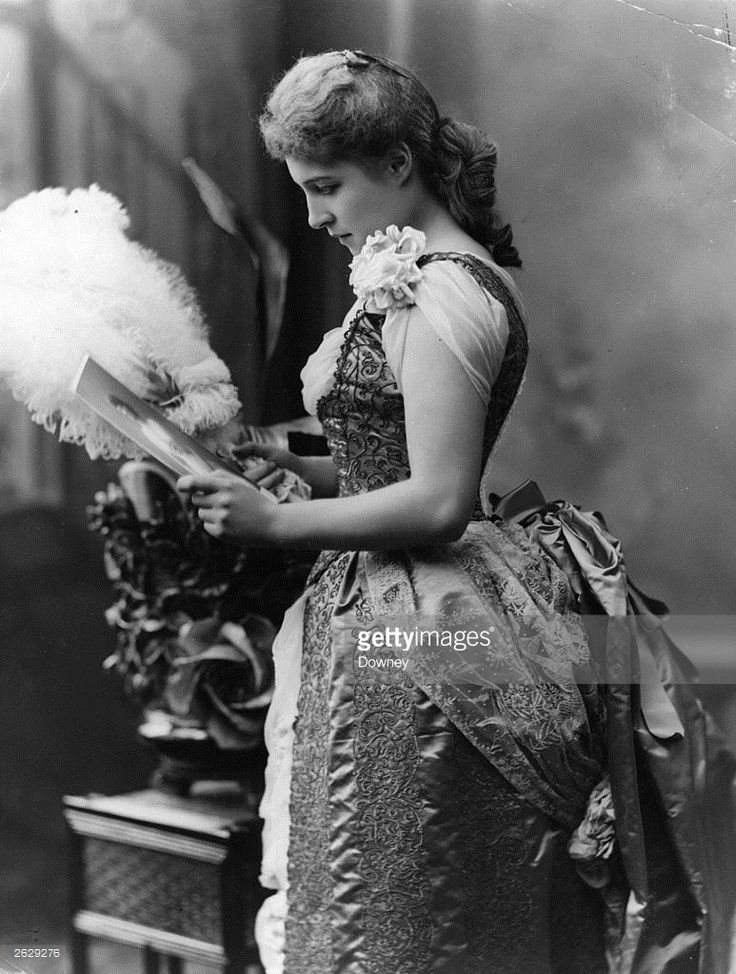
From the photo below of British actress Lillie Langtry (Original Publication: People Disc – HU0206. Photo by Downey/Getty Images), I pulled inspiration for the “sleeve” idea I wanted to incorporate. The pattern of the fabric used for the bodice in this photo was also reminiscent of one of the fabrics I used to update my dress.

And finally, I was also inspired by the beaded swags (and chiffon “sleeves”) on the c. 1887 dress in the collection of the Kent State University Museum in the photo below.

Dress Update Overview

For the re-make of the dress, I wanted to maintain my goal of using materials already on hand. I still had small scraps of the navy blue satin in my stash as well as the silver net. I also went through my fabric stash binder to see what other fabrics and trimmings might work and found that the best bets were a piece of polyester velvet flocked with silver swirls that I’d purchased at Joann Fabrics probably twenty years ago when I had just started sewing and loads of silver ribbon that I had been gifted to me. The blue and silver colors fit the colors of the existing dress perfectly and I thought there was a sort of New Year’s aspect to the color scheme, as well. (I also purchased the Joann fabric in burgundy and green (both with gold swirls) and had made Christmas decorations out those, but I don’t think I ever used the piece of blue, so this was a great opportunity!)

With my materials decided, I moved on to the sewing part of the project, starting with unpicking the original trim from the dress. I had made it knowing I might someday want to change the trimmings, so they were not sewn into seams and were pretty easy to remove. That left me with an almost entirely navy blue dress, relieved only by the silver pleats at the bottom of the skirt.

Then I went back and considered my original list of changes, which included:

  • Boning the center back edges so they would lie flat when laced closed
  • Adding a matching piece of satin behind the lacing holes to hide any white fabric of undergarments
  • Making sure that my chemise wouldn’t poke out of the armholes

Quoting myself, from 2016… “these are minor changes and I’m not sure when I’ll have the opportunity to wear this again so it might be awhile before they happen.” I’ll say! It only took 9 years!

Historical Sew Monthly

My goal of using stash-only materials for this dress re-do makes it fit into the Historical Sew Monthly 2025 Challenge #9 Blue:

Make an item that features blue, in any shade from azure to zaffre.

Just the facts:

Fabric/Materials: Approximately ¾ yard silver net, just over 1 yard of navy velvet with silver motifs, and scraps of navy polyester satin.

Pattern: My own.

Year: c. 1885.

Notions: Approximately 23.5 yards of ¼” silver ribbon.

How historically accurate is it?: 90%. Polyester and modern synthetic ribbon do not have accurate fiber content. And my patterning is conjecture. But the overall idea is pretty good.

Hours to complete: I didn’t keep track.

First worn: December 7, 2024.

Total cost: Free, since everything came from the stash and was either gifted to me or purchased ages ago!

Dress Update: Back Closure

Following the original list of changes, I added a placket behind the lacing holes and added plastic bones along the very back edges, to help hide undergarments (the white color really does pop against the navy blue of the dress!) and keep the back laying flat when laced closed.

Dress Update: Sleeves

When re-examining the dress in 2024 with fresh eyes, one of my biggest desires for change was to better fill in the armholes of the dress and provide a decorative element. Yes, evening dresses in the 1880s were often sleeveless, but when really looking closely at them again, I found that while not having sleeves, they do almost always have something that obscures the armhole and even the upper arm. I am more likely to call these styles swags or drapes of fabric, as they aren’t really proper sleeves, but they are certainly set into the armhole in some way. I wanted something like that for the re-do of this dress.

I haven’t had a need to pattern something like this for this period before, so I looked through my historical pattern books for places to start. Interestingly, I didn’t find much. There was one sleeve that seemed like a possible starting place, but when I mocked it up it didn’t really do what I was hoping for at all!

So that left me with the decision to create a pattern from scratch. Thinking about what didn’t work in the mockup and my inspiration image, I proceeded to drape a mockup that achieved what I was hoping for. I didn’t have my dress form handy, so it required a fair bit of going back and forth between pinning and trying on the bodice to get the right shape. But I did! It’s a strange shape, for any sort of sleeve pattern. But that makes sense, since the sleeve drape is a not-really-sleeve!

Dress Update: Apron, Sleeve Swags, and Ribbon Flowers

I pondered creating some sort of beaded fringe for the armhole (and maybe even the waist, as can be seen in the third inspiration photo, above), but decided against it for time and material reasons. I really did want to stick to the stash!

Even if the beaded fringe wasn’t going to happen, I liked the idea of something to set off the wonderfully pointed bodice so that it would show up and not blend into the skirt. So in the end I decided to use some of the velvet from the stash to make an apron layer for the skirt, as was very common on dresses from the 1880s.

I started with making the pleated neck swag, so I wouldn’t run out of fabric, and then used all of the leftover fabric to make the apron. Due to this fabric restriction, I patterned the apron based on what was possible with my fabric, using a general understanding of the how these skirt elements were patterned in this period. The front of the apron is a curved piece that is pleated into the back on each side. The back piece is a bit scant, but has a few pleats along the top to give volume and descends to a point at the center back, since that was the shape of the fabric that was available! I used up pretty much all of the blue velvet!

For the sleeves, I made flower shaped sprays from lengths of ribbon that were tied into loose knots close to each end and then folded into quarters to make one loop and two ends. These individual elements were then combined and sewn together to make the flower-like formations, with larger scale ones on the skirt and smaller ones on the bodice.

The sleeve dangles were made from the same ribbon, knotted in the same way, that was folded to make a longer and shorter side and then tucked under the sprays on the shoulders.

Below, you can see the individual spray elements and a length of ribbon ready to be added as a sleeve dangle.

Finished Updates

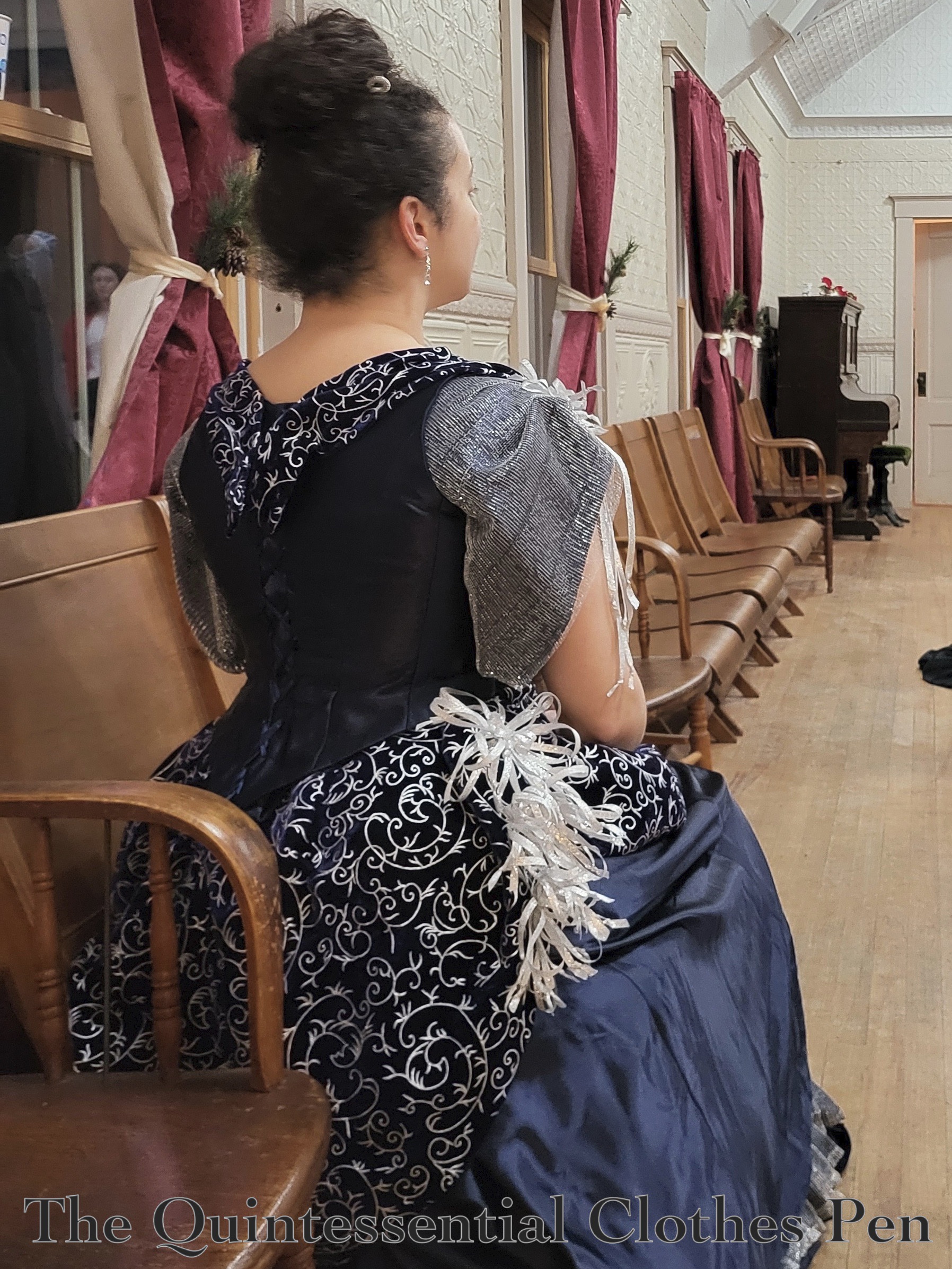
Here is the updated dress! The blue velvet pleated v-shaped neck swag completely ignores the neck shape of the bodice underneath, which is more of a square shape. The same fabric is used again to create an apron, stitched to the outside of the waistband of the skirt to reduce bulk.

The silver net is used over the blue satin scraps to create “sleeves” that are pleated into the armhole and decorated with sprays and dangles of silver ribbon.

The “sleeves” wound up looking a little odd where the meet the back of the bodice, but that’s more due to my original patterning of a very inset armhole in the back than it is the sleeve pattern. It’s a lesson/change for the next bustle period evening gown I make, whenever that is!

I didn’t know what to do with the back of the velvet swag, because I wanted it to be easily adjustable depending on how tightly the back was laced. I ended up with this pointed arrangement that accomplished the goal of flexibility.

The armholes, left side front of the bodice, and right side front of the skirt are decorated with the sprays of looped silver ribbon. I used x4 — 4 yard spools of ribbon and half each of x3 more spools that were 5 yards each.

I calculated how many sprays and dangles I wanted for each section, but in the end I was running out of ribbon and started to just combine and move things around until they looked reasonable. Sadly, that means I don’t have a good record of how much ribbon went into each element or how long each piece of ribbon ended up being. I think that the smaller sprays were made of piece of ribbon that were 10″, the larger sprays on the skirt were made of pieces of ribbon that were 16″, and the arm dangles were 11″ before being folded.

Wearing

I wanted to find a simple but still 1880s hair style for this wearing, so I was pleased when I came across a photo of women in 1880s evening dresses with their hair drawn back and pulled up into simple large chignons on the backs of their heads. I wore that style with the addition of a few silver hair pins to tie everything together.

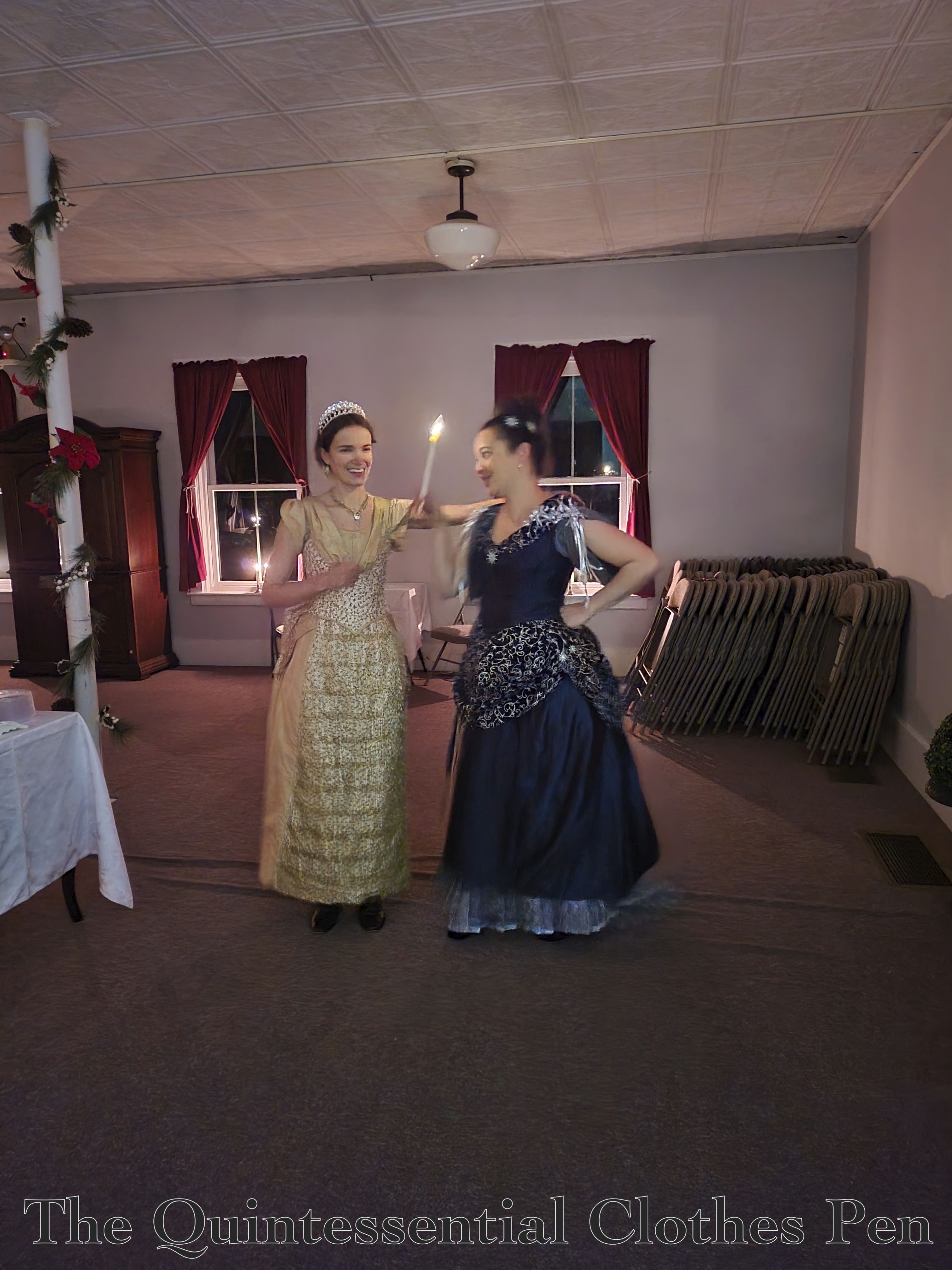
I also reused some of the star brooches from the first iteration of this dress, adding one at the center from of the bodice, two on the left side of the skirt, and some on the left side of my hair. They stand out well in the photo below, in which the two of us are bobbling about, making the ribbons on my dress and beaded trim on the dress on the left shimmer, sparkle, and sway.

Other Photos From The Event

This was a ball for bustles! There were multiple people wearing dresses with this feature, including the dress above, as well as the burgundy velvet dress below.

Finally, a cheerful holiday view into the ballroom. I wasn’t feeling my best at this event and therefore didn’t dance, but everyone else had a grand time! I look forward to the next event in which I can participate in dancing with the bustle! It’s really quite fun to experience the movement of dancing with all of your dress behind you!

1863 Fancy Dress: Genevieve As The Queen Of Hearts

Back in September, The Footwork and Frolick Society hosted a Wonderland-themed 19th century fancy dress ball. The idea was inspired by the whimsy of Lewis Carroll’s Alice In Wonderland (published in 1865) and Through The Looking Glass (published in 1871).

There were so many fabulous interpretations of Alice In Wonderland! You can get a sense of the fun in the gallery from the event on the Footwork & Frolick website, here.

I chose to re-use an idea I’d executed in 2018 when I turned a 1980s dress into a 1950s dress and style it as The Queen of Hearts. You can read about the dress re-make and original fancy dress styling here, in a past blog post. For this new wearing in 2024 I chose to use The Queen of Hearts theme and accessories again, but with one of my 1860s dresses to suit the mid-19th century goal of the Wonderland Ball!

Genevieve, the name of my apricot ballgown from 1863, seemed to be the most fitting choice for a Queen of Hearts theme. (You can read all about the making of this dress in this Project Journal series of posts.) The two main elements of my fancy dress ensemble were a tiara and a royal order sash. I figured that could easily work again.

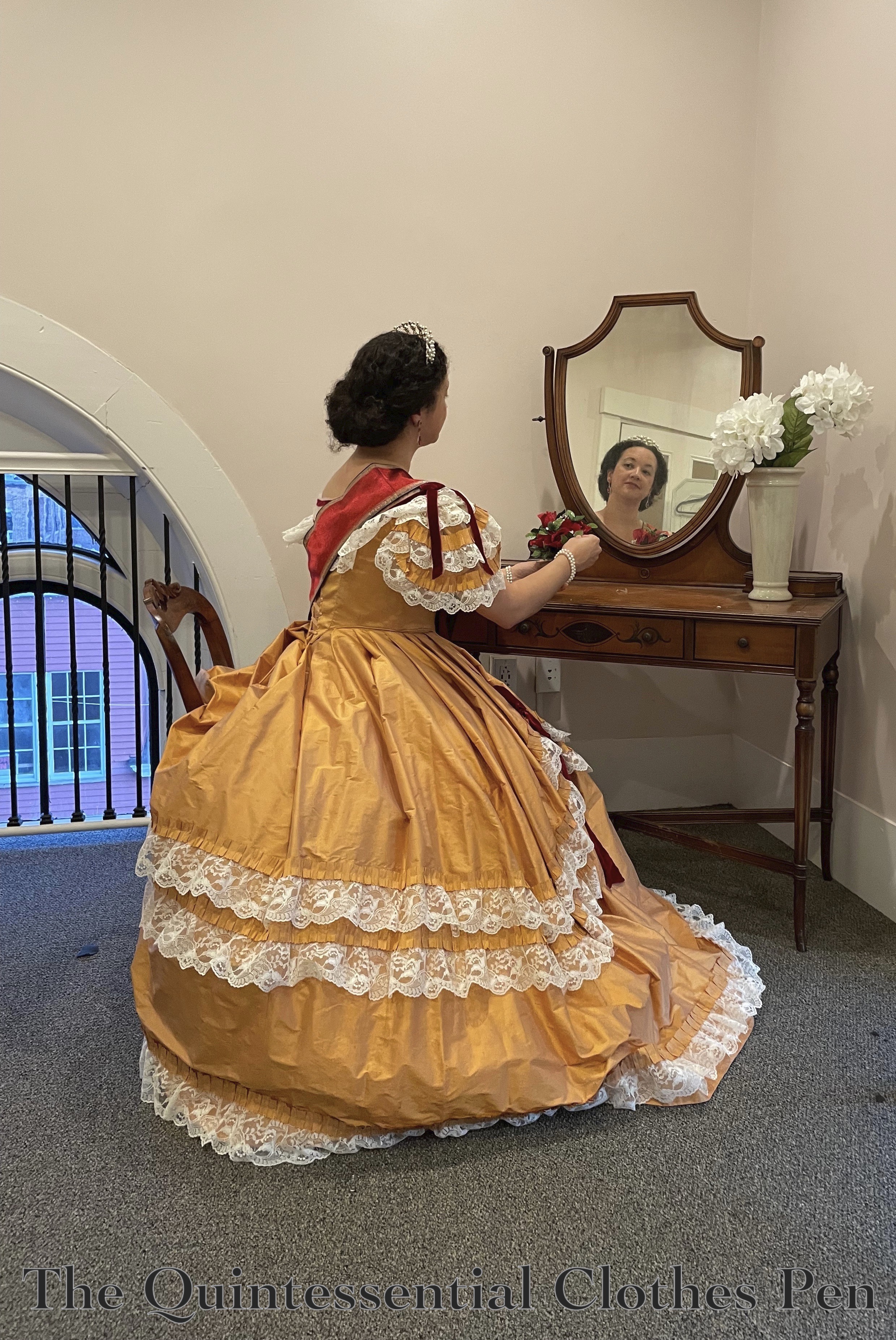
We captured a series of photos of The Queen of Hearts elegantly (and somewhat aloofly!) preparing for the ball!

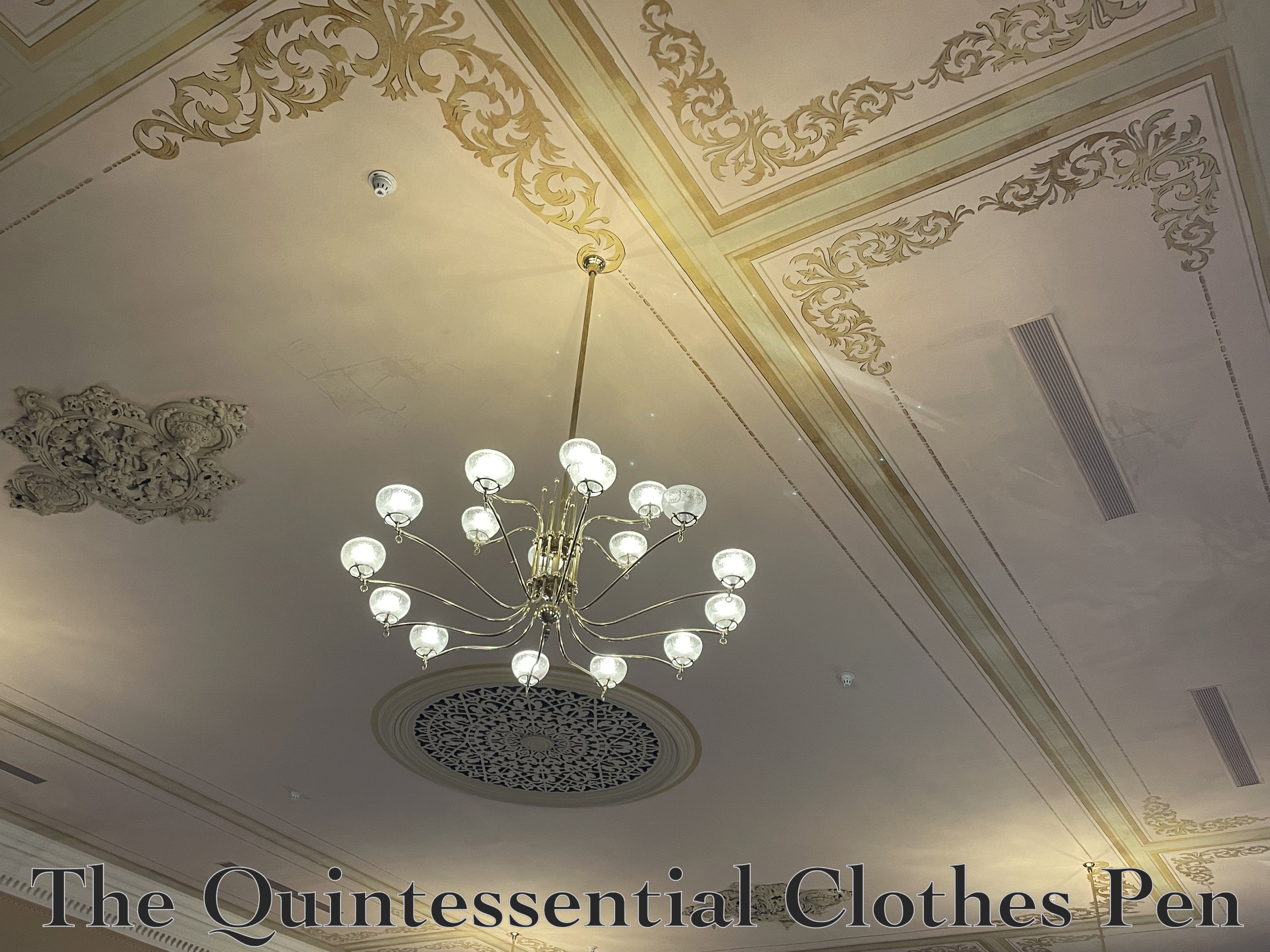
The ball itself took place in the lovely Andover town hall. It has all sort of beautiful details. Look at the ceiling!

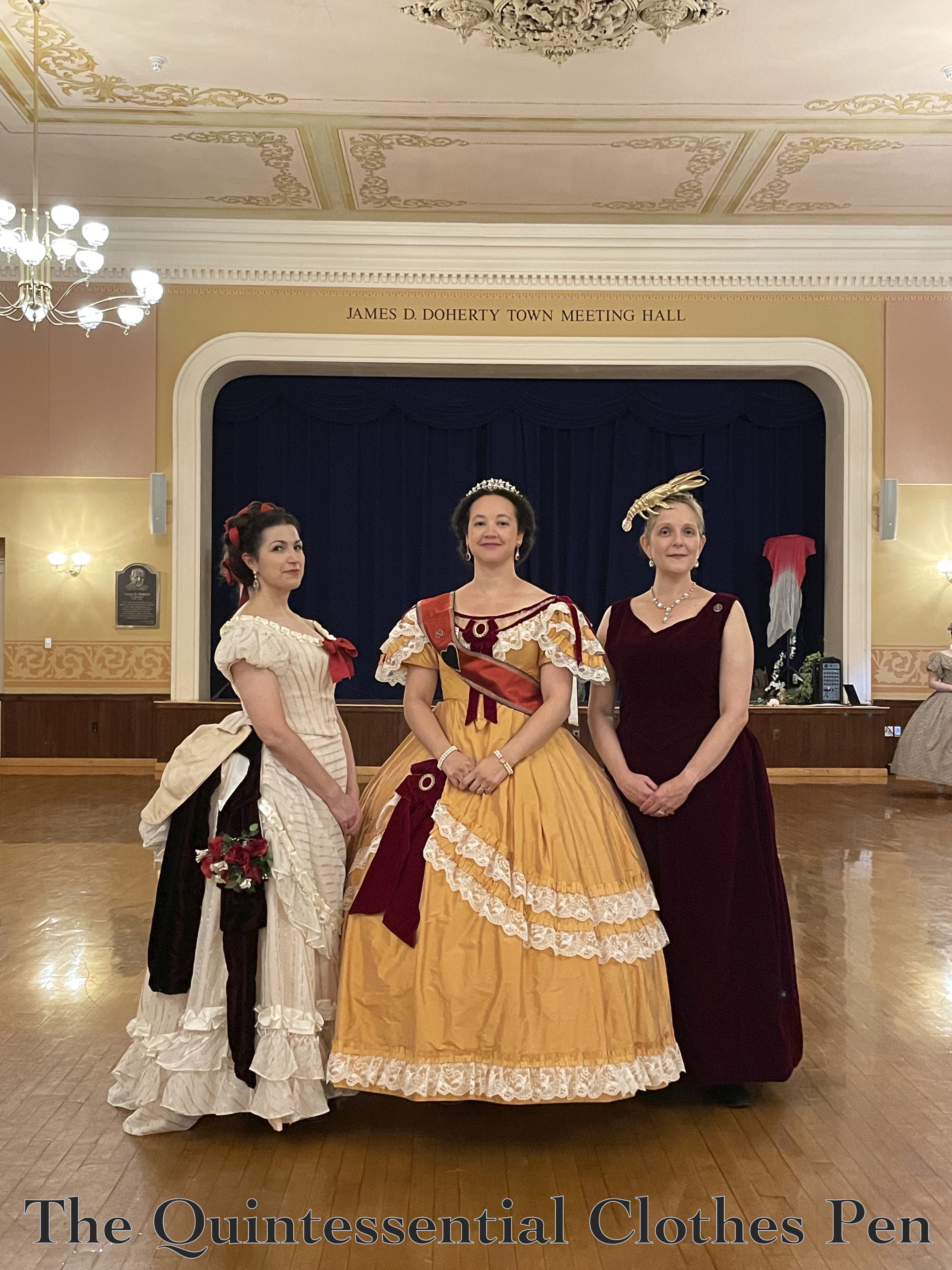
And the company was lively! I met charming new acquaintances and reconnected with creative friends. Below are a few of them… and we are joined by a golden lobster! (The lobster wanted to participate in the Lobster Quadrille, but had to step up the bling-factor to be ball appropriate!)
When The 1860s Drawers No Longer Fit (HSM #11: Worn By All)

I have a series of posts called When The Dress No Longer Fits that document how I’ve updated the size of various dresses I’ve made to fit better as my size changes over time (or as the dresses shrink in the closet, which is how I usually describe it!).

In this case, I’ve adapted that post-naming-style for another garment I recently updated. In this case, I altered an old pair of 1860s drawers rather than a dress!

It brings me joy to be able to extend the life of garments I already have in my closet. For these drawers, being able to adjust the size of the waistband has allowed me to continue to use them for many years. Proof: I documented these drawers on the blog in 2013 (and I’m pretty sure I made them in 2011 or 2012) so they have being faithfully serving their duty for over 10 years!

In that time, they’ve seen lots of use. I’m pleased that they have held up very well. About 8 years ago, I let down some tucks to make the legs a little longer (so that the top of my stockings/knees wouldn’t show–because, gasp, that would be shocking!) and I also increased the waistband size about 6 years ago. Below, a photo of the drawers with those first round of alterations made.

And below is a closeup of the waistband after that first round of alterations. I don’t remember why I thought a closure method of a cord looped in a figure eight around two buttons made sense. I can’t remember a source for this idea… but it has worked for many years. It’s been wonderful because it allows for adjustability (up to a point of running out of cord length to loop between the buttons securely, of course).

But recently, even with the increased waistband size, there was still a gap at the waist and the gathering of the legs into the waistband was no longer distributed in a way that helped the back edges stay closed when being worn. That’s not the end of the world in terms of modesty, as I always have a chemise on underneath, but it wasn’t my favorite look, either.

So I decided to do something about it. I added yet another extendo to the waistband. “Why remake the entire waistband?” I mused. The would need a bigger section of fabric and be more work. No one sees the waistband of my drawers except me, friends getting dressed near me, and you readers on the blog!

So now, here are the most recent updates to these old drawers, with a second extendo added to the waistband. Taking the waistband apart to add the new pieces reminded me that I’d stiffened the waistband lightly by adding a layer of linen in between the two layers of cotton. This is a note to self that this method has worked well, creating a waistband that doesn’t collapse and wrinkle horribly around the waist while also not being super stiff.

I also decided to change the closure method to a button and button hole. The old wrapping the cord in a figure eight method had the added challenge of being a bit tricky to do behind my own back. I decided that while a button would be less adjustable (without resewing it), the larger size button would be easier to do up than the cord wrapping.

I also made a bit of extra waistband for the day when I might need to increase the waist size even more (but I’ll pretend that day isn’t coming). And I decided to hand sew the buttonhole, because it was being fussy on my machine and I figured it would be faster to sew it by hand than fight the machine!

Here is a closeup of what the waistband looks like with the most recent extendo. For this round of alterations, I also completely removed the waistband and redistributed the gathers and side points to better match the new waistband size (these alterations are machine sewn). This makes the drawers more effectively lay in place.

I’m calling this my entry for the Historical Sew Monthly 2024 Challenge #11: Worn by All:

Make a garment that would be worn as everyday clothing by most social classes during your chosen time period and/or place.

Just the facts:

Fabric/Materials: Scraps of white cotton and linen (Is it the same white cotton and linen as the original drawers? Nope, but that’s ok with me for this project!)

Pattern: None. I just added rectangles.

Year: c. 1860.

Notions: 1 shell button and thread.

How historically accurate is it?: 98%. It’s completely reasonable to extend the life of a garment like this by altering it. The only non-accurate thing might be the machine sewing–although it is pretty subtle!

Hours to complete: 2? I didn’t really keep track.

First worn: Worn on May 19 with an 1860s ensemble.

Total cost: Free! Materials were scraps left over from other projects.

This was one of the small sewing tasks on my Maybe-To-Do list for 2024 as well as being one of the small projects that was stacking up on my alterations-and-mending pile. I’m so pleased to have checked it off!

1875 Reception Dress Photo Shoot

I was really excited to spend lots of time working on and finally completing this dress during the summer of 2020.

At that time, there was no option of finding a fabulous indoor place to take photos, so I had to make do with the outdoors. Don’t get me wrong, I have lovely photos from that short outing, but they didn’t have as much background ambiance as I was hoping to find, someday.

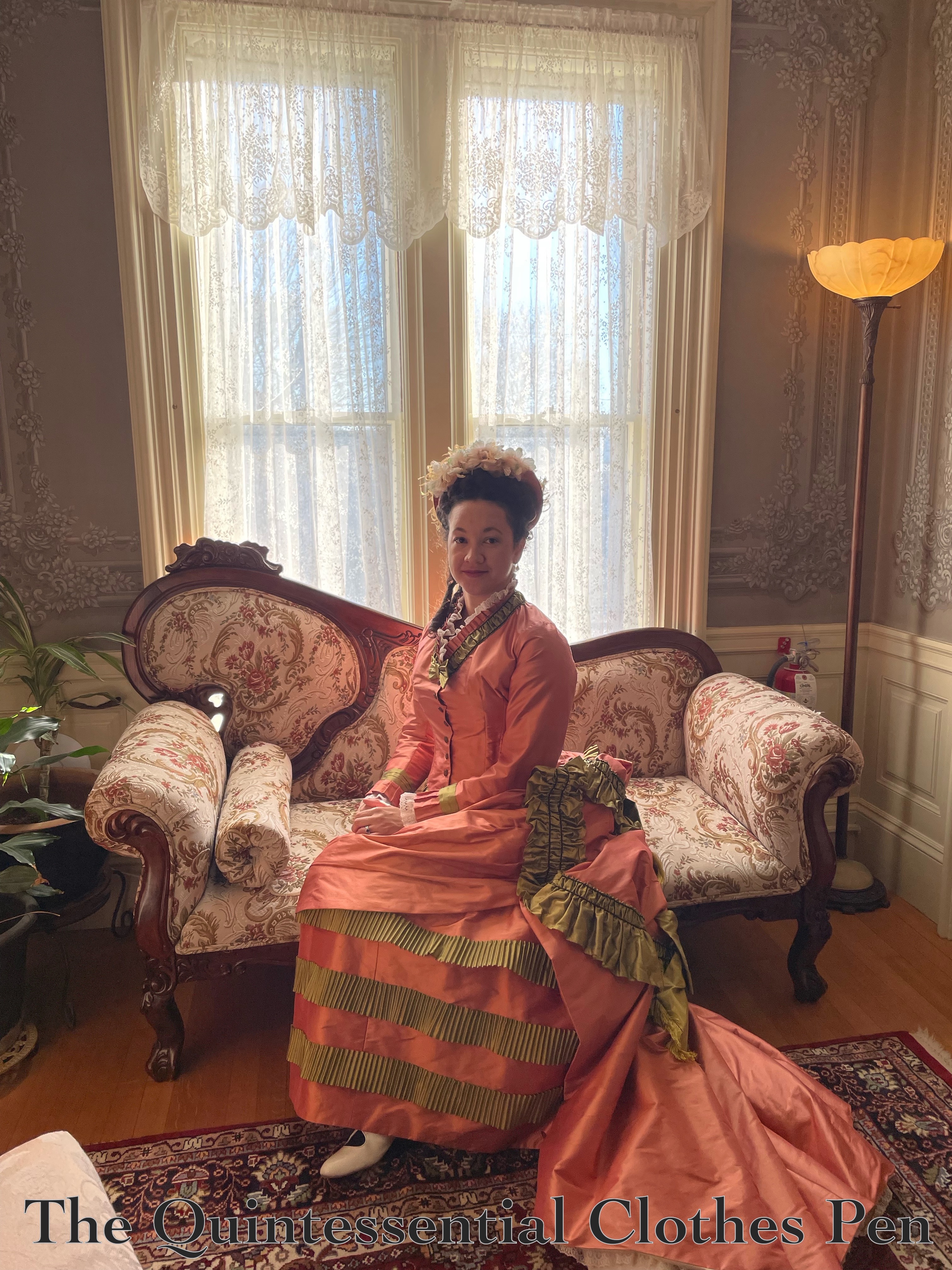
But last year, I had the opportunity to actually wear this dress for an activity! And I was able to convince friends to take oodles of photos so I could better document the dress in appropriate surroundings for its reception status. So now, I present many photos of this dress.

There are dramatic back views, of course.

And front views showing the bust, waist, hip dimensions I worked very hard at in the patterning stages. This is created/augmented with padding. You can read more about that in this past post.

There are also views trying to show both the front and back. A side front view, if you will. This also captures the hat very well. I wrote a detailed post about making it, which you can read here.

And a few more sitting photos, as well. These are great for showing off the train and the layers that support it (this is my past post about constructing the skirt and this is about the balayeuse that supports the skirt, if you’d like to know more).

It was hard to choose favorites! I’m very pleased to have so many photos that capture the glory of this dress in an appropriate location.

Mid-Century Birthday Croquet At Roseland Cottage

Finally, a break from stay-related blog posts! (Slow sewing progress is being made, but not enough to post about…)

In the meantime, I have an armchair peep into a lovely birthday outing with friends on a gorgeous autumn afternoon.

The location of the outing is Roseland Cottage, in Woodstock, Connecticut.

Built in 1846 in the newly fashionable Gothic Revival style, Roseland Cottage was the summer home of Henry and Lucy Bowen and their young family. While the house is instantly recognizable for its pink exterior, Roseland Cottage has an equally colorful interior, featuring elaborate wall coverings, heavily patterned carpets, and stained glass, much of which survives unchanged from the Victorian era. The house is a National Historic Landmark.
(from the Historic New England website)

We made special arrangements with the staff to picnic and croquet on the lawn in mid-19th century clothing, followed by a house tour. Some of us had seen the house before, but the details never cease to amaze and hold our interest. If you’re ever in the area, I highly recommend a visit!

The grounds of the house are well maintained and provided an excellent area to set up croquet.

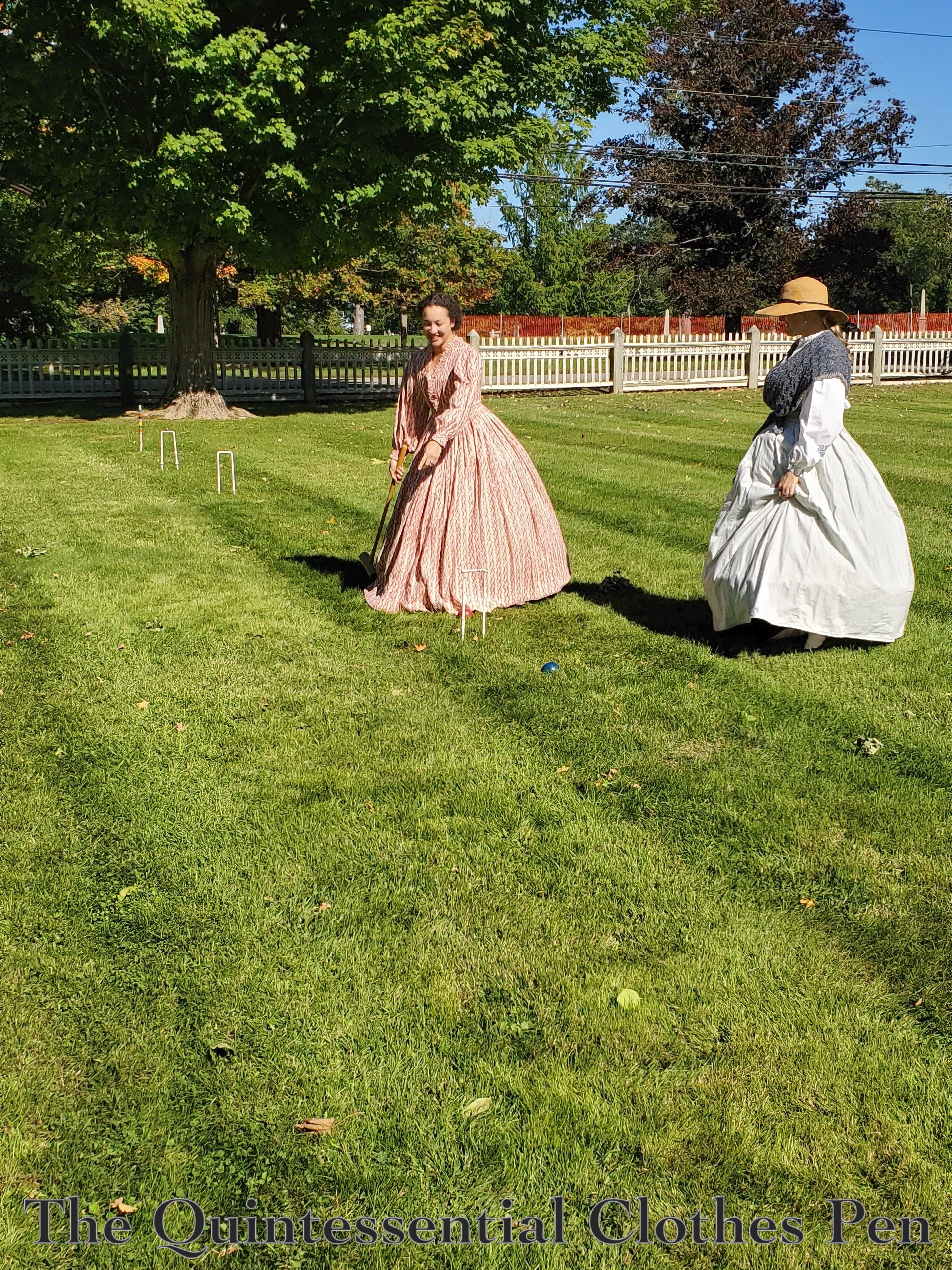
We enjoyed serious croquet as well as a few silly rounds of our own invention. The shadows made for fun photos, too!

The day was sunny and beautiful. There was a slight bit of chill to the air, but it was quite comfortable in full length sleeves and long dresses.

One zealous croquet ball whacked me in the ankle and caused a small scene. Thankfully, it wasn’t too bad after the initial pain wore off (no bruises or anything worse!)

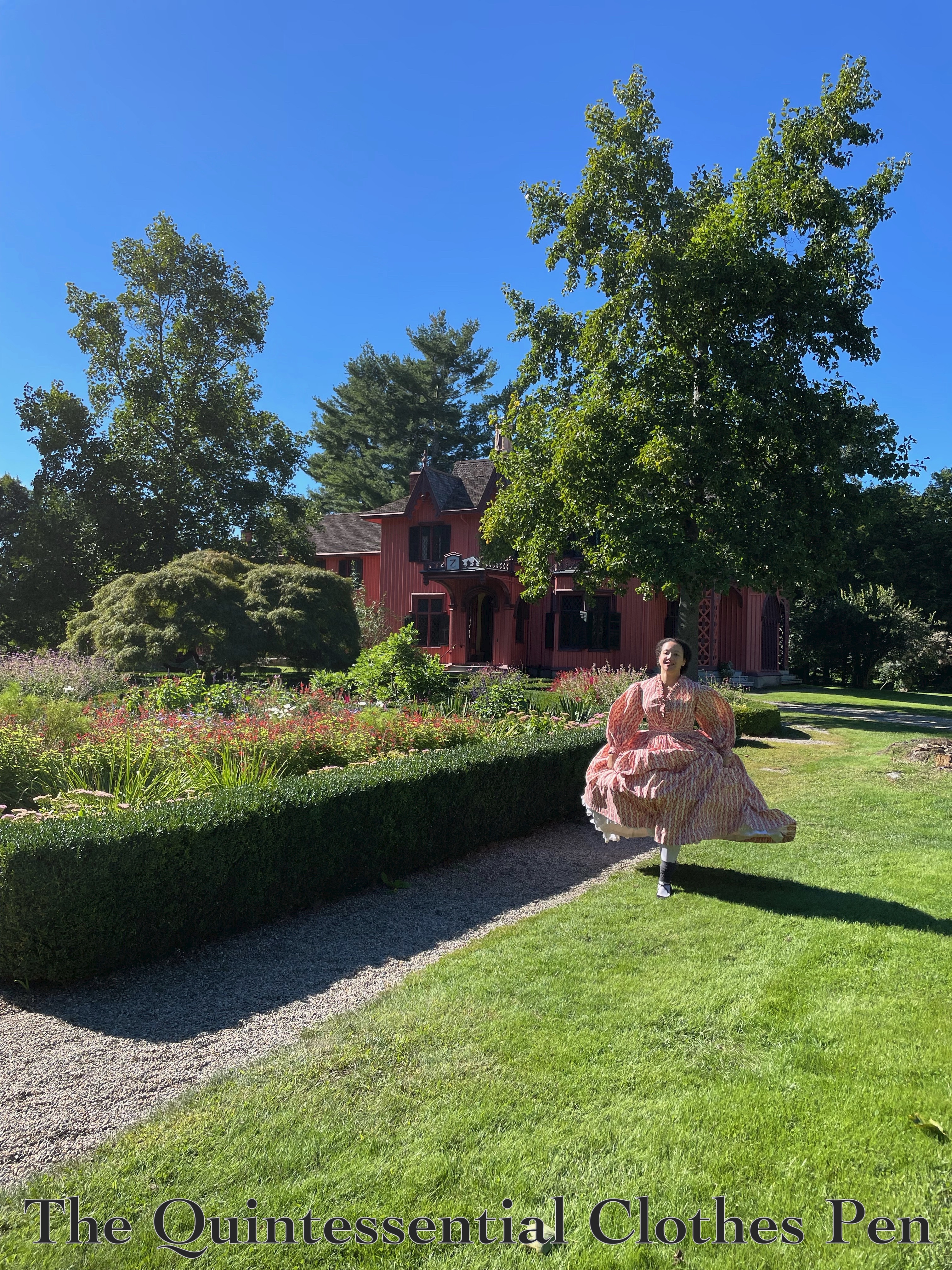
In fact, the croquet ball whack didn’t stop me from enjoying the gardens in Sophie, my 1861 reproduction cotton print dress.

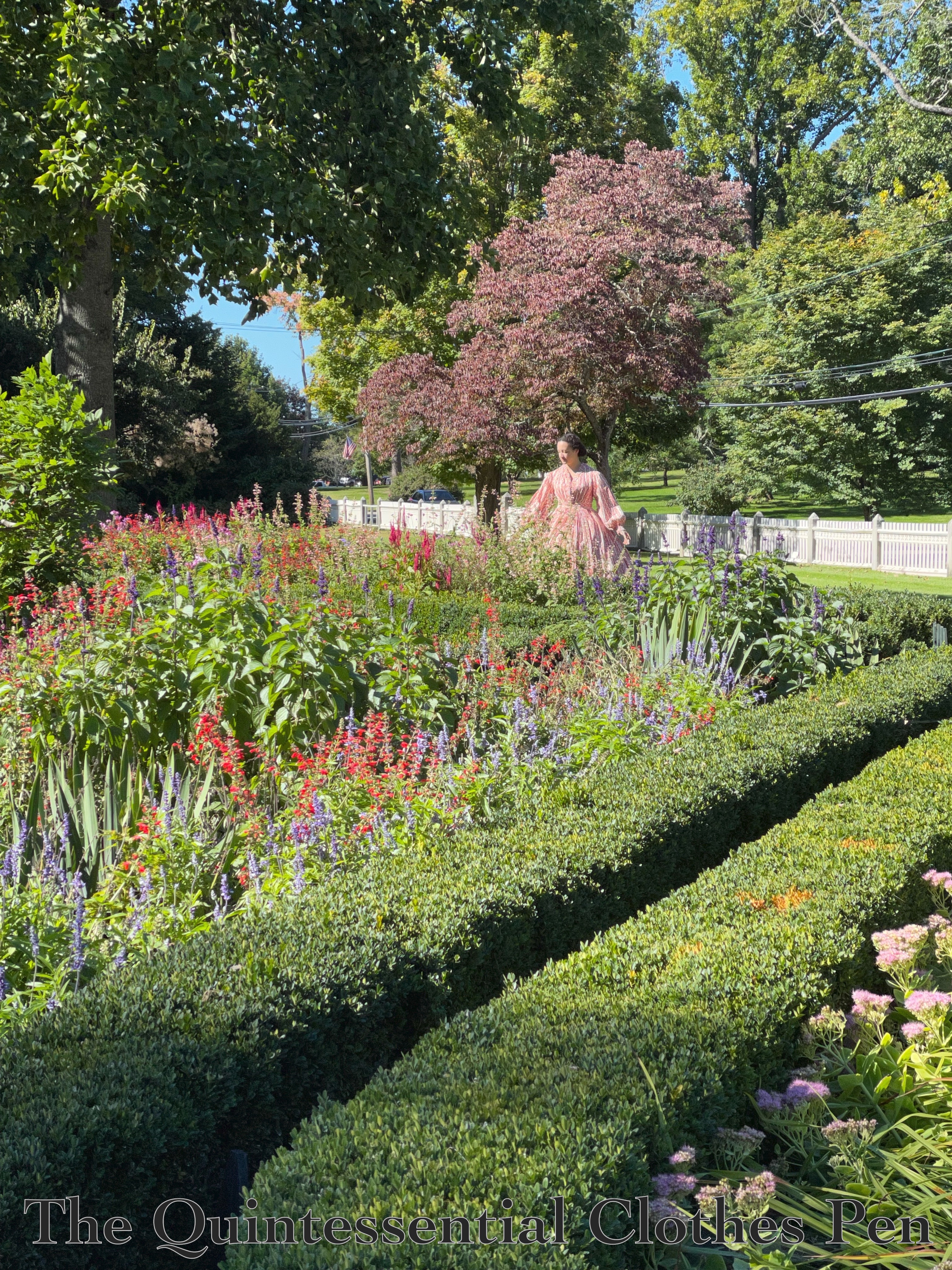
The gardens are maintained with the same plan and variety of plants that would have been evident in the 19th century. They were in full color during our visit!

I greatly enjoy this photo, which was completely unintentional. I just started running around because it was fun, and then was told to go back and do it again because the photo opportunity was so exciting. So I suppose in a way it was intentional?

Croquet was followed by a house tour, during which the staff invited us to remain in historical clothes and take photos. This was my favorite! There’s a little built-in seat with a bay window in one room. It was well suited to sitting in hoops. Looking for friends arriving, perhaps?

An exciting, beautiful day! Thanks for enjoying it with me!

1850s Ivory Quilted Winter Hood (HSM #5)

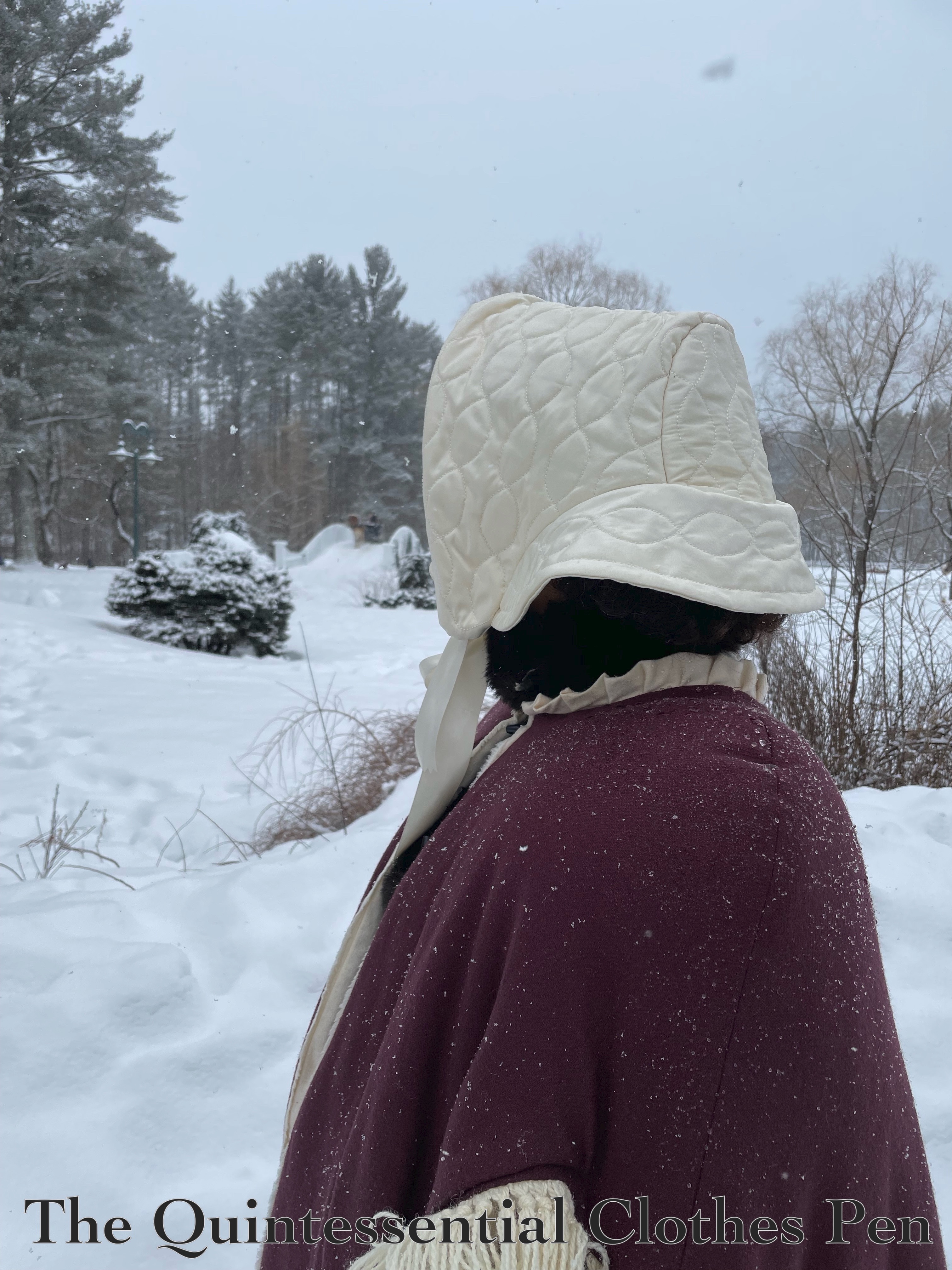
I was mentally preparing for my 19th century winter adventure a few months ago by taking note of the suitable warm winter outerwear in my historic closet. One of the warmest garments I have is my 1855 Wool Cape; however, my thoughts ran along the lines of “I don’t have any 1850s winter appropriate headwear to go with the cape….”

That was easily remedied!

Last fall, I’d purchased Anna Worden Bauersmith’s Quilted Winter Hood pattern on a whim (the pattern was being discontinued for the moment and I didn’t want to miss out). I hadn’t had a project with a deadline in awhile and so I decided to quickly make up the Quilted Winter Hood for the winter adventure… by hand (including the quilting!), of course, because I can be a bit crazy sometimes.

Since the goal of the hood was to keep me warm, it is a perfect garment for the Historical Sew Monthly 2022 May Challenge! Protection: Create a garment that protects you from something: weather, dirt, wear, weapons, etc.

As such, here are the facts:

Fabric/Materials: ½ yd of ivory silk taffeta, ¾ yd  ivory cotton, and 1 yd cotton batting.

Pattern: Anna Worden Bauersmith’s Quilted Winter Hood.

Year: c. 1850.

Notions: 1 ¼ yds 1 ½” ivory satin ribbon, 1 yd millinery wire, approximately 45 yards of silk quilting thread, and regular sewing thread.

How historically accurate is it?: 90%. The pattern, construction methods, and fabric are all quite good and it is entirely hand sewn. I’m sure it’s not quite the same as an original, though.

Hours to complete: 13.

First worn: February 2022.

Total cost: $27 (approximately $17 for the materials and $10 for the pattern).

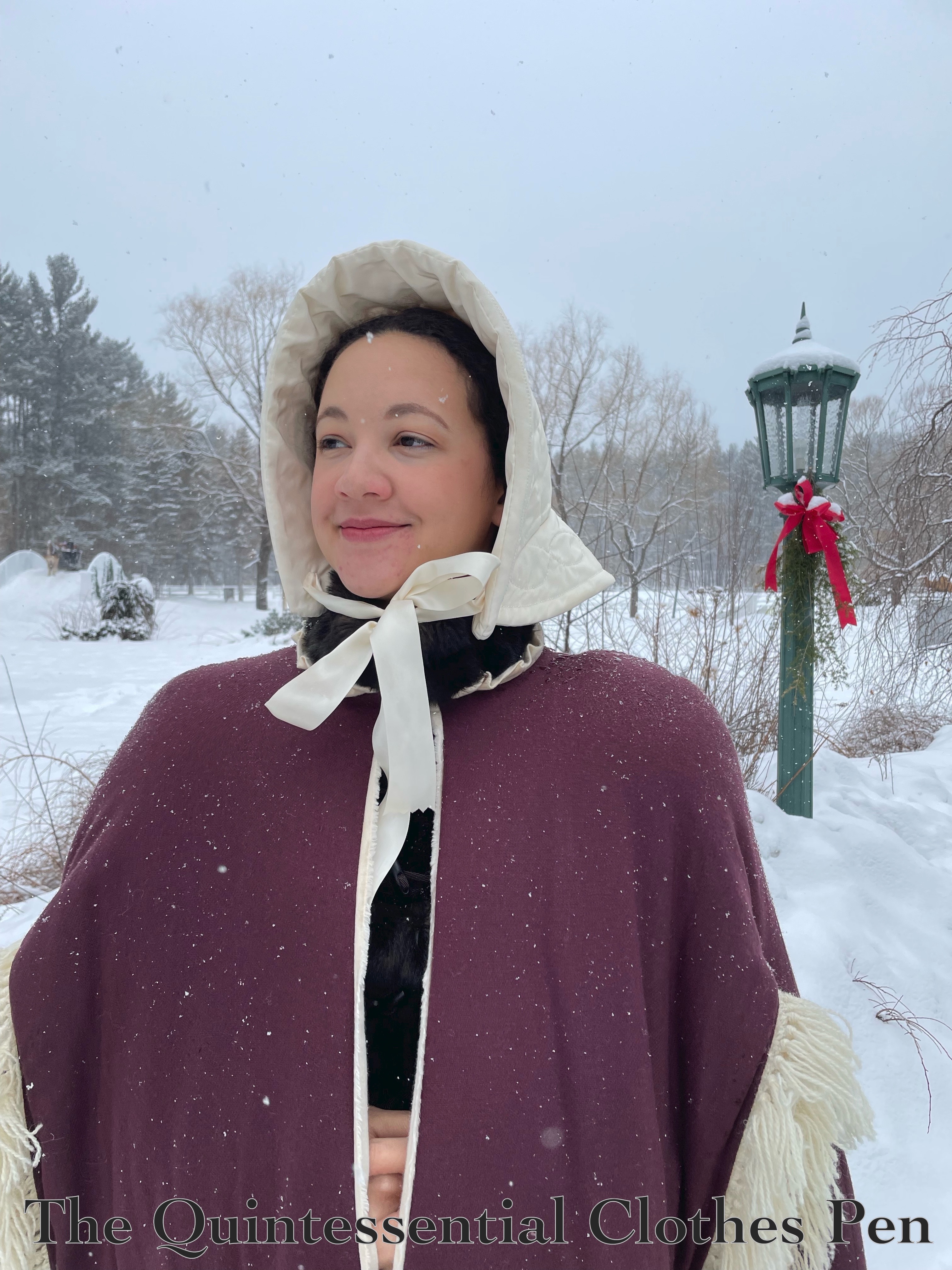
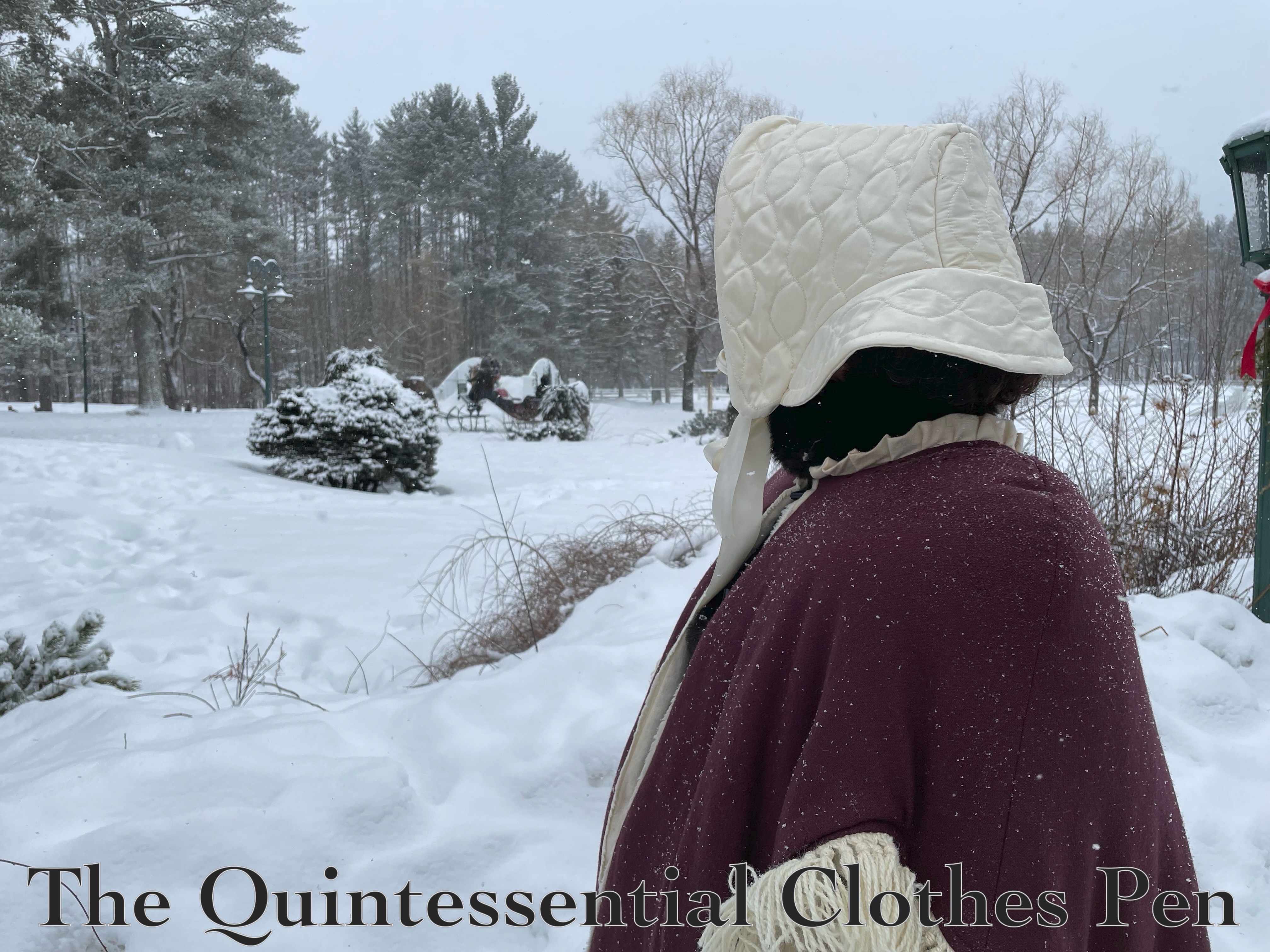
The pattern offers ideas for quilting patterns as well as detailed observations on extant hoods and their common features. While straight lines of various sorts seem more common for quilting patterns, I decided to go with the scalloped suggestion taken from a period magazine.

This front view photo looks like a little silly to me because of the very square shouldered silhouette (that isn’t 1850s at all!). It’s due to the 1890s sleeves that are underneath the 1855 cape…

A woman has to stay warm!

Some of my favorite inspiration hoods are on my Pinterest board for this project. (Many more quilted hoods can be found on Anna Worden Bauersmith’s Winter Hoods Millinery Pinterest board, as well.)

In the process of creating my board, I was drawn to a few other winter hoods and cloaks. That set me off down a brainstorming path to see what else I have in my too-full wool stash that could be made into more 1850s and 1860s winter outerwear!

Not that I need more… I’m only one person, after all, and how many wool capes can one person reasonably wear at once? But… there are at least two other hoods and another cape that I’m now seriously pondering. So this quilted hood (and the cape I already have) might just be the beginning of a whole series of mid-19th century winter outerwear someday. (And maybe I should eventually take a photo layering all of it at once, just to be silly!)

A 19th Century Winter Wonderland Adventure

Friends and I have been talking about going away for a historical winter outing for years to a particular establishment remembered from childhood outings. Nestlenook Farm, in Jackson, New Hampshire, boasts a variety of winter activities all in one place! There are sleigh rides (with real horses and actual runners, if there is enough snow!), a three acre skating pond, and snowshoeing trails.

I grew up in a different part of the country, so I hadn’t ever been Nestlenook Farm, but I have fond memories of going into the mountains with my family and best childhood friend to have winter adventures. My memories are of a man called Happy Jack who ran a small business driving draft horses pulling real sleighs through the woods to a hill that was perfect for snow tubing. He’d drop you off for the day, allow the kids to tire themselves out tubing, sledding, and hanging out by the fire pits, and then he’d return to take you back through the woods. It was very exciting!

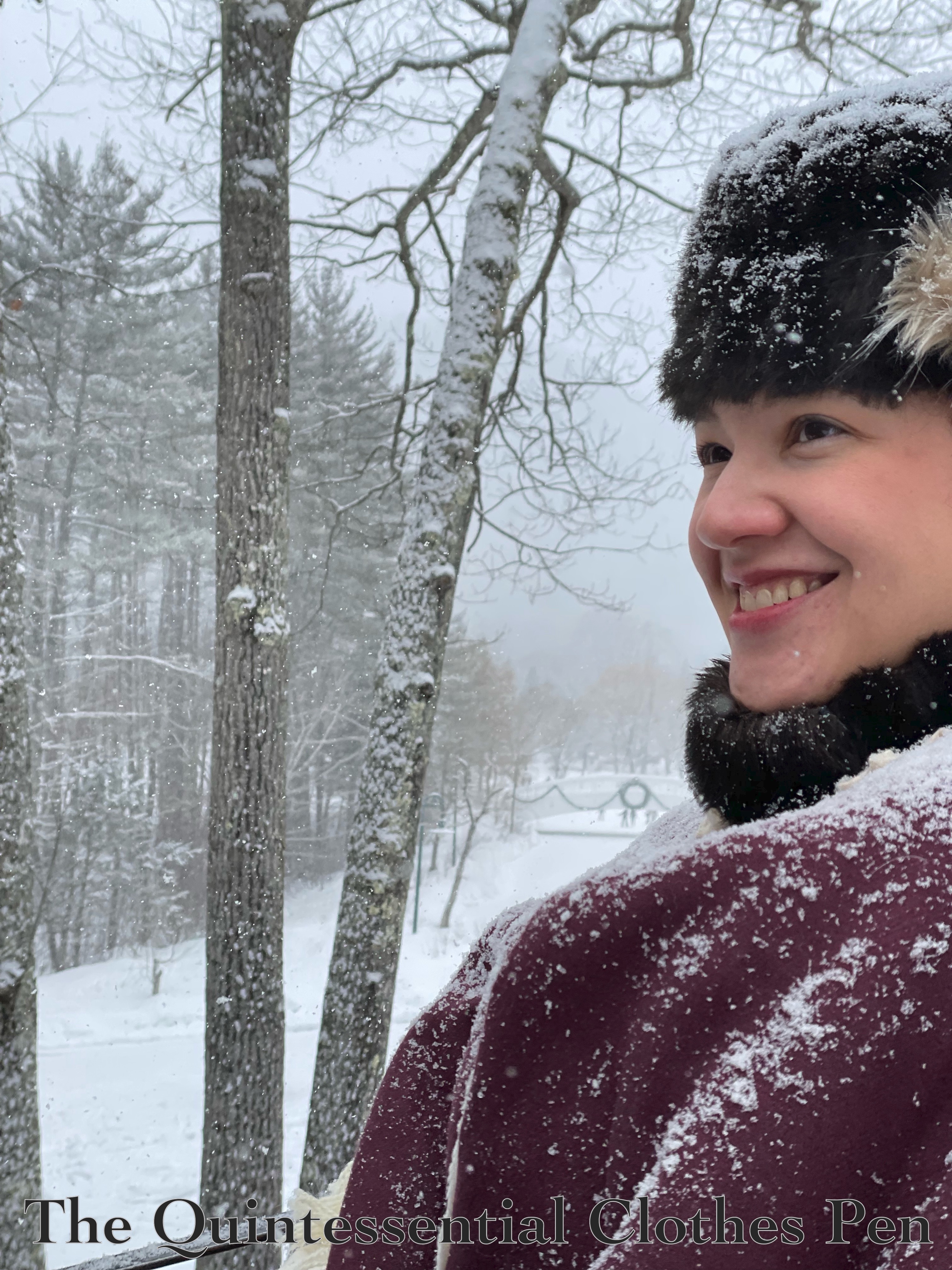
This past winter I was able to experience all of this fun, but in 19th century clothes! We were worried there wouldn’t be snow. But not only was there snow on the ground, we also had a magical day of snow lightly falling while we took part in the various activities! We could not have asked for more picturesque weather!

We bundled up in our various 19th century (and hidden modern) warm layers, outerwear, accessories, and blankets for our sleigh ride. The sleigh trail circles the ice skating pond and there’s a lovely lookout where the sleigh drivers will pause to take a photo. Ours kindly took many photos, anticipating that we might accidentally make silly faces in some of them.

Now that’s a real smile! It was difficult not to smile, with good company, an obliging sleigh driver, the sound of the horses’ bells jingling, and snow lightly falling!

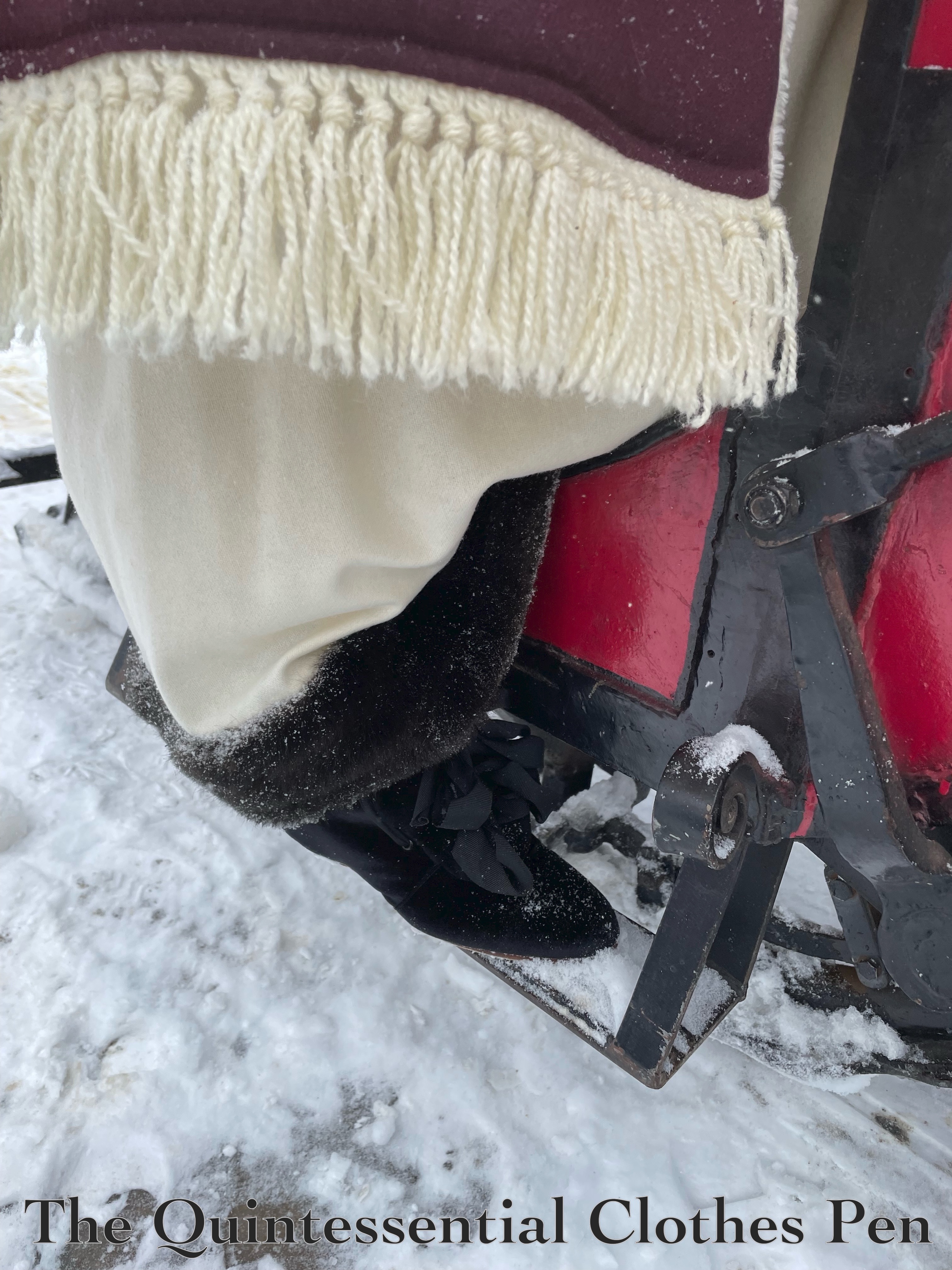
I opted to wear my American Duchess carriage boots. How could I not? A sleigh is just a carriage with runners, right? Photo documentation of both the boots and the sleigh on actual runners was essential.

In addition to shoes, the rest of my outfit for the day consisted of modern ski base layers, my 1880s yellow corset and 1903 super silk petticoat, 1895 ice skating ensemble, matching faux fur hat and muff set (made for 1917 but with the ability to be used for lots of periods), and my 1855 wool cape because the other layers weren’t quite enough to be warm in the sleigh.

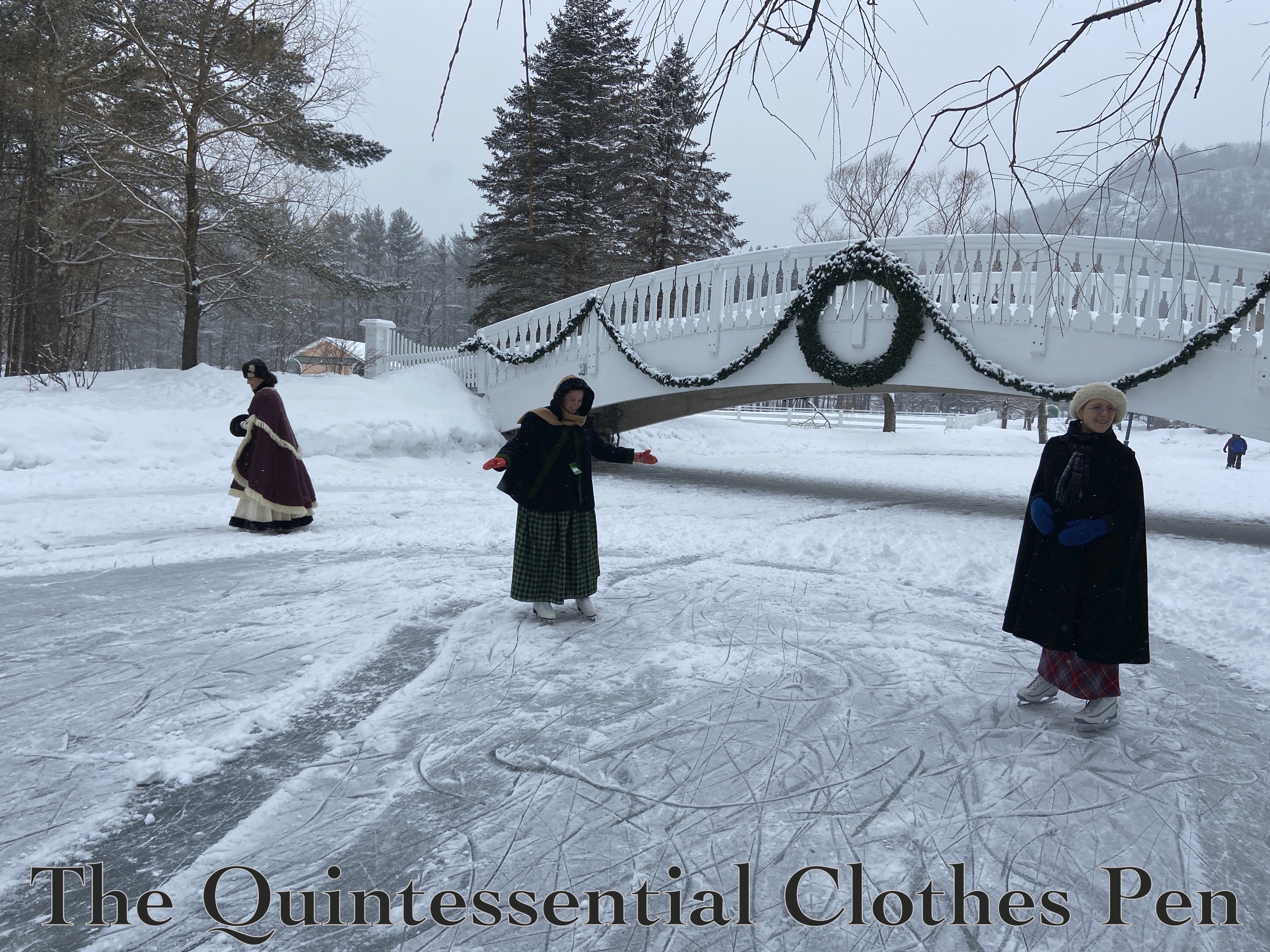
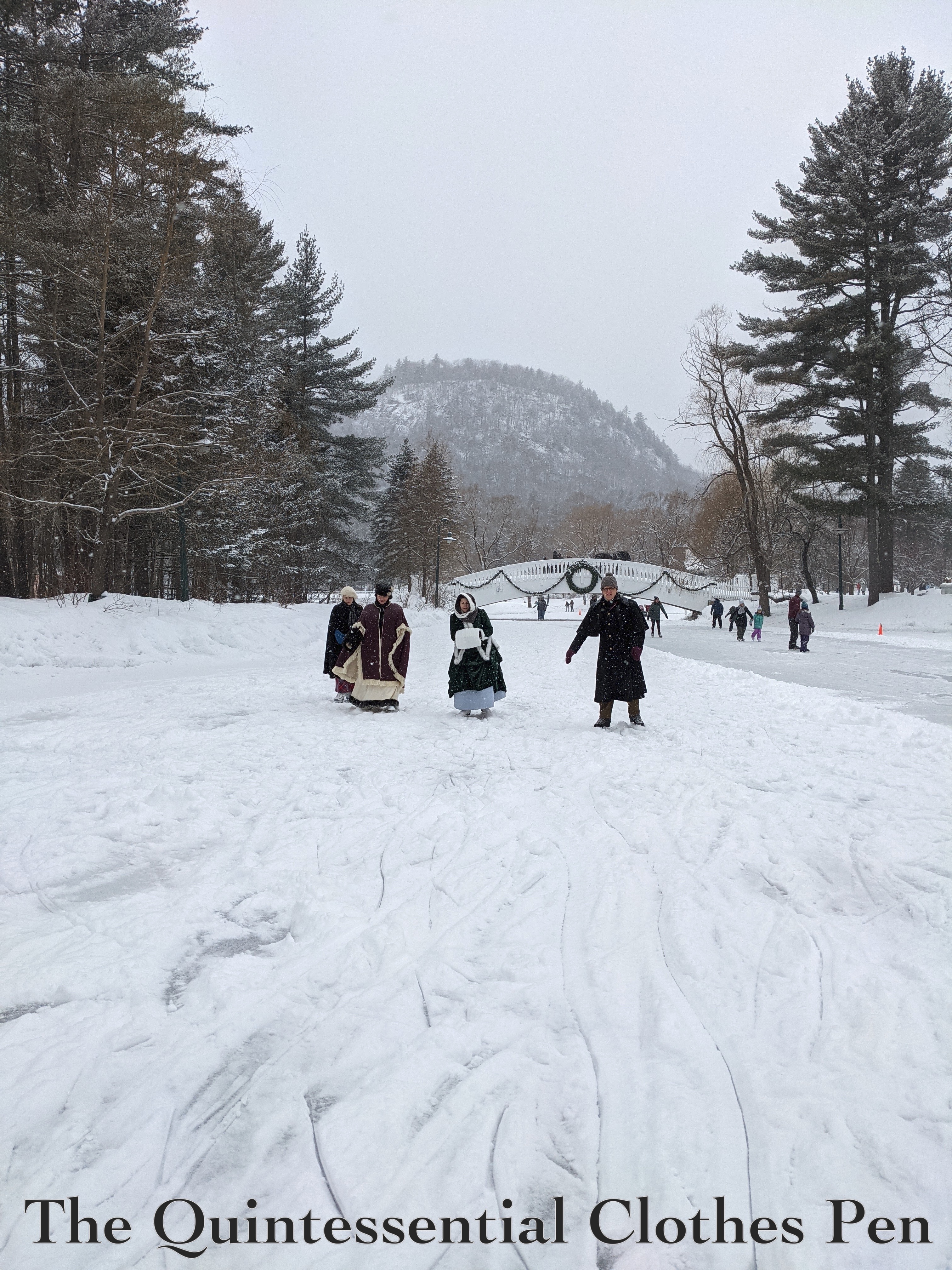
Following the sleigh ride, we went ice skating!

I’ve done a middling amount of outdoor ice skating since moving to the Northeast, but I can say with certainty that I’ve never been ice skating with accumulated snow on the ice. I wasn’t sure if it would be difficult to skate through, so I had to try it! It’s not bad, actually, if it’s only a few inches deep. (When I tried to skate through drifts that were more than about 6″ high I found the dramatic decrease in my momentum to be startling as it threw off my balance. But it was still fun to go flying through drifts!)

A few inches of snow on the ice sort of helps stabilize you (unless it obscures obstacles and trips you up!). That’s what happened to me here. There was uneven ice that caused me to do a super plop as my feet went right out from underneath me. This was the aftermath, as I caught my breath before getting up again.

There weren’t all that many people skating, so it was easy to find areas for nice photos. Skating made me warm enough that I didn’t mind taking off the cape for some ice-skating-outfit-only photos. How could I not, when this outfit was made just for this?

It may not be winter anymore (yay, spring is here!), but it’s fun to revisit this exciting adventure by including it here on the blog. Thanks for enjoying it with me!

1880s Blush Duchess Satin Corset

In 2015 and 2016, I posted a ‘project journal’ series of blog posts about making a yellow duchess satin c. 1880 Steam Molded Corset (this link will take you to the whole series, which includes specific posts about the plan, inspiration, mockups and patterning, the final pattern, construction, steaming, and finished garment photo shoot). Late last year, I made another one as a commission for a friend, this time in a blush pink duchess satin I picked up at the fabric store with no particular purpose, but thinking it would be really good for this specific use (in fact, I mention this exact idea in the fabric stash additions post where I shared about the purchase of this fabric in 2020).

Having already figured it out once, I used my old blog posts as a guide for making the new corset. This post is intended to document the new corset and the changes and updates I made from the yellow one.

To start, I adjusted the pattern I’d developed for size as well as some of the boning patterns to accomodate the adjusted seam lines and to simplify some of the boning patterns, especially in the back. The yellow corset has a whole bunch of bones… It’s great and based directly off my inspiration image, but time consuming and unnecessary for this purpose.

Once I had a solid pattern, I cut out all my pieces: one layer of silk satin for the exterior and two layers of white coutil for the inner layers. For the most part, the layers for each piece are exactly the same, but there are some differences at front and back panels.

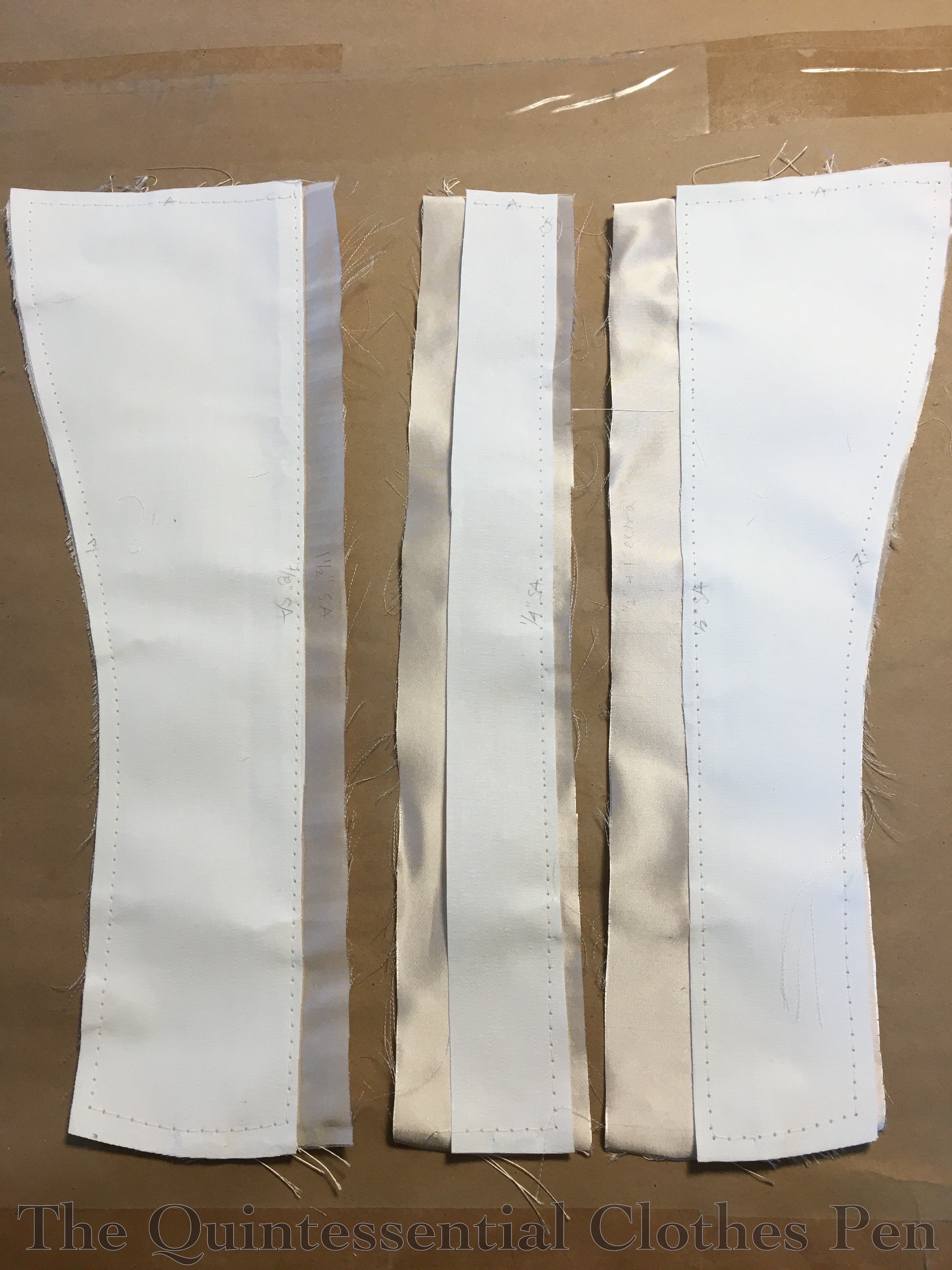
Below are the front panels, where I’ve intentionally cut the coutil to be smaller than the silk. This allows for the seam allowances to be less bulky and therefore more crisp as they fold inward around the busk. The piece on the left is for the proper left side of the corset while the two other pieces are both for the proper right side of the corset. I’ll show how these pieces are put together later in this post.

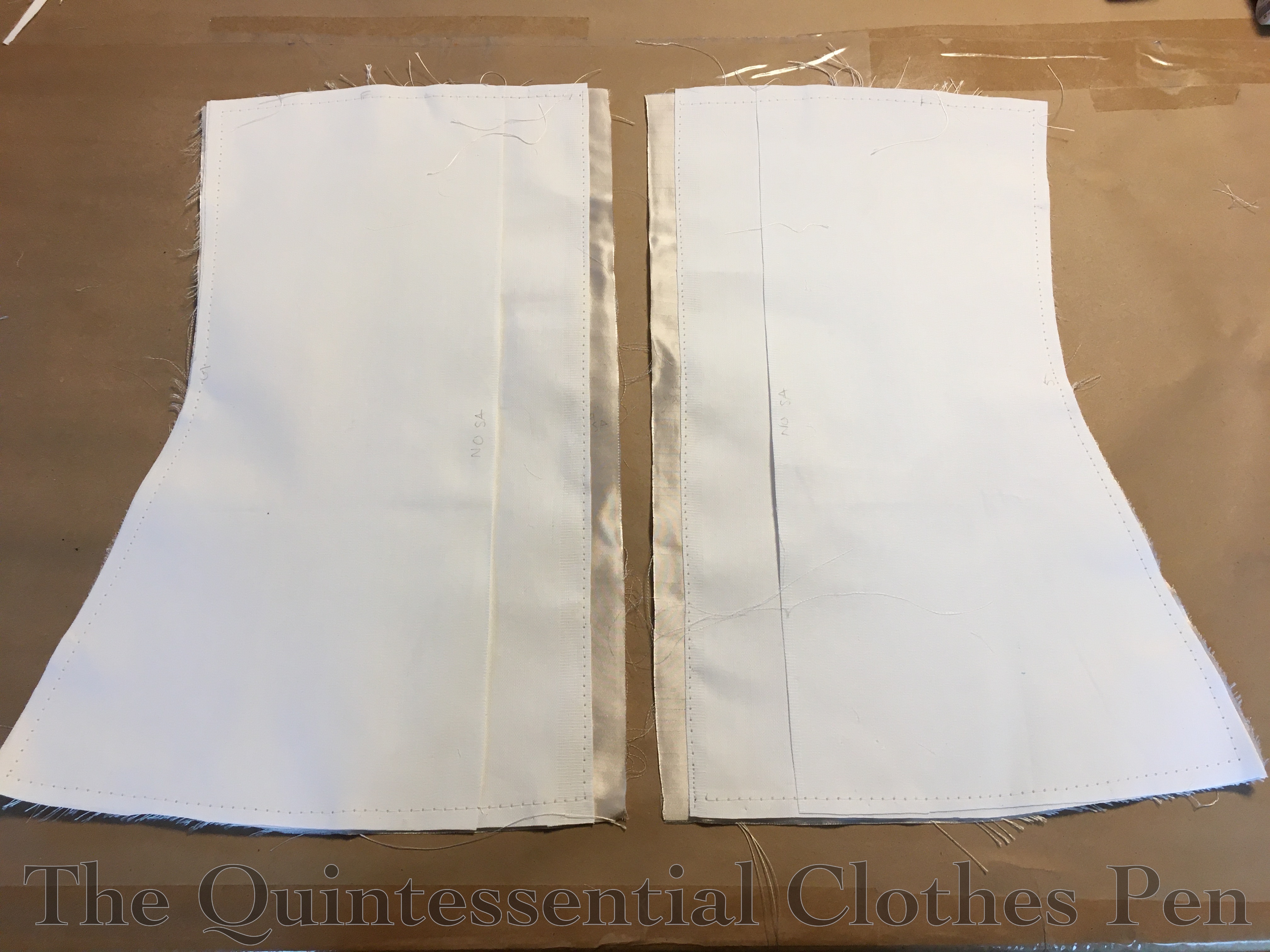
Next are the back panels, again showing that all of the layers are not cut to be exactly the same. The cut edge of the narrowest coutil layer provides a crisp edge over which to turn the other piece of coutil for the back edge. It also creates 3 layers of coutil where the grommets will be while allowing the silk to fold under the outermost edge of the coutil for a crisp line there as well.

You can see in both of the above images that I machine flat lined the layers for each piece together on almost every edge (some were strategically left alone).

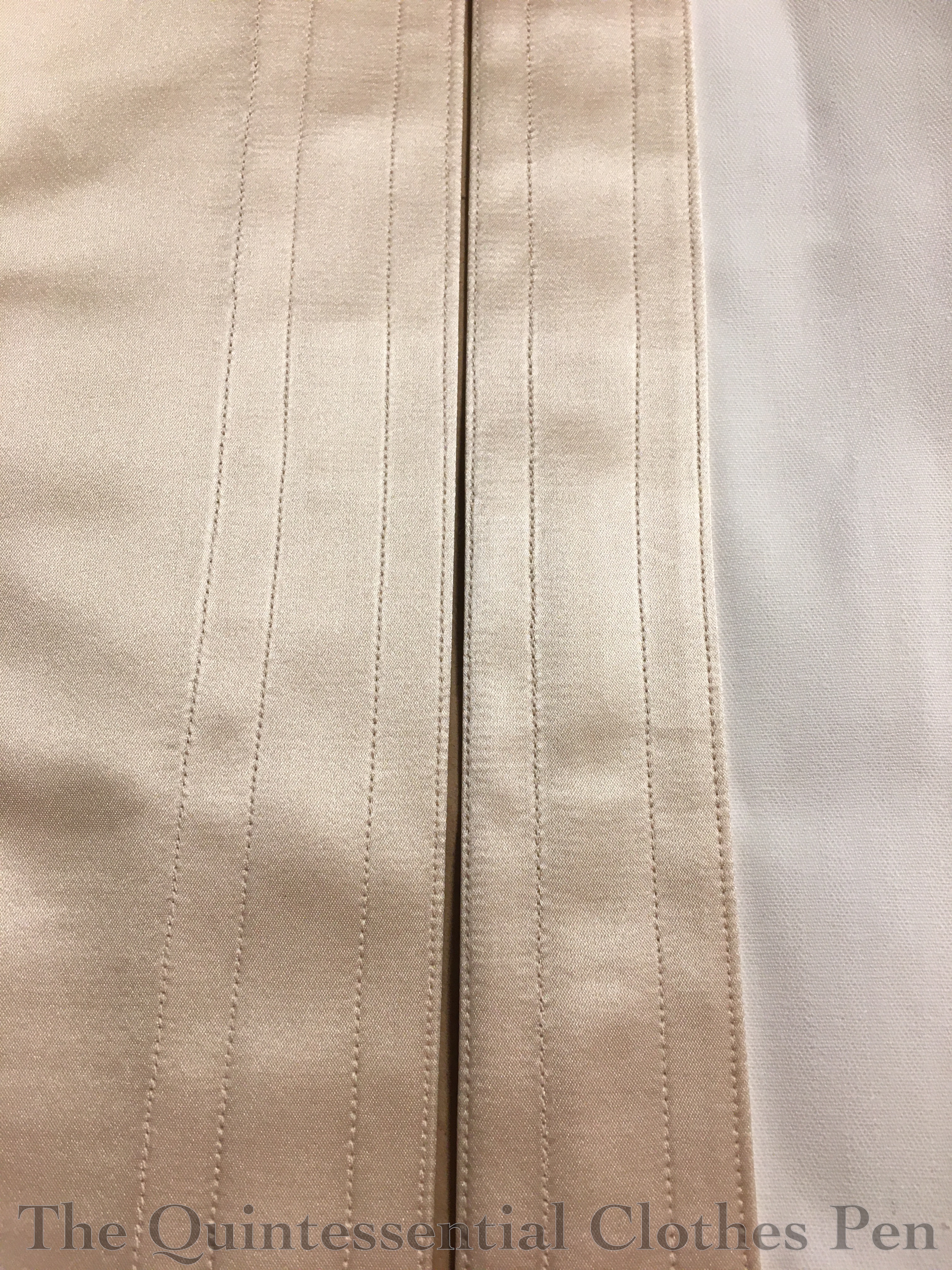
Next, I prepared the center back grommet areas. The silk only seam allowance was crisply turned back over the straight cut edge of the coutil, then the coutil was crisply pressed back over the narrower layer of coutil. You can see the folds opened on the right and the resulting crisp panel on the left.

These were very carefully pinned in place (duchess satin does not hide pin marks!) and then the channels were stitched. I made sure to make them wide enough to not struggle when putting in bones (the last corset had boning channels that were a bit narrow for the bones and it was terribly hard to put them in!).

I used an edge stitch foot to get the lines of stitching right along the folds. Edge stitch feet are magical! I discovered mine while making masks last summer and have since started using it for all kinds of projects–any time I need to stitch close to the edge of a fold! My machine, which is pretty basic, came with one (though I hadn’t used it in, oh… 12 years???). I encourage you to it out if you haven’t before!

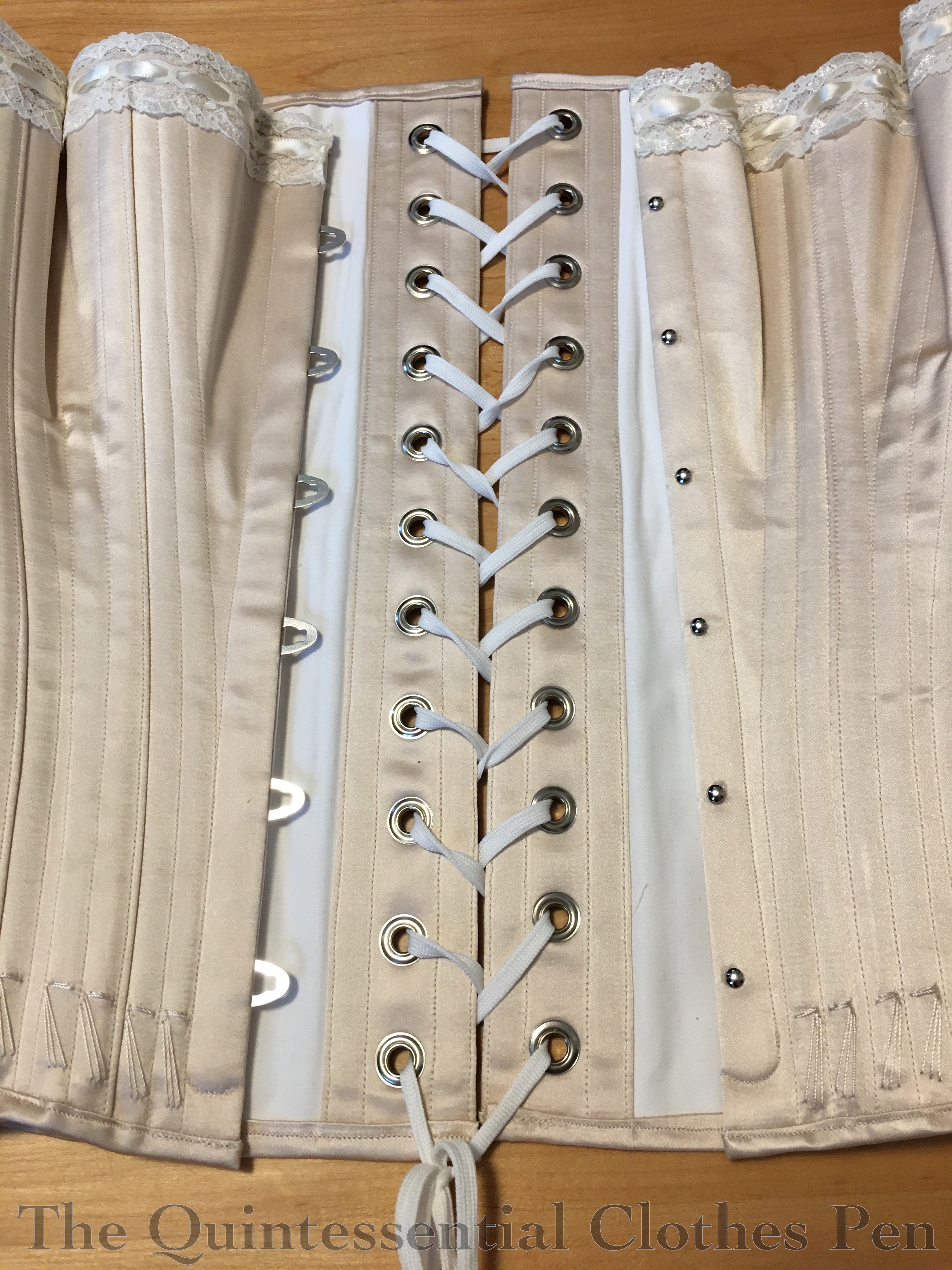
Here you can see the exterior of the grommet panels on the left and the interior on the right.

Later, I added size 0 silver grommets. Skipping ahead in construction, here’s a finished image of the corset, showing the finished grommets in place.

After preparing the grommet area, I assembled each side of the corset. No photos of that here, since I did this in the same way as my last corset: grading my seams, binding them with ⅝” cotton twill tape, and then stitching these down to create channels for the bones. (My original construction post has detailed pictures and explanation of this method. The part of the post discussing this also has some images showing the many bones on the back of that yellow corset that I mentioned earlier.)

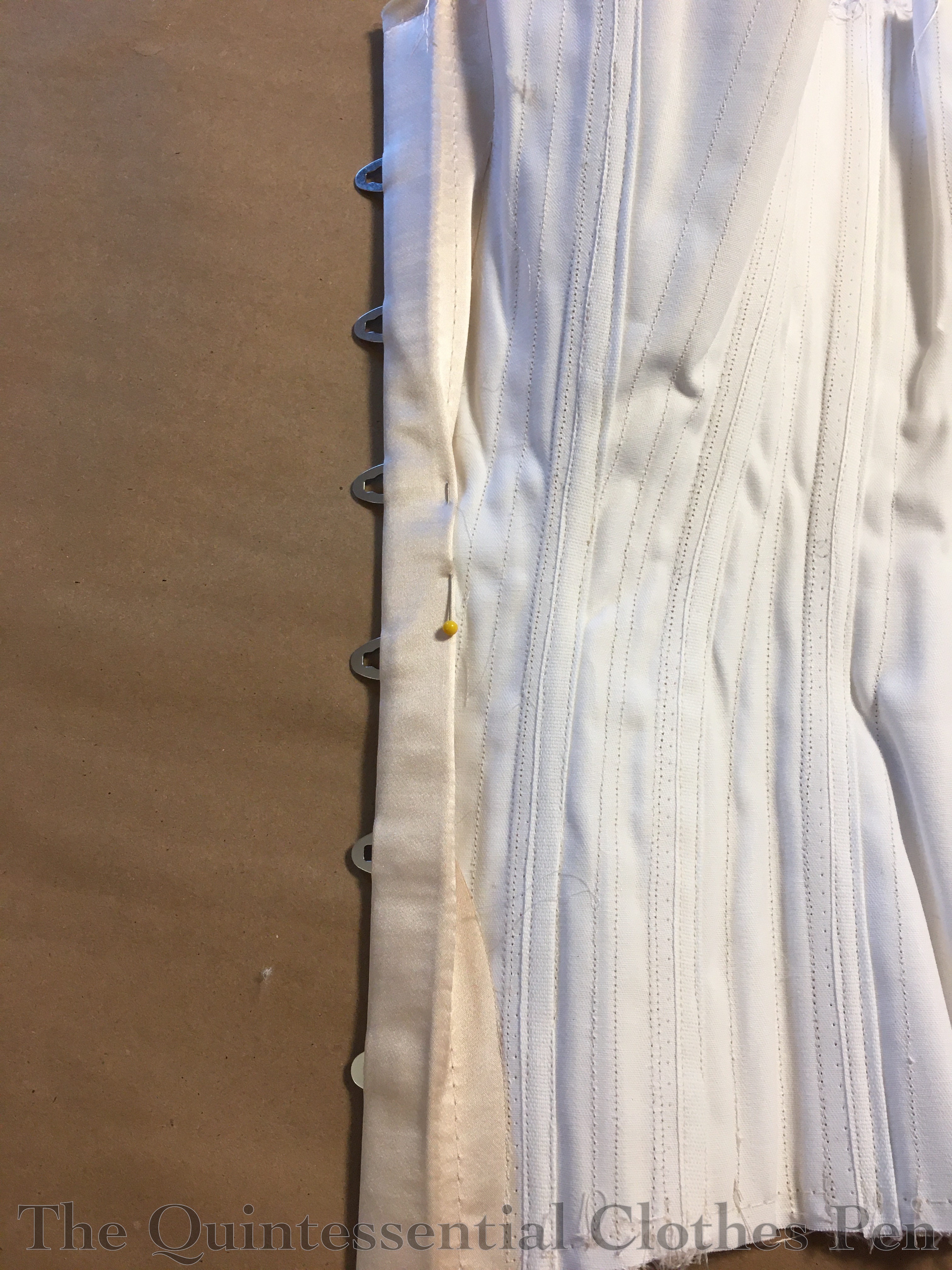
Next, I put in the busk, starting with the socket side, which is the proper right side of the corset. I used a different method on this corset than on my yellow one. Further inspection of originals shows a seam that the busk sockets are pushed through, rather than reinforced holes without a seam, so that’s what I wanted to do!

This is where I used the two pieces I cut. In the photo below you can see that the two pieces are pinned together (pin heads are on the underside, in case you’re wondering) and I’ve marked small lines where the sockets will land on the seam. This allows me to leave openings in the seam for each socket. The openings need to be snug, but not too tight. The seam is sewn just outside of the coutil, so that the layers fold crisply. As you can see, my seam allowance is uneven. I left the side of the silk that will be visible as the busk is pulled on a little wider to make a solid facing even after years of use.

Here is the finished seam, pressed open. If you look carefully you can see the gaps in the seam that I left for the sockets of the busk. My ruler at the bottom shows the scale. (This photo also shows some of the finished seam allowances and boning channels on the other seams, as well.)

Now the socket half of the busk is pushed into place. The single layer of silk seam allowance is pressed over the cut edge of the coutil and the whole thing is carefully pinned in place. I made sure that the busk is quite snug, so that it can’t shift in any direction.

To do this, I started with pinning the inside, to ensure that the silk is perfectly wrapped under the busk–no gaps or bubbles there! Then, I very carefully pinned from the outside. As you can see, I only pushed the pins through the silk once (they come up through the coutil again, but not through the satin) to minimize holes.

After that, some very careful stitching with a zipper foot was in order. I curved my stitching around the top and bottom of the busk (a detail from extant garments). It’s tricky to make the curves look nice, but it’s a small detail that helps elevate the finished garment, I think.

On the inside, it looks like this. I was able to keep the stitching a consistent distance from the fold in the silk due to my careful pinning. I’ll admit that this turned out better than my yellow corset! The yellow corset has a few bubbles and variation in the width of the turned under seam allowance.

Here is the busk from the side. You can see the seam and the snug openings, with solid back stitching, which leave space for the sockets to push through.

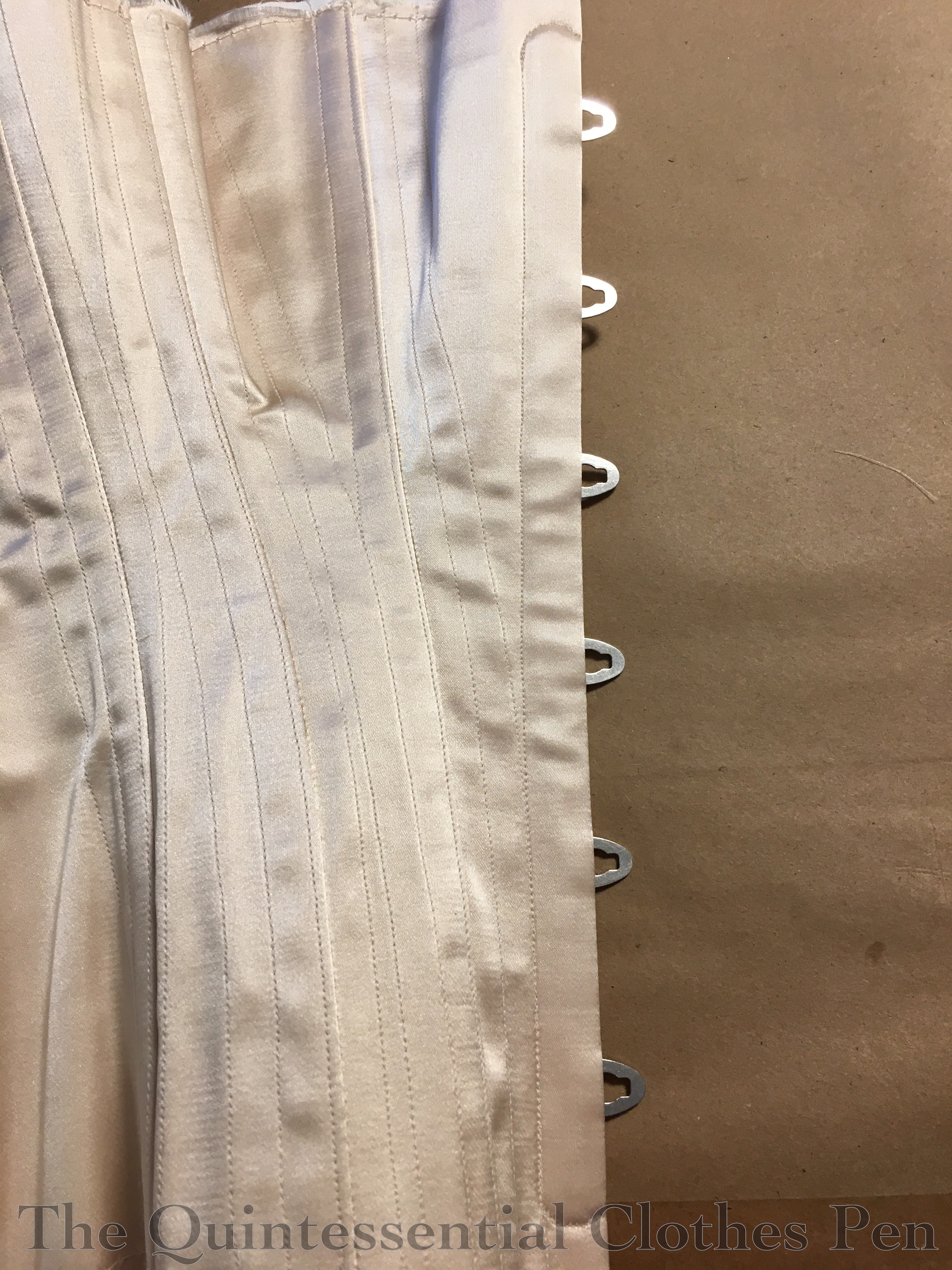
Ok, on to the stud side of the busk! This is the proper left side. Here, you can see the marks I’ve made to show where the studs will poke through and where the edge of the busk will fall. It is intentionally set back from the cut edge of the coutil.

One thing I was very careful about was poking my holes for the studs, because I found that on my yellow corset the silk pulled where I used an awl to make the holes. No one but me would probably see this, but I wanted to do better with this corset. I believe I used very sharp snips to cut small holes rather than using an awl to push the fibers apart. This is fiddly work, because a hole too big can’t be saved and will fray and cause the stud to move around, but it produced better end results, I think.

After making my holes and getting all the studs through, I carefully pinned and then stitched around the busk just like I did on the socket side.

Ta da! Busk!

Next up was binding the top and bottom edges. I used almost the same method as on my last corset. To quote myself:

The bottom binding is bias strips cut 1″ wide. I stitched them first to the right side of the corset with ⅛” seam allowance on my bias, trimmed my corset seam allowance to just about ⅛”, folded the bias over the edge, turned the raw edge under on the wrong side, [basted the seam allowance in place on the inside instead of hand whip stitching the bias down on the inside (slow, but a more effective method than pinning in this case)], then turned the corset back to the right side and topstitched very close to the edge of the first fold. This narrow topstitched binding seems to be common on late 19th century extant corsets and looks very tidy.

Below you can see the bias turned to the inside, pinned, and being basted in place. On the right are finished edges from the inside and outside.

This corset is boned with spiral steel for the bulk of the seams and flat steel on either side of the grommets.

I usually apply the bottom binding first, then put in my bones, and then bind the top. It’s a bit trickier sometimes to bind the corset after the bones are in, and if the top will have decorative lace then it can help hide any struggles that occur. (Thankfully, I learned from my last experience and made a test sample of the boning channel width that was perfect, so it was relatively easy to bone this corset!)

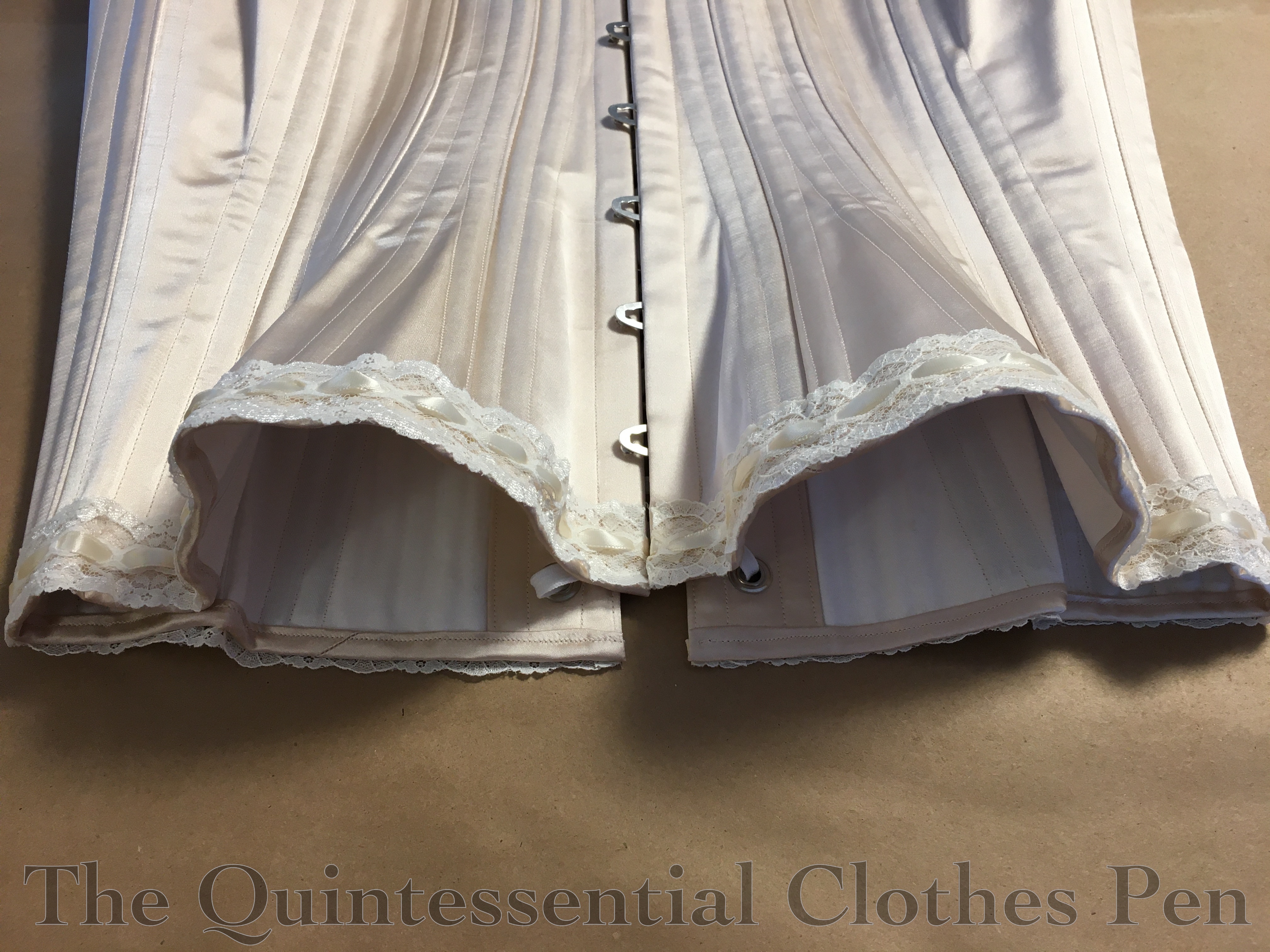
At this point the corset was basically done! The only things left were to add ivory beading lace and ribbon around the top and silk flossing along the bottom of the boning channels.

I was excited that I had all of the necessary materials in the stash, including the silk thread in the perfect ivory color.

I’m very pleased with the end result. It takes all the struggles and things I learned along the way with my yellow corset and perfects them, creating crisper folds and finishes and a comfortable garment with a great silhouette.

There’s no trickery in the next photo, this corset holds its shape with no support other than what is built in!

Early & Mid 19th Century Commission For NSCDA-MA

I find great joy in the pursuit of researching and making historical clothing. Here on the blog, I post most often about the garments I make for myself, but I rarely post about commissions to make custom historical garments for private individuals, museums, historical institutions, etc. Today’s post is different from the usual in that I’m going to share a commission project with you!

This commission came about through the kindness of Myrthe, who blogs at Atelier Nostalgia. (And how fitting, that we were just communicating about how wonderful it is to connect with people who love historical clothes from around the world!) The commission was from the Massachusetts Chapter of the National Society of the Colonial Dames of America (NSCDA-MA).

The NSCDA-MA owns the beautiful William Hickling Prescott House in Boston, which was built in 1808 and upgraded throughout the 19th century. The NSCDA-MA website (linked above) shares many more details about the various owners of the house and its architecture. In addition to the house itself, the NSCDA-MA also holds a wonderful collection of historical clothing, some items of which have been used for display purposes throughout the house (though most of the garments are in storage and only available for research visits by appointment). Unfortunately, historical garments are often not suited to permanent display as they can be made of delicate fabrics that can be damaged by light, dust, and gravity, just to name a few possible problems. The NSCDA-MA was looking for custom made historical dresses to display instead of the extant historic garments and I was very excited to work with them to make that goal a reality!

The commission involved two dresses: one from about 1810 and one from about 1845. The two dresses haven’t been mounted yet and aren’t available to visit due to ongoing closures, but I hope to eventually go see them in one of the glorious rooms of the house. For now we’ll have to make do with flat photos that were taken for my own archival purposes.

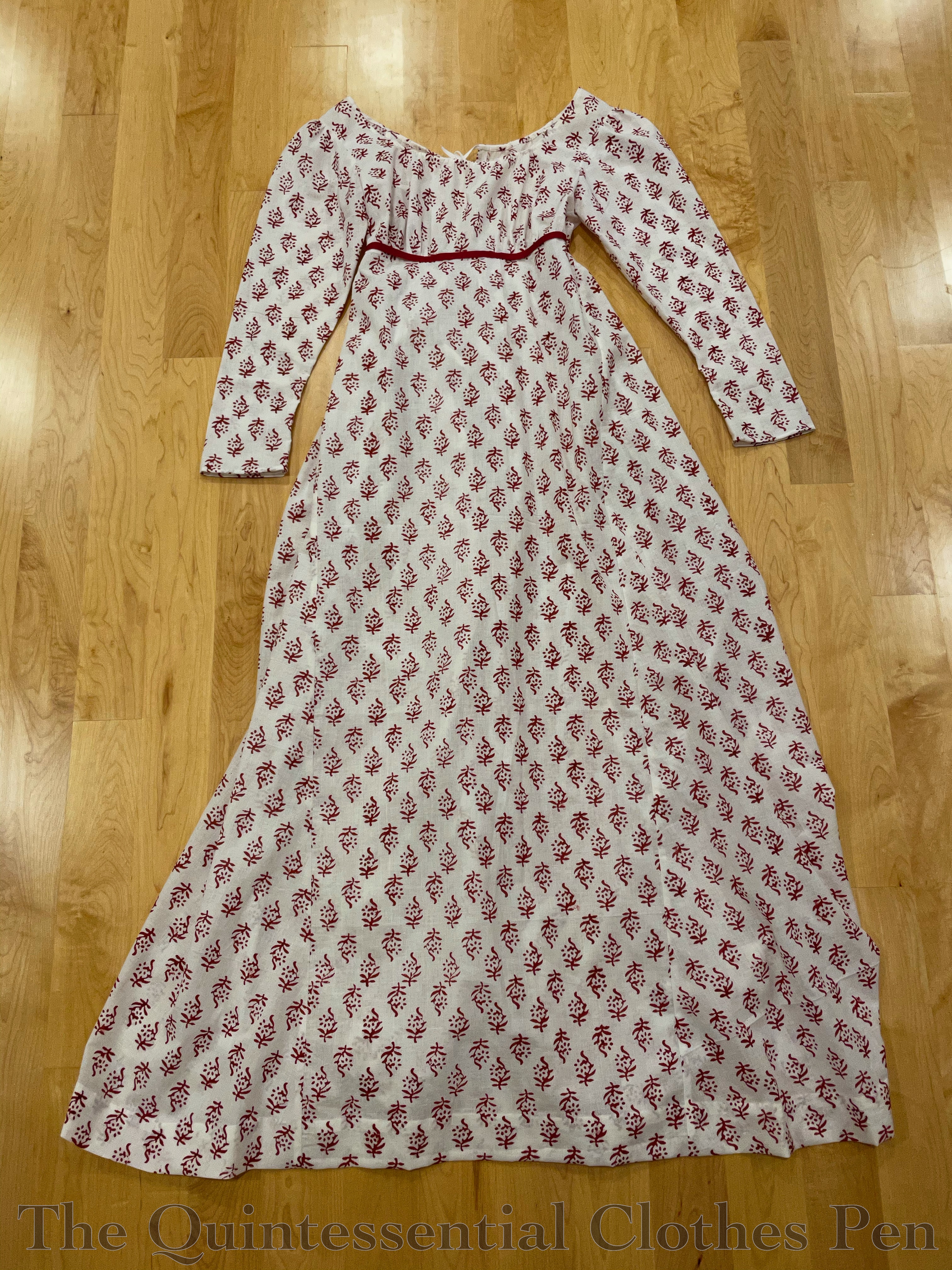
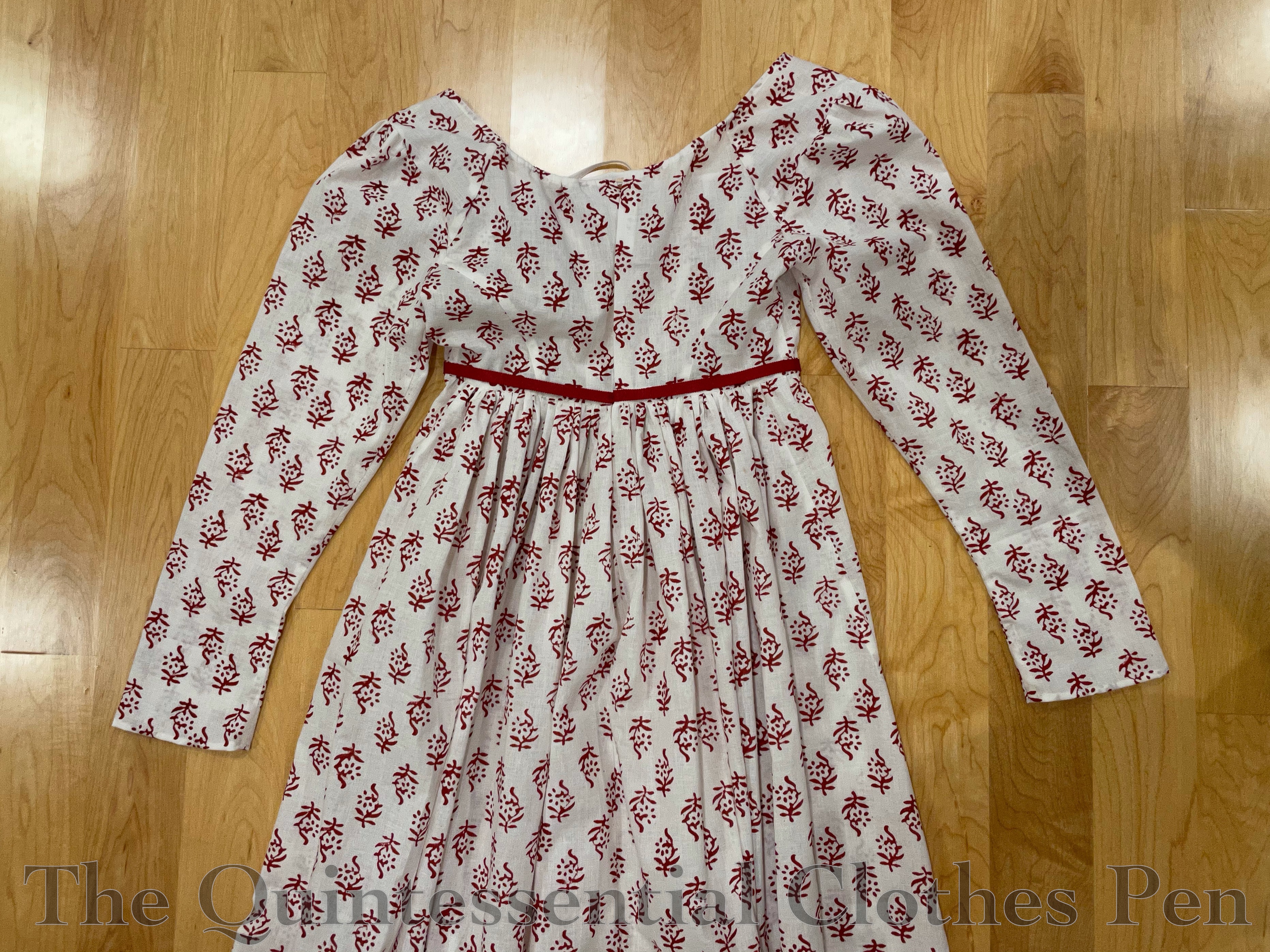
The c. 1810 dress was inspired by a few different dresses, including this c. 1810 cotton dress held by The Metropolitan Museum of Art. The goal was to merge the inspiration dresses into one dress with a repeated pattern on cotton, an adjustable drawstring neck, and long sleeves. In order to support the silhouette and provide opacity I also made a bodiced petticoat to go with the dress. Below are front and back views.

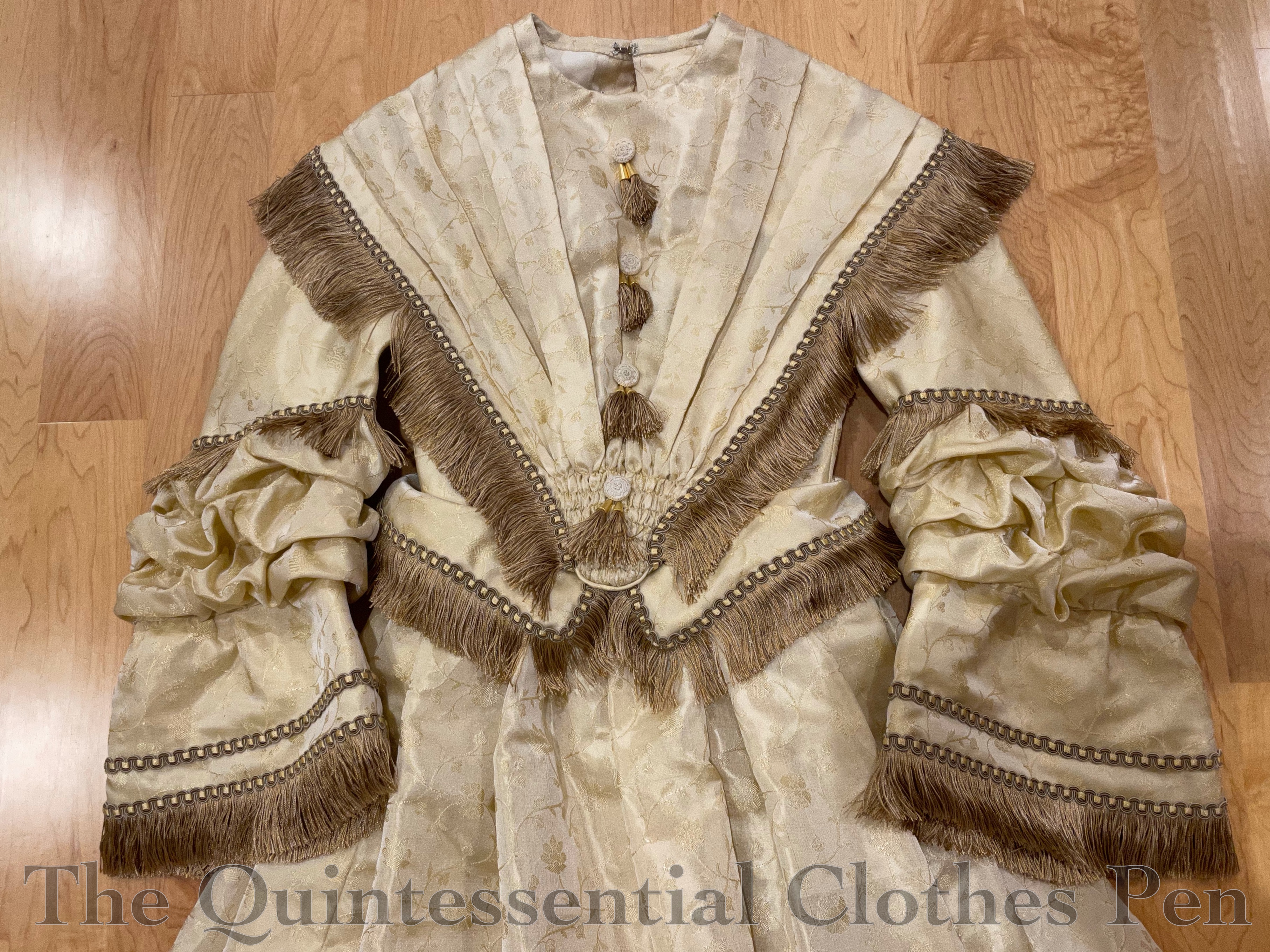
Unlike the first dress, the c. 1845 dress was inspired by this specific c. 1848 silk dress held by The Met. The goal was to keep the details of The Met inspiration dress but make the new dress proportional to the measurements of the form that would be wearing it. The dress includes extra structure to help the bodice keep its shape even without a corset underneath. Below are a full length front view and a close up of the bodice.

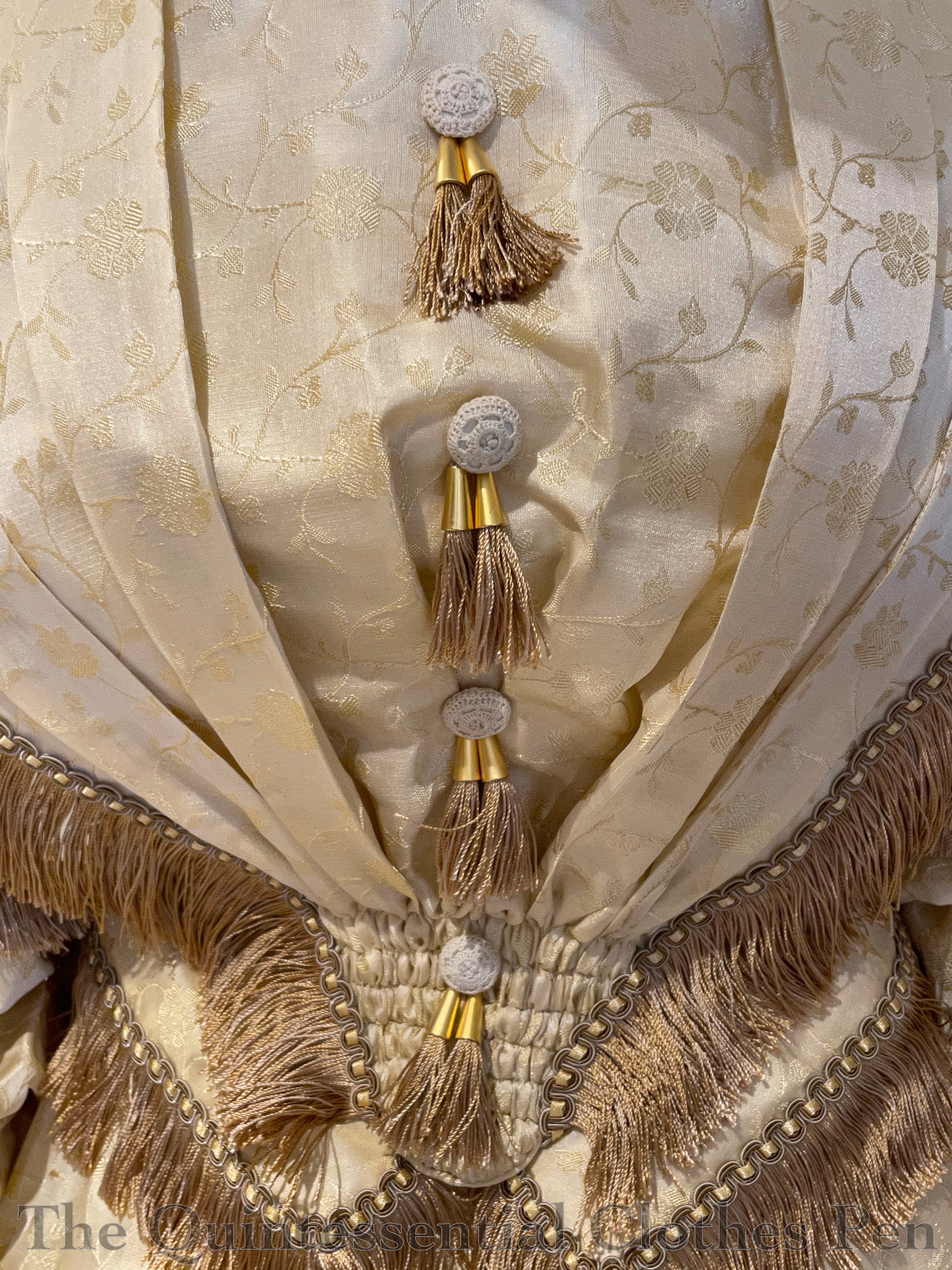
I had lots of fun finding trimmings for this dress that recalled the original. In the case of the tassels, I combined sections of the fringe with tassel tops and vintage passementerie buttons in order to get the right look and create tassels. Below, a closeup of tassel parts and the final result.

The designs of each dress were settled on with much collaboration to determine fabrics, trimmings, style details, and more. Both patterns were individually created to fit the requirements and specifications for each dress. Both dresses use a mixture of machine sewing/modern methods on the interiors and hand finishing on the exteriors. This speeds up construction and provides the necessary foundation for the dresses even without a full set of supportive undergarments.

I love projects like this! It’s so wonderful to collaborate with others who appreciate the minute details of historical clothing while also making garments that can be used to help interpret history to the public. These sorts of projects are often initiated through word of mouth suggestions, so please reach out if you know of museums, historic sites, historical societies, etc. who are looking for this type of collaboration!