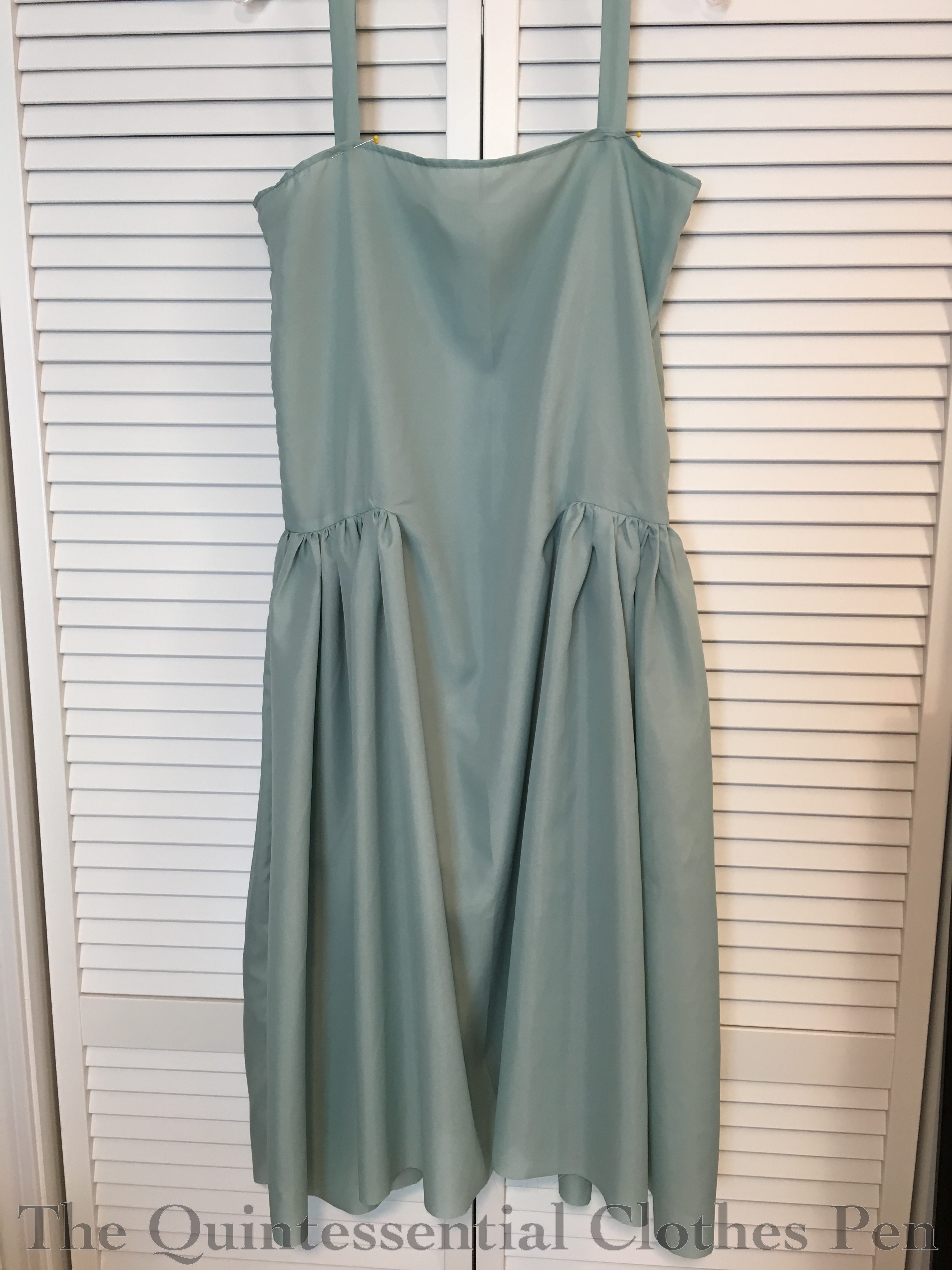
Project Journal: 1863 Apricot Evening Gown Part I: The Plan

It’s been a few years (three, I think) since I made a new mid-19th century evening gown. I have three evening gowns from this era that currently fit and they are kept constant rotation at events each year. It’s nice to change it up and have different dresses to wear, so I’ve decided I want a new dress!

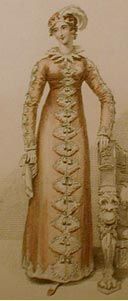
My goal is to keep the cost down on the new dress, so I went through my stash binder to look for fabrics I already own that would work for this project. I also went through my inspiration for dresses from this period, settling on a lace trimmed dress in an illustration on page 208 of Cunnington’s English Women’s Clothing in the Nineteenth Century.

It’s the dress on the right that I like, the one ‘Of white tarletan; double skirts flounced with black lace’. However, I’ve decided to make my dress in apricot colored silk. This is due in part to the fact I had yardage enough of apricot silk in my stash, but I think the idea was also influenced by the description of the dress in the center of the illustration. I think I had apricot on the brain!

The apricot silk was purchased in 2016 with no particular project in mind except the general idea of being a historical dress. It has slubs and is definitely a shantung and not a taffeta. That’s not great for historical garments for many periods, but there are a few points in its favor.
a) it was already in the stash in enough yardage for this project
b) the multiple bands of trim on the skirt and generous bertha will distract from the slubs
c) it’s a color of dress that I don’t have too much of and that I don’t have any of in this time period

That explains the color choice, but I’m not planning for my dress to have a double skirt. To me, it looks like the white tarletan dress is drawn in a way that looks like a single skirt with lace trim applied at multiple heights rather than a double skirt. This type of applied skirt trim around the entire circumference of the skirt is common in the first few years of the 1860s, so I’m going with idea. I’ll share more about my skirt trim inspiration that when I get to that point in the process.

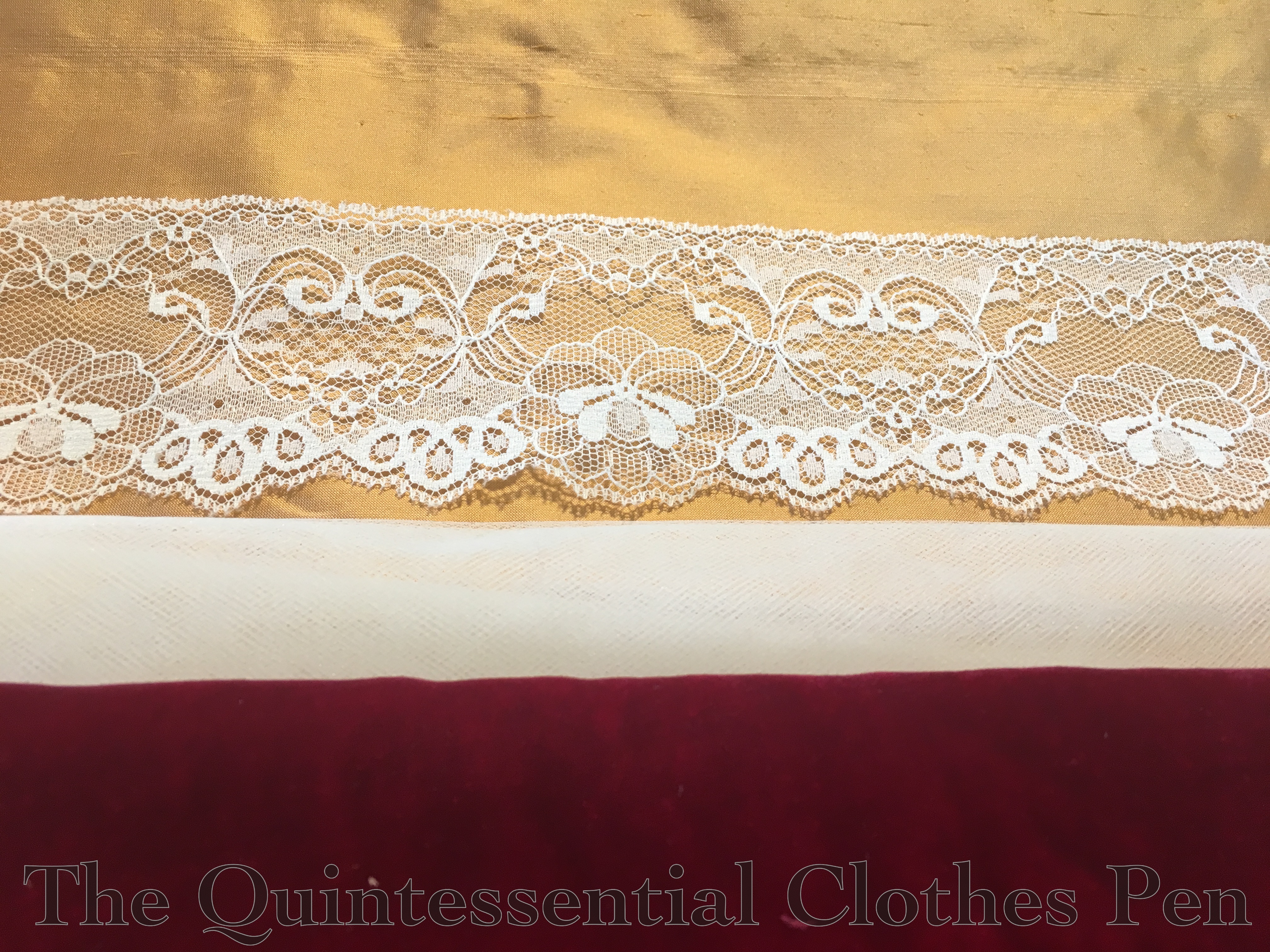
For now, if we were to describe my dress in Cunnington’s style, it would be ‘Of apricot silk with cream lace and red silk velvet bows’. There might be some tulle mixed into the bertha as well, we’ll see when we get there. Here are my fabrics, with a stand-in lace (I estimate needing around 35 yards of lace for this dress–not a quantity that was already in my stash–so that was the one section of the project that needed to be purchased).

Plan? Check. Fabric? Check. Next step, a pattern. That’s where we’ll start in the next post in this series.

1926 Silver Robe de Style Second Styling

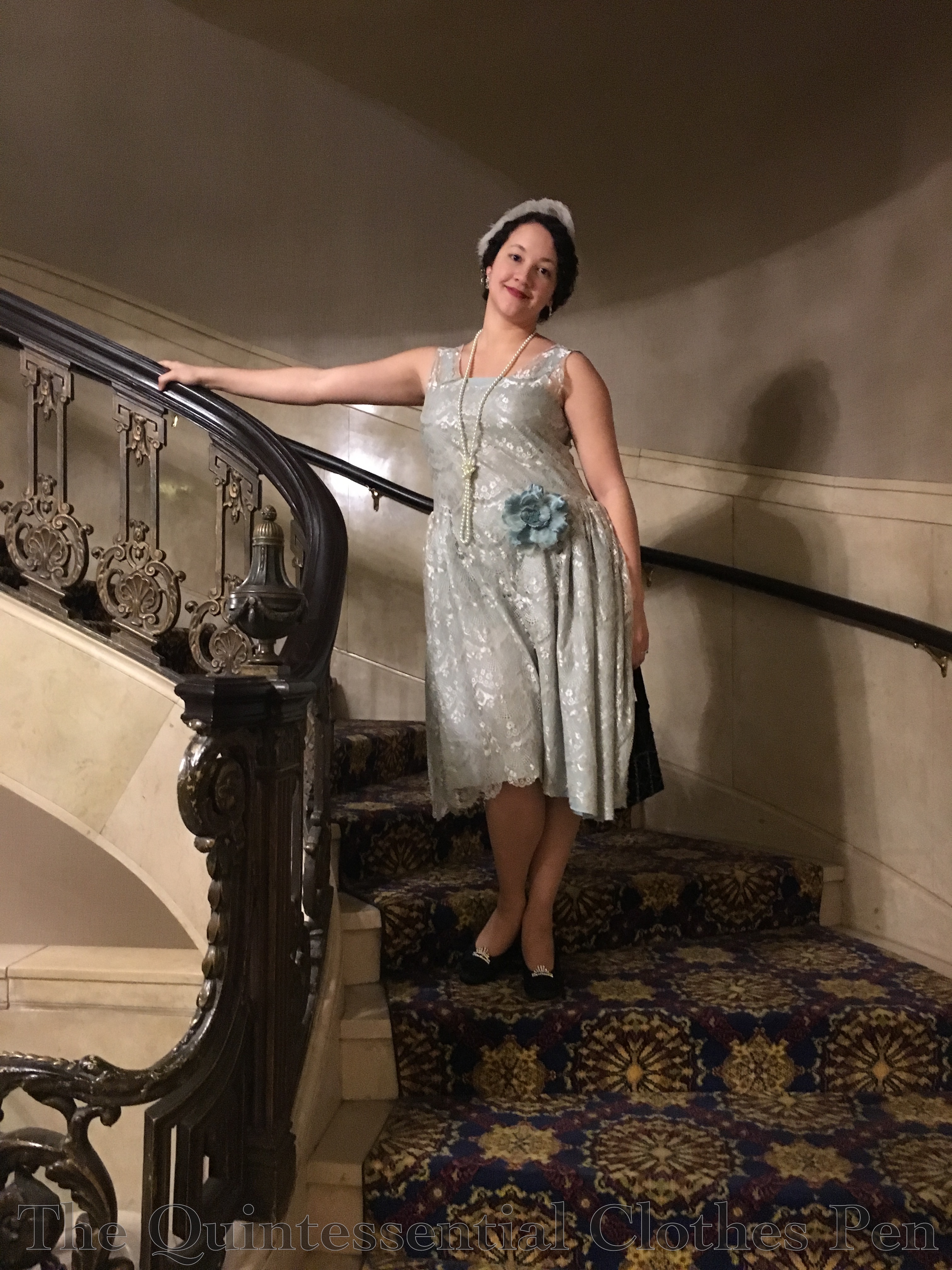
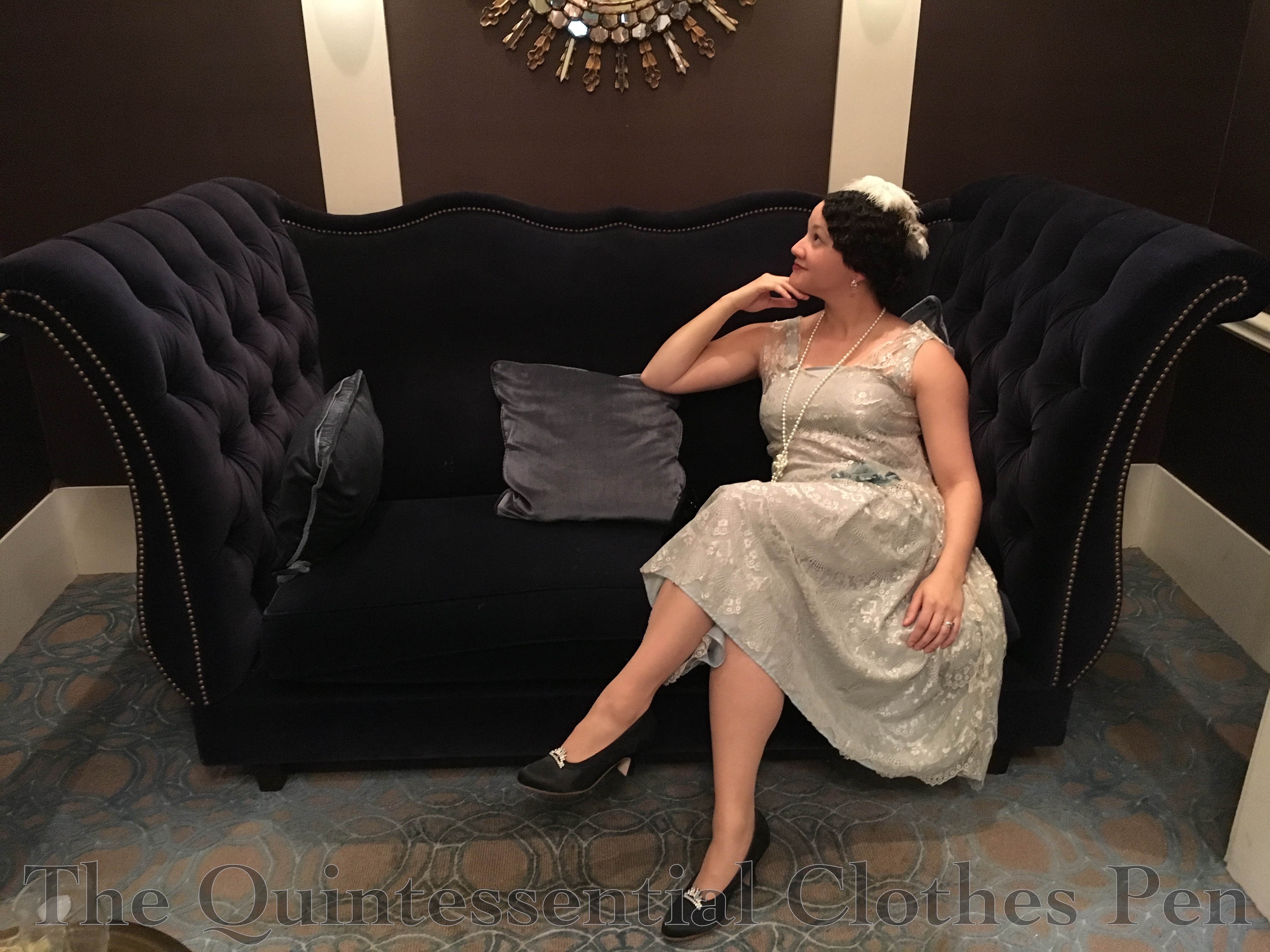
Today I have a new dress adventure to share with you: the second wearing of my 1926 Silver Lace Robe de Style to a Gatsby Ball in January. The last time I wore this dress was last August, so it was fun to bring it out again. I thought it fit in nicely with the idea of blue and silver for the new year, even though it wasn’t technically a new year themed event.

The robe de style dress was popularized during the 1920s particularly by the designer Lanvin. This alternative to the popular straight silhouette dresses of the 1920s is characterized by a dropped waist with wide skirts. Many of these dresses have panniers in them that are borrowed from the style of 18th century court dresses. Here is a little more information about the robe de style from the FIDM museum if you’d like to read more.

I have another more dramatic robe de style already, so this lace one is more of a nod to the robe de style, with softly gathered sections at the hips and no panniers or other understructure.

(My 1924 Golden Robe de Style is the more dramatic one. I made that dress in 2015 and posted about the construction of it this past post. Since then I have updated the trim on it to be much better suited to the dress. You can see the new trimming in these two past posts: in 2016 and in 2017.)

Last August I wore this dress with silver accessories: silver American Duchess Seaburys and silver hairpins. This time I decided to try my black Seaburys with silver rhinestone shoe clips, an ostrich feather/rhinestone hairpin (this is the same decoration I had in my hair for my 2016 Versailles look–how fitting to wear it again with a dress that has a nod to the shape of the gown I wore that night!), and my newly made black velvet handbag. It’s a bit hard to see the handbag in these photos, but if you look for it you can spot it in one hand or the other in most photos. Trying to show it off and not look ridiculous was a bit of a challenge.

(As a another side note, that same hairpin works really well for the 1890s, too! Who knew it could so easily shift between not only decades, but centuries!)

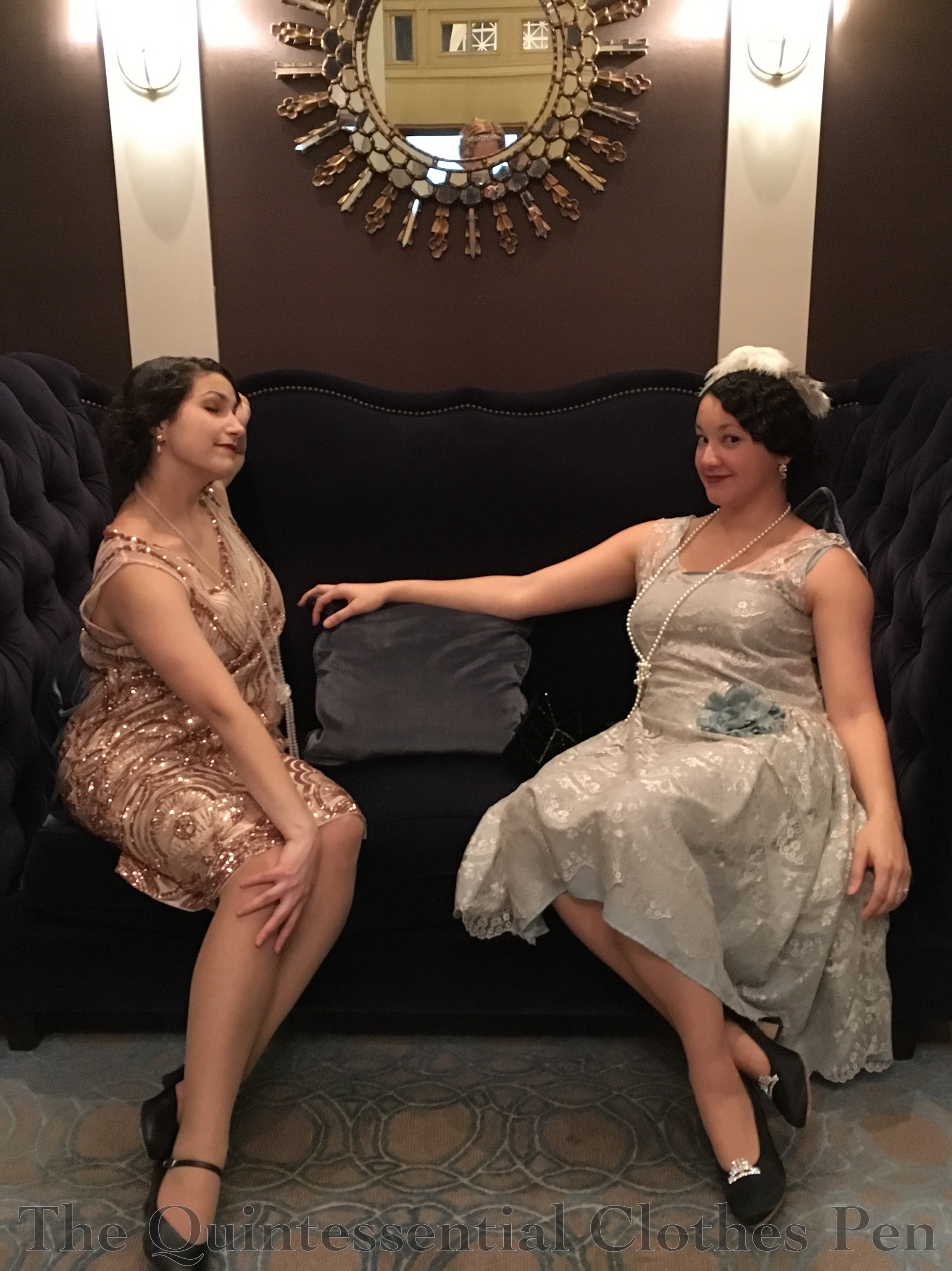
While packing and getting dressed, I couldn’t decide which dress to wear to the ball: this silver robe de style or my 1927 Blush Sparkle Dress. I brought both of them with me to the event and only made a decision when I realized that a friend hadn’t brought a sparkly dress to wear. (Never fear, she had a dress, just not a sparkly one!) The fabulous architecture of the The Fairmont Copley Plaza Hotel really called for some sparkle, so I wore the robe de style and loaned her the blush sparkle dress. It was fun to see it sparkling around the ballroom!

Showing off two different styles of 1920s dresses. Blush Sparkle on the left and Silver Robe de Style on the right. It’s hard to lounge and not look silly. This was one of the best we got!

After the second wearing, I am still pleased with this dress. It’s fun to dance in and a bit unusual in style: qualities that suit me perfectly.

I think I like this dramatic black and ostrich styling best so far. Do you have a preference between the first styling with silver accessories and this second wearing?


1926 Silver Lace Robe de Style

One of my summer sewing projects was a new 1920s robe de style. (And yes, I am clearly delayed in posting about it!) I already have one (my 1924 Golden Robe de Style) but I stumbled across a lovely lace at Joann Fabrics in the spring that called to join my wardrobe as a second dress in this category. I attend enough 1920s evening events that I can never seem to have enough dresses. Doesn’t that sound grand written out? I actually do have plenty of dresses, but it’s nice to have variety and cycle through different styles, types of fabrics, weights, etc.

I’ve enjoyed wearing my first robe de style and wanted to try another one with different characteristics. The 1924 golden one is made of silk taffeta and has an ankle length skirt, but I wanted this one to be much lighter weight and shorter in length. I also wanted a different neckline. After looking through my Robe de Style Pinterest board for inspiration I settled on this dress, a Boué Soeurs robe de style from fall/winter 1925-6. This is where my date of 1926 for my new robe de style comes from.

Obviously the lace is not opaque so as with the original dress I needed a lining. I settled on the icy blue because it was from my stash. (You’ve seen this fabric before, in my 1899 evening gown.) It was great to use a stash fabric for cost saving and stash-diminishing purposes as well as the fact that the colors coordinate. And, I was able to accessorize with a large flower pin in a very similar color that has been in my stash since before I had a fabric stash! Isn’t it wonderful to find good homes for odds and ends like this?

In addition to the flower pin, I also wore my extra long strand of faux pearls, my American Duchess silver Seabury shoes, and vintage silver hair pins. Oh, and earrings. But I can’t remember which ones and I can’t tell from the photos which pair they are. I’ll have to figure that out again next time I wear this dress!

The pattern for this dress is me-made, composed of mostly rectangular shapes based on my measurements. The body of the lining is basically an upside down T shape, where the sides are gathered into a slit that extends into the main body on each side by a few inches. (You can see what I’m talking about in the photo below.) The lining has a straight top edge with rectanglur straps attached. The hem angles down slightly on the sides intentionally. I still wanted an uneven hem as with my 1924 dress, but I wanted a less dramatic difference than with that dress.

The lace layer was a little more complicated. I wanted an uneven hem to match the lining, but I also wanted to keep the hem following the scallops across the fabric. So… I had to keep my hem straight. That means I had to make the tops of the sides curve up since the bottom couldn’t curve down, but that meant I couldn’t cut my lace layers as a T, because the curve up would cut into the sides of the dress.

My solution was to add a seam across the lace pieces at the height of the gathers. To do this I perfectly matched the scallops, carefully layered and stitched them with a narrow zig zag, and then trimmed away the excess fabric to make the seam almost entirely invisible. Can you spot it in this photo?

I also had to trim away the ‘eyelash’ bits left over after cutting along the scalloped pattern along the hem. This photo shows that step in progress. A bit tedious, but worth it!

Unlike the lining with its straight top edge, the lace has a v neck on one side and a scoop on the other. This layer is interchangeable in terms of which is front and back, since they’re the same with no special shaping. The edges of the lining are finished by machine while the neckline and the armholes of the lace are narrow hemmed by hand.

This new dress can be worn with or without panniers, but for the first wearing I went without in order to make the full skirt more subtle and to differentiate the dress from my 1924 Golden Robe de Style (which needs to be worn with panniers).

While this dress could be worn at any time of year, I am particularly enchanted with the idea of it being perfectly suited to a 1920s New Year party. The colors and silver lace seem well suited to that theme.

And on that note, in case I don’t get another post in before 2019… happy new year!

1925 Lace Cloche

I knew I wanted a cloche to go with my 1925 Blue Coral Dress from early on in the process of making it. It was going to be hot when I wore the dress, so I knew I wanted something that would both look and feel lightweight. Turns out any hat was warmer than a bare head (well, one with hair on it!), but that being said, I think this was on the right track with a lightweight hat.

I considered making the cloche from fabric, but couldn’t decide on a style with seams that I liked. However, as I was browsing my Pinterest board, my eyes kept settling on straw, horsehair, and lace hats. It seemed like that was the way to go.

I didn’t have any particular materials on hand or in mind for that type of hat but I had come across a modern cotton lace cloche on Amazon for $14 that seemed like a good starting point. It’s no longer available, but I’m sure a careful search could find something similar. To the right is what it looked like before I started changing it up.

Generally, modern cloches have such a deep crown that they don’t leave any space for hair arranged on the back of the head. I have long hair, so that just doesn’t work for me. Cloches from the 1920s frequently have a cutout in the back to allow for your neck… or hair! They also have more interesting brims than modern cloches often do. Perfect. That’s what I wanted. An interesting brim and a cutout for my hair.

With my design plan in place, I started disassembling the modern cloche. First, I removed the braided band and flower. Then, I started unwrapping the lace on the brim, taking out the stitching that held one circumference to the next. I stopped at the bottom of the crown. I removed the inner hat band for most of the way around the hat, so I could stitch the new brim shape and the back cutout without stitching through the hat band.

Next, I played with the lace I had unwrapped for the brim to decide on a new shape. Once I made some decisions I had to make a few shorter pieces out of the lace, but most of it I tried to keep intact. In the back, I decided where I wanted my cut out to be… and cut it! Then I bound the edge using the lace and topstitched it down to encase the edges.

It was a bit tricky to find an acceptable shape for the new brim. The first few tries were so similar in shape to the crown of the hat that they hardly showed when I put it on my head. I ended up with a brim that flares out a bit so it stands away from the crown of the hat, especially in the front. I had to be careful to cover the ends of the plastic horsehair braid that backs the cotton lace, as it is very poky when cut. I covered the ends either by turning them under or having the inner hat band cover them.

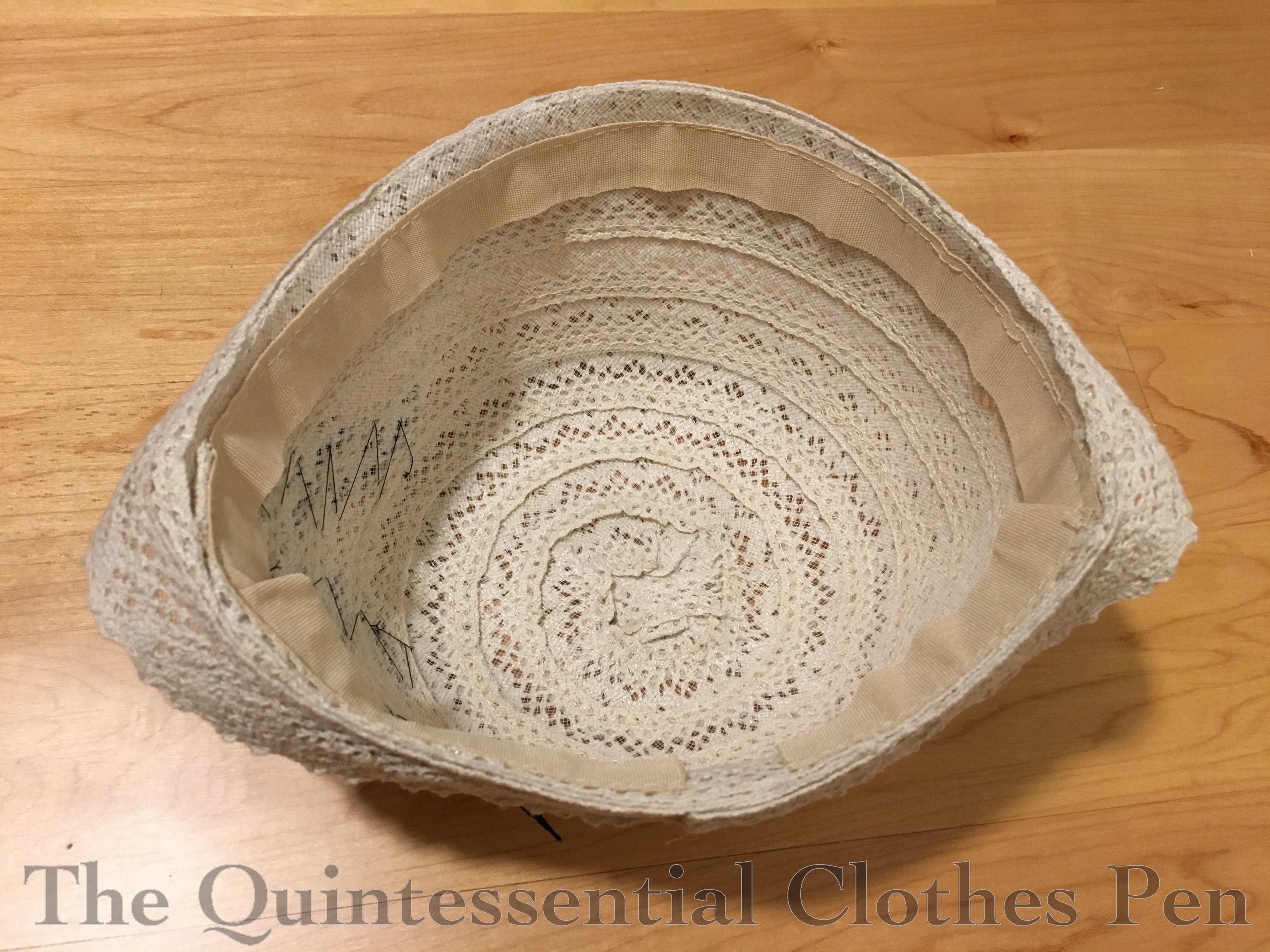
After sorting out the brim and back cutout it was time to reattach the inner hat band. Then I sewed on my trim. Here’s what the hat looked like on the inside after all that.

I’ve loved Leimomi’s cloche decoration in this post since she posted about it in 2014. Having that in mind, I thought of what bits of trim I already had in my stash and what might work for this hat. I decided on a random yard of navy grosgrain ribbon, which I cut into thirds, pleated, and attached in imitation of this hat.

When I styled my hair, I tried to have hair come down to my jawline more than I usually do. I think cloches look less silly if there is some hair showing around them. My hair didn’t really look like a bob, but at least there was some hair showing in the front. In the back, it was pinned into a low twist-y mass of curls.

The great thing about the materials of this hat is that they are intended to be flexible for packing and traveling. Not only is it easy to store this hat but it’s also easy to remove it at a picnic and leave it on the blanket or put it in a bag without worrying that it will be damaged. It can get crushed and bounce back into shape!

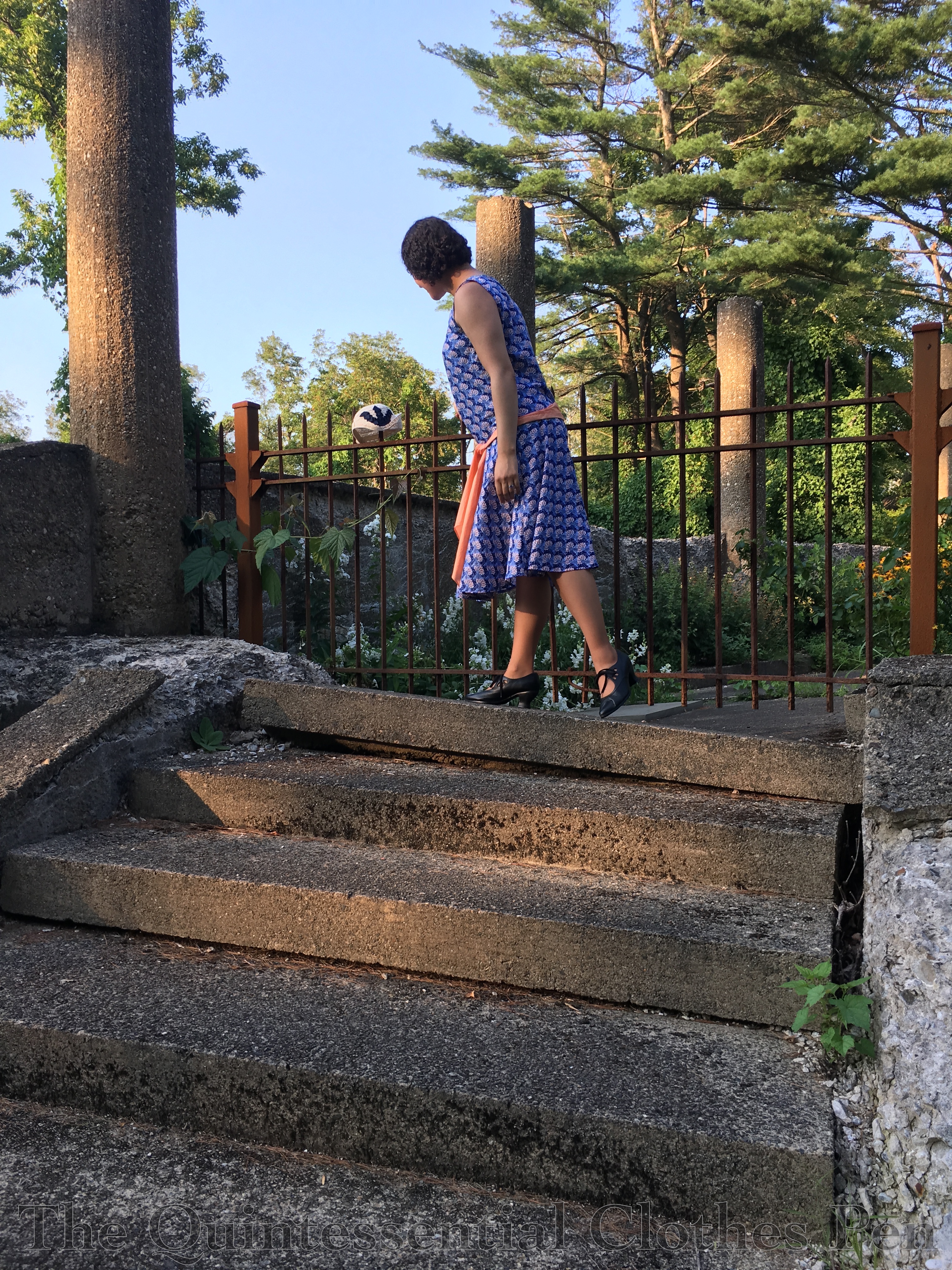
In the end, I continue to think my head looks like an egg when I wear a cloche. I like styles that don’t hug my head better! That’s my own feeling–other people don’t think it’s nearly as egg-like as I do! But as egg-heads go, this was better than some attempts, so I think we’ll call it a success! It certainly looks cute on the fence!

1814 Orange Boven Pelisse

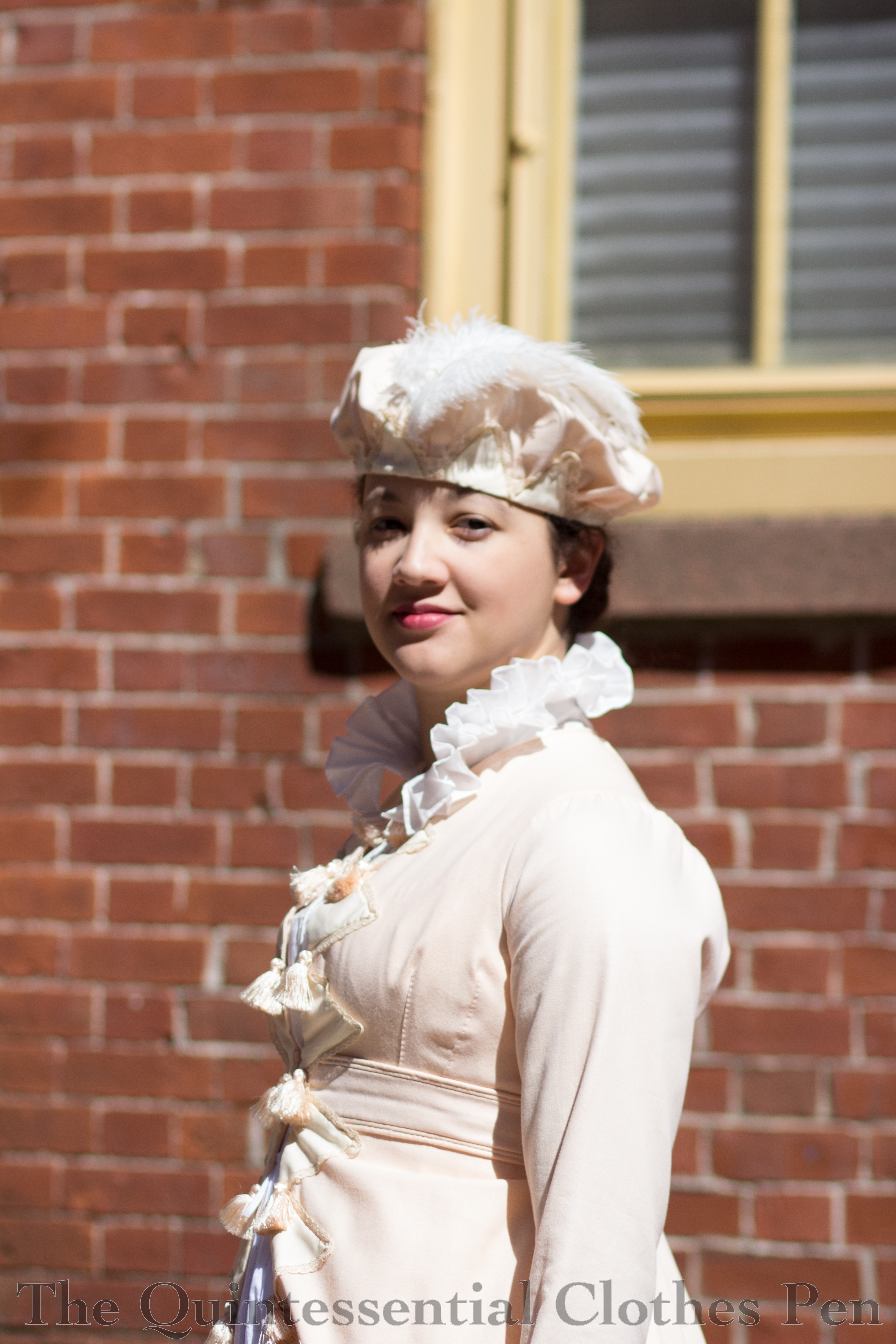
At least three years ago I was inspired by a fashion plate, as one often is, and started working on a Regency pelisse following the design in the image. I got really far along, finishing the construction and even part of the trimming, but then stalled and let the ensemble languish for years before determining to pick it up and finish it off this year or else! I’m excited to have finally reached a ‘done’ point in this project so I can remove it from the UFO list!

The pelisse (and hat) are directly inspired by the following fashion plate, which can be seen here with slightly different coloring and here in black and white. In the first of those two links, the garment is labeled as a dinner dress, but I thought the design would make excellent pelisse trimming and so I adapted it.

You’ll notice, perhaps, that the finished pelisse does not have as much trim on it as the inspiration image. Early in this project, before it languished, I cut out all of the appliqués for the neck, sleeves, and hem as well as the front edges. I pressed under a 1/4″ on each side of each piece, too. And then, as I was finishing all that triangle trim on the front earlier this year, two things happened:

#1- I lost steam and really just needed to be done with this project.

#2- I decided I liked the simplicity of the pelisse without the extra trim. It’s so easy to draw lots of details, but then in a real garment the details don’t always translate. For example, the triangles around the neck just looked bad and awkward (plus, I wonder if that is a chemisette collar and not trim on the dress itself?) and the sleeves just looked too crowded. I was also afraid that putting all that work into triangles around the hem would just get dirty and not be a good use of many more yards of the vintage lace I used to edge the triangles.

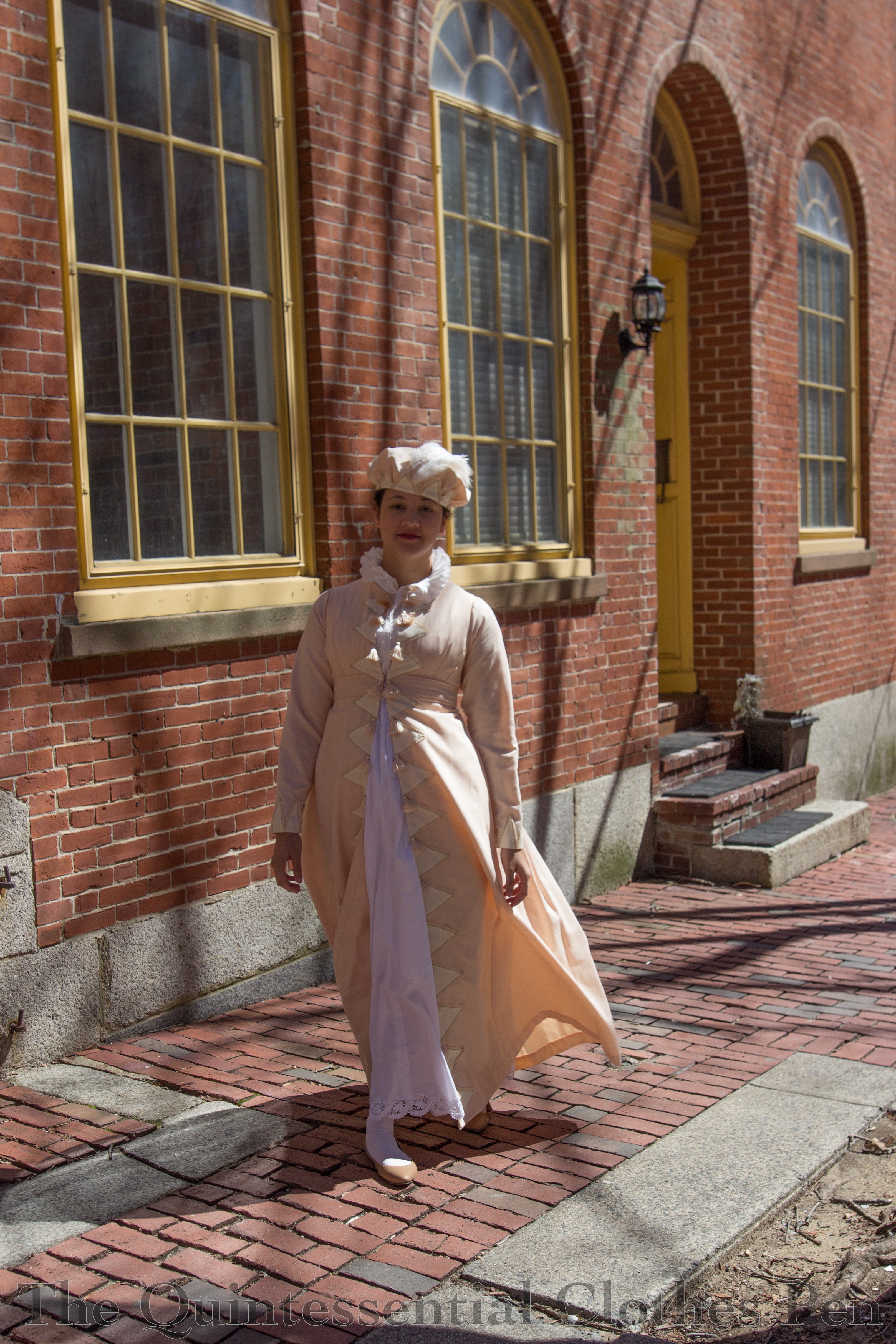
In fact, despite the somewhat-simplified trim, there are actually a lot of details in the construction of the pelisse. Each back seam is piped and the belt has double piping above and below it. The neck is bound with piping, which is sewn with small, invisible stitches around the neck to hold the seam allowance to the inside. Also, the skirt is knife pleated into the back, allowing for a nice silhouette from all sides.

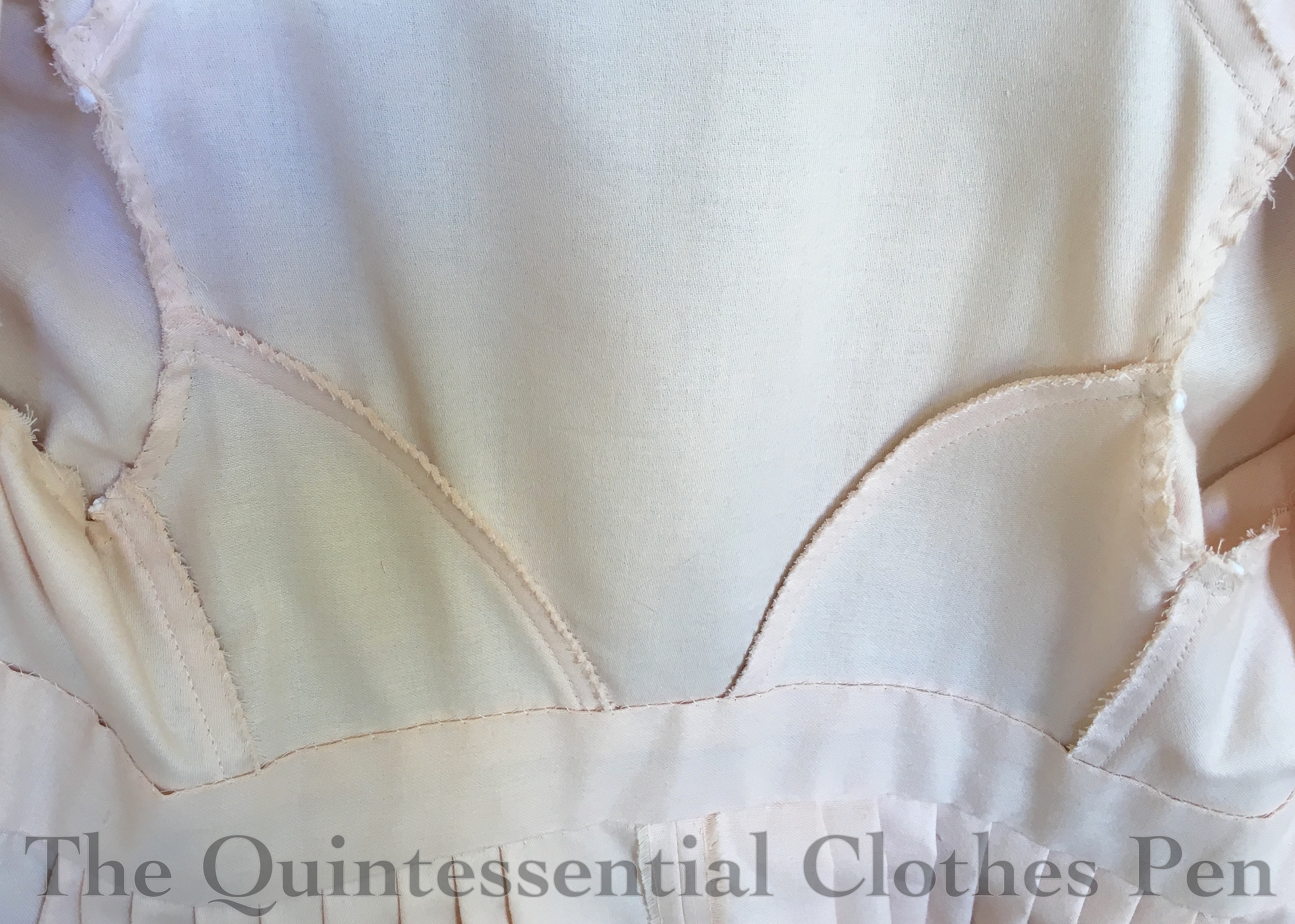
The pelisse is made entirely from peach colored cotton. It is unlined, except on the belt, where it is lined in order to hide the raw edges. The other seam allowances are whip stitched to keep them tidy. Here is an inside view of the bodice section. I do like my insides to be tidy!

The trim fabric is a cream colored poly/cotton blend. Each triangle is edged in very light tan vintage lace. Then, to top it all off, there are peach tassels on each triangle down the front as well. The peach tassels were removed from a length of upholstery trim that happened to be a perfect color match!

The pelisse is machine sewn on the interior seams and hand finished, including the hem, neckline, seam allowances, and all that trim. The darts are also sewn by hand with a small running stitch, a detail I picked up from looking at extant pelisses, though of course it’s been so many years now that I can’t find a specific example. I like how the top stitched darts at a little extra interest.

The pattern for this pelisse is of my own design. I’m pretty sure it was based on my 1819 spencer, but adapted slightly for a different fit. It’s hard to remember since it’s been so many years since I made the pattern! The skirt is a large rectangle–two panels of fabric seamed at center back.

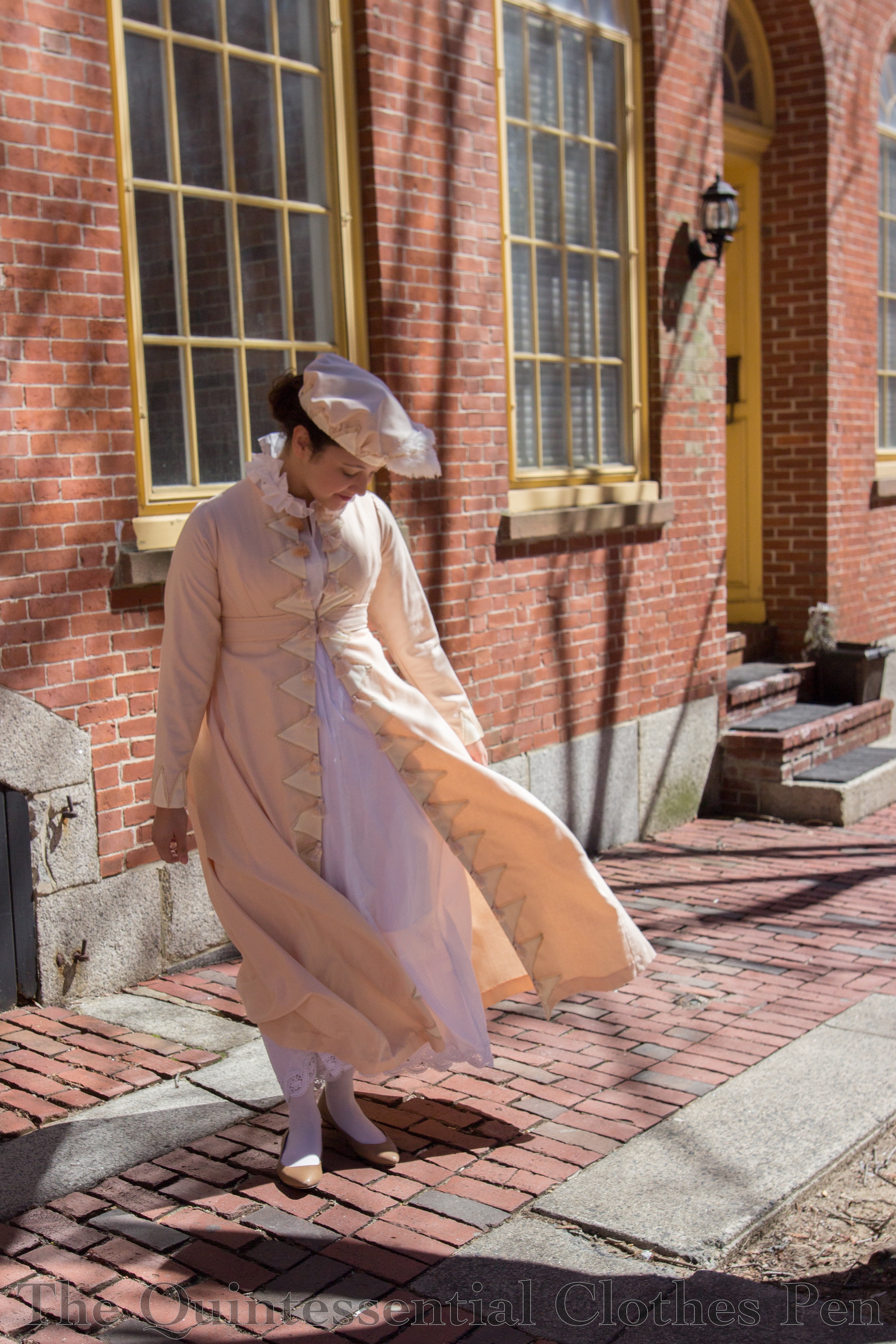
I’m wearing the pelisse with the following garments: a chemise and my short stays, my Vernet petticoat , my recently finished chemisette, and the hat that matches the whole ensemble. I’m excited to have found a use for the Vernet petticoat that shows off the trim at the hem! I did take out the tucks that made it the right length for my Witzchoura so that it would be the right length for the pelisse, but that’s what tucks are for, right? On picture day there was a nice breeze blowing everything around and showing off all the layers nicely.

I was lucky to take these photos in and around some of the Regency period buildings in Salem, MA. You can’t beat buildings from the right period for a suitable backdrop for a garment like this!

Now I have my first pelisse. More outings will hopefully arise in the future so I can wear it again. I’m so glad I’ve decided it’s finished and that it was a comfortable garment to wear, though I maintain that the hat is a bit silly.


Orange Boven Hat, 1814 (HSM#4)

I am pleased to report that I made a garment which qualifies for the HSM challenge #4: Circles, Squares, and Rectangles! I wasn’t sure I had anything on the sewing list that would do, but then I remembered years ago when I started this hat and it was only two pieces, a circle for the crown and a rectangle for the binding. Perfect! (I’m not counting the triangular trim. That’s just the trimming!)

As you might guess from the photo, this hat is part of a matching ensemble: a pelisse and hat from 1814. I’ve got lots of details planned regarding the inspiration for this ensemble as well as more pictures of the finished outfit, but for now this teaser will have to suffice. It gives context to the rather silly hat.

Just the facts:

Fabric: Pale peach cotton and cream (likely) poly/cotton blend.

Pattern: My own based on my head measurements.

Year: 1814.

Notions: Thread, two ostrich feathers, and about 1 yard of vintage lace.

How historically accurate is it?: I’m going to go with 95% on this one. It’s entirely recognizable in its own time and made in a way that is straightforward and consistent with historic garments. The materials are not 100% accurate.

Hours to complete: If I’m only counting the hat, about 3 or 4, since it is entirely hand sewn.

First worn: April 9 for a Regency tea.

Total cost: About $8 for the hat without the pelisse.

Masquerade! Paper Faces On Parade…

Masquerade!
Hide your face so the world will never find you!
Masquerade!
Every face a different shade…
Masquerade!
Look around there’s another mask behind you!

I’ve always wanted to attend a masquerade. This wasn’t quite the masquerade of The Phantom Of The Opera, not having sweeping orchestral music and head-to-toe colorful costumes, but it was nonetheless fun and a bit surreal in the masks-plus-fabulous-location-ness (I think a bit of a surreal experience is what makes a masquerade a unique experience, so this is entirely a positive description here).

Digressions about masquerades aside, back in November of last year I had the good fortune to attend such an event myself. The theme was 1960s, but I had recently acquired a 1950s dress that fit me so perfectly that it just HAD to be worn, so I opted to be a bit old fashioned for the theme of the party.

img_2086-1

The event was held in a very nice downtown hotel. We had a series of rooms including the ballroom, its foyer, and a parlor-type space far enough away from the music to easily chat and lounge. It was quite elegant feeling!

img_2040-1

Usually I don’t wear vintage or historical garments. I’d prefer to use them for study and don’t want to damage them. But I made an exception in this case and did my best to be gentle with the dress. I carefully mended it before wearing and then again after, as the delicate lace was pulling apart at the seams under the arms when I received the dress as well as after wearing it. My second version of the mend was to put gussets under the arms, using a tiny bit of leftover fabric I had from shortening the sleeves (I wanted to do this during the pre-wearing mend, but ran out of time). I think the sleeves were full length on the original owner, but they came down to an awkward mid-forearm length on me, so I shortened them to be a nice 3/4 length. I know! It was a hard decision to make, changing the dress, but I think it is in keeping with the period the dress is from and it allowed me to better fix the underarm problem, so I’ve come to terms with the choice.

Here’s a slightly clearer view of the bodice. The lace is backed by nude net and there is a silk faille band around the waist. The entire skirt is faille with an overlay of the same lace and horsehair around the hem for stiffening.

img_2048-1

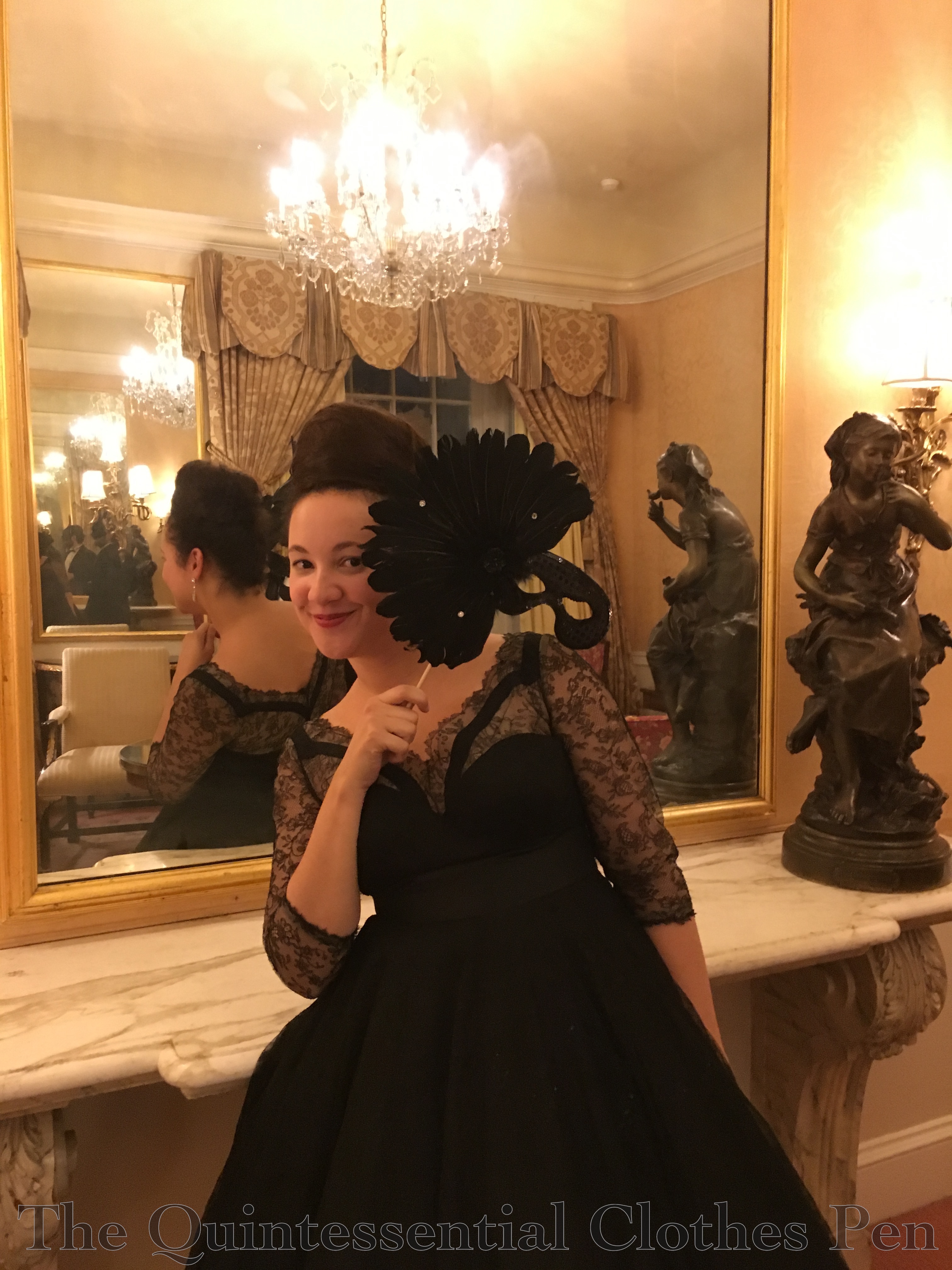
For my hair, I decided it was go big or go home, so I used my largest bun form (part of the base of my Versailles hairstyle) to create a giant poof-bun-thing on top of my head that’s a nod to the 1960s beehive. I think it was balanced out well by the feathers on my mask. Plus, in general I’m pretty good at making big hair work.

I put the mask on a stick so that it wouldn’t irritate my face and so that something like an elastic wouldn’t squash my huge hair. A bonus is that I could peek out from behind it, as in this picture.

img_2052-1

With this ensemble, I wore the same sparkly earrings I wore to Versailles and my silver American Duchess Seaburys with silver rhinestone shoe clips to make the ensemble even more bling-y!

img_2038-1

The event included food and dancing and chatting. I had a great time that was even better than I was expecting, though I think that was due to being tired after a long week of work and not really sure if the event would be a hit or not.

img_2110-1

My friends and I did lots of silly 1960s dances–the monkey, the swim, etc. (Are these really 1960s? I don’t know for sure, but in my mind they are…) These pictures of my dancing in the lobby are some of my favorite, partly because swishing around in my 1950s dress was so much fun!

img_2095-1

img_2098-1

img_2107-1

1899 Elusive Blue With Train

My last post recounted a fun event that I recently attended which explored the Victorian fascination with ancient Egypt. The event was unusual in topic, quite well done, and interesting, especially as I rather like ancient Egyptian history myself. I felt that I knew a good portion of the information in the lecture, but I also learned some new things.

I decided to leave my outfit for the event for this separate post so I could go into detail without getting too long winded. As sometimes happens, I committed just about two weeks before the event to having a new garment. A trained skirt! This event seemed very suitable–dramatic surroundings and no dancing being the biggest factors.

I had started a second, trained, skirt to go with my 1899 dress back in January, but it had languished at the point of needing hemming. Despite all the other projects also needing to be completed around this time, I decided to furiously work to hem the trained skirt so I could wear it to this event.

img_1993-1

img_1995-1

Success! The construction of the trained skirt is based on this gorgeous green gown at The Met. There is a side view of the skirt which shows just a bit of the under layers that support the hem. With that in mind, I scrounged for other extant examples of trained hem finishes and included them on my inspiration Pinterest board. This example, also from the Met, shows a clear view of the hem finishing on the inside of the skirt.

To replicate the wide and stiffened hem of the exterior I purchased polyester organza in a closely matching color and used it cut on the bias. The width of organza was folded in half to add an extra bit of support before being hand hemmed. The lining is hemmed with a bias band of an ivory cotton/poly blend that has a gathered section of lace machine sewn to the top edge prior to the hand hemming so the machine stitching doesn’t show. (Given that the whole dress is mystery fabric, I had no qualms about continuing to use polyester to keep the cost down on this project.) After hemming, I put the skirt on a dress form and pinned the lining and exterior together at five strategic points, then swing tacked the layers together. These tacks keep the exterior perfectly positioned over the lining.

img_2001-1

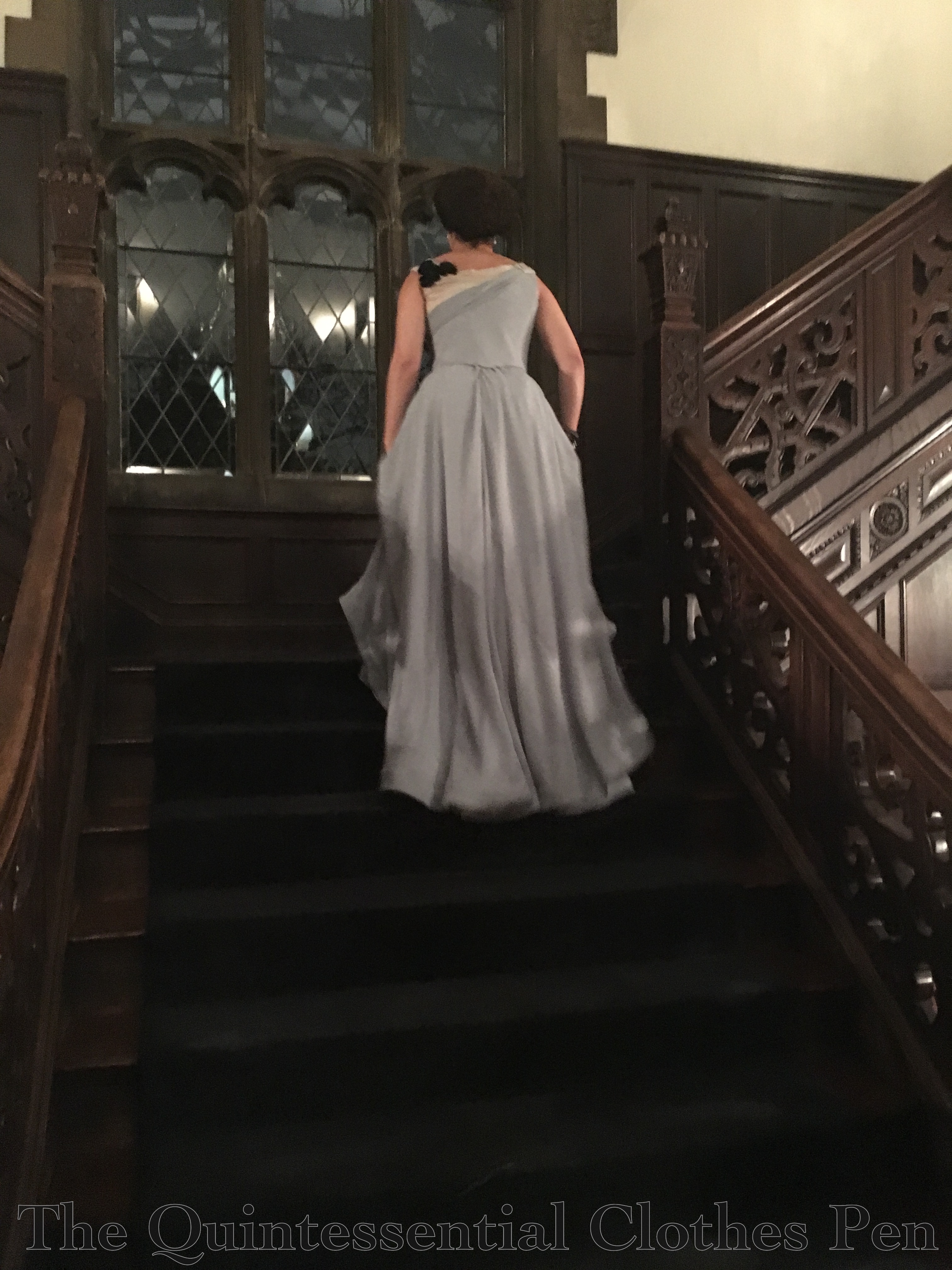
All of the extra work to support the hem layers was worth it. Along with my super silk petticoat to support the skirt, they nicely support the train, allowing it to elegantly float behind or swirl around me with just a small movement. It was quite fun to swish through the lovely rooms at the Castle with a dramatic train without it being so long that it becomes a nuisance. I’ll have to find more opportunities to wear this fabulous ensemble!

Project Journal: Versailles Sacque: Construction Details

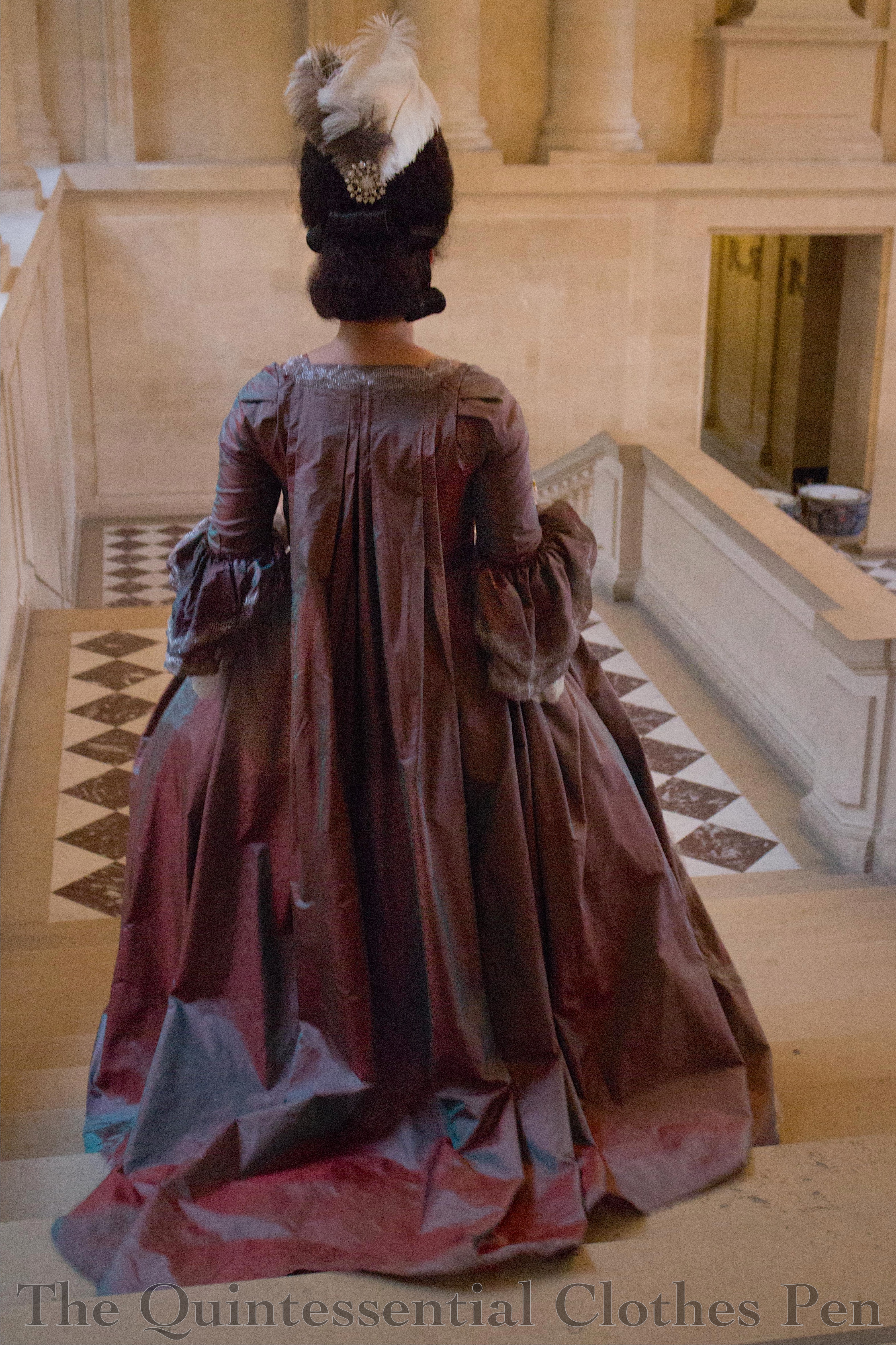
It’s time for some in depth detail about the construction of the robe a la francaise I wore to Versailles in May. My original plan was to use pink silk in my fabric stash to create a robe de cour inspired by Maria Federovna, but I realized when I went to cut out the pieces that I did not have enough fabric.

The change in plan resulted in new fabric and a new plan. I stuck with the decade of the 1770s, but decided to make a robe a la francaise, or sacque, instead of a robe de cour as it seemed like a garment I might be more likely to wear again in the future. Accordingly, I found and ordered new fabric: 11 yards of a very lightweight changeable silk ‘lutestring’ from Burnley and Trowbridge. Luckily, the new fabric still worked with the metallic silver net I’d purchased for trim. It’s the same metallic silver net that is on my 1885 Night Sky Fancy Dress, just cut into strips.

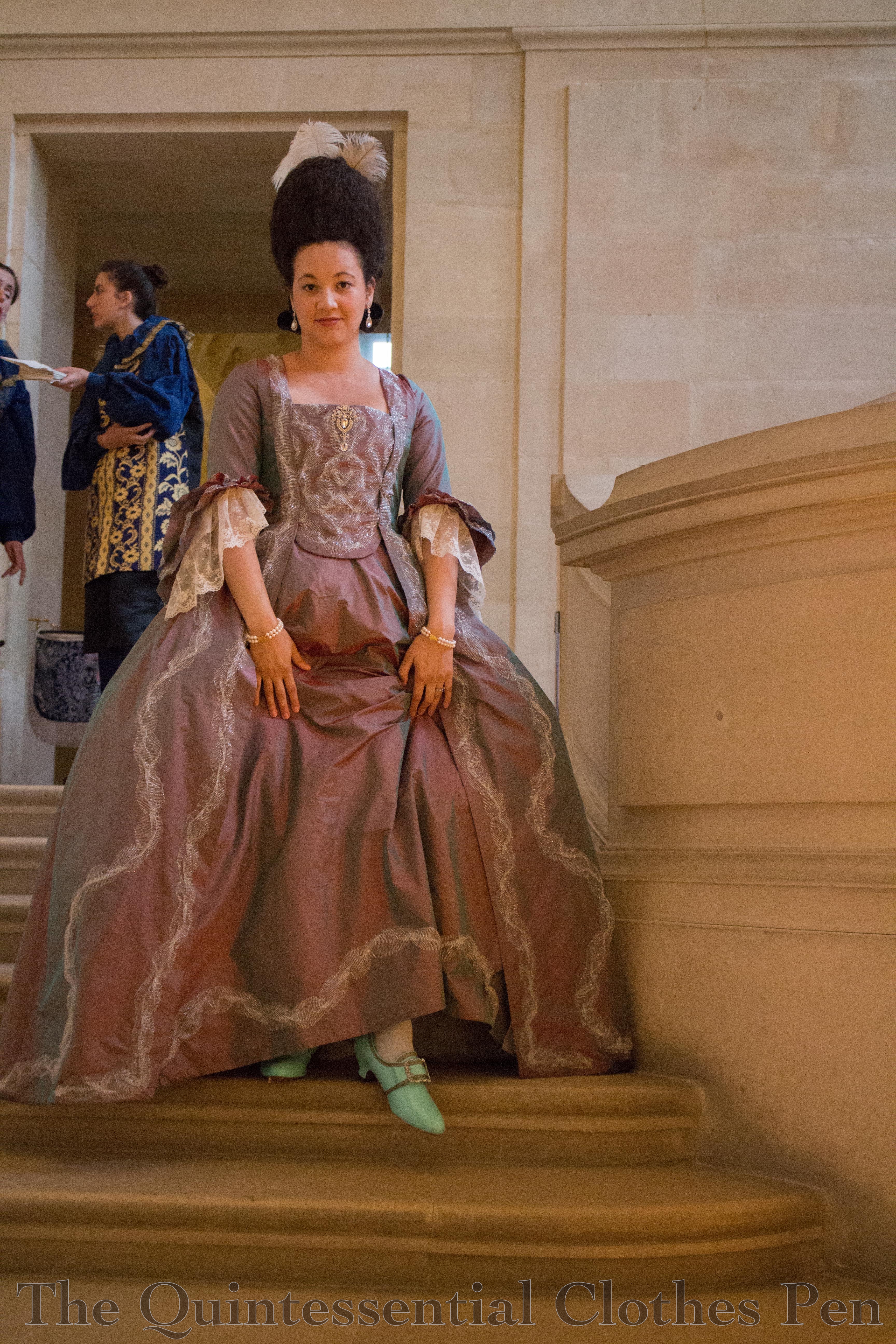
The pattern is from JP Ryan: it’s the Pet en Lair pattern, lengthened to create a gown as they suggest. Underneath I’m wearing a shift, stays, pocketsMr. Panniers, a generic 18th century petticoat, and the petticoat that matches the gown. I also have American Duchess clocked stockings and embellished American Duchess Kensingtons. All my jewelry is from eBay. You can read more about how I created my hairstyle and the hair ornament in this past post.

IMG_0258

Regarding the pattern, I found some of the directions to be confusing. For example, making the petticoat seemed way overcomplicated.   You can read more details about how I made my petticoat here. Also, I found the directions for pleating the front robings/facing and the back pleats quite confusing. There, I was saved by this post written by AJ who also used the JP Ryan pattern, got confused, and posted about the confusing bits. Very helpful! Aside from the confusing directions, the gown pieces went together perfectly with no trouble. I did have to alter the front strap area to make the front sit flat against my body. Two friends who used this same pattern did not have to make that adjustment, so I chalk it up to differing body shapes but do not think it negatively affects the pattern.

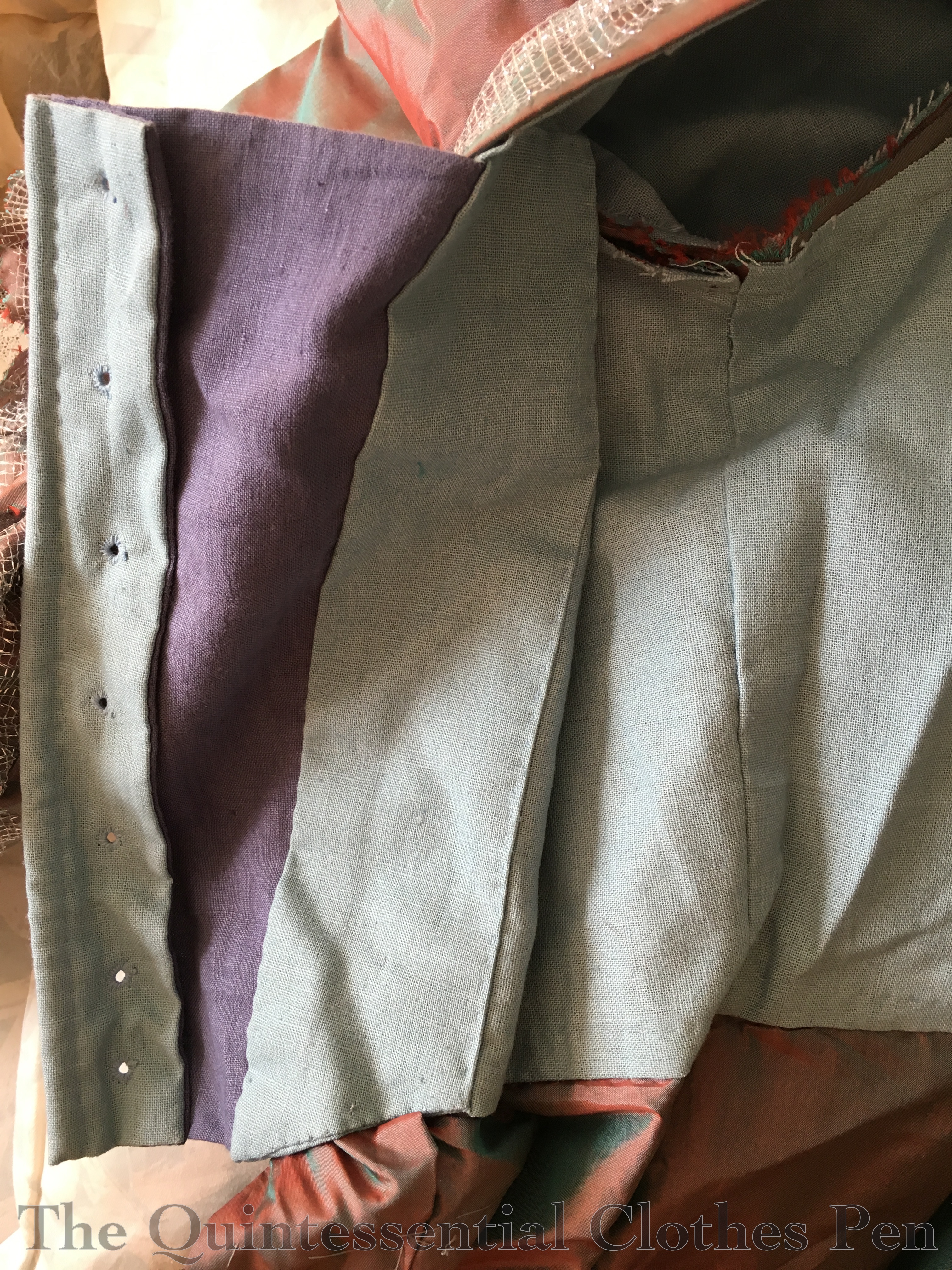
IMG_0687 (1)The lining of the gown is made from a one yard piece of cotton/linen blend from my stash. Also from my stash and used inside the gown were a scrap of medium blue linen and a scrap of medium blue cotton twill used to interface the stomacher. These were all the bits left of those three stash fabrics–yay! I was also amused that all of the random non-silk fabrics in this gown and petticoat wound up being blue. I used my lining as my mockup, meaning that I had to take a dart in the front strap area, but was able to adjust the pattern to eliminate the dart before cutting out the silk.

The back of the lining is adjustable using a tie threaded through eyelets. The edges are boned with reed. The pattern suggests ties, but you also see lacing in extant garments and this seemed easier to adjust and that it would use less length for the tie(s). There are examples of both ties and lacing on my Pinterest board for this project. The tie is a 1/4″ cotton twill tape. It’s not accurate, but did the job.

IMG_1476 (1)

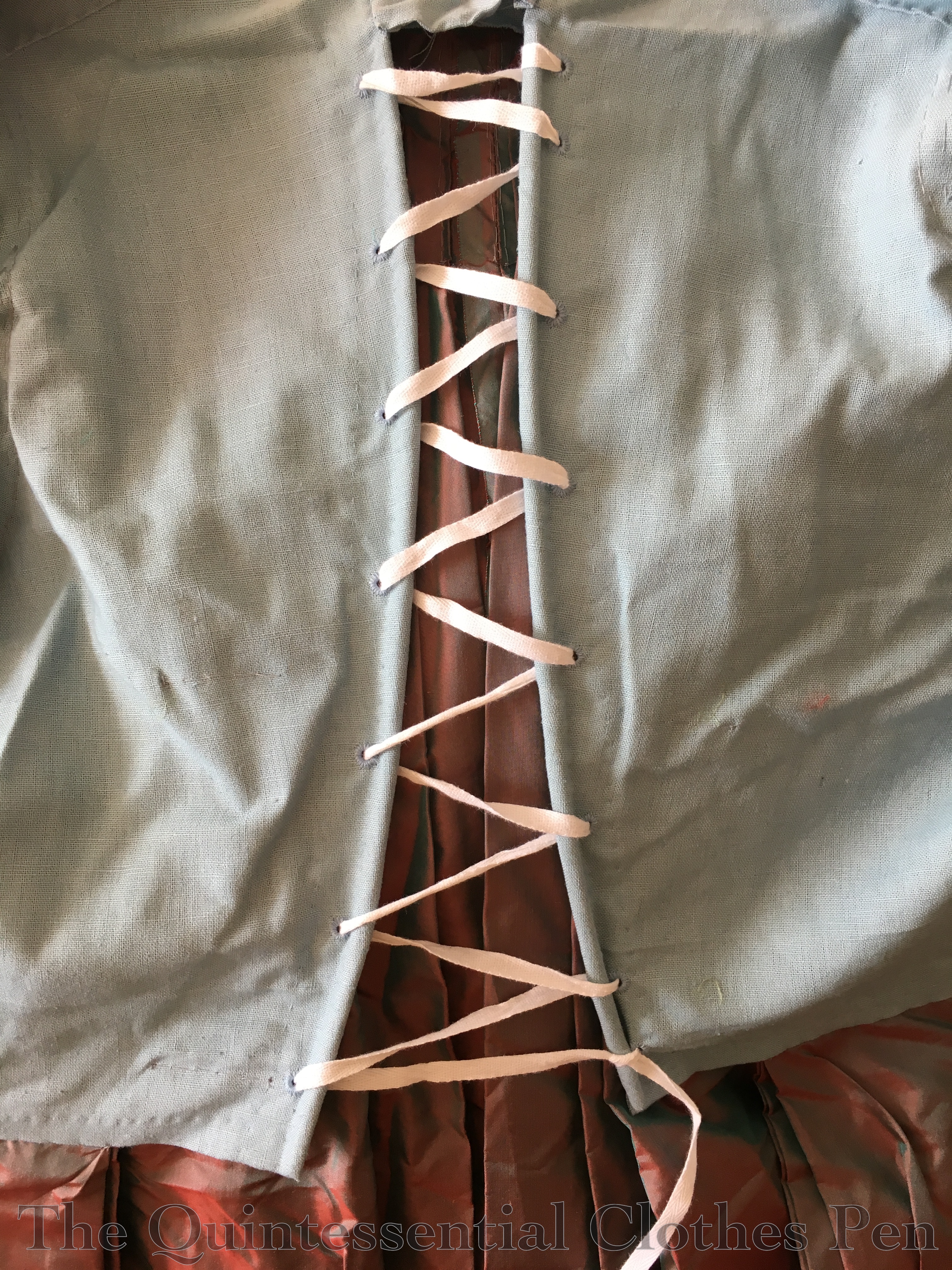
Underneath the decorative stomacher, the gown closes with lacing panels attached to the lining. Again, mine laces closed using twill tape.

IMG_1477 (1)

This is the inside of the front lacing panels. You can see the medium blue linen backing. I think I had run out of the cotton/linen blend at that point. As is usual with 18th century garments, the armhole is left unfinished.

IMG_1478 (1)

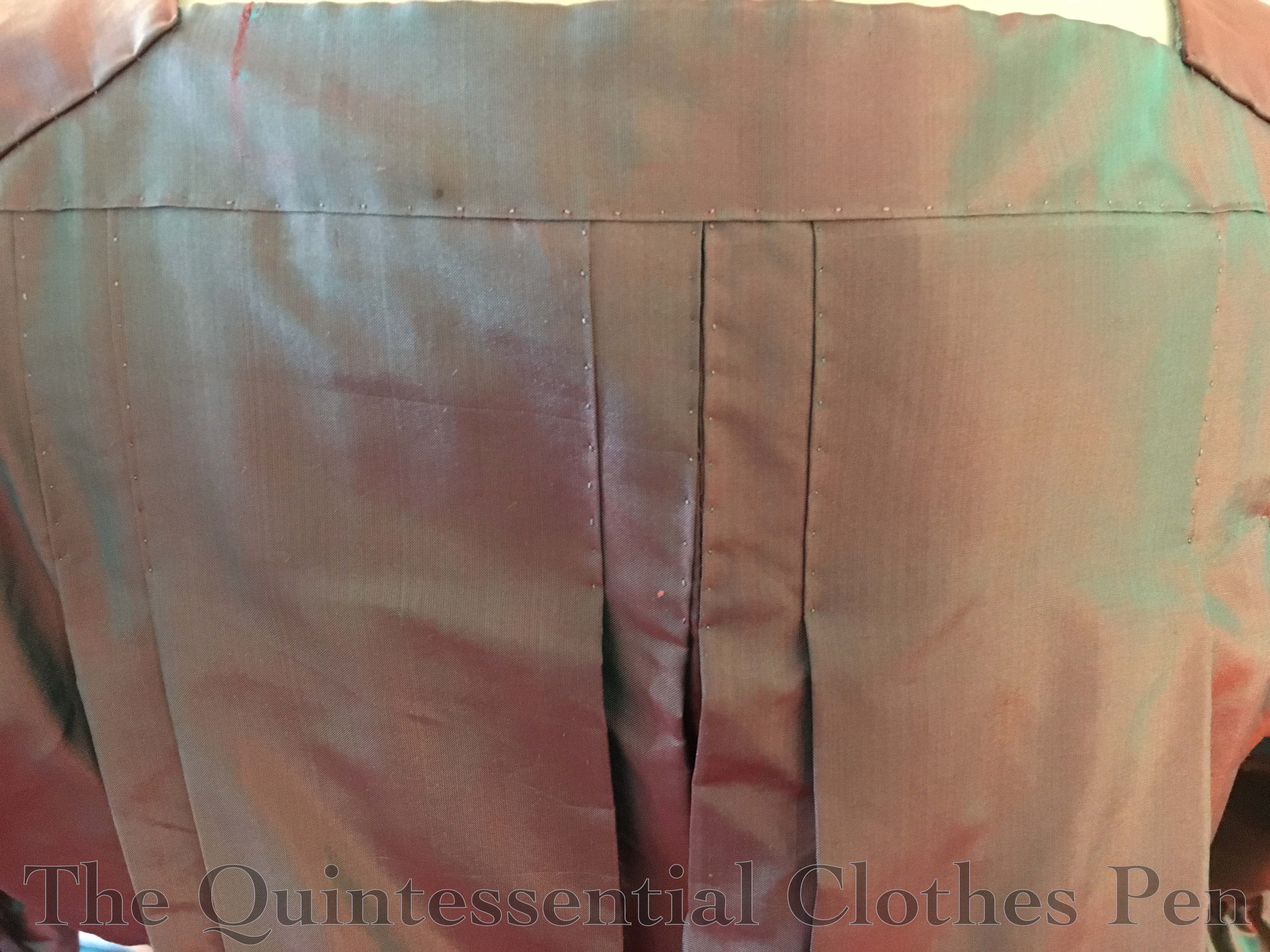
Here’s a close up of the back pleats. These are stitched all the way through to the lining. The directions for the pleats were slightly confusing, but made sense once I started fiddling with my fabric. It was important that I had transferred all the markings from the pattern to make the pleating easier to understand. The pattern uses another four pleats pleats, underneath these, that you can’t see to add volume to the back.

IMG_0922 (1)

IMG_0286 (1)

Due to the unexpected nature of the purchase of the silk fabric for this gown, I decided to do that fabric justice by hand sewing the entire garment. So in addition to the exterior stitching like that anchoring the pleats on the back, all of the interior seams are also hand sewn. I rather enjoy hand sewing and it makes a lot more sense given the way 18th century garments were constructed.

Here is the gown mostly sewn in its essential elements, but lacking trim. The sleeve flounces were individually gathered and sewn to the arm openings. They are pinked with scalloped shears on the top and bottom edges.

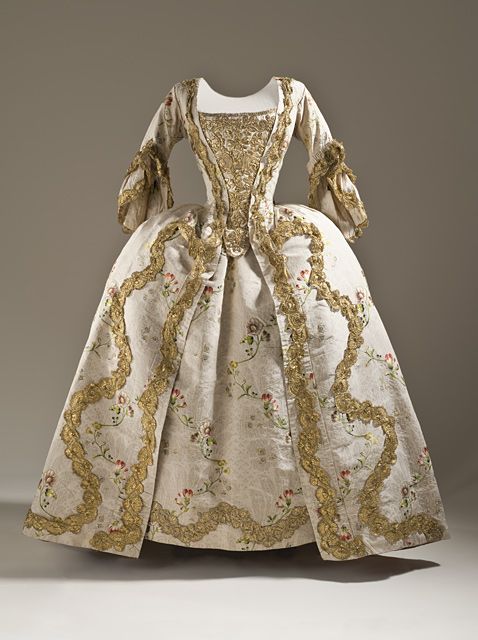
The following image is the gown that I followed in terms of trim placement. It took many more hours than I thought it would to pin the trim on. Those big waves are more complicated than they look, plus I had the challenge of creating the smaller scallops as I went along as well. All of the trim had to be sewn along both sides and tacked at each scrunch after it had been pinned.

IMG_0919 (1)

8423a2253758be21b68f0141235eadb1
Robe a la Francaise. 1765. LACMA.

You can see that I pressed my robings down all the way to the hem, though once the trim was applied on top it was really not very noticeable. I like the finished result, but I think it’s worth pointing out that this pattern is designed to have a wide stomacher. I was envisioning it coming out a little narrower at the waist. But I think adjusting the back opening enough to make a noticeable difference would only create awkward wrinkles under the arms.

The finished stomacher was covered in scalloped trim and finished off with a sparkly brooch. I went to France with an untrimmed stomacher and no clear idea about how I wanted to trim it except that I wanted it to be an all over metallic feast for the eyes. Luckily, early in the trip I was able to go see the 300 Centuries of Fashion exhibit at Les Arts Decoratifs. In addition to being amazing (I got to stand within 6 feet of Dior’s Bar Suit and see many garments I’ve only ever seen on Pinterest!), I also took a picture of a stomacher that was inspirational in terms of the overall wavy patterns and filler shapes. That picture is below.

IMG_0419 (1)

IMG_1153 (1)

Trimming the stomacher took place in the evenings in the few days before the special event. Here is the stomacher in progress. I took it specifically to show the amazing green color that the fabric can appear from some angles. I was hoping to get a picture of the finished gown looking this color, but had to be content with seeing shades of green in some of the pictures as we didn’t capture any where the whole gown was this color.

IMG_1339 (1)

Another part of the dress that was finished in France were my engageants. The pattern includes flounces of two lengths to be made of silk and then one longer flounce for an under flounce or engageant. I sacrificed some lace I’ve been intending for another project, threw some darts in at the longest section to get the scalloped edge to be the right shape, and filled in the length with a bit of mystery ivory sheer. The resulting flounce was gathered and sewn to a cotton tape that was basted into the arm opening.

IMG_1481 (1)

It sure sounds like a lot of work, recounting these bits of the process. It was! And it paid off. I’m very pleased with the gown. And very pleased that this picture captures some of the stunning green in the fabric!

IMG_0287 (1)

Belated HSF 2013 #13: 1885 Frills and Furbelows

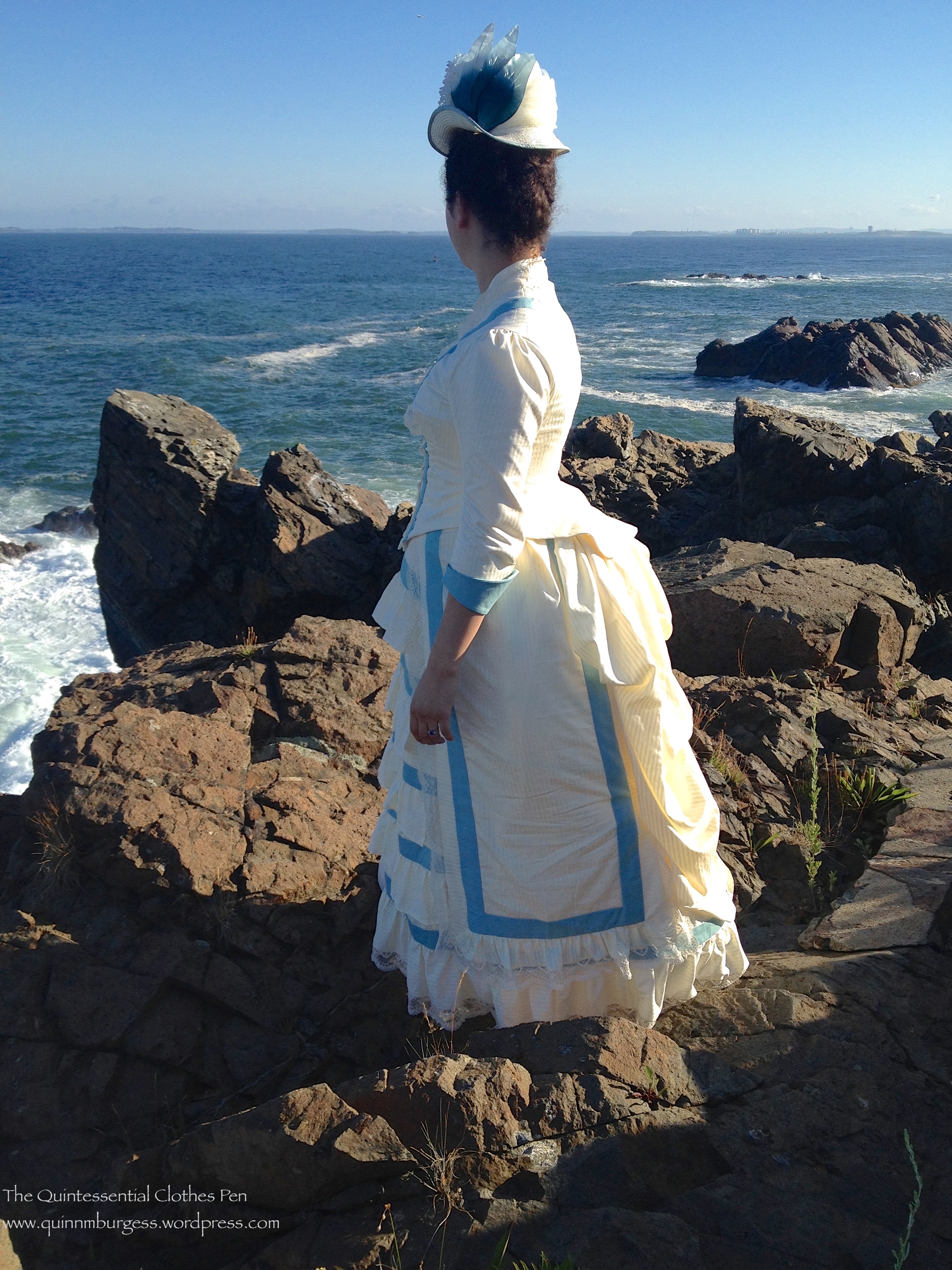
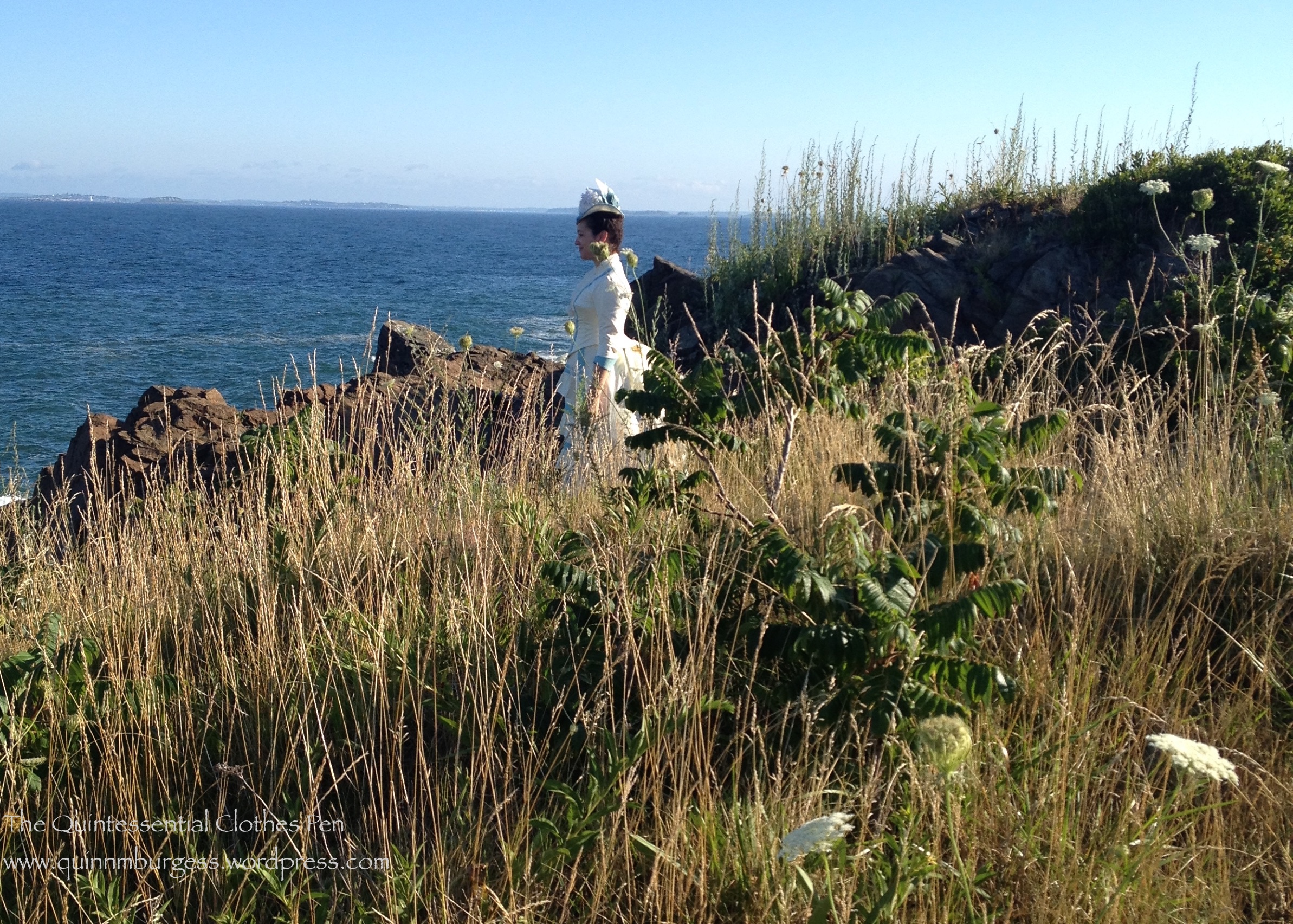
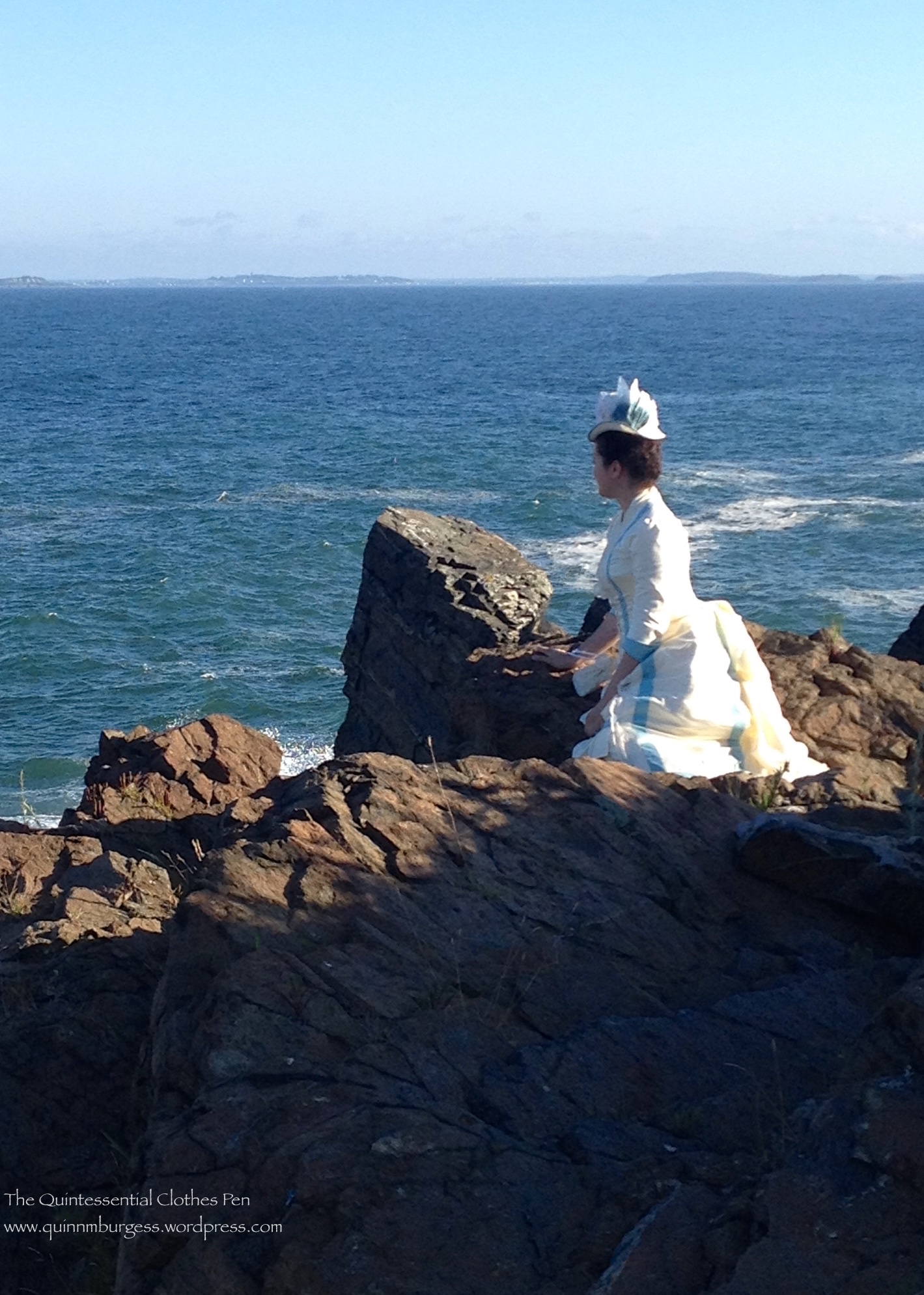
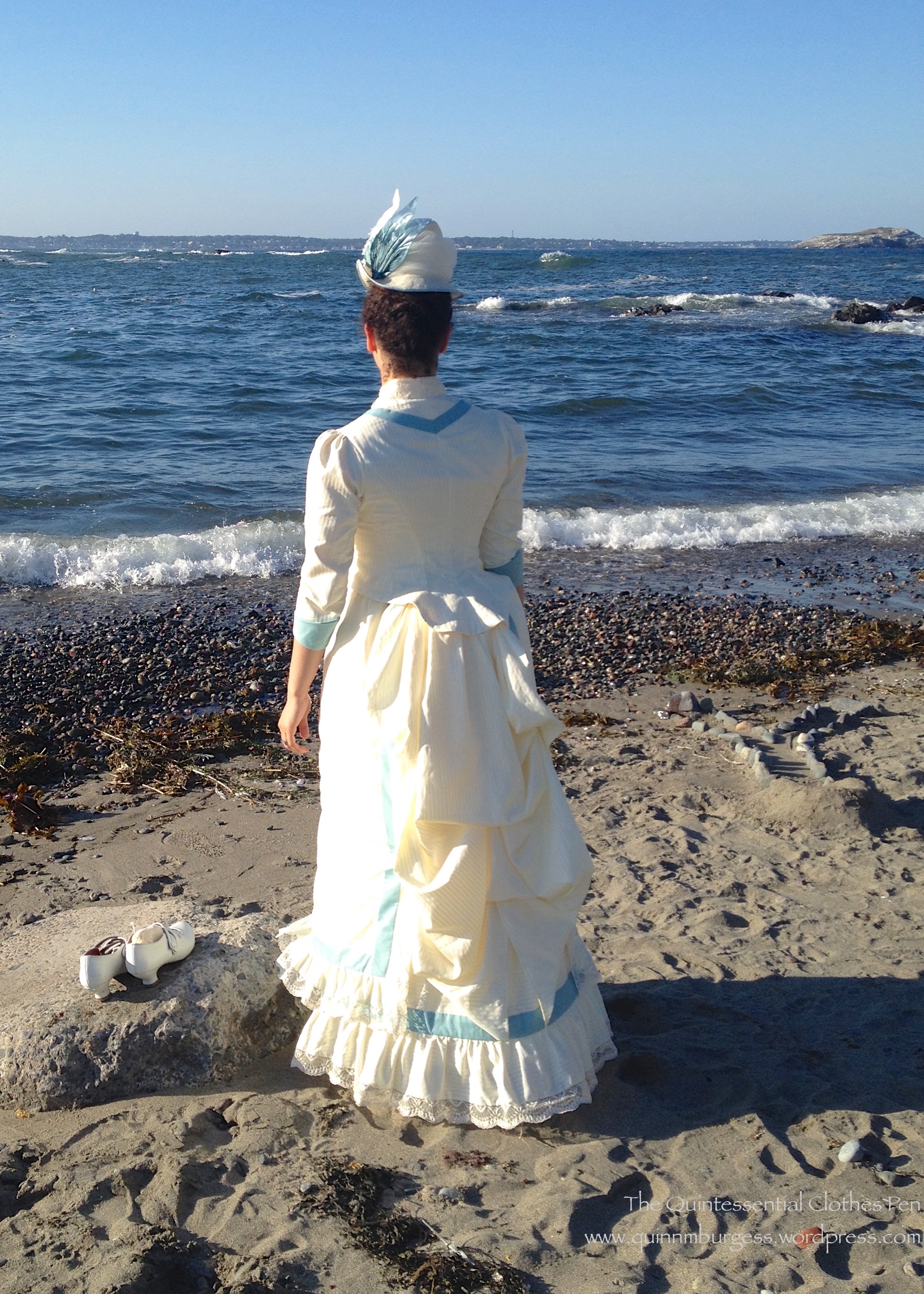
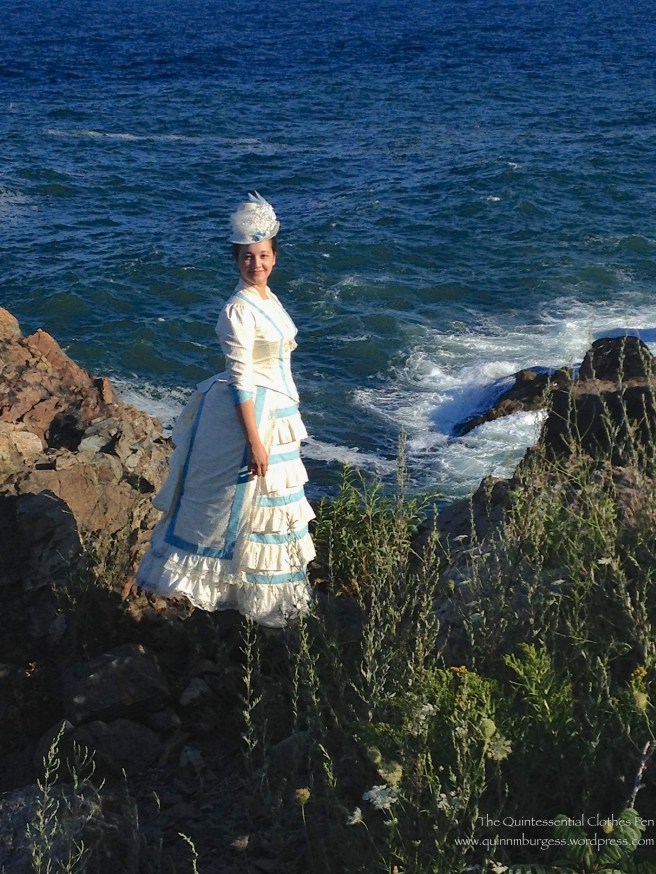
For my 300th post on the blog, I thought I’d share a dress that makes me smile. This dress makes me smile because of the frilliness of it which reminds me of Anne of Green Gables, because of the fact that it was very enjoyable and comfortable to wear, because I love that it is a UFO from 2013 that is finally complete, and because of the stunning backdrop I had for the pictures of it, which also remind me of Anne of Green Gables.
IMG_2725

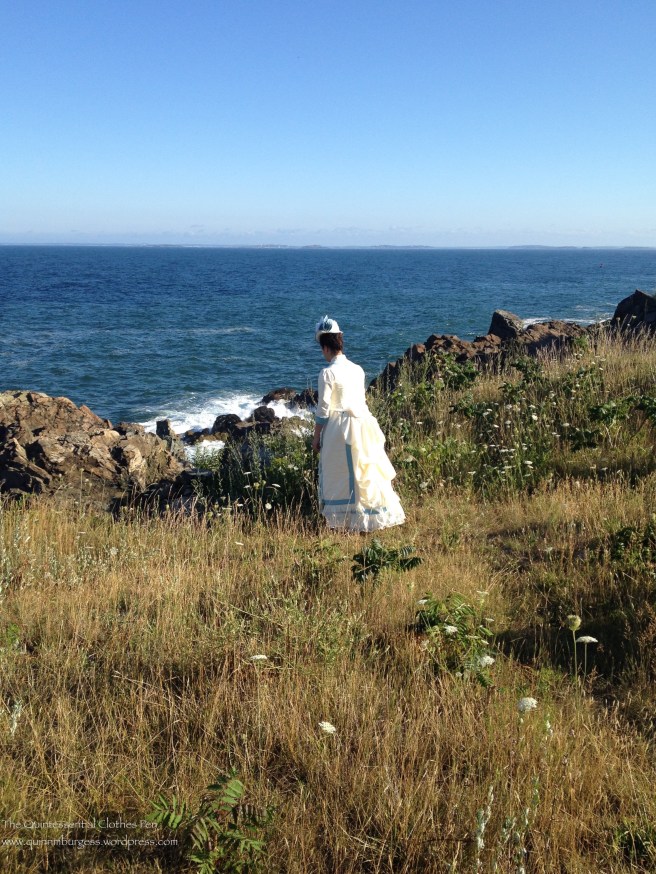
I wore this dress to the Nahant Vintage Dance Weekend Formal Tea and Seaside Promenade in August. It was also the first outing for the my new 1880s steam molded corset and my recently made 1885 straw hat. I am pleased to report that they were all comfortable garments and accessories to wear. Being heavily boned, the corset was very supportive and thankfully didn’t feel heavy, and because it is shaped exactly to my body it was super comfortable–smoothing my figure without squishing it uncomfortably. The dress was perfectly reasonable to wear, with the exception of sitting, which required a slight sideways perch that was a bit precarious. And the hat stayed in place perfectly with two hat pins, as you can see from the pictures where my head is tilted in various directions.

IMG_2699

IMG_2689

IMG_2698

This dress has an association in my head with the puffed sleeves that Anne wants in Anne of Green Gables. While being from the wrong decade, it seems exactly like the sort of dress covered in frills and furbelows that Marilla wouldn’t waste fabric on. And just like Anne, I would often rather have the ridiculous, fashionable styles in historical clothing than the plain and sensible ones!

MARILLA: I’m not going to pamper your vanity. These are good and sensible dresses. This one is for Sunday, and the others you can wear to school.

ANNE: I am greatful, but I’d be even more grateful if you’d made this one with puffed sleeves.

MARILLA: I cannot waste material on ridiculous looking frills and furbelows. Plain and sensible is best.

ANNE: I’ve always dreamed of going to a picnic in puffed sleeves. I’d rather look ridiculous with everyone else than plain and sensible all by myself.
IMG_2706

This dress was started in 2013. I had grand hopes of finishing it that summer for the Historical Sew Fortnightly challenge #13: Lace and Lacing

Lacing is one of the simplest and oldest forms of fastening a garment, eminently practical, and occasionally decorative.  Lace has been one of the most valuable and desirable textiles for centuries, legislated, coveted, at times worth more than its weight in gold, passed down from one garment to the next over centuries. Elaborate and delicate it is eminently decorative, and rarely practical.  Celebrate the practicality of lacing, and the decorative frivolity of lace, with a garment that laces or has lace trim, or both.

And while I did make significant progress on the skirt that summer (getting all of the trimming figured out, cut, and assembled, as well as getting the skirt base and side panels constructed), I didn’t get anywhere near far enough along to have a wearable outfit. So it sat in my “in-progress” sewing box with hopes to be worked on, but didn’t really make it to the top of my sewing list again until this summer. I had enlarged and sized a pattern from Janet Arnold in between 2013 and 2015, even cutting and assembling a mockup, but that had been waiting for a fitting because I wanted to wear my new specifically 1880s corset with the dress and the new corset didn’t get completed until June. Once I had the corset done, I set to work on the dress again, fitting the mockup bodice, finishing the skirt, and making the bodice, as well as a slight delay while I made the hat to match. It’s handy to make a hat part-way through the process of making the dress, because you don’t wind up running out of time at the end and not having matching accessories!

IMG_2772

The first inspiration for my dress was this white summer dress at the LACMA. The skirt was pretty much directly taken from the original, except for the back, which has a cascade of fabric instead of tucks as on the original–I figured there was already enough fluff for me on the front of the dress. I originally planned to edge all the front ruffles in lace as well, but ran out of lace. Running out of lace also made me rethink how I was going to trim the bodice. I went back to my inspiration boards and found these dresses with inspiring bodice treatments: a seaside ensemble and an afternoon dress with very different fabrics and intent, but I thought this could be adapted for my summery seaside dress. I had only a few yards of lace left when I got to working on the bodice and I decided to save some for edging the top of the 1880s corset because the shape of the lace is perfect, but that didn’t leave me much for the bodice. It turns out I had just enough to execute the final trimming plan I decided on.

IMG_2754

Since this was originally intended to be part of the HSF, here are just the facts:

Fabric: 7ish, I think, yards of cream satin stripe cotton, 1/3ish of a yard of blue polished cotton, and 1.5 yards or so of cream polished cotton for flat lining the bodice.

Pattern: Created by me, but the shapes are based on a dress in Janet Arnold.

Year: 1885.

Notions: 9 yards of ivory lace, hooks and eyes, scraps of white cotton for finishing off the bodice edges, and vintage ivory buttons.

How historically accurate is it?: As accurate as I can be using the research I’ve done and the materials that are available in 2015. It definitely passes Leimomi’s test of being recognizable in its own time.

Hours to complete: Tons over two years.

First worn: In August 2015.

Total cost: I bought the all the cottons for super cheap, probably $3/yard, the lace was probably about $8, the buttons were a few dollars, and the rest was from the stash, so around $30-$35.

There were so many good pictures it was very hard to limit myself for this post! So here’s some more, with a bit of commentary to go along with them.

We had a beautiful day for the Tea and Promenade. It had been very hot prior to this, but the day of the event was a little cooler and the stiff ocean breezes made for a temperature that felt perfect for me in my layers and ¾ sleeves. The formal tea part of the day was at Egg Rock on Nahant (the same location as the Formal Soiree I attended last August). There was a lovely concert inside the house as well as guests lounging around outside, including me, playing croquet. At that point the stiff breeze had me worried that my hat wouldn’t stay on without pulling at my hair, so I chose not to wear it for awhile. (Thank goodness I gave it a try later, though, because it is perfect with the dress and I wouldn’t have wanted to miss wearing the two together!)

IMG_2668

11866207_10153557263049588_8661903483348243128_n

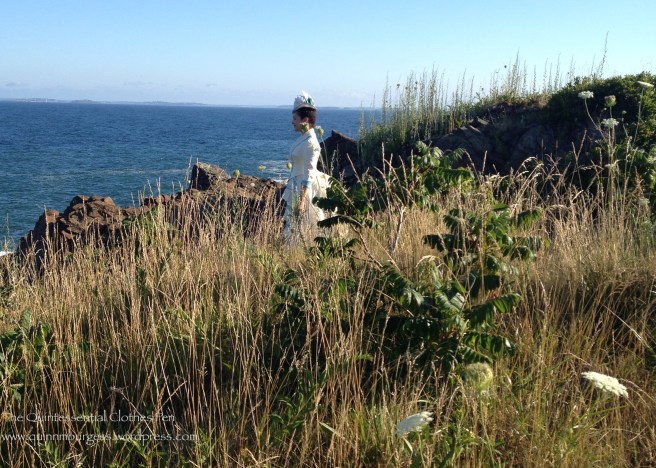
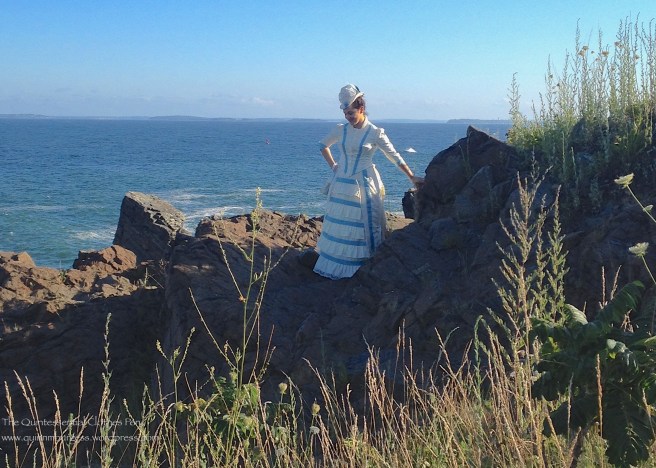
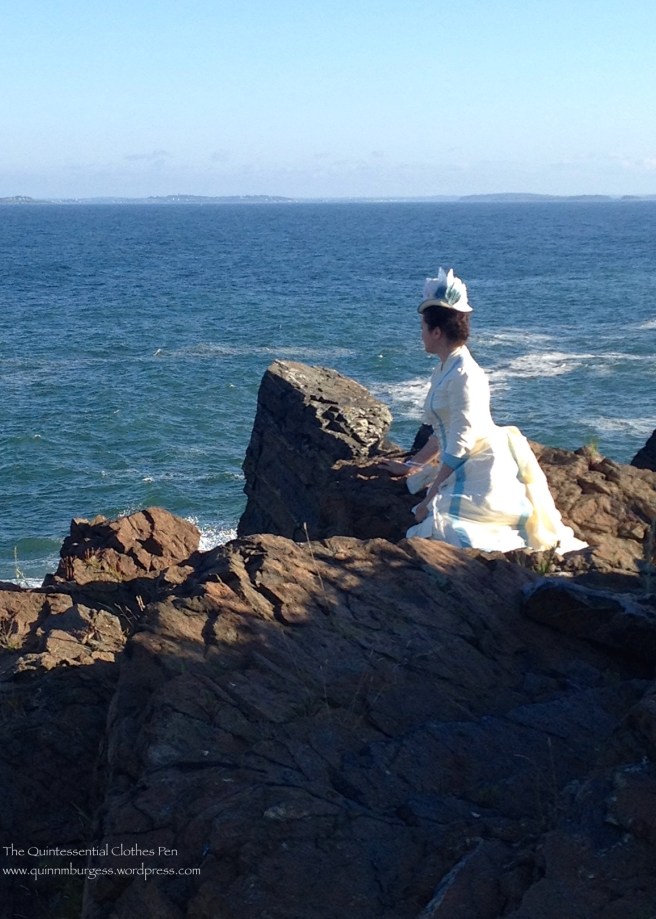
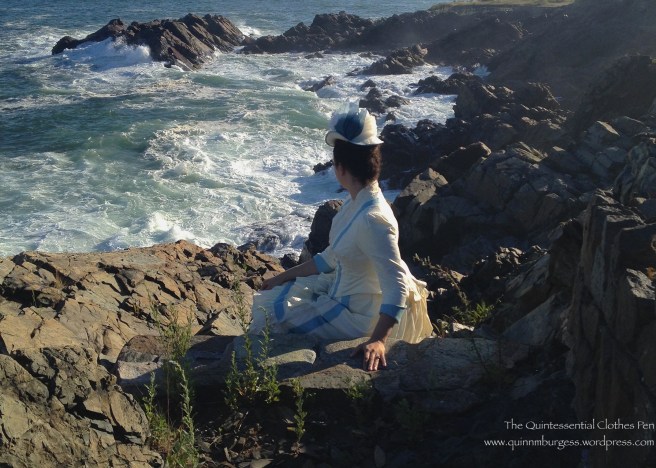
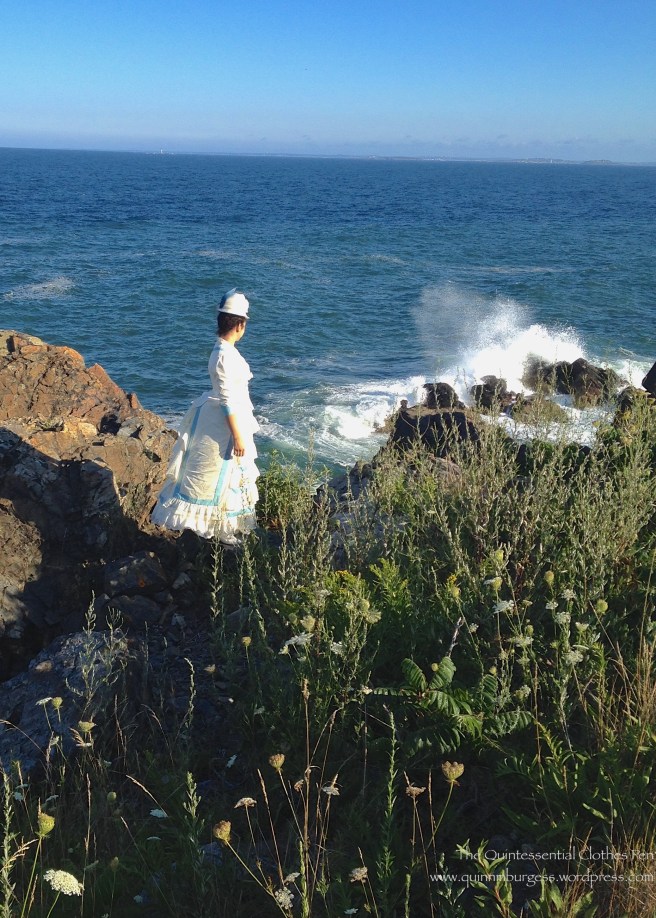
After the concert and some refreshments, the guests assembled for the promenade. As you would expect, we stopped traffic, attracted stares, and received questions from the more brave souls who would talk to us rather than just making up stories in their heads about our unusual clothing. The promenade took us to East Point, former site of the 19th century Nahant Hotel. The hotel is no longer standing, but there were stunning views of the Atlantic and the rocky coast to clamber on!

IMG_2716

IMG_2721

IMG_2735

IMG_2737 (1)

IMG_2742

IMG_2750

IMG_2776

Not me, but such a gorgeous view and cute picture that I had to share it, too!

IMG_2766

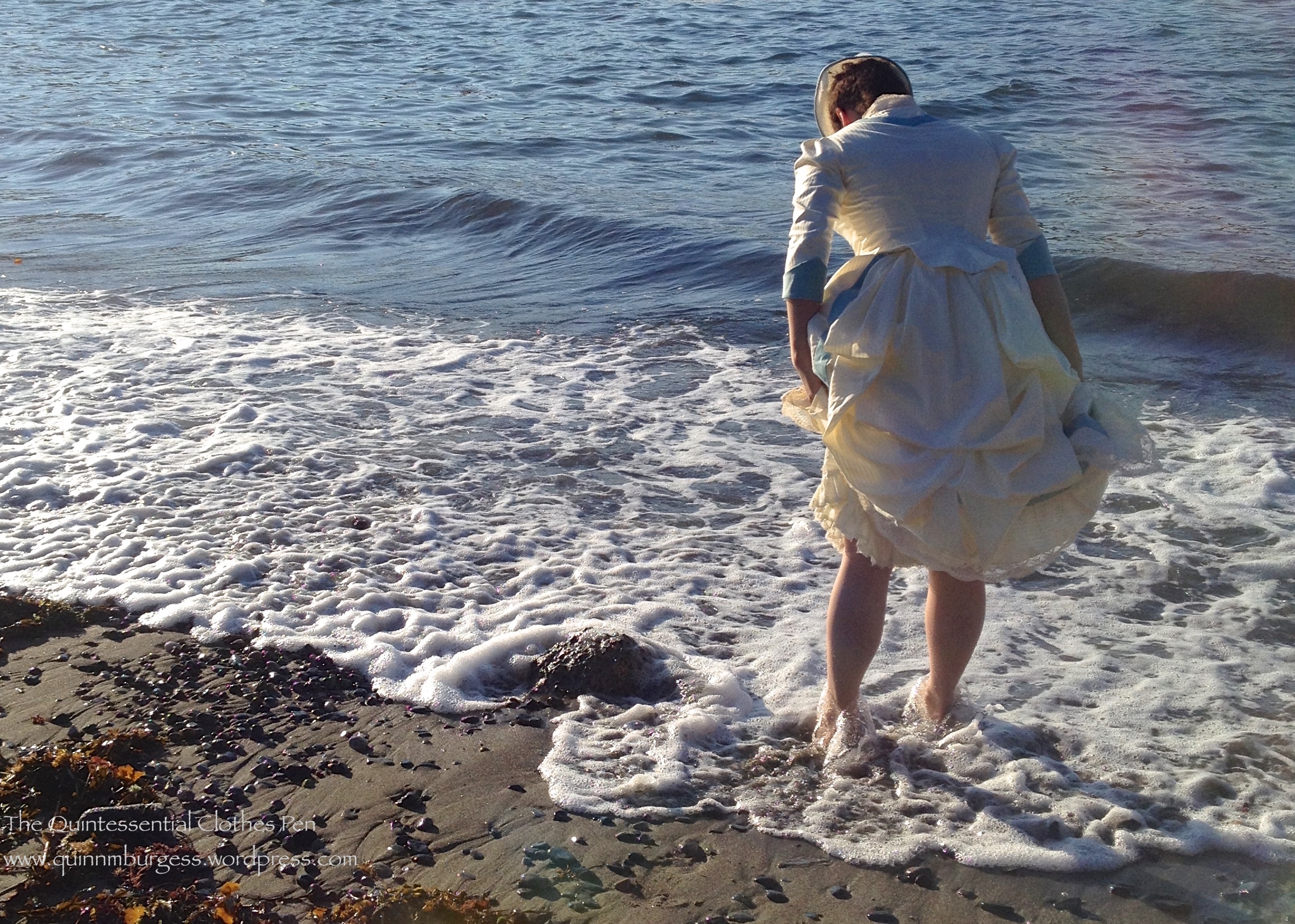
Some of us decided to head back a little early so we could stop at a small beach we had passed on our way to East Point and go wading! After the walk, the cold Atlantic water felt quite good on our feet. Here I am with stockings and shoes off, ready to head into the water.

IMG_2785

And here I am, wading in my bustle dress!

IMG_2816

There’s this picture of two ladies in bustle dresses from 1885 who look like they are collecting shells. That’s what I had in mind when I took this next picture, although looking at the 1885 picture again I see that the ladies in the picture are still wearing their stockings and shoes… I guess I’m pretty scandalous for 1885 in my bare legs and feet!

IMG_2827

Here we are, the whole wading group. It was a pretty fun adventure. I don’t think I’ve been wading in historical clothing since Newport in 2012.

IMG_2789

IMG_2810