From Clamshell To Icicle Crown

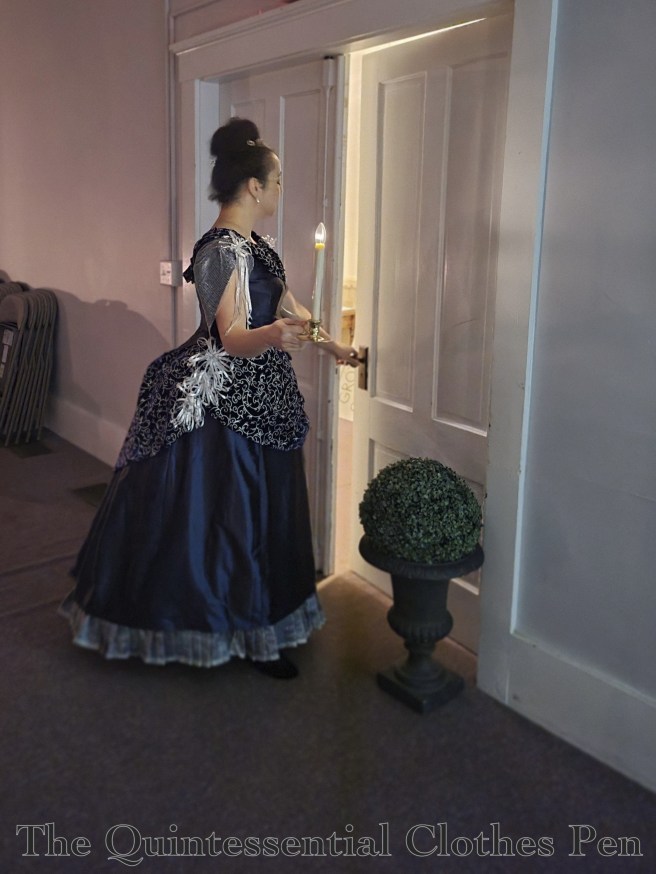
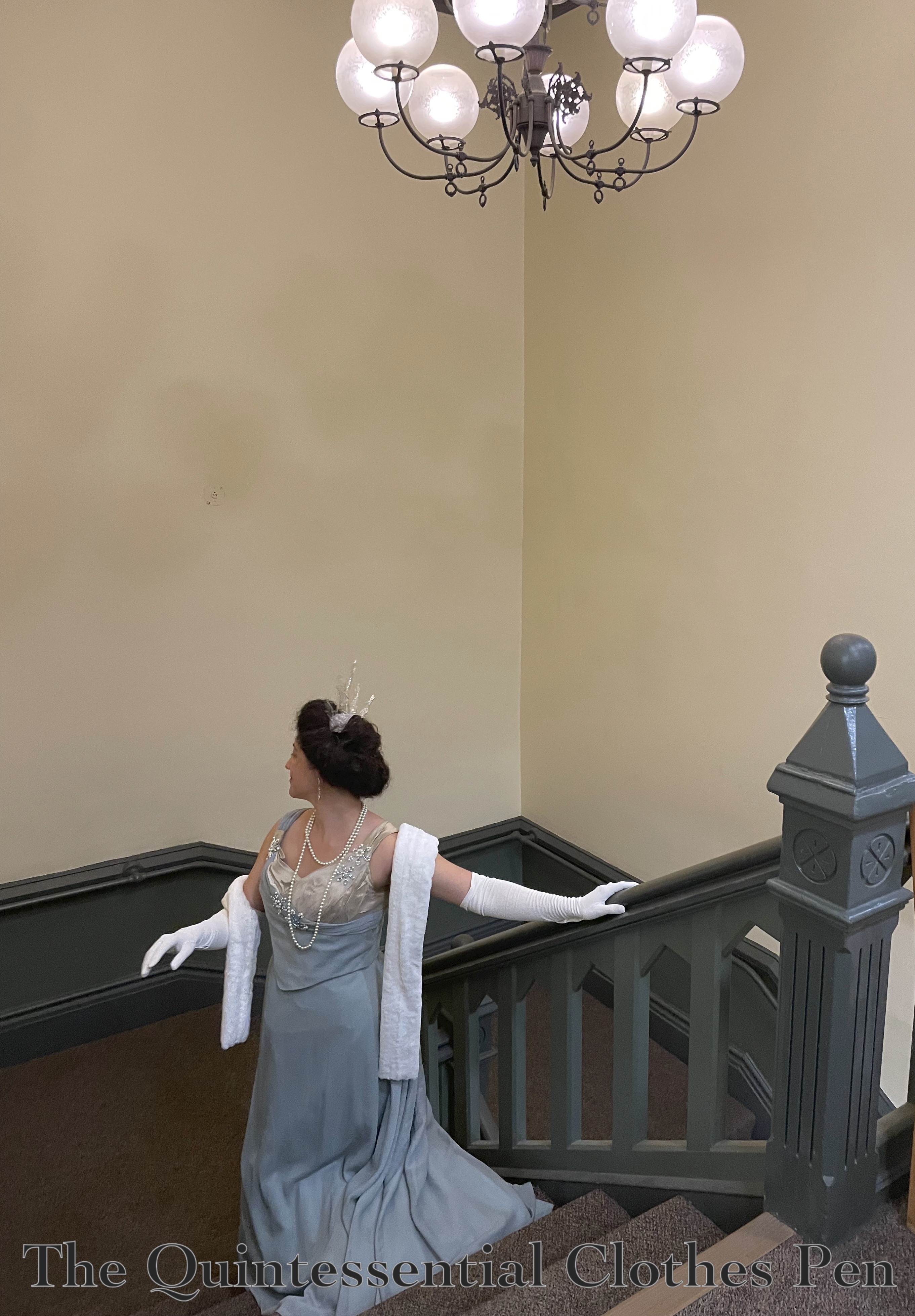
In October, The Footwork & Frolick Society hosted a fairytale themed late 19th century ball. I wanted to wear something fun from my historical wardrobe that I hadn’t worn in awhile and decided on my 1899 Elusive Blue dress. Once the outfit was decided on I had to figure out how that might fit the theme!

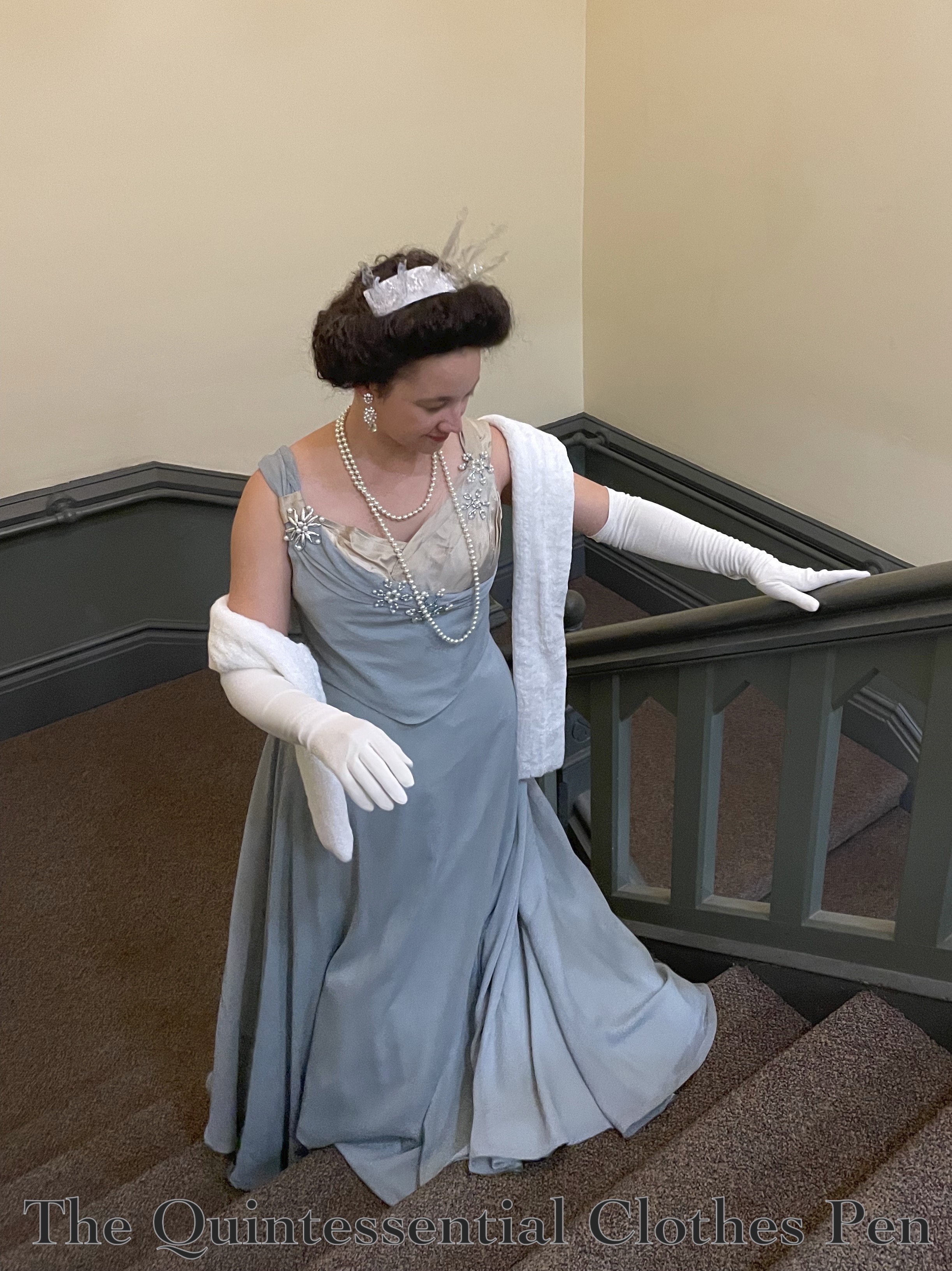
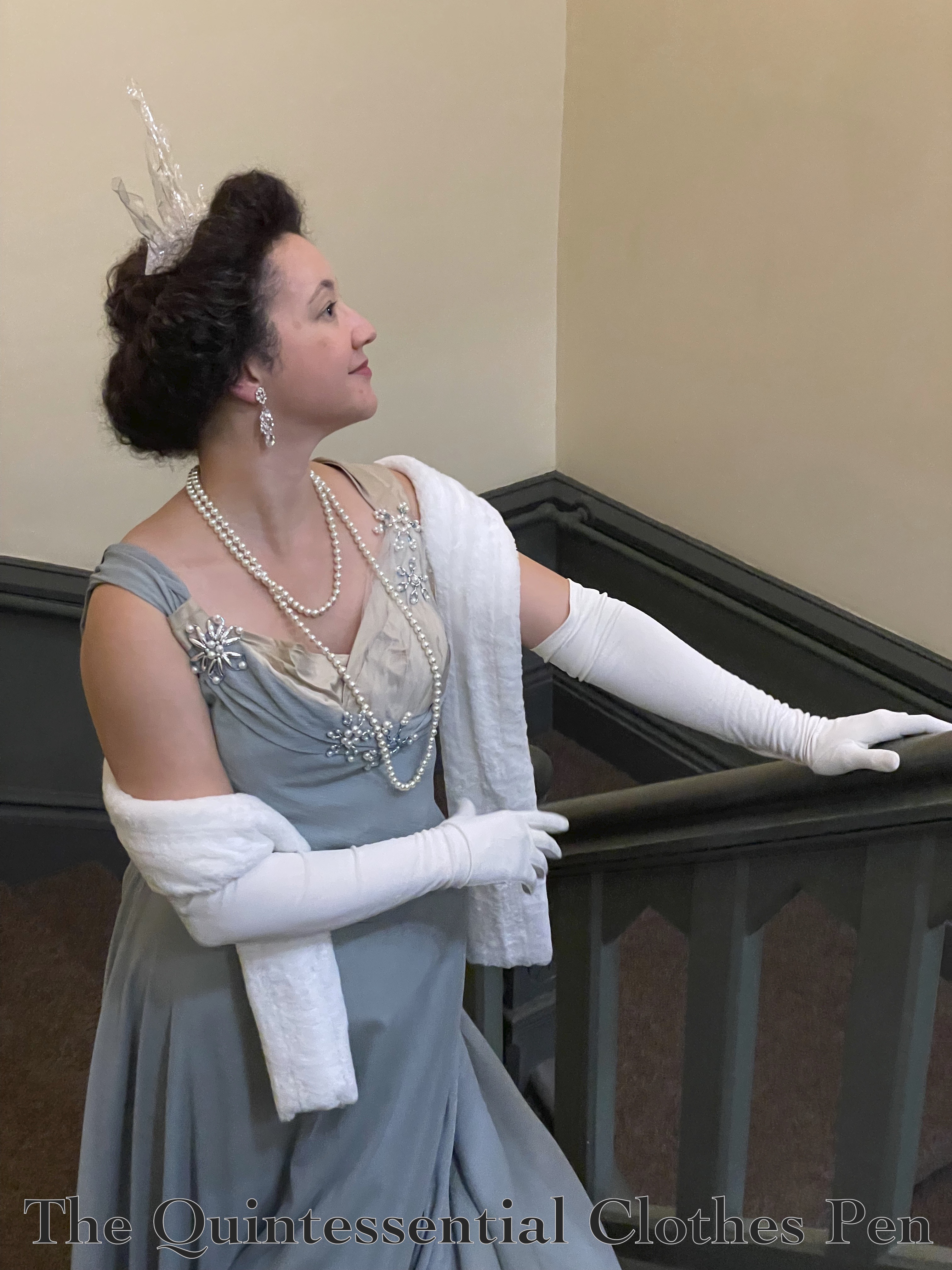
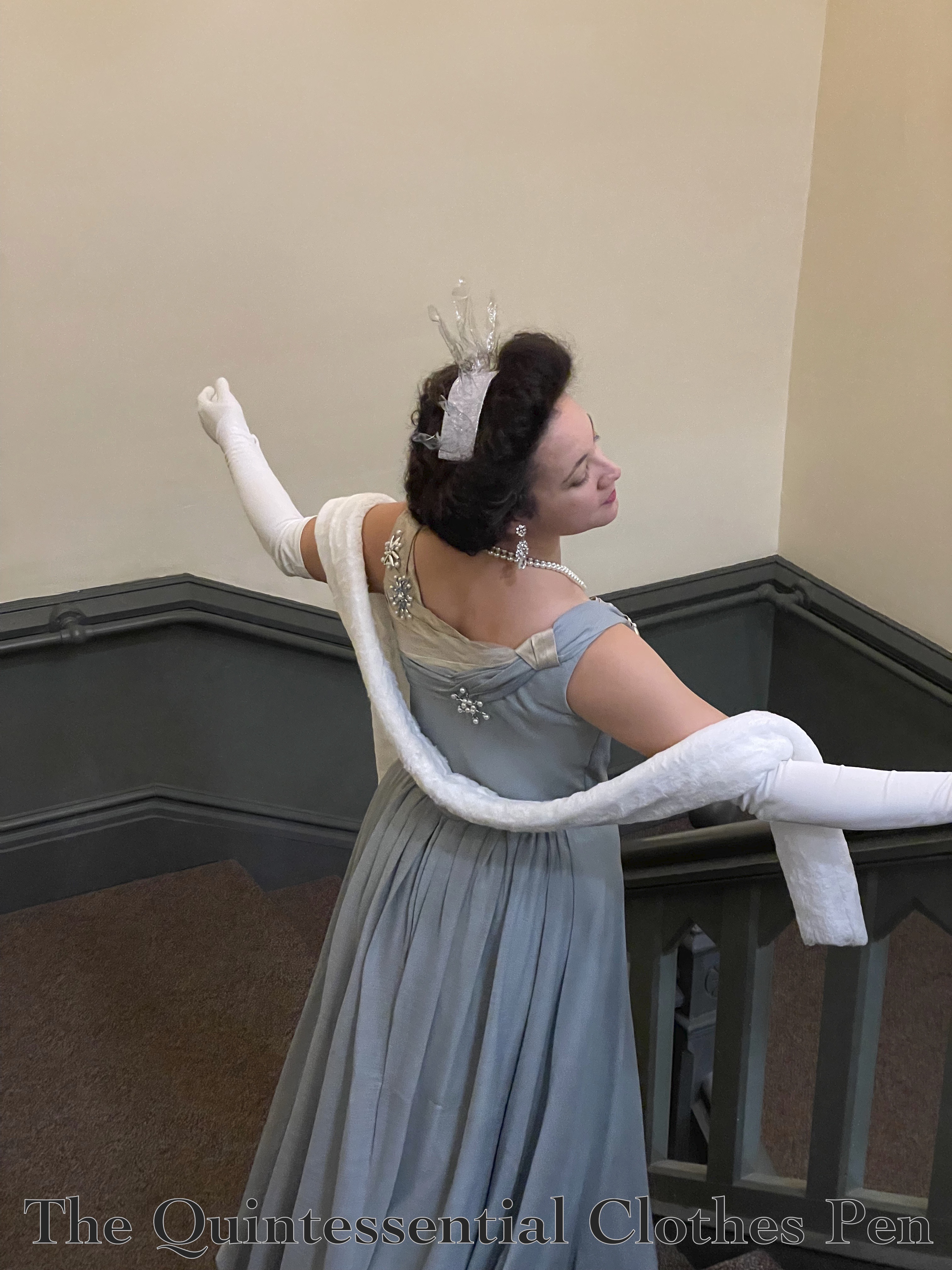
After a bit of thinking, I decided on a Snow Queen idea, inspired by Hans Christian Andersen’s character and story. The idea of a light blue, white, and silver dress seemed like it could be adapted to fit my chosen outfit with minimal additions.

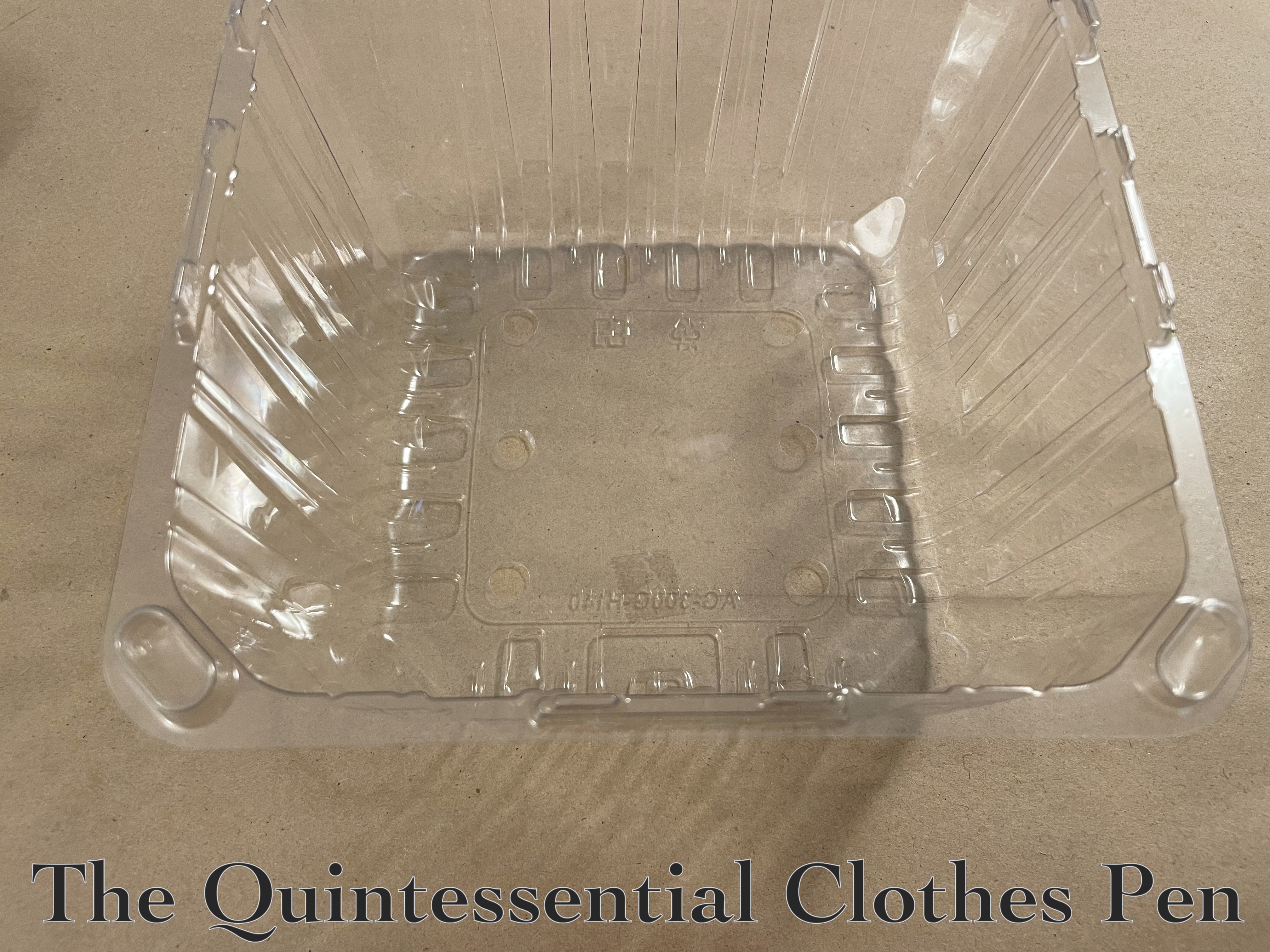
One of the essential accessories I wanted was an icicle crown! I’ve successfully made icicles using Worbla’s TranspArt product (a thermoplastic that can be heated, shaped, and then allowed to cool to become rigid), but I didn’t have any of this on hand. I wondered if I could use plastic grocery clamshells for a similar effect… and make use of my recycling in the process!

Spoiler: I was successful! But I don’t want to detract from Worbla’s products. They are much easier to use and more forgivable — easily flexing in all directions as well as easier to reshape and tweak. The clamshells only wanted to flex in a limited directions and were a bit fussy to tweak once I had the basic shapes made.

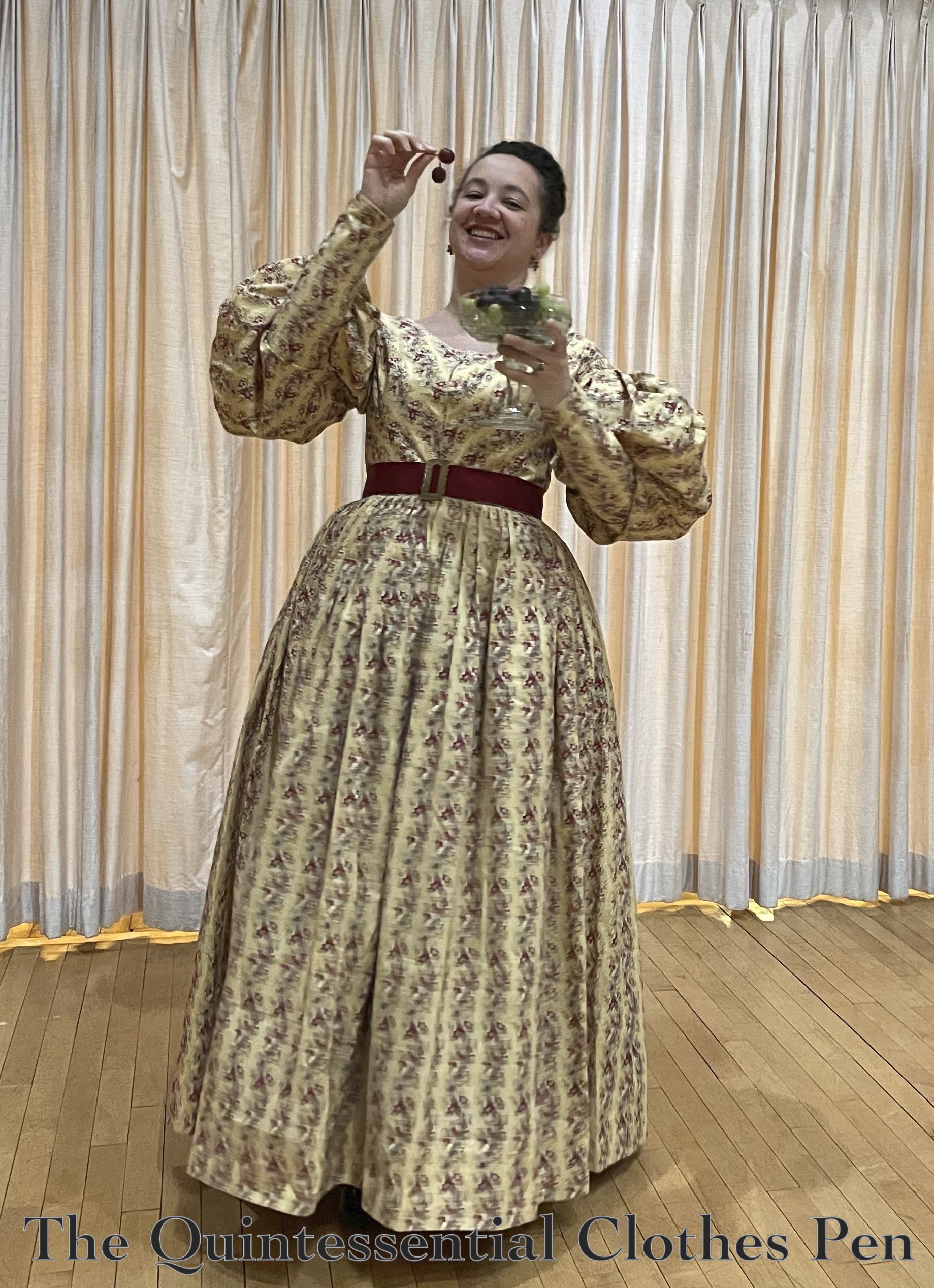
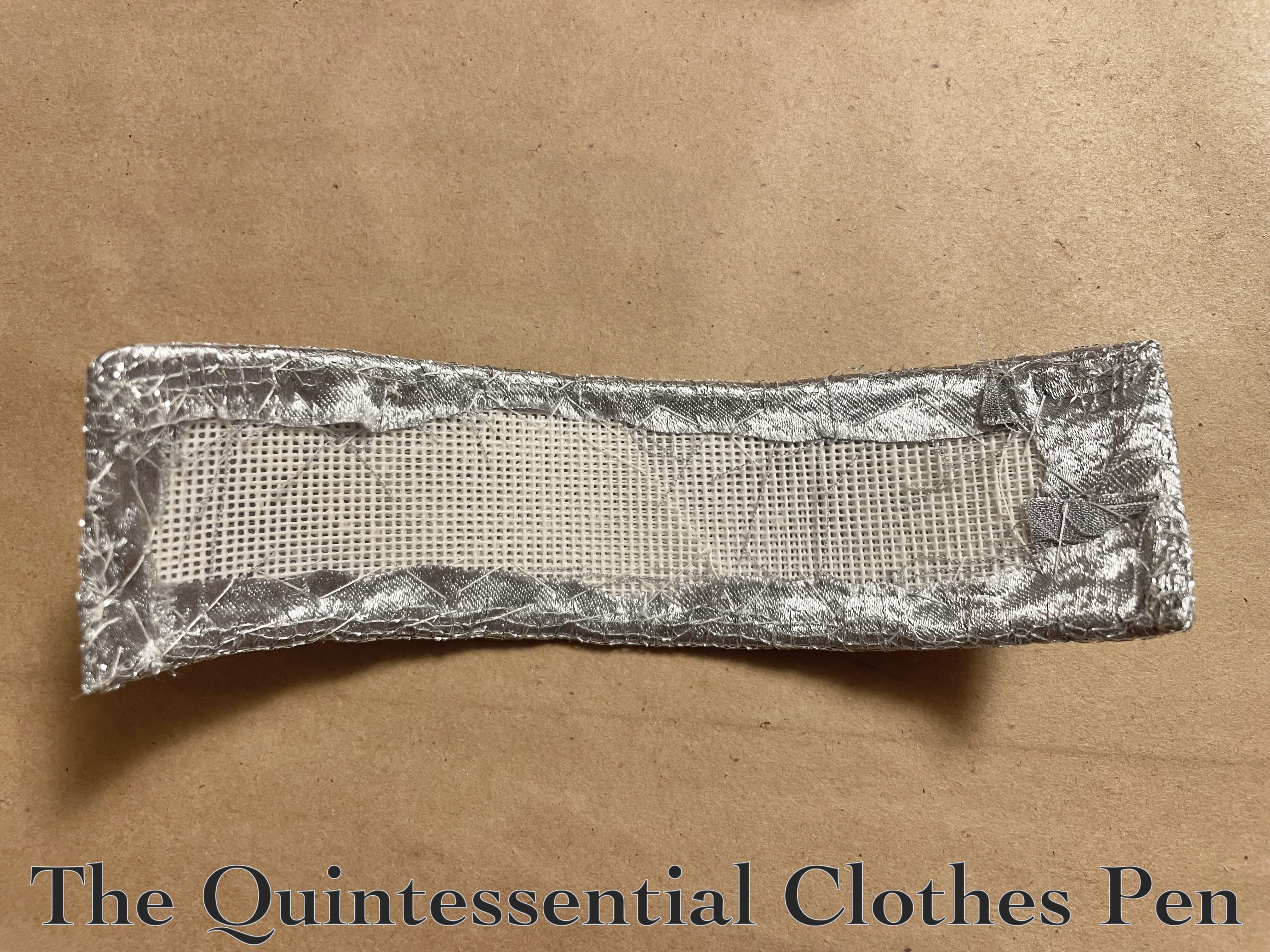
But this story is a transformation, from this:

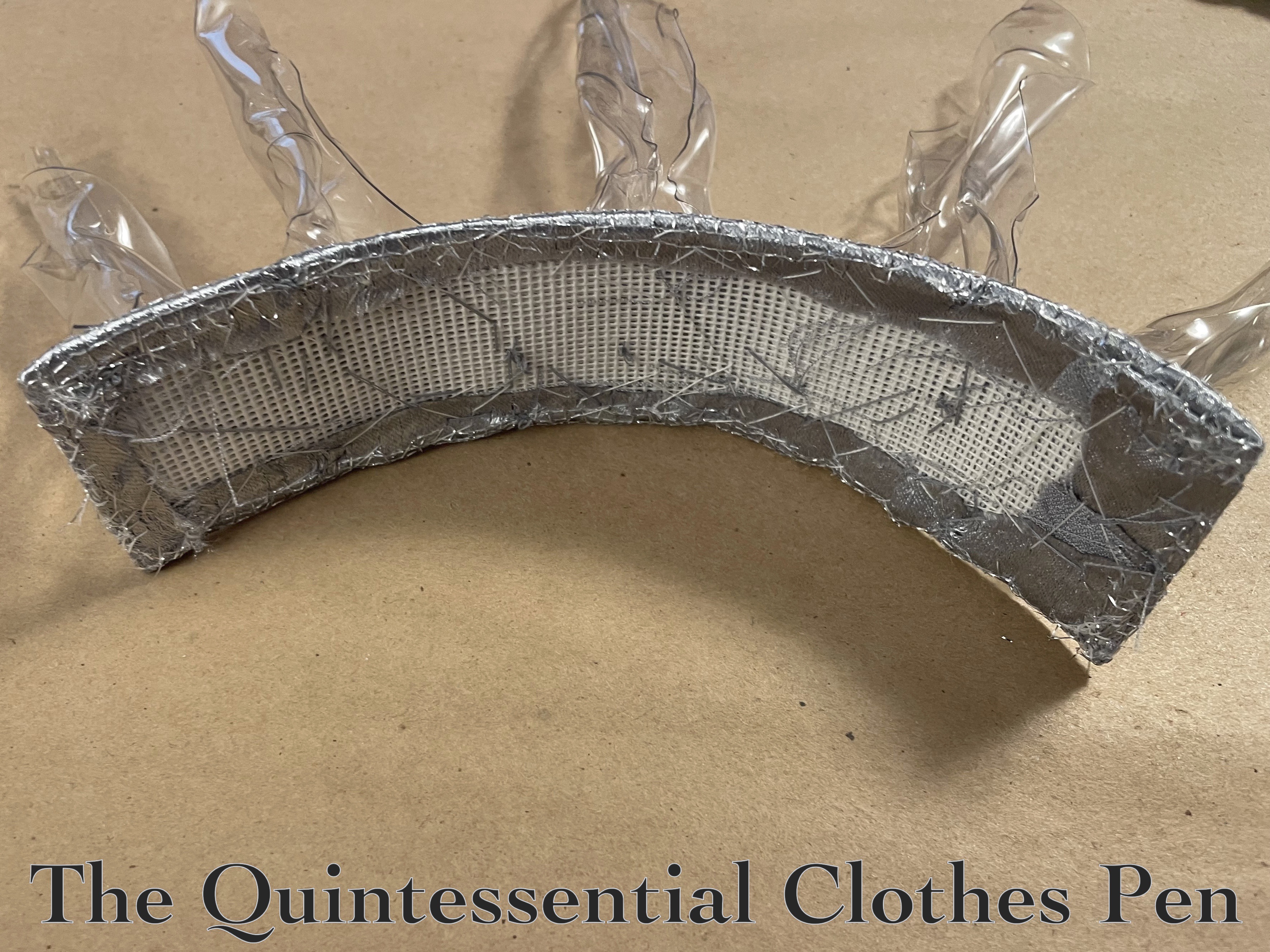
To this:

Icicle Methods

Once I had this idea, I spent a month or so saving plastic produce clamshell packaging from my everyday groceries: stone fruit, tomatoes, grapes, etc. If they had too many labels or not many mostly flat spaces they didn’t make the cut. But even with these guidelines, I accumulated quite a number of packages I could use for this project.

I started by cutting rough rounded triangles out of the clamshells I collected. The first two I tried using an area that was all plastic and one that had a label on it, just to see how they would behave and what they would look like.

I started by heating the plastic with a hair dryer (outside, for ventilation, and on a sturdy scrap piece of plywood that wouldn’t melt). The hair dryer was not powerful enough to warp the plastic, so I next tried a heat gun. I used an oven mitt to protect the hand holding the plastic. I found that medium heat from the heat gun worked well! My first two samples are below.

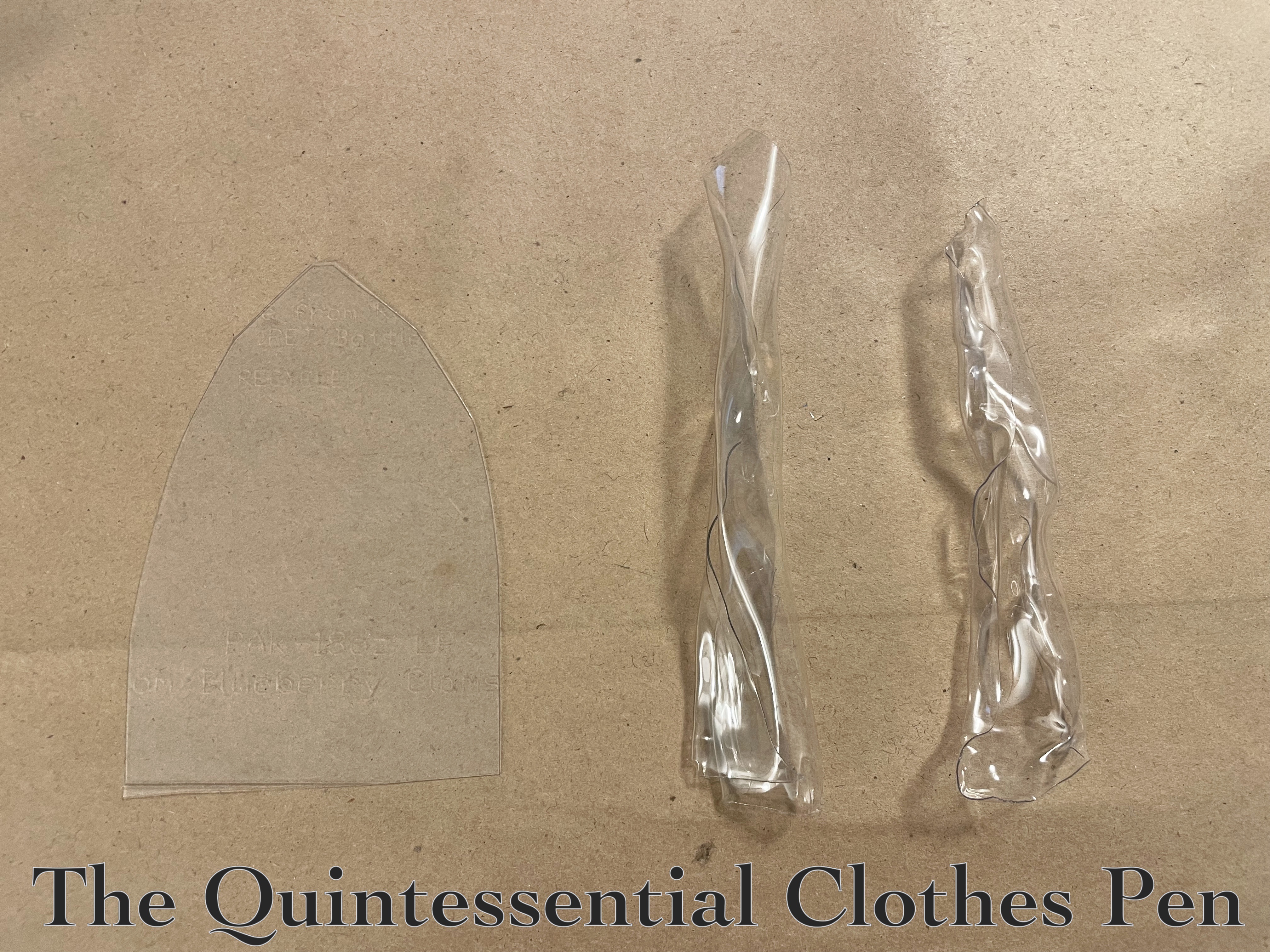
The one with the label looked not like an icicle and didn’t really want to shape well, so I ruled out that idea. But the all plastic one actually worked pretty well! After asking what I was up to, Mr. Q was not impressed and thought that this idea would not work… But I carried on. I cut more rough triangles in a few different lengths and shaped them with my heat gun. The flat shape and twisted icicles are pictured below.

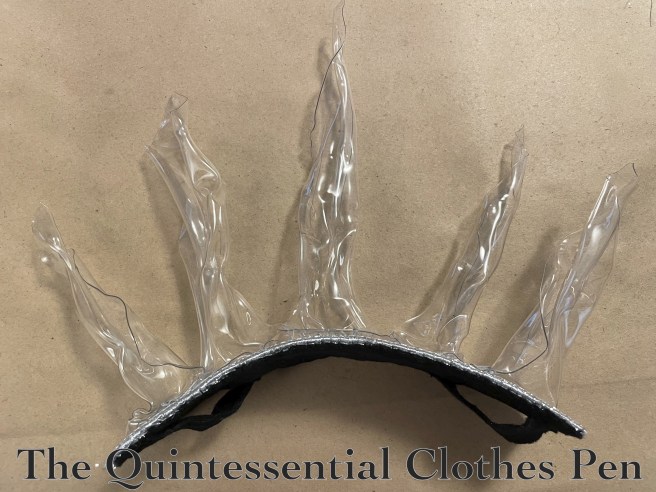
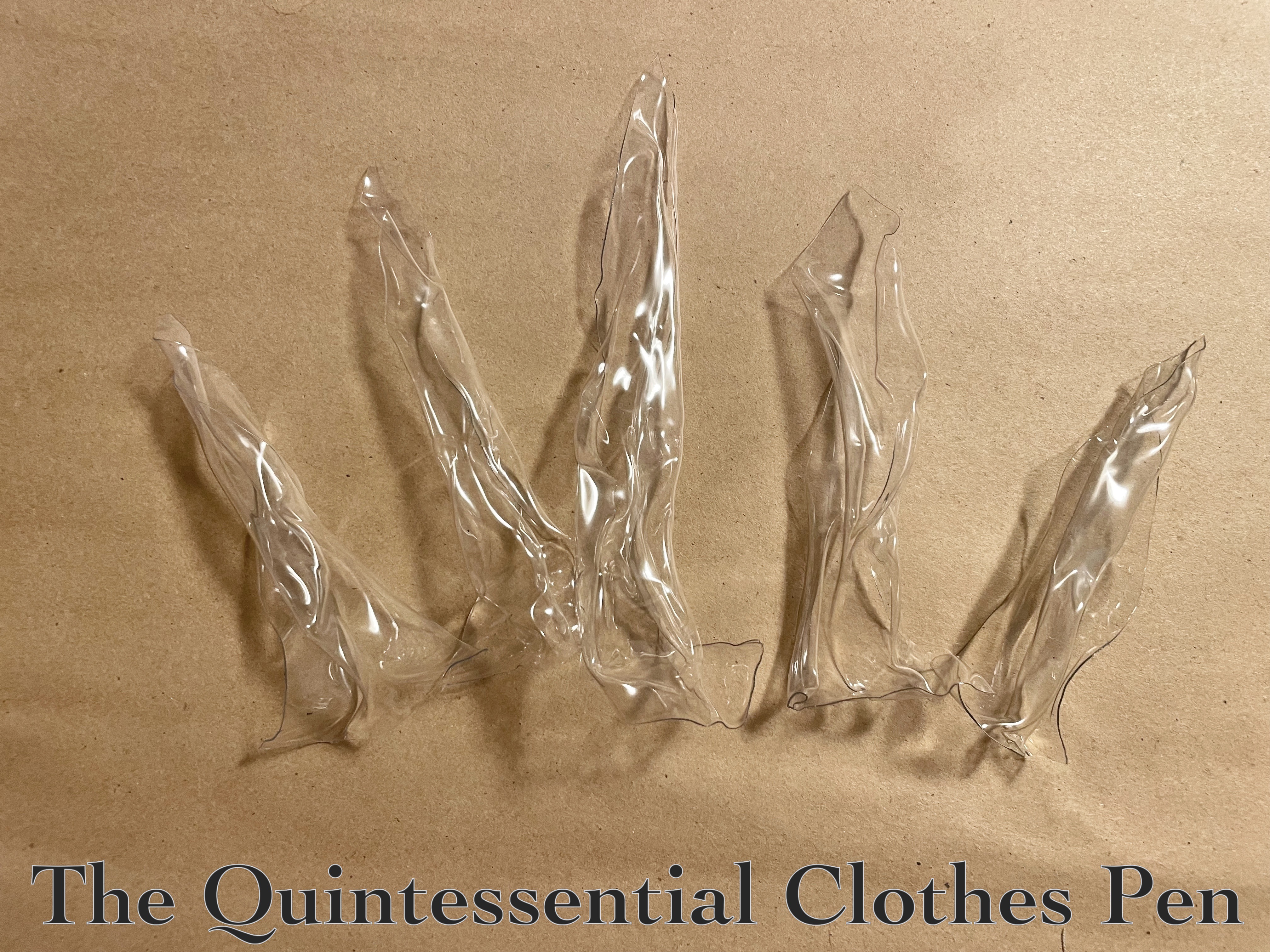
I decided I wanted five of them — a tall one in the center and slightly shorter ones to either side. I picked the best out of the 8 or so that I made and arranged them. That led me to go back and adjust a few to get better shapes. It was no problem to shape them with scissors or reheat them to change the shapes. I also softened the bottom of the chosen 5 icicles to flatten them out a bit to provide a way to have them stand up and attach to a base, as you can see below.

Crown Base

For a base of support, I pulled out my buckram scraps. I layered two of them and stitched them together around the edges. Then, I covered the buckram with scraps of two layers of silver fabric — a polyester satin and silver net. Below is a photo showing the underside of the buckram. My stitches are big, rough, and messy. They will be covered later.

The top of the crown base can be seen below. The silver fabric looks a bit like tinfoil. It was a bit shiny on its own, but made sense once the whole crown was complete.

Attaching The Icicles

Next, it was time to attach the icicles! I tried using the needle that I would normally use to sew, but it was a bit too weak to push through the plastic easily. I went to my needle stash and found a much larger (in length and diameter) sharp needle and used that to punch holes in the icicle bases that I could then easily sew through to secure the icicles to the crown base. This can be seen in the photo below.

Then, I sewed through the holes and the buckram base to secure the icicles in place. The underside of the crown is below. The grey thread I used isn’t really visible on the silver fabric covering.

You can see what the crown looks like from the top in the photo below. The stitches are completely hidden by the shine of the fabric and plastic.

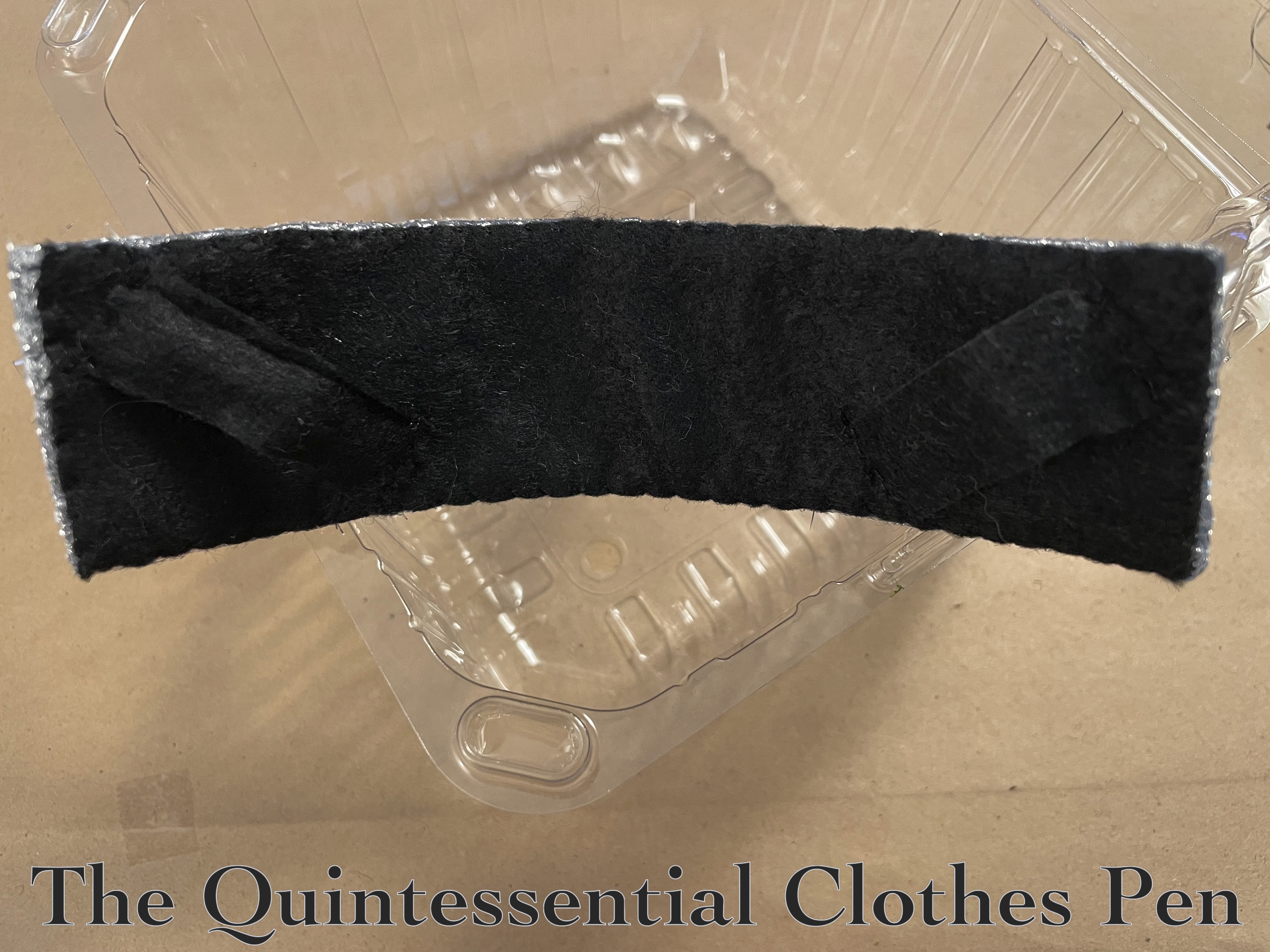
The last step was to cover up all of my stitching with a nicely whipped backing of black felt. This not only makes the whole thing super tidy, but also provides some friction to help the crown stay in place on my hair. I added a few loops to the felt, as well, so that I would have something easy to bobby pin (and not have dark bobby pins showing on the silver fabric side). Below, a much tidier bottom of the crown!

I’m proud to say that Mr. Q said the finished product does, in fact, look like icicles despite his lack of confidence along the way about my clamshell idea! That sounds like a confidence problem on his part to me, amusingly, but nevertheless I’m pleased for the positive opinion!

Photos of the finished Snow Queen ensemble will be coming in a future post!

1794 Windowpane Ruffled Dress Outing

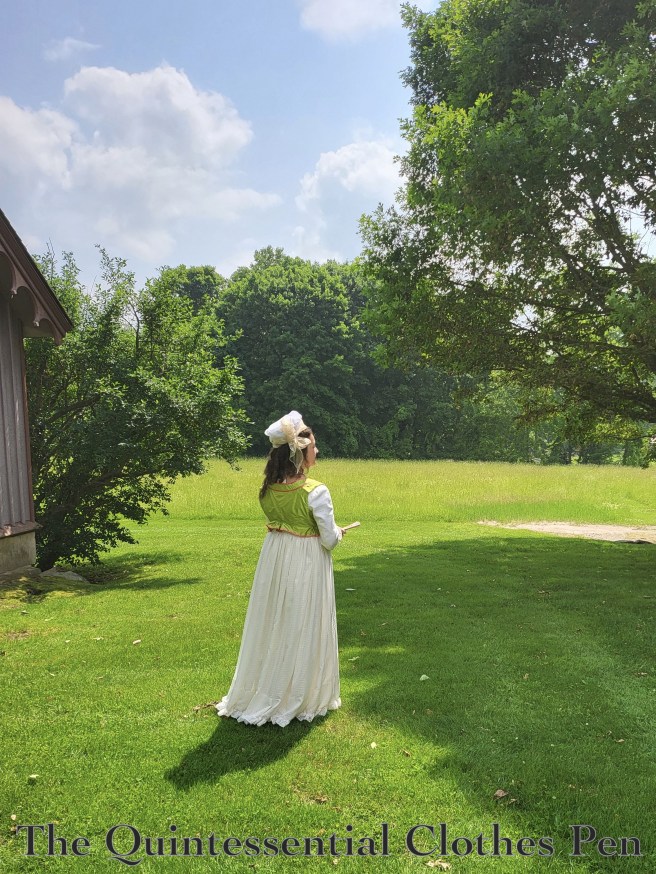
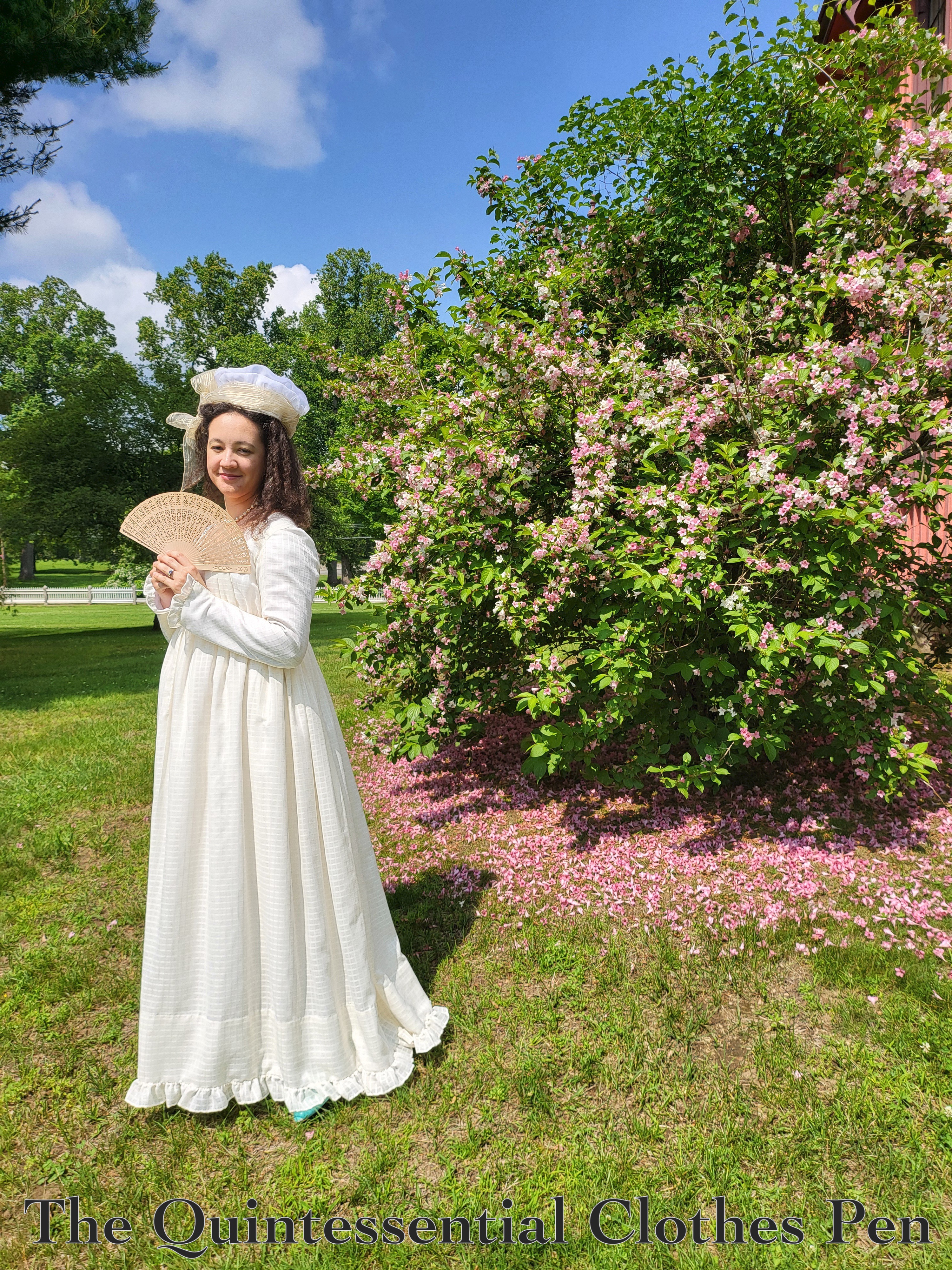
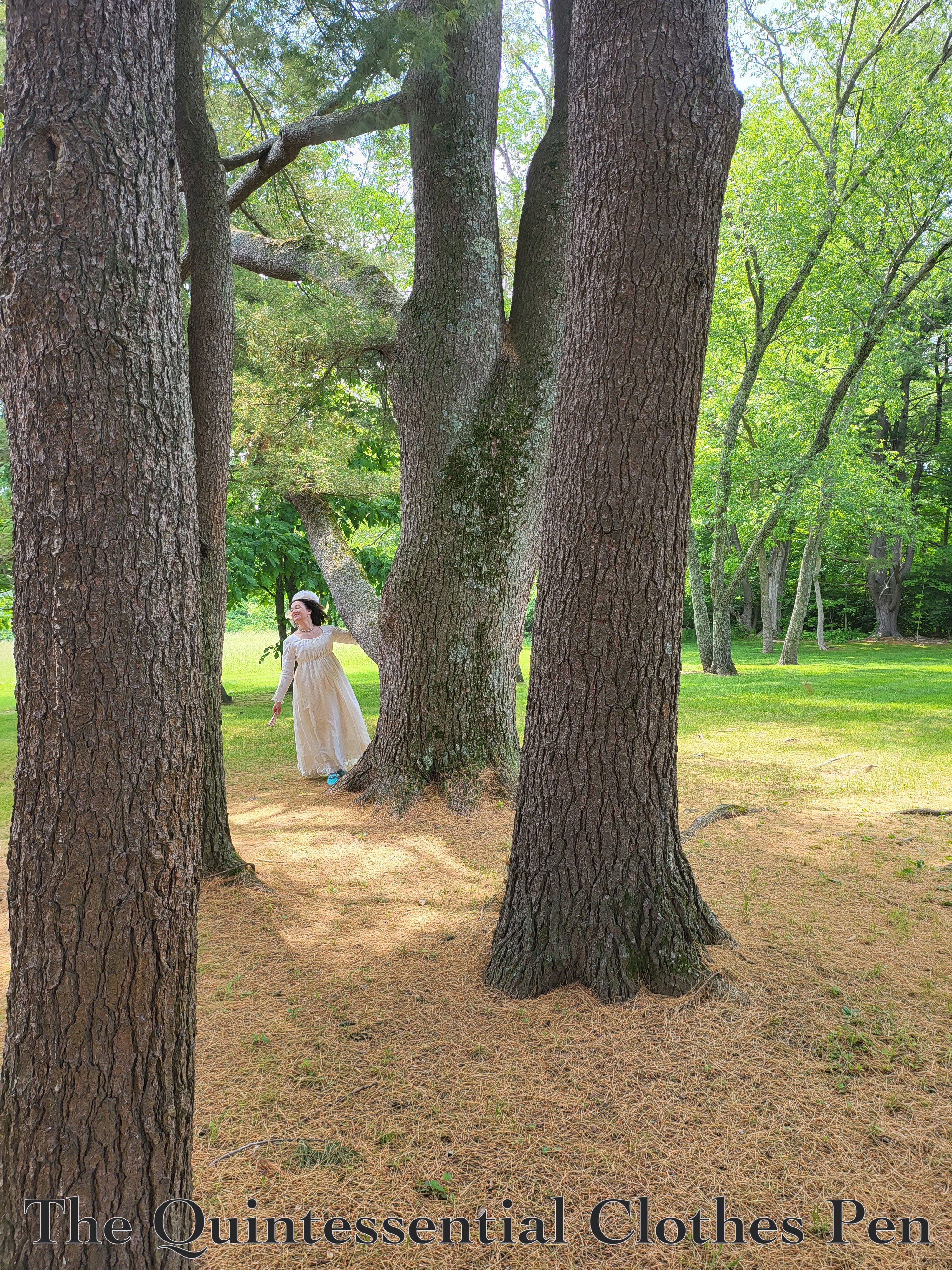
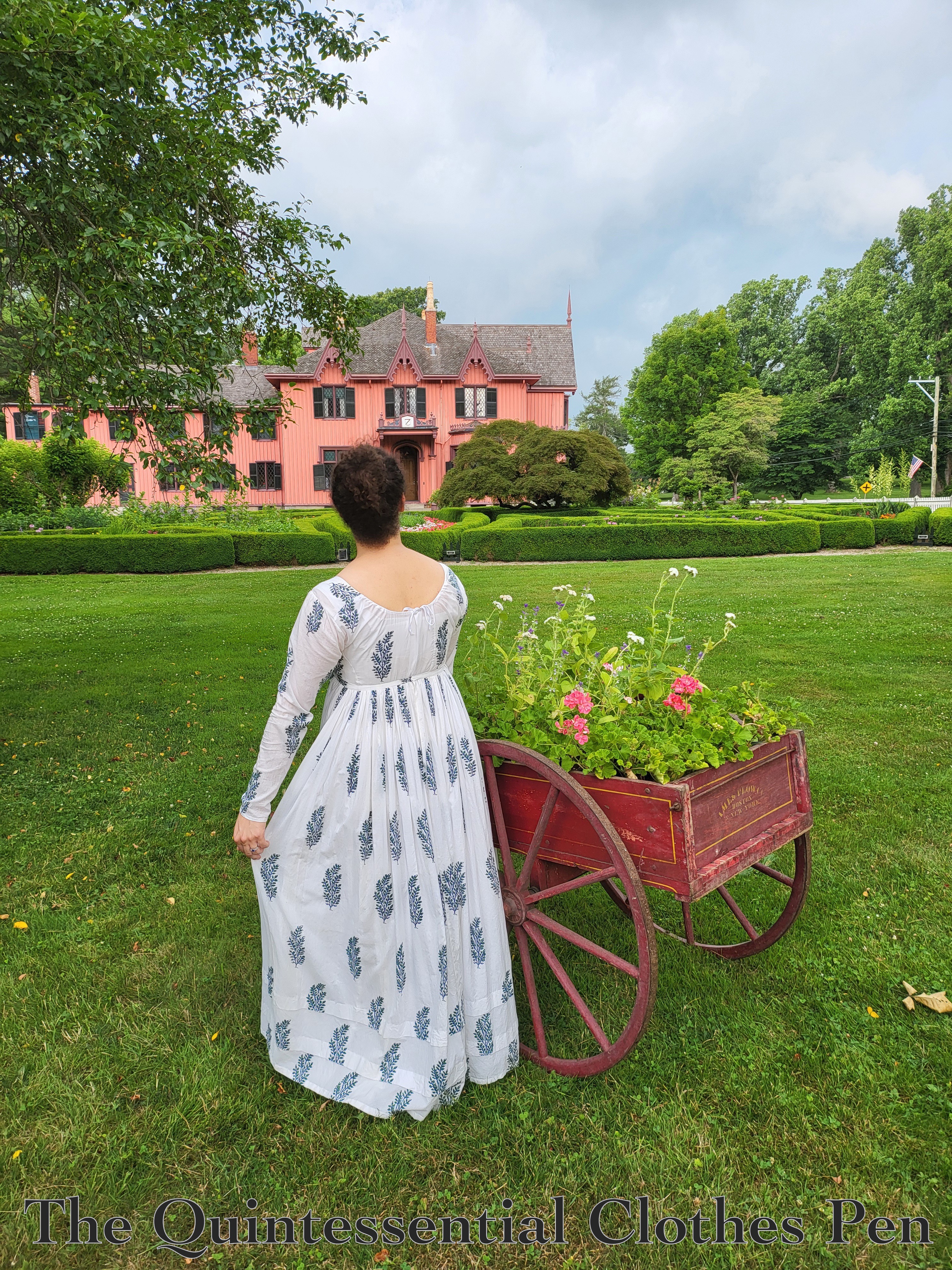
Back in October 2024, I posted about the inspiration and construction details of a freshly completed 1794 dress (you can view that past post here). At the time, I promised myself that I would figure out how to get my hair to look vaguely 1790s and find a fun opportunity to wear the dress and get photos!

Every few months after finishing the dress, I found the inspiration needed for a trial to figure out how to get my small-diameter-curly hair to look remotely like the billowing-larger-scale curls found in 1790s fashion plates. Of course, one could wear a wig… but I really enjoy using my own hair for these things! It’s a fun challenge, I think.

My first trial attempt was unsuccessful in the overall look, but I learned that curling iron curls didn’t look so far off as to be implausible. My second trial attempt taught me that the 1790s organza cap I made (finished even earlier, in 2023, and which you can read all about here, in a past post) that was intended for this outfit looked silly when perched directly on my head. It really, really needed volume so it appeared to be floating on my hair. Enter, a giant bun form. (The same bun form, in fact, that makes up the biggest part of my hair support for giant 1770s hair in this past post.)

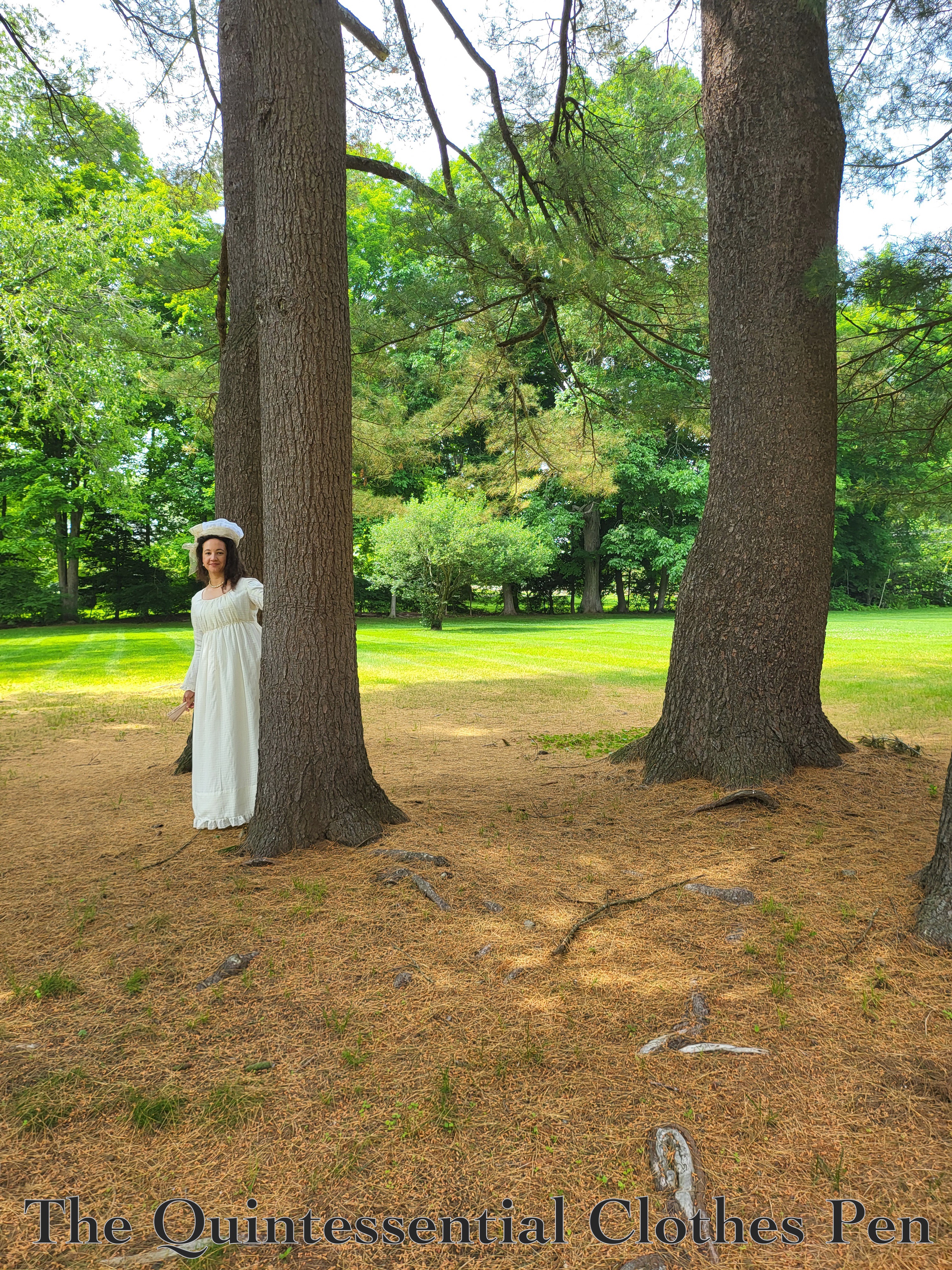
See? The cap isn’t really on my head at all. It’s just floating on my hair. Aside from curling all of my hair, the only other part of creating this hairstyle was to artfully pin the curls up to make them elegantly descend from the cap on every side.

With this dress, I wore the foundations of the 1790s ensemble I’ve been putting together for the last few years. This included my entirely hand sewn c. 1785 Stays of Success and 1790s Petticoat & Bum Pad. Also finished in 2023 and 2024, this was the first real outing for the stays, which you can read all about in this past post, and for the petticoat and bum pad, which you can read all about in this past post.

The whole ensembles is super comfortable! The stays are, in fact, a success! And the layers, with their generously gathered skirts, are full of movement. The ruffles add a bit of fun. And the front closures on the petticoat and dress are definitely easy to use!

The only difficulty of wearing this dress came from the hem that just brushes the ground. Wearing it outside meant that it collected twigs, pine needs, and leaves that I was constantly removing. Not to mention the fact that the layers attracted multiple stinging bee-like creatures to get stuck between them! Ack! Luckily, kind people around me helped me separate the layers enough to let the winged creatures free, and not a single person was stung! Whew!

Perhaps this ensemble is better suited to a marble-floored walkway, but… it was breezy, and cool, and elegant to wear outside (when one ignored the bits of nature stuck in the hem ruffle!).

A Mysterious Domino, Part I: Background & Research

Earlier this year, The Footwork and Frolick Society hosted an early 19th century themed Masquerade Ball. I enjoy fancy dress themes, and so the idea of a masquerade (which takes the idea of a costume to another level by adding a mask) seemed like a lot of fun. But what was I to do to about a costume?

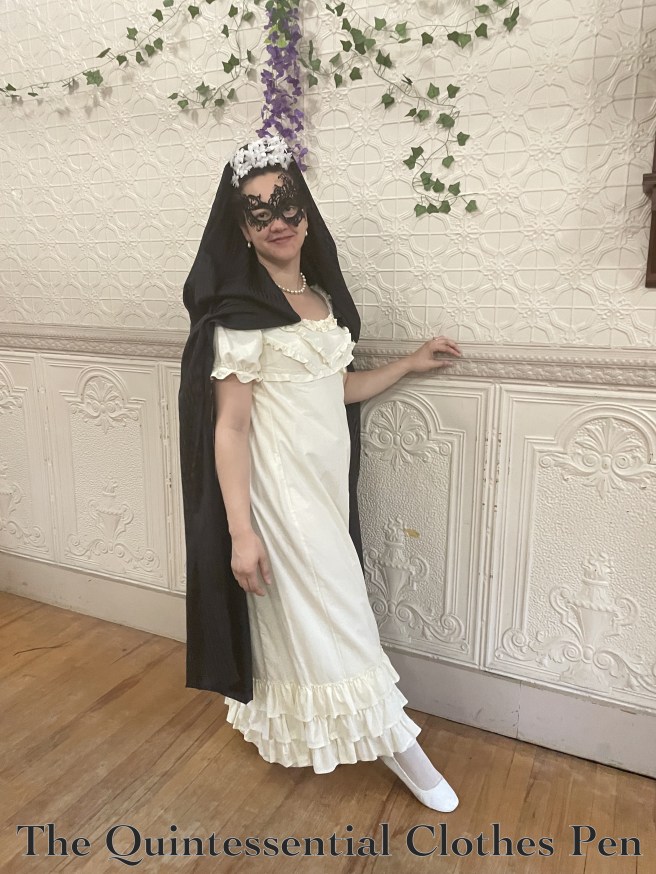
The dress: I had already decided that I wanted to wear an oldie-but-goodie dress to the ball — my ivory 1819 ruffle dress, finished in 2012 (and resized at some point, though I don’t seem to have a post about that on the blog).

The mask: I don’t really enjoy wearing masks (unless they are on a stick, like this, but that’s not good for a ball when you need your hands!). I find that masks irritate my face, but at some point I did buy a black lace mask for a fantasy masquerade that is very malleable and irritates me less. So I knew that I wanted to incorporate that mask into my outfit.

The costume: I wasn’t sure… my creative problem was to figure out what kind of costume would unite an ivory dress and a black mask!

I liked the idea of choosing something historically plausible and I know that themes like flowers, seasons, and historical periods were all popular for Fancy Dress costumes (and therefore, I figured, for masquerades), but I couldn’t think of a good theme that made sense with my color choices.

So I started doing some research, and came across the idea of a domino. Not a numbered playing piece from a game… but a mysterious, historical domino!

What Is A Domino?

What is that, then? A mysterious, historical domino?

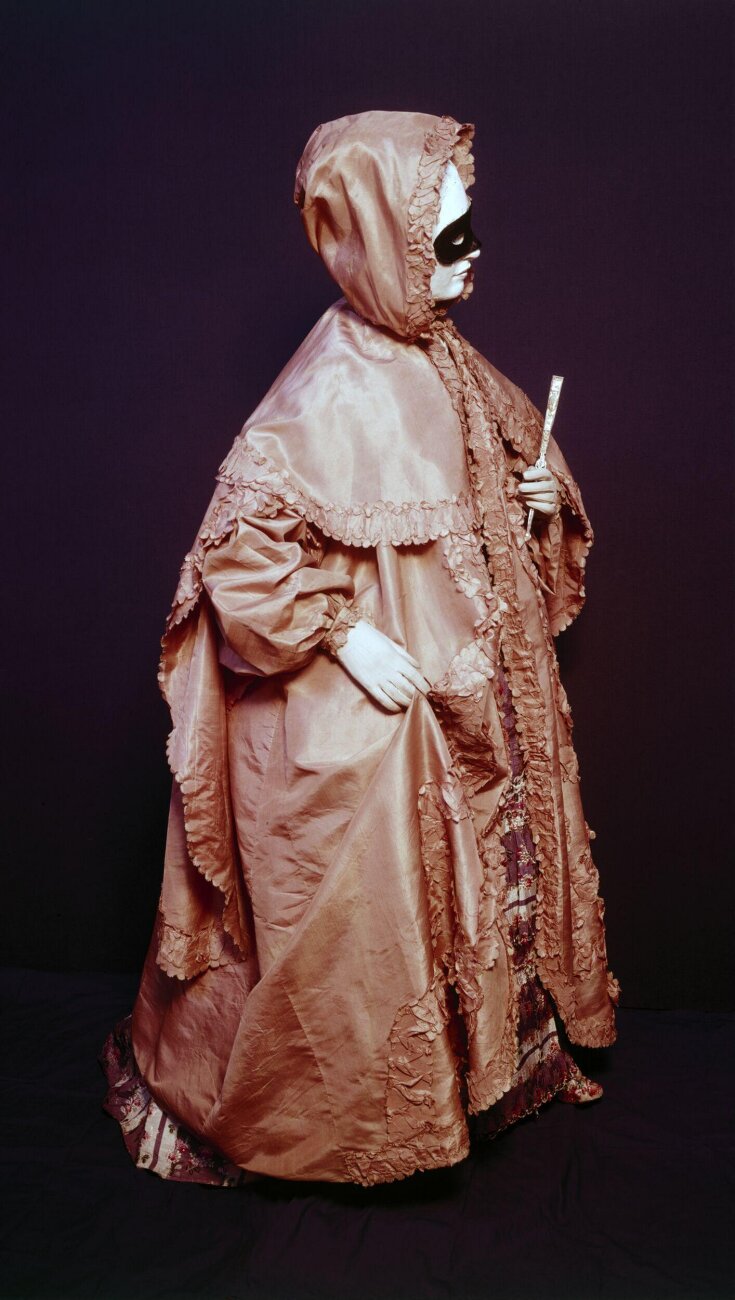
A domino is traditionally a voluminous black robe-like hooded cape worn with a black half mask as a disguise during Venetian Carnival. Dominos were popular during the 18th century at masquerades and it seems that hooded capes in this century were sometimes just generally called dominos (such as this one, perhaps, at the Metropolitan Museum of Art). By the 19th century, dominos were occasionally seen at masquerades, and even less often at fancy dress events (a costume party without masks).

Examples Of Dominos

Below is an example of an 18th century domino in the collection of the Victoria and Albert museum. In this case, the idea has been reimagined in pink, rather than the usual black. The museum gives this information regarding a date: 1765 – 1770 (sewing), ca. 1775 (altered) (accession number T.195-1968).

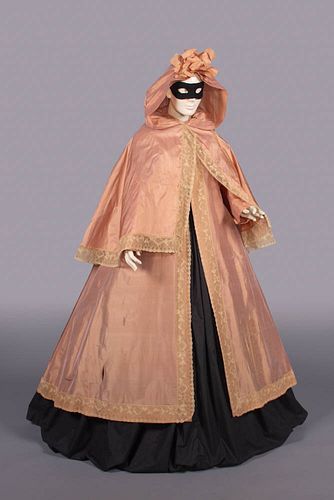
Below is another example, from the late 18th or early 19th century, also pink. This domino still shows evidence of 18th century construction styles — particularly the large gathered hood and what appear to be rectangle shaped sleeves. The extant example below is from Augusta Auctions. They labeled it as a Two Piece Shot Silk Domino, c.1800.

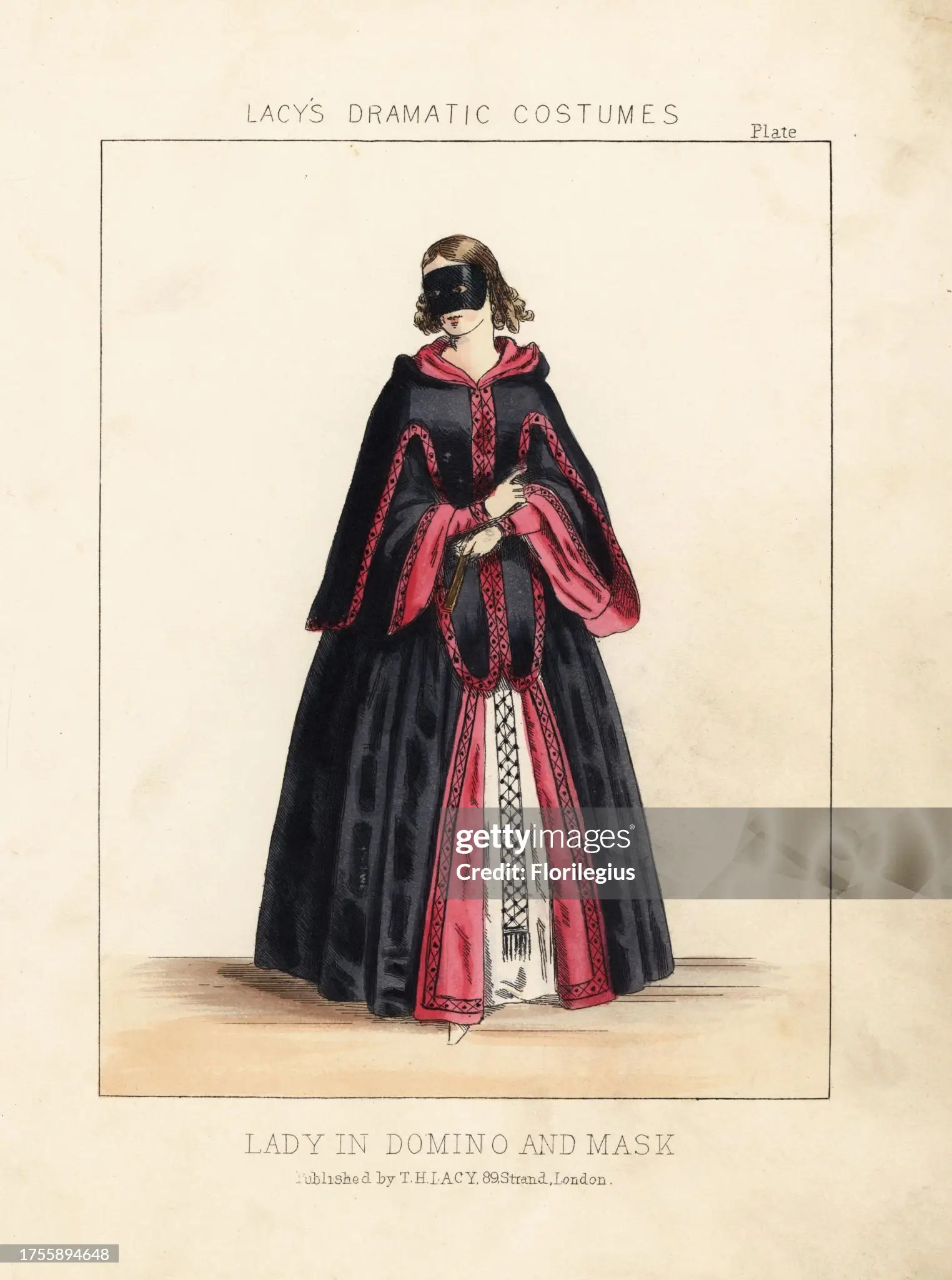
Below is an example of a mid-19th century take on a domino. This is a costume idea for a masked ball (or masquerade). This plate is from Thomas Hailes Lacy’s “Female Costumes Historical, National and Dramatic in 200 Plates,” London, 1865 (from Getty Images).

Susan de Guardiola has collected later 19th century descriptions of dominos that are available here, as well.

Though less common, dominos were still in use for masquerades even in the early 20th century. While looking for other unrelated research, I came across a mention of them from January 1920, when the accomplished fashion designer Erté wrote in a letter he was asked to write from Monte Carlo to the editor of Harper’s Bazar:

This winter will mark the first organized effort at gaiety since the dark night of war… Already we are planning to revive the masked ball in all its mad gaiety…

The domino–aha! … In Venice until the fall of the Republic, it was commonly worn in the streets. There reigned in the enchanted city at this decadent epoch a strange corruption of manners, and the mask was a necessity. At every entrance hung the black domino. Rich and poor alike donned it, in order that they might sally forth enveloped in anonymity…

“But,” argue some, “the domino gives to the fête an air of mystery.” I reply, “Then one may attain this illusion by means of a domino of distinguished cut, a domino which shall not make one’s figure look like a shapeless bundle.”

(From Designs By Erté: Fashion Drawings & Illustrations From ‘Harper’s Bazar’ Including 8 Covers In Full Color By Stella Blum)

I think this is a great place to pause. I’ll continue sharing in my next post, which will focus on how I whipped up a quick domino and what it looked like when worn!

A Story Of Two Tuckers (HSM #6)

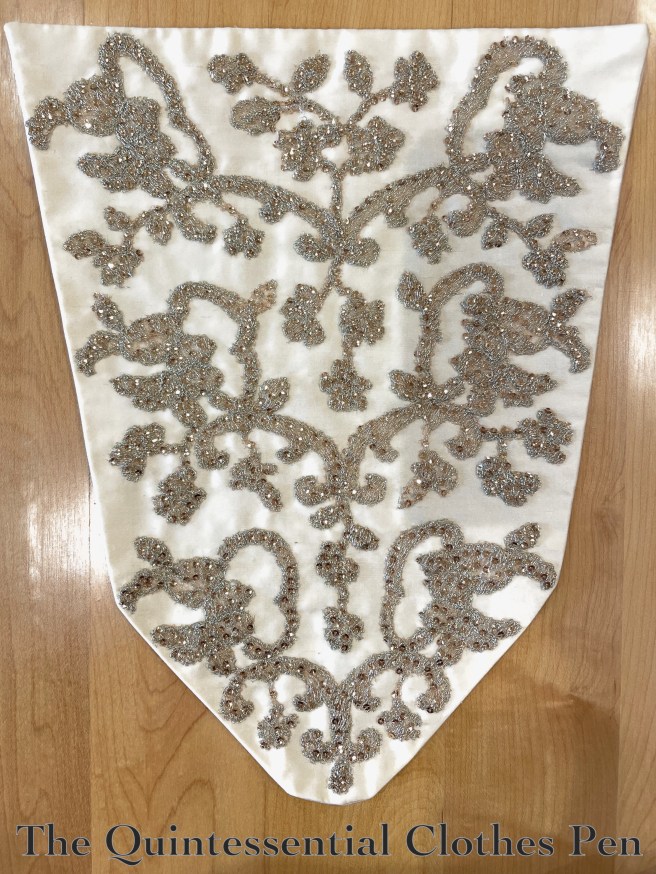
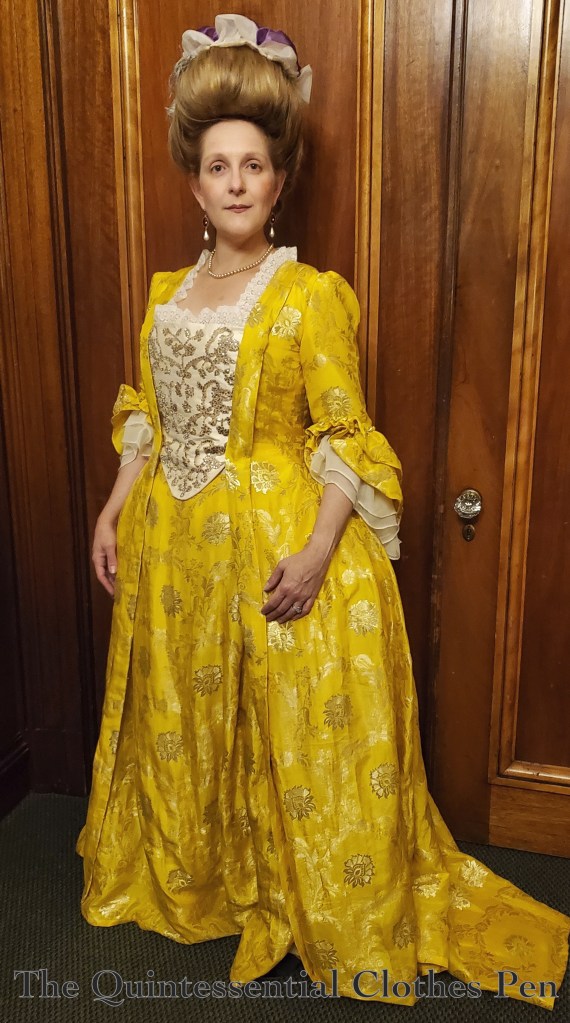
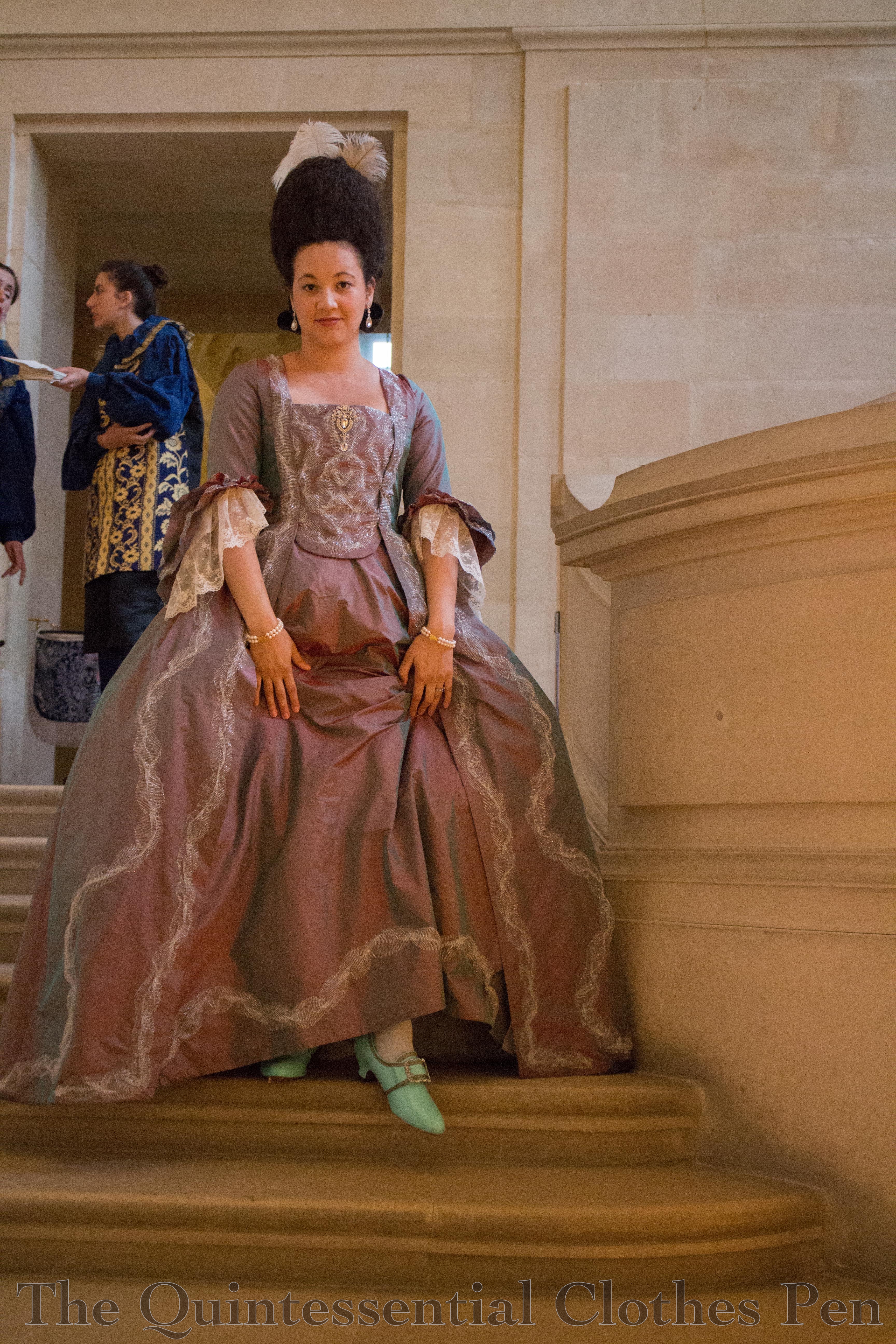
One of my goals for the second wearing of my Versailles sacque was to finish a small detail that didn’t make it into the first wearing back in 2016 (you can read about that exciting adventure in this past post). Below is a photo from that first exciting wearing of the dress. My new goal: to fill in the neckline of the dress with a bit of lace known as a ‘tucker’.

In addition, I also wanted to have a second tucker to complete the neckline of the new Yellow Sacque that I was working on.

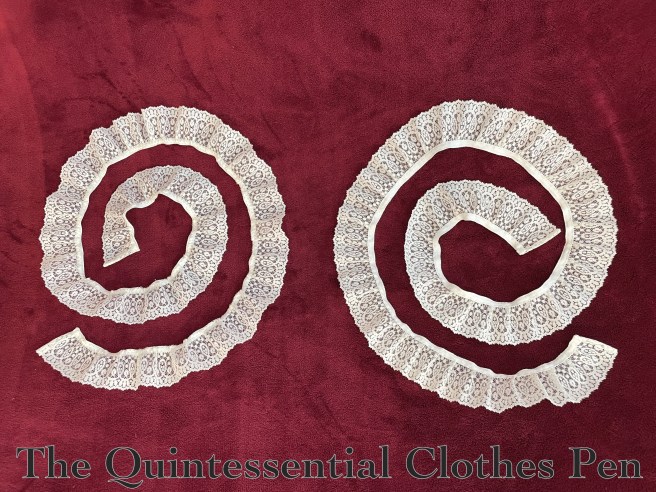
Accordingly, over the summer of 2024 I dug around in my stash to find a suitable lace to use for these simple accessories. I came up with a 1 ⅞” wide lace that I’d purchased a roll of 100 yards of from Debs Lace and Trims. (I’ve purchased quite a quantity of lace from this shop over the last 15 years and have great things to say about it. I’ve never found better prices, which is excellent for historical projects that need large quantities of lace. I say that with no ulterior motives. I’m not affiliated with the store in any way!)

I followed the instructions on page 122 in The American Duchess Guide To 18th Century Dressmaking by Lauren Stowell and Abby Cox to make these two tuckers. They are exactly the same except that one is slightly longer (by 3″) than the other.

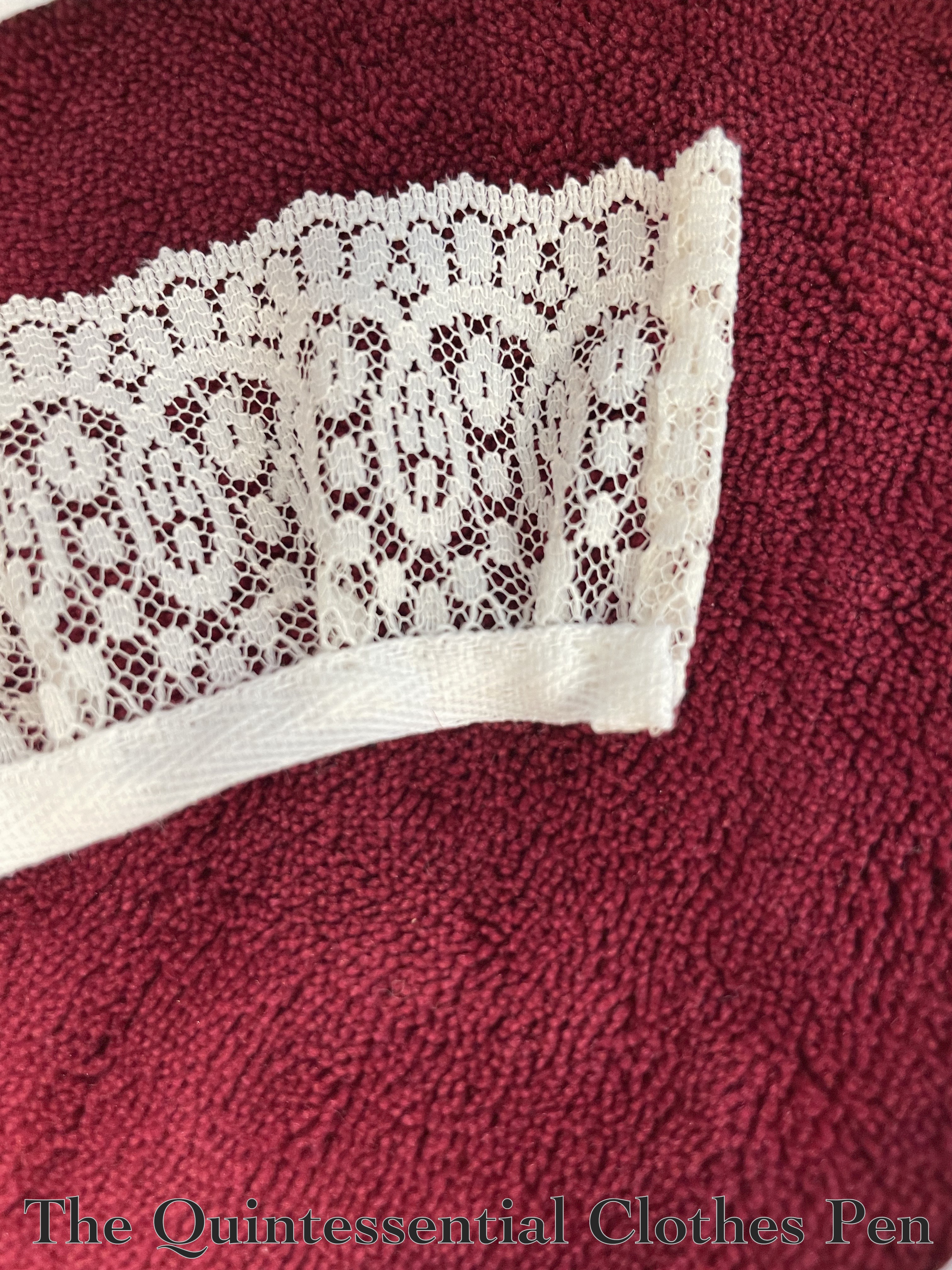
The ends of the lace are neatly hemmed, as you can see below.

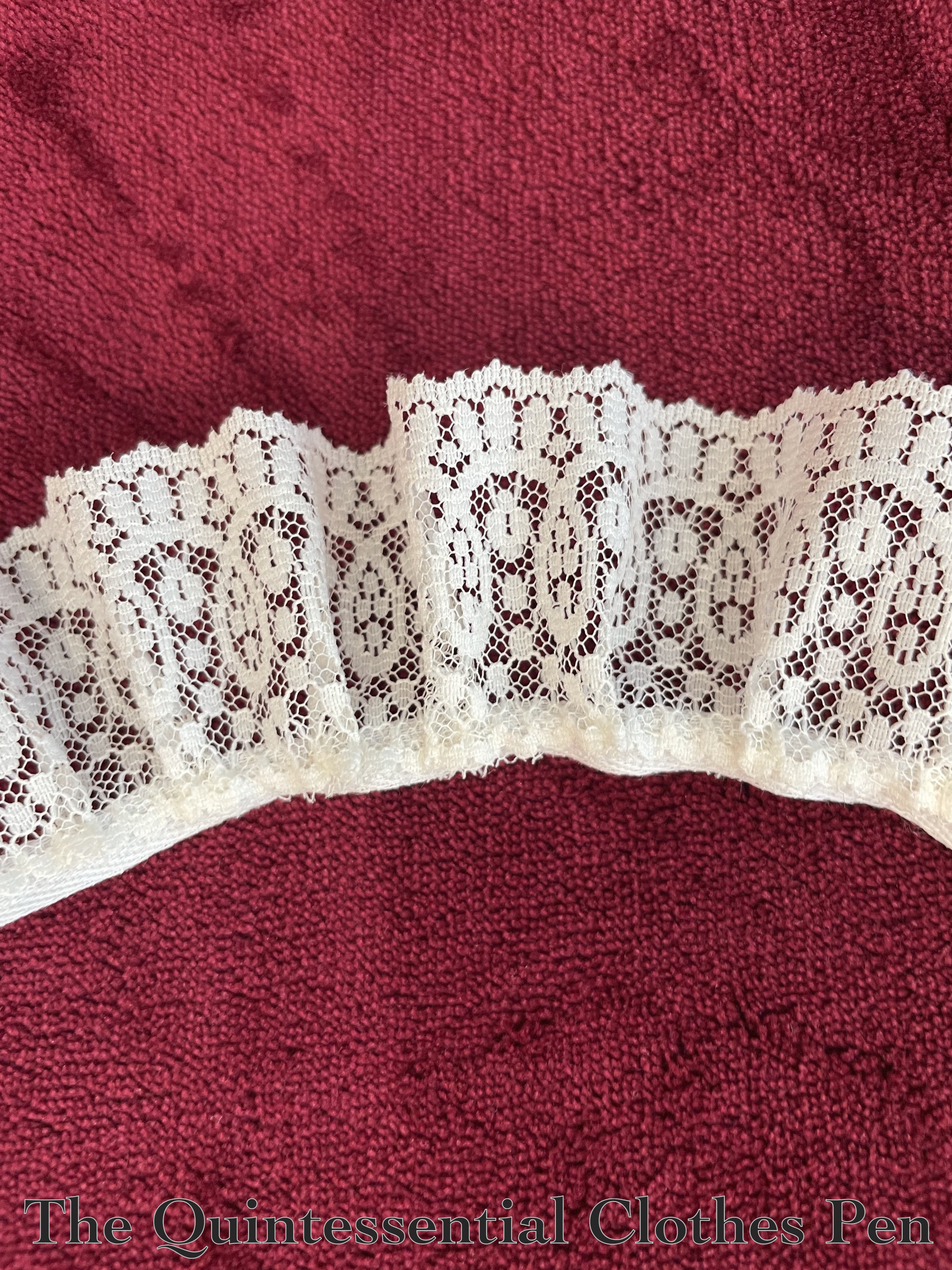
And the lace is whipped to a 1/4″ cotton twill tape, as you can see in the photo above as well as the one below.

And that’s it! This is my entry for the Historical Sew Monthly 2025 Challenge #6 Accessorize:

Accessories add polish to your outfits, helping to create the perfect historical look. Create the perfect period accessory for yourself.

Just the facts:

Fabric/Materials: Approximately 2 yards of 1 ⅞” wide lace (for each tucker).

Pattern: From The American Duchess Guide To 18th Century Dressmaking by Lauren Stowell and Abby Cox.

Year: c. 1770.

Notions: Approximately 1 ¼ yards of 1/4″ white cotton twill tape (for each tucker) and thread.

How historically accurate is it?: 90%. Entirely hand sewn, made from plausible looking materials, and using a pattern that is backed up by lots of research. I just give a little off for the fiber content of the lace and the use of ¼” cotton tape rather than ½” linen tape.

Hours to complete: About 1 hour per tucker.

First worn: October 5, 2024.

Total cost: Approximately $3, for both tuckers! The lace was just $0.10 per yard and the twill tape was also purchased in bulk — I probably only used about $1 or $2 worth.

Summary of 2024: Looking Forward To 2025

As is tradition here on the blog, I present my 2024 round up and thoughts about looking ahead to another new year! (You can see all of my past posts related to reflecting and looking forward here.)

 Projects I completed in 2024

April: 1940 Schiaparelli Inspired Dress

May: Another Round of Dotty Tap Pants

May: Replaced the zipper in the Happy Clover Dress

June: 1860s Drawers: Waist Re-Size (HSM #11)

June: Regency Petticoat Re-Size (HSM #5)

August: 1815 Tree Gown Re-Size

October: 1790s Petticoat and Bum Pad (HSM #8)

November: Yellow Sacque Petticoat (HSM #12)

November: Engageants For The New Yellow Sacque (HSM #6)

December: A White 1780s Petticoat (HSF #7)

General Blog News

I participated in my 12th year of the Historical Sew Monthly! Wow! Really! I’ve been at this a long time, I guess! It doesn’t feel that long! This year I completed 7 of the 12 challenges. That’s actually pretty good for me. It means I’ve had time to sew again!

Event Recap

I attended 3 balls, 4 other events (tea, picnic, croquet, outings, etc.), 2 dance and historical pastimes performances, and participated in 1 weekend event (that included dancing, games, and educational lectures). That’s a definite increase from last year! I’m so pleased to have these opportunities again.

To Do Lists

Last year’s definitely-to-do list was pretty substantial, including multiple repairs, UFOs, and multi-part new garments. I’m super pleased with myself that I completed all of the list except for one thing!  The unfinished item will be at the top of my list for 2025.

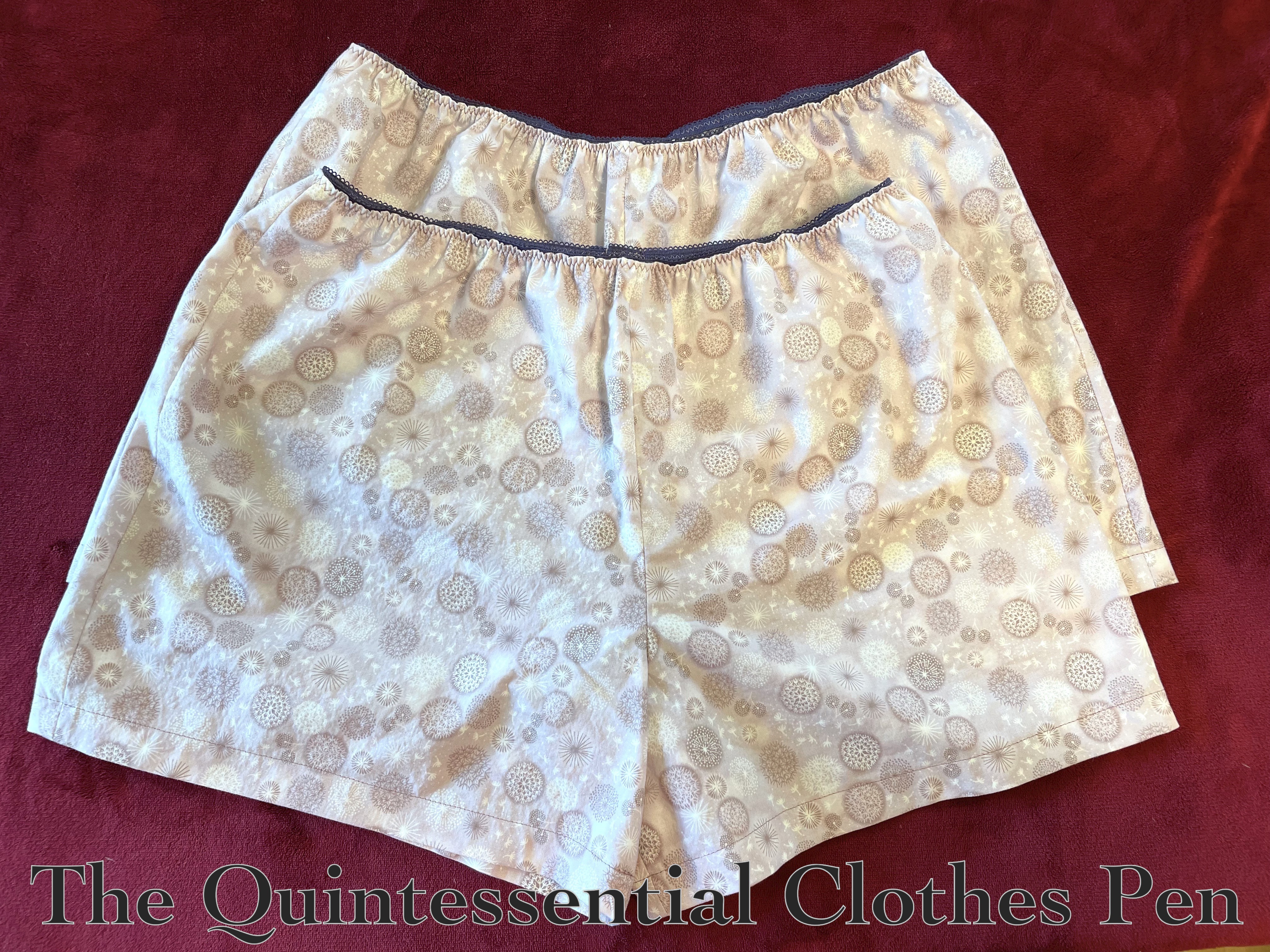
In addition to those ‘definitely’ things, I also completed a few items on my lengthy ‘maybe’ list (updating my 1885 Night Sky Fancy Dress — not posted about yet — and making new dotty tap pants). I think some of my ‘maybes’ will just move up to ‘definitely’ for this year. And then I’ll also see what else inspires me as the year goes on!

So, my definitely-to-do for 2025 list includes:

  • Updating the trimming on my 1893 Bronze and Pink Ballgown to better go with the size updates I made in 2022 and posted about in 2023
  • Finishing the 1836 Blue Print Cotton Day Dress #2
  • 18th century neckerkerchief
  • Scroop Patterns Frances rump (1775-1795)
  • Various sleeve and neck ruffles to go with all of these 18th century gowns

And my maybe-to-do list includes:

I am so pleased to have a little more time to sew and the project planning to lay things out so that I can sew whether I have the brain space to dedicate to new projects or to just mindlessly hem things. Having a range ready to go has worked very well for me!

I am so very grateful to my supportive friends, family, and blog readers — in terms of sewing projects and adventures as well as general support and encouragement. It is my fervent hope that you also have many things to be grateful for in this new year! Maybe you’ll even have silly friends who make moose ears (well, yes, I know it’s really moose antlers…) with you!

Engageants For The New Yellow Sacque (HSM #6)

I’m trying to get in all of my Historical Sew Monthly 2024 posts before the new year! So in that spirit, here is another one!

Above is a closeup of the fluff that makes up the arm openings of the new yellow sacque I mentioned in my last post (where I shared details about the petticoat for the new sacque) as well as my Versailles dress from 2016. Part of the fluff is the sleeve ruffles on the dresses and part of the fluff is the engageants — lace for the Versailles dress and a double layer of ivory silk for the new yellow sacque!

Engageants are sleeve ruffles. The Oxford English Dictionary traces the word back to the 16th century with its origins in French.

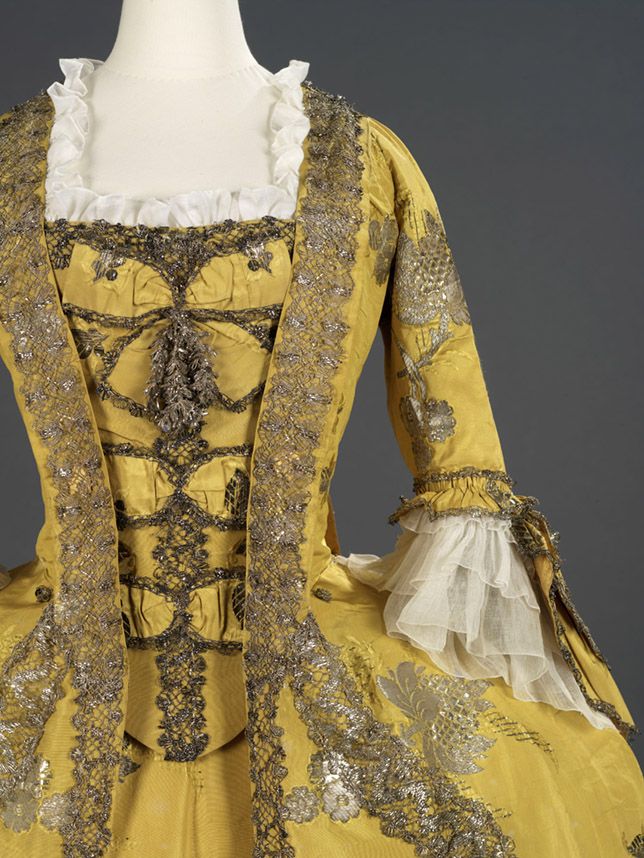
These new engageants are made of two layers of silk gauze, inspired by the ones displayed with the lovely yellow dress below by the Royal Ontario Museum.

Robe à la française Spitalfields (London), England. Silk extended tabby (gros de Tours) with liseré self-patterning and brocading in silver lamella and filé Georgian Rococo. 1750s. Gift of the Fashion Group Inc. of Toronto in memory of Gwen Cowley. ROM2009_10909_22.

I specifically wanted the semi-sheer quality as a change from the lace engageants that accompany my Versailles sacque (which you can read about in this past post detailing construction information about that dress).

I looked through my stash and realized that the best fabric I had for this project was salvaged from an old ballroom dancing dress I’d made. Here is a blast from the past for you! The elusive Mr. Q is even hiding there, behind my head… But back to the dress. It was made pre-blog, so no photos of it have made it here before.

I was so proud of it! But after a fair bit of wearing this dress, I moved on to creating new ballroom dresses and sacrificed this one for parts. The rhinestoned lace was re-used in a dress that did make it onto the blog in 2013 (documented in this past post), but the float — that dangling piece hanging from my wrist that floats in the breeze while dancing — was simply put into my fabric stash, which is where I found it when looking for engageant material!

The float was an odd triangular piece, so I had to do some piecing (adding center seams, for example) to make my engageant pieces fit. But that’s fine! In all the fluff you can’t see the seams.

And in fact, the pattern I used, from 1769, was intended to create zero fabric waste, which intentionally added seams, as well. The scalloped pieces are stacked together with the scallops facing each other to efficiently use a single rectangle of fabric.

Completed engageants are below. The seams are not obvious!

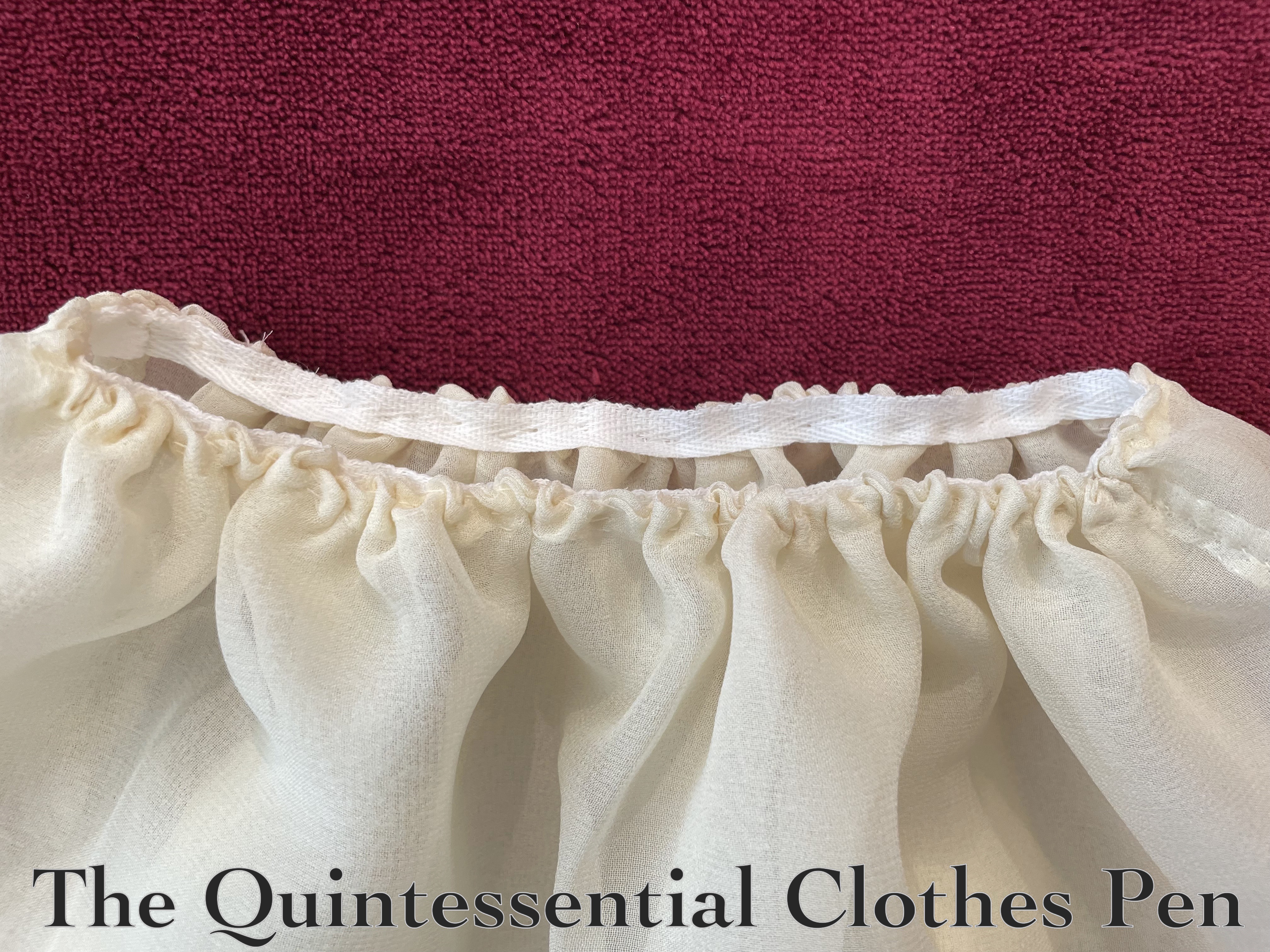
Every individual silk piece for these was narrow hemmed on all the edges and then the seams were butted, whipped, laid flat, and pressed. Below is a close up of a seam and a scalloped bottom edge.

Once all of that was done, the two layers were laid on top of each other and whip gathered along the top edge. This was then sewn to a ¼” cotton tape. This allows for the engageants to be removed to be cleaned or used with another dress someday.

And that’s it! These qualify for the Historical Sew Monthly Challenge #6 Up Your Sleeve:

Level up your sleeve game by making a garment where the focus is on the sleeves.

Just the facts:

Fabric/Materials: Approximately ½ yard of ivory silk gauze.

Pattern: From page 14 in Patterns of Fashion 6 (written by Janet Arnold, Sébastien Passot, Claire Thornton, & Jenny Tiramani).

Year: 1769.

Notions: Approximately ⅔ yard of ¼” white cotton twill tape and thread.

How historically accurate is it?: 95%. Entirely hand sewn. The construction methods are historically sound. The fiber content and weave may not be perfect.

Hours to complete: 8 ¾.

First worn: October 5, 2024.

Total cost: I have no recollection of what I paid for the silk gauze many years ago. Plus, at this point this fabric is being re-used, so might be called free regardless. The twill tape was bought in bulk and cost less than $1 per yard. So let’s say approximately $5.

c. 1770 Pink Panniers (HSM #12)

I have a longer-term goal to make a another sacque (similar the one I made for Versailles in 2016–documented in these many past posts). I specifically want this new one to be loan-able to a few friends, so I’m adjusting the size a bit from the one I made for myself.

I know that foundations make the garment on top look good, so it’s important to me to also be able to provide the foundation pieces that might be needed to go with the sacque. Stays are covered, as I now have the c. 1785 Green Linen Stays that can be loaned and/or some friends have their own, but panniers and an additional foundation petticoat felt like items that I don’t already have and therefore should make in addition to the sacque itself.

This post is going to document the panniers I made for this new ensemble. I’m pleased that they qualify for the Historical Sew Monthly Challenge #12, Paired to Perfection:

Make something that comes in a pair (mittens, stockings, garters, braces etc.) Or make something in which the trim or construction prominently features sets of two.

Just the facts:

Fabric/Materials: 1 yd (or probably a little less) pink cotton twill.

Pattern: The Dreamstress’s pattern from the Pannier Along in (oh my, has it been this long…???) 2013! All the steps, information, etc. is available on Leimomi’s blog, here.

Year: c. 1770.

Notions: Thread, 3 24″ x 3/8″ zip ties, and approximately 2 yds grosgrain ribbon.

How historically accurate is it?: 70%. Machine sewing and materials are generally not historically accurate, but the overall pattern and shapes are.

Hours to complete: I didn’t really keep track. Let’s say 5.

First worn: Has not been worn yet.

Total cost: All of the materials are from the stash (leftovers from other projects), so let’s say free!

A view of the top of the stays, with them collapsed down on themselves.

I made these following all of the steps in The Dreamstress’s tutorial, as mentioned above. I decided to mostly machine sew them, in the spirit of speed and because I knew the fabric I chose was not accurate to start with.

I made my boning channels out of the same fabric as the exteriors (pink cotton twill leftover from making early 19th century stays over ten years ago).

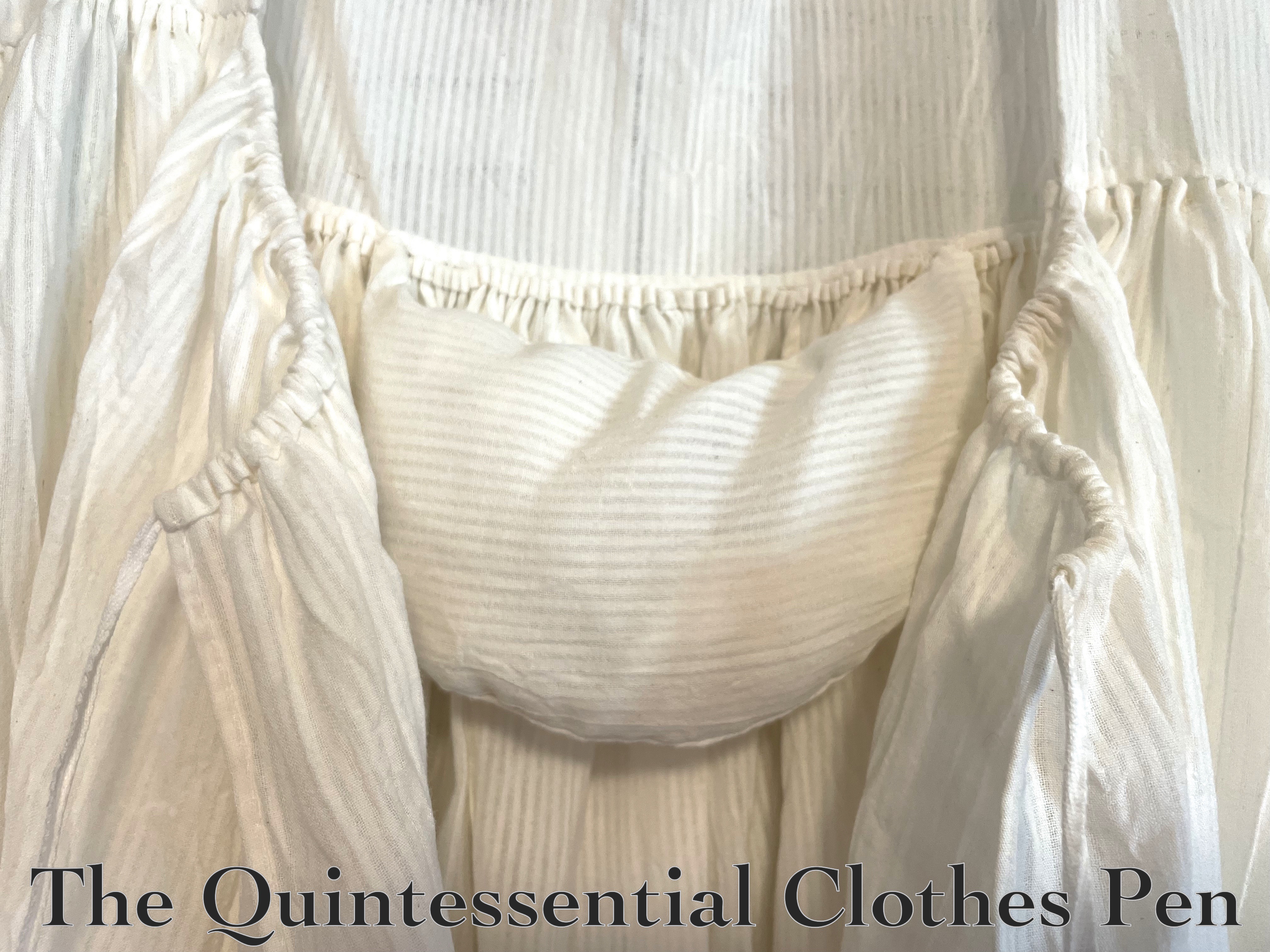
There are only two hand sewn bits. One is the slit on top (to be able to use these as pockets and store things in them), pictured below. Each slit is reinforced at the bottom to keep the fabric from ripping during use.

The other hand sewn bit is the band at the top, which is whipped down after being machine sewn on.

And that’s it! Pink panniers! It has a bit of a ring to it, I think!

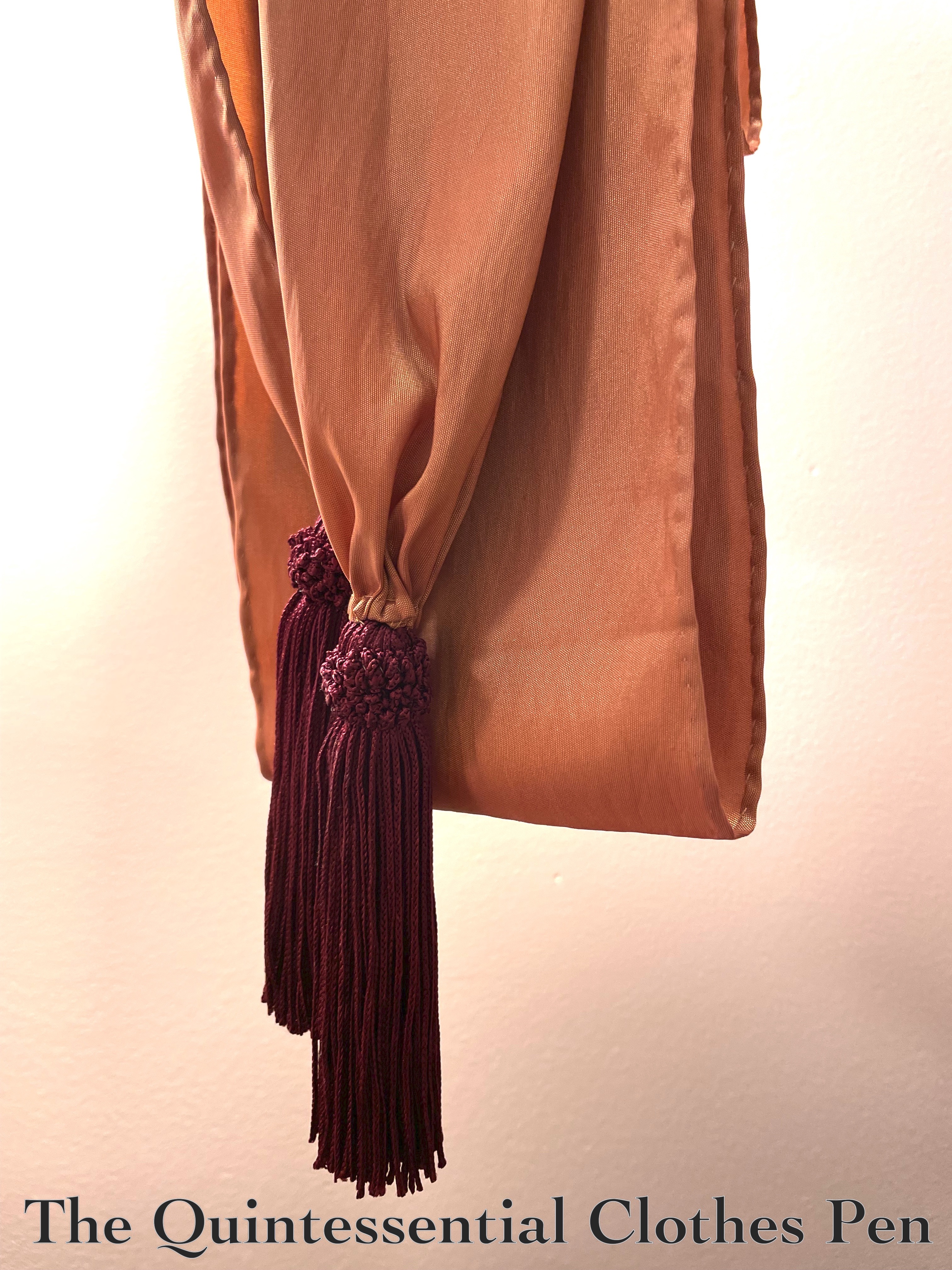
HSM #3: Copper Colored 1790s Sash

I finished a project! It’s small, but I’m very pleased with it.

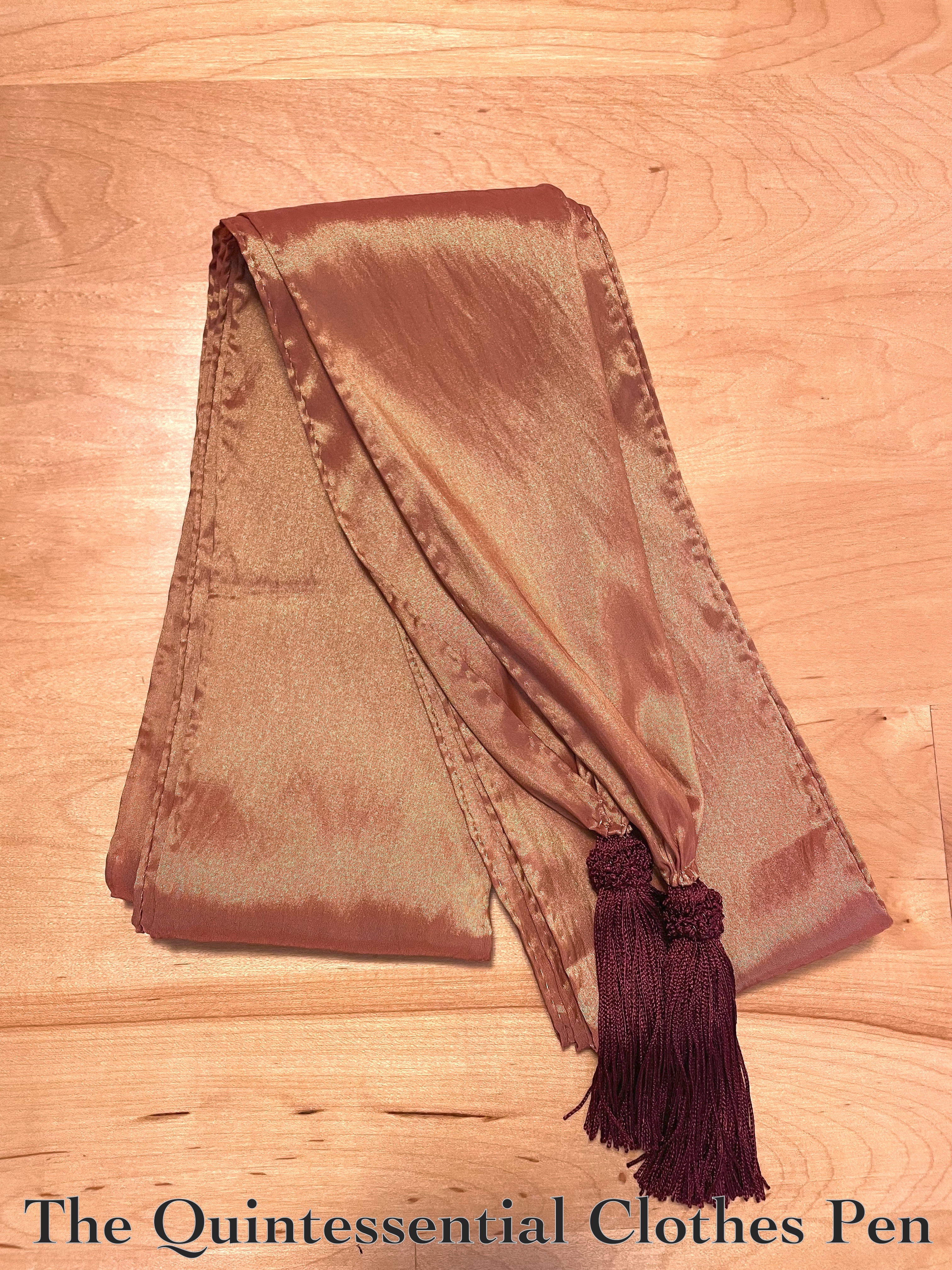
The project is a sash to be worn with an in-progress 1790s dress. The goal is to be slowly progressing towards an entire 1790s outfit, with all of the appropriate accessories.

I’ve enjoyed making lists of what those accessories might be and getting them cut out and lined up for mindless hand sewing. That way, even when life is busy and I don’t have time to think about a project, I can still make progress and have something to sew, which brings me great joy and a sense of calm.

This project takes its inspiration and instruction from The American Duchess Guide To 18th Century Dressmaking, by Lauren Stowell and Abby Cox.

I’m excited that the sash qualifies for the Historical Sew Monthly Challenge #3, Focus on the Fabric:

Make something in which the fabric colour/ texture/print/material etc. is the central feature of the design.

This fits the challenge in that the sash really isn’t at all about the construction details… The only cuts to the fabric were to make strips, and the only sewing is joining them and finishing the edges. So it really is all about the fabric!

Just the facts:

Fabric/Materials: ½ yard or so orange/gold shot polyester taffeta leftover from a very old project and 2 burgundy tassels.

Pattern: 1790s Sash in the book The American Duchess Guide To 18th Century Dressmaking, by Lauren Stowell and Abby Cox.

Year: c. 1790.

Notions: Thread.

How historically accurate is it?: 90%. Polyester is obviously not historically accurate, but the dimensions and hand sewing method are.

Hours to complete: 5.

First worn: Has not been worn yet.

Total cost: $2 for the tassels and let’s say $.50 for the thread. We’ll count the fabric as free. So, $2.50.

1875 Reception Dress Photo Shoot

I was really excited to spend lots of time working on and finally completing this dress during the summer of 2020.

At that time, there was no option of finding a fabulous indoor place to take photos, so I had to make do with the outdoors. Don’t get me wrong, I have lovely photos from that short outing, but they didn’t have as much background ambiance as I was hoping to find, someday.

But last year, I had the opportunity to actually wear this dress for an activity! And I was able to convince friends to take oodles of photos so I could better document the dress in appropriate surroundings for its reception status. So now, I present many photos of this dress.

There are dramatic back views, of course.

And front views showing the bust, waist, hip dimensions I worked very hard at in the patterning stages. This is created/augmented with padding. You can read more about that in this past post.

There are also views trying to show both the front and back. A side front view, if you will. This also captures the hat very well. I wrote a detailed post about making it, which you can read here.

And a few more sitting photos, as well. These are great for showing off the train and the layers that support it (this is my past post about constructing the skirt and this is about the balayeuse that supports the skirt, if you’d like to know more).

It was hard to choose favorites! I’m very pleased to have so many photos that capture the glory of this dress in an appropriate location.

1920s Star Fancy Dress

The theme recommendation for the evening soiree at Gatsby On The Isles earlier this year was a masquerade. I took that to heart and decided to adapt an existing dress in my closet to make it fancy dress. (It turns out that the majority of people who attended didn’t adhere to the guidelines, so I was a bit out of place, but I enjoyed my fancy dress regardless!)

My requirements for this outfit were: to use a dress as a base that was already in my closet, to not cost much, to not take much time, and to have the elements of fancy dress be easily reversible.

I looked through my 20th Century Fancy Dress Pinterest board and settled on the image below as my inspiration. (Unfortunately, I can’t find a source for the image that isn’t Pinterest. If anyone has information, please share.)

I thought the idea of stars would work well with my 1926 Silver Lace Robe de Style. I briefly considered creating the stars myself and then I remembered that I didn’t want this too take too much time and I started researching purchasable stars. I wanted something nice looking but not costly, remember, and I also wanted to stay away from glitter–the shedding! Ugh! While considering various metallic and cardboard style stars I realized that: 1- those may not travel well (I didn’t want bent stars!) and 2- they probably wouldn’t be comfortable to wear. So I started researching felt stars!

I decided on these felt stars. They were a good size, I liked the color, and they weren’t supposed to be too stiff. Not being stiff would be more comfortable to wear and also easier to sew through! I’d considered making garlands of the stars but I figured they would get tangled, so instead I opted to sew the stars directly onto the lace.

I started by placing the stars in a line diagonally across the top of the dress. The goal was to capture the feeling of my inspiration but didn’t feel the need to add as many stars as the drawing has, so I stopped with the one line. I liked the stars hanging from the hem, so I did those next–one star per each dip in the pattern of the lace.

After that I didn’t have many stars left! I used a scrap of metallic knit fabric to make a veil and put a star on each corner. The veil is a square, with one corner turned under, gathered, and stitched to a hair comb.

I also used some black felt scraps to cut a few stars by hand to accent the star at the waist. I thought this might tie in the metallic knit veil and also draw attention to the grey stars on the grey dress!

I added some sparkly shoe clips, pearl bracelets, and sparkly stars for my hair (reused from my 1885 Night Sky Fancy Dress) and the outfit was complete! It pays off to reuse themes for fancy dress, I guess!