1797 Watermelon Sleeveless Bodice, Part II: Patterning & Construction

This story begins in my previous post (which you can read here) in which I share the backstory and inspiration for this garment. I’ll be carrying on from where I left off. But first, a quick side story!

Mr. Q saw the title of this post and asked “What is a watermelon sleeve?” An excellent question, I think! I explained that watermelon is my description fpr the colors of the garment I’m discussing. But… I do rather wonder what a “watermelon” sleeve might look like…! After all, there are many historical sleeves with fun names (bishop, bell, pagoda, beret, gigot, and mameluke all come to mind quickly, though I can’t think of any that are named after fruit. If you can, let me know!).

Leaving that tangent behind… back to the story!

Patterning

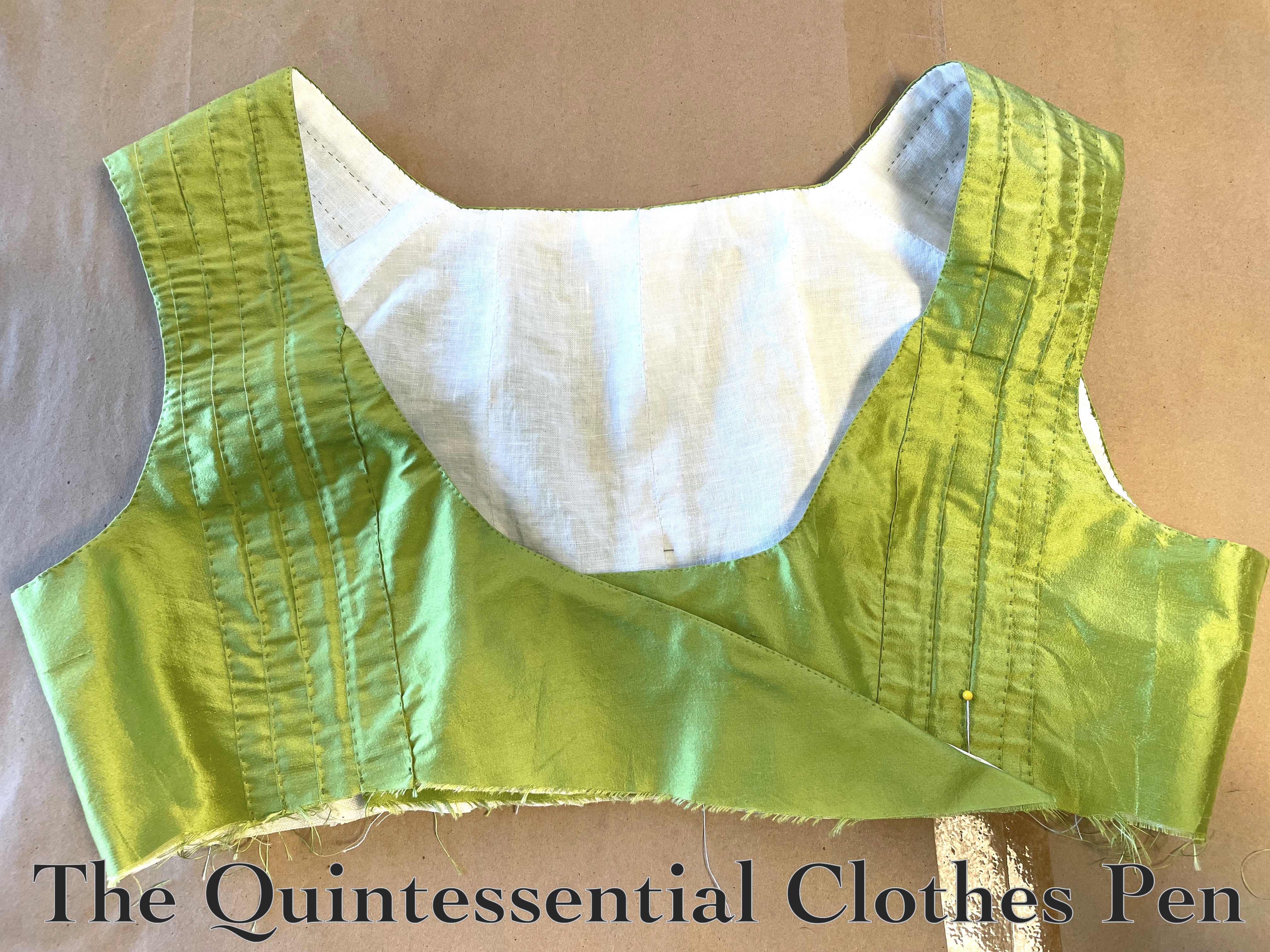
The pattern started with the lining pattern for the dress that I knew fit and would be worn under the sleeveless bodice as well as the bodice of “A Robe c. 1795 – 1803” on pages 44 and 45 of the original printing of Janet Arnold’s Patterns of Fashion 2. I liked the idea of the pleats on the exterior to provide interest on my otherwise solid fabric. It didn’t occur to me until very late in the process of making this garment that most of the pleats would be covered by the neck trim. Oops! Oh well! Below, a photo of the front of the bodice. The pleats are the topstitched lines running downwards from the shoulders.
I ended up with separate patterns for the exterior and lining front pieces, but the side back and back pieces were cut from the same pattern. I’ll explain how I made them.

For the front lining piece, I started with the dress lining, as pictured below. By starting with this, I knew that the sleeveless bodice would easily fit over the dress and have similar seam lines.
I adjusted this pattern to have a little bit of wearing ease by adding ¼” to the bottom edge, ¼” to the neck edge, ½” across the center back piece, and ¼” across the side back pieces.

To that, I superimposed the PoF robe because it had a very low front bodice (clearly intended to be worn with a dress underneath) and it had a front pattern piece that curved downward towards the front, with a separate side front piece. Ah ha! I could create a dart going towards the waist in the area between these two pieces and have a one piece lining while also easily having a two piece exterior to make the pleats easier! This would reduce bulk in the finished garment and allow for the necklines of the exterior and lining to be exactly the same.

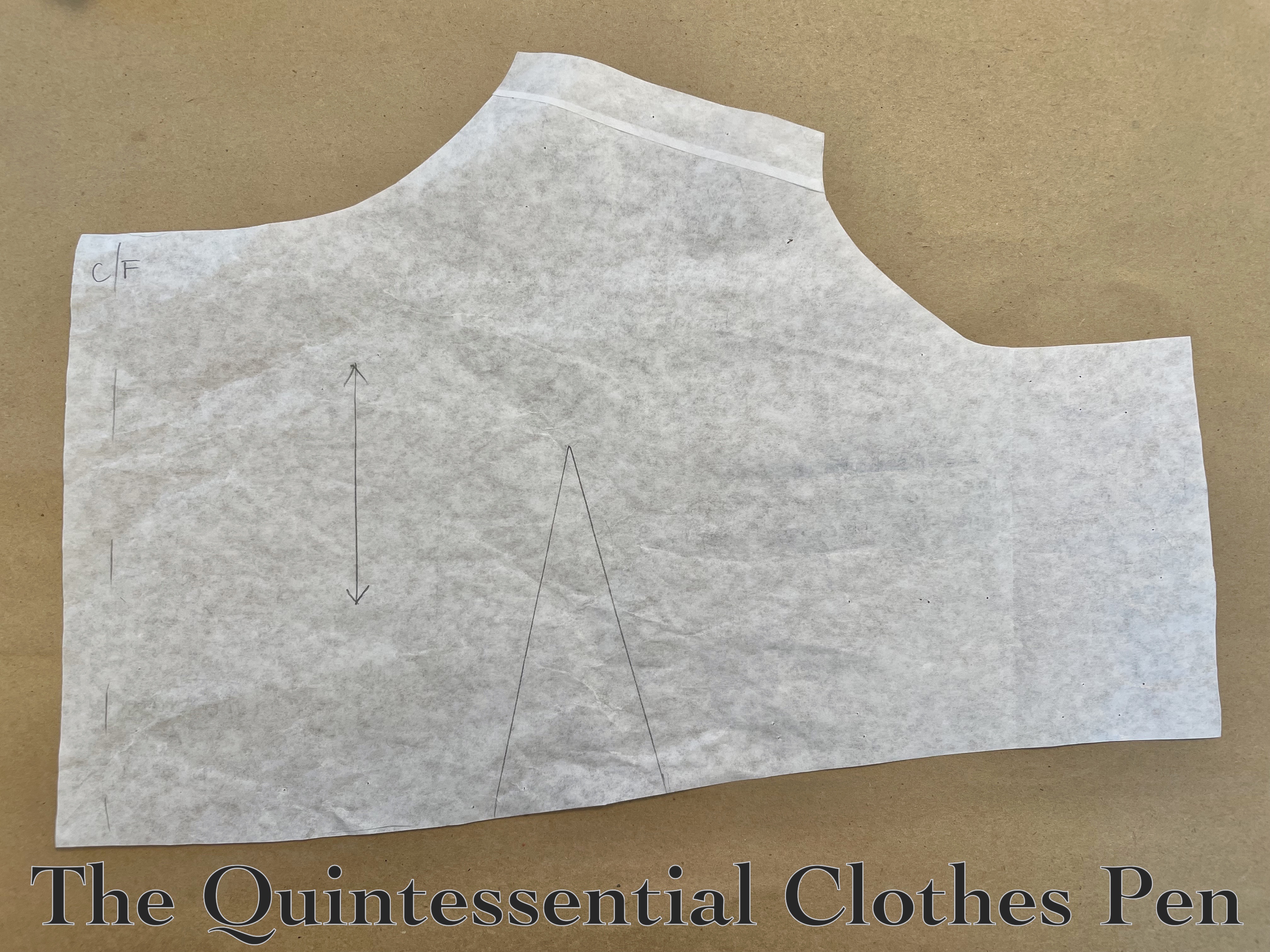
The photo below shows the front pieces I ended up with. On the left is the lower part of the front lining (the shoulder area is extended with a separate shoulder piece in the lining) and the center front part of the lining. For the lining, these were cut as one piece (with the dart marked).
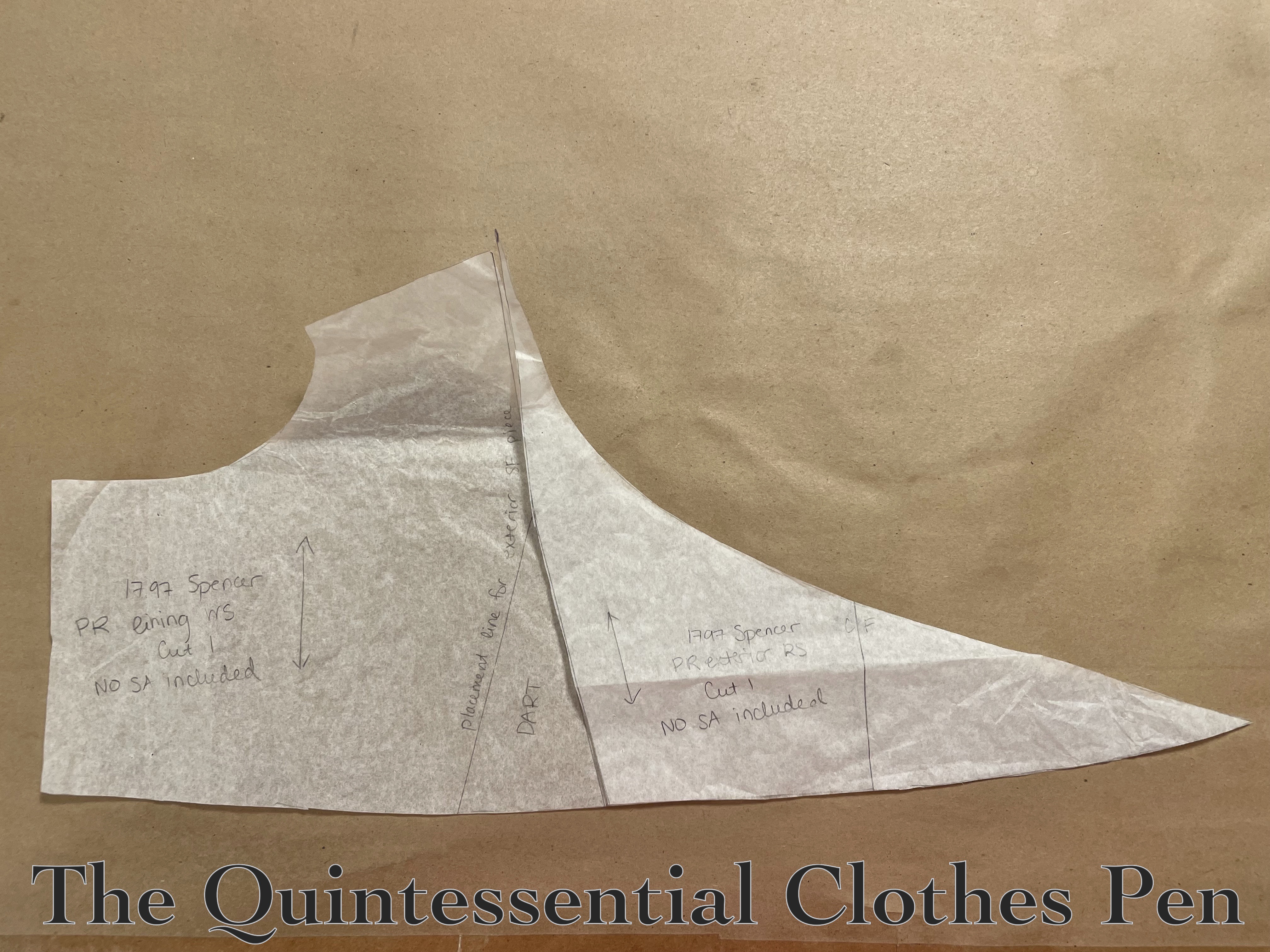
If you look carefully, you might notice that the grainline on the center front piece is off relative to the side piece. Why is that, you might wonder?

Well, for the front exterior I started with the lining piece but changed the single dart to be the pleats I’ve previously mentioned. I didn’t see bust darts in my inspiration fashion plate or observations of 1790s overdresses, but in 18th century dresses pleats are used used in varying depths to adjust a flat piece of fabric to fit the curves of a body, so I used that method.

First, I traced the lining pattern onto a new piece of paper, including the dart. Then, as you can see in the photo below, I cut along the dart edge closer to Center Front, then up a line that continued to the neck edge I wanted. (I also cut down to the bust point from two other points along the neckline, but later realized I didn’t need those cuts.)

Next, as you can see in the photo below, I rotated the center front piece down towards the dart, making that area a little narrower and creating space (essentially another dart) going up towards the shoulder. Then I drew my new grainline on the front piece for the exterior, heading up towards the shoulder. This is why it looks off relative to center front. When worn, those ‘darts’ are closed when the exterior is fitted over the lining and center front is pulled into its proper place on the body.

These exterior darts — hidden in the seam line — are what creates that downward curve to the pattern pieces that I observed in PoF.

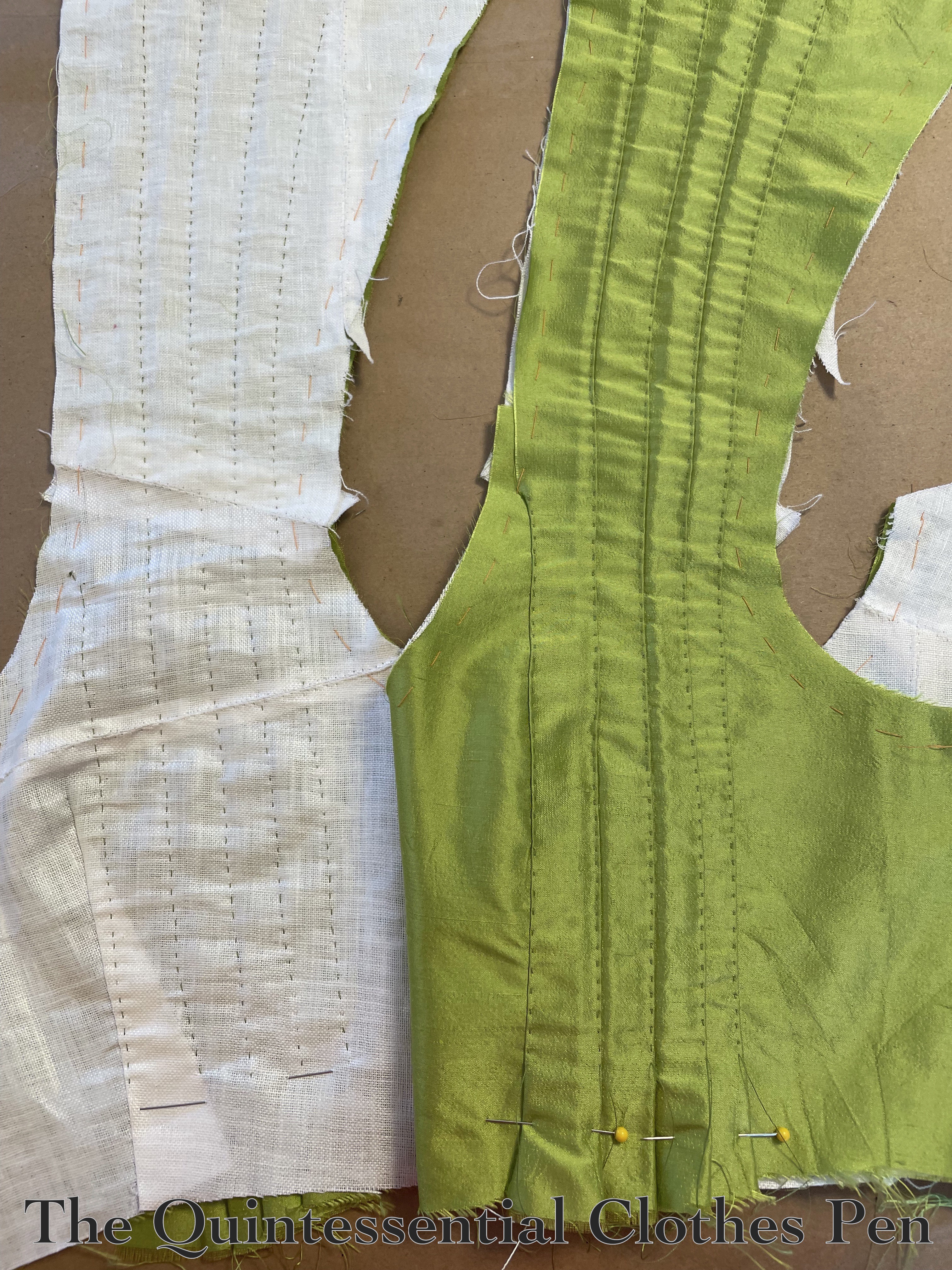
The two ‘darts’ are taken up in the pleated side front piece of the exterior, which is fitted over the center front piece and the darted bodice lining. In the photo below, the dart in the lining is visible on the left and the silk is pleated to fit and visible on the right.
After creating the paper pattern, I made a mockup and did a fitting to see how well my adjustments worked. They were pretty good, but I did have a few notes — I extended the bottom edge by a little more across the front, set the overlap shape I wanted (based on the fashion plate), set my armhole seam allowance, decided on the height of the peplum, and adjusted the front neckline to sit nicely over the dress.

I made these adjustments to my paper pattern and then moved on to cutting out my pieces in real fabric:

  • A proper left front lining
  • A proper right front lining
  • Proper left side front and center front exteriors
  • Proper right side front and center front exteriors
  • Straps in lining fabric
  • Side back pieces for lining and exterior
  • Center back pieces for lining and exterior

The Backstory: Construction

With a pattern established, I went down the rabbit hole of figuring out construction methods.

I had been reading Patterns of Fashion 6: The Content, Cut, Construction & Content of European Women’s Dress c. 1695-1795 and my mind was full of details and excitement about 18th century construction methods, so I happily went down a path of sewing in an 18th century manner! But… at some point in the middle of things I realized that I would need to combine some early 19th century construction methods into what I was doing, too, since my sleeveless bodice idea does span two different eras of construction styles.

For example, from an 18th century perspective turning seam allowances of the lining and exterior towards each other and whipping the pieces together made perfect sense. From a 19th century perspective, however, finishing the armholes with this method seemed odd (usually in the 18th century the seam allowance would have been left raw on the inside when the sleeve was attached, but I wasn’t adding sleeves!) and inserting a peplum into the bottom edge seemed odd, too (often a ruffle was applied on top of an edge, rather than being sandwiched between the exterior and lining, but that wasn’t the look I wanted). After many brain somersaults, I wound up mashing these two methods of construction together to create a transitional garment (which does actually make sense, since this was a transitional period for construction methods!).

Actually Making The Spencer

I thought it would be fun to use up linen scraps for the lining, rather than cutting into yardage from my stash. The lining pieces weren’t that big, right? Well, it turns out they were bigger than I thought. I ended up using 3 or 4 different types of white linen and adding in a fair number of piecing seams to get the shapes I needed for these lining pieces (you can see some extra seams in the lining in the previous photos). It definitely added time, but I had time while making this garment, so it was fine.

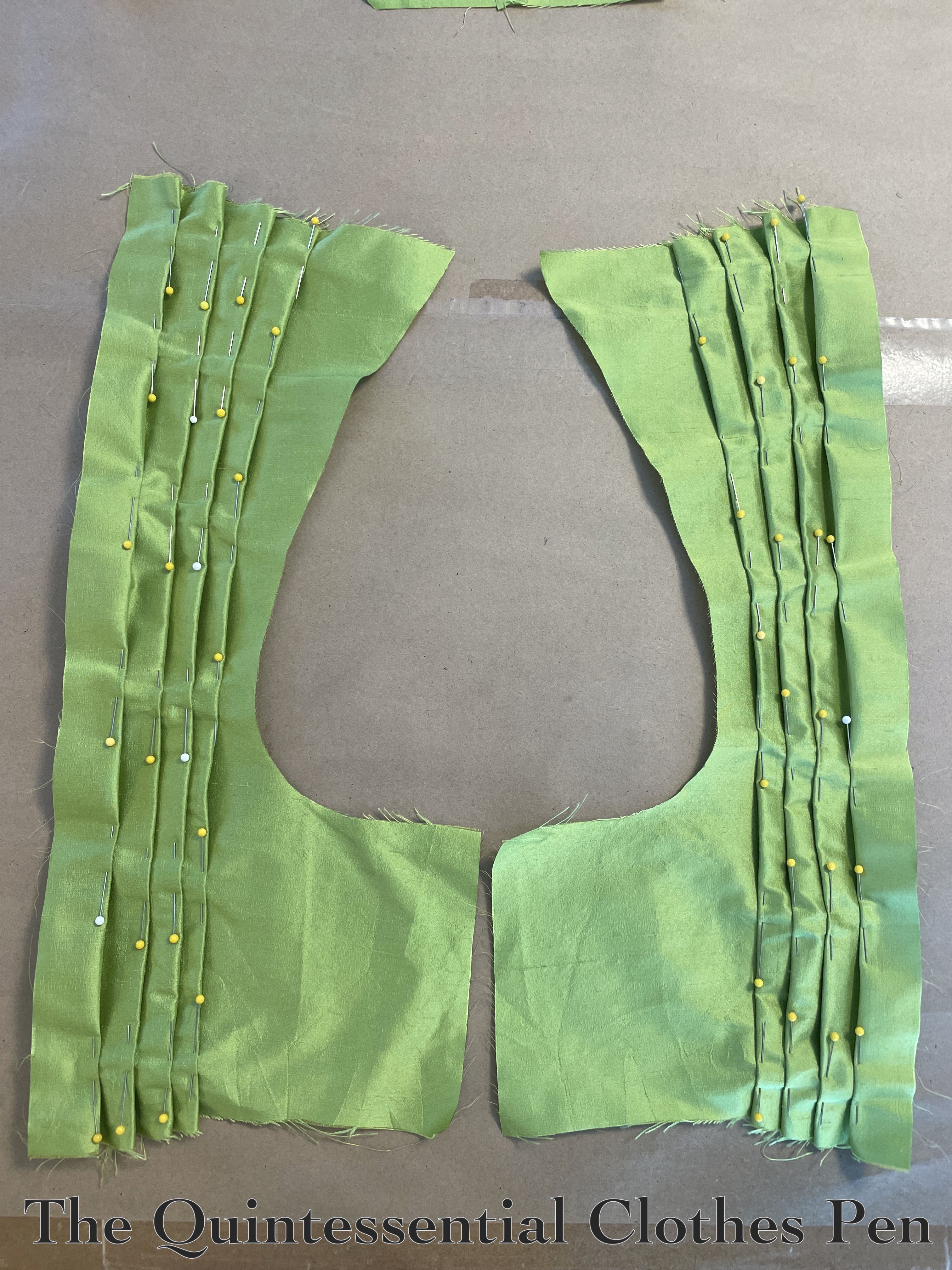
Once the lining pieces were ready to go I could cut the silk layers. The side front of the silk exterior had the shoulder straps included and was extra wide in order to create those all-important pleats. Below is a photo of what the pleats looked like before they were topstitched flat. They are not quite all the same depth and slowly spread out as they move towards the shoulder seam in the back (at the top of the photo).
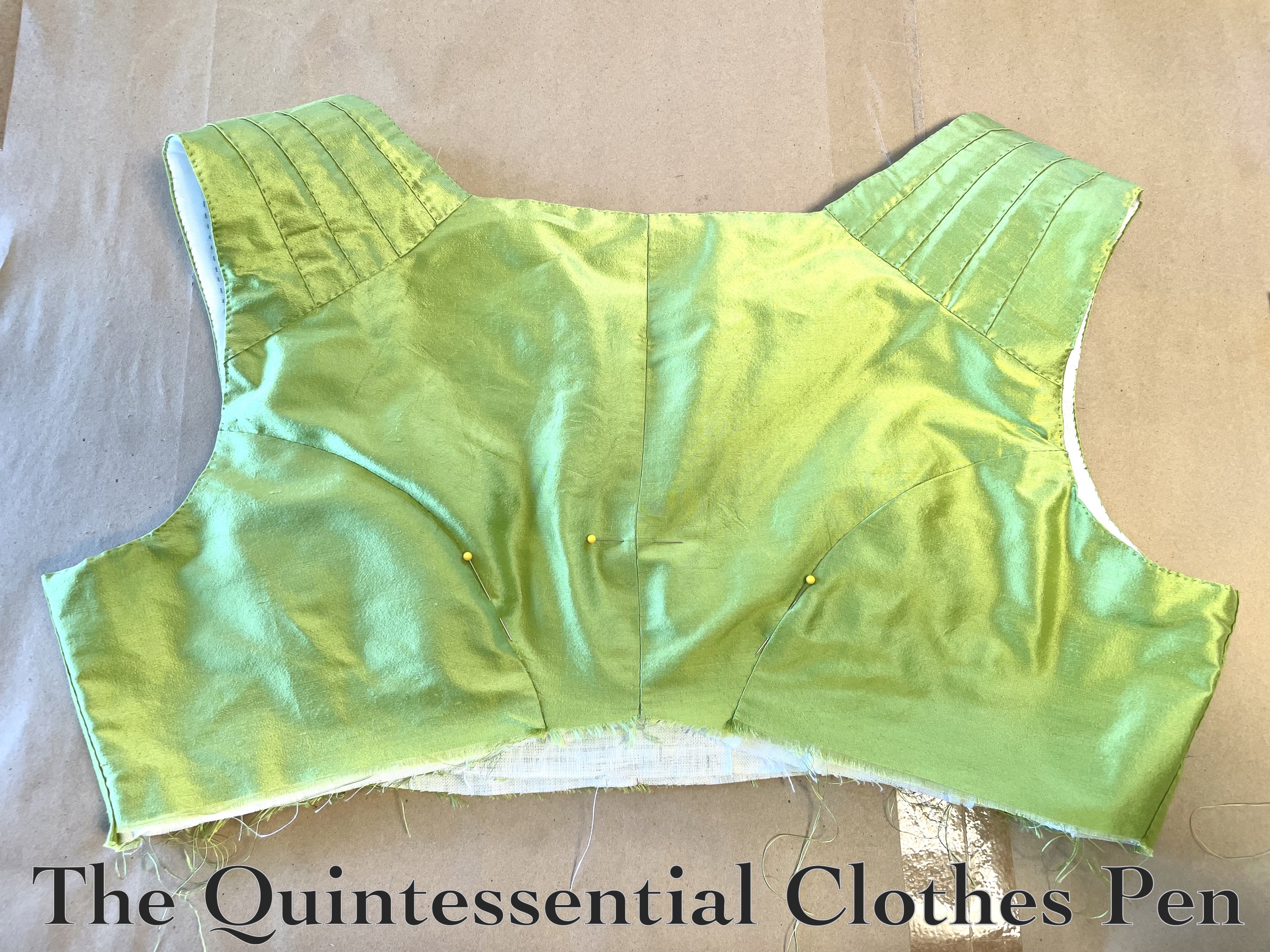
Here is a summary of the 18th century elements I used in the construction of this garment: much piecing of the lining fabrics, whipping the lining pieces together along the seams, whipping the lining into the exterior around the edges, topstitched pleats in the front exterior for shaping over the bust, a shoulder seam that is topstitched onto the back piece, many edges bound in narrow strips of silk, and the neckline trim being tucked to shape around the neckline curve.

Here is a summary of the 19th century elements I used in the construction of this garment: gathering the peplum and sewing it to the bodice with right sides together then whipping the lining seam allowance on top and turning in the seam allowance of the armholes and whipping the lining into place.

In the photo below, most of those methods have been employed to get the bodice to this state, which is basically finished aside from the peplum, neck trim, and closures.
The neck trim is a pieced strip of the green silk bound in running stitched ¼” wide strips of pink silk (hence the watermelon name!). The assembled band was running stitched along the outer edge and then eased into place around the neck edge. Below is the easing in progress. It took many pins!
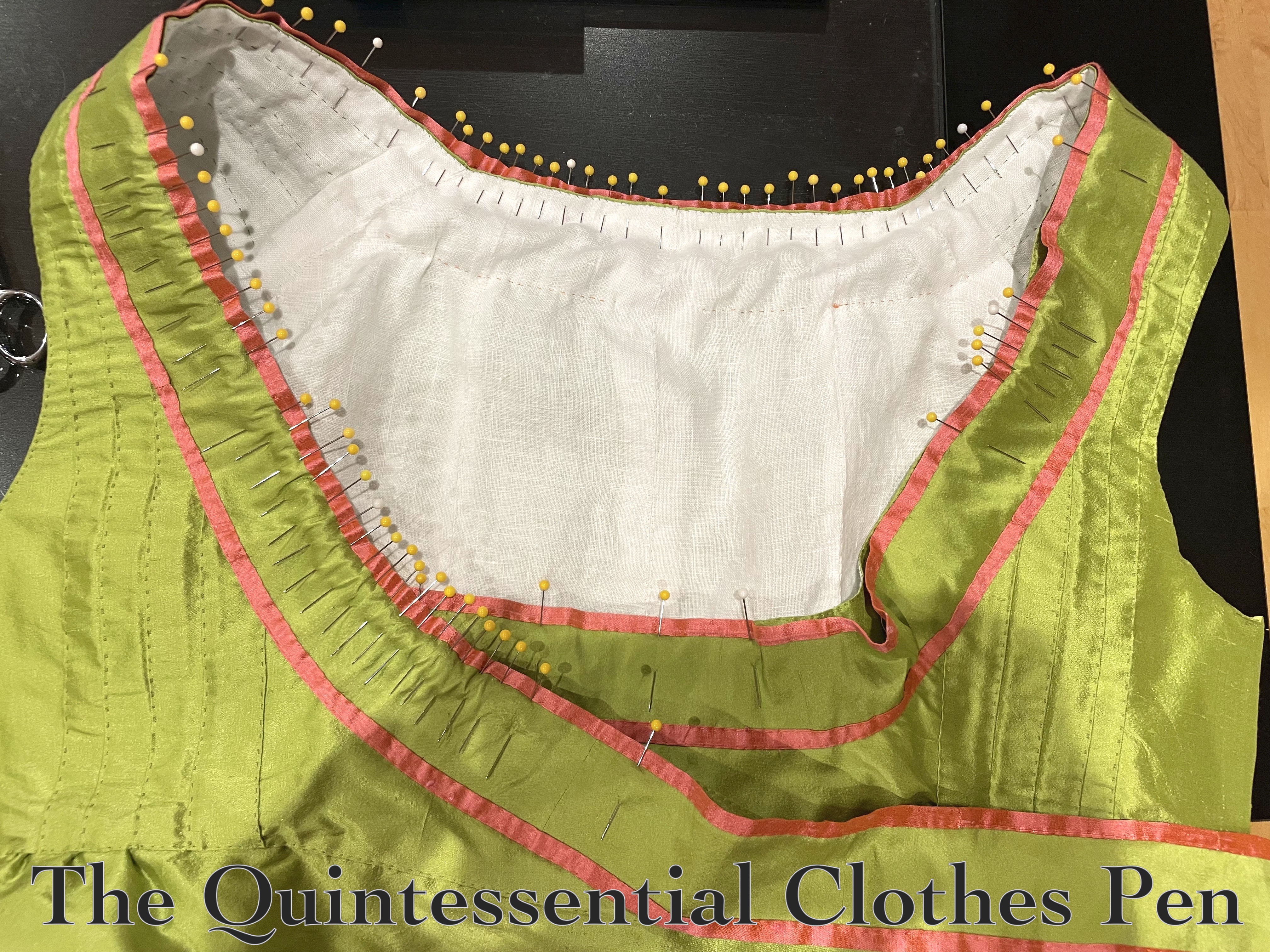
And here is a closeup. You can see some of the whip stitched piecing seams in the lining and the minute easing of the neckline edge of the trim.

And that was it…! Entirely hand sewn, with many small details, lots of justifying and research, and, in the end, a relatively small garment! Next time, photos of the finished garment being worn!
1797 Watermelon Sleeveless Bodice, Part I: Background & Inspiration

First:

The Backstory

As with last year, The Footwork and Frolick Society hosted a Bridgerton themed croquet afternoon this summer, which seemed like a great event to debut the 1794 dress I posted about making last fall (I did, in fact, wear the 1794 dress — you can see photos in this past post). My only hesitation about that idea was that the dress is all white, which didn’t feel quite as colorful as I might hope for given the Bridgerton theme. So I started brainstorming…

Prior to this brainstorming, I had happened across a 1 ½ yard piece of lime green silk in the discount bin at one of the local fabric stores for $6. Silk at that price felt too good to pass up, even in a very bright color and yardage too small for a dress. I figured I would find a use for it eventually!

During my brainstorming, I came back to the idea of the lime green silk… It seemed wonderfully bright and fitting for this particular intended purpose! And with a small yardage amount, it seemed perfect for a Directoire accessory.

What is Directoire? The Encyclopedia Britannica defines this style as the “Neoclassical style of dress, furniture, and ornament popular in France during the period of the Directory (1795–99).” Given that many of the inspiration images for my dress were French fashion plates from this period, or close to it, I think it is fitting to use the description of Directoire for this garment.

Choosing The Style

I first thought about making a sash (similar to the one I posted about in 2023 that hasn’t been worn yet), but decided I wanted something different to vary up my possible looks.

After looking at many fashion plates, books, and extant garments, I realized I was drawn towards spencers; however, when I really paid attention to dates it struck me that the popularity of those garments seems to be concentrated in the 1800s and 1810s when Neoclassicism had really settled in, dresses were not as fluffy as they still were in 1797, and the description of “spencer” was fully established. (I explain what a “spencer” is in this old post from 2011. There are many photos of extant examples included in that past post, as well.)

I really liked the idea of a sleeveless bodice. So I set about looking for specifically late 1790s examples of these over white dresses. It turns out that the sleeveless idea (in the specific date range of approximately 1794-1798) is unusual — though it is not uncommon to find long and short sleeved variations.

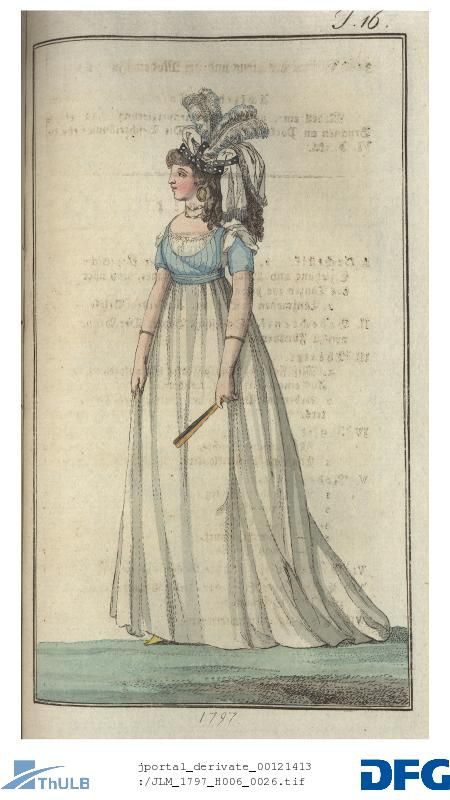
Below is an example of a short-sleeved bodice from the Journal des Luxus und der Moden (The Journal of Luxury and Fashion) in 1797. This German fashion journal was published in Weimar. You can click on the fashion plate below to go to the Rijksmuseum, where you can zoom in to see more detail!

Here is another example showing a long sleeved bodice (actually called a spencer in the description!). This was published in Costume Parisien in 1799. As you might guess from the name, this fashion journal was published in Paris.

Finalizing The Details

I decided to combine the crossover detail and vertical lines of the Luxus und der Moden style with a sleeveless variation visible on the left in this next fashion plate, which is from The Gallery of Fashion. This fashion journal was published in London by Nicolaus Heideloff. Clicking on the fashion plate will take you to the Metropolitan Museum of Art, where you can zoom in on the fashion plate and learn more about Heideloff.

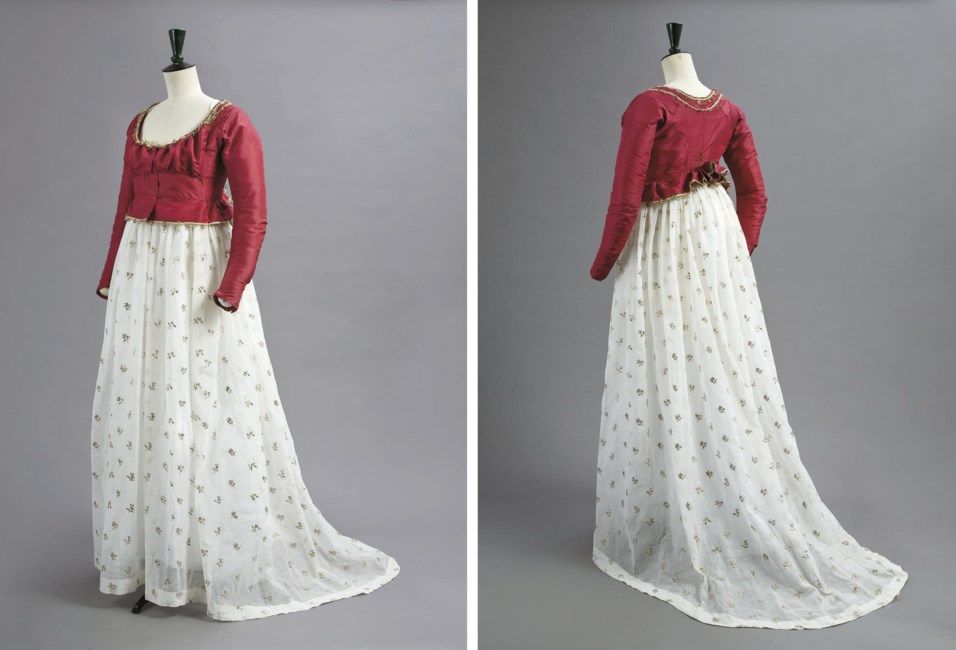
I also borrowed a peplum idea from the extant spencer below, which was sold by Christie’s in 2008. I liked the look of a peplum and appreciated how this one rises at the center back, which is a nice feature to highlight the rising back design element on the 1794 dress I planned to pair with this garment.

Many spencers have some sort of trimming around the edges. I was inclined to use something bright and silly to match the lime green silk and in the stash I found scraps of vibrant pink that went well with the green. I decided to use this as a edging, placing it in similar locations as on the Christie’s spencer.

And that means my plan was mostly in place! Next I had to think about how I would construct this garment and move on to patterning it. I’ll share about that in another post!

A Mysterious Domino, Part I: Background & Research

Earlier this year, The Footwork and Frolick Society hosted an early 19th century themed Masquerade Ball. I enjoy fancy dress themes, and so the idea of a masquerade (which takes the idea of a costume to another level by adding a mask) seemed like a lot of fun. But what was I to do to about a costume?

The dress: I had already decided that I wanted to wear an oldie-but-goodie dress to the ball — my ivory 1819 ruffle dress, finished in 2012 (and resized at some point, though I don’t seem to have a post about that on the blog).

The mask: I don’t really enjoy wearing masks (unless they are on a stick, like this, but that’s not good for a ball when you need your hands!). I find that masks irritate my face, but at some point I did buy a black lace mask for a fantasy masquerade that is very malleable and irritates me less. So I knew that I wanted to incorporate that mask into my outfit.

The costume: I wasn’t sure… my creative problem was to figure out what kind of costume would unite an ivory dress and a black mask!

I liked the idea of choosing something historically plausible and I know that themes like flowers, seasons, and historical periods were all popular for Fancy Dress costumes (and therefore, I figured, for masquerades), but I couldn’t think of a good theme that made sense with my color choices.

So I started doing some research, and came across the idea of a domino. Not a numbered playing piece from a game… but a mysterious, historical domino!

What Is A Domino?

What is that, then? A mysterious, historical domino?

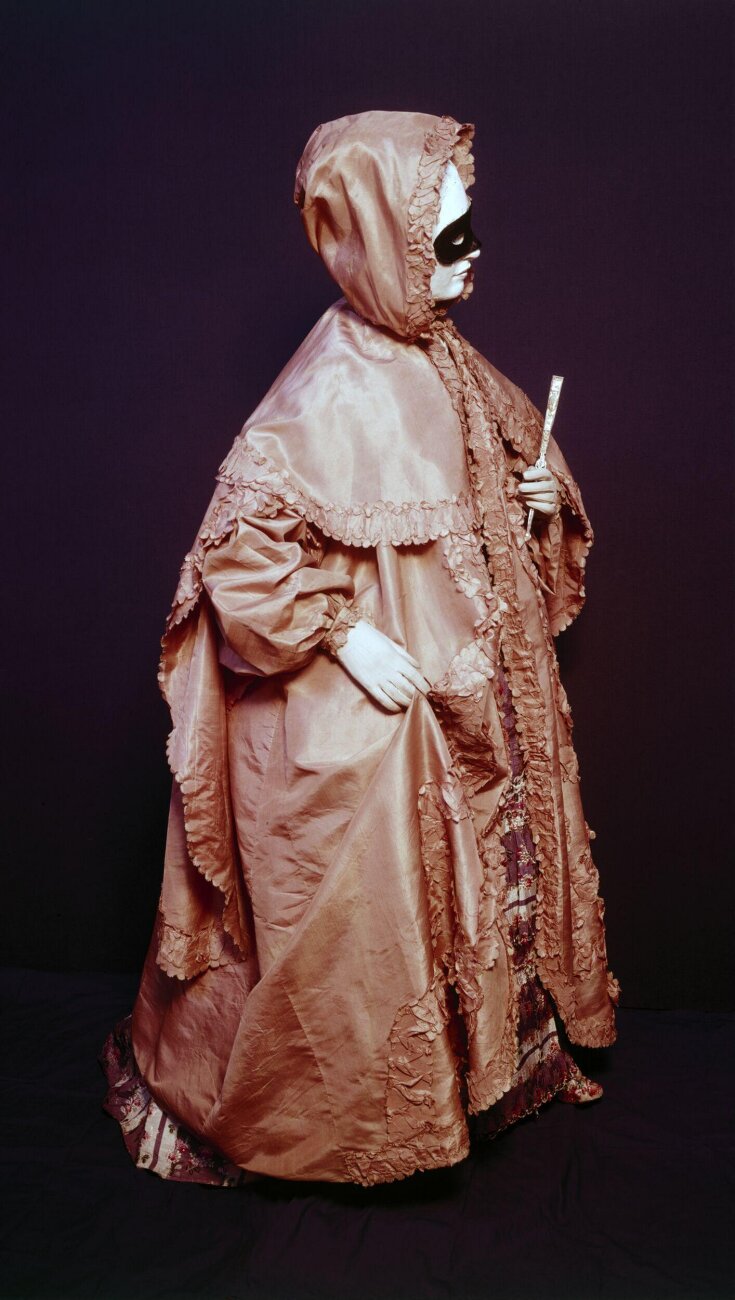
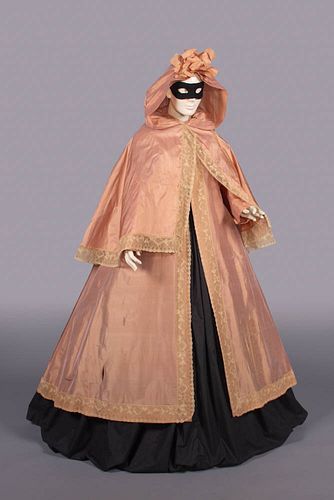
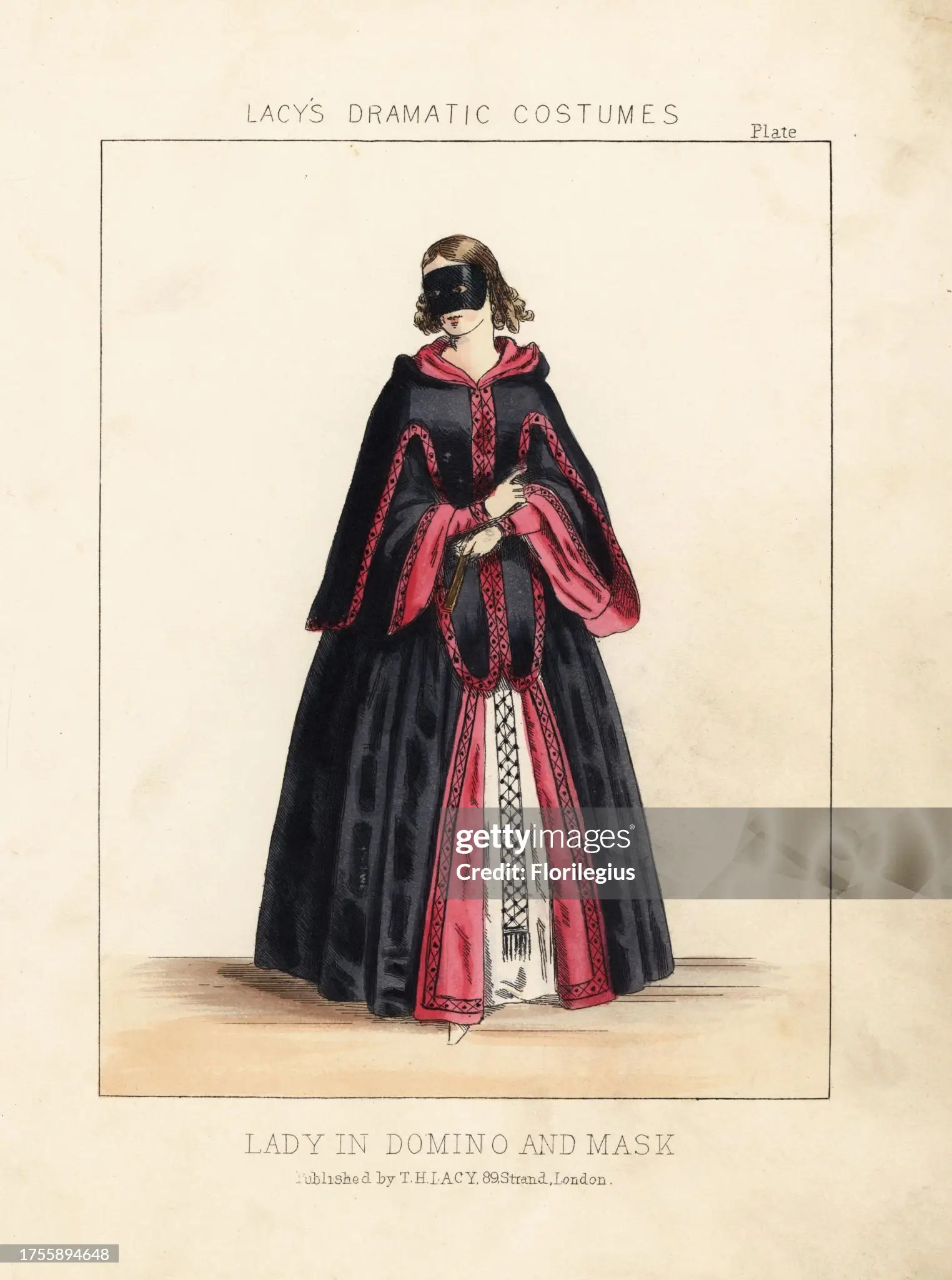
A domino is traditionally a voluminous black robe-like hooded cape worn with a black half mask as a disguise during Venetian Carnival. Dominos were popular during the 18th century at masquerades and it seems that hooded capes in this century were sometimes just generally called dominos (such as this one, perhaps, at the Metropolitan Museum of Art). By the 19th century, dominos were occasionally seen at masquerades, and even less often at fancy dress events (a costume party without masks).

Examples Of Dominos

Below is an example of an 18th century domino in the collection of the Victoria and Albert museum. In this case, the idea has been reimagined in pink, rather than the usual black. The museum gives this information regarding a date: 1765 – 1770 (sewing), ca. 1775 (altered) (accession number T.195-1968).

Below is another example, from the late 18th or early 19th century, also pink. This domino still shows evidence of 18th century construction styles — particularly the large gathered hood and what appear to be rectangle shaped sleeves. The extant example below is from Augusta Auctions. They labeled it as a Two Piece Shot Silk Domino, c.1800.

Below is an example of a mid-19th century take on a domino. This is a costume idea for a masked ball (or masquerade). This plate is from Thomas Hailes Lacy’s “Female Costumes Historical, National and Dramatic in 200 Plates,” London, 1865 (from Getty Images).

Susan de Guardiola has collected later 19th century descriptions of dominos that are available here, as well.

Though less common, dominos were still in use for masquerades even in the early 20th century. While looking for other unrelated research, I came across a mention of them from January 1920, when the accomplished fashion designer Erté wrote in a letter he was asked to write from Monte Carlo to the editor of Harper’s Bazar:

This winter will mark the first organized effort at gaiety since the dark night of war… Already we are planning to revive the masked ball in all its mad gaiety…

The domino–aha! … In Venice until the fall of the Republic, it was commonly worn in the streets. There reigned in the enchanted city at this decadent epoch a strange corruption of manners, and the mask was a necessity. At every entrance hung the black domino. Rich and poor alike donned it, in order that they might sally forth enveloped in anonymity…

“But,” argue some, “the domino gives to the fête an air of mystery.” I reply, “Then one may attain this illusion by means of a domino of distinguished cut, a domino which shall not make one’s figure look like a shapeless bundle.”

(From Designs By Erté: Fashion Drawings & Illustrations From ‘Harper’s Bazar’ Including 8 Covers In Full Color By Stella Blum)

I think this is a great place to pause. I’ll continue sharing in my next post, which will focus on how I whipped up a quick domino and what it looked like when worn!

When The 1860s Drawers No Longer Fit (HSM #11: Worn By All)

I have a series of posts called When The Dress No Longer Fits that document how I’ve updated the size of various dresses I’ve made to fit better as my size changes over time (or as the dresses shrink in the closet, which is how I usually describe it!).

In this case, I’ve adapted that post-naming-style for another garment I recently updated. In this case, I altered an old pair of 1860s drawers rather than a dress!

It brings me joy to be able to extend the life of garments I already have in my closet. For these drawers, being able to adjust the size of the waistband has allowed me to continue to use them for many years. Proof: I documented these drawers on the blog in 2013 (and I’m pretty sure I made them in 2011 or 2012) so they have being faithfully serving their duty for over 10 years!

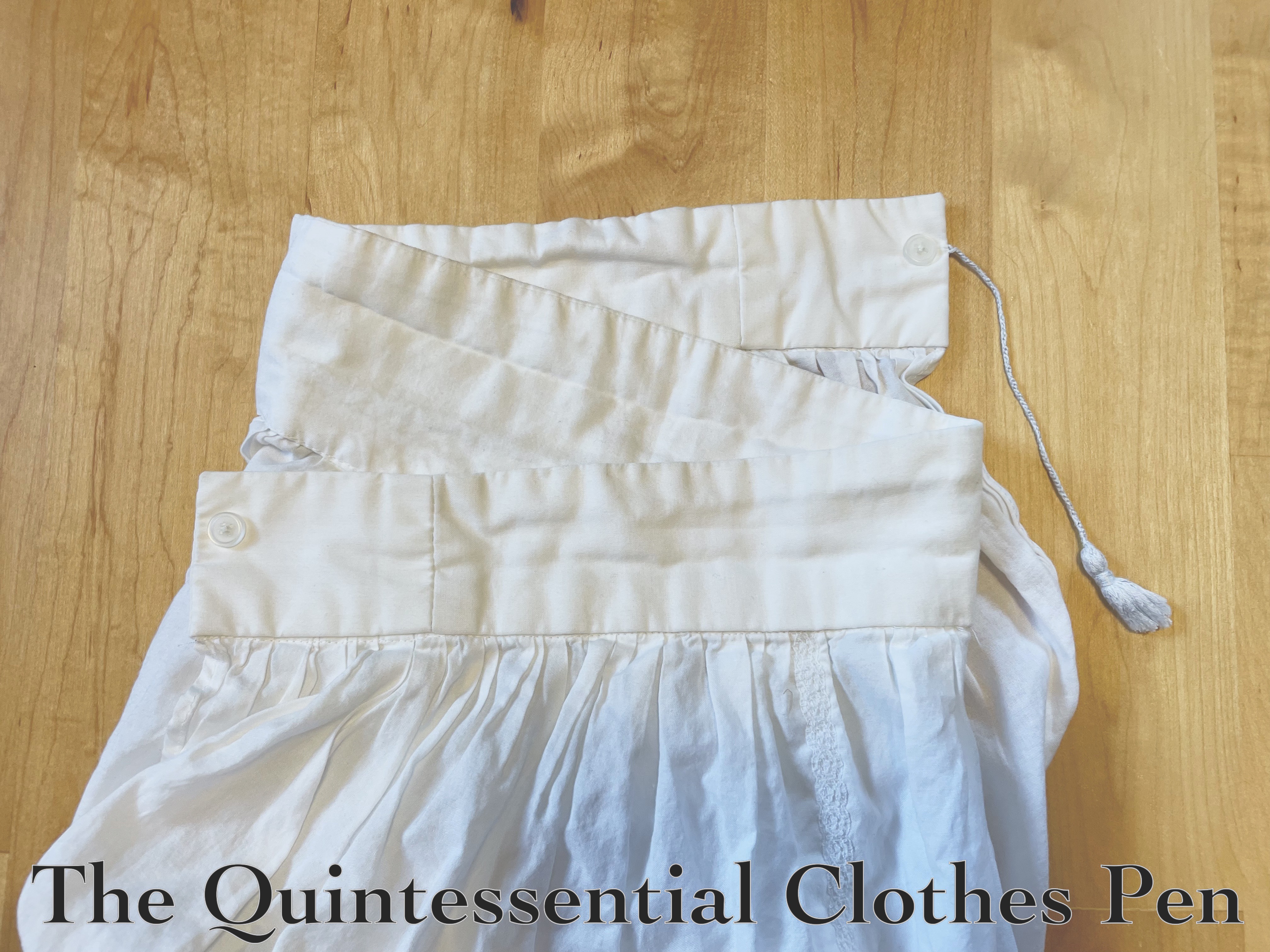
In that time, they’ve seen lots of use. I’m pleased that they have held up very well. About 8 years ago, I let down some tucks to make the legs a little longer (so that the top of my stockings/knees wouldn’t show–because, gasp, that would be shocking!) and I also increased the waistband size about 6 years ago. Below, a photo of the drawers with those first round of alterations made.

And below is a closeup of the waistband after that first round of alterations. I don’t remember why I thought a closure method of a cord looped in a figure eight around two buttons made sense. I can’t remember a source for this idea… but it has worked for many years. It’s been wonderful because it allows for adjustability (up to a point of running out of cord length to loop between the buttons securely, of course).

But recently, even with the increased waistband size, there was still a gap at the waist and the gathering of the legs into the waistband was no longer distributed in a way that helped the back edges stay closed when being worn. That’s not the end of the world in terms of modesty, as I always have a chemise on underneath, but it wasn’t my favorite look, either.

So I decided to do something about it. I added yet another extendo to the waistband. “Why remake the entire waistband?” I mused. The would need a bigger section of fabric and be more work. No one sees the waistband of my drawers except me, friends getting dressed near me, and you readers on the blog!

So now, here are the most recent updates to these old drawers, with a second extendo added to the waistband. Taking the waistband apart to add the new pieces reminded me that I’d stiffened the waistband lightly by adding a layer of linen in between the two layers of cotton. This is a note to self that this method has worked well, creating a waistband that doesn’t collapse and wrinkle horribly around the waist while also not being super stiff.

I also decided to change the closure method to a button and button hole. The old wrapping the cord in a figure eight method had the added challenge of being a bit tricky to do behind my own back. I decided that while a button would be less adjustable (without resewing it), the larger size button would be easier to do up than the cord wrapping.

I also made a bit of extra waistband for the day when I might need to increase the waist size even more (but I’ll pretend that day isn’t coming). And I decided to hand sew the buttonhole, because it was being fussy on my machine and I figured it would be faster to sew it by hand than fight the machine!

Here is a closeup of what the waistband looks like with the most recent extendo. For this round of alterations, I also completely removed the waistband and redistributed the gathers and side points to better match the new waistband size (these alterations are machine sewn). This makes the drawers more effectively lay in place.

I’m calling this my entry for the Historical Sew Monthly 2024 Challenge #11: Worn by All:

Make a garment that would be worn as everyday clothing by most social classes during your chosen time period and/or place.

Just the facts:

Fabric/Materials: Scraps of white cotton and linen (Is it the same white cotton and linen as the original drawers? Nope, but that’s ok with me for this project!)

Pattern: None. I just added rectangles.

Year: c. 1860.

Notions: 1 shell button and thread.

How historically accurate is it?: 98%. It’s completely reasonable to extend the life of a garment like this by altering it. The only non-accurate thing might be the machine sewing–although it is pretty subtle!

Hours to complete: 2? I didn’t really keep track.

First worn: Worn on May 19 with an 1860s ensemble.

Total cost: Free! Materials were scraps left over from other projects.

This was one of the small sewing tasks on my Maybe-To-Do list for 2024 as well as being one of the small projects that was stacking up on my alterations-and-mending pile. I’m so pleased to have checked it off!

1928 Egyptomania Inspired Green & Teal Dress (HSM #2)

I was inspired to make a dress! That seems like quite an accomplishment these days as I’ve been so busy with other things that I haven’t made much for myself this year.

It was summer, you see, and I knew that Gatsby On The Isles was coming up. (I’ve attended in the past, check out the past posts from 2019, 2018, and 2016.)

I have plenty of dresses (and let’s be honest, not many of them have been worn in the last two years or so), but I also had fabric that was waiting to be turned into a dress… So it didn’t take too much self-convincing to decide that the fabric ought to be turned into a dress, right now!

My first idea was to create something like the dress on the bottom right (#2346) in next image, but after making a mockup I realized that I didn’t have enough yardage of my proposed fabric.

Needlework Magazine, March, 1925

I’d bought the fabric thinking I’d make a rather simple 1920s dress, but the dress I’d been pursuing wasn’t quite that–and the length was longer than I had yardage for. So it was back to Pinterest to find another idea. I settled on using the green dress below, another one I’d been eyeing for years, as my inspiration.

1928

I’d purchased the green and teal accent fabrics in 2021 and thought they would work well for this second design idea.

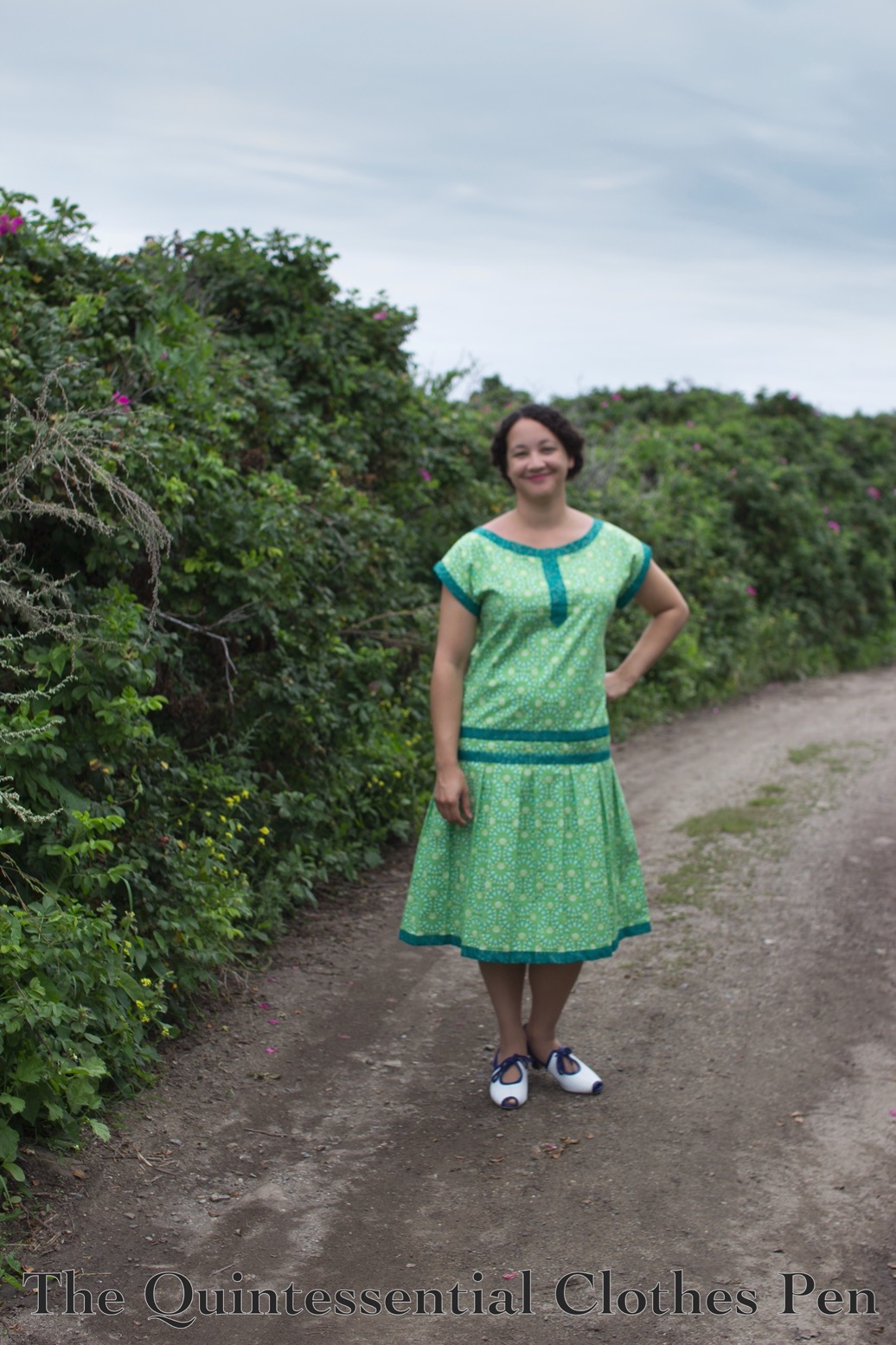
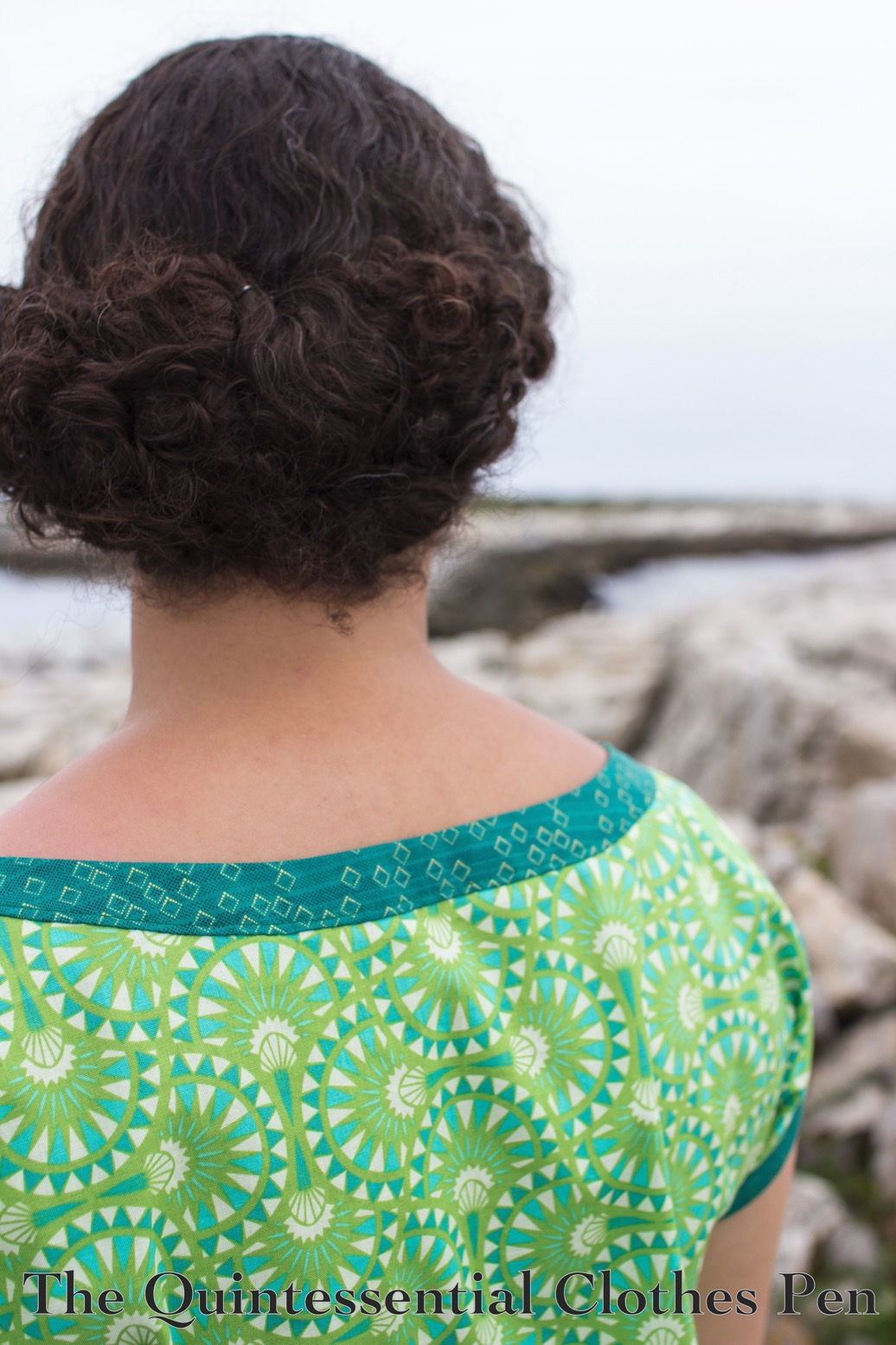
My bodice pattern was adapted from my 1925 Blue Coral Dress, to get the general size, in combination with my late 18th century shift, to get the cut on sleeves. The skirt is just a tube made from what was leftover after that. I wanted to get two full widths of 45″ but didn’t have enough, so the skirt is one full width and two additional sections.

I wanted to match the pattern perfectly at the seams, but that ate up too many inches of my circumference so I settled on not matching them–and frankly, you can’t tell! I spent a lot of time making perfect pleats (the print on the fabric makes that pretty easy, actually), but of course they smoothed out as soon as I wore the dress. Oh well!

The dress qualifies for the Historical Sew Monthly Challenge #2

The Roaring 20s: Make something from the 20s (any century) or that somehow incorporates a number in the 20s. .

Just the facts:

Fabric/Materials: 2 yds green cotton and 1 yd of teal cotton.

Pattern: Created by me.

Year: 1928.

Notions: Thread.

How historically accurate is it?: 95%. The pattern and construction methods are quite good. The fabrics are a bit stiffer than those that I think would have been used 90 years ago.

Hours to complete: Perhaps 12? I didn’t keep track.

First worn: August 2021.

Total cost: Approximately $9.

This dress is mostly machine sewn. The goal was to entirely machine sew the dress, including attaching and top stitching the trim, but then as I was reaching the end of the sewing process I realized there were a few things that would look nicer with a bit of hand sewing.

Why is this Egyptomaina inspired?

Well, ancient Egypt was all the rage in Europe and America in the 1920s, particularly after Howard Carter and Lord Carnarvon discovered the tomb of the Pharaoh Tutankhamun in 1922. Egyptian motifs were used in Art Deco design elements for furnishings, jewelry, and clothing. So, while not exactly Egyptian… the colors and patterns in my fabrics remind me of Egyptian things: the Nile river, lapis lazuli, the Egyptian lotus flower, and the tops of many ancient Egyptian columns, for example.

Obelisks were often erected in pairs at the entrances to ancient Egyptian temples, so given the Egyptian association of my dress, I wanted to try and get a photo of my dress with the obelisk on the island. The photo is not quite just me and the obelisk, but it will do. (The problem is that the obelisk is so tall that if you’re close to it you can’t tell what it is… but being far enough away to get the full height means that other elements make their way into the photo, too!)

There are lots of additional photos from tromping around looking for good photo opportunities for this dress, so you’ll be seeing more of it and my accompanying adventures in more posts soon!

1875 Hair & Finished Hat (HSM #7)

Last post, I shared details about the style I decided on for the hat to accompany my 1875 reception dress, as well as how I made the hat.

Today, we get to see the finished hat being worn and take a look at the hairstyle I created to support the it!

This hat qualifies for the Historical Sew Monthly challenge #7: No-Buy! I was pleased that I had everything I needed for this hat on hand and it was a bonus that I was even able to use scraps in a lot of places!

Make something without buying anything.  Whether it’s finishing off a UFO, using up scraps of fabric from earlier challenges in the year, sewing entirely from stash, or finding the perfect project for those small balls of yarn, this is your opportunity to get creative without acquiring more stuff.

Just the facts:

Fabric/Materials:  Scraps of buckram, scraps of cotton flannel, scraps of pink, green, and ivory silk, 2 green-ish/brown ostrich feathers, 9 vintage silk millinery flowers, and a bit of cotton velvet.

Pattern: My own.

Year: c. 1875.

Notions: Millinery wire and thread.

How historically accurate is it?: Let’s say 85%. It’s pretty good on shape, materials, and methods, I believe, and it would be recognizable in its time.

Hours to complete: 10 ¾ hours.

First worn: In May, for photos with my 1875 ensemble!

Total cost: This was a stash project, so I count it as free; however, not counting fabric scraps I think I spent about $12 on the other materials at some point in the past.

Hairstyle Possibilities

When I was deciding on the style of hat I would be making, I also had to consider what my hairstyle might be, as the two support and complement each other. The post showing how I made this hat also shows a variety of hat styles popular at this time.

Along those same lines, let’s look at possible hairstyles from the years around 1875. Hairstyles changed throughout the 1870s, sometimes in subtle ways… and sometimes in not subtle ways! Here is not subtle for you.

Guy Little Theatrical Photograph, V & A, S.145:535-2007

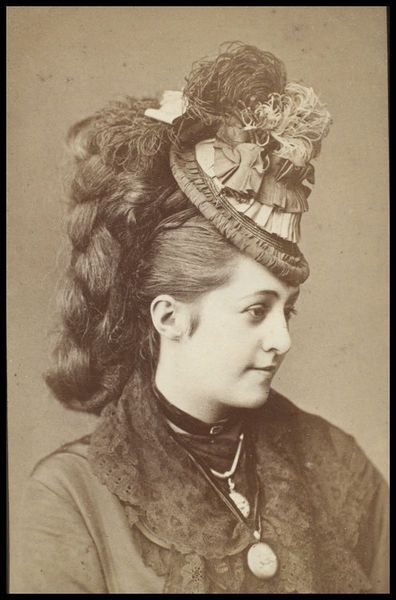
I love this look (though I can see why you might chose to have a differing opinion), with ginormous braids and twists that use much more hair than most people naturally have on their heads. However, this style (with all of the additional hair at the back of the head) does not coordinate with the type of hat I chose–one that would sit on the back of my head, creating a crown effect.

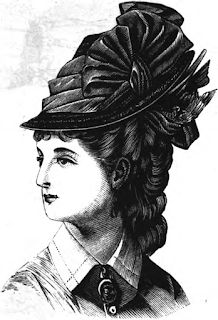
Looking at the years right around 1875 (the year of my reception dress), I found hairstyles with lots of curls and twists hanging down. 1875 is the part of the decade when the fashionable silhouette of dresses changes from the very round styles of 1870-1874 (like this, for example, from 1870) to the styles from 1875-1877 that have fabric starting to slide down the backs of skirts (like this, for example, from 1875).

As if in sympathy with the dresses, I notice that hairstyles start to slide down, too. It is these years when I see curls and twists hanging down the back, while the top parts of the hair are still sculptural, decorative, and large. Here is another example showing both the cascading fabric and the sympathetic hanging curls.

La Mode Artistique, 1875, via Yesterday’s Thimble

Interestingly, there are lots of advertisements for hair pieces to help achieve these styles–for ready-made curls, twists, braids… we know that women were not achieving this with only their own hair!

Ten illustrations of different types of wigs and hair pieces, May 1875, via Hats From History

Another hairstyle option is much more subdued and most popular starting in 1878. This is the Natural Form period, when skirts are quite narrow by comparison with earlier years (like this, for example, from 1880). In keeping with the streamlined silhouette, the hair is now generally swept up, but with much less ornamentation and volume than we see in the previous years. Here is an example. No hanging curls or twists and no masses of faux hair.

1880, Le Journal des Modes, via the LAPL

Hairstyle Decision

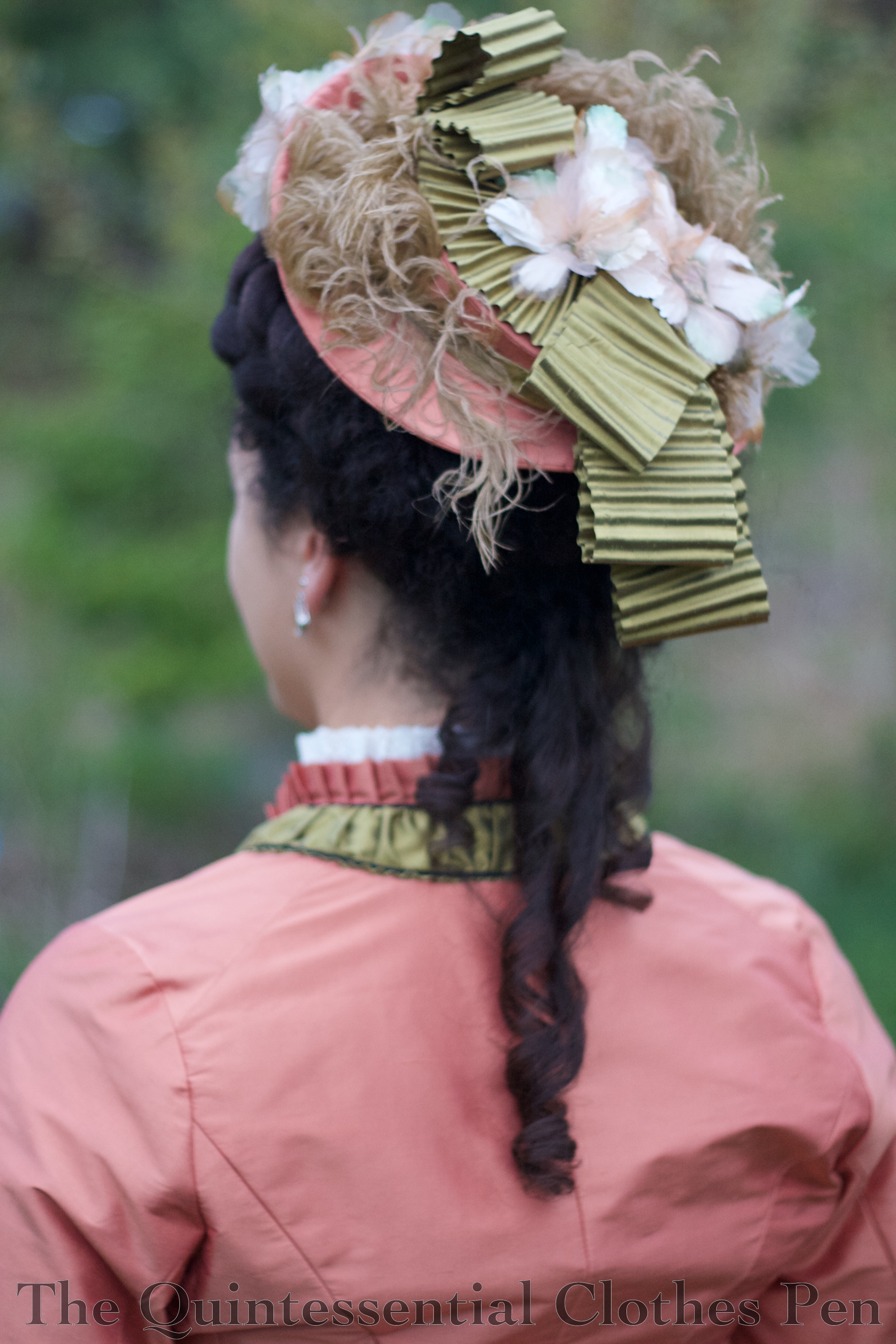
I settled on the mid-century hairstyle of decorative bits hanging down the back with sculptural hair on the top of my head, to complement the hat. This style provided a solid base that helped visually and physically balance and anchor the hat. Indeed, without all the extra volume on top of my head the hat just looks out of place.

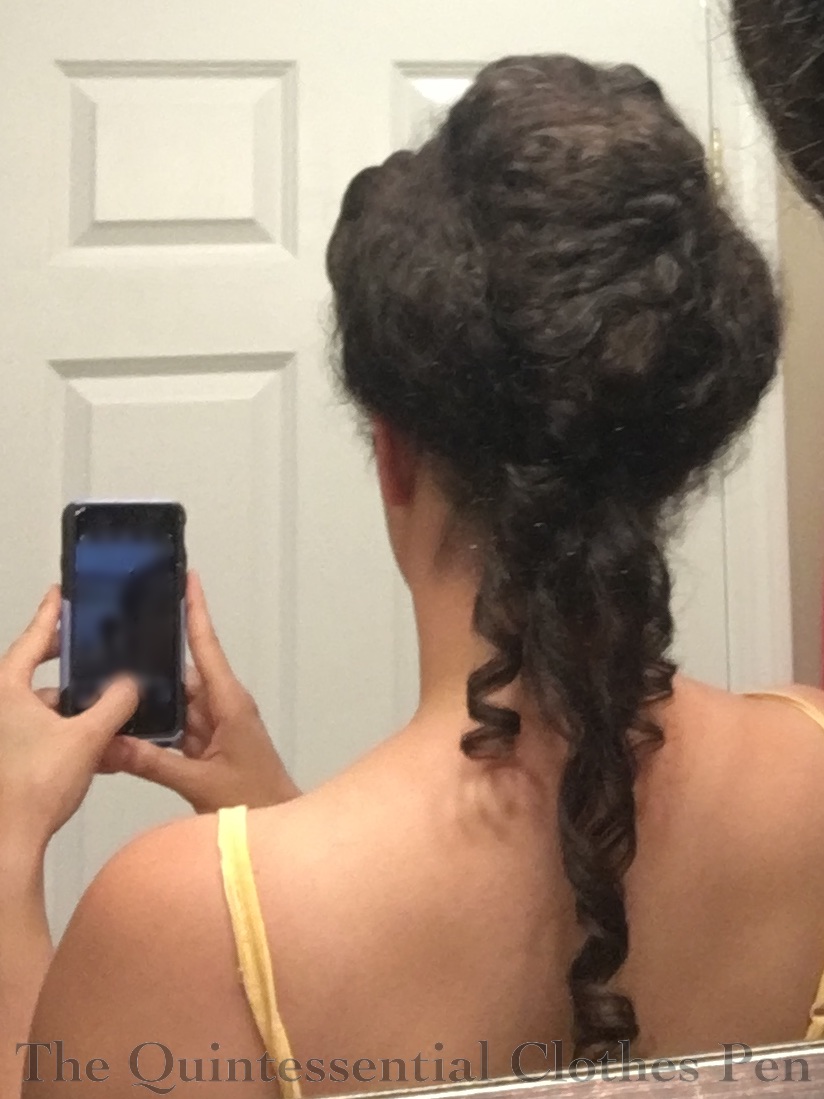
As you can see in the front view photo (above), I used a giant braid for the top/front of my style. There’s a whole blog post about how I created the braid here. Behind that, there is a bun form to help create volume on top of my head. This worked wonderfully for anchoring my hat pin, which you can just see poking out on the right side of the photo below–it’s tipped in a green glass leaf.

I attempted to create loops and swirls of hair around and below the bun, but I’m afraid that part of the style wasn’t as successful as I was hoping for. It’s difficult to do on the back of your own head and it’s hard to make the loops distinct, especially with my hair texture. I suspect it would be easier with smoother hair and definitely easier to do on someone else instead of yourself. I’ll have to try this style again some day. For this first attempt the back of my head was completely covered by my hat, so it doesn’t really matter what it looks like!

Below the loopy/swoopy bit I left curls hanging down at a few different lengths, as I saw in many fashion plates. This part turned out well!

That’s it, really. Massive hair, some hanging curls, plop the trimmed hat on top, secure it with a hat pin, and suddenly my head is about double the size it normally is! Here is another photo showing the hat and a sneak peak at more of the dress. Lots of details are coming up about the dress in future posts!

Style Decisions & Making A 1875 Hat

A reception ensemble would not have been complete in the late 19th century without headwear. To that end, I needed a hat to complete my 1875 reception dress. Despite having a number of hats in my historic closet, I’ve never needed one for this particular section of history, so… not finding anything suitable, I decided to make a new one!

I started by carefully observing hat styles from the 1870s to decide what would be appropriate and pleasing for my 1875 reception look.

Hat Style Possibilities

There were a variety of styles a lady could choose for her headwear in the 1870s. Here are some of the large categories I identified. All of these images are from about 1875-1877.

  • Forward perching hats: these sit upon masses of hair at the back and tilt down towards the face
via historicaltidbits.blogspot.com
  • Hats crowning the back of the head: these sit upon masses of hair, but tilt up in the front and have trim starting to drip off the back, mimicking the look of the hairstyles and dresses from the middle part of the 1870s
Journal des Demoiselles, 1875 via Guy RIVIERE
  • Bonnets: tiny little things with basically no brim, sitting upon the back of the head
MFA Boston ACCESSION NUMBER46.324

And then there are a variety of hats and bonnets that fall in between these categories. Fashion doesn’t always fit firmly within categories!

Journal des Demoiselles, 1877 via Guy RIVIERE

My Hat Choice

I decided to make the type of hat that crowns the back of the head. This seemed like an appropriate choice for an 1875 reception dress while also providing some new challenges in terms of patterning and hairstyling (and I do have a soft spot for crown-like hairstyles, be it in the 1810s, mid-19th century, or, apparently, the 1870s).

Making My Hat

I decided that this hat would have a buckram base covered in silk. It’s pretty wonderful that I had all of the materials on hand, including remnants of my fluted trim, scraps of the silks used for my dress, greenish/brown ostrich feathers that just happened to perfectly match the unusual shades of my silks, millinery flowers, buckram, millinery wire, and flannel for mulling the pieces.

I started by spending a bit of time with paper, scissors, and scotch tape, creating my pattern. Getting the brim to be the right shape and proportion took a few tries.

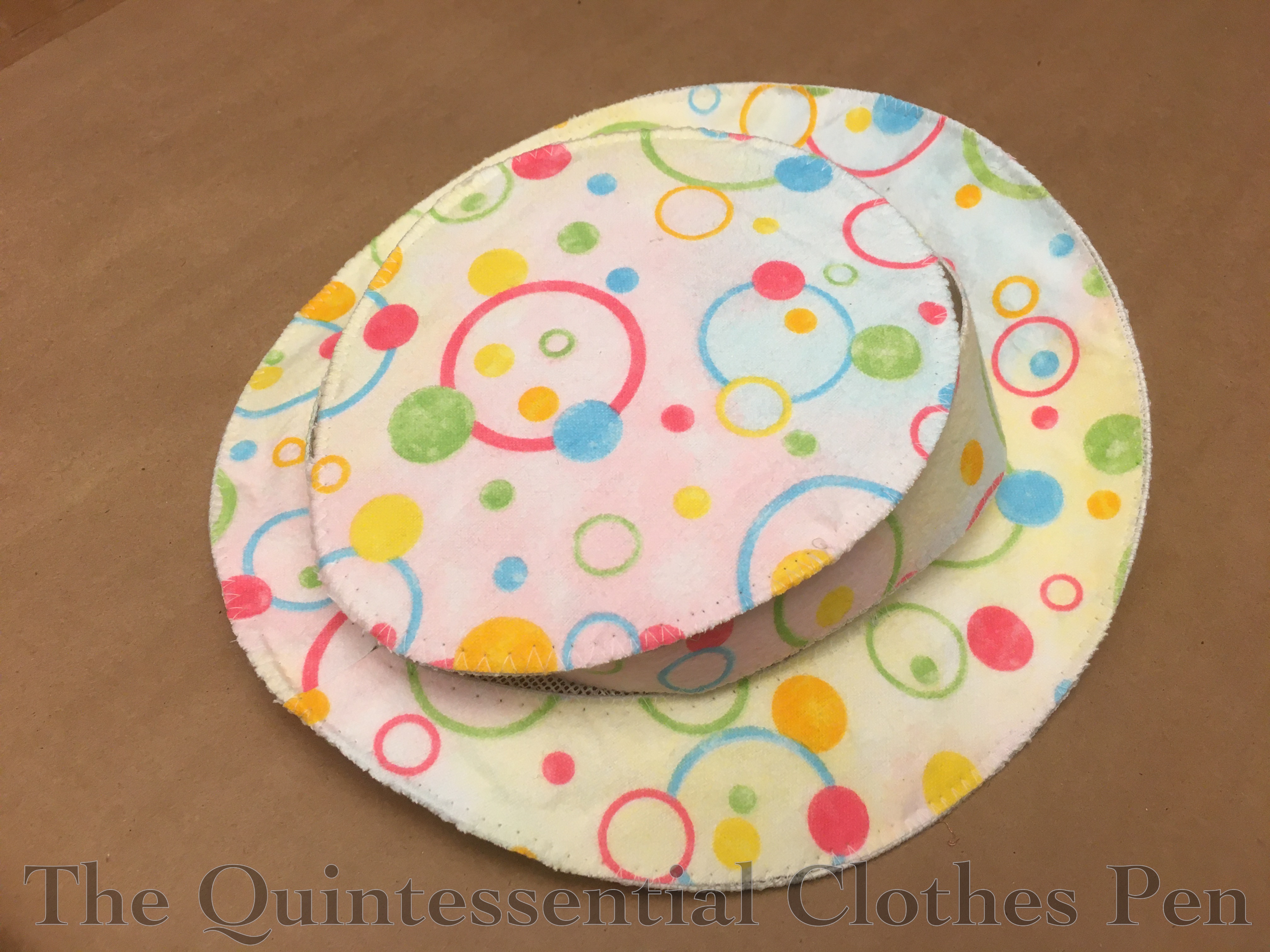
Once I had a pattern, I cut out my pieces from buckram and flannel (and was able to use up some scrap pieces, yay!). I used my machine to zig zag millinery wire around the inner and outer edges of the brim and the edge of the tip.

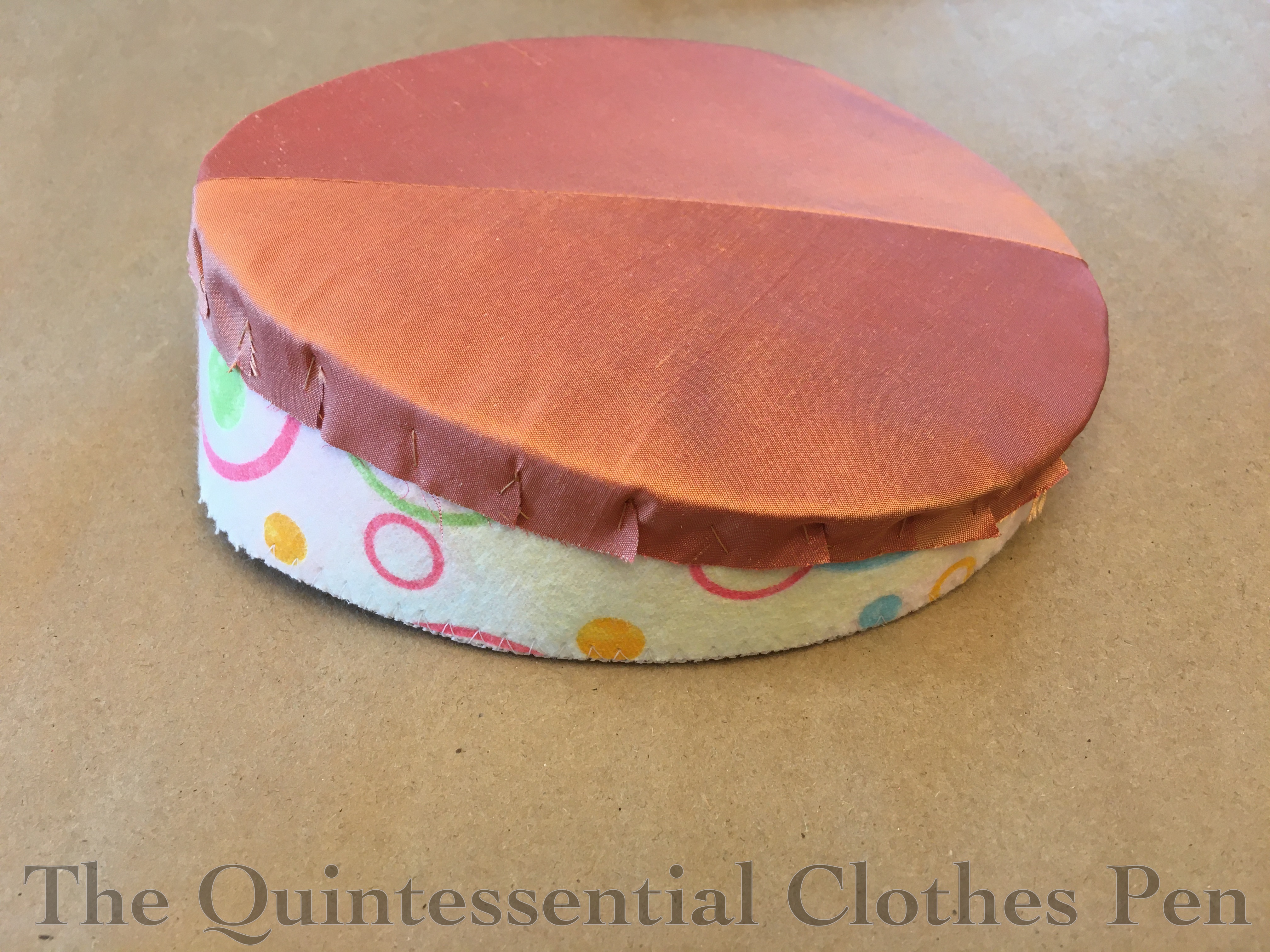
Then I used my machine (and a little bit of glue on the concave curves) to attach my flannel. Normally I would use a less brightly patterned flannel, but this is what was easily available and it doesn’t show through my silk. (I love that this fun patterned dot flannel is left over from a pair of pajama pants I made about 15 years ago! Yay for keeping things and eventually using them!)

After being sufficiently amused by my colorful dot choice, I cut out my silk pieces. I had very little pink silk left after my dress was done, so I had to piece the tip and both of the brim covering pieces. Thankfully, there is enough trim on the finished hat that the seams are not noticeable!

Here you can see the silk seam allowance clipped, curved over the edges, and tacked to the flannel with hand sewing stitches.

And here is what the brim looked like flipped over at this stage. I also hand tacked the silk around the head opening, to keep the tension even across the curves of the brim.

This is the crown of the hat, showing off my center seam and those hand sewing stitches that hold the clipped seam allowance in place.

Next, I covered the top of the brim. To do this, I clipped and turned under the outer edge seam allowance, pinning it in place. The head opening was also pinned in place. Then both edges were carefully sewn by hand.

Once that was done, I attached the brim to the crown with sturdy hand sewn stitches through all the layers. These stitches were covered with a green silk band (that really can’t be seen after all the trim was added…).

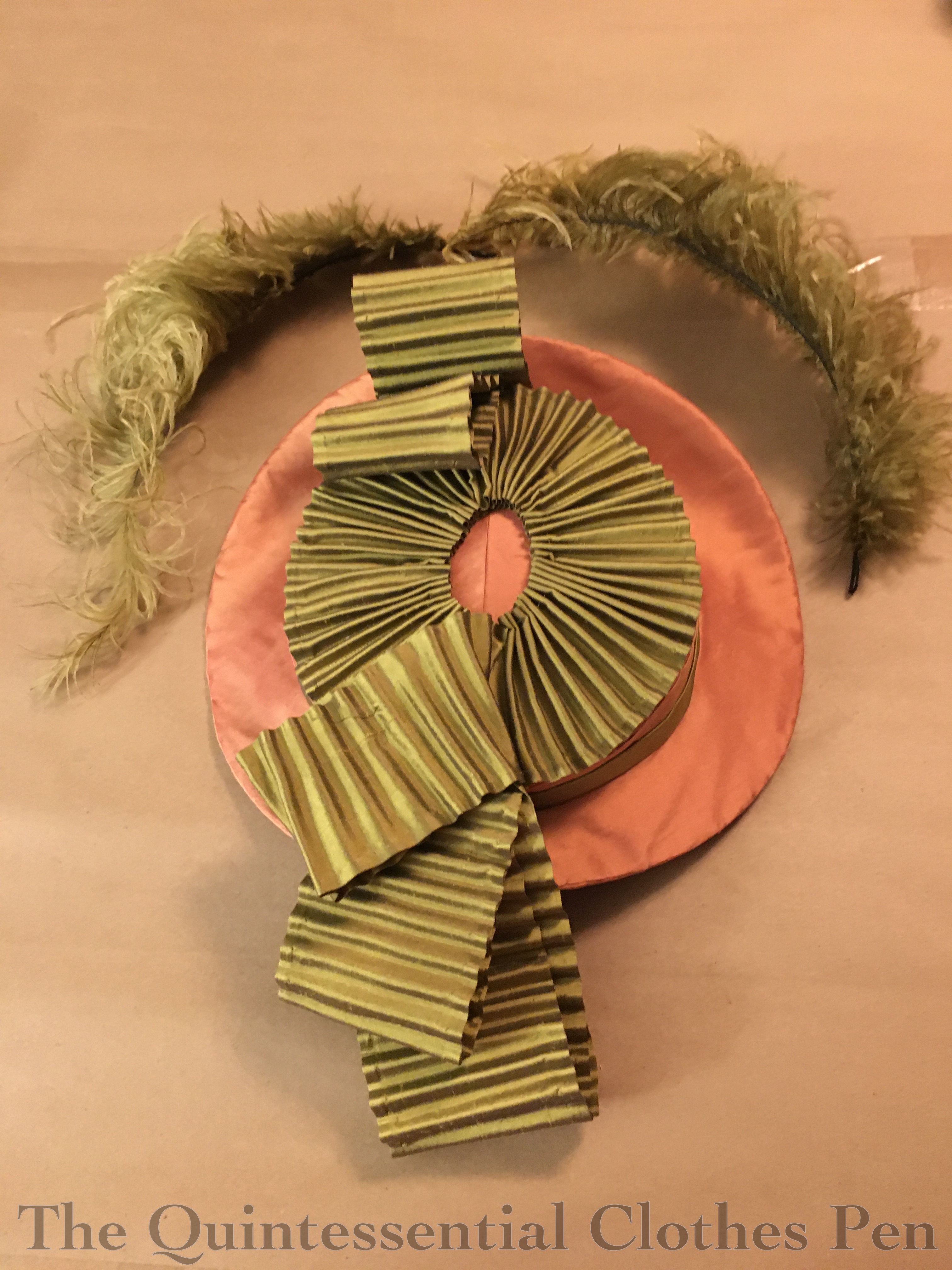
Here, I am laying out trim options. I am amused at the feathers, which at this point have zero shaping and so are standing out like propellers.

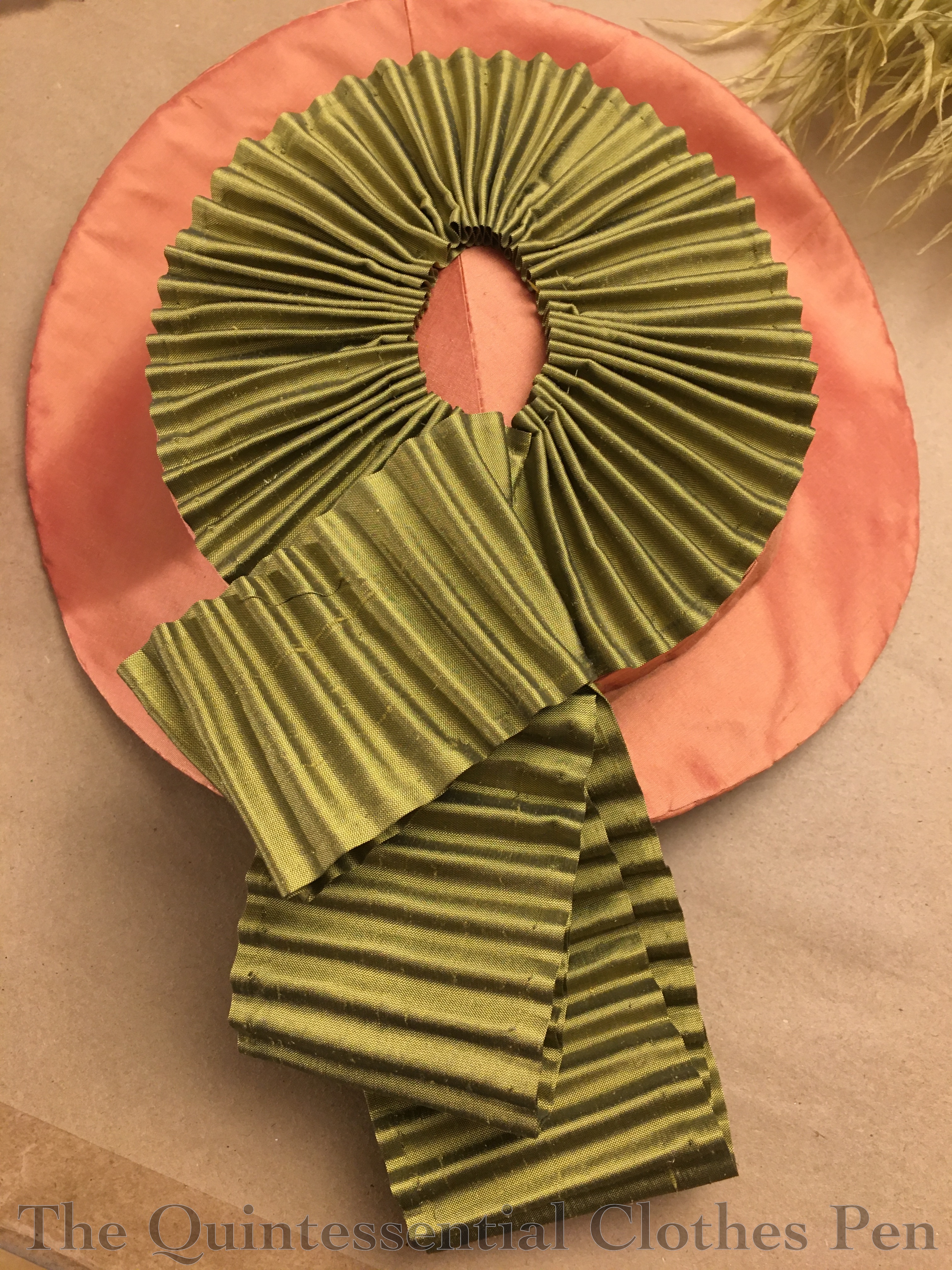
I thought it would be fun to use the remnants of my fluted trim on the hat (read all about how I made it here). I wanted it to resemble wide ribbon (and I wanted to hide the hems, partly because they are only pressed and not sewn in place).

To achieve this, I carefully tacked two layers with the wrong sides together before attaching the loops of fluted trim to the hat.

The tip of the hat is mostly covered by a radiating section of fluted trim with an opening in the middle that was eventually covered with flowers. There are loops of the fluted ‘ribbon’ trailing off the back of the hat as well as standing up in the front.

Then there were the feathers that needed taming.

I started by curling the feathers, as having them stand straight out around the brim of the hat looked a little mad rather than elegant. Curling was achieved using a butter knife. It’s a motion similar to curling ribbon, and requires just the right amount of pressure and firmness not to just rip the feather to shreds. It took awhile to get the hang of the motion and find the point on my knife that worked best.

It wasn’t the most fun… it rather hurt my wrists to twist the knife each time… but over the course of a few hours (yes, this took awhile), I was able to get softly curling feathers.

Here is a half curled feather (on the left) next to an uncurled feather (on the right). In addition to curling the feather fluff I also shaped the center shaft of the feather to curl around the brim of my hat. You can see that I’ve started that process with these feathers, as well.

At this stage the hat has the hat band and fluted trim attached. The curled feathers are prepped and ready to be placed.

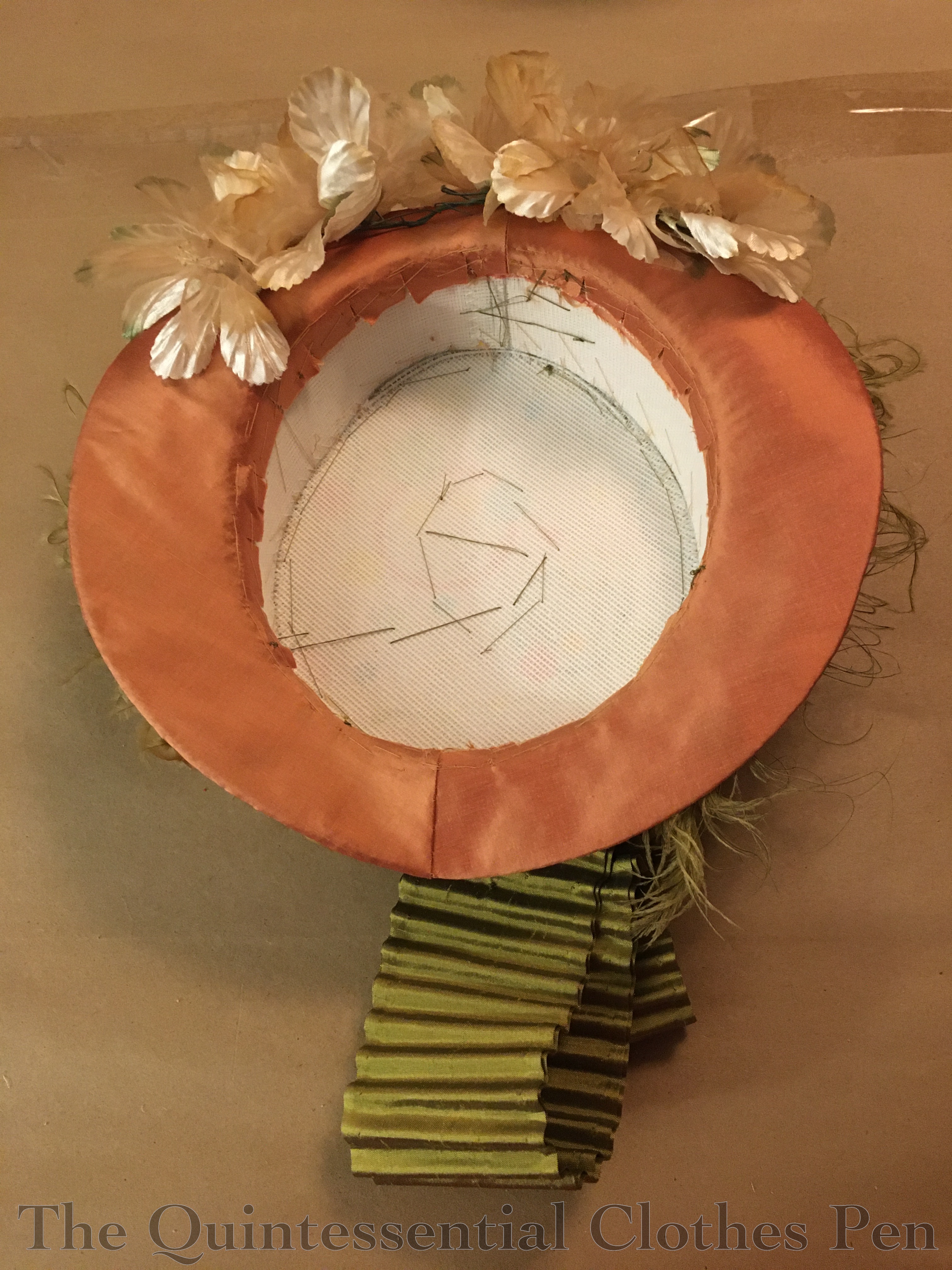
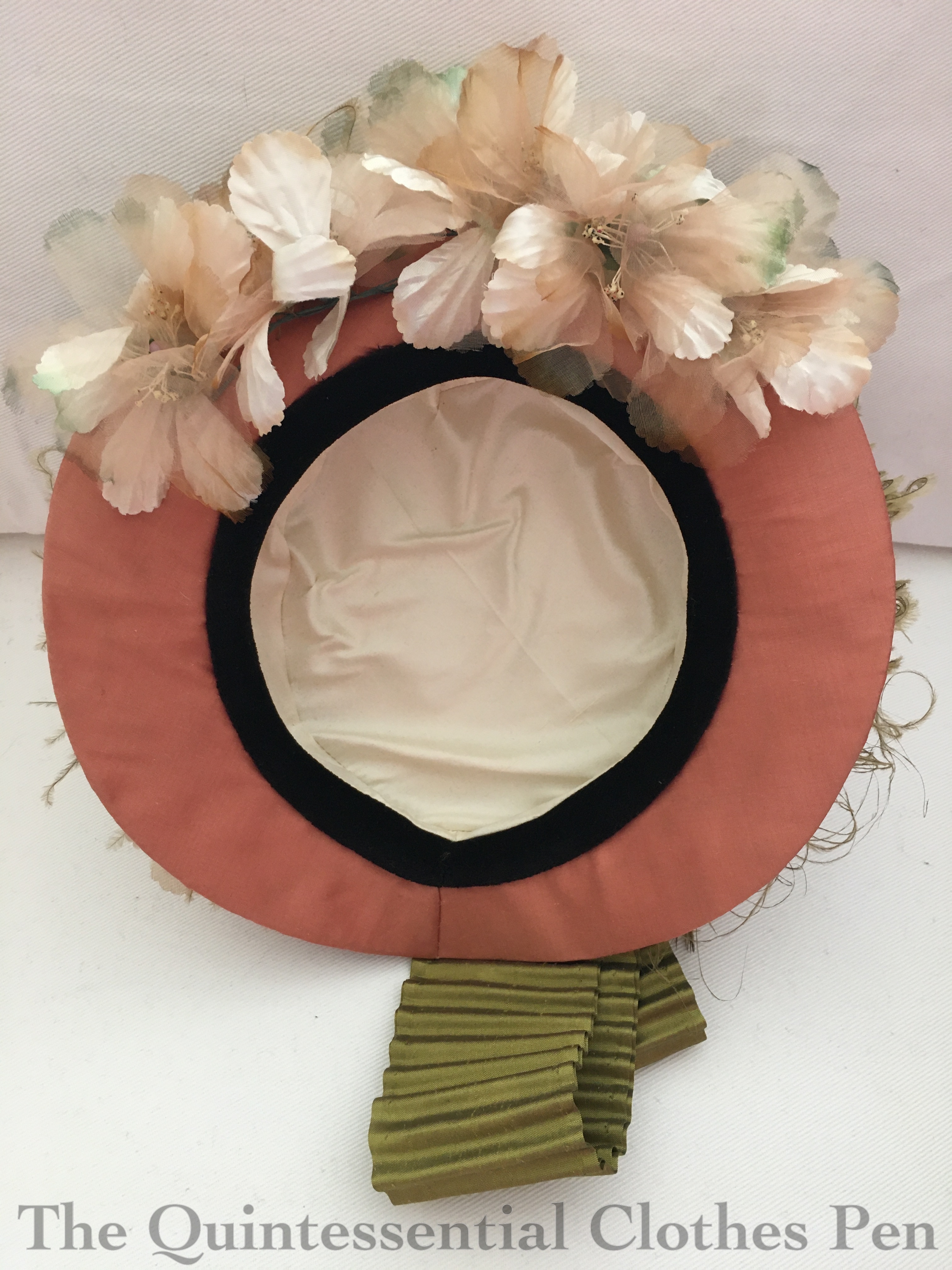
After adding the feathers, I added the flowers on the top of the hat and underneath the brim. Trim under the brim of hats is pretty common in this period. It adds to the floating effect of these hats on top of the grand hairstyles.

Though it seems a bit abrupt to me looking at the underside of the hat, the transition from flowers to brim is more subtle when the hat is placed on the head. The flowers here also serve the purpose of hiding the center front seam I added due to my small pieces of silk!

This photo shows the stitches holding the brim to the crown as well as all of the tacking stitches that hold the trim in place.

The final step was to add a lining to cover all of those tacking stitches!

The lining of this hat is silk shantung, leftover from my 1903 petticoat. The join between the pink silk and the lining is covered by a band of brown cotton velvet. The velvet helps grip the hair to keep the hat in place. I chose dark brown because that will camouflage against my hair. (And, both the silk lining scraps and the brown velvet are leftover from projects in 2011, so yay for using what is on hand!)

And that’s it! It takes a bit of time to hand sew all those sections of the hat (even longer if I don’t machine sew the first few steps), but it’s worth it to have a super sturdy, beautifully covered saucer of trim.

This post is getting long enough, so photos of the finished hat being worn are coming in a future post!

The Amazing Balayeuse (HSM #8)

I am super pleased with a recently completed addition to my historical closet, my brand new balayeuse! Practical, utilitarian, and still managing to be a little frivolous looking, this thing is amazing!

I’ll tell you all about it, but first… what is a balayeuse? Our go-to source for etymology, the Oxford English Dictionary (OED), has the following information.

balayeuse, n.
Pronunciation:  /balɛˈjəːz/
Frequency (in current use)
Etymology: French, feminine of balayeur sweeper.
Dressmaking.
1882   S. F. A. Caulfeild & B. C. Saward Dict. Needlework 18/2   Balayèuse, or Sweeper.—A French term to signify the frilling of material or lace which lines the extreme edge of a dress skirt to keep the train clean as it sweeps along the floor. The balayèuse is allowed to project beyond the edge of the dress, so as to form a decorative as well as a useful trimming.
1894   Daily News 20 Jan. 5/7   Three flounces of..silk forming a richly-rustling balayeuse beneath the hem.

Please note: The Oxford English Dictionary is only available by subscription, therefore I have not included links to this definition as you will not be able to access it simply by clicking a link. Many libraries have subscriptions to the OED, so I suggest you start there for access.

Are you curious how to pronounce balayeuse? The OED provides us with the correct pronunciation, but the official pronunciation notes don’t mean too much to me. I think of the word as bal-ay-yuhz.

Ok, so now we know what this thing is and how to pronounce it. We even have an idea of the purpose, from the OED definition.

As you saw in the first photo, my balayeuse is it’s own garment. But there is another type of balayeuse mentioned in the first OED quote, from 1882. Also called a ‘dust ruffle’, this type of balayeuse is directly attached to the skirt. I’ve had great luck with this in the past and I really like the look of lace peeking out from under a late 19th century skirt, so I included that type of balayeuse on the pink skirt as well, but that alone was not enough to keep its shape.

I decided to make a second type of balayeuse–one that, in addition to the wonderful job of keeping the underside of the skirt’s train from becoming soiled, also helps the train to keep its shape and not collapse on itself. Caroline (of the blog Dressed In Time) mentions this function in a blog post showing her own balayeuse. Here is the train of my skirt laid out (sneak peak!).

I felt I had to make my skirt before the balayeuse, in order to make the balayeuse the right shape to hide under the skirt when it was finished, and so I’ve tried it on a few times without the balayeuse. The train is great looking when I twist and turn in my corset to get the skirt to lay just right, but it doesn’t stay that way when I move around.

But with the balayeuse it was so different! The skirt just magically lays exactly how it should as soon as I put it on and it stays that way no matter how I move–backing up, turning, it is amazing!

So how does this balayeuse really help keep the shape? Well, the main thing is that the base is a double layer of stiff cotton poplin (from Dharma Trading–I love them for my natural fiber, white, black, and unbleached fabric needs). This photo of the balayeuse with the ruffle side face down (as it would be worn) shows the poplin off nicely.

The poplin base is basically a big rectangle with the bottom edge curved up at the sides. I used the full width of the poplin, which was a little less than 60″ wide. The center is 17″ tall and the sides taper to about 9″. The base is gathered to a band that is 28″ wide and 2″ tall. I didn’t add extra stiffening to the band, as the poplin is pretty hardy all by itself. This blog post at Atelier Nostalgia has an image that was great inspiration for my shape (though my balayeuse is wider than this) and the button attachment method I’ll show you below.

The poplin base has three rows of ruffles attached to it. I decided to use unbleached muslin for the ruffles for a few reasons: #1 gathering three rows of stiff poplin didn’t sound like fun (and the base is plenty stiff enough as it is), #2 I figured that the muslin would be less obviously dirty looking, already being unbleached as opposed to very white, and #3 the muslin will be easy and cheap to replace someday, if needed.

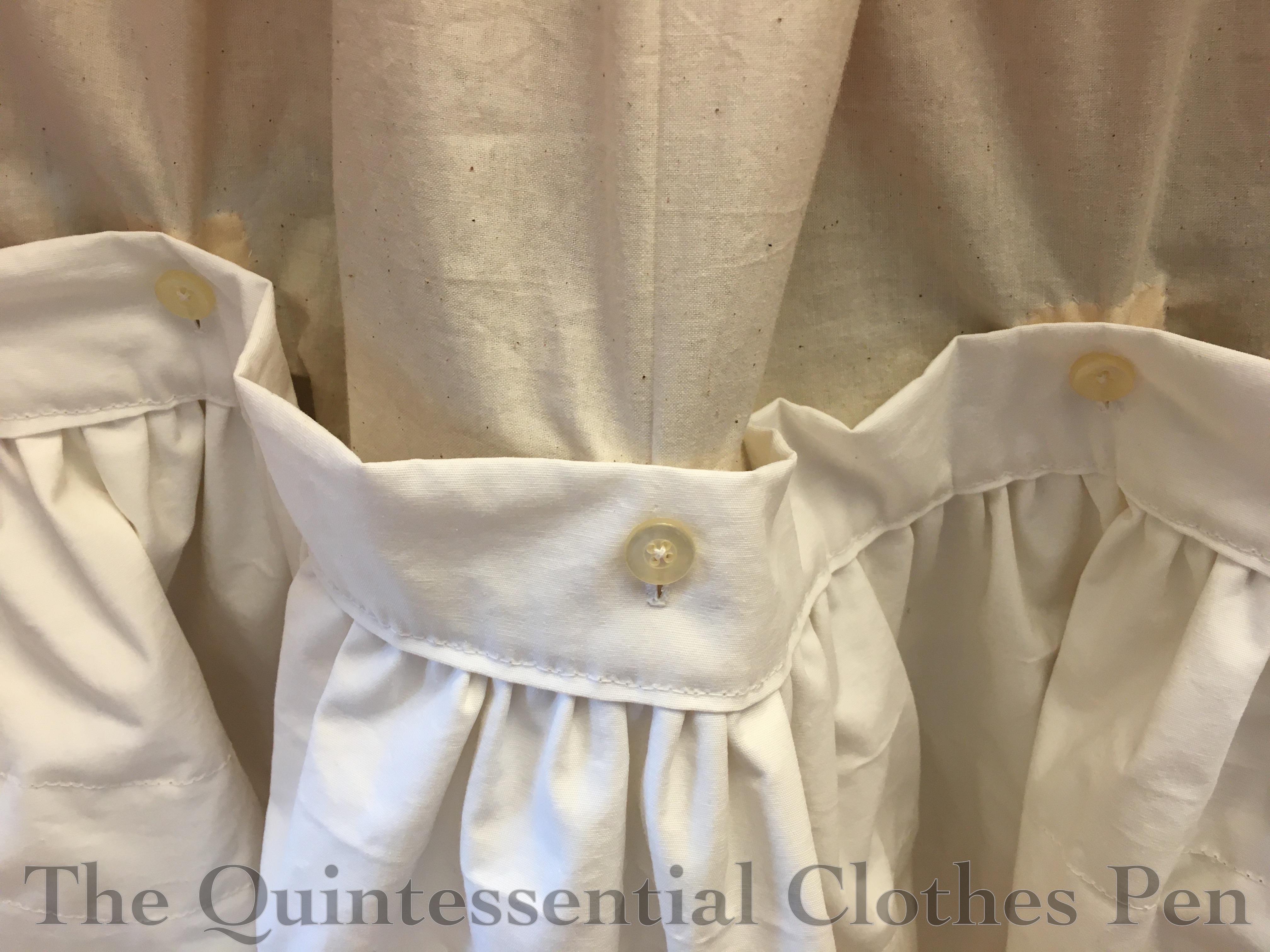
As you can see in the photo above, the band of the balayeuse has buttonholes in it. This allows the balayeuse to be easily removed for cleaning and storage, or use with a different dress (thinking ahead, here!). To accommodate the buttonholes, there are buttons sewn to the lining of the skirt.

The buttons are reinforced with extra squares of muslin whipped to the lining, as you can see in the photo below.

It seemed too much to ask the buttons to hang on to a single layer of muslin while dragging the balayeuse around. Here’s what those whipped on squares look like on the other side.

The end result is this. As you can see, the non-ruffled top of the balayeuse overlaps with the skirt lining and would not be dragging on the ground. The muslin ruffles actually continue the muslin underskirt nicely, I think, though no one is likely to ever see that!

It might not seem super stiff, but this ruffle-y contraption spreads out beautifully when it hits the floor. For comparison, here is a photo of my mockup balayeuse, made from an old sheet (and without ruffles). It’s spread out for the photo, but you can imagine how an old sheet would collapse on itself when picked up.

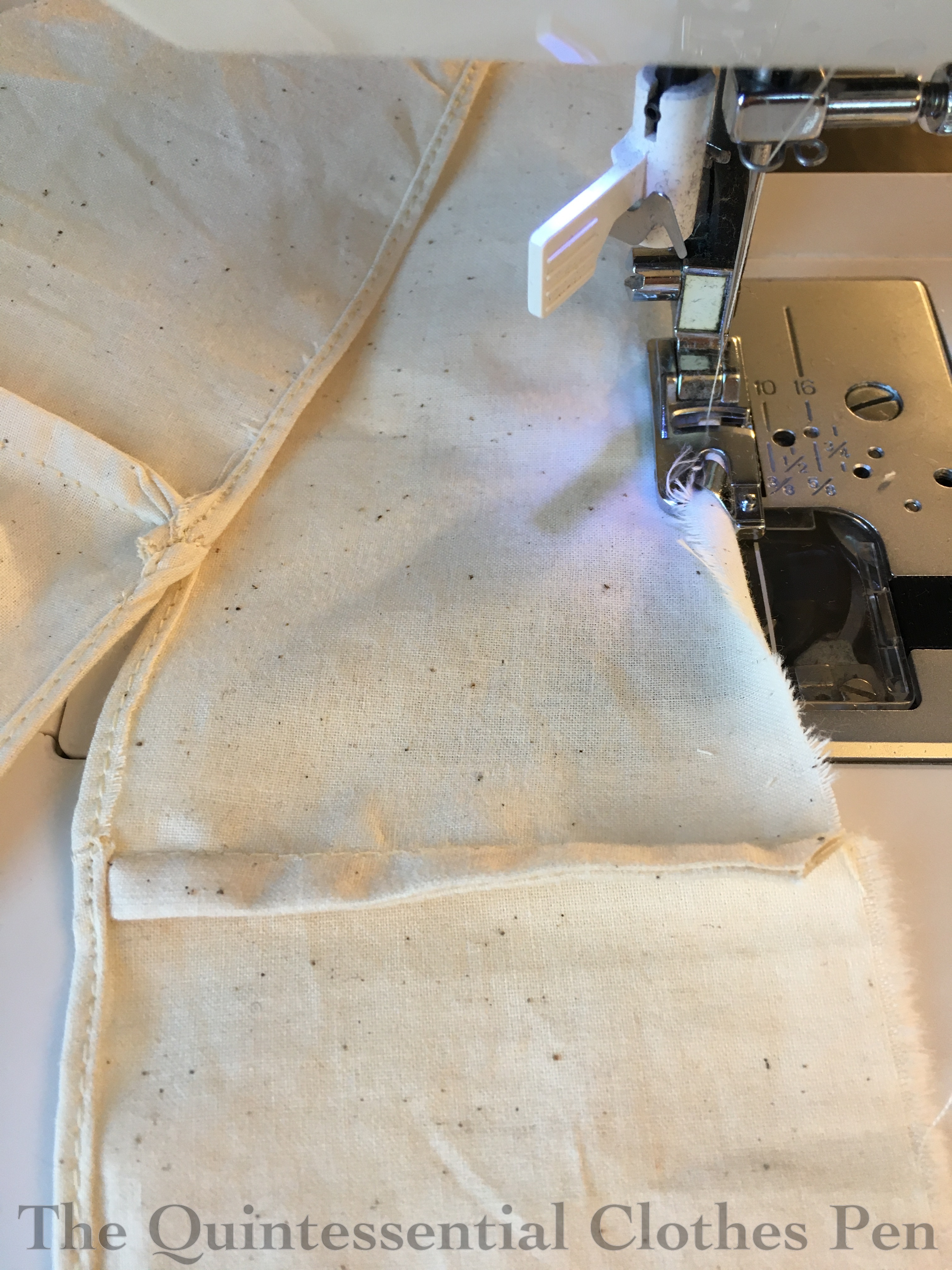
One last thought… the ruffles! I decided to try out a new tool for these ruffles: a narrow hem foot. This is one of those things I should have tried before but haven’t ever used for a project, but miles of ruffle edges seemed like the perfect opportunity to practice!

I can report that practice definitely helped! For example, I had some trouble going over my french seamed joins in the ruffles. In the photo below, my first try is on the left, my fifth try is in the middle, and my last try is just coming up on the right. The french seam was just too bulky to fit through the hook on the presser foot that turns under the hemmed edge. I discovered that if I eliminated some bulk with a diagonal cut of the seam allowance it worked so much better!

I didn’t bother to go back and fix my first few sad-looking french seam crossings. I figured this was going to drag around on the ground, and who would be looking? Also, it’s more fun to make beautifully colored dresses than muslin ruffles… There was a bit of ‘done is good’ on that front for this project.

Yay for learning things! I also found I needed to move my needle just a tad bit to the right of center to easily (and speedily) stitch the narrow hems.

The mention of the narrow hem foot reminds me that this project qualifies for the HSM challenge #8: Celebration.

Make something for a specific historical celebration, make something generally celebration worthy, make something that celebrates a historical hero, or just make something that celebrates some new skills you’ve learned.

Just the facts:

Fabric/Materials:  1 yard cotton poplin and 1 yard cotton muslin.

Pattern: My own.

Year: c. 1875.

Notions: 5 light yellow plastic buttons and thread.

How historically accurate is it?: I haven’t seen an extant stand-alone balayeuse before, so I can’t be sure, but I would say 90%. Materials and style completely recognizable and plausible for their time.

Hours to complete:  5 ¼ hours.

First worn: In May, for fittings. I need to complete my ensemble (only the hat is left!) so I can wear it with the dress it was made for to get photos.

Total cost: $6.25 for the poplin and $4 for the muslin. The buttons were gifted to me. And the thread was negligible. There was a bit of shipping to get the poplin, so let’s say $15 total.

Further information I found helpful as I made my balayeuse included this blog post at Yesterday’s Thimble. It’s also worth mentioning that if this idea sounds great, but patterning your own balayeuse is too much, Truly Victorian has a pattern for a petticoat with detachable train that you can check out.

Sad & Box Iron Etymology

I shared a new adventure with you in my last post as I learned how to make use of my late 19th century fluting iron.

I’ve received lots of interest in this experiment from family, friends, blog readers, and Instagram followers. Yay! Thanks! It’s been great fun to connect with you. I’ve heard about people’s memories as well as stories of lurking, unused, antique irons that people are feeling motivated to try out. I’ve also received enthusiastic feedback about the etymology of various antique iron terms.

On that note, a friend-who-shall-not-be-named who was most intrigued about iron etymology shared a variety of sources with me with clear images and descriptions of different types of irons as well as pointing me towards the Oxford English Dictionary for the meaning of the term ‘sad iron’ (the OED is source which I greatly enjoy but hadn’t thought to make use of during my experiment as I was more focused on how to use a fluting iron in that moment). I thought that some of the information contained in the OED might interest some of you, as well, so here is a rather long, word-heavy post looking at the meaning and history of words… I hope you enjoy!

To start, let’s look at the word ‘sad’ followed by the term ‘sad iron’.

‘Sad’

‘Sad’ in the OED has an extensive list of definitions, many of which are noted as being obsolete and no longer in use.

sadadj.n., and adv.
Excerpt from the Oxford English Dictionary, with quotations, phrases, and compounds omitted

A. adj.
I. Of persons and immaterial things: satisfied, full; steady, serious.
1. Having had one’s fill; satisfied, sated; weary or tired (of something). Chiefly with of or infinitive. Obsolete.
†2. 
a. Settled, firmly established in purpose or condition; steadfast, firm, constant. Obsolete.
b. Strong, firm, standing fast, esp. in battle; capable of resisting; valiant. Obsolete.
3.
a. Of looks, appearance: dignified, grave, serious. Obsolete.
b. Of a person: orderly and regular in life; of trustworthy character and judgement; grave, serious. Also, in extended use, of a person’s behaviour or age, of a period of time, etc. Often coupled with wise or discreet. In later use archaic or regional (chiefly Scottish and Caribbean).
c. Of thought, consideration, etc.: mature, serious, grave, considered. Obsolete.
d. Profoundly or solidly learned (in something). Obsolete.
4. Unmistakable, certain; true, genuine. Obsolete.

II.Feeling sorrow or regret, and related uses. (Now the principal use.)
5.
a. Of a person, or his or her feelings, disposition, etc.: feeling sorrow; sorrowful, mournful, heavy-hearted.
b. Expressing or showing sorrow; (esp. of a look, tone, gesture, or feature) mournful.
c. Causing or evoking sorrow; calamitous, distressing.
d. Of a period, place, action, etc.: characterized by sorrow, full of sorrow; (in early use esp.) hard, sore, bitter.
6. Used as a general expression of censure, depreciation, or regret. Originally: exceptionally bad, deplorable, shameful. Later (also): unfortunate, regrettable, sorry, miserable.
7. slang (depreciative). Esp. of a person: pathetically inadequate or unfashionable; socially undesirable or inept.

III. In various physical senses, principally developed from branch A. I.
8. Of material objects.
a. Firmly fixed or established, stable. Obsolete.
b. Solid; dense, compact; massive, heavy. Also figurative. Now rare (regional in later use).
c. Solid as opposed to liquid. Also figurativeObsolete.
d. Of soil: stiff, heavy; difficult to work.
e. Of a number of persons or things: forming a compact body. Obsolete.
f. Of pastry, dough, etc.: that has failed to rise, heavy. Now chiefly regional.
9.
a. Of a blow: heavy, delivered with vigour. Obsolete.
b. Of a fire: violent. Obsolete.
c. Of rain: heavy. Obsolete.
10.
a. Of colour: dark, deep. In later use esp.: not cheerful-looking; neutral, dull, sombre.
b. Esp. of clothing or fabric: of such a shade; dark-coloured; sombre. Now rare (archaic and poetic in later use).
11. Of sleep: sound, deep. Obsolete.

B. n.
1. Satiety, weariness. Obsolete.
2. Now chiefly with the. Sad or sorrowful people as a class. Also: something sad or suggesting sadness (rare).

C. adv. In a sad manner (in various senses of the adjective). Chiefly recorded in poetical and literary contexts.
1.
a. Firmly, strongly, fixedly; soundly. Obsolete.
b. Heavily, with force. Obsolete.
c. Steadfastly. Obsolete.
2. Seriously, solemnly; soberly, discreetly, wisely. Obsolete.
3. Thoroughly, truly, certainly. Obsolete.
4. Sadly, sorrowfully, mournfully. Now rare (poetic in later use).

That’s a lot of meanings for the word ‘sad’! Even a quick scroll and skim makes it clear how many of these definitions are obsolete. Fascinating!

‘Sad Iron’

To think about how the definition of ‘sad’ influences the definition of ‘sad iron’, I would like to draw your attention back to III. 8. b. from the OED definition of ‘sad’. (Here it is again so you don’t have to scroll back up.)

sadadj.n.
Excerpt from the Oxford English Dictionary

III. In various physical senses, principally developed from branch A. I.
8. Of material objects.
b. Solid; dense, compact; massive, heavy. Also figurative. Now rare (regional in later use).
[In the OED, this definition is followed by this note:]
In early use frequently ‘solid, as opposed to hollow’; cf. sad iron n.sadware n. at Compounds 2.

Ah ha! This is the most relevant part of the definition of ‘sad’ for this discussion. While III. 8. b. does list heavy as one of the meanings of the word ‘sad’, the following note clarifies that in terms of ‘sad iron’ the meaning is focused on the way the object is made: ‘solid, as opposed to hollow’. What does that mean? Let’s allow the OED explain it to us.

sad ironn.
Excerpt from the Oxford English Dictionary

Now historical.
A solid flat iron for smoothing clothes, in contradistinction to a hollow box iron.

As with every definition, the OED has provided a list of relevant quotes using the word over hundreds of years. I omitted those for the word ‘sad’ as there were just too many and it was less directly relevant, but for ‘sad iron’ I’ve included the quotations provided by the OED below. Again, I find it fascinating to see where the quotes were published, what years they are from, and how the term is used.

1759   Newport (Rhode Island) Mercury 9 Oct. 4/3   Imported from London & Bristol, And to be sold by Samuel Goldthwait..Sad Irons, Box Ditto, Brass and Iron Candlesticks.
1787   Maryland Gaz. 1 June 1/2   Hardware of all kinds… Sad-Irons in casks of 2 cwt.
1833   J. Holland Treat. Manuf. Metal II. 253   Dealers commonly distinguish these useful implements by the terms ‘sad-iron’, ‘box-iron’ and ‘Italian-iron’.
1899   Daily News 30 Oct. 2/7   Sadirons 10s. per ton [dearer].
1936   M. Mitchell Gone with the Wind i. v. 84   Hands like sadirons when it comes to reins.
1964   F. O’Rourke Mule for Marquesa 99   Washday smell,..don’t forget to damp and starch, spit on the sadiron.
1995   Mother Earth News Feb. 75/3 (advt.   Hundreds of old time general store items you thought they’d quit making years ago, including wooden kegs, pickle crocks,..sad irons, [etc.].


8.III.b. also mentioned ‘sadware’. Now that we know so many meanings for the word ‘sad’ we could take a guess at the meaning, but I thought I would include the OED definition to clarify.

sadware n.
Excerpt from the Oxford English Dictionary

Now historical.
(Heavy) pewter flatware

‘Box Iron’

So what does the OED have to say about box, or hollow, irons? The OED has ‘box iron’ contained within the definition for ‘box’. (The OED does not have a separate entry for ‘hollow iron’.) Here is the relevant bit.

boxn.2
Excerpt from the Oxford English Dictionary

I. A container or receptacle, and related uses.

C1. General attributive.
c. With the sense ‘of the nature of, or resembling a box’.

box-iron  n. a smoothing iron with a cavity to contain a heater; also attributive.

1723   London Gaz. No. 6195/6   John Brown..Box-Iron-maker.
1746   H. Miles in Philos. Trans. (Royal Soc.) 44 56   Box-Irons for smoothing Linen-Clothes.

Images of Irons

Here are some images of the types of irons mentioned above as well as some other interesting iron variations as well.

This site has a photo and information about an extant sad iron.

This site (also linked in my last post) has a helpful description of box irons and how they were heated in the past as well as how they are used today. There are also a few helpful images, including box irons and sad irons.

This site has drawings of all kinds of irons, including a box iron (and variations such as charcoal and gas), a polishing iron, a millinery iron, an egg iron, an Italian iron (and the bolt used to heat it), and two different types of specialty tongs used for pressing trims.

This site has a photo and information about an extant charcoal (box) iron.

The Italian iron, also called a goffering iron, is mentioned in the OED quote from 1833 in the entry for ‘sad iron’. One of these was featured in the video from the Oshawa Community Museum that I included in my last post, and here is another extant one, with a photo and information.

Other specialty irons existed, too. Check out this billiard table iron.

Please note: The Oxford English Dictionary is only available by subscription, therefore I have not included links to the definitions in this post, as you will not be able to access them simply by clicking a link. Many libraries have subscriptions to the OED, so if you would like to conduct your own adventures in etymology I suggest you start there for access.

A Practical Experiment: How To Use A Fluting Iron

Way back in 2012, I posted with great excitement about a new to me sewing tool that Mr. Q called the Cast Iron Crinkle Cutter. These antique specialty irons are actually called fluting irons.

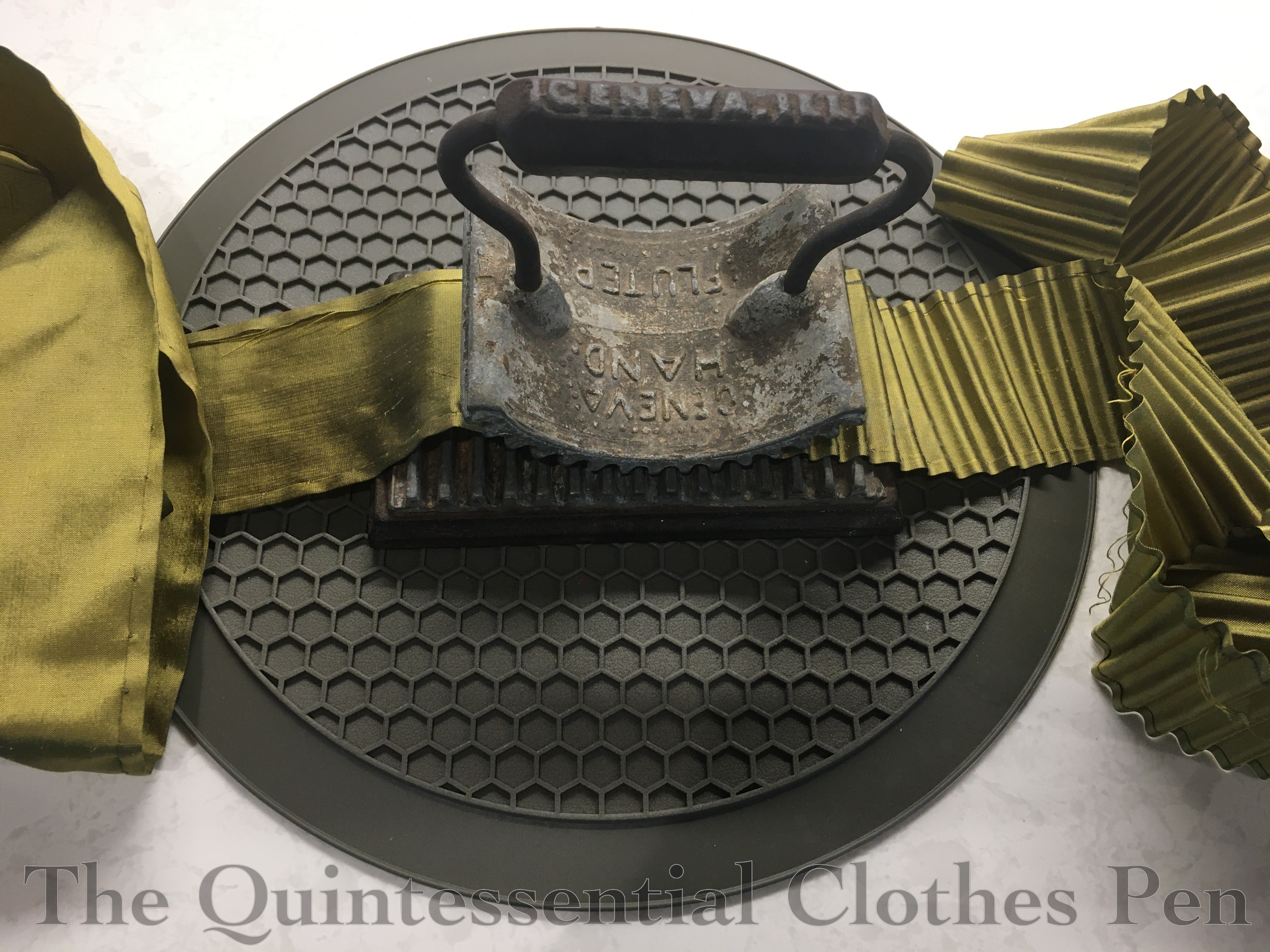
Here is mine, in action!


Despite my best intentions of actually creating trim with my fluting iron, instead it has been used as a door stop and decorative item (near my modern iron in my sewing room!) since I’ve owned it. I’m currently working on a project from 1875 that has pleated trim around the skirt and I thought that perhaps instead of knife pleating I would try a sample with my fluting iron! I figured that if I liked it (and I could get it to work) I’d use it for the trim on the dress.

Brief History

Specialty irons have been used for hundreds of years to create different types of ruffles and trims. I came across two sites that had really interesting information about the fluting iron I have as well as many other types of irons from around the world and for the last few thousand years. This one is summary of ironing throughout history. This one is more about types of historical irons. Also, this video from the Oshawa Community Museum looks specifically at some ironing tools that were used to create late Victorian ruffles, including various types of fluting irons.

Along the way to learning more about fluting irons, I also learned that flat cast iron irons are called sad irons. (I might have read that before but didn’t remember the term, so it feels like new information!) They’re called that not because they’re melancholy, but because in the past ‘sad iron’ meant the iron was solid as opposed to hollow (to be filled with heating devices, such as charcoal). The word ‘sad’ also meant heavy and a sad iron could weigh up to 15 pounds. That only further reinforces the fact that laundering in the 19th century was strenuous work (hand scrubbing, hauling buckets of water to heat, maintaining the stove or fire, harsh soaps, refreshing the rinsing water… hard work!). *This is edited from my original description of sad iron. To read all about the etymology of the terms ‘sad’, ‘sad iron’, and ‘box iron’ (the term for a hollow iron), check out this post, published after the one you are currently reading.

Practical thoughts about getting started

In terms of my fabric, I had the strips I wanted to flute prepared and ready to go before ironing them. I had hemmed one long side and just pressed the other edge under (that would become the top edge). With the crisp silk I’m using I probably could have gotten away with just pressing under both the hem and the top edge, but oh well. I prepared and hemmed these long before I officially decided to flute them.

In terms of the fluting iron, I followed these steps (or considered them, anyway):

Cleaning: I used dish soap and a toothbrush, to really get into all the grooves on both pieces of my fluting iron and remove the accumulated dust and grime (I don’t want those on my silk fabric!).

Drying: To prevent rust from forming, I carefully dried the iron and then also let it air dry overnight (though I realized that if I were to immediately use it the heat would cause all of the water to evaporate anyway…).

Seasoning: This is done on non-coated cast iron pans to keep them from rusting. I chose not do this with my iron at this time. I might do it later (I read that well-seasoned cast iron will not release oil onto your fabrics), but right now I just wanted to get started on my experiment.

Supplies

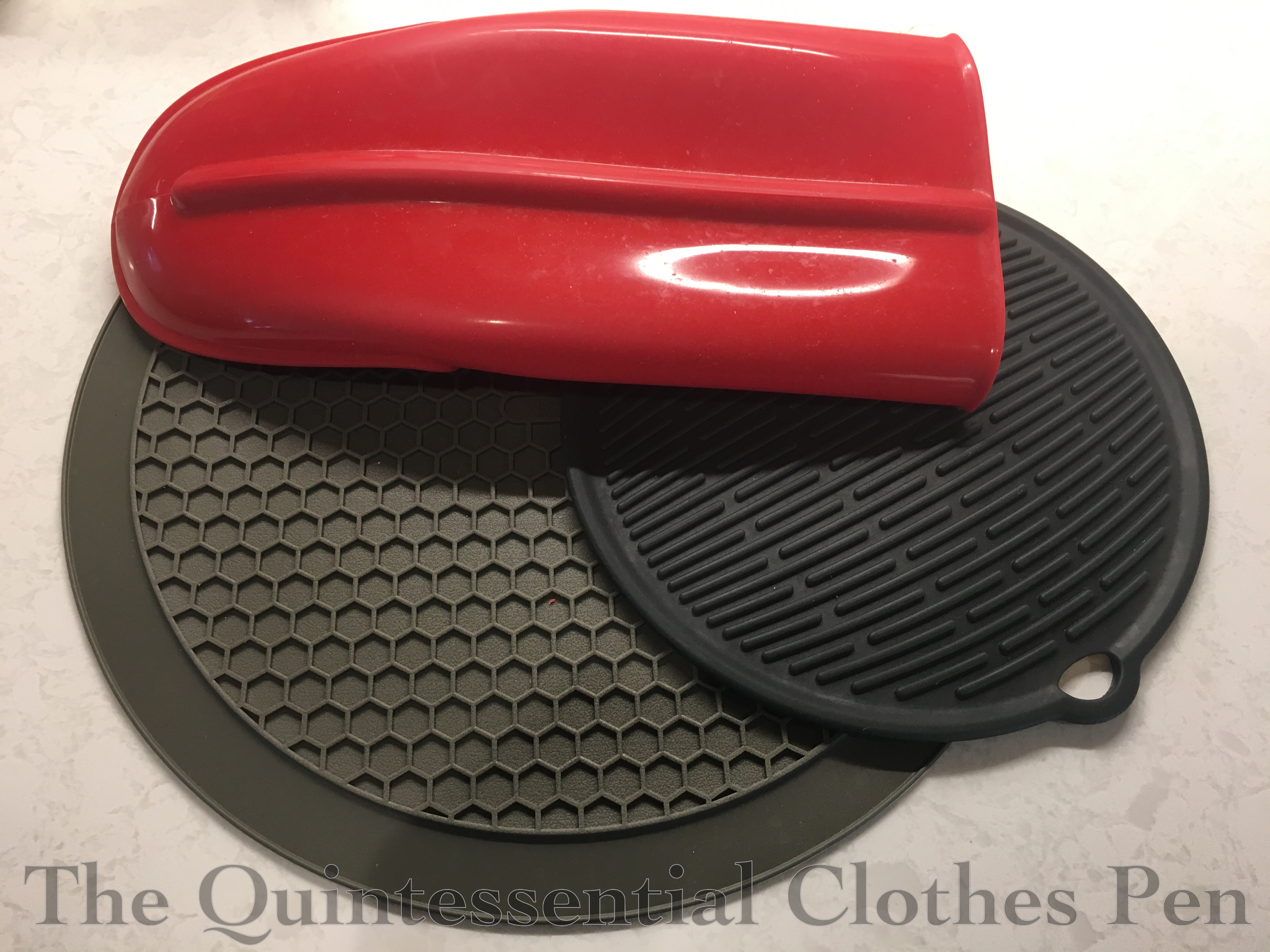
It’s worth noting that the cast iron gets much too hot to hold with bare hands or put directly on the counter to use, so in addition to the two parts of the iron, I also used a variety of other kitchen tools in this experiment.

I used the baking sheet, cookie drying rack, and cast iron frying pan you’ll see in photos at various points, as well as the silicone baking supplies pictured below: a hefty mitt, a small trivet, and a large trivet.

I also used a spatula to help get a grip on the base of the iron while lifting it out the frying pan, a small spray bottle, white vinegar from my pantry, and tap water.

Method #1 (the slow and steady way to heat the fluting iron)

Heating/Using: I used my conventional oven to heat both parts of my fluting iron on a baking sheet. I could not find specific directions for temperature or length of time, so I started conservatively with 175 F for 15 minutes. (Partly due to the basic information on Wikipedia about specific temperatures for different types of fabrics, but also check out the image of the tailor’s stove on the right side of the page: a multi-sided stove to heat sad irons simultaneously makes so much sense if you’re ironing a lot, as tailors would be!).

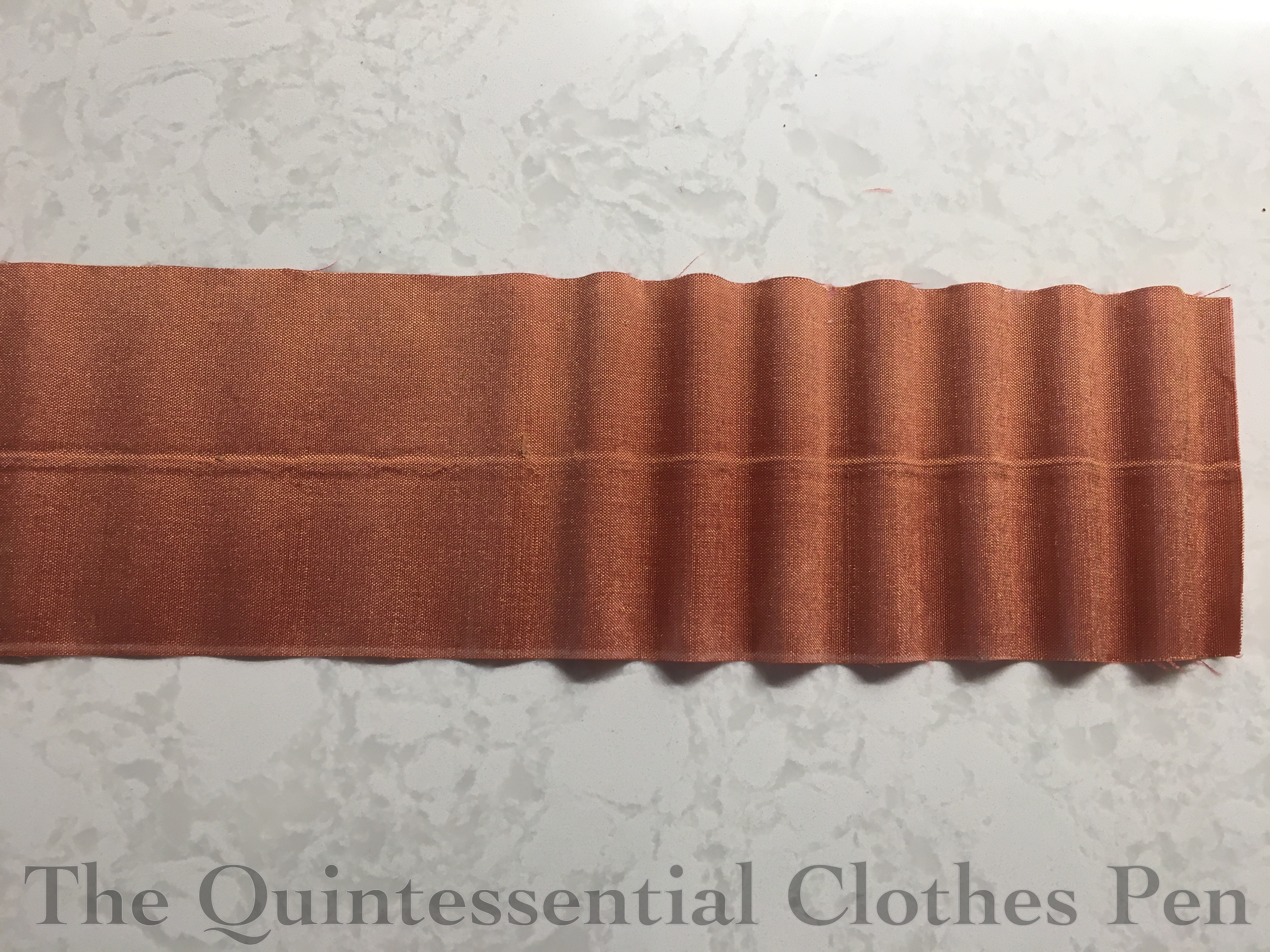
When tested on my silk this hardly made an impact. So I put the iron pieces back in the 175 F oven for another 10 minutes. This was better, but not as effective at getting tight flutes as I wanted. On the left are the barely visible results from the first 10 minutes of heating and on the right after the second 10 minutes of heating.

I increased the temperature to 225 F and put the iron pieces back in the oven for 10 more minutes. This time I also decided to use vinegar to help set the flutes. I mixed ½ white vinegar and ½ water in a spray bottle and then sprayed the section of silk I intended to iron. Here you can see the sprayed silk ready to feed into the iron on the left and the results coming out on the right.

This worked much better, but still feeling like I needed more heat to get a good sizzle and press, I increased the oven to 275 F and put the pieces in for another 10 minutes. This seemed like the right temperature! A bit of sizzle from the evaporating liquid on the silk and tight flutes as a final result.

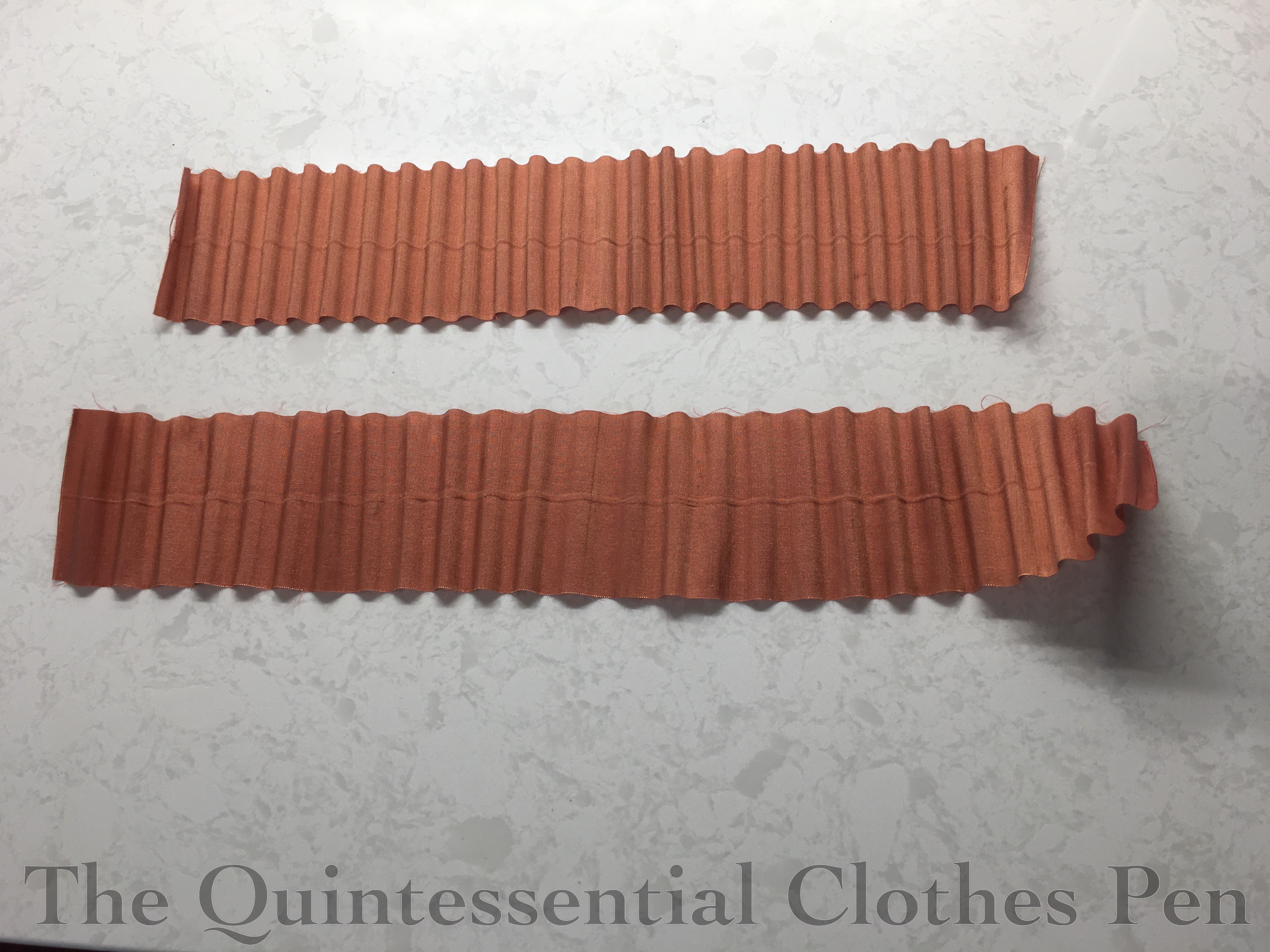
Here is a comparison of two silk samples. The one on the bottom used vinegar and lower heat: 175 F and 225F. The one on the top is the sample that used vinegar and 275 F for heating.

Reheating: I found that the iron lost heat pretty quickly. I reheated it for 10 minutes after every 5 minutes of use. It wasn’t the most efficient process (I can really understand why you would have a set with multiple irons to keep them heating while not in use), but it got the job done on a Saturday afternoon. Experimenting with temperature and fluting 106″ of fabric took about 4 hours.

Setting: In addition to using vinegar (which made huge difference in terms of getting crisp flutes!), I also found it quite important to move the iron very slowly over the base to create the flutes. A quick pass did not do the job and getting each and every flute to line up perfectly to go over it multiple times is much easier to say than to do! I rocked the iron from one side to the other, trying to hold each little section in place for at least a few seconds before moving to the next. I got through about two full rocks with the iron before needing to reheat it.

Method #2 (the much more efficient way)

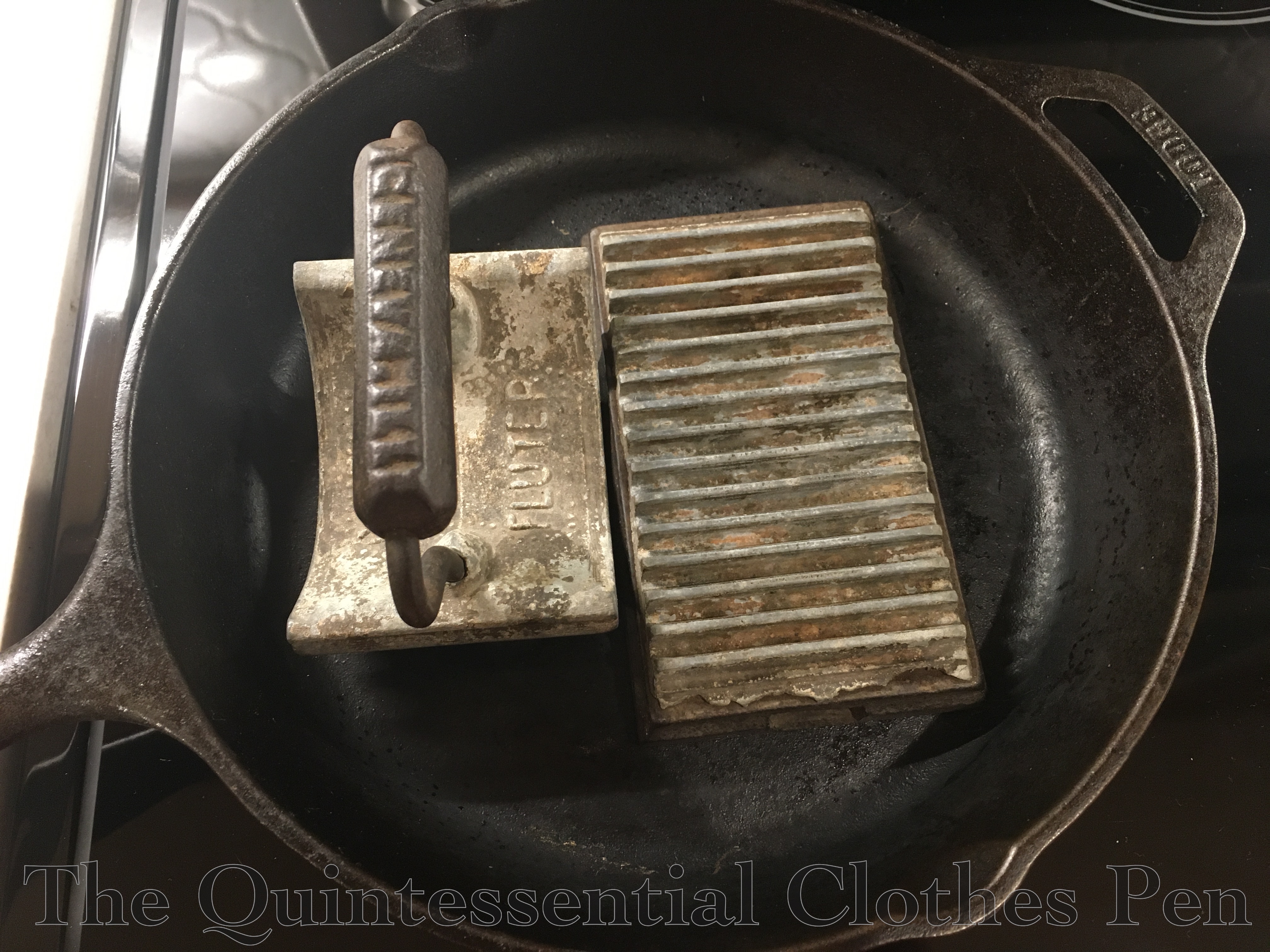
Heating: After I completed the first of three 106″ sections of trim, a science-minded friend suggested that I would have much more efficient transfer of heat to the iron pieces if I were to heat them directly on my stove in a cast iron pan. This was genius!

I started with my pan on pretty low, as it’s much easier to heat cast iron up than cool it down. This particular burner on my stove gets super hot, so I kept the pan around 2 out of 10 in terms of heat. Harder to translate for other people, but I let the iron heat up for about 10 minutes, until I could feel radiant heat coming from the base when it was out of the pan and I held my hand 1″-2″ away. Another way I tested the head was with a drop of water. At this temperature it quickly evaporated when dripped onto the cast iron.

Reheating: Using the cast iron pan was much more efficient than the oven! I still reheated the iron after about 5 minutes of use, but now I only had to let it reheat for 5 minutes. And because I wasn’t lifting a pan in and out of the oven it was much easier to let the top part of the iron sit on the pan while I moved the fabric along the base piece of the iron. Because the iron was warmer than with the oven, and I’d had more practice at using it, I was able to do three or four full rocks of the iron before needing to reheat it. That meant that my second and third 106″ lengths of fabric only took about 1 hour each. So much faster than with the oven!

You can see the crisp flutes that this method acheieved.

Setting: I used the vinegar/water spray to help set all of these flutes. It should help the fabric to keep this shape permanently (short of me completely soaking the fabric). I experimented with a light spritzing, but the heat quickly evaporated the liquid so I started just making it pretty soaked. Sometimes I even sprayed a bit on the fabric right under the iron if it evaporated before I reached that section of the rocking motion.

Here’s another view of the half finished strip of fabric.

Post Experiment Thoughts

This was fun! I would definitely like to use my fluting iron for more projects–and it should be easier now that I’ve figured out how.

I will say that practice makes a huge difference in terms of being able to flute quickly, so that the iron doesn’t cool down. You don’t have too long to think once you take the iron off the heat source!

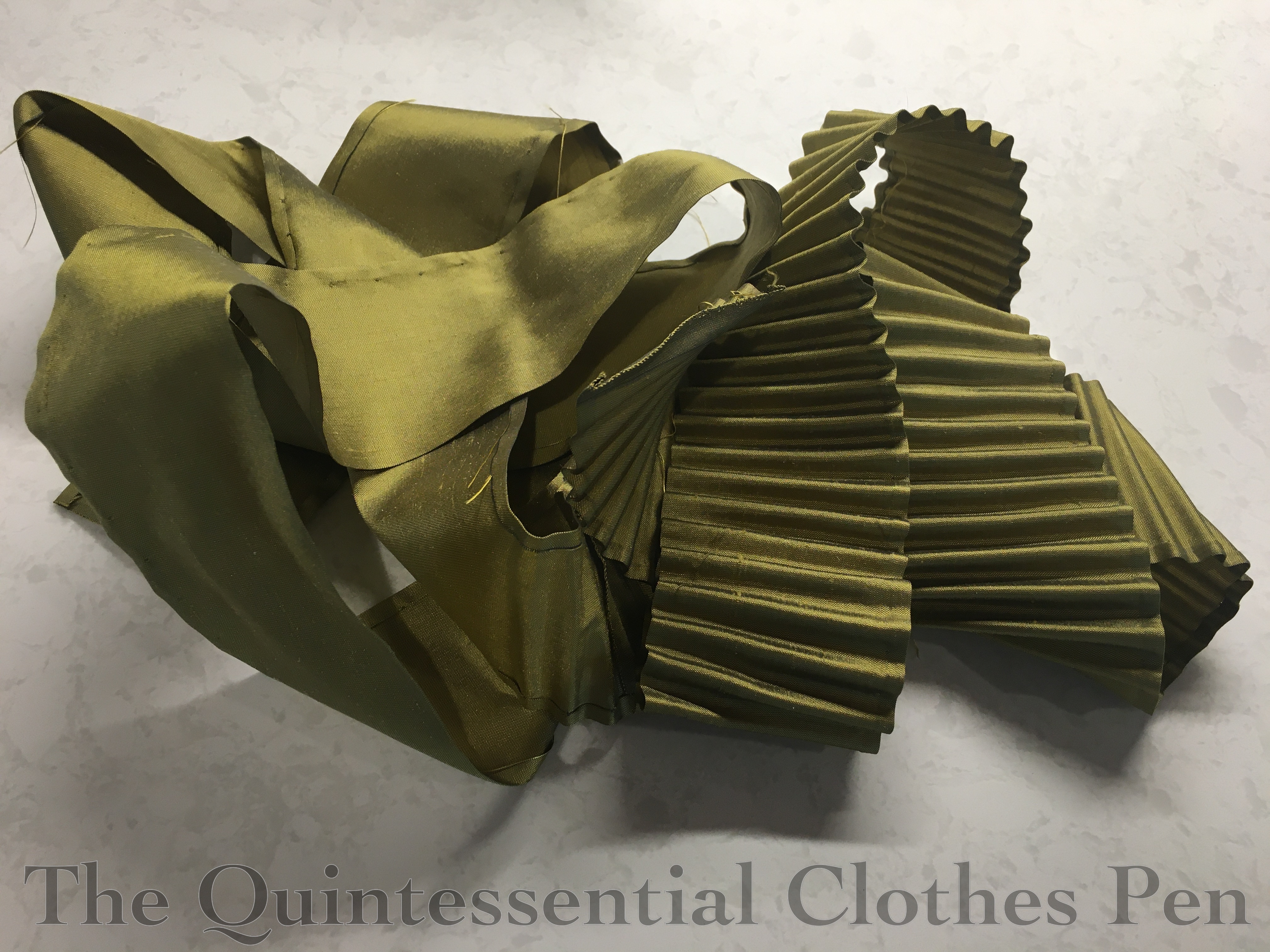
A finished pile of about 318″ of fluted trim! I’m curious about how I will sew this on. I think that a sewing machine would crush the flutes (and I don’t think I want a line of machine stitches anyway), so I will likely sew it on by hand, catching only the valleys and not the hills in the fabric. Good thing I like hand sewing!


I came across few people trying out antique fluting irons while looking for information to get started on this experiment. For the sake of anyone else who might be looking, here are a few other practical experiments to check out:

Katherine of The Fashionable Past tried out a fluting iron in 2011 and posted about it on her blog here, including a video.

@isabel.northwode tried out a fluting iron in 2018 and posted about it on Instagram here.