

I recently finished up a series of blog posts that document the trials, tribulations, and triumphs of a new pair of 18th century stays. Here is the link to the most recent post (and I’ll include a link to all of the posts in the series at the end of this post).

I’m really, really excited that this pair of stays is complete! They are entirely hand sewn, which took quite a bit of time. And, they were a struggle to fit that ended in success. For both of those reasons, I’m excited that these qualify for the HSM Challenge #11: Style Starts At Home:
Make something which would generally be seen only within the household (ex: informal at-home wear, nightwear, undergarments)
How do these fit the challenge? Well, stays are an undergarment that would generally only be seen at home!
Just the facts:
Fabric/Materials: ⅔ yard natural linen for exterior (scraps from another project), 1 ⅓ yards thick/heavy white linen for interlining (scraps from another project), and ½ yard cream linen/cotton blend for lining
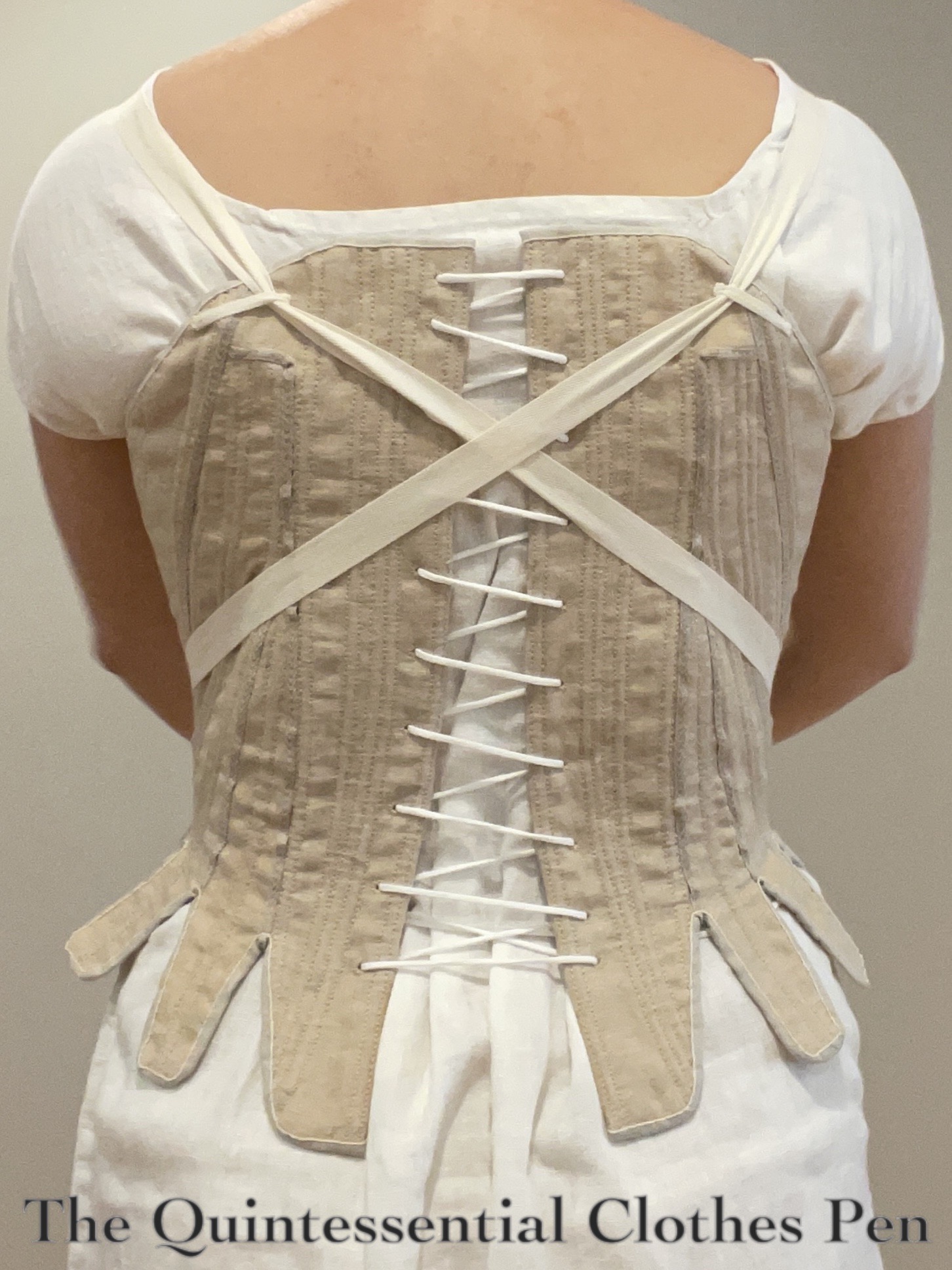
Pattern: 1785-1788 Half-Boned Stays from Mandy Barrington’s book Stays and Corsets: Historical Patterns Translated for the Modern Body
Year: c. 1785-1788
Notions: 29 10″-14″ zip ties that I cut to be 3/16″ wide for boning, 2 ½ yards 3/16″ wide natural linen twill tape for seam covering, 4 yards 1/2″ wide natural linen plain weave tape for binding, 3 yards white cotton cord for lacing, 1 yard ¼” wide cotton twill tape for front lacing, 2 yards ¾” wide cream cotton twill tape for straps, regular weight thread, and heavy weight thread
How historically accurate is it?: 90%. The pattern and methods are based on historical examples. The materials are pretty close, though the zip ties and cotton/linen blend aren’t perfect replicas of 18th century materials.
Hours to complete: I only kept track of about 50 hours, but my guess is that I spent at least 70-80 on these stays.
First worn: In May 2023 for photos.
Total cost: Approximately $40.
And, a few more photos: side and back view, as well as a view of the stays folded in half from the inside.


You can read previous posts in this series here:
c. 1785 Stays of Success, Part VII: Conclusion, Reflections, and Resources
c. 1785 Stays (Of Fail), Part VI: Finishing Construction Details
c. 1785 Stays (Of Fail), Part V: Middle Construction Details
c. 1785 Stays (Of Fail), Part IV: Early Construction Details
c. 1785 Stays (Of Fail), Part III: The Pattern
c. 1785 Stays (Of Fail), Part II: Fitting Update
c. 1785 Stays (Of Fail), Part I: Beginnings
 The Quintessential Clothes Pen
So glad they turned from fail to success for you!
Thank you!! I appreciate you following along with the adventure!
Oh, wow, this process has been so fabulous to follow. Happy sewing what goes on top!
Thank you for following along, Angela! I appreciate the happy sewing wishes. 🙂
So….a stay is like…a half-corset-?
Thanks for your question! Sorry to be very, very slow responding to it.
Yes, sort of!
“Stays” are a predecessor to corsets–both are foundation garments that provide support and shape the torso into the fashionable silhouette of the period. Generally, “stays” (or a pair of stays–which is one full garment of this sort) refers to a half-boned or fully boned, laced bodice worn under clothes. The term was generally used throughout the 17th and 18th century. The precise silhouette, length, etc. changes over time.
“Stays” is usually plural, referring to both halves (left and right) of the garment. A single half doesn’t seem like it would be very useful for wearing. 😉
So stays are worn below where a bra would be, specifically to pull in the waist or pull together the bodice?
Stays and (most eras of) corsets provide bust support in addition to torso shaping and smoothing. So most stays and corsets will go up to a point about halfway up the bust, providing stability from the underside (sort of the bottom half of where a modern bra would be). The top half of support/stability is provided by a garment worn under the stays or corset–the term for this changes, but it ranges from smock, to shift, to chemise from the 16th through 19th centuries.
(One exception to this is that by the 1910s, corsets are, in fact, worn below where a bra would be in order to smooth the waist. At this point, “bust bodices” start to be worn–and these really are like an early bra, in that they support only the bust and do not go down over the waist. For some time these two garments were worn together, and then the corset is discarded and bras become the undergarment of choice.)
Love the hand-stitching!
Thank you! It was a labor of love… 🙂