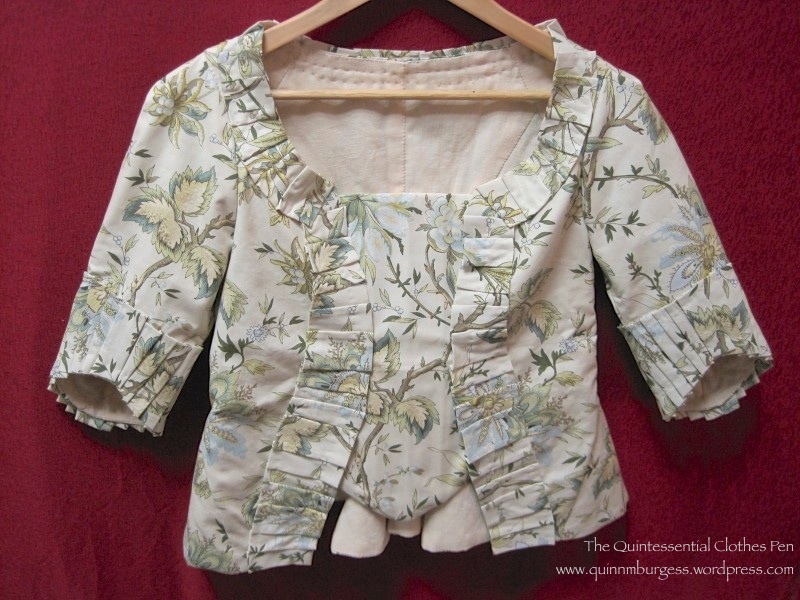
1797 Watermelon Sleeveless Bodice, Part II: Patterning & Construction

This story begins in my previous post (which you can read here) in which I share the backstory and inspiration for this garment. I’ll be carrying on from where I left off. But first, a quick side story!

Mr. Q saw the title of this post and asked “What is a watermelon sleeve?” An excellent question, I think! I explained that watermelon is my description fpr the colors of the garment I’m discussing. But… I do rather wonder what a “watermelon” sleeve might look like…! After all, there are many historical sleeves with fun names (bishop, bell, pagoda, beret, gigot, and mameluke all come to mind quickly, though I can’t think of any that are named after fruit. If you can, let me know!).

Leaving that tangent behind… back to the story!

Patterning

The pattern started with the lining pattern for the dress that I knew fit and would be worn under the sleeveless bodice as well as the bodice of “A Robe c. 1795 – 1803” on pages 44 and 45 of the original printing of Janet Arnold’s Patterns of Fashion 2. I liked the idea of the pleats on the exterior to provide interest on my otherwise solid fabric. It didn’t occur to me until very late in the process of making this garment that most of the pleats would be covered by the neck trim. Oops! Oh well! Below, a photo of the front of the bodice. The pleats are the topstitched lines running downwards from the shoulders.
I ended up with separate patterns for the exterior and lining front pieces, but the side back and back pieces were cut from the same pattern. I’ll explain how I made them.

For the front lining piece, I started with the dress lining, as pictured below. By starting with this, I knew that the sleeveless bodice would easily fit over the dress and have similar seam lines.
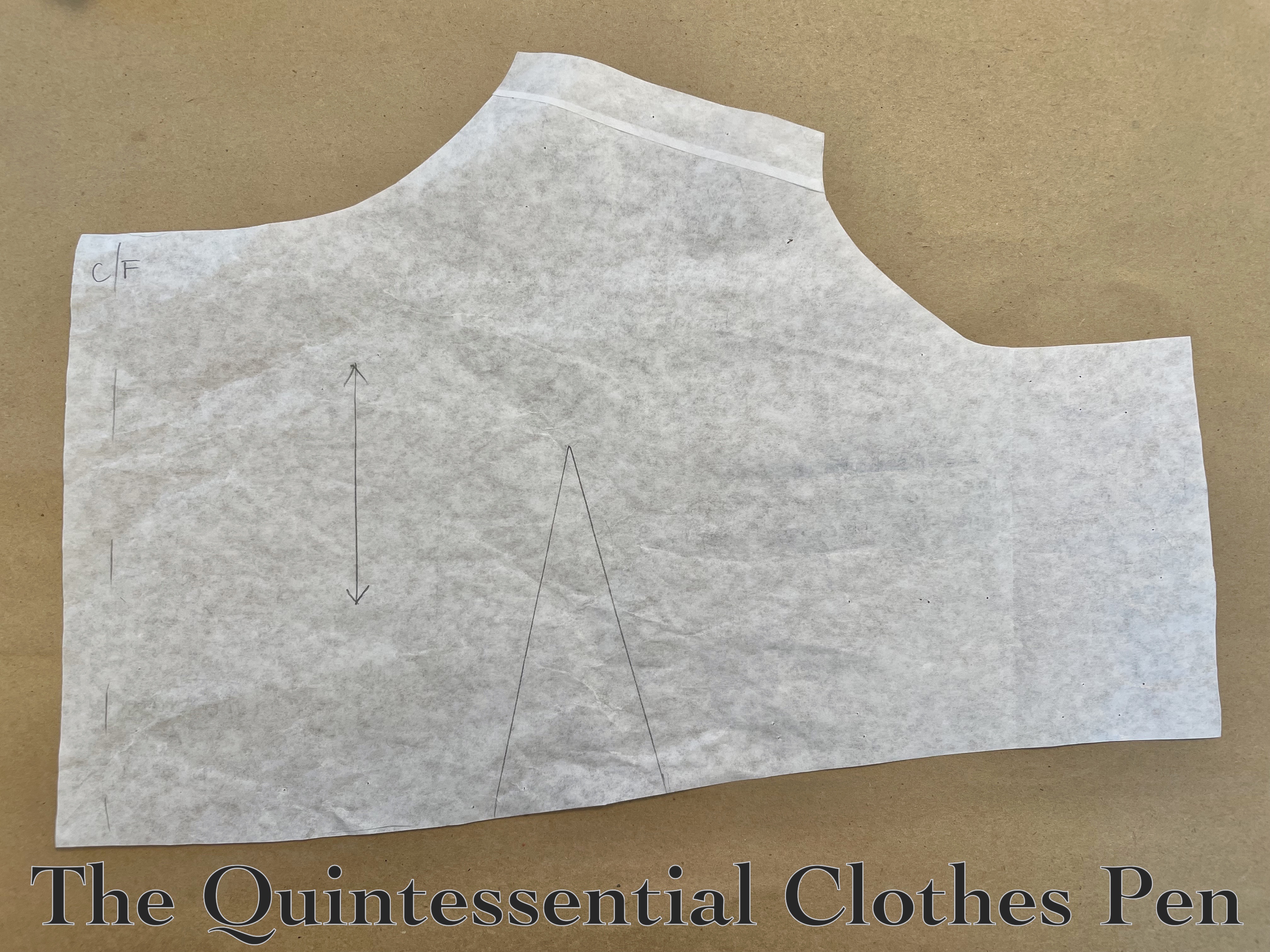
I adjusted this pattern to have a little bit of wearing ease by adding ¼” to the bottom edge, ¼” to the neck edge, ½” across the center back piece, and ¼” across the side back pieces.

To that, I superimposed the PoF robe because it had a very low front bodice (clearly intended to be worn with a dress underneath) and it had a front pattern piece that curved downward towards the front, with a separate side front piece. Ah ha! I could create a dart going towards the waist in the area between these two pieces and have a one piece lining while also easily having a two piece exterior to make the pleats easier! This would reduce bulk in the finished garment and allow for the necklines of the exterior and lining to be exactly the same.

The photo below shows the front pieces I ended up with. On the left is the lower part of the front lining (the shoulder area is extended with a separate shoulder piece in the lining) and the center front part of the lining. For the lining, these were cut as one piece (with the dart marked).
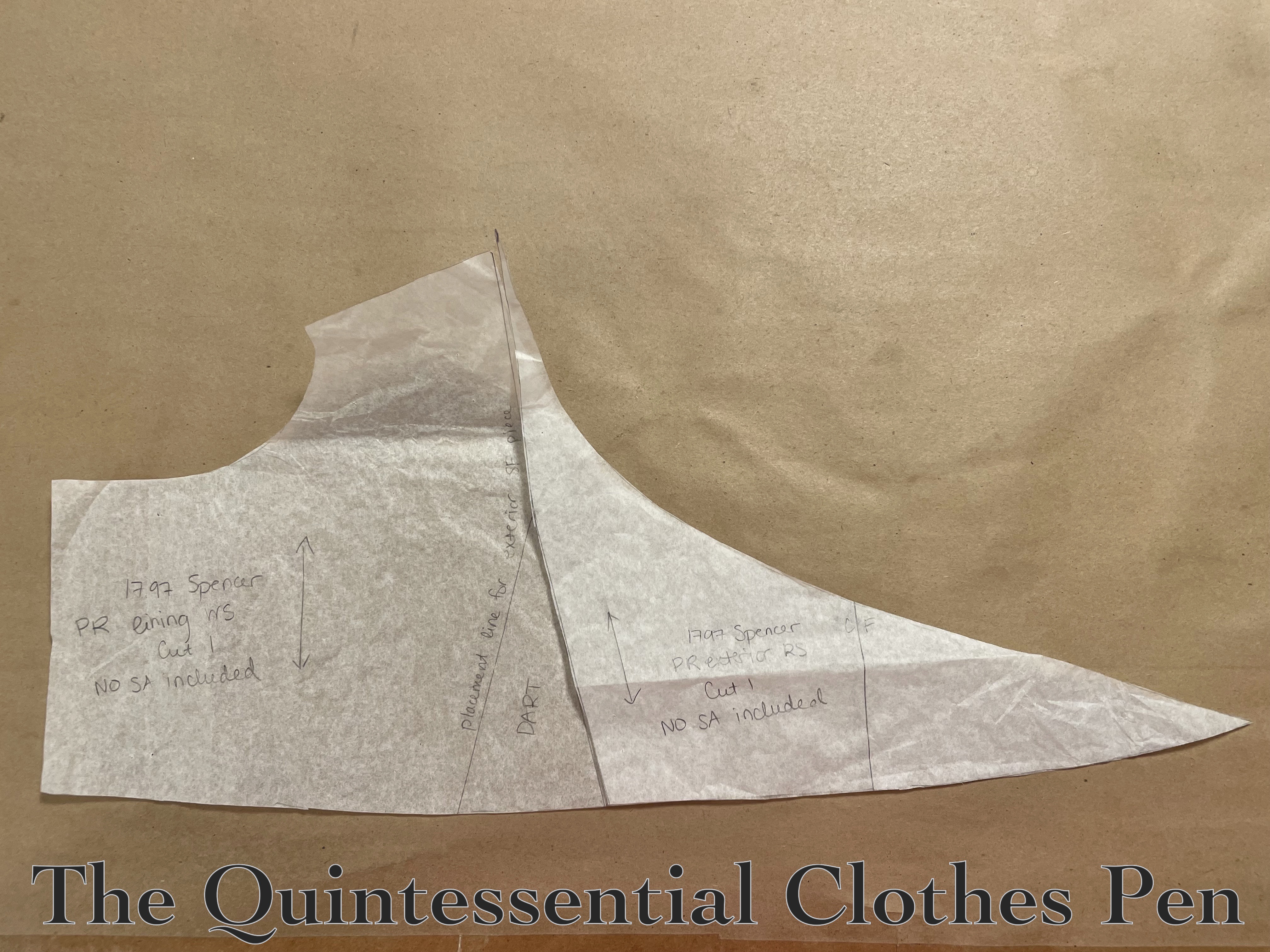
If you look carefully, you might notice that the grainline on the center front piece is off relative to the side piece. Why is that, you might wonder?

Well, for the front exterior I started with the lining piece but changed the single dart to be the pleats I’ve previously mentioned. I didn’t see bust darts in my inspiration fashion plate or observations of 1790s overdresses, but in 18th century dresses pleats are used used in varying depths to adjust a flat piece of fabric to fit the curves of a body, so I used that method.

First, I traced the lining pattern onto a new piece of paper, including the dart. Then, as you can see in the photo below, I cut along the dart edge closer to Center Front, then up a line that continued to the neck edge I wanted. (I also cut down to the bust point from two other points along the neckline, but later realized I didn’t need those cuts.)

Next, as you can see in the photo below, I rotated the center front piece down towards the dart, making that area a little narrower and creating space (essentially another dart) going up towards the shoulder. Then I drew my new grainline on the front piece for the exterior, heading up towards the shoulder. This is why it looks off relative to center front. When worn, those ‘darts’ are closed when the exterior is fitted over the lining and center front is pulled into its proper place on the body.

These exterior darts — hidden in the seam line — are what creates that downward curve to the pattern pieces that I observed in PoF.

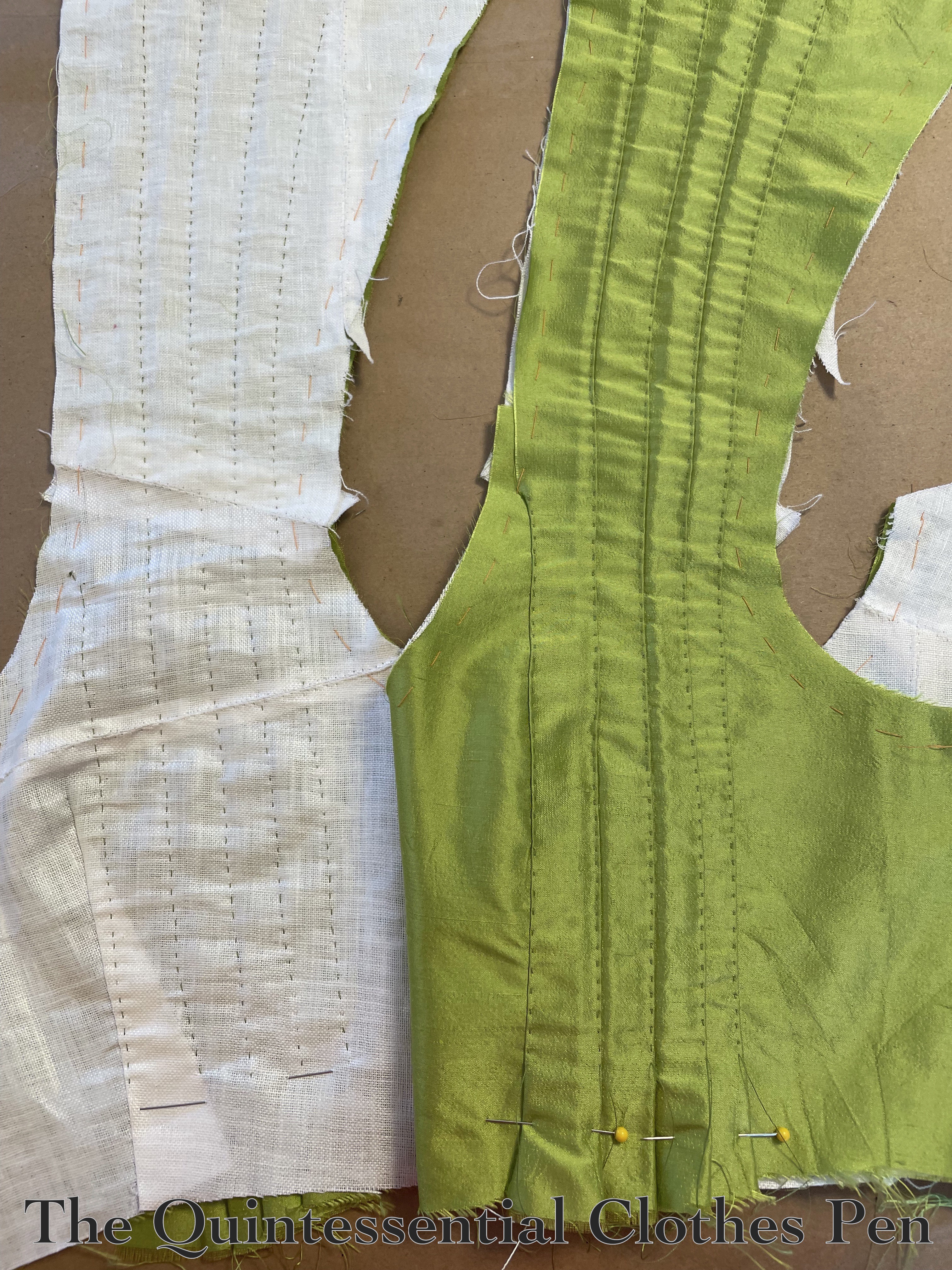
The two ‘darts’ are taken up in the pleated side front piece of the exterior, which is fitted over the center front piece and the darted bodice lining. In the photo below, the dart in the lining is visible on the left and the silk is pleated to fit and visible on the right.
After creating the paper pattern, I made a mockup and did a fitting to see how well my adjustments worked. They were pretty good, but I did have a few notes — I extended the bottom edge by a little more across the front, set the overlap shape I wanted (based on the fashion plate), set my armhole seam allowance, decided on the height of the peplum, and adjusted the front neckline to sit nicely over the dress.

I made these adjustments to my paper pattern and then moved on to cutting out my pieces in real fabric:

  • A proper left front lining
  • A proper right front lining
  • Proper left side front and center front exteriors
  • Proper right side front and center front exteriors
  • Straps in lining fabric
  • Side back pieces for lining and exterior
  • Center back pieces for lining and exterior

The Backstory: Construction

With a pattern established, I went down the rabbit hole of figuring out construction methods.

I had been reading Patterns of Fashion 6: The Content, Cut, Construction & Content of European Women’s Dress c. 1695-1795 and my mind was full of details and excitement about 18th century construction methods, so I happily went down a path of sewing in an 18th century manner! But… at some point in the middle of things I realized that I would need to combine some early 19th century construction methods into what I was doing, too, since my sleeveless bodice idea does span two different eras of construction styles.

For example, from an 18th century perspective turning seam allowances of the lining and exterior towards each other and whipping the pieces together made perfect sense. From a 19th century perspective, however, finishing the armholes with this method seemed odd (usually in the 18th century the seam allowance would have been left raw on the inside when the sleeve was attached, but I wasn’t adding sleeves!) and inserting a peplum into the bottom edge seemed odd, too (often a ruffle was applied on top of an edge, rather than being sandwiched between the exterior and lining, but that wasn’t the look I wanted). After many brain somersaults, I wound up mashing these two methods of construction together to create a transitional garment (which does actually make sense, since this was a transitional period for construction methods!).

Actually Making The Spencer

I thought it would be fun to use up linen scraps for the lining, rather than cutting into yardage from my stash. The lining pieces weren’t that big, right? Well, it turns out they were bigger than I thought. I ended up using 3 or 4 different types of white linen and adding in a fair number of piecing seams to get the shapes I needed for these lining pieces (you can see some extra seams in the lining in the previous photos). It definitely added time, but I had time while making this garment, so it was fine.

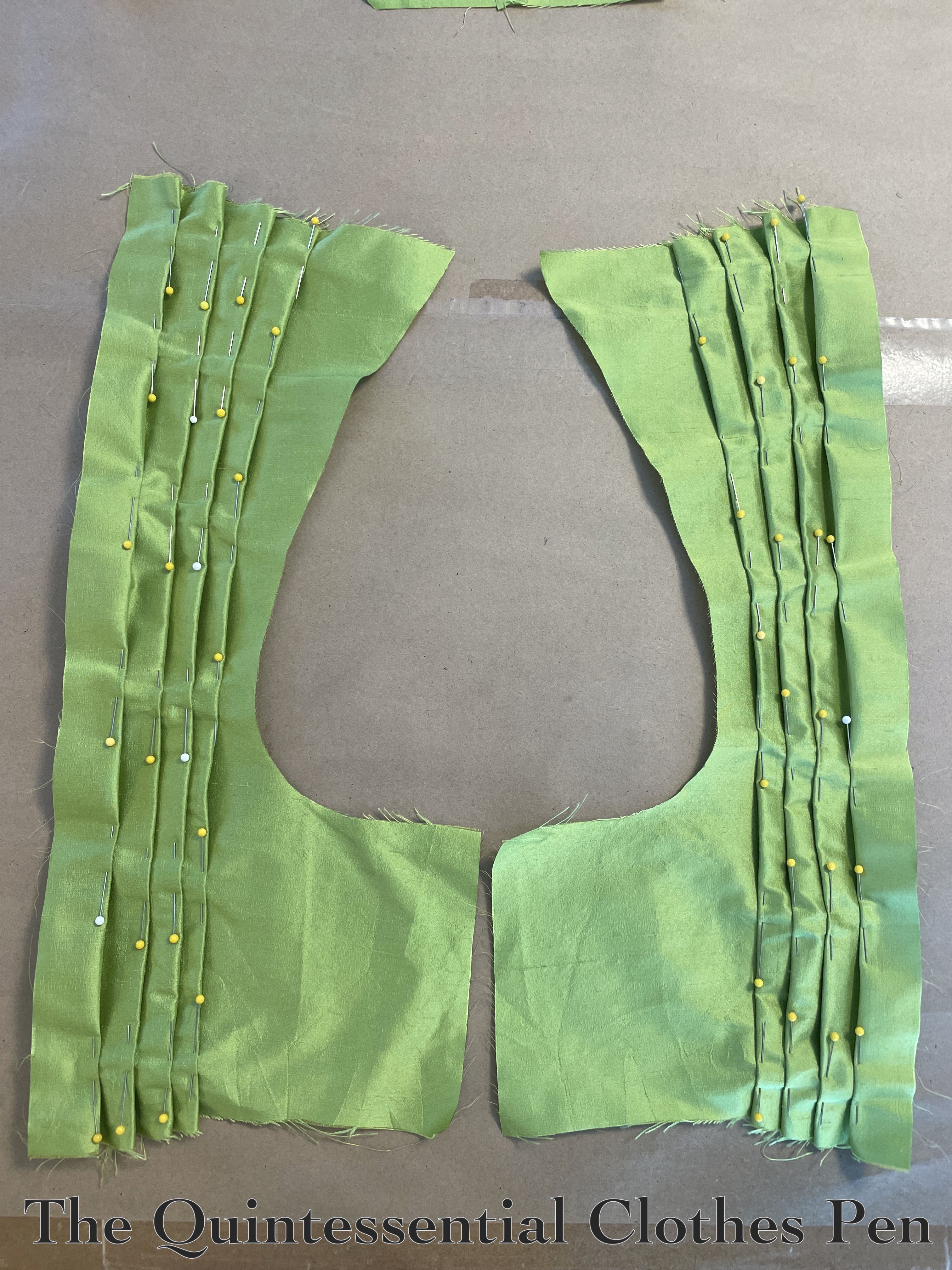
Once the lining pieces were ready to go I could cut the silk layers. The side front of the silk exterior had the shoulder straps included and was extra wide in order to create those all-important pleats. Below is a photo of what the pleats looked like before they were topstitched flat. They are not quite all the same depth and slowly spread out as they move towards the shoulder seam in the back (at the top of the photo).
Here is a summary of the 18th century elements I used in the construction of this garment: much piecing of the lining fabrics, whipping the lining pieces together along the seams, whipping the lining into the exterior around the edges, topstitched pleats in the front exterior for shaping over the bust, a shoulder seam that is topstitched onto the back piece, many edges bound in narrow strips of silk, and the neckline trim being tucked to shape around the neckline curve.

Here is a summary of the 19th century elements I used in the construction of this garment: gathering the peplum and sewing it to the bodice with right sides together then whipping the lining seam allowance on top and turning in the seam allowance of the armholes and whipping the lining into place.

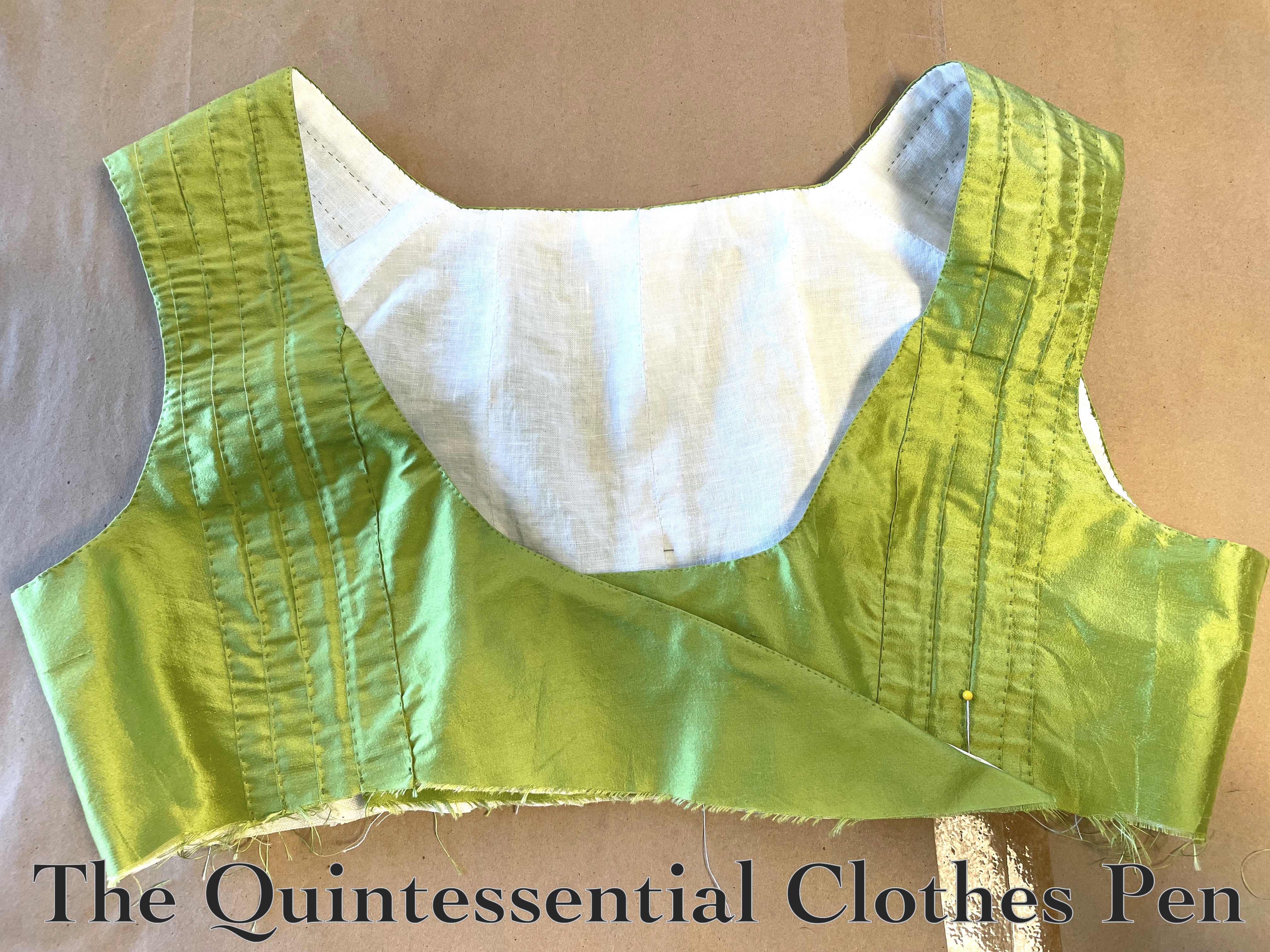
In the photo below, most of those methods have been employed to get the bodice to this state, which is basically finished aside from the peplum, neck trim, and closures.
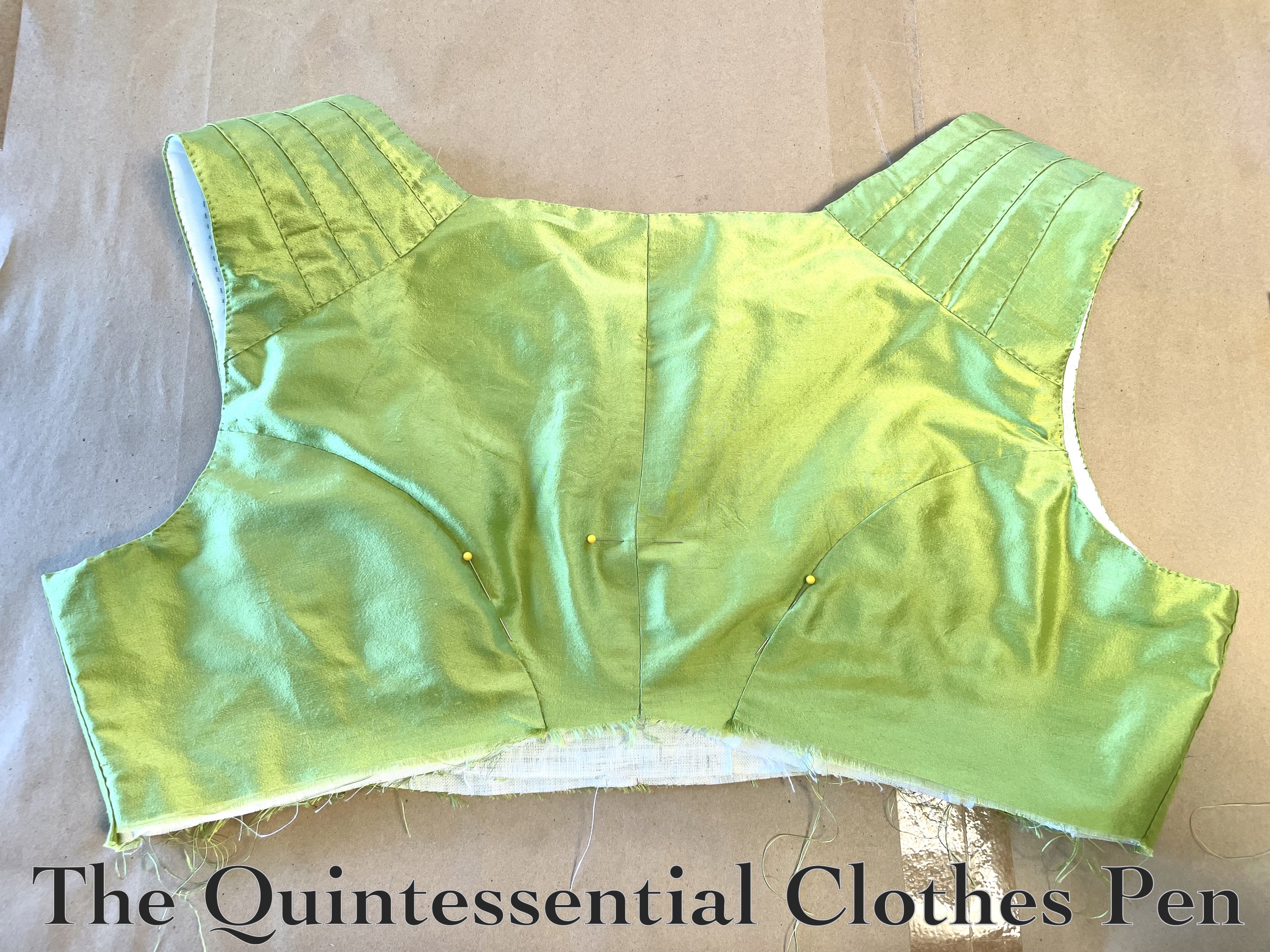
The neck trim is a pieced strip of the green silk bound in running stitched ¼” wide strips of pink silk (hence the watermelon name!). The assembled band was running stitched along the outer edge and then eased into place around the neck edge. Below is the easing in progress. It took many pins!
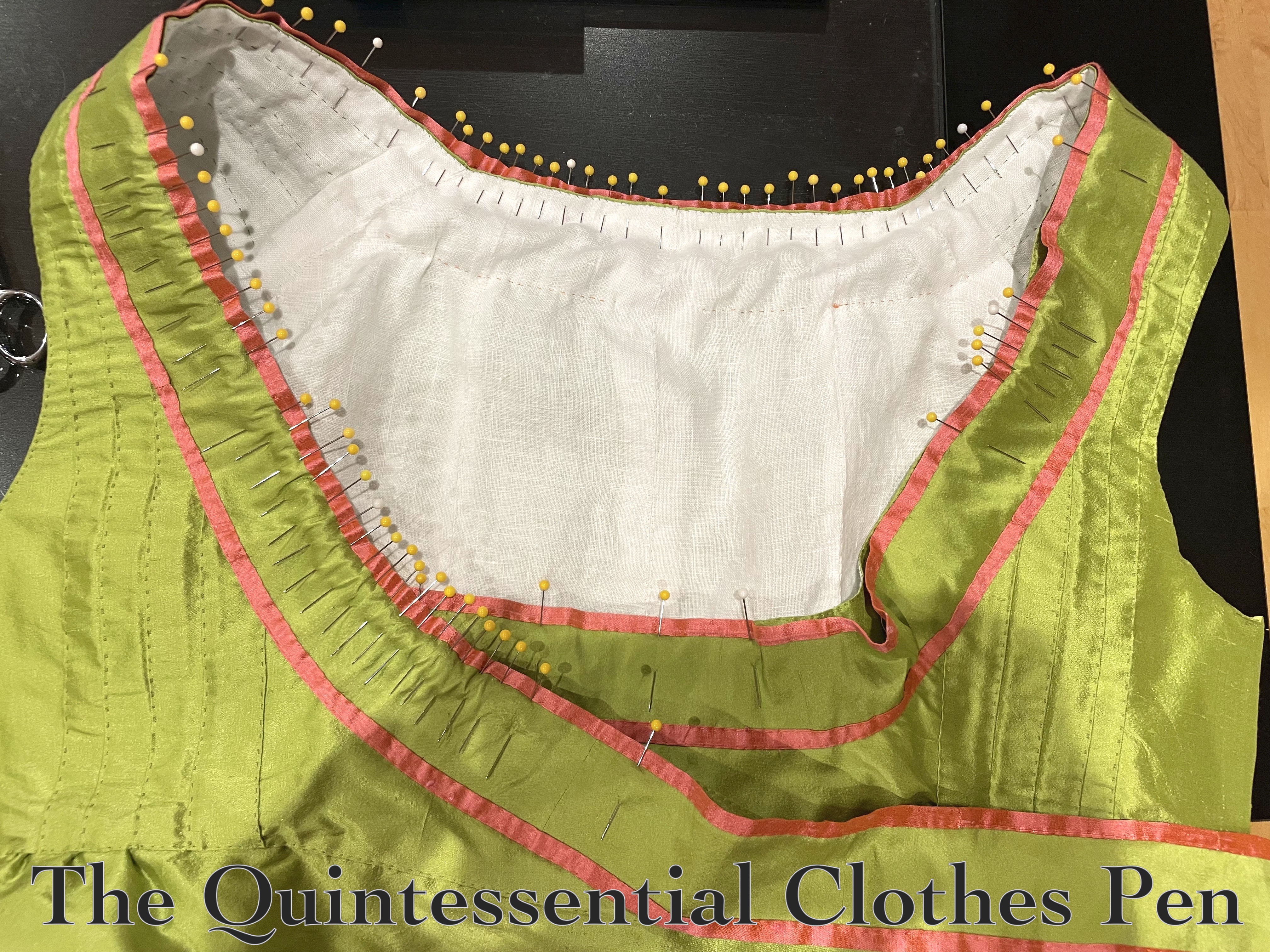
And here is a closeup. You can see some of the whip stitched piecing seams in the lining and the minute easing of the neckline edge of the trim.

And that was it…! Entirely hand sewn, with many small details, lots of justifying and research, and, in the end, a relatively small garment! Next time, photos of the finished garment being worn!
c. 1785 Stays (Of Fail), Part VI: Finishing Construction Details

This project was on hiatus for a number of months (the last post about it was in October 2022!), but the time has come to wrap it up!

After the progress made in the last post, there weren’t that many steps left to complete. Yay! Below are details about those steps.

Binding

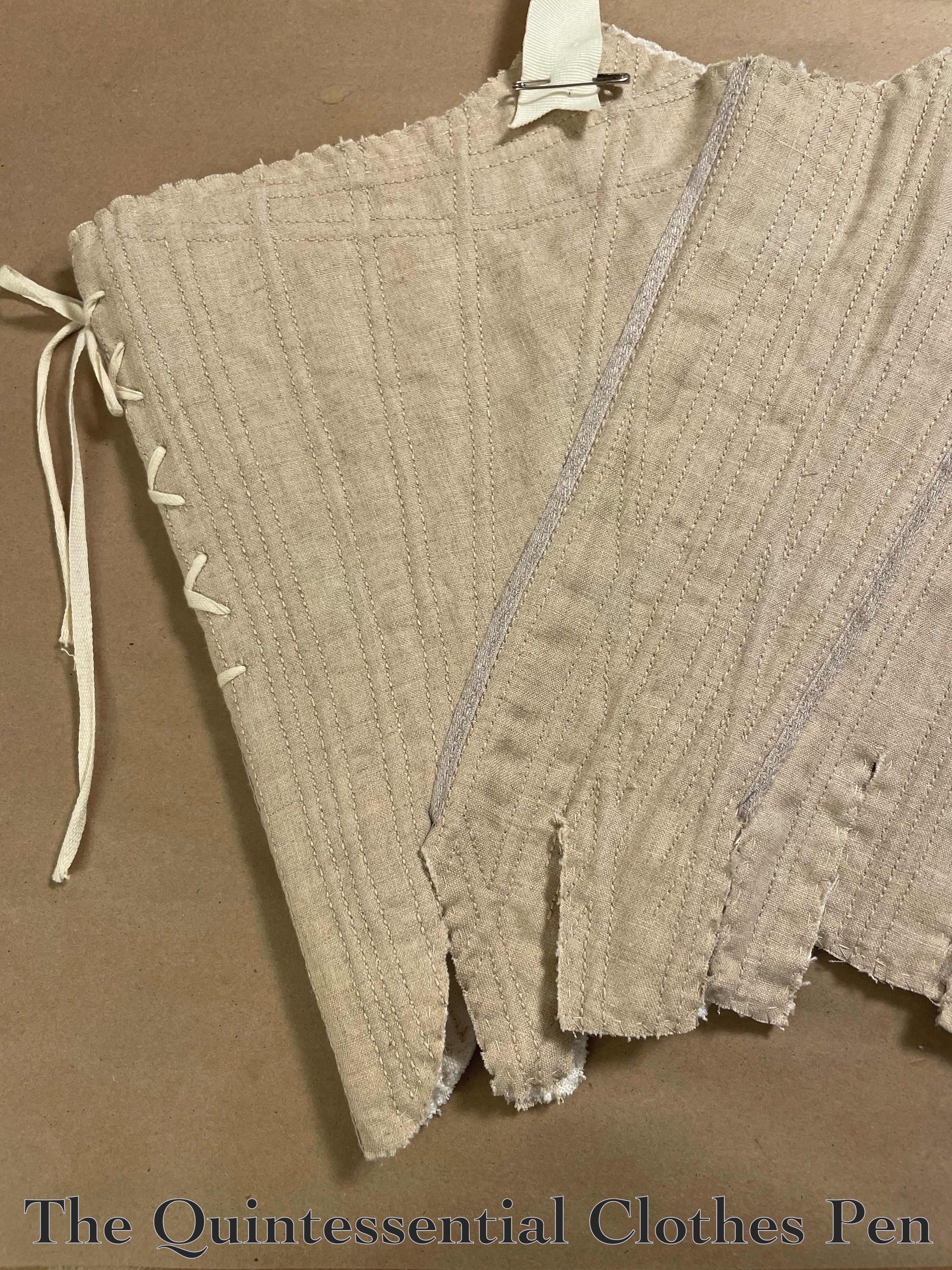
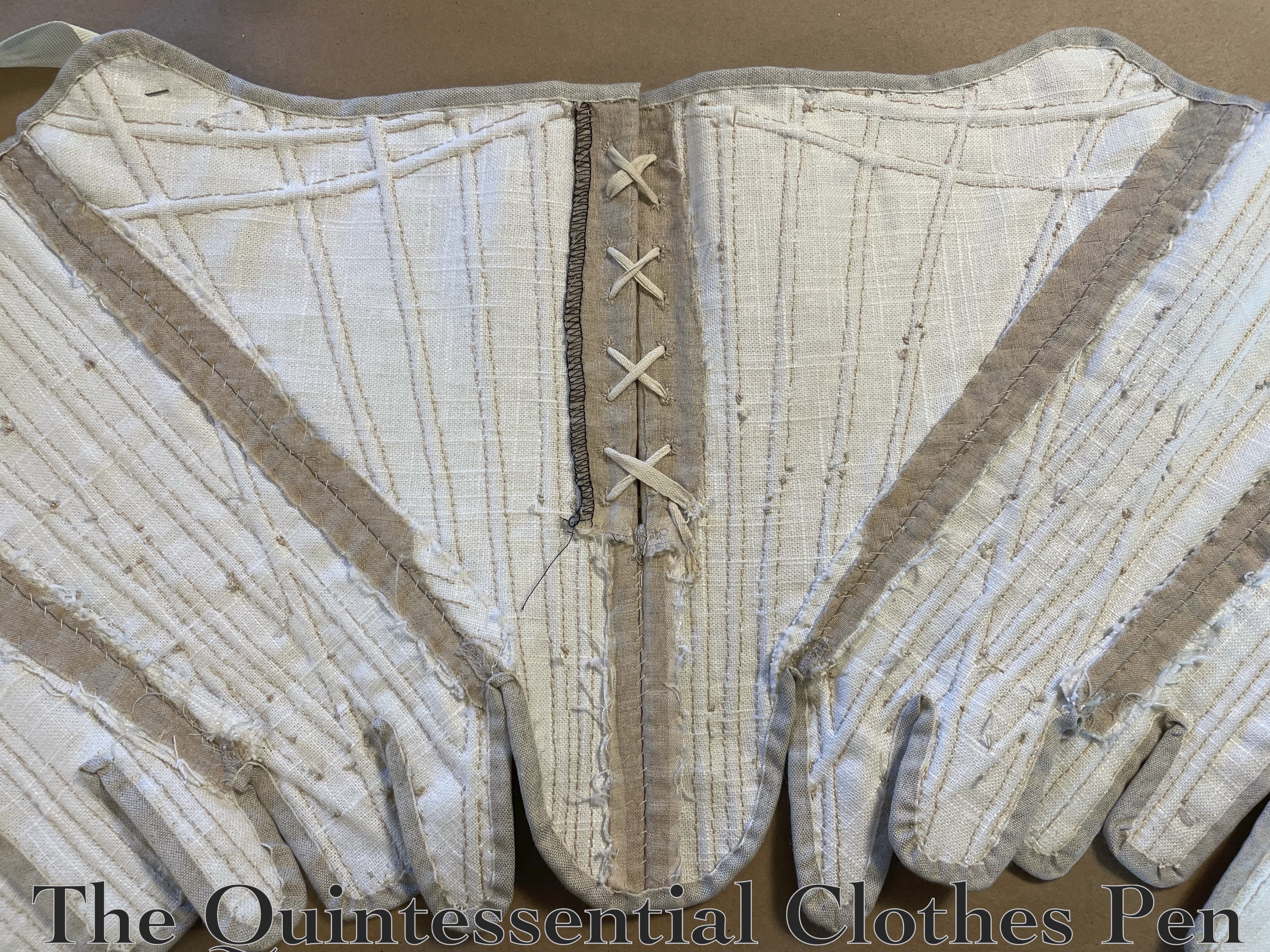
I used ½” natural linen tape. It is whip stitched onto the right side and then wrapped around to the inside and more roughly whipped. The inside stitches will be covered with the lining, so making them invisible and pretty is less important. Below is a photo of the inside of the stays after the binding was sewn on.

Lining

At this point, the stays were almost done. The lining serves to cover up all of the interior construction. To make it, I laid my stays out wrong side face up (as in the above photo) with my lining fabric on top. I pinned in a few strategic places and then roughly penciled where I wanted the cutting lines to be. Then, I cut the lining pieces out.

Once cut, I pinned the center lining piece in place, then pinned the piece next to it, turning under my raw edges at the places I wanted the seam to be and around the edges. Those edges were all pinned in place and then each edge was whip stitched. Additionally, each tab has a separate, small piece of lining whose edges are also whip stitched in place.

Straps

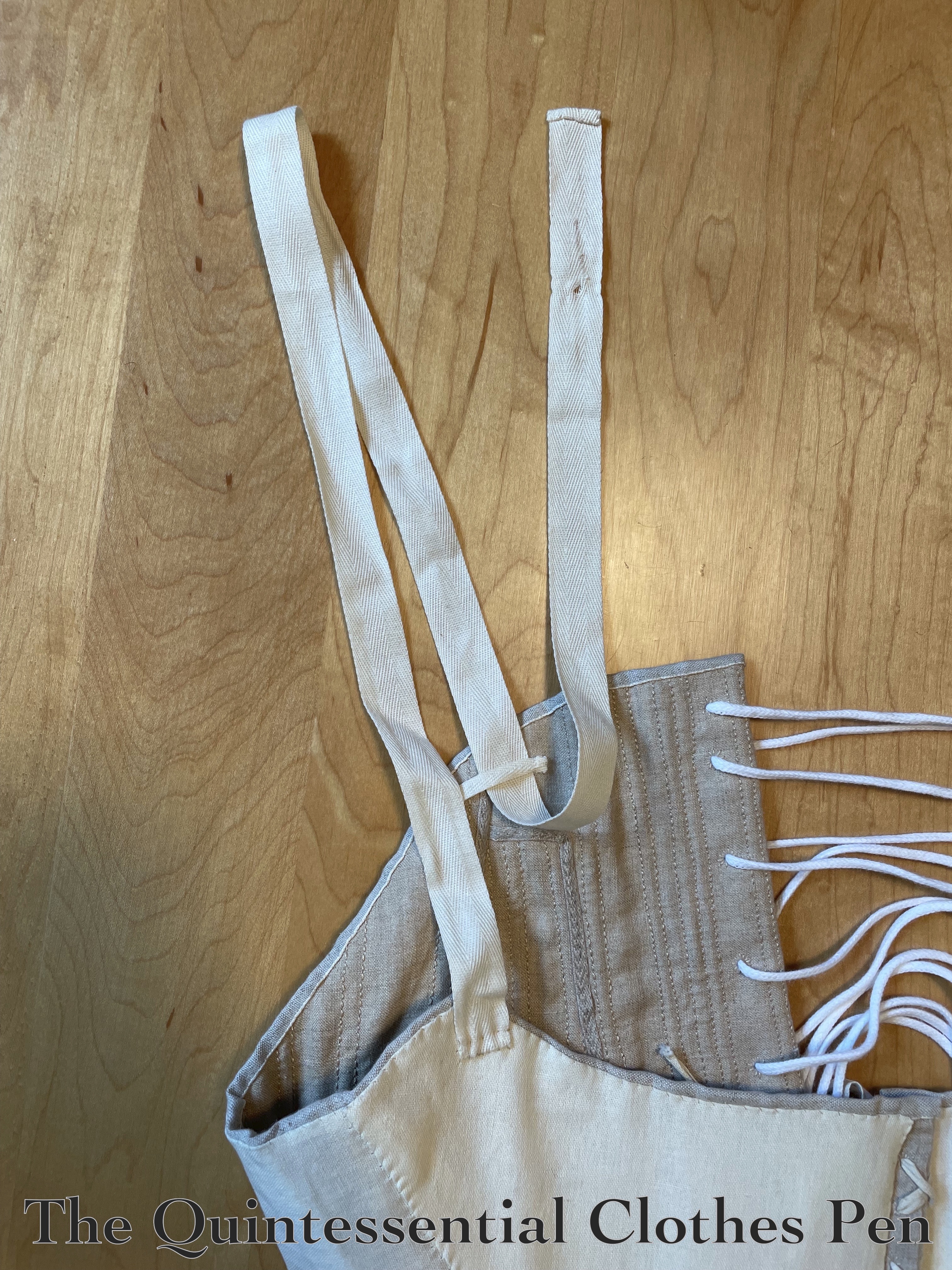
The truly final step was to add straps! I used ¾” ivory cotton twill tape. Each strap was sewn to the front points of the stays and the short raw end hemmed. A scrap of ¼” twill tape was also sewn on each of the side backs for the wider tape to run through.

Then, I tried on the stays and determined where I needed to place the hooks that the straps would attach to. Below is a photo of one of the straps held in place by the sideways hook. The straps are long enough to wrap over the shoulder, cross in back, and wrap around towards the front to catch on the hooks.

After that, all I had to do was attach the hooks… and… after many years… the stays were finally, finally… finally…. DONE! They were finished in April 2023.

You can read previous posts in this series here:

c. 1785 Stays (Of Fail), Part V: Middle Construction Details
c. 1785 Stays (Of Fail), Part IV: Early Construction Details
c. 1785 Stays (Of Fail), Part III: The Pattern
c. 1785 Stays (Of Fail), Part II: Fitting Update
c. 1785 Stays (Of Fail), Part I: Beginnings

HSM #11: c. 1785 Green Linen Stays

I’m excited that the green stays in my most recent post qualify for the Historical Sew Monthly Challenge #11: Fitting (Make something that focuses on fit).

If you read my lengthy post about making these, you’ll hear all about how fit was both one of the reasons I started these and that I had a joyful time playing with fit as I created them.

I actually finished these on March 30 and I’m excited to post about them before 2022 ends so that they can officially qualify for the HSM this year!

Just the facts:

Fabric/Materials: ½ yd green linen (exterior), 1 yard heavy olive linen (inner layers), and ½ yd ivory linen/cotton blend (lining).

Pattern: My own, but using the drafting guide on page 155 of Patterns of Fashion 5.

Year: c. 1785.

Notions: Heavyweight ivory Guterman thread, regular weight tan Guterman thread, cotton covered polyester quilting thread, approximately 410″ of ⅜” wide zip ties (boning), 11 ½” heavy duty steel bone (busk), 2 ⅛ yard ¼”  linen twill tape (covering seams), and 4 yards ½” linen twill tape (binding).

How historically accurate is it?: 90%. The pattern and materials are good. The construction methods are a mix of modern and historical.

Hours to complete: It seems that I didn’t keep track. Maybe 32 hours?

First worn: Has not been worn yet, except to get photos for the blog.

Total cost: The fabrics came from the stash as leftovers from other projects or were gifted to me. I’d say the notions cost about $16 +  $15 for the linen twill tape. So, let’s say about $35, if we include thread.

There is a lengthy post sharing the story behind these stays, my musings about the journey to complete them, many photos of the construction process and the stays on the body, and written construction details that you can read here.

c. 1785 Stays (Of Fail), Part V: Middle Construction Details

I had hoped to get all of my remaining construction details into this post, but progress on the stays has slowed. Plus, I realized I didn’t have enough linen tape to bind the edges, so new binding needed to be ordered. That has been done but I’ve been so busy that no sewing has happened yet. So for now, here are the middle parts of the construction update.

Updating Gussets

After all the initial steps of putting the stays together (which I detailed in my previous post in this series), I had a fitting that left me feeling rather disappointed. I’ve already detailed the results of that fitting, in Part II of this series.

To summarize: I wanted to raise the gusset I’d added to the back with the goal of providing more width at the waist and hopefully increasing the comfort of the stays on my back. Accordingly, I removed the offending short gusset out of the stays, but, instead of piecing new gussets out of my meager scraps, I realized I could cannibalize the straps I’d originally cut (but decided not to use) to make longer gussets.

Below: the new, longer gussets in place.

This worked well for the exterior linen and one layer of interlining linen, but the straps were only ever going to have one inner layer of linen. And none of my scraps were quite long enough to make a second layer now that the piece would be used in the main body of the stays.

So, I used what I could and layered a second piece near the bottom tab to extend the second layer of linen. Work with what you have, right?

This new gusset had a wider bone channel already sewed… and I really didn’t want to deal with my narrow bone idea again. Therefore, these two pieces will have permanently wide boning channels. It’s all in the spirit of making do! I did have to extend the bone channels after adding the extra bit of linen near the tab, but that was easy to do.

Covering Seams & Finishing Edges

Following the information in Patterns of Fashion 5 (see my fourth blog post in this series for more information on this incredible book), I covered the visible whip stitches that formed the seams of the pieces with 1/4″ linen tape.

Then, I basted all around every exterior edge, to hold the layers in place while I continued to work on the stays. I followed that by whip stitching the raw edges, in order to create a more stable edge for the binding.

In the photo below you can see the linen tape covering the seams and the edges that have been basted and whipped.

Finally, I was ready to bind the edges!

You can read previous posts in this series here:
c. 1785 Stays (Of Fail), Part IV: Early Construction Details
c. 1785 Stays (Of Fail), Part III: The Pattern
c. 1785 Stays (Of Fail), Part II: Fitting Update
c. 1785 Stays (Of Fail), Part I: Beginnings

c. 1785 Stays (Of Fail), Part IV: Early Construction Details

Construction Process Resource

The book I used to create the pattern for my stays (Stays and Corsets: Historical Patterns Translated for the Modern Body by Mandy Barrington) gives very little in the way of construction information for stays (process, materials, and details). I found this to be really disappointing.

Thankfully, however, there are other resources that one can go to for this type of information. I chose to reference Patterns of Fashion 5 (PofF5), authored by Janet Arnold, Jenny Tiramani, Luca Costigliolo, Sebastien Passot, Armelle Lucas and Johannes Pietsch.

The great thing is that I could go to PoF5! It had not yet been released when I started this project, but I have it in hand now… and I must say that it is an absolute gold mine of information! There is so much research, expertise, and detail included. There are so many color photos. There are x rays of extant garments. And of course there are patterns. And information about patterning and making both in the past and now.
I cannot do anything but rave about this book! It is almost double the length of the earlier Patterns of Fashion books. I actually sat down and read this book cover to cover, which is not how I usually deal with pattern books (usually I read the bits that are relevant to a certain project). This book is amazing!
On To The Construction Process

Despite creating a pattern from another source, PoF5 was invaluable for the construction process of my stays. Using information in PoF5, I decided to make my stays from an outer layer of linen, 2 layers of linen buckram, and a lining (that will likely be linen).

To start, I cut out the exterior and 2 layers of heavy linen for the interlining. Below is a photo of my inner heavy linen with the pattern laid on top. I used stash fabric and found a piece that just barely fit my pieces. No seam allowance is included in the pattern, so you can see that I really eked my pieces out!

To nerd out on history fun and try something new, I decided to make my own stiffened buckram for the inner layers. So, on a hot August afternoon I was to be found sitting on my deck dripping with sweat while painting gum tragacanth onto my linen pieces instead of being inside where it was cool.

So what is gum tragacanth? It is a stiffening agent used to make linen buckram, which is a material used to stiffen 18th century stays.

Burnley and Trowbridge has a great video about making buckram that describes fum tragacanth and Leimomi, The Dreamstress, has a great blog post discussing gum tragacanth and xanthan gum. The post includes videos and lots of wonderful how-to information.

I used a paintbrush to spread my gum tragacanth on my linen. By the end I was definitely getting a little sloppy because I wanted to get out of the sun as quickly as possible, but I was still impressed with myself for the lengths I go to sometimes for the sake of historical exploration!

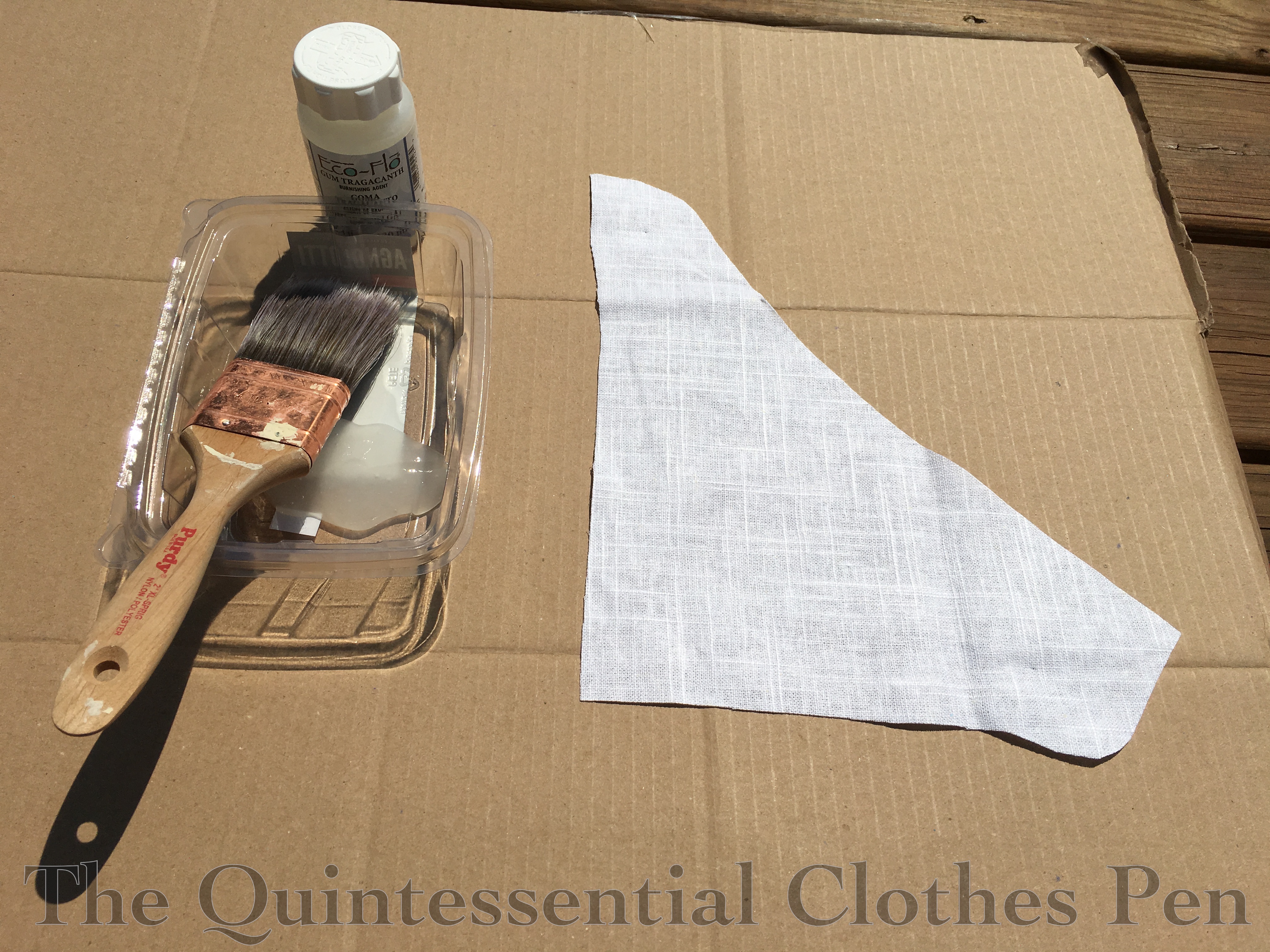
Below is a photo of my set up. Cardboard from the recycle, a dish-shaped piece of packaging from the recycle, and a paint brush.

I used a full 4.4 oz bottle of Eco-Flo Gum Tragacanth for my double layer linen interlining. In the dish you can see the consistency of it. It was wonderful not to need to mix or heat it, as you would need to do with xanthan gum.

To be honest, I didn’t notice too much of a difference in the linen after applying the gum tragacanth. (This could be because I was already using a heavy linen?) It also seems, and makes sense, that the stiffness has been reduced as I’ve worked with the fabrics. Regardless, I am still entertained and enriched by my experiment.

After the gum tragacanth dried, I flat lined my 3 layers for each piece (2 layers of heavy linen and the exterior linen) and marked my boning channels. I found that using Frixion pens worked well, because the marks easily erase with a hot iron after the channels are sewn (and the pen marks don’t rub off while being sewn, as with chalk). Magic!

There was lots… and lots… of sewing boning channels, as you can see blow.

After all my channels were complete (and I’d pushed in all those narrow zip ties I ranted about in my first post about these stays), I moved on to the eyelets. There are eyelets for the center back closure and eyelets for front adjustability, as on the inspiration Chertsey stays (which you can see in my third post about these stays).

I realized that I hadn’t cut my center back pieces with enough fabric to wrap around past the eyelets (though I didn’t have enough fabric to do that, anyway!), so I pieced strips together and whip stitched them on to make the extension, as you can see on the right side of the next photo.

After the eyelets were done, I assembled my pieces with whip stitches.

I whip stitched the seam allowances down as well, thinking that might help make the stays fit smoothly for a fitting.

That basically brings the project up to the unfinished state it is in now, minus a few fittings and adding that back gusset.

You can read previous posts in this series here:
c. 1785 Stays (Of Fail), Part III: The Pattern
c. 1785 Stays (Of Fail), Part II: Fitting Update
c. 1785 Stays (Of Fail), Part I: Beginnings

Plum Pants With Pointed Pockets

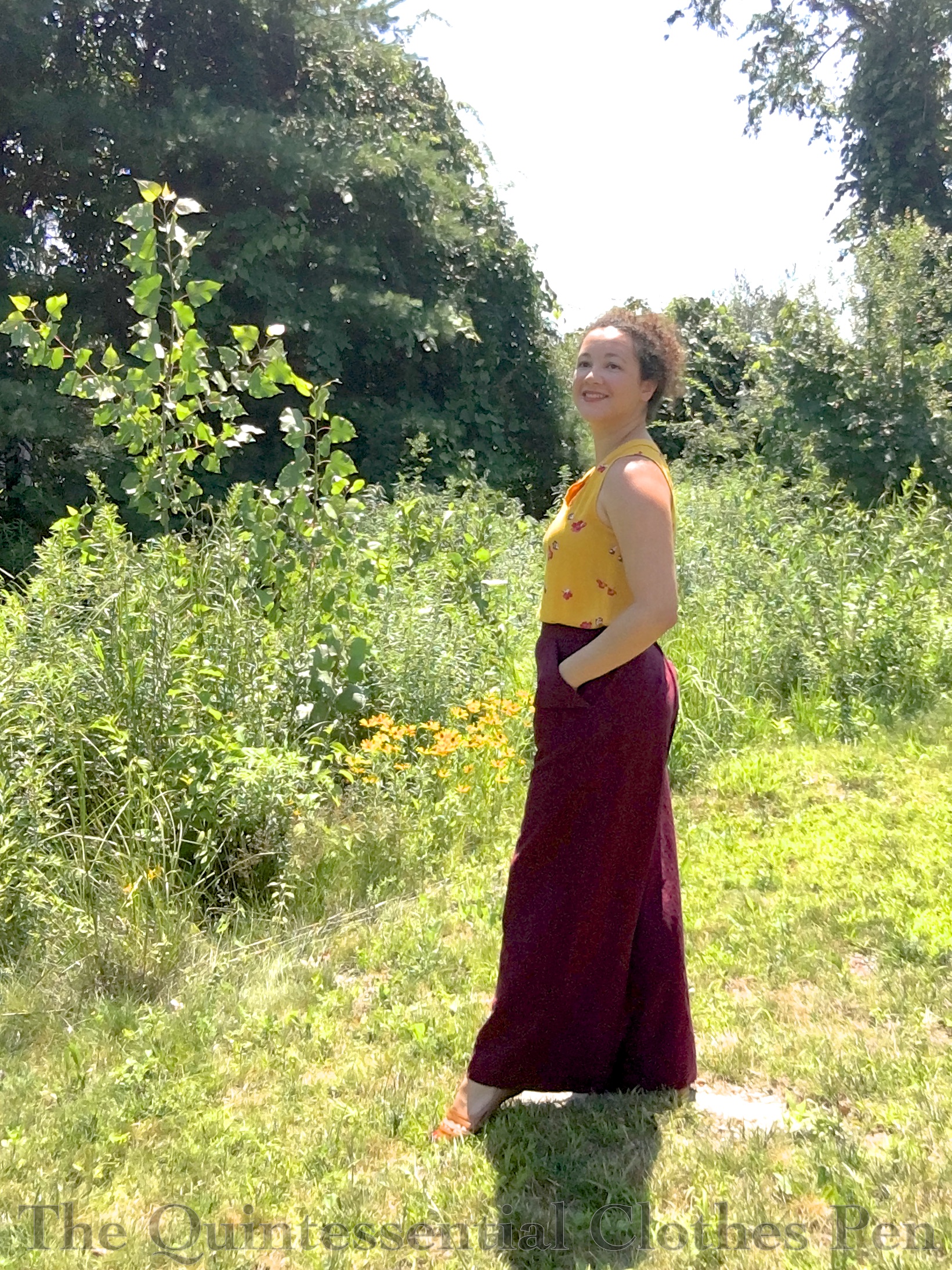
Last year, I happened across a lovely plum colored linen/rayon blend fabric at Joann’s that was such a perfect Quinn-color that I just couldn’t pass it up…. Accordingly, 3 yards came home with me along with the idea to make wide leg pants out of the yardage.

Trying To Determine The Design

I wasn’t really sure exactly what I wanted in terms of specific design details, which made the patterning and mockup process rather slow. I spent a few hours making mockups that fiddled with the width of the legs, the length of the crotch seams, and my design idea–trying to decide exactly what it is I was trying to make!

I was extremely frustrated for awhile (close to despair, as Anne of Green Gables might say) as the mockups looked like medical scrubs. The legs weren’t wide enough to look like the vision in my head at that point and I just couldn’t figure out what the details would be. I thought I wanted a non-functional wide tie at the waist, but that wasn’t looking right with the scrub looking pants. (The scrub problem was likely related to the fact that the old sheets I was using as my mockup fabric are dark grey, so the color and texture was scrub like…)

Not too long after my frustrating mockup sewing session, I was sewing something else and watching the Netflix series High Seas when I saw a pair of high waisted pants on one of the lead actresses and thought ‘That’s it!’. This particular pair of pants had details I loved: a high waist, wide legs, and pockets that added interest and vintage charm. After that, mocking up the pants and finishing the pattern was so much easier!

Getting Started

After pre-washing my fabric, I was ready to go! The basic pants are pretty straight forward with front and back pieces as well as a waistband, but they have additional pieces for the pockets as well as canvas interfacing for the waistband.

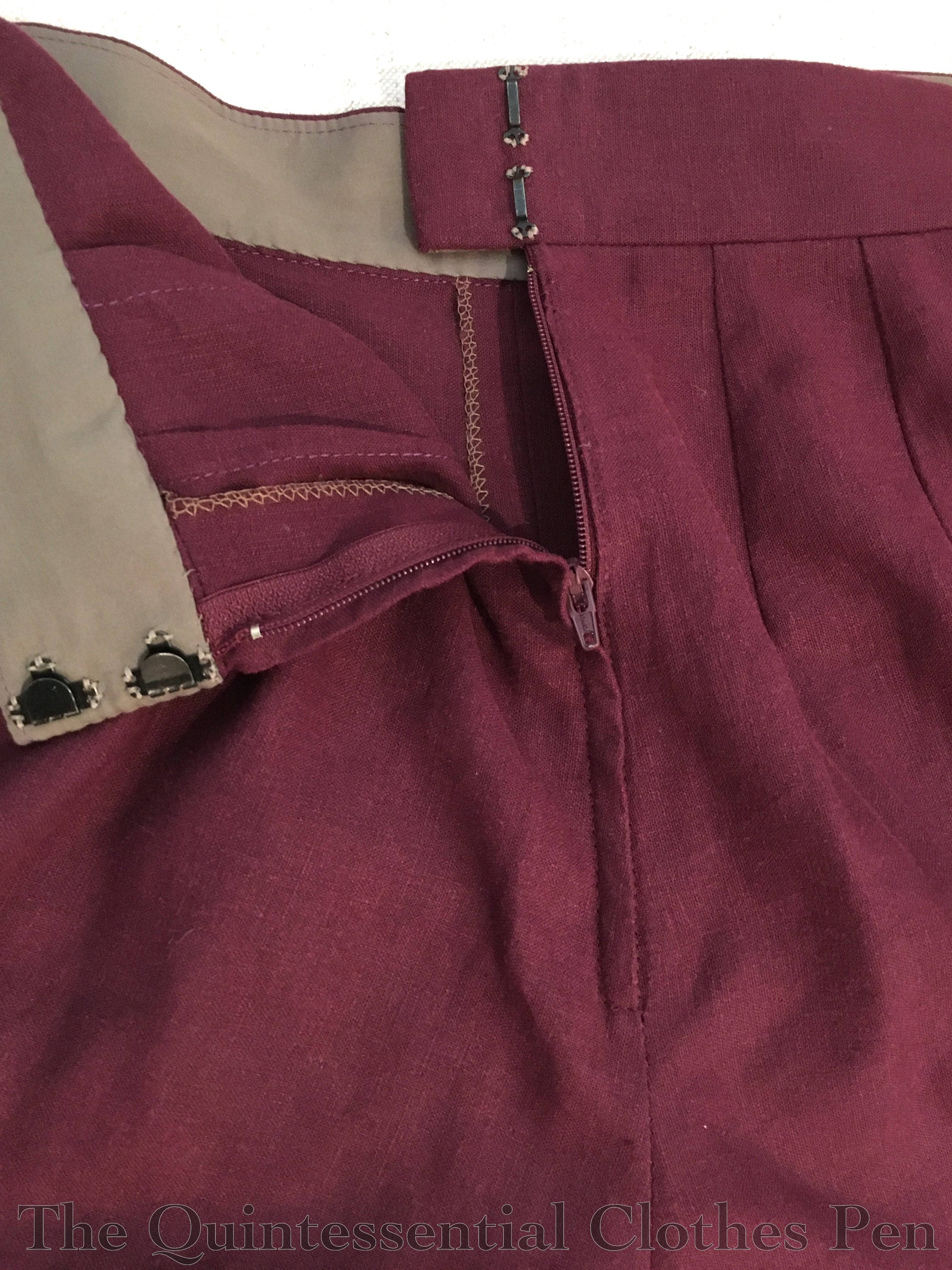
The pants are mostly machine sewn, with a bit of hand finishing on the waistband (you can see the whip stitches on the bottom of the waistband in the photo below). The exposed inside edges are either french seamed, as with the pockets (on the left in the photo below), or finished with a serger (on the right in the photo below).

The pockets and waistband facing are cut from an early mockup iteration made from repurposed sheets (yay for reusing old fabric!). I decided to use the mockup fabric for the real pants because 1) the mockup made me mad and I wanted to get back at it 2) the smooth cotton is a good facing/pocket material.

Here’s a look inside one of the pockets. It’s not likely to ever be seen (in any venue other than this!), but the top stitching along the facing edges makes me very happy.

The pants have a wide hem–2″–that is machine top stitched in place. With perfectly matching thread (that was in my stash as a gift from a friend–yay!), the topstitching blends right in.

While all of the visible stitching is done in the perfectly matching thread, I didn’t want to run out of it and so the interior seams are sewn with a more purple thread. The serging is done in brown, because that’s the closest neutral that I had cones of. It blends with the grey facings/pockets to create what appears to be an intentional ‘design choice’!

The pants close with a lapped zipper at center back.

The Zipper Saga

Oh, and that’s a story! So I bought a zipper, set it in, and was so excited!

I tried on my pants and showed them off to Mr. Q (who wasn’t particularly impressed, because vintage styles don’t really appeal to him). I went to take off the pants so I could finish them off and couldn’t get the zipper undone… I was stuck! And they’re fitted pants at the top, so it wasn’t like I could shimmy out of them. I tried to pick a few stitches, but couldn’t see what I was doing, because the zipper is at the center back, and I was afraid I’d poke myself instead of the pants, or rip a hole instead of picking stitches… I had to go back to Mr. Q and get his help seam ripping the zipper enough that I could get out of the pants! He thought it was hysterical. I don’t know that I completely agree with that… though it is more amusing after the fact.

After managing to get the pants off, I took this photo to document the debacle.

Then the offending zipper was completely removed. I reset it, thinking that I’d stitched too close to the teeth and that was the problem, and it still didn’t work (I tested it out without putting the pants on the second time!). I doubled checked that I didn’t sew too close to the teeth the second time and that didn’t seem to be the problem. I don’t know what the issue was because I’ve set many zippers and haven’t had this problem and this zipper works just fine when not attached to a garment. Horrible thing–it was sternly put away and may never be used again!

The solution was that I went out to a different store and bought a new zipper. It actually matches much better, though it is a regular zipper as opposed to an invisible one. Most importantly, it works as it’s supposed to! So all is well in the end.

Here is a view of the back of the pants, showing the new zipper, darts, interior finishing, and waistband closure.

Other Inspiration

As I was looking for inspiration for these pants, I was reminded of fabulous wide leg pants made/patterned by other wonderful bloggers. These were all indirect inspiration for my pants.

Lauren Stowell’s 1970s does 1930s Wide Leg Pants 

Caroline’s Vacation Pants (made from the pattern below)

Wearing History’s Smooth Sailing Trousers pattern

Final Thoughts

My new pants are super comfortable to wear. The fabric is stable and yet lightweight enough to flow nicely. The waistband is suitably substantial and does not crease when I sit for extended periods.

The pockets are great! They make a statement that elevates the pants to being stylish (vintage stylish, of course!) and I patterned them to be big enough to easily store my phone and other essentials–so helpful!

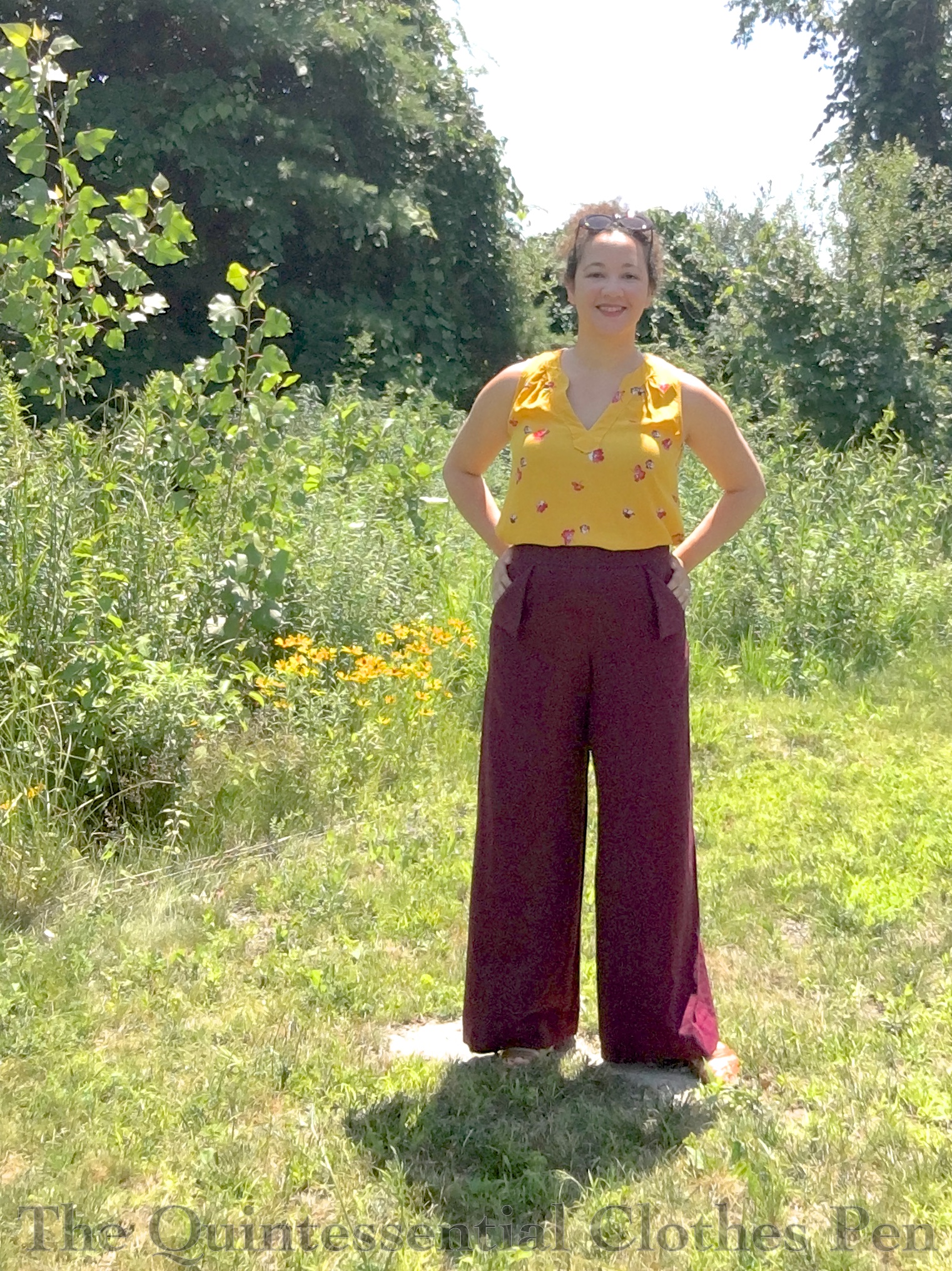
One final photo and story for you… I took these photos in my yard without help, so I needed to figure out a way to stabilize my camera and easily maneuver it around my yard. Prior to this, I’d clamped it to a ladder, but the ladder was heavy to move around, so for this photo session I decided to clamp my phone to my lawn mower handle. Yes–lawn mower! It worked pretty well–easy to roll around the yard, but occasionally my phone would slip and I would get a series of photos of the ground and the lawn mower handle! Any neighbors that saw me probably wondered what I was up to!

Added to the challenge was the fact that I didn’t feel like putting contacts in, so I would leave my glasses on the lawn mower, set the timer on my phone, and then run to my chosen marker to stand for the photos. I have pretty terrible eyesight, so I can’t see the timer on my phone once I stand away from it. That plus the bright sun (it was a hot day!) made for a lot of squinting. 

This outtake photo is one of the ones that didn’t make the cut (except to be amusing)–squinting as I walk back towards my lawn mower camera setup!

Vernet Project: Silly Shoes

One of the five pieces of my Vernet Project was creating the silly up-turned-toe elf shoes in the fashion plate. Clearly, these are not shoes that could be purchased, as they are so specific in style, so I set out to make my own!

IMG_1920 (1)

In the beginning, I was thankful to have another Vernet project maker’s experience making her boots before mine to work from. Jenni posted a two part tutorial showing how she made her boots as well as sharing information behind-the-scenes with project participants earlier in the process (Part 1 and Part 2). She closely referenced Every Lady Her Own Shoemaker, published in 1855 (a little late relative to the date of the project, but still useful for construction advice), for construction methods and carefully documented her process. In fact, she did a much better job at documenting the actual sewing than I did… I also read Anna’s information about making mid-19th century shoes multiple times to help get my mind acquainted with the project (again, a little later than the period of the project, but still helpful). She also has lots of great construction pictures.

I started by creating a pattern for my shoe using patterns in Every Lady Her Own Shoemaker. Given that my shoe has the unusual turned-up-toe, I necessarily needed to make adjustments to the general slipper pattern. Here is my shoe at the mockup stage. The upper pieces fit pretty well! I adjusted the width of the sole as well as the shape of the turned-up section before moving on to cut out the final pieces.

Mockups.001

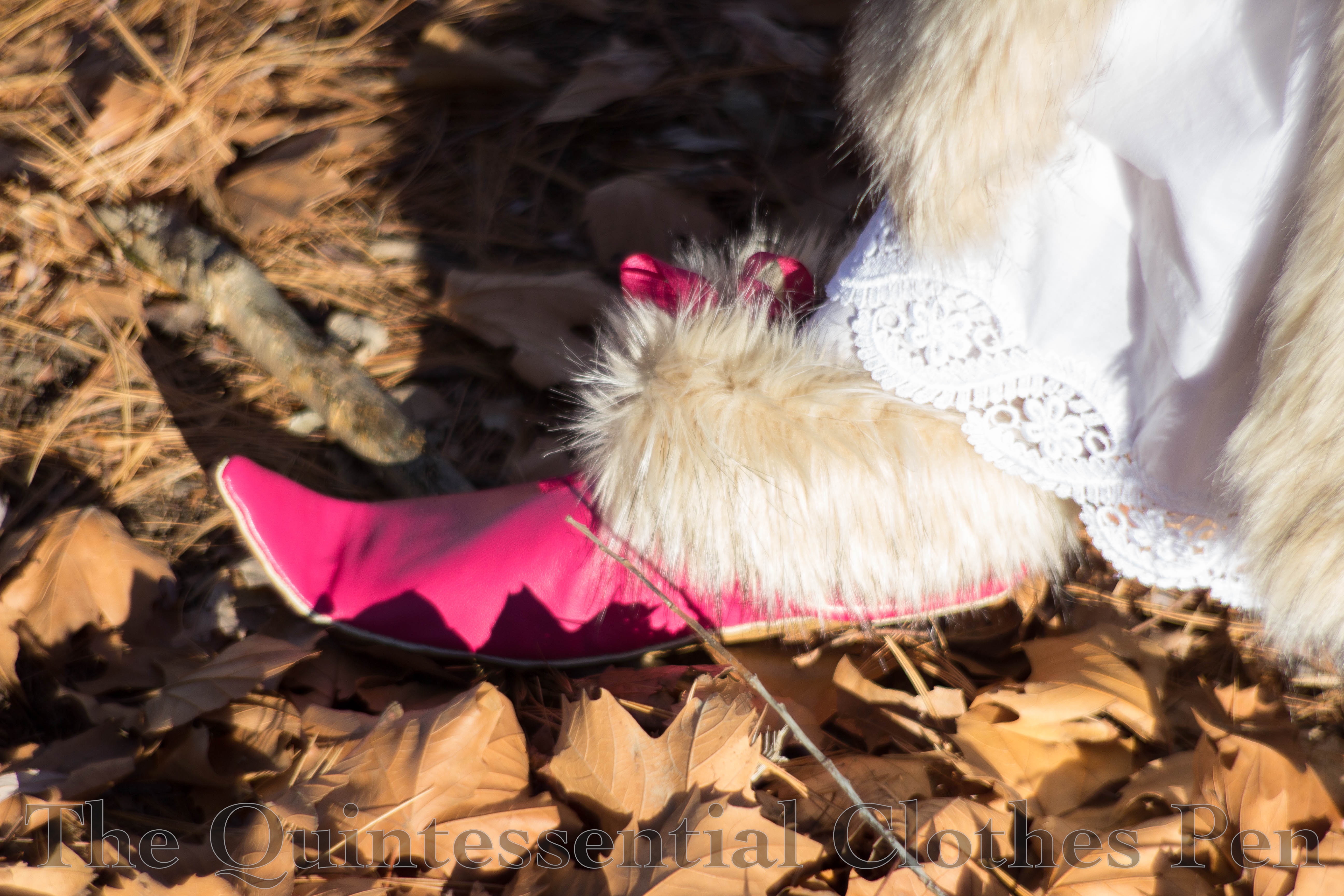
Here are all of the final pieces cut out and ready to assemble. The soles have three layers: heavier tan leather for the outer sole, cardboard for the inner sole structure, and white linen to cover the cardboard insole. The uppers have two layers: lightweight raspberry leather for the exterior and white linen for the interior. Later in the process I also added a faux fur cuff.

IMG_0239 (1)

To help the shoes keep their turned-up-toe shape I soaked the leather soles in water, taped them to a lysol wipe container, and let them dry. You can see the results below. Not perfectly curved up, but still helpful. I also tried boiling leather soles to thicken them before shaping, but found that the leather shrank unevenly which created soles that wouldn’t work for this project. I did save them, though, and hopefully will get to use them for a future shoe making endeavor. I repeated the soaking and shaping for the cardboard insoles before gluing the linen to them. There’s a picture of the insoles at this stage in this past post.

Soles in progress.001

After shaping the soles it was time to construct the uppers. I did the interior and exterior separately, then basted them together around the top opening and around the bottoms. Then I sewed the bottom edges of the uppers to the soles, using the slanting stitch through the side of the sole that Jenni shows in Part 2 of her tutorial. She used all sorts of nifty leather tools as well as a wooden last during construction. I purchased the nifty leather tools but found that they didn’t work for me and a simple non-leather needle worked just fine. (I think my leather was too thin and soft for these to be needed). As for the last, I looked online for a wooden one, never found one in my size foot, and eventually decided to give it a go without one, especially since I had to do the turned-up toe. In the end, I don’t think it was a problem not to have a last.

IMG_2253 (1)

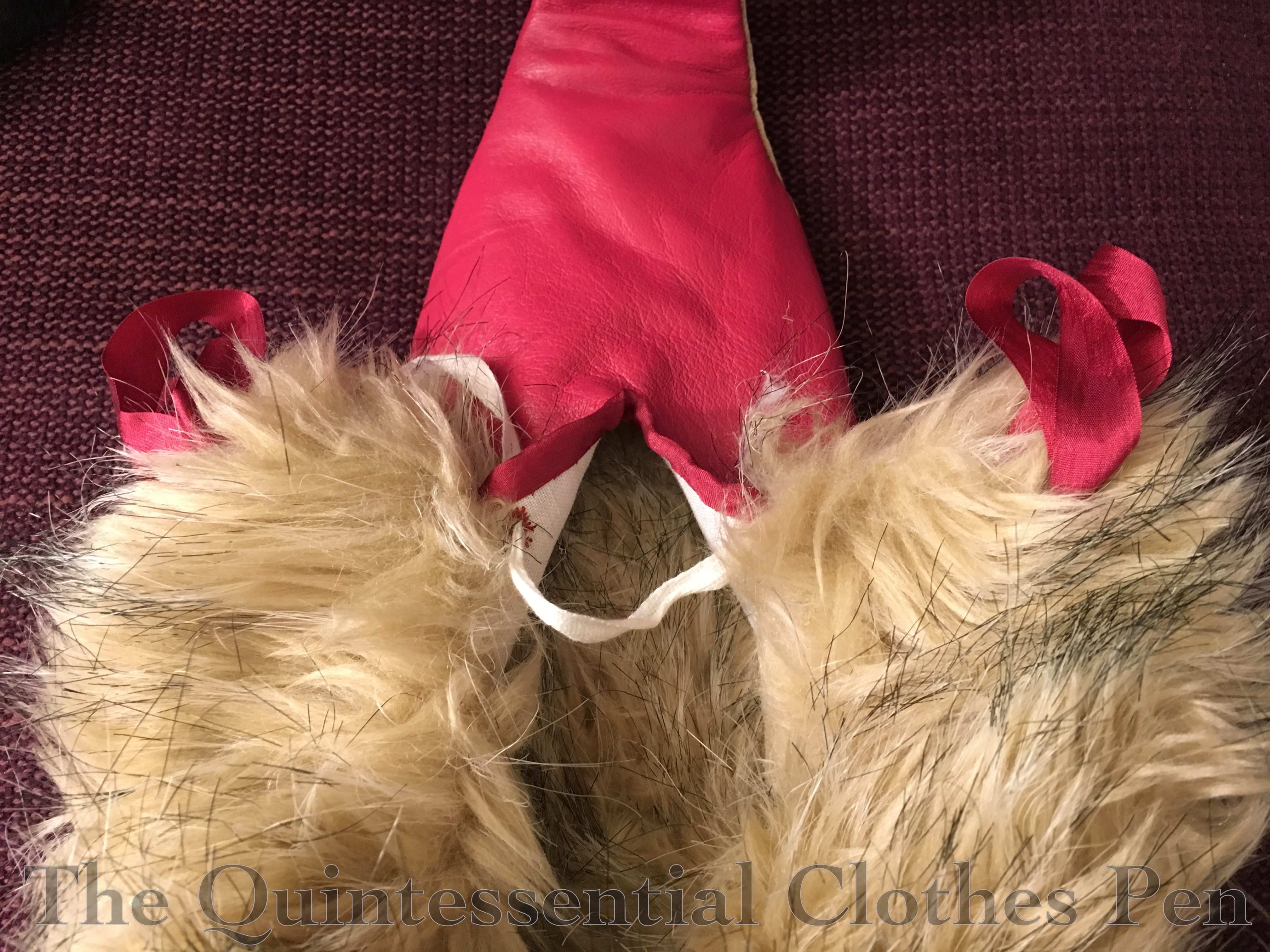
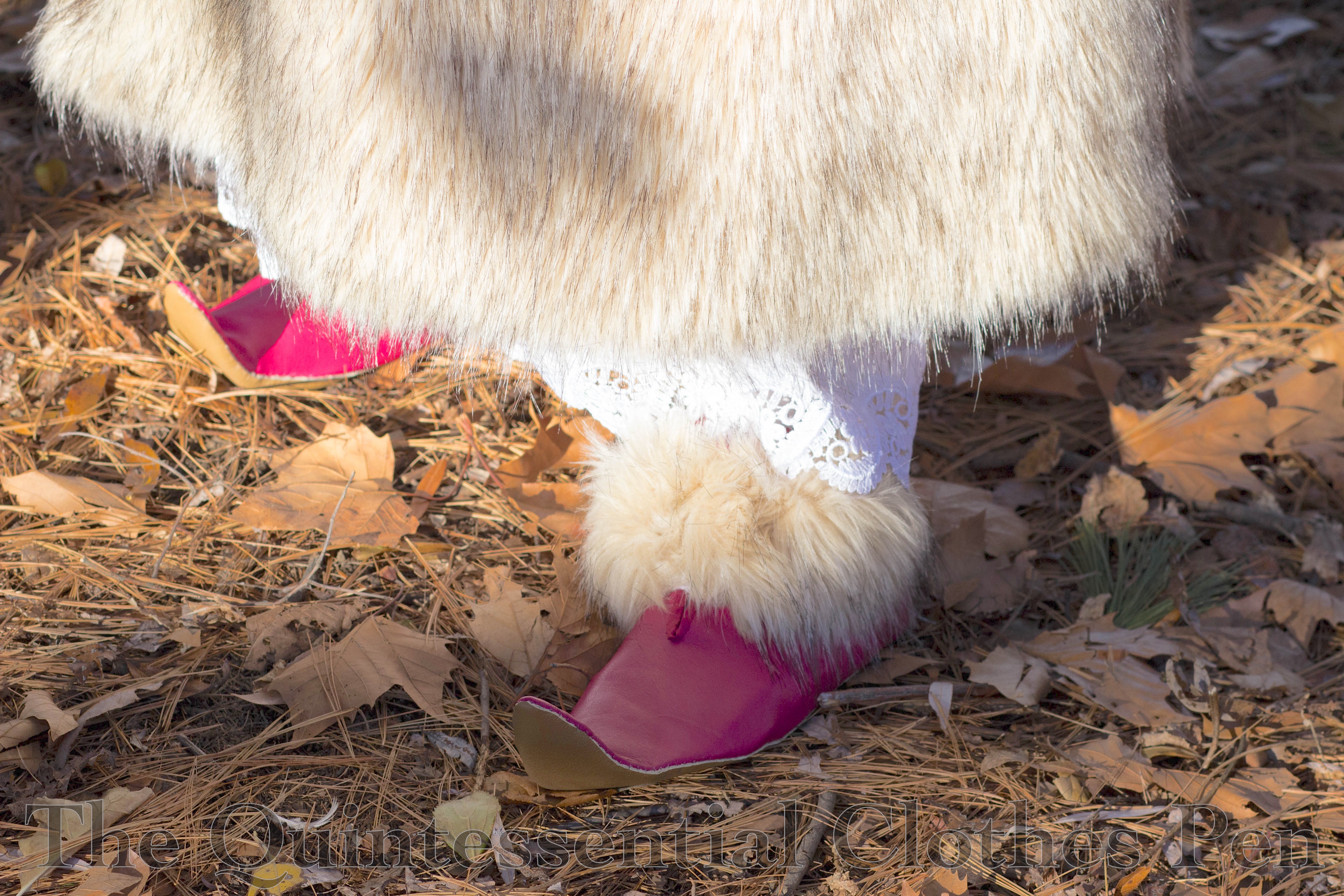
Once the soles were attached, I bound the front slit with matching silk ribbon. Then I cut a piece of faux fur for each shoe that went around just the top of the foot opening and could double over on itself. There are non-functional silk ribbon loops that are sewn to the front of the fur that encases the top edge of the shoe. The shoes actually close with a twill tape threaded through hand sewn eyelets on each side of the opening.

IMG_1684

They’re actually quite comfortable for walking around in. I have very flat feet, so don’t really need arch support to be comfortable. The only thing is that my feet did get cold during our photoshoot due to the freezing ground only separated from my feet by a few thin layers of fabric. So, for the second wearing, while caroling at Christmastime, I added a faux fur insole. Problem solved! They were toasty and even more comfortable!

IMG_1884 - Version 2

Interestingly, witzchouras are mentioned as being popular in Paris during the year 1827 by La Belle Assembleé, after a mention of other popular pelisses and mantles (well worth checking out!), and are are described as being worn with boots laced in front and with fur around the leg.

335d382370bd68a719024c208ffeff0c

Doesn’t that description sound oddly familiar? It reminds me so very much of the Vernet fashion plate and my silly shoes!

HSF #1: The Make Do Shift

The first challenge of the Historical Sew Fortnightly (HSF) 2014 is Make Do And Mend. At the start of January, none of my in-progress projects qualified, unfortunately, and while I wanted to get started on the right foot for the HSF 2014 and not miss the challenge, I also didn’t want to make something just to make something. I don’t need more stuff with no purpose and it’s hard to stay motivated on a project if you’re doing it “just because.” So I racked my brain trying to think of what would work for the challenge and be useful, without taking too much time. I settled on the idea of turning a gifted partially finished linen man’s shirt into an 18th century shift suitable for the mid-to-late 18th century. That just happens to be the period my 18th century court gown will be from at some point this year. Useful! I made an 18th century shift a few years ago, but it’s actually late 18th century/Regency, with short sleeves, which really isn’t appropriate for the rest of the century. This new shift will sort of work for the entire century, though the sleeves aren’t really full enough to be entirely accurate for the first half.

IMG_0672
1750-1790 shift

All of the seams are flat felled. The neck is narrow hemmed. It’s pretty accurate, though I did have to add center front and center back seams, which is not usual for these garments. Those seams are due to the fact that the shift was super wide after I cut it out because I had to deal with the neck opening of the partially sewn shirt, and that was gathered into the neck, so was super full. There was just way more fabric than was needed, so I seamed it and kept the extra with the other scraps I had. I’m sure they’ll get used someday! It’s very nice, light linen.

The facts:

Fabric: Linen reused from a partially completed man’s 18th century shirt.

Pattern: I used Mara Riley’s 18th century shift draft to cut my pieces, though I had to make some adjustments given that I didn’t start with fabric yardage.

Year: Loosely 1750-1790.

Notions: Thread.

How historically accurate?: It’s 100% hand sewn using 18th century stitches and cut in the manner of an 18th century shift, so lots of points for that. I probably should loose a few points for using polyester thread. The only other odd thing is that I have seams up center front and center back, but they did piece a lot in the 18th century, so it’s not totally out of the realm of possibility, given that this challenge is Make Do and Mend. I give it 90%.

Hours to complete: 10-15 maybe? I didn’t really keep track.

First worn: By the hanger. I probably won’t wear this until I have more things to wear with it!

Total cost: Free!

HSF #26: Curtain Along Jacket, Finally!

The theme of the final HSF challenge of 2013 is “Celebrate”:

Make something that is celebration worthy, make something that celebrates the new skills you have learned this year, or just make something simple that celebrates the fact that you survived HSF ’13!

This challenge gave me the inspiration to finally finish my Mineral Felicite jacket!

Here’s the story… I bought the fabric over a year ago, but didn’t really start thinking about the project until this summer. I made a mock-up of my chosen 1760s pattern and thought I’d sorted out the fitting issues, but after I’d cut and sewn the real fabric I had many more unexpected problems! I was discouraged, but recieved some really wonderful opinions about what I should do to proceed from you lovely readers. I decided to go with a stomacher front jacket with self fabric pleated trim around the neckline/front opening and around the cuffs on the sleeves, like this jacket at the Met. Then, back in September, the HSF inspired me to make a stomacher to match my jacket for challenge #19. After that, my jacket languished, because I really wasn’t very excited about finishing the sewing for the other decisions I’d made and the alterations that needed to be done to make the jacket the way I wanted it. But I really wanted to finish the jacket in this calendar year. And that brings us to the present, with the jacket finally completed. Yay! I am SO ready to celebrate that this jacket is finally done!!!

IMG_7431
Front. The pleated trim easily hides the pins used to attach the stomacher!

IMG_7432
Back. It’s wrinkly and without a waist on the hanger. You’ll just have to believe that it looks better on a body!

The facts:

Fabric: Almost 2 yds Waverly Mineral Felicite printed cotton and 1yd (I think) peach linen

Pattern: Heavily altered, but I started with the 1760-1790 jacket pattern in Janet Arnold.

Year: Well… 1760s is what I was aiming for in the beginning.

Notions: Thread and cane boning.

How historically accurate?: 60%. This definitely falls in the historic costume category of my wardrobe. The Waverly fabric is in the spirit of the 18th century, but not accurate, though the linen is accurate as are the methods of construction. The trim is based on extant garments but not specifically reproduced. The jacket is 100% hand sewn.

Hours to complete: So many! With all the problems and alterations and re-sewing I completely lost count.

First worn: Has not been worn yet.

Total cost: $30 maybe? I don’t remember exactly what I paid for the fabrics.

Hopefully, I’ll get some more pieces of an 18th century ensemble done at some point and get pictures of the jacket on me. Don’t hold your breath, though, it could be awhile!

May Fabric Stash Additions

I’ve been trying to be good about not buying more fabric… but sometimes things are just too good to pass up, or an event comes along that requires new clothes! I think I last bought fabric in January, so that’s a pretty good few months of no-new-fabric.

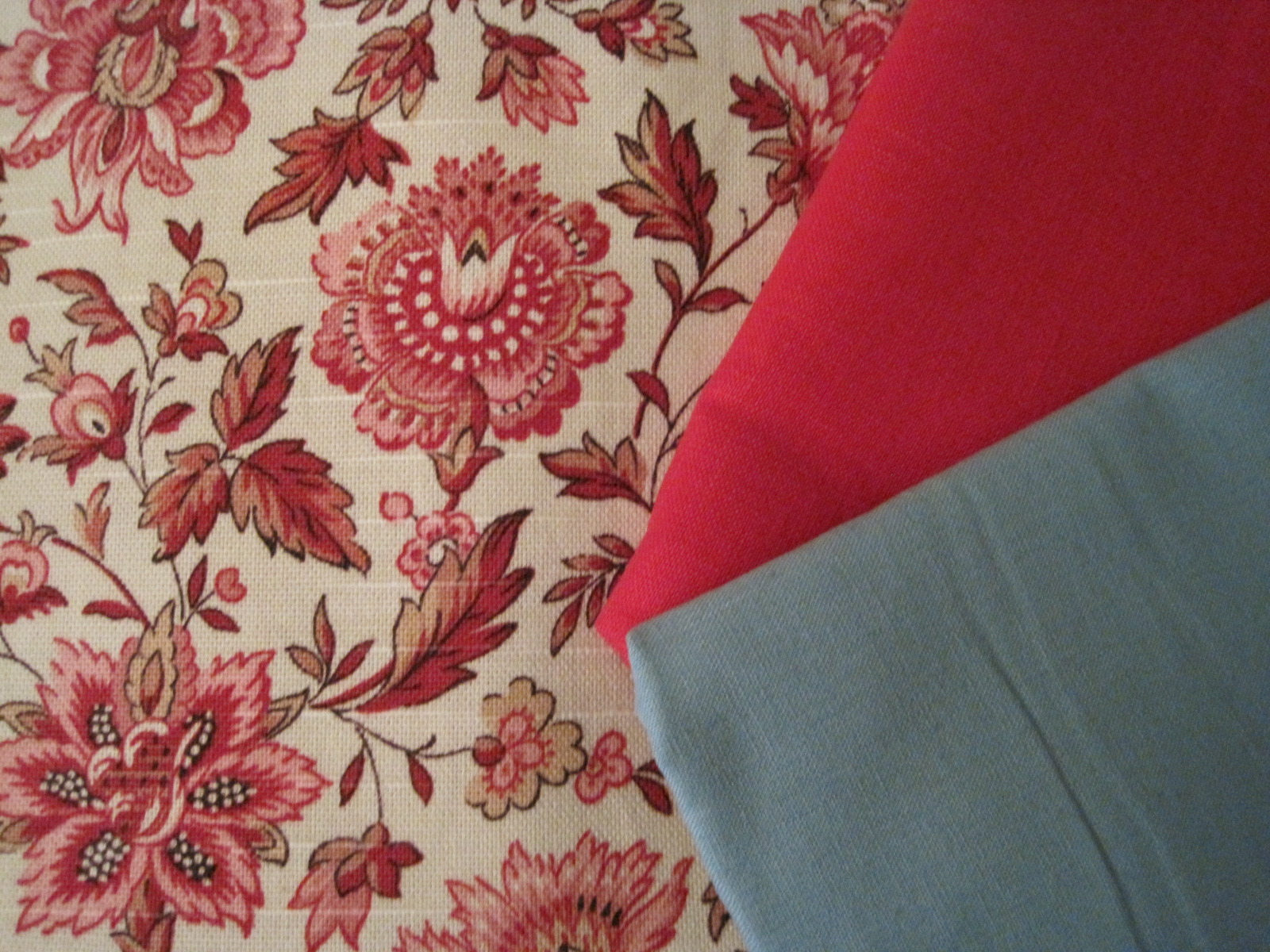
I wasn’t even looking for this fabric! But I happened upon this great red/pink/brown cotton chintz and couldn’t get it out of my mind. In the end, I decided I would regret it if I didn’t buy it. And there you are. I’m thinking of perhaps an 1790s/1800ish open robe eventually. The other two fabrics wouldn’t have been bought on their own, but with the chintz already being purchased… I tacked them on to the order. There is a small bit of the cherry red linen, to make a 1740s jacket some day, and a bit of that blueish cotton/linen blend. I was hoping it would be more teal colored, but it’s not. So it might get relegated to lining something else.

IMG_4443

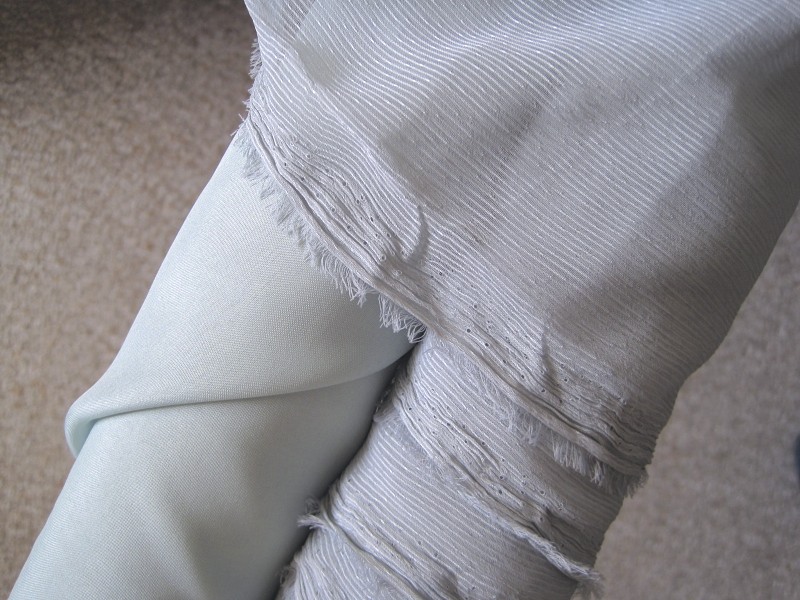
Later in the month, I was on a grand search to find fabric for an 1860s cotton dress and came across this fabulous light teal stripey fabric for $1/yd. I’m calling it the elusive blue green fabric in my head, because that color is sort of hard to find and I’ve been inspired lately to find it. At $1/yd I couldn’t pass it up!

IMG_4444

The pictures don’t really do it justice. I’m thinking of making a new Regency evening gown using it and perhaps a 1906ish evening gown some day as well. I bought that similarly colored lining to go with the stripy for the 1906ish evening gown, because at $1/yd in the right color it’s just meant to be, even if it is polyester. I’m not sure what the fabric content of the stripy fabric is, but I’m guessing it’s probably man-made…

IMG_4446

Lastly, I’ll be performing in another 1920s dance event next weekend during the day and I needed a 20s day dress. I wanted it to be washable and I didn’t have any appropriate fabrics in my stash. There weren’t a lot of options that I liked, but in the end I went with this royal blue cotton lawn swiss dot. The dress will have white accents on it (and is looking rather sailor-like, despite that not being my intent). I have to just claim the sailor look so I don’t feel foolish in it.

IMG_4452