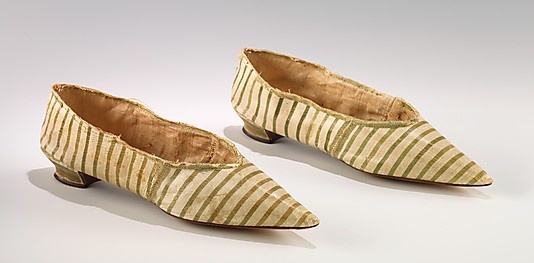
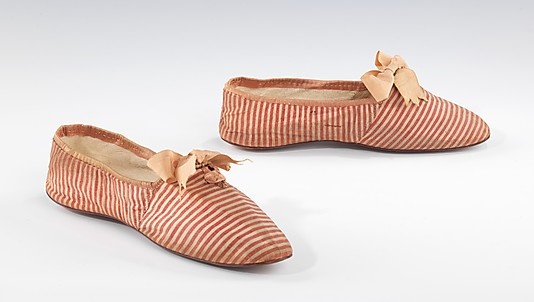
Since I seem to be on a shoe spree, I thought it would be a fitting time to share with you a series of striped shoes from the 19th and early 20th century. The continuity of the adornment over the changing shoe styles on these first three pairs is so interesting.
Striped evening slippers. 1840-1849. The Met.Striped evening slippers. 1860-1870. The Met.Striped evening pumps. 1920. The Met.
Do you have a favorite amongst these? Personally, I like the pair from 1860-1870 best (maybe it’s the rosette that appeals to me in addition to the stripes!). You can also pick from these next few pairs, which I’ve included just for fun.
Striped slippers. 1795-1810. The Met.Striped shoes. 1845-1865. The Met. (These kind of look like Toms?!?)Striped evening shoes. Late 1920s. The Met.
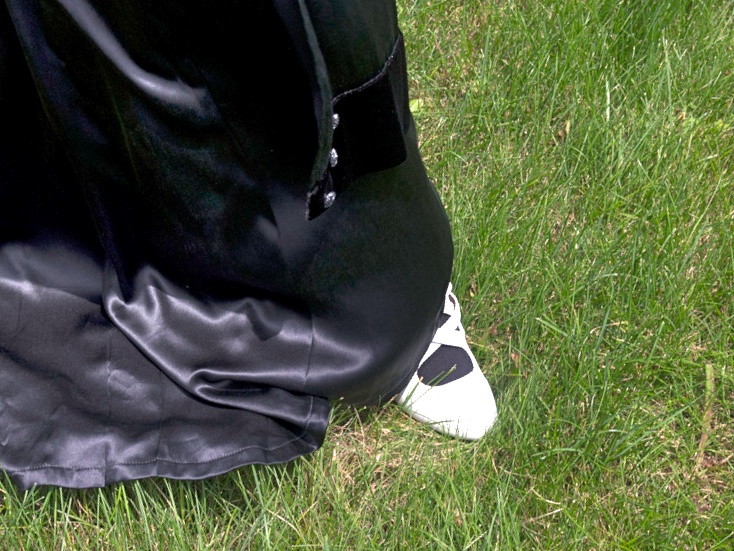
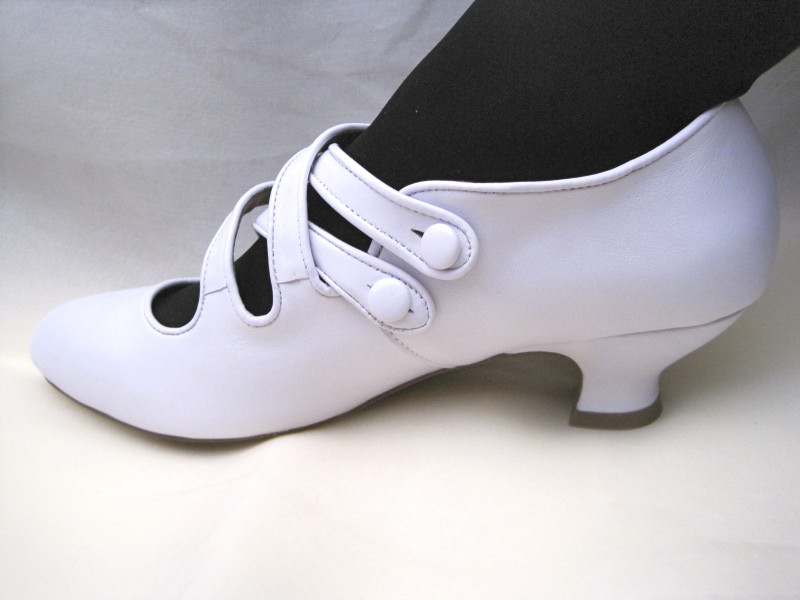
As I recently mentioned, my American Duchess Astorias have gained a coat of paint and are now ivory. The buttons have also been moved and now it is time to officially show you how fun they are with feet in them! (By the way, I did include a picture where you could see them on my new portfolio page, which was unveiled before this post… it was a spoiler, though I don’t think it was very noticeable!)
Here’s the spoiler picture.They’re a little buried in the grass, but here they are!A close up!
Super fun! Now I have outdoor shoes to wear with Edwardian clothes!
Product links in this post contain an affiliate code, which provides a small benefit to my shoe fund. This does not affect my impressions and reviews of this product.
If you’ve looked along the top of this blog, right above that lacey petticoat picture, you have probably noticed the different pages listed there. Hopefully, you’ve even clicked on one or two of them and conducted a little bit of exploration! Well, as of today, a new page has been added: The Portfolio Page.
“What is the Portfolio Page?” Well, click and see!
If you’re like me and you want to know before you click, here are the details: The Portfolio Page is a gallery of my past work with links to the blog posts about the different garments. As I continue to construct new things, I’ll add them to the page so that it constantly reflects a quick-view of my work. The Portfolio Page also contains a link to my professional portfolio, for those of you who are interested in learning more about me or seeing my expanded, professional work.
Why do I have a separate professional portfolio? Well, this blog is a collection of posts relating to my personal hobby of historic costuming; however, as a professional costumer there are many other things that I make and shows that I work on. These are things that I have chosen to keep separate from my personal blog for many reasons, but they are still representative of my costuming skills. The new Portfolio Page of this blog is a great opportunity for me to include all my personal projects that show a high quality of work but which do not belong on my professional portfolio! So go, visit my Portfolio Page and then take a little trip to see my professional portfolio, too!
In fact, here’s a taste! Here are just a few things that are available to be viewed on my professional portfolio, but which are not included on this blog.
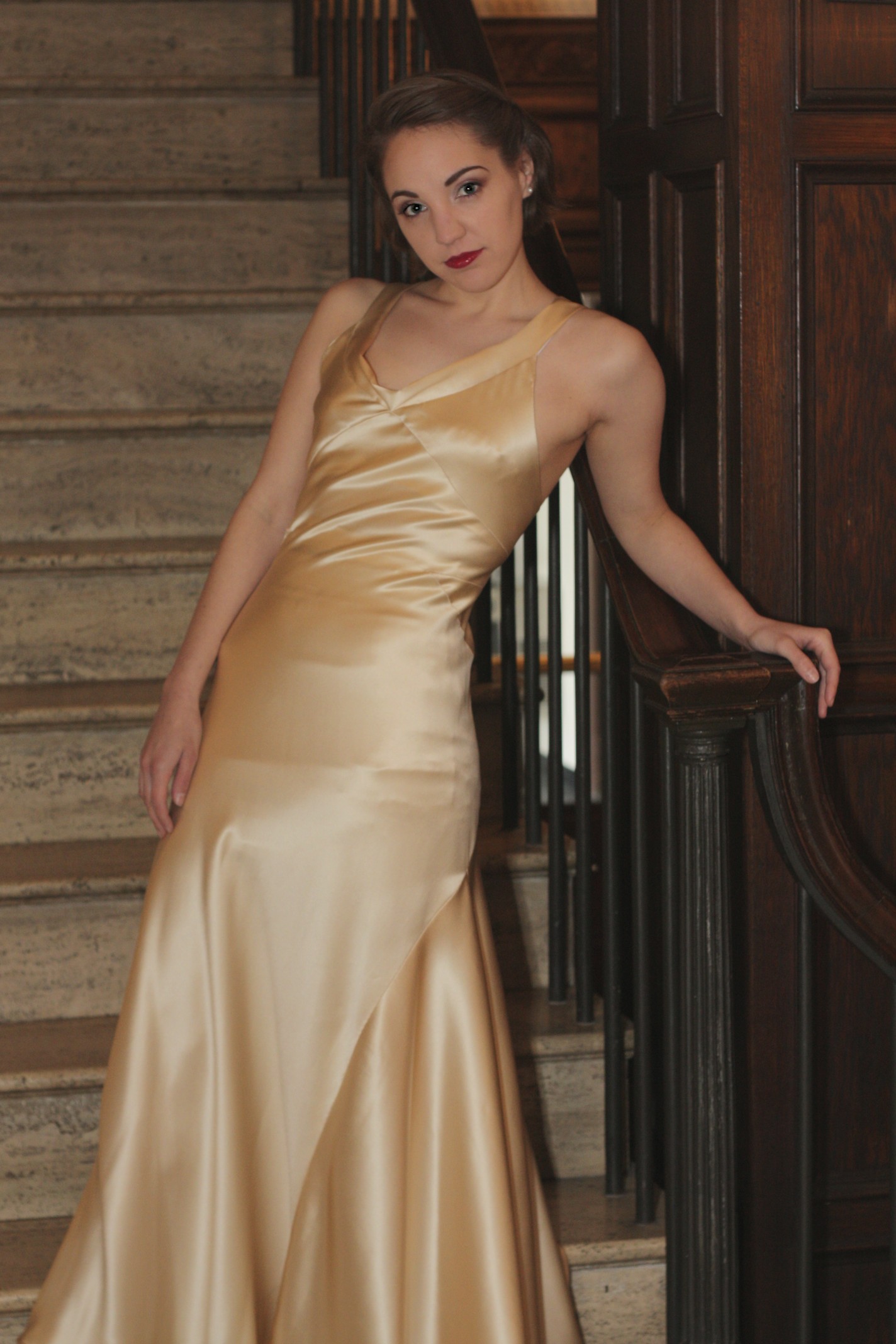
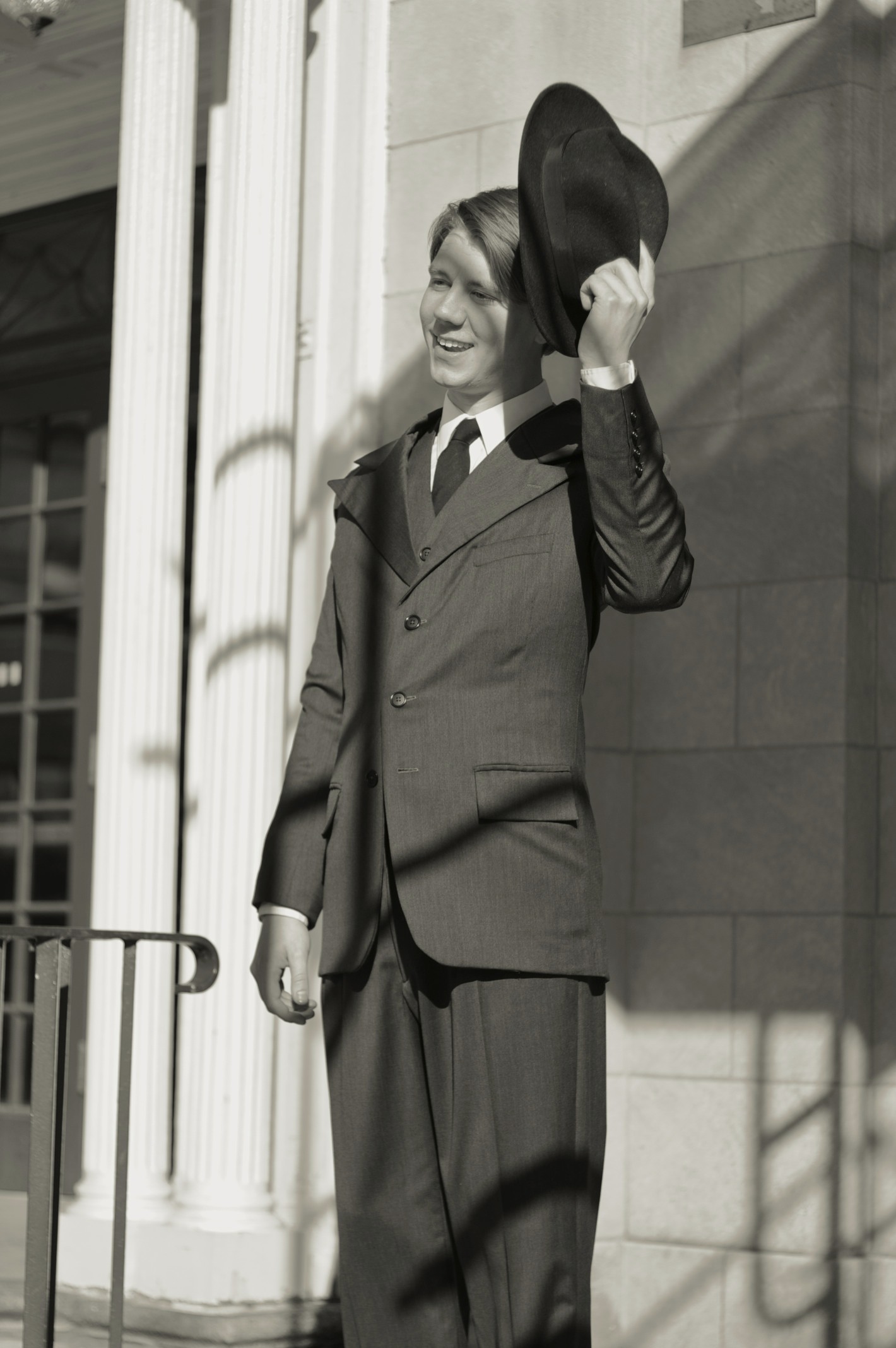
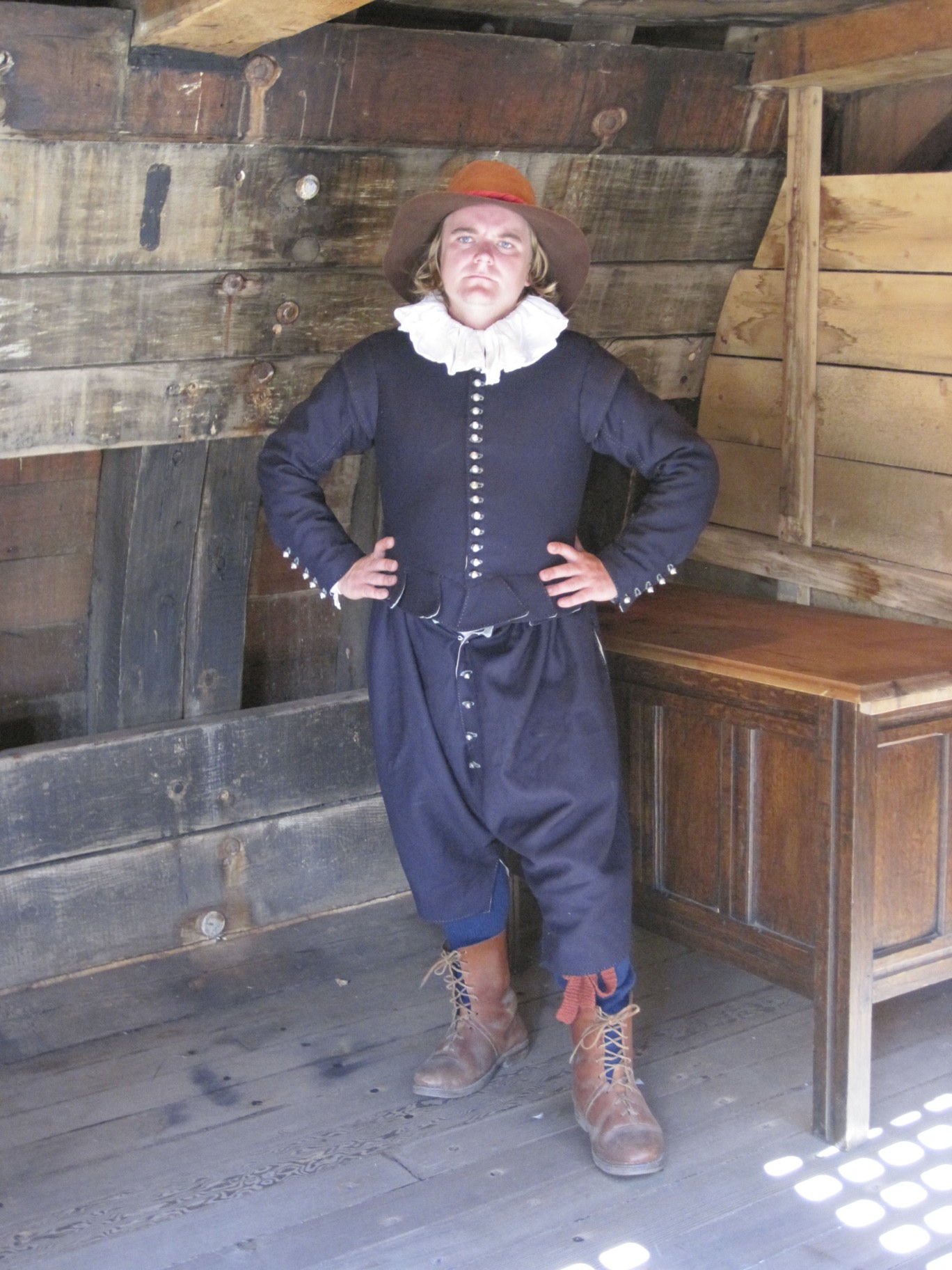
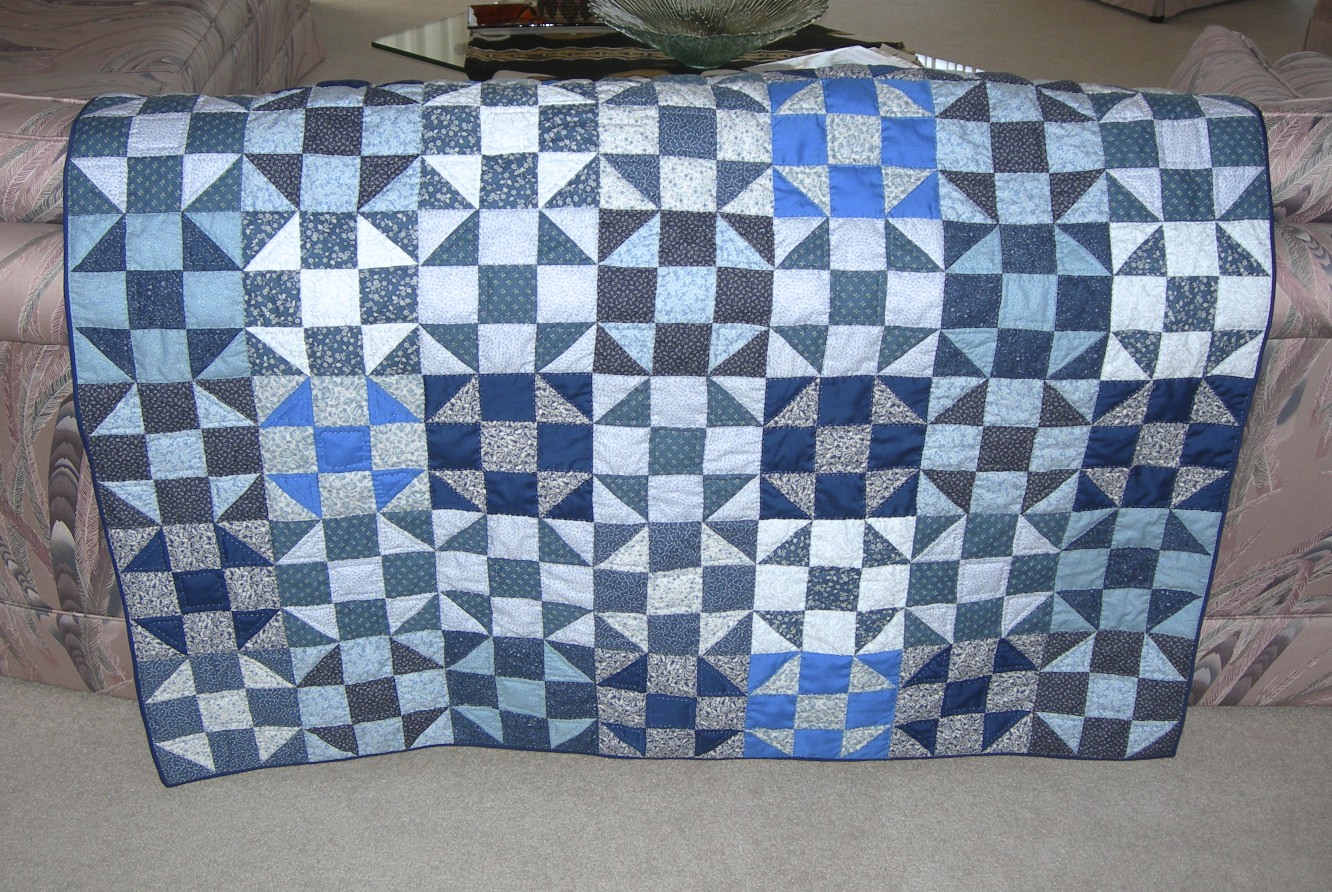
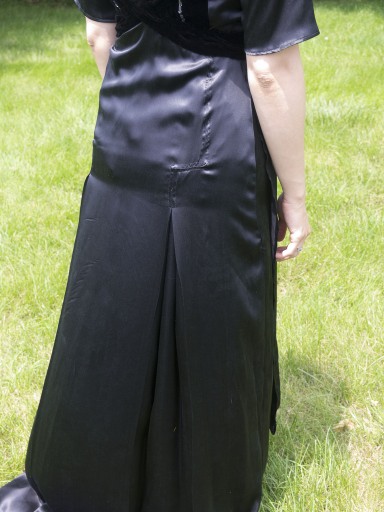
1930s bias Vionnet evening gown in silk crepe back satin with matching underwear set.c. 1940 three piece suit.1627 wool doublet and breeches.One of my hand quilted projects: a Shoofly pattern lap quilt.
The back of my 1912 tea gown. I like the belt that crosses and swoops up (hard to see, except that the line of beading is interrupted by the belt) and the side back seams that end in pleats (it looks really cool while I’m walking!).It’s a little hard to see in the first image, but the side back seams make a few intentional right corners before opening in inverted box pleats that help form the train. Here is a close-up of those seams: unfortunately, they pucker a little in the silk charmeuse because I didn’t think to stabilize them before starting to sew and snip corners… Let that be a lesson to you!Another view of the back seam and pleats.Here’s a side view, so you can see the front and the back.And a recap picture of the mushroom hat.
I was able to wear my freshly painted and moved-button Astorias with this dress and others at Dress U recently, but you’ll have to wait to see pictures of the finished shoes–they’ll be coming in another post soon!
Yes! My leather painting was successful! My American Duchess Astorias are now a lovely shade of ivory–hard to notice the difference now that they are painted, but compare the two shoes in the picture below. Can you see the difference? I certainly can. I still need to move the buttons so that the straps do not gap, but half of my plan is complete! Only a few days left for me to do that before I wear them…
This link contains an affiliate code, which provides a small benefit to my shoe fund. This does not affect my impressions and reviews of this product.
Left: Unpainted, the original color Right: Painted ivory to match the fabric at the bottom of the pictureGetting ready to paint.
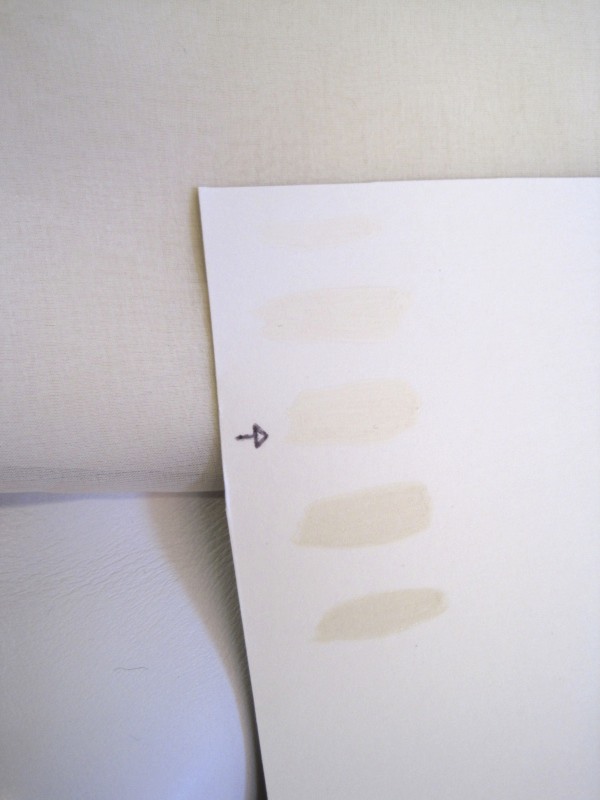
How did I go about painting them? Well, as I mentioned in my last post, I bought Angelus Leather Paint in three colors: yellow, white, and champagne. Technically, ivory is a very small amount of yellow diluted with mounds of white, but when I went to order the paint I had a great gut reaction thought that the champagne might make a better ivory than the yellow. It turns out that the yellow was just too strong! I made a little swatch card (so I could find the right shade of ivory, see what the shades looked like when dry, and so I could repeat the color if I needed to mix more paint). I tried the yellow first, and just one drop of yellow in a fair amount of white made a light yellow color, not at all similar to ivory!
Trying to make ivory paint from mixing yellow and white.
So back to paint mixing: I next tried the champagne. I kept adding more drops of the champagne color to the white to see what depth of shade I would want.
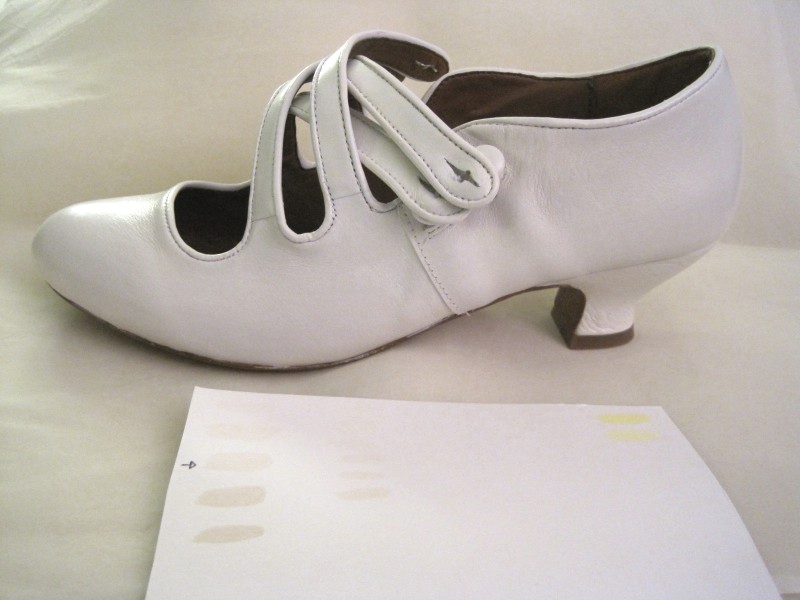
Ivory fabric, top left: that’s the color I was aiming for White toe of the Astoria, bottom left: unpainted My swatch card, right side: with an arrow at the shade I like
Then on to the painting! The Angelus paint worked wonderfully. I did two coats: a light first coat and then a second coat to blend away all the brush strokes and even out the color. I thought about mixing my paint with a little water, but actually liked the consistency straight out of the bottle. I had no trouble getting smooth looking paint after the two coats I applied.
If you look carefully, you can see that the back of the shoe and the heel have not been painted yet. The front was only just receiving the first coat of paint, so it was not super smooth or opaque yet.
As I said, the change is not drastic, but it is noticeable. The shoes no longer glare white at me. Yay! Here’s a final picture of my whole swatch card with the newly painted ivory Astoria!
Freshly painted Astoria, with my swatch card. Champagne ivories on the left and yellow not-quite-there ivories on the right.
Five months after my super intense excitement of the pre-order of my American Duchess Astorias, they have finally arrived! Luckily, I still have events coming up for which they will be great, though they did miss out on being worn at the Titanic Weekend back in April. Despite their innate cuteness, however, they are going to need some adjusting before I wear them. Here they are, unadjusted.
This link contains an affiliate code, which provides a small benefit to my shoe fund. This does not affect my impressions and reviews of this product.
Reasons I love them:
The straps are just so cute! There were a wide variety of shoes with this kind of detail in the Edwardian period and this modern shoe does a fantastic job of capturing that perfectly Edwardian spirit!
They are super comfortable! It hardly feels like there is a heel on them and the shape of the toe box is just right for comfot.
Things I’m disappointed with and want to change (and my plans for doing so):
Due to my very narrow flat feet at least half of the straps are about 1/2″ too big, causing unattractive gaping over my foot (the crossed straps look really outstanding when held taut against my foot, but when they gap the shoes just looks messy). The plan: to remove the buttons from their original location and restitch them at the point where the straps want to be when tight. Overall, it’s a pretty simple solution that just takes time to execute.
I ordered the ivory color of the shoe, and to my eyes it looks very white. Since I plan to wear the shoes with many clothes where ivory is a featured color, it is important to me that my shoes are ivory and not white. In the photo below you can see how different the shoe looks from the ivory silk background. The plan: to paint my Astorias with Angelus Leather Paint from Dharma Trading Company to be a suitable color.
Well, that’s the plan. Time to start–I’ve got two weeks before I wear them!
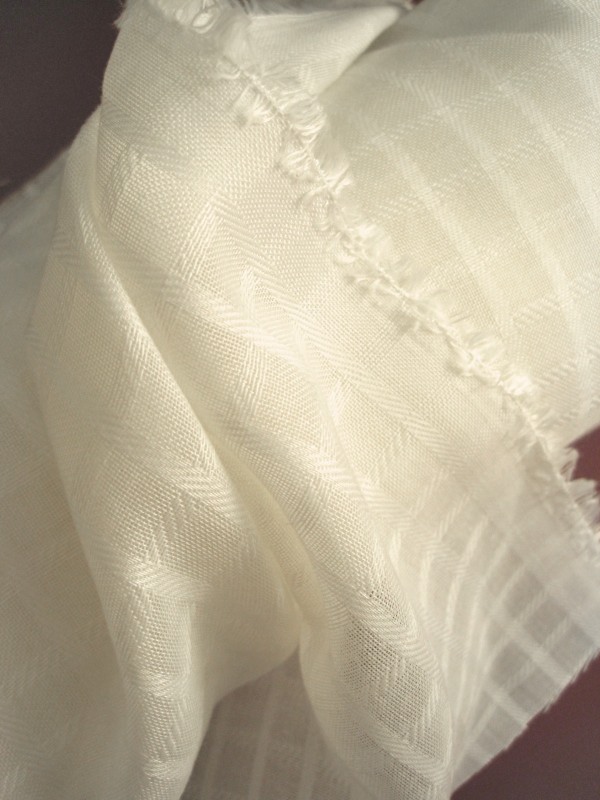
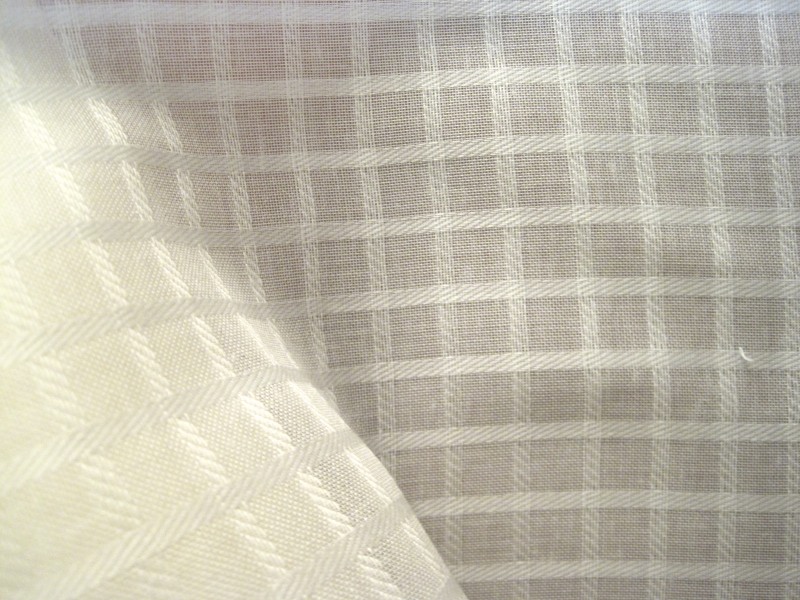
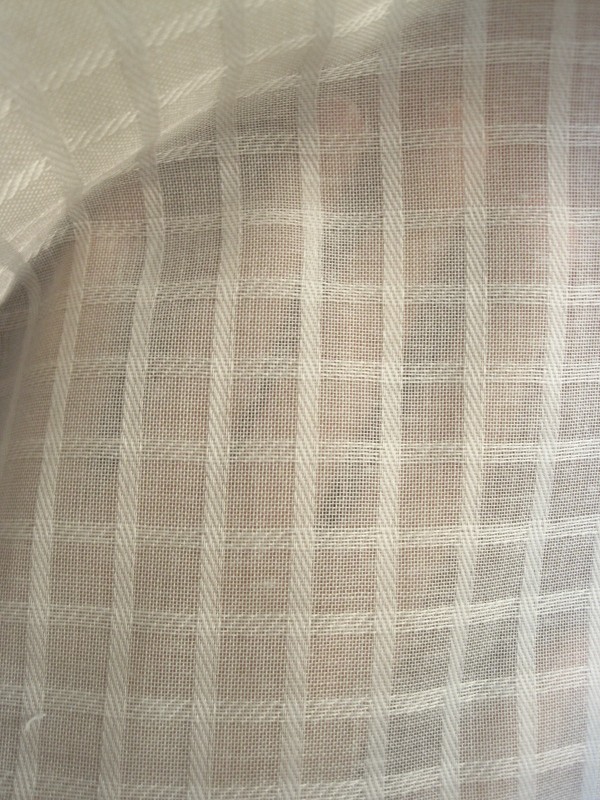
I recently mentioned the addition of a new fabric to my stash! I bought it with the thought to build an early Regency dress and another something or two. Perhaps an 18th century apron? Or an Edwardian blouse? Now I’m also considering a frothy 1908-ish dress. And I’m sure that more ideas will be sparked before I actually construct anything (because there are many other things on the “to be sewn” list that need to come first!). But I did promise pictures. Here they are!
Ivory cotton gauze with windowpane pattern. It’s fairly sturdy, but has a lovely drape and is quite soft to the touch.It’s semi-transparent. This is with nothing behind it but color.This is with my hand behind it. You can see the outline of my hand pretty distinctly.
This photo was taken the day of the filming of the documentary that I spoke of in my last post. The first photo is the original photo as it came out of the camera. The second photo is a version that I altered (thinking, “The photo is so dark. I need to lighten it up a bit to see the details!). However, now that I’ve seen both images, I’m torn! I think both are wonderful! Each is striking in a different way. I’m curious to know what you think? Version 1 or Version 2? Why that choice?
Version 1 (original)Version 2 (brightened to show detail)
7am: wake up, shower, coif hair, apply makeup, dress
8am: grab already packed bags and head out the door
9am: change into Annabelle and participate in the filming of a documentary regarding Henry Bergh, the founder of the ASPCA, by Sagacity Productions
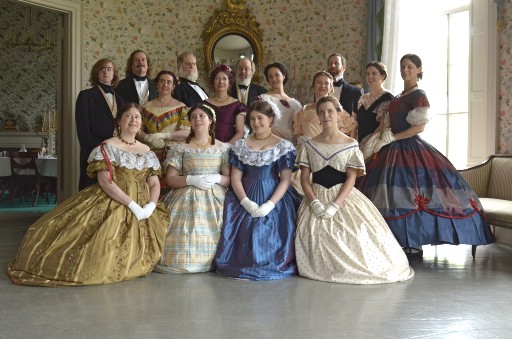
The CVD members who participated in the filming.
2pm: go out to lunch (still in 1860s garb)
It’s hard to sit next to each other in modern seating when wearing hoops!
4pm: head home for a super quick nap
5pm: paint toes and get dressed for a modern evening out
Yes… I do actually wear modern clothes sometimes!
11pm: arrive home, feeling like I’ve just lived at least two days… all in one!
The amazing part? Despite the fact that I didn’t have time to change my 1860s hair style, it worked just as well for my modern look! I got a comment that it looked inspired by the 1940s. Maybe? I think a modern woman always looks distinguished and a bit vintage when wearing her hair up in the evening, since it is just not the style these days (and I was surrounded by mostly college age people… so there were mostly curling ironed hair styles around…). To be entirely fair, there were many amazing parts of that day! I feel blessed that it was mine.
For those of you who live near Boston, you will know that the fabric store selection in this area is pretty dismal. We do have a few small stores that have a fun selection of certain kinds of fabrics and/or great low prices on a random assortment of fabric, but we don’t have a great fabric store population. Have you heard that the new Fabric Place Basement opened at the end of last year where the old Fabric Place was, in Natick? (Spoiler: there is a coupon for 15% off of one cut of fabric on the website for the store!) When you descend the stairs it looks like a huge selection (of what I hoped to be all dress goods), but I found that about 1/3 of it is decorating fabrics (great for some things, but only rarely for historic costuming), 1/3 of it is quilting fabrics, and that leaves only 1/3 for dressmaking fabrics. They did have some great fur, and a lot of sequined things, and a huge selection of leather. They did also have silks, in a random assortment of colors and types, for between $10 and $20 a yard depending on the type. Oh, and they had some really nice wools, in a random assortment of weights and colors, but for pretty good prices, considering the quality of the fabric. The notions section was ok, but not outstanding, and the trim section just seemed a little random, with an abundance of sequined trims.
But… I did find some new pieces for my stash! The highlight is a bunch of cameo buttons. They are plastic, but I think they look pretty good (and for 25 cents a piece I really can’t complain!). It would also be possible to carefully paint the black background to change up the look… I have 2 different shapes in 5 different sizes. I envision a variety of uses for the cameos: as brooches, buttons, or to add interest to accessories.
Most of the cameos are the same frame and figure, but these two below were different. It is easiest to see the difference in the frame, and I think the little one has a man on it rather than a lady like the others.
It’s a button in disguise!
Anyway, the other thing I found (and bought…) is an ivory cotton gauze with a windowpane pattern on it. It is 118″ wide and was actually a really good price! Yay! I bought enough to make a Regency dress (at some point in the future…) as well as something else… Maybe an 18th century apron? Or an Edwardian blouse? I don’t plan to use it right away, but I am thinking of ideas. I’ll have to take a picture of it!















 The Quintessential Clothes Pen