Knitting For Victory

My 1917 “Knit Sweater of Angorina” is finally complete! But, you’ll have to wait until my official HSF post to see it. In the meantime, I want to share a little bit of history that relates to knitting in WWI and, by extension, my new sweater.

WorldWarOneKnit07
World War I Red Cross poster encouraging knitting, ca. 1917

World War I started on July 28, 1914 and ended on November 11, 1918. The US entered the war on April 6, 1917. After the US joined the war, it didn’t take long before conditions in the trenches prompted the Red Cross to put out an urgent call for knitted goods for soldiers in the summer of 1917. Their immediate need was for one and a half million each of knitted wristlets, mufflers, sweaters, and pairs of socks. That’s a lot of knitting!

This section is quoted directly from historylink.org essay 5721:

The need for the socks was paramount: The trench warfare conditions under which the war was fought meant that soldiers spent weeks or months entrenched in wet and in winter freezing conditions.

For American soldiers in the trenches or on the march in France, warm socks made all the difference. The boots these soldiers wore (the 1917 Trench Boot) were made of heavy retanned cowhide with thick soles. Although in theory water-repellant, the boots ripped out at the seams fairly quickly. They had iron heels and five rows of hobnails (to prevent slipping) hammered into the soles. These hobnails conducted the cold from the frozen ground directly to the soldiers’ feet.

An improved version (1918) called the Pershing Boot added an extra sole and thus extra warmth, but a soldier could not bend his foot in the rigid boot and his feet remained cold, sore, and often wet. These boots were not insulated in any way, and soldiers took to wearing two pairs of thick wool sock. This required them to wear boots two sizes larger than their regular size. Allowing for wear and tear and the prudent practice of changing socks often in order to avoid contracting trench foot (a fungus), the need for a continuous supply of warm wool socks was endless.

As you would expect, not everyone could knit very well, so the quality of knitted goods being sent overseas varied, but a sock is a sock, even with dropped stitches and other mistakes, and it will still keep a foot warm! In support of the war effort, people began knitting everywhere: work, school, while on public transportation, at church… People who couldn’t knit were encouraged to buy yarn for those who could, and children were encouraged to do whatever they could to help their family members have time to knit. Personal knitting was looked down upon for being selfish, because it didn’t support the war effort or the soldiers.

This section is quoted directly from historylink.org essay 5721:

By mid-1918 the need for socks was so severe that the Red Cross begged knitters, “Don’t make sweaters … every pound of yarn that can be secured should be used for knitting socks” (quoted in MacDonald, 218). Some knitters conserved wool by using cotton yarn for the legs and wool for the feet. Wool was the best fiber for moisture absorption. Other knitters, stymied by the somewhat complicated mystique of turning the heel (i.e. knitting a heel flap and then picking up stitches along its sides to knit a gusset, forming the heel-shaped portion of the sock) began knitting heel-less tube socks. These drew praise from soldiers because they were more comfortable than socks with lumpy, poorly made heels.

The Seattle Red Cross operated a knitting machine that produced long knitted tubes. The tubes were cut into 27-inch lengths and the toes purled together by hand. “When the knitting machine is once ‘set up’ with gray yarn, it knits and knits and knits.” (The Seattle Times, December 2, 1917)

In September 1918, all American yarn retailers were ordered by the War Industries Board to turn over their stock of service yarn (any yarn in khaki, gray, heather, natural or white) to the Red Cross. For the next six weeks all yarn for war-effort knitting was available only through the Red Cross. This was done to ease the yarn shortage and to allow Red Cross knitting to continue uninterrupted. 

…The so-called War To End All Wars ended on November 11, 1918, when Germany surrendered. In the war’s final months, the American Red Cross turned its attention to the devastating 1918 influenza pandemic… Many [knitters] foreswore gray and khaki yarn for good, or so they thought. These same knitters would be the first to pick up their needles in December 1941, to once more “knit for victory.”

Quite an interesting bit of history, I think. Given this information, I can confidently say that my sweater would have been knit early in 1917, before the US joined the war. I encourage you to click through to historylink.org to read the entire article I’ve quoted here. It focuses on knitters in the Seattle, Washington area, but I’m sure reflects what other areas would have been like as well.

1950s Adventures Part III: On A Roll

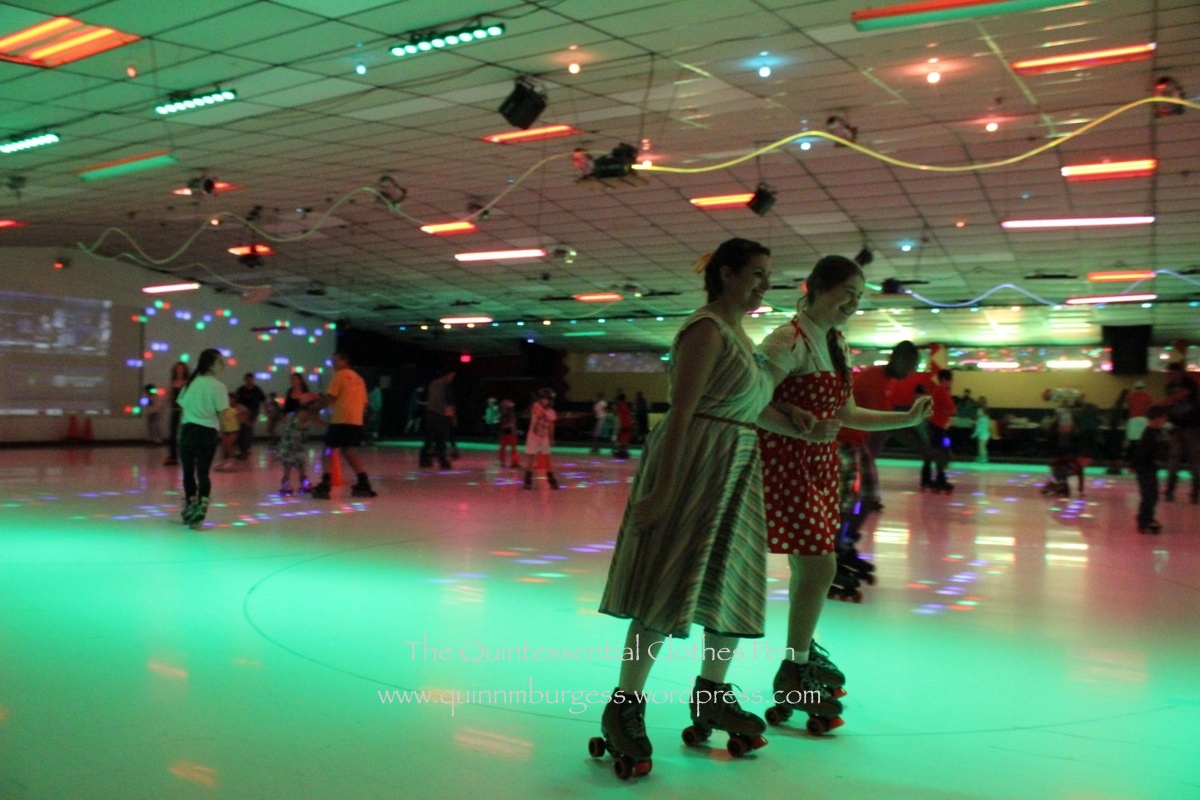
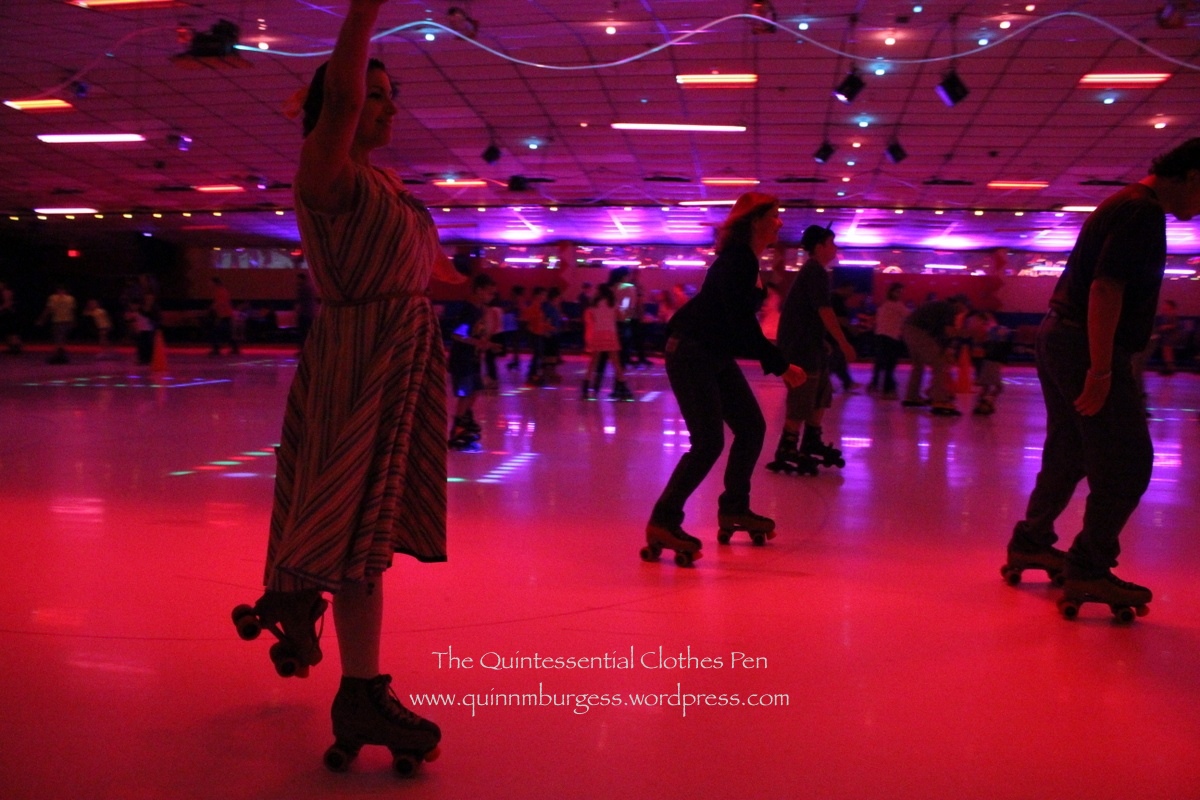
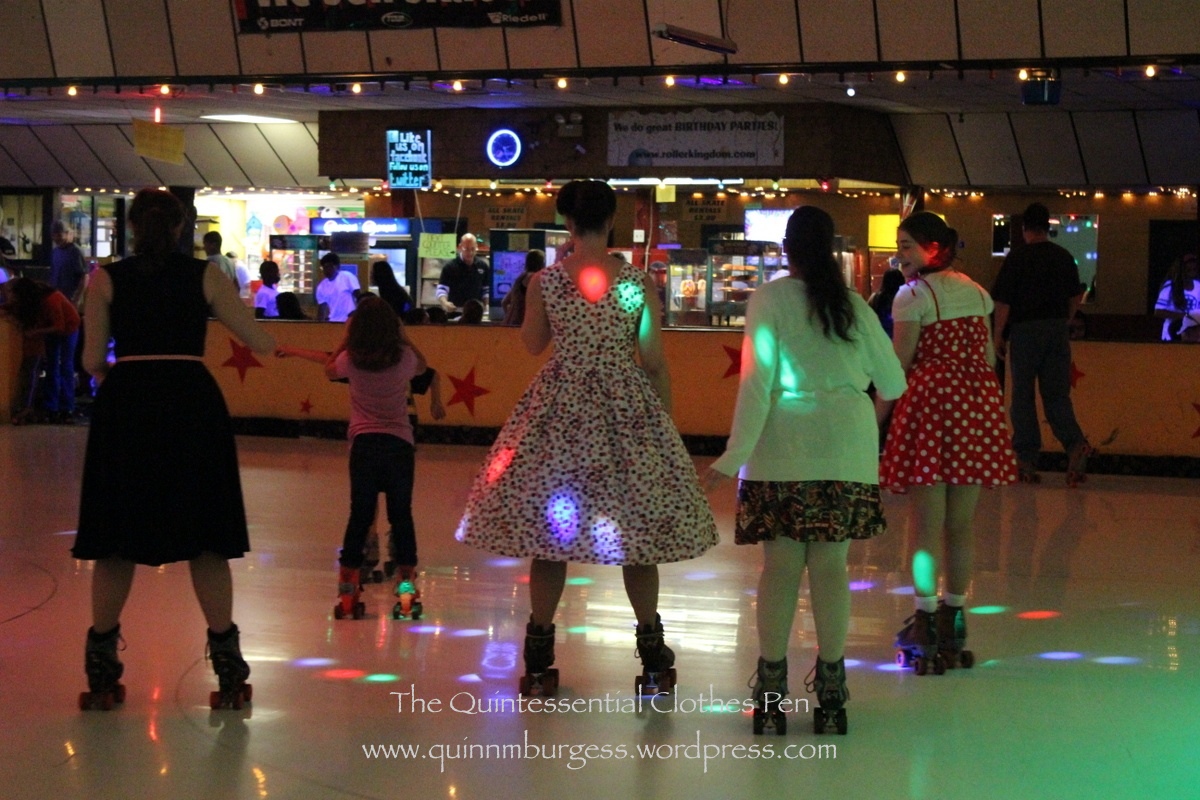
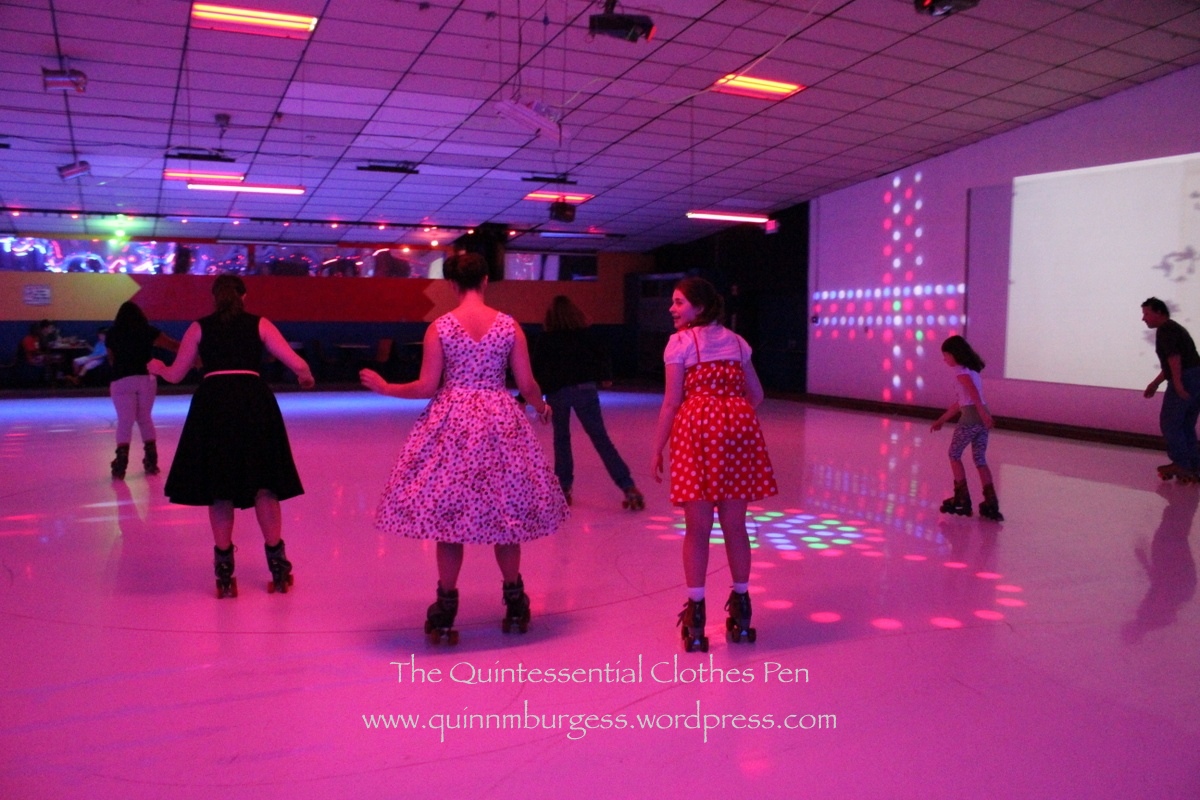
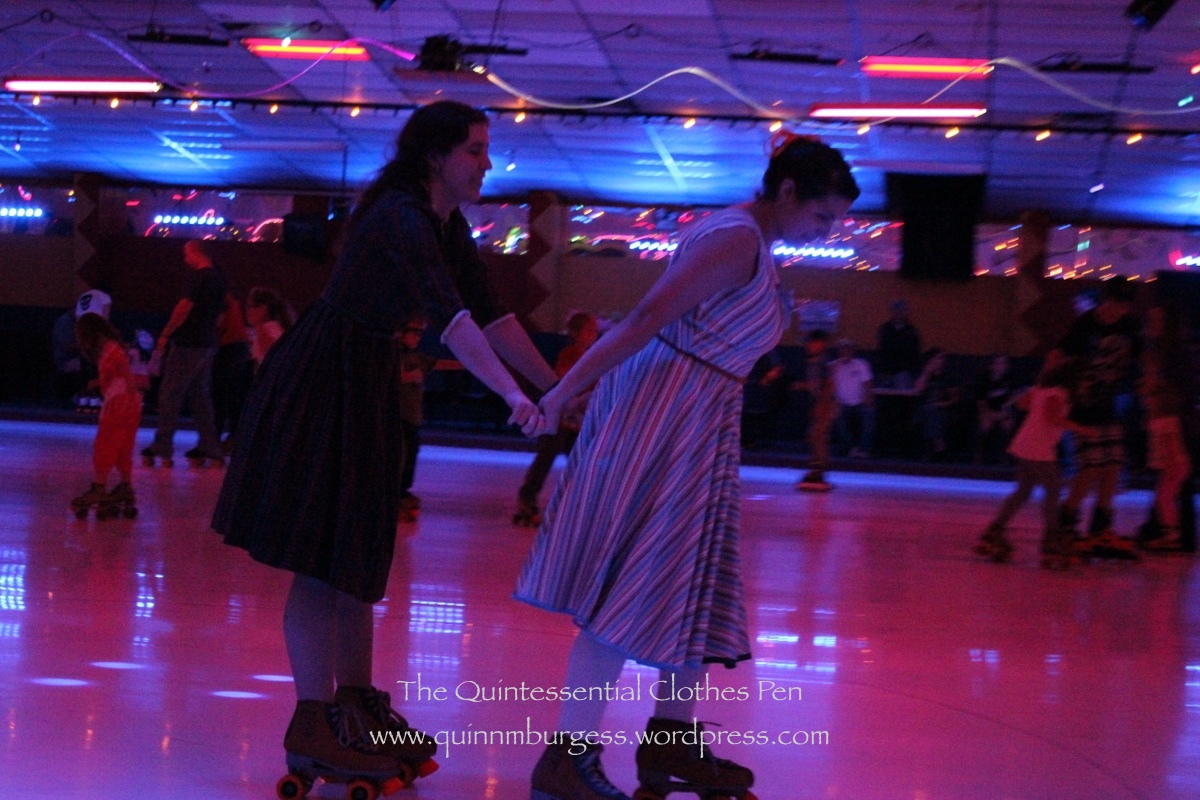
After eating brunch at a 1950s themed diner, stopping along the side of the road to take lovely autumn color pictures, and spending some time at a thrift store before the roller rink opened, we finally headed out to go roller skating! I had been jokingly warned that we were likely to be at the roller rink with a whole lot of 8 year olds and the warning was pretty accurate. There were a few adult couples on dates and a few by themselves, but mostly there were a ton of 5-13 year olds and their adult chaperones. It was a Saturday afternoon, after all, so it was to be expected that there would be a lot of birthday parties… It didn’t bother us, though, we’re used to being unique. And lots of the girls called out that they liked our dresses as we skated by. Perhaps one day they’ll be inspired to make or wear historic clothing!

Some of us had been more used to roller blading, but in the spirit of trying to be 1950s-ish, we all rented roller skates. Granted, the roller rink and the skates are obviously modern and not 50s, as you’ll see, but we had so much fun it didn’t matter at all!

IMG_5238
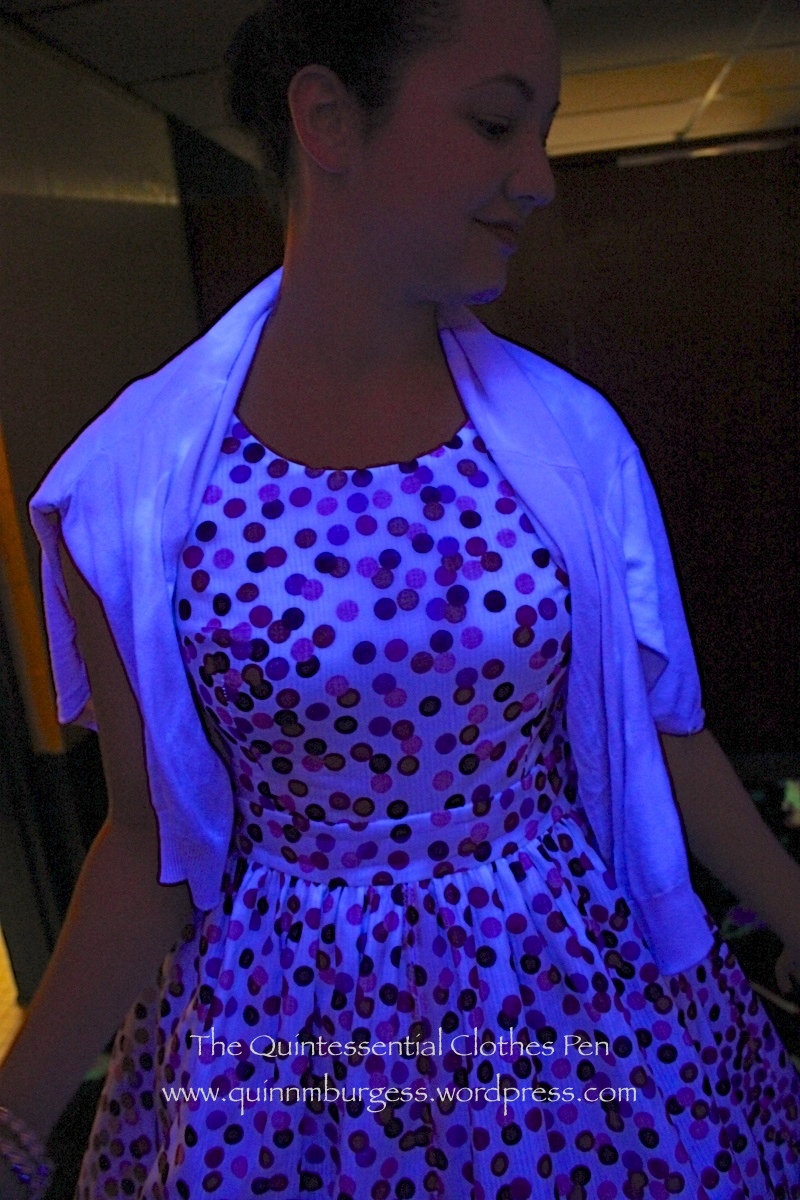
Putting on skates under a black light.
IMG_5256
Things started off a little shaky for some of us.
IMG_5395
But we were there to support each other.
IMG_5254
In fact, I almost fell over before I even made it onto the rink… But I managed to keep my balance, and here I am, successfully skating!
IMG_5280
Our confidence rose pretty quickly, and soon we were all making it around the rink.
IMG_5294
We were even managing to be graceful sometimes.
IMG_5272
And possibly even in sync…
IMG_5283
I did still lose my balance sometimes and make crazy faces…
IMG_5282
But they were balanced out by the successful moments.
IMG_5284
Look, here’s another successful moment!
IMG_5331
On a roll!
IMG_5329
This picture amuses me, because we might be dancing, or we might just be loosing our balance…
IMG_5335
Group shot (with fun lights!).
IMG_5332
Another group shot…
IMG_5371
You might remember our “raise the roof Charleston”… We just like to throw in raising the roof any chance we get, and this was a perfect opportunity.
IMG_5384
It almost looks intentional that we’re all in a line!
IMG_5400
Full circle. Returning my skates under the black light.

Fun, right? We really enjoyed ourselves and no one actually fell! But the day wasn’t over… we still had a Regency ball to run/attend that night. I’ve got pictures of that coming soon. It sure is a transformation from 1950s!

1950s Adventures Part II: Autumn Colors

Back to 1950s adventures! I started the adventures with my previous post about the beginning of our day at a 50s themed diner. After leaving the diner we wanted to get some pictures with the beautiful New England autumn colors in the background, so we thought we’d find a place along the side of the road. We took a wrong turn over a bridge and got a little confused, but the confusion wound up with us driving past a lovely side road/private drive with lots of lovely trees and rock clumps. Rather impulsively, we pulled over a hopped out to take some pictures… and here are some of the results!

IMG_5204
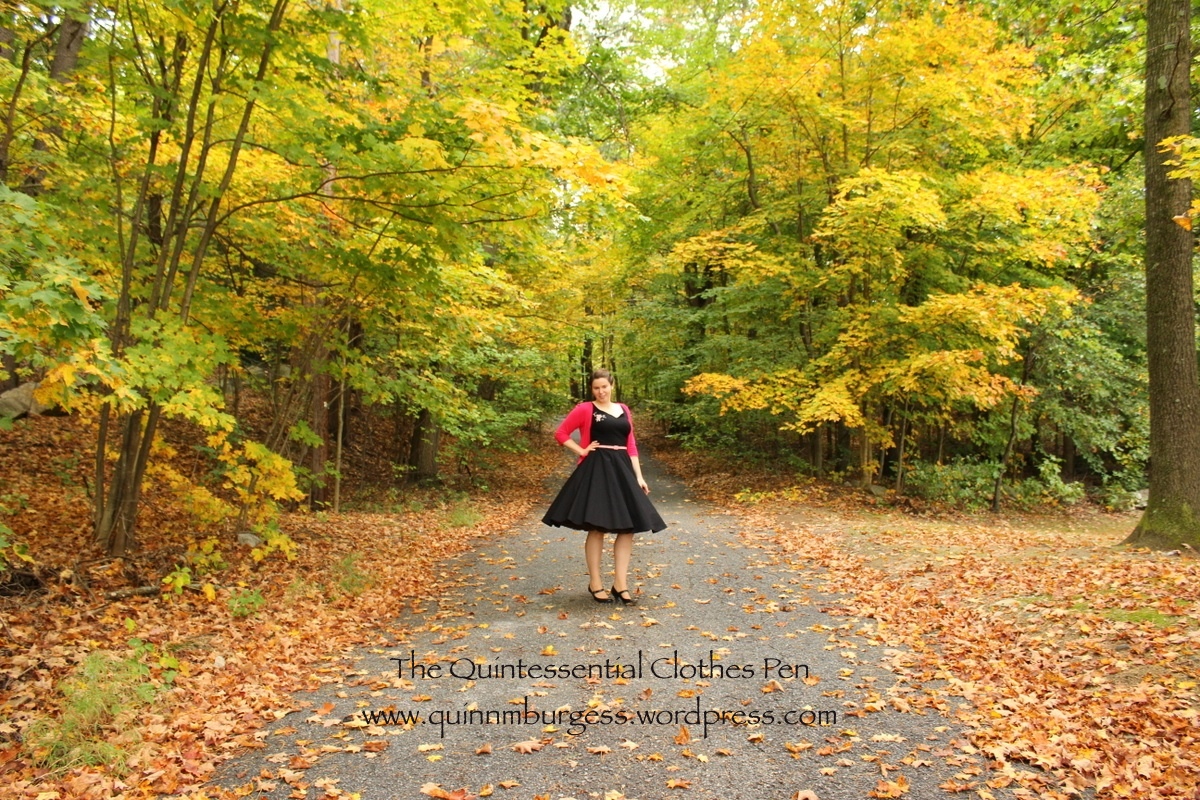
Autumn in New England!
IMG_5219
Striking a pose at the base of the road we stopped on.
IMG_5200
There’s a song that used to play on the Oldies radio station when I was young: “Secret Agent Man”–when I look at this picture I start singing that song in my head… “They’ve given you a number, and taken away your name… (instrumental: doo da doo da doo da doo da doo da doo…) Secret Agent Man!”
IMG_5225
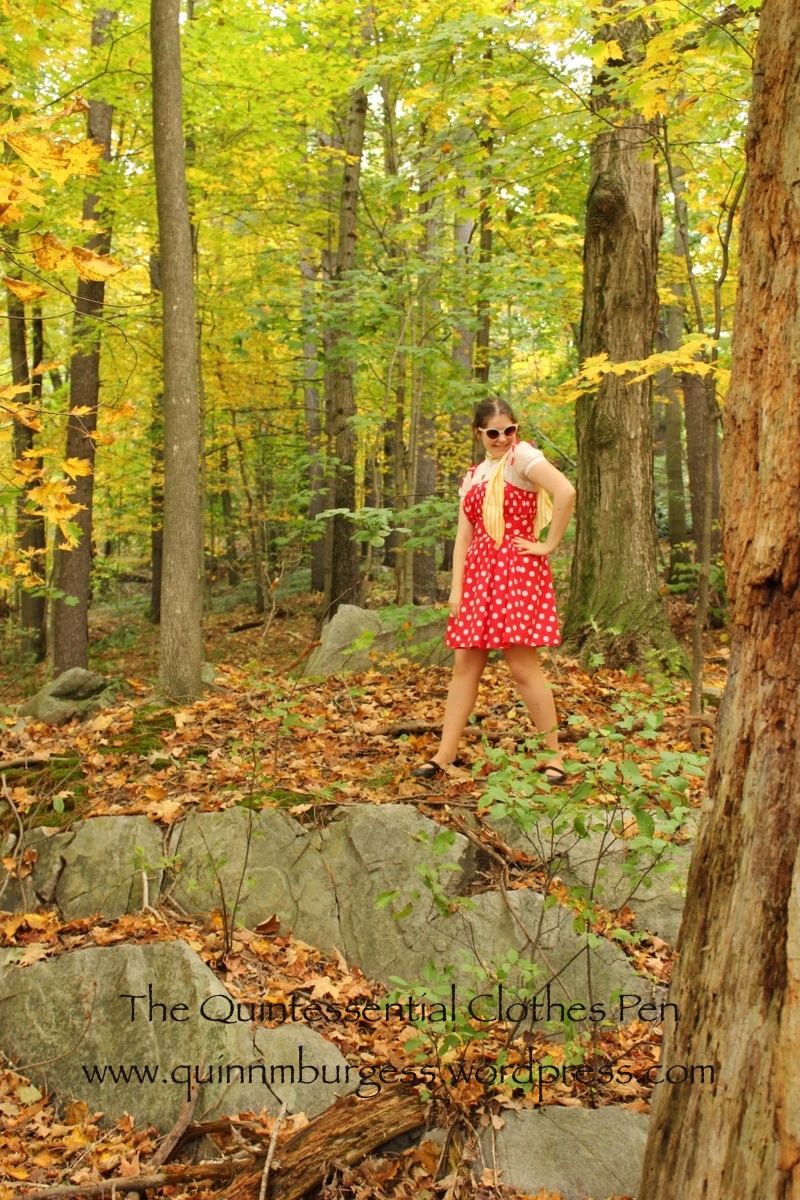
This looks like it’s straight out of the autumn edition of a clothing catalog.
IMG_5208
We were playing pass-around-my-petticoat so no one would feel left out.
IMG_5197
Petticoat!
IMG_5205
There were so many fun places to take photos!
IMG_5157
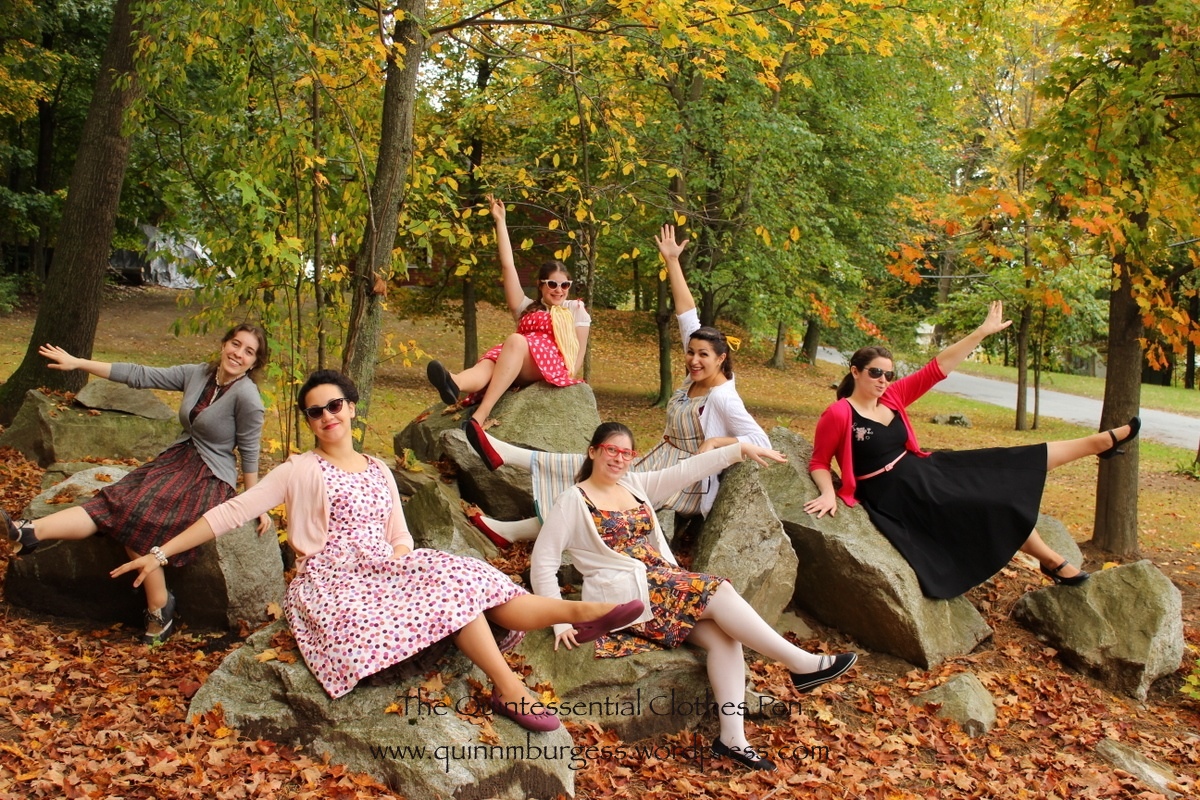
Group shot on the rocks.
IMG_5159
Serious faces. It has since been determined that if we were to start a hipster band named Queens of Rock, this would be the cover of our first album “Colors of Fall.” Of course, we’d be super obscure and you wouldn’t have heard of us…
IMG_5189
The colors are so complimentary! And the glasses are cute.
IMG_5198
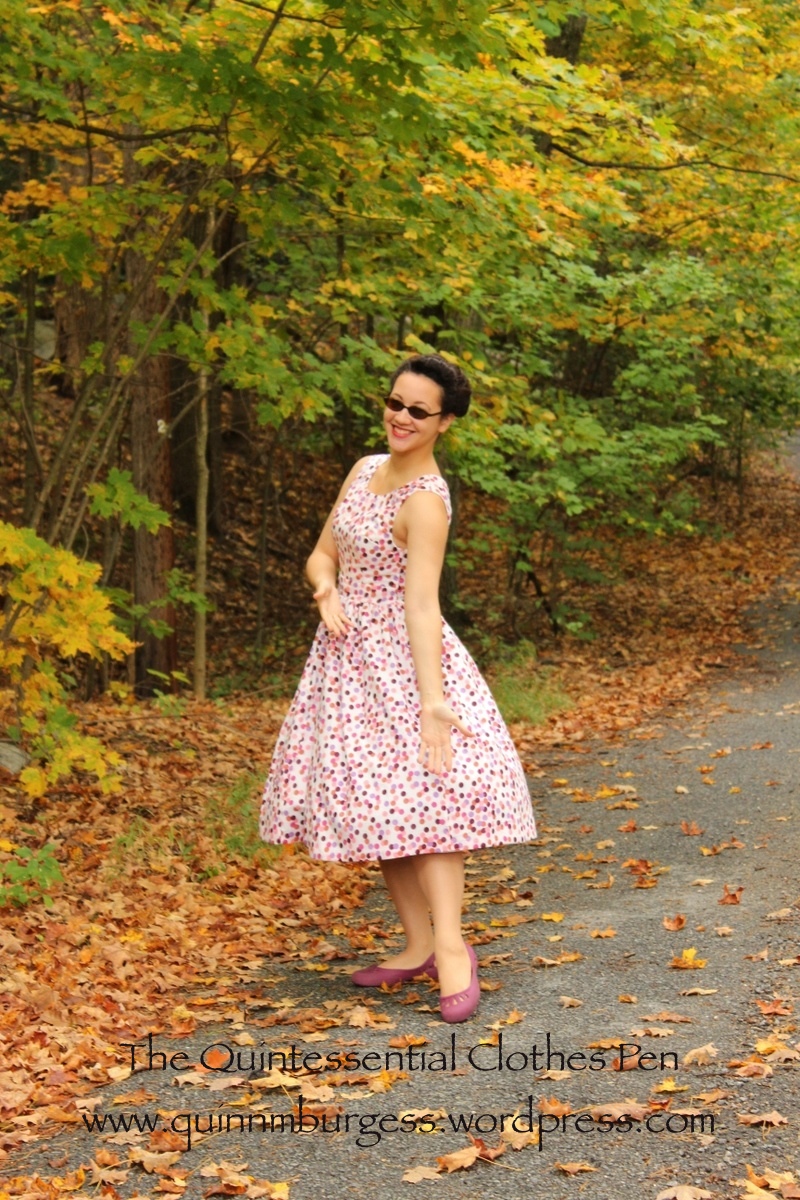
Showing off my more casual, modern footwear… purple crocs that match my dress!

So there you go. I hope you enjoyed all the leaves! Next stop is the roller rink…

1950s Adventures Part I: Dots At The Diner

Remember when I posted the details about my 1953 dot dress, I mentioned that I was waiting to participate in a grand adventure to get photos of the dress on me? It worked out recently that schedules were free on the same day, so we were able to have a 1950s adventure! We started out going for brunch at a 1950s themed diner, then stopped by the side of the road to take fall color pictures on our way to go to a thrift store (where I purchased a flip top picnic basket for $4!), followed by roller skating, and then we finished off the evening with a Regency ball. It was a long, awesome day. I was absolutely exhausted by the end of it.
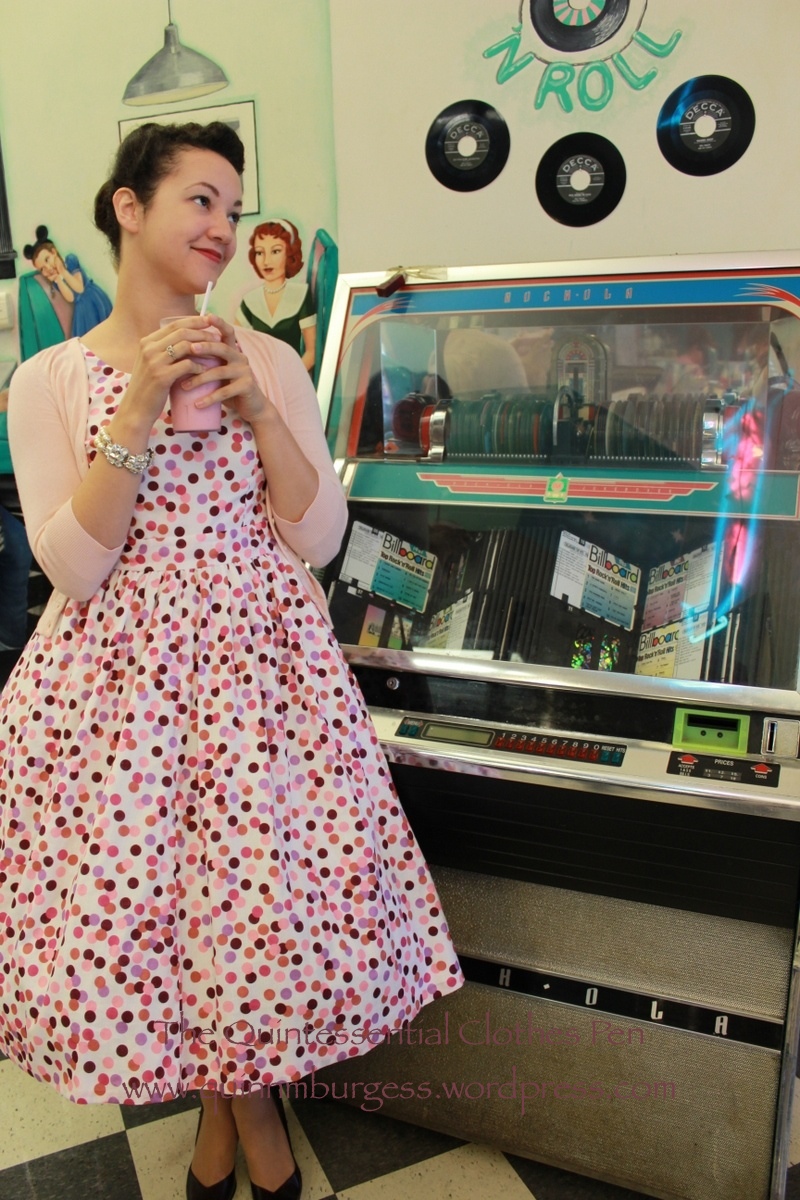
But I’ve got lots of fun pictures to share! Yay! I’m going to break up the 1950s pictures into three parts: photos at the diner, fall color photos, and photos of roller skating. There will be a separate post about the Regency ball (which includes pictures of my Refreshing Apron in action and my new tiara!).

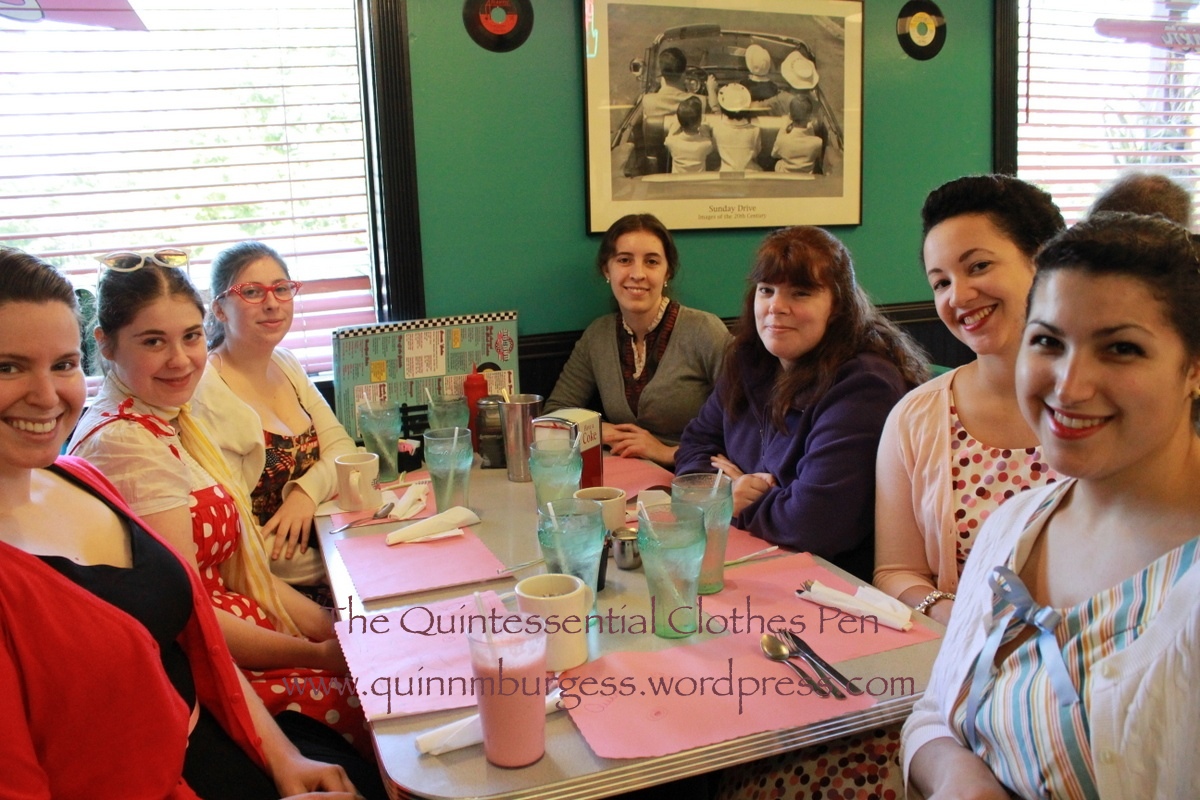
Our 1950s group at the diner. We had another patron take the group shot and she sort of cut off people's heads, but we're grateful for the photo nonetheless.
Our 1950s group at the diner. We had another patron take the group shot and she sort of cut off people’s heads, but we’re grateful for the photo nonetheless.
I rather loved the aqua and pink color scheme, which included the aqua/green coke water glasses.

I noticed crayons on another table the waitresses were clearing off and asked if we could have them… because you never really stop being a child! Though I have to say I was more easily inspired when I was a child. It was hard to come up with something to draw!

Crayons!
Crayons!
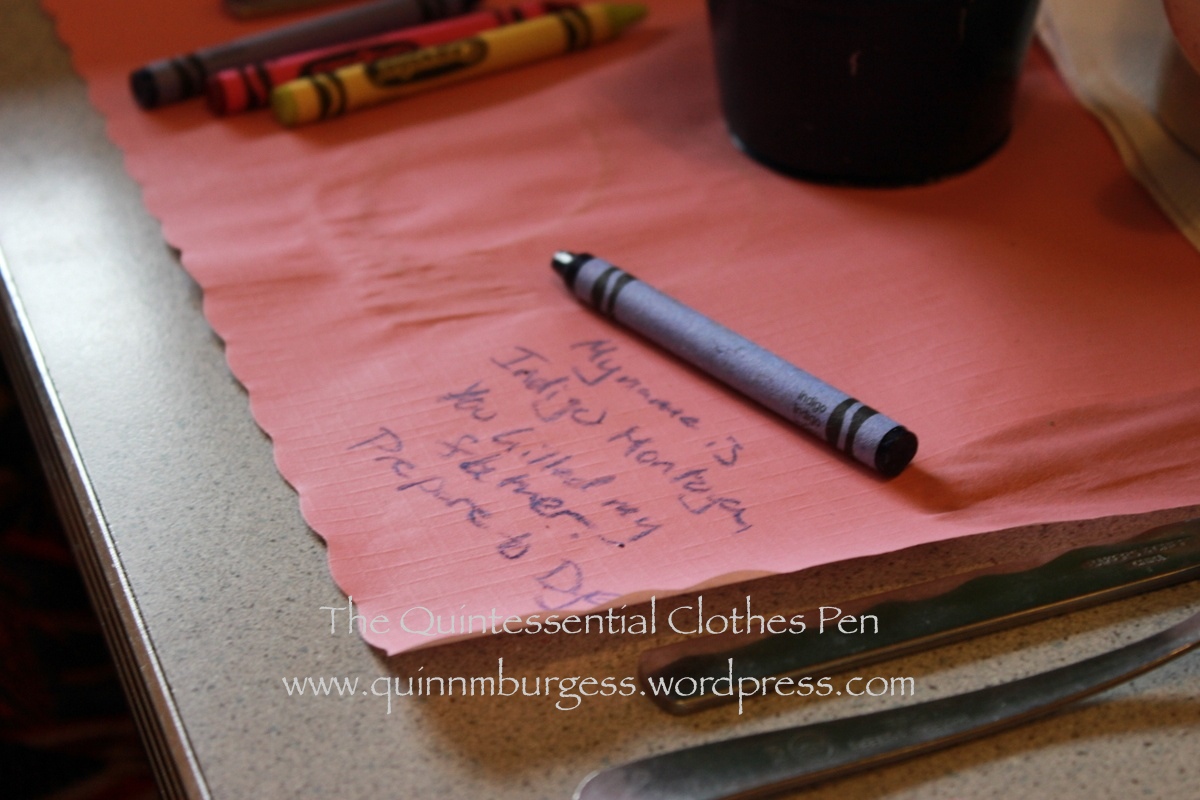
"My name is Indigo Montoya. You killed my father. Prepare to dye." The crayon color was Indigo, and the reference is from The Princess Bride.
“My name is Indigo Montoya. You killed my father. Prepare to dye.” The crayon color was Indigo, and the reference is from The Princess Bride.
Doodling away. We were competing to see who could draw a better record.
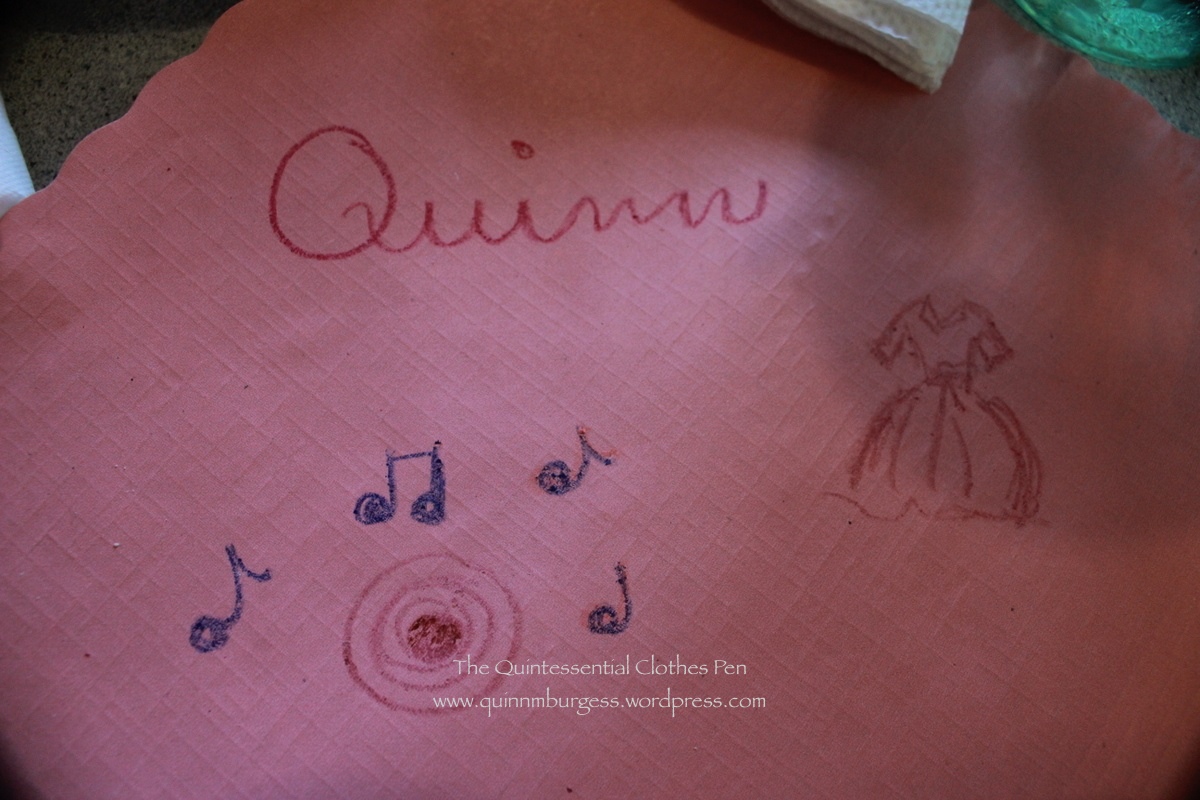
Here's mine. It's hard to draw a record with crayons! Do the music notes help?
Here’s mine. It’s hard to draw a record with crayons! Do the music notes help?
And here I am, drawing away. I really like this picture! (I'm not making a crazy face!)
And here I am, drawing away. I really like this picture! (I’m not making a crazy face!)

Now is as good a time as any to talk about my hair and accessories (especially since I’m about to subject you to a series of me-shots). I tried to do rolls with my hair. I think they were quite successful, though they did take a very long time. I had to dry my hair, straighten my hair, then curl my hair while adding hairspray and trying to contain the waves and the frizz… I aimed for an asymmetrical style but in some pictures it looks like I just have an odd halo of hair on one side of my head and not the other. I ran out of time and inspiration for the back, so my hair is just in a bun. It’s the first time I’ve attempted this sort of hair style, so I certainly don’t have lots of practice. Ah well, I like that I look very put together and made up–that just seems like a 50s way to be.

Unfortunately, the juke box isn't functional. But it's a great photo opportunity!
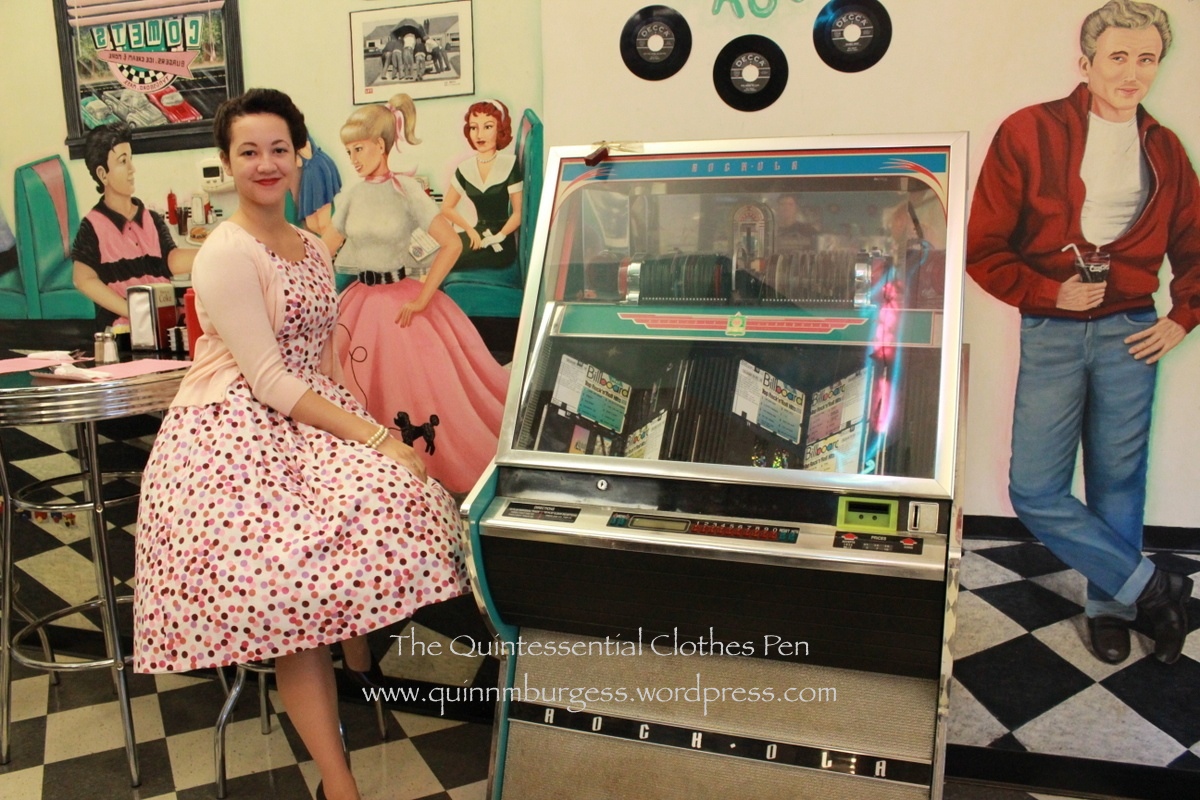
Unfortunately, the juke box isn’t functional. But it’s a great photo opportunity!

Oh right, and accessories! Well, I’ve got a modern sweater from Old Navy. I’ve got Nine West brown heels (a little tall for the 50s, but other than that they have a great shape). And I’ve got a faux pearl and jewel bracelet (another of the costume jewelry presents from my mom). Thanks mom!

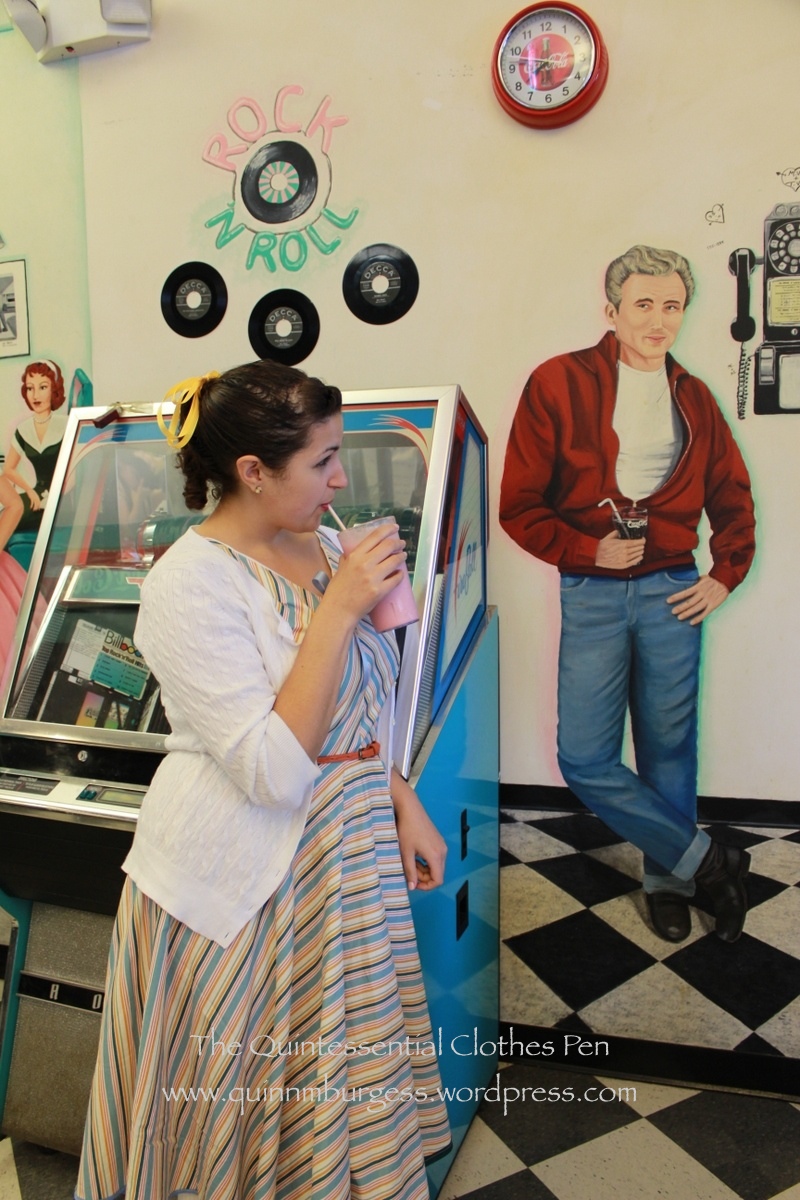
Posing with someone else's shake. But it's pink, so it had to be done. I'm pretty bad at posing. There are lots of pictures where I'm just making awkward faces...
Posing with someone else’s shake. But it’s pink, so it had to be done. I’m pretty bad at posing. There are lots of pictures where I’m just making awkward faces…
One of my favorite pictures! I love the painted people in the background, and that I'm not making a crazy face.
One of my favorite pictures! I love the painted people in the background, and that I’m not making a crazy face.
See? Half halo head. Anyway, I like this picture, too.
The actual owner of the pink shake also posed by the juke box. That guy on the wall is pretty funny.
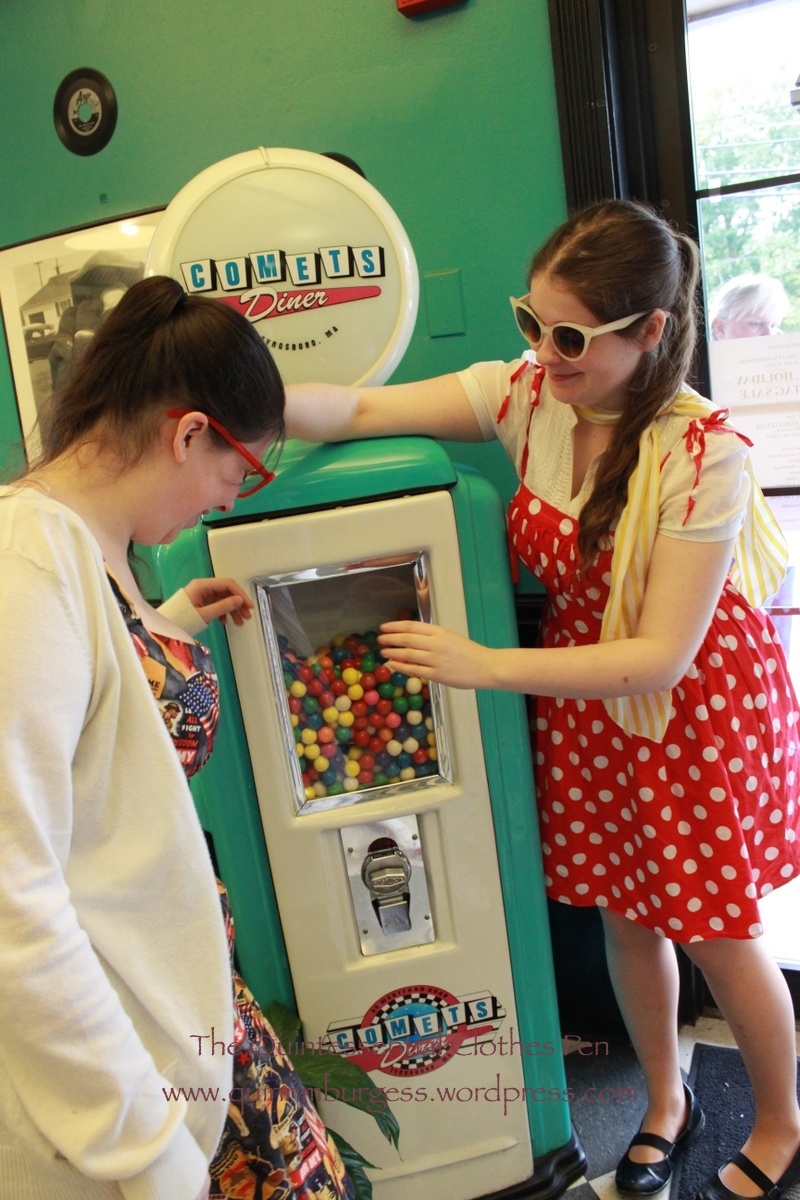
Gumball machine!
Gumball machine!

Finally, step outside and there’s a cute scarecrow waiting for you (at least during the month of October…)!

Shaking hands with Mr. Scarecrow.
Ditzy faces. Oh hey, my hair looks less dorky in these scarecrow pictures. It really depends on the angle!

See? So many smiles. Next stop will be the side of the road where we stopped to take fall color pictures…

Brushing Off My Knitting Needles

I’ve brushed off my knitting needles and am attempting to knit my first sweater! Not just any sweater, though, this sweater pattern is from 1917.

knisweofangpic1-1
“Knitted sweater of Angorina” from the Star Needlework Journal 1917.

This most recently started project has me going in a slightly different direction than in my previous knitting adventures. I taught myself how to knit in college (it was a popular thing lots of my friends and I did). I would often knit in class (and I had awesome professors who realized that I actually paid more attention while I was knitting because it kept my brain engaged during lectures and discussions). Mostly I knit scarves… so many, in fact, that I ran out of people to give them to. Then I started on afghans and pillows. I loved to figure out complicated patterns and cabling… But I never could figure out how to knit in the round (to make hats and such) and I never wanted to deal with sizing and non-rectangular patterns to create a sweater. I’ve since been taught how to knit in the round, though I haven’t tried it yet, but this is my first attempt at a sweater!

I decided to knit a sweater for an event I’m likely to attend in November for which we’ll be wearing WWI era clothes. That’s what sparked my interest in looking for knitting patterns from that period. I found the pattern I’m using through Ravelry, but in searching the internet for other patterns I came across other resources for period knitting that I’ve included at the end of this post. I also came across a pattern for a 1922 sweater that I’m hoping to try eventually (and assuming this one isn’t a complete failure!). It’s a more complicated pattern that uses two colors, so that will be new and exciting… some day.

I was further spurred on my knitting mission by coming across knitting needles and skeins of yarn for 50 cents in the bargain attic at our local fabric store. The yarn is a lovely cream color and super soft. I’m guessing it’s acrylic, but it had no label and I haven’t bothered burn testing it, so I’m not certain of the fiber content. I figured that for about $3 I could take a chance on knitting a sweater. If it works out I can always buy more expensive (or normally priced, haha) yarn later and make another sweater. Oh, and did I mention that the pattern I’m using is free??? Love that price!

Here’s my progress so far:

IMG_4893
The back of the sweater. I’ve still got about 6″ to go, but you can see that it’s starting to look like something!
IMG_4894
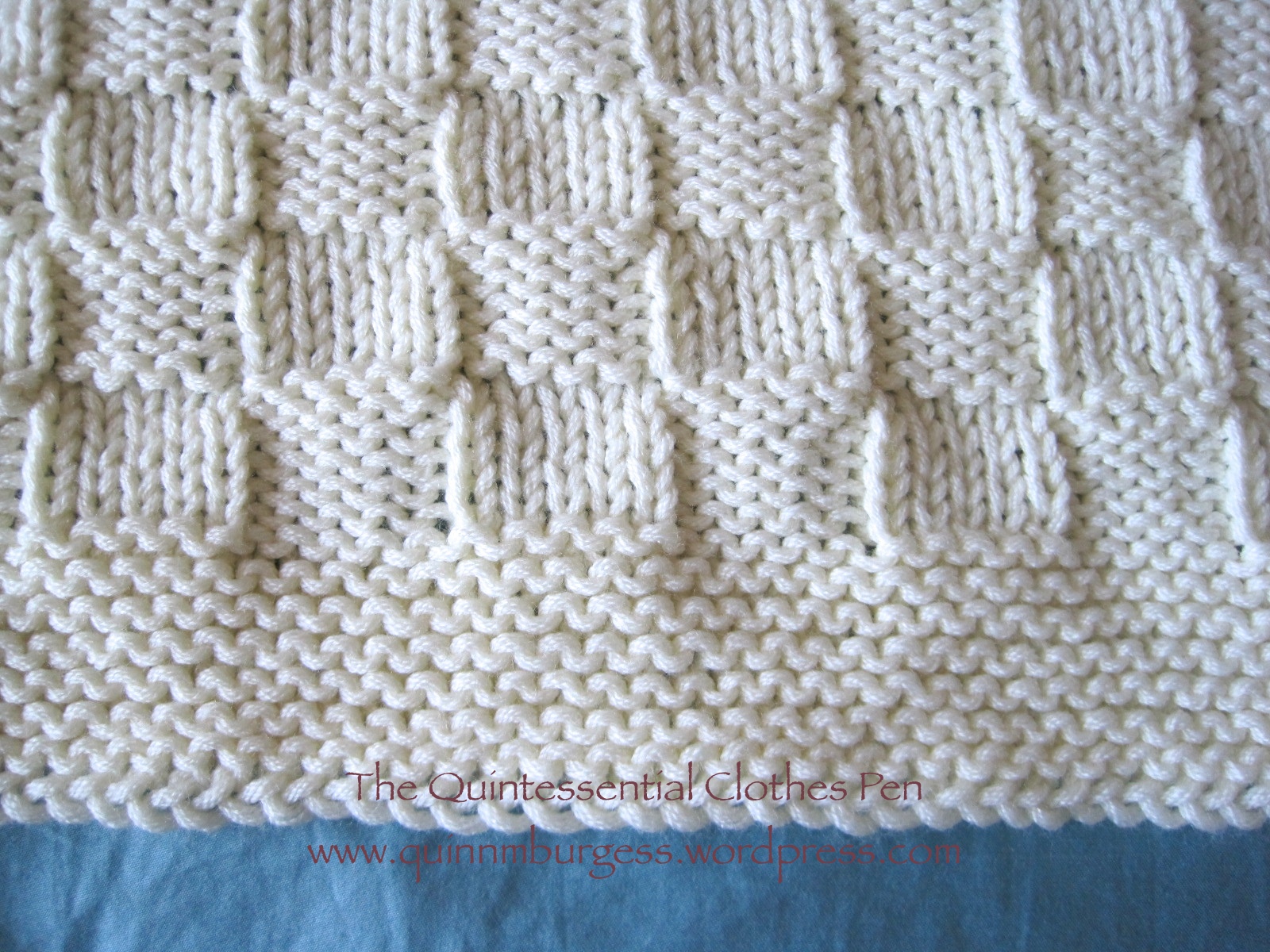
Here’s a close up of the basket weave pattern. It’s just knits and purls in sets of 5 stitches.

I’ve been  knitting rather than sewing for the last week or so and it has been a nice change, plus it’s really neat to see the sweater starting to turn into something. As I get further I’ll post more about my progress.

Here are some other early 20th century knitting pattern sources I came across:

http://www.historylink.org/index.cfm?DisplayPage=output.cfm&File_Id=5721 (a history of knitting related to WWI, specifically in Washington State: it’s quite interesting!)

http://blog.caseybrowndesigns.com/2010/10/vintage-knitting-resources/ (links to vintage knitting patterns from the 1900s-1950s)

http://freevintageknitting.com/women.html (vintage 20th century sweater patterns: looks like mostly 1930s-1960s patterns but they don’t have dates, just images)

http://www.hjsstudio.com/patterns.html (has a variety of patterns from WWI and WWII)

Oh hey, and wordpress just reminded me that this is my 200th post on this blog! That’s pretty exciting!

Cute Claremonts!

claremont-1930s-suede-oxford-brown-2
1930s Claremonts from American Duchess

Lauren of American Duchess just keeps rolling out lovely new shoe styles! This most recent one is super cute and tempting! There have been hints that black and maroon might be coming in the future so I’m going to hold out for those. Because how awesome would these be in maroon??? But don’t let me stop you from ordering the brown ones… they’re seriously tempting, right???

SaveSave

1953 Dot Dress

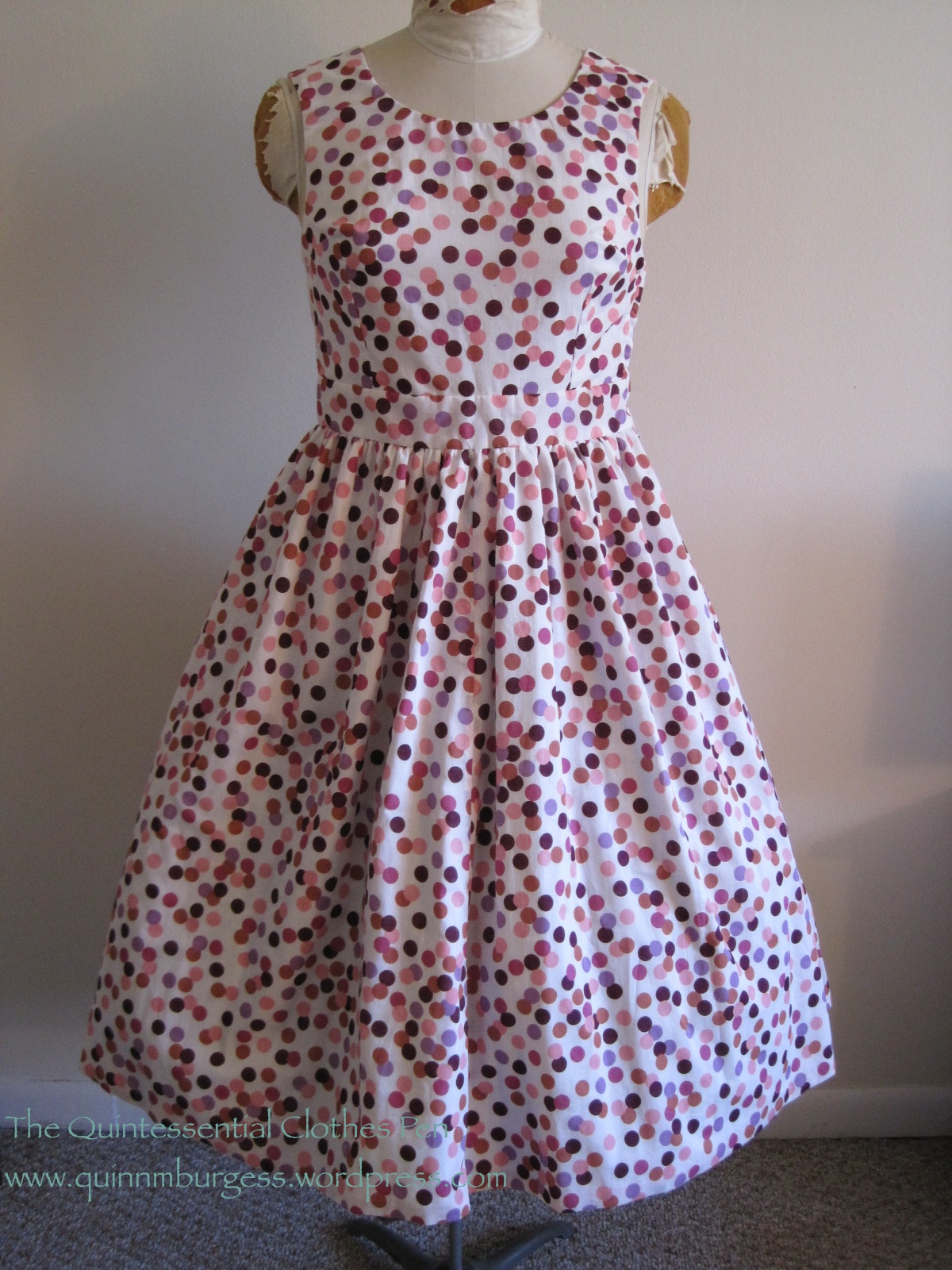
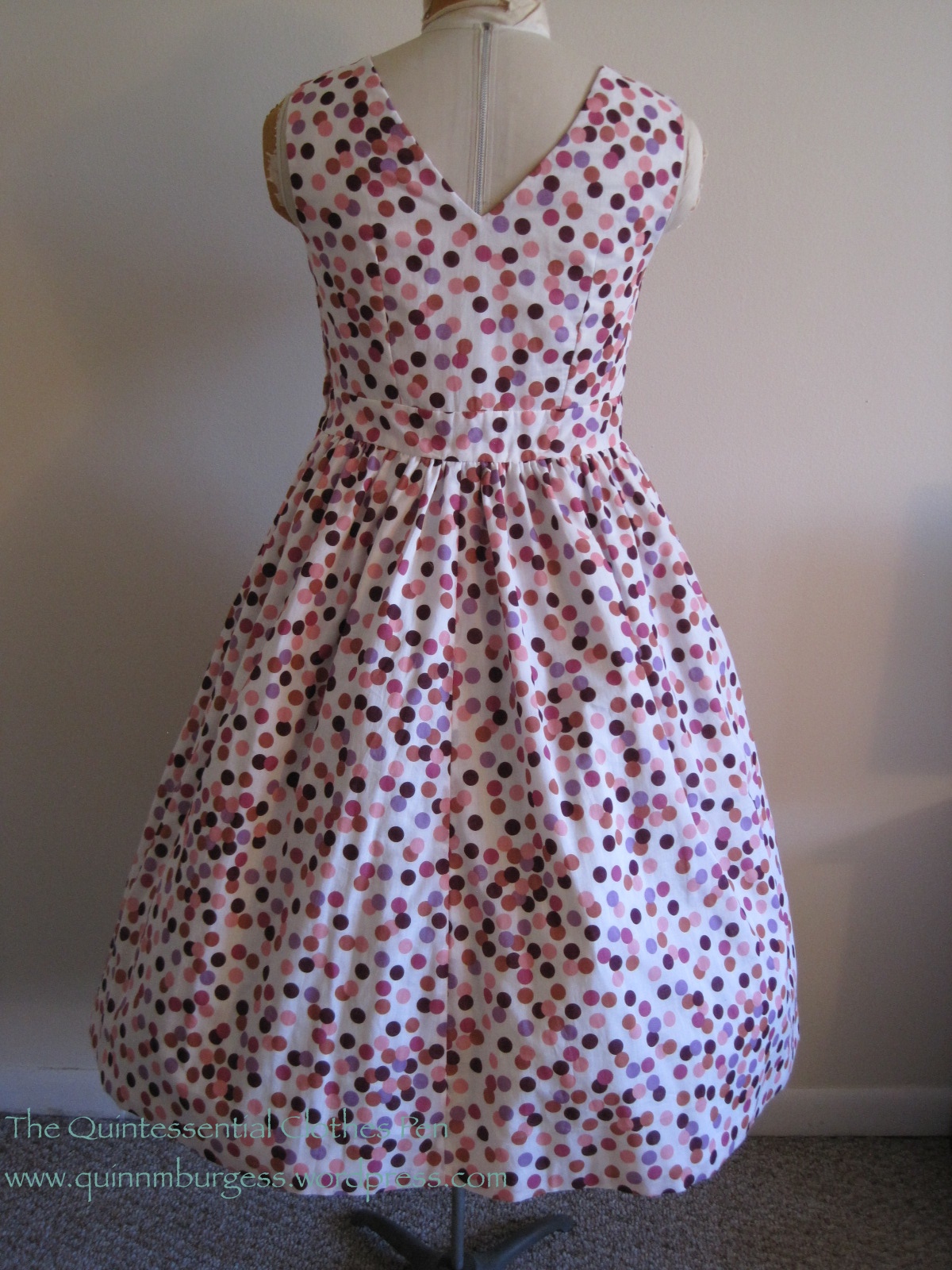
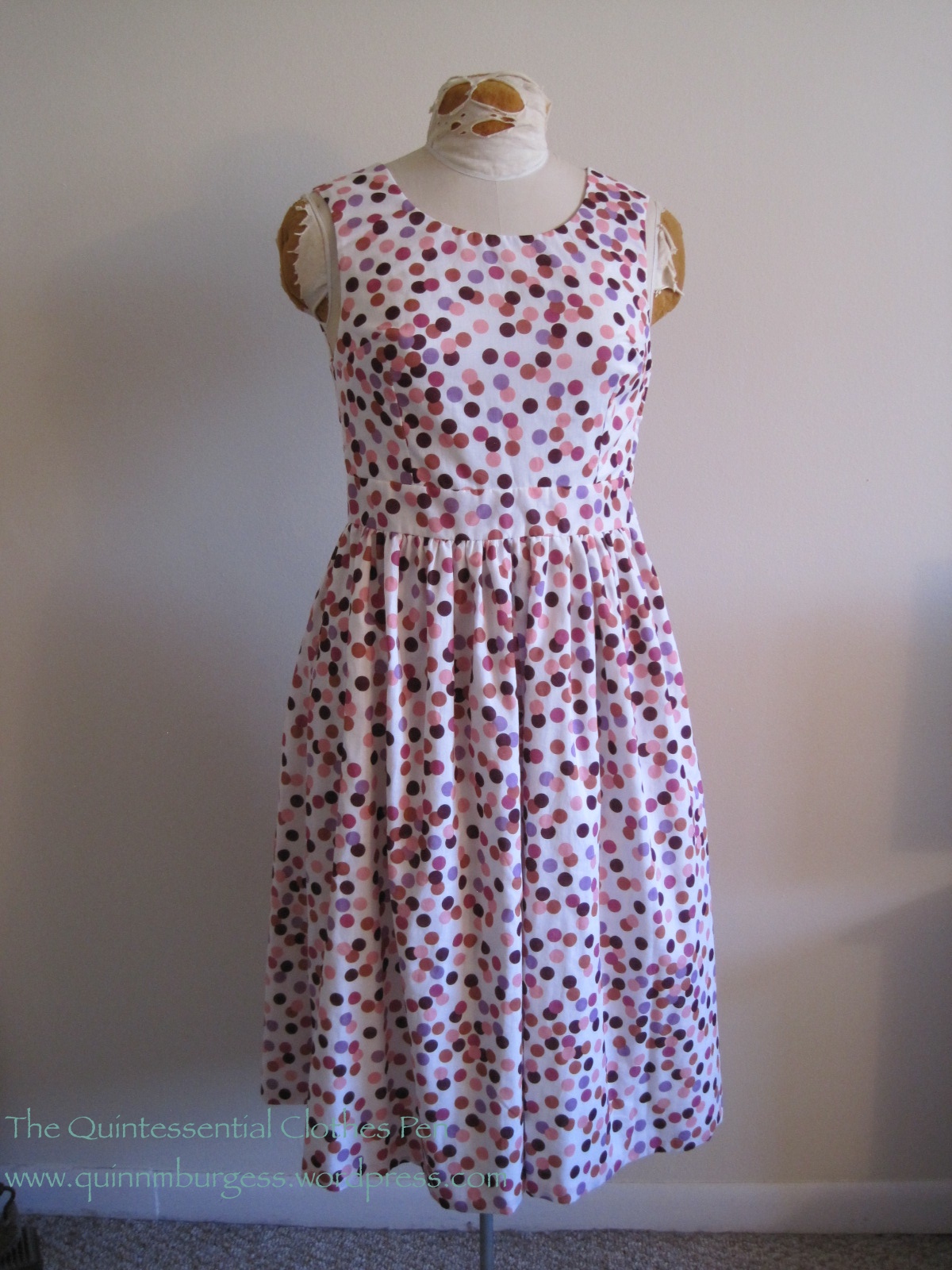
It’s been months since I bought the fabric for this dress (I actually had to look back to see when I purchased the fabric: it was February). I bought it rather on a whim, with the goal of expanding the number of patterned dresses in my historic wardrobe. Well, success! My 1953 dot dress is complete!

IMG_4829
Yay!
IMG_4830
And the back.

I think it looks more flattering on me than it does on Squishy, but the opportunity I’m hoping to use to wear it and take pictures has been postponed due to the busy lives of my friends. We’ve got a grand plan involving roller skating, a 50s diner, and ice cream. All of those things just scream for pictures!

But for now, the facts (a la the HSF, though unfortunately the cutoff for the HSF is 1937, so this doesn’t qualify!):

Fabric: The dress is constructed from about 3 yds of lightweight cotton lawn printed with dots and lined with some of my white striped $1 a yard cotton fabric. It’s a perfect pairing, because it creates opacity but keeps the lightweight feel of the lawn.

Pattern: The skirt pattern is from a Vogue pattern I bought at Vintage In Vogue last year. The bodice pattern is a simple darted bodice pattern I draped for myself with the neckline adjusted to be a scoop in front and a v in back.

Year: 1953.

Notions: 10-12 yds of pink Hug Snug; white, off white, and pink thread; and an off white plastic zipper (It was all I had that wasn’t dark since I don’t use zippers much for historic sewing…).

How historically accurate?: I give it 95%. Cotton is entirely reasonable for the 1950s. I’m not sure when Hug Snug was first marketed, but the design on the spools certainly looks vintage (and rayon had been in use for at least 20 years by the 1950s). If they didn’t have Hug Snug, they probably had something similar. The pattern was printed in the 1950s and a basic darted bodice is seen on many 1950s dresses and patterns. The sewing machine was in widespread use by the 1950s. The only thing is that my plastic zipper is probably a bit modern (in the 1950s zippers were still metal, I believe).

Hours to complete: 30: lots of interior finishing by machine and hand .

First worn: By Squishy for pictures.

Total cost: My entire 50 yd roll of Hug Snug was only 50 cents, the fabric was about $15, and the zipper was probably about $2… Total: about $17.

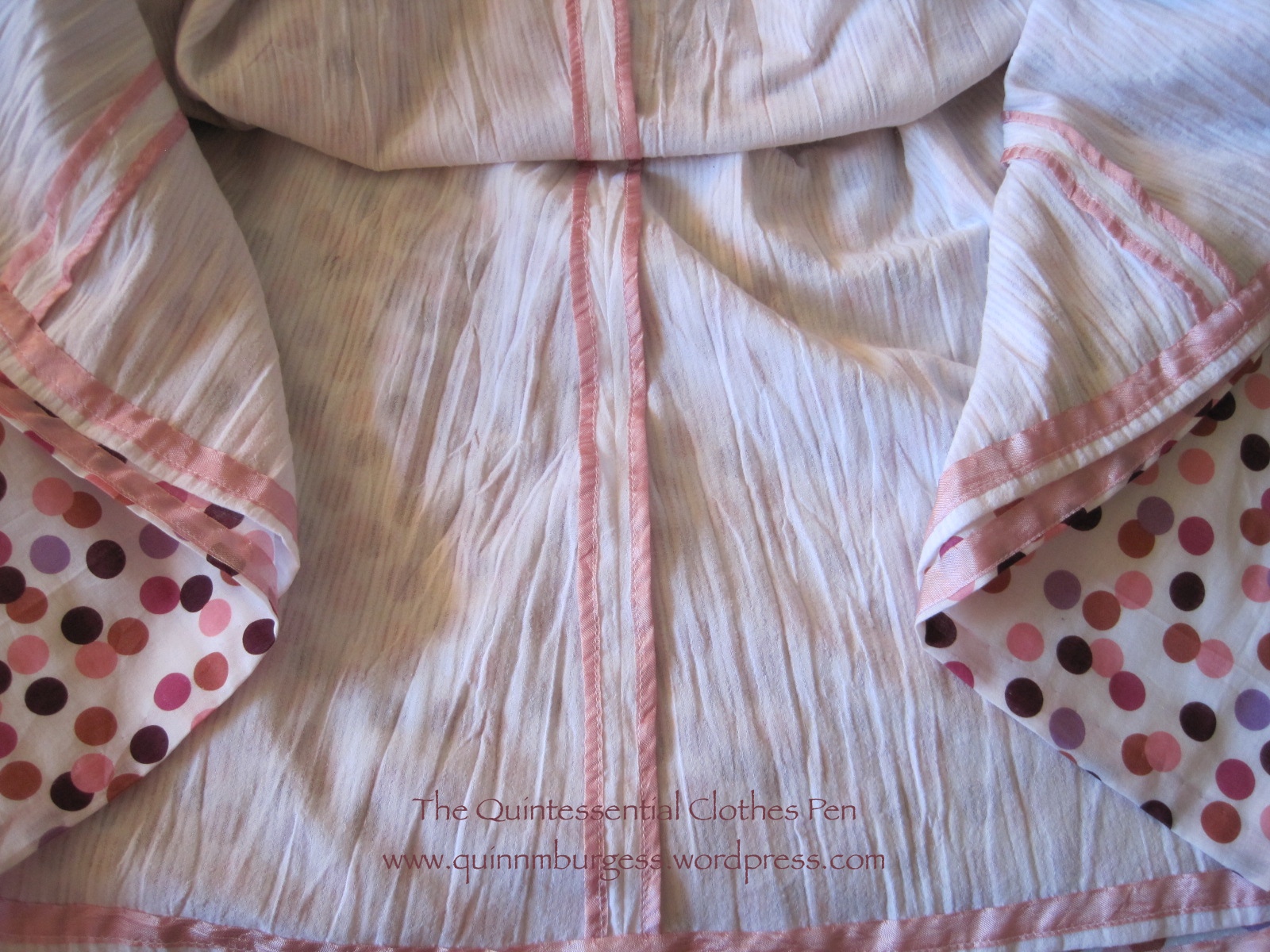
Now, you know that I love paying attention to details. I had a lot of fun spending time on the interior details of this dress. Unfortunately, they won’t be visible, but I know that this dress is as cute inside as it is outside, and now you will, too!

IMG_4831 (1)
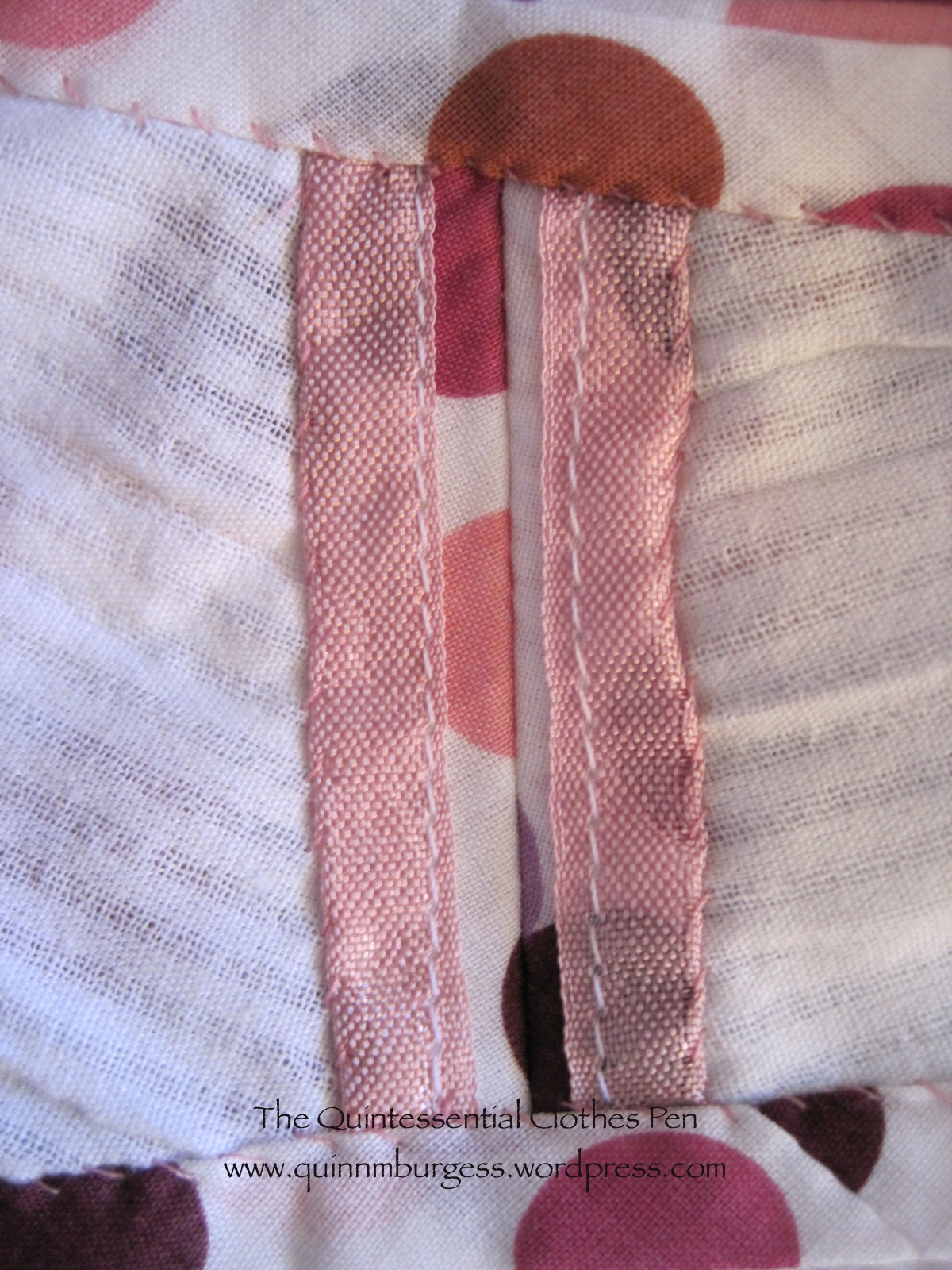
The hems flipped up to see the interior finishing. Both hems are finished with Hug Snug and I also used Hug Snug to bind the seam allowances of the white lining. The seam allowances of the dot fabric are turned and zig zagged (the Hug Snug showed through to the exterior too much when I did a sample using Hug Snug on the dot). The first side of the Hug Snug is machine stitched to the hem and the second side is hand sewn with only tiny prick stitches that go through to the outside fabric so it’s almost invisible.
IMG_4835
More of the inside of the skirt. It’s like candy, with all the pink Hug Snug seam binding on the white fabric! I love it!
IMG_4837 (1)
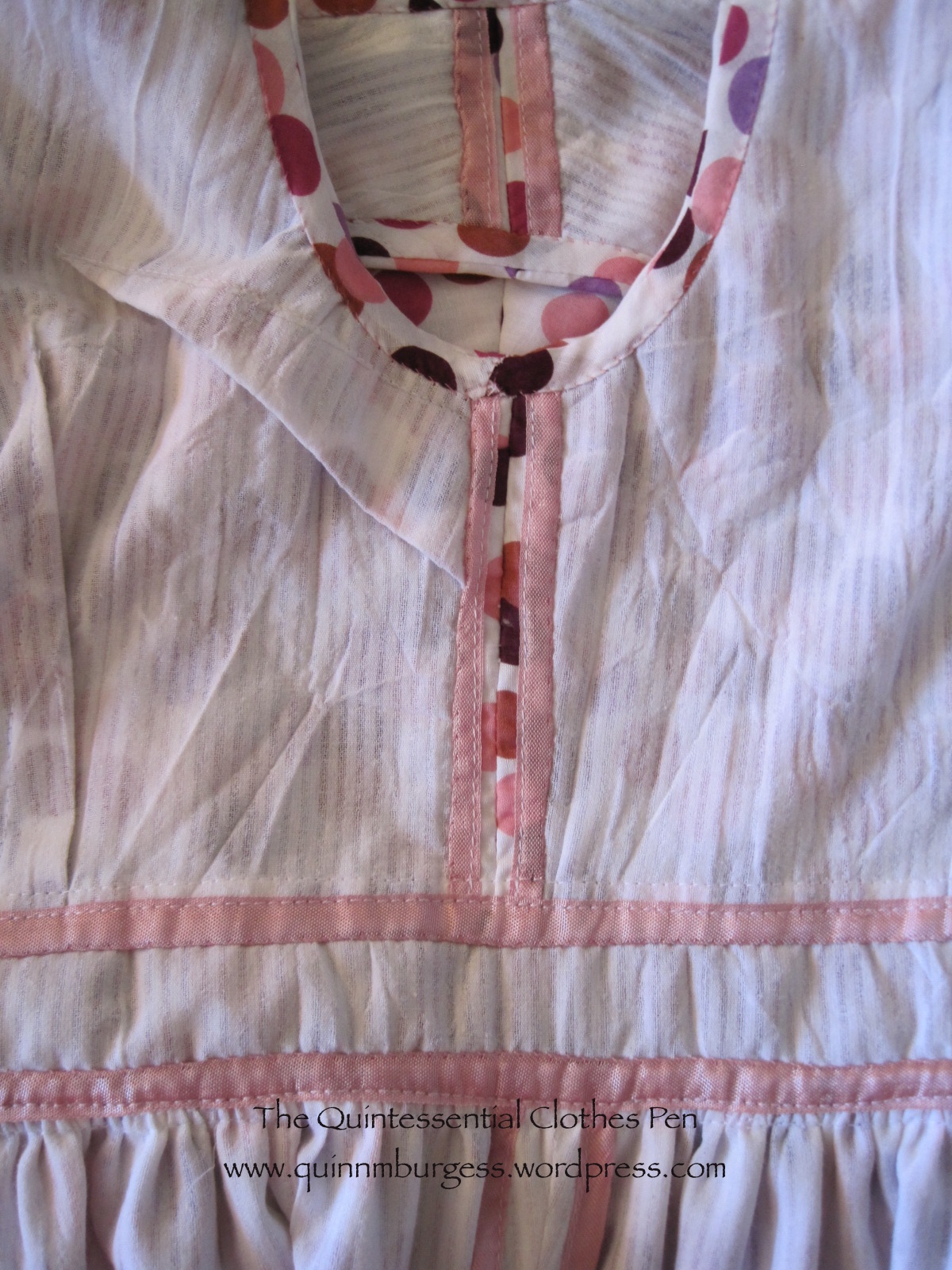
Here’s the side seam of the bodice that doesn’t have the zipper. On the bodice the dot and the white stripe fabric are treated as one, unlike on the skirt. All of the seams are bound with Hug Snug. The armhole (at the top of the photo) and the neckline are bound with self fabric bias strips.
IMG_4840
Here’s a close up of the shoulder seam showing the Hug Snug and the self fabric bias. All of the bodice seam and edge bindings are stitched down to the white stripe lining by hand using whip stitches.
IMG_4827
Here’s what it looks like without skirt support.

I might even like the inside more than the outside… I’m really looking forward to wearing this at some point! I was even thinking that perhaps I could wear it in my modern life without a crinoline petticoat under it, but I think the skirt is a little too long and the waist is a little too high. If I had more of an every day vintage style I might be able to pull it off, or if I was getting dressed up, but for normal days, unfortunately, I don’t think I’ll be wearing it around my everyday life. All the more reason my friends need to clear their calendars!!!

More 20s! (Prohibition Ball 2013)

Only one week after I attended the 1920s Lawn Party, I was immersed in the 1920s again, this time at a Prohibition Ball in Chelmsford, MA. I would guess the attendance at maybe 40-50 people total, though I’m not sure we were ever all in the ballroom at the same time. It was a nice, social group of people and I saw everyone meeting and greeting new people, dancing with a variety of people, and generally being social and having a good time with everyone around. It was also nice to see some of the new people we had met at the 1920s Lawn Party at the ball. The venue, the Chelmsford Center for the Arts, was a lovely place I’d never seen before.
IMG_4196
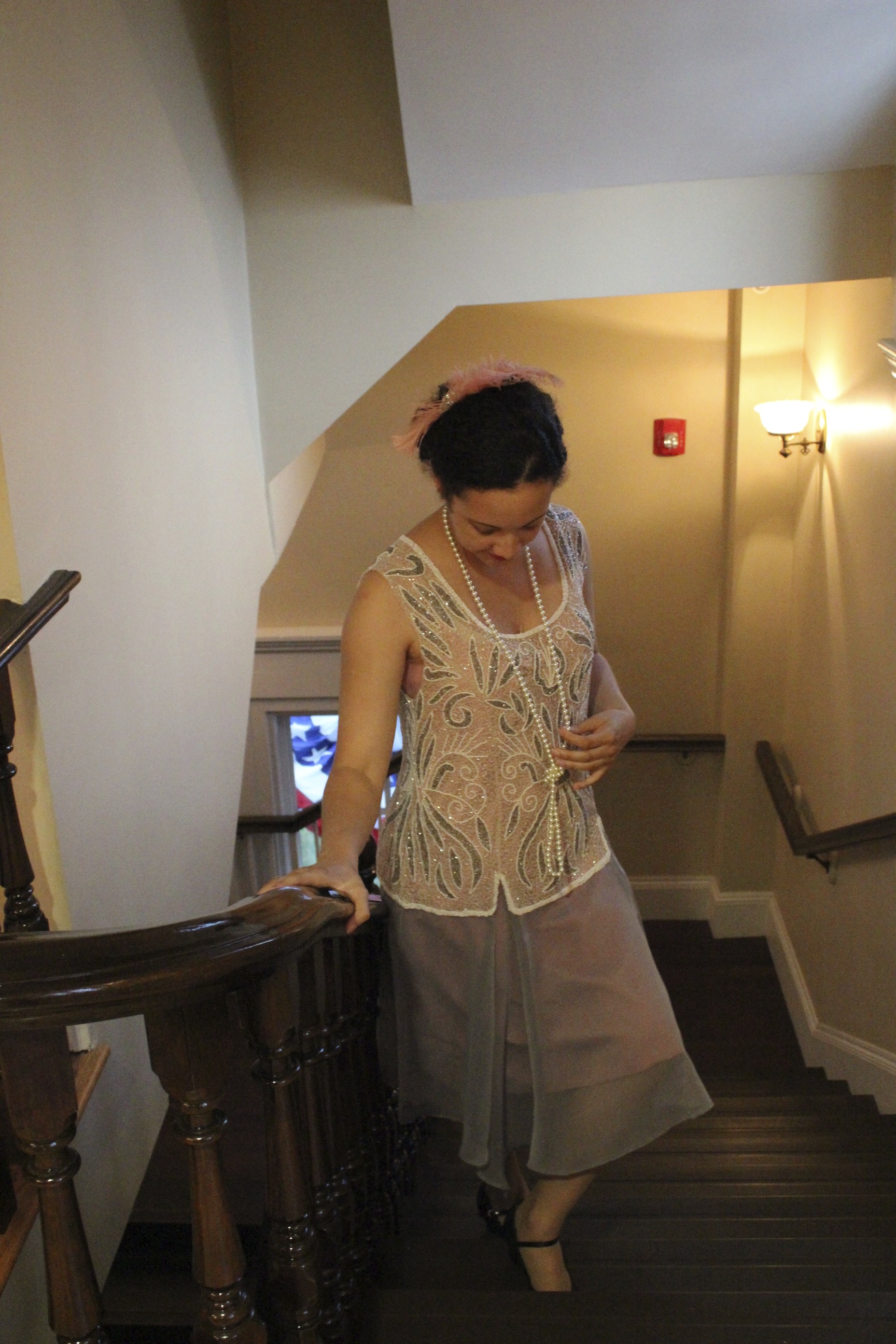
I wore my 1925 beaded dress and accessorized with a long string of pearls and jeweled/feather hair decoration.

I tried a new style with my hair! I did my now usual 20s thing, where I gel the front sections and use a fine tooth comb to create waves in front while my hair is wet. Then I secure it to my head and let it dry. Usually, I’ve taken the back and put it in a tight bun at the base of my head (like when I’ve worn my not-quite-sailor dress). The idea in doing that is that it makes my hair close to my head and  thus, maybe, more bob-like (I know, I’m kidding myself, it does not actually look like a bob!). This time however, I did something totally different with the back. It seems counter-intuitive, so be prepared… I took my curly hair, and curled it with a curling iron. Yup. Actually, the curling iron eliminates all my usual frizz (that alone is amazing!), but it also creates nice, even, wide curls. I was in a super hurry to get my hair done, so I just did some rather messy curling iron curls then pinned them up in a mass at the back and added my jeweled/feather clip. I love the defined curly mass (different than my normal frizzy, curly mass)! I’m excited to try out curling ironed styles for other events, too!

IMG_4164-001
Defined curls coiffure surmounted by feathers and jewels.

The other cool thing about the feather/jeweled clip is that from the front I have a small halo of feathers showing. I like that it is visible from the front and packs a big punch in the back! Success!

IMG_4199-001
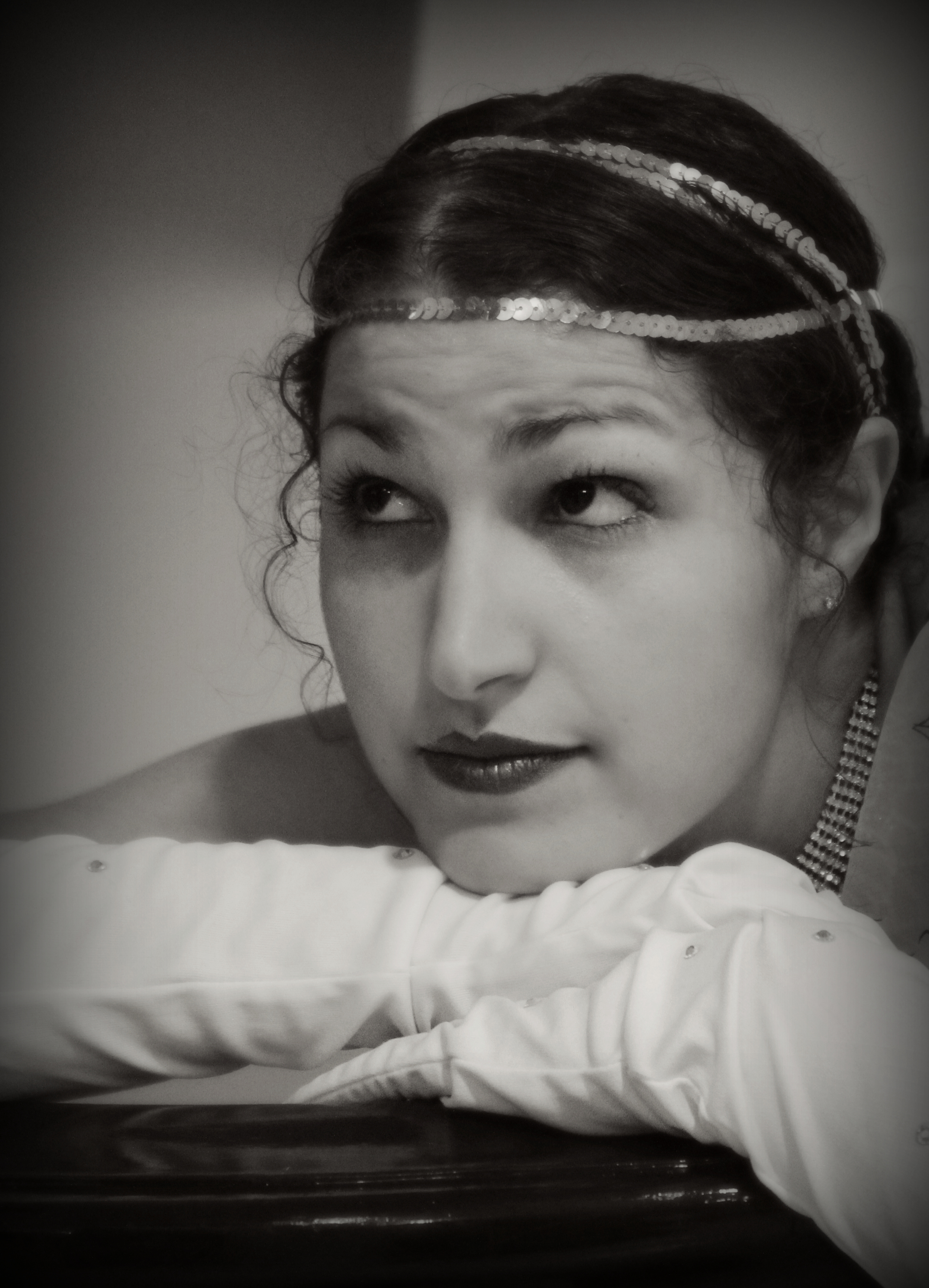
Glamour shot! I often make really silly 20s faces, but I think this one works! I love the defined eyelashes, the red lips, the feathers, the pearls…
IMG_4202 close-001
More glamour! I’d call this a more sultry shot than mine, which is more playful. It’s got those same fun elements, though, eyelashes, lips, sequins, jewels…

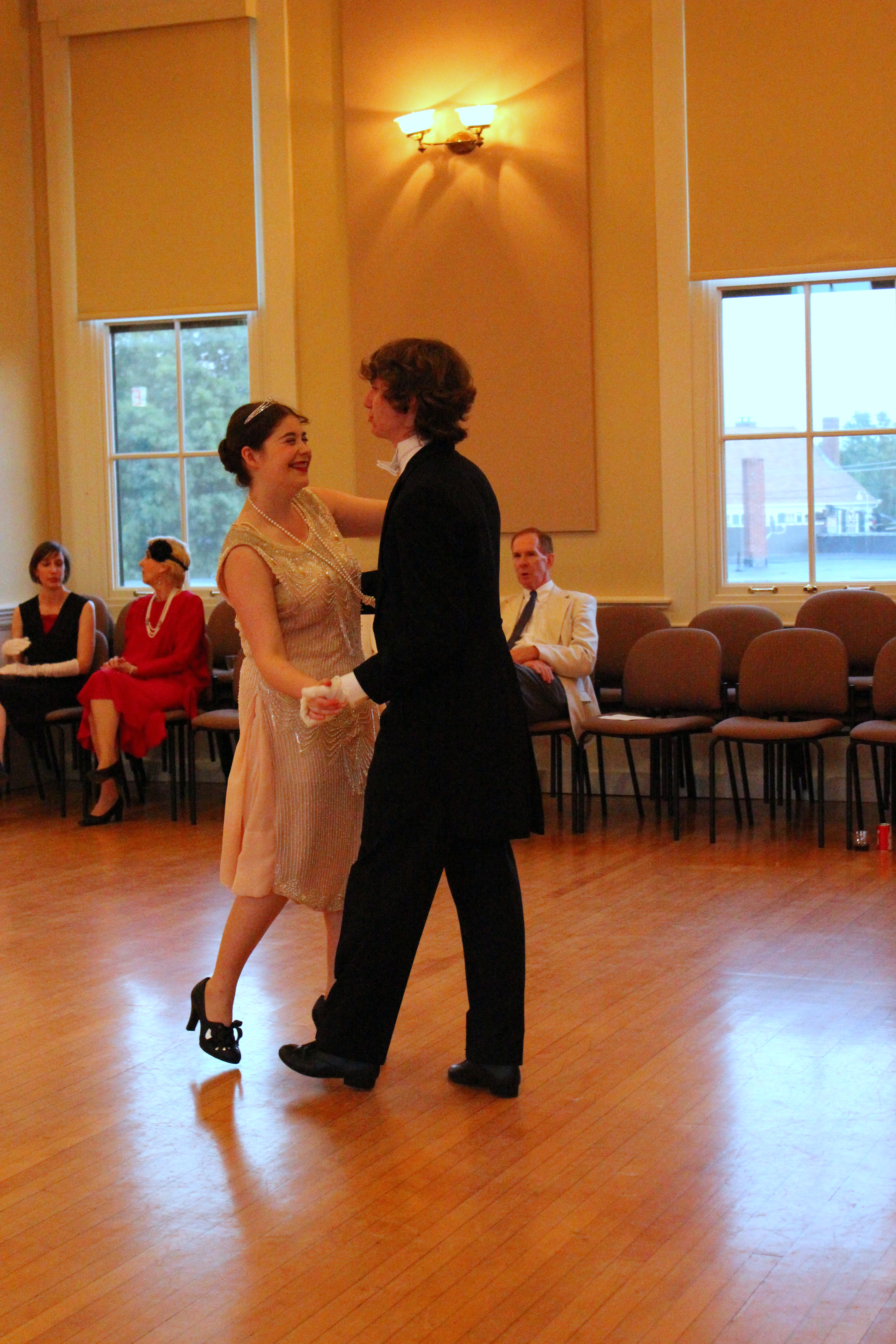
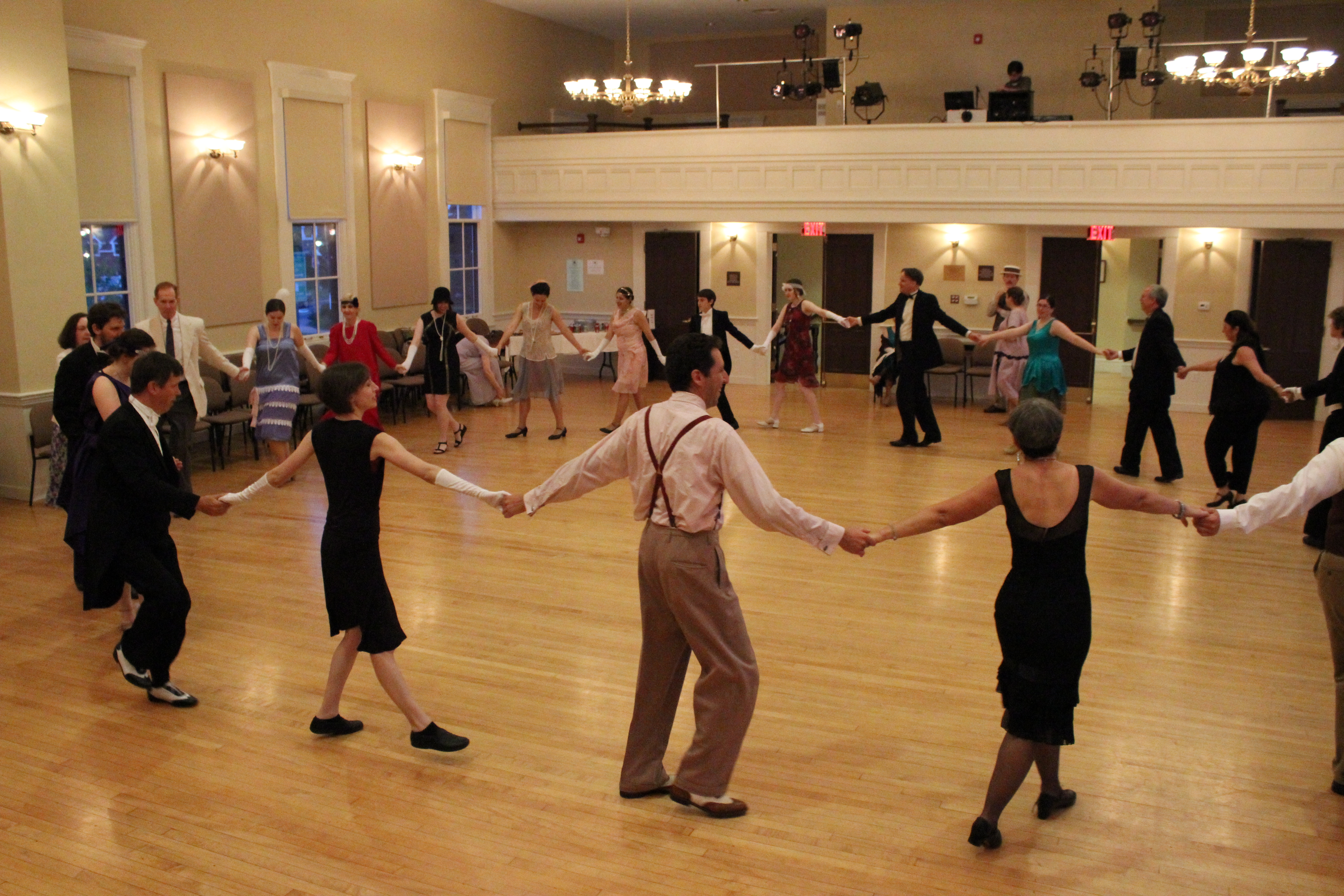
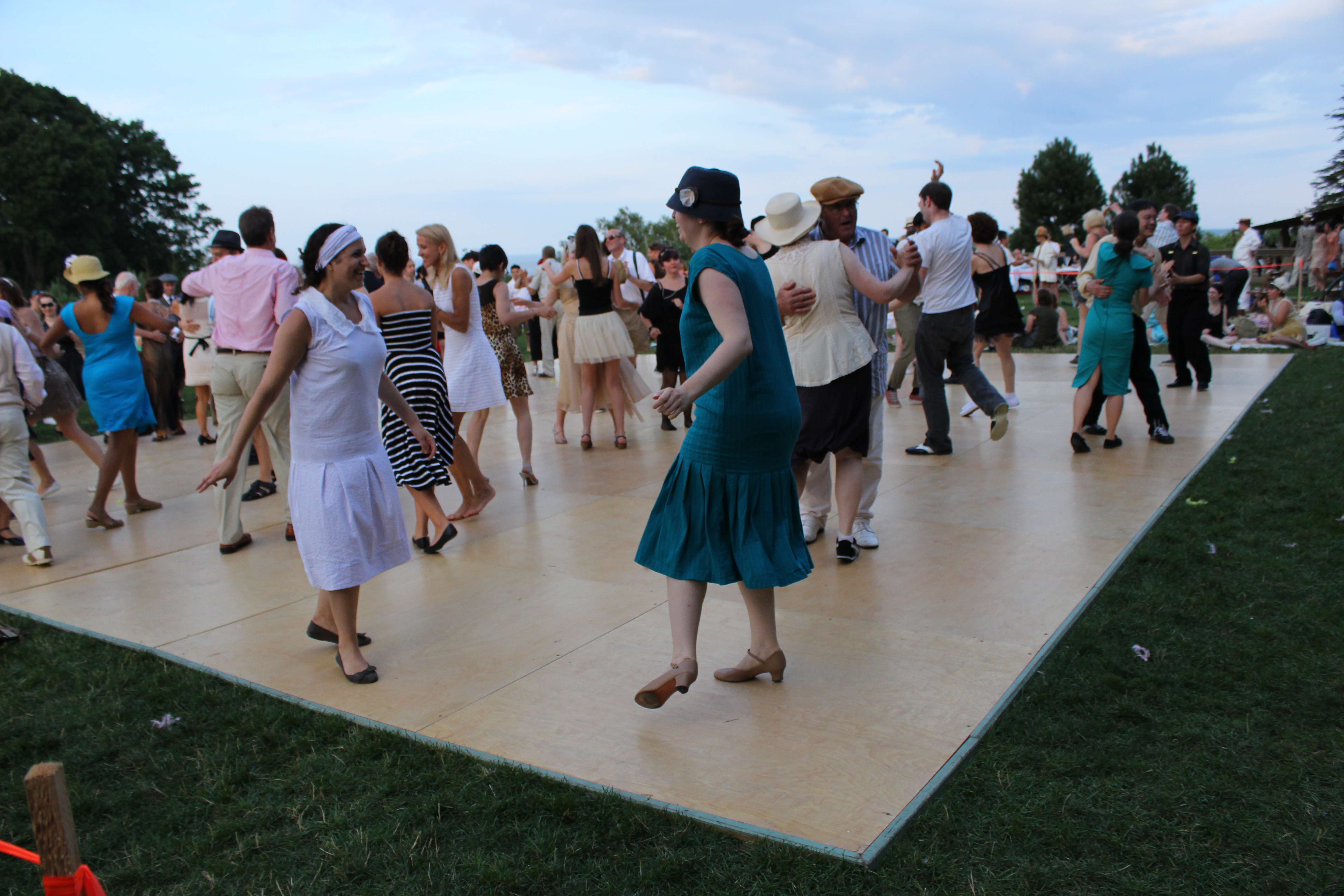
I did mention that this was all for a ball, right? And the ball did include dancing! In addition to normal couple dancing, and large group Charelstons (you can dance the Charleston in a circle like you used to dance in high school!), there were also a lot of mixer-type dances, where participants changed partners, or danced with unknown partners…

IMG_4178
Attendees chatting with each other and looking great.
IMG_4150
Dancing… A foxtrot or one step, perhaps?
IMG_4204
Dancing!
IMG_4207
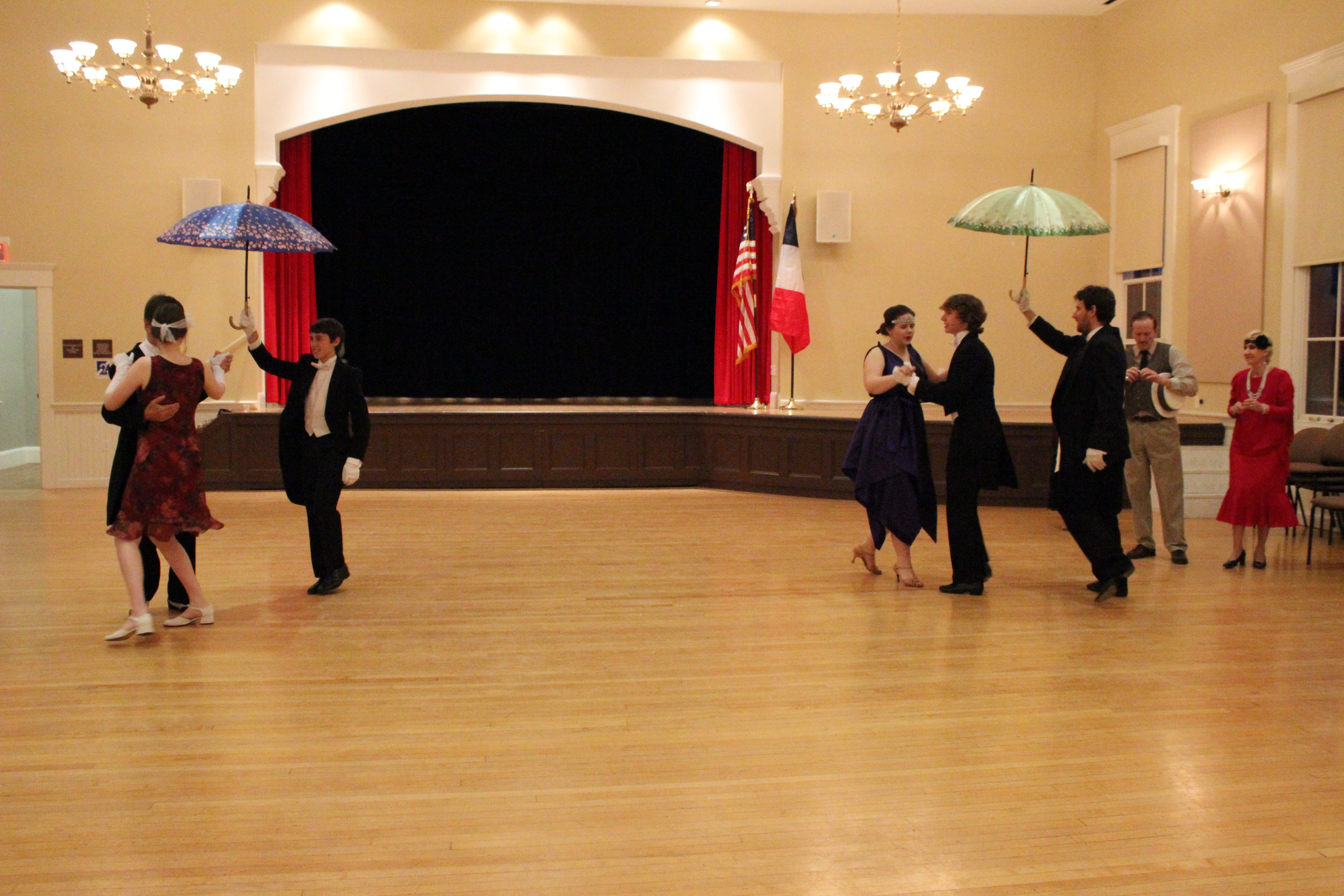
One of the mixers with a name like “Paul Jones” or something similar.
IMG_4276
The dancing couples trying to escape the gentlemen with umbrellas.
IMG_4320
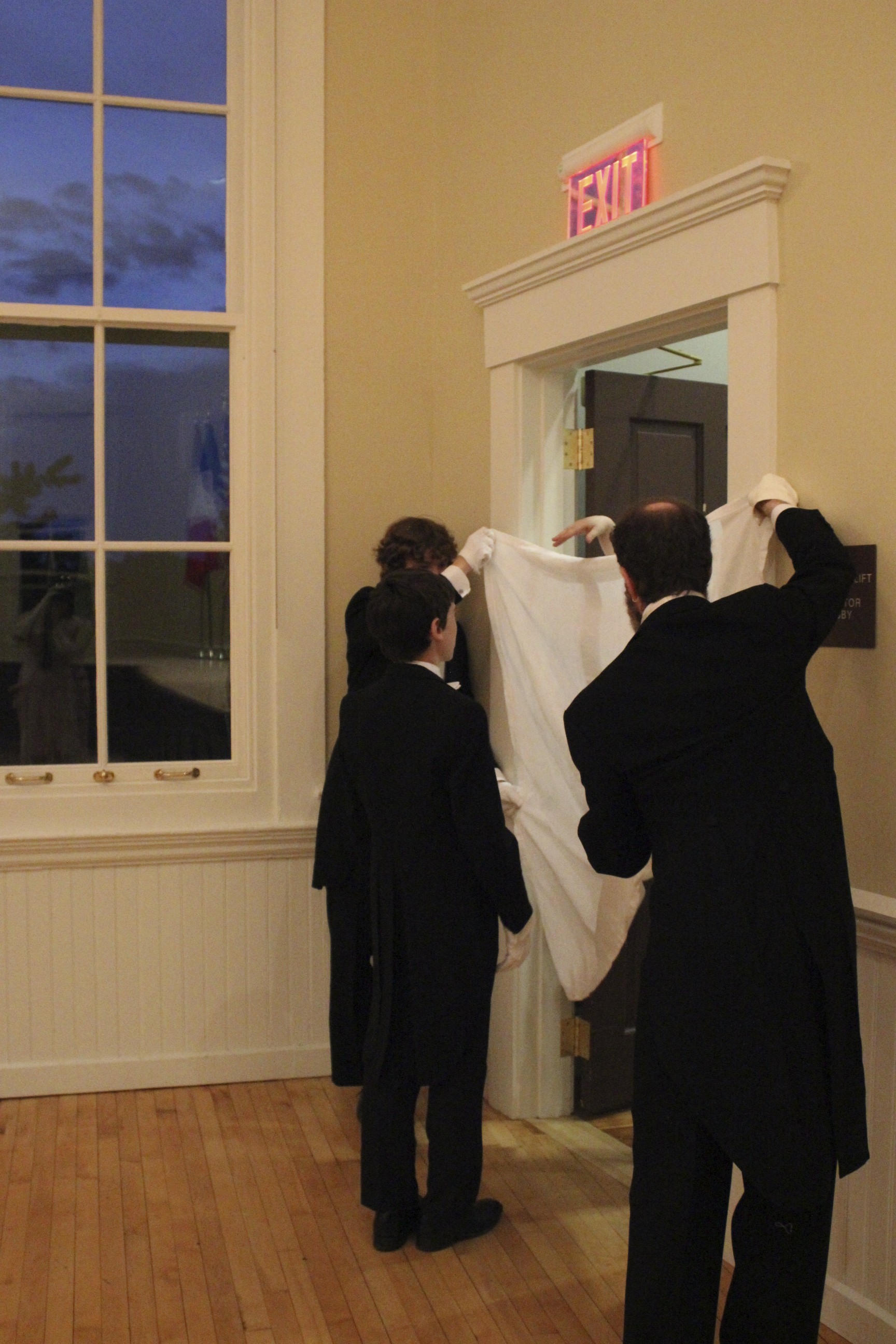
Another mixer. See the hand over the sheet? Neither gentleman nor lady knows who his or her partner will be.
IMG_4321
Surprise!

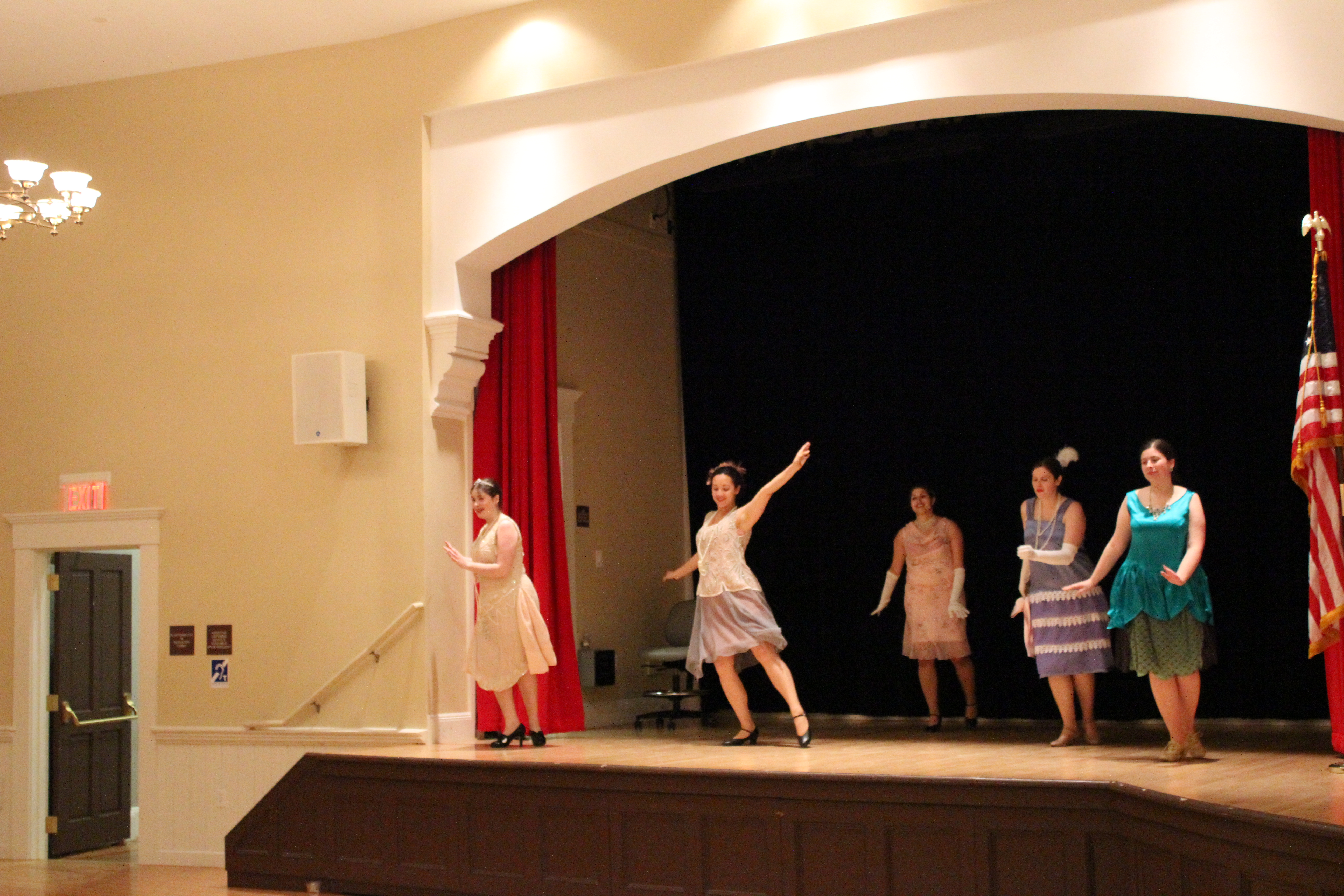
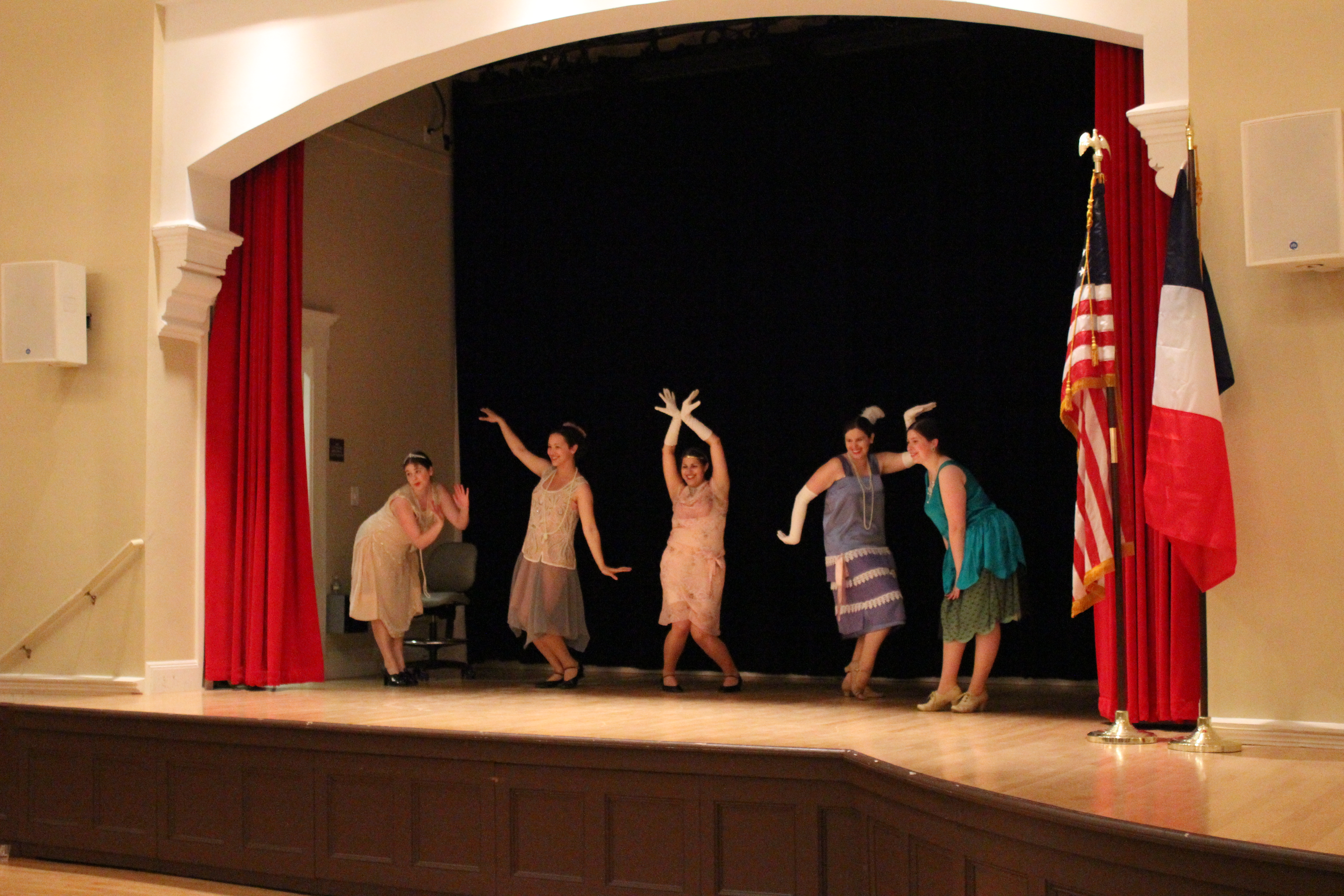
There was also a slightly unplanned performance of our five lady Charleston (the same one we performed at the Great Gatsby in May). People really enjoyed it, and it’s always a pleasure to dance a Charleston to the song Egyptian Ella. The Great Gatsby performance post includes a video you can listen to that has the song we performed to, if you’re curious. It’s a fun song!

IMG_4378
We sort of look like penguins in this shot… At least we’re on the same feet!
IMG_4360
There are little bits where we do solos: here I am washing the windows.
IMG_4361
Then I turn and back up. There really isn’t a good way to describe it… looks fun though, right?
IMG_4365
Another solo (well, duo, I suppose). I don’t actually know what this figure is called, but it’s super fun to watch.
IMG_4375
Starting to do the shimmy! (I think it’s the shimmy… It’s really just wiggling, it’s not as shimmy-like as you’re probably imagining!) It was super scandalous in the 20s!
IMG_4388
Final pose.

And of course, there was silly-ness. That’s to be expected when I’m around.

IMG_4355
The “Hello Charleston”… (I made it up…)
IMG_0544
How low can you go?

I had the added bonus of my parents being available to experience, in person, their first vintage dance event. They’ve seen thousands of pictures but have never been able to attend. It was fun to share the experience with them and to Charleston with them! I sure had fun, I hope that you’ve had fun reading about it!

1920s Lawn Party

I had the opportunity to attend a 1920s Lawn Party at the Crane Estate in Ipswich, MA, the day right after I participated in the George’s Island Vintage Dance Performance. Luckily, the weather wasn’t so hot. In fact, when we first arrived we were thinking sweaters would have been nice, given the sea breeze, but that thought didn’t last for long as the day heated up.

The lawn party was hosted by Boston Swing Central and included live music by the Baby Soda Jazz Band. The music was lovely and the venue was lovely, as you’ll soon see, but I have to say that I wished for more 20s dancing and less swing… of course, that’s because I’m biased towards older styles of dancing, but I did feel that the event had a vague “I’m not sure what decade I’m in” feel to it rather than strictly as 20s as I had hoped. Ah well, we made our own fun 20s atmosphere.

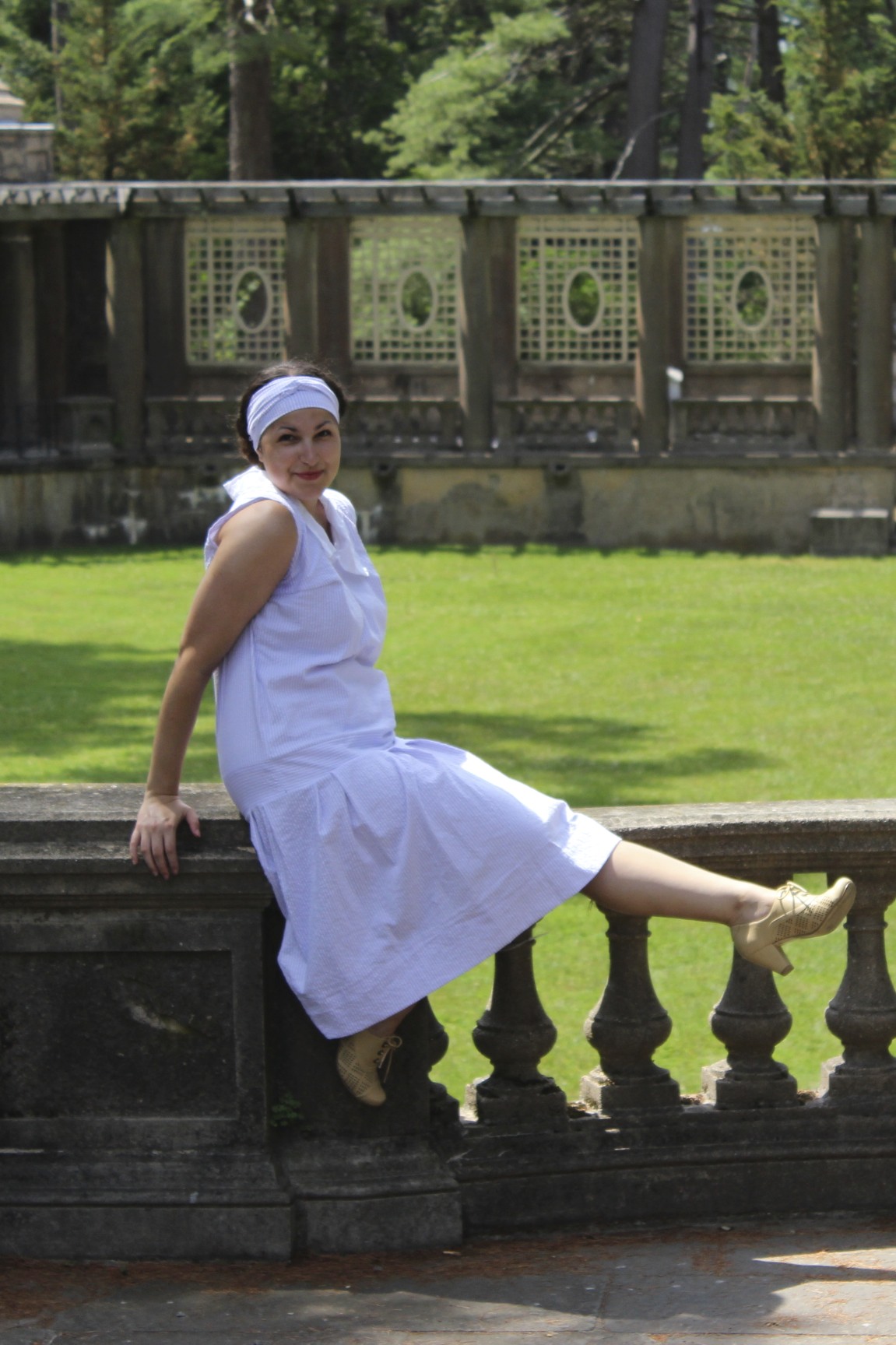
I wore my 1926 cotton not-quite sailor dress and American Duchess Gibsons, and it was nice to see friends with new 1920s day dresses! I think I had the most fun just walking around the lovely estate and taking pictures, so that’s what most of these pictures are.

IMG_3754
Practicing our 20s poses with the Crane Estate behind us.
IMG_4730
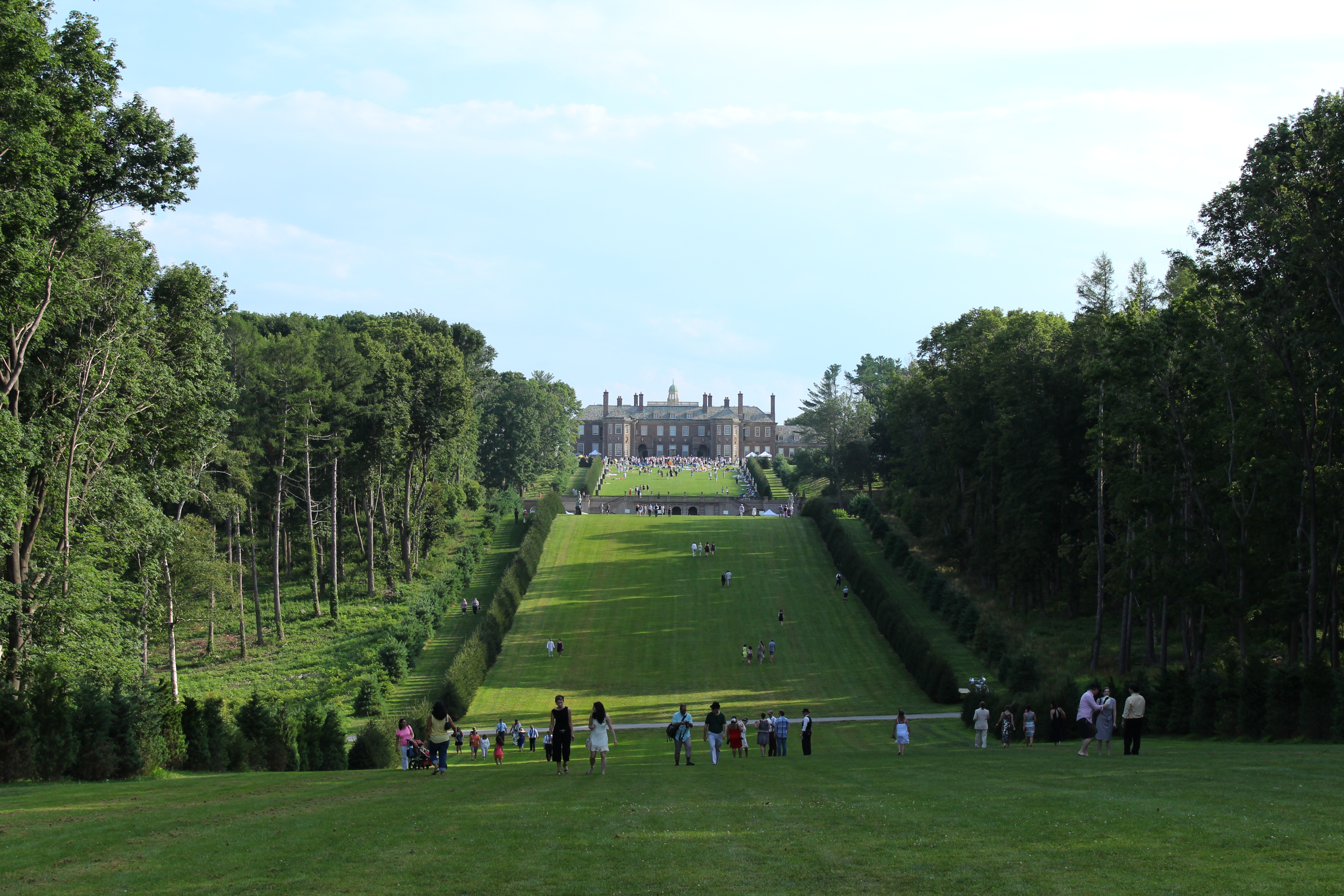
The view from the house looking out towards the ocean. Those lovely rolling hills don’t look that big, but I promise you they are!
IMG_4732
Did you happen to notice the statues along the edges of the grass?
IMG_4735
Well you know silly-ness often happens when I’m around…
IMG_3741
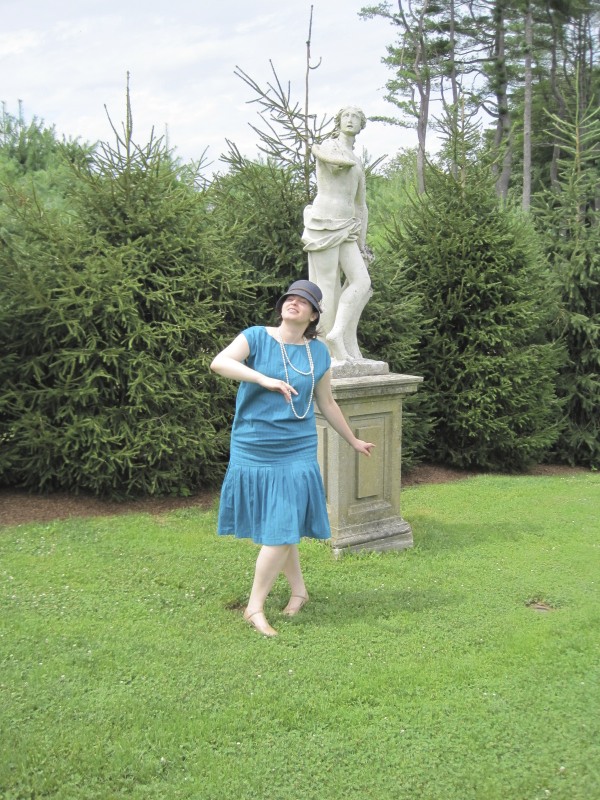
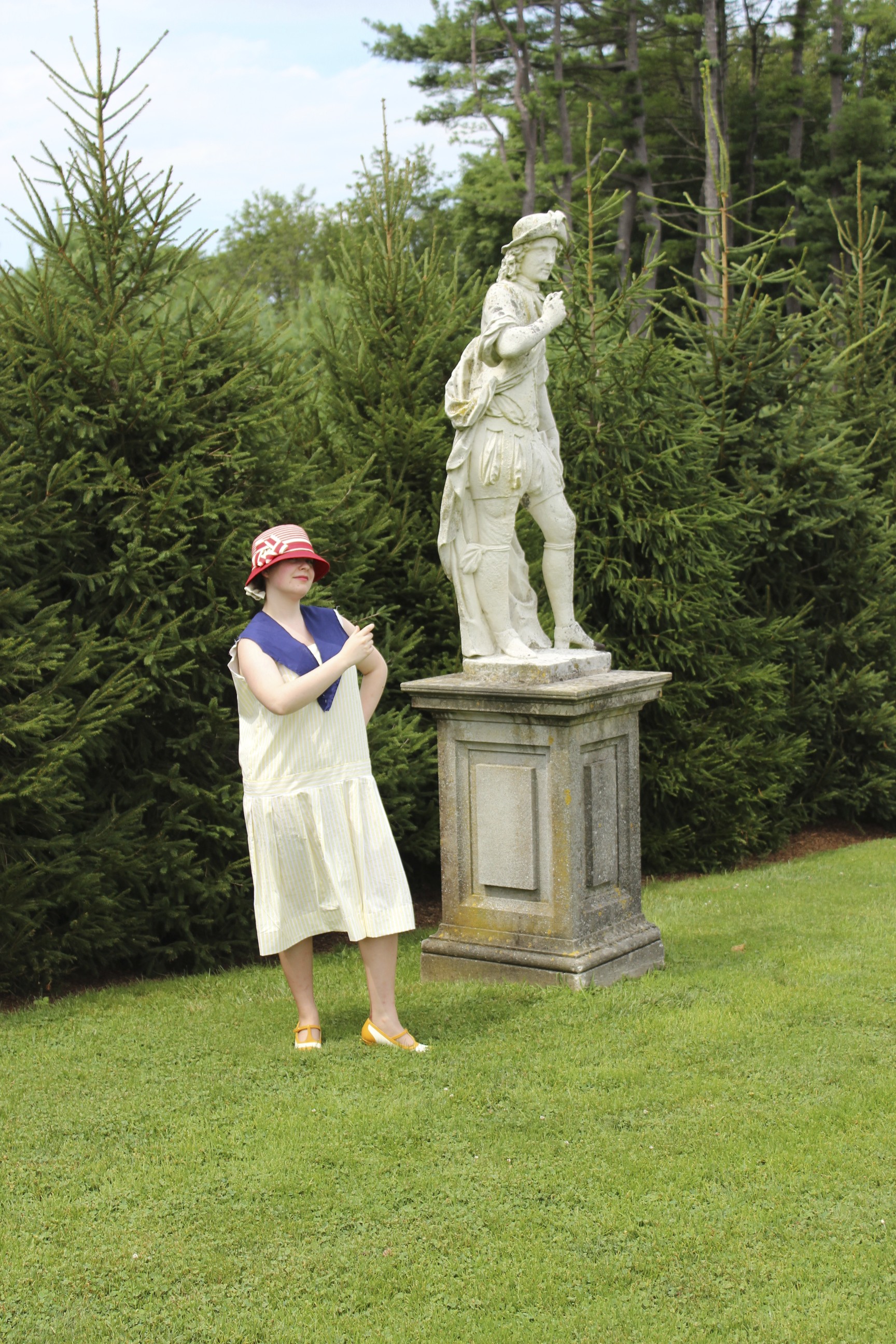
So we each took turns imitating the statues.
IMG_4073
When you’ve walked all the way to end of the hills, this is the view that greets you.
IMG_4084
Lovely!
IMG_4062
Looking back at the house from the farthest point with the grounds full of people.
IMG_3859
Looking over the Italian garden tucked away from the main house.
IMG_3924
While in the garden we took the opportunity for fun photos: telling secrets…
IMG_3846
Lounging on the rails…
IMG_3796
Posing with sporting equipment…
IMG_3884
Admiring the flowers…
IMG_3931
And playing with accessories and wrought iron gates!
IMG_4015
There were vendors of vintage items, which were fun to look through. I especially like this dress!
IMG_4032
And we met some well dressed new people!
IMG_4108
We also took part in the dancing, especially when there was a song to which we could dance a Charleston!
IMG_4091
By the end of the day I was feeling pretty tired along with everyone else I was with. We took the opportunity to explore the side of the house that had parking space rather than dancing action, which was quiet and relaxing. This side of the house looks out over marshes.

Not long after that the event was over and it was time to return home, feeling like I needed a weekend to unwind from my weekend!

Product links in this post contain an affiliate code, which provides a small benefit to my shoe fund. This does not affect my impressions and reviews of this product.

SaveSave

Model Ts, A New 1926 Dress, And New Shoes: Part II

IMG_2996
A 1926 Ford Model T.

Remember last post, I told you I was going to share some “artsy” photos from the Model T event that occurred recently? Here we are, it’s time.

IMG_4577
Close up of a wheel with the Ford logo in the center.
IMG_4585
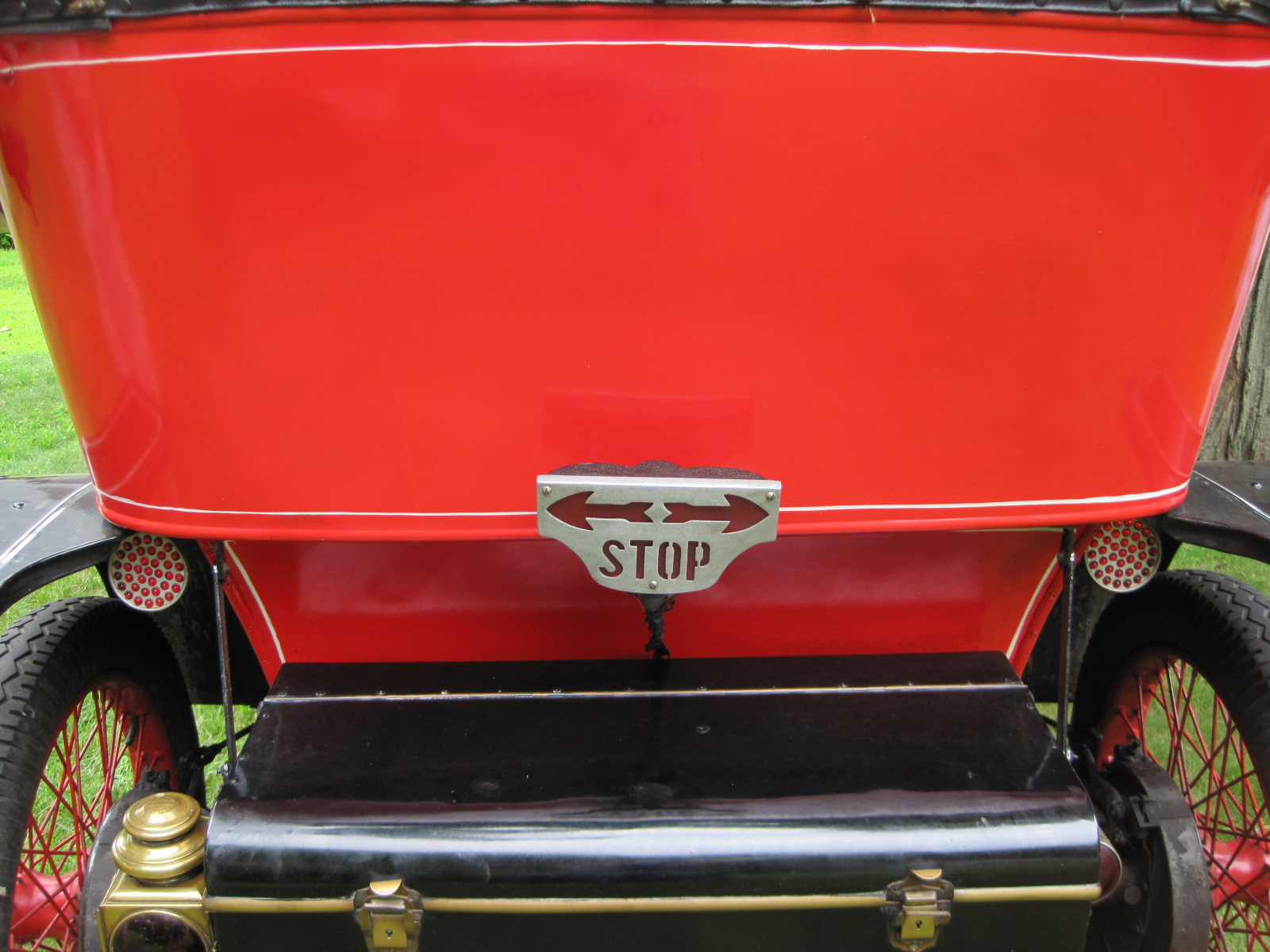
Isn’t the stop/brake light situation cute? I love it!
IMG_3123
I like the spare tire on this green car.
IMG_4583
And the glass in this headlight has a lovely pattern.
IMG_4589
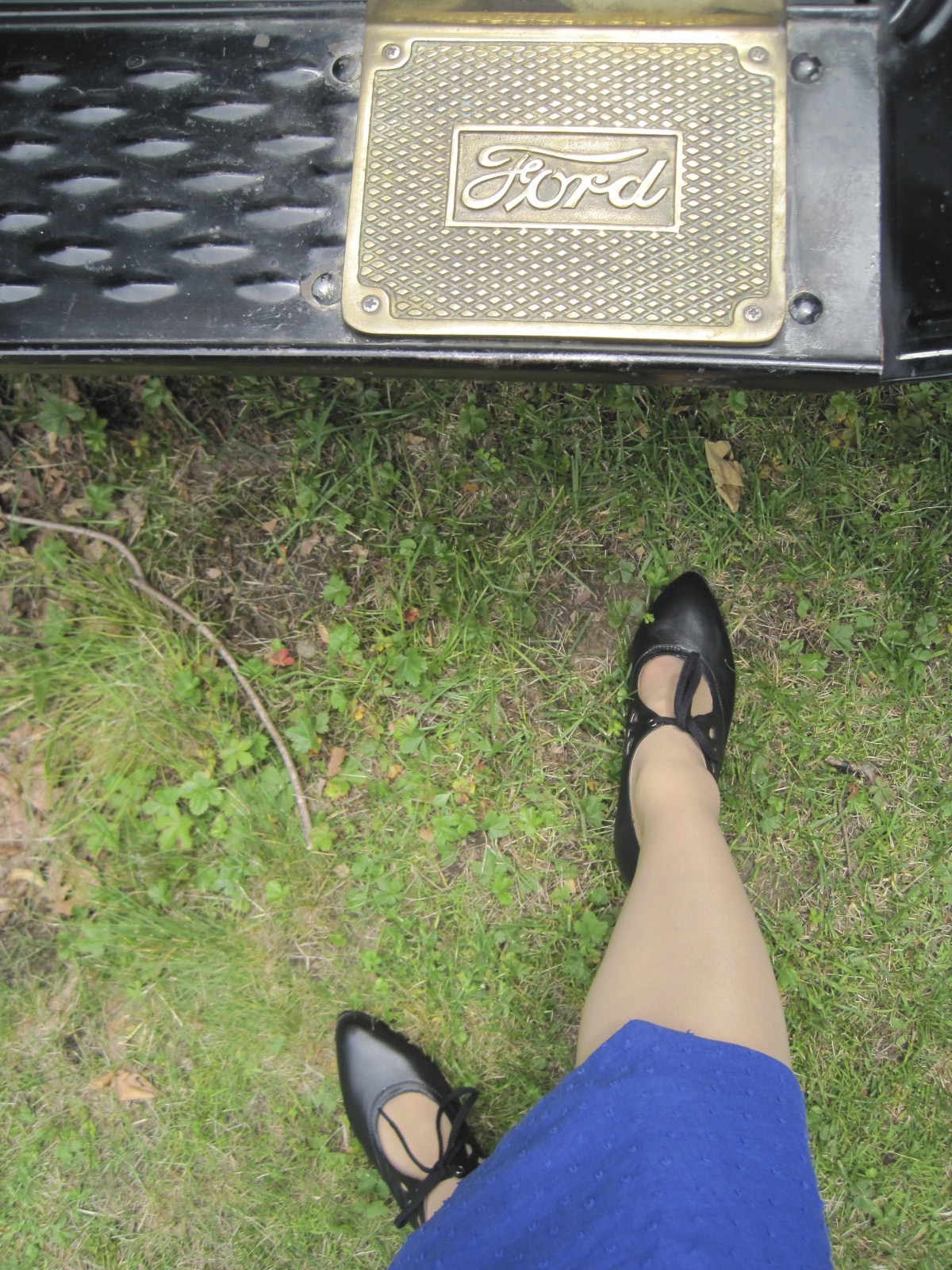
I wanted to get this shot of the Ford logo with my new shoes, American Duchess Gibsons.
This link contains an affiliate code, which provides a small benefit to my shoe fund. This does not affect my impressions and reviews of this product.
IMG_3056
Here I am! Someone else got me getting my feet!
IMG_3134
Speaking of shoes, we were playing with focus in this shot and the next.
IMG_3133
Same photo, but in one the focus is the wheel and in the other it’s my feet.
IMG_3000
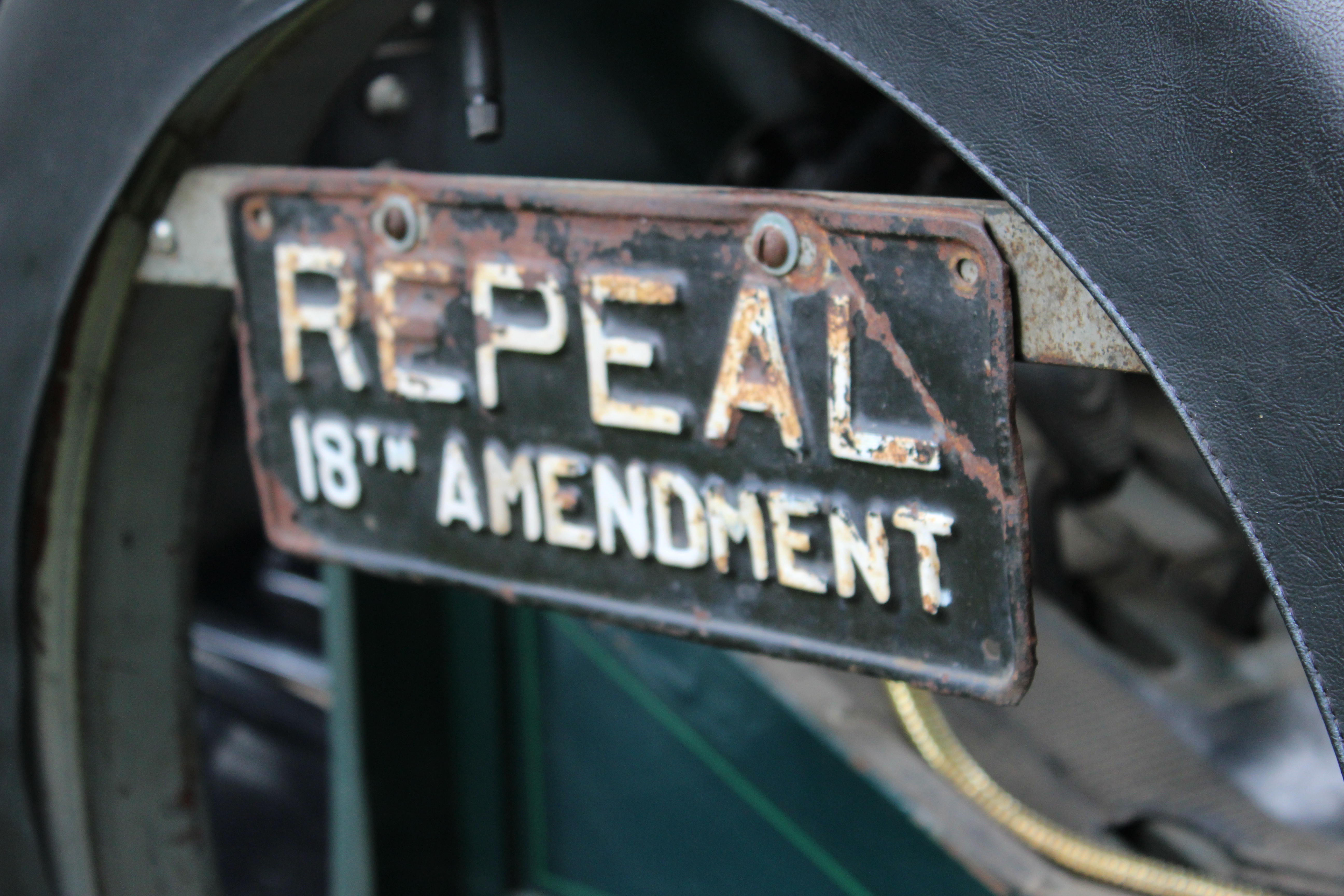
Attached to one of the cars. (The 18th Amendment is the one that established Prohibition.)
IMG_3115
See us reflected in the windshield? We tried to look like we were driving, but that didn’t work, so we had to settle with this.

That’s it! I hope you enjoyed this 1920s Model T adventure. I sure did!

SaveSave