The time for dancing has arrived! You’ll remember that I recently shared pictures of the reception on the Sunday evening of the Regency Dance Weekend as well as the sharing of the train at that same reception? I’ve been promising to share ball pictures and finally, the time has come. Without further ado…
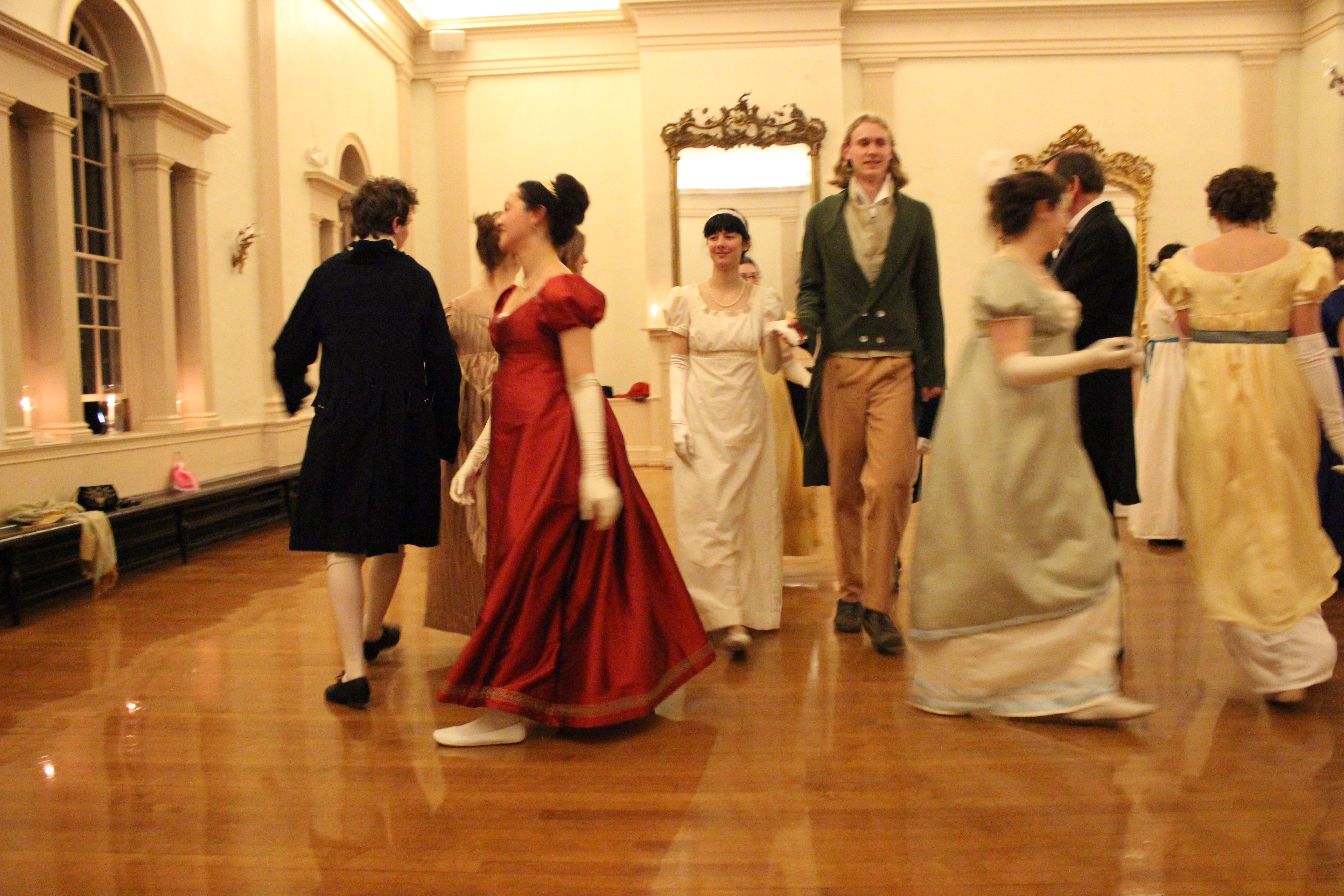
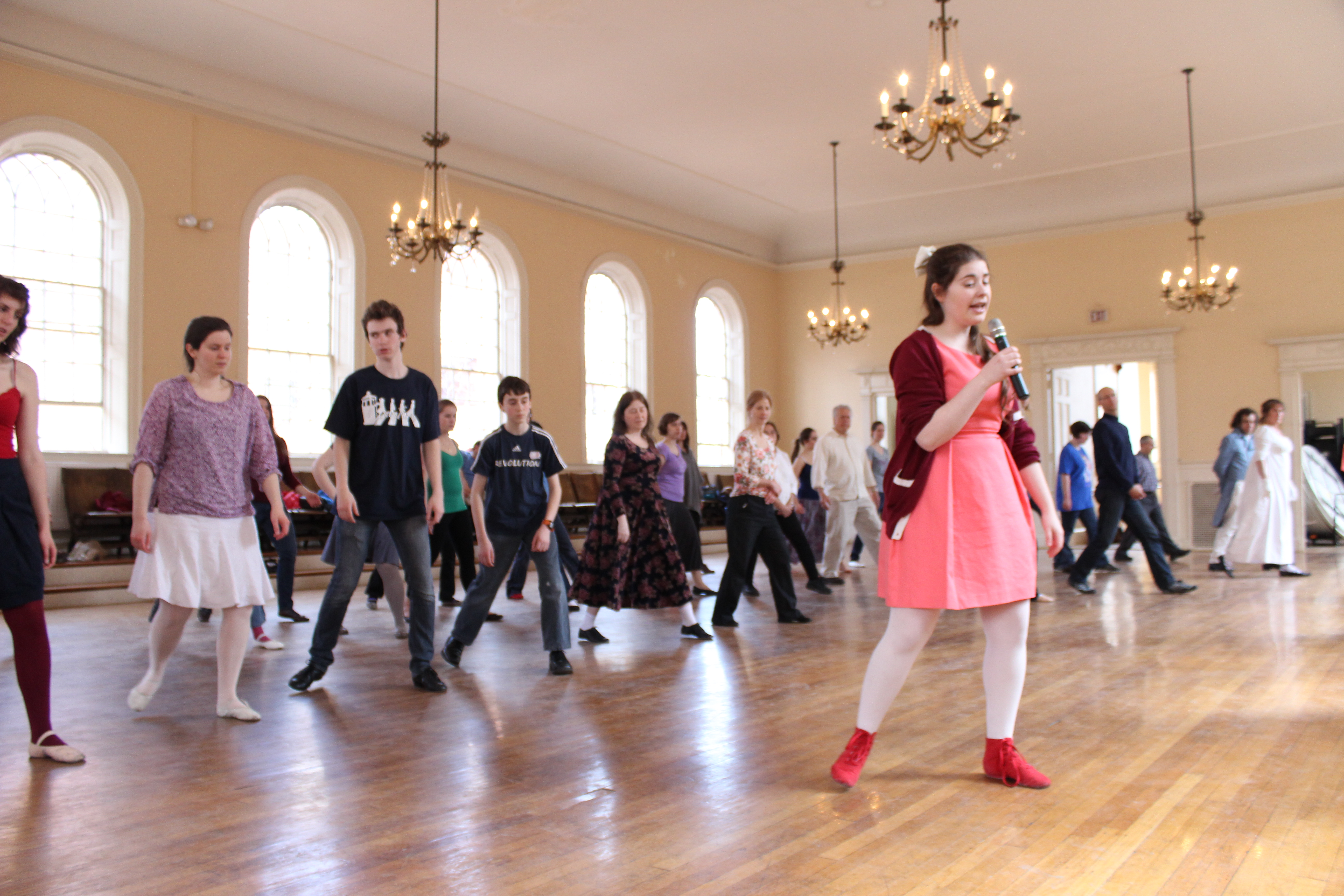
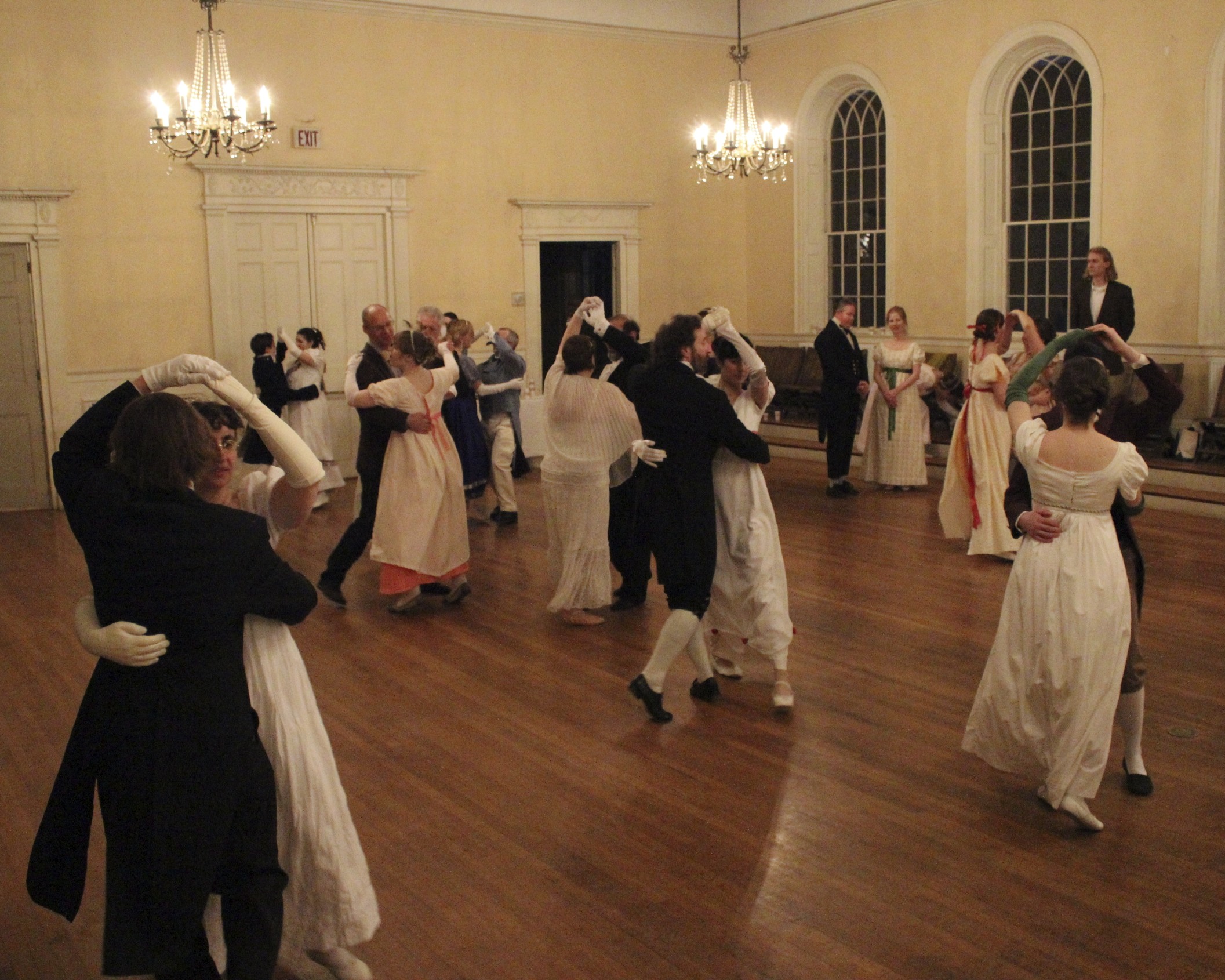
The Grand March. We had a good quantity of people this ball and because of our practice during the daytime classes all of the figures looked really good!
The Grand March was followed by a good number of country dances and figured waltzes. It was an amazing experience to have a room full of people who had already learned the dances and were able to dance them without instruction. We were able to complete dance after dance after dance and it wasn’t long before it was time for some refreshment.
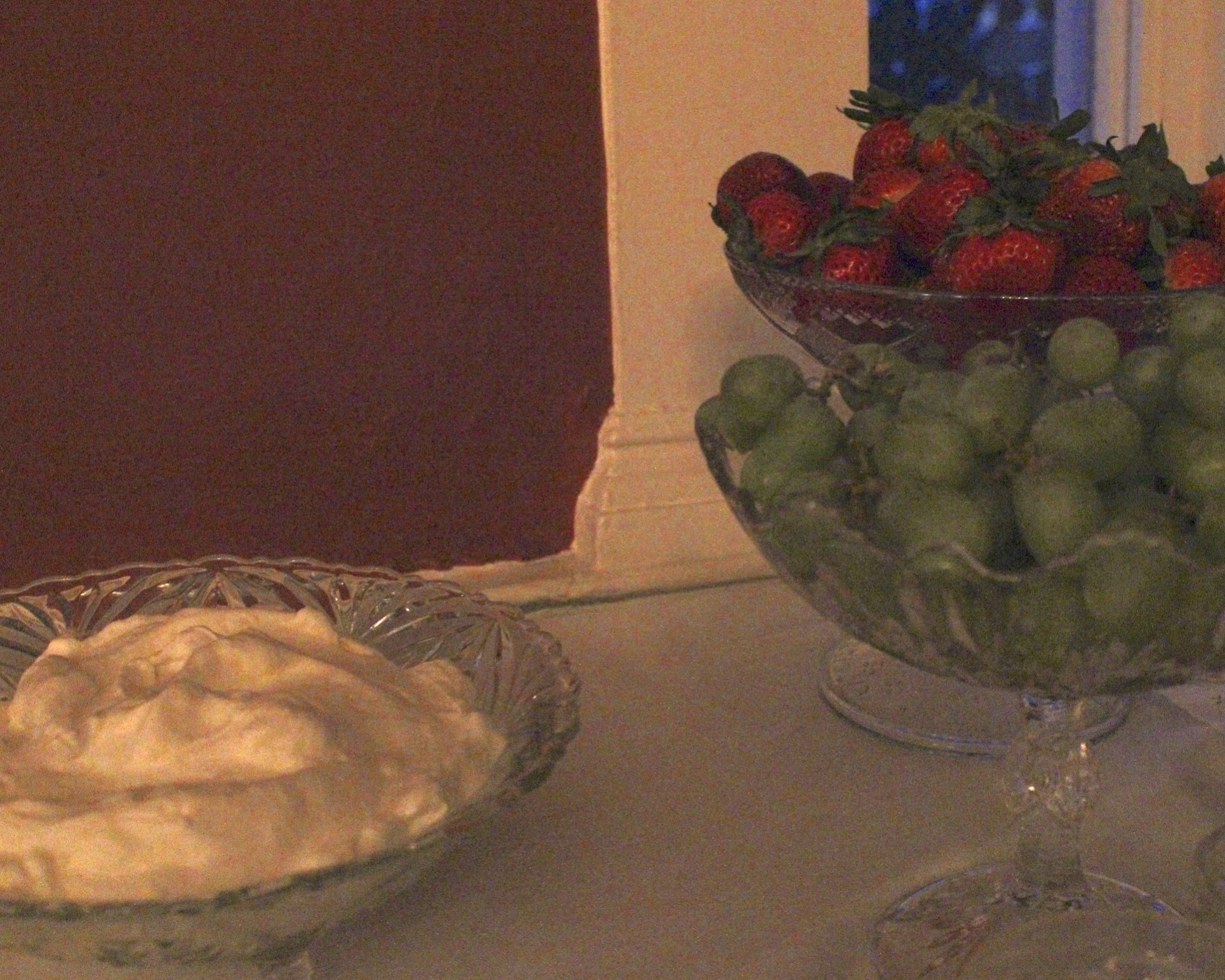
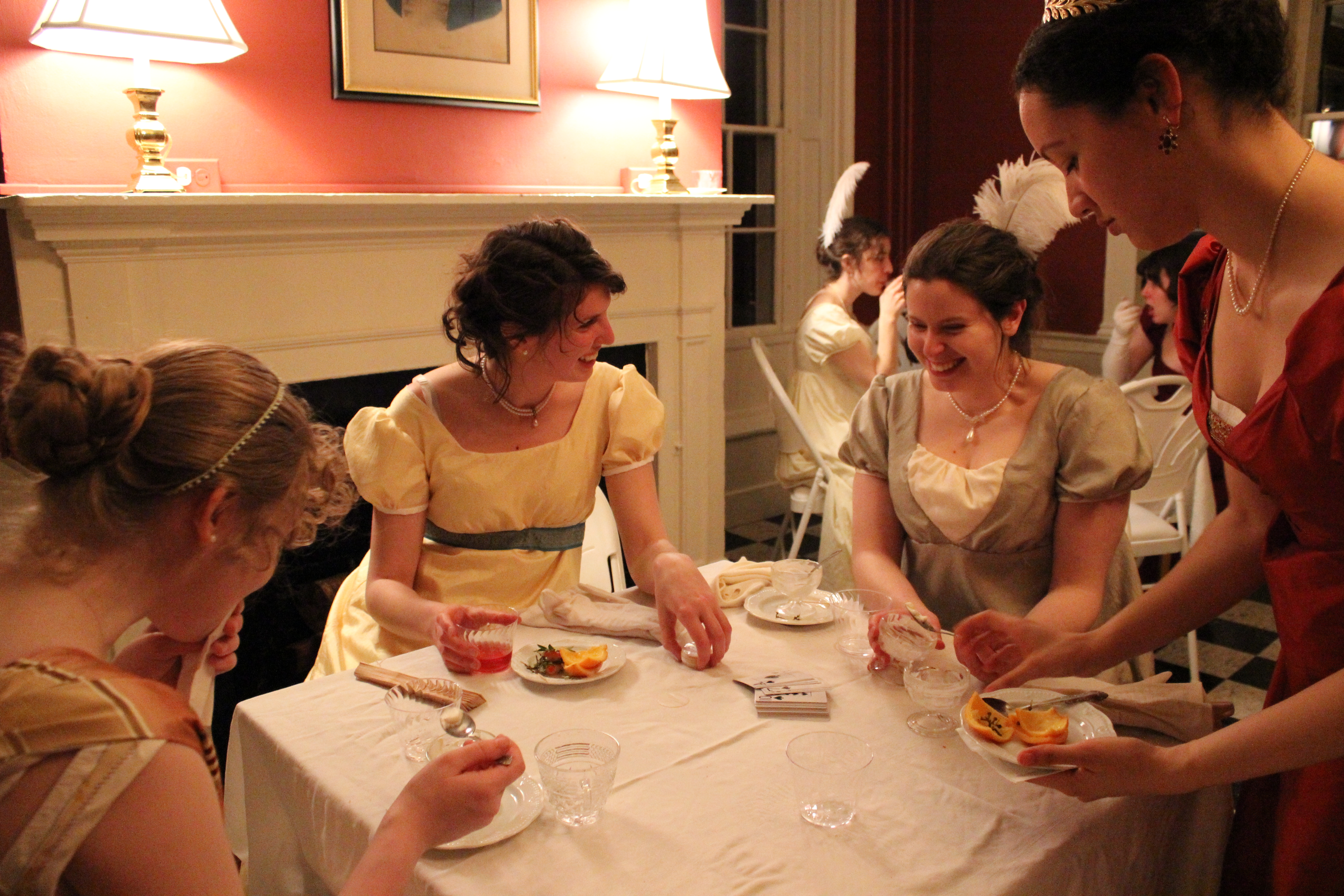
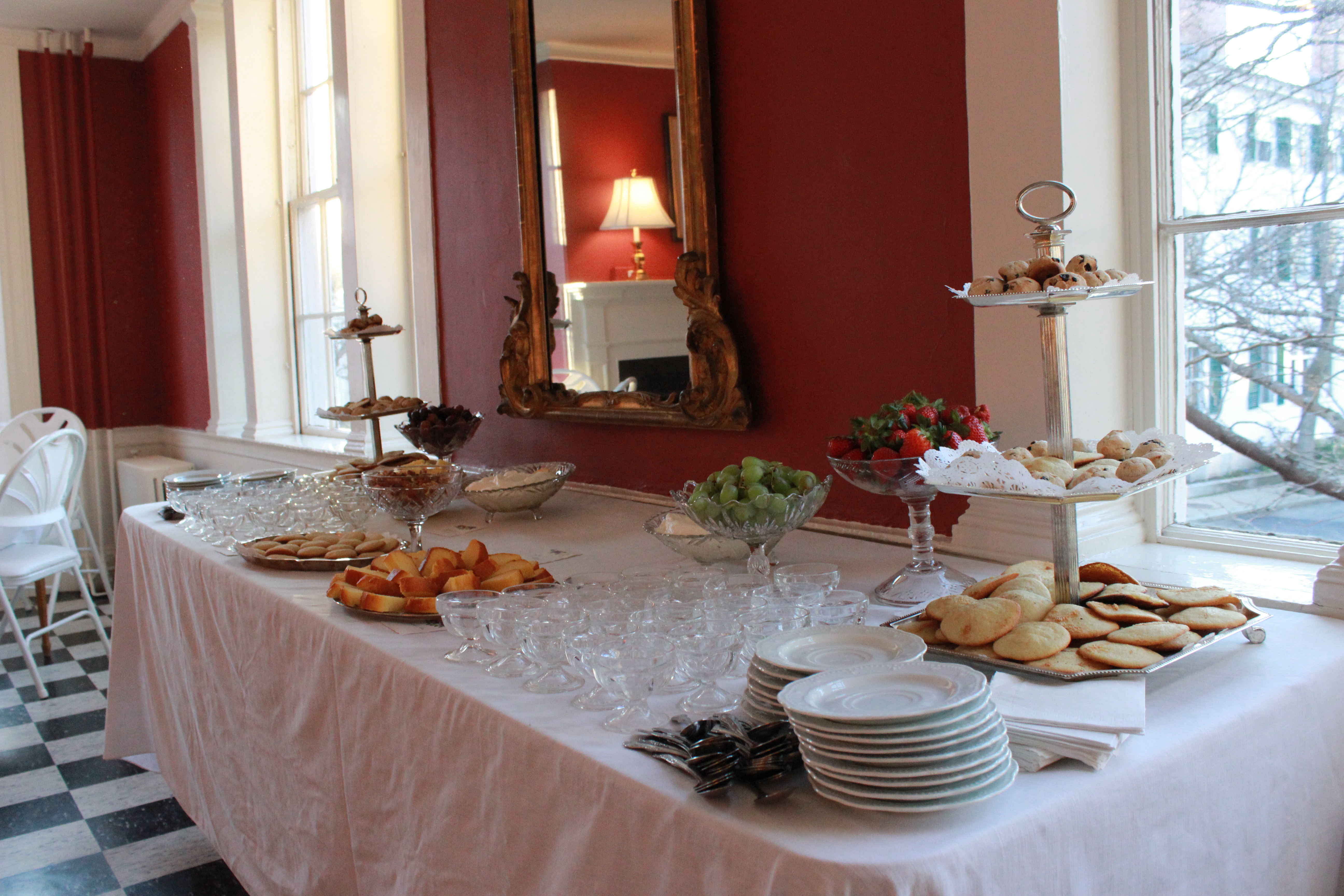
Punch had been nicely laid out in the refreshment room earlier in the evening.There were cookies, and fruit, and syllabub (sweet cream) with pound cake, just to name a few delicious treats.The refreshment room also had small tables set up to encourage chatting while eating.
Unlike some of balls during which we have refreshment breaks, at this ball a person could break for refreshments at any point in the evening. It was a nice change, and especially since we did so much dancing and less standing and listening, it was particularly useful to refresh oneself throughout the evening.
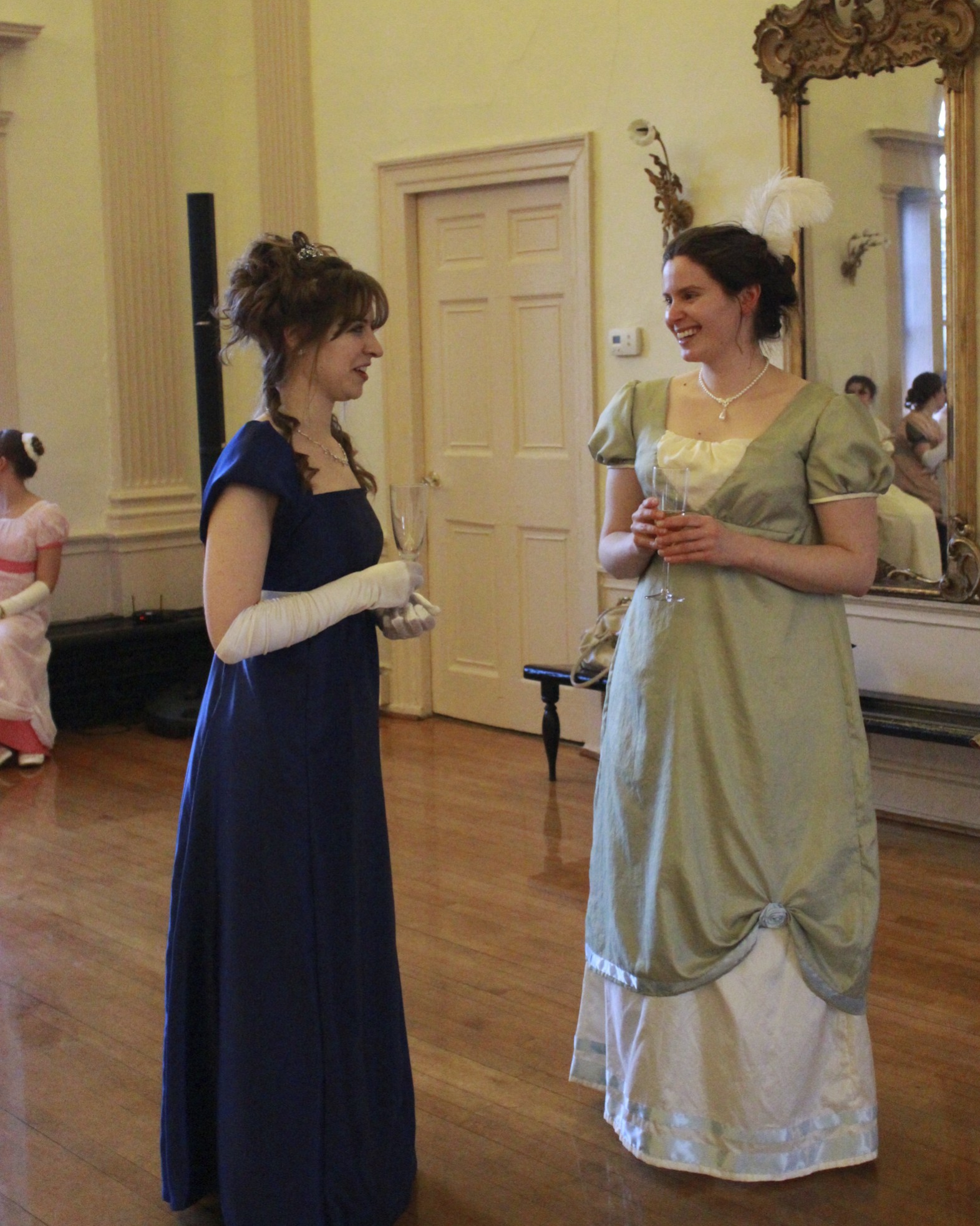
Of course, there was the opportunity to chat with friends and family throughout the evening in addition to time spent in the refreshment room.Setting up for a country dance. Or perhaps this was Sir Roger De Coverley?Yes, I believe that was Sir Roger. This was later in the evening after sillyness had set in… We were changing partners and gentlemen/lady positions just to keep things interesting.
Goodness! By the end of the evening my legs were feeling all the dancing of the weekend. The characteristic Regency upbeat rise was getting harder and harder to achieve… But what an event! What a weekend! It was so full of fun, and getting to know new people, and learning dancing… Really, an exquisite experience.
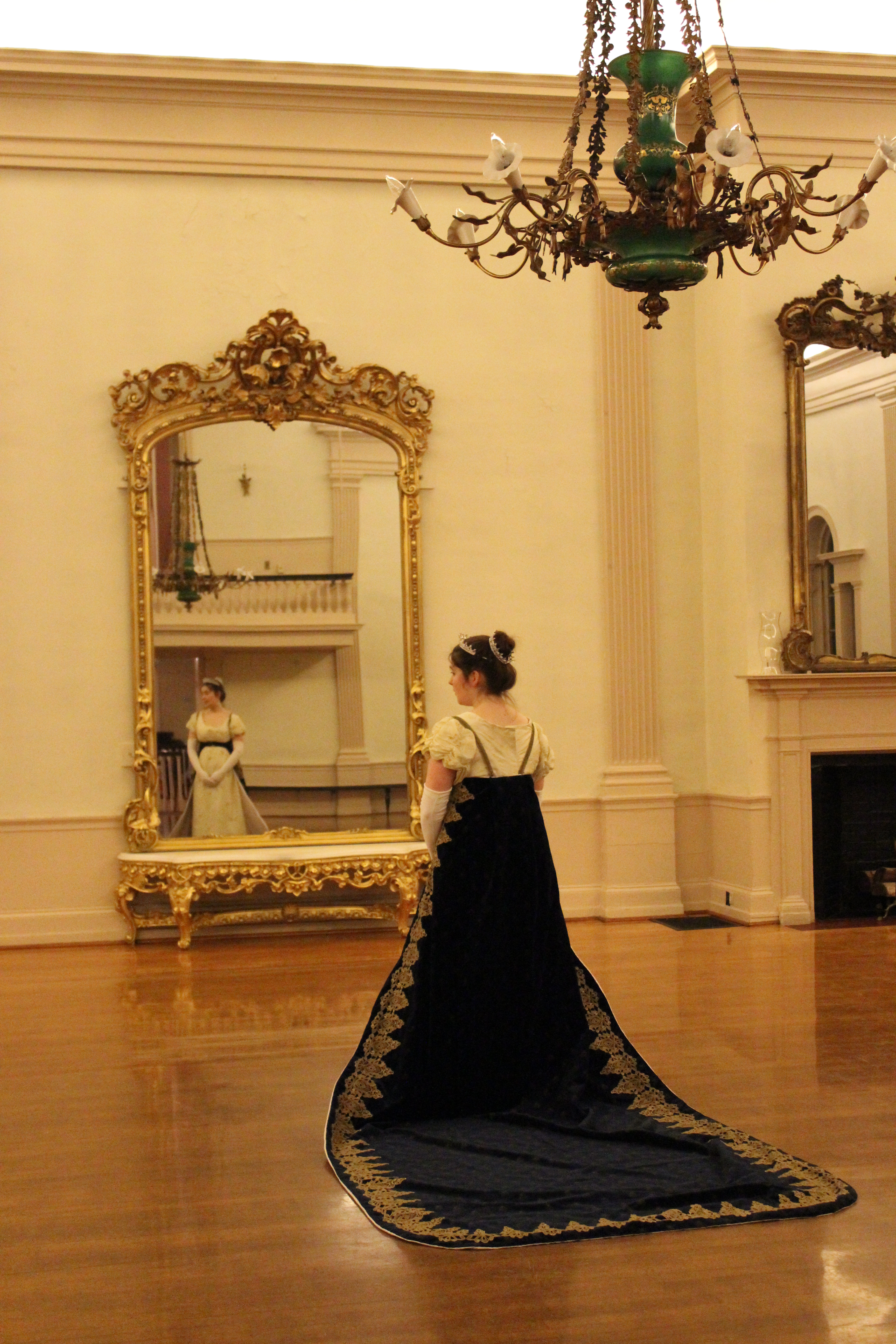
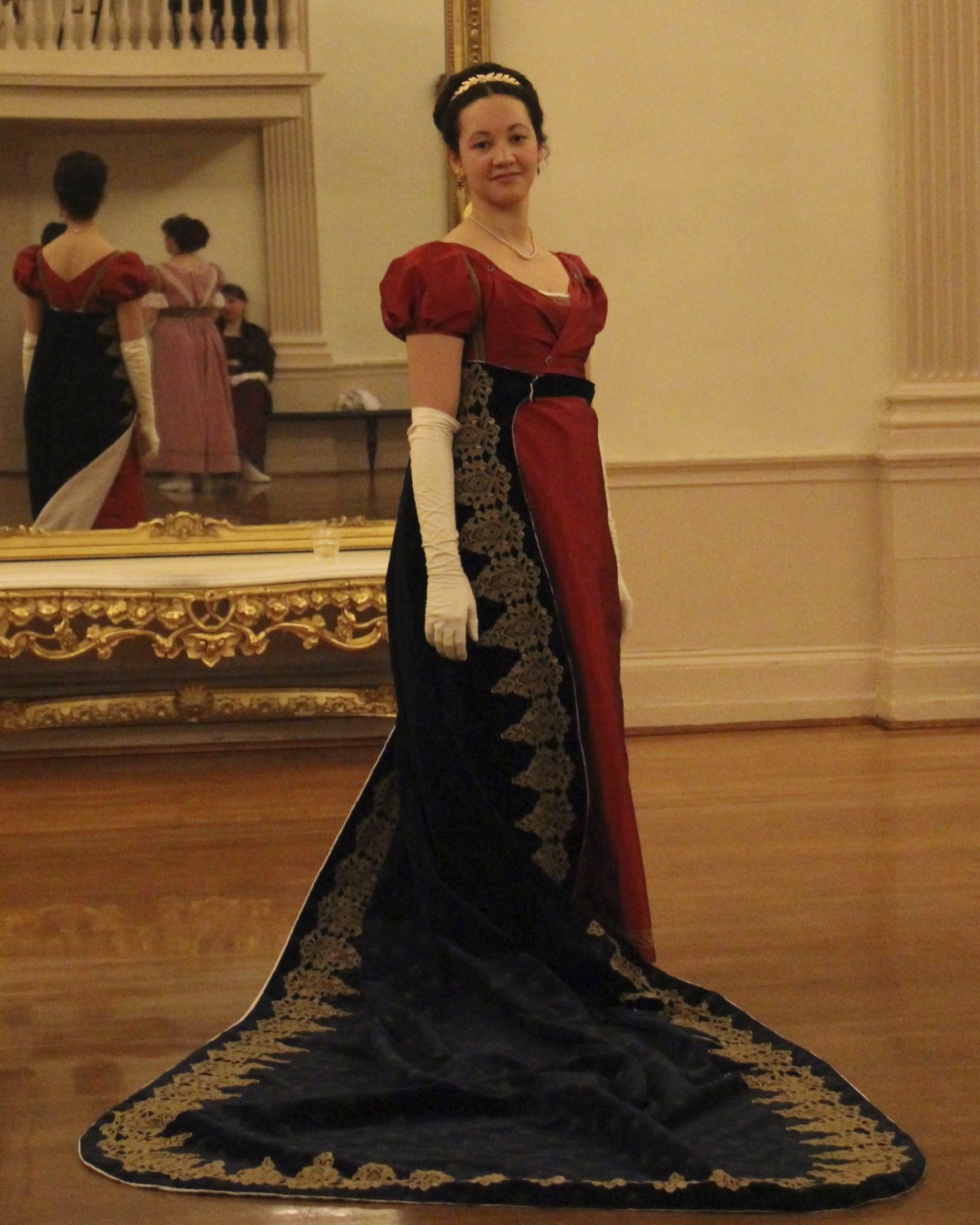
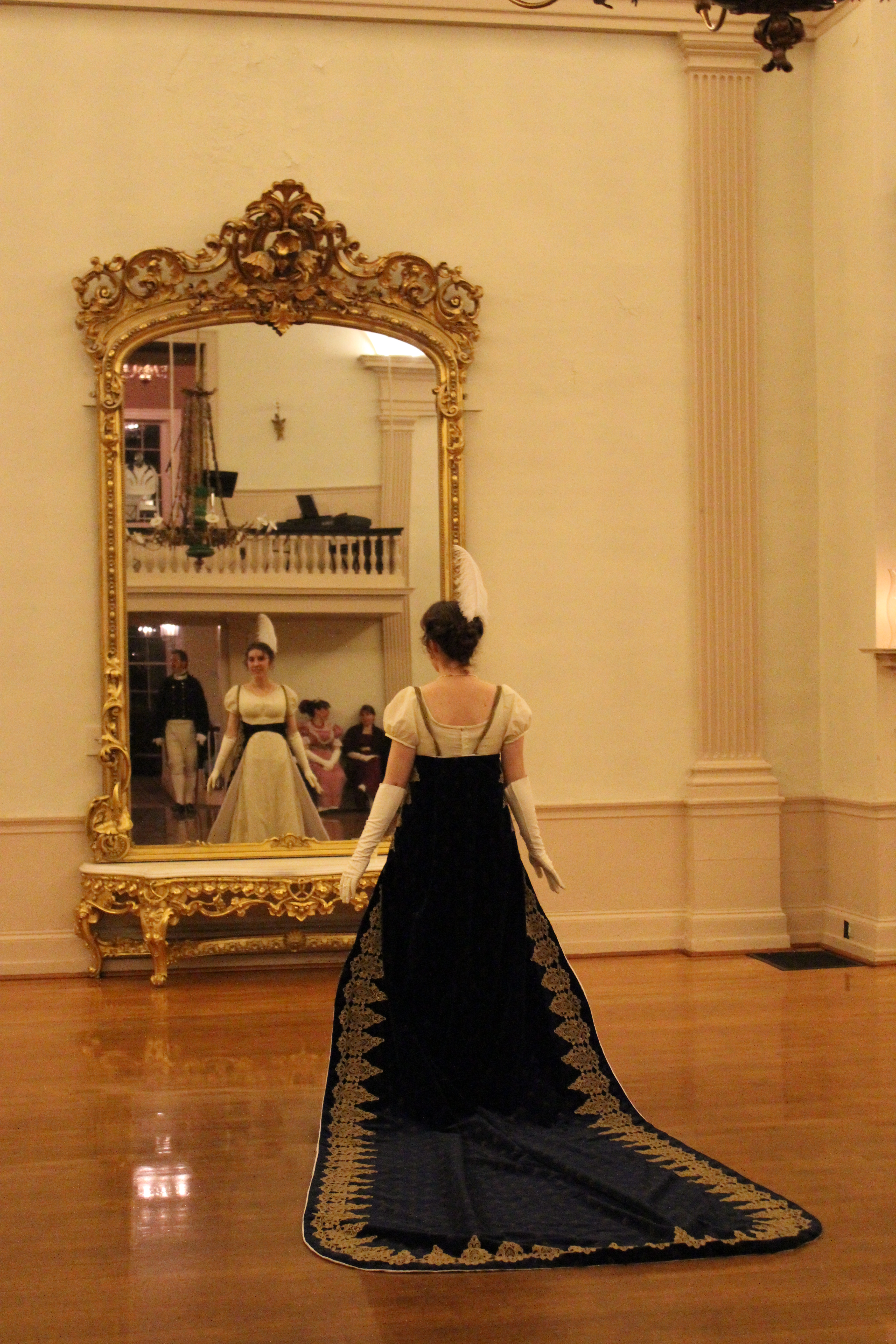
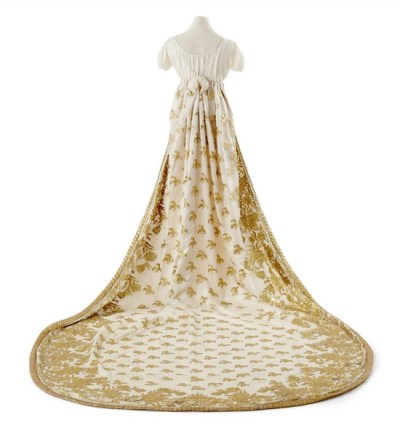
I’m eager to share pictures of the grand ball with you, but I want to insert this post before continuing to ball pictures. One of my friends had the ambition to complete a Regency court train to wear during the reception I showed pictures of last post. It’s a pretty fabulous train made of velvet printed with golden bees and trimmed with opulent gold lace.
The actual owner and maker of the train.
It’s not the sort of thing to be danced in, but that’s fine, because it attaches at the waist, so it’s easy to take off. During the course of the evening some of us tried on the train and tried out different poses in it. So nice of Antonia to share with all of us! It was quite grand and fabulous.
It’s my blog, and that means I can share as many pictures of me as I want…! Spoiled sounding? Probably… Okay, fine, I’ll return to my more humble un-royalty roots.
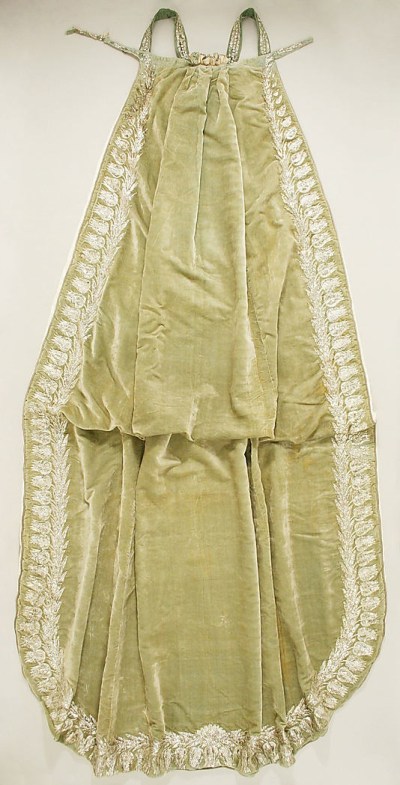
There are some absolutely stunning extant court trains out there. Here’s my pinterest page of court gowns and trains from all different periods. And here are some of my favorite Regency court trains to inspire you.
ca. 1809. The Met.1809. The Met.First Empire From the Chateau de Malmaison Costume Collection appFirst Empire From the Chateau de Malmaison Costume Collection app
There is an event at Dress U in about a month that requires court gowns or trains. I won’t be there, but I’m looking forward to seeing pictures of other people’s fabulous court trains! I hope you’ve enjoyed these silly pictures. I promise that the next post in this series about the Regency Weekend will be pictures of the ball: no more delays!
The reception was to include a toast with sparkling cider, so we pre-filled glasses to have ready to go at the right time. In addition, we worked on laying out the refreshments in pretty glass compotes and on silver trays as well as making the punch and laying out all the necessary silverware and dishes. Preparation was a bit hurried and I have to confess to getting super grumpy at one point…
Picturesque filling of the glasses.Picturesque grumpy face.
The alterations I made to my skirt to fix the rip created a new issue. Sigh. See those horizontal wrinkles on the rib area? Because the front of the skirt hangs differently now, the front skirt wants to wrinkle. I can fix this problem, but ugh! It’s so much easier when the clothes just fit perfectly!
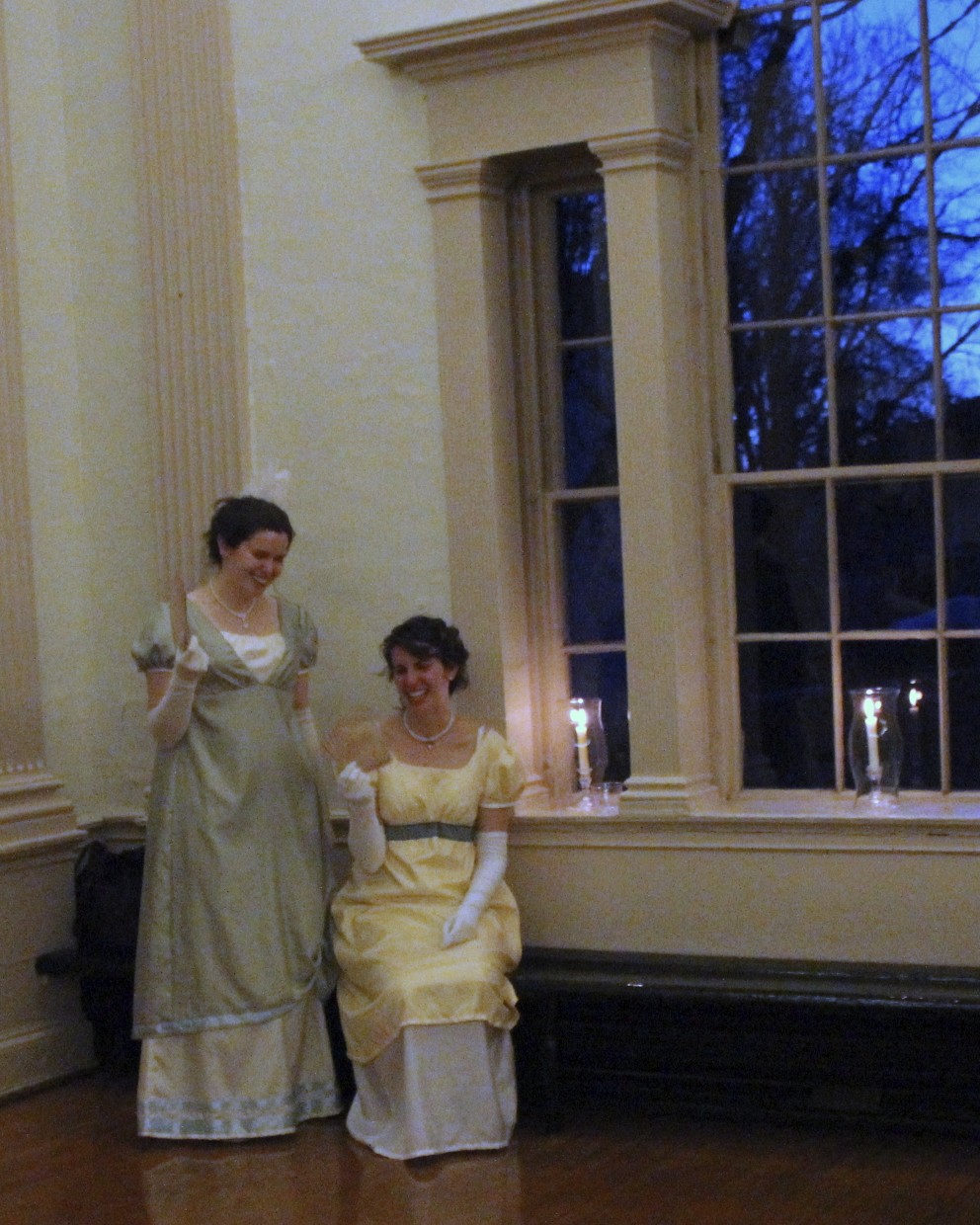
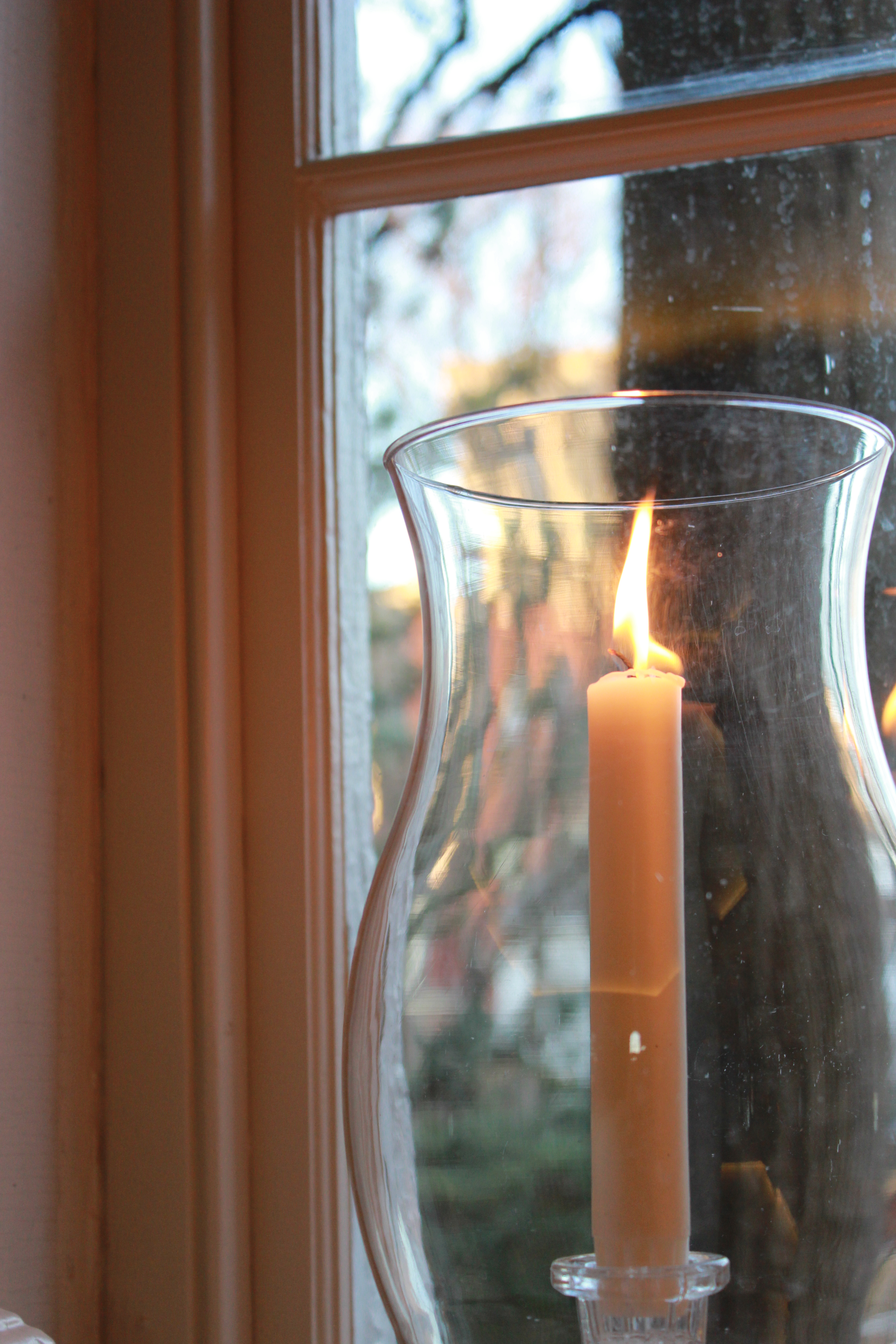
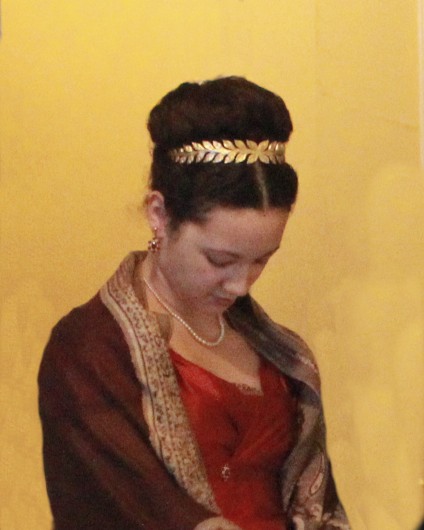
Partially completed spread of refreshments.When everything was ready we joined everyone else for some pictures in the lovely ballroom, where there were real candles in the windows! So pretty!These mirrors are stunning and beautiful, in addition to being wonderful places to pose for the camera.I thought my hair looked particularly regal for this event. Here’s a good picture of my poof and laurel wreath tiara.
It’s convenient for these sort of events to have hair that is easily made poofy. I don’t have any short bits of hair around my face (aside from frizz…) so curly tendrils for Regency hair styles don’t work for me. This had become my go-to Regency style: center part in the front with the front bits of hair saved for last; the back part of the hair put into a pony tail and brushed out to be super poofy, then rolled on itself to create a self rat and hide the ends. The poof is then pinned in place, the front bits are wrapped down and around the back which creates lovely lines on the back of the head, and finally the tiara is added to define the area between part and poof. The whole thing is finished off with a liberal douse of super hold hairspray to contain the frizz and keep the style in place.
But enough pictures of my dress and hair! After these reception pictures we all descended the stairs to the sidewalk, where we watched a celebratory champagne bottle be opened with a saber. Neat!
Ready?Each person was served with a glass of sparkling cider on his or her way back up to the ballroom.And then we all had a bit of time to socialize and admire the room, the people, and the circulating cider refills.
When the cider was beginning to dwindle (which didn’t take too long), the time had come for the dancing to begin. And my, what dancing there was!
Yup, that’s me I’m talking about in the title of this post. I was straggling along the first bit of the Mar-pril Regency Sew Weekly road. For Goal #2: evening wear, I had hopes to fix the rip in my 1813 red evening gown, but unfortunately I didn’t get to it in time for the deadline.
Sad, sad rip.
I did get to it before the Regency Dance Weekend, though, so I was able to wear the dress for the Grand Ball and Reception on Sunday night. I’ve got pictures of the event to share soon, but for now I’m going to focus on the gown.
When I first made this dress back in January and wore it to the Pride and Prejudice Ball in February, the skirt of the dress was tightly gathered across the back to take in all the fulness of the skirt. But while taking pictures after the ball, the dress caught and ripped! I suppose it’s hard to tell in the picture, but the rip was not small.
Gathers used in the back to take in all the fullness.
Ugh! What to do? Try to patch it, or darn it, or replace the whole vertical panel where the rip was? None of those ideas sounded like they would be pretty or fun.
I didn’t actually get around to fixing this until after I had constructed my Tree Gown, which has a skirt with an angled (trapezoidal) front panel and the back panel cut as a rectangle. The effect of that shaping on the Tree Gown is neat: there is less fabric to gather at the back and the skirt has a nice shape to it that is different than the shape that is created by the original tube shaped skirt on the red gown. In addition, I decided after looking at the pictures of the red gown that the gathers were too poofy in the back and created a shape I wasn’t looking for.
So I came to the idea of using the trapezoid plus rectangle skirt shaping for the red gown, because making a trapezoid would allow me to cut out the section of the skirt with the rip. This required taking the skirt off of the back waistband, sewing the new seams, then reattaching the whole thing. Since I was taking it apart anyway at that point, I decided to also pleat the fabric around the back instead of gathering it, like this dress, below.
1812 Wedding Dress at the Met with a pleated skirt.The ripped side of the skirt, removed from the waistband and with the new seam pinned. Now you can see the scale of the rip!
It looks like I don’t have any great pictures of the back of the gown with the new pleated back… whoops! Here’s one picture, though, where you can sort of see what’s going on with the dress.
Sort of hard to tell, but the area where the skirt meets the waistband is much flatter, and the skirt has a much bigger flare at the hem due to the new seam shaping.
Perhaps hard to envision, but if you compare this back picture to the one at the beginning of this post, there is a definite difference. It wasn’t a fun project, but it needed to be done, and I sure am glad it is! Next time there will be pictures of the reception, including more fun pictures of this dress.
Not so long ago (only about two weeks, though it seems longer), I had the most marvelous time at the Commonwealth Vintage Dancers’ Regency Intensive Dance Weekend. The weekend included classes, archery and outdoor lounging, an informal dance, and a formal ball. Plus, I had the added bonus of staying with friends in a lovely 1807 house and having extra outdoor adventures the day after the weekend ended!
The weekend had about 50 people in attendance, which was a perfect number for socializing, meeting new people, and filling a ballroom without it being over crowded. It was so special to get to know so many new people, not only by name, but also to have time to get to know a little about them. By the final ball on Sunday night the atmosphere was of the kind you usually only get to dream about when reading Jane Austen: it was a ball where you knew everyone in the room , everyone was constantly changing partners, and everyone knew the steps so there was no teaching, just dancing. It was an absolute blast (and after the weekend I had danced so much that my calves were so sore it was hard to walk for a few days)!
Given that I had such a great time, and that I was able to wear some lovely new clothes (like the tree gown, and my new bonnet, and my blue underdress) you can understand that I have lots of pictures to share. Everyone else looked stunning as well and also had new clothes to show off, which was super fun. Really, people really did look marvelous! Yes, I’ve got lots of pictures, and I’m going to break them down into multiple posts.
First, we’ll look at Saturday, a day with 5 hours of dance classes, checking in to our lovely 1807 house, and attending an evening dance. (Oh wait, did I mention my friends and I also swarmed our lovely and kind friend’s house on Friday night? No great pictures, but it sure was fun to hang out together and squish 8 people into an apartment…! Plus, it made getting to dance class the next morning so much better since we didn’t have to drive very far!)
Starting to learn Regency dance steps.Working on Regency waltz.The wallpaper in my room of the 1807 house we stayed in for the weekend. The room was decorated in this deep red. It was so beautiful!Dressed in my new blue underdress and square neck gown. I’m heading off to the informal dance. Accessories include my blue American Duchess clocked stockings, blue velvet flats, white gloves, a red bead necklace, and my patterned red pashmina.Waltzers during the dance.Dancing a Regency waltz. Look at us go on our toes!
That’s it for now. Next post will be about archery and outdoor lounging!
In all those pictures of Evie and the Returning Heroes Ball that I’ve posted recently, I don’t think there were any good shots of the front of my dress. So for now, a quick post showing the front of the gown with the double rosette to match the skirt and the graduated ruffle showing itself from under the bertha.
I’ve been slow to post my final group of pictures from this event. Sorry! You’ll remember that I first posted Three Series of Photos of my new green 1864 ball gown, Evie, and her undergarments? Then I posted A Second Series of Photos of friends? It’s finally time for the final installment of posts from the Commonwealth Vintage Dancers’ Returning Heroes Ball back in March.
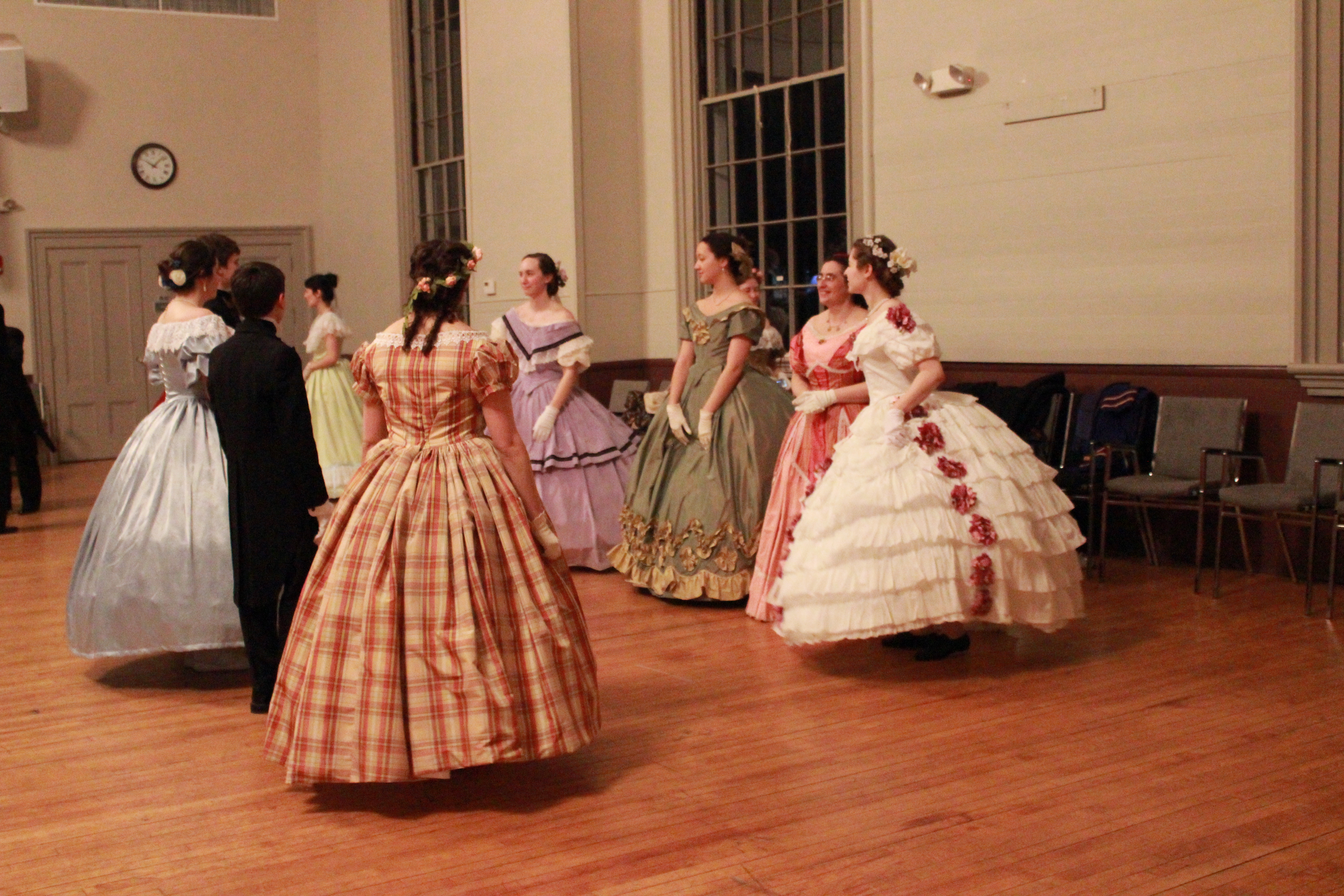
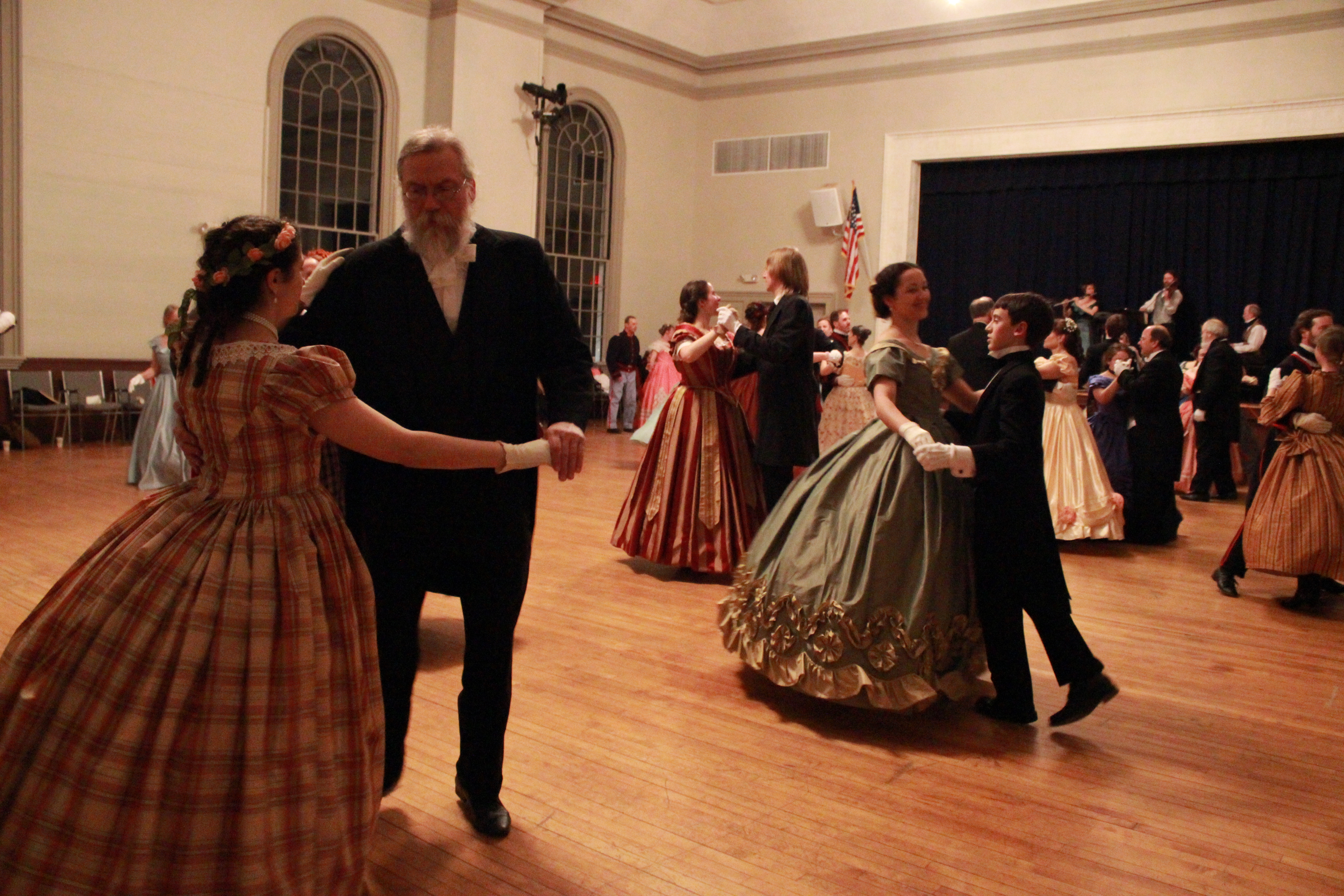
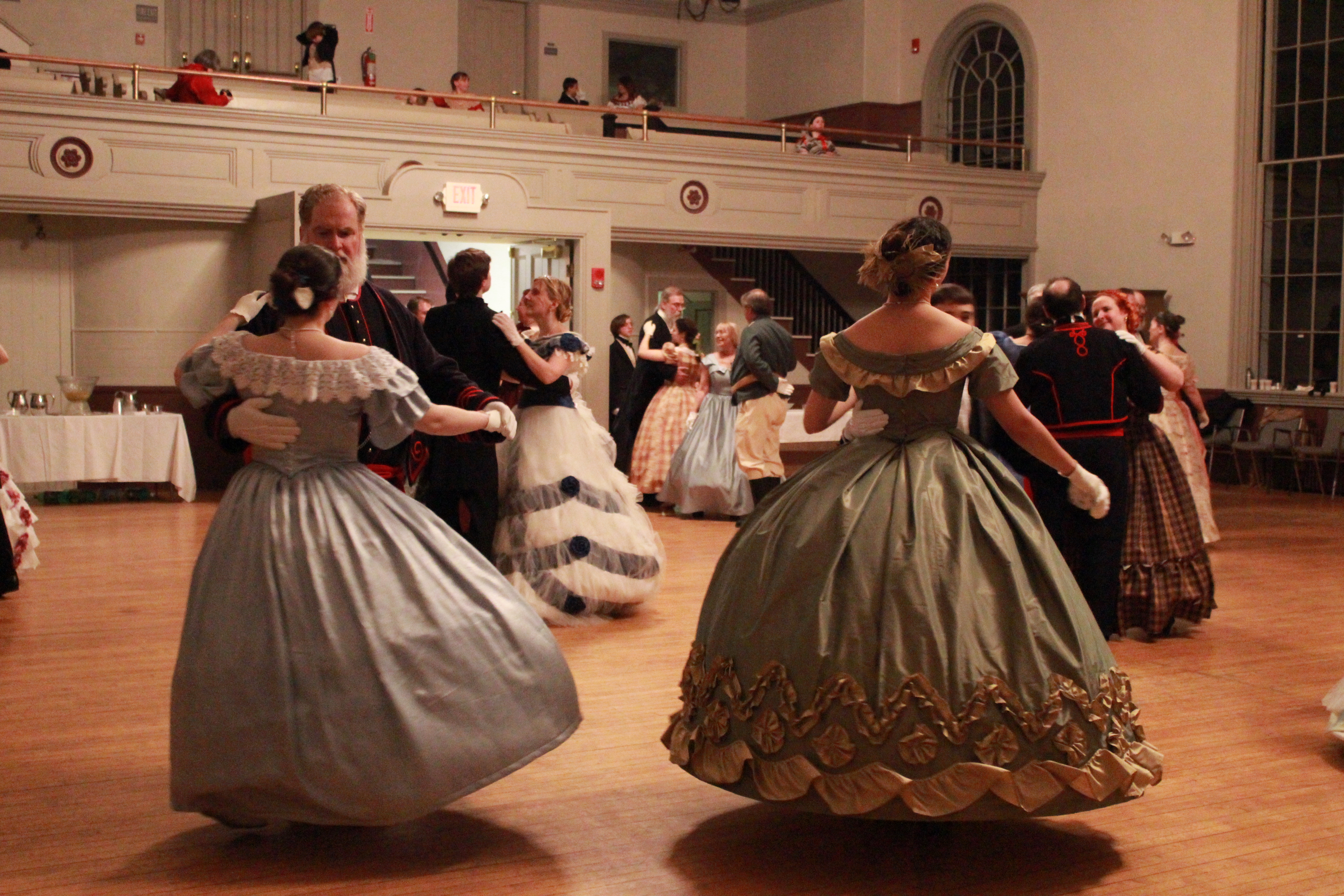
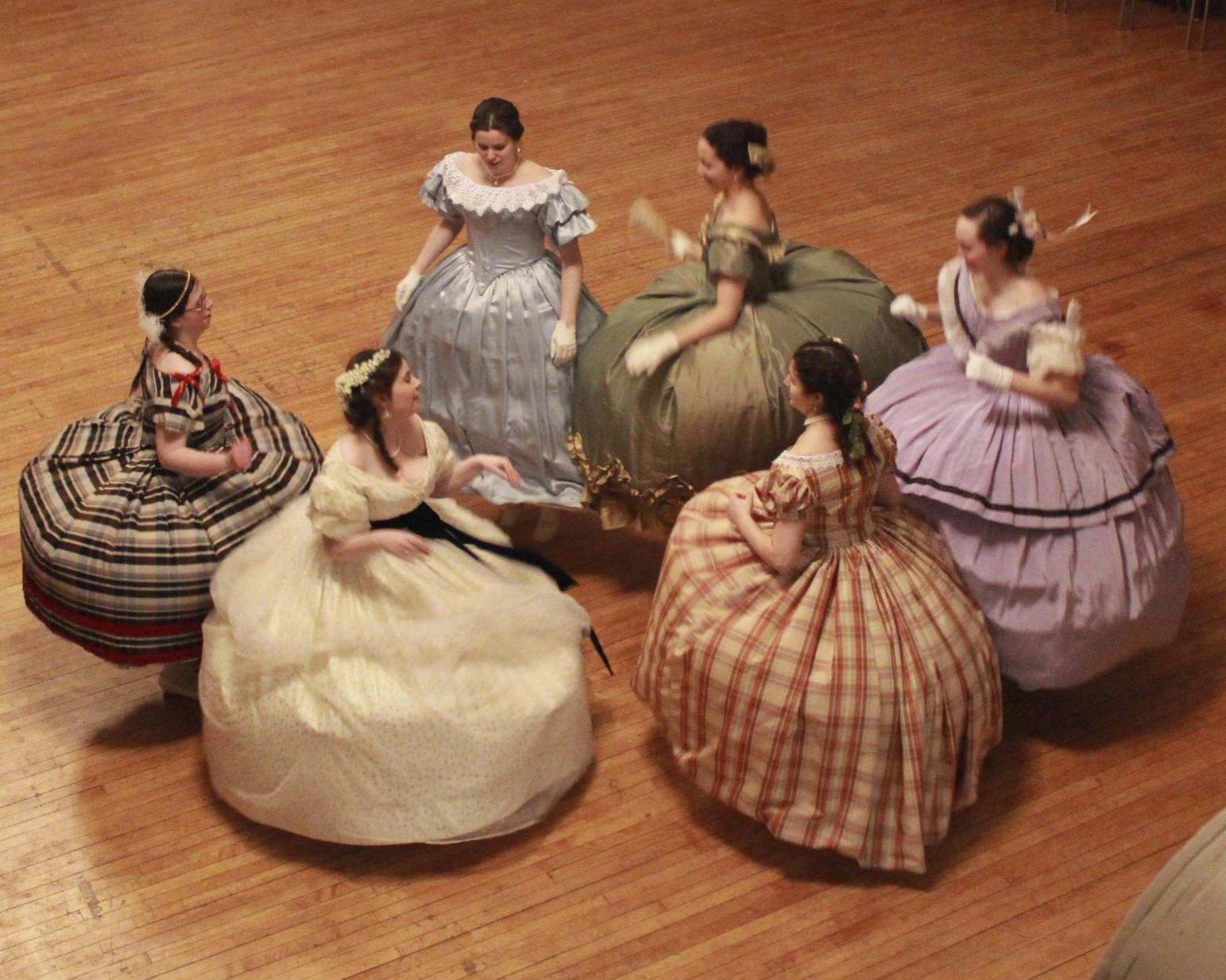
A ballroom full of hoop skirted ladies and suited gentlemen.A lovely set of dancers. Don’t we all look nice in our light colored dresses?Dancing a waltz.A “German Cotillion” dance game during intermission, in which the two young men vied for the young lady holding the candle, each trying to blow it out first. Whoever blew it out was rewarded with a waltz.More dancing after intermission.Caught on camera!Do The Jellyfish! There are more Jellyfish pictures from Ochre Court last year.The chandelier is perhaps not the loveliest style, but I like the artsy style of the photo. The coffered ceiling is great!
You know how sometimes the best laid plans are waylaid by life? I had every intention of finishing this bonnet before the HSF deadline of yesterday, but along the way got side tracked by life and made conscious choices to do other things with my time instead of bonnet-ing. Oh well, it happens to the best of us!
1815 bonnet (the more interesting side).
I made this bonnet to coordinate with my new Regency Tree Gown (which is why I’m calling it the Tree Bonnet). Lucky for me, it also fulfills the HSF Challenge #7: Accessorize and will coordinate with other items already in my closet (such as my 1819 brown spencer). I’ll be wearing the new gown, the spencer, and the bonnet this weekend for the Regency Dance Intensive, along with a lot of other Regency things, so be prepared for lots of pictures next week!
The facts:
Fabric: Silk twill, changeable silk taffeta for trim, and china silk for lining.
Pattern: Created by me.
Year: 1815.
Notions: Four approximately 8″ pieces of sage green polyester ribbon, a spray of wired millinery flowers, about 1 1/2 yds of navy silk ribbon for ties, about 3/4 yd of navy grosgrain ribbon for inner band, buckram for the base, millinery wire, cotton flannel for mulling, tacky glue, and thread.
How historically accurate?: 95% I’d say. There are a few polyester things, but the overall shape, impression, and majority of materials are accurate.
Hours to complete: 28? Hand finishing and trimming takes a long time, especially on hats, because the angles are weird, so it’s a slow process.
First worn: Not yet, but will be worn this weekend!
Total cost: $6ish for the silk twill bit, the green silk and china silk are remnants from other projects, the polyester bits are old and from the stash, the millinery flowers were from the stash, the buckram was maybe $4, the wire was probably $2… so about $12? I didn’t buy anything special for this bonnet, it’s all from the stash! Yay! Go me!
Close-up of the pleated silk trim and rosette-like decoration. You can also see the pleats on the side band of the bonnet.The millinery flowers on the front of the bonnet.The more plain side.Inside of the brim, looking into the lining and hat band.
This week marks the end of the MpRSW (though I still have one more post to go about that), with the final goal aimed at yesterday, #5: Anything Left! I’d already completed some packing for this goal, and procurement of kite making supplies (yes, there will be a future mention of kites!), but this bonnet also qualifies!
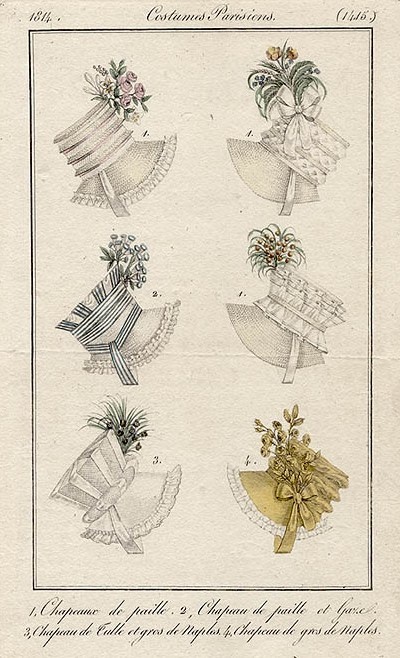
Now let me share some of my inspiration for this bonnet. There are more bonnet images on my 1810s Pinterest page as well.
From 1815. La Belle Assemblee, Parisian Promenade Hats, July 1816.Costume Parisien from 1814.Costume Parisien from 1815.
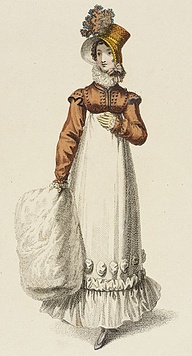
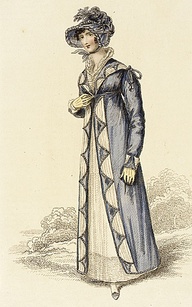
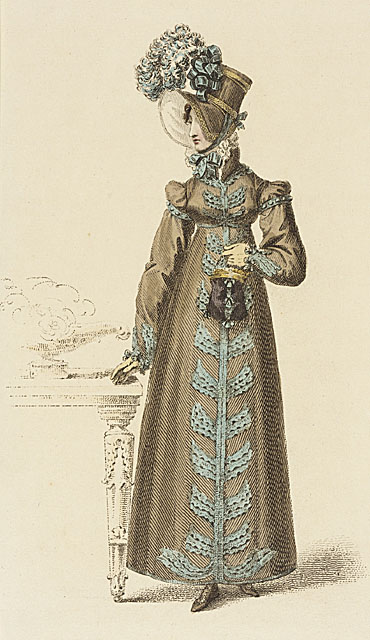
In trying to determine length of ties for the bonnet, I looked to some fashion plates that included people in them. Here are some of the best examples I found.
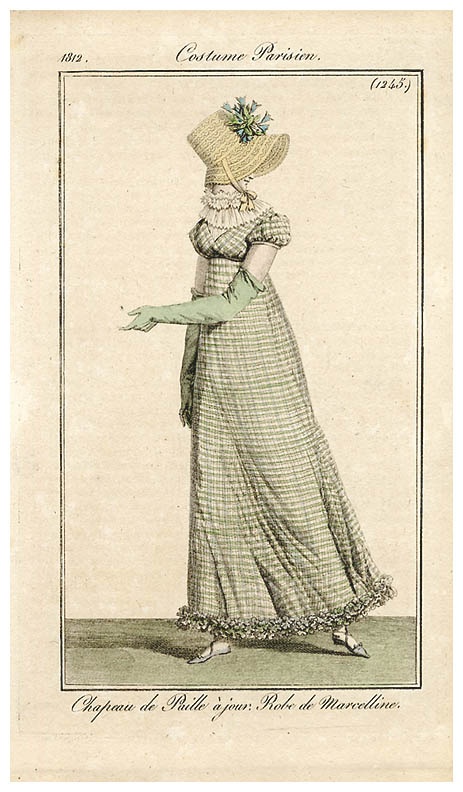
1813 afternoon promenade dress.Ackermann’s Repository, Walking Dress, April 1817.Ackermann’s Repository, Walking Dress, November 1817.Walking dress 1815EKDuncan – My Fanciful Muse: Regency Era Fashions – Ackermann’s Repository 1819Ackermann’s Repository, Walking Dress, February 1818.Robe de Marcelline, 1812 Costume Parisien
Well, there we are. I just finished sewing that pleated brim trim tonight, and I am glad to be done! It’s slow and slightly painful on the fingers. But pretty, so totally worth it!
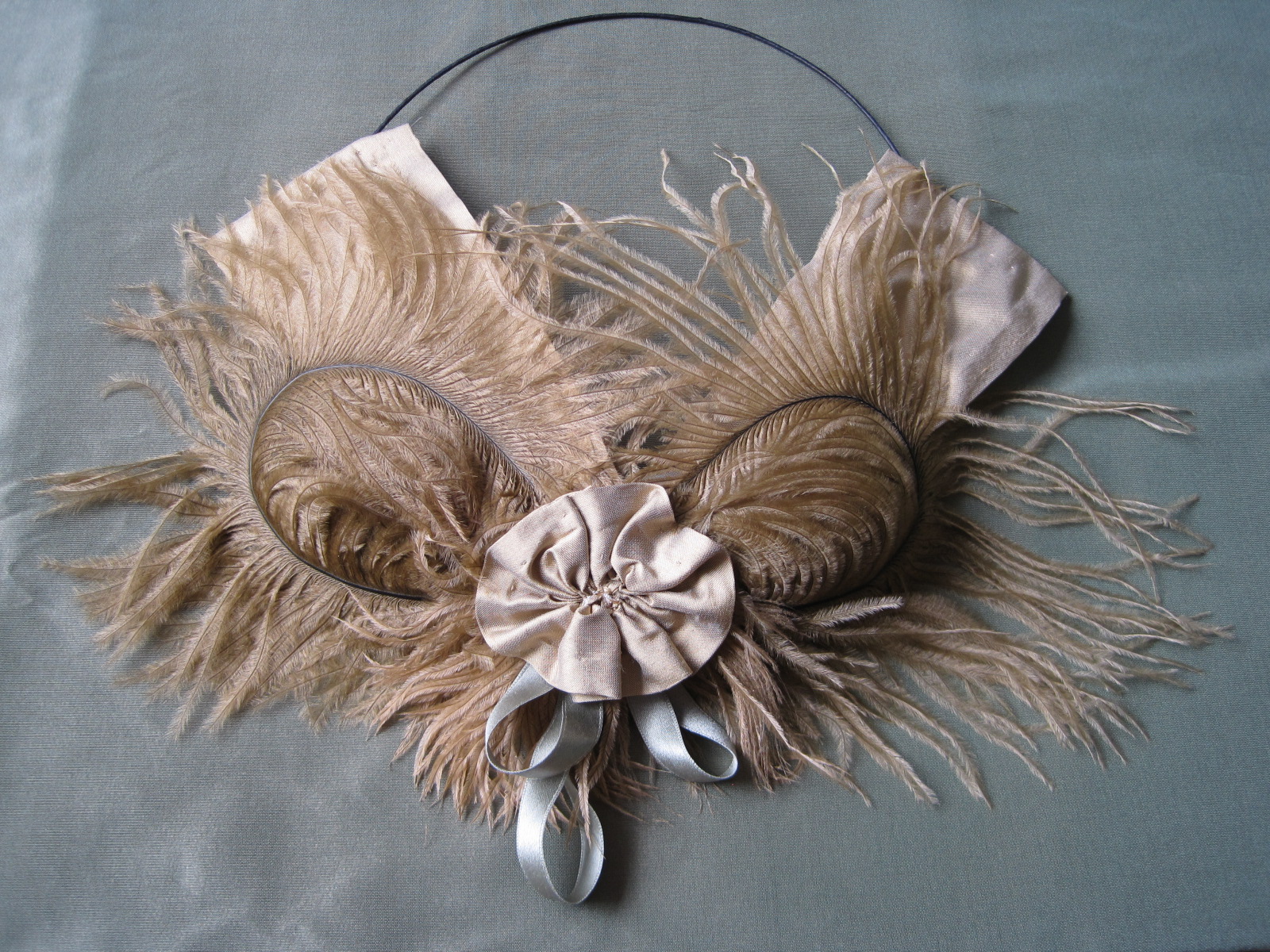
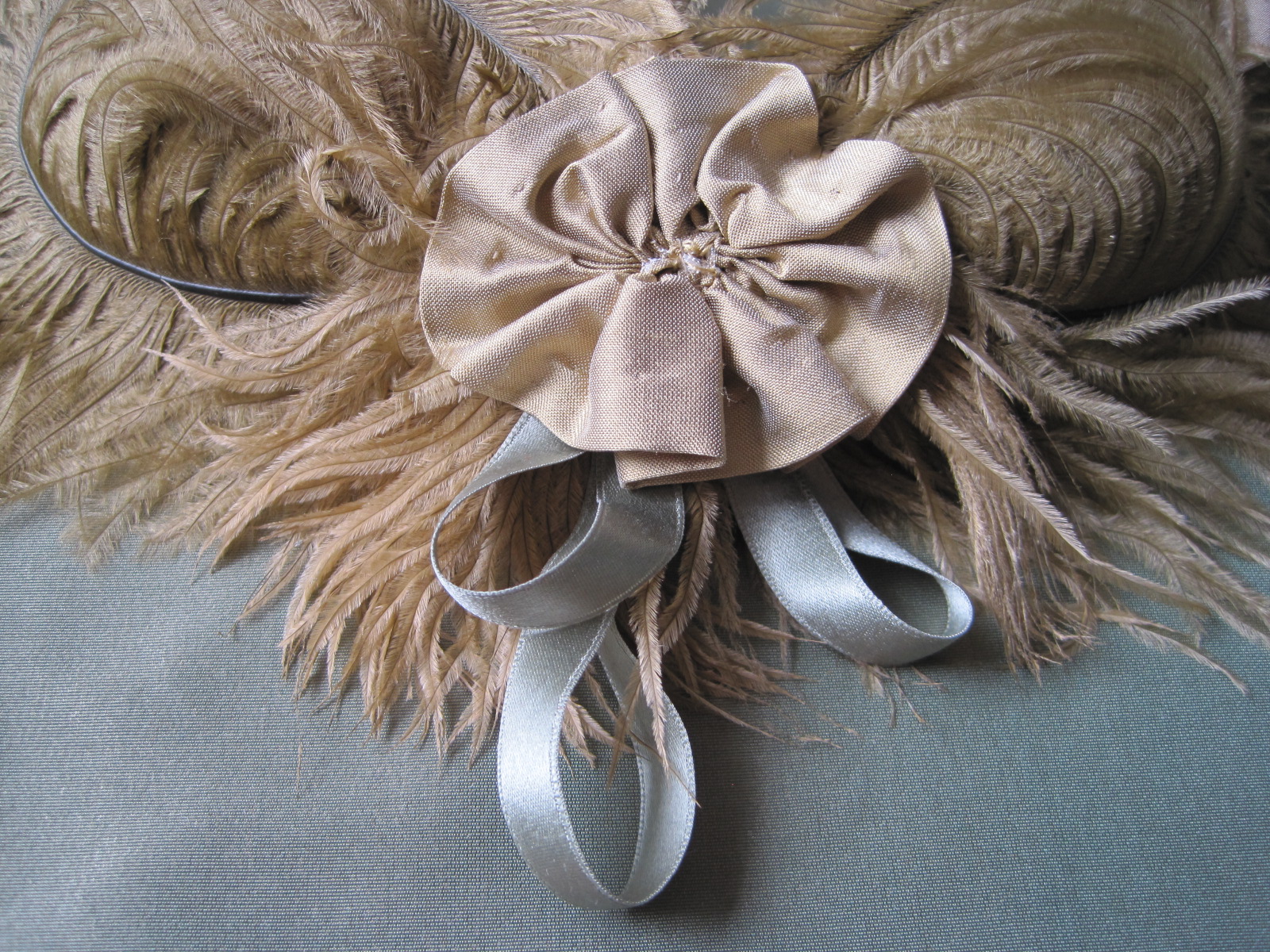
Remember Evie, my 1864 green ball gown? I felt compelled to make a matching hair wreath to wear with her, and here it is! A ring of paper covered millinery wire colored black (to blend with my hair) with a sharpie, decorated with a bit of gold silk, some green silk ribbon, and the mysteriously changeable gold/green ostrich feathers. Here those feather look gold, but I assure you that they sometimes appear as green as the silk background (which is the silk the dress is constructed of).
I think I would like to trim the ostrich feather on the right so it is the same shape as the one on the left, but aside from that one change, this is good as is! It’s super easy to bobby pin the wire to my hair and it’s easy to hide the bobby pins under all that silk and ostrich feather business going on at the bottom.
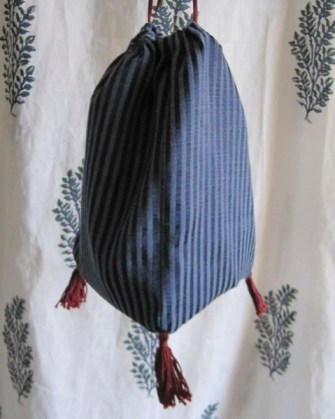
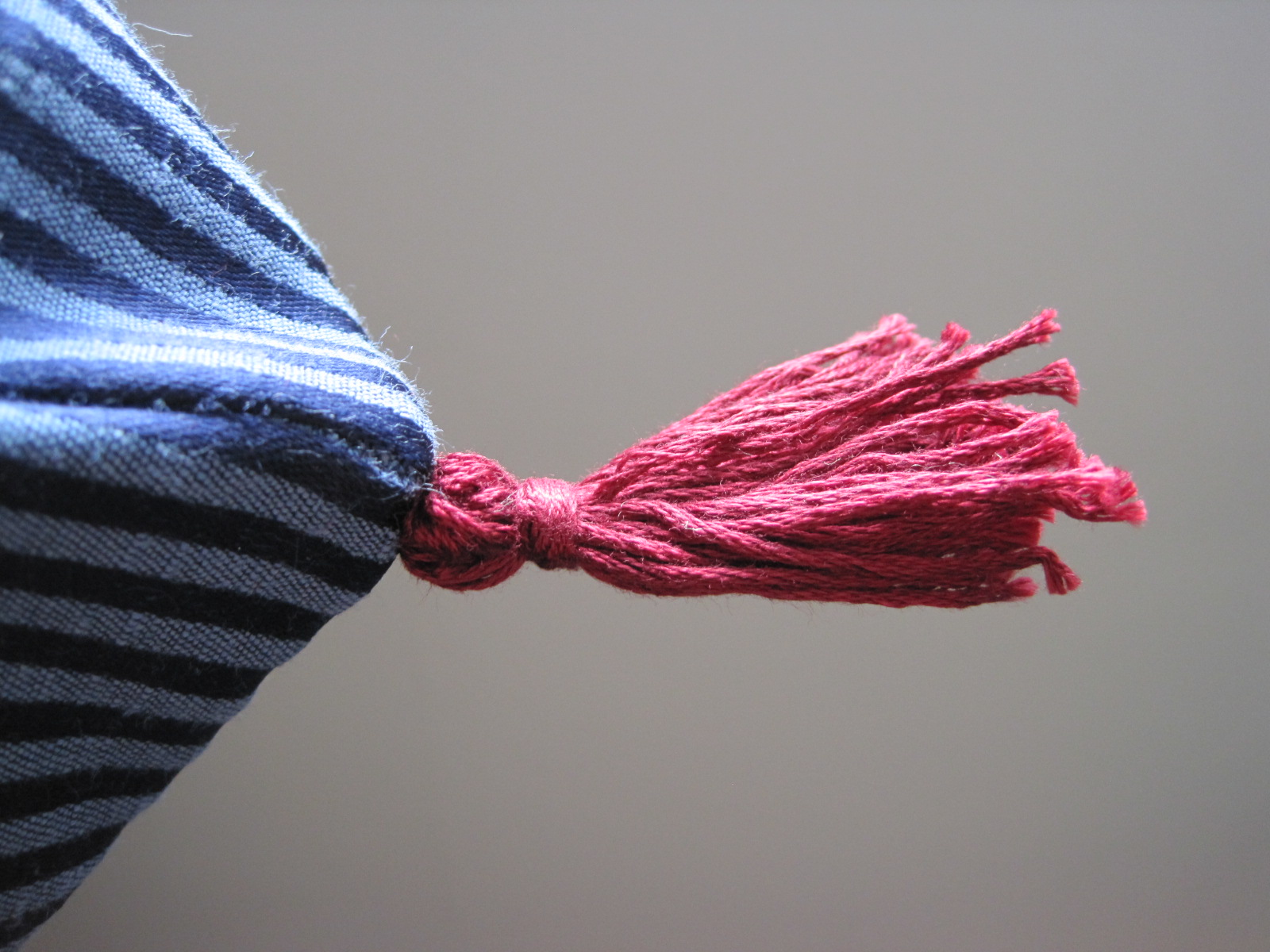
I intended to complete this reticule for the HSF Challenge #6: Stripes this past week, but as the deadline approached and I reread the fine print, I realized that the challenge was supposed to be fulfilled by a garment. Whoops! I don’t think I can convince myself that a reticule is garment, let alone other people. So I put the project on hold while working on other things (like Evie, my 1864 ball gown, and the completion of my purple ballroom competition dress), but finally got back to it and finished it off towards the end of last week.
Lucky for me, this reticule does fulfill the MpRSW Goal #4: Accessories (due April 8th: I’m early!). (If you’re paying attention, I did fail to post about the MpRSW Goal #2: Evening Gown… I might have fallen off the wagon on that one and not managed to fix the rip in my gown on time. But luckily, the MpRSW is motivating me to complete that repair this week, even if I am delayed!)
Tassels!
Trust me, this is not a historically accurate reticule. The fiber content is questionable… (probably a blend including polyester), the ribbon is polyester, and the tassels are cotton embroidery floss. But it’s cute and functional and has the general look of the period, so I’m happy. This will get packed for the Regency weekend coming up in April!
Inside the reticule: french seams and a cotton canvas purple (woohoo, extra fun on the inside!) layer whip stitched to the inside of the bottom to provide stability and help keep the triangular shape. The seams are hard to spot because the stripes blend into each other so much, but they’re there!
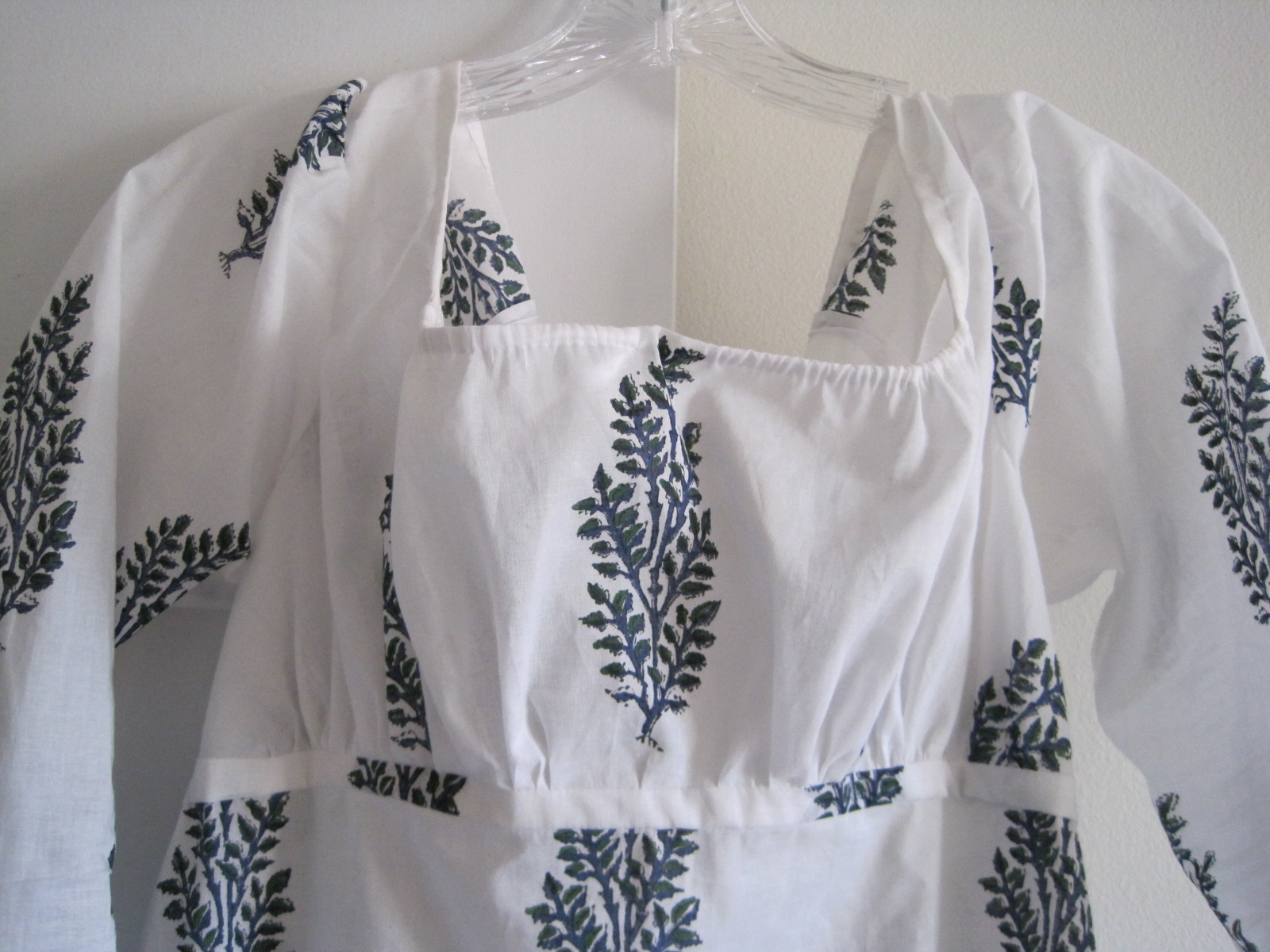
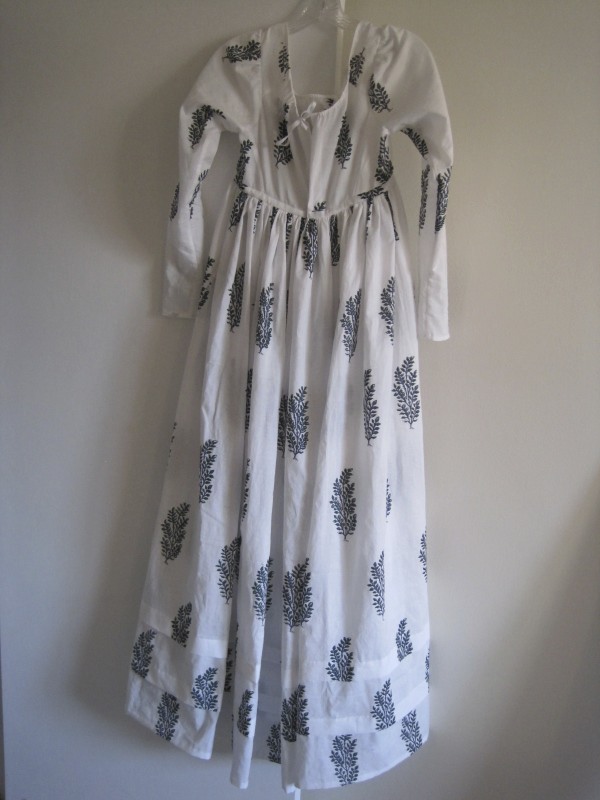
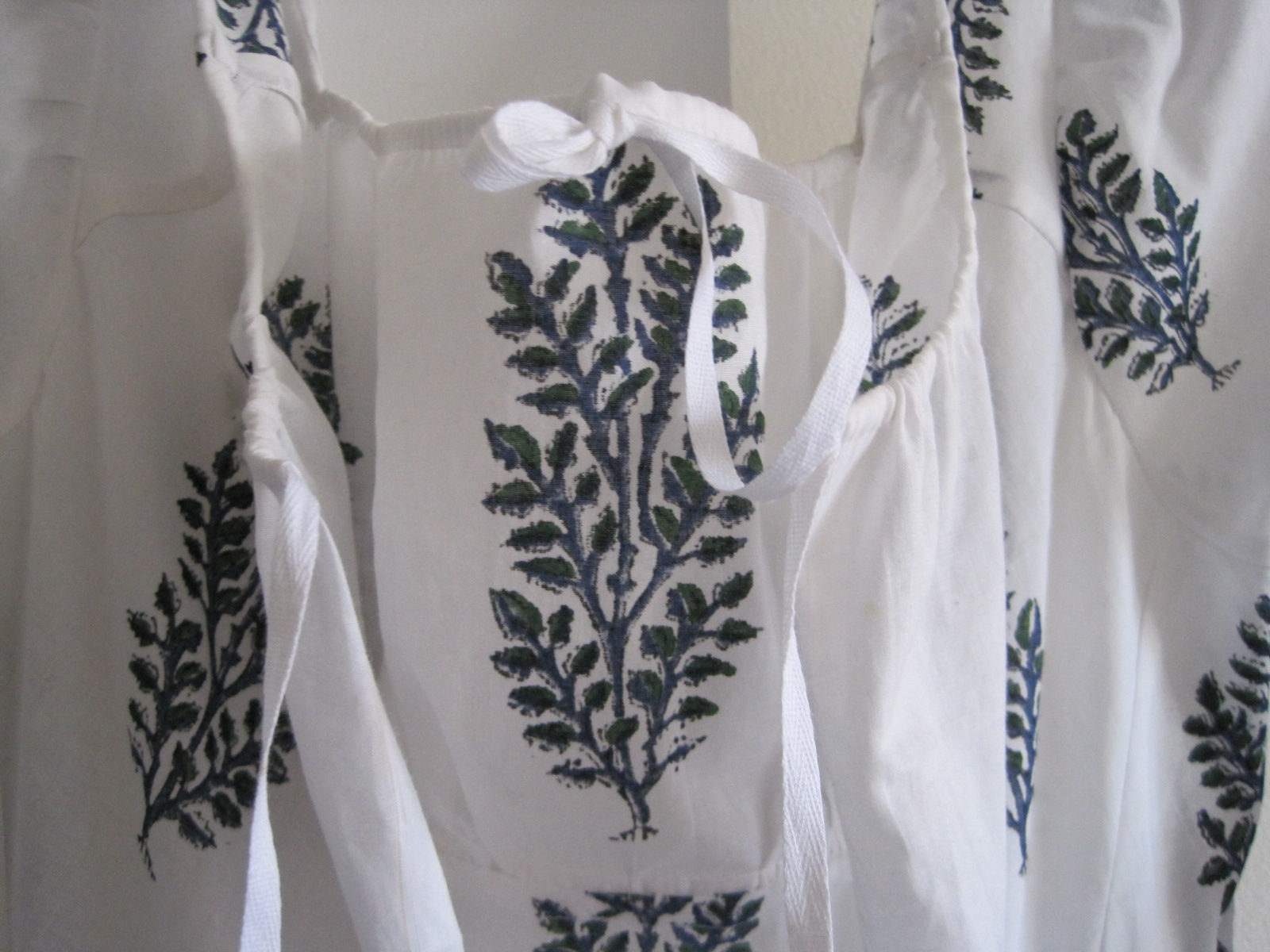
What you saw in the first picture (behind the reticule) was a first glimpse of my latest Regency gown! This new block printed cotton gown, from 1815, is “The Tree Gown” in my head because the motif reminds me of trees (or shrubs perhaps, but I like the sound of The Tree Gown better than The Shrub Gown). This gown fulfills the MpRSW Goal #3: Day Wear! It’s due today, so I’m right on time. The gown is machine sewn on all of the non visible seams, and hand finished on the visible sections.
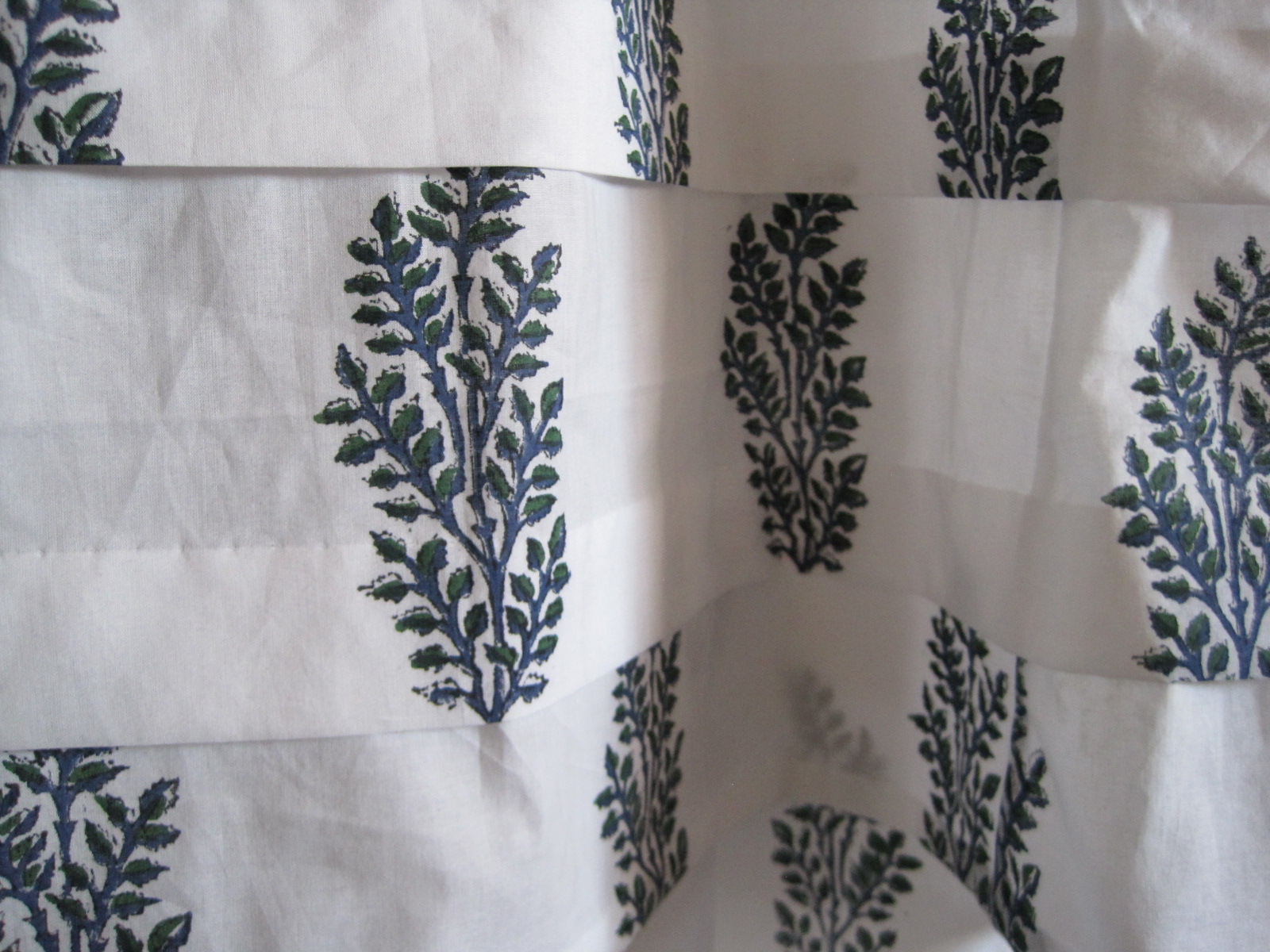
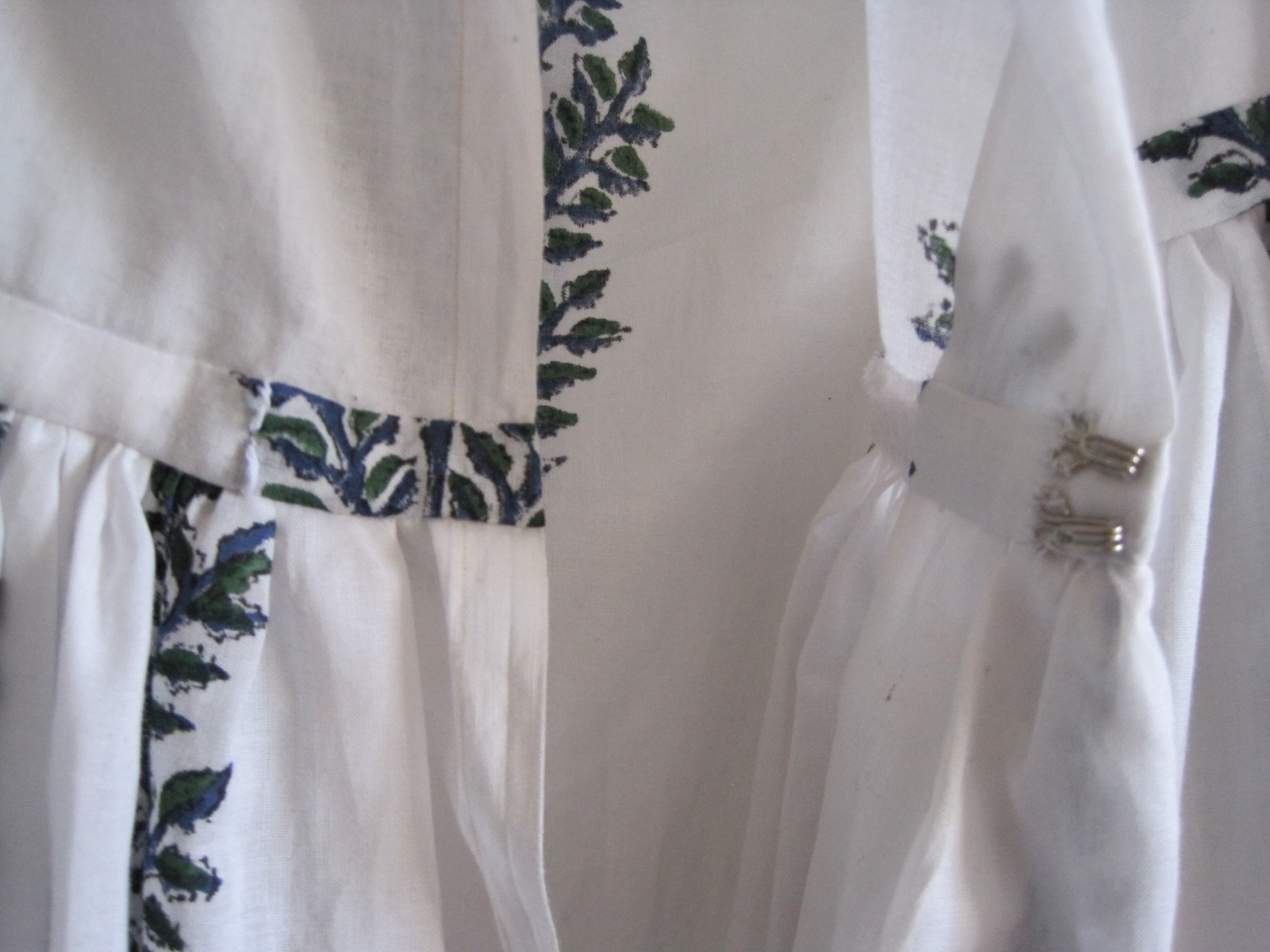
Center front. This gown has a mostly squared neckline with a drawstring across the bust, like my 1812 white striped gown.Unlike previous Regency gowns in my possession, this gown has long sleeves! (This is a back view.)There are two 1 1/2″ tucks around the hem of this gown, for decoration.The gown closes at center back with two hooks on the waistband (see the thread loops?) and a tie at the top of the back.The tie at the top of center back is a drawstring that continues to the shoulder seam, allowing the back to gather slightly. The bow in the middle is the drawstring for center front.The fullness at center back is gathered. This gown has french seams and the waistband seam allowance is just whip stitched together to keep it tidy.The inside of the neck opening. The area over the shoulder is reinforced with an extra bit of fabric cut on the straight of grain to keep it from stretching.
This gown below is my main inspiration for this dress: the tucks at the hem, the sleeves, the pattern for the skirt, the gathers on the bodice, the mostly squared neck in front, the tie at the back of the neck… I omitted the extra sleeve puff (partly because I didn’t have enough fabric, partly because I wanted this dress to be more streamlined) and the tie at the back waistband. I love the super zoom on the Met’s website because you can see so many great details!
For example, I could see where the center front skirt panel ended and the angle of that seam (as well as the angle of the back panel). Using that information, I determined that my front panel should be a rectangle (it’s 21″ across in my dress given my proportions) and that the back panels should be cut straight at center back, but with an angle on the side seams that goes up toward center back making an elongated trapezoid. There is a seam at center back, so the hem of each back piece is 45″, but each top narrows to 31″. I’m curious to see how that style of skirt fits me. I certainly like the look of the skirt on the dress in the museum!
1810-1815 dress at the Metropolitan Museum of Art.
This gown also fills the HSF #9 Challenge: Flora and Fauna, so you’ll be seeing another post about it with some more details (and pictures of it on a body!) coming up in a few weeks (after the Regency Weekend in April, you know!).


























 The Quintessential Clothes Pen