c. 1785 Stays Of Success Part VII: Conclusions, Reflections, & Resources

Did you notice the change in the name of these stays??? I’ve decided to call them the Stays of Success instead of the Stays of Fail!

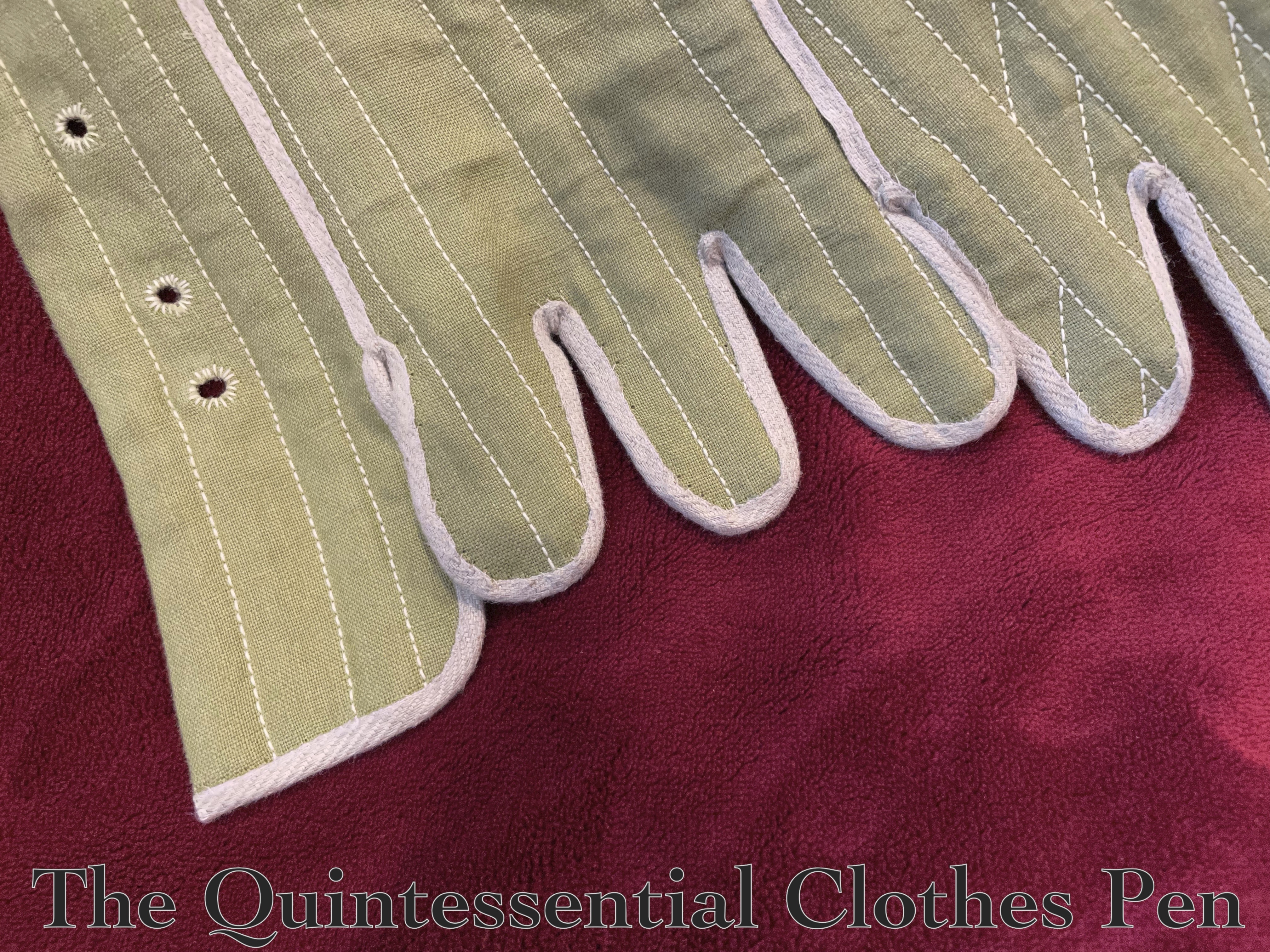
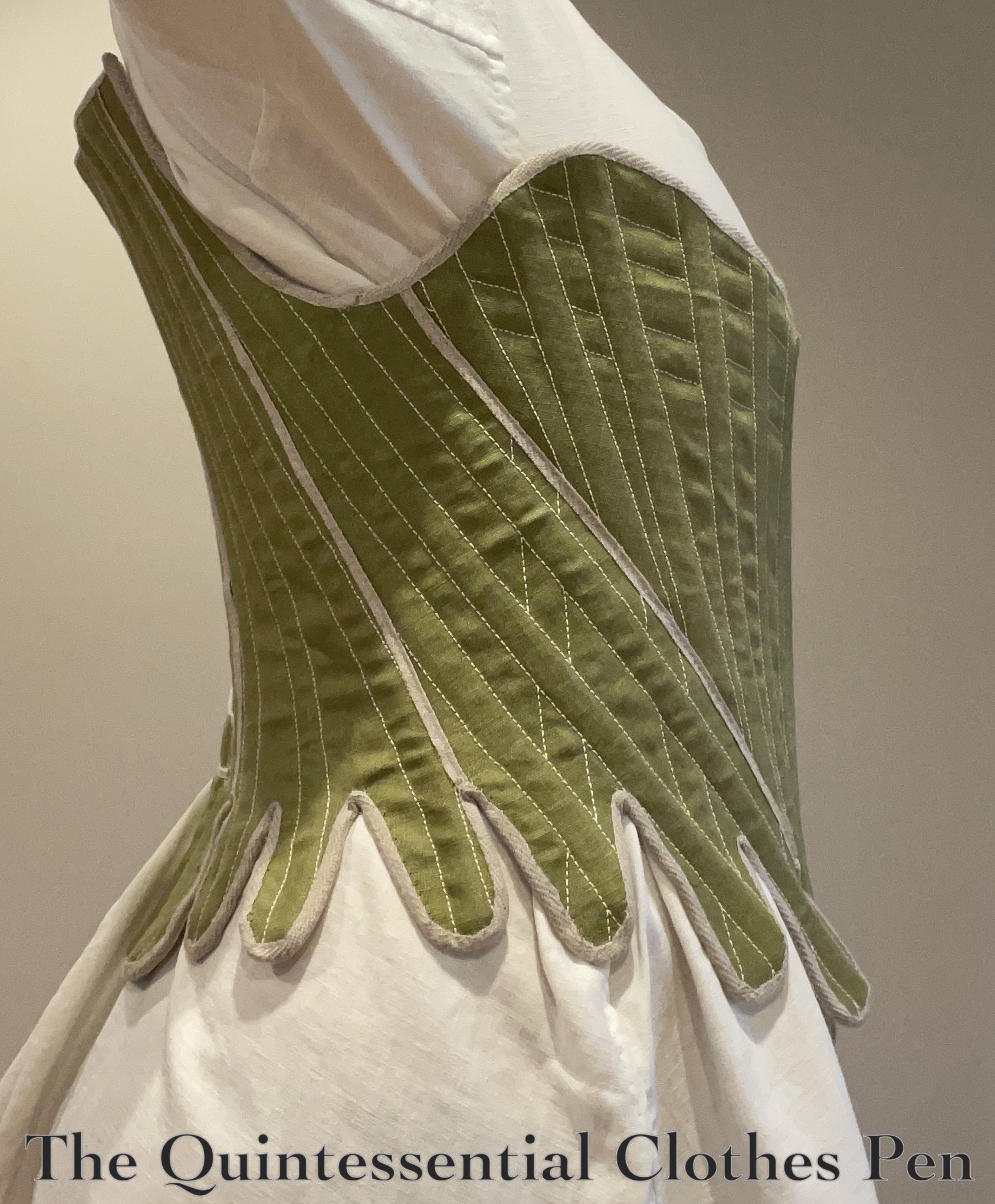
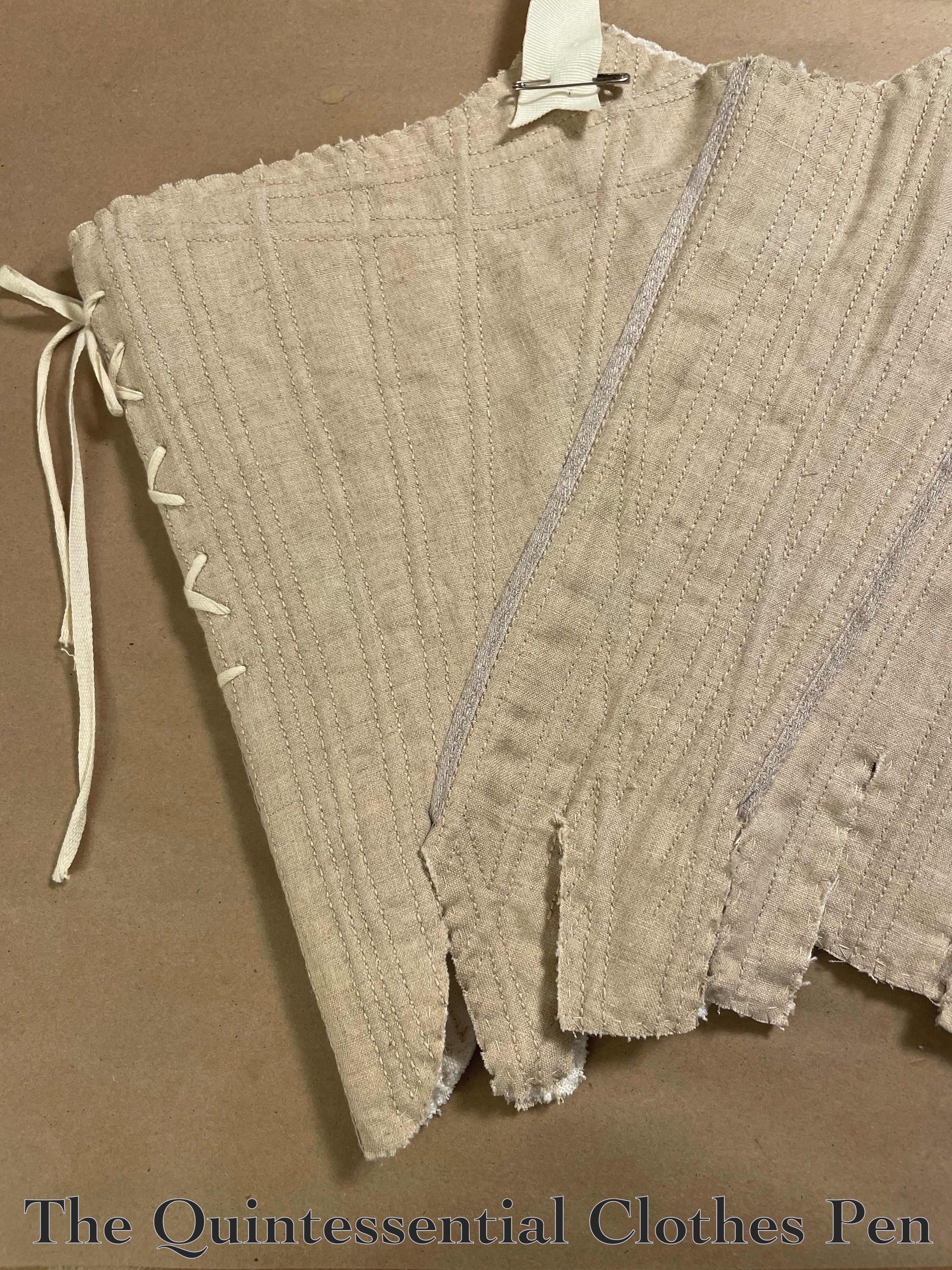
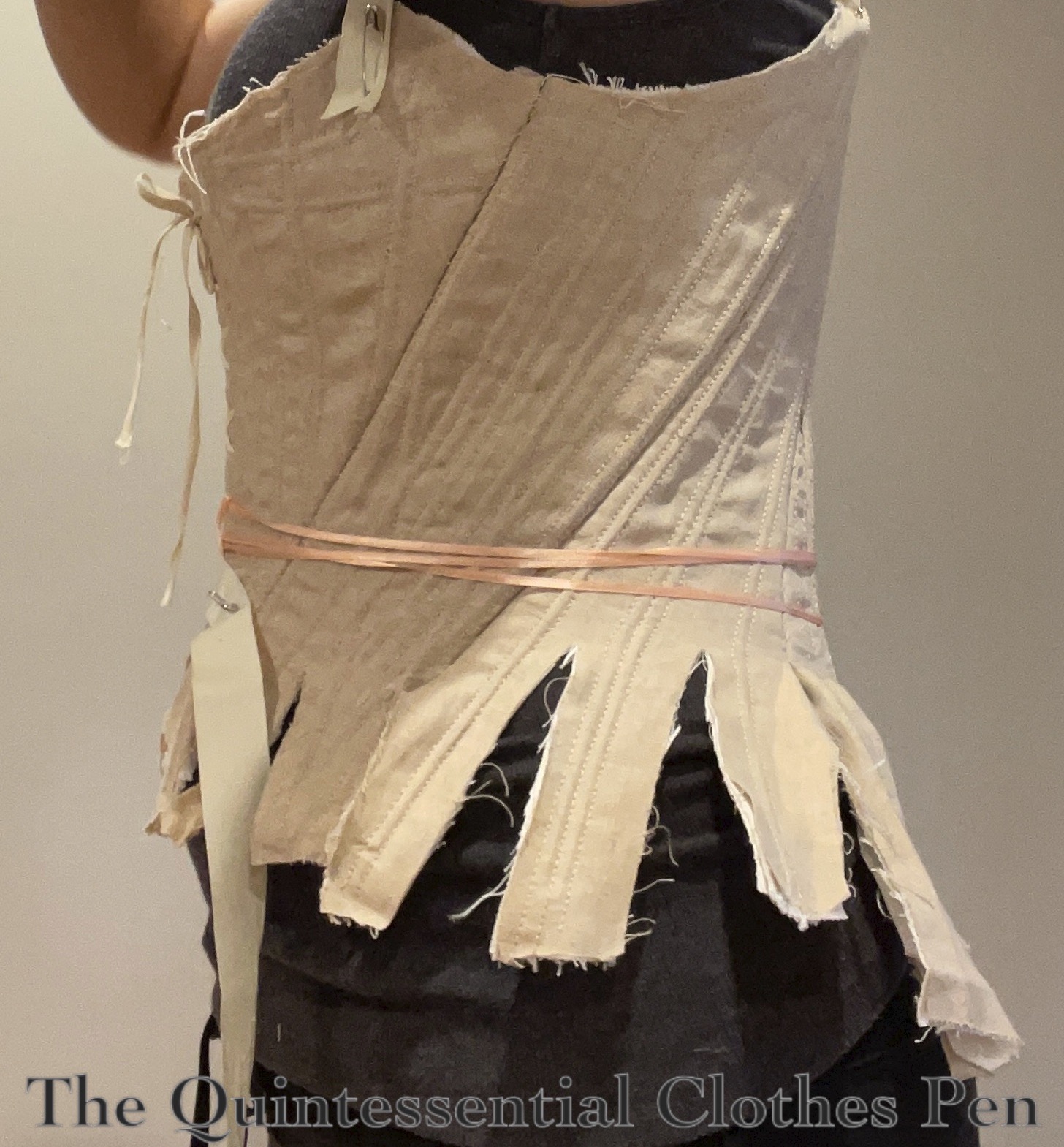
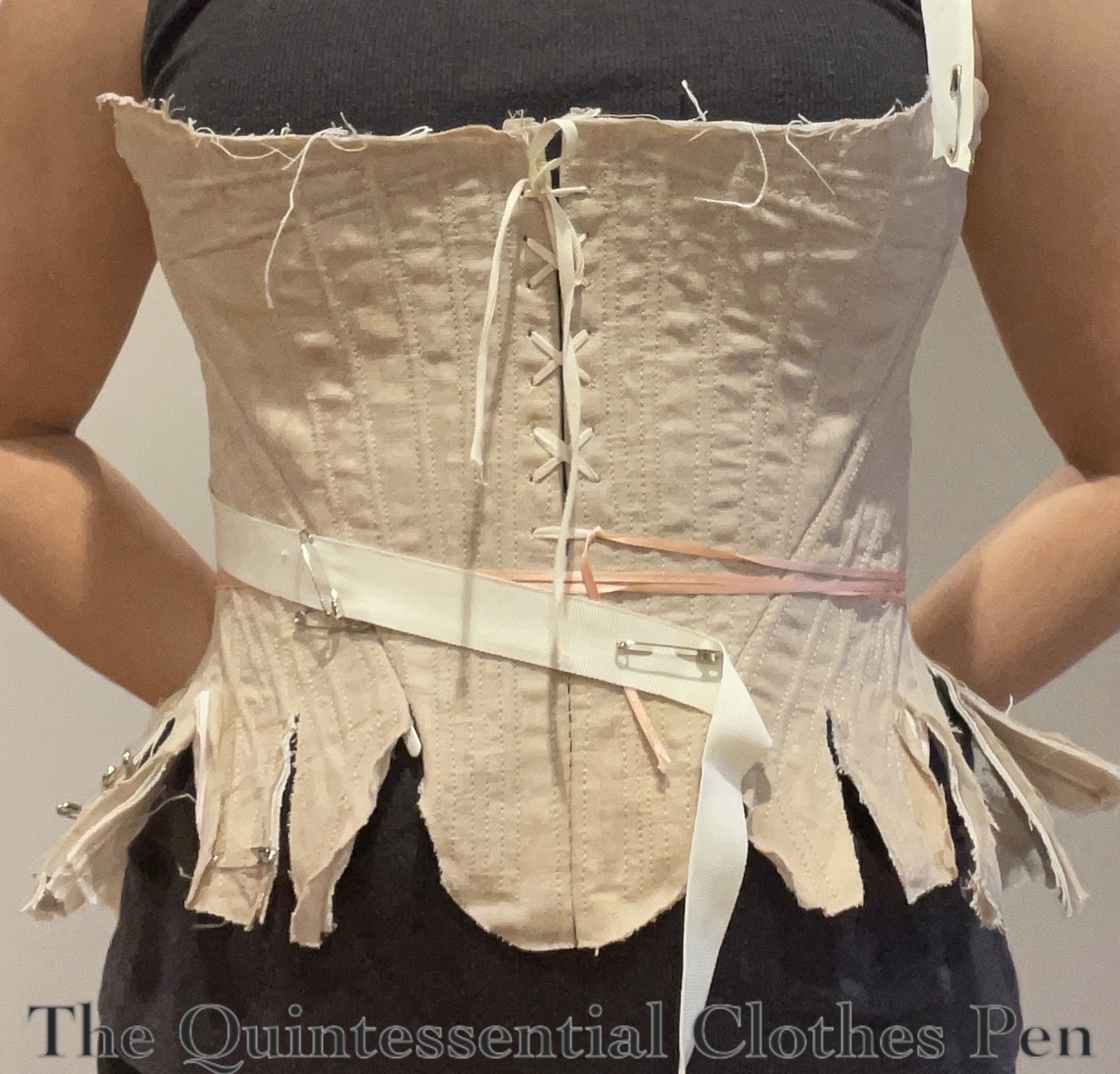
This is partly to give them a more uplifting name that brings joy instead of disappointment, but also because I finally took photos of them… and then proceeded to wear them around the house for a number of hours because they were actually quite comfortable! Success!

Conclusions and Musings

I want to start by exploring why I originally named this pair of stays the ‘Stays of Fail’. That is because, until very recently, I felt that this attempt at stays was a failure in terms of comfort. The comfort is what I based the original name of them on.

By the time the construction was almost done, I felt slightly better and that they were a (very struggle-y) learning opportunity. After adapting them, I was thinking that ‘Stays of Fail’ maybe should turn into ‘Stays of Learning’ (although isn’t that every project?!?) or maybe just c. 1785 Hand Sewn Natural Linen Stays (but that’s not very exciting!).

Stays of Success is more entertaining!

Reflections On The Process

Would I use the book Stays and Corsets: Historical Patterns Translated for the Modern Body by Mandy Barrington again?

My experience, as I moved forward with the construction process, was that I regularly lamented the focus of the book on modern theatrical methods, as I was aiming to produce historical stays. When I wanted to go back and get detailed information about the materials, construction methods, measurements of bindings, etc. I found that information just wasn’t included. It was especially frustrating when information was just missing–such as the locations of the front eyelets–even on a pattern taken from the original.

At one point, I thought I could get around the problem of lack of historical detail in the book by looking for the online record of the Chertsey stays that the pattern was based on. Clever, I thought! However, I can only find two images of them and it seems that aside from that they aren’t available to view online in full. (The back lacing can be seen here and a front view can be seen by Google image searching ‘Chertsey museum stays’, but clicking through to the museum website doesn’t lead to the image.)

This lack of information is why I heavily relied on Patterns of Fashion 5 (PoF5)–because all of the detailed information I wanted (and more!) is there. (I did have to extrapolate and make decisions based on the information in PoF5 since it is all for similar stays but not for the exact pair that I’ve patterned.)

So, while using this book was a valuable experiment, I don’t think I would be inclined to use it to create another historical support garment for myself. However, I can see the benefit of drafting a pattern with similar proportions for someone who is vastly different than the original pattern size, for theatrical purposes in particular. For that purpose, I wouldn’t be interested in replicating the historical details and so the omissions I mentioned would not be a detriment to the garment I would be intending to produce.

In the end, I’ve learned a lot about what this book can, and can’t, do and that is helpful even if I’ve been a bit frustrated along the way due to my goals being different than what the book is aimed at.

Further Experiments

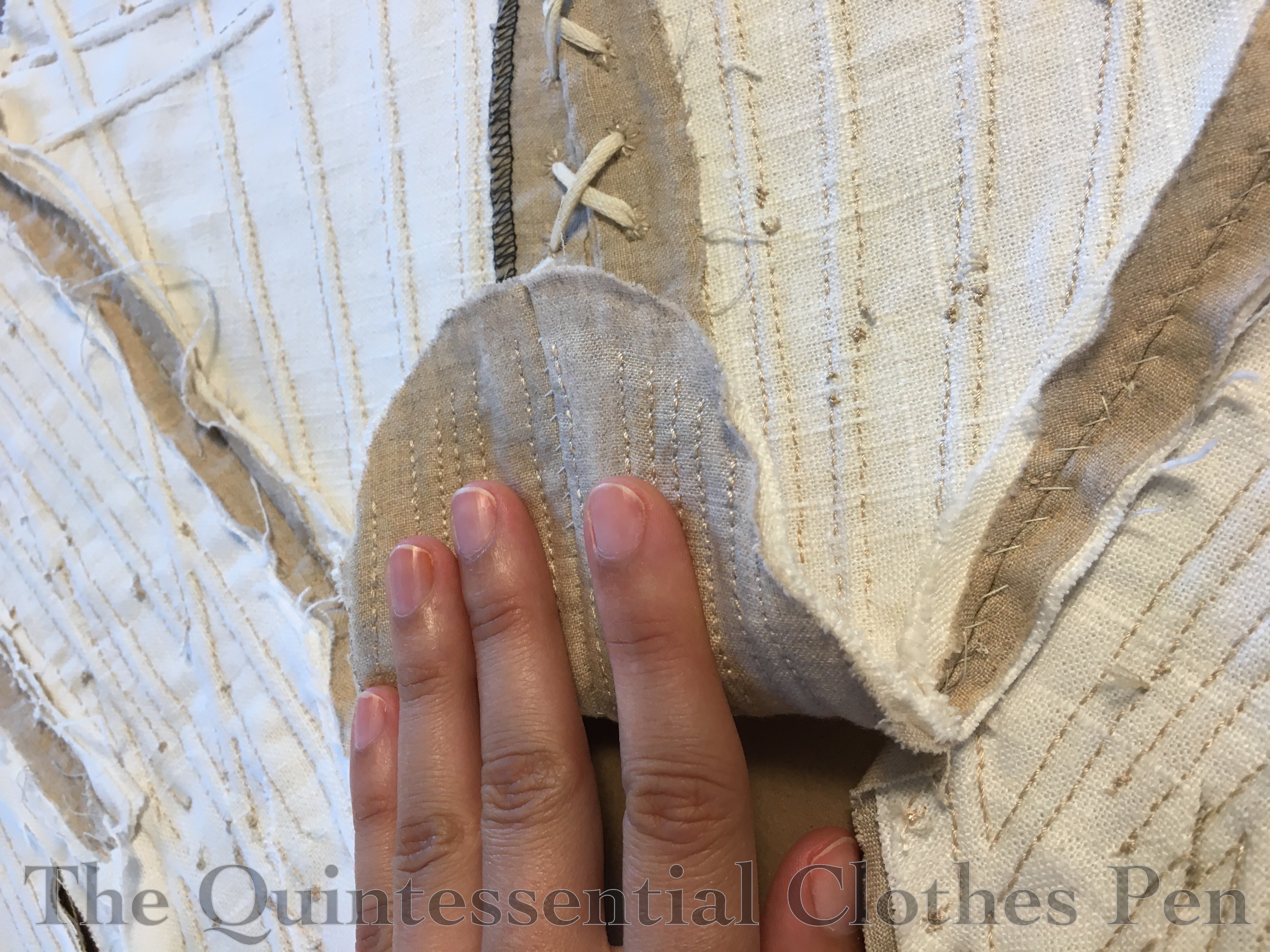
Unfortunately, one of the fitting problems I encountered might be due to an alteration I made in the mockup to take in the waist (I’m taking ownership of my actions!). This inside photo of the mockup shows the center front and side area alterations I made.

After finishing the stays, I was curious to see how the mockup would fit if I compared it to the finished stays. It turns out that I basically had to add in the width I’d taken out in the mockup when I added my back gusset. Sigh!

In theory, my alterations should have made the mockup slightly smaller than the finished stays with the added gusset, but the odd thing is that the mockup dimensions (with the alterations) are pretty similar to the finished stays (with the back gusset added in). So perhaps the real fabric stay pieces shrunk or wound up being smaller than I thought? Who knows?!? I’m done puzzling on this one!

In The Meantime…

While wrestling with these stays, I decided that I didn’t want my lack of stays to hold me back from making dresses any further and so I decided to start a whole new pair of stays instead off dealing with this pair (at least for a short time).

I held off sharing about them for quite awhile because I wanted to finish the saga of these stays… but eventually I gave up, and at the end of 2022 had great fun sharing the success and construction of my c. 1785 Green Linen Stays.

Resources

This is not comprehensive by any standards, but I thought it might be helpful to collect some links that I’ve found useful for anyone who wants to know more, see other people’s stays, or people who are making stays themselves. (These sites were especially useful for seeing the process when I didn’t have PoF5 on my cutting table!)

You can read previous posts in this series here:

c. 1785 Stays (Of Fail), Part VI: Finishing Construction Details
c. 1785 Stays (Of Fail), Part V: Middle Construction Details
c. 1785 Stays (Of Fail), Part IV: Early Construction Details
c. 1785 Stays (Of Fail), Part III: The Pattern
c. 1785 Stays (Of Fail), Part II: Fitting Update
c. 1785 Stays (Of Fail), Part I: Beginnings
c. 1785 Stays (Of Fail), Part VI: Finishing Construction Details

This project was on hiatus for a number of months (the last post about it was in October 2022!), but the time has come to wrap it up!

After the progress made in the last post, there weren’t that many steps left to complete. Yay! Below are details about those steps.

Binding

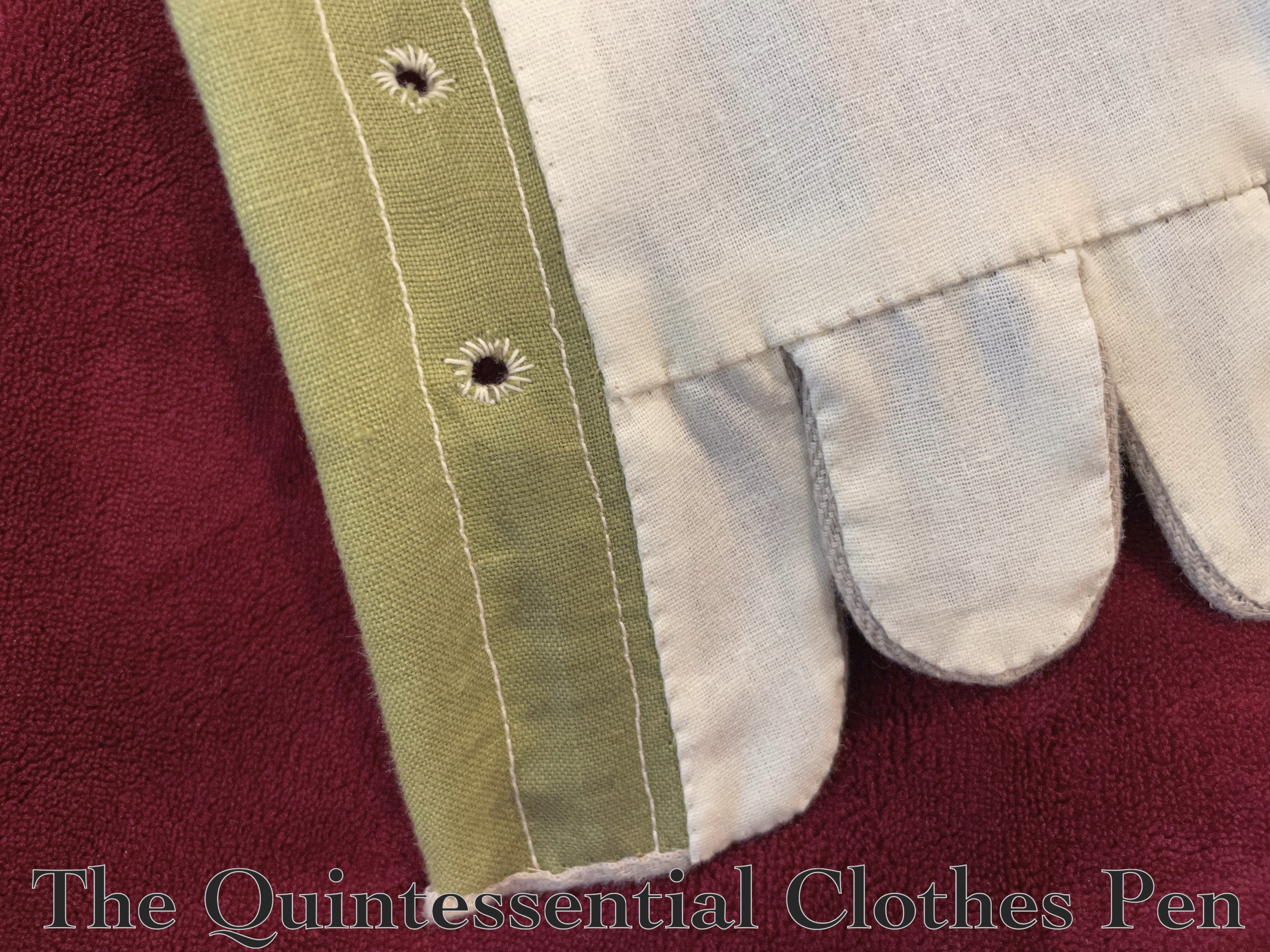
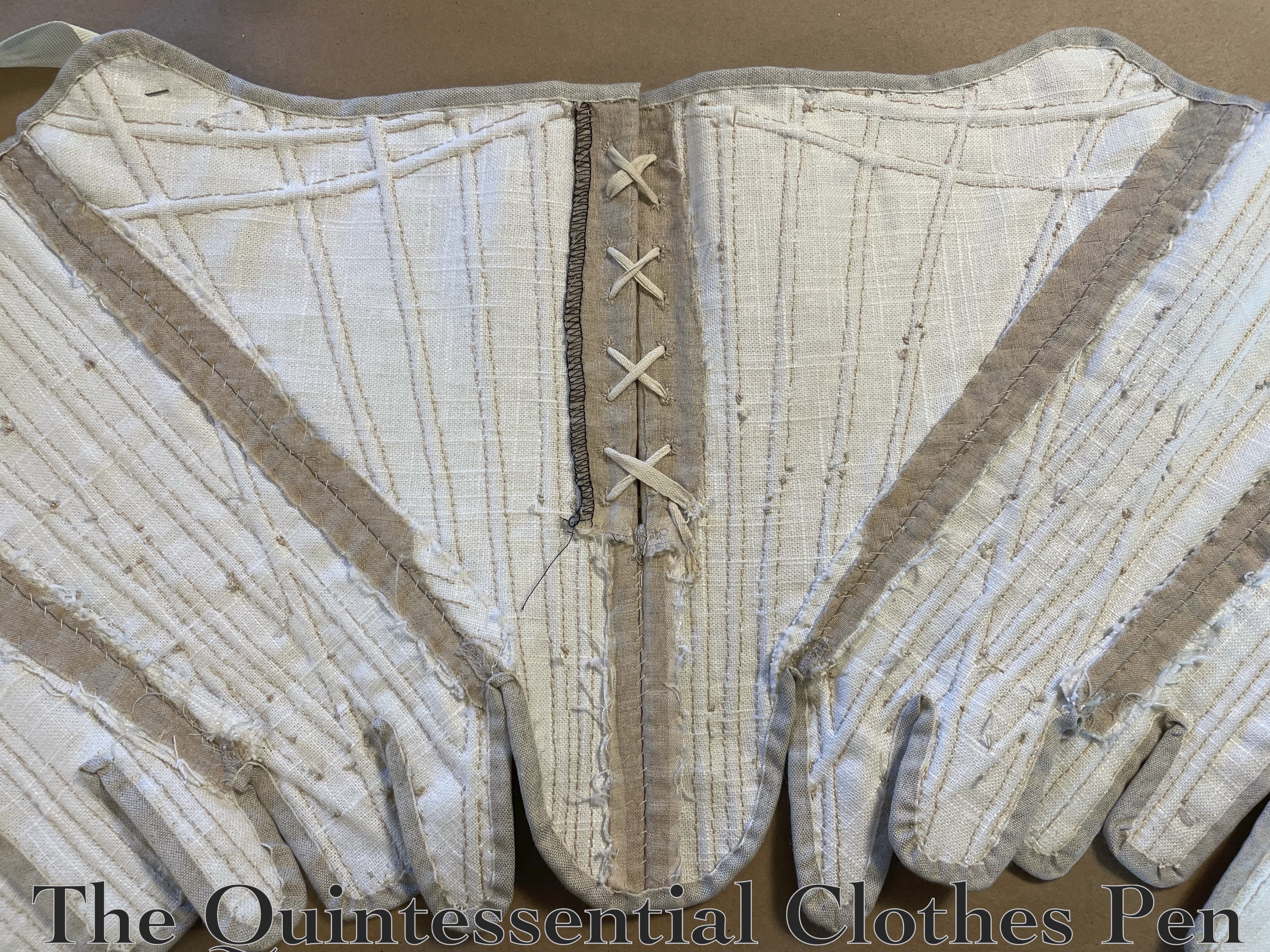
I used ½” natural linen tape. It is whip stitched onto the right side and then wrapped around to the inside and more roughly whipped. The inside stitches will be covered with the lining, so making them invisible and pretty is less important. Below is a photo of the inside of the stays after the binding was sewn on.

Lining

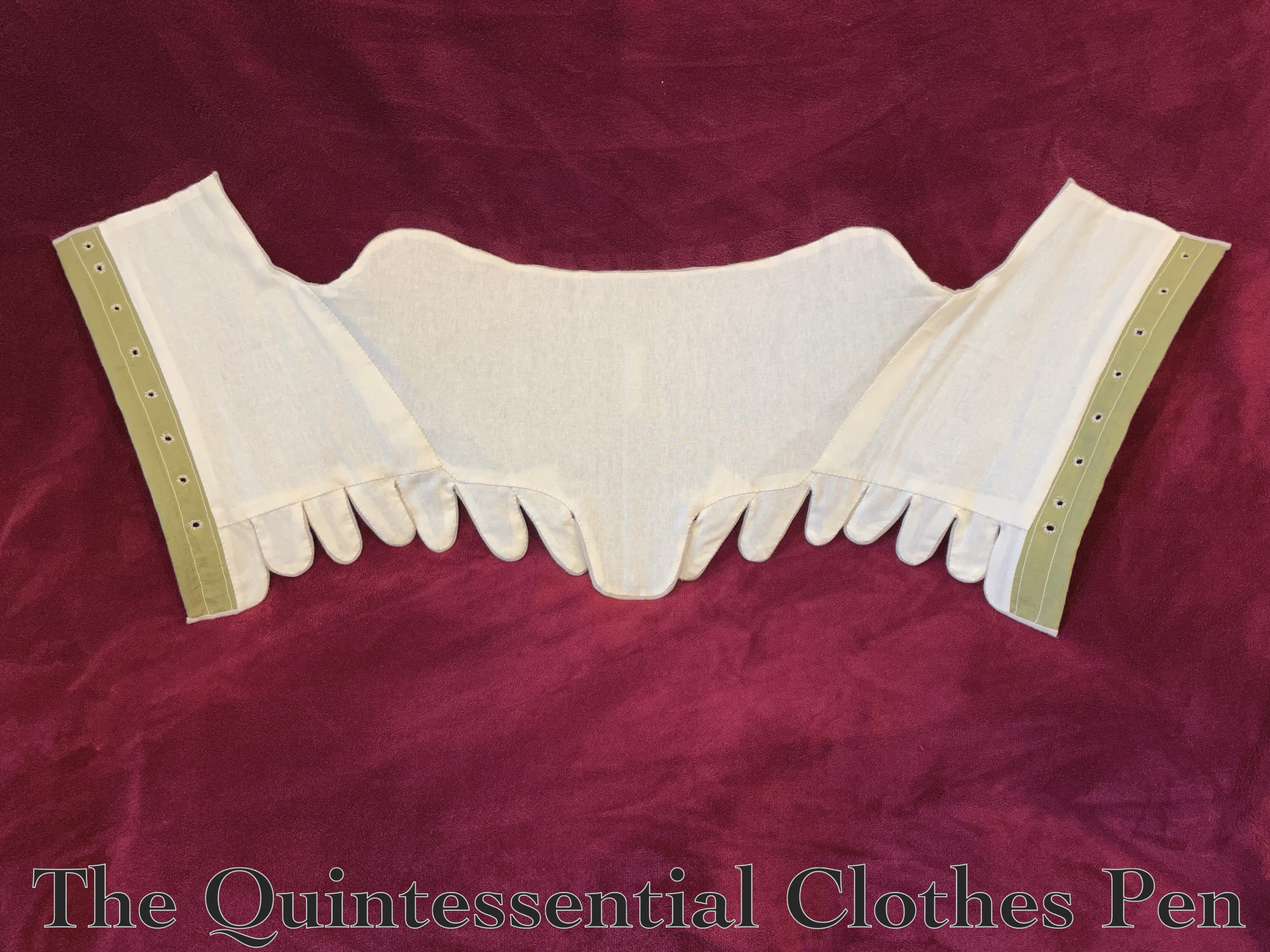
At this point, the stays were almost done. The lining serves to cover up all of the interior construction. To make it, I laid my stays out wrong side face up (as in the above photo) with my lining fabric on top. I pinned in a few strategic places and then roughly penciled where I wanted the cutting lines to be. Then, I cut the lining pieces out.

Once cut, I pinned the center lining piece in place, then pinned the piece next to it, turning under my raw edges at the places I wanted the seam to be and around the edges. Those edges were all pinned in place and then each edge was whip stitched. Additionally, each tab has a separate, small piece of lining whose edges are also whip stitched in place.

Straps

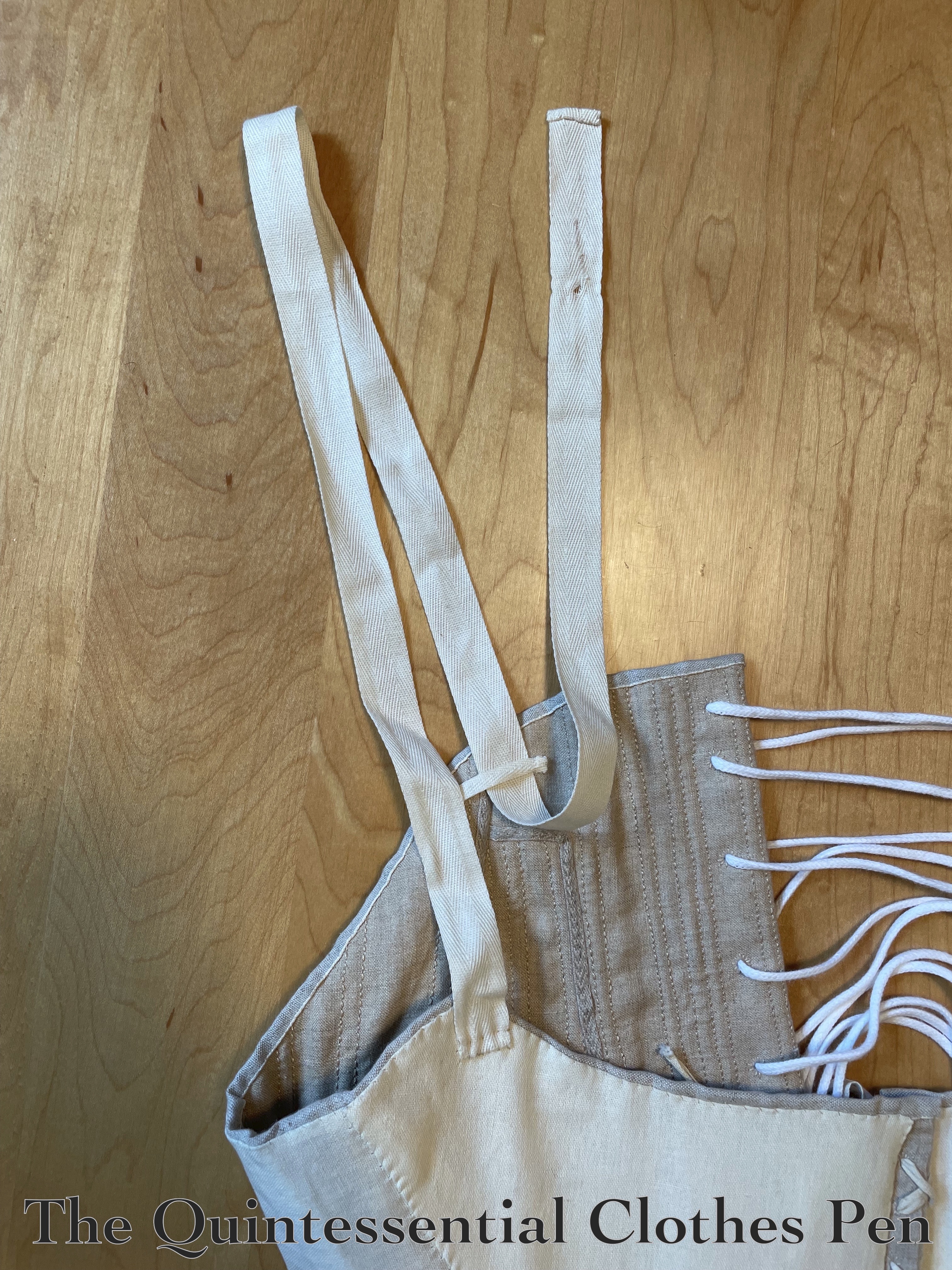
The truly final step was to add straps! I used ¾” ivory cotton twill tape. Each strap was sewn to the front points of the stays and the short raw end hemmed. A scrap of ¼” twill tape was also sewn on each of the side backs for the wider tape to run through.

Then, I tried on the stays and determined where I needed to place the hooks that the straps would attach to. Below is a photo of one of the straps held in place by the sideways hook. The straps are long enough to wrap over the shoulder, cross in back, and wrap around towards the front to catch on the hooks.

After that, all I had to do was attach the hooks… and… after many years… the stays were finally, finally… finally…. DONE! They were finished in April 2023.

You can read previous posts in this series here:

c. 1785 Stays (Of Fail), Part V: Middle Construction Details
c. 1785 Stays (Of Fail), Part IV: Early Construction Details
c. 1785 Stays (Of Fail), Part III: The Pattern
c. 1785 Stays (Of Fail), Part II: Fitting Update
c. 1785 Stays (Of Fail), Part I: Beginnings
HSM #11: c. 1785 Green Linen Stays

I’m excited that the green stays in my most recent post qualify for the Historical Sew Monthly Challenge #11: Fitting (Make something that focuses on fit).

If you read my lengthy post about making these, you’ll hear all about how fit was both one of the reasons I started these and that I had a joyful time playing with fit as I created them.

I actually finished these on March 30 and I’m excited to post about them before 2022 ends so that they can officially qualify for the HSM this year!

Just the facts:

Fabric/Materials: ½ yd green linen (exterior), 1 yard heavy olive linen (inner layers), and ½ yd ivory linen/cotton blend (lining).

Pattern: My own, but using the drafting guide on page 155 of Patterns of Fashion 5.

Year: c. 1785.

Notions: Heavyweight ivory Guterman thread, regular weight tan Guterman thread, cotton covered polyester quilting thread, approximately 410″ of ⅜” wide zip ties (boning), 11 ½” heavy duty steel bone (busk), 2 ⅛ yard ¼”  linen twill tape (covering seams), and 4 yards ½” linen twill tape (binding).

How historically accurate is it?: 90%. The pattern and materials are good. The construction methods are a mix of modern and historical.

Hours to complete: It seems that I didn’t keep track. Maybe 32 hours?

First worn: Has not been worn yet, except to get photos for the blog.

Total cost: The fabrics came from the stash as leftovers from other projects or were gifted to me. I’d say the notions cost about $16 +  $15 for the linen twill tape. So, let’s say about $35, if we include thread.

There is a lengthy post sharing the story behind these stays, my musings about the journey to complete them, many photos of the construction process and the stays on the body, and written construction details that you can read here.

c. 1785 Green Linen Stays (Construction Details)

I made another pair of stays!

This pair is a reaction to many of the things that went wrong or that I didn’t like about The Stays of Fail (which I’ve posted a whole series about: the background, construction, and patterning, though the lessons learned post is still forthcoming) as well as a chance to try out ideas from Patterns of Fashion 5 and all of the information I’ve learned about stay-making over the last 10 years or so.

The Background Story

I made a pair of stays about 10 years ago, so I figured I had some experience… Such hubris! We can always learn more things.

The old pair is well documented in old blog posts, but I would like to point out that since I made those stays I’ve learned so much–about what fabrics to use, what the construction process should be, etc. I’ve also changed size in the last 10 years, so my old stays (which always had a gap, intentionally), now hardly reach around my sides. It’s no longer a gap, it’s a chasm!

I don’t wear 18th century clothing that often, so making these work has been fine… The last time I wore them was to Versailles in 2016. They’re still pretty comfortable, they just need a very long lace to bridge the chasm!

However, in the last few years I’ve developed grand plans to make 1780s and 1790s clothing and I wanted a better fitting support structure to go underneath. I thought I’d use the knowledge I’ve gained, along with the invaluable information in Patterns of Fashion 5 (only published recently in 2019), to make a new pair of stays. (If you want to know more about the book, I rave about its amazingness in more detail in this blog post.)

Contemplating My First Pair Of Stays

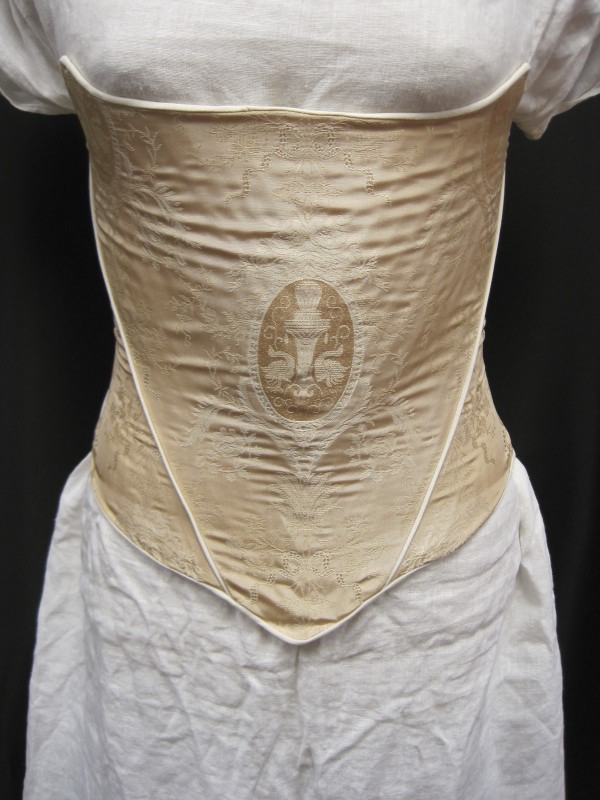
With the knowledge I’ve gained over the last 10 years, I suppose I would call the old stays ‘smooth covered’ stays that are fully boned with cane. I wanted to machine sew the channels but picked a lovely patterned silk for the exterior that I didn’t want machine channels on top of, so that’s where the smooth covered idea came from.

At the time I made the stays, I didn’t know what the purpose of the narrow tapes covering the seams was (now I know: it’s to cover what shows of the whip stitches used to attach the pieces together when the stays are hand sewn, as they would have been), so I inserted piping to approximate the look. It’s definitely not historical, but my best guess at the time. And, some of my piping isn’t long enough to extend into the binding… Below, a view of this old pair of stays (more photos in this past blog post).

Speaking of which, the binding is bias twill, which isn’t terrible, but is much more of a 19th century practice than an 18th century one (18th century stays seem to be most often bound in tapes or leather).

The one thing I did do well was create hand sewn eyelets for lacing, though they are set up for x lacing as opposed to spiral lacing (the latter being more common in the 18th century for the functional closure of stays).

Patterning The New Green Stays

For the new stays, I wanted to try the drafting method detailed in Patterns of Fashion 5 on page 155 as opposed to sizing up a gridded pattern and adjusting it to fit. The instructions are easy to follow, although determining exactly what height the measurements should be taken at takes practice, previous knowledge, and/or trial and error.

My measurements are: bust 40, waist 33. When I used those measurements, the pieces were a little large, so I adapted the pattern to use these measurements: bust 36, waist 30.

The other measurements I used to create the pattern were:
width of CB to armhole: 6″
width of CF to armhole: 9″ (maybe this was too big)
underarm to waist: 6″
CF top to waist: 6.5″
CF waist to bottom of peak: 5″
CB top to waist: 9.5″
CB waist to bottom of peak: 4″
CB top to top of side hip: 15.5″

I felt the patterning was quite successful! I was able to use my measurements and easily adapt the pattern to fit my back in a way that did not cause discomfort (as was the problem with the Stays of Fail early on in the process).

Constructing The New Green Stays

These stays have an exterior made from leftover avocado green linen from the stash. Additionally, there are two layers of heavyweight, coarse army green linen that make up the structure of the stays. This is also from the stash–it was gifted to me and is too heavy for most garments I make. The weight is great for supporting stays, though!

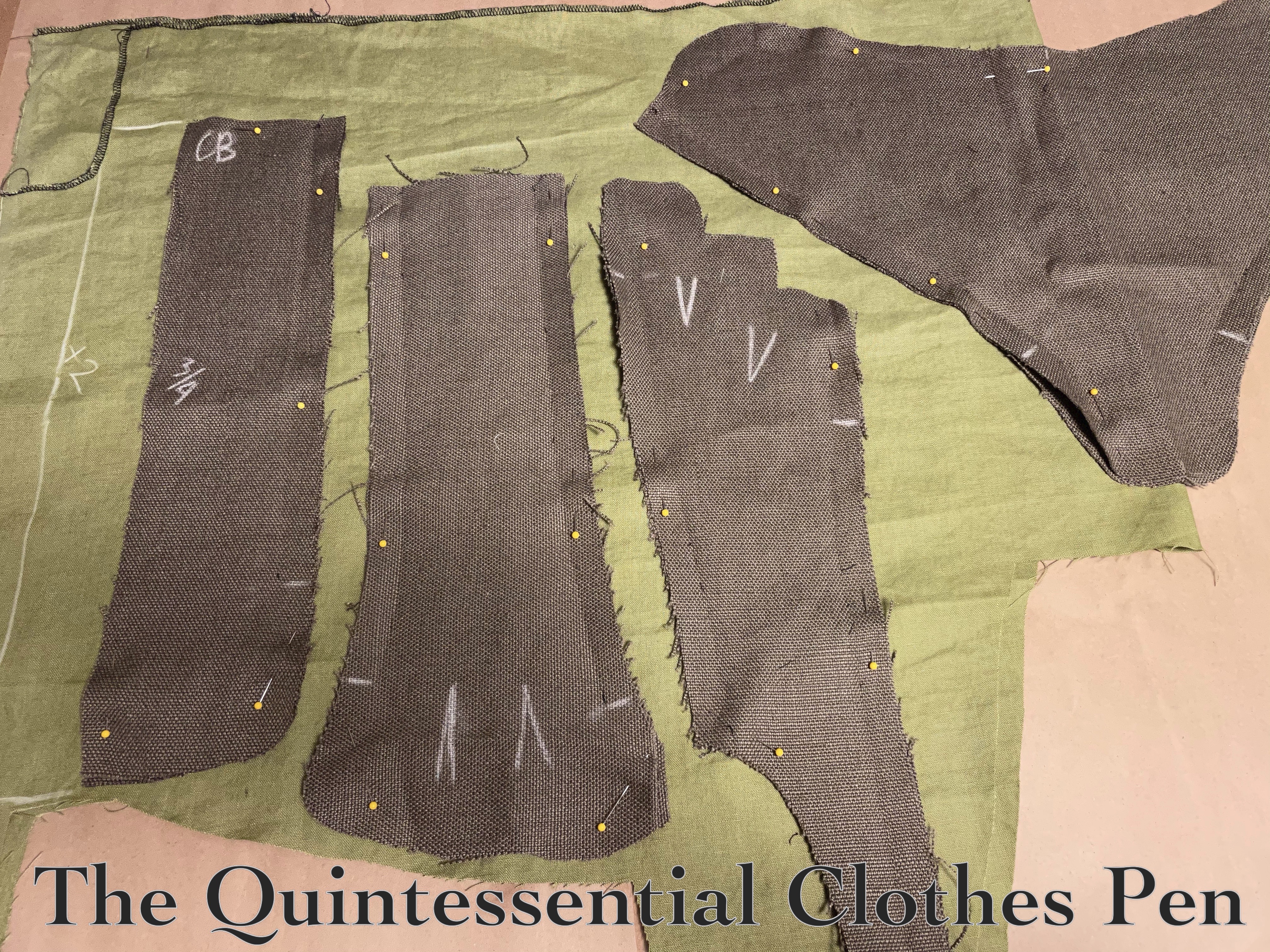
Here are my inner lining pieces set up on my limited green linen scrap.

Constructing The New Green Stays

The new stays are half boned. I chose to machine sew the channels with buttonhole weight thread (I wasn’t about to spend a million hours hand sewing channels again after just doing that for The Stays of Fail).

I like the look of the heavier thread, as opposed to regular weight sewing thread. The channels are boned with full width zip ties (none of that cutting them in half nonsense like I did for The Stays of Fail, either).

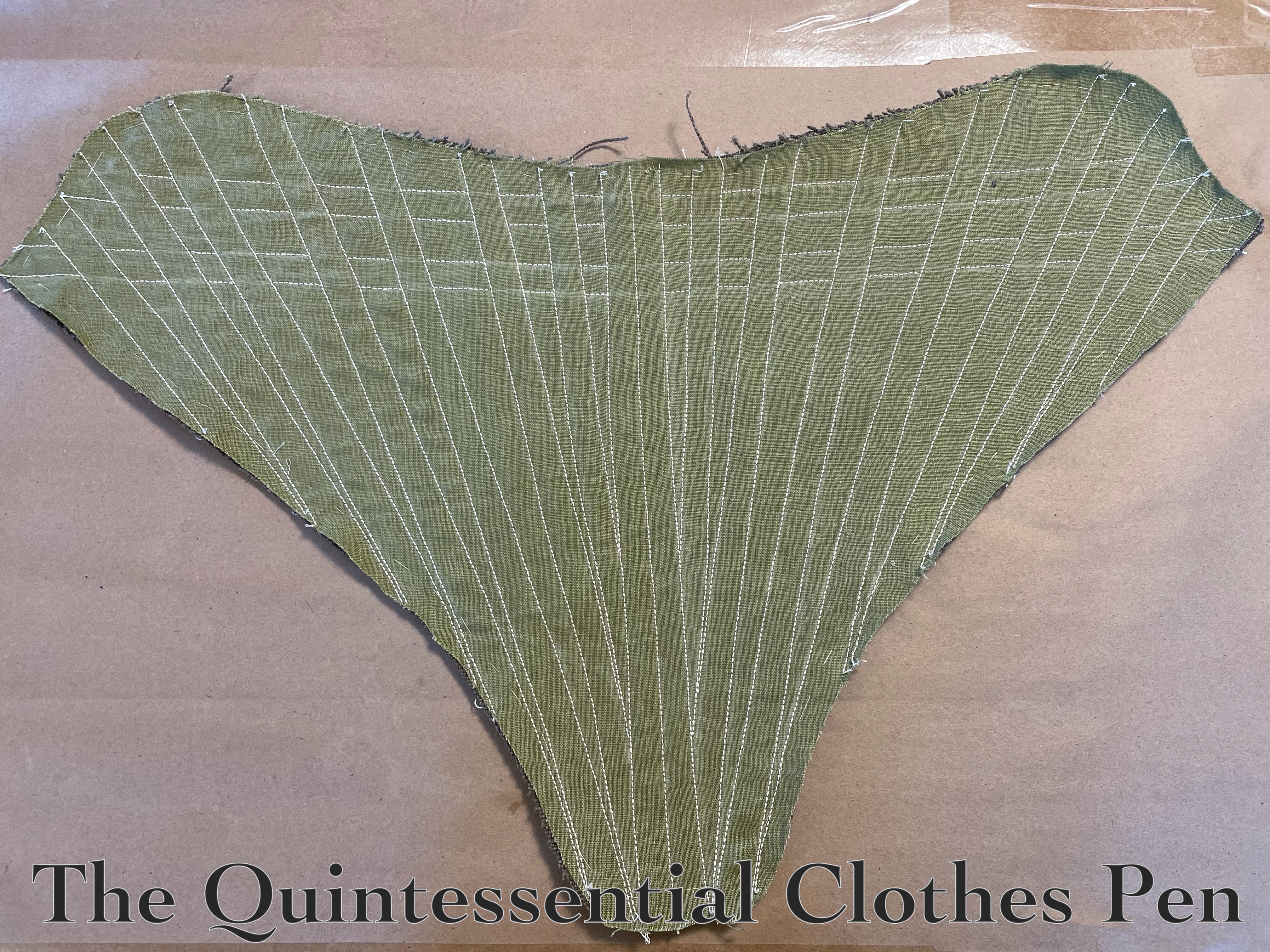
As an experiment, I chose a boning pattern with both vertical/diagonal bones as well as bones that run horizontally across the chest. That means that my boning channels crossed.

I carefully started and stopped my stitches to line up at the corners of the crossing channels and left my tails loose, to be pulled to the inside and knotted by hand later in the process. I did the same with my thread ends at the raw edges, so that my channels would be beautifully even with no backstitching (it helps with the illusion that the channels are hand stitched and not machine sewn).

In places where the boning channels crossed, I added an additional piece of coarse linen on the inside of the stays. This allowed me to have separate boning channels for the different directions, which was helpful in keeping the crossing points from becoming too bulky.

After the boning channels were in, I put in the bones that would no longer be accessible after the seams were sewn. Then, I machine sewed my pieces together. (This project was about making successfully patterned stays more-so than completely hand stitched ones!)

Following that step, the remaining bones were pushed into the channels. I also hand stitched the eyelets around this time (I made them pretty big for ease of lacing–the ones I’d made on The Stays of Fail are pretty tiny!). Below, my eyelets are marked and my edges are tidied.

Next, I basted around the edges of the stays to keep the bones in place, covered my exterior seams with woven linen tape, trimmed my edges, whip stitched my edges, and bound the edges of the stays in ¾” linen tape.

The stays looked like this on the inside at this point.

And like this on the outside.

I also added extra laters of reinforcement over the belly, as seen in extant stays. These are graduated in size and made of the same coarse linen.

Some stays also have wooden busks to further stiffen the center front. Given that these already have modern methods, I chose to use an extra heavy, ½” wide steel bone for my busk. It is inserted under the extra layers of linen and stitched in place, as you can see below.

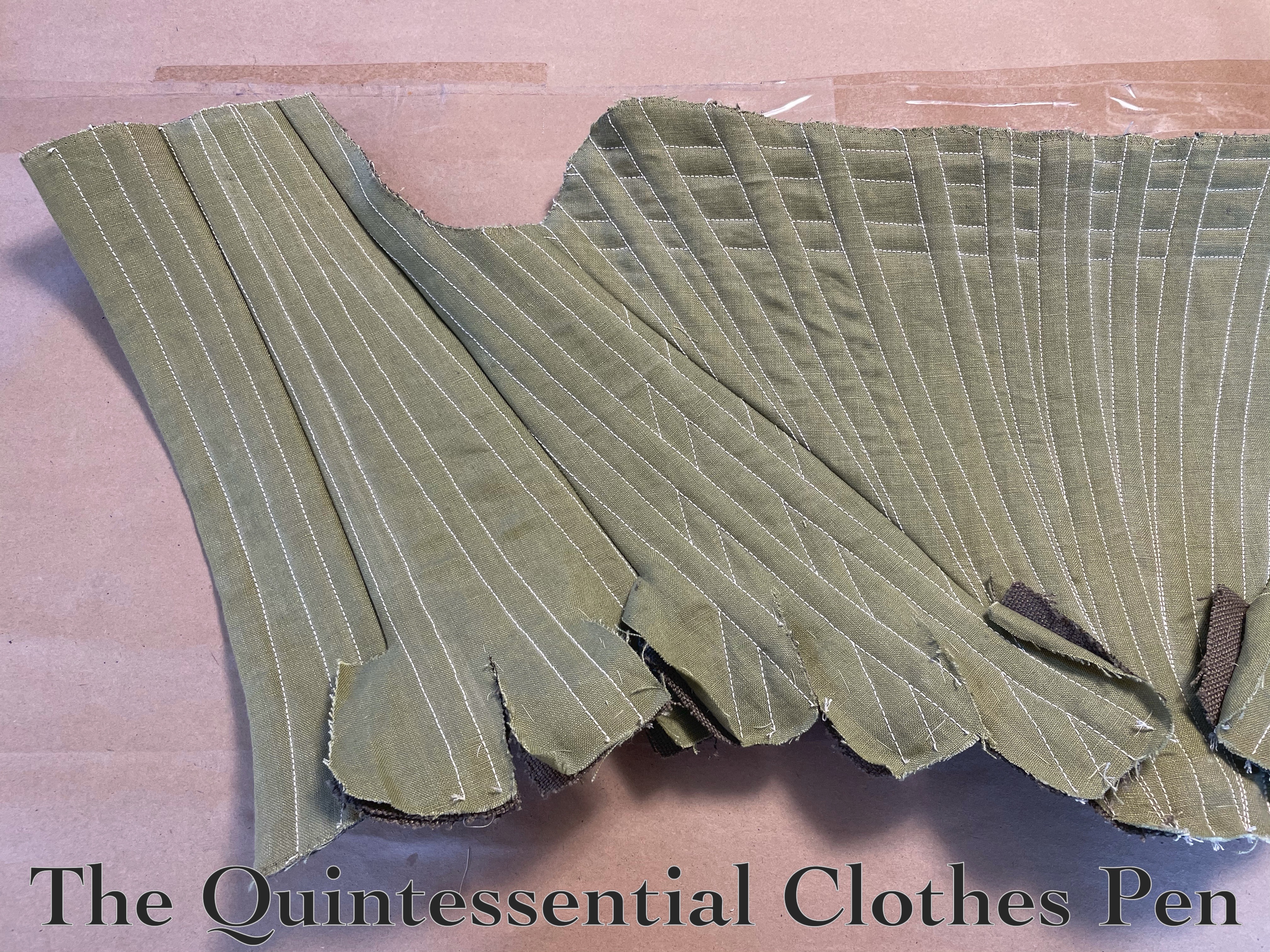
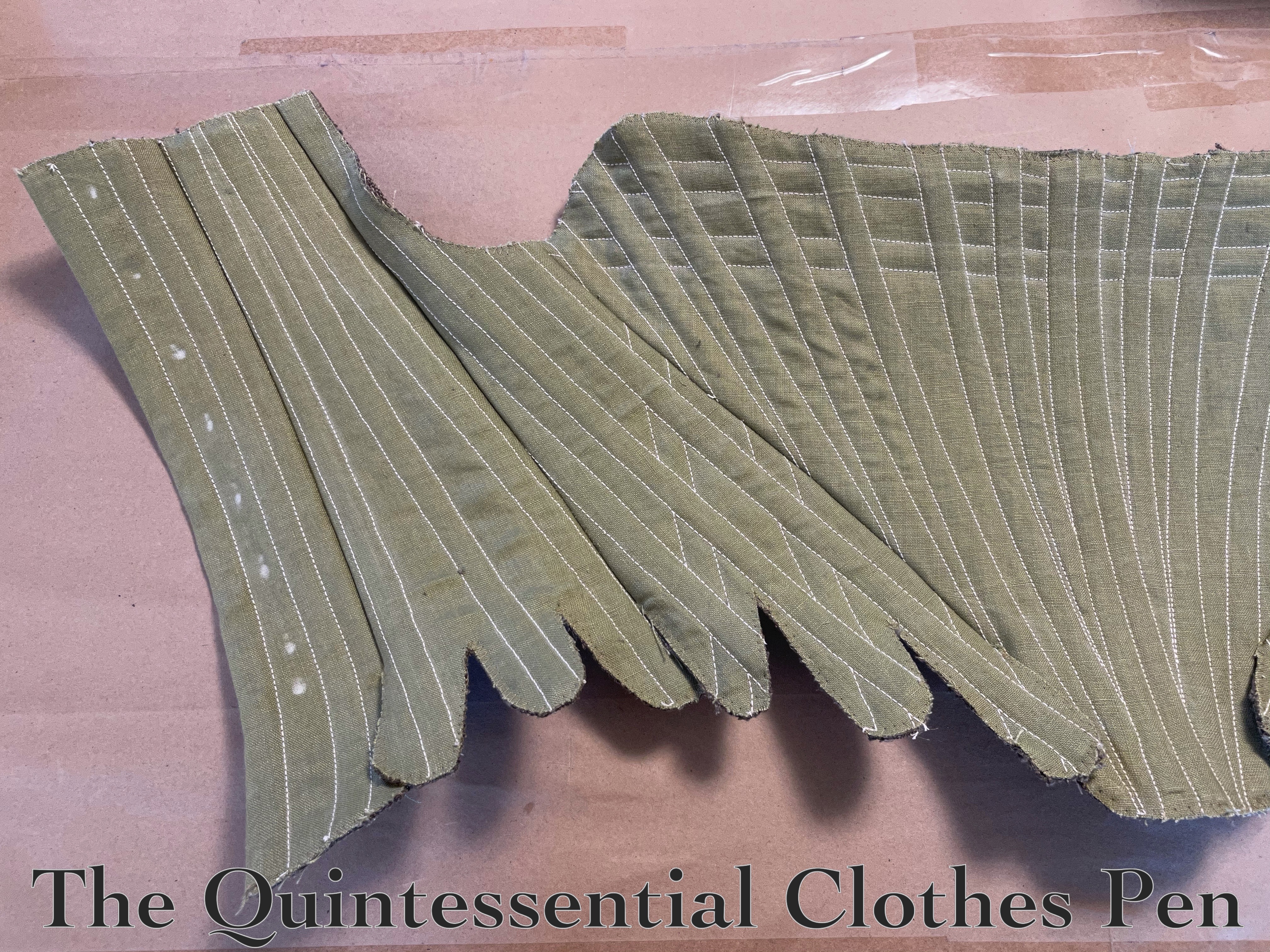
The final step was to line the stays. I used a natural colored cotton/linen blend from my stash. The tabs are each lined with a small bit of fabric (you can see that in the above photo). Then fabric was laid out on the inside of the main body of the stays, traced, and cut for both sides. The lining pieces are all whip stitched in place.

Here is a closeup of the back edge and tabs, with eyelets, binding, and full lining.

Below, a closeup of the top edge of the stays as I pinned the lining in preparation for trimming it to the correct size.

The seams on the inside do not correspond to the exterior seams.

Finished Stays

These new stays fit pretty well and are generally comfortable.

The front width wound up being a bit wide for me across the top, but otherwise they are good.

Final Thoughts

I like the horizontal boning across the front. The only downside to that is that the stays don’t fold in half for storage!

I had such a fun time deciding what pattern-making decisions to make. (What grainline to use on each piece? What boning pattern to use? Straps or no straps?) I couldn’t include all of the ideas in a single pair of stays, and so I have plans to make another pair, in a dark yellow from my stash. The someday-yellow pair will allow me to tweak the fit of the front as well as play with alternate patterning ideas. The pattern and materials are still out… it’s just a matter of finding the time and inspiration!

P.S. Stay-making Resources

This is not comprehensive, by any standards, but I thought it might be helpful to collect some links that I’ve found useful for anyone who wants to know more or see other people’s stays. (These blog posts were especially useful for seeing the process when I didn’t have PoF5 on my cutting table! That gives you a sense of the fact that this blog post started at least 3 years ago!)

Blogs showing the creation of similar stays:

  • The Sewing Goatherd: 1780s Stays Using Scroop’s Augusta Pattern (and stiffening her own innards, too!)
  • Rococo Atelier: 18th century speedy stay making tutorial using a sewing machine, this is part 1, this is part 2, this is part 3 (great photos and tips, this pair of stays also uses the PoF5 drafting method and machine sewing)
  • The Fashionable Past: 1780s Stays Tutorial (not quite the same shape as my stays, but the process is basically the same and this has lots of great photos of each step)
  • Rockin’ The Rococo: 18th century stays (the shape is earlier than mine, but the process is basically the same and this has lots of great photos of each step)
  • The Mantua Maker At Midnight: Making Stays 1730-1780s (this is earlier than mine, but the process is basically the same and this has lots of great photos of each step)
  • Atelier Nostalgia: Late 18th Century Stays (these are more similar to my Stays of Fail in some details–the tape straps and center front opening, for example–, but the general construction information is applicable to lots of stay projects)
Videos about stays:
Blogs with information about stays:

Pattern suggestions:

c. 1785 Stays (Of Fail), Part V: Middle Construction Details

I had hoped to get all of my remaining construction details into this post, but progress on the stays has slowed. Plus, I realized I didn’t have enough linen tape to bind the edges, so new binding needed to be ordered. That has been done but I’ve been so busy that no sewing has happened yet. So for now, here are the middle parts of the construction update.

Updating Gussets

After all the initial steps of putting the stays together (which I detailed in my previous post in this series), I had a fitting that left me feeling rather disappointed. I’ve already detailed the results of that fitting, in Part II of this series.

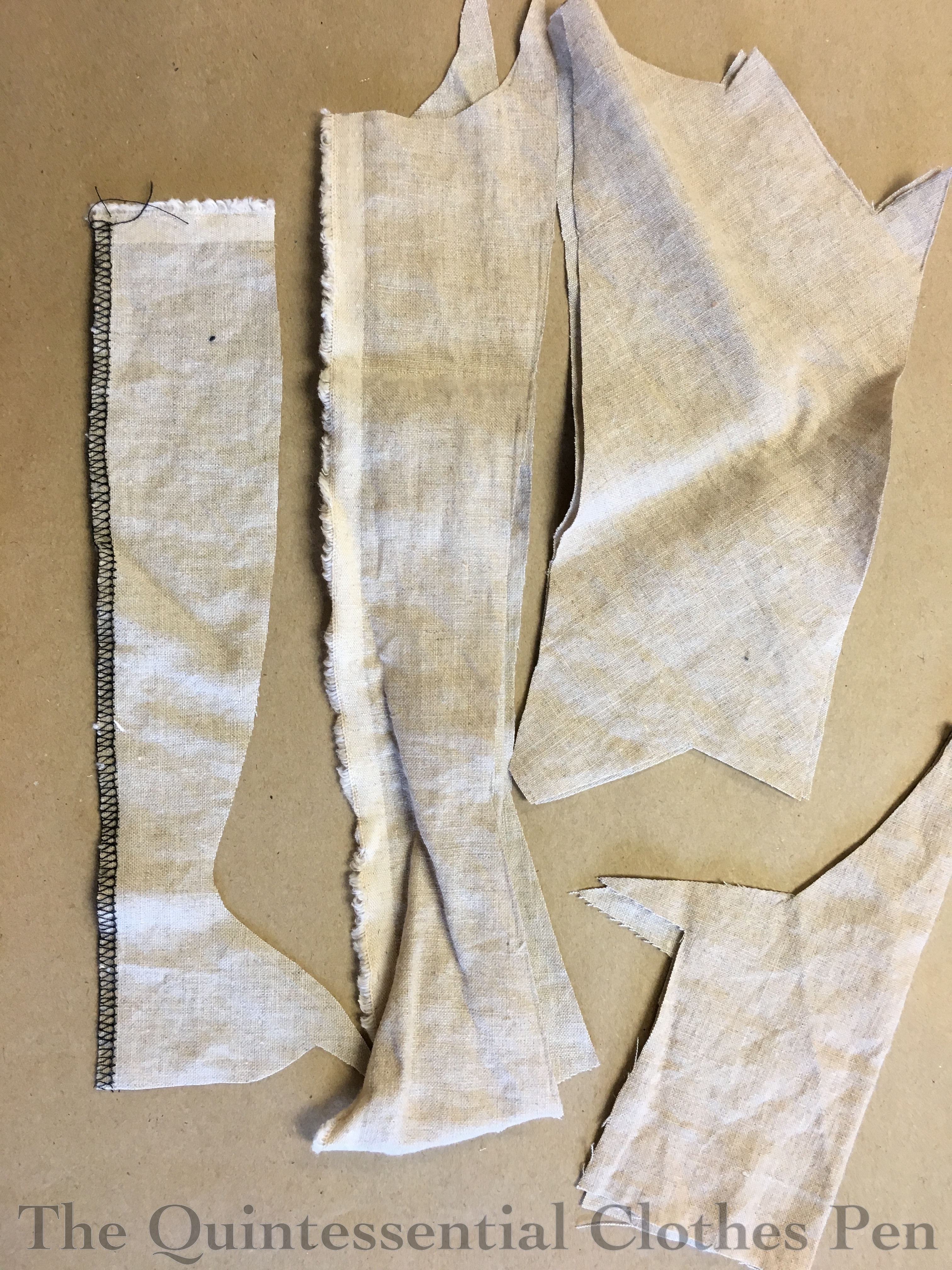
To summarize: I wanted to raise the gusset I’d added to the back with the goal of providing more width at the waist and hopefully increasing the comfort of the stays on my back. Accordingly, I removed the offending short gusset out of the stays, but, instead of piecing new gussets out of my meager scraps, I realized I could cannibalize the straps I’d originally cut (but decided not to use) to make longer gussets.

Below: the new, longer gussets in place.

This worked well for the exterior linen and one layer of interlining linen, but the straps were only ever going to have one inner layer of linen. And none of my scraps were quite long enough to make a second layer now that the piece would be used in the main body of the stays.

So, I used what I could and layered a second piece near the bottom tab to extend the second layer of linen. Work with what you have, right?

This new gusset had a wider bone channel already sewed… and I really didn’t want to deal with my narrow bone idea again. Therefore, these two pieces will have permanently wide boning channels. It’s all in the spirit of making do! I did have to extend the bone channels after adding the extra bit of linen near the tab, but that was easy to do.

Covering Seams & Finishing Edges

Following the information in Patterns of Fashion 5 (see my fourth blog post in this series for more information on this incredible book), I covered the visible whip stitches that formed the seams of the pieces with 1/4″ linen tape.

Then, I basted all around every exterior edge, to hold the layers in place while I continued to work on the stays. I followed that by whip stitching the raw edges, in order to create a more stable edge for the binding.

In the photo below you can see the linen tape covering the seams and the edges that have been basted and whipped.

Finally, I was ready to bind the edges!

You can read previous posts in this series here:
c. 1785 Stays (Of Fail), Part IV: Early Construction Details
c. 1785 Stays (Of Fail), Part III: The Pattern
c. 1785 Stays (Of Fail), Part II: Fitting Update
c. 1785 Stays (Of Fail), Part I: Beginnings

c. 1785 Stays (Of Fail), Part IV: Early Construction Details

Construction Process Resource

The book I used to create the pattern for my stays (Stays and Corsets: Historical Patterns Translated for the Modern Body by Mandy Barrington) gives very little in the way of construction information for stays (process, materials, and details). I found this to be really disappointing.

Thankfully, however, there are other resources that one can go to for this type of information. I chose to reference Patterns of Fashion 5 (PofF5), authored by Janet Arnold, Jenny Tiramani, Luca Costigliolo, Sebastien Passot, Armelle Lucas and Johannes Pietsch.

The great thing is that I could go to PoF5! It had not yet been released when I started this project, but I have it in hand now… and I must say that it is an absolute gold mine of information! There is so much research, expertise, and detail included. There are so many color photos. There are x rays of extant garments. And of course there are patterns. And information about patterning and making both in the past and now.

I cannot do anything but rave about this book! It is almost double the length of the earlier Patterns of Fashion books. I actually sat down and read this book cover to cover, which is not how I usually deal with pattern books (usually I read the bits that are relevant to a certain project). This book is amazing!

On To The Construction Process

Despite creating a pattern from another source, PoF5 was invaluable for the construction process of my stays. Using information in PoF5, I decided to make my stays from an outer layer of linen, 2 layers of linen buckram, and a lining (that will likely be linen).

To start, I cut out the exterior and 2 layers of heavy linen for the interlining. Below is a photo of my inner heavy linen with the pattern laid on top. I used stash fabric and found a piece that just barely fit my pieces. No seam allowance is included in the pattern, so you can see that I really eked my pieces out!

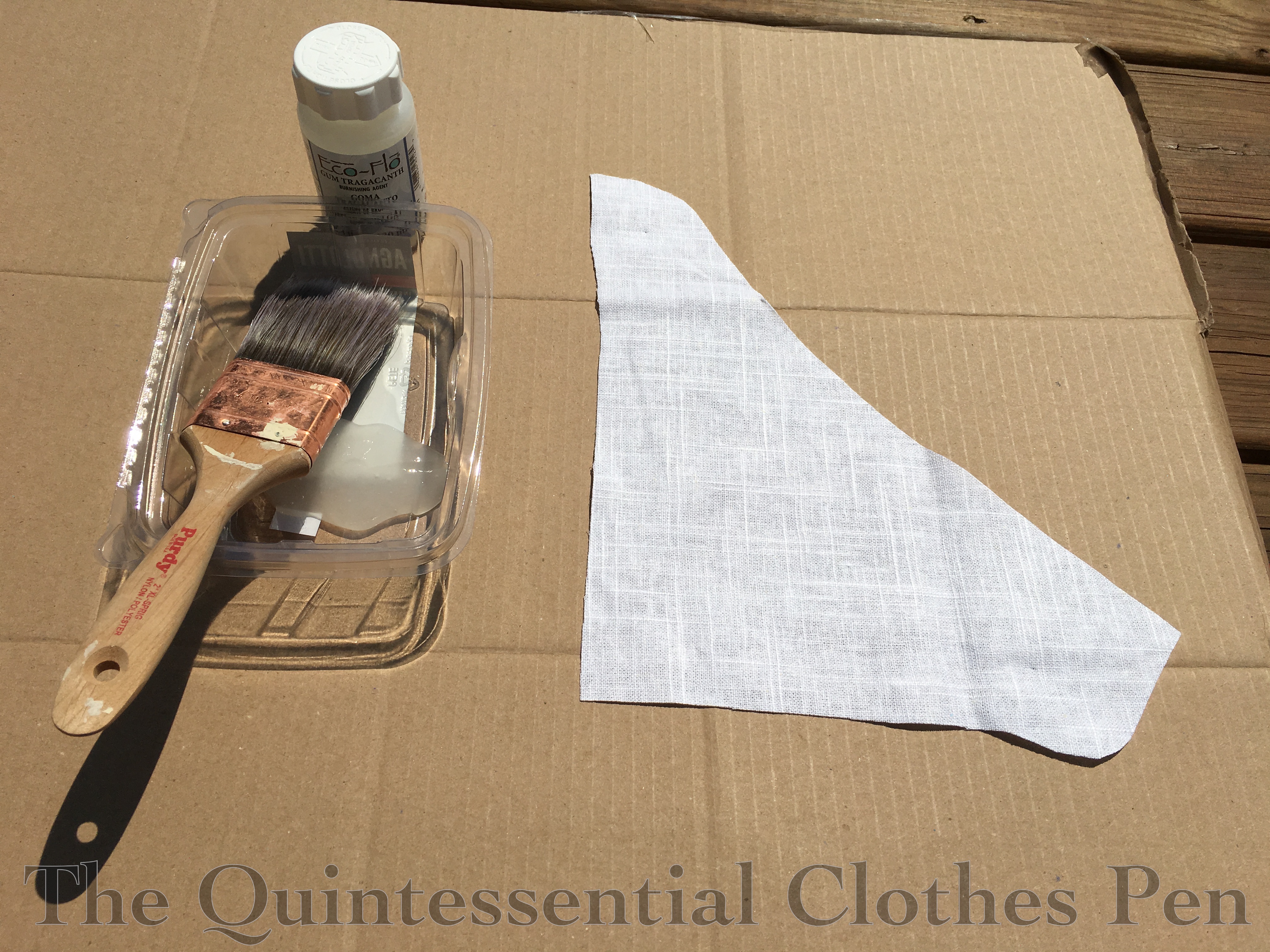
To nerd out on history fun and try something new, I decided to make my own stiffened buckram for the inner layers. So, on a hot August afternoon I was to be found sitting on my deck dripping with sweat while painting gum tragacanth onto my linen pieces instead of being inside where it was cool.

So what is gum tragacanth? It is a stiffening agent used to make linen buckram, which is a material used to stiffen 18th century stays.

Burnley and Trowbridge has a great video about making buckram that describes fum tragacanth and Leimomi, The Dreamstress, has a great blog post discussing gum tragacanth and xanthan gum. The post includes videos and lots of wonderful how-to information.

I used a paintbrush to spread my gum tragacanth on my linen. By the end I was definitely getting a little sloppy because I wanted to get out of the sun as quickly as possible, but I was still impressed with myself for the lengths I go to sometimes for the sake of historical exploration!

Below is a photo of my set up. Cardboard from the recycle, a dish-shaped piece of packaging from the recycle, and a paint brush.

I used a full 4.4 oz bottle of Eco-Flo Gum Tragacanth for my double layer linen interlining. In the dish you can see the consistency of it. It was wonderful not to need to mix or heat it, as you would need to do with xanthan gum.

To be honest, I didn’t notice too much of a difference in the linen after applying the gum tragacanth. (This could be because I was already using a heavy linen?) It also seems, and makes sense, that the stiffness has been reduced as I’ve worked with the fabrics. Regardless, I am still entertained and enriched by my experiment.

After the gum tragacanth dried, I flat lined my 3 layers for each piece (2 layers of heavy linen and the exterior linen) and marked my boning channels. I found that using Frixion pens worked well, because the marks easily erase with a hot iron after the channels are sewn (and the pen marks don’t rub off while being sewn, as with chalk). Magic!

There was lots… and lots… of sewing boning channels, as you can see blow.

After all my channels were complete (and I’d pushed in all those narrow zip ties I ranted about in my first post about these stays), I moved on to the eyelets. There are eyelets for the center back closure and eyelets for front adjustability, as on the inspiration Chertsey stays (which you can see in my third post about these stays).

I realized that I hadn’t cut my center back pieces with enough fabric to wrap around past the eyelets (though I didn’t have enough fabric to do that, anyway!), so I pieced strips together and whip stitched them on to make the extension, as you can see on the right side of the next photo.

After the eyelets were done, I assembled my pieces with whip stitches.

I whip stitched the seam allowances down as well, thinking that might help make the stays fit smoothly for a fitting.

That basically brings the project up to the unfinished state it is in now, minus a few fittings and adding that back gusset.

You can read previous posts in this series here:
c. 1785 Stays (Of Fail), Part III: The Pattern
c. 1785 Stays (Of Fail), Part II: Fitting Update
c. 1785 Stays (Of Fail), Part I: Beginnings

c. 1785 Stays (Of Fail), Part III: The Pattern

The Beginnings, The Longer Version

Let me back up from the current state of the Stays Of Fail to all the wonderful documentation I did about making them, at least to this point. When I started these stays back in 2018, I intended them to be a sort of in-between-projects-project for when I wanted a bit of hand sewing to do. Given that, the project moved at a pace only slightly faster than a glacier!

Somewhere very early in the planning stages of these stays I decided to try out a new book for patterning them: Stays and Corsets: Historical Patterns Translated for the Modern Body by Mandy Barrington. This book presents the idea that you can use any person’s measurements to draft a basic block of the body and then use the basic block to draft any of the historical stays in the book. It’s a neat idea, in theory, and I wanted to try it out.

The Pattern

I didn’t keep track of how long the patterning/drafting process took me. But it was a long time…

There was lots of math, which always happens with drafting a body block and is to be expected, but on top of that there was also the drafting of the specific pair of stays I’d decided on: the 1785-1788 Half Boned Stays (patterned from a pair of stays held at the Chertsey Museum). I was doing my pattern drafting while being often interrupted, so that slowed me down, but despite that the process was longer than I was expecting (and I’m not new to making body blocks or patterns).

This is the original pair of stays at the Chertsey Museum. (Accession number M.2008.53)

(The nice thing is that if I were to use this book to pattern another set of stays or corset I would be halfway there, having already now created a custom body block, but I suspect it would be faster for me to start with a pattern from another book source, because I think my brain wraps around the idea of resizing a pattern without the body block drafting pretty easily.)

I eventually had my body block and was able to draft my pattern using the instructions. The instructions were quite detailed, so that was great. I finally had a pattern that I was able to cut out and make a mockup out of! I was able to get into the fun part: sewing!

Testing The Pattern With A Mockup

I had expected that, after spending a lot of time spent patterning the stays to fit my measurements, I would have stays that basically fit. And I did. But they fit my measurements with the center backs touching and no compression, just sort of lightly surrounding my body without providing support.

The drafting did it’s job of making stays to my measurements, but I was dubious about whether they would do their supporting job when fully boned and finished. So I decided to adjust the mockup a bit–taking some in at the waist, in particular.  (While this is a small adjustment to make, it reminded me that at the point at which I had to alter the mockup I might as well have started with a pattern that took less time to create.)

But perhaps, that alteration was my downfall. As you’ll see in later posts, I later had to add fabric back into the waist size.

That’s all for now. Next post, I’ll detail the early construction process, including stiffening my own linen!

You can read previous posts in this series here:
c. 1785 Stays (Of Fail), Part II: Fitting Update
c. 1785 Stays (Of Fail), Part I: Beginnings

c. 1785 Stays (Of Fail), Part II: Fitting Update

In March 2022, I had another fitting on the pair of stays I started posting about recently. I tried a few different things and some seemed to work. It gave me hope!

I decided to add tape straps to these stays, partly to help counteract the back pulling away from my shoulder blades and slouching in towards center. This method of straps comes this pair of stays at the McCord Museum (accession number M969X.26), which is dated 1785-1790.

The idea has intrigued me for awhile and specifically appeals for this project because I didn’t like the fit and feel of the attached fabric straps and had already cannibalized them to make gussets, anyway.

Adding the tape helped the stays feel better, but the gussets were still a problem. I decided to move the gussets up higher by about 3″. I didn’t have quite enough fabric length to do that but I decided to piece on additional sections at the bottom. Piecing is completely period and seemed like a better idea than not having stays that I could wear!

Additionally, I maxed out the seam allowance on both sides of the gussets and the abutting pieces. I’m hoping those things will help narrow the back gap. I’ll also add a new boning channel in the gusset.

In terms of fit, the side view actually isn’t bad with the added strap!

The tape shoulder straps wrap across the back and then will hook in the front. For the fitting the test strap is just safety pinned. Other pins are marking where the strap hits as well as the finished length of the tabs.

After this fitting, the to do list includes:

  • resetting/piecing the gussets and adding boning channels and boning to them
  • whipping the edges of the stays in preparation for binding them
  • binding the edges of the stays
  • adding the tape straps for a final fitting

I’ve been very busy, so those things are moving along quite slowly. I did update the gussets and start whipping the edges, so there is some progress.

That’s all for now. Next post, I’m going to go back to the early construction details of these stays.

c. 1785 Stays (Of Fail), Part I: Beginnings
The Beginnings, The Abbreviated Version

The very late 18th century (1780s and 1790s) is a mostly new period for me. I have a chemise… but no other underclothes that fit, no dresses, and quite likely no accessories… I’m starting mostly from scratch! And as one does (or at least as I do) when faced with a new period, I decided to make completely hand sewn stays as the foundation. That was in 2018!

I thought I had a grand plan. I was so excited about my stays! I tried a new way of patterning, tried a new method of stiffening my fabric, sewed oodles of boning channels by hand, shoved bones into all the channels that were just a little too tight, put in my eyelets by hand… And I documented all of it to share it here.

Catching Up To The Current State Of Things

Then in mid-2021, I did a fitting… and realized that I was really unhappy with the stays. Really unhappy. Mostly due to the fit.

The stays pushed my tummy downwards so it rounded out underneath the front point and tabs, but, even worse, the back pushed down on my lower back and was super uncomfortable! AHHHHH! After all that time spent hand sewing! And it’s not like I jumped right in to hand sewing stays without mockups and thinking that the pattern fit. No, I’d done those steps and hadn’t noticed anything wrong! GRRRR.

My immediate reaction was to put the project away. I just couldn’t bear it. After I calmed down (weeks later, mind you!), I tried to see what I could do to fix the issues. I decided to add a gusset into the back, since the pressure seemed partly to come from the bottom of the lacing gap being quite wide. I had only very small scraps left, so the only way to do this was to cannibalize my straps (which is fine, because I wasn’t super keen on them restricting my shoulders, anyway).

Here’s a photo of the back of the stays with the triangular gusset already added (and some other things that I’ll talk about later). The gap at the bottom was even wider before I added the gussets!

Fast forward a bit more and I had another fitting. The gusset helped a little, but I still had pressure on my lower back. And… the front problem, I realized, was due to a combination of the front being too short for my frame and this idea I had to use ⅛” bones, to mimic the size of originals…

I’ve had success with plastic zip ties as bones, so I thought I could use narrow ones to create the width I was looking for (I used these, purchased on Amazon). Unfortunately, they were very tight in the channels. It took a lot out of my wrists to cut and push in all the bones. The width of the zip ties looks great, but they’re too flimsy. Look how much I can bend back the front tab!

After much deliberation that included going back to look at the original that the pattern I used is based off of, and the reproduction made from it that is in the book I used, I realized that the original stays are just really short in the front. AHHHHH! (More about the book I used will be coming in a future post.)

I didn’t process this earlier, in any of my fittings, or my mockup, or my patterning, or my looking at the book! And I’m incredibly low on fabric! Below are my scraps, minus the long ones in the center, which were already used to face the eyelets.

So… I was left with a half finished pair of stays that took many, many hours to even get to this point–wonderfully sewn in terms of methods, but which I couldn’t wear. I was very upset and put the stays into time-out (again!).

I’ll stop the story of the stays here and continue on with my updates from the most recent fitting next time.

Fabric Stash Additions: Summer 2020

I’ve accumulated a few new fabrics over the last few months and I thought it would be fun to share them in a stash addition post!

Fabric for new sweatpants

I have a favorite pair of sweatpants that I’ve had for almost 20 years. They’ve seen a lot of wear. After 20 years, the hems are pretty worn out and they’re starting to develop holes in the fabrics near the seams. I’ve been on the lookout for similar ones to replace them for years, but the fit is hard to find: wide-ish legs with a bit of a flare, diagonal pockets, and wide hems. I’ve never come across another pair with quite the same styling. (And they’re not currently in style, being 20 years old, so that’s part of the challenge.)

While wearing them quite a bit in March and April I had the thought that “I could make myself a new pair of these pants!”

This idea was spurred in part by the lovely fleece fabrics that Blackbird Fabrics has stocked over the last eight months or so. Every time they popped up in an email I considered purchasing some, but couldn’t make up my mind about color and dragged my feet. Blackbird’s fabrics sell out quickly and I kept missing the boat with my indecision, but then they restocked the bamboo/cotton stretch fleece and matching ribbing and I decided to make a decision, go for it, and order some!

Doesn’t the fleece side of this fabric look soft? I love that new fleece feeling!

I ordered 1.5 meters of the fleece and .5 meters of the ribbing. I’m sure I’ll have leftover ribbing, as it’s only used for the band at the top of the pants, but I’ll find a use for it again someday, I hope.

Of course, right around the time I purchased my new sweatpant fabrics the weather warmed and I lost my motivation to make the pants. But the fabric isn’t going anywhere and in theory the weather is getting cooler soon, so maybe these will make it onto my sewing table sometime in the next few months.

I do congratulate myself on taking the time to take a pattern from the old pants before I lost motivation so that when I decide to move forward I’m ready to go!

Two block printed fabrics

I keep a running list of sewing projects, in order to remind myself what steps projects are at, what fabrics are marked for certain projects, and what projects I have in mind. Occasionally, while looking at this list, I get swept away with ideas for new projects.

Earlier this summer, this feeling of wanting new projects was compounded by a friend updating me on the status of her current 1830s day dress project using a lovely block print cotton. It’s been a few years since I’ve seriously looked at what’s on offer for block print cottons on places like Etsy and eBay, so I decided to check things out.

Oops! Because, of course, I found pretty things! And then my brain went into overdrive, thinking of all the amazing projects I could make with the beautiful things!

I confess that I gave in to temptation and purchased two block printed fabrics.

I feel somewhat justified in that I have very clear ideas in mind for them!

I intend for the green and red print to become a gown like this one, from about c. 1785. I have 10 yards, enough to make the dress and a matching petticoat, but I thought that someday I might also be interested in having a contrast petticoat as well.

In terms of timeline, I have no clear plans for when I might make this. I am working on stays from this period, so that will be a great help, but that’s not really a solid plan. And the stays are going slowly, as I’ve been distracted from them by other projects. So, no deadline or timeline in mind.

I also bought 9 yards of the pink print in order to make a day dress from 1843/44. But then I remembered a fabric already in my stash that would also make a lovely dress from these years (I actually posted about it in this past stash addition post in 2018–it’s the cream woven plaid). So… I’m not exactly sure which fabric I would pick for this project, though I’m leaning towards the new pink block print (whichever one I don’t pick doesn’t have a clear plan).

I have a new corded petticoat that would help with the 1840s silhouette and I already have the rest of the undergarments, so it’s not out of the realm of possibility that I could tackle this project in the not-too-distant future. (What does that actually mean? Next year, maybe?)

Discount duchess satin

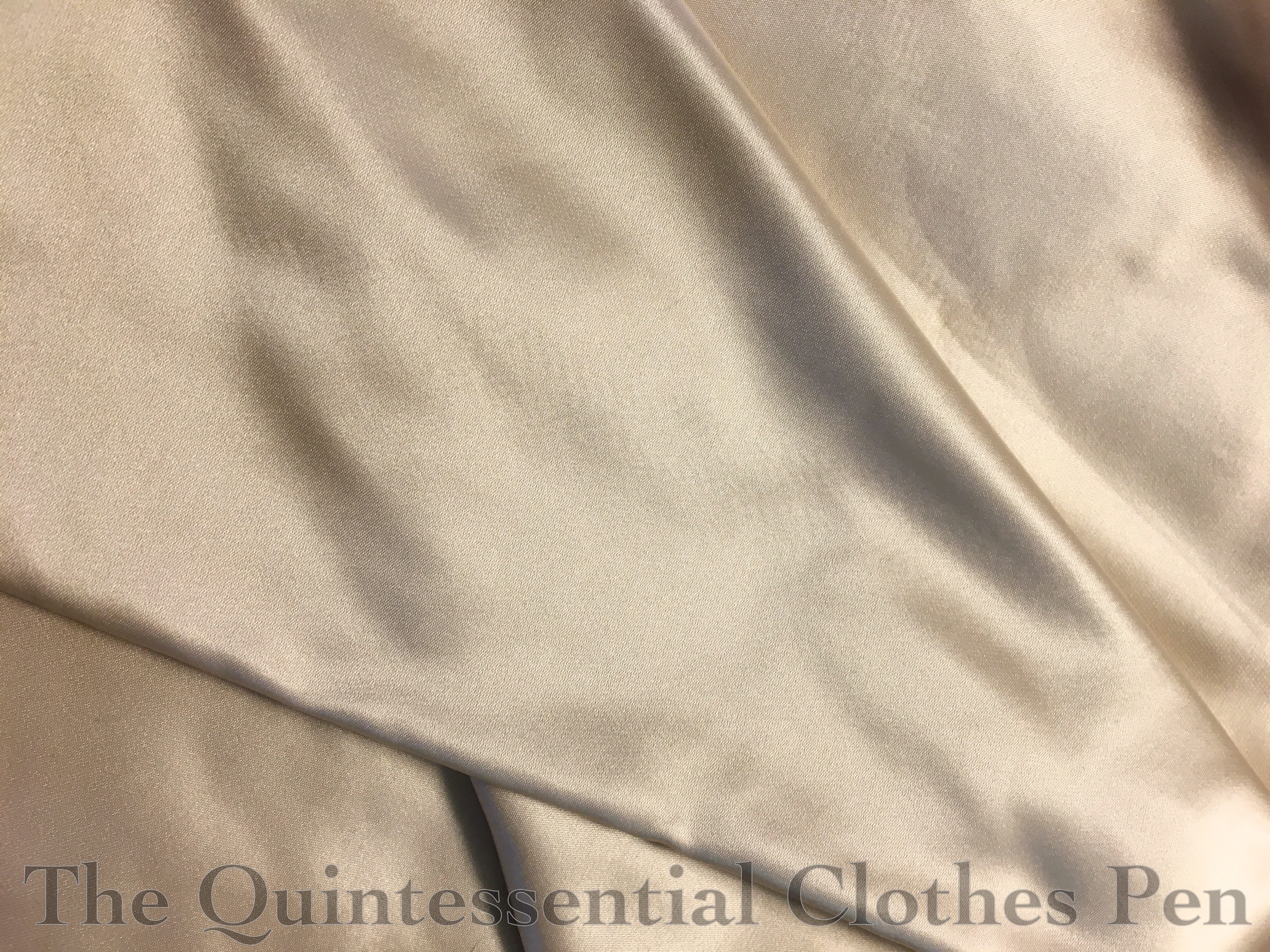
This is the standard ‘I happened upon it’ story. This blush duchess silk satin was in the discount bin at a local store.

Of all of the fabrics I’ve acquired recently, this is the one that is the most ‘stash addition’.  I don’t need the 1.5 yards that I bought for anything in particular, but I thought that for the low price it was worth picking some up.

I think it would make a gorgeous 19th century corset (like my 1880s steam molded corset, which is also made from duchess silk satin). I also have vague plans to someday make a 1920s corset/girdle and I think it might be useful for that as well.

In conclusion…

I’ve been doing well at using stash fabrics to make things recently, which is great, but I’m not sure if I’ve offset that by buying new things… Oh well! Sometimes you have to buy things when you see them!