A Quick ‘Behind The Scenes’ Of My Versailles Evening

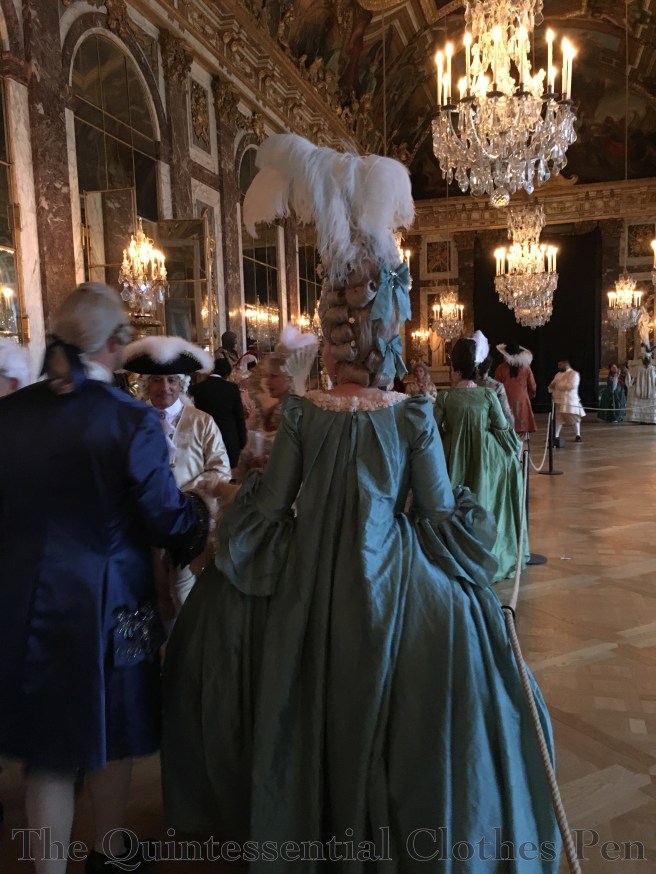
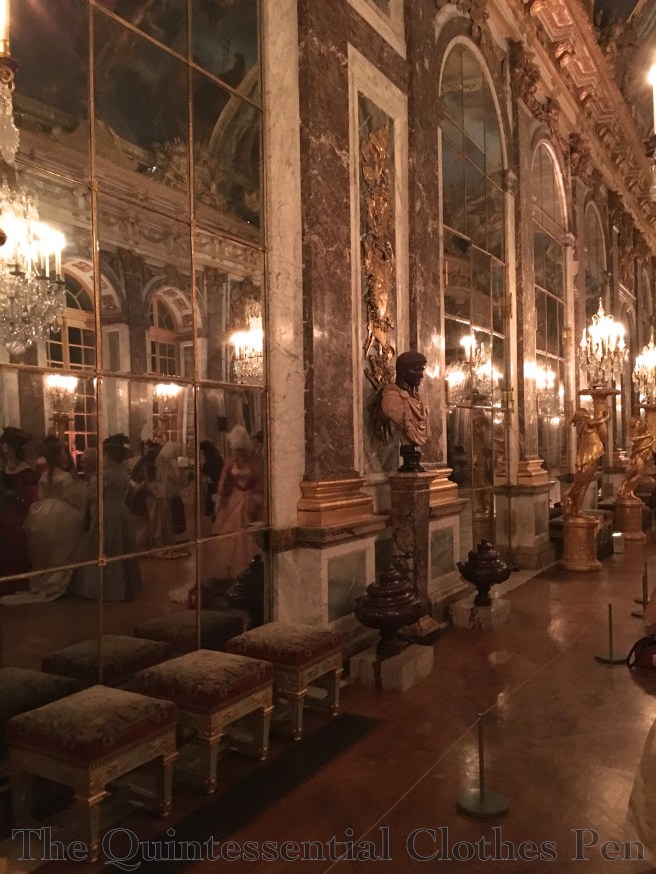
All those pictures of Versailles look amazing, but a lot of work went into looking effortlessly elegant. Some of the work I’ll be sharing in posts specifically about my hair and gown, but I also have a few pictures from the day along the same lines that didn’t quite fit into main post. They’re more ‘behind the scenes’. Enjoy!

IMG_1340
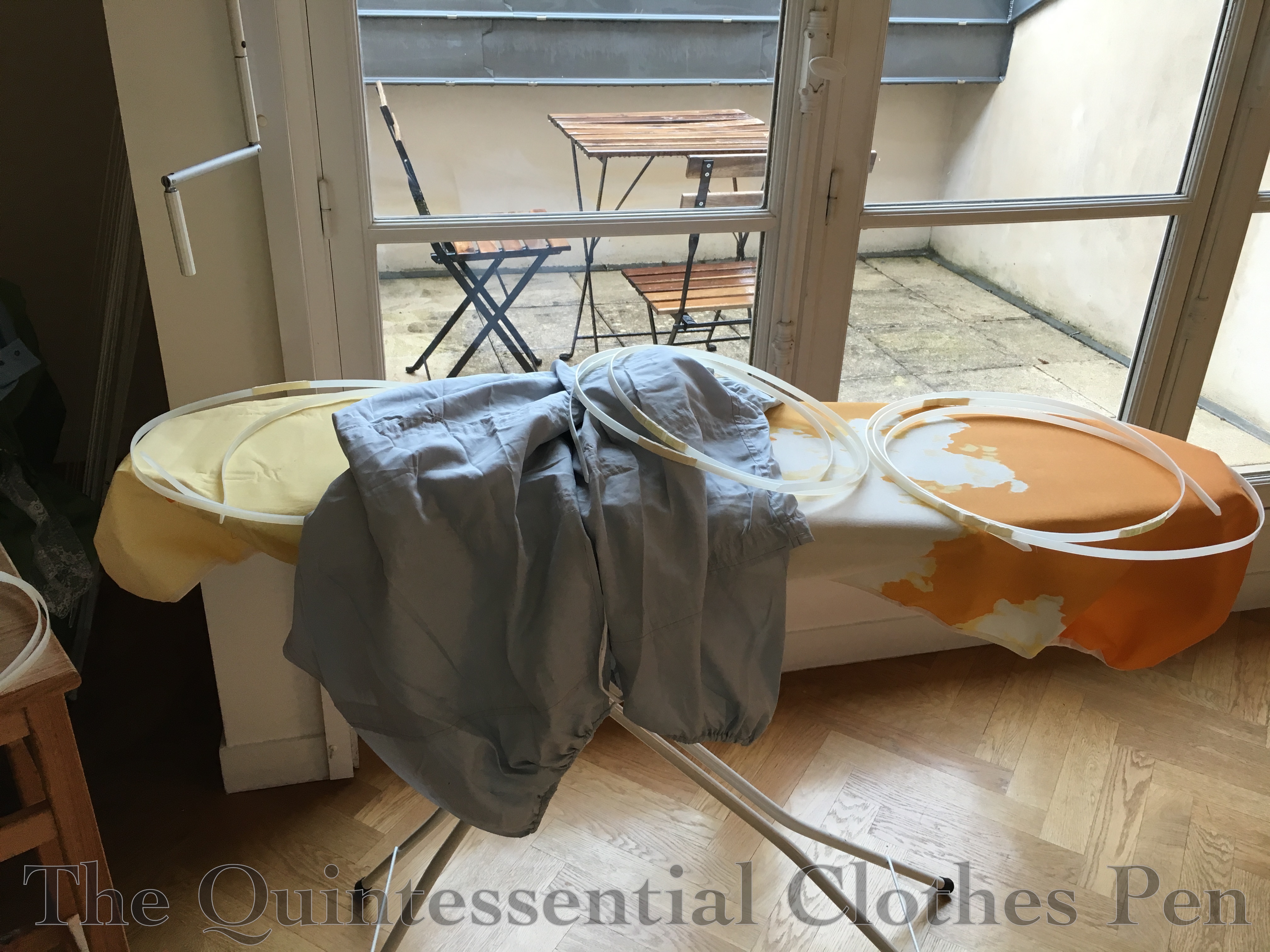
This is Mr. Panniers after escaping my suitcase and before having his bones inserted for the big event. Hard to recognize without his proper shape, I think!
IMG_1343
Getting ready. My half finished hair is half powdered, to show the difference in color. As you can see, I only did a light bit of powder.
IMG_1437
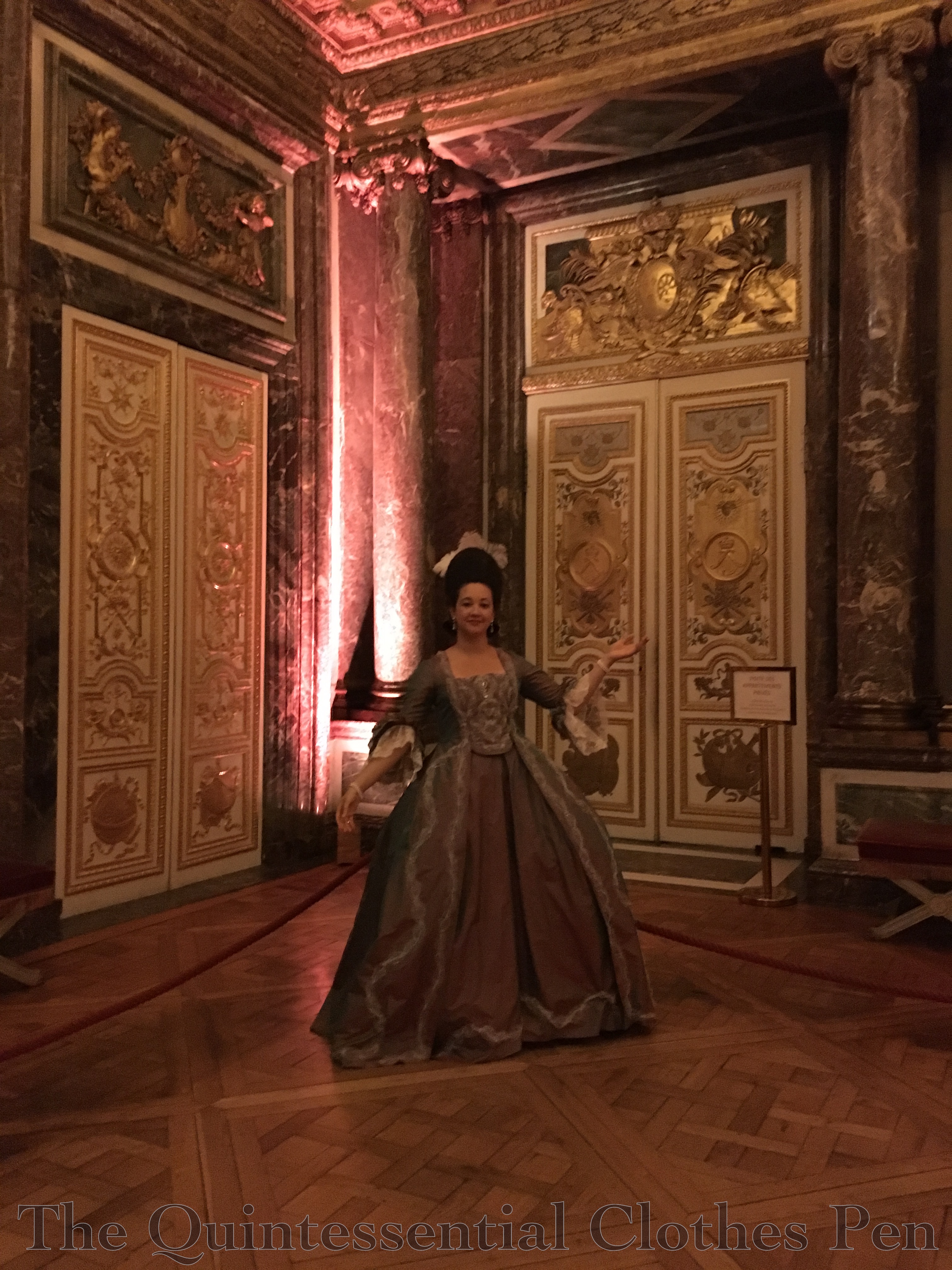
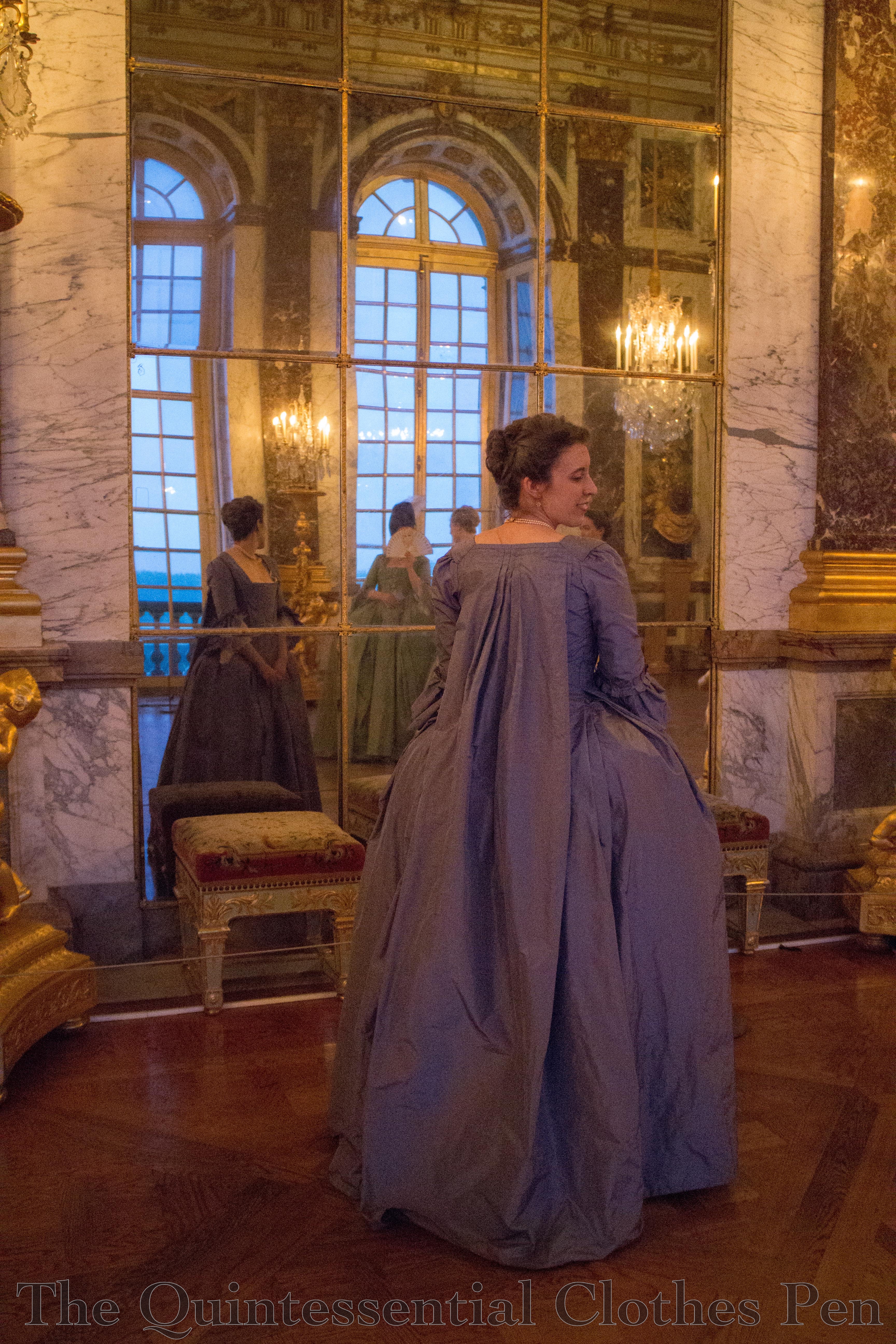
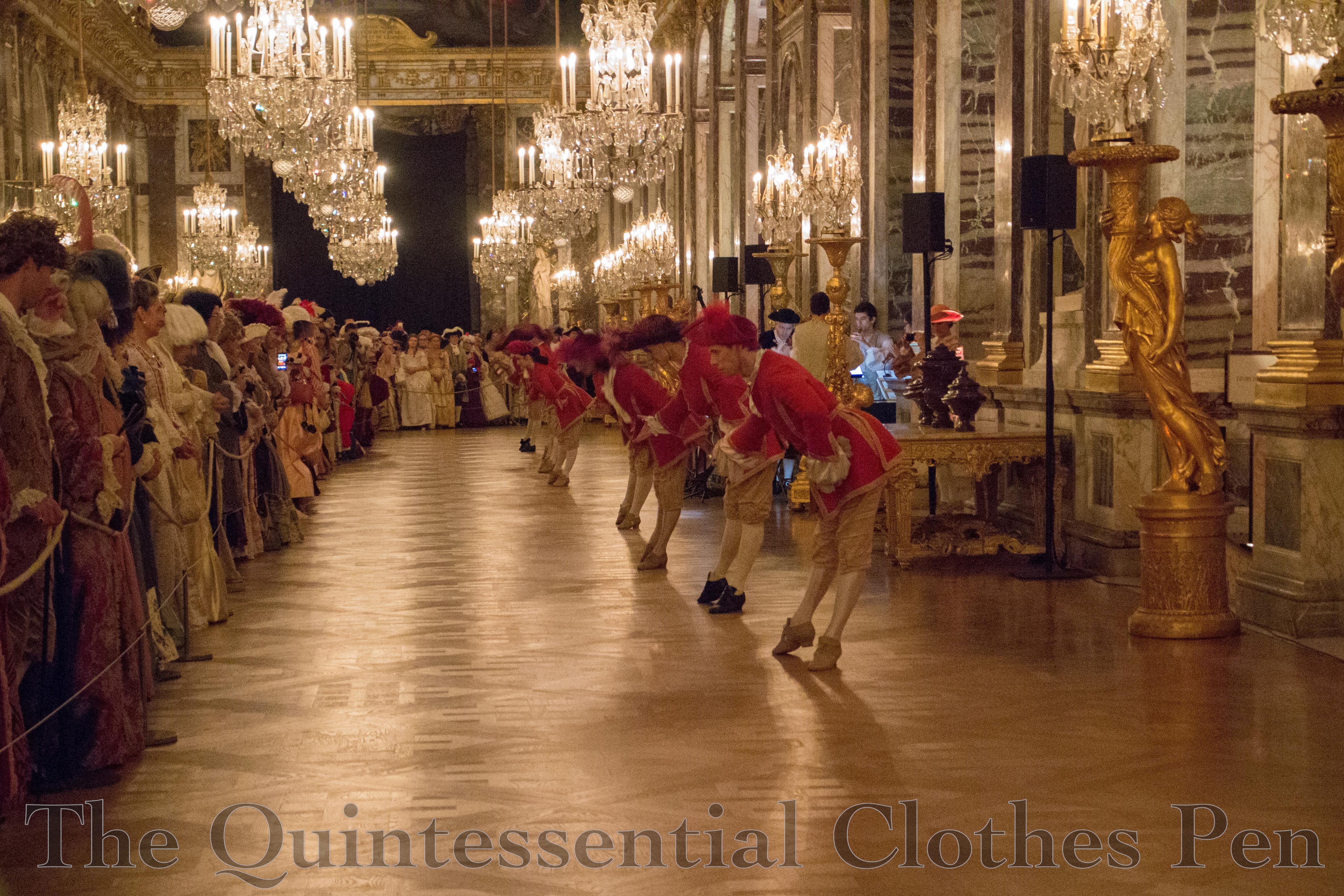
A final graceful pose in the Hall of Mirrors as the staff was very slowly herding us out.

An Evening At Versailles

I am blessed to have had many amazing opportunities to wear beautiful historical clothing in stunning historical spaces while doing fun historical activities. Newport Vintage Dance Week in 2012 was full of them, most notably the mid-century ball at Ochre Court. But I’ve had these moments in other time periods as well, for example while wearing Regency clothing at numerous balls in historic halls, such as at the first CVD Regency Weekend in 2013 and at the second CVD Regency Weekend in 2014, and at the Commandant’s House in the Charlestown Navy Yard in 2012.

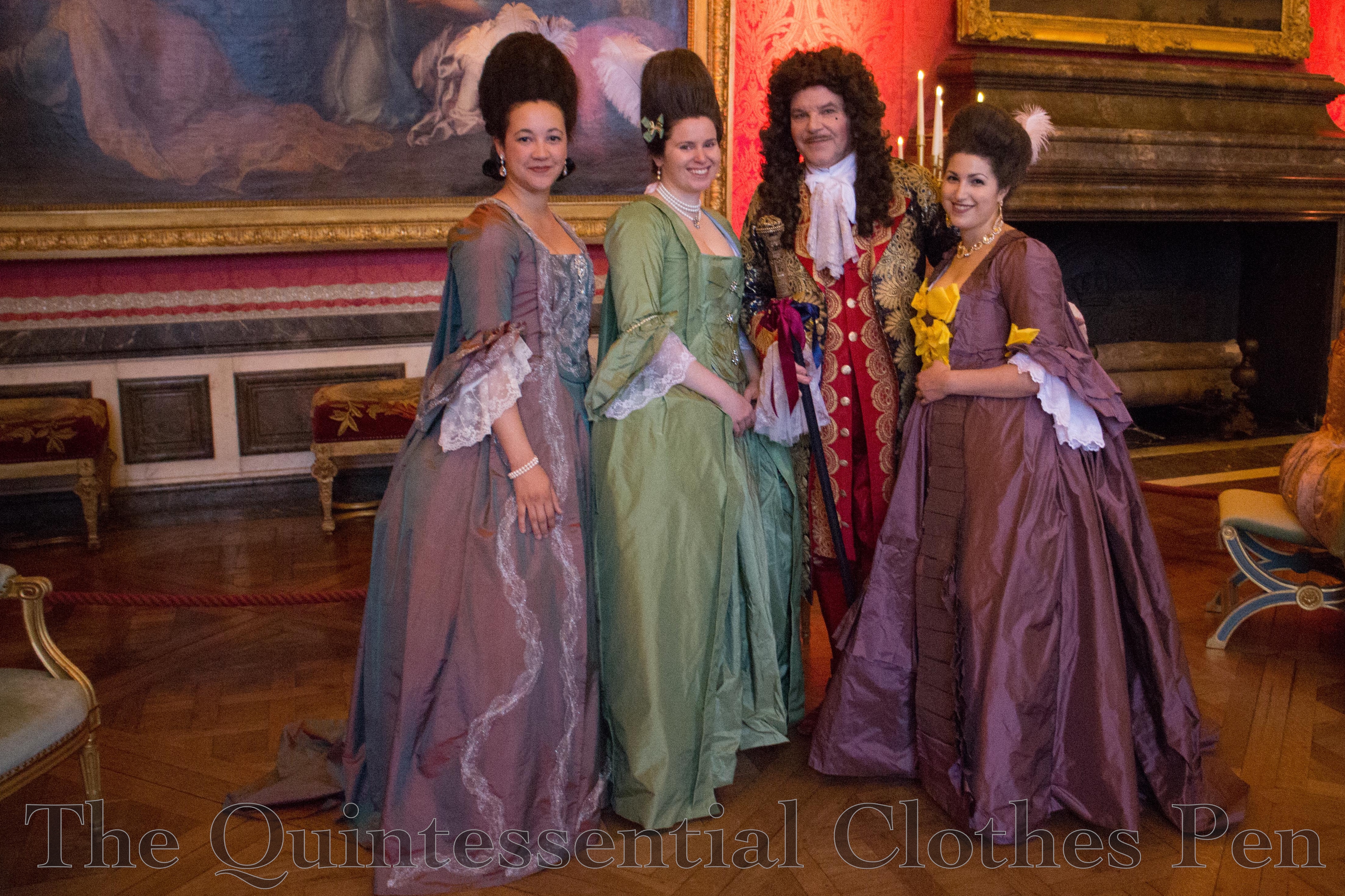
My recent trip to Versailles was right up there in terms of these amazing opportunities. It was staggering to be comfortably lounging with friends as often happens in other places and then remember that this venue was indeed Versailles! It almost required pinching to make sure it was real. The pictures prove the reality, I think. Come join me for a pictorial review of a (likely) once in a lifetime evening at Versailles for the 2016 Fetes Gallants.

The weekend before the event it rained. Hard. And rained some more. By the Monday of the event it was still raining and did not appear to be letting up. It’s hard to capture rain in photos, but here’s a view of Versailles from the Hall of Mirrors towards the beginning of the event while it was still light outside.

IMG_1351 (1)

As you know from my posts before leaving for the trip, I’ve been sewing a silk robe a la francaise for this event since January. I wasn’t about to walk through the streets of Versailles and let it get wet in the rain. Neither were the friends I was staying with. The plan: to go out midday to the grocery store and pick up trash bags to make dress covers. Well, entire body covers, really.

13346273_1745066749108952_2351170953101628418_o (1)

When we arrived, people looked at us like we were crazy (well, we are, I suppose), but when we left people were looking at us enviously and asked if we had extra bags to share! What a change. Each of us is wearing about four trash bags taped together with masking tape I’d brought along.

Luckily, there was a coat check, where we checked a reusable shopping bag full of our wet trash bags. Then it was on to get our complimentary glass of champagne, arrange ourselves for the first pictures of the evening, and head upstairs to the King’s Apartments and Hall of Mirrors.

This is the Hercules Drawing Room. It’s one of the first rooms we entered as regular tourists during our day visit as well as one of the first rooms we entered during the event. And my, what a stunning change between one visit and the other! During the day this room (and the rest of them) are absolutely stuffed with large tour groups and tourists. There is a constant movement to the flow such that you can’t really stop and have time to admire everything. Plus, it is so full of people that you rather want to keep moving to escape them. Not so at this event! You can see the floor!

IMG_1362 (1)

From the Hercules Drawing Room you can proceed through another six drawing rooms towards the back of the palace and the Hall of Mirrors. These drawing rooms are all arranged in a line such that you can look from one end to the other. They are named after various gods: Apollo, Diana, Mars, etc.

IMG_0288 (1)

You walk the same path during the day, but it was such a better experience at the event. There was a steady stream of people, but there was space to stop and look around, have a conversation, enjoy the spaces, and get pictures. The scale of the ceilings, the windows, the paintings… it all seems that much more grand and impressive when there is empty space to balance out the grandeur.

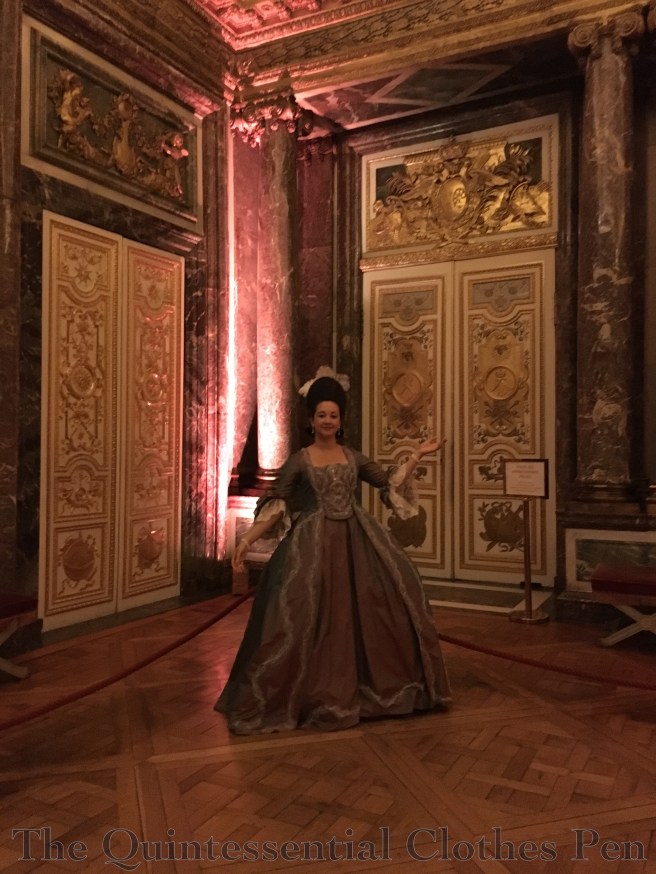
IMG_0296 (1)

IMG_1447 (1)

IMG_0303 (1)

IMG_0313 (1)

IMG_0317 (1)

IMG_0323 (1)

IMG_0322 (1)

In one room, we had a picture with the “king.” Which king, you ask? I think we was supposed to be Louis XIV or XV, but I can’t remember.

IMG_0321 (1)

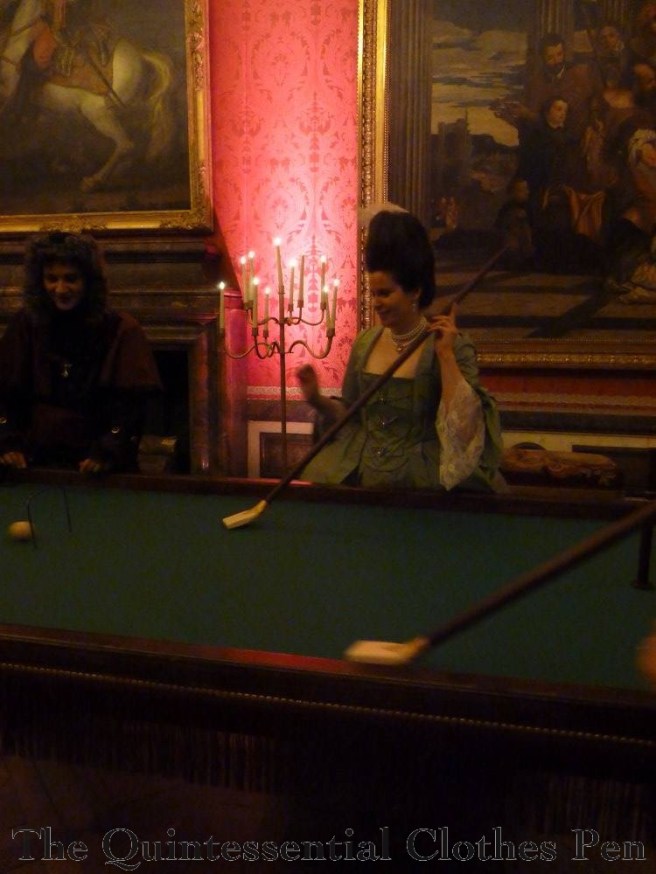
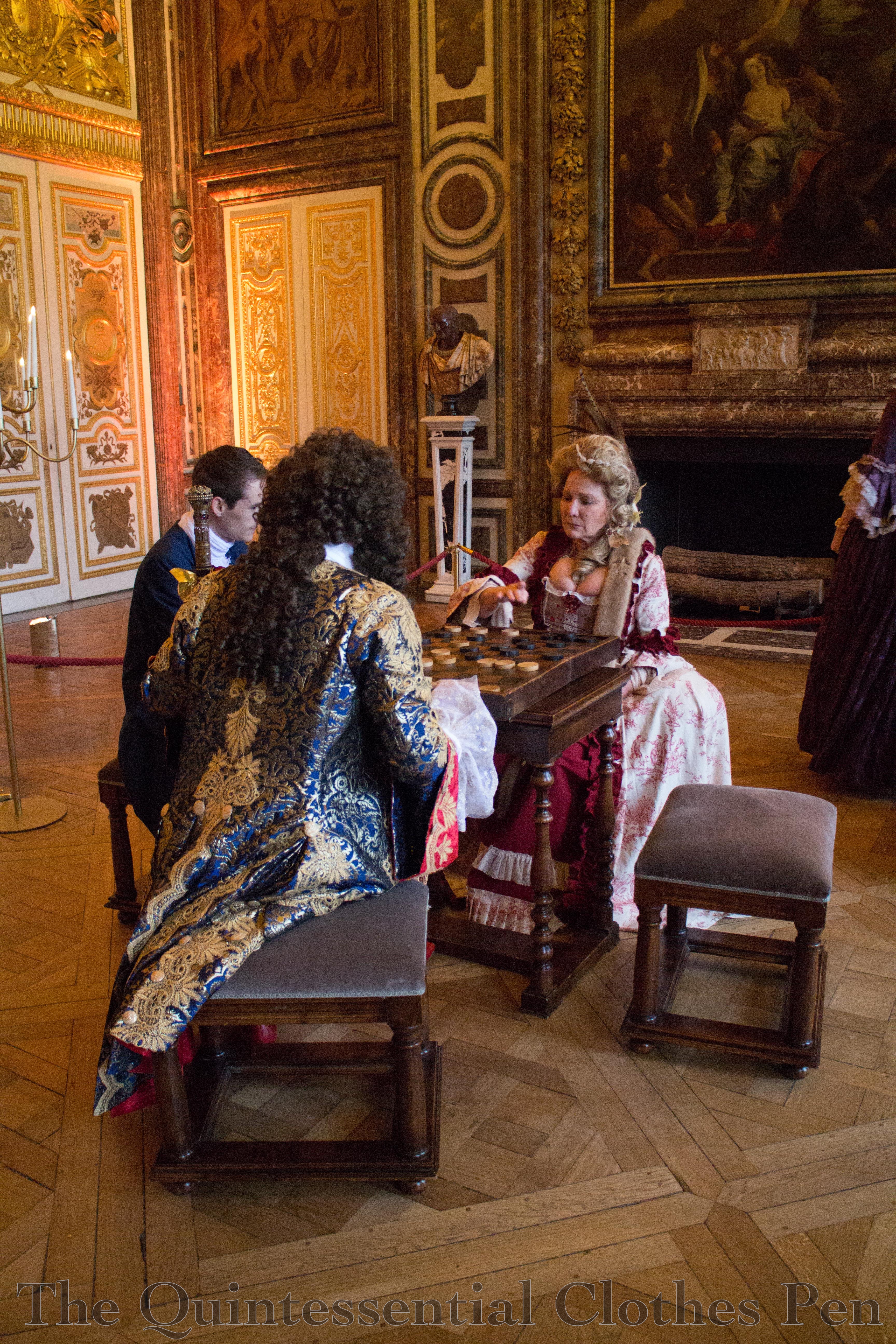
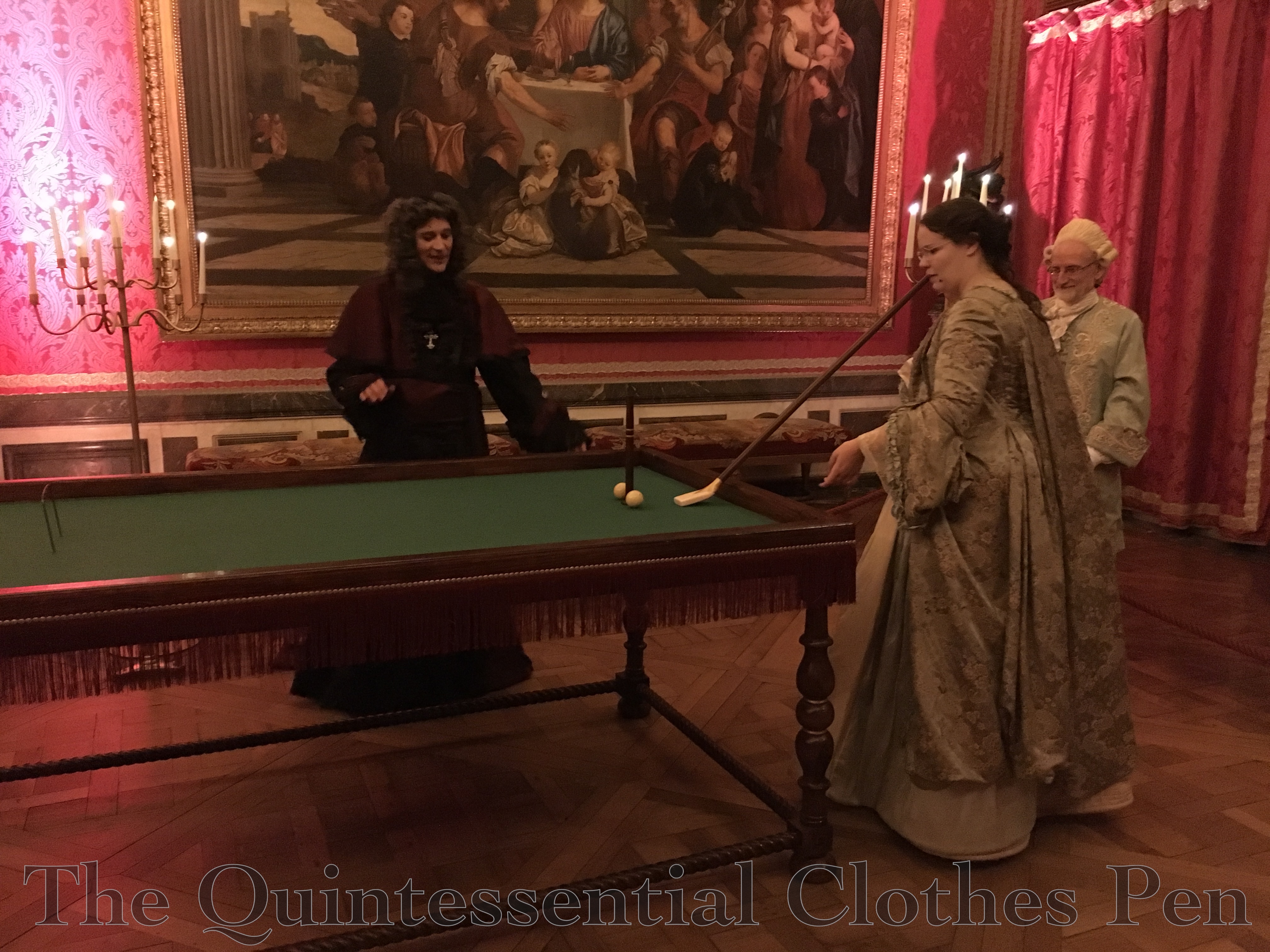
There were interactive period games set up in multiple rooms. The king himself was not above the entertainment. Neither were we! In one room we took the opportunity a few times to play each other at the billiard-like game. (If you know what this is called, please share.)

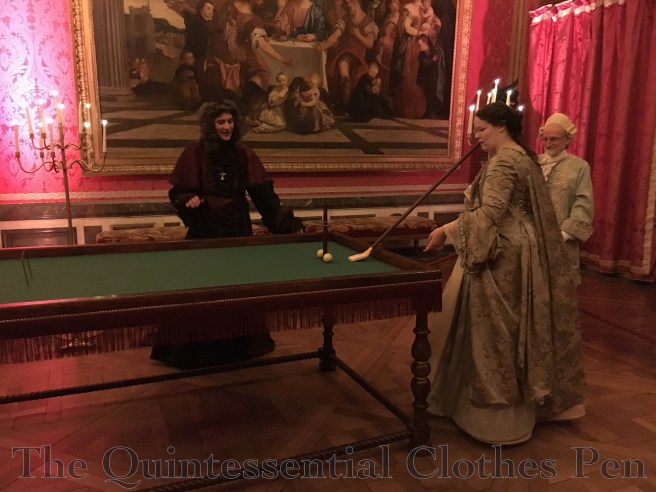
IMG_0309 (1)

IMG_1385 (1)

13329512_10154201444329110_7241591894756174364_o (1)

13308162_10154201444729110_7018204184378752156_o (1)

Proceeding along, we reached the War Drawing Room, on the corner between the long line of drawing rooms and the Hall of Mirrors.
IMG_0409 (1)

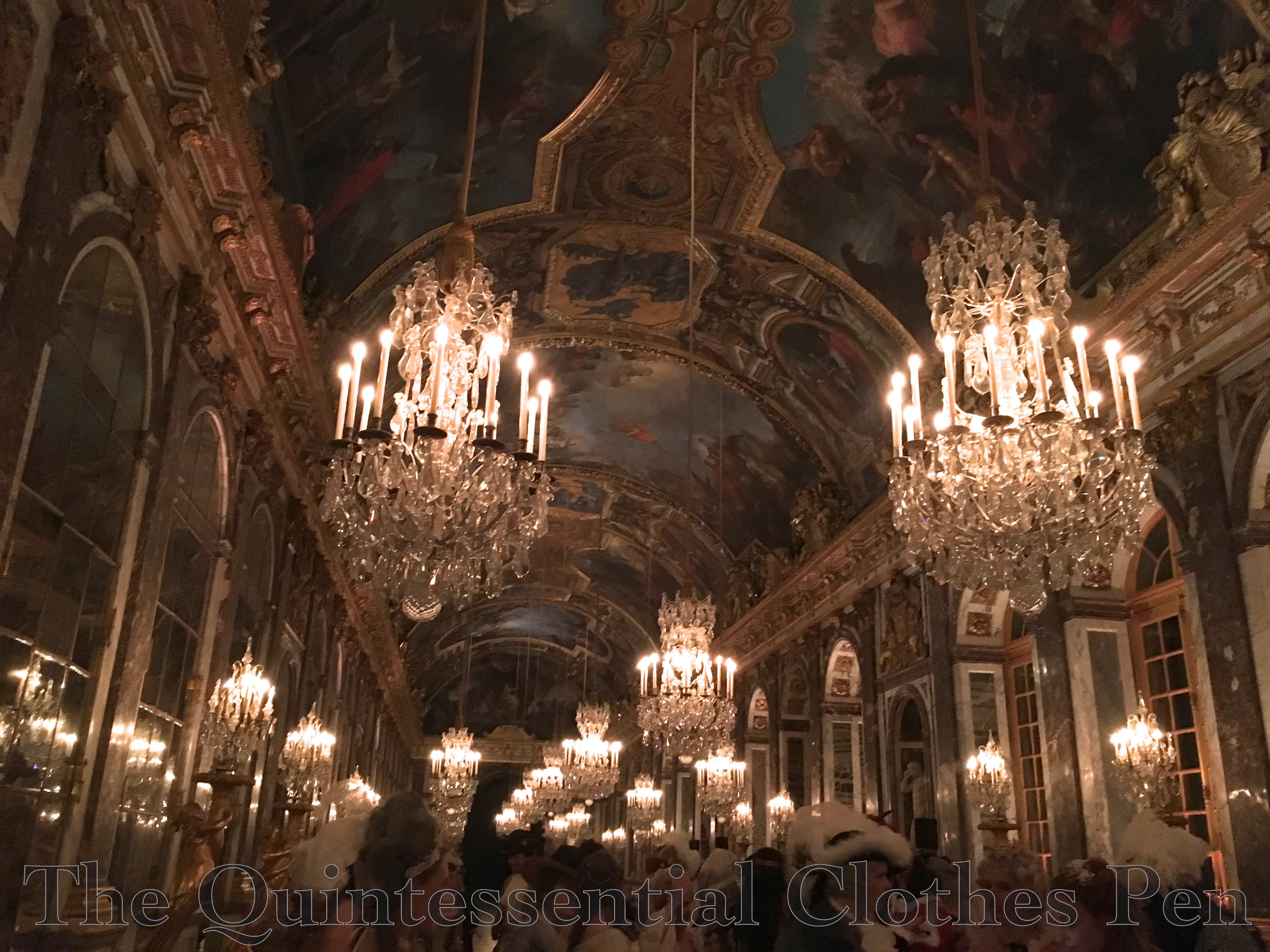
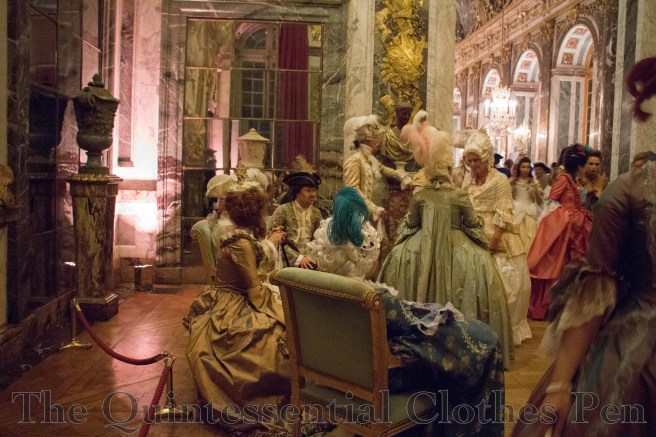
Turning the corner is the Hall of Mirrors. I wasn’t much impressed with the Hall of Mirrors when I visited Versailles about 10 years ago as a tourist. It’s crowded and the mirrors are not what a 21st century mindset is likely envisioning in terms of elegance. And visiting it again as a tourist on the trip I was still not over-the-top impressed. Beautiful, of course, but that’s about where my praise stopped.

However, seeing the room full of people in 18th century clothing and illuminated once the sun had set, the room became the spectacle that I learned of while studying art history. This is how Versailles should be seen.

The next two pictures are from early in the evening while natural light was still pouring through the windows along one side. The two pictures after that were taken later, after the sun had set and it was dark outside.

IMG_0333 (1)

IMG_1348 (1)

IMG_1434 (1)

IMG_1435 (1)

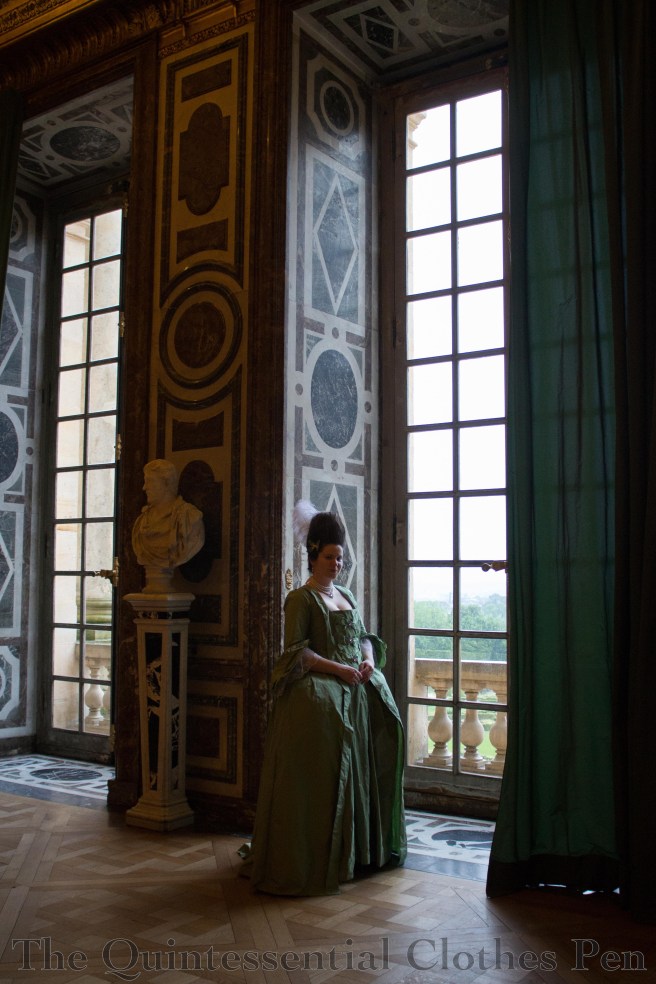
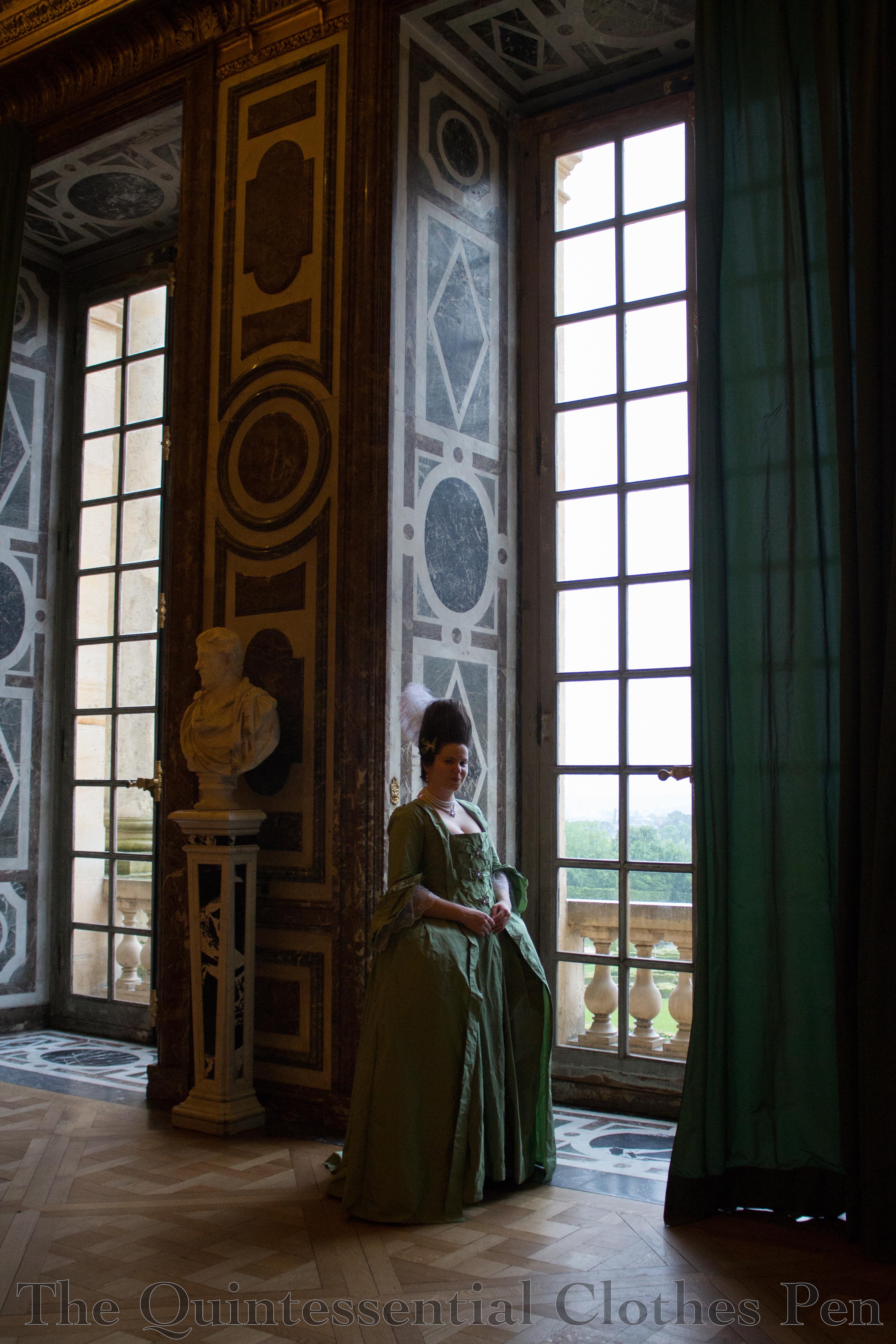
One friend had felt that our sacques were rather unflattering… until she saw herself in a mirror in the Hall of Mirrors! I think it might be impossible to wear a robe a la francaise in the Hall of Mirrors and not feel the elegance of the clothing and of the space.

IMG_1386 (1)

IMG_0361 (1)

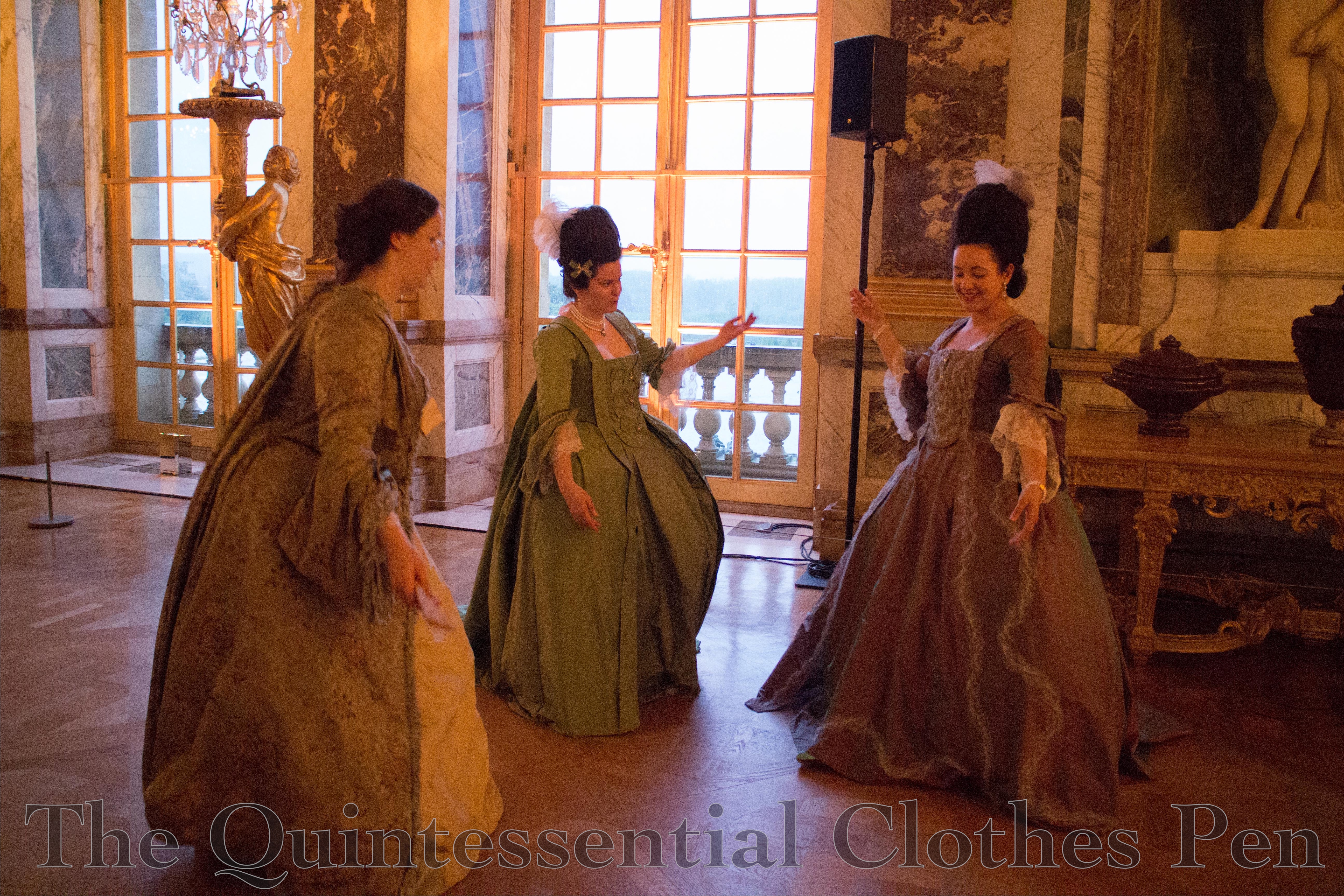
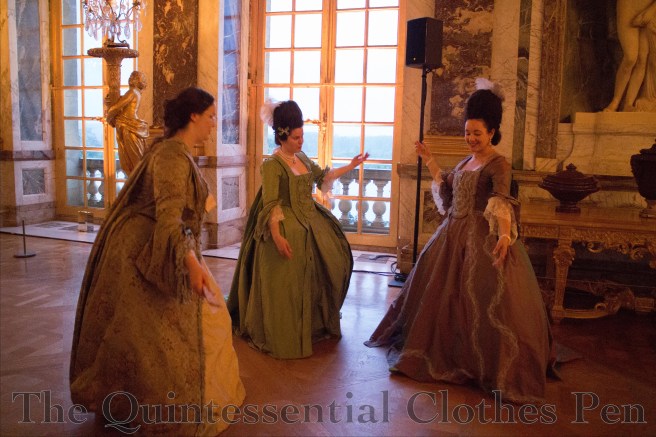
Our tickets included two activities (chosen at the time of purchase) out of about four options. My first activity is not hard to guess. Dancing! And where else, but in the Hall of Mirrors?

Along the way to the Hall of Mirrors we found a friend of a friend who had been introduced online. It was lovely to meet her and it turned out we had the same activities on our tickets so we chatted and took part in activities all evening! In fact, she was my dance partner! Being French, she was able to help translate the dancing instructions that I didn’t pick up from watching the instructors. Unfortunately, while we were learning all my friends were either dancing or attending other activities, so the only picture of me dancing is a staged one.
IMG_0343 (1)

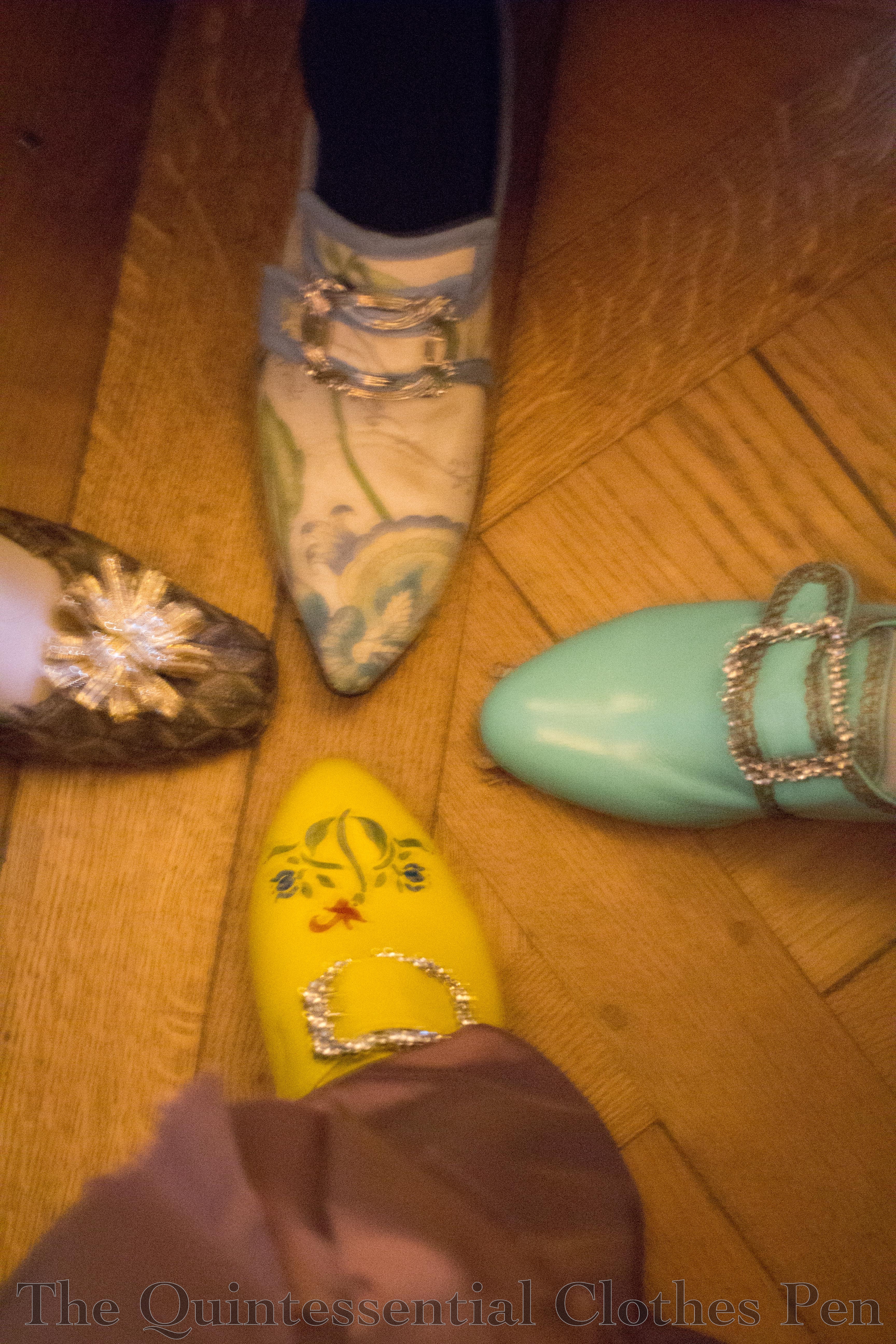
Here are our shoes: my two traveling companions and our new friend. We all made or embellished our shoes. Neat!

IMG_0310 (1)

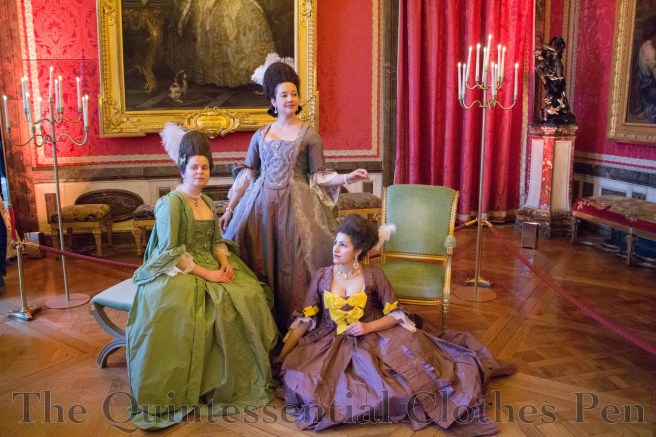
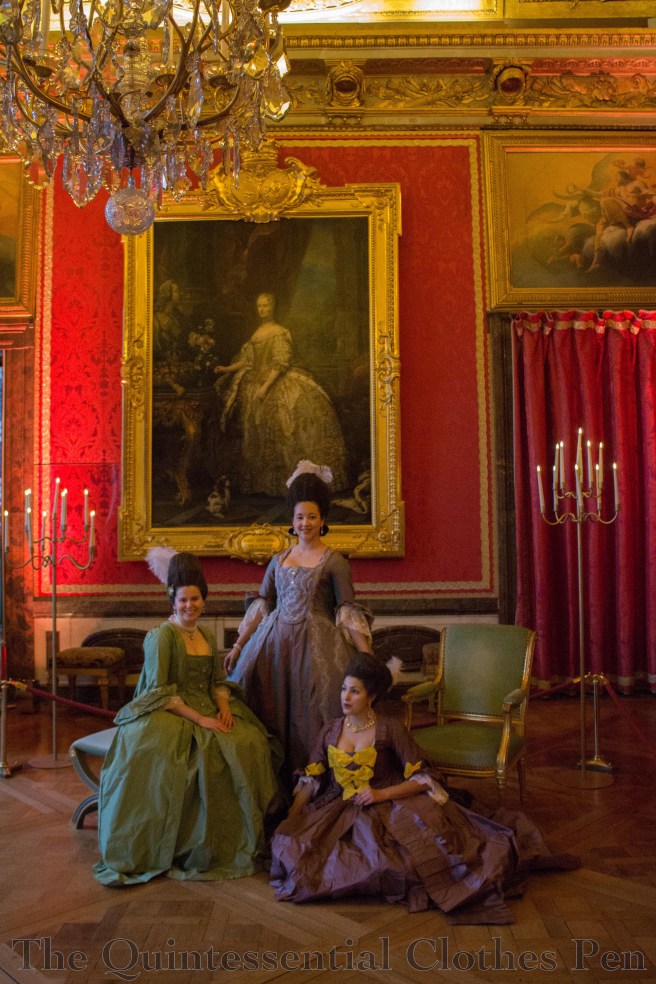
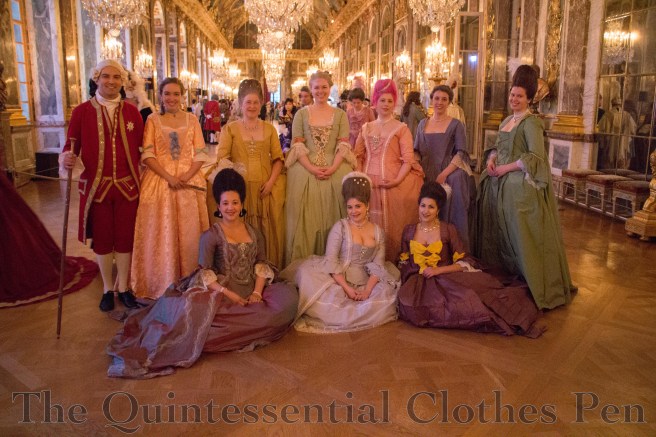
We also found more friends! In fact, there was a group of seven of us from Boston who met up at the event, as well as a group of four we knew who traveled from Scotland, and the friend we met who is French. We didn’t all make it into one picture, but here’s most of us. The impressive thing is that we’re all dressed. I’m pretty sure most if not all of us were still sewing the day of.
IMG_0345 (1)

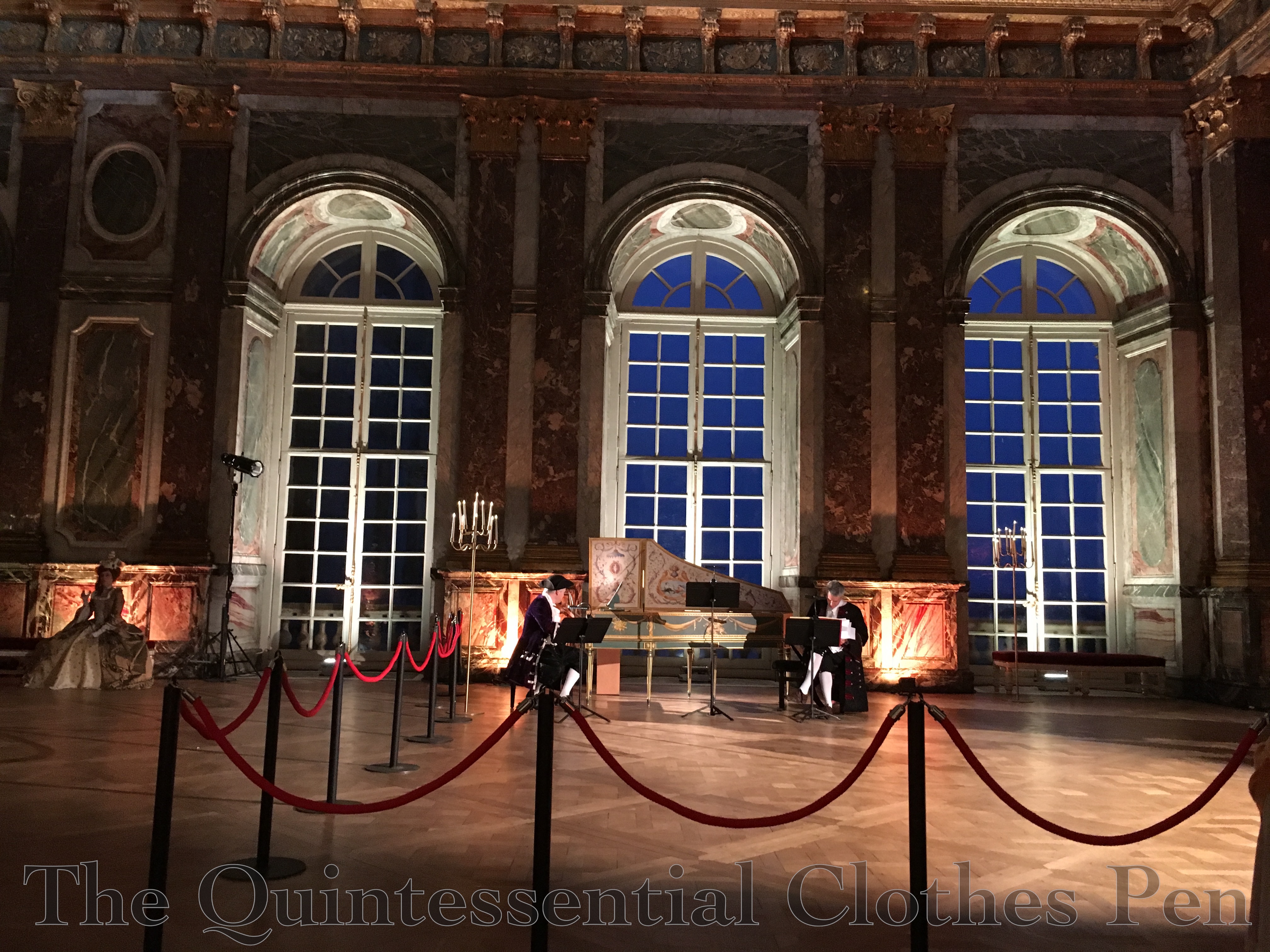
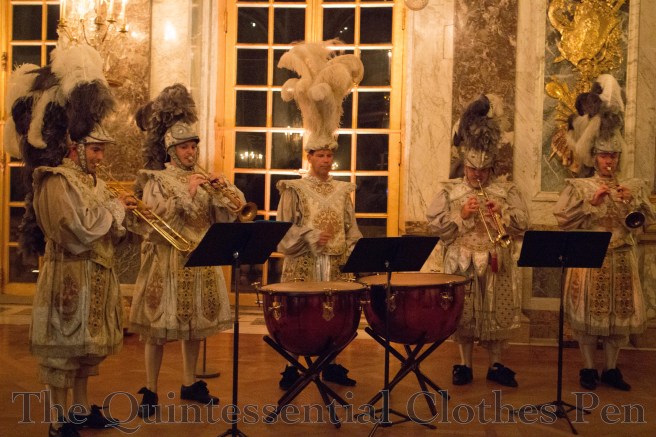
Every time the king entered the Hall of Mirrors this special unit of musicians would play a fanfare. You could certainly tell something was happening even at the other end of the hall. And wow, did these guys have great hats! They rival the ones worn by Buckingham Palace Guards in awesomeness.
IMG_0392 (1)

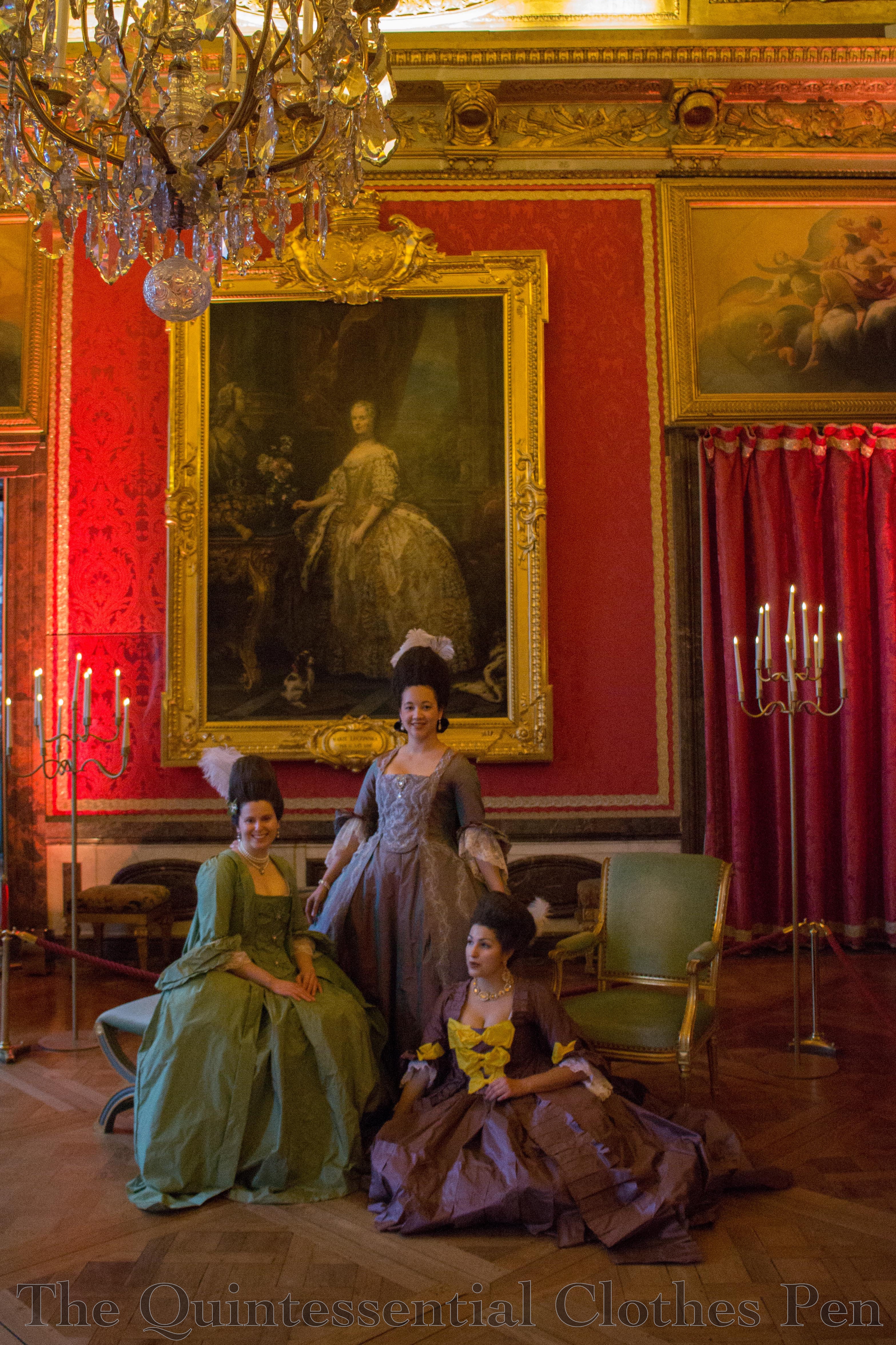
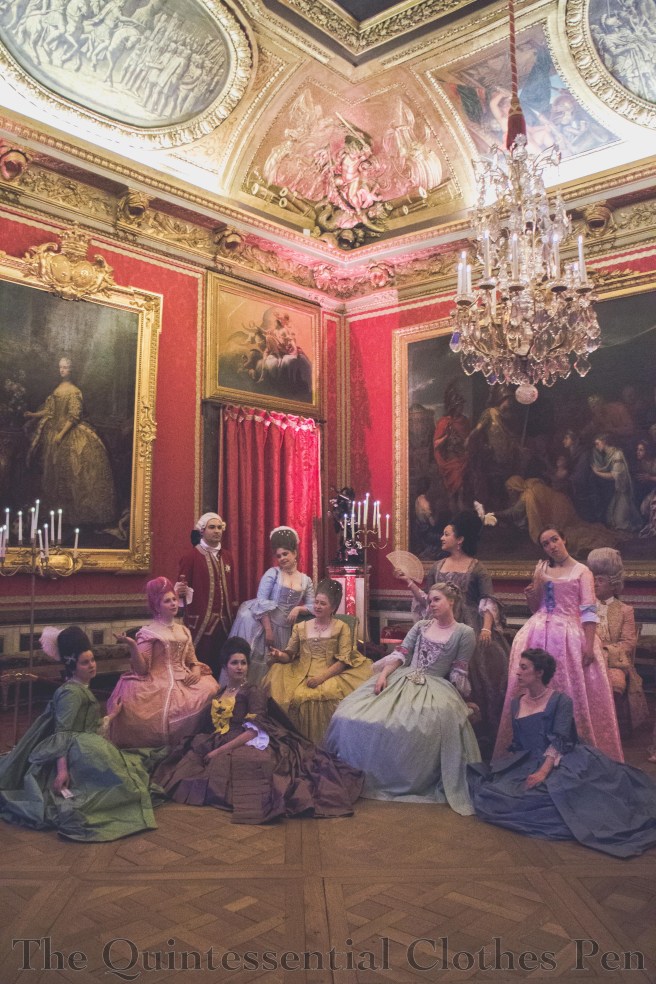
My next activity was back at the other end of the line of drawing rooms. As the group meandered our way through we were wrangled into another group picture, this one intended to be in the style of  Annie Leibovitz’s Marie Antoinette photos.
IMG_0372-2

Then it was actually off to my second activity, a concert of sacred music in the Royal Chapel. We had to wait a bit to enter as the previous concert hadn’t yet finished when we arrived, but that gave us time to look around the Hercules Drawing Room a bit more than we did upon first entering it. Part of the room was cordoned off to provide space for a dance and music performance, a portion of which we were able to watch while waiting.

IMG_1363 (1)

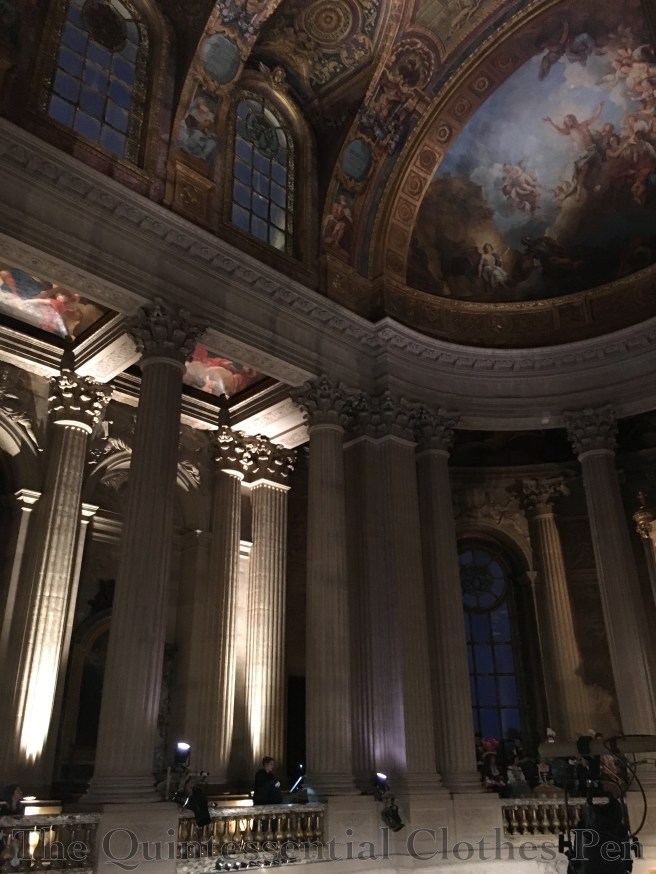
As a daytime tourist, we were only able to look through the doorway into the Royal Chapel, so it felt like quite a treat to be allowed to enter and sit for the concert. We were all seated on the second level of the chapel. And to my great delight, the concert’s music was provided on the organ! How exquisite, to listen to the music fill the room and fade away in echoes between songs. Some pieces also included singers. It was a lovely rest for the feet and quite a stunning and special experience.
IMG_1374 (1)

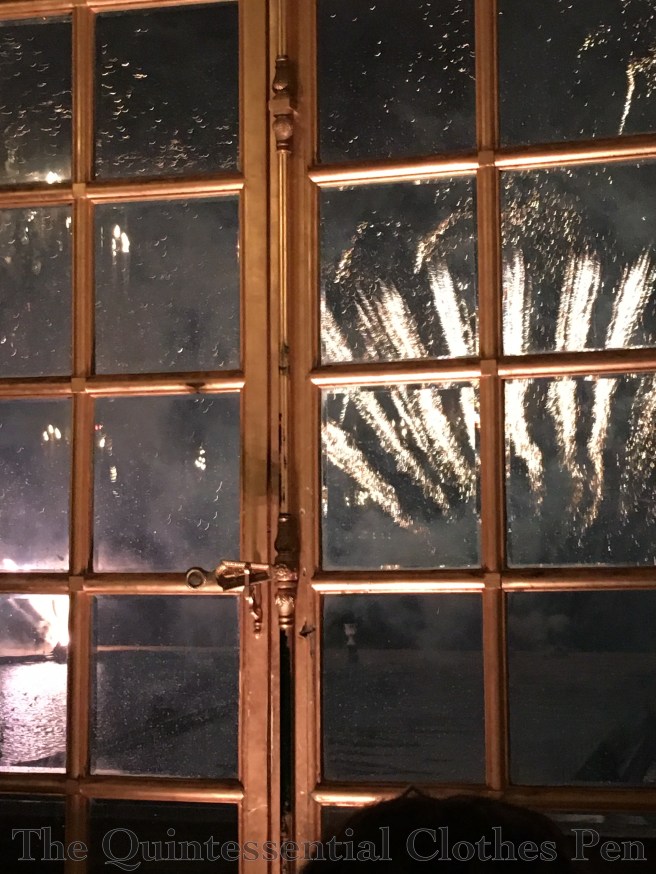
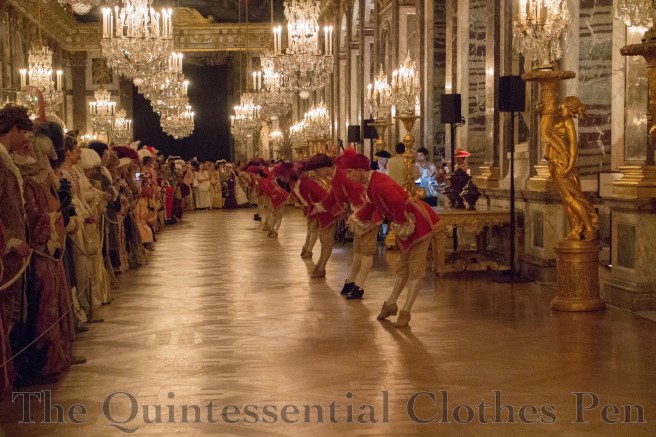
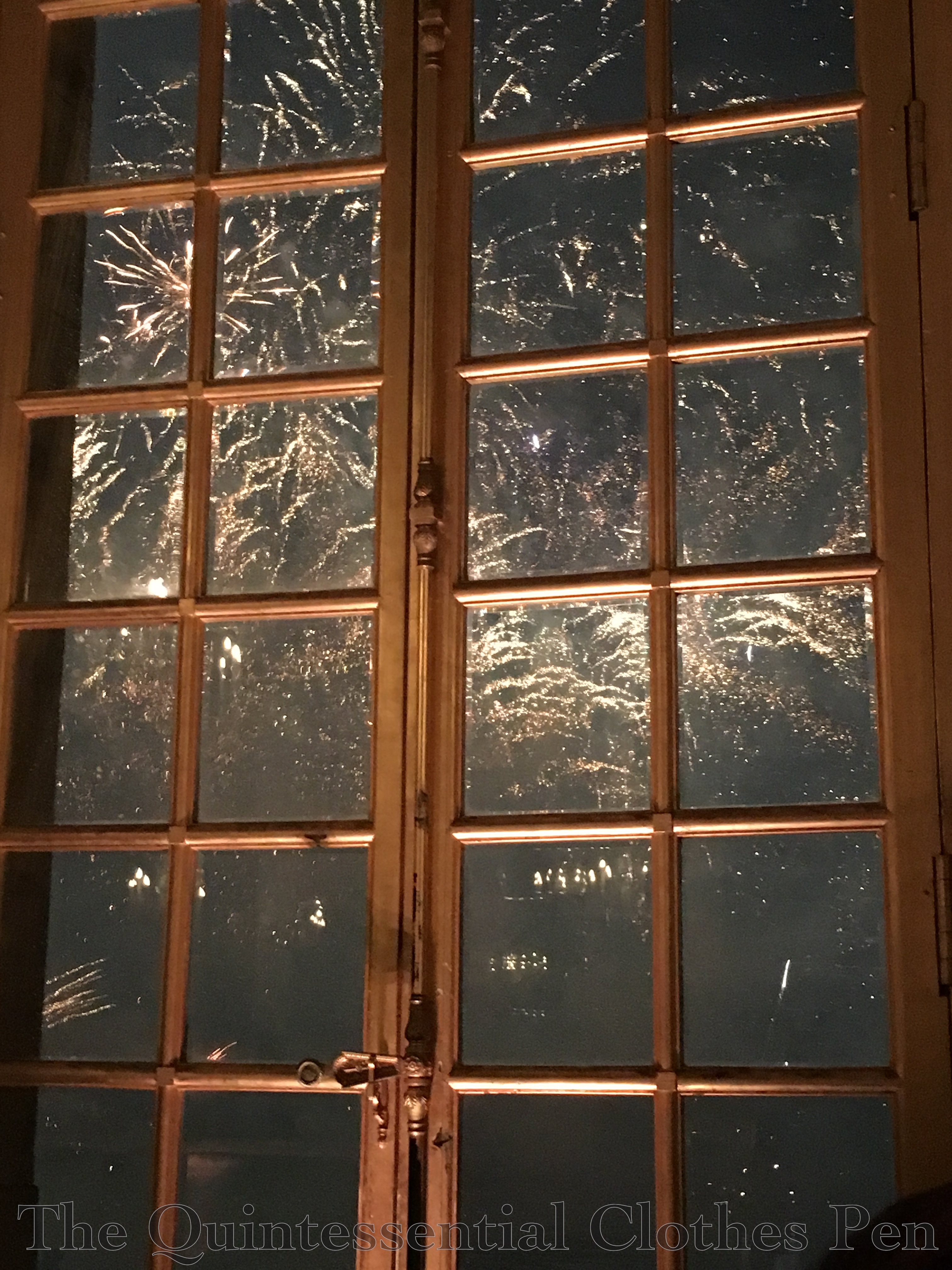
I was starting to feel tired, but the event was not ready to conclude. We headed back to the Hall of Mirrors for a dance performance and for fireworks! We weren’t sure they would do the fireworks with all the rain, but they did!
IMG_0399 (1)

IMG_1416 (1)

IMG_1415 (1)

IMG_1412 (1)

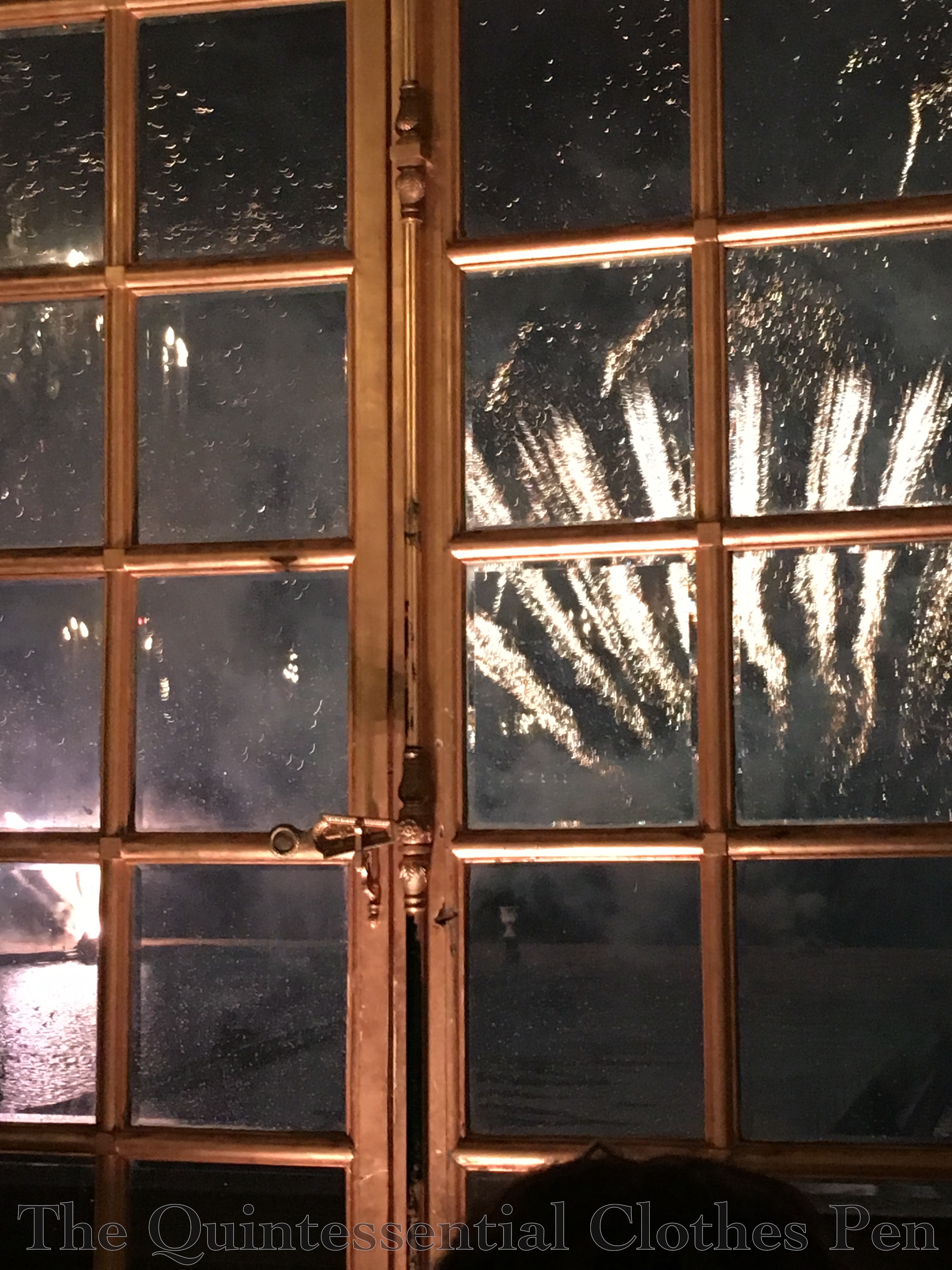
The fireworks were the finale of the evening, but the event staff didn’t rush us out. In fact, we stayed and lounged for another hour after the fireworks ended. There was a line of event staff very slowly moving through the rooms and herding people, but it was a very civilized and non-intrusive herding.

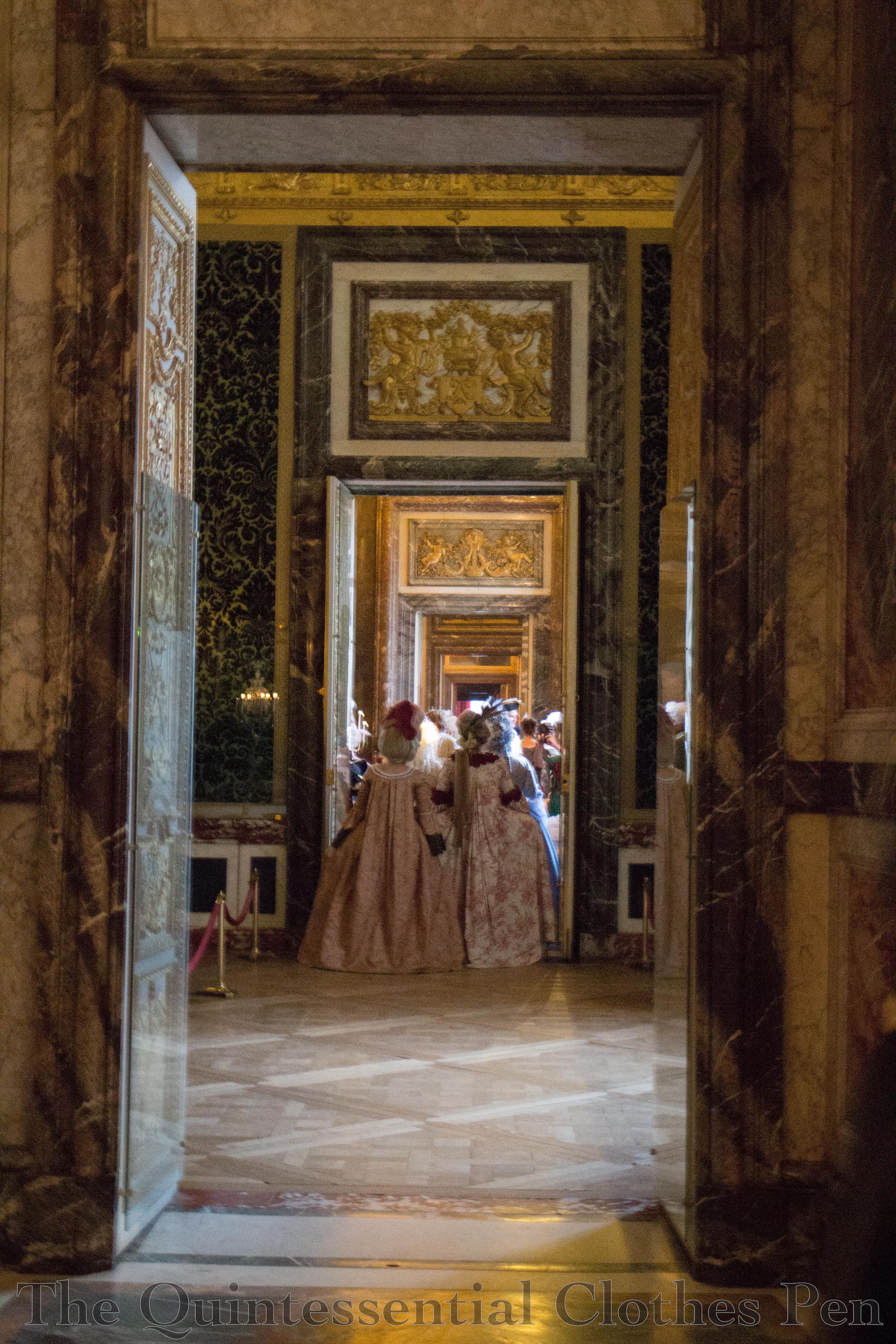
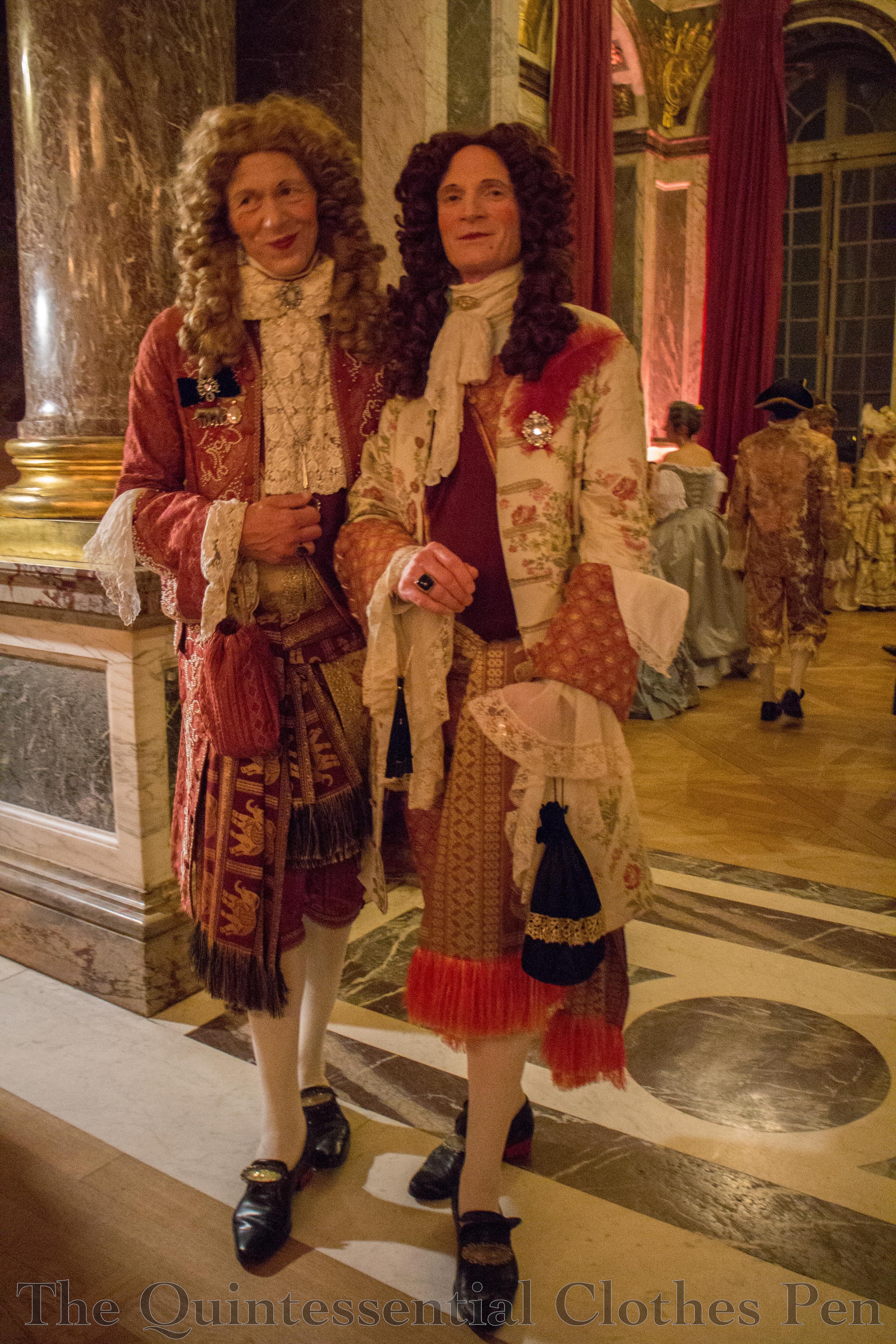
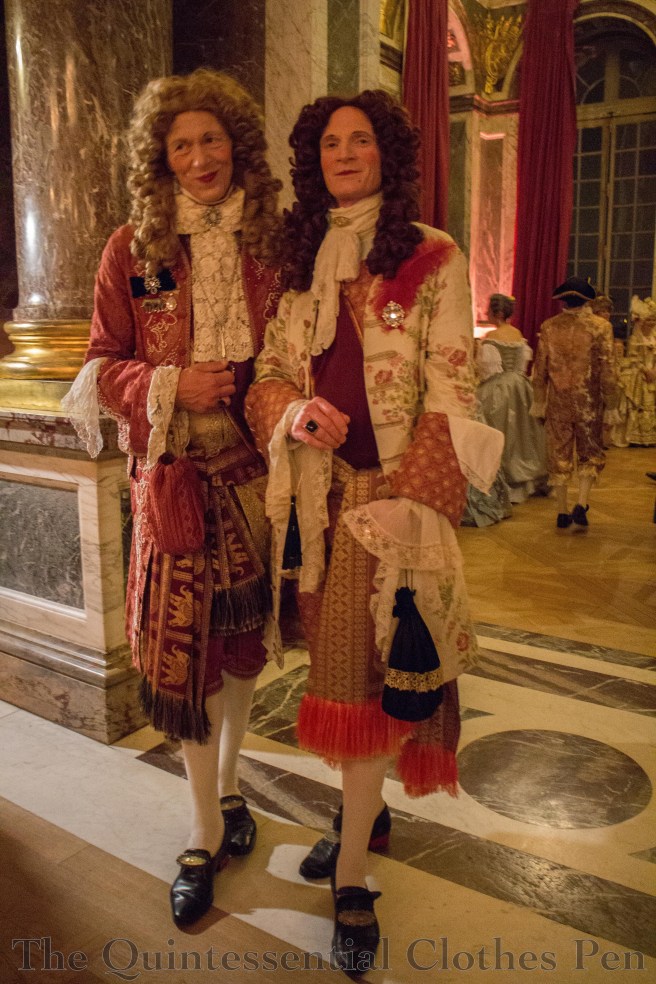
It gave us more time to admire other people’s clothing, including these two, and to be admired. I was impressed with myself when I understood a compliment given to me in French!
IMG_0428 (1)

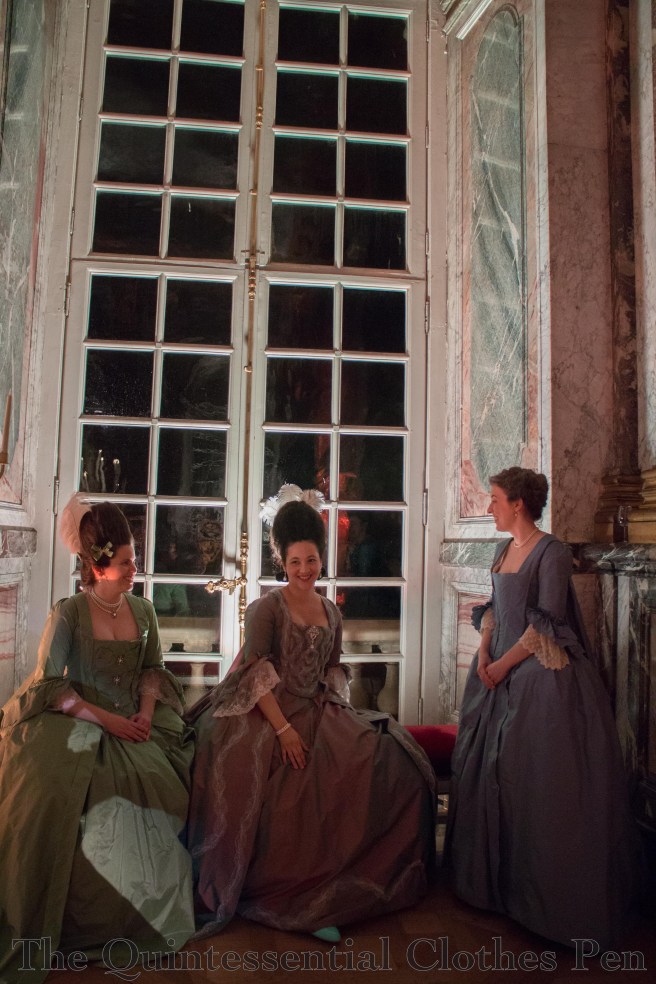
We slowly walked back through the line of drawing rooms, not wanting to leave because it meant the end of the evening. This is back in the Hercules Drawing Room before we headed down to get suited up in our trash bags.
IMG_0439 (1)

If you appreciate stepping into history and you ever get the chance to attend this event, you should. It was stunning and special. This is how Versailles should be not only seen, but experienced.

IMG_1451 (1)

Suggestions For Dressmakers, 1896

“When it comes to making, the actual sewing and finishing, the American dressmaker has nothing to learn from anyone. First class American dressmakers turn out the best work, so far as the mechanics of dressmaking go, of any dressmakers in the world. In point of fact, they make dresses too well. They might with advantage to themselves, and with no disadvantage to their patrons, unlearn something about sewing, and let some of the fussy details, over which they now bother their heads to very little purpose, go by default.

But the A-1 American dressmaker puts too much fine sewing into her dresses. They look well; they look about as well on the wrong side as upon the right side; perhaps if they were not such marvels of patience in the inside finishing, they might be more artistic to look like on the outside. Look at even the highest priced foreign made dresses; by comparison, they seem almost slovenly in workmanship, compared with American dress, but after all to what end put such an infinite amount of pains into finishing off a dress that, nowadays, is worn but a few times…house dresses and evening dresses might be slighted in finishing just as the Parisian dressmakers slight them without suffering an iota in looks or wearing possibilities, and with a notable saving in time and trouble.

The Parisian dressmaker is clever. She knows every trick in putting her work where it will make the most show. So long as she gets the effect she wants, and it stays as long…as it is required, which is not long, for instance, in a tulle party frock, she doesn’t try to make the sewing in every part of the sort that would win a prize at a school exhibition. The Parisian Milliner long, long ago, found that she could get effects by pinning on her hat and bonnet trimmings that absolutely defied sewing, and the Parisian dressmaker will catch a flounce of lace here and a ribbon there with fascinating grace, and never bother her head about what it looks like on the wrong side. Why should she?”

7138bd5bed5bd5a8921d1fd61bbdfd27I came across this passage in Suggestions For Dressmakers (1896) a number of months ago around the time I was completing my 1899 elusive blue evening gown. It is from the chapter called “Making” on pages 27-28.

The passage immediately brought to mind my process for making historical garments, which is usually along the lines of the “American dressmaker” in that I put many hours of fine sewing into my dresses to make the insides just as much as work of art as the exterior.

The obvious and most current example that came to mind was the dress I was completing at the time, but there are many others as well. Here are a few made during the last few years and spanning the 19th century in terms of their origins.

IMG_0544
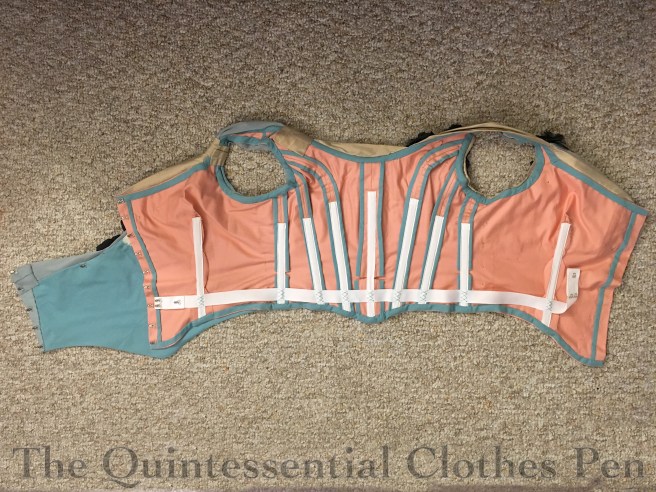
In the style of the “American Dressmaker”, the beautifully finished interior of my 1899 elusive blue bodice made in 2016.
IMG_0951 (1 of 1)
Another beautifully finished bodice in the “American Dressmaker” style from 2014. This is Georgina’s 1858 evening bodice.
IMG_4277
Tidy insides in my 1813 evening gown made in 2013, also in the “American Dressmaker” style.

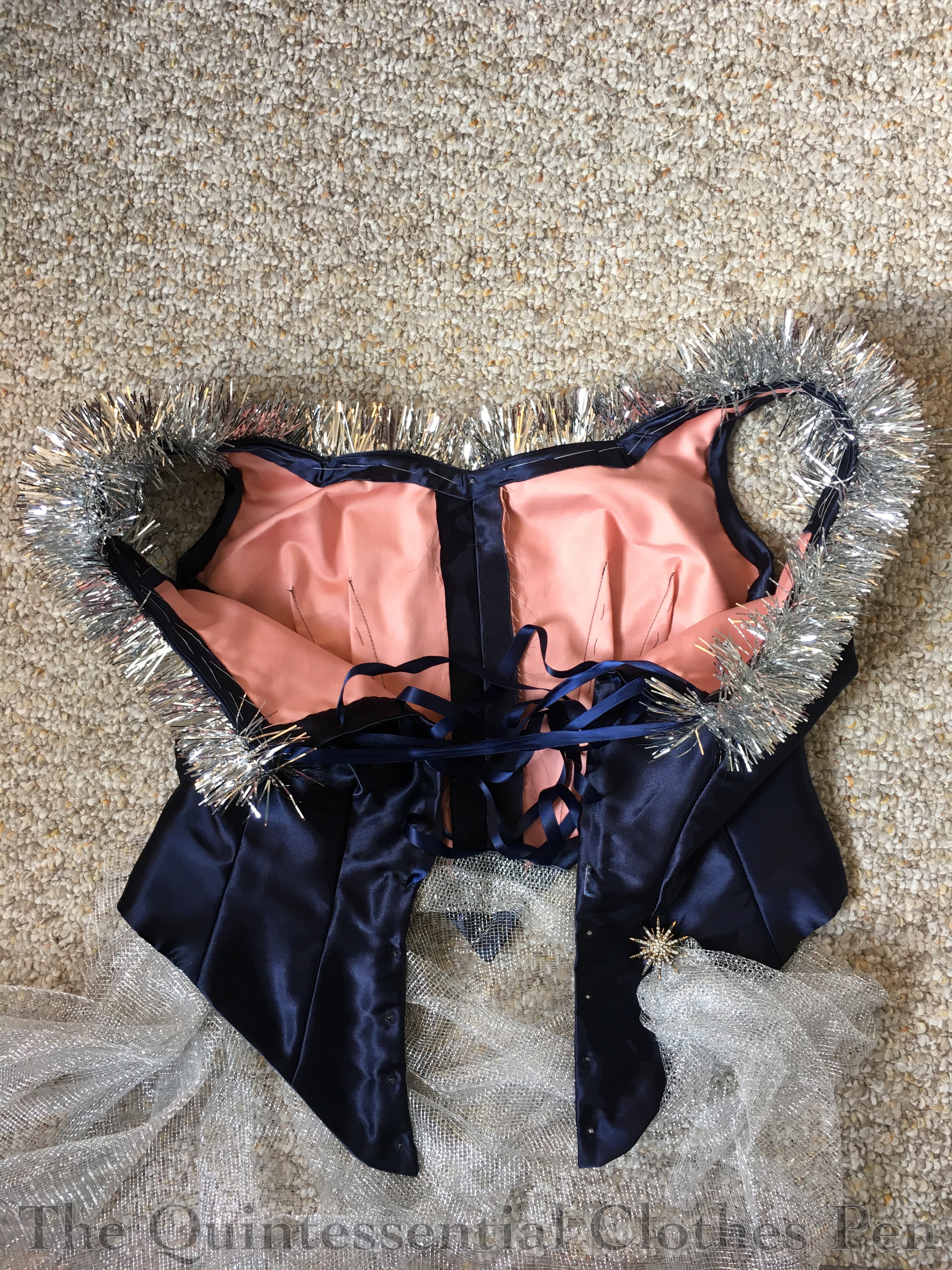
I also had this passage in mind while working over the first part of this year on my recent 1885 Night Sky fancy dress. I decided with that ensemble to follow the suggestion to adapt to the “Parisian Dressmaker” style and not worry about the insides as I usually do. While still quite tidy, I did not spend time finishing unseen seams inside the skirt or finishing the edges of the vertical seams on the bodice, as you can see below. It was a bit of a struggle with my natural instincts, but worked out very well in terms of the working on this right up until the deadline and not having time for all the pretty finishing anyway.

IMG_1483
I couldn’t entirely shake the urge to be tidy and nicely finish things, but I did leave some edges raw and basted on the trim in case I want to easily remove it in the future.

There’s also the mention of pinning trim on hats. That is a suggestion that I often make use of! I can think of multiple examples of hats that have had trim pinned on for years even while the hats are in storage. For example, remember the hat that I wear with my 1895 Skating Ensemble? That’s the same hat from my 1883 Tailored Ensemble with fur trim and extra feathers that have been pinned on since early 2015. I’ve felt no need to sew those on!

Do you sew like American dressmaker or a Parisian dressmaker? Is it a conscious choice for you to pick one style or the other, or is it just your natural sewing method? What about hats? Do you ever pin your trimmings on?

1885 Night Sky Fancy Dress

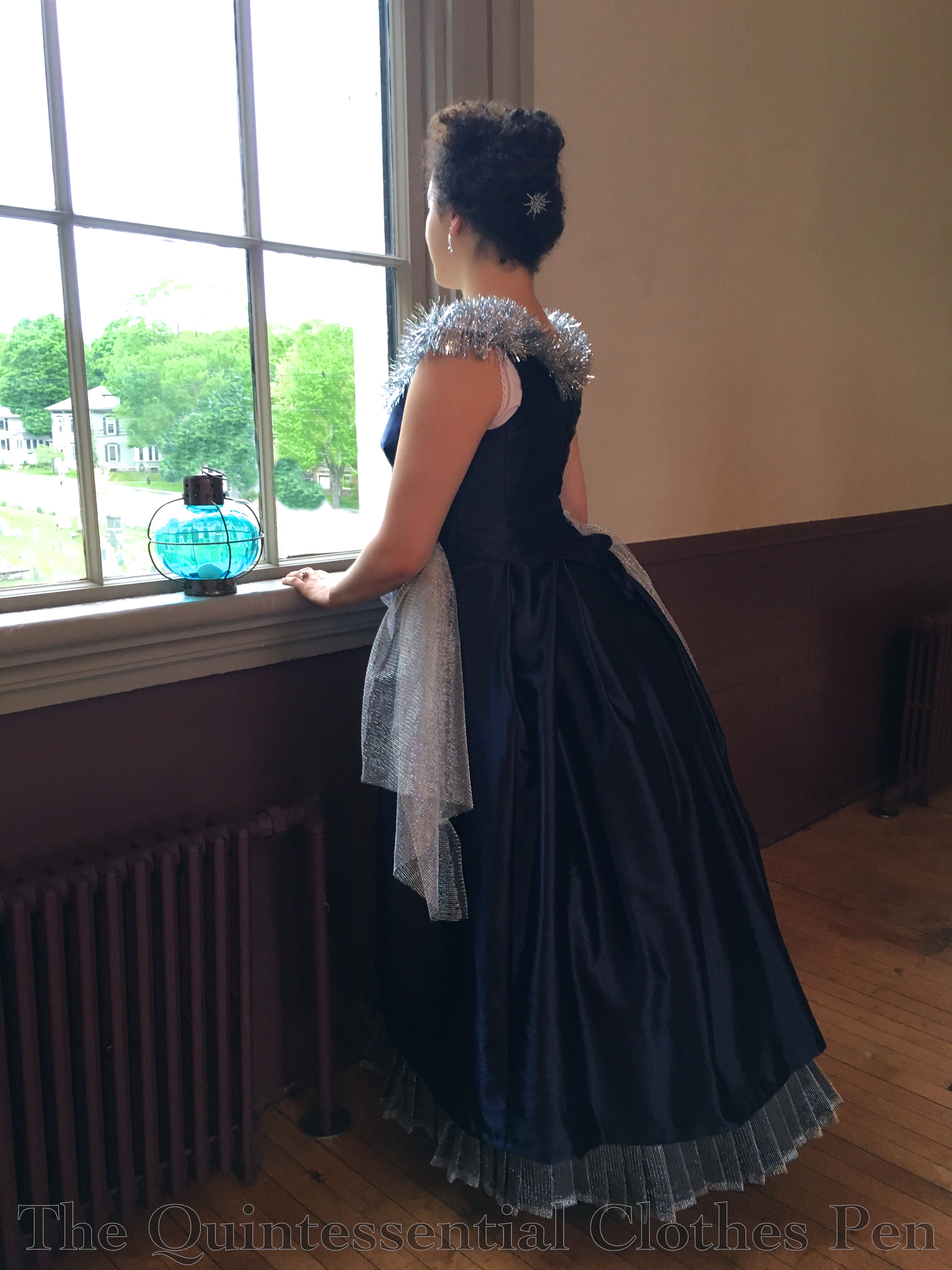
It has been a goal to make a specifically fancy dress outfit for years, but particularly since I made a makeshift 1860s flower basket fancy dress outfit in 2015. This May I had the perfect opportunity in the form of a fancy dress ball!

I decided to make an 1880s bustle dress because I already had all the undergarments, including my still-new-feeling 1880s steam molded corset, and because it’s a period of dress that I rarely wear, especially for dancing. I wanted to experiment with dancing in a bustle to see how it worked and what it felt like.

Design-wise, I was inspired by Mrs. Alice Gwynn Vanderbilt’s Electric Light fancy dress outfit made by Worth in 1883, but wanted to adapt the idea to fabrics I already had on hand. Since the fabric I came up with was navy blue, I decided on Night Sky as my inspiration.

2753c5268e0e74e0fc49e0c0d77e3053
Mrs. Alice Gwynn Vanderbilt’s Electric Light fancy dress outfit, 1883

I started my outfit in January and worked on it over the next four months or so, but despite all that preparation time I was still working on it right up until the day before the event. Luckily, I did the vast majority of the work of cutting, sewing, and fitting before March and April when I became super busy. Tasks left at that point included finishing the bodice edges, trimming, and closures.

IMG_0999 (1)

In addition to the Mrs. Vanderbilt’s inspiration I also looked at other 1880s skirts for draping ideas and other 1880s fancy dress outfits for trimming ideas. You can see the most inspiring images and extant garments on my Pinterest board for this project here.

For ease of documentation, I’ll do the facts as with the HSF:

Fabric: 2-3 yards of navy blue cotton twill for underskirt, 6ish yards of navy blue polyester charmeuse, 1ish yard of pink cotton twill for flat lining, and 1-2yds of silver net.

Pattern: My 1885 Frills and Furbelows Bustle Dress pattern, adapted for evening and for the style of skirt desired.
Year: 1885.

Notions: A 3yd tinsel garland, 6 star brooches, 3yds of navy polyester ribbon for lacing, hook and bar closures for the skirt, and thread.

How historically accurate is it?: 90%. Recognizable in it’s own time, certainly. Reasonable construction, certainly. Materials, not so much. It was much more important to use what was on hand than to purchase new fabrics, especially since this is an outfit that I don’t see getting a lot of use.
Hours to complete: Tons. I didn’t keep track. Bustles are fussy and require lots of time with a dress form to achieve an elegant drape.

First worn: May 21.

Total cost: Most of the fabrics were in the stash with the exception of the silver net and most of the notions were purchased cheaply on eBay. Let’s say $20.

IMG_1011 (1)

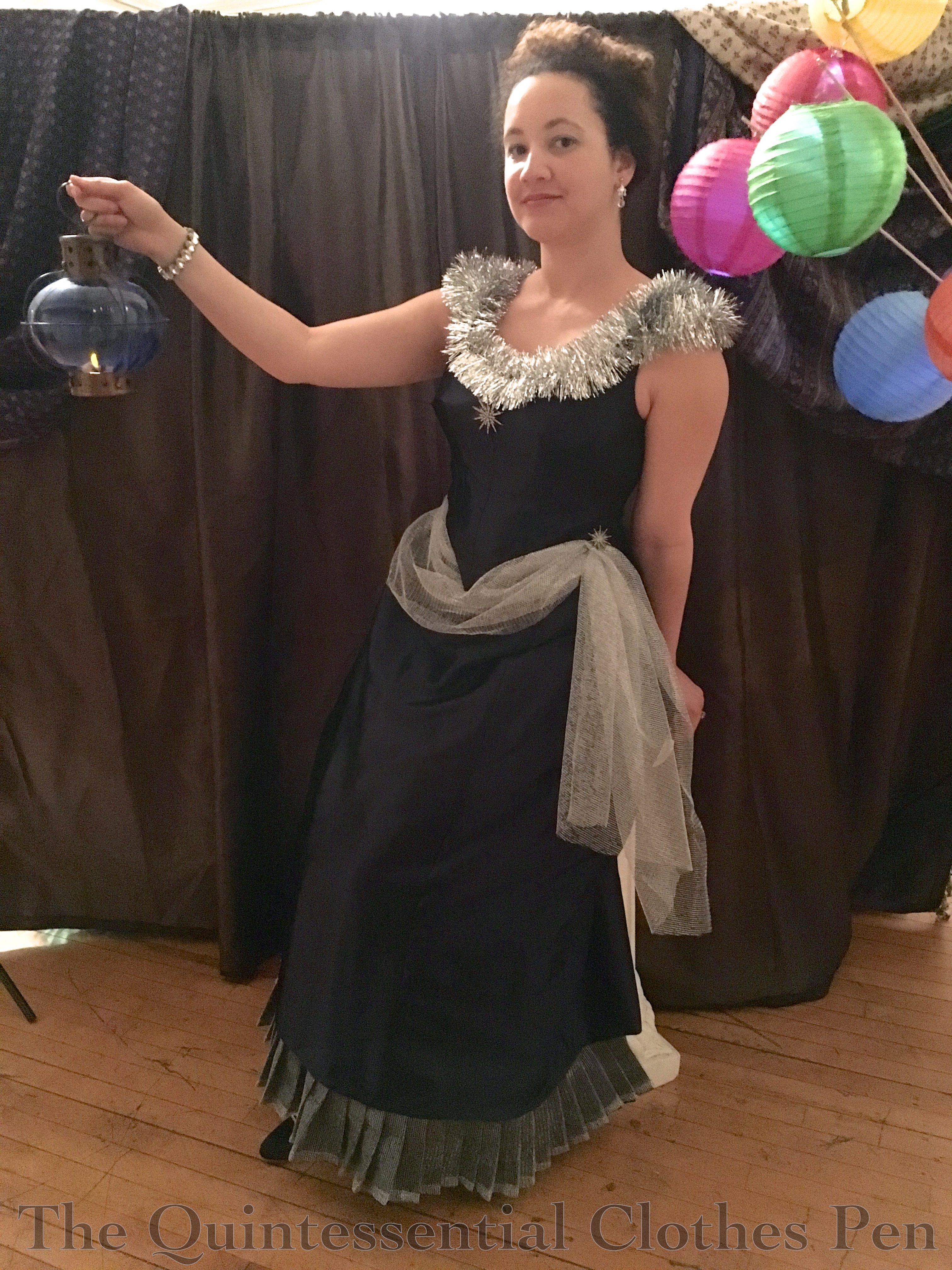
For the photos I wore the dress with my black Seaburys and the new rhinestone shoe clips that I purchased in March. It was quite sparkly and elegant, but for dancing I changed into navy blue velvet flats. They were just as cute but did not get the special treatment of being shown off in photos.

I had the grand idea to use my curly hair ends flipped up on top of my head like the curled fringe popular in the 1880s. It’s also long enough that I was able to make the bun shape on the back also using only my natural hair. I pinned in star brooches to match those on my dress as decoration.

IMG_1034 (1)

All in all I’m quite happy with the final result! Dancing in the bustle was just as easy as any other Victorian style. The differences were that all the extra fabric was behind me making some movements more challenging due to space such as during a quadrille, and that the bustle and layers of fabric on the back gathered a fair bit of momentum when turning, creating quite a swish!

Construction wise the only change I would like to make after one wearing is to bone the center back edges so that the back lies flat when laced onto my body and to sew in a matching fabric piece behind the lacing holes to hide any white from undergarments that wants to peak out. I’ll also need to wear a different chemise or tuck the top down so there’s not white cotton poking out at the armholes. However, these are minor changes and I’m not sure when I’ll have the opportunity to wear this again so it might be awhile before they happen.

IMG_1023 (1)

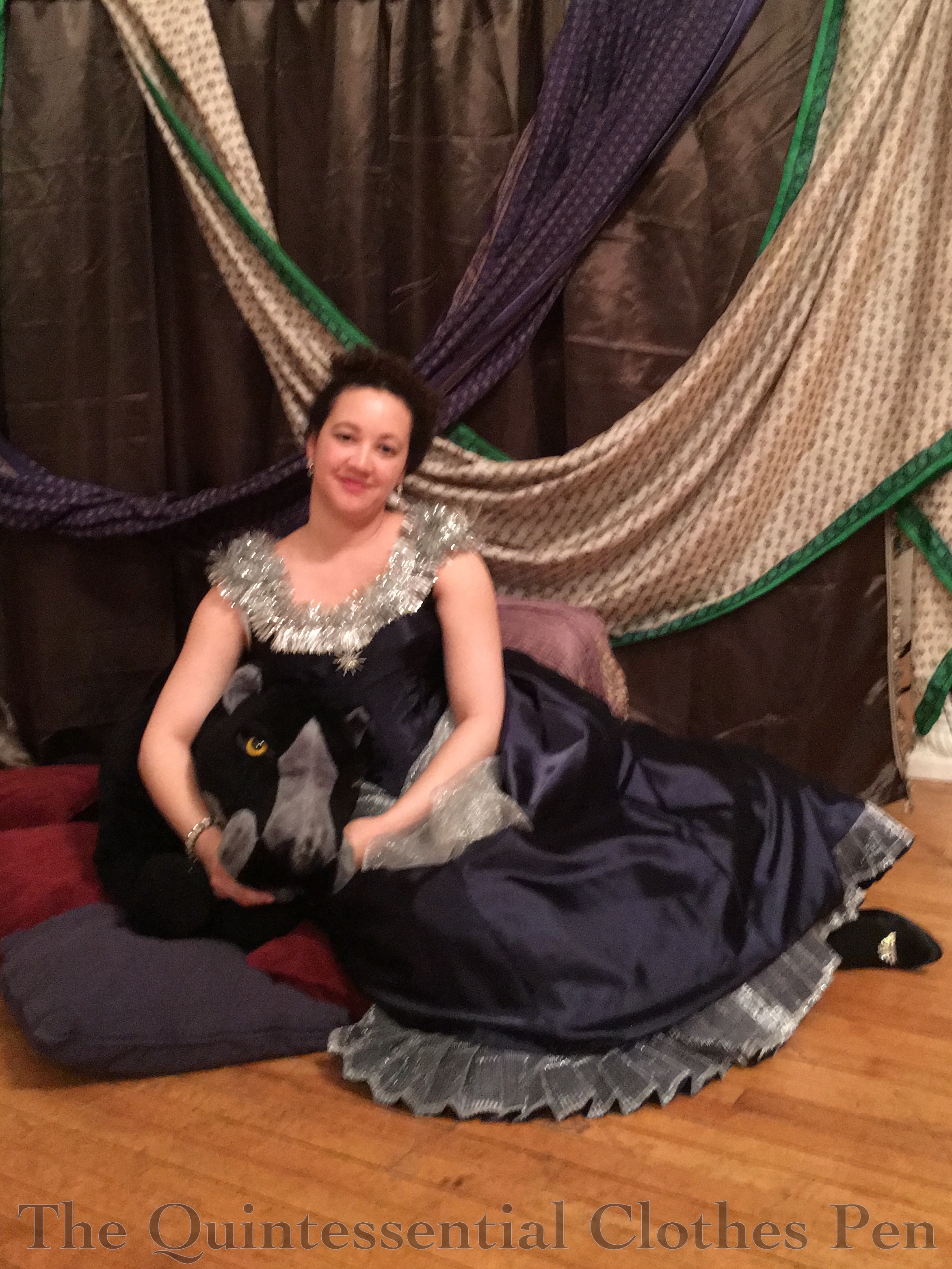
For this ball we set up a double sided picture backdrop, one side of which you’ve already seen. The other side included a large stuffed jaguar/panther I dubbed Jaggy for the night. You often see backdrops in regular Victorian photos as well as fancy dress photos. Unfortunately, with my heels on I was too tall for them! Oops! Being too tall inspired me to take some fun sitting photos.

IMG_1094 (1)
Hanging out with Jaggy.
IMG_1097 (1)
Tired after a night of dancing.

For decoration out of the ordinary, we had the lucky and unexpected use of the fabulous blue and turquoise lanterns in many of the pictures as well as multicolored paper lanterns with lights inside. We put the lanterns around the room in glass vases as bouquets. First, a picture from the set up part of the evening. Second, a picture with some lanterns creeping into the photo.

IMG_0973 (1)

IMG_1080 (1)

Fancy dress outfit, check!

Project Journal: Versailles Sacque: Hair Decided

I’m quite busy sewing up a storm to get my sacque finished in the last few days I have before heading out on my trip. Therefore this is just a quick post to document my progress.

In the last few weeks I had two hair trial days. The first was a bit frustrating, because I did my hair twice and wasn’t satisfied either time. I was experimenting: figuring out what worked and what didn’t, what was becoming and what wasn’t, fashioning and refashioning the support for the style, and making permanent and detachable buckles (see below for a description of a buckle, from Cunnington’s The Dictionary of Fashion History).

Screen Shot 2016-05-20 at 7.52.27 PM

The second day was much more successful. The buckles were already made, I knew what shape I wanted to achieve, and I had a clearer idea of how to get there. Eventually I plan to share more details about creating the style, but for now, here are pictures of the style on trial day #2 with another sneak peak at my sacque in the process of having its trim added.

IMG_0951 - Version 2

IMG_0954

I also played with powdering my hair on day #2. I was unsure about it before I tried it, but the powder helps the real greys (ahem) blend in and helps the false hair of the buckles with their sheen blend better, too. For the actual event I’ll have to do a better job making it even so I don’t look like I have a streak!

The sacque is so close to done that I’m crossing it off, too. It needs one more sleeve flounce layer and an under sleeve flounce layer added, but that’s it! And trim. Pinning the trim is taking a lot longer than I imagined it would because I am a perfectionist about the placement. I don’t expect that sewing it will be as slow, but I’m not there yet. Ahh! Off to sew!

  • Panniers
  • Petticoat
  • Robe a la francaise (with a subset of trimming)
  • Hair
  • Shoes

Project Journal: Versailles Sacque: A Pretty Petticoat

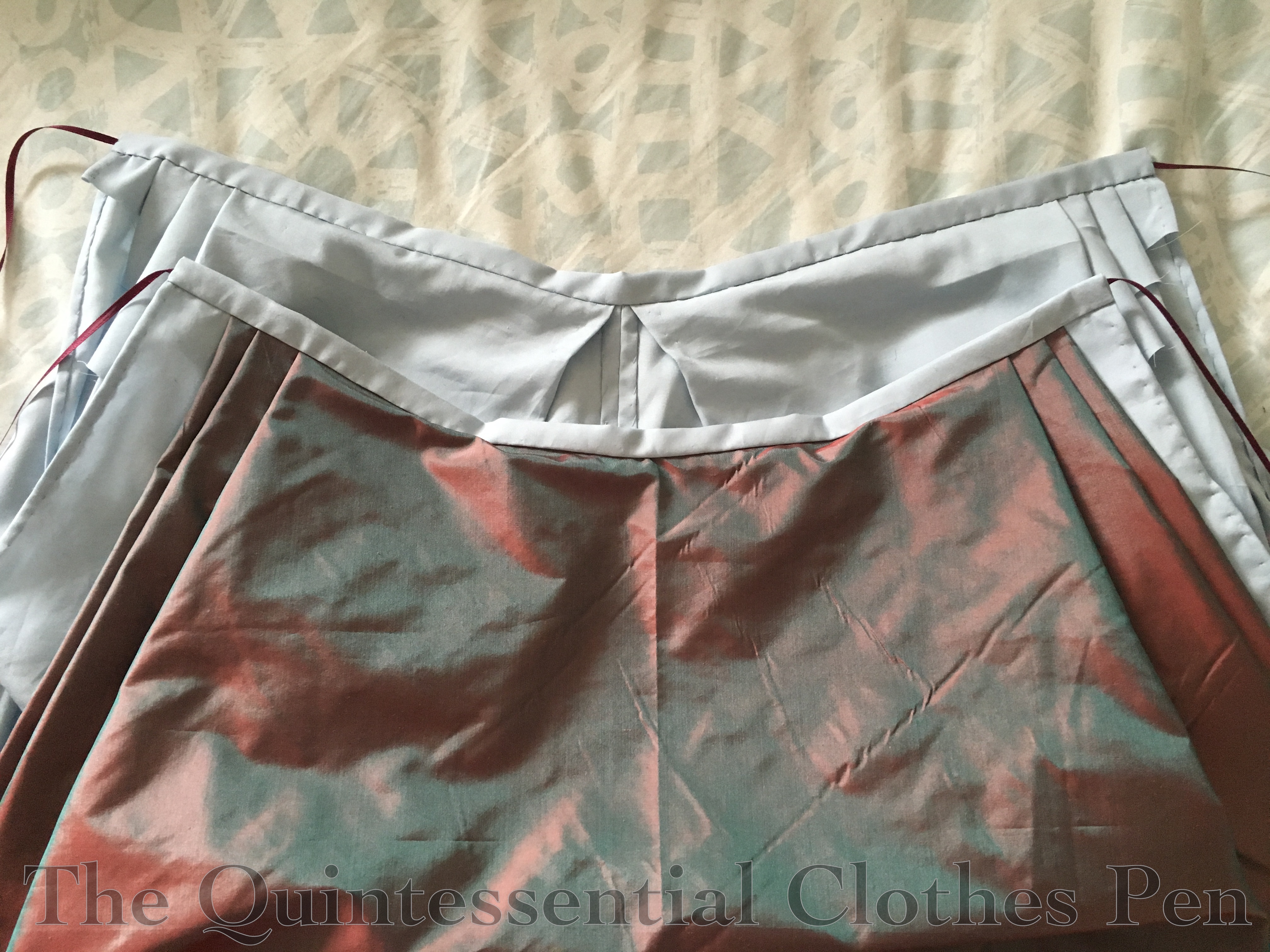
The petticoat for my Versailles Sacque has been done for a few weeks now, but was waiting in the blog post queue to have its progress made public. It’s sort of boring to look at the whole petticoat, because it’s just a petticoat with longer sides than normal, so I’ve focused the pictures on the more interesting waistband section of the petticoat. (As you can see, this picture was taken before I ironed the front of the petticoat…)

IMG_0866

In making the petticoat I referenced Katherine’s 18th Century Petticoat Tutorial and The Standard 18th Century Petticoat Tutorial at A Fashionable Frolick. The nice thing about Katherine’s tutorial is that it’s adjusted for a petticoat to go over pocket hoops, while the great thing about the tutorial at A Fashionable Frolick is that it has tons of detailed construction information like which stitches to use. Both tutorials are clear and very helpful.

When it came to pleating, I thought I might struggle as Mr. Panniers is larger than normal pocket hoops, but I found that once I put the petticoat on the dress form with Mr. Panniers underneath I could neatly arrange the pleats around the waist and not go into the extra complicated pleated needed for a very square and wide pannier shape (such as in Katherine’s court gown and Kendra’s court gown). Whew! I placed all my pleats off to the side (further than I would for a normal 18th century petticoat) to keep the front of the petticoat flat where the trim will be visible between the fronts of the sacque.

The front panel of my petticoat is the fashionable silk that my sacque is/will be made of. (Enjoy the sneak peak!) The back panels are the same blue mystery fabric that Mr. Panniers is made of. The ties are polyester ribbon to match the silk, because hey, I was already fudging the accuracy of materials with the mystery fabric but on the other hand the color compliments the silk very nicely!

Here’s what the inside looks like. The extra fabric at the top of the petticoat is turned to the inside, slit up the middle to accommodate the curved top edge, and left raw.

IMG_0867

And here is the back. The petticoat is hand sewn. The center back seam is felled mostly because I am slightly obsessive with having nice insides and the other two seams are selvedges. For some reason the raw edges across the top don’t bother me. Go figure.

IMG_0868

I’ve also been playing with hair styling. I’m not satisfied yet, so I don’t consider it done, but at least I’ve made a start! The sacque is coming along nicely, too!

  • Panniers
  • Petticoat
  • Robe a la francaise (with a subset of trimming)
  • Hair
  • Shoes

HSF #5: Versailles Shoes

I realized after I’d posted about finishing the trimming of my Kensingtons that they qualify for May’s Historical Sew Fortnightly challenge: Holes. The description of the challenge is:

Sometimes the spaces between stuff are what makes a garment special.  Make a garment that is about holes, whether it is lace, slashing, eyelets, etc.

And boy, are my shoes about the lace (which has holes!). The lace makes the shoes complete and finished looking. (Also, the buckles required holes being made to fit the buckles, so that’s a roundabout way of including the shoes, too.)

IMG_0858

Just the facts:

Fabric: (well, materials) One pair of American Duchess Kensington shoes and American Duchess “Fluer” buckles.

Pattern: None–inspired by extant shoes.

Year: 2nd half of the 18th century.

Notions: Just under 3 yards of 1/4″ metallic lace; other supplies included angelus leather preparer and deglazer, angelus leather paint, angelus matte acrylic finisher, masking tape, paint brushes, and hot glue.

How historically accurate is it?: 85%. Reasonable color and trim on well researched historical shoes, but of course the whole thing is actually modern.

Hours to complete: 8 maybe? I took a long time painting lots of layers until I got a color I was happy with and then adding the lace took another hour or two.

First worn: Will be worn at the end of May!

Total cost: $102 for imperfect Kensingtons and the buckles a few years ago, $15 for the lace, $15 for the paint, and the rest was from the stash, so about $137 total.

I’ve been making lots of things this spring, but they haven’t lined up with the HSF since January. Yay! I’m pleased these fit the HSF challenge.

Product links in this post contain an affiliate code, which provides a small benefit to my shoe fund. This does not affect my impressions and reviews of this product.

Project Journal: Versailles Sacque: Finished Shoes!

After the many coats of paint I shared about already, there was one final coat that I convinced myself had to be the last because I needed to move on and finish decorating my Kensingtons. After that I went ahead and put on a matte acrylic finisher as suggested by Lauren at American Duchess. I then made the holes for my buckles using this tutorial also from American Duchess. The shoe buckle tutorial was invaluable and made the process incredibly easy!

IMG_0849
Finished?

I told myself the shoes were done, but I still wasn’t entirely happy with them. I think perhaps I was not satisfied because I had painted my shoes a color I’ve only really seen in cloth shoes rather than leather. But I moved on… and then this shoe-remake popped up on Pinterest and I was captured by the idea of adding metallic lace trim to my shoes to finish them off.

And so I went on the hunt on eBay, settling on this. It was a reasonable price and arrived quite speedily. As in the inspiration re-make, I used hot glue to attach the lace to the shoes. It was easy to work with and is generally reversible if I decide to change the shoes sometime in the future (though that’s pretty unlikely…) I think the trim suits my dress fabric nicely and it was narrow enough to follow the curves of the shoe without too much hassle, even on the latchets (which were the trickiest parts).

I also considered creating a design for the toe box area of the shoe, but decided against the idea once I realized how tricky it would be to get something I like. The lace doesn’t do tight curves easily and all the ends would need to be finished if I used non continuous pieces of trim, so all the ideas I came up with were going to be time intensive or poorly executed. I decided on simplicity.

IMG_0858
Ta da!

Now when I look at my shoes I have a smile on my face. They finally feel done and like they make sense! Yay–cross that off the list!

  • Panniers
  • Petticoat
  • Robe a la francaise (with a subset of trimming)
  • Hair
  • Shoes
Product links in this post contain an affiliate code, which provides a small benefit to my shoe fund. This does not affect my impressions and reviews of this product.

SaveSave

Springtime In 1895

Part of my super busy April included a few historical adventures and for one of them I made a new skirt! I was lucky to be able to squeeze it in between working on things for Versailles and for my other event in May–a fancy dress ball!

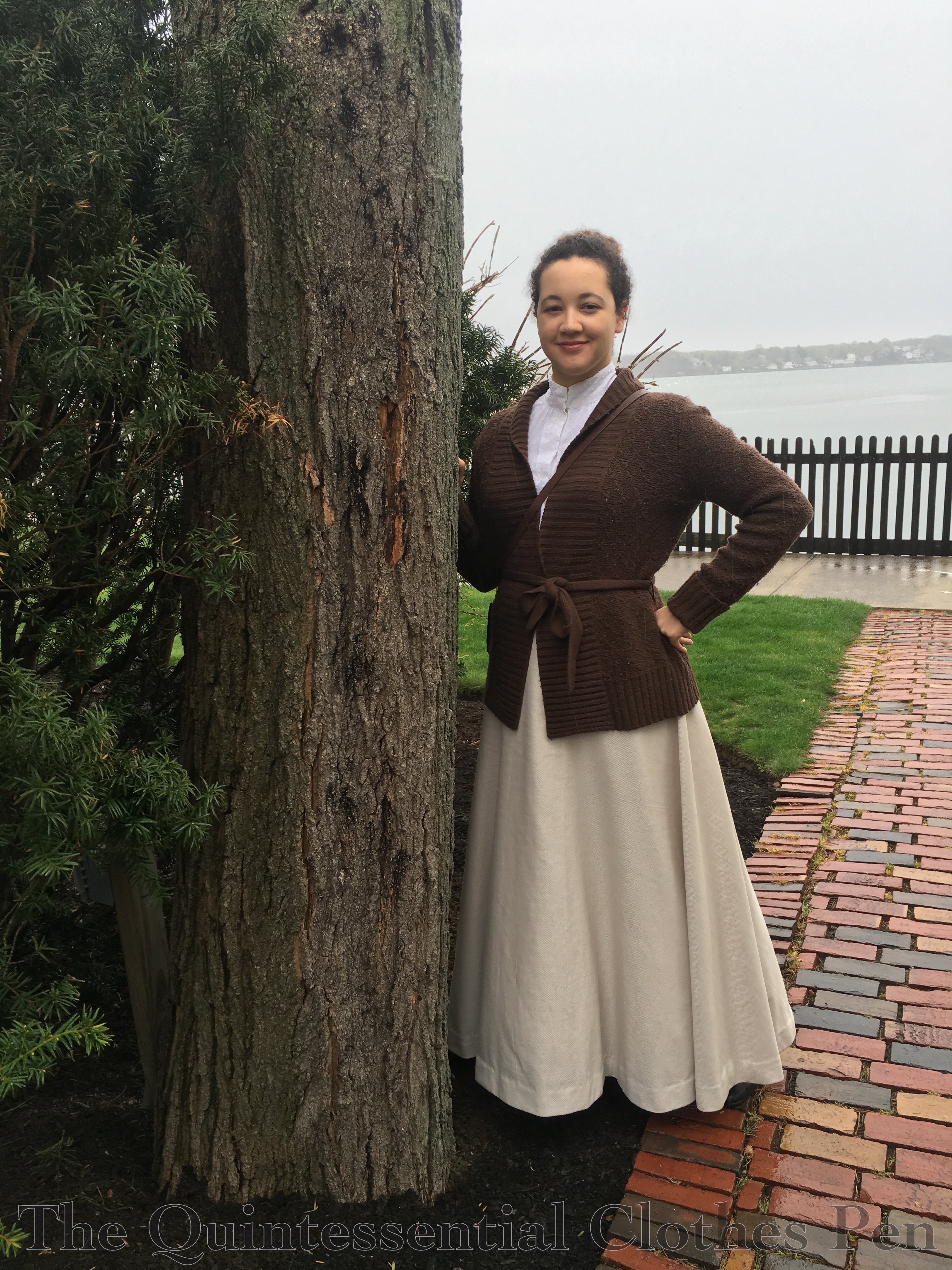
The morning was rainy and cold and so I threw on a sweater to keep warm. I rather fancied that I looked like an 1890s adventurer, sort of 1890s-lady-does-Indiana-Jones-in-the-rain-without-the-hat. (I really want to make an adventuring/archeologist outfit and find a great place for pictures…! Someday…)

IMG_0796 (1)

IMG_0803 (1)

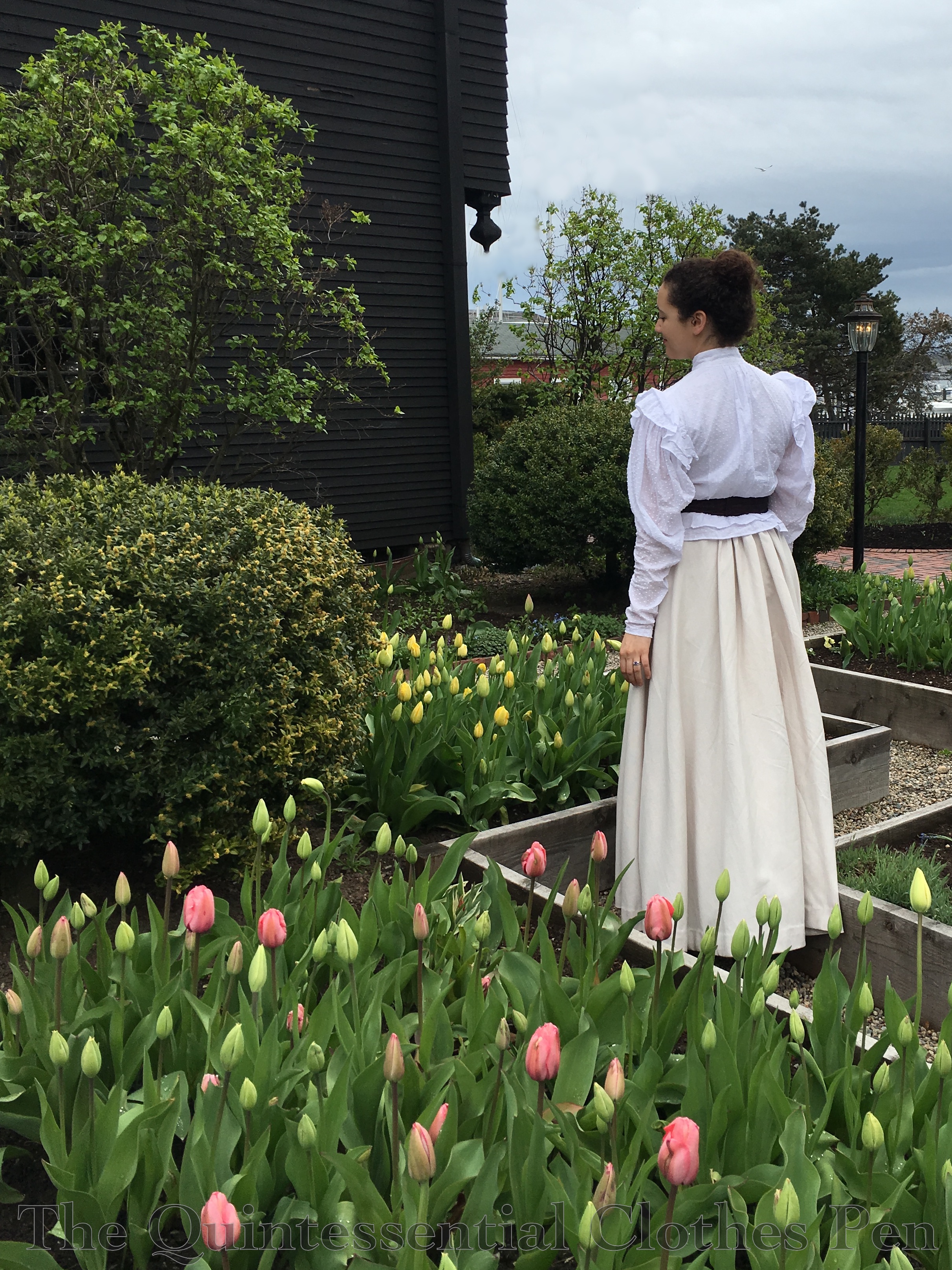
By the afternoon the rain and ceased and the sun came out, which was a perfect opportunity to take some pictures of my ensemble without the sweater. I find I don’t have many outfit pictures taken in the springtime and this seemed like a perfect opportunity to counteract that problem.

IMG_0819 (1)

The new 1895 skirt is being worn with an 1895 blouse I made in 2012 as well as a silk taffeta belt and my super silk petticoat for volume. The last few times I wore this blouse I was wearing a skirt from about five years later. Not out of the question in terms of plausibility, but not as perfect in silhouette as I was hoping for. This time though, I was excited to have springtime pictures with an outfit in which all the clothing was from the right period!

IMG_0820 (1)

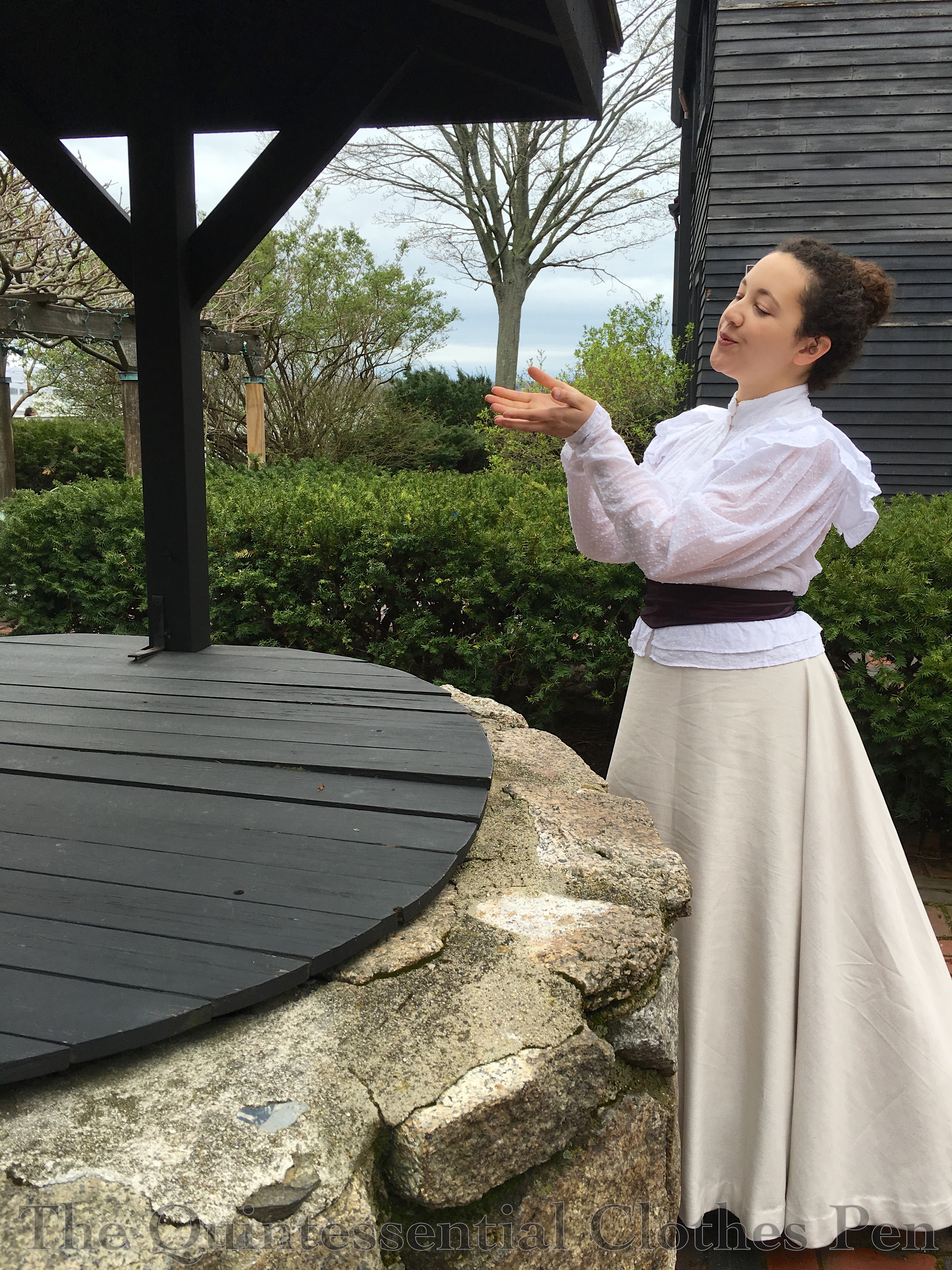
The skirt is an umbrella shape, meaning that it is all one piece with only a center back seam, just like my 1895 skating skirt. It is hand sewn simply because it was easier to sew it by hand than get out the machine to do it. It’s made from a rayon blend herringbone weave fabric which has a lovely drape, but wrinkles very easily. I like that it is neutral without being white and that it has a subtle pattern.

There was also a covered well that seemed cute for taking pictures until I stopped to think about how to pose. Most of my pictures are extra silly looking, but these two are reasonable and my favorite.

IMG_0832 (1)

IMG_0836 (1)

Thank goodness spring is finally here! The flowers and green on the trees is lovely and such a change from the dull brown and grey of winter.

Project Journal: Versailles Sacque: Chameleon Shoe Progress

This month has been super crazy busy for me and progress on my Versailles Project has therefore been quite slow. Aside from thinking about my hair the only other real progress I have made is on my shoes, which have been painted with about 10 coats of paint as I’ve tried to make up my mind about what color I want them to be.

The process began after my materials were ordered and assembled: unpainted ivory Kensingtons from American Duchess, 3 colors of Angelus leather paint, and scraps of my changeable silk fabric. The plan was to go for dark turquoise/teal. (I did tape off the heel cap and the inside part of the latchets closest to the vamp with masking tape to keep things tidy. Then I got bored and stopped taping.)

IMG_0738

I’ve referenced two American Duchess resources during the process so far, which included prepping my shoes as suggested and mixing water into my paint for more even layers of color. (Well, I forgot to add water to the first coat, as you’ll see, but I remembered after that!) This blog post and this information page are the two resources I just mentioned.

Here was the first batch of paint. Lots of dark green with a small bit of turquoise and gift box blue.

IMG_0740

I was doing quite well taking pictures of my paint mixing as a record as I started, but then as I kept doing more and more layers and getting frustrated I slacked on the picture taking. I did make a sample card with little swatches of all my paint colors as I went along, though I didn’t take notes on how I achieved each color, so I’m not sure it will be very useful in the future.

Here are the results of the first two coats of paint. The shoe on the right was the first layer, for which I was so excited I forgot to add some water… oops! The color was more green than I wanted, so for the second coat I added more turquoise paint to the mix. The result is on the left.

IMG_0743

I stopped with the two coats of paint, but wasn’t sold on the color–too bright. Fast forward a week and I tried again, painting the shoes in multiple layers between paying attention to other house tasks, like cooking and baking.

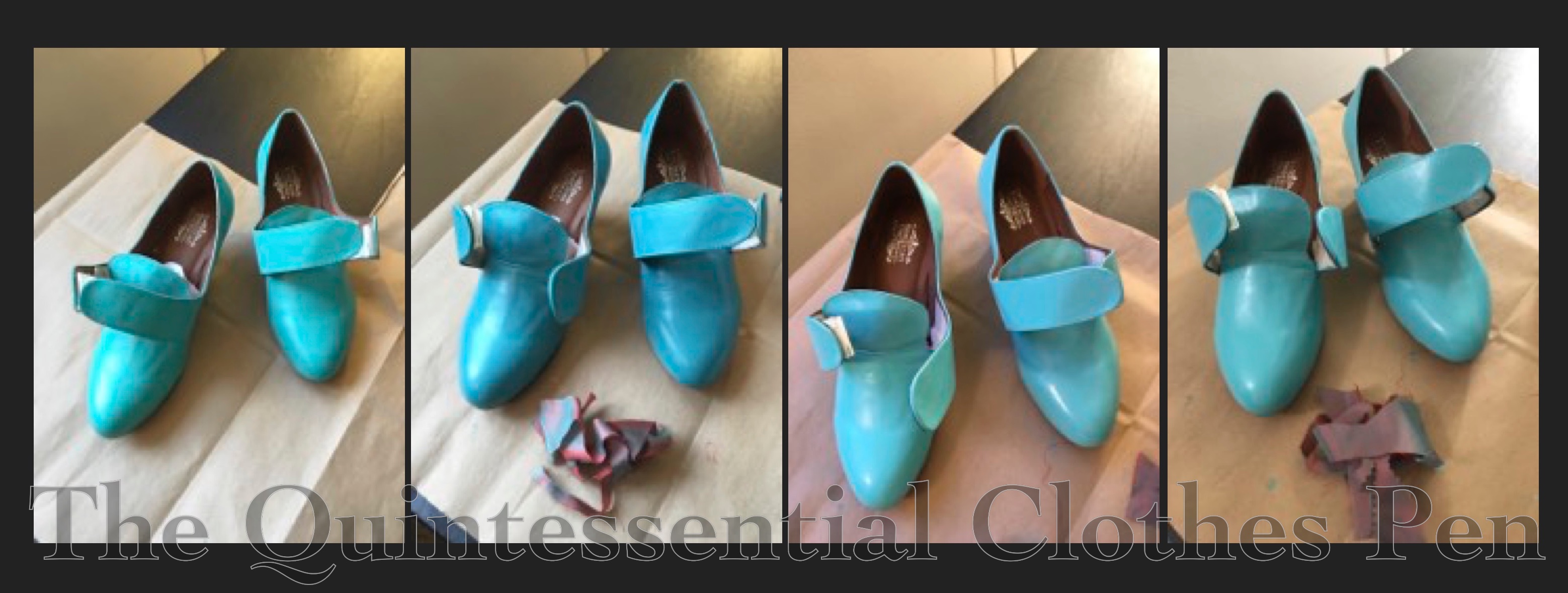
First is the shoes after two coats, then after I tried a darker blue, then after I decided they didn’t match and tried a lighter blue, then after I decided they didn’t look like a plausible 18th century color and needed to be a bit more grey…

Untitled 2 (1)

(Oh yes, on the second day of painting I also used some white and black and dark grey paint to mix in as well). Unfortunately, after all that I still wasn’t happy!

I did one final coat you’ll have to wait to see and then put the shoes away to consider if they grew on me over time or not. That was about two weeks ago. I haven’t had time to work on them in that time, but I think I’m mostly happy with the color and frankly I’m running out of time, so the color they ended up with will likely be the color they stay. When I have time I will be applying a matte finisher as suggested in the American Duchess links and then figuring out attaching the buckles.

Product links in this post contain an affiliate code, which provides a small benefit to my shoe fund. This does not affect my impressions and reviews of this product.

SaveSave