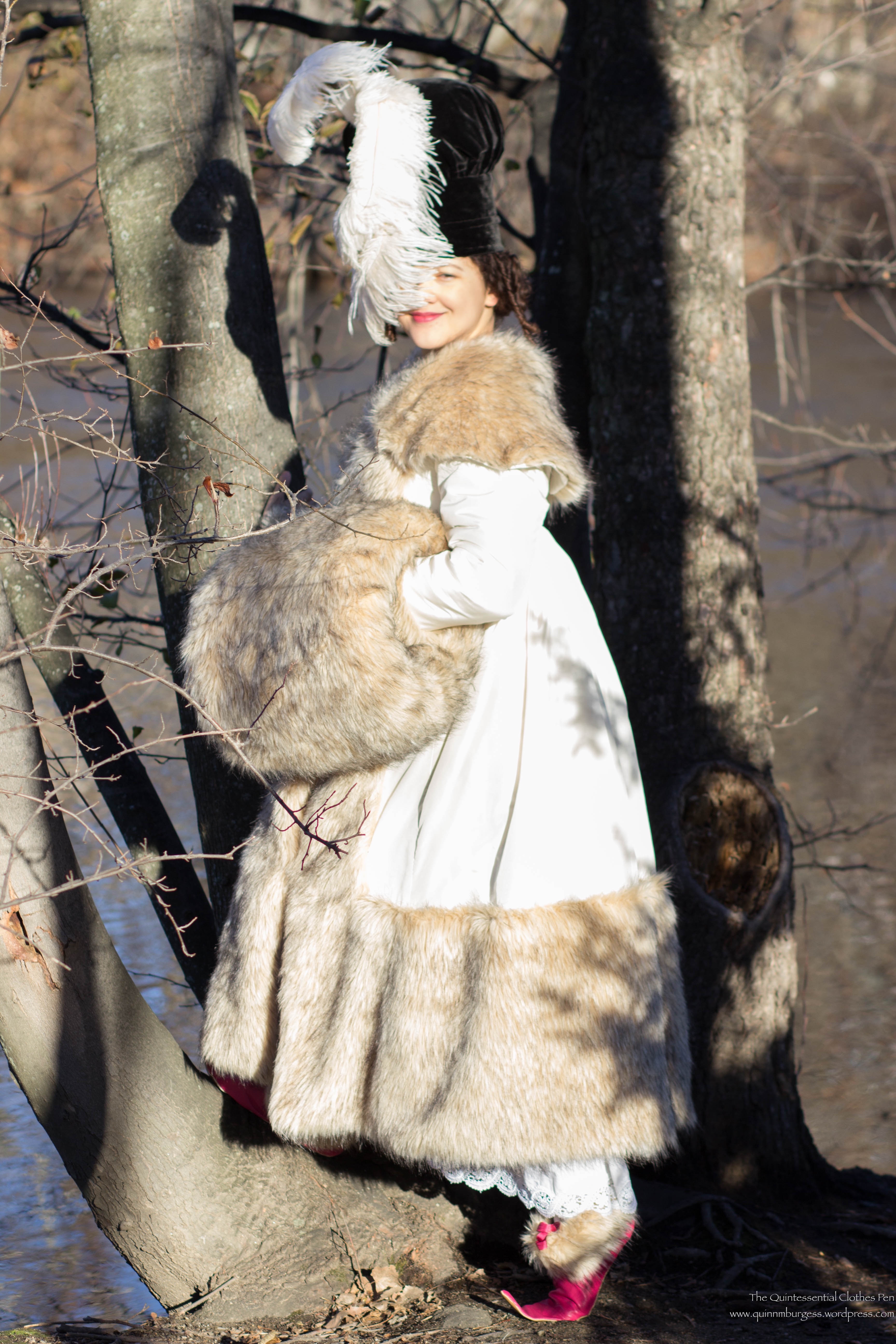
Vernet Project: Witzchoura Construction

This is the last post about the construction of my amazing 1814 Vernet Project. I really enjoyed doing the research and making the parts of this project. It was great fun and such a lovely learning experience to be part of the group of people making Vernet ensembles. And I was able to wear most of the ensemble for more than just pictures! I hope to find future reasons to wear these again!

I’ve been saving the best for last–the construction of the main piece, the witzchoura itself. As with all the other pieces in this ensemble, the witzchoura is entirely hand sewn. It is made up of a faux fur lining and an exterior of silk taffeta flat lined with cotton flannel and trimmed with more faux fur. Here are some in progress photos.

img_2202-1
Faux fur lining made up but not set in.
img_2205-1
A seam and bust darts in the faux fur lining. The edges were cut without seam allowance, butted together, and whip stitched.
img_0264-1
An interior view of the in progress witzchoura, showing the back pleats and cotton flannel interlining. I believe at this point I had attached the hood/collar as well as the faux fur lining at the neck but had not yet sewn the center front edges together.
img_0278-1
The exterior silk/flannel layer was pleated, but the fur was gathered (it wound up resembling cartridge pleats) to the bodice.
img_0274-1
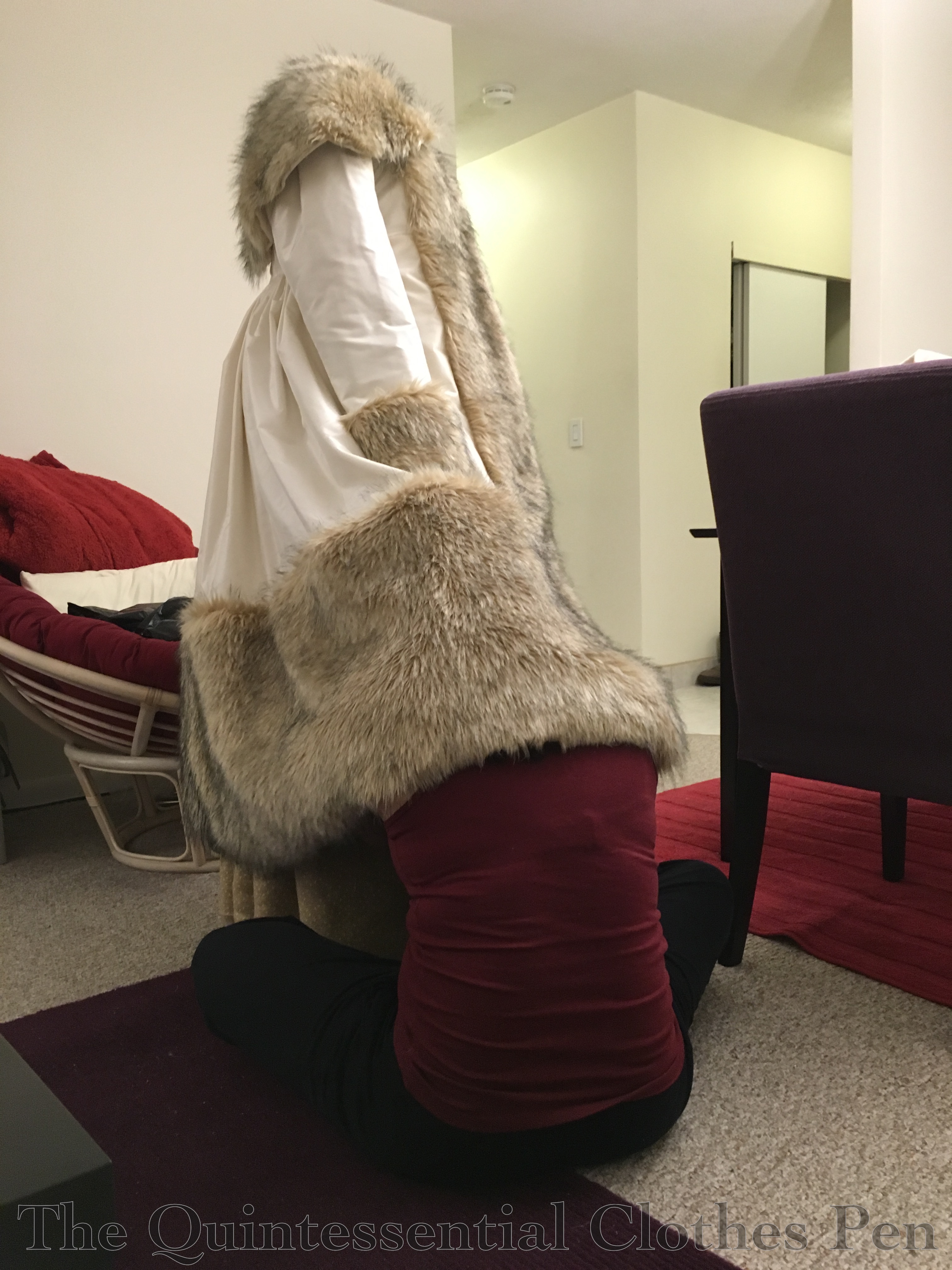
After attaching the front edges of the exterior and lining I put the witzchoura on squishy to look at the hem lengths. In doing so, I found a few places where the exterior needed to be invisibly tacked to the lining, which is why I’ve got my head between the layers!

Ta da! The finished witzchoura with all of the lovely accessories. It certainly is a luxurious looking and feeling ensemble!

img_1860-1

I thought I would address a few other points as well. Some people have been waiting for answers to these questions for a long time! Thank you for your patience as I waited to answer your questions until now in order to keep everything together in terms of information.

Is it heavy to wear?

No, once dressed, the ensemble does not feel heavy. But, when holding it, or hanging it, or putting it on, YES, it feels quite heavy! It’s a fair bit of fabric, with three layers, and the faux fur gets heavy quickly with such yardage.

What is the weight? How does it compare to a heavy wool winter coat, for example?

Oh dear. I’m very bad at estimating this. I like the comparison question better! If you’ve ever held a very heavy, thick, full length winter coat, I think this is probably similar in weight. But compared to anything less, it would feel heavier.

Is it easy to walk and move with such an enveloping set of objects?

This is the sort of question I would want to know the answer to! Yes, it’s easy to walk. The ensemble does not restrict leg movement. I can also move my head with ease, because the hat sits low enough that it is well anchored and not going anywhere. However, the witzchoura does restrict arm movement some. For example, putting it on without just the right movement (which is lifting it up and behind and then sliding both arms in at the same time) doesn’t really work. And once it’s on, there’s only so much forward and backward arm movements that are possible. Lifting arms is better, but still not full range of movement. Each layer by itself has more possibilities, but the faux fur fills a lot of space inside the silk exterior. This makes it quite warm, but feels a little bit like wearing a marshmallow.

I hope you’ve enjoyed my Vernet journey! If you have any other questions about the ensemble please let me know. I would be happy to answer them!

Vernet Project: A Witzchoura Tangent

I started this post soon after joining the Vernet Project, so I think it must have been in my drafts for close to two years at this point. I didn’t want to leave it in the drafts folder forever, though, so I thought I’d include it as I’m wrapping up my Vernet posts.

Throughout my research, I’ve looked through many hundreds of pins on my Pinterest boards from the 1810s, 1820s, and 1830s and have found only a handful of plates that show outerwear specifically labeled as witzchouras (these can be seen in this past post showing examples). There are a much larger number of other, similar, types of outerwear.

(If you’ve missed out, this post explores the origins and qualities of a witzchoura, while this past post explores witzchouras in even more depth, with multiple excepts from the first part of the 19th century mentioning them.)

Examples of garments similar to witzchouras

Common garments in this category are labeled using words such as pelisse and pardessus. Then there are also carriage dresses (example), promenade dresses (example), and redingotes (example) trimmed in fur, but it seems clear in the fashion plate descriptions that these garments were not considered witzchouras.

ac27bb830f63f1673e45316d0e18f87d
Fashion plate showing a Pardessus from 1811.

Here is another similar garment, a Russian mantle, described in The Ladies Pocket Magazine in 1838 under the chapter English Fashions and Novelties: Remarks On The Prevailing London Fashions.

content

Descriptions of garments similar to witzchouras

In 1849, La Belle Assembleé addresses this for us (while also mentioning yet another type of outer wear, a burnous. The Dreamstress defines and explores this garment specifically as it relates to historical fashion, which is excellent and full of images!). The author of this reflection of fashion specifically mentions the weight of a witzchoura and how that compares to the weight of a pardessus, as well as the types of outings that these garments would have been worn for. Interesting that they would be worn for carriage dress, when, alternatively, one could also wear a ‘carriage dress’.

content

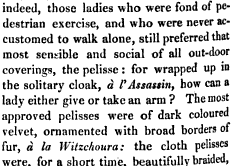
This next excerpt, from La Belle Assembleé in 1825, tells us one distinctive quality of a pelisse which is that the arms were not encased in the garment and could be freely moved about.

content-1

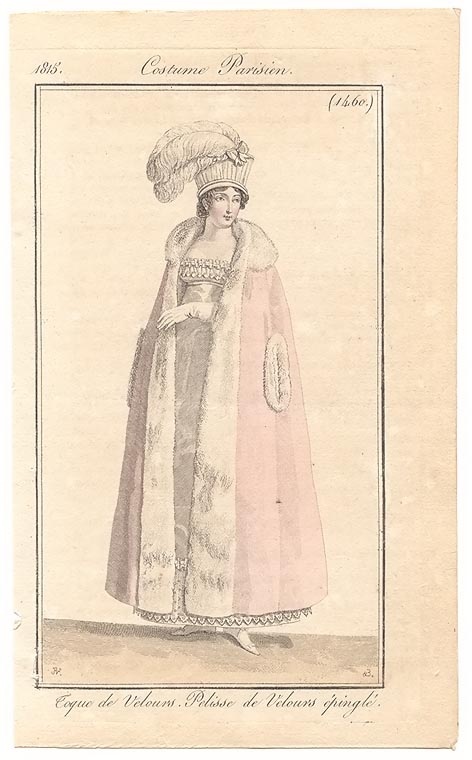
a94e6fc37e3582c81ab22797c3c06b78
Example of a Pelisse from 1815, showing the armholes that would allow movement.
004c2dc3370c00425fcfd044369a9d53
A slightly later example of a Pelisse in a similar style. This is from 1821.

Examples of out of the ordinary witzchouras

Then there are garments labeled as witzchouras, but which are odd in a variety of ways. For example, take a look at the interesting witzchoura mentioned in The Lady’s Monthly Museum in 1817, seen below.

content

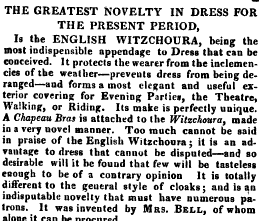
I’m not really sure what qualities allow a witzchorua to keep one’s dress from being rumpled, but what strikes me as odd is that the witzchoura mention is lined with silk and that is has a chapeau bras attached! Also in 1817, La Belle Assembleé mentions this exact garment twice! The first is a description of the garment. The second is about the inventor, Mrs. Bell, who, if you care to read more, has a long list of other interesting things that she supplies.

content

content-1

In this next case, the witzchoura is described as being lined with sarsnet (a fine plain or sometimes twill weave usually silk fabric) and only trimmed with fur rather than being lined entirely with fur. Haven’t we seen conclusively that a witzchoura should be lined and trimmed in fur? This witzchoura is also interesting because of its colors. It is quite likely a garment made for the general mourning of the death of Queen Charlotte, who passed away in November 1818.

“For out-door costume nothing can be reckoned more completely elegant than the Witchoura pelisse of black velvet lined with white sarsnet, and trimmed with real ermine.”

La Belle Assembleé  in January 1818

Finally, there is this fashion plate at the LACMA which is labeled as being a witzchoura but with nothing witzchoura-like about it! A mistake perhaps? This looks like a summer garment, not a heavy winter garment.

What a rabbit hole of obscure information the witzchoura is. I’m rather glad to say that I’ve now exhausted my currnet list of historical references to the witzchoura!

Vernet Project: Petticoat and Muff Details

As the end of this year draws nearer, I feel the urge to complete my plan to share all the details of my 1814 Vernet Ensemble before the end of 2016. In order to do that, I have the smaller garments to discuss (petticoat and muff) and the witzchoura itself, which I know some people have had questions about for probably about a year. Sorry to keep you waiting!

As I’m saving the witzchoura to be the grand finale, today I want to share some details about the petticoat and muff. First, here are some repeat pictures of the full ensemble in case you’ve started reading since this project was unveiled. Both of these pictures are from my Vernet Project photo shoot in 2015. They give you a good glimpse at the petticoat and the muff.

IMG_1985

The muff exterior is the same faux fur as the trim on the witzchoura. The lining is an ivory cotton flannel, which feels warmer on the hands than a silk lining and which I don’t think is out of the realm of possibility in terms of historical reasonability (a theory I have tested out with multiple muffs over the last few years).

In order to get the distinctly Regency style of a beehive style muff, the inner flannel lining is substantially smaller in dimension than the exterior fur. Layers of high loft polyester batting fill in the shape and the fur actually wraps to the inside of the lining for a few inches on each side and is gathered to fit the smaller circumference of the lining. The result is a very large and very cozy muff. (This method is different than making the interior and exterior the same or similar in dimensions, resulting a muff that looks like my 1822 one. The blog post sharing details about that muff has lots of great images of both types of muffs from this period, if you want to see more. Also, it’s worth noting that polyester batting would not have been used to keep one’s hands warm in the early 19th century, but that I chose that materials because I had it on hand and it is not visible.)

IMG_2004

The petticoat is the only piece of my Vernet project that existed before I agreed to participate. It started life as part of a dress, but was removed and languished for years. Turns out I had made it too narrow to dance in, which isn’t very useful in my life. On the bright side, I had just enough of the cotton fabric left to add another panel, thus making the hem circumference much more wearable.

The petticoat had an attached sleeveless bodice before the addition of extra fabric in the skirt, so after adding fullness I was able to simply reattach the bodice. The edges of the bodice are narrow hemmed and it closes at center front with a tie at the waist and a button and loop at the bust. This past blog post discusses extant sleeveless underdresses or petticoats such as this. As with everything else in this project, both this petticoat and the muff are entirely hand sewn.

img_1632-1

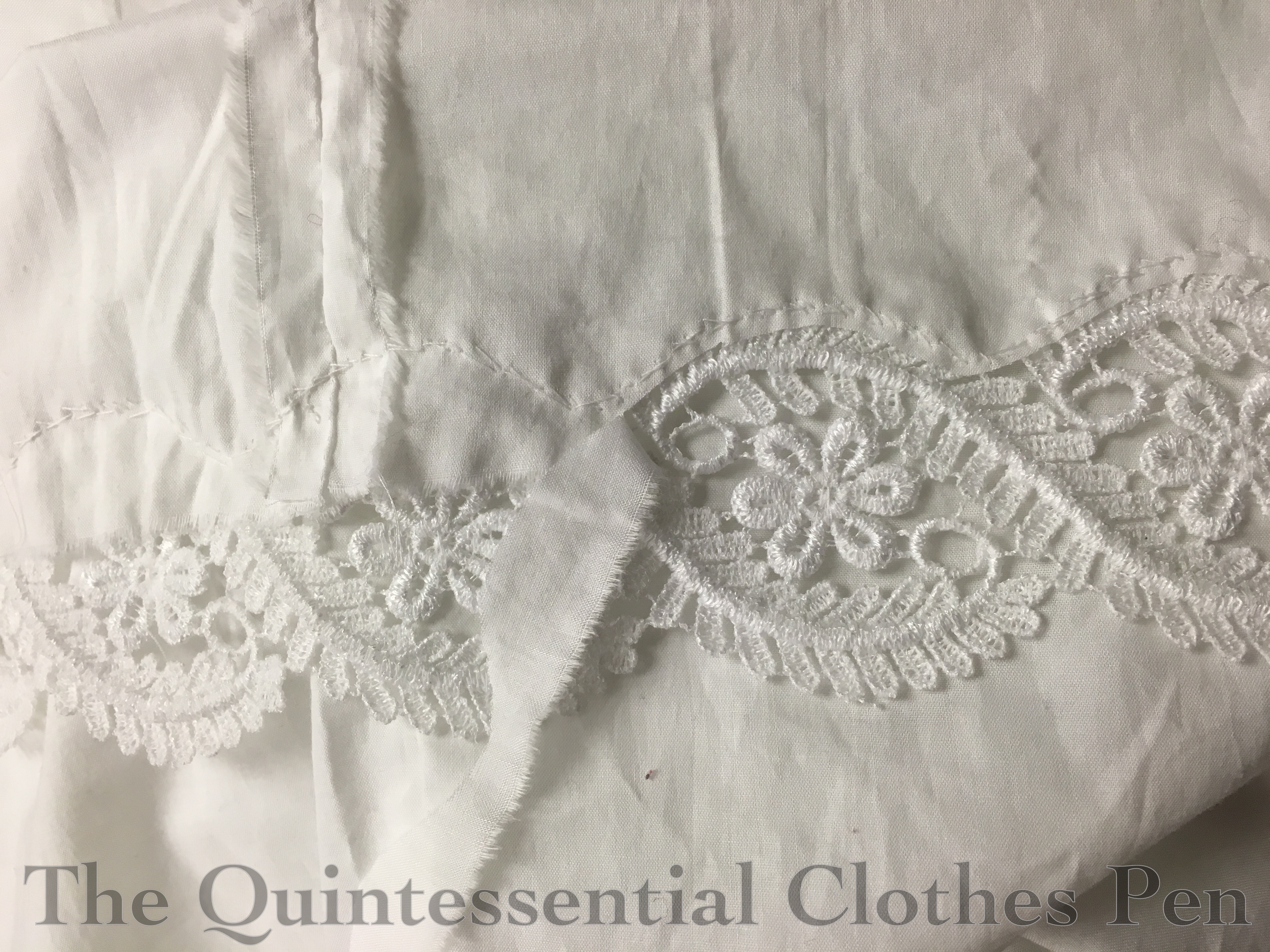
The only other changes I needed to make to the petticoat to use it for the Vernet Project were at the hem. I started by adding lace that mimicked the shape of the embroidery seen in my Vernet fashion plate. I whip stitched the lace on with small stitches and then cut away the fabric behind the lace, creating a lovely scalloped hem.

img_0284-1

After trying on the petticoat with the finished hem, I decided it was too long and took a tuck above the hem to shorten it. You can see the tuck in one of the photo shoot pictures early in this post.

This final picture is from when I was hemming the witzchoura. While I had that garment on the dress form I also put the petticoat on to determine the placement  of the lace on the previously hemmed petticoat.

img_0279-1

And that’s it! Those two garments were minor in scale compared to the toque de velours, silly shoes, and the witzchoura itself, both in terms of materials and sheer volume of work involved.