Sophie, 1861 Cotton Print (HSM #8)

Last week, I introduced Eleanor, a newly made plaid gown from 1862. Today’s introduction is to Eleanor’s friend, Sophie. Sophie actually came first, back during the summer when I was intending to participate in the same dance performance for which I’ve worn Georgina in the past (here are a selection of past posts about Georgina: the construction which is similar in some ways to Sophie, Georgina in action, and Georgina with a new collar).

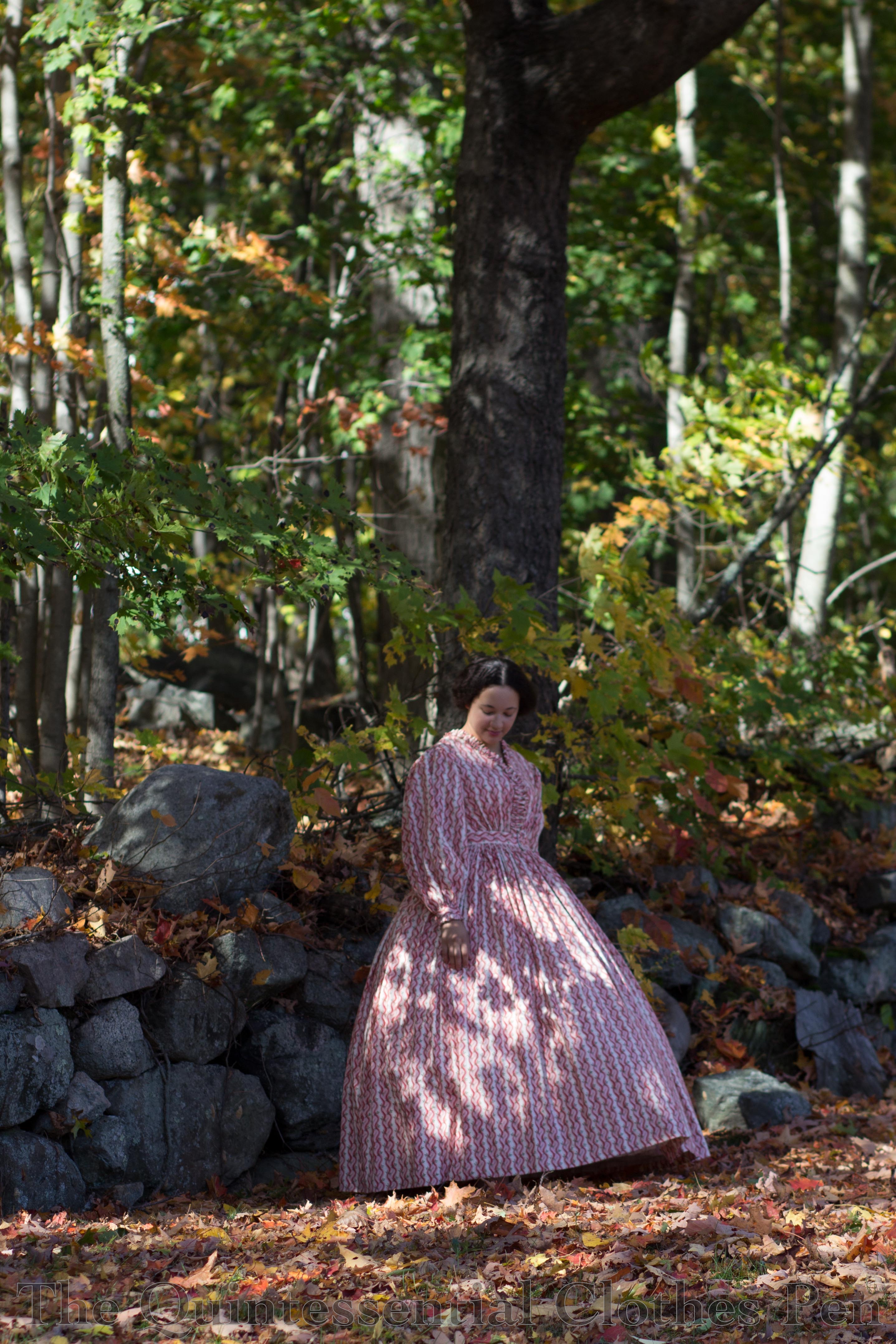
This year, the performance was rescheduled due to rain and I couldn’t attend the new date, meaning that the new dress, Sophie, languished until October, when I was able to wear it during part of a recent mid-19th century dance weekend. The nice thing about the delay is that the pictures all have stunning fall leaves, which would not have been in the case in the summer.
img_3450-1

Also, had I worn this dress on the first intended date, it would not have been entirely completed. Having extra time allowed me to officially finish all the trim and closures which made this dress the perfect entry for the Historical Sew Monthly challenge #8 “Pattern – make something in pattern, the bolder and wilder the better.” I didn’t have any pictures of the dress on a body at that point, so I submitted a rather sad picture of the dress on a hanger at that time. It’s exciting to have real pictures now!

Just the facts:

Fabric: 7.5 yards cotton print.

Pattern: Adapted from Past Patterns #701, 1850-1867 Gathered and Fitted Bodices.

Year: 1860-1863 based on my extant inspiration, but I’m calling it 1861.

Notions: Thread, hooks and bars, muslin scraps, and narrow yarn for cording.

How historically accurate is it?: I’m going to go with 95% on this one. This is as accurate as I can be given the research I have done and the materials I used, though the use of a facing on the front edges is guesswork. Regardless, this would be entirely recognizable in its time.

Hours to complete: Unknown. A fair bit.

First worn: October 23 for an afternoon tea and dance games.

Total cost: $23.

img_3451-1

Sophie was directly inspired by this extant dress at the Kent State University Museum. I was considering what to wear for the performance, thinking that I’d worn Georgina enough to want something new, that I’d had an 1860s cotton print fabric in my stash for a few years, and then I remembered this dress. I decided to leave off the ruffle on the skirt (and also didn’t have enough fabric), but was so pleased that my cotton print is so perfectly suited for playing with the pattern in the same way as the extant dress!
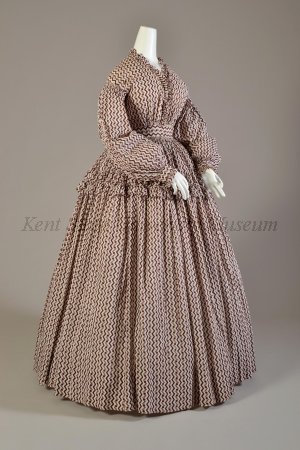
19861270001

Dresses from this period with v necks are not common, but they do exist. This Pinterest board has lots of examples. My Pinterest board has a few other dresses that helped move me along as well.

As I mentioned in my post about Eleanor, finding and making use of subtle differences between dresses from similar years brings me joy. For example, Sophie has a v neck, no boning, cartridge pleated sleeves, gathered trim, and is actually sewn together as a dress, rather than hooking together at the waistband as with all my other dresses from this period.
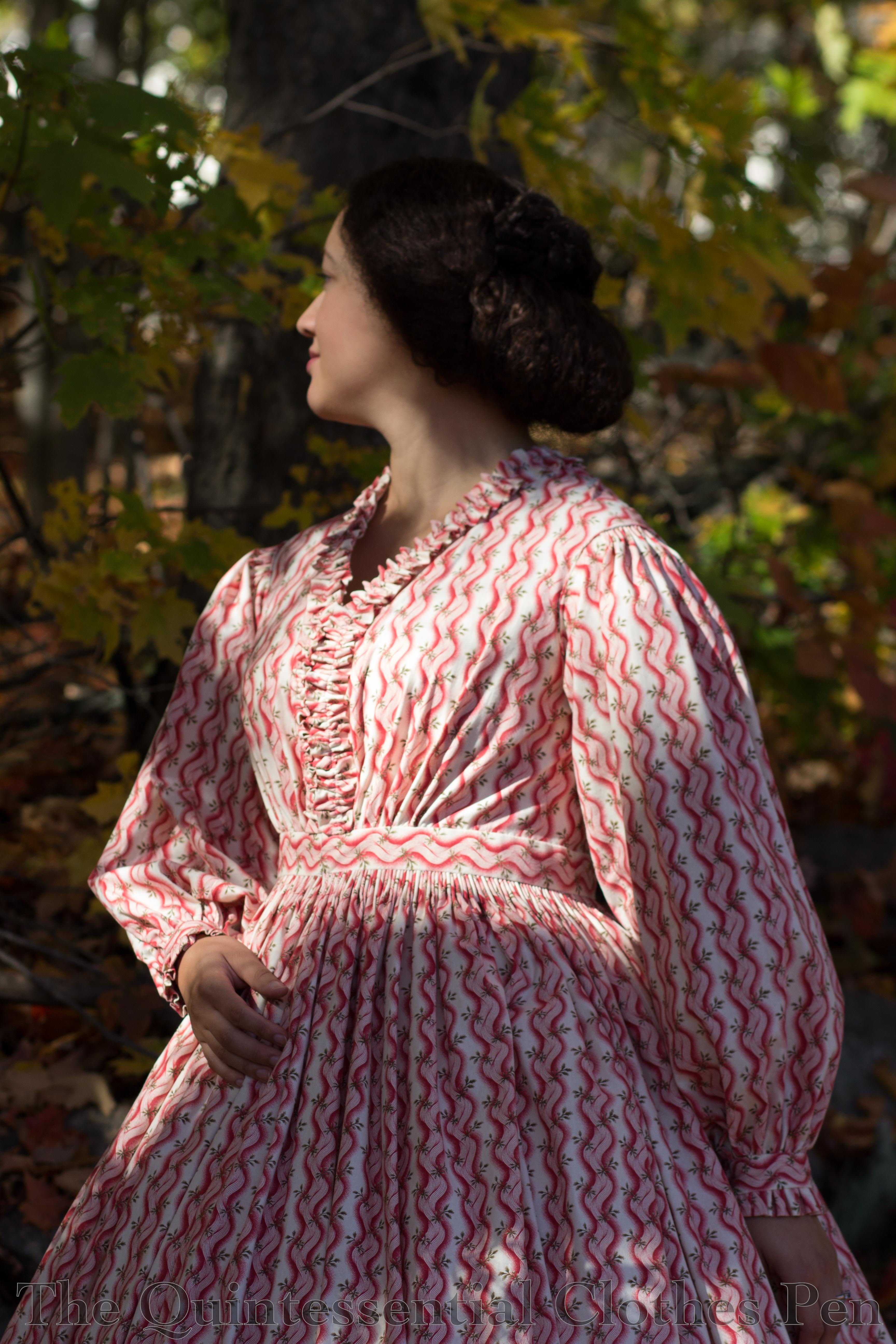
img_3461-1

img_3464-1

img_3467-1

In other ways, Sophie is similar to Georgina, being partially machine and partially hand sewn, having a cartridge pleated skirt, cuffs with little ruffles at the ends, and pockets.

img_3462-1

Personally, I love having pockets in day dresses. It brings me peace of mind to know that modern things like my keys are close by and not sitting around somewhere. Plus, chapstick, fan, gloves, etc. are also excellent choices for stashing in pockets. These pockets, which you can see the top of in the picture below, are sewn in the same way as Georgina’s pockets, shown here. I love this collection of references to pockets from the 1840s, 50s, and 60s that Anna Worden Bauersmith put together. I’ve been waiting for just the right moment to share it for what seems like ages.

img_1871

Here are two more interior shots of the dress. The first shows the muslin facings. I don’t have documentation for this method being used to finish a lightweight summer cotton dress, but it makes sense that this method might have been used to finish the edges nicely while keeping the main body of the dress breathable and light. The second picture shows in the inside of the top of the sleeve, particularly to show the cartridge pleats.

img_1874

img_1872

In addition to the dress, I also made a new cage crinoline. I’ve been wanting a slightly smaller, less bell shaped one, particularly to wear with cotton dresses. I love my old cage crinoline (seen here) for evening dresses, but it is just a bit too much for a more practical daytime look. The new crinoline shape just looks ‘right’ with the cotton dress. The difference is subtle, but pleasing. Unfortunately, it did not perform well in its first wearing. The vertical tapes were sliding all over the place and causing the hoops to drop and be tripped on. Not good! It needs revision before being finished and shared, so for now you’ll just have to believe that I’m wearing it with this dress.

Now that you’ve heard all about the dress itself, here are some pretty pictures of it in action. These first ones are in the spirit of the development of rural cemeteries in the mid-19th century, which you can read more about in this blog post at Plaid Petticoats.

img_3492-1

img_3480-1

The next few are a celebration of the autumn season. The gorgeous leaves were beckoning us to have some laughs. Incidentally, I tend to jump in the air with my arms up whenever I’m having an amazing time in this period. Take this memory, for example. I’m doing pretty much the exact same thing!

img_3522-1

img_3525-1

img_3526-1

img_3543-1

We have so many things to be grateful for. I am always thankful for the many blessings in my life, particularly at this time of year. I hope that your life is also overflowing with blessings and reasons to give thanks, in autumn and always.
img_1956-1

An Introduction To Eleanor (HSM #10)

The Historical Sew Monthly challenge for October is Heroes – Make a garment inspired by your historical hero, or your historical costuming hero.

img_3400-1

You may or may not know that one of my favorite movies is Gone With The Wind. (I posted about this topic years ago when the blog was in its infancy–most of what I claimed then is still true and the 1860s will always have a special place in my heart, but I can now say that other periods give me excited wiggles too!) You can read the old blog post to get more specifics, but the essential point is that despite her personal shortcomings and the turbulent and controversial history of the period, Scarlett reminds me of the clothing that I love and therefore is an historical costuming hero to me.

And this gown has an added historical hero, Eleanor ‘Felcie’ Bull, who came to my rescue when I was contemplating what sleeve style to give my dress.

b9d863448d33e96ca7ce04a041dfd005
Eleanor “Felicie” Bull. 1863.

Prior to finding her image, I had been planning to name this dress Johanna, in honor of the friend who convinced me that I needed the fabric a few years ago. But I had sort of decided this was weird, since all my other dresses from this period have names that I like, but that are not from a specific living person. Once I found this image I was completely overtaken with excitement–I love the name Eleanor and there she was, helping me out! The choice was obvious.

img_3382

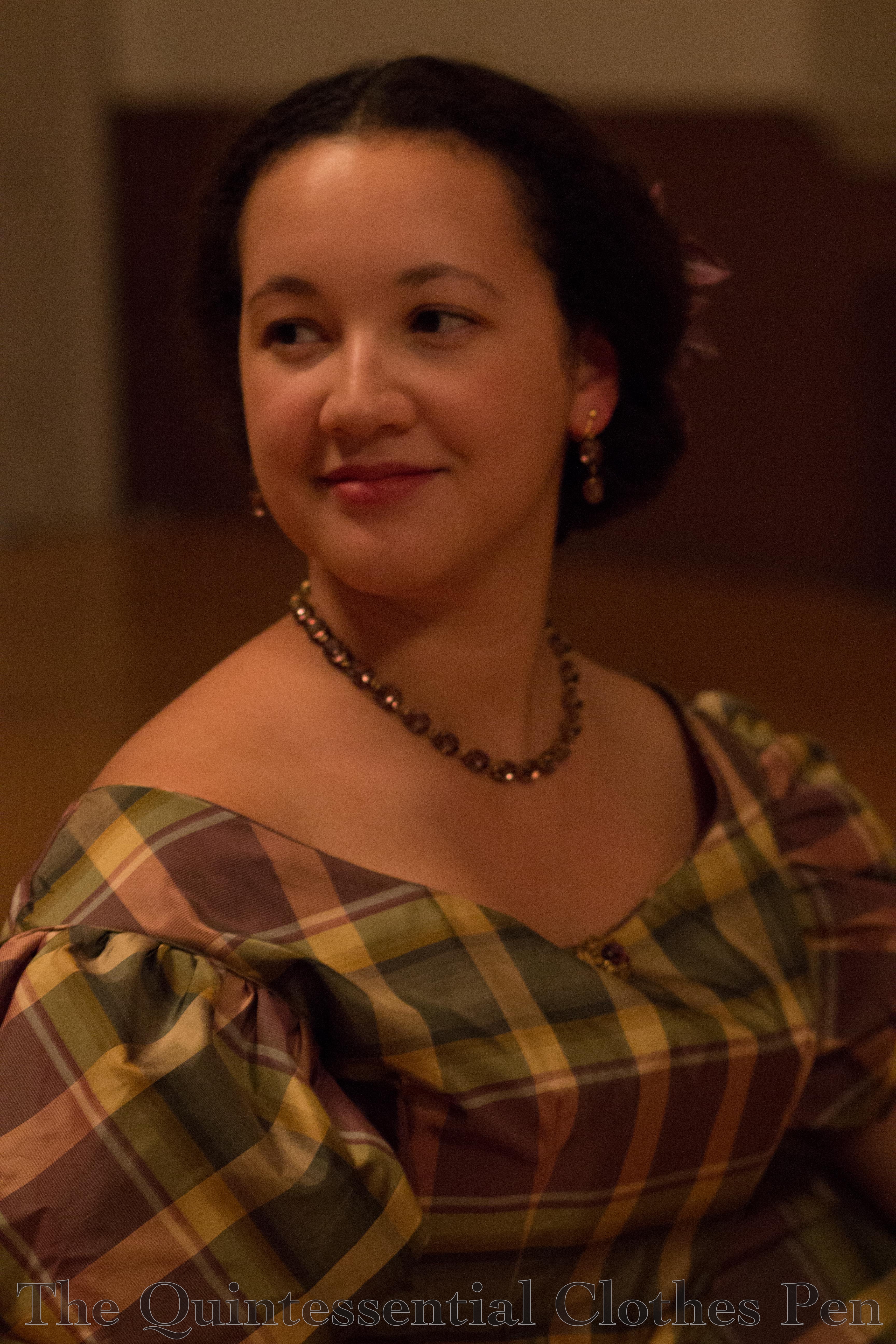
I made a new hair decoration to go with Eleanor. I had the perfect stem of purple velvet leaves, but no flowers to match the dress. So I dyed some white millinery flowers to a golden yellow. They have a fluffier texture than before being dyed, but the color is perfect. Using millinery flowers brings me so much joy, because it’s easy to shape any section since each stem is fully wired. And I couldn’t pass up the opportunity to wear my Dames a la Mode purple earrings and necklace.

img_3384

Regarding dress construction, we must start with a bit of a personal habit, or perhaps a theory, though I’m not sure it’s as thought out as that. When the opportunities arise for me to make multiple garments from the same period that could be carbon copies of each other in different fabrics (so much speedier on the patterning and planning front!), I hardly ever take that easy road. I am drawn to exploring the small variations.

So it is with Eleanor. I decided to: knife pleat her skirt instead of box pleating, cartridge pleating, or gathering; to make a plain darted bodice instead of using seams or gathers; to make the bodice straight across all around, which is more unusual for evening gowns made of silk than having points in front and back; to overlap and topstitch her side back seams; to omit the oft-seen bertha around the neckline; and to have single puff bias cut sleeves. These things all make this dress just slightly different than my others from this period, adding a bit of thought and time to the process. And if we’re talking about time, let’s just mention how mind-boggling cutting plaid pieces with curved seams and darts is when the pattern matching is important to you!

I collected images of plaid gowns with a focus on evening bodices and noticed these features, which is why I decided on them. The most useful images are in one place here, on my Pinterest board for the project. I was contemplating the sleeve type when I came across Eleanor ‘Felcie’ Bull. Interestingly, she shows all of those traits I’d decided on. I loved her simple sleeves and restrained bodice trimming, which then set me on an extensive Ebay and Etsy hunt to find just the right brooches to replicate her style. Yes, I did look through about 150 pages of bow brooches to find just the right one for less than $15. Plus many pages of gold oval brooches. I couldn’t have wished for better results! Remember the look I gave you a look a few posts ago? The only thing I did was to brush the oval brooch (which is new, not vintage) with a bit of brown acrylic paint to bring it down to the old gold color of the bow brooch.

img_3403-1

Other construction details include flatlining the bodice and facing the skirt in a remnant of dusty mauve cotton from my stash (used it up, yay!), creating boning channels in the darts to keep the front nicely shaped, and finishing the neck and bottom edge of the bodice as well as the armholes with very narrow cording.

Just the facts:

Fabric: About 6 yards of silk taffeta and 1 yard of cotton.

Pattern: Adapted from Past Patterns #702, 1850s-1863 Dart Fitted Bodices and Period Costumes for Stage and Screen as a reference for the sleeves.

Year: 1862, given the details that I decided on.

Notions: Thread, hooks and bars, canvas to interline the belt, narrow yarn for cording, and plastic wire ties for boning the bodice.

How historically accurate is it?: I’m going to go with 99% on this one. Materials and methods are well researched and executed. This would be entirely recognizable in its time.

Hours to complete: I really didn’t keep track. But I can safely say many!

First worn: October 22 for a ball.

Total cost: $98 total: $68 for the silk, $10 for bow brooch, and $18 for the oval brooch.

I’ll end this with my photographic homage to Eleanor ‘Felcie’ Bull.

img_3386-2-1

Tiki Bubble Dots

img_2023-1

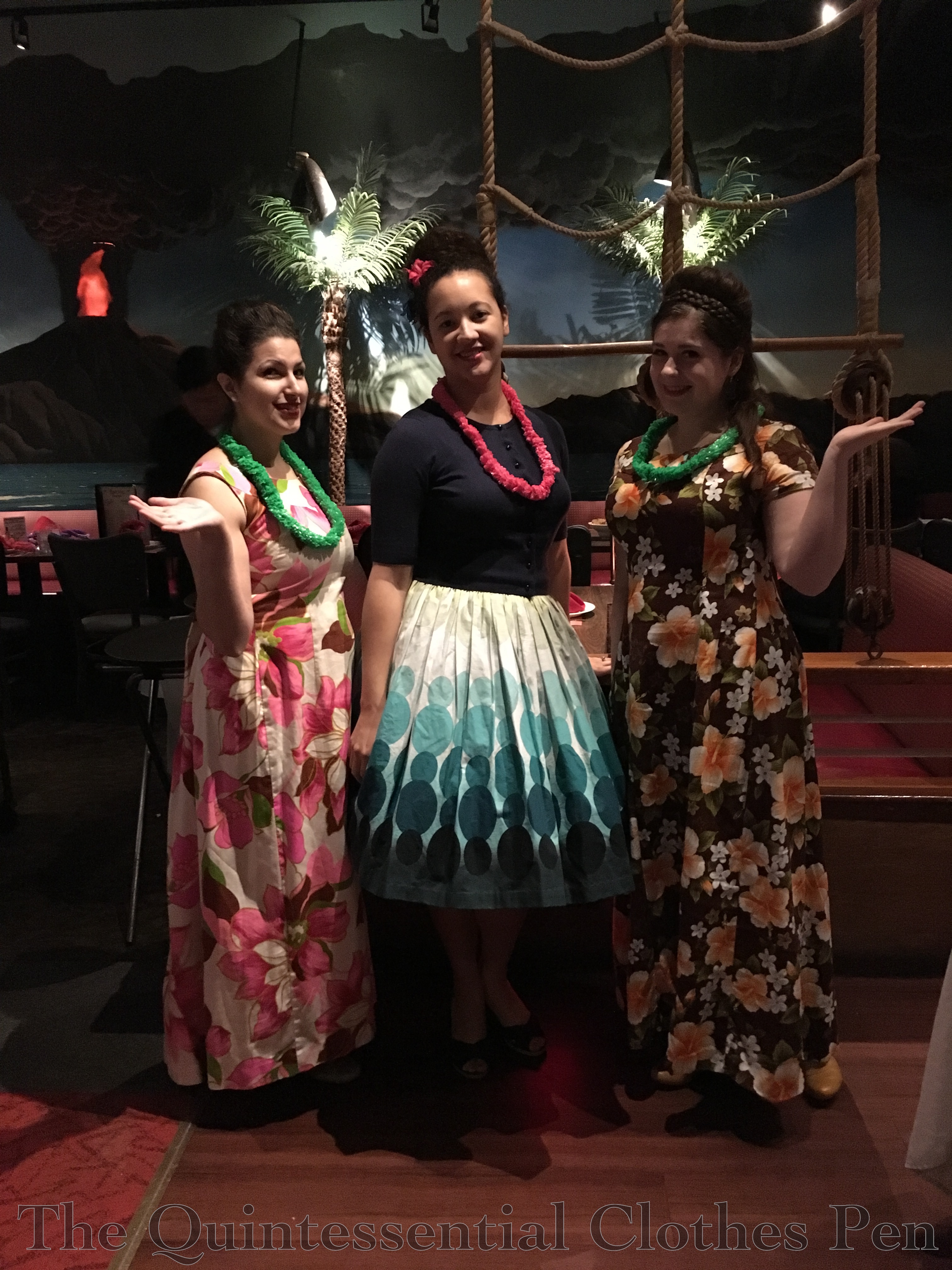
On a recent Saturday evening, I was to be found with the usual suspects at a local tiki themed restaurant. We were wearing, of course, 1950s and 1960s tiki-party themed clothing. What else would you wear, really?

img_2022-1

I took the outing as a sign that I needed to complete a revamped petticoat. There will be more on that later, as I haven’t taken pictures yet and I’ll be wearing it again soon. I will say simply that I am quite pleased with the shape I achieved!

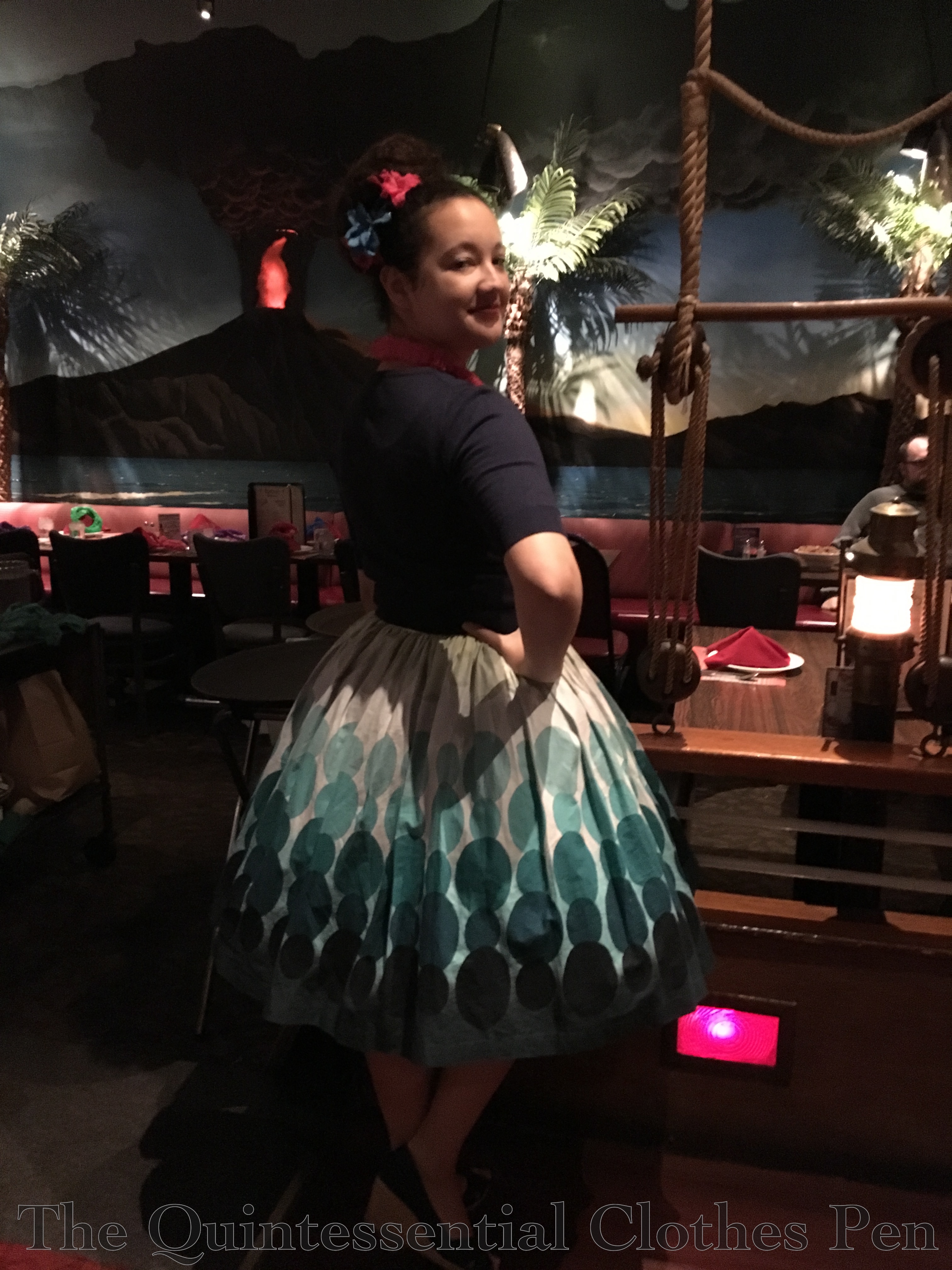
The revamped petticoat was needed to puff out my Bubble Dot Skirt (which I’d made and posted about this summer) into a nicely full 1950s shape. I wore it with a 1950s fifties inspired cardigan, espadrilles, a super hair bun, some tropical flowers, and a down coat (not pictured, obviously) to stay warm outside!

We had lots of fun. The restaurant is intense in its decor. We were seated in a ship, including furled sails and rigging. There were fountains and volcanoes and thatched roofs and all sorts of other interesting things.

And it was a great excuse to wear a full petticoat with my Bubble Dot skirt! Now I’m thinking I need a less full one to wear with it on normal days. Something to make it A-line but not be obtrusively large and obvious. (This desire is also sparked by watching The Crown. Some of the skirts are so understated but perfectly A-line!) Do you have any ideas?

img_2010-1

1899 Elusive Blue With Train

My last post recounted a fun event that I recently attended which explored the Victorian fascination with ancient Egypt. The event was unusual in topic, quite well done, and interesting, especially as I rather like ancient Egyptian history myself. I felt that I knew a good portion of the information in the lecture, but I also learned some new things.

I decided to leave my outfit for the event for this separate post so I could go into detail without getting too long winded. As sometimes happens, I committed just about two weeks before the event to having a new garment. A trained skirt! This event seemed very suitable–dramatic surroundings and no dancing being the biggest factors.

I had started a second, trained, skirt to go with my 1899 dress back in January, but it had languished at the point of needing hemming. Despite all the other projects also needing to be completed around this time, I decided to furiously work to hem the trained skirt so I could wear it to this event.

img_1993-1

img_1995-1

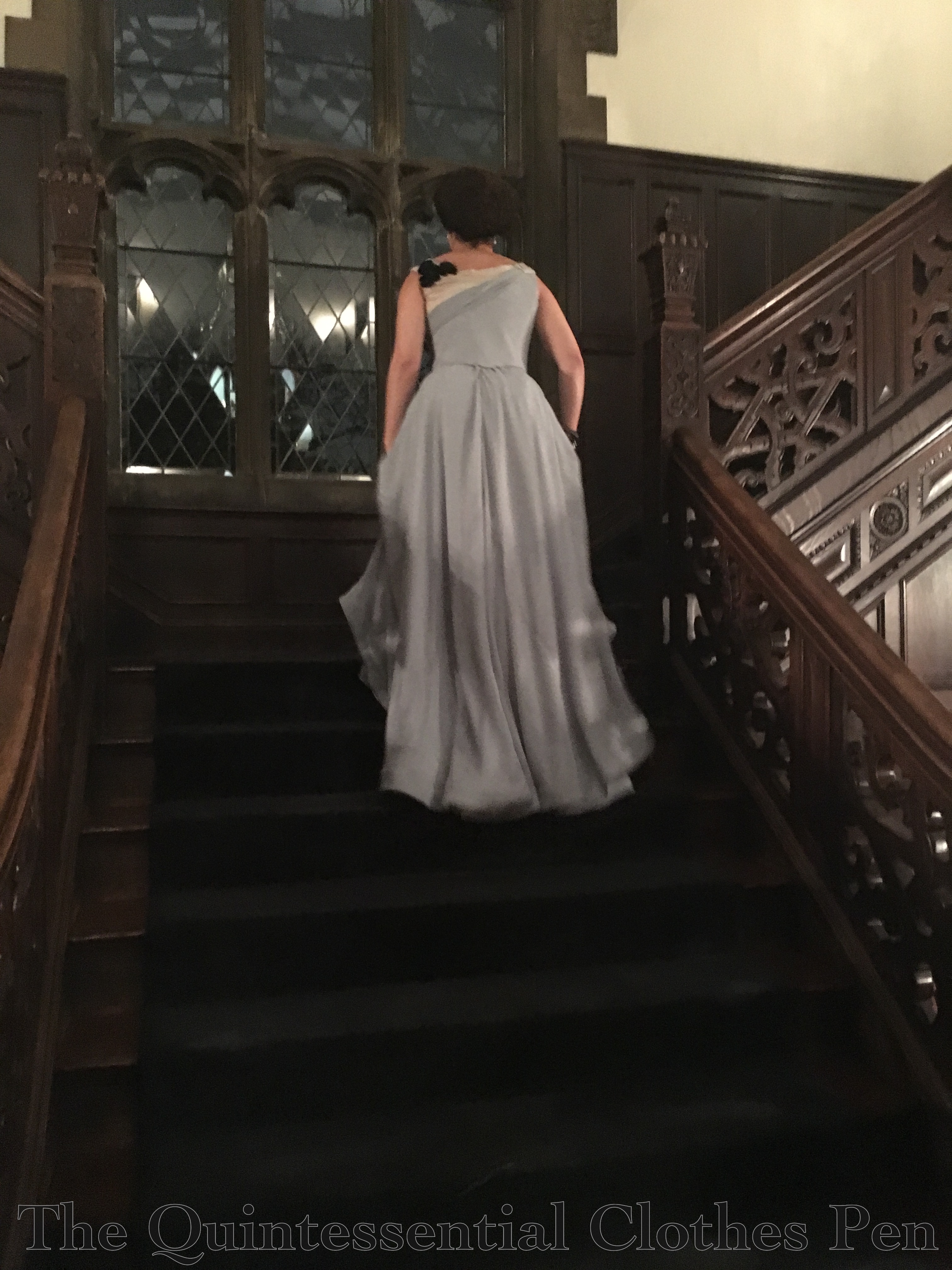
Success! The construction of the trained skirt is based on this gorgeous green gown at The Met. There is a side view of the skirt which shows just a bit of the under layers that support the hem. With that in mind, I scrounged for other extant examples of trained hem finishes and included them on my inspiration Pinterest board. This example, also from the Met, shows a clear view of the hem finishing on the inside of the skirt.

To replicate the wide and stiffened hem of the exterior I purchased polyester organza in a closely matching color and used it cut on the bias. The width of organza was folded in half to add an extra bit of support before being hand hemmed. The lining is hemmed with a bias band of an ivory cotton/poly blend that has a gathered section of lace machine sewn to the top edge prior to the hand hemming so the machine stitching doesn’t show. (Given that the whole dress is mystery fabric, I had no qualms about continuing to use polyester to keep the cost down on this project.) After hemming, I put the skirt on a dress form and pinned the lining and exterior together at five strategic points, then swing tacked the layers together. These tacks keep the exterior perfectly positioned over the lining.

img_2001-1

All of the extra work to support the hem layers was worth it. Along with my super silk petticoat to support the skirt, they nicely support the train, allowing it to elegantly float behind or swirl around me with just a small movement. It was quite fun to swish through the lovely rooms at the Castle with a dramatic train without it being so long that it becomes a nuisance. I’ll have to find more opportunities to wear this fabulous ensemble!