At last year’s Plymouth Thanksgiving Parade in November 2014, I portrayed suffragists with the same ladies as I did in 2013. I recently posted about the finally finished 1917 wool skirt I wore that day, but I thought it would be fun to share this video also and it didn’t quite fit in with the skirt post. It’s a little clip of us singing a suffrage song: While We Go Marching Together. For more information on suffrage songs, one of the other participants from our suffrage adventures wrote a blog post about them awhile ago that you can view here.
In addition to singing suffrage songs, we made suffrage ribbons and photocopied suffrage pamphlets, both to hand out to the public while interacting with them about the subject of women’s suffrage. We talked with men, women, and children about the value of women’s suffrage and the history of the movement, encouraging everyone to consider the importance of the right of women to vote.
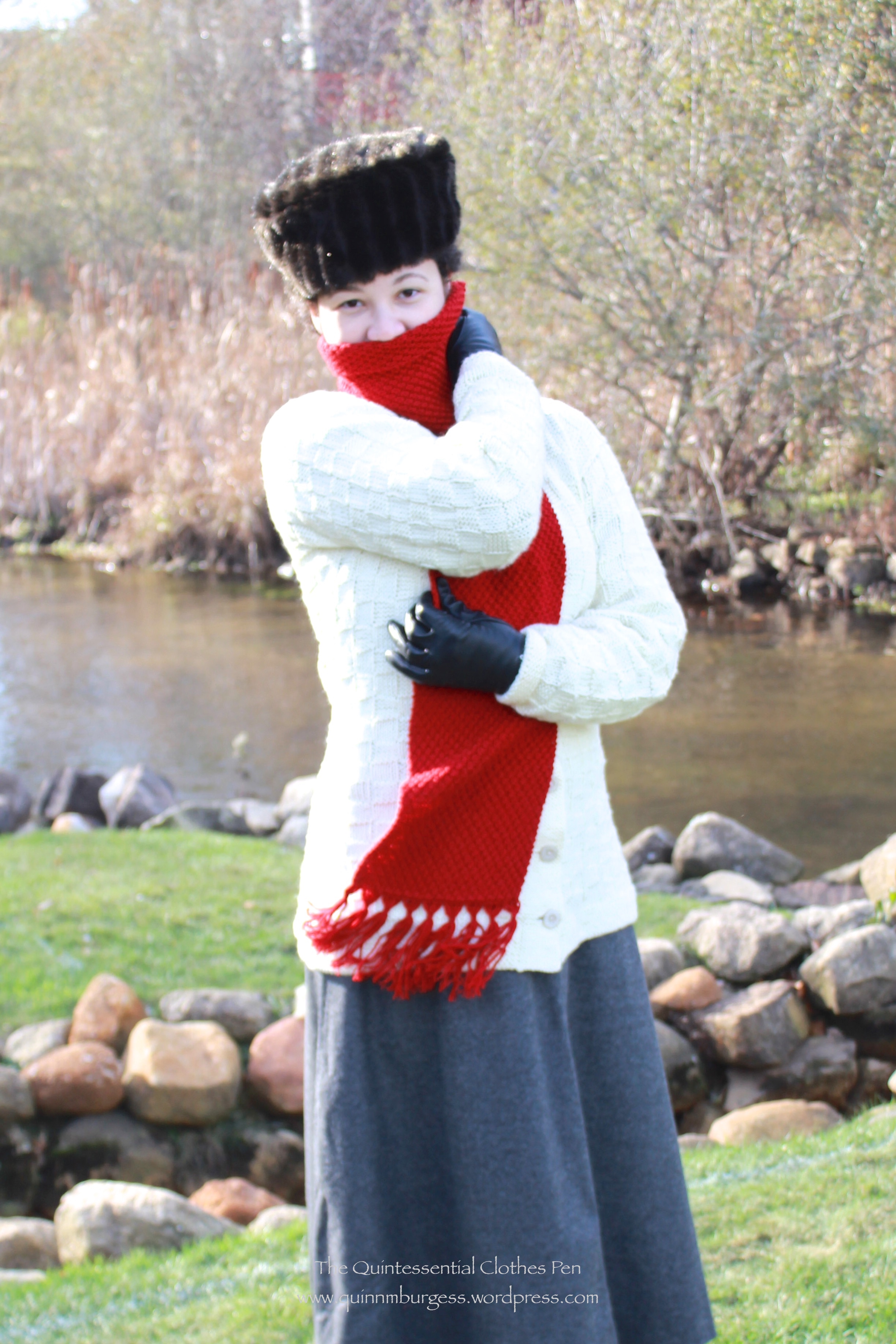
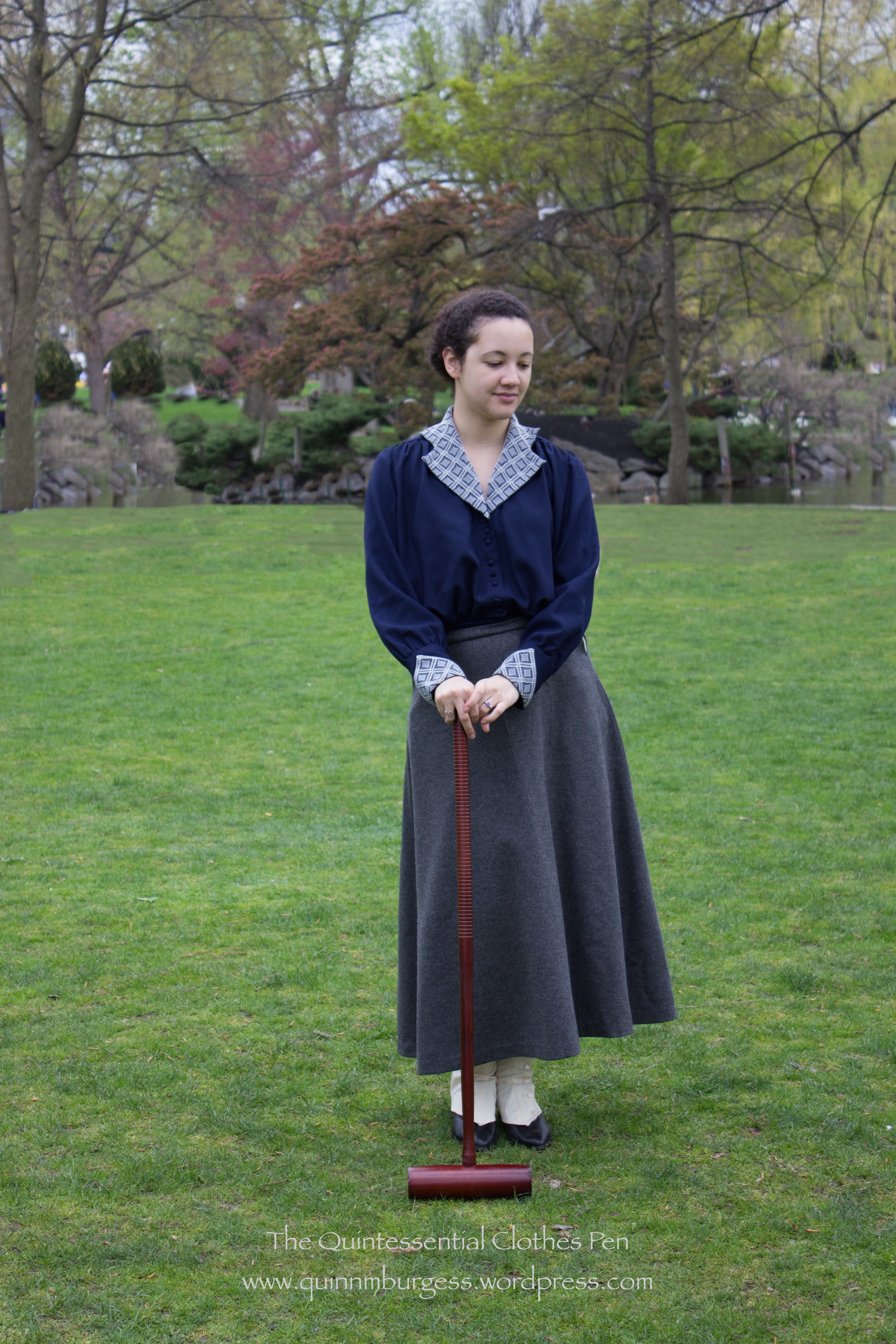
From the Cranberry Scarf post, proof that I was wearing my wool skirt, though all the layers cover up the changes I made that completed it.The new placket closes with hidden skirt hooks and bars.
While the side seams, hem, and waistband were totally finished for the first wearing, the skirt never had closures. It just sat in my closet taunting me with it’s almost-finished status. When I went to finish it I realized that a side closure would make it much easier to get dresses and be less gap-y than the center back closure I had originally intended. Moving the closure meant re-do-ing the waistband, so I also used the opportunity to change out the pockets.
As a side note, pockets on day wear are genius! They’re so useful when you’re the public eye and you need to keep things like your car key, phone, and ID on you but you don’t want to leave them lying around. They free your hands from any sort of bag and ensure that your sensitive modern items are not lost or stolen. GENIUS!
New (modern shaped) pocket.
The pockets I’d originally put in were rectangles set in vertically that extended both in front of and behind the pocket slit. They are just fine in skirts with more fullness, but for this period they were hard to get my hand in and out of. So when I was changing around the waistband, I cut out a new pocket shaped like what you would find in a modern garment. The new pocket has a facing piece of the skirt wool sewn over the muslin where it might show when I put my hand in (that’s the square set of stitching on the upper right). Because I added a side closure I only have one pocket on the other side, but it is easier to use than the old pocket style was. Both the pocket and the waistband facing are made from scrap muslin (not itchy, not slippery, and who doesn’t love using up scraps?!?).
Both sides of the skirt have four covered buttons on them. Buttons were often used in the 1910s to decorate skirts and blouses (take a look at my 1915-18 Pinterest board, for instance, and you’ll see lots of examples). These buttons are just for show, though, because the skirt closes with hidden skirt hooks and bars.
Braving the cold to show off my completed skirt placket.
I referenced Jennifer Rosbrugh’s great placket tutorial (I could remember all the directions exactly, but it’s so much easier to just take a quick look to remember which pieces to cut to different sizes and where to put them!) and this tutorial showing how to add hidden side pockets (Again, nice to to have to think very hard: easy directions and good illustrative photos!). And I’m super pleased that the skirt is complete! Yay!
It’s time for a little more information about witzchouras! Back in January, I shared my round-about journey to figure out what a witzchoura is. Now it’s time to look at witzchouras in more detail to determine what qualities define them.
In that last post, we left off with this enlightening sentence from the book Empire Fashions by Dover Publishers: “Around 1808, a high-waisted, fur-lined woman’s coat appeared, the witzchoura [wi choo ra].” Here is an example of what a witzchoura looks like.
Costume Parisien from 1813
My go-to source when I get geeky about word history is theOxford English Dictionary, and lucky for me, it has an entry for witzchoura! The OED tells us it as an obsolete noun from the French vitchoura and the Polish wilczura (a wolf-skin coat) that is defined as “A style of lady’s mantle fashionable c. 1820-35.” The OED also shares four uses of the word from period sources. Here they are, with slight edits:
1823 La Belle Assemblée Dec. Witzchoura pelisse of gros de Naples,..trimmed with a very broad border of swansdown. 1833 Ladies Pocket Mag. The witchoura is a very ample mantle, made with a very deep collar, and cape, and long, loose sleeves. 1835 Court Mag. [The mantle] is of the Witzchoura form, drawn close at the back, with large Turkish sleeves, and a deep falling collar. [1898 M. Loyd tr. O. Uzanne Fashion in Paris Witzchouras had not yet [c1806] come into vogue.]
So far, our qualifications for a witzchoura include: a high waist for earlier witzchouras (to correspond with the fashionable silhouette), fur lining, fur trim, the fact that a witzchoura is a coat or mantle (for outerwear, with another garment worn underneath), that it was most popular c. 1820-1835, and that it had not yet become fashionable c. 1806. Other sources add to a witzchoura’s qualifications those of its being full length, having large sleeves and a wide collar (or sometimes hood or cape layers over the shoulders) especially in the 1830s when the silhouette changed, as well as the general period of the “early 19th century” for its popularity, which makes sense since we’ve just looked at sources that mention dates between 1806 and 1835.
There is some information telling us that the garment became popular after Napoleon gained a Polish mistress in 1808 and other information that tells us that the garment was Russian in origin and became popular after the Napoleonic Wars brought the style back to France and England. (For more information about these early witzchoura influences, check out this post at the Sewing Empire blog.)
I’m excited the word has Polish or Russian origins, because “witz” sounds Polish or German to me. Also, I love that the last quote from the OED tells us that witzchouras weren’t popular just a few years prior to the year 1814. Oh, how fashionable is a merveilleuse!
Last weekend, I took my new skates out on the ice! I took two hard falls due mostly to other people stopping in front of me, but I still had fun. It didn’t feel nearly as cold as it actually was while we moving in the sun. We went out to skate purely for the fun of doing so and didn’t wear historical clothes as we had originally intended, which meant that I could convince Mr. Q to go! (He’s behind the camera.)
Ice skating in modern clothes with the usual suspect.
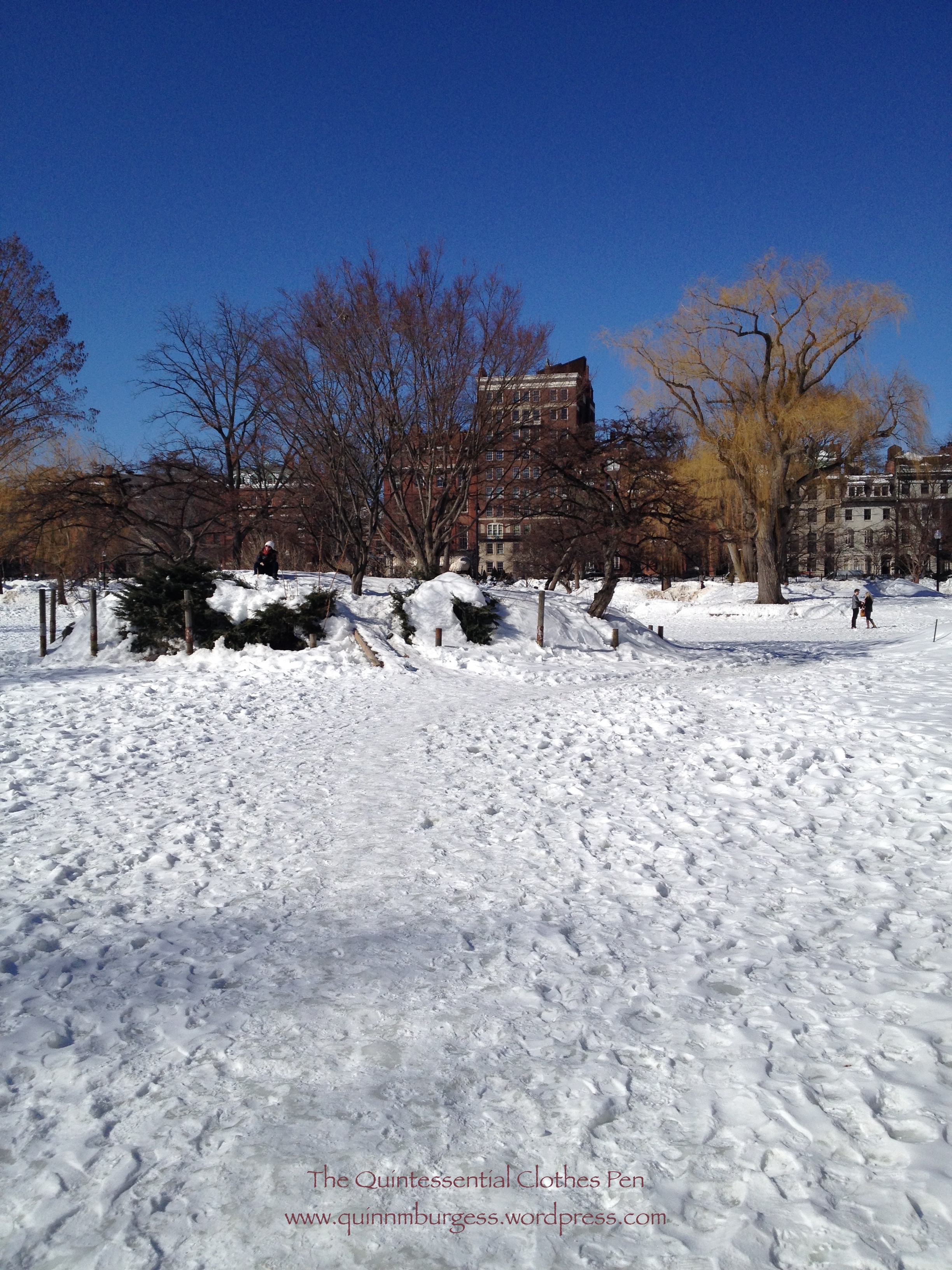
On our way to the ice rink we wandered through the Boston Public Garden. During the spring and summer there are all sorts of stunning flowers (I’ve seen huge beds of multi-colored tulips during the spring and lovely tropical looking plants during the summer), but with all the snow we’ve had this winter the scene was entirely different!
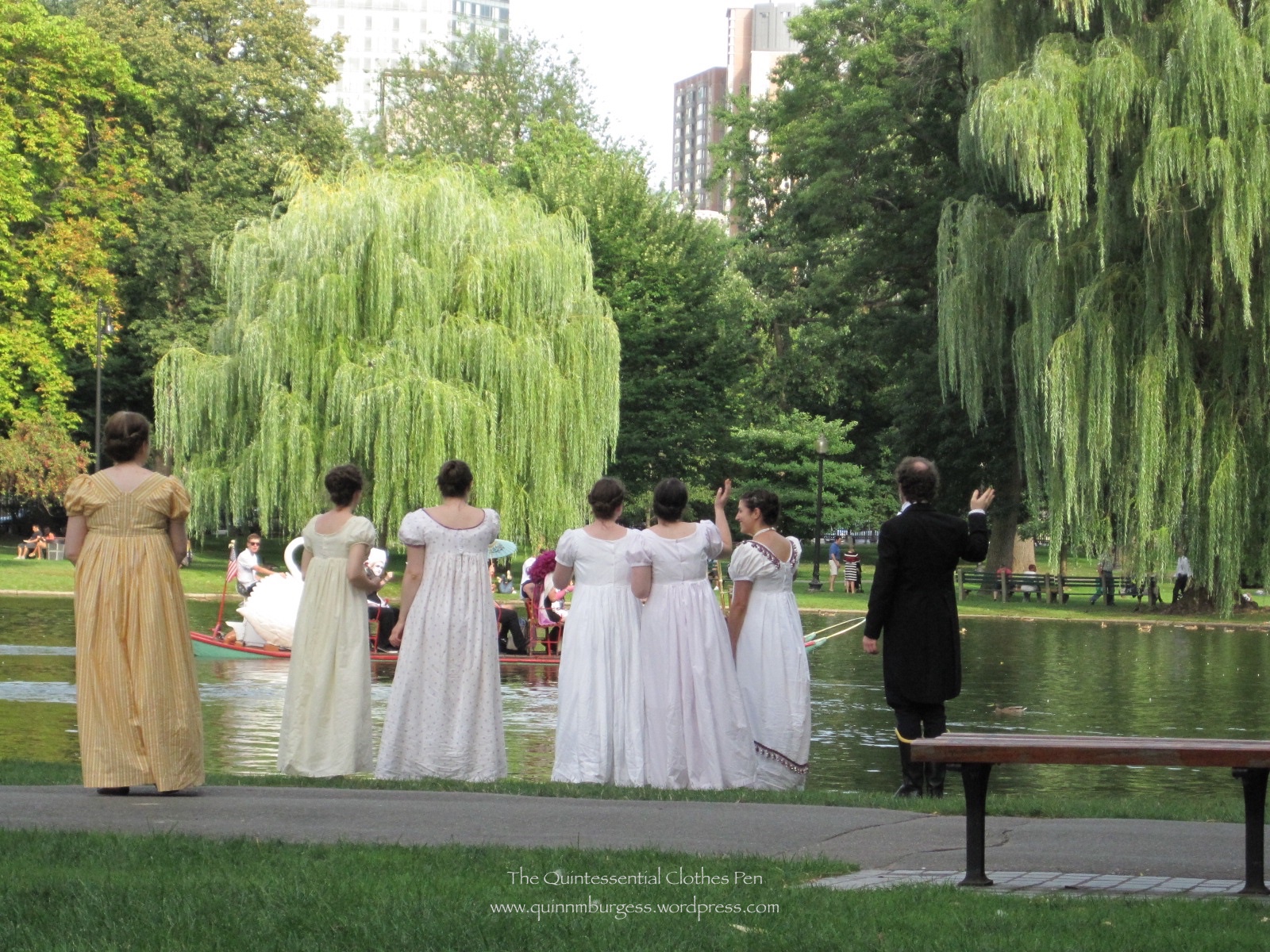
The sign, which is about 2 ½ to 3 feet tall, reads “Please keep off the lawn”…That line of green you see? Not a railing. That’s the back of some of the benches that line the paths! The snow has condensed so that when walking around on the uncleared parts of the garden you’re walking at seat height (see the seat slats poking out in a few places along the way?).There is an island out in the middle of part of the pond that you can’t reach when the pond is full of water (also, it’s often being patrolled by angry looking swans), but with the pond drained and full of snow we were able to clamber about on it!For comparison, that same island is behind me in this picture from our May picnic in 2014 (more pictures of the garden are in that post, also).And here’s a swan boat on the other end of the pond at an August picnic in 2012 (more pictures of the garden, including the tropical looking plants, in that post).
Quite a different scene! We’re all looking forward to spring here in Boston (can you blame us?), though I doubt our snow piles will melt for months!
I used the deadline of the HSF/M Challenge #2: Blue to finish the nagging little things on my 1811 Elusive Blue evening gown that either didn’t make it to completion in time for the first wearing last April or that bothered me after wearing it that first time. The changes: lengthening the hem of the underdress, adding a drawstring below the bust to control where the fullness and folds will fall beneath the overdress, fixing a section of pearls on the back hem that had come loose, and creating trim to finish off the sleeve openings.
The trim on the sleeve openings is probably the most noticeable and interesting of the things that brought the dress to completion.
Just the facts:
Fabric: Scraps of elusive blue and dark blue fabric from the original dress.
Notions: Extra pearls, thin yarn for cording, and thread.
How historically accurate is it? The trim is directly inspired by this extant gown at the Met and is entirely hand sewn. I think it would be recognizable by someone in 1811, so the only points off would be for inaccurate fabric choice. Let’s say 90%.
Hours to complete: As usual, I did not keep track for the changes/finishing or for the original construction. I can safely say, “a lot.”





 The Quintessential Clothes Pen