Well, as you recently read, I have a 9 month sewing plan to get me through May of 2013. It’s not set in stone (which means that mostly I keep adding to it, not taking things away…), but it gives me a great overview of what I need to accomplish and by what month. Deadlines really help in getting things completed!
The first major portion of the sewing plan is an ensemble of clothing from about the year 1823. I’ve been doing lots of looking at fashion plates and extant clothing from the early 1820s, in books and online. Here’s a link to my pinterest board: 1820-1824. I had so many pins in the 1820-1829 board that I had to separate the decade, so I also have a separate pin board of 1825-1829.
The 9 month plan includes the following pieces: petticoat, ball gown, walking dress, muff, bonnet, and chemisette. I’ve added one more thing since the plan was created: a tippet to match the muff! Before I explain why I want these items (ie, where I plan to wear them!), let’s look at my inspiration for the items themselves!
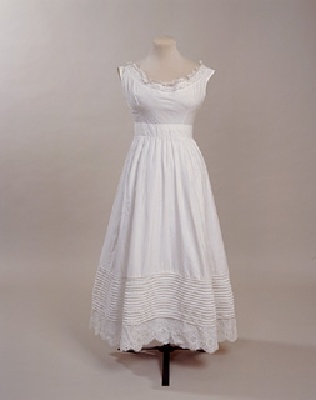
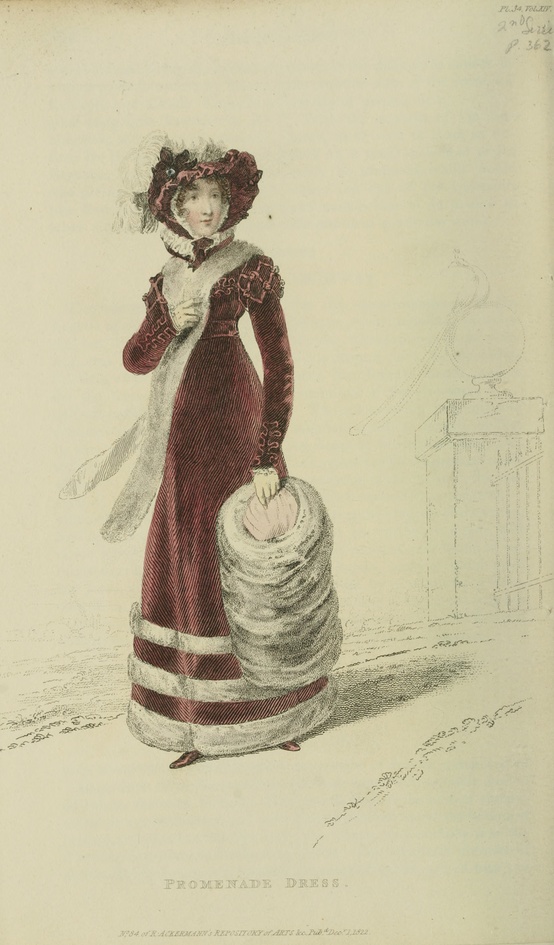
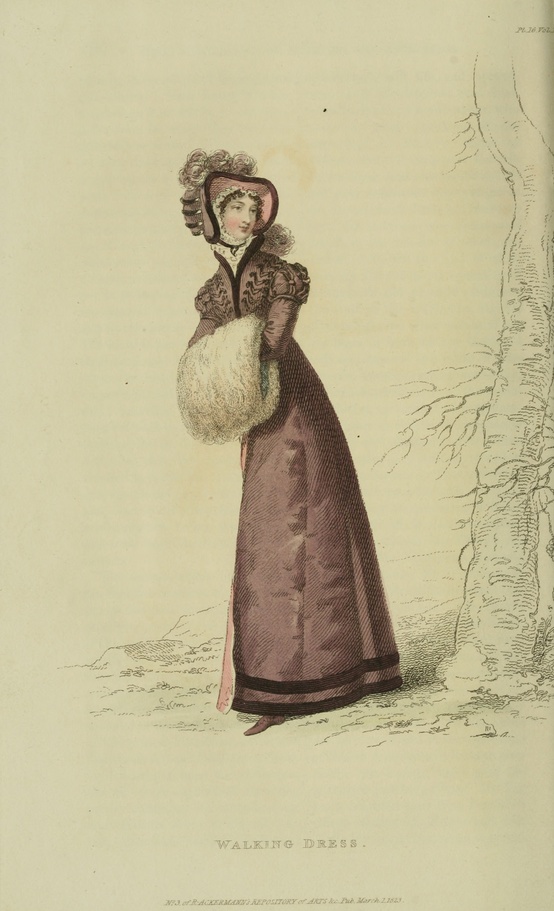
Petticoat. Manchester City Galleries. (I’m making a petticoat out of white cotton. It is entirely hand sewn.)Actually a Dinner Dress (but I’ll use it as a ball gown). Ackerman’s Repository. May 1824. (I guess I lied about the year… I’ve been looking at the images so much I haven’t even glanced at the date in ages! Anyway… I’m making this in apple green silk with hand sewn silk organza appliqués.)Promenade Dress. Ackerman’s Repository. December 1822. (I am making this out of deep, rich pinkish burgundy wool with hand sewn lavender silk trim.) This is also my inspiration for the tippet. (I’m making the tippet out of white faux fur.)Walking Dress. Ackerman’s Repository. March 1823. (I think this is where I got the year 1823 from… This is another influence on my walking dress design, especially at the collar.) This is also my inspiration for my muff. (The muff will be the same fur as the tippet, lined with pale blue silk shantung.)Bonnet. C. 1820. The Met. (I plan to make this in lavender to match the walking dress.)Chemisette. c. 1810-1825. Snowshill Collection. (Yes, this is one of the ones in Janet Arnold. I plan to make this out of lightweight cotton and use my fluting iron! However, I have to say that if one thing in my December-to-do doesn’t make the cut, this would be it. I really want to take my time on this and play with my fluting iron, and I’m not sure I’ll have the time on this one…)
What is all of this for, you ask? I plan to wear the whole ensemble in December when I attend Fezziwig’s Ball, a 19th century ball hosted by the Commonwealth Vintage Dancers in Salem, MA. Since it’s a ball, I’m sure you understand why the petticoat and ball gown are required! But why the outerwear? Before the ball begins, ball-goers have the opportunity to go caroling around the streets! It’s really fun, and usually pretty cold. I need to stay warm, hence the wool walking dress, tippet, and muff. The chemisette is to fill in the collar of the walking dress, and the bonnet is really icing on the cake to help pull the whole ensemble together! As an added bonus, later this winter my friends and I hope to go ice skating in 19th century dress, so this will also be my ice skating outfit!
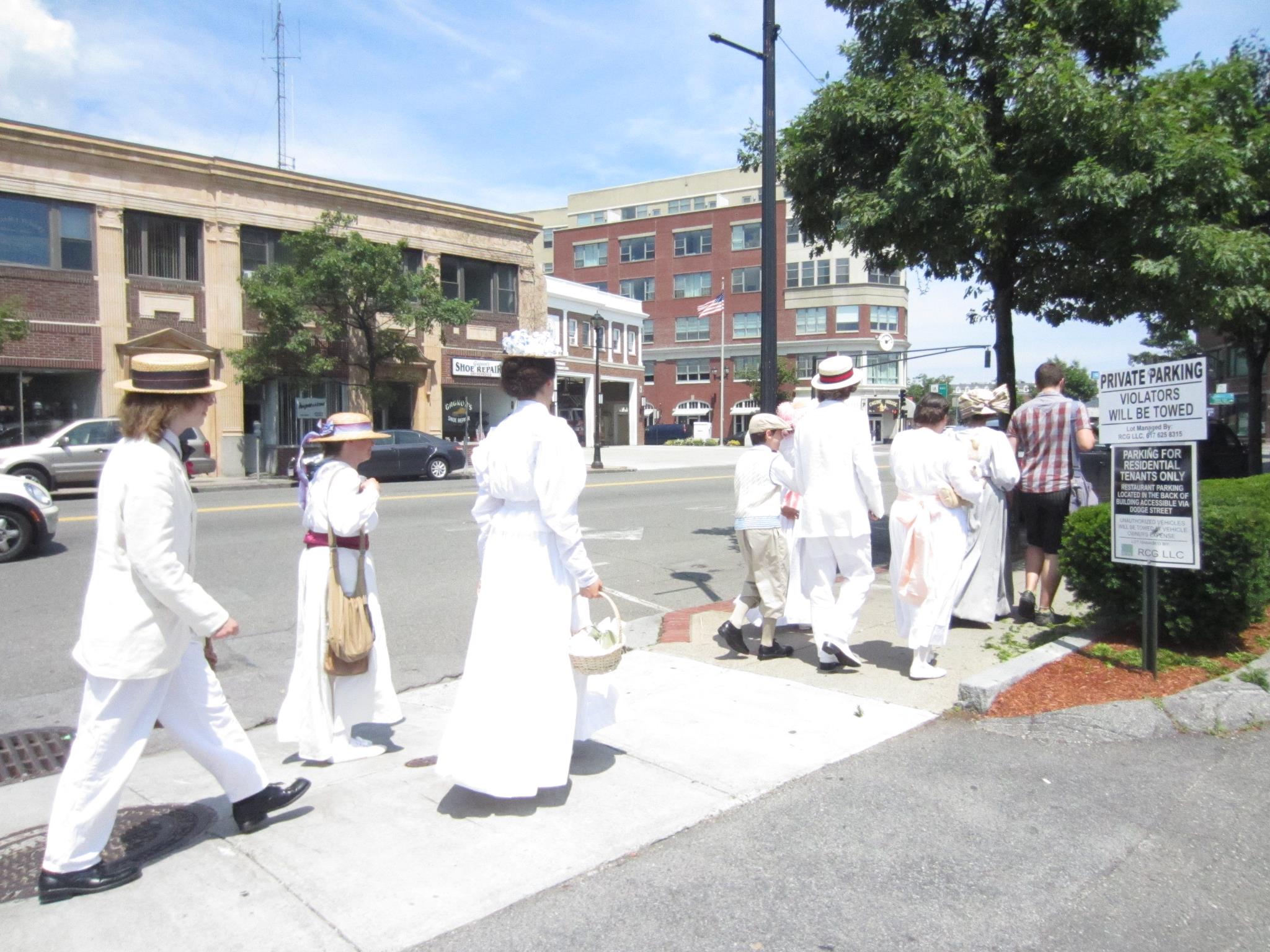
This is another case of the delays… The Commonwealth Vintage Dancers performed at an event in June (cough, cough… I am so slow!) that was called something like A Picnic for Teddy, Mommy, and Me. It was at the Salem Athenaeum, a private library, and was targeted toward young girls, their mothers, and their teddy bears! Cute!
We performed in 1890s whites. I had been dragging my feet about constructing my own whites, so I took this opportunity to go for it.
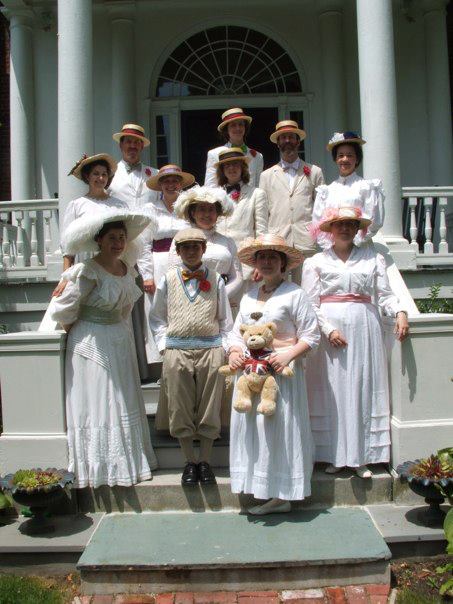
Dancing “Teddy Bear’s Picnic.” It’s really a ridiculous dance, but it fit the theme of the event perfectly!It was super hot that day! Sitting, in the shade, was wonderful. As was my fan…CVD on the steps of the Athanaeum.After the event we walked across Salem to get some lunch. Of course, Salem often sees people dressed in odd clothes, so we didn’t surprise people, but they were curious about what event we were going to.
I’m not totally sold on the white skirt I made. It’s a gored skirt and it works fine, it’s just not super eye catching (aka, it’s great for performances, but won’t get worn for other things… maybe it will be a petticoat if needed?). Oh, and I also threw the hat together, thinking that the white and blue would be nautical and good for Newport. But then I totally re-trimmed the hat at Newport because it didn’t have quite enough oomph with the white and blue. But the blouse… I love the blouse! It’s super comfy and lightweight, it closes in front (yay!), is washable, and I like the fabric. Win!
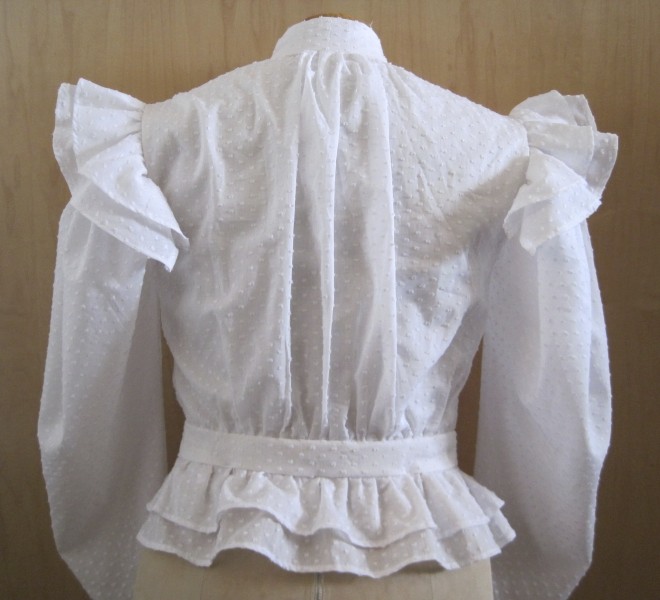
It is based off of a fashion plate in one of my many books. I draped a basic blouse pattern and adapted the pattern as needed to add the gathers in the front and back. The exterior is mounted on a lining made from the basic blouse pattern so that they gathers will stay where they are supposed to be. It is constructed of cotton with swiss dots for the exterior and a lightweight woven stripe cotton for the base (which I bought for $1 a yard a while ago! Love that price!). It closes up the front with concealed hooks and thread bars. The sleeves are quite large gigot sleeves, but because they are not lined they sort of just droop. Here are some pictures! I think I got pretty close to that inspiration image, don’t you? I love the feeling of success that comes with really nailing the look in reproducing a garment! Don’t we all?
The inspiration image.Front of the blouse, on Squishy, the mannequin.Back of the blouse on Squishy.In the garden.
Remember I recently shared with you the square necked 1812 Ikea curtain gown? And I promised pictures of the accompanying undergarments? Now is the time! Please forgive the silly black and white checked walls in these photos… I took the opportunity of having people around to take photos of me in the garments, despite the lack of a fitting setting.
Chemise and short stays.
The chemise is constructed of linen, and despite its rather cute a line shape, it is actually just a tube with shoulder straps. The front has a draw string across it to help it shape over the bust, which I think is part of the reason the front looks so evenly distributed and full. As you can see, I chose to make a sleeveless chemise, specifically for the square necked gown.
Back view.
The back of the chemise is cut low and square to fit within the shape of the square necked gown. Next is a closeup of the stays so you can see more detail.
Short stays.
In this photo you can see the drawstring on the chemise. You can also see the front lacing stays better. They are essentially the same basic shape as my longer pink stays, with a few differences. The pink stays have a simple front, back, hip gusset, bust gusset construction, whereas these new stays have a back piece, side piece, and then front piece with the bust gussets. For this pair, I think I actually could do without one of the bust gussets, since it looks a little big. But it’s WAY too late now to change that! I had to cut the area under the arm pretty low to be comfortable, and I also had to move the straps a few times, especially in front. If they are too far out they cut into your arm joint when you try to move–not comfortable, let me tell you–but they needed to be pretty wide in order to accommodate the wide neckline of the square necked gown.
The stays are white cotton twill layered with two layers of cotton canvas, except the gussets and straps, which are just one layer of the canvas and one layer of the twill. The stays are bound with white cotton bias. They are boned (only at center front to stabilize the eyelets) with plastic wire ties. Despite the light boning they are quite stable when laced up. And let me just say how much easier it is to get dressed when your stays lace in front! So easy! Love it!
These stays were stitched by machine. I needed them done quickly and I wanted to be able to dance and sweat in them without having spent lots of hours hand sewing them. Also… at some point when I washed them (after the 1812 Guerriere weekend, when they were wet through from sweat) they got streaky. Now they are mostly off white, but still have bright white streaks. So I didn’t feel the need to make them super pretty and spend the time hand sewing them. I did hand sew the eyelets for the lacing. I thought about doing spiral lacing, but then when I made the eyelets I forgot to space them that way… so they don’t spiral lace.
Under dress.
The other new undergarment is this under dress–needed because of the sheerness of the dress fabric. So here it is. The skirt is the same dimensions as the square neck dress, and mounted to the bodice in the same way. The bodice also uses the same pattern, except that the front is not gathered. There is a small tuck on each side of the bust, but that’s it. The straps on the under dress are similar to the straps on the chemise and stays, so that they don’t interfere with the sheer sleeves of the gown. The under dress ties in back at the top and where the waist is. The day of these pictures one of the lower ties came off, so you can see the gap where a tie would normally be. Below the ties are an opening of about 8″ that allows me to get in and out of the garment. It all looks quite a-line in these photos, but with the dress on top the whole thing looks much more columnar.
Back of the underdress with the missing tie.
I think I’ll do another separate post with some of my research images for the sleeveless under garments. So for now, this is it!
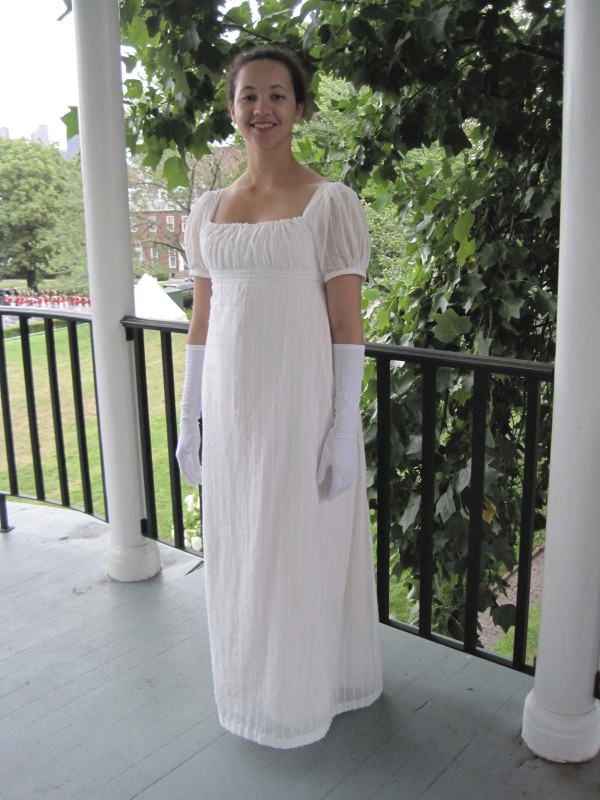
My favorite picture of my new 1812 gown, from the Guerriere weekend at the Commandant’s House at the Charlestown Navy Yard in Boston.
Ok, I admit that it is not a very clever title, but it fits the subject matter perfectly!
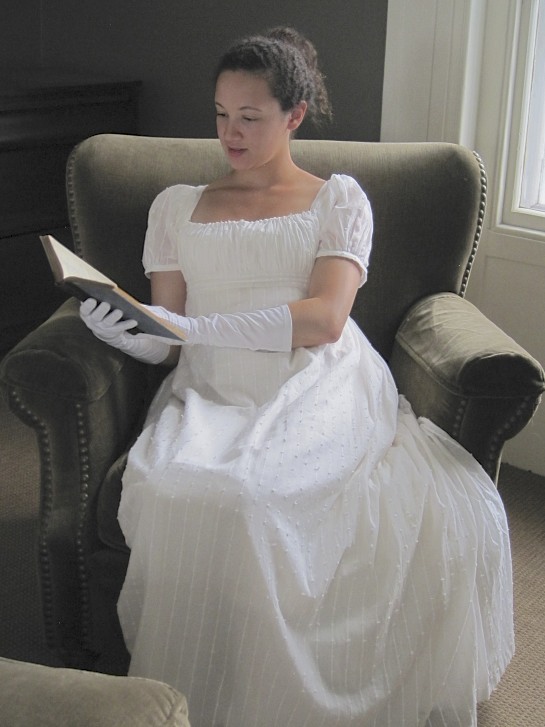
First, some details. This 1812 reproduction gown is constructed from 100% cotton curtains from Ikea. Yes, Ikea. You never know where you’re going to run across fantastic fabric. In fact, these Matilda curtains were made in India, which is very fitting for a Regency gown, because cottons in the early 19th century were being imported from India. It is very lightweight, sheer gauze with a 1/8″ vertical stripe spaced every 1″ across the fabric and with woven in dots every 1″ vertically. I bought a package of two curtain panels, each 55″ wide by 98″ long.
Does it look like a curtain dress? I’m sad to report that Mr. Q didn’t realize, until I explained it to him, that the idea of a curtain dress is a famous theme from Gone With The Wind… How could I have attached myself to someone who doesn’t know that? Opposites attract?
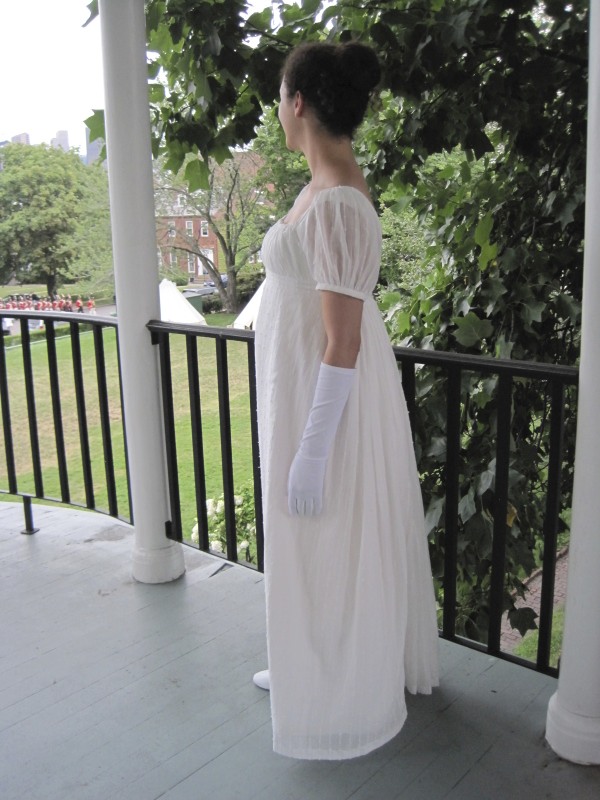
The skirt for the gown is a two panel tube, 43″ long by 110″ circumference. The front is stitched flat to the waistband and the remaining fabric is tightly gathered into the back across 13″. Center front and center back are actually the middle of the panels, so that the two seams are lost in the back gathers. The gown opens center back with hooks and eyes on the bodice and a narrowly hemmed slit that extends 8″ down the center of the back panel. The slit is also lost in the gathers. The waistband is 1″ wide. It was cut on the cross and has long tucks taken all around it so that it has three stripes spaced close together.
You can really see the difference between the flat front and the gathered back in this side view.
The bodice pattern is taken from Janet Arnold Patterns of Fashion I “c. 1806-1809 frock” and adjusted for fit and so that the entire front panel has a 2:1 gather ratio at the top and bottom (essentially, just more gathers than the original dress). What I really love about that pattern is the simplicity of the neckline. The bodice is cut separately from the straps, and the straps are cut on the straight grain, thus they fit really well with a wide square neck that stays square and doesn’t fall off your shoulders! GENIUS! Sometimes those historic tailors and dressmakers really amaze me with their sensible-ness. The bottom gathers are sewn to the waistband, but the top gathers are adjustable with a tie at center front. The ties are stitched to the armsceye seam allowance and can be tightened from center front then tucked inside the gown. The shoulder straps are folded in half with the fold towards the neck so that I didn’t have to finish that edge (another 19th century smart trick!). There is a stripe in the middle of each strap.
Oooo, wait, I love this picture too! Sometimes I think my smile is dorky, but not here! And the leaves make a lovely background. Anyway… you can also see the bodice details better in this photo.
The sleeves are a conglomeration of various patterns… essentially they are just a normal Regency short sleeve pattern with about 6″ extra fullness at the top and bottom which is gathered into the armsceye and the sleeve band. The sleeve bands are cut on the cross, like the shoulder straps, and on the fold. They are placed so that the stripe runs around them. I wanted them to puff more, so after these pictures I took a few tucks in the underarm seams of the sleeves so they can’t hang as low on my arms. We’ll see how that looks next time I wear the dress.
With regard to inside finishing… The skirt seams didn’t need anything, because they are selvedge edges. The hem is 1″ turned twice and stitched down with a small running stitch (stitches every 1/16″ to 1/8″). The waistband is faced on the inside with a second waistband (without worrying about having three stripes running around it) that encloses all of the gathers on the top and bottom. The armsceyes are bound with self fabric bias strips. The few bodice seams are flat felled. The top edge of the back of the bodice has a narrow hem.
You can see the fabric pretty well in this photo.
The best part about this dress is that it is the first entirely hand sewn reproduction garment I’ve made (I think). I’ve come pretty close in work I’ve done in the past, but I’ve always used a sewing machine for inside seams and things that won’t be seen. Not so with this one. There were two reasons for hand sewing it: 1-I wanted to have the satisfaction of it 2-I had a week to make the dress and a long road trip for about half of the week I had… you can’t use a sewing machine in a moving car as far as I know… but you can hand sew! So the second best part about this dress: I whipped it up in one week, with undergarments!
I hadn’t mentioned that part yet. To accomodate the wide, square neckline and sheer sleeves of this gown, I had to make three other new pieces as well! A sleeveless chemise to accommodate the square neck and sheer sleeves, an underdress/petticoat to add some opacity which also needed to have a square neck, and a new pair of stays in white (because my only other regency pair are pink… and that would have not been subtle at all!). To be fair and honest, I didn’t get all the inside finishing done on these four garments the first time I wore them, and I did use a sewing machine for the undergarments. I was saftey pinned into the stays… I was madly hemming the underdress the day of our final dress rehearsal… and the chemise had unfinished edges… but you couldn’t tell once I put the dress on! I still need to finish some of the undergarments, actually… so hopefully once I do that I can take some pictures of them and do a post detailing their construction! Also in the works is another underdress that can be worn under this white dress. It will be a nice medium Regency-like blue.
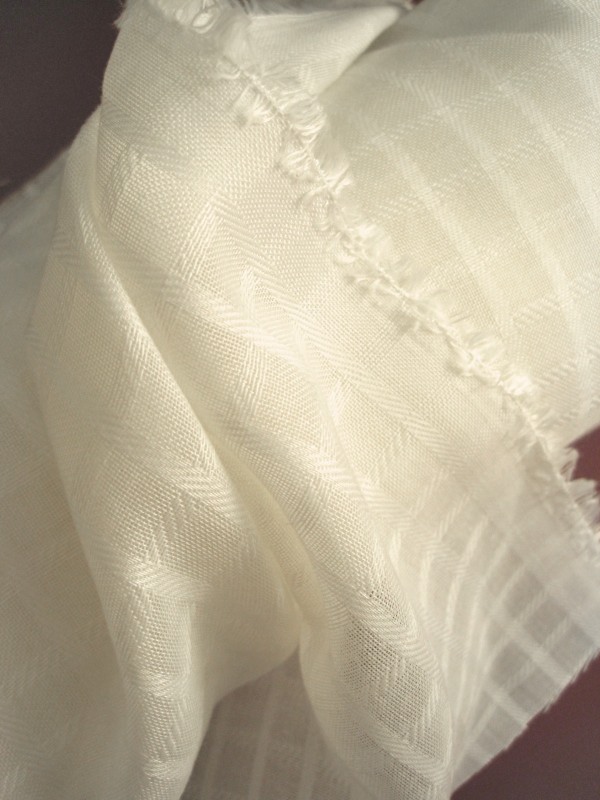
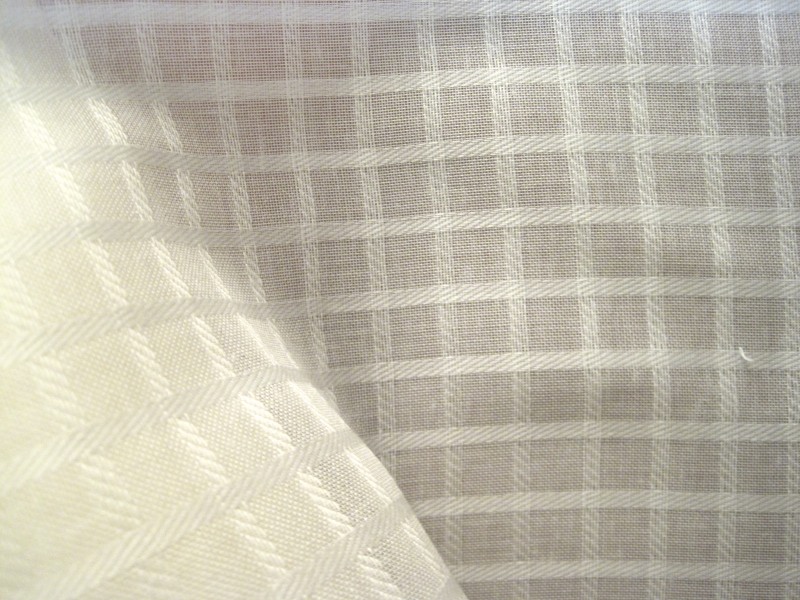
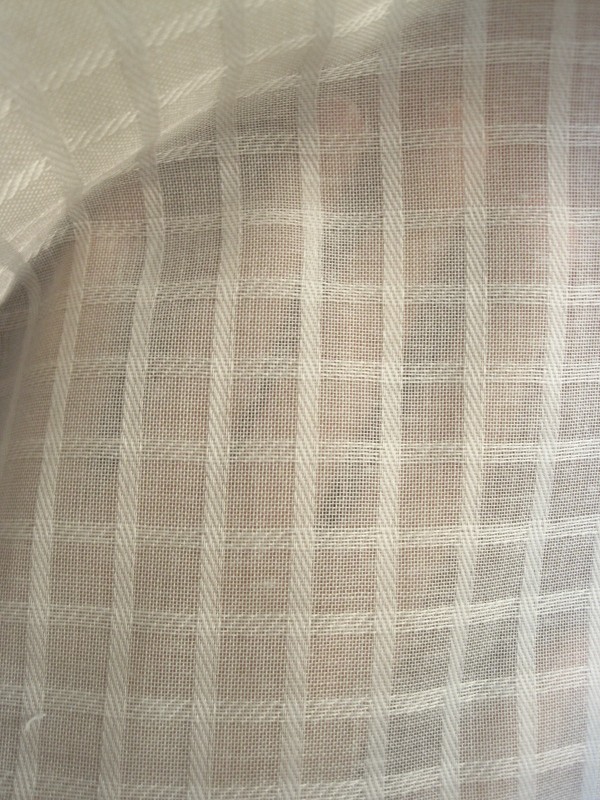
I recently mentioned the addition of a new fabric to my stash! I bought it with the thought to build an early Regency dress and another something or two. Perhaps an 18th century apron? Or an Edwardian blouse? Now I’m also considering a frothy 1908-ish dress. And I’m sure that more ideas will be sparked before I actually construct anything (because there are many other things on the “to be sewn” list that need to come first!). But I did promise pictures. Here they are!
Ivory cotton gauze with windowpane pattern. It’s fairly sturdy, but has a lovely drape and is quite soft to the touch.It’s semi-transparent. This is with nothing behind it but color.This is with my hand behind it. You can see the outline of my hand pretty distinctly.
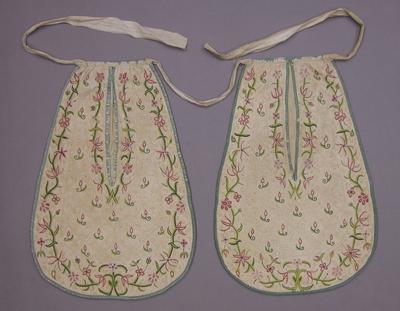
For the last month, I have been pondering the idea of making 18th century pockets. It was my idea to wear them to an 18th century ball and use them as a place to store my modern items (cell phone, credit card, cash, car keys, etc.). I was thinking of making simple linen ones, without embroidery, but once I started researching them I realized that I really wanted to go the full distance. In this case, the full distance meant hand sewn silk embroidery… The realization hit me just a few days before the ball that this plan was flawed. There was no way I was going to complete hand embroidered pockets in the time I had left. My choices: to fudge it and be stressed out while trying to complete hand embroidery with cotton thread or to wait, source my products and make a plan, and enjoy my time hand embroidering. What to do? Well, I decided to do the latter and I am glad to say that I am thankful to have used common sense and avoided stress! For now, the plan to make pockets has been added to my list of things to make in my leisure sewing time (when other, more time sensitive projects are lacking… Does that ever happen???). These charming pink, green, and blue ones are my goal.
Early 1700s pockets, linen embroidered with silk, trimmed with silk ribbon and with silk ties (V and A)
Pockets in the 18th century were often made of linen and elaborately embroidered in colorful silk or wool thread, as with the example above and the following examples. Aren’t these yellow trimmed ones adorable? It looks like the pocket slits are smiling!
Mid-1700s pockets, linen embroidered with silk, trimmed with silk and with silk and linen ties (Manchester City Galleries)
This next pair of pockets has beautiful (and intense) embroidery.
Mid-1700s pockets, linen embroidered with wool, with linen ties (Worthing Museum and Art Gallery)
This next pocket has a lovely embroidered pattern that looks much simpler to replicate than the previous examples. This is my back up plan if the other, more complicated embroidery proves to be too much.
1718-1720 pocket, linen embroidered with silk, with linen ties (V and A)
The pockets with unfinished red embroidery are an excellent example of pocket construction. You can see the manner in which the design is marked as well as the embroidery being completed prior to the pocket being cut out and assembled.
1718-1720 pockets, linen with silk embroidery, the pattern drawn in ink (V and A)
There are also some pockets constructed of silk, such as these, below. These pockets were acquired with a quilted silk petticoat and the Victoria and ALbert Museum assumes that they were intended to be worn together. They look puffy and super cute, but because they are assumed to have such a specific purpose I don’t think they are the right idea for me. Also, I wouldn’t get to embroider!
Mid-1700s pockets, silk with silk ribbon (V and A)
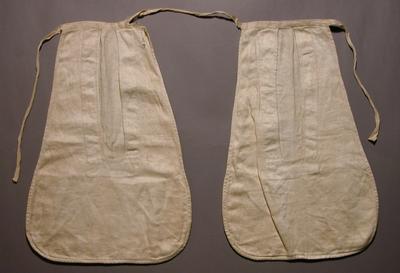
Pockets continued to be used in the 19th century, but they were often constructed of cotton rather than linen and were not as elaborately embroidered as in the pervious century. Some 19th century pockets were constructed of cottons with woven patterns, such as stripes or diamonds as well as the occasional pocket of satin weave cotton fabric. In the middle of the century embroidery was again used as decoration, though the motifs were changed from the 18th century. These next few pockets are just a few 19th century ones I like, either because they use interesting fabrics, or because they are smiling at you!
Late 1800s pockets, twill weave cotton (Oxfordshire Museum Service)I like this one especially, because it really does look like a smiley face pocket! Early 1800s pockets, ribbed cotton, with cotton tape (Cheltenham Art Gallery and Museum) Early-mid-1800s pockets, satin weave cotton (Maidstone Museum and Bentlif Art Gallery)early 1800s pockets, figured silk satin, trimmed with silk (Cheltenham Art Gallery and Museum)
Do you have a favorite pocket amongst these? Does any pair stand out to you?
All of these pockets were recently available at here, at VADS: the online resource for visual arts; however, VADS appears to no longer be operable (perhaps because of recent US government action to curtail internet copyright infringement?). Alternatively, the Victoria and Albert Museum has a pretty good selection of pockets, including some of the ones featured on VADS.
I have decided to remake my ivory 1819 cotton gown for an upcoming Regency ball. Originally, my plan was to add trim to the dress as it currently exists, but I realized there were many things about the dress I wanted to change: with my new late Regency corset the neckline tended to sit away from my body in front, the back closure was too tight for comfort, the bust line in front was so high that it was very hard to get it to sit below my bust, the sleeve openings were uncomfortably tight, the sleeves weren’t puffed enough, I wanted to separate all the petticoat layers to be individual layers rather than petticoats built into the dress, and I wanted to add ruffles to the skirt to really bring it up to the years just before the 1820s. Indeed, the things I wanted to change were so numerous that I decided to just remake the dress!
In the end, the only thing that I decided to keep the same is the skirt base fabric… Using just one additional yard of the original fabric, I plan to complete the following changes: constructing an entirely new bodice with ruffled trimming, creating entirely new puffed sleeves with a cute v-shaped detail, making stand alone petticoats out of the original built in petticoats, and adding bias ruffles to the skirt.
From Ackermann's Repository 1822
My dress is from the period just before the 1820s and I felt that I needed to go more in an 1820s direction with the new trimming and adornment. The main feature of trimming in the 1820s is wide sections of trimmings on the skirt, in combination with corresponding trim across the bodice and sleeves. Thus, there two horizontal lines of interest with a simple, unadorned mid-section (as in the fashion plate on the left, from 1822).
Before I had decided to make so many changes, my original intention was to simply add ruffles to the bottom hem, along the lines of the dress (below) from the Kyoto Costume Institute.
c. 1820 Silk Day Dress (Kyoto Costume Institute)Ribbon trim on 1819 dress before the remake
However, as I thought about it I realized that the ruffle style (above) just would not have a corresponding look to the current zig zag ribbon trim on the dress bodice (right). Those two styles did not make sense on one dress.
The logical step was to change the trim on the bodice. But remember that I had other complaints about the bodice as well… So came the decision to remake the bodice. But how to trim it to correspond with the ruffles on the skirt? I was not at all interested in the bodice trimming on the Kyoto dress for my dress, because the fabric doesn’t lend itself to that look. Well, I started researching trimming from the late 18-teens to see if I would be inspired. The image below is one of my favorites that didn’t make the cut, and there are more on my 1819 dress trimming ideas Pinterest board (thank you to Lauren, at American Duchess, for linking to her Pinterest board in a post and sparking my interest in this fabulous organization tool).
From Ackermann's Repository 1819
Many of my Pinterest images come from the same place: the blog “My Fanciful Muse” by EK Duncan. She has a series of posts that contain text and fashion plates from Ackermann’s Repository beginning in 1808 and going through 1828! Here is the link for the post on 1828: if you scroll to the bottom you will see a list of links to all of the previous years. It is absolutely fabulous! If you haven’t seen this yet you MUST visit! (Thank you for sharing, Evelyn!)
In the end, I decided on a combination of the two dresses in the image below: the ruffles on the skirt of the dress on the right (for some reason I really like the idea of ruffles on my skirt!) and the bodice of the dress on the left. The repeated use of ruffles on the skirt and bodice will produce the corresponding style I am aiming for. The sleeves will be a style from the first few pages of the first half of the 19th century Janet Arnold pattern book: a puffed sleeve with a triangular inset coming from the shoulder. I’ve wanted to use that sleeve style for months and now I finally have a way to use it that makes sense!
1820 illustration from Cunnington's English Women's Clothing in the Nineteenth Century (the illustration is based off of contemporary fashion plates)
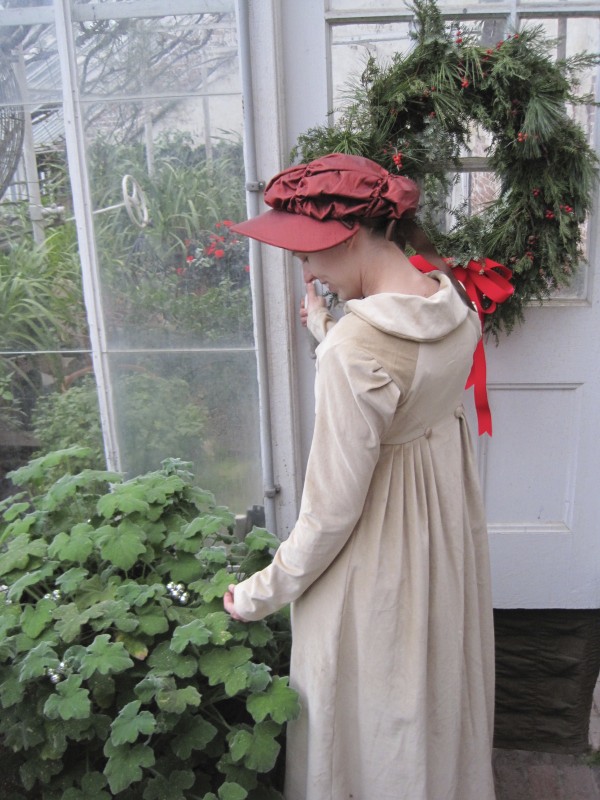
Despite the long name of this post… Here it is! My (almost) finished 1819 Regency Ensemble! The ensemble includes an early 19th century white linen chemise, 1815-1820 pink cotton corset, 1815-1825 ivory cotton gown, 1819 brown velvet Spencer, 1819 straw bonnet, and mid-19th century fur muff (ok, so it’s not quite as giant and droopy as a Regency muff… but it was cold outside!). You can click on the links to see more about each piece. There is more to come on the gown and bonnet.
Right now I want to focus on the completed Spencer and its details. Please click on the link above to see my research for the Spencer: it is based off a Spencer at the Metropolitan Museum of Art. You can see pictures of the mockup Spencer here. The Spencer is constructed of brown cotton velvet that is flatlined with white cotton. It is trimmed with green cotton cording, vintage brown lace, and green tassels to match (Aren’t the tassels so adorable?).
1819 SpencerBack of the 1819 Spencer
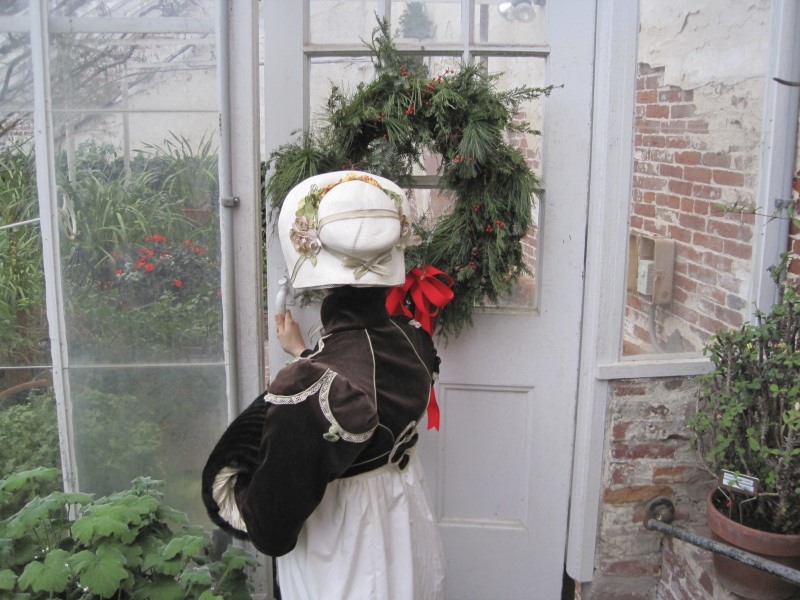
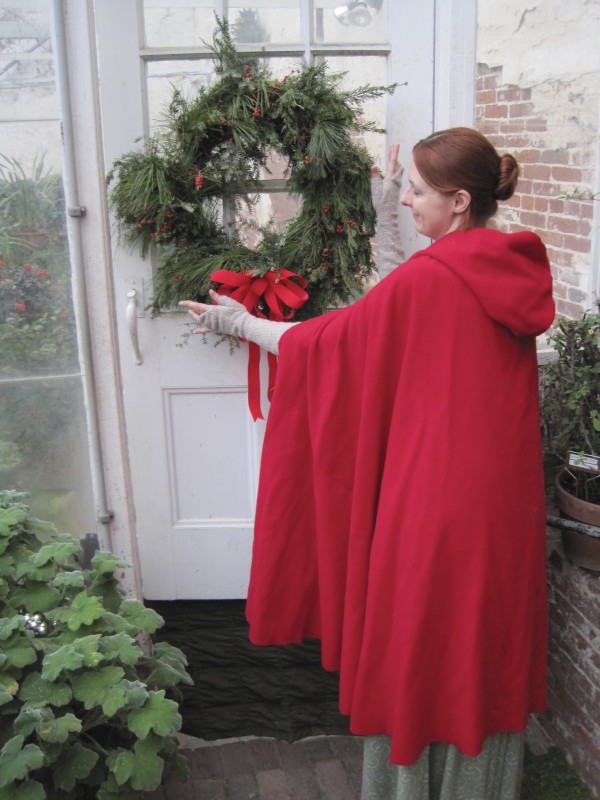
I wore this Spencer to the Massachusetts Costumers annual Regency Holiday Tea. This year, in addition to having tea, we visited the Lyman Estates Greenhouses, which were built in 1804 and added to in 1820, 1840, and 1930.
On to see more of the greenhousesOrnaments hanging from a tree!Picture time!Admiring the decorSo many beautiful things to look at
The tea was lovely and I do believe that my Spencer turned out wonderfully! Spencers are so adorable and varied. I hope to make more in the future… but there are other things to do before I go back to Spencers. The next big push is going to be Edwardian outfits for Titantic evens in April!
Well, it’s been a little bit of time since I shared with you my research and plan to build a Regency corset to accompany my 1819 gown. I’m excited to say that I was successful! The corset is complete, although I still plan to quilt a diamond pattern along front rib section within the next few months (I’ll share photos of that once it is complete). You can see the diamond quilting in the photos in the link, above.
The dummy isn't quite the right shape for this corset, but here it is!Corset back
This corset is constructed of two layers of pink cotton twill with a layer of coutil sandwiched between them to provide stability and support. I began construction by flatlining the coutil to the outer layer of twill. I sewed the non-gusset seams (the front and back pieces) together in these flat lined pieces, leaving the inside twill layer for later. Each gusset had all three layers flatlined together and sewn into place with the seam allowances pressed away from the gussets themselves. Then I went back and basted the inner twill pieces into place that had been left aside. I turned under the seams on these pieces and hand sewed them over the seam allowance of the gussets so that no seam allowance was showing.
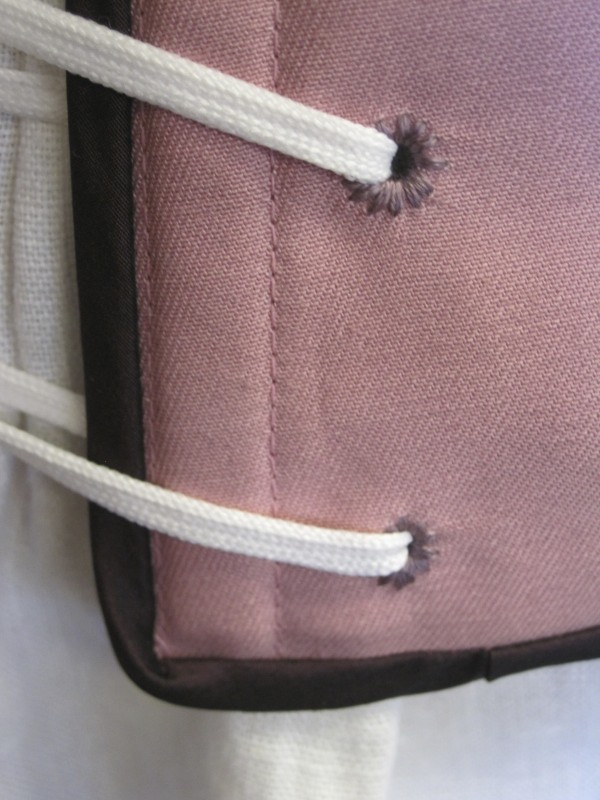
After completing the inside construction I bound the edges with purple bias silk taffeta, scraps from another project. The final step was to create eyelets. I decided to do these by hand in purple cotton embroidery floss. Each eyelet is reinforced with a metal jump ring that is caught under the thread on the inside of each eyelet. This reinforces the edge of each eyelet and keeps them from stretching out of shape when laced. The jump rings are only visible on the inside of the eyelets, where the stitching is bulkier because it passes over the rings.
Hand sewn eyelets, on the outside
The corset is lightly boned at center front and center back. I struggled over what material would be best to create the 2″ wide center front bone. Eventually I remembered a suggestion from a friend, Carly, who had used a creative option for boning that I decided would be perfect for this project. Home supply stores such as Home Depot and Loew’s sell plastic wire ties that are about 3/8″ wide and which come in lengths up to about 20″. The ties are a good 1/8″ thick, strong, but still bendable. They have a similar tension to a steel bone, but are a little thicker. And the nice thing is that you can cut and shape them easily with scissors! Of course, plastic boning is not historically accurate, but it is functional and affordable (a pack of these wire ties is about $5, and there are about 12 per pack) and creates a boned garment that feels similar to one boned with steel bones (and once you finish the garment, who would know?).
In this corset, each side of center back has a single bone. The 2″ wide center front bone is actually 5 wire ties attached to one other with (shhh!!!) masking tape! This is an experiment that I hope will work (I have slight fears that body heat might one day cause the tape to lose its grip and the bones to start to move around in funny ways, or worse, that the tape will leech sitcky goo onto the fabric that will stain the exterior). I put the center front bone in between the layer of coutil and the inside twill, so even if the masking tape does one day create stains, it is unlikely that the stains will make it to the outside of the corset.
As I mentioned in my last post in this Project Journal, I decided to make a pair of stays like the one to the right. I like the unique features of these: specifically the use of colorful fabric, the fact that this is fully boned, and the cording in each seam as well as the absence of shoulder straps and tabs. I adapted a pattern from Corsets and Crinolines by Norah Waugh. The pattern I started with had straps and tabs but I eliminated those elements to reproduce the pattern of these inspirational stays.
Cane boning
I decided to use cane boning for these stays for a few reasons: 1) I wanted to try a new material for boning 2) cane boning is period correct for the 1780s 3) given the amount of boning needed for a fully boned pair of stays the cane boning was much more cost effective (you can see the quantity on the left–it was about $15 from Wm. Booth, Draper) and 4) the cane boning seemed like it would be super easy to manipulate and, most importantly, to cut (and it was! normal scissors easily cut the correct lengths needed and it was easy to round the ends a little bit as well!). I actually only wound up using approximately half of the cane boning that I bought, so that means that I have plenty to use for another future project!
The silk that I decided to use as my exterior fabric is a fabulous damask. I originally thought about stitching my boning channels through the exterior fabric (as in my inspirational piece) but decided against that idea on this fabric, because it would really have just been way to much going on with the pattern and so many stitch lines. You can see the silk pattern a few pictures father down.
Stitching the boning channels
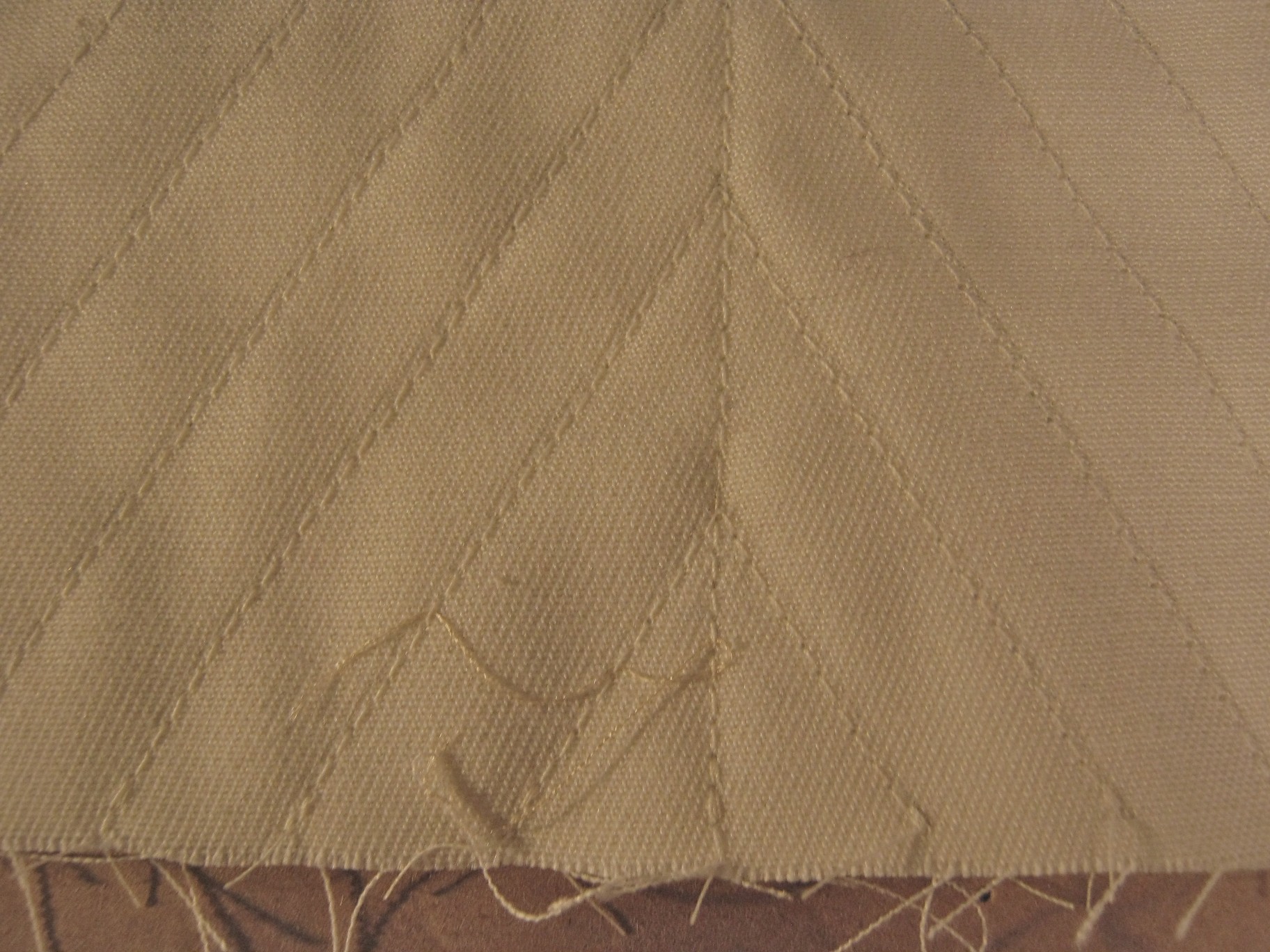
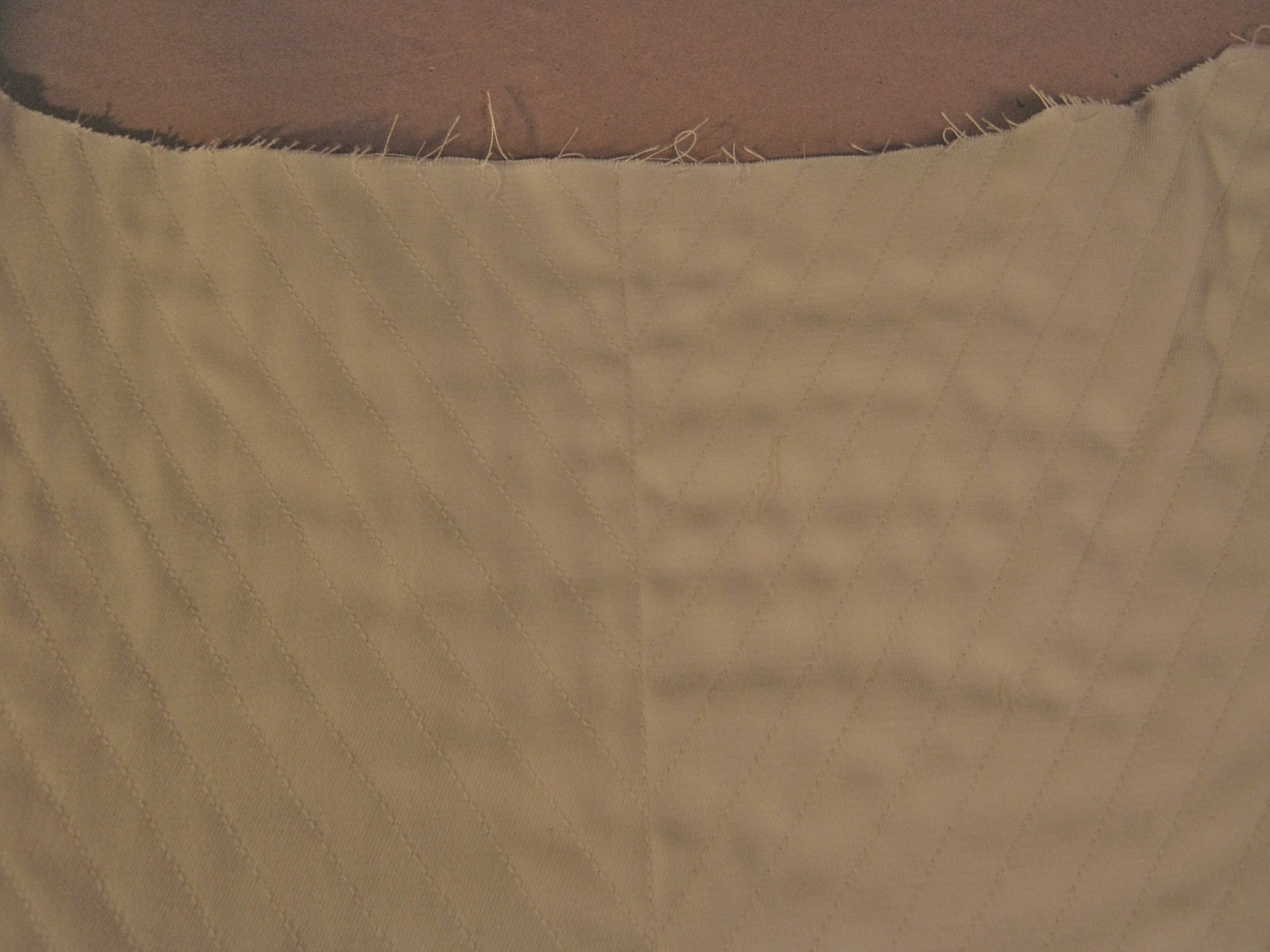
I didn’t want to stitch boning channels through my silk so I started the construction process by stitching the boning channels through two layers of cotton. You can see that I drew lines on the fabric so I could make nice, straight lines. The nice this about this is that I covered the pencil marking side with the silk, so on the inside of the finished corset all you can see is the stitching with no indication of pencil lines!
You can see the pencil guide lines on this side of the corsetOn this side there are no pencil lines!
I did want my silk to roll around the center back opening on each side and then be included in the seam attaching center back to the next piece, so I stitched those silk pieces into the seams of the cotton. I just kept the silk out of the way while sewing the boning channels. Then, once the boning was complete, I stitched the remaining silk pieces to the flapping center back pieces and turned the whole thing so that the silk was on the outside with the seams facing the side of the cotton that had the pencil lines drawn on. Thus, the silk is just a covering for the cotton, it is not actually attached into the seams of the cotton except on the inside at the side back seam. You can see what I mean in the pictures below.
Stays with the boning channels sewn (you can see that only the center back silk pieces are attached at this point)Stays with the cane boning inserted, before the silk is sewn onThe silk has been attached (you can see the cording and the pattern on the silk in this picture)
At this point the stays are almost finished! The last few tasks are to bind the edges (I’ll be using bias strips cut from the same cotton as the cording and lining) and work hand sewn eyelets along each side of center back. More pictures to come!






















 The Quintessential Clothes Pen