Meet Georgina!

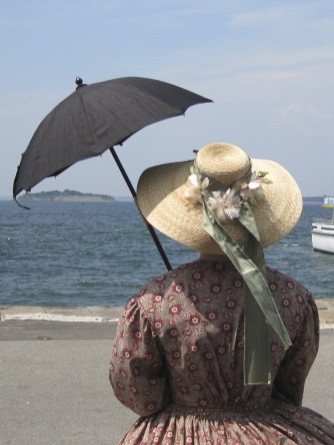
“Georgina” is the name I’ve chosen for my new 1858 cotton print day dress. Being a day dress from a new decade (the 1850s), makes her a fabulous new expansion in my wardrobe of historic clothes!

IMG_4675
Georgina: 1858 cotton print day dress.
IMG_4671
Back view.

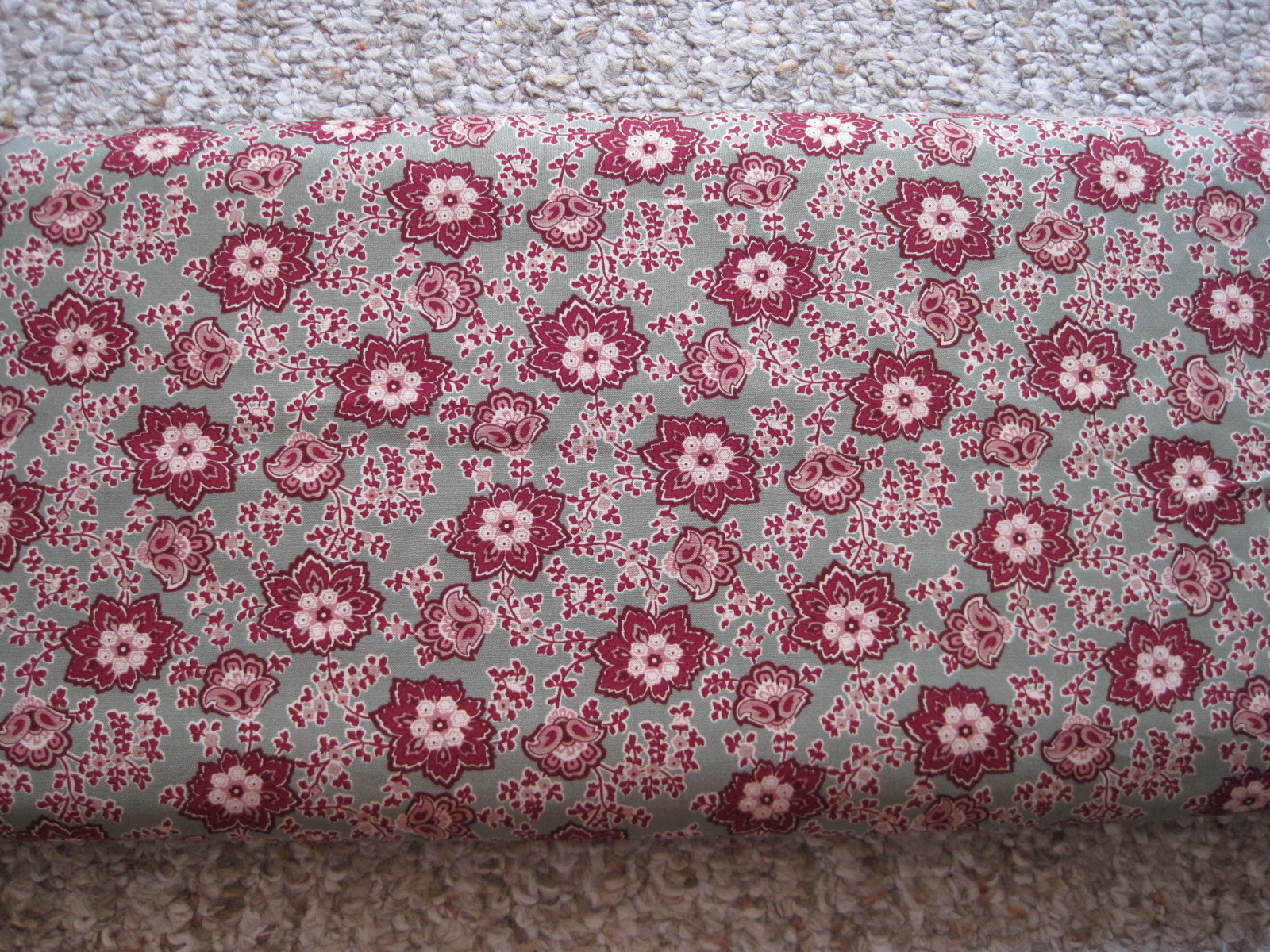
The dress is constructed from about 5yds of a Marcus Brothers reproduction historic cotton print I purchased earlier this summer. I used Past Patterns #701 and #702 bodice patterns as a starting point, though I had to make significant alterations to achieve a comfortable and pleasing fit, especially in the shoulder/armsceye area. I used the darted pattern for the fitted lining and the gathered pattern for the gathered exterior. The sleeves are the bishop sleeves from one of the patterns, though I totally changed the cuff design.

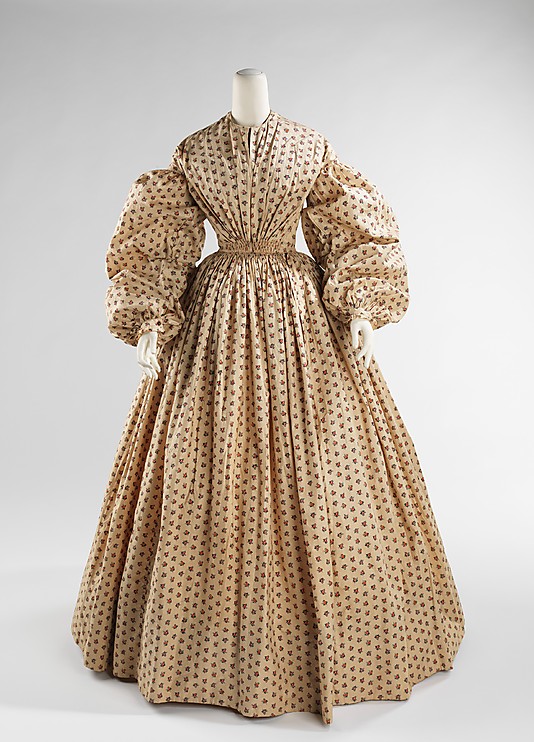
The cuff design and a lot of other fiddly details were taken from this c. 1852 dress at the Met (pictured below). If you zoom in on the cuffs on the Met website you can see that they look just like mine (pictured later in this post)! I also used the following design elements from the Met dress: piping at the neck and waist, gathers that are tacked down beyond the seam line, button closure on the cuffs, and cartridge pleating all around the skirt. I have a whole pinterest board of inspiring images for this dress and hat ensemble, but this dress is the one from which I took the most information and detail.
61.141.3_front_CP4
c. 1852 Dress, Met.

Here are a few pictures of the fiddly details I integrated from the Met dress:

IMG_4773
Gathers at the center back that are tacked down beyond the seam line. I like the controlled look these extra stitches produce.
IMG_4767
Self fabric cuff finished with a small ruffle. The cuffs close with a hand sewn buttonhole and button.

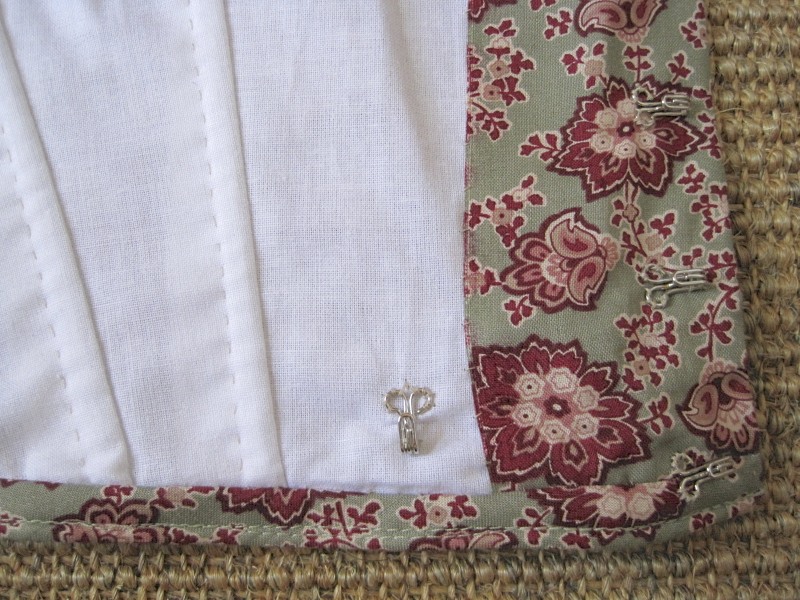
Georgina’s bodice is lined with white cotton. There are hand sewn boning channels sewn into the bodice in the front darts on each side and on the sides. The bones are then slipped in between the layers of fabric. I didn’t have the right length metal bones, so I used heavy duty plastic wire ties–but–I cut them in half the long way so they are much skinnier than normal (they just don’t look at all historically plausible in their normal width, in my opinion). Once they’re in the bodice, you’d never know they are plastic instead of metal.
IMG_4769
The proper left side of the bodice: hand stitched boning channels in the darts, front hook closure, a hook to attach the skirt and bodice together, and nicely finished piping along the bottom edge.

The bodice is finished at the neck and bottom edge with piping that is nicely whip stitched to the inside. There is also piping in the armsceye seam. The sleeve seams are french seamed by machine with the opening seam allowance at the cuff turned twice and stitched by hand. The other bodice seams are all machine sewn and the bodice is hand finished. The bodice closes at center front with hidden hooks and bars. It also hooks to the waistband of the skirt to keep the two pieces from gaping while worn.

The skirt has a wide hem that is hand stitched. The long skirt seams are machine sewn. The waistband is the same cotton print with an interfacing layer of canvas to create stability. The skirt is cartridge pleated and hand sewn to the waistband. There is a single layer of lightweight flannel folded into the cartridge pleats to give them a little more bulk than the thin cotton had on its own.

I also took the time to add pockets to this skirt! This turned out to be really useful for storing gloves, sunglasses, chapstick, a fan… with two pockets a lady can store so many things! Here’s how I made them and sewed them into the skirt:
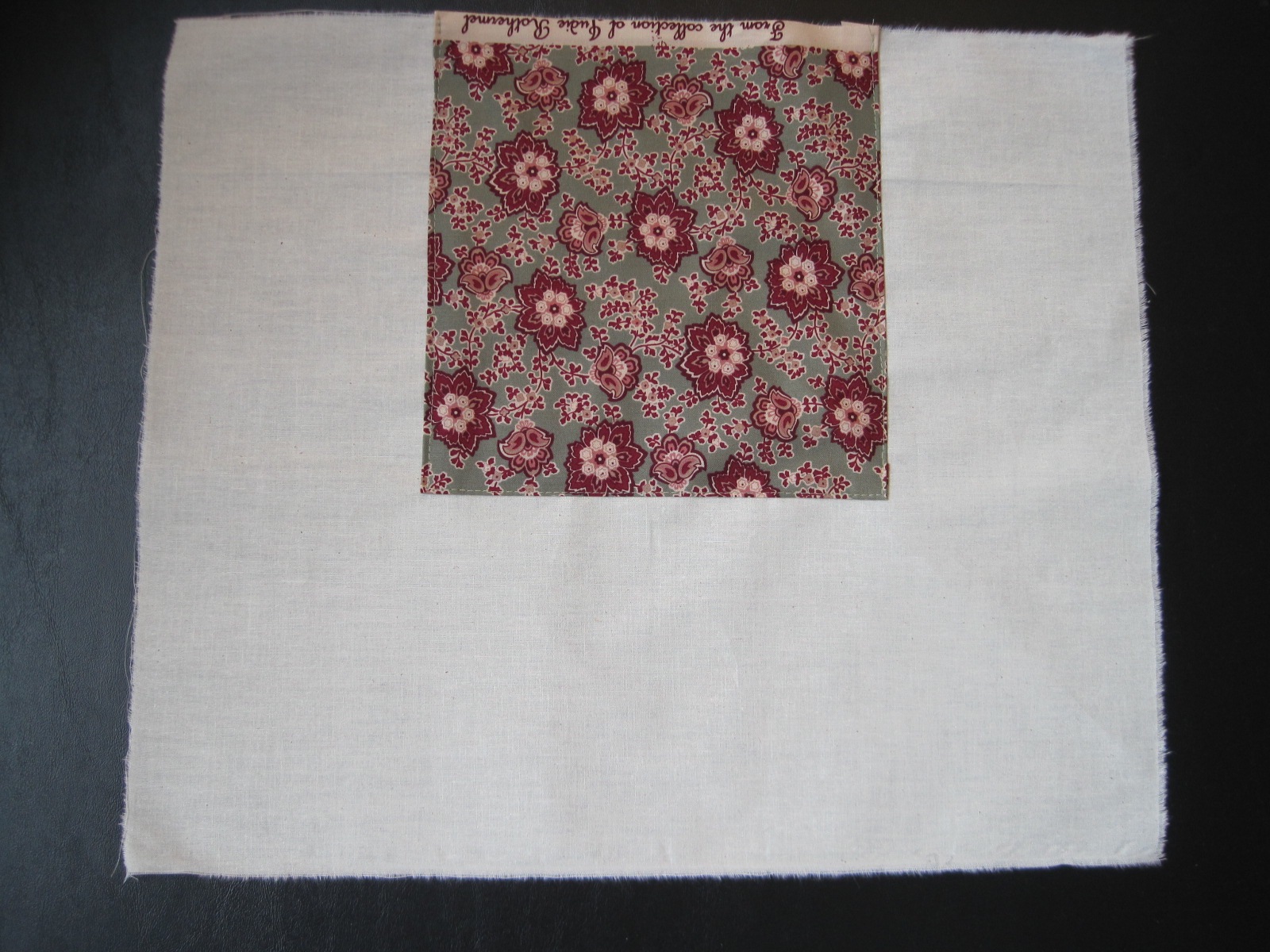
IMG_4597
The pockets are muslin rectangles with a piece of the cotton print topstitched on the top center (this is the part of the pocket that can show while I’m wearing the dress and taking things in and out of the pockets).
IMG_4598
After the cotton print was sewn on I french seamed the vertical seam and then the bottom seam by machine, making sure that the cotton print stayed centered. On the left is what a pocket looks like with the french seams facing out. On the right is a pocket turned inside out to show the cotton print centered at the top.
IMG_4777
I left the top part of the vertical seam open and hand sewed that into slits in the skirt using a whip stitch through the pocket and the seam allowances (essentially under stitching the pockets, which keeps the muslin from rolling to the outside!). The pocket slits were made after the skirt was cartridge pleated and attached to the waistband, so the slits stop below the cartridge pleats (it was way too much thinking to try and figure out where the pockets should be before cartridge pleating the skirt!).
IMG_4778
It worked wonderfully, and the pockets blend right in and are hardly noticeable, even when they gap open! (I’ve turned the edges of the pocket so you can see the muslin pocket for this picture, but they don’t actually stay turned out like that, and you can imagine how the print fabric of the skirt blends right into the print section of the pocket).
IMG_4775
On the inside, the top edge of each pocket is stitched to the cartridge pleats to evenly distribute the weight of anything in them.

Georgina cost about $18: $15 for the fabric and about $3 for hooks and eyes. The various other fabrics (cotton lining, canvas interlining, etc.) were all in my stash from previous projects (yay!). I first wore Georgina last weekend to a vintage dance performance on George’s Island in the Boston Harbor. I’ve got pictures of the performance and pictures of island exploration coming up soon!

HSF #16: Eugenie Inspired 1857 Straw Hat

I recently participated in an outdoor mid-century dance performance for which the weather was an un-obliging 90-something degrees + humidity. Yup, not kidding. It was HOT! And we were dancing on asphalt. Luckily, we were out on an island in the Boston harbor and had a breeze. But it was HOT!

Anyway, more on that performance soon, because it involved a new cotton print day dress made from one of my recently acquired historic cotton prints! In addition to the dress, I also restyled a straw hat to go with the outfit and keep some of the sun off of my head. The hat has been used with various other clothes (1780s and Regency come to mind), but I had only ever added a simple ribbon to it rather than really styling it. This was the perfect opportunity to really make something of the hat!

I wanted to keep it simple and in the 1850s/60s, so I started by adding inspirational images to my pinterest board for this project. I visited the board many times before making a decision that I loved the shape of Eugenie’s straw hat in this painting. The hat has that nice downward curve in the front that sort of frames the face and accentuates the fashionable heart shape. The gauzy/tulle trim was a little whimsical for my purposes, so I opted for a more subdued and practical trim style on my hat.

Empress_Eugénie,_Hillwood_Museum,_1857
Franz Xaver Winterhalter (1805–1873) Eugénie of Montijo, Empress of France Date 1857

I started by wetting my hat in the bathtub then tying it with string so it would dry with the curve that I wanted to achieve in the brim. I also wanted the back to curve under a bit, so I let the hat curve on both sides.

IMG_4612
Tying the hat to create curves.

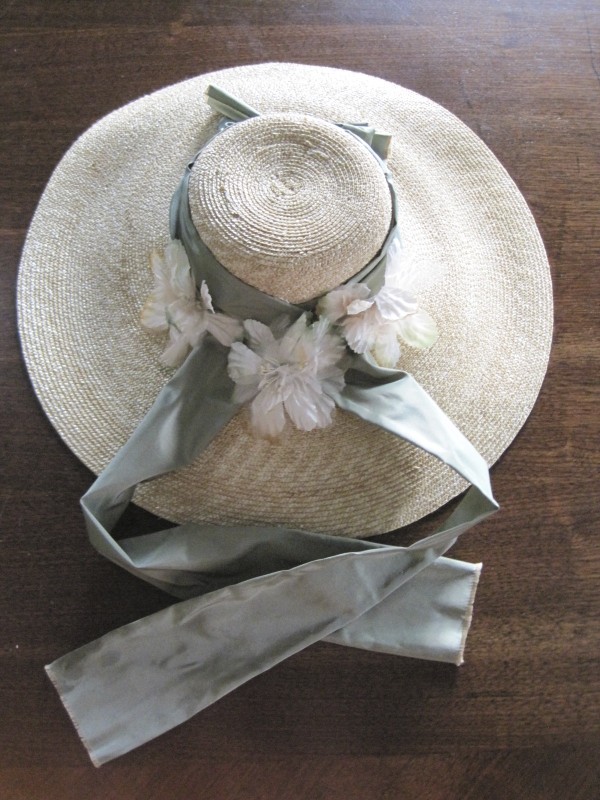
Once the hat had dried all that was left was to trim it! I chose to use green silk left over from Evie, my 1864 ball gown, and some silk millinery flowers. The silk is narrow hemmed on both sides and the ends are fringed, showing gold threads (the fabric is green/gold shot taffeta). The long ends hang down the back while the hat is worn, a style like the one below which you can see in the images on my pinterest board. I also added a bow on the front like you see in the images. Turns out that the bow is not quite centered… whoops!

56737fd6fd819eb71c2360fd4be5679f
LAPL, Magasin des Demoiselles, August 1858

And here is the result of my labors, and my fulfillment of the HSF Challenge #16: Separates. “Make a non-matching garment which can be paired with other items in your historical wardrobe to extend your outfit choices.”

IMG_4729
You can’t see the curve since the hat is sitting flat on the table… but you can see the trim!

Just the facts:

Fabric: A 4″ width of green silk 60″ wide plus a few scraps.

Pattern: None.

Year: 1850s generally, 1857 specifically.

Notions: Straw hat, silk flowers, thread.

How historically accurate?: I give it 98% (and that’s pretty high for me!). Straw, silk, more silk… The sewing machine was even invented by 1858, so the machine sewn hat isn’t totally out of the realm of possibility. The -2% is for the polyester thread.

Hours to complete: 2, not including time for the straw to dry.

First worn: July 20 for a vintage dance performance on George’s Island in the Boston harbor.

Total cost: I bought the hat a few years ago for probably about $25, the silk was leftover from another project, and the flowers cost some small number of cents since I got them as part of a large box for only $5! Let’s just say $26 total.

IMG_4617
Back view of the hat on my head. See how the front dips? This is also a sneak peak of my new gown, Georgina, to whom you will be formally introduced soon.
IMG_4623
Front view. See the dip?

At first I thought I had made the curve too pronounced, but when I look at the pictures again, I think I was pretty darn spot on! Woo! Completed new separates accessory for my historic wardrobe: check. Oh, and did I mention I’m in early on this project? The deadline is August 12!

Historic Cotton Print Eye Candy

I was recently able to visit a wholesale quilt fabric company to purchase historic dress fabrics for an upcoming mid-19th century performance on behalf of me and other members in my vintage dance troupe. It was such a treat! The majority of the fabrics we found were Marcus Brothers fabrics, but RJR also had a smaller number of really lovely fabrics.

IMG_4487
Marcus Brothers Gettysburg Print 1840-1860. To make an1850s day dress.
IMG_4486
Windham Fabrics Colonies Archives Print c. 1850 and Marcus Brothers Charleston II Print. For other 1850s/60s day dresses.

There were so many lovely things, but the best part was the prices! All of the fabrics were between $2.50-$3.75 a yard! You had to buy a bolt, which varied between 7 1/2 and 15 yds, but at those prices it’s still outstanding! We came away with fabric for the 1850s/60s dresses and bit more besides… There were some things that were just so fantastic they couldn’t be left behind!

IMG_4479
Marcus Brothers Old Sturbridge Village Print. To eventually make an 1840s dress! It’s going to be so pretty! I love this fabric and the colors (it’s actually yellow and pinkish flowers with brownish vines).
IMG_4481
RJR Print. I have no idea what I will make with this, I just love it. I find it to be so striking!
IMG_0422
Another sample of the lovely prints. These were purchased by a friend. One will be used for an 1860s dress, eventually, and the other will possibly be used for an 1840s dress, eventually.

Don’t worry, there will be upcoming posts with more on the 1850s day dress I’ll be making as well as the other much farther in the future projects. And I’m sure I’ll also have great pictures from the mid-19th century performance as well.

First Picnic Of The Summer: Part I

Last weekend was a whirlwind of events and that means I’ve got lots of pictures to share! The pictures will be coming in small-ish groups. I do hope you’ll be able to vicariously enjoy the nice weather and fun through them.

The first event was a low-key turn of the 20th century picnic in the Boston Public Garden. You might remember that last year we did a Regency picnic in the same place? We were out to have a good time and get some fresh air without worrying about 100% historical accuracy, hence the low-key part of the description. So without further ado, pictures!

IMG_2651
Taking a turn about the garden.
IMG_4492
There are lots of ducks in and around the swan pond in the center of the garden and this time of year you can also see baby ducks! There were 9 of them in this bunch. Aren’t they cute?
IMG_4502
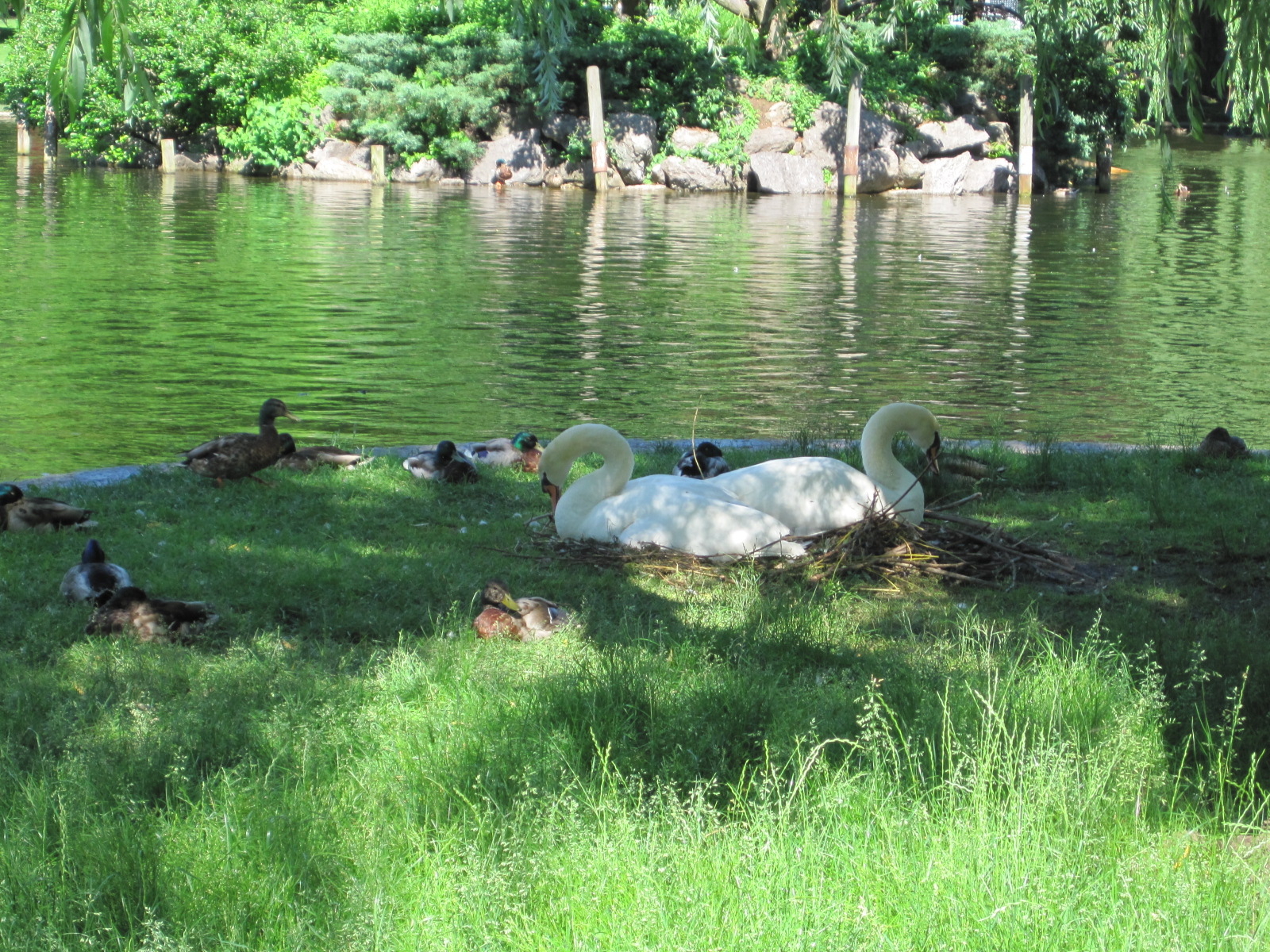
There are also swans around the swan pond. These ones were nesting in a fenced off area. Pretty, but you wouldn’t want to get too close. Swans are big, and mean.
IMG_2880
There are lovely old trees around the garden as well.
IMG_2913
The trees make great backdrops for photos.
IMG_4509
Walk a bit away from the swan pond and you are likely to encounter George Washington, who happened to be showing off his Bruins spirit this past weekend. (I love that the city, presumably, had a custom all-weather jersey-cape made, since Washington can’t actually move his arms to put on a jersey, given that he’s bronze…)
IMG_4524
All around the statue of Washington are lovely flower beds. The flowers get changed out pretty regularly so they’re always blooming and pretty. These flowers are my favorite though! They’re called allium, and I love the colors, and the size, and the circle-y-ness of them.
IMG_2699
I believe I have a weakness for circle-y things. And, my outfit matched the flowers! I think my gibson-y hair turned out pretty well, too.
IMG_2704
I know this picture is similar to the last one… but I can’t decide which one I like best. I’m hoping maybe you have an opinion that will sway me one way or the other?
IMG_2743
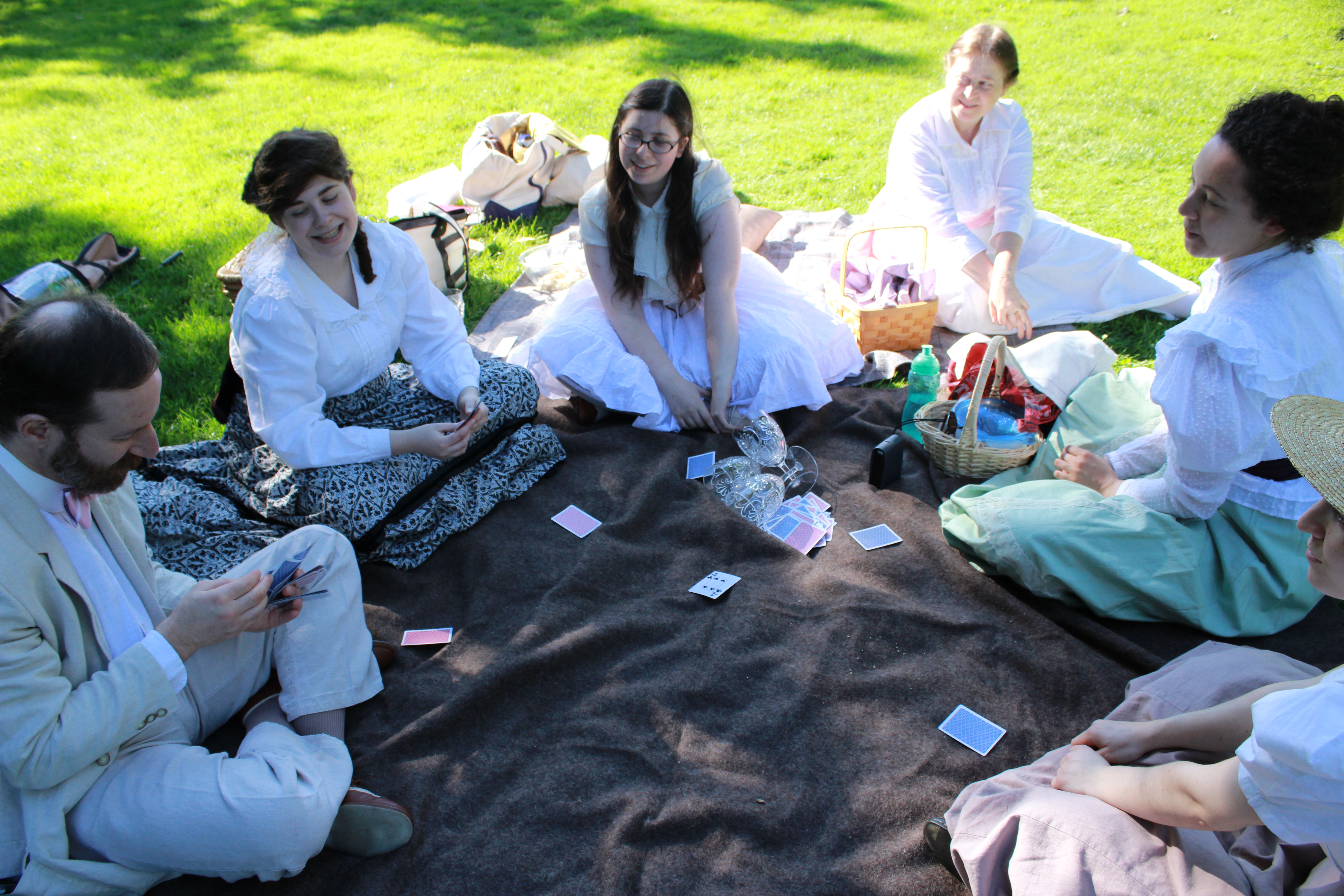
It got warm promenading about the garden, so we returned to the blankets in the shade to play cards.
IMG_2803
After the rest, we broke out the croquet set we had brought along. Apparently we were more interesting while playing croquet than we were at any other time during the day, because we actually gathered a crowd of people who were watching us play.
IMG_2814
Contemplating my next shot. I was getting out of the metal panel obstacle…
IMG_4552
I was the pink ball! I think it was supposed to be red, but it looked awfully pink to me!
IMG_2845
My outfit choice was inspired by an image in the KCI collection. I did my best to imitate it in spirit, despite my lack of a boater.
ce257125a81f4b3e3a2f99407ae4f099
When revisiting the image I realized that it does not include a croquet mallet. Be that as it may, I tried, and I think the inspiration is clear, even though my memory is not!
IMG_2787
Picnic-ers!

Regency Kites!

Well, it’s June now, and that means summer to me. I’ve been slow to post about my kite making adventures because I was busy posting about other things, but it seems fitting for this post to be the first one of June–summery, somehow.

After the official end of the Regency Dance Weekend I’ve been posting about recently, my friends and I stayed in the Salem area to relax a bit and have some further Regency adventures. We had been brainstorming about what sort of activity we might engage in that was outside of our usual occupations and had settled on the idea of flying kites!

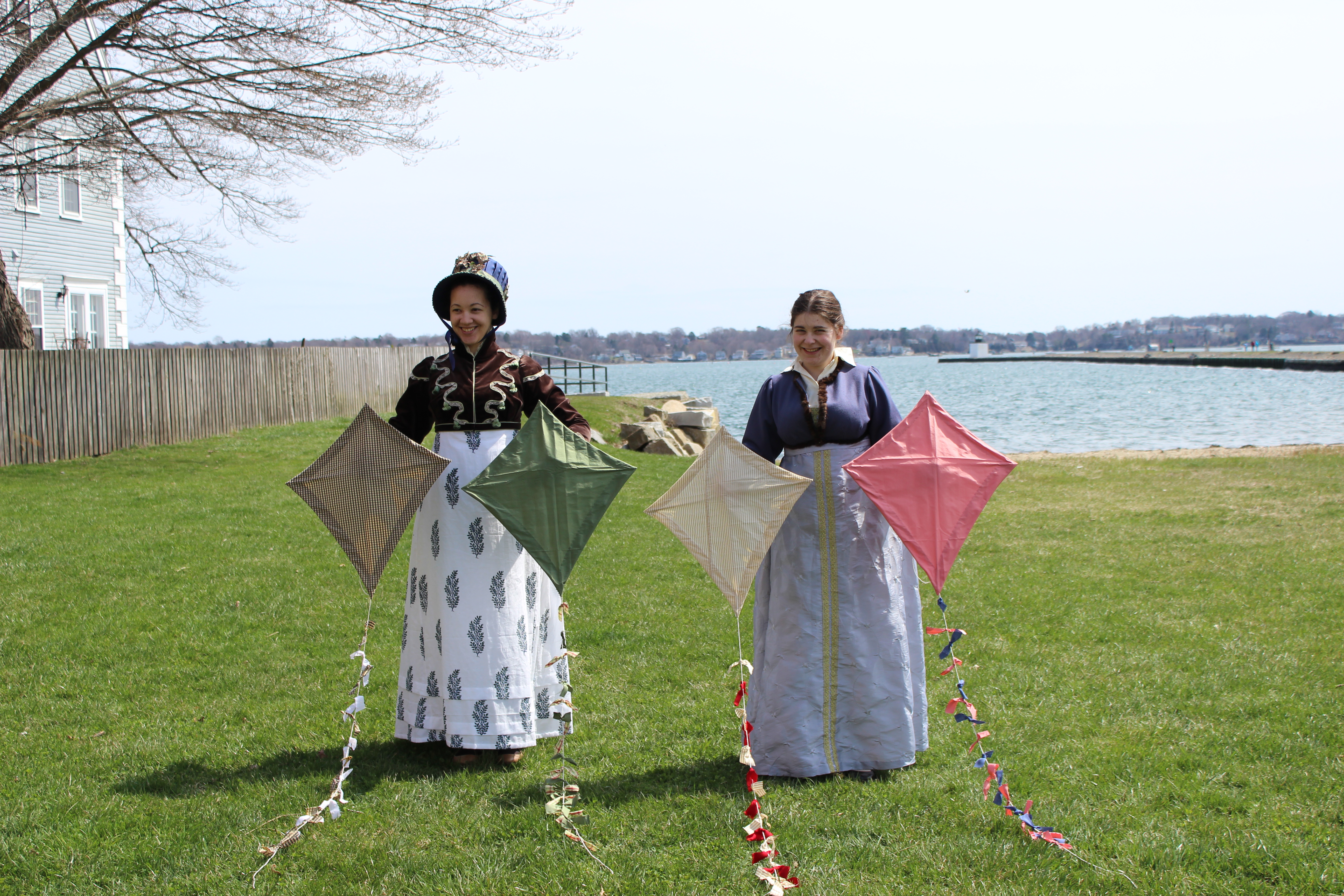
I did some research into Regency kites and spent some of my evening time during the weekend sewing these four silk kites with some help from friends.

IMG_1241
Plaid, green, striped, and pink.

I didn’t find much to go on with the kite making. The best source I found was Jen’s post about Georgian Toys on her blog Festive Attyre. The post includes a link to this kite making how-to as well as a link to this 18th century extant kite. Unfortunately, I couldn’t find more information on the extant kite than that which is on that one page. Jen’s post is great and includes fun information about other Georgian toys as well as kites. The how-to link is a good one as well, though I did sub out modern methods for more period ones. For example: there is no tape to be found, instead there are stitches.

Making the kites was fun. I went to Home Depot to buy the dowels for the kite frames. They were cheap and luckily you can saw the lengths to be what you need while you’re in the store (good for me since I don’t own a saw!). I also bought twine there. It’s a poly-cotton blend (boo), but it’s smooth on the hands, so that’s worth it! The kite tails are bits of the main fabric and a contrasting fabric just tied around the twine. Instead of notching the ends of the dowels after they were cut (I tried, and it failed, because the dowels just wanted to splinter) I just wrapped the twine around the ends enough times that it wouldn’t move. The method definitely worked and sometimes that’s all you need.

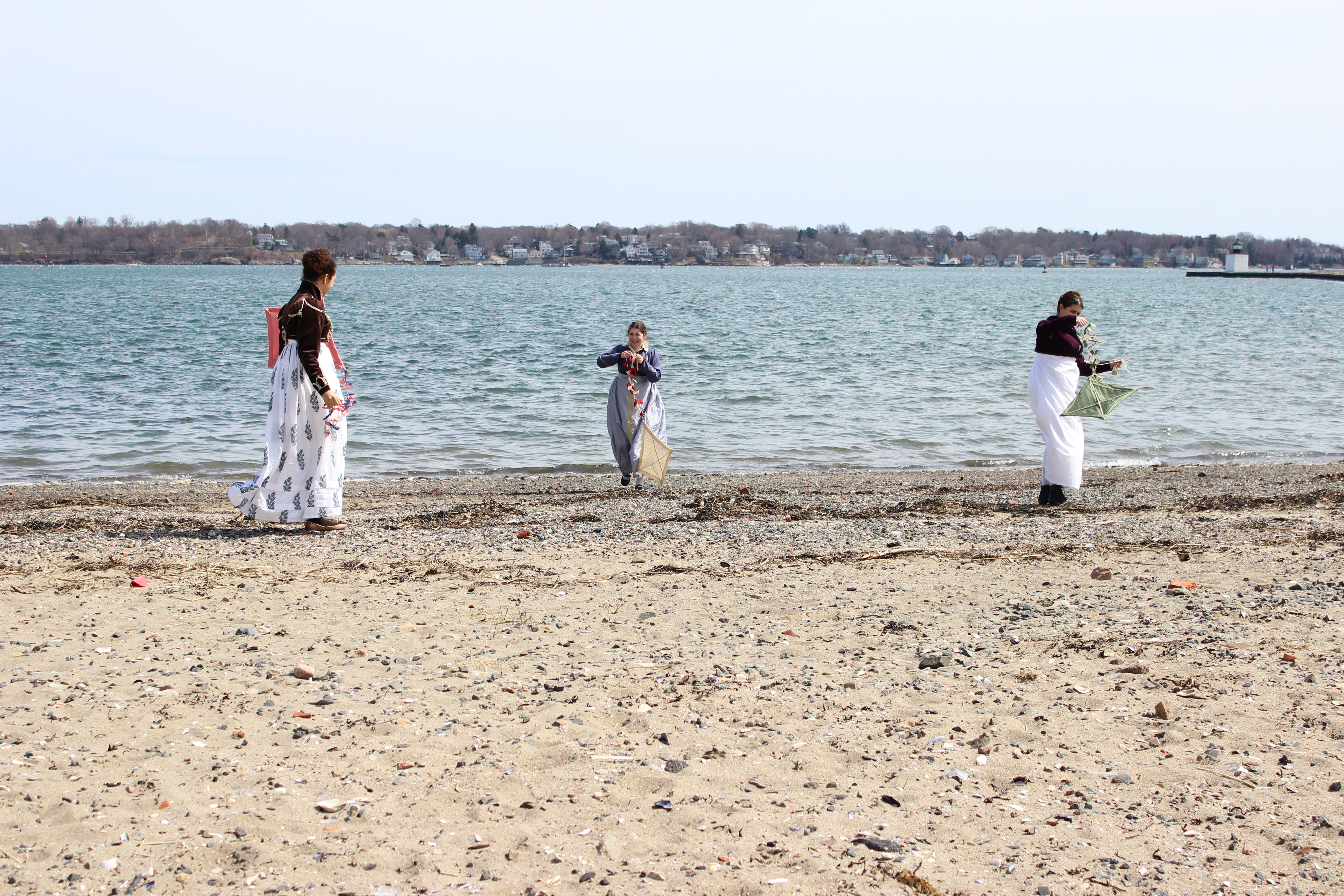
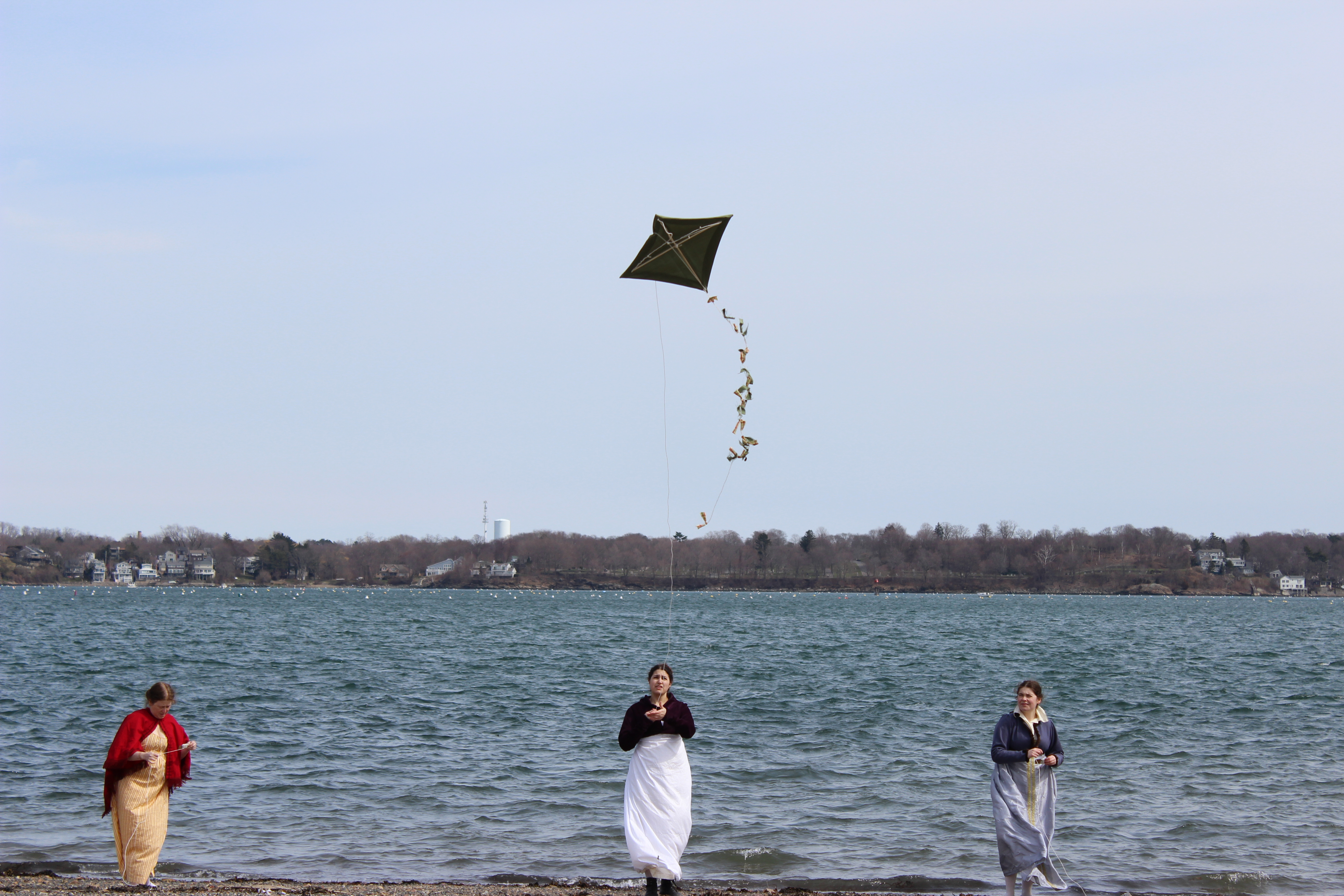
Despite the fact that it was super windy by the water, we had trouble getting the kites to stay in the air. I’ve surmised that my kite engineering skills are not super outstanding, because the kites did lots of circles near our head height and then dove into the ground… over and over and over again… It was a bit frustrating. These pictures capture the few times we got the kites up in the air. Trust me when I say they didn’t stay up very long!

IMG_1255
Perhaps a running start?
IMG_1256
Perplexed but still trying.
IMG_1279
Clearly this kite did not want to go up.
IMG_1378
Triumph! (If only for the moment!)
IMG_1266
This kite had the best luck at staying in the air.
IMG_1363
Another successful moment.

There were some adjustments and kite injuries along the way. One of the dowels in the pink kite broke, so I have to figure out how I’m going to fix that. The other kites had things like alternate bridles made and pennies sewn into the edges to try to add weight. Some of those things seemed to work. I guess I just need to do some research about what makes kites stay up. I’m not sure the tails worked very well, either. They tangled easily and were hard to sort out again. If you know anything about kite making and have tips, I’d love to hear them!

This is definitely something I plan to work on and try again. Perhaps at a summer picnic? We’ll see. It was a fun endeavor, despite the diving kites (and I had the opportunity to wear my new Tree Gown again!). Plus, there were pretty places nearby to take pictures!

IMG_1223
Perfect photo opportunity.
IMG_1198
It was pretty windy, so hat holding was totally necessary!

Regency Dance Weekend Part VI: Grand Ball

The time for dancing has arrived! You’ll remember that I recently shared pictures of the reception on the Sunday evening of the Regency Dance Weekend as well as the sharing of the train at that same reception? I’ve been promising to share ball pictures and finally, the time has come. Without further ado…

IMG_1027
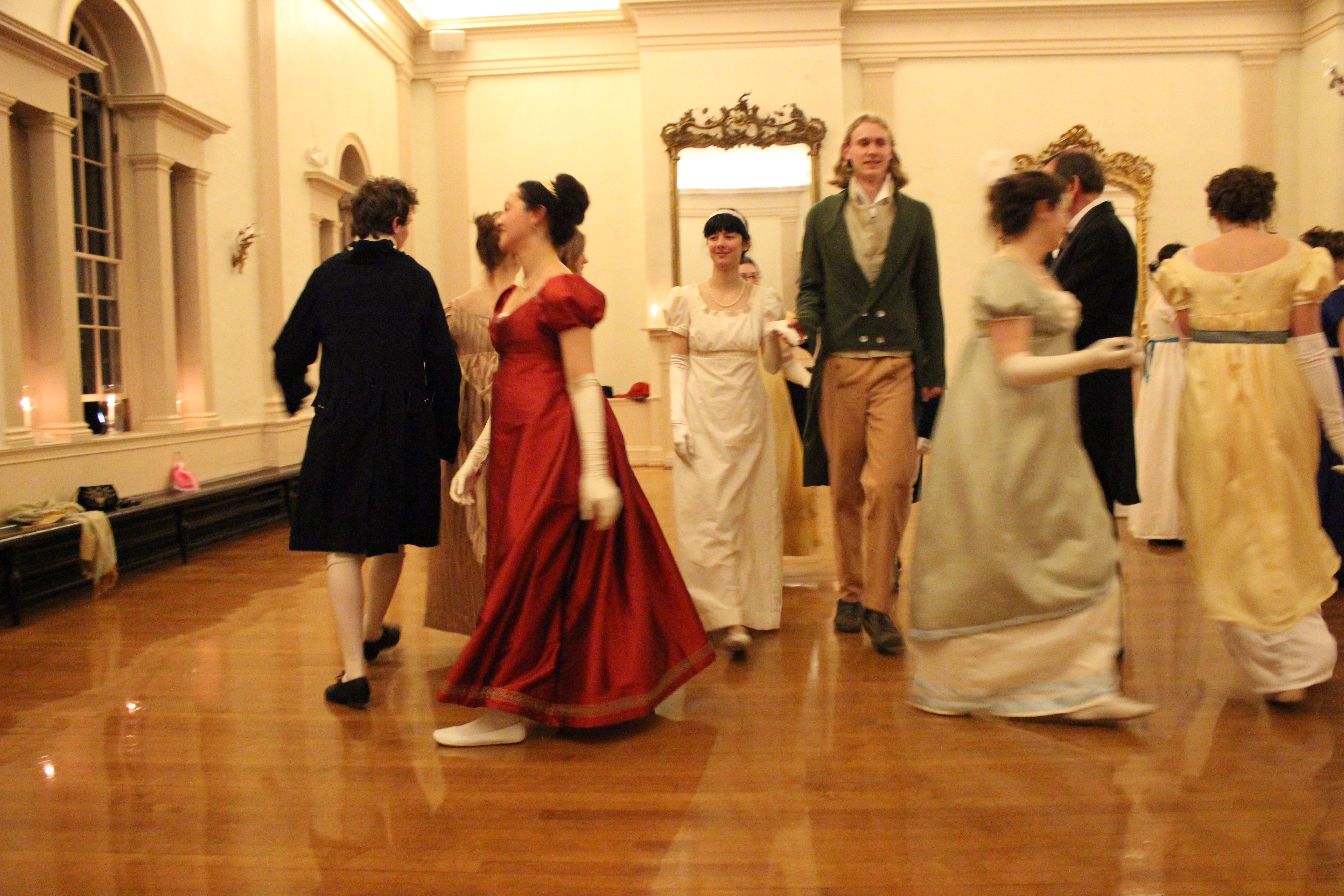
The Grand March. We had a good quantity of people this ball and because of our practice during the daytime classes all of the figures looked really good!

The Grand March was followed by a good number of country dances and figured waltzes. It was an amazing experience to have a room full of people who had already learned the dances and were able to dance them without instruction. We were able to complete dance after dance after dance and it wasn’t long before it was time for some refreshment.

IMG_1054
Punch had been nicely laid out in the refreshment room earlier in the evening.
IMG_1053
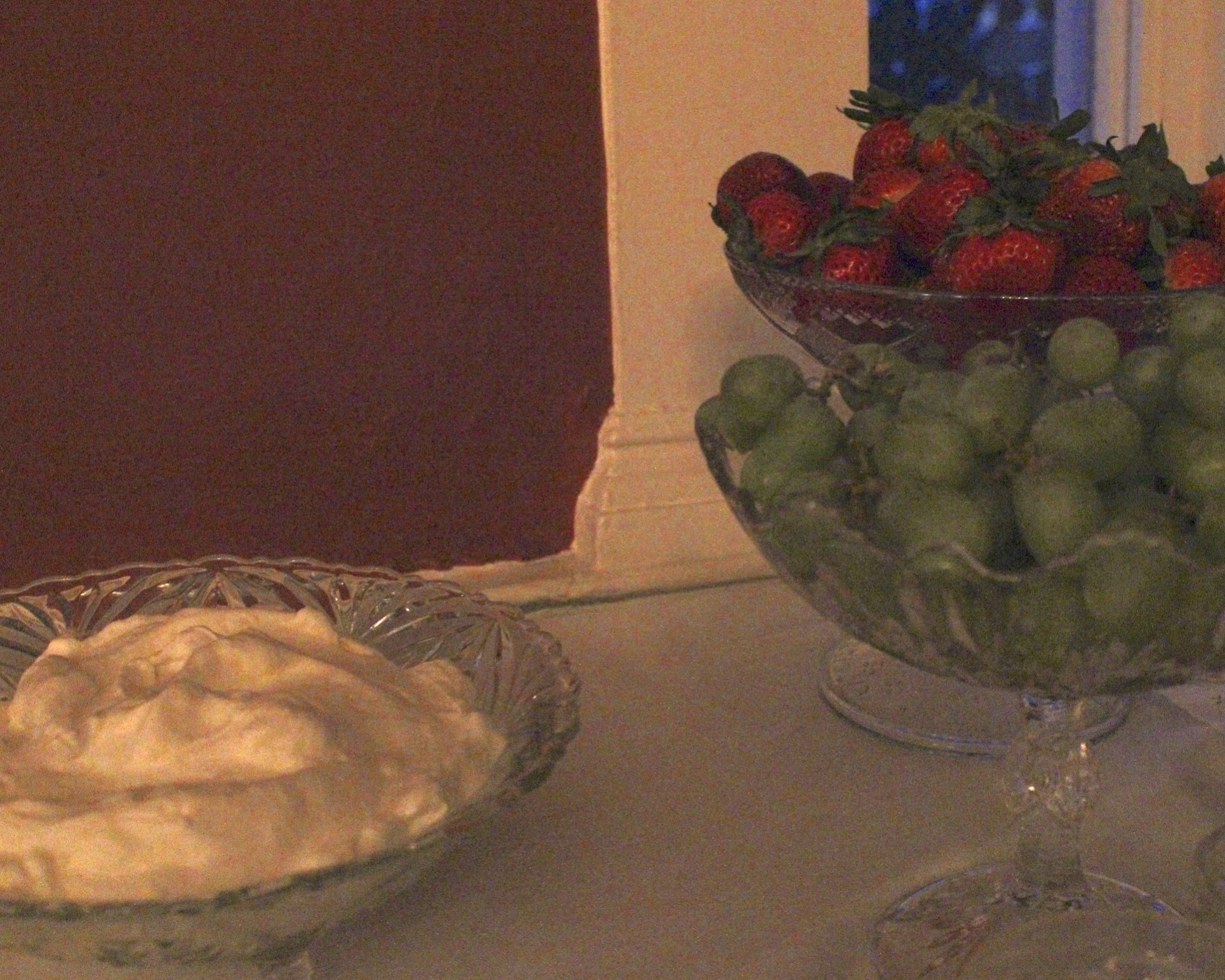
There were cookies, and fruit, and syllabub (sweet cream) with pound cake, just to name a few delicious treats.
IMG_1066
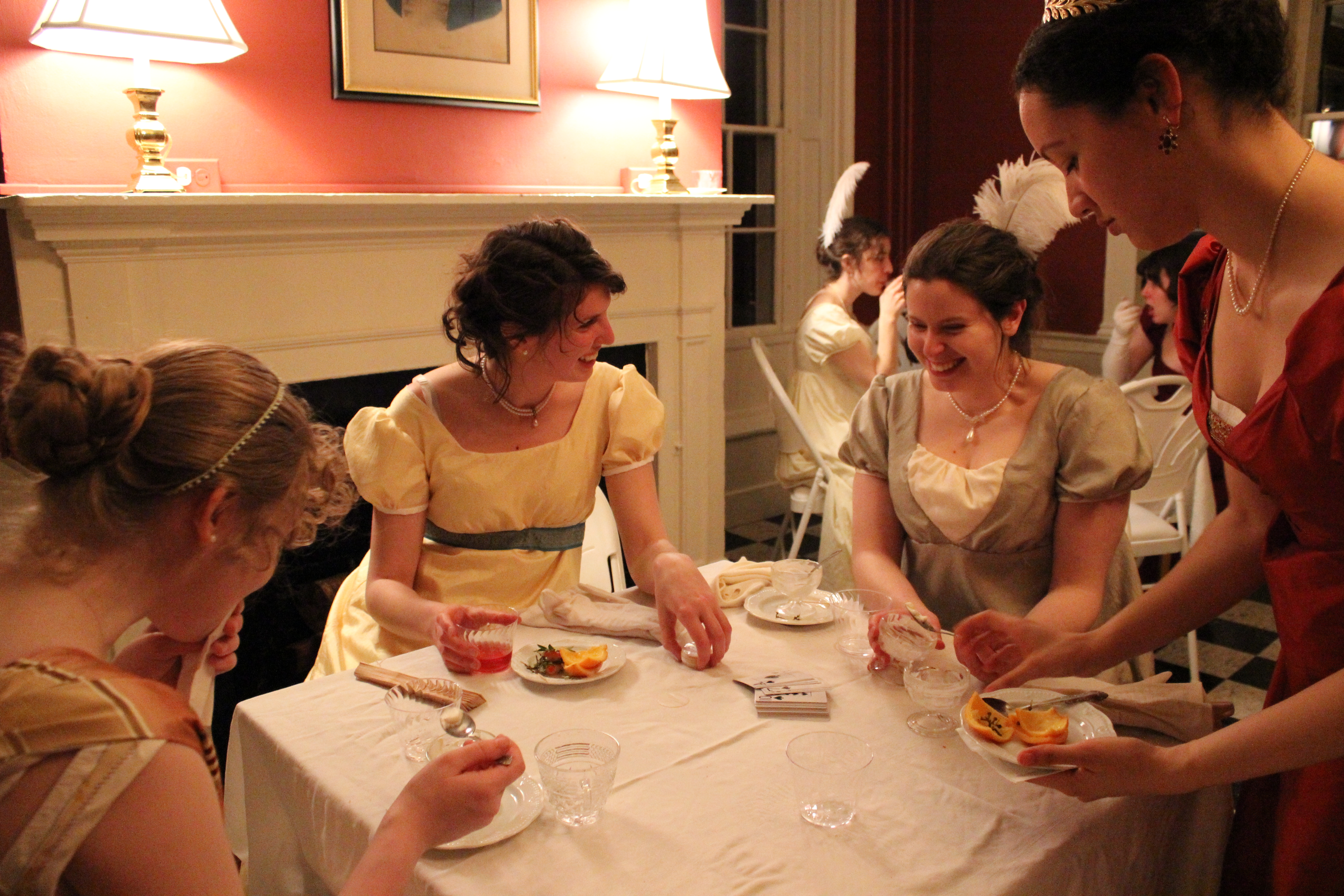
The refreshment room also had small tables set up to encourage chatting while eating.

Unlike some of balls during which we have refreshment breaks, at this ball a person could break for refreshments at any point in the evening. It was a nice change, and especially since we did so much dancing and less standing and listening, it was particularly useful to refresh oneself throughout the evening.

IMG_1058
Of course, there was the opportunity to chat with friends and family throughout the evening in addition to time spent in the refreshment room.
IMG_1070
Setting up for a country dance. Or perhaps this was Sir Roger De Coverley?
IMG_1098
Yes, I believe that was Sir Roger. This was later in the evening after sillyness had set in… We were changing partners and gentlemen/lady positions just to keep things interesting.

Goodness! By the end of the evening my legs were feeling all the dancing of the weekend. The characteristic Regency upbeat rise was getting harder and harder to achieve… But what an event! What a weekend! It was so full of fun, and getting to know new people, and learning dancing… Really, an exquisite experience.

Regency Dance Weekend Part V: Sharing The Train

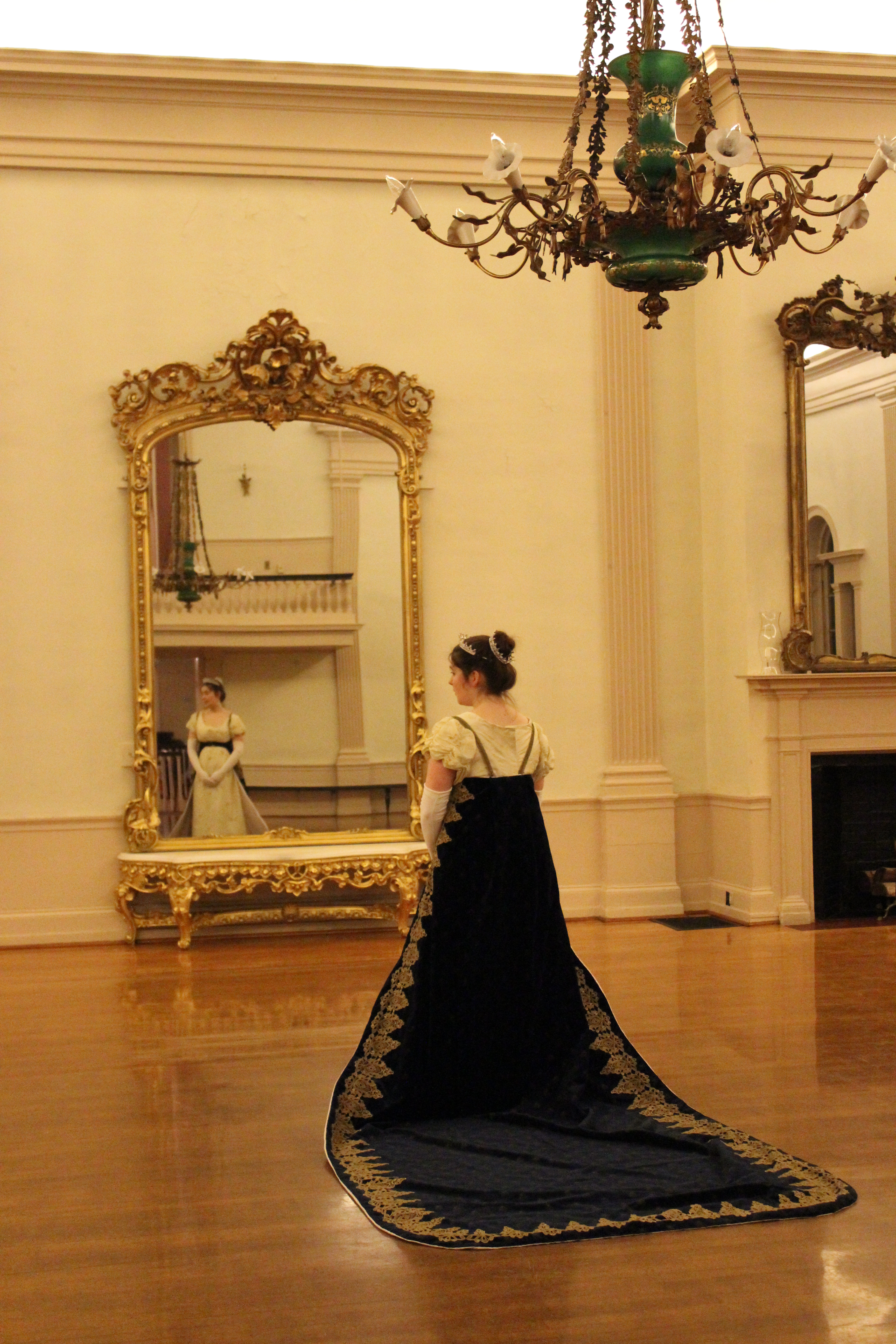
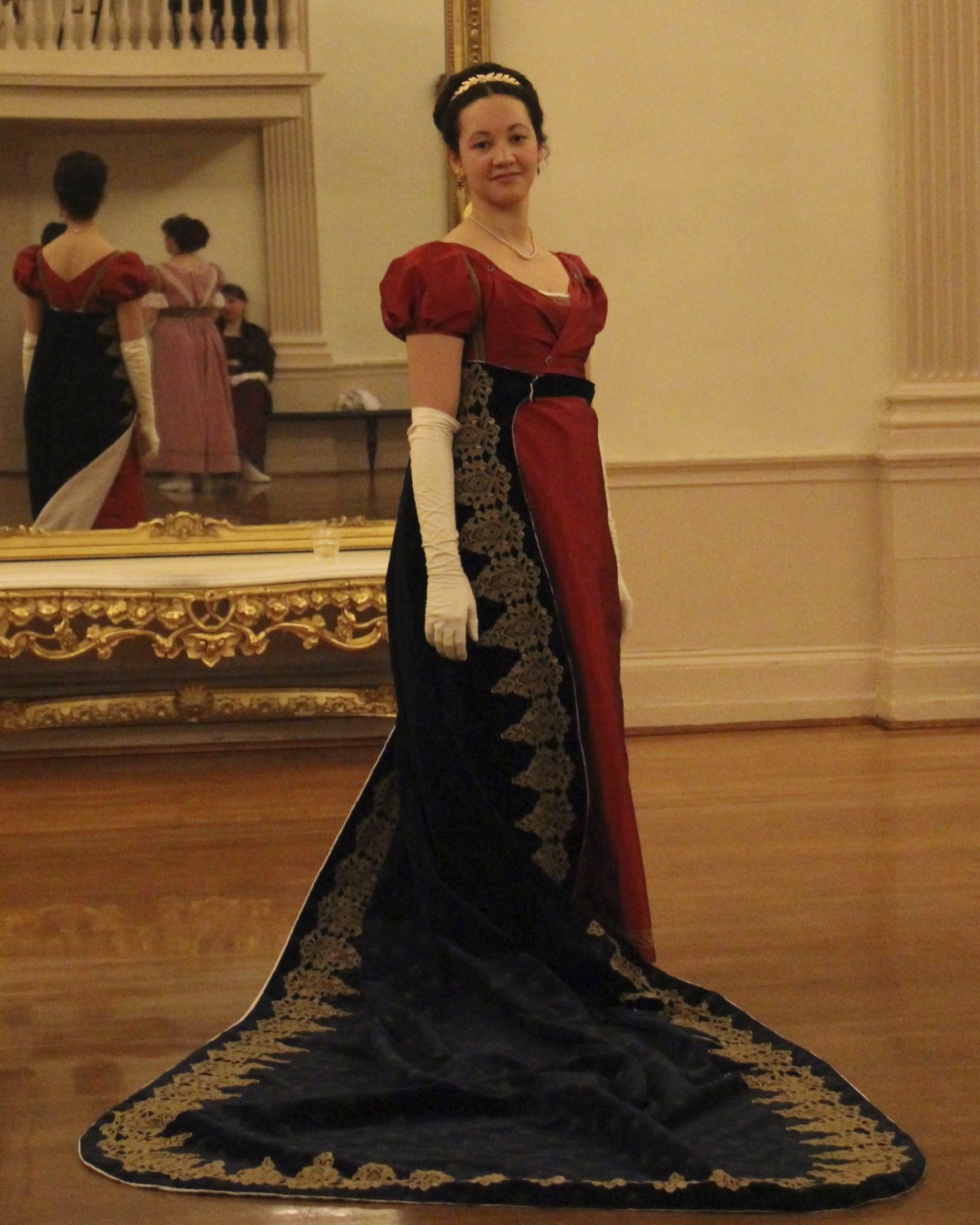
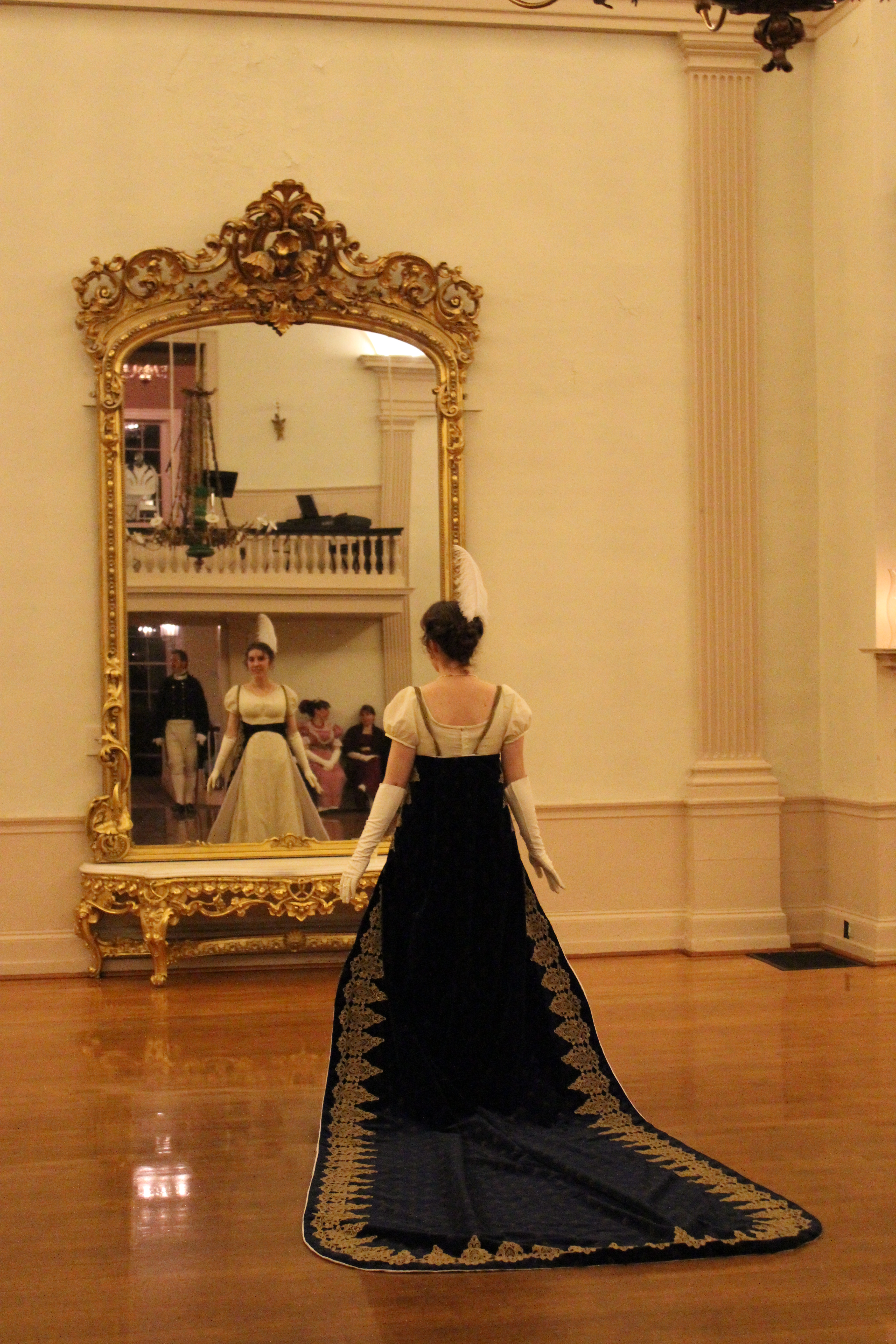
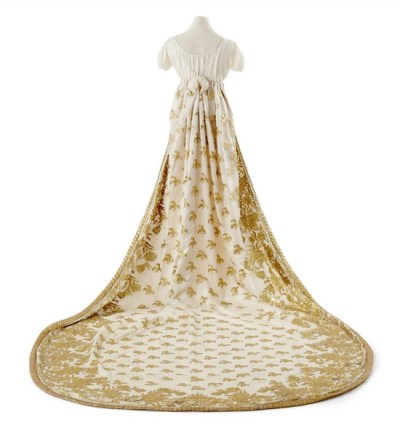
I’m eager to share pictures of the grand ball with you, but I want to insert this post before continuing to ball pictures. One of my friends had the ambition to complete a Regency court train to wear during the reception I showed pictures of last post. It’s a pretty fabulous train made of velvet printed with golden bees and trimmed with opulent gold lace.

IMG_1162
The actual owner and maker of the train.

It’s not the sort of thing to be danced in, but that’s fine, because it attaches at the waist, so it’s easy to take off. During the course of the evening some of us tried on the train and tried out different poses in it. So nice of Antonia to share with all of us! It was quite grand and fabulous.

IMG_1125
Benevolent royalty face.
IMG_1144
Elegant royalty face.
IMG_1131
Aloof royalty face.
IMG_1142
Exuberant royalty face.
IMG_1121
Pretty pretty princess royalty face.

It’s my blog, and that means I can share as many pictures of me as I want…! Spoiled sounding? Probably… Okay, fine, I’ll return to my more humble un-royalty roots.

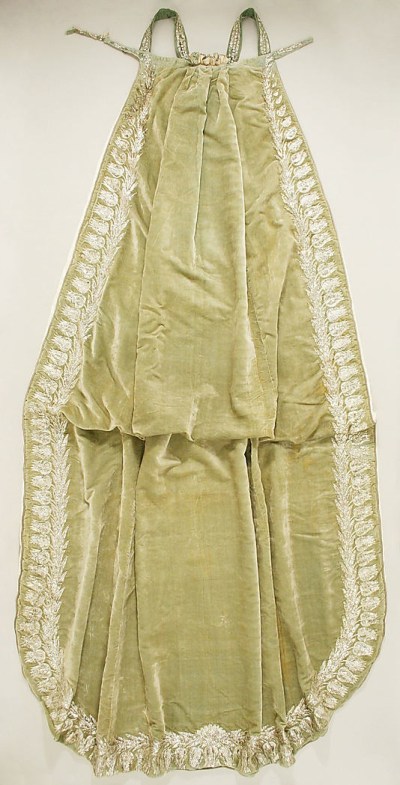
There are some absolutely stunning extant court trains out there. Here’s my pinterest page of court gowns and trains from all different periods. And here are some of my favorite Regency court trains to inspire you.

2a9f7d18f6efa162da388068a6fd2796
ca. 1809. The Met.
6127903c863106593286fb768cf6f770
1809. The Met.
6eb9ea6b01ad25fc4f8645202f685d93
First Empire From the Chateau de Malmaison Costume Collection app
fcb6d976814d2a2975ae67d9b284948c
First Empire From the Chateau de Malmaison Costume Collection app

There is an event at Dress U in about a month that requires court gowns or trains. I won’t be there, but I’m looking forward to seeing pictures of other people’s fabulous court trains! I hope you’ve enjoyed these silly pictures. I promise that the next post in this series about the Regency Weekend will be pictures of the ball: no more delays!

Regency Dance Weekend Part IV: Reception

Having successfully completed the first day of the Regency Dance Weekend and then archery on Sunday afternoon, we hurried off to prepare for the Grand Reception and Ball on Sunday evening. These events were held at Hamilton Hall in Salem, MA. This hall that was built in 1805: perfect for our Regency events!

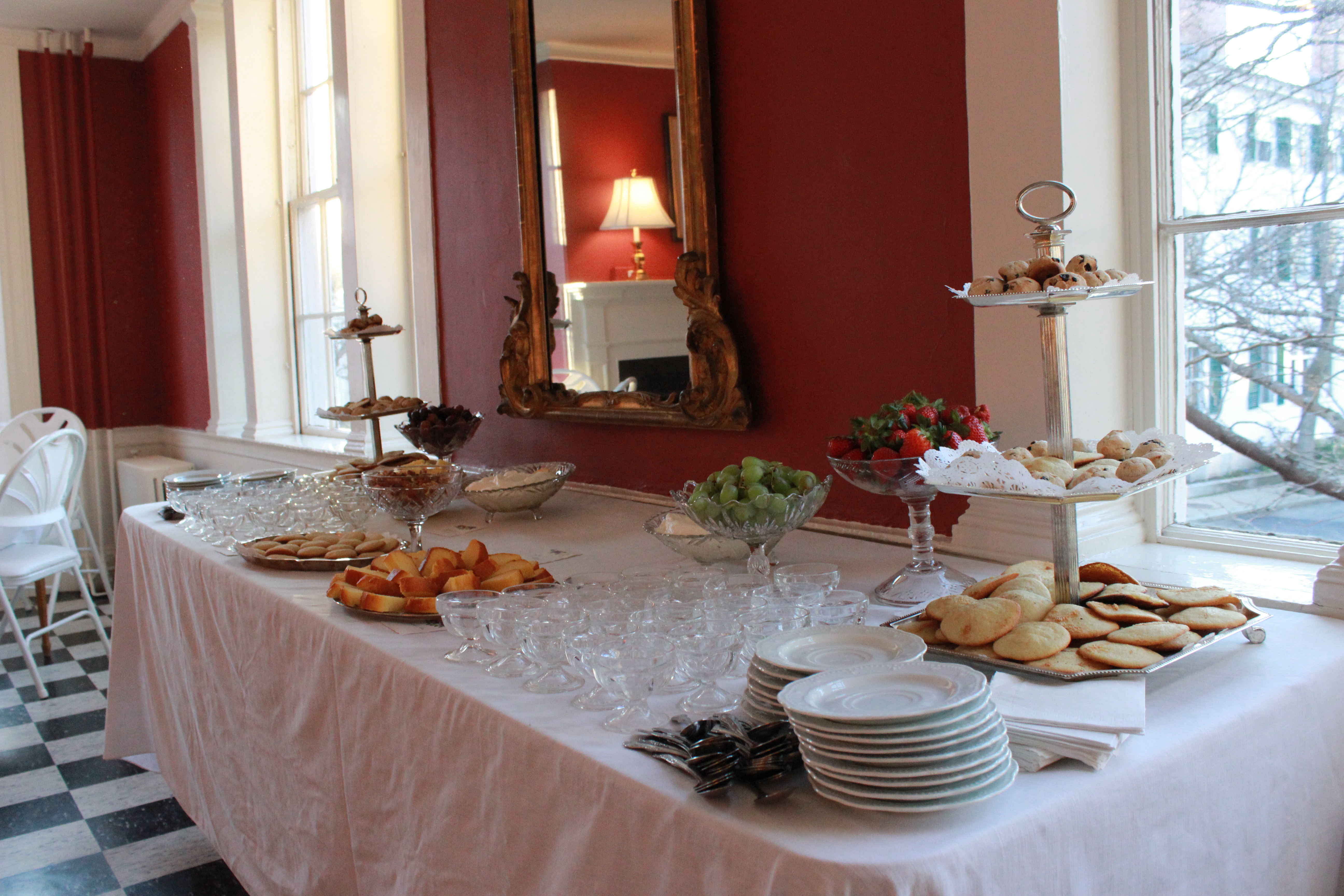
The reception was to include a toast with sparkling cider, so we pre-filled glasses to have ready to go at the right time. In addition, we worked on laying out the refreshments in pretty glass compotes and on silver trays as well as making the punch and laying out all the necessary silverware and dishes. Preparation was a bit hurried and I have to confess to getting super grumpy at one point…

IMG_0867
Picturesque filling of the glasses.
IMG_0860
Picturesque grumpy face.

The alterations I made to my skirt to fix the rip created a new issue. Sigh. See those horizontal wrinkles on the rib area? Because the front of the skirt hangs differently now, the front skirt wants to wrinkle. I can fix this problem, but ugh! It’s so much easier when the clothes just fit perfectly!

IMG_0869
Partially completed spread of refreshments.
IMG_0925
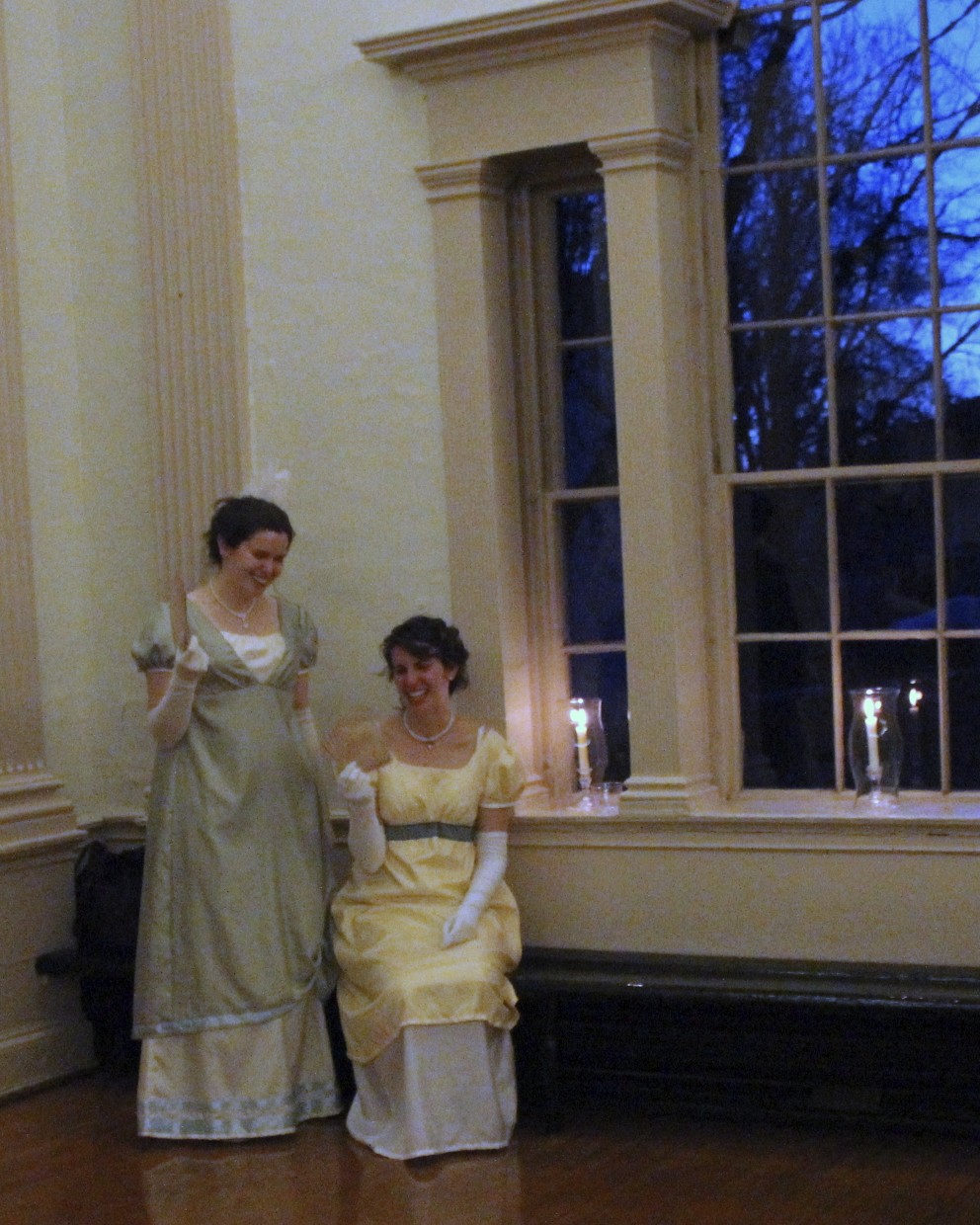
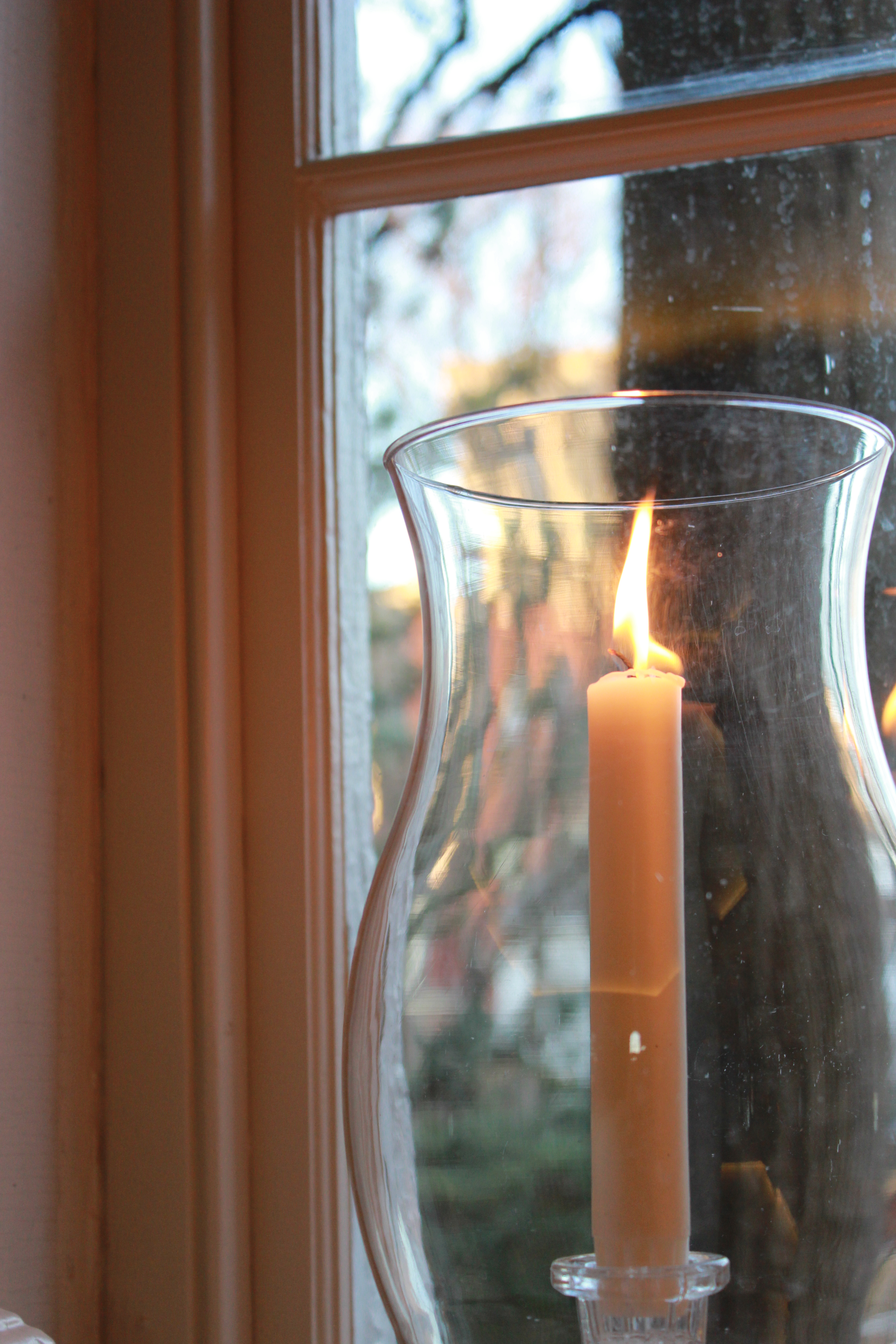
When everything was ready we joined everyone else for some pictures in the lovely ballroom, where there were real candles in the windows! So pretty!
IMG_0958 - Version 2
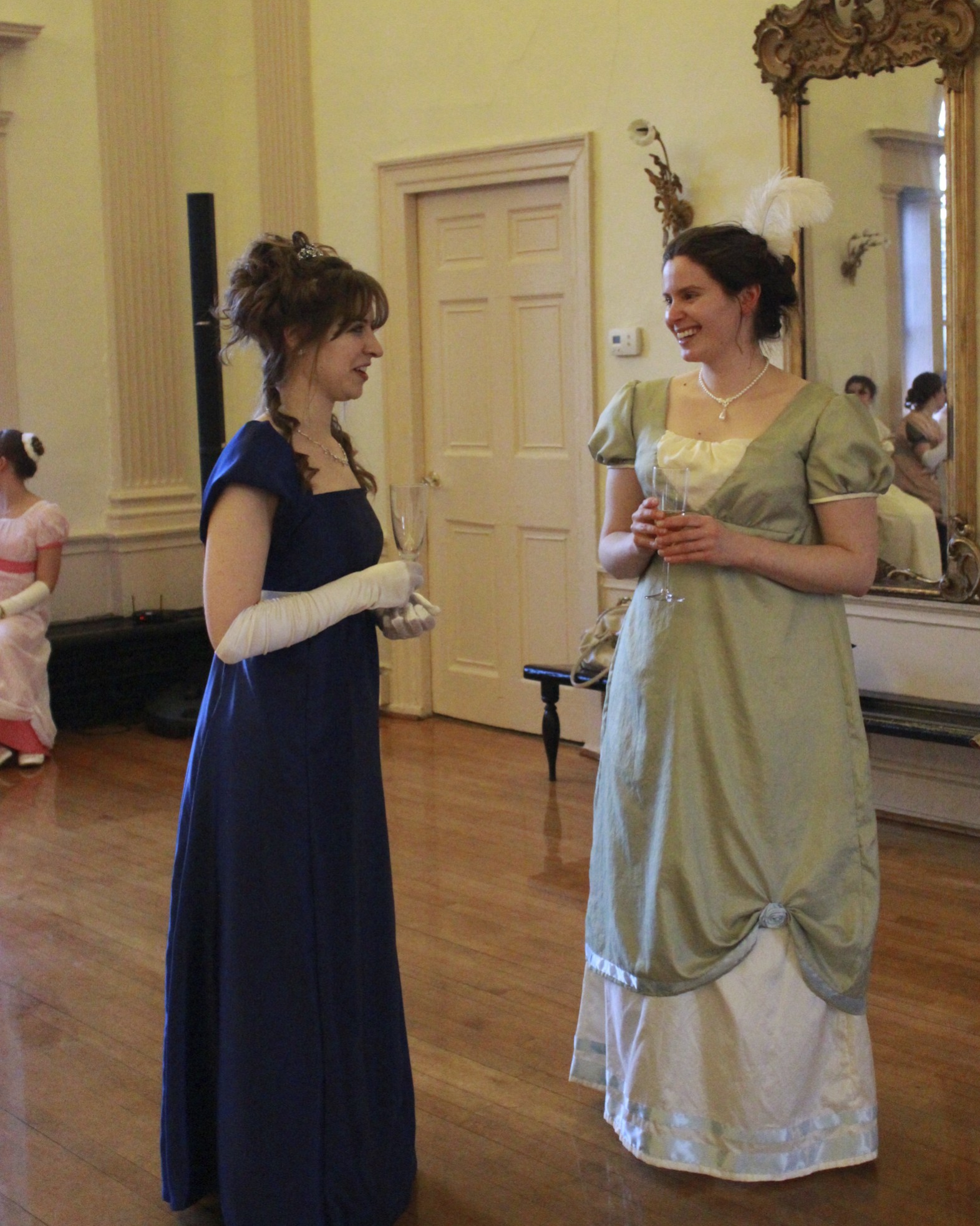
These mirrors are stunning and beautiful, in addition to being wonderful places to pose for the camera.
IMG_0874
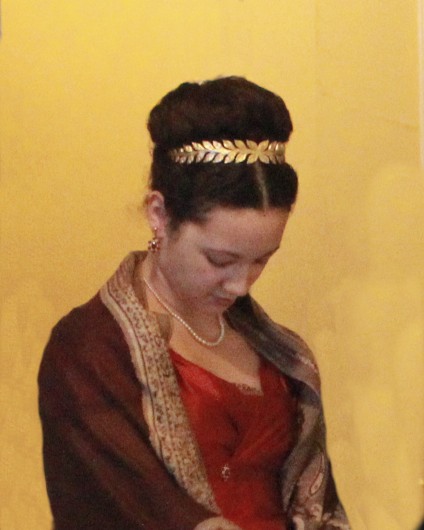
I thought my hair looked particularly regal for this event. Here’s a good picture of my poof and laurel wreath tiara.

It’s convenient for these sort of events to have hair that is easily made poofy. I don’t have any short bits of hair around my face (aside from frizz…) so curly tendrils for Regency hair styles don’t work for me. This had become my go-to Regency style: center part in the front with the front bits of hair saved for last; the back part of the hair put into a pony tail and brushed out to be super poofy, then rolled on itself to create a self rat and hide the ends. The poof is then pinned in place, the front bits are wrapped down and around the back which creates lovely lines on the back of the head, and finally the tiara is added to define the area between part and poof. The whole thing is finished off with a liberal douse of super hold hairspray to contain the frizz and keep the style in place.

But enough pictures of my dress and hair! After these reception pictures we all descended the stairs to the sidewalk, where we watched a celebratory champagne bottle be opened with a saber. Neat!

IMG_0905
Ready?
IMG_0913
Each person was served with a glass of sparkling cider on his or her way back up to the ballroom.
IMG_0966
And then we all had a bit of time to socialize and admire the room, the people, and the circulating cider refills.

When the cider was beginning to dwindle (which didn’t take too long), the time had come for the dancing to begin. And my, what dancing there was!

Regency Dance Weekend Part III: Fell Off The Sewing Wagon, But Got Back On!

Yup, that’s me I’m talking about in the title of this post. I was straggling along the first bit of the Mar-pril Regency Sew Weekly road. For Goal #2: evening wear, I had hopes to fix the rip in my 1813 red evening gown, but unfortunately I didn’t get to it in time for the deadline.

IMG_4281
Sad, sad rip.

I did get to it before the Regency Dance Weekend, though, so I was able to wear the dress for the Grand Ball and Reception on Sunday night. I’ve got pictures of the event to share soon, but for now I’m going to focus on the gown.

When I first made this dress back in January and wore it to the Pride and Prejudice Ball in February, the skirt of the dress was tightly gathered across the back to take in all the fulness of the skirt. But while taking pictures after the ball, the dress caught and ripped! I suppose it’s hard to tell in the picture, but the rip was not small.

IMG_4271
Gathers used in the back to take in all the fullness.

Ugh! What to do? Try to patch it, or darn it, or replace the whole vertical panel where the rip was? None of those ideas sounded like they would be pretty or fun.

I didn’t actually get around to fixing this until after I had constructed my Tree Gown, which has a skirt with an angled (trapezoidal) front panel and the back panel cut as a rectangle. The effect of that shaping on the Tree Gown is neat: there is less fabric to gather at the back and the skirt has a nice shape to it that is different than the shape that is created by the original tube shaped skirt on the red gown. In addition, I decided after looking at the pictures of the red gown that the gathers were too poofy in the back and created a shape I wasn’t looking for.

So I came to the idea of using the trapezoid plus rectangle skirt shaping for the red gown, because making a trapezoid would allow me to cut out the section of the skirt with the rip. This required taking the skirt off of the back waistband, sewing the new seams, then reattaching the whole thing. Since I was taking it apart anyway at that point, I decided to also pleat the fabric around the back instead of gathering it, like this dress, below.

1980.189_B
1812 Wedding Dress at the Met with a pleated skirt.
IMG_4401
The ripped side of the skirt, removed from the waistband and with the new seam pinned. Now you can see the scale of the rip!

It looks like I don’t have any great pictures of the back of the gown with the new pleated back… whoops! Here’s one picture, though, where you can sort of see what’s going on with the dress.

IMG_1083
Sort of hard to tell, but the area where the skirt meets the waistband is much flatter, and the skirt has a much bigger flare at the hem due to the new seam shaping.

Perhaps hard to envision, but if you compare this back picture to the one at the beginning of this post, there is a definite difference. It wasn’t a fun project, but it needed to be done, and I sure am glad it is! Next time there will be pictures of the reception, including more fun pictures of this dress.