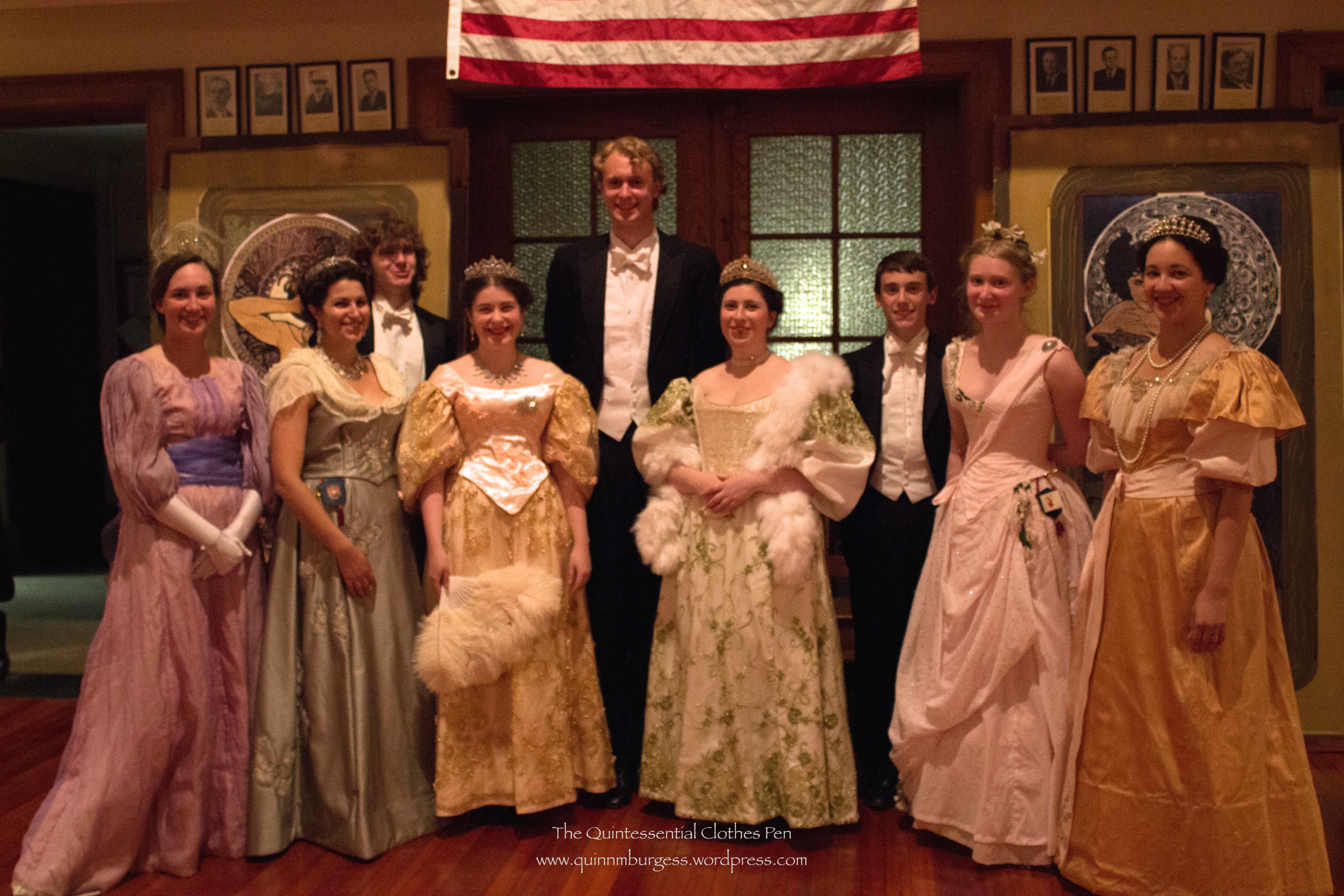
In January, The Commonwealth Vintage Dancers hosted an 1890s weekend (the same weekend that included an ice skating party that I blogged about a few weeks ago). Despite some snow during the day and into the evening, people were not kept away and the ball on Saturday was packed with dancers. Please join me on a little jaunt back to a snowy evening in the 1890s.
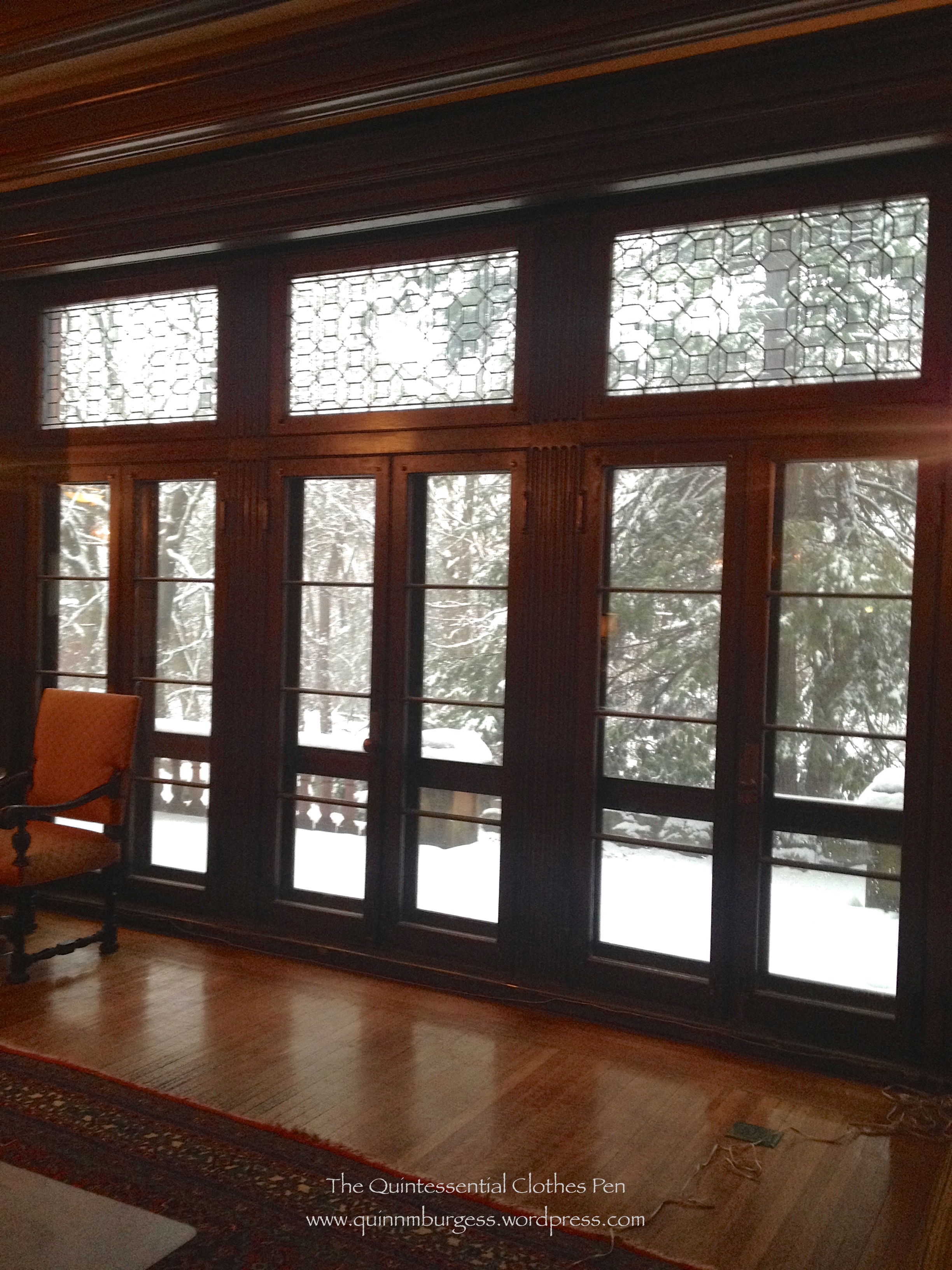
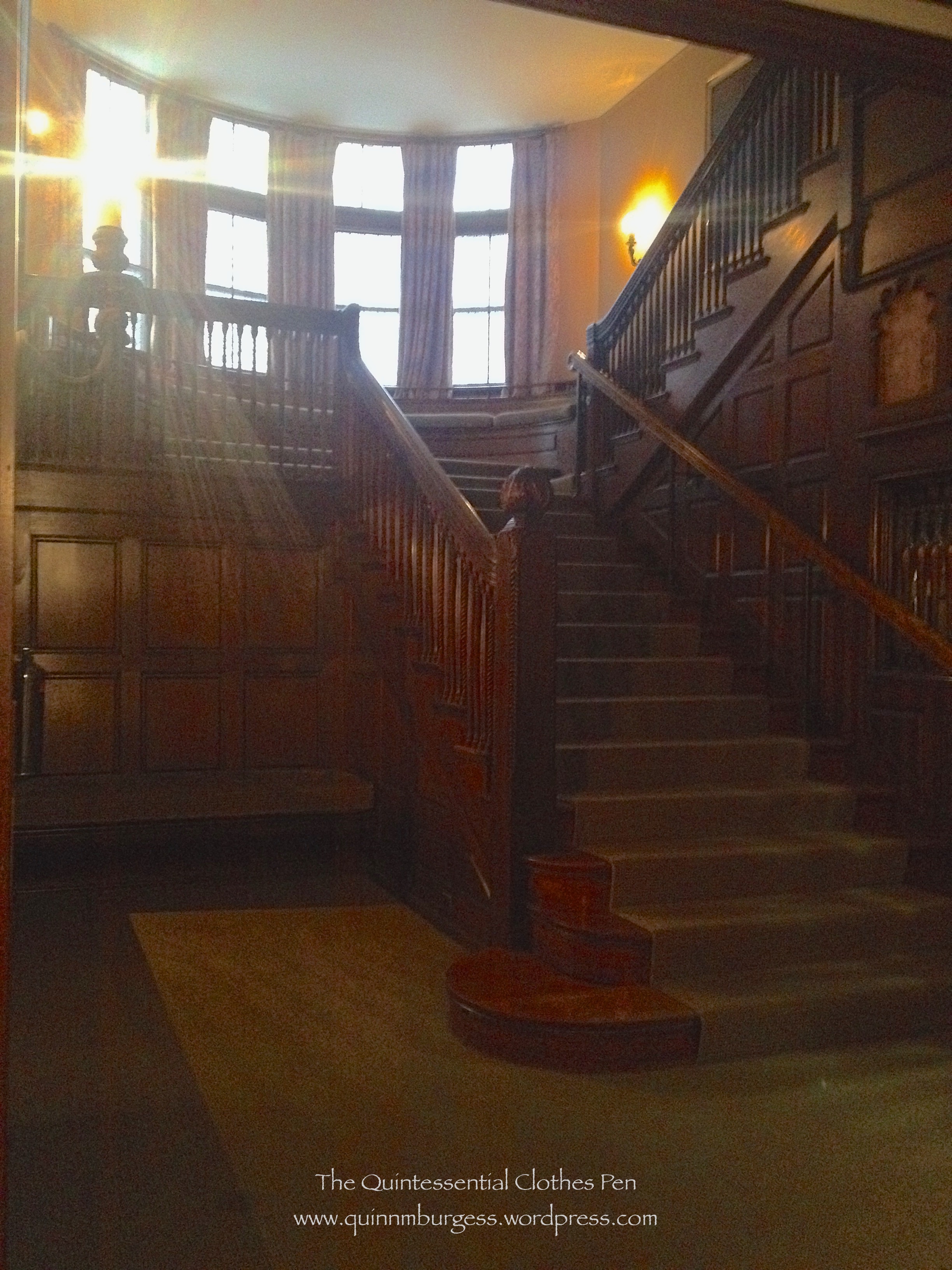
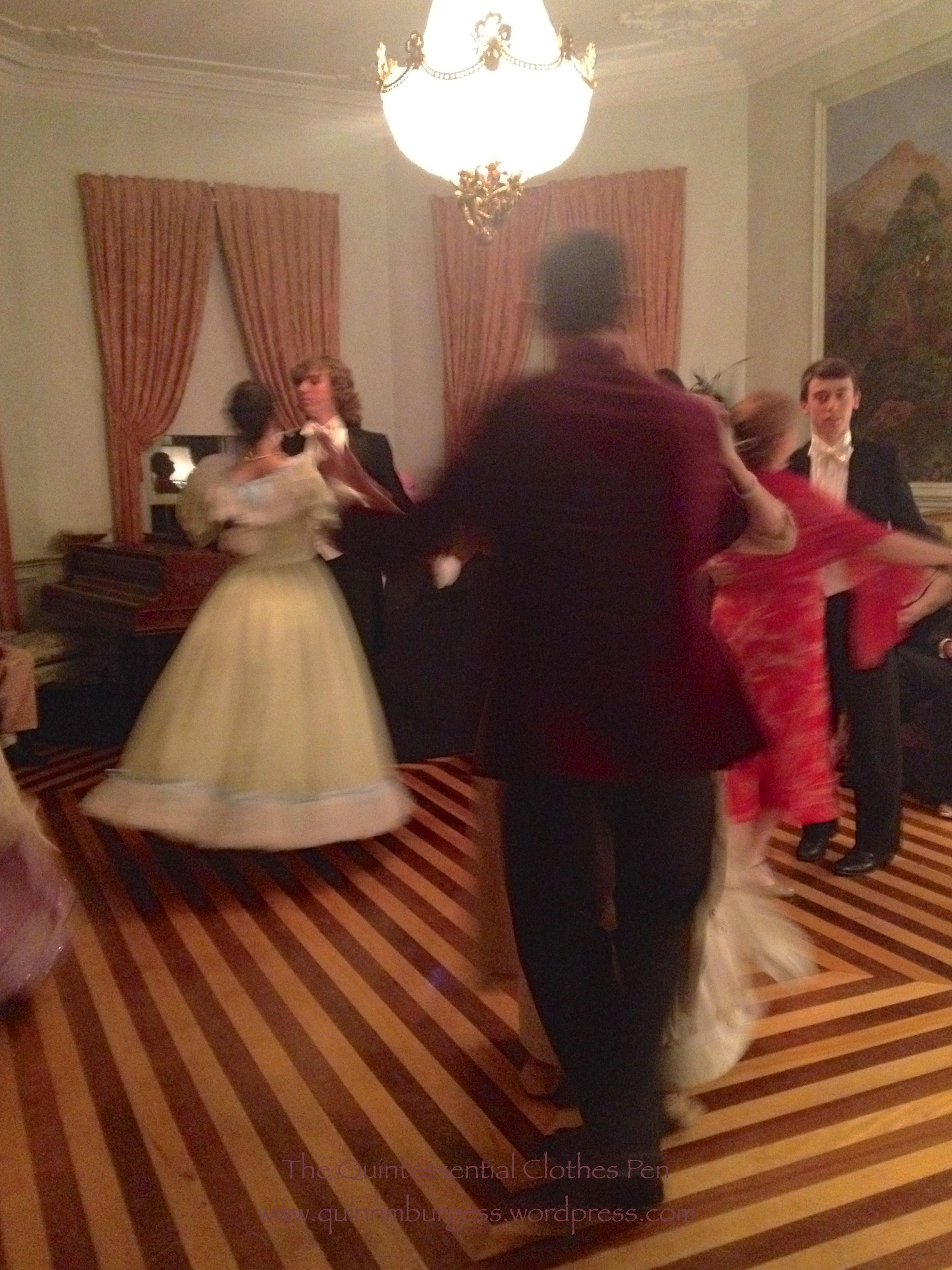
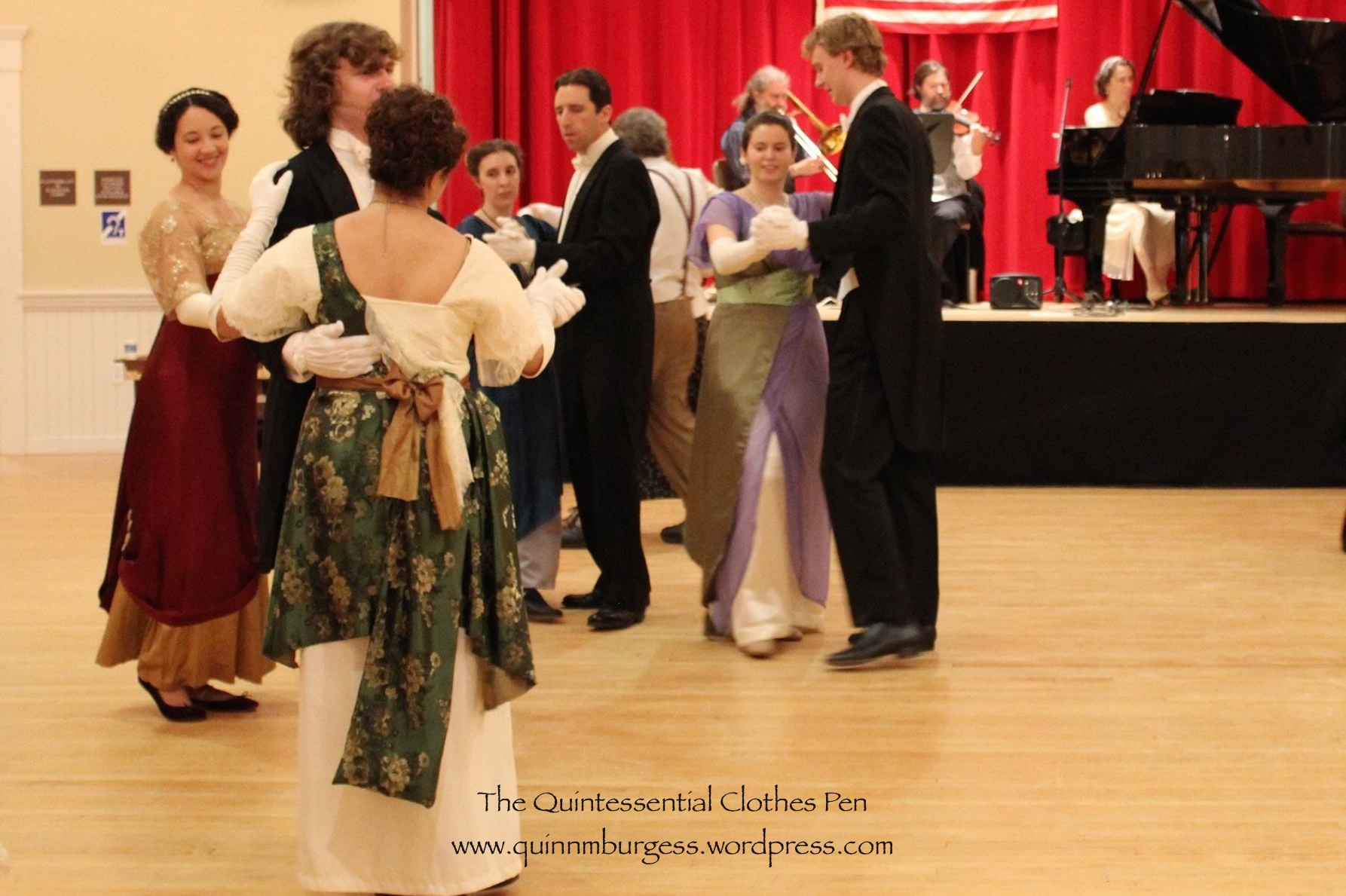
Arriving at the ball in the snow. (Well, sort of… I actually arrived in modern clothes, got dressed in my 1893 ball gown, borrowed a friend’s fur cape to keep the snow off my silk and the cold off my chest, and went back outside to take staged “arriving” photos.)The entrance hall’s view of the snow outside.The beautiful main staircase to the upper floors. There were lots of lovely sitting areas and nooks throughout the venue.There were also bookcases everywhere full of elegant hard cover books (my favorite!).In the ballroom, couples danced round dances including waltzes and polkas.What strikes me in this photograph are the black and white evening suits of the gentlemen. Everyone is nicely lined up to dance what I believe was the Opera Reel.
Videos are even more immersive than photos, and with this you can actually step into the ballroom that evening. Keep a look out for me partway through the video dancing a polka and then dancing a waltz at the end.
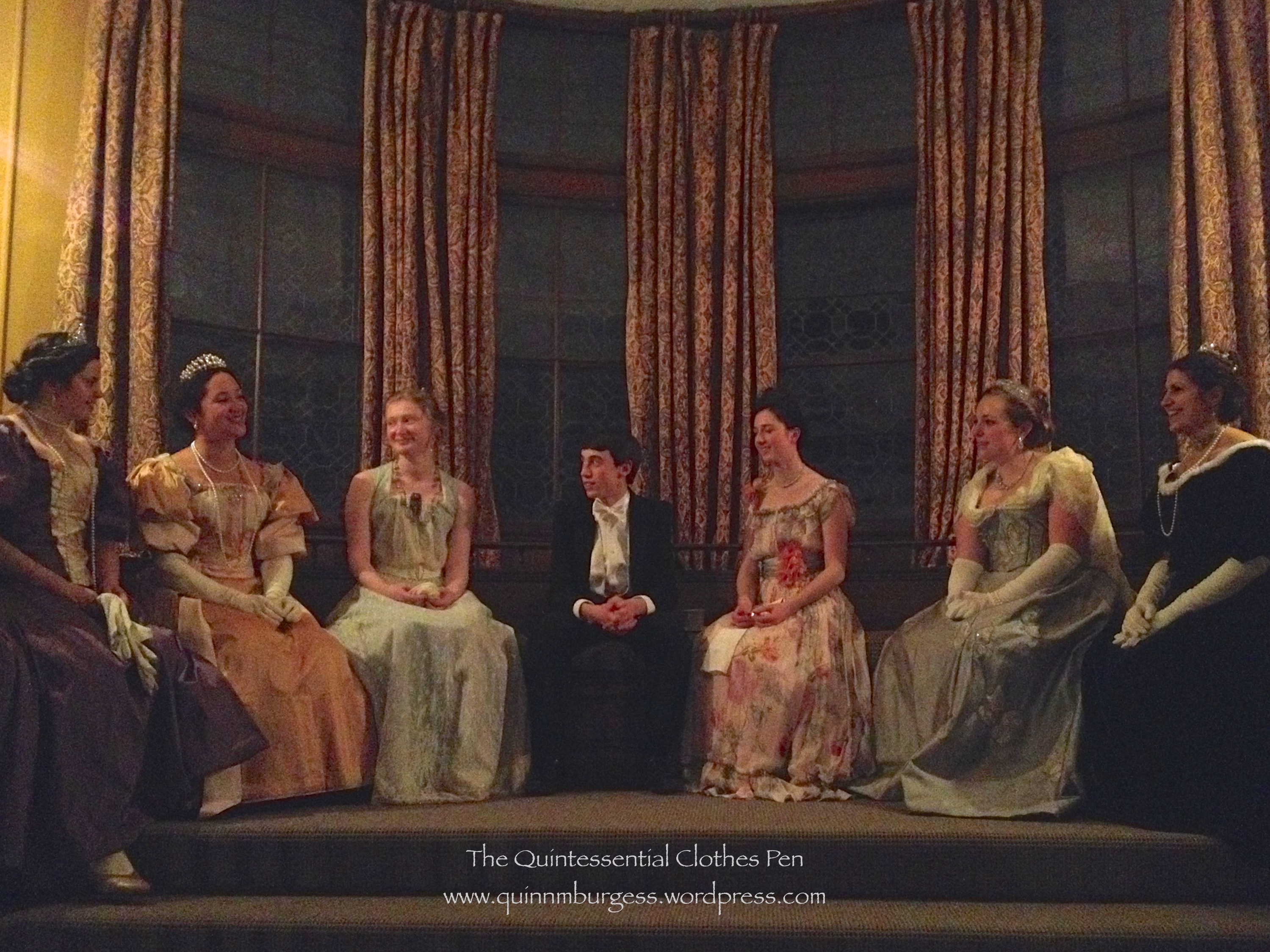
It became quite warm in the ballroom with all that dancing, so I stepped outside partway through to cool off and the snow had resumed in earnest!People spread through the house during the a break in the dancing. Here we are part way up the main staircase. Aren’t we well set up for a photo?And finally, being silly, because I blended very well with the curtains! Good night!
I attended a small Regency ball last weekend. It was charming and not nearly as packed full of people as I have grown accustomed to at these events in recent years. The smaller crowd made for a much more subdued (but still pleasant) evening than I was expecting.
The only downside was that the hall was exceptionally cold and not being full of people did not warm up very quickly! Few of us had planned for the situation and we were mostly scrambling to find any scarves or sweaters to wrap ourselves in. Many of us were resorting to items that we’d worn to keep ourselves warm outside, sacrificing fashion for warmth (it’s been below freezing here in Boston for at least the last three or four weeks consistently). I, for example, wrapped up in my pink cashmere scarf despite wearing a red dress. I thought it looked odd, though I was told that the colors looked good together. But there were a few lucky solutions that were both fashionable and warm: a large paisley shawl and a plaid scarf/wrap that looked very Scottish were the two most fashionable looks in my opinion. After some dancing and about midway through the evening, many had warmed up enough that scarves were being discarded, though I do believe I kept my scarf wrapped over my shoulders and chest throughout the entire evening.
Elegant, fashionable lounging during the refreshment break.Delicious refreshments alluringly laid out.
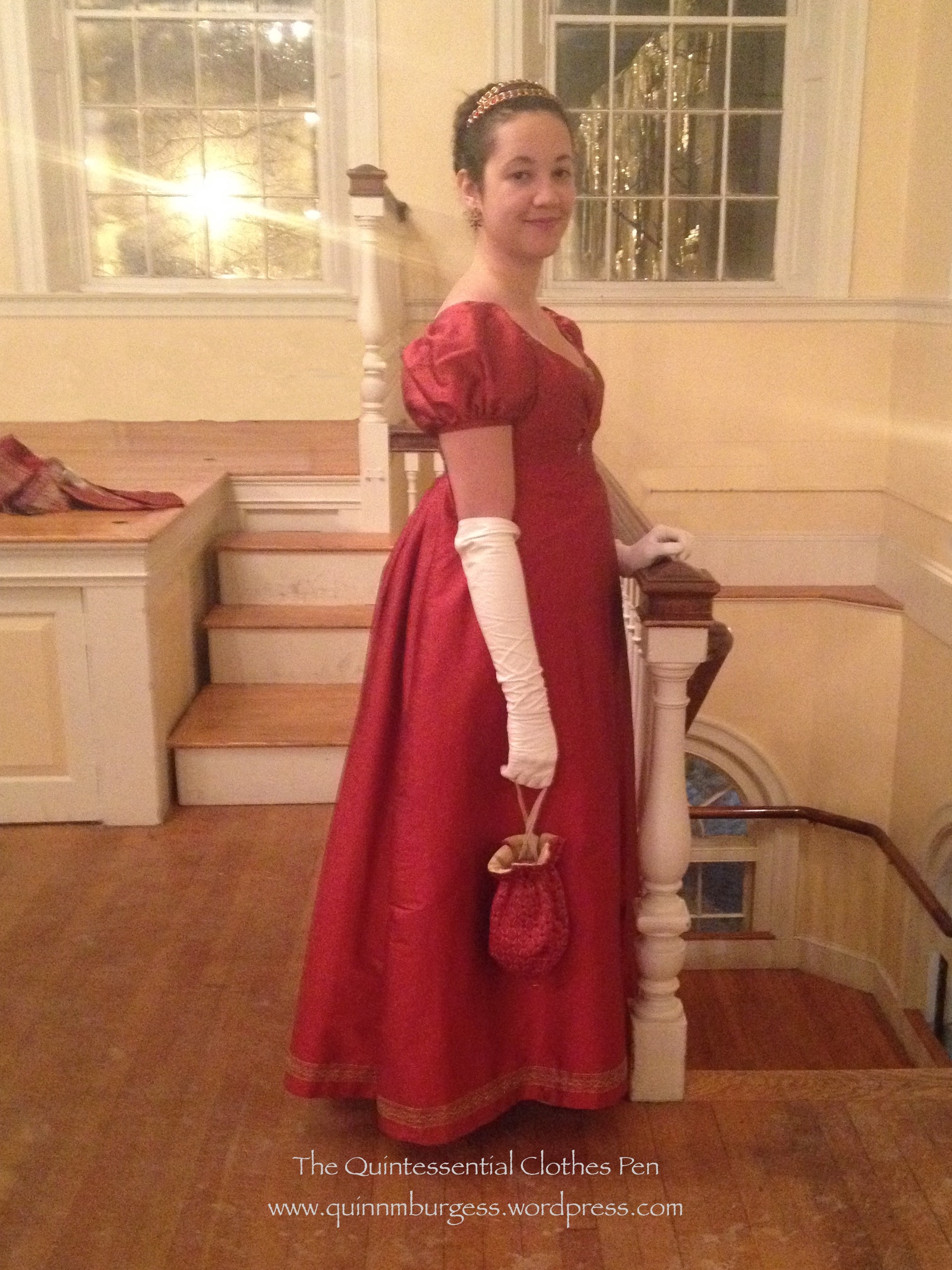
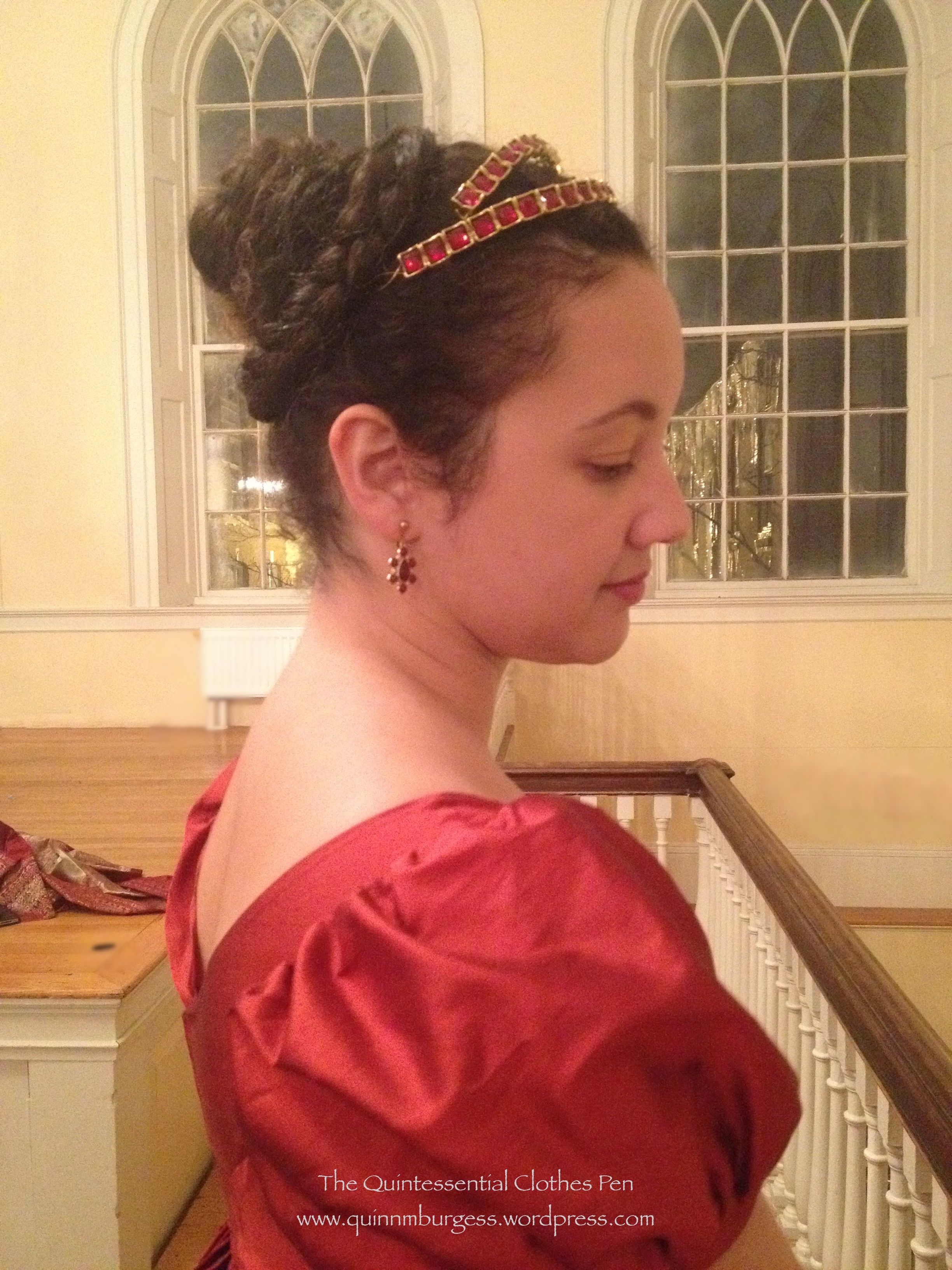
I wore my red 1813 evening gown and my homemade red and gold tiara. (I had hoped to finish and wear my 1811 elusive blue evening gown, but I would have had to do a lot of last minute sewing to finish it in time and after my recent skating costume last minute sewing adventure I was not inclined to do so again so soon. It is very satisfying to have a closet of options for an event, especially when plans to complete something new go awry.) I also brought along my red and gold reticule, because it matches the outfit so perfectly (although the only thing I kept in it was my phone… which is the reason for the slightly blurry, grainy photos).
All the red and gold Regency pieces in my wardrobe put together in one outfit!It was so cold getting dressed that I was not inclined to do a complicated hair style. Heeheehee, fake hair to the rescue! I just put my hair in a pony tail, braided it, and wrapped it around itself. Simple! The big braid is what makes it look complicated, but it is pre-braided fake hair. I think it completes the style perfectly and has a bit of a “chinoise” look to it, too.
What do I mean by “chinoise”? The word itself is from the French adjective meaning Chinese. In terms of fashion, there are scarce references to “chinoise” styles in Regency fashion plates (compared to the abundance of Regency fashion plates showing other styles). Here are a few examples. This Merveilleuse from 1814 has a “Coeffure Chinoise,” this lady from 1812 has a “Coeffure a la Chinoise,” and this fashion plate shows “La Toilette Chinoise.” (I do sort of wonder how some of these attributes, and the hairstyles in particular, said “Chinese” to people during the Regency, but of course the world was perceived very differently then and people had access to vastly different quantities and types of information than I do today.)
I’ve often noticed that “chinoise” hairstyles make use of braids that wrap around the head. In addition, there seems to often be a vertical emphasis to the hair and to a bun, if one is present in the style. It is these attributes that say “a la chinoise” when I look at my own coiffure from last weekend. Sometime, I’ll have to try to make a more exaggerated “chinoise” style with a very tall and flyaway bun such as the Merveilleuse from 1814 has. I’m pretty sure my hair will have no trouble with that since it is naturally curly and wanting to fly away!
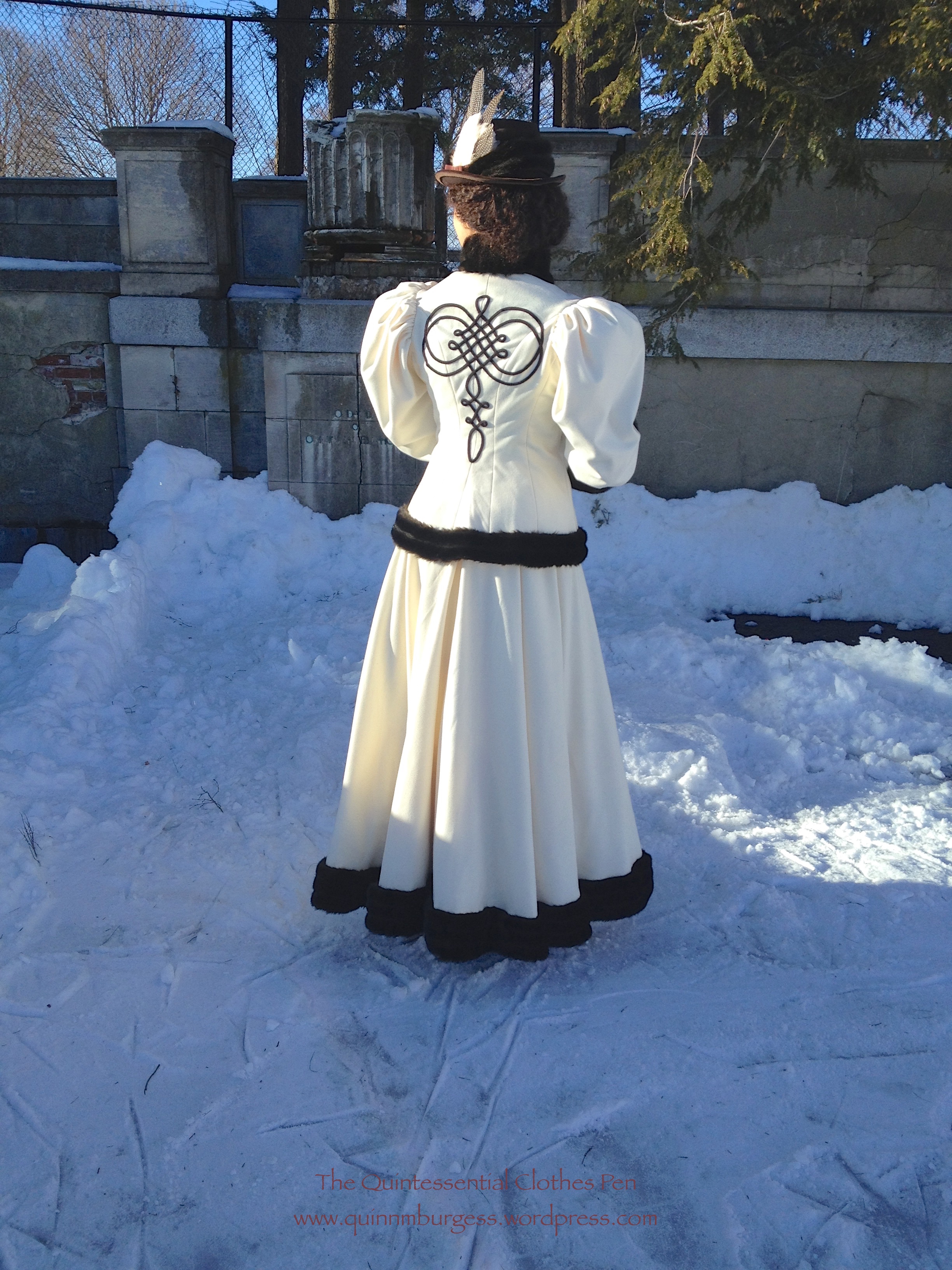
This is one of my favorite outfits of all time. I just want to hug myself, with all the fur, and I love the trim on the back! The whole thing is so cozy and so hug-able and the skirt has such a nice drape and the accessories work so well… and I actually got to go skating in it! I am just utterly chuffed (to use a British word) with the whole thing!
I was on the fence about whether this outfit would apply to the Historical Sew Fortnightly/MonthlyChallenge #1: Foundations, but then I read Leimomi’s teaser post about her foundation entry in which she reminds us about different interpretations of foundations and the intent of this challenge to create loose guidelines open to interpretation.
I was convinced (or pushed off the fence, if you prefer to think of it in that amusing way). I’m claiming my all new 1895 skating outfit for the first challenge of the new year! It does rather stretch the idea of foundations. Is the skirt a foundation because it is literally worn below the jacket, thus being a foundation as you would think of one in a building? Or is the bodice a foundation, because my direct inspiration is a lonely jacket without a skirt and therefore it is the foundation of the outfit because I wouldn’t have made the skirt without having the jacket? Either way, there is an element of a foundation in there.
Just the facts:
Fabric: 5 yds of ivory wool, about ⅓ to ½ yd of dark brown faux fur, probably about 3 yds of scrap muslin for flat lining the jacket, a bit of scrap canvas to stiffen the collar, and a bit of ivory flannel to line the inside of the collar.
Pattern: Made by me and based on my inspiration jacket as well as patterns published in Authentic Victorian Fashion Patterns (a Dover book).
Year: c. 1895.
Notions: 5 yds of brown braid, thread, a bit of high loft polyester batting to keep the sleeves puffed out, about 1 yd of ivory hug snug to finish the bottom of the jacket, hooks and bars for the skirt, and thread.
How historically accurate is it? Pretty darn good. Definitely recognizable by someone in the 1890s. The construction is accurate, aside from the use of hug snug instead of bias and faux fur instead of real fur. So, 95%.
Hours to complete: Um… As usual, I did not keep track. I definitely spent at least 15 hours the few days before the event sewing on my braid and fur trim… Plus full days of pattern making, fitting, cutting, and sewing. Maybe 30-40 hours? I care so much more about the finished project than the time it takes to get there! And I loved sewing this, so I didn’t mind that it took time!
Total cost: $75 for the wool, probably about $8 for the fur yardage I used for this project, $4 for the braid, and the rest from the stash = $87
My accessories were a matching fur muff that I made a few years ago and wore once for caroling (with my as-yet-undocumented 1860s winter cape) but more often with my 1917 winter ensemble and a revamp of my 1883 wool hat. I didn’t have time to make a new hat because of all the last minute fur and trim sewing, so I pinned a fur scrap around the 1883 hat and added some feathers to stand up a bit more like 1890s hats and called it good. My main inspiration (and the reason I feel it was an acceptable looking style to have the squashy fedora hat look in the 1890s) was this image.
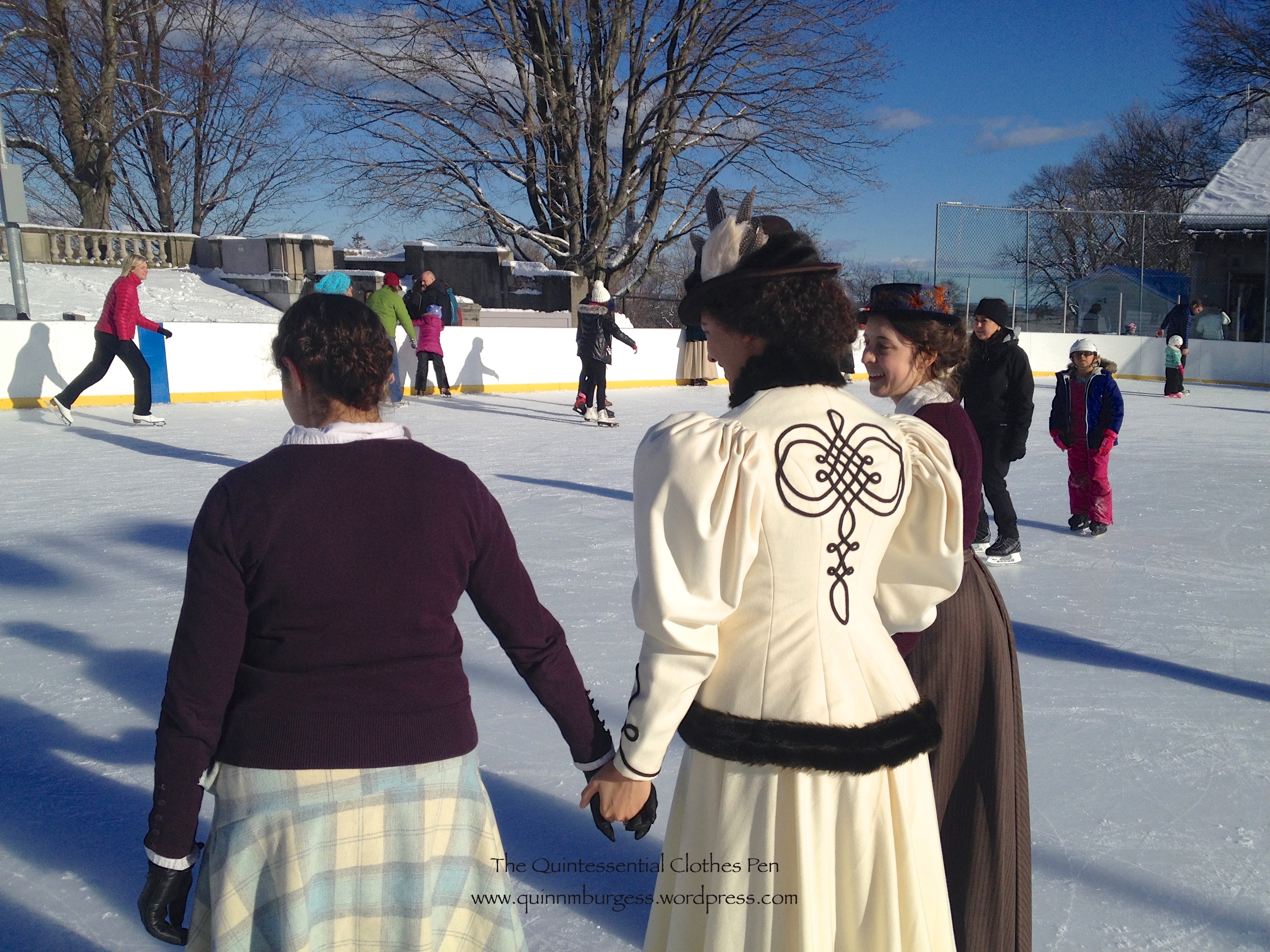
For good measure, here’s my Pinterest board for the entire project. And here are pictures of us skating (with ice skates: all our snow and cold weather does occasionally come in handy here in Boston)!
Yes, we just crashed a local outdoor ice rink on a Sunday afternoon. One of the attendees even wore vintage skates! Turns out they can be hard to skate in because they’re not very supportive… but they looked fantastic! We got lots of comments from people asking what we were doing, why we were dressed up, and that we looked good. I was asked by multiple groups of young girls why I was dressed up and one group in particular asked what the swirly thing was that I had, which I got to explain was a muff to keep my hands warm!
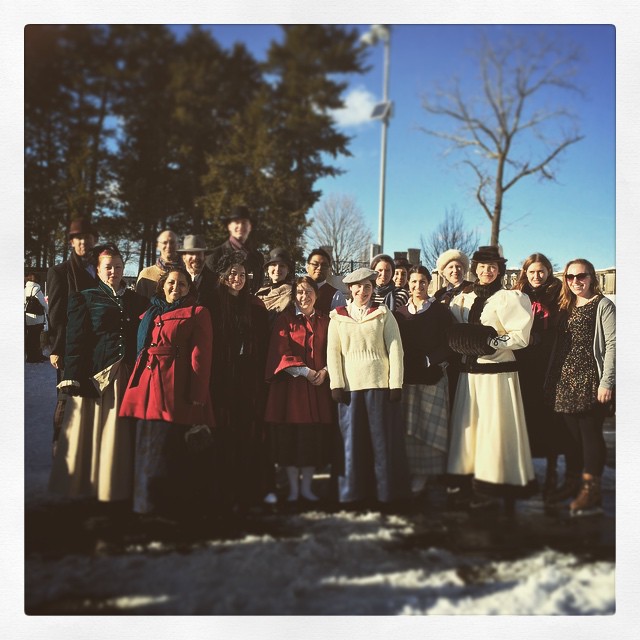
Here’s our skating group. People came in a variety of late 19th century and early 20th century winter outfits as well as modern clothes.
With my skating ensemble I wore fleece lined tights (modern, but warm so I didn’t care), knee high bamboo socks (modern again), my 1903 silk petticoat (super useful for the 1890s, also), a modern tank top (instead of combinations, because I needed to go to work later in the afternoon and change out of my outfit in the back seat of my car without being indecent…), my 1895 corset, and a long sleeve modern waffle tee (mostly to shield my skin against the wool seam allowances and also for warmth). And I was perfectly warm wearing this out for skating on a day that was sunny and right around freezing. In fact, with the muff and wool hat I actually was too warm at times.
Pleased, chuffed, and smiling all afternoon! So fun! Maybe we will get to go skating again this winter!
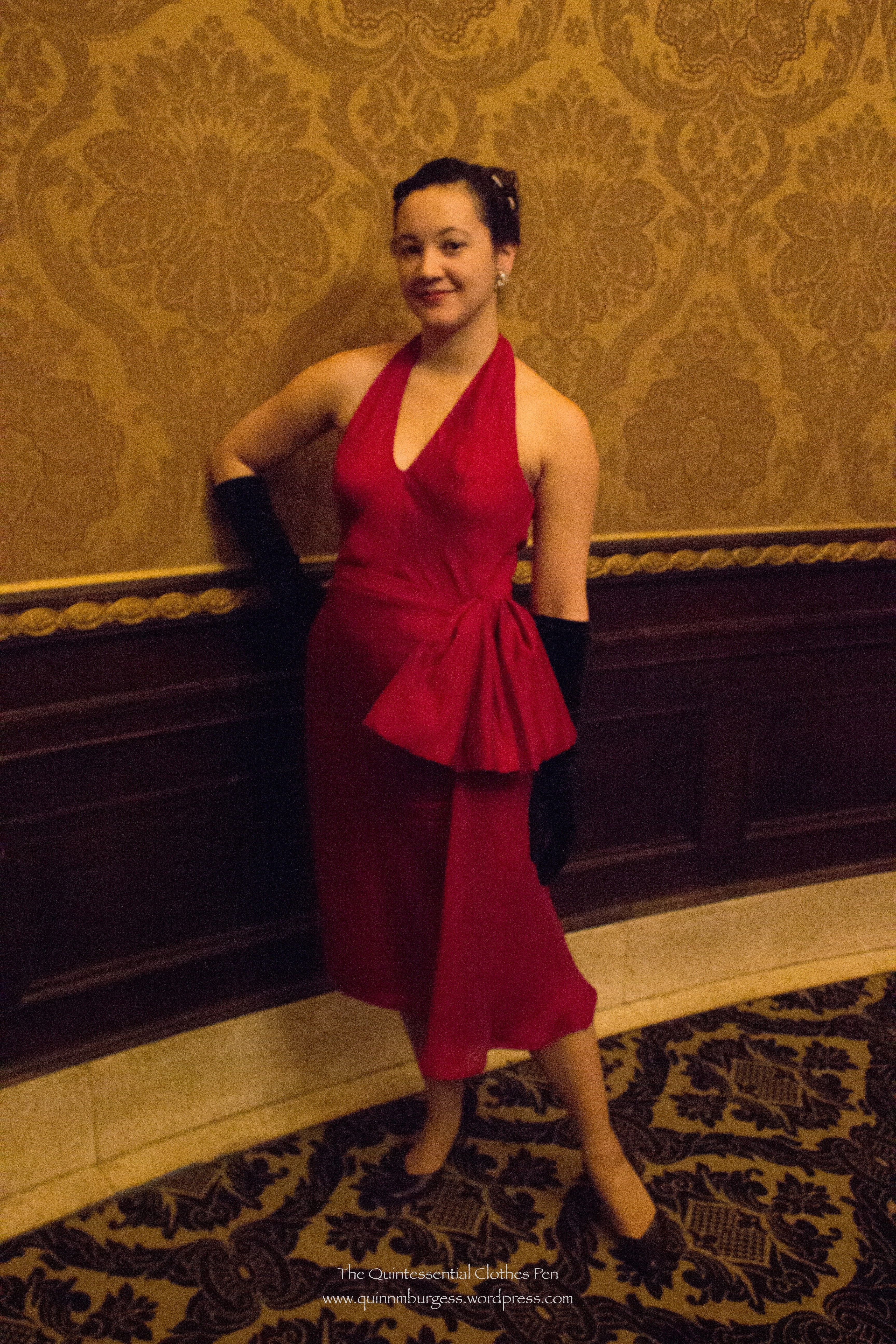
Success! I not only finished my 1950 Baroness Christmas dress the weekend after Thanksgiving, but we also managed to line up our schedules and go see The Boston Ballet’s Nutcracker at the beautiful Boston Opera House, where we took pictures! There were brass bands playing outside and carolers in silver down coats on our walk to the theatre. It was all very festive. And, of course, there was The Nutcracker with a live orchestra.
As you might be expecting, I wore my Christmas dress and took pictures for Edelweiss Patterns’ Virtual Christmas Dress Party. The original inspiration image is in this post. The dress is made from rayon and lined with polyester. I made an attempt to do a 50s stylized up-do, too, though I don’t have any close up head shots… but without further ado, here it is:
There were a few changes from the original, like adding a slit behind the front drape for ease of movement, adding a self fabric belt over the waist seam, and not quite making the pleats across the front deep enough to read once the bow was attached. I’m quite pleased, however, and love how festive the dress is! (And it’s quite formal, with that low back…)
Our group was very well balanced in having two greens and two reds, and three hats, and four gloves (two pairs, you know)… (It sounds like One Fish Two Fish Red Fish Blue Fish or The Twelve Days of Christmas, doesn’t it?)
3 hats!5 of us in 1950s inspired Christmas outfits!Merry Christmas!
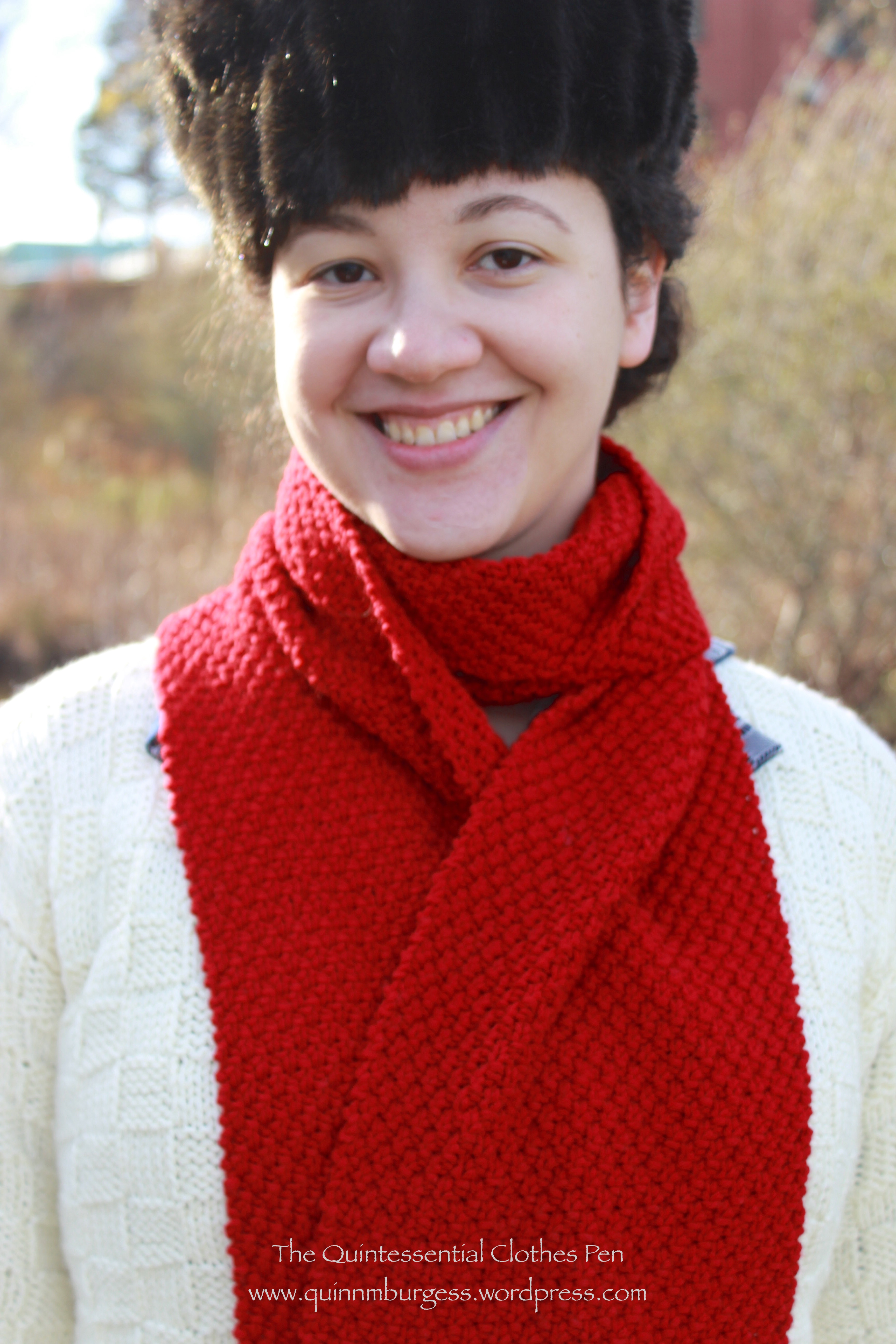
…and it qualifies for the HSF Challenge #23: Modern History! This particular challenge is to make something historical or historically inspired that is wearable in an everyday context. And a scarf like this: absolutely wearable in my modern life if I choose!
Just the facts:
Fabric: 2 skeins, of unknown length, of probably acrylic yarn.
Pattern: Made by me. (More details below.)
Year: 1910s. (More details below.)
Notions: None!
How historically accurate?: Ideally, it would have been made of angora yarn, but I had the acrylic on hand and didn’t want to spend extra money (angora yarn isn’t cheap, you know!). Acrylic wasn’t invented until 1941. However, the dimensions of the scarf are accurate, the pattern is entirely plausible for the 1910s, and the style is taken directly from an ad from the 1910s. So I’d say 90%.
Hours to complete: No idea. I knit while watching Netflix and didn’t pay any attention.
First worn: In Plymouth, MA the weekend before Thanksgiving while portraying a suffragette (as I did last year).
Total cost: $2.50 for the knitting needles and $1 for the yarn = $3.50.
The color is perfectly suited to the holiday season, being cranberry red just like the fresh berries I used to make homemade cranberry sauce last week. (That was really easy and tasty, by the way–I bought Ocean Spray cranberries and the recipe was on the bag!)
Cranberry red!
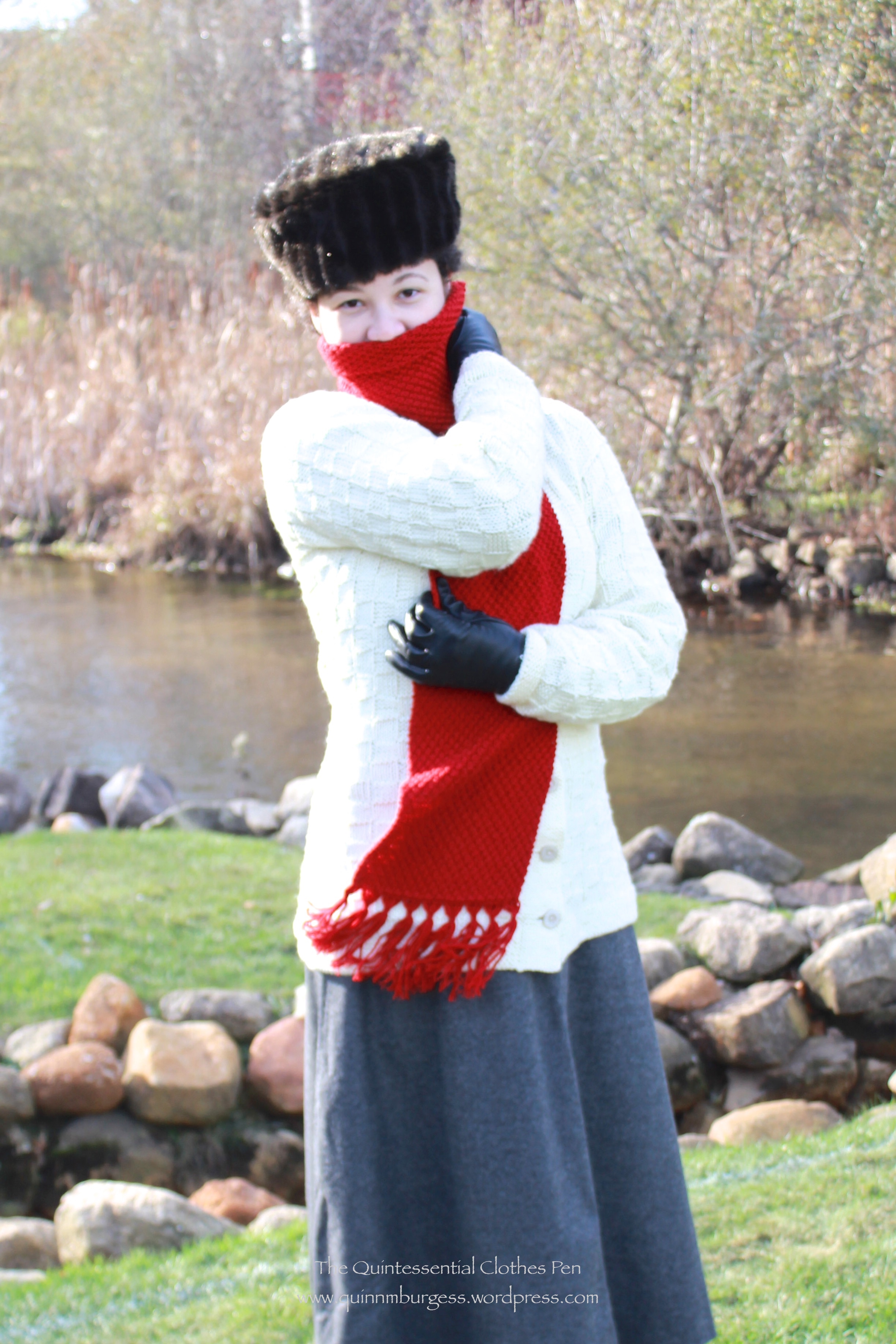
The pattern is moss stitch. I knit an extra row at the beginning and end just to provide some stability. Then, K2, P2 all the way across for two rows. P2, K2 all the way across for the next two rows. Repeat. Super easy. I keep track of what row I’m on in a little notebook with all my knitting patterns in it. That way I know where I’m at while I’m watching Netflix or when I’ve put it down and picked it up on a different day.
The dimensions are taken directly from a 1910s knitted wear ad that Lauren from Wearing History shared on her blog, here. I made my scarf 8” wide and 68″ long so it would provide maximum warmth while being worn. It also helps that it’s acrylic, which doesn’t breath and keeps you toasty. The fringe is about 6″ long and tied into 9 tassels, just as seen in the ad on a few of the scarves (turns out that I had the perfect number of fringe pieces to divide by 9 without planning!).
I had hoped to make these gloves from a 1910s pattern in matching yarn, but didn’t even start them. Perhaps it’s something that I can do next year! I’ve never knit gloves and I’ve only just taught myself to knit in the round, so while the cables in the pattern are not at all daunting, the simple idea of making gloves is. But challenges are fun sometimes! And I’m very pleased with the scarf.
First, you have to pretend it’s still summer and the air is still warm. Once you feel the warmth, come back with me to the Regency period with a performance by The Commonwealth Vintage Dancers at the Salem Maritime Festival back in August. The day was cloudy, but not too warm, and was interrupted mid-afternoon by a bit of strong rain (during which many of our dancers had wandered off and I sat under a tree and watched the rain fall).
Opening the gate to our own historic house front yard performing space.I brought along the kites I’d made in 2013 and though we didn’t fly them they looked nice on our picnic blankets. The strings had become all tangled over the last 18 months and thankfully some others found the untangling task rather enjoyable.We were pleasantly surprised to be provided with two live musicians who not only played for us, but also sang.While visiting a neighboring house we took the opportunity to peer at the modern visitors just as they peer at us!Another participant in the day’s events snapped a few sneaky photos of us through the window of the neighboring West India Goods Store where she was set up for the day. Photo by Sew 18th Century.
Back in August at the Nahant Vintage Dance Weekend, I was able to attend a soiree at Egg Rock (see that post here) as well as attend the Grand Ball of the weekend. I wore my 1893 bronze ball gown that I made back in 2012.
Unfortunately, I have to say that the crowds and the August temperature without air conditioning conspired for a very sweaty evening, which was not to my liking. However, everyone was very nicely attired and tasty refreshments were provided. In fact, sorbet was brought out at one point and was a tasty and cooling treat! (Hard to imagine being that warm as fall settles in and the air outside is crisp and chilly! I’ve been slow to get to posting about this event.)
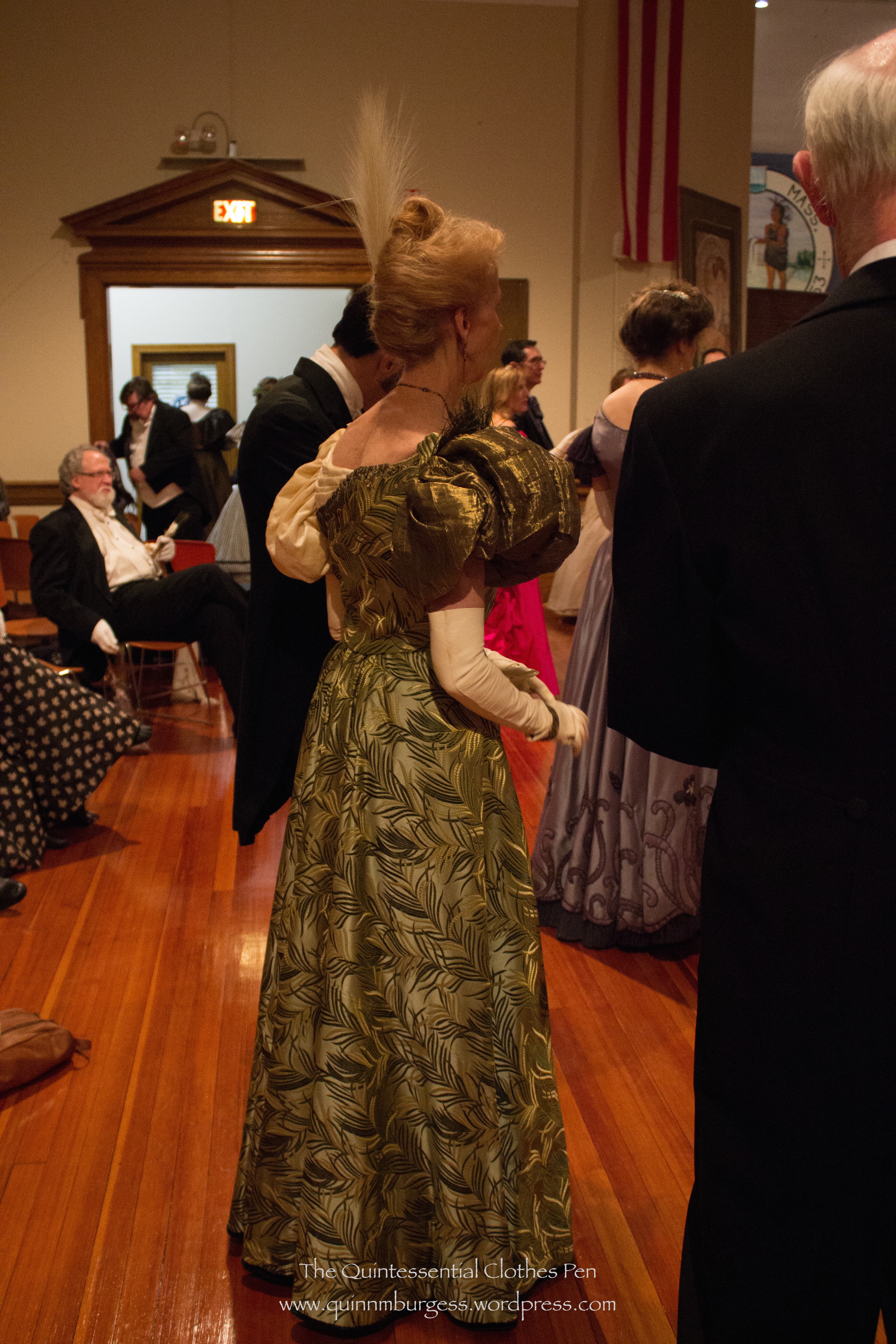
Imitation is the sincerest form of flattery, right?Dancing a waltz, I believe.This time I’m smiling!I happened to be standing in front of a fan while explanations of a dance were going on and I have to confess to laughing more at my flying shoulders than listening to the explanation…A view of the crowded ballroom.Another view of the room.Everyone looked fabulous for the event.This was my favorite new dress I hadn’t seen before. It was quite sunning, with the bi-colored sleeves and tall aigrette. And in complimenting the wearer I was able to meet someone new, which is always nice.TNG. That’s that.
The entire Nahant weekend made the New York Times via the delightful Bill Cunningham (who was in attendance taking pictures for the weekend). I can be spotted in a few of his pictures in the Evening Hours section from August 15. There was also an afternoon of events that I did not attend, but which you can see pictures of here and watch a video with Bill’s narration of here.
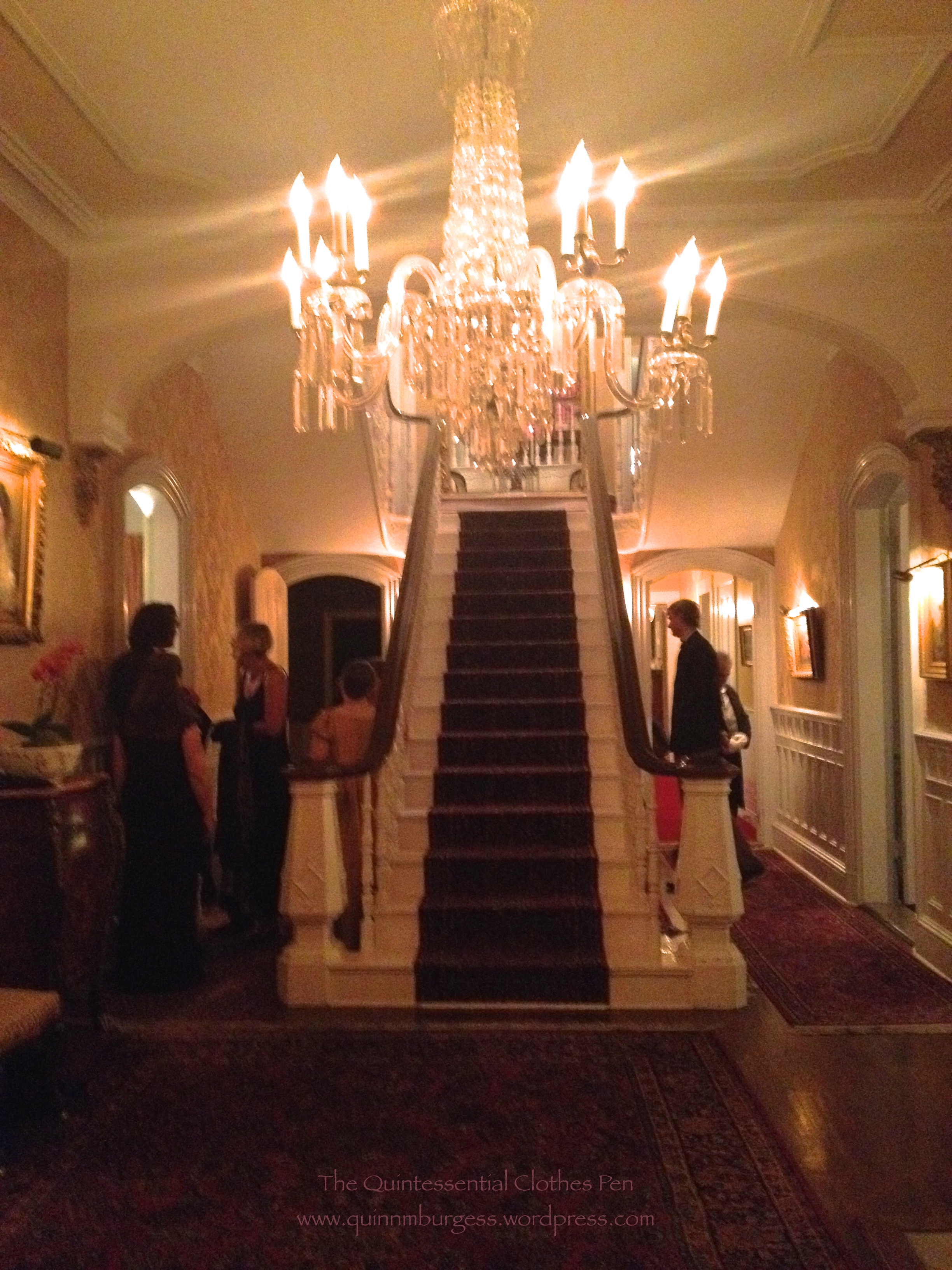
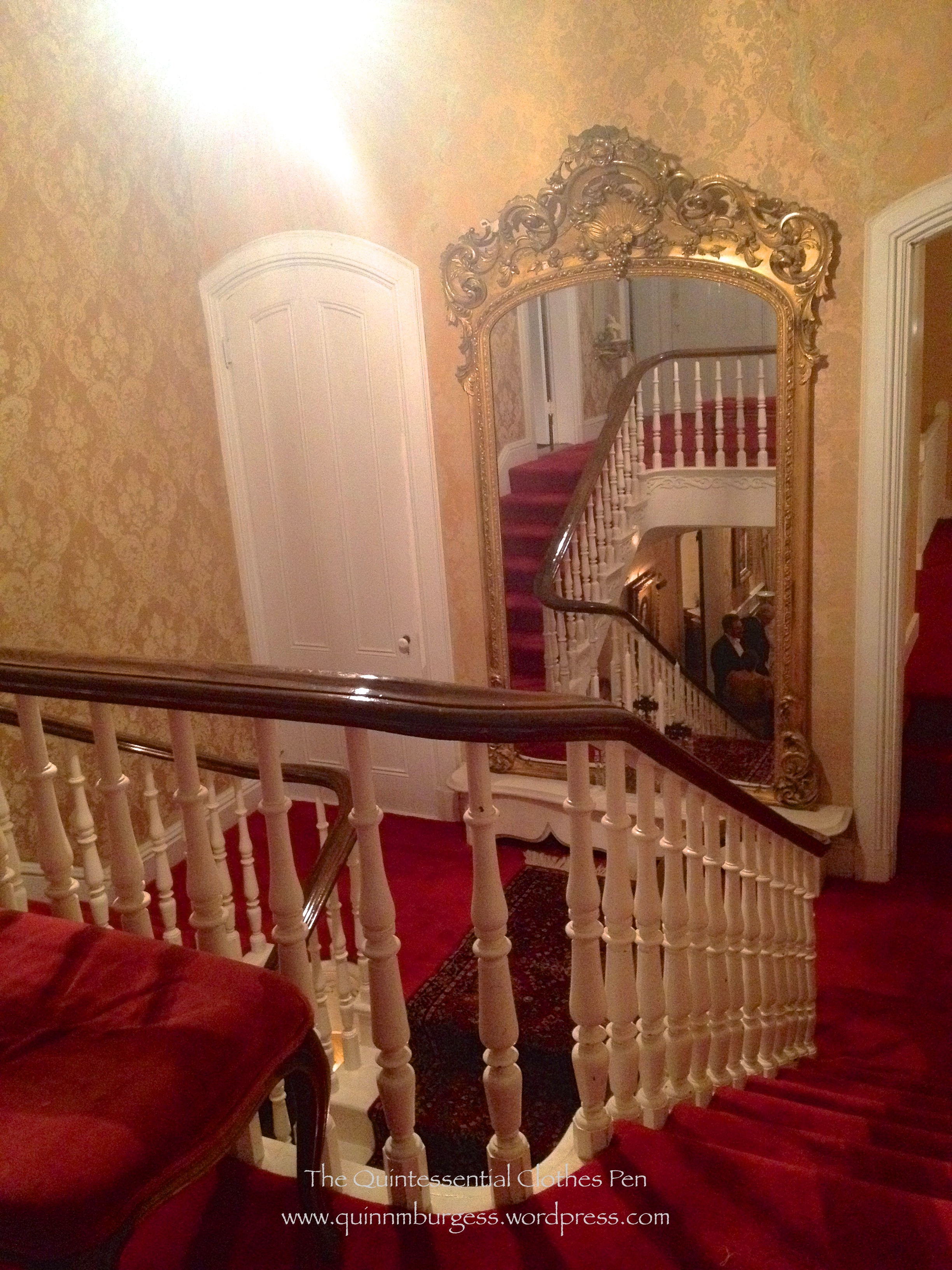
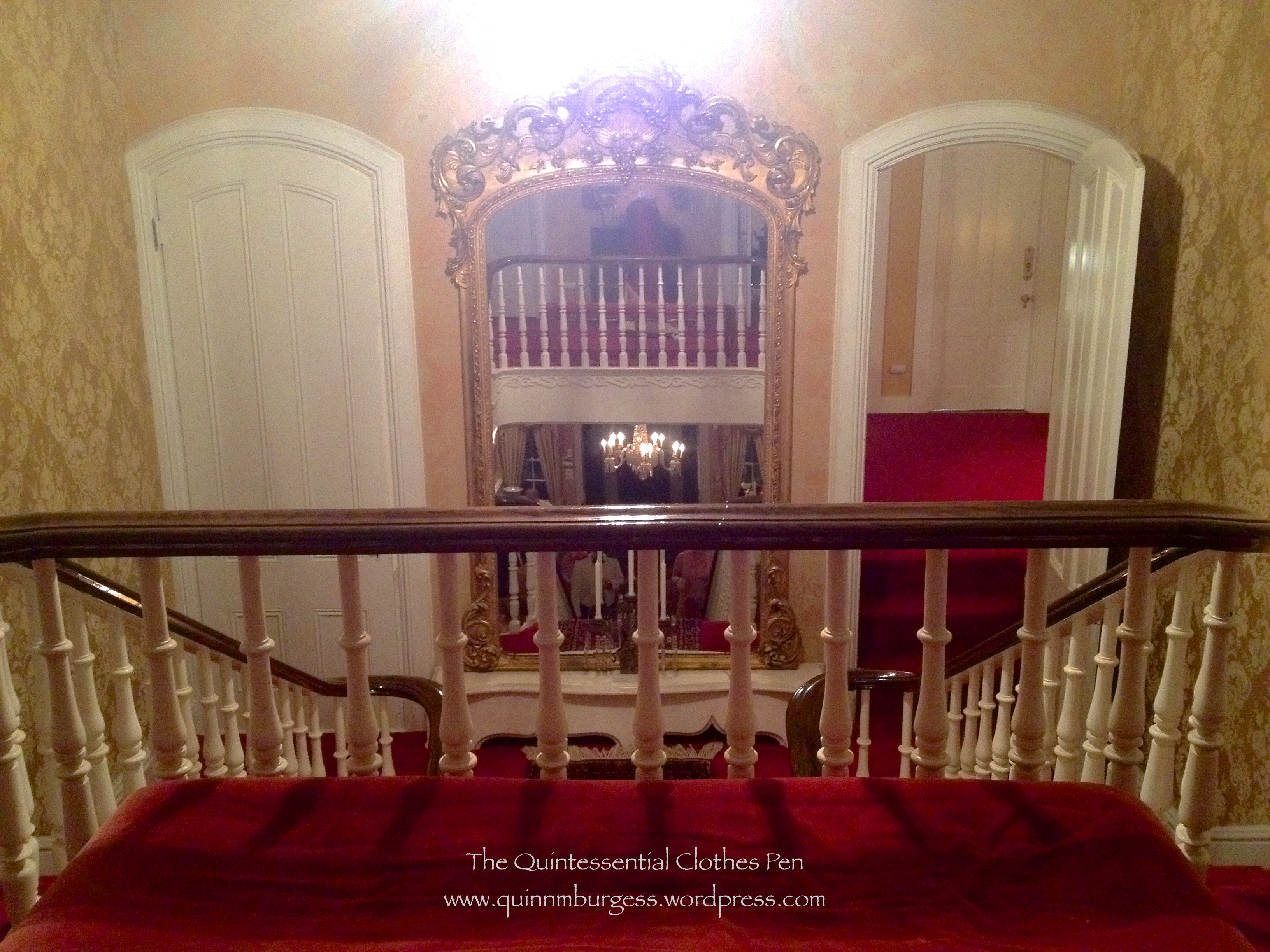
Early in August, I was able to attend two events that were part of Vintage Victorian’s Nahant Vintage Dance Weekend. The first was a lovely late 19th/early 20th century soiree at Egg Rock, a lovely historic house with beautiful furnishings built in 1864 right on the cliffs overlooking the ocean (the second was the Grand Ball, but I’ll save that for another post). The event was quite elegant and included catered food and drinks. I’d like to take you with me to wander around the house, if you’re inclined. (I apologize for the slightly blurry pictures, the phone camera didn’t like the lighting much.)
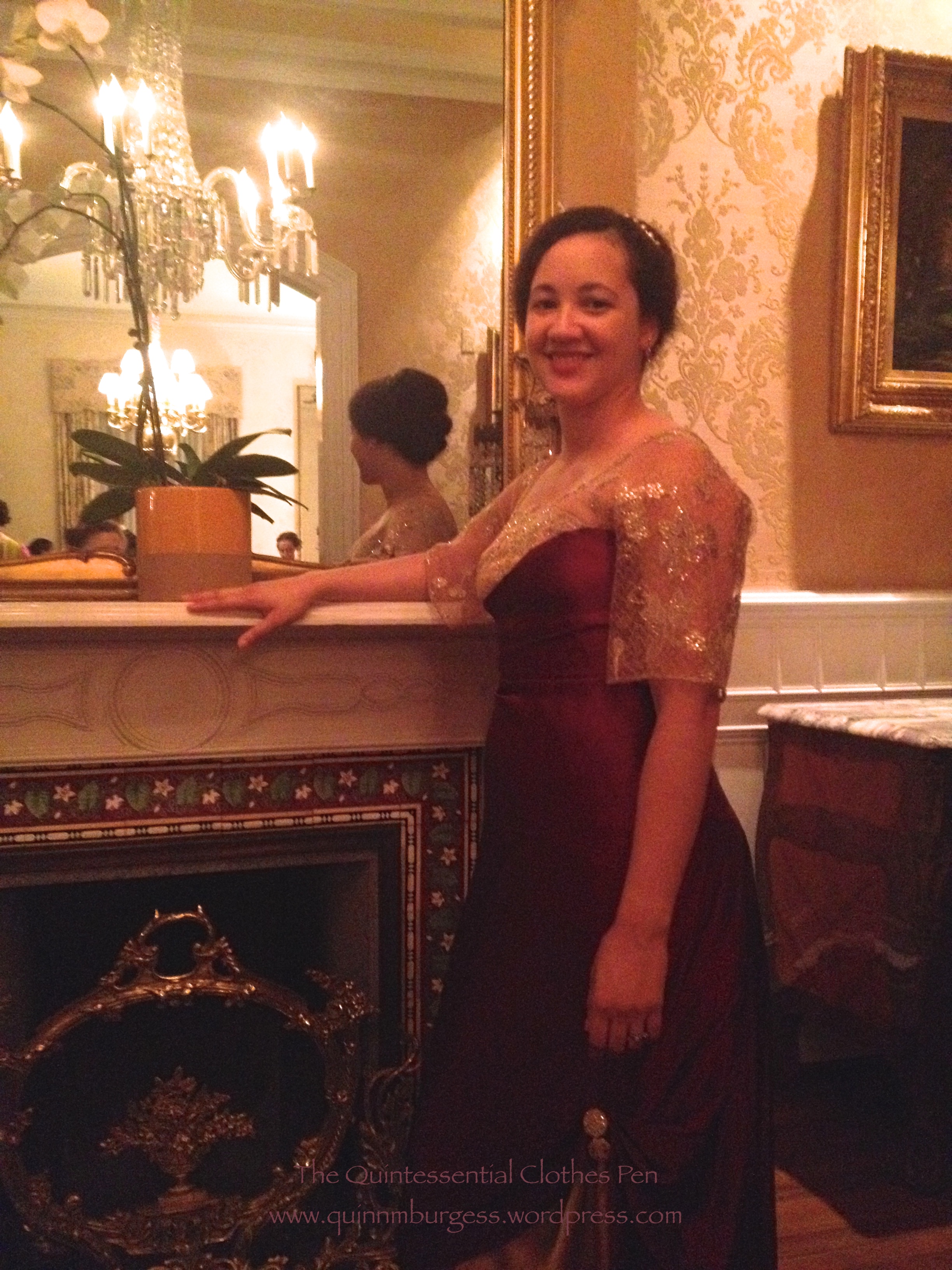
A lovely staircase in the front hall greets us, as is is typical of a mid-19 century home.Beautiful architectural details grace all aspects of the house: see the lovely gold damask wallpaper and the decorative woodwork along the stair moulding?At the top of the stairs there is another split set of stairs leading up to a cute balcony and bedrooms overlooking the ocean.Standing at the top of the balcony we can look into the fabulous tall mirror down the stairs into the hallway below.Back downstairs in the entrance hall we can appreciate another lovely mirror, beautiful fireplace, and elegant grandfather clock.Off to the opposite side of the hall from the fireplace is a small ballroom with a distinctive wood floor. Dancers whirled in small circles here all evening to the tune of live music.The ballroom’s walls were adorned with large pastoral paintings which sadly were peeling and in need of conservation. There was also this elegant sofa on one side. I love that the colors in these dresses complement each other so well and that the attitudes of each person are so distinctive and pretty.And here I am, wearing my burgundy and gold 1912 evening gown, which harmonized beautifully with the colors in the entry hall. See that wallpaper? I love it!
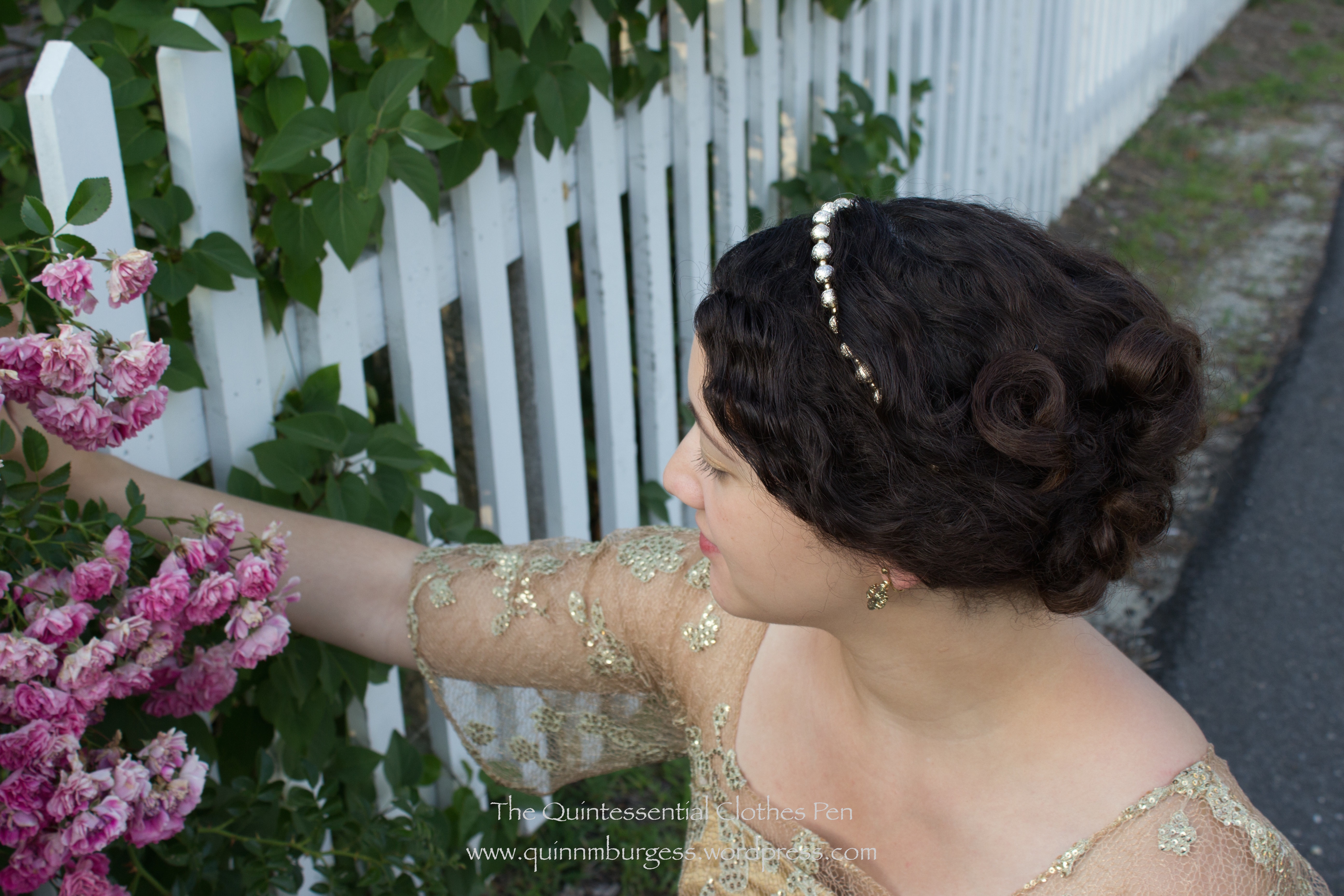
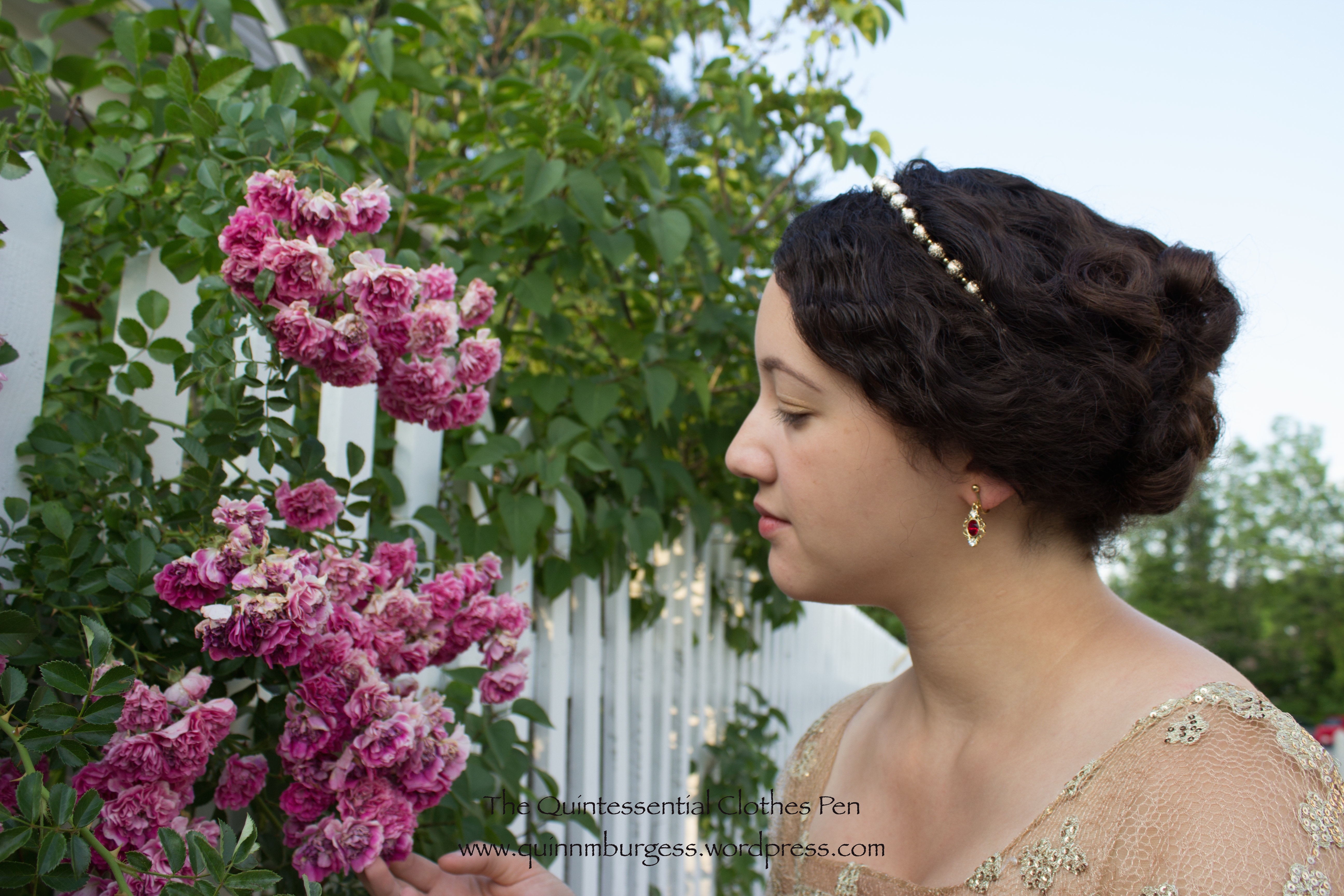
I was rather undecided about attending this event until the last moment, so I did a reprise of my hair style from July using the beaded gold necklace as a headband, but did it hastily and without a curling iron, so the texture was my normal wavy frizz rather than defined waves and curls. I’m glad I attended, though, because I had a lovely time and really enjoyed the house. I hope you also enjoyed this short visit to Egg Rock!
It’s been over a month now, but back in July I attended a Ragtime ball that proved to be great fun. I wore my tried-and-true 1912 burgundy and gold evening gown (while it’s nice to have new things, it’s also nice to pull beautiful things out of the closet, too!). Despite wearing a dress I’ve worn before, I tried a new style with my hair, including a repurposed (and therefore new-feeling) accessory.
I was inspired by hairstyles like these from the early 1910s. There are more examples on my Hair: 1900-1920 Pinterest board as well, if you’re interested. What I took away from these images was the use of a headband of some sort, the rather large airy shape, and the defined waves and curls.
c. 1912 Lily ElsieLa coiffure française illustrée. (1910)
Of course, I decided to try this out the afternoon of the event so I hadn’t thought ahead in terms of what to use for a headband. After casting around a bit I thought of a bead necklace I’d purchased a few years ago that ties with a ribbon. Why not use that as a headband? In addition to the bead-necklace-as-headband, I wore my Downton Abbey Collection earrings, which are quite lovely and matched my dress very well in color and style.
It took rather a lot of time to create the front waves with my curling iron. The back loopy curls were time consuming, too, though fun until my arms started to hurt from being held up for extended periods of time.I love how defined the curls came out, though, and while I do think there’s a slightly flat spot at the back of my head I generally think the silhouette is what I was aiming for.Waves, curls, and earrings!
And here is the dancing in action! People were very well dressed and enthusastic at this event and really seemed to have a good time. For most dances there was hardly anyone sitting out! That’s great, especially when the crowd is a mix of ages.
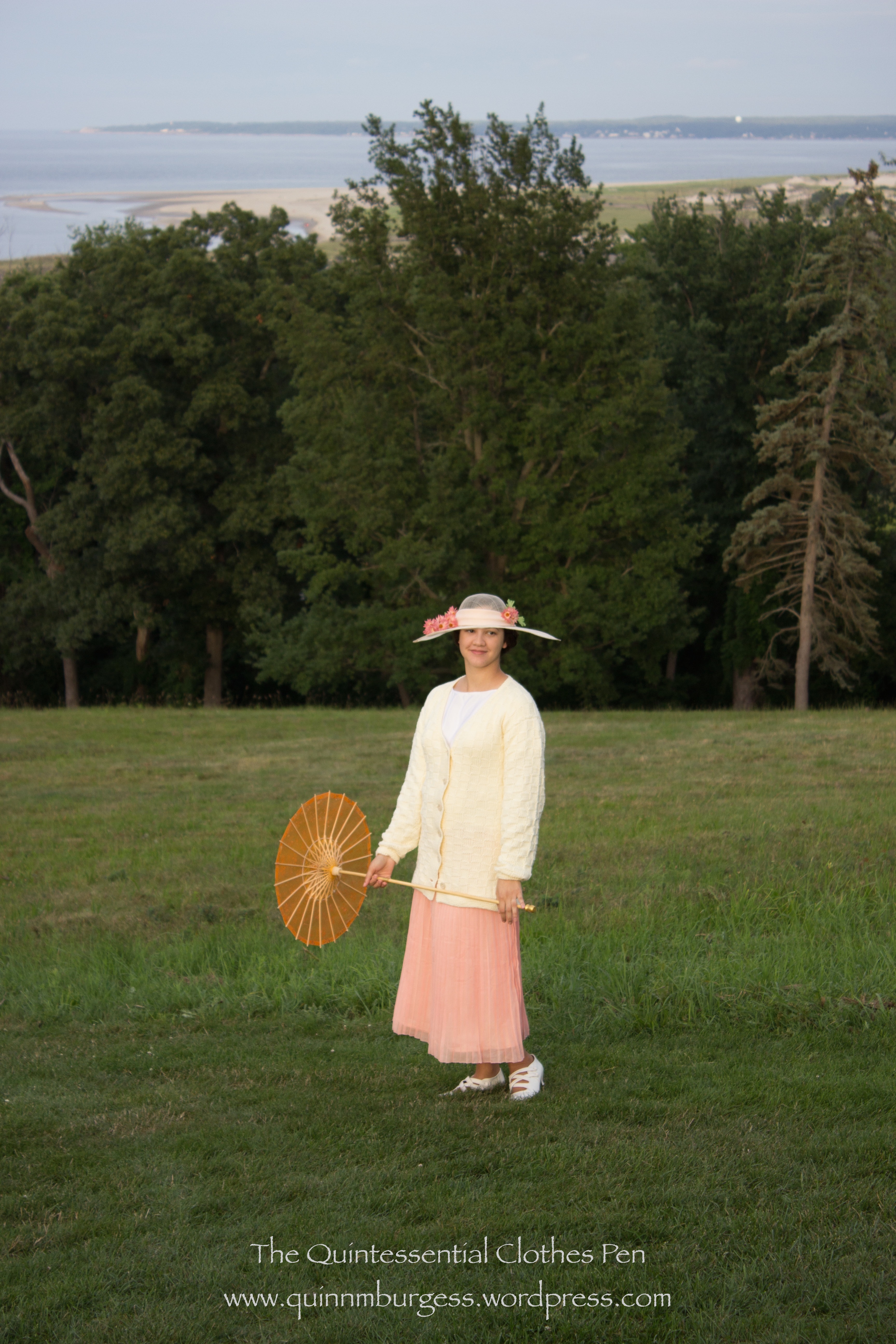
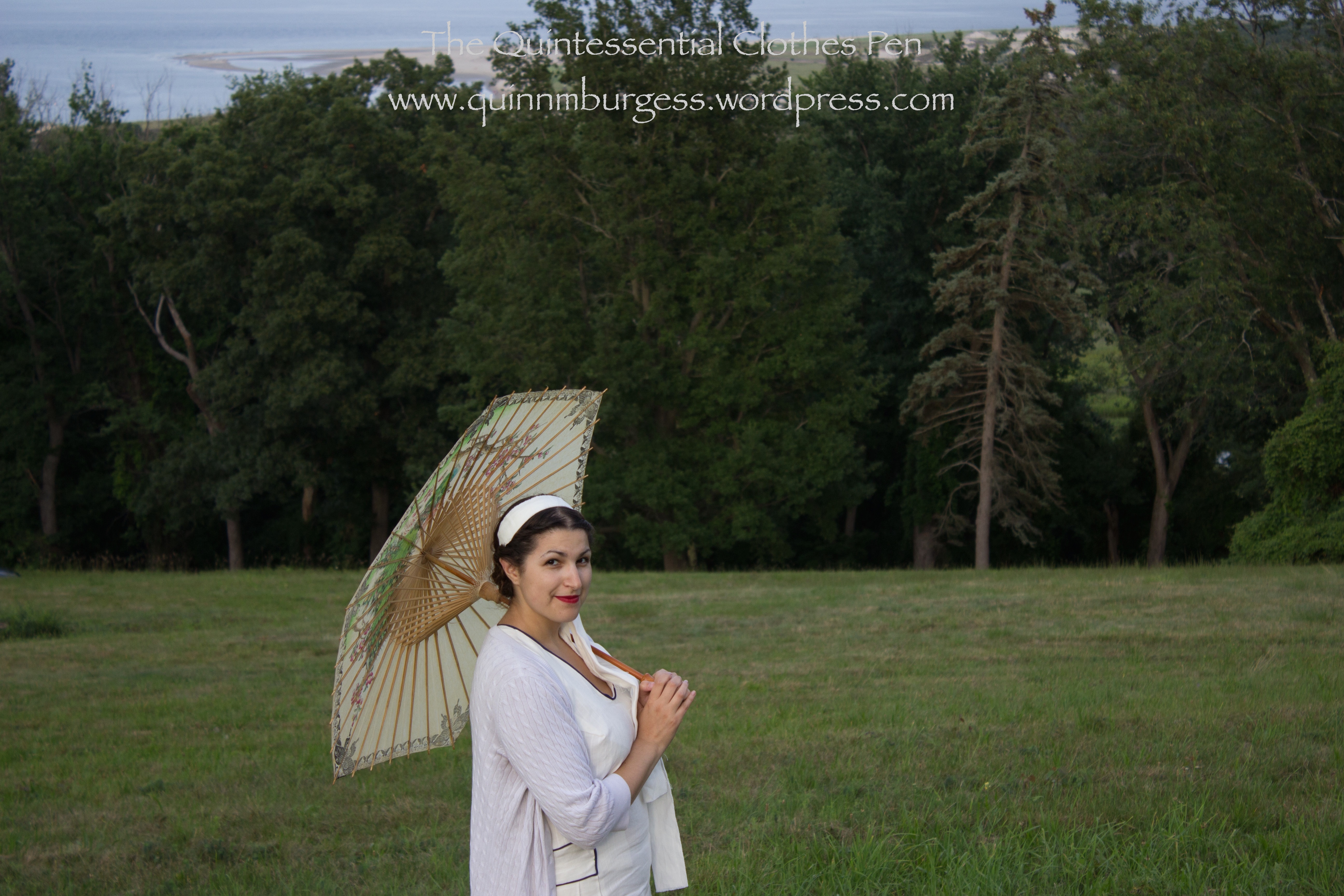
This year, I paired my new parasol and hat with a pleated skirt from ebay (it was one of those things you gamble on when you order, and while I don’t like it for modern wear I think it worked perfectly for an early 20s look!), a new silk blouse c. 1922, my 1917 Knitted Sweater of Angorina (because I’m sure people didn’t wear their clothing only during one year!), and my American Duchess Astorias. It’s wonderful to have accessories and pieces like sweaters in the closet that can fill out an outfit without having to always create an entirely new ensemble.
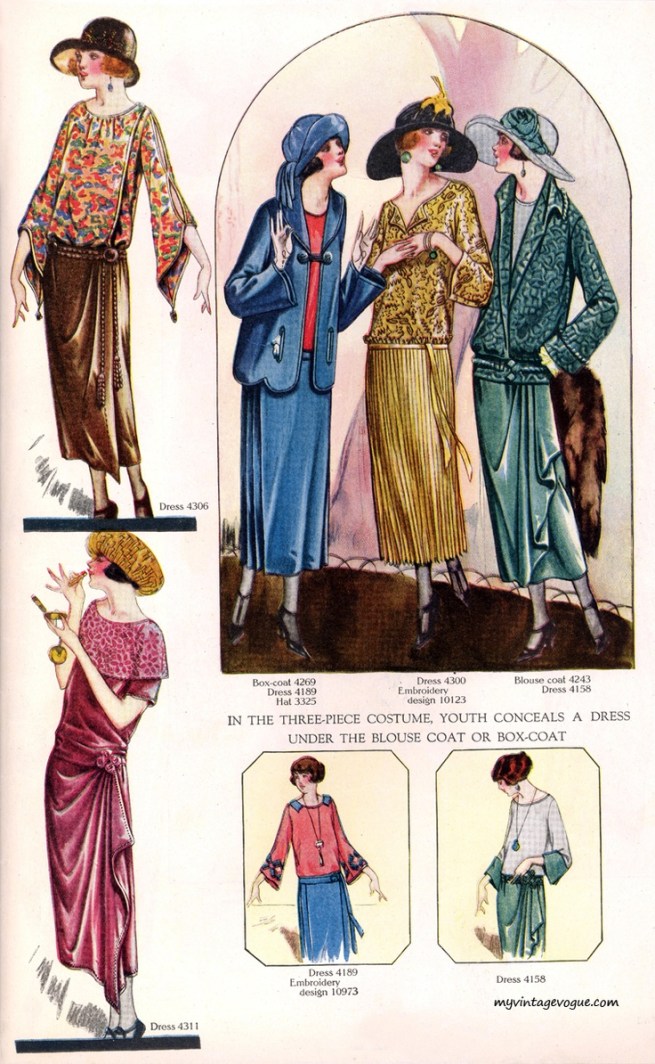
My goal was an early 1920s look, when the skirts were still long and the clothes weren’t quite such bags. In terms of overall clothing style, I was aiming for the yellow lady in the image below. In terms of accessories, I was aiming for some of the looks which you can see in this past post about making my parasol.
The Delineator Magazine 1923
The blouse I made from white silk crepe the afternoon before the event. It’s all one piece, with the gathered sections on the sides. I used short sleeves, as in view A, but omitted the bow, as in view C. This was partially due to fabric restrictions, as I used fabric left over from another project and I only had an odd shaped piece to work with. I’m not entirely pleased with it, because, being 20s, it is rather a bag, but it was very comfortable, which I did like. I think I would like it better if it was an off white rather than a bright white, because it would have complimented my outfit better. But my hand knitted sweater is ivory and I was really pleased to wear it over the blouse, because I liked the color and the length better. It has such nice proportions with the skirt!
My inspiration for the blouse. Butterick pattern #3779 from 1922 at COPA. I used the pattern layout as a general guide for creating my blouse.My 1922 blouse. (…that is a bag!)
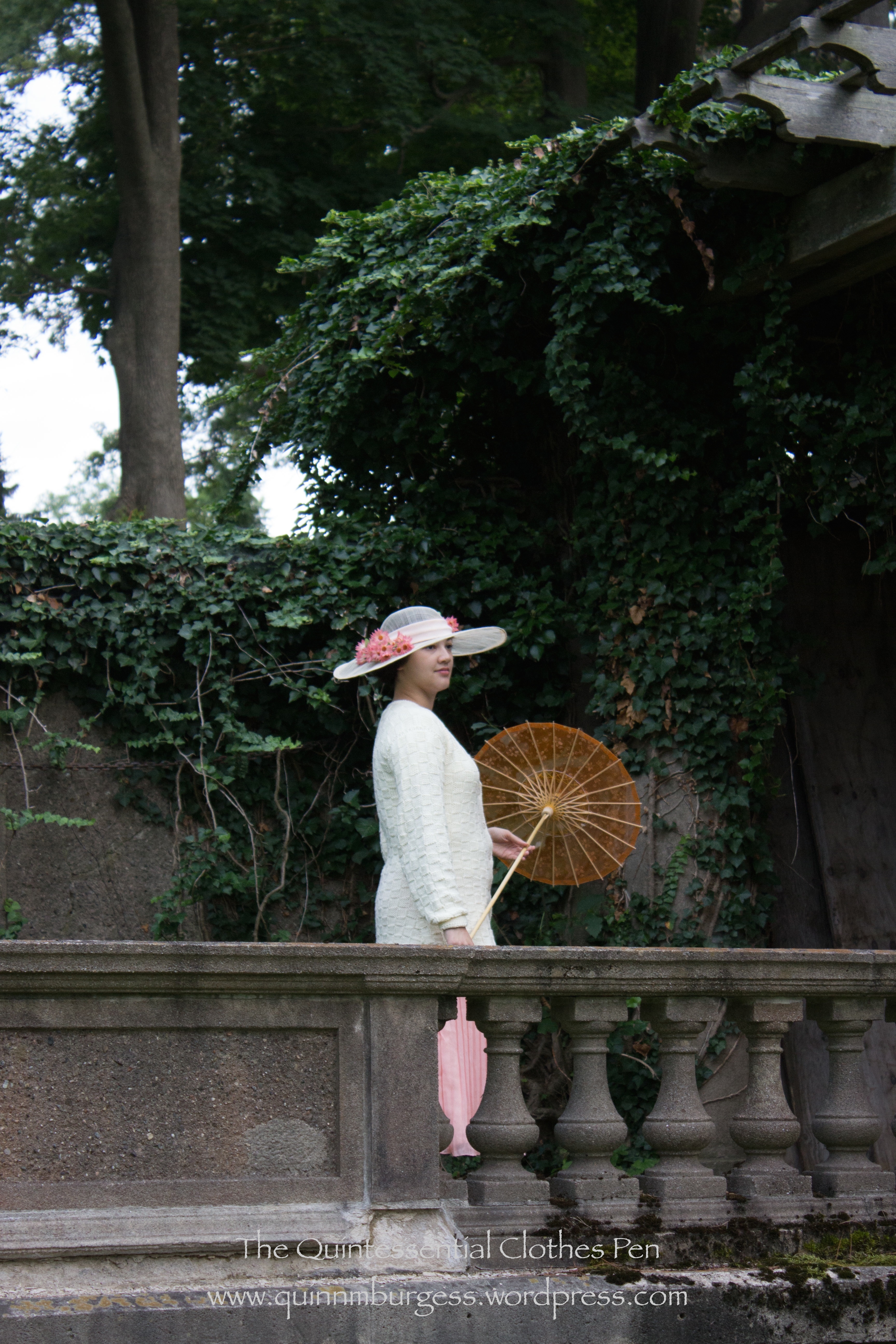
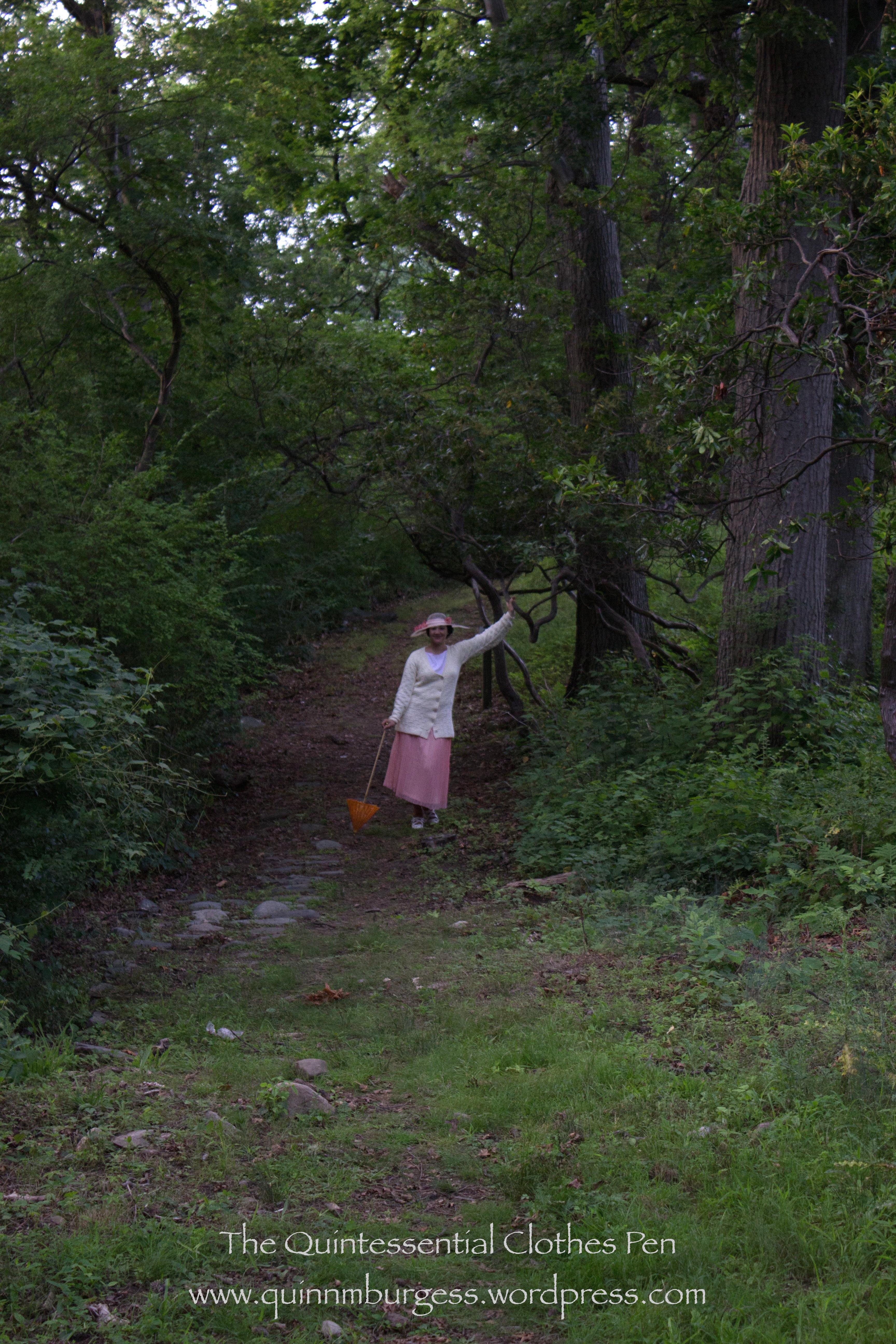
In no particular order, here are a variety of pictures taken around the estate of the entire ensemble. There were quite a few that I liked, for the movement of the fabrics, or the pose, or the background. The wide hat brim was great for hiding my face. Useful, since I am really good at making weird faces and not always the best at making good picture faces.
Looking out over the ocean.In the sunken garden.At the gate to the secret garden.At the beginning of the wooded path.Exploring the wooded path.Appreciating the gnarly trees.Ascending the path.
Of course, sometimes I was the person behind the camera as well (it’s only fair that if I want lots of pictures of my outfits that I also reciprocate!). Here are a few other pictures just for fun. I took all of these except the last one.
Capturing the ocean and the lovely parasol.The house is surrounded by a lovely terrace with stone walls.Through the gate to the secret garden was distant view of marshes.
And, lastly, a bit of humor to end the parade of pictures.
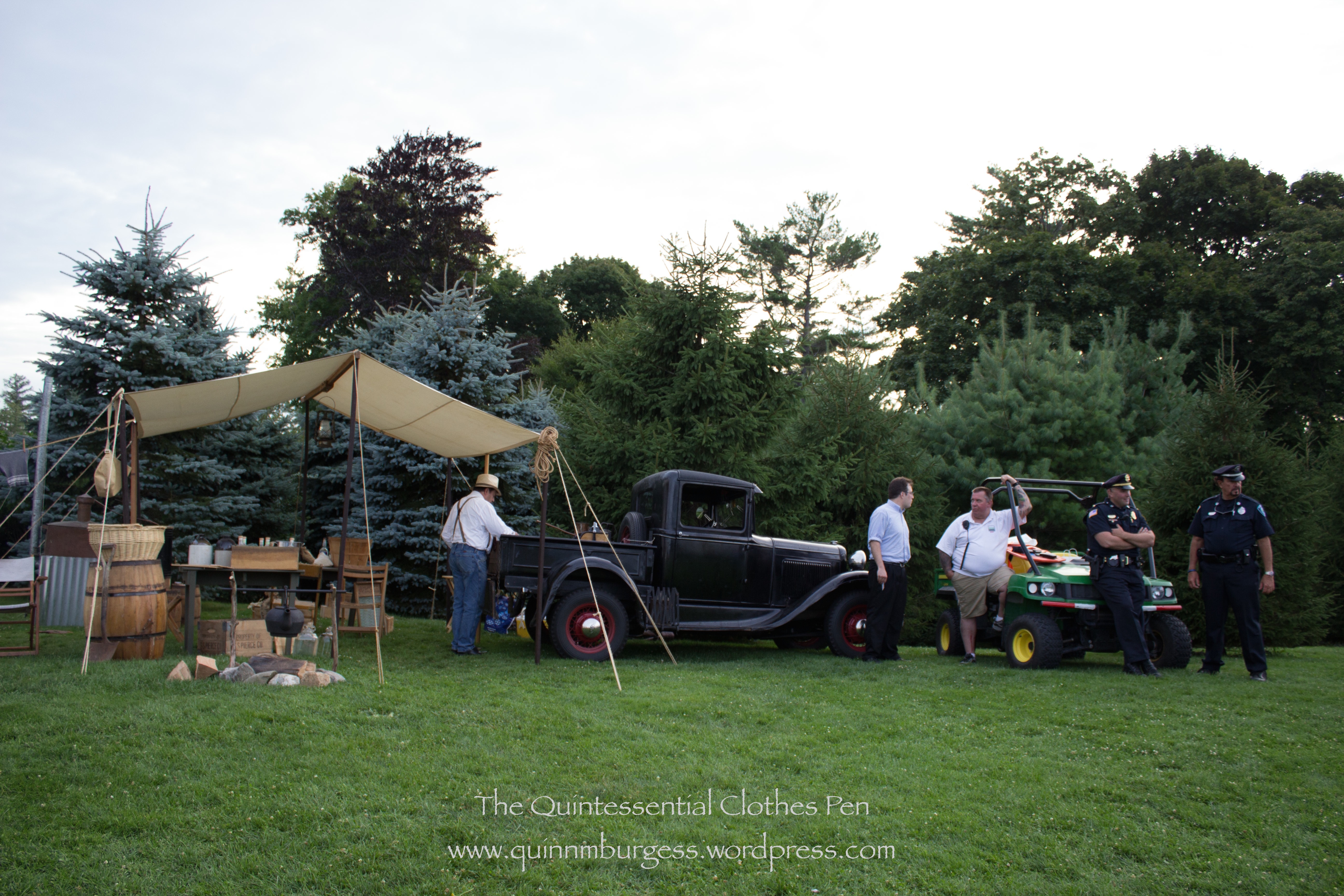
One section of the lawn had a great bootlegger setup and I was particularly amused to see the (modern) police hanging out right next to it.
And there we are! All of my recent 1920s accessories have been worn/used and documented in my complex photography files. That’s it for 1920s for awhile.































 The Quintessential Clothes Pen