1896 Bicycling Ensemble: Construction Details

As promised, I have quite a few words and photos to share with you about the construction of my 1896 Bicycling Ensemble, so prepare yourself for a long post! This post is a great reference for me to have all the details in one place, but I also hope that some of my details might be helpful for other people who want to build 1890s cycling outfits as well.

If you want to read a bit more about the social history of the bicycle ensemble, see more finished ensemble photos than the few in this post, or read more about the accessories I’m wearing with this ensemble, check out my first post about it (this is the same as the first link). I also have a post looking specifically at patents and advertisements for women’s bicycling clothing from this time. It’s a great supplement to some of the information I mention in that first post.
This post is going to focus on the main garments that make up this ensemble: the jacket and bloomers. We’ll start with the two main similarities between these garments.

#1 Both garments are mostly machine sewn, with hand sewing for the tailoring steps of the jacket as well as much of the finishing of each garment.

#2 Both jacket and bloomers are made from a drab colored wool that has been in my stash since 2012. I purchased it from the remnant table at the local discount fabric store for the amazing price of $3/yard! I bought every piece they had, so I have about 10 yards broken up in about 6 different pieces. I used less than half of what I purchased for this project, leaving me plenty to use this for an 1880s dress as well. (That one has been in progress for the last 18 months… I hope to finish it this year!)

The drab colored wool is perfect for this cycling outfit, not only because I already owned it and it has been taking up space for years, but also because drab was a popular color for cycling outfits because it successfully hid dirt and dust. Other recommended colors were brown, black, and navy.

The Bloomers

Now that we’ve looked at the similarities let’s look at the differences, starting with the bloomers.

These are entirely self drafted. While that might sound intimidating, these are actually quite simple! Each leg is the full width of the fabric, 60″ wide, and 33″ in length. On my 5’6″ frame that provides plenty of pouf in the legs when they are held in place around the tops of my calves. The only shaping is in the crotch seam, which is a curve ~5.5″ wide and ~12″ deep. The crotch curve is deep enough and the bloomers are full enough that I made the crotch curve the same for the front and back. Here’s a photo of the crotch curve drawn out before I cut it.

The fullness of the 60″ wide legs is pleated into the waistband with knife pleats folded towards center front and center back. Knife pleats are documented in sporting bloomers from the 1890s and are specially mentioned as being folded this way in order to help the bloomers maintain the full look of a skirt, in keeping with the social convention that skirts were acceptable wear for women but bifurcated bloomers were not. I experimented and decided I liked just a few deep knife pleats as they helped the bloomers fall nicely on my body.

I debated about how to gather in the fullness at the bottom of the legs, especially since I couldn’t find specific instructions on how this was accomplished or see this particular detail given the way extant bloomers are displayed. I decided on gathering each leg into a band that hooks so that it stays in place at the top of my calf. There is a 3″ slit in the leg as well. The raw edges of this are turned under ¼” and whip stitched by hand. There is also a small reinforcing bar sewn across the top of the slit to keep it from ripping. Here’s a closeup of the leg opening.

The inside of the bloomers looks like this. There are two decorative strapping details on the front of the bloomers (more on that when I get to the jacket). These conceal a placket opening on one hip (visible on the far left) and a pocket on the other! The crotch seam and inseams are left unfinished. This wool did a pretty good job of not fraying at the edges so there was no need to finish these seam allowances.
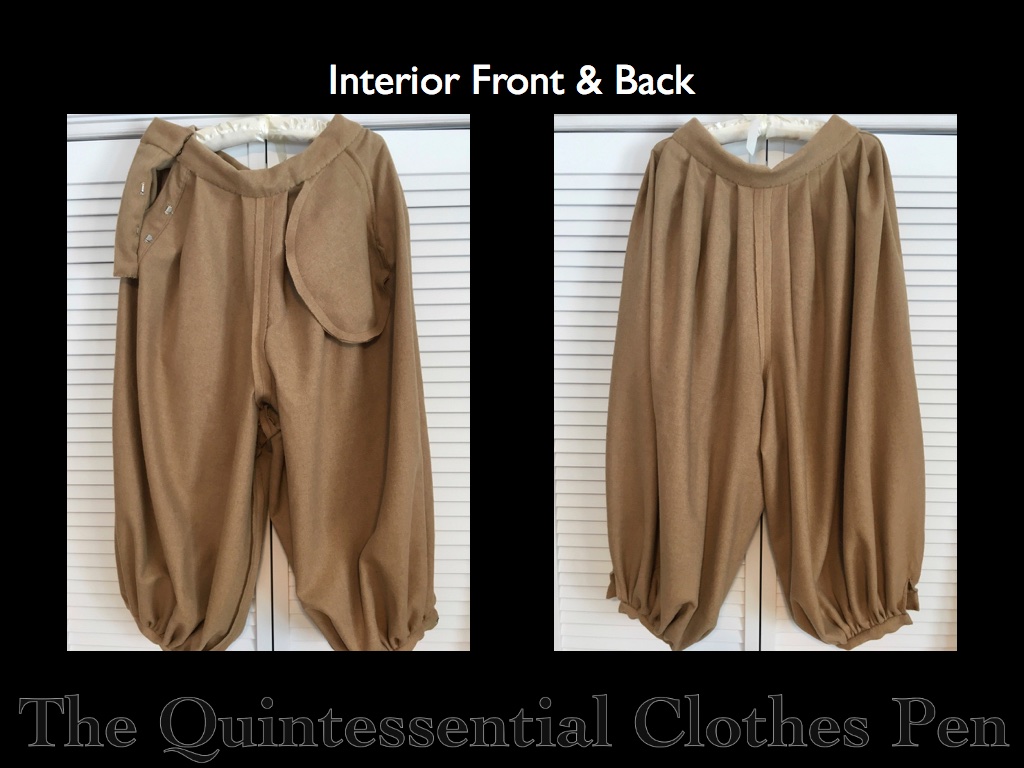
Here is a closeup of the placket opening that is hidden behind one of the strapping details. You can also see the interior of the waistband, which is whip stitched to hold it in place. To be entirely fair, I could have made bloomers on a waistband without the strapping and pocket and saved a fair bit of time. Stitching the strapping bits on and hiding the placket and pocket behind them required some extra brain somersaults and time to figure out and execute. But I really like the strapping detail on this extant bicycling ensemble from 1896 at The Met and really wanted to include that detail in my own garments, so here we are.

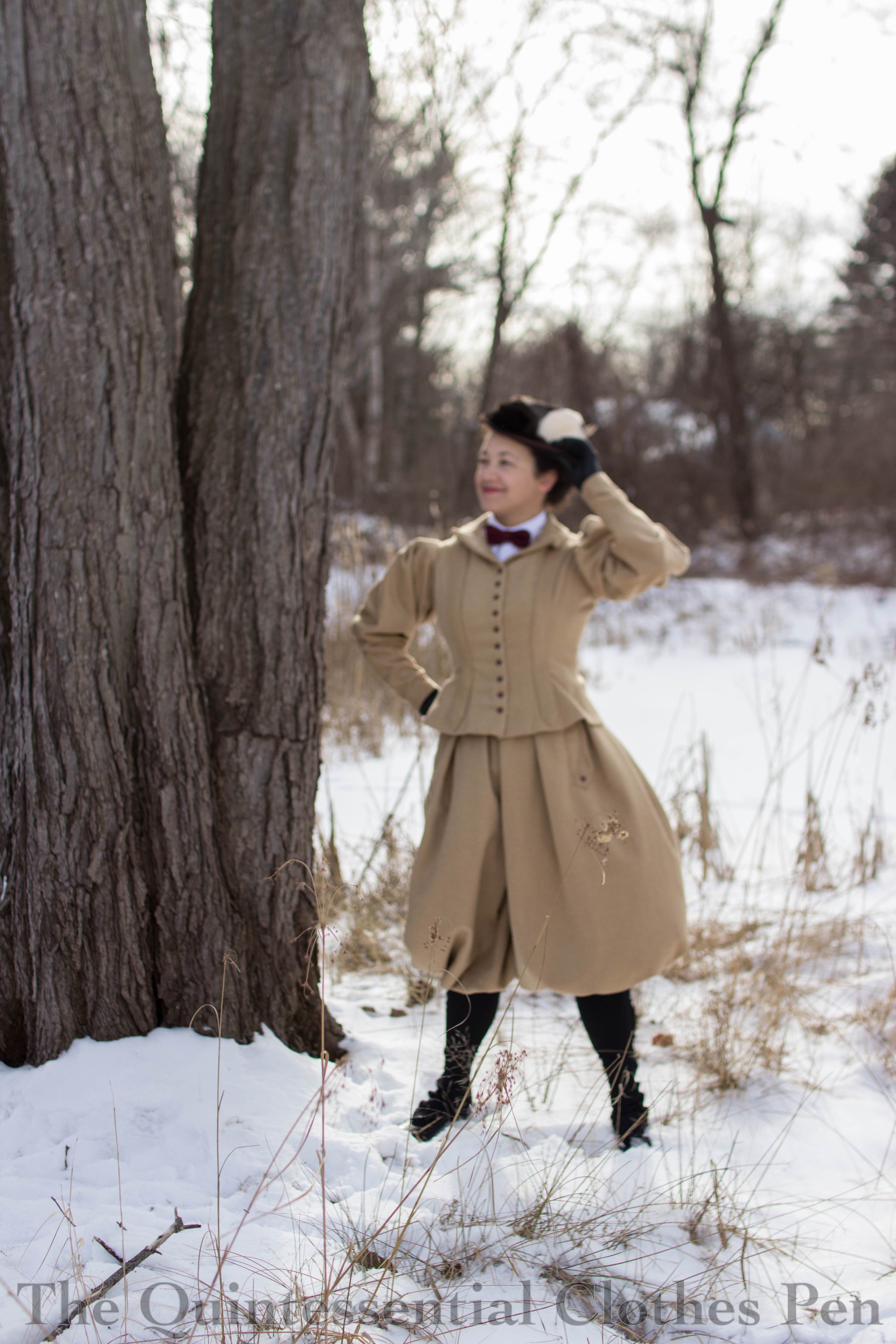
Here’s what the bloomers look like when the wind filled them out during our photoshoot. This gives a better idea of how much fabric is in each leg of the bloomers.
The Jacket

I wanted to have a tailor-made style with a lapel and collar that would follow the general style of men’s jackets in the 19th century. Most bicycling ensembles are of this style, due in part to the fact that this type of activity was traditionally a male pastime. The specialty clothing produced for men’s active pursuits was made by a tailor, so it follows that women’s clothing began to be tailor-made as well as they joined in these male activities in the later part of the 19th century.

I started with the pattern for my 1895 Skating Ensemble because I knew it had the general shape of the mid-1890s and that it already fit. That pattern was made by me, based on my inspiration jacket for that ensemble as well as patterns published in Authentic Victorian Fashion Patterns. I had already modified it to get the shape of the skating jacket, but I modified it even more to create this new jacket. I made these further changes:

  • Created princess seams on the front and back that run down from the shoulders instead of the armsceye
  • Joined the side back pieces to make a single wider piece instead of two narrower pieces
  • Moved the new side back seam towards the side seam
  • Added back pleats, front darts, and a lapel and collar
  • Shortened the length

At this point it’s really not close to the original pattern at all!

The sleeves are my standard 1890s gigot sleeve that originally came from Period Costumes For Stage and Screen. I wound up making a number of changes to the pattern to get a slightly different shape. Below you can see my progress.
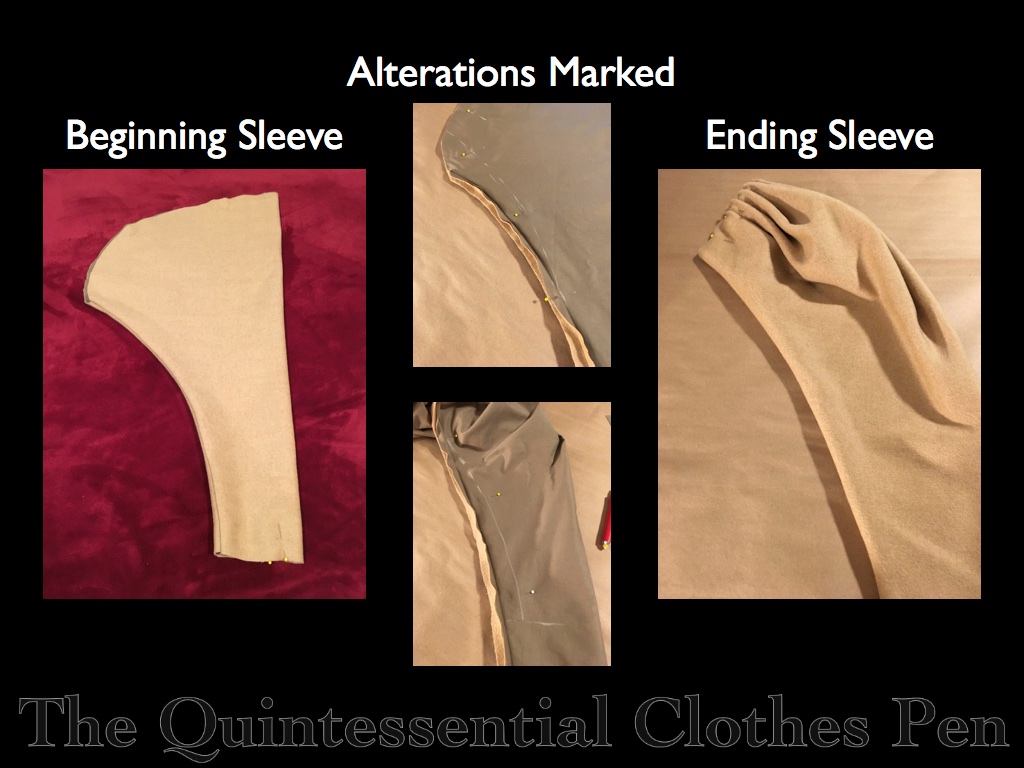
After trying out the original sleeve I made two major changes to the shape, angling the underarm seam at the top/making the top less full and angling the underarm seam at the bottom towards the wrist/shortening the length. After pleating each side of the new sleeve towards center I ended up with the sleeve shape on the right.

After I had a pattern I was confident with I started cutting my pieces. Each exterior piece was cut in wool and cotton in order to be flatlined. The front and collar facings are single layers of wool. There are also canvas interlining pieces for the front and collar.

The proper way to flatline is to pin your layers together and then (preferably) hand baste around each piece to hold the layers together while working with them. I opted to eliminate the basting step, using pins to hold the layers together until they were sewn. My fabrics were pretty sticky so this time-saving shortcut worked pretty well. You can see the pins holding the non-sewn edges together in this photo of the exterior after assembling the front and back pieces.

This is also one of the only steps that show the front darts, as those were hidden under the decorative strapping I added to the jacket later on. The other amusing thing here is that because I was cutting my garment pieces from multiple pieces of wool you can see a color difference here between the center back pieces and the other pieces. But it’s not noticeable in the finished jacket, so that’s good!

And here’s the jacket at the same point in the process, turned over to see the inside. Now the flat lining is clearly visible, as are the box pleats along the back seams. You can also see the canvas that runs down the fronts.

Here is just one side of the front. It gives a clearer view of the front dart and the canvas that supports the lapel and front edge.
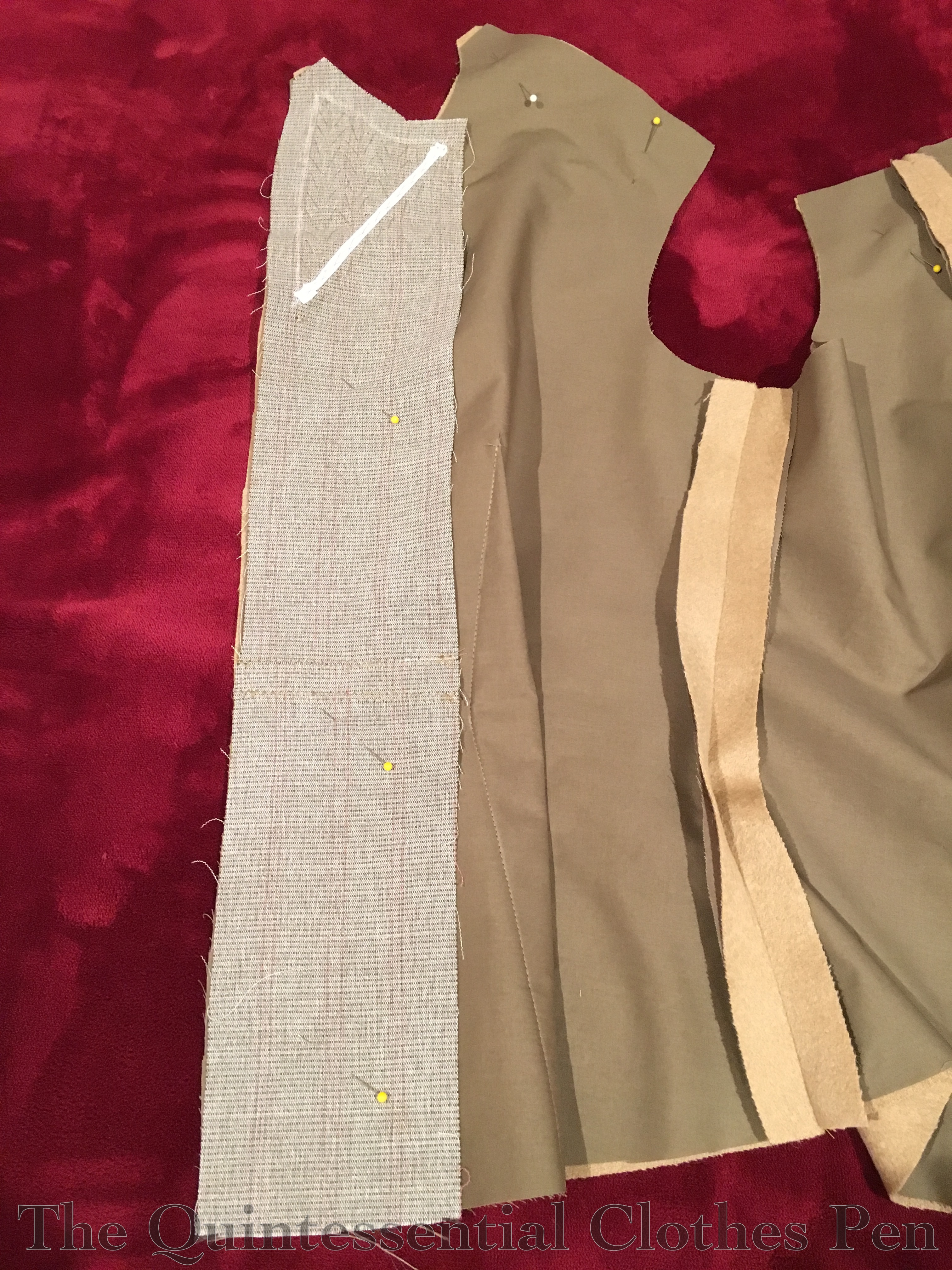
I pad stitched the lapel and taped the roll line in men’s tailoring fashion. These stitches help to support the roll of the collar. The tape running across the roll line snugs that distance in just a bit which helps the collar roll in exactly that spot.
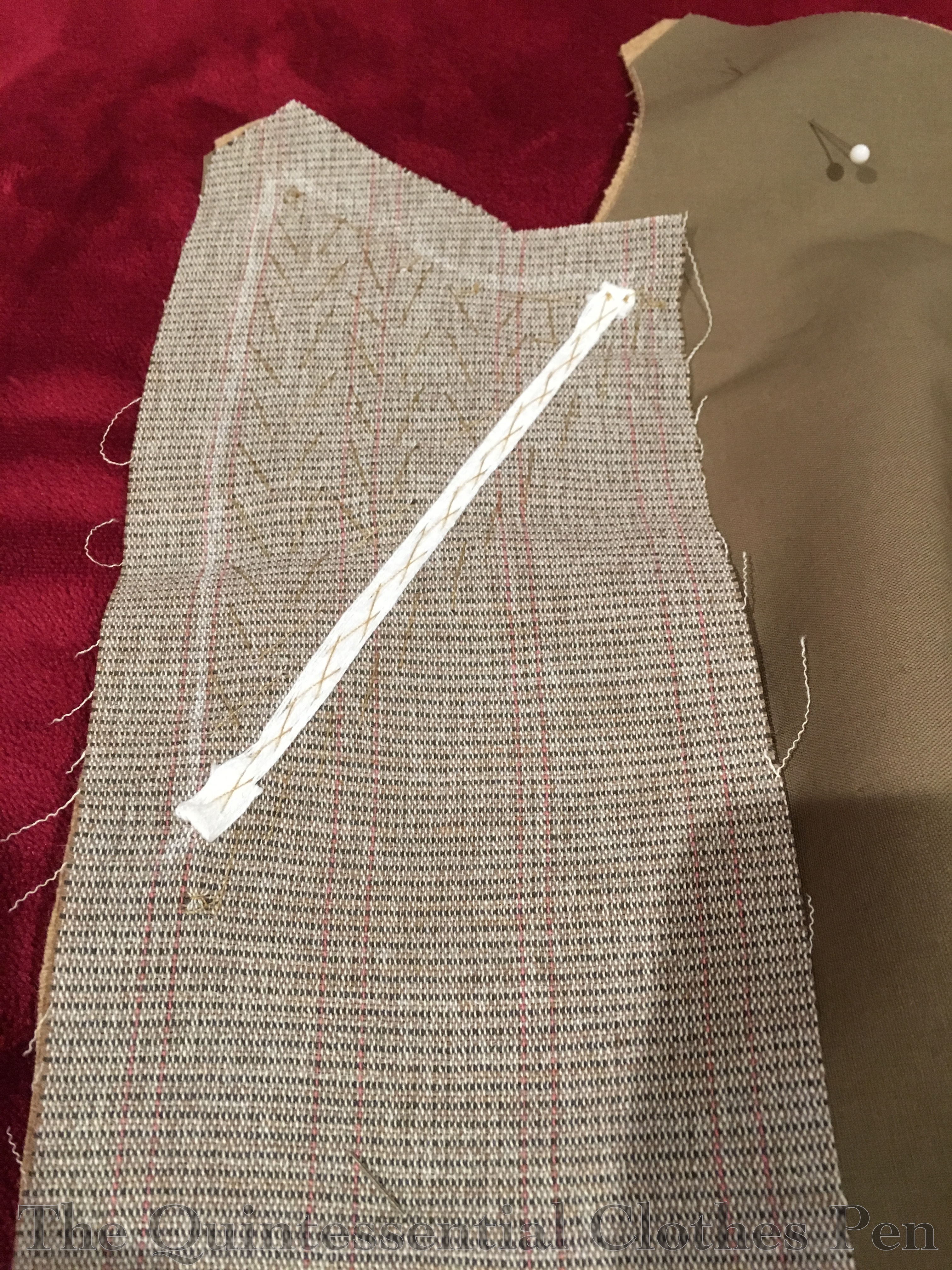
I decided not to try to pattern the strapping with the main body pieces. It just seemed too complicated to wrap my head around. I knew they wouldn’t be straight, as my body is curved, and I knew that making them on the bias would be a disaster to try and manage the edges of… I decided to deal with this step when I got there in the construction process.

Accordingly, when the jacket had all of the vertical seams assembled it was time to consider the strapping. I did this at this step, before sewing the shoulder seams, as I wanted the strapping front and back pieces to perfectly match along that seam. Easier to pattern flat than if I’d already sewn the shoulder seams!

I laid the jacket out on the table with a scrap piece of wool on top of it, put pins along the seam line to mark the location (so my strapping would hide the seam), and then drew a strapping shape I liked around that. As you can see, I didn’t follow the curve of the seam perfectly. That was an intentional choice, as I wanted the strapping to have a similar curve as the curve on the strapping of my inspiration jacket (here is the link to that again, in case you want to take a look and not scroll all the way up to the first link).

I repeated this process for the front (which was trickier with the shaping that dart creates!) then cut out four of each piece. I decided to finish the edges by making a tube that was topstitched by machine before being hand sewn to the jacket

I can’t imagine how horrible it would have been to try to topstitch the straps onto the jacket! Bad… very, very bad! And trying to turn the edges under and then topstitch would not have provided enough stability for crisp edges and would also have been a frustrating experience. Thank goodness I avoided those potential problems!

Here are two of the four straps, pinned and ready to be stitched together. The only edge I left open is the straight edge (at the right) that would go into the shoulder seam. After being sewn and trimmed these were turned right side out, pressed, topstitched, and carefully placed at the shoulder seam so that they would match up perfectly when the seam was stitched. The edges of the straps were then invisibly hand sewn to the jacket.

Here’s the end result. The straps look topstitched onto the jacket, but they are actually finished pieces that are fully sewn down in front but only attached above the pleats in the back, allowing the bottoms to flap amusingly! This detail is again taken from my inspiration jacket (and here is the link to that again).

As I mentioned earlier, the bloomers also have a strapping detail taken directly from my inspiration bicycle outfit at The Met. Those were carefully patterned–they look straight at first glance but are actually slightly angled and tapered. They are made in the same way as the jacket strapping pieces, though as I mentioned earlier, they were more complicated to put onto the bloomers as they conceal a placket on one side and a pocket on the other. That was a figure it out as I go experiment that required precision and quite a bit of puzzle-solving!

The collar was interlined with canvas and pad-stitched to provided stability for the shape. Then it was sewn around the edge by the machine and the seam allowances were graded before I turned it right side out.

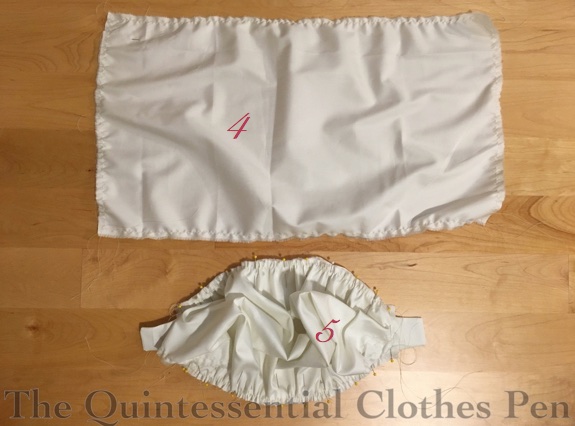
The sleeves are pleated to take in the fullness to fit the armsceye. There are 10 pleats total, each about ½” (1″ total) in depth. Here’s a photo looking down into the sleeve with all the pleats pinned in place. The box pleat (that is slightly off center in the photo) is the top of the sleeve when it’s set into the armhole of the jacket.

In this next photo we’ve progressed quite a few steps! The sleeves are set, the collar is on, the front wool facings are on, the collar edge and facing edges are turned under and hand sewn in place. I’ve finished the bottom edge of the jacket with a bias strip of cotton that was machine sewn then pressed to the inside and hand sewn into place (this is also how I finished the sleeve cuffs). The buttons are on and the buttonholes sewn by machine. I’ve whip stitched all of the seam allowances to keep them from fraying and added some extra support for the sleeve caps. I’ve also added a waist stay. Quite a few hours of work to condense into one paragraph!

The waist stay is a grosgrain ribbon sewn to the seam allowances that hooks in the front. Its purpose is to keep the jacket tight against my lower back and to keep the jacket from riding up as I use my arms. The photo below shows a close up of this as well as a number of other details–the bias binding at the bottom, the whip stitched seam allowances, and the pleats tacked to the lining along the top edges.

The sleeve pleats wouldn’t stand up on their own which made me a bit sad. My solution was to give them a bit of support… in this case I reused stiff net sleeve headers removed from 1980s dresses that I have a whole bag of in my stash. Each jacket sleeve has two of these sewn into the armsceye such that they stand up off my shoulder and help to support the pleats. In this photo I’ve just flipped them out to make them easier to see, but normally they’re tucked up inside the sleeve.

I also tacked the pleats together by hand about 1.5″ away from the seam. This helps keep the pleats nicely arranged and pointing up, which helps keep the fullness of the sleeves in check. In the end, this sleeve isn’t quite the same shape as my Met inspiration (here’s the link one more time), but that’s because it would have taken a lot more patterning time to determine exactly how the Met sleeve is shaped. I wanted to use my existing sleeve pattern and so I’ve decided to be happy with the sleeves I have.

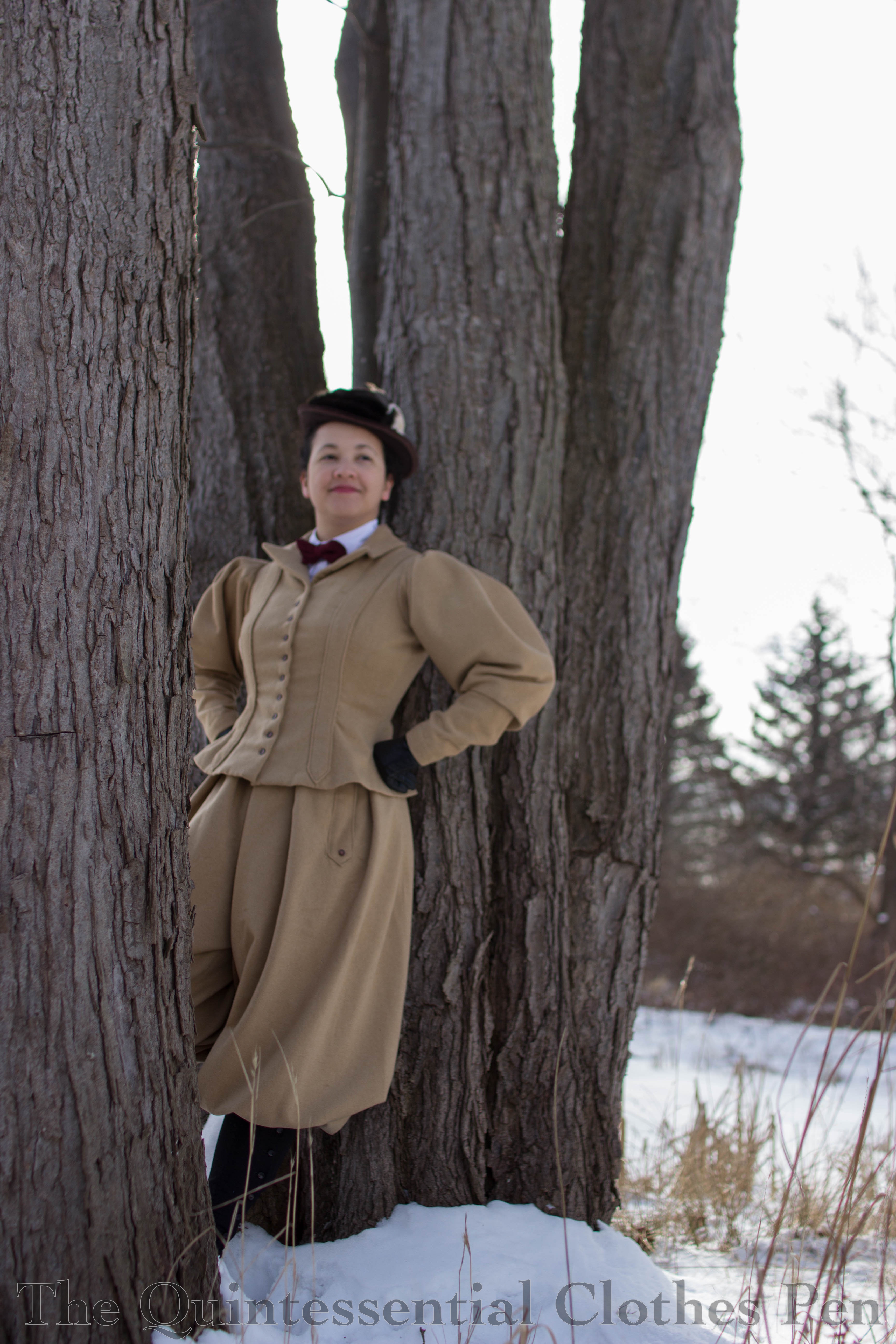
To recap, all these details and construction steps produce this! Slightly subdued 1890s puff sleeves, tailored jacket details, interesting strapping patterns, and bloomers!
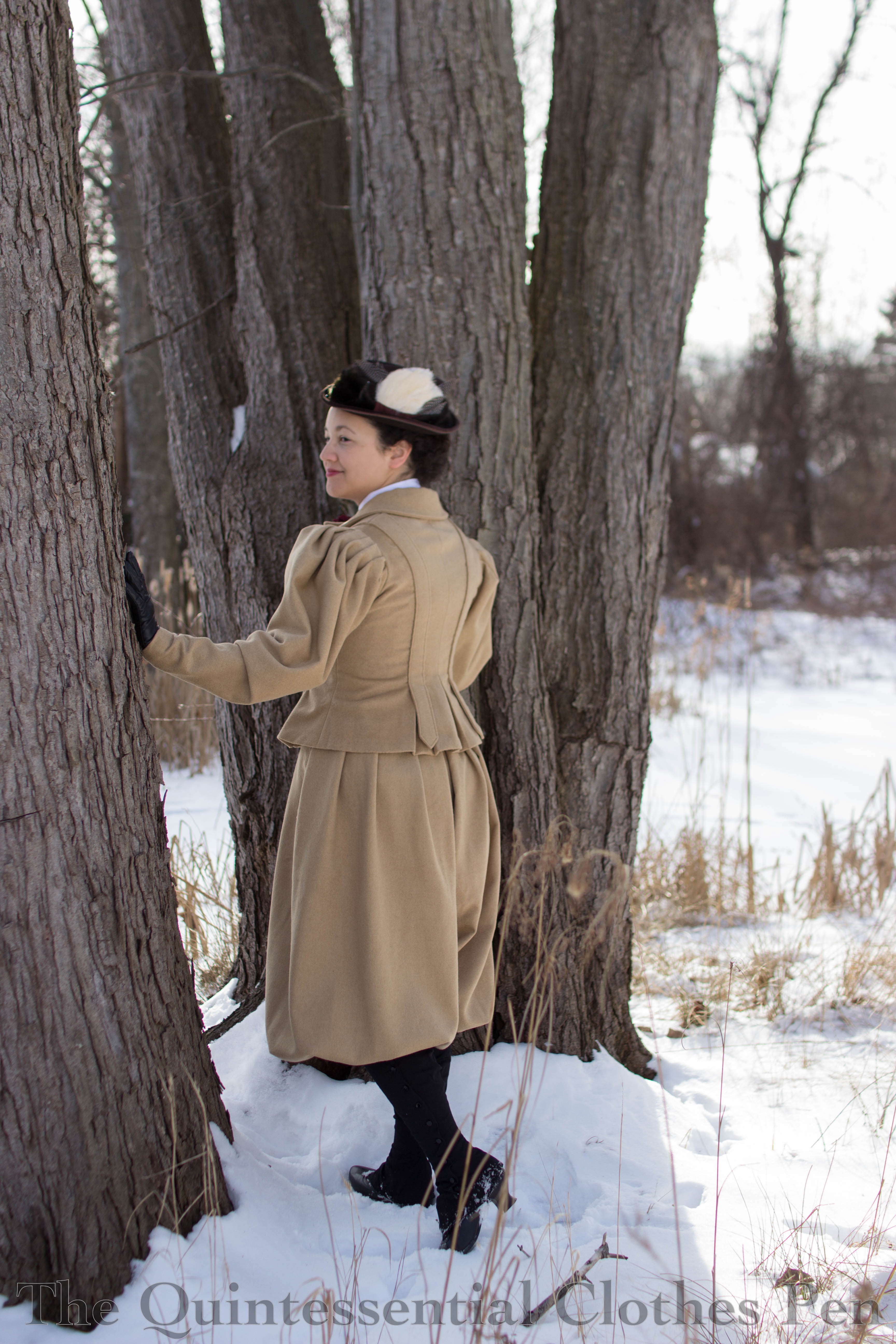
People sometimes ask me how long it takes to make my garments and often I don’t have a good answer as I don’t actually pay attention. I’m in it for the enjoyment of sewing and unless something is going wrong and I’m frustrated I generally enjoy the process. For this ensemble I kept track, though, and I can report that it took me 22 hours to pattern, fit, cut, tailor, sew, and finish this jacket and bloomer ensemble.

I’ve collected some (but by no means all!) images of bicycling ensembles on my 1890s Sportswear Pinterest board if you want to see more of my visual research and inspiration. Thanks for sticking with me for a lengthy post!
Sunshine Yellow Stripes In 1933

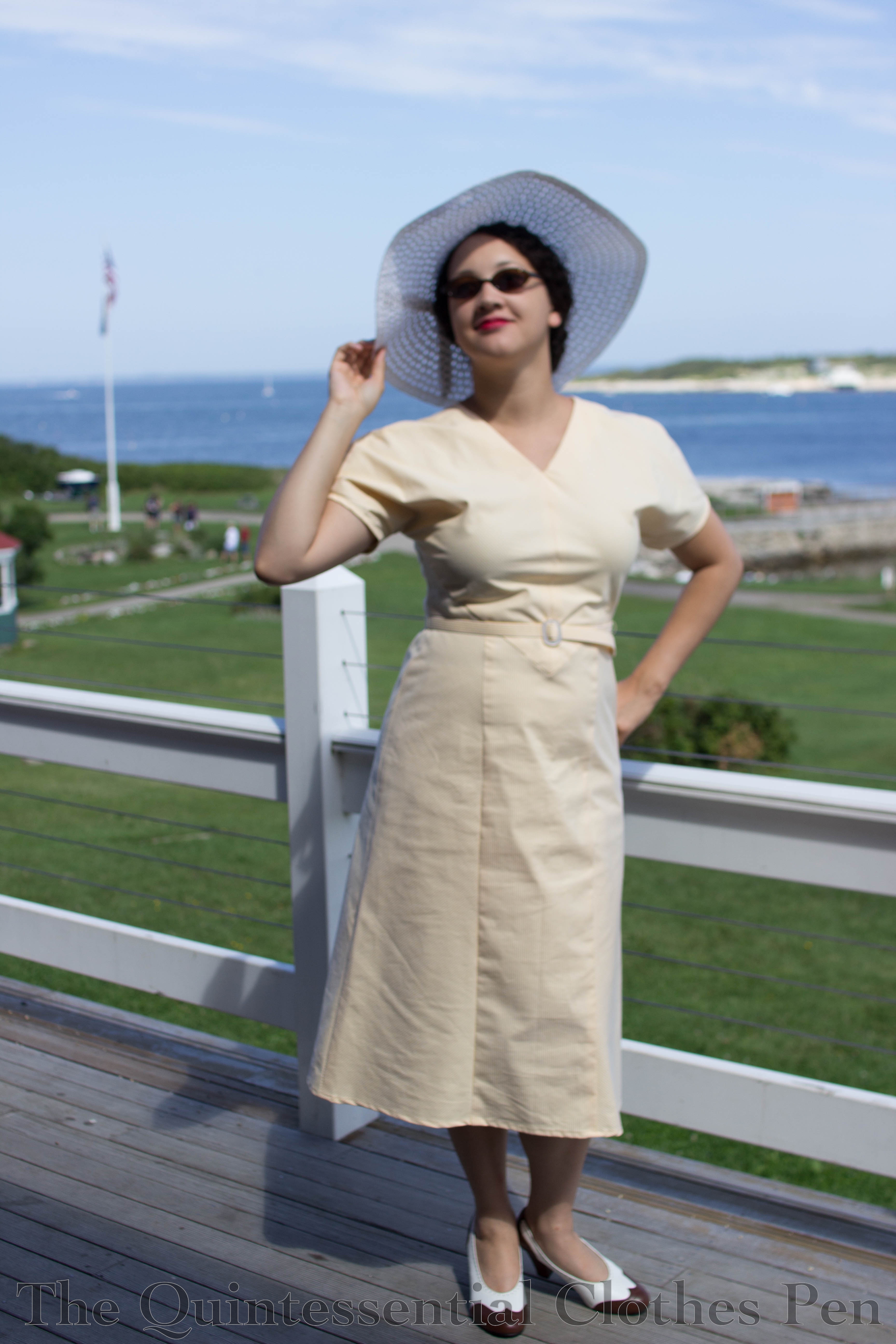
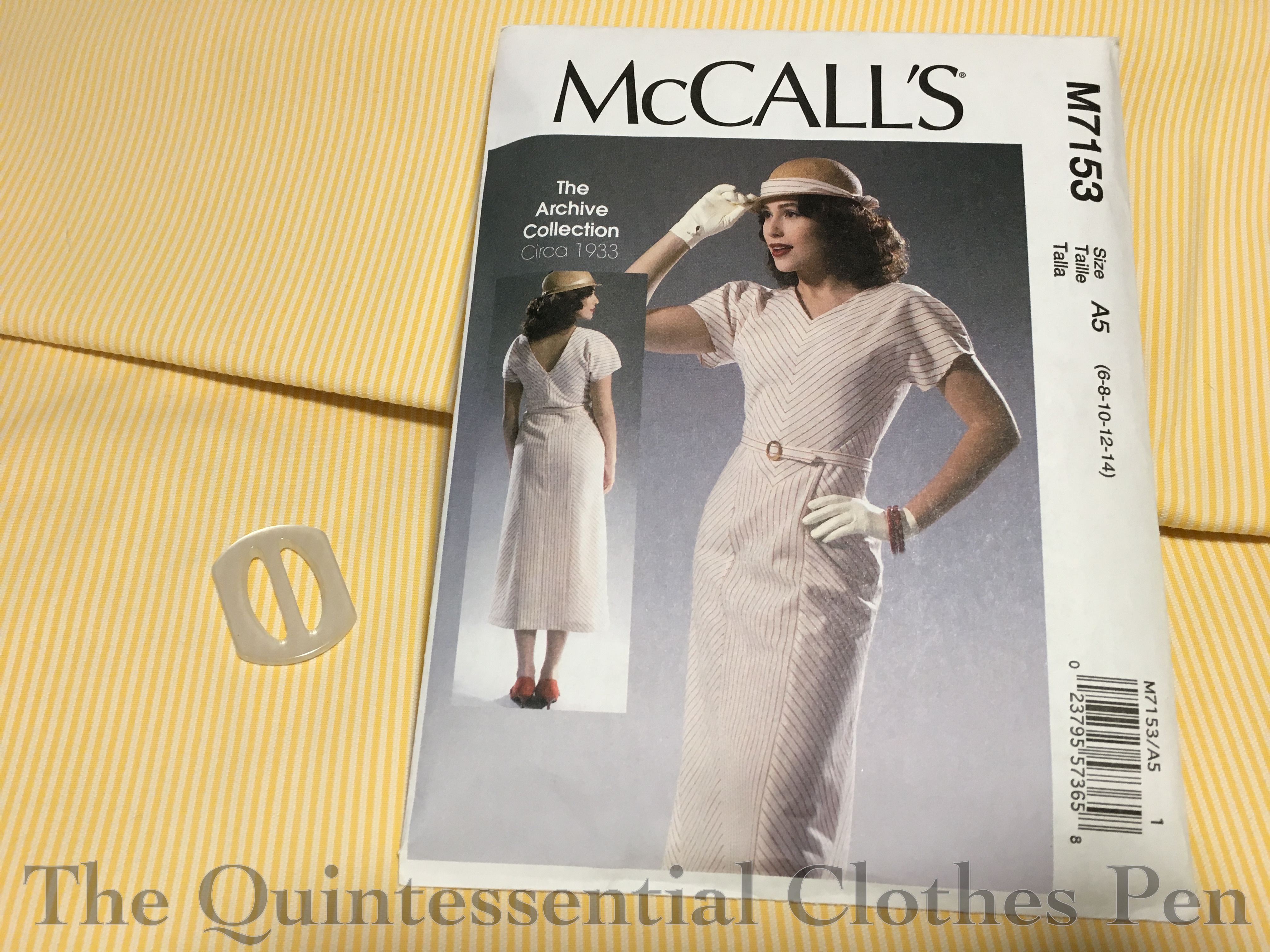
Last summer, I decided to make a dress from McCall’s #7153, an archive pattern from 1933 (although now out of print, it was released in 2015 so it’s pretty easy to find with a quick search). This is a pattern I’ve been eyeing for awhile. I decided to make it because I wanted something comfortable, new, and appropriate for daytime to wear to a Gatsby weekend in the heat of August. 1933 is obviously not in the 1920s, but the weekend tends to be more generally 1920s/1930s in terms of clothing, so I figured this would fit right in.

The style of the dress is quite defined by the differing grain lines on the pieces, a detail that is set off by the stripes used for the sample dress. Accordingly, I went off in search of a good stripe for the dress. I couldn’t find one I liked in the right weight with a stripe quite as delicate, visible, and widely spaced as the sample dress, but I did find a lovely yellow and ivory narrow stripe at Farmhouse Fabrics (although now they have this, which is similar to the sample dress–I’m not sure which one I would choose if I had both options in front of me now!). I couldn’t find a yellow belt buckle that was right, so I decided to go classic with a white mother of pearl one from my stash instead.

I cut out a mockup in size 14. This was a project for my #virtualsewingcircle while I was still finding time to sew live. The mockup fit, but was very tight, so when I cut out the yellow stripe I made the dress a size 16 (for reference, my measurements were about bust 40″, waist 32″, and hips 42″).

The only other change that was required was to take up the shoulders (which I think meant that I also lowered the front neckline and cut new front facings, though now it was long enough ago that I don’t remember perfectly). McCall’s must have been thinking people were going to put in huge shoulder pads–there was so much room! I believe I took about about 2″ (4″ total) of height!

In addition, I took Kelly’s advice from making this dress and omitted the zipper down the back to keep things smooth. This was made possible in part because my fabric has a little bit of stretch in it.

I think I mostly followed the pattern directions for assembly. There are some steps in a specific order to get the nice point, particularly in the front.

I machine finished the hems, including the sleeves, and under stitched the neck facing, tacking it down by hand to the seam allowances on the inside. The seam allowances were pinked to keep the seams from getting bulky while also keeping them from fraying. This wasn’t important for the bias cut pieces, but it definitely helped the center back and center front panels that are cut on the straight grain of the fabric!

I completely ignored the belt directions, opting instead to use belting encased in a tube of my fabric. Belting is a great product that, as fas as I can tell, stopped being produced in the last few years. Boo! It’s a bendable but stiff plastic backed fabric that you used to be able to purchase in different widths to use as stiffening for self-fabric dress belts (perfect for dresses from the 1930s, 1940s, and 1950s!).

Despite the photos of the whole look with accessories (which I’m very pleased with!), when I tried on the dress after finishing the sewing I was so disappointed! I looked so frumpy in the mirror with the calf length hem and my bare feet! I made a lot of faces. Then I thought, ‘Well, I guess I try on the shoes I plan to wear with this.’ That idea did make me a little happier, because I had snagged a pair of Royal Vintage brown and white spectators but hadn’t found a reason or outfit to wear them with yet. And then… MAGIC. Those 3″ heels absolutely transformed the look! All of a sudden that calf length hem looked great! I was probably standing with more confidence rather than disappointment, too, but really, it was like I was wearing a different dress. Has that ever happened to you? The accessories really make some looks come together! And especially with 1930s calf length hems… the heels really help posture and proportions.

I found that my first pair of Royal Vintage shoes are very comfortable. They have a bit of padding in the sole, which is great under the balls of my feet especially, and also arch support. They don’t pinch or rub in any uncomfortable ways. After wearing them for the better part of two days in a row I can say that my feet were tired of being in 3″ heels, but tired or aching in no other way (that’s just a function of being in 3″ heels, no matter how comfortable they are). And boy, did I feel snazzy for those two days!

This next one is the ‘Oh no! My hat is flying away!’ face. It was rather windy, so there actually were moments where I had to hold onto my hat to keep it from flying away! This hat is a refashion of a modern sunhat that deserves its own post–coming soon. I’m very pleased with this updated version and I love how well it coordinates with my shoes!

The stripe in the fabric gets a bit lost when you’re not right next to the dress, but I still like it overall. I found the dress was more comfortable to stand in than to sit in, but it did well in the heat and was cool and breezy. Success!

1920s Beaded Bag (HSM #11)

The November Historical Sew Monthly Challenge was Purses and Bags (you’ve got your arms covered in July, your hands in September, now make something amazing to dangle from them). Late in the month I realized this was a great poke to finish an idea I’ve had for about six years. It was a bit of a challenge to complete my project before the end of the month, but I just slipped in, finishing it on November 30.

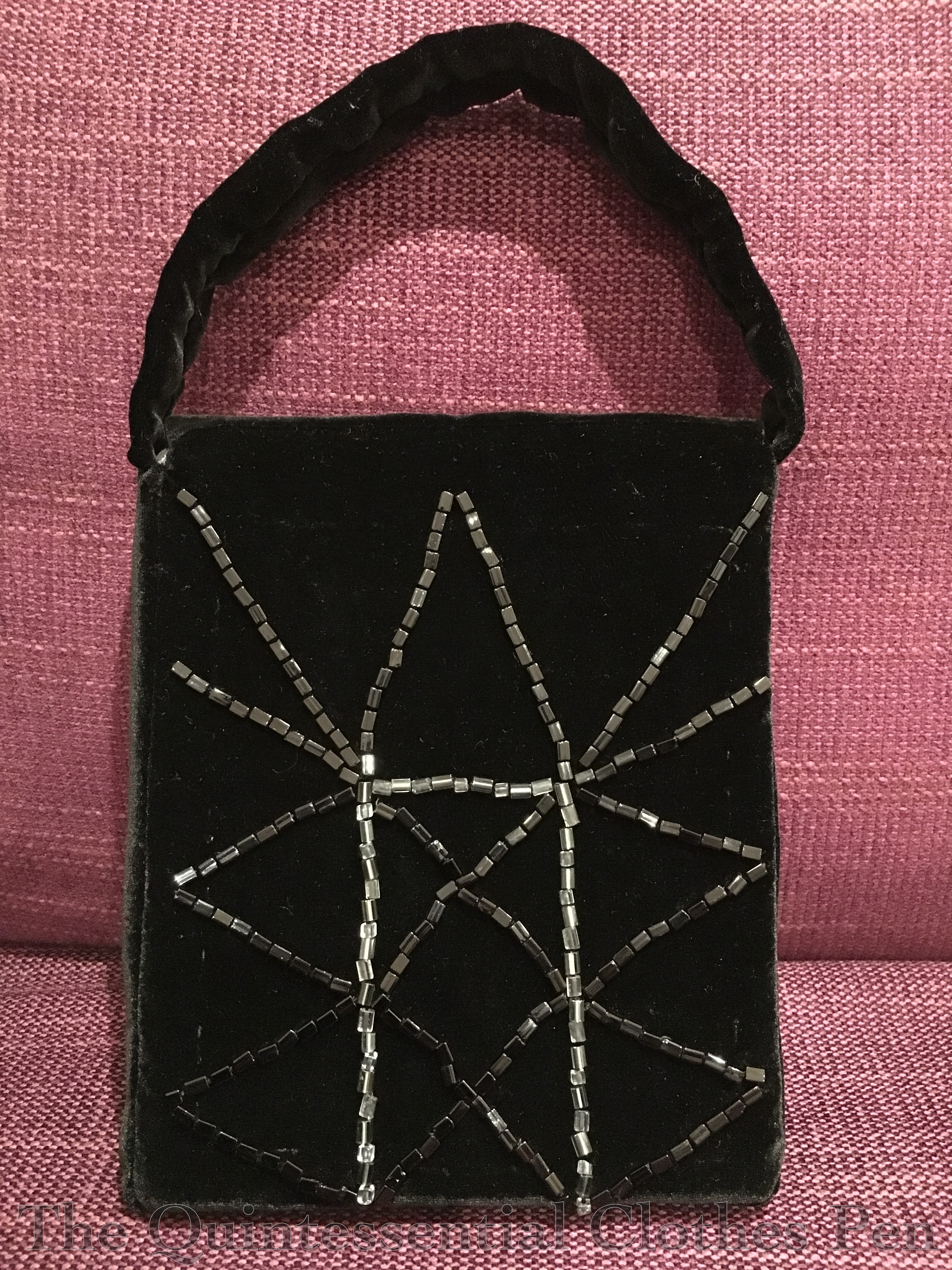
The idea came from my 1912 Tea Gown. I had intended it to have elaborate beading, but decided not to do that for a variety of reasons detailed in that past post. However, I had already beaded one panel that I decided not to use. I’ve been holding on to it waiting for the opportunity to put it to use in some other way. And so, I decided to turn it into a handbag.

Saving your scraps comes in handy on projects like this, because I had plenty of velvet to cut the additional pieces I needed for the bag. I looked through my stash to find a lining and came up with grey silk shantung as the best option. This was also a piece of fabric that I only had scraps of. It was originally used for the boning channels on an 1883 corset I made way back in 2011 (you can see it in this rather old post).

My inspiration is this page showing handbags from 1922 (source). It inspired me to go in a more structural direction rather than a gathered top bag, which was my initial thought.

I had the idea in mind, but I was restricted in the shape of the bag based on the beading that already existed on the main piece. So I cut out another rectangle the same shape as the beaded piece, a long strip for the outside edges of the bag, a strap piece, and a triangle piece to make a flap that would close the top.

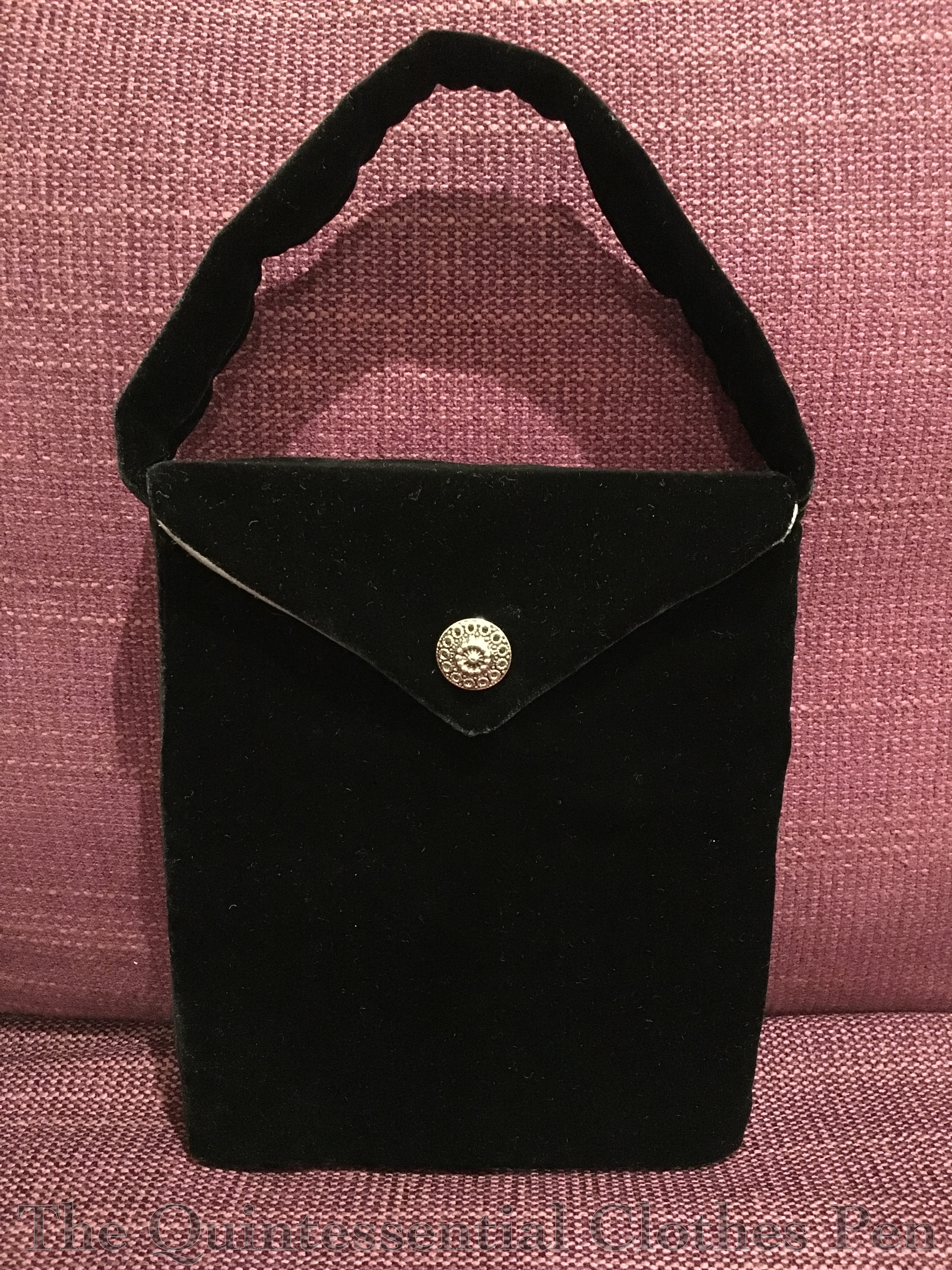
Along the way I realized that interfacing wasn’t going to stiffen the bag enough for what I was envisioning. I cast about for ideas of what to use for stiffening and settled on cutting up a shoe box that was in my recycle bin. It was a great weight of cardboard–not too thick, not too thin, and not too bendy. There are cardboard pieces on each flat side, along the bottom, and a strip along the top edge to keep the flap nicely shaped. The pieces on the sides and bottom are (shhh…) masking taped together to create a flexible but stiff foundation for the bag. The piece in the top is stitched into a channel that is only sewn through the interlining so it doesn’t show on the velvet or the lining.

I assembled my pieces, thinking hard about which part to leave open to set in the lining, and struggling a bit with the shifty velvet. I wanted to sew most of the seams on the machine for speed, but sewing it by hand would probably have been more pleasant. I wrangled it mostly into submission, only needing to restitch a few sections as I went along. The only hand sewing came when I needed to close up the lining after putting all the pieces together. Things had become a bit wonky with seam allowances and shifting velvet, so I did my best, figuring that the seam would be on the inside and I really just wanted to finish the darn thing.

After that seam, the only thing left was a closure. I decided on a simple hook and bar. Not quite as classy as a real purse, but it gets the job done and I had it on hand. On the outside is a decorative button.

And that’s it, except the facts!

Fabric: Scraps of silk velvet, silk shantung, and cotton canvas.

Pattern: My own.

Year: c. 1925.

Notions: A shoe box, thread, beads, and a button.

How historically accurate is it?: 60%? The silhouette and fabrics are plausible, though the cardboard probably isn’t. The beads are certainly too big and the method of closure is unlikely unless the item was made at home.

Hours to complete: Not counting the beading, approximately 3 hours.

First worn: Not yet!

Total cost: Free! All of the materials and notions came from my stash.

Vintage-Inspired Book Dress

Two or so years ago, I came across this dress as I was poking around the internet. I loved the print, but the style was not for me. The peter pan collar, in particular, isn’t really my style. However, I got it in my head that maybe I could make my own version of this dress, with style details that suited me better.

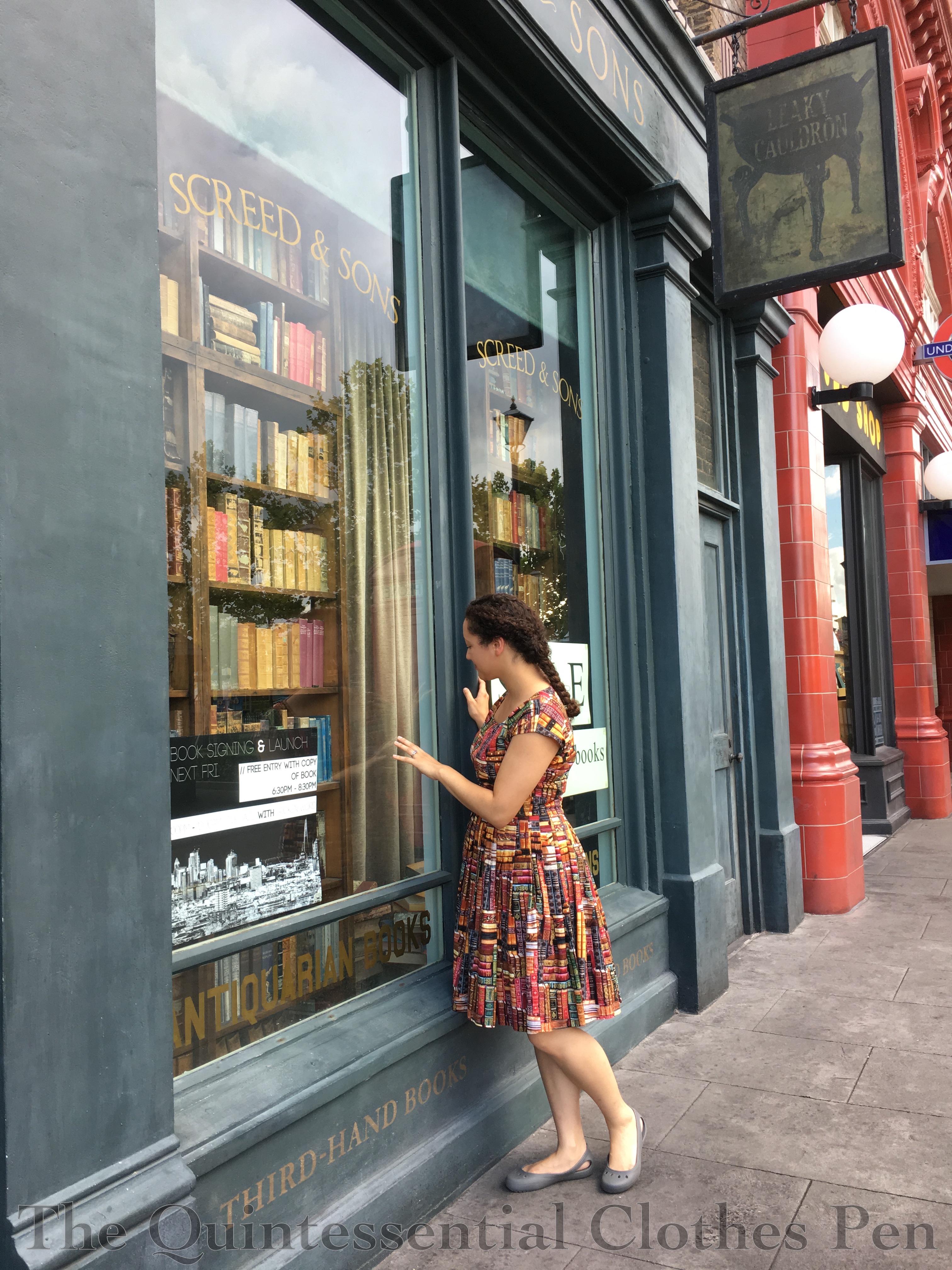
This led to a hunt for the fabric. With a little bit of searching, I was actually able to find the exact cotton print fabric used in the dress I originally liked! I bought mine from Fabric.com, but it was (and still is) also listed on Etsy. It has a little bit more stiffness than your average quilting cotton, which makes for a dress with nice body. It also has little hints of metallic gold in the book titles, some of which are readable. This makes it a little festive and fun without being over done.

That was back in 2016. It took me about a year to get around to making the dress, but I finished it in late 2017. And I’ve been wearing it! It just took another year to wear it somewhere that was good for taking photos. (I still hold out hopes of taking photos of it in a fabulous wood paneled library, while holding my hardcover copy of Gone With The Wind. That’s one of the readable titles on the dress! Not sure when that will happen, though.) In the meantime, I’m very pleased with these photos from my trip to Universal Orlando, where we took photos of this dress in various Harry Potter locations.

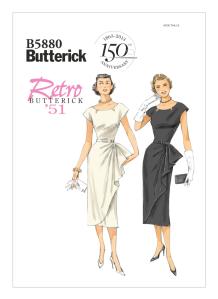
I used Butterick 5880 (a retro pattern from 1951) for the bodice of this dress. This is the same bodice I used for my Happy Clover Dress, which I finally finished in 2017 as well. Both of these dresses have a different neckline than the original pattern. I’ve found that this is a great basic pattern for me. It fits well, I like the all-in-one-with-the-bodice sleeve, and different necklines work with it to change it up from one dress to the next!

The square neck inspiration for this dress came from a blog reader in 2017, who commented on my Happy Clover Dress post and suggested that a square neckline might be a nice vintage touch. I thought the idea made sense with the square corners of the books in this print and decided to give it a try!

As with the Happy Clover Dress, I did not use the Butterick skirt pattern, instead opting to create my own. My vintage inspired skirt is simply a tube that is 122″ in circumference, knife pleated to fit the waist size of the bodice. I carefully cut and seamed the panels to maximize my fabric use and have side seams as well as a center back seam. Part of the reason I had to maximize my fabric use was that I used up pretty much all of all 2.5 yards that I bought. In fact, I didn’t even have scraps big enough to make pockets out of after cutting out the bodice and skirt pieces! I used what I had and pieced the rest of my pocket bags with fabric left over from my 1860s Flower Basket Fancy Dress project. I had dyed the fabric a mottled brown, had only had small scraps left, and the look reminded me of book leather, so it seemed like a fitting thing to use.

Pockets in a dress is excellent! And you can do that when you make your own clothes. Actually, while I was on my trip I was asked whether I’d made the dress. The giveaways were the fact that I had my hands in my pockets and the knife pleated skirt, both of which struck the person who asked as being vintage and self-made details–not a combination that would be easy to buy in a store. I thought that was fun!

I made this dress using modern techniques. All of the inside seam allowances are finished using a serger/overlocker. There is an invisible zipper in the back. It is almost entirely machine sewn, including the hem and armholes. The only hand stitching is the finishing of the brown bias tape that finishes the neckline, in order to keep that nice and invisible. On the hem and armholes the black machine stitching blends into the print and is hardly noticeable.

I have fun wearing this dress and pairing it with different cardigans in the colder months! Black and red are my favorites. And I can report that it was very enjoyable to be dressed in slightly-vintage-style to visit Diagon Alley and Hogsmeade. I had no trouble on the rides and was as comfortable in the heat of Florida as I would have been in shorts or capris and a tee shirt, which is what most people were wearing. I felt more put together and enjoyed the themed dress! I might have to do things like that more often!

A New Old(er) Dress

Today, I present a new version of an old dress.

(Well, not old in the usual way on this blog, which is a dress that is often 100+ years old. In this case, the ‘old’ dress is about 8 years old. I couldn’t pass up the colors in the flowers, though the cut and fabric was more ‘junior’ than adult woman, especially with the built in underskirt of tulle which I promptly cut out as soon as I reached home. However, worn with a waist length or otherwise cropped cardigan, the original dress saw me through a number of summers.)

And then my shape changed and the the dress became a bit too small and a bit too tight. This is the standard my-clothes-shrunk-in-the-closet problem. Boo! But I still loved the colors, so when I happened to see a similar fabric at the fabric store I snapped it right up with the goal of making a new, older (as in, not ‘junior’ style) version of the original dress, so I could retire the original from my wardrobe and send it on to a new home. (In fact, when Mr. Q saw me working on the new dress he confused it with the old one because the colors are so similar!)

I decided to use New Look #6143 as a starting point for a pattern for the new version of the dress. It’s got a basic bodice that would be good for other things if I liked it made up and a variation on a basic skirt, which never hurts to have either. I believe the only thing I changed from the original pattern design was the neckline in the front. Of course, it took me probably two years to actually get around to finishing the darn thing. I started it, realized it was too big, got frustrated by the amount of alterations needed, and let it languish (for years…).

This year, however, I was determined. Turns out I had just cut a size larger than I needed. (P.S. I hate figuring out commercial pattern sizing. There is so much ease that the size the pattern envelope claims I should be is often too big, as in this case. Do you ever have that struggle? When I took apart my bodice pieces and traced out the lines for a smaller size, the bodice fit perfectly. Nice, but it would have been so much better if it fit perfectly the first time!) I had already pleated the skirt and added side seam pockets when I started the dress years ago-I wasn’t going to change that–so instead I angled the side seams from the pockets up to the waist to take in the excess amount. Not the most perfect solution, but in a full skirt you can’t see the fudge.

I love how tidy the insides of Carolyn’s modern dresses are (like this and this) and I wanted similar tidiness for this dress. The bodice of my dress is fully lined in lightweight cotton and the skirt edges are all overlocked to keep them from fraying.

Oh, and as I mentioned, I added pockets! Most dresses are better with pockets! (I would say all, but some lightweight dresses just pull in awkward ways with things in the pockets, so really, why bother adding them?)

The dress closes in the back with a (pink!) invisible zipper that is carefully sandwiched between the floral exterior and the bodice lining. The pink zipper matches perfectly and amuses me greatly. It’s a fun color!

At the bottom of the bodice lining the seam allowance is turned up and whip stitched to the waistband seam allowance to create a tidy finish. Tidy finishes like this make my heart pitter-patter with glee!

I’m very pleased with the new version of this dress and so pleased that it is off of the UFO pile! My only slight complaint is that I wanted an everyday dress, but the fabric is a little satin-finish-y rather than matte, even though it’s cotton, which takes it more in a ‘dinner’ or ‘event’ direction rather than ‘wear to work’. Oh well! It’s cute, it fits, and the colors are perfectly me.

I’m looking forward to trying this pattern out in other variations! I have plans to make another version of this dress soon–probably during August!
SaveSave

SaveSave

SaveSaveSaveSave

SaveSave

SaveSave

c. 1860 Crinoline Size Comparison & Tutorial

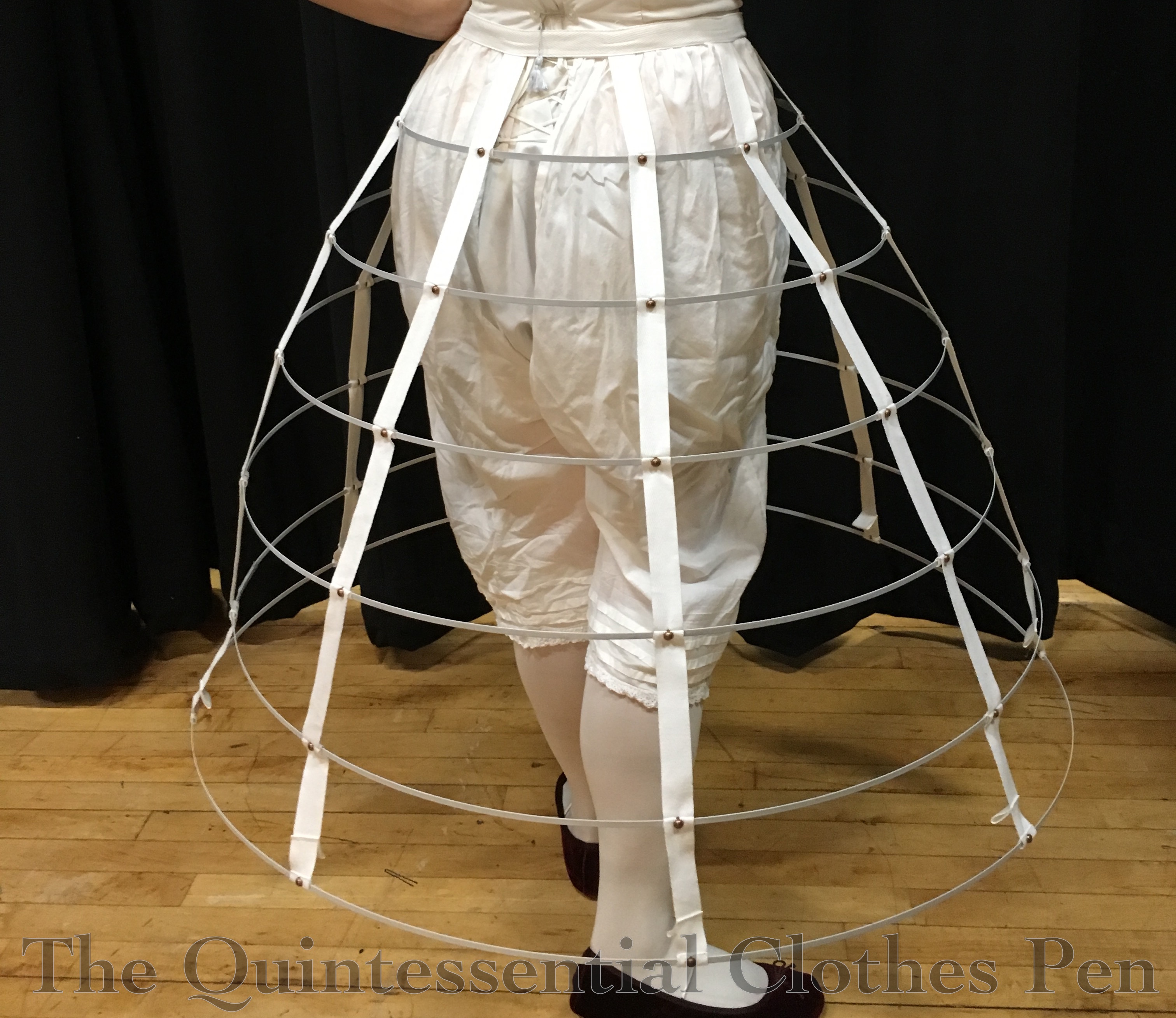
Back in October of 2016, I made a new, smaller crinoline (also called a hoop skirt) than the one I’d had for about the last 10 years. I thought it would be great, and it was… in terms of shape. Unfortunately, the new crinoline had a fatal flaw: the channels for the hoops were too wide for the slippery-ness of the hoops and therefore all the tapes would slide to one side while being worn, causing the hoops to drop down and create a trip hazard for the wearer. I had loaned these to a friend at a ball and was horrorstruck as I realized the problem and she attempted to dance without realizing the problem. It was such an awful feeling! We solved the problem for the night, but I resolved to fix the hoops before wearing them again and I learned a good lesson about trying out new garments myself before loaning them! I’ll get to my solution for the sliding hoops in a bit, but first I’ll start at the beginning.

The new crinoline was an experiment to see if I could use the hooping from a cheap Amazon hoop skirt like this to create a cage crinoline with smaller dimensions than my usual crinoline, the super-cupcake, which has a decidedly high fashion silhouette. The answer to that question is ‘yes’ it was easy to reuse the hoop steel from the Amazon crinoline to make a cage crinoline.

You see, the super-cupcake looks great with the right circumference of skirt and the right environment (high fashion daywear or a ballroom); however, under a cotton day dress I wanted a more subtle, practical, reasonable shape. I have to admit to liking a big skirt though, so a reasonable crinoline for me still has a larger circumference than what it might be for others. Also, at 5’6″ I am taller than the average woman, which allows me to carry off a larger circumference while staying within reasonable looking proportions. (For more thoughts on practical sized crinolines, Maggie May has shared useful research and an equation to help determine crinoline circumferences.)

Here’s a comparison of my two crinolines worn with cotton dresses: the super-cupcake is on the left and the newer reasonable crinoline is on the right.

Interestingly, the dimensions of these two crinolines aren’t terribly different. The lowest hoop is only about 8″ smaller  on the new crinoline. The biggest difference (and what alters the silhouette most) is that the new crinoline has a more tapered shape in the upper hoops.

I’ve provided the following size chart in an effort to help those who might be making or adjusting their own crinolines. Even if you don’t want to deal with all the vertical tapes, you can use these dimensions to adjust the hoop sizes in a ready-made modern crinoline to achieve the same effect.

Interestingly, both of these crinolines have the same vertical tape length that is short enough to keep the bottom hoop decidedly above the floor. The lowest hoop on these is about at my mid-calf height. This keeps my feet from getting tangled–especially useful while dancing! In order to keep my dresses from folding under the bottom hoop as I move, I have a cotton petticoat with a substantial ruffle around the hem which provides stability for the dress worn on top. You can see the length of the super-cupcake on me as well as the ruffled petticoat that I wear over both crinolines in this post.

Here are my two crinolines next to each other while the new one was still in progress. They have an overall similar construction (although I did simplify the new ones, using fewer hoops and fewer vertical tapes).

My old crinoline used ivory twill tape for the vertical supports. There are actually two layers of it that are hand sewn together to make channels for the hoops, creating channels along the lines of those seen in this 1859 hoop skirt patent filed by James Draper of New York (while the hoop circumferences are not provided in the patent, the silhouette of Draper’s hoop skirt is similar to that of my super-cupcake). This method used a ridiculous amount of twill tape, so I came up with a way to make the new channels that would use only one layer of twill tape for each vertical support. More on that in a moment.

The old crinoline’s hoops are made from cotton covered steel that was in a ribbon form originally. I had cut each ribbon in half (and over time, the fabric covering started to fall off, which caused me to painstakingly wrap each hoop all the way around with thread to make it more durable–a caution to anyone else using this to make a crinoline, although I’m not sure where you’d source this type of material these days as I believe this type of ribbon wire is no longer being produced). The fabric covering combined with the narrow channels in the twill tape means that the vertical ribbons only slide when I want them to, but that they otherwise stay in place nicely.

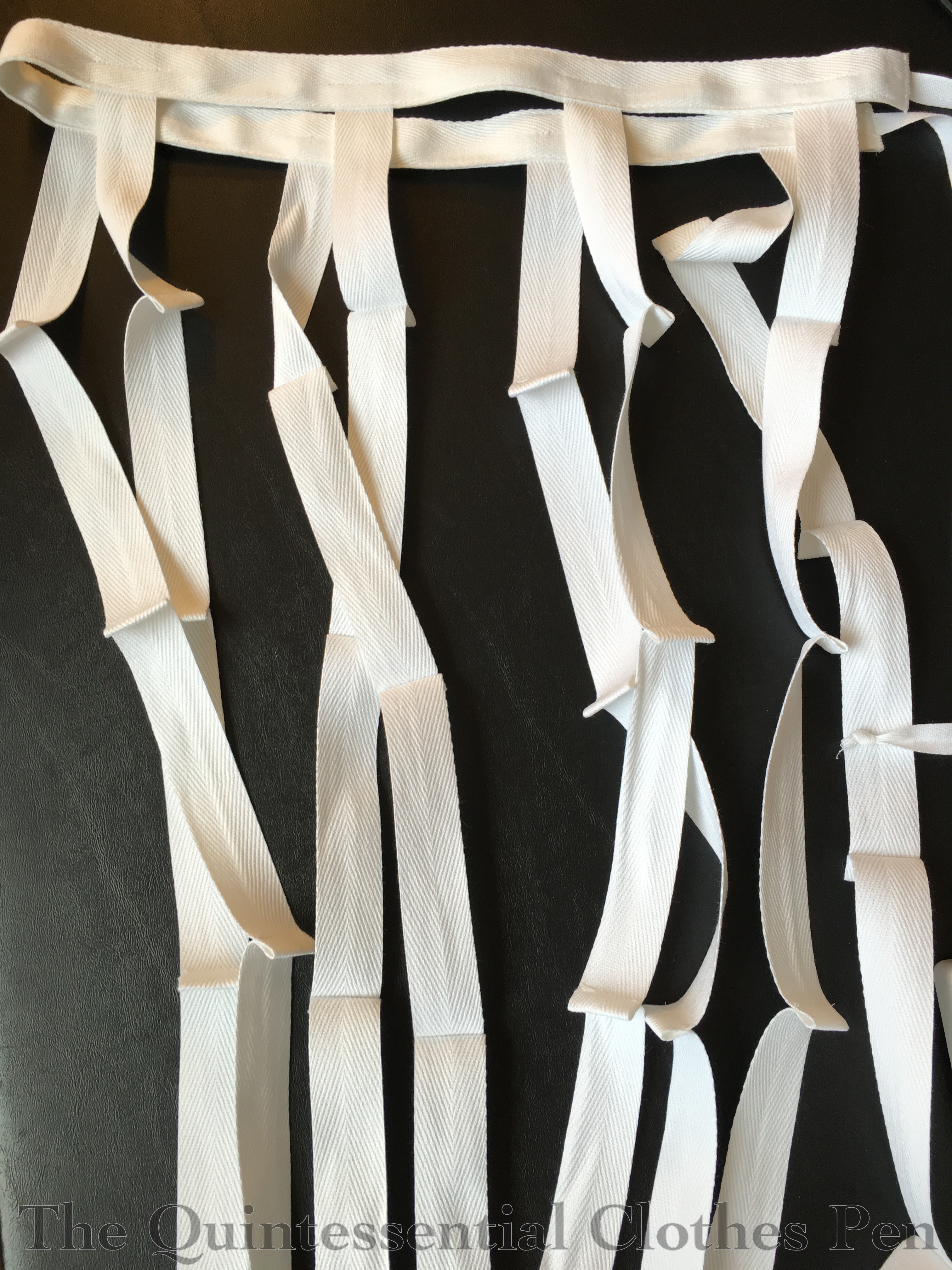
For the new crinoline, I machine sewed tucks into a single layer of twill tape to create channels for the hoops. You can see those tucks in the photo below.

I also machine sewed the vertical tapes to the twill tape waistband, because why not–I was machine sewing anyway. The waistband is two layers of twill tape sandwiched together.

That’s basically it for the construction before the awful incident of loaning them out. I cut the hoops to be the dimensions I wanted, slid them through the channels, and used the plastic joiners that had come with crinoline to secure the ends. Done! Or so I thought…

After realizing that these hoops were going to slide horribly, I went back to research to figure out how this problem was solved in the past. What I noticed are little metal dots on each join of hoop to vertical support. That makes so much sense! I wanted to add these to my hoops but I didn’t know what to call them while searching for materials.

It took me a little research to figure it out, but I did and now I’ll share that with you. They are called spots! Once you realize that then a whole world of spots becomes available to you. Decorative ones, bronze, copper, nickel, black… so many options! I got plain domed copper from this seller on eBay and am very happy with them. They’re easy to apply with a pair of pliers and seem quite durable. Now my hoops and tapes stay in place–no more sliding around!

And here is the finished result of the spots on the reasonable crinoline. I like the look as well as the practicality. I’m planning to add gold ones to the super-cupcake as well, for looks more than anything else.

SaveSave

SaveSave

SaveSave

SaveSave

SaveSave

SaveSave

SaveSave

SaveSave

SaveSave

SaveSave

Dressing Gown & Slip c. 1935

I made this robe about four years ago, for the same film that I made the 1934 Metallic Evening Gown I posted about recently. Like that dress, this robe and the accompanying slip were made and never worn, and so have spent the last four years languishing in my closet.

When I had the opportunity to attend Gatsby On The Isles in 2016 I thought it would be a great opportunity to wear these pieces for breakfast on the second day, and also to get some photos!

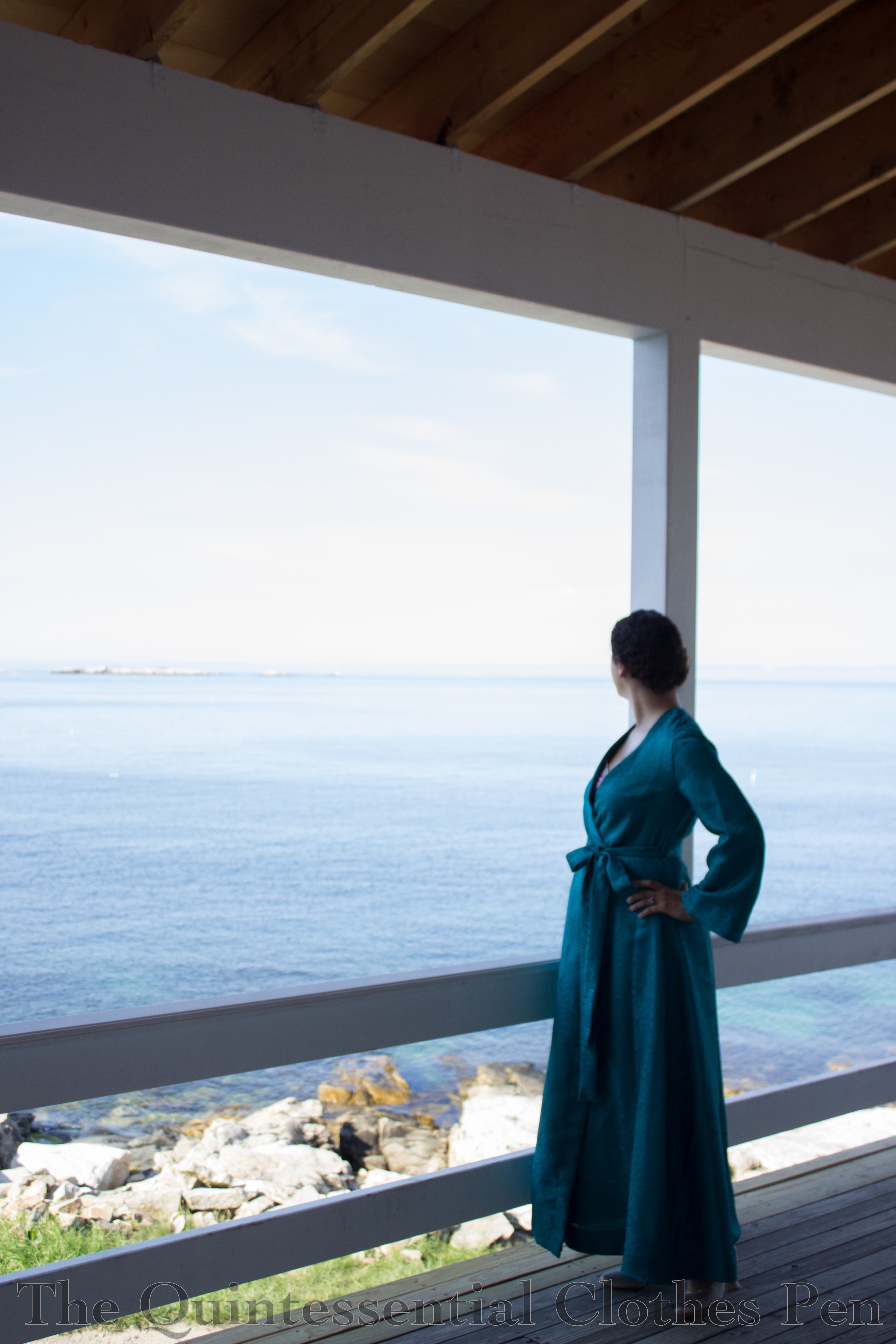
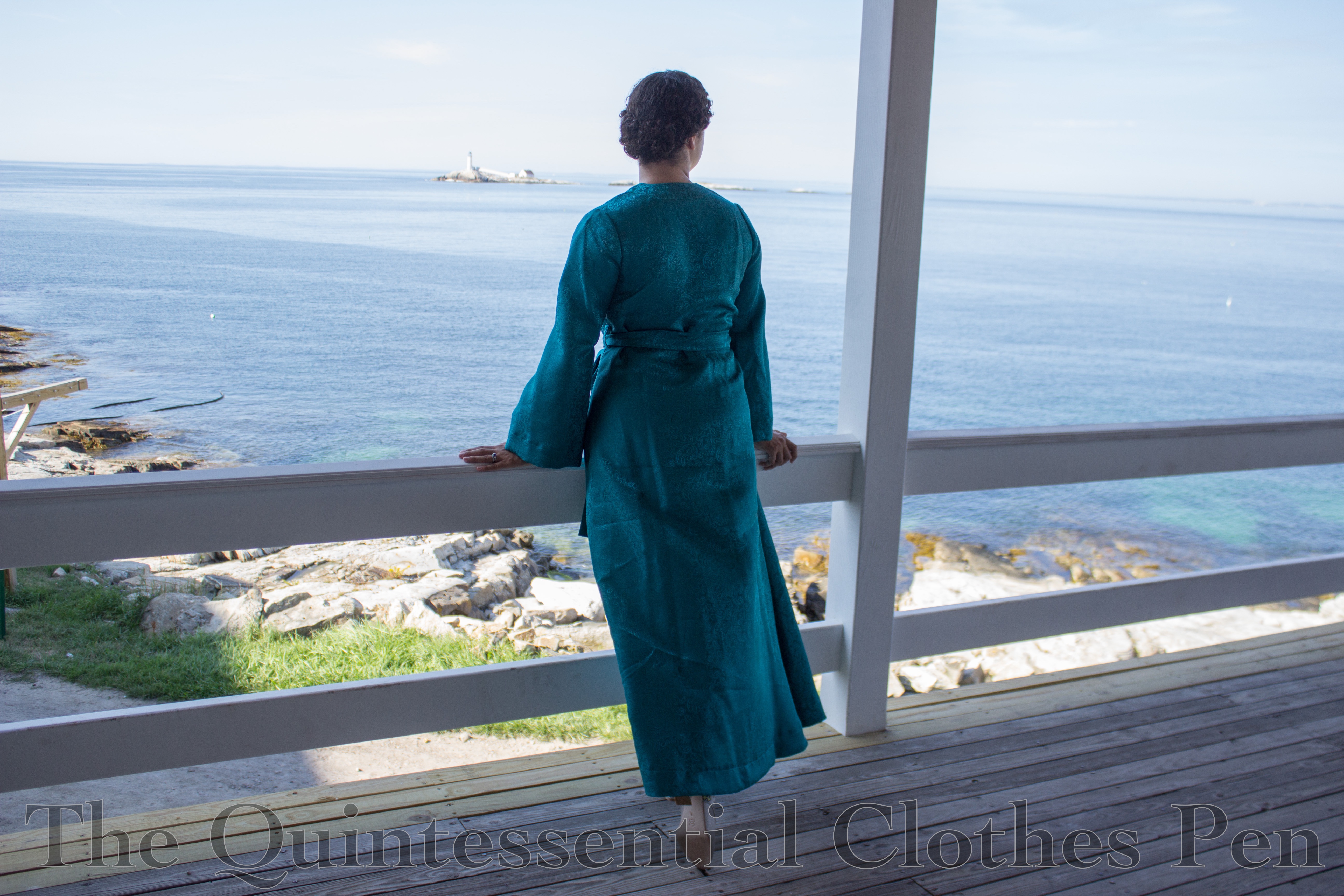
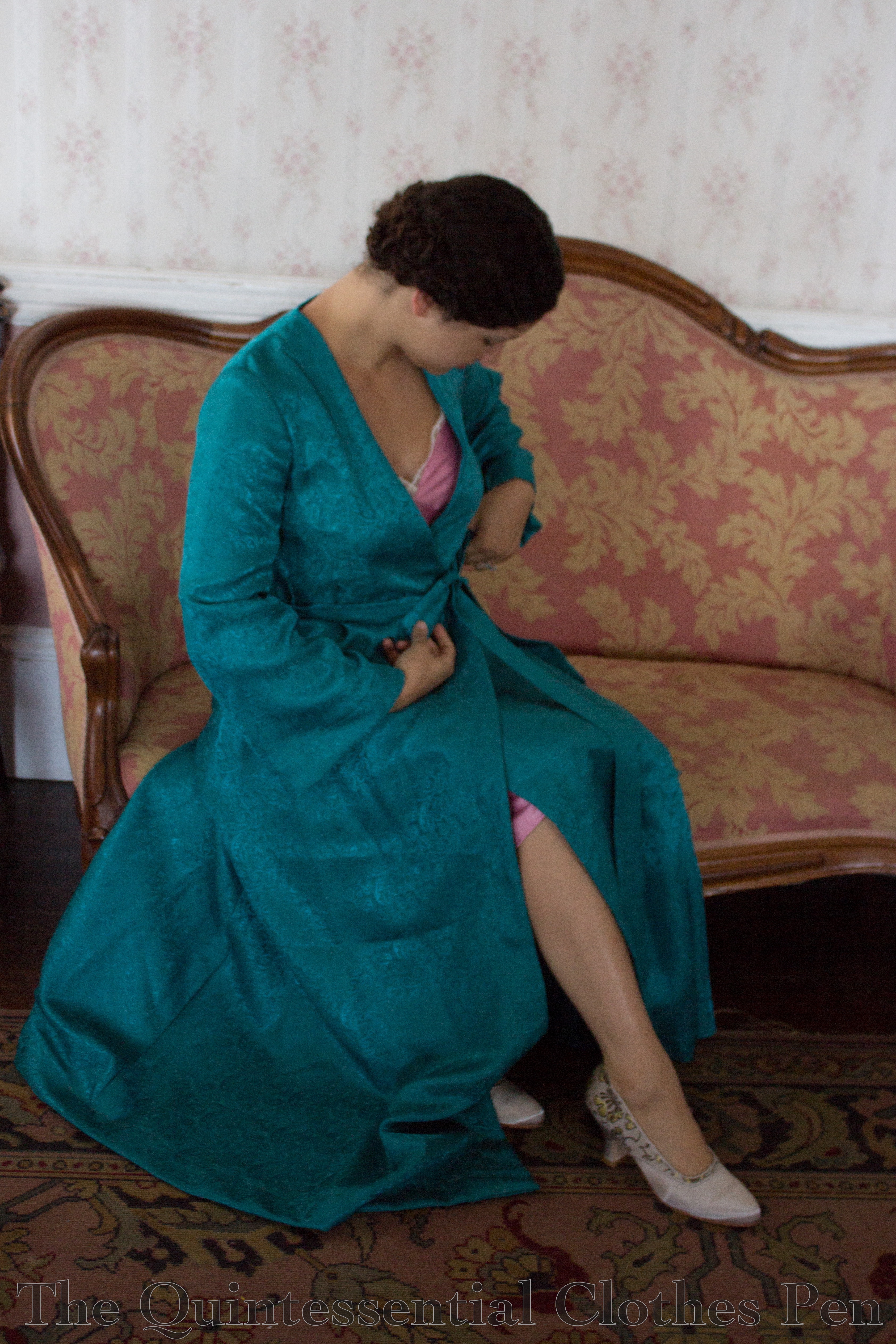
The robe is inspired by the silhouette of these robes from 1936. The pattern started life as Burda 7627, which I adapted to get the shape I wanted: a longer skirt with more fullness and sleeves with a little more flare. The slip is inspired by slips in this image from 1934. The pattern for this is actually the same as for my evening gown from 1934, just cut off around knee height and with a different strap situation.

The robe is made from a polyester jacquard. It’s not lined, just faced with more of the same fabric on the edges. The slip is made from polyester charmeuse and edged with lace. Both garments are entirely machine sewn.

I thought it would be fitting to pair these garments with my beautiful silver American Duchess Seabury shoes. These shoes are excellent–a unique historical shape, comfortable, sturdy for walking and dancing, and with gorgeous, lustrous silk exteriors. I even wear these in my modern life–they’re a quirky, elegant shoe to wear for a dressed up event.

On the other hand, I don’t have the opportunity to wear this dressing gown that often (I mean, I could wear it around the house as a modern person, but I don’t, generally speaking), so when I do wear it I really enjoy how elegant and put together it makes me feel. It’s fun to have historical comfy clothes in addition to the day dresses and evening gowns!

SaveSave

SaveSaveSaveSaveSaveSave

SaveSave

SaveSave

SaveSave

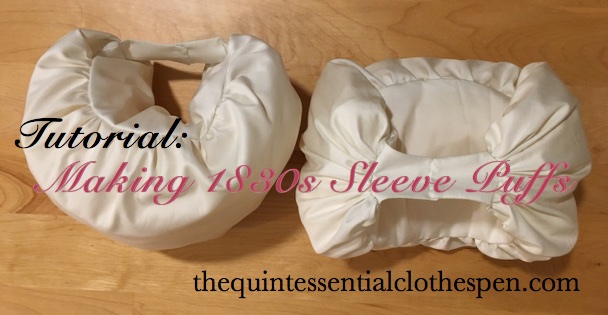
1830s Sleeve Puff Tutorial

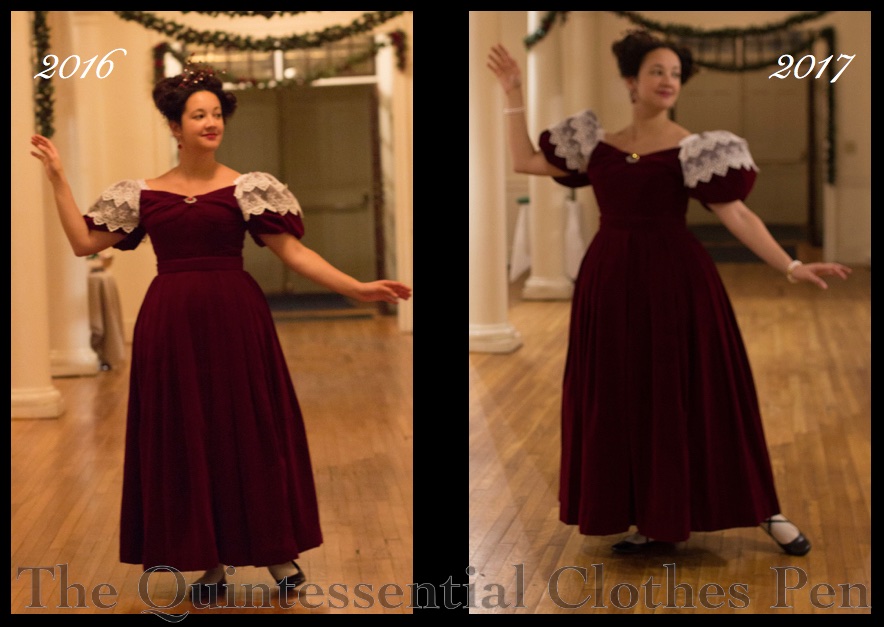
Why make sleeve puffs, you ask? In order to keep the large sleeves of 1830s dresses from deflating, of course! Here’s an example of my 1832 dress without puffs (on the left) and with puffs (on the right). They make such a difference!

I chose to use a sewing machine for much of the assembly of my puffs, but you could easily hand sew all of these steps instead.

To make these sleeve puffs you will need the following materials:

  • Fabric: ¾ yard of 44″ wide or ⅜ yard of 60″ wide (cotton, linen, and silk are the most historical options, but you can use whatever is comfortable on your skin, just make sure it’s not too loosely woven or too heavy in weight)
  • Stuffing: I used scraps of stiff net and organza, but you could also use batting, tulle, down, etc.
  • Thread

To begin, you’ll need to cut out your pieces:

  • Two rectangles: 25″ wide x 13″tall
  • Two shaped bases: 18.5″ wide x 7.5″ tall at the center and curved down to 2.5″ tall at the sides
  • Four end caps (two for each end of your shaped base): use the shaped base as a pattern and cut the end caps so they are 2.5″ wide

Next, you’ll assemble your puffs:

Step 1: Lay your end caps on each end of the shaped base. Sew around the three exterior sides, leaving the side towards the center unstitched.

Step 2: Trim your seam allowances, corners, and clip through seam allowance close to the end of your stitch line on the shaped base.

Step 3: Turn each end cap so the right sides face out–the clip through the seam allowance allows the end caps to sit nice and flat on the shaped base.


Step 4: Run gathering stitches along each individual side of the four sides of each rectangle (not one long gathering line that turns the corners).

Step 5: Pull up your gathering stitches on the long sides and pin to the curved edges of the shaped base. You want to pin the rectangle to the side of the shaped based that does not have the end caps on it.


Step 6: Sew the gathered rectangle to the shaped base and turn it right side out.

Step 7: Now pull up the gathering threads on one short side of each rectangle. Turn the raw edge under and pin the gathers in place. Hand sew these gathers through all the layers, making sure to take small stitches and catch the gathers in many places. Leave the other side open for now.

Step 8: Stuff those puffs!

Step 9: Now pull up the gathering threads on the remaining short side of each rectangle. Turn the raw edge under and pin the gathers in place. Hand sew these gathers through all the layers as well, making sure to take small stitches and catch the gathers in many places. (This is the same as step 7.)

Step 10: Overlap the end caps about ¼” and sew them together.

Ta da! Now you have some sleeve puffs of your very own!

Extra tips:

I strongly suggest taking a look at extant puffs. As a starting point, I suggest this pair at the MFA and this pair at the V and A.

If you’re worried about keeping your puffs in place, ties can be added to the puffs which would be secured to additional ties in the armholes of dresses. Take another look at the those two pairs of extant puffs and you’ll see ties.

I also suggest looking at the puffs other people have made. It never hurts to see more methods of construction. I referenced Fresh Frippery and Stepping Into History when creating my puffs. Have you come across other 1830s puff making resources? If so, please share!

SaveSave

SaveSave

SaveSave

SaveSave

SaveSave

SaveSave

SaveSave

SaveSave

SaveSave

SaveSave

At Long Last, A Happy Clover Dress

Life has been so busy for last month and a half or so that posting about my sewing and adventures had no choice but to be put on hold. However, things have calmed down now and I have plenty of blog content that just needs time and inspiration to be crafted into posts. To that end, I present a new dress!

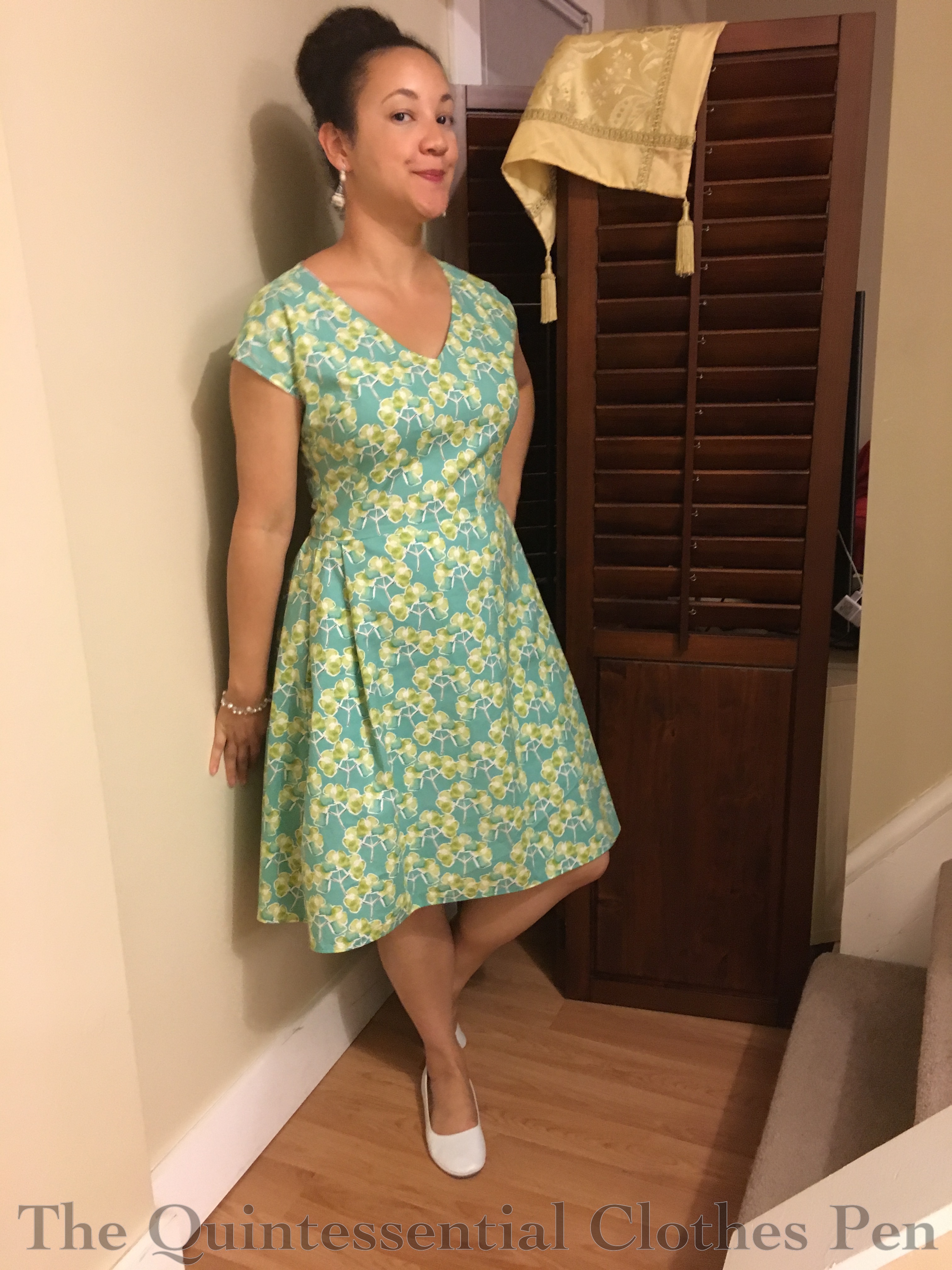
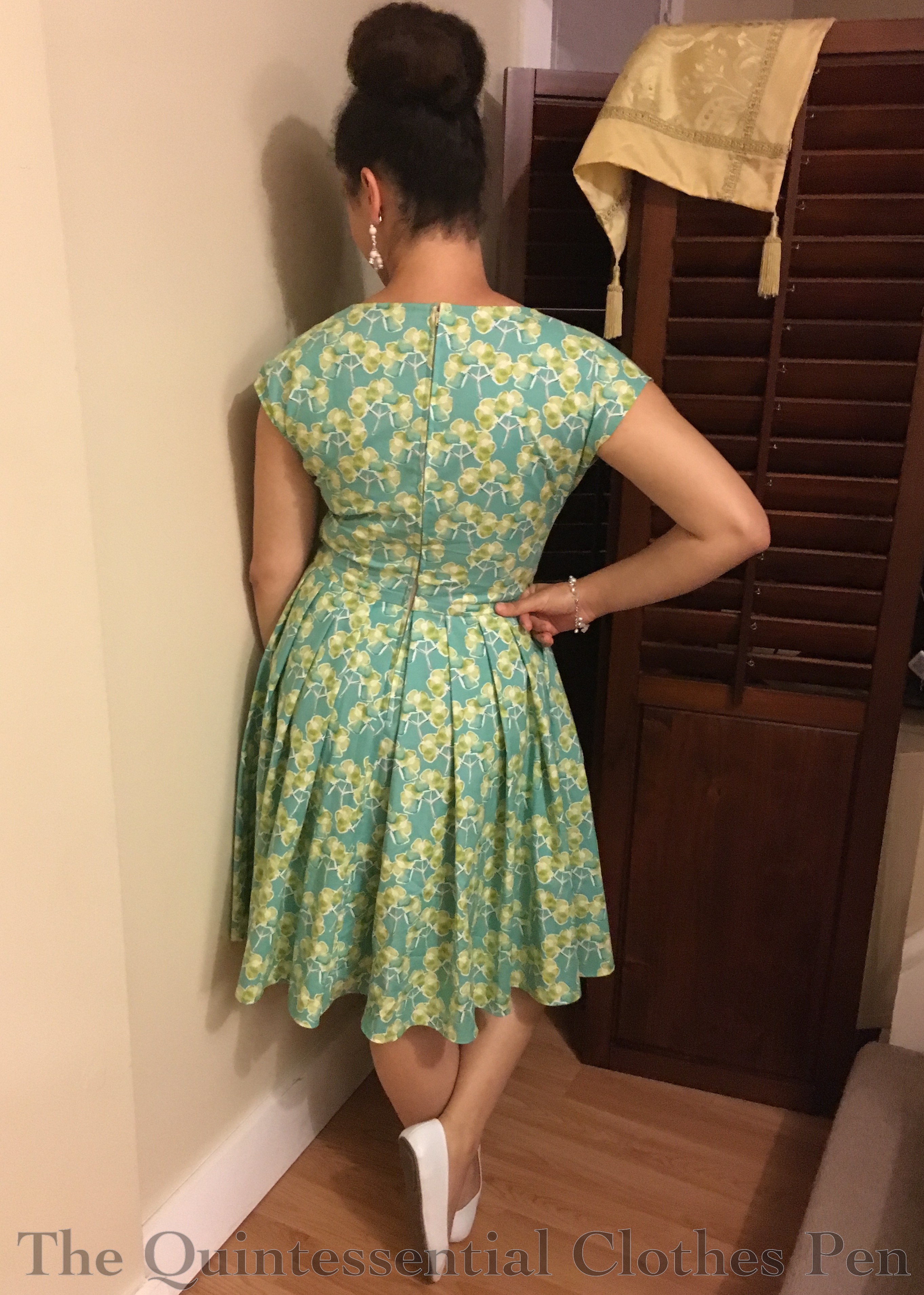
This dress was years in the making. It’s story started four years ago when I was on a mission to add prints to my wardrobe and found this cotton print. It’s a nice weight for a dress: mid-weight and opaque. It’s a bit hard to remember, but I’m pretty sure I started work on it pretty quickly. My plan was to use the bodice from Butterick 5880 with a vintage-inspired skirt of my own creation.

The skirt shape I started with was slightly A-line and gathered into the waist. I’d cut it nice and long, I think in case I wanted a deep hem or tucks. It was decidedly calf length. I knew I didn’t want the notches in the neckline of the bodice and I was thinking of a boat neck shape, so the original bodice was also very high on my collarbones.

When I tried it on… it was so dowdy! I was horrified! It was also a little large. (No pictures, I was too horrified!) All together, I couldn’t even begin to see how I would make it wearable. I stuck it in my UFO pile and let it sit there for years. Every summer I would tell myself I would make it better, but it took four years to feel mentally ready to tackle it.

This year, I started by removing the offensive skirt then fitting the bodice, which turned out to just be taking in the side seams a bit. I took apart the skirt pieces and took stock of what I had to work with. I hadn’t used all of the 3.5 yards I’d purchased, so I had a yard or so uncut to work with as well as the pieces I’d taken apart. In the end, all I did was to shorten the skirt pieces to a flattering length and pleat them to the bodice instead of gathering them. Originally, the skirt was just two panels, but that didn’t have enough oomph for me, so I set out to cut as many more as I could. Unfortunately, due to the fact that I’d cut the original skirt pieces so long, I could only cut one more skirt panel from my extra fabric. Boo!

I was thinking of pleats all around the waist, but I couldn’t find a way to make it symmetrical and pleasing to me with only three panels. It put seams in odd places and just wasn’t working. In the end, I decided to make the front mostly flat and keep the pleated oomph in the back. It looks smooth and A-line shaped from the front…

But the back has lots of pleats! I love the fullness! Too bad it couldn’t be that way in front, too. Oh well. Next time!

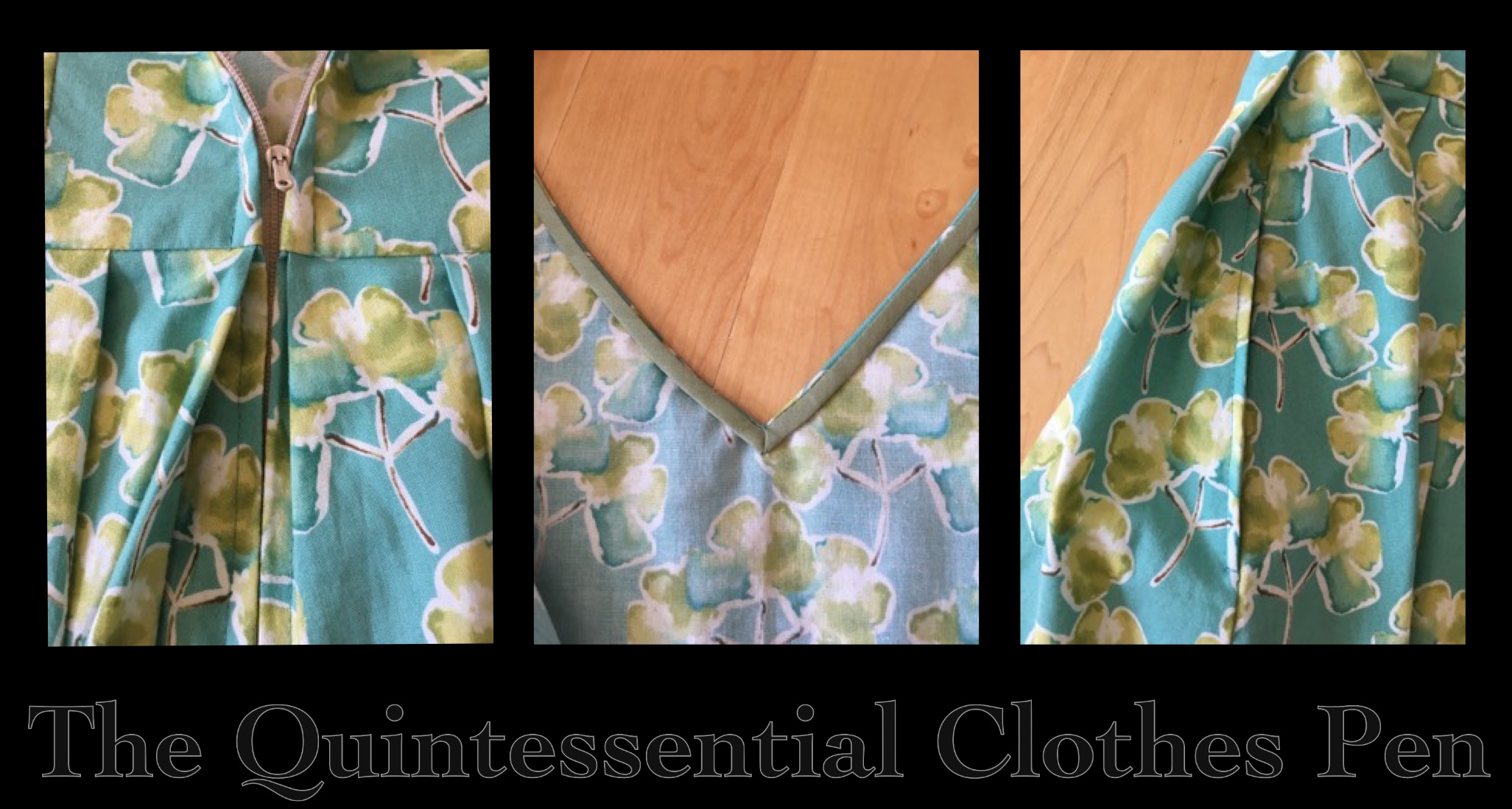
I also changed the neckline. I abandoned the idea of a boat neck (save that for another dress, I think) and changed the neckline to be a wide V shape, a style which I really like. Opening up the neckline helped balance the overall look.

The dress is almost entirely machine sewn. Since it’s a casual cotton dress, I machine sewed the hem and the arm openings with a narrow hem and put a centered zipper up the back (and I’m pleased with myself that the pleats extend all the way to center back despite the zipper and it’s all nicely stitched!). The neckline is finished with bias tape that is invisibly stitched by hand after being turned. All of the interior seams are serged. Also, the dress has the bonus of pockets! Keeping the seams at the sides allowed me to easily put in side seam pockets, which I topstitched in keeping with the other visible machine sewing.

And at long last, a happy clover dress that brings a smile to my face instead of frown! It was glorious to get it off the UFO pile and even better to wear it!

SaveSave

SaveSave

SaveSaveSaveSave

SaveSave

SaveSave

SaveSave

1927 Blush Sparkle Dress

img_2353-1

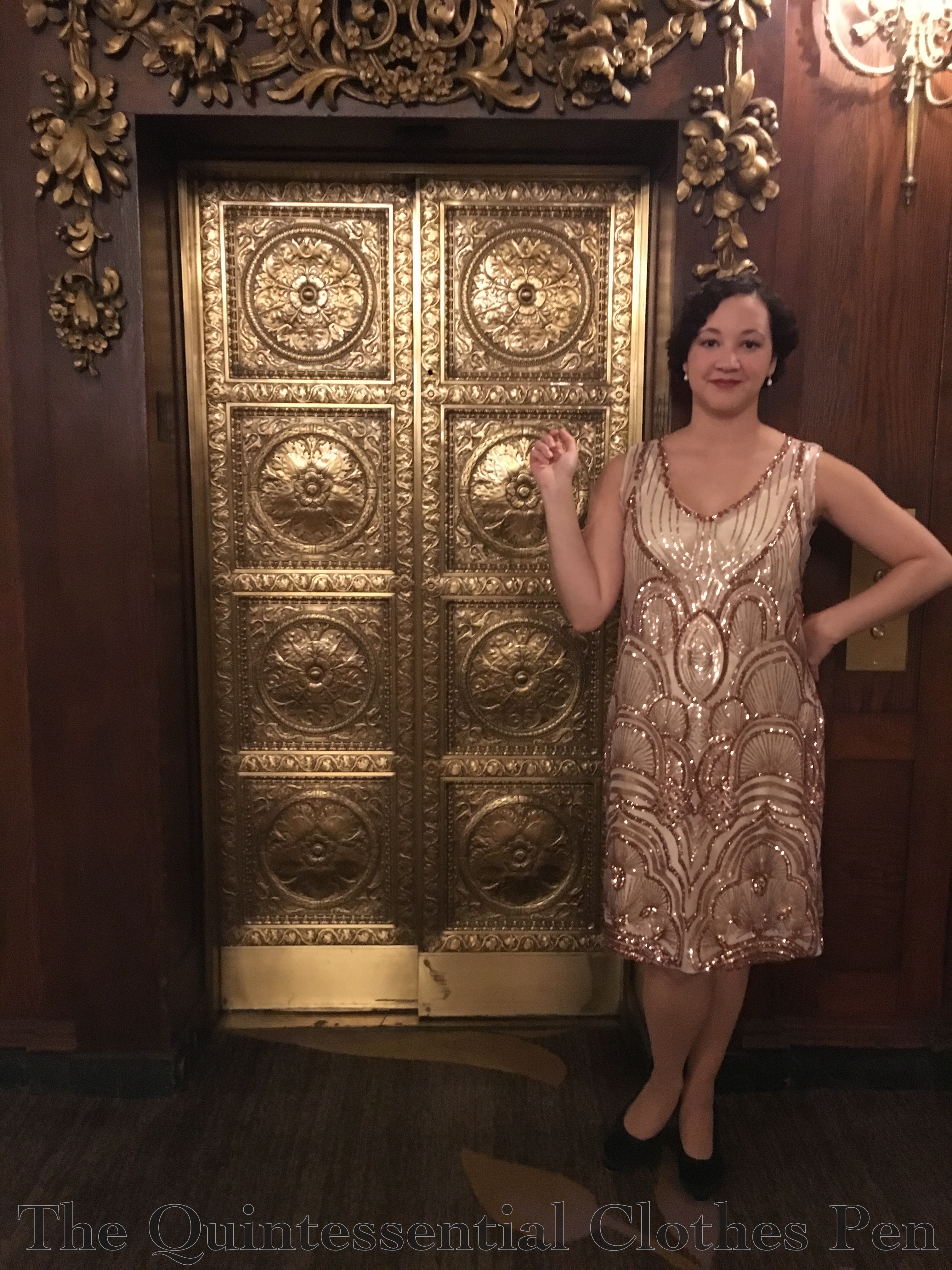
I was at the fabric store looking for other things… (the beginning of a lot of my fabric buying adventures) when two super sparkly fabrics caught my eye. They were screaming “1920s!” But the colors were somewhat costume-y 1920s and not often seen in my research of actual historical dresses from this period–red on nude net and black on nude net. A bit disappointed, I looked at the sparkly lace section some more and found the same fabric in blush on nude net! It was so sparkly and the pattern on it was so perfectly deco that I had to take some home with me. Luckily it wasn’t expensive and only cost $14 for 1.25 yards. Not bad!

The timing was perfect, because I had a 1920s event in January and just enough time to make the dress.  I didn’t have a slip to go under it that was the right shape or color, so I also squeezed in making a bias cut slip.

img_2349-1

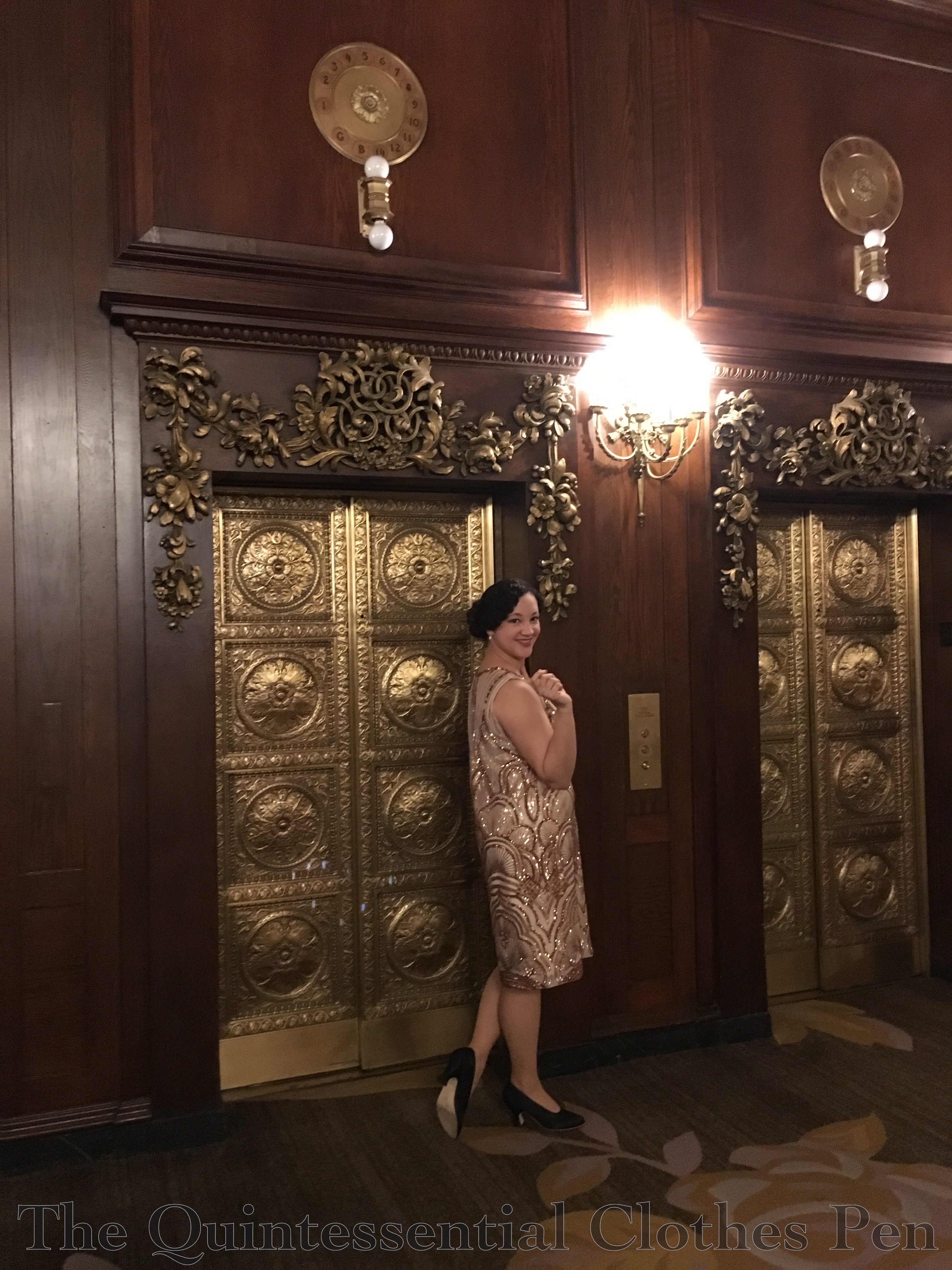
For the pictures, I wore my American Duchess black Seaburys. They provided just the right 1920s shoe shape, encasing the front of my foot in a uniquely historical way that modern style shoes do not. You can see the shape more clearly in this post when I wore the shoes with my 1920s bathing suit in a beauty pageant look.

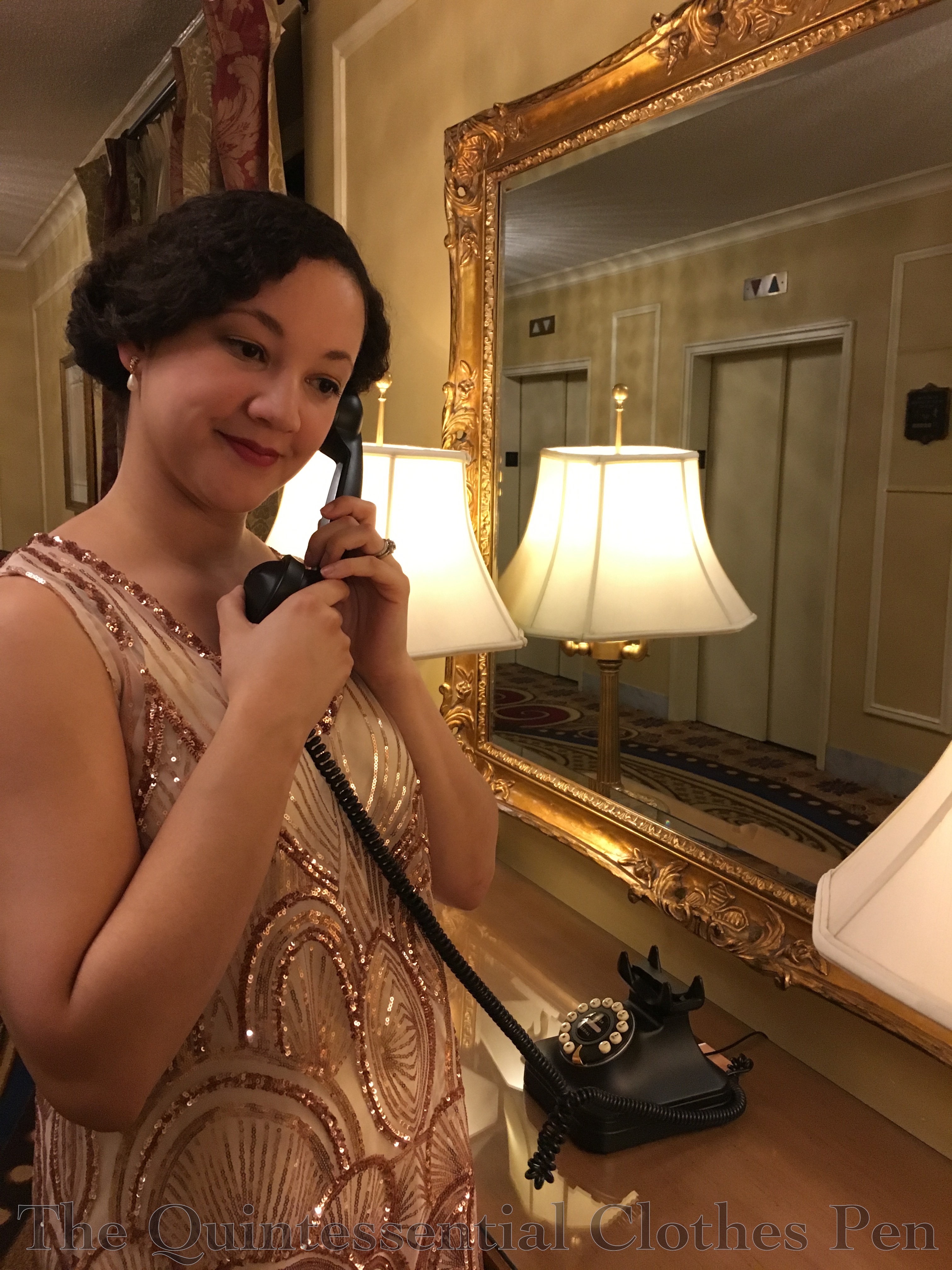
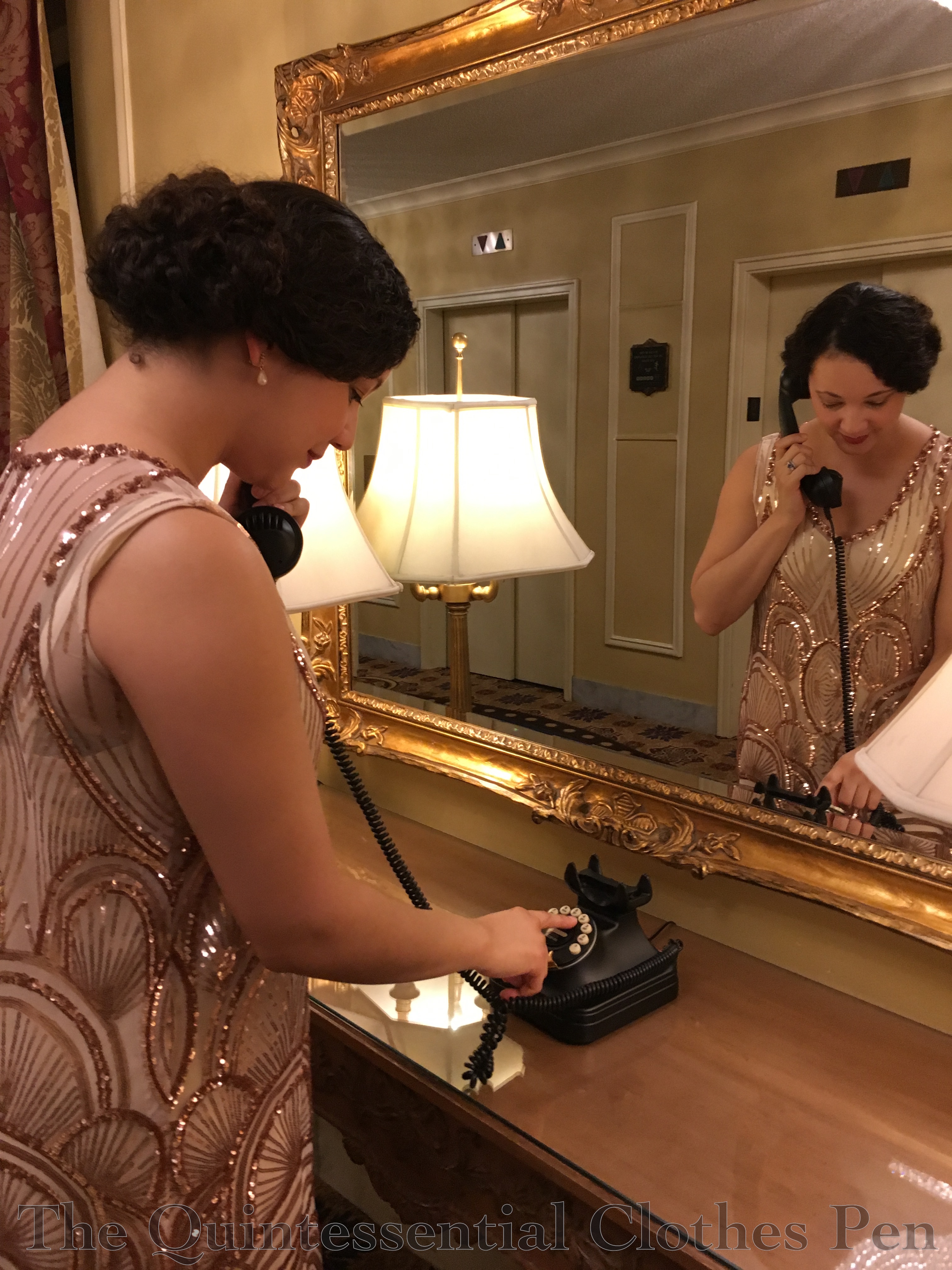
I was also incredibly lucky that the event was held in a historical hotel that provided fun backdrops for pictures! Those elevator doors are lovely! And look at this awesome phone–it had to be included in pictures!

img_2340-1

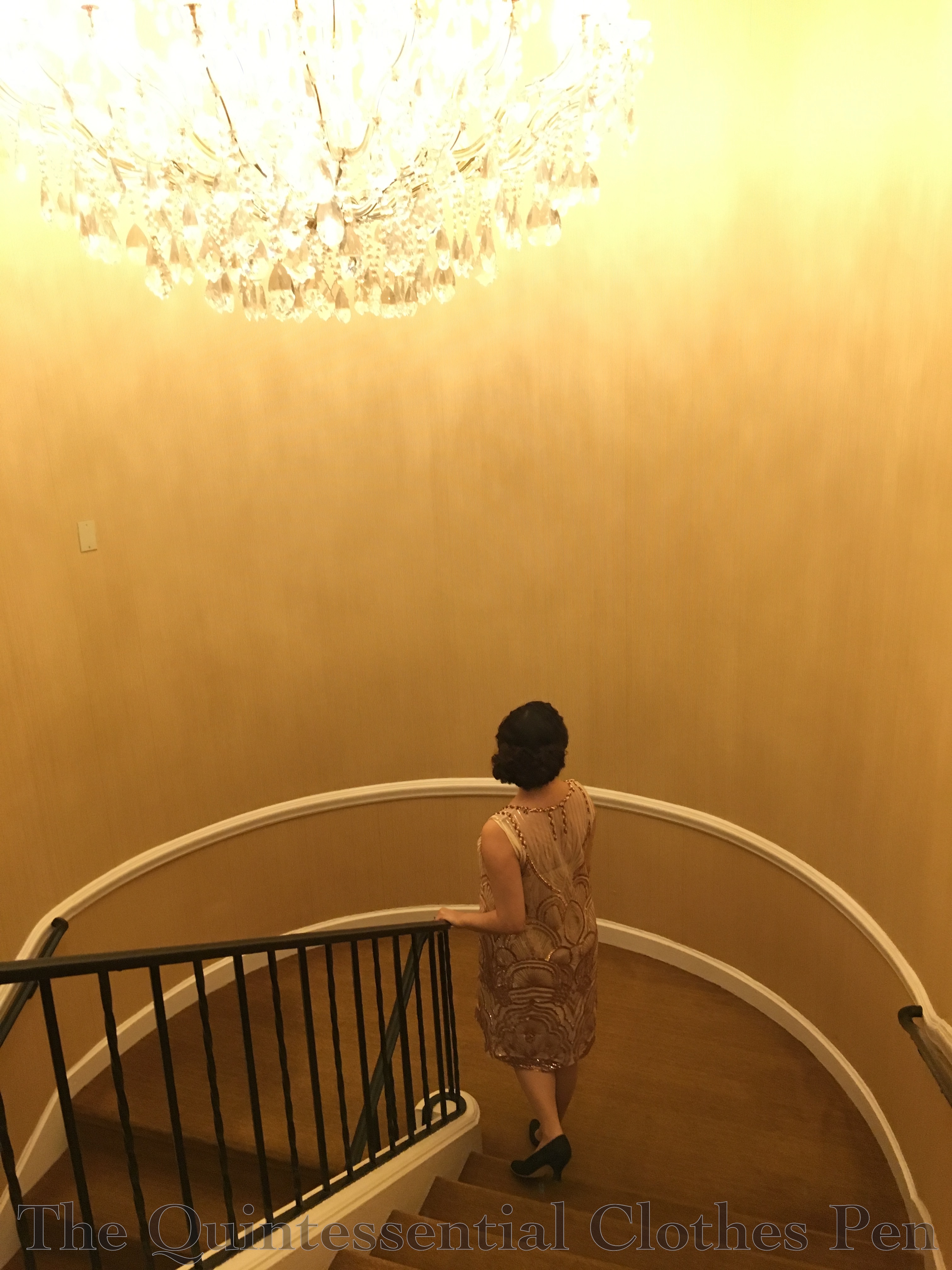
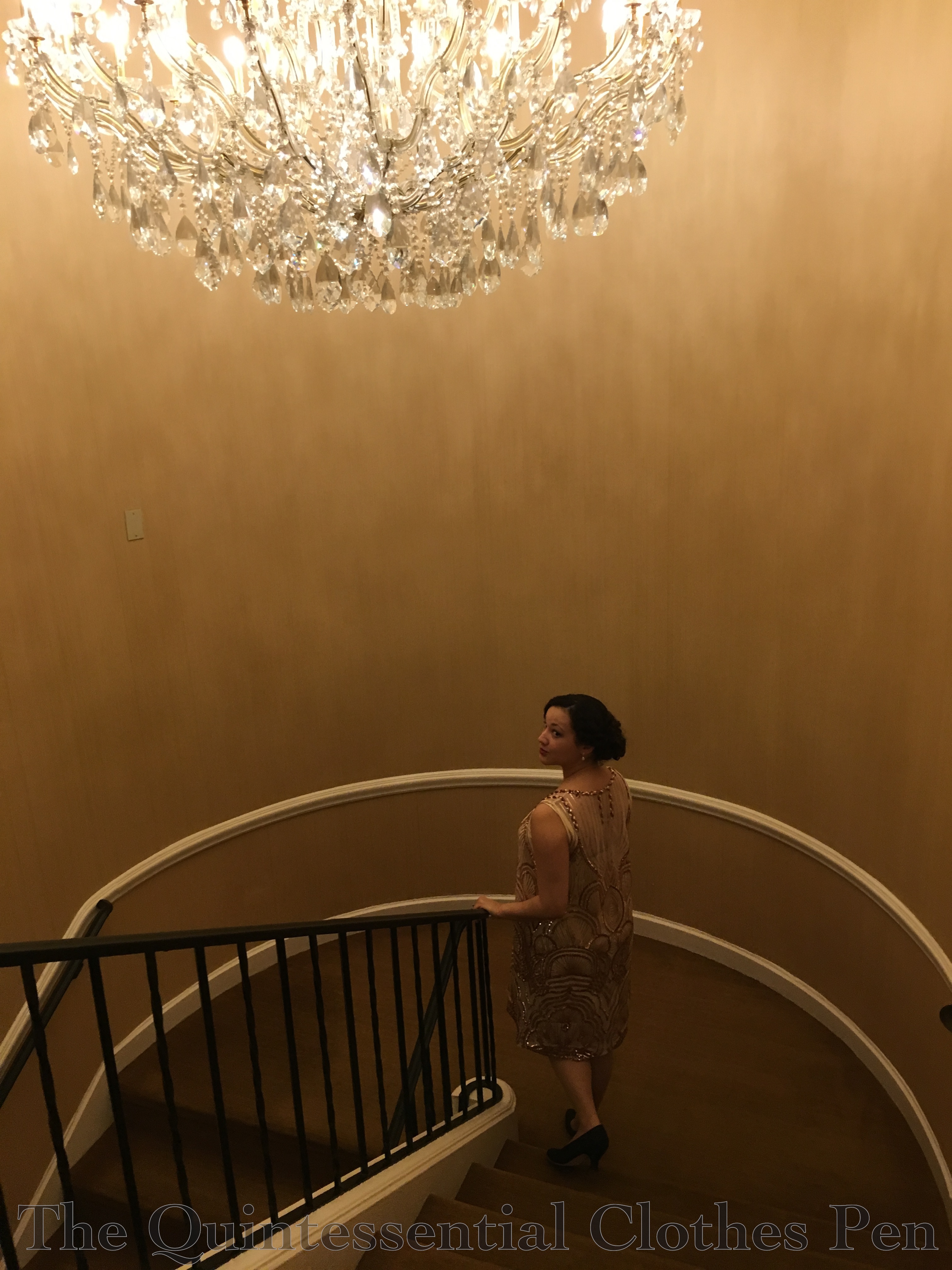
Another neat place we took pictures was this stairwell. I love how different these two pictures are, despite being so similar. One is much more about the dress while the other shows off the chandelier and is a bit more artsy and mysterious.

img_2329-1

img_2327-1

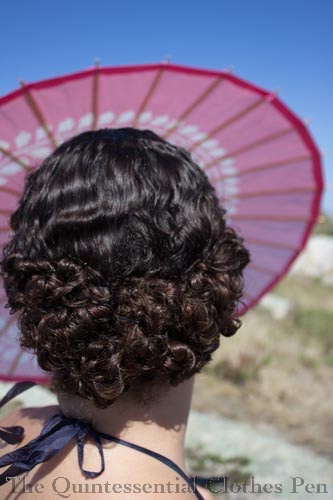
img_3151-1I was so pleased with how my hair turned out! I tried a style similar to one I did last summer for a different 1920s event that I have yet to post about… oops! But here’s a teaser of just my hair. Soon I’ll post the details and it will bring some warm summer memories to my New England winter.

For the summer event I did my hair when it was wet, resulting in a similar style, but much smaller and closer to my head. For that version, I did all the back curls while my hair was still distinctly damp, making the curls much tighter and closer to my head.

For this event, I braided my hair in the morning while it was still damp (to help create waves on the top but curls on the bottom) and left it all day, meaning it was mostly dry when I took out the braid. Then, when doing my hair for the evening, I added small rats under the puffed bottom portion to add a bit more volume than just my own curls. I covered the rats with the length of my hair then carefully placed and pinned the curly ends to imitate having a sort of 1930s smooth-on-top-curly at the bottom style, like this. This style is a few years later than my new dress, but I think it works as a 20s style for someone with longer hair, like me. I have a lot of hair to hide in a 1920s style!

img_2332-1

Both the dress and slip are entirely hand sewn, due to working on it away from home (I would have hand sewed the dress anyway because of all the sequins, but probably not the slip). The dress started out as a tube, but was more unflattering than I was willing to allow. It was fine from the hips down, but needed to be taken in above the hips. What I ended up with is a curved seam (or a long dart, depending on how you look at it–one side didn’t have a seam to begin with) allowing slight shaping from the torso to the skirt portion of the dress. 1920s dresses can be such bags, but after the extra shaping I am very happy with the still somewhat bag-like, skimming shape of the dress without feeling like it’s an absolute sack.

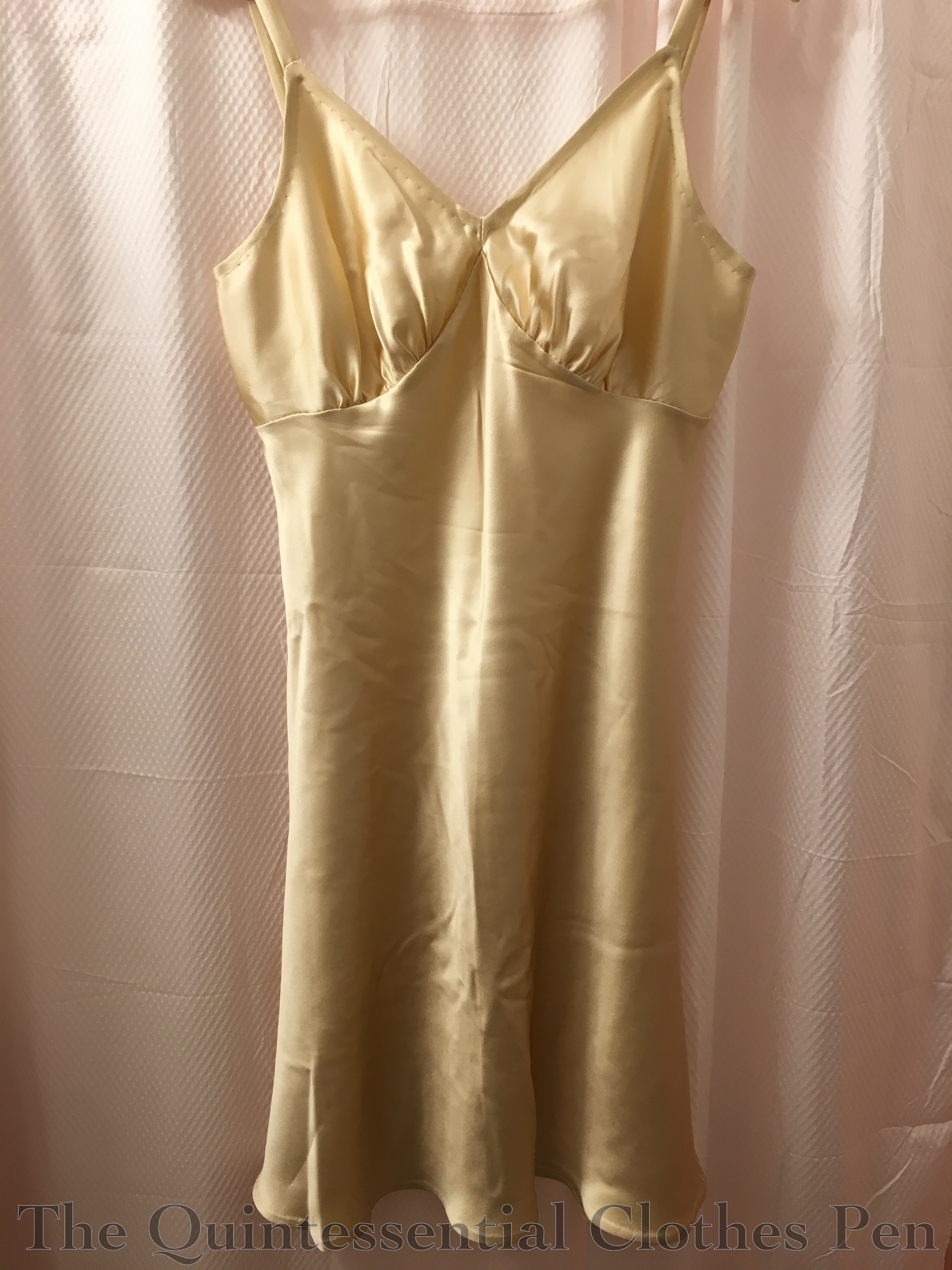
The slip was cut from a pattern I made a few years ago–perfect, since I didn’t have time to pattern something from scratch! I intentionally picked a 1930s pattern in order to have the addition of a perfectly fitting 1930s silk slip to my wardrobe, but also because the shape of the neckline was perfectly suited to the v-neckline I decided on for the sparkly overdress.

img_2374

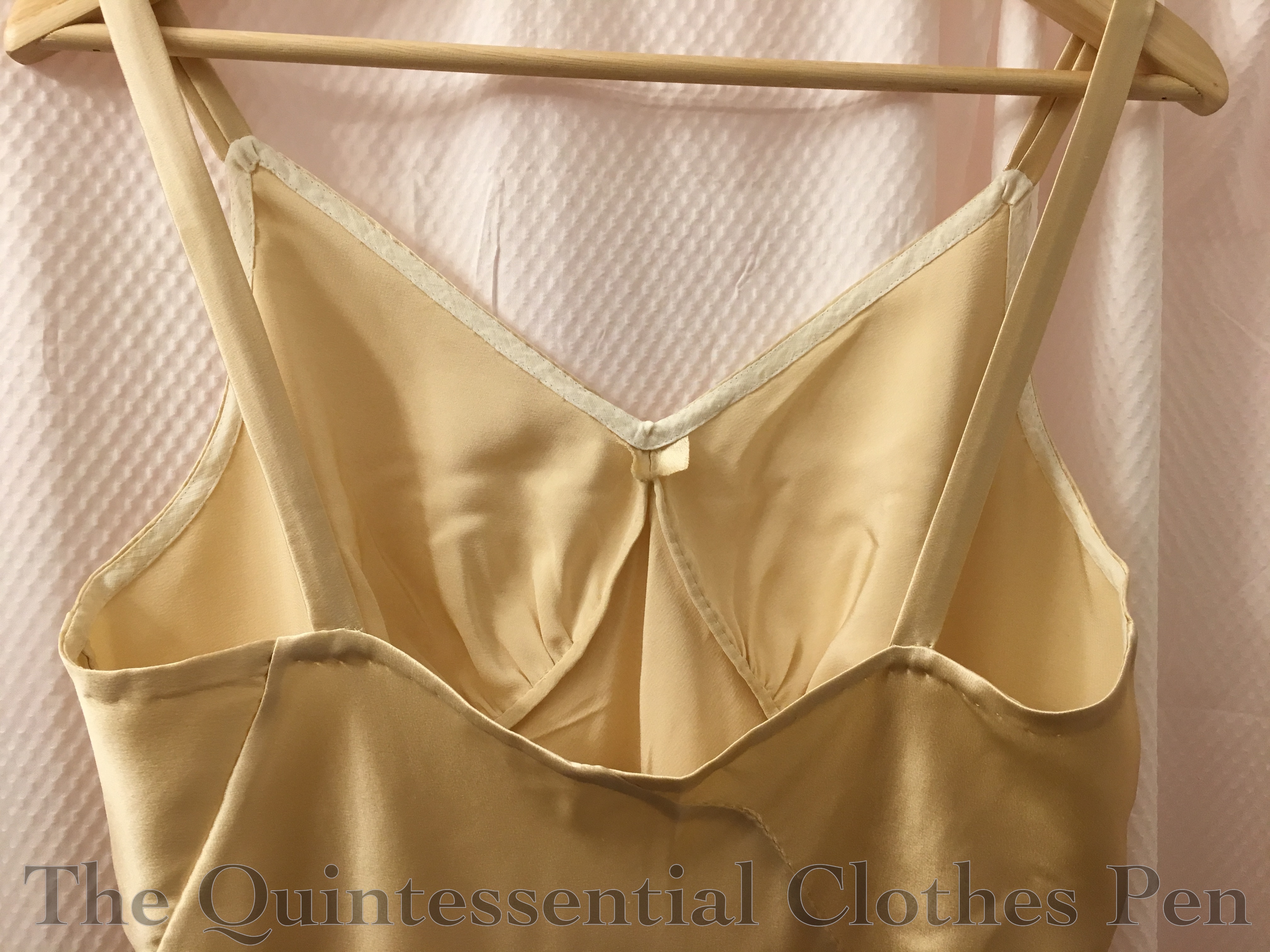
The slip has french seams on the sides. The under-bust seam allowance was trimmed away on the gathered piece and then the body piece seam allowance was turned over it and hand sewn to hide the raw edges. The top edge is mostly bound of with vintage cotton bias (which I removed from the top of the net petticoat I show in this post before shortening it. The piece wasn’t quite long enough to go all around the top edge of the slip, so the center back section is just turned twice and slip stitched, in the same way as the hem.

img_2378

The slip fabric is left over from a project that I did about 7 years ago. It’s lovely silk crepe back satin with the perfect weight for making bias cut 1930s clothing. I thought I would have just enough to eke out the slip, but I came up a little short on the back piece and decided to piece it to make it work, as the fabric is so nice to wear and it was the perfect color. As a result, there are two random diagonal seams on the top of the back piece of the slip. Oh well! They add character!