Re-Imagined 1885 Fancy Dress (HSM #9)

The Backstory

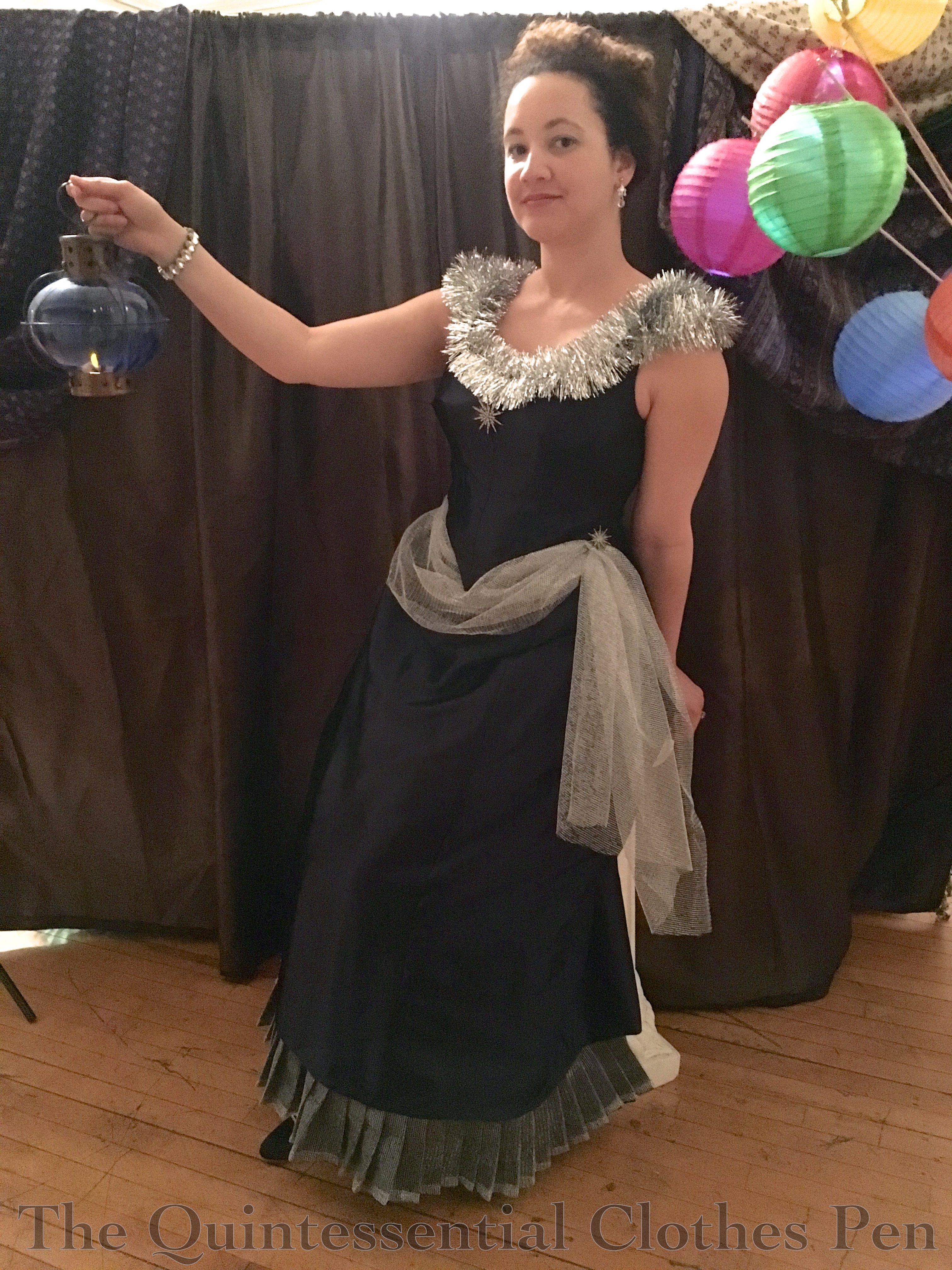
In 2016, I made a dress for a Fancy Dress Ball inspired by a dress worn by Alice Gwynn Vanderbilt in 1883. Alice’s now-famous dress, made by The House Of Worth, celebrated Electric Light as its theme. The dress uses beading and metallic elements (as well as an electric torch, for the original wearing!) to visually reflect light as well as communicate the electric light theme via decorative motifs. I posted an image of the inspiration gown and a link to more information about it in my original post about my dress in 2016, which you can view here.

I was inspired by the trimmings on the gown, but needed to create a dress with little expenditure (much different than the budget for a Worth dress!). To achieve this, the goal when I made my dress in 2016 was to use as many materials as I could that I already owned. The main dress fabrics were already in the stash from old projects and the silver net was leftover from trimming the Versailles sacque I posted about wearing recently.

Below, a photo of the dress in 2016, with a lantern standing in for “electric light.”

There were a few small changes I wanted to make after the first wearing of the dress, but I didn’t have a need to wear it again for years. Fancy Dress events are not all that common even within the already limited realm of historically clothed events! And with the original trimmings I didn’t like the dress for regular wear. Plus, for a number of years after making the dress the events I was attending did not encompass the 1880s.

More recently, however, I have had more opportunities to wear clothing from this period, as The Footwork and Frolick Society has hosted a few events with themes that can include the 1880s. Therefore, I decided to re-trim the Fancy Dress dress into a more regular, less Fancy Dress, ballgown style for the Yuletide Ball in 2024.

Inspiration

This time, my inspiration was a mashup of ideas from a variety of images.

From the fashion plate below, published in the Revue de la Mode in February 1886, I pulled information from the gown on the right, with the pleated fabric along the v-shaped neckline and asymmetrical decorations (which I guess are feathers) on the shoulder and skirt.

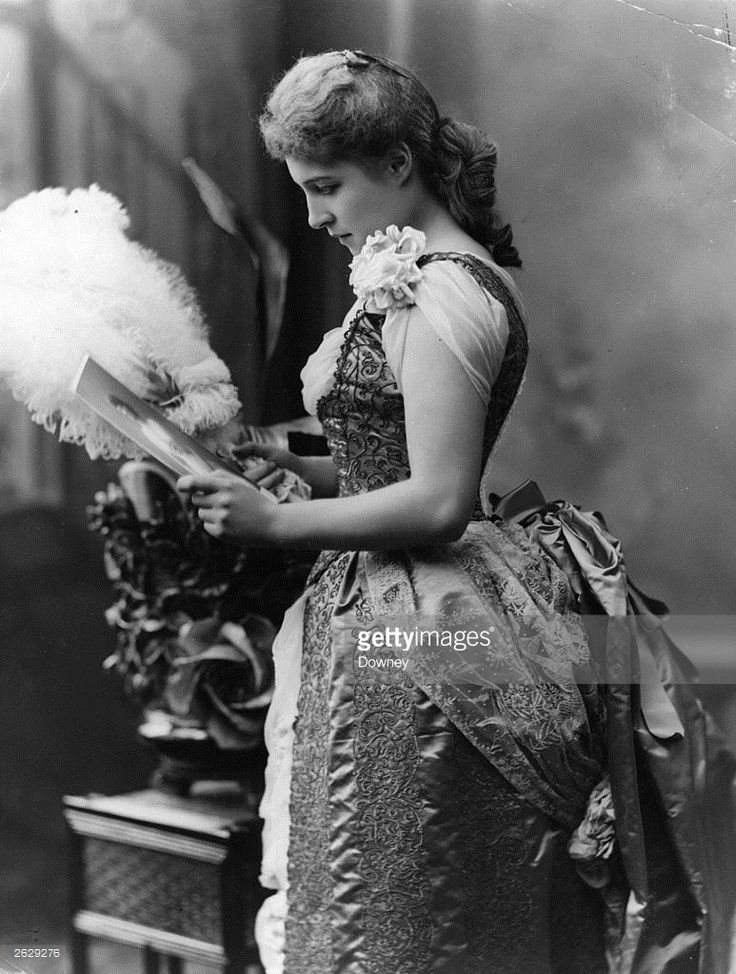
From the photo below of British actress Lillie Langtry (Original Publication: People Disc – HU0206. Photo by Downey/Getty Images), I pulled inspiration for the “sleeve” idea I wanted to incorporate. The pattern of the fabric used for the bodice in this photo was also reminiscent of one of the fabrics I used to update my dress.

And finally, I was also inspired by the beaded swags (and chiffon “sleeves”) on the c. 1887 dress in the collection of the Kent State University Museum in the photo below.

Dress Update Overview

For the re-make of the dress, I wanted to maintain my goal of using materials already on hand. I still had small scraps of the navy blue satin in my stash as well as the silver net. I also went through my fabric stash binder to see what other fabrics and trimmings might work and found that the best bets were a piece of polyester velvet flocked with silver swirls that I’d purchased at Joann Fabrics probably twenty years ago when I had just started sewing and loads of silver ribbon that I had been gifted to me. The blue and silver colors fit the colors of the existing dress perfectly and I thought there was a sort of New Year’s aspect to the color scheme, as well. (I also purchased the Joann fabric in burgundy and green (both with gold swirls) and had made Christmas decorations out those, but I don’t think I ever used the piece of blue, so this was a great opportunity!)

With my materials decided, I moved on to the sewing part of the project, starting with unpicking the original trim from the dress. I had made it knowing I might someday want to change the trimmings, so they were not sewn into seams and were pretty easy to remove. That left me with an almost entirely navy blue dress, relieved only by the silver pleats at the bottom of the skirt.

Then I went back and considered my original list of changes, which included:

  • Boning the center back edges so they would lie flat when laced closed
  • Adding a matching piece of satin behind the lacing holes to hide any white fabric of undergarments
  • Making sure that my chemise wouldn’t poke out of the armholes

Quoting myself, from 2016… “these are minor changes and I’m not sure when I’ll have the opportunity to wear this again so it might be awhile before they happen.” I’ll say! It only took 9 years!

Historical Sew Monthly

My goal of using stash-only materials for this dress re-do makes it fit into the Historical Sew Monthly 2025 Challenge #9 Blue:

Make an item that features blue, in any shade from azure to zaffre.

Just the facts:

Fabric/Materials: Approximately ¾ yard silver net, just over 1 yard of navy velvet with silver motifs, and scraps of navy polyester satin.

Pattern: My own.

Year: c. 1885.

Notions: Approximately 23.5 yards of ¼” silver ribbon.

How historically accurate is it?: 90%. Polyester and modern synthetic ribbon do not have accurate fiber content. And my patterning is conjecture. But the overall idea is pretty good.

Hours to complete: I didn’t keep track.

First worn: December 7, 2024.

Total cost: Free, since everything came from the stash and was either gifted to me or purchased ages ago!

Dress Update: Back Closure

Following the original list of changes, I added a placket behind the lacing holes and added plastic bones along the very back edges, to help hide undergarments (the white color really does pop against the navy blue of the dress!) and keep the back laying flat when laced closed.

Dress Update: Sleeves

When re-examining the dress in 2024 with fresh eyes, one of my biggest desires for change was to better fill in the armholes of the dress and provide a decorative element. Yes, evening dresses in the 1880s were often sleeveless, but when really looking closely at them again, I found that while not having sleeves, they do almost always have something that obscures the armhole and even the upper arm. I am more likely to call these styles swags or drapes of fabric, as they aren’t really proper sleeves, but they are certainly set into the armhole in some way. I wanted something like that for the re-do of this dress.

I haven’t had a need to pattern something like this for this period before, so I looked through my historical pattern books for places to start. Interestingly, I didn’t find much. There was one sleeve that seemed like a possible starting place, but when I mocked it up it didn’t really do what I was hoping for at all!

So that left me with the decision to create a pattern from scratch. Thinking about what didn’t work in the mockup and my inspiration image, I proceeded to drape a mockup that achieved what I was hoping for. I didn’t have my dress form handy, so it required a fair bit of going back and forth between pinning and trying on the bodice to get the right shape. But I did! It’s a strange shape, for any sort of sleeve pattern. But that makes sense, since the sleeve drape is a not-really-sleeve!

Dress Update: Apron, Sleeve Swags, and Ribbon Flowers

I pondered creating some sort of beaded fringe for the armhole (and maybe even the waist, as can be seen in the third inspiration photo, above), but decided against it for time and material reasons. I really did want to stick to the stash!

Even if the beaded fringe wasn’t going to happen, I liked the idea of something to set off the wonderfully pointed bodice so that it would show up and not blend into the skirt. So in the end I decided to use some of the velvet from the stash to make an apron layer for the skirt, as was very common on dresses from the 1880s.

I started with making the pleated neck swag, so I wouldn’t run out of fabric, and then used all of the leftover fabric to make the apron. Due to this fabric restriction, I patterned the apron based on what was possible with my fabric, using a general understanding of the how these skirt elements were patterned in this period. The front of the apron is a curved piece that is pleated into the back on each side. The back piece is a bit scant, but has a few pleats along the top to give volume and descends to a point at the center back, since that was the shape of the fabric that was available! I used up pretty much all of the blue velvet!

For the sleeves, I made flower shaped sprays from lengths of ribbon that were tied into loose knots close to each end and then folded into quarters to make one loop and two ends. These individual elements were then combined and sewn together to make the flower-like formations, with larger scale ones on the skirt and smaller ones on the bodice.

The sleeve dangles were made from the same ribbon, knotted in the same way, that was folded to make a longer and shorter side and then tucked under the sprays on the shoulders.

Below, you can see the individual spray elements and a length of ribbon ready to be added as a sleeve dangle.

Finished Updates

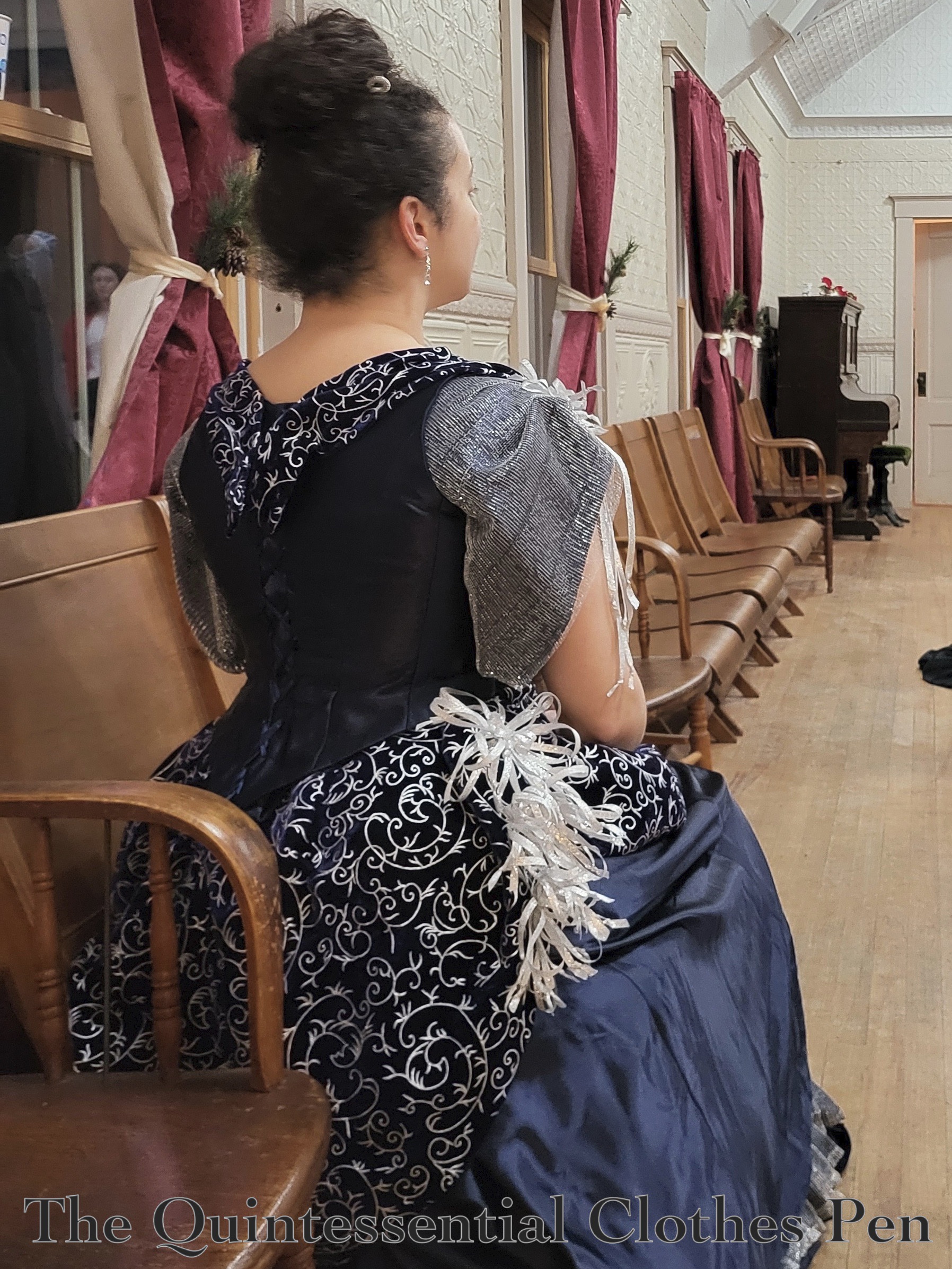
Here is the updated dress! The blue velvet pleated v-shaped neck swag completely ignores the neck shape of the bodice underneath, which is more of a square shape. The same fabric is used again to create an apron, stitched to the outside of the waistband of the skirt to reduce bulk.

The silver net is used over the blue satin scraps to create “sleeves” that are pleated into the armhole and decorated with sprays and dangles of silver ribbon.

The “sleeves” wound up looking a little odd where the meet the back of the bodice, but that’s more due to my original patterning of a very inset armhole in the back than it is the sleeve pattern. It’s a lesson/change for the next bustle period evening gown I make, whenever that is!

I didn’t know what to do with the back of the velvet swag, because I wanted it to be easily adjustable depending on how tightly the back was laced. I ended up with this pointed arrangement that accomplished the goal of flexibility.

The armholes, left side front of the bodice, and right side front of the skirt are decorated with the sprays of looped silver ribbon. I used x4 — 4 yard spools of ribbon and half each of x3 more spools that were 5 yards each.

I calculated how many sprays and dangles I wanted for each section, but in the end I was running out of ribbon and started to just combine and move things around until they looked reasonable. Sadly, that means I don’t have a good record of how much ribbon went into each element or how long each piece of ribbon ended up being. I think that the smaller sprays were made of piece of ribbon that were 10″, the larger sprays on the skirt were made of pieces of ribbon that were 16″, and the arm dangles were 11″ before being folded.

Wearing

I wanted to find a simple but still 1880s hair style for this wearing, so I was pleased when I came across a photo of women in 1880s evening dresses with their hair drawn back and pulled up into simple large chignons on the backs of their heads. I wore that style with the addition of a few silver hair pins to tie everything together.

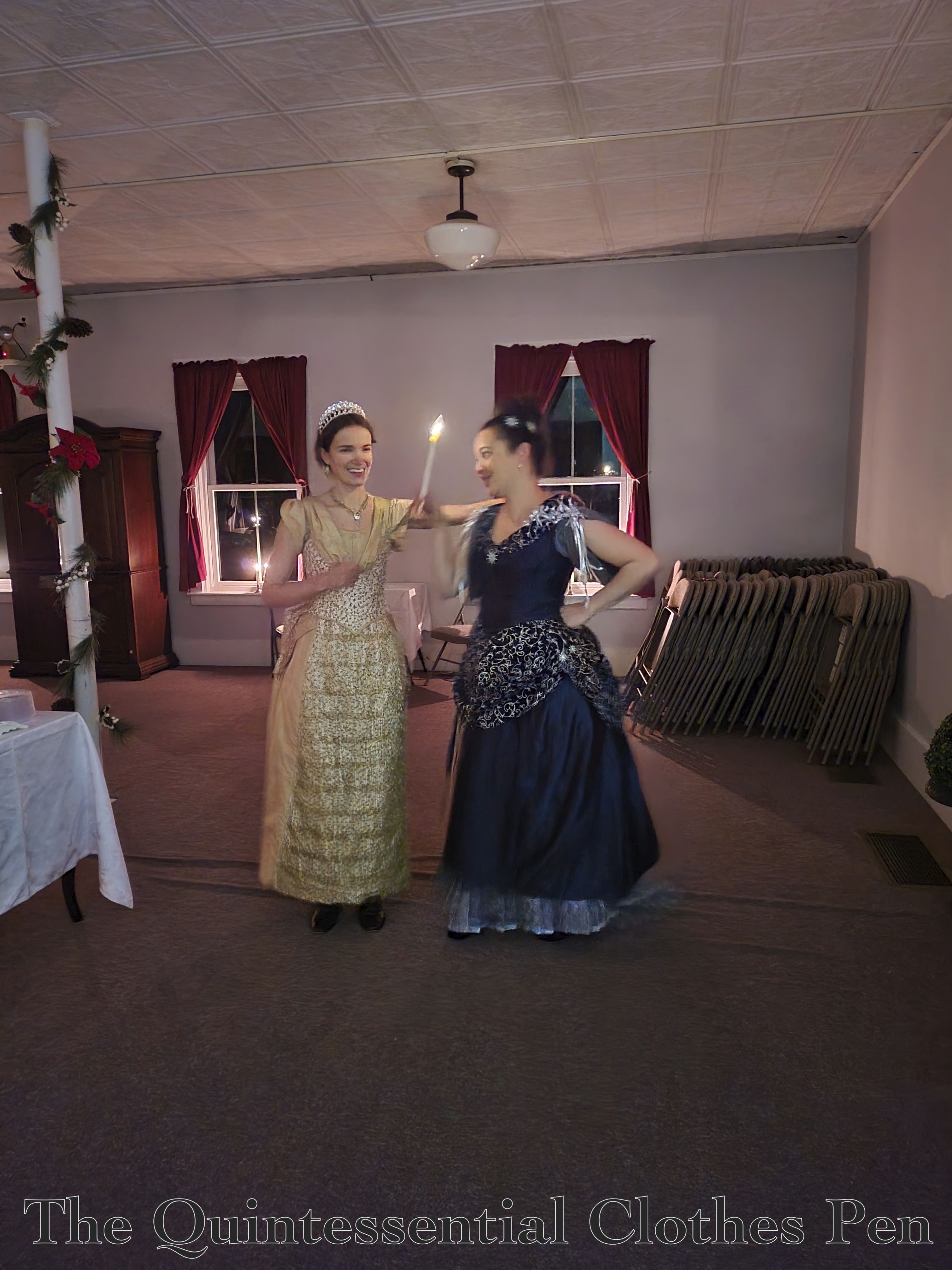
I also reused some of the star brooches from the first iteration of this dress, adding one at the center from of the bodice, two on the left side of the skirt, and some on the left side of my hair. They stand out well in the photo below, in which the two of us are bobbling about, making the ribbons on my dress and beaded trim on the dress on the left shimmer, sparkle, and sway.

Other Photos From The Event

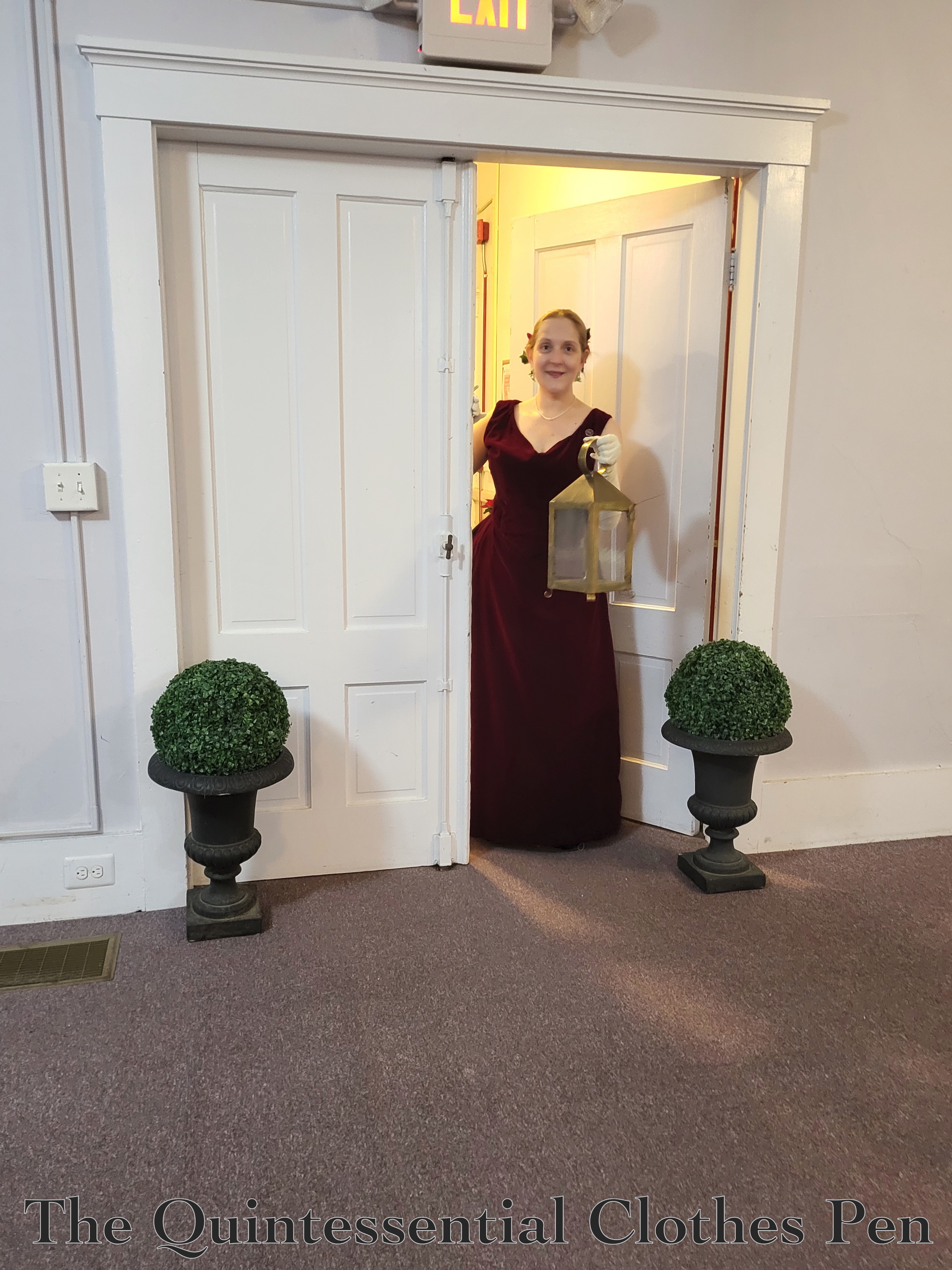
This was a ball for bustles! There were multiple people wearing dresses with this feature, including the dress above, as well as the burgundy velvet dress below.

Finally, a cheerful holiday view into the ballroom. I wasn’t feeling my best at this event and therefore didn’t dance, but everyone else had a grand time! I look forward to the next event in which I can participate in dancing with the bustle! It’s really quite fun to experience the movement of dancing with all of your dress behind you!

A Stomacher For The Yellow Sacque (HSM #12)

One of the many parts of the new c. 1770 Yellow Sacque ensemble that I’ve been slowly posting about is the stomacher. This is the triangular shaped piece that fills in the front of the dress, covering the undergarments worn underneath.

18th century stomachers come in a variety of shapes and styles. Some are more pointy and triangular, some are more wide and rounded. Some match the dress exactly and others contrast with the dress fabric.

The stomacher that goes with my Versailles sacque (which you can read about in the past post discussing the construction details for that dress) is more of the wide, rounded, and matching-the-dress variety. So for this new dress I decided to go in the opposite direction and make a stomacher that is more pointy, triangular, and made of contrasting fabric.

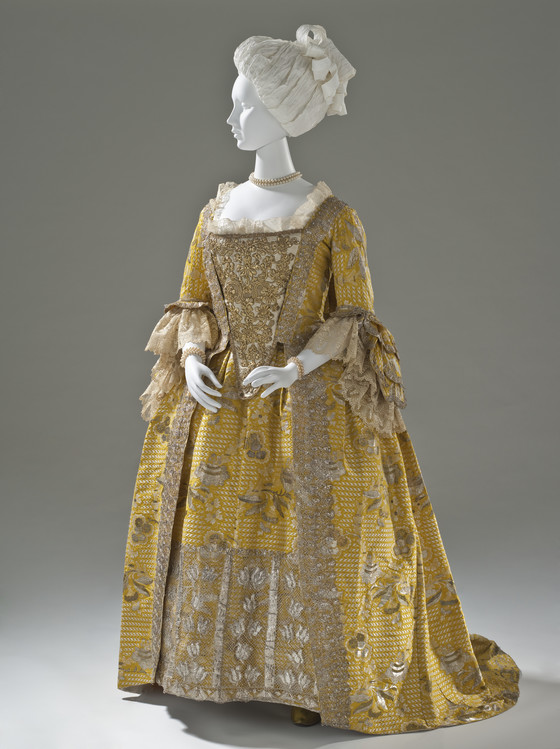
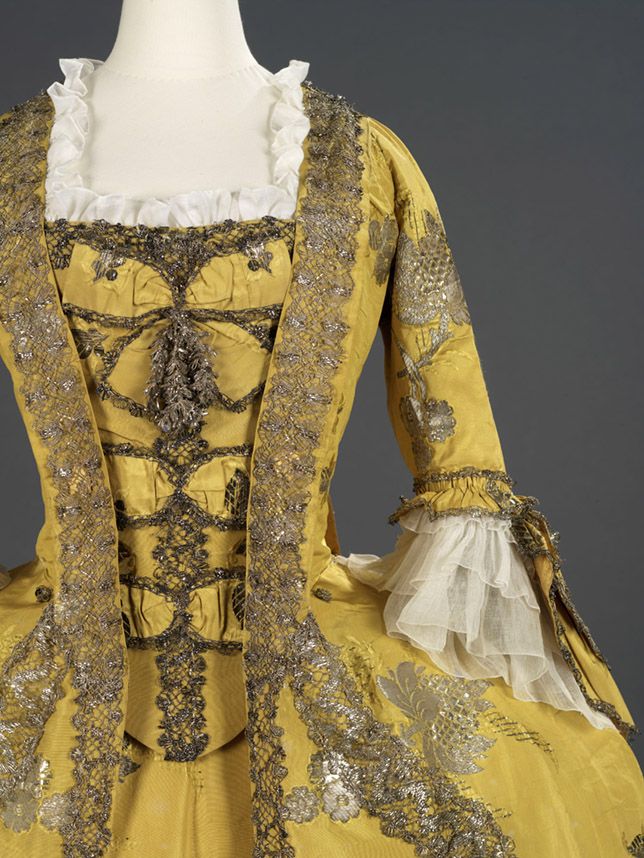
I was particularly inspired by the dress and stomacher combination below, which is in the collection of the LA County Museum of Art. I love that the gold embroidery on the stomacher is completely different than the trim on the dress and that is completed on an ivory colored base that is also completely different than the dress fabric itself.

Woman’s Dress and Petticoat (Robe à la française). England, circa 1760. Silk plain weave with weft-float patterning and silk with metallic-thread supplementary-weft patterning, and metallic lace. Gift of Mrs. Henry Salvatori (M.79.118a-b).

With that idea in mind, it was time to figure out how to achieve that look! I dabbled in embroidery in 2020, but definitely not enough to feel up to the elaborate style and cost of materials to achieve this look from scratch. I did have a fabric in my stash, however, that has lovely gold embroidered motifs on a bronze net background. I’ve cut out the motifs and used them before with fantastic results, so I figured I could do that again for this purpose. (The full net fabric was used in my 1912 Burgundy and Gold Evening Gown made in 2012 and the motifs were used as appliqués in my 1893 Bronze and Pink Evening Gown in 2012, as well.)

For this project, some of the helpful motifs from the lace were along the edges of the fabric. Others were in the middle. The motifs were not always symmetrical, so in many cases I had to piece them together to make them look reasonable for this purpose — especially in the central budding/dripping areas of the stomacher. I used approximately 30 individual sequin/embroidered bits, some as small as a single leaf!

Below is a photo of the stomacher with all of the individual gold bits pinned in place.

After that, all I had to do was use an appliqué stitch to attach them around each edge! I like that sort of work (it’s the same process I used for my 1940 Schiaparelli Evening Dress last year). It’s not hard, but just takes patience. The most patience is needed when the thread gets caught on a pin!

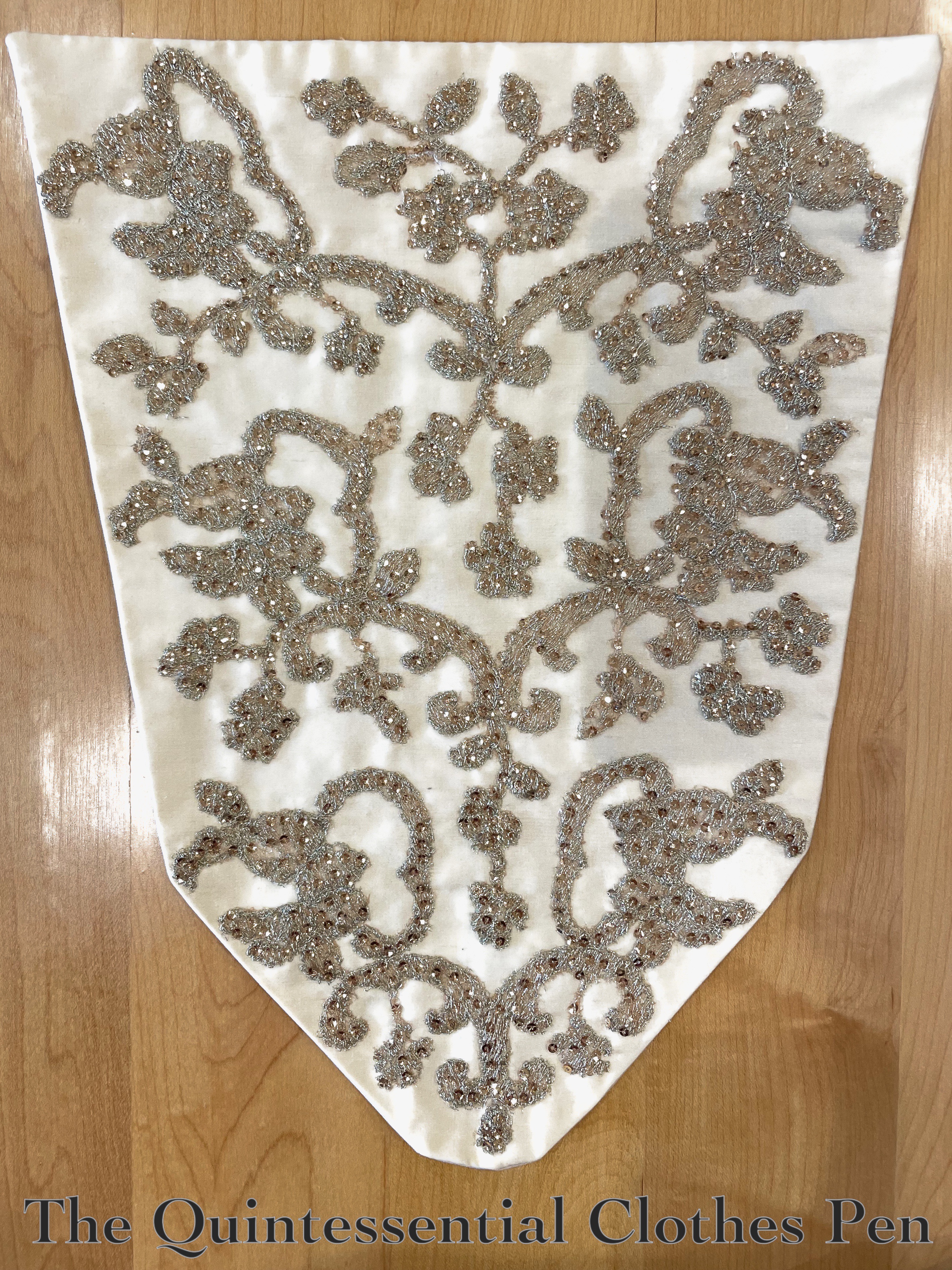
Below is the completed stomacher.

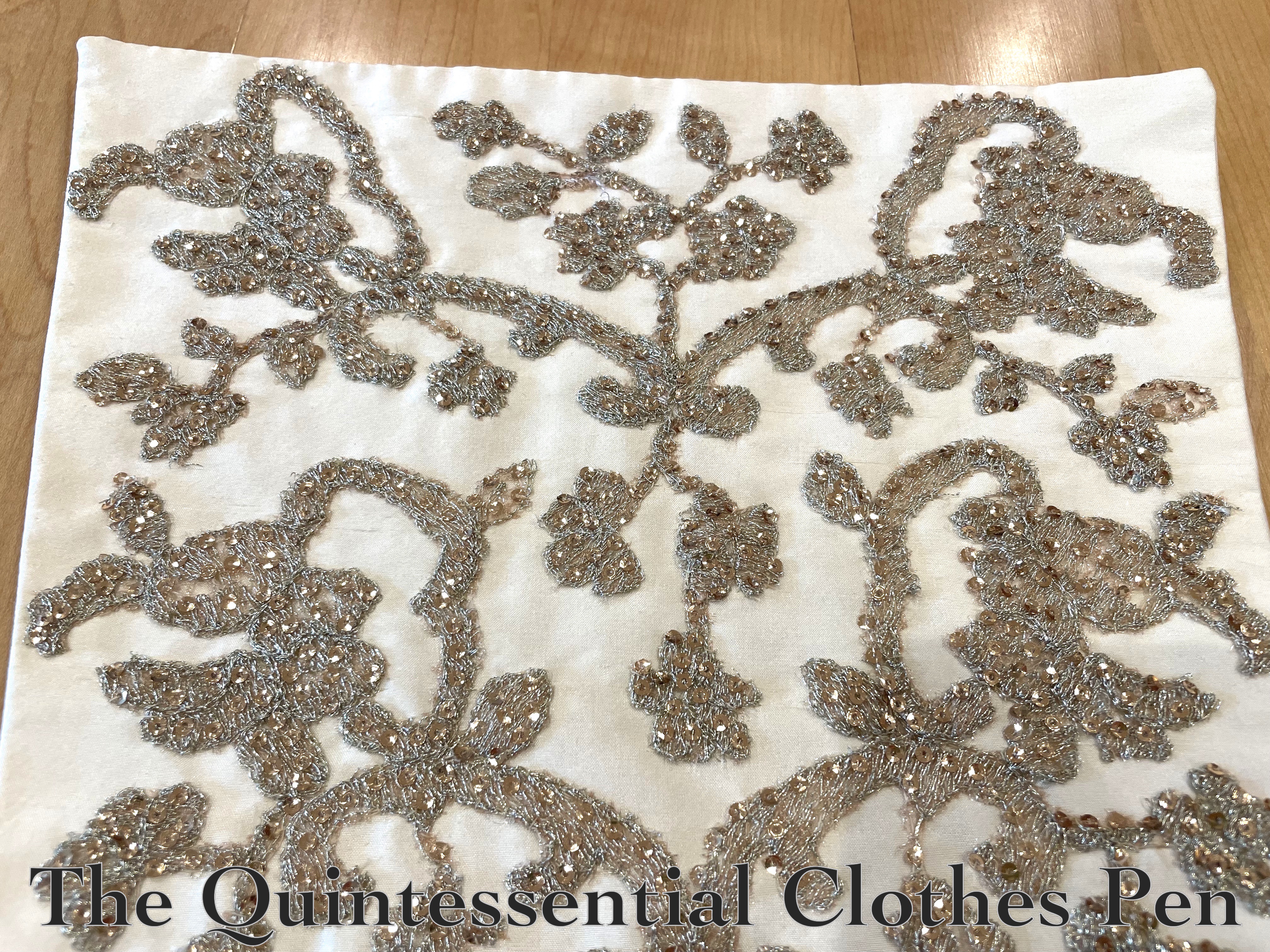
It really sparkles in the light, as the gold embroidery also has gold sequins on it. That lovely sparkly element was hard to capture in a photo. I did try! Below is a view that shows the sequins a little bit better.

I know that spangles (flat metal discs) were in use long before the 18th century. So while my sequined modern lace appliqués may not be perfect on a historical-reproduction scale, I do think it’s reasonable to think that something similar would have been used in the 18th century to help reflect light in the halls of Versailles or other palaces of the period.

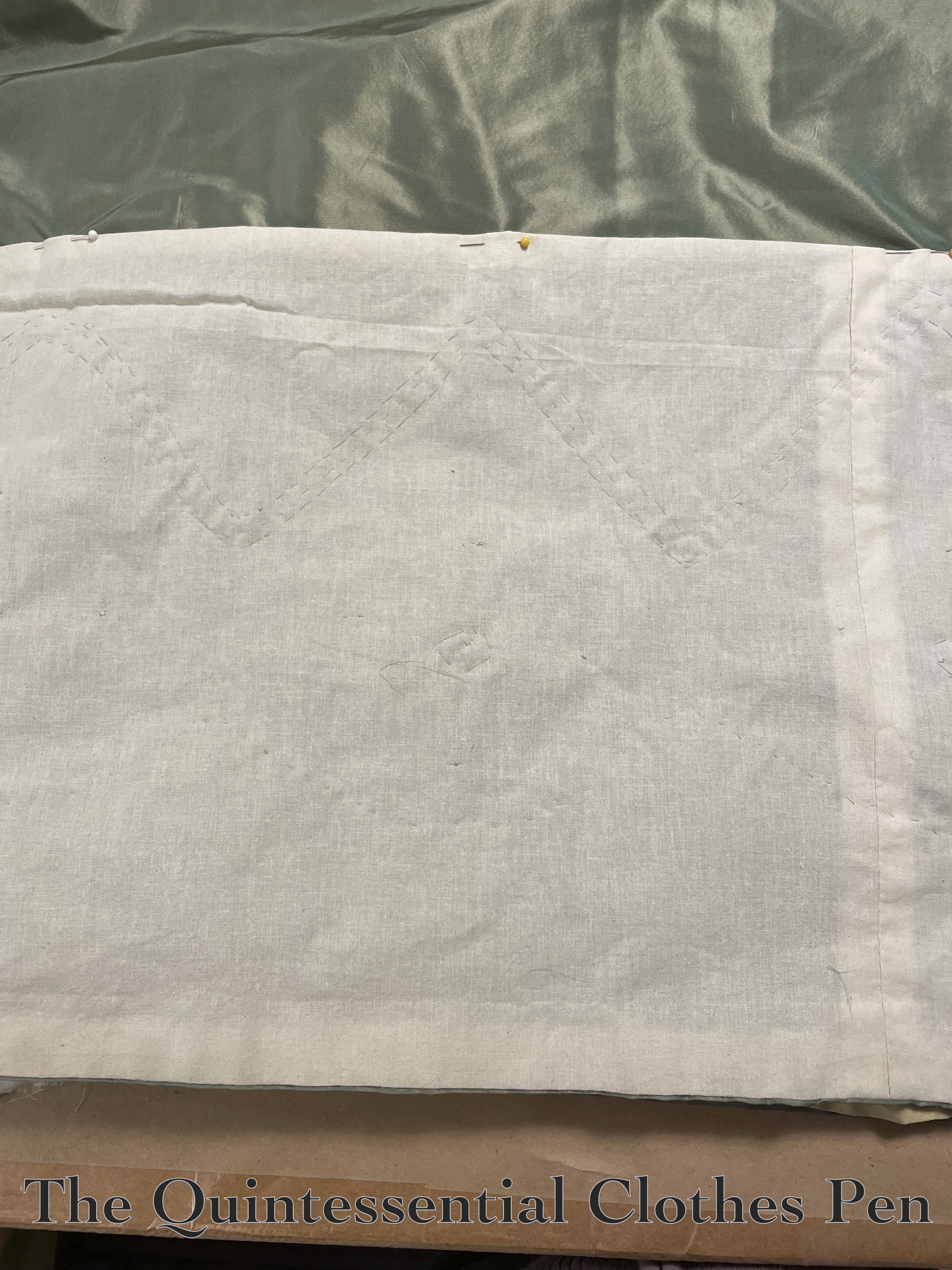
In addition to the gold bits, I also had scraps of ivory silk shantung in the stash leftover from making my fluffy 1903 petticoat back in 2011. I used one of these scraps for the visible ivory section of the stomacher. The back of the stomacher is made of a scrap of unbleached cotton canvas, also from the stash (this is not historically correct, but it did the job of stiffening the stomacher very well!). A photo showing these fabrics up close is below.

The canvas and silk layers were bagged out, the opening edge whipped closed, and then the appliqué stitches applied only through the silk. The cotton canvas provides stability for stiffening the stomacher as well as pinning into the dress.

This stomacher qualifies for the Historical Sew Monthly Challenge #12 The Final Touch:

Make an accessory or garment that is the finishing touch to an outfit.

Just the facts:

Fabric/Materials: Scrap of ivory silk, scrap of natural canvas, and embroidered/sequin bits from approximately ½ yard of gold lace.

Pattern: The base was adapted from the JP Ryan Pet-en-l’air pattern.

Year: c. 1770

Notions: Thread.

How historically accurate is it?: 90%. Entirely hand sewn. The construction methods are historically plausible, though I believe this would have been embroidered in the 18th century rather than appliquéd. The fiber content and weave of the base fabrics are not accurate.

Hours to complete: I didn’t keep track. Let’s say 6.

First worn: October 5, 2024.

Total cost: I’m going to call the scraps free. My guess is that I spent about $10 per yard on the lace over ten years ago. So let’s say approximately $5.

A White 1780s Petticoat (HSF #7)

The plan for the yellow sacque ensemble I’ve been working on was to provide an under petticoat that would help the yellow silk petticoat (that I posted about in November 2024) hang nicely and be opaque. I thought I’d completed this goal in December 2023, when I re-used fabric from an old Regency style dress to make a base petticoat (you can read the details about that here).

As I started working on the yellow petticoat, though, I realized that the silk was very thin, and that the blue under petticoat (made from the dress) was distorting the yellow color, making it look washed out and less vibrant. Ugh! What to do??

I determined that a light, neutral color under petticoat was needed and looked through my stash to see what I has in enough quantity for a new petticoat. The goal was to make this from the stash!

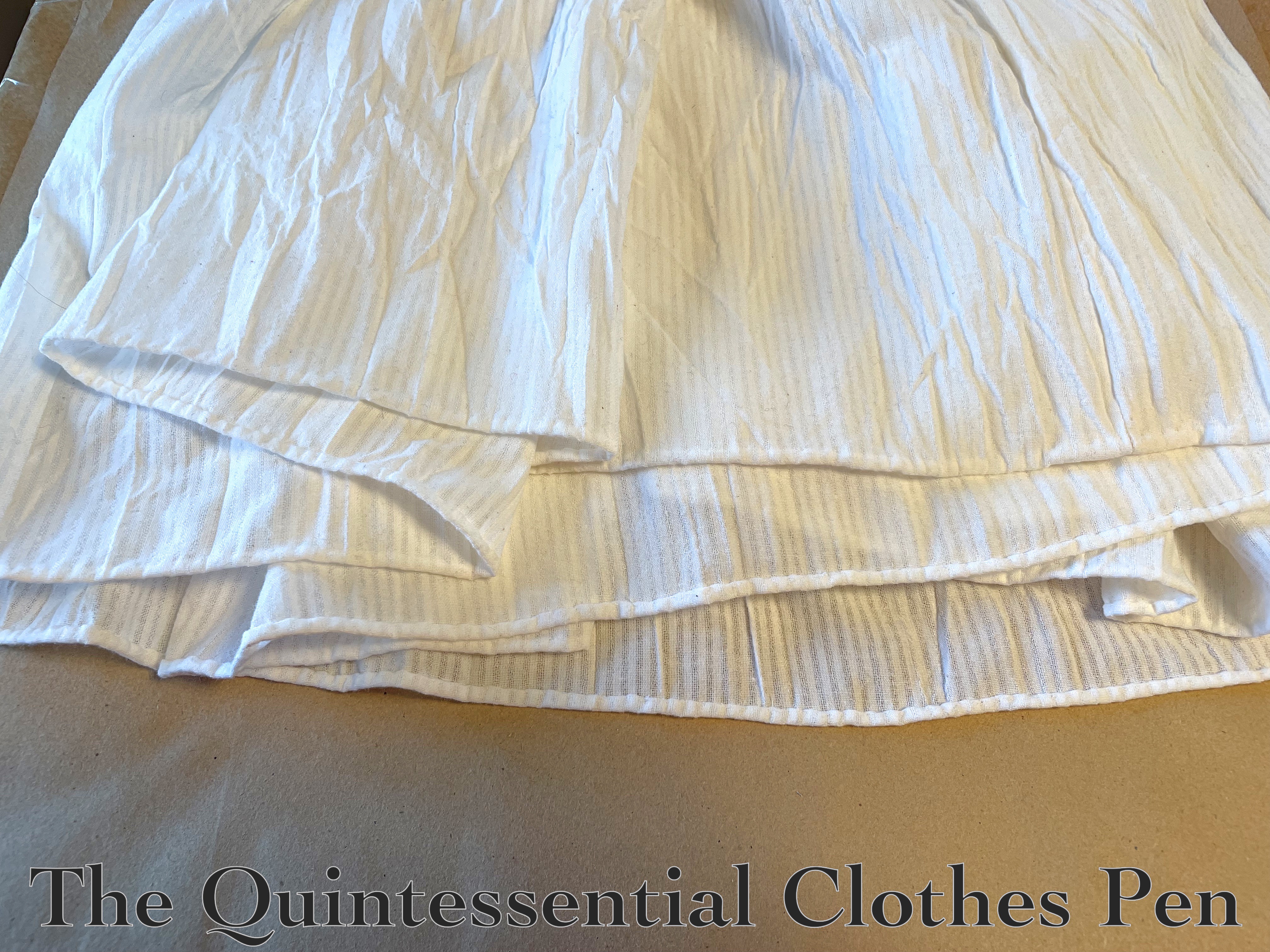
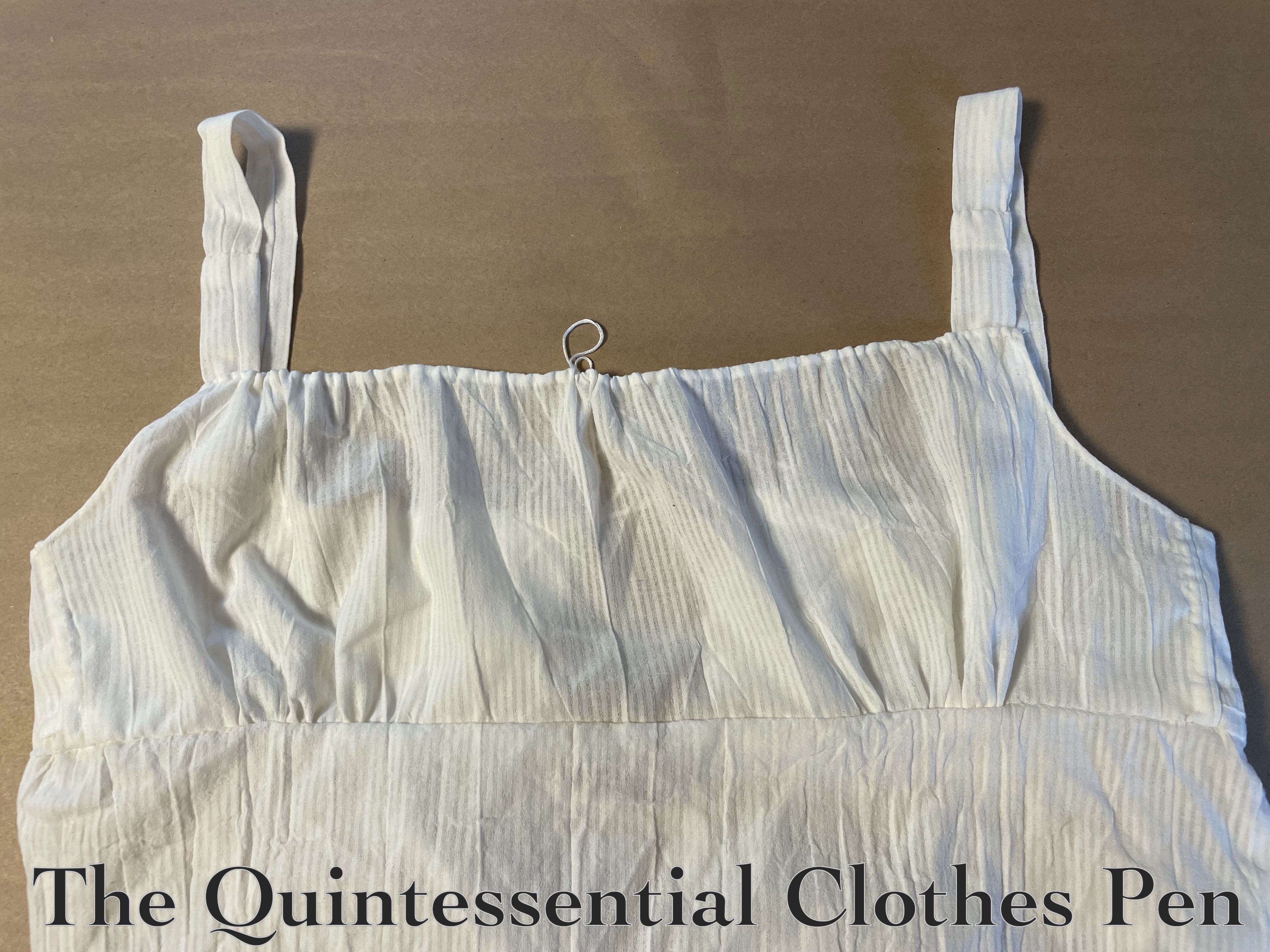
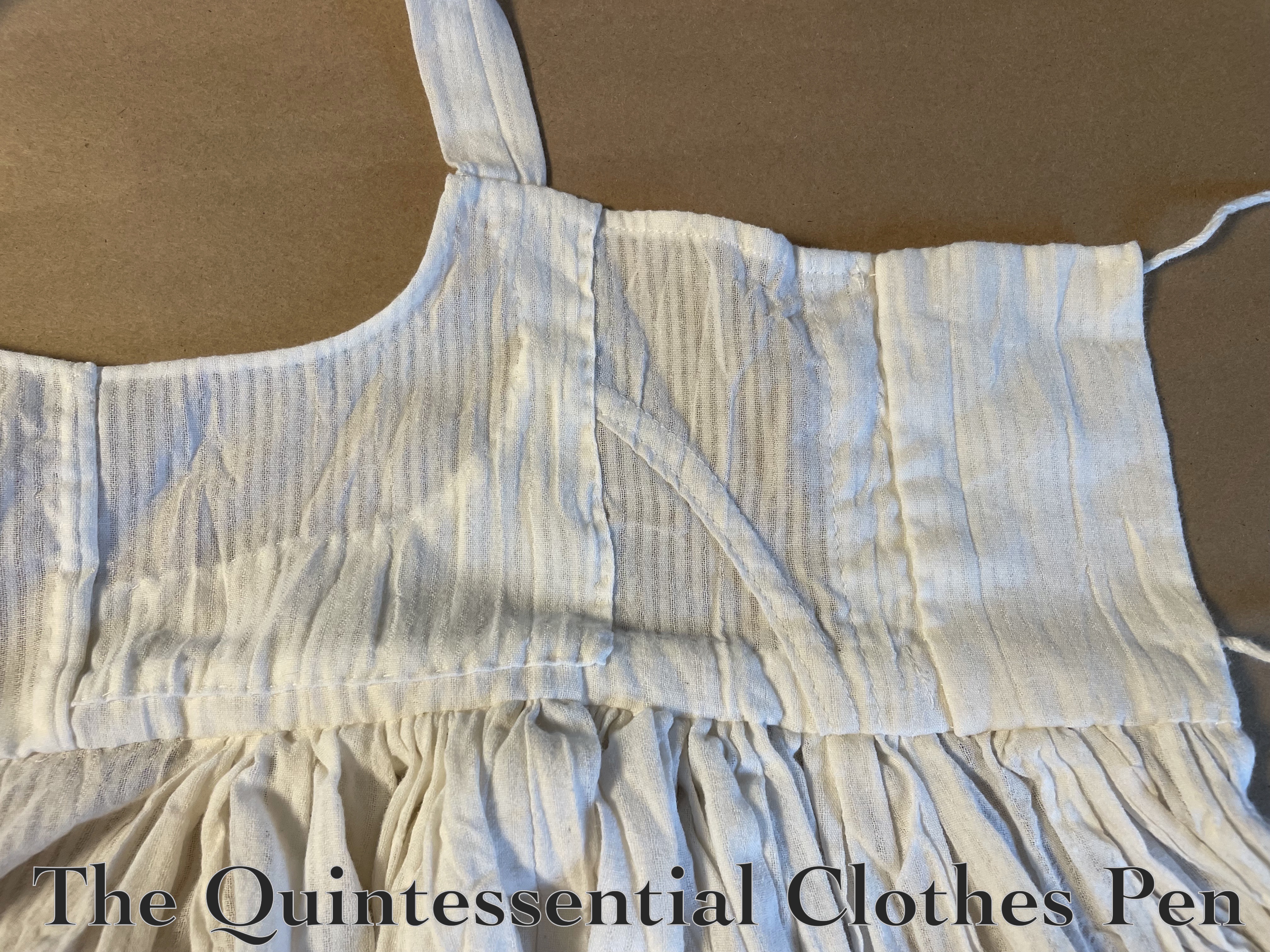
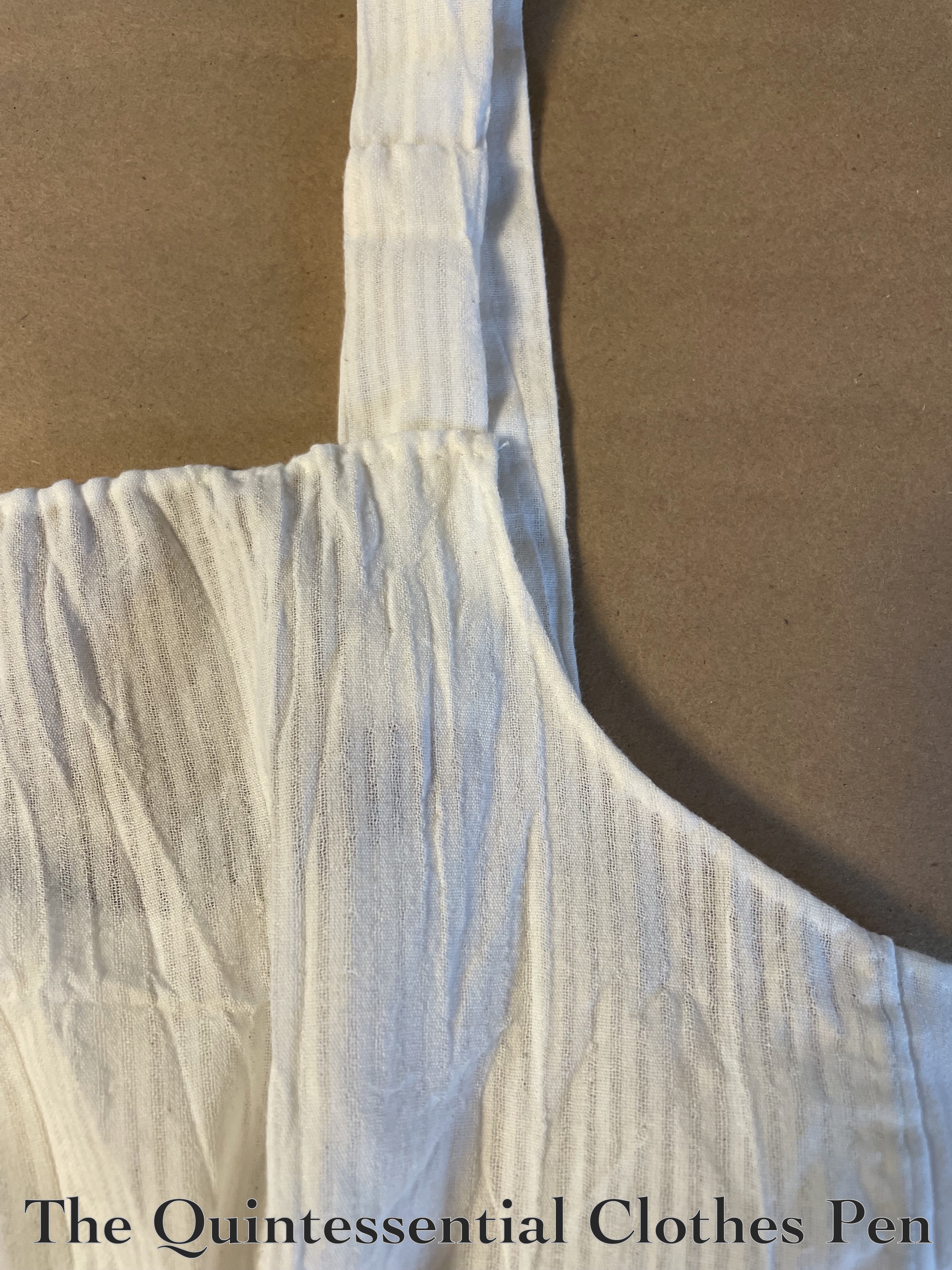
I found that I still had yardage of the mystery $1 per yard fabric I’d purchased two ten yard rolls of about ten or twelve years ago. I’ve used it for many projects, including all sorts of historical underwear and other projects (my recent 1790s petticoat and bum pad, a recently updated 1810s petticoat, lining a sheer 1895 blouse, lining a 1953 dress… and probably more things that aren’t coming to mind right now!). It’s very versatile!

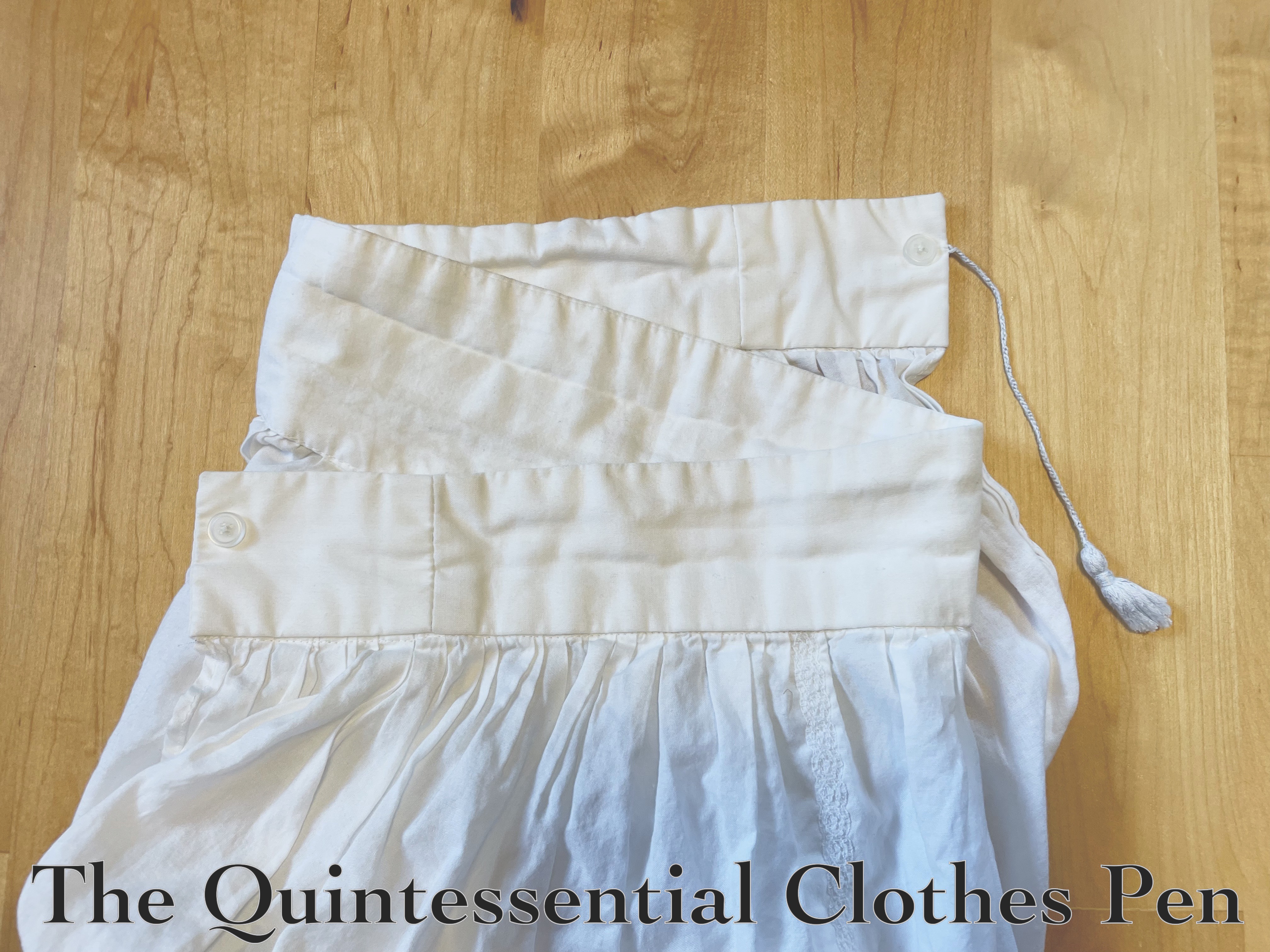
Above is a front view of the new petticoat. I made this in exactly the same way as the blue petticoat, referencing the same tutorials, etc. Essentially this is a tube that is pleated at the waist, with ties to hold it on the body.

The front has an outward box pleat at center front, while the center back (pictured above) has an inverted box pleat. The pleats are finished off by on the grain strips that form the ½” waistbands. Ivory satin ribbon ties are set into these waistbands.

Given that I had to make a whole new petticoat, it was my goal to make one that I could reuse for other purposes. Namely, I have 1780s ensembles in my sights and I wanted this petticoat to be able to be used for those. So it was important to me to level the petticoat in a way that would make sense for that purpose, but I also needed to make sure the petticoat to be long enough in the front to fully back the yellow silk for the sacque project.

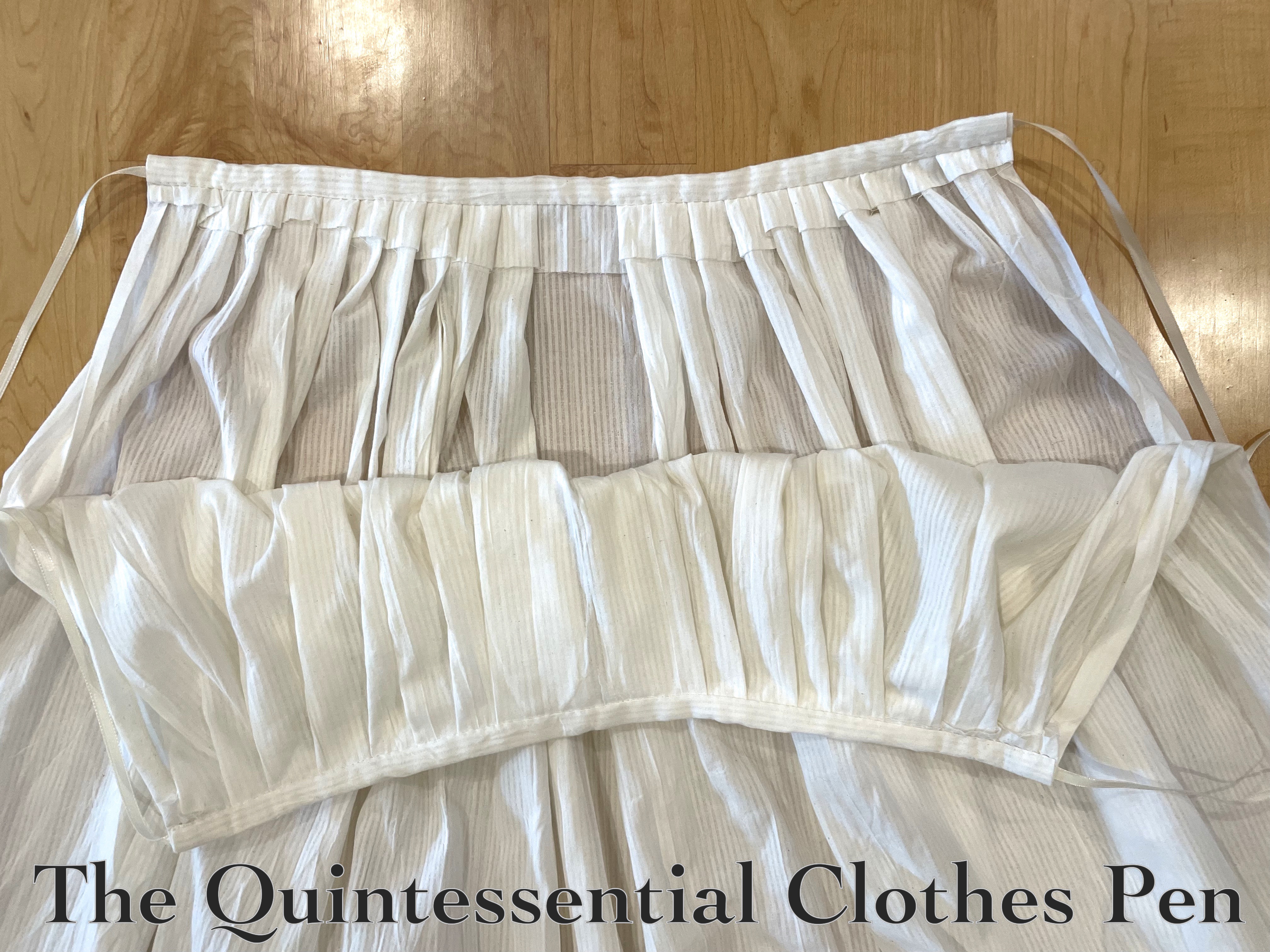
I’m pleased that with some careful figuring I was able to accomplish both goals! This petticoat doesn’t sit evenly over the pink panniers for the yellow sacque, but it does sit evenly over a not-quite-finished Scroop Patterns Frances Rump for a 1780s style! In order to know this would work, it meant I also had to make the Frances Rump and get it far enough along to be put on so I could figure out the leveling. More on the Frances Rump later! For now, a photo (below) of the insides of the white petticoat.

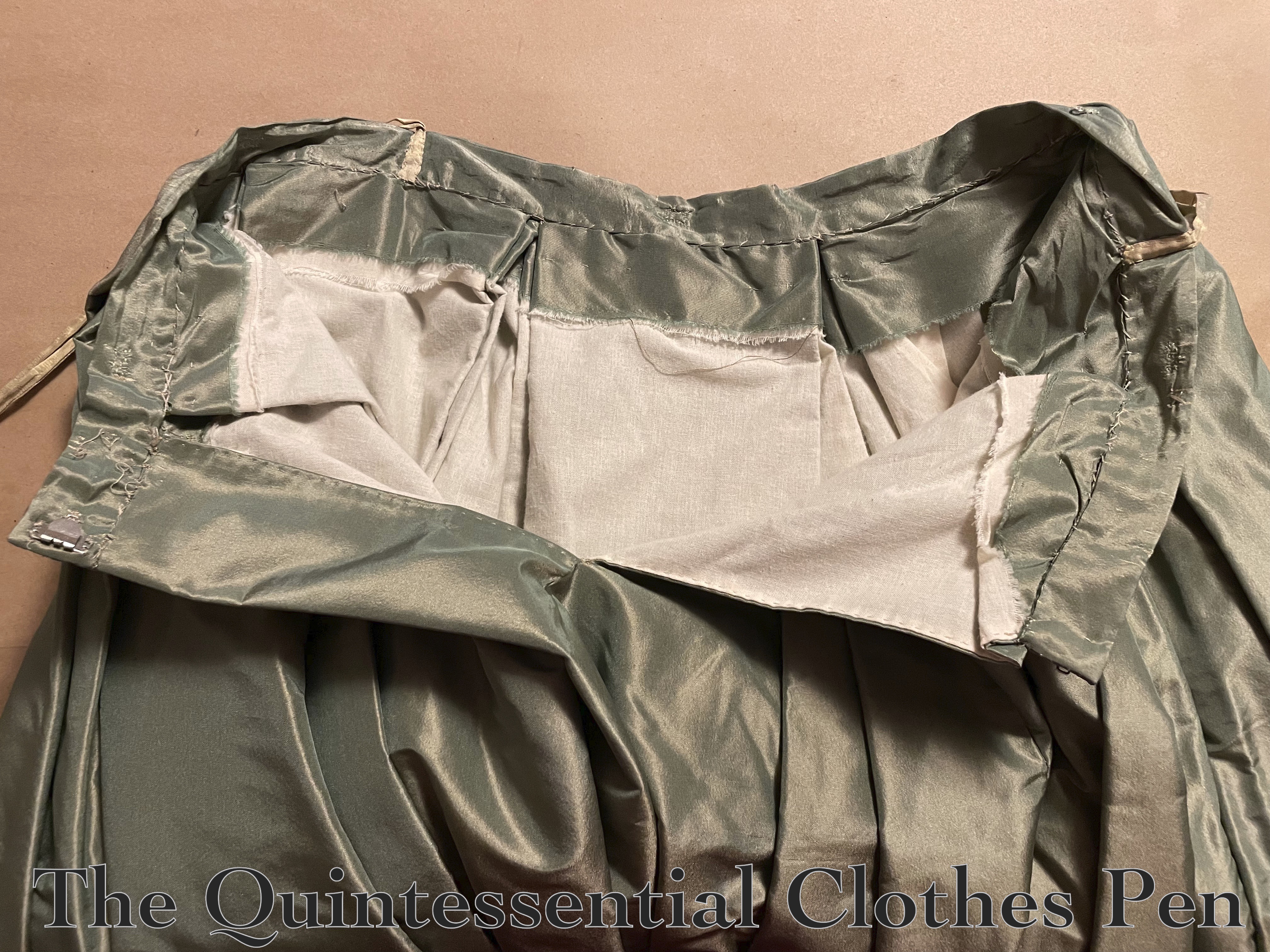
In the photo, the back is flipped down, showing that the skirt is leveled in a way that is pretty straight across. You can just see a little extra fabric length poking out of the waistband on the right side. The front of the petticoat is facing the top of the image. You can see how it needed to be a little bit shorter (therefore more fabric turned down to the inside) to accommodate the lack of bum pad on the front of the body.

The petticoat is finished with a whipstitched 1″ hem. It’s just the right length for me (and luckily also for the person who wore it in October), but might need to be whacked up with a basting stitch if I loan it to a friend with shorter legs. That’s easy, though!

And that’s it!

This garment qualifies for the HSM Challenge # 7, Always In Style:

Make a garment or accessory that is appropriate for more than one historical period…or even a historical piece that can be worn with modern clothing! (Note that the piece should still be ‘historical’, not just ‘historically-inspired’.)

Just the facts:

Fabric/Materials: Approximately 3-4 yards white striped cotton.

Pattern: None, but I referenced both of these tutorials on constructing 18th century petticoats. Katherine’s tutorial is for a petticoat with an uneven length (to go over panniers, or a bum roll, for example). Rebecca’s tutorial is for a petticoat with an even length (the same length all the way around, to be worn without extra supports). Both tutorials have construction information, Rebecca’s includes a bit more detail in terms of which stitches and methods to use.

Year: Loosely 1700-1790, but leveled to be appropriate for c. 1785.

Notions: 3ish yards of ¼″ ivory polyester ribbon and thread.

How historically accurate is it?: 70%. Accuracy gets knocked down because: 1- all unseen seams are machine sewn, 2- I used polyester ribbon for ties, 3- I haven’t seen research that shows cotton being used at this time for a single plain petticoat of this sort.

Hours to complete: 5? I didn’t really keep track.

First worn: October 5, 2024.

Total cost: The fabric was $1 per yard. The ribbon was gifted to me. So approximately $4.

Engageants For The New Yellow Sacque (HSM #6)

I’m trying to get in all of my Historical Sew Monthly 2024 posts before the new year! So in that spirit, here is another one!

Above is a closeup of the fluff that makes up the arm openings of the new yellow sacque I mentioned in my last post (where I shared details about the petticoat for the new sacque) as well as my Versailles dress from 2016. Part of the fluff is the sleeve ruffles on the dresses and part of the fluff is the engageants — lace for the Versailles dress and a double layer of ivory silk for the new yellow sacque!

Engageants are sleeve ruffles. The Oxford English Dictionary traces the word back to the 16th century with its origins in French.

These new engageants are made of two layers of silk gauze, inspired by the ones displayed with the lovely yellow dress below by the Royal Ontario Museum.

Robe à la française Spitalfields (London), England. Silk extended tabby (gros de Tours) with liseré self-patterning and brocading in silver lamella and filé Georgian Rococo. 1750s. Gift of the Fashion Group Inc. of Toronto in memory of Gwen Cowley. ROM2009_10909_22.

I specifically wanted the semi-sheer quality as a change from the lace engageants that accompany my Versailles sacque (which you can read about in this past post detailing construction information about that dress).

I looked through my stash and realized that the best fabric I had for this project was salvaged from an old ballroom dancing dress I’d made. Here is a blast from the past for you! The elusive Mr. Q is even hiding there, behind my head… But back to the dress. It was made pre-blog, so no photos of it have made it here before.

I was so proud of it! But after a fair bit of wearing this dress, I moved on to creating new ballroom dresses and sacrificed this one for parts. The rhinestoned lace was re-used in a dress that did make it onto the blog in 2013 (documented in this past post), but the float — that dangling piece hanging from my wrist that floats in the breeze while dancing — was simply put into my fabric stash, which is where I found it when looking for engageant material!

The float was an odd triangular piece, so I had to do some piecing (adding center seams, for example) to make my engageant pieces fit. But that’s fine! In all the fluff you can’t see the seams.

And in fact, the pattern I used, from 1769, was intended to create zero fabric waste, which intentionally added seams, as well. The scalloped pieces are stacked together with the scallops facing each other to efficiently use a single rectangle of fabric.

Completed engageants are below. The seams are not obvious!

Every individual silk piece for these was narrow hemmed on all the edges and then the seams were butted, whipped, laid flat, and pressed. Below is a close up of a seam and a scalloped bottom edge.

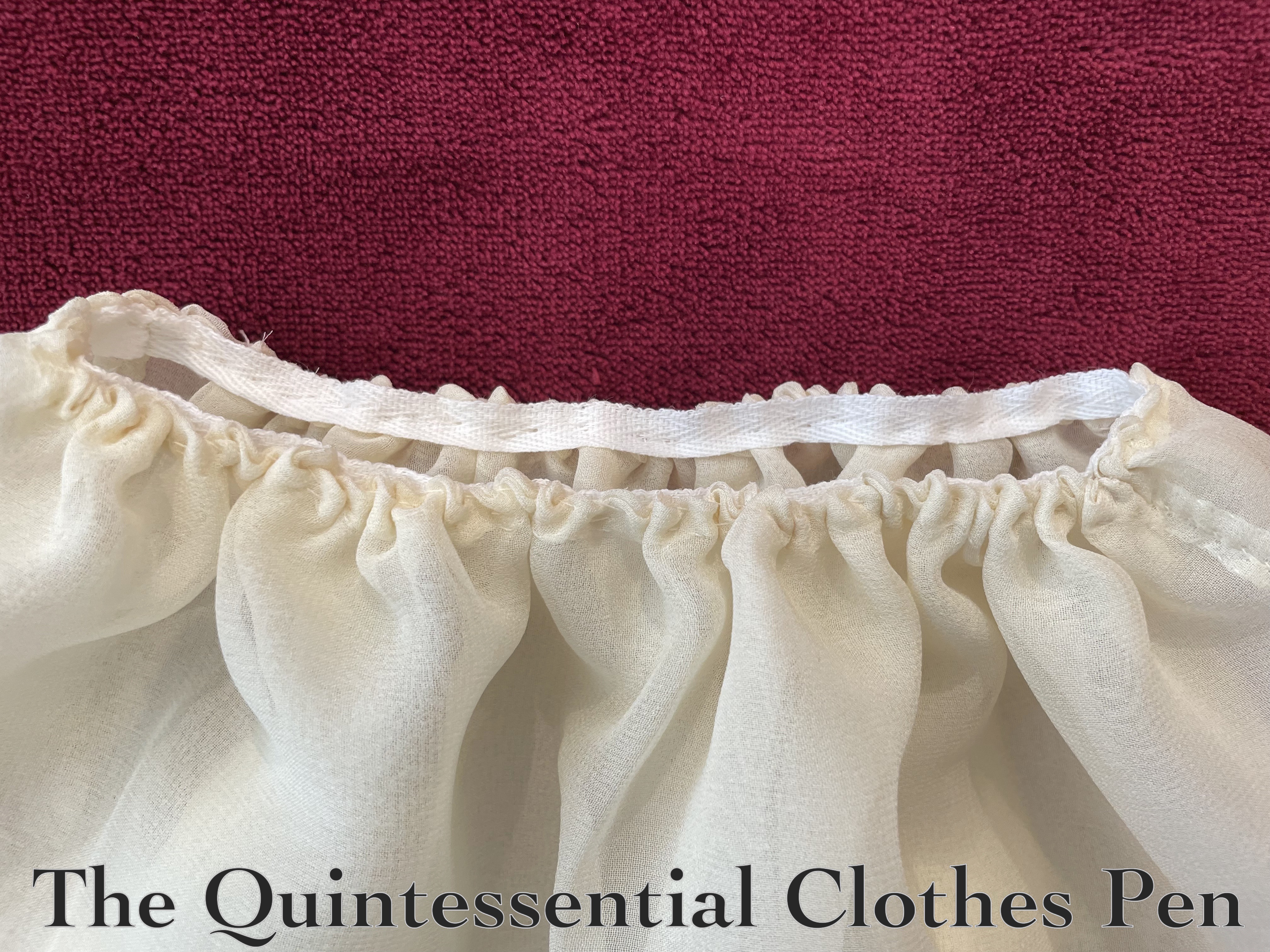
Once all of that was done, the two layers were laid on top of each other and whip gathered along the top edge. This was then sewn to a ¼” cotton tape. This allows for the engageants to be removed to be cleaned or used with another dress someday.

And that’s it! These qualify for the Historical Sew Monthly Challenge #6 Up Your Sleeve:

Level up your sleeve game by making a garment where the focus is on the sleeves.

Just the facts:

Fabric/Materials: Approximately ½ yard of ivory silk gauze.

Pattern: From page 14 in Patterns of Fashion 6 (written by Janet Arnold, Sébastien Passot, Claire Thornton, & Jenny Tiramani).

Year: 1769.

Notions: Approximately ⅔ yard of ¼” white cotton twill tape and thread.

How historically accurate is it?: 95%. Entirely hand sewn. The construction methods are historically sound. The fiber content and weave may not be perfect.

Hours to complete: 8 ¾.

First worn: October 5, 2024.

Total cost: I have no recollection of what I paid for the silk gauze many years ago. Plus, at this point this fabric is being re-used, so might be called free regardless. The twill tape was bought in bulk and cost less than $1 per yard. So let’s say approximately $5.

Yellow Sacque Petticoat (HSM #12)

Over the last year or so I’ve been working on another new ensemble: a second 1770s sacque dress (also called a Robe à la Française or sack-back gown) to be friends with my original Versailles dress (which you can read all about in this past series of posts). My goal was to have a new dress that I could loan to two different friends so that they could join me in 18th century splendor. Luckily, the two friends I have in mind are not too different in circumferences!

The new ensemble has many individual garments — under petticoat, over petticoat, the sacque itself, a tucker, and sleeves flounces (or engageantes) — so there will be a number of posts coming up that share details about these various pieces. This post is going to focus on the over petticoat that I made for this ensemble.

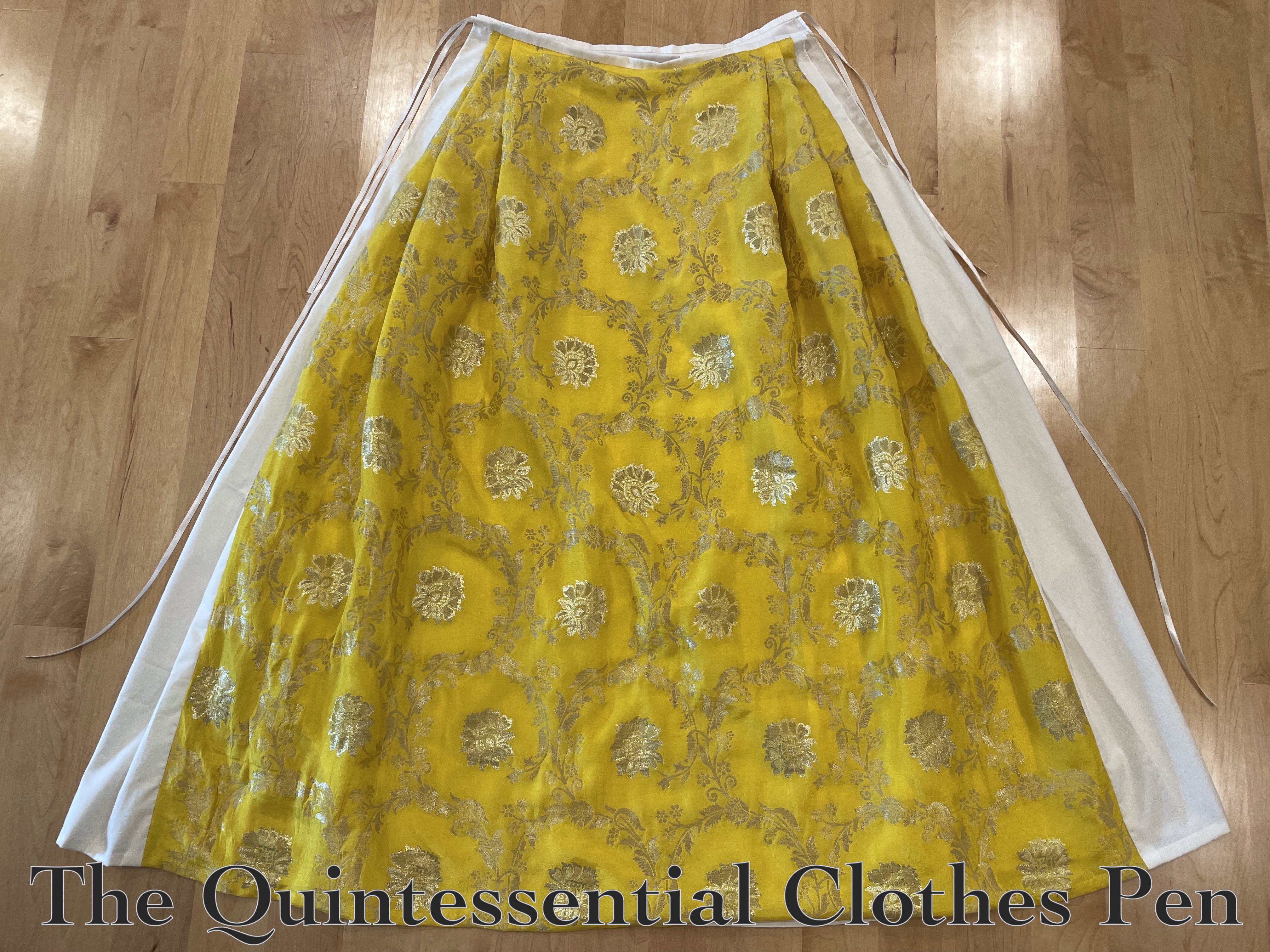
The petticoat front is made up of the yellow jacquard fabric that the dress itself is made out of, while the sides and back are made of a cream colored cotton. No need to use expensive fabric where it is unlikely to be seen! This was a common 18th century practice. Above is an image of the front of the petticoat. Below is an image of the back of the petticoat.

There are three fabric panels — two of the cotton and one of the silk. These are seamed together and then divided in half, such that some of the cotton falls on the ‘front’ of the petticoat (since it makes up ⅔ of the circumference of the skirt). There are slits cut into the sides at the halfway points. These are narrowly hemmed by hand.

Below is a closeup of the top the petticoat, which shows the pocket slit on the right side.

The front and back are pleated in the same way, though with differing quantity and depth of pleats. They have an outward box pleat at the center and additional deep knife pleats towards the sides. The pleats are held in place by front and back waistbands that are finished at ½”. Below, you can see the inside of the front and inside of the back, showing the knife pleats and waistbands.

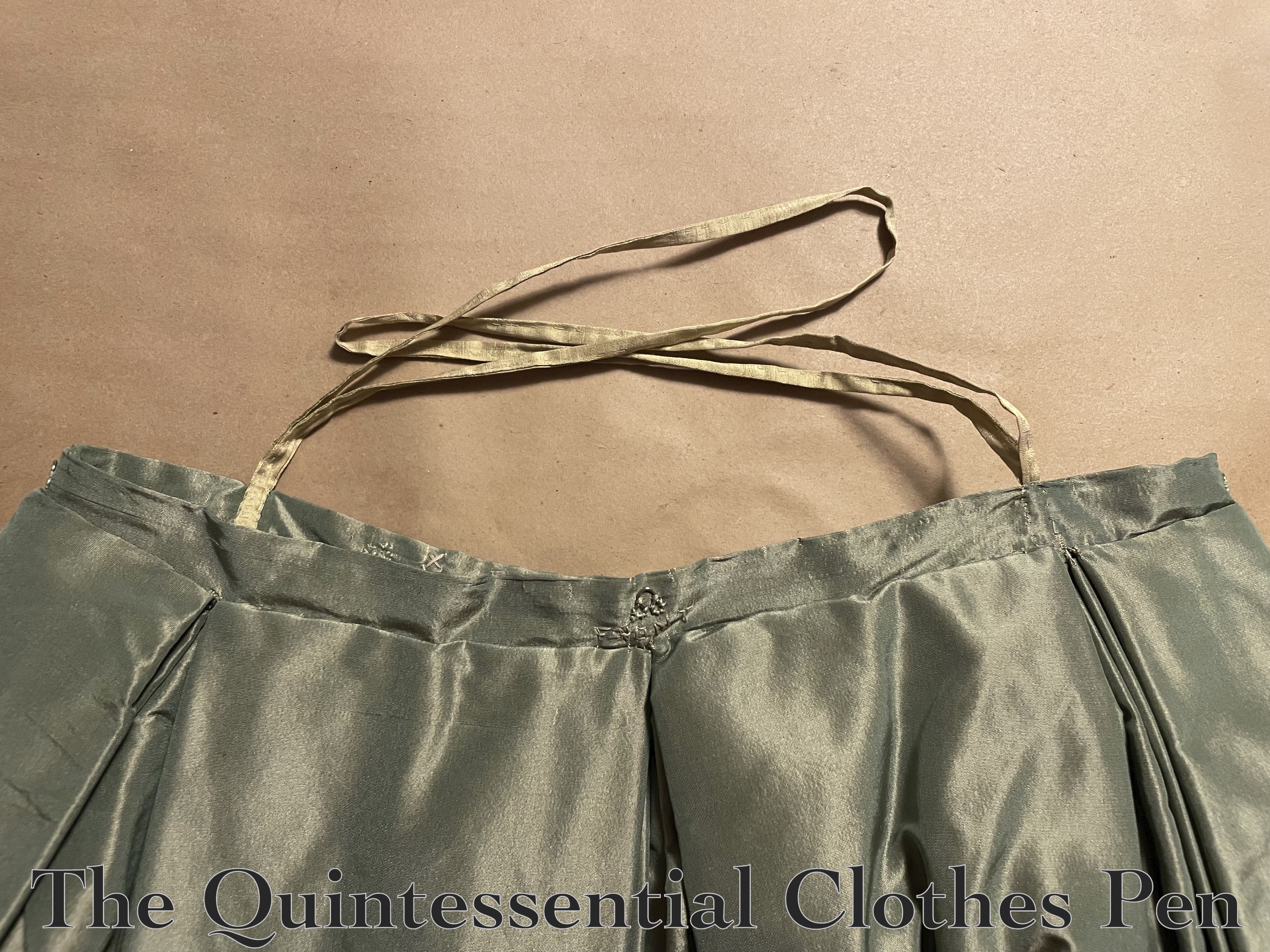
And here is one more interior closeup of the waistband. You can see that it was sewn on by machine and then flipped to the inside and whip stitched in place. You can also see the ribbon tie on the right as well as a little bit of the pocket opening.

Set inside of the waistbands are long ties (in this case, made of ivory polyester ribbon because it was on hand). The back ties are long enough to tie around the front of the body. Then the front ties warp around the back and are long enough to tie in front. (You can see how this works in this past post about the petticoat I wear under my Versailles sacque.)

The bottom of the skirt has a ½” hand sewn whip stitched hem, which you can see in the image below. It is leveled to sit over 1770s panniers (which you can read about in this past post).

And that’s basically it! This petticoat qualifies for the Historical Sew Monthly Challenge #12 That’s A Wrap:

Make an accessory or garment that is worn by wrapping it around the body.

Just the facts:

Fabric/Materials: Approximately 1.25 yards of yellow jacquard silk and 2 yards of cream cotton.

Pattern: I referenced my first petticoat, which referenced Katherine’s 18th Century Petticoat Tutorial and The Standard 18th Century Petticoat Tutorial at A Fashionable Frolick. The nice thing about Katherine’s tutorial is that it’s adjusted for a petticoat to go over pocket hoops, while the great thing about the tutorial at A Fashionable Frolick is that it has tons of detailed construction information like which stitches to use. Both tutorials are clear and very helpful.

Year: c. 1775.

Notions: Approximately 3 yards of ¼” ivory polyester ribbon and thread.

How historically accurate is it?: 90%. All of the visible bits are hand sewn. The construction methods are accurate, though cotton is not the most likely fiber content as it was expensive in the 18th century.

Hours to complete: I didn’t keep track (a nice change from some of my projects). My guess is about 5 hours for machine sewing non-visible areas and hand finishing.

First worn: October 5, 2024.

Total cost: Approximately $30 (the cotton was $4/yard, the silk was $17/yard, and the ribbon was free).

1794 Windowpane Ruffle Dress (HSM #10)

At this point, I’ve posted about most of the garments and accessories needed for the 1790s ensemble I’ve been slowly creating (you can read past posts here: stays, cap, sash, as well as petticoat and bum pad). The final piece (and perhaps one of the most essential pieces) is the dress!

I started this in 2023, along with most of the accessories, and finally finished in May 2024. My goal for this post is to document the inspiration and construction details of the dress (photos of the dress being worn will come later!).

Basic Information

To start, the information for the Historical Sew Monthly 2024 Challenge #10 UFO Spotter:

We all have an UnFinished Object or two (or ten!) Now’s the time to complete one of your unfinished historical costuming projects.

This dress was definitely a UFO! It’s been hanging in my sewing room for many months in a state of partial completion.

Just the facts:

Fabric/Materials: 3 ½ yards of 120″ wide ivory windowpane woven curtain sheer (probably polyester) and 1 yard of 58″ wide lightweight white linen for the lining.

Pattern: Adapted from the 1790s Round Gown pattern in The American Duchess Guide To 18th Century Dressmaking by Lauren Stowell and Abby Cox. I changed the front bodice to suit my goals and style as well as adding ruffles to the sleeves and hem.

Year: c. 1794.

Notions: 2 ½ yards of ¼” white cotton twill tape, 4 hooks and loops, and thread.

How historically accurate is it?: 95%. The pattern and construction methods are well researched and documented. The only points off, I’d say, are for the fiber content of the main dress fabric.

Hours to complete: 13.5 for the main dress construction + 11.5 for the ruffles = 26 hours of hand sewing.

First worn: Not yet!

Total cost: I paid approximately $10/yard for the main fabric and $6/yard for the linen. So, with the addition of the notions I would say this dress cost about $50 for materials.

A Few Observations

As with the 1790s petticoat I made (linked above in the introduction to this post) this dress is entirely hand sewn.

I had to go back through my records to figure out what I spent on the fabric for the dress. It’s been in my stash for years, so while I remember what store I purchased it from I had no memory of how much I paid. It turns out that I bought both the windowpane exterior fabric and the linen lining in 2012! At the time, I had no particular plan in mind for them, so they sat and waited… for over ten years! I’m excited to have finally put them to good use!

Inspiration

I’ve been interested in trying various garments and accessories in the American Duchess book since I first purchased it, and this 1790s idea felt like a good opportunity, especially since I could work from the undergarments out with the patterns and instructions all in one place.

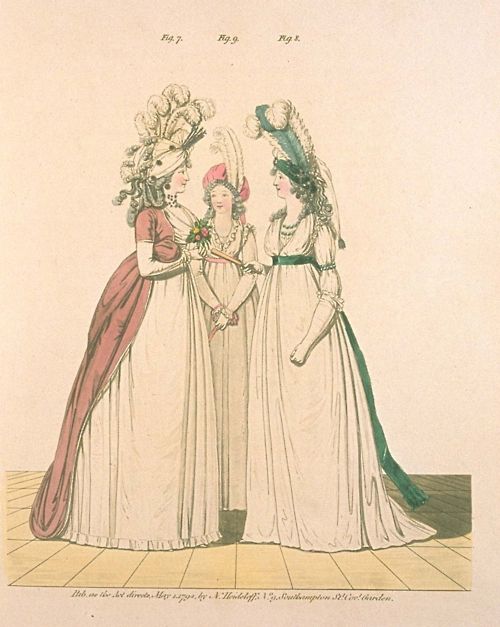
The basic elements of the 1790s dress in the book worked for me, but I decided I wanted a different front bodice look, more like the gown on the right in the image below (rather than like the one on the left, which is more like what the sample in the book is shaped like). The painting below, La duquesa de Osuna como Dama de la Orden de Damas Nobles de la Reina María Luisa, by Augustín Esteve is dated between 1796 and 1797 (it is available on Wikimedia Commons). That’s a few years later than my date of 1794, but the gathered front and round neck shape is seen earlier, even in the 1780s in Chemise a la Reine styles (you can read more about this style, popularized by Marie Antoinette, here on the Fashion Institute of Technology: Fashion History Timeline page). There is another example of the front shape I was intrigued by in the Cora Ginsburg auction catalog from Spring 2023 on page 12.

In addition to the bodice shape, I was particularly inspired by the fashion plate below for the ruffles at the hem and wrists. Other fashion plates from this year show the same detail. The plate below, and more from 1794, can be seen on the Dames a la Mode website here.

I gathered my favorite inspiration, including those shown above, together on a Pinterest board, which you can see here if you are interested.

Construction

I mostly followed the directions in the American Duchess book, though I did have to adapt a few order of operations things in the bodice to accommodate my change in front style, as well as to accommodate adding the ruffles to the sleeve openings.

I started by assembling the bodice lining. Below is my bodice lining, ready for the exterior pieces to be added.

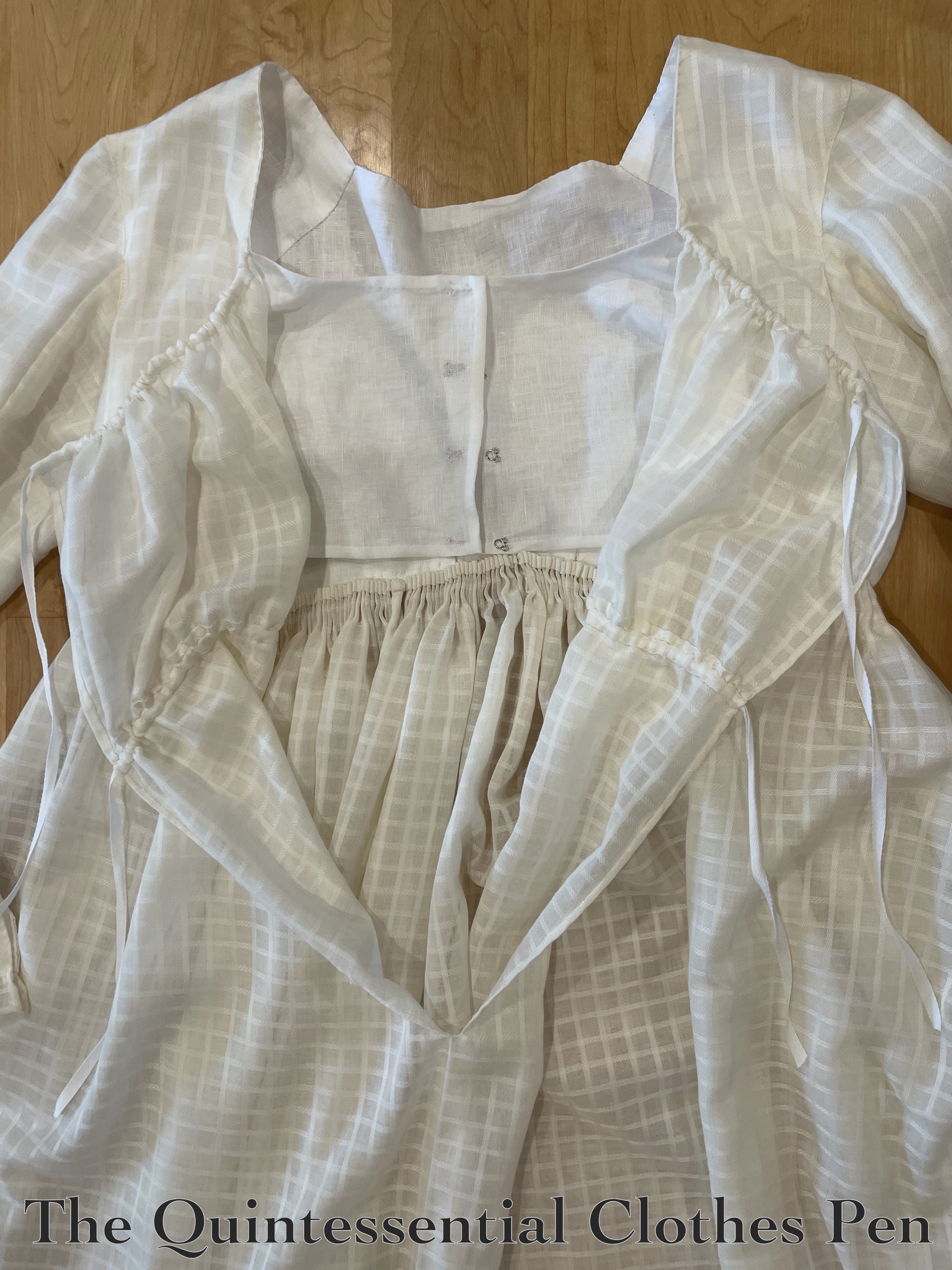
I didn’t take any further in-process photos, but I did document the completed garment. First, an image of what the front looks like when the front closure is done up. The exterior of the dress adjusts at the high waistline and the neckline with drawstrings.

Then, below, is the dress with the front exterior opened up. Historically speaking, the lining would likely have been pinned in place, but I decided hooks would be simpler for me (and still adjustable with a little bit of sewing) and so my lining closes with 4 hooks and loops. The front skirt slit opening is lost in the gathers once the exterior of the dress is closed.

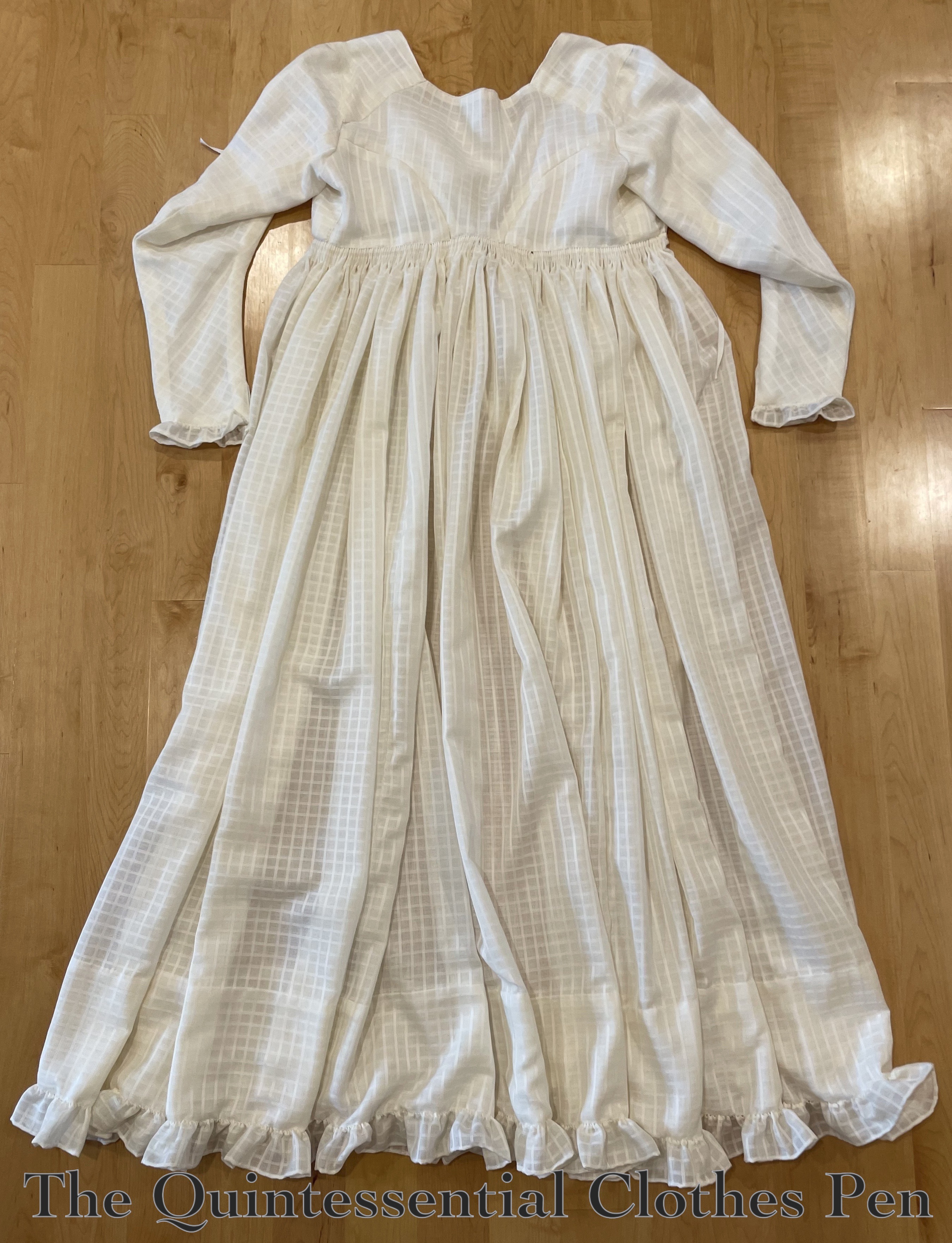
The next photo shows the back of the bodice, which curves up a little at center back in a very 1790s way, as well as the very full skirt that is attached across the back using cartridge pleats, creating a lovely series of folds.

And here is a view of the entire back of the dress.

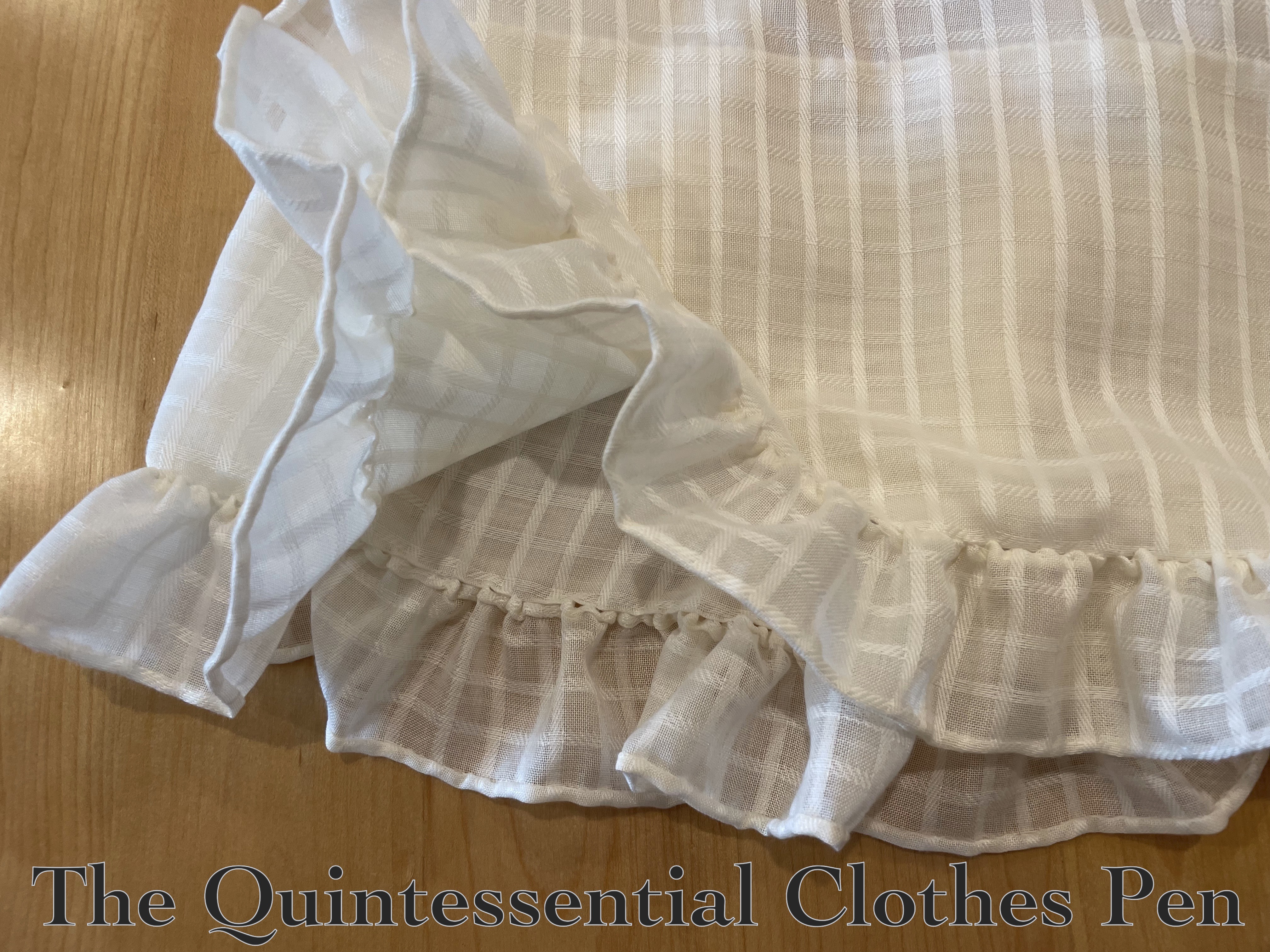
The final touch was to hem and then add all of the ruffles! I brought the basic rectangle shapes with me on trips and quietly introverted while hemming miles of edges. Eventually, they were all hemmed and connected. Then… I went back along one long edge on each ruffle section and ran whip gathers. Then, finally, I butted the edges to the sleeve hems and bottom edge of the skirt and whipped the ruffles into place.

Below is a closeup of the hem ruffle, where the narrow hem of the ruffle and the butted edges are both clearly visible.

And here is a closeup of the sleeve opening, which again shows the narrow hems on the ruffle and butted edges of the ruffle and sleeve.

I did have one strange decision to make regarding the depth of them hem on the dress itself. It might not have struck you as odd that the hem is so deep (about 6″), but it does look slightly strange to me when I look at photos of the dress laid out, or when I see it without the petticoat underneath.

The reason for the unusually (for this period) deep hem is that my petticoat somehow ended up being a bit short, even with a narrow hem. I didn’t want to have the nice, smooth white expanse of this skirt broken by a section at the hem that wasn’t backed by a petticoat before the dense white of the ruffle. And I had lots of length in my dress exterior to play with.

I considered tucks to take up the length and provide opacity, but it looked ridiculous in this fabric and for this particular decade. Instead, I settled on this wide hem which is set at a height that makes the ruffle just brush the tops of my feet. The top edge of the deep hem just blends in when the petticoat is under the dress. Here is a view of the hem. Each of the squares is about ½”.

And that’s it! The dress is finally done! I’m super pleased that this UFO garment and the accessories to complete an ensemble are finished and that I have a whole new decade of clothing ready to wear.

Now, I’ve moved on to other sewing projects and trying to figure out how to use (mostly) my real hair to create a 1790s look so that I can get photos of the whole 1790s ensemble. More on that once I figure it out and get photos. In the meantime, thanks for reading this far and sticking with me through all of these minute details!

1790s Petticoat & Bum Pad (HSM #8)

This post is part of my ongoing and slow work on a 1790s ensemble.

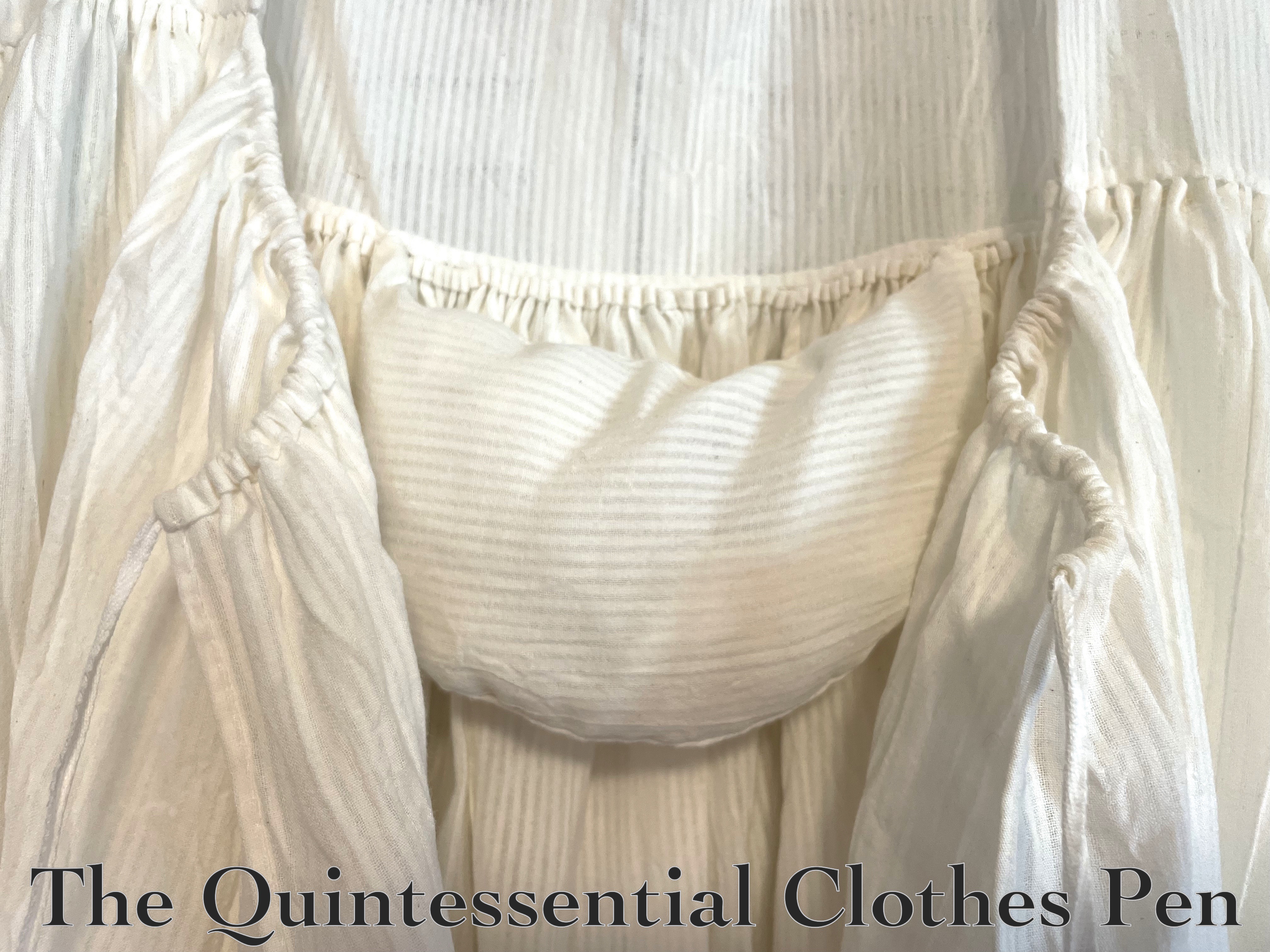
Last year, I was working on a petticoat and bum pad to create a foundation for a dress. The petticoat was pretty much done by the end of the year. The bum pad needed just a final fitting for me to decide if I liked the plumpness before sewing it closed.

After a fitting when the dress was very close to done I determined that I did like the plump pad (stuffed with scraps of the white striped cotton the petticoat and bum pad are made of).

With the bum pad being good to go, I was finally able to finish up the petticoat!

This is my entry for the Historical Sew Monthly 2024 Challenge #8 Stripes and Dots:

Make something using striped or dotted material. The stripes or dots can be printed on the material, knitted/woven in to the material, or created with surface embellishment (ex: embroidery). Textural stripes or dots (i.e: those that are the same colour as the base fabric) are permitted!

This petticoat is made from fabric with a narrow woven in stripe.

Just the facts:

Fabric/Materials: Approximately 3 yards of white striped cotton.

Pattern: From The American Duchess Guide To 18th Century Dressmaking by Lauren Stowell and Abby Cox.

Year: c. 1795.

Notions: Approximately 1 yard of 1/4″ white cotton twill tape, 4 hooks and loops, and thread.

How historically accurate is it?: 100%. Entirely hand sewn, made from plausible fabric, using a pattern that is backed up by lots of research… I’d say this one is pretty accurate!

Hours to complete: About 2 ¼ hours.

First worn: Not yet worn.

Total cost: Approximately $4. The fabric was just $1 per yard when I purchased it years ago and the twill tape and hooks/loops were bought in super bulk and probably cost no more than $1 for all of the bits that I used.

More details:

The petticoat closes with a drawstring, as can be seen below. I love this, as it will make it easily adjustable (a common theme in my recent sewing projects!)

The front opening is finished on both sides with a narrow hem. It’s long enough that I didn’t feel the need to reinforce the bottom, as I don’t think I’m likely to rip it getting in and out.

The next photo shows that I left extra seam allowance at the sides and shoulder seams… again on the theme of garments being alter-able!

And finally, a hem! I needed to max out the length to accommodate the sheer dress that will be worn over this, so the hem is only about ¼”.

And that’s it! I’m excited to have another foundation piece for a new-to-me decade of clothing and I’m pleased that it is entirely hand sewn.

When The (Regency) Petticoat No Longer Fits (HSM #5: New Clothes From Old)

While we’re on the subject of updating clothing that no longer fits quite right (this is continued from my last post about updating a pair of 1860s drawers, which you can read here), I have another post about updating a layer of historical underwear for fit.

A few background thoughts

In the past 15 years or so that I’ve been making historical clothing, I’ve also changed sizes and some of the clothes I made early on just no longer fit. The usual culprits are the waist, bust, and shoulder width. (It’s not necessarily all for the worst. My shoulders and arms are bigger because I’m gaining strength and being active, so that’s a healthy change!)

I’ve been able to wear more of my historical clothes recently and the more I wear the older ones, the more I realize just how much my shape has changed.  Because I have some lovely garments that I still want to be able to wear, I’ve been updating these garments to better fit my current shape.

Background on this particular garment

I made an early 19th century bodiced petticoat in 2012 (here is my post from back then sharing research about this type of garment). Since then, I’ve gained inches in the bust, ribcage circumference, and in the width of my shoulders. So despite wearing this petticoat and making do, I finally reached a point where it became important to make this fit better.

Here is the bodice portion of the petticoat before my alterations, from the front and back.

I determined that I needed a whole new front piece–one that would be wider across the bust and with more gathers to condense to the ribcage size. I also realized that it would be helpful to make the side back pieces a little more substantial, with a taller side seam to match the new front.

Update details

Thankfully, I keep lots of fabric scraps! And in this case, I actually still have yardage of the fabric I made the petticoat from. So no problems there — I was able to easily cut out a new front with updated dimensions as well as bits to add to the side pieces to extend them (I didn’t feel like replacing them entirely — this petticoat already is a bit pieced at the center back, where I had previously added fabric in order to help make it a little larger a few years ago).

After cutting new pieces came the boring part of unpicking the original front. Ugh! I don’t enjoy taking apart things that I’ve made! But I did it.

I thought I might machine sew the new pieces on, but I was more inclined to complete this project while not near my sewing machine, so I did it by hand instead. I replicated all of the same seam finishes from the original bodice front (because I like consistency, but not because they are historically accurate, in this case).

Here are the results!

And here are closeups of my very pieced method of creating larger side back pieces (you can also see the extendo I added to the back at some point about 6 years ago).

Unfortunately, when I tried on the adjusted petticoat I realized that the armsceyes were uncomfortably small. I was not going to be able to deal with that! “Get it off!” was my exact though. To fix that problem, I added strap extender bits to the front of the straps.

This worked great! And now, I have a petticoat that fits again! It covers my current bust size AND fits across the back (in fact, I made it even a little too wide across the back because I figured that might be helpful).

Here is a photo of the inside of the new front bodice piece. Both the old bodice front and the new one have a drawstring along the top edge. And you can see that I left additional strap length for theotrical future of letting-out.

I’m calling this my entry for the Historical Sew Monthly 2024 Challenge #5 New Clothes from Old:

Make something new out of a worn-out garment or accessory. Or make something using recycled materials.

I believe I’ve recycled a worn-out garment into something new and ready to use again!

Just the facts:

Fabric/Materials: Scraps of white cotton.

Pattern: My own.

Year: c. 1812.

Notions: Thread.

How historically accurate is it?: 100%. It’s completely reasonable to extend the life of a garment like this by altering it.

Hours to complete: 4? It took some time to seam rip and then I was meticulous about stitching the new pieces on. I didn’t really keep track.

First worn: On May 4.

Total cost: Free! Materials were scraps left over from the original project.

It took a bit longer than expected to hand sew all of the updates I needed to make, especially with the late-to-the-party addition of the strap update. I was pleased to finish this the day before it was needed! (More on that later!)

When The 1860s Drawers No Longer Fit (HSM #11: Worn By All)

I have a series of posts called When The Dress No Longer Fits that document how I’ve updated the size of various dresses I’ve made to fit better as my size changes over time (or as the dresses shrink in the closet, which is how I usually describe it!).

In this case, I’ve adapted that post-naming-style for another garment I recently updated. In this case, I altered an old pair of 1860s drawers rather than a dress!

It brings me joy to be able to extend the life of garments I already have in my closet. For these drawers, being able to adjust the size of the waistband has allowed me to continue to use them for many years. Proof: I documented these drawers on the blog in 2013 (and I’m pretty sure I made them in 2011 or 2012) so they have being faithfully serving their duty for over 10 years!

In that time, they’ve seen lots of use. I’m pleased that they have held up very well. About 8 years ago, I let down some tucks to make the legs a little longer (so that the top of my stockings/knees wouldn’t show–because, gasp, that would be shocking!) and I also increased the waistband size about 6 years ago. Below, a photo of the drawers with those first round of alterations made.

And below is a closeup of the waistband after that first round of alterations. I don’t remember why I thought a closure method of a cord looped in a figure eight around two buttons made sense. I can’t remember a source for this idea… but it has worked for many years. It’s been wonderful because it allows for adjustability (up to a point of running out of cord length to loop between the buttons securely, of course).

But recently, even with the increased waistband size, there was still a gap at the waist and the gathering of the legs into the waistband was no longer distributed in a way that helped the back edges stay closed when being worn. That’s not the end of the world in terms of modesty, as I always have a chemise on underneath, but it wasn’t my favorite look, either.

So I decided to do something about it. I added yet another extendo to the waistband. “Why remake the entire waistband?” I mused. The would need a bigger section of fabric and be more work. No one sees the waistband of my drawers except me, friends getting dressed near me, and you readers on the blog!

So now, here are the most recent updates to these old drawers, with a second extendo added to the waistband. Taking the waistband apart to add the new pieces reminded me that I’d stiffened the waistband lightly by adding a layer of linen in between the two layers of cotton. This is a note to self that this method has worked well, creating a waistband that doesn’t collapse and wrinkle horribly around the waist while also not being super stiff.

I also decided to change the closure method to a button and button hole. The old wrapping the cord in a figure eight method had the added challenge of being a bit tricky to do behind my own back. I decided that while a button would be less adjustable (without resewing it), the larger size button would be easier to do up than the cord wrapping.

I also made a bit of extra waistband for the day when I might need to increase the waist size even more (but I’ll pretend that day isn’t coming). And I decided to hand sew the buttonhole, because it was being fussy on my machine and I figured it would be faster to sew it by hand than fight the machine!

Here is a closeup of what the waistband looks like with the most recent extendo. For this round of alterations, I also completely removed the waistband and redistributed the gathers and side points to better match the new waistband size (these alterations are machine sewn). This makes the drawers more effectively lay in place.

I’m calling this my entry for the Historical Sew Monthly 2024 Challenge #11: Worn by All:

Make a garment that would be worn as everyday clothing by most social classes during your chosen time period and/or place.

Just the facts:

Fabric/Materials: Scraps of white cotton and linen (Is it the same white cotton and linen as the original drawers? Nope, but that’s ok with me for this project!)

Pattern: None. I just added rectangles.

Year: c. 1860.

Notions: 1 shell button and thread.

How historically accurate is it?: 98%. It’s completely reasonable to extend the life of a garment like this by altering it. The only non-accurate thing might be the machine sewing–although it is pretty subtle!

Hours to complete: 2? I didn’t really keep track.

First worn: Worn on May 19 with an 1860s ensemble.

Total cost: Free! Materials were scraps left over from other projects.

This was one of the small sewing tasks on my Maybe-To-Do list for 2024 as well as being one of the small projects that was stacking up on my alterations-and-mending pile. I’m so pleased to have checked it off!

18th Century Blue Foundation Petticoat (HSM #8)

In addition to the c. 1770 Pink Panniers that I recently posted about, the blue foundation petticoat pictured below (front view) is also intended to be easily loaned to friends.
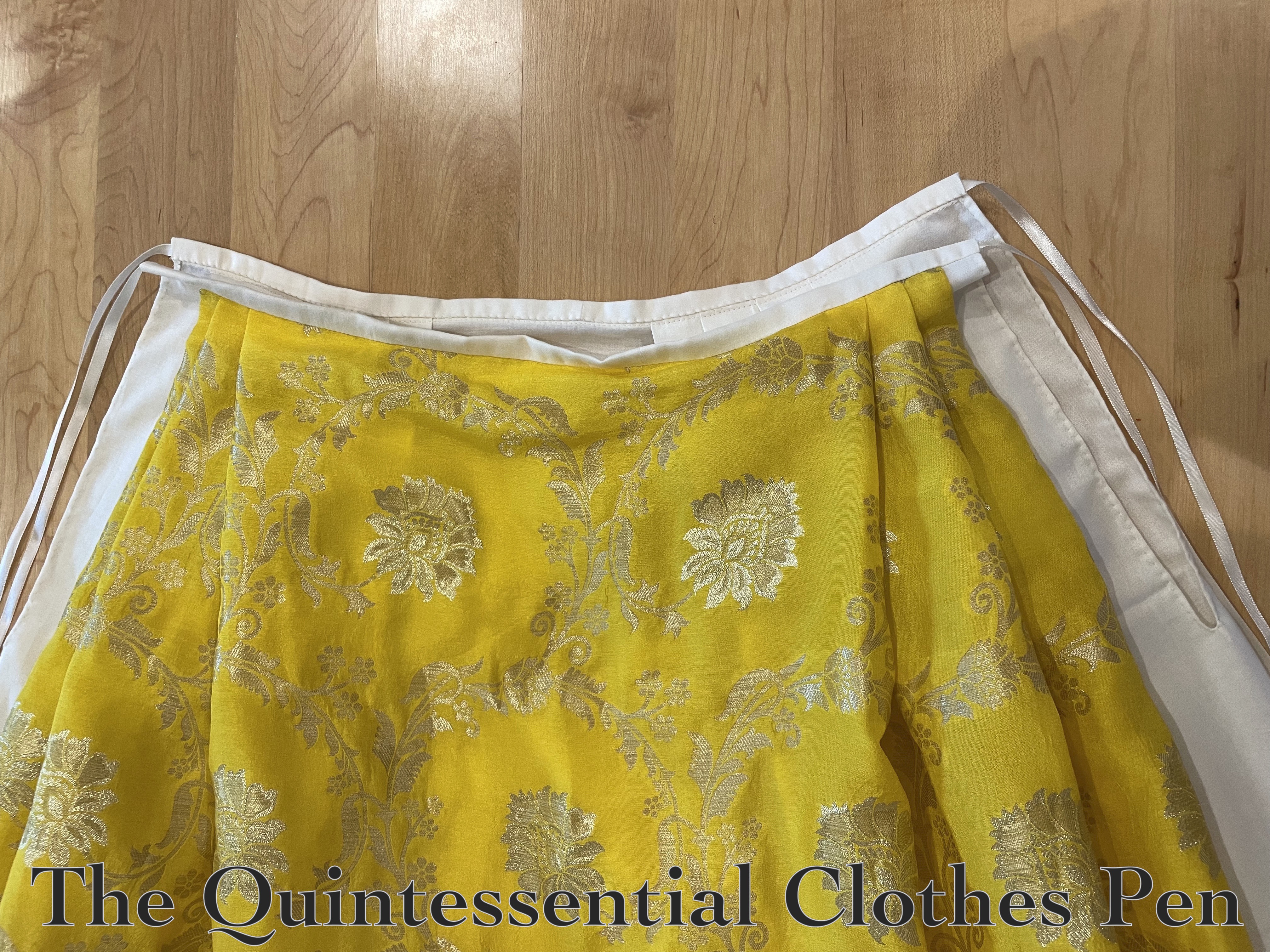
I’m super pleased with this for a few reasons:

1 – I was able to easily replicate the construction steps that I used for my Apricot Petticoat in 2013, ten years ago!

2 – I was able to re-make the petticoat from an old project: the 1812 Blue Under Dress I also made in 2013. I was never very happy with this color under my 1812 Striped White Gown (it was blah) and within even a few years of being made it no longer fit the width of my back, anyway.

3 – This remake qualifies for the HSM Challenge # 8, All Tied Up:

Make something that closes with ties, or something that uses knots/bows as a decorative feature.

Just the facts:

Fabric/Materials: Approximately 3-4 yards blue cotton/polyester blend fabric (salvaged from an old dress).

Pattern: None, but I referenced both of these tutorials on constructing 18th century petticoats. Katherine’s tutorial is for a petticoat with an uneven length (to go over panniers, or a bum roll, for example). Rebecca’s tutorial is for a petticoat with an even length (the same length all the way around, to be worn without extra supports). Both tutorials have construction information, Rebecca’s includes a bit more detail in terms of which stitches and methods to use.

Year: Loosely 1700-1790.

Notions: 3ish yards of 1/8″ blue polyester ribbon and thread.

How historically accurate is it?: 70%. Accuracy gets knocked down because: 1- all unseen seams are machine sewn, 2- I used polyester ribbon for ties, 3- I haven’t seen research that shows cotton being used at this time for a single plain petticoat of this sort.

Hours to complete: 5? I didn’t really keep track.

First worn: Has not been worn yet.

Total cost: Free! Materials were either in the stash/gifted to me or re-used from other projects.

Here are more photos of the petticoat, starting with a back view.

And, close-up evidence of weird things, such as the twice-stitched machine hem, which could be useful if I ever want to lengthen this petticoat. These hems are leftovers from the salvaged dress–no hemming required for this petticoat. Perfect!

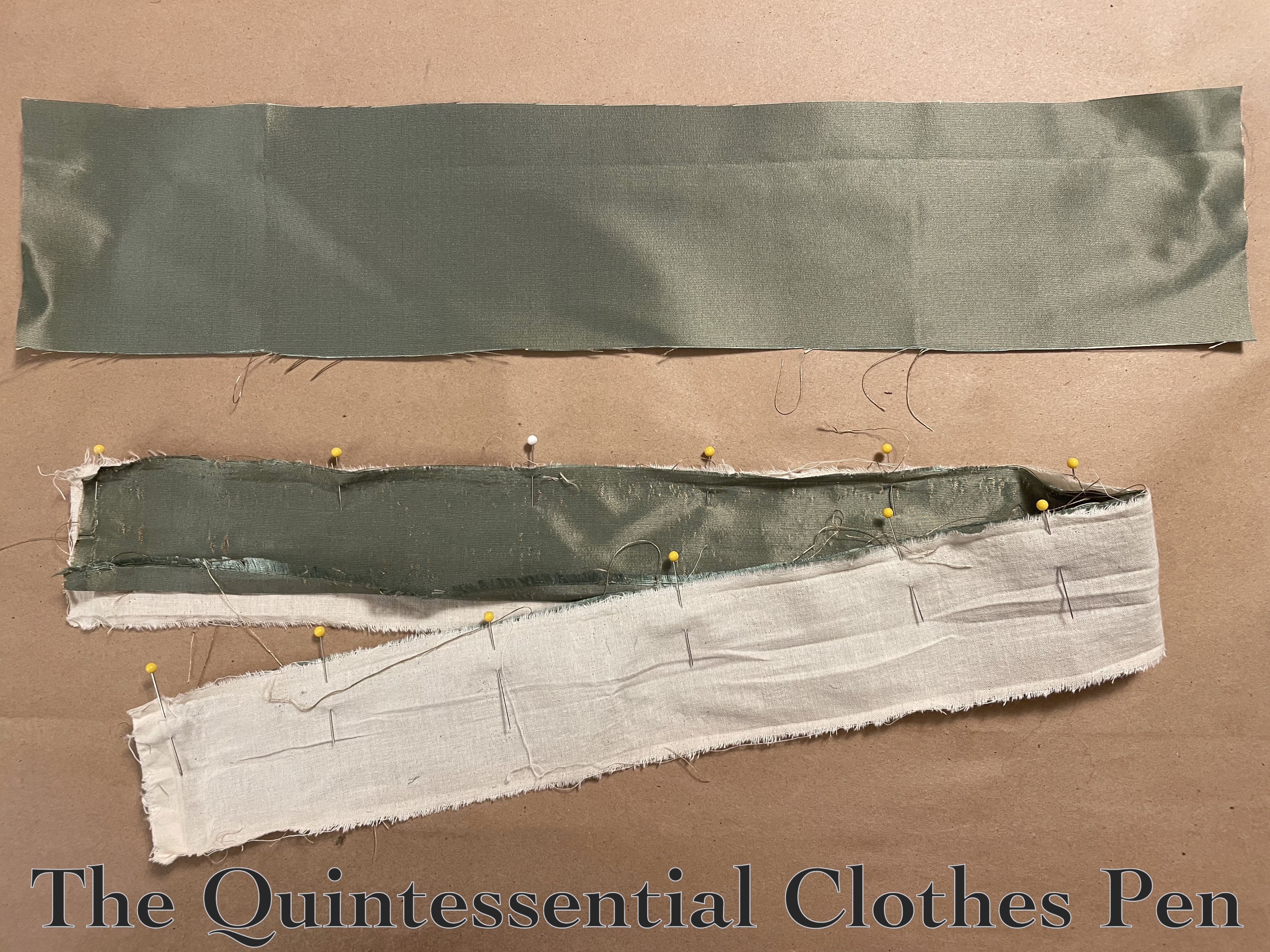
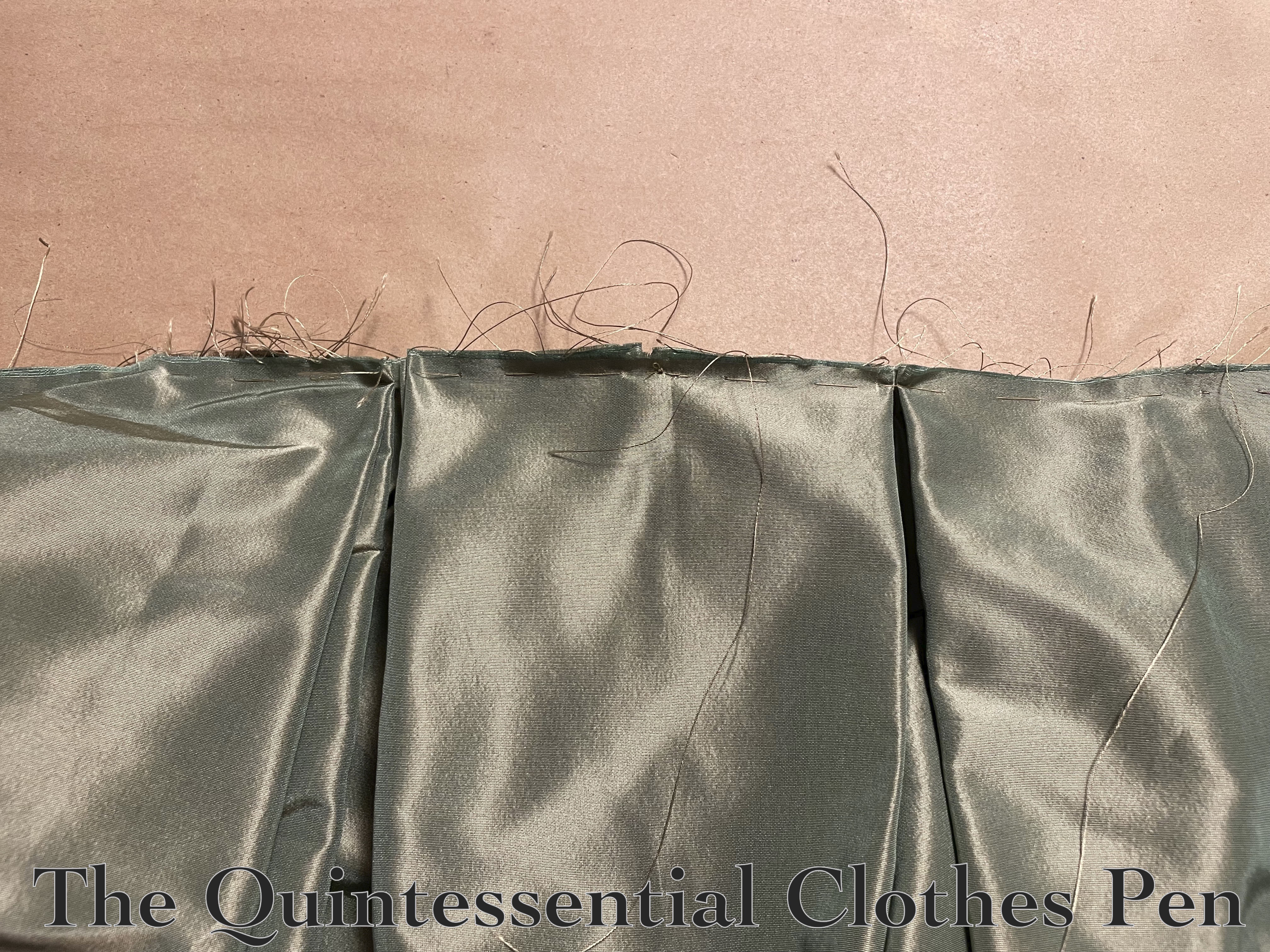
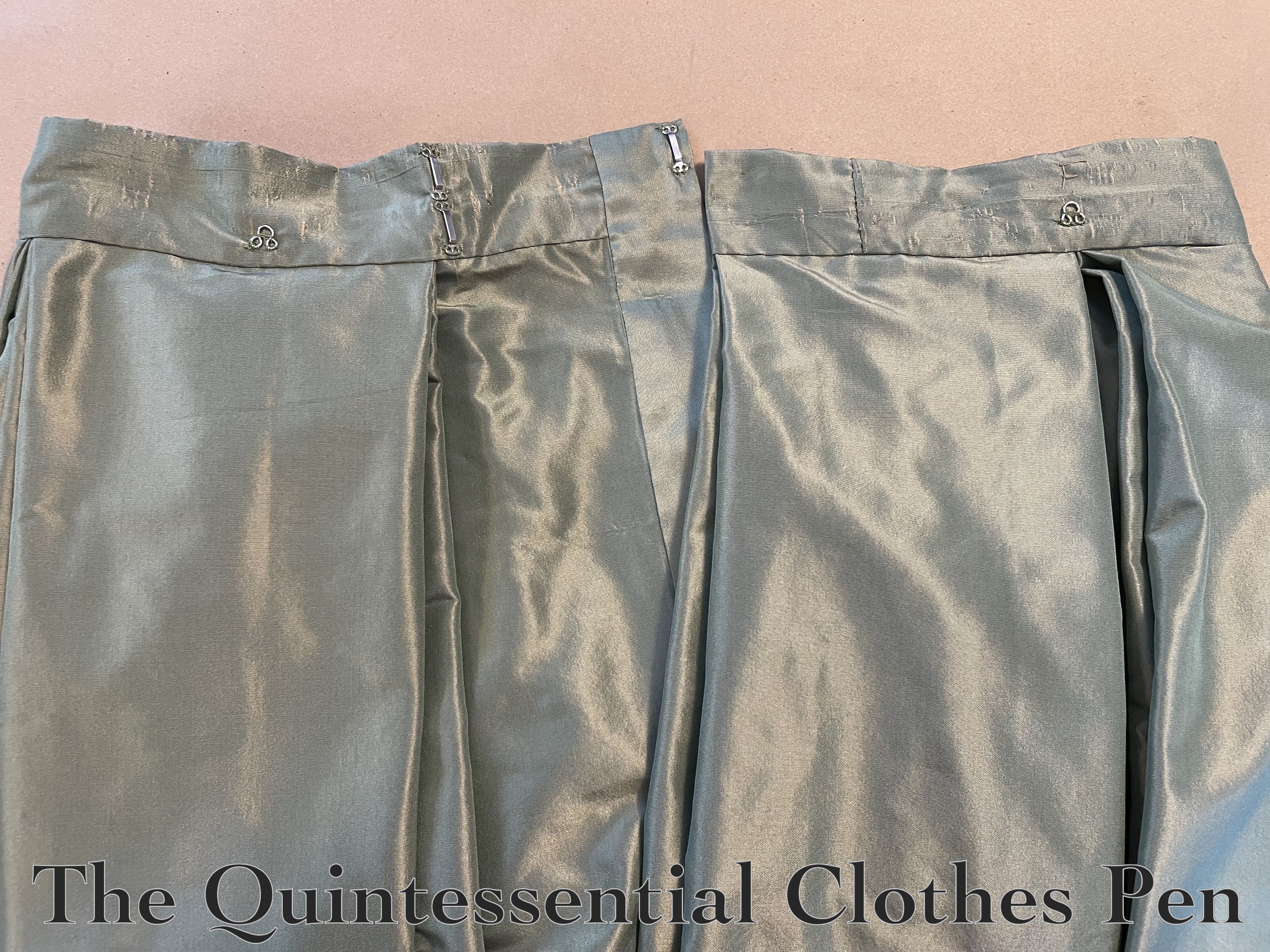
I followed the instructions as indicated in Just The Facts earlier in this post. This leads to tidily finished waistbands, as you can see here (along with a randomly located vertical seam).

(Another weird thing about this petticoat is where the seams landed on this, now that it is a petticoat and not the skirt of a dress, and that each seam is finished in a different method!)

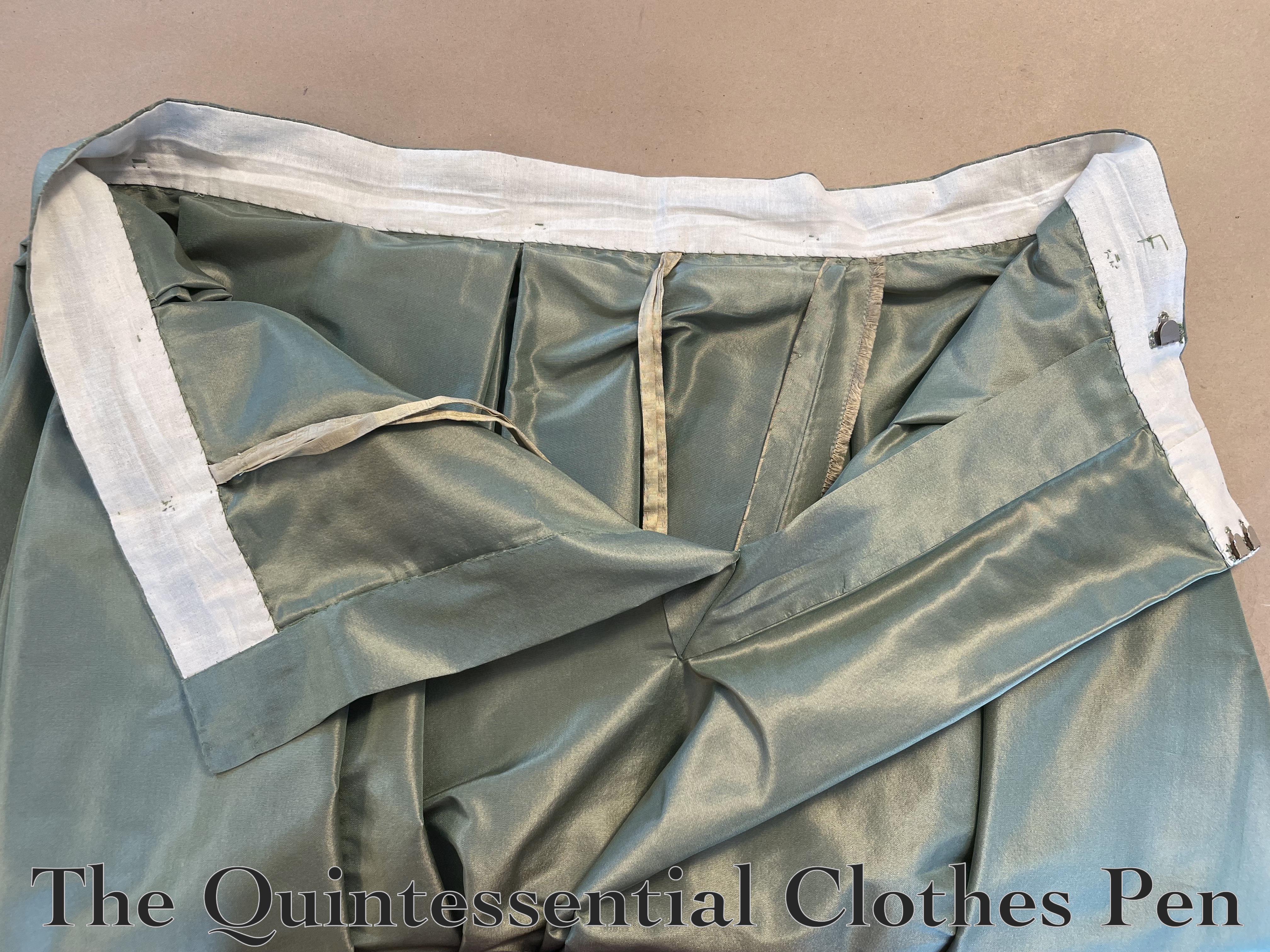
And here’s a the same view, but with the front folded down to show how the petticoat is made shorter at center from than it is anywhere else.

Below, a final closeup of the extra length at the front folded down and left raw. The top fold is encased in the waistband, which is machine sewn and whip stitched down on the inside.

I was super pleased to just barely fit this petticoat length out of the skirt length of the old dress. The hem circumference was just about perfect, too! And, I was able to cut the waistband strips from the front bodice pieces of the original dress!

All in all, a quick and satisfying project! I’m much more pleased with this as a petticoat than I ever was with it as a dress.