1926 Silver Robe de Style Second Styling

Today I have a new dress adventure to share with you: the second wearing of my 1926 Silver Lace Robe de Style to a Gatsby Ball in January. The last time I wore this dress was last August, so it was fun to bring it out again. I thought it fit in nicely with the idea of blue and silver for the new year, even though it wasn’t technically a new year themed event.

The robe de style dress was popularized during the 1920s particularly by the designer Lanvin. This alternative to the popular straight silhouette dresses of the 1920s is characterized by a dropped waist with wide skirts. Many of these dresses have panniers in them that are borrowed from the style of 18th century court dresses. Here is a little more information about the robe de style from the FIDM museum if you’d like to read more.
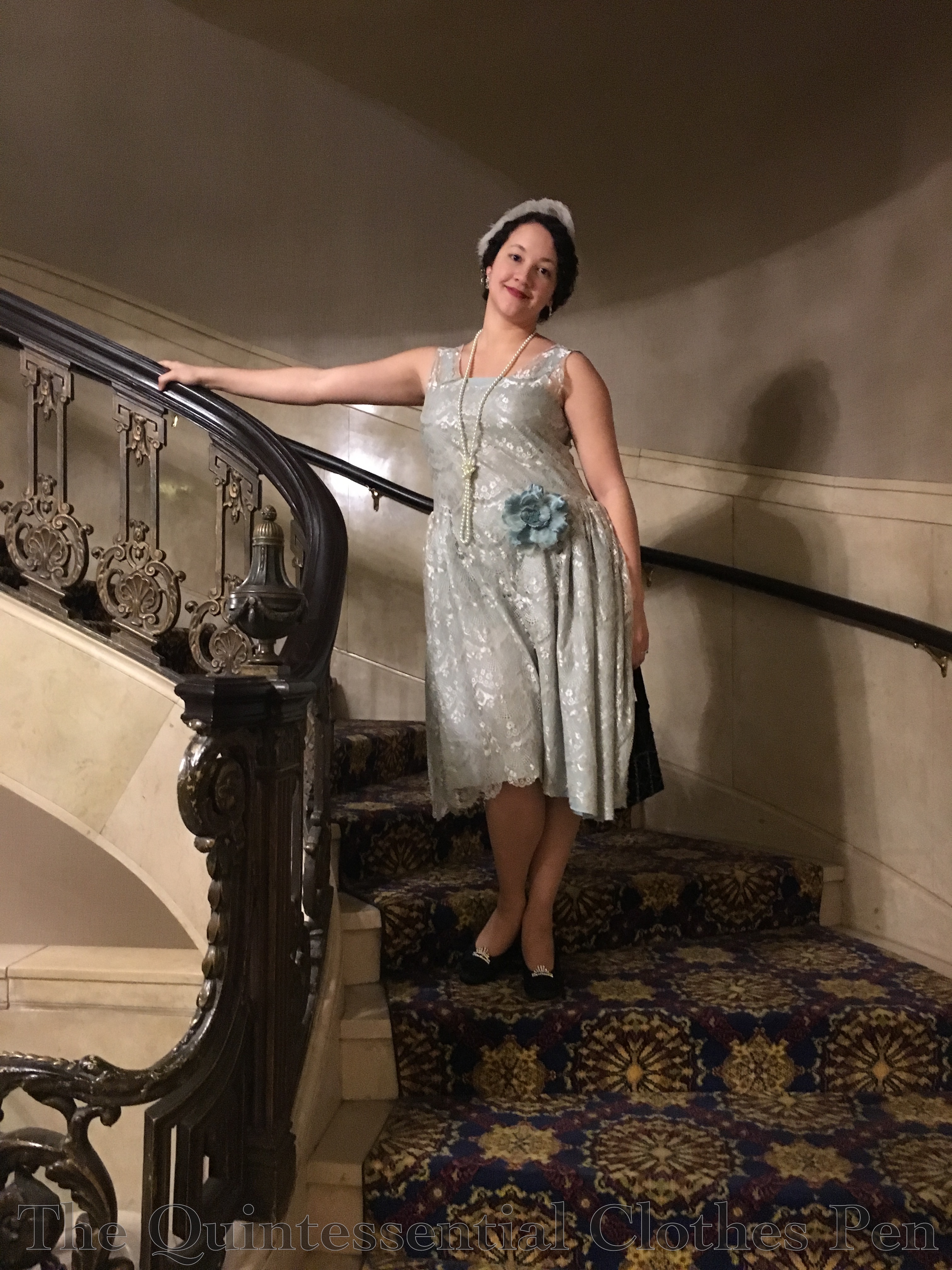
I have another more dramatic robe de style already, so this lace one is more of a nod to the robe de style, with softly gathered sections at the hips and no panniers or other understructure.

(My 1924 Golden Robe de Style is the more dramatic one. I made that dress in 2015 and posted about the construction of it this past post. Since then I have updated the trim on it to be much better suited to the dress. You can see the new trimming in these two past posts: in 2016 and in 2017.)
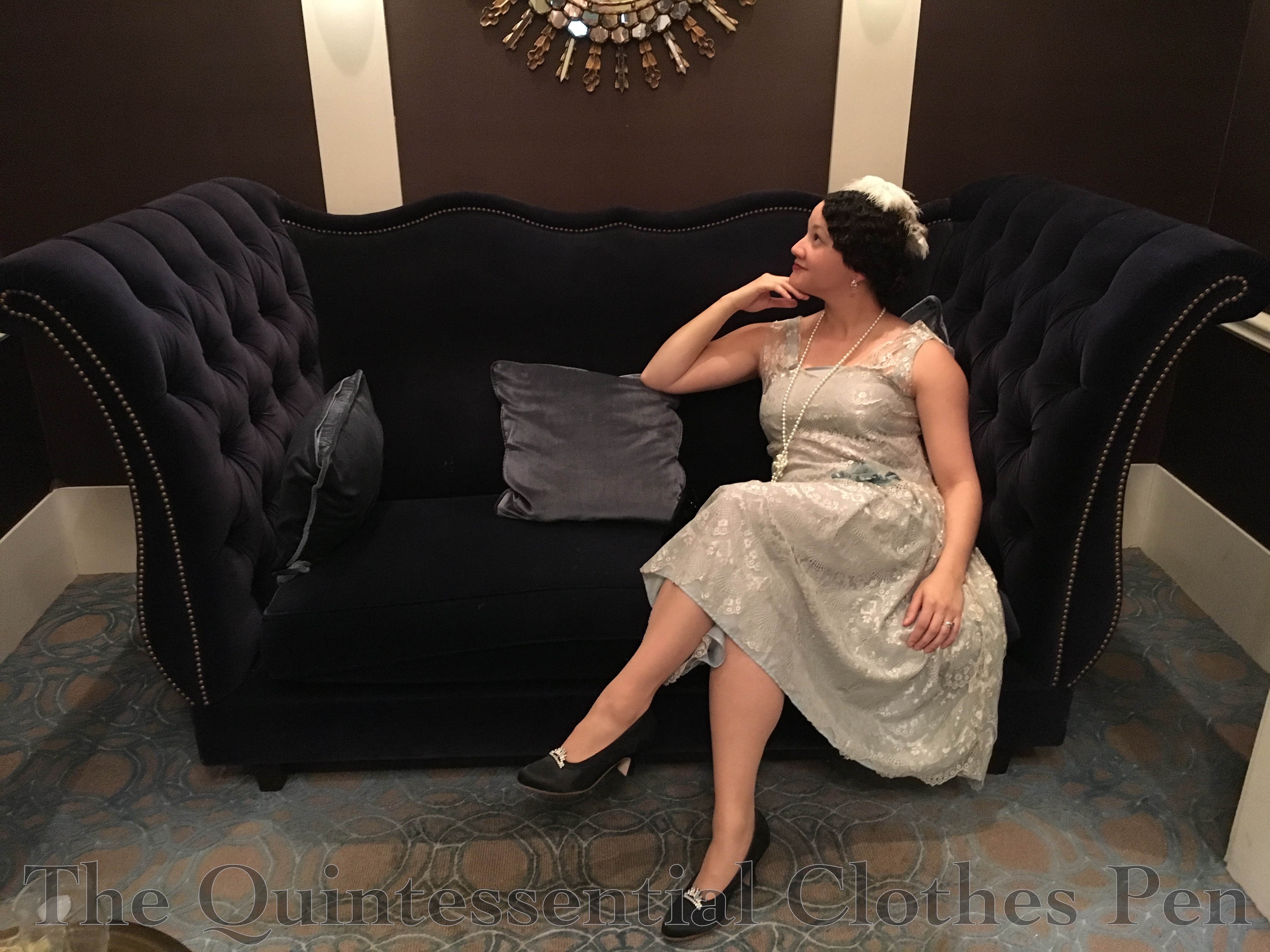
Last August I wore this dress with silver accessories: silver American Duchess Seaburys and silver hairpins. This time I decided to try my black Seaburys with silver rhinestone shoe clips, an ostrich feather/rhinestone hairpin (this is the same decoration I had in my hair for my 2016 Versailles look–how fitting to wear it again with a dress that has a nod to the shape of the gown I wore that night!), and my newly made black velvet handbag. It’s a bit hard to see the handbag in these photos, but if you look for it you can spot it in one hand or the other in most photos. Trying to show it off and not look ridiculous was a bit of a challenge.

(As a another side note, that same hairpin works really well for the 1890s, too! Who knew it could so easily shift between not only decades, but centuries!)

While packing and getting dressed, I couldn’t decide which dress to wear to the ball: this silver robe de style or my 1927 Blush Sparkle Dress. I brought both of them with me to the event and only made a decision when I realized that a friend hadn’t brought a sparkly dress to wear. (Never fear, she had a dress, just not a sparkly one!) The fabulous architecture of the The Fairmont Copley Plaza Hotel really called for some sparkle, so I wore the robe de style and loaned her the blush sparkle dress. It was fun to see it sparkling around the ballroom!

Showing off two different styles of 1920s dresses. Blush Sparkle on the left and Silver Robe de Style on the right. It’s hard to lounge and not look silly. This was one of the best we got!
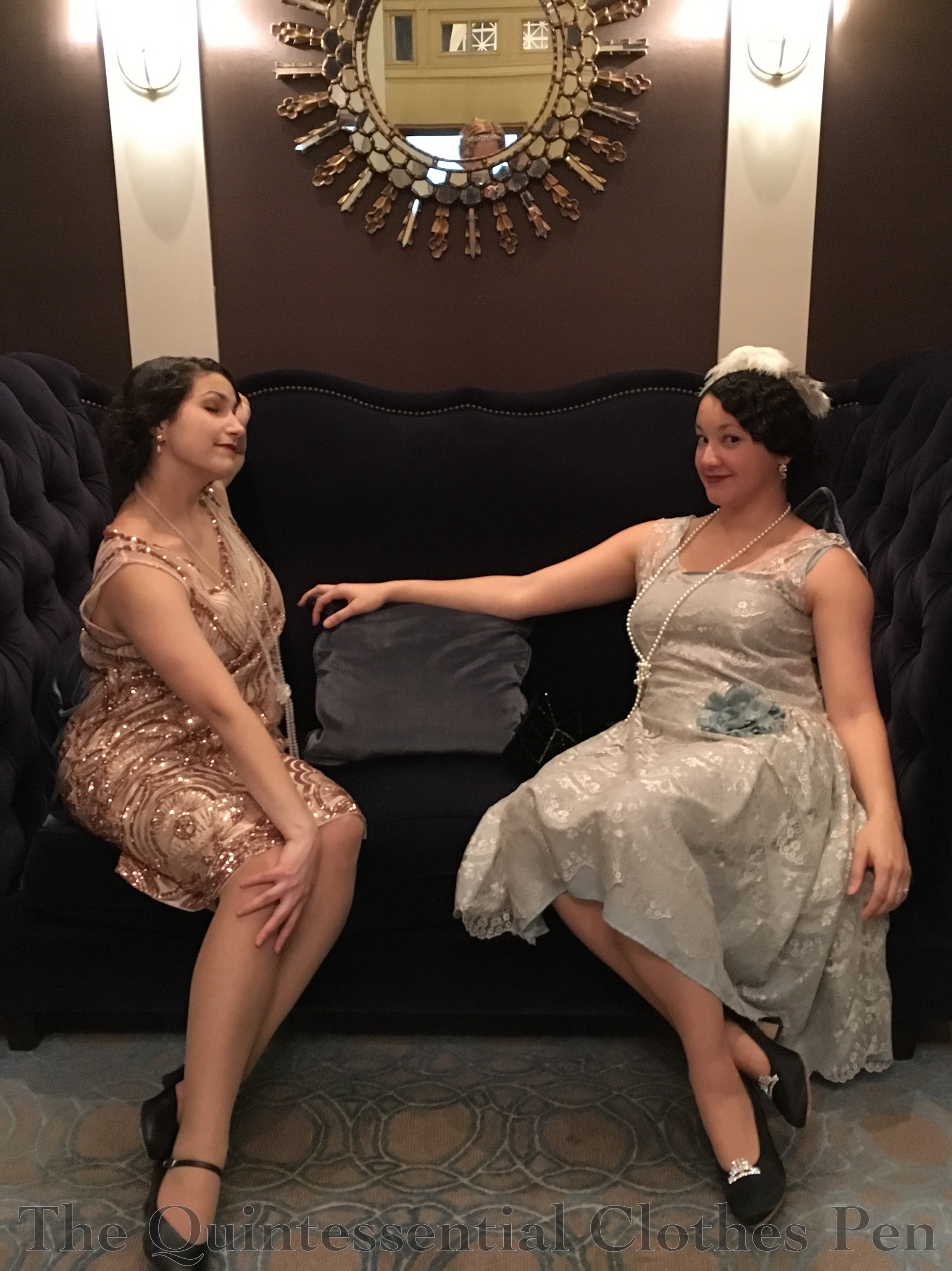
After the second wearing, I am still pleased with this dress. It’s fun to dance in and a bit unusual in style: qualities that suit me perfectly.

I think I like this dramatic black and ostrich styling best so far. Do you have a preference between the first styling with silver accessories and this second wearing?


Making A 1933 Summer Hat

Last post, I shared my 1933 Sunshine Stripes dress with you. One of the accessories that I loved wearing with that dress was a modern sun hat that I remade into a 1930s shaped hat. Now I’d like to share how easy this process was. I hope it inspires you to try remaking something yourself!

I started with this modern ‘straw’ hat from eBay. I say ‘straw’ because the fiber is really plastic rather than any sort of natural material… but I digress. The price was good and I thought white would be a nice neutral for my 1920s summer wardrobe. But the crown on this hat was soooo tall! 5″! It came way down over my eyebrows and combined with the floppy brim it was not a great look nor was it historical. I think I tried to wear it a few years ago but was displeased with the shape. The only bonus is that it squishes well and pops right back into shape–that’s great for packing! (As a side note, in trying to find the link for the hat I realized I ordered this back in 2015… it only took me a few years to make it something I was really pleased with!)

While trying to decide what to accessorize my 1933 dress with, I looked at the hat in my closet and wondered if there was anything to be done to make it better. I figured the white would coordinate well with the white stripes in the dress fabric. I looked for hat inspiration on my 1930s sportswear Pinterest board and 1930s day wear Pinterest board and decided that the main problem with my hat was the tall crown. I wanted a hat that just perched on my head, so I needed to shorten the crown.

I started by ripping out the stitching on the lower part of the crown just above where it connected to the brim. Here’s the hat at this point with the shallower crown and brim still technically attached.

After determining that I liked the new crown height, I cut away the extra braid. Then I wrapped the loose ends around the crown and brim and stitched them down so I had two nicely finished parts.

Then I reassembled the two parts, carefully stitching them together while avoiding the inner hat band. I matched the stitch length to what was already on the hat (rather long, by my usual standards). Because the hat is so malleable it was easy to squash onto the sewing machine.

After stitching, the join blends right in! The only thing left was trim!

I decided on a simple brown band to trim the hat. I had the brown cotton in my stash and it matched my shoes well. It is nicely complimentary for the outfit without being match-y and it’s neutral enough that I can easily wear this with other outfits as well. The brown is carefully hand sewn around the crown with the ends spreading over the brim of the hat. Ta da! Elegant sun protection!

Sunshine Yellow Stripes In 1933

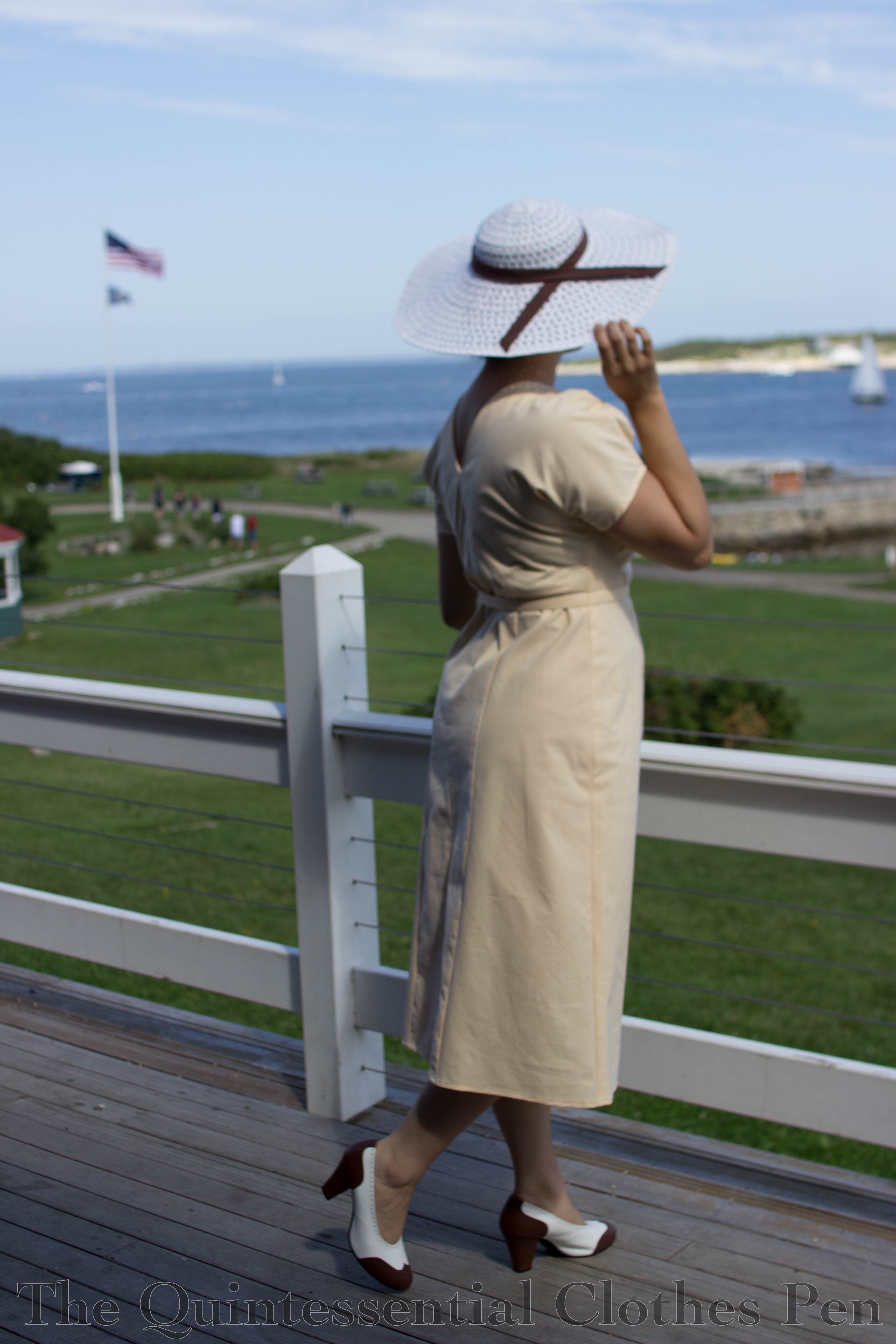
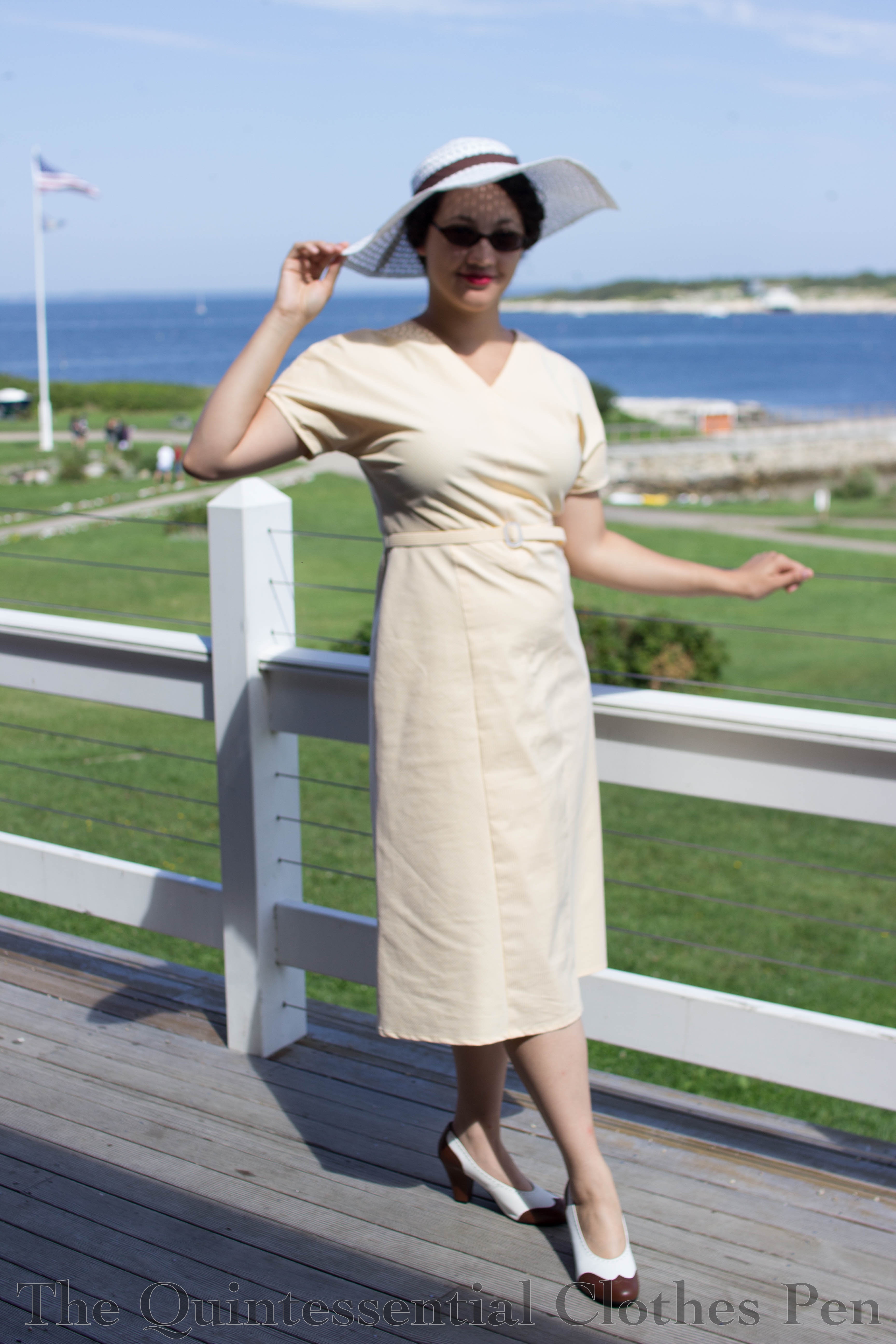
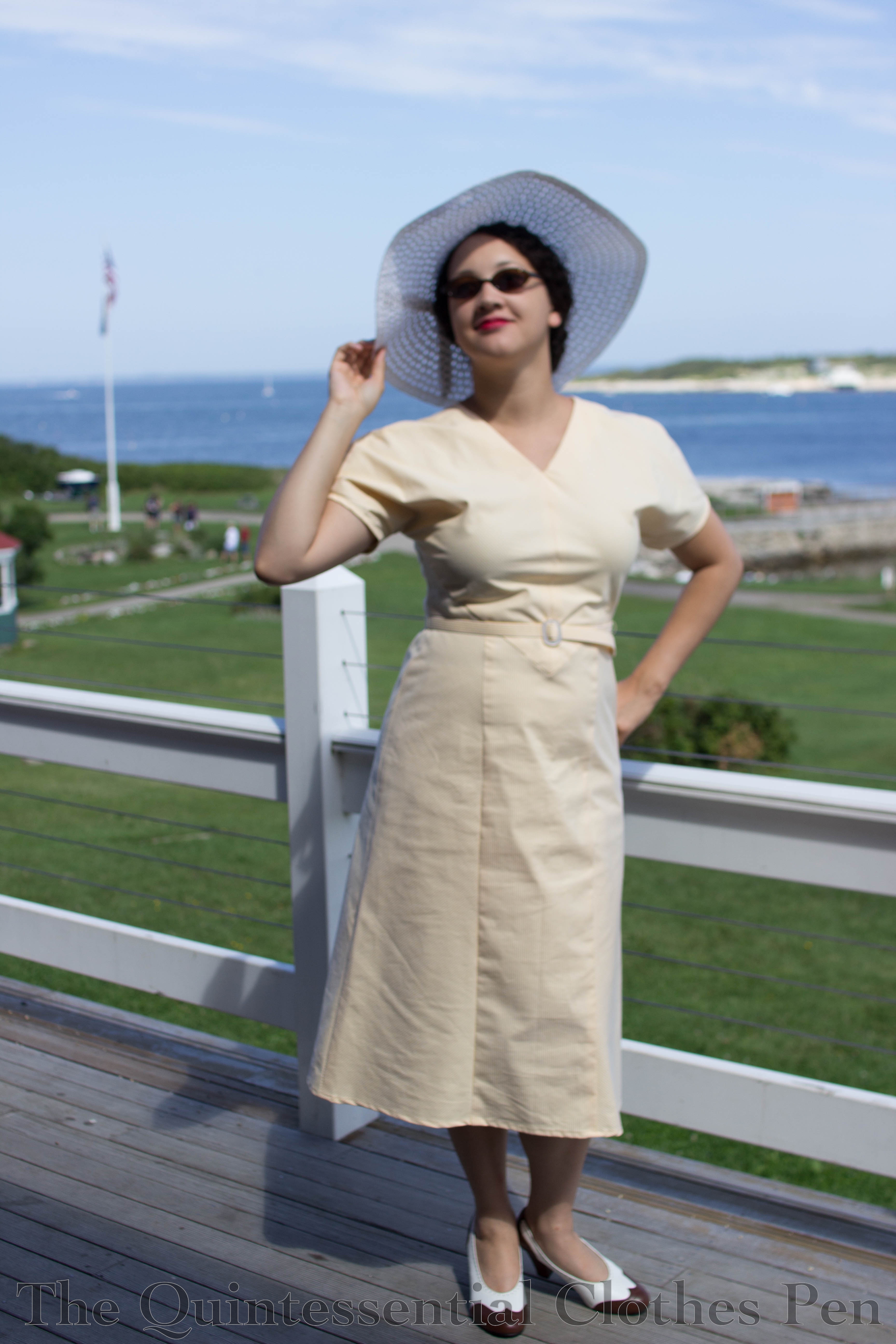
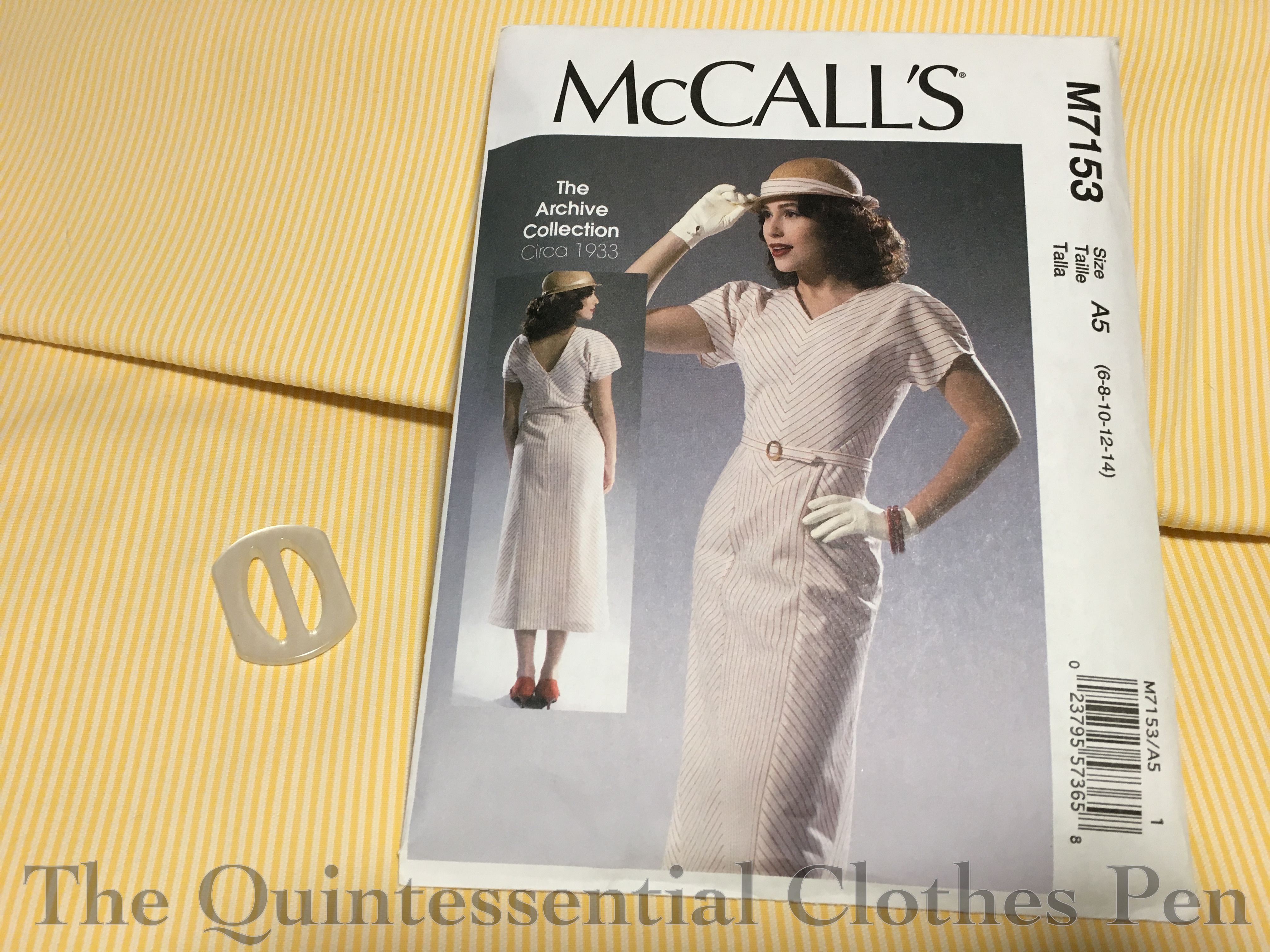
Last summer, I decided to make a dress from McCall’s #7153, an archive pattern from 1933 (although now out of print, it was released in 2015 so it’s pretty easy to find with a quick search). This is a pattern I’ve been eyeing for awhile. I decided to make it because I wanted something comfortable, new, and appropriate for daytime to wear to a Gatsby weekend in the heat of August. 1933 is obviously not in the 1920s, but the weekend tends to be more generally 1920s/1930s in terms of clothing, so I figured this would fit right in.

The style of the dress is quite defined by the differing grain lines on the pieces, a detail that is set off by the stripes used for the sample dress. Accordingly, I went off in search of a good stripe for the dress. I couldn’t find one I liked in the right weight with a stripe quite as delicate, visible, and widely spaced as the sample dress, but I did find a lovely yellow and ivory narrow stripe at Farmhouse Fabrics (although now they have this, which is similar to the sample dress–I’m not sure which one I would choose if I had both options in front of me now!). I couldn’t find a yellow belt buckle that was right, so I decided to go classic with a white mother of pearl one from my stash instead.

I cut out a mockup in size 14. This was a project for my #virtualsewingcircle while I was still finding time to sew live. The mockup fit, but was very tight, so when I cut out the yellow stripe I made the dress a size 16 (for reference, my measurements were about bust 40″, waist 32″, and hips 42″).

The only other change that was required was to take up the shoulders (which I think meant that I also lowered the front neckline and cut new front facings, though now it was long enough ago that I don’t remember perfectly). McCall’s must have been thinking people were going to put in huge shoulder pads–there was so much room! I believe I took about about 2″ (4″ total) of height!

In addition, I took Kelly’s advice from making this dress and omitted the zipper down the back to keep things smooth. This was made possible in part because my fabric has a little bit of stretch in it.

I think I mostly followed the pattern directions for assembly. There are some steps in a specific order to get the nice point, particularly in the front.

I machine finished the hems, including the sleeves, and under stitched the neck facing, tacking it down by hand to the seam allowances on the inside. The seam allowances were pinked to keep the seams from getting bulky while also keeping them from fraying. This wasn’t important for the bias cut pieces, but it definitely helped the center back and center front panels that are cut on the straight grain of the fabric!

I completely ignored the belt directions, opting instead to use belting encased in a tube of my fabric. Belting is a great product that, as fas as I can tell, stopped being produced in the last few years. Boo! It’s a bendable but stiff plastic backed fabric that you used to be able to purchase in different widths to use as stiffening for self-fabric dress belts (perfect for dresses from the 1930s, 1940s, and 1950s!).

Despite the photos of the whole look with accessories (which I’m very pleased with!), when I tried on the dress after finishing the sewing I was so disappointed! I looked so frumpy in the mirror with the calf length hem and my bare feet! I made a lot of faces. Then I thought, ‘Well, I guess I try on the shoes I plan to wear with this.’ That idea did make me a little happier, because I had snagged a pair of Royal Vintage brown and white spectators but hadn’t found a reason or outfit to wear them with yet. And then… MAGIC. Those 3″ heels absolutely transformed the look! All of a sudden that calf length hem looked great! I was probably standing with more confidence rather than disappointment, too, but really, it was like I was wearing a different dress. Has that ever happened to you? The accessories really make some looks come together! And especially with 1930s calf length hems… the heels really help posture and proportions.
I found that my first pair of Royal Vintage shoes are very comfortable. They have a bit of padding in the sole, which is great under the balls of my feet especially, and also arch support. They don’t pinch or rub in any uncomfortable ways. After wearing them for the better part of two days in a row I can say that my feet were tired of being in 3″ heels, but tired or aching in no other way (that’s just a function of being in 3″ heels, no matter how comfortable they are). And boy, did I feel snazzy for those two days!

This next one is the ‘Oh no! My hat is flying away!’ face. It was rather windy, so there actually were moments where I had to hold onto my hat to keep it from flying away! This hat is a refashion of a modern sunhat that deserves its own post–coming soon. I’m very pleased with this updated version and I love how well it coordinates with my shoes!

The stripe in the fabric gets a bit lost when you’re not right next to the dress, but I still like it overall. I found the dress was more comfortable to stand in than to sit in, but it did well in the heat and was cool and breezy. Success!

1896 Black Gaiters For A Sporting Look

Five years ago (yikes, where did the time go?!?), I made ivory gaiters. They were made to wear over heeled shoes, giving the look of two tone boots. Unfortunately, the ivory gaiters I already have don’t work for the the 1896 cycling ensemble on my sewing table! Ivory gaiters would show dirt and be rather impractical for the sporting look, so I decided to make utilitarian black ones for this outfit.

I used the same pattern as for the ivory gaiters with only a few modifications: the top edge curves in a bit more over my calf and the back heel is longer so it stays on top of my shoe (in my blog post about the ivory gaiters I share about how they were riding up over my shoe–I solved this with a little piece I added in after the photos were taken, but for the new pair the pattern was cut longer instead). It was lovely to have a pattern ready to go!

I’m pleased that I squeezed this small project into 2018. I can count it for the HSM Challenge #12: Neglected! This challenge is sort of a catch-all for making something that fits into a previous challenge either from this year or a previous year. I chose the September 2018 challenge, Hands and Feet, for this December challenge.

Just the facts:

Fabric: About ¼ yard slightly stretchy black cotton.

Pattern: Created by me.

Year: 1896.

Notions: Thread, ¼” and ½” cotton twill tape in various widths, and plastic buttons.

How historically accurate?: 90%. The look is right but the materials are a mix and match of right and modern.

Hours to complete: Approximately 5.

First worn: Not yet!

Total cost: $5 for the buttons. The fabric and twill tapes were in my stash!

These are constructed in the same way as my previous pair. The seams are covered with ½” twill tape, the edges are bound with ¼” twill tape, there is a strap (in this case made of the exterior fabric), and then buttons and buttonholes finish it off.

The great thing about my gaiter pattern is that they work for a few different decades. The ivory pair was made for a 1917 outfit, but I feel perfectly confidant that the pattern works for the 1890s and 1900s as well. I’m looking forward to trying these on with my cycling ensemble once that is far enough along to put all the pieces together!

1926 Silver Lace Robe de Style

One of my summer sewing projects was a new 1920s robe de style. (And yes, I am clearly delayed in posting about it!) I already have one (my 1924 Golden Robe de Style) but I stumbled across a lovely lace at Joann Fabrics in the spring that called to join my wardrobe as a second dress in this category. I attend enough 1920s evening events that I can never seem to have enough dresses. Doesn’t that sound grand written out? I actually do have plenty of dresses, but it’s nice to have variety and cycle through different styles, types of fabrics, weights, etc.

I’ve enjoyed wearing my first robe de style and wanted to try another one with different characteristics. The 1924 golden one is made of silk taffeta and has an ankle length skirt, but I wanted this one to be much lighter weight and shorter in length. I also wanted a different neckline. After looking through my Robe de Style Pinterest board for inspiration I settled on this dress, a Boué Soeurs robe de style from fall/winter 1925-6. This is where my date of 1926 for my new robe de style comes from.

Obviously the lace is not opaque so as with the original dress I needed a lining. I settled on the icy blue because it was from my stash. (You’ve seen this fabric before, in my 1899 evening gown.) It was great to use a stash fabric for cost saving and stash-diminishing purposes as well as the fact that the colors coordinate. And, I was able to accessorize with a large flower pin in a very similar color that has been in my stash since before I had a fabric stash! Isn’t it wonderful to find good homes for odds and ends like this?

In addition to the flower pin, I also wore my extra long strand of faux pearls, my American Duchess silver Seabury shoes, and vintage silver hair pins. Oh, and earrings. But I can’t remember which ones and I can’t tell from the photos which pair they are. I’ll have to figure that out again next time I wear this dress!

The pattern for this dress is me-made, composed of mostly rectangular shapes based on my measurements. The body of the lining is basically an upside down T shape, where the sides are gathered into a slit that extends into the main body on each side by a few inches. (You can see what I’m talking about in the photo below.) The lining has a straight top edge with rectanglur straps attached. The hem angles down slightly on the sides intentionally. I still wanted an uneven hem as with my 1924 dress, but I wanted a less dramatic difference than with that dress.

The lace layer was a little more complicated. I wanted an uneven hem to match the lining, but I also wanted to keep the hem following the scallops across the fabric. So… I had to keep my hem straight. That means I had to make the tops of the sides curve up since the bottom couldn’t curve down, but that meant I couldn’t cut my lace layers as a T, because the curve up would cut into the sides of the dress.

My solution was to add a seam across the lace pieces at the height of the gathers. To do this I perfectly matched the scallops, carefully layered and stitched them with a narrow zig zag, and then trimmed away the excess fabric to make the seam almost entirely invisible. Can you spot it in this photo?

I also had to trim away the ‘eyelash’ bits left over after cutting along the scalloped pattern along the hem. This photo shows that step in progress. A bit tedious, but worth it!

Unlike the lining with its straight top edge, the lace has a v neck on one side and a scoop on the other. This layer is interchangeable in terms of which is front and back, since they’re the same with no special shaping. The edges of the lining are finished by machine while the neckline and the armholes of the lace are narrow hemmed by hand.

This new dress can be worn with or without panniers, but for the first wearing I went without in order to make the full skirt more subtle and to differentiate the dress from my 1924 Golden Robe de Style (which needs to be worn with panniers).

While this dress could be worn at any time of year, I am particularly enchanted with the idea of it being perfectly suited to a 1920s New Year party. The colors and silver lace seem well suited to that theme.

And on that note, in case I don’t get another post in before 2019… happy new year!

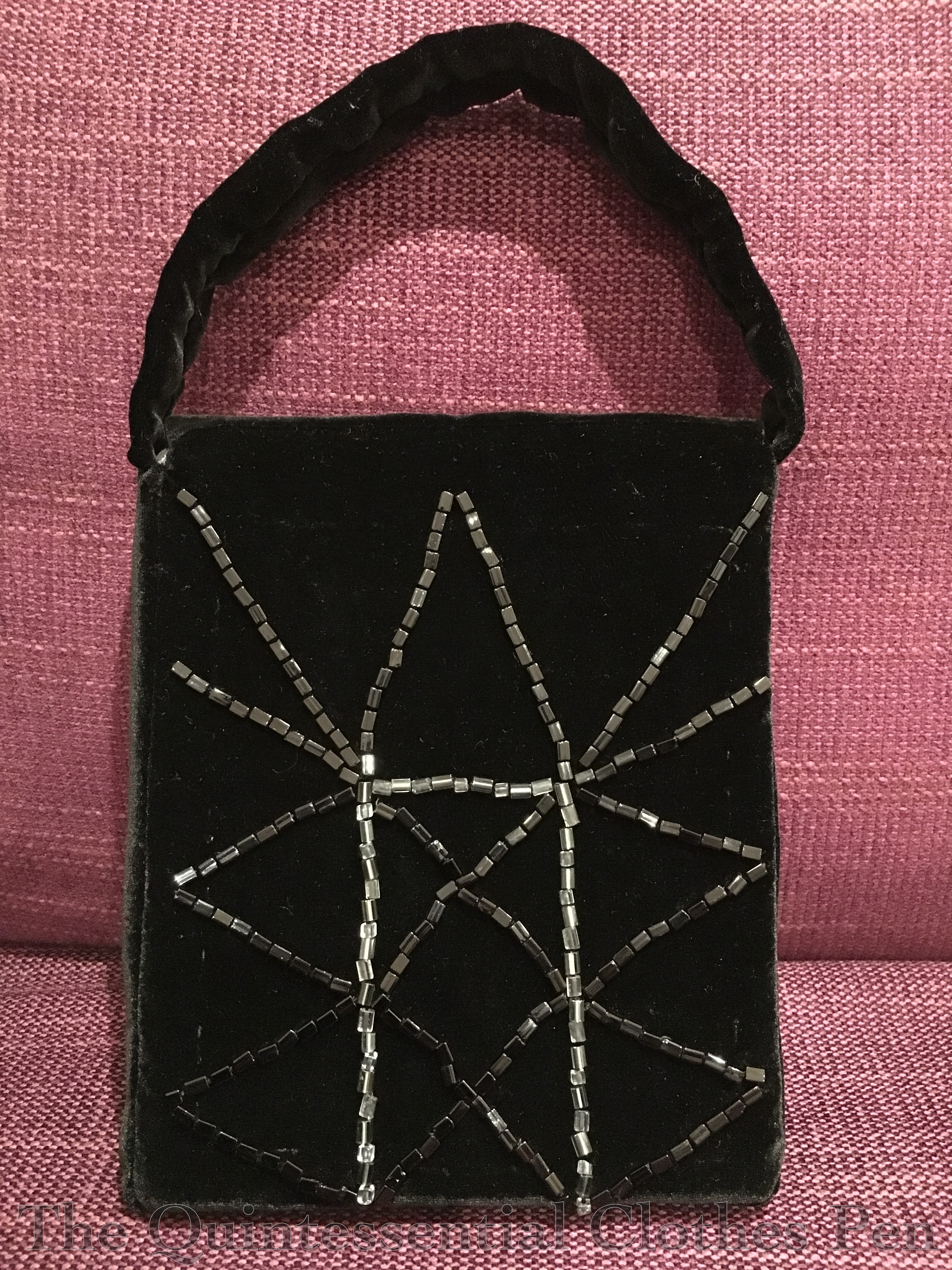
1920s Beaded Bag (HSM #11)

The November Historical Sew Monthly Challenge was Purses and Bags (you’ve got your arms covered in July, your hands in September, now make something amazing to dangle from them). Late in the month I realized this was a great poke to finish an idea I’ve had for about six years. It was a bit of a challenge to complete my project before the end of the month, but I just slipped in, finishing it on November 30.

The idea came from my 1912 Tea Gown. I had intended it to have elaborate beading, but decided not to do that for a variety of reasons detailed in that past post. However, I had already beaded one panel that I decided not to use. I’ve been holding on to it waiting for the opportunity to put it to use in some other way. And so, I decided to turn it into a handbag.

Saving your scraps comes in handy on projects like this, because I had plenty of velvet to cut the additional pieces I needed for the bag. I looked through my stash to find a lining and came up with grey silk shantung as the best option. This was also a piece of fabric that I only had scraps of. It was originally used for the boning channels on an 1883 corset I made way back in 2011 (you can see it in this rather old post).

My inspiration is this page showing handbags from 1922 (source). It inspired me to go in a more structural direction rather than a gathered top bag, which was my initial thought.

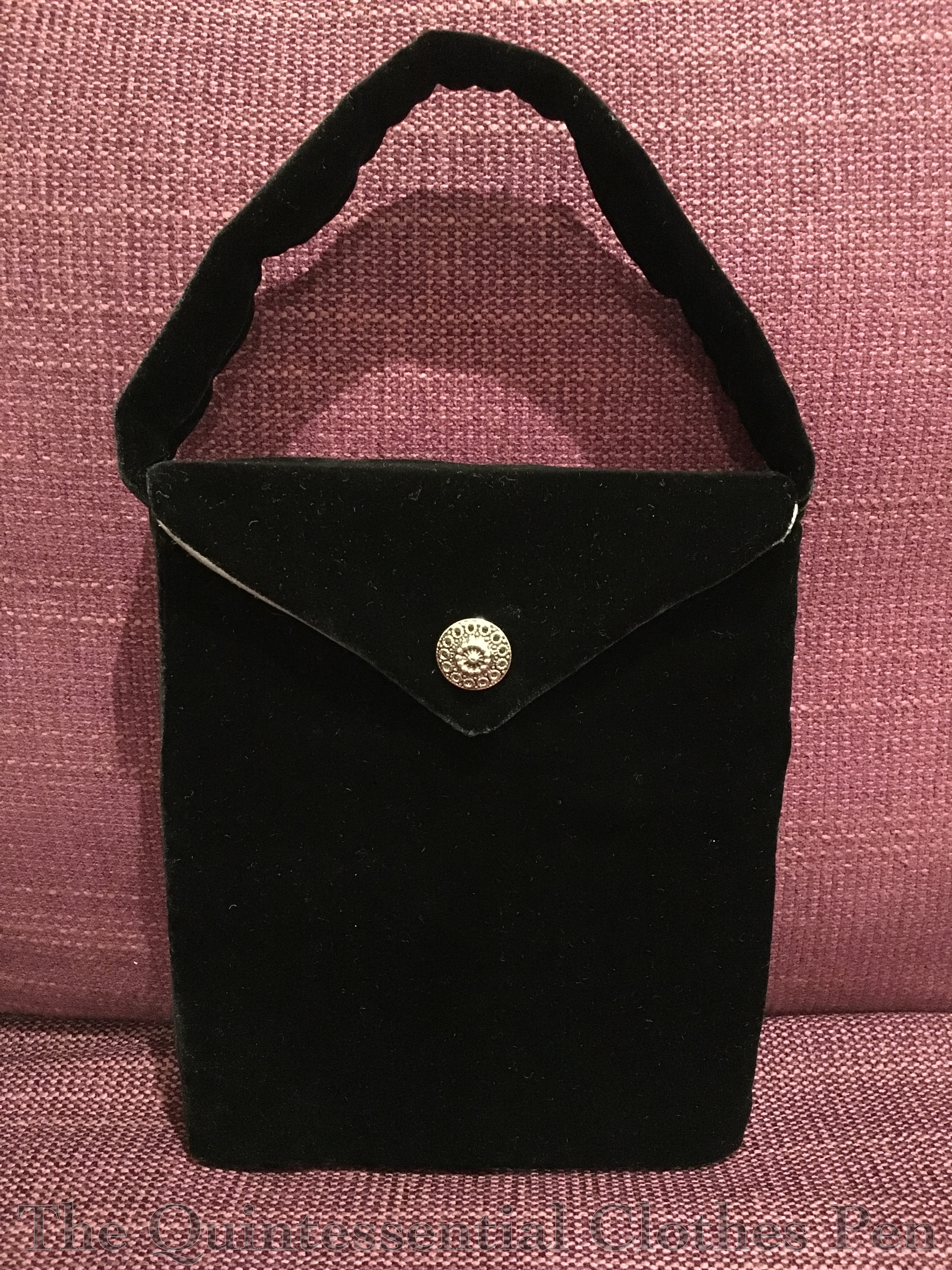
I had the idea in mind, but I was restricted in the shape of the bag based on the beading that already existed on the main piece. So I cut out another rectangle the same shape as the beaded piece, a long strip for the outside edges of the bag, a strap piece, and a triangle piece to make a flap that would close the top.

Along the way I realized that interfacing wasn’t going to stiffen the bag enough for what I was envisioning. I cast about for ideas of what to use for stiffening and settled on cutting up a shoe box that was in my recycle bin. It was a great weight of cardboard–not too thick, not too thin, and not too bendy. There are cardboard pieces on each flat side, along the bottom, and a strip along the top edge to keep the flap nicely shaped. The pieces on the sides and bottom are (shhh…) masking taped together to create a flexible but stiff foundation for the bag. The piece in the top is stitched into a channel that is only sewn through the interlining so it doesn’t show on the velvet or the lining.

I assembled my pieces, thinking hard about which part to leave open to set in the lining, and struggling a bit with the shifty velvet. I wanted to sew most of the seams on the machine for speed, but sewing it by hand would probably have been more pleasant. I wrangled it mostly into submission, only needing to restitch a few sections as I went along. The only hand sewing came when I needed to close up the lining after putting all the pieces together. Things had become a bit wonky with seam allowances and shifting velvet, so I did my best, figuring that the seam would be on the inside and I really just wanted to finish the darn thing.

After that seam, the only thing left was a closure. I decided on a simple hook and bar. Not quite as classy as a real purse, but it gets the job done and I had it on hand. On the outside is a decorative button.

And that’s it, except the facts!

Fabric: Scraps of silk velvet, silk shantung, and cotton canvas.

Pattern: My own.

Year: c. 1925.

Notions: A shoe box, thread, beads, and a button.

How historically accurate is it?: 60%? The silhouette and fabrics are plausible, though the cardboard probably isn’t. The beads are certainly too big and the method of closure is unlikely unless the item was made at home.

Hours to complete: Not counting the beading, approximately 3 hours.

First worn: Not yet!

Total cost: Free! All of the materials and notions came from my stash.

An Edwardian Island Adventure

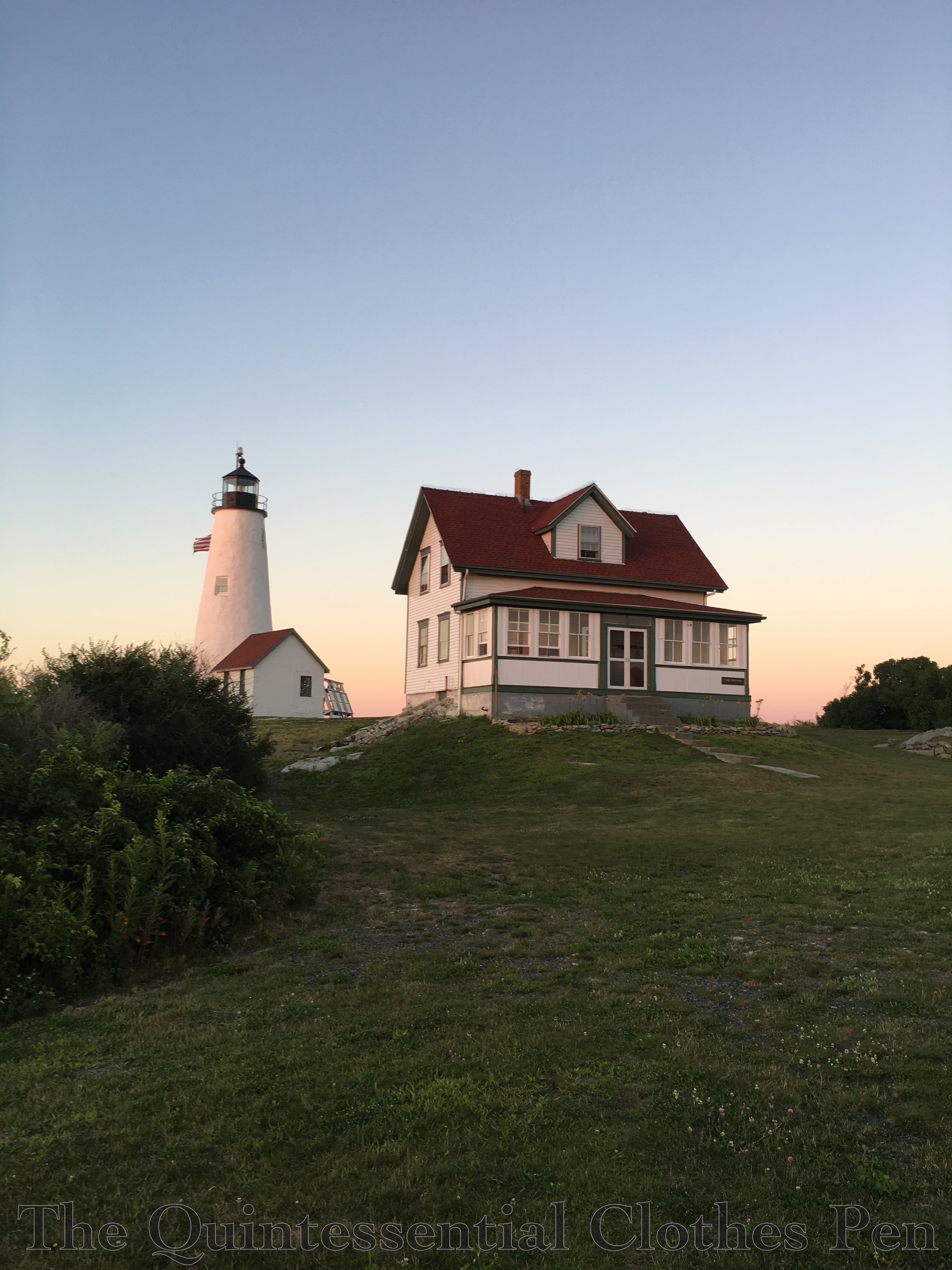
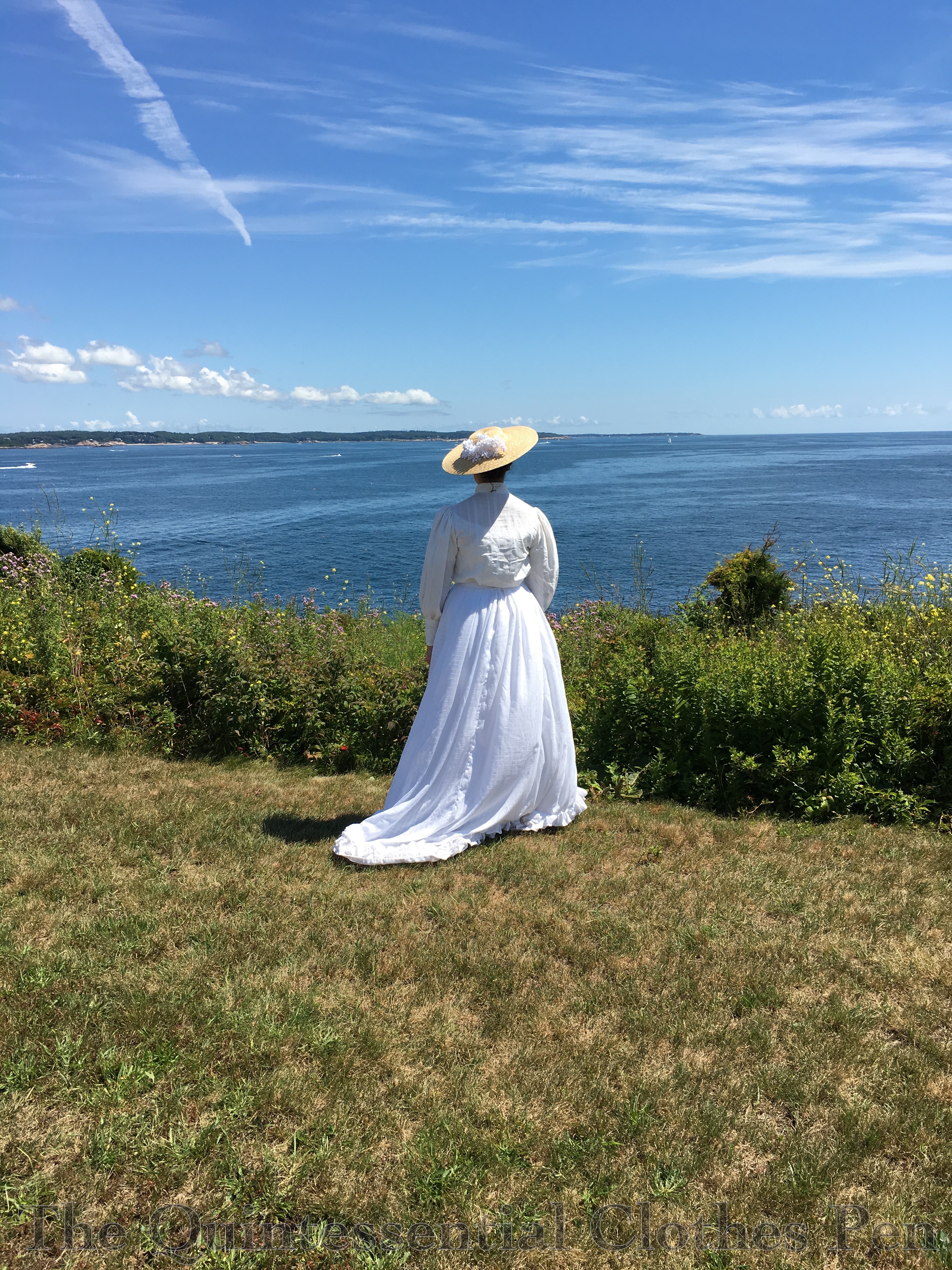
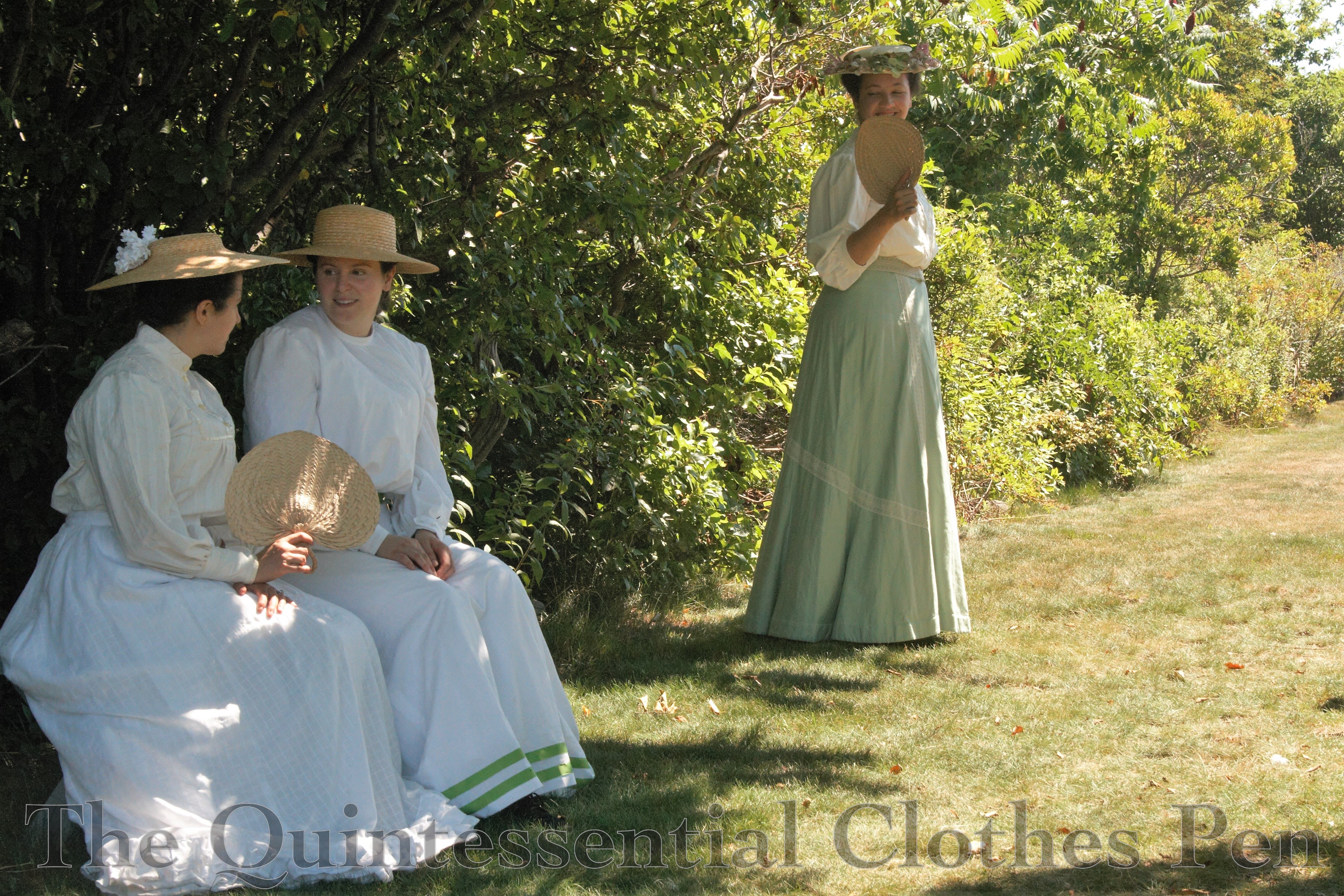
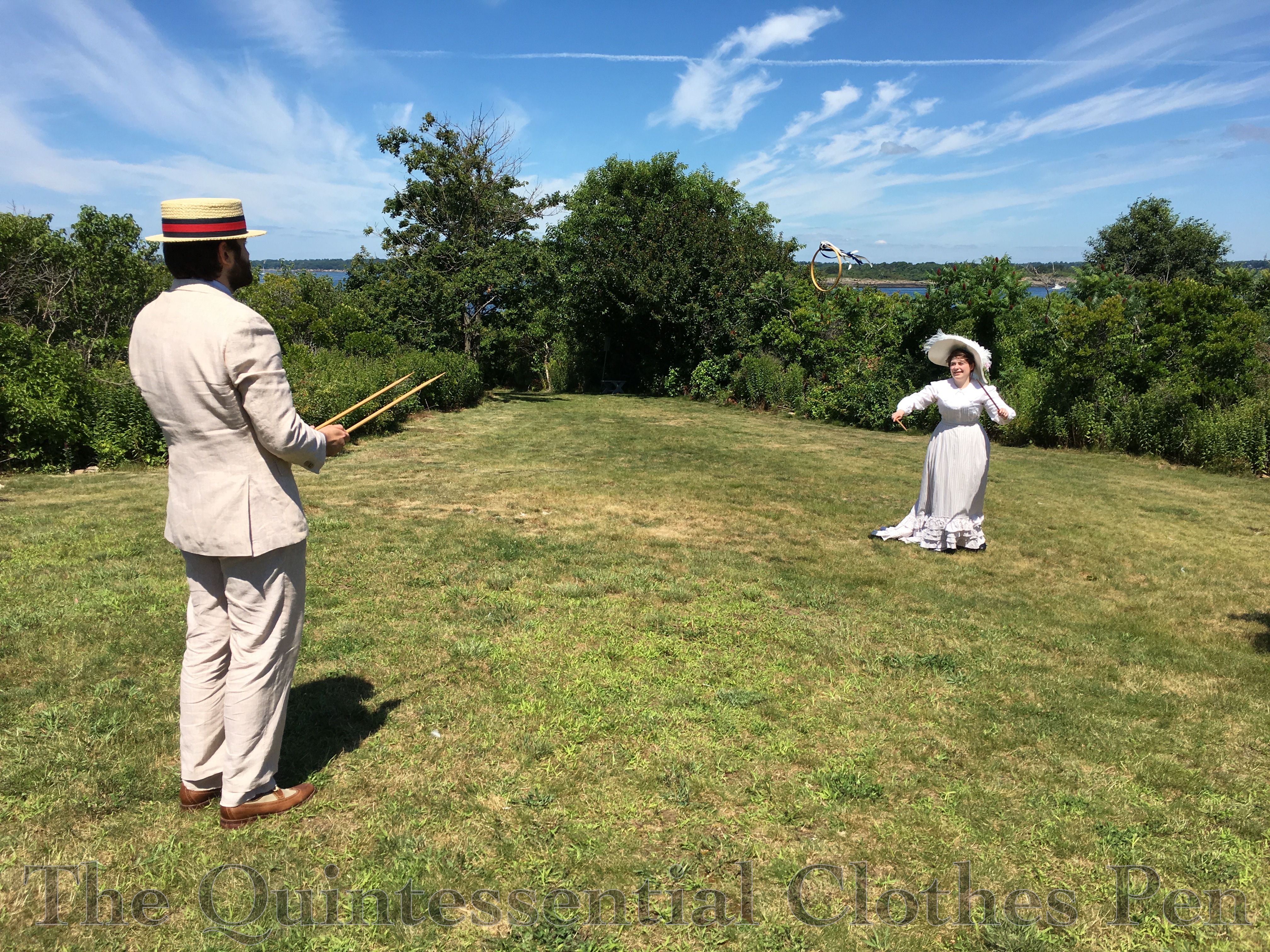
Over the summer, my dance group was invited to create a turn-of-the-century atmosphere for a weekend on Bakers Island, off the coast of Salem, MA. Today, the part of the island we were on is managed by Essex Heritage and is home to a lighthouse, but for our visit the idea was that visitors to the island could get a sense of what the island would have been like over 100 years ago when there was a large hotel located there.

We didn’t actually dance, but we played historical games and activities and explained our context to the visitors. They came upon us along various paths during their walking tour.

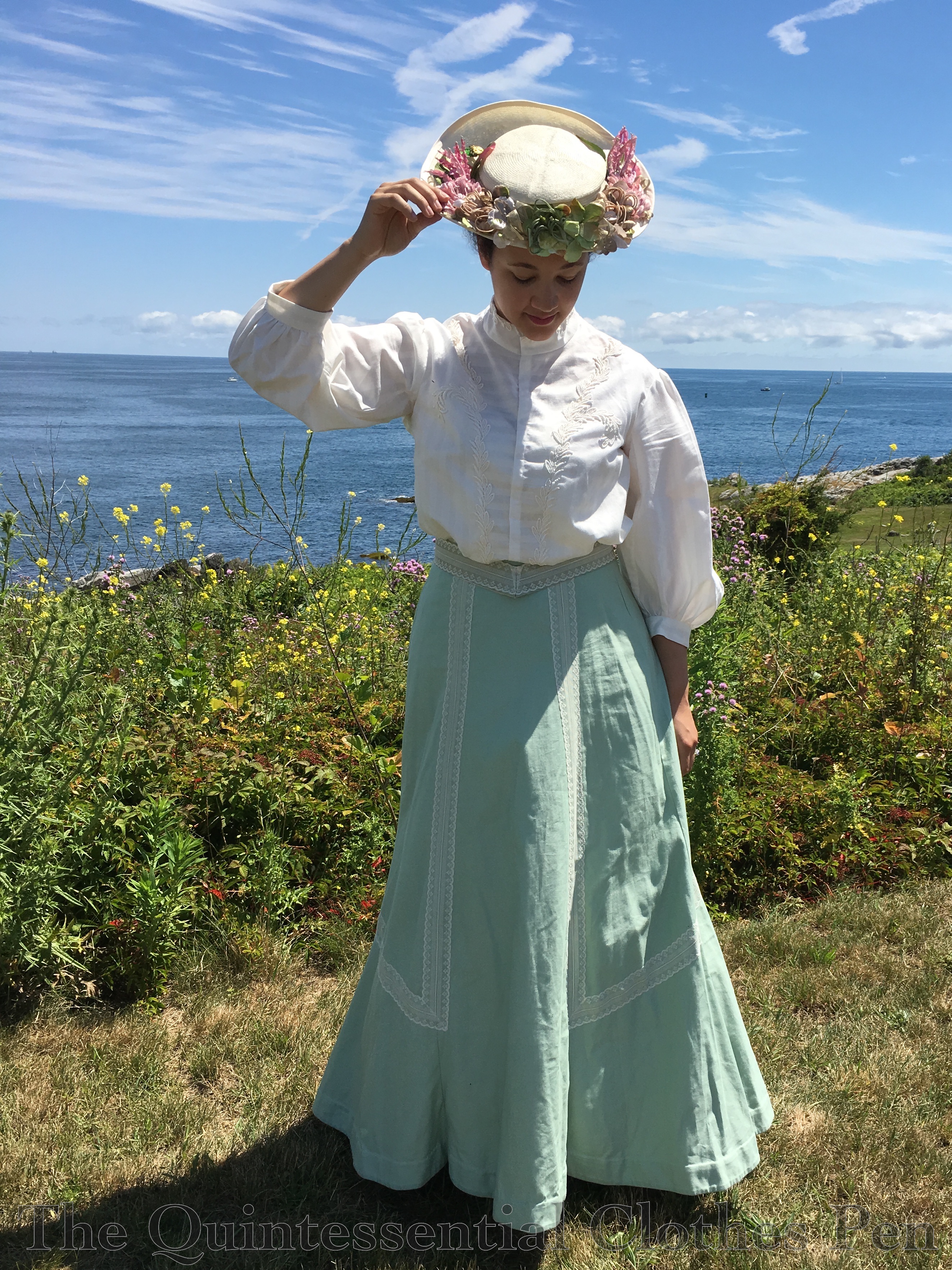
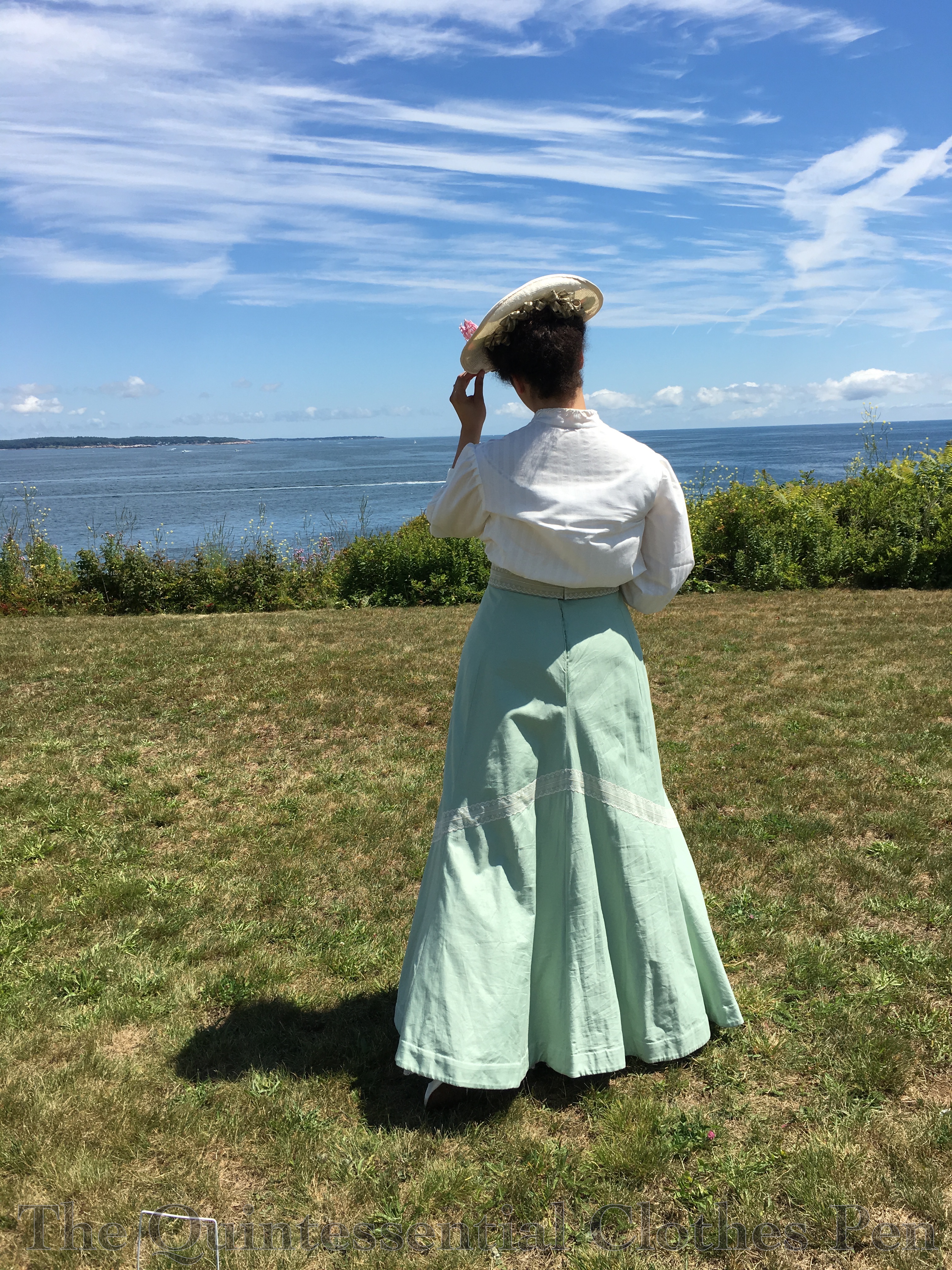
I wore my 1904 Anne of Green Gables ensemble. This time, though, I had a new belt and I got my hat to behave. It’s supposed to flip up in back, but was misbehaving last time I wore it and was flipped down in back. Boo!

The new belt is green silk covered with the same lace that I used on the skirt. The green isn’t a perfect match to the skirt, but I like that it coordinates without being too match-y. Taking a photo of it also allowed us to capture the subtle lace detail and woven stripe in the fabric of the blouse better than we did last time, which was a bonus outcome.

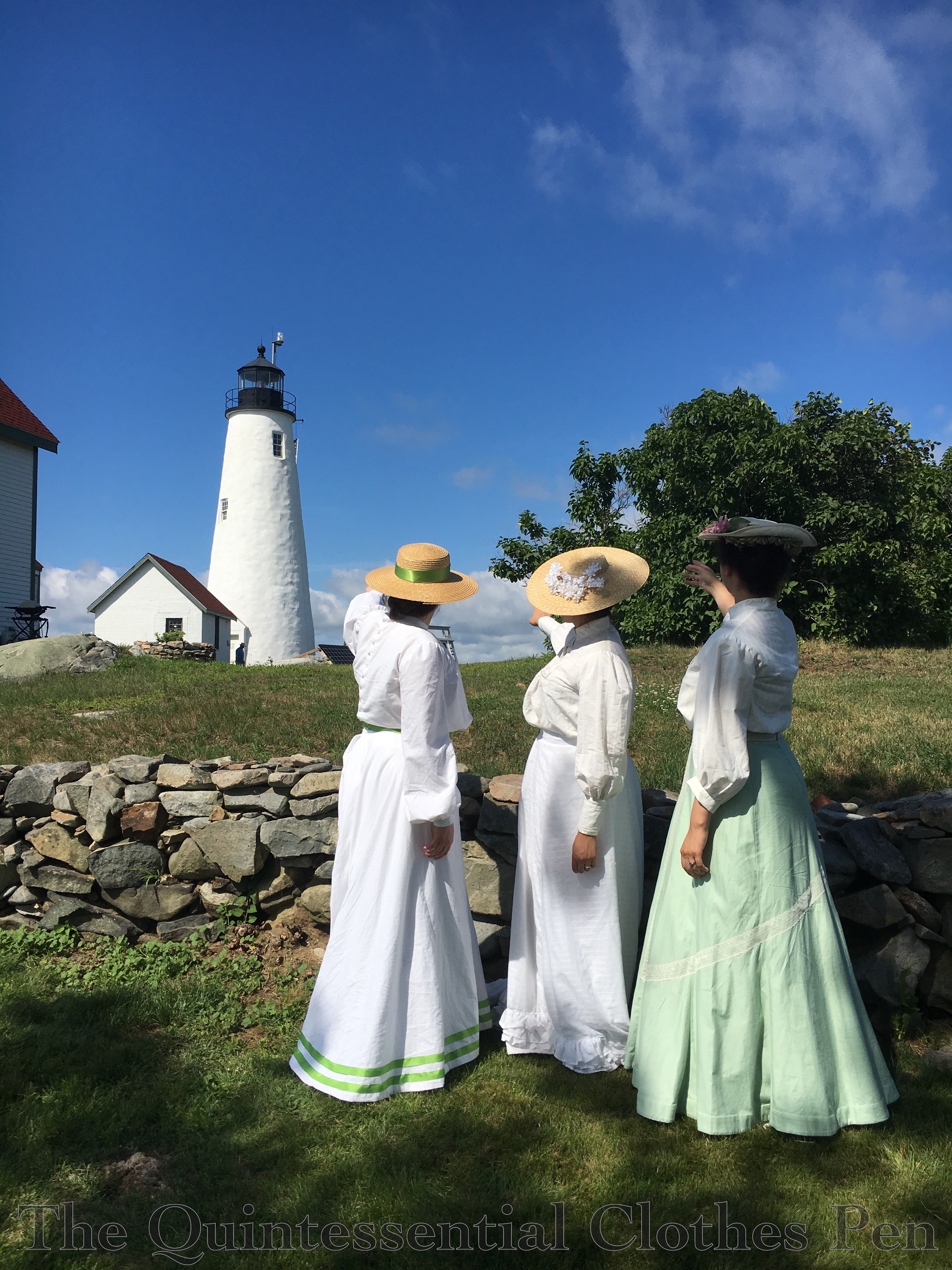
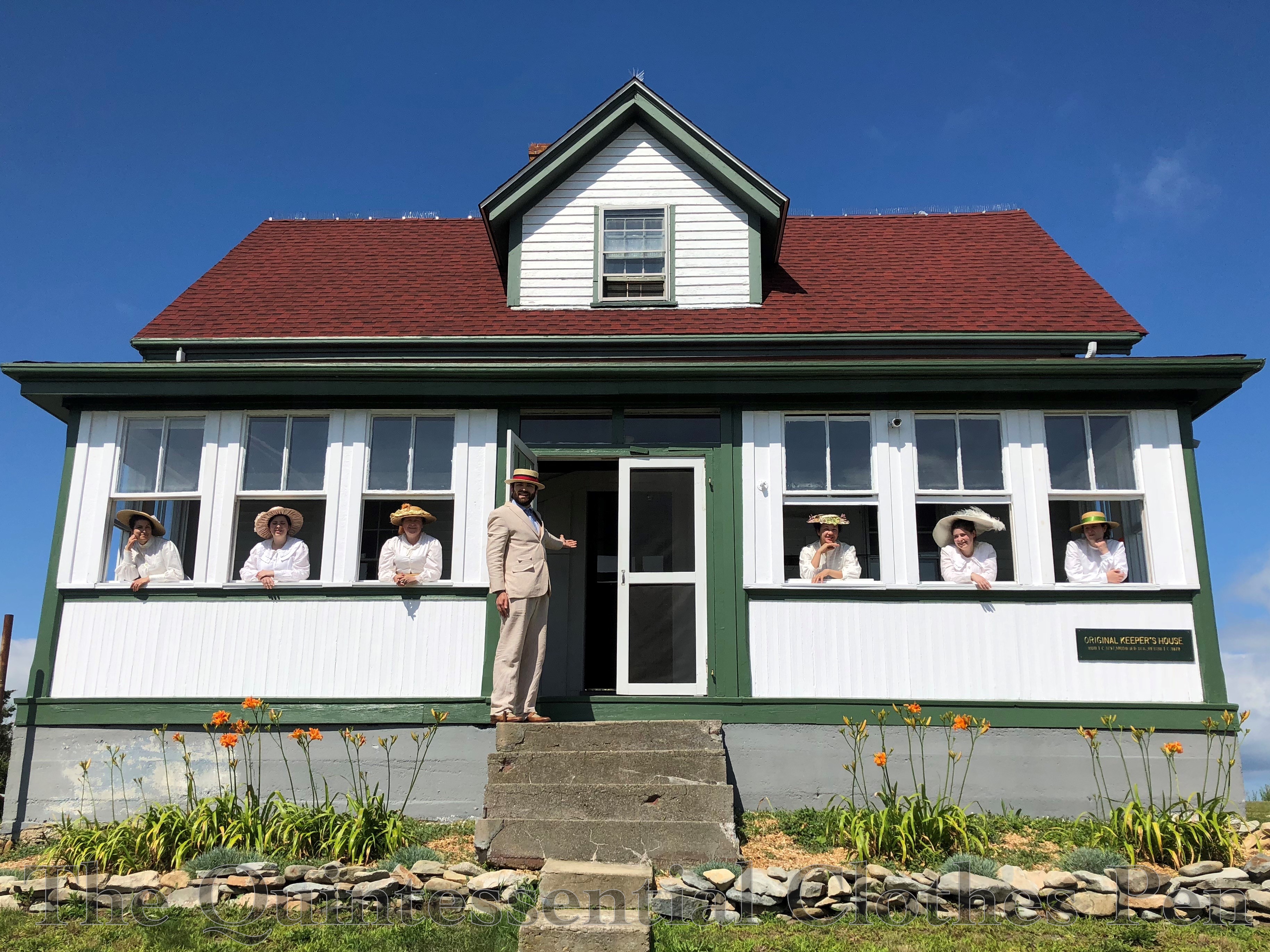
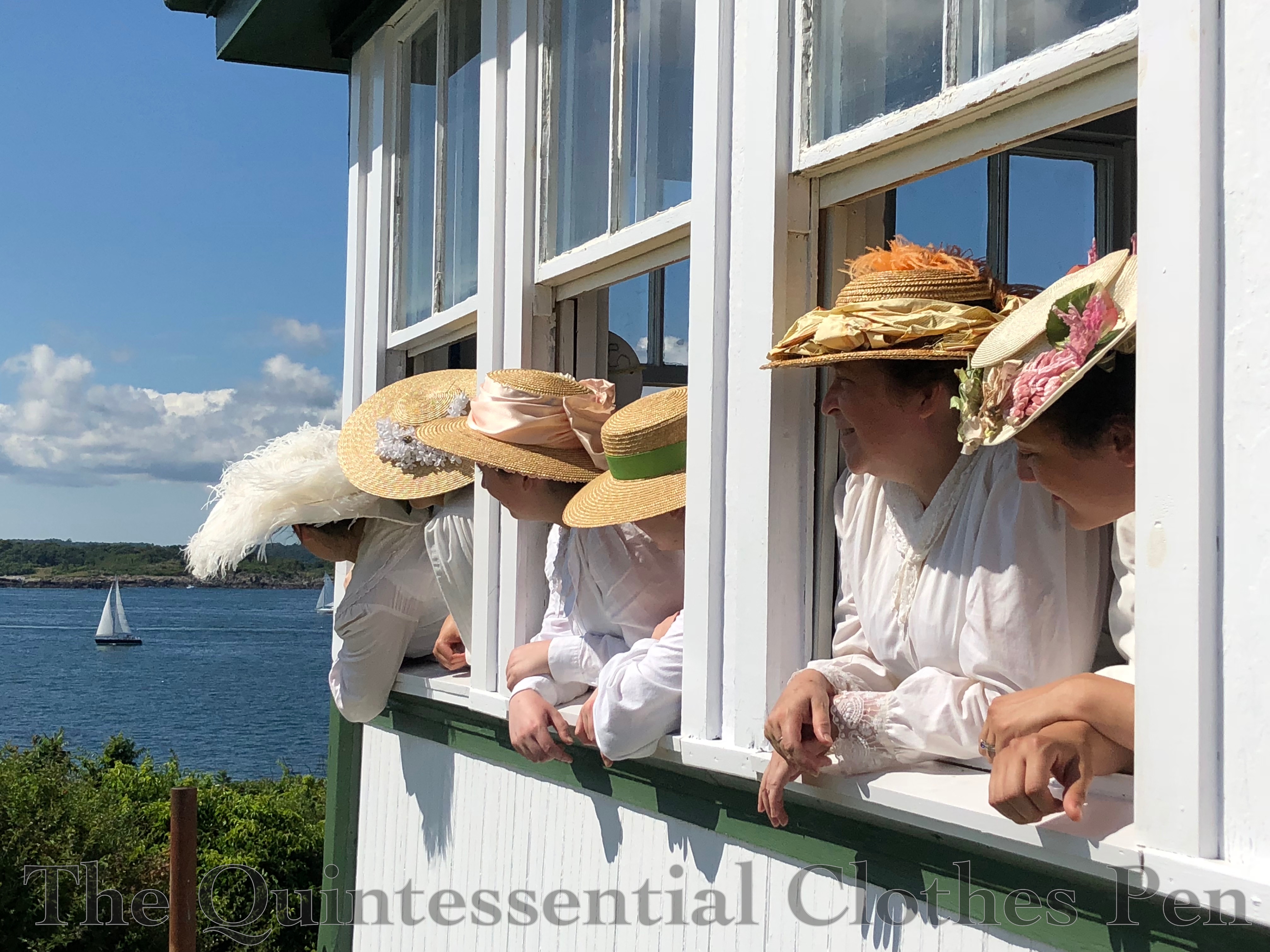
In between tours, we took some group photos around the lighthouse and the light keeper’s house. The light keeper’s house, in particular, provided us with some really adorable photos. These were provided to us by the light keepers, who keep their own charming blog (currently about their stay on Bakers Island this summer) which you can view here.

Behind the scenes, we needed to arrive before the visitors to set up. Given when boats were available that meant we had to arrive the day before the visitors. There aren’t any indoor accommodations we were able to take advantage of, so it was camping in tents for us. I’m not really a camping kind of person, but thankfully other people had tents to share. Between the modern equipment and food that we needed as well as the historical clothes, games, and amusements, we had quite the pile of luggage for two days and seven people! Here we are waiting for the boat back to the mainland.

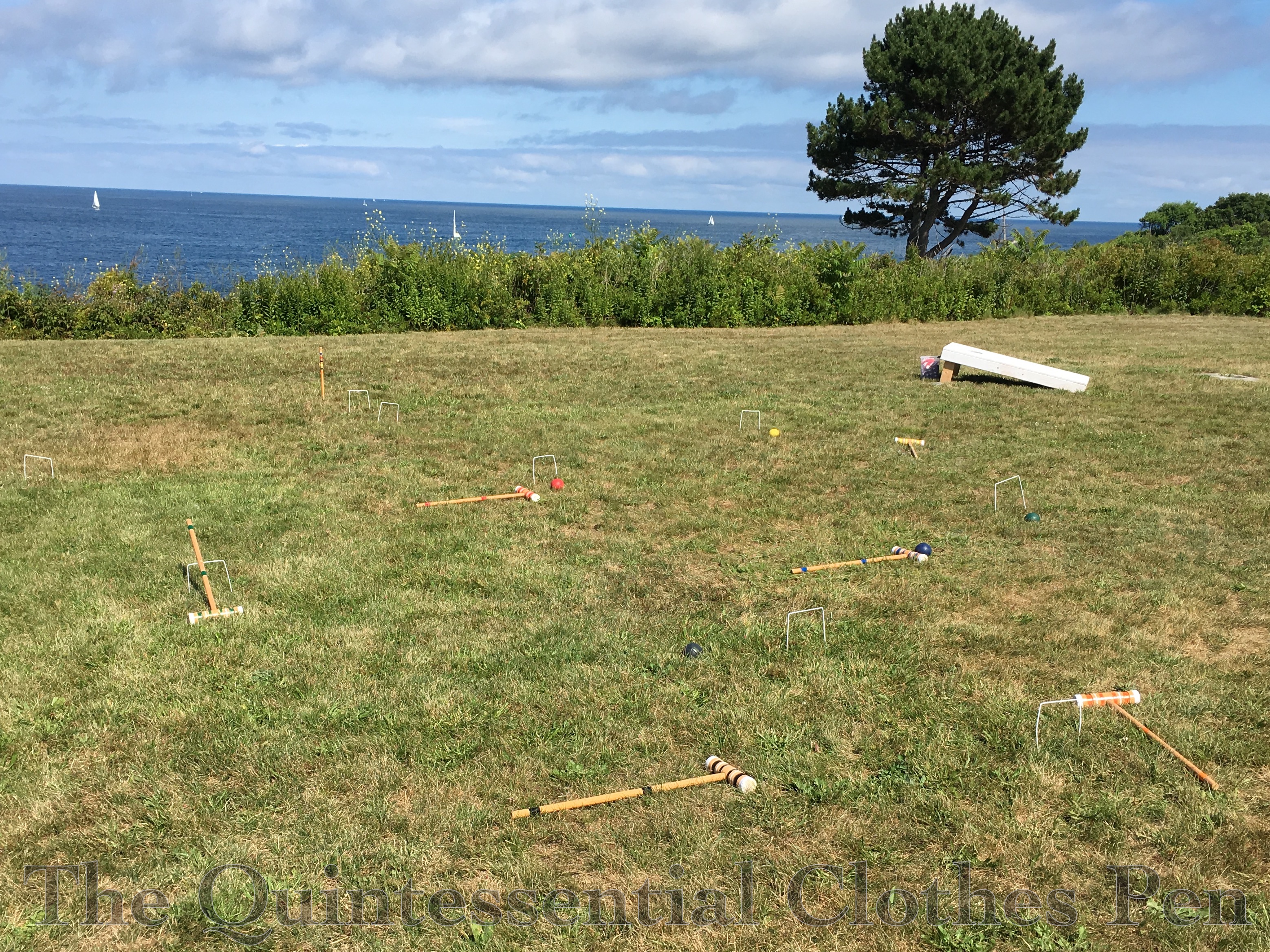
A new adventure complete! The croquet set is still in place but the players are gone! Maybe someday there will be others (or maybe us, who knows?) to once again bring history to life on this island.

Exploring The Crane Estate Gardens

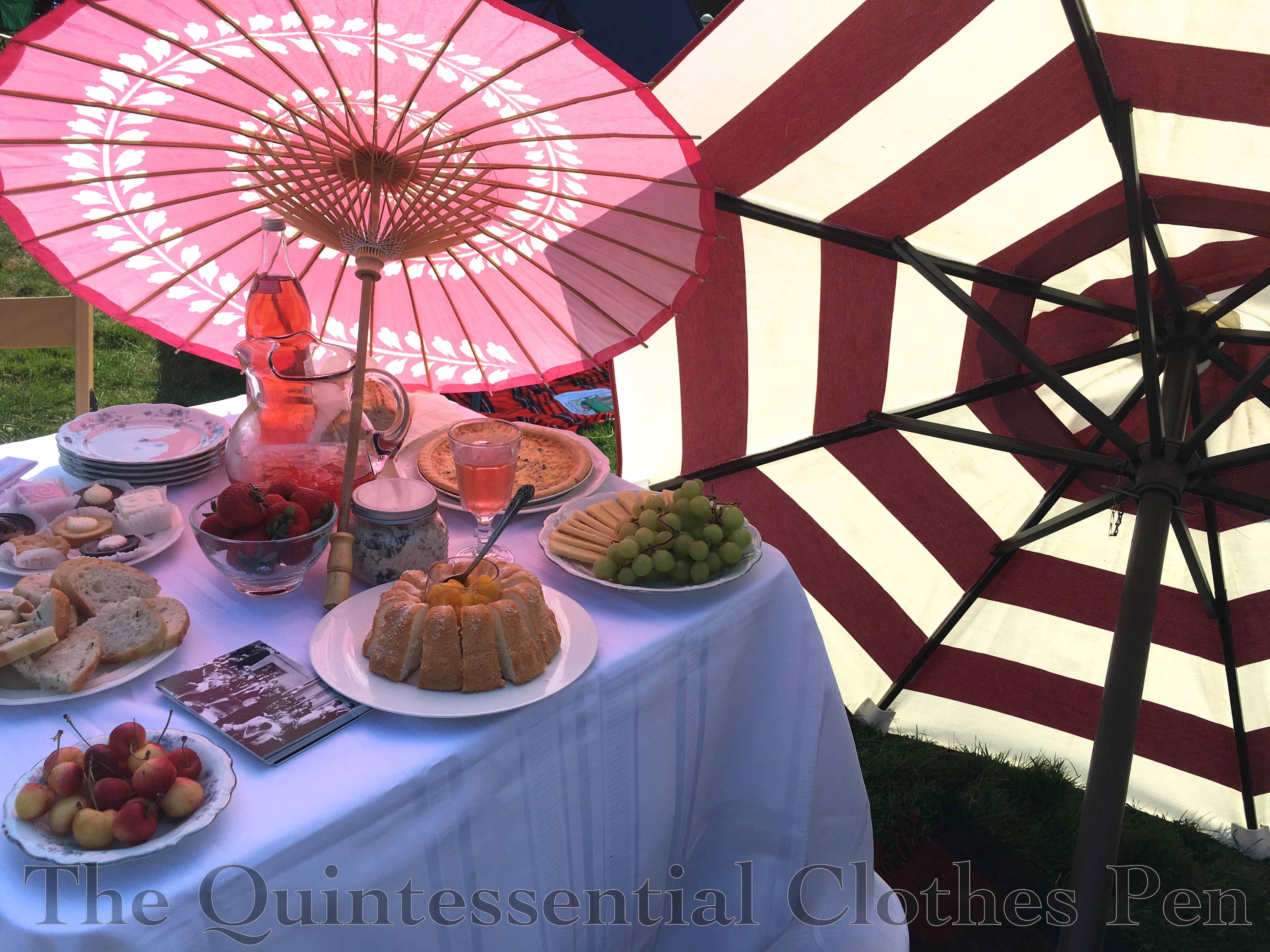
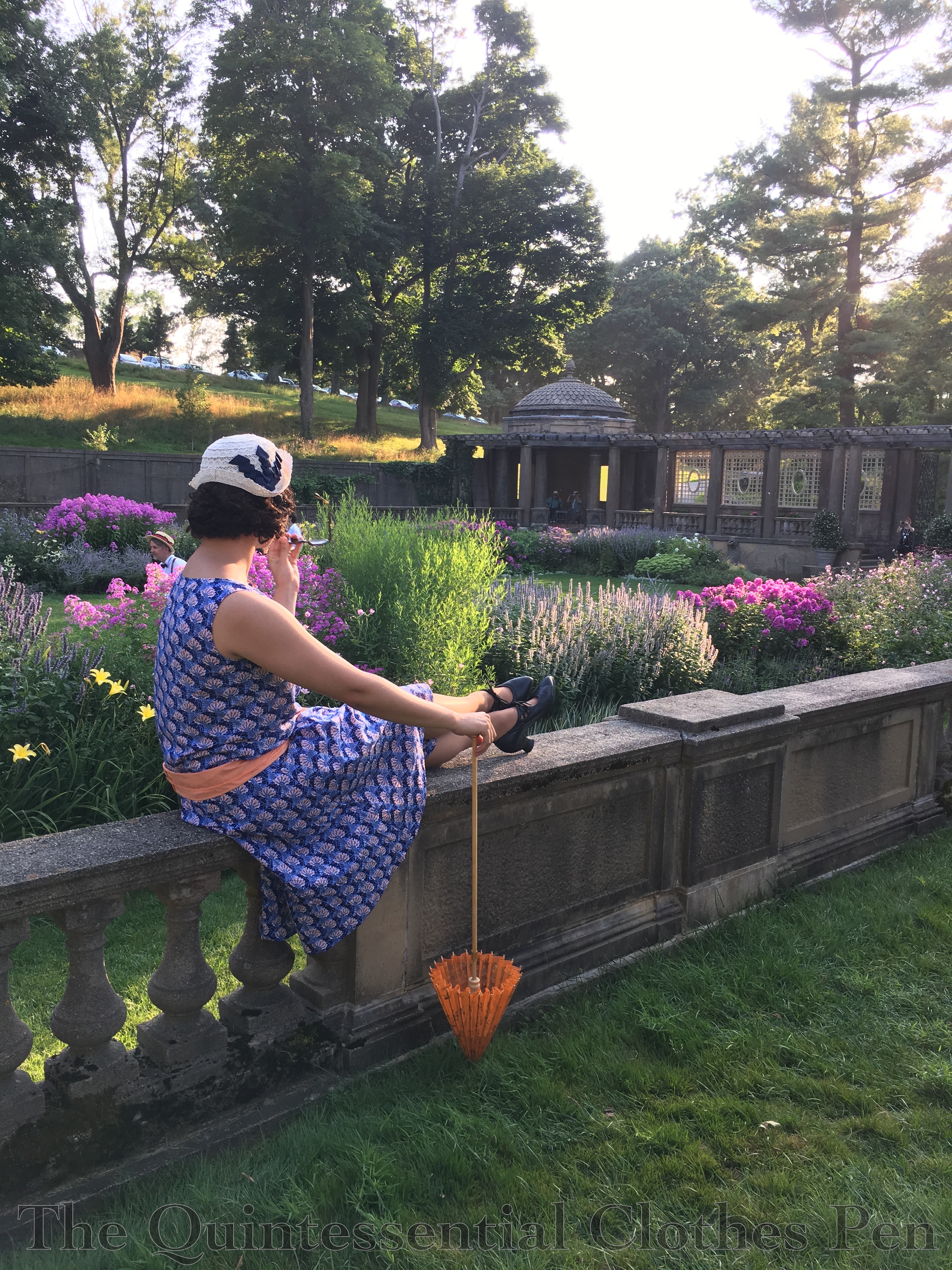
I recently shared photos of my 1925 Blue Coral Day Dress and Lace Cloche, both of which I wore to the Crane Estate Gatsby themed lawn party in August. I wanted to share a few more photos from the day that didn’t fit into posts about the construction of the clothes I made for the event. To start, here’s our elegant, shade-proving picnic setup. This lawn party is always hot, so parasols and umbrellas are essential to stay comfortable.

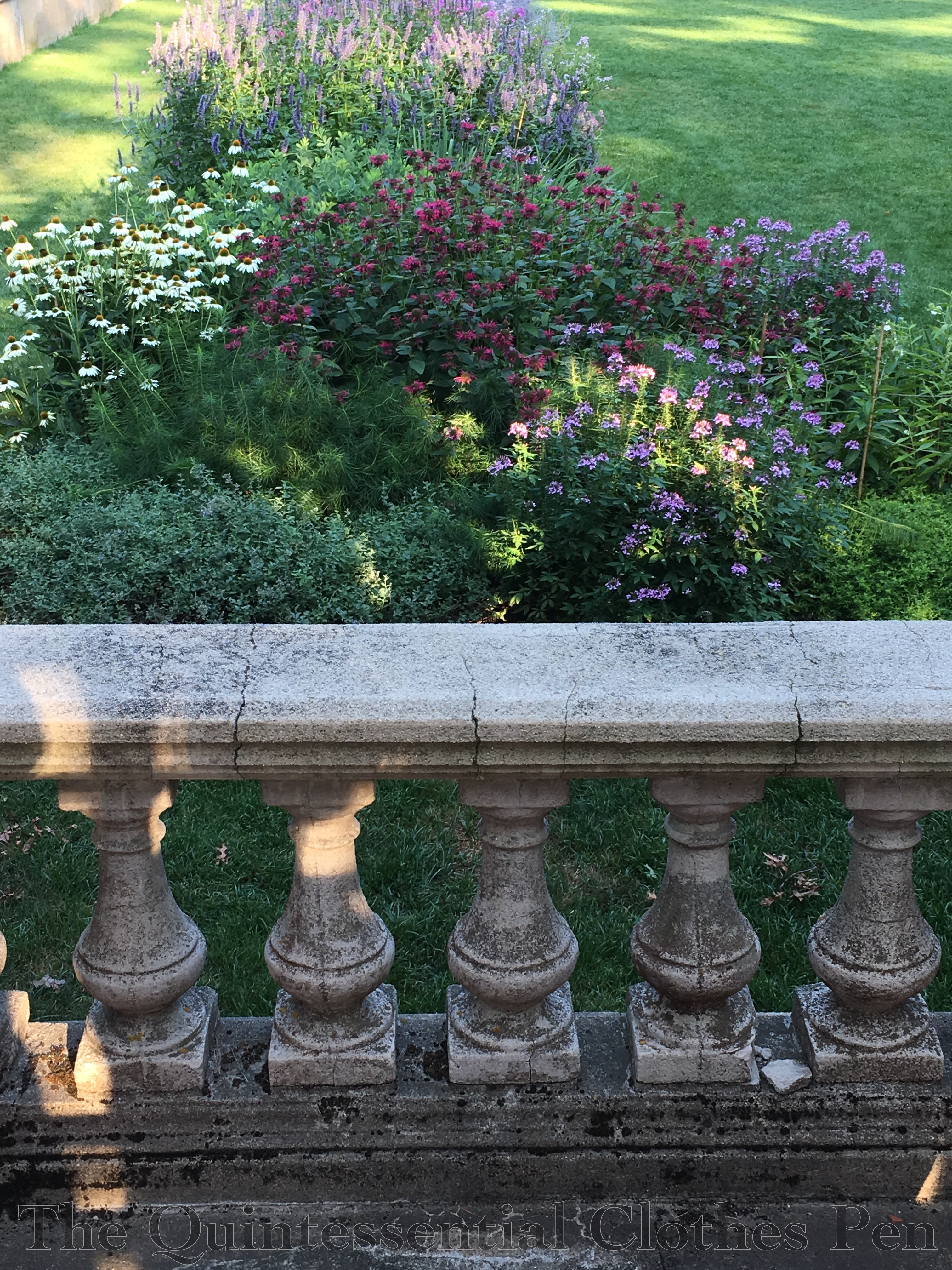
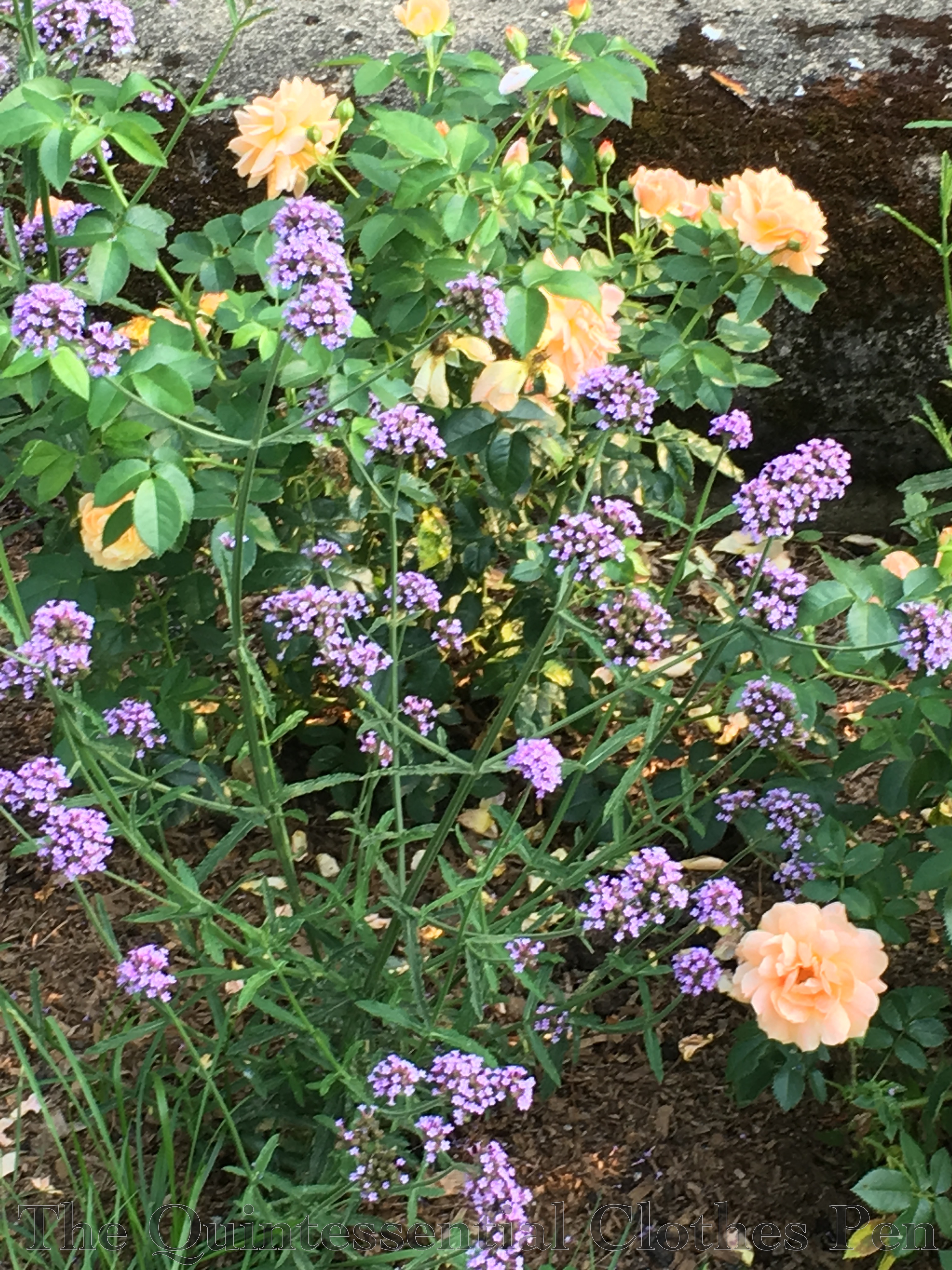
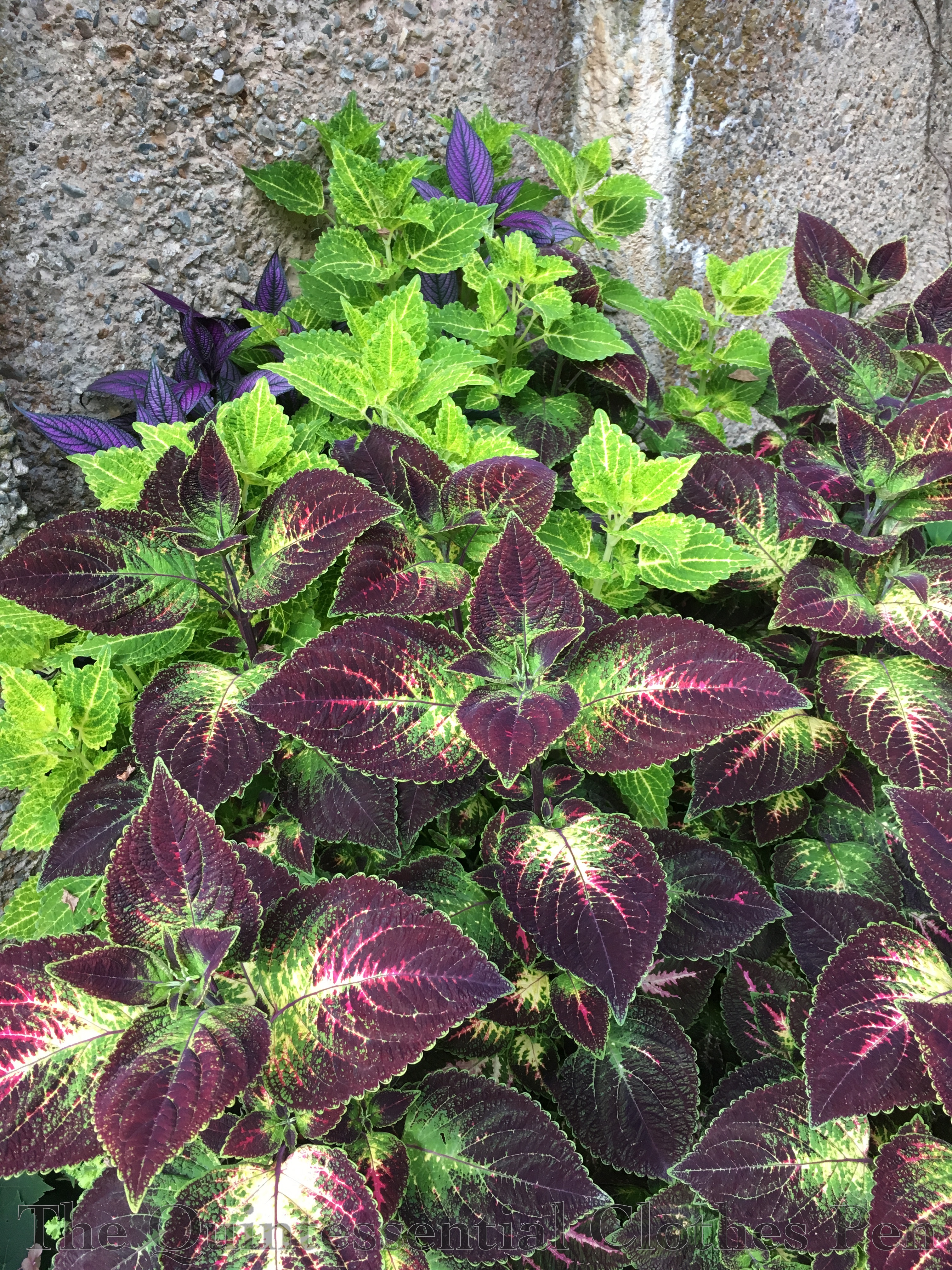
After sitting for awhile we decided to explore the gardens. Every year I’ve been they’ve been a lovely and cool respite during the hot afternoon.

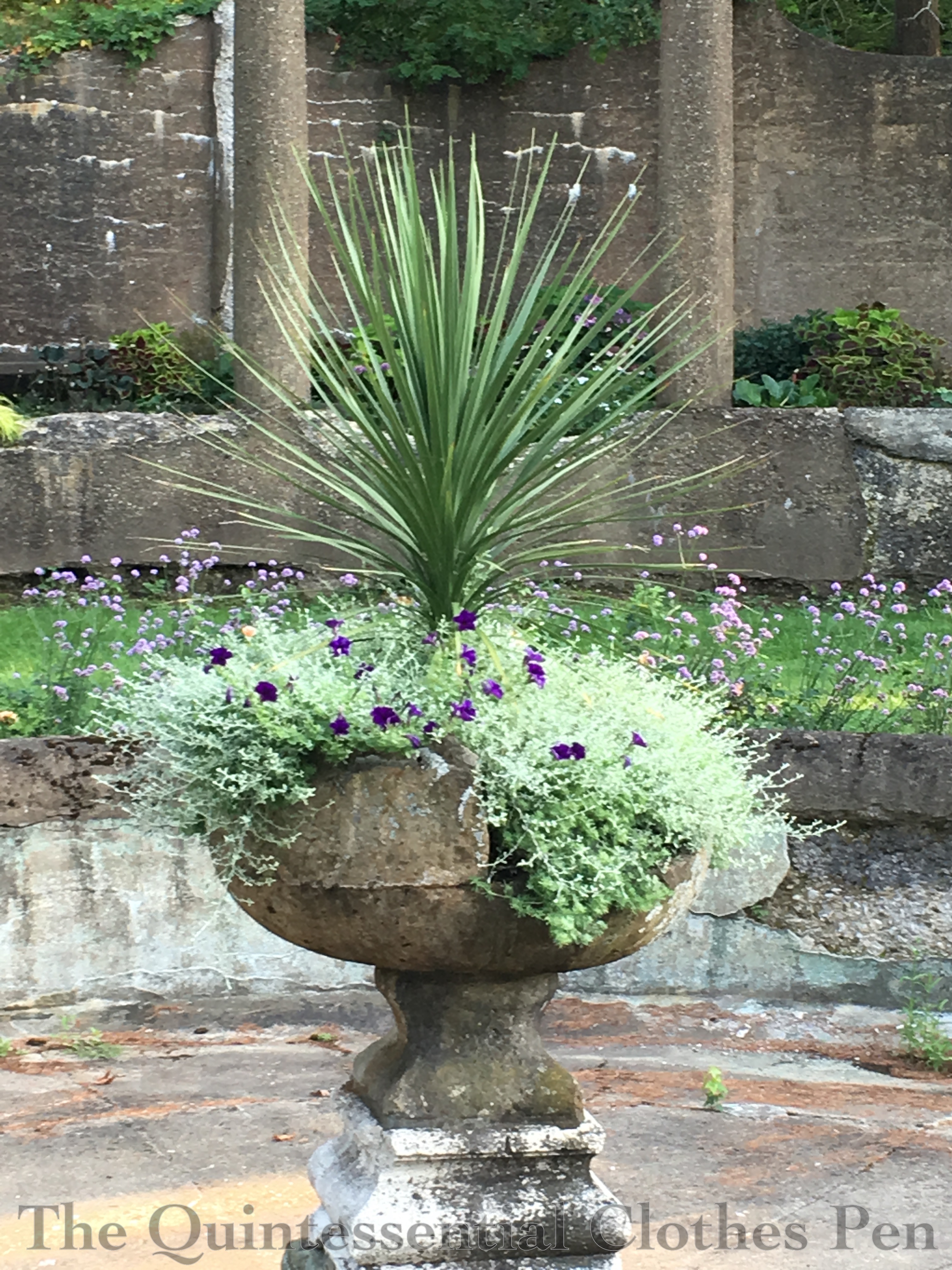
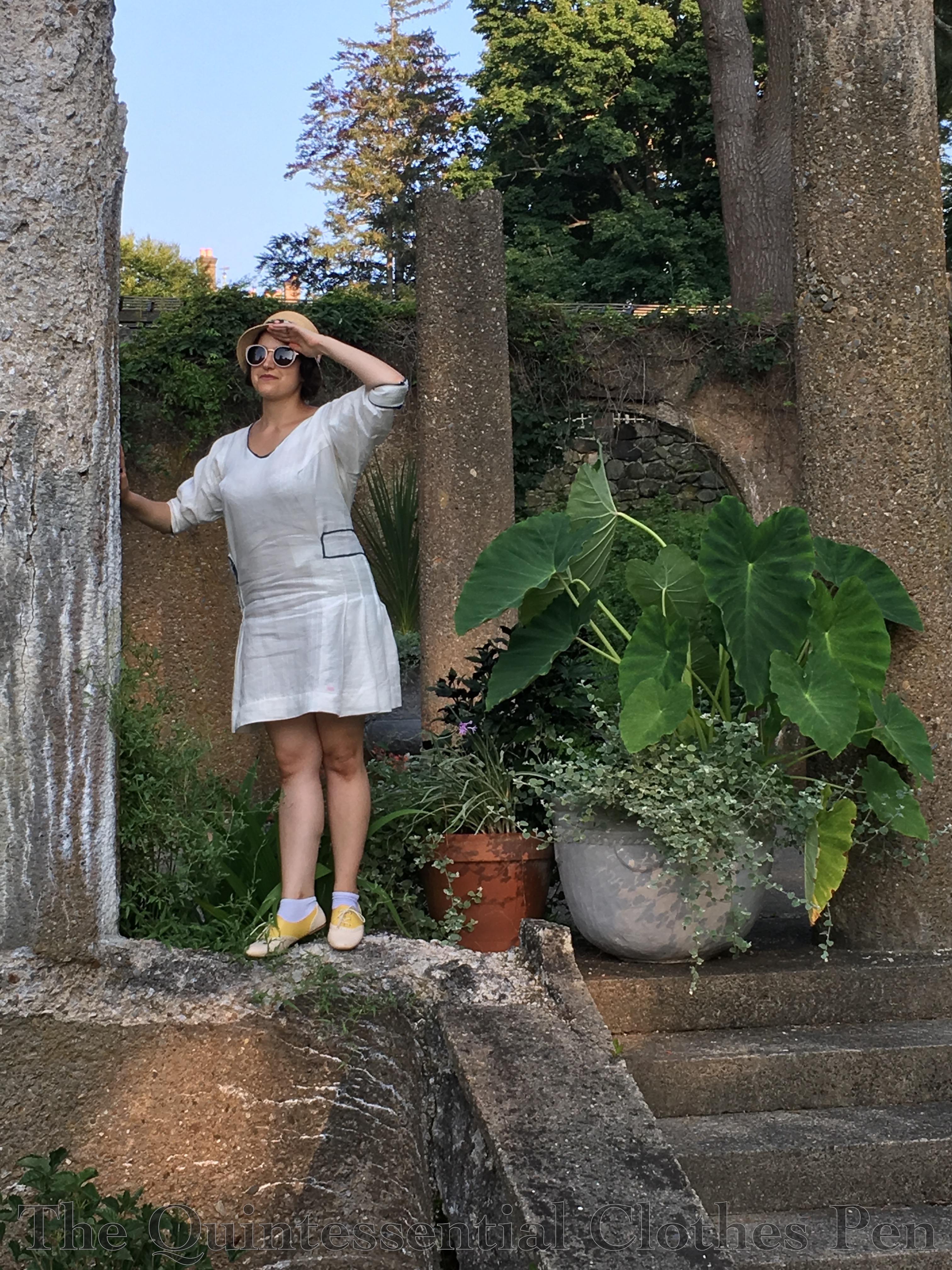
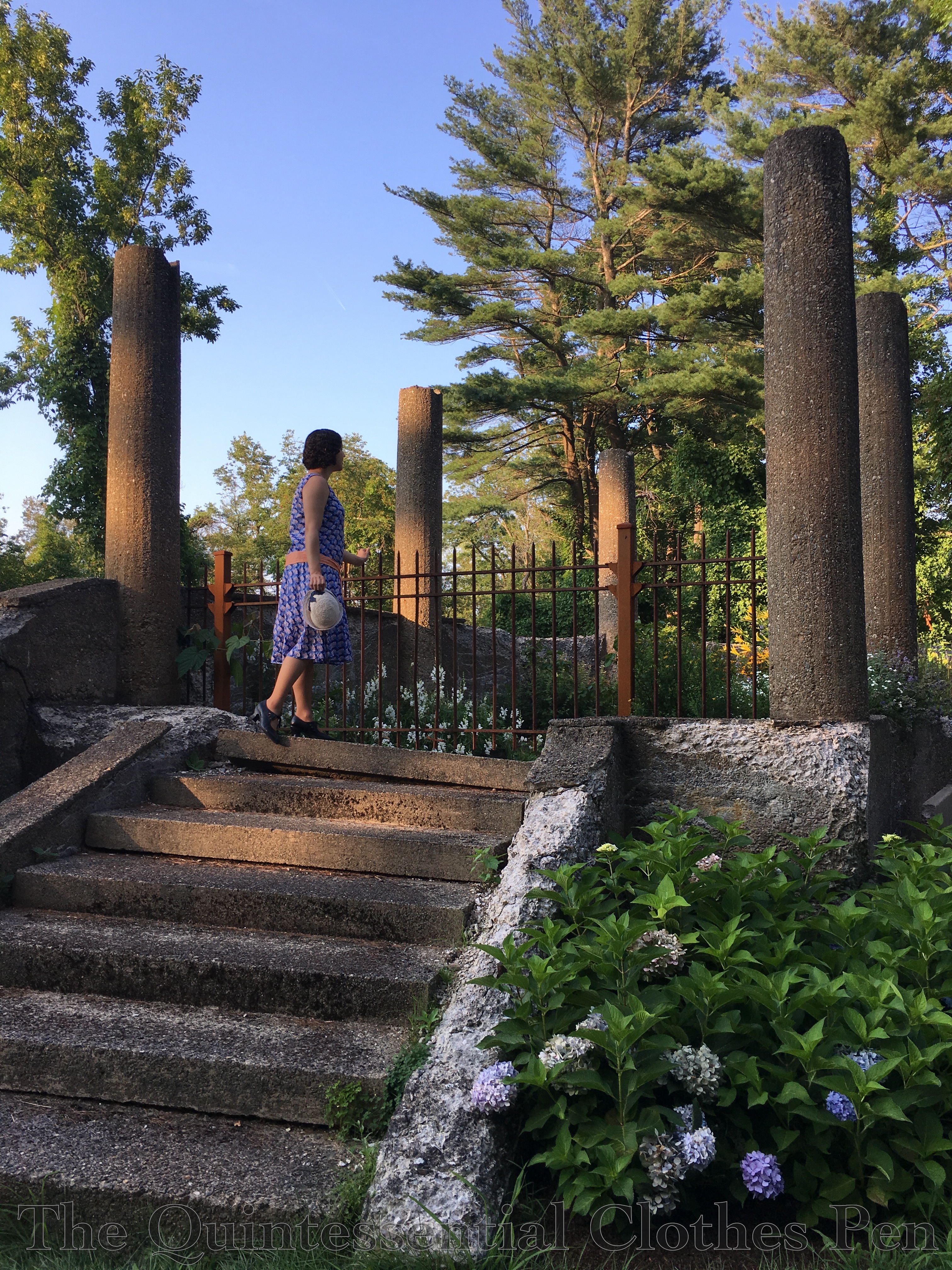
This year we were excited to find that an area that has previously been closed off behind a locked gate was open! (Check out this post to see the closed gate!) There were lovely flowers in this area and fun spots to take photos, too!

I enjoyed looking at the interesting, new sights as well as the columns. It felt like a grand adventure and was easy to imagine we were in the (mostly well-manicured) ruins of some ancient civilization.

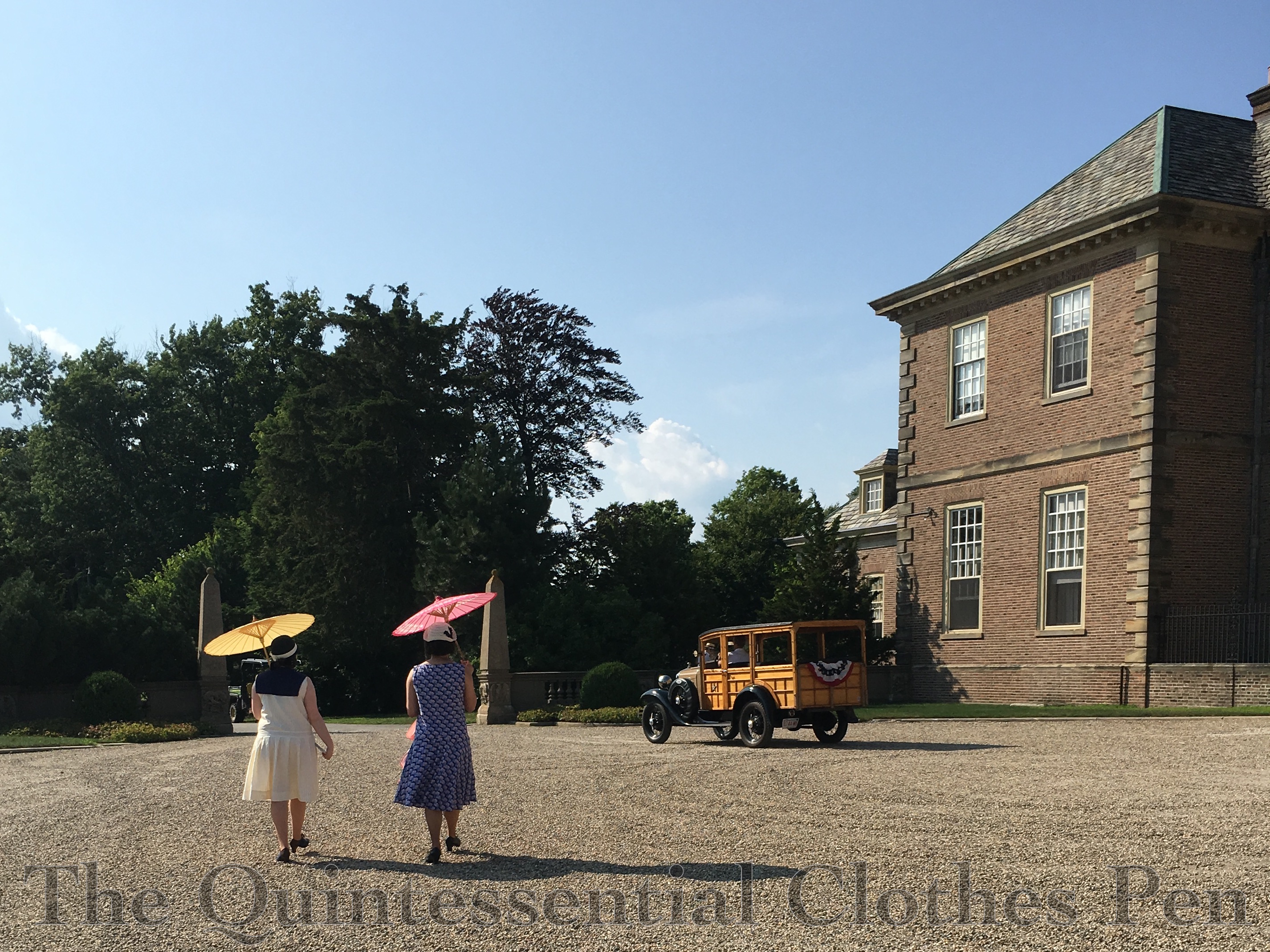
Our walk also included a stroll around the main house, where there were antique car rides. We didn’t take a ride, but it was fun to capture one of the cars in our photos.

All in all, I had a nice day and enjoyed adding new memories to those I already have from this event.

1925 Blue Coral Day Dress (HSM #8)

The summer has been very busy and I don’t feel like I’ve completed very many sewing projects for myself. Really the only reason I’ve completed anything is because I’ve been live streaming my sewing, which forces me to make things from the list of the-things-I-want-to-make-that-I-never-make-time-for. Do you have a list like that? Mine is lengthy!

One of the first of these things-I-don’t-usually-make-time-for projects was a dress made out of one of the fabrics I bought earlier this year. I really wanted to have it for events this month as they are generally quite hot and the fabric I found is nice and lightweight while still being opaque. I found this fabric at a local discount store for the awesome price of $2.99/yard and then later saw it at a regular price store for somewhere closer to $10/yard, which really made me feel like I got a deal!

The pattern for this dress is a Quinnpen special (ie. made by me). I took my inspiration directly from this extant dress at All The Pretty Dresses. Due to that, it qualifies for the HSM Challenge #8 Extant Originals (copy an extant historical garment as closely as possible)!

To start, just the facts:

Fabric: 2.5 yards cotton lawn.

Pattern: My own.

Year: 1925.

Notions: Small bits of contrasting fabric for bias binding, thread.

How historically accurate is it?: I’d say this one is about as close as I can get to 100%!

Hours to complete: Approximately 8 hours.

First worn: August 5, 2018.

Total cost: $10.50 (including the fabrics I used for decorative sash options).

For the bodice of this new dress, I started with my 1927 Blush Sparkle dress (that dress started life as a tube before I added a head hole, armholes, and side seams/darts to about the hip level). For the skirt, I made a circular pattern that had the zig zag top edges that are featured in the extant dress. It was a bit of trial and error process to get the zig zags just right, but I made it in the end! You can see the topstitched zig zag detail on the extant inspiration if you look at the pictures carefully.

The zig zag top edge of the skirt is pressed under and topstitched onto the bodice. On both my dress and the extant dress that detail gets lost in the pattern, but it allows the skirt to have a lovely drape and fullness while the top can stay that straight 1920s shape that is so iconic. Here’s a closeup of my topstitching. Not bad on the pattern matching!

I finished my dress armholes and neck hole using bias, as I believe the original did based on looking at the photos. My only changes here were to use a contrasting color so I could actually see where the openings are (before I put on the orange binding the blue on blue pattern just made a big indistinguishable pile!) and to turn the bias binding to the inside of the openings (given that I was using a contrasting color). Aside from that the only other detail I omitted was a center back seam on the bodice since I had enough fabric not to need it when I was cutting out the pieces.

The photo above shows the dress with two different sash options that I made for it: pink and orange. I bought the orange when I bought the blue, but when I got home I thought it might be too bold and decided I might like the pink better. But I really couldn’t decide, so in the end, I made both!

When I wore the dress, I was still undecided… so I took pictures with all three options: no sash, pink sash, and orange sash. See each look below!

The idea behind a sash was this inspiration: Wilton Williams, The Bystander, August 12th 1925, though after wearing it my preference is no sash! I think that the bold, large scale patterns in the fabrics of the inspiration dresses lend themselves better to a sash than this blue dress.  The bonus part of not having a sash is that the dress is easy to wear, there’s no fussing with keeping a sash in place, and the dress really does have a nice 1920s shape to it even though the detail of the zig zag is lost from more than a foot or two away. What do you think? Does one style of sash (or no sash) speak most to you?

It’s fun to have a new dress to wear, discuss, and document! There are more dresses in the live stream queue, so if you want to stay in touch with what I’m making I would love to have you join me for one of my virtual sewing circles. You can join me on Wednesdays and Fridays from 9-10:30pm EST!

Spring & Summer Fabric Stash Additions: Stripes & Patterns

For most of this year, I’ve had a dress in mind that I want to build for an event in August. I’ve been on the hunt for just the right striped fabric for it for a few months, but really hadn’t found anything that was just right. I was shopping for another fabric and saw that Farmhouse Fabrics had a large section of stripes… I had to come back and look through them!

‘Danger!’ Should have been posted somewhere, because I wound up purchasing three different striped cotton fabrics instead of just the one I’d been looking for!

I have solid plans for all three fabrics, which somewhat justifies their purchase. The green seersucker I plan to make a modern dress out of, most likely with a circle skirt. The cotton candy stripe, as I call it, I’m planning to also use for a modern dress based on New Look #6143. The yellow stripe is intended for McCall’s #7153, a 1933 Archive Collection pattern.

I also came across (yes, I promise, I wasn’t intentionally looking for these either!) two interesting patterned fabrics this spring.

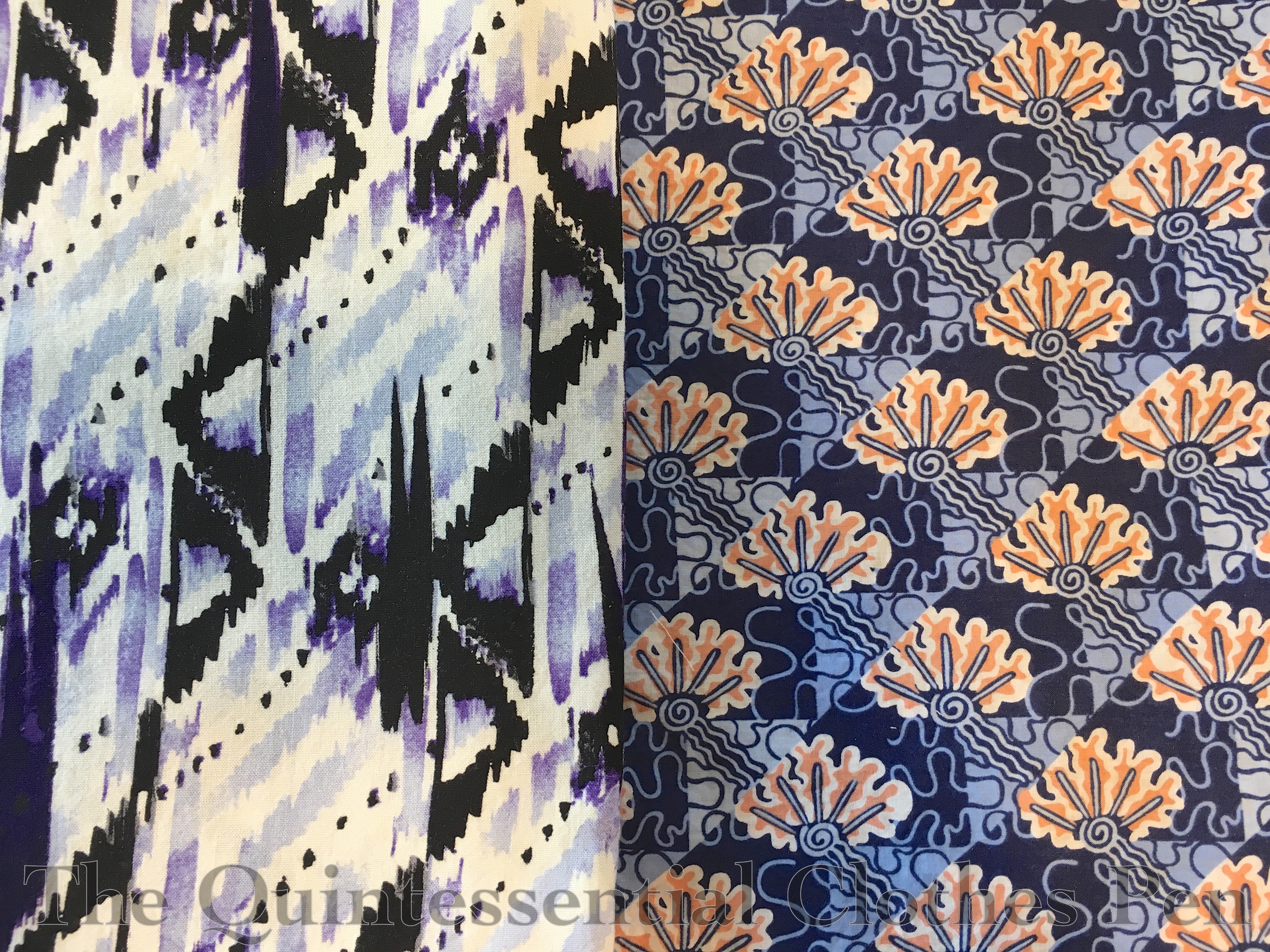
The one on the left is a rayon from Joann’s (and in looking for the link I see they’ve got a whole bunch of lovely looking new rayon prints–more danger!). It’s great that they’ve got a wider variety of fiber contents lately. I think it will make an interesting Henrietta Maria. Leimomi posted one awhile ago that I loved and this fabric reminds me of it a little.

The fabric on the right was super discounted at a local store (though I’ve seen at regular price at another store, so I definitely got a deal). It’s a lovely cotton lawn that I think will make an interesting 1920s day dress. I’ve got lots of evening gowns but my daywear options are somewhat limited. It will be fun to have new 1920s daywear! In fact, I’ve already started making a dress with the cotton lawn! I’ve been posting progress pictures of it on my Instagram account. Check it out!

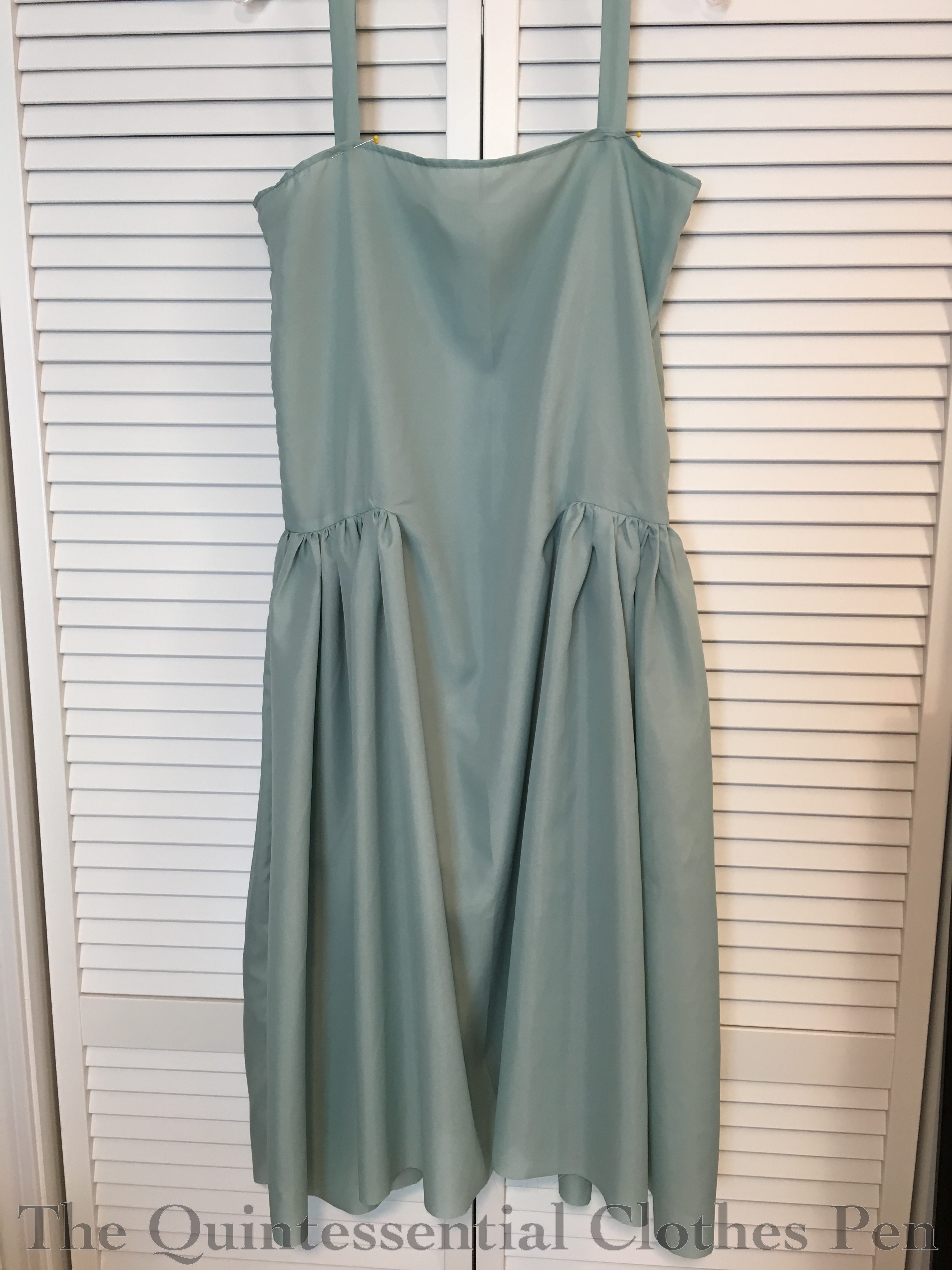
Oh, I also came across remnants of seafoam green silk taffeta for a bargain price that I also bought, though I don’t have a picture or a specific project in mind for that. It’s hard to pass up silk taffeta even when there is no project in mind, because if you go on a hunt for a specific color you can’t usually find it at a bargain price.

I’m looking forward to putting these new fabric projects high enough on the to-do list to actually accomplish them!

SaveSave

SaveSave

SaveSave

SaveSave