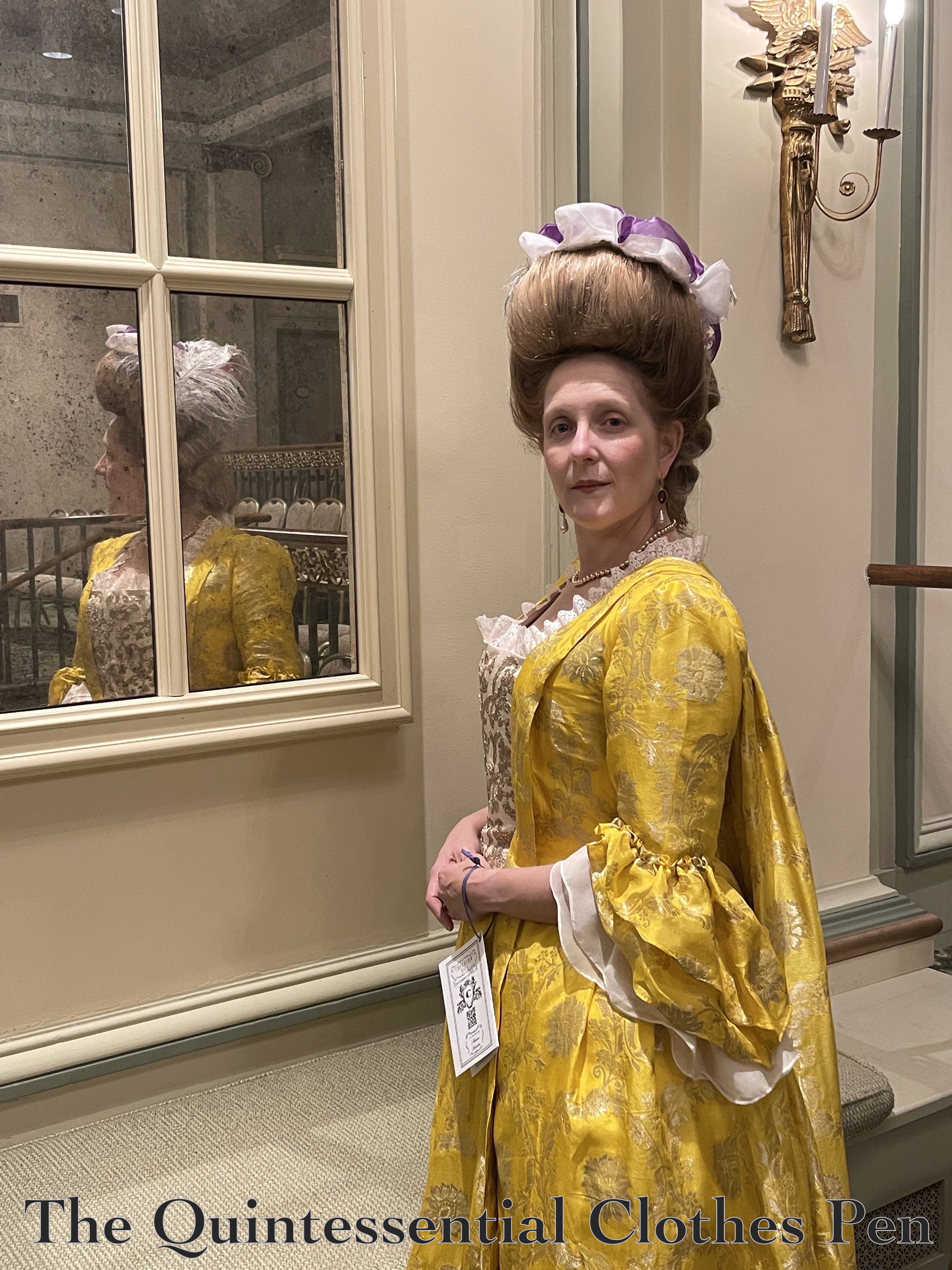
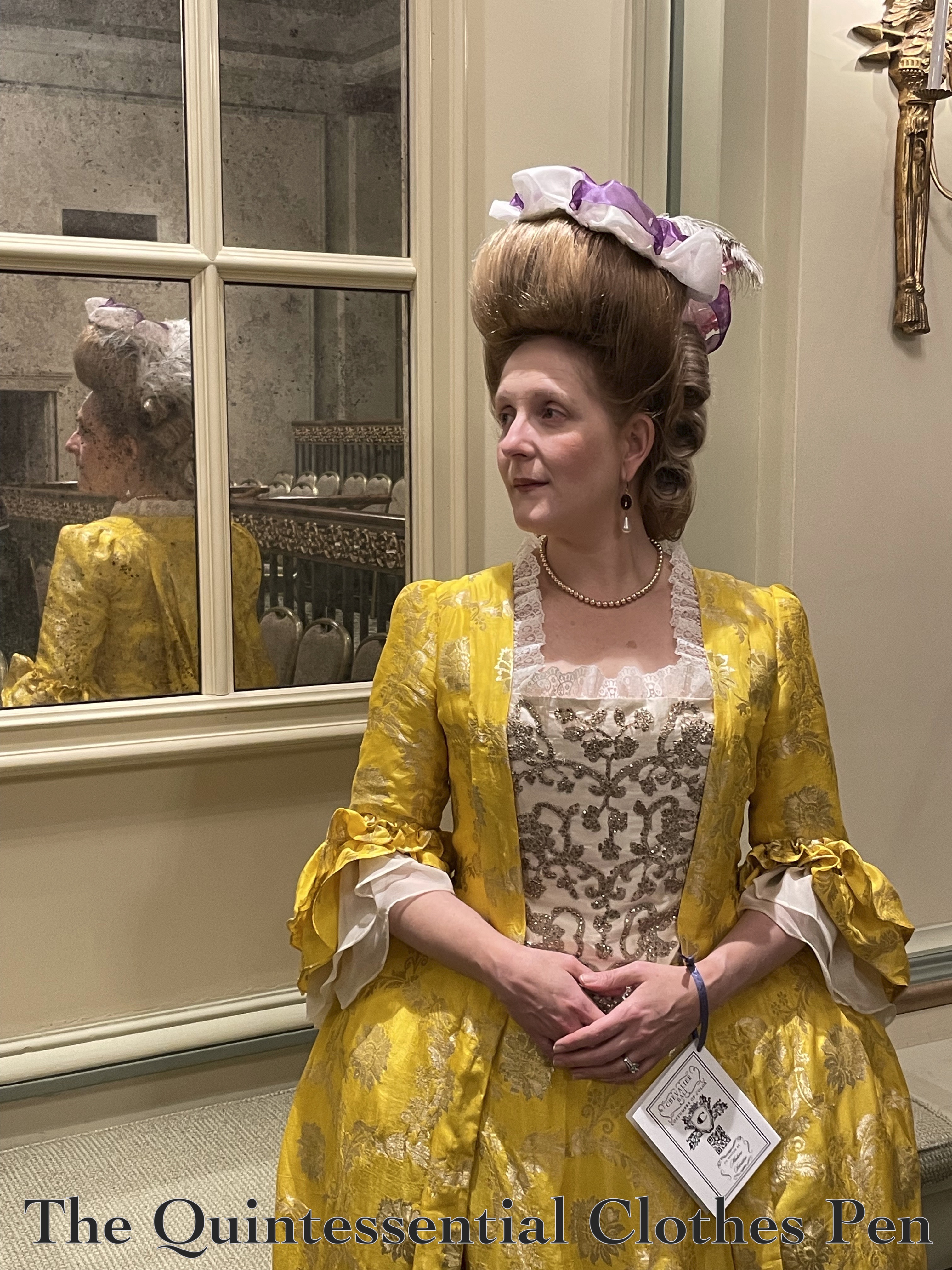
Two Sacques At ‘The Salon at Palais-Royal’

I am finally ready to share a full set of photos of the new Yellow Sacque and its friend, my older Versailles sacque (all of the construction details for these dresses can be found by clicking the links)! The two dresses had a joyful outing together at an event last year. This post is going to share about the event itself as well as photos and recollections.

Below, a photo of the Versailles Sacque and new Yellow Sacque next to each other!
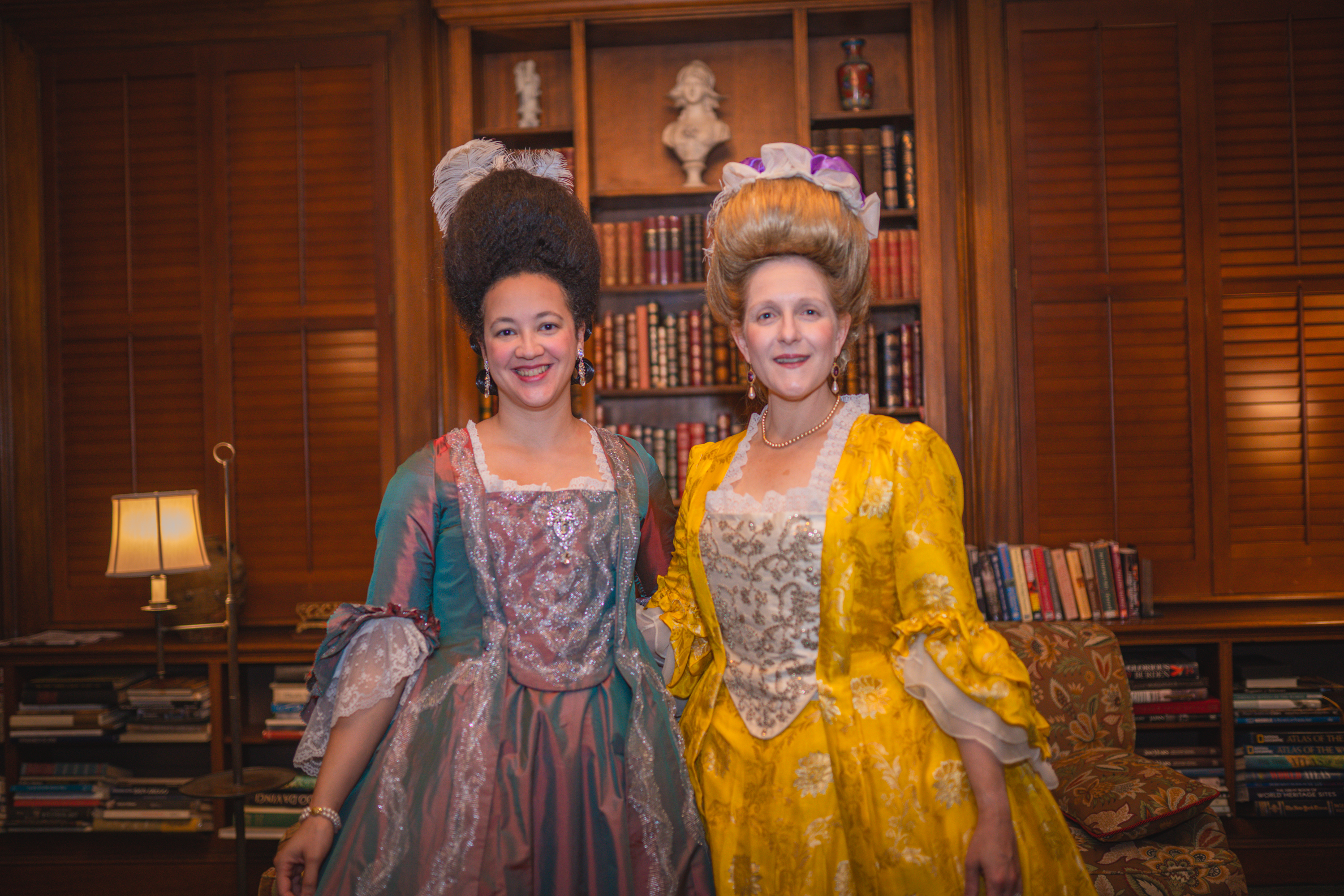
Photo courtesy of Aleks Vu

About The Event

In October 2024, I had the great joy of attending the ‘Salon at Palais-Royal: An 18th-Century Chevalier Experience’ weekend hosted by Costumers of Color. The program included educational lectures, a violin concert, historical activity discussions and demonstrations, dancing, and more, with the goal of providing an inclusive environment for people of color both in terms of attendance and in terms of the educational theme of the event.

It was a success! Costumers of Color shared on the page for the event that “over 40 of the 140 attendees were POC (people of color).” That’s pretty amazing, and special! (If you go to the linked page, you can see group photos, one of which is of all the people at the event who identify as people of color.) I enjoyed that aspect of the event, as well as the educational theme that centered Joseph Bologne, Chevalier de Saint Georges, an 18th century Black “scholar, a fencer, a virtuoso violinist and a famous and sought-after composer.” (This quote is from the Costumers of Color blog post about Joseph Bologne. Please go give it a read if you would like to learn more! Bologne’s achievements are impressive!) In addition to these elements, I also enjoyed the combination of learning and participating that was incorporated into the weekend.

What Was Worn

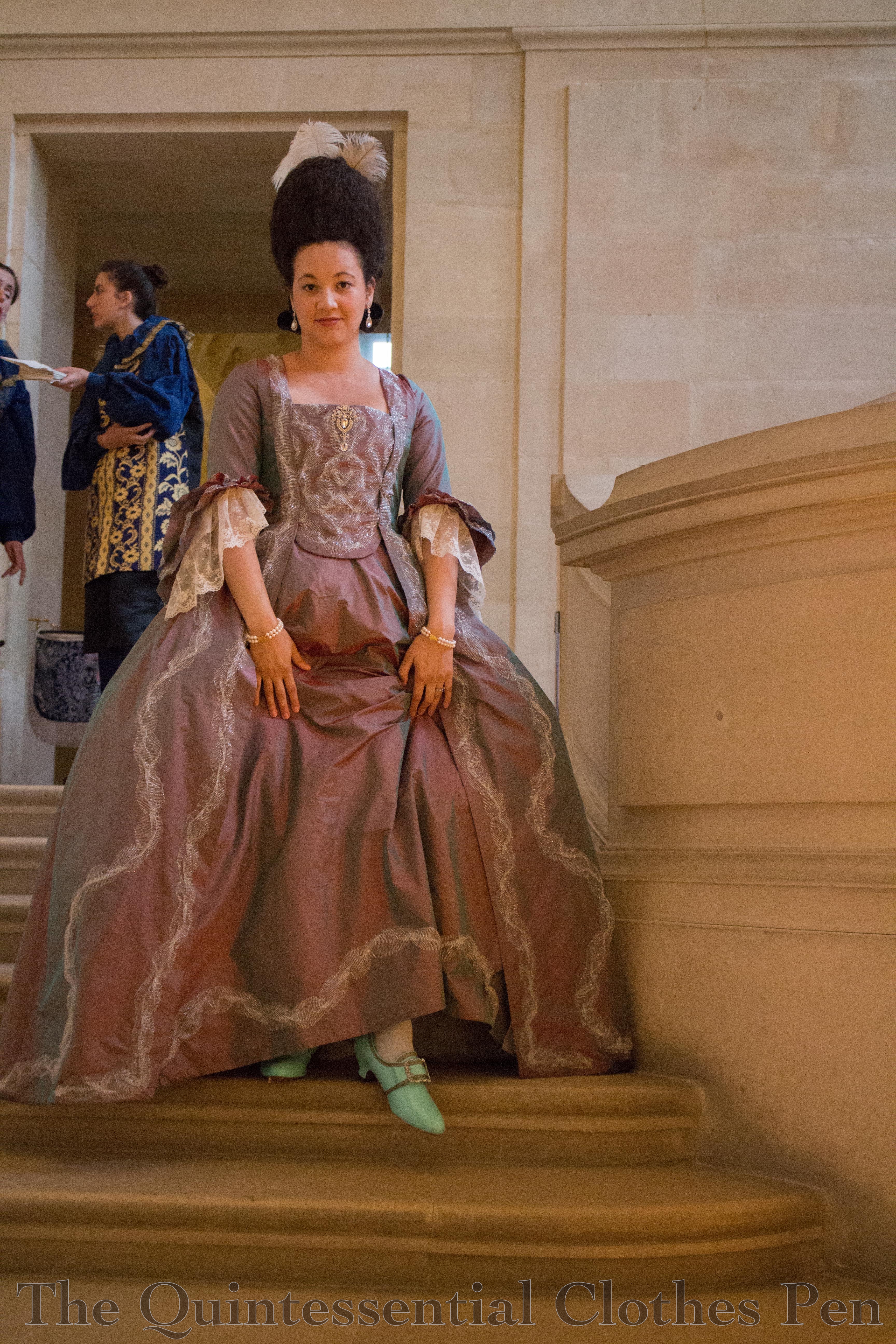
For the formal evening part of the event, I chose to wear my Versailles Sacque (made and last worn in 2016, which I posted about here)! For this wearing, I updated the ensemble with a lace tucker around the neckline of the dress. This small new accessory helps complete the full look. It took a little bit of referencing my old blog posts to reconstruct my hair form and remind myself what accessories to wear, but I was successful. I was very grateful to myself for documenting things so well!

I also had the pleasure of seeing the new Yellow Sacque and all of the new accessories I’ve been making being elegantly worn by a friend!

Below, showing off both the front and back of the sacque (or Robe à la Française) style of dress.

Photo courtesy of Aleks Vu

More Photos

I was so pleased that my American Duchess Kensingtons were still in good shape after the immense amount of rain they endured in 2016. It was really exciting to break them out again with this dress! I’m still chuffed with the metallic lace I added. For Versailles, more bling was the thing! And in this photo, you can see how the light turquoise paint color picks up on the hints of turquoise in the dress fabric!
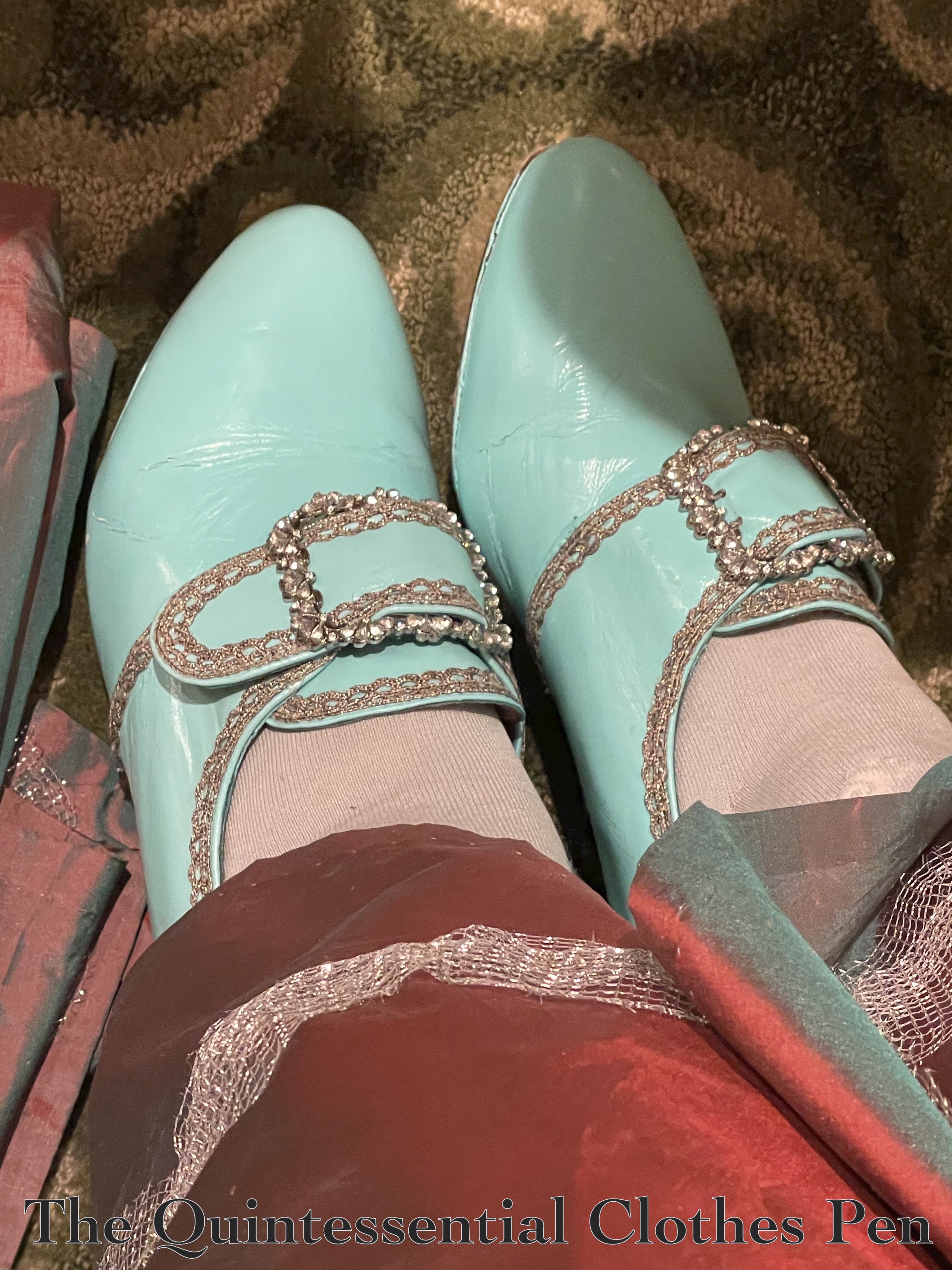
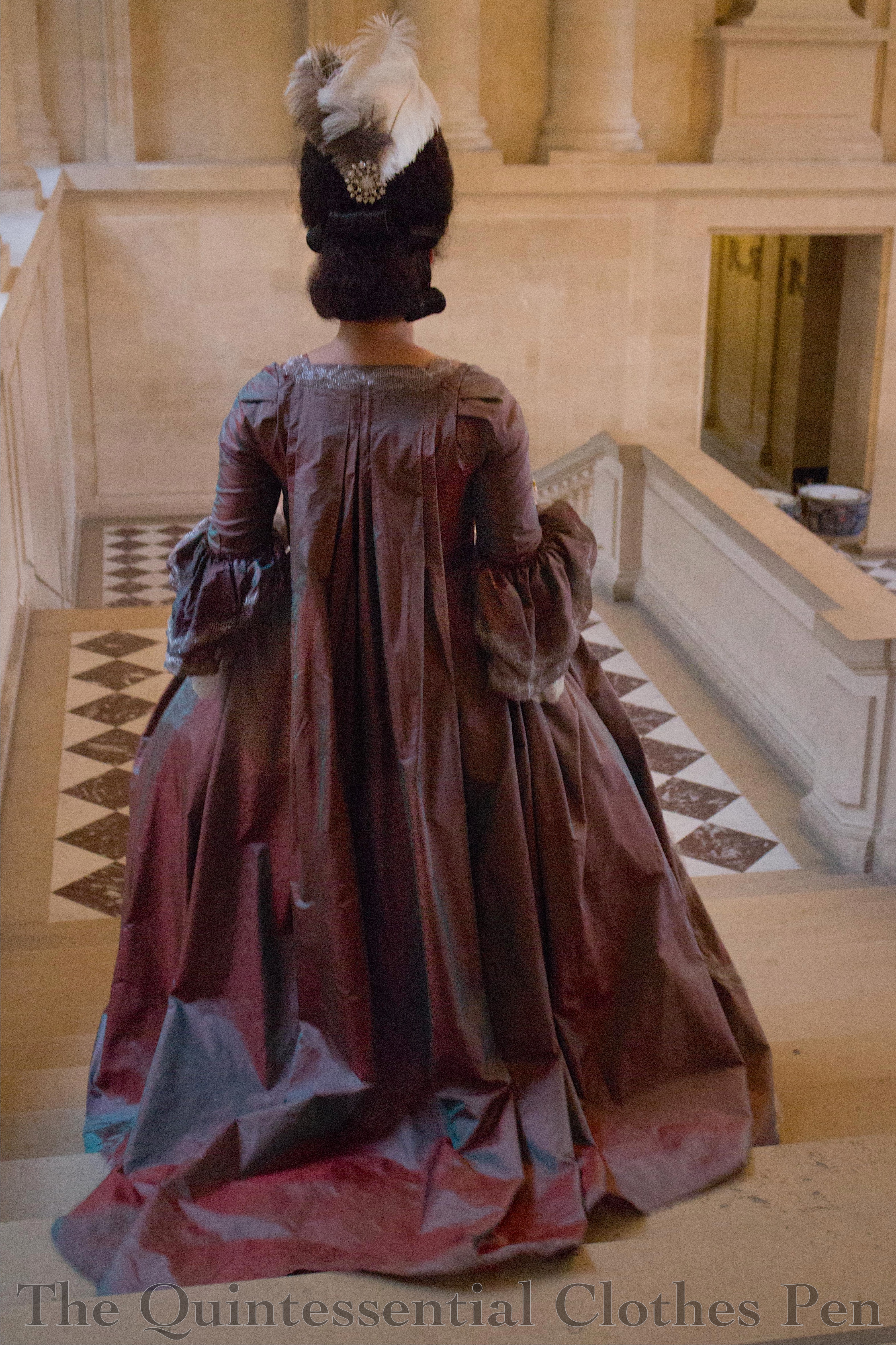
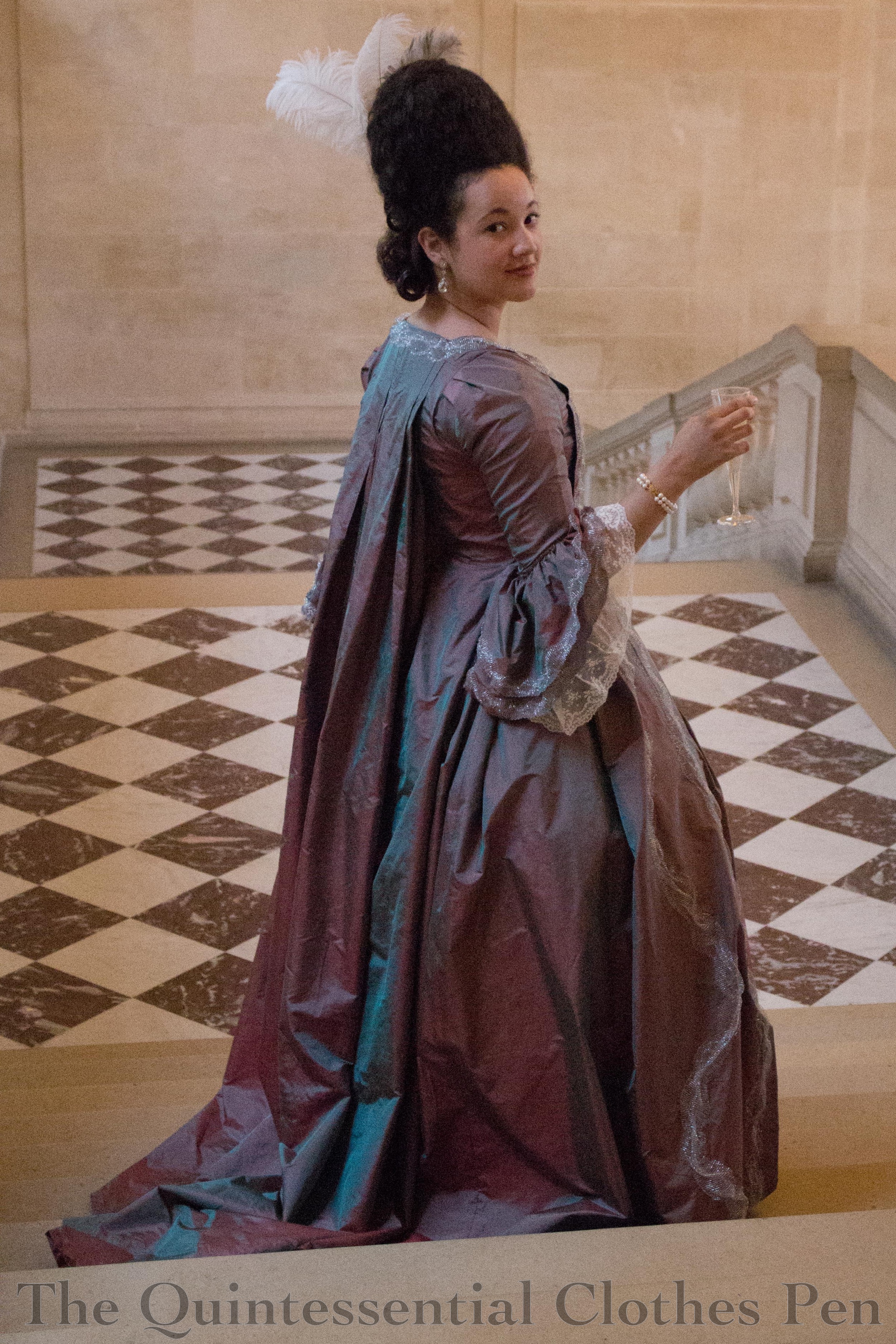
One of the things that I’d struggled to capture in photos for the Versailles dress’s first wearing was the changeable nature of the silk fabric. It is a ‘shot’ fabric, meaning that it uses two different colors woven in opposite directions: a vibrant turquoise and a deep red. This means that fabric appears to be both colors, or a mixture that looks a bit purple, depending on how the light hits it.

Most of my photos from the first wearing of the dress show the purple color, but the lighting at this event captured the many colors of the fabric much more clearly! Below is one example. Most of the dress appears in the red tone, but the shadows of the dress in the back look like the green color.

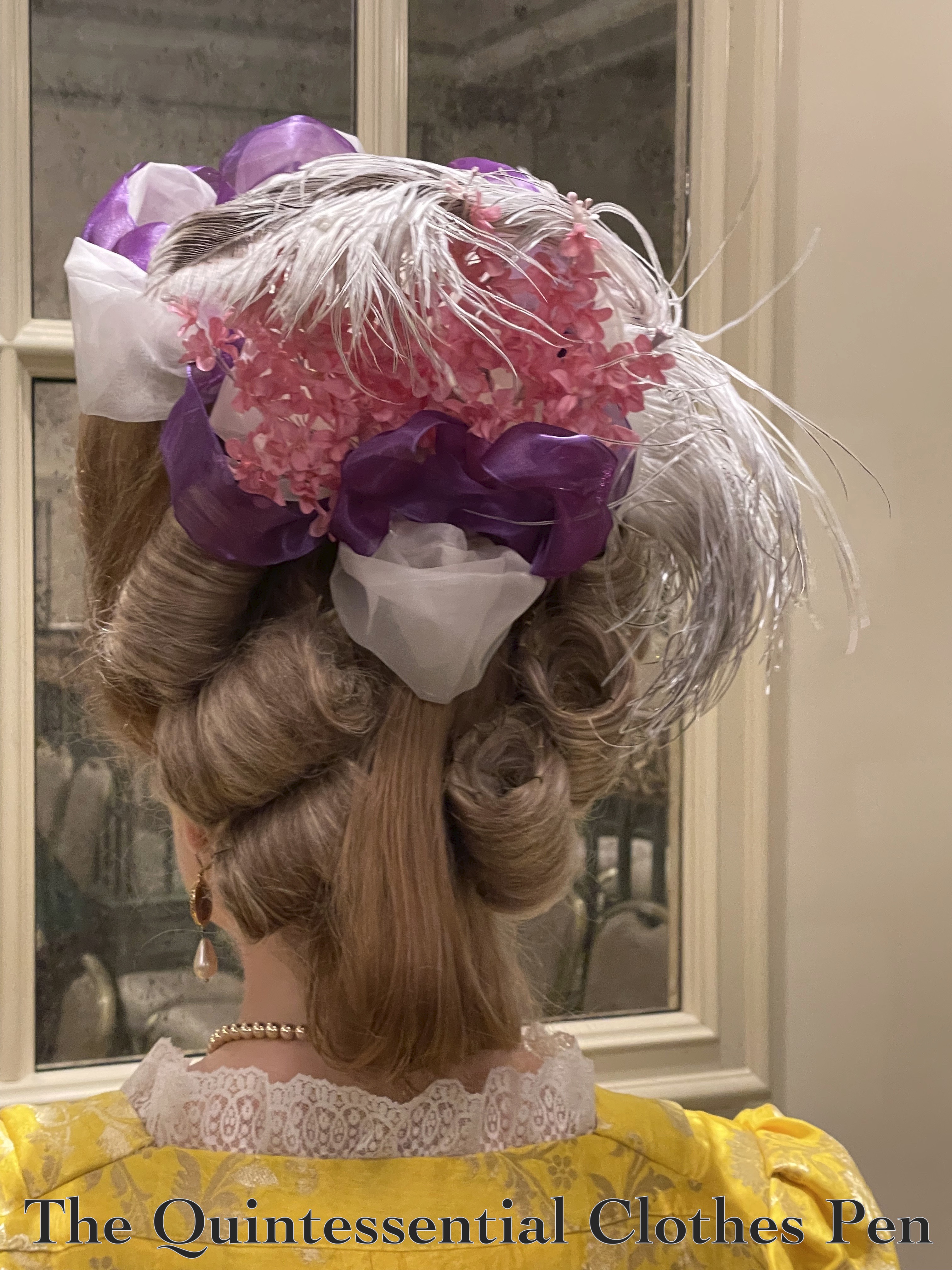
As I mentioned earlier, I had to reconstruct my hair style for this wearing. In 2016, I cobbled together a large form from many hair supports on hand (you can read about that in this past post). After that event, I deconstructed the large form in order to be able to use the individual parts again. So for this, re-forming the large form was necessary.

Below, you can see the final result of the style. This is the same style I created in 2016. (You can read more about it in this past post.)

My friend wearing the Yellow Sacque also had a fabulously large hairstyle! Her style uses elements from the book The American Duchess Guide To 18th Century Beauty, including the ‘Ski Slope Hair Cushion’ and ‘1770s Pouf’ on pages 119 and 127. She also created her own buckles (those pre-made rolls of hair on the sides). And I had fun helping her place them the day of. It was fun to make two styles that are similar, but different in shape and details!
Recollections

I had a fantastic time traveling with friends to this event. We all enjoyed the content of the weekend as well as the opportunity to make or refresh our clothing and accessories.
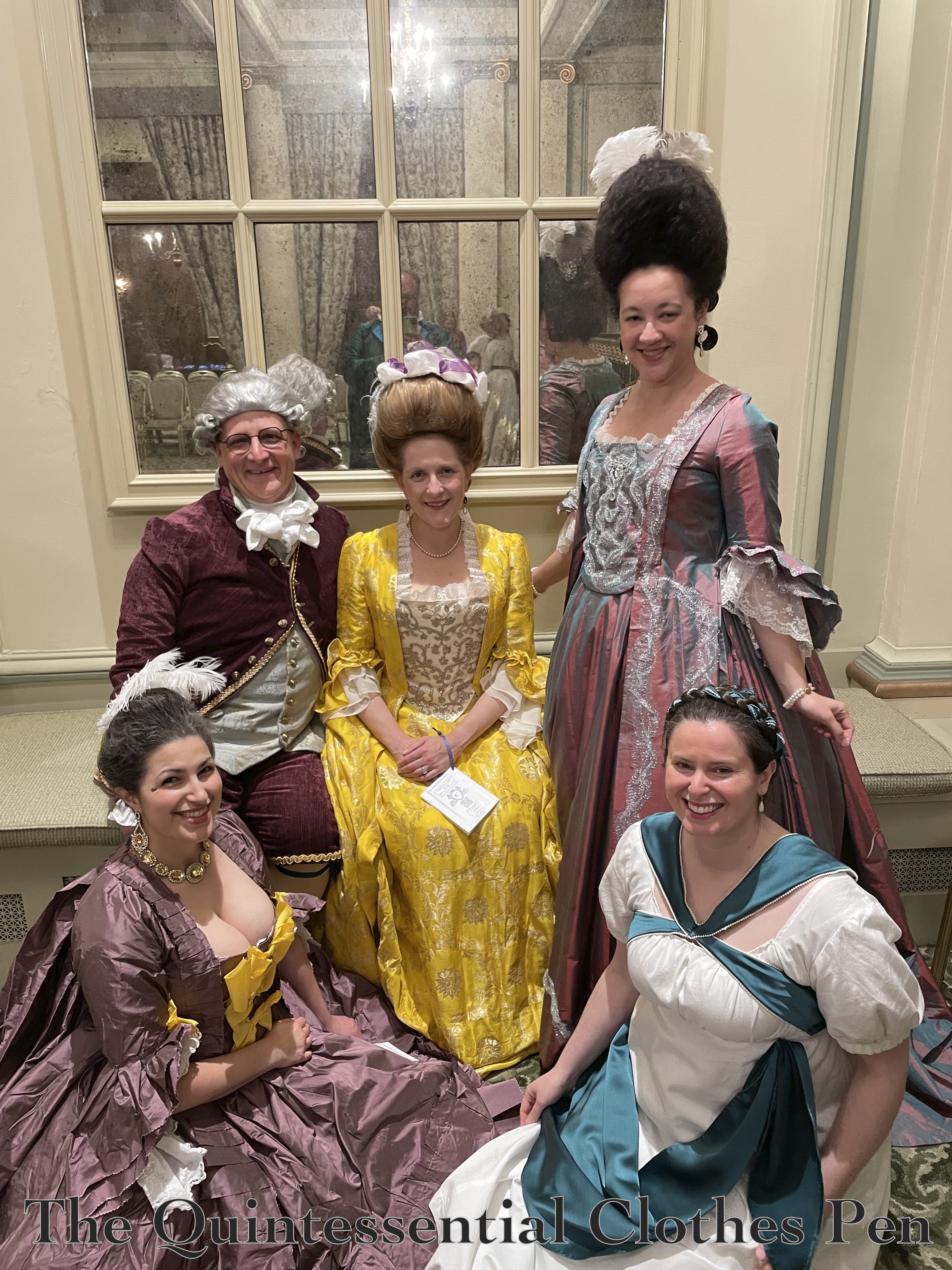
In fact, we had such a lovely time we felt the need to take a break in the ladies dressing room! How could we not, with such an elegant day bed and foot stool to lounge on?

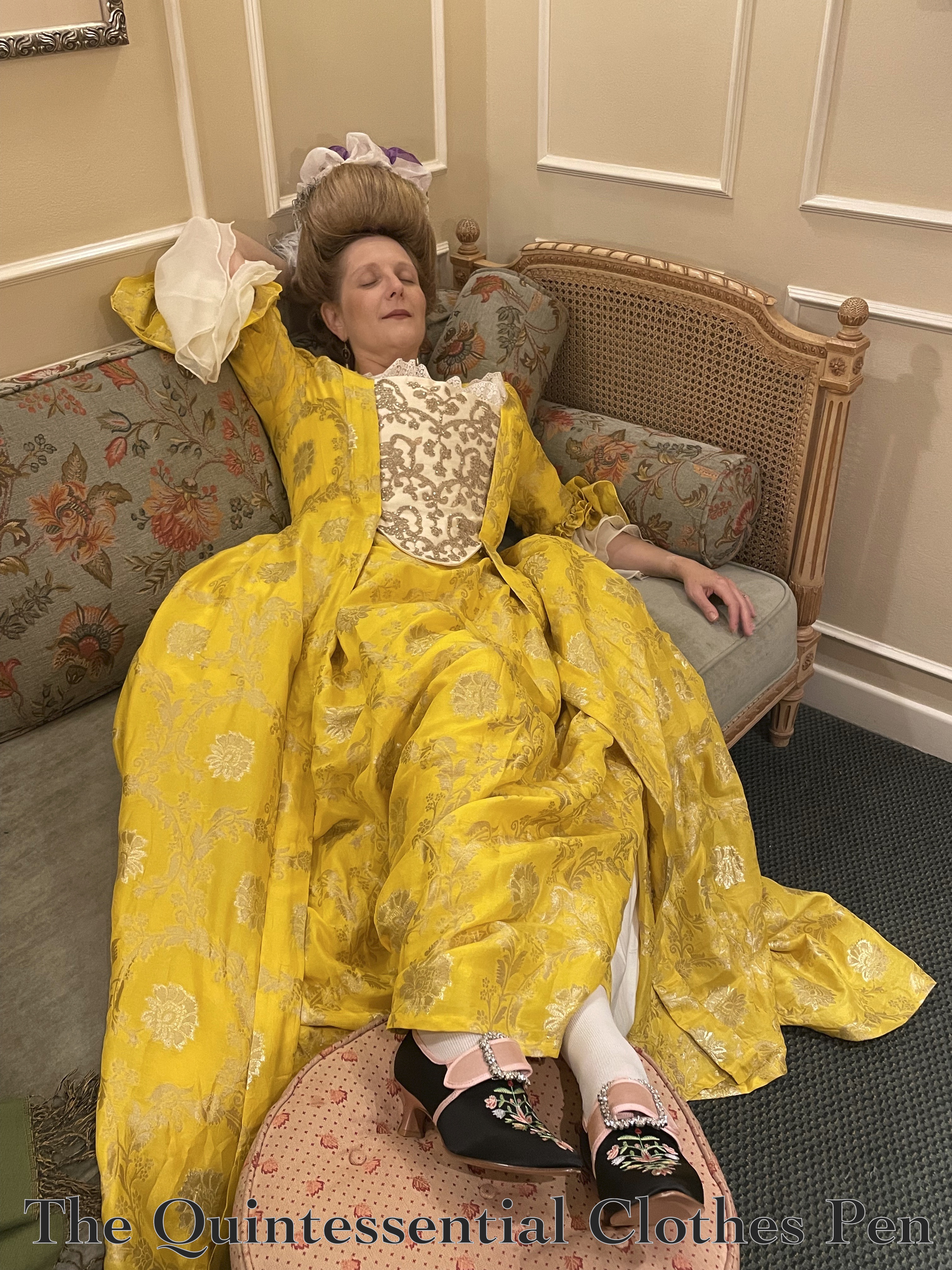
It was also a special experience to have the opportunity to meet other bloggers and costumers I don’t often (or ever) get to see in person! We might exchange comments and be inspired by each other’s creations, but to meet people and have a conversation is extra wonderful. I’m so grateful that Cindy, of Cation Designs (who is in the photo with me, below), took the time to chat with me and express her appreciation for how this blog has made costuming feel approachable for her!

After a lovely evening, it was time to head out. It wasn’t particularly warm outside, so an extra layer was much appreciated!

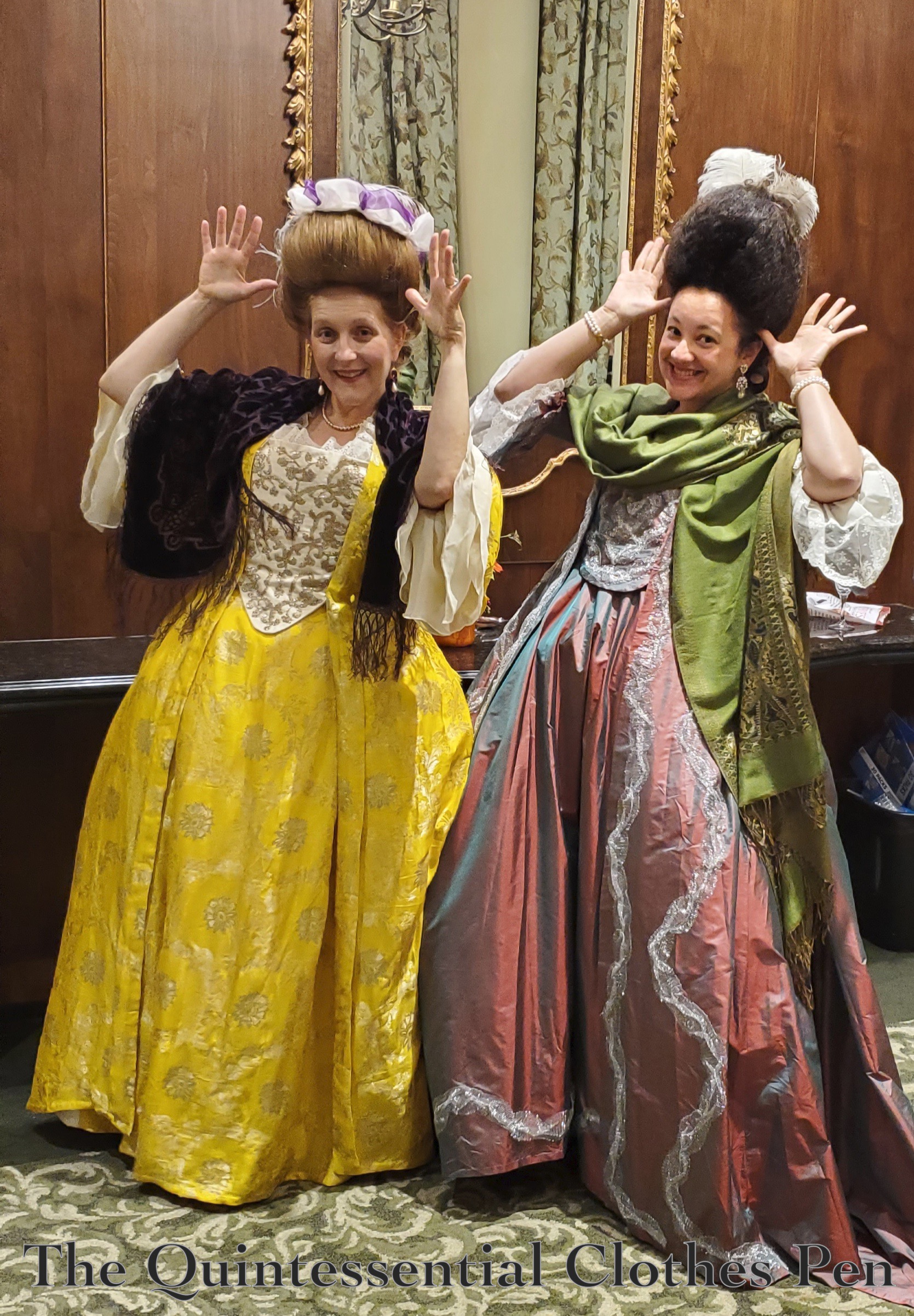
But a pause was necessary… I love my silly moose poses! Thanks for enjoying this outing with me!
The New Yellow Sacque!

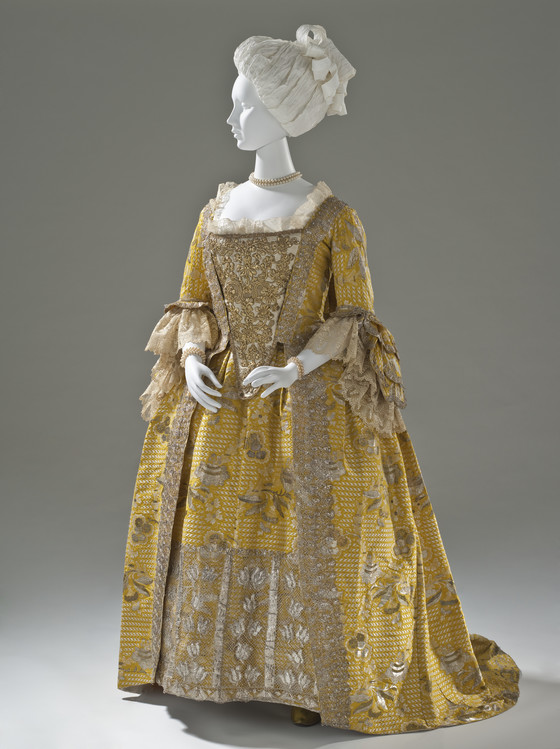
It’s time to share photos of the finished c. 1770 yellow sacque I’ve been posting about for the last year or so! I’m not going to include too much introduction, as I’ve been hinting at and posting about this dress for ages. If you would like more background on this dress, check out the link to past posts at the end of next paragraph.

Without further ado, here is a full length photo of the dress, with all the accessories I’ve been slowly posting about: the panniers, engageants, stomacher, tucker, etc. If you want to know more about these elements or the construction of this dress itself, you will find lots of details and photos in this series of past posts.

This next wonderful view artistically shows off both the front and side view of the dress, including the dramatic back pleats that cascade down from the shoulders. This is a defining feature of this style of dress!

And here is a clearer view of the front of the dress, with the sparkly embroidered-looking stomacher more clearly visible. (Plus another fun view of the pleats in the back, too!)

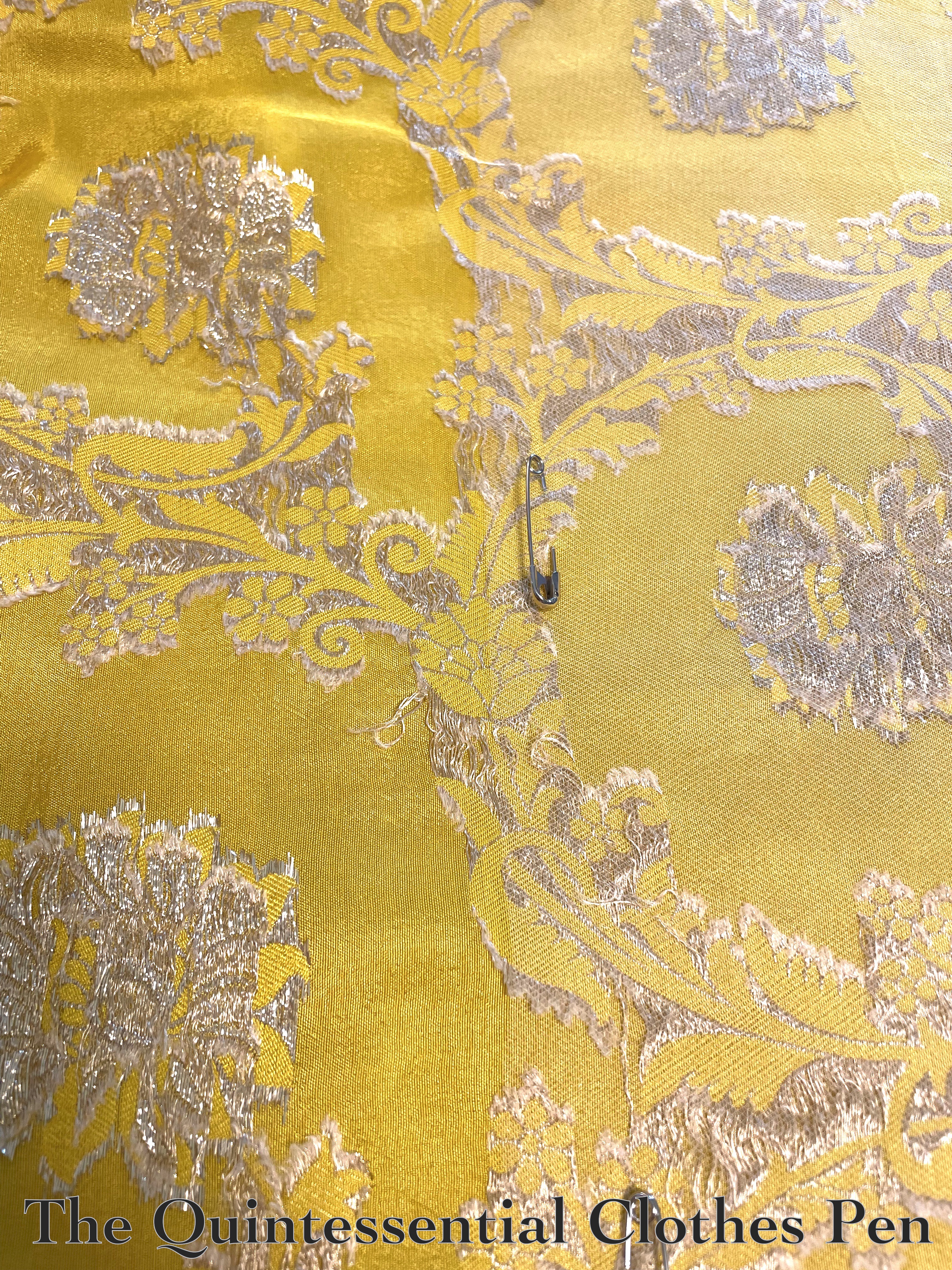
I’m so pleased with how it turned out! The color is just as vibrant as I hoped, the gold pattern woven into the yellow adds excitement without needing additional trim just as I hoped, the accessories help complete the outfit in a wonderful way, I’m very happy with the shape and effect of the stomacher, and I’m very pleased with the pattern alterations and fitting tweaks I made so that this dress would fit just right. This was a fun and rewarding project!

The New Yellow Sacque: Construction Details

Photos of the finished yellow sacque are on their way, but before I get to posting those I’d like to discuss the construction details of the dress. I’ve already posted about the accessories and other parts of the ensemble. You can view those blog posts at the links below.

c. 1770 Pink Panniers
18th Century Blue Foundation Petticoat
A White 1780s Petticoat
Yellow Sacque Petticoat
Engageants For The New Yellow Sacque
A Stomacher for the Yellow Sacque

Overall Goal

Whereas my goal for the Versailles Sacque was to hand sew everything and use historically accurate materials and methods, my overall goal for this new sacque was to machine sew as much as possible and use materials from the stash. This pair of goals influenced my choices for patterning and constructing the new dress. (If you’d like more information about the Versailles Sacque, you can read all of the posts about this project here.)

Patterning

The sacque itself is made from the JP Ryan Pet-en-l’air pattern. This is the same pattern I used for my Versailles Sacque. For the new Yellow Sacque, I used a larger size than I previously did. I also tweaked some of the dimensions to fit the measurements of the two friends I knew I wanted to be able to wear the new dress. This included things like increasing the back shoulder width and the bicep circumference.

I started with a mockup, which allowed me to check and see if the changes I made to the paper pattern worked on a real body. And they did! I only had minimal changes to make — some of which was taking out a little bit of the ease I’d added in. Oh well! That happens.

Early Construction, With The Dress In Pieces

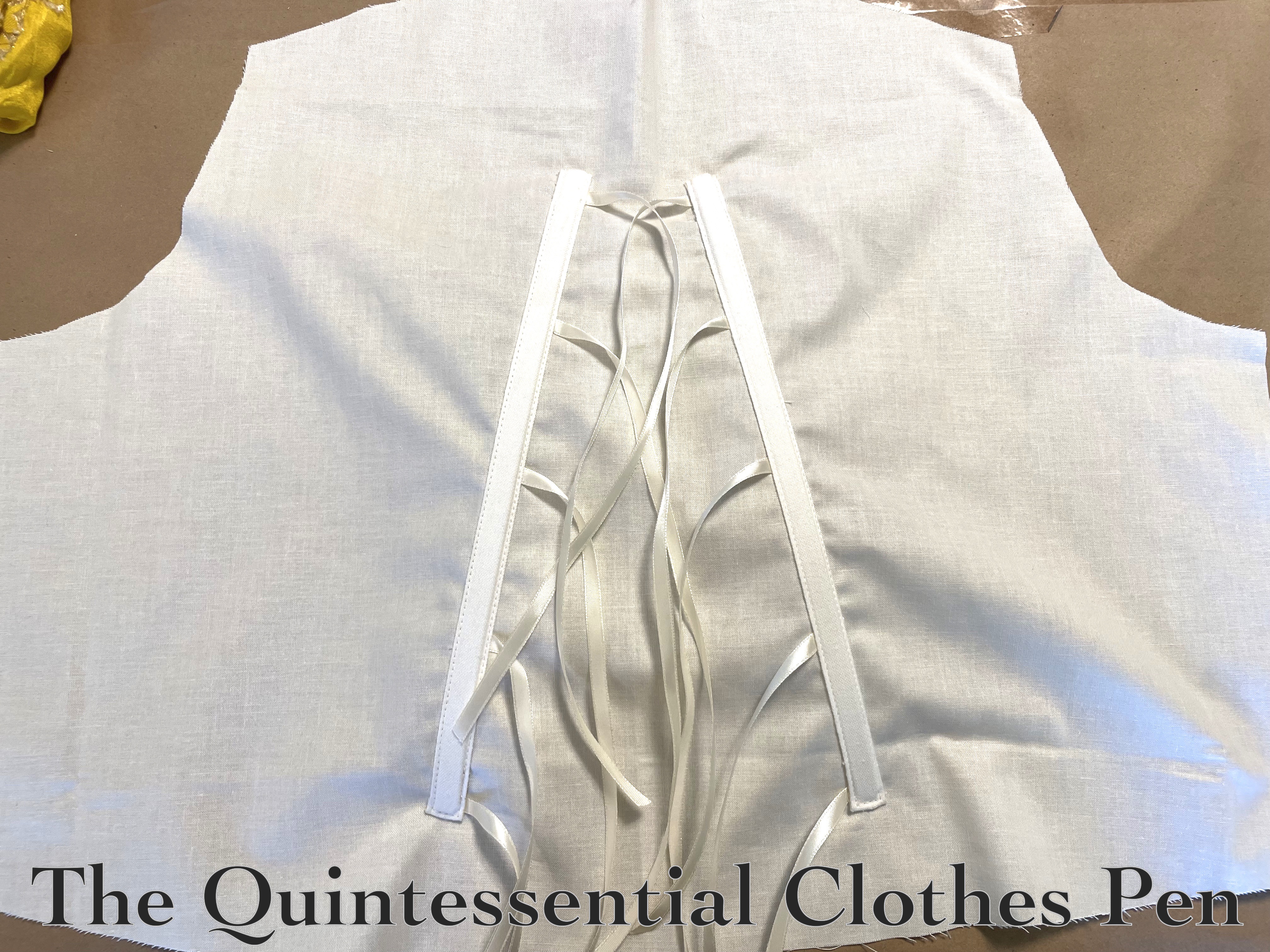
After cutting out all of the pieces, there were some steps that were easier to do before attaching things together. For example, I added boning and ties at the back of the lining in order to add adjustability underneath the back pleats of the dress. Ties or lacing like this was common for sacque style dresses in the 18th century.

I was pleased to reuse bones and bone casing from an old deconstructed corset as well as ivory ribbon that was gifted to me. Using things from the stash!

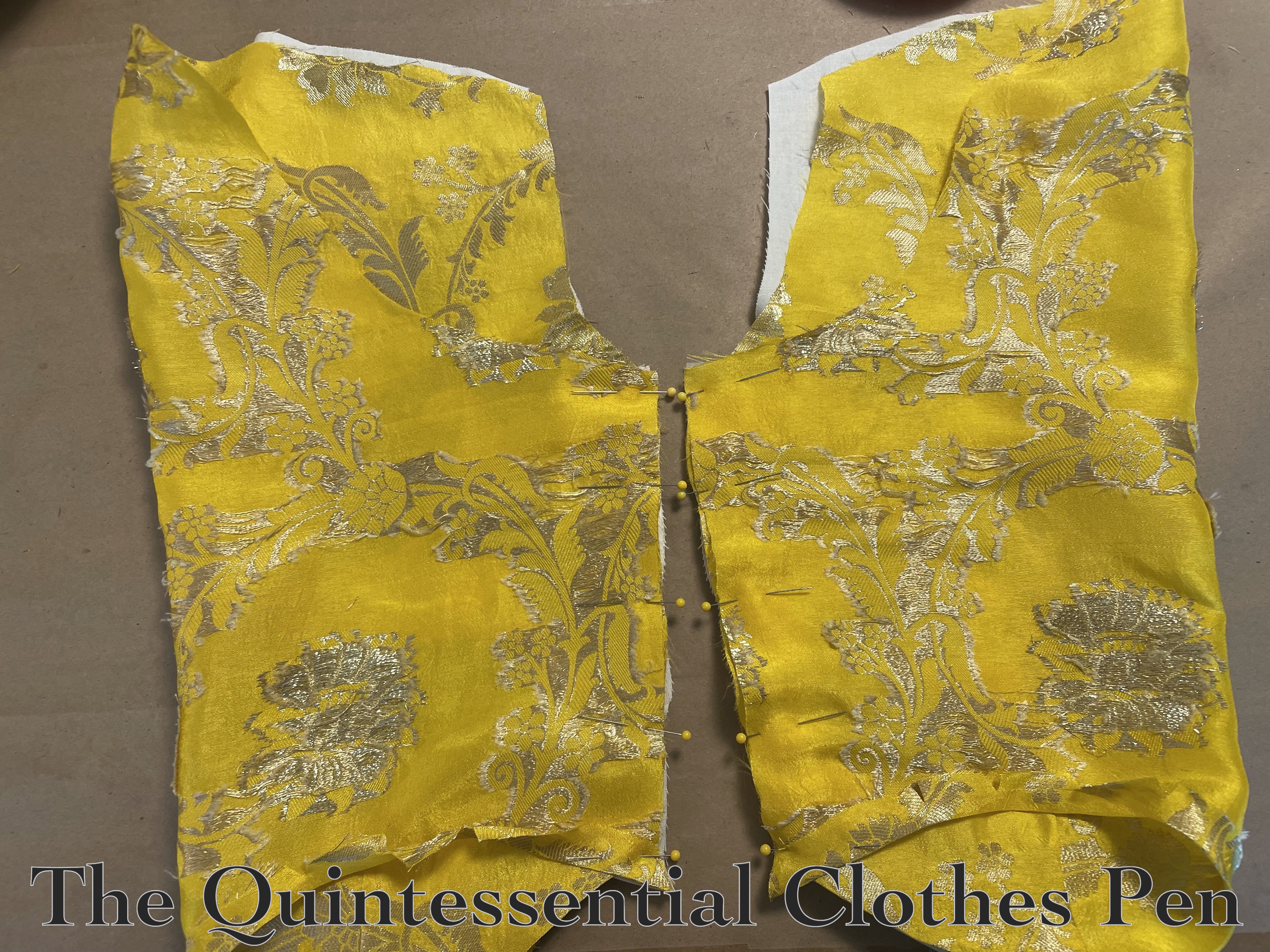
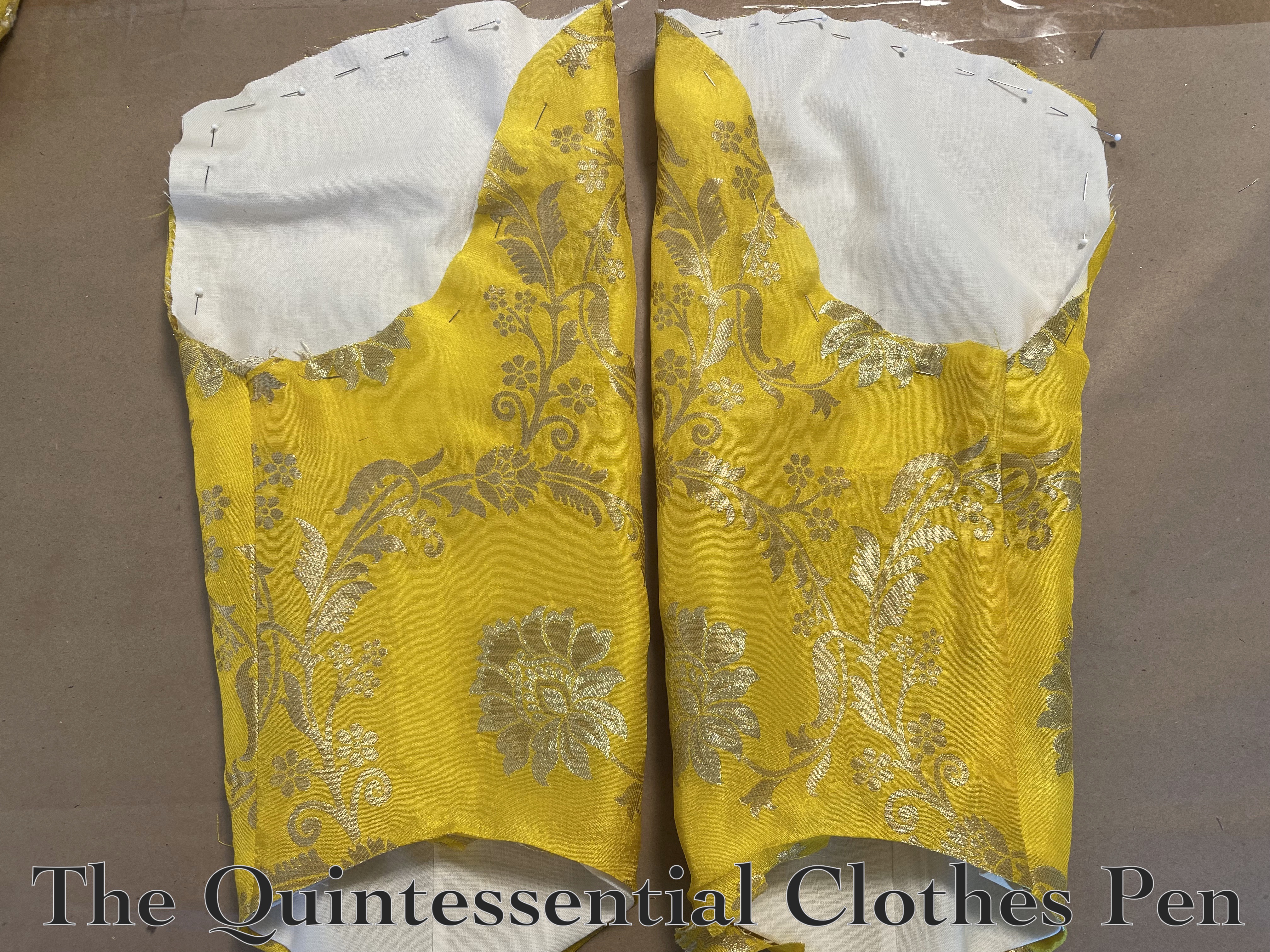
I also assembled the sleeves, with their linings, before attaching them to the dress. Below are the sleeves with the sleeve inseams pinned and ready to sew. By folding the lining and exterior right sides together and stacking them, there is a neat trick by which you can sew once to get both lining and exterior inseams sewn with one go (and all of the raw edges hidden between the layers.

Here are the sleeves turned right sides out. The bottom edges are already pressed under in preparation for being hand sewn later in the process. The top edges are pinned and ready for basting, so that they can be set into the arm opening as one layer.

Back Pleats

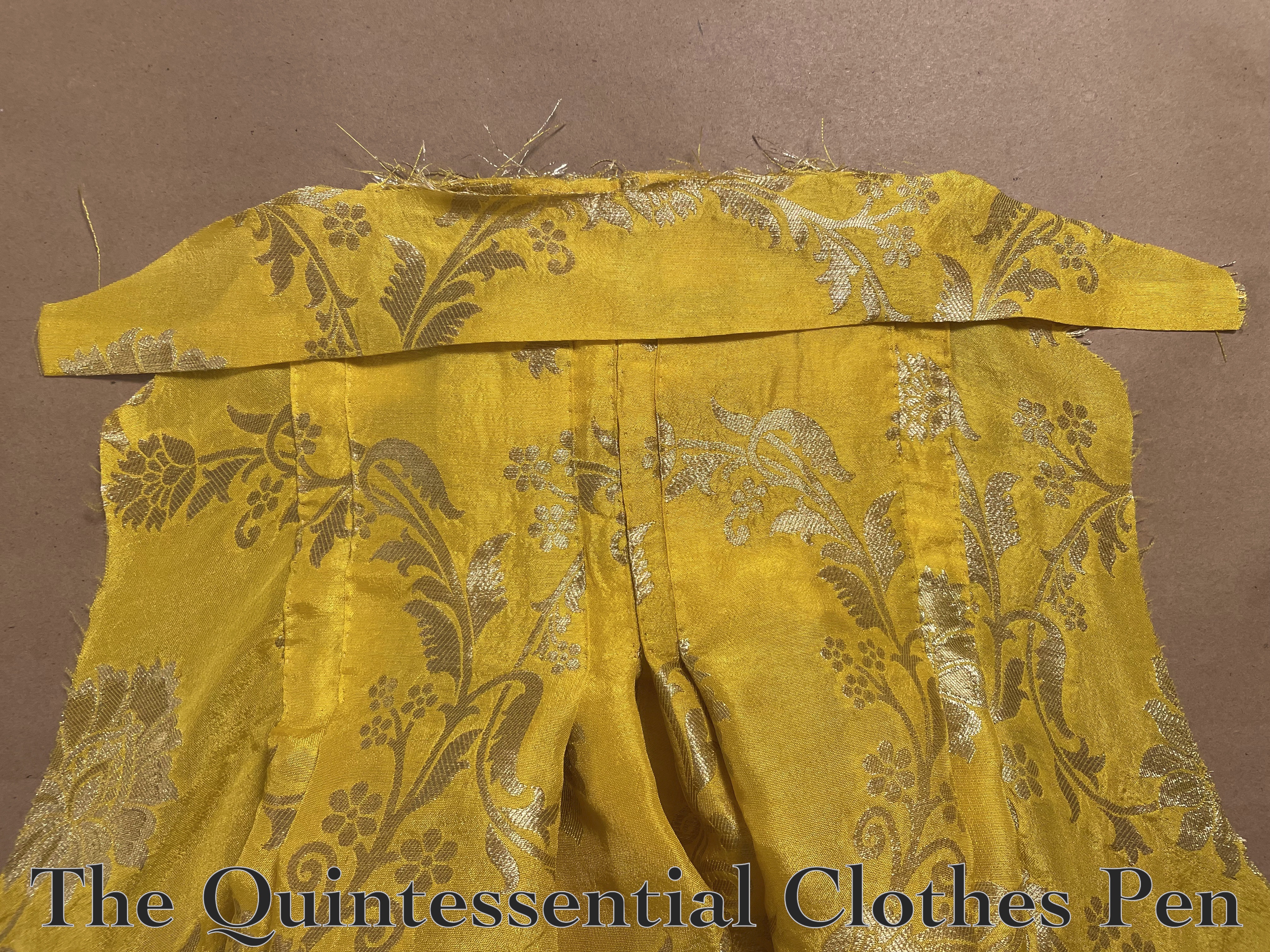
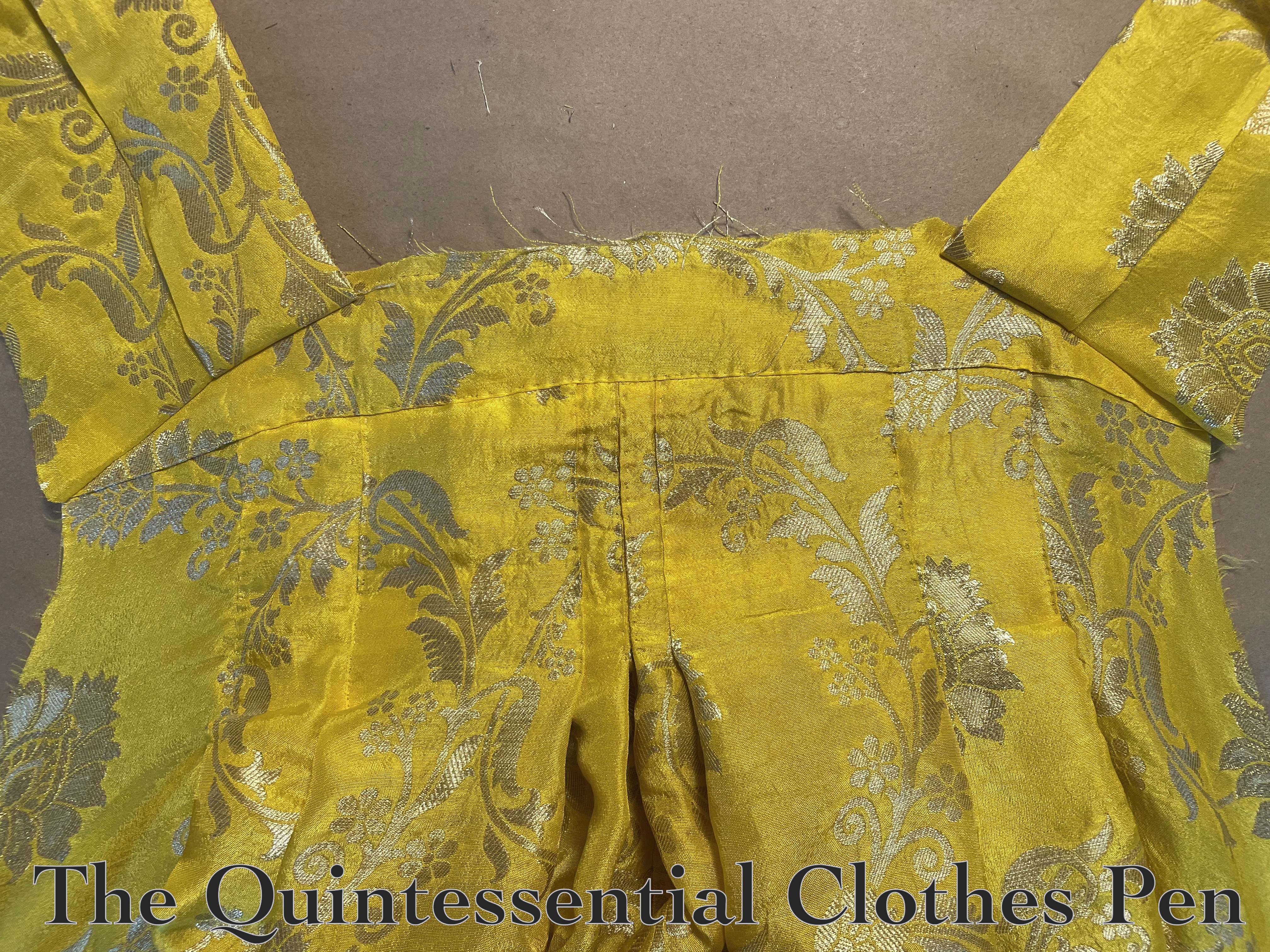
Eventually the process moved on to the back pleats — the signature feature of a sacque! I carefully followed the pleating instructions and hand stitched the various stacked box pleats in place. Then I went to put the back neck piece on… Oops!

They widths didn’t match! This was not a pattern problem. This was my problem! When I adjusted the pieces (the backs and the back neck piece) for a body shape with wider shoulders I didn’t remember to adjust the spacing of the pleats across the back accordingly.

So, I carefully removed the stitching holding the pleats and re-organized them to make the back wider. I didn’t want to change the center due to the depths of the pleats, but I was able to move the side pleats over towards the arm holes. I don’t think the change is noticeable. And extant garments show a variety of pleating patterns and widths, so I feel perfectly justified from that perspective.

Sleeve Ruffles

Before I started this dress, I’d been looking through my new copy of Patterns of Fashion 6, from The School of Historical Dress (information and purchasing information about the book is available here, on The School of Historical Dress website). In the book (on pages 15 and 16, to be precise), there are diagrams of sacque patterns laid out in the most economical way possible. This includes various pieced seams for some parts of the garment as well as a way of cutting the sleeve ruffles that nestles them together to save fabric. I was intrigued! And I decided that for this yellow sacque I wanted to try out this method.

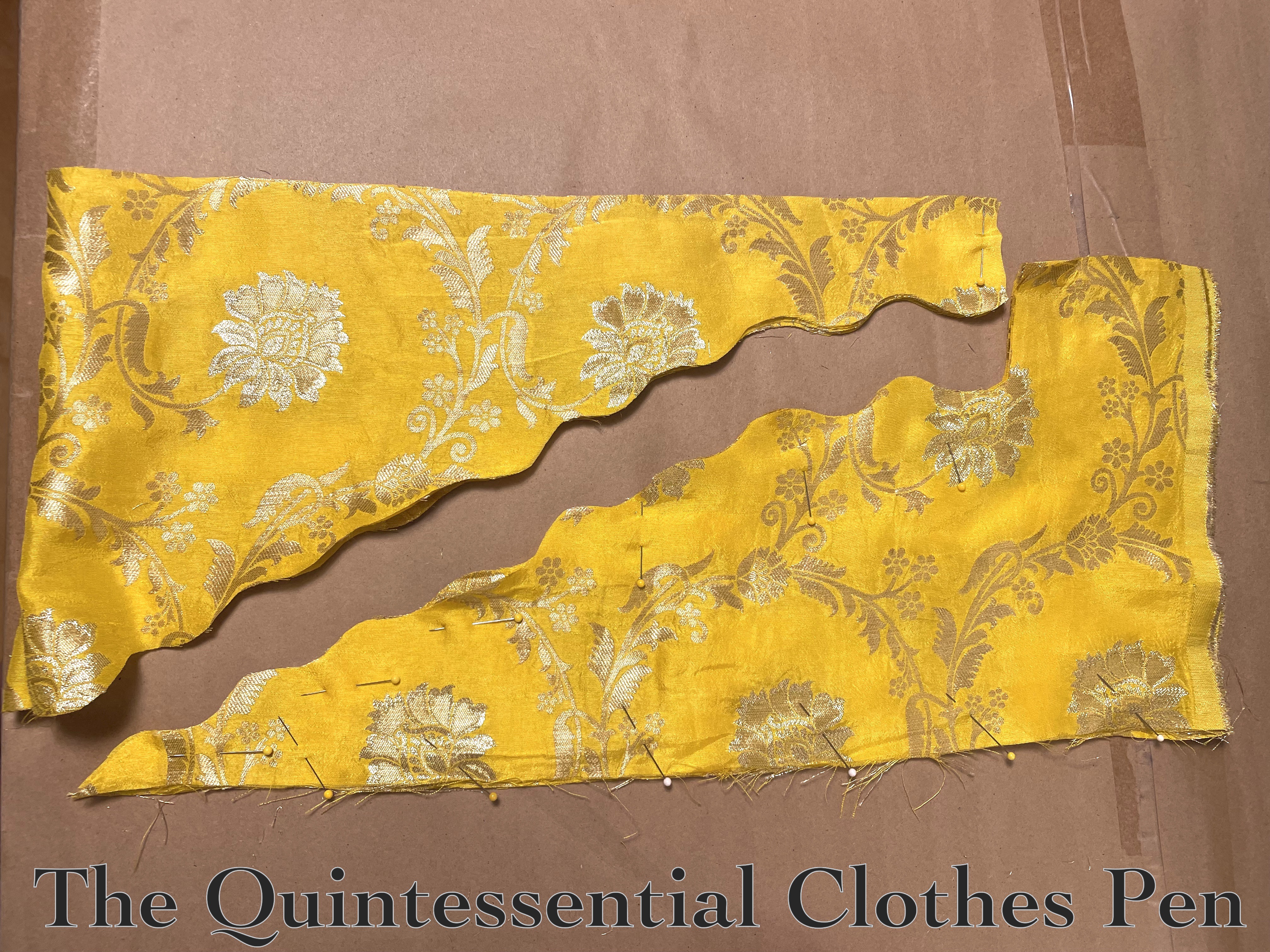
Essentially, a rectangle is cut on a diagonal with each diagonal portion making up a flounce. With the rectangle folded along a short side, this results in one triangle that can be cut on the fold while the other one ends up with a seam in the middle. Additionally, one of the flounces ends up being upside down in terms of the pattern on the fabric. I think this is a fun, historical quirk (as compared to what we would likely find on a modern garment) and I also don’t think it’s noticeable once the flounce with the upside down pattern and seam is placed underneath the other flounce.

So, I cut my flounces accordingly, with a wavy edge! Below is the result, with the two pieces separated slightly to show the geometry.

After the first diagonal separation, I also updated the scallops a little further to make each layer of flounces slightly different in shape than the other. The extra bits I cut off to do this are pictured below.

Hemming

Other steps were completed and eventually the dress looked like a dress! It was time to think about hemming it!

I wanted a narrow hem of about ½”. That’s easy to do, but I was worried about the metallic threads on the wrong side of the yellow fabric snagging on the train while being worn. I’ve seen this happen and know it can create pulls in the fabric that I wanted to avoid. But I didn’t want to put on a linen facing (as might have been used in the 18th century on what seem to be rare occasions), because I didn’t want an obvious line of stitching along the top or the weight and drape of that part of the lightweight silk dress to be different than the rest of the garment.

One trick I know of to help with this is to put a facing of tulle over the underside of the train. This makes a smooth surface to drag on the floor while not adding weight or making an obvious line along the top at whatever point the facing stops.

I looked in my stash and found a one yard piece of ivory tulle that would be just the right size for this purpose. A single layer of the ivory blends very well with the yellow silk!

The tulle facing tapers away to nothing around the side seams of the dress and extends up about 6″ above floor level at the center back.

Below is a photo showing part of the hem of the dress with the ivory tulle pinned in place. I pieced the tulle where needed, which was not in the same places as the seams of the yellow silk.

And here is a closeup of the wrong side of the fabric, where the metallic threads are clearly visible on the left and the tulle is just noticeable on the right. One it was all pinned in place I used a sort of running prick stitch to catch the tulle to the yellow silk. This resulted in very small stitches on the yellow silk (or where possible, I caught the metallic threads so that the stitches wouldn’t be visible at all). The stitches are not at all noticeable when the dress is being worn.

Materials & Time Spent

This dress (accounting for all of the individual parts of the ensemble) used:

  • 10.75 yards of the yellow figured silk
  • 3.25 yards of cream cotton (1.25 yards for for the sacque lining and 2 yards for the petticoat)
  • Scraps of ivory silk
  • Scraps of natural canvas
  • 1 yard ivory tulle
  • Embroidered/sequin bits from approximately ½ yard of gold lace

As well as small notions such as ivory ribbon, bones and bone casings, and thread.

I didn’t keep track of how much time I spent on this project, which was a relief in some ways. It was nice to just make it and not count. My photos show that I started patterning and mocking up the pattern in fall of 2023. I know I cut the pieces out in the winter of 2024 while my notes were still fresh. And then I was busy and didn’t start sewing until summer of 2024. I finished the dress on September 28, 2024. So it took me about a year of not-at-all consistent work — a Saturday here, a day or two of vacation there, and some hand sewing in the evenings. For this project, I’m not going to try and estimate the hours, but just bask in the knowledge of not keeping time.

And that’s it! This dress is made of pretty wonderful fabric that steals the show without additional trimmings, so I didn’t add any aside from accessories (such as the stomacher). Photos of the finished garment will be coming soon!

A Story Of Two Tuckers (HSM #6)

One of my goals for the second wearing of my Versailles sacque was to finish a small detail that didn’t make it into the first wearing back in 2016 (you can read about that exciting adventure in this past post). Below is a photo from that first exciting wearing of the dress. My new goal: to fill in the neckline of the dress with a bit of lace known as a ‘tucker’.

In addition, I also wanted to have a second tucker to complete the neckline of the new Yellow Sacque that I was working on.

Accordingly, over the summer of 2024 I dug around in my stash to find a suitable lace to use for these simple accessories. I came up with a 1 ⅞” wide lace that I’d purchased a roll of 100 yards of from Debs Lace and Trims. (I’ve purchased quite a quantity of lace from this shop over the last 15 years and have great things to say about it. I’ve never found better prices, which is excellent for historical projects that need large quantities of lace. I say that with no ulterior motives. I’m not affiliated with the store in any way!)

I followed the instructions on page 122 in The American Duchess Guide To 18th Century Dressmaking by Lauren Stowell and Abby Cox to make these two tuckers. They are exactly the same except that one is slightly longer (by 3″) than the other.

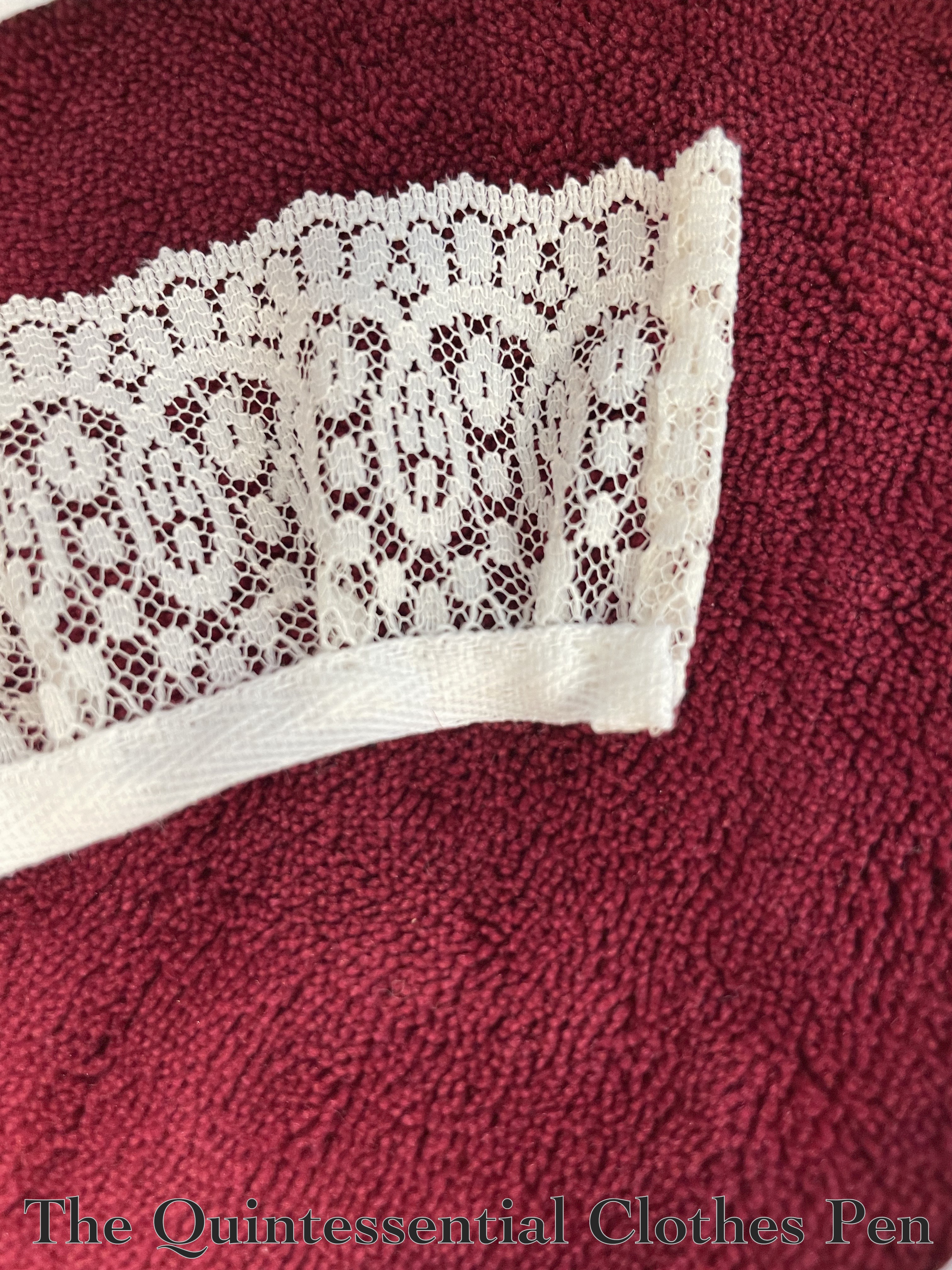
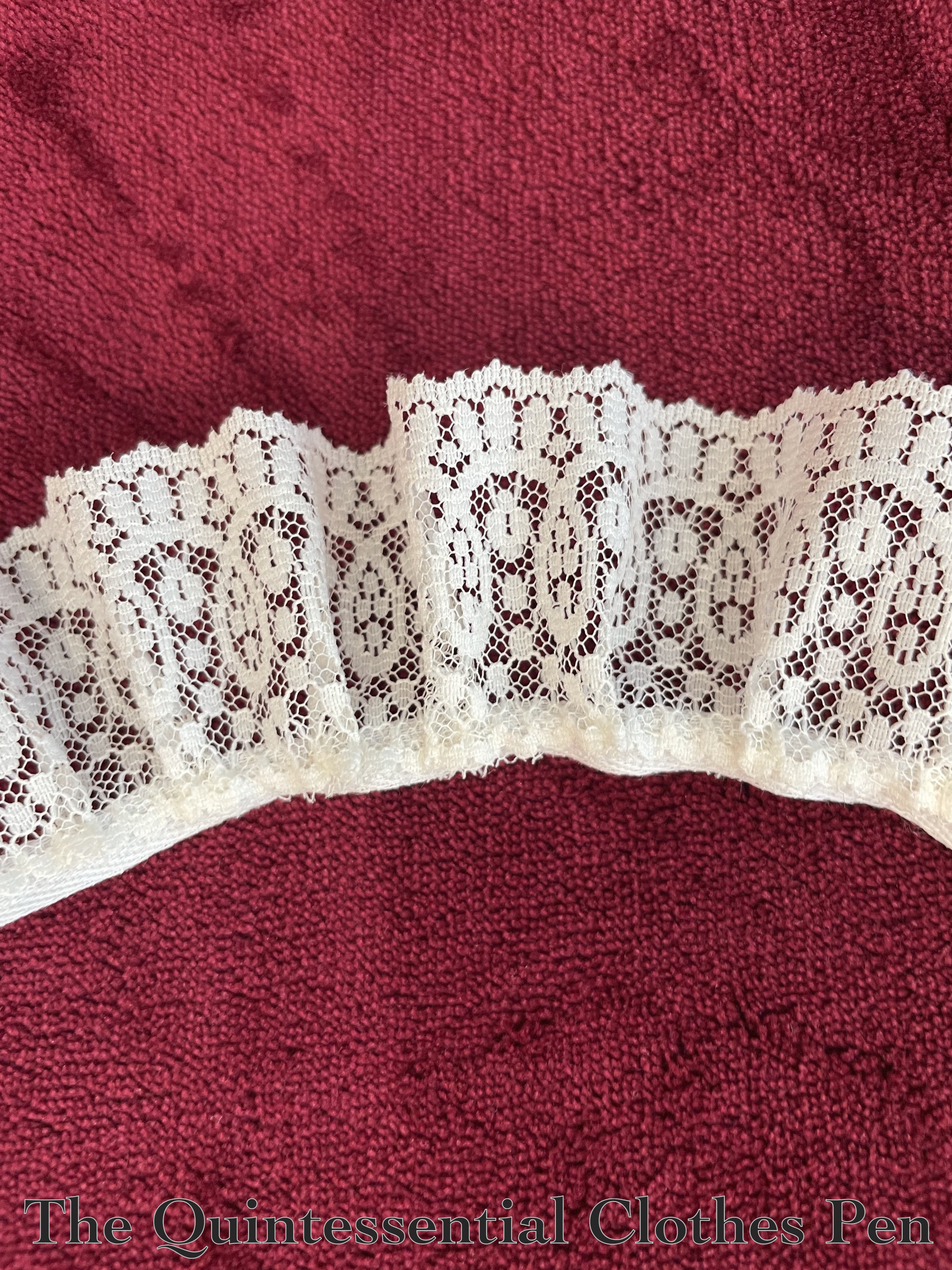
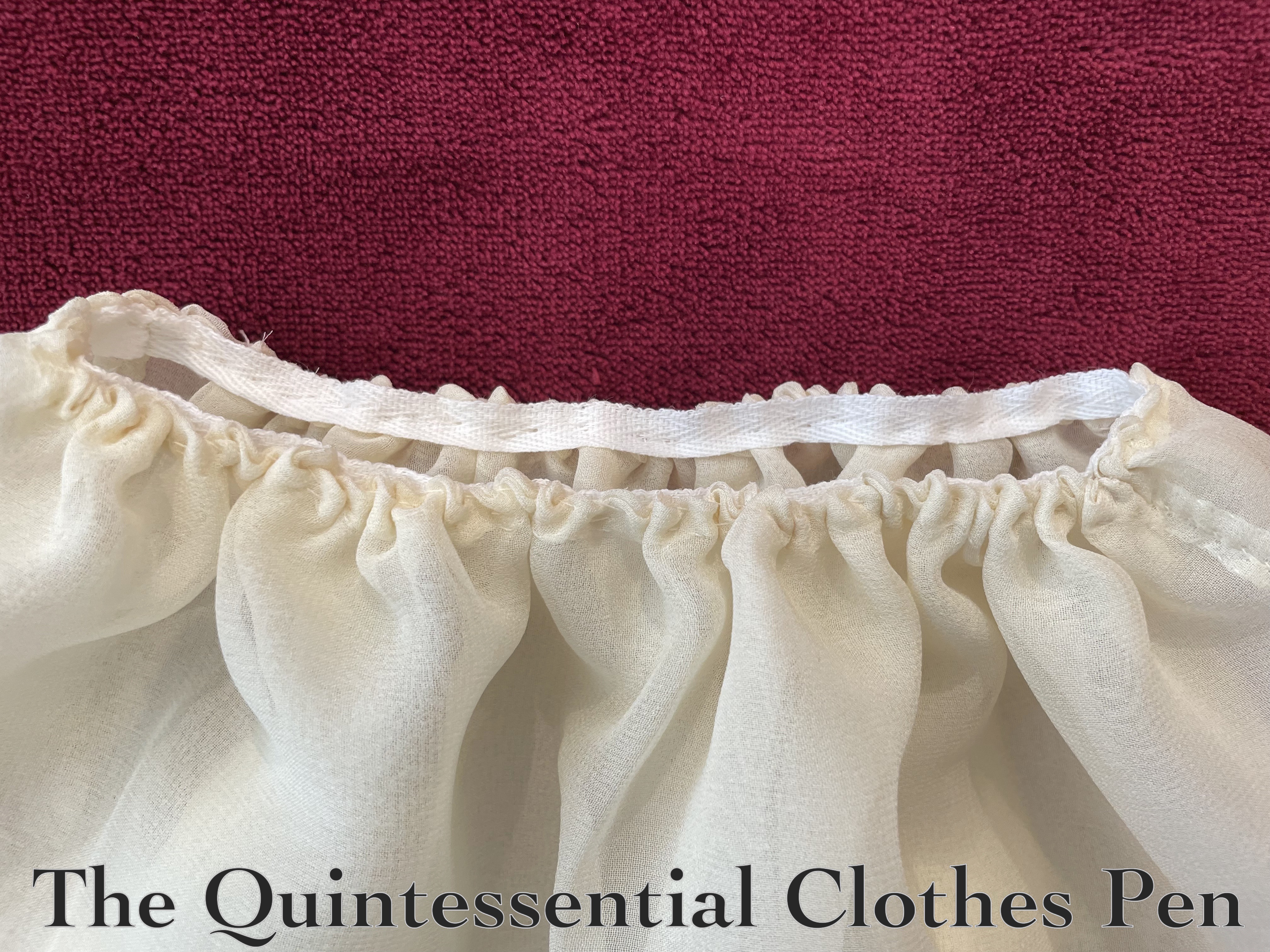
The ends of the lace are neatly hemmed, as you can see below.

And the lace is whipped to a 1/4″ cotton twill tape, as you can see in the photo above as well as the one below.

And that’s it! This is my entry for the Historical Sew Monthly 2025 Challenge #6 Accessorize:

Accessories add polish to your outfits, helping to create the perfect historical look. Create the perfect period accessory for yourself.

Just the facts:

Fabric/Materials: Approximately 2 yards of 1 ⅞” wide lace (for each tucker).

Pattern: From The American Duchess Guide To 18th Century Dressmaking by Lauren Stowell and Abby Cox.

Year: c. 1770.

Notions: Approximately 1 ¼ yards of 1/4″ white cotton twill tape (for each tucker) and thread.

How historically accurate is it?: 90%. Entirely hand sewn, made from plausible looking materials, and using a pattern that is backed up by lots of research. I just give a little off for the fiber content of the lace and the use of ¼” cotton tape rather than ½” linen tape.

Hours to complete: About 1 hour per tucker.

First worn: October 5, 2024.

Total cost: Approximately $3, for both tuckers! The lace was just $0.10 per yard and the twill tape was also purchased in bulk — I probably only used about $1 or $2 worth.

A Stomacher For The Yellow Sacque (HSM #12)

One of the many parts of the new c. 1770 Yellow Sacque ensemble that I’ve been slowly posting about is the stomacher. This is the triangular shaped piece that fills in the front of the dress, covering the undergarments worn underneath.

18th century stomachers come in a variety of shapes and styles. Some are more pointy and triangular, some are more wide and rounded. Some match the dress exactly and others contrast with the dress fabric.

The stomacher that goes with my Versailles sacque (which you can read about in the past post discussing the construction details for that dress) is more of the wide, rounded, and matching-the-dress variety. So for this new dress I decided to go in the opposite direction and make a stomacher that is more pointy, triangular, and made of contrasting fabric.

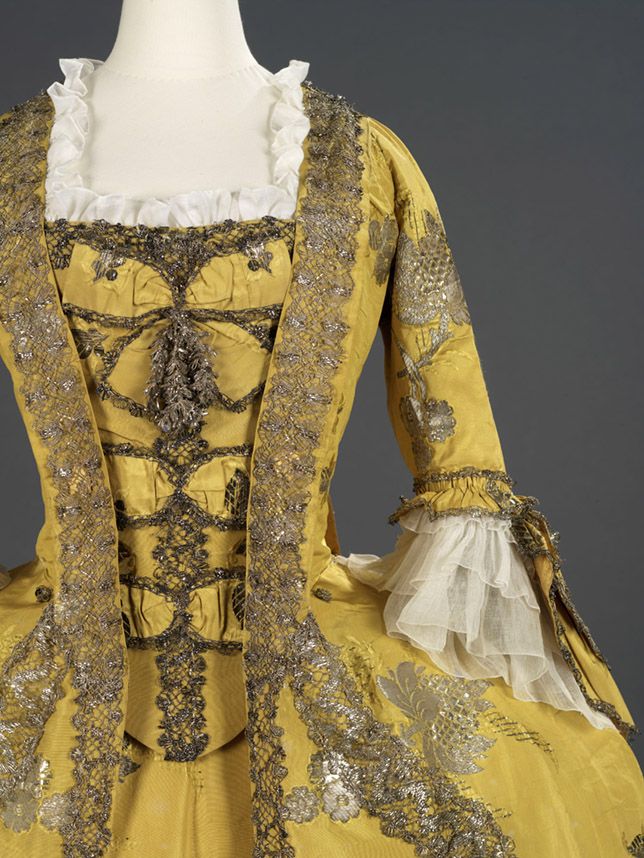
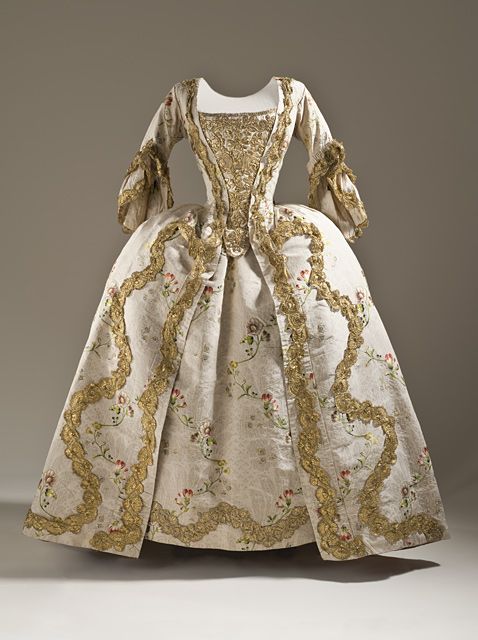
I was particularly inspired by the dress and stomacher combination below, which is in the collection of the LA County Museum of Art. I love that the gold embroidery on the stomacher is completely different than the trim on the dress and that is completed on an ivory colored base that is also completely different than the dress fabric itself.

Woman’s Dress and Petticoat (Robe à la française). England, circa 1760. Silk plain weave with weft-float patterning and silk with metallic-thread supplementary-weft patterning, and metallic lace. Gift of Mrs. Henry Salvatori (M.79.118a-b).

With that idea in mind, it was time to figure out how to achieve that look! I dabbled in embroidery in 2020, but definitely not enough to feel up to the elaborate style and cost of materials to achieve this look from scratch. I did have a fabric in my stash, however, that has lovely gold embroidered motifs on a bronze net background. I’ve cut out the motifs and used them before with fantastic results, so I figured I could do that again for this purpose. (The full net fabric was used in my 1912 Burgundy and Gold Evening Gown made in 2012 and the motifs were used as appliqués in my 1893 Bronze and Pink Evening Gown in 2012, as well.)

For this project, some of the helpful motifs from the lace were along the edges of the fabric. Others were in the middle. The motifs were not always symmetrical, so in many cases I had to piece them together to make them look reasonable for this purpose — especially in the central budding/dripping areas of the stomacher. I used approximately 30 individual sequin/embroidered bits, some as small as a single leaf!

Below is a photo of the stomacher with all of the individual gold bits pinned in place.

After that, all I had to do was use an appliqué stitch to attach them around each edge! I like that sort of work (it’s the same process I used for my 1940 Schiaparelli Evening Dress last year). It’s not hard, but just takes patience. The most patience is needed when the thread gets caught on a pin!

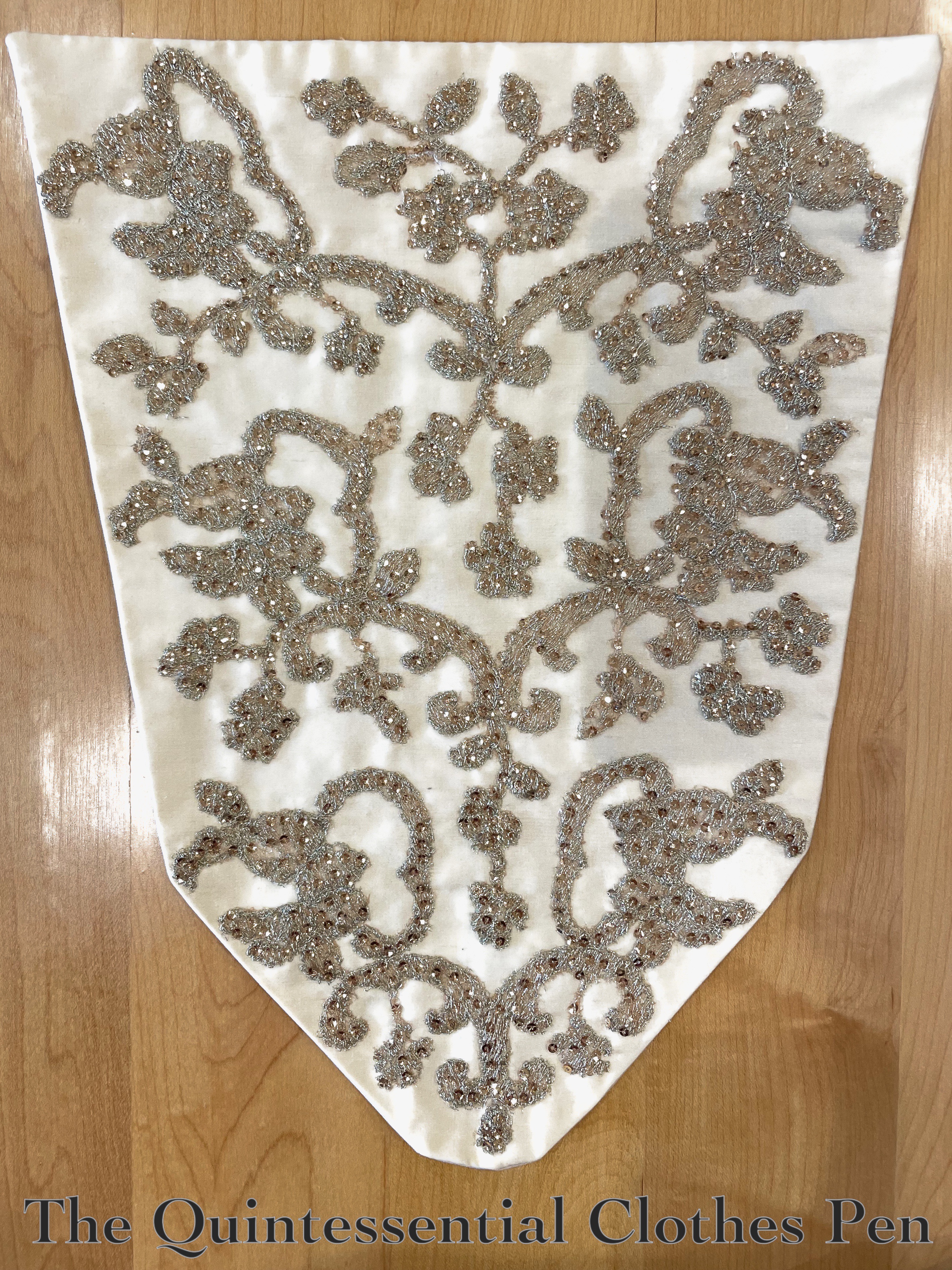
Below is the completed stomacher.

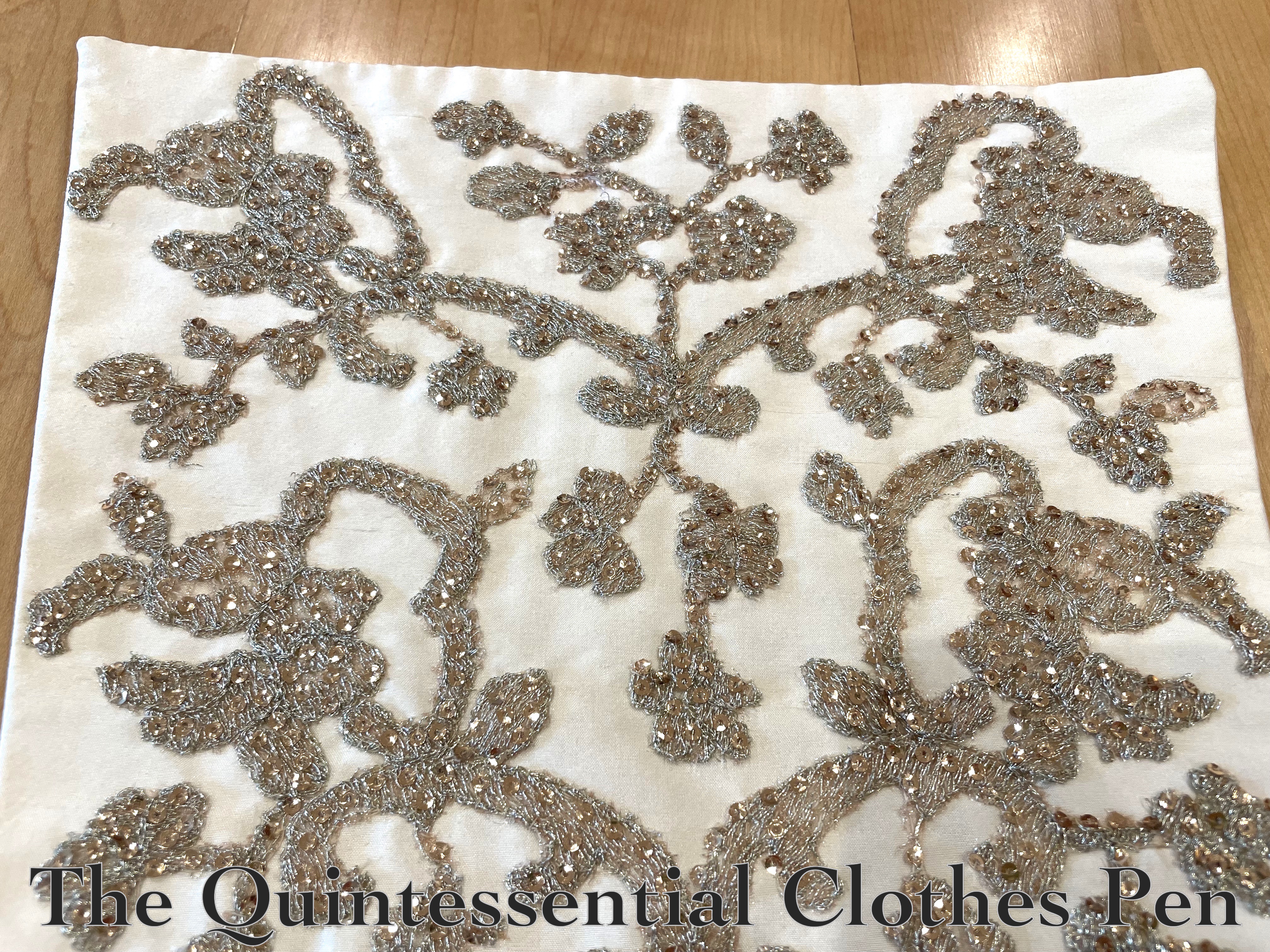
It really sparkles in the light, as the gold embroidery also has gold sequins on it. That lovely sparkly element was hard to capture in a photo. I did try! Below is a view that shows the sequins a little bit better.

I know that spangles (flat metal discs) were in use long before the 18th century. So while my sequined modern lace appliqués may not be perfect on a historical-reproduction scale, I do think it’s reasonable to think that something similar would have been used in the 18th century to help reflect light in the halls of Versailles or other palaces of the period.

In addition to the gold bits, I also had scraps of ivory silk shantung in the stash leftover from making my fluffy 1903 petticoat back in 2011. I used one of these scraps for the visible ivory section of the stomacher. The back of the stomacher is made of a scrap of unbleached cotton canvas, also from the stash (this is not historically correct, but it did the job of stiffening the stomacher very well!). A photo showing these fabrics up close is below.

The canvas and silk layers were bagged out, the opening edge whipped closed, and then the appliqué stitches applied only through the silk. The cotton canvas provides stability for stiffening the stomacher as well as pinning into the dress.

This stomacher qualifies for the Historical Sew Monthly Challenge #12 The Final Touch:

Make an accessory or garment that is the finishing touch to an outfit.

Just the facts:

Fabric/Materials: Scrap of ivory silk, scrap of natural canvas, and embroidered/sequin bits from approximately ½ yard of gold lace.

Pattern: The base was adapted from the JP Ryan Pet-en-l’air pattern.

Year: c. 1770

Notions: Thread.

How historically accurate is it?: 90%. Entirely hand sewn. The construction methods are historically plausible, though I believe this would have been embroidered in the 18th century rather than appliquéd. The fiber content and weave of the base fabrics are not accurate.

Hours to complete: I didn’t keep track. Let’s say 6.

First worn: October 5, 2024.

Total cost: I’m going to call the scraps free. My guess is that I spent about $10 per yard on the lace over ten years ago. So let’s say approximately $5.

A White 1780s Petticoat (HSF #7)

The plan for the yellow sacque ensemble I’ve been working on was to provide an under petticoat that would help the yellow silk petticoat (that I posted about in November 2024) hang nicely and be opaque. I thought I’d completed this goal in December 2023, when I re-used fabric from an old Regency style dress to make a base petticoat (you can read the details about that here).

As I started working on the yellow petticoat, though, I realized that the silk was very thin, and that the blue under petticoat (made from the dress) was distorting the yellow color, making it look washed out and less vibrant. Ugh! What to do??

I determined that a light, neutral color under petticoat was needed and looked through my stash to see what I has in enough quantity for a new petticoat. The goal was to make this from the stash!

I found that I still had yardage of the mystery $1 per yard fabric I’d purchased two ten yard rolls of about ten or twelve years ago. I’ve used it for many projects, including all sorts of historical underwear and other projects (my recent 1790s petticoat and bum pad, a recently updated 1810s petticoat, lining a sheer 1895 blouse, lining a 1953 dress… and probably more things that aren’t coming to mind right now!). It’s very versatile!

Above is a front view of the new petticoat. I made this in exactly the same way as the blue petticoat, referencing the same tutorials, etc. Essentially this is a tube that is pleated at the waist, with ties to hold it on the body.

The front has an outward box pleat at center front, while the center back (pictured above) has an inverted box pleat. The pleats are finished off by on the grain strips that form the ½” waistbands. Ivory satin ribbon ties are set into these waistbands.

Given that I had to make a whole new petticoat, it was my goal to make one that I could reuse for other purposes. Namely, I have 1780s ensembles in my sights and I wanted this petticoat to be able to be used for those. So it was important to me to level the petticoat in a way that would make sense for that purpose, but I also needed to make sure the petticoat to be long enough in the front to fully back the yellow silk for the sacque project.

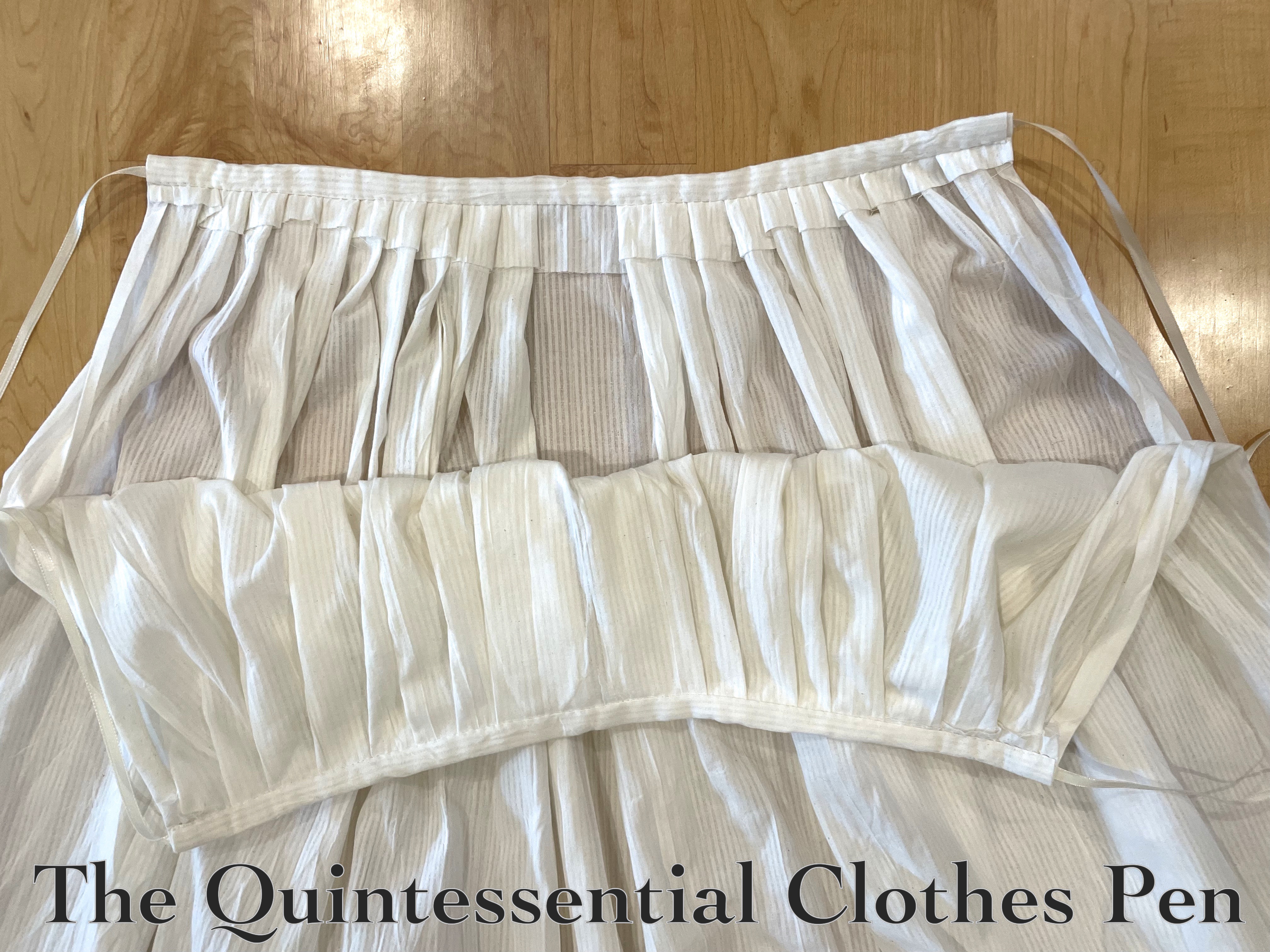
I’m pleased that with some careful figuring I was able to accomplish both goals! This petticoat doesn’t sit evenly over the pink panniers for the yellow sacque, but it does sit evenly over a not-quite-finished Scroop Patterns Frances Rump for a 1780s style! In order to know this would work, it meant I also had to make the Frances Rump and get it far enough along to be put on so I could figure out the leveling. More on the Frances Rump later! For now, a photo (below) of the insides of the white petticoat.

In the photo, the back is flipped down, showing that the skirt is leveled in a way that is pretty straight across. You can just see a little extra fabric length poking out of the waistband on the right side. The front of the petticoat is facing the top of the image. You can see how it needed to be a little bit shorter (therefore more fabric turned down to the inside) to accommodate the lack of bum pad on the front of the body.

The petticoat is finished with a whipstitched 1″ hem. It’s just the right length for me (and luckily also for the person who wore it in October), but might need to be whacked up with a basting stitch if I loan it to a friend with shorter legs. That’s easy, though!

And that’s it!

This garment qualifies for the HSM Challenge # 7, Always In Style:

Make a garment or accessory that is appropriate for more than one historical period…or even a historical piece that can be worn with modern clothing! (Note that the piece should still be ‘historical’, not just ‘historically-inspired’.)

Just the facts:

Fabric/Materials: Approximately 3-4 yards white striped cotton.

Pattern: None, but I referenced both of these tutorials on constructing 18th century petticoats. Katherine’s tutorial is for a petticoat with an uneven length (to go over panniers, or a bum roll, for example). Rebecca’s tutorial is for a petticoat with an even length (the same length all the way around, to be worn without extra supports). Both tutorials have construction information, Rebecca’s includes a bit more detail in terms of which stitches and methods to use.

Year: Loosely 1700-1790, but leveled to be appropriate for c. 1785.

Notions: 3ish yards of ¼″ ivory polyester ribbon and thread.

How historically accurate is it?: 70%. Accuracy gets knocked down because: 1- all unseen seams are machine sewn, 2- I used polyester ribbon for ties, 3- I haven’t seen research that shows cotton being used at this time for a single plain petticoat of this sort.

Hours to complete: 5? I didn’t really keep track.

First worn: October 5, 2024.

Total cost: The fabric was $1 per yard. The ribbon was gifted to me. So approximately $4.

Engageants For The New Yellow Sacque (HSM #6)

I’m trying to get in all of my Historical Sew Monthly 2024 posts before the new year! So in that spirit, here is another one!

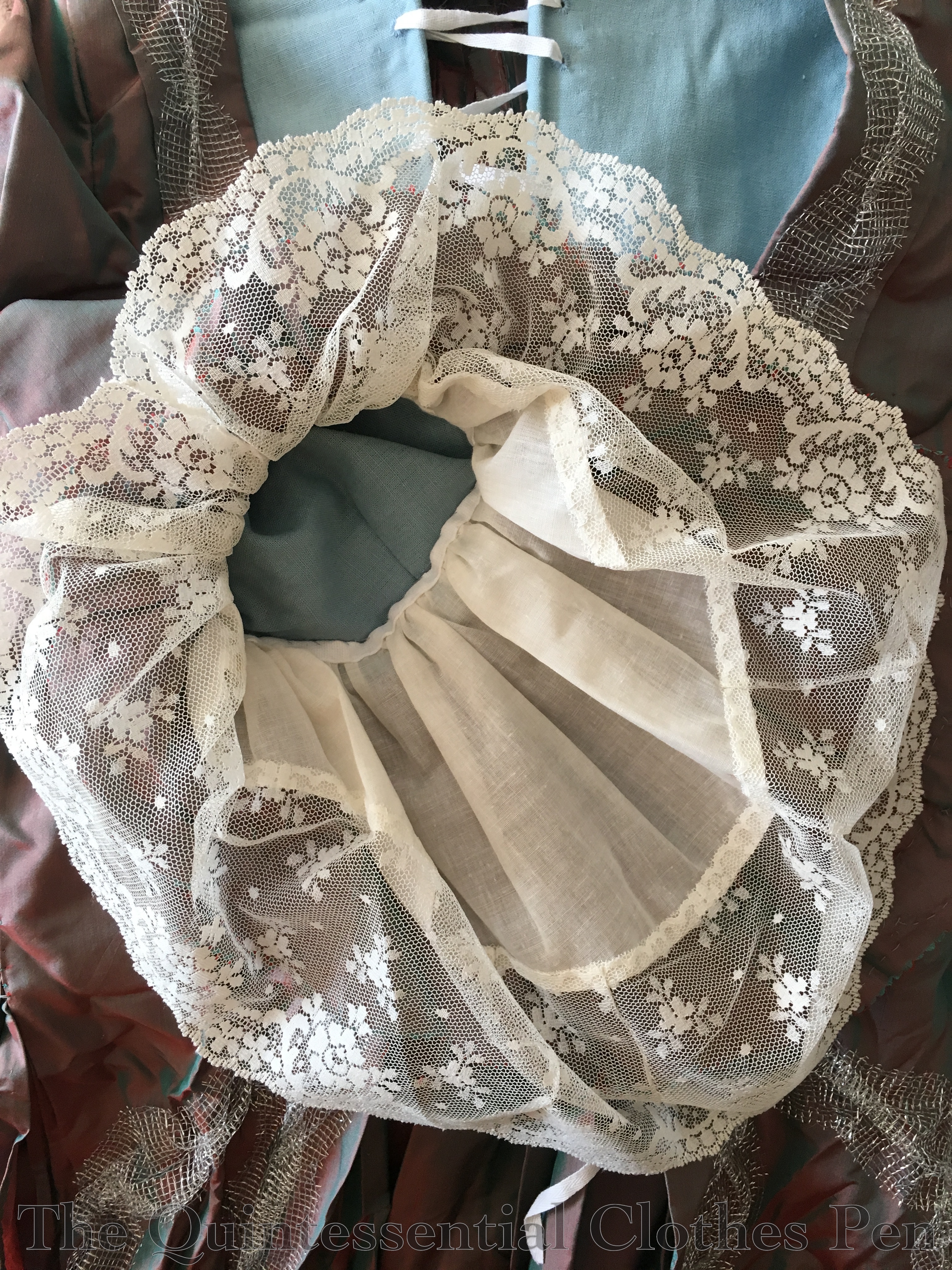
Above is a closeup of the fluff that makes up the arm openings of the new yellow sacque I mentioned in my last post (where I shared details about the petticoat for the new sacque) as well as my Versailles dress from 2016. Part of the fluff is the sleeve ruffles on the dresses and part of the fluff is the engageants — lace for the Versailles dress and a double layer of ivory silk for the new yellow sacque!

Engageants are sleeve ruffles. The Oxford English Dictionary traces the word back to the 16th century with its origins in French.

These new engageants are made of two layers of silk gauze, inspired by the ones displayed with the lovely yellow dress below by the Royal Ontario Museum.

Robe à la française Spitalfields (London), England. Silk extended tabby (gros de Tours) with liseré self-patterning and brocading in silver lamella and filé Georgian Rococo. 1750s. Gift of the Fashion Group Inc. of Toronto in memory of Gwen Cowley. ROM2009_10909_22.

I specifically wanted the semi-sheer quality as a change from the lace engageants that accompany my Versailles sacque (which you can read about in this past post detailing construction information about that dress).

I looked through my stash and realized that the best fabric I had for this project was salvaged from an old ballroom dancing dress I’d made. Here is a blast from the past for you! The elusive Mr. Q is even hiding there, behind my head… But back to the dress. It was made pre-blog, so no photos of it have made it here before.

I was so proud of it! But after a fair bit of wearing this dress, I moved on to creating new ballroom dresses and sacrificed this one for parts. The rhinestoned lace was re-used in a dress that did make it onto the blog in 2013 (documented in this past post), but the float — that dangling piece hanging from my wrist that floats in the breeze while dancing — was simply put into my fabric stash, which is where I found it when looking for engageant material!

The float was an odd triangular piece, so I had to do some piecing (adding center seams, for example) to make my engageant pieces fit. But that’s fine! In all the fluff you can’t see the seams.

And in fact, the pattern I used, from 1769, was intended to create zero fabric waste, which intentionally added seams, as well. The scalloped pieces are stacked together with the scallops facing each other to efficiently use a single rectangle of fabric.

Completed engageants are below. The seams are not obvious!

Every individual silk piece for these was narrow hemmed on all the edges and then the seams were butted, whipped, laid flat, and pressed. Below is a close up of a seam and a scalloped bottom edge.

Once all of that was done, the two layers were laid on top of each other and whip gathered along the top edge. This was then sewn to a ¼” cotton tape. This allows for the engageants to be removed to be cleaned or used with another dress someday.

And that’s it! These qualify for the Historical Sew Monthly Challenge #6 Up Your Sleeve:

Level up your sleeve game by making a garment where the focus is on the sleeves.

Just the facts:

Fabric/Materials: Approximately ½ yard of ivory silk gauze.

Pattern: From page 14 in Patterns of Fashion 6 (written by Janet Arnold, Sébastien Passot, Claire Thornton, & Jenny Tiramani).

Year: 1769.

Notions: Approximately ⅔ yard of ¼” white cotton twill tape and thread.

How historically accurate is it?: 95%. Entirely hand sewn. The construction methods are historically sound. The fiber content and weave may not be perfect.

Hours to complete: 8 ¾.

First worn: October 5, 2024.

Total cost: I have no recollection of what I paid for the silk gauze many years ago. Plus, at this point this fabric is being re-used, so might be called free regardless. The twill tape was bought in bulk and cost less than $1 per yard. So let’s say approximately $5.

Yellow Sacque Petticoat (HSM #12)

Over the last year or so I’ve been working on another new ensemble: a second 1770s sacque dress (also called a Robe à la Française or sack-back gown) to be friends with my original Versailles dress (which you can read all about in this past series of posts). My goal was to have a new dress that I could loan to two different friends so that they could join me in 18th century splendor. Luckily, the two friends I have in mind are not too different in circumferences!

The new ensemble has many individual garments — under petticoat, over petticoat, the sacque itself, a tucker, and sleeves flounces (or engageantes) — so there will be a number of posts coming up that share details about these various pieces. This post is going to focus on the over petticoat that I made for this ensemble.

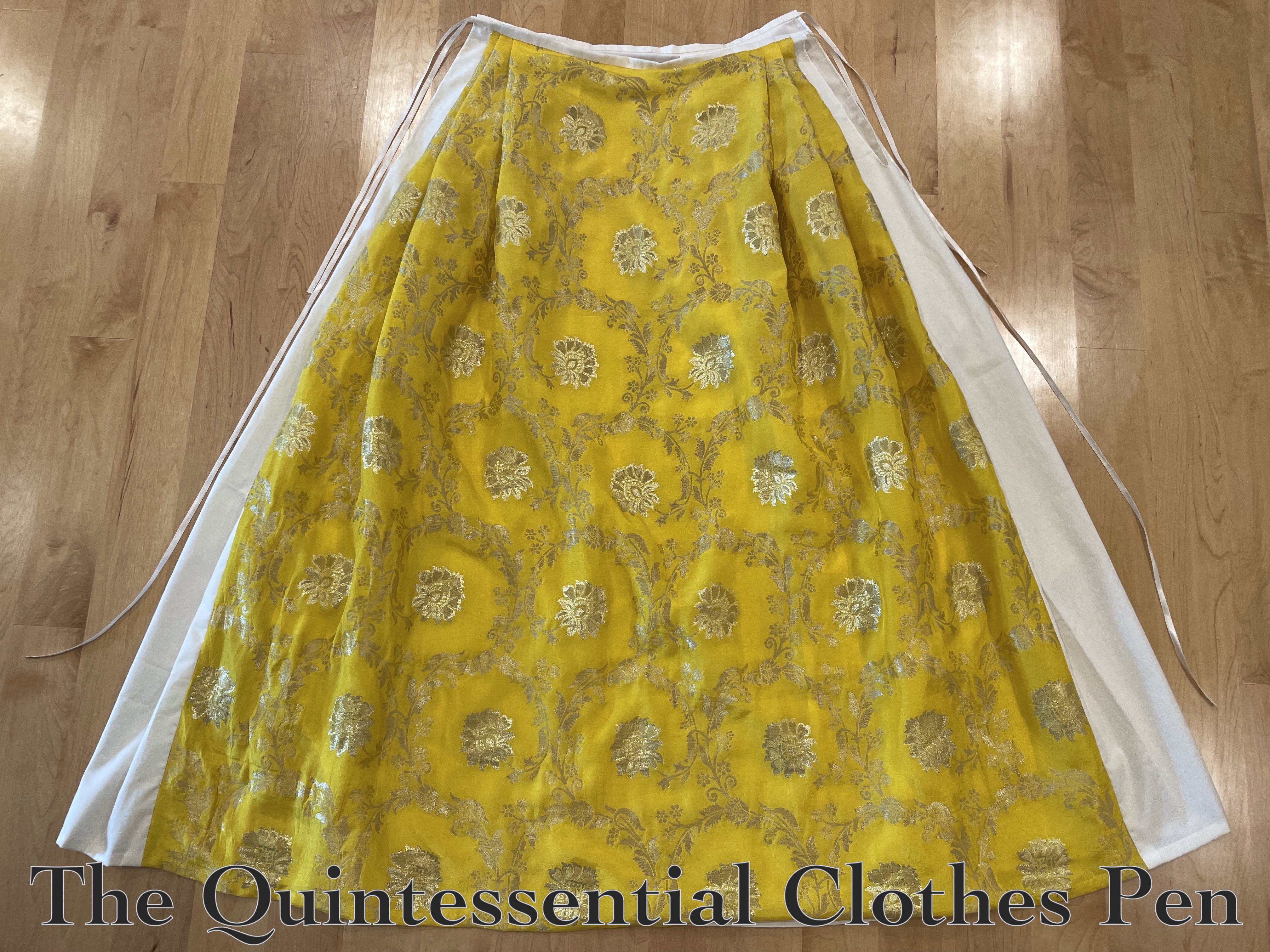
The petticoat front is made up of the yellow jacquard fabric that the dress itself is made out of, while the sides and back are made of a cream colored cotton. No need to use expensive fabric where it is unlikely to be seen! This was a common 18th century practice. Above is an image of the front of the petticoat. Below is an image of the back of the petticoat.

There are three fabric panels — two of the cotton and one of the silk. These are seamed together and then divided in half, such that some of the cotton falls on the ‘front’ of the petticoat (since it makes up ⅔ of the circumference of the skirt). There are slits cut into the sides at the halfway points. These are narrowly hemmed by hand.

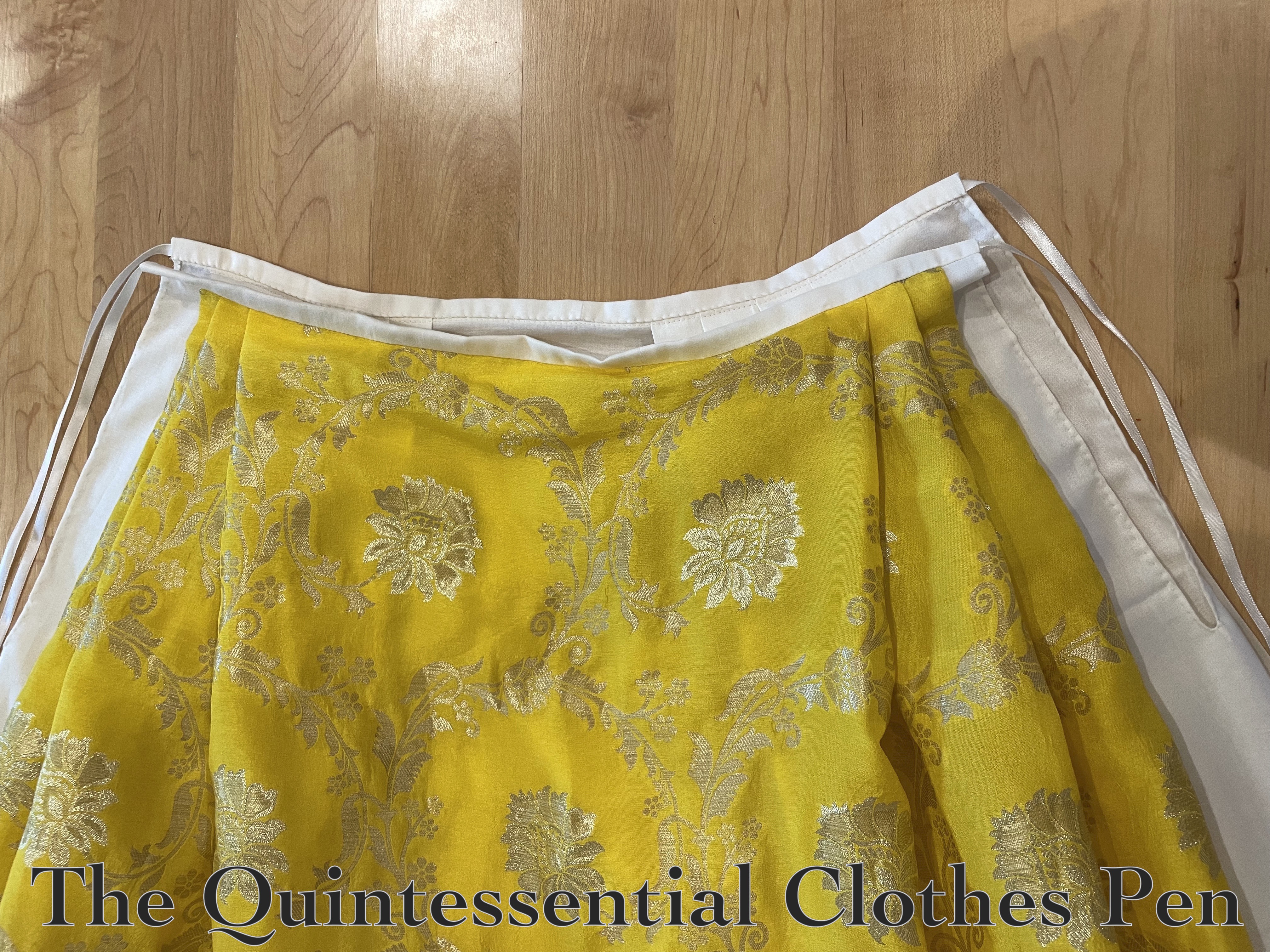
Below is a closeup of the top the petticoat, which shows the pocket slit on the right side.

The front and back are pleated in the same way, though with differing quantity and depth of pleats. They have an outward box pleat at the center and additional deep knife pleats towards the sides. The pleats are held in place by front and back waistbands that are finished at ½”. Below, you can see the inside of the front and inside of the back, showing the knife pleats and waistbands.

And here is one more interior closeup of the waistband. You can see that it was sewn on by machine and then flipped to the inside and whip stitched in place. You can also see the ribbon tie on the right as well as a little bit of the pocket opening.

Set inside of the waistbands are long ties (in this case, made of ivory polyester ribbon because it was on hand). The back ties are long enough to tie around the front of the body. Then the front ties warp around the back and are long enough to tie in front. (You can see how this works in this past post about the petticoat I wear under my Versailles sacque.)

The bottom of the skirt has a ½” hand sewn whip stitched hem, which you can see in the image below. It is leveled to sit over 1770s panniers (which you can read about in this past post).

And that’s basically it! This petticoat qualifies for the Historical Sew Monthly Challenge #12 That’s A Wrap:

Make an accessory or garment that is worn by wrapping it around the body.

Just the facts:

Fabric/Materials: Approximately 1.25 yards of yellow jacquard silk and 2 yards of cream cotton.

Pattern: I referenced my first petticoat, which referenced Katherine’s 18th Century Petticoat Tutorial and The Standard 18th Century Petticoat Tutorial at A Fashionable Frolick. The nice thing about Katherine’s tutorial is that it’s adjusted for a petticoat to go over pocket hoops, while the great thing about the tutorial at A Fashionable Frolick is that it has tons of detailed construction information like which stitches to use. Both tutorials are clear and very helpful.

Year: c. 1775.

Notions: Approximately 3 yards of ¼” ivory polyester ribbon and thread.

How historically accurate is it?: 90%. All of the visible bits are hand sewn. The construction methods are accurate, though cotton is not the most likely fiber content as it was expensive in the 18th century.

Hours to complete: I didn’t keep track (a nice change from some of my projects). My guess is about 5 hours for machine sewing non-visible areas and hand finishing.

First worn: October 5, 2024.

Total cost: Approximately $30 (the cotton was $4/yard, the silk was $17/yard, and the ribbon was free).

c. 1770 Pink Panniers (HSM #12)

I have a longer-term goal to make a another sacque (similar the one I made for Versailles in 2016–documented in these many past posts). I specifically want this new one to be loan-able to a few friends, so I’m adjusting the size a bit from the one I made for myself.

I know that foundations make the garment on top look good, so it’s important to me to also be able to provide the foundation pieces that might be needed to go with the sacque. Stays are covered, as I now have the c. 1785 Green Linen Stays that can be loaned and/or some friends have their own, but panniers and an additional foundation petticoat felt like items that I don’t already have and therefore should make in addition to the sacque itself.

This post is going to document the panniers I made for this new ensemble. I’m pleased that they qualify for the Historical Sew Monthly Challenge #12, Paired to Perfection:

Make something that comes in a pair (mittens, stockings, garters, braces etc.) Or make something in which the trim or construction prominently features sets of two.

Just the facts:

Fabric/Materials: 1 yd (or probably a little less) pink cotton twill.

Pattern: The Dreamstress’s pattern from the Pannier Along in (oh my, has it been this long…???) 2013! All the steps, information, etc. is available on Leimomi’s blog, here.

Year: c. 1770.

Notions: Thread, 3 24″ x 3/8″ zip ties, and approximately 2 yds grosgrain ribbon.

How historically accurate is it?: 70%. Machine sewing and materials are generally not historically accurate, but the overall pattern and shapes are.

Hours to complete: I didn’t really keep track. Let’s say 5.

First worn: Has not been worn yet.

Total cost: All of the materials are from the stash (leftovers from other projects), so let’s say free!

A view of the top of the stays, with them collapsed down on themselves.

I made these following all of the steps in The Dreamstress’s tutorial, as mentioned above. I decided to mostly machine sew them, in the spirit of speed and because I knew the fabric I chose was not accurate to start with.

I made my boning channels out of the same fabric as the exteriors (pink cotton twill leftover from making early 19th century stays over ten years ago).

There are only two hand sewn bits. One is the slit on top (to be able to use these as pockets and store things in them), pictured below. Each slit is reinforced at the bottom to keep the fabric from ripping during use.

The other hand sewn bit is the band at the top, which is whipped down after being machine sewn on.

And that’s it! Pink panniers! It has a bit of a ring to it, I think!

Project Journal: Versailles Sacque: Construction Details

It’s time for some in depth detail about the construction of the robe a la francaise I wore to Versailles in May. My original plan was to use pink silk in my fabric stash to create a robe de cour inspired by Maria Federovna, but I realized when I went to cut out the pieces that I did not have enough fabric.

The change in plan resulted in new fabric and a new plan. I stuck with the decade of the 1770s, but decided to make a robe a la francaise, or sacque, instead of a robe de cour as it seemed like a garment I might be more likely to wear again in the future. Accordingly, I found and ordered new fabric: 11 yards of a very lightweight changeable silk ‘lutestring’ from Burnley and Trowbridge. Luckily, the new fabric still worked with the metallic silver net I’d purchased for trim. It’s the same metallic silver net that is on my 1885 Night Sky Fancy Dress, just cut into strips.

The pattern is from JP Ryan: it’s the Pet en Lair pattern, lengthened to create a gown as they suggest. Underneath I’m wearing a shift, stays, pocketsMr. Panniers, a generic 18th century petticoat, and the petticoat that matches the gown. I also have American Duchess clocked stockings and embellished American Duchess Kensingtons. All my jewelry is from eBay. You can read more about how I created my hairstyle and the hair ornament in this past post.

IMG_0258

Regarding the pattern, I found some of the directions to be confusing. For example, making the petticoat seemed way overcomplicated.   You can read more details about how I made my petticoat here. Also, I found the directions for pleating the front robings/facing and the back pleats quite confusing. There, I was saved by this post written by AJ who also used the JP Ryan pattern, got confused, and posted about the confusing bits. Very helpful! Aside from the confusing directions, the gown pieces went together perfectly with no trouble. I did have to alter the front strap area to make the front sit flat against my body. Two friends who used this same pattern did not have to make that adjustment, so I chalk it up to differing body shapes but do not think it negatively affects the pattern.

IMG_0687 (1)The lining of the gown is made from a one yard piece of cotton/linen blend from my stash. Also from my stash and used inside the gown were a scrap of medium blue linen and a scrap of medium blue cotton twill used to interface the stomacher. These were all the bits left of those three stash fabrics–yay! I was also amused that all of the random non-silk fabrics in this gown and petticoat wound up being blue. I used my lining as my mockup, meaning that I had to take a dart in the front strap area, but was able to adjust the pattern to eliminate the dart before cutting out the silk.

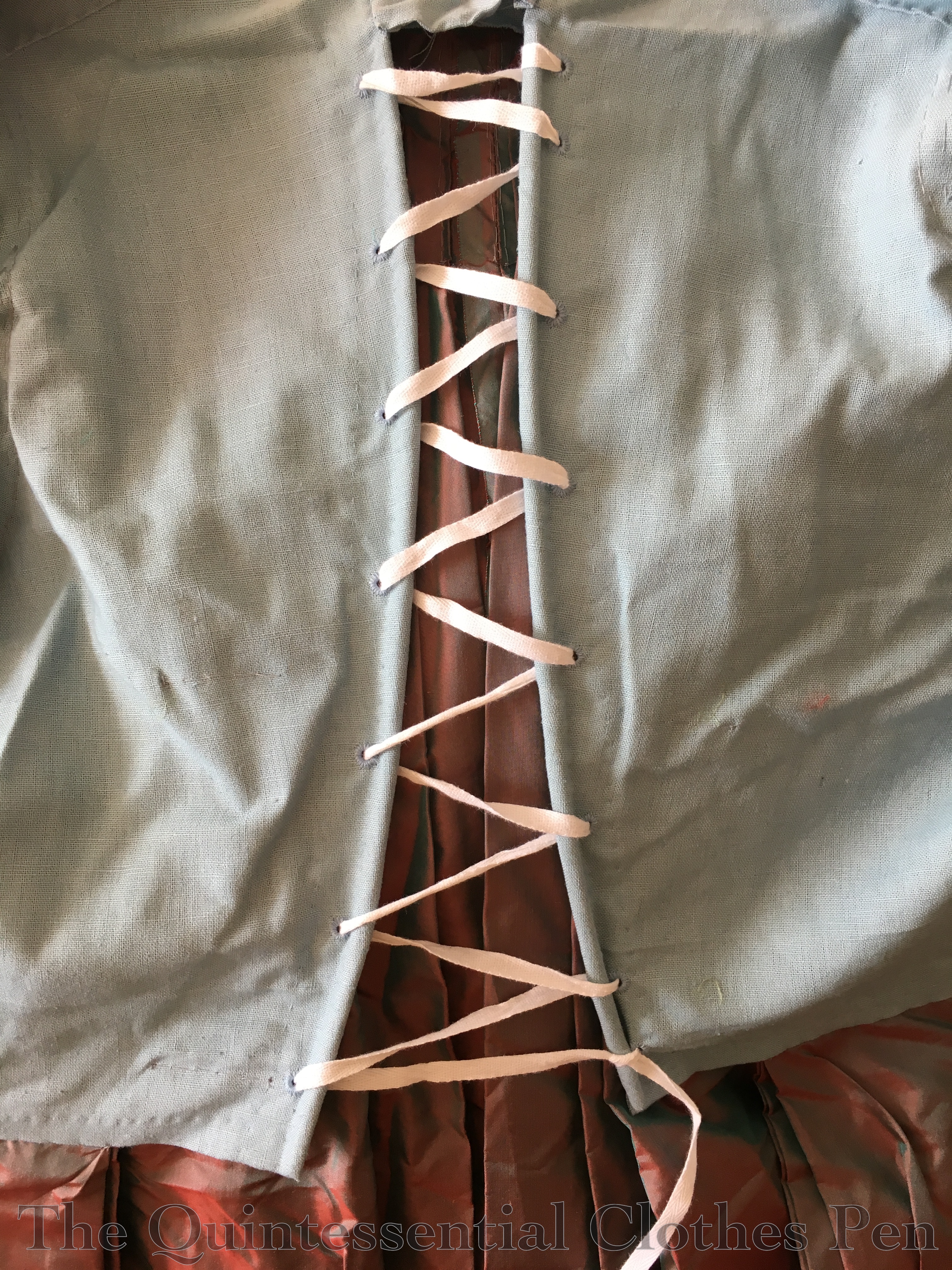
The back of the lining is adjustable using a tie threaded through eyelets. The edges are boned with reed. The pattern suggests ties, but you also see lacing in extant garments and this seemed easier to adjust and that it would use less length for the tie(s). There are examples of both ties and lacing on my Pinterest board for this project. The tie is a 1/4″ cotton twill tape. It’s not accurate, but did the job.

IMG_1476 (1)

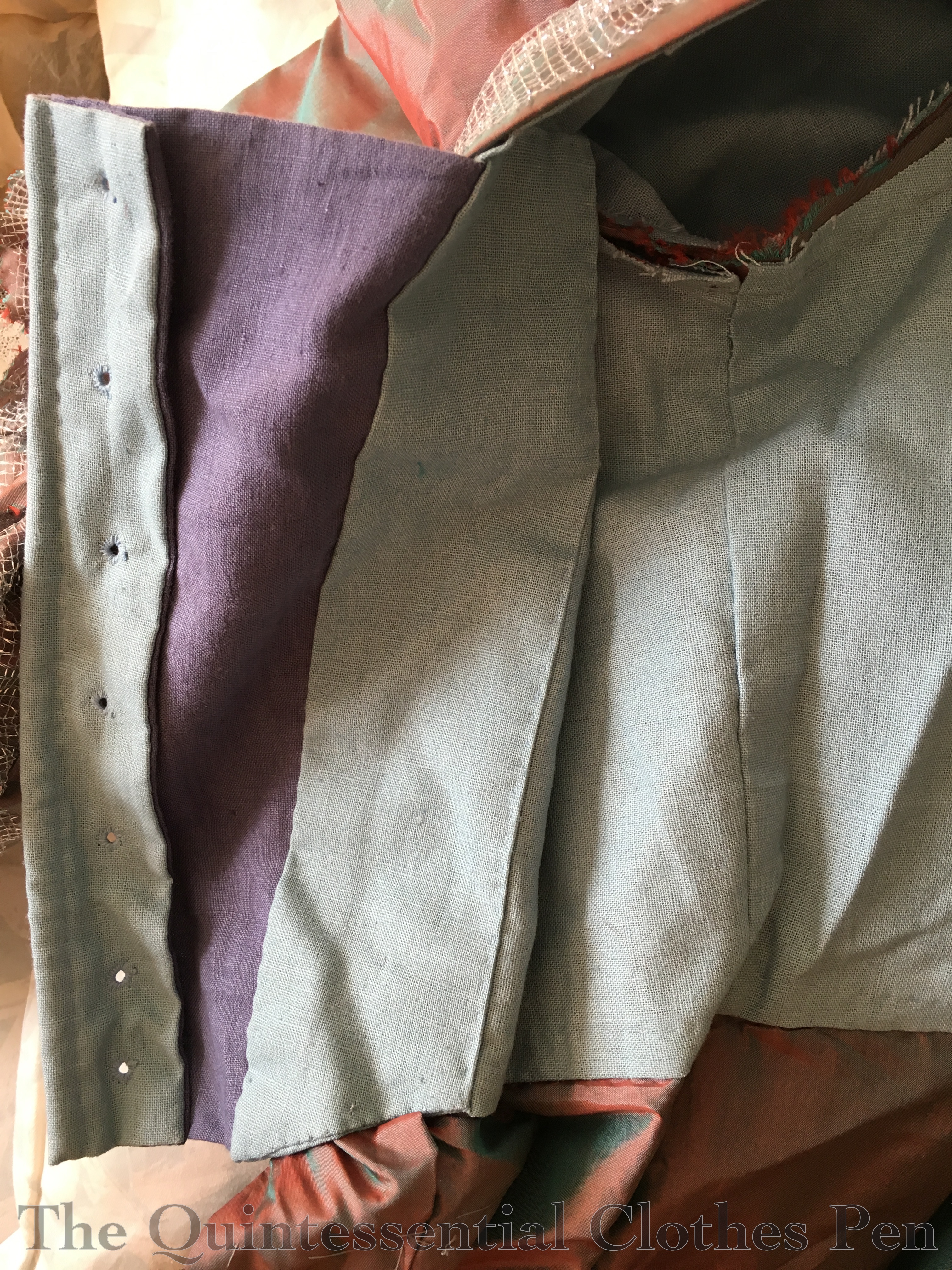
Underneath the decorative stomacher, the gown closes with lacing panels attached to the lining. Again, mine laces closed using twill tape.

IMG_1477 (1)

This is the inside of the front lacing panels. You can see the medium blue linen backing. I think I had run out of the cotton/linen blend at that point. As is usual with 18th century garments, the armhole is left unfinished.

IMG_1478 (1)

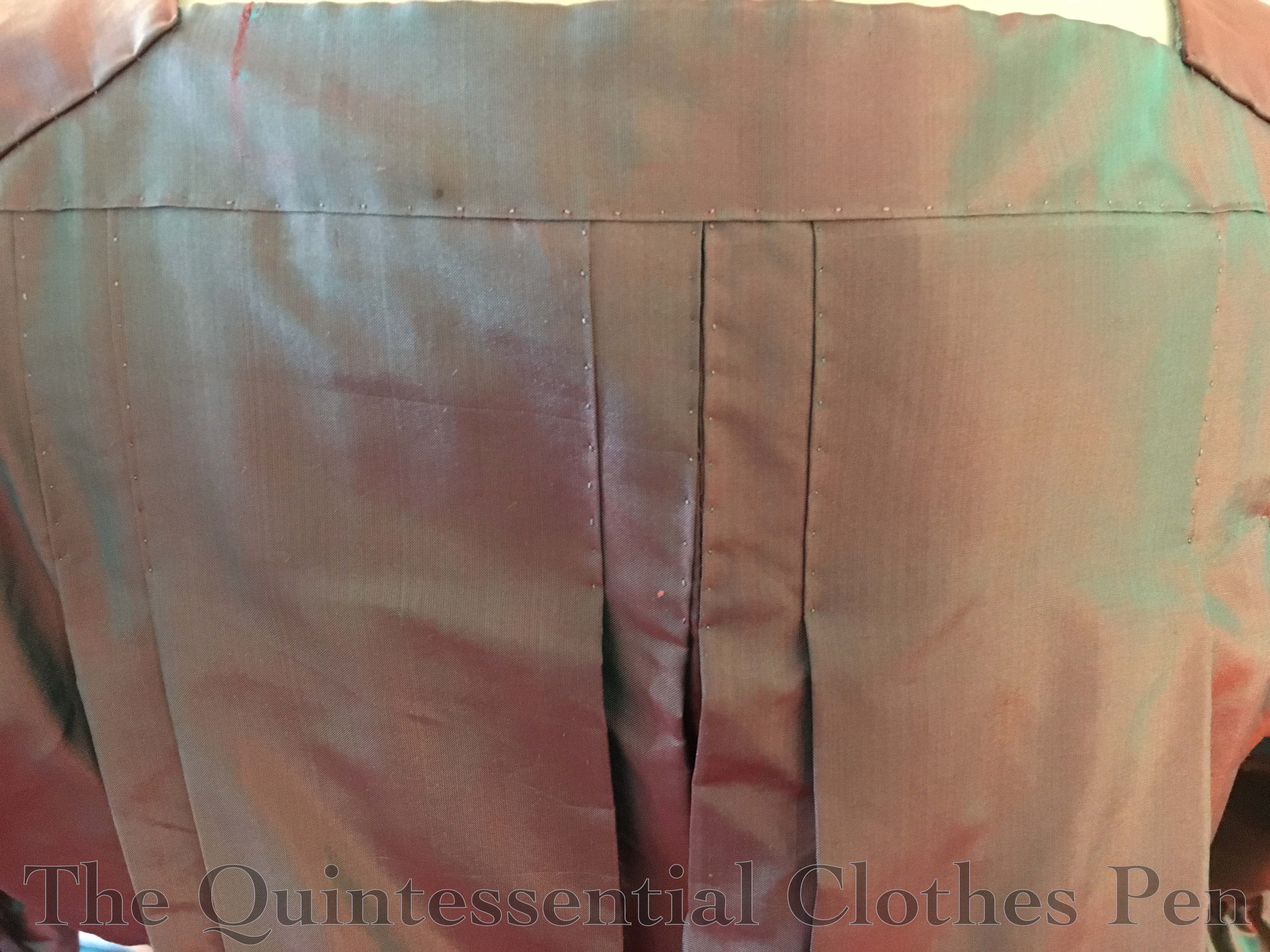
Here’s a close up of the back pleats. These are stitched all the way through to the lining. The directions for the pleats were slightly confusing, but made sense once I started fiddling with my fabric. It was important that I had transferred all the markings from the pattern to make the pleating easier to understand. The pattern uses another four pleats pleats, underneath these, that you can’t see to add volume to the back.

IMG_0922 (1)

IMG_0286 (1)

Due to the unexpected nature of the purchase of the silk fabric for this gown, I decided to do that fabric justice by hand sewing the entire garment. So in addition to the exterior stitching like that anchoring the pleats on the back, all of the interior seams are also hand sewn. I rather enjoy hand sewing and it makes a lot more sense given the way 18th century garments were constructed.

Here is the gown mostly sewn in its essential elements, but lacking trim. The sleeve flounces were individually gathered and sewn to the arm openings. They are pinked with scalloped shears on the top and bottom edges.

The following image is the gown that I followed in terms of trim placement. It took many more hours than I thought it would to pin the trim on. Those big waves are more complicated than they look, plus I had the challenge of creating the smaller scallops as I went along as well. All of the trim had to be sewn along both sides and tacked at each scrunch after it had been pinned.

IMG_0919 (1)

8423a2253758be21b68f0141235eadb1
Robe a la Francaise. 1765. LACMA.

You can see that I pressed my robings down all the way to the hem, though once the trim was applied on top it was really not very noticeable. I like the finished result, but I think it’s worth pointing out that this pattern is designed to have a wide stomacher. I was envisioning it coming out a little narrower at the waist. But I think adjusting the back opening enough to make a noticeable difference would only create awkward wrinkles under the arms.

The finished stomacher was covered in scalloped trim and finished off with a sparkly brooch. I went to France with an untrimmed stomacher and no clear idea about how I wanted to trim it except that I wanted it to be an all over metallic feast for the eyes. Luckily, early in the trip I was able to go see the 300 Centuries of Fashion exhibit at Les Arts Decoratifs. In addition to being amazing (I got to stand within 6 feet of Dior’s Bar Suit and see many garments I’ve only ever seen on Pinterest!), I also took a picture of a stomacher that was inspirational in terms of the overall wavy patterns and filler shapes. That picture is below.

IMG_0419 (1)

IMG_1153 (1)

Trimming the stomacher took place in the evenings in the few days before the special event. Here is the stomacher in progress. I took it specifically to show the amazing green color that the fabric can appear from some angles. I was hoping to get a picture of the finished gown looking this color, but had to be content with seeing shades of green in some of the pictures as we didn’t capture any where the whole gown was this color.

IMG_1339 (1)

Another part of the dress that was finished in France were my engageants. The pattern includes flounces of two lengths to be made of silk and then one longer flounce for an under flounce or engageant. I sacrificed some lace I’ve been intending for another project, threw some darts in at the longest section to get the scalloped edge to be the right shape, and filled in the length with a bit of mystery ivory sheer. The resulting flounce was gathered and sewn to a cotton tape that was basted into the arm opening.

IMG_1481 (1)

It sure sounds like a lot of work, recounting these bits of the process. It was! And it paid off. I’m very pleased with the gown. And very pleased that this picture captures some of the stunning green in the fabric!

IMG_0287 (1)