

The plan for the yellow sacque ensemble I’ve been working on was to provide an under petticoat that would help the yellow silk petticoat (that I posted about in November 2024) hang nicely and be opaque. I thought I’d completed this goal in December 2023, when I re-used fabric from an old Regency style dress to make a base petticoat (you can read the details about that here).
As I started working on the yellow petticoat, though, I realized that the silk was very thin, and that the blue under petticoat (made from the dress) was distorting the yellow color, making it look washed out and less vibrant. Ugh! What to do??
I determined that a light, neutral color under petticoat was needed and looked through my stash to see what I has in enough quantity for a new petticoat. The goal was to make this from the stash!
I found that I still had yardage of the mystery $1 per yard fabric I’d purchased two ten yard rolls of about ten or twelve years ago. I’ve used it for many projects, including all sorts of historical underwear and other projects (my recent 1790s petticoat and bum pad, a recently updated 1810s petticoat, lining a sheer 1895 blouse, lining a 1953 dress… and probably more things that aren’t coming to mind right now!). It’s very versatile!

Above is a front view of the new petticoat. I made this in exactly the same way as the blue petticoat, referencing the same tutorials, etc. Essentially this is a tube that is pleated at the waist, with ties to hold it on the body.

The front has an outward box pleat at center front, while the center back (pictured above) has an inverted box pleat. The pleats are finished off by on the grain strips that form the ½” waistbands. Ivory satin ribbon ties are set into these waistbands.
Given that I had to make a whole new petticoat, it was my goal to make one that I could reuse for other purposes. Namely, I have 1780s ensembles in my sights and I wanted this petticoat to be able to be used for those. So it was important to me to level the petticoat in a way that would make sense for that purpose, but I also needed to make sure the petticoat to be long enough in the front to fully back the yellow silk for the sacque project.
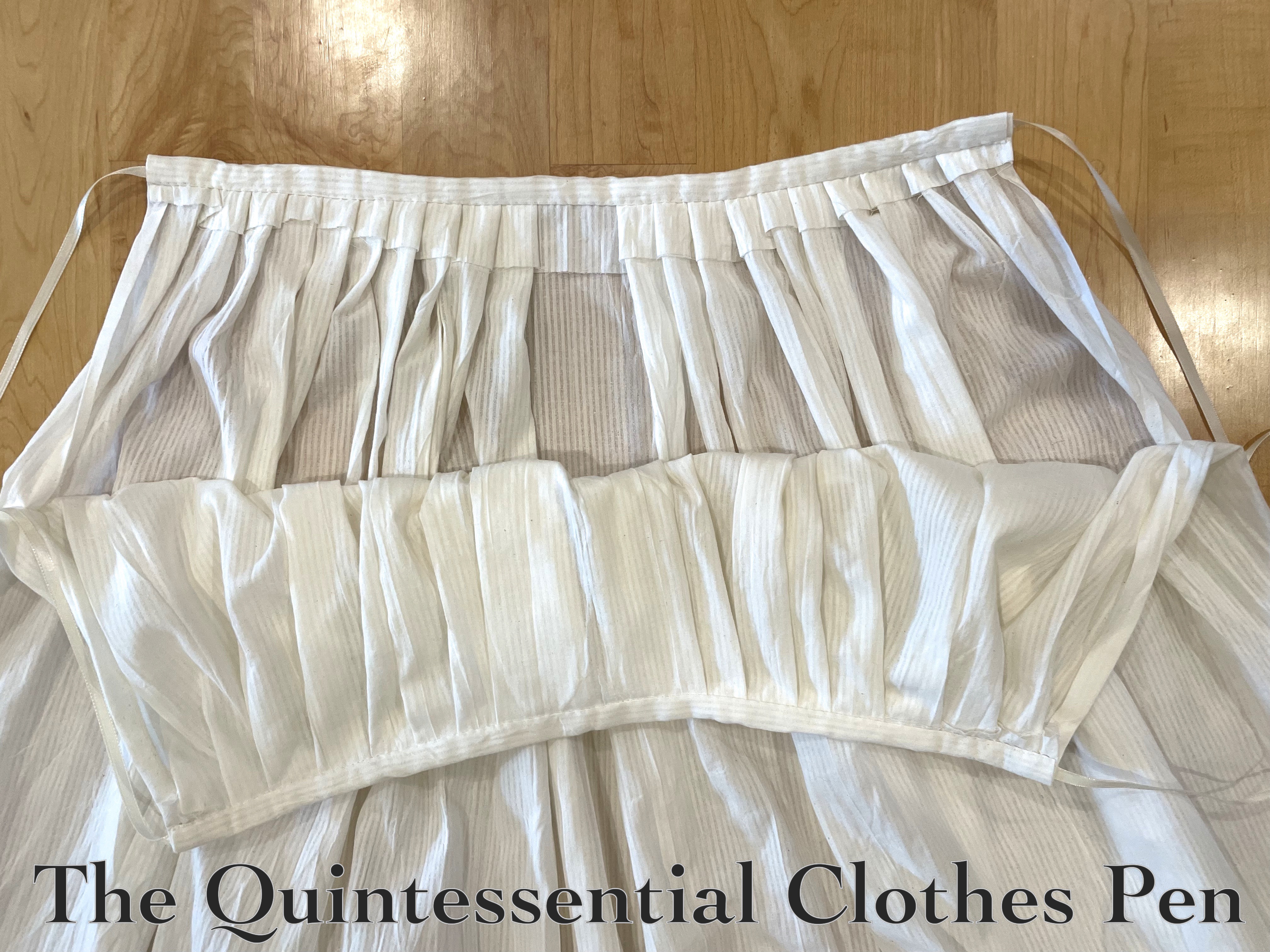
I’m pleased that with some careful figuring I was able to accomplish both goals! This petticoat doesn’t sit evenly over the pink panniers for the yellow sacque, but it does sit evenly over a not-quite-finished Scroop Patterns Frances Rump for a 1780s style! In order to know this would work, it meant I also had to make the Frances Rump and get it far enough along to be put on so I could figure out the leveling. More on the Frances Rump later! For now, a photo (below) of the insides of the white petticoat.
In the photo, the back is flipped down, showing that the skirt is leveled in a way that is pretty straight across. You can just see a little extra fabric length poking out of the waistband on the right side. The front of the petticoat is facing the top of the image. You can see how it needed to be a little bit shorter (therefore more fabric turned down to the inside) to accommodate the lack of bum pad on the front of the body.
The petticoat is finished with a whipstitched 1″ hem. It’s just the right length for me (and luckily also for the person who wore it in October), but might need to be whacked up with a basting stitch if I loan it to a friend with shorter legs. That’s easy, though!

And that’s it!
This garment qualifies for the HSM Challenge # 7, Always In Style:
Make a garment or accessory that is appropriate for more than one historical period…or even a historical piece that can be worn with modern clothing! (Note that the piece should still be ‘historical’, not just ‘historically-inspired’.)
Just the facts:
Fabric/Materials: Approximately 3-4 yards white striped cotton.
Pattern: None, but I referenced both of these tutorials on constructing 18th century petticoats. Katherine’s tutorial is for a petticoat with an uneven length (to go over panniers, or a bum roll, for example). Rebecca’s tutorial is for a petticoat with an even length (the same length all the way around, to be worn without extra supports). Both tutorials have construction information, Rebecca’s includes a bit more detail in terms of which stitches and methods to use.
Year: Loosely 1700-1790, but leveled to be appropriate for c. 1785.
Notions: 3ish yards of ¼″ ivory polyester ribbon and thread.
How historically accurate is it?: 70%. Accuracy gets knocked down because: 1- all unseen seams are machine sewn, 2- I used polyester ribbon for ties, 3- I haven’t seen research that shows cotton being used at this time for a single plain petticoat of this sort.
Hours to complete: 5? I didn’t really keep track.
First worn: October 5, 2024.
Total cost: The fabric was $1 per yard. The ribbon was gifted to me. So approximately $4.
 The Quintessential Clothes Pen