Finally Finished: 1917 Wool Skirt

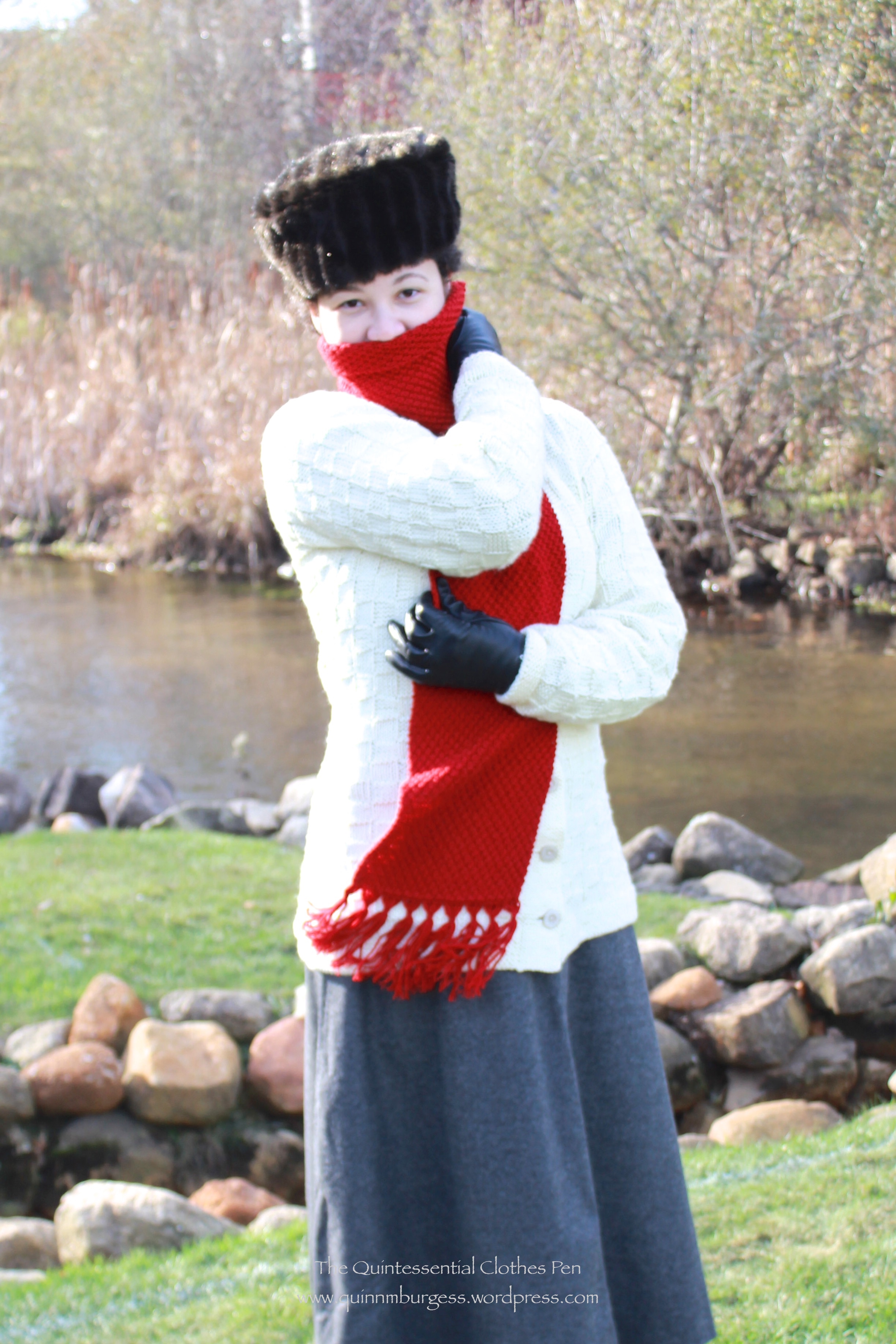
Last fall, in November I believe, I actually finished the 1917 wool skirt I’d made in 2013 as part of my 1917 Ensemble. Of course, it was wearable prior to being completed–I’d worn it for it’s original purpose and for a picnic in May 2013. But it wasn’t actually completed until I wore it last November when I also wore my 1917 Cranberry Red Scarf.

IMG_9658
From the Cranberry Scarf post, proof that I was wearing my wool skirt, though all the layers cover up the changes I made that completed it.
IMG_1561
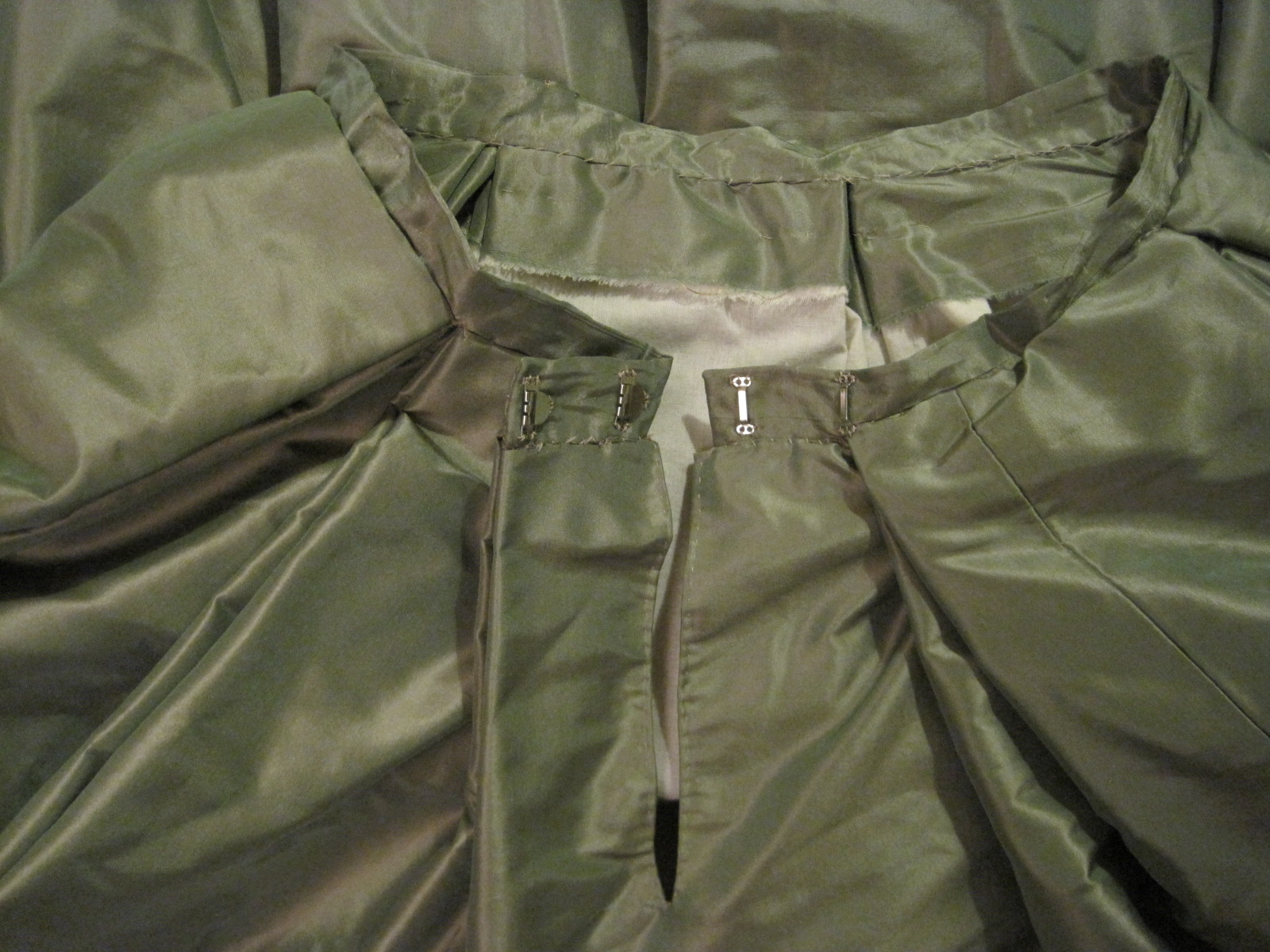
The new placket closes with hidden skirt hooks and bars.

While the side seams, hem, and waistband were totally finished for the first wearing, the skirt never had closures. It just sat in my closet taunting me with it’s almost-finished status. When I went to finish it I realized that a side closure would make it much easier to get dresses and be less gap-y than the center back closure I had originally intended. Moving the closure meant re-do-ing the waistband, so I also used the opportunity to change out the pockets.

As a side note, pockets on day wear are genius! They’re so useful when you’re the public eye and you need to keep things like your car key, phone, and ID on you but you don’t want to leave them lying around. They free your hands from any sort of bag and ensure that your sensitive modern items are not lost or stolen. GENIUS!

IMG_1562
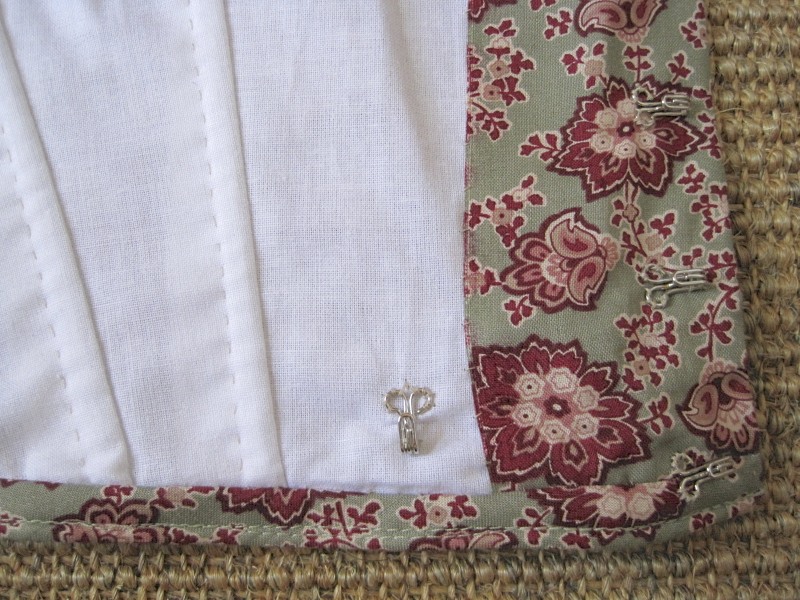
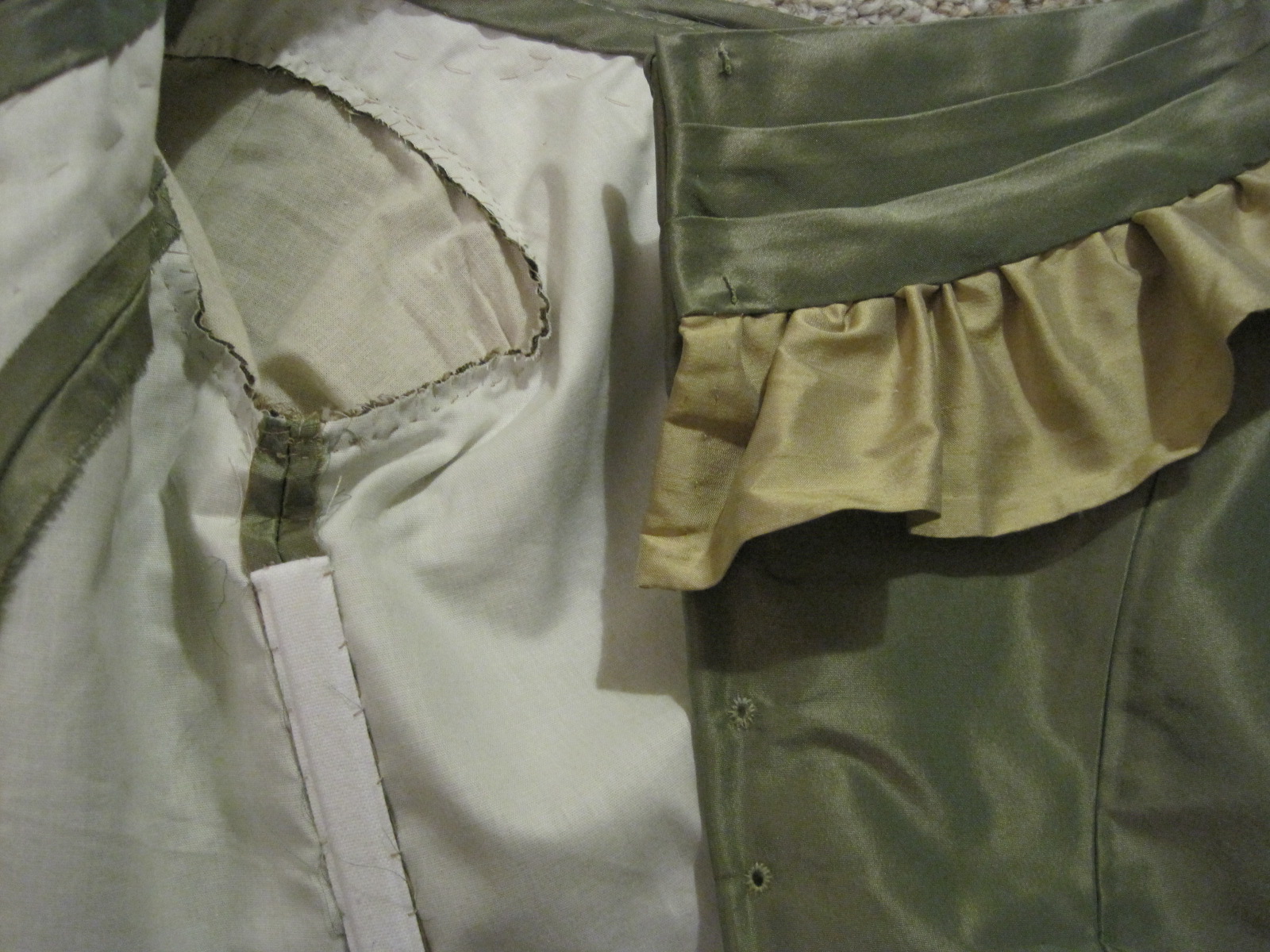
New (modern shaped) pocket.

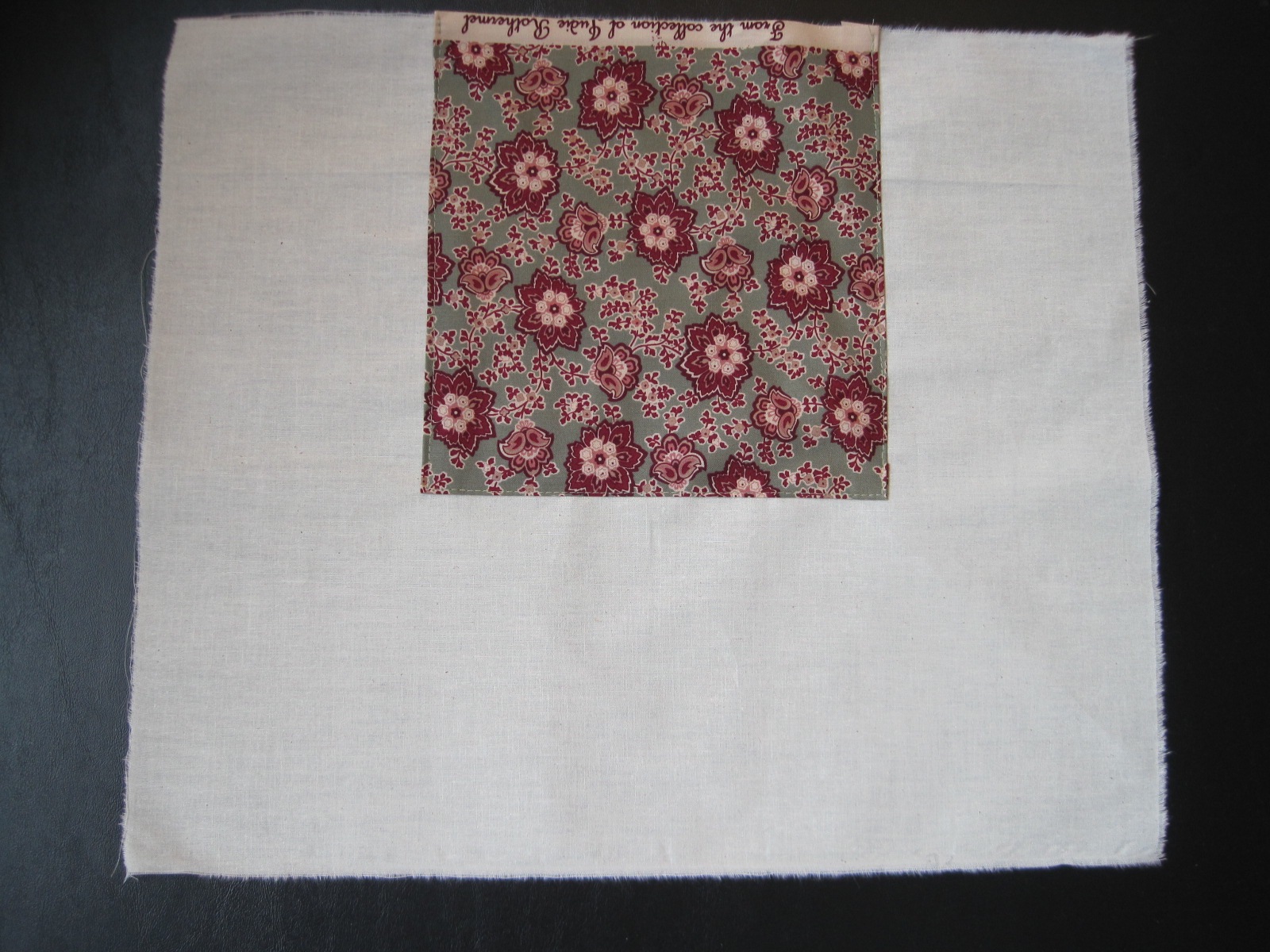
The pockets I’d originally put in were rectangles set in vertically that extended both in front of and behind the pocket slit. They are just fine in skirts with more fullness, but for this period they were hard to get my hand in and out of. So when I was changing around the waistband, I cut out a new pocket shaped like what you would find in a modern garment. The new pocket has a facing piece of the skirt wool sewn over the muslin where it might show when I put my hand in (that’s the square set of stitching on the upper right). Because I added a side closure I only have one pocket on the other side, but it is easier to use than the old pocket style was. Both the pocket and the waistband facing are made from scrap muslin (not itchy, not slippery, and who doesn’t love using up scraps?!?).

Both sides of the skirt have four covered buttons on them. Buttons were often used in the 1910s to decorate skirts and blouses (take a look at my 1915-18 Pinterest board, for instance, and you’ll see lots of examples). These buttons are just for show, though, because the skirt closes with hidden skirt hooks and bars.

IMG_9664
Braving the cold to show off my completed skirt placket.

I referenced Jennifer Rosbrugh’s great placket tutorial (I could remember all the directions exactly, but it’s so much easier to just take a quick look to remember which pieces to cut to different sizes and where to put them!) and this tutorial showing how to add hidden side pockets (Again, nice to to have to think very hard: easy directions and good illustrative photos!). And I’m super pleased that the skirt is complete! Yay!

1922 Lawn Party Ensemble

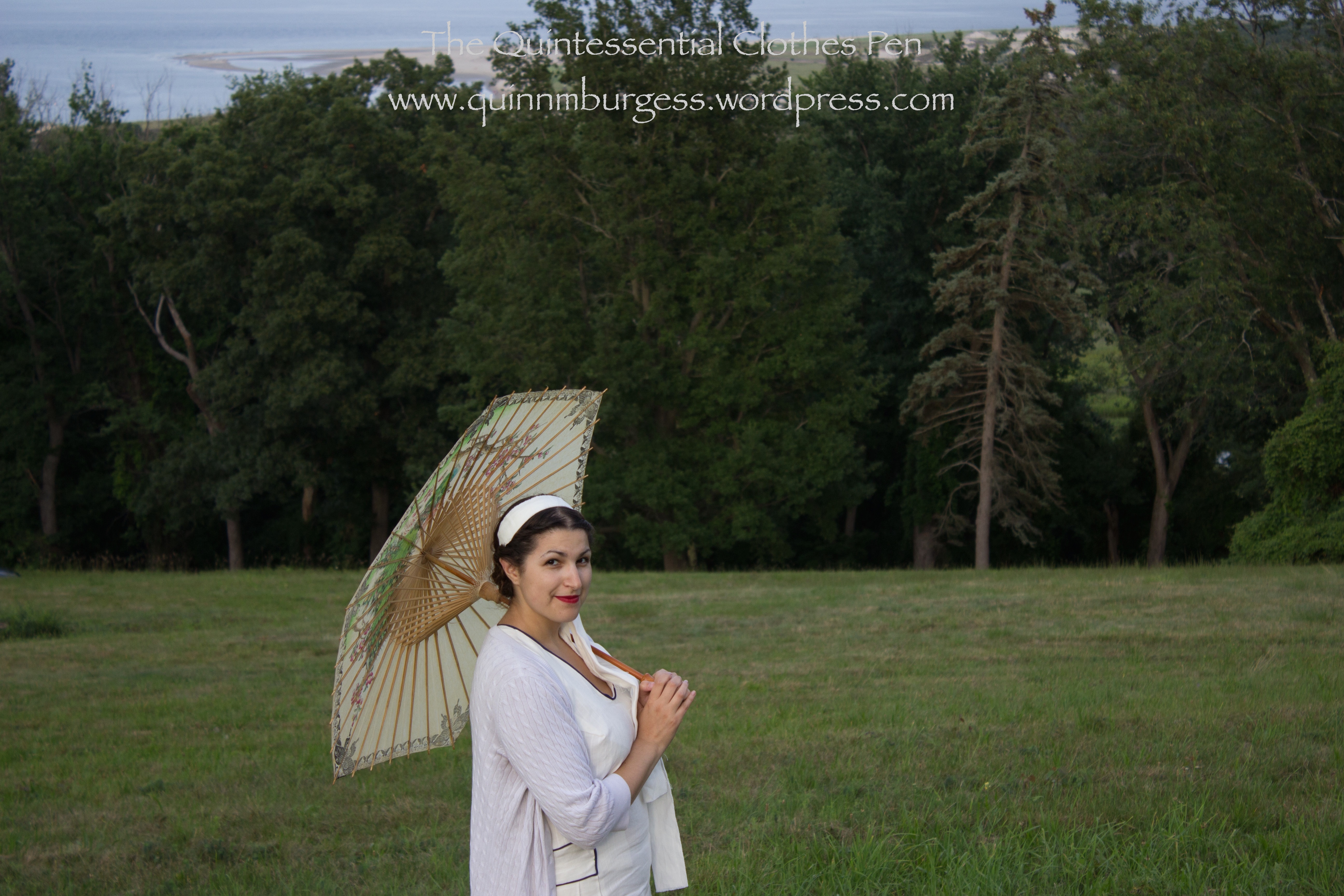
Remember my Sort-of 1920s Long Handled Parasol and my 1920s Wide Brim Hat? I was able to wear/use both of these at the recent 1920s Crane Estate Lawn Party event. I attended the event last year as well, which you can check out to see more pictures of the venue than I’ve included in this post.

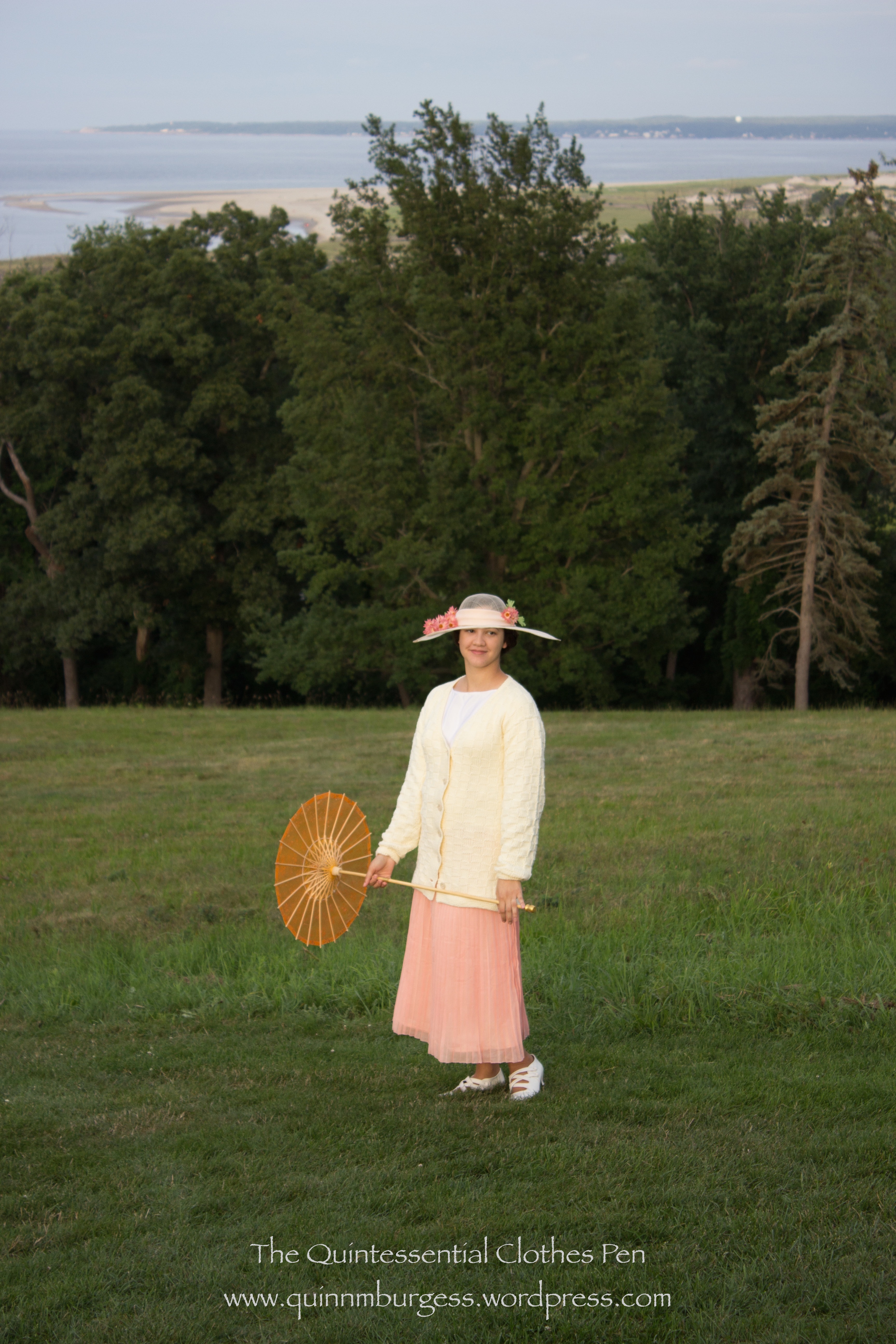
This year, I paired my new parasol and hat with a pleated skirt from ebay (it was one of those things you gamble on when you order, and while I don’t like it for modern wear I think it worked perfectly for an early 20s look!), a new silk blouse c. 1922, my 1917 Knitted Sweater of Angorina (because I’m sure people didn’t wear their clothing only during one year!), and my American Duchess Astorias. It’s wonderful to have accessories and pieces like sweaters in the closet that can fill out an outfit without having to always create an entirely new ensemble.

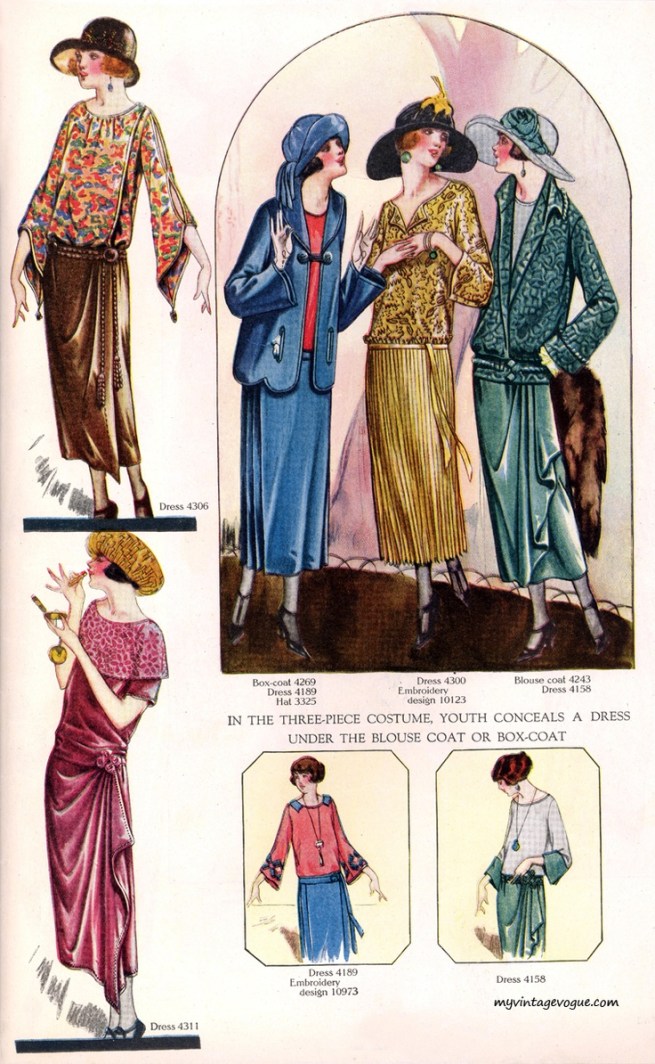
My goal was an early 1920s look, when the skirts were still long and the clothes weren’t quite such bags. In terms of overall clothing style, I was aiming for the yellow lady in the image below. In terms of accessories, I was aiming for some of the looks which you can see in this past post about making my parasol.

80f48de904eecb22b43fff925ffe081c
The Delineator Magazine 1923

The blouse I made from white silk crepe the afternoon before the event. It’s all one piece, with the gathered sections on the sides. I used short sleeves, as in view A, but omitted the bow, as in view C. This was partially due to fabric restrictions, as I used fabric left over from another project and I only had an odd shaped piece to work with. I’m not entirely pleased with it, because, being 20s, it is rather a bag, but it was very comfortable, which I did like. I think I would like it better if it was an off white rather than a bright white, because it would have complimented my outfit better. But my hand knitted sweater is ivory and I was really pleased to wear it over the blouse, because I liked the color and the length better. It has such nice proportions with the skirt!

sample_show.php
My inspiration for the blouse. Butterick pattern #3779 from 1922 at COPA. I used the pattern layout as a general guide for creating my blouse.
IMG_0033 (1 of 1)
My 1922 blouse. (…that is a bag!)

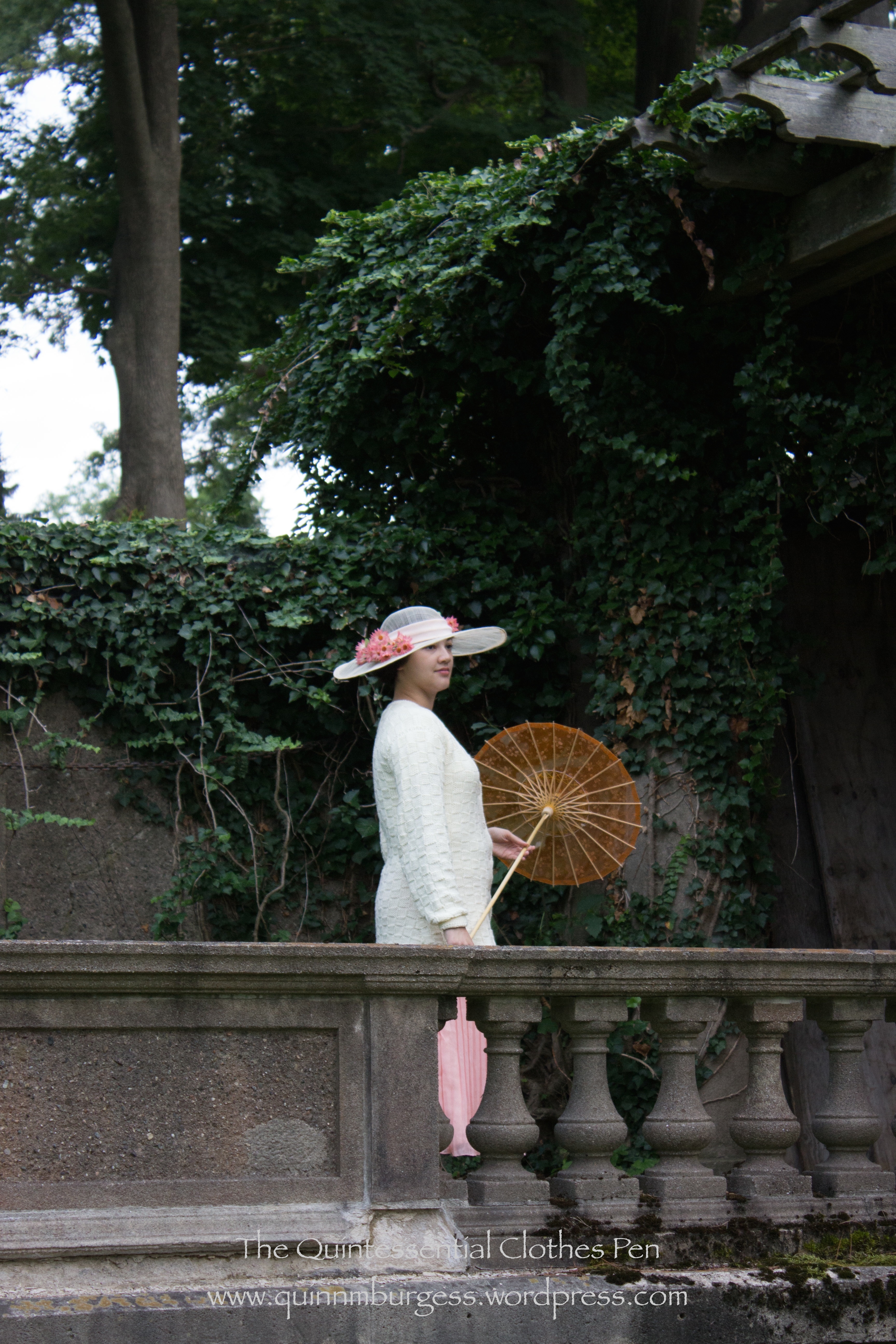
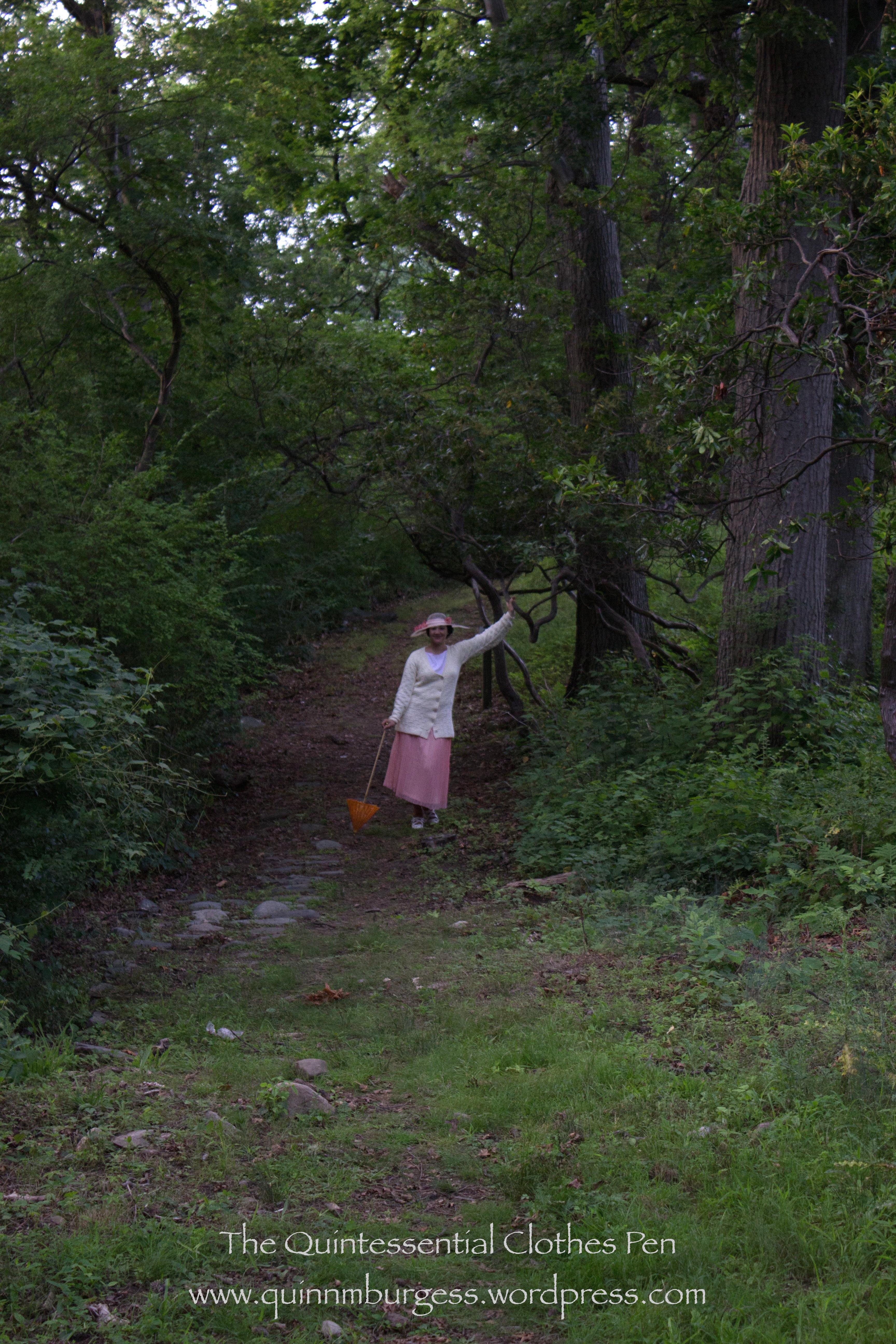
In no particular order, here are a variety of pictures taken around the estate of the entire ensemble. There were quite a few that I liked, for the movement of the fabrics, or the pose, or the background. The wide hat brim was great for hiding my face. Useful, since I am really good at making weird faces and not always the best at making good picture faces.

IMG_0083 (1 of 1)
Looking out over the ocean.
IMG_0119 (1 of 1)
In the sunken garden.
IMG_0133 (1 of 1)
At the gate to the secret garden.
IMG_0141 (1 of 1)
At the beginning of the wooded path.
IMG_0145 (1 of 1)
Exploring the wooded path.
IMG_0151 (1 of 1)
Appreciating the gnarly trees.
IMG_0165 (1 of 1)
Ascending the path.

Of course, sometimes I was the person behind the camera as well (it’s only fair that if I want lots of pictures of my outfits that I also reciprocate!). Here are a few other pictures just for fun. I took all of these except the last one.

IMG_0095 (1 of 1)
Capturing the ocean and the lovely parasol.
IMG_0108 (1 of 1)
The house is surrounded by a lovely terrace with stone walls.
IMG_0137 (1 of 1)
Through the gate to the secret garden was distant view of marshes.

And, lastly, a bit of humor to end the parade of pictures.

IMG_0110 (1 of 1)
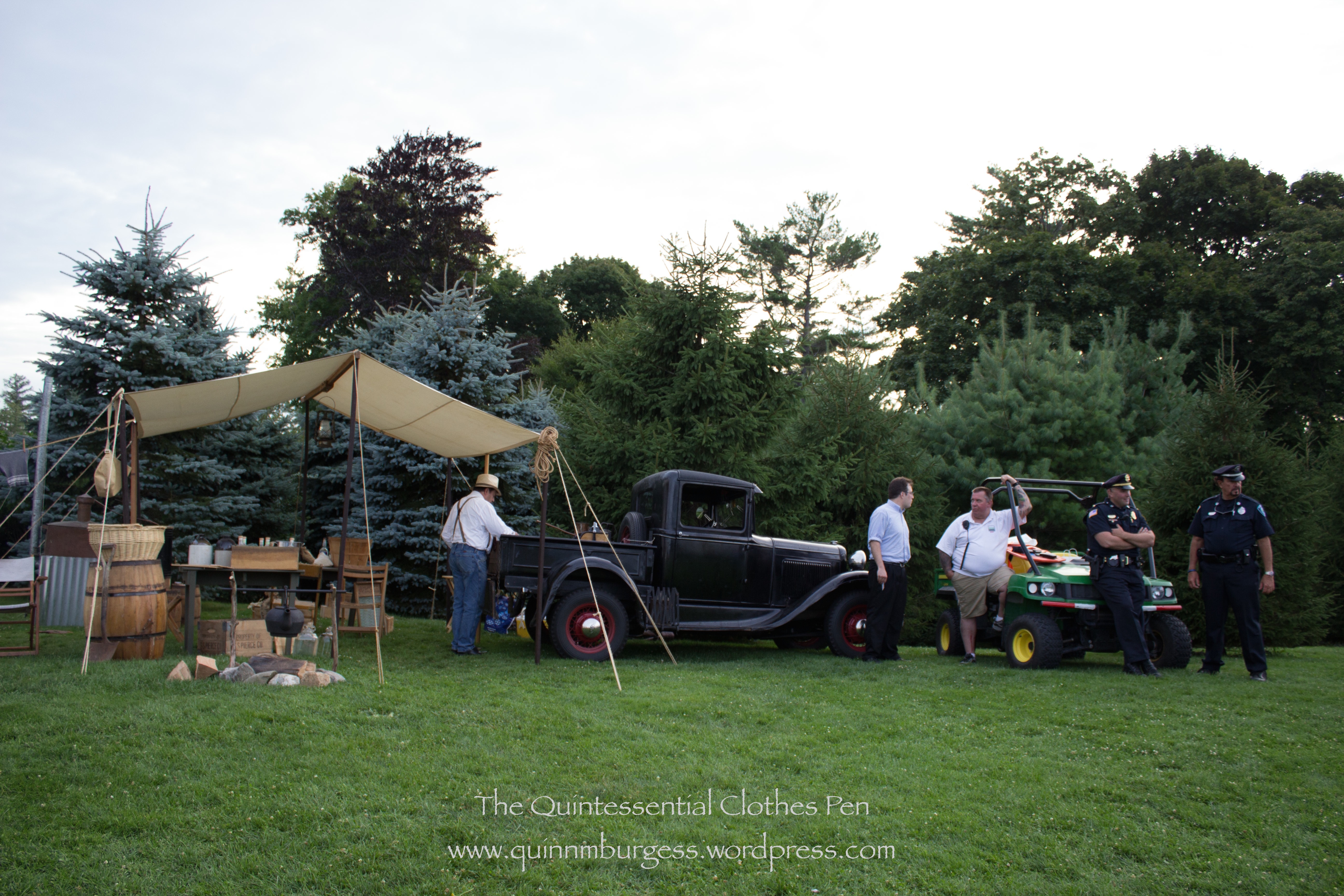
One section of the lawn had a great bootlegger setup and I was particularly amused to see the (modern) police hanging out right next to it.

And there we are! All of my recent 1920s accessories have been worn/used and documented in my complex photography files. That’s it for 1920s for awhile.

Thankful For Suffrage

If you saw my last post, you were left guessing as to what event I was furiously sewing for. I think most you guessed that it had to do with women’s suffrage… Yay you! The entire event wasn’t really about suffrage, but suffrage was a part of it. We went down to Plymouth, MA to be a part of a historic village event that was linked to the main Thanksgiving parade in town.

The historic village contained various groups from the early 17th century, groups from the 18th century, Marines from 1812, a unit from the Civil War, my usual dancing friends and I representing women’s suffrage c. 1914, and paratroopers from the 1940s. The parade was…a parade. There were historic groups in it (including some of the military groups I just mentioned), there were marching bands, there were floats, there were unicycles, and there were horses doing various things.

And I’ve got pictures! To start, here are some images of the parade:

IMG_7068
Happy Thanksgiving! The giant inflatable turkey was pretty amusing, especially when he had to slightly deflate to get his head under the power lines!
IMG_7024
Often these guys are dancing with us, but at this event they were hanging out in the 1630s as the Salem Trayned Band.
IMG_7088
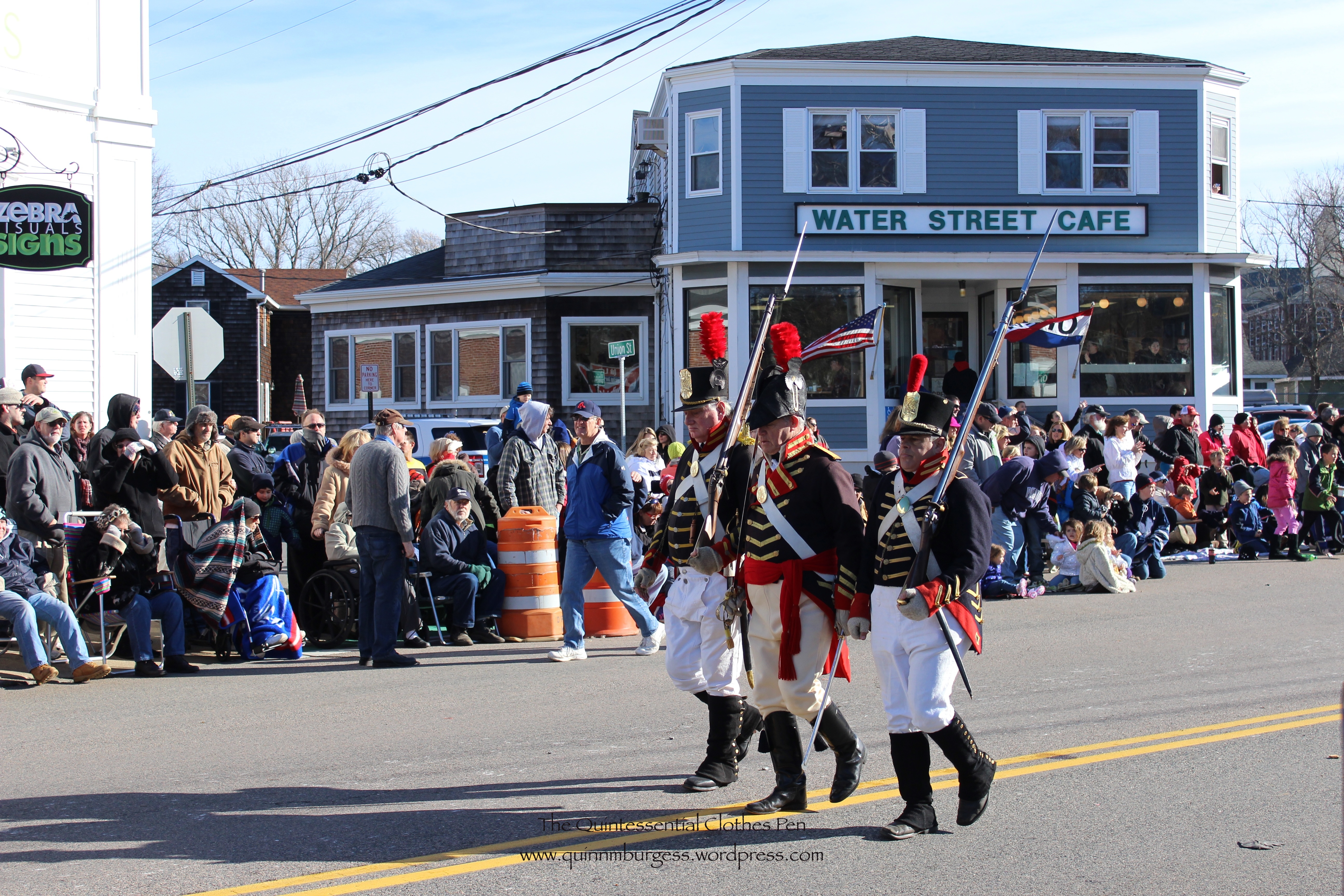
Some of our other friends: 1812 Marines.
IMG_7077
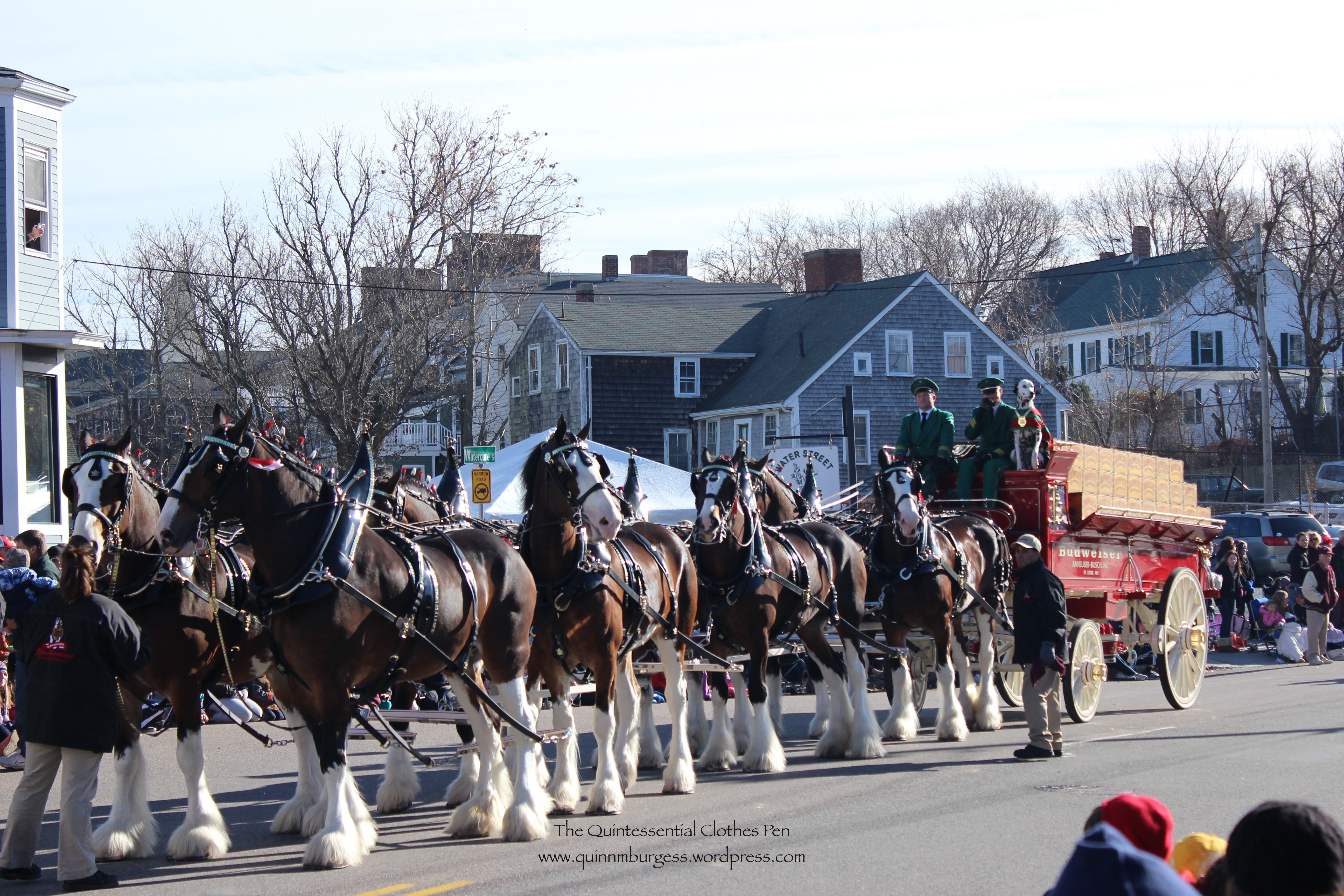
8 beautiful (and large!) Budweiser Clydesdales.
IMG_7104
4 spirited horses pulling…
IMG_7105
A fancy Wells Fargo stage coach!
IMG_7119
A super snazzy green car, with bright green trim!
IMG_7177
Red, white, and blue confetti in the cold, clear air near the end of the parade route.

Next, here are some images of our representation of Suffragists and our setup in the historic village:

IMG_6903
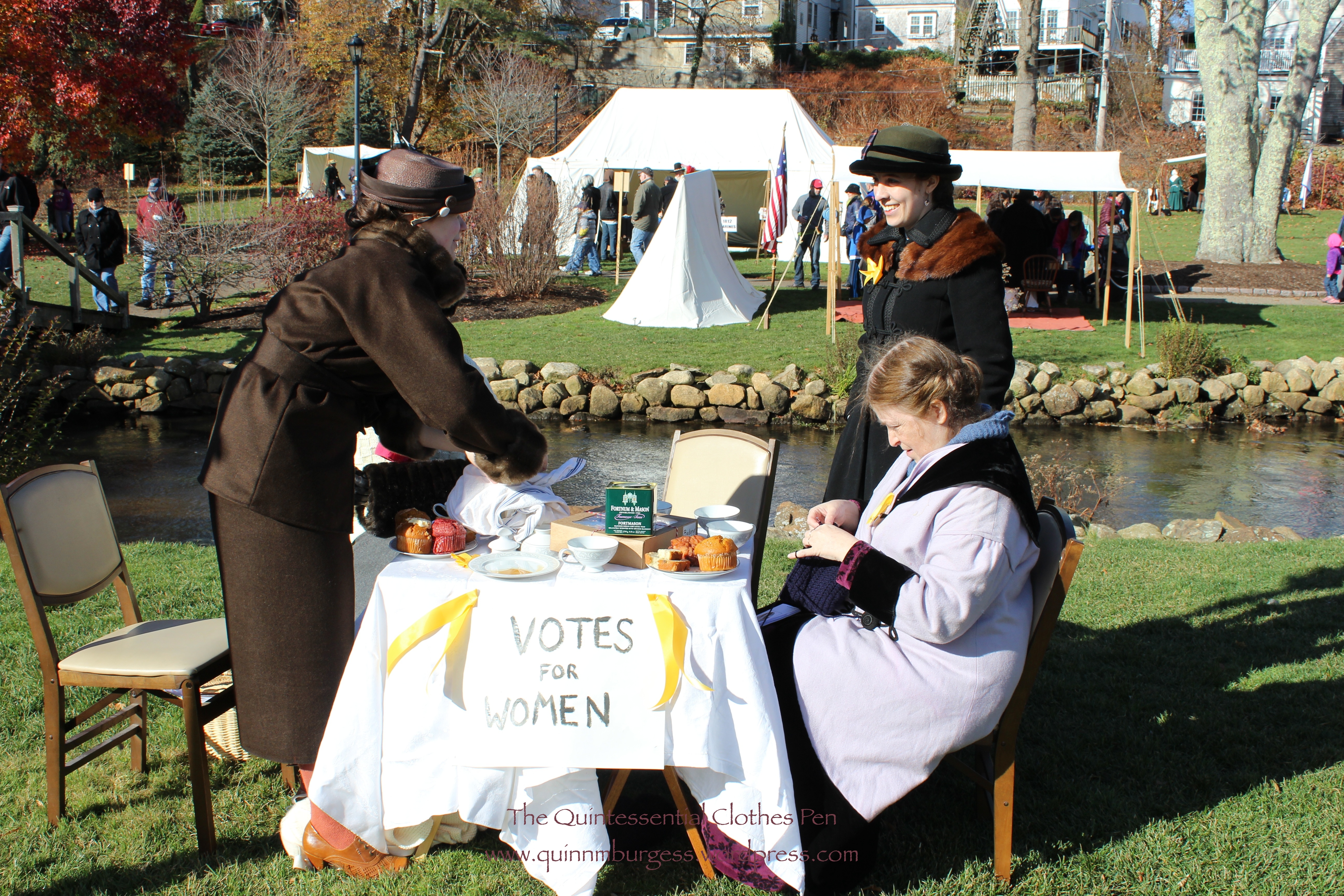
Setting up our tea table. Other setups included tents and smoking fires (it had rained the day before and everything was damp and mushy, so the fires didn’t really work…).
IMG_6900
Yes, we really did drink tea. In china cups. It actually was very nice to have hot beverages throughout the day given how cold it was outside!
IMG_6979
See, we’re drinking our tea!
IMG_6962
We didn’t march in the parade or parade around the historic village, but we did serenade the ducks in the creek behind us (and visitors walking by) with suffrage songs.
IMG_7208
Here we are making “serious suffrage” faces.
IMG_7209
Ok, smile for the camera.

The best part is that in addition to sharing a little bit about history with the public and getting to watch the Thanksgiving parade in all its glory, I was able to use this opportunity to build and wear an outfit showing off my recently completed 1917 Knitted Sweater of Angorina. I had to plan for cold weather, but I didn’t want to cover up my sweater! So I planned a faux fur hat to match an existing muff, a wool skirt, a polyester crepe blouse (in this case, the polyester was a great choice, because the fact that it wouldn’t breathe would help me stay warm and use up a random bit of fabric in my stash that had no other project in its future!), and did a mostly unnoticeable revamp on my 1860s/can-look-like-other-decades fur muff (which was essential, it turned out, for keeping my hands warm!). And to look stylish, I made gaiters to turn my 1920s American Duchess Gibsons into 19-teens looking spat-boots. And all of the fabrics were from my stash! The gaiters might just be my favorite part of the outfit, and both they and my fur hat will qualify for the next two HSF challenges, so you’ll see more detailed information on those soon! All in all, I managed to stay warm, except for my feet! I wore thick tights, but I didn’t think to wear extra socks, and my toes and feet were SO cold! Note to self: wear thick socks next time an all day outside event in the cold is on the horizon…

And here is my brand new 1917 outfit:

IMG_6948
Yay! New hat, revised muff, new blouse, hand knit sweater, new skirt, and new gaiters, worn with my Gibsons, my modern cashmere lined leather gloves, my 1913 petticoat pinned up to shorten its length, and a golden yellow ribbon in support of women’s suffrage. I was able to completely finish my accessories, but the blouse and skirt didn’t get as far as closures. You can’t tell of course, but safety pins are great sometimes. These two garments now live in the “need to be finished” section of my sewing list.
IMG_6963
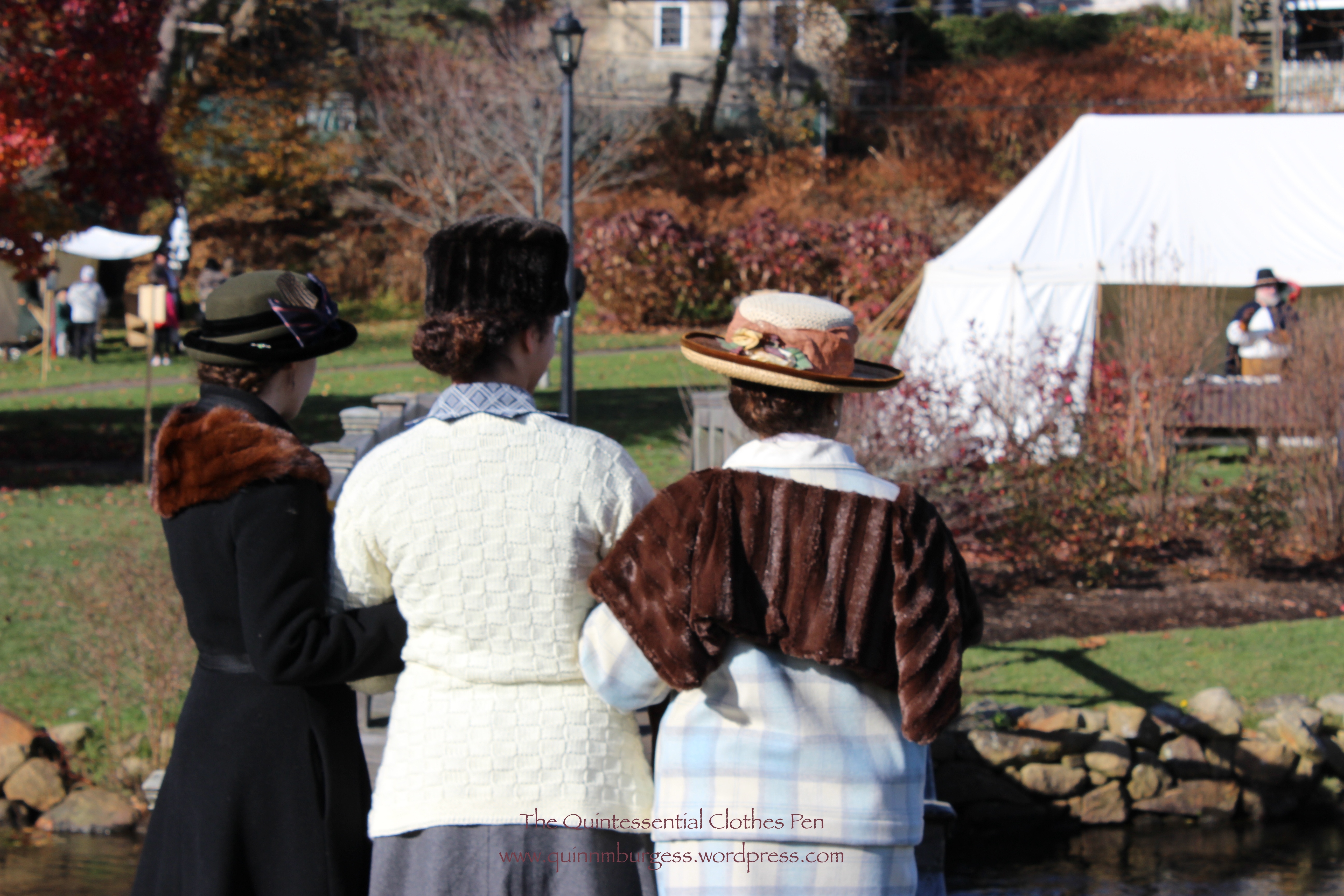
One of the only back views. The blouse has neat collar details (see those cute points?) and neat cuff details you obviously can’t see. When I eventually finish the blouse and skirt I’ll post more details about their design and construction.

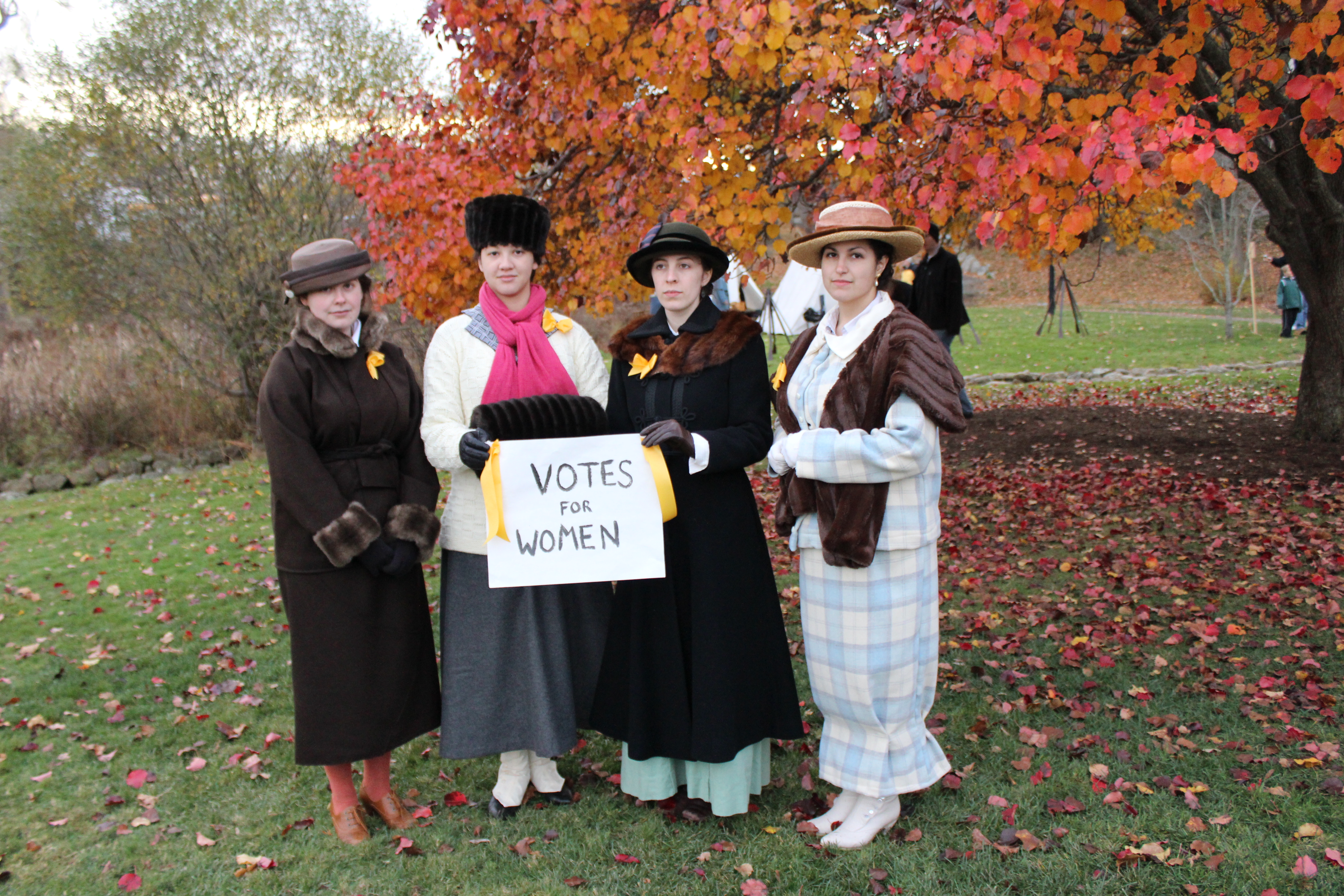
Despite last minute sewing for all of us, we all looked good and had fun wearing clothes from the 1910s while sharing a bit of important history with the public:

IMG_7158
Brown wool suit with fur trim.
IMG_7144
A wool plaid hobble skirt and jacket and a lovely black wool coat with fur collar.

The 19th Amendment, which gave women the right to vote in the US, was ratified in 1920, after over 70 years of struggle. I think it’s fitting that Thanksgiving and women’s suffrage were related events for us ladies this year. In addition to many other things, we’re thankful for those who fought to get women the right to vote!

Product links in this post contain an affiliate code, which provides a small benefit to my shoe fund. This does not affect my impressions and reviews of this product.

Meet Georgina!

“Georgina” is the name I’ve chosen for my new 1858 cotton print day dress. Being a day dress from a new decade (the 1850s), makes her a fabulous new expansion in my wardrobe of historic clothes!

IMG_4675
Georgina: 1858 cotton print day dress.
IMG_4671
Back view.

The dress is constructed from about 5yds of a Marcus Brothers reproduction historic cotton print I purchased earlier this summer. I used Past Patterns #701 and #702 bodice patterns as a starting point, though I had to make significant alterations to achieve a comfortable and pleasing fit, especially in the shoulder/armsceye area. I used the darted pattern for the fitted lining and the gathered pattern for the gathered exterior. The sleeves are the bishop sleeves from one of the patterns, though I totally changed the cuff design.

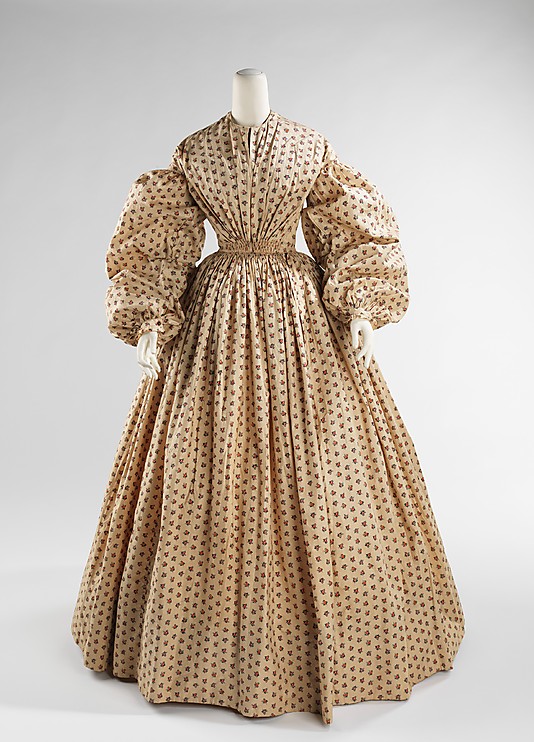
The cuff design and a lot of other fiddly details were taken from this c. 1852 dress at the Met (pictured below). If you zoom in on the cuffs on the Met website you can see that they look just like mine (pictured later in this post)! I also used the following design elements from the Met dress: piping at the neck and waist, gathers that are tacked down beyond the seam line, button closure on the cuffs, and cartridge pleating all around the skirt. I have a whole pinterest board of inspiring images for this dress and hat ensemble, but this dress is the one from which I took the most information and detail.

61.141.3_front_CP4
c. 1852 Dress, Met.

Here are a few pictures of the fiddly details I integrated from the Met dress:

IMG_4773
Gathers at the center back that are tacked down beyond the seam line. I like the controlled look these extra stitches produce.
IMG_4767
Self fabric cuff finished with a small ruffle. The cuffs close with a hand sewn buttonhole and button.

Georgina’s bodice is lined with white cotton. There are hand sewn boning channels sewn into the bodice in the front darts on each side and on the sides. The bones are then slipped in between the layers of fabric. I didn’t have the right length metal bones, so I used heavy duty plastic wire ties–but–I cut them in half the long way so they are much skinnier than normal (they just don’t look at all historically plausible in their normal width, in my opinion). Once they’re in the bodice, you’d never know they are plastic instead of metal.

IMG_4769
The proper left side of the bodice: hand stitched boning channels in the darts, front hook closure, a hook to attach the skirt and bodice together, and nicely finished piping along the bottom edge.

The bodice is finished at the neck and bottom edge with piping that is nicely whip stitched to the inside. There is also piping in the armsceye seam. The sleeve seams are french seamed by machine with the opening seam allowance at the cuff turned twice and stitched by hand. The other bodice seams are all machine sewn and the bodice is hand finished. The bodice closes at center front with hidden hooks and bars. It also hooks to the waistband of the skirt to keep the two pieces from gaping while worn.

The skirt has a wide hem that is hand stitched. The long skirt seams are machine sewn. The waistband is the same cotton print with an interfacing layer of canvas to create stability. The skirt is cartridge pleated and hand sewn to the waistband. There is a single layer of lightweight flannel folded into the cartridge pleats to give them a little more bulk than the thin cotton had on its own.

I also took the time to add pockets to this skirt! This turned out to be really useful for storing gloves, sunglasses, chapstick, a fan… with two pockets a lady can store so many things! Here’s how I made them and sewed them into the skirt:

IMG_4597
The pockets are muslin rectangles with a piece of the cotton print topstitched on the top center (this is the part of the pocket that can show while I’m wearing the dress and taking things in and out of the pockets).
IMG_4598
After the cotton print was sewn on I french seamed the vertical seam and then the bottom seam by machine, making sure that the cotton print stayed centered. On the left is what a pocket looks like with the french seams facing out. On the right is a pocket turned inside out to show the cotton print centered at the top.
IMG_4777
I left the top part of the vertical seam open and hand sewed that into slits in the skirt using a whip stitch through the pocket and the seam allowances (essentially under stitching the pockets, which keeps the muslin from rolling to the outside!). The pocket slits were made after the skirt was cartridge pleated and attached to the waistband, so the slits stop below the cartridge pleats (it was way too much thinking to try and figure out where the pockets should be before cartridge pleating the skirt!).
IMG_4778
It worked wonderfully, and the pockets blend right in and are hardly noticeable, even when they gap open! (I’ve turned the edges of the pocket so you can see the muslin pocket for this picture, but they don’t actually stay turned out like that, and you can imagine how the print fabric of the skirt blends right into the print section of the pocket).
IMG_4775
On the inside, the top edge of each pocket is stitched to the cartridge pleats to evenly distribute the weight of anything in them.

Georgina cost about $18: $15 for the fabric and about $3 for hooks and eyes. The various other fabrics (cotton lining, canvas interlining, etc.) were all in my stash from previous projects (yay!). I first wore Georgina last weekend to a vintage dance performance on George’s Island in the Boston Harbor. I’ve got pictures of the performance and pictures of island exploration coming up soon!

Project Journal: 1864 Ball Gown Part IV: Three Series Of Photos

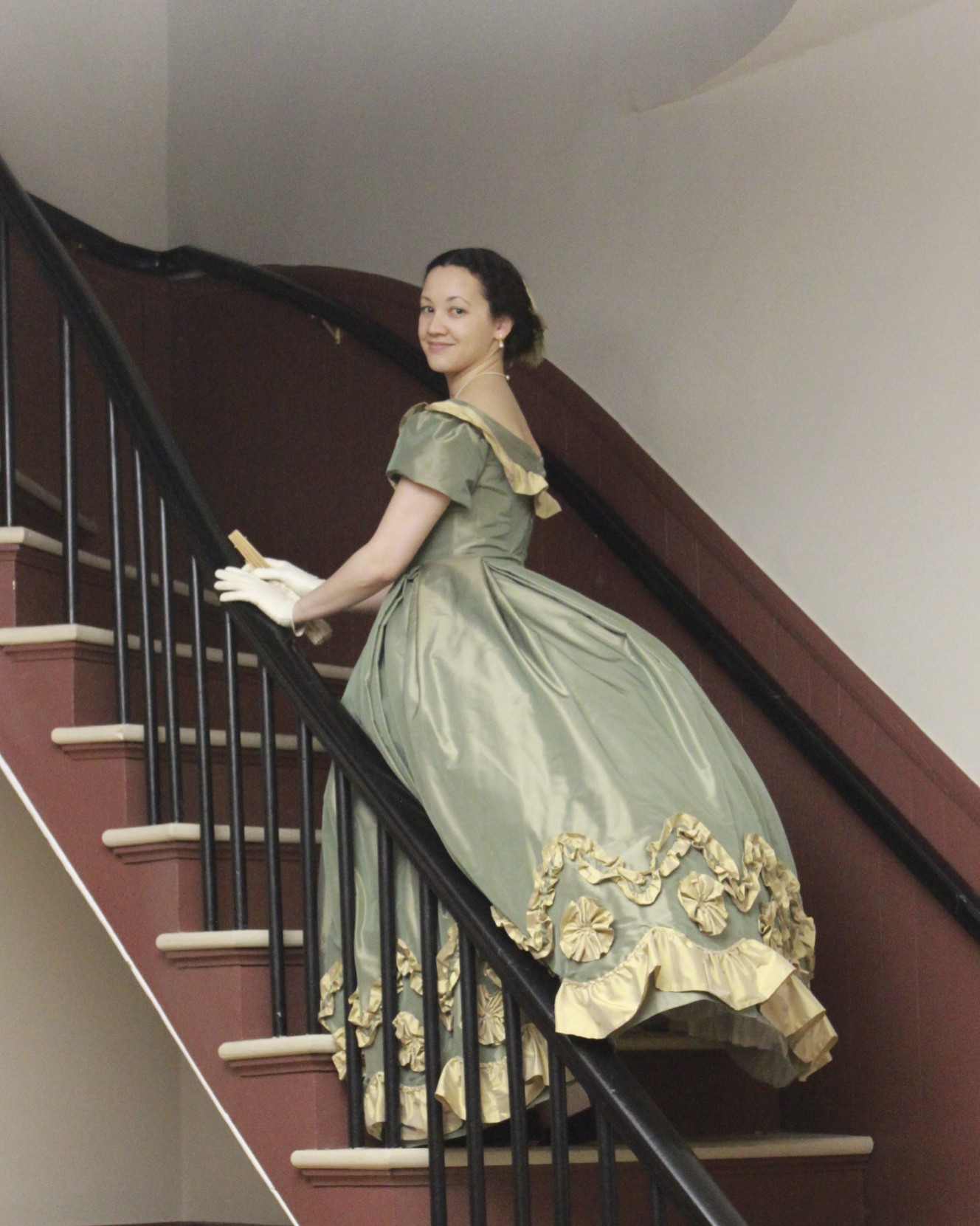
Remember in my last post I promised pictures of the finished ball gown now known as Evie? The time has come! I had a hard time narrowing down the options (because of course I wanted to share ALL of the good pictures), but I’ve tried to limit myself to only the best of the best. This post will focus on the completion of my dress, Evie, but there are two more posts coming soon that will share some of the other photo series as well as pictures of the ball itself!

These photos are the idea of my friend with the camera. She wanted to take series of pictures of us in our modern clothes, 1860s undies, and then dressed in our 1860s ball gowns: all in the same location and the same pose. It’s a neat idea and the results are great, not only because it provided lots of pictures (yay!) some of which are of things I don’t have pictures of (like my 1860s undies), but also because you can see the time passing through the evening by looking at the light in the photos. They start in the afternoon, proceed to early evening, then finish at night. Not all the series are a complete set, but all around, it’s pretty cool. Which series do you like best?

Series 1: To The Right

IMG_9740
To The Right: first layer
IMG_9735
To The Right, second layer
IMG_0151
To The Right, third layer

Series 2: What A Change

IMG_9546
What A Change, first layer
IMG_9729
What A Change, second layer
IMG_0144
What A Change, third layer

Series 3: On The Stairs

IMG_9693
On The Stairs, first layer
IMG_9714
On The Stairs, second layer
IMG_0130
On The Stairs, third layer

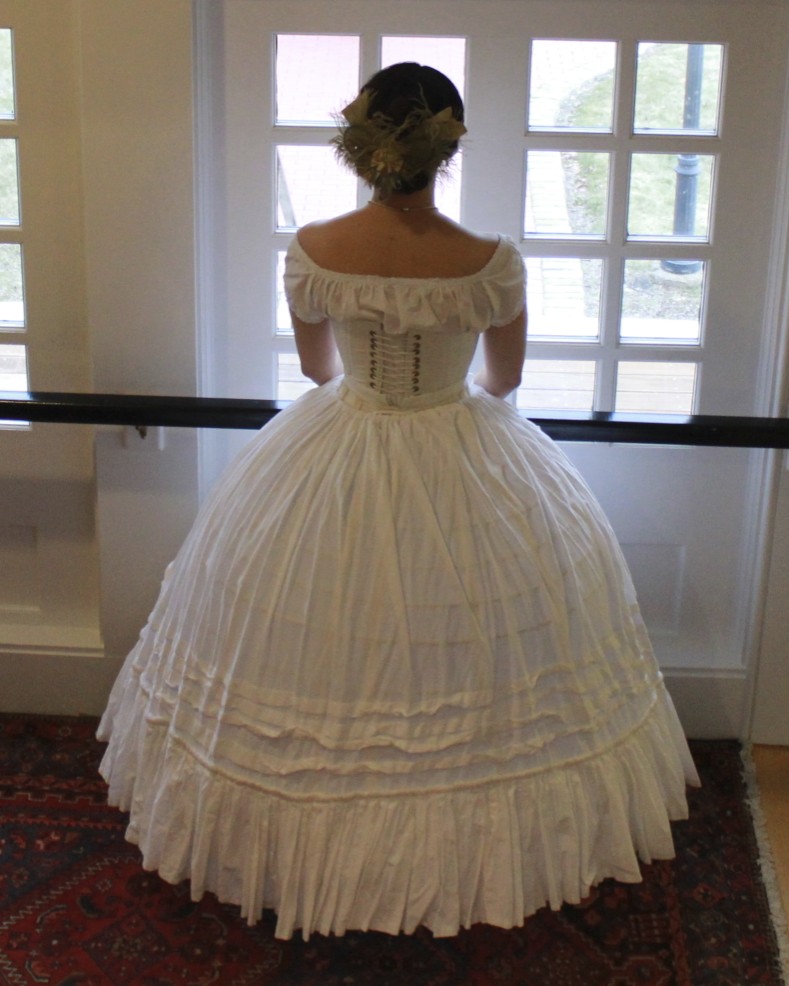
I’ve never been able to get pictures of my 1860s undies before, so this is exciting! I’ve got a chemise, corset, drawers, cage crinoline, and petticoat (in addition to stockings, shoes, jewelry, hair wreath, gloves, fan, and gown). The crinoline is entirely hand sewn, except for the waistband. The measurements of the hoops are taken from an extant crinoline, and I believe the circumference of the bottom hoop is about 120″. The crinoline closes with a hook on the waistband. The other pieces are machine sewn and trimmed with lace, pin tucks, and ribbon. The chemise slips over the head and the drawers close at the back with a button and loop arrangement. (And that poor petticoat does need a press… but I threw it in the washer and dryer a while ago and since it doesn’t usually get seen I haven’t taken the time to press it.) The petticoat ties around the waist. As you can see, the crinoline stops mid-calf, so the intense petticoat ruffle really helps keep the shape for the skirt below that point, in addition to keeping my hoops from showing as horizontal lines through the skirt of the gown.

Want to be further amused? Look at the apparently changeable feathers on my hair wreath. Sometimes they’re brownish/gold and sometimes vivid green! They really do seem to change color depending on the light!

I don’t think I’ve mentioned it yet, but the basic pattern for this gown is essentially taken from Janet Arnold’s Patterns of Fashion 2. The trim however, is based on two things. Thing 1: the skirt trim is from the fashion plate I shared with you in the first post of this project journal. Thing 2 : the bodice trim is based on this gown, below. I went through a lot of phases trying to decide how to trim the bodice, since I didn’t really like the fashion plate bodice trim. In the end, I decided on this look: a graduated ruffle (just one, in my case, to match the one ruffle on the skirt) that gets longer toward center back, a triple pleated bertha that has a swoop towards center front rather than being straight, and a big trim thing right at the center (in my case, a rosette to match the skirt, rather than a bow). It’s pretty hard to see the front of my dress in these pictures I’ve shared so far, but there are some coming up in the next two posts which will show off the front of the gown better, so stay tuned for that!

5178aec3e06e5f940a6b607a4b697fcc
A costume from the movie Il Gattopardo (1962, costume design by Piero Tosi). It’s lovely, despite the fact that it is not an extant gown from the 1860s.

While getting dressed we might have been making silly faces for the camera while the owner walked away…

IMG_9674
Haha! Moose making companion! In case you don’t know, this is my favorite silly face to make. Don’t believe me? Look here and here!

Project Journal: 1864 Ball Gown Part III: Innards

It’s been a little while since I posted about my new 1864 ball gown. Over a month, I think, because in February I posted about the plan/inspiration and then about the progress I made on the trim. I was steadily working on it during the month of March and had it ready to go for the Returning Heroes Ball a week ago. That’s not to say there wasn’t a little bit of last minute sewing the afternoon of the ball. My last minute sewing was gloves and hair piece, though, not dress, so that’s an accomplishment! And I wasn’t alone in my afternoon sewing… friends were sewing with me! There are lots of upcoming pictures but for now I’m going to post about the insides of the skirt and bodice. It’s a sneak peak, since you have to wait for the others pictures to see the full ensemble!

IMG_4361
Completed skirt trim! I was SO ready to be done with it by the time I was sewing down the green zig zag (the last step of the skirt trim).

My other 1860s dresses have names: Belle is my dark blue gown and Annabelle is my white gown. I haven’t really been thinking of this dress by name until recently. Upon consideration, I’ve decided that she’s named Evelyn, or perhaps Evie for short. Why that name? I just like it, it’s old fashioned, and it has Y, and I have a fondness for the less commonly used letters of the alphabet. So here she is: Evie.

IMG_4362
Skirt waistband of self fabric, to which the box pleated skirt is sewn. There is a cleverly hidden opening on the fold of one of the pleats.
IMG_4363
Magic! The pleats are deep enough that you can’t see the opening when the skirt is hooked closed, even with my hoops underneath.

The raw top edges of the skirt are just turned to the inside and left alone. The silk skirt is flat lined with muslin, which helps give it some body, preventing creasing, and some stability at the hem for all that trim. There are six double box pleats evenly spaced around the skirt, as you can see. I haven’t tried this evenly distributed method on an 1860s skirt before (my previous dresses have knife pleated fronts and cartridge pleated backs, which makes them much heavier in the back than the front… I suppose I could divide the skirt in half and do that method, but given how those skirts are weighted, I’m sure there’s more fabric in back than in front). All that to say that I love how evenly weighted this skirt is! It means I don’t need a giant bum pad to keep my hoops level with the floor. (Come to think of it, I suppose I could remount the skirts of my other dresses onto new waistbands and redistribute the fabric… hm… I’ll have to think about that!)

IMG_4365
Inside of the bodice at center front. The bodice is flat lined in ivory polished cotton. The edges are finished with cording (even the top edge, which you can’t see on the outside because it is hidden by the bertha, grrr, but oh well!).
IMG_4368
Inside of the left front and outside of the right back.

The sleeve is lined in muslin. I originally intended that it wouldn’t be seen, but then changed the sleeve design so now the muslin is visible on the inside of the bodice. It doesn’t matter, though, but I do like it when everything matches. The seam allowances of the bodice are just left unfinished (I might whip stitch over the edges some day, but that’s unlikely, since I’ll probably be sewing something else!). The armhole seam allowances are whip stitched together to keep them from fraying and to keep all those layers together. The armholes also have cording in them. The bodice closes at center back with lacing. The eyelets, like everything else, are hand sewn. The bertha also closes at center back (unusual, since a lot of them close on the shoulder, but I didn’t want my bertha pleating to be able to move or show the top of the ruffle). You can see the stitching holding the bertha in place in the first bodice picture, because those stitches go right through to the inside of the bodice.

I stopped keeping track of how many yards of hand sewing went into this dress… but now I’m curious again. So when I finished stitching the gathering stitches I was at 86 1/2 yds just for the trim. I’d estimate about another 22 yds of stitching to attach the trim and about 12 yds of stitching to construct the skirt before attaching it to the waistband. Waistband attachment was probably about 7 yds (it’s quite sturdy and all those pleats are well sewn!). That puts the skirt at a total of about 127 1/2 yds of hand sewing. Then there’s the bodice, which is maybe 12 yds of hand sewing total? That’s a harder one to estimate. That brings Evie to a total of approximately 140 yds of stitching.

I’m proud to say that every single stitch is hand sewn. Next time, though, I’m planning on machine stitching the inside seams. It’s super satisfying to have an entirely hand sewn dress, but it took about two months, and that could have been much sped up with the use of a sewing machine, which means I could have made more things! Who knows, I might change my mind, but right now even I am tired of hand sewing that dress.

Project Journal: 1864 Ball Gown Part II: Trim Progress (HSF #4)

Well, I hope this isn’t too much of a stretch (or maybe interpretation is a better word), but I’ve finished preparing all of my skirt trim and I’m going to call it my project for the HSF #4  Challenge: Embellish. I say it’s a stretch because my completion of this project is the preparation of the trim, rather than the attachment to the garment. To be fair, just the prep has been a lot of sewing, so I think it counts. Here it is, below: gold trim on the rather wrinkly skirt of green and gold shot silk taffeta. Because the gold is shot with silver, and the green is shot with gold, they are both photographing more washed out looking than they appear to me when not looking through a camera. Hopefully one day I’ll be able to get a picture where they look a little less silvery.
IMG_4284
All the skirt trim, gathered and ready to be attached!

The top pile of trim (that rather resembles a ruffly brain, don’t you think?) is for the zig zag. The two piles on either side are the 18 rosettes. The section on the bottom center is the ruffle that goes at the bottom. You can see the inspirational fashion plate here, in this previous post, to see what these different trim sections look like in their actual context.

IMG_4285
My favorites are the rosettes. Aren’t they cute?
IMG_4286
Here’s all of them laid out like an accordion, or a slinky. They look so adorable!

Anyway… here are the facts:

Fabric: almost 1.5 yds of gold shot with silver silk shantung.

Pattern: none, just a lot of math.

Year: 1864.

Notions: none, just thread.

How historically accurate?: Well, shantung is not accurate, but silk is (and this shantung is pretty smooth and not slubby, so I don’t think anyone will know it’s shantung unless I tell them). The trim layout is from a fashion plate, so super accurate. The stitching is accurate. Overall, I give it a 90%.

Hours to complete: Um… a lot. It’s all hand sewn. I started in January, so… 50 hours to get to this point? I really have no idea. I think in terms of months or weeks usually, not hours or even days.

First worn: Not yet, but will be worn in March.

Total cost: $9, because the silk was a remnant.

And while I’m keeping count, let me also note the yards of stitching currently sewn into the trim. When it was all hemmed I was at 45 yards. Now I have the addition of gathering stitches (31 1/2 yds) and ruffle binding (9 yds). That ups the total yards stitched for trim to 86 1/2 yds, and that’s before attaching it! Nice.

Project Journal: 1822-1824 Ensemble Part III: Green Dress Hem Appliqués

Well, I’ve got the green silk ball gown sewn together. That’s good, because the ball is fast approaching. There’s only a week to go! Eep!!! I’ve finished the padded hem, but I still need to have someone mark center back for me so I can put closures on. And I haven’t set the neckline yet, either, because I’m waiting to see how it looks with the back actually closed… So far every time I’ve tried it on the back has just been hanging open, because I can’t actually reach that part of my back by myself. Never fear, though, I’ll be seeing friends this weekend who can help with marking the back for me! Yay!

You’ll remember from my overview of this early 1820s ensemble that the fashion plate below is my inspiration for this gown.

19562579602401819_964eyRUt_c
May 1824. Ackerman’s Repository.

I’ve been furiously hand sewing, working on the skirt appliqués on the ball gown. These are my first priority. In part this is because they’re already started (and it would look silly to have only a fraction of them done) and in part this is because the hem decoration is pretty essential for 1820s dresses. This is how I’m making the appliqués.

IMG_3966
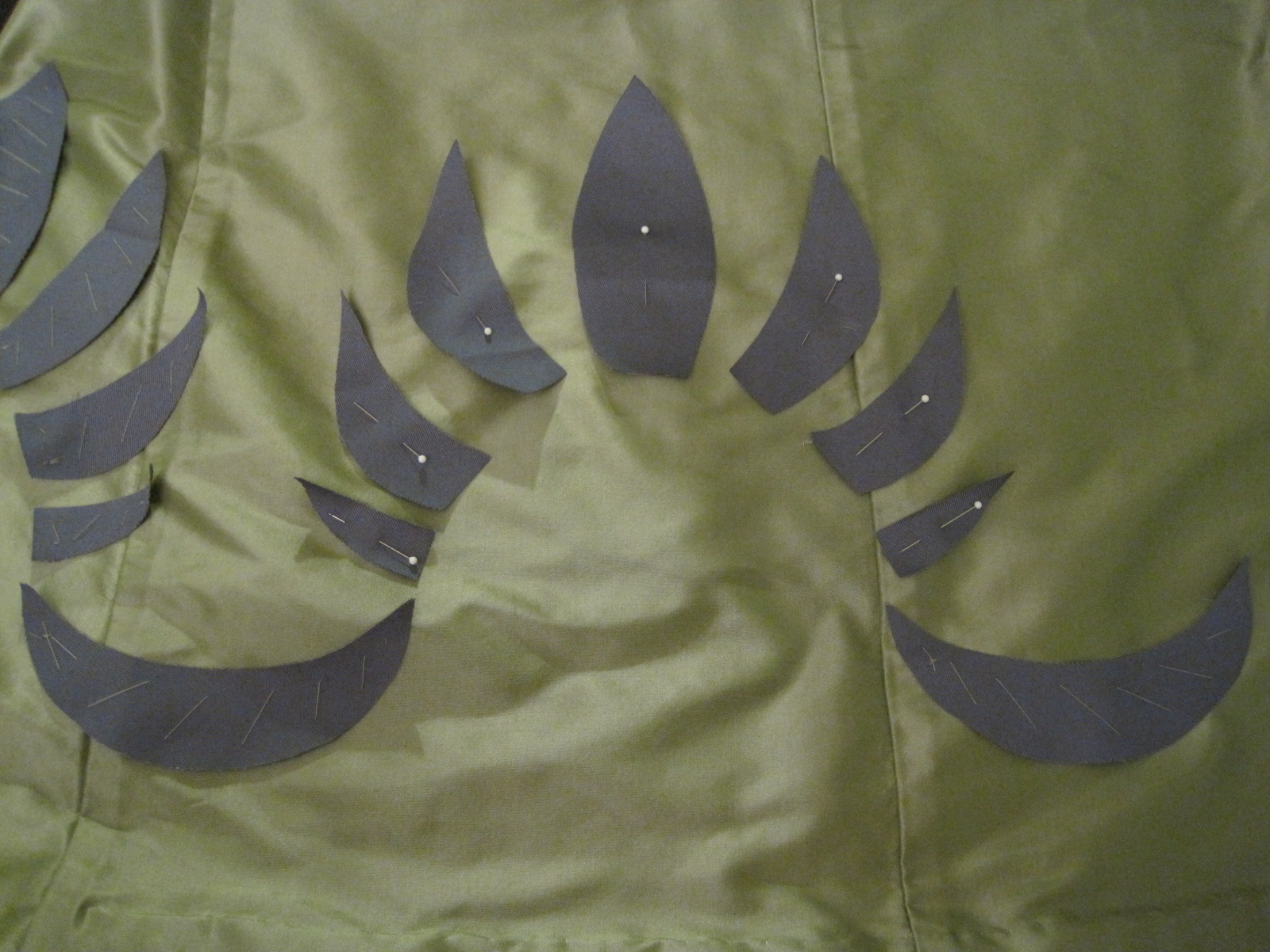
After cutting out literally hundreds of pieces… I pin the blue canvas bases to the silk of the gown. The pinning allows me to make sure everything is symmetrical before sewing the bases down. Once I’m satisfied, I baste the bases to the silk, leaving 1/4″ around all the edges unsewn, so I can tuck seam allowance under later.
IMG_3963
Whew! Finished basting that repeat of the pattern. The blue canvas is tightly woven and hardly frays, even at the points and in the curves! And even after being manipulated and folded while I’m basting all the pieces down, which is important because it keeps the shape accurate for the layers that go over the base.
IMG_3965
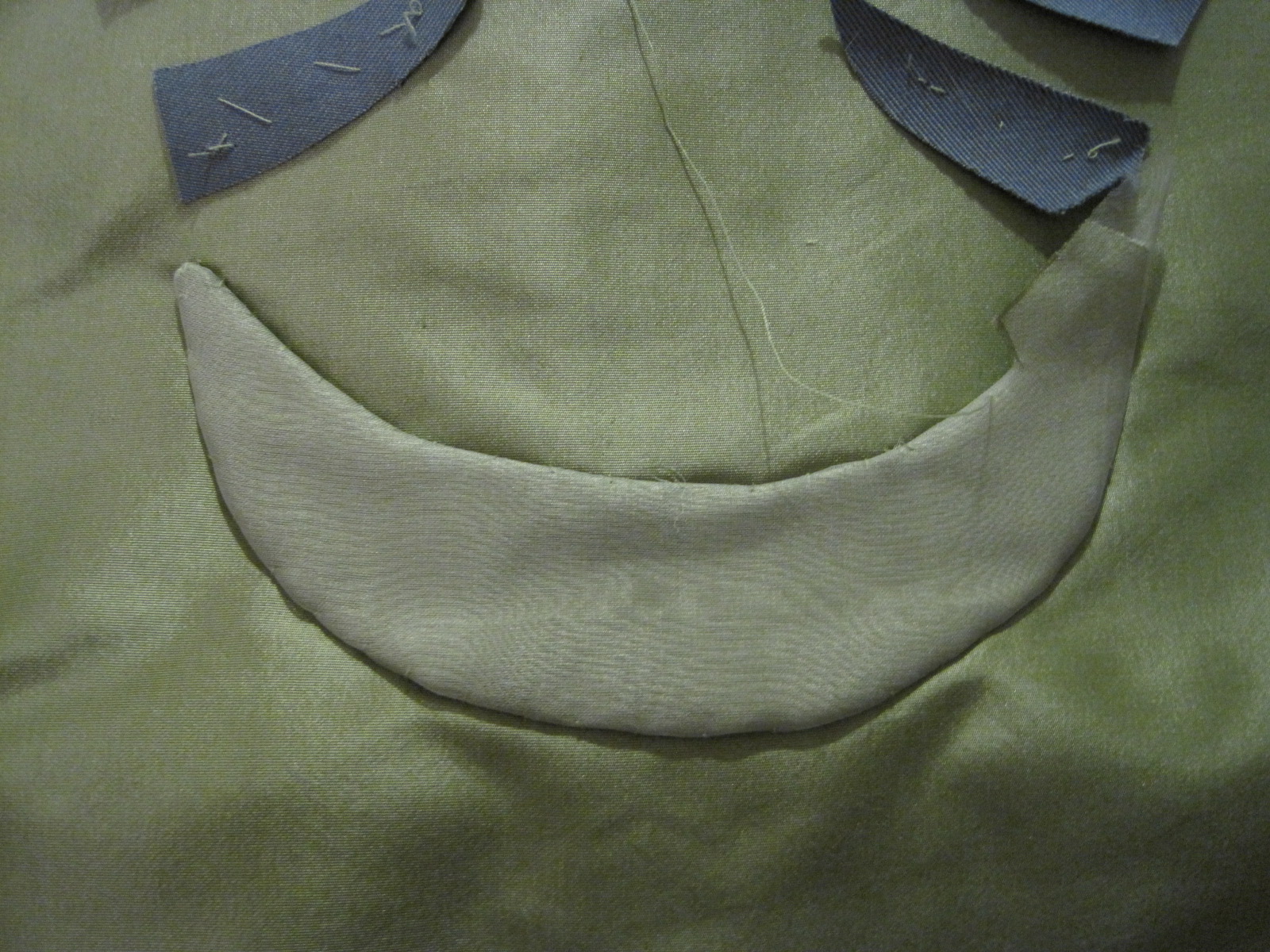
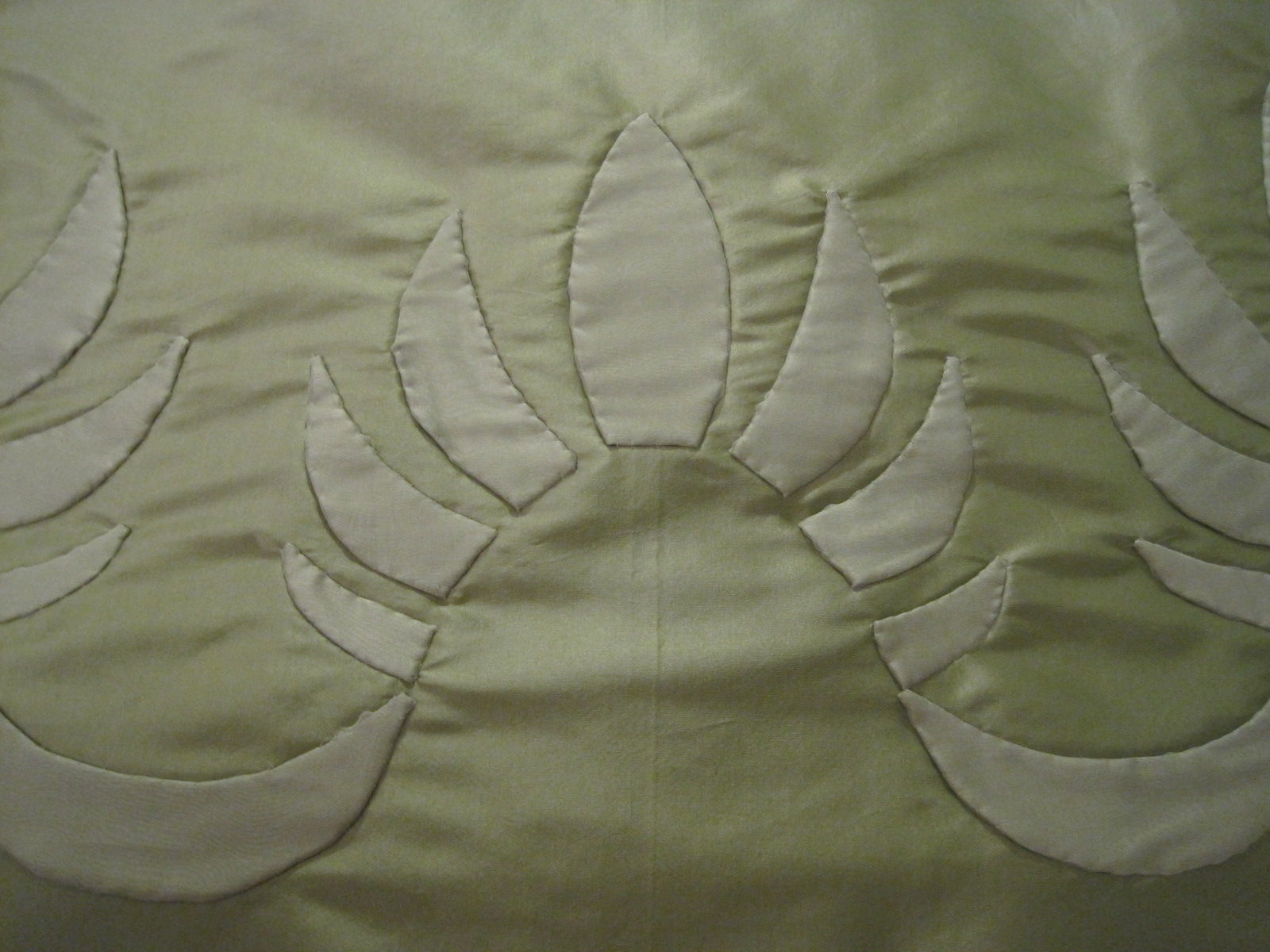
The next step is to take the two top layers (a layer of the green silk and a layer of white silk organza) and sew them over the base. The base provides sturdy edges so that I keep all those nice curves when turning under my seam allowance. This piece is just about done, except for the last corner. I used the technique in this great quilting appliqué blog post to make my sharp corners as sharp as possible.
IMG_3969
And here’s what the motif looks like when all the bases are covered! The silk organza is pretty tricky for making sharp points, so I think these turned out pretty well! The motifs are still missing their center sections. I’m focusing on all the pointy bits first. Right now I’ve got 3 out of 7 motifs done.
IMG_3970
This is what the inside of the skirt looks like after the appliquéing is finished. It’s kind of neat, I think, to see the relief of the front shapes.
IMG_3967
Most recently, I’ve just finished basting on the bases where they meet at the back. You can see in this picture there was only one more motif to go!

Right now the motifs really remind me of pineapples, a common motif in appliqué quilts (as a quilter as well, I appreciate the overlap between related interests). I’m sure once the centers are added they will look more like flowers and much more like the fashion plate. Each motif is 11″ tall and the repeat is 12″.

As I continue to sew these, I’m thinking about the sleeve appliqués. Currently, I’m stumped. I was going to sew my motifs on in the same way as the skirt, but I also made my sleeves pretty gathered… so I’m not sure how to nicely hide my seam allowances while also keeping the gathers looking un-squashed. I want the sleeve appliqués to sort of float on the gathered sleeves… I’m still brainstorming on how to make that happen. Perhaps I’ll stitch the seam allowance to the back of the base and then hope that the gathers mean you won’t see the base past the 1/4″ seam allowance that gets turned? If you have ideas, I’d love to hear them!

Details Of The Bronze And Pink 1893 Ball Gown

I’ve been meaning to post about my new 1893 ball gown since Newport Vintage Dance Week back in August… Well, I’m slow about getting it done, but but this is going to be a post with mounds of great detail, so I think the wait was worth it!

At the 1890s Soiree during Newport Vintage Dance Week in August.

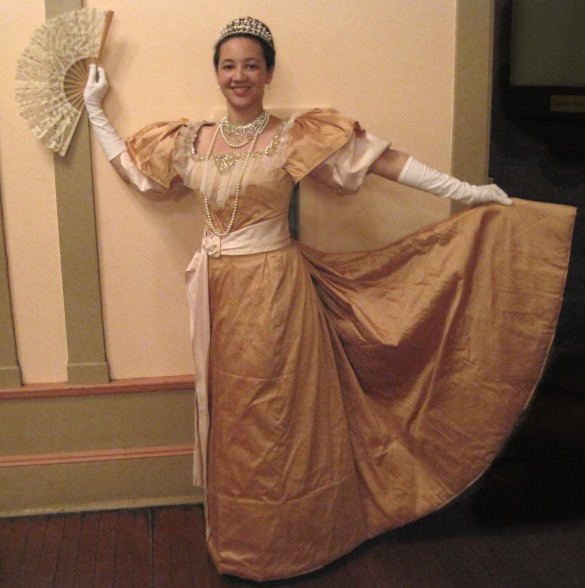
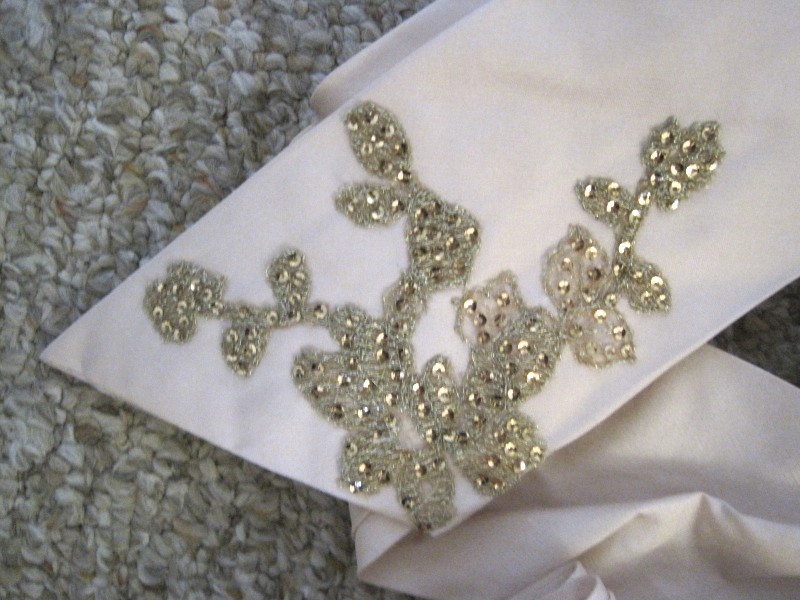
This gown is constructed of bronze shot silk shantung with pale pink slightly slubby silk satin. It is flat lined throughout with ivory waxed cotton. It is stabilized with cotton canvas at the hem and in the waistband. The bodice is trimmed with ivory net and bits of metallic bronze/gold net that have sequin motifs on it (in fact, it’s the same metallic net as the top sleeve section of my 1912 burgundy silk evening gown, which I also wore at Newport). The sash is trimmed with the metallic bronze/gold net. The sleeves have layers of ivory tulle inside them to help maintain the full shape.

I wore this dress with a combination, a corset, a slight bum pad, two petticoats (one silk, one cotton), stockings, and shoes. Exterior accessories include cotton/poly elbow length white gloves (I have lovely leather ones that come up above the elbow, but they are getting soiled from being worn while dancing with men who are not wearing gloves (breech of decorum on their part!), so I chose not to wear those to this ball); my handy Battenburg lace fan; my faux pearl drop earrings; a long strand of faux pearls (originally bought to be worn with my 1928 green silk evening gown); a nice bling-y necklace borrowed from a friend for the evening; and my fabulous almost-Victorian tiara from eBay!

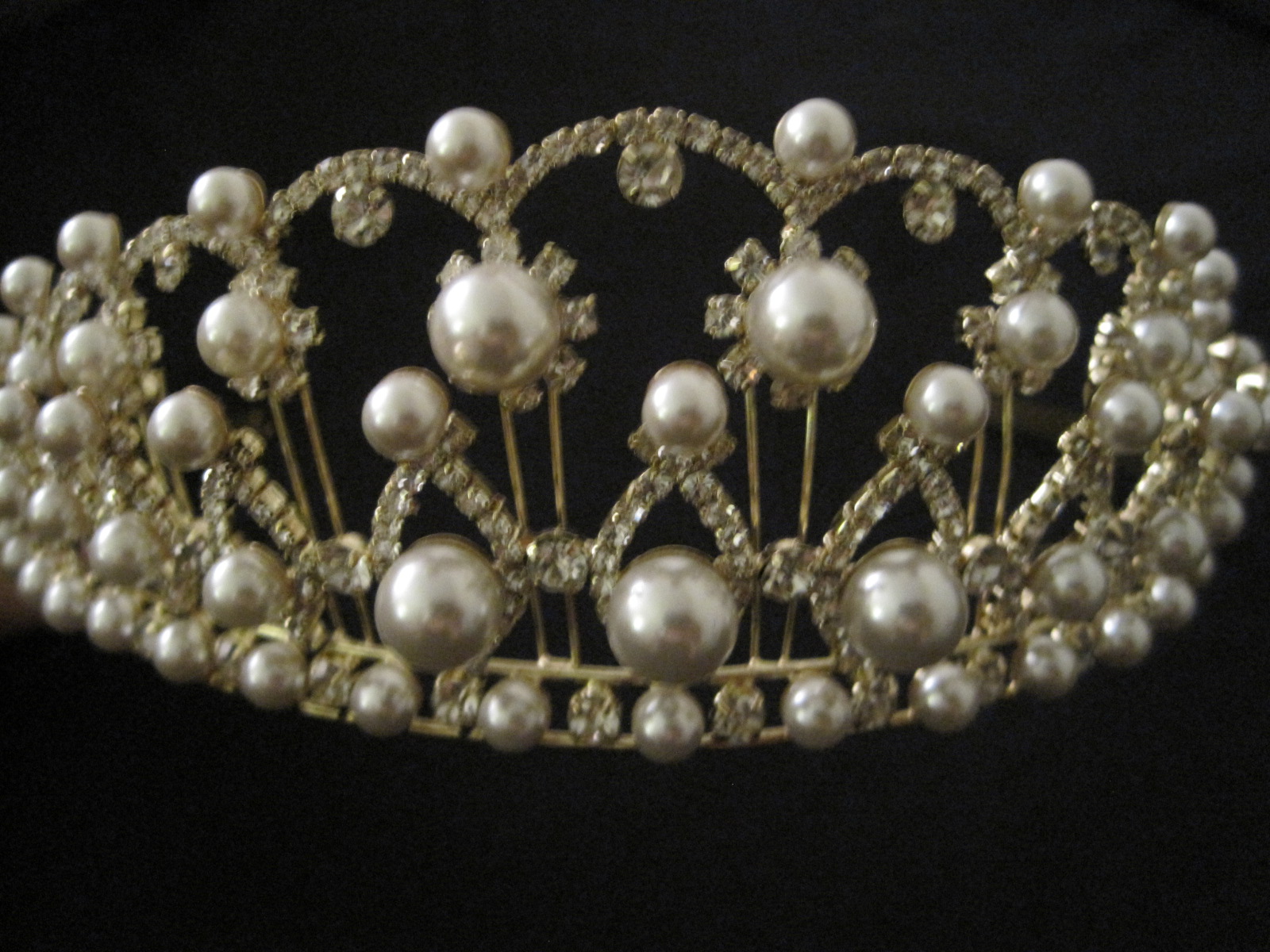
My tiara shares a general design with the Lover’s Knot Tiara, below. Both tiaras have round elements connected by jeweled arches above a second row of round elements, both rows of which are surmounted by tear shaped pearl elements which are set above a final row of further round shaped elements around the base. Additionally, in both tiaras there is a high point in the center which then diminishes toward each side. Obviously, the two are not exactly the same, but I think they’re similar. Of course, wearing mine for an 1893 look is slightly earlier than the given date of the Lover’s Knot Tiara, which is c. 1913. But isn’t that excusable, when the tiara looked so wonderful with my dress and accessories? There’s a closeup of my tiara below so you can compare.

Lover’s Knot Tiara by Garrard c.1913.
My eBay tiara.

It took a bit of work to come up with a hair style I liked that also worked with the tiara, I can tell you. I wanted to have a puff of hair not directly behind the tiara, but close enough that it would provide a dark background for the tiara to stand out from. Unfortunately, I don’t have any great pictures of my hair. Oh well! It also took A LOT of bobby pins to secure the tiara. I  think I used about 20 for the tiara alone. I put one between each of the base pearls, then another to cross the first one. I also secured the ends of the tiara with extra pins. It was really stable and didn’t move at all during the entire night, so that part was successful!

Here’s a closeup of the jewelry.

In the picture above you can see the jewelry better. You can also see the one major flaw in this dress. The wide neckline wasn’t shaped quite right, so the sleeves started slipping off my shoulders, making the sleeves look slightly less impressive. This is one of those things that was perfectly fine in all my fittings. It’s during those pesky balls, when you move and sweat, that you really discover the flaws in your clothes! I’ll have to do something about that before I wear the dress again.

A full length view. This was the end of the night, and the end of the week, so that’s why I look tired.
A full length back view. Again, you can see how the sleeves just didn’t want to stay on my shoulders.

Now on to the specifics of patterning. The bodice (and especially the sleeves) of this dress are from Janet Arnold’s Patterns of Fashion 2, as is the skirt. The decorative sash and bodice trim were inspired by an image in Norah Waugh’s The Cut of Women’s Clothes. I looked at many images that had similar sashes with bows, so I’m sure I was influenced by those as well.

The next thing to discuss is the construction of the dress. It is in two pieces: a plain bronze silk skirt and a decorative bronze and pink silk bodice. The wonderful thing about this arrangement is that I can make other bodices to go with the skirt (I’ve got extra bronze and pink silk). For example, I plan to one day make a day bodice to go with the same skirt. Since the skirt takes the biggest bulk of fabric, this is an economical and practical plan in addition to adding to my wardrobe!

I’ve got some great closeup pictures of the bodice construction, but I didn’t take any close up pictures of the skirt, come to think of it. Honestly, though, it’s not as interesting. The skirt is gathered in back and set into a waistband which closes at the back with hooks. There is a placket opening that is hidden in the gathers. The entire skirt is flat lined with ivory cotton. In addition, the hem has a 12″ band of bias cut canvas tacked between the silk and cotton. The canvas helps the skirt form those wide folds at the hem as well as providing a certain weight and gravity to the lightweight silk. Finally, it also helps provide a clean sharp edge over which to turn the hem. For the hem, the bronze silk is folded to the inside over the canvas, turned again, and stitched to the cotton lining. The hem is about 1/4″.

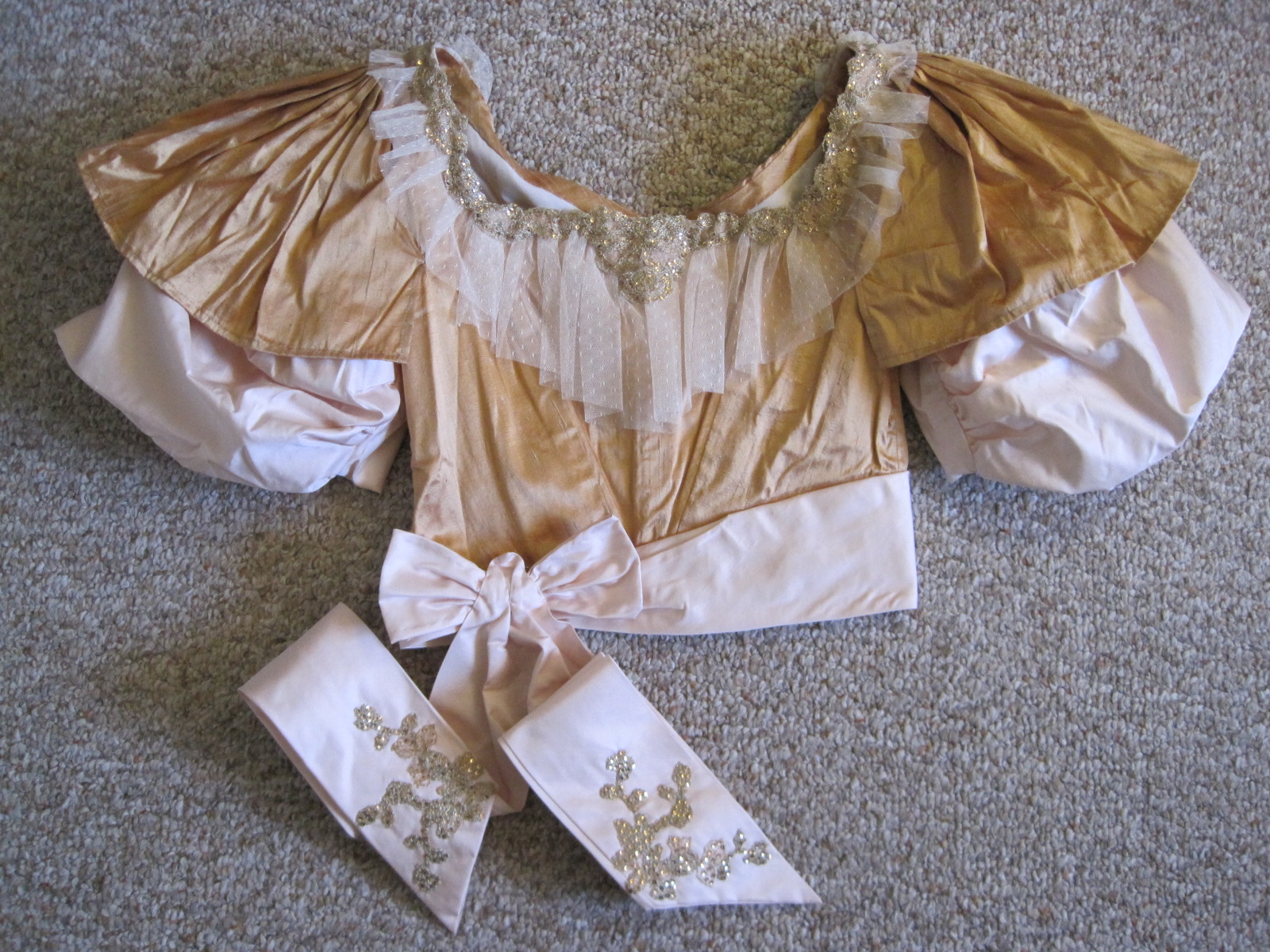
The bodice, by itself. As you can see, the sash is a part of the bodice.
Here is the net applique on the sash ends. The net is great because it doesn’t fray, so I simply had to cut out the motif I wanted and then stitch it around all the edges to the sash. The sash is a tube of bias finished at an angle on the ends with a slip stitch.
A closup of the shoulder and top of the sleeve. You can see the ivory net trim around the neck of the bodice, which terminates in those cute bows on the shoulder. The bronze part of the sleeves are rectangles that are knife pleated radially at the shoulder, which you can see in this photo. And finally, you can see the gold net applique which is stitched over the ivory net around the neck opening.
Then comes the question, where are the closures on this bodice? Well, the sash is stitched to the bodice from the right side front around the left side to center back. Then the bodice opens up center back.
To keep the sash in place around the right side, there are three hooks that correspond to thread loops on the bodice. This keeps the sash in place. You can see the canvas backing of the sash in this picture.
One of the thread loops on the bodice that holds the sash in place.
The center back closure is hooks and thread loops. I like thread loops better than the metal eyes or loops because you can’t see them when the bodice is pulled tight, like you can with the metal. You can see that I added a placket that extends farther than the loops just in case something pops open.
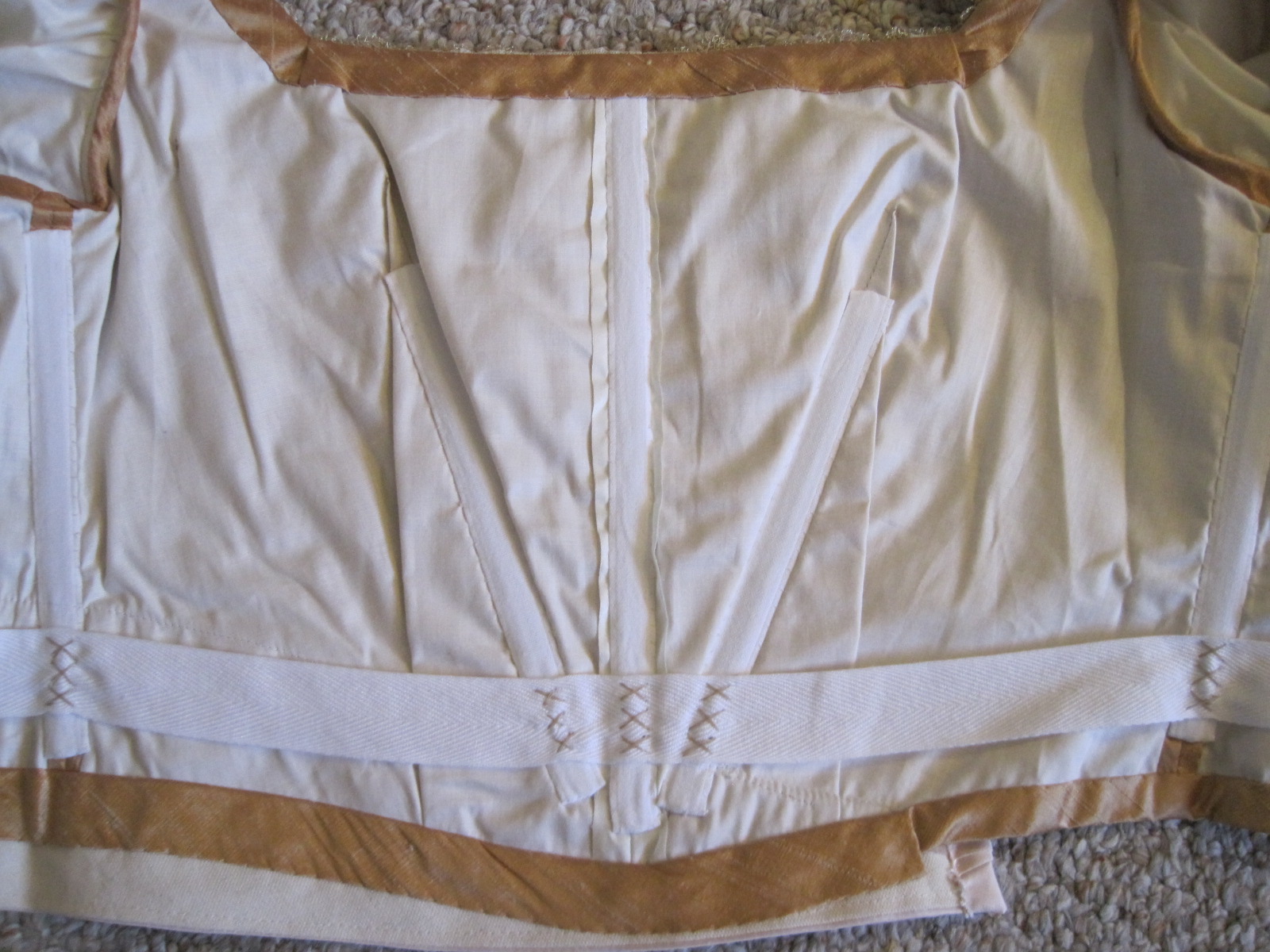
The inside of the bodice. I LOVE to make the insides of garments pretty, and I think this is one of my finest examples! Aside from the fact that it is modern materials, it looks just like an extant garment from the 19th century. The bodice is boned up center front, the front darts (which create a V-shape on either side of center front), the side seams, and each of the four side back seams. The neck and hem are finished off with self fabric bias with is then nicely whip stitched to the cotton flat lining. The armholes are bound with self bias. Then there is also a waistband, to help alleviate the tension on the center back closure. This waistband is cross stitched to each boning channel and closes with hooks and eyes.
The right side of the bodice. You can see the bias bindings, the boning channels, cross stitched waistband, and hooks. Oh, and I just noticed that I also finished the exposed seam allowances by turning them back on themselves and whip stitching. (The seam allowances under the boning channels are trimmed and left raw.)
Center front. The boning channels were whip stitched to the cotton lining along the sides. It was a bit of a logistal problem to determine how to nicely bind off the edges of the bodice with bias, since there is a sash part of the way around. You can see that there is a separate piece of bias covering the join between the sash and the bodice from the right side where the sash opens.
The left side. On the waistband I did use the metal bars instead of thread loops, since I knew they wouldn’t be seen from the outside. You can also see how the sash was attached. It was flipped up and topstitched to the bodice (avoiding bones!), then flipped down to cover the raw edges and joined to the bottom of the bodice with bias.
The interior of the pink under sleeve. The silk is gathered into a cotton lining. Of course, you can’t see up into the sleeve when there is an arm in it!

It makes me feel all warm and fuzzy inside, to have such a beautifully finished bodice. And I felt like such a princess at the 1890s Soiree, to be wearing an all silk dress with silk petticoat and a fabulous tiara!

Whee!

Sort-Of-New 1895 Blouse: At A Picnic With Teddy And Me

This is another case of the delays… The Commonwealth Vintage Dancers performed at an event in June (cough, cough… I am so slow!) that was called something like A Picnic for Teddy, Mommy, and Me. It was at the Salem Athenaeum, a private library, and was targeted toward young girls, their mothers, and their teddy bears! Cute!

We performed in 1890s whites. I had been dragging my feet about constructing my own whites, so I took this opportunity to go for it.

Dancing “Teddy Bear’s Picnic.” It’s really a ridiculous dance, but it fit the theme of the event perfectly!
It was super hot that day! Sitting, in the shade, was wonderful. As was my fan…
CVD on the steps of the Athanaeum.
After the event we walked across Salem to get some lunch. Of course, Salem often sees people dressed in odd clothes, so we didn’t surprise people, but they were curious about what event we were going to.

I’m not totally sold on the white skirt I made. It’s a gored skirt and it works fine, it’s just not super eye catching (aka, it’s great for performances, but won’t get worn for other things… maybe it will be a petticoat if needed?). Oh, and I also threw the hat together, thinking that the white and blue would be nautical and good for Newport. But then I totally re-trimmed the hat at Newport because it didn’t have quite enough oomph with the white and blue. But the blouse… I love the blouse! It’s super comfy and lightweight, it closes in front (yay!), is washable,  and I like the fabric. Win!

It is based off of a fashion plate in one of my many books. I draped a basic blouse pattern and adapted the pattern as needed to add the gathers in the front and back. The exterior is mounted on a lining made from the basic blouse pattern so that they gathers will stay where they are supposed to be. It is constructed of cotton with swiss dots for the exterior and a lightweight woven stripe cotton for the base (which I bought for $1 a yard a while ago! Love that price!). It closes up the front with concealed hooks and thread bars. The sleeves are quite large gigot sleeves, but because they are not lined they sort of just droop. Here are some pictures! I think I got pretty close to that inspiration image, don’t you? I love the feeling of success that comes with really nailing the look in reproducing a garment! Don’t we all?

The inspiration image.
Front of the blouse, on Squishy, the mannequin.
Back of the blouse on Squishy.
In the garden.