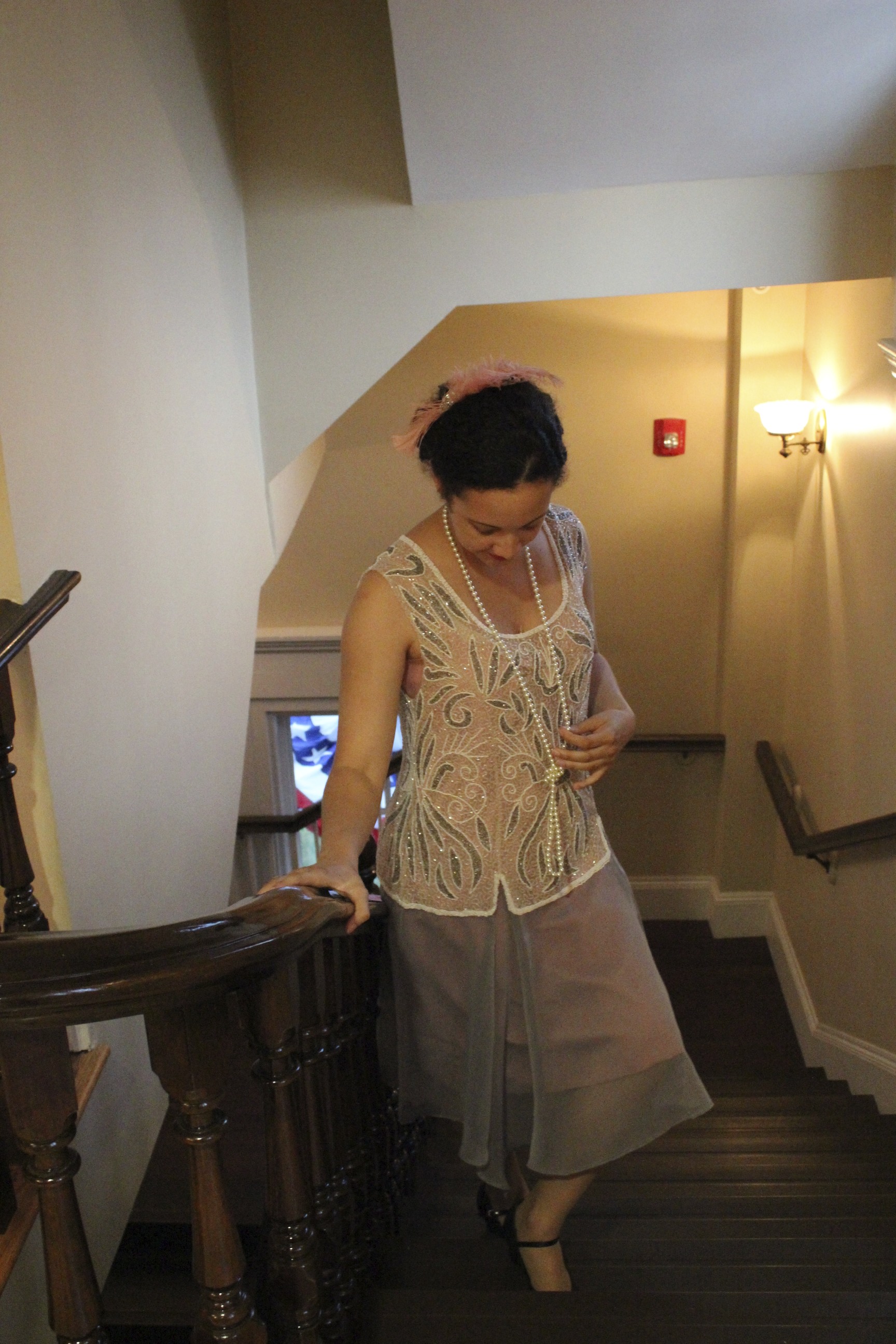
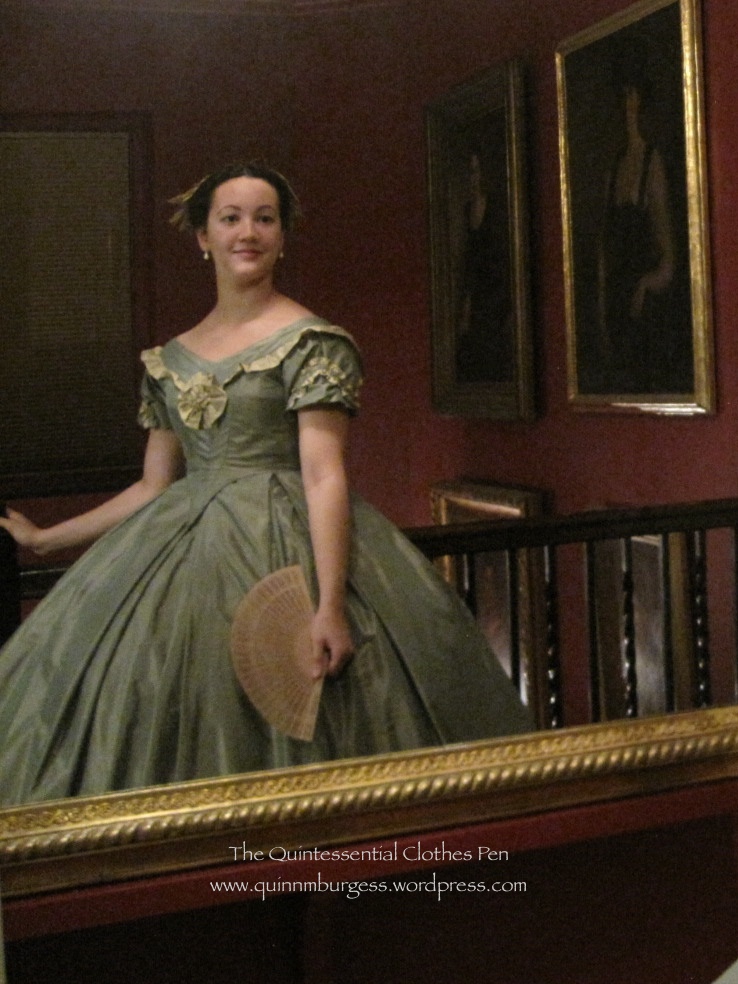
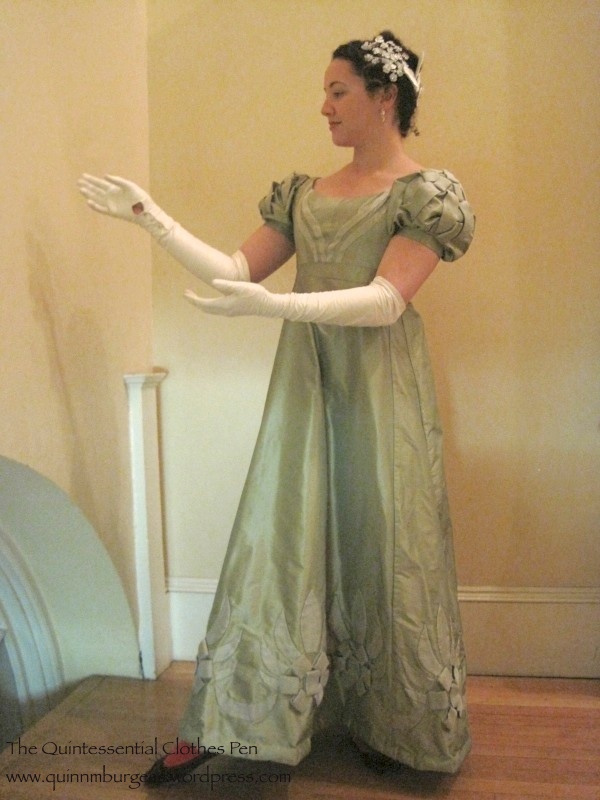
A Dress Suited For Eve

I know I promised pictures of the two balls at the Regency Intensive Dance Weekend in my last post, and I still promise that those are coming, but we’re going to take a quick detour before we get to ball pictures, to look at…

IMG_8442
“A Dress Suited For Eve” (Elusive blue ball gown, 1811)
When dressed for the evening the girls nowadays
Scarce an atom of dress on them leave;
Nor blame them; for what is an evening dress
But a dress that is suited for Eve?
-1818
Quoted from page 42 of C. Willett Cunnington’s Fashion and Women’s Attitudes in the Nineteenth Century.

I came across this quote as I was either planning or starting this dress and I so enjoyed the curmudgeonly generation-gap thoughts expressed in it that it has stuck in my head as a sort of motto. I should explain that this quote occurs as Cunnington is discussing the new Classical style of gowns between the years 1800-1820. These dresses are usually not quite as scandalous to our modern sensibilities as they would have been to people at the time, especially those of older generations. Interestingly, this quote is from 1818 although in my opinion the often sheer muslin dresses from 1800-1810 are generally more revealing than those from 1810-1815, and especially more revealing than those from 1815-1820. Regardless, the idea of these dresses being so revealing that one is dressed as Eve would have been (i.e., wearing nothing!) is amusing to me.

This new gown is actually two separate gowns: a dark blue sleeveless underdress and a lightweight sleeved overdress in a color I call “elusive blue.” Both dresses are a mixture of hand and machine sewing, though all the finishing was done by hand on both pieces.

The underdress is simple and without a waist seam: it is gathered to a yoke in the back and gathered by a drawstring in front. The waist is created by tying the overdress. The overdress, however, is more complicated. The skirt is a simple rectangle with rounded front corners (two widths of fabric wide: there’s a seam at center back), but the bodice has front pieces, shoulder straps, and an interestingly gathered back piece, as well as sleeves. In addition to having more pieces, the overdress is edged all around with lace and faux pearls, as well as having puffs edged with lace and trim sewn on to the sleeves.

IMG_8465
Back view (you can see the gathers on the back bodice piece).

I did indeed sew all the pearls on by hand, individually, and good thing, too! You see, if each pearl is sewn on individually then if the thread breaks you might loose a few pearls, but you won’t have your entire pearl job go spilling all over the dance floor (that could be catastrophic for the dancing and your hard work!). I did wear this to the Grand Ball on the Sunday evening of the Regency Dance Weekend, and by the end of the night I had lost a very small section of pearls along the back hem of my dress. Thanks to all my fastidious pearl sewing, that was all I lost and there were no comical/catastrophic scenes with pearls spilling on to the dance floor! If you look closely at the wavy lines you can see that they get a little wobbly at times, but I did do my best to be symmetrical despite the wobbles. I also did my best to estimate the wavelength of the pearls and replicate it as best I could while eyeballing as I went along. (In fact, I think my wavy lines of pearls are actually more regular than those on my inspiration dress.)

My dress is a direct interpretation of the ball gown at the Met from 1811 (pictured below). The most obvious difference is the colors I chose to use (partly because I found the fabulous elusive blue overdress fabric in the perfect light weight fabric for $1/yard!). I’m sure there are other small differences, too, but I did my best to follow the construction methods I gleaned from the zoom feature when making my dress. (The zoom feature on most of the Met’s pictures is so amazing! I love it.)

C.I.66.38.1ab_F
Ball gown, 1811, the Met.

As is usual with the first wearing of a new garment, there are things I am unsatisfied with and want to change. There are also things that didn’t quite get completed and need to be addressed.

First, the sleeves. My sleeves didn’t quite turn out like the ones in the inspiration photo, but they also didn’t get completed before I wore the dress (if you look closely, you’ll see that my sleeves are just raw edges on the bottom!). I ran out of time, but I also wasn’t sure that I would like how my sleeve puffs look and I didn’t want to spend time completing the sleeves if I was going to wind up disliking them in the end. Each puff is edged in the narrow bit I cut off of the wide edging lace and then also edged in a bit of trim that perfectly matches the elusive blue fabric (and that I purchased for about $2!). I don’t think my puffs look quite as elegant as the original, but they were a lot of work and I don’t have any more of that elusive blue trim to change things up. Also, if you look closely at the sleeves of the dress on the Met you’ll see that they are not displayed in the same way. I prefer the sleeve that is more puffed up (on the right), but I examined the pictures really closely and I think that it is just caught up on the mannequin and is intended to look like the other sleeve (on the left). So I have to decide, and that will help me determine how to finish the bottom of my sleeves.

Other things that bothered me were the length of my underdress (seems to have a similar length ratio to the inspiration, but I think I want my underdress to be about 2″ longer), the fact that I realized after sewing on all the lace that I had put in on with the wrong side facing out (oops! but I am absolutely not changing that!), and the fact that the blue underdress is a super bag without the overdress holding it in (I think part of the problem is my skirt shaping–I tried something new and it did not work–but the skirt kept wanting to poof out from between the fronts of the overdress, which I didn’t like). I’d like to address the underdress problems, but I’m not going to bother with that lace problem!

IMG_8446
The lighting in this photo captures the colors of the dress much better than in the other photos.

I tried a new thing with my hair for this event which I think was quite successful. The poof is normal, but in front of it and my pearl hair “tiara” (it’s really a necklace!) are two narrow braids, one coming from each side of my head. I managed to hide the ends under the braids and my natural highlights allowed the braids to stand out from my front hair, in the right light (as with the picture, above). The only odd thing was covering up the points where the braids started. I liked it and I think I’ll try it again sometime. I also was able to wear some new earrings: green gems with little fake diamonds set around the edge of the teardrop shape. Despite not matching exactly, I think they suited the dress.

Ok, now the next post in this series really will be about the balls themselves!
A Floral Headband For Annabelle (Returning Heroes Ball 2014)

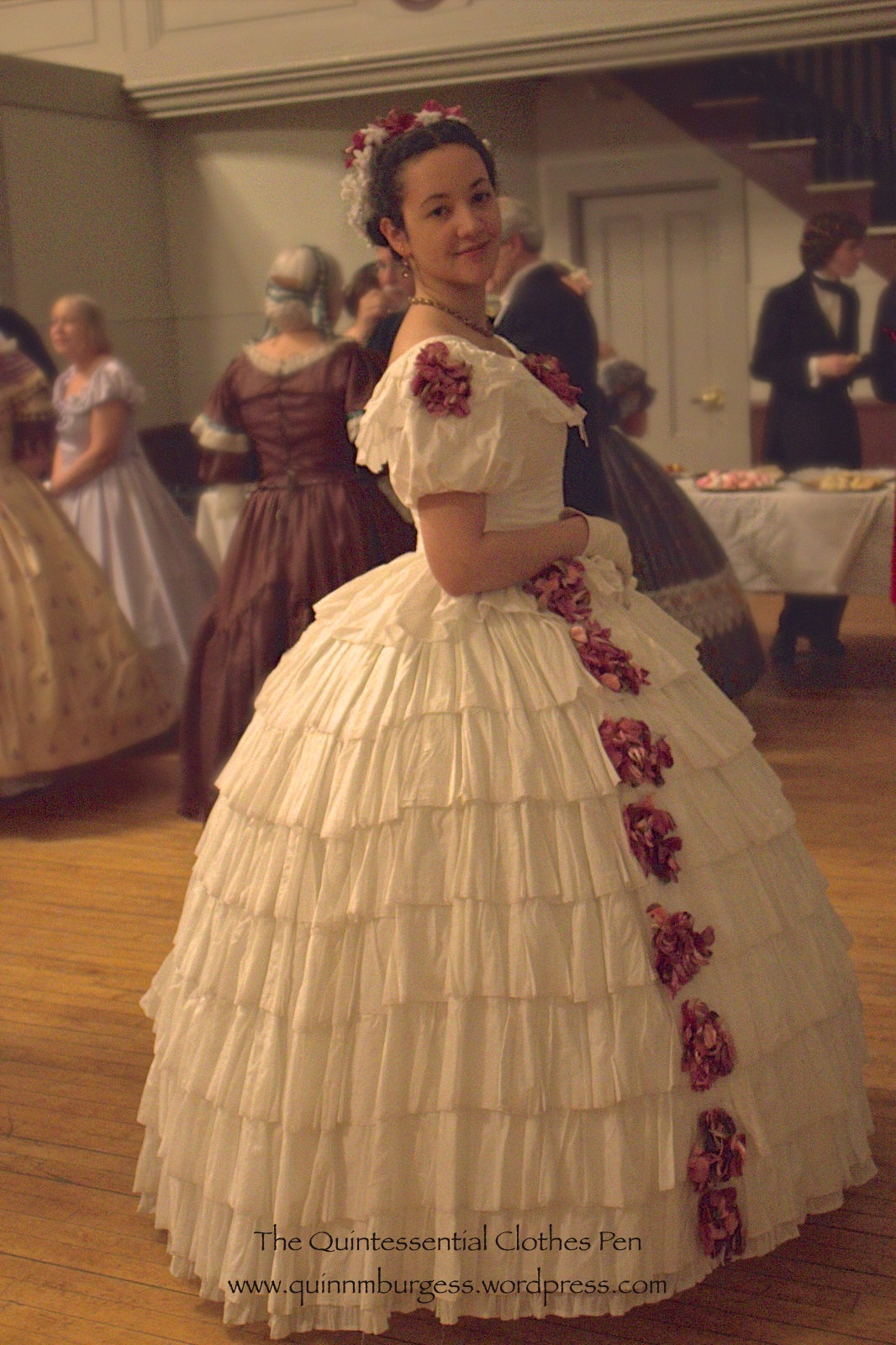
Not too long ago, I was again able to be part of the annual Returning Heroes Ball hosted by The Commonwealth Vintage Dancers. I decided to wear Annabelle again this year, even though I’d worn her last year, because I’d just worn Evie and Belle at the 1860s Dance Weekend in November.

IMG_7853
Annabelle at Returning Heroes Ball 2014.

Each time I’ve worn Annabelle, I’ve been slightly disappointed with the various incarnations of flower hair wreaths I’ve attempted to match her: the first wreath and the giant mass of flowers. So this year I decided to try again to see if I could get something I like. There are quite a number of evening dresses decorated with flowers right about 1860 and many of them are depicted in fashion plates and portraits with matching flowers in the hair. Here are some examples: 1859 fashion plate, another 1859 fashion plate, a third 1859 fashion plate, 1861 fashion plate, 1861 portrait, 1862 fashion plate, and 1863 fashion plate. For this new incarnation, I decided to try a different style from what I have for my other two evening dresses (Belle has a crescent and Evie has a hair wreath).  The style I settled on I’m calling a headband. It creates a halo around the face and extends down towards the ears, but does not connect across the back of the head. Instead, the hair must be interestingly arranged to fill in the back of the head. Here’s an example of the headband style using flowers that match the dress from 1862. And here is the fashion plate that Annabelle is based on which shows a headband style hair wreath worn with the dress.

IMG_7827
Here is Annabelle’s new floral headband. 
IMG_7953
Back view of my hair style. I needed something dramatic to fill in the base of my head. I wanted to do a sideways oval surrounded by rolls, but that didn’t work out and this is what I ended up with. I was dubious at first, but I think it worked. (It’s hard to see, but there’s one big central roll/puff and one smaller one above and below that.)

In addition to my new headband, I was also able to wear my new ca. 1860 corset and my still rather new purple paste jewels (a matching collet necklace and drop earrings) from Dames a la Mode. They worked wonderfully with my outfit (of course, I did pick the purple knowing it would match multiple outfits…!) and I enjoyed wearing them again.

The ball was lovely, as usual, and filled with well dressed people and more uniformed gentlemen than we have seen in recent years. The dancing was well executed and the intermission boasted a lavish spread of refreshments that both looked and tasted scrumptious.

IMG_7809
Bowers, during the Grand March.
IMG_7930
Bowing at the end of a polka.
IMG_7848
One small portion of the refreshments table.
IMG_7937
Looking lovely and dashing.

You can see more pictures of the event at Raven’s Plaid Petticoats blog post about Returning Heroes.

Ca. 1860 Corset Intense Details

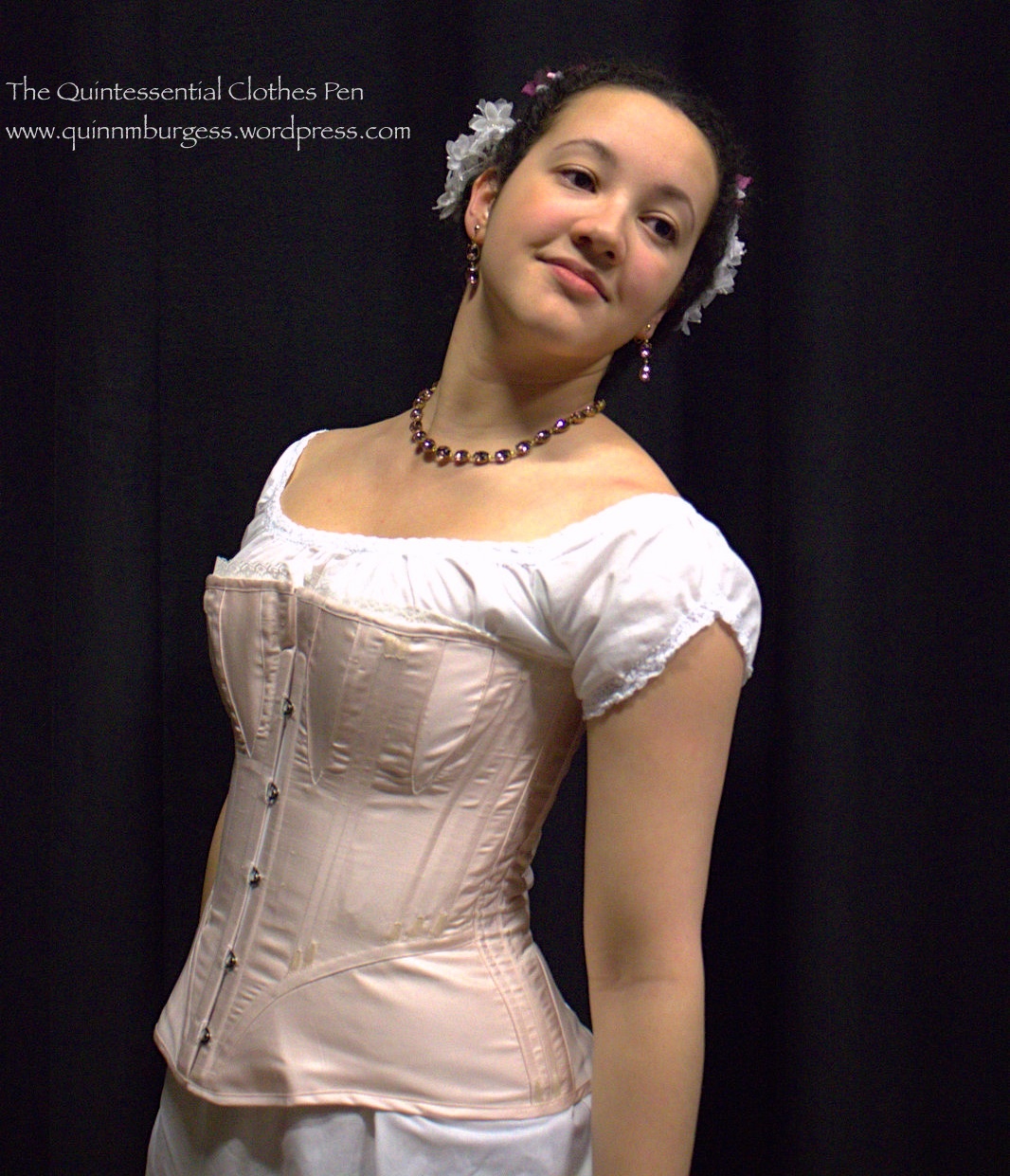
This is a follow-up post to my last post: ca. 1860 Corset For Me! (HSF #4)That post has a short background on my reasons for building the corset, but it doesn’t mention other details, so that’s what this post is for!

IMG_7441
My new ca. 1860 corset.

So let’s start with more background, since this post is all about intense amounts of details! We’ll start with the pattern I made for this corset: you’ll notice it has bust and hip gores as well as that curved piece on each side of the front. The bust gores aren’t so unusual for a modern 1860s corset recreation, but I don’t see too many corsets made (and certainly not many corset patterns) with hip gores and I’m not sure I’ve ever seen anyone reproduce an 1860s corset with that curved piece in front. I found these details intriguing and wanted to make this style for two reasons: 1, because it’s a style I haven’t seen recreated, but which I have multiple examples of in my research, and 2, because it seemed like it would fit into a new thought I absorbed a few months ago.

50.180.3_CP2
1865-1867 corset, The Met

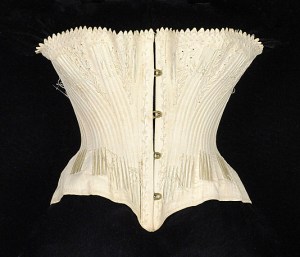
First, a discussion about the style. It seems like a lot of modern ca. 1860s corsets are cut with vertical seams that run from top to bottom of the corset to create shaping, sometimes with the addition of bust gores. (The corset on the right is an example of one from the 1860s that uses this style of seaming to create shape.) These corsets are cut with shaping in the seams to create space for the bust and hips, but an alternative to this is to use bust and hip gores to achieve shape for the body. The interesting thing is that hip gores do not seem to be very commonly used in historic corsets made by modern people, despite their use in historic clothing. I attribute this to the fact that shaped seams are easier to execute than inserting gores of any type, but especially gores that are not in a seam (like the gores in my corset). Also, I would think that pattern companies have an easier time grading patterns using the shaped seams, because the gores (particularly hip gores) really need a lot more individual adjustment and fiddling on a body than shaped seams do.

Second, about this new thought that I absorbed. While reading Merja’s most recent blog posts about corset construction, I was rather surprised by a simple statement that makes so much sense but which I haven’t necessarily followed in corset making  in the past (here are Merja’s gusseted 1870s corset, which has the sentence which mentions this magical new thought, as well as her 1880s purple corset and 1860s white corset with seaming like the Met corset, above, which exhibit the thought without it being explicitly stated). Essentially, she says that she always makes adequate space in the corset for bust and hips, so that the corset is only constraining her waist. Duh! A related thought is that when you tighten your corset you displace some bits to your bust and hips, so your corset really does need adequate room there to accommodate the normal and the extra. That makes so much sense and sounds so much more comfortable than having a corset that digs into your hips or pushes your bust around uncomfortably. I made the goal to take this approach for the new corset and all future corsets! and this new corset was my first attempt at really following this sound piece of information.

So given that the style I set out to make is one that I haven’t ever seen a pattern for, where did I get mine? Well, it’s loosely based off of one in Corsets and Crinolines by Norah Waugh (the pattern is ca. 1873, pg. 80). I say loosely, because I started there, but then began combining pieces and changing the shape of them to suit my measurements and the seam placement that I wanted (most importantly the hip gore and that curved front piece). Interestingly, Waugh notes on a different corset pattern (ca. 1860, pg. 78) that the 1860s style of corset without bust or hip gores (more like what I seem to see in modern made ca. 1860 corsets like the one from the Met at the top of this post) was a style preferred in France. The English preferred the style of corset I am making with gores. (Merja’s white 1860s corset I mentioned in the pervious paragraph uses this French corset pattern in Waugh, if you’d like to see what it looks like made up.)

I wound up making two mockups to get the pattern the way I wanted it even after adjusting the pattern from the beginning (and still made a few alterations before cutting out my real fabric). The original pattern in the book had a waist that was much too small and a bust that was a little large relative to my measurements. Despite my changes, the first mockup was too short waisted, needed bigger and longer bust gores, smaller hip gores (I had overestimated how much ease I needed there), and a little bigger waist. The second mockup was still a little short (I added another ½” to the top), the hip gores were still just slightly too big, and the lacing gap between the back pieces was wider than I wanted it to be by about 3″. Ugh! I actually determined that last fact after cutting out and sewing up my actual fabric. Turns out my shoulder blade area is bigger than I thought. I had an inner struggle about if I wanted to take out the small stitch size flat felled seam to insert a piece or if I wanted to just let it go. Adding a piece won in the end, because I figured that I was spending so much time on the corset that I really wanted to be pleased with it and not have nagging doubts for the next number of years until making a replacement. (The piece I added is between the front and back pieces. You can see it easily in the first picture in this post. It’s a v shaped piece that extends from top to bottom.) Adding the piece actually wasn’t so bad, despite all my inner complaining and I’m very pleased I did it, because I am happy with the result.

2010EE8233_jpg_l
1864 corset, The Victoria and Albert Museum.

That’s all the aspects of choosing the pattern and executing it. Now I can move on to my inspiration for creating it. This blue corset at the V and A is the most thoroughly photographed piece of inspiration (click through, there are lots of different angles of the corset, and close up pictures!). As you can see, the blue corset has bust gores, that curved front piece, (and if you look at the pictures of the back…) hip gores, as well as useful close up construction photos showing the flossing, how the busk is sewn in, how the binding is sewn on, etc. You can also see great detail for things like how to sew the points of the bust darts and the tops of the hip gores: they are overcast near the tips of the bust gores and tops of the hip gores before being machine sewn with topstitching to the binding. I used this method in my corset, sewing the overcasting by hand. I found that it was very useful on the bust gores (since mine are set into a slit in the fabric, not a seam) because the amount of seam allowance near the points is negligible (like, less than ⅛”) and that would have been extremely frustrating to try and machine sew! Also, the overcasting kept the edges from fraying as I was working with them. It also adds an extra measure of stability and sturdiness to those areas.

CI38.23.10b
1839-1841 corset, The Met.

Other very useful images to me were this orange 1860s corset front and side views (with generally similar lines as the blue V and A one) and this 1862 Godey’s image of a corset (with very similar lines as the blue V and A one). (As a side note: Does anyone know what collection houses the orange corset? I’ve only been able to find images, but no real source.) These corsets provide a nice end date range for my corset pattern, because in the 1870s the corset begins to change shape. But to determine a good start date for my corset I had to look elsewhere. The Met has a corset dated 1839-1841 with similar hip gores and the front curved piece (great zoomable pictures including an interior view, click through the image!), but it does not have separate bust gores (they are cut in one with the front pieces as is usual for 1840s corsets) and it does not have a front opening busk (those weren’t in general use until 1849). The 1839-41 corset is more curvy than the 1860s ones, as you would expect from an 1840s corset, but it still looks like a forerunner to me! Waugh has an 1844 corset pattern (pg. 77) that has similar lines to the 1839-41 Met one, with bust gores but without hip gores or the curved front piece. These 1840s corsets are useful for determining the start point of my date range, which seems to safely be the 1850s. Thus, my corset is dated ca. 1860, which is just a shorter way of saying 1850-1870. That makes sense looking at the silhouette of the dresses from these decades, as well, since neither the 1850s or 1860s require the curvy shape of 1840s or 1870s corsets.

EDIT: The orange corset mentioned above is in the collection of the Manchester Art Gallery via this link.

I used all of these different images to look for construction details to use in my corset. Specific things I was looking for include: stitch size, width of the binding, method of sewing the binding, placement of bones, design of flossing, seam placement, method of setting bust and hip gores, location of topstitching, placement of eyelets down the back, finishing of the interior of the corset, and length of the busk. Some of these things can be determined by looking at the extant corsets I’ve shared in this post, but others required other helpful research. Specifically, the gusset construction method I used came from this image that Merja shared in her 1870s corset post. It’s from 1872, but is still relevant for my corset, because if you look at the blue and orange corset pictures you will see it used on the overcasting at the bust and hip gores. This image, from 1868, shows similar methods as well (and has a selection of mostly French and a few English style corsets if you’d like to see more examples of those).

And now, here are the close up construction details of my corset that I promised.

IMG_7452
An interior view of my corset. It’s important to me that the inside of garments is as nicely finished as the outside, as you can see. It’s a little hard to see, but the grommets near the waist are set closer together than the ones a the top and bottom.
IMG_7449
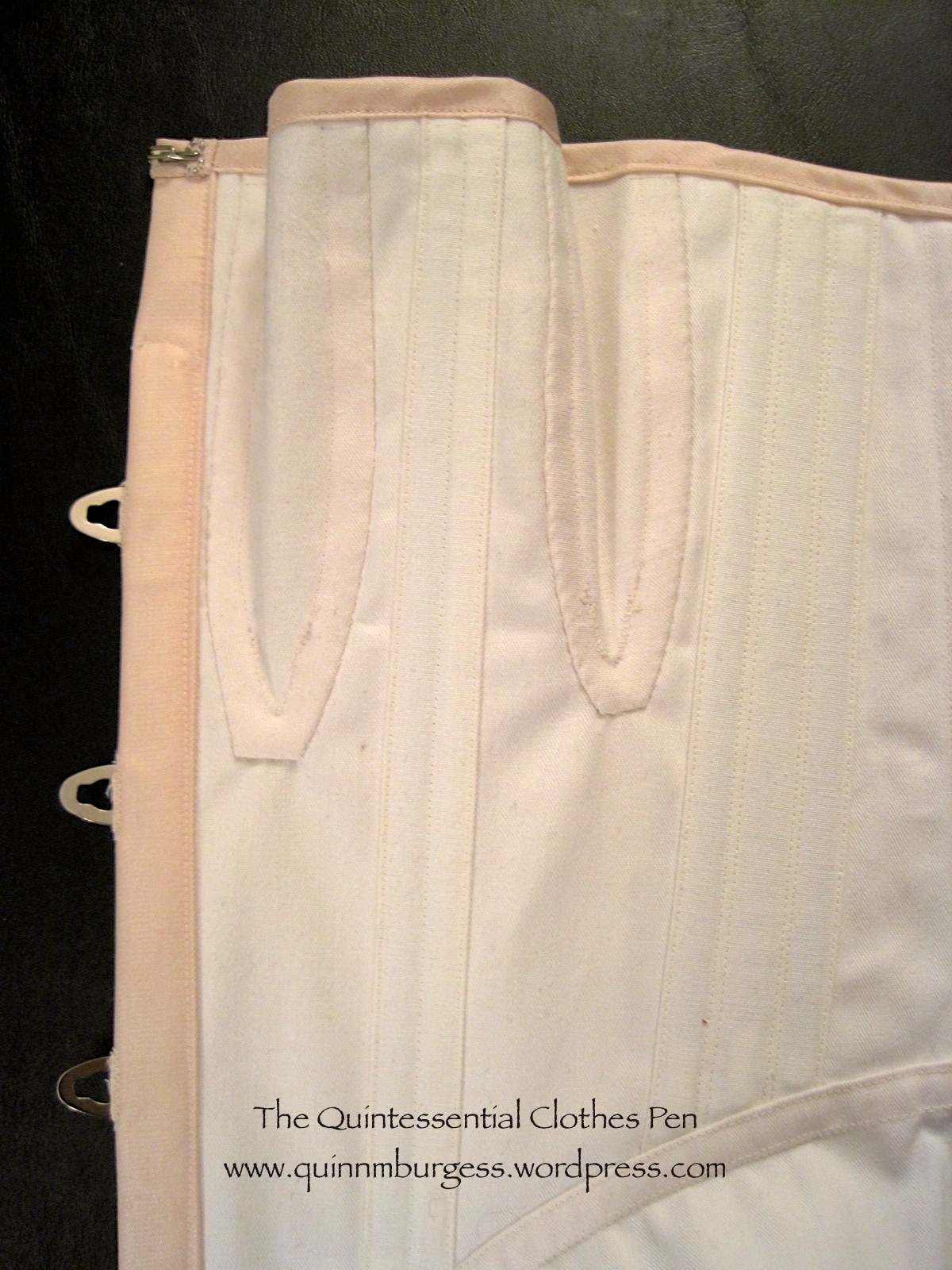
Details: Hand sewn overcast stitches at the bast of the bust gore and machine top stitching above that. Machine sewn button holes for the busk hooks (I’ve found this method to be much sturdier than leaving a gap in a seam on the edge).
IMG_7444
Details: The busk is top stitched around the top curve to keep it from moving. There is flossing at the top of the boning channels (every boning channel is flossed at the top and bottom). Machine sewn top stitched binding.
IMG_7454
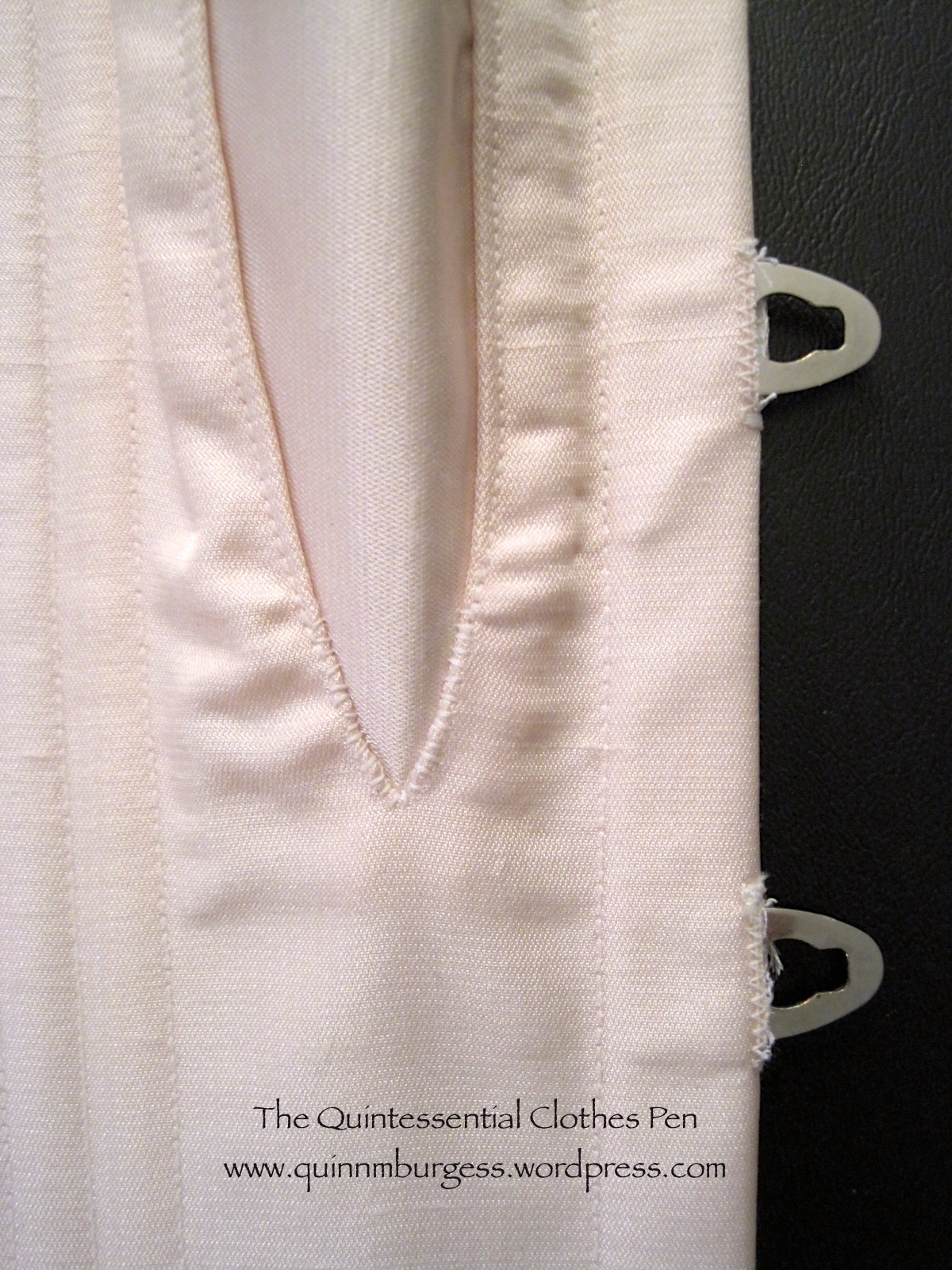
Details: The top hook of my busk is a few inches below the top of the corset, so I added a hook and thread loop at the top to keep it closed. I used coutil cut on the straight of grain for my boning channels: the edges are pressed under and then they are topstitched into place and into the proper number of channels (keeps the inside tidy and doesn’t require extra notions!). The seam allowance of my bust gores is turned under and flat felled by hand with a whip stitch that only catches the coutil. The curved front piece is flat felled by machine.
IMG_7456
Years of use have caused my busk to have a bend in it at my waist line. See how it curves up from the table in the middle? Impressive, really, that my body can permanently change the shape of metal.

I’m hoping to get pictures of the corset on me this weekend at its first ever wearing. Hopefully I’ll be able to share those in the near future!

Ca. 1860 Corset For ME! (HSF #4)

Unfortunately, I’m a few days late completing my project for the HSF Challenge #4: Under It All. I tried really hard on this one and was definitely motivated to keep working consistently by the fact that I wanted to get it done for the HSF challenge. I was held up by a severe cold that took me out for about a week and other dealing with life things. So while I’m late, I’m super glad and excited to be done with this project (especially because the last two days have included a lot of flossing, and my fingers/hand muscles are so done with that for awhile)!

The last ca. 1860 corset I built for myself was made in 2006 or 2007 (you can see it in this post). It’s been worn more times than I can count and has stood up to the test of time and tension well, especially considering it was the first corset I ever made! But the time has come for a new corset for this period–one that is made to fit me using all the skills in pattern making and construction that I’ve gained over the last 7 or 8 years.

I realized while working on this corset that aside from building my first corset to fit me in 2006 or 2007, the only other stays or corsets I wear with my historic clothes that were made to fit me are my 18th century stays, my short Regency stays, and my c. 1825 long stays. I wear other corsets from 1895 (hm, I don’t think there are pictures of this on the blog), 1903, and 1913 but none of them were constructed to fit me (though I did construct them beautifully!). I’ve made them work and they sort of fit me, but all of them have problems because they were made to fit other people: a busk that’s too long, being a little small, especially in the hips, or being too big and needing a tuck. So it occurred to me that I should probably invest in making a few more corsets made to my measurements for the Victorian and Edwardian periods. Sounds obvious, but it was a revelation to me when I sat down and thought about it!

So that’s what this project is: a ca. 1860 corset made to fit me!

IMG_7441
Hard to see the details in this picture, I know. There will be detail shots and lots of commentary in an upcoming post!

I have lots of other thoughts and inspiration to share with regard to this project, but I expect it to be lengthy, so I’ll be writing it up in a separate post. Plus, I want to post about my completion of the challenge as soon as possible. So for now, the very much condensed details.

Fabric: 1/2 yd ish of white herringbone cotton coutil and ½ yds ish of slightly slubby pale pink silk satin.

Pattern: Created by me, though I began with a corset pattern in Norah Waugh’s Corsets and Crinolines and made lots of changes to it.

Year: c. 1860.

Notions: Metal boning, metal grommets, a recycled metal busk from my old ca. 1860 corset, regular weight ivory thread, and heavy weight ivory thread for flossing.

How historically accurate?: Pretty darn accurate, I’d say. I wanted to create a corset using the seam lines found in extant garments, but which don’t seem to be much recreated. I used construction methods that are accurate as far as I know. Let’s say 90% because you can’t ever quite make it to 100% if it’s modern, can you?

Hours to complete: A lot. I didn’t keep track, but I’ve been working on this for  at least 2 or 3 weeks, and some of those days have been a full day’s work on the corset, not just evenings.

First worn: Has not been worn yet, but will be worn to a ball in March.

Total cost: Free (all stash materials)!

HSF #3: A Pink Regency Belt Style Sash

My project for the HSF Challenge #3: Pink is a silk belt style sash for my square neck 1812 gown. It’s a small project because I’m working on multiple other bigger projects (two different Regency dresses and a new 1850-1870 corset–more on those in the upcoming months) and I didn’t want to distract myself. Part of my decision to make a belt style sash came from the discussion with friends that led to my previous post on adding variety to Regency sash styles (this post explains what I mean by a belt style sash, in addition to explaining other Regency sash styles).

And now, as usual, on to the facts:

Fabric: None.

Pattern: None.

Year: c. 1810

Notions: About 1 yard pink silk ribbon, some unknown yards of 28 gauge wire, maybe 2 yards grayish blue hug snug, a hook and bar, and thread.

How historically accurate?: Silk is an accurate material, but nothing else is for this time frame. So… maybe 80% for looks and 40% for materials.

Hours to complete: More than it should have because I made the buckle from scratch. Let’s say 4.

First worn: To a vintage dance performance in January.

Total cost: Free (all stash materials)!

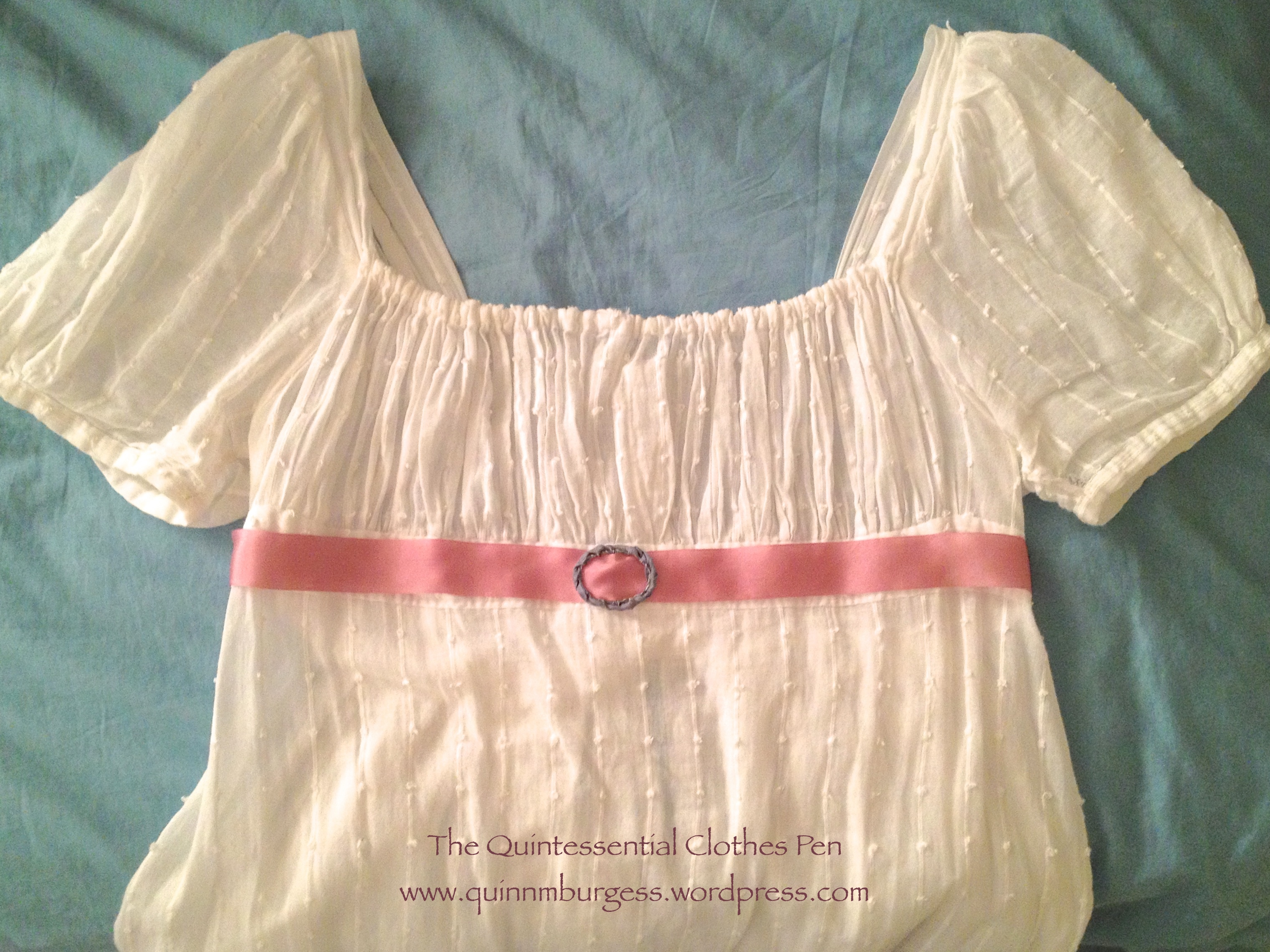
IMG_0673
I didn’t have a non-sparkly buckle in the right size, so I decided to make one from wire. At first I thought that it might be cute with the scallops around it, but it didn’t look solid enough from a distance. So I experimented with weaving ribbons through and around the scallops. I tried gold silk ribbon first but it ended up looking like straw. In the end I decided on the hug snug because I liked the color.
IMG_0678
A closeup of the finished buckle. It wound up looking rather braided.
IMG_0675
The finished effect.

For the performance, I sewed the belt to the dress even though I also sewed a hook and bar to the belt. The idea is that I can wear it with another dress in the future if I want to!

Variety Please: Regency Ribbon Sashes

In modern interpretations of Regency costume, there is a widespread use of what I am going to call the “ribbon sash.” By this I mean a length of ribbon, in a contrasting color to the dress and not used to trim any other part of the dress, tidily tied or sewn under the bust, and terminating with long hanging ends. I understand that this style provides an easy way to adorn a dress of any color or add color to a white dress, but I believe that the style is much too often used relative to the occurrences we see of them being worn in portraits, fashion plates, and built into extant gowns. I would like to encourage all of us to have variety in the ribbon sash styles we wear with Regency clothing.

When looking at portraits, fashion plates, and extant gowns, you do find the sort of ribbon sash I described in the beginning of this post, but you don’t find them in anywhere near the same proportion with which they are used today. You do see these types of sashes, but it is a small proportion of the styles worn and you see a variety of other sash styles, too. I would like to share a variety of ribbon sash styles with you and encourage you to pick one of these less used styles if you decide to wear a ribbon sash yourself or if you have the influence to encourage others in their own ribbon sash wearing. By expanding the styles of ribbon sashes worn, hopefully we can all more accurately represent clothing worn in the Regency period.

Generally speaking, there are 4 large categories of ribbon sash styles. I’ve included an example image of each style underneath the accompanying description and I’ve included links to other good examples (below the four sash style descriptions) so you can look at them for more ideas.

1: The Ribbon Sash (as described in the beginning of this post): a length of ribbon, in a contrasting color to the dress and not used to trim any other part of the dress, tidily sewn or tied under the bust, and terminating with long hanging ends approximately 24″-36″. It is very rare to see this style used in a fashion plate or painting with the termination of the sash in any location other than center back.

f718f40238cfc85cf02418565c440a52
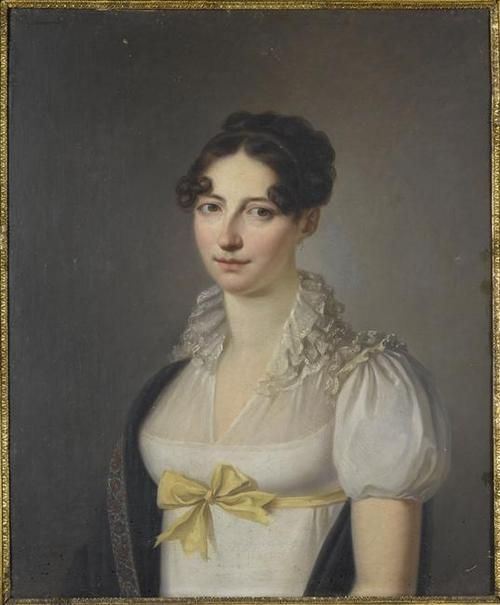
Henri François Mulard, Portrait of a lady, circa 1810

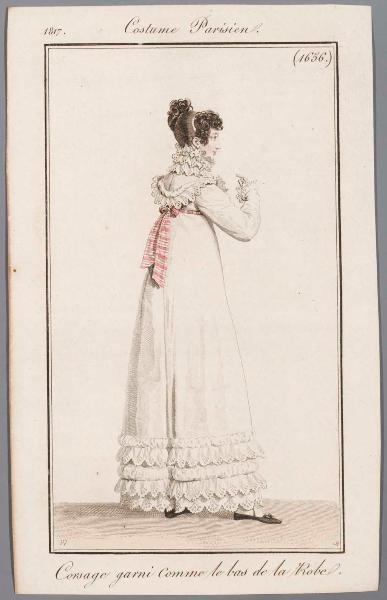
2: The Short Sash: a length of ribbon, in a contrasting color to the dress and not used to trim any other part of the dress, tidily sewn or tied under the bust, and terminating with short hanging ends approximately 6″-18″. I have seen this style with the termination of the sash in center back, center front, and  occasionally off to one side of the front.

39b5c0d0d643bba771d16242bc7cd001
Costume Parisien, 1817

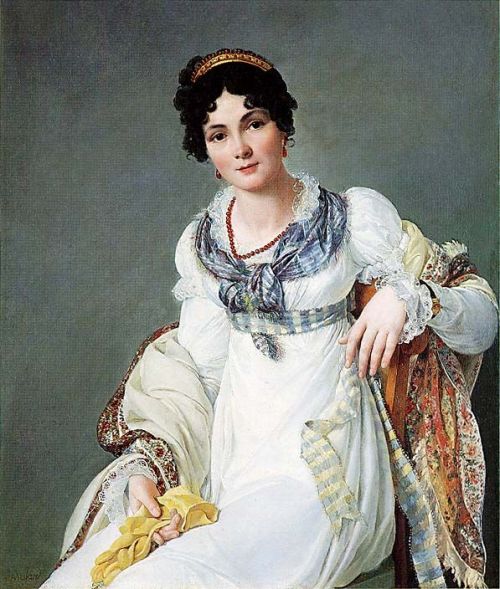
3: The Belt Sash: a length of ribbon, in a contrasting color to the dress and not used to trim any other part of the dress, tidily sewn or tied under the bust, and with very short hanging ends or without hanging ends at all. This style is sometimes plain or sometimes adorned with a buckle or bow. The buckle or bow with short ends is often at center front.

bf13efcf8156d526622fc6126c7b045b
Portrait de Laure de Berny ca. 1810 by Henri-Nicolas Van Gorp

4: The Trim Sash: a much more common variant of any of the first three sash styles. Any of the first three sash styles can fall into this category if the sash matches and coordinates, in a harmonious fashion, with trim elsewhere on the dress (neckline, sleeve openings, or hem).

6d79a16093d852e426ea43901059fa9c
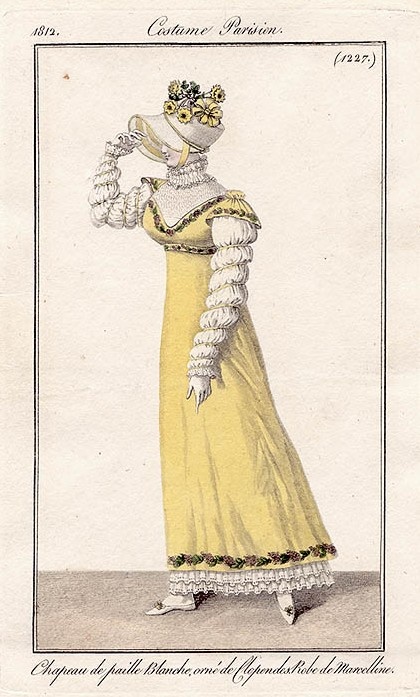
Costume Parisien, 1812

All of these sash styles are seen with different styles of termination. I’ve most often seen a variety of bows as well as tidy arrangement of loops. Often, the belt style seems as though the belt sash is actually sewn to the dress, but for the sake of options, I can easily see a ribbon sash made with a closure such as hook and eyes so the sash can be easily added or removed from any outfit. It’s worth noting that there are a substantial amount of images showing ladies from the front who appear to be wearing a ribbon sash of some sort. The trouble is that we often can’t see what’s going on in the back, so we can’t know with certainty what style of ribbon sash is actually being represented, though we can make educated guesses.

Here are more examples of each of the sash styles shown above:

1: The Ribbon Sash

Portrait of a lady, ca. 1810: ribbon sash on a white dress (ties in back)

Costume Parisien, 1813: ribbon sash on a white dress (ties in back)

2: The Short Sash

Auguste-Amalie de Baviere, ca. 1815: short sash (ties in front)

Costume Parisien, 1817: short sash (ties in back)

3: The Belt Sash

Laure de Berny, ca. 1810 (bow in front)

A young woman wearing gloves in a park, 1813

Anna Maria Magnani, 1814 (bow in front)

Woman knitting in a blue dress, ca. 1819 (bow in front)

4: The Trim Sash

Dress, ca. 1810, The Met: belt sash

Dress, ca. 1810-1811, Gemeentemuseum Den Haag: belt sash

Costume Parisien, 1812: belt sash

Costume Parisien, 1812: belt sash

Dress, ca. 1810-1815, Rijksmuseum: belt sash

Family Portrait, 1813: short sash (ties in front)

Of course, these are only a starting point. My pinterest boards have hundreds of pins from the 1800s and 1810s that you are welcome to look at for other ideas. Keep the contrasting ribbon sashes in mind, but don’t forget that you can make sashes out of your dress fabric, too (see below). Sashes made from self fabric are quite common. Look around and see what you can find that inspires you. This Regency Portraits board has a lot of great images showing all sorts of sashes as well.

Here are some great examples of dresses with sashes made from self fabric (meaning that fabric used in the dress was also used to create a ribbon sash look):

Désirée Bernadine Eugénie Clary, ca. 1810: long sash

Costume Parisien, 1810 short sash (ties in front)

Costume Parisien, 1811: short sash (ties in front)

Costume Parisien, 1811: short sash (ties in front)

Costume Parisien, 1812: short sash (ties in front)

Costume Parisien, 1814: short sash (ties in back)

Costume Parisien, 1817: short sash (ties in back)

In looking at my pinterest board covering 1800-1809, I do find that there are some very cute sashes then, too, that are relevant for a potential sash look. In  this period it seems that most sashes match the trim used on the dress, though it is not an absolute rule. I’ll include a few examples of this sort below, so you can look if you’re curious.

Costume Parisien, 1799: short sash (ties in front)

Costume Parisien, 1800: short sash: (ties in front)

Costume Parisien, 1800: trim ribbon sash with long ends

Young Woman Drawing, 1801: short sash (ties in back)

La Belle Assemblee, 1807: trim ribbon sash with long ends

Costume Parisien, 1808: belt sash

Felicite de Durfort von Merry, 1808: belt sash

Charlotte Bonaparte, 1808: belt sash

For the record (and because I always forget!), the official “Regency” is referring to England during the years 1811-1820, following the Prince of Wales being named regent for George III in 1810. In France, the Napoleonic Empire spanned the years 1804-1814. So there is some overlap between Empire and Regency, but not a whole lot. (And just to add another date to the mix, the Federal period in America roughly spanned the years 1780-1830.) For the purposes of this post, I’m using the word Regency to specify the 1810s, but my points about variety in sash styles are relevant for the first decade of the 19th century as well.

As a final note, let me encourage you to use color in Regency dresses (color in trim as well as color in the fabric), especially in those dresses intended to represent the 1810s rather than 1800s. By the 1810s, not all dresses were in white tones, as they were much more predominantly in the first few years of the 19th century. Colors were used often, some of the colors even being rather vivid in tone (don’t get too carried away with very bright colors, though, because chemical dyes weren’t invented till the middle of the 19th century). Check out these great resources that describe and show colors used in the Regency:

Colours used in the Regency and Georgian eras

Regency Colors and Fabrics

HSF #1: The Make Do Shift

The first challenge of the Historical Sew Fortnightly (HSF) 2014 is Make Do And Mend. At the start of January, none of my in-progress projects qualified, unfortunately, and while I wanted to get started on the right foot for the HSF 2014 and not miss the challenge, I also didn’t want to make something just to make something. I don’t need more stuff with no purpose and it’s hard to stay motivated on a project if you’re doing it “just because.” So I racked my brain trying to think of what would work for the challenge and be useful, without taking too much time. I settled on the idea of turning a gifted partially finished linen man’s shirt into an 18th century shift suitable for the mid-to-late 18th century. That just happens to be the period my 18th century court gown will be from at some point this year. Useful! I made an 18th century shift a few years ago, but it’s actually late 18th century/Regency, with short sleeves, which really isn’t appropriate for the rest of the century. This new shift will sort of work for the entire century, though the sleeves aren’t really full enough to be entirely accurate for the first half.

IMG_0672
1750-1790 shift

All of the seams are flat felled. The neck is narrow hemmed. It’s pretty accurate, though I did have to add center front and center back seams, which is not usual for these garments. Those seams are due to the fact that the shift was super wide after I cut it out because I had to deal with the neck opening of the partially sewn shirt, and that was gathered into the neck, so was super full. There was just way more fabric than was needed, so I seamed it and kept the extra with the other scraps I had. I’m sure they’ll get used someday! It’s very nice, light linen.

The facts:

Fabric: Linen reused from a partially completed man’s 18th century shirt.

Pattern: I used Mara Riley’s 18th century shift draft to cut my pieces, though I had to make some adjustments given that I didn’t start with fabric yardage.

Year: Loosely 1750-1790.

Notions: Thread.

How historically accurate?: It’s 100% hand sewn using 18th century stitches and cut in the manner of an 18th century shift, so lots of points for that. I probably should loose a few points for using polyester thread. The only other odd thing is that I have seams up center front and center back, but they did piece a lot in the 18th century, so it’s not totally out of the realm of possibility, given that this challenge is Make Do and Mend. I give it 90%.

Hours to complete: 10-15 maybe? I didn’t really keep track.

First worn: By the hanger. I probably won’t wear this until I have more things to wear with it!

Total cost: Free!

Summary of 2013: Looking Forward to 2014

2013 flew by. Really, it’s hard to believe it is 2014 already… As I did in 2011, and 2012, here is the year 2013 in review and a look at the upcoming year 2014.

Completed projects in 2013:

IMG_0958 - Version 2
January: 1813 Evening Gown (HSF #1)
IMG_4148
January: 1823 Petticoat (HSF #2)
IMG_4201
February: 18th Century Pockets (HSF #3)
IMG_4286
March: Evie the 1864 Ball Gown trim (HSF #4)
IMG_4209
March: Purple Ballroom Competition Dress
IMG_0368
March: Blue Under Dress (HSF #5)
IMG_0791
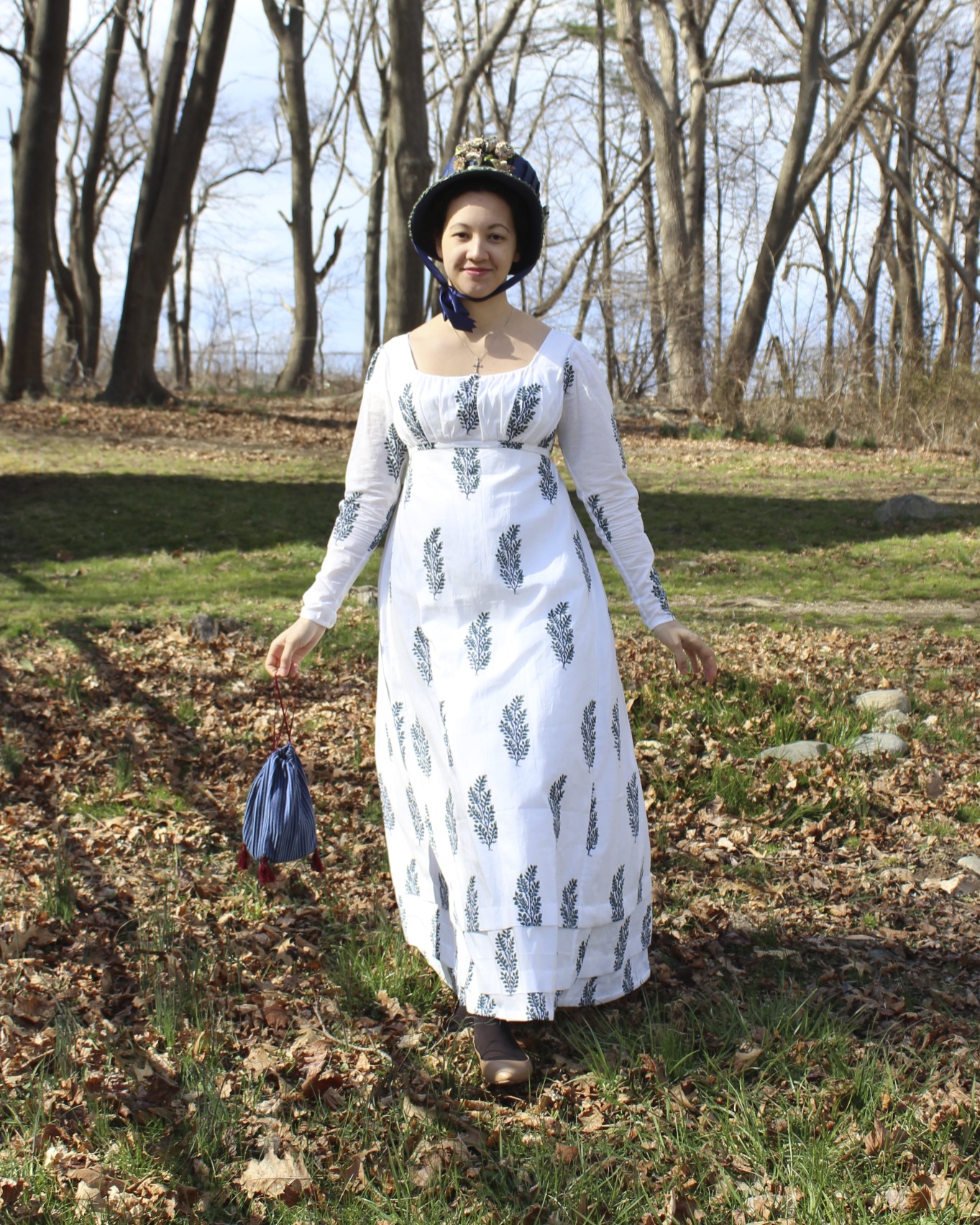
March: Regency Tree Gown 1815 (HSF #9) and Stripe-y Regency Reticule (HSF #6)
IMG_4407
April: 1815 Tree Bonnet (HSF #7)
IMG_4196
May: 1925 beaded evening gown (HSF #10)
IMG_4073
June: 1926 blue dress and slip
IMG_4607
June: 18th Century Apricot Petticoat (HSF #11)
IMG_4603
July: 18th Century Bum Roll (HSF #15)
IMG_4675
July: Georgina, from 1858, and 1857 Eugenie hat (HSF #16)
IMG_5437
August: Refreshing Apron and Red & Gold Regency Tiara (HSF #18)
IMG_5204
August: 1953 dot dress
IMG_0571
September: Mineral Felicite Stomacher (HSF #19)
IMG_4889
October: 1822 Walking Dress Trim (HSF #20)
IMG_4988 - Version 2
October: Evie Sleeve Trim (HSF #21)
IMG_6948
October: 1917 Angorina Sweater (HSF #23). December: 1917 Fur Hat and Revised Muff (HSF #24) and 1917 Gaiters (HSF #25).
IMG_7416
November: 1823 Evening Gown Trim December: 1823 hair wreath
IMG_7431
December: 1760s Mineral Felicite Jacket

Whew! And that’s only the list of things I made for fun and for myself (no work or commissions included in that list!). As I look forward to 2014, here’s what my confirmed sewing list is looking like:

February: Late Regency evening turban

March: new Annabelle hair wreath

April: 1814 pelisse and hat, 1811 evening gown

June: Georgina evening bodice

December: 1830s or maybe 1840s evening gown

At some point: 18th century court gown and grand panniers

There are lots of other things that may or may not be started or finished, including (but absolutely not limited to) and in no particular order: an Anne Adams pattern 1930s-does-modern dress, an 1885 summer dress and hat, an 1860s corset, an 1820s bonnet, painting and decorating my Kensingtons, adding a giant bow to my 1928 evening dress, an 18th century hand quilted petticoat, more Regency reticules, and a whole host of other possibilities.

Looking at what I thought I would complete in 2013, I think I did a pretty good job of sticking to my plans. Some of the things that were on my to do list are on the 2013 to do list again because I didn’t start them, or I started them but didn’t finish them. And as usual, there are some things that have been dropped off of my list entirely because I decided I didn’t need them or I used the fabrics for some other project.

To recap other things, this blog was awarded three different blog awards in 2013!

Lovely Blog Award

Liebster Blog Award

Very Inspiring Blogger Award

2013 was also the first year of The Historical Sew Fortnightly hosted by The Dreamstress. My goal was to complete as many challenges as I could without making things just for the sake of making things. Out of 27 challenges, I completed 21 of them. There was a stretch of time over the summer where the projects I needed/wanted to sew didn’t line up with challenge themes or the things that I hoped to finish didn’t get done… Some of those things are still on my UFO pile, even at this point in the year! And there were a few other challenges throughout the year that just didn’t fit with anything I had planned or had the time and materials to build. 21 out of 27 is pretty good, though, considering I made lots of other things that didn’t qualify for the HSF.

And how many events did I attend? 22 total, I think. This breaks down as 10 balls, 4 performances (I feel like I must have done more than this, but I can’t think of what they were), and 7 other events including picnics, archery, kite flying, roller skating, etc. Multi-day extravaganzas include a Regency Intensive Dance Weekend and an 1860s Dance Weekend.

Here’s looking forward to 2014. Blessings!

IMG_7387 (1)

Project Journal: 1822-1824 Ensemble Part VII: Trimming Complete (Fezziwig’s Ball 2013)

I am very excited to share that I am finally done sewing the trim on my 1822 Walking Dress and 1824 Ball Gown. I actually finished sewing the trim on both garments about two months ago. Yay me, for being ready for a ball a full month ahead of time!

The walking dress has a previous post from when I completed sewing the trim. The ball gown has previous posts about being worn partially trimmed last year and about sewing on the hem appliques. Here is the link to the category that shows all the posts related to this ensemble.

I wore both garments this year at Fezziwig’s Ball, hosted by the Commonwealth Vintage Dancers, just as I did last year. Last year, however, I didn’t have enough time to trim them like I wanted to and I didn’t really have time to look into proper hair styles either. So this year, in addition to adding trim, I also decided to try out a different hair style that would be much more early 1820s.

I looked at lots of fashion plates and noted what elements made the styles look 1820s. This is the look, from 1823 (also pictured a little farther down). The style required a new hair wreath, so that was the only last minute sewing for this year’s event. I did the same style as the fashion plated: crossed braids on top of my head and little curls around my hair line. When you have long hair and no bangs like me it’s quite a challenge to get curls around the hair line. I managed to make the little curls happen, but I still want to improve my methods. The hair wreath was essential for hiding my long hair and only showing the curly ends. It is made of wired millinery flowers sewn to a length of millinery wire. The front bits are small flower sprays and the back is velvet leaves.

IMG_3222
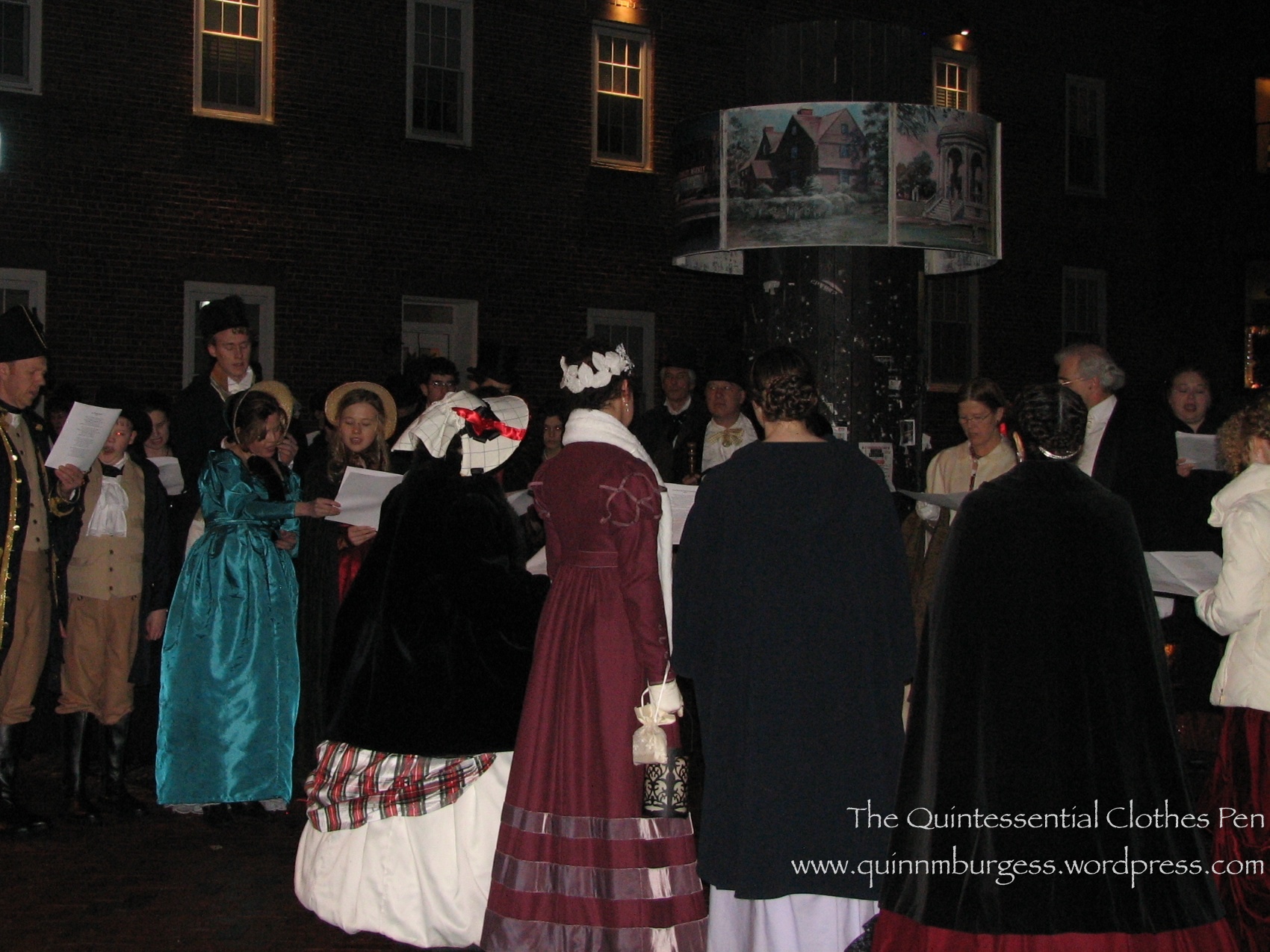
Caroling before the ball.
IMG_3213
This is a great view of the back of my walking dress and the back of my new hair wreath.
IMG_7406
Here we are: 1822 walking dress with trim, worn with a chemise, corset, corded petticoat, muff, tippet, gloves, and my new hair wreath. (If you want to see/read more details about these garments you can view the entire Project Journal for this ensemble.)
Ser3 v1 1823 Ackermann's fashion plate 29 - Evening Dress
1823 – Ackermann’s Repository Series 3 Vol 1 – May Issue (My inspiration for my hair wreath, hair style, and for the picture below.)
IMG_7416
Changed for the ball: 1824 ball gown with finished trim on the sleeves and front. Same undergarments with different accessories (long leather gloves with red stockings and burgundy shoes to be in the holiday spirit!).
IMG_3272
Lining up for a grand march during the ball. I loved the garlands hanging in the background.

I was amused throughout the night that people kept commenting on how much they liked the sleeve appliques on my green dress. I didn’t realize they were so exciting, but I do think they balance out the skirt nicely. By the end of the night my curls were looking a bit crazed… but it was fun, and I do enjoy wearing these garments and the style of the 1820s, in general. Oh, and I was able to wear my refreshing apron, too, though we were too busy refilling refreshments to take pictures. So yay for completion! It’s nice to get these things off the sewing list to make room for other fancily trimmed things!