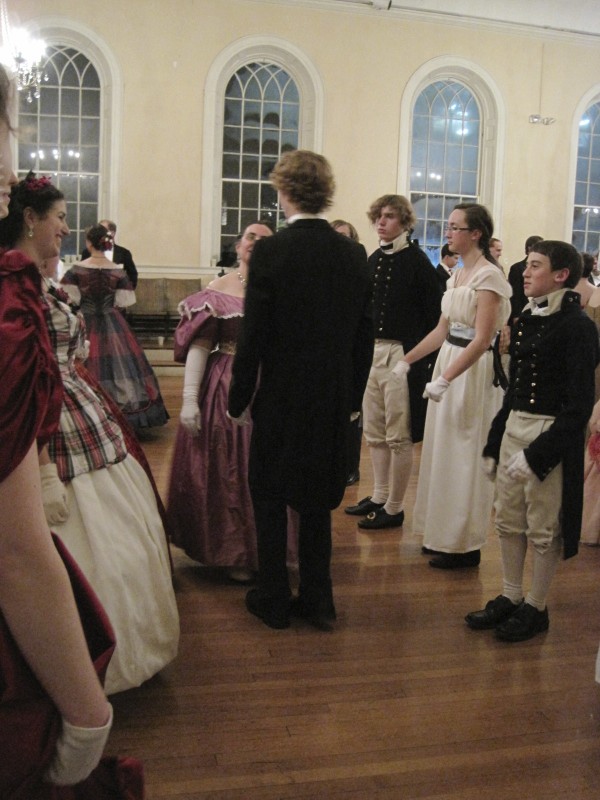
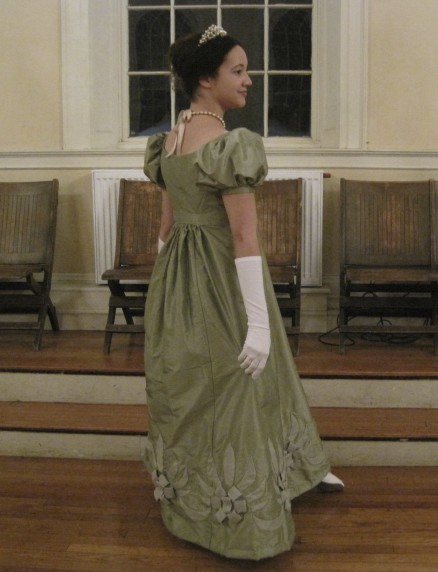
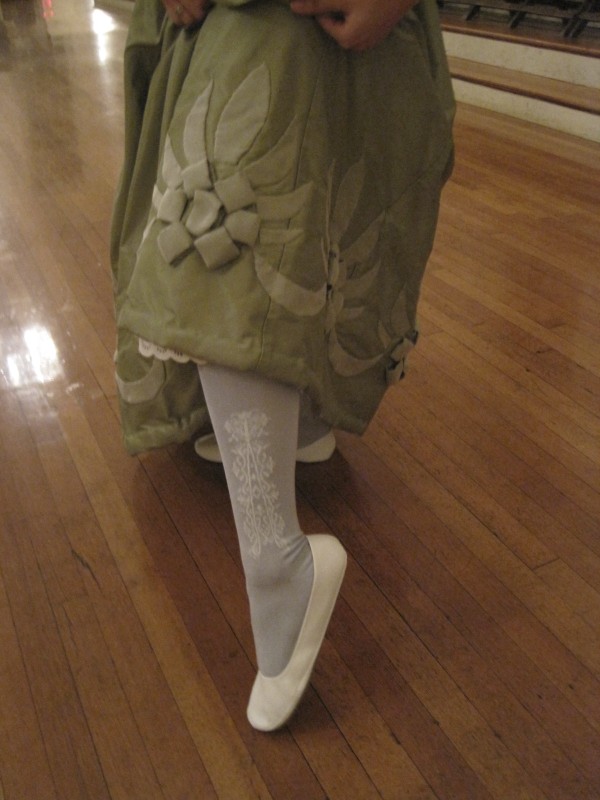
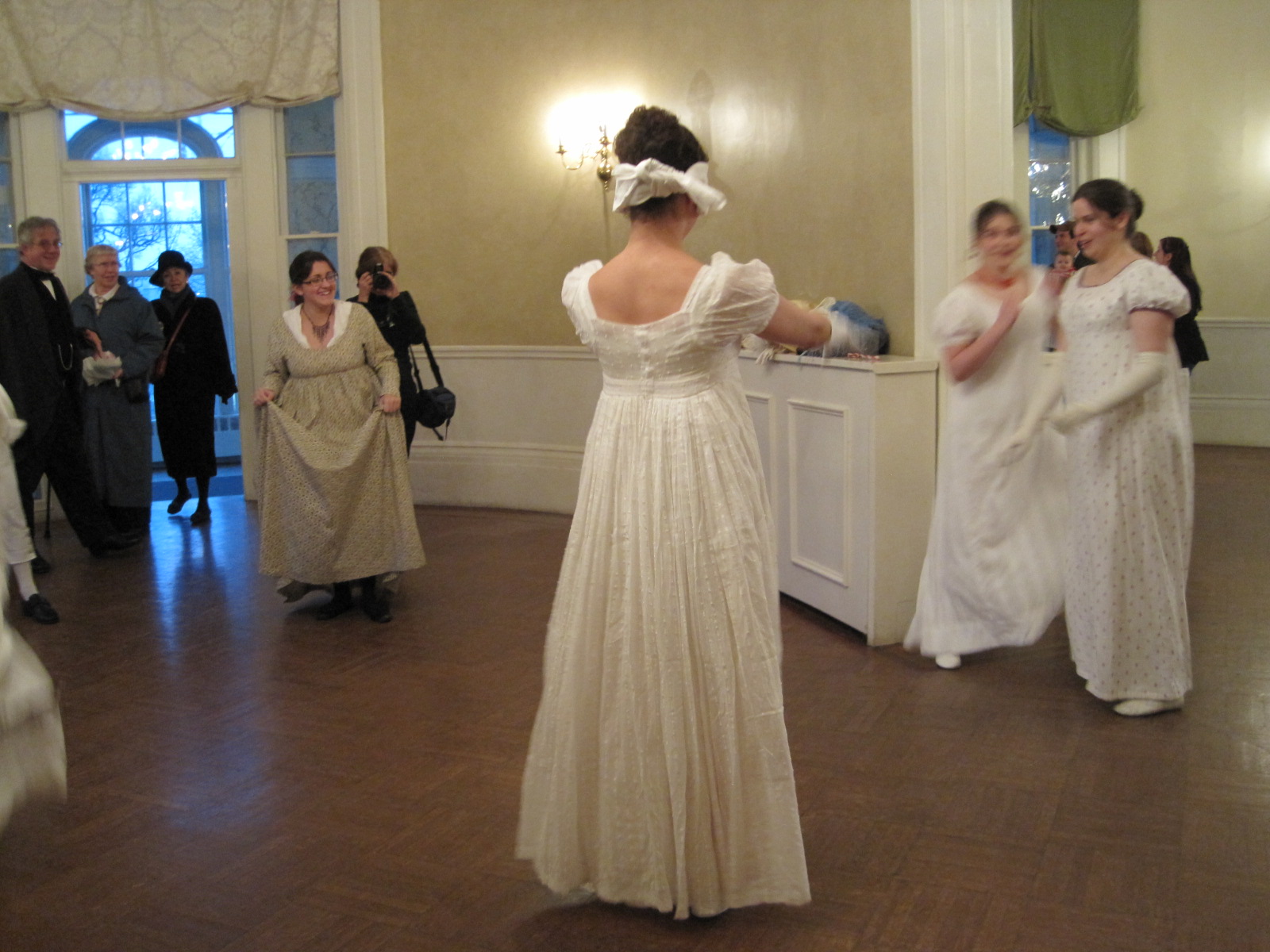
Regency Dance Weekend Part I: Settling In

Not so long ago (only about two weeks, though it seems longer), I had the most marvelous time at the Commonwealth Vintage Dancers’ Regency Intensive Dance Weekend. The weekend included classes, archery and outdoor lounging, an informal dance, and a formal ball. Plus, I had the added bonus of staying with friends in a lovely 1807 house and having extra outdoor adventures the day after the weekend ended!

 The weekend had about 50 people in attendance, which was a perfect number for socializing, meeting new people, and filling a ballroom without it being over crowded. It was so special to get to know so many new people, not only by name, but also to have time to get to know a little about them. By the final ball on Sunday night the atmosphere was of the kind you usually only get to dream about when reading Jane Austen: it was a ball where you knew everyone in the room , everyone was constantly changing partners, and everyone knew the steps so there was no teaching, just dancing. It was an absolute blast (and after the weekend I had danced so much that my calves were so sore it was hard to walk for a few days)!

Given that I had such a great time, and that I was able to wear some lovely new clothes (like the tree gown, and my new bonnet, and my blue underdress) you can understand that I have lots of pictures to share. Everyone else looked stunning as well and also had new clothes to show off, which was super fun. Really, people really did look marvelous! Yes, I’ve got lots of pictures, and I’m going to break them down into multiple posts.

First, we’ll look at Saturday, a day with 5 hours of dance classes, checking in to our lovely 1807 house, and attending an evening dance. (Oh wait, did I mention my friends and I also swarmed our lovely and kind friend’s house on Friday night? No great pictures, but it sure was fun to hang out together and squish 8 people into an apartment…! Plus, it made getting to dance class the next morning so much better since we didn’t have to drive very far!)

IMG_0309
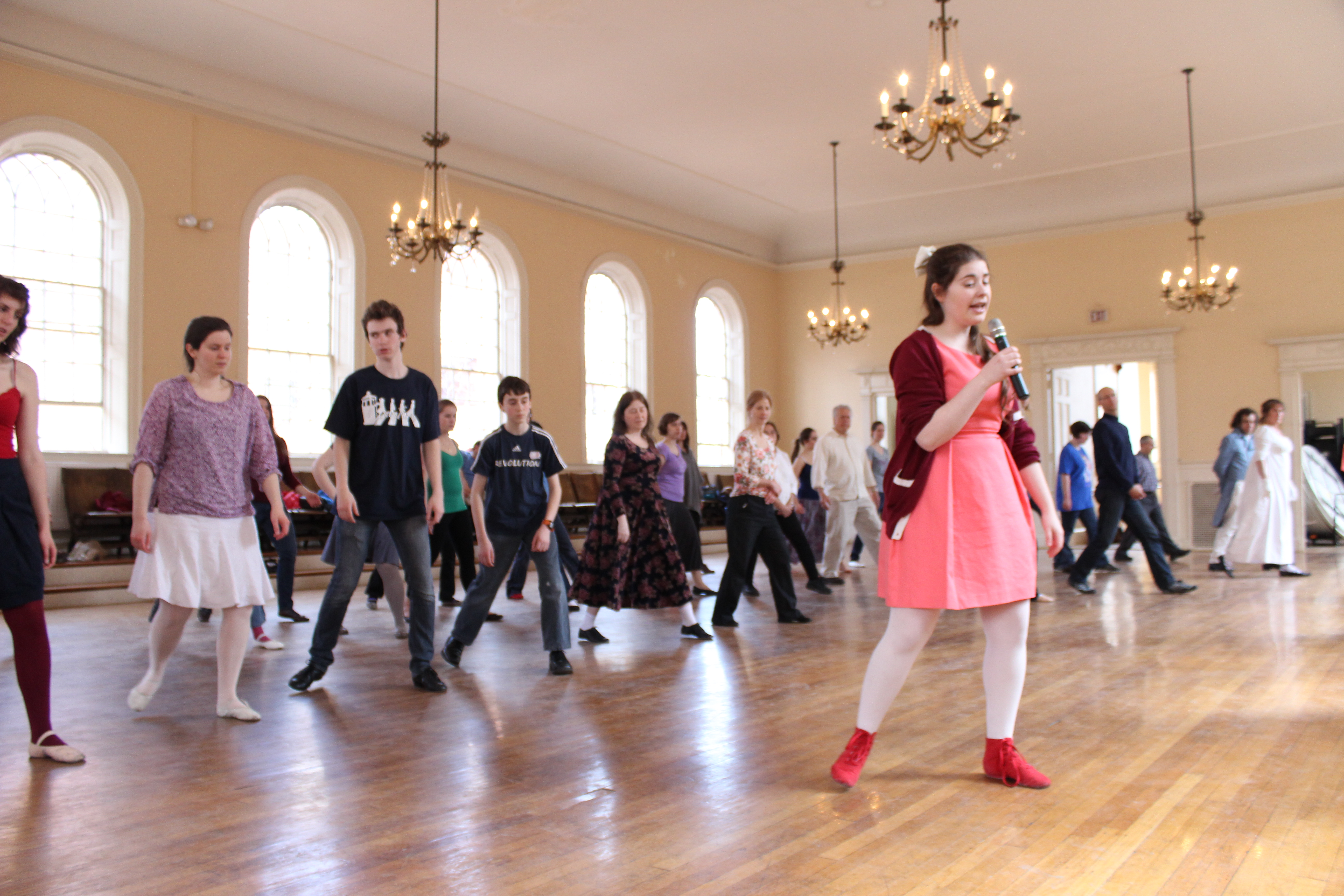
Starting to learn Regency dance steps.
IMG_0324
Working on Regency waltz.
IMG_0351
The wallpaper in my room of the 1807 house we stayed in for the weekend. The room was decorated in this deep red. It was so beautiful!
IMG_0368
Dressed in my new blue underdress and square neck gown. I’m heading off to the informal dance. Accessories include my blue American Duchess clocked stockings, blue velvet flats, white gloves, a red bead necklace, and my patterned red pashmina.
IMG_0402
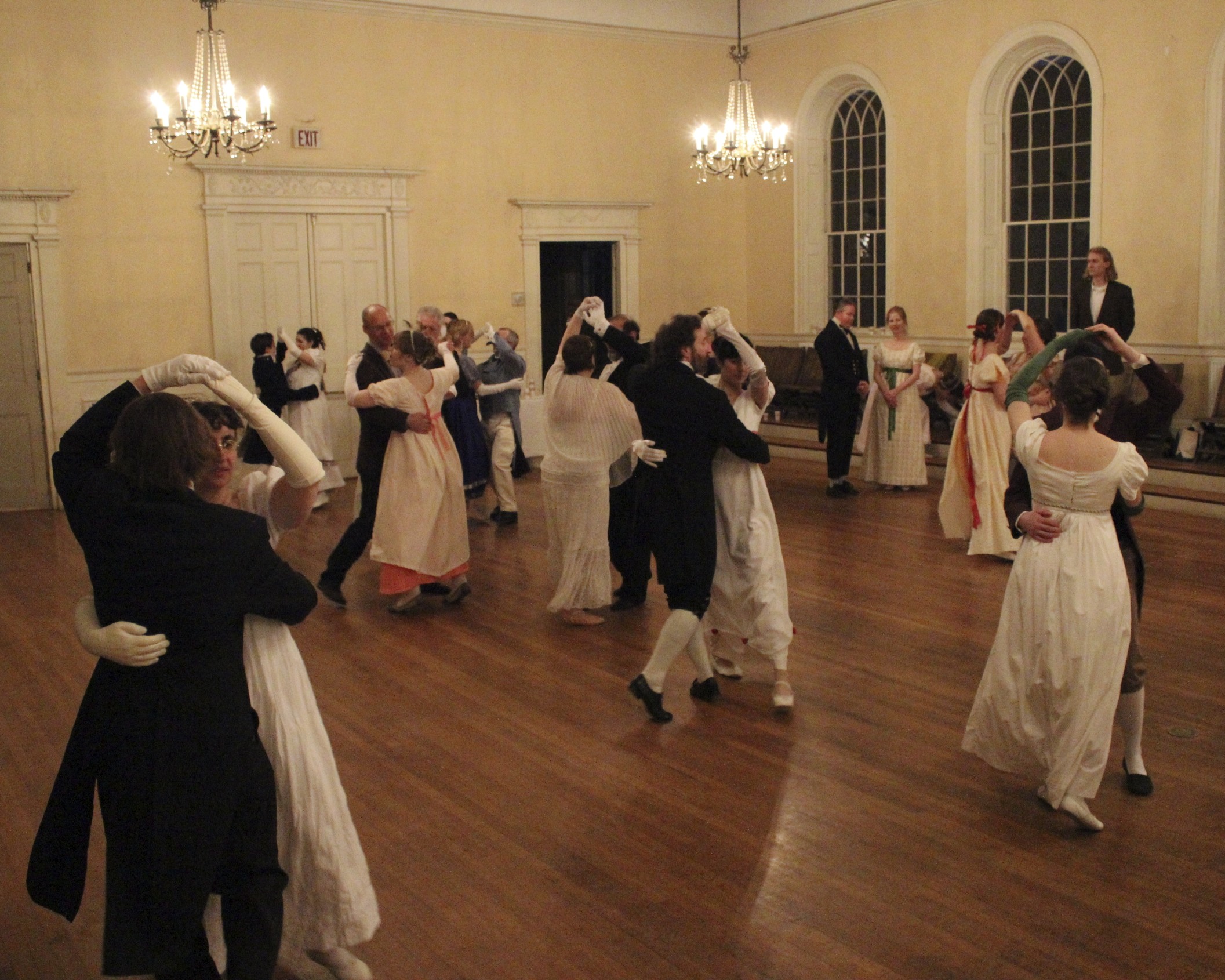
Waltzers during the dance.
IMG_0474
Dancing a Regency waltz. Look at us go on our toes!

That’s it for now. Next post will be about archery and outdoor lounging!
A Hair Wreath For Evie

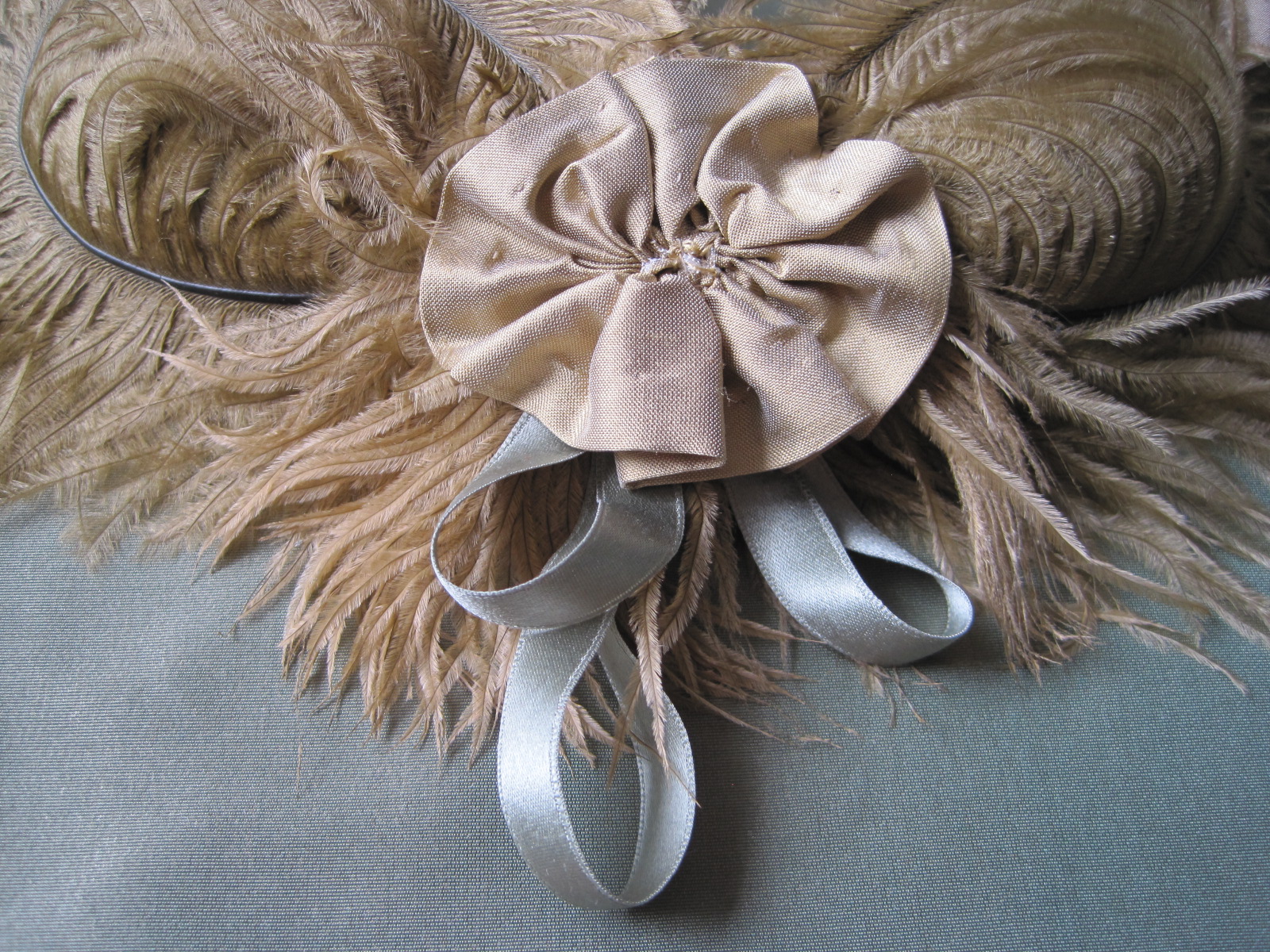
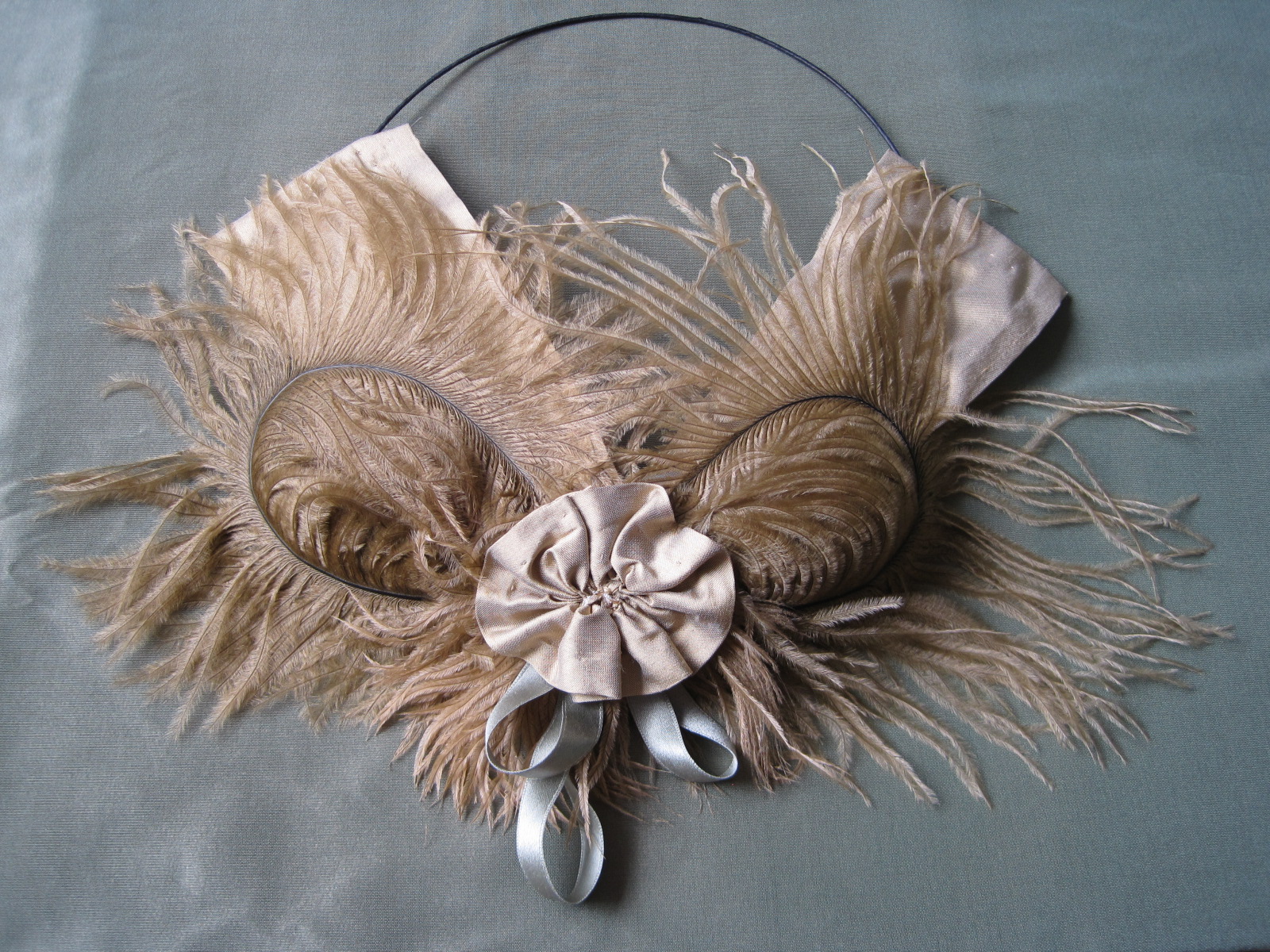
Remember Evie, my 1864 green ball gown? I felt compelled to make a matching hair wreath to wear with her, and here it is! A ring of paper covered millinery wire colored black (to blend with my hair) with a sharpie, decorated with a bit of gold silk, some green silk ribbon, and the mysteriously changeable gold/green ostrich feathers. Here those feather look gold, but I assure you that they sometimes appear as green as the silk background (which is the silk the dress is constructed of).

IMG_4381

IMG_4382

I think I would like to trim the ostrich feather on the right so it is the same shape as the one on the left, but aside from that one change, this is good as is! It’s super easy to bobby pin the wire to my hair and it’s easy to hide the bobby pins under all that silk and ostrich feather business going on at the bottom.

A Stripe-y Reticule And Sneak Peek At A Tree Gown (MpRSW #3 & #4)

IMG_4397
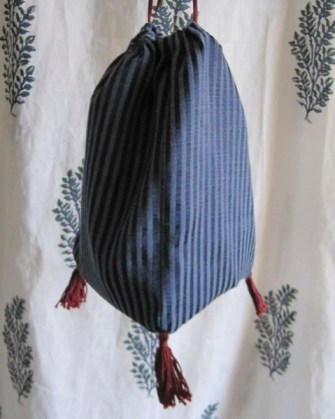
Stripes!

I intended to complete this reticule for the HSF Challenge #6: Stripes this past week, but as the deadline approached and I reread the fine print, I realized that the challenge was supposed to be fulfilled by a garment. Whoops! I don’t think I can convince myself that a reticule is garment, let alone other people. So I put the project on hold while working on other things (like Evie, my 1864 ball gown, and the completion of my purple ballroom competition dress), but finally got back to it and finished it off towards the end of last week.

Lucky for me, this reticule does fulfill the MpRSW Goal #4: Accessories (due April 8th: I’m early!). (If you’re paying attention, I did fail to post about the MpRSW Goal #2: Evening Gown… I might have fallen off the wagon on that one and not managed to fix the rip in my gown on time. But luckily, the MpRSW is motivating me to complete that repair this week, even if I am delayed!)

IMG_4376
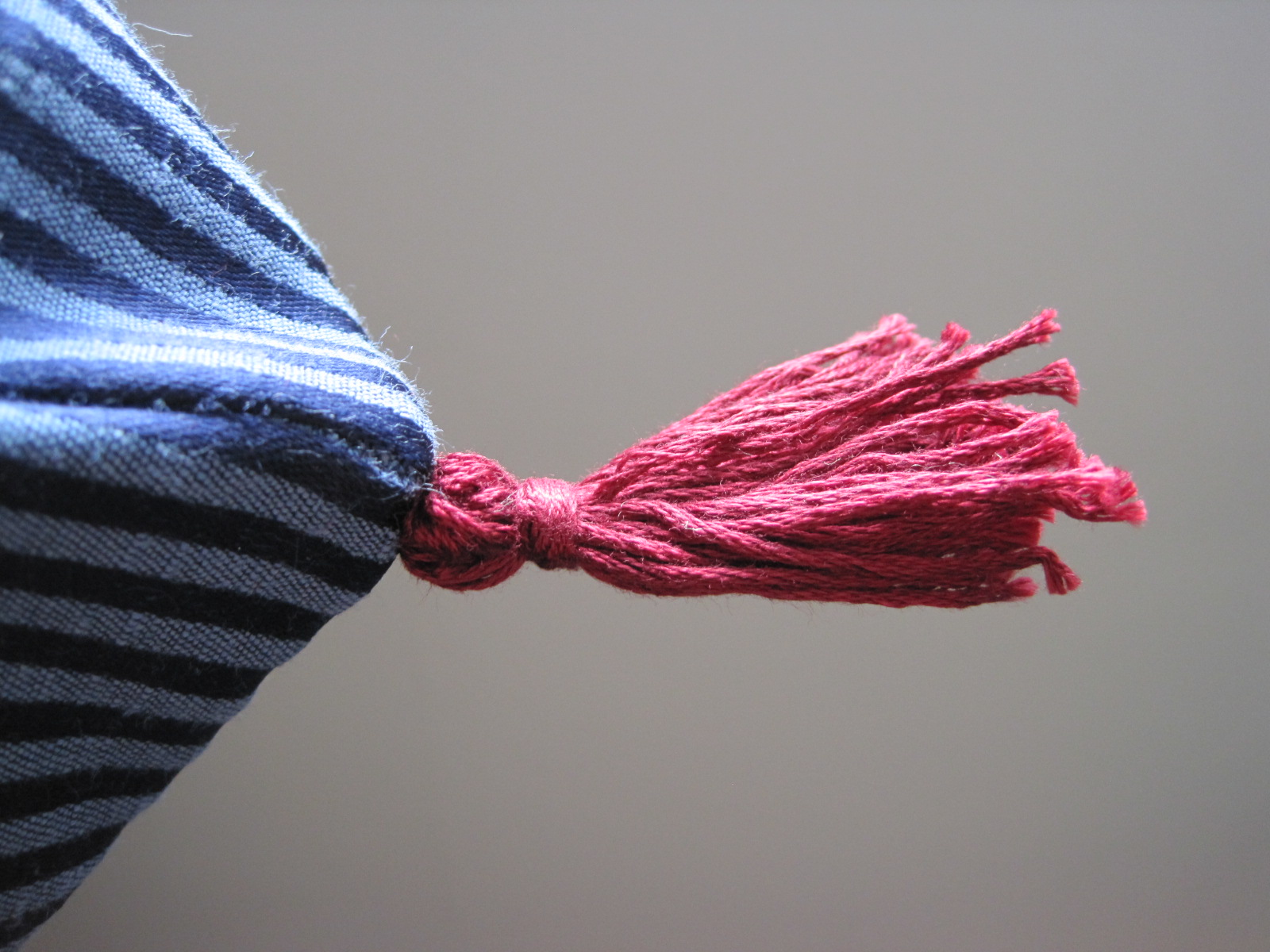
Tassels!

Trust me, this is not a historically accurate reticule. The fiber content is questionable… (probably a blend including polyester), the ribbon is polyester, and the tassels are cotton embroidery floss. But it’s cute and functional and has the general look of the period, so I’m happy. This will get packed for the Regency weekend coming up in April!

IMG_4377
Inside the reticule: french seams and a cotton canvas purple (woohoo, extra fun on the inside!) layer whip stitched to the inside of the bottom to provide stability and help keep the triangular shape. The seams are hard to spot because the stripes blend into each other so much, but they’re there!

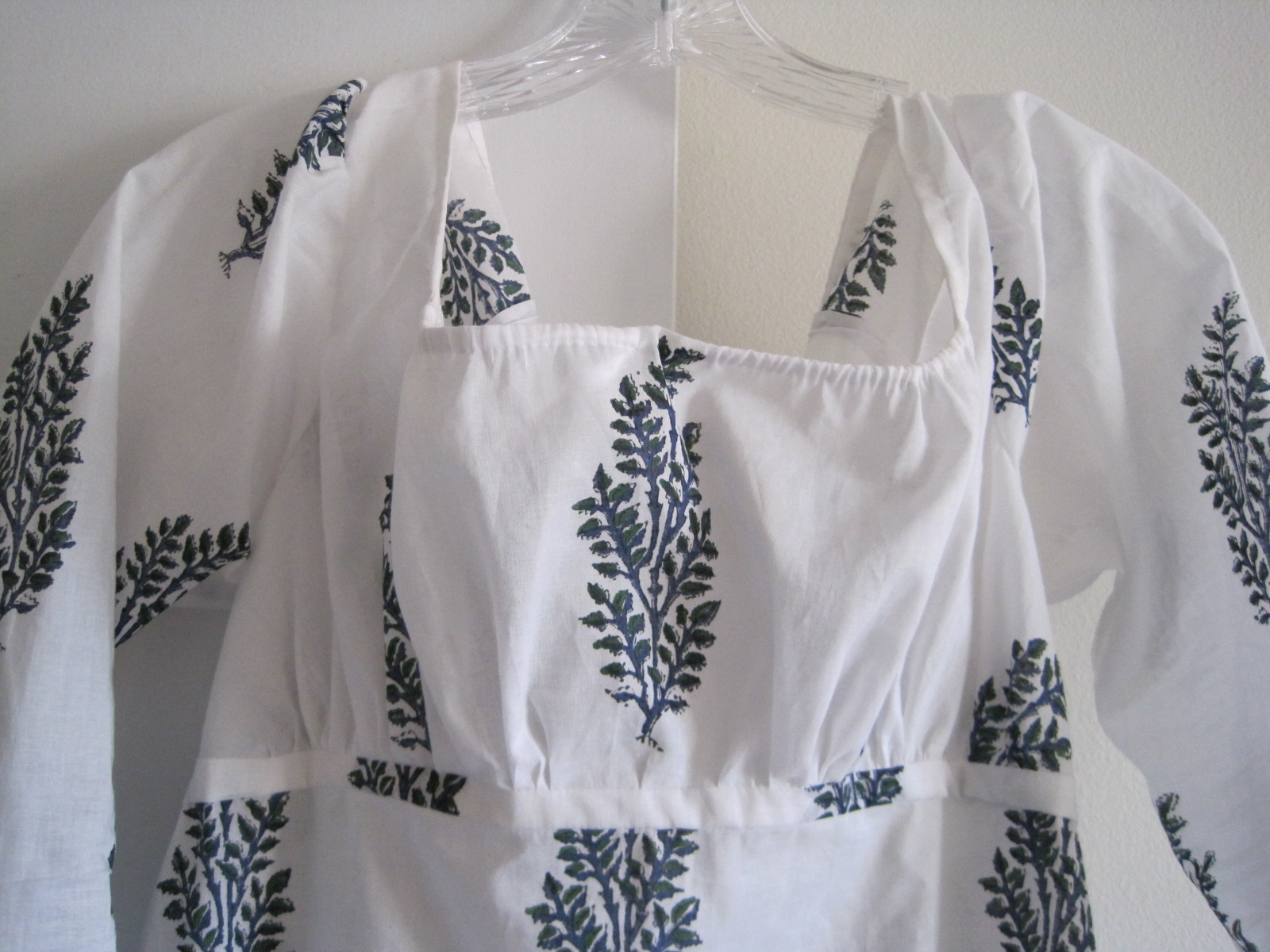
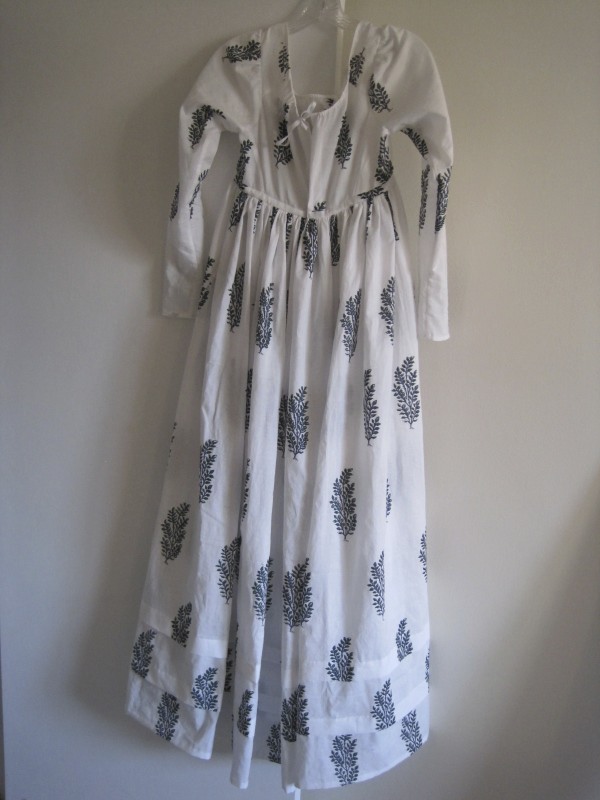
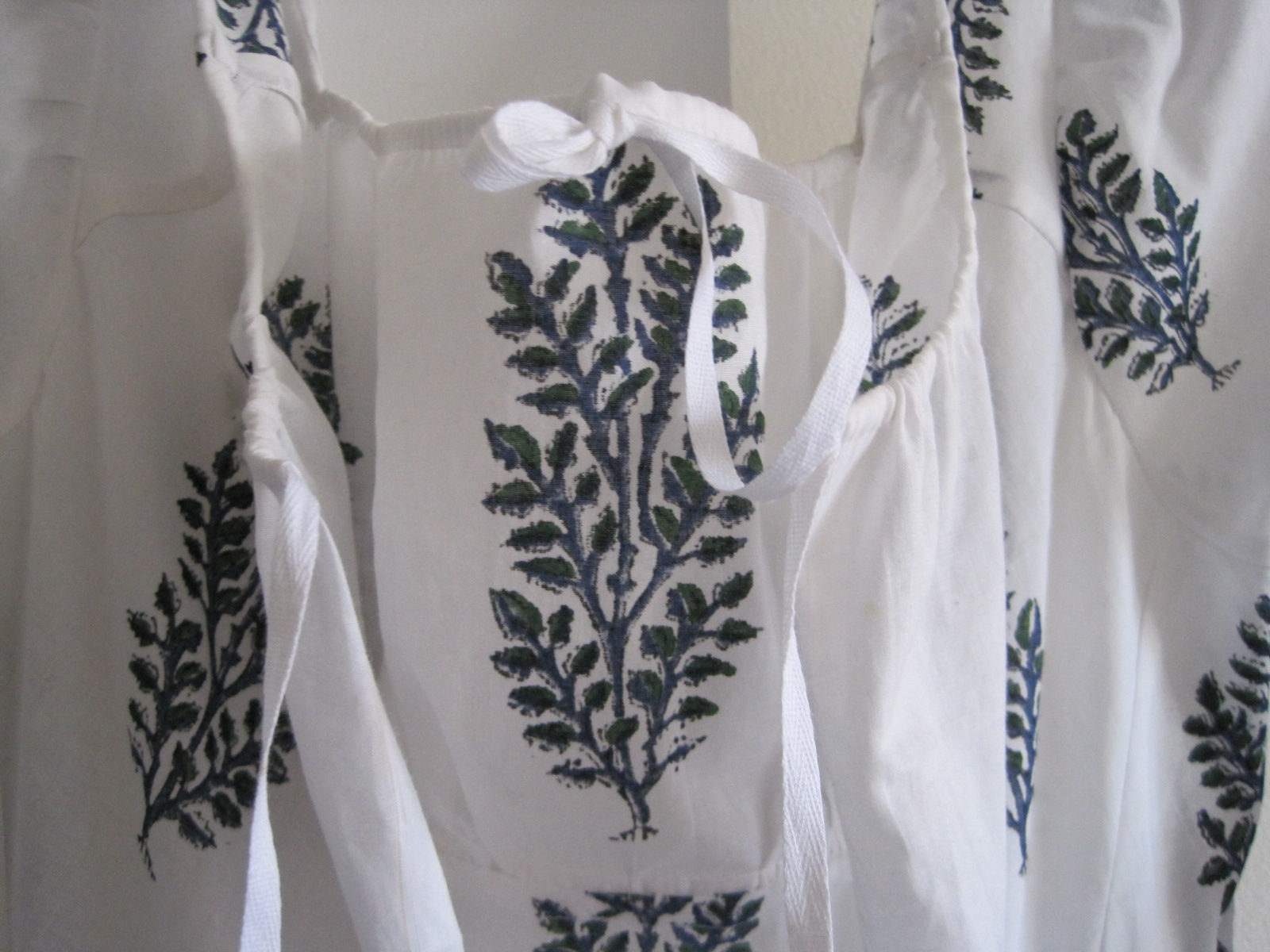
What you saw in the first picture (behind the reticule) was a first glimpse of my latest Regency gown! This new block printed cotton gown, from 1815, is “The Tree Gown” in my head because the motif reminds me of trees (or shrubs perhaps, but I like the sound of The Tree Gown better than The Shrub Gown). This gown fulfills the MpRSW Goal #3: Day Wear! It’s due today, so I’m right on time. The gown is machine sewn on all of the non visible seams, and hand finished on the visible sections.

IMG_4386
Center front. This gown has a mostly squared neckline with a drawstring across the bust, like my 1812 white striped gown.
IMG_4388
Unlike previous Regency gowns in my possession, this gown has long sleeves! (This is a back view.)
IMG_4385
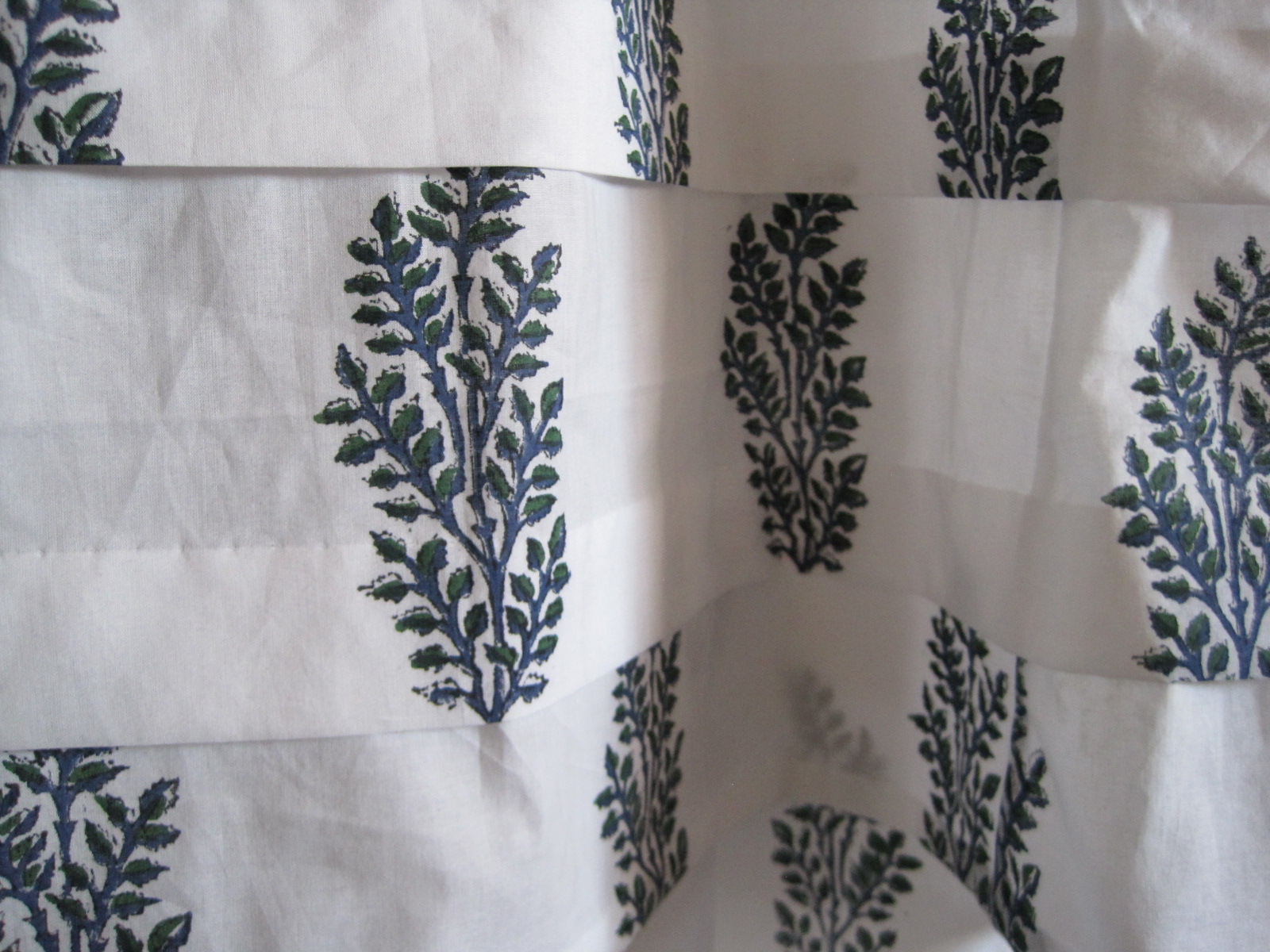
There are two 1 1/2″ tucks around the hem of this gown, for decoration.
IMG_4389
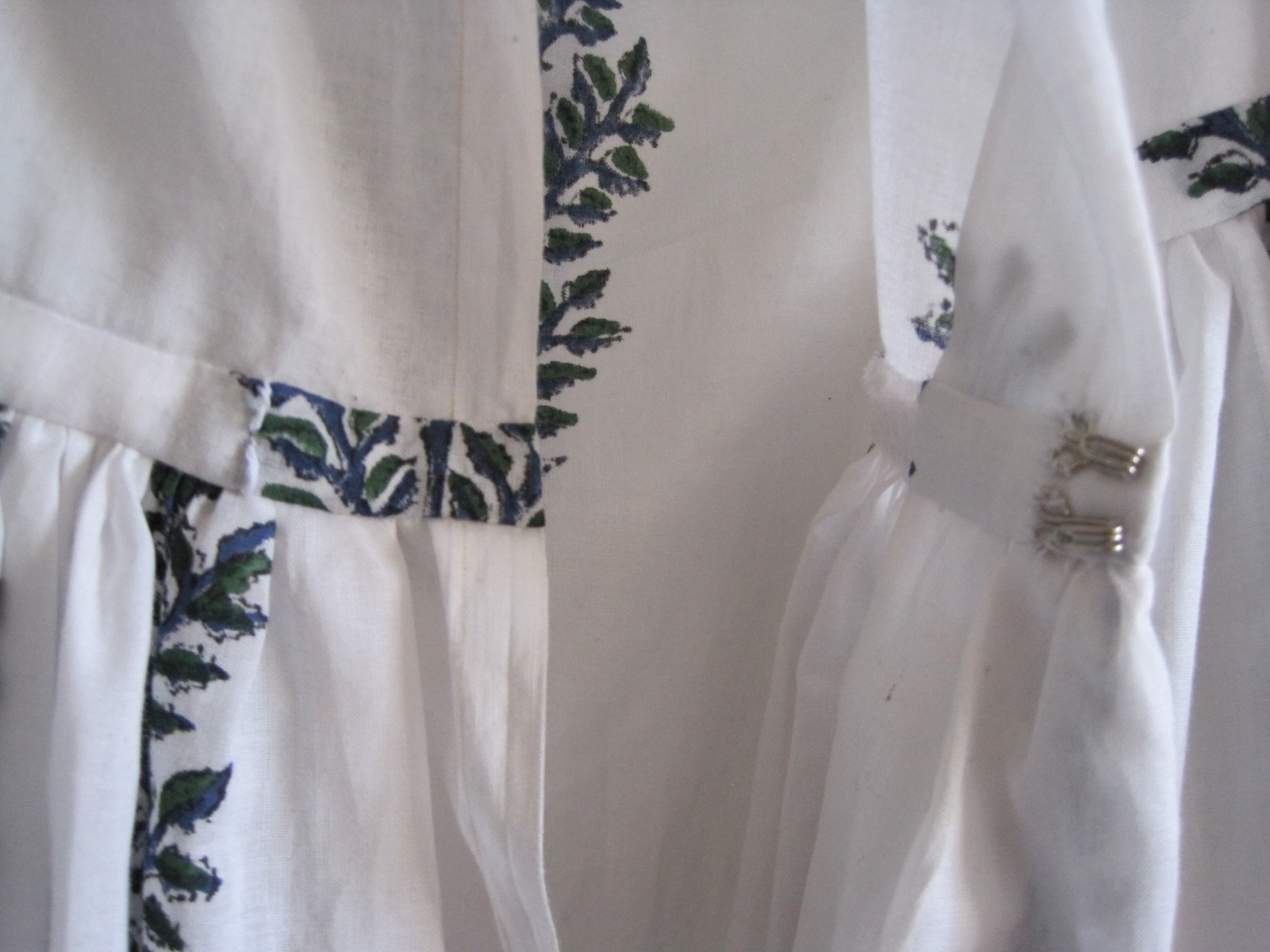
The gown closes at center back with two hooks on the waistband (see the thread loops?) and a tie at the top of the back.
IMG_4393
The tie at the top of center back is a drawstring that continues to the shoulder seam, allowing the back to gather slightly. The bow in the middle is the drawstring for center front.
IMG_4391
The fullness at center back is gathered. This gown has french seams and the waistband seam allowance is just whip stitched together to keep it tidy.
IMG_4392
The inside of the neck opening. The area over the shoulder is reinforced with an extra bit of fabric cut on the straight of grain to keep it from stretching.

This gown below is my main inspiration for this dress: the tucks at the hem, the sleeves, the pattern for the skirt, the gathers on the bodice, the mostly squared neck in front, the tie at the back of the neck… I omitted the extra sleeve puff (partly because I didn’t have enough fabric, partly because I wanted this dress to be more streamlined) and the tie at the back waistband. I love the super zoom on the Met’s website because you can see so many great details!

For example, I could see where the center front skirt panel ended and the angle of that seam (as well as the angle of the back panel). Using that information, I determined that my front panel should be a rectangle (it’s 21″ across in my dress given my proportions) and that the back panels should be cut straight at center back, but with an angle on the side seams that goes up toward center back making an elongated trapezoid. There is a seam at center back, so the hem of each back piece is 45″, but each top narrows to 31″. I’m curious to see how that style of skirt fits me. I certainly like the look of the skirt on the dress in the museum!

1bf6645634e092b2fa8f0b62ffcc9ecc
1810-1815 dress at the Metropolitan Museum of Art.

This gown also fills the HSF #9 Challenge: Flora and Fauna, so you’ll be seeing another post about it with some more details (and pictures of it on a body!) coming up in a few weeks (after the Regency Weekend in April, you know!).

HSF #3: Silk Pockets

I’ve been sewing up a storm this weekend! (And yes, pun intended, since I was stuck inside all weekend because of the blizzard ‘Nemo’… and as a side note, do you think they saw the irony in naming this storm Nemo? All I think of is a cute cartoon fish, which seems at odds with the 2 1/2 feet of snow that is still being cleaned up outside as I create this post.)

Anyway… events were cancelled, including the Regency Ball I created my 1813 dress (HSF #1) for, which is rather sad. Not being able to go anywhere means I’ve had lots of time to work on other things, though. Mostly, I’ve spent the time working on my replacement of the berry ballroom dancing dress. I was hoping to move along on my new 1864 ball gown as well, but that didn’t happen because I was so inspired to keep working on the ballroom dress (and I made lots of progress, so that’s good!). I did take some time out of my furious sewing to finish up my new silk pockets, just in time for the deadline of the Historical Sew Fortnightly’s Challenge #3: Under It All.

IMG_4203
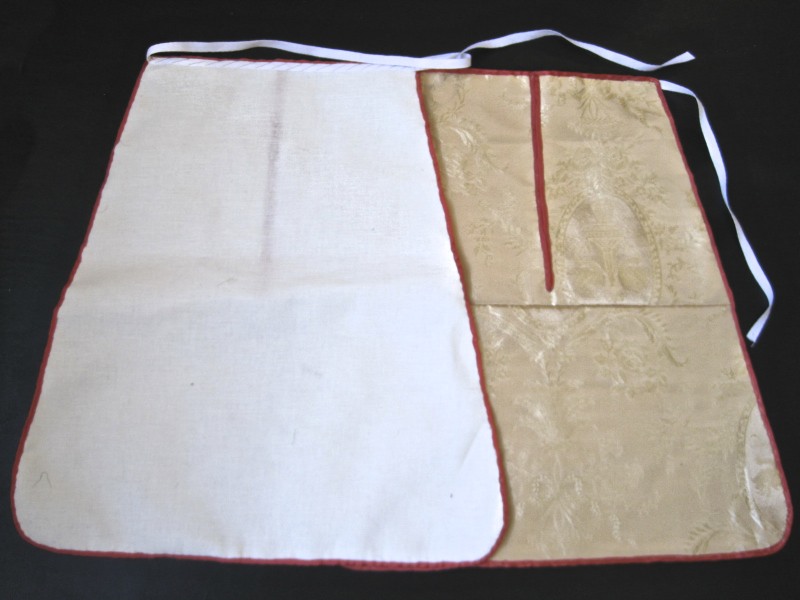
Yay! Pockets!

For the facts:

Fabric: Silk brocade scraps left over from my 1780s stays and linen scraps left over from my 1812 regency chemise.

Pattern: From Costume Close-Up.

Year: The year in Costume Close-Up is 1740-1770, but I think these can be used for years spanning almost the entirety of the 18th century.

Notions: About 2 yds of 1/4″ persimmon colored silk ribbon and about 1 yd of 1/4″ white cotton twill tape for ties.

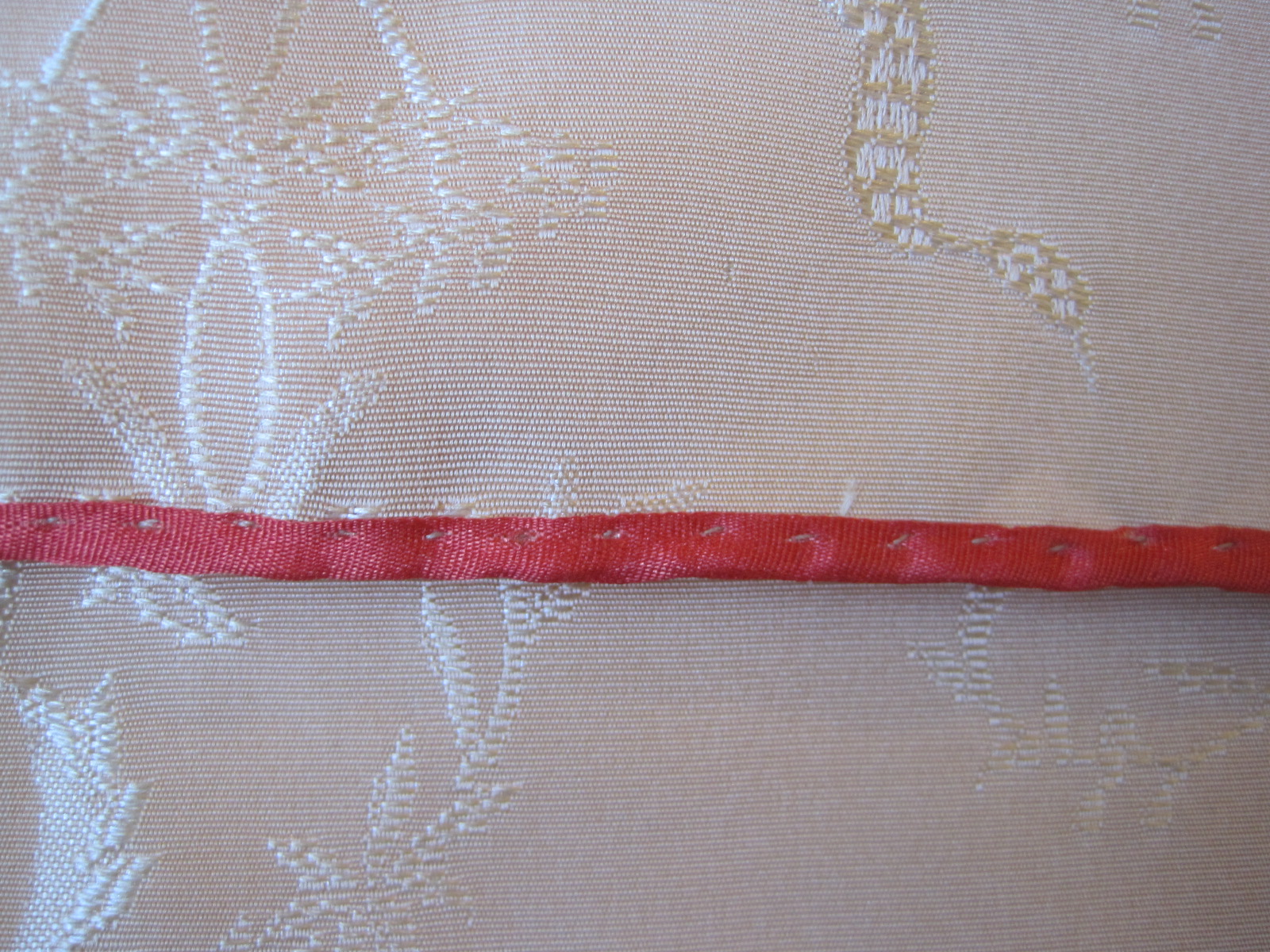
How historically accurate?: I give them a 95% rating. Accurate fabrics, accurate piecing, accurate pattern, no machine sewing… Thread choice is not accurate, and I’m not convinced that the stitches I used to attach my edging ribbon are accurate either. (And I probably should have tea dyed my waist tie so it wouldn’t be so bright white… but I am the only person who is likely to see it, and frankly, I just wanted to attach it and be done.)

Hours to complete: Entirely hand sewn, so about 13 hours.

First worn: They haven’t been worn yet, and probably won’t be worn for awhile… but at least now they’re done, and ready to go for next time I need them!

Total cost: $7? If I count the cost of all the bits and pieces. Since they use scraps from other projects it’s hard to tell.

IMG_4201
Back view. You can see the linen backing. The silk on the front has a second layer of linen under it.
IMG_4202
Close-up of the tiny stitches holding the ribbon down along the edges.

HSF #1: 1813 Evening Gown

IMG_4162
1813 Evening Gown

Historical Sew Fortnightly (HSF) Challenge #1 complete! It was actually completed a few days ago, which I am super pleased about. Even better is that it is for a Regency ball in February, and it is entirely complete a full month ahead of time! All the trim, all the closures, everything! All I have to do on the day of the ball is put it on. Wow! Usually when I wear a new dress to a ball I’m furiously sewing right up until the end and often all the trim doesn’t make it on (that’s what happened with my 1820s green dress back in December, remember?).

The facts:

Fabric: 4 yds red and black shot polyester

Pattern: The bodice front was draped, the back was adapted from my 1812 square neck Ikea gown, and the skirt is the same as the 1812 square neck Ikea gown, with the pattern originally from Janet Arnold’s Patterns of Fashion

Year: 1813

Notions: 3 yds metallic gold bobbin lace, hooks, and little brooch bits

How historically accurate?: The silhouette, cut, and style are accurate, as is the interior finishing (all flat felled and bound edges… it’s quite pretty!). The fabric is obviously not accurate and neither is the lace fiber content, though the style of it is. The closure is accurate. The little brooch bits are accurate in style, though not in materials.

Hours to complete: I’m so bad at estimating this. Let’s say 48 hours.

First worn: Hasn’t been worn yet! Its first wear will be in February 2013.

Total cost: Approximately $26

Now for other details!

Well, first, here’s a closeup of the bodice, so you can actually see the details and the little brooch bits. I’m super pleased with them, because I think they really finish off the bodice and add a little extra touch. I got them from New York and Company, actually. They were part of triple drop earrings, which I took apart. I kept the bottom drop and put them on clip backs (so now I have matching earrings for the dress!) which you can see in the picture below. And the best part is that one of the sections had a missing gem, so the cost of the earrings was refunded by NY&Co and so the total cost of the earrings is $0! Awesome! (It worked out perfectly, because I only used 5 sections of the triple drop earrings, so the damaged one wasn’t a problem.) Of course, the materials used in the earrings are not at all historically accurate, but I’m ok with that, for the cost (yay!) and the fact that they do have the right look.

IMG_4170
Little brooch bits!
IMG_4169
Single drop! Clips! Perfect!

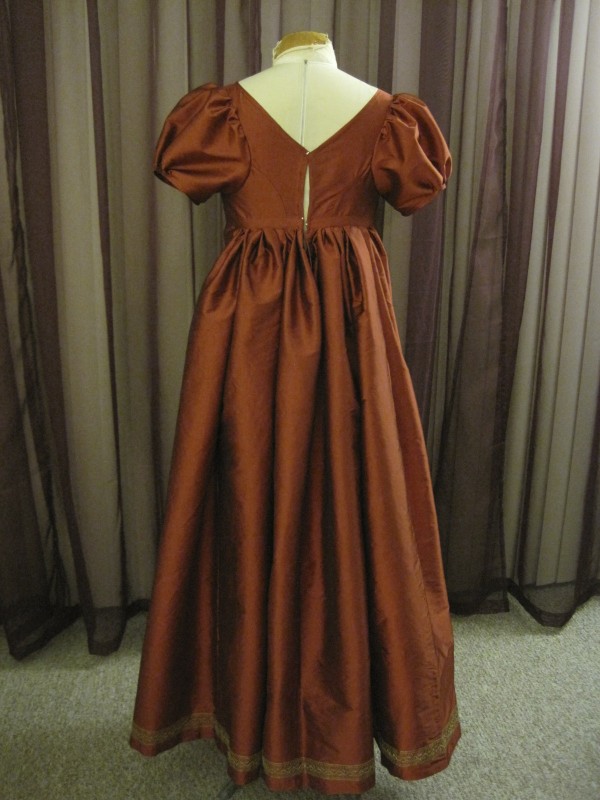
And here’s the back. As you can see, it doesn’t quite fit Squishy in the back, but it shouldn’t have trouble fitting me. I love the drape of the fabric! Now that all the raw edges are enclosed and the polyester can’t fray everywhere, I am totally happy with the fabric choice (bargain!). The photos don’t really do justice to the fabulous gold lace at the hem.

IMG_4164
Aren’t those gathers and folds lovely?!?

The dress is entirely hand finished and mostly hand sewn. Originally, I was going to make it all by machine, but then I had sewing parties and things that required hand sewing, and I just didn’t feel like lugging out the machine, so I wound up hand sewing a lot of it, which was quite satisfying. There’s one side back seam sewn my machine, I think the long skirt seams are sewn by machine (though I can’t remember, because I started this dress back in October or November), and the waistband was sewn by machine. Actually, it was so much easier to keep the width consistent using the machine than when sewing it by hand.

The only other information to share is my inspiration for the dress.

19562579602239981_TEw2UjIU_c
For her neckline and sleeves: Comtesse de Tournon by Ingres, 1812.
131378514099875826_v9iatcAj_c
Another neckline inspiration: L’Art de vivre au temps de Josephine.
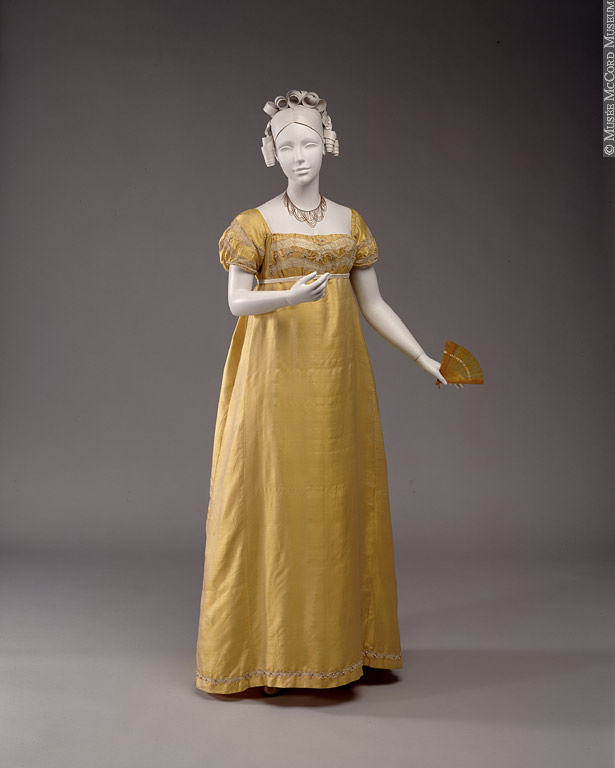
1810-gold-mccord
For the overall silhouette and the trim style: 1810.
12-501052
One more neckline inspiration and another similar dress built by Natalie Garbett. Here is her post about her 1812 gown with a v neck.

Clearly, I need a Kashmir shawl to complete the ensemble… I have a pashmina that sort of looks the part, so I’ll have to try that out at the ball. Stay tuned for more pictures of this dress in about a month!

Project Journal: 1822-1824 Ensemble Part VI: Muff and Tippet

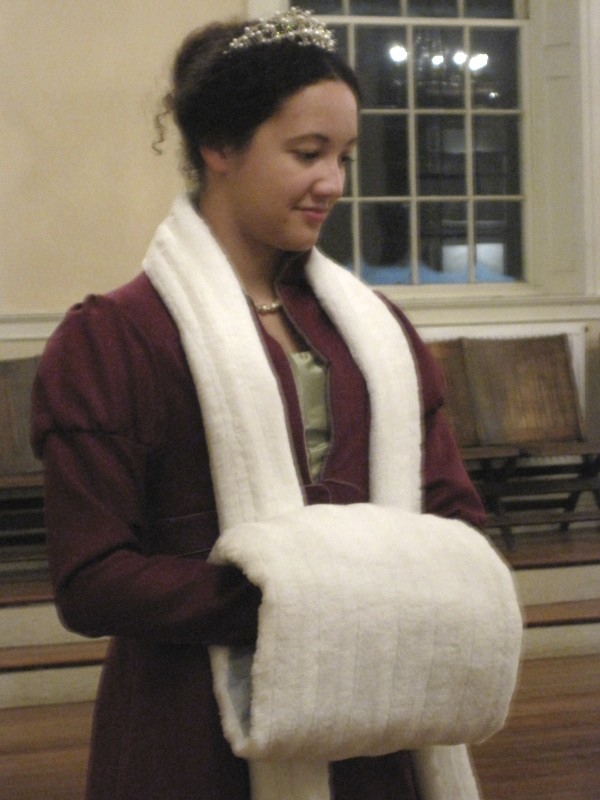
One thing I actually did finish for the recent ball was the muff and tippet. For visual reference, the picture below shows the garments I’m discussing.

IMG_4145
1822 walking dress with muff and tippet (and a bit of the 1824 ball gown peeking out).

What is tippet, exactly? Merriam-Webster defines it, thus:

1: a long hanging end of cloth attached to a sleeve, cap, or hood
2: a shoulder cape of fur or cloth often with hanging ends


So, how did I make my tippet? First, I cut a piece of high loft polyester batting the length and width that I wanted. (I know they didn’t have poly batting  in the 19th century… but it’s super warm and sometimes just worth it!) Then I cut a piece of my faux fur that was double the width of the batting plus an extra 3/4″ or so on each side as well as about 1″ longer on each end. I centered the batting on the wrong side of the fur, wrapped the fur around to the back, turned one edge under, and pinned. The ends of the fur I just turned up and under the other pinned bits. Then I whip stitched that folded edge down using pretty large stitches. The stitches disappeared in the fur… and voila, tippet! Too bad I didn’t take pictures of the construction!

The muff was slightly more tricky, not because of construction details, but because I agonized over what color lining to use! (To construct the muff, I made two tubes, one out of fur and one out of silk lining. I stitched one end of each tube to the other, turned the whole thing right sides out, inserted a tube of poly batting (warm!), pulled the lining through the middle, and pinned the open side of the fur to the silk, with the fur edge turned under. Then I simply whip stitched it like I did the tippet.

But before I could make the muff, I had to pick the lining color! Did I want it to match my walking dress trim (and be lavender?) Did I want to pick a color from a fashion plate? What colors were used in fashion plates? So many questions! I determined that of the muff linings I could see in fashion plates from that general period, there were three recurring colors: pink, blue, and white. Here’s what I came up with, image-wise:

PINK

19562579602803386_gVTjJrmC_c
January 1823 Walking Dress. La Belle Assemblee.
19562579602401776_TvaRkZoN_c
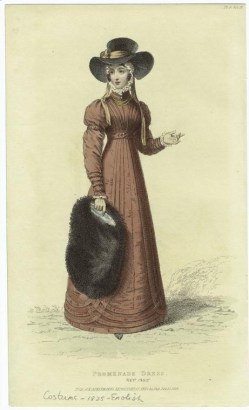
December 1822 Promenade Dress. Ackerman’s Repository.
19562579602401842_51zasE7P_c
January 1826 Promenade Dress. Ackerman’s Repository.

BLUE

19562579602401785_nUUKnK8g_c
March 1823 Walking Dress. Ackerman’s Repository.
186688347022992512_HVaD6lEY_c
December 1825 Carriage Dress. Lady’s Magazine.

WHITE

186688347022992610_ERzVeK6C_c
1825 Promenade Dress.
83035186849486953_XGi68fzU_c
1829 Walking Dress. Ackerman’s Repository.

UNKNOWN/OTHER

145663369167455361_eRX7bB2f_c
c. 1810 Redingote (and muff!). KCI. (Also a tippet, though they call it a “palantine”: which M-W defines as a fur cape or stole covering the neck and shoulders.)
19562579602930398_Bi3xvCKC_c
November 1814. La Belle Assemblee.
Volare Digital Capture
November 1817 Walking Dress. Ackerman’s Repository.
186688347023026494_QoWFeN5r_c
1823 Carriage Dress

So pink came in with 3, blue and white tied with 2 each, and then there were an assortment of unknown/other. But I didn’t like the idea of pink with my dark pinkish wool (you can see what that would look like in the December 1822 fashion plate: that’s the inspiration for my walking dress), so I settled for the light blue, which I think is delicate and softly Regency. Also, I had just a small amount of that color silk, and it’s a color that doesn’t really complement my skin, so I wasn’t likely to use it for a bonnet or something similar… but with a muff most of my skin is hidden! You can see the predominance of white fur for the muffs in these fashion plates (one of the reasons I chose white fur for the muff and tippet). There are brown, too, but a lot of white! 7 out of the 11 I included are white. Well, there you go. That’s my rationale for the muff and tippet.

All of these images are on my Pinterest pages with lots of other beautiful garments. Specifically, these are on the 1810s Inspiration1820-1824 Inspiration, and 1825-1829 Inspiration pages.

Project Journal: 1822-1824 Ensemble Part IV: Partial Completion For The Ball (Fezziwig’s Ball 2012)

Yikes, that is a long title… but I do like my titles to be descriptive sometimes…

As is suggested by the title of this post, though I did have new, wearable 1820s clothes (with closures, yay!) for Fezziwig’s Ball this past weekend, not all of the garments were entirely completed. I had set out with a rather rigorous plan for the month of December and I will admit that “my eyes were bigger than my stomach” and I wasn’t able to fully complete all of the projects I wanted to. That being said, however, I was very pleased with how things looked. (I will also admit that I spent the week before the ball furiously sewing every night… in fact, I was still sewing appliqués on the afternoon of the ball!)

IMG_4083
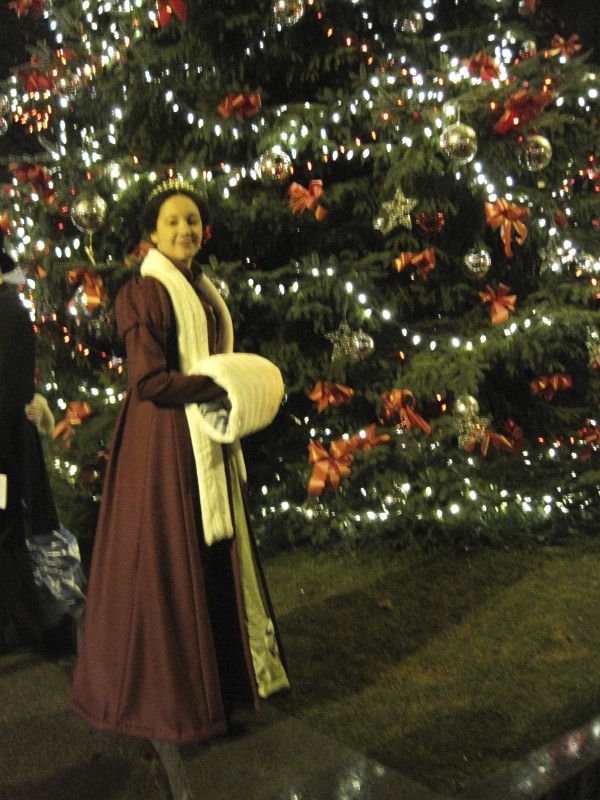
Caroling before the ball! We stopped at the super huge town Christmas tree to take pictures. I was perfectly warm in my new clothes!
IMG_7378
After caroling we paused outside the hall to take some more pictures… As you can see, the muff and tippet did get done! Entirely! Yay!
IMG_4101
Back of the new walking dress. I only just noticed that someone is in the window… That’s sort of creepy looking!
IMG_4104
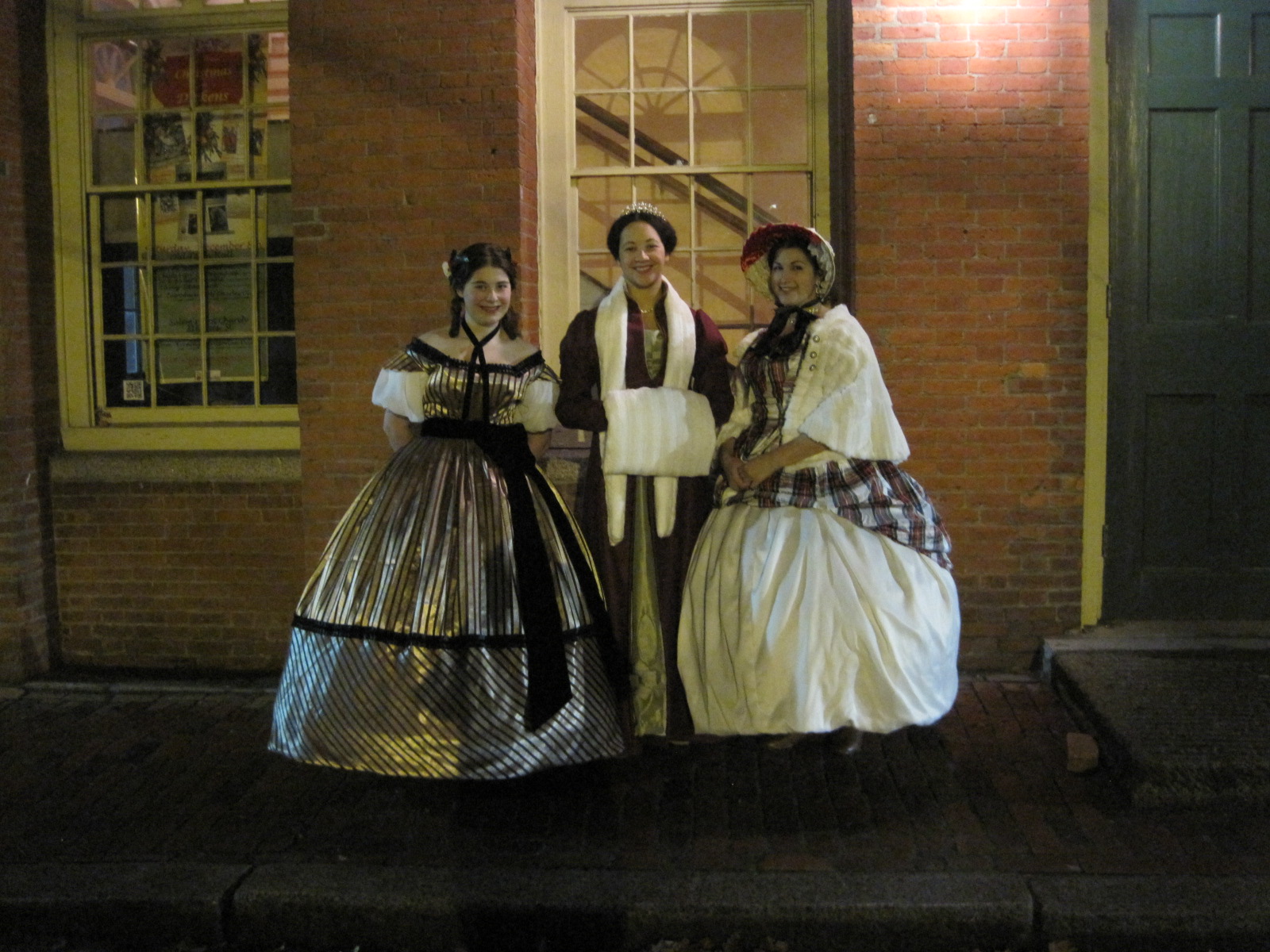
Friends outside the hall.
IMG_4106
Staging a “gossiping” photo before the ball officially began.
IMG_4110
Waiting for the dance, Sir Roger De Coverley, to begin.
IMG_4113
Dancing Sir Roger. It is similar to the Virginia Reel.

I had a wonderful time during the ball. It was crowded, but that didn’t stop me from enjoying myself. Perhaps because I knew more people than I have in any year past, the entire evening felt full of friendship and fun. Also, it’s super new and exciting to dance the same dances as other balls, but to the tune of Christmas music! And there were lots of beautiful dresses and fashionable gentlemen to keep one’s eyes occupied.

After the ball I imposed on my friends to take pictures (in better lighting) of my new clothes, so I could document them here on my blog. I, in turn, took pictures of them so they would have pictures as well! That’s only fair, really.

IMG_4123
I am the photographer in this one.
IMG_4131
Here it is! Clear, full length picture of my new gown! I finished the hem appliqués! Whew! But it is missing it’s sleeve appliqués and the center front appliqués.
IMG_4135
I was having trouble making my hair look the way I wanted to, so I settled for a tiara (it’s actually the same one I wore to the 1890s Soiree during Newport Vintage Dance Week). In the end, I really liked how it looked!
IMG_4076
A closeup of the finished appliqué motif around the hem.
IMG_4136
For this event I took the opportunity to wear my blue American Duchess clocked stockings. I liked them! The only annoying thing is that one got brown puddle stains on it during caroling. I’ll have to see if I can scrub it out. I think I can.
IMG_4145
Here we are, a picture of the walking dress with better lighting! You can actually see the dark raspberry color of the wool. It’s pretty scrumptious. It’s soft on it’s own, but also lined with soft cotton, so really it’s quite cozy.
IMG_4152
This is how we all felt after the ball.
IMG_4156
Proof that the sleeve appliqués were partially complete! I didn’t have the time to finish the raw edges, make the centers, or sew them on…

Pictures of the petticoat will be in an upcoming post. It was almost finished for the ball. I’m looking forward to adding trim to the walking dress and the front and sleeves of the ball gown, as well as finishing the bonnet. All of these things were started (the pieces cut out and even sewn in some cases), but as you can see in the pictures, they didn’t make it in time for the ball. Oh well!

SaveSave

Regency Christmas Party At The Commandant’s House

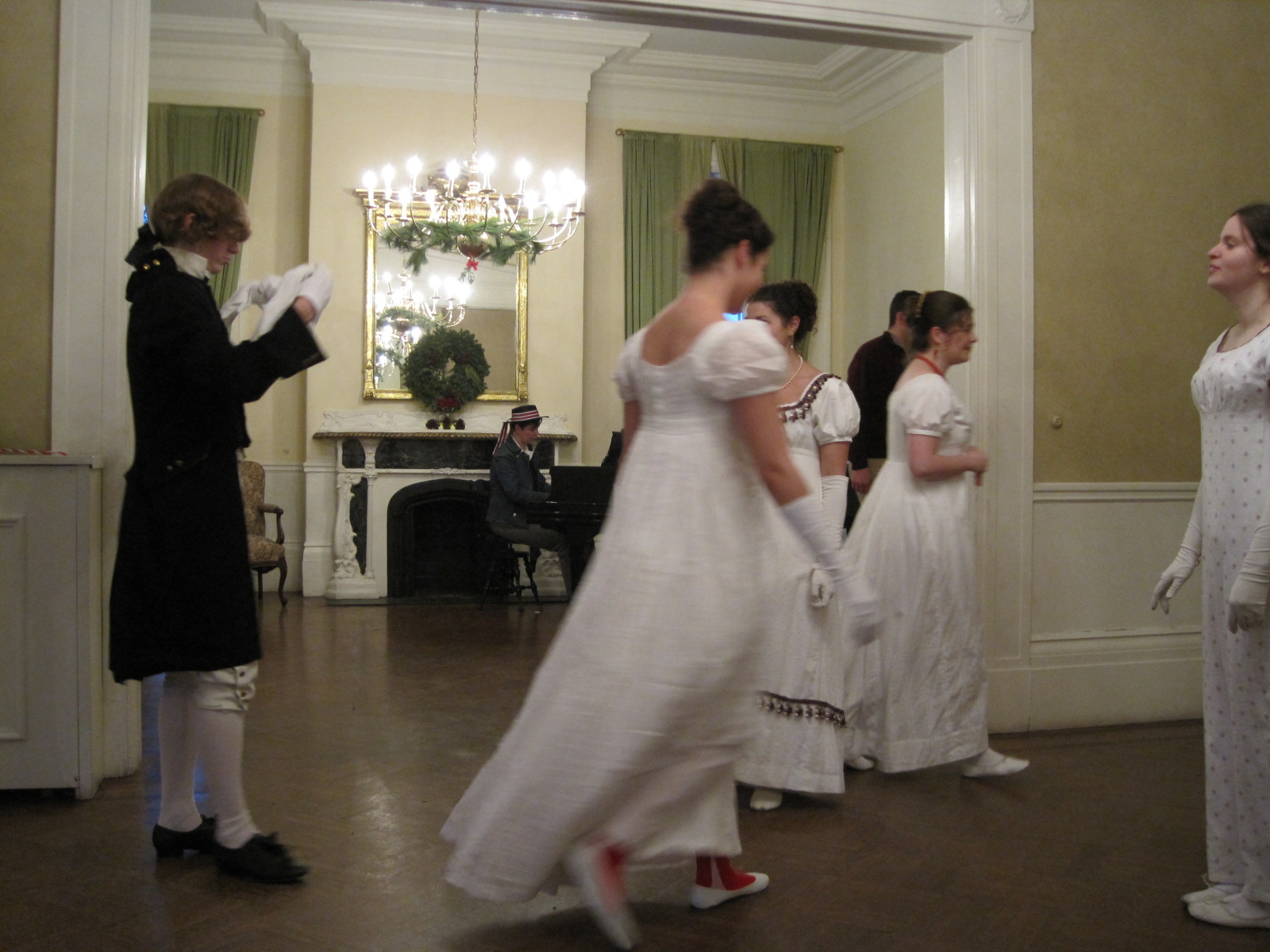
IMG_3974This past weekend, the Commonwealth Vintage Dancers participated in a Regency Christmas party for a public event at the Charlestown Navy Yard. It’s the same venue as the Guerriere Weekend we participated in a few months ago. I wore the same 1812 hand sewn gown I made for that event, which you can read more about in this post. We danced and played games while the public wandered through, watching and taking pictures, and eating the delicious cookies and punch we provided. We love that space, so of course we enjoyed being there again. I took the opportunity of the Christmas party to try out my red clocked stockings from American Duchess... they were perfectly fitting for the Christmas cheer!

IMG_3976
Posing with the lovely tea set that was set out to add ambiance to the scene.
IMG_3983
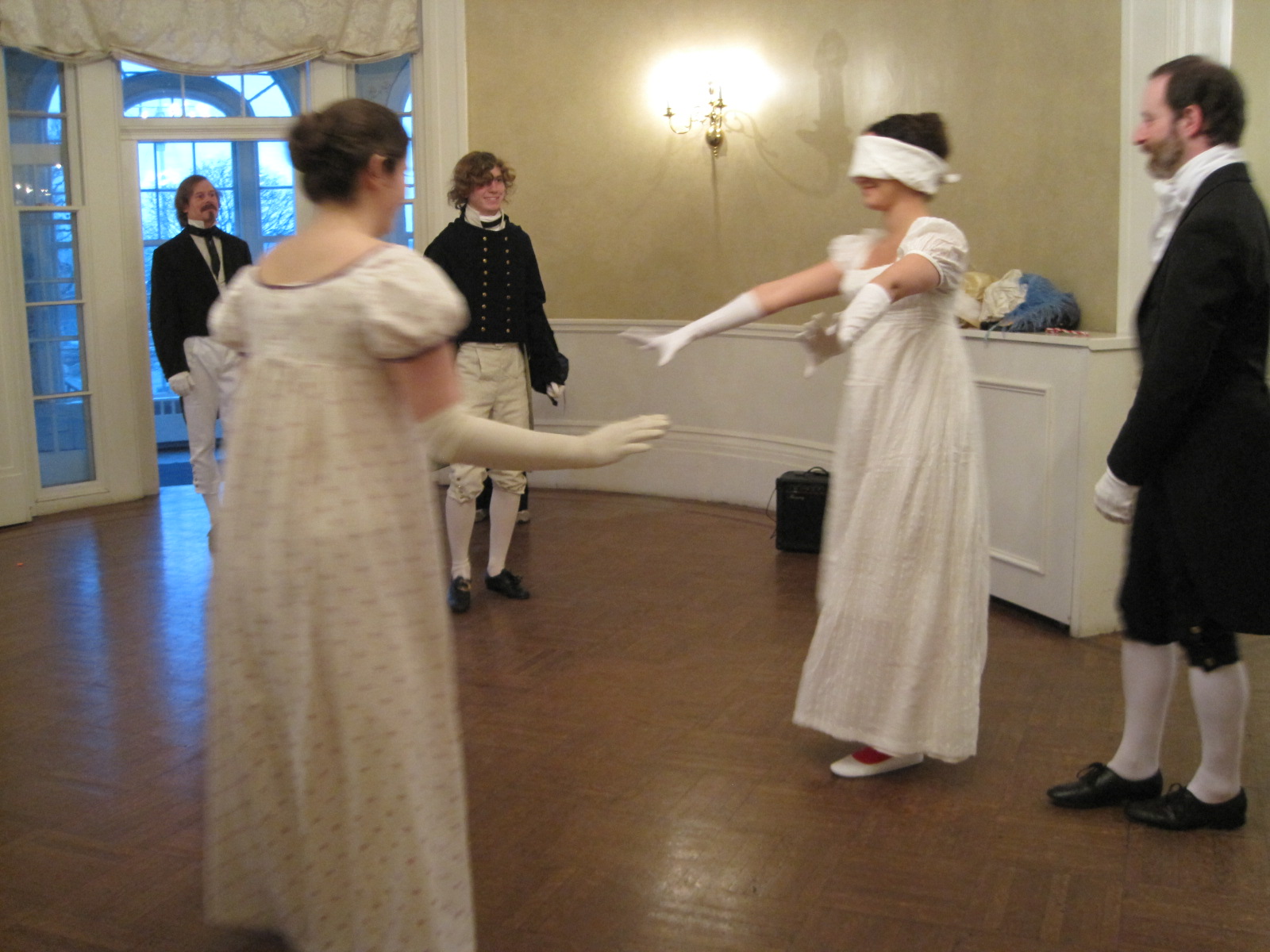
Playing Blind Man’s Bluff.
IMG_3987
I was having trouble finding a person…
IMG_3994
But I had cute stockings!
IMG_3996
So someone had to be made a sacrifice!
IMG_4000
Yay! I caught someone!
IMG_4004
Another glimpse of my red stockings as I passed off the blind fold.
IMG_4007
After the party we stuck around to get some extra pictures. I had to get a real pose with my stockings!
IMG_4013
Then we staged a few fake scenes to take pictures for possible CVD advertising opportunities.
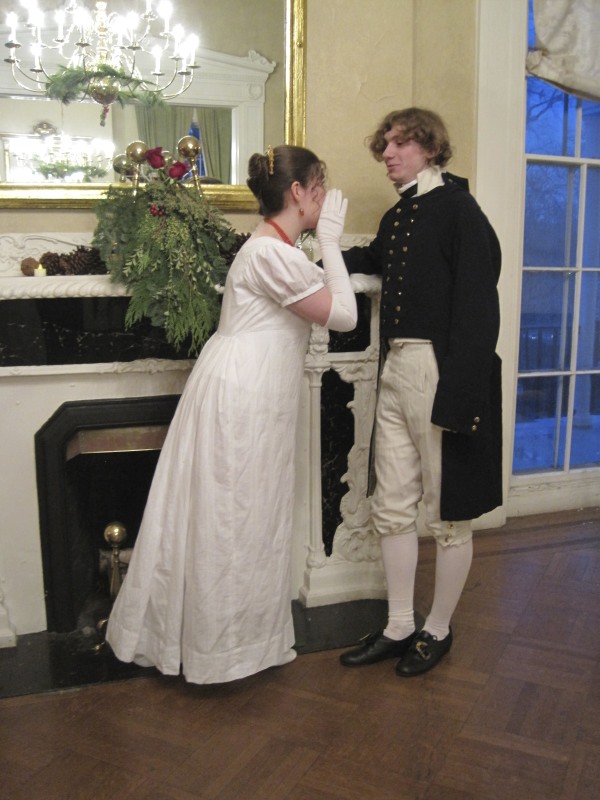
IMG_4015
It was one of those “look into each other’s eyes” scenes, which I somehow get put in rather often… Anyway, I like this picture because you can see my hair. I took a long time (and a lot of bobby pins) putting it up and really liked the result.
IMG_4034
Then I grouped some of the dancers to get some nice “as though you are dancing” shots. This is how we would begin and end a dance.
IMG_4042
Back to scenes. Aren’t these scenes by the fireplace super cute?
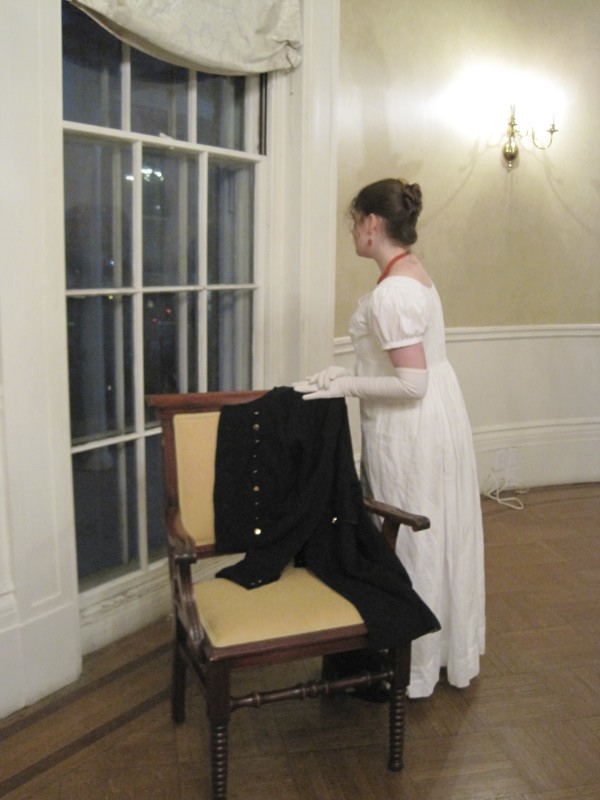
IMG_4058
Last one. Missing Mr. Darcy, perhaps?

As you can see, it was a fun Christmas gathering. We look forward to participating in more events at the Commandant’s House next year!

SaveSave

Project Journal: 1822-1824 Ensemble Part I: Overview

Well, as you recently read, I have a 9 month sewing plan to get me through May of 2013. It’s not set in stone (which means that mostly I keep adding to it, not taking things away…), but it gives me a great overview of what I need to accomplish and by what month. Deadlines really help in getting things completed!

The first major portion of the sewing plan is an ensemble of clothing from about the year 1823. I’ve been doing lots of looking at fashion plates and extant clothing from the early 1820s, in books and online. Here’s a link to my pinterest board: 1820-1824. I had so many pins in the 1820-1829 board that I had to separate the decade, so I also have a separate pin board of 1825-1829.

The 9 month plan includes the following pieces: petticoat, ball gown, walking dress, muff, bonnet, and chemisette. I’ve added one more thing since the plan was created: a tippet to match the muff! Before I explain why I want these items (ie, where I plan to wear them!), let’s look at my inspiration for the items themselves!

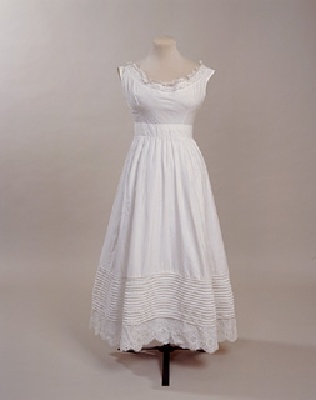
Petticoat. Manchester City Galleries. (I’m making a petticoat out of white cotton. It is entirely hand sewn.)
Actually a Dinner Dress (but I’ll use it as a ball gown). Ackerman’s Repository. May 1824. (I guess I lied about the year… I’ve been looking at the images so much I haven’t even glanced at the date in ages! Anyway… I’m making this in apple green silk with hand sewn silk organza appliqués.)
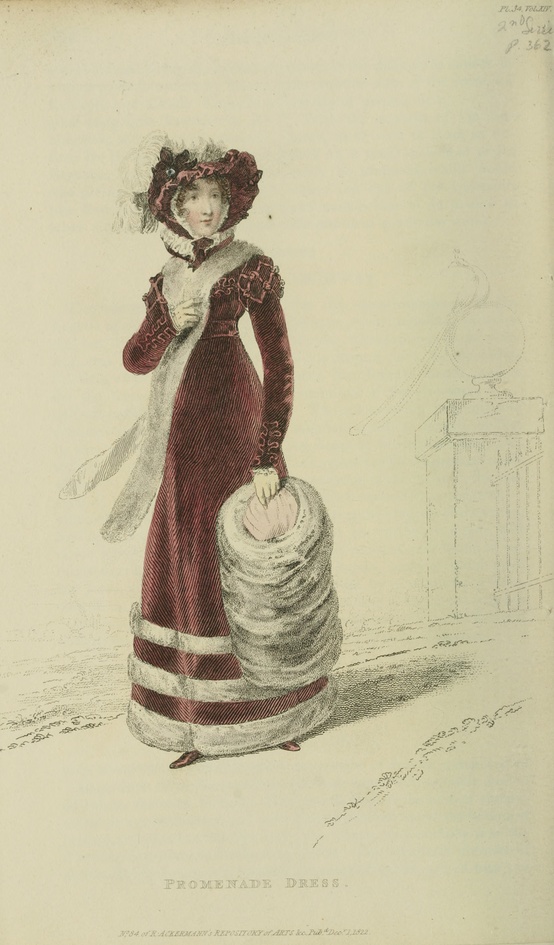
Promenade Dress. Ackerman’s Repository. December 1822. (I am making this out of deep, rich pinkish burgundy wool with hand sewn lavender silk trim.) This is also my inspiration for the tippet. (I’m making the tippet out of white faux fur.)
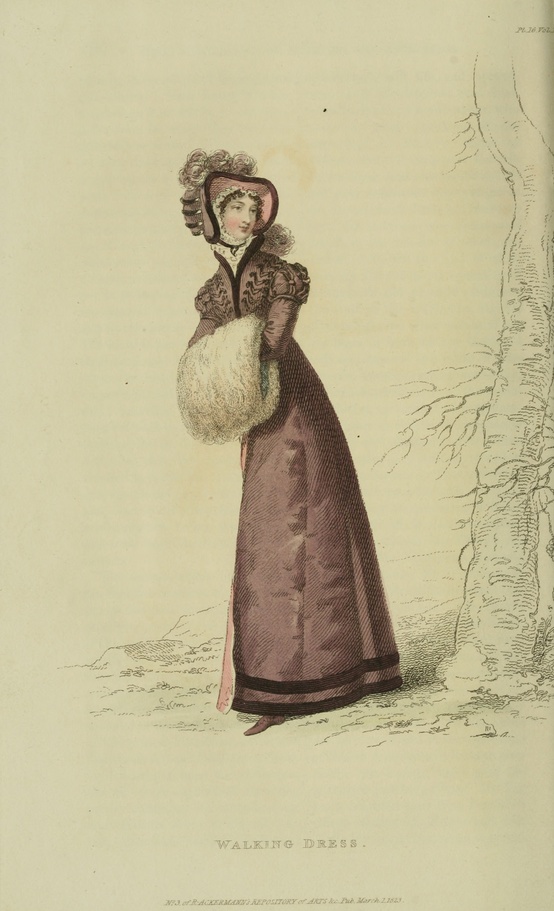
Walking Dress. Ackerman’s Repository. March 1823. (I think this is where I got the year 1823 from… This is another influence on my walking dress design, especially at the collar.) This is also my inspiration for my muff. (The muff will be the same fur as the tippet, lined with pale blue silk shantung.)
Bonnet. C. 1820. The Met. (I plan to make this in lavender to match the walking dress.)
Chemisette. c. 1810-1825. Snowshill Collection. (Yes, this is one of the ones in Janet Arnold. I plan to make this out of lightweight cotton and use my fluting iron! However, I have to say that if one thing in my December-to-do doesn’t make the cut, this would be it. I really want to take my time on this and play with my fluting iron, and I’m not sure I’ll have the time on this one…)

What is all of this for, you ask? I plan to wear the whole ensemble in December when I attend Fezziwig’s Ball, a 19th century ball hosted by the Commonwealth Vintage Dancers in Salem, MA. Since it’s a ball, I’m sure you understand why the petticoat and ball gown are required! But why the outerwear? Before the ball begins, ball-goers have the opportunity to go caroling around the streets! It’s really fun, and usually pretty cold. I need to stay warm, hence the wool walking dress, tippet, and muff. The chemisette is to fill in the collar of the walking dress, and the bonnet is really icing on the cake to help pull the whole ensemble together! As an added bonus, later this winter my friends and I hope to go ice skating in 19th century dress, so this will also be my ice skating outfit!

Adjusting My Sort-of-New Clocked Stockings

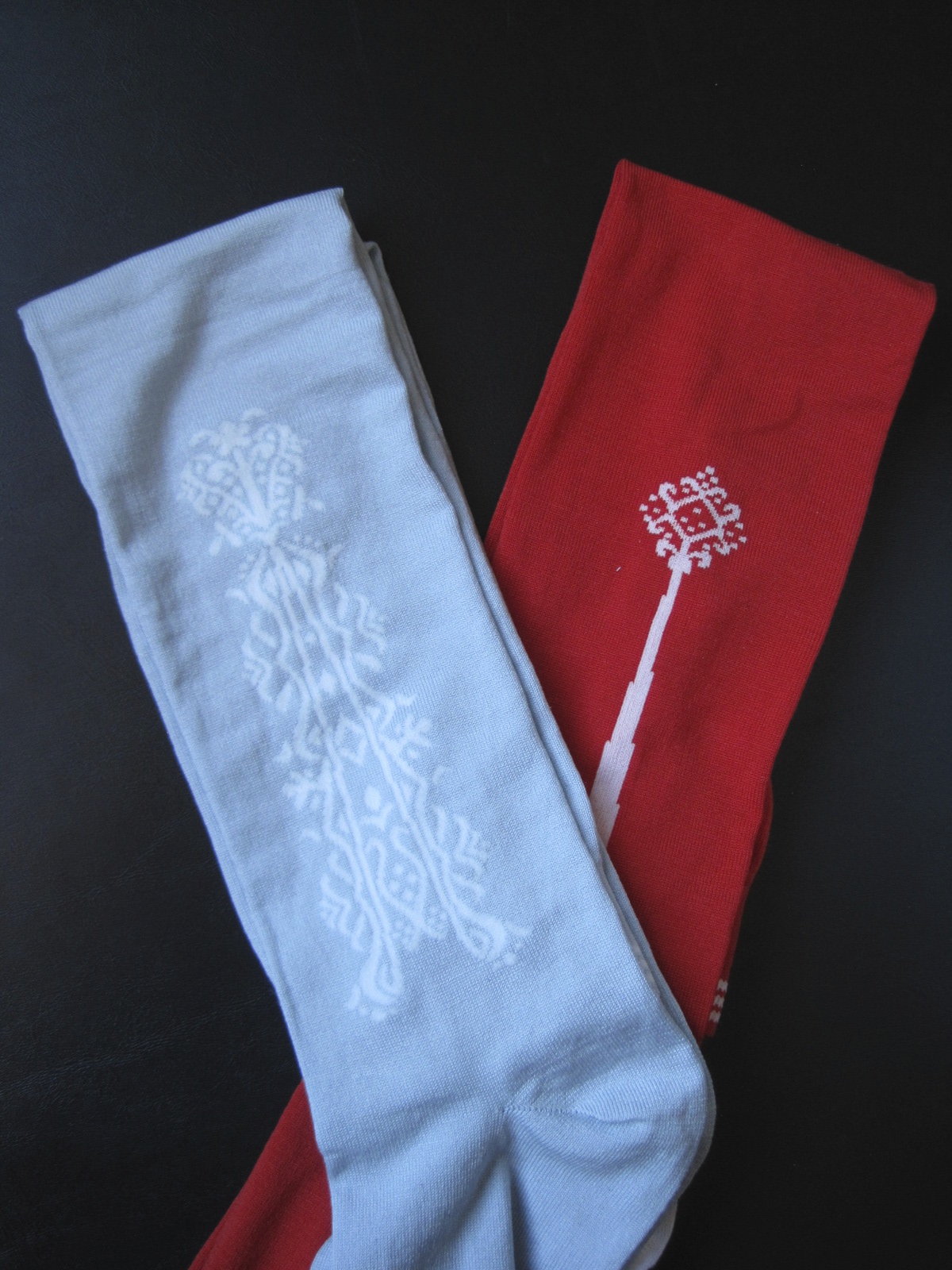
For my birthday a month or so ago I treated myself to a fun little accessory shopping spree at American Duchess and purchased two pairs of the new-ish clocked silk stockings Lauren has added to her offerings. Fun!

Blue and red stockings from American Duchess.

They arrived while the weather was still warm… so they just sat around waiting for my attention. Finally, I spent some time with them, trying them on, etc. I’m super excited to wear them! I think the red will be really fun and silly and good for picture taking at holiday events, and the blue is nice and light and appropriate for all year round without being white. I have nothing against white stockings, but I like the idea of colored and clocked ones! The elastic around the tops of the stockings is pretty tight, so they might get worn turned down under my knee. The only other thing about them is that the foot (from heel to toe) was bigger than my foot. Not for long, though! Inspired by a post from Lauren about adjusting the stockings to fit your foot, I went at it with the sewing machine. First, I changed my needle to a ball point to help sew through the knit.

First attempt at the red pair. I made the mistake of cutting the toe off before trying to sew it. It was frustrating to sew, so I suggest you don’t try it that way. You can also see the second line of zig zag stitching because I went back to shape the toe to my foot (my toes are not squared off like the first line of stitching).
First attempt next to the second attempt. The second one was so much easier, since I hadn’t cut the toe off yet!
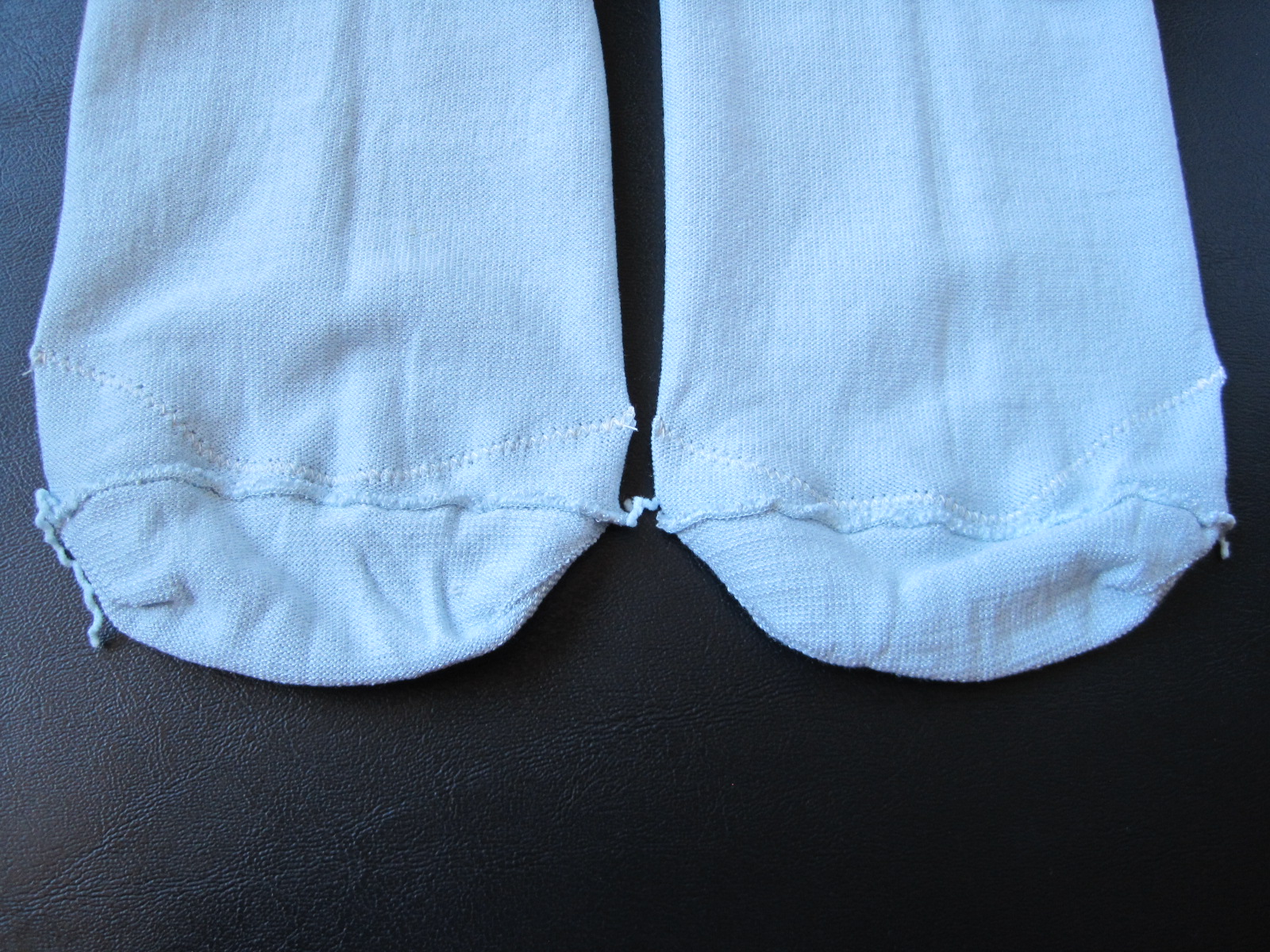
Here’s the blue pair. They went so much faster than the red pair! You can see that I wasn’t exact with the line I sewed. I figured that as long as the general shape is right it will be fine on my toes.
The blue pair after cutting off the unnecessary toe length.
Success! And I actually think it’s more comfortable to have the toe seam on the tips of your toes rather than the tops.
Product links in this post contain an affiliate code, which provides a small benefit to my shoe fund. This does not affect my impressions and reviews of this product.