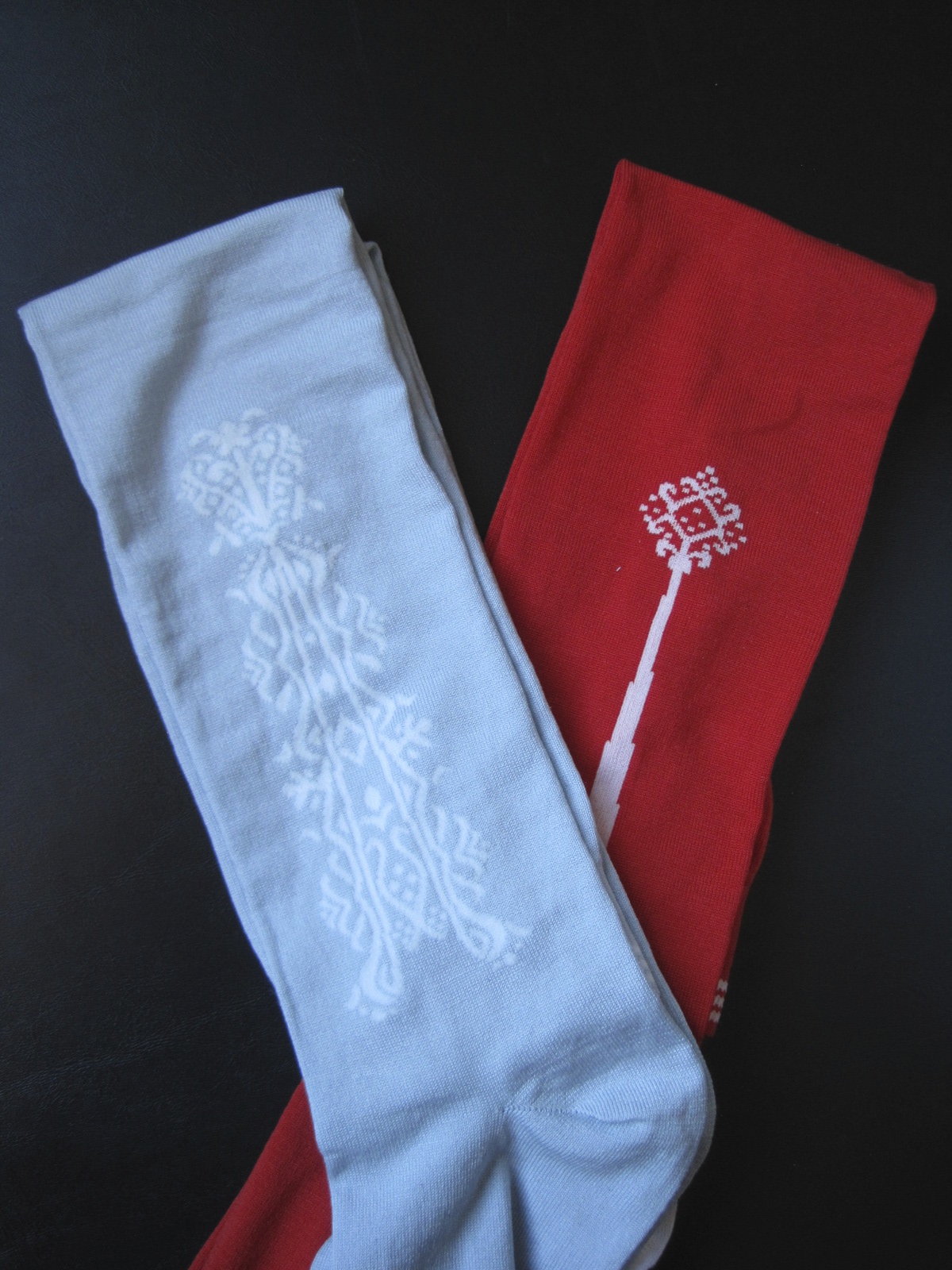
For my birthday a month or so ago I treated myself to a fun little accessory shopping spree at American Duchess and purchased two pairs of the new-ish clocked silk stockings Lauren has added to her offerings. Fun!
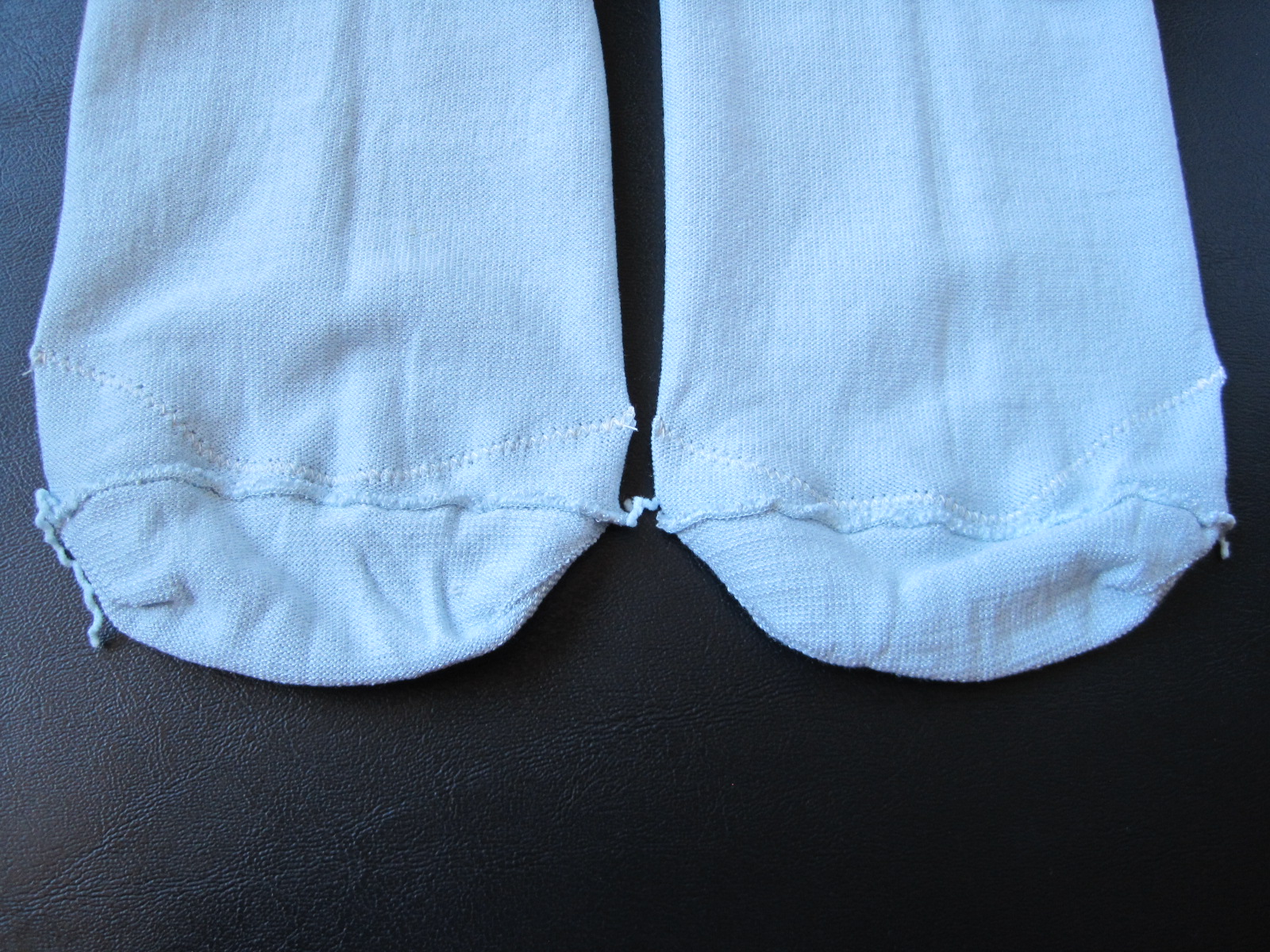
They arrived while the weather was still warm… so they just sat around waiting for my attention. Finally, I spent some time with them, trying them on, etc. I’m super excited to wear them! I think the red will be really fun and silly and good for picture taking at holiday events, and the blue is nice and light and appropriate for all year round without being white. I have nothing against white stockings, but I like the idea of colored and clocked ones! The elastic around the tops of the stockings is pretty tight, so they might get worn turned down under my knee. The only other thing about them is that the foot (from heel to toe) was bigger than my foot. Not for long, though! Inspired by a post from Lauren about adjusting the stockings to fit your foot, I went at it with the sewing machine. First, I changed my needle to a ball point to help sew through the knit.
First attempt at the red pair. I made the mistake of cutting the toe off before trying to sew it. It was frustrating to sew, so I suggest you don’t try it that way. You can also see the second line of zig zag stitching because I went back to shape the toe to my foot (my toes are not squared off like the first line of stitching).First attempt next to the second attempt. The second one was so much easier, since I hadn’t cut the toe off yet!Here’s the blue pair. They went so much faster than the red pair! You can see that I wasn’t exact with the line I sewed. I figured that as long as the general shape is right it will be fine on my toes.The blue pair after cutting off the unnecessary toe length.Success! And I actually think it’s more comfortable to have the toe seam on the tips of your toes rather than the tops.
Product links in this post contain an affiliate code, which provides a small benefit to my shoe fund. This does not affect my impressions and reviews of this product.
I’ve been meaning to post about my new 1893 ball gown since Newport Vintage Dance Week back in August… Well, I’m slow about getting it done, but but this is going to be a post with mounds of great detail, so I think the wait was worth it!
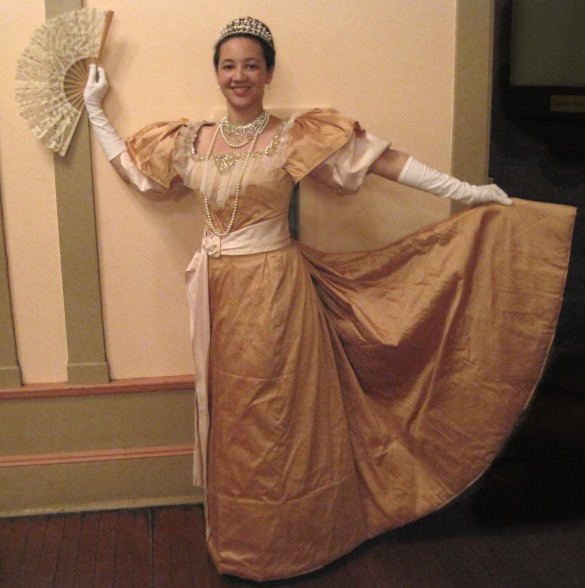
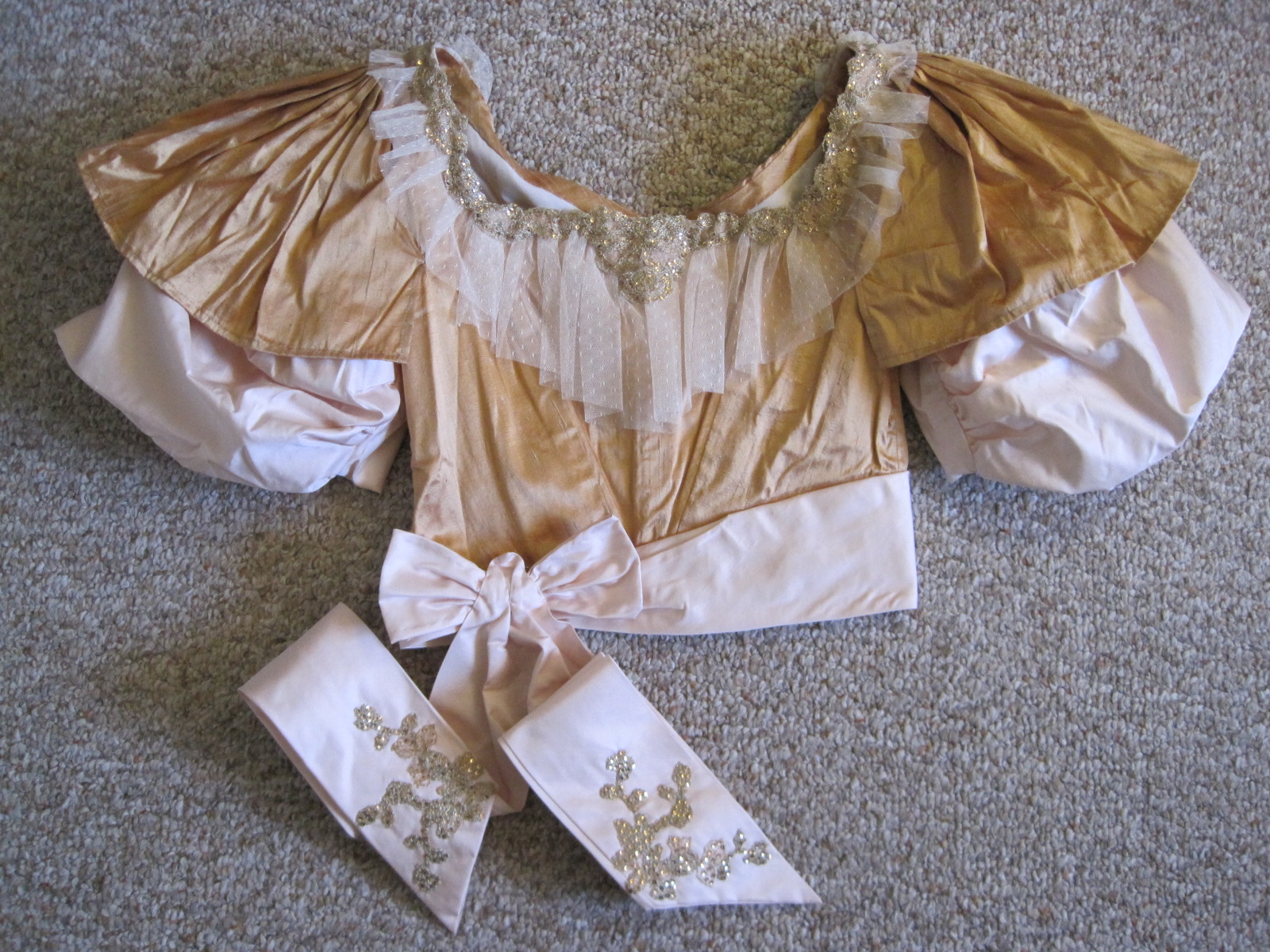
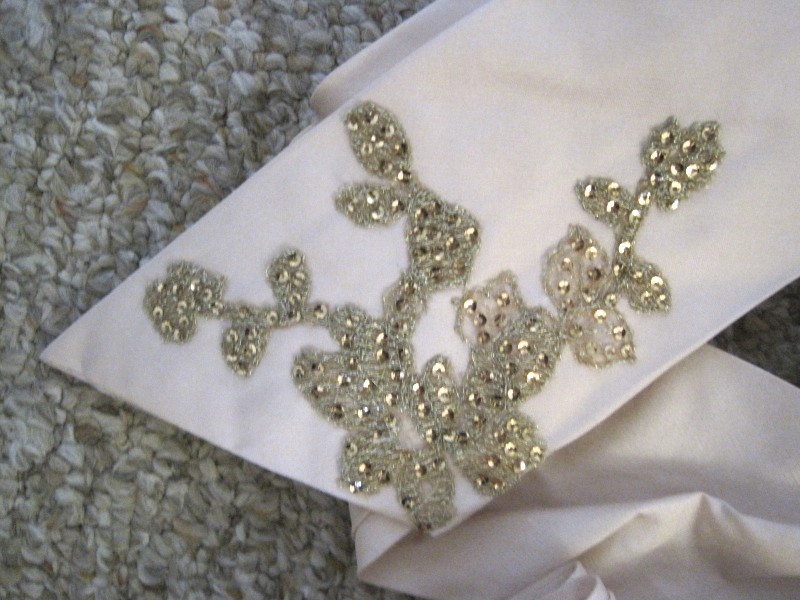
This gown is constructed of bronze shot silk shantung with pale pink slightly slubby silk satin. It is flat lined throughout with ivory waxed cotton. It is stabilized with cotton canvas at the hem and in the waistband. The bodice is trimmed with ivory net and bits of metallic bronze/gold net that have sequin motifs on it (in fact, it’s the same metallic net as the top sleeve section of my 1912 burgundy silk evening gown, which I also wore at Newport). The sash is trimmed with the metallic bronze/gold net. The sleeves have layers of ivory tulle inside them to help maintain the full shape.
I wore this dress with a combination, a corset, a slight bum pad, two petticoats (one silk, one cotton), stockings, and shoes. Exterior accessories include cotton/poly elbow length white gloves (I have lovely leather ones that come up above the elbow, but they are getting soiled from being worn while dancing with men who are not wearing gloves (breech of decorum on their part!), so I chose not to wear those to this ball); my handy Battenburg lace fan; my faux pearl drop earrings; a long strand of faux pearls (originally bought to be worn with my 1928 green silk evening gown); a nice bling-y necklace borrowed from a friend for the evening; and my fabulous almost-Victorian tiara from eBay!
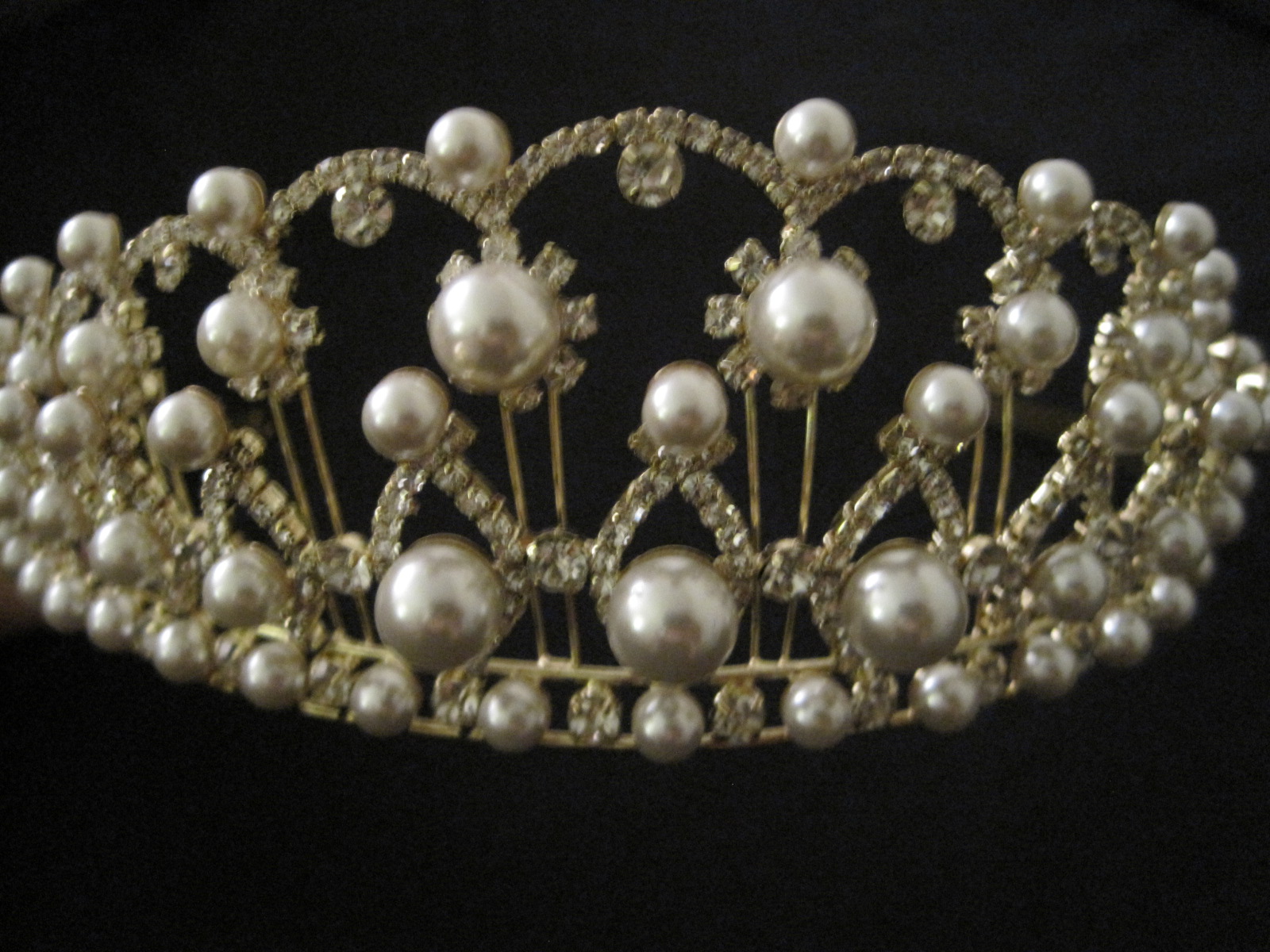
My tiara shares a general design with the Lover’s Knot Tiara, below. Both tiaras have round elements connected by jeweled arches above a second row of round elements, both rows of which are surmounted by tear shaped pearl elements which are set above a final row of further round shaped elements around the base. Additionally, in both tiaras there is a high point in the center which then diminishes toward each side. Obviously, the two are not exactly the same, but I think they’re similar. Of course, wearing mine for an 1893 look is slightly earlier than the given date of the Lover’s Knot Tiara, which is c. 1913. But isn’t that excusable, when the tiara looked so wonderful with my dress and accessories? There’s a closeup of my tiara below so you can compare.
Lover’s Knot Tiara by Garrard c.1913.My eBay tiara.
It took a bit of work to come up with a hair style I liked that also worked with the tiara, I can tell you. I wanted to have a puff of hair not directly behind the tiara, but close enough that it would provide a dark background for the tiara to stand out from. Unfortunately, I don’t have any great pictures of my hair. Oh well! It also took A LOT of bobby pins to secure the tiara. I think I used about 20 for the tiara alone. I put one between each of the base pearls, then another to cross the first one. I also secured the ends of the tiara with extra pins. It was really stable and didn’t move at all during the entire night, so that part was successful!
Here’s a closeup of the jewelry.
In the picture above you can see the jewelry better. You can also see the one major flaw in this dress. The wide neckline wasn’t shaped quite right, so the sleeves started slipping off my shoulders, making the sleeves look slightly less impressive. This is one of those things that was perfectly fine in all my fittings. It’s during those pesky balls, when you move and sweat, that you really discover the flaws in your clothes! I’ll have to do something about that before I wear the dress again.
A full length view. This was the end of the night, and the end of the week, so that’s why I look tired.A full length back view. Again, you can see how the sleeves just didn’t want to stay on my shoulders.
Now on to the specifics of patterning. The bodice (and especially the sleeves) of this dress are from Janet Arnold’s Patterns of Fashion 2, as is the skirt. The decorative sash and bodice trim were inspired by an image in Norah Waugh’s The Cut of Women’s Clothes. I looked at many images that had similar sashes with bows, so I’m sure I was influenced by those as well.
The next thing to discuss is the construction of the dress. It is in two pieces: a plain bronze silk skirt and a decorative bronze and pink silk bodice. The wonderful thing about this arrangement is that I can make other bodices to go with the skirt (I’ve got extra bronze and pink silk). For example, I plan to one day make a day bodice to go with the same skirt. Since the skirt takes the biggest bulk of fabric, this is an economical and practical plan in addition to adding to my wardrobe!
I’ve got some great closeup pictures of the bodice construction, but I didn’t take any close up pictures of the skirt, come to think of it. Honestly, though, it’s not as interesting. The skirt is gathered in back and set into a waistband which closes at the back with hooks. There is a placket opening that is hidden in the gathers. The entire skirt is flat lined with ivory cotton. In addition, the hem has a 12″ band of bias cut canvas tacked between the silk and cotton. The canvas helps the skirt form those wide folds at the hem as well as providing a certain weight and gravity to the lightweight silk. Finally, it also helps provide a clean sharp edge over which to turn the hem. For the hem, the bronze silk is folded to the inside over the canvas, turned again, and stitched to the cotton lining. The hem is about 1/4″.
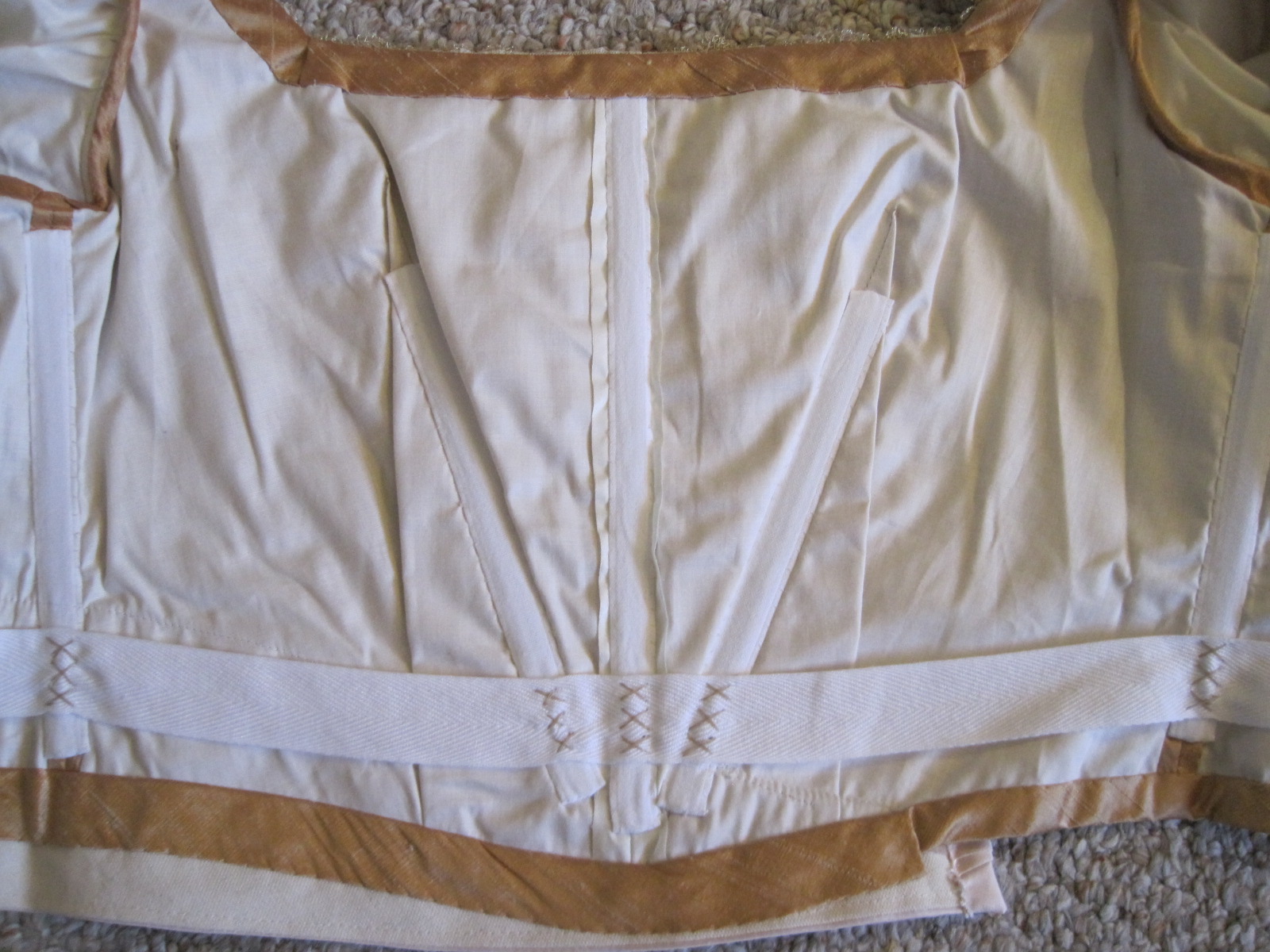
The bodice, by itself. As you can see, the sash is a part of the bodice.Here is the net applique on the sash ends. The net is great because it doesn’t fray, so I simply had to cut out the motif I wanted and then stitch it around all the edges to the sash. The sash is a tube of bias finished at an angle on the ends with a slip stitch.A closup of the shoulder and top of the sleeve. You can see the ivory net trim around the neck of the bodice, which terminates in those cute bows on the shoulder. The bronze part of the sleeves are rectangles that are knife pleated radially at the shoulder, which you can see in this photo. And finally, you can see the gold net applique which is stitched over the ivory net around the neck opening.Then comes the question, where are the closures on this bodice? Well, the sash is stitched to the bodice from the right side front around the left side to center back. Then the bodice opens up center back.To keep the sash in place around the right side, there are three hooks that correspond to thread loops on the bodice. This keeps the sash in place. You can see the canvas backing of the sash in this picture.One of the thread loops on the bodice that holds the sash in place.The center back closure is hooks and thread loops. I like thread loops better than the metal eyes or loops because you can’t see them when the bodice is pulled tight, like you can with the metal. You can see that I added a placket that extends farther than the loops just in case something pops open.The inside of the bodice. I LOVE to make the insides of garments pretty, and I think this is one of my finest examples! Aside from the fact that it is modern materials, it looks just like an extant garment from the 19th century. The bodice is boned up center front, the front darts (which create a V-shape on either side of center front), the side seams, and each of the four side back seams. The neck and hem are finished off with self fabric bias with is then nicely whip stitched to the cotton flat lining. The armholes are bound with self bias. Then there is also a waistband, to help alleviate the tension on the center back closure. This waistband is cross stitched to each boning channel and closes with hooks and eyes.The right side of the bodice. You can see the bias bindings, the boning channels, cross stitched waistband, and hooks. Oh, and I just noticed that I also finished the exposed seam allowances by turning them back on themselves and whip stitching. (The seam allowances under the boning channels are trimmed and left raw.)Center front. The boning channels were whip stitched to the cotton lining along the sides. It was a bit of a logistal problem to determine how to nicely bind off the edges of the bodice with bias, since there is a sash part of the way around. You can see that there is a separate piece of bias covering the join between the sash and the bodice from the right side where the sash opens.The left side. On the waistband I did use the metal bars instead of thread loops, since I knew they wouldn’t be seen from the outside. You can also see how the sash was attached. It was flipped up and topstitched to the bodice (avoiding bones!), then flipped down to cover the raw edges and joined to the bottom of the bodice with bias.The interior of the pink under sleeve. The silk is gathered into a cotton lining. Of course, you can’t see up into the sleeve when there is an arm in it!
It makes me feel all warm and fuzzy inside, to have such a beautifully finished bodice. And I felt like such a princess at the 1890s Soiree, to be wearing an all silk dress with silk petticoat and a fabulous tiara!
It was recently requested that I share more information about this dress, and maybe some extra pictures. This dress was lovingly placed in my closet upon my return from Newport, but as you’ll soon see, the silk charmeuse just LOVES to wrinkle! I didn’t steam the wrinkles out to take closer pictures, so you’ll have to bear with the wrinkly silk.
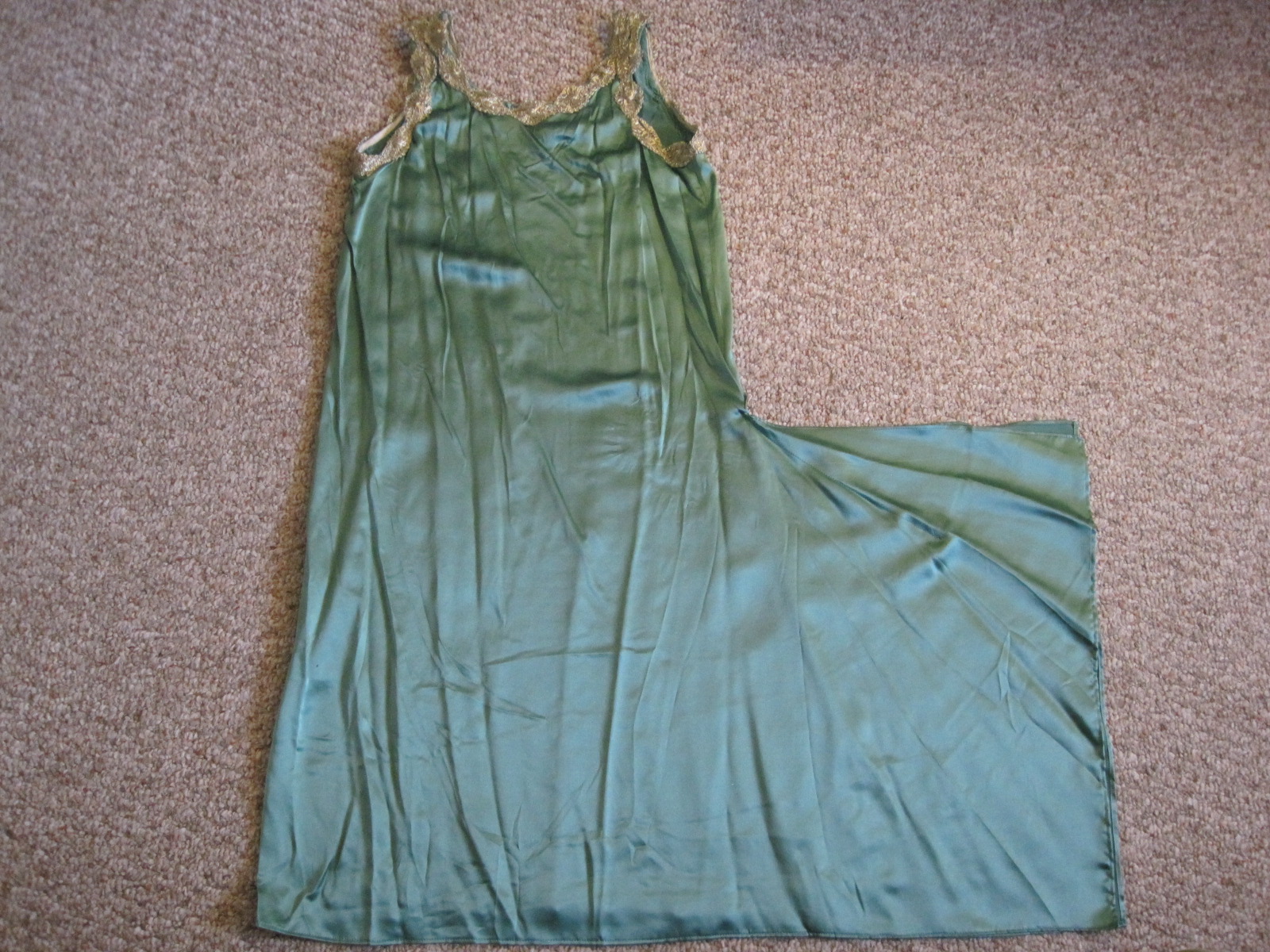
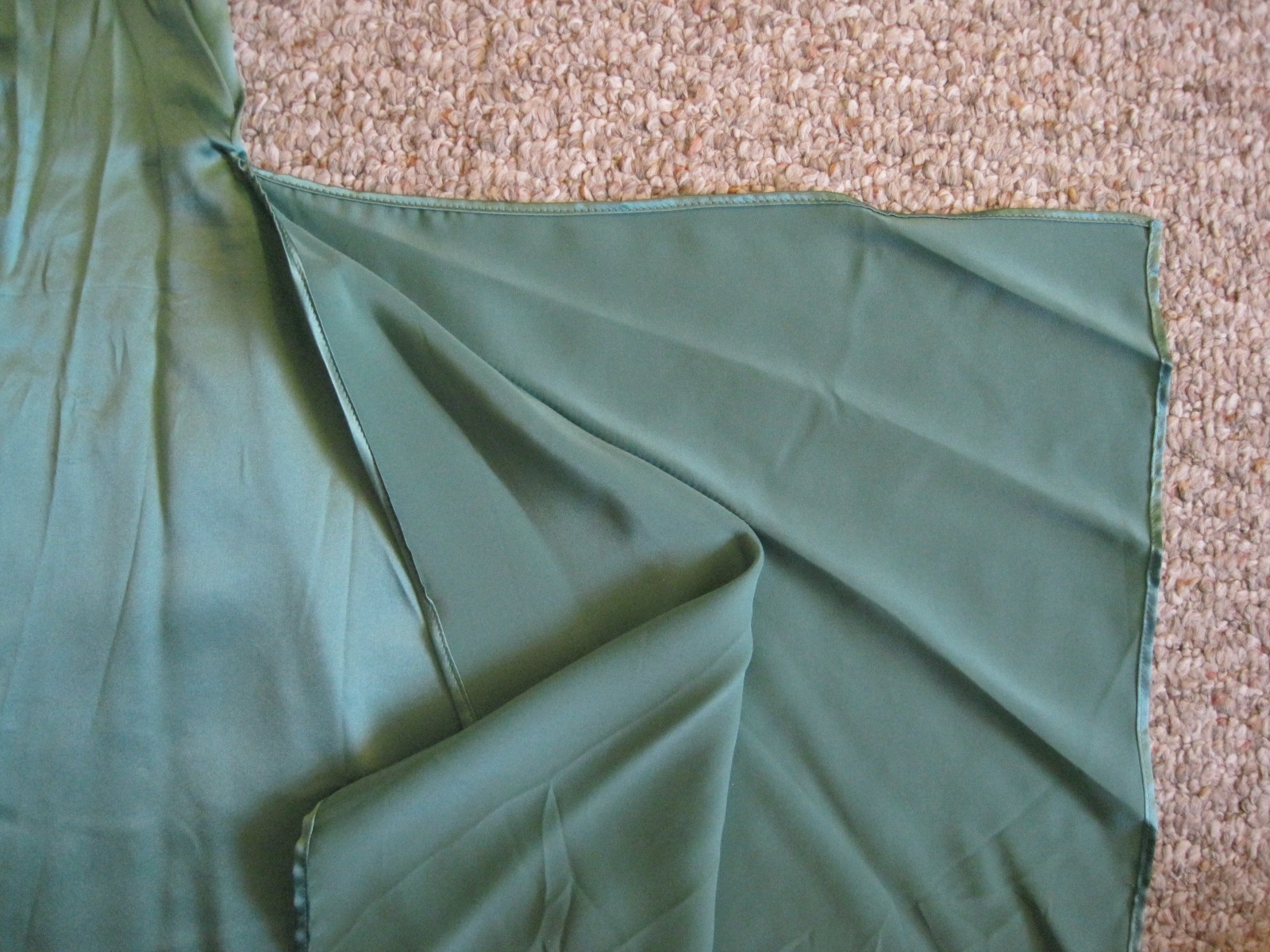
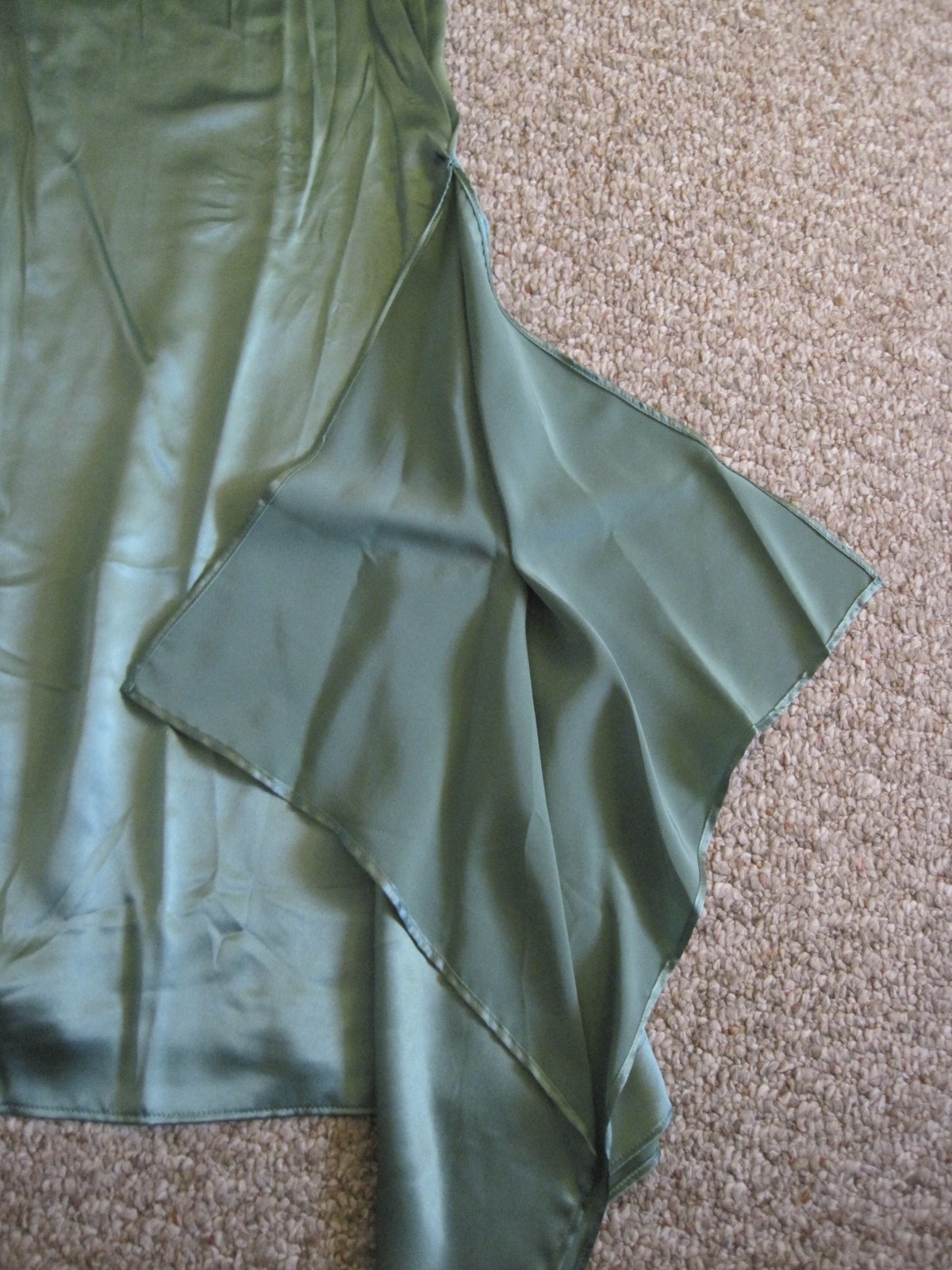
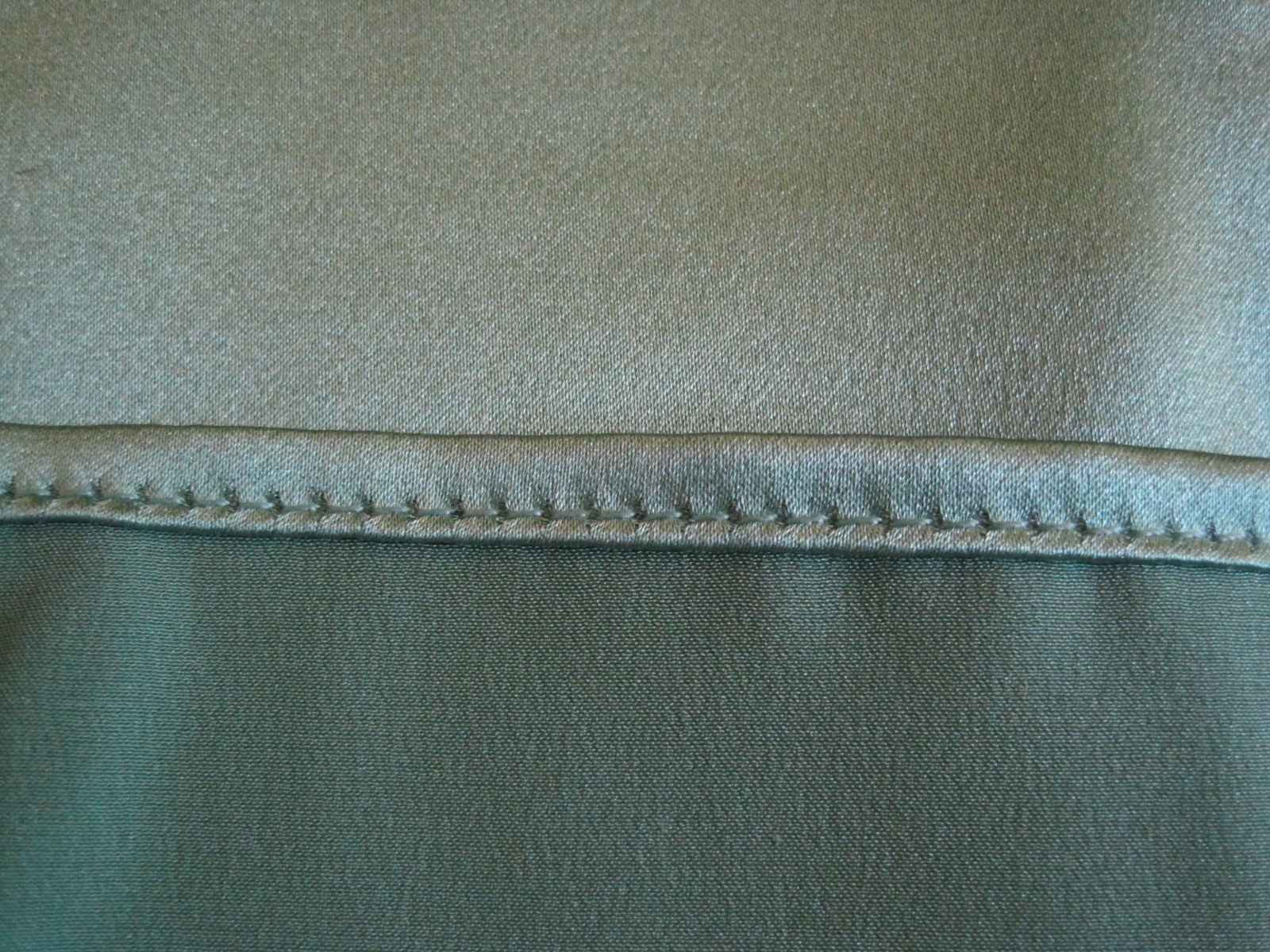
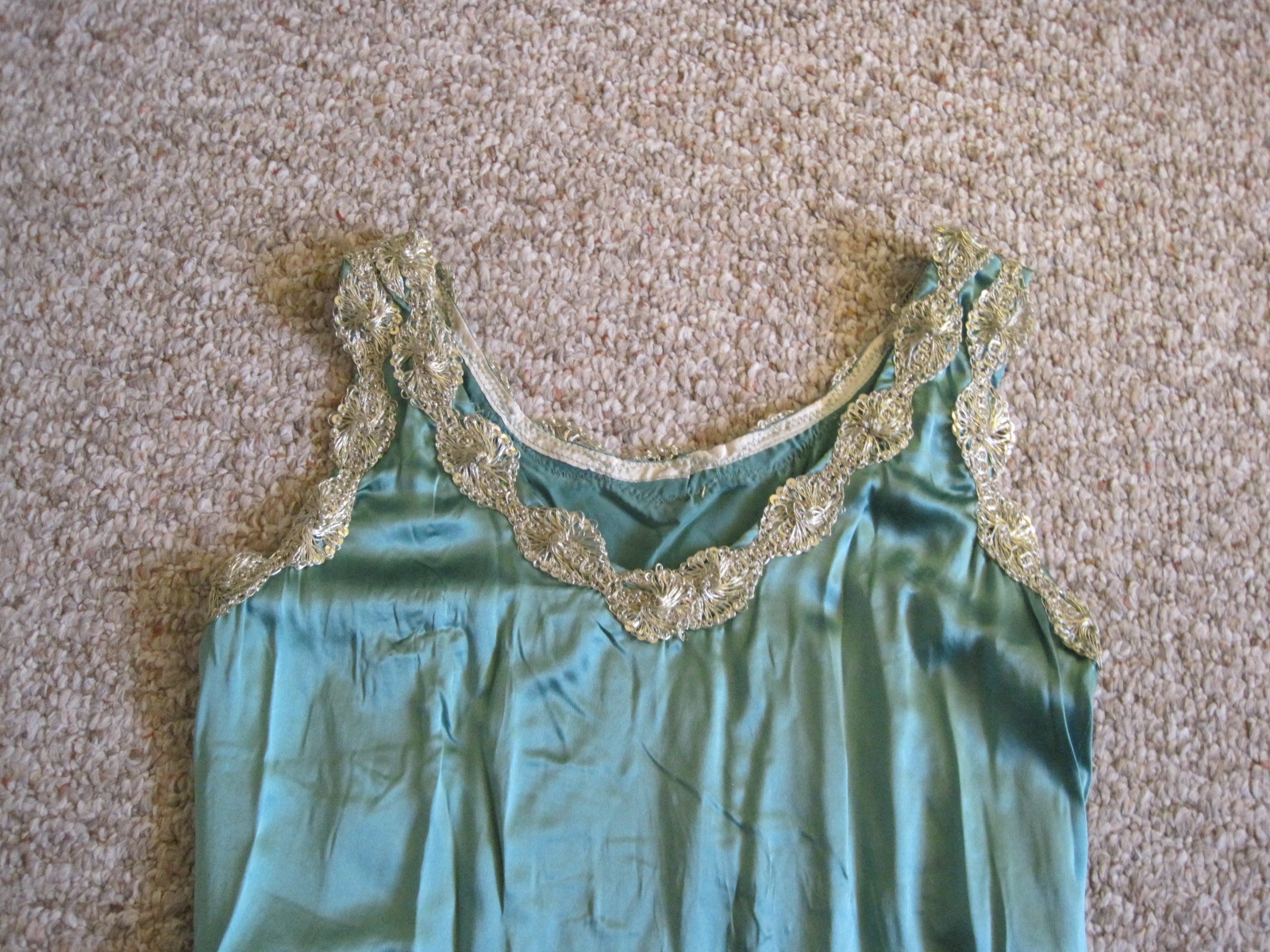
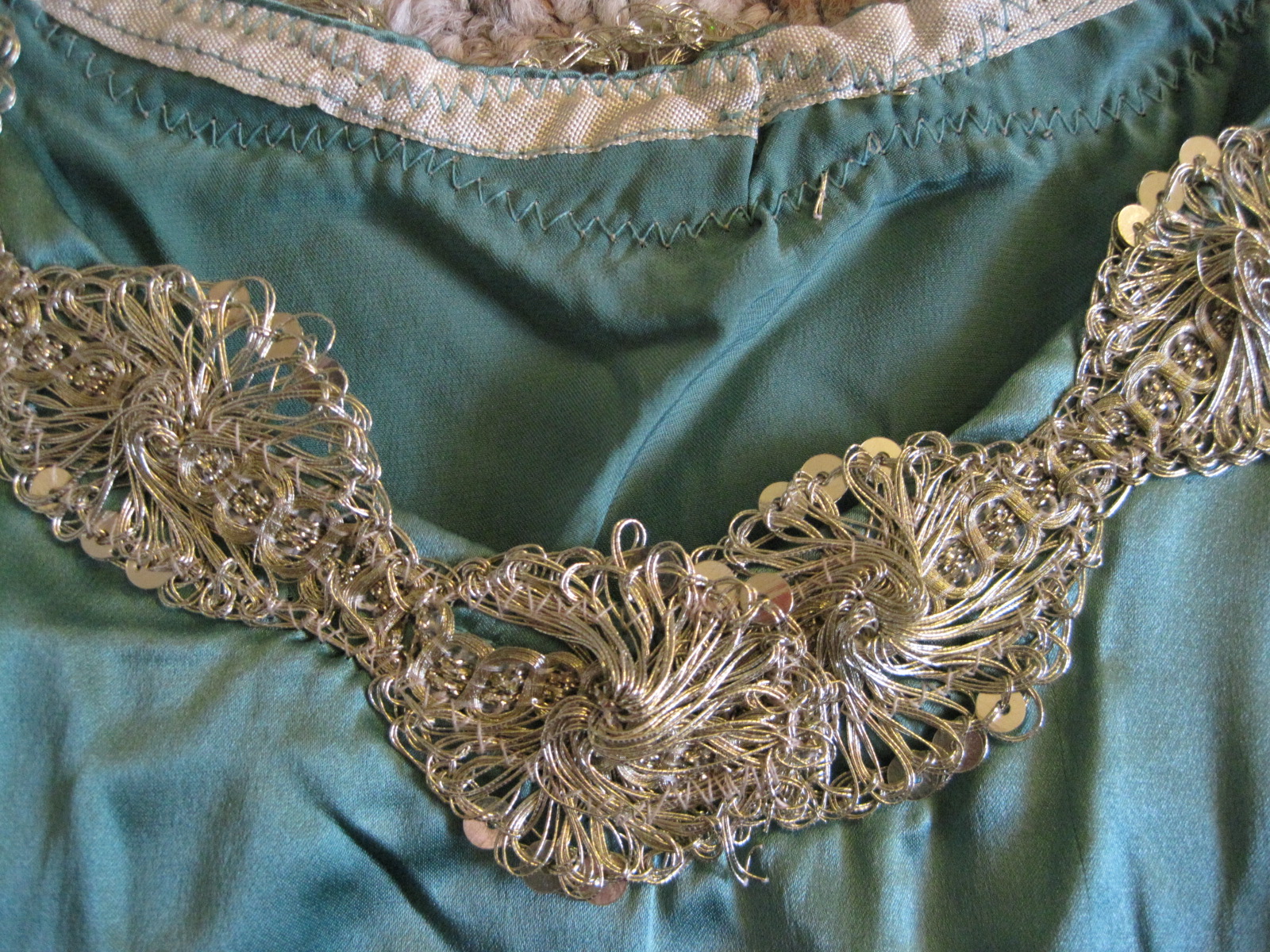
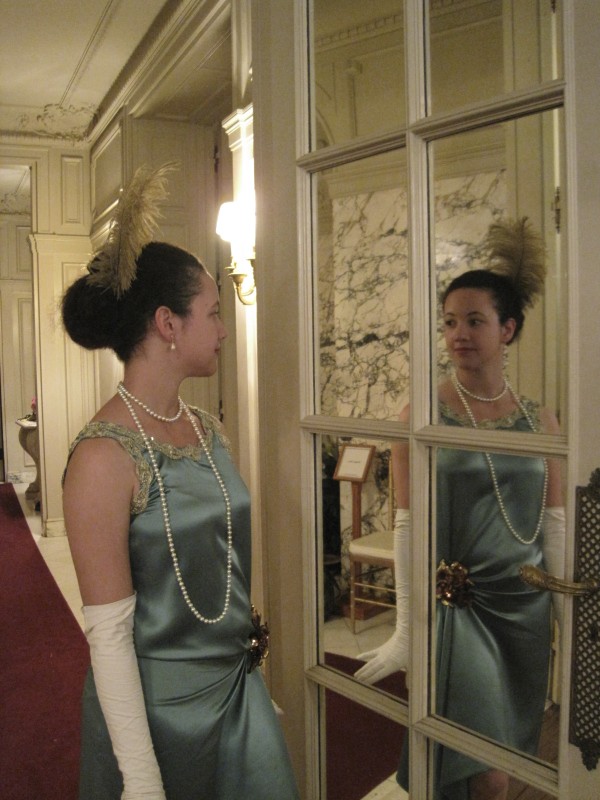
This dress may look complicated, but it’s actually just an L-shaped garment with neck and armholes.The bottom of the L-shape is stitched together on a diagonal to keep the drape-y bits from showing too much leg.Here are the drape-y bits hanging down, but folded open so you can see where the stitching stops. It’s about mid-thigh, but I didn’t have any problems with too much leg showing because it tends to hang closed all the way to the hem.All of the bottom hems and drape-y edges are narrow hemmed by machine, like this. The hem is about 1/4″This is a back view of the top of the dress. You can see that the front neck is a scoop and the back is a V-shape. The trim is from Heritage Trading on eBay. It’s is gold metallic threads/wires with sequins. Originally I had thought to trim the skirt as well, but decided against that because I didn’t want stitches to show on the inside when the skirt flipped around while dancing.A closeup of the neckline. I stitched hug snug around the neck and armholes then turned the hug snug and stitched again to enclose the raw edges of the silk. I then zig zag stitched the metallic trim on. It caused some puckering of the silk, but that’s not very noticeable when I have the dress on.Here it is!
The dress is a basic tunic with no waist, as you can see in one of the first pictures. I used my measurements to determine the basic shape, then held it up to myself (super scientific, I know) to determine arm and neck openings. I cut them, sewed the shoulder and side seams, then put the dress back on to make changes.
I didn’t want to put closures on the dress, but I did want those horizontal folds around the waist. Without a waist, the dress just droops and pulls on the side with the drape-y bits. So how did I fake a waist while still allowing easy access to the dress with no closures? Well, I took an elastic hair tie and scrunched the dress up while wearing it so that it sat the way I wanted! Then I pinned a (modern, ahem) sequined flower (left over from my beginning ballroom dancing days) to hide the scrunch. The sequins are bronze and gold, so while it didn’t match perfectly, I think it worked just fine.
It was a rather down-and-dirty sewing job. I wasn’t out to have the most beautiful interior of a dress (as I almost usually am). I was simply trying to get the dress done as quickly and easily as possible, so I could spend time making my other dresses really lovely, inside and out. As I have mentioned before, the 1920s aren’t super inspiring to me, so I didn’t have a whole lot invested in this dress, except that I wanted to look great at the Gatsby Ball at Newport with minimum effort. (My original thought was to hand bead a dress… but I didn’t have the time or interest for that, in the end.) However, I’ve got another 20s event coming up next year… and I plan to make a new 20s dress. And this time, it will be beaded. You’ll have to wait for a future post to hear about my plans for the new 20s dress!
I used to dream of going to a Halloween masquerade in an 1860s dress. I’ve never attended a real masquerade, but I do attend a fair number of events in 1860s dresses… so that goal is half completed! I don’t actually do Halloween things anymore. I don’t really like crowds and annoying people, so I tend to stay home in order to avoid those things (not that every person out on Halloween is annoying… but so many of them are, it’s just easier to stay home). Plus, I have that added bonus of wearing historic clothes and costume-y things year round, so I don’t feel like Halloween is my one-and-only-chance to wear something I wouldn’t normally wear. Anyway, for those of you dressed up or just plain getting dressed… or those of you staying home like me…
Making moose antlers is a favorite past time of mine when the camera comes out for silly pictures!
Happy Halloween!
PS. This is one my all time favorite pictures of me! I just think it is hilarious!!!
As an extra note, I’d like to extend my thanks to Caroline, of the blog Dressed In Time, for nominating me for the Versatile Blogger Award! When you are nominated for this award you are asked to share 7 things about yourself and also nominate 15 other blogs. You can read my responses here. Thanks again Caroline, for the nomination! I’m so pleased that you enjoy seeing my events!
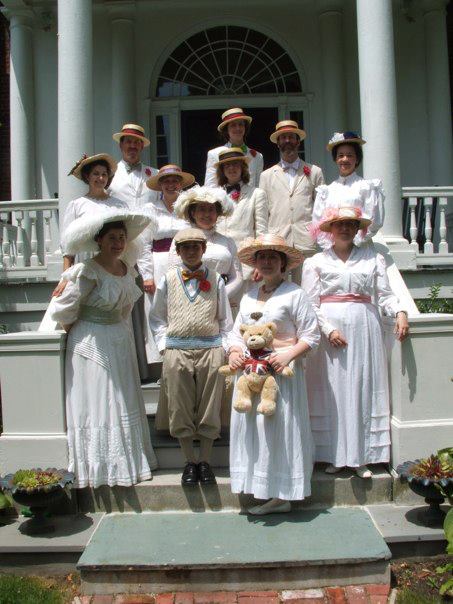
This is another case of the delays… The Commonwealth Vintage Dancers performed at an event in June (cough, cough… I am so slow!) that was called something like A Picnic for Teddy, Mommy, and Me. It was at the Salem Athenaeum, a private library, and was targeted toward young girls, their mothers, and their teddy bears! Cute!
We performed in 1890s whites. I had been dragging my feet about constructing my own whites, so I took this opportunity to go for it.
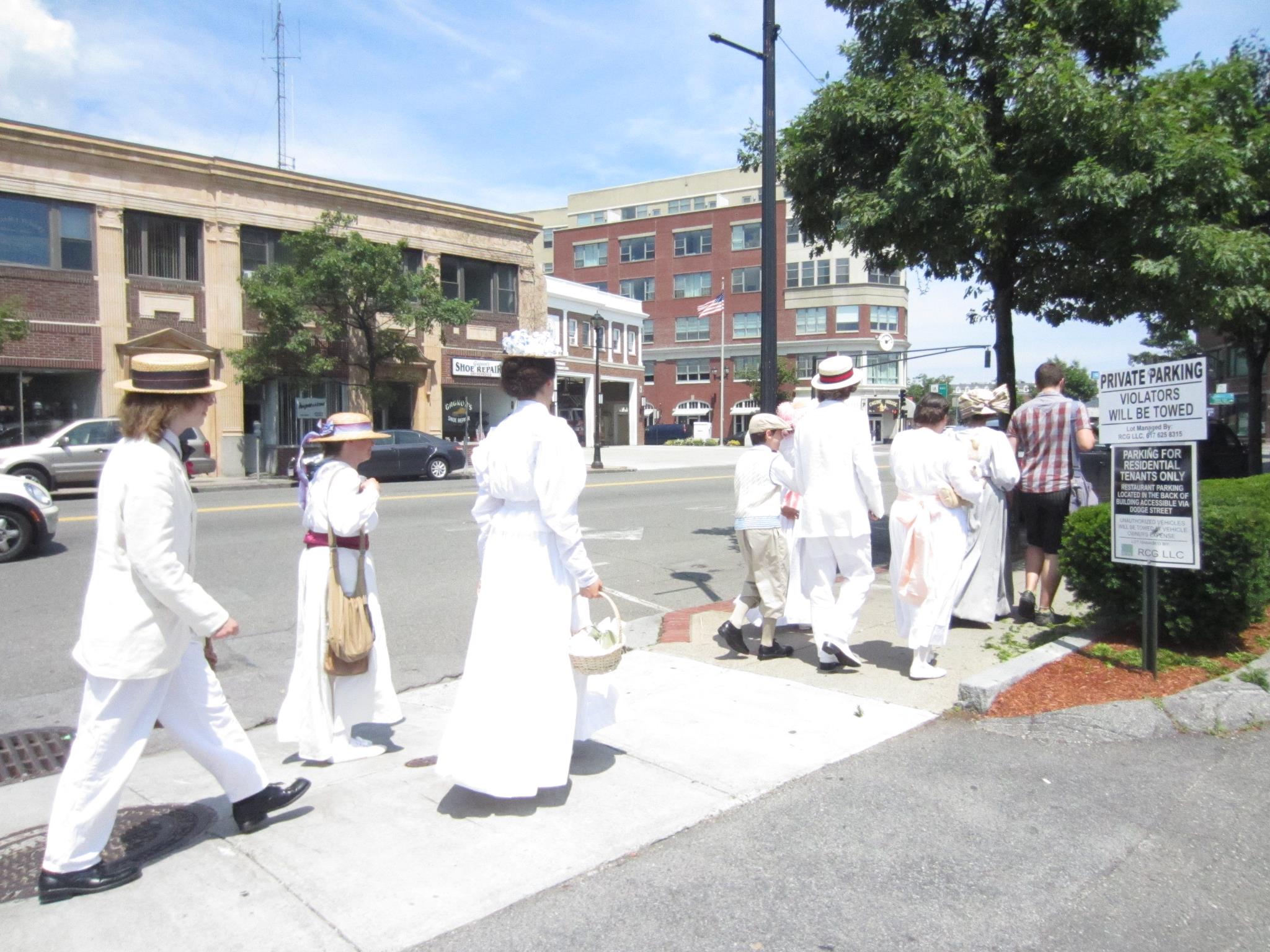
Dancing “Teddy Bear’s Picnic.” It’s really a ridiculous dance, but it fit the theme of the event perfectly!It was super hot that day! Sitting, in the shade, was wonderful. As was my fan…CVD on the steps of the Athanaeum.After the event we walked across Salem to get some lunch. Of course, Salem often sees people dressed in odd clothes, so we didn’t surprise people, but they were curious about what event we were going to.
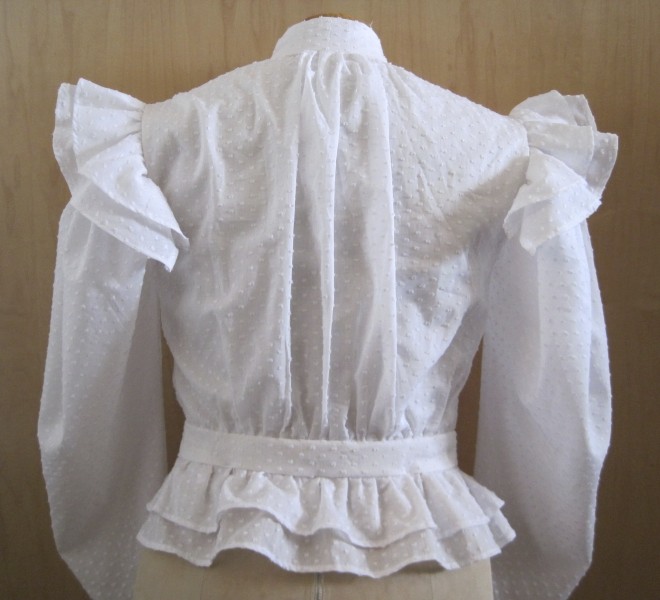
I’m not totally sold on the white skirt I made. It’s a gored skirt and it works fine, it’s just not super eye catching (aka, it’s great for performances, but won’t get worn for other things… maybe it will be a petticoat if needed?). Oh, and I also threw the hat together, thinking that the white and blue would be nautical and good for Newport. But then I totally re-trimmed the hat at Newport because it didn’t have quite enough oomph with the white and blue. But the blouse… I love the blouse! It’s super comfy and lightweight, it closes in front (yay!), is washable, and I like the fabric. Win!
It is based off of a fashion plate in one of my many books. I draped a basic blouse pattern and adapted the pattern as needed to add the gathers in the front and back. The exterior is mounted on a lining made from the basic blouse pattern so that they gathers will stay where they are supposed to be. It is constructed of cotton with swiss dots for the exterior and a lightweight woven stripe cotton for the base (which I bought for $1 a yard a while ago! Love that price!). It closes up the front with concealed hooks and thread bars. The sleeves are quite large gigot sleeves, but because they are not lined they sort of just droop. Here are some pictures! I think I got pretty close to that inspiration image, don’t you? I love the feeling of success that comes with really nailing the look in reproducing a garment! Don’t we all?
The inspiration image.Front of the blouse, on Squishy, the mannequin.Back of the blouse on Squishy.In the garden.
Well, sometimes I am good about sharing what I’m up to, and sometimes I experience delays. This is a severe case of the delays. All the way back in June, I attended Dress U, a costume conference along the lines of Costume College (which I have never been to, though it does look like mounds of fun). I took a few hundred pictures… but clearly haven’t found time to share them with you. I originally thought to share more detailed information about what I wore and the events that were included in the weekend, but I think I’m going to take another course, and just share a gallery of fun clothes and pictures, with captions.
Boston ladies at the Welcome Tea.Lovely clothes. I especially love that Edwardian suit!More cute clothes and fun accessories!Fabulous 1920s dress.Super cute Edwardian outfit from Jenni.Loren’s open robe and gown are lovely and bright.All 1840s. I missed the memo on that one.Showing off the 1840s petticoats.Super cute zone front from Aubry.At the Titanic Dinner.More Titanic Dinner.Just one of the fabulous bustle dresses worn.Outdoor photoshoot!Tiaras and Jampagne.Look at all that bling!So lovely!Gloria’s fabulous open robe.Amanda’s mid-19th century gown.Shoe shot.
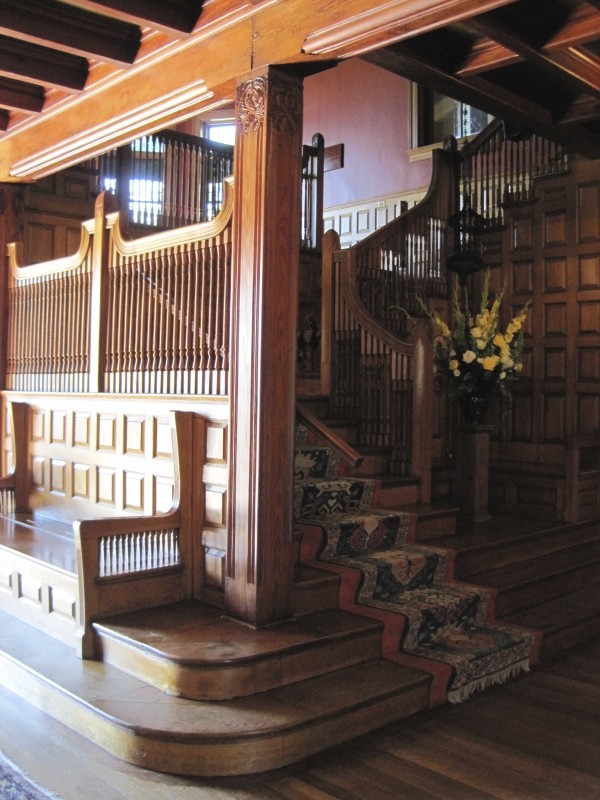
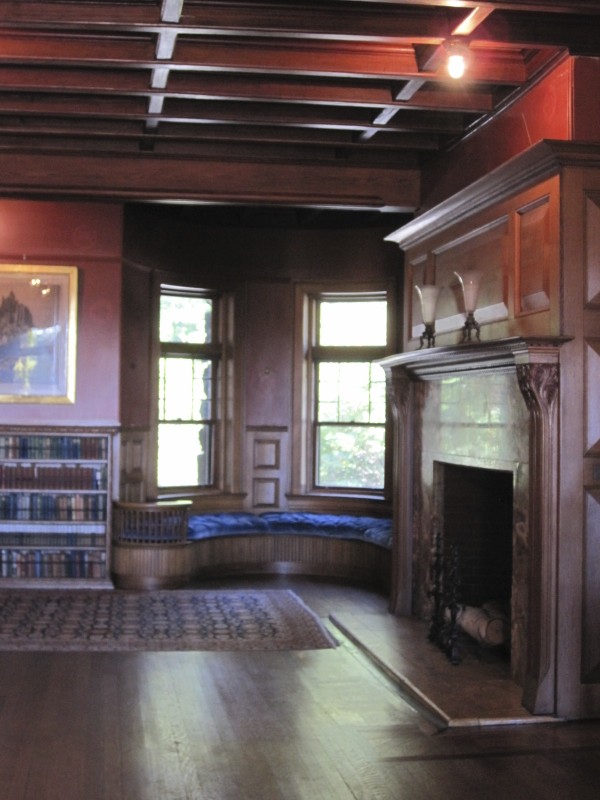
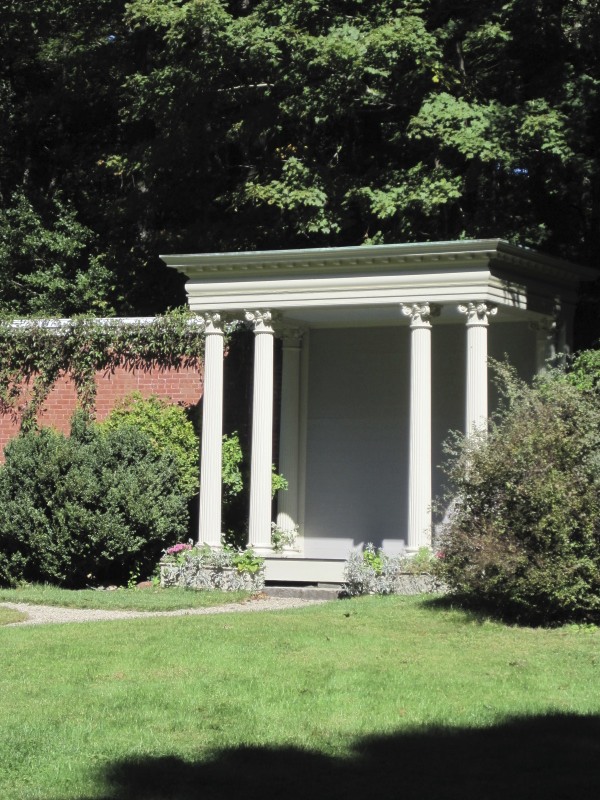
On the subject of summer picnics… We recently took advantage of a sunny Sunday afternoon to view two of the historic houses in nearby Waltham, Massachusetts: Stonehurst (completed in 1886) and the Lyman Estate (built in 1793). We ended the afternoon with a relaxing picnic on the lawn of the Lyman Estate. Pictures often say more than words, so without further delay… pictures!
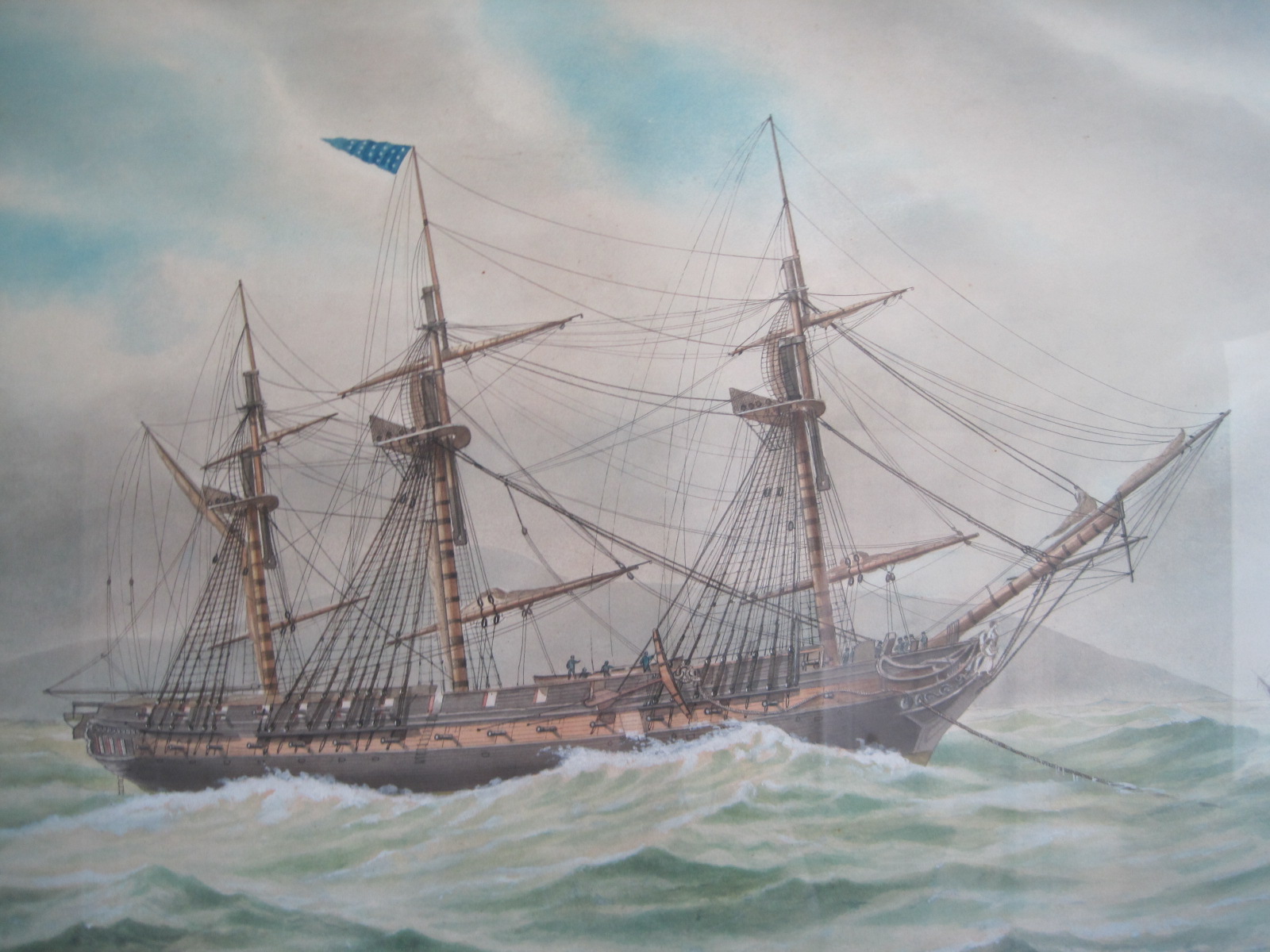
On the walk up the drive to Stonehurst, I passed this street sign, which was just begging to be photographed!The main stair in the front hall of Stonehurst.Also in the front hall. Stonehurst has all these cute little nooks and benches. This one was my favorite!Then on to the Lyman Estate, which has a very different feel. Light, airy, and Grecian… perfect for Regency!The ballroom of the Lyman Estate house.A fireplace at the opposite end of the house. Those tiles are really neat.One of the bedrooms upstairs. This house is often used for weddings, so I think this is often the bride’s dressing room.A painting of the USS Constitution! Fitting, considering our summer adventures relating to the Constitution. 1805.Lovely flowers outside the front door.The greenhouses at the estate are open to the public year round. This was where I visited last year for the Regency Holiday Tea.Finding an appropriate picnic spot.Taking a turn about the garden. Isn’t this a super cute picture???
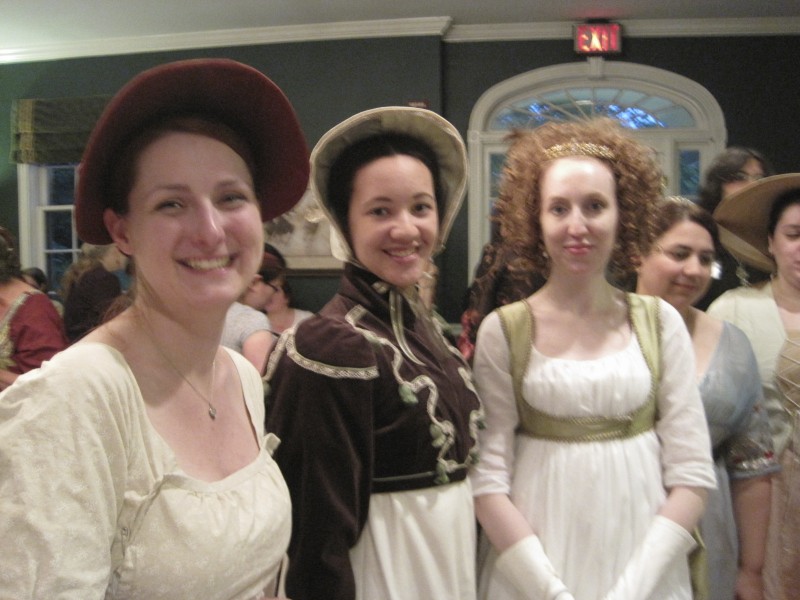
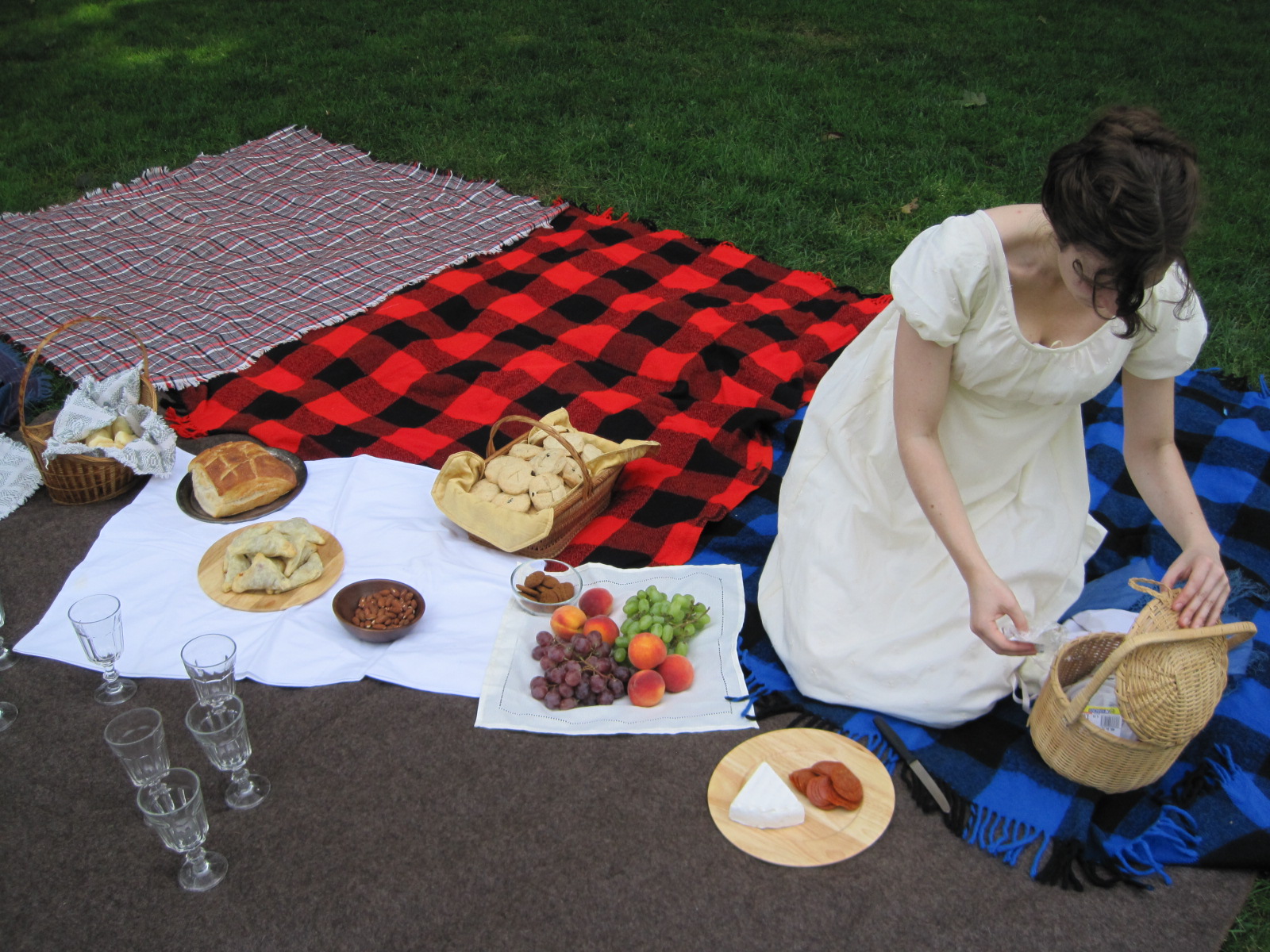
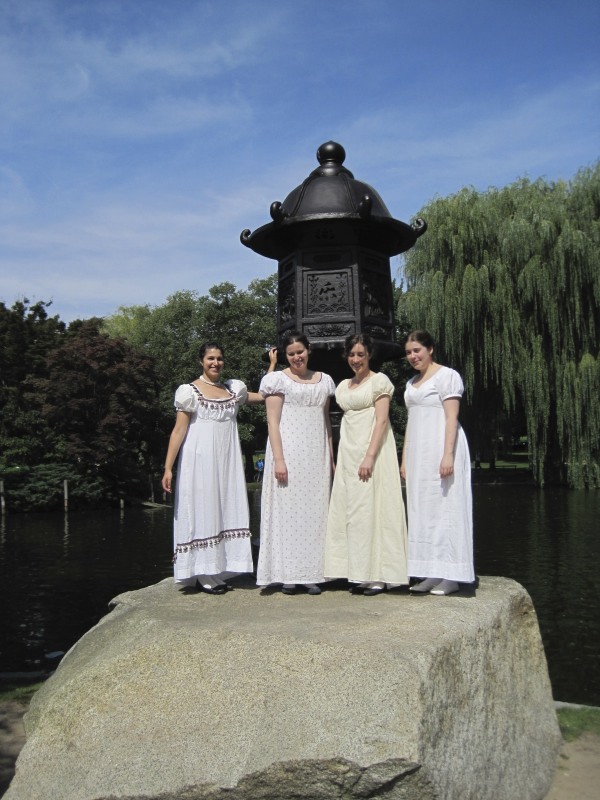
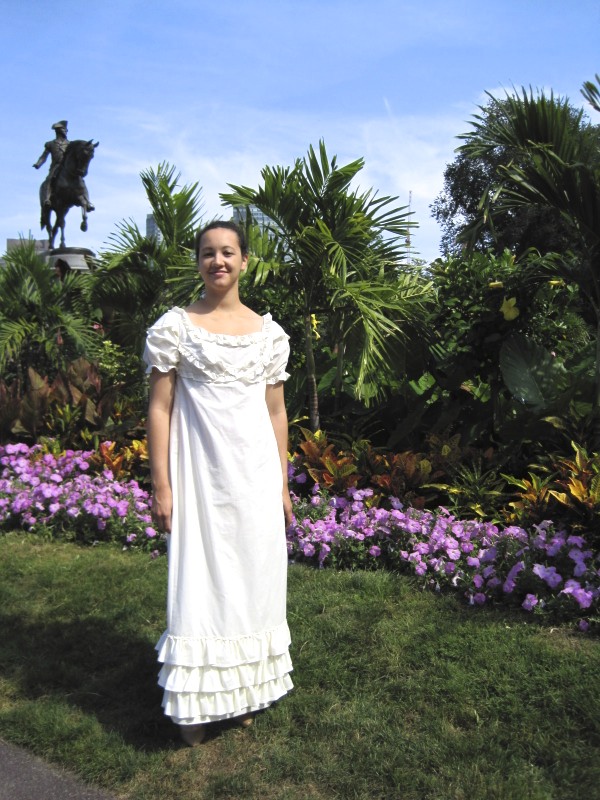
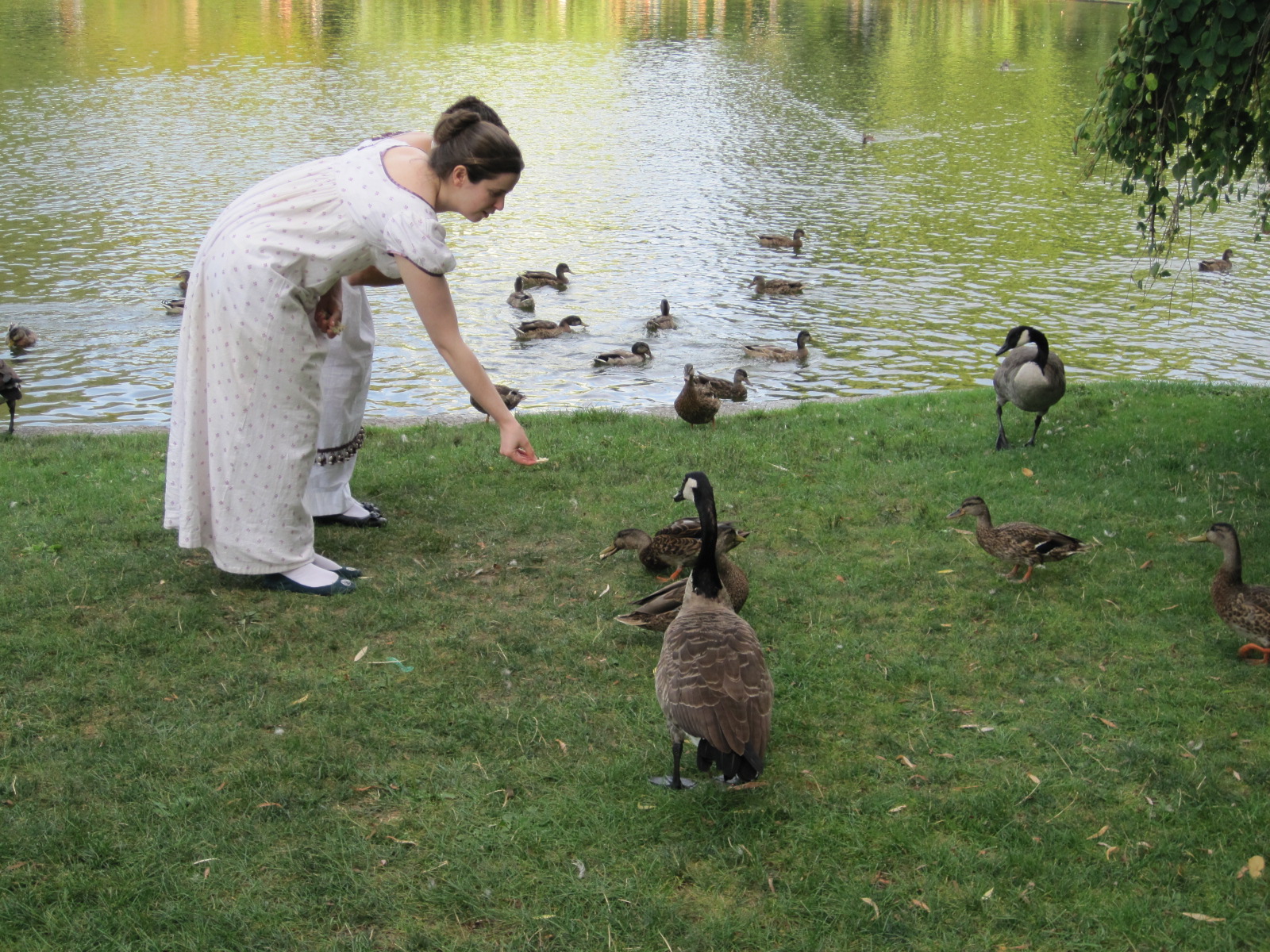
Summer is mostly over, here (although we did just have a nice, warm, sunny day that felt like summer…), but I haven’t finished sharing about summer picnics! To bring a little summer to you, here are a few pictures from a Regency picnic in the Boston Public Garden in August. The Boston Public Garden was established in 1837, so we were a little early, in our Regency dresses.
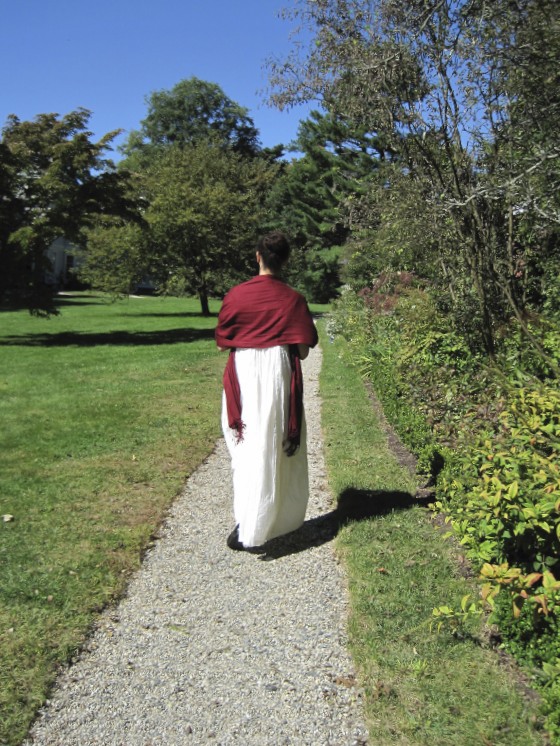
Laying out the simple fare on our wide expanse of blankets.Taking a walk around the garden, you run into all sorts of fun picture taking opportunities.I don’t think I’ve ever been to the garden in August. I have usually been there in May, when all of the flower beds are bursting with tulips. I didn’t realize they change the flower beds to tropical things! I was super surprised!I think that is George Washington.Not the usual Boston flora.Look at the size of those leaves!And hibiscus!I feel so tall sometimes…Squirrel? He was busy scrambling to get food for the winter.Watching the swan boats pedal by.It wouldn’t be Boston without the ducks and geese…
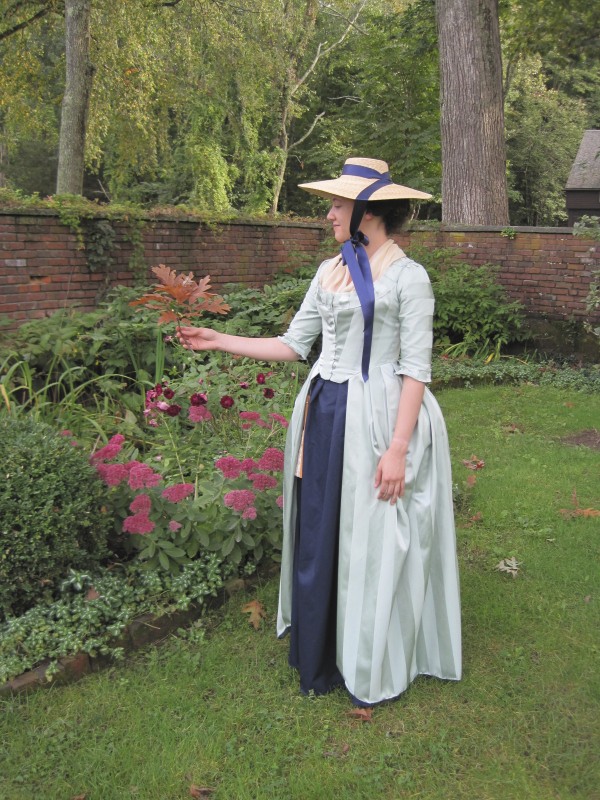
I recently met up with friends from the Massachusetts Costumers to attend a colonial faire. It was a cold, damp, day so we had the opportunity to pull out warm clothes and accessories like mitts, muffs, and cloaks.
First, I made a matching petticoat out of the remaining bit of striped fabric I had. I had enough to make the front stripes run vertically, but in the back the stripes are only vertical for about 12″ and then I hd to do lots of piecing to even have enough fabric. Right above the vertical stripes are stripes that run horizontal, and above that are remnants of my green 1900 skirt from Newport. And I really do mean remnants! There are 3 rows of pieced in remnants, some of those are even pieced together with vertical seams to be wide enough! Of course, you can’t see all of the crazy piecing, since the skirt of the anglaise covers it. And I was rather in a hurry while doing all of this, so I have to confess that I did not iron any of my seams… or my hem… Bad behavior, I know!
Robe a la anglaise worn a la polonaise.
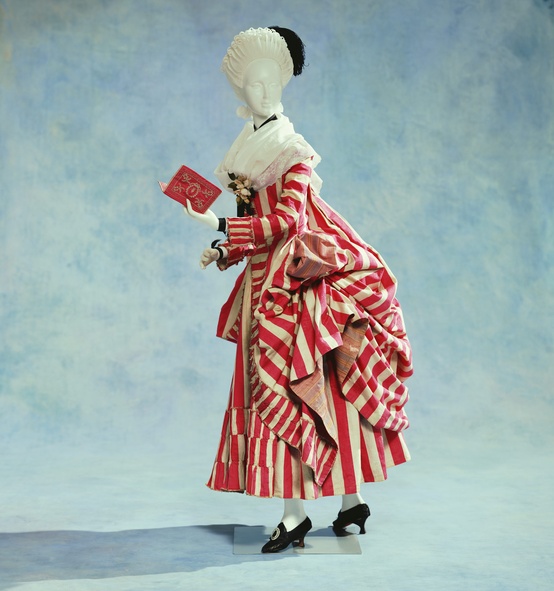
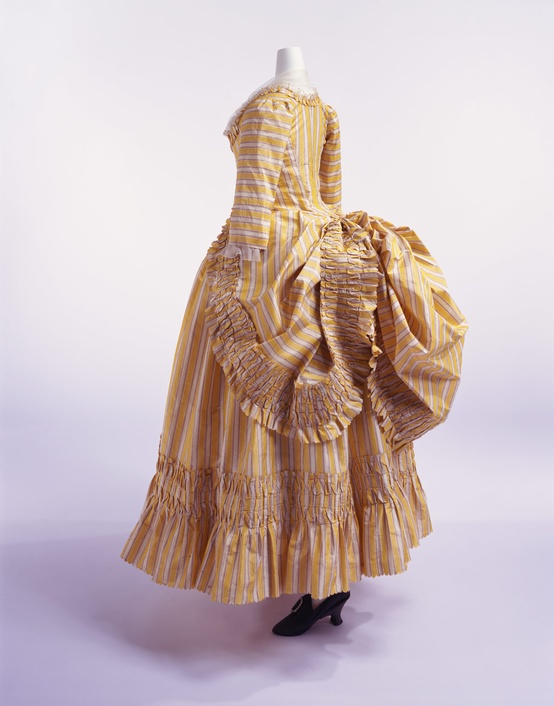
Second, I decided to wear the anglaise a la polonaise. I did this in part to keep it out of the mud in the fields we would be wandering through, and partly because I found multiple examples of striped robes a la anglaise with matching petticoats that were worn a la polonaise.
Robe retroussee dans les poches. KCI. c. 1780. French. In “…the “retroussée dans les poches”… [The] gown’s hem is pulled out from slits in either side, and draped on the back.” (From KCI) Okay, not actually a polonaise, but very similar.Robe a la polonaise. KCI. c. 1780. French.
Third, I decided against wearing the straw hat I wore last year. The shape of the brim is good, but the crown is too high for the 18th century and the ribbon wasn’t sewn on in an 18th century decorative way. I thought of adding that same blue silk ribbon to my 1912 ivory mushroom hat since that hat shape also appears in the 18th century… but it seemed a bit too much to have an ivory silk hat to wander around muddy fields. Plus, after completing my hair style, I realized that I hadn’t made my hair big enough to support the hat (and I didn’t want to cover up the rolls I had attempted in the back!).
Bun roll hair.
Fourth, I attempted a new hair style with rolls in the back. I don’t think I quite made it, since it kind of looks like edible buns on the back of my head… But it was an experiment, and I learned some things, so it wasn’t a total bust. I separated the hair on the front part of my head and brushed it out and hair sprayed it upside down to add volume. Then I actually put it into a pony tail on the back of my head, which I pinned in place to create the poof in front. I then separated the pony tail into those three sections and rolled them individually. I took the remaining bottom section of hair, brushed it out a little, and pinned it up so it would fall from the bottom roll, rather than the base of my scalp.
Rather sad petticoat, but fabulous new muff!
Fifth, I wore my new 18th century muff! The muff is from one of the classes I took at Dress U this summer, with Stephanie Pool. It’s stuffed with 100% down and is super warm. The blue silk cover is removable, so I can make lots of covers and have interchangeable muffs! I was hoping to have the blue silk ribbon on my head to complement the muff, but that didn’t happen. Incidentally, muffs make rather good pockets… I was able to put a little bag with my phone, money, etc. in it as well as my camera inside my muff!
You can see the down filled pillow inside. The two ends have a silk ribbon running through a channel. You simply pull the ribbon to gather the ends and then tie them to secure the gathers. You simply have to untie the ribbons to loosen the gathers and change the cover!
I did sort of give up and not try super hard for accuracy when I was getting dressed. I decided not to wear stockings, because I didn’t want them to get dirty. I couldn’t find any shoes that were remotely 18th century-like. I clearly need to make some under petticoats and readdress my bum pad/roll situation (I had also made my bum pad smaller, since it seemed so large last year… but this year my skirts looked a little sad and droopy… so maybe I went too far?). I need to actually hem the silk tucked into my bodice, so it’s not a full square of fabric… Oh also, I guess I need to make some simple pockets, until I learn embroidery and make some fancy embroidery pockets as I mentioned earlier this year.
At this point, I am going to freely admit that I rather failed at creating an outfit that is historic clothing, rather than a historic costume. Certainly, there are some aspects of this ensemble that are correct. For example, I’m very pleased that I cut my sleeves so that the stripes go around my arm, not vertically. I think my trim is well done and really makes good use of the fabric I selected. And I like the scale of my stripes, but feel that the fabric is really not the right choice for a piece of historic clothing, rather than a historic costume. In addition to that knowledge, I have learned a lot about the construction of 18th century clothing, which I did not know when I made this last year. For example, I now know how to make petticoats the correct way, and how to construct the bodice of the robe the correct way, and how to sew the shoulder straps the correct way. I plan to make more 18th century things in the next year, so I will be sharing these sources with you as I go so that you will be able to gain this knowledge as well.
In the end, I’ve chalked this green anglaise up to experience, as every seamstress has to do, now and again. We all have to start somewhere. It’s pretty rare that the first thing you make from a totally new era is as correct as you want it to be!
Here’s a few more shots from the day, of me and my companions. Enjoy!
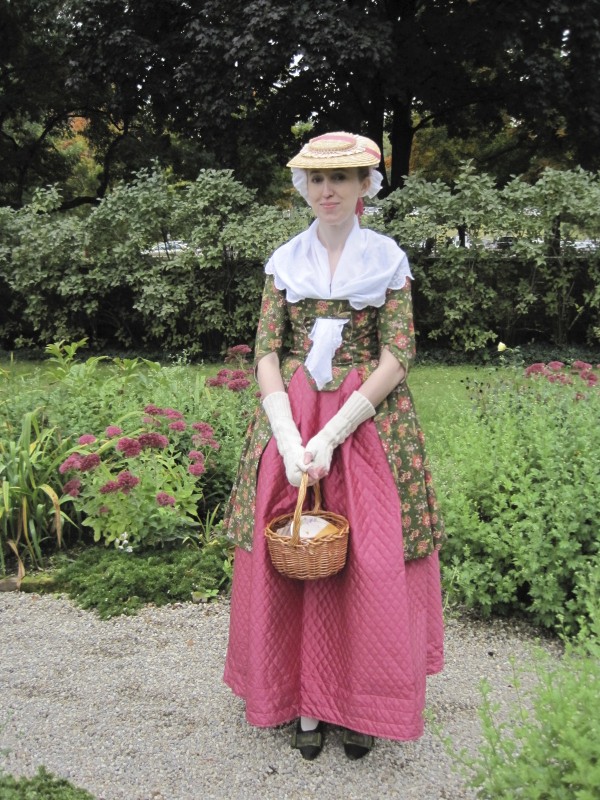
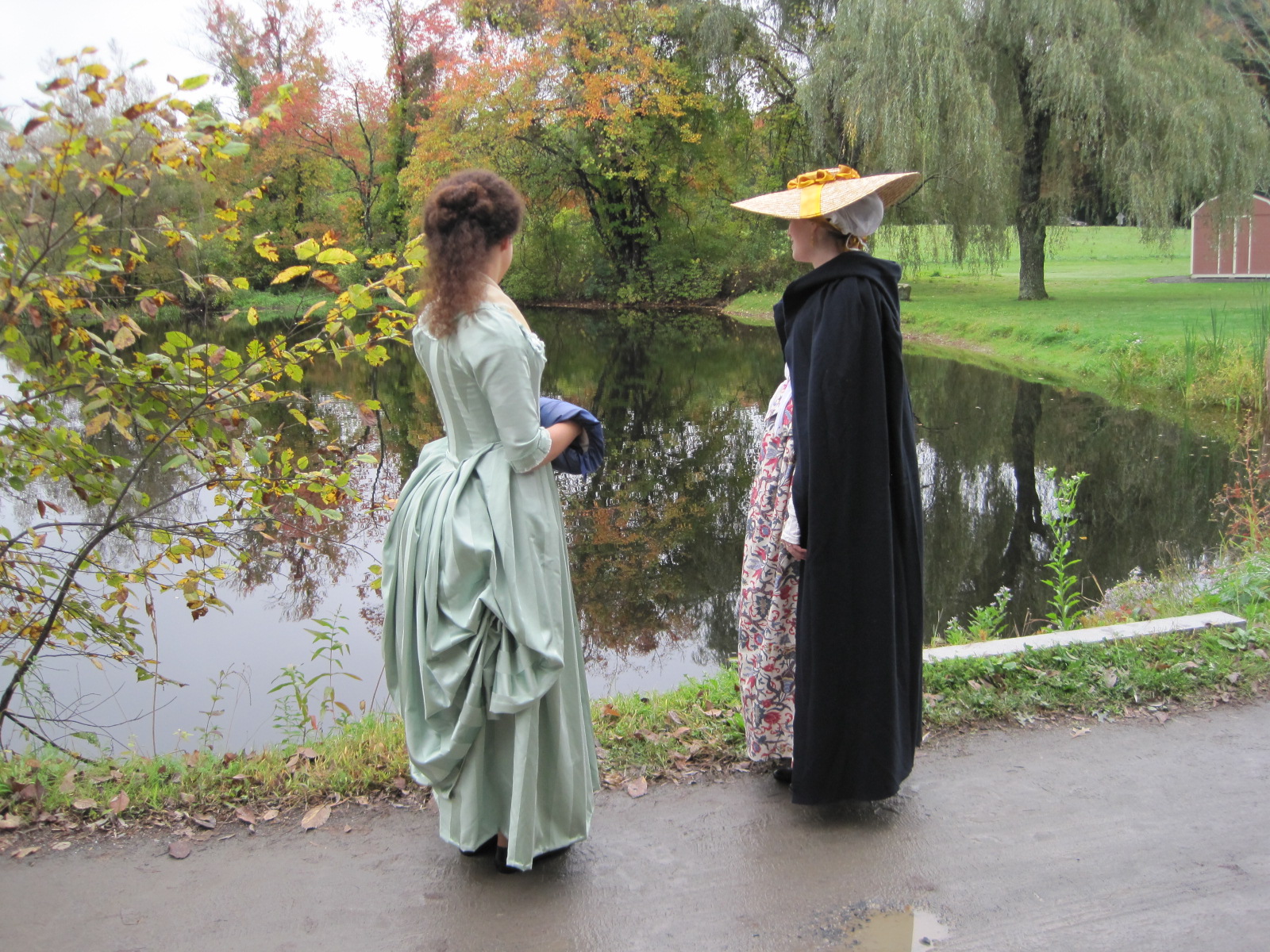
New caraco and quilted petticoat.New jacket! In a day! You can read more at Jenni’s blog: here.I really enjoy this pond. That willow on the right is the very same one we took pictures at last year!It was chilly, so we stopped in the tavern at the inn to warm up a bit.In front of the real fire! It was really pleasant.Of course, I took this picture to be silly. There was a lot of picture taking and iphone-ingShoe shot! With our “chaperone,” who was obviously not wearing historic clothes.
Oh yes, and I’ve realized I don’t have any shoes that are remotely 18th century-like. So I need to deal with that too… I want yellow ones!…
As I mentioned in my last post, the one where I shared pictures of my new 1812 under garments, there aren’t a whole lot of extant examples of sleeveless undergarments from the Regency period, so I had to take the research images I could find and extrapolate what was necessary for my dress from that information. Here are a few extant examples of sleeveless underdresses.
Early 19th century. Petticoat. The Met.Petticoat. 1800. Cotton. National Trust.Early 19th century cotton petticoat/underdress. MFA Boston.
It is fitting that this last one was worn by someone who lived in Boston, MA (that’s where I live). Neat! And isn’t the whitework at the hem lovely? Fashion plates and extant underdresses and petticoats from the early 19th century not uncommonly have hems that had white work and lace decorations. I didn’t incorporate that into my underdress… but maybe in the future I can make another such garment and include that detail!
Natalie Garbett also wrote a blog post about a sleeveless underdress that she made, which you can read by clicking this link. It’s super cute (and has hem trim)!
I actually didn’t find any sleeveless chemises, though I did come across mentions of them. I suppose a lady could have tucked up the sleeves of a normal chemise, or worn a sheer dress with the sleeves of the chemise showing through. Here’s an example of an early 19th century chemise with sleeves. This one is pretty ruffly, but the basic shape is the same, as is the gathering tie at the neck.









































 The Quintessential Clothes Pen