Of flounces and dance cards: Part II (Nahant Victorian Day 1860s Ball 2011)

Part II: …and dance cards
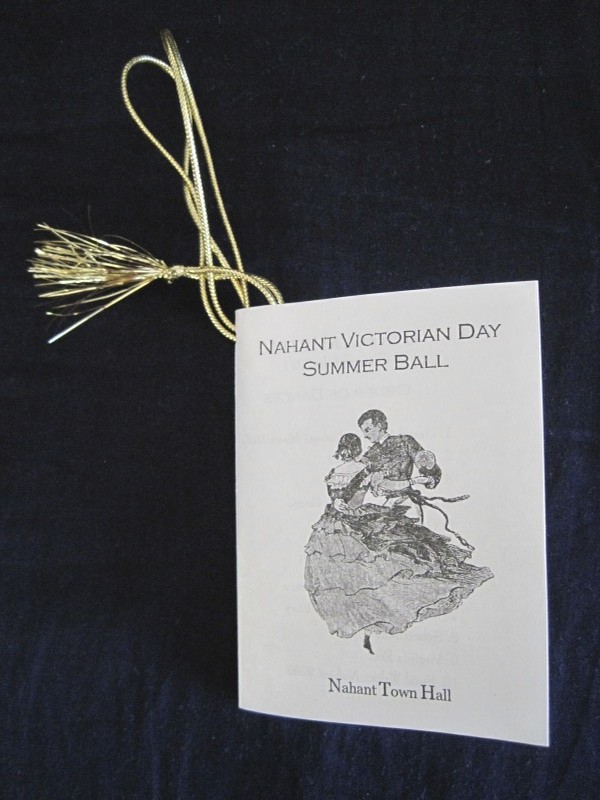
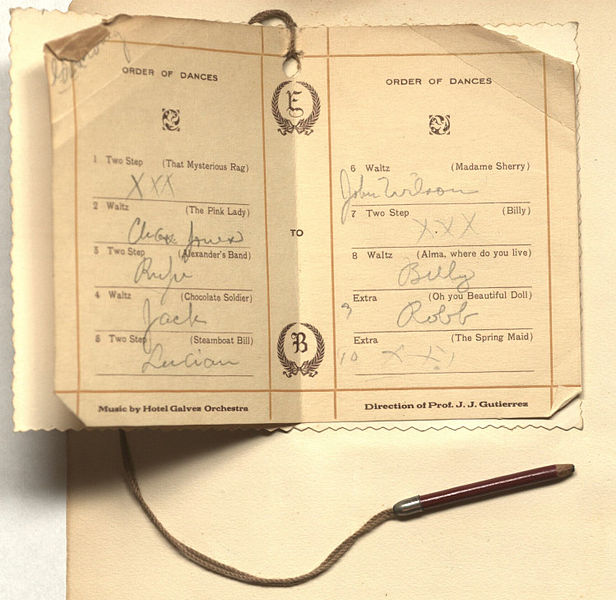
Dance Card from the Nahant Victorian Day Ball 2011

Last post, I shared with you my latest 1860s gown: Annabelle. This gown just recently had its debut at the Nahant Victorian Day Ball hosted by Vintage Victorian.

This ball included the use of dance cards, a practice I am aware of but have never participated in. It turns out that they are much more complicated than one thinks they might be! Why are the so complicated?

Well, it all sounds quite glorious and sophisticated. The Oxford English Dictionary defines a “dance-card” as “a card bearing the names of (a woman’s) prospective dance partners at a dance.” In stories and books, a dance card is a memento one can keep so that after the ball is over she can muse about beaus and flirtations. Practically, a dance card might help a person remember who his or her next partner is, what kind of dance the next dance is, or allow a gentleman to ask for a dance later in the evening.

But wait! There are complications and confusions! Does everyone have a dance card, men and women? Does a person take off his or her gloves before writing in a dance card? (I attempted this both ways: it is quite challenging to write your name while wearing gloves…) Does one exchange dance cards with a prospective partner or ask the name of the person and write it herself? (It seems more effective to swap dance cards with your intended partner to allow for ease of spelling, etc. and, in a more romantic sense, so that you have that person’s handwriting in your dance card.) How does one attach the card to her wrist so that it doesn’t get lost? How does one attach the card to her wrist without the pencil sticking out (so that her white dress isn’t marked!)? Really, a lot of questions popped up that would not have made themselves apparent without practical application. Also, at least at this ball, not having a prearranged partner did not necessarily mean that you were not able to dance. I was able to dance most of the dances of the night, despite my somewhat empty dance card.

Interior of my Dance Card from the Nahant VIctorian Day Ball 2011

Below you can see a few historic dance card images and below that some images of the ball! If anyone has any research on the use or history of dance cards, please share. I’d love to learn more about the etiquette of dance card use!

1884 Dance Card
1912 Dance Card
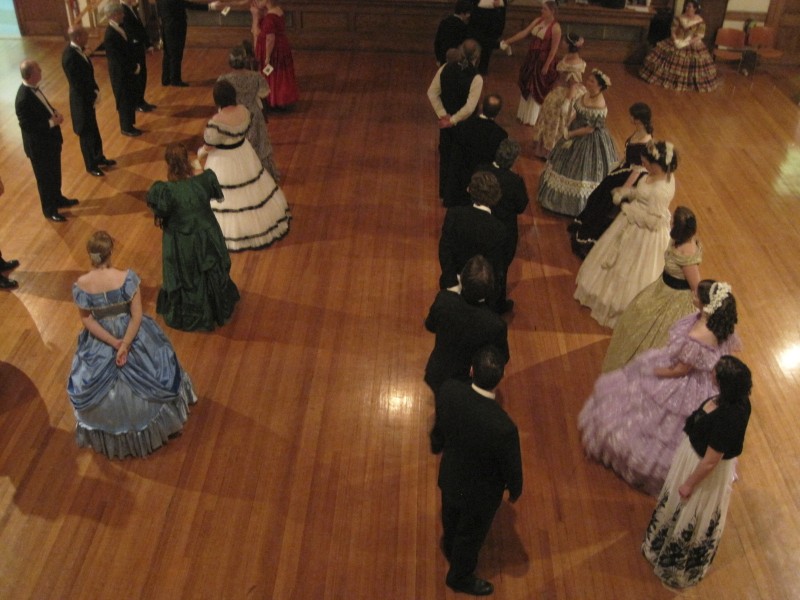
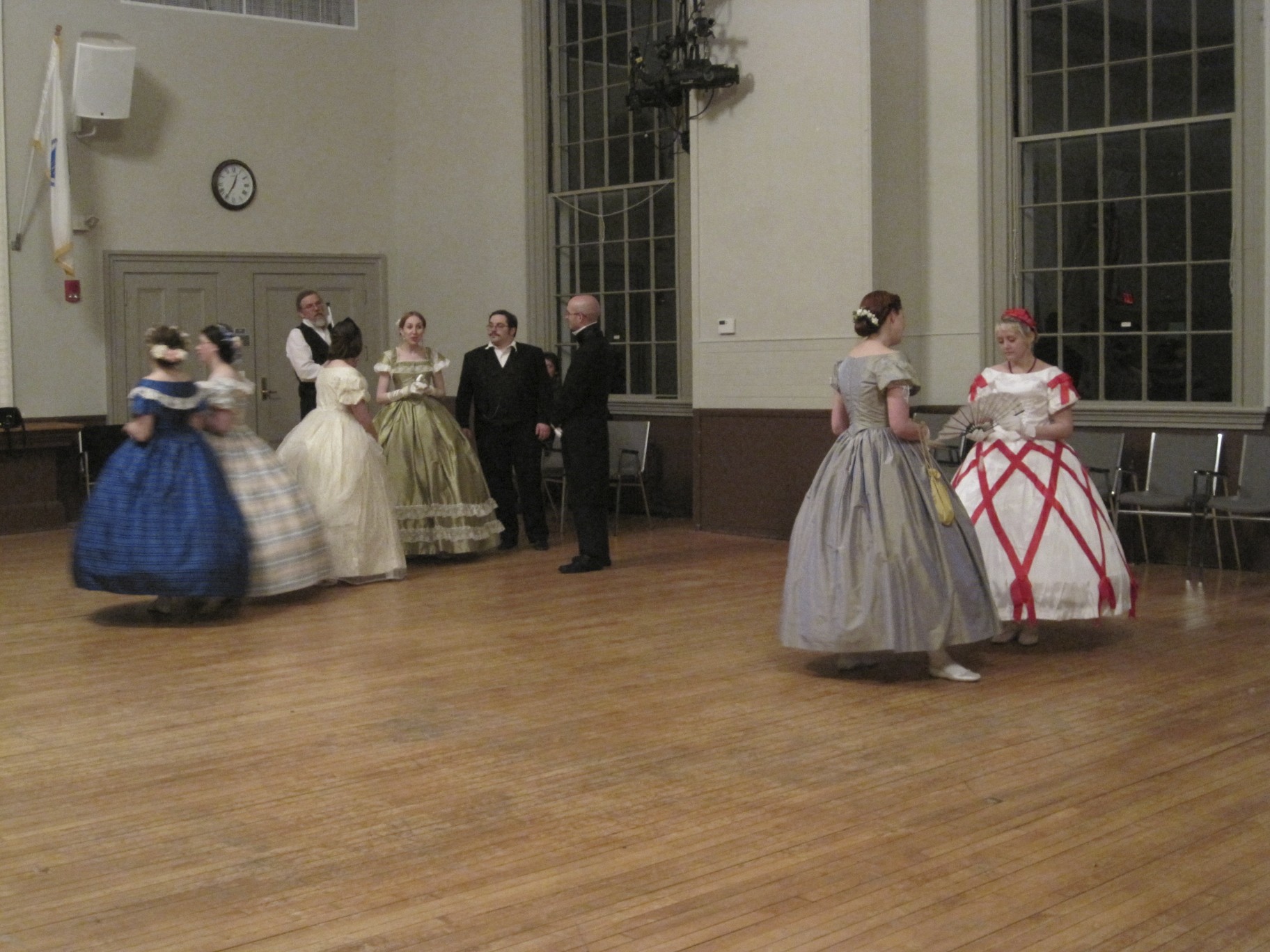
I believe this dance is the Contradance: Hull's Victory. (Nahant Victorian Day Ball 2011)
A different view of the same dance as above.
The Grand March. (Nahant Victorian Day Ball 2011)
More Grand March.

Here’s a video of the Grand March in action!

Bolero jackets of the 20th century: 1900-1909

A few posts ago, we took a look at Bolero jackets from the mid-19th century. Let’s look at them  in another context: Boleros from the early 20th century, with a hint of information from the 1890s as well.

1904 Dress with Bolero

What exactly is a Bolero jacket? The Oxford English Dictionary defines it as “A short jacket, coming barely to the waist; worn by men in Spain; applied to a similar garment worn  by women elsewhere, usually over a blouse or bodice.” This definition condenses the influence and origination of the Bolero down quite eloquently (of course, it is the job of the OED to eloquently distill all words down to a concise definition… but still, I do like this definition). The men’s style Spanish Bolero, with elaborate braiding and bright colors, influenced the style of women’s Boleros from the Victorian period. The following quotes from the OED provide more insight into the history of the Bolero (they also mention other styles of short jackets including the Zouave and the Eton).

“1892    Daily News 14 Nov. 6/3   The Zouave is as great a favourite as it has been for some seasons, and though it varies in form—being sometimes a bolero, sometimes a toreador, and sometimes a cross between an Eton jacket and a Zouave.
1893    Daily News 1 Apr. 2/4   The Zouave is quite as popular as it was last year.‥ Sometimes it is pure bolero.
1893    Lady 17 Aug. 178/1   Zouave Bodices are a feature of autumn gowns. (in the Zouave definition)
1899    Westm. Gaz. 6 July 3/2   Robbing the coat of its basque has created‥the bolero corsage, really an actual bodice, though appearing a bolero coat and skirt.”

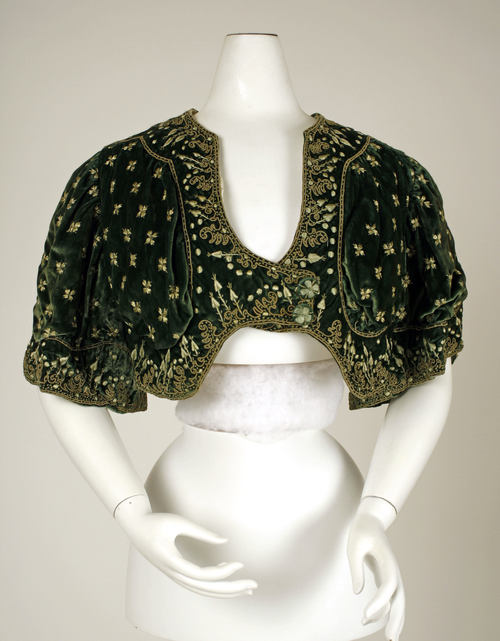
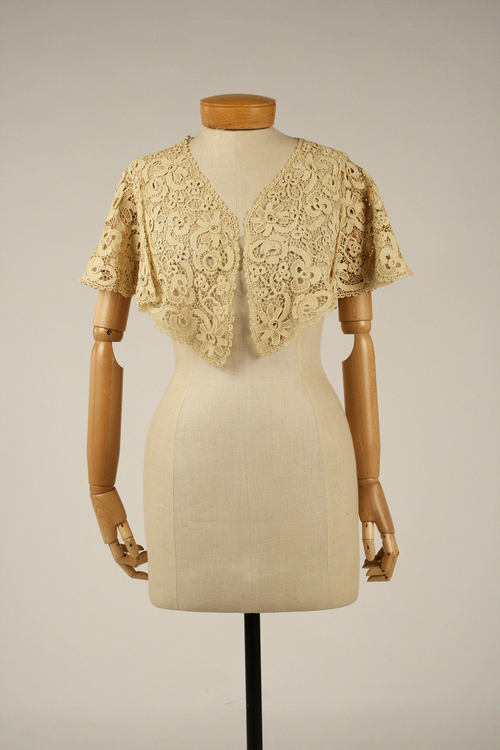
The flared skirt and small waist silhouette of women’s clothing during the first decade of the 20th century was well suited to the style of Bolero jackets, as they could help to visually balance the figure by adding just a small amount of width across the chest and shoulders.  Here are a few Boleros from the Metropolitan Museum of Art. One is silk velvet, elaborately trimmed. The other is lace. Can you imagine the dresses that would have accompanied these Boleros? Clearly, they were intended for different purposes. Perhaps the first was intended for evening wear and the second for an afternoon stroll or visiting friends?

c. 1905 Bolero from the Metropolitan Museum of Art
c. 1907 Bolero from the Metropolitan Museum of Art

A waltzing Zouave?

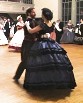
In my last post (Returning Heroes 1860s Ball 2011) I mentioned that one of my favorite moments of the night was dancing a waltz with a Zouave. First of all, what is a Zouave? Secondly, why would I be dancing a waltz with one at at 1860s ball???

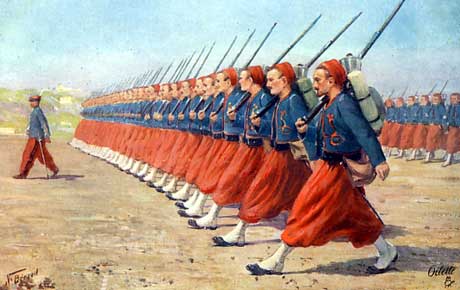
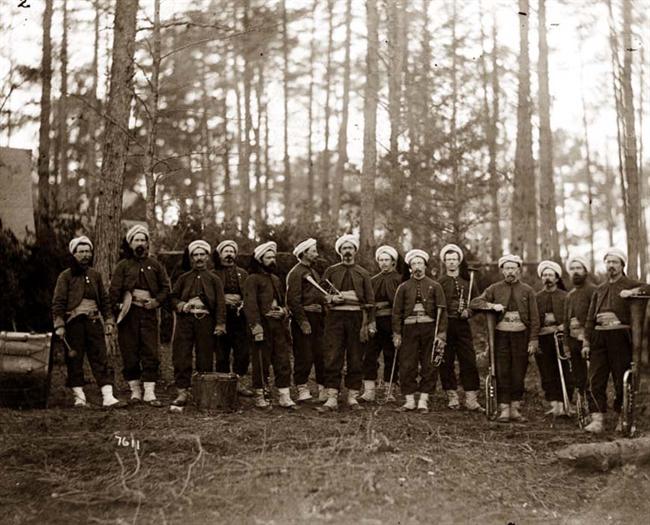
In the 1830s, the French military fighting in North Africa incorporated a tribe of fierce fighters into their ranks. These original soliders were renowned for their skills. In fact, in 1852 the French created three units of Zouaves to be entirely of Frenchmen. These French Zouaves achieved legendary status for themselves during the Crimean War (1854-1855). More detailed information about their involvement can be found in this history of Zouaves (this site also has some great pictures of Zouave regiments). The French Zouaves were quite inspirational to American forces during the American Civil War: both the Confederate and Union armies formed Zouave regiments who wore imitations of the French uniforms.

114th Pennsylvania Infantry (1861-1865)
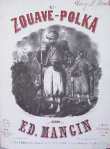
Zouave Music Sheet 1850-1865

Now we know what a Zouave is. Why would I be dancing with one? Well, the idea of the Returning Heroes Ball is that “Gentlemen in uniforms of both sides of that great conflict are welcome.” So it is perfectly reasonable for a Zouave be dancing alongside the formally clothed men at the ball. Fun!

Returning Heroes 1860s Ball 2011

I was reminiscing recently and realized that I neglected to post about the Returning Heroes Ball hosted by the Commonwealth Vintage Dancers in March 2011! I had such a fantastic evening that I decided that late is better than never!

I have been dreaming of being in a room full of people all wearing crinolines and period menswear for years: the 1860s are my most favorite period! The night started out with all the ladies helping each other get dressed: lacing corsets, donning hoops and petticoats, fluffing skirts,  and securing bodices. Of course, it does take some time to get dressed, so while we were dressing the band was warming up and the men were standing around looking important and discussing… well, who knows what?

We were supposed to be using dance cards, but I was disappointed in that part of my dream as we wound up not using the dance cards that had been prepared. But that didn’t dampen my spirits for more than a minute or two, because the band started playing and we began to dance!

I have two favorite moments from the night: 1- dancing the Grand March in which every lady was wearing hoops (there was a lot of friction as well all spiraled around each other), the best part of which was joining in lines and progressing down the hall to “Dixie” and 2- dancing a waltz with a Zouave (see picture left).

Here’s a few more pictures (I should have taken more, but I was busy dancing!). I’ll just end with this video from the Returning Heroes Ball in 2007. It starts with a Grand March and starting at about 60 seconds “Dixie” is playing! Enjoy!

Project Journal: Victorian Women’s Tailoring Part VI: Fitting 1903 Garments

Well, if you remember from a few posts ago, I completed my mockup undergarments and exterior garments for this 1903 look in muslin (the same fabric I used for the 1883 and 1913 mockups). But now I’ve completed first fittings for my garments in their actual fabrics!

Let’s start at the outside and work our way in. The exterior “suit” is two pieces: a jacket and walking skirt. Both layers are constructed of fairly heavy wool, so tightly woven it is almost like melton. Melton is a felted wool frequently used for outerwear and constantly used historically for it’s water resistance and ability not to fray–thus allowing tailors to leave their cut edges raw and not finish them with time intensive seam finishes. The walking skirt is intended for use out of doors: specifically for talking walks (hence the name) and promenading about in the public eye.

Under the jacket is a silk crepe blouse with a lace yoke, collar, and cuffs. If you look closely you can see the three points of the lace yoke on the blouse. The blouse is pulled off-center in this picture because of the alterations I needed to make-only one side has the alterations pinned.

Under the skirt there is a cream colored lace edged silk shantung petticoat. The petticoat has two circular, gathered ruffles at the bottom. The top ruffle has a wavy hem edged in lace and the bottom ruffle is edged in matching lace. There are also arches of lace above the ruffles.

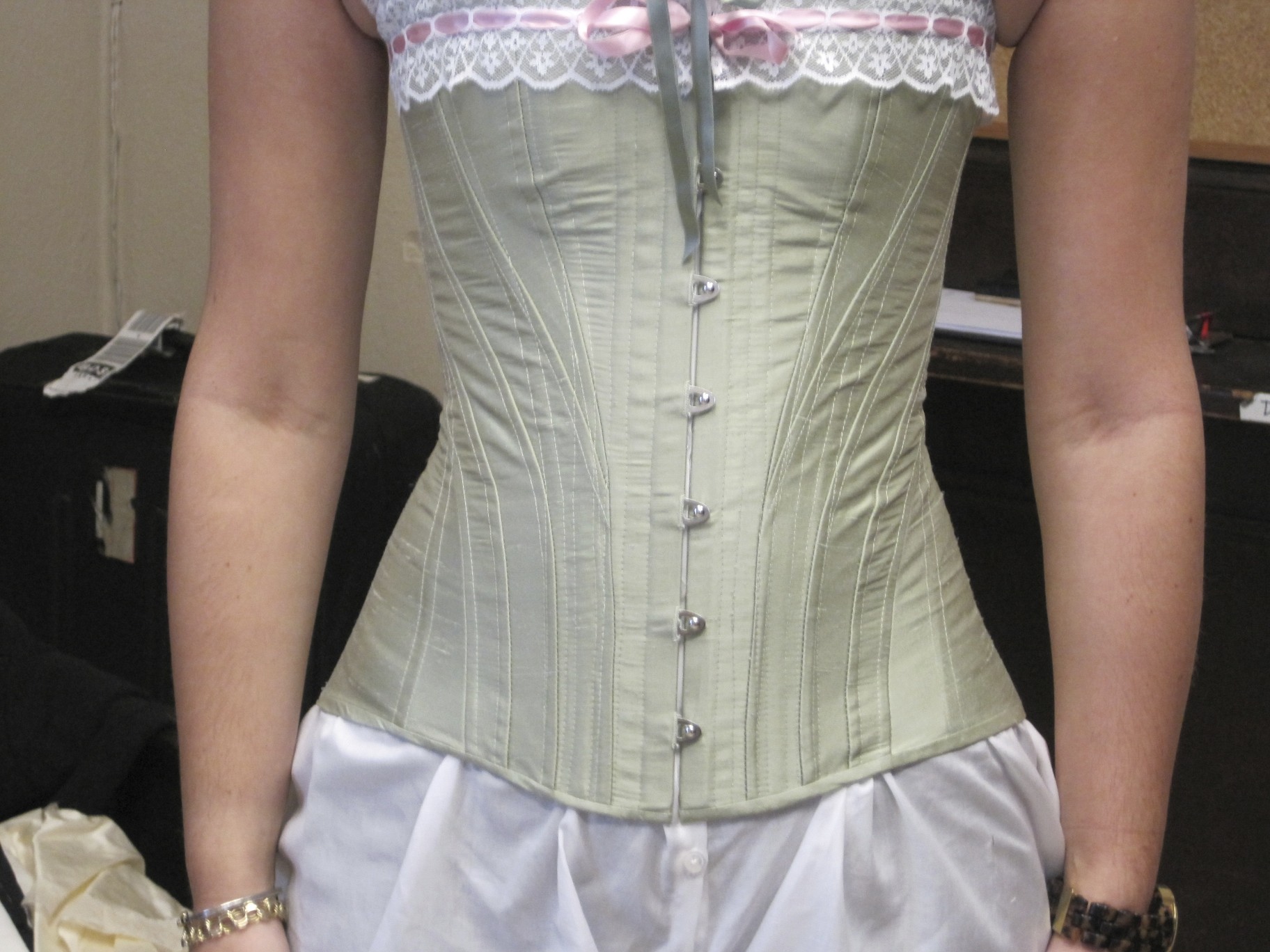
There is also a cream colored corset cover that is not pictured in these photos. This s-shape corset is made of green silk shantung flat lined with coutil. The seams are flat felled on the inside. The edges are bound in bias cut shantung and the top is also edged with white lace threaded with pink silk ribbon. Under the corset is a cotton combination that buttons up the front. A combination is an undergarment that is functions as a chemise but has bifurcated leg openings, like drawers. This pair is edged in white lace at the leg openings and neck edge. The neck opening is threaded with a green silk ribbon to coordinate with the corset.

The 14 hour Regency dress (Sense and Sensibility Regency Ball 2011)

I’d decided months ago to attend  the Dancing with the Dashwoods (Jane Austen period) Ball recently hosted by the Commonwealth Vintage Dancers; however, I was in a sticky spot about what to wear! I did not have a dress appropriate to the period of this ball and I really needed to focus on my tailoring project… what to do?!?

Well, I decided to spend just one day making a cotton Regency dress. I quickly adapted a pattern from Norah Waugh’s The Cut of Women’s Clothes: 1600-1930 to my size and decided to forgo the mockup step. Cutting out the fabric is my least favorite part of making garments, so I tried to make that part go as quickly as possible.

In an effort to simplify things, I included two petticoat layers in the dress itself and decided not to worry about finishing my seams on the inside. The bodice also has two extra layers inside of it to keep it opaque. Each piece (of three layers) was treated as one piece when I went to sew it.

All in all, the basic seams went quickly. What slowed me down and took about a third of my time on the dress were the finishing steps of completing the neck trim and putting closures on the back. The trim took a fair amount of time to pin, stitch, and thread through the ribbon loops, and the hook and thread loop closures took time because it was getting late at that point…

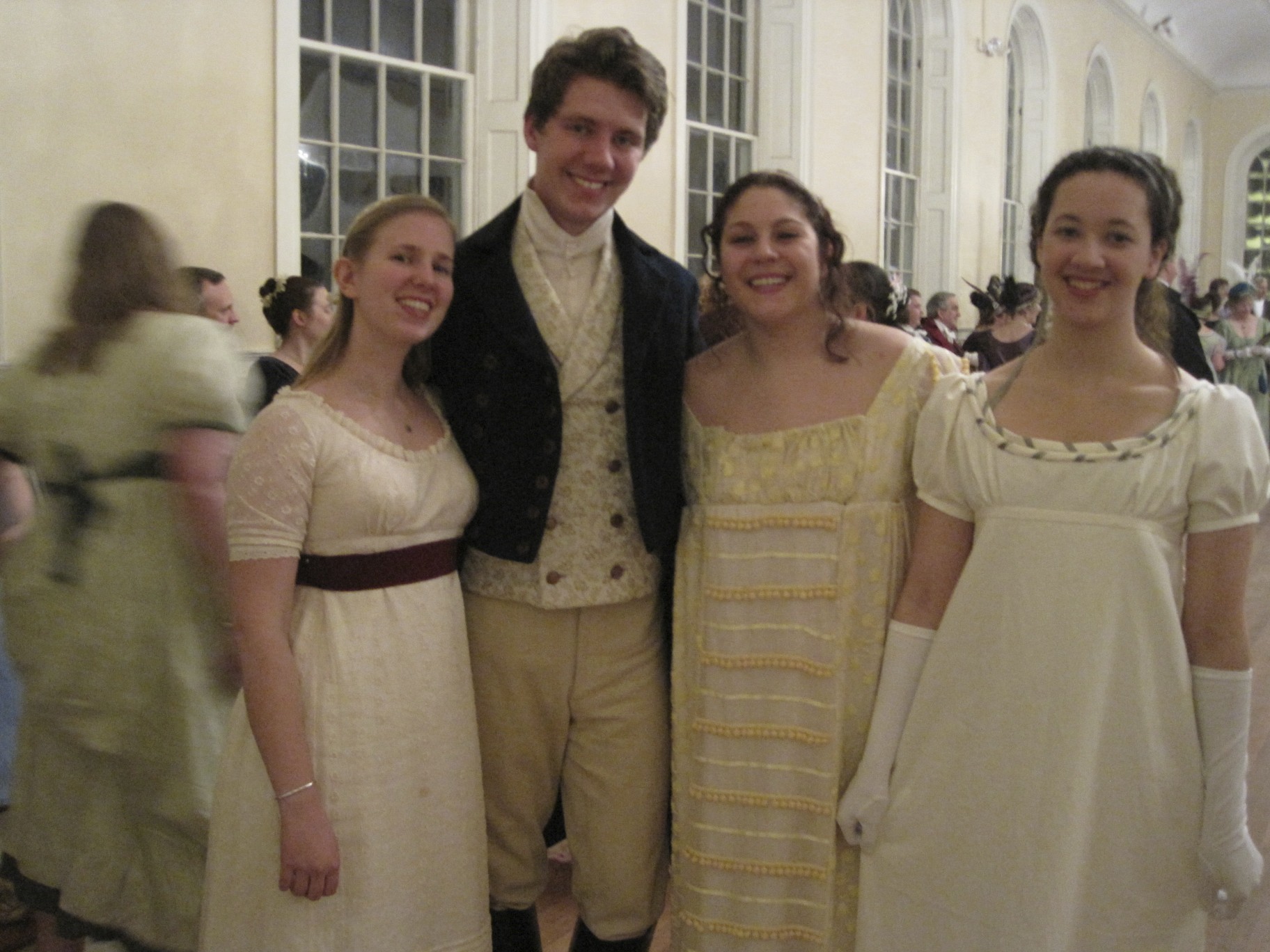
Fast-forward to the ball! I had the good fortune to be able to bring along friends as well! It was crowded but super fun to dance in period costume and a period hall! Enjoy the photos!

Project Journal: Victorian Women’s Tailoring Part I: Overview

My current historic sewing project is reproducing three tailor-made garments and their undergarments from the end of the 19th century. The project aims to show the development of women’s tailoring from the 1880s to the 1910s–essentially the turning point between a tailored dress and a suit.

Look 1: 1883.

This garment is characterized by its bustle. The bustle goes in and out of use, changing shape and size, throughout the 1870s and 1880s. In 1883 the bustle is at a point where I call it the “shelf bustle,” extending from the back at an almost ninety degree angle once being covered by the voluminous skirt layers. During the 1880s, in particular, “tailor-made” garments were fashionable, but these were essentially dresses, not suits.

Look 2: 1903.

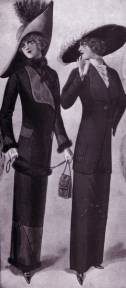
This garment is characterized by its romantic figure, featuring “pigeon breast” blousing and gracefully flaring skirts. The foundation of this shape is the new corset design introduced at the turn of the century, augmented by extra padding at the bust and rear. Tailored looks of this period separated jackets from skirts, but still these do not qualify as suits.

Look 3: 1913.

This garment stands between the corseted Victorian woman of the 19th century and the independent, working woman of the 20th century. Just a few years after this the rigid corset disappears in favor of new, lighter undergarments such as brassieres, knickers, camisoles, and girdles. Clearly, this garment is a suit, not a dress, but its undergarments remain in the past where dresses, not suits, were what women wore.

More journal entries will be coming with more information about each look as well as updates on the actual construction of these garments. Stay tuned!

Sources of Images:

1883. http://www.digitalchangeling.com/sewing/periodResources/Delineator-July1883/

1903. http://people.virginia.edu/~sfr/enam312/fashindx.html

1913. http://www2.uvm.edu/landscape/dating/clothing_and_hair/1910s_clothing_women.php

“Belle” of the ball (Fezziwig’s Ball 2010)

My first large sewing project for myself was, fittingly, an 1860s gown nick-named “Belle.” (This is the full story of Belle.) Owning a gown like this was a childhood fantasy for me, ever since my first days of loving Gone With The Wind. I finished construction of this gown about four years ago and since then I’ve lovingly stored it and its accompanying undergarments and hoops in my closet, alongside all my modern clothes.

I’ve been hoping for an opportunity to wear Belle for the last four years, not only to give a purpose to the dress I so lovingly created, but also to see how it feels to wear it for a hours at a time. I just recently attended an event called Fezziwig’s Ball, which was presented by the Commonwealth Vintage Dancers in Salem, Massachusetts. I was able to sing Christmas carols, dance, and have a real experience wearing Belle–and I was in the company of others who not only appreciated my hard work, but who had also worked hard to create and wear their own 1860s dresses!

I learned a vast amount of small details about the practicalities (or hindrances) of wearing 1860s clothing. For example, I understand now why vintage dances from this period turn constantly in the same direction: because your hoops gain so much momentum that they can only sustain fast, continuous movement in one direction, not changing directions. That particular sensation was just not as clear when I was practicing dancing in modern pants or knee length skirts. Also, I have  much clearer idea of why women would faint so often. Imagine dancing fast for four minutes in modern clothes, but then imagine doing the same amount of movement while laced into a corset! I felt faint after four minutes of fast dancing, and my corset wasn’t laced nearly as tightly as ladies would have been laced in the 1860s.

I had so much fun learning first hand and am quite sure I have more lessons in store for me in the future! I’m eagerly awaiting the next 1860s themed ball to be presented in March 2011 by the Commonwealth Vintage Dancers, the Returning Heroes Ball, a specifically 1860s Grand Ball.

My favorite period-the 1860s

Hoop skirts and crinolines make me so excited I get the wiggles. I was in ninth grade the first time I read Gone With The Wind. Scarlett O’Hara, while being a debatably lovable character in my mind, has inspired my absolute love of the 1860s, crinolines, hoops, and costume history ever since that first time I read the book. It only took once.

Years later, I am fascinated by costume, material, and social history. I get excited about the entire 19th century–but the only period that really gives me the wiggles remains the 1860s. There’s just something about women resembling giant moving cupcakes that is fascinating and inspiring.

There is something very dreamy about imagining the world these huge constructions moved through. The world had to adapt to these gowns: chairs for ladies had no arms and doors were wider to accommodate their skirts. Can you imagine wearing clothing five feet across? That’s two feet too wide to fit through a modern door! How does a person cope with that all day every day? Sometimes I can envision it and sometimes it just seems impossible. But these questions just remind me that THIS is why the 1860s are particularly fascinating to me.

Gone With The Wind is definitely a controversial story. I found this report to be an interesting and factual discussion of its merits and faults. It clearly states why it is such a classic story and how it glosses over reality. This blog also has an interesting post about Gone With The Wind, discussing if it is a “great American novel.”

As a side note, I love both the book and movie versions of Gone With The Wind. While both are moving, sweeping epics, the book has much more depth and character exploration than the movie. Thus, I encourage you to read Gone With The Wind for yourself and to be inspired by history and by skirts with a circumference of 124″!

I just love historic clothes!

c.1900 Dress

Here is my first question to both of us (you, the reader, and myself!): what is this blog all about?

Clothes. Specifically, historic clothes–clothes that were worn in the past. I am most passionate about clothes in Europe and America from about 1800-1940, but really I just love clothes. Underclothes, outer clothes, outerwear, accessories, shoes… Clothes. The articles we put on our bodies to cover up and adorn ourselves.

I know there are those of you who share my love of clothes–studying clothes, conserving clothes, designing clothes, making clothes, collecting clothes, or maybe just wearing clothes! I want to find you and share my thoughts with you. I want to hear your thoughts. I want us to encourage each other in our passions (and probably bursting closets!).

I want to explore what we wore and how those articles were made, how and why we wore the clothes we did, and maybe even what we might wear in the future.

So then, why are you passionate about clothes?