Vernet Project: Silly Shoes

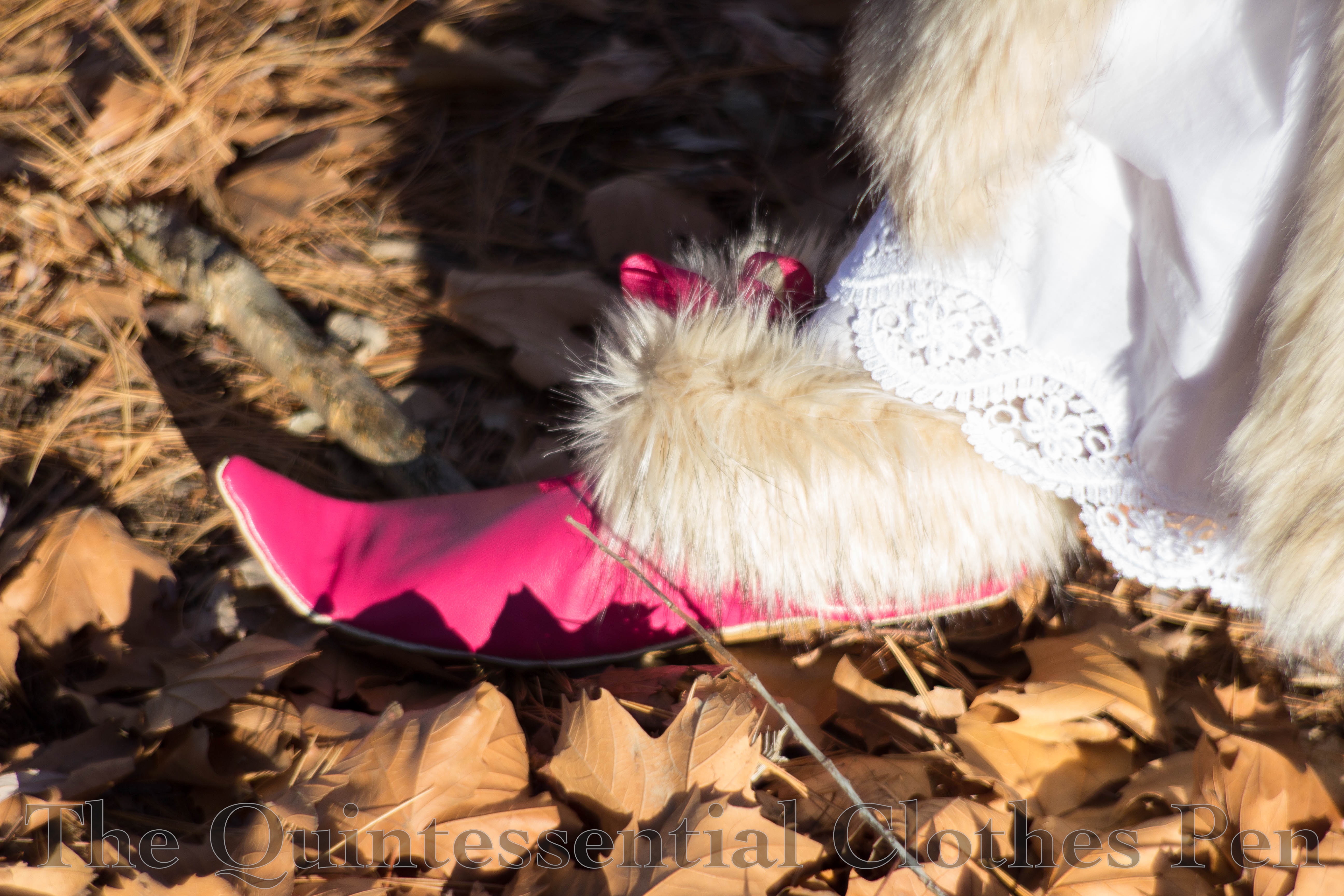
One of the five pieces of my Vernet Project was creating the silly up-turned-toe elf shoes in the fashion plate. Clearly, these are not shoes that could be purchased, as they are so specific in style, so I set out to make my own!
IMG_1920 (1)

In the beginning, I was thankful to have another Vernet project maker’s experience making her boots before mine to work from. Jenni posted a two part tutorial showing how she made her boots as well as sharing information behind-the-scenes with project participants earlier in the process (Part 1 and Part 2). She closely referenced Every Lady Her Own Shoemaker, published in 1855 (a little late relative to the date of the project, but still useful for construction advice), for construction methods and carefully documented her process. In fact, she did a much better job at documenting the actual sewing than I did… I also read Anna’s information about making mid-19th century shoes multiple times to help get my mind acquainted with the project (again, a little later than the period of the project, but still helpful). She also has lots of great construction pictures.

I started by creating a pattern for my shoe using patterns in Every Lady Her Own Shoemaker. Given that my shoe has the unusual turned-up-toe, I necessarily needed to make adjustments to the general slipper pattern. Here is my shoe at the mockup stage. The upper pieces fit pretty well! I adjusted the width of the sole as well as the shape of the turned-up section before moving on to cut out the final pieces.

Mockups.001

Here are all of the final pieces cut out and ready to assemble. The soles have three layers: heavier tan leather for the outer sole, cardboard for the inner sole structure, and white linen to cover the cardboard insole. The uppers have two layers: lightweight raspberry leather for the exterior and white linen for the interior. Later in the process I also added a faux fur cuff.

IMG_0239 (1)

To help the shoes keep their turned-up-toe shape I soaked the leather soles in water, taped them to a lysol wipe container, and let them dry. You can see the results below. Not perfectly curved up, but still helpful. I also tried boiling leather soles to thicken them before shaping, but found that the leather shrank unevenly which created soles that wouldn’t work for this project. I did save them, though, and hopefully will get to use them for a future shoe making endeavor. I repeated the soaking and shaping for the cardboard insoles before gluing the linen to them. There’s a picture of the insoles at this stage in this past post.

Soles in progress.001

After shaping the soles it was time to construct the uppers. I did the interior and exterior separately, then basted them together around the top opening and around the bottoms. Then I sewed the bottom edges of the uppers to the soles, using the slanting stitch through the side of the sole that Jenni shows in Part 2 of her tutorial. She used all sorts of nifty leather tools as well as a wooden last during construction. I purchased the nifty leather tools but found that they didn’t work for me and a simple non-leather needle worked just fine. (I think my leather was too thin and soft for these to be needed). As for the last, I looked online for a wooden one, never found one in my size foot, and eventually decided to give it a go without one, especially since I had to do the turned-up toe. In the end, I don’t think it was a problem not to have a last.

IMG_2253 (1)

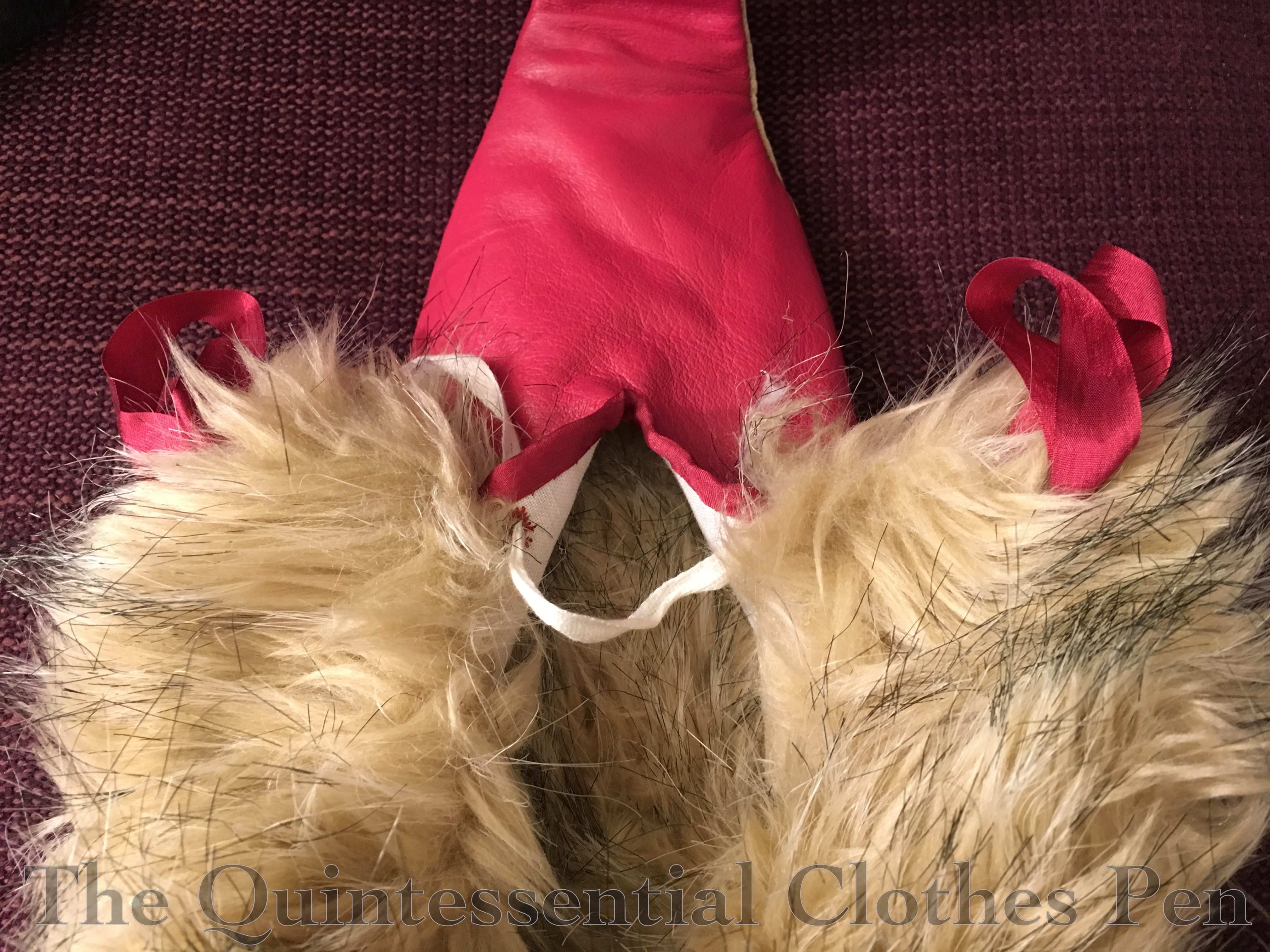
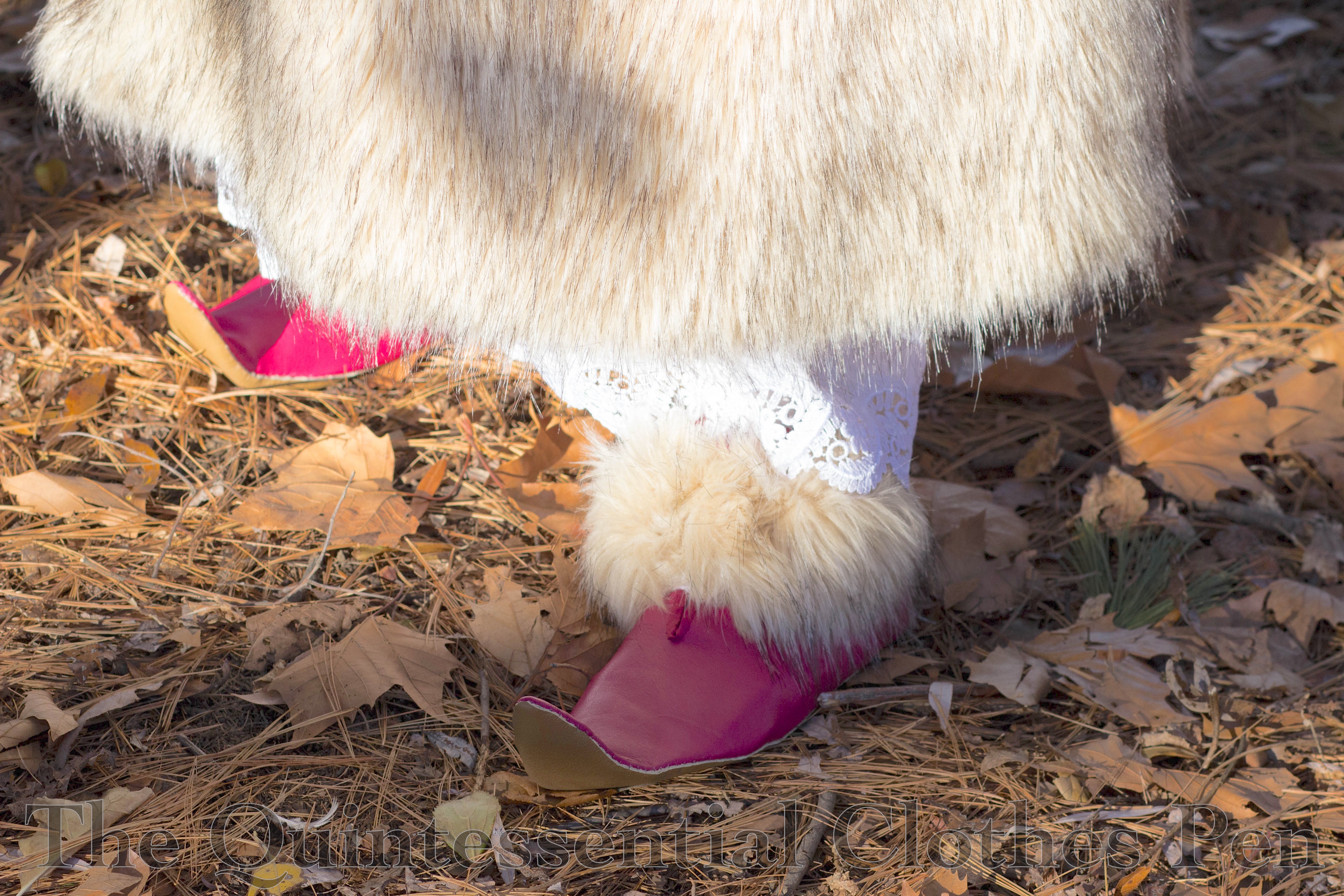
Once the soles were attached, I bound the front slit with matching silk ribbon. Then I cut a piece of faux fur for each shoe that went around just the top of the foot opening and could double over on itself. There are non-functional silk ribbon loops that are sewn to the front of the fur that encases the top edge of the shoe. The shoes actually close with a twill tape threaded through hand sewn eyelets on each side of the opening.
IMG_1684

They’re actually quite comfortable for walking around in. I have very flat feet, so don’t really need arch support to be comfortable. The only thing is that my feet did get cold during our photoshoot due to the freezing ground only separated from my feet by a few thin layers of fabric. So, for the second wearing, while caroling at Christmastime, I added a faux fur insole. Problem solved! They were toasty and even more comfortable!
IMG_1884 - Version 2

Interestingly, witzchouras are mentioned as being popular in Paris during the year 1827 by La Belle Assembleé, after a mention of other popular pelisses and mantles (well worth checking out!), and are are described as being worn with boots laced in front and with fur around the leg.

335d382370bd68a719024c208ffeff0c

Doesn’t that description sound oddly familiar? It reminds me so very much of the Vernet fashion plate and my silly shoes!
Making Waves In 1925

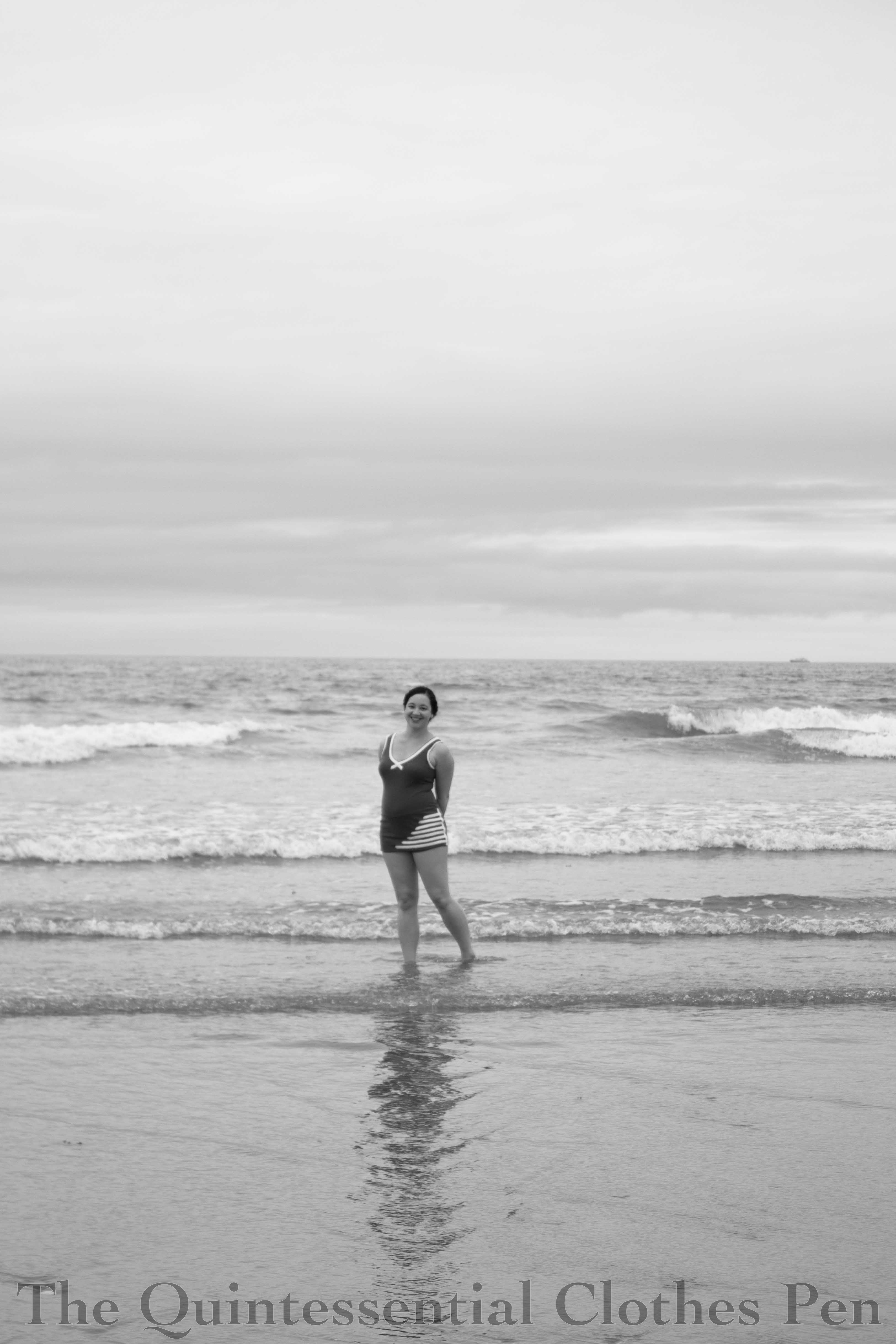
On my to-do list for this summer was a 1920s bathing suit. At first I thought I might knit one, but I wanted a smaller project than that, and also, a friend who hand knit a swimsuit last year reported a fair bit of sagging happening when she wore hers in the water. So I decided to try a different approach and make my suit from wool jersey fabric, a historically accurate option in terms of weave and fiber for a 1920s suit, as far as I can tell from my research.

IMG_2965-2 (1)

After spending lots of time looking at inspirational images on Pinterest and compiling this board of the most inspirational images, I decided on the year 1925, when suits were getting shorter and often sported built in shorts. My main inspiration was this extant suit from 1925 at Abiti Antichi. It’s where my decorative inspiration came from and also justified the visible seam where the shorts attach to the dress. I also referenced this 1920s extant suit at All The Pretty Dresses, which shows interior finishing (serging!) and has narrower straps.

IMG_2929-2 (1)

I knew there was no chance of finding wool jersey at a local fabric store, so I searched around the internet for sources. I believe I found only three–a company in New Zealand, New Zealand Merino and Fabrics, that makes gorgeous colors and sells through their own website and through Etsy; Denver Fabrics, which had wool double knit fabric; and Nature’s Fabrics, which I had never ordered from before, but which had lovely colors. I decided on bottle green from Nature’s Fabrics and vowed to get the whole project out of just one yard.

IMG_2957 (1)

For a pattern, I used a tank top from Old Navy as a starting point since I liked the straps, adding length (and width since my wool jersey was less stretchy than the tank). I cut the dress pieces first, then used the extra bits to cut the shorts.

IMG_1527 (1)

I wanted to use the pattern from my dotty tap pants for the shorts, but I didn’t have it handy, so I pulled out a finished pair of the shorts and used that instead. Unfortunately, I was a few inches shy of being able to cut all four shorts pieces out of my leftover fabric. My solution was to cut the two fronts out and then piece the back pieces with a seam about 4″ below the waist, hoping that it wouldn’t be noticeable in the finished suit. There’s a slight line, but it’s not something I’m worried about, especially since I basically used up all the fabric I had–no adding to the stash on this project!

IMG_2931 (1)

The white trim came from the stash. It’s a lightweight knit terrycloth I bought at JoAnn’s when I first started sewing. I made a robe, but didn’t love it. I did, however, keep it and am happy to have repurposed the fabric.

This would have been a really speedy project if it wasn’t for the trim. I used a serger with four threads to sew/finish the seams all at once, making the construction super speedy (I think I cut and assembled the whole thing in an evening). However, the white lines took a long time to carefully machine sew on and then I still had to bind the arm and neck holes, turning the project into a multi-evening size. The time spent was worth it though, because I love the finished product!

IMG_2937 (1)

I love the images of the bathing suit contests here from the 1920s, in particular this one from 1926. All the bathing beauties are wearing their nice pumps with their bathing suits!

1926-bathing-suit-contest-mem-pd

I didn’t have time to get a sash together, but the bathing beauty look is what I was aiming for in this picture, wearing my American Duchess Seaburys with my swimsuit.

IMG_2831 (1)

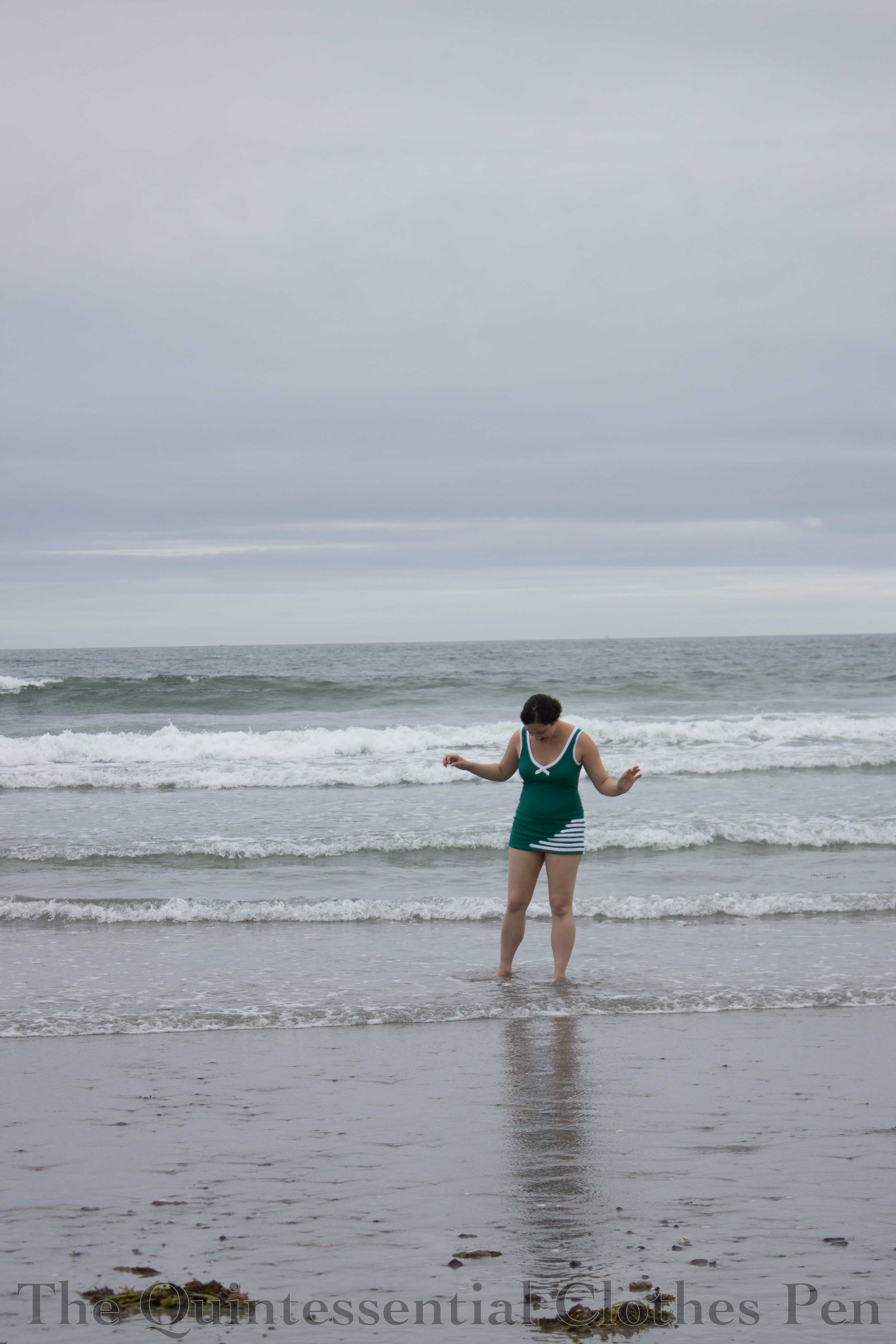
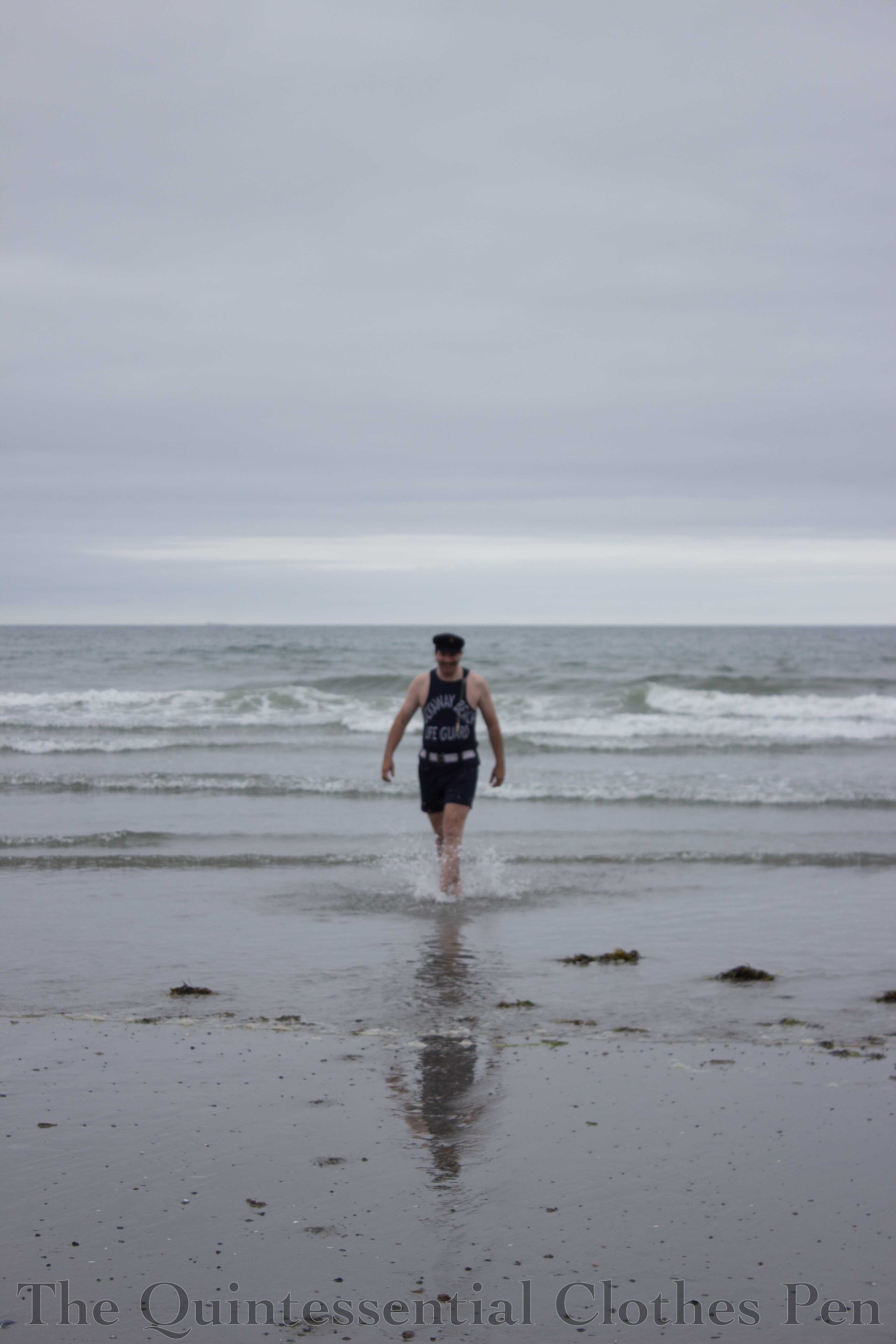
My main goal was to have the suit for an event at the end of August, but it was done in time for a vintage beach outing in July! It was an unusually cold day and therefore the beach was pretty empty, but it meant we had the beach basically to ourselves and got some great pictures!  In August, I’m planning for the whole suit to get wet, so we’ll see how that goes! In the meantime, here are a few more fun pictures from the July beach day.

IMG_2872 (1)

IMG_2991-2 (1)

Project Journal: Versailles Sacque: Construction Details

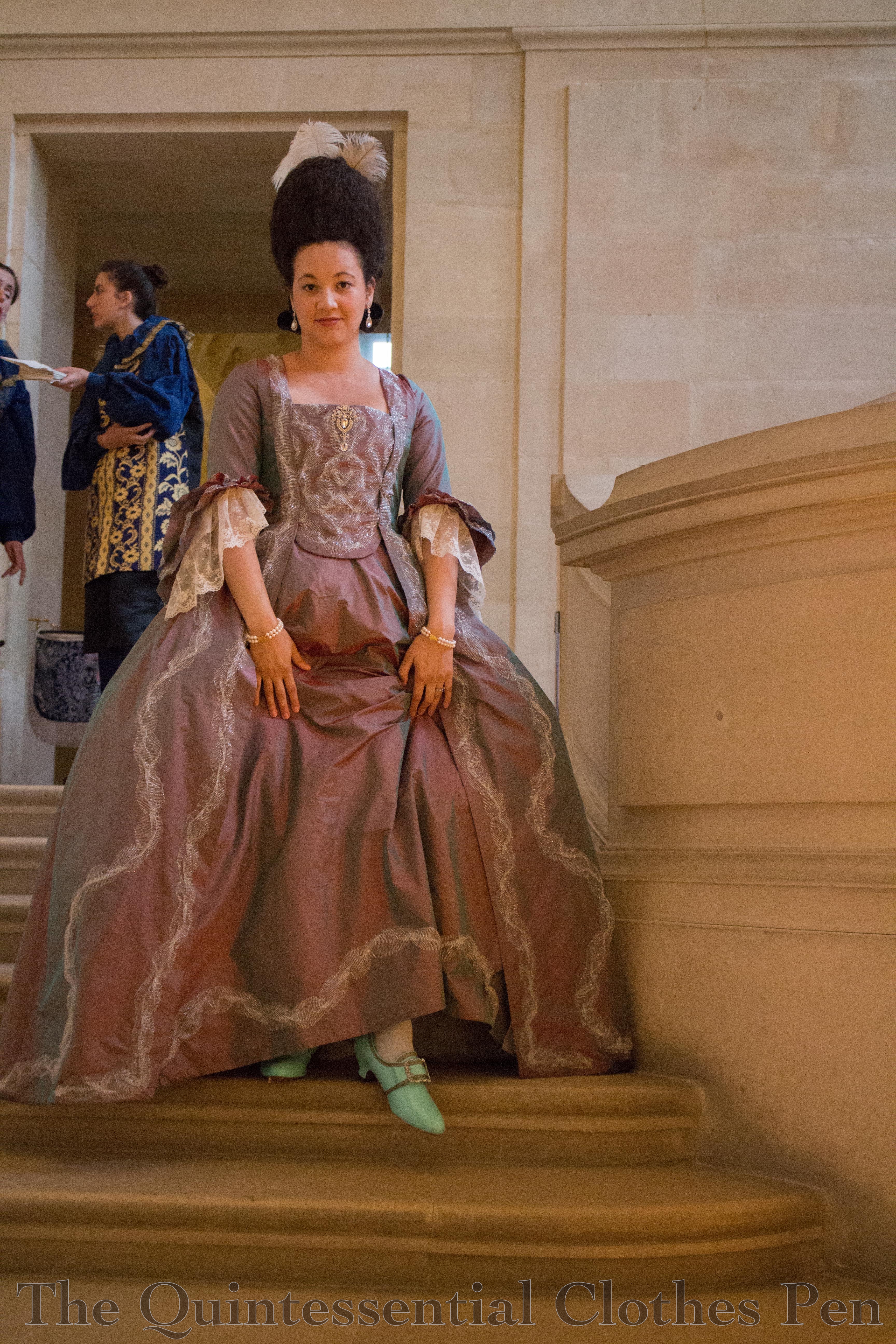
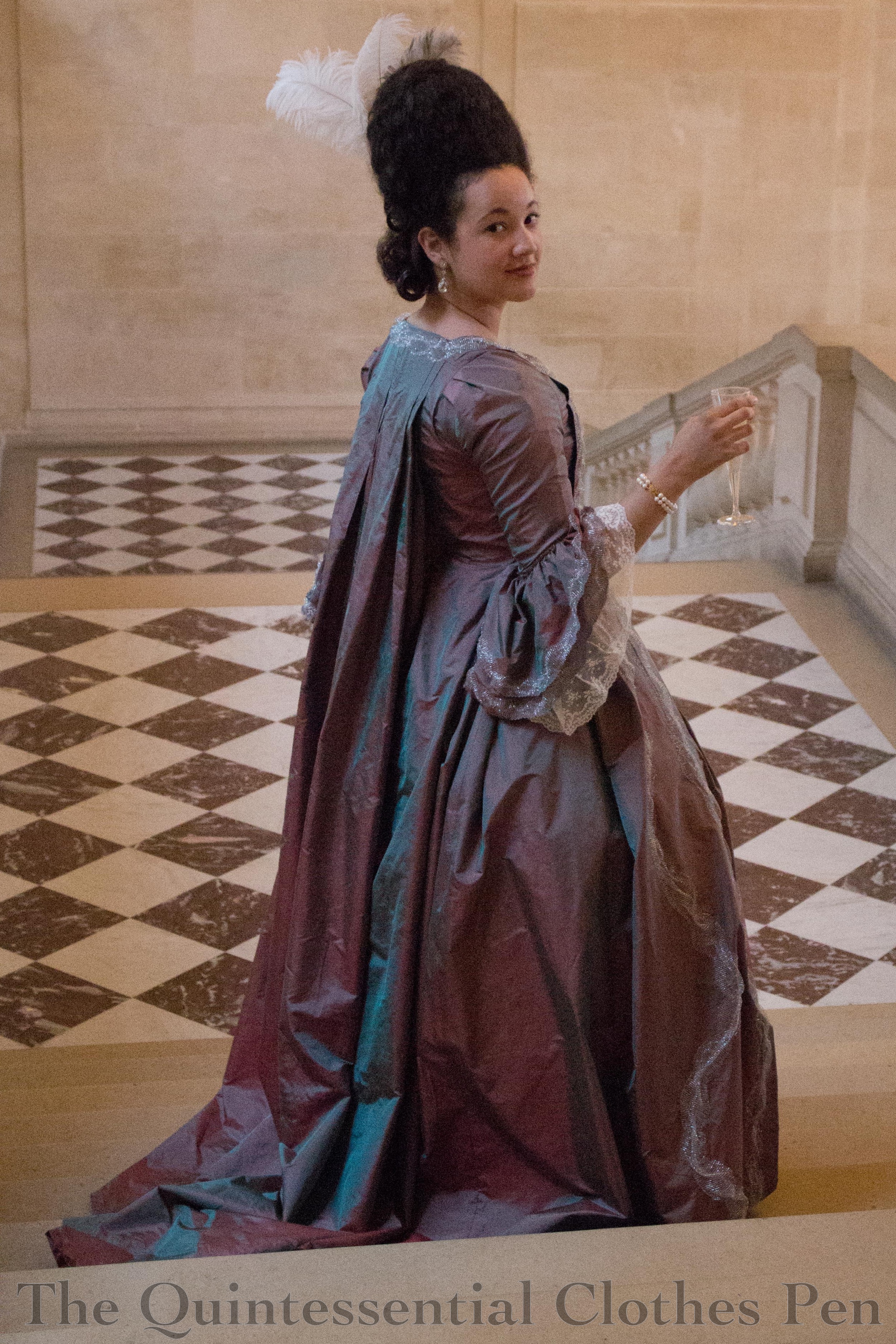
It’s time for some in depth detail about the construction of the robe a la francaise I wore to Versailles in May. My original plan was to use pink silk in my fabric stash to create a robe de cour inspired by Maria Federovna, but I realized when I went to cut out the pieces that I did not have enough fabric.

The change in plan resulted in new fabric and a new plan. I stuck with the decade of the 1770s, but decided to make a robe a la francaise, or sacque, instead of a robe de cour as it seemed like a garment I might be more likely to wear again in the future. Accordingly, I found and ordered new fabric: 11 yards of a very lightweight changeable silk ‘lutestring’ from Burnley and Trowbridge. Luckily, the new fabric still worked with the metallic silver net I’d purchased for trim. It’s the same metallic silver net that is on my 1885 Night Sky Fancy Dress, just cut into strips.

The pattern is from JP Ryan: it’s the Pet en Lair pattern, lengthened to create a gown as they suggest. Underneath I’m wearing a shift, stays, pocketsMr. Panniers, a generic 18th century petticoat, and the petticoat that matches the gown. I also have American Duchess clocked stockings and embellished American Duchess Kensingtons. All my jewelry is from eBay. You can read more about how I created my hairstyle and the hair ornament in this past post.

IMG_0258

Regarding the pattern, I found some of the directions to be confusing. For example, making the petticoat seemed way overcomplicated.   You can read more details about how I made my petticoat here. Also, I found the directions for pleating the front robings/facing and the back pleats quite confusing. There, I was saved by this post written by AJ who also used the JP Ryan pattern, got confused, and posted about the confusing bits. Very helpful! Aside from the confusing directions, the gown pieces went together perfectly with no trouble. I did have to alter the front strap area to make the front sit flat against my body. Two friends who used this same pattern did not have to make that adjustment, so I chalk it up to differing body shapes but do not think it negatively affects the pattern.

IMG_0687 (1)The lining of the gown is made from a one yard piece of cotton/linen blend from my stash. Also from my stash and used inside the gown were a scrap of medium blue linen and a scrap of medium blue cotton twill used to interface the stomacher. These were all the bits left of those three stash fabrics–yay! I was also amused that all of the random non-silk fabrics in this gown and petticoat wound up being blue. I used my lining as my mockup, meaning that I had to take a dart in the front strap area, but was able to adjust the pattern to eliminate the dart before cutting out the silk.

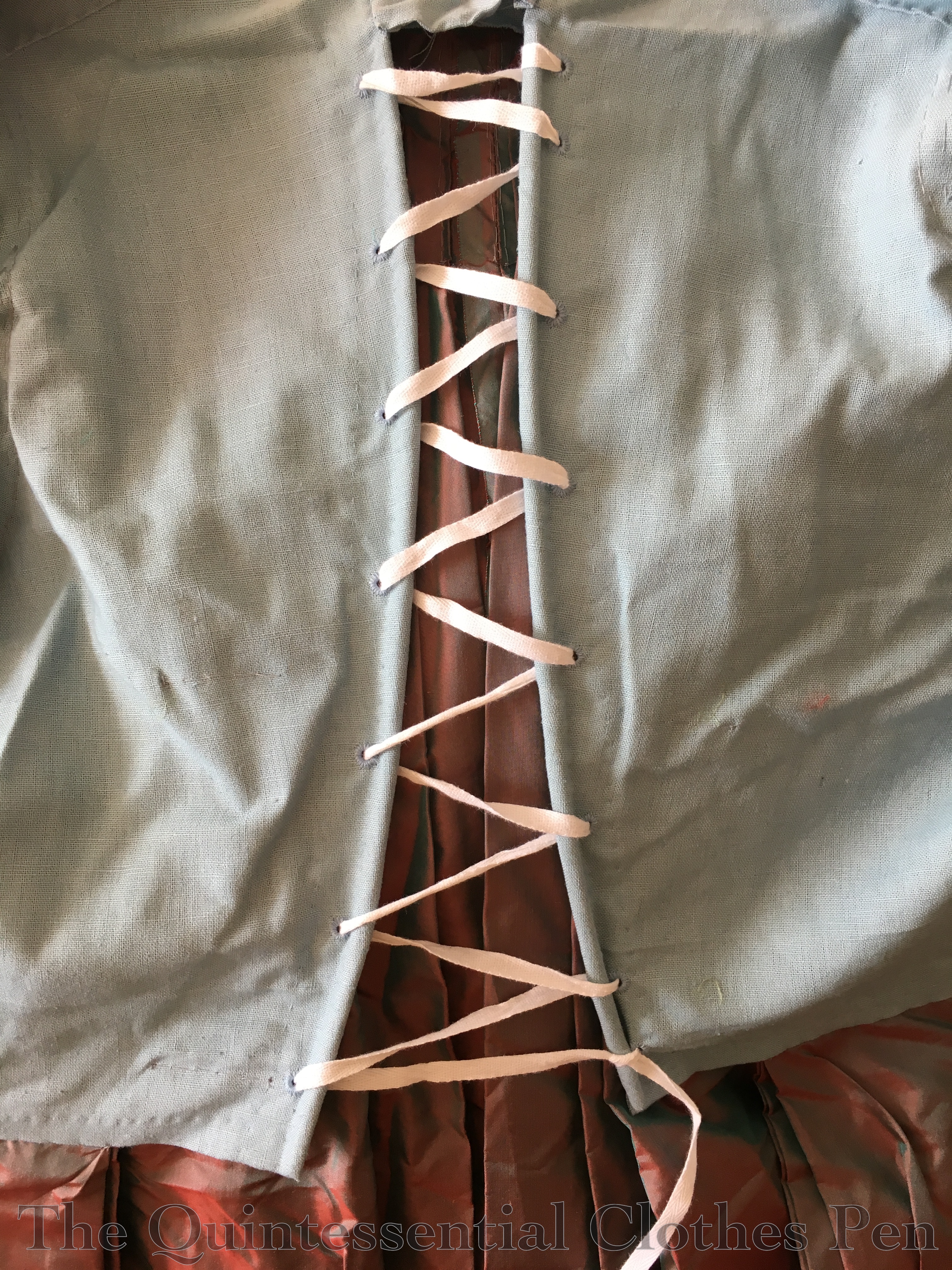
The back of the lining is adjustable using a tie threaded through eyelets. The edges are boned with reed. The pattern suggests ties, but you also see lacing in extant garments and this seemed easier to adjust and that it would use less length for the tie(s). There are examples of both ties and lacing on my Pinterest board for this project. The tie is a 1/4″ cotton twill tape. It’s not accurate, but did the job.

IMG_1476 (1)

Underneath the decorative stomacher, the gown closes with lacing panels attached to the lining. Again, mine laces closed using twill tape.

IMG_1477 (1)

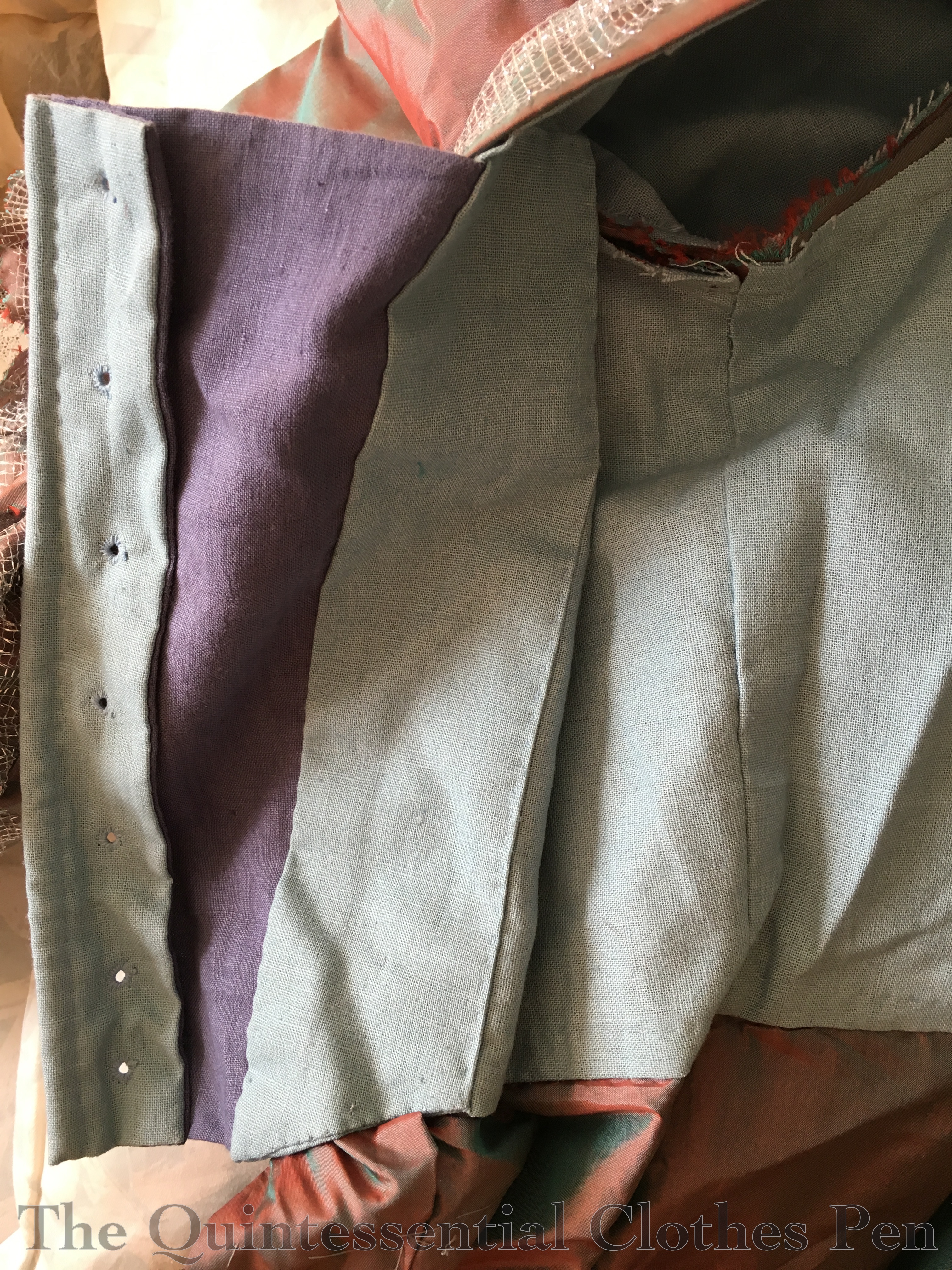
This is the inside of the front lacing panels. You can see the medium blue linen backing. I think I had run out of the cotton/linen blend at that point. As is usual with 18th century garments, the armhole is left unfinished.

IMG_1478 (1)

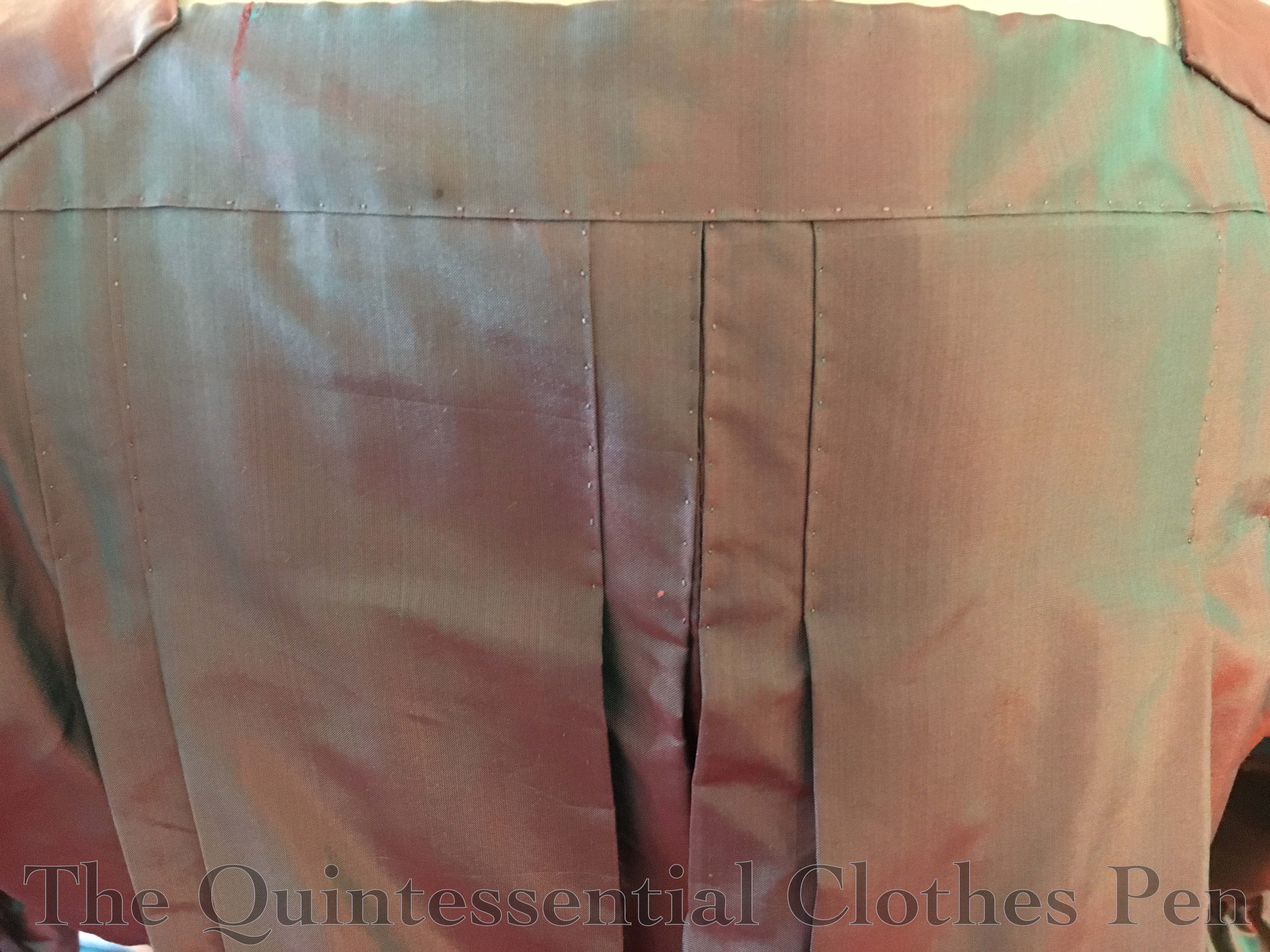
Here’s a close up of the back pleats. These are stitched all the way through to the lining. The directions for the pleats were slightly confusing, but made sense once I started fiddling with my fabric. It was important that I had transferred all the markings from the pattern to make the pleating easier to understand. The pattern uses another four pleats pleats, underneath these, that you can’t see to add volume to the back.

IMG_0922 (1)

IMG_0286 (1)

Due to the unexpected nature of the purchase of the silk fabric for this gown, I decided to do that fabric justice by hand sewing the entire garment. So in addition to the exterior stitching like that anchoring the pleats on the back, all of the interior seams are also hand sewn. I rather enjoy hand sewing and it makes a lot more sense given the way 18th century garments were constructed.

Here is the gown mostly sewn in its essential elements, but lacking trim. The sleeve flounces were individually gathered and sewn to the arm openings. They are pinked with scalloped shears on the top and bottom edges.

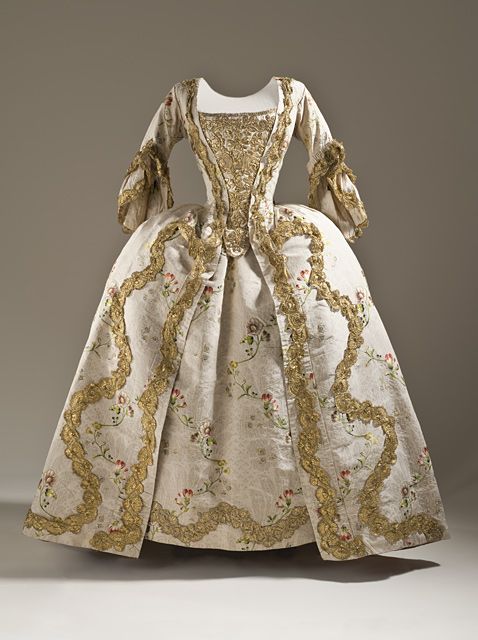
The following image is the gown that I followed in terms of trim placement. It took many more hours than I thought it would to pin the trim on. Those big waves are more complicated than they look, plus I had the challenge of creating the smaller scallops as I went along as well. All of the trim had to be sewn along both sides and tacked at each scrunch after it had been pinned.

IMG_0919 (1)

8423a2253758be21b68f0141235eadb1
Robe a la Francaise. 1765. LACMA.

You can see that I pressed my robings down all the way to the hem, though once the trim was applied on top it was really not very noticeable. I like the finished result, but I think it’s worth pointing out that this pattern is designed to have a wide stomacher. I was envisioning it coming out a little narrower at the waist. But I think adjusting the back opening enough to make a noticeable difference would only create awkward wrinkles under the arms.

The finished stomacher was covered in scalloped trim and finished off with a sparkly brooch. I went to France with an untrimmed stomacher and no clear idea about how I wanted to trim it except that I wanted it to be an all over metallic feast for the eyes. Luckily, early in the trip I was able to go see the 300 Centuries of Fashion exhibit at Les Arts Decoratifs. In addition to being amazing (I got to stand within 6 feet of Dior’s Bar Suit and see many garments I’ve only ever seen on Pinterest!), I also took a picture of a stomacher that was inspirational in terms of the overall wavy patterns and filler shapes. That picture is below.

IMG_0419 (1)

IMG_1153 (1)

Trimming the stomacher took place in the evenings in the few days before the special event. Here is the stomacher in progress. I took it specifically to show the amazing green color that the fabric can appear from some angles. I was hoping to get a picture of the finished gown looking this color, but had to be content with seeing shades of green in some of the pictures as we didn’t capture any where the whole gown was this color.

IMG_1339 (1)

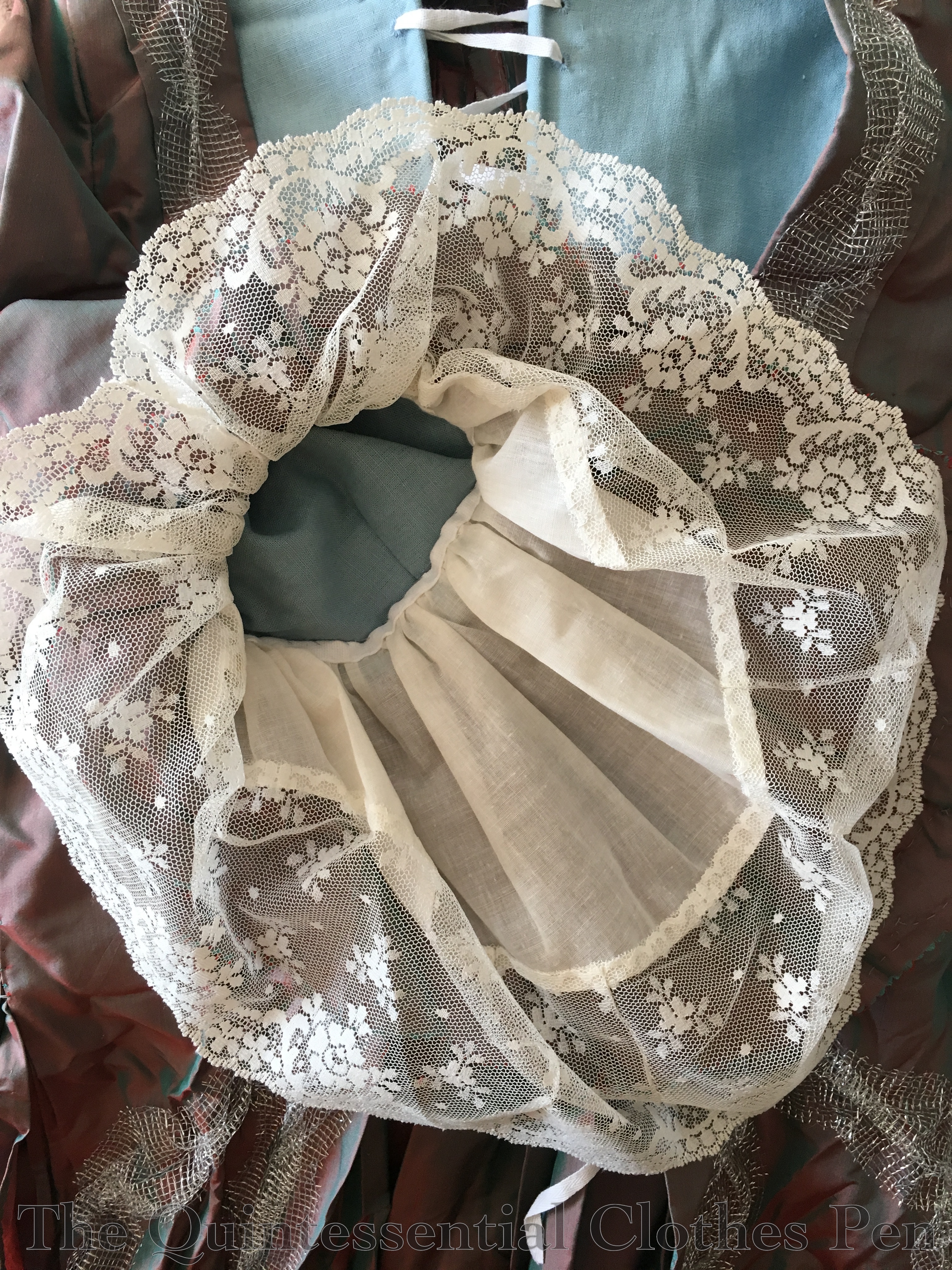
Another part of the dress that was finished in France were my engageants. The pattern includes flounces of two lengths to be made of silk and then one longer flounce for an under flounce or engageant. I sacrificed some lace I’ve been intending for another project, threw some darts in at the longest section to get the scalloped edge to be the right shape, and filled in the length with a bit of mystery ivory sheer. The resulting flounce was gathered and sewn to a cotton tape that was basted into the arm opening.

IMG_1481 (1)

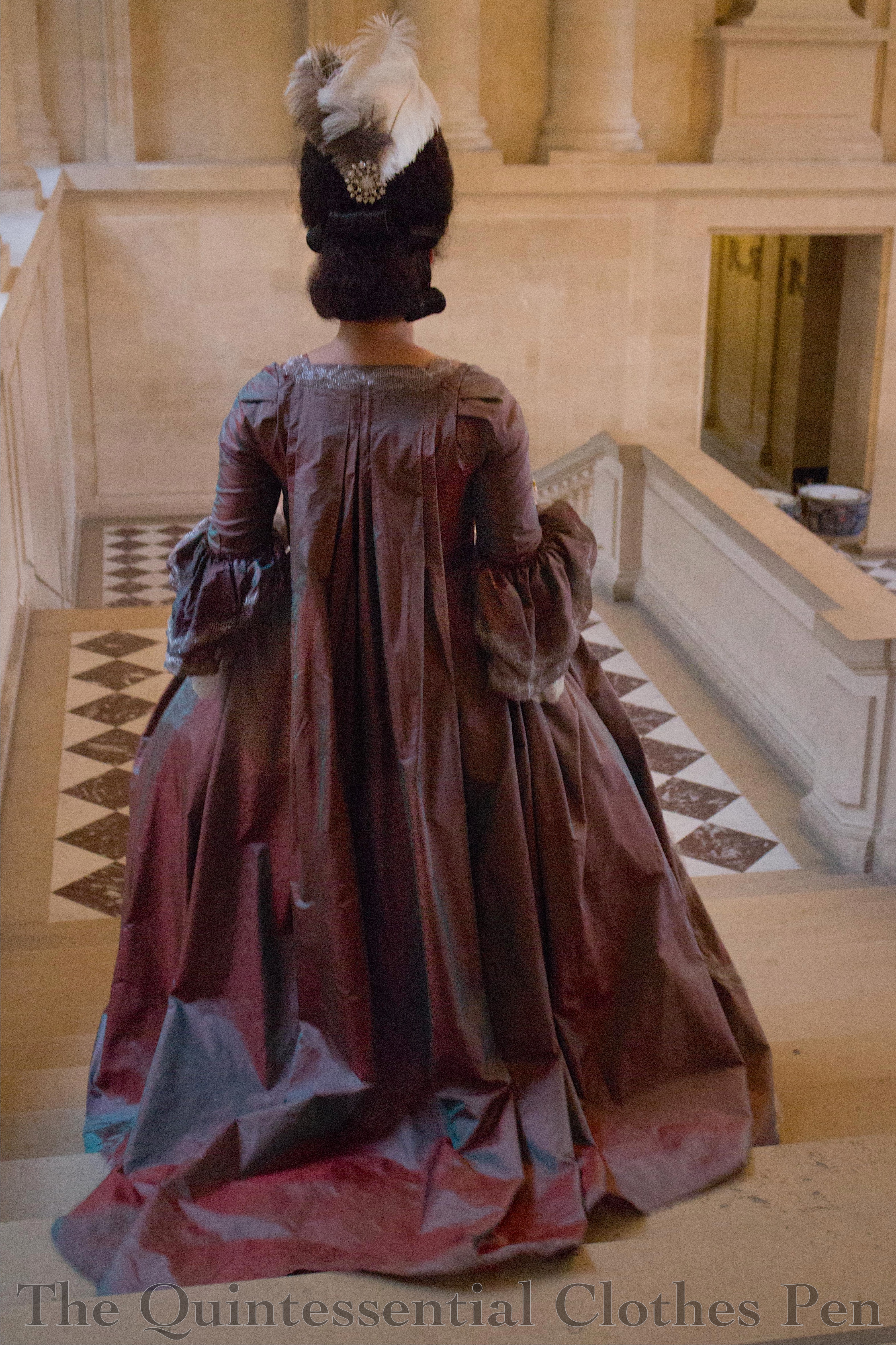
It sure sounds like a lot of work, recounting these bits of the process. It was! And it paid off. I’m very pleased with the gown. And very pleased that this picture captures some of the stunning green in the fabric!

IMG_0287 (1)

HSF/M #10: 1910 Dowager Countess Evening Gown

IMG_1597

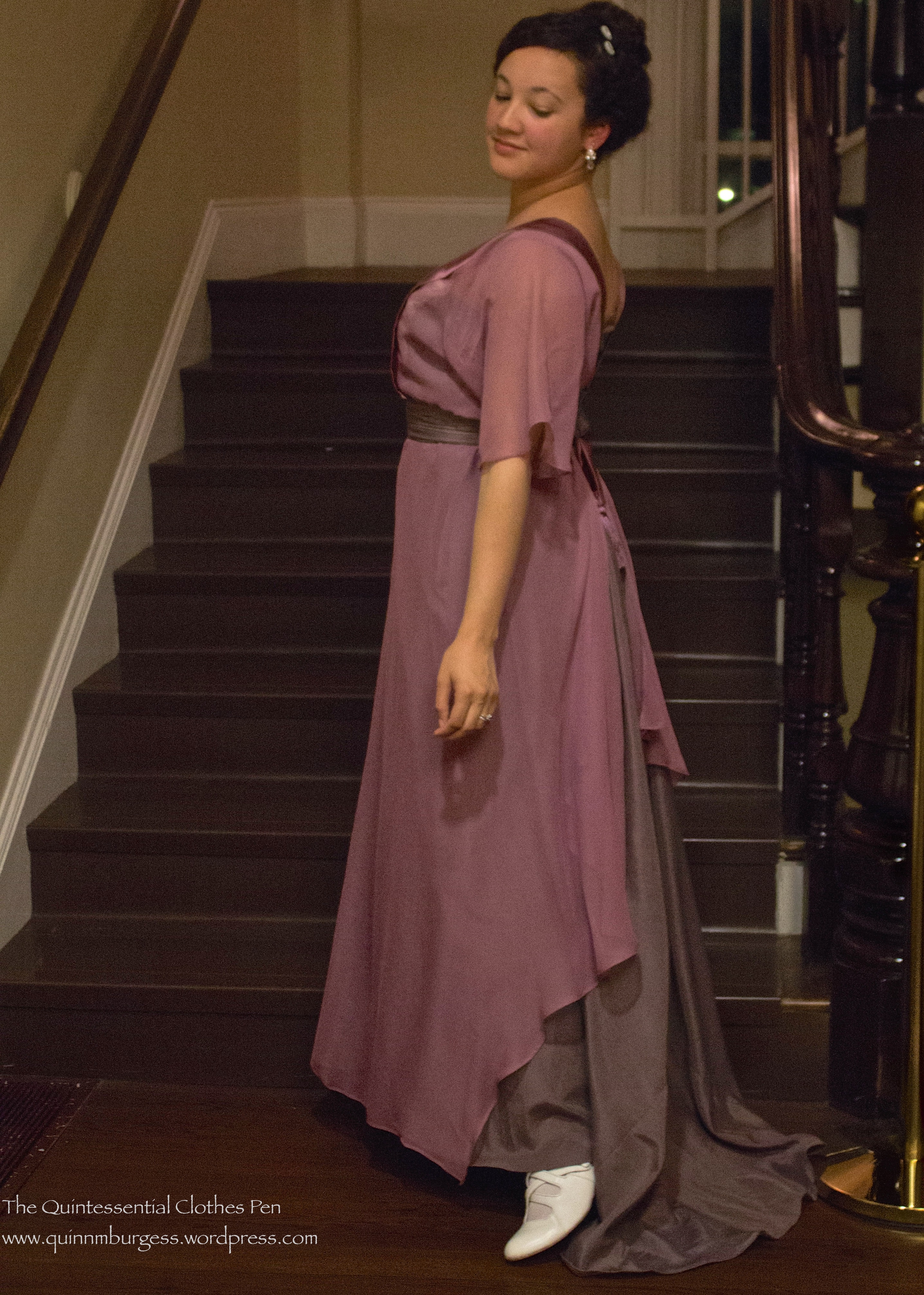
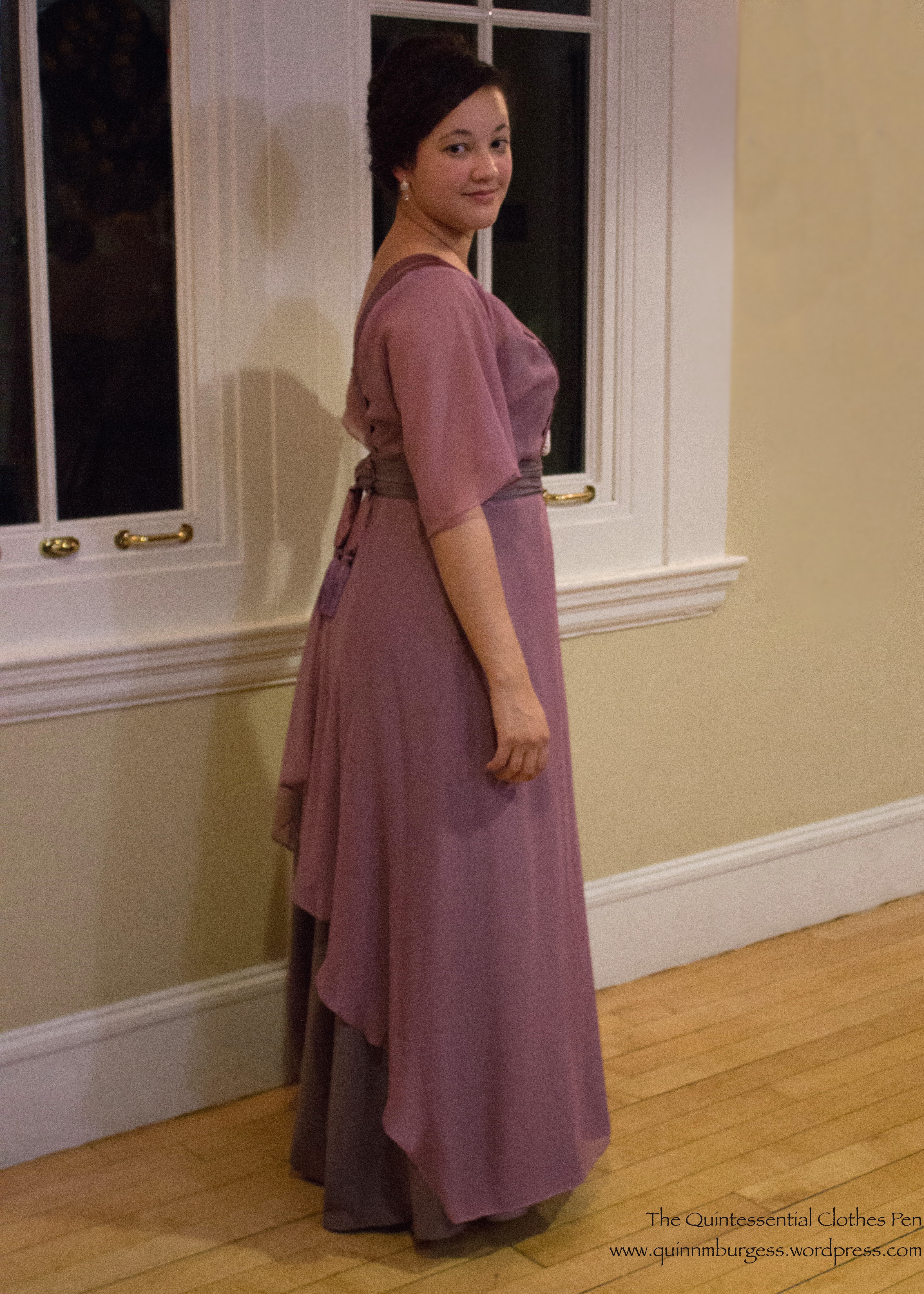
This gown was already in my sewing plan before I decided it fit into the HSF/M Challenge #10: Sewing Secrets. It turns out that it fits into the Sewing Secrets challenge for multiple reasons:

#1: Because like many dresses from the first few decades of the 20th century, the method of closure is cleverly hidden, rather complicated, and definitely secretive–you really can’t tell how the dress goes on just looking at it once it’s all hooked up. (Right? Can you figure it out before I show you later in the post?)

#2: The beaded panel on the front might look familiar if you’ve been reading my blog for a few years. It is actually the sleeve (turned upside down) from a 1980s evening gown that I remade into a sleeveless 1925 evening gown.

#3: I made this dress with a train because I had enough fabric, it’s elegant, and I don’t get to have many dresses with trains because I’m usually dancing in them. However, I do plan to dance in this dress, so I included a secret hidden button under the decorative knot at the back and a loop on the center back skirt seam so that the skirt can hook up (bustling, essentially) to be a uniform length all around so I can dance unhindered!

IMG_1598

I paired this new dress with my American Duchess Astoria shoes, because they are super comfy and made sense color-wise with my other accessories: plain white stockings, a super long strand of faux pearls, lovely clear/white dangle earrings I’ve had for at least ten years, and two matching metallic silver wrapped hair pins I think my mother gave me also a number of years ago. Underneath is my 1913 chemise and corset.

IMG_1616

I’ve had all the fabrics in the stash for at least three to seven years. The underskirt was leftover from a former project never fully pictured here on the blog–an 1890s 2 part dress taken directly from an extant bodice with an extrapolated skirt (the skirt was worn by a friend in Newport in 2012–there are pictures toward the bottom of this past post, and I forgot that the ensemble I’m wearing in that post also uses this same fabric as trim). I had purchased way more fabric than I needed and had more than enough for the new project, so I guess I’ll be using it on another something someday. The matching chiffon and charmeuse I’d purchased with the intention of making a 1910s evening dress back in 2012, but ran out of time that year.

When I was first seriously thinking of making this dress, I thought I had enough fabric to do something like this dress, but I hit a snag when I realized I only had about ½ yd of the charmeuse and that the beaded sleeve I was hoping to incorporate into the dress was entirely unsuited for the shape of the beaded bit on the inspiration dress. I decided to make a dress like my original inspiration someday, but to go back to the beginning for the current dress and rethink what the dress might look like. I would up with something I am quite happy with that is drawn from a variety of inspirational dresses on my 1909-1914 evening gown Pinterest board with this as the most obvious inspiration.

Just the facts:

Fabric: One beaded silk sleeve from a 1980s evening dress that I deconstructed two years ago to make a 1925 evening dress, about ¼ yd of plain weave cotton for the base, less than ¼ yd of silk charmeuse, about 2 yds of silk chiffon, and 3-4 yds of lightweight silk faille for the underskirt.

Pattern: Created by me, loosely starting with the pattern for the bodice of my 1912 burgundy and gold evening gown and referencing skirt shapes in Janet Arnold for inspiration.

Year: 1910.

Notions: Thread, hooks and bars, and two pre-made tassels.

How historically accurate is it?: It definitely passes Leimomi’s test of being recognizable in its own time. It uses accurate materials and accurate techniques. 95%.

Hours to complete: More than I kept count of.

First worn: In September 2015.

Total cost: Technically this is a stash project because all of the things I used have been in my stash for years, except the tassels, which I bought within the last year knowing this project was high on the to do list. If I had to guess at the cost of the materials it was probably $50-$60 dollars.

The dress was sewn with a mixture of machine and hand sewing. Most of the assembly of the bodice and skirt pieces while they were separate was done by machine, as was the hemming of all the chiffon and faille (though the hem edge of the chiffon is actually the selvedge). The hand sewing came in when I went to mount all of the pieces together. I started with the under bodice and kept adding layers and figuring things out as I went. The closures are also hand sewn.

Incidentally, I’m not really sure what color to call this dress. I’ve been calling the colors orchid and mauve, but I’m not really sure those are the best color names. The chiffon and charmeuse are a shade of pinky/purple that’s hard to put a finger on and the contrast faille is more grey than anything when it’s by itself, though it really takes on a pinky/purple cast when paired with these other fabrics. Does any really perfect color name come to your mind? If it does I’d be happy to know what it is!

As I mentioned, the closure for this dress is quite complicated and as I knew I was going to include it in the sewing secrets challenge we took pictures specifically of the closures to document how it works. If I tried to explain only with words I’m sure there would be confusion, so I think the pictures will clarify things. We’ll start hooked up and unhook as we go.

IMG_1762
The back knot snaps into place over the belt, which hooks together at the back. The button for the bustling skirt loop is hidden under the belt in this picture.
IMG_1763
The belt unhooks all the way to center front.
IMG_1764
The chiffon overskirt unhooks from center back to the side.
IMG_1765
Then the front bodice chiffon layer unhooks at the top edge of the beading and at the waist so it peels back toward the side. After that the under bodice unhooks and the dress slides right off. Is that what you thought might be the closure system?

Overall, I’m super pleased with this dress. It’s very comfortable, has lots of fabric in the skirt so is easy to dance in, and is a nice transitional style between the full skirts and pigeon breasts of the years around 1908 and the much slimmer, longer lines of the years around 1912. Plus, it has a train!

Here’s a comparison of the dress with the train down and then with it looped up. Luckily, these pictures were taken before dancing. Turns out that while I was dancing a very fast waltz, either my or my partner’s foot caught the hem of the dress and caused the loop to break, so I’ll have to repair it more sturdily for the next wearing. Ah well, that’s why they make safety pins!

IMG_1638

IMG_1648

I was quite pleased with how my hair turned out, so I had to make sure to get a reasonable close-up. Some of the curls are natural and some are made nice and smooth with a curling iron. The key is to put the hair up in a lot of different sections–and I mean a lot!

IMG_1727

I call this dress the “Dowager Countess” gown because the shape of it reminds me of what Maggie Smith’s character in Downton Abbey often wears to dinner parties. Look at the bodices on these dresses: this dress, this dress, and this dress are all examples of a similar style–one that the Dowager Countess wears often! And why wouldn’t I want to be reminded of Maggie Smith when I think of this dress? Her snarky comments are highlights of Downton Abbey! (Incidentally, one of my friends wore the just-emerging-in-the-1910s style of pants in the ballroom to this ball–gasp!–and we took some posed snarky pictures. Head over to her blog, Plaid Petticoats, to take a look at her scandalous outfit. When you get to the bottom you’ll find the snarky pictures. You might even find that you think I’m there twice, because I was wearing this new 1910 dress and I loaned my 1912 evening gown from 2012 to a friend who happens to be being snarky with me.)

IMG_1646

SaveSave

1930s Beach Ensemble

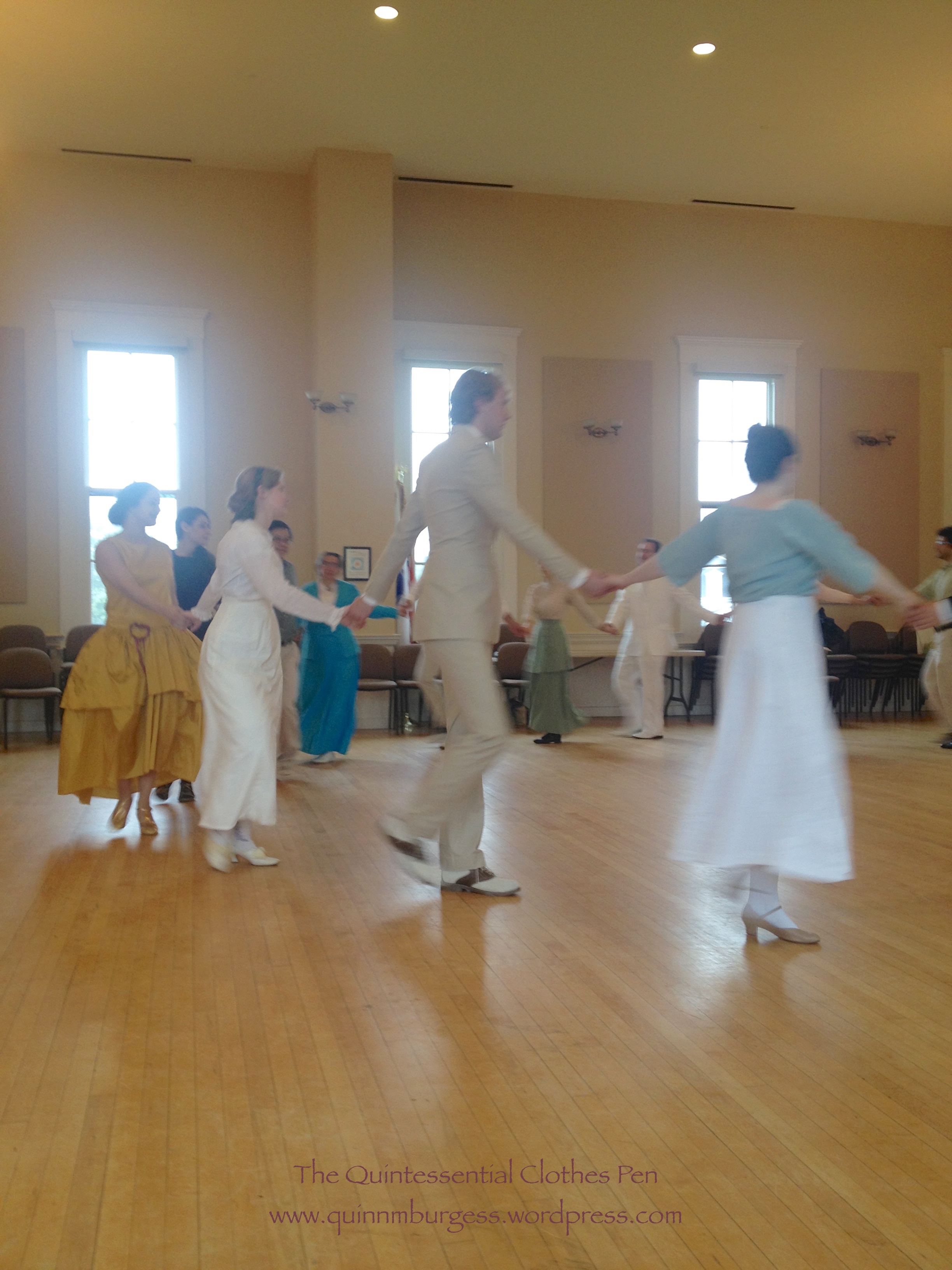
In August, I attended the 1920s Crane Estate Lawn Party again for it’s 3rd year. The last two years I’ve worn dresses (my 1926 sailor dress and my 1922 blouse, hat, and parasol ensemble), but this year I had hoped to go to the beach prior to the lawn party and I really wanted a more beachy ensemble than a dress. It was also on my to-do list to make a 1930s beach ensemble, so I bent the time period of the lawn party a bit and decided to make and wear a new 1930s beach ensemble despite not actually making it to the beach.

It was a super hot day, unfortunately, so I spent a lot of time huddled under an umbrella in the direct sun before we got smart and moved to the shade. Before we hunkered down to avoid the sun I did get some good pictures, though! My hair turned out very well–I’m quite pleased with it, though I can’t remember what I did to get it to look like that!

IMG_2658

unnamed

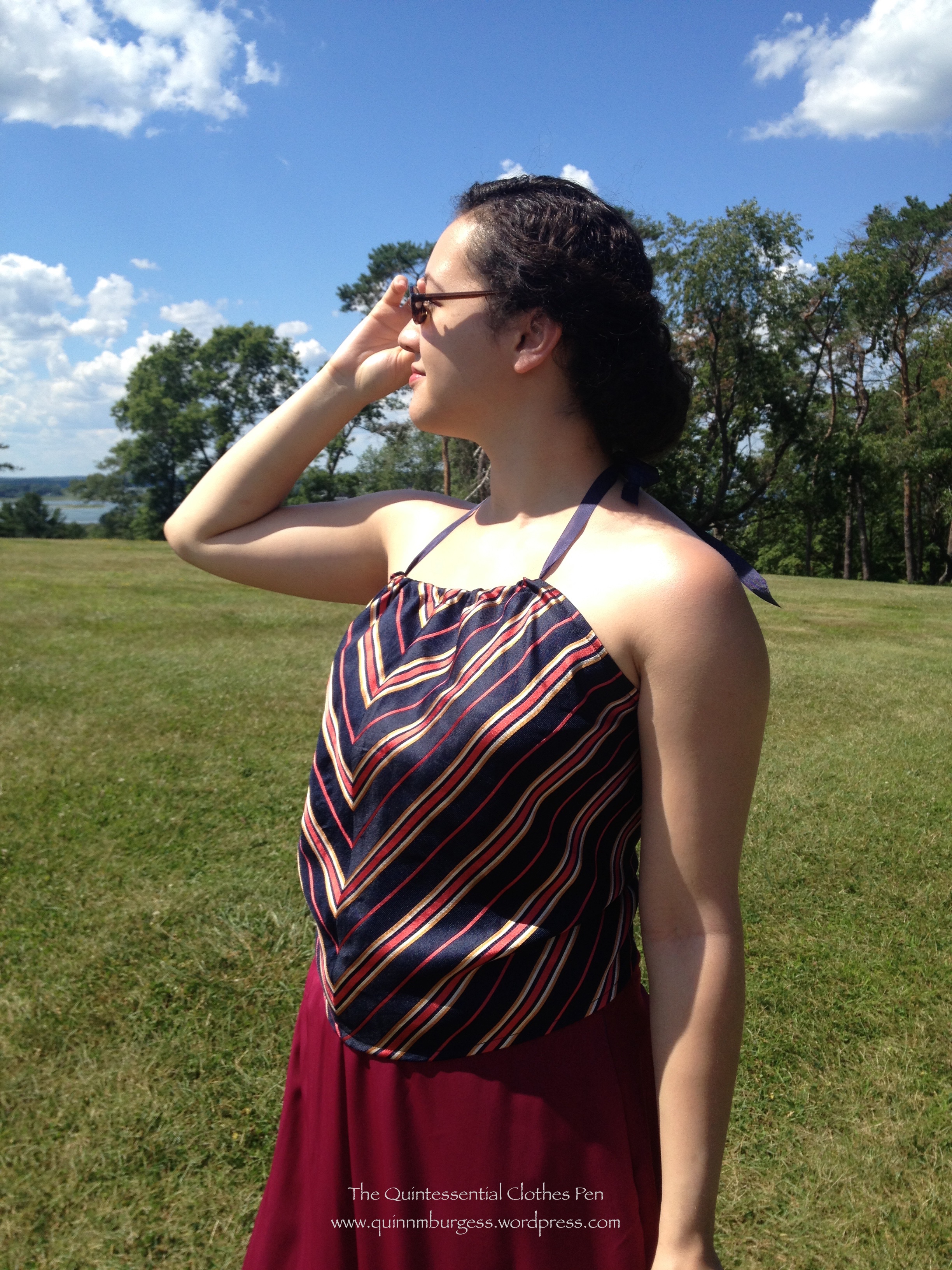
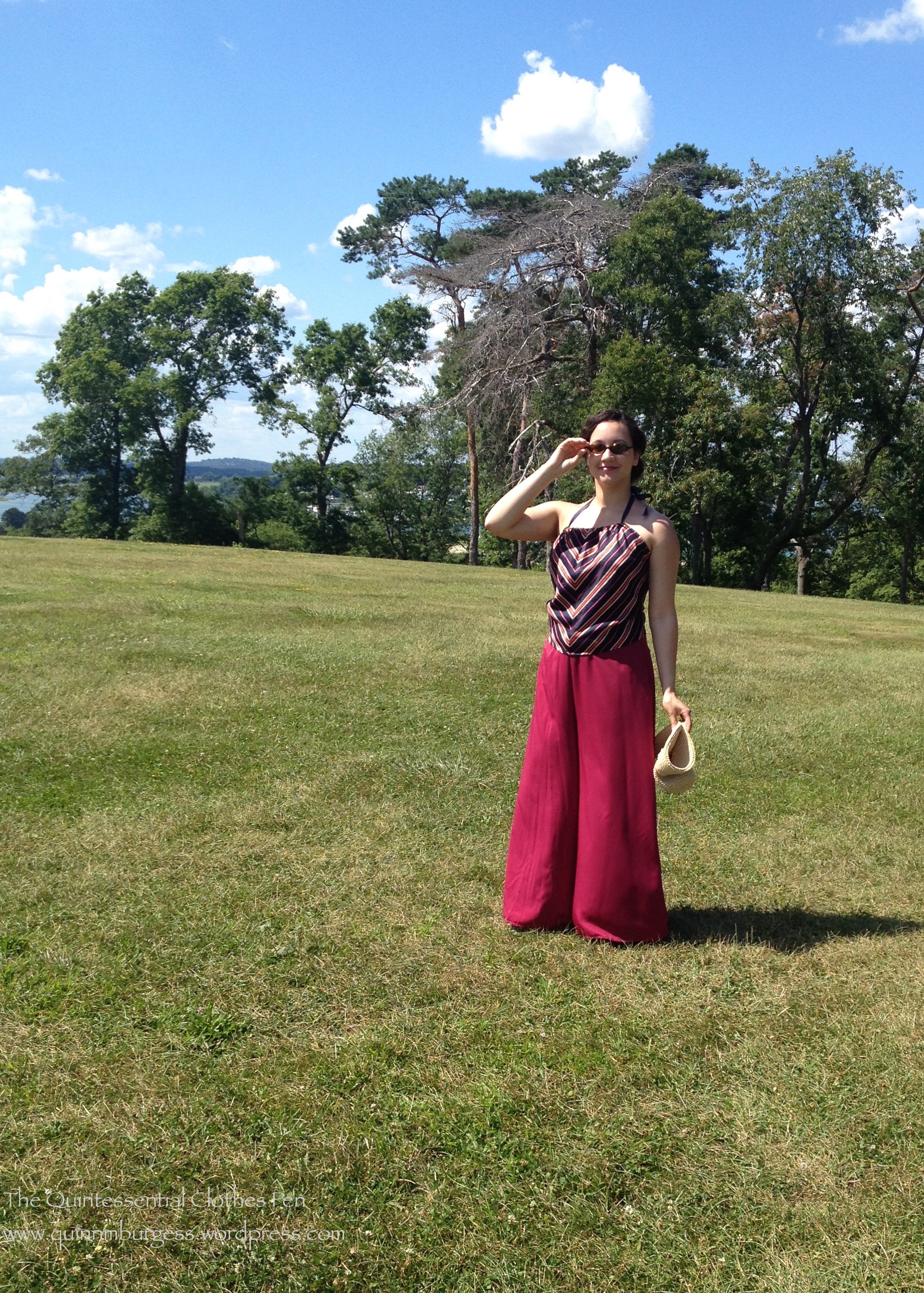
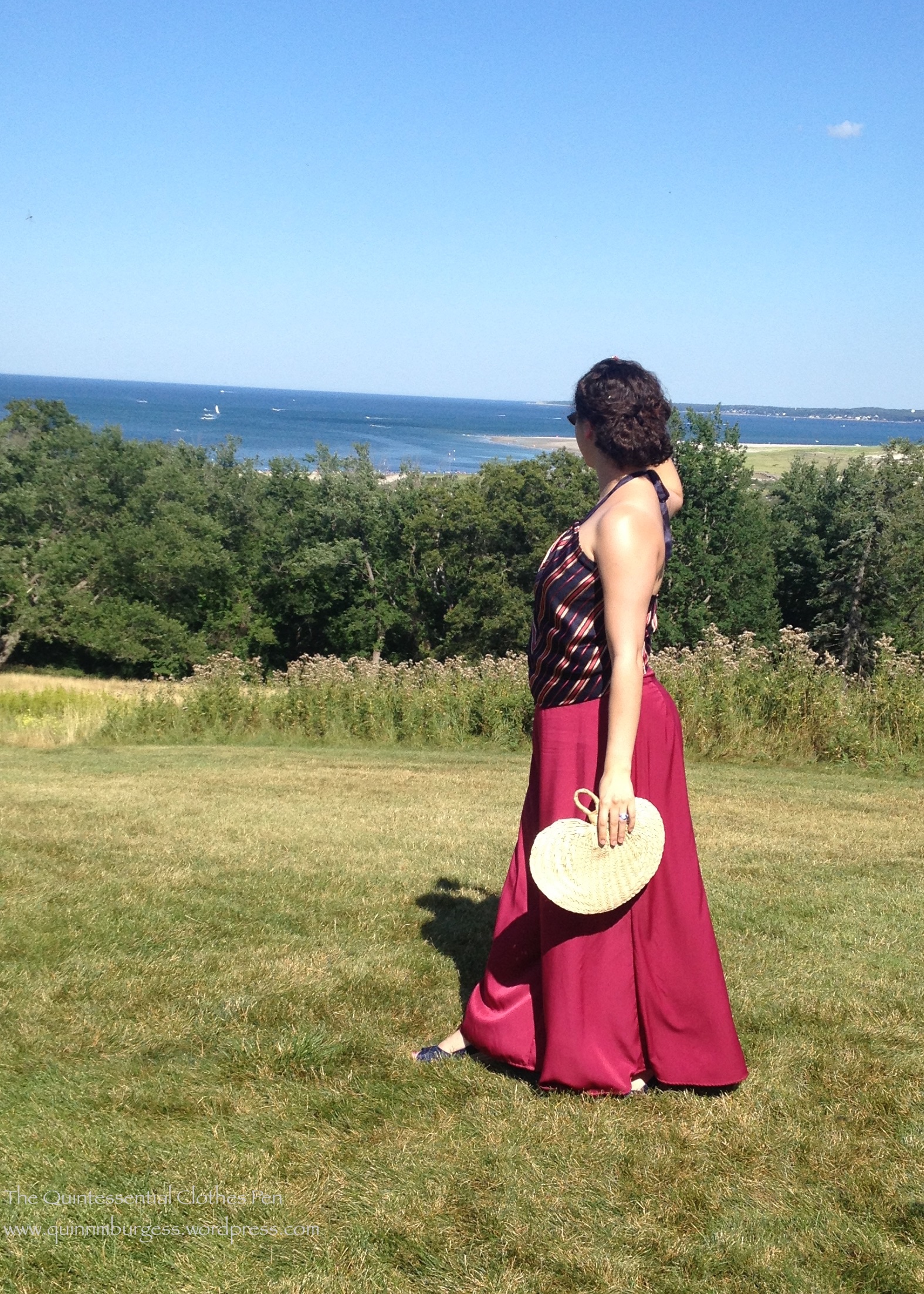
The halter was made using Leimomi’s tutorial “How to make a 1930s style handkerchief halter top“. I used an old striped silk twill fabric remnant rather than a handkerchief, so I had to finish my edges, but I also had to piece the fabric to get the right beginning square rather than rectangle shape. I also made my square a bit bigger than a scarf’s dimensions so that my lower back would be totally covered by the halter. And I used hug snug for my tie, because it was all I had on hand that matched. The halter was pinned around my body to a comfortable point on each side.

IMG_2647
Front.
IMG_2649
Back.
Colorized-early-30s-postcard-of-fashionable-beach-pyjama-wearing-holiday-ers-on-the-Cote-DAzure-2
My inspiration: one of the images that Leimomi includes in her tutorial post (just like the lady in the middle, I decided to make my center front seam decorative and do a chevron–it makes me very happy!). Beach pyjamas on the Cote D’Azure, colourized postcard, 1930s
IMG_2443
Cutting and piecing to get the chevron.

The pants I drafted myself. They’re actually based on the same pattern I made my dotty tap pants from, adjusted to have a waistband, full length legs, and much more fullness in the width of the legs! The pants close with an invisible side zip. They are constructed from soft washed crepe-like polyester fabric that is super comfy to wear while lounging around on picnic blankets. And bonus, both of these fabrics have been in my stash for years: the stripe for about 7 or 8 years and the pants fabric for about 4 years. Free, and yay for using up stash fabrics!

IMG_2645

IMG_2642

IMG_2651

There are more very fun examples of wide leg beach pajamas on my 1930s Sportswear Pinterest page. I’m looking forward to finding other opportunities to wear these again and hopefully getting pictures of them on a beach at some point!

1924 Golden Robe De Style

I’ve wanted a robe de style to join my historic closet for at least a year, but haven’t had just the right fabric or the time or impetus to make it happen until this past spring. And as a general goal, I’ve been trying to expand my color choices beyond blues, greens, and reds, because those colors seem to dominate my historic wardrobe. Then this spring, I found gorgeous yellow silk at the local discount fabric store. I convinced myself that I didn’t need it, but couldn’t stop thinking about it, so I drove back to the fabric store a few days later to purchase the fabric.

IMG_2390

I was inspired by the styles from the earlier years of the 20s for this particular robe de style, when the skirts were long and full. You can see a mix of robe de styles from the 20s on my inspiration Pinterest board. I didn’t follow any particular image or extant garment, but used them in general to create a unique dress. I really enjoyed wearing this dress and would like to make another someday that I think I’ll make a little shorter, more like later 20s styles.

I chose to accent the waistline of this dress with a ribbon rosette in a contrasting silk ribbon. It has an inner circle of matching yellow silk and a bit of gold sequined lace in the center. It looks a little like I won a prize at a state fair, but I like that it breaks up all the yellow of the dress.

IMG_2388

The pattern is loosely based off the information provided by Maria in this blog post about her black robe de style. I scaled up her pattern, made a mockup, and then adjusted it to suit my body shape. The skirt required some math to get the right curve across the top to achieve the high-low hem–the bottom edges are the straight selvedge edges–but aside from that the panels are just gathered to fit the waist, with more gathers concentrated over the sides than in the front and back. The extra bonus about using selvedge edges for the hems is that they have a nice fringed edge that meant I didn’t even need to hem them! Instant hems and a nice lightweight looking skirt. Double win!

I used the opportunity of wearing this new dress to break out a new pair of shoes. Glamorous gold t-straps! (All the credit goes to Katherine for these shoes–she bought them in silver and posted about it which is what directed my attention to the style in the first place.) I bought them about 10 months ago for my birthday but hadn’t had an opportunity to wear them until now.

IMG_2362

IMG_2361

IMG_2354

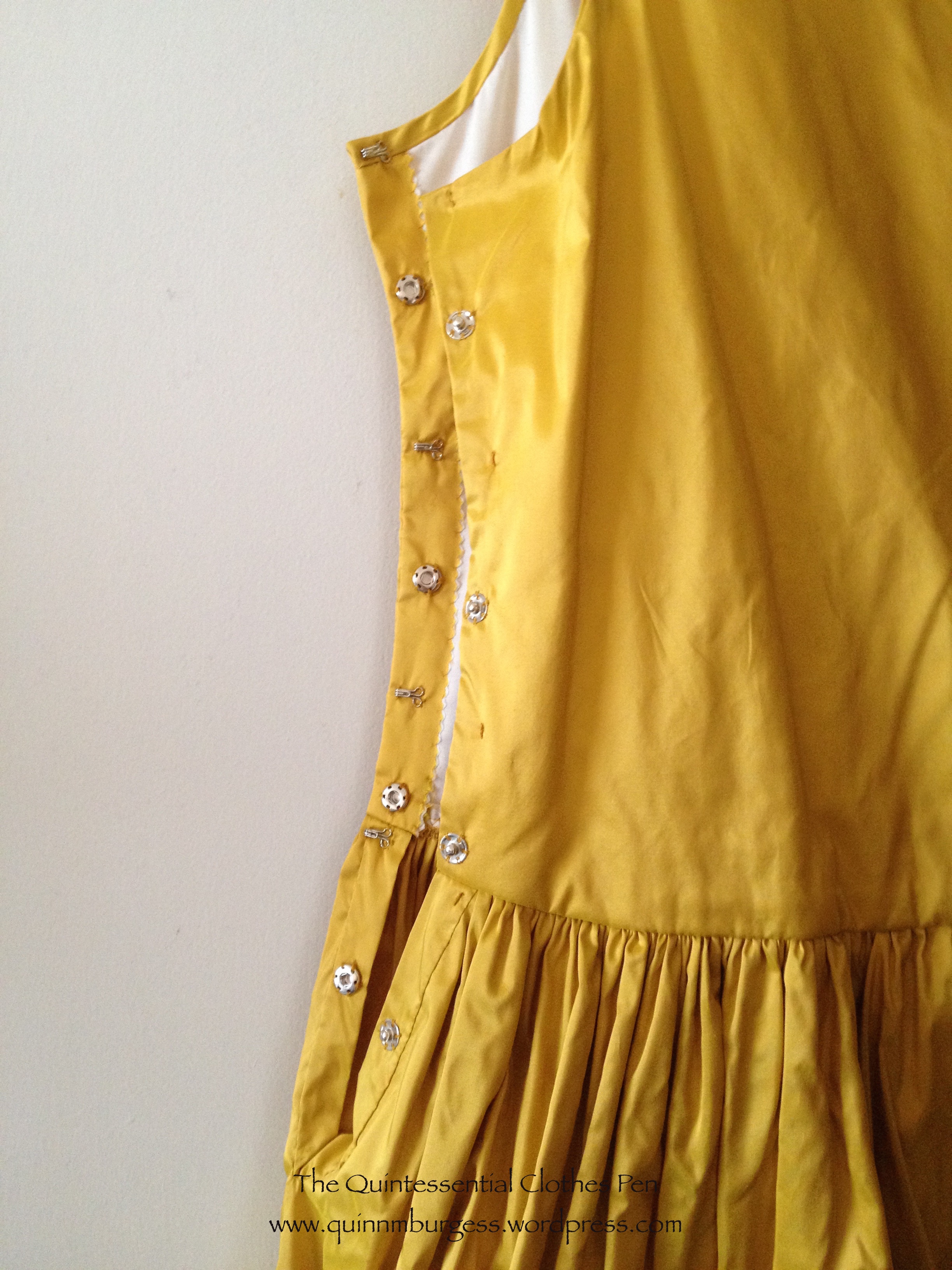
In addition to the pattern, I was also inspired by Maria’s simple finishing methods. I therefore flat lined my bodice, finished the neck and armholes with bias, and made a side closure. I opted to alternate snaps and hook/eyes for the closure, since Maria (and Katherine, who also made an inspirational robe de style you can see here) mentioned that their predominantly snap closures had a tendency not to stay closed. I had no problems with my closures on the dress’s first outing!

IMG_2403

I chose to keep the understructure for this dress separate rather than building it in–that way I can easily use it for a second robe de style in the future! The understructure is mini-18th century pocket hoops attached to a grosgrain ribbon that fastens around my hips. I found that they shifted a little bit while I was wearing the dress, but not enough for me to really notice or care.

Unfortunately, the silk does want to wrinkle every chance it gets. But when the dress is in motion it’s really not very noticeable! I wore the new dress to an afternoon ragtime tea dance, which is what the pictures in action are from. There are 2 more tea dances this summer (one of them is this coming Sunday) and a suffrage rally and formal ball in September, so if you’re in the area and have the time I would love to see you at one of these future events (details here).

IMG_2378

IMG_2374

How I Organize My Patterns And Sewing Books

I showed you how I organized my fabric stash and now I thought I’d show you how I organize my patterns and sewing books.

Most of the patterns I make and choose to keep are for historic clothing. I choose to keep them so that I can use them as a reference for future garments or so I can reuse them as is. A lot of these are garments that I’ve made for myself, but some are also patterns I’ve made for work. Probably 85% of the patterns I keep are historic or vintage. And probably 90% of my patterns are self-made. (I really like having self-made patterns–I find it easier to see what’s going on when there is only one size on the pattern, no seam allowance included.) Some of the envelopes contain vintage and modern commercial patterns for which I’ve traced off my size for the given garment pieces, sometimes making changes to them as well. At that point, I choose to keep those pattern pieces separate from an original purchased pattern.

Given these factors, I choose to organize my patterns by historic period. I use the post-it notes so I can easily change which folder the label is on. Purchased patterns (of which I only own very few) are stored separately, because there are so few of them.

Each self-made pattern is folded and put into a manilla or recycled envelope. I label the front of each envelope with:

  • the month and year I made the pattern
  • the name of the garment
  • other pertinent information: such as the measurements the garment is made for, whether a mockup of the garment is also in the envelope, and an image or drawing of the garment if possible, etc.
IMG_1476
Each section is also organized chronologically.

At this point, I’ve maxed out the number of patterns I can fit in this one basket, so I’m trying to decide what categories of patterns can be stored somewhere else, and where that somewhere else is… Someday when I have a sewing room I hope to change these over to a filing cabinet.

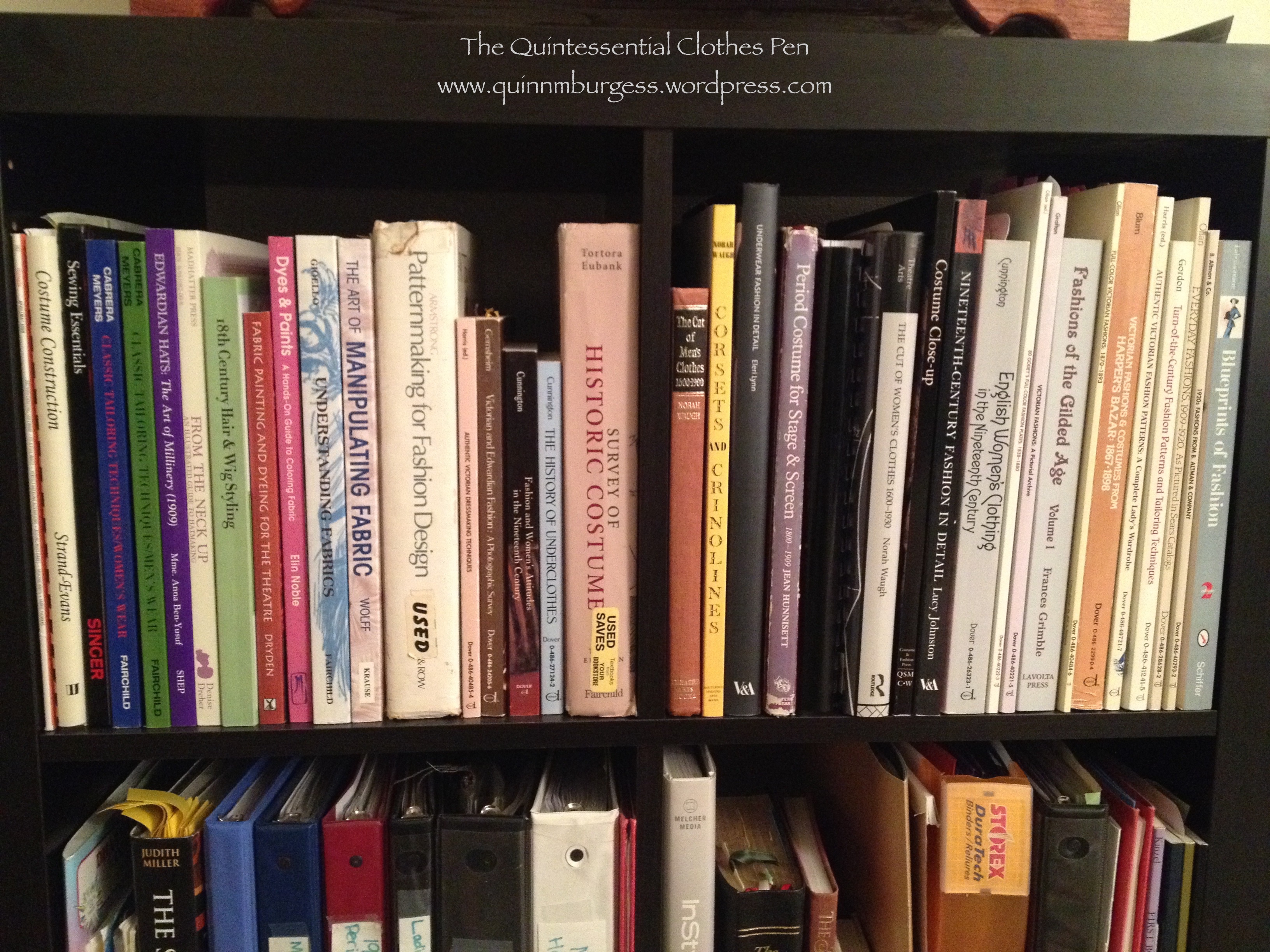
As for my books, I keep all of my personal books at home and bring them into work only on an as-needed basis. I do this for two reasons: first, that I’m very protective of all books that I own and want them to stay in the best condition possible; and second, that I enjoy seeing these books regularly.

IMG_1492
The books are organized by the type of information they contain, then chronologically, if possible. The binders peeking up from the bottom shelf on the left are all full of notes and samples and other construction-related information. The books on the bottom right are other things including a binder of cooking recipes, wedding research, knitting books, and my Janet Arnold books.

How do you organize your sewing related patterns and books?

Project Journal: 1880s Steam Molded Corset: The Pattern

The previous post in this series compared the two mockups I created while finalizing the pattern for the new corset. This post let’s compare the pattern pieces themselves.

Since my inspiration corset is only shown from one angle in a single photo, I had to use other information to extrapolate information for the areas not visible in that photo. As I mentioned in my previous post, I began the patterning process with the 1880s corset pattern in Corsets and Crinolines. That, combined with observations of other 1880s corsets, and the information below from the V and A description of my inspiration corset, all helped inform my decision to have 6 pieces in each half of the corset.

This corset from the 1880s is composed of twelve separate shaped pieces and forty whalebone strips.

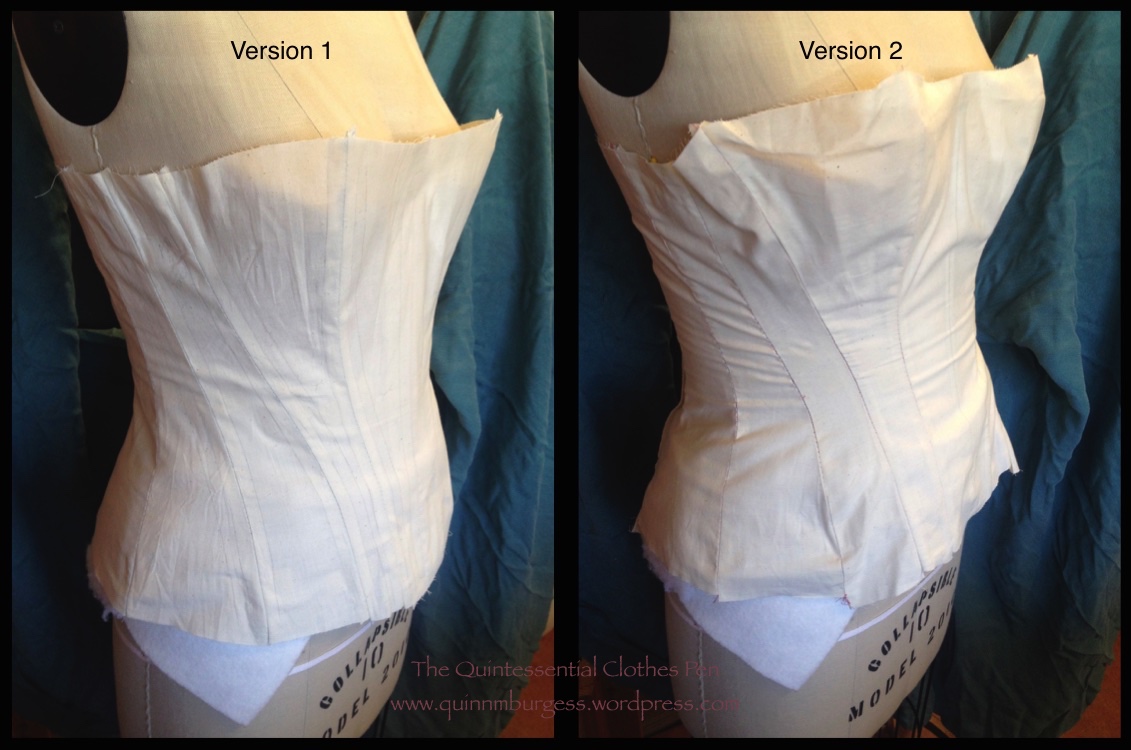
The image below shows the pattern pieces from my first mockup compared to the pattern pieces from my second mockup. At first glance they are basically the same, but upon closer inspection there are subtle differences. It’s the same idea I’ve been repeating in every post about this corset: the lines aren’t really that different, but the curves on them have been exaggerated (this is especially noticeable on pieces 1 (CF), 3, and 6 (CB)).

Untitled 2
Center front is on the left and center back is on the right.

You might also remember that I mentioned in my previous post that I had changed the two pieces closet to center back after the mockup. Here are the two original 5 and 6 pattern pieces from Version 2 compared to the newer 5 and 6 pieces from Version 2.

IMG_2237
On the left, pieces 5 and 6 (CB) Version 2.1, as seen in the mockup. On the right, pieces 5 and 6 (CB) Version 2.2, updated after the mockup.

I think the change in the pattern pieces is pretty obvious when they are compared side by side. You can see the inspiration image of the back of an 1880s corset that prompted me to make this change in my previous post.

Determining where the boning channels would be was an essential part of the patterning process, due to the immense number of bones and their specific placement between seams on the inspiration corset. I looked very closely at the inspiration corset to determine where the bones would be located on the front pieces of the corset. For the back pieces, I used the mention from the V and A that the inspiration corset had 40 bones to figure out how many additional bones I needed after the front ones were planned and information gathered from back views of other 1880s corsets to determine bone placement. You can see that the pattern pieces from Version 2 have short vertical lines drawn on them to help me envision where the boning channels would be as I created the pattern. Once I was satisfied with the shape of the pieces and the location of the boning channels I was able to move on to the cutting and construction… more on that soon!

Project Journal: 1880s Steam Molded Corset: Mockups/Patterning

I began the patterning process for my new 1880s corset with the late 1880s corset in Norah Waugh’s Corsets and Crinolines. I immediately had to adjust the pattern for size, as is often the case when using scaled historical patterns. While doing that, I also made some initial guesswork at adjusting the pattern to get the curvy seam lines in my inspiration corset at the V and A.

The result was a perfectly usable pattern for an 1880s corset, but the pieces didn’t have the exaggerated curvy seams I was looking for. So I started playing with the pattern pieces from the first iteration and came up with a second mockup that was satisfyingly curvy. The back pieces didn’t change, so I’ll only show a comparison of the fronts and sides. The noticeable differences are in the silhouette of the bust and hips. (I roughly padded out the dress form to be shaped like me, but being rather un-squishy, as dress forms often are, the corset mockups aren’t really filled out as they would be by a squishy body.)

Untitled 2
Front.
Untitled 2 (1)
Side front.

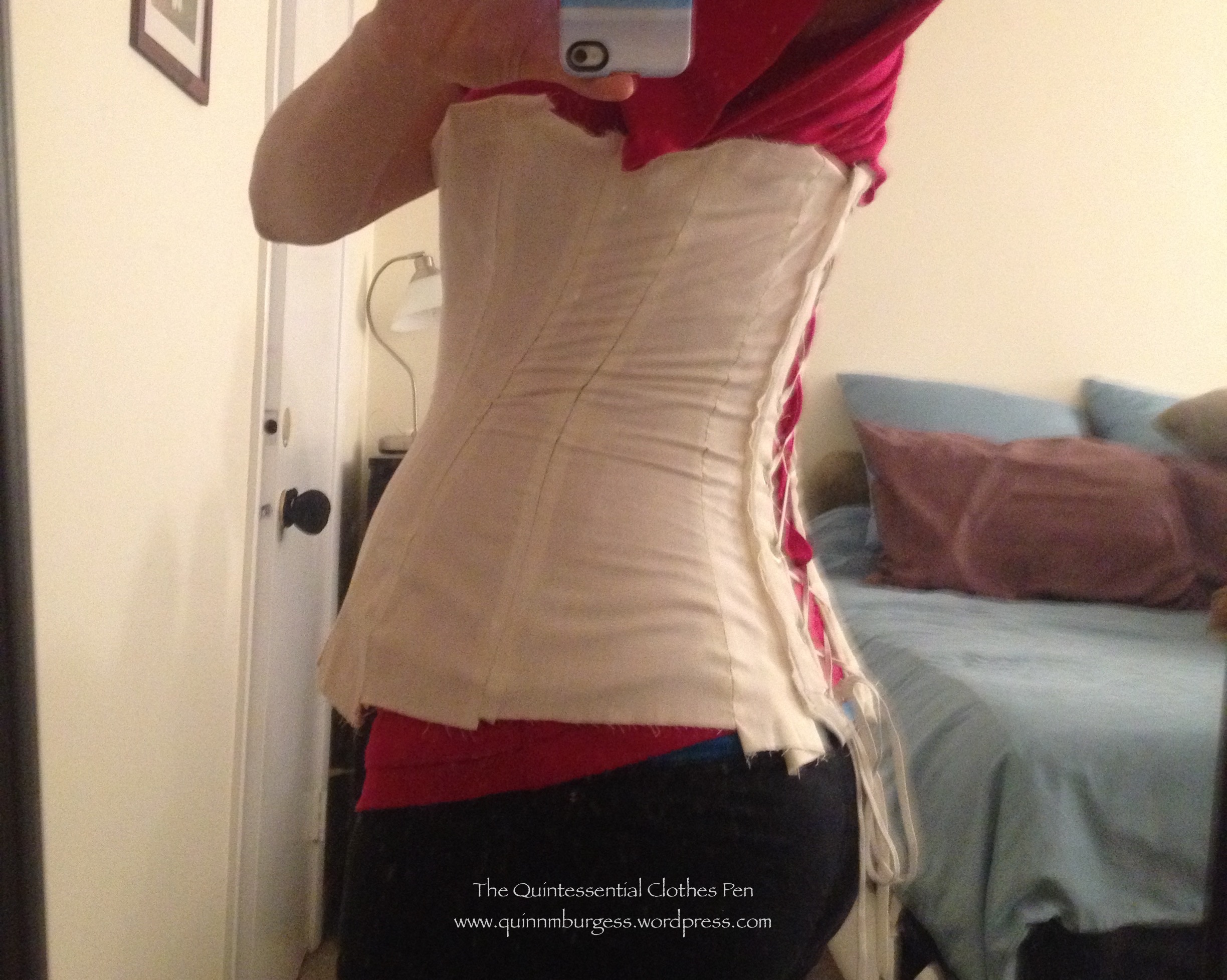
I didn’t take pictures of the first corset mockup on me, but I did take pictures of the second one, to give an idea of how it fits onto a squishy real body. The mockup corset is made from a single layer of muslin, with spiral bones taped onto the seams and a wide flat bone at the front to simulate a busk. The back has lacing strips basted on. I didn’t have help taking the pictures, so you’ll have to forgive the awkward angles!

IMG_2211
Front.
IMG_2210
Side front.
IMG_2214
Side.
IMG_2217
Back.

After the second mockup/pattern I still made a few changes, such as truing the pattern pieces so the edges that meet are the same length and some other small adjustments such as taking in the bottom front pieces a little to keep them from standing away from my body. The largest change I made was to change the seam closet to the back grommets.

You can see in the back picture how the seam lines are rather vertical once the corset is on my body, which didn’t seem to match the curvy seams on the front of the corset. Unfortunately, the V and A doesn’t have any pictures of the back of my inspiration corset online that I have found, so I had to turn to other extant 1880s corsets to look at seaming (and bone placement, but I’ll discuss that in my next post). I settled on the image below as my inspiration for the back of my new corset.

8af42269aeecc4fb8255d408c916c8d5
1884, French, The Met

As with the front pieces, I noticed that the curviness of the seams is distinct as the corset goes over the hips and up the torso, but my second mockup didn’t have enough curve in these areas for my taste. So I went back to my pattern and made new pattern pieces for the two back pieces to adjust the seam line.

And that’s a great place to end this post. The next post in the series will be a comparison of the two patterns, looking at the pieces themselves.


Project Journal: 1880s Steam Molded Corset: Inspiration

The first corset I ever constructed was from a modern historical pattern company. While the corset was fitted to my specific curves, the pattern pieces for it still created a basically cylindrical shape without a lot of hip or bust shaping visible when the corset was laid flat. (I’m wearing that first-ever corset in the pictures in this past blog post.) I’m not saying that shape is wrong for the 19th century, because there are extant examples, patents, and other information showing us that style, such as the corset below.

34cccb898ab3130f745b2c3bb6017b26
French corset c. 1885, The Met

Looking at corsets from the last half of the 19th century, however, there are a variety of other styles that have more interesting lines and definitive flare at curvy points than the basic cylindrical shape. My c. 1860 pink silk corset is an example of a style of corset that uses bust and hip gores to create a more curvy silhouette. (I discussed this in detail in a post about that c. 1860 corset that you can read here. That post has examples of extant corsets showing that shape.) Here is a catalog page of corsets from the 1880s showing that same style.

In addition to the hip gore style corset, there are also a growing number of curvy seam corsets as the 19th century progresses. Some of these also make use of bust gores while maintaining the curvy seams to really provide shape. These all lead up to the s-shape corset of the early 20th century, but we’re not quite there yet in the 1880s.

Here are some extant examples of curvy seam 1880s corsets: black, light blue, and ivory (very similar to the one pictured above, but more extreme in its curves if you look carefully). The curvy seam corset style is what caught my eye for this project, because it is a style that brings new challenges in terms of patterning and because it will be a new style in my wardrobe when completed. Compare this to the the photo above and you can see quite a difference in terms of the cut of the pieces.

046b07af92b3f1063aa27c342bed5124
Edwin Izod corset, 1887, V and A.

This Edwin Izod corset from the V and A is my inspiration. I’m intrigued by the shaping of the panels and the completed silhouette, but also by the construction method. The V and A gives some tantalizing information about the steam molding process patented by Edwin Izod and used to create this corset, just enough information to make me want to see if I can create some form of steam molding and discover how it might change the finished silhouette and wearable feel of the finished corset when compared to other corsets I’ve constructed.

From the V and A:

Fashion and technological innovation changed the shape of late ninteenth-century corsets. As the bustle replaced the crinoline and bodices contoured the figure, corsets became longer to achieve the desired hourglass silhouette. They encased the abdomen and enveloped the hips, and the amount of whalebone also increased to give a smoother outline and help prevent wrinkling of the fabric. This corset from the 1880s is composed of twelve separate shaped pieces and forty whalebone strips.

To improve shape, performance and comfort, manufacturers claimed numerous inventions. One of the most successful was the steam-moulding process developed by Edwin Izod in 1868, and still used in the 1880s to create elegant corsets such as this one. The procedure involved placing a corset, wet with starch, on a steam-heated copper torso form until it dried into shape. The result was a beautifully formed corset, whereby ‘the fabric and bones are adapted with marvellous accuracy to every curve and undulation of the finest type of figure’ (The Ladies’ Gazette of Fashion advertisement, London July 1879).

I’ll be coming back to the nuggets of detail contained in this description, because some relate to patterning and some relate to the steam molding itself, but those are topics for future posts.

* In case you’re wondering why I spell steam molding without a “u” but the V and A quote spells it with a “u”, check out this little bit of information.