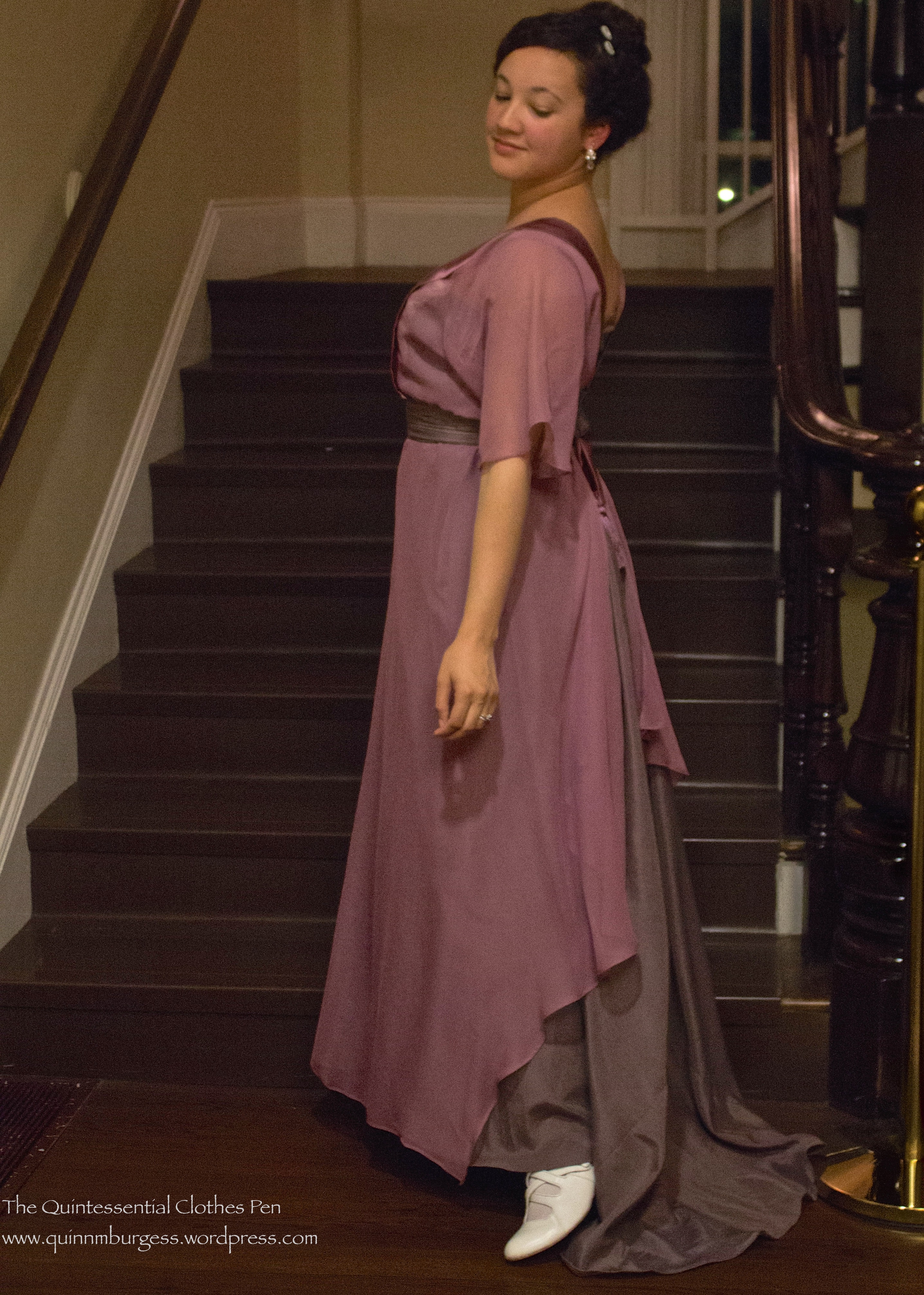
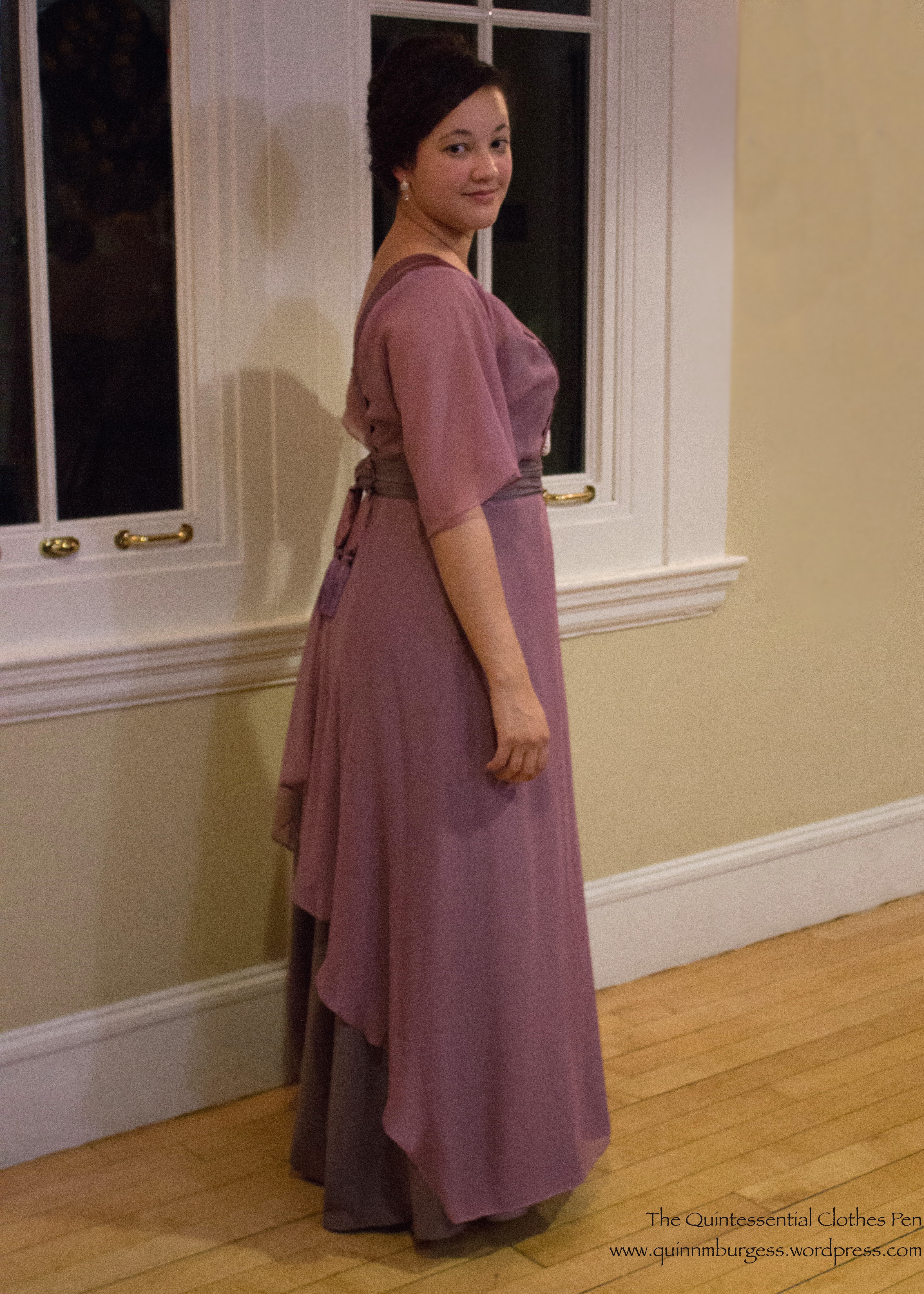
HSF/M #10: 1910 Dowager Countess Evening Gown

IMG_1597

This gown was already in my sewing plan before I decided it fit into the HSF/M Challenge #10: Sewing Secrets. It turns out that it fits into the Sewing Secrets challenge for multiple reasons:

#1: Because like many dresses from the first few decades of the 20th century, the method of closure is cleverly hidden, rather complicated, and definitely secretive–you really can’t tell how the dress goes on just looking at it once it’s all hooked up. (Right? Can you figure it out before I show you later in the post?)

#2: The beaded panel on the front might look familiar if you’ve been reading my blog for a few years. It is actually the sleeve (turned upside down) from a 1980s evening gown that I remade into a sleeveless 1925 evening gown.

#3: I made this dress with a train because I had enough fabric, it’s elegant, and I don’t get to have many dresses with trains because I’m usually dancing in them. However, I do plan to dance in this dress, so I included a secret hidden button under the decorative knot at the back and a loop on the center back skirt seam so that the skirt can hook up (bustling, essentially) to be a uniform length all around so I can dance unhindered!

IMG_1598

I paired this new dress with my American Duchess Astoria shoes, because they are super comfy and made sense color-wise with my other accessories: plain white stockings, a super long strand of faux pearls, lovely clear/white dangle earrings I’ve had for at least ten years, and two matching metallic silver wrapped hair pins I think my mother gave me also a number of years ago. Underneath is my 1913 chemise and corset.

IMG_1616

I’ve had all the fabrics in the stash for at least three to seven years. The underskirt was leftover from a former project never fully pictured here on the blog–an 1890s 2 part dress taken directly from an extant bodice with an extrapolated skirt (the skirt was worn by a friend in Newport in 2012–there are pictures toward the bottom of this past post, and I forgot that the ensemble I’m wearing in that post also uses this same fabric as trim). I had purchased way more fabric than I needed and had more than enough for the new project, so I guess I’ll be using it on another something someday. The matching chiffon and charmeuse I’d purchased with the intention of making a 1910s evening dress back in 2012, but ran out of time that year.

When I was first seriously thinking of making this dress, I thought I had enough fabric to do something like this dress, but I hit a snag when I realized I only had about ½ yd of the charmeuse and that the beaded sleeve I was hoping to incorporate into the dress was entirely unsuited for the shape of the beaded bit on the inspiration dress. I decided to make a dress like my original inspiration someday, but to go back to the beginning for the current dress and rethink what the dress might look like. I would up with something I am quite happy with that is drawn from a variety of inspirational dresses on my 1909-1914 evening gown Pinterest board with this as the most obvious inspiration.

Just the facts:

Fabric: One beaded silk sleeve from a 1980s evening dress that I deconstructed two years ago to make a 1925 evening dress, about ¼ yd of plain weave cotton for the base, less than ¼ yd of silk charmeuse, about 2 yds of silk chiffon, and 3-4 yds of lightweight silk faille for the underskirt.

Pattern: Created by me, loosely starting with the pattern for the bodice of my 1912 burgundy and gold evening gown and referencing skirt shapes in Janet Arnold for inspiration.

Year: 1910.

Notions: Thread, hooks and bars, and two pre-made tassels.

How historically accurate is it?: It definitely passes Leimomi’s test of being recognizable in its own time. It uses accurate materials and accurate techniques. 95%.

Hours to complete: More than I kept count of.

First worn: In September 2015.

Total cost: Technically this is a stash project because all of the things I used have been in my stash for years, except the tassels, which I bought within the last year knowing this project was high on the to do list. If I had to guess at the cost of the materials it was probably $50-$60 dollars.

The dress was sewn with a mixture of machine and hand sewing. Most of the assembly of the bodice and skirt pieces while they were separate was done by machine, as was the hemming of all the chiffon and faille (though the hem edge of the chiffon is actually the selvedge). The hand sewing came in when I went to mount all of the pieces together. I started with the under bodice and kept adding layers and figuring things out as I went. The closures are also hand sewn.

Incidentally, I’m not really sure what color to call this dress. I’ve been calling the colors orchid and mauve, but I’m not really sure those are the best color names. The chiffon and charmeuse are a shade of pinky/purple that’s hard to put a finger on and the contrast faille is more grey than anything when it’s by itself, though it really takes on a pinky/purple cast when paired with these other fabrics. Does any really perfect color name come to your mind? If it does I’d be happy to know what it is!

As I mentioned, the closure for this dress is quite complicated and as I knew I was going to include it in the sewing secrets challenge we took pictures specifically of the closures to document how it works. If I tried to explain only with words I’m sure there would be confusion, so I think the pictures will clarify things. We’ll start hooked up and unhook as we go.

IMG_1762
The back knot snaps into place over the belt, which hooks together at the back. The button for the bustling skirt loop is hidden under the belt in this picture.
IMG_1763
The belt unhooks all the way to center front.
IMG_1764
The chiffon overskirt unhooks from center back to the side.
IMG_1765
Then the front bodice chiffon layer unhooks at the top edge of the beading and at the waist so it peels back toward the side. After that the under bodice unhooks and the dress slides right off. Is that what you thought might be the closure system?

Overall, I’m super pleased with this dress. It’s very comfortable, has lots of fabric in the skirt so is easy to dance in, and is a nice transitional style between the full skirts and pigeon breasts of the years around 1908 and the much slimmer, longer lines of the years around 1912. Plus, it has a train!

Here’s a comparison of the dress with the train down and then with it looped up. Luckily, these pictures were taken before dancing. Turns out that while I was dancing a very fast waltz, either my or my partner’s foot caught the hem of the dress and caused the loop to break, so I’ll have to repair it more sturdily for the next wearing. Ah well, that’s why they make safety pins!

IMG_1638

IMG_1648

I was quite pleased with how my hair turned out, so I had to make sure to get a reasonable close-up. Some of the curls are natural and some are made nice and smooth with a curling iron. The key is to put the hair up in a lot of different sections–and I mean a lot!

IMG_1727

I call this dress the “Dowager Countess” gown because the shape of it reminds me of what Maggie Smith’s character in Downton Abbey often wears to dinner parties. Look at the bodices on these dresses: this dress, this dress, and this dress are all examples of a similar style–one that the Dowager Countess wears often! And why wouldn’t I want to be reminded of Maggie Smith when I think of this dress? Her snarky comments are highlights of Downton Abbey! (Incidentally, one of my friends wore the just-emerging-in-the-1910s style of pants in the ballroom to this ball–gasp!–and we took some posed snarky pictures. Head over to her blog, Plaid Petticoats, to take a look at her scandalous outfit. When you get to the bottom you’ll find the snarky pictures. You might even find that you think I’m there twice, because I was wearing this new 1910 dress and I loaned my 1912 evening gown from 2012 to a friend who happens to be being snarky with me.)

IMG_1646

SaveSave

Belated HSF 2013 #13: 1885 Frills and Furbelows

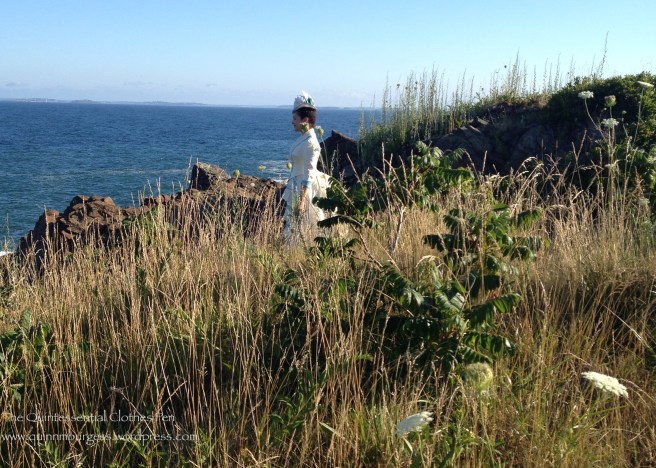
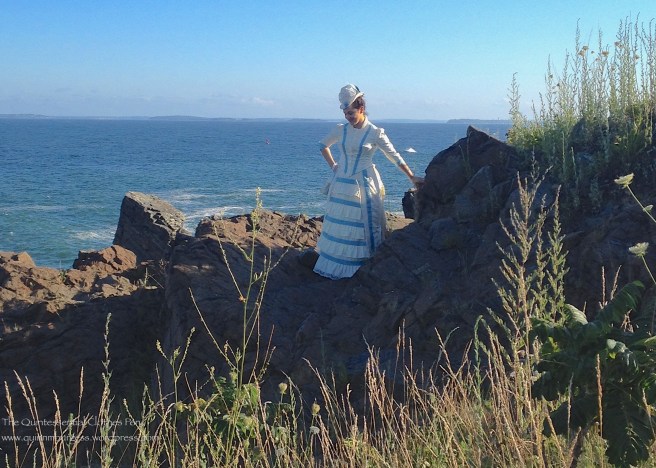
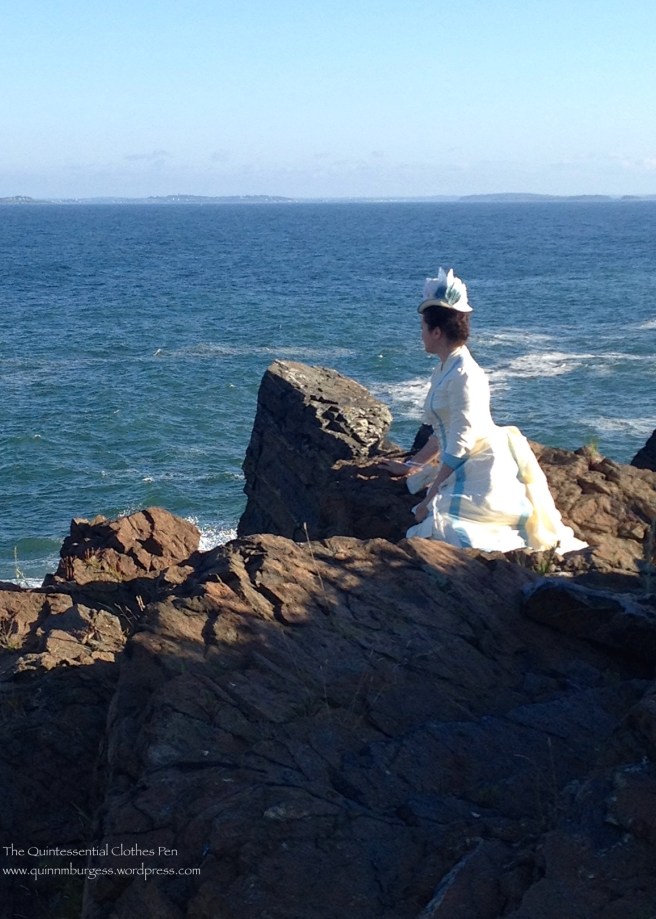
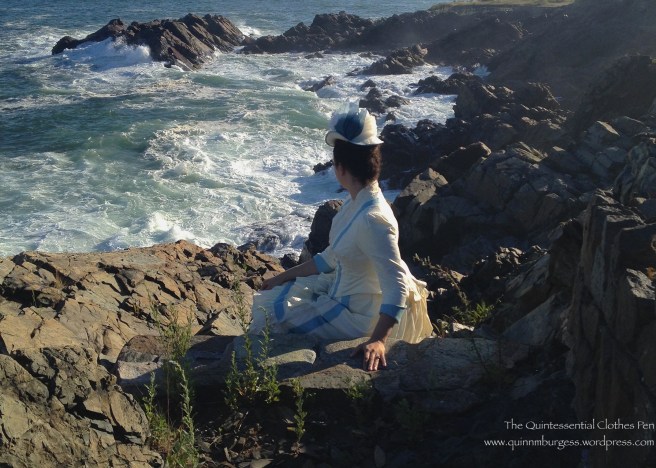
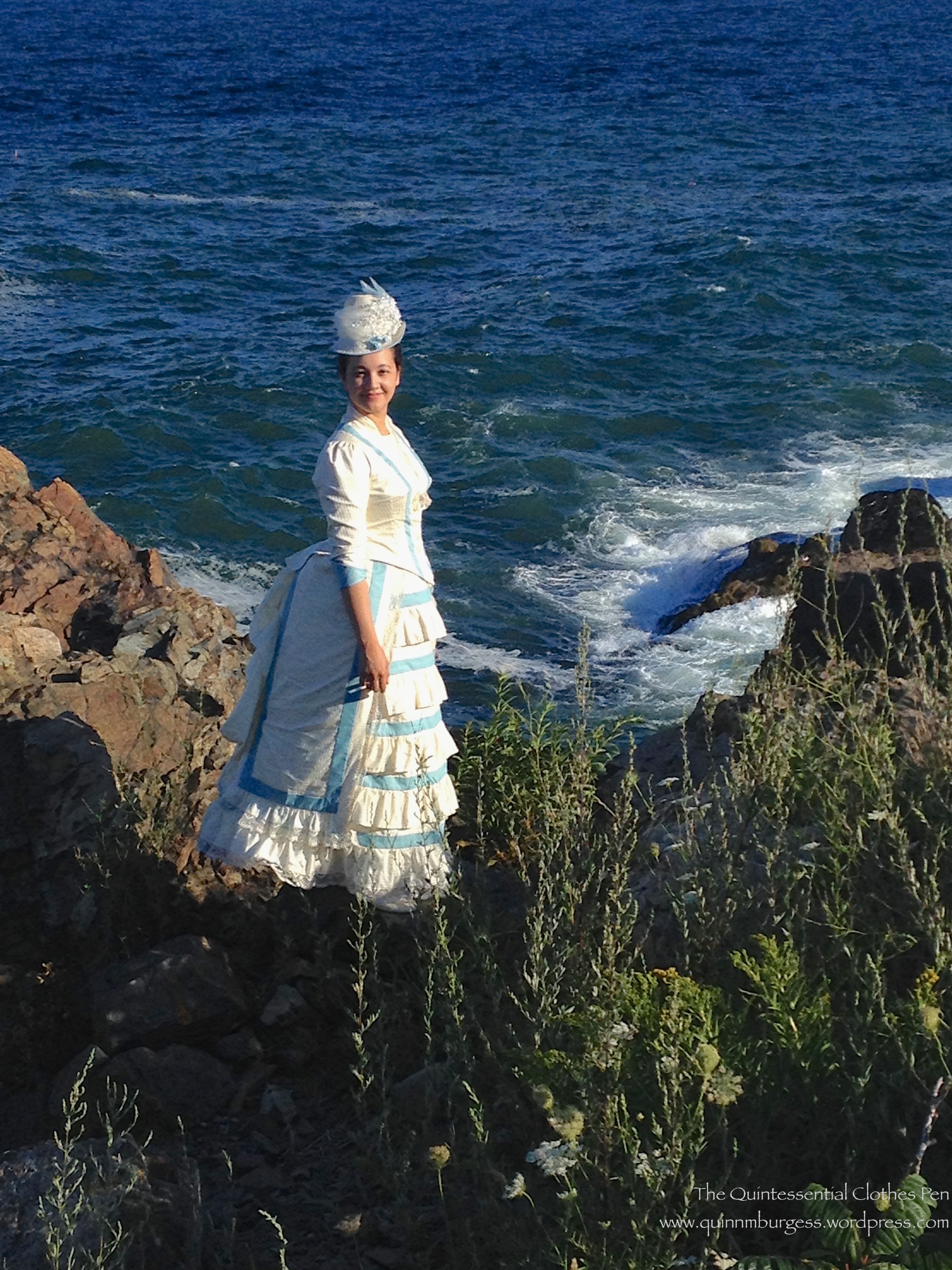
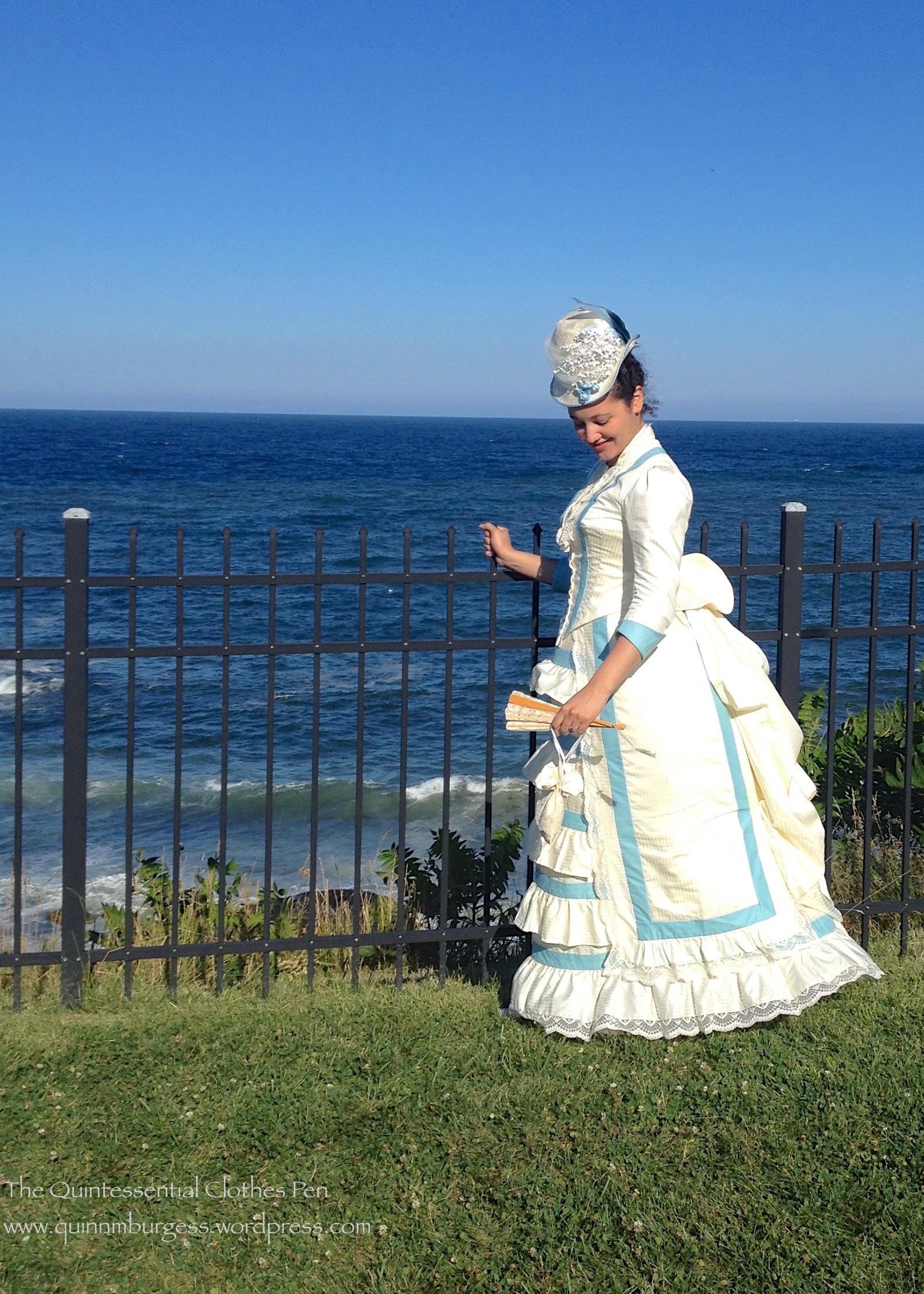
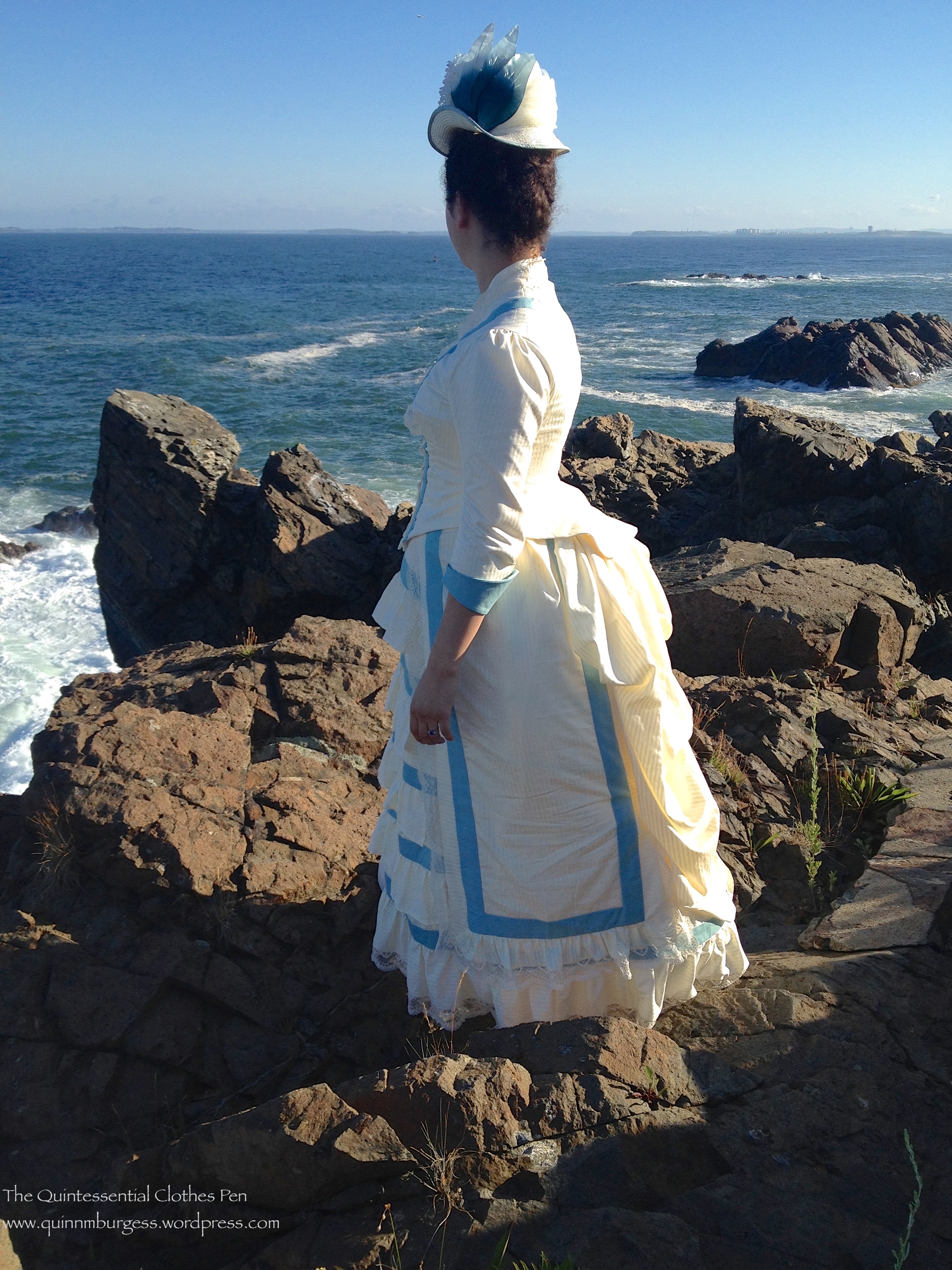
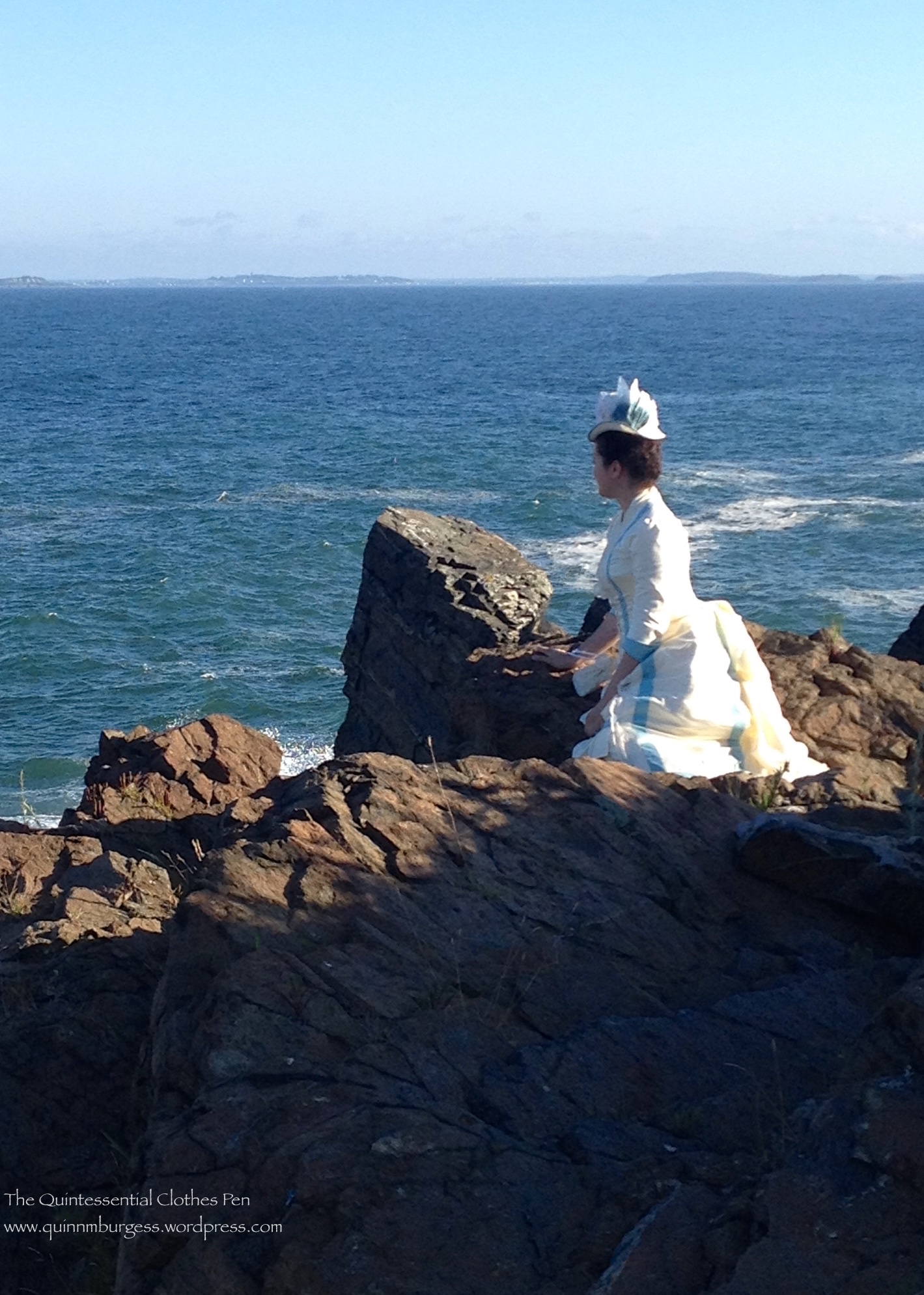
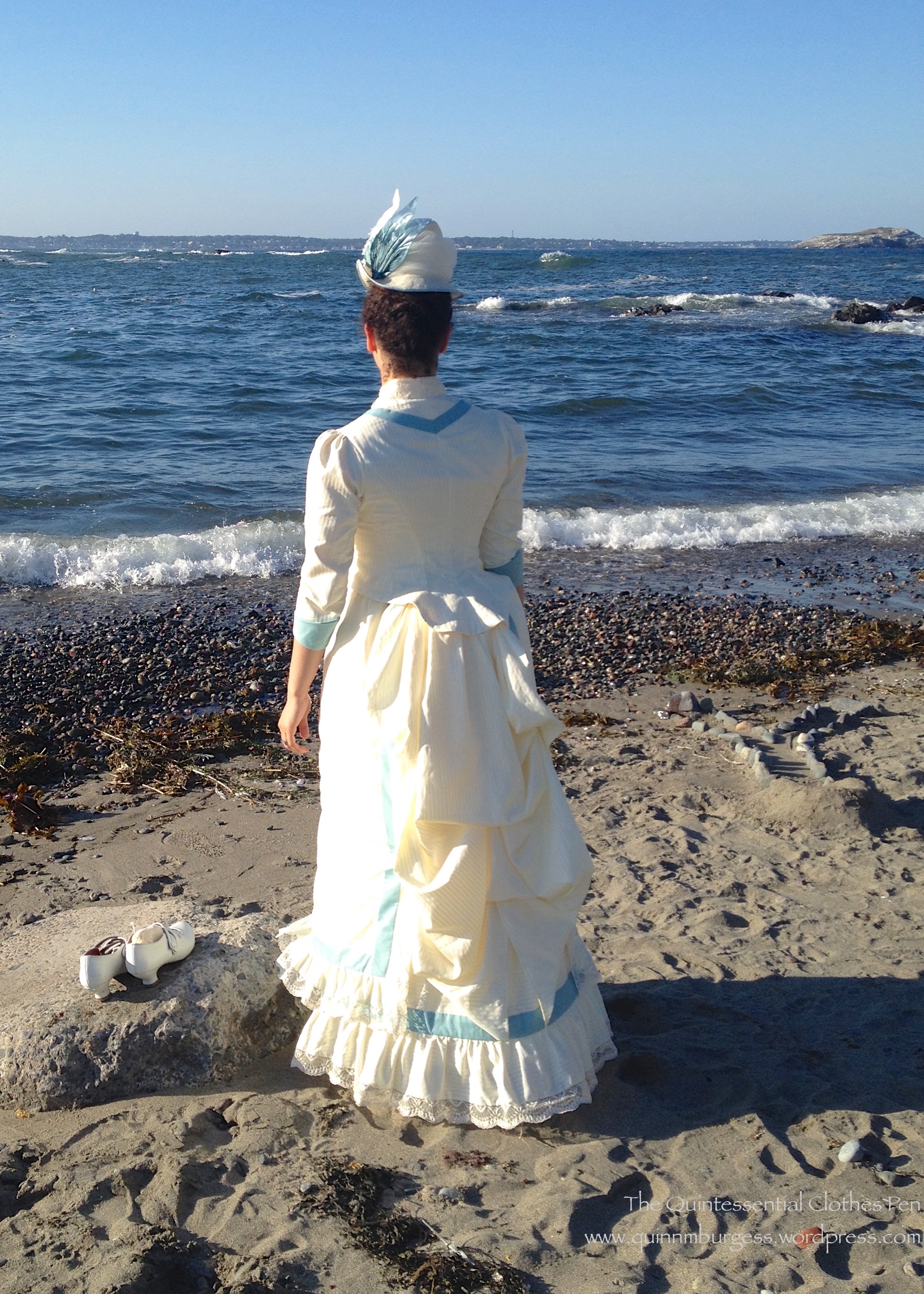
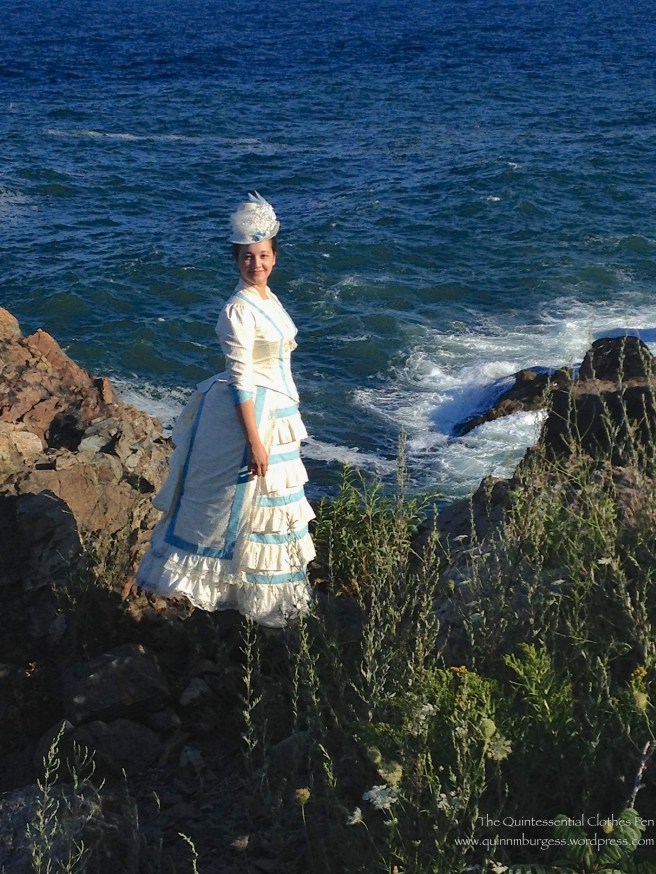
For my 300th post on the blog, I thought I’d share a dress that makes me smile. This dress makes me smile because of the frilliness of it which reminds me of Anne of Green Gables, because of the fact that it was very enjoyable and comfortable to wear, because I love that it is a UFO from 2013 that is finally complete, and because of the stunning backdrop I had for the pictures of it, which also remind me of Anne of Green Gables.
IMG_2725

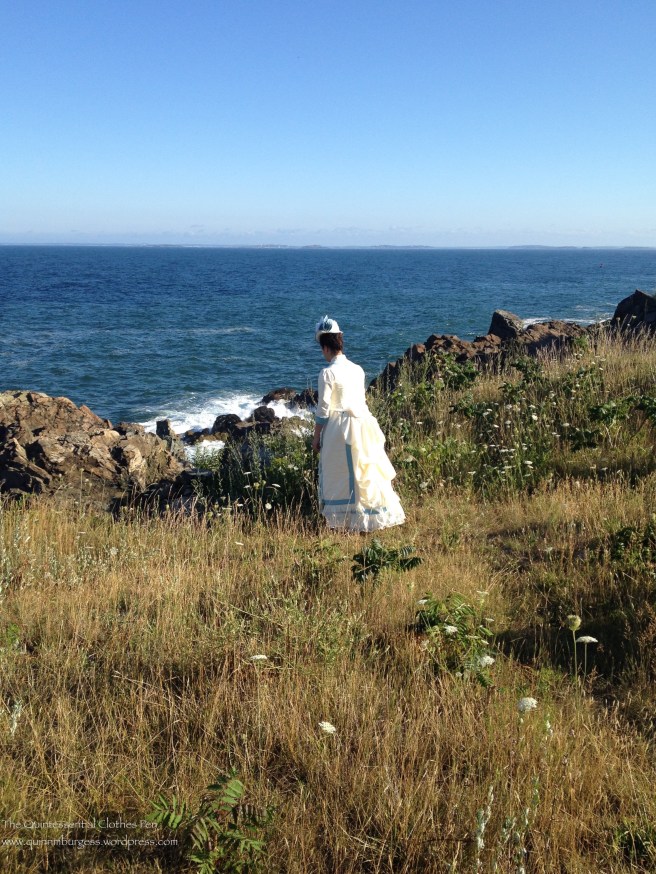
I wore this dress to the Nahant Vintage Dance Weekend Formal Tea and Seaside Promenade in August. It was also the first outing for the my new 1880s steam molded corset and my recently made 1885 straw hat. I am pleased to report that they were all comfortable garments and accessories to wear. Being heavily boned, the corset was very supportive and thankfully didn’t feel heavy, and because it is shaped exactly to my body it was super comfortable–smoothing my figure without squishing it uncomfortably. The dress was perfectly reasonable to wear, with the exception of sitting, which required a slight sideways perch that was a bit precarious. And the hat stayed in place perfectly with two hat pins, as you can see from the pictures where my head is tilted in various directions.

IMG_2699

IMG_2689

IMG_2698

This dress has an association in my head with the puffed sleeves that Anne wants in Anne of Green Gables. While being from the wrong decade, it seems exactly like the sort of dress covered in frills and furbelows that Marilla wouldn’t waste fabric on. And just like Anne, I would often rather have the ridiculous, fashionable styles in historical clothing than the plain and sensible ones!

MARILLA: I’m not going to pamper your vanity. These are good and sensible dresses. This one is for Sunday, and the others you can wear to school.

ANNE: I am greatful, but I’d be even more grateful if you’d made this one with puffed sleeves.

MARILLA: I cannot waste material on ridiculous looking frills and furbelows. Plain and sensible is best.

ANNE: I’ve always dreamed of going to a picnic in puffed sleeves. I’d rather look ridiculous with everyone else than plain and sensible all by myself.
IMG_2706

This dress was started in 2013. I had grand hopes of finishing it that summer for the Historical Sew Fortnightly challenge #13: Lace and Lacing

Lacing is one of the simplest and oldest forms of fastening a garment, eminently practical, and occasionally decorative.  Lace has been one of the most valuable and desirable textiles for centuries, legislated, coveted, at times worth more than its weight in gold, passed down from one garment to the next over centuries. Elaborate and delicate it is eminently decorative, and rarely practical.  Celebrate the practicality of lacing, and the decorative frivolity of lace, with a garment that laces or has lace trim, or both.

And while I did make significant progress on the skirt that summer (getting all of the trimming figured out, cut, and assembled, as well as getting the skirt base and side panels constructed), I didn’t get anywhere near far enough along to have a wearable outfit. So it sat in my “in-progress” sewing box with hopes to be worked on, but didn’t really make it to the top of my sewing list again until this summer. I had enlarged and sized a pattern from Janet Arnold in between 2013 and 2015, even cutting and assembling a mockup, but that had been waiting for a fitting because I wanted to wear my new specifically 1880s corset with the dress and the new corset didn’t get completed until June. Once I had the corset done, I set to work on the dress again, fitting the mockup bodice, finishing the skirt, and making the bodice, as well as a slight delay while I made the hat to match. It’s handy to make a hat part-way through the process of making the dress, because you don’t wind up running out of time at the end and not having matching accessories!

IMG_2772

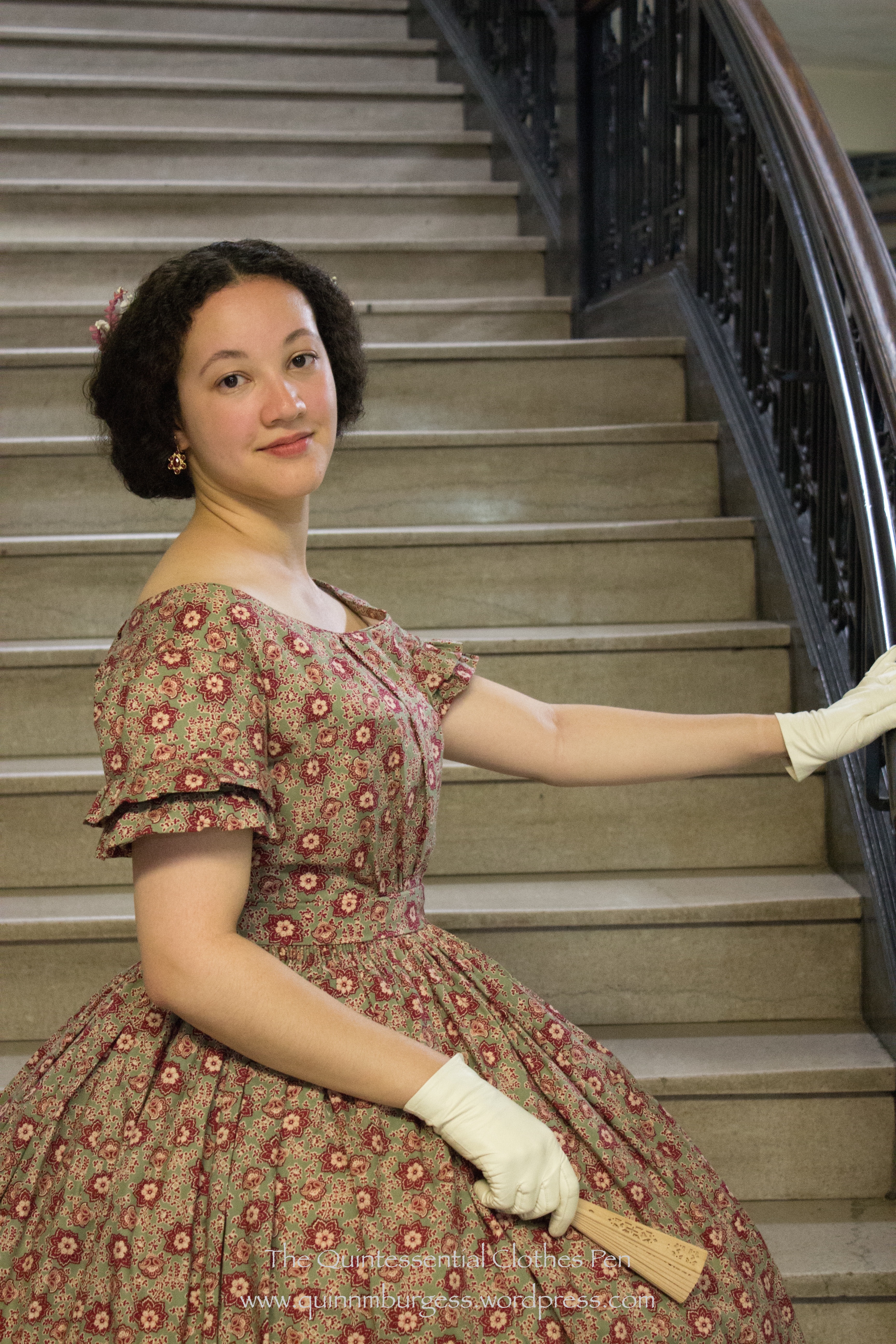
The first inspiration for my dress was this white summer dress at the LACMA. The skirt was pretty much directly taken from the original, except for the back, which has a cascade of fabric instead of tucks as on the original–I figured there was already enough fluff for me on the front of the dress. I originally planned to edge all the front ruffles in lace as well, but ran out of lace. Running out of lace also made me rethink how I was going to trim the bodice. I went back to my inspiration boards and found these dresses with inspiring bodice treatments: a seaside ensemble and an afternoon dress with very different fabrics and intent, but I thought this could be adapted for my summery seaside dress. I had only a few yards of lace left when I got to working on the bodice and I decided to save some for edging the top of the 1880s corset because the shape of the lace is perfect, but that didn’t leave me much for the bodice. It turns out I had just enough to execute the final trimming plan I decided on.

IMG_2754

Since this was originally intended to be part of the HSF, here are just the facts:

Fabric: 7ish, I think, yards of cream satin stripe cotton, 1/3ish of a yard of blue polished cotton, and 1.5 yards or so of cream polished cotton for flat lining the bodice.

Pattern: Created by me, but the shapes are based on a dress in Janet Arnold.

Year: 1885.

Notions: 9 yards of ivory lace, hooks and eyes, scraps of white cotton for finishing off the bodice edges, and vintage ivory buttons.

How historically accurate is it?: As accurate as I can be using the research I’ve done and the materials that are available in 2015. It definitely passes Leimomi’s test of being recognizable in its own time.

Hours to complete: Tons over two years.

First worn: In August 2015.

Total cost: I bought the all the cottons for super cheap, probably $3/yard, the lace was probably about $8, the buttons were a few dollars, and the rest was from the stash, so around $30-$35.

There were so many good pictures it was very hard to limit myself for this post! So here’s some more, with a bit of commentary to go along with them.

We had a beautiful day for the Tea and Promenade. It had been very hot prior to this, but the day of the event was a little cooler and the stiff ocean breezes made for a temperature that felt perfect for me in my layers and ¾ sleeves. The formal tea part of the day was at Egg Rock on Nahant (the same location as the Formal Soiree I attended last August). There was a lovely concert inside the house as well as guests lounging around outside, including me, playing croquet. At that point the stiff breeze had me worried that my hat wouldn’t stay on without pulling at my hair, so I chose not to wear it for awhile. (Thank goodness I gave it a try later, though, because it is perfect with the dress and I wouldn’t have wanted to miss wearing the two together!)

IMG_2668

11866207_10153557263049588_8661903483348243128_n

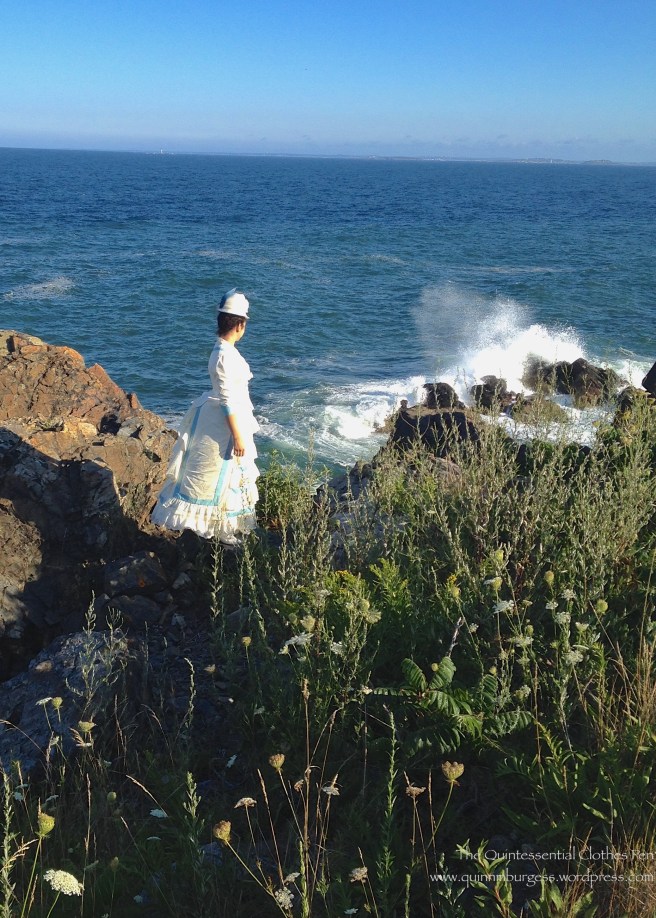
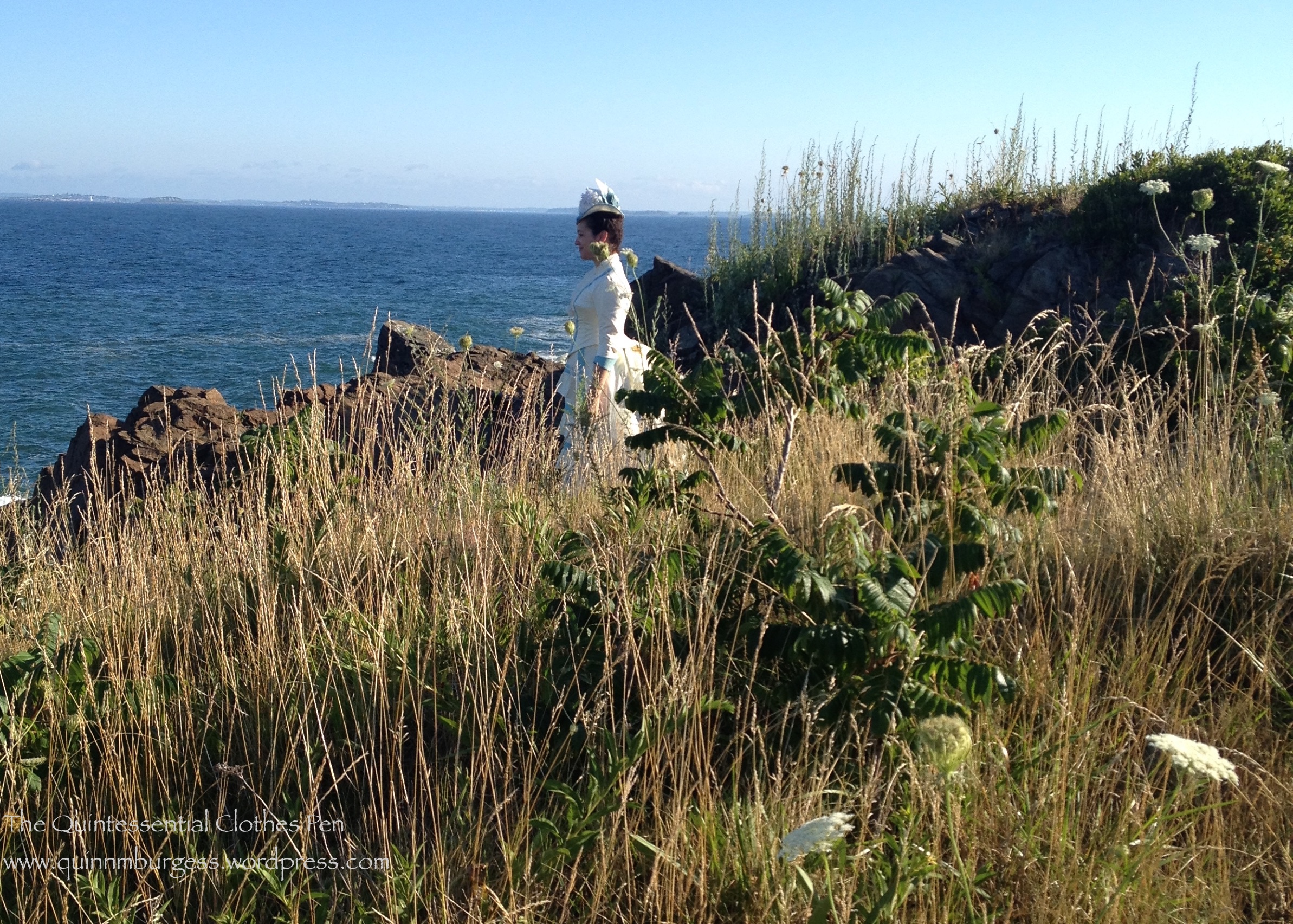
After the concert and some refreshments, the guests assembled for the promenade. As you would expect, we stopped traffic, attracted stares, and received questions from the more brave souls who would talk to us rather than just making up stories in their heads about our unusual clothing. The promenade took us to East Point, former site of the 19th century Nahant Hotel. The hotel is no longer standing, but there were stunning views of the Atlantic and the rocky coast to clamber on!

IMG_2716

IMG_2721

IMG_2735

IMG_2737 (1)

IMG_2742

IMG_2750

IMG_2776

Not me, but such a gorgeous view and cute picture that I had to share it, too!

IMG_2766

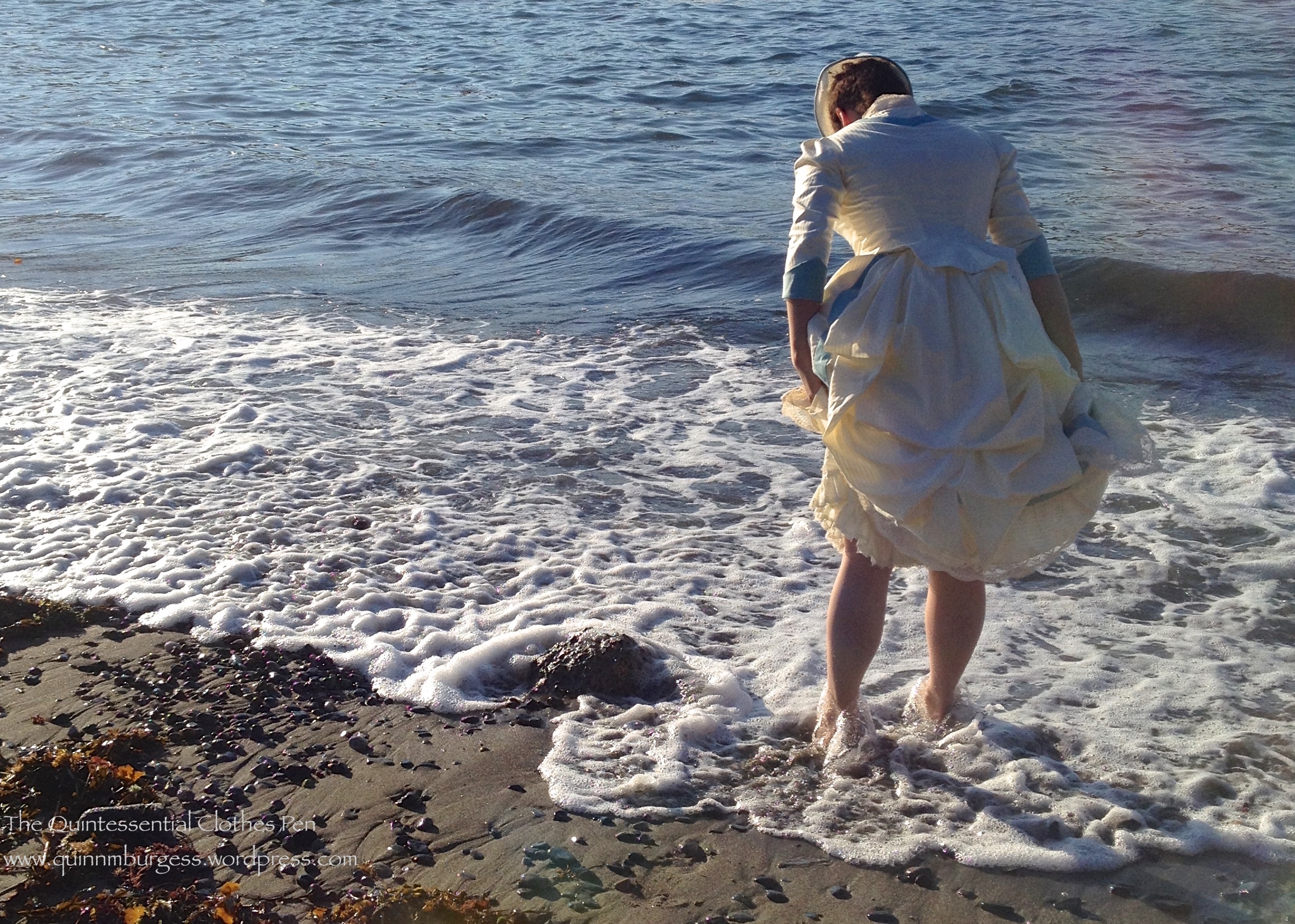
Some of us decided to head back a little early so we could stop at a small beach we had passed on our way to East Point and go wading! After the walk, the cold Atlantic water felt quite good on our feet. Here I am with stockings and shoes off, ready to head into the water.

IMG_2785

And here I am, wading in my bustle dress!

IMG_2816

There’s this picture of two ladies in bustle dresses from 1885 who look like they are collecting shells. That’s what I had in mind when I took this next picture, although looking at the 1885 picture again I see that the ladies in the picture are still wearing their stockings and shoes… I guess I’m pretty scandalous for 1885 in my bare legs and feet!

IMG_2827

Here we are, the whole wading group. It was a pretty fun adventure. I don’t think I’ve been wading in historical clothing since Newport in 2012.

IMG_2789

IMG_2810

HSF/M #7: 1885 Straw Hat

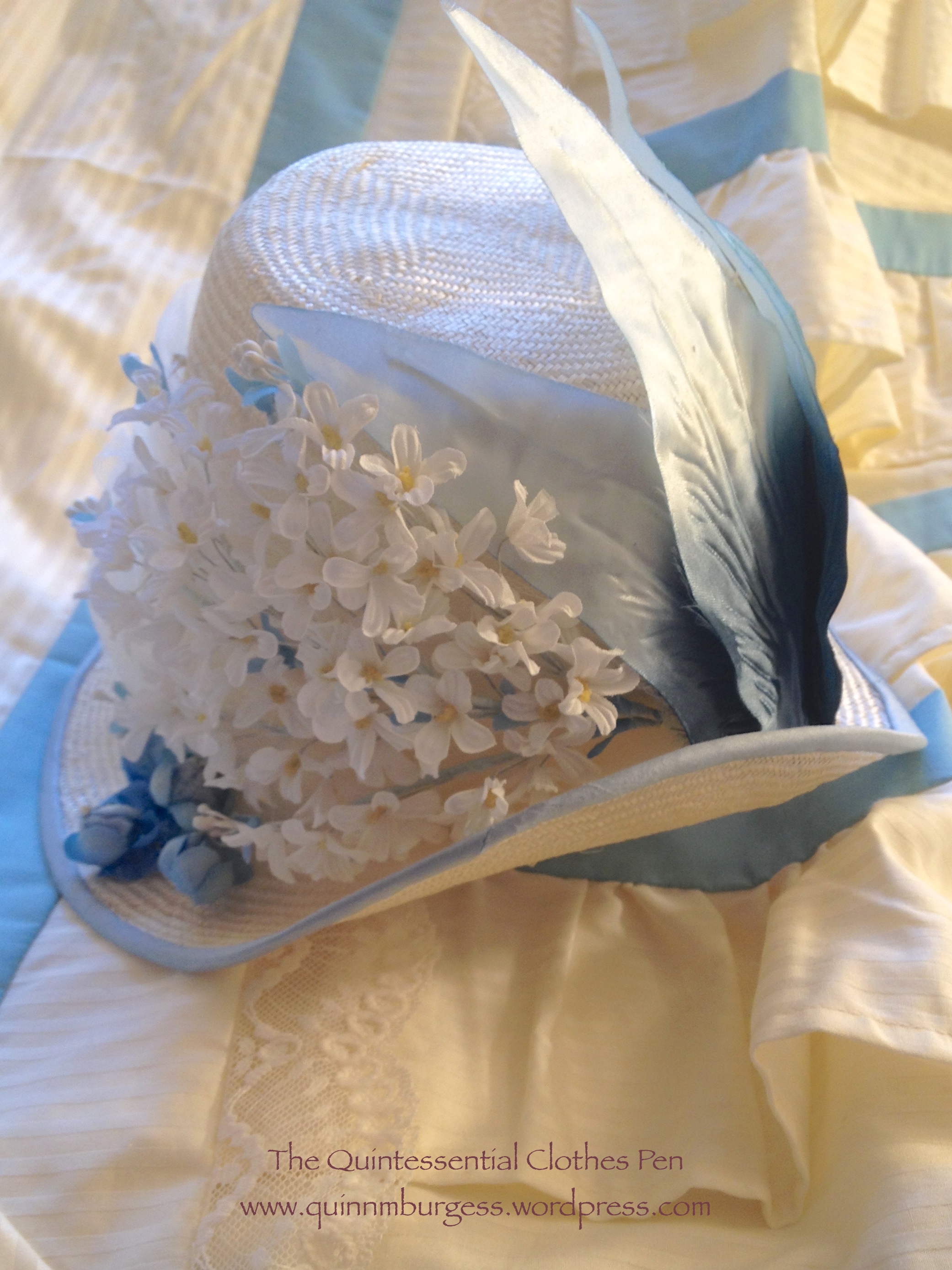
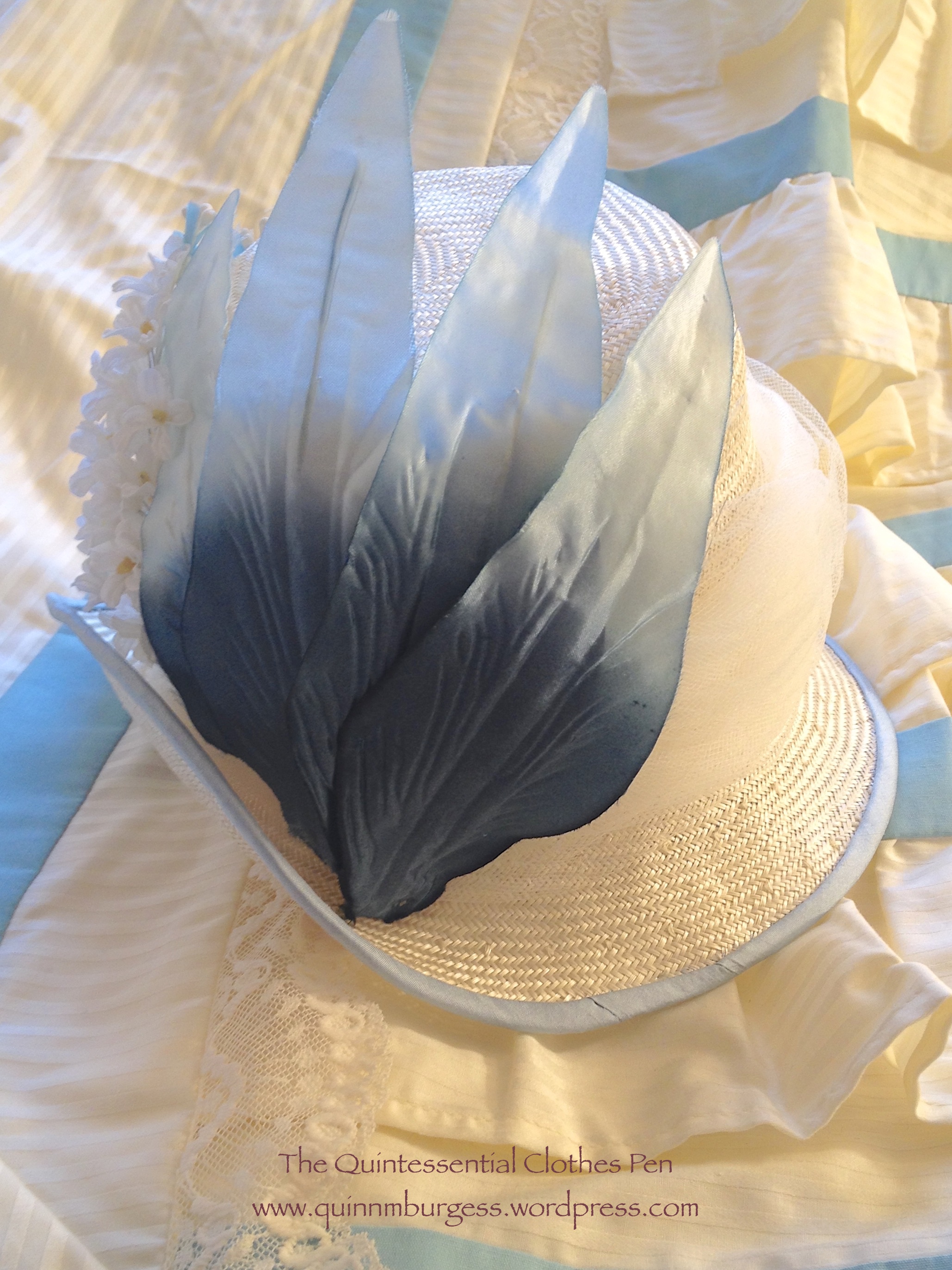
This month’s HSF/M challenge is “Accessorize.” In preparation for the first wearing of a new 1885 outfit next month, I made up a hat to match.

IMG_2446

I chose to make a flowerpot shaped hat, a style that is quite common in the mid-1880s. You can see other examples of this style and others on my 1880s headwear Pinterest board.

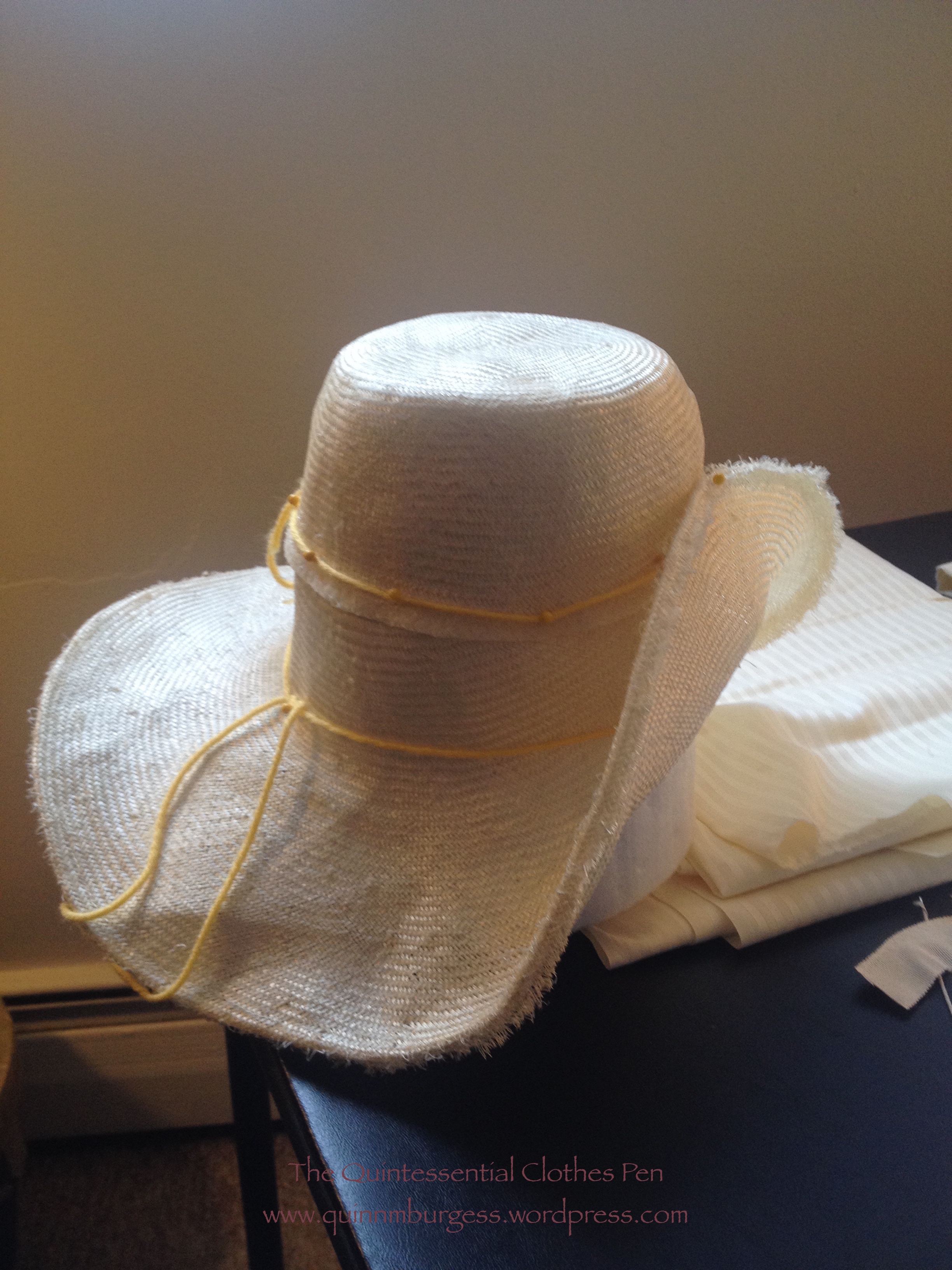
The straw base of this hat has seen multiple previous shapes that failed in creating a look I was happy with. (You can see one of the old iterations in this previous post from 2012. And as a side note, I really need to wear the other clothes in that post again–it’s been awhile and they’re cute!) So I was happy to reblock the straw into a new shape (that I am very happy with!).
IMG_2398I made my hat block out of packing foam stuff that I masking taped around a lysol wipe container–make do with what you have, right? To begin, I wet the straw, then used a paintbrush to cover the straw with a layer of my sizing (a bit of elmer’s glue dissolved in water–no formula, I just winged it). In order to keep the straw in place while the hat was drying overnight I used yarn tied and pinned in strategic locations to keep everything in place. I wanted to use twine, but we’d run out, so I made do again. As you can see, there is a random seam in the middle of the hat crown, because in the past it had made sense to have a crown separate from a brim, but for this hat I needed some of the old brim to become the crown. (The seam was later covered by the tulle trimming.)

IMG_2396

My inspiration for the trimming of this flowerpot hat is this fashion plate. The lady on the left happens to be wearing an outfit in the same colors as my outfit and the fashion plate is dated only one year later. I used materials I had on hand, but was inspired in general by her trim placement and scale.

IMG_2449
Side view.
IMG_2450
Side back view.

Just the facts:

Fabric: A bit of blue silk shantung for binding and a length of 6″ wide tulle.

Pattern: None.

Year: c. 1885.

Notions: French crinoline for binding the straw edges, thread, millinery grosgrain for the inner hat band, elmer’s glue for sizing, and vintage millinery flowers.

How historically accurate is it?: As accurate as I can be using the research I’ve done and the materials that are available in 2015. It definitely passes Leimomi’s test of being recognizable in its own time.

Hours to complete: All hand sewn, so a few mostly on the brim binding. Then a whole lot of days debating over the placement of the flowers–actually sewing them on didn’t take very long.

First worn: Has not been worn yet, but I have plans to wear it in August.

Total cost: Free! All from the stash!

Project Journal: 1880s Steam Molded Corset: Steaming (HSF/M #6)

Most of the work on this new corset was completed during the sewing process, which you can read all about in detail in this previous post. The remaining steps were to starch and steam mold the corset, to floss the corset, and to add lace to the top of the corset.

First, the steaming. I did what I could to follow the description provided by the V and A regarding Edwin Izod’s steam molding process:

One of the most successful was the steam-moulding process developed by Edwin Izod in 1868, and still used in the 1880s to create elegant corsets such as this one. The procedure involved placing a corset, wet with starch, on a steam-heated copper torso form until it dried into shape. The result was a beautifully formed corset, whereby ‘the fabric and bones are adapted with marvellous accuracy to every curve and undulation of the finest type of figure’ (The Ladies’ Gazette of Fashion advertisement, London July 1879).

To begin, I made a solution of cornstarch dissolved in water. I put 2 tsp to 350 ml water, but wound up using only about 1/5 of that. On a scrap, I tried applying the starch solution with a spoon, but decided against that because it left a visible starch crust on the fabric as it dried. What I found worked better for even distribution of the starch solution was a spray bottle. I sprayed the inside of my corset (the coutil layer) until it was thoroughly damp, then put it onto Squishy (since I don’t have a steam-heated copper torso of myself available, darn!): she’s a squishable dress form that I had previously padded to be close to my measurements and proportions (that’s an important point, that she had my proportions–padding in the right areas so the corset would dry into my shape!) and covered with a plastic garment bag so the starch would stay on the corset. Once the corset was on the form, I steamed it all over using a Rowenta Steam-n-press hand held steamer about three or four times. Then I intermittently steamed it again while it dried overnight.

IMG_2346
Steaming the starched corset on Squishy.

I only did one application of starch and I believe it had some effect. It’s not as stiff as cardboard and able to stand up on its own, as I have heard some steam molded corsets described, but it does seam to want to create the curves that were patterned into it with ease and I do think that the bones took on a little of the curvy shape during the drying process as well. (Here is an example of an extant very stiff steam molded corset. Look at how well it retains its shape! I want to do some more research regarding the Symmington corset company but that’s going to have to wait a bit.)

After the corset was dry, I flossed the boning channels using ivory silk thread and the flossing pattern from my inspiration corset. Unfortunately, I only had enough of the thread to floss the bottom of the channels… so I have to deviate from my inspiration a little and not have flossing across the top.

The last step will be to add lace across the top of the corset. I’d like to use the same lace that I’m using to trim my in-progress 1885 bustle dress, but I’ve only got a small bit left and I want to make sure the dress has enough before I use it on the corset. I’ve started figuring it out but am not confident yet that I have enough, so I’m going to hold off on taking absolute final pictures of the corset with the flossing and lace until I’ve officially decided that point. Regardless of the lace issue, we’re going to call this corset done, because it is entirely wearable at this point, just in time for it to qualify for the HSF/M #6: Out Of Your Comfort Zone!

Just the facts:

Fabric: A remnant of yellow silk duchess satin, a remnant of ivory linen, and white herringbone coutil.

Pattern: Created by me (more details in this blog post about mockups and this one about the pattern pieces themselves).

Year: c. 1885

Notions: 38 bones (34 of which are spiral steel and 4 of which are flat steel), a metal busk, metal grommets, cotton twill tape, thread, silk thread for flossing, and a lace for the corset (with the addition of decorative lace sometime soon).

How historically accurate is it?: As accurate as I can be using the research I’ve done and the materials that are available in 2015. I think it passes Leimomi’s test of being recognizable in its own time.

Hours to complete: Many! Patterning, cutting, sewing, finishing…

First worn: Only for fitting the mockup of the dress that inspired it–but I plan to wear it with that dress in August.

Total cost: The fabrics were all from the stash, as were most of the notions, except for the bones and busk, for which I paid about $50.

New techniques: Steam molding! But I also added a few new details to the corset construction process. Details in this construction in detail blog post.

Reflecting back on the process, I think I probably could attempt to starch the corset with a stronger solution or more applications, but at this point I’m satisfied and ready to move on to the many other things I’d like to sew this summer, including the 1885 bustle dress that sparked this project in the first place! (I’ve actually already moving ahead with that–I fit the mockup bodice over the corset and was very pleased! More on that in a few weeks hopefully!)

HSF/M #2: 1811 UFO Completed

I used the deadline of the HSF/M Challenge #2: Blue to finish the nagging little things on my 1811 Elusive Blue evening gown that either didn’t make it to completion in time for the first wearing last April or that bothered me after wearing it that first time. The changes: lengthening the hem of the underdress, adding a drawstring below the bust to control where the fullness and folds will fall beneath the overdress, fixing a section of pearls on the back hem that had come loose, and creating trim to finish off the sleeve openings.

IMG_2042
The trim on the sleeve openings is probably the most noticeable and interesting of the things that brought the dress to completion.

Just the facts:

Fabric: Scraps of elusive blue and dark blue fabric from the original dress.

Pattern: None, though I did reference Sabine’s trim creation method to create the dark blue trim on the sleeves.

Year: 1811.

Notions: Extra pearls, thin yarn for cording, and thread.

How historically accurate is it? The trim is directly inspired by this extant gown at the Met and is entirely hand sewn. I think it would be recognizable by someone in 1811, so the only points off would be for inaccurate fabric choice. Let’s say 90%.

Hours to complete: As usual, I did not keep track for the changes/finishing or for the original construction. I can safely say, “a lot.”

First worn: At a Regency Weekend in April 2014, unfinished. It has not yet been worn in its finished state.

Total cost: Free, because all the scraps were in the stash!

Hopefully I’ll get to wear it (in its now completed state) within the next few months.

HSF/M #1: 1895 Hug-able Skating Costume

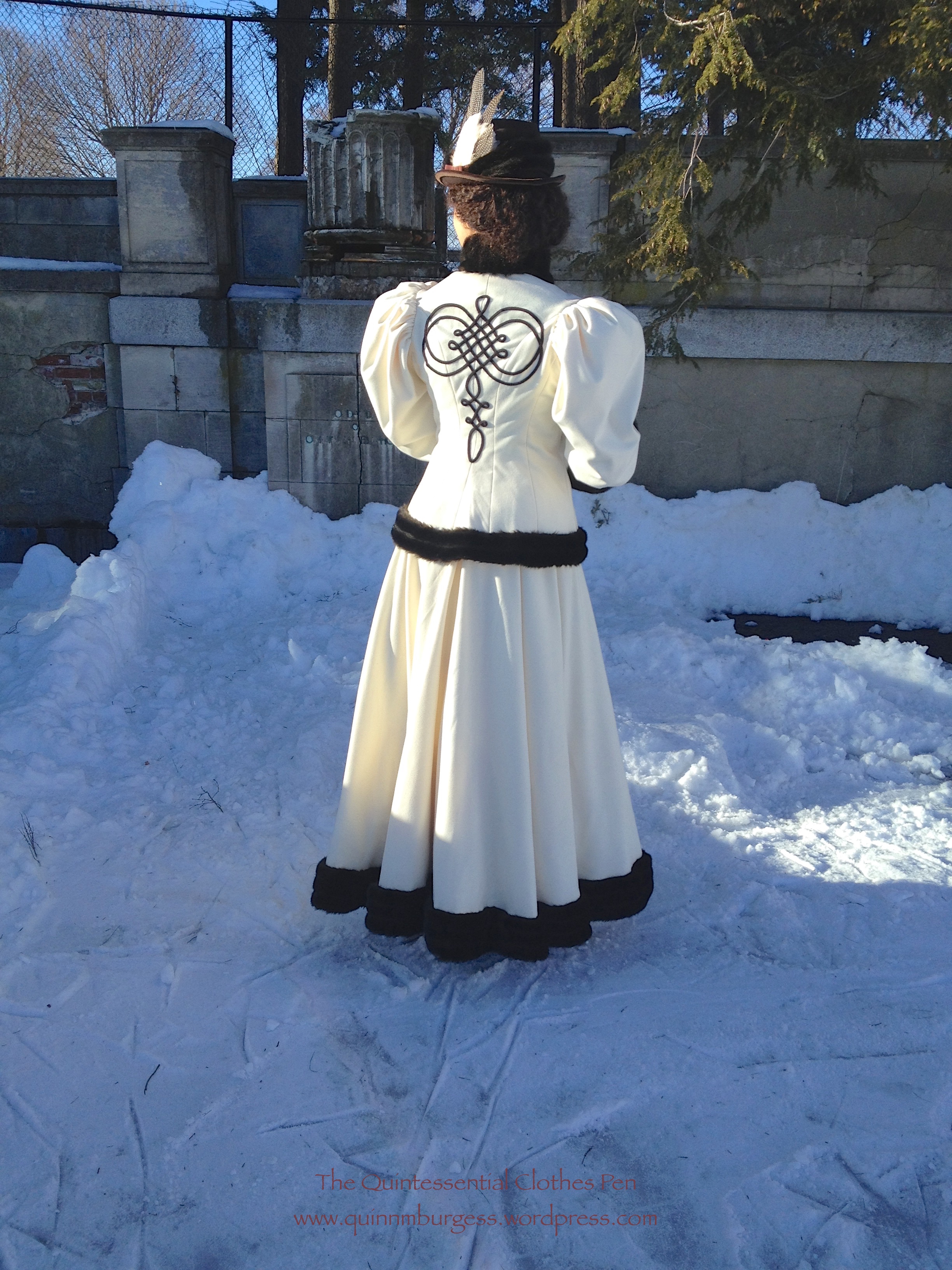
This is one of my favorite outfits of all time. I just want to hug myself, with all the fur, and I love the trim on the back! The whole thing is so cozy and so hug-able and the skirt has such a nice drape and the accessories work so well… and I actually got to go skating in it! I am just utterly chuffed (to use a British word) with the whole thing!

IMG_1952

IMG_1955

IMG_1956

I was on the fence about whether this outfit would apply to the Historical Sew Fortnightly/Monthly Challenge #1: Foundations, but then I read Leimomi’s teaser post about her foundation entry in which she reminds us about different interpretations of foundations and the intent of this challenge to create loose guidelines open to interpretation.

I was convinced (or pushed off the fence, if you prefer to think of it in that amusing way). I’m claiming my all new 1895 skating outfit for the first challenge of the new year! It does rather stretch the idea of foundations. Is the skirt a foundation because it is literally worn below the jacket, thus being a foundation as you would think of one in a building? Or is the bodice a foundation, because my direct inspiration is a lonely jacket without a skirt and therefore it is the foundation of the outfit because I wouldn’t have made the skirt without having the jacket? Either way, there is an element of a foundation in there.

Just the facts:

Fabric: 5 yds of ivory wool, about ⅓ to ½ yd of dark brown faux fur, probably about 3 yds of scrap muslin for flat lining the jacket, a bit of scrap canvas to stiffen the collar, and a bit of ivory flannel to line the inside of the collar.

Pattern: Made by me and based on my inspiration jacket as well as patterns published in Authentic Victorian Fashion Patterns (a Dover book).

Year: c. 1895.

Notions: 5 yds of brown braid, thread, a bit of high loft polyester batting to keep the sleeves puffed out, about 1 yd of ivory hug snug to finish the bottom of the jacket, hooks and bars for the skirt, and thread.

How historically accurate is it? Pretty darn good. Definitely recognizable by someone in the 1890s. The construction is accurate, aside from the use of hug snug instead of bias and faux fur instead of real fur. So, 95%.

Hours to complete: Um… As usual, I did not keep track. I definitely spent at least 15 hours the few days before the event sewing on my braid and fur trim… Plus full days of pattern making, fitting, cutting, and sewing. Maybe 30-40 hours? I care so much more about the finished project than the time it takes to get there! And I loved sewing this, so I didn’t mind that it took time!

First worn: To a skating party that was part of the Commonwealth Vintage Dancers‘ 1890s weekend in January.

Total cost: $75 for the wool, probably about $8 for the fur yardage I used for this project, $4 for the braid, and the rest from the stash = $87

My accessories were a matching fur muff that I made a few years ago and wore once for caroling (with my as-yet-undocumented 1860s winter cape) but more often with my 1917 winter ensemble and a revamp of my 1883 wool hat. I didn’t have time to make a new hat because of all the last minute fur and trim sewing, so I pinned a fur scrap around the 1883 hat and added some feathers to stand up a bit more like 1890s hats and called it good. My main inspiration (and the reason I feel it was an acceptable looking style to have the squashy fedora hat look in the 1890s) was this image.

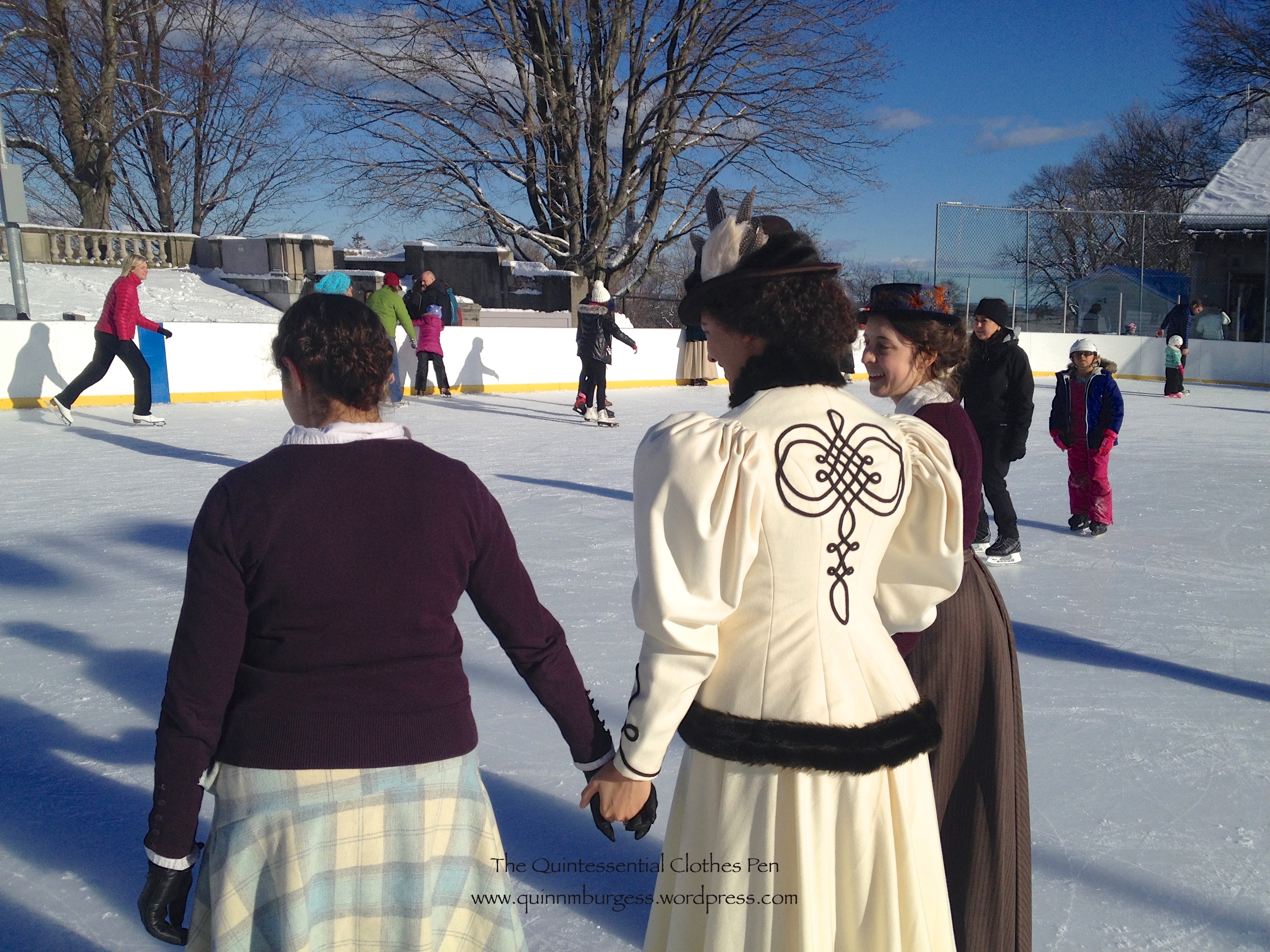
For good measure, here’s my Pinterest board for the entire project. And here are pictures of us skating (with ice skates: all our snow and cold weather does occasionally come in handy here in Boston)!

IMG_1911

IMG_1903

IMG_1942

IMG_1949

IMG_1947

Yes, we just crashed a local outdoor ice rink on a Sunday afternoon. One of the attendees even wore vintage skates! Turns out they can be hard to skate in because they’re not very supportive… but they looked fantastic! We got lots of comments from people asking what we were doing, why we were dressed up, and that we looked good. I was asked by multiple groups of young girls why I was dressed up and one group in particular asked what the swirly thing was that I had, which I got to explain was a muff to keep my hands warm!

10906529_10203571494468255_4785896006596651774_n
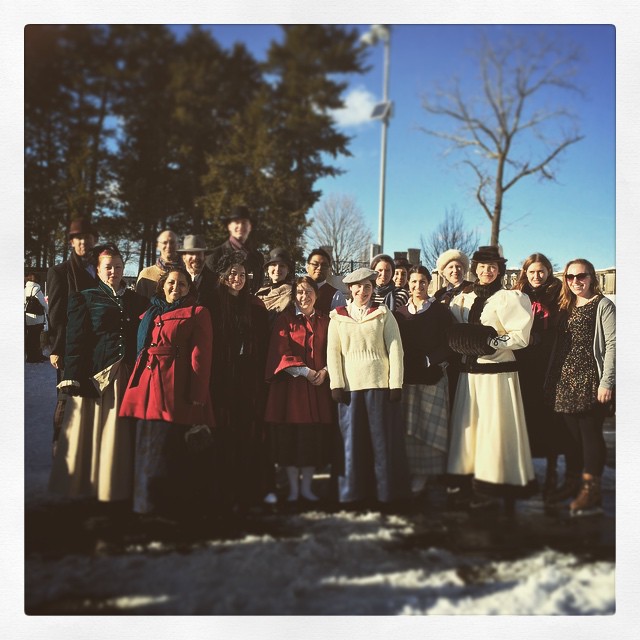
Here’s our skating group. People came in a variety of late 19th century and early 20th century winter outfits as well as modern clothes.

With my skating ensemble I wore fleece lined tights (modern, but warm so I didn’t care), knee high bamboo socks (modern again), my 1903 silk petticoat (super useful for the 1890s, also), a modern tank top (instead of combinations, because I needed to go to work later in the afternoon and change out of my outfit in the back seat of my car without being indecent…), my 1895 corset, and a long sleeve modern waffle tee (mostly to shield my skin against the wool seam allowances and also for warmth). And I was perfectly warm wearing this out for skating on a day that was sunny and right around freezing. In fact, with the muff and wool hat I actually was too warm at times.

IMG_1920
Pleased, chuffed, and smiling all afternoon! So fun! Maybe we will get to go skating again this winter!

HSF #23: 1917 Cranberry Red Scarf

IMG_9660
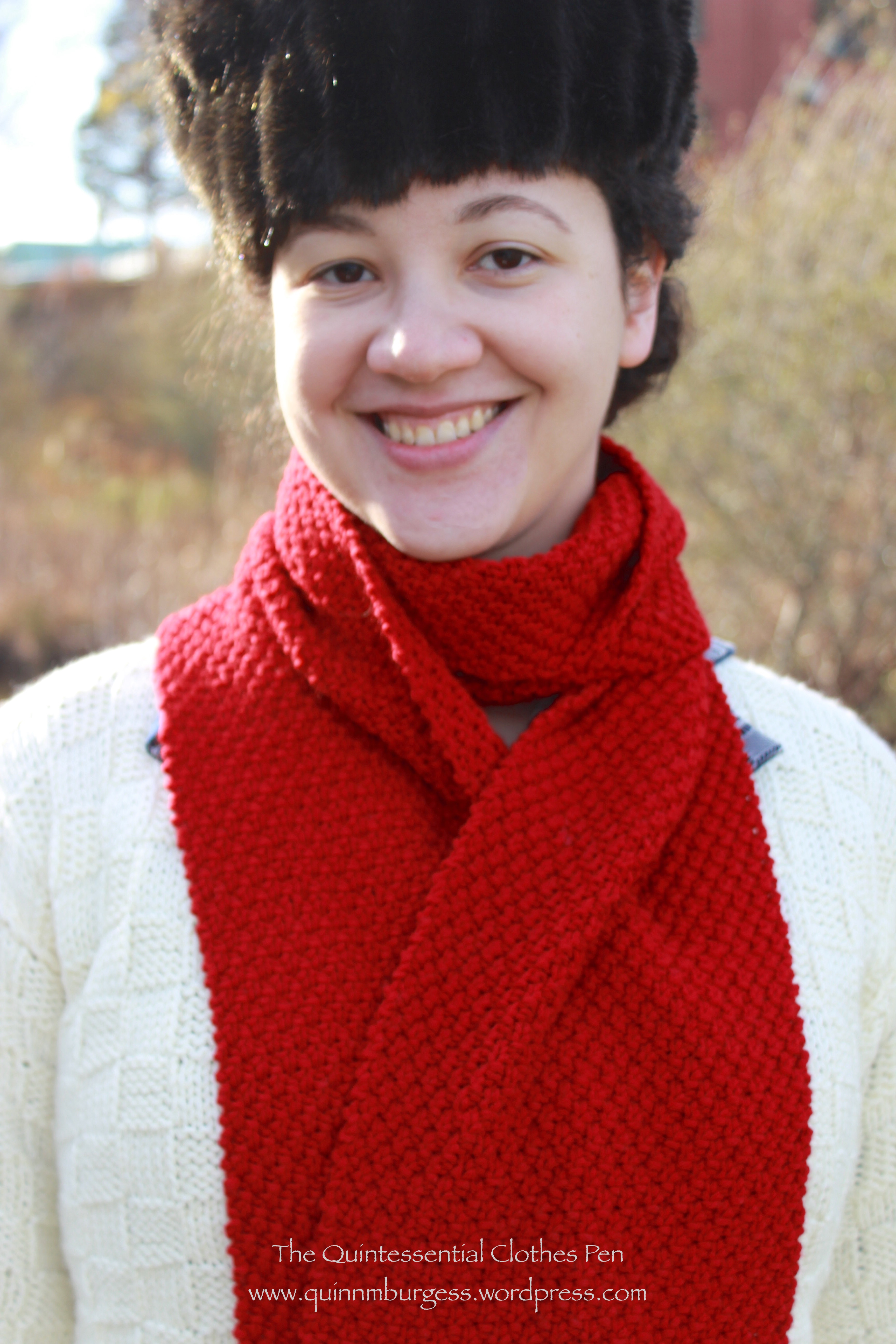
Look, I made my scarf!

…and it qualifies for the HSF Challenge #23: Modern History! This particular challenge is to make something historical or historically inspired that is wearable in an everyday context. And a scarf like this: absolutely wearable in my modern life if I choose!

Just the facts:

Fabric: 2 skeins, of unknown length, of probably acrylic yarn.

Pattern: Made by me. (More details below.)

Year: 1910s. (More details below.)

Notions: None!

How historically accurate?: Ideally, it would have been made of angora yarn, but I had the acrylic on hand and didn’t want to spend extra money (angora yarn isn’t cheap, you know!). Acrylic wasn’t invented until 1941. However, the dimensions of the scarf are accurate, the pattern is entirely plausible for the 1910s, and the style is taken directly from an ad from the 1910s. So I’d say 90%.

Hours to complete: No idea. I knit while watching Netflix and didn’t pay any attention.

First worn: In Plymouth, MA the weekend before Thanksgiving while portraying a suffragette (as I did last year).

Total cost: $2.50 for the knitting needles and $1 for the yarn = $3.50.

The color is perfectly suited to the holiday season, being cranberry red just like the fresh berries I used to make homemade cranberry sauce last week. (That was really easy and tasty, by the way–I bought Ocean Spray cranberries and the recipe was on the bag!)

IMG_9662
Cranberry red!

The pattern is moss stitch. I knit an extra row at the beginning and end just to provide some stability. Then, K2, P2 all the way across for two rows. P2, K2 all the way across for the next two rows. Repeat. Super easy. I keep track of what row I’m on in a little notebook with all my knitting patterns in it. That way I know where I’m at while I’m watching Netflix or when I’ve put it down and picked it up on a different day.

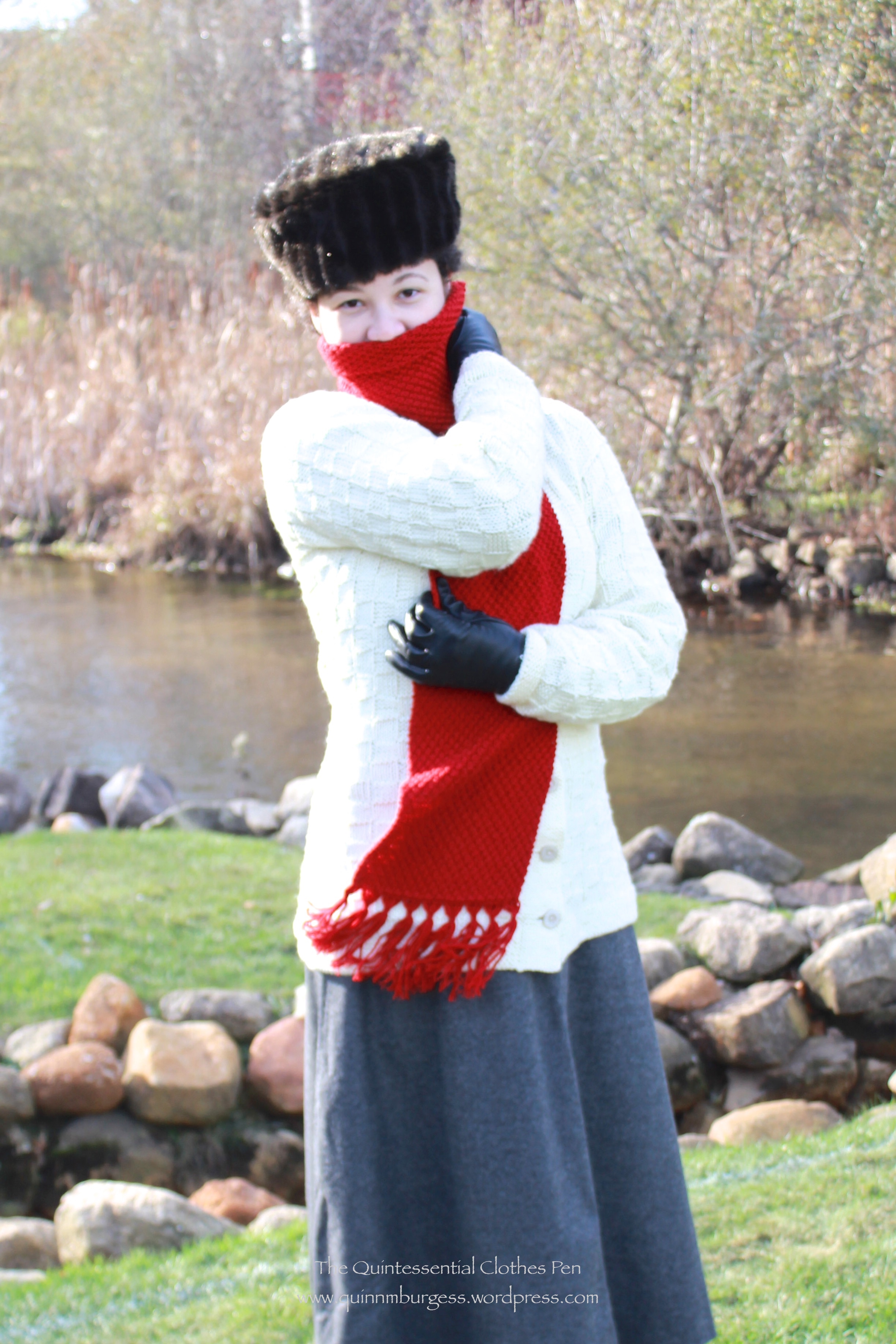
The dimensions are taken directly from a 1910s knitted wear ad that Lauren from Wearing History shared on her blog, here. I made my scarf 8” wide and 68″ long so it would provide maximum warmth while being worn. It also helps that it’s acrylic, which doesn’t breath and keeps you toasty. The fringe is about 6″ long and tied into 9 tassels, just as seen in the ad on a few of the scarves (turns out that I had the perfect number of fringe pieces to divide by 9 without planning!).

I had hoped to make these gloves from a 1910s pattern in matching yarn, but didn’t even start them. Perhaps it’s something that I can do next year! I’ve never knit gloves and I’ve only just taught myself to knit in the round, so while the cables in the pattern are not at all daunting, the simple idea of making gloves is. But challenges are fun sometimes! And I’m very pleased with the scarf.

IMG_9658
It was breezy and cold!

HSF #15: 1920s Wide Brim Hat

One of my recent projects lined up with an HSF challenge! I’m excited! My new hat qualifies for the HSF #15: The Great Outdoors. I enjoy making hats, partially because it is always nice to keep my hat making skills in use so I don’t forget them and also because I like putting those skills I’m practicing and remembering to use. The more you do things, the better you do them and the easier it is to remember how to do them!

IMG_0129 (1 of 1)
c. 1920 wide brim sinamay hat

The crown of this hat was pulled over a wooden form and then liberally brushed with sizing multiple times before being removed. The brim is a circle, wired on the outside edge, covers with French elastic to keep the poky edge bits from being poky and then bound in bias cut sinamay. The brim is also well sized. There is an inner millinery grosgrain hat band which covers the join between the crown and brim. The exterior hat band is made from bias cut cotton scraps from my stash. The flowers are some of those I purchased awhile ago for super cheap.

IMG_0905 (1 of 1)
Here is my only in progress picture, of the crown just after being removed from the hat block. The bottom edge was eventually trimmed off to make it even.

Fabric: ½ yd or so of sinamay* yardage.

Pattern: None.

Year: c. 1920.

Notions: Millinery wire, French elastic (½” wide bias cut tricot), millinery grosgrain, cotton scraps, faux flowers, and thread.

How historically accurate?: Let’s go with 90%. Sinamay has been produced for hundreds of years and was certainly known and used in America by the early 20th century. I don’t know for certain that it was used for hats at that point, but I have encountered images and extant examples of hats which certainly look like they could have been made from sinamay or some other similar looking material. The style of the brim and trimmings are consistent with the variety I’ve found in 1920s hats.

Hours to complete: 5ish, spread over about 3 months.

First worn: To the Crane Estate Lawn Party in Ipswich, MA at the beginning of August.

Total cost: Entirely a stash project, which makes it free! I probably paid about $5 for the amount of sinamay I used about six years ago when I bought it, but I used such small bits of all of the other materials that it is pretty hard to estimate how much they cost.

* Sinamay is a natural fiber woven from the processed stalks of the abaca tree, a banana palm native to the Philippines. It is woven in a variety of weights which produce a variety of qualities from rough to very fine, but regardless of the weight and quality it is always very strong. Historically, it was used to make twine, rope, and cordage because of its strength and resistance to salt water. More recently, it has been used for specialty items such as the production of tea bags, floor mats, and furniture, as well as for clothing, and hats!

IMG_0024 (1 of 1)
This picture was taken using a Petzval lens, which produces the unique blurred effect.
IMG_0122 (1 of 1)
I shaped the wire to create the slight curve down on the sides which I’ve often seen in 1920s hats.

You can see some inspiration here, in this post about making my long handled parasol. And here are some more examples: c. 1920c. 1925, and 1927. I’ve got more pictures of my whole ensemble, including my new long handled parasol, which will be coming soon!

HSF #13: Cotton Print Evening Bodice For Georgina

A few months ago, I had a master plan to use the leftover yardage from Georgina, my 1858 cotton print day dress, to make an evening bodice in addition to her current day bodice for versatility and washability. Luckily, I was able to complete the bodice and a new hair crescent before my life exploded in June and I was smothered under an immense amount of work. I am pleased to have work, don’t get me wrong, but I was so exhausted by the end of the month all I could do was sleep and be disoriented! I’ve just come back from a vacation and feel like I can peer out from under my rock and join the world again! So, to celebrate constructing historic clothing for myself rather than other people, here is a post about a really neat addition to my historic wardrobe! And it fits into the current HSF challenge #13: Under $10, a bonus since the HSF challenges haven’t lined up very well with a lot of my projects this year.

9357
c. 1855 new evening bodice, with previously constructed skirt. Worn with all the usual underpinnings (chemise, my new corset, drawers, stockings, hoops, and petticoat) and accessorized with gloves, fan, earrings, and a new hair crescent. Oh, and I’m wearing burgundy velvet shoes! No picture of that, though.

Fabric: Reproduction mid-19th century cotton print, also used for a day bodice, and plain white cotton.

Pattern: I began with Past Patterns #701 but altered it extensively to fit me, to have pleats and gathers on the exterior, and to have an evening neckline. The sleeve pattern was drafted by me.

Year: c. 1855

Notions: Thread, plastic wire ties for boning, hooks and eyes, and cotton cording.

How historically accurate?: Based off of historic examples, constructed with accurate details… I think the only compromise is the plastic boning, which I used because I didn’t have the right length in metal, and because plastic is easily washable (and I want this to be a garment that can be washed easily–that’s part of the goal in having a cotton evening bodice!).

Hours to complete: I have no idea… 32 hours maybe? I really didn’t keep track at all on this project.

First worn: To a mid-19th century ball in June (one of the few moments of respite in my crazy month).

Total cost: About $3 for approximately 1 yard of historic cotton print and a lot of stash materials, which count as free, since I have no idea what I paid for them at this point! Let’s call the total about $8.

IMG_0951 (1 of 1)
Inside of the bodice.

As you know, I like things to be tidy. All of the seam allowances are either hidden between the layers of fabric or nicely finished. There are plastic bones in the darts and the side seams. The bodice is machine sewn and hand finished. (One amusing mistake is that I cut the lining with a center front opening for fitting purposes (and left lots of seam allowance, as you can see) but then forgot to leave seam allowance in the back… So the lining doesn’t extend all the way to the folded edge of the print, but it’s all covered up so no one will ever know and it fits just fine… it’s just one of those amusing things!)

IMG_0953 (1 of 1)
From the back with the right side flipped open.

The bodice closes with hooks and bars. I wanted to use metal bars but make sure they wouldn’t been seen, so I let about ¼” of the print extend past the points of the hooks to create an overlap. I also left extra print extended past the bars, in addition to all the seam allowance, in case I want or need to adjust the size of the bodice in the future. The bars are especially hard to spot on the print, but if you look carefully on the left you can see them. The neck and armsceyes both have very narrow cording.

9347
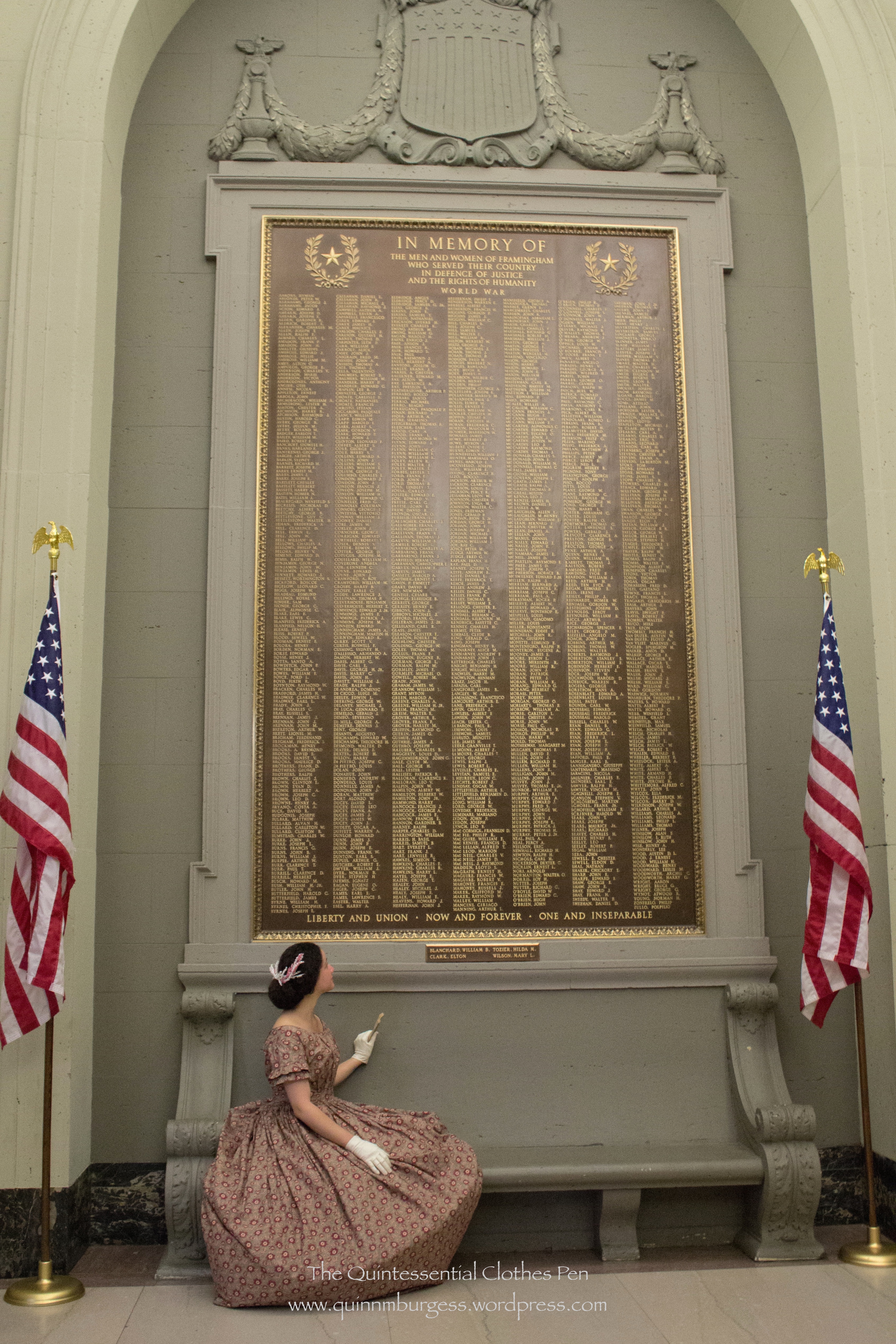
Appreciating those who have served our country. The ball was held in a local town hall which had lists for all the 20th century wars. I don’t think they have 19the century war plaques, but we thought it was a nice photo opportunity.

I had very specific inspiration for this dress, since you don’t see too many cotton ball gown bodices. Here the specific examples which I referenced: sheer white bodice, sheer peach bodice, blue and white striped bodice, yellow and white bodice, floral print bodice, and purple print bodice (this last has a matching separate pelerine shown worn over the bodice, but the “off the shoulder neckline” in the description tells us that underneath is an evening bodice).

The defining design details were obviously the low neck and short sleeves, but there were other common details as well, such as double puffs or pleats to trim the sleeves, tubular sleeves without very much fullness at the top or bottom, 1.5″-2″ waistbands sitting on the outside of the skirt waistband, and gathered or pleated fullness on the fronts and backs (no darts on any of these cotton bodices). Some of the bodices have a yoke around the top so that only the bottom portion of the bodice is gathered, but this look says “young girl” not “grown woman” to me, so I opted for a bodice without a yoke.

In terms of construction, to have enough fabric in the print for the pleats and gathers on the print fabric, I first constructed and fit the lining. Then I separated one side of the lining to use as a pattern and added width to have space for the pleats I had planned. Once I had cut the print, I reassembled the lining and mounted the pleated print on top. From there on I treated the two layers as one.

9359
Bodice closeup and a nice view of my successful 1850s round hair style!

As I’ve looked at 1850s images and fashion plates in comparison to early 1860s, especially, what I’ve noticed is that the 1850s really attempted to make a woman’s head look round or wide, whereas by the early 1860s the styles begin to grown upward and become vertically elongated. Here are some great examples of the round 1850s hair look: from 1851-53, c. 1855,  from 1857, another 1857, yet another 1857, one more from 1857, and one from 1859. Here’s a super wide 1850s style and here is an example of the different shape of the early 1860s. The very round shape is what I was attempting to complement my 1850s bodice.

How? Well, I put gel right at the roots of my hair while it was still wet and then encouraged it to stand up from my head rather than being pulled back. I let it dry like that and it stayed all day. Later in the day, I styled it for my 1940s Anne Adams dress photos by brushing it out (and brushing my hair when it’s dry makes it big!!!). There was lots of added hair spray for that style, so when I went to restyle it there was plenty of fullness and air in my hair.  I puffed the fronts and pinned them up and behind my ears then did a big roll with the rest.

The finishing touch was a new hair crescent that I made specifically to complement the colors in the cotton print. The crescent is made up of fully wired millinery flowers in ivory, some of which I dyed to be pinkish. Each extension is a singular stem and I just twisted them together until I liked the result. Lastly, I sewed a hair comb in the center to help attach it to my head and stabilize the wires. Each side also has a bobby pin to secure it to my head so the extended bits don’t flap around while I’m dancing.

9360
Back view, and new hair crescent.

I’m super pleased with the end result: the bodice, the hair style, and the hair crescent! Oh, and the pictures (thanks!). And I had a marvelous time at the ball–it was one of the class of events which makes me feel radiant and at which I really enjoy myself (compared to those when I’m grumpy and grouchy at the world). And all the smiling and dancing gave me a lovely natural rosy glow in the pictures. The aloof face is my attempt at a 19th century portrait face (it took a long time to capture a picture then, which is my rationale for why everyone has a generally serious face!). You had to pick something you could keep still for a long time, and a big smile is hard to maintain without movement or looking staged.

HSF #8: Red/Gold Regency Reticule

It’s been a little while since I completed a challenge for the HSF 2014. I’ve either been too busy to sew (sad!) or I’ve been sewing things that haven’t remotely lined up with the HSF challenges as they came along (also sad!). This time, though, I found a little bit of time to finish up a partially completed Regency reticule, which perfectly fits challenge #8: UFOs and PHDs (click through the link if you don’t know what those acronyms mean in sewing-land!).

IMG_0791
Red/Gold Regency Reticule

I was inspired by this Regency reticule pattern which is available on Etsy. I just made up my own pattern based on the image. I didn’t quite get the proportions right so mine is more elongated and a little less round, as well as not bunching up very tightly at the top due to the fabric I chose, but I’m happy with it nonetheless. Perhaps some day, I’ll try making it in a lighter weight fabric and see if I can get a more round shape and a tighter gather at the top (on the other hand, this one does hold its shape nicely… and a lighter weight fabric may not do that for me).

The facts:

Fabric: Polyester upholstery fabric for the exterior and gold polyester taffeta for the lining.

Pattern: Made up by me.

Year: c. 1810

Notions: 1 tassel, gold and burgundy thread, and about 1 yd of gold silk ribbon.

How historically accurate?: Accurate in style but not in materials or use of a sewing machine… Let’s say 50%.

Hours to complete: Not many, though I didn’t really keep track since I worked on it in small bits of time.

First worn: Has not yet been used.

Total cost: Free (all stash materials)!