HSF #13: Cotton Print Evening Bodice For Georgina

A few months ago, I had a master plan to use the leftover yardage from Georgina, my 1858 cotton print day dress, to make an evening bodice in addition to her current day bodice for versatility and washability. Luckily, I was able to complete the bodice and a new hair crescent before my life exploded in June and I was smothered under an immense amount of work. I am pleased to have work, don’t get me wrong, but I was so exhausted by the end of the month all I could do was sleep and be disoriented! I’ve just come back from a vacation and feel like I can peer out from under my rock and join the world again! So, to celebrate constructing historic clothing for myself rather than other people, here is a post about a really neat addition to my historic wardrobe! And it fits into the current HSF challenge #13: Under $10, a bonus since the HSF challenges haven’t lined up very well with a lot of my projects this year.

9357
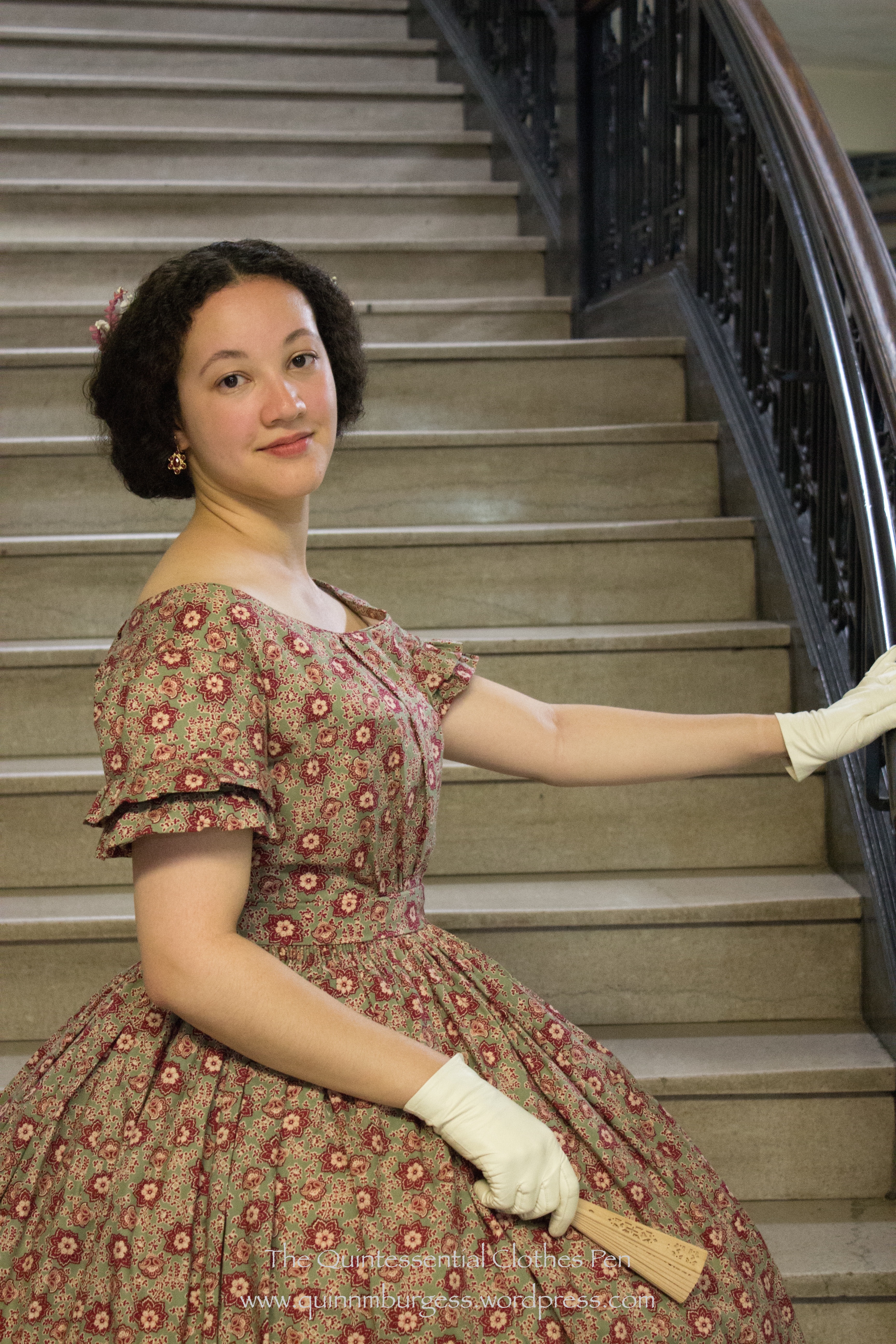
c. 1855 new evening bodice, with previously constructed skirt. Worn with all the usual underpinnings (chemise, my new corset, drawers, stockings, hoops, and petticoat) and accessorized with gloves, fan, earrings, and a new hair crescent. Oh, and I’m wearing burgundy velvet shoes! No picture of that, though.

Fabric: Reproduction mid-19th century cotton print, also used for a day bodice, and plain white cotton.

Pattern: I began with Past Patterns #701 but altered it extensively to fit me, to have pleats and gathers on the exterior, and to have an evening neckline. The sleeve pattern was drafted by me.

Year: c. 1855

Notions: Thread, plastic wire ties for boning, hooks and eyes, and cotton cording.

How historically accurate?: Based off of historic examples, constructed with accurate details… I think the only compromise is the plastic boning, which I used because I didn’t have the right length in metal, and because plastic is easily washable (and I want this to be a garment that can be washed easily–that’s part of the goal in having a cotton evening bodice!).

Hours to complete: I have no idea… 32 hours maybe? I really didn’t keep track at all on this project.

First worn: To a mid-19th century ball in June (one of the few moments of respite in my crazy month).

Total cost: About $3 for approximately 1 yard of historic cotton print and a lot of stash materials, which count as free, since I have no idea what I paid for them at this point! Let’s call the total about $8.

IMG_0951 (1 of 1)
Inside of the bodice.

As you know, I like things to be tidy. All of the seam allowances are either hidden between the layers of fabric or nicely finished. There are plastic bones in the darts and the side seams. The bodice is machine sewn and hand finished. (One amusing mistake is that I cut the lining with a center front opening for fitting purposes (and left lots of seam allowance, as you can see) but then forgot to leave seam allowance in the back… So the lining doesn’t extend all the way to the folded edge of the print, but it’s all covered up so no one will ever know and it fits just fine… it’s just one of those amusing things!)

IMG_0953 (1 of 1)
From the back with the right side flipped open.

The bodice closes with hooks and bars. I wanted to use metal bars but make sure they wouldn’t been seen, so I let about ¼” of the print extend past the points of the hooks to create an overlap. I also left extra print extended past the bars, in addition to all the seam allowance, in case I want or need to adjust the size of the bodice in the future. The bars are especially hard to spot on the print, but if you look carefully on the left you can see them. The neck and armsceyes both have very narrow cording.
9347
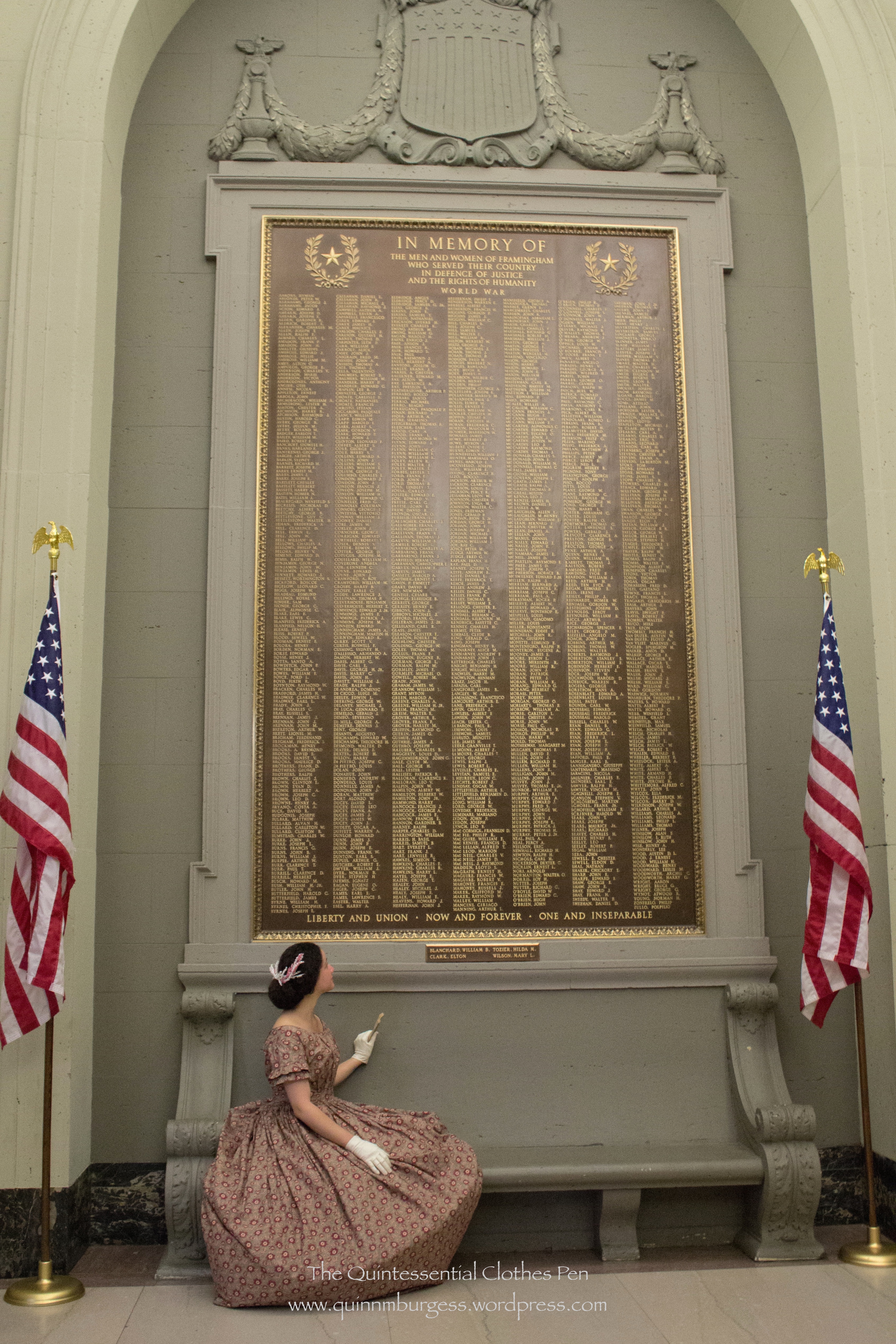
Appreciating those who have served our country. The ball was held in a local town hall which had lists for all the 20th century wars. I don’t think they have 19the century war plaques, but we thought it was a nice photo opportunity.

I had very specific inspiration for this dress, since you don’t see too many cotton ball gown bodices. Here the specific examples which I referenced: sheer white bodice, sheer peach bodice, blue and white striped bodice, yellow and white bodice, floral print bodice, and purple print bodice (this last has a matching separate pelerine shown worn over the bodice, but the “off the shoulder neckline” in the description tells us that underneath is an evening bodice).

The defining design details were obviously the low neck and short sleeves, but there were other common details as well, such as double puffs or pleats to trim the sleeves, tubular sleeves without very much fullness at the top or bottom, 1.5″-2″ waistbands sitting on the outside of the skirt waistband, and gathered or pleated fullness on the fronts and backs (no darts on any of these cotton bodices). Some of the bodices have a yoke around the top so that only the bottom portion of the bodice is gathered, but this look says “young girl” not “grown woman” to me, so I opted for a bodice without a yoke.

In terms of construction, to have enough fabric in the print for the pleats and gathers on the print fabric, I first constructed and fit the lining. Then I separated one side of the lining to use as a pattern and added width to have space for the pleats I had planned. Once I had cut the print, I reassembled the lining and mounted the pleated print on top. From there on I treated the two layers as one.
9359
Bodice closeup and a nice view of my successful 1850s round hair style!

As I’ve looked at 1850s images and fashion plates in comparison to early 1860s, especially, what I’ve noticed is that the 1850s really attempted to make a woman’s head look round or wide, whereas by the early 1860s the styles begin to grown upward and become vertically elongated. Here are some great examples of the round 1850s hair look: from 1851-53, c. 1855,  from 1857, another 1857, yet another 1857, one more from 1857, and one from 1859. Here’s a super wide 1850s style and here is an example of the different shape of the early 1860s. The very round shape is what I was attempting to complement my 1850s bodice.

How? Well, I put gel right at the roots of my hair while it was still wet and then encouraged it to stand up from my head rather than being pulled back. I let it dry like that and it stayed all day. Later in the day, I styled it for my 1940s Anne Adams dress photos by brushing it out (and brushing my hair when it’s dry makes it big!!!). There was lots of added hair spray for that style, so when I went to restyle it there was plenty of fullness and air in my hair.  I puffed the fronts and pinned them up and behind my ears then did a big roll with the rest.

The finishing touch was a new hair crescent that I made specifically to complement the colors in the cotton print. The crescent is made up of fully wired millinery flowers in ivory, some of which I dyed to be pinkish. Each extension is a singular stem and I just twisted them together until I liked the result. Lastly, I sewed a hair comb in the center to help attach it to my head and stabilize the wires. Each side also has a bobby pin to secure it to my head so the extended bits don’t flap around while I’m dancing.

9360
Back view, and new hair crescent.

I’m super pleased with the end result: the bodice, the hair style, and the hair crescent! Oh, and the pictures (thanks!). And I had a marvelous time at the ball–it was one of the class of events which makes me feel radiant and at which I really enjoy myself (compared to those when I’m grumpy and grouchy at the world). And all the smiling and dancing gave me a lovely natural rosy glow in the pictures. The aloof face is my attempt at a 19th century portrait face (it took a long time to capture a picture then, which is my rationale for why everyone has a generally serious face!). You had to pick something you could keep still for a long time, and a big smile is hard to maintain without movement or looking staged.
HSF #24: 1917 Fur Hat (And Revised Muff)

The theme of this HSF challenge is Re-Do, in which you re-do a previous challenge for a second time or you re-do a challenge you didn’t complete the first time around.

IMG_6968
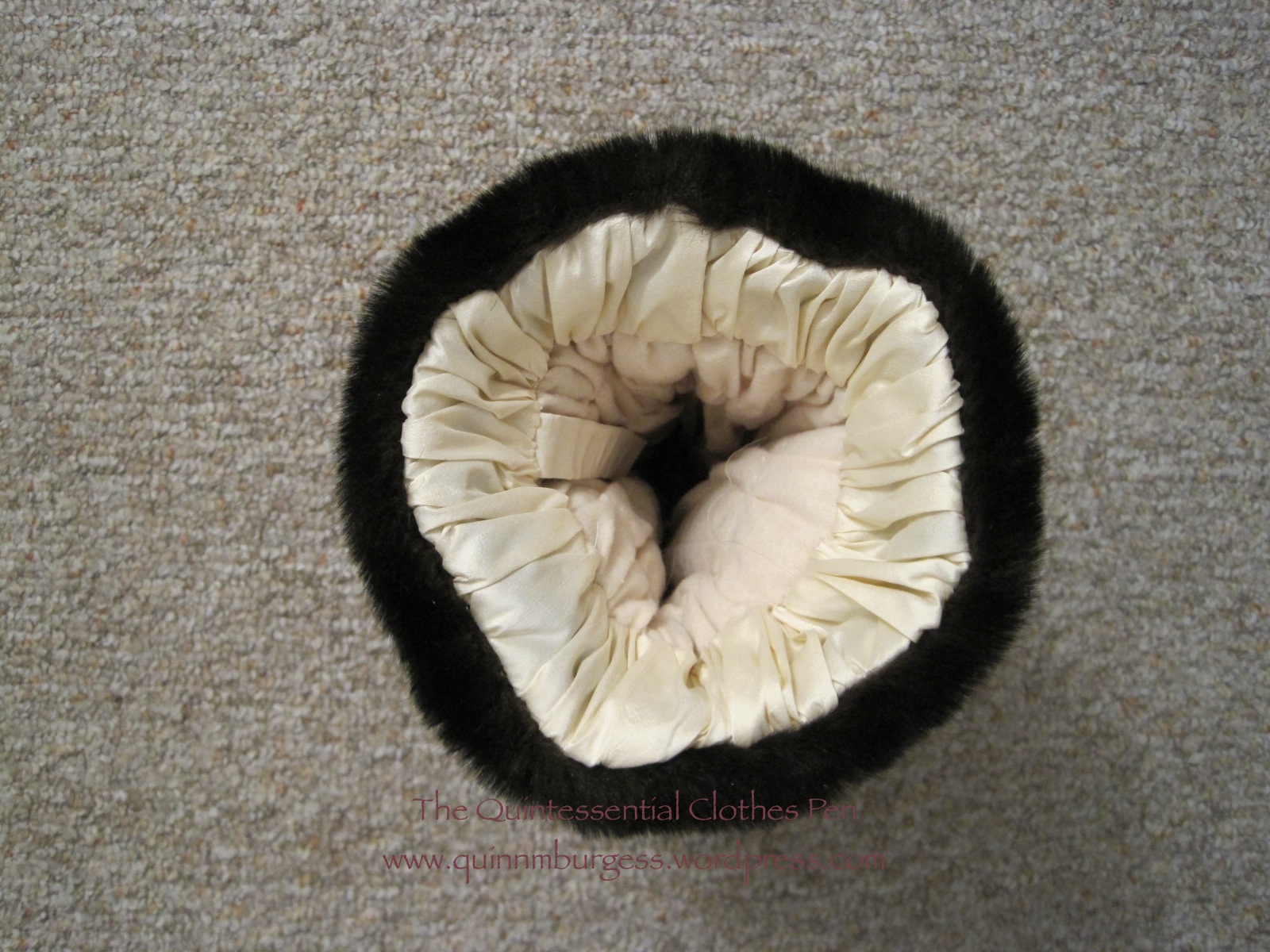
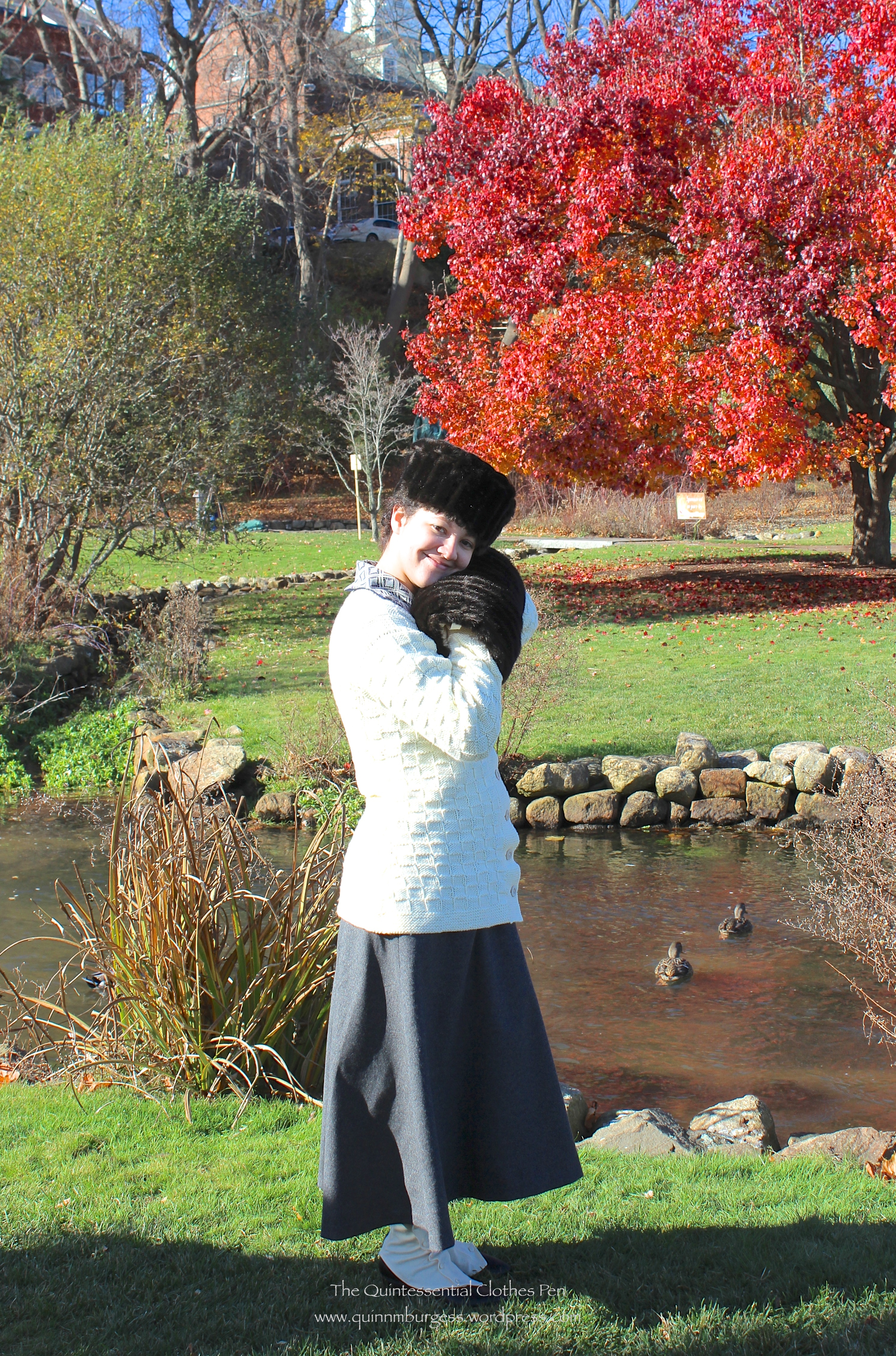
The muff and hat are super soft. In addition to keeping my hands in the muff, I also spent a fair amount of time hugging and patting it.

I’m using my recently completed 1917 fur hat and recently revised matching muff as my entry for this challenge. I think the hat and muff best qualify for a re-do of Challenge #20: Outerwear, which I did complete with my 1822 Walking Dress (so this would be a re-do of a challenge I already completed). So, the facts:

Fabric: About 1/4 yd of faux fur and about 1/4 yd cotton flannel.

Pattern: Created by me.

Year: 1917.

Notions: Thread, polyester batting.

How historically accurate?: 90%. Tall round hats of this sort were popular in 1917, though they were likely made of real fur rather than faux fur. The revised muff has a great shape for lots of periods, including this one, and is pretty accurate, aside from the fact that it is also faux fur. Oh, and neither hats nor muffs were insulated with poly batting… but it is so warm! And no one will know except me, and those of you reading this!

Hours to complete: Unknown. I was pretty tired while working on the hat, so I know it took longer than it should have. The muff was quick (like 2 hours) but that’s just the revision. I don’t remember how long it took to make it originally.

First worn: At a Thanksgiving event in Plymouth.

Total cost: None, since I bought the fur and the flannel specifically for the muff over two years ago I count it as a stash project.

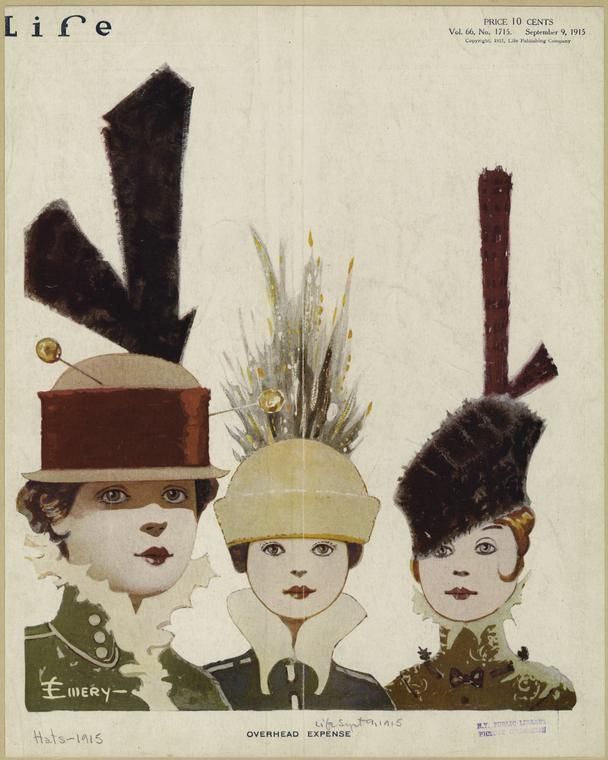
Here’s my inspiration for the hat. I was aiming for the exaggerated shape on the right. I don’t think I quite achieved that, unfortunately. I did actually spend a lot of time patterning the hat so it would look right sitting at an angle rather than straight. I think I was so cold when I was wearing it that I pulled it down to cover more of my head and thus pulled it off of its angle. Sad! But also, the thick fur rather obscures the shape anyway. I chose not to do the sticky-up bit, partly because I ran out of time, and partly because I just didn’t know what to make it out of, since the hat was already fur. Oh well. I really like that middle hat, too…

638f173724a14b7943037d74c9ef21bb
1915. In the collection of the NYPL.

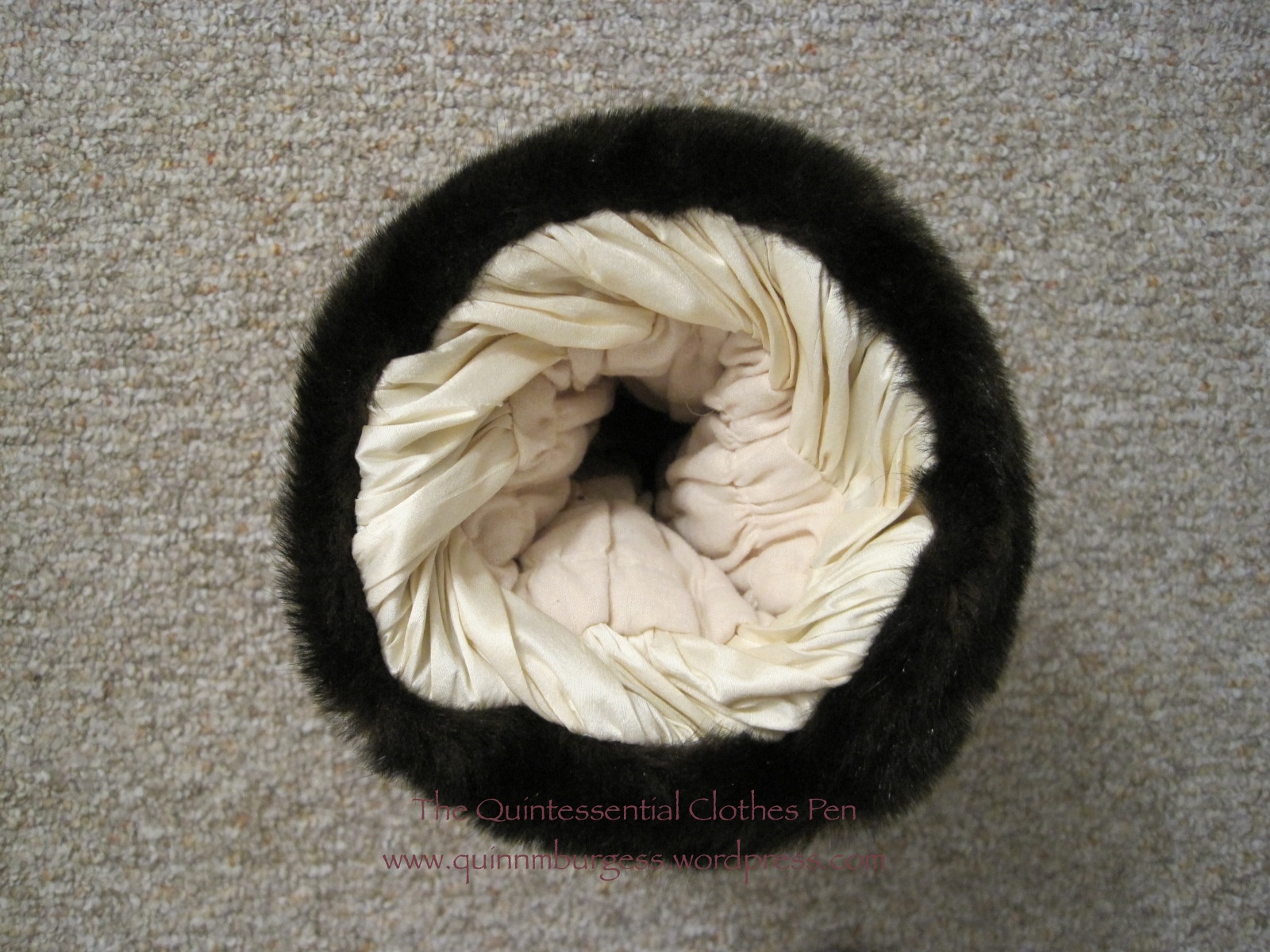
I originally made the muff for an 1860s event a few years ago. I had a plan to use gathered silk for the two ends, but it turns out it looked cooler in my head than when I executed the plan. Also, the muff was a little longer than I liked, so I decided that for this event I would shorten the muff by taking off the silk ends and folding the fur over to cover the ends. Here’s my Pinterest board of inspiration for this project. You’ll see that there are various shapes and sizes of muffs c. 1917. Mine is somewhere in the middle in terms of size and shape.

IMG_7369
This is sort of what I was envisioning with the silk on the ends, but it is a little underwhelming. You can see the cotton flannel lining in the middle. It holds body heat, so it doesn’t feel cold when you put your hands in!
IMG_7371
This is the other side. It’s pretty twisty and sad.

But as I said, I took the silk off, folded the fur down over the ends, and sewed it directly to the flannel. (I have plans to use the silk for a Regency reticule at some point in the future… yay recycling!) You can see the results in these next few pictures. I’m quite happy with the results! The muff is about 3″ shorter and I like the look of the fur on the sides.

IMG_6958
See the fur on the sides? That used to be the silk part.
IMG_7221
This was our silly shot and it shows off the new muff end well.
IMG_7225
Another silly shot, just for fun. I think maybe I was trying to keep my face warm?

Thankful For Suffrage

If you saw my last post, you were left guessing as to what event I was furiously sewing for. I think most you guessed that it had to do with women’s suffrage… Yay you! The entire event wasn’t really about suffrage, but suffrage was a part of it. We went down to Plymouth, MA to be a part of a historic village event that was linked to the main Thanksgiving parade in town.

The historic village contained various groups from the early 17th century, groups from the 18th century, Marines from 1812, a unit from the Civil War, my usual dancing friends and I representing women’s suffrage c. 1914, and paratroopers from the 1940s. The parade was…a parade. There were historic groups in it (including some of the military groups I just mentioned), there were marching bands, there were floats, there were unicycles, and there were horses doing various things.

And I’ve got pictures! To start, here are some images of the parade:

IMG_7068
Happy Thanksgiving! The giant inflatable turkey was pretty amusing, especially when he had to slightly deflate to get his head under the power lines!
IMG_7024
Often these guys are dancing with us, but at this event they were hanging out in the 1630s as the Salem Trayned Band.
IMG_7088
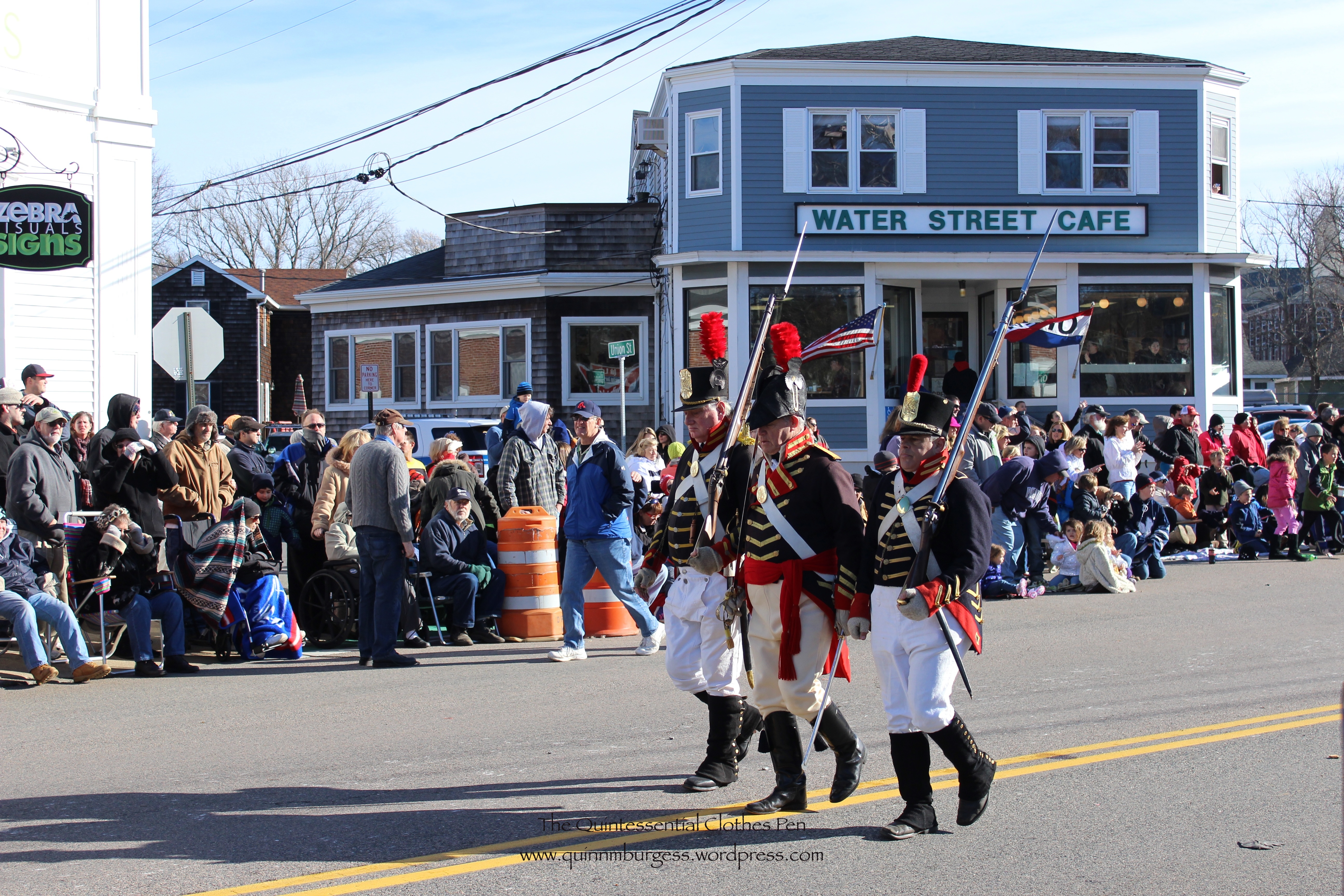
Some of our other friends: 1812 Marines.
IMG_7077
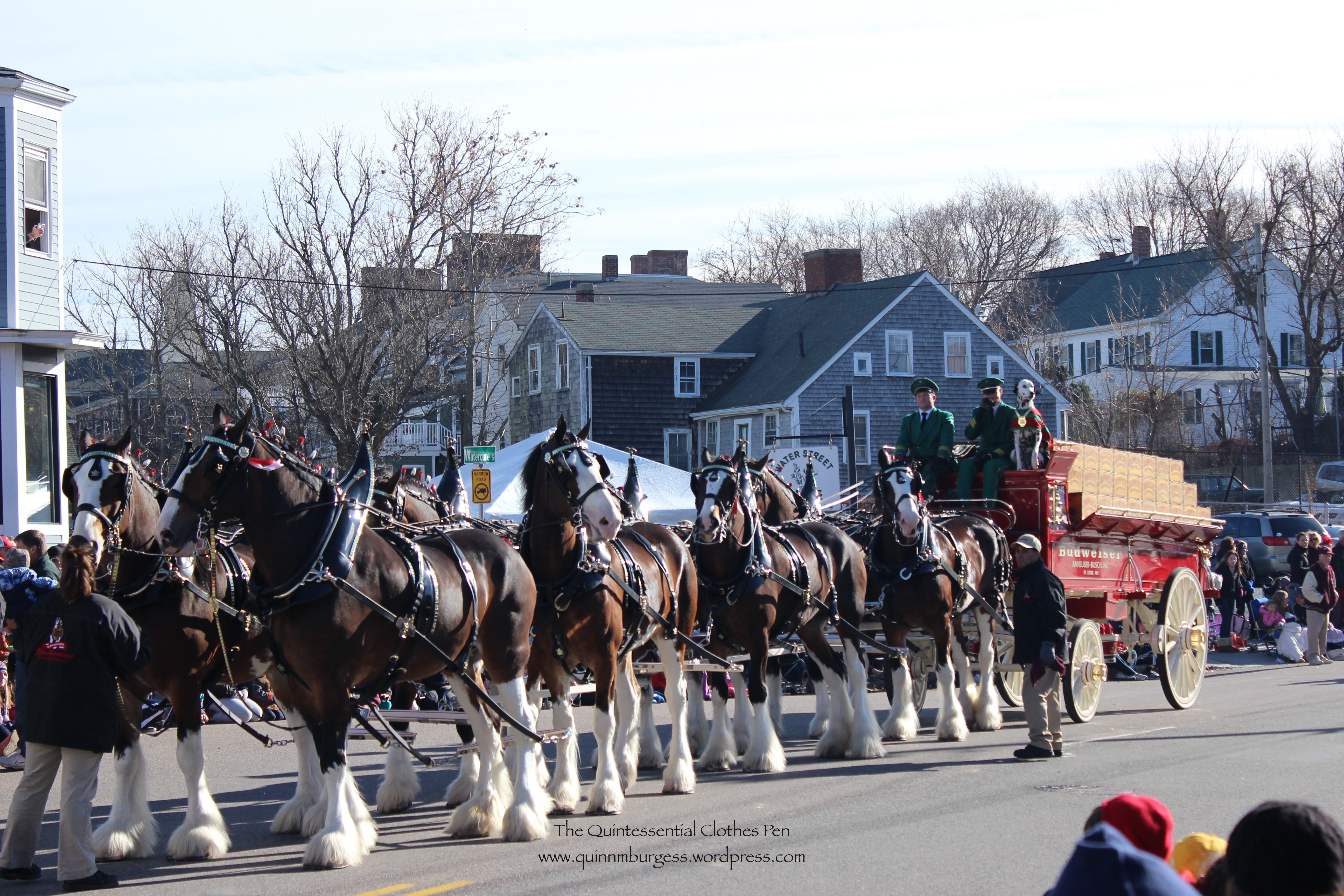
8 beautiful (and large!) Budweiser Clydesdales.
IMG_7104
4 spirited horses pulling…
IMG_7105
A fancy Wells Fargo stage coach!
IMG_7119
A super snazzy green car, with bright green trim!
IMG_7177
Red, white, and blue confetti in the cold, clear air near the end of the parade route.

Next, here are some images of our representation of Suffragists and our setup in the historic village:

IMG_6903
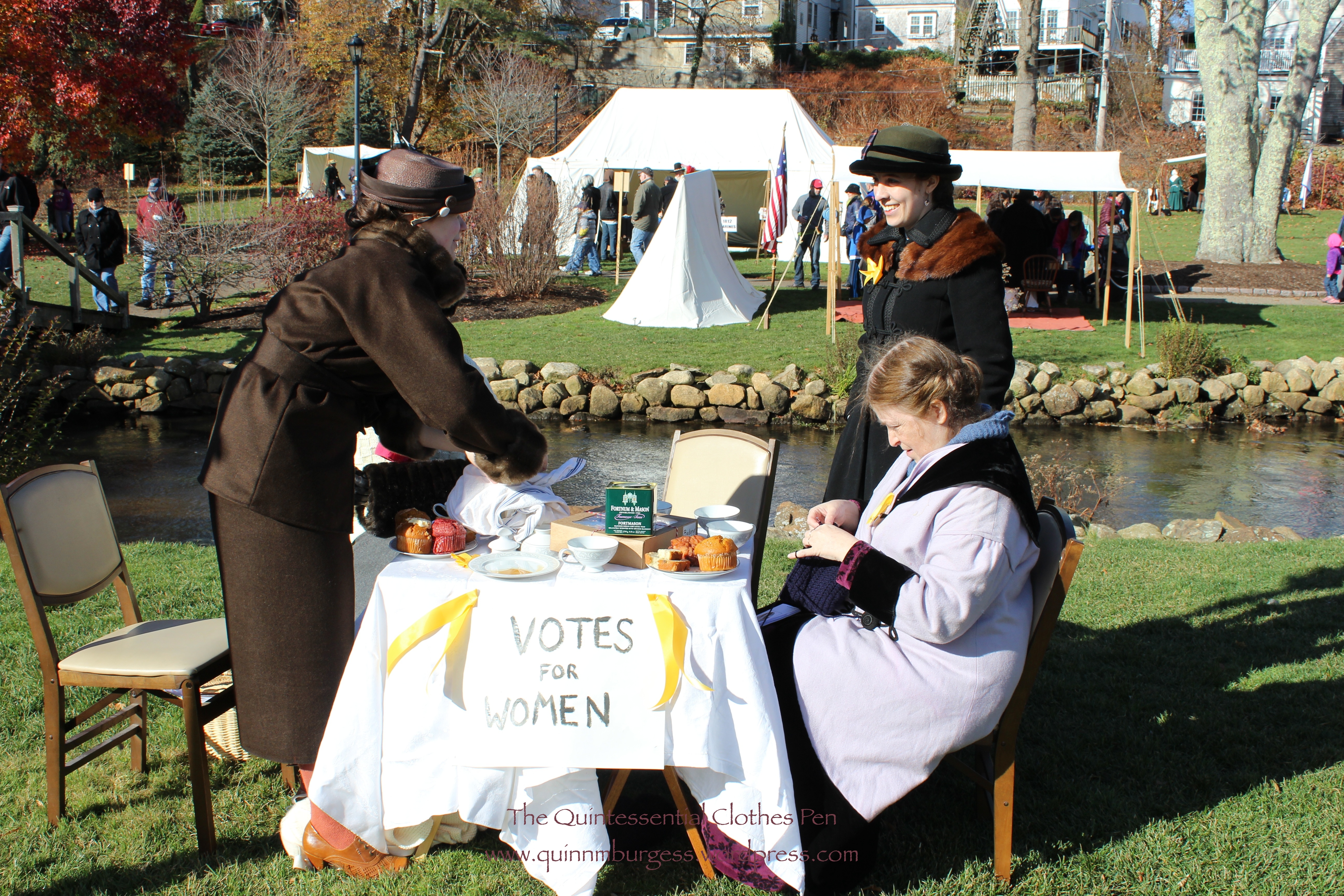
Setting up our tea table. Other setups included tents and smoking fires (it had rained the day before and everything was damp and mushy, so the fires didn’t really work…).
IMG_6900
Yes, we really did drink tea. In china cups. It actually was very nice to have hot beverages throughout the day given how cold it was outside!
IMG_6979
See, we’re drinking our tea!
IMG_6962
We didn’t march in the parade or parade around the historic village, but we did serenade the ducks in the creek behind us (and visitors walking by) with suffrage songs.
IMG_7208
Here we are making “serious suffrage” faces.
IMG_7209
Ok, smile for the camera.

The best part is that in addition to sharing a little bit about history with the public and getting to watch the Thanksgiving parade in all its glory, I was able to use this opportunity to build and wear an outfit showing off my recently completed 1917 Knitted Sweater of Angorina. I had to plan for cold weather, but I didn’t want to cover up my sweater! So I planned a faux fur hat to match an existing muff, a wool skirt, a polyester crepe blouse (in this case, the polyester was a great choice, because the fact that it wouldn’t breathe would help me stay warm and use up a random bit of fabric in my stash that had no other project in its future!), and did a mostly unnoticeable revamp on my 1860s/can-look-like-other-decades fur muff (which was essential, it turned out, for keeping my hands warm!). And to look stylish, I made gaiters to turn my 1920s American Duchess Gibsons into 19-teens looking spat-boots. And all of the fabrics were from my stash! The gaiters might just be my favorite part of the outfit, and both they and my fur hat will qualify for the next two HSF challenges, so you’ll see more detailed information on those soon! All in all, I managed to stay warm, except for my feet! I wore thick tights, but I didn’t think to wear extra socks, and my toes and feet were SO cold! Note to self: wear thick socks next time an all day outside event in the cold is on the horizon…

And here is my brand new 1917 outfit:

IMG_6948
Yay! New hat, revised muff, new blouse, hand knit sweater, new skirt, and new gaiters, worn with my Gibsons, my modern cashmere lined leather gloves, my 1913 petticoat pinned up to shorten its length, and a golden yellow ribbon in support of women’s suffrage. I was able to completely finish my accessories, but the blouse and skirt didn’t get as far as closures. You can’t tell of course, but safety pins are great sometimes. These two garments now live in the “need to be finished” section of my sewing list.
IMG_6963
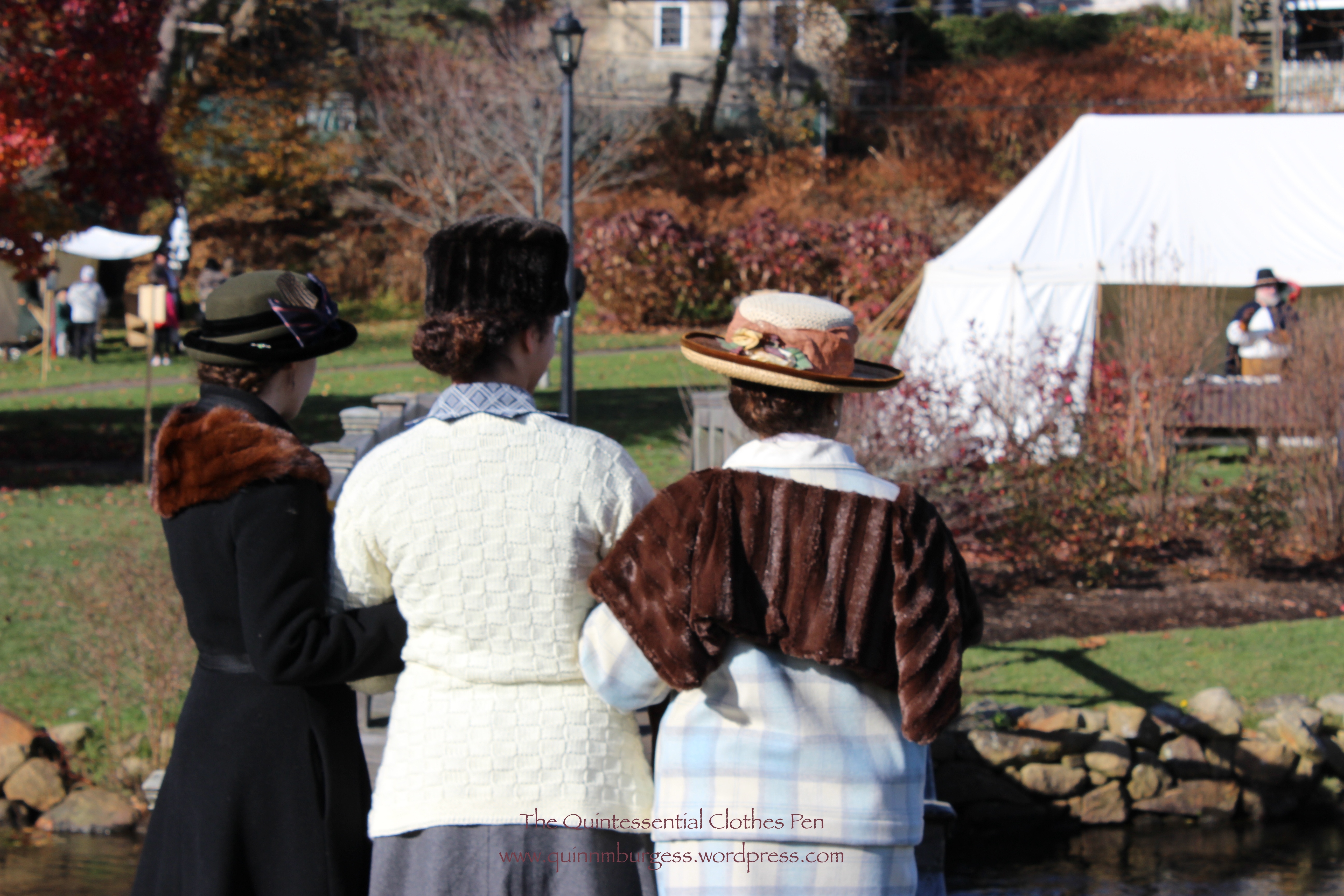
One of the only back views. The blouse has neat collar details (see those cute points?) and neat cuff details you obviously can’t see. When I eventually finish the blouse and skirt I’ll post more details about their design and construction.

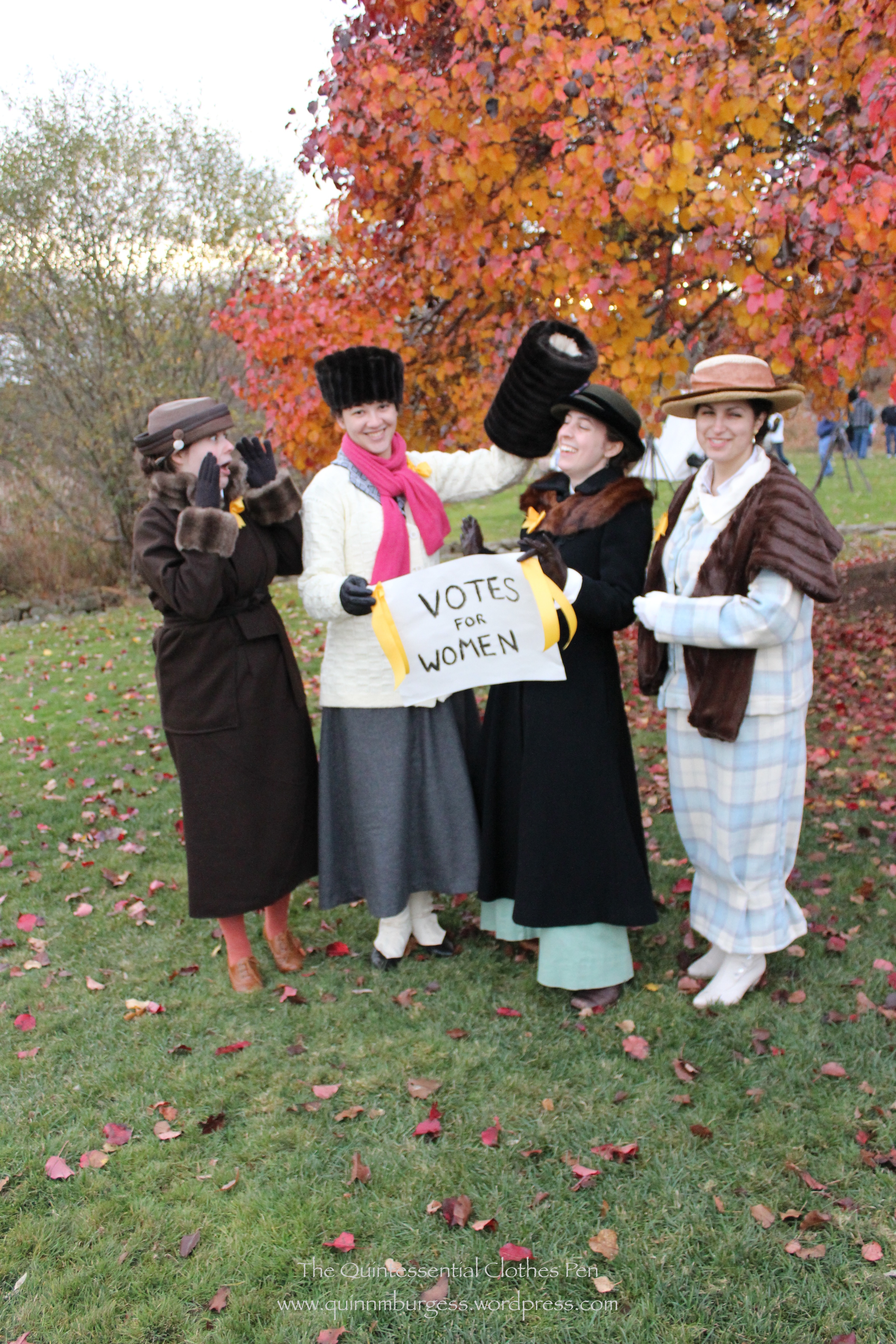
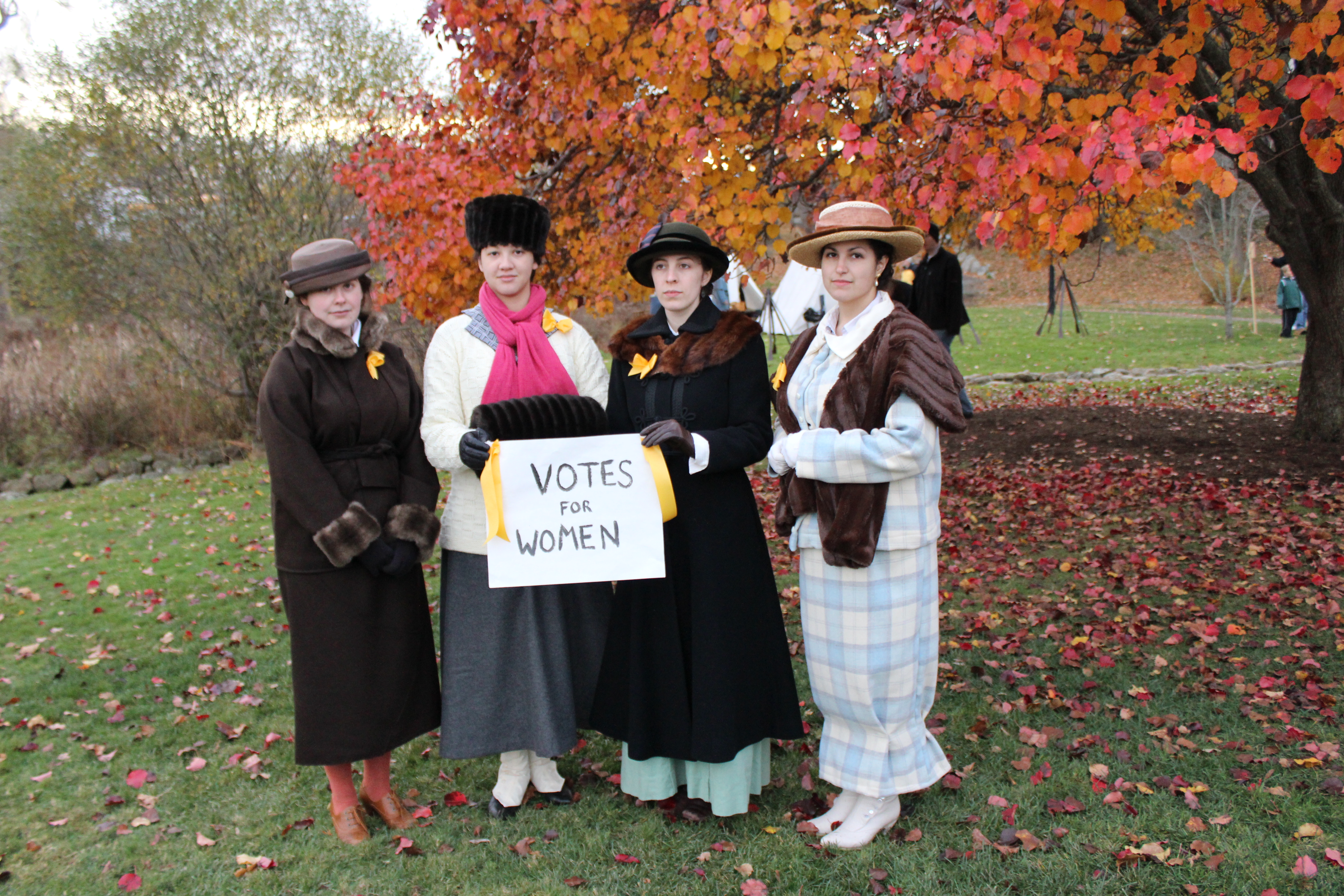
Despite last minute sewing for all of us, we all looked good and had fun wearing clothes from the 1910s while sharing a bit of important history with the public:

IMG_7158
Brown wool suit with fur trim.
IMG_7144
A wool plaid hobble skirt and jacket and a lovely black wool coat with fur collar.

The 19th Amendment, which gave women the right to vote in the US, was ratified in 1920, after over 70 years of struggle. I think it’s fitting that Thanksgiving and women’s suffrage were related events for us ladies this year. In addition to many other things, we’re thankful for those who fought to get women the right to vote!

Product links in this post contain an affiliate code, which provides a small benefit to my shoe fund. This does not affect my impressions and reviews of this product.

HSF #16: Eugenie Inspired 1857 Straw Hat

I recently participated in an outdoor mid-century dance performance for which the weather was an un-obliging 90-something degrees + humidity. Yup, not kidding. It was HOT! And we were dancing on asphalt. Luckily, we were out on an island in the Boston harbor and had a breeze. But it was HOT!

Anyway, more on that performance soon, because it involved a new cotton print day dress made from one of my recently acquired historic cotton prints! In addition to the dress, I also restyled a straw hat to go with the outfit and keep some of the sun off of my head. The hat has been used with various other clothes (1780s and Regency come to mind), but I had only ever added a simple ribbon to it rather than really styling it. This was the perfect opportunity to really make something of the hat!

I wanted to keep it simple and in the 1850s/60s, so I started by adding inspirational images to my pinterest board for this project. I visited the board many times before making a decision that I loved the shape of Eugenie’s straw hat in this painting. The hat has that nice downward curve in the front that sort of frames the face and accentuates the fashionable heart shape. The gauzy/tulle trim was a little whimsical for my purposes, so I opted for a more subdued and practical trim style on my hat.

Empress_Eugénie,_Hillwood_Museum,_1857
Franz Xaver Winterhalter (1805–1873) Eugénie of Montijo, Empress of France Date 1857

I started by wetting my hat in the bathtub then tying it with string so it would dry with the curve that I wanted to achieve in the brim. I also wanted the back to curve under a bit, so I let the hat curve on both sides.

IMG_4612
Tying the hat to create curves.

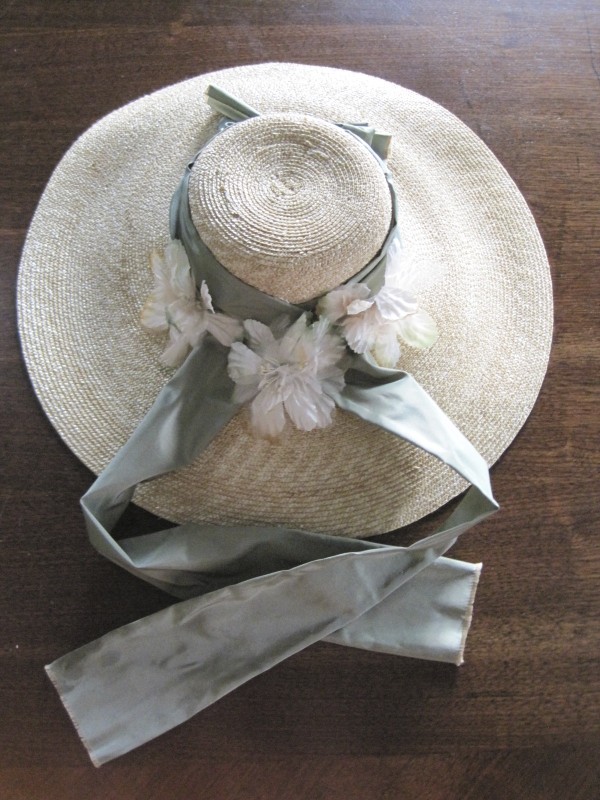
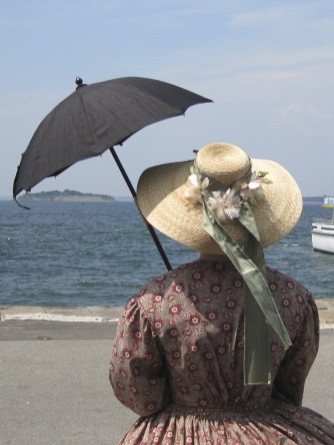
Once the hat had dried all that was left was to trim it! I chose to use green silk left over from Evie, my 1864 ball gown, and some silk millinery flowers. The silk is narrow hemmed on both sides and the ends are fringed, showing gold threads (the fabric is green/gold shot taffeta). The long ends hang down the back while the hat is worn, a style like the one below which you can see in the images on my pinterest board. I also added a bow on the front like you see in the images. Turns out that the bow is not quite centered… whoops!

56737fd6fd819eb71c2360fd4be5679f
LAPL, Magasin des Demoiselles, August 1858

And here is the result of my labors, and my fulfillment of the HSF Challenge #16: Separates. “Make a non-matching garment which can be paired with other items in your historical wardrobe to extend your outfit choices.”

IMG_4729
You can’t see the curve since the hat is sitting flat on the table… but you can see the trim!

Just the facts:

Fabric: A 4″ width of green silk 60″ wide plus a few scraps.

Pattern: None.

Year: 1850s generally, 1857 specifically.

Notions: Straw hat, silk flowers, thread.

How historically accurate?: I give it 98% (and that’s pretty high for me!). Straw, silk, more silk… The sewing machine was even invented by 1858, so the machine sewn hat isn’t totally out of the realm of possibility. The -2% is for the polyester thread.

Hours to complete: 2, not including time for the straw to dry.

First worn: July 20 for a vintage dance performance on George’s Island in the Boston harbor.

Total cost: I bought the hat a few years ago for probably about $25, the silk was leftover from another project, and the flowers cost some small number of cents since I got them as part of a large box for only $5! Let’s just say $26 total.

IMG_4617
Back view of the hat on my head. See how the front dips? This is also a sneak peak of my new gown, Georgina, to whom you will be formally introduced soon.
IMG_4623
Front view. See the dip?

At first I thought I had made the curve too pronounced, but when I look at the pictures again, I think I was pretty darn spot on! Woo! Completed new separates accessory for my historic wardrobe: check. Oh, and did I mention I’m in early on this project? The deadline is August 12!

Regency Dance Weekend Part II: Archery And Outdoor Lounging

Not very long ago, I shared the first section of Regency Dance Weekend photos: Settling In–about dance classes, an 1807 house, and an informal dance. Now it’s time for Part II: relating to archery (yay!) and outdoor lounging. These outdoor events took place on Sunday afternoon at Pioneer Village in Salem, MA. The village had been opened specifically for our use, so we had our run of the place!

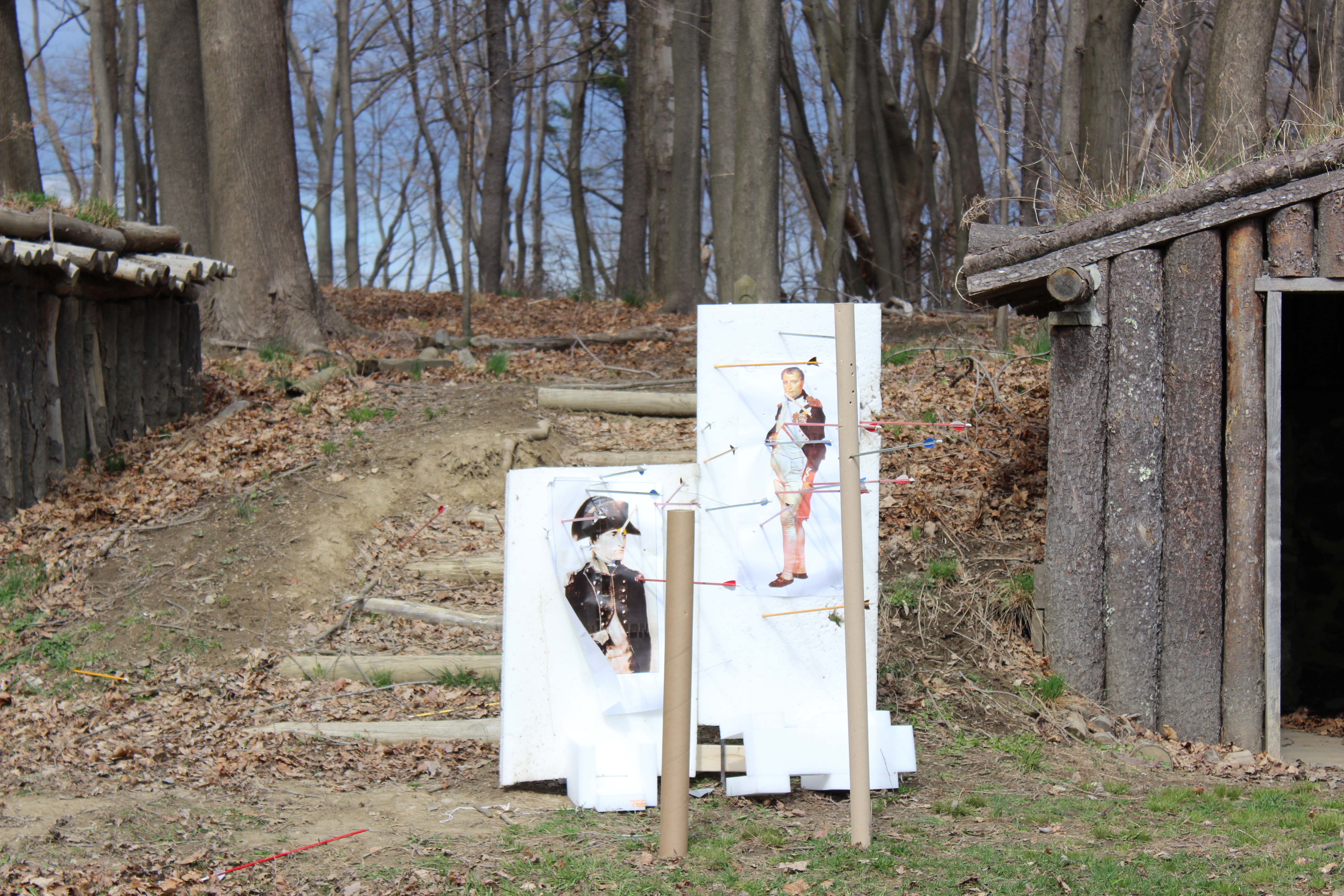
Archery was the major activity and took up most of the time allotted before preparing for the Grand Ball and Reception that evening. Given that it was a Regency period event, there were plans made (and executed) to use images of Napoleon as targets, which was super silly and fun. I think there were perhaps 30-40 people who took part in this daytime event.

IMG_0510
Our instructor teaching us basics and safety.
IMG_0613
I think most people were pretty successful at hitting the target at least sometimes.
IMG_0601
There he is! Napoleon is lurking on the left.
IMG_0588
Archery in a bonnet is an extra challenge, but we made it work.
IMG_0567
Recognize that dress and bonnet? And perhaps the spencer? This is your first glimpse of my new clothes!
IMG_0680
We got him, and the tubes he was hiding behind!
IMG_0579
There were replacement Napoleons for when the first few had been well hit.

It was pretty cold out, actually, especially when we weren’t distracted by archery! Nevertheless, we prevailed for hours and were still willing to stay outside and lounge for more pictures even after archery was complete.

IMG_0714
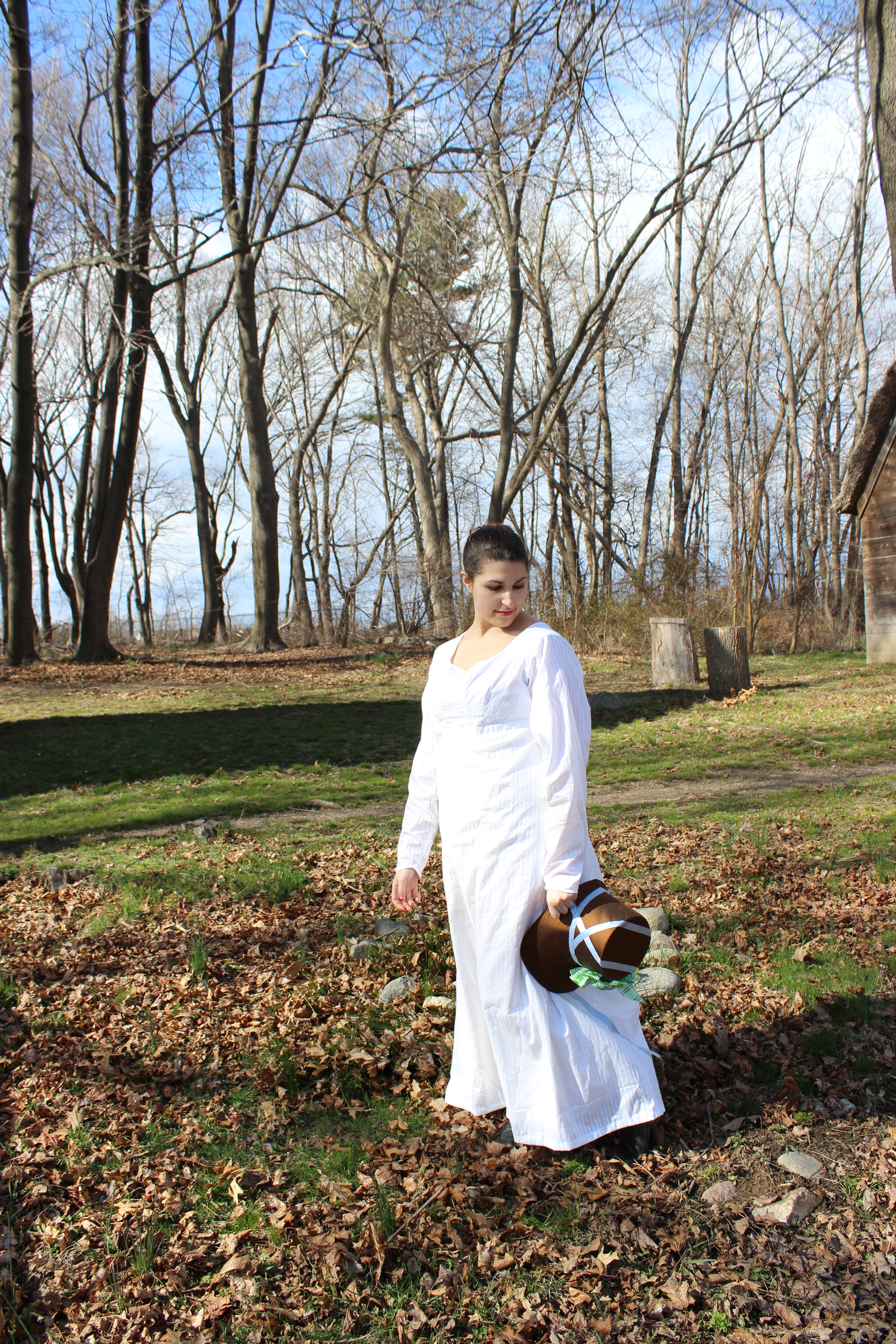
New clothes amongst the trees.
IMG_0728
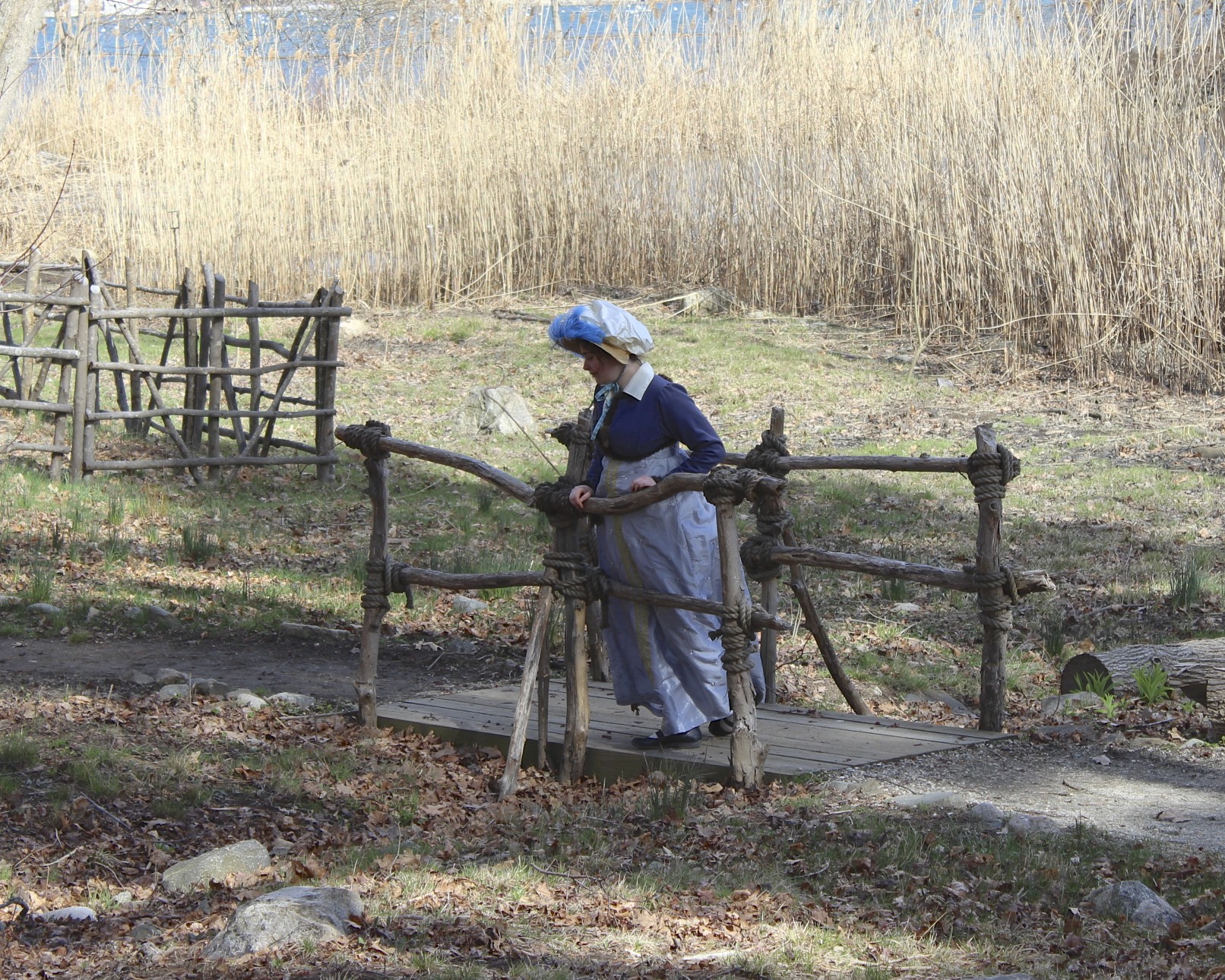
Striking a pose on the footbridge.
IMG_0751
Climbing a fence. Perhaps while out on a stroll? I feel like this is something the more athletic Jane Austen characters do.
IMG_0829
New long sleeved day dress and a new bonnet. You know how it is when someone is wearing something new. It always requires pictures!
IMG_0624
I was very pleased with how my new dress and bonnet look and feel, and I’m so pleased that they coordinate so well with the spencer. Yay!
IMG_0840
Spencer time. It’s so neat that we’ve built up our wardrobes and are well equipped with dresses and spencers! Bonnets are on most sewing lists, too, which is so much fun!

Next up is a post specifically dedicated to my new tree gown!

1815 Tree Bonnet (HSF #7)

You know how sometimes the best laid plans are waylaid by life? I had every intention of finishing this bonnet before the HSF deadline of yesterday, but along the way got side tracked by life and made conscious choices to do other things with my time instead of bonnet-ing. Oh well, it happens to the best of us!

IMG_4407
1815 bonnet (the more interesting side).

I made this bonnet to coordinate with my new Regency Tree Gown (which is why I’m calling it the Tree Bonnet). Lucky for me, it also fulfills the HSF Challenge #7: Accessorize and will coordinate with other items already in my closet (such as my 1819 brown spencer). I’ll be wearing the new gown, the spencer, and the bonnet this weekend for the Regency Dance Intensive, along with a lot of other Regency things, so be prepared for lots of pictures next week!

The facts:

Fabric: Silk twill, changeable silk taffeta for trim, and china silk for lining.

Pattern: Created by me.

Year: 1815.

Notions: Four approximately 8″ pieces of sage green polyester ribbon, a spray of wired millinery flowers, about 1 1/2 yds of navy silk ribbon for ties, about 3/4 yd of navy grosgrain ribbon for inner band, buckram for the base, millinery wire, cotton flannel for mulling, tacky glue, and thread.

How historically accurate?: 95% I’d say. There are a few polyester things, but the overall shape, impression, and majority of materials are accurate.

Hours to complete: 28? Hand finishing and trimming takes a long time, especially on hats, because the angles are weird, so it’s a slow process.

First worn: Not yet, but will be worn this weekend!

Total cost: $6ish for the silk twill bit, the green silk and china silk are remnants from other projects, the polyester bits are old and from the stash, the millinery flowers were from the stash, the buckram was maybe $4, the wire was probably $2… so about $12? I didn’t buy anything special for this bonnet, it’s all from the stash! Yay! Go me!

IMG_4408
Close-up of the pleated silk trim and rosette-like decoration. You can also see the pleats on the side band of the bonnet.
IMG_4409
The millinery flowers on the front of the bonnet.
IMG_4410
The more plain side.
IMG_4405
Inside of the brim, looking into the lining and hat band.

This week marks the end of the MpRSW (though I still have one more post to go about that), with the final goal aimed at yesterday, #5: Anything Left! I’d already completed some packing for this goal, and procurement of kite making supplies (yes, there will be a future mention of kites!), but this bonnet also qualifies!

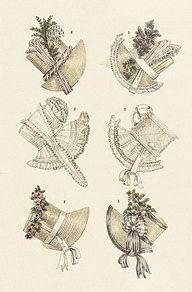
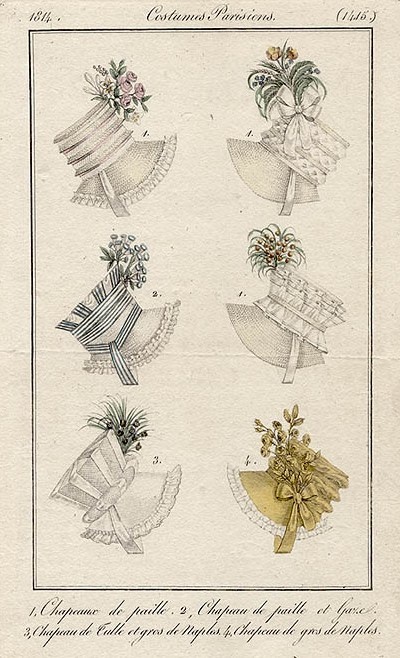
Now let me share some of my inspiration for this bonnet. There are more bonnet images on my 1810s Pinterest page as well.

9b8f7b45f7afff8db618554b973b5eab
From 1815. 
Volare digital capture
La Belle Assemblee, Parisian Promenade Hats, July 1816.
cf83f2dc91eb3bf303ba9087826b8419
Costume Parisien from 1814.
5aaaeddcc5533ec69fe92be1e72f8c83
Costume Parisien from 1815.

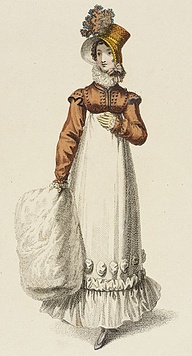
In trying to determine length of ties for the bonnet, I looked to some fashion plates that included people in them. Here are some of the best examples I found.

Volare digital capture
1813 afternoon promenade dress.
Volare Digital Capture
Ackermann’s Repository, Walking Dress, April 1817.
Volare Digital Capture
Ackermann’s Repository, Walking Dress, November 1817.
Volare Digital Capture
Walking dress 1815
61acb0c35e149289d55017462f06b675
EKDuncan – My Fanciful Muse: Regency Era Fashions – Ackermann’s Repository 1819
Volare Digital Capture
Ackermann’s Repository, Walking Dress, February 1818.
800b11831fa576966952e099671eae3e
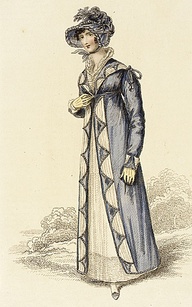
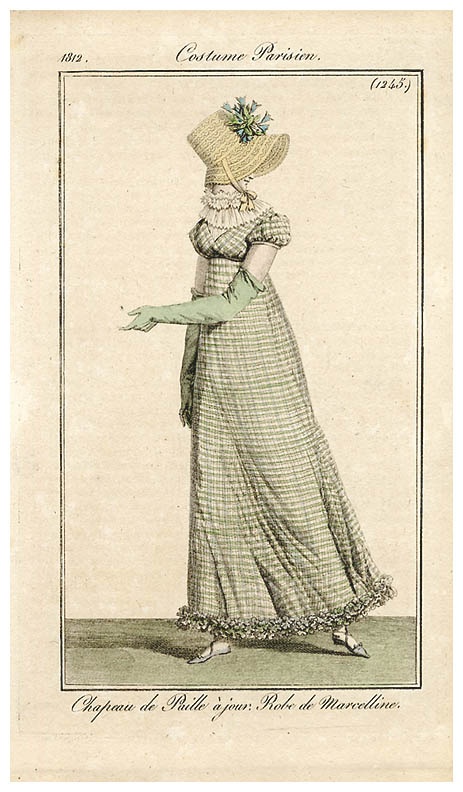
Robe de Marcelline, 1812 Costume Parisien

Well, there we are. I just finished sewing that pleated brim trim tonight, and I am glad to be done! It’s slow and slightly painful on the fingers. But pretty, so totally worth it!

Project Journal: 1822-1824 Ensemble Part I: Overview

Well, as you recently read, I have a 9 month sewing plan to get me through May of 2013. It’s not set in stone (which means that mostly I keep adding to it, not taking things away…), but it gives me a great overview of what I need to accomplish and by what month. Deadlines really help in getting things completed!

The first major portion of the sewing plan is an ensemble of clothing from about the year 1823. I’ve been doing lots of looking at fashion plates and extant clothing from the early 1820s, in books and online. Here’s a link to my pinterest board: 1820-1824. I had so many pins in the 1820-1829 board that I had to separate the decade, so I also have a separate pin board of 1825-1829.

The 9 month plan includes the following pieces: petticoat, ball gown, walking dress, muff, bonnet, and chemisette. I’ve added one more thing since the plan was created: a tippet to match the muff! Before I explain why I want these items (ie, where I plan to wear them!), let’s look at my inspiration for the items themselves!

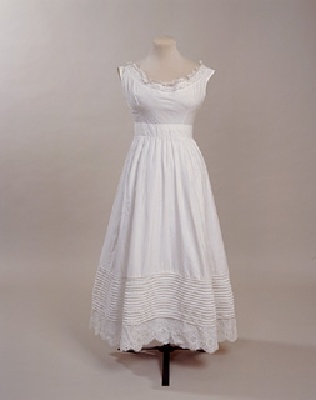
Petticoat. Manchester City Galleries. (I’m making a petticoat out of white cotton. It is entirely hand sewn.)
Actually a Dinner Dress (but I’ll use it as a ball gown). Ackerman’s Repository. May 1824. (I guess I lied about the year… I’ve been looking at the images so much I haven’t even glanced at the date in ages! Anyway… I’m making this in apple green silk with hand sewn silk organza appliqués.)
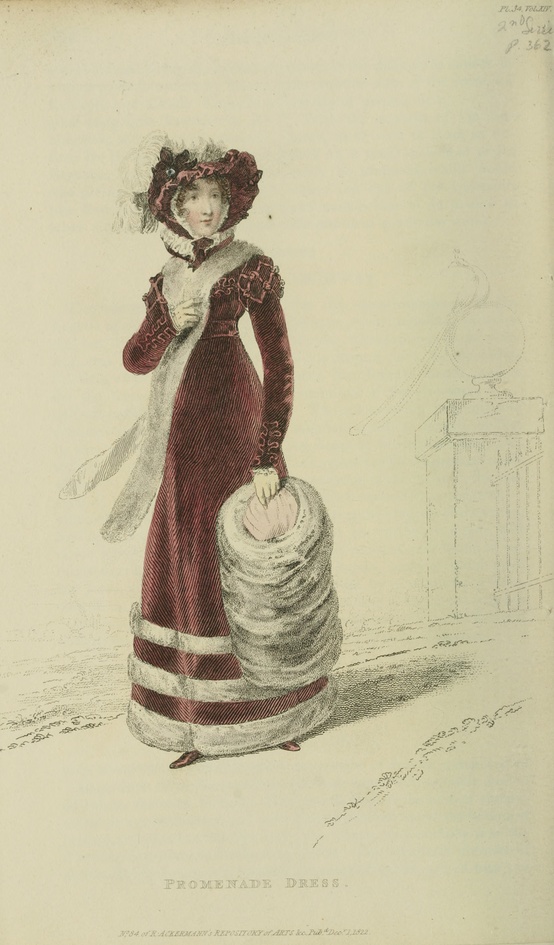
Promenade Dress. Ackerman’s Repository. December 1822. (I am making this out of deep, rich pinkish burgundy wool with hand sewn lavender silk trim.) This is also my inspiration for the tippet. (I’m making the tippet out of white faux fur.)
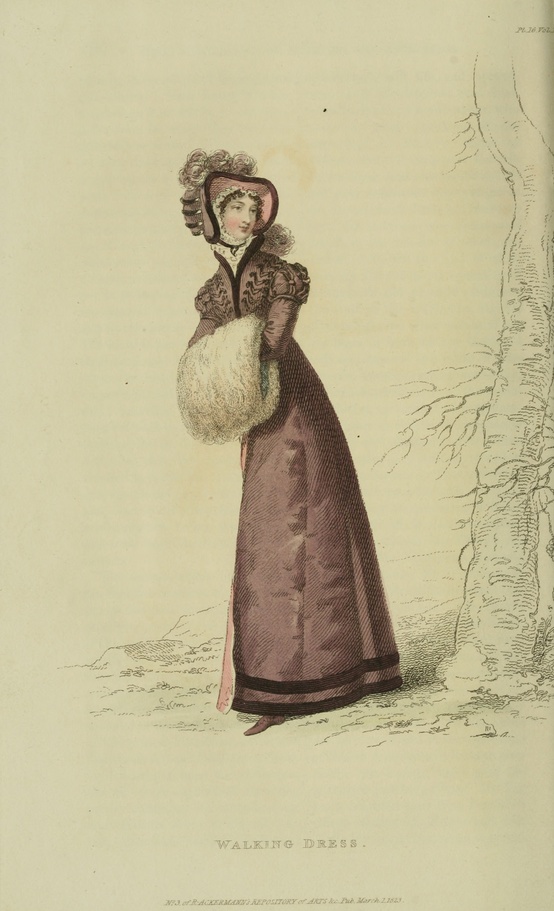
Walking Dress. Ackerman’s Repository. March 1823. (I think this is where I got the year 1823 from… This is another influence on my walking dress design, especially at the collar.) This is also my inspiration for my muff. (The muff will be the same fur as the tippet, lined with pale blue silk shantung.)
Bonnet. C. 1820. The Met. (I plan to make this in lavender to match the walking dress.)
Chemisette. c. 1810-1825. Snowshill Collection. (Yes, this is one of the ones in Janet Arnold. I plan to make this out of lightweight cotton and use my fluting iron! However, I have to say that if one thing in my December-to-do doesn’t make the cut, this would be it. I really want to take my time on this and play with my fluting iron, and I’m not sure I’ll have the time on this one…)

What is all of this for, you ask? I plan to wear the whole ensemble in December when I attend Fezziwig’s Ball, a 19th century ball hosted by the Commonwealth Vintage Dancers in Salem, MA. Since it’s a ball, I’m sure you understand why the petticoat and ball gown are required! But why the outerwear? Before the ball begins, ball-goers have the opportunity to go caroling around the streets! It’s really fun, and usually pretty cold. I need to stay warm, hence the wool walking dress, tippet, and muff. The chemisette is to fill in the collar of the walking dress, and the bonnet is really icing on the cake to help pull the whole ensemble together! As an added bonus, later this winter my friends and I hope to go ice skating in 19th century dress, so this will also be my ice skating outfit!

Sort-Of-New 1895 Blouse: At A Picnic With Teddy And Me

This is another case of the delays… The Commonwealth Vintage Dancers performed at an event in June (cough, cough… I am so slow!) that was called something like A Picnic for Teddy, Mommy, and Me. It was at the Salem Athenaeum, a private library, and was targeted toward young girls, their mothers, and their teddy bears! Cute!

We performed in 1890s whites. I had been dragging my feet about constructing my own whites, so I took this opportunity to go for it.

Dancing “Teddy Bear’s Picnic.” It’s really a ridiculous dance, but it fit the theme of the event perfectly!
It was super hot that day! Sitting, in the shade, was wonderful. As was my fan…
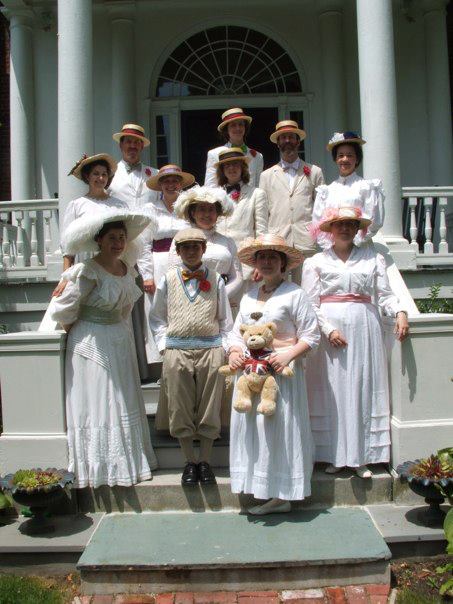
CVD on the steps of the Athanaeum.
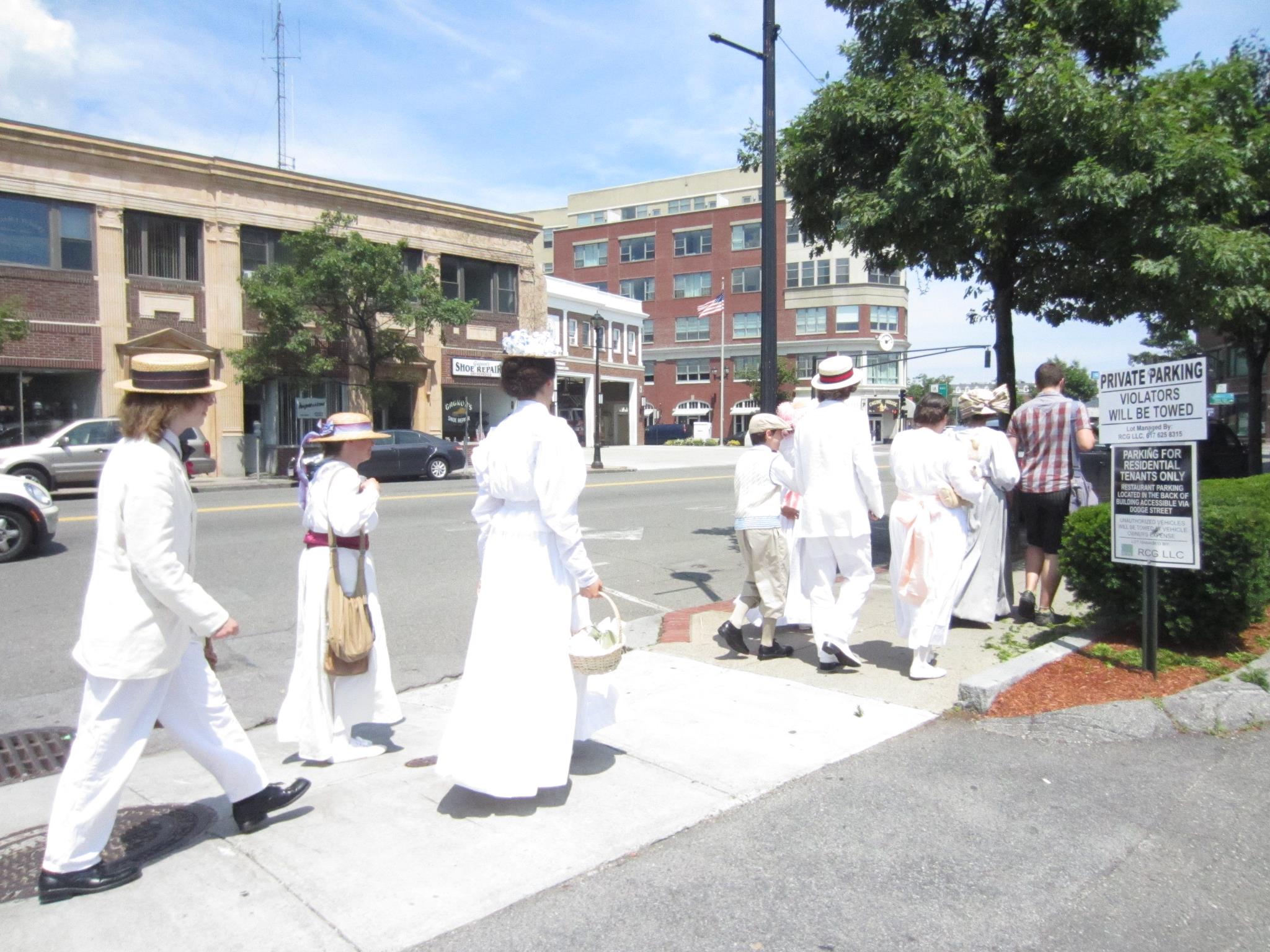
After the event we walked across Salem to get some lunch. Of course, Salem often sees people dressed in odd clothes, so we didn’t surprise people, but they were curious about what event we were going to.

I’m not totally sold on the white skirt I made. It’s a gored skirt and it works fine, it’s just not super eye catching (aka, it’s great for performances, but won’t get worn for other things… maybe it will be a petticoat if needed?). Oh, and I also threw the hat together, thinking that the white and blue would be nautical and good for Newport. But then I totally re-trimmed the hat at Newport because it didn’t have quite enough oomph with the white and blue. But the blouse… I love the blouse! It’s super comfy and lightweight, it closes in front (yay!), is washable,  and I like the fabric. Win!

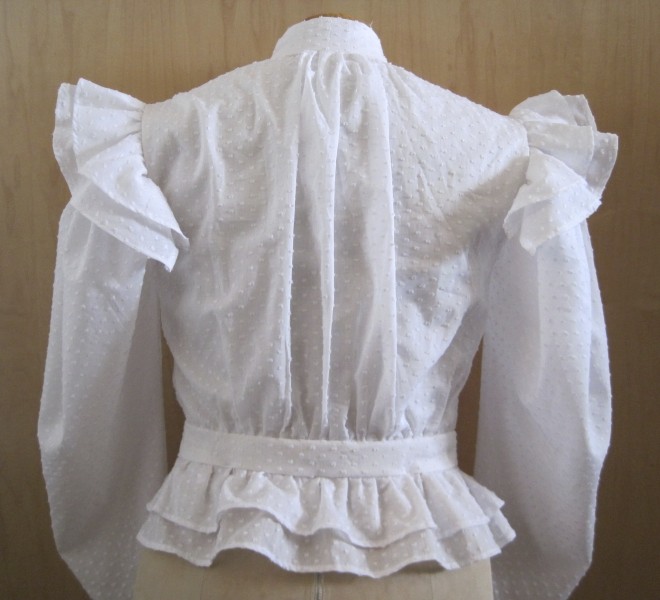
It is based off of a fashion plate in one of my many books. I draped a basic blouse pattern and adapted the pattern as needed to add the gathers in the front and back. The exterior is mounted on a lining made from the basic blouse pattern so that they gathers will stay where they are supposed to be. It is constructed of cotton with swiss dots for the exterior and a lightweight woven stripe cotton for the base (which I bought for $1 a yard a while ago! Love that price!). It closes up the front with concealed hooks and thread bars. The sleeves are quite large gigot sleeves, but because they are not lined they sort of just droop. Here are some pictures! I think I got pretty close to that inspiration image, don’t you? I love the feeling of success that comes with really nailing the look in reproducing a garment! Don’t we all?

The inspiration image.
Front of the blouse, on Squishy, the mannequin.
Back of the blouse on Squishy.
In the garden.

Titanic Weekend Part II: All About The New 1912 Day Ensemble

We took a rather in-depth look at my new 1912 evening gown. Now, on to the second 1912 ensemble that I also wore during the weekend: day gown and hat!

Gown and hat with (unbuttoned...) white kid opera gloves. I'm so pleased with the overall effect! Unfortunately, I don't have pictures of the back. There are cool details back there, so another fashion shoot will be required in the future...

This gown is constructed from silk charmeuse. The skirt is a single layer in addition to the overskirt panel in front. The bodice has a foundation of the same white cotton as my new evening gown. Mounted on to that cotton are (from the neck down) layers of ivory silk charmeuse, ivory silk flat lined with fabulous ivory colored diamond lace, black silk velvet, and black silk charmeuse. The overskirt panel is trimmed with matching silk velvet and the belt is constructed of the same. There are small buttons on the overskirt velvet trim (because, really, the Edwardians just loved adding buttons everywhere!). Because the back bodice mirrors the front in its style (which unfortunately I don’t have a picture of right now…), I had to be crafty with my closures. The dress has two places that open with hooks and bars: the left side from just under the arm to a few inches down the hip and the left shoulder seam around the neck to the center back of the collar. The effect is a form fitting dress that looks like it was magically donned. The side closure is straight forward, with the foundation layer hooking first, to take the tension of holding the dress tight, and the outer charmeuse layer hooking over that simply to stay closed. Again, the foundation is essential to achieving the elegant, effortless exterior. The neck closure is a series of hook and bars that turn different directions to accommodate the seams: front to back at the shoulder, hooks that hook up on the collar to attach it to the back neck, and hooks going sideways on the center back of the collar.
In addition to the gown, I also constructed what I call the “mushroom” hat, which you can read more about in this previous post. I created the pattern for the hat, which is basically just a shaped brim with circular side band. The side band support the crown, which is a circle that is pleated to create that “mushroom” shape. I love the hat! It lends such an air of Edwardian drama and elegance to the look! And I am so pleased the the “mushroom” shape worked out!

Hm… Patterning this dress… Well, the general skirt shape is from Janet Arnold, but it is adapted to have two symmetrical box pleats that terminate at the top in delightfully detailed seams (which I really, really need pictures of!). The bodice pattern was draped with many references to my inspiration image. I created a basic shape for the bodice and then cut in into the different pieces (ivory silk, ivory silk and lace, black velvet, and black charmeuse) so that each piece would fit together perfectly. The belt is slightly shaped but doesn’t actually have a pattern.

The dress is inspired by this image from a 1910 issue of the magazine Bon Ton.

I'm sure you can guess, but the dress I was referring to is the one on the right.

In the end I made a few changes: I added a train, discarded the white under sleeves (I made them, I tried them, and they just didn’t work! They pulled the bodice in all sorts of weird ways… Maybe if the were not so tight they wouldn’t pull so much? I am fine with having gloves cover my lower arms, anyway.), and drastically scaled back the beading. Perhaps you’ll remember my plan to bead this dress? Well, the beading was drastically scaled back because I didn’t like the beads I bought as much as I thought I would (they are rectangular and larger than I thought… not seed bead-y at all), I realized I didn’t want to devote as much time as it would take to do the amount of beading I originally intended, I didn’t have enough beads to bead all four panels as much as the one panel I completed and I didn’t want to buy more beads, and I didn’t like the beading motif I had created, nor was I inspired to change it. You can see that I did leave one outline shape of beading on the bodice in the velvet section, but the rest was scrapped. That one line is repeated front and back (symmetry, you know). I did actually complete the overskirt top panel, but decided not to use it after my scaling back plan was complete (you can see it, below). I’m going to keep the beaded panel and see if it finds its way onto another project one day… I would still love to do intense beading on a garment, but I’ll have to pick a different one, because it wasn’t measuring up to my expectations for this dress.

Scrapped beaded panel. A mix of silvery and black beads. I started in the center with the somewhat wonky lines, can you see improvement? I think it would have been distracting from the dress to have four panels like this.

1912 Ivory “Mushroom” Hat: Part II

The hat is complete!

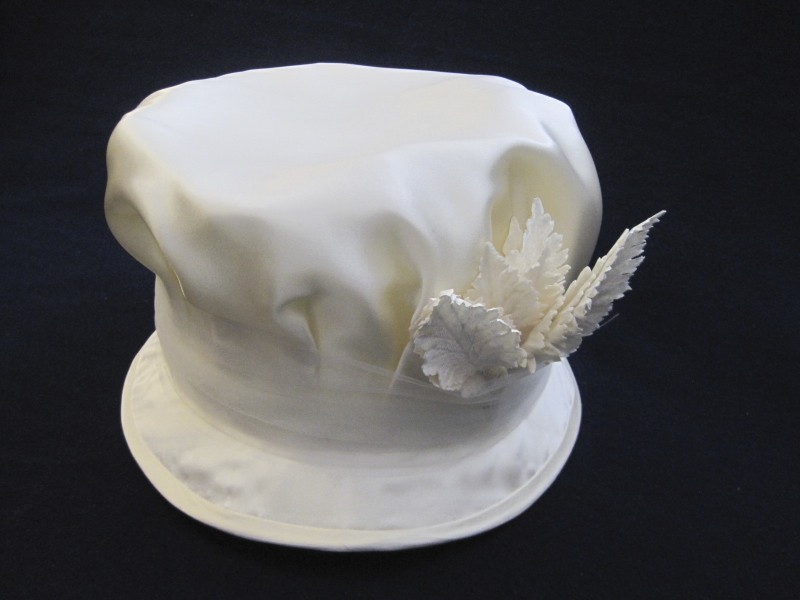
The specifics: wired buckram brim and sideband, ivory silk charmeuse flatlined with ivory cotton to cover the brim and crown, bias cut ivory silk shantung brim binding, trimmed with ivory tulle and black ostrich feathers, lined with the same ivory cotton as the flat lining. (Did you know that craft stores sell tulle in 6″ wide rolls 25′ long in all sorts of colors in the bridal section??? This is great for hats!)

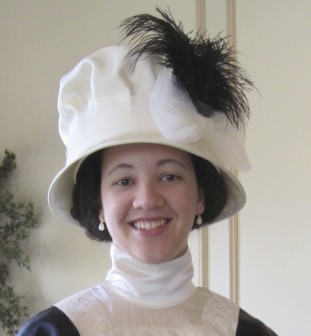
All in all, I’d say the hat turned out beautifully! I didn’t take the time to smooth out every bubble in the silk charmeuse along the brim, so there are a few bubbles… but I think I’m the only person who will ever notice them. It’s rather a tall hat… But I like it! I think it achieved the mushroom-y look I mentioned in Part I of the Ivory Mushroom Hat adventure and it has space in the head size opening as I intended. It even resembles a mob-cap, as I mentioned in Part I. Yay! I think it lends some serious Edwardian grandeur to my look. Full length pictures of the tea gown are coming soon so you can decide what you think about the hat.

It turns out that hair makes a great bandeau! I added some fake hair to my coiffure for tea to help support the hat in the back and it worked wonderfully. Without the extra hair the hat slips down over my face to a point somewhere around my nose… luckily, my poofy hair plus some extra hair works wonders!

I decided to trim the hat with black feathers and an ivory tulle bow because all ivory was overwhelming… the tulle trim is lost, whereas when black feathers are added the tulle trim suddenly stands out as well. Judge for yourself, below! Here are some other trim ideas I sampled on the hat before making my decision.

All ivory with a tulle bow.
All ivory with ivory millinery leaves.
With black goose biots.