Project Journal: 1863 Apricot Evening Gown Part VIII: ‘Of Apricot Silk With Cream Lace And Red Velvet Bows’ (HSM #10)

DONE! I am so glad to be done. I’m also excited to have a new dress (and, despite the challenges and worries along the way, one I like the look of! YAY!).

I’ve kept you waiting to see photos of the finished dress. Life got a bit busy after the ball and then I wanted to share my final sewing details with you. But now it’s time to introduce you to Genevieve, my 1863 Apricot Evening Gown, also known as the Orange Monster for the last few months. Here she is!

I’m excited that this dress qualifies for the October HSM challenge.

Details: Sometimes the little things really make something fabulous. Focus on the details of your garment, to create something that just gets better the closer you look.

This dress is definitely one of those garments! I’ll explain and show you lots of reasons why in these finished photos, but there are currently seven other posts in this series sharing tons of details about the planning, patterning, sewing, and trimming process as well.

First, the facts:

Fabric:  6 ⅔ yards of apricot silk, ½ yard of dark red silk velvet, approximately ½ yard of ivory tulle, muslin scraps for hem facing, a scrap of canvas for stiffening the waistband, and about ½ yard of drab cotton for flat lining.

Pattern: It originally came from Janet Arnold’s Patterns of Fashion 2 but has been adapted over the course of a few dresses.

Year: 1864.

Notions: 25 yards of 3 ¾” lace, 2 brooches, 3 yards of ⅜” polyester ribbon, a few plastic cable ties, about 1 yard of bone casing, a variety of hooks and bars, and thread.

How historically accurate is it?: 95%. A few substitutions of modern materials exist but aside from that it’s pretty much as close as I can get.

Hours to complete: 57.

First worn: September 28, 2019.

Total cost: $112.78

The cost breakdown is as follows: $66 for the silk (local discount store in 2016), $12.50 for the velvet (WM Booth Draper in 2011), ~$2 for the tulle (local discount store in 2011),~$1 for the drab cotton (local discount store in 2018), ~$15 for the lace (Debs Lace and Trims in 2019), $6.28 for the brooches (Etsy in 2019), ~$6 for the ribbon (Farmhouse Fabrics in 2019), and we’ll say $4 for the scraps and other notions since they’re from the stash, reused from other projects/mockups, or used in very small quantities.)
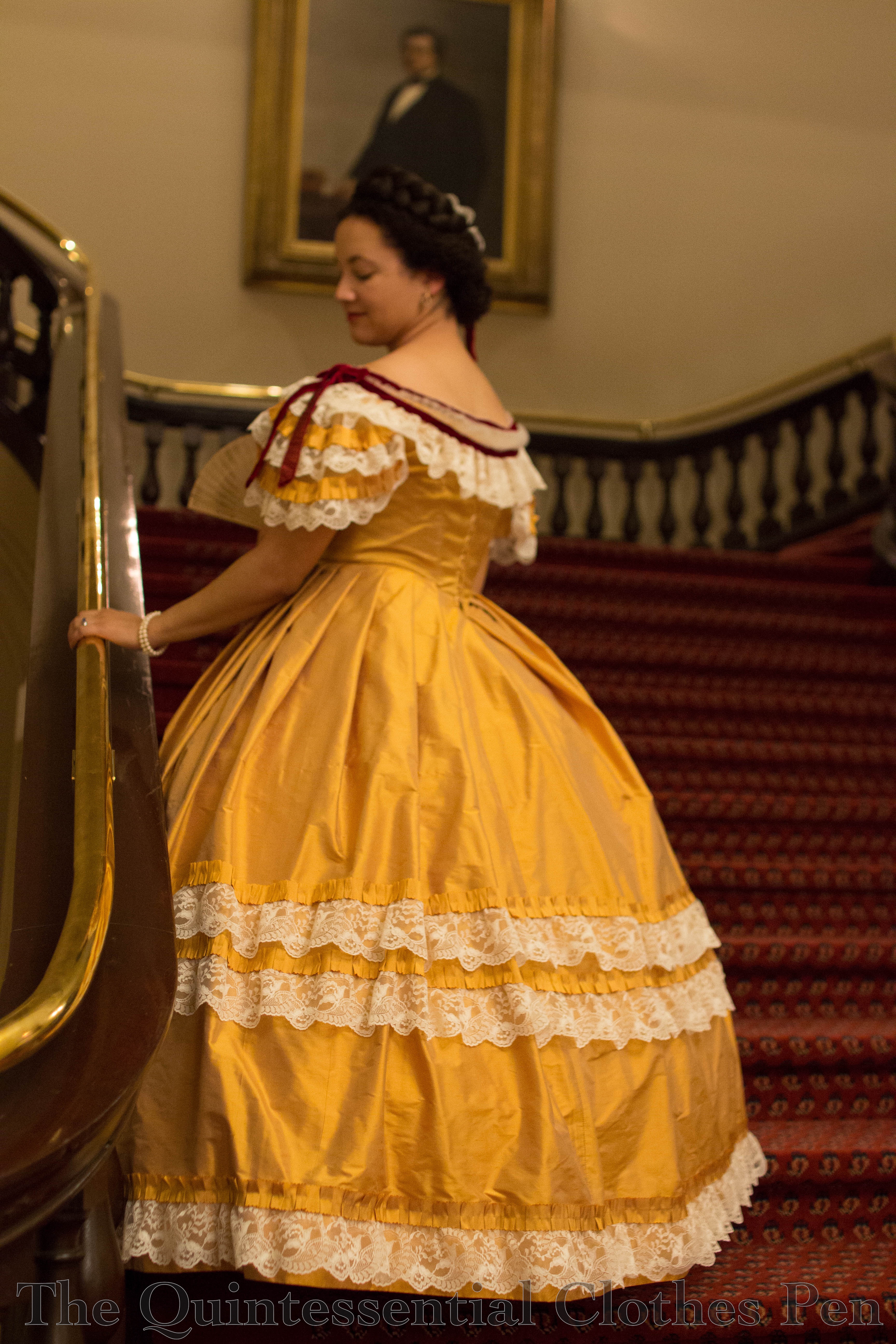
Visible details, you ask? Well, in addition to sharing so many other details along the way, the finished dress has many visible layers of details. The most time consuming detail is the hand sewn 3 tiers of lace ruffle/silk scalloped & pleated trim around the skirt. This detail alone took 17.5 hours. There is a whole post dedicated to this aspect and the details that went into it.

That form of decoration is continued on the bodice sleeve caps. Here’s a closeup where you can see the pleated silk. It is meticulously hand stitched with tiny stitches everywhere it is used.

Another layer of detail is the bertha and sleeve caps. Those have tulle, gathered tulle, and lots of velvet details. My last post explains how these are made.

I found the sleeve caps to be rather unusual amongst dresses from this period, so I was pleased to find this fashion plate which has a similar look.

(This next one is a great ‘I’m plopped and tired of standing’ photo!)

And as for details, let’s not forget the velvet bows in addition the velvet trim. Especially that oversized skirt bow! I also spent quite a bit of time looking for the gold brooches to go on the velvet bows.

Aside from the photo above I don’t have many directly front facing photos of this dress–I guess I did a lot of my posing at an angle–but here is one that is slightly less angled and gives the full effect of all the trimmings.
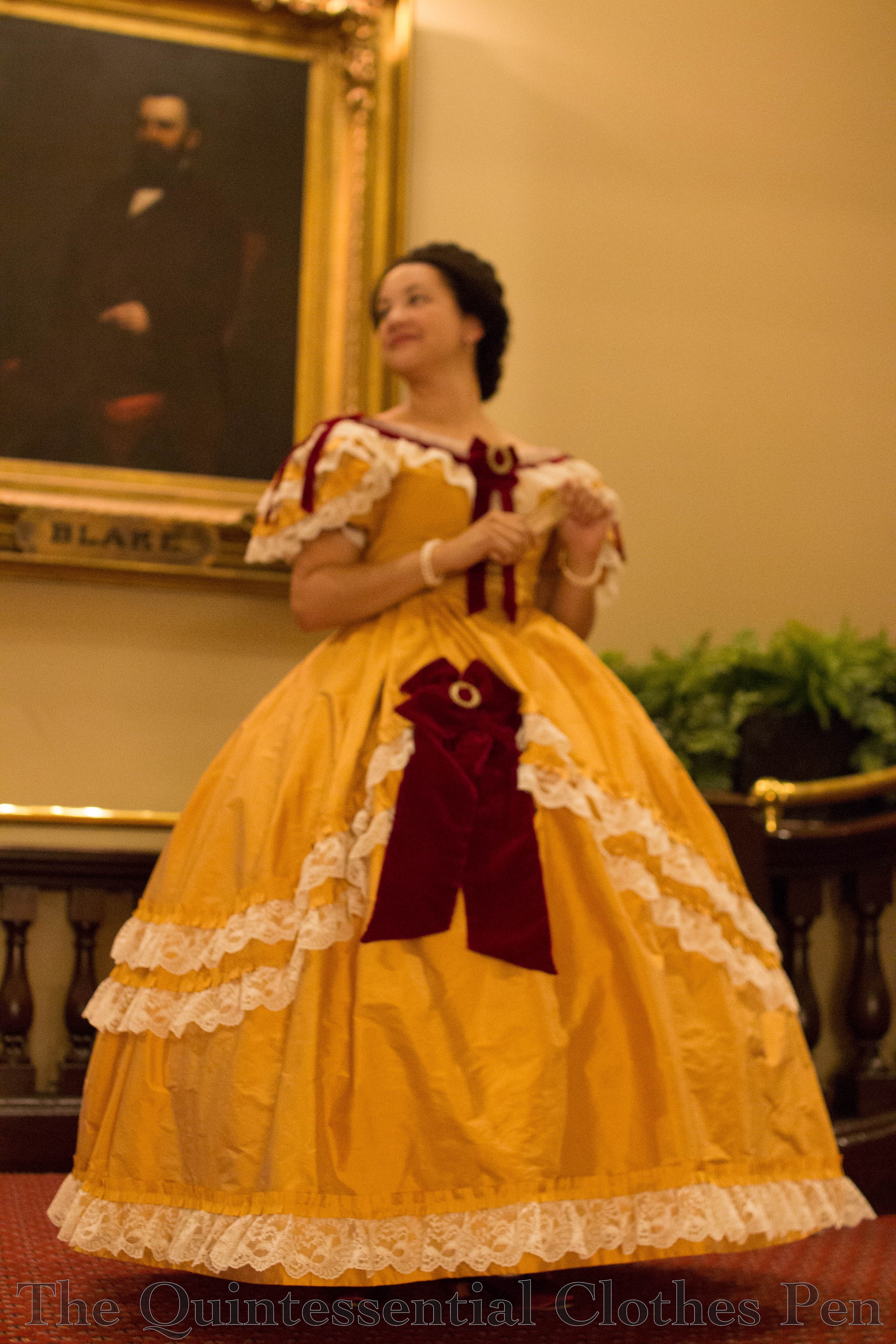
I was super pleased to wear my American Duchess burgundy satin Amelie shoes with this dress! They matched my velvet trim quite well and were fun to have peeking out from under the giant skirt. It’s such a fun piece of history to have contrasting shoes that actually match your dress! Yay! You can see them in this next photo.

The venue we were in for the ball not only had a number of fabulous staircases leading to the ballroom but also many photos of generals and other military figures from the Civil War. It seemed fitting for this period of dress even if they do occasionally seem to be ‘photo-bombing’! Here’s an example. I love this photo! But does the painting look amused, or disapproving? Hm…
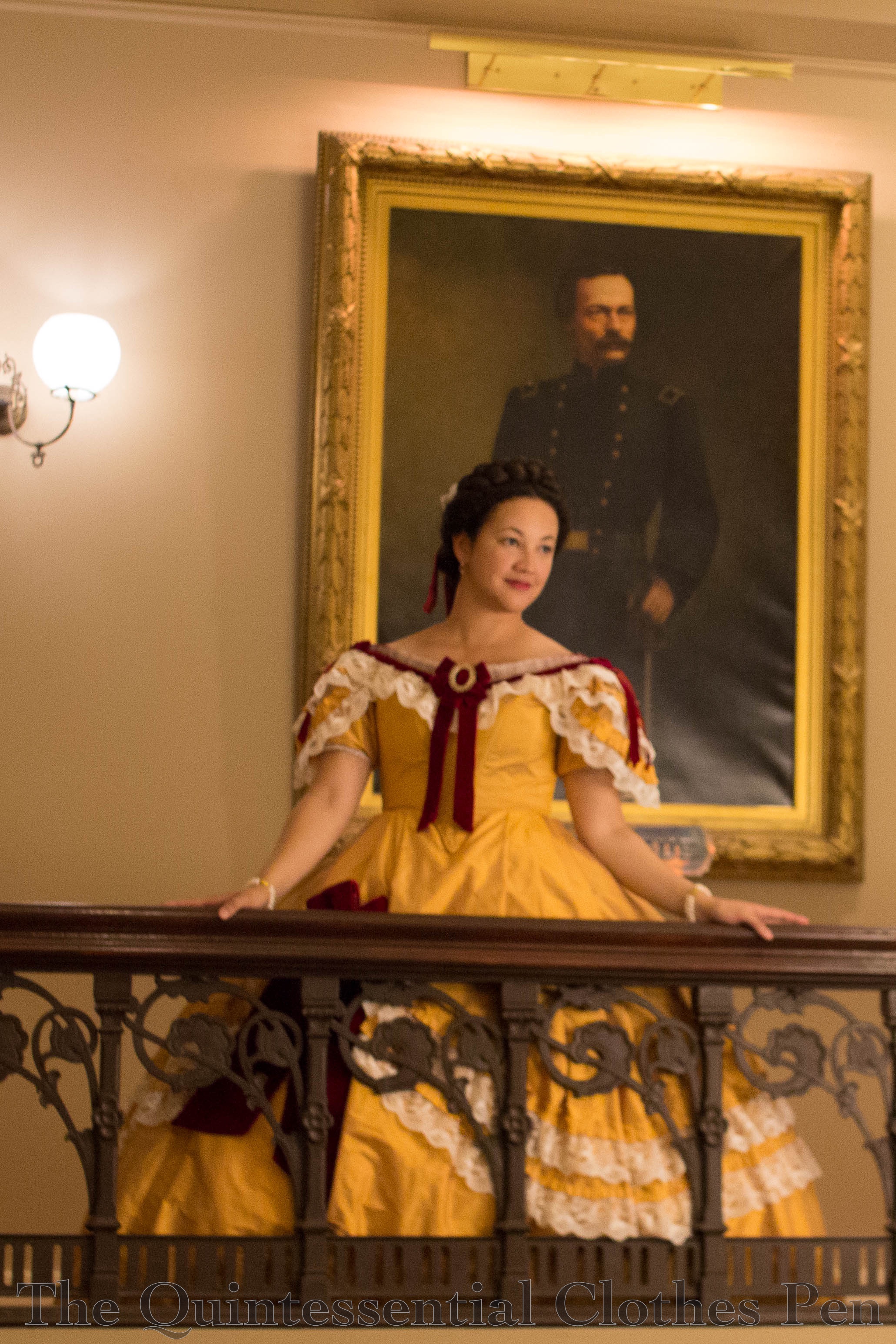

I’ve got a post coming up specifically about my grand crown hairstyle as well as a few photos of the ball in general. For now though, thanks very much for bearing with me through this project! I’ve appreciated your encouraging words and excitement about seeing the finished product!


Project Journal: 1863 Apricot Evening Gown Part VII: Finishing Details

Next post will be photos of my finished apricot dress… YAY! But first, I have the final finishing details to discuss. Most of the finishing left was on the bodice, so let’s start with that.

Bertha

Side note: have we ever talked about what a bertha is? A bertha is a collar of lace or other thin fabric, particularly popular during the 19th century. Check out this link to learn a little more about the history of the word.

In my last post, I included a photo showing the assembled front of the bertha for this dress before I attached it to the bodice. My goal was to make the bertha completely separate so that it would be easy to change if I decided to do that at a later time.

The foundation is a single layer of ivory tulle cut to the shape of the front (and one for the back) of the fully assembled bodice. A gathered piece of my lace trim was machine stitched to the bottom edge of the tulle, about ½” up from the cut edge.

On top of that foundation is a second layer of tulle that is gathered at both the top and bottom edges. The top edge is folded under by about ½” and the gathering stitch run through both layers so that the top edge is a fold rather than the cut edge of the tulle.

It took quite a few pins to secure the gathered tulle to the tulle underneath. It was finicky–tulle on tulle… not fun!

And I might have made a mistake while ironing my first foundation piece of tulle. Any guesses about what that was?

Oops! I like to iron with a hot iron but the nylon tulle was having none of that! I had to cut a new piece… and turn down my iron for a bit! The bottom gathered tulle in the above photo shows another failed experiment. That tulle is a full double width folded at the top and gathered top and bottom. I decided it was too bulky and not as elegant and decided to go with my previously explained method of only turning the top to create a fold.

After machine sewing my successful gathered tulle to the base layer of tulle it was time to add velvet trim. The velvet was cut on the bias, both edges pressed under, and then it was slip stitched over the stitch lines in the tulle. I also created velvet bows, as I hinted about last time. This is one of the bows I created before I realized I needed more than I had cut out… oops again!

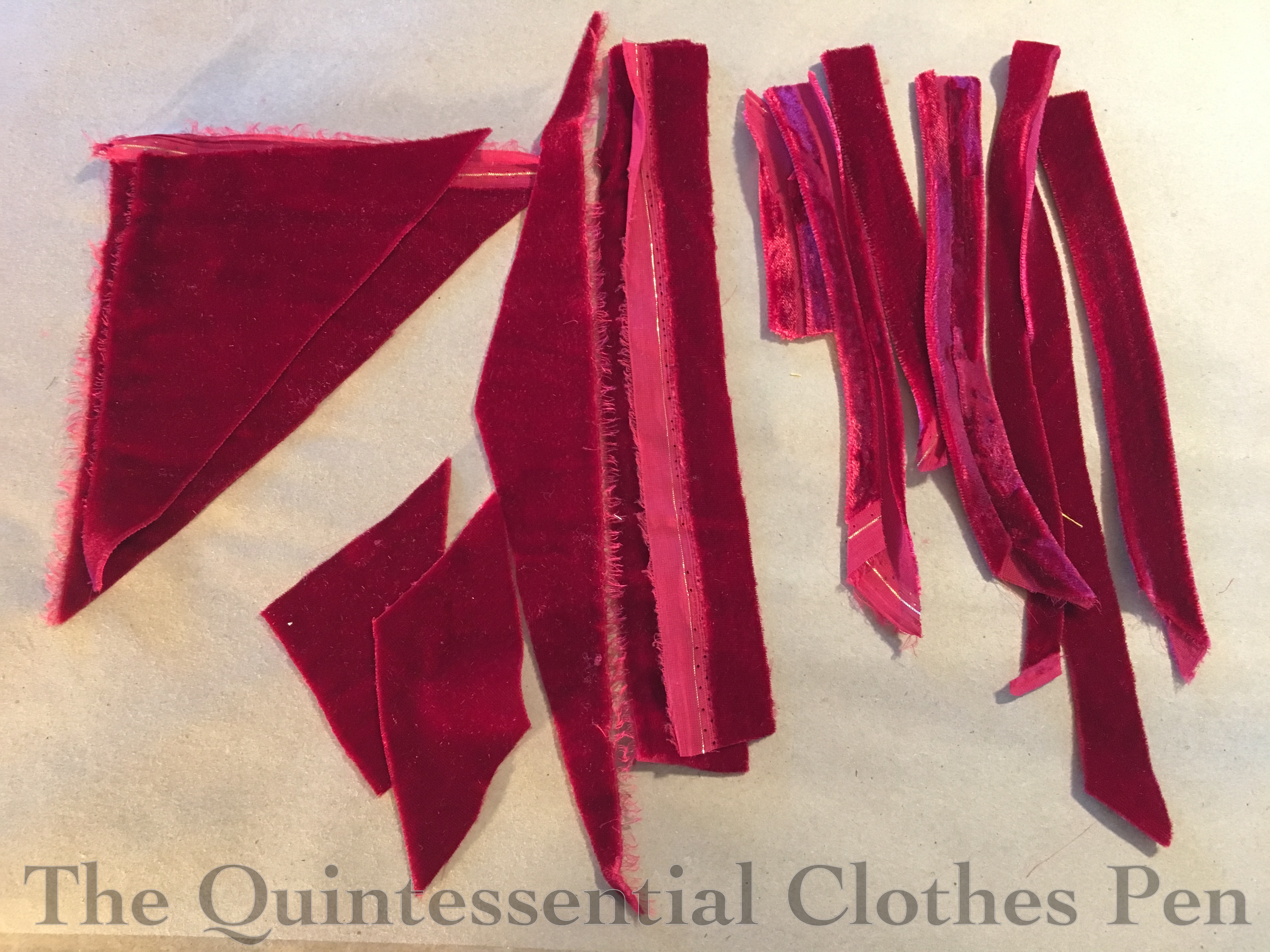
After recutting my bows, this is the velvet I had left. I didn’t include anything for scale, but the longest piece in this photo is about 6″!

Remaking the bows (or rather, cutting new ones and disassembling ones I had already made) brings us back to where we were in the last post. The old velvet bows had top bow parts and dangling bow parts cut on the straight of grain, but due to my limited fabric I cut out the new bows with bias dangling parts. In the end I’m glad I did, because I think they hang more elegantly than the straight cut version.

Brooches

You might have noticed that the center velvet bow on the bertha has a gold filigree oval on it. In my inspiration it looks like these are buckles or brooches of some kind. I started by trying to use my stash, finding two matching football shaped buckles that I hoped could work. But the more I looked at them the more I didn’t like them.

So I spent a long time looking for something else low-cost that would work. Ideally, I wanted two sizes of the same style, but that quickly proved to be hard unless I wanted smallish very sparkly rhinestone buckles. But of course the scale of this dress is not small. Eventually I found the right search terms to find open centered brooches intended for creating your own cameos. I purchased these and painted them gold using acrylic paint. Despite being the same size for the bodice and skirt, I think they worked well!

Sleeves

I suppose I should also mention the sleeves. They made it onto the bodice but I haven’t talked about them at all. They are cut on the straight of grain and are basically a round-top trapezoid shape, with an outer layer of silk that is larger than an inner layer of my flat lining cotton. The silk was gathered around the bottom and around the armhole to fit. Due to the longer measurement of the silk it rolls up inside the sleeves by about 1″, which keeps the cotton from showing while being worn. Here you can see the poofy sleeves as well as the bertha before it had velvet added.

Oh, but those sleeves weren’t done yet! My inspiration had sleeves that appeared to be droopy continuations of the bertha. This is a detail that is different from all of my previous dresses from this period, so I felt it would be a neat detail to include. It took quite a bit of pondering to decide how to achieve the look and it was something I didn’t feel I could tackle until well into the process when I could see what the bertha and sleeves were doing without the extra layer.

My solution was to create sleeve caps of single layers of tulle with more of my lace and silk pleated trim on top. The tulle rather disappears when worn, giving the effect of floating trim. It’s pretty neat, actually.

Sewing the lace on was easy and relatively fast, as I did it by machine. But the silk… well, I thought I had enough left over from my crazy skirt trimming for the sleeves but those pleats eat silk so quickly! I only had about 75% of what I needed.

It was less than a week before the ball. I had returned the scalloped scissors to my friend so I couldn’t cut more silk. I tried spacing out what I had as much as possible without looking different from the skirt. And I was still short! UGH! Last minute challenges aren’t very fun. I pleated and re-pleated. Got a few more inches covered. Then I decided to harvest some pleated trim from my skirt, from underneath the big velvet bow where it wouldn’t be seen. Not terribly fun, to seam rip something you’ve just made. And the pieces I got were about 5″ in length. But I got them. And I put them on those sleeves. And even though they’re pieced you can’t tell at all and those sleeves got done!

This photo shows the first sleeve in progress, before I realized I didn’t have enough silk trim…

I sewed the sleeve caps on with small top stitches to the outside of the bodice at the armsceye seam. Again, this makes them easy to remove if I want. Also, I’d already set the sleeves… so I couldn’t easily put them into that seam (oops?). In the end, it doesn’t matter that they’re on the outside, because the bertha lace completely hides the armsceye along the top of the sleeve.

Bodice Finishing Details

In addition to sewing on the sleeve caps, I also attached both the front and back bertha layers to the bodice.

I finished my eyelets and ran the lacing ribbon through the top half. I find that 3 yards of ribbon allows me to leave the ribbon laced through the top eyelets and still get in and out, which makes getting dressed faster as the person helping me then only has to lace the bottom half of the bodice and tighten the ribbon at the top.

I also made and whipped in a placket. That’s the rectangular piece that’s rather wrinkly in the center of the photo below. While this bodice fits perfectly now, you never know what the future will bring and this will allow for a slight gap (if needed) that will still look like dress fabric and not like underwear.

I added hooks and thread bars to the bertha at the right shoulder, as well as two along the right back neckline to hold it in place along that edge. There is also a hook on the lace to secure it to the lace on the front of the bertha. Once hooked it looks seamless!

The final step was to sew hooks on the front and sides inside the bodice to allow it hook to the skirt. You can see the hook on the boning at the center front in the photo below.

Skirt Finishing Details

The skirt was basically done once I added my giant velvet bow except for a few things.

I added two hooks and bars to the waistband to close the skirt. The narrow hemmed opening is hidden under a pleat and will allow for future changes in waist size if needed.

I added loops to hook the bodice to. You can see one of those on the left. Turns out I didn’t line the side ones up very well (I think this was the very last task late one night on the last night I was stitching), so we added a safety pin at the ball and hooked the bodice to that. The safety pin is visible just to the right of the loop. At some point I need to move the loop to the location of the safety pin. Boo! There’s always something to fix or repair or change once you wear a garment!

And finally, when I added the waistband I also added hanging loops for the skirt. There’s one poking up on the right. These allow me to easily hang the skirt to keep it from getting wrinkled in storage.

And finally… after many, many hours of sewing, this dress is done. I like big projects but I confess to getting a bit sick of this one after sewing on it every day for about a month at the end of the process. Next post will be photos of the finished dress. (And I can report that I was happy with it in the end! Yay!)