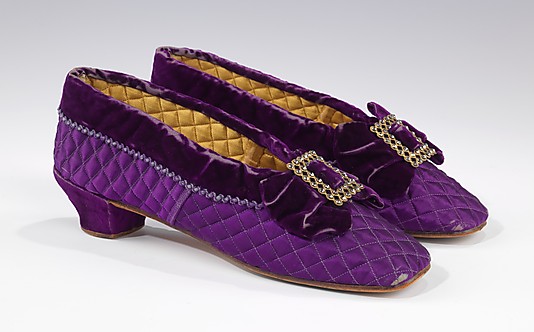
Recently, while looking through the Metropolitan Museum of Art’s Costume Collection for entirely unrelated items, I came across these very purple quilted slippers. I like them, but I also feel they are a little loud. Quilting? And purple? And velvet? And bows? There’s just a lot going on. They look pretty comfortable, though! How do you feel about these? And can you imagine what sort of dress would go with them? Perhaps a white cotton flounced one with purple trim…
1865-1885 Silk Slippers (Metropolitan Museum of Art)
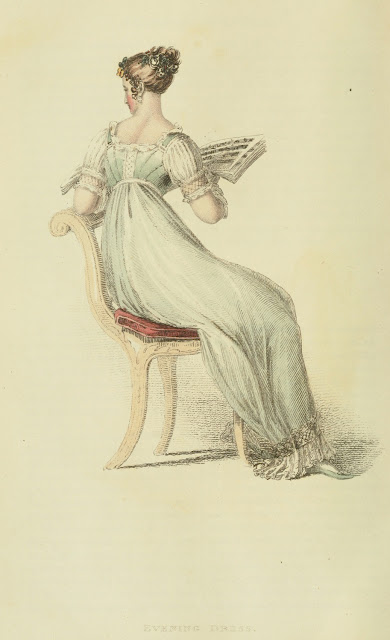
Now that we’ve seen my re-made 1819 dress (woohoo!), let’s look a little closer at my hair. Despite the fact that I have naturally curly hair, Regency hair styles are not as easy for me to achieve as you might think. Many Regency styles have short curls (bangs, really) that surround the face, like the one below.
1813 Ackermann’s fashion plate from EK Duncan’s blog: look at those curls that frame her face!
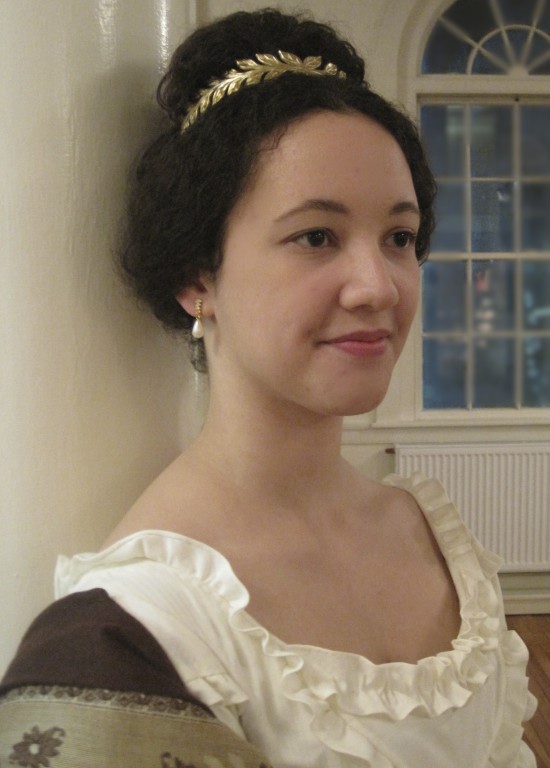
However, in this modern world, curly bangs are just not the thing to have… so thus my regular, un-period hairstyle is long, with no trace of bangs! (So I don’t even have pieces I could curl with a curling iron to get the ringlets at the front.) I dug through my books to look for Regency hair styles that did not have the face framed in curls and I did find some in Cunnington’s English Women’s Clothing in the Nineteenth Century. Luckily, many of the non-face-framed-curly styles were from the same year as my dress: 1819. I also had the good fortune a few months ago to come across a gold laurel leaf headband that fits the Regency period wonderfully. It’s actually plastic, but I think it looks the part. I used it as a tiara.
You'll remember this picture from my last post.
In terms of styling my hair, I wound up trying out a few of the techniques that Lauren (of American Duchess) has been discussing recently in terms of early Edwardian hair styling. The question for me with these sorts of styles is always what to do with the back? Once the top poof has been achieved something has to fill in the back or it just looks weird. Lauren’s posts have been quite illuminating for me in solving this problem.
I started by parting my hair from ear to ear over my head, to separate the front bits: this I parted down the center to form a left and right side, then I clipped these out of the way to save for later. I then took the back section and divided it into a top and bottom section. I put the top section in a super high pony tail and then rolled it to create a poof at the top of my head, to fill in the laurel tiara.
You can see the top poof and rolled up back sections.
Once that section had been pinned, I divided the remaining back section into three sections: one by each ear and one in the middle at the nape of my neck. Each of these was separately rolled up and pinned below the poof on the top of my head, to fill in the back section. Now remember, I didn’t want to curl the area around my face… but I had the left and right front sections still. The image that I used had wings (almost like an 1860s look)… and so that’s what I did with the front sections. Each one swooped over my ear and was pinned in the back bottom section. Big sigh of relief… An hour later, having used 20 bobby pins, and a lot of super duper hair spray (to contain my frizz, you know), Regency hair! I felt very Josephine-like with such an up-do and regal tiara! I’m not totally sold on the wings. I think they were a little too poofy. Maybe next time I can smooth them down more?
Side back view.
Below is a great example of a Regency up-do from a fashion plate. I think I created a similar style, if not more complicated style, although without those face-framing curls…
1813 Ackermann's fashion plate from EK Duncan: a great view of a Regency up-do from the back
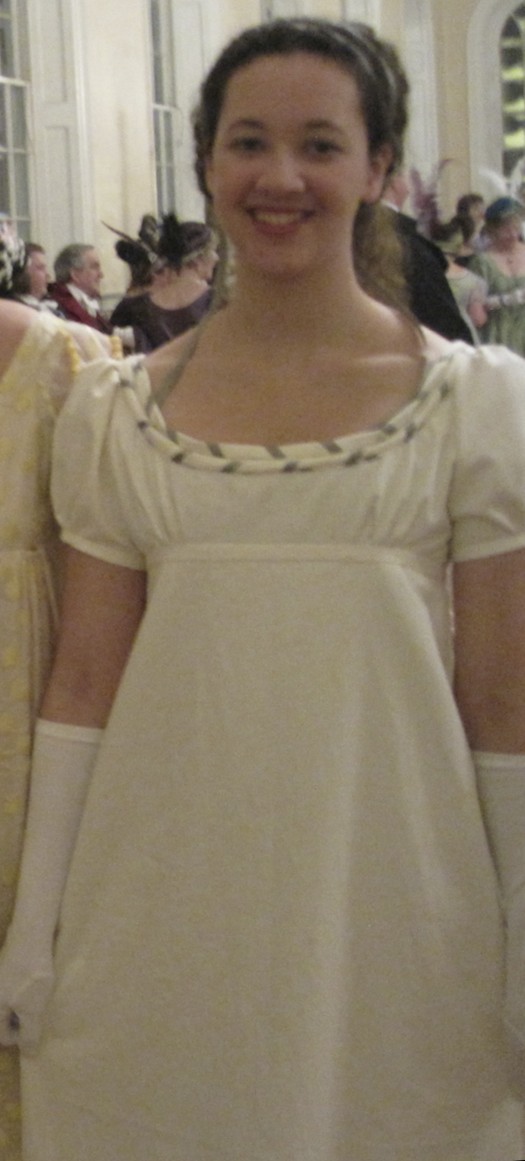
I am so pleased with my re-made 1819 dress. You can get the background here or read the sewing update here! In short, the new style shares only the skirt with its former self. The new ruffles are all hand hemmed and hand sewn on. The dress seams are a mix of machine and hand sewing, depending on if I felt like digging out the sewing machine or not. All of the bodice seams are flat felled by hand. The dress closes in the back with 4 mother of pearl buttons. Oh, and let me not forget that the dress no longer has built in petticoats. Part of the re-make was to create a separate petticoat from one of the two petticoat layers built into the dress. The petticoat ties under the bust and has a single button to close the top of the bust. It is just a sleeveless, simple version of the gown. I’ll have to take pictures sometime so I can share them. But the dress… It fits! It is ruffly! It has so much more style than it did before! Just to compare, the first picture is your first glimpse of its current style, and below that is from before the re-make.
The re-made 1819 dress, with ruffles!The 1819 dress in its first incarnation.
Isn’t it more stunning than it previously was? I wore it to the Commonwealth Vintage Dancers’ 1812 Ball (ok, so my dress was a little forward thinking… maybe I have a time machine?). I had a lovely time, as expected. I made some new acquaintances and renewed some old ones, I was able to wear my recently purchased kid leather opera-length (which means over the elbow) gloves and a beautiful shawl one of my aunts gave me a few years ago, I got to practice my historic hair styling techniques (more to come on that point soon), and I danced! But let me stop writing, because really this post is about sharing pictures.
The back view of the re-made dress.Friends: don't we make a lovely group? Ok, wait, but there's a funny face...How about this one? Same group, but now I'm making the funny face. Rather a severe expression, don't you think?
I’d just like to insert a comment here: looking again at these pictures, all the ruffles on the bodice of my dress really manage to make me look much more busty than I actually am… Hm… there are a lot of ruffles going on there!
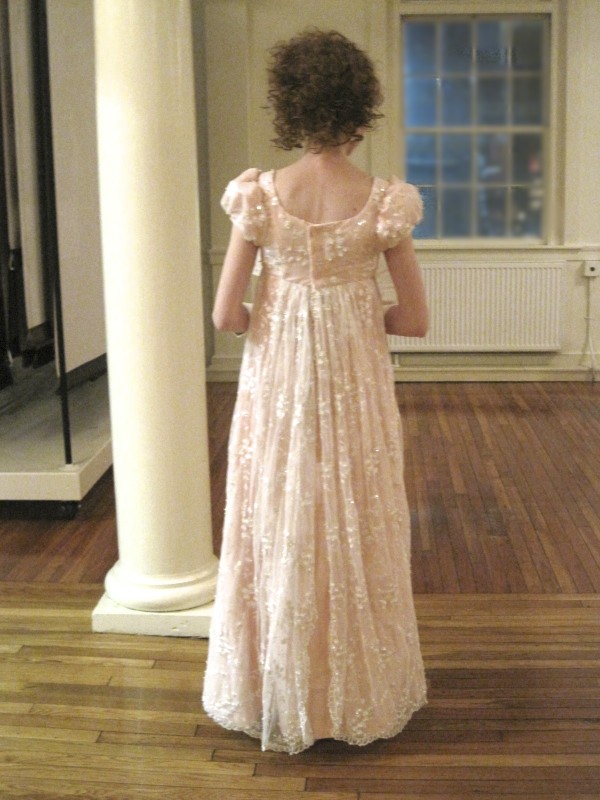
My friend made this beautiful fan to go with her dress! It's hard to see the detail in this picture, but it's absolutely lovely.Front of her new dress. She also has the super cute tiara, that is much more sparkly in person...Back of her new dress.
I’ll leave you with this image: a teaser for a soon-to-come post about the creation of this hair style!
Quite picturesque, I think. Thanks for taking the photos, Carly (and Mark)!
My 1819 re-made ball gown is almost complete! The ball is next weekend, so pictures will be coming soon. I have all my accessories in order and I’ve just about completed my petticoat. It’s time to start cranking out my Titantic-era dresses… but… I’ve taken a detour from my plans to work on a sewing project from a different facet of my life (warning: this is unrelated to historic costume!): competitive ballroom dancing.
My most recent Standard dress: unfortunately the picture quality is bad
I have made multiple dresses over the last seven or so years that I have been dancing, and they get progressively better (as with most sewing projects: you can see past dresses in the ballroom dance dress gallery in my online portfolio). I still like my most recent dress, the pale yellow with jade green lace to the right, but unfortunately almost four years have passed since its construction and it doesn’t quite fit the way it used too… (That is because the dress shrunk, right?) We are competing three or four times in the next few months and the idea was planted in my head by my partner (cough, cough), that perhaps a new dress would show me off to better advantage. So, after trying on the dress and realizing how tight the midsection had become I decided to pause in my historic construction plans and go blazing on an all new Standard dress!
International Standard ballroom dancing is made up of five dances: Waltz, Tango, Viennese Waltz, Foxtrot, and Quickstep. Below is a video of the 2010 International DanceSport Federation Standard Semi-Finalists and Finalists. The video is in five parts, if you are at all interested I encourage you to at least skim them all! Obviously, the dancing is amazing, because these are the best in the world, but there is also great professional commentary.
I’ve been doing lots of thinking about the color scheme and the style of the new dress. I’ve been looking at dresses within the past few years to see what the current style is for Standard dresses (because, like other styles of fashion the dresses do change in terms of fashionable details and cuts). You can visit my Pinterest board and see inspirational dresses and colors. It’s really quite fabulous–a riot of colors and great dancing (some of which is from the dancers in the above video)! I really enjoy just looking at that Pinterest board. You can probably guess the colors I decided on, but I’m not going to tell you officially, yet!
I still need to order rhinestones and a hem stiffener. I have yet to decide between nylon horsehair and plastic wire. The horsehair creates a more obvious edge, whereas the wire just makes a nice wavy hem that stands out on its own. But I have fabric! I leave you now to get to work on the dress… eek!
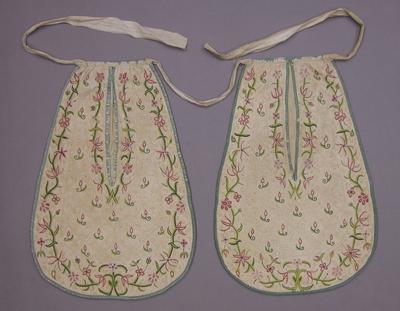
For the last month, I have been pondering the idea of making 18th century pockets. It was my idea to wear them to an 18th century ball and use them as a place to store my modern items (cell phone, credit card, cash, car keys, etc.). I was thinking of making simple linen ones, without embroidery, but once I started researching them I realized that I really wanted to go the full distance. In this case, the full distance meant hand sewn silk embroidery… The realization hit me just a few days before the ball that this plan was flawed. There was no way I was going to complete hand embroidered pockets in the time I had left. My choices: to fudge it and be stressed out while trying to complete hand embroidery with cotton thread or to wait, source my products and make a plan, and enjoy my time hand embroidering. What to do? Well, I decided to do the latter and I am glad to say that I am thankful to have used common sense and avoided stress! For now, the plan to make pockets has been added to my list of things to make in my leisure sewing time (when other, more time sensitive projects are lacking… Does that ever happen???). These charming pink, green, and blue ones are my goal.
Early 1700s pockets, linen embroidered with silk, trimmed with silk ribbon and with silk ties (V and A)
Pockets in the 18th century were often made of linen and elaborately embroidered in colorful silk or wool thread, as with the example above and the following examples. Aren’t these yellow trimmed ones adorable? It looks like the pocket slits are smiling!
Mid-1700s pockets, linen embroidered with silk, trimmed with silk and with silk and linen ties (Manchester City Galleries)
This next pair of pockets has beautiful (and intense) embroidery.
Mid-1700s pockets, linen embroidered with wool, with linen ties (Worthing Museum and Art Gallery)
This next pocket has a lovely embroidered pattern that looks much simpler to replicate than the previous examples. This is my back up plan if the other, more complicated embroidery proves to be too much.
1718-1720 pocket, linen embroidered with silk, with linen ties (V and A)
The pockets with unfinished red embroidery are an excellent example of pocket construction. You can see the manner in which the design is marked as well as the embroidery being completed prior to the pocket being cut out and assembled.
1718-1720 pockets, linen with silk embroidery, the pattern drawn in ink (V and A)
There are also some pockets constructed of silk, such as these, below. These pockets were acquired with a quilted silk petticoat and the Victoria and ALbert Museum assumes that they were intended to be worn together. They look puffy and super cute, but because they are assumed to have such a specific purpose I don’t think they are the right idea for me. Also, I wouldn’t get to embroider!
Mid-1700s pockets, silk with silk ribbon (V and A)
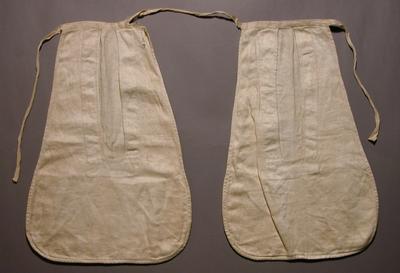
Pockets continued to be used in the 19th century, but they were often constructed of cotton rather than linen and were not as elaborately embroidered as in the pervious century. Some 19th century pockets were constructed of cottons with woven patterns, such as stripes or diamonds as well as the occasional pocket of satin weave cotton fabric. In the middle of the century embroidery was again used as decoration, though the motifs were changed from the 18th century. These next few pockets are just a few 19th century ones I like, either because they use interesting fabrics, or because they are smiling at you!
Late 1800s pockets, twill weave cotton (Oxfordshire Museum Service)I like this one especially, because it really does look like a smiley face pocket! Early 1800s pockets, ribbed cotton, with cotton tape (Cheltenham Art Gallery and Museum) Early-mid-1800s pockets, satin weave cotton (Maidstone Museum and Bentlif Art Gallery)early 1800s pockets, figured silk satin, trimmed with silk (Cheltenham Art Gallery and Museum)
Do you have a favorite pocket amongst these? Does any pair stand out to you?
All of these pockets were recently available at here, at VADS: the online resource for visual arts; however, VADS appears to no longer be operable (perhaps because of recent US government action to curtail internet copyright infringement?). Alternatively, the Victoria and Albert Museum has a pretty good selection of pockets, including some of the ones featured on VADS.











 The Quintessential Clothes Pen