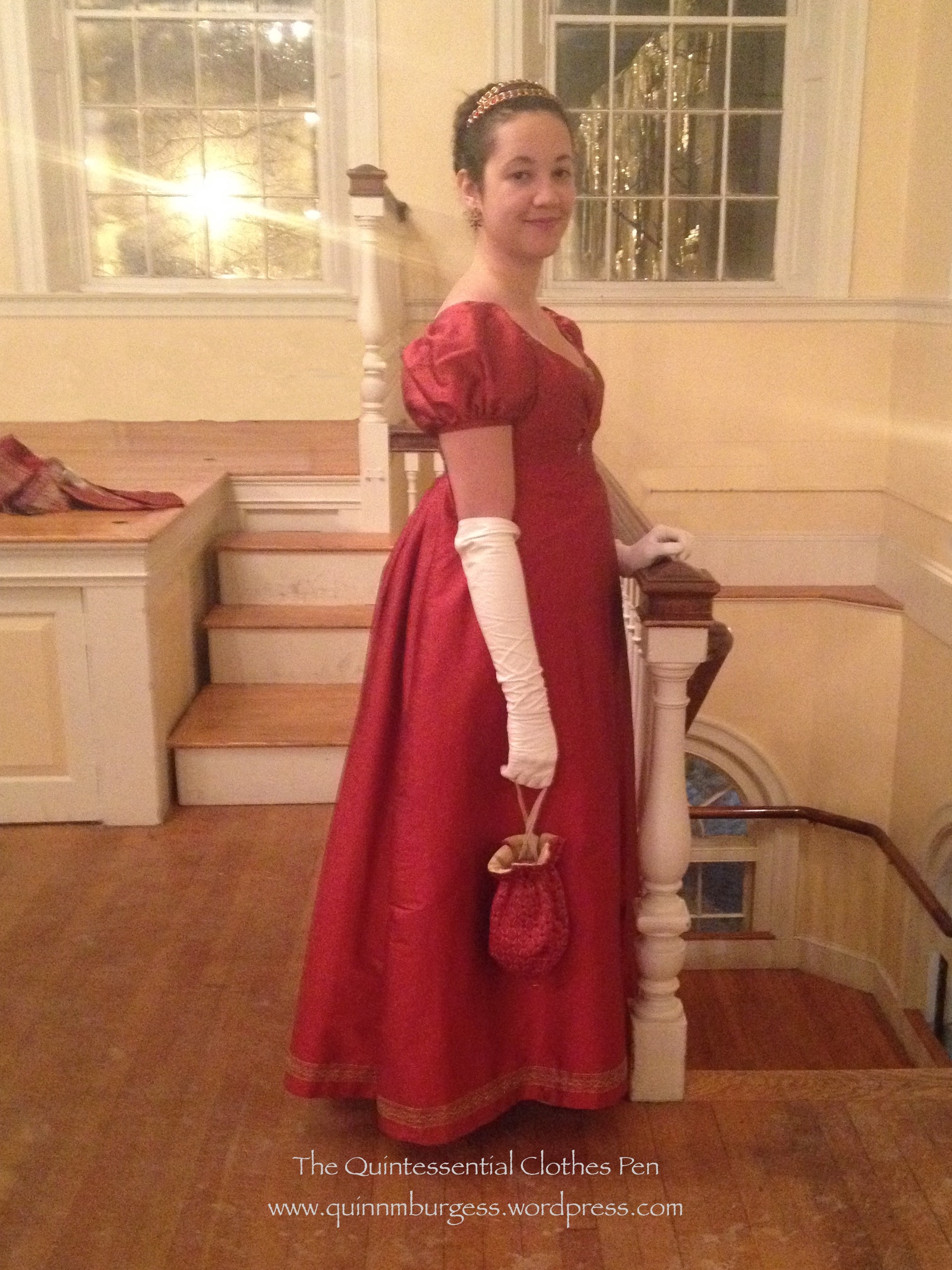
HSF #1: Elusive Blue In 1899

I made my (first) and last 1890s ball gown in 2012. It is from 1893, with super poof sleeves, and is lovely, but after wearing it to more events than I’ve kept track of without serious thought (which means somewhere over 5 and probably under 10), I was growing tired of it and wanted something new. (Of course, now I’m curious when I wore it. Let’s see: last January’s 1890s ball in 2015, the Nahant Vintage Dance Weekend Grand Ball in 2014, a December Victorian ball in 2013 where I solved the problem of it sliding off my shoulders when I wore it for the first time during Newport Vintage Dance Week in 2012, plus various performances.)

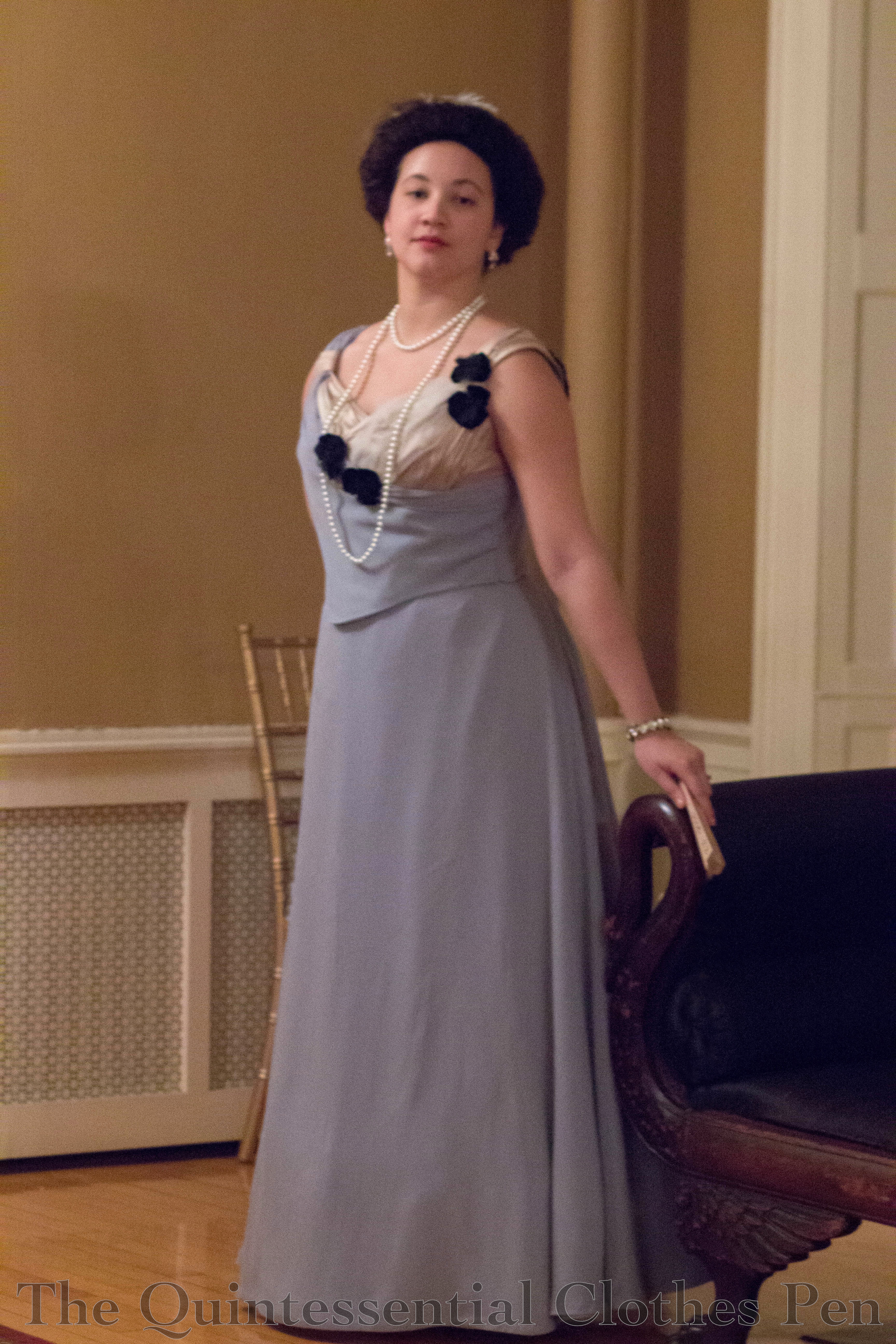
I already had inspiration pinned to a board, I had fabric in the stash (the fabric is more of the same elusive blue I used to make my 1811 evening gown in 2014–it time travels!), and I had an opportunity to wear an 1890s gown this past month! With a vague plan in mind, I started the skirts* sometime in the fall with the sincere hope of getting a fair bit done on them, but only got as far as cutting them out, after which they languished in the closet while I worked on other projects. Languishing is a variation on procrastination, which is the HSF challenge for this January. And so, with the languishing having finished its course, here is the finished new gown.

IMG_2204-2

Just the facts:

Fabric: 5 yards or so of (likely polyester) elusive blue chiffon, 3 yards or so of elusive blue polyester for skirt lining, 3/4 yard or so robin’s egg blue cotton, 1 yard or so of pink glazed cotton, 1/8 yard or so of taupe silk shantung, some small bits of ivory polyester tulle and ivory silk gauze.

Pattern: Created by me, with reference to Janet Arnold dresses from the 1890s.

Year: 1899.

Notions: Wide grosgrain ribbon, bone casing, 1/4″ plastic wire tires, narrow grosgrain ribbon, black velvet and organza millinery flowers, hooks and eyes, and thread.

How historically accurate is it?: Definitely recognizable in its own time. The silhouette is spot on. The colors are inspired by extant clothing. The construction is mostly accurate. The materials are a mix of accurate and inaccurate. I’ll give it 80%.

Hours to complete:  Many. I worked on this over a few months.

First worn: January 9, 2016.

Total cost: About $15-$20.

(The low cost is due to the fact that the chiffon and lining fabrics were purchased for the amazing price of $1/yard and that many of the notions and small bits were in my fabric stash.)
IMG_2197

For the bodice, I started with the pattern for my 1893 gown (which was adapted from Janet Arnold originally). The back needed very slight alteration, but the front had quite a few changes, due to being worn over my new 1880s corset  and because I wanted different dart placements, neckline, a front/side hidden closure, etc. I did multiple mock-up fittings (no pictures, sorry) before feeling ready to cut real fabric.

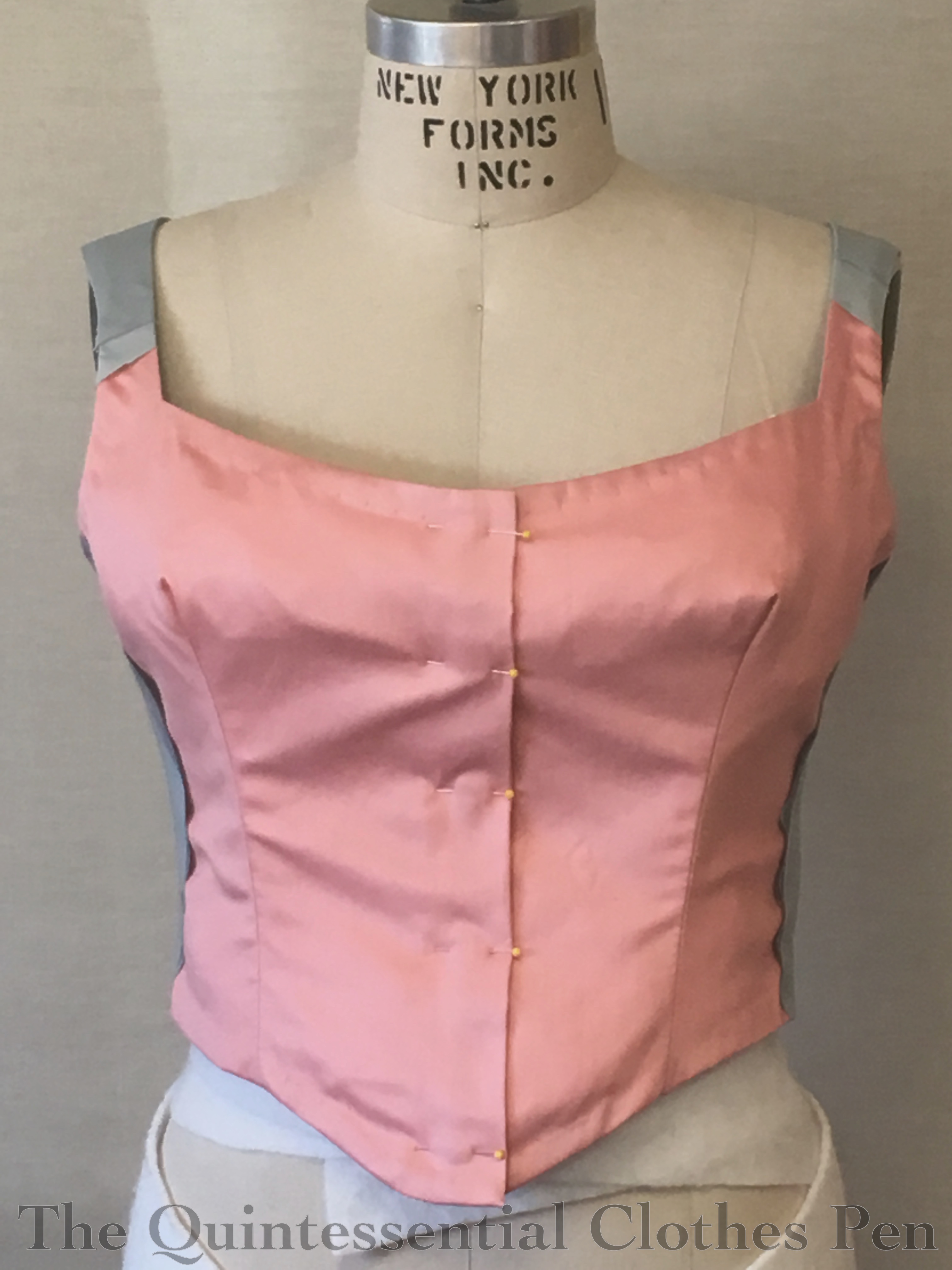
Here is the bodice in the middle stages on construction. You’d never guess from the exterior, but the bodice is flat lined with pink! This is not a standard lining color, but I had it on hand, it is the right weight (with a glazed finish, which is standard), and it amused me. By this point, I’d finished my edges, adding boning, nicely finished my interior seam allowances, and covered the back with elusive blue lining and chiffon cut on the bias.
IMG_0459 (1)

Next was creating the front bodice main piece, which is also on the bias. I draped it and then bagged the lining/chiffon with the robin’s egg cotton to create nice finished edges. The flapping bit on the left of the picture was turned under and hand sewn later in the process.

IMG_0470 (1)

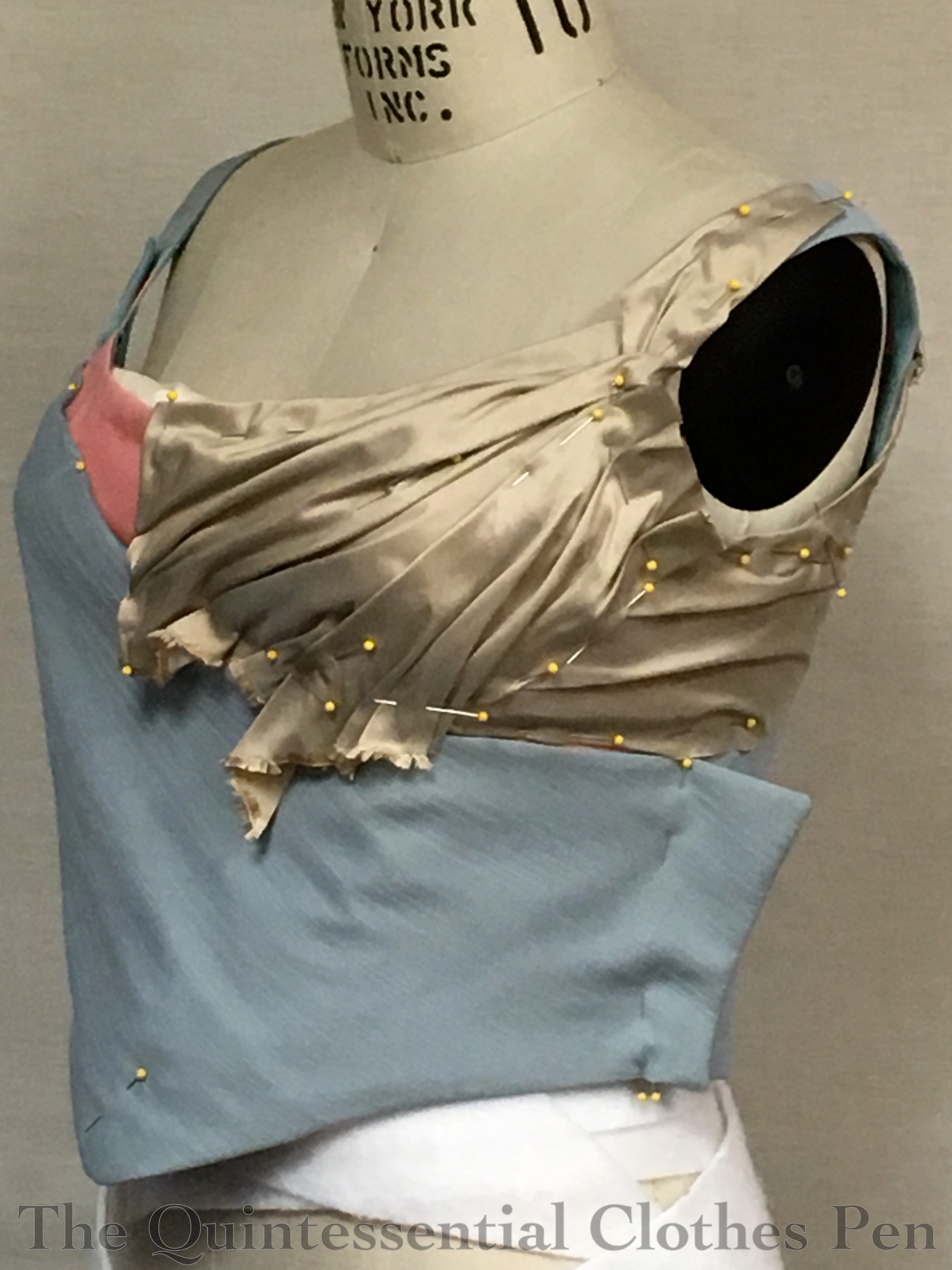
Draping the silk was next. There are actually a number of small pieces carefully pleated before being hand sewn in place.
IMG_0473 (1)

My original main inspiration was this gown at the Met (and the alternate skirt follows this idea quite closely), but when I looked at my material options, I really loved this variation, also from the Met. Other dresses with a similar cut were also influential, including this, this, and this. Here’s a similar example that clearly shows the shadow of a side closure.

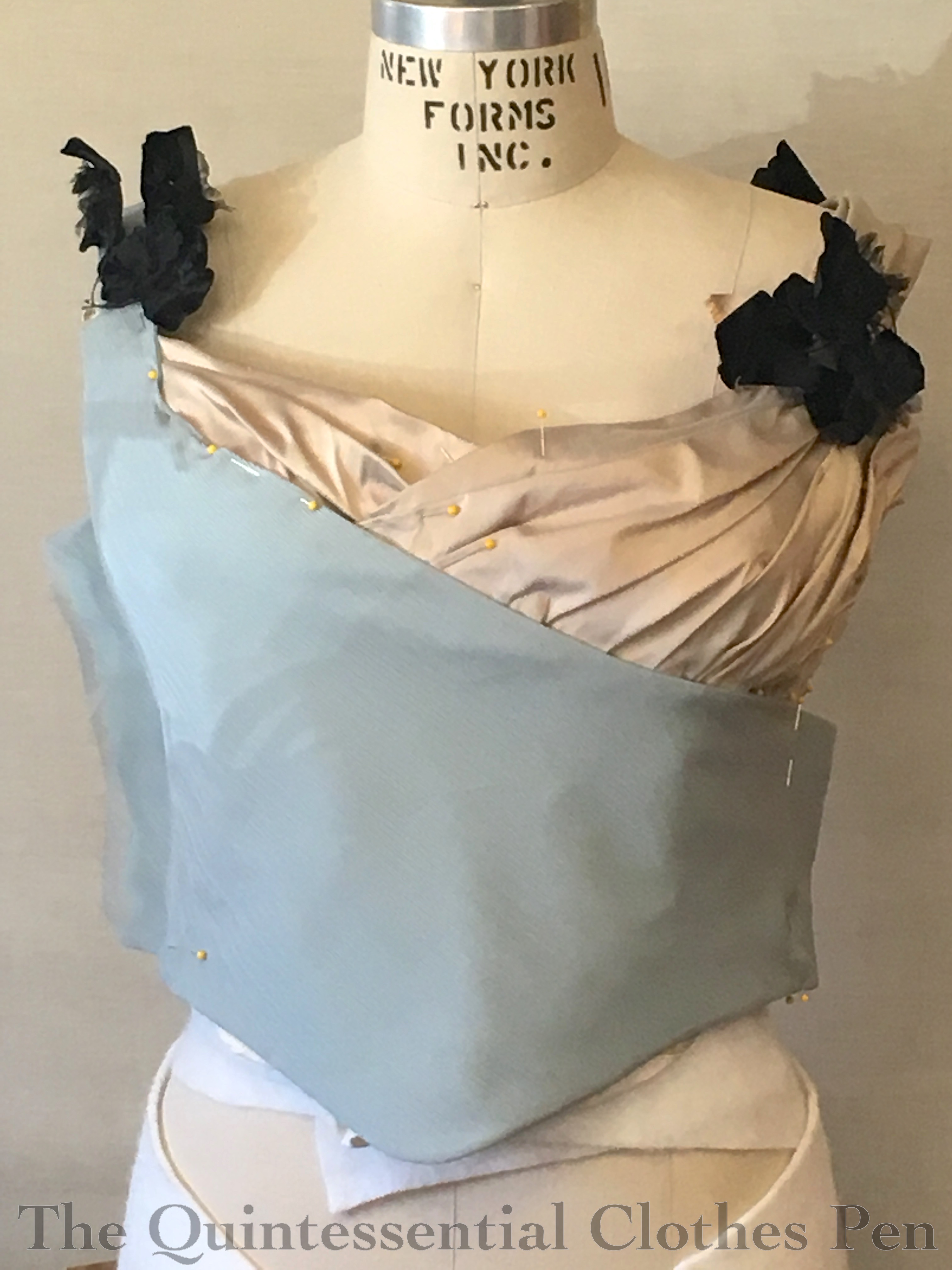
In the next picture, both the left and right sides have been covered in silk. Each side of the bust layers and attaches separately. I also started playing with flower placement at this point. I was inspired to add black accents to the otherwise subdued colors by this dress. I really like how the black pops!
IMG_0477 (1)

Here’s the back around the same stage.

IMG_0478 (1)

At this stage, I’ve added gauze and tulle to the front and am playing with the chiffon edging. The flowers are tucked into place to see the effect. I’ve also sewn down the proper right (left in the picture) side. The proper left (right in the picture) side is pinned and tucked, waiting for a final fitting before finishing and adding closures.

IMG_0514 (1)

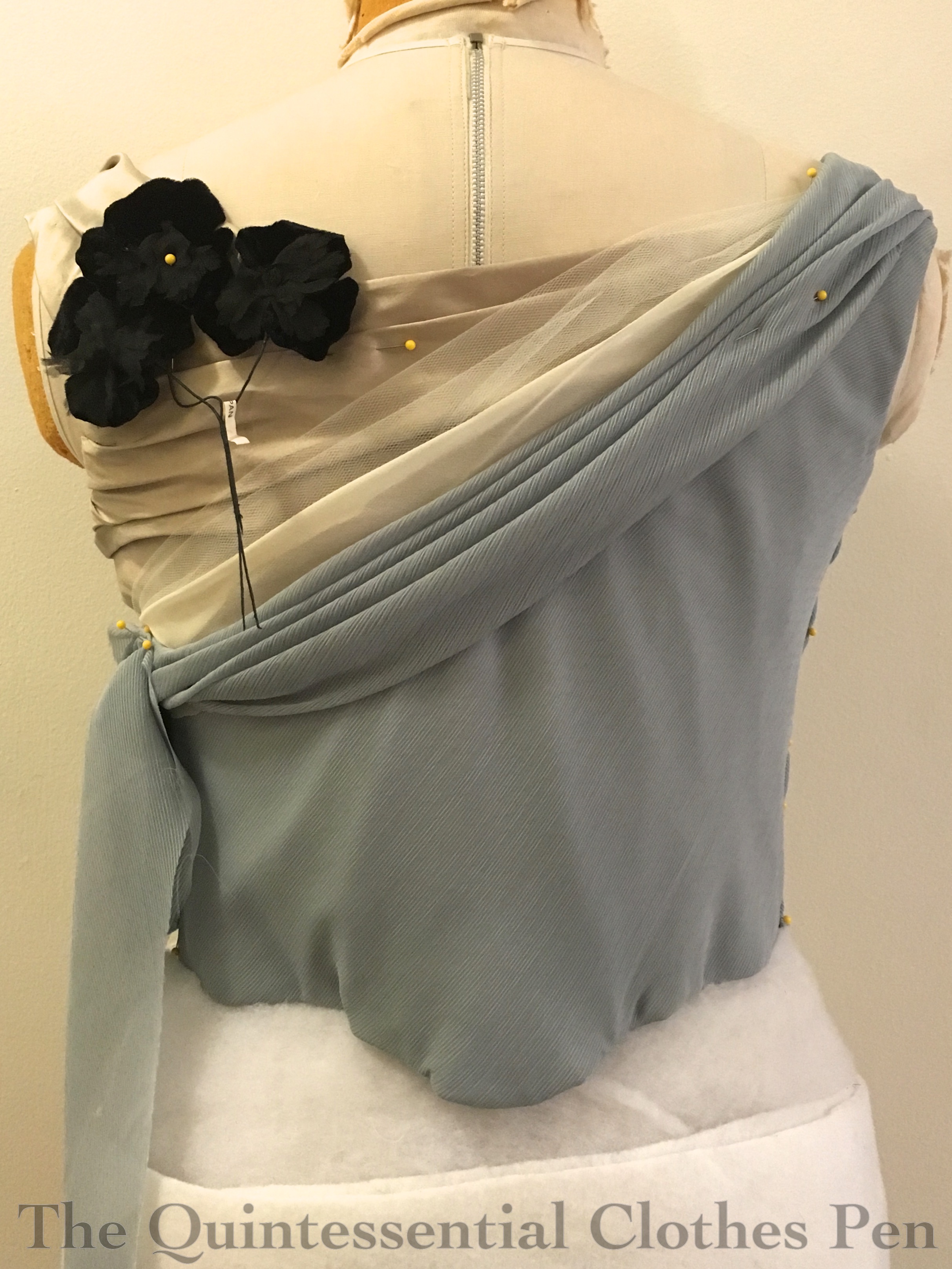
The back also received a treatment of gauze and tulle in addition to a chiffon edging. You can see that the flowers came in stems of three (these are another part of one of two huge hauls of millinery flowers for super cheap that I’ve had in the last few years, yay!).
IMG_0516 (1)

Sewing down all the pleats just so, in order to look natural and not constrained, took rather a long time, as did nicely tucking all the silk around the armhole. But it was worth it!

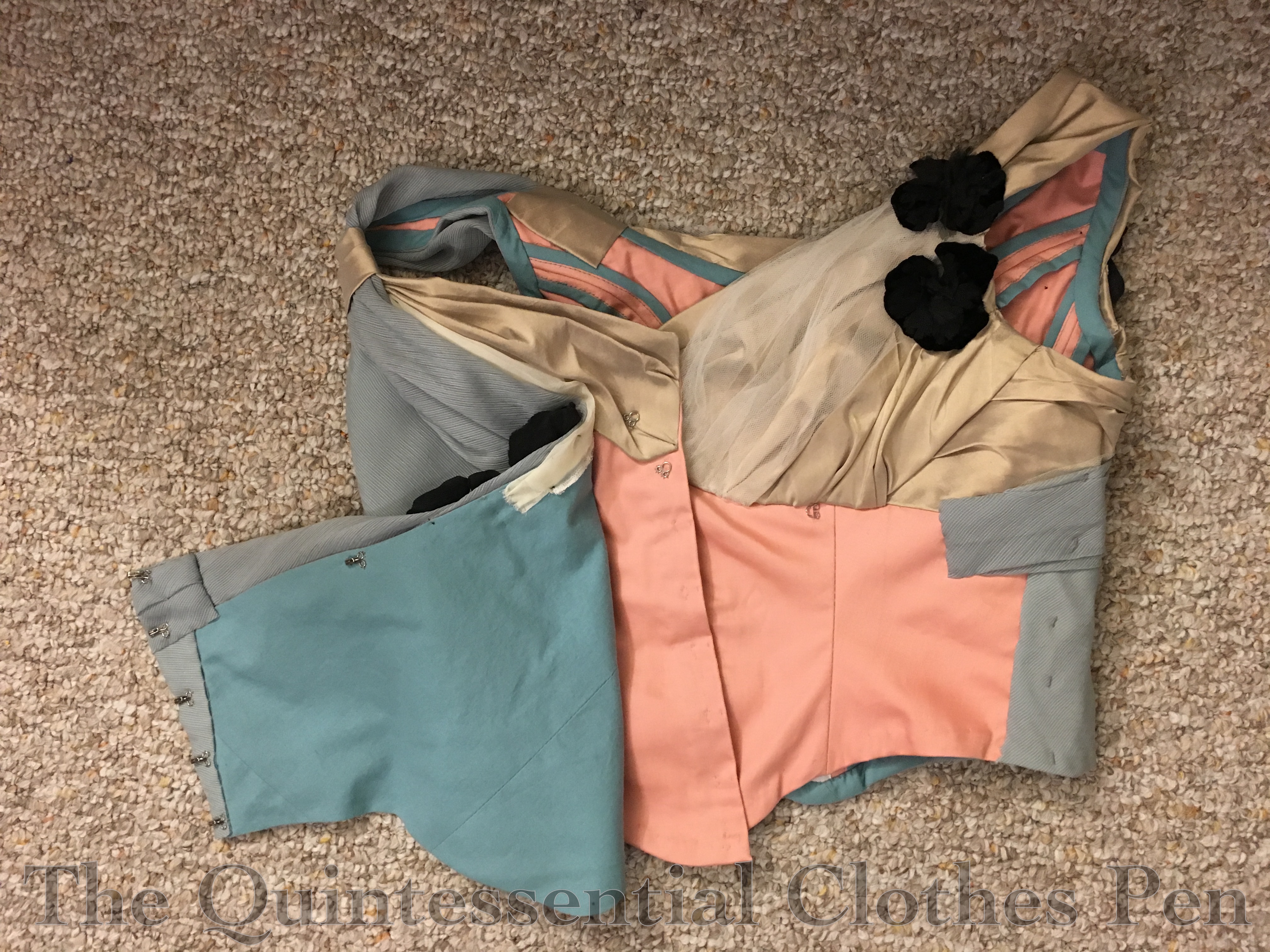
Here is the inside of the bodice, finished. I decided to bind the seam allowances in the same robin’s egg blue cotton that I used for bias binding for the edges and armholes. A hong kong finish is not accurate, but I didn’t feel like hand whip stitching all the seam allowances (although, in the end, it probably would have taken just as much time, or less), plus, I enjoy the effect. There are also closures (yay!) and a waist tape.

IMG_0544

And here’s what the bodice looks like with center fronts together. The bit with the tulle actually hooks over the other side (but pictured this way, you can see the closures). After that, the front panel hooks across the front and is securely hooked at the side seam, effectively covering my pink lining.
IMG_0545

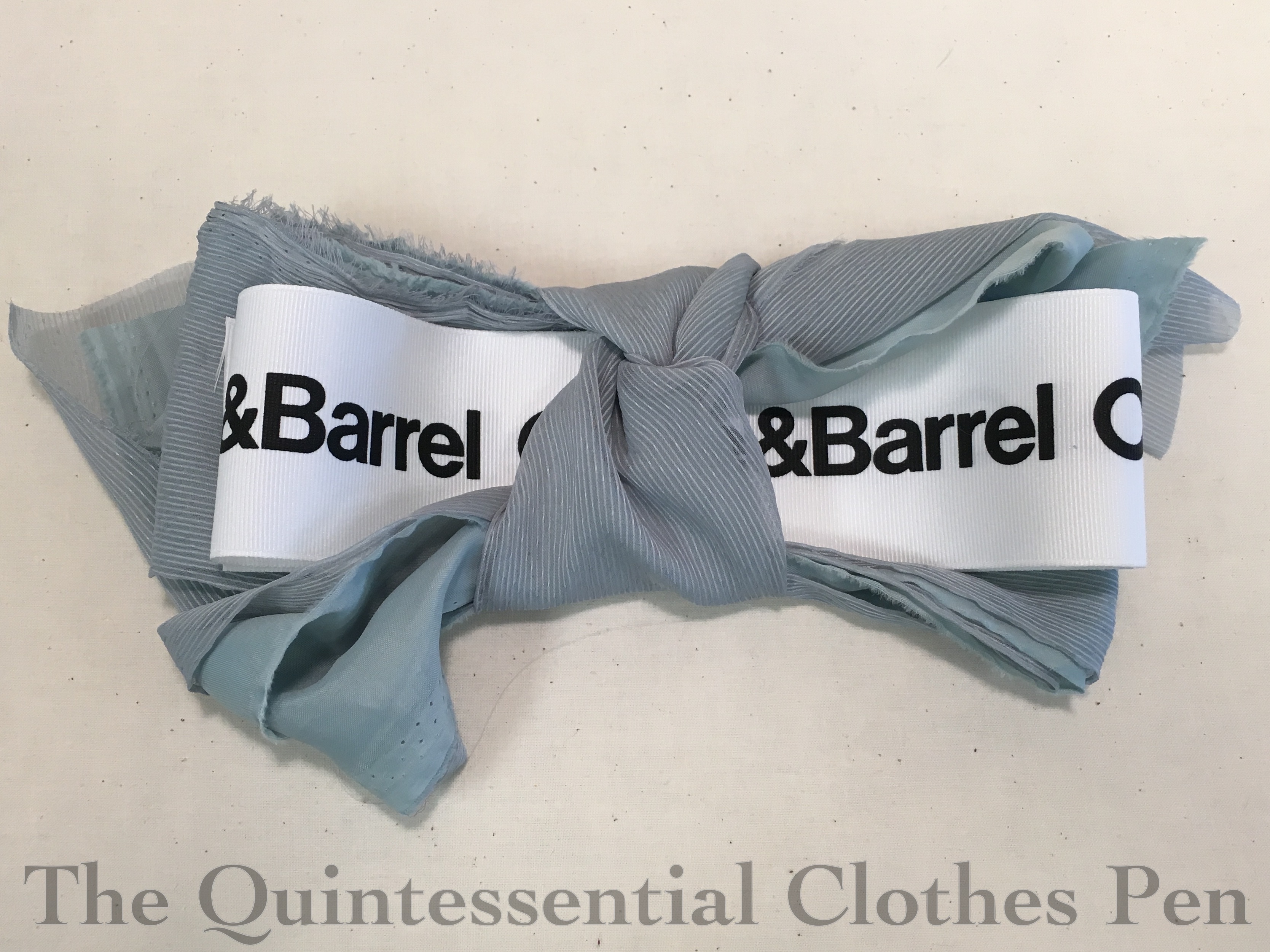
The untrained skirt is flat in front and gathered at the back. It is cut in an umbrella shape (like my 1895 skating ensemble skirt), so that the only seams needed are center back, and a diagonal seam across the back to add width to the panel. The waistband and placket are standard 19th century style, with the exception of the fact that the ribbon I used to stabilize the thin fabrics is leftover gift wrapping ribbon from wedding gifts we received from Crate and Barrel. Yay! It’s hidden on the inside and folded in half, but it amuses me, because recycling is great and it’s nice to have a bit of Mr. Q-related-something in a dress.
IMG_0479 (1)
A nice package of placket and waistband pieces. I made one for each skirt.

The most annoying thing about fitting this gown was marking the hem on the skirt. (Fitting the bodice on myself with all the layered closures was also a feat, but more uncomfortable twisting than annoying.) Chiffon is annoying to hem most of the time and it only gets more complicated when you’re marking the hem on yourself. It meant looking in the mirror, bending over to place a marking pin while everything shifted, standing up to check things, and then repeating that over and over again to shift pins by tiny amounts until they all looked good (while wearing a corset and fluffy petticoat of course, so the whole thing would hang properly on my body). Once that was all over, I hemmed each layer with self fabric bias that is turned to the inside and invisibly hand stitched in place.

I was quite successful, but it took a whole afternoon to mark and cut and sew the hem of the chiffon and of the lining (because of course the lining couldn’t stick out or be too short!). The whole thing would have been much speedier if I’d had someone else to mark the hem for me. (I thought of using my hem puffer, but the floor is too close for the puffer to reach and I didn’t have anything to stand on.)

Anyway, the end effect was fabulous. The chiffon and lining swooshed so beautifully that it was necessary to get “swooshy skirt” pictures at the ball just to highlight their movement.

IMG_2208

The ball also gave me an opportunity to have fabulous hair and a new hair ornament instead of a tiara as well as an opportunity to photograph my new 1880s corset completely finished and the fabulous petticoat I have for 1890s/1900s styles. It gets worn often, but hardly ever seen (which I suppose is rather the point of a petticoat, but when you have one as lovely as this, it really should be seen!). There will be future posts for the hair and undergarments, as this post is getting pretty long.

Overall, 1890s ball was lovely, with beautiful dresses and beautiful dancers. There were fun new people as well as quiet moments to sit and have engaging exchanges with friends.

IMG_2179

And the new gown was very comfortable and fun to wear. I’m looking forward to completing the trained skirt (hopefully without too much procrastination) and wearing it this summer!

*My plan is to have two skirts for this gown, one without a train, for dancing, and one with a train, because trains are fun! I only finished the non-trained skirt for the ball, though the trained skirt is assembled and mostly finished with the exception of a closure and hems.

HSF/M #10: 1910 Dowager Countess Evening Gown

IMG_1597

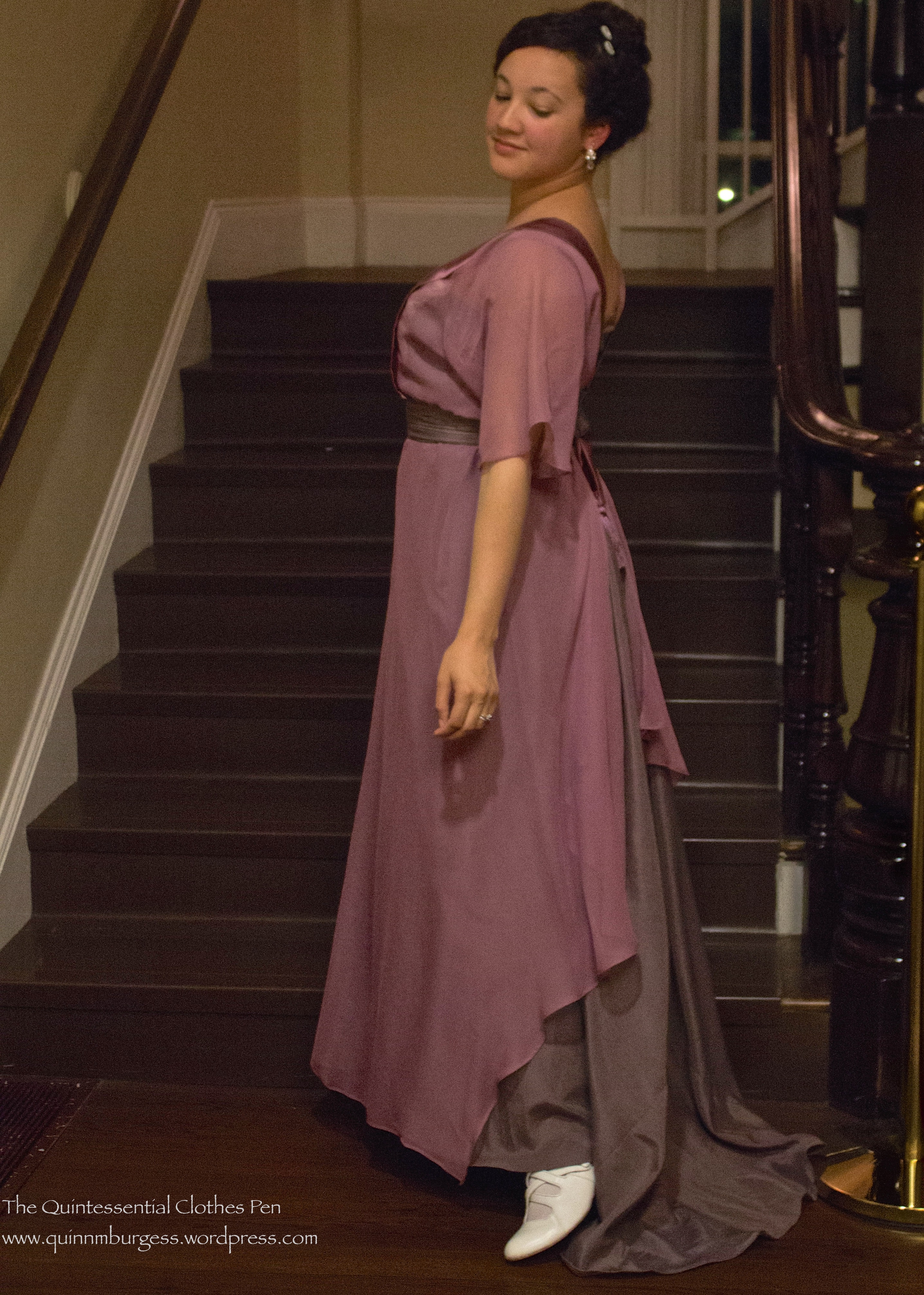
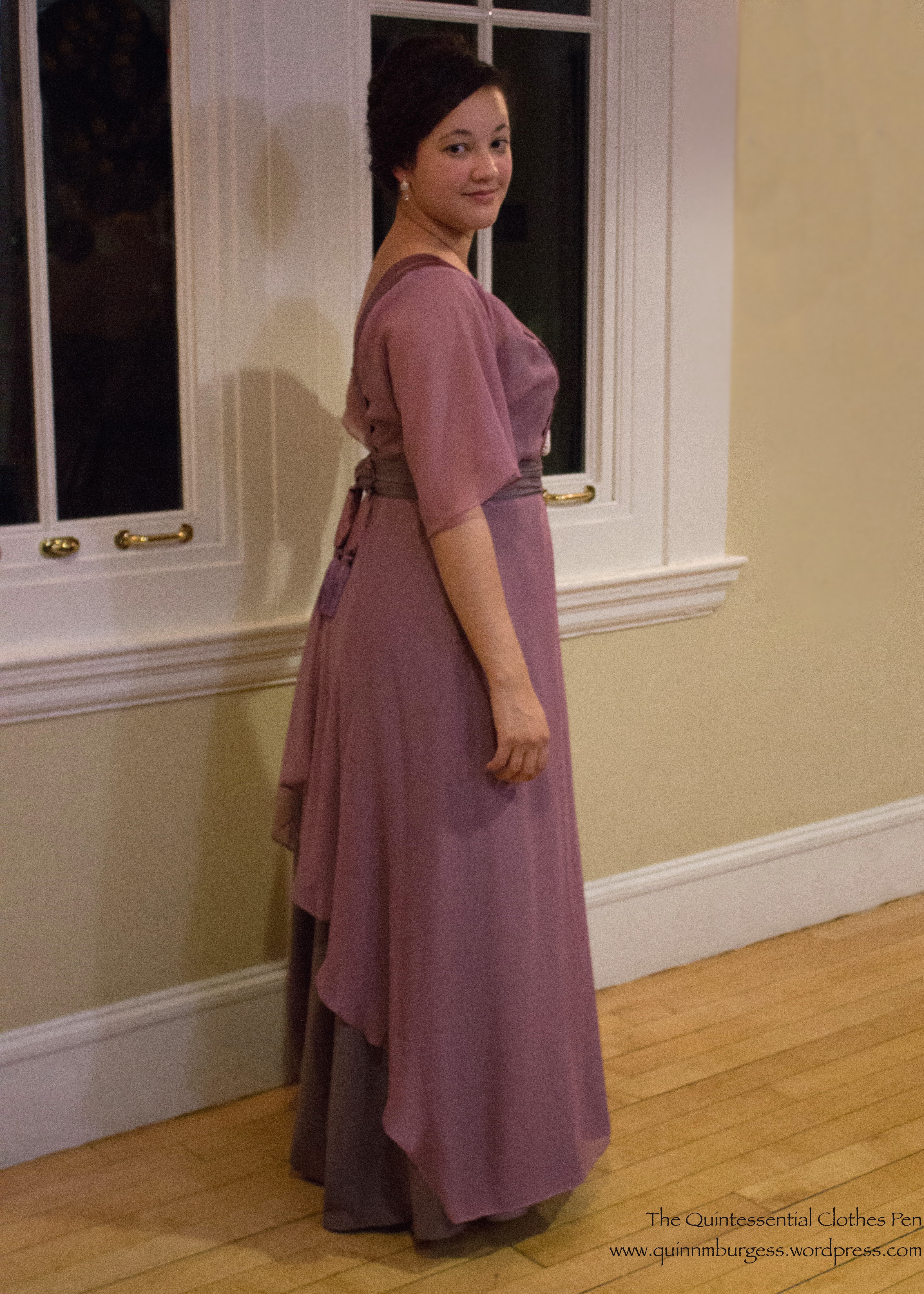
This gown was already in my sewing plan before I decided it fit into the HSF/M Challenge #10: Sewing Secrets. It turns out that it fits into the Sewing Secrets challenge for multiple reasons:
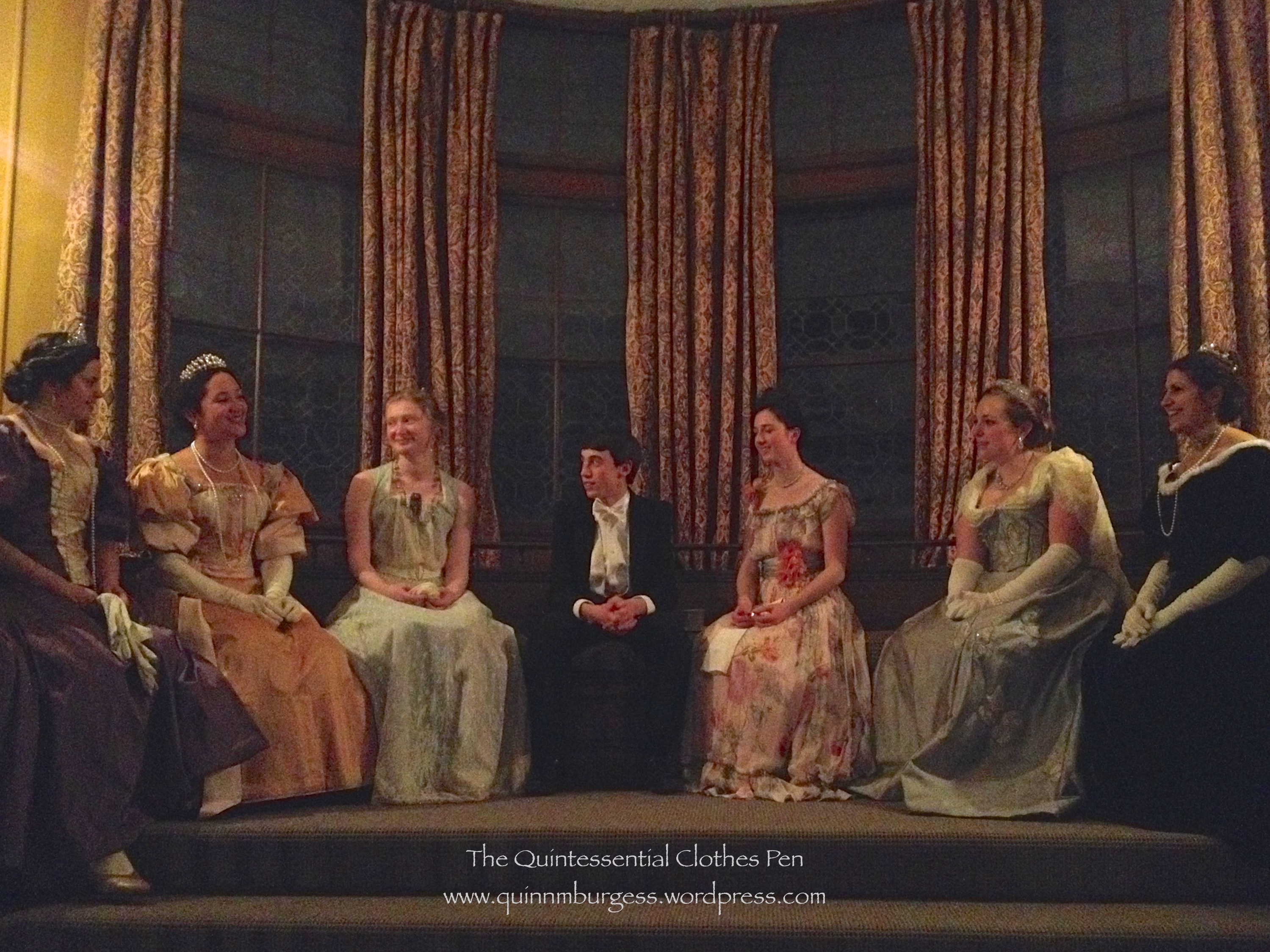
#1: Because like many dresses from the first few decades of the 20th century, the method of closure is cleverly hidden, rather complicated, and definitely secretive–you really can’t tell how the dress goes on just looking at it once it’s all hooked up. (Right? Can you figure it out before I show you later in the post?)

#2: The beaded panel on the front might look familiar if you’ve been reading my blog for a few years. It is actually the sleeve (turned upside down) from a 1980s evening gown that I remade into a sleeveless 1925 evening gown.

#3: I made this dress with a train because I had enough fabric, it’s elegant, and I don’t get to have many dresses with trains because I’m usually dancing in them. However, I do plan to dance in this dress, so I included a secret hidden button under the decorative knot at the back and a loop on the center back skirt seam so that the skirt can hook up (bustling, essentially) to be a uniform length all around so I can dance unhindered!

IMG_1598

I paired this new dress with my American Duchess Astoria shoes, because they are super comfy and made sense color-wise with my other accessories: plain white stockings, a super long strand of faux pearls, lovely clear/white dangle earrings I’ve had for at least ten years, and two matching metallic silver wrapped hair pins I think my mother gave me also a number of years ago. Underneath is my 1913 chemise and corset.

IMG_1616

I’ve had all the fabrics in the stash for at least three to seven years. The underskirt was leftover from a former project never fully pictured here on the blog–an 1890s 2 part dress taken directly from an extant bodice with an extrapolated skirt (the skirt was worn by a friend in Newport in 2012–there are pictures toward the bottom of this past post, and I forgot that the ensemble I’m wearing in that post also uses this same fabric as trim). I had purchased way more fabric than I needed and had more than enough for the new project, so I guess I’ll be using it on another something someday. The matching chiffon and charmeuse I’d purchased with the intention of making a 1910s evening dress back in 2012, but ran out of time that year.

When I was first seriously thinking of making this dress, I thought I had enough fabric to do something like this dress, but I hit a snag when I realized I only had about ½ yd of the charmeuse and that the beaded sleeve I was hoping to incorporate into the dress was entirely unsuited for the shape of the beaded bit on the inspiration dress. I decided to make a dress like my original inspiration someday, but to go back to the beginning for the current dress and rethink what the dress might look like. I would up with something I am quite happy with that is drawn from a variety of inspirational dresses on my 1909-1914 evening gown Pinterest board with this as the most obvious inspiration.

Just the facts:

Fabric: One beaded silk sleeve from a 1980s evening dress that I deconstructed two years ago to make a 1925 evening dress, about ¼ yd of plain weave cotton for the base, less than ¼ yd of silk charmeuse, about 2 yds of silk chiffon, and 3-4 yds of lightweight silk faille for the underskirt.

Pattern: Created by me, loosely starting with the pattern for the bodice of my 1912 burgundy and gold evening gown and referencing skirt shapes in Janet Arnold for inspiration.

Year: 1910.

Notions: Thread, hooks and bars, and two pre-made tassels.

How historically accurate is it?: It definitely passes Leimomi’s test of being recognizable in its own time. It uses accurate materials and accurate techniques. 95%.

Hours to complete: More than I kept count of.

First worn: In September 2015.

Total cost: Technically this is a stash project because all of the things I used have been in my stash for years, except the tassels, which I bought within the last year knowing this project was high on the to do list. If I had to guess at the cost of the materials it was probably $50-$60 dollars.

The dress was sewn with a mixture of machine and hand sewing. Most of the assembly of the bodice and skirt pieces while they were separate was done by machine, as was the hemming of all the chiffon and faille (though the hem edge of the chiffon is actually the selvedge). The hand sewing came in when I went to mount all of the pieces together. I started with the under bodice and kept adding layers and figuring things out as I went. The closures are also hand sewn.

Incidentally, I’m not really sure what color to call this dress. I’ve been calling the colors orchid and mauve, but I’m not really sure those are the best color names. The chiffon and charmeuse are a shade of pinky/purple that’s hard to put a finger on and the contrast faille is more grey than anything when it’s by itself, though it really takes on a pinky/purple cast when paired with these other fabrics. Does any really perfect color name come to your mind? If it does I’d be happy to know what it is!

As I mentioned, the closure for this dress is quite complicated and as I knew I was going to include it in the sewing secrets challenge we took pictures specifically of the closures to document how it works. If I tried to explain only with words I’m sure there would be confusion, so I think the pictures will clarify things. We’ll start hooked up and unhook as we go.

IMG_1762
The back knot snaps into place over the belt, which hooks together at the back. The button for the bustling skirt loop is hidden under the belt in this picture.
IMG_1763
The belt unhooks all the way to center front.
IMG_1764
The chiffon overskirt unhooks from center back to the side.
IMG_1765
Then the front bodice chiffon layer unhooks at the top edge of the beading and at the waist so it peels back toward the side. After that the under bodice unhooks and the dress slides right off. Is that what you thought might be the closure system?

Overall, I’m super pleased with this dress. It’s very comfortable, has lots of fabric in the skirt so is easy to dance in, and is a nice transitional style between the full skirts and pigeon breasts of the years around 1908 and the much slimmer, longer lines of the years around 1912. Plus, it has a train!

Here’s a comparison of the dress with the train down and then with it looped up. Luckily, these pictures were taken before dancing. Turns out that while I was dancing a very fast waltz, either my or my partner’s foot caught the hem of the dress and caused the loop to break, so I’ll have to repair it more sturdily for the next wearing. Ah well, that’s why they make safety pins!

IMG_1638

IMG_1648

I was quite pleased with how my hair turned out, so I had to make sure to get a reasonable close-up. Some of the curls are natural and some are made nice and smooth with a curling iron. The key is to put the hair up in a lot of different sections–and I mean a lot!

IMG_1727

I call this dress the “Dowager Countess” gown because the shape of it reminds me of what Maggie Smith’s character in Downton Abbey often wears to dinner parties. Look at the bodices on these dresses: this dress, this dress, and this dress are all examples of a similar style–one that the Dowager Countess wears often! And why wouldn’t I want to be reminded of Maggie Smith when I think of this dress? Her snarky comments are highlights of Downton Abbey! (Incidentally, one of my friends wore the just-emerging-in-the-1910s style of pants in the ballroom to this ball–gasp!–and we took some posed snarky pictures. Head over to her blog, Plaid Petticoats, to take a look at her scandalous outfit. When you get to the bottom you’ll find the snarky pictures. You might even find that you think I’m there twice, because I was wearing this new 1910 dress and I loaned my 1912 evening gown from 2012 to a friend who happens to be being snarky with me.)

IMG_1646

SaveSave

Restyled 1928 Green Silk Dress

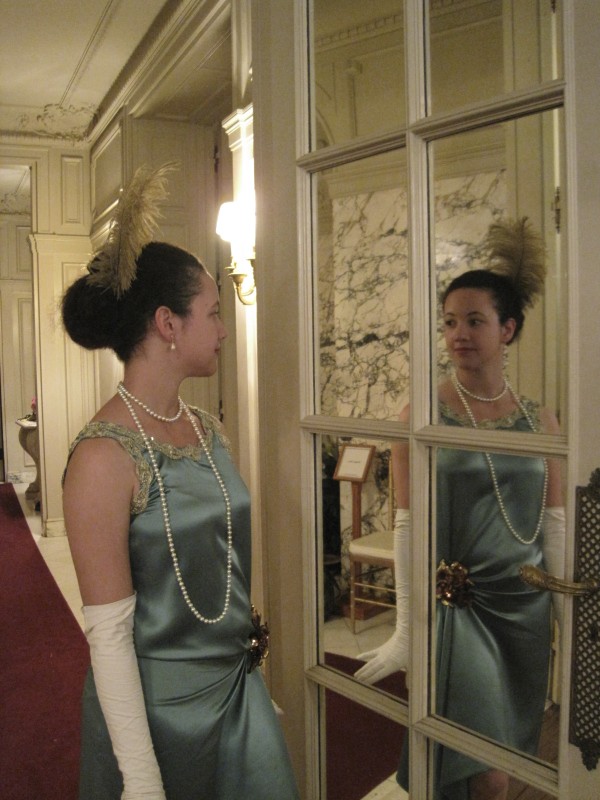
Perhaps you remember this late 1920s green dress, which I made and first posted about in 2012? When it was first completed, I was in the midst of creating lots of new things for Newport Vintage Dance Week and was grateful that it had made it to a wearable state. I hadn’t quite solved the issue of keeping one side bunched up, so for the first wearing I used the bronze sequined flower pin you see in the picture below.

The slippery silk of the dress caused the pin to move around and shift while I was wearing the dress. I also didn’t love that it did nothing to break up the smooth lines of the back side of the dress.

IMG_2793
In 2012.

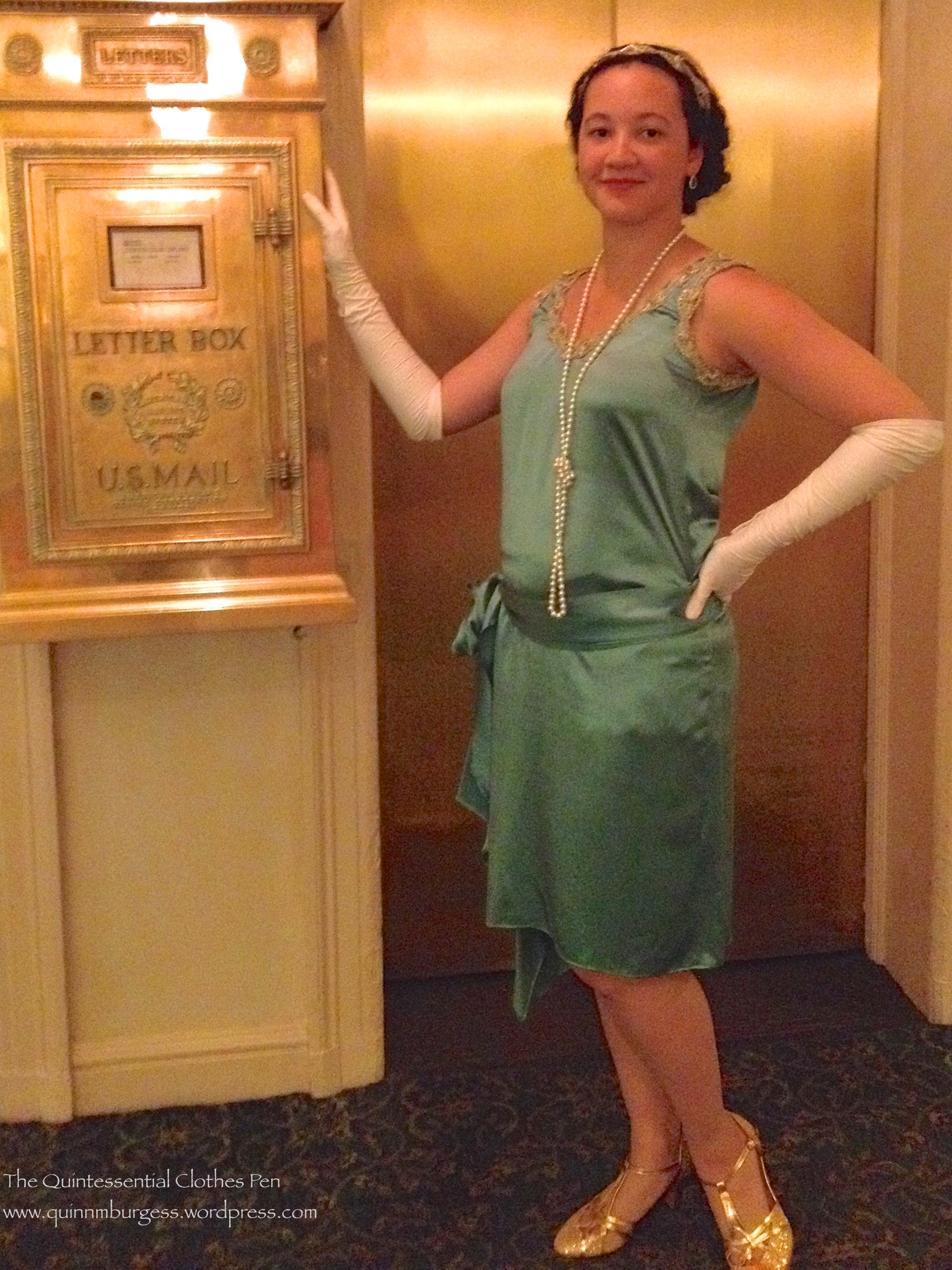
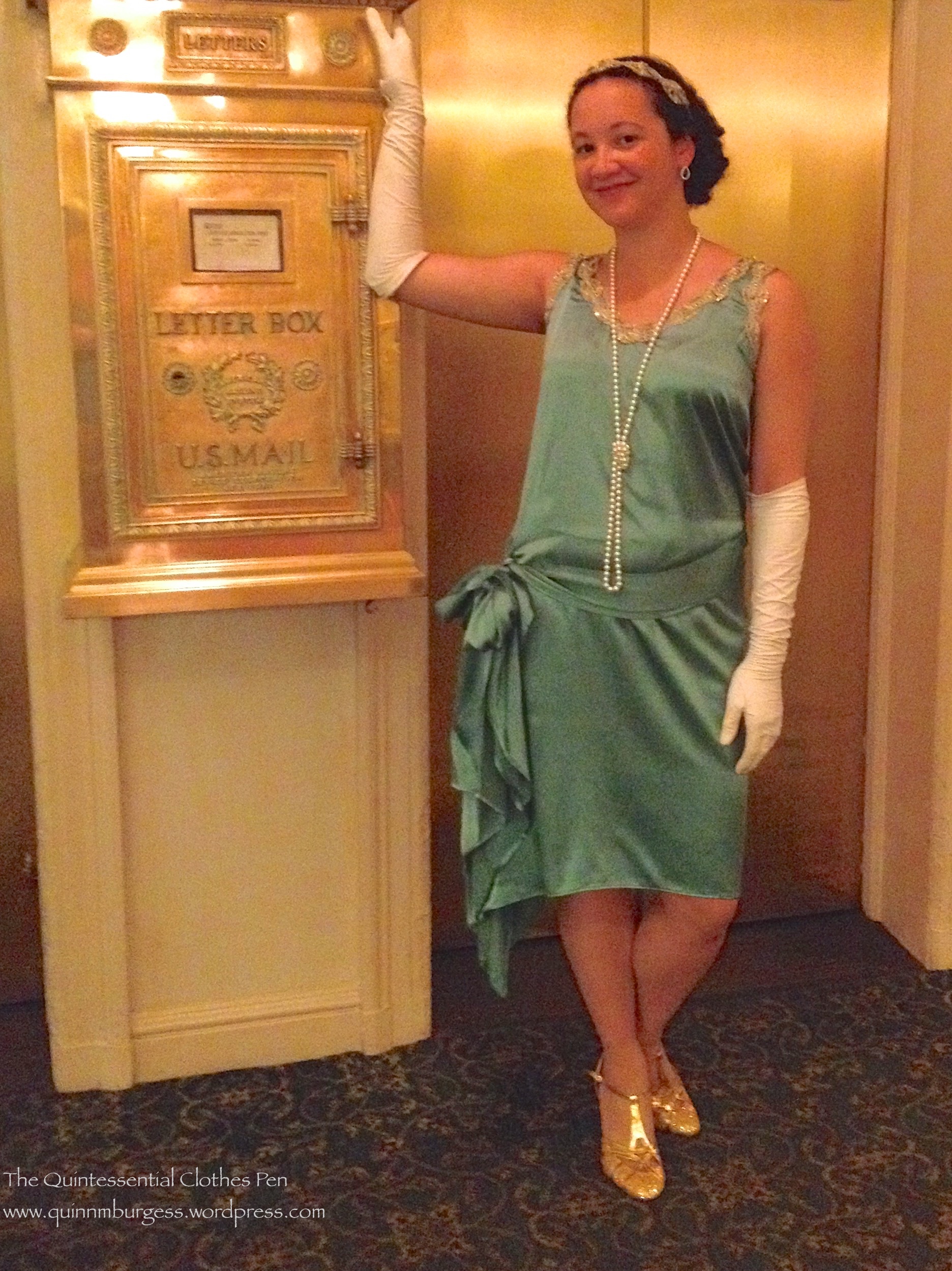
Last year, I had a reason to wear the dress again and I came up with a new design idea, based on this image from 1929. I loved the simple lines of the green dress on the right (and it happened to be the right color!) and the sash with a huge bow. It took me another year to get proper pictures of the new look and document it here, but I’m really pleased with the pictures, so I guess it was worth the wait!

I used my remaining fabric to create a separate sash for my dress. It’s separate so I didn’t have to deal with adding closures to the dress–it still slips on over my head; however, because the silk is slippery and the bow side of the sash wanted to slide down, I did safety pin both the bow side and the opposite side of the sash to the dress to keep it in place.

IMG_2429
The same basic dress in 2015, styled differently. The same gloves and pearls (worn differently), with my newly shared gold t straps, green earrings, and a matching trim headband.
IMG_2438
And a different hair style. This is a better view of the bow.

I think the 20s silhouette grows in my estimation the more I wear it. It’s sort of odd at first, but can be quite elegant sometimes! I’m very pleased with how the sash and bow break up the dress and add extra oomph to the hem.

905794_10153002186899327_6142922609015185505_o
The event I wore the dress to was a 20s fundraiser at a local hotel. Here’s a bonus picture of the dress in action.


1924 Golden Robe De Style

I’ve wanted a robe de style to join my historic closet for at least a year, but haven’t had just the right fabric or the time or impetus to make it happen until this past spring. And as a general goal, I’ve been trying to expand my color choices beyond blues, greens, and reds, because those colors seem to dominate my historic wardrobe. Then this spring, I found gorgeous yellow silk at the local discount fabric store. I convinced myself that I didn’t need it, but couldn’t stop thinking about it, so I drove back to the fabric store a few days later to purchase the fabric.

IMG_2390

I was inspired by the styles from the earlier years of the 20s for this particular robe de style, when the skirts were long and full. You can see a mix of robe de styles from the 20s on my inspiration Pinterest board. I didn’t follow any particular image or extant garment, but used them in general to create a unique dress. I really enjoyed wearing this dress and would like to make another someday that I think I’ll make a little shorter, more like later 20s styles.

I chose to accent the waistline of this dress with a ribbon rosette in a contrasting silk ribbon. It has an inner circle of matching yellow silk and a bit of gold sequined lace in the center. It looks a little like I won a prize at a state fair, but I like that it breaks up all the yellow of the dress.

IMG_2388

The pattern is loosely based off the information provided by Maria in this blog post about her black robe de style. I scaled up her pattern, made a mockup, and then adjusted it to suit my body shape. The skirt required some math to get the right curve across the top to achieve the high-low hem–the bottom edges are the straight selvedge edges–but aside from that the panels are just gathered to fit the waist, with more gathers concentrated over the sides than in the front and back. The extra bonus about using selvedge edges for the hems is that they have a nice fringed edge that meant I didn’t even need to hem them! Instant hems and a nice lightweight looking skirt. Double win!

I used the opportunity of wearing this new dress to break out a new pair of shoes. Glamorous gold t-straps! (All the credit goes to Katherine for these shoes–she bought them in silver and posted about it which is what directed my attention to the style in the first place.) I bought them about 10 months ago for my birthday but hadn’t had an opportunity to wear them until now.

IMG_2362

IMG_2361

IMG_2354

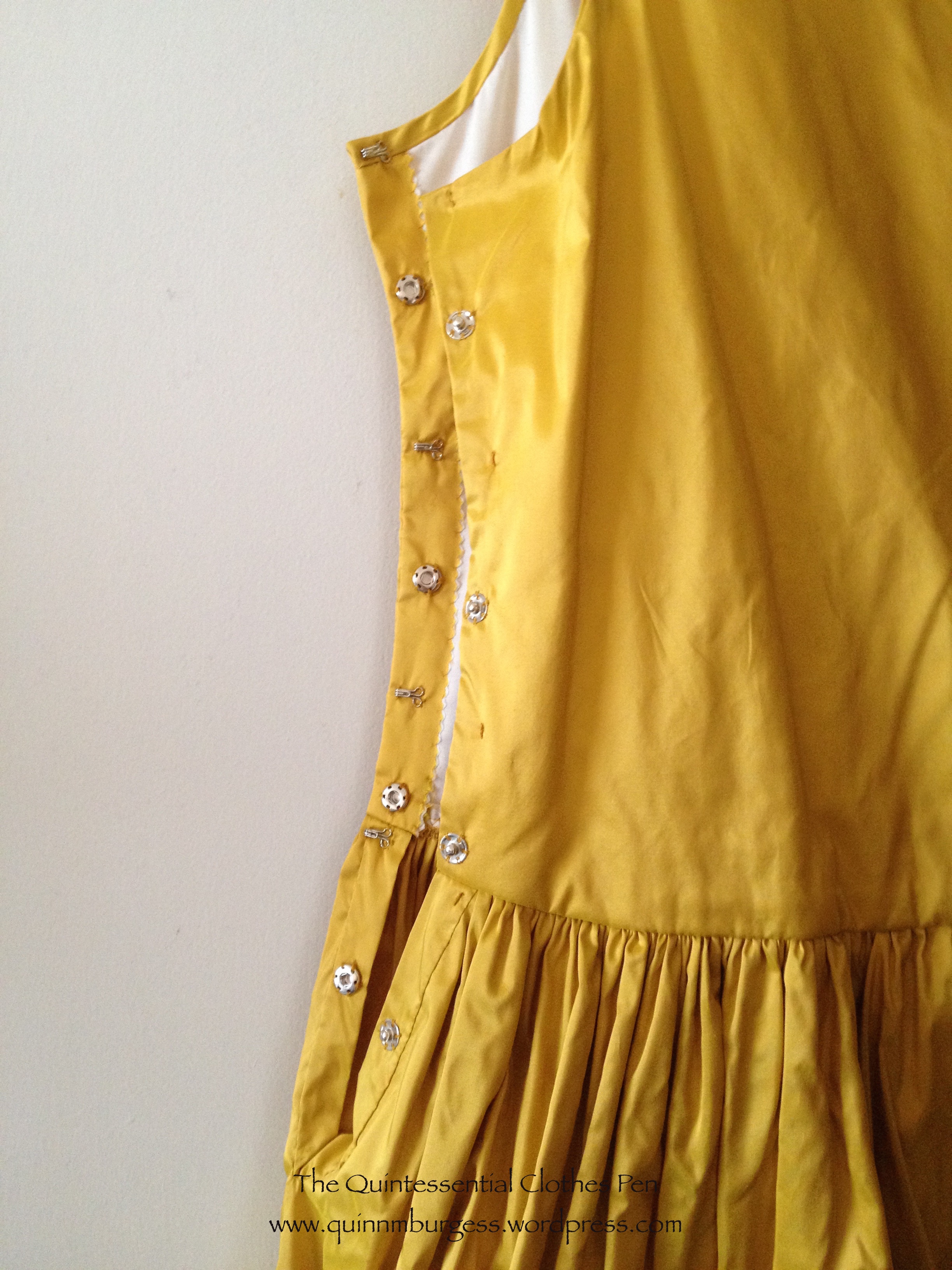
In addition to the pattern, I was also inspired by Maria’s simple finishing methods. I therefore flat lined my bodice, finished the neck and armholes with bias, and made a side closure. I opted to alternate snaps and hook/eyes for the closure, since Maria (and Katherine, who also made an inspirational robe de style you can see here) mentioned that their predominantly snap closures had a tendency not to stay closed. I had no problems with my closures on the dress’s first outing!

IMG_2403

I chose to keep the understructure for this dress separate rather than building it in–that way I can easily use it for a second robe de style in the future! The understructure is mini-18th century pocket hoops attached to a grosgrain ribbon that fastens around my hips. I found that they shifted a little bit while I was wearing the dress, but not enough for me to really notice or care.

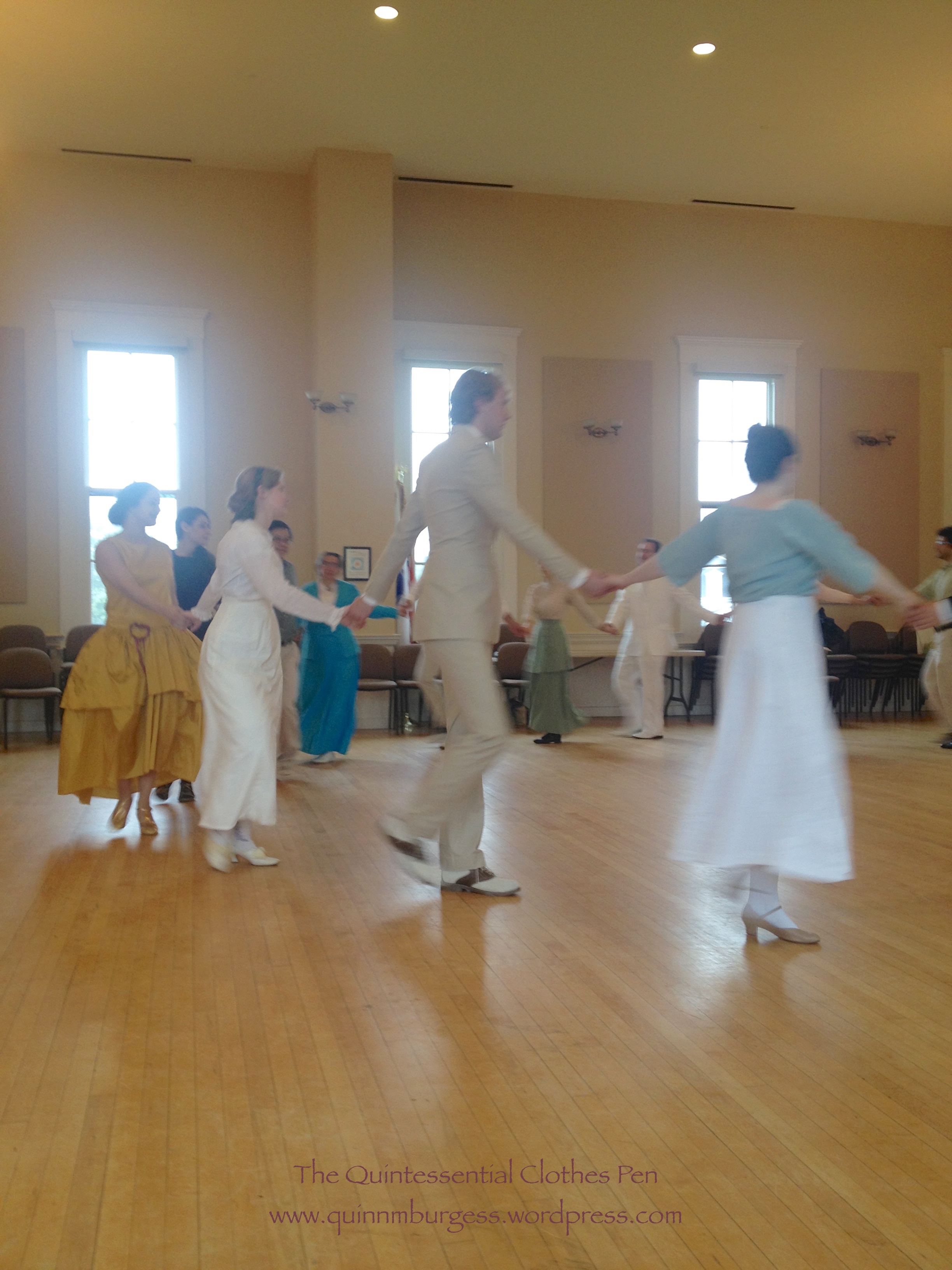
Unfortunately, the silk does want to wrinkle every chance it gets. But when the dress is in motion it’s really not very noticeable! I wore the new dress to an afternoon ragtime tea dance, which is what the pictures in action are from. There are 2 more tea dances this summer (one of them is this coming Sunday) and a suffrage rally and formal ball in September, so if you’re in the area and have the time I would love to see you at one of these future events (details here).

IMG_2378

IMG_2374

Returning Heroes 2015

Back in March, I was again able to attend The Commonwealth Vintage Dancers‘ annual strictly-Civil-War ball (this is the 5th year I’ve been there, wow!). It’s been a joy every year I’ve attended and this year was no exception. Unfortunately, I only had my phone to document the evening, which means my pictures came out rather blurry. Here’s just a few.

IMG_2052
Obviously, the most important thing to document was that I was able to wear my Refreshing Apron for the first time with a mid-century dress.
IMG_2087
Also, I danced. In this case, a schottische. (Other people danced, too, and looked quite elegant and lovely.)

Evie is always special to wear and was accompanied by the usual accessories and undergarments. The only thing I did when I came home was to mark front on the skirt, because every time I wear this gown I struggle to remember where front is! (It makes a difference when your skirt hooks to your bodice–without everything lined up properly it just doesn’t work!)


Belated Fezziwig’s Ball 2014

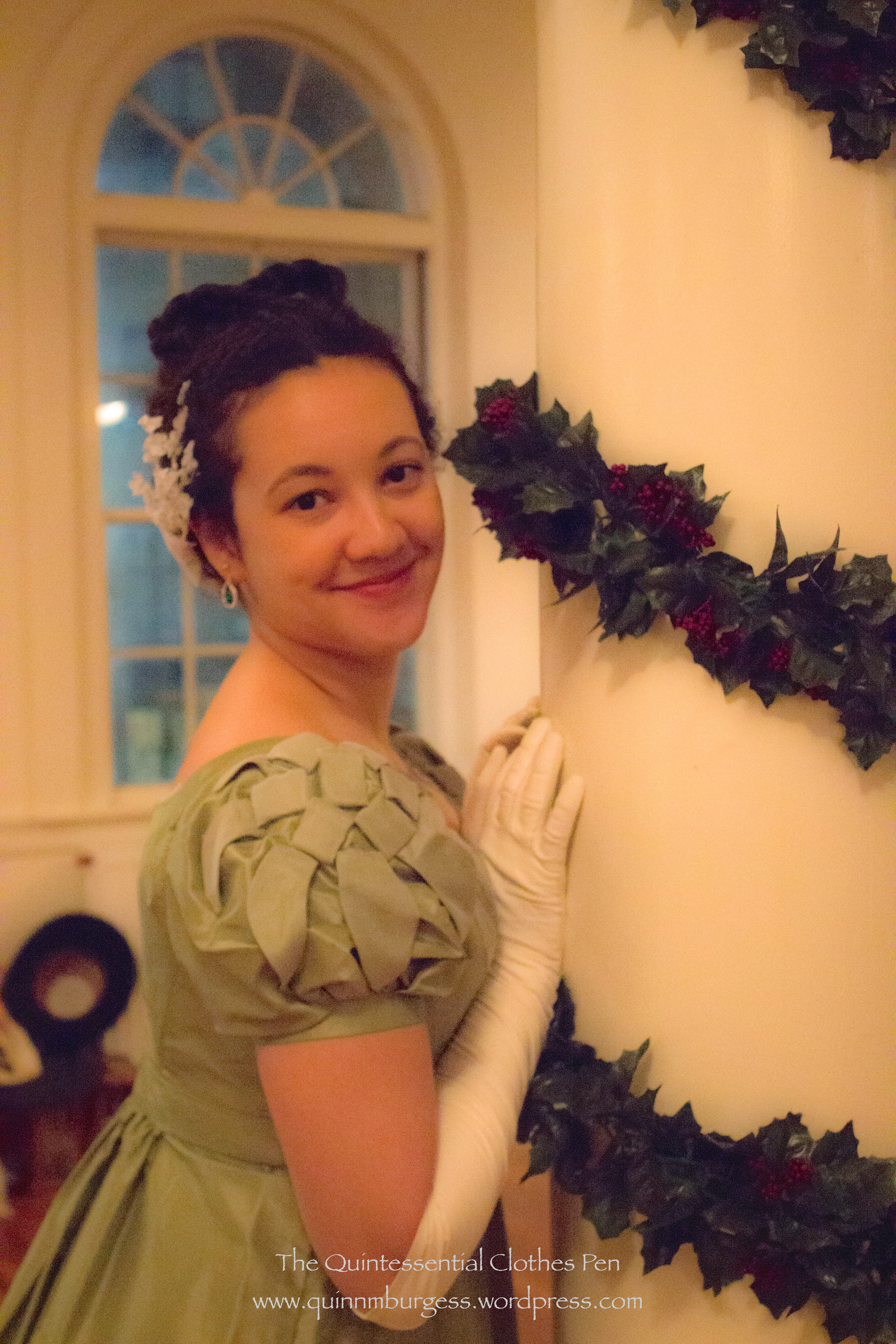
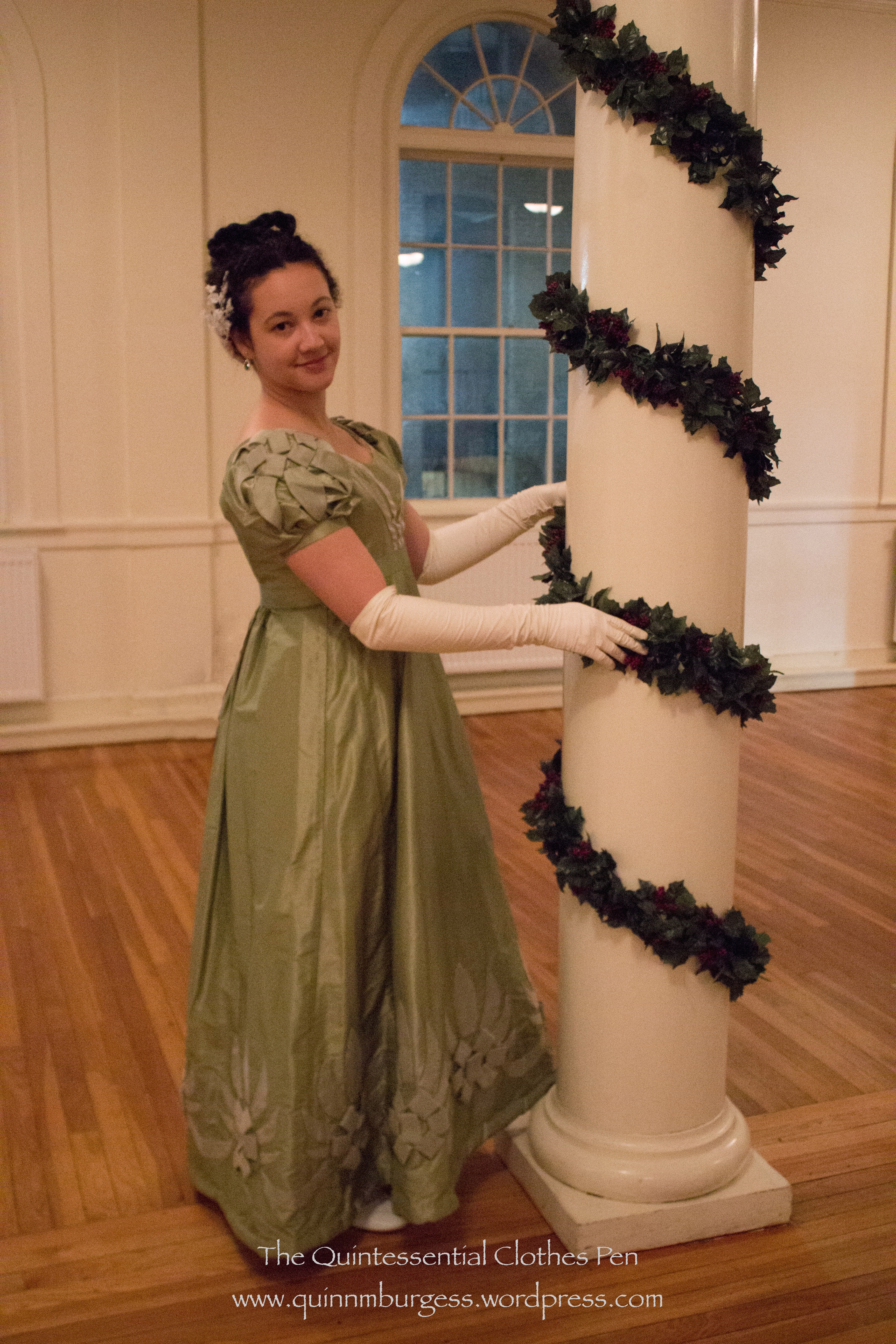
Last December, I had the opportunity to wear my green 1824 dress again at an annual holiday ball. It took a lot of time to sew all the trim on the dress (there are construction posts about this dress here) and I don’t get many opportunities to wear 1820s clothes, so it’s quite lovely to have a general “early 19th century” ball to wear this dress to.

This year we had new garland decorations and were able to get some adorable pictures! I was quite pleased with my silly figure eight braid hair style and my other accessories (the green earrings added a nice matching pop of color, the hair wreath worked well as it has in the past, and I like the white shoes with this dress). I’m behind sharing the photos, but pleased that they’re finally making it into a post.

IMG_9969

IMG_9935

IMG_9951

IMG_9986

IMG_9987

Don’t you want to jump out of your chair and join in the dancing?

A Snowy Evening In The 1890s

In January, The Commonwealth Vintage Dancers hosted an 1890s weekend (the same weekend that included an ice skating party that I blogged about a few weeks ago). Despite some snow during the day and into the evening, people were not kept away and the ball on Saturday was packed with dancers. Please join me on a little jaunt back to a snowy evening in the 1890s.

IMG_1816
Arriving at the ball in the snow. (Well, sort of… I actually arrived in modern clothes, got dressed in my 1893 ball gown, borrowed a friend’s fur cape to keep the snow off my silk and the cold off my chest, and went back outside to take staged “arriving” photos.)
IMG_1802
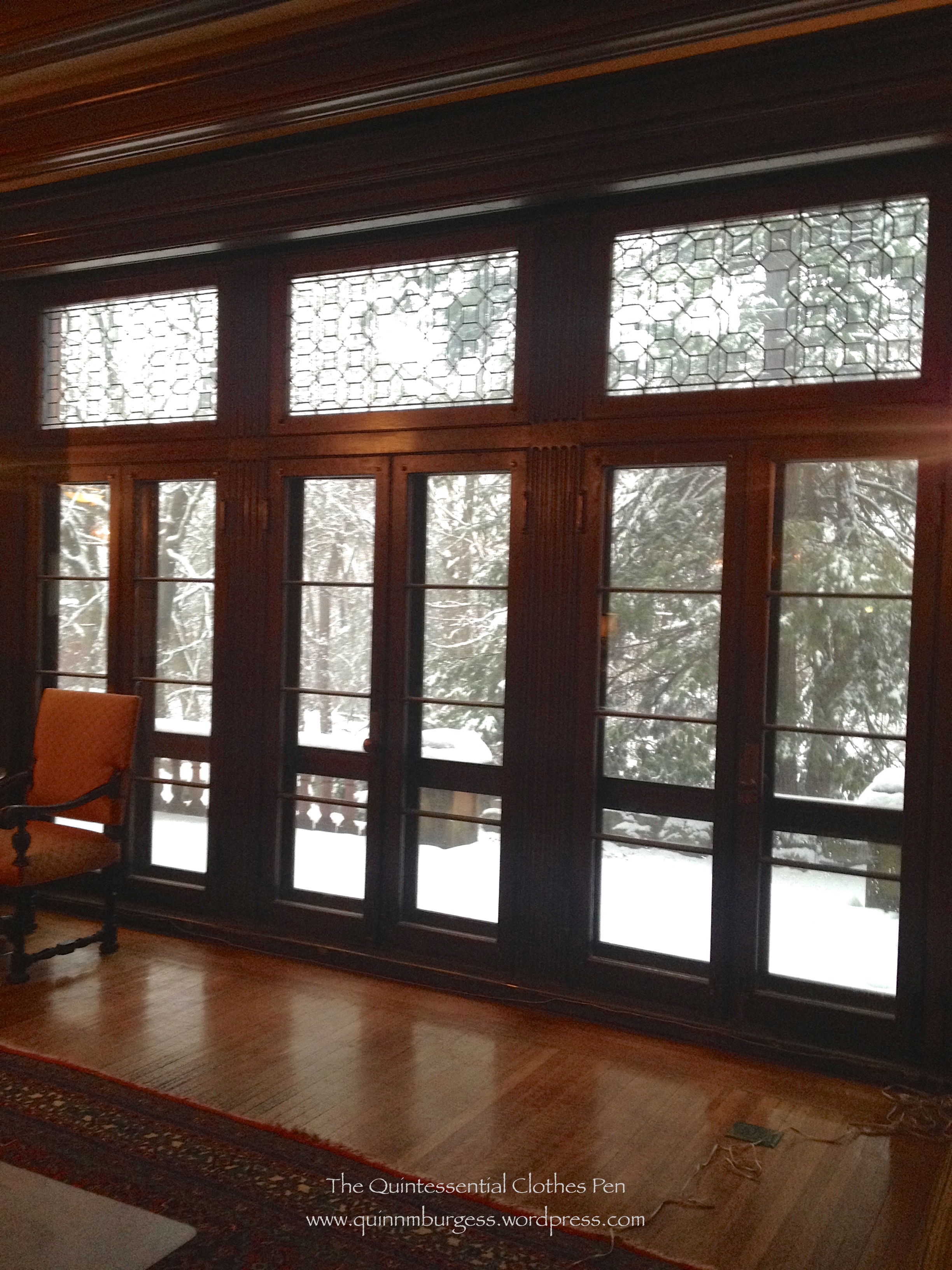
The entrance hall’s view of the snow outside.
IMG_1803
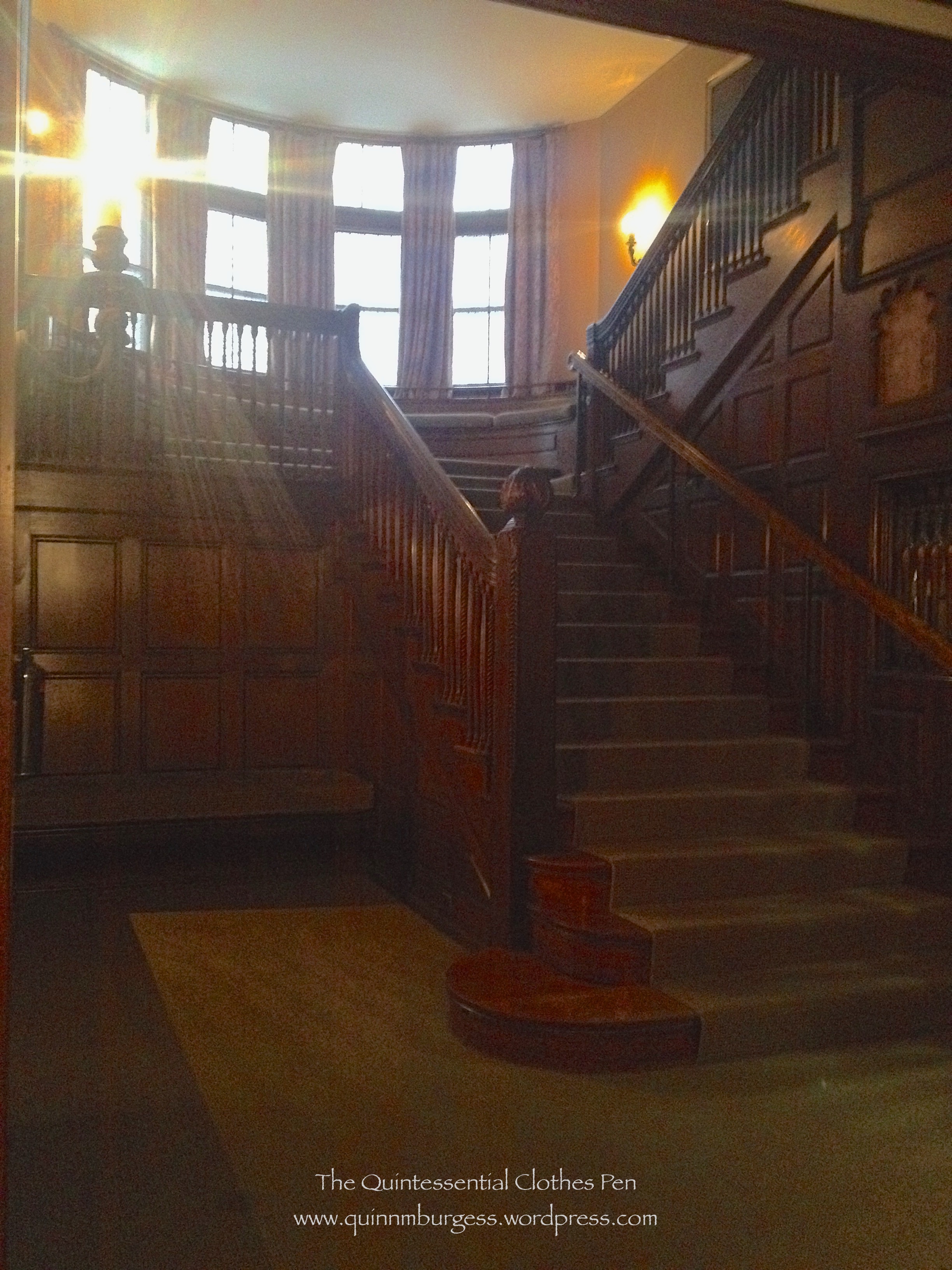
The beautiful main staircase to the upper floors. There were lots of lovely sitting areas and nooks throughout the venue.
IMG_1849
There were also bookcases everywhere full of elegant hard cover books (my favorite!).
IMG_1824
In the ballroom, couples danced round dances including waltzes and polkas.
IMG_1838
What strikes me in this photograph are the black and white evening suits of the gentlemen. Everyone is nicely lined up to dance what I believe was the Opera Reel.

Videos are even more immersive than photos, and with this you can actually step into the ballroom that evening. Keep a look out for me partway through the video dancing a polka and then dancing a waltz at the end.

IMG_1831
It became quite warm in the ballroom with all that dancing, so I stepped outside partway through to cool off and the snow had resumed in earnest!
IMG_1844
People spread through the house during the a break in the dancing. Here we are part way up the main staircase. Aren’t we well set up for a photo?
IMG_1851
And finally, being silly, because I blended very well with the curtains! Good night!

Subdued “Coeffure a la Chinoise” In Red And Gold

I attended a small Regency ball last weekend. It was charming and not nearly as packed full of people as I have grown accustomed to at these events in recent years. The smaller crowd made for a much more subdued (but still pleasant) evening than I was expecting.

The only downside was that the hall was exceptionally cold and not being full of people did not warm up very quickly! Few of us had planned for the situation and we were mostly scrambling to find any scarves or sweaters to wrap ourselves in. Many of us were resorting to items that we’d worn to keep ourselves warm outside, sacrificing fashion for warmth (it’s been below freezing here in Boston for at least the last three or four weeks consistently). I, for example, wrapped up in my pink cashmere scarf despite wearing a red dress. I thought it looked odd, though I was told that the colors looked good together. But there were a few lucky solutions that were both fashionable and warm: a large paisley shawl and a plaid scarf/wrap that looked very Scottish were the two most fashionable looks in my opinion. After some dancing and about midway through the evening, many had warmed up enough that scarves were being discarded, though I do believe I kept my scarf wrapped over my shoulders and chest throughout the entire evening.

IMG_1973
Elegant, fashionable lounging during the refreshment break.
IMG_1972
Delicious refreshments alluringly laid out.

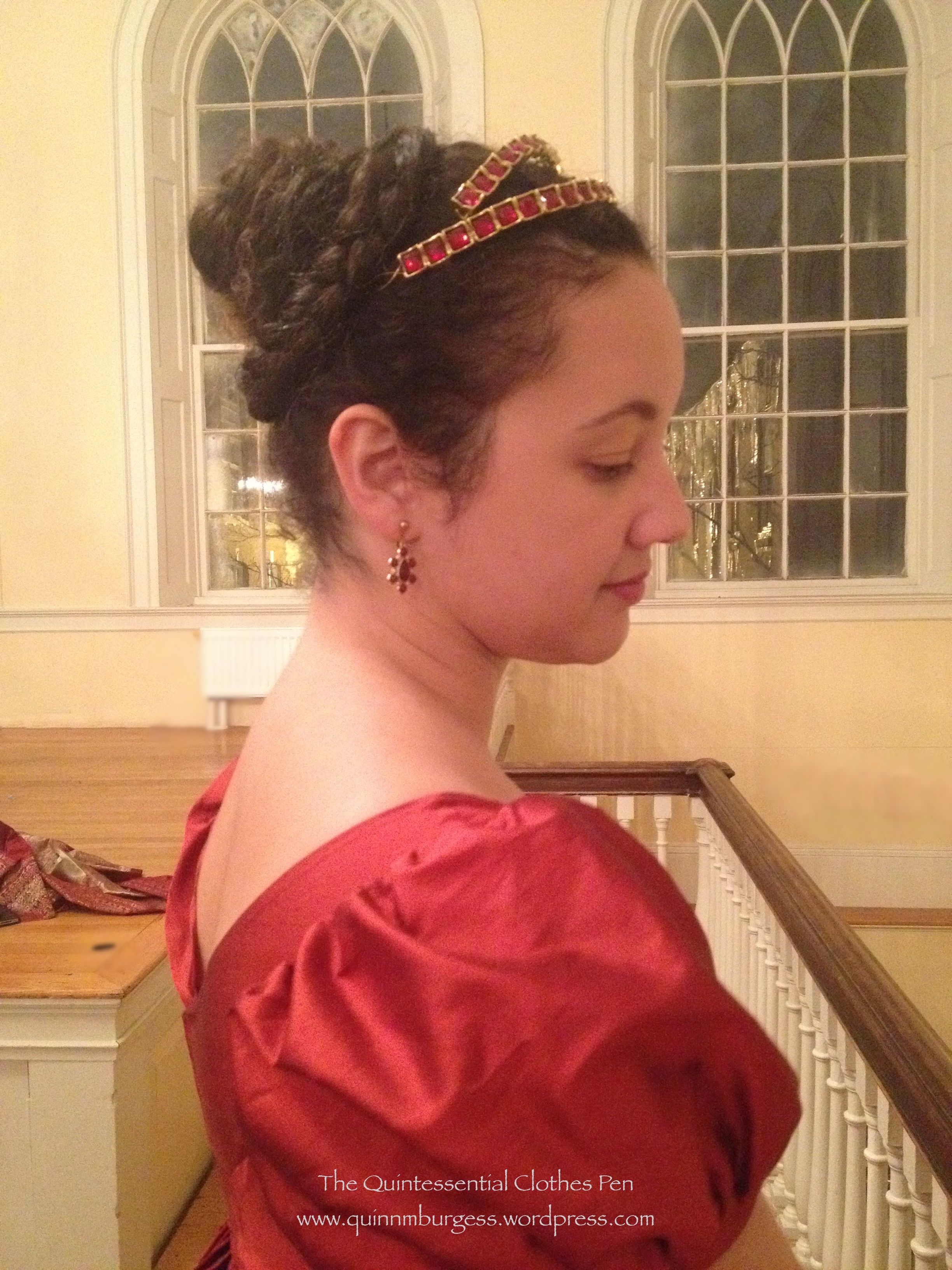
I wore my red 1813 evening gown and my homemade red and gold tiara. (I had hoped to finish and wear my 1811 elusive blue evening gown, but I would have had to do a lot of last minute sewing to finish it in time and after my recent skating costume last minute sewing adventure I was not inclined to do so again so soon. It is very satisfying to have a closet of options for an event, especially when plans to complete something new go awry.) I also brought along my red and gold reticule, because it matches the outfit so perfectly (although the only thing I kept in it was my phone… which is the reason for the slightly blurry, grainy photos).

IMG_1976
All the red and gold Regency pieces in my wardrobe put together in one outfit!
IMG_1980
It was so cold getting dressed that I was not inclined to do a complicated hair style. Heeheehee, fake hair to the rescue! I just put my hair in a pony tail, braided it, and wrapped it around itself. Simple! The big braid is what makes it look complicated, but it is pre-braided fake hair. I think it completes the style perfectly and has a bit of a “chinoise” look to it, too.

What do I mean by “chinoise”? The word itself is from the French adjective meaning Chinese. In terms of fashion, there are scarce references to “chinoise” styles in Regency fashion plates (compared to the abundance of Regency fashion plates showing other styles). Here are a few examples. This Merveilleuse from 1814 has a “Coeffure Chinoise,” this lady from 1812 has a “Coeffure a la Chinoise,” and this fashion plate shows “La Toilette Chinoise.” (I do sort of wonder how some of these attributes, and the hairstyles in particular, said “Chinese” to people during the Regency, but of course the world was perceived very differently then and people had access to vastly different quantities and types of information than I do today.)

I’ve often noticed that “chinoise” hairstyles make use of braids that wrap around the head. In addition, there seems to often be a vertical emphasis to the hair and to a bun, if one is present in the style. It is these attributes that say “a la chinoise” when I look at my own coiffure from last weekend. Sometime, I’ll have to try to make a more exaggerated “chinoise” style with a very tall and flyaway bun such as the Merveilleuse from 1814 has. I’m pretty sure my hair will have no trouble with that since it is naturally curly and wanting to fly away!

Take A Break With Me

My life is still unexpectedly busy and my only sewing has been decor-related as a result. What do I mean, you ask? The story (with pictures!) is coming sometime soon in an upcoming post, but for now I’m leaving only that hint.

This weekend, though (unlike last weekend!), I’ll be taking a break from my decor-realted activities. And if you’re in the Boston area and you don’t yet have plans for November 8th and 9th, you might consider joining the Commonwealth Vintage Dancers at a Civil War Dance Weekend in Chelmsford, MA. I’ll be there dancing the weekend away and would be pleased to see you there.

Not able to join us for this dance weekend? There’s an annual holiday ball in December and a special 1890s weekend in January coming up! Details can be found here. And if you’re just too far away to be in person at any of these events, I hope you still enjoyed the brief video and that you’ll enjoy the pictures of these events that will be included in future posts!

Regency Dancing At The Salem Maritime Festival

First, you have to pretend it’s still summer and the air is still warm. Once you feel the warmth, come back with me to the Regency period with a performance by The Commonwealth Vintage Dancers at the Salem Maritime Festival back in August. The day was cloudy, but not too warm, and was interrupted mid-afternoon by a bit of strong rain (during which many of our dancers had wandered off and I sat under a tree and watched the rain fall).

IMG_9921
Opening the gate to our own historic house front yard performing space.
IMG_9717
I brought along the kites I’d made in 2013 and though we didn’t fly them they looked nice on our picnic blankets. The strings had become all tangled over the last 18 months and thankfully some others found the untangling task rather enjoyable.
IMG_9773
We were pleasantly surprised to be provided with two live musicians who not only played for us, but also sang.
IMG_9843
While visiting a neighboring house we took the opportunity to peer at the modern visitors just as they peer at us!
unnamed
Another participant in the day’s events snapped a few sneaky photos of us through the window of the neighboring West India Goods Store where she was set up for the day. Photo by Sew 18th Century.

I wore my 1812 square neck dress accessorized with a pink silk ribbon sash that I put together earlier this year in conjunction with a post I wrote about variety in Regency ribbon sashes. I think this is the first picture of me wearing the dress with the sash that has made it to the blog. Only took about 7 months!