I’ve wanted a robe de style to join my historic closet for at least a year, but haven’t had just the right fabric or the time or impetus to make it happen until this past spring. And as a general goal, I’ve been trying to expand my color choices beyond blues, greens, and reds, because those colors seem to dominate my historic wardrobe. Then this spring, I found gorgeous yellow silk at the local discount fabric store. I convinced myself that I didn’t need it, but couldn’t stop thinking about it, so I drove back to the fabric store a few days later to purchase the fabric.
I was inspired by the styles from the earlier years of the 20s for this particular robe de style, when the skirts were long and full. You can see a mix of robe de styles from the 20s on my inspiration Pinterest board. I didn’t follow any particular image or extant garment, but used them in general to create a unique dress. I really enjoyed wearing this dress and would like to make another someday that I think I’ll make a little shorter, more like later 20s styles.
I chose to accent the waistline of this dress with a ribbon rosette in a contrasting silk ribbon. It has an inner circle of matching yellow silk and a bit of gold sequined lace in the center. It looks a little like I won a prize at a state fair, but I like that it breaks up all the yellow of the dress.
The pattern is loosely based off the information provided by Maria in this blog post about her black robe de style. I scaled up her pattern, made a mockup, and then adjusted it to suit my body shape. The skirt required some math to get the right curve across the top to achieve the high-low hem–the bottom edges are the straight selvedge edges–but aside from that the panels are just gathered to fit the waist, with more gathers concentrated over the sides than in the front and back. The extra bonus about using selvedge edges for the hems is that they have a nice fringed edge that meant I didn’t even need to hem them! Instant hems and a nice lightweight looking skirt. Double win!
I used the opportunity of wearing this new dress to break out a new pair of shoes. Glamorous gold t-straps! (All the credit goes to Katherine for these shoes–she bought them in silver and posted about it which is what directed my attention to the style in the first place.) I bought them about 10 months ago for my birthday but hadn’t had an opportunity to wear them until now.
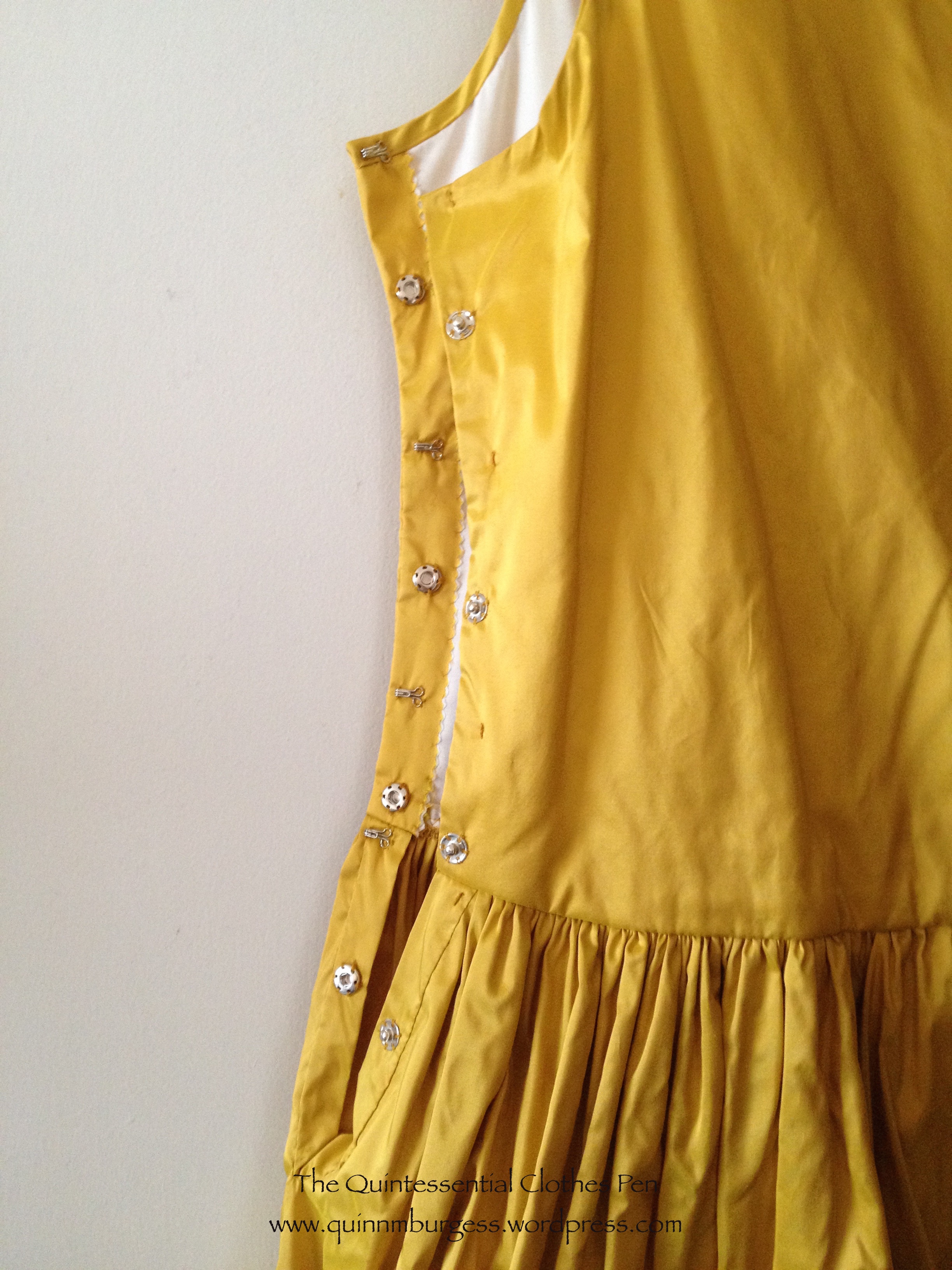
In addition to the pattern, I was also inspired by Maria’s simple finishing methods. I therefore flat lined my bodice, finished the neck and armholes with bias, and made a side closure. I opted to alternate snaps and hook/eyes for the closure, since Maria (and Katherine, who also made an inspirational robe de style you can see here) mentioned that their predominantly snap closures had a tendency not to stay closed. I had no problems with my closures on the dress’s first outing!
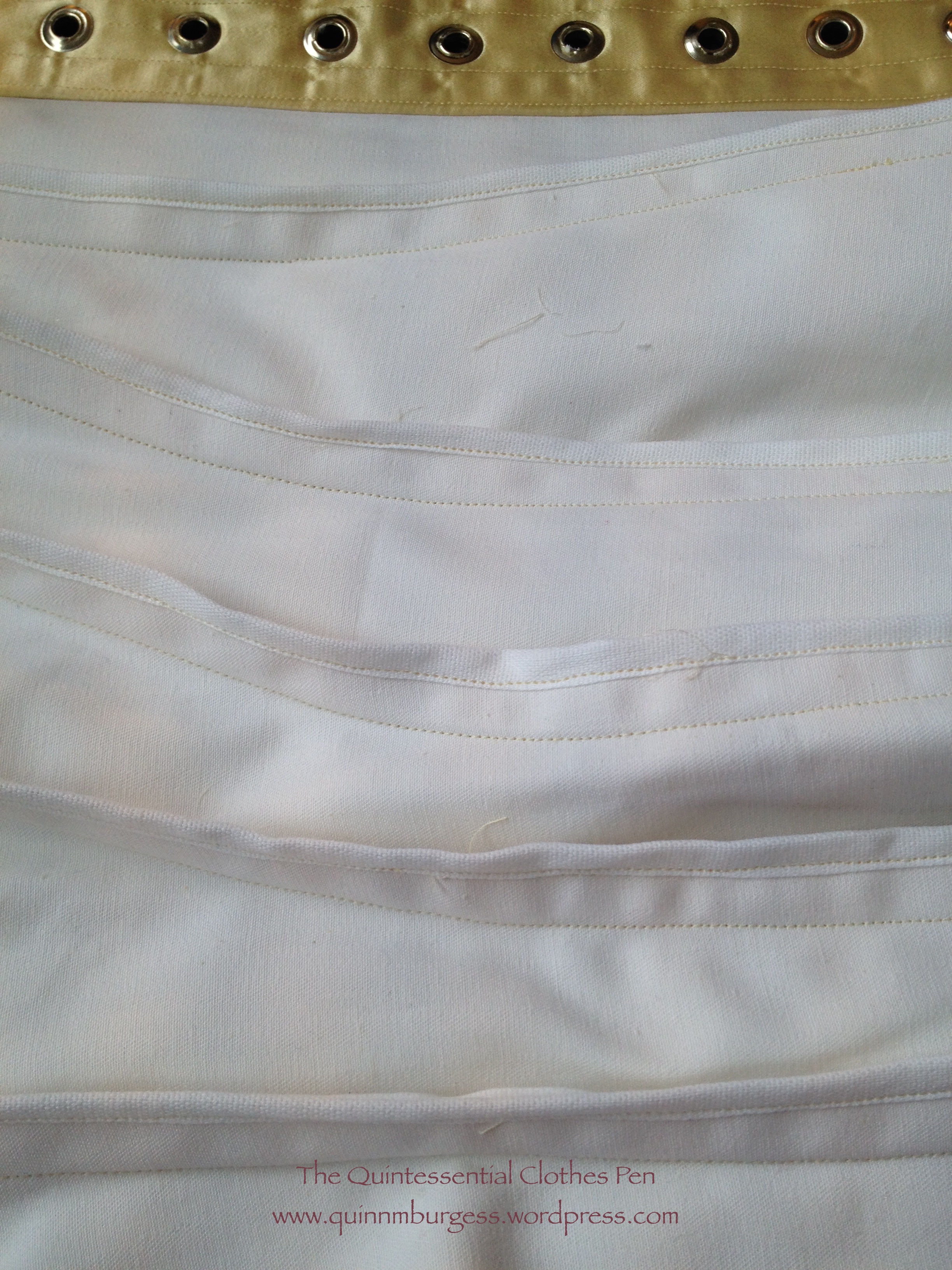
I chose to keep the understructure for this dress separate rather than building it in–that way I can easily use it for a second robe de style in the future! The understructure is mini-18th century pocket hoops attached to a grosgrain ribbon that fastens around my hips. I found that they shifted a little bit while I was wearing the dress, but not enough for me to really notice or care.
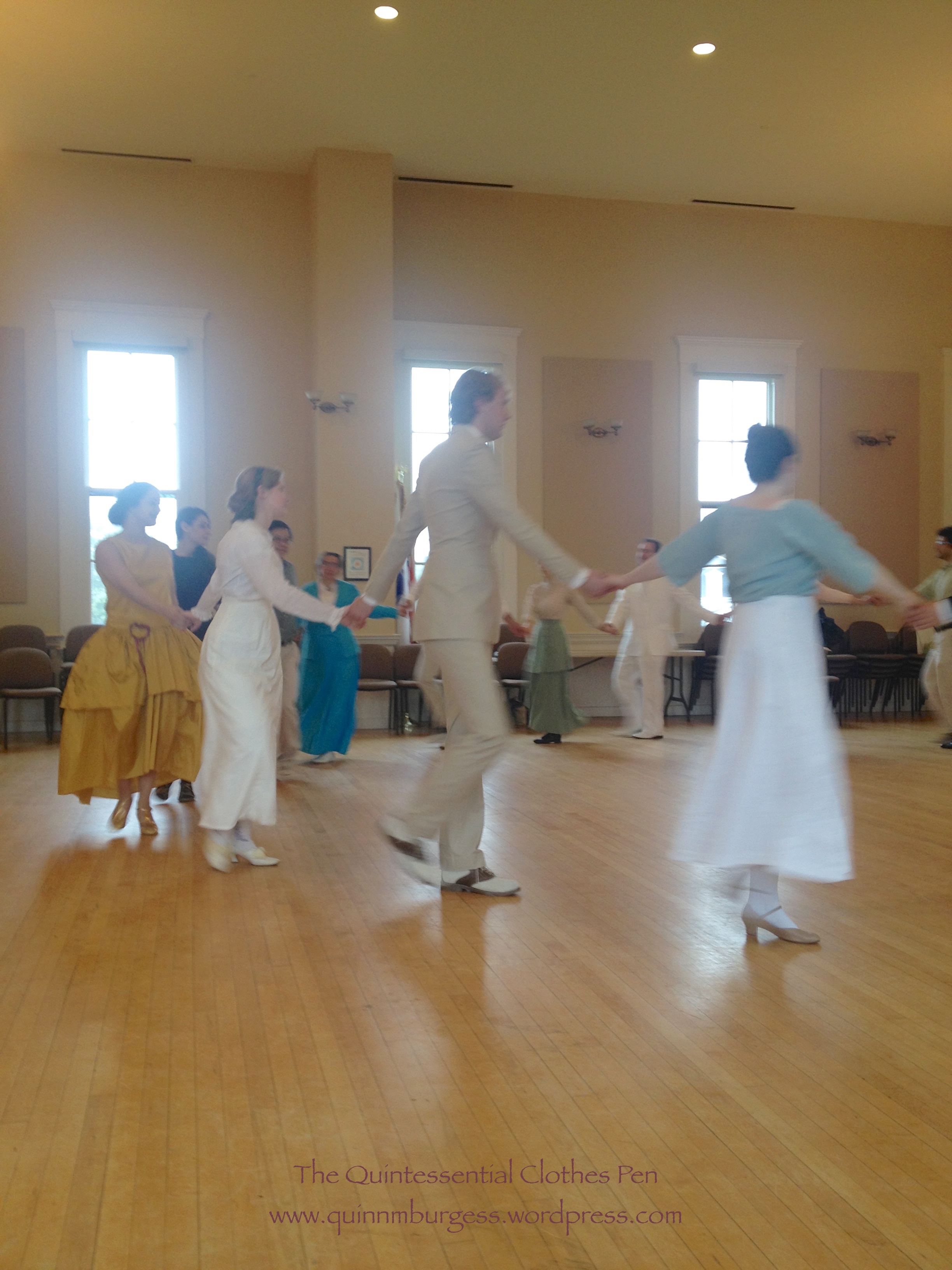
Unfortunately, the silk does want to wrinkle every chance it gets. But when the dress is in motion it’s really not very noticeable! I wore the new dress to an afternoon ragtime tea dance, which is what the pictures in action are from. There are 2 more tea dances this summer (one of them is this coming Sunday) and a suffrage rally and formal ball in September, so if you’re in the area and have the time I would love to see you at one of these future events (details here).
Most of the work on this new corset was completed during the sewing process, which you can read all about in detail in this previous post. The remaining steps were to starch and steam mold the corset, to floss the corset, and to add lace to the top of the corset.
One of the most successful was the steam-moulding process developed by Edwin Izod in 1868, and still used in the 1880s to create elegant corsets such as this one. The procedure involved placing a corset, wet with starch, on a steam-heated copper torso form until it dried into shape. The result was a beautifully formed corset, whereby ‘the fabric and bones are adapted with marvellous accuracy to every curve and undulation of the finest type of figure’ (The Ladies’ Gazette of Fashion advertisement, London July 1879).
To begin, I made a solution of cornstarch dissolved in water. I put 2 tsp to 350 ml water, but wound up using only about 1/5 of that. On a scrap, I tried applying the starch solution with a spoon, but decided against that because it left a visible starch crust on the fabric as it dried. What I found worked better for even distribution of the starch solution was a spray bottle. I sprayed the inside of my corset (the coutil layer) until it was thoroughly damp, then put it onto Squishy (since I don’t have a steam-heated copper torso of myself available, darn!): she’s a squishable dress form that I had previously padded to be close to my measurements and proportions (that’s an important point, that she had my proportions–padding in the right areas so the corset would dry into my shape!) and covered with a plastic garment bag so the starch would stay on the corset. Once the corset was on the form, I steamed it all over using a Rowenta Steam-n-press hand held steamer about three or four times. Then I intermittently steamed it again while it dried overnight.
Steaming the starched corset on Squishy.
I only did one application of starch and I believe it had some effect. It’s not as stiff as cardboard and able to stand up on its own, as I have heard some steam molded corsets described, but it does seam to want to create the curves that were patterned into it with ease and I do think that the bones took on a little of the curvy shape during the drying process as well. (Here is an example of an extant very stiff steam molded corset. Look at how well it retains its shape! I want to do some more research regarding the Symmington corset company but that’s going to have to wait a bit.)
After the corset was dry, I flossed the boning channels using ivory silk thread and the flossing pattern from my inspiration corset. Unfortunately, I only had enough of the thread to floss the bottom of the channels… so I have to deviate from my inspiration a little and not have flossing across the top.
The last step will be to add lace across the top of the corset. I’d like to use the same lace that I’m using to trim my in-progress 1885 bustle dress, but I’ve only got a small bit left and I want to make sure the dress has enough before I use it on the corset. I’ve started figuring it out but am not confident yet that I have enough, so I’m going to hold off on taking absolute final pictures of the corset with the flossing and lace until I’ve officially decided that point. Regardless of the lace issue, we’re going to call this corset done, because it is entirely wearable at this point, just in time for it to qualify for the HSF/M #6: Out Of Your Comfort Zone!
Just the facts:
Fabric: A remnant of yellow silk duchess satin, a remnant of ivory linen, and white herringbone coutil.
Pattern: Created by me (more details in this blog post about mockups and this one about the pattern pieces themselves).
Year: c. 1885
Notions: 38 bones (34 of which are spiral steel and 4 of which are flat steel), a metal busk, metal grommets, cotton twill tape, thread, silk thread for flossing, and a lace for the corset (with the addition of decorative lace sometime soon).
How historically accurate is it?: As accurate as I can be using the research I’ve done and the materials that are available in 2015. I think it passes Leimomi’s test of being recognizable in its own time.
Hours to complete: Many! Patterning, cutting, sewing, finishing…
First worn: Only for fitting the mockup of the dress that inspired it–but I plan to wear it with that dress in August.
Total cost: The fabrics were all from the stash, as were most of the notions, except for the bones and busk, for which I paid about $50.
New techniques: Steam molding! But I also added a few new details to the corset construction process. Details in this construction in detail blog post.
Reflecting back on the process, I think I probably could attempt to starch the corset with a stronger solution or more applications, but at this point I’m satisfied and ready to move on to the many other things I’d like to sew this summer, including the 1885 bustle dress that sparked this project in the first place! (I’ve actually already moving ahead with that–I fit the mockup bodice over the corset and was very pleased! More on that in a few weeks hopefully!)
This corset is made up of three different fabrics, all sandwiched together and flat lined. The outer fashion fabric is a scrap of butter yellow duchess silk satin that just barely fit all my pattern pieces (whew!). The inner layer is a white herringbone cotton coutil. Sandwiched in between these two layers is a tightly woven slightly off white linen. I chose this fabric for a few reasons: #1, because it was in the stash and an odd shaped scrap not likely to be used for a garment that required large pattern pieces; #2, because it didn’t have any dye that might leech through onto the yellow silk; and #3, because it is tightly woven enough that I’m not worried about the bones poking through it over repeated use.
The three layers of fabric in this corset.
I decided to use three fabrics instead of the usual one (coutil) or two (coutil and a fashion fabric) for two reasons: #1, because I wanted an extra layer of fabric between my silk fashion fabric and my inner coutil layer so there would be less chance of any sort of spotting from the starch; and #2, because applying boning channels of any material would have been incredibly bulky and challenging with all the curves and bones on seams, but by having a third layer of tightly woven fabric I could sew boning channels anywhere I pleased without adding bulk.
After cutting out all 12 pieces in each fabric I machine basted the layers together so nothing would be sliding around creating bubbles while I assembled the pieces. Most of the basting wound up being removed as I moved through other steps in the process–either during the grading of the seams or while inserting bones.
Once the layers were flat lined I put the grommets in the two back pieces. Normally, I do this later in the process, but this time it worked well placed here. I used size 0 silver grommets. They are a little larger than extant corsets seem to have, but they are what I had available. After that, I assembled the pieces along their vertical seams. Then I graded each seam so that when it was pressed towards the back of the corset it would be less bulky.
A graded seam.And here’s what it looked like with all the seams graded and ready to go.
Most of my previously made corsets have flat felled seams, some of which are used as boning channels and some of which are not. I prefer this method because it provides more strength along each seam than any method in which seam allowances are left pressed open. In this case, though, 3 layers of fabric getting flat felled was very thick, so I decided to try a different method. I bound each seam with ⅝” cotton twill tape, not worrying about the fact that the graded fabrics closest to the original seam were not encased in the binding.
All the seam allowances bound with twill tape.
The seam allowances were all pressed towards the back, but not immediately topstitched as with a flat felled seam. Instead, they were caught and stitched down as I stitched boning channels. Some of them have boning channels that run all the way down the seam while others are held down by boning channels in enough places that, when combined with a binding on the top and bottom edges, will be sufficient to keep the binding flat and not allow any of the graded seam allowances to peek out.
With all the boning channels in place the bound seam allowances are caught in enough places that they won’t flip around.
Another detail unique to this corset is related to stitching the boning channels. Often when I flat fell seams for corsets I don’t also topstitch right along the seam. For this corset, however, I stitched an extra line of stitching next to the fold of the seam allowance. This detail is taken directly from my inspiration corset at the V and A. While this might provide a little extra strength, I believe it is mostly a decorative and flattening stitch.
On the left you can see how the seam has not been topstitched next to the fold, while on the right you can see the extra line of topstitching.
I was able to stitch most of the boning channels prior to inserting any of my boning. This corset was intended to have 4o bones, as the V and A description states, but wound up with 38. Unlike the original, which has whalebone, this corset has ¼” spiral steel bones except for the bones that flank the grommet channel, which are ¼” flat steel.
This is the first corset I’ve made that uses this much spiral steel. Usually I use flat steel, but these boning channels are much to curvy for that. The spiral steel definitely lends itself to the curviness of the corset, allowing it to shape to my body rather than making it a more cylindrical shape.
This is also the first corset I’ve made with this much boning. I’d say it has about double the usual amount of boning. That, combined with the three layers of fabric, make this one heavy corset (and heavy duty, too!)! Unfortunately, I don’t own a scale to weigh it, but the weight is surprising every time I pick it up.
The back of this corset has diagonal boning channels that bump up against a seam on one side and the grommet channel on the other. I order to sew those and also get a bone in them, I first stitched the bottom line of stitching, then inserted a bone and used a zipper foot to sew very close to the other side of that bone to create the channel. These diagonal back channels are where I lost 1 bone on each side of the corset. My estimates must have been off, because I had one bone that was way to long for the channel, but eliminating it fixed everything. I was ok with that deviation from my inspiration corset by this point in the process.
My boning channels got a little wonky up near the top (where the presser foot is), but it almost looks artistic, and is symmetrical on both sides of the corset. And I was ready to be done by the time I reached these boning channels!
The above picture shows another corset trick, also. When I’m stitching boning channels that end partway across a panel, rather than at the top or bottom, I leave my thread tails and do not backstitch. Once I’ve completed the channel I flip the corset over to the wrong side, use a seam ripper to pull both thread ends to the inside, hand tie them, and snip them close. That leaves no tiny thread ends on the outside of the corset making little shadows that look un-tidy. The method works wonderfully!
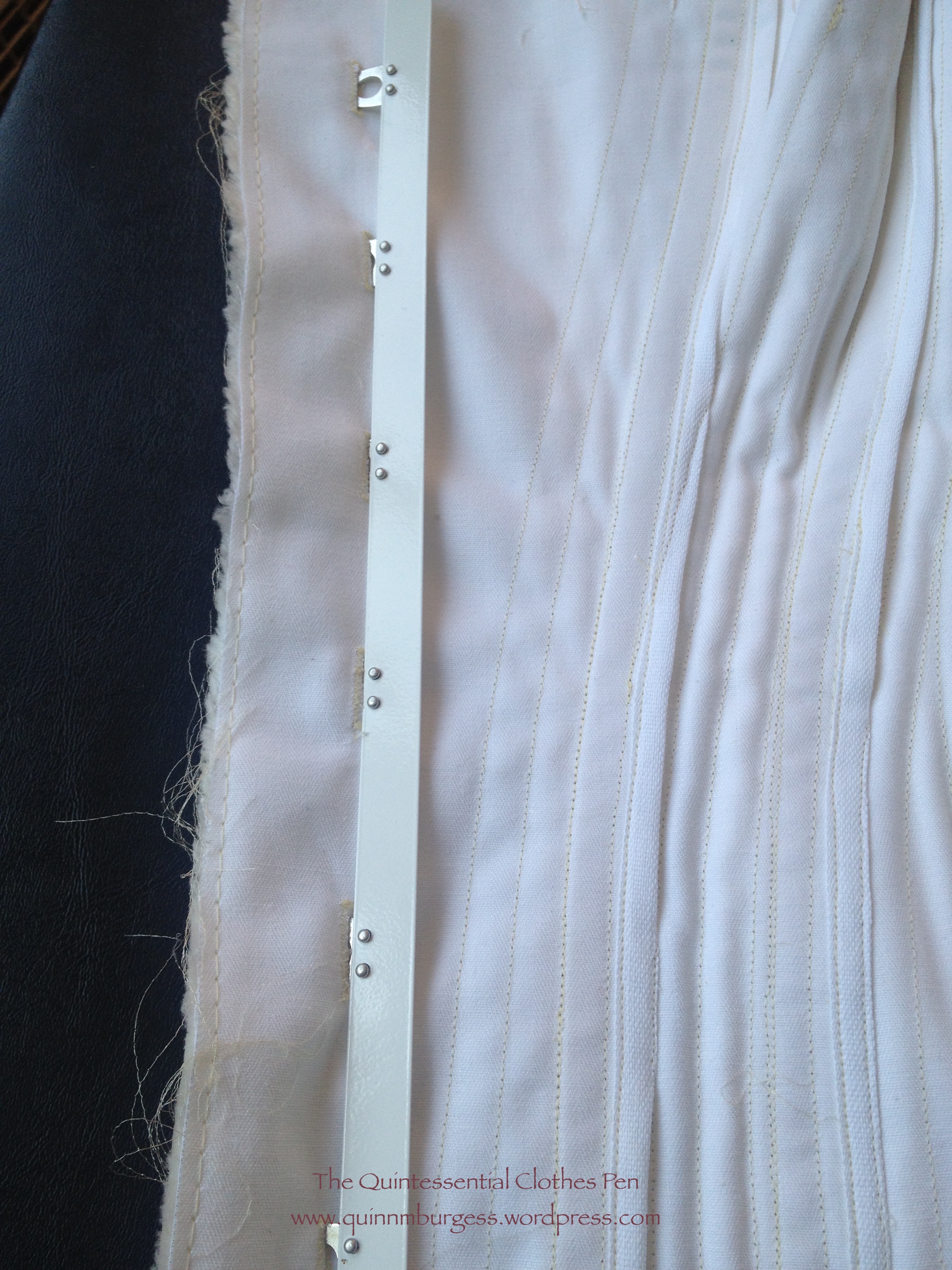
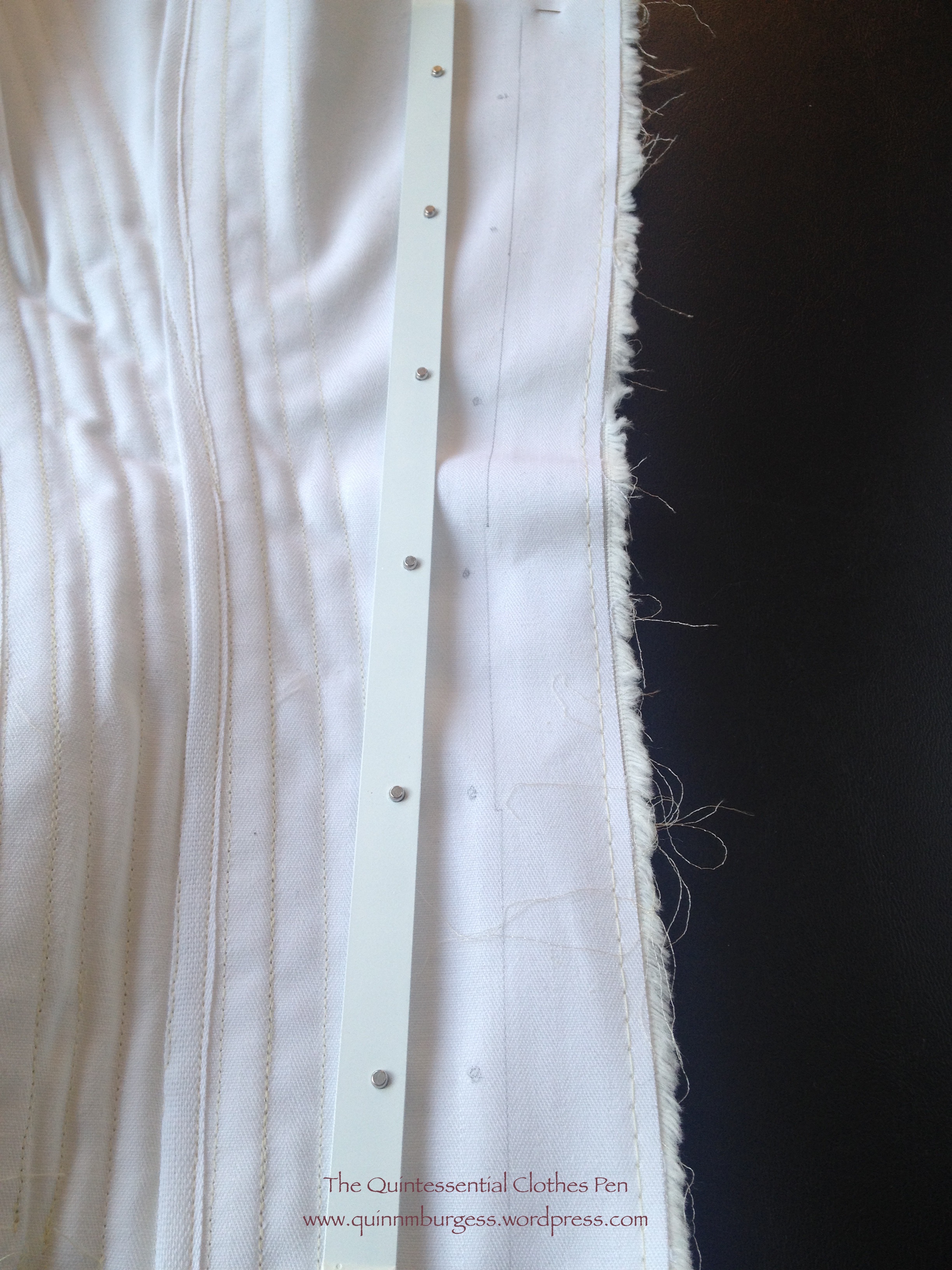
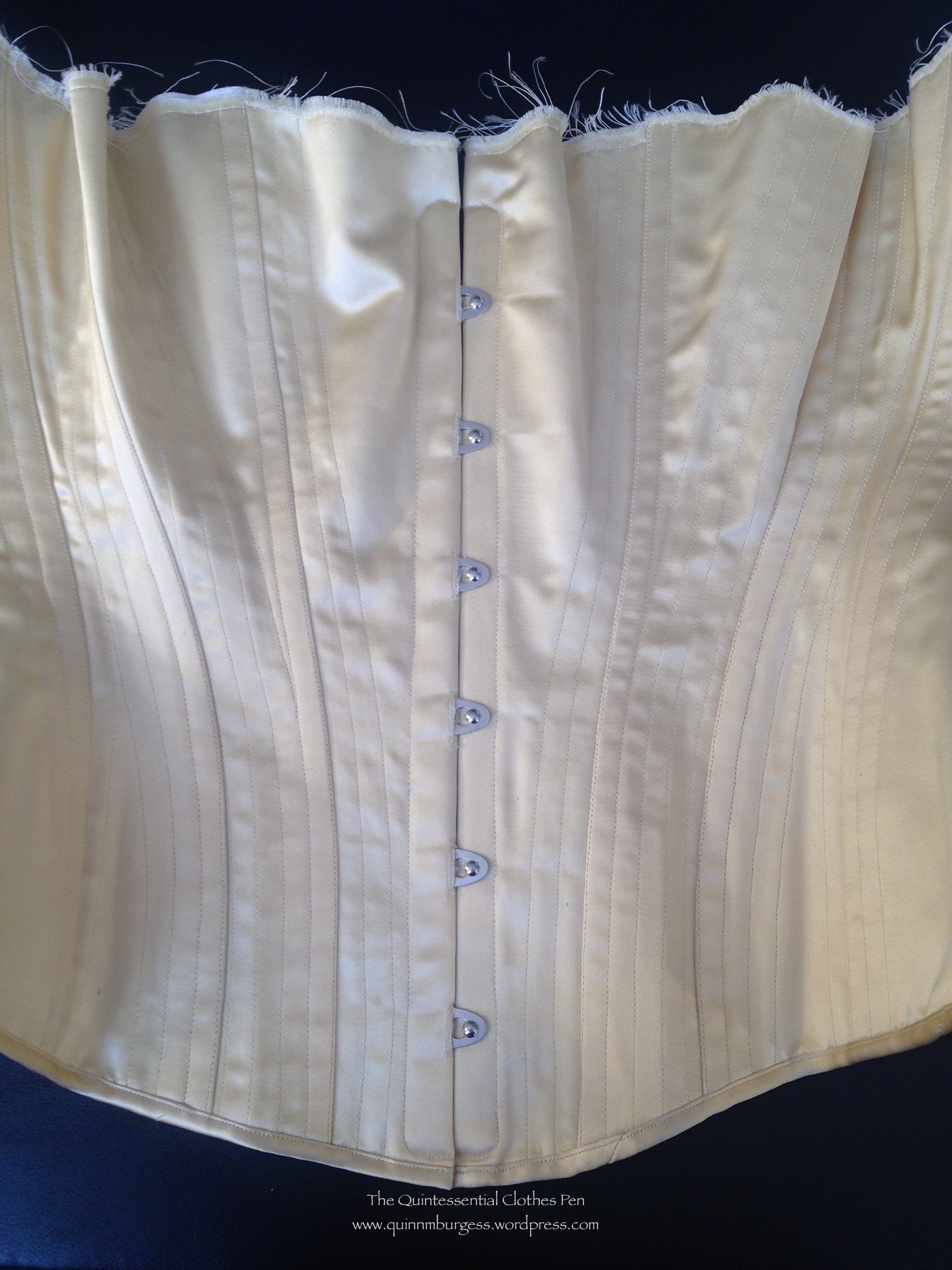
Once I finished the boning channels I put the busk into the two front edges of the corset. I thought I’d show you how I like to do those steps in more detail. After the steps that are pictured, I turn the extra seam allowance under the busk on the inside (trimming it if I’ve left too much) and top stitch with a zipper foot right next to the edge of the busk. On my older corsets, I stitched a straight line from top to bottom, but on more recently made corsets I curve around the top and bottom of the busk to keep it from sliding up and down (another detail I’ve noticed in extant corsets).
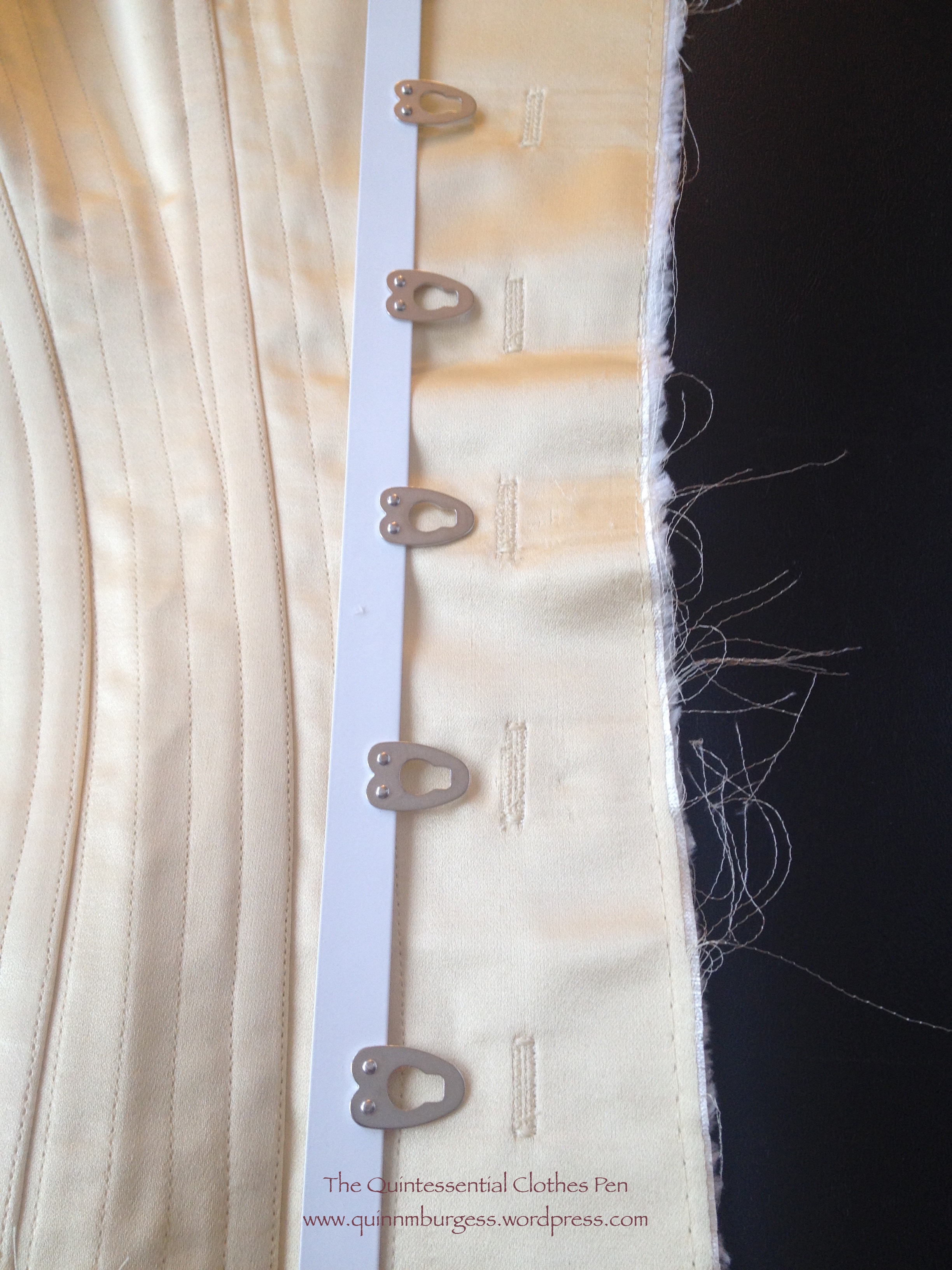
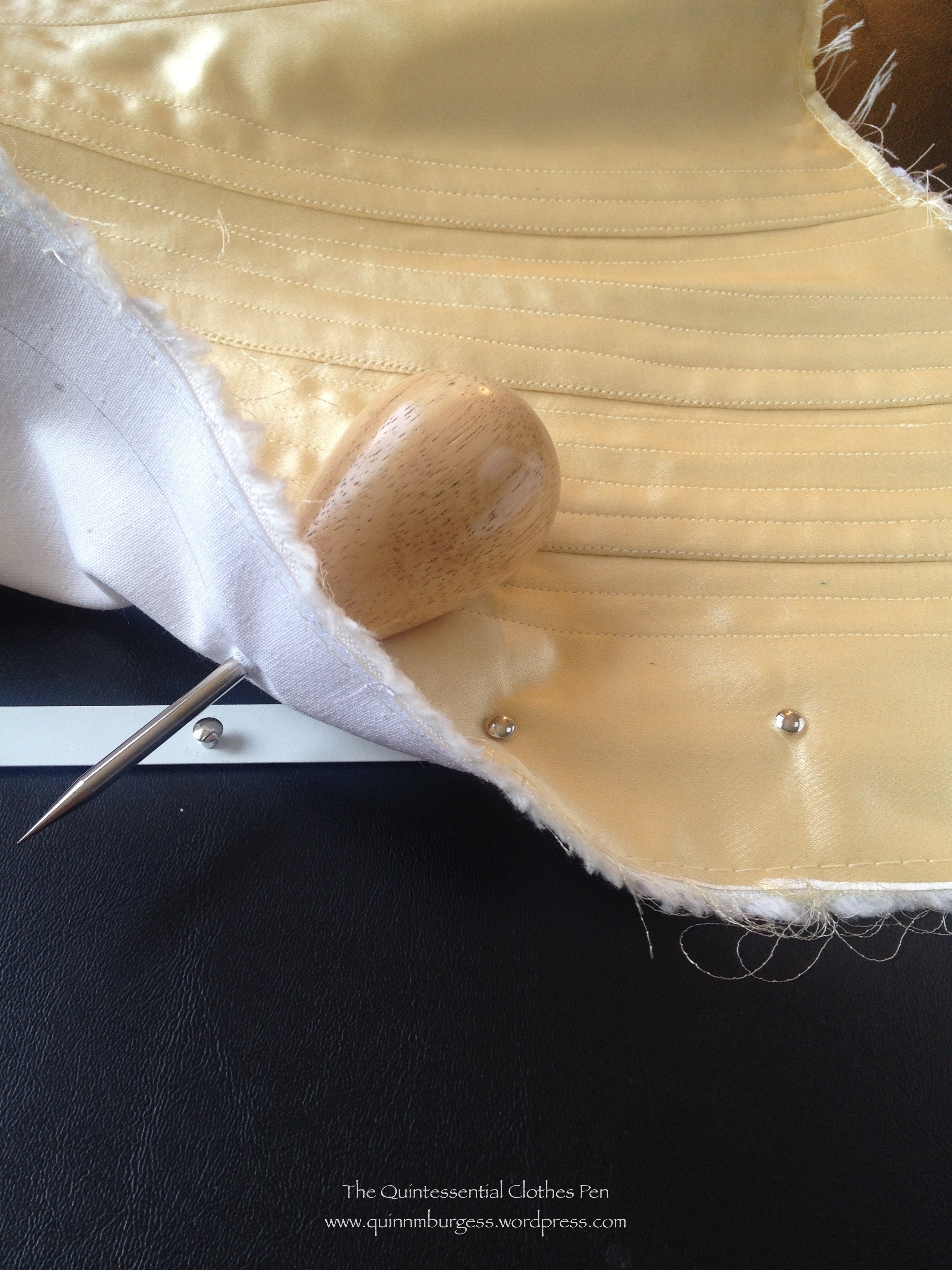
I’ve found that putting both sides of the front busk on a fold is nice and sturdy. I’ve also found that creating buttonholes for the loops to poke through helps minimize wear and tear on the corset over time as well.I make sure to make the buttonholes just larger than each loop and placed exactly so there are no bubbles anywhere.For the other side of the busk, you can see that I’ve roughly marked a fold line as well as the placement of each knob. Again, these have to be exactly placed.Then I use an awl to open up the weave of the fabrics so I can push the knob through.
After that, I was ready to bind the bottom edge of the corset! Sewing all 38 boning channels took hours (this corset is thick and sewn with small stitches, another detail I’ve noticed in extant corsets), so I was excited to move on to the next step. Luckily, I thought ahead and realized that there are three vertical bones on the back panels that dead-end at those diagonal channels–the bones for those channels had to be inserted before I sewed the bottom binding on. I didn’t take a picture of that exact step, but I did take a picture of the assembled corset with boning channels before I bound either edge.
You can see the vertical boning channels in the back that dead-end at the diagonal channels and you can see that the diagonal channels that don’t reach the top edge had the bones stitched in as I went along.
The bottom binding is bias strips cut 1″ wide. I had to do a lot of piecing of my small scraps to have enough binding for the entire corset (see that seam just to the right of the busk in the picture below?). I stitched them first to the right side of the corset with ⅛” seam allowance on my bias, trimmed my corset seam allowance to just about ⅛”, folded the bias over the edge, turned the raw edge under on the wrong side, hand whip stitched the bias down on the inside (slow, but a more effective method than pinning in this case), then turned the corset back to the right side and topstitched very close to the edge of the first fold. This narrow topstitched binding seems to be common on late 19th century extant corsets and looks very tidy.
Bottom binding sewn on.
Then came the struggle of the bones! I really struggled with this! I spread the job out over about a week and worked on it a little each day because it was hard on my fingers and wrists. The spiral boning condenses when pressure is applied, so pushing it through tight boning channels was a challenge! I wound up wrangling the corset bones into submission using a thimble, pliers, and a chopstick to help out my hands. Turns out that especially at the boning channels on seam lines, where the seam allowances were thick, I should have made the channels a little wider to make getting the bones in easier. There were one or two channels I finally resorted to unpicking and then restitching after inserting the bones for part of their length. In the end, victory was mine and I was able to move on and bind off the top edge of the corset. This was done in the same way as the bottom edge, being careful to be symmetrical between the sides and avoid sewing over bones.
And here is the result! It’s wearable at this point, but not quite complete.
The previous post in this series compared the two mockups I created while finalizing the pattern for the new corset. This post let’s compare the pattern pieces themselves.
Since my inspiration corset is only shown from one angle in a single photo, I had to use other information to extrapolate information for the areas not visible in that photo. As I mentioned in my previous post, I began the patterning process with the 1880s corset pattern in Corsets and Crinolines. That, combined with observations of other 1880s corsets, and the information below from the V and A description of my inspiration corset, all helped inform my decision to have 6 pieces in each half of the corset.
This corset from the 1880s is composed of twelve separate shaped pieces and forty whalebone strips.
The image below shows the pattern pieces from my first mockup compared to the pattern pieces from my second mockup. At first glance they are basically the same, but upon closer inspection there are subtle differences. It’s the same idea I’ve been repeating in every post about this corset: the lines aren’t really that different, but the curves on them have been exaggerated (this is especially noticeable on pieces 1 (CF), 3, and 6 (CB)).
Center front is on the left and center back is on the right.
You might also remember that I mentioned in my previous post that I had changed the two pieces closet to center back after the mockup. Here are the two original 5 and 6 pattern pieces from Version 2 compared to the newer 5 and 6 pieces from Version 2.
On the left, pieces 5 and 6 (CB) Version 2.1, as seen in the mockup. On the right, pieces 5 and 6 (CB) Version 2.2, updated after the mockup.
I think the change in the pattern pieces is pretty obvious when they are compared side by side. You can see the inspiration image of the back of an 1880s corset that prompted me to make this change in my previous post.
Determining where the boning channels would be was an essential part of the patterning process, due to the immense number of bones and their specific placement between seams on the inspiration corset. I looked very closely at the inspiration corset to determine where the bones would be located on the front pieces of the corset. For the back pieces, I used the mention from the V and A that the inspiration corset had 40 bones to figure out how many additional bones I needed after the front ones were planned and information gathered from back views of other 1880s corsets to determine bone placement. You can see that the pattern pieces from Version 2 have short vertical lines drawn on them to help me envision where the boning channels would be as I created the pattern. Once I was satisfied with the shape of the pieces and the location of the boning channels I was able to move on to the cutting and construction… more on that soon!
I began the patterning process for my new 1880s corset with the late 1880s corset in Norah Waugh’s Corsets and Crinolines. I immediately had to adjust the pattern for size, as is often the case when using scaled historical patterns. While doing that, I also made some initial guesswork at adjusting the pattern to get the curvy seam lines in my inspiration corset at the V and A.
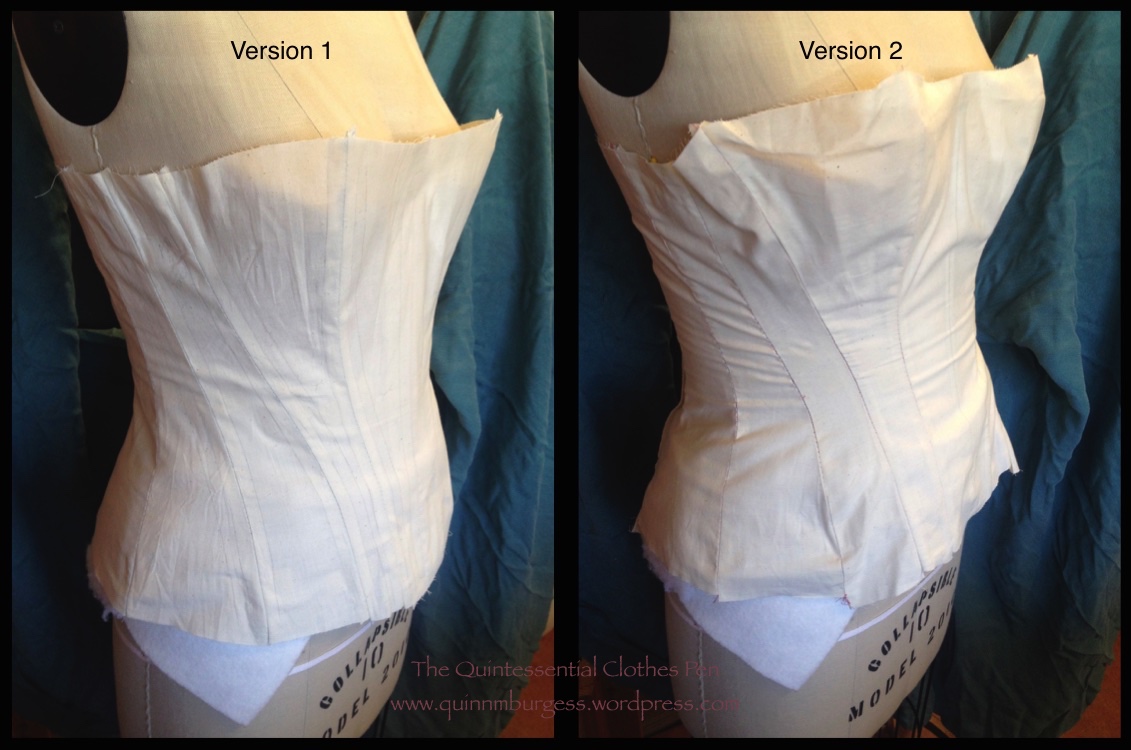
The result was a perfectly usable pattern for an 1880s corset, but the pieces didn’t have the exaggerated curvy seams I was looking for. So I started playing with the pattern pieces from the first iteration and came up with a second mockup that was satisfyingly curvy. The back pieces didn’t change, so I’ll only show a comparison of the fronts and sides. The noticeable differences are in the silhouette of the bust and hips. (I roughly padded out the dress form to be shaped like me, but being rather un-squishy, as dress forms often are, the corset mockups aren’t really filled out as they would be by a squishy body.)
Front.Side front.
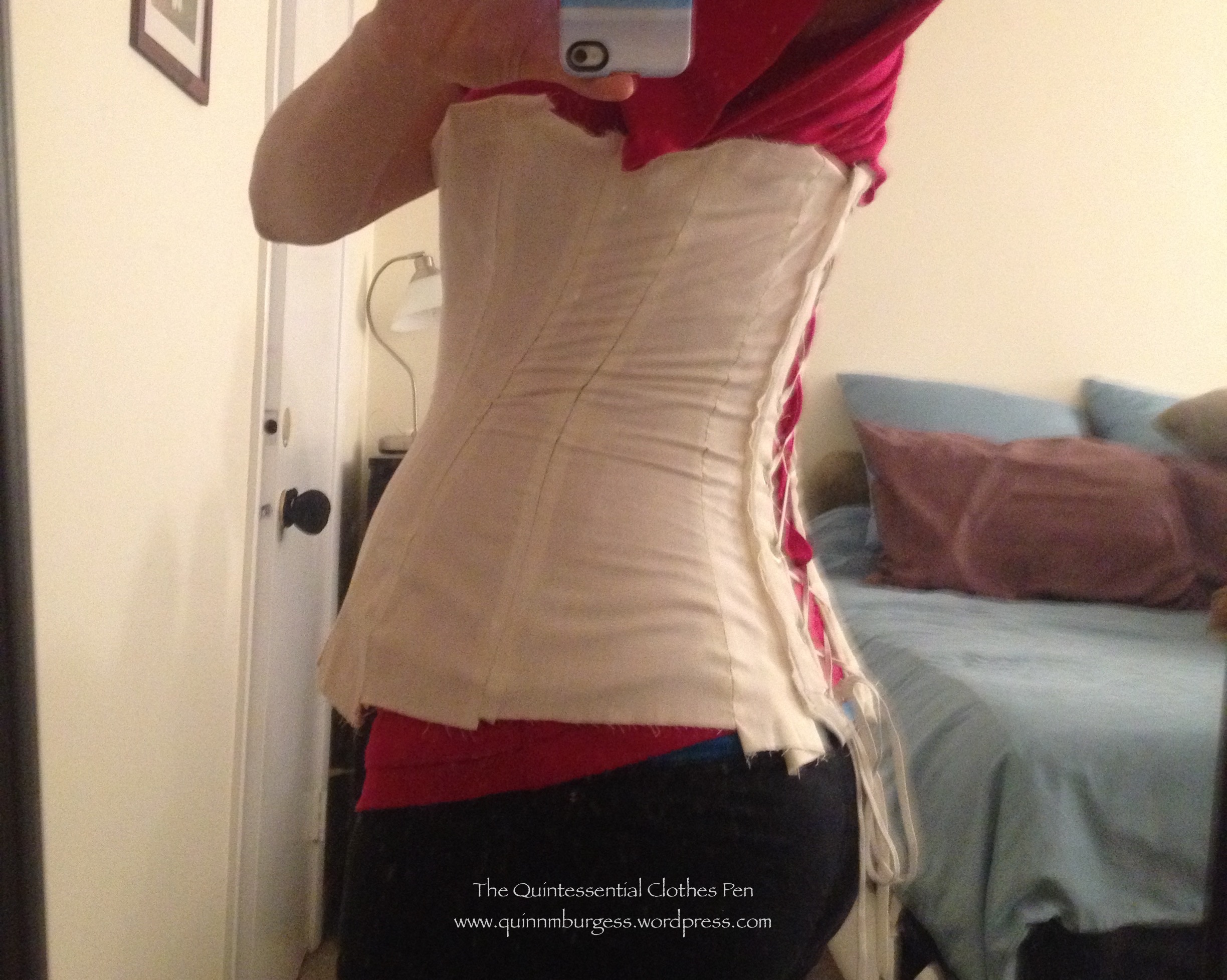
I didn’t take pictures of the first corset mockup on me, but I did take pictures of the second one, to give an idea of how it fits onto a squishy real body. The mockup corset is made from a single layer of muslin, with spiral bones taped onto the seams and a wide flat bone at the front to simulate a busk. The back has lacing strips basted on. I didn’t have help taking the pictures, so you’ll have to forgive the awkward angles!
Front.Side front.Side.Back.
After the second mockup/pattern I still made a few changes, such as truing the pattern pieces so the edges that meet are the same length and some other small adjustments such as taking in the bottom front pieces a little to keep them from standing away from my body. The largest change I made was to change the seam closet to the back grommets.
You can see in the back picture how the seam lines are rather vertical once the corset is on my body, which didn’t seem to match the curvy seams on the front of the corset. Unfortunately, the V and A doesn’t have any pictures of the back of my inspiration corset online that I have found, so I had to turn to other extant 1880s corsets to look at seaming (and bone placement, but I’ll discuss that in my next post). I settled on the image below as my inspiration for the back of my new corset.
1884, French, The Met
As with the front pieces, I noticed that the curviness of the seams is distinct as the corset goes over the hips and up the torso, but my second mockup didn’t have enough curve in these areas for my taste. So I went back to my pattern and made new pattern pieces for the two back pieces to adjust the seam line.
And that’s a great place to end this post. The next post in the series will be a comparison of the two patterns, looking at the pieces themselves.
The first corset I ever constructed was from a modern historical pattern company. While the corset was fitted to my specific curves, the pattern pieces for it still created a basically cylindrical shape without a lot of hip or bust shaping visible when the corset was laid flat. (I’m wearing that first-ever corset in the pictures in this past blog post.) I’m not saying that shape is wrong for the 19th century, because there are extant examples, patents, and other information showing us that style, such as the corset below.
French corset c. 1885, The Met
Looking at corsets from the last half of the 19th century, however, there are a variety of other styles that have more interesting lines and definitive flare at curvy points than the basic cylindrical shape. My c. 1860 pink silk corset is an example of a style of corset that uses bust and hip gores to create a more curvy silhouette. (I discussed this in detail in a post about that c. 1860 corset that you can read here. That post has examples of extant corsets showing that shape.) Here is a catalog page of corsets from the 1880s showing that same style.
In addition to the hip gore style corset, there are also a growing number of curvy seam corsets as the 19th century progresses. Some of these also make use of bust gores while maintaining the curvy seams to really provide shape. These all lead up to the s-shape corset of the early 20th century, but we’re not quite there yet in the 1880s.
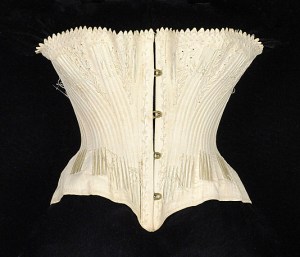
Here are some extant examples of curvy seam 1880s corsets: black, light blue, and ivory (very similar to the one pictured above, but more extreme in its curves if you look carefully). The curvy seam corset style is what caught my eye for this project, because it is a style that brings new challenges in terms of patterning and because it will be a new style in my wardrobe when completed. Compare this to the the photo above and you can see quite a difference in terms of the cut of the pieces.
Edwin Izod corset, 1887, V and A.
This Edwin Izod corset from the V and A is my inspiration. I’m intrigued by the shaping of the panels and the completed silhouette, but also by the construction method. The V and A gives some tantalizing information about the steam molding process patented by Edwin Izod and used to create this corset, just enough information to make me want to see if I can create some form of steam molding and discover how it might change the finished silhouette and wearable feel of the finished corset when compared to other corsets I’ve constructed.
Fashion and technological innovation changed the shape of late ninteenth-century corsets. As the bustle replaced the crinoline and bodices contoured the figure, corsets became longer to achieve the desired hourglass silhouette. They encased the abdomen and enveloped the hips, and the amount of whalebone also increased to give a smoother outline and help prevent wrinkling of the fabric. This corset from the 1880s is composed of twelve separate shaped pieces and forty whalebone strips.
To improve shape, performance and comfort, manufacturers claimed numerous inventions. One of the most successful was the steam-moulding process developed by Edwin Izod in 1868, and still used in the 1880s to create elegant corsets such as this one. The procedure involved placing a corset, wet with starch, on a steam-heated copper torso form until it dried into shape. The result was a beautifully formed corset, whereby ‘the fabric and bones are adapted with marvellous accuracy to every curve and undulation of the finest type of figure’ (The Ladies’ Gazette of Fashion advertisement, London July 1879).
I’ll be coming back to the nuggets of detail contained in this description, because some relate to patterning and some relate to the steam molding itself, but those are topics for future posts.
* In case you’re wondering why I spell steam molding without a “u” but the V and A quote spells it with a “u”, check out this little bit of information.
I have a number of corsets, some made for me specifically and some made for other ladies but which I wear, but there are still periods for which I don’t have any corsets that are really perfect. When it comes to the later 19th century, I’ve got a corset intended for the 1860s, whose style continues to be seen through the 1890s, and a corset from the 1890s that wasn’t made for me and doesn’t fit as well as I would like it to, despite the fact that I wear it rather regularly. The 1890s corset is being worn under most of the 1890s/turn of the 20th century garments shown here on my blog, but I’ve never shared pictures of the corset itself here before.
1890s corset on the body it was constructed for in 2009. The pattern is from Corsets and Crinolines and has 4 elastic panels in the front.
Someday, I’ll make a new 1890s corset that is fitted for me using the features I like from the current one, such as the very comfortable elastic panels, but changing things such as the busk length (the current one is too long and pokes me in the legs when I sit or bend… it’s ok if I get it just between my legs, but has caused bruises when I’ve bent over unexpectedly in the past and dug the busk into my leg…) and creating more room the bust area. But I digress, because an 1890s corset is not on my to-do list for this summer.
What is on my to-do list is completing a summer dress from the 1880s (that I started back in 2013, yay for super overdue UFOs!). The skirt is pretty close to completion, but I’d been holding off on the bodice not only because the project has been generally on hold, which is most of the reason, but also because I really wanted to fit the mockup over the corset I planned to wear with the dress. The plan was to have a new specifically 1880s corset to wear. And now that the dress is on my to-do list again, the corset has joined in as well!
I’ll be doing a Project Journal series on this corset, because in addition to showing in progress pictures, I also plan to attempt to steam mold this new corset, so there will be lots of interesting information and success or failure updates. Next post in this series will be about my inspiration!
I’ve been making rather slow progress on bigger projects lately, but my stack of recently started UFOs was causing me stress and I really felt the need to finish a project entirely. I had a bit of time today and used it to finish up 3 small projects, as well as fitting a final mockup so I can move on with making a pair or two of modern capris (depends on if I can squeeze two pairs out of my fabric or not) and realizing that another modern top pattern I’ve been trying to make work for me just needs to be left alone for now. If I make the conscious decision to let something go then I feel like I can take it off the to-do list and not feel like it’s a UFO, so all of these things feel like progress!
Two of my three finished projects are pretty much the same: two pairs of cotton dot printed tap pants to wear under modern and historical skirts during warm weather. They’re useful for soaking up sweat! I bought the fabric thinking I’d make a top, but then realized that I would never like a top made out of this fabric, so I decided to make these summer tap pants instead. And I really enjoy the result, because having dotty tap pants that no one will see brings me joy. Unless I’m changing at an event… and then some ladies out there might see them!
The pattern is Butterick #4289 from 1976. I made view C and altered it just slightly: eliminated the waistband, lengthened the inseam, lowered the top edge a bit, eliminated the darts, straightened the hips instead of curving them inwards to accommodate the fact that I did not include a fly, and finished the top edge with elastic. I have another pair of cotton tap pants I made sometime in the last few years that are complicated, with a fly and a waistband, but all of that is rather unnecessary, really. I was inspired to simplify the idea after purchasing some tap pants (like these, called petti pants, which are great for wearing over tights and under dresses in the winter!) and realizing how simple these garments could be.
So these are my simplified version, with a pattern that fits perfectly. Hooray! These are all nicely finished on the inside with serged seams. As I pointed, out the top edgess are finished with elastic, though I tried different methods of attaching the elastic on each pair. We’ll see if I notice a difference when wearing these. The only other thing to note, which makes me quite happy, is that I included a little blank cotton twill tape “tag” on the back seam of each pair. Without a tag it’s hard to find the back when getting dressed and this makes it very easy!
(The other project I completed today is an old pair of jeans that I cut off, reshaped the legs of, and hemmed, thereby turning them into capris! If I get pictures of me wearing them someday I’ll share, but it’s not a super high priority. It’s mostly just that I haven’t been able to find ready made capris that I like in years and so I haven’t had any that fit for years, and during the summer that is just not an enjoyable situation. So I’m glad to have some capris again!)
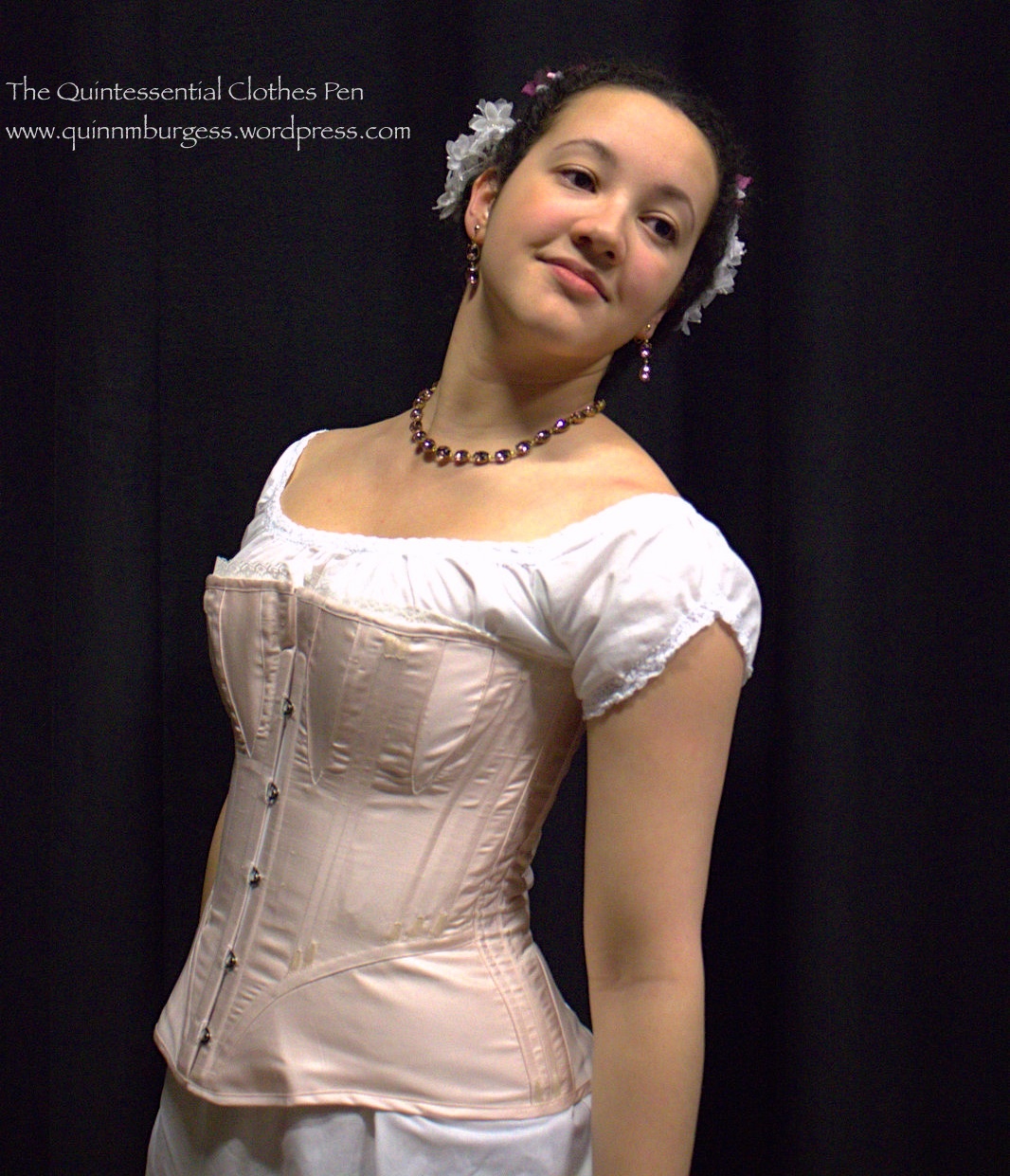
This is a follow-up post to my last post: ca. 1860 Corset For Me! (HSF #4). That post has a short background on my reasons for building the corset, but it doesn’t mention other details, so that’s what this post is for!
My new ca. 1860 corset.
So let’s start with more background, since this post is all about intense amounts of details! We’ll start with the pattern I made for this corset: you’ll notice it has bust and hip gores as well as that curved piece on each side of the front. The bust gores aren’t so unusual for a modern 1860s corset recreation, but I don’t see too many corsets made (and certainly not many corset patterns) with hip gores and I’m not sure I’ve ever seen anyone reproduce an 1860s corset with that curved piece in front. I found these details intriguing and wanted to make this style for two reasons: 1, because it’s a style I haven’t seen recreated, but which I have multiple examples of in my research, and 2, because it seemed like it would fit into a new thought I absorbed a few months ago.
1865-1867 corset, The Met
First, a discussion about the style. It seems like a lot of modern ca. 1860s corsets are cut with vertical seams that run from top to bottom of the corset to create shaping, sometimes with the addition of bust gores. (The corset on the right is an example of one from the 1860s that uses this style of seaming to create shape.) These corsets are cut with shaping in the seams to create space for the bust and hips, but an alternative to this is to use bust and hip gores to achieve shape for the body. The interesting thing is that hip gores do not seem to be very commonly used in historic corsets made by modern people, despite their use in historic clothing. I attribute this to the fact that shaped seams are easier to execute than inserting gores of any type, but especially gores that are not in a seam (like the gores in my corset). Also, I would think that pattern companies have an easier time grading patterns using the shaped seams, because the gores (particularly hip gores) really need a lot more individual adjustment and fiddling on a body than shaped seams do.
Second, about this new thought that I absorbed. While reading Merja’s most recent blog posts about corset construction, I was rather surprised by a simple statement that makes so much sense but which I haven’t necessarily followed in corset making in the past (here are Merja’s gusseted 1870s corset, which has the sentence which mentions this magical new thought, as well as her 1880s purple corset and 1860s white corset with seaming like the Met corset, above, which exhibit the thought without it being explicitly stated). Essentially, she says that she always makes adequate space in the corset for bust and hips, so that the corset is only constraining her waist. Duh! A related thought is that when you tighten your corset you displace some bits to your bust and hips, so your corset really does need adequate room there to accommodate the normal and the extra. That makes so much sense and sounds so much more comfortable than having a corset that digs into your hips or pushes your bust around uncomfortably. I made the goal to take this approach for the new corset and all future corsets! and this new corset was my first attempt at really following this sound piece of information.
So given that the style I set out to make is one that I haven’t ever seen a pattern for, where did I get mine? Well, it’s loosely based off of one in Corsets and Crinolines by Norah Waugh (the pattern is ca. 1873, pg. 80). I say loosely, because I started there, but then began combining pieces and changing the shape of them to suit my measurements and the seam placement that I wanted (most importantly the hip gore and that curved front piece). Interestingly, Waugh notes on a different corset pattern (ca. 1860, pg. 78) that the 1860s style of corset without bust or hip gores (more like what I seem to see in modern made ca. 1860 corsets like the one from the Met at the top of this post) was a style preferred in France. The English preferred the style of corset I am making with gores. (Merja’s white 1860s corset I mentioned in the pervious paragraph uses this French corset pattern in Waugh, if you’d like to see what it looks like made up.)
I wound up making two mockups to get the pattern the way I wanted it even after adjusting the pattern from the beginning (and still made a few alterations before cutting out my real fabric). The original pattern in the book had a waist that was much too small and a bust that was a little large relative to my measurements. Despite my changes, the first mockup was too short waisted, needed bigger and longer bust gores, smaller hip gores (I had overestimated how much ease I needed there), and a little bigger waist. The second mockup was still a little short (I added another ½” to the top), the hip gores were still just slightly too big, and the lacing gap between the back pieces was wider than I wanted it to be by about 3″. Ugh! I actually determined that last fact after cutting out and sewing up my actual fabric. Turns out my shoulder blade area is bigger than I thought. I had an inner struggle about if I wanted to take out the small stitch size flat felled seam to insert a piece or if I wanted to just let it go. Adding a piece won in the end, because I figured that I was spending so much time on the corset that I really wanted to be pleased with it and not have nagging doubts for the next number of years until making a replacement. (The piece I added is between the front and back pieces. You can see it easily in the first picture in this post. It’s a v shaped piece that extends from top to bottom.) Adding the piece actually wasn’t so bad, despite all my inner complaining and I’m very pleased I did it, because I am happy with the result.
1864 corset, The Victoria and Albert Museum.
That’s all the aspects of choosing the pattern and executing it. Now I can move on to my inspiration for creating it. This blue corset at the V and A is the most thoroughly photographed piece of inspiration (click through, there are lots of different angles of the corset, and close up pictures!). As you can see, the blue corset has bust gores, that curved front piece, (and if you look at the pictures of the back…) hip gores, as well as useful close up construction photos showing the flossing, how the busk is sewn in, how the binding is sewn on, etc. You can also see great detail for things like how to sew the points of the bust darts and the tops of the hip gores: they are overcast near the tips of the bust gores and tops of the hip gores before being machine sewn with topstitching to the binding. I used this method in my corset, sewing the overcasting by hand. I found that it was very useful on the bust gores (since mine are set into a slit in the fabric, not a seam) because the amount of seam allowance near the points is negligible (like, less than ⅛”) and that would have been extremely frustrating to try and machine sew! Also, the overcasting kept the edges from fraying as I was working with them. It also adds an extra measure of stability and sturdiness to those areas.
1839-1841 corset, The Met.
Other very useful images to me were this orange 1860s corset front and side views (with generally similar lines as the blue V and A one) and this 1862 Godey’s image of a corset (with very similar lines as the blue V and A one). (As a side note: Does anyone know what collection houses the orange corset? I’ve only been able to find images, but no real source.) These corsets provide a nice end date range for my corset pattern, because in the 1870s the corset begins to change shape. But to determine a good start date for my corset I had to look elsewhere. The Met has a corset dated 1839-1841 with similar hip gores and the front curved piece (great zoomable pictures including an interior view, click through the image!), but it does not have separate bust gores (they are cut in one with the front pieces as is usual for 1840s corsets) and it does not have a front opening busk (those weren’t in general use until 1849). The 1839-41 corset is more curvy than the 1860s ones, as you would expect from an 1840s corset, but it still looks like a forerunner to me! Waugh has an 1844 corset pattern (pg. 77) that has similar lines to the 1839-41 Met one, with bust gores but without hip gores or the curved front piece. These 1840s corsets are useful for determining the start point of my date range, which seems to safely be the 1850s. Thus, my corset is dated ca. 1860, which is just a shorter way of saying 1850-1870. That makes sense looking at the silhouette of the dresses from these decades, as well, since neither the 1850s or 1860s require the curvy shape of 1840s or 1870s corsets.
EDIT: The orange corset mentioned above is in the collection of the Manchester Art Gallery via this link.
I used all of these different images to look for construction details to use in my corset. Specific things I was looking for include: stitch size, width of the binding, method of sewing the binding, placement of bones, design of flossing, seam placement, method of setting bust and hip gores, location of topstitching, placement of eyelets down the back, finishing of the interior of the corset, and length of the busk. Some of these things can be determined by looking at the extant corsets I’ve shared in this post, but others required other helpful research. Specifically, the gusset construction method I used came from this image that Merja shared in her 1870s corset post. It’s from 1872, but is still relevant for my corset, because if you look at the blue and orange corset pictures you will see it used on the overcasting at the bust and hip gores. This image, from 1868, shows similar methods as well (and has a selection of mostly French and a few English style corsets if you’d like to see more examples of those).
And now, here are the close up construction details of my corset that I promised.
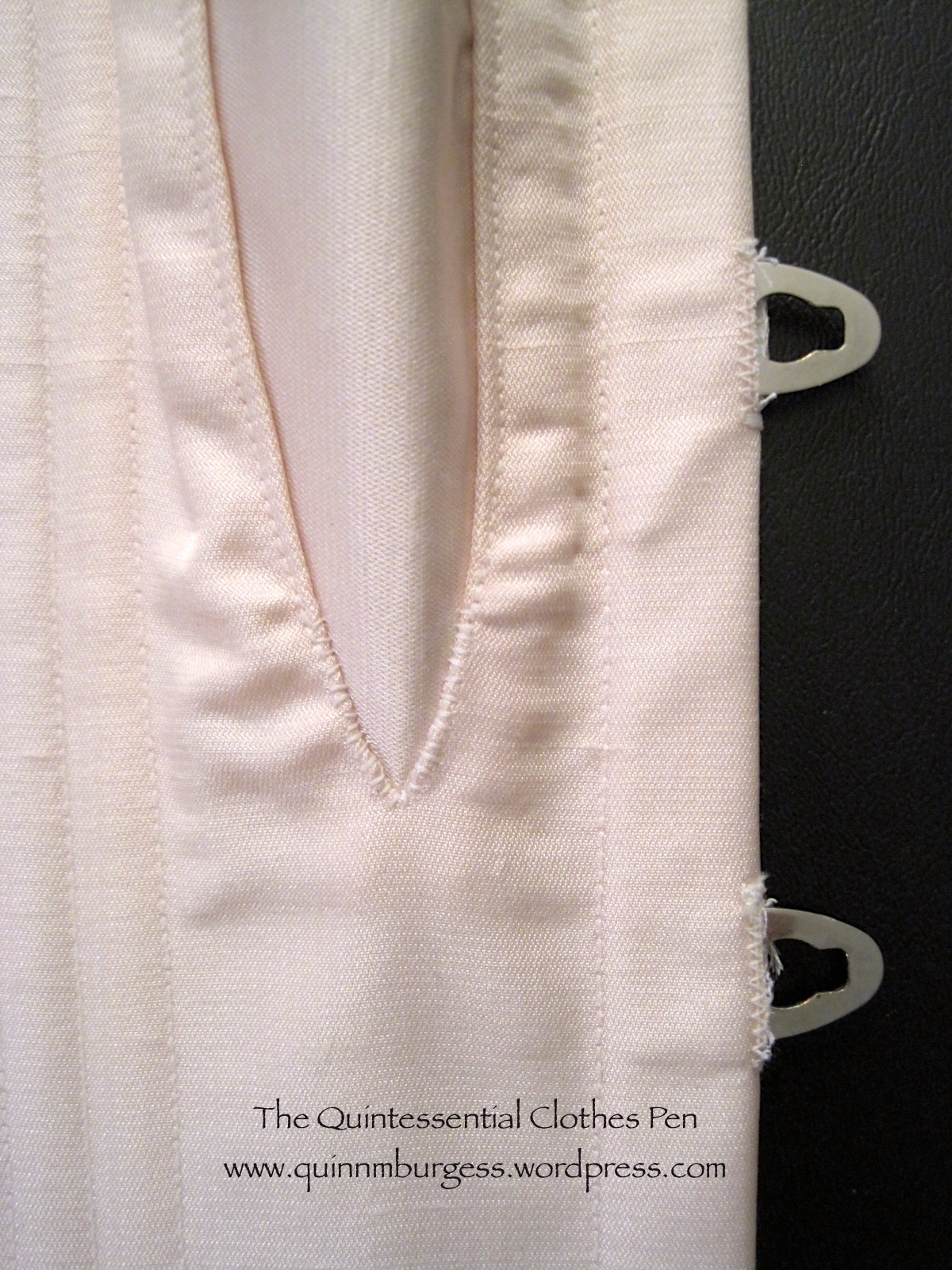
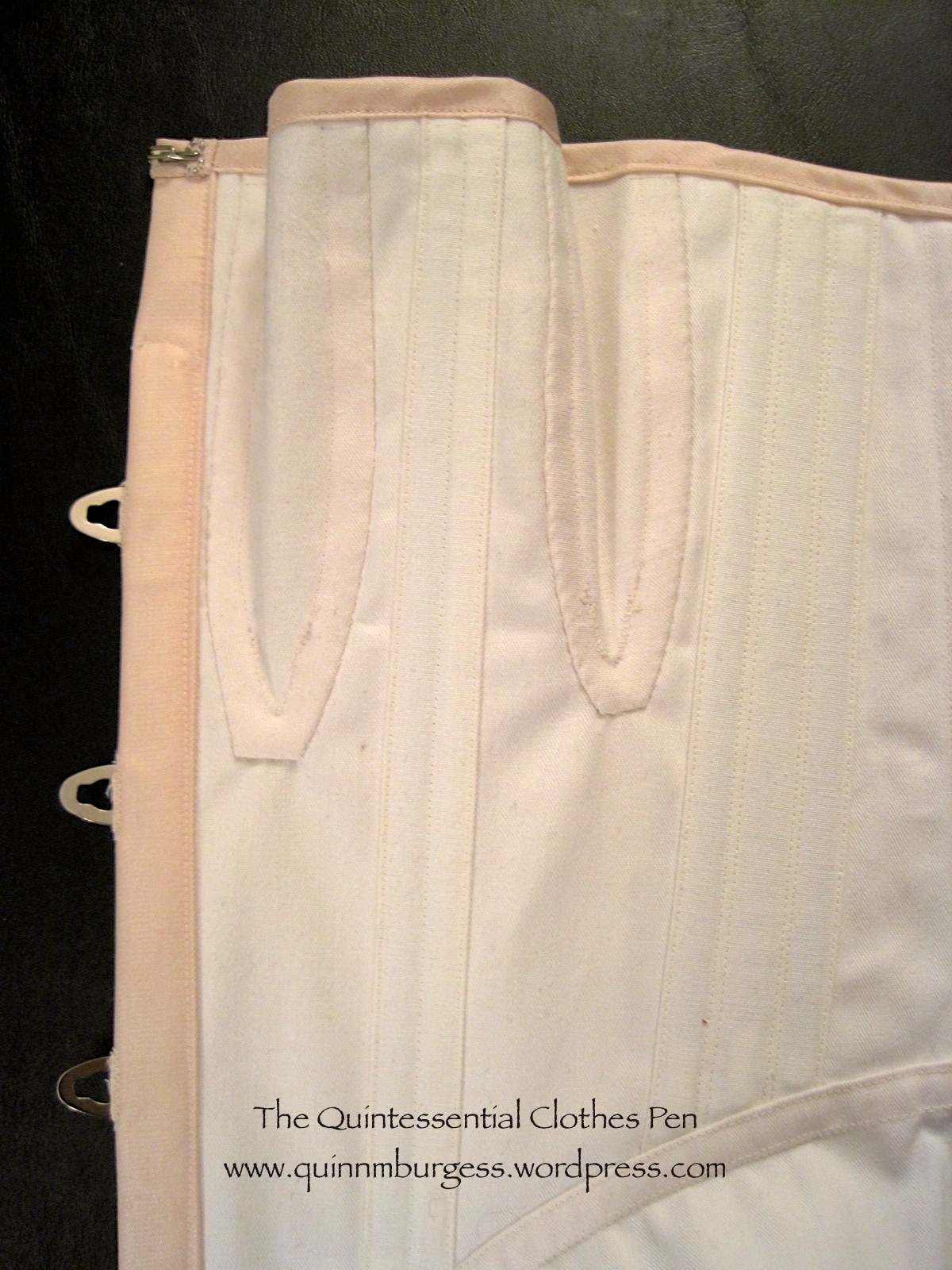
An interior view of my corset. It’s important to me that the inside of garments is as nicely finished as the outside, as you can see. It’s a little hard to see, but the grommets near the waist are set closer together than the ones a the top and bottom.Details: Hand sewn overcast stitches at the bast of the bust gore and machine top stitching above that. Machine sewn button holes for the busk hooks (I’ve found this method to be much sturdier than leaving a gap in a seam on the edge).Details: The busk is top stitched around the top curve to keep it from moving. There is flossing at the top of the boning channels (every boning channel is flossed at the top and bottom). Machine sewn top stitched binding.Details: The top hook of my busk is a few inches below the top of the corset, so I added a hook and thread loop at the top to keep it closed. I used coutil cut on the straight of grain for my boning channels: the edges are pressed under and then they are topstitched into place and into the proper number of channels (keeps the inside tidy and doesn’t require extra notions!). The seam allowance of my bust gores is turned under and flat felled by hand with a whip stitch that only catches the coutil. The curved front piece is flat felled by machine.Years of use have caused my busk to have a bend in it at my waist line. See how it curves up from the table in the middle? Impressive, really, that my body can permanently change the shape of metal.
I’m hoping to get pictures of the corset on me this weekend at its first ever wearing. Hopefully I’ll be able to share those in the near future!




















 The Quintessential Clothes Pen