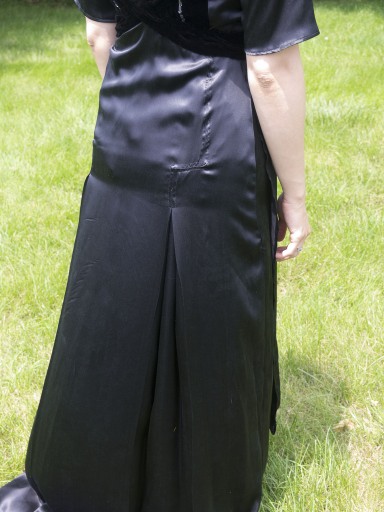
The back of my 1912 tea gown. I like the belt that crosses and swoops up (hard to see, except that the line of beading is interrupted by the belt) and the side back seams that end in pleats (it looks really cool while I’m walking!).It’s a little hard to see in the first image, but the side back seams make a few intentional right corners before opening in inverted box pleats that help form the train. Here is a close-up of those seams: unfortunately, they pucker a little in the silk charmeuse because I didn’t think to stabilize them before starting to sew and snip corners… Let that be a lesson to you!Another view of the back seam and pleats.Here’s a side view, so you can see the front and the back.And a recap picture of the mushroom hat.
I was able to wear my freshly painted and moved-button Astorias with this dress and others at Dress U recently, but you’ll have to wait to see pictures of the finished shoes–they’ll be coming in another post soon!
We took a rather in-depth look at my new 1912 evening gown. Now, on to the second 1912 ensemble that I also wore during the weekend: day gown and hat!
Gown and hat with (unbuttoned...) white kid opera gloves. I'm so pleased with the overall effect! Unfortunately, I don't have pictures of the back. There are cool details back there, so another fashion shoot will be required in the future...
This gown is constructed from silk charmeuse. The skirt is a single layer in addition to the overskirt panel in front. The bodice has a foundation of the same white cotton as my new evening gown. Mounted on to that cotton are (from the neck down) layers of ivory silk charmeuse, ivory silk flat lined with fabulous ivory colored diamond lace, black silk velvet, and black silk charmeuse. The overskirt panel is trimmed with matching silk velvet and the belt is constructed of the same. There are small buttons on the overskirt velvet trim (because, really, the Edwardians just loved adding buttons everywhere!). Because the back bodice mirrors the front in its style (which unfortunately I don’t have a picture of right now…), I had to be crafty with my closures. The dress has two places that open with hooks and bars: the left side from just under the arm to a few inches down the hip and the left shoulder seam around the neck to the center back of the collar. The effect is a form fitting dress that looks like it was magically donned. The side closure is straight forward, with the foundation layer hooking first, to take the tension of holding the dress tight, and the outer charmeuse layer hooking over that simply to stay closed. Again, the foundation is essential to achieving the elegant, effortless exterior. The neck closure is a series of hook and bars that turn different directions to accommodate the seams: front to back at the shoulder, hooks that hook up on the collar to attach it to the back neck, and hooks going sideways on the center back of the collar.
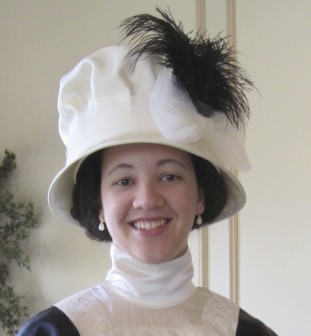
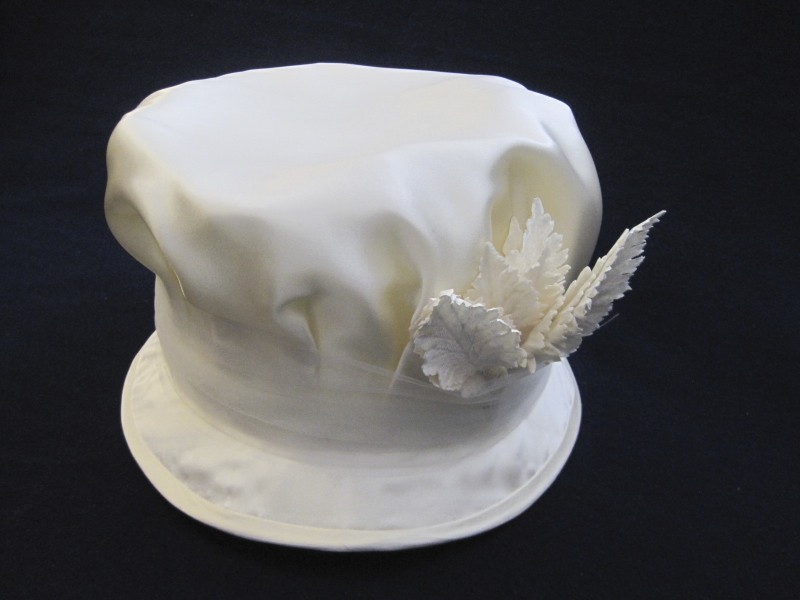
In addition to the gown, I also constructed what I call the “mushroom” hat, which you can read more about in this previous post. I created the pattern for the hat, which is basically just a shaped brim with circular side band. The side band support the crown, which is a circle that is pleated to create that “mushroom” shape. I love the hat! It lends such an air of Edwardian drama and elegance to the look! And I am so pleased the the “mushroom” shape worked out!
Hm… Patterning this dress… Well, the general skirt shape is from Janet Arnold, but it is adapted to have two symmetrical box pleats that terminate at the top in delightfully detailed seams (which I really, really need pictures of!). The bodice pattern was draped with many references to my inspiration image. I created a basic shape for the bodice and then cut in into the different pieces (ivory silk, ivory silk and lace, black velvet, and black charmeuse) so that each piece would fit together perfectly. The belt is slightly shaped but doesn’t actually have a pattern.
The dress is inspired by this image from a 1910 issue of the magazine Bon Ton.
I'm sure you can guess, but the dress I was referring to is the one on the right.
In the end I made a few changes: I added a train, discarded the white under sleeves (I made them, I tried them, and they just didn’t work! They pulled the bodice in all sorts of weird ways… Maybe if the were not so tight they wouldn’t pull so much? I am fine with having gloves cover my lower arms, anyway.), and drastically scaled back the beading. Perhaps you’ll remember my plan to bead this dress? Well, the beading was drastically scaled back because I didn’t like the beads I bought as much as I thought I would (they are rectangular and larger than I thought… not seed bead-y at all), I realized I didn’t want to devote as much time as it would take to do the amount of beading I originally intended, I didn’t have enough beads to bead all four panels as much as the one panel I completed and I didn’t want to buy more beads, and I didn’t like the beading motif I had created, nor was I inspired to change it. You can see that I did leave one outline shape of beading on the bodice in the velvet section, but the rest was scrapped. That one line is repeated front and back (symmetry, you know). I did actually complete the overskirt top panel, but decided not to use it after my scaling back plan was complete (you can see it, below). I’m going to keep the beaded panel and see if it finds its way onto another project one day… I would still love to do intense beading on a garment, but I’ll have to pick a different one, because it wasn’t measuring up to my expectations for this dress.
Scrapped beaded panel. A mix of silvery and black beads. I started in the center with the somewhat wonky lines, can you see improvement? I think it would have been distracting from the dress to have four panels like this.
I recently returned from a successful Titanic-themed weekend of events, including multiple vintage dance opportunities. I’ve been working on some new clothing for these events since January, which you can read more about in my past posts relating to the 100th Anniversary of the Titanic. I’ve been rather remiss in posting updates about the progress of the new dresses I constructed for these events… So my first task is to share pictures of my attire and explain the inspiration and construction of the garments.
I created two new 1912 ensembles: an evening gown and a day gown with accompanying hat. Let’s start with the evening gown!
My camera had a challenging time capturing the colors and shimmering sequins on this gown, but this is a good representation of the colors. Look! I wore my ballroom dance shoes, which worked well, and my white kid opera gloves and pearl drop earrings... fabulous!Fabulous painted backdrop! Perfect for taking photos, although my camera didn't quite catch the colors so well in this photo. I think this gown is so much more fabulous in person! I was told that the sequins just shimmer in subdued mood lighting.
This gown is burgundy silk charmeuse with a gold silk charmeuse underskirt. The bodice is gold silk layered under gold sequined net. The sleeves are the same gold sequined net flat lined with nude colored tulle: the tulle provides unnoticeable stability for the net layer. The burgundy layers are pleated up and held in place in two places by gold silk and sequined net covered buttons. The bodice and skirt are lined with brown cotton and the entire dress is mounted on a foundation of some extra white cotton which I have an excess of in my fabric stash. The foundation layer is essential to the drape of the dress, because it provides stability as well as a layer to attach all of the pleats and drapery points to. The foundation allows the burgundy silk to effortlessly hang and artfully fold without looking heavy or as though it serves to hold an weight. The foundation layer also supports the underskirt which is attached at about knee height (thus not extending all the way up to the waist and saving fabric). If you plan to create a draped Edwardian gown I strongly suggest that you include a foundation layer: the practice is historically accurate and will help your dress look effortless rather than heavy. This gown closes center back with hooks and eyes along the gold sequin area and a complicated series of further hooks and eyes at the top of the burgundy back drape. The hooks and eyes help create the tension that is required to keep the waist carefully draped in elegant folds across the waist.
There is not a hat associated with this gown because hats were not worn for formal evening events. I did create a wonderful Edwardian coiffure with loops and puffs of hair on the crown of my head surmounting the two front sweeps from the front as they swooped around the base of the back of my head. Unfortunately, I didn’t get any closeups of the style. I feel it is necessary to encourage you by saying that the more often I practice my Edwardian hair styling the faster I am and the better the styles look. You, too, can have fabulous Edwardian hair! Practice! Practice! Practice!
I draped the pattern for the foundation, bodice, and sleeves. The underskirt is a mix of information from the usual pattern book culprits (Janet Arnold and Norah Waugh) that I took in and then kept in mind while flat patterning a knee high underskirt pattern. The outer draped layer is just that: draped. It was a good challenge–I would have a hard time creating a flat pattern of that layer. All I can say is that it is just one rectangular piece of fabric that was sometimes frustrating and draped with many references to my inspirational images.
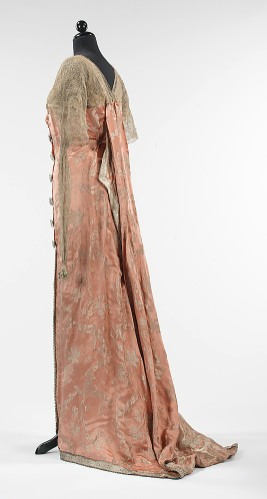
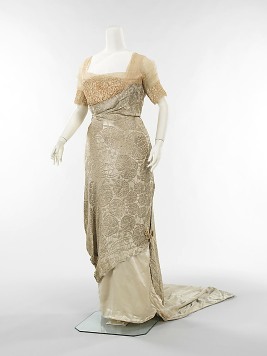
It turns out that the evening gown is a mash-up of two gowns (pictured below) at the Metropolitan Museum of Art. I think I started by aiming for the pink dress but wound up moseying my way along to the pale blue dress. Do you see the influence of both the pink and pale blue dresses? I do…
1914 Callot Soeurs evening dressSide/Back of the same.1911-1914 Callot Souers evening dress.Side/Back of the same.
The specifics: wired buckram brim and sideband, ivory silk charmeuse flatlined with ivory cotton to cover the brim and crown, bias cut ivory silk shantung brim binding, trimmed with ivory tulle and black ostrich feathers, lined with the same ivory cotton as the flat lining. (Did you know that craft stores sell tulle in 6″ wide rolls 25′ long in all sorts of colors in the bridal section??? This is great for hats!)
All in all, I’d say the hat turned out beautifully! I didn’t take the time to smooth out every bubble in the silk charmeuse along the brim, so there are a few bubbles… but I think I’m the only person who will ever notice them. It’s rather a tall hat… But I like it! I think it achieved the mushroom-y look I mentioned in Part I of the Ivory Mushroom Hat adventure and it has space in the head size opening as I intended. It even resembles a mob-cap, as I mentioned in Part I. Yay! I think it lends some serious Edwardian grandeur to my look. Full length pictures of the tea gown are coming soon so you can decide what you think about the hat.
It turns out that hair makes a great bandeau! I added some fake hair to my coiffure for tea to help support the hat in the back and it worked wonderfully. Without the extra hair the hat slips down over my face to a point somewhere around my nose… luckily, my poofy hair plus some extra hair works wonders!
I decided to trim the hat with black feathers and an ivory tulle bow because all ivory was overwhelming… the tulle trim is lost, whereas when black feathers are added the tulle trim suddenly stands out as well. Judge for yourself, below! Here are some other trim ideas I sampled on the hat before making my decision.
All ivory with a tulle bow.All ivory with ivory millinery leaves.With black goose biots.
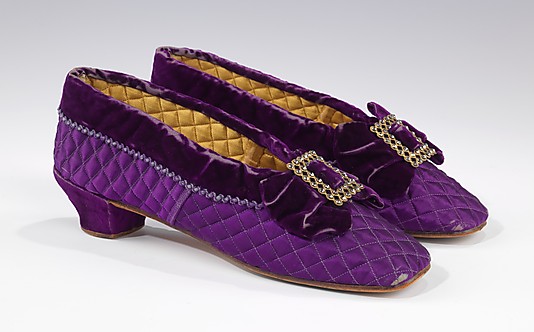
Recently, while looking through the Metropolitan Museum of Art’s Costume Collection for entirely unrelated items, I came across these very purple quilted slippers. I like them, but I also feel they are a little loud. Quilting? And purple? And velvet? And bows? There’s just a lot going on. They look pretty comfortable, though! How do you feel about these? And can you imagine what sort of dress would go with them? Perhaps a white cotton flounced one with purple trim…
1865-1885 Silk Slippers (Metropolitan Museum of Art)
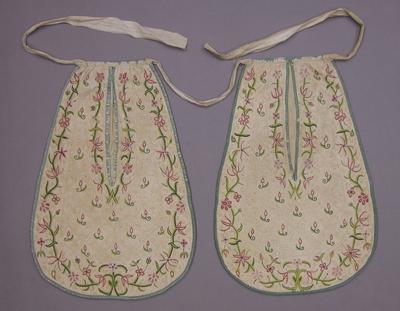
For the last month, I have been pondering the idea of making 18th century pockets. It was my idea to wear them to an 18th century ball and use them as a place to store my modern items (cell phone, credit card, cash, car keys, etc.). I was thinking of making simple linen ones, without embroidery, but once I started researching them I realized that I really wanted to go the full distance. In this case, the full distance meant hand sewn silk embroidery… The realization hit me just a few days before the ball that this plan was flawed. There was no way I was going to complete hand embroidered pockets in the time I had left. My choices: to fudge it and be stressed out while trying to complete hand embroidery with cotton thread or to wait, source my products and make a plan, and enjoy my time hand embroidering. What to do? Well, I decided to do the latter and I am glad to say that I am thankful to have used common sense and avoided stress! For now, the plan to make pockets has been added to my list of things to make in my leisure sewing time (when other, more time sensitive projects are lacking… Does that ever happen???). These charming pink, green, and blue ones are my goal.
Early 1700s pockets, linen embroidered with silk, trimmed with silk ribbon and with silk ties (V and A)
Pockets in the 18th century were often made of linen and elaborately embroidered in colorful silk or wool thread, as with the example above and the following examples. Aren’t these yellow trimmed ones adorable? It looks like the pocket slits are smiling!
Mid-1700s pockets, linen embroidered with silk, trimmed with silk and with silk and linen ties (Manchester City Galleries)
This next pair of pockets has beautiful (and intense) embroidery.
Mid-1700s pockets, linen embroidered with wool, with linen ties (Worthing Museum and Art Gallery)
This next pocket has a lovely embroidered pattern that looks much simpler to replicate than the previous examples. This is my back up plan if the other, more complicated embroidery proves to be too much.
1718-1720 pocket, linen embroidered with silk, with linen ties (V and A)
The pockets with unfinished red embroidery are an excellent example of pocket construction. You can see the manner in which the design is marked as well as the embroidery being completed prior to the pocket being cut out and assembled.
1718-1720 pockets, linen with silk embroidery, the pattern drawn in ink (V and A)
There are also some pockets constructed of silk, such as these, below. These pockets were acquired with a quilted silk petticoat and the Victoria and ALbert Museum assumes that they were intended to be worn together. They look puffy and super cute, but because they are assumed to have such a specific purpose I don’t think they are the right idea for me. Also, I wouldn’t get to embroider!
Mid-1700s pockets, silk with silk ribbon (V and A)
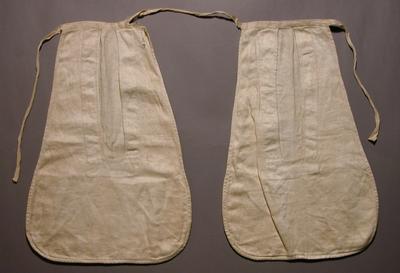
Pockets continued to be used in the 19th century, but they were often constructed of cotton rather than linen and were not as elaborately embroidered as in the pervious century. Some 19th century pockets were constructed of cottons with woven patterns, such as stripes or diamonds as well as the occasional pocket of satin weave cotton fabric. In the middle of the century embroidery was again used as decoration, though the motifs were changed from the 18th century. These next few pockets are just a few 19th century ones I like, either because they use interesting fabrics, or because they are smiling at you!
Late 1800s pockets, twill weave cotton (Oxfordshire Museum Service)I like this one especially, because it really does look like a smiley face pocket! Early 1800s pockets, ribbed cotton, with cotton tape (Cheltenham Art Gallery and Museum) Early-mid-1800s pockets, satin weave cotton (Maidstone Museum and Bentlif Art Gallery)early 1800s pockets, figured silk satin, trimmed with silk (Cheltenham Art Gallery and Museum)
Do you have a favorite pocket amongst these? Does any pair stand out to you?
All of these pockets were recently available at here, at VADS: the online resource for visual arts; however, VADS appears to no longer be operable (perhaps because of recent US government action to curtail internet copyright infringement?). Alternatively, the Victoria and Albert Museum has a pretty good selection of pockets, including some of the ones featured on VADS.
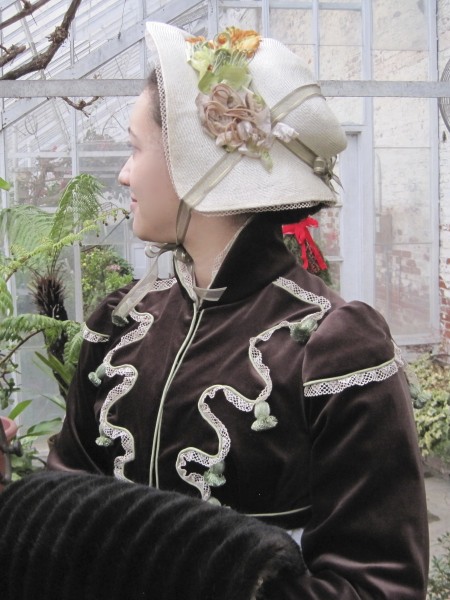
As with the 1819 ivory gown, the bonnet that is part of my late Regency look has also been remade from its original style. Why re-make it, you might ask?
Though the bonnet was based off of an 1819 illustration in Cunnington’s English Women’s Clothing the Nineteenth Century, it was built for use in the theatre, so the materials used to trim it are nowhere near accurate for off stage use. However, the shape and placement of the trim was accuratly reproduced from the inspiration image and that fact made the re-trimming possible, because the base of the bonnet could remain unchanged!
Before: The bonnet before re-trimming
The original trim was entirely polyester, which stands out when placed with other, more accurate garments and in natural light (rather than stage lighting). The color scheme was pink and peach fabric manipulated in various ways: the flowers were pinked and gathered lengths of polyester fabric, the ribbons were bias cut polyester fabric, the inside of the brim was lined with pink polyester shantung, and the brim was edged with white polyester lace. Aside from the polyester problem, the pink color scheme would not match my darling new spencer, which is brown and green. It’s not that the colors would clash, it’s just that they would look like they were not intended for each other… and I really wanted a coherent, matching look to my ensemble.
And After: The re-trimmed bonnet with matching spencer
I removed all of the fabric flowers, the bias ribbon trim, the lace edging and the lining. The lining was replaced with green silk shantung to match the new bonnet trimmings and the spencer while the lace edging was changed to light brown vintage cotton lace that matches the lace used on the spencer. The flowers were replaced with millinery flowers in green and light brown from my stash. I decided to use the spark of orangey-brown near the top so that the bonnet wasn’t too matchy-matchy. The ribbon was changed out for a matching green ribbon that has narrow bands of gold along the edges (I confess it is still polyester… but I like the look of it and I didn’t have enough of my matching green silk satin ribbon to use it, nor did I like the shine of the satin with the green of the flowers). And voila! A bonnet that now is the right shape and has the right trimmings to match my Regency ensemble!
Well, it’s been a little bit of time since I shared with you my research and plan to build a Regency corset to accompany my 1819 gown. I’m excited to say that I was successful! The corset is complete, although I still plan to quilt a diamond pattern along front rib section within the next few months (I’ll share photos of that once it is complete). You can see the diamond quilting in the photos in the link, above.
The dummy isn't quite the right shape for this corset, but here it is!Corset back
This corset is constructed of two layers of pink cotton twill with a layer of coutil sandwiched between them to provide stability and support. I began construction by flatlining the coutil to the outer layer of twill. I sewed the non-gusset seams (the front and back pieces) together in these flat lined pieces, leaving the inside twill layer for later. Each gusset had all three layers flatlined together and sewn into place with the seam allowances pressed away from the gussets themselves. Then I went back and basted the inner twill pieces into place that had been left aside. I turned under the seams on these pieces and hand sewed them over the seam allowance of the gussets so that no seam allowance was showing.
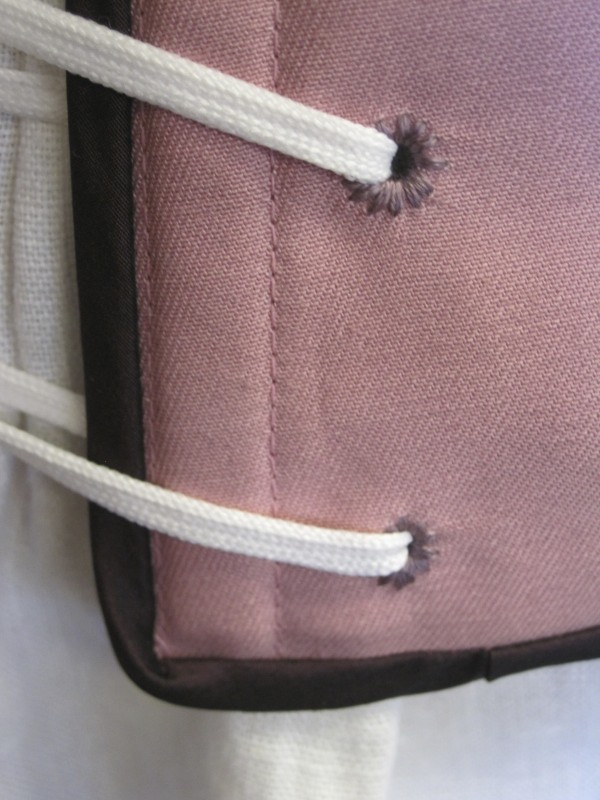
After completing the inside construction I bound the edges with purple bias silk taffeta, scraps from another project. The final step was to create eyelets. I decided to do these by hand in purple cotton embroidery floss. Each eyelet is reinforced with a metal jump ring that is caught under the thread on the inside of each eyelet. This reinforces the edge of each eyelet and keeps them from stretching out of shape when laced. The jump rings are only visible on the inside of the eyelets, where the stitching is bulkier because it passes over the rings.
Hand sewn eyelets, on the outside
The corset is lightly boned at center front and center back. I struggled over what material would be best to create the 2″ wide center front bone. Eventually I remembered a suggestion from a friend, Carly, who had used a creative option for boning that I decided would be perfect for this project. Home supply stores such as Home Depot and Loew’s sell plastic wire ties that are about 3/8″ wide and which come in lengths up to about 20″. The ties are a good 1/8″ thick, strong, but still bendable. They have a similar tension to a steel bone, but are a little thicker. And the nice thing is that you can cut and shape them easily with scissors! Of course, plastic boning is not historically accurate, but it is functional and affordable (a pack of these wire ties is about $5, and there are about 12 per pack) and creates a boned garment that feels similar to one boned with steel bones (and once you finish the garment, who would know?).
In this corset, each side of center back has a single bone. The 2″ wide center front bone is actually 5 wire ties attached to one other with (shhh!!!) masking tape! This is an experiment that I hope will work (I have slight fears that body heat might one day cause the tape to lose its grip and the bones to start to move around in funny ways, or worse, that the tape will leech sitcky goo onto the fabric that will stain the exterior). I put the center front bone in between the layer of coutil and the inside twill, so even if the masking tape does one day create stains, it is unlikely that the stains will make it to the outside of the corset.
As I mentioned in my last post in this Project Journal, I decided to make a pair of stays like the one to the right. I like the unique features of these: specifically the use of colorful fabric, the fact that this is fully boned, and the cording in each seam as well as the absence of shoulder straps and tabs. I adapted a pattern from Corsets and Crinolines by Norah Waugh. The pattern I started with had straps and tabs but I eliminated those elements to reproduce the pattern of these inspirational stays.
Cane boning
I decided to use cane boning for these stays for a few reasons: 1) I wanted to try a new material for boning 2) cane boning is period correct for the 1780s 3) given the amount of boning needed for a fully boned pair of stays the cane boning was much more cost effective (you can see the quantity on the left–it was about $15 from Wm. Booth, Draper) and 4) the cane boning seemed like it would be super easy to manipulate and, most importantly, to cut (and it was! normal scissors easily cut the correct lengths needed and it was easy to round the ends a little bit as well!). I actually only wound up using approximately half of the cane boning that I bought, so that means that I have plenty to use for another future project!
The silk that I decided to use as my exterior fabric is a fabulous damask. I originally thought about stitching my boning channels through the exterior fabric (as in my inspirational piece) but decided against that idea on this fabric, because it would really have just been way to much going on with the pattern and so many stitch lines. You can see the silk pattern a few pictures father down.
Stitching the boning channels
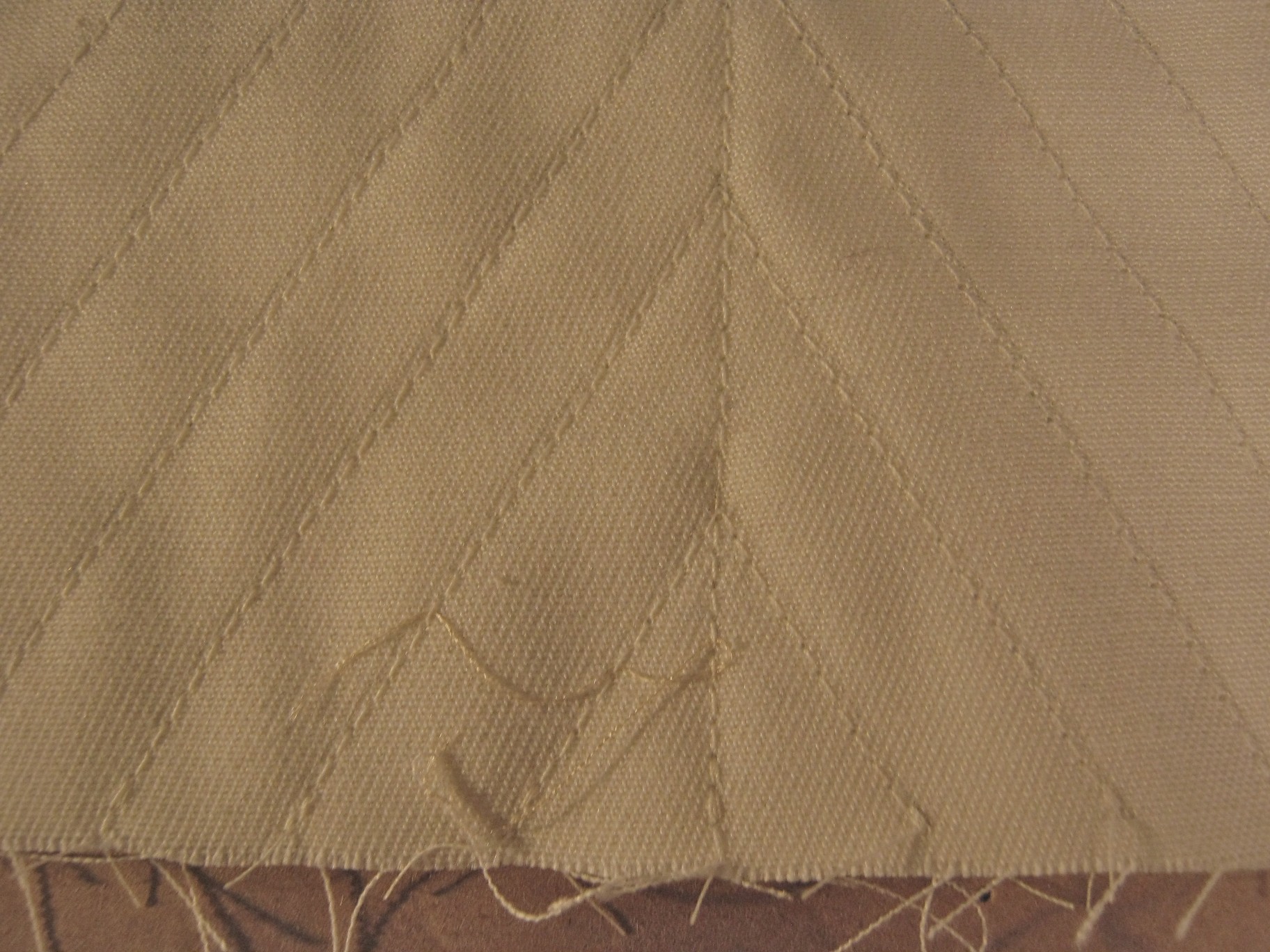
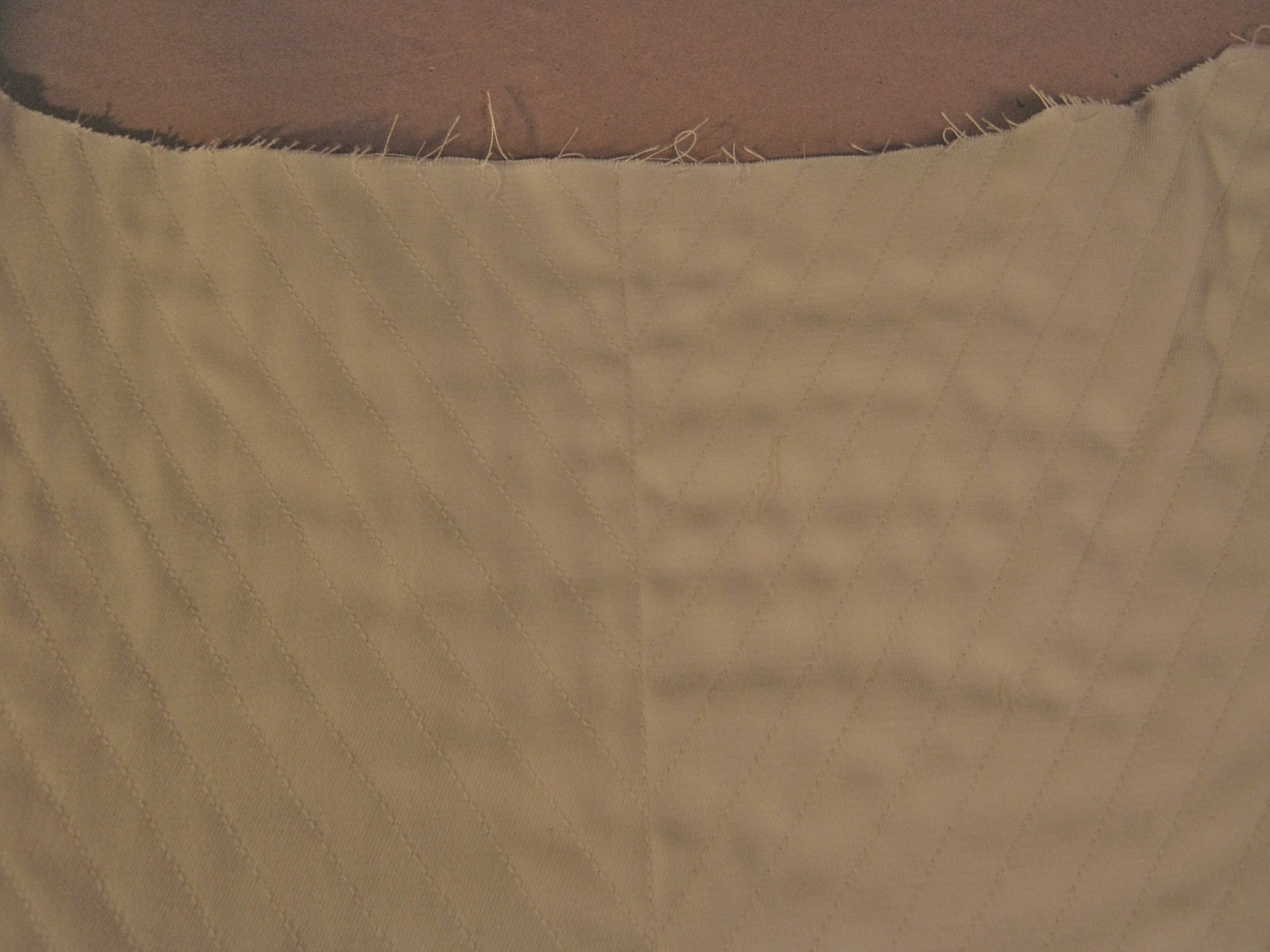
I didn’t want to stitch boning channels through my silk so I started the construction process by stitching the boning channels through two layers of cotton. You can see that I drew lines on the fabric so I could make nice, straight lines. The nice this about this is that I covered the pencil marking side with the silk, so on the inside of the finished corset all you can see is the stitching with no indication of pencil lines!
You can see the pencil guide lines on this side of the corsetOn this side there are no pencil lines!
I did want my silk to roll around the center back opening on each side and then be included in the seam attaching center back to the next piece, so I stitched those silk pieces into the seams of the cotton. I just kept the silk out of the way while sewing the boning channels. Then, once the boning was complete, I stitched the remaining silk pieces to the flapping center back pieces and turned the whole thing so that the silk was on the outside with the seams facing the side of the cotton that had the pencil lines drawn on. Thus, the silk is just a covering for the cotton, it is not actually attached into the seams of the cotton except on the inside at the side back seam. You can see what I mean in the pictures below.
Stays with the boning channels sewn (you can see that only the center back silk pieces are attached at this point)Stays with the cane boning inserted, before the silk is sewn onThe silk has been attached (you can see the cording and the pattern on the silk in this picture)
At this point the stays are almost finished! The last few tasks are to bind the edges (I’ll be using bias strips cut from the same cotton as the cording and lining) and work hand sewn eyelets along each side of center back. More pictures to come!
I’ve decided to attend 2 events in September which require clothing from the last quarter of the 18th century (1775-1799). This decision is rather at the last minute when it comes to building new historic clothes: I now have exactly three weeks to make a decision about what to wear, pick out fabrics, make patterns, and complete the construction of the garments. Yikes!
So I’ve been busy researching this period because it is not within the realm of my previous historic clothing projects, which have generally focused on the 19th century. Unlike women’s clothing in the 19th century, for which I can recall silhouette, construction details, pattern shapes, and fabric choices and colors with far less research for each garment (because I’ve already done all that research and it’s all in my head…), I really need the research to be able to consider reproducing historic clothing from the 18th century. Here are some inspirational images I thought I would share!
Here’s how this conversation went in my head: “Where do I start?” I asked myself. “Silhouette?” I replied. “Ah, yes. That sounds good. But… what is the silhouette during this period? Hopefully not panniers!” because panniers, you see, require a lot more effort to produce and a lot more fabric to cover. “Well, let’s start by looking for some images,” I suggested. And here we go!
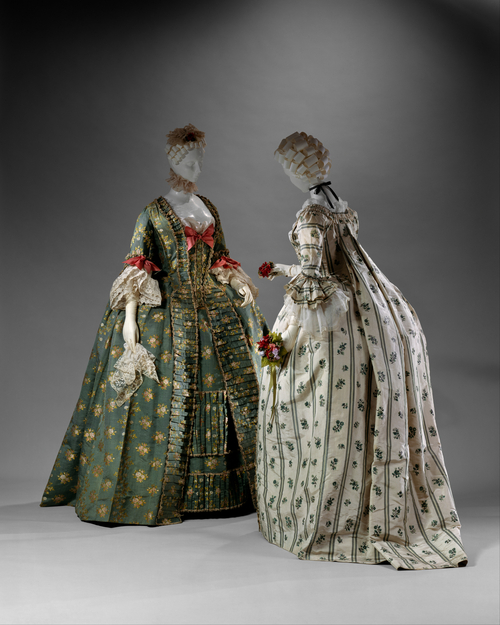
c. 1770 Silk Robe a l'Francaise at the Metropolitan Museum of Art
Now, you can see by looking at the above image that these gowns require panniers to achieve the exaggerated hip shape. You can also see that these gowns are Robes a l’Francaise, meaning robes in the French style. This style of gown has the characteristic pleating at center back that falls from the back neck line to the floor in one piece. This style, with the panniers and the Robe a l’Francaise, is not what I have the time to make in three weeks. So we move on!
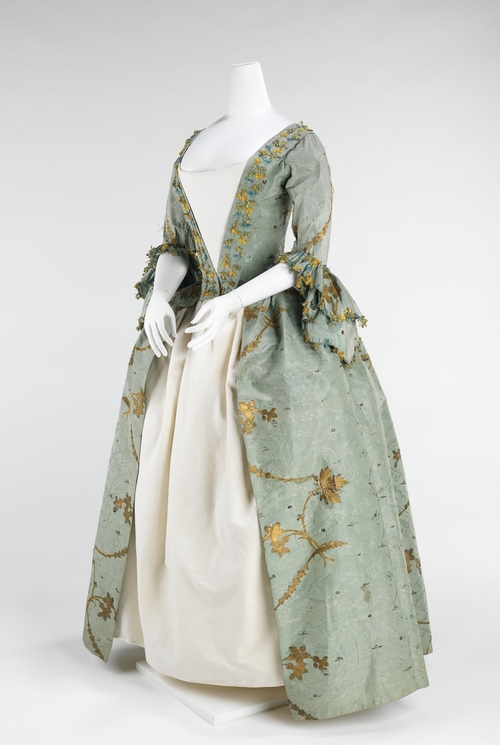
1770-1775 Silk Robe a l'Anglaise at the Metropolitan Museum of Art
In contrast to the Robe a l’Francaise, I am actually interested in the style of dress on the left: the Robe a l’Anglaise, or English style robes. This style evolved from the Robe a l’Francaise: over time the side back seams of the Robe al’Francaise were cut close enough together that the characteristic pleats were no longer used.
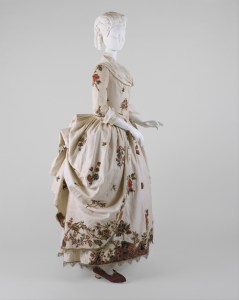
Below, you can see another two examples of gowns in the style of a Robe a l’Anglaise. These two are from the 1780s and you can see that the width of the hips has diminished from the 1770s. Note that all of these gowns have open fronts that show the petticoat underneath.
c. 1780 Cotton Robe a l'Anglaise at the Metropolitan Museum of Artc. 1780 Cotton Robe a l'Anglaise from the Metropolitan Museum of Art
1780-1785 Cotton Robe a l'Anglaise at the Metropolitan Museum of Art1780-1785 Cotton Robe a l'Anglaise at the Metropolitan Museum of Art
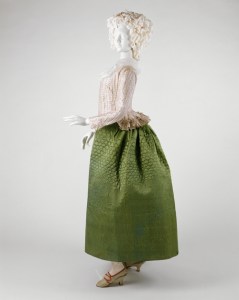
There are other options for this period as well: there is the style Robe a la Polonaise, which has a characteristic bunching of fabric across the back side as well as the skirt and jacket combination. I’m not interested in making a Robe a la Polonaise at this point, but a skirt and jacket combination is a possibility. You can see these styles below. There is another style as well: the Chemise Dress, but you’ll have to wait for my next post to see and read about it!
c. 1780 Linen Robe a la Polonaise at the Metropolitan Museum of Art
c. 1785 Silk Jacket at the Metropolitan Museum of Art



















 The Quintessential Clothes Pen