New month = new adventures! This one happened back in August (I did a lot of things that month, so you’ll be hearing about them for awhile) not too long after Newport Vintage Dance Week, the subject of the last… ahem… ten posts on this blog. Anyway, this was another fun filled dancing adventure with the same young people that attended Newport… but in a different period: Regency.
In August, the Commonwealth Vintage Dancers performed in and occupied the Commandant’s House at the Charlestown Navy Yard in Boston as part of the celebration of the 200th anniversary of the USS Constitution‘s defeat of the HMS Guerriere in the War of 1812. The Navy Yard was also host to multiple groups of War of 1812 military reenactors from both the American and British sides who did various exhibitions during the weekend in addition to just hanging around their camps looking stylish in their military uniforms.
I wound up with about 400 of my own pictures from the weekend, a number which I have slimmed down in order to share with you only the best of the bunch; however, it’s still more pictures than is reasonable for one post. Thus, I will be doing four posts about the weekend! I had to sort the pictures somehow, so I’ve created four different focuses for each of the posts. This first post I entitled “Happenings” because it is pictures of CVD members and reenactors doing things of various sorts (as opposed to the content of my next two posts: “The USS Constitution” and “Lounging in the Commandant’s House”). The final post will be about the all new hand sewn 1812 dress I whipped out in the week before the performance! I’ll have to come up with a fun title for that one…
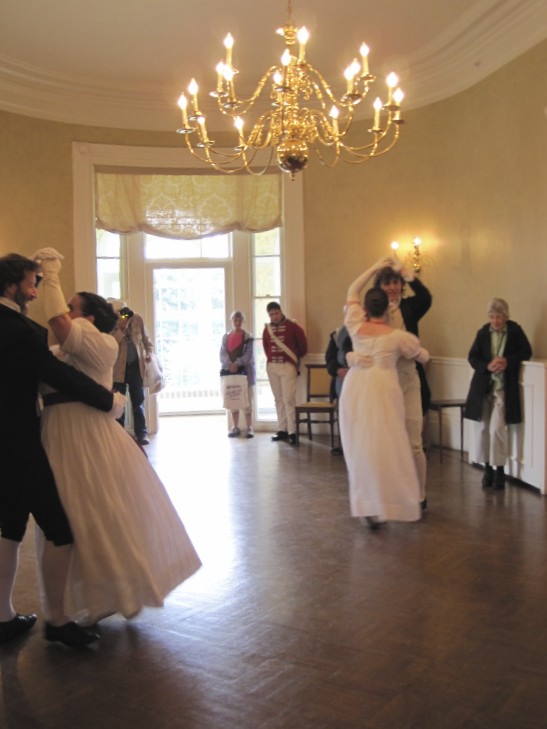
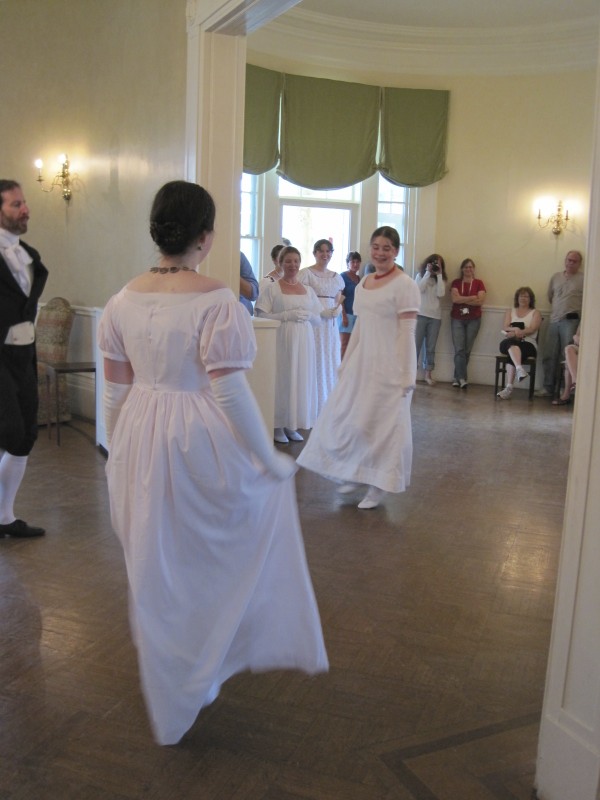
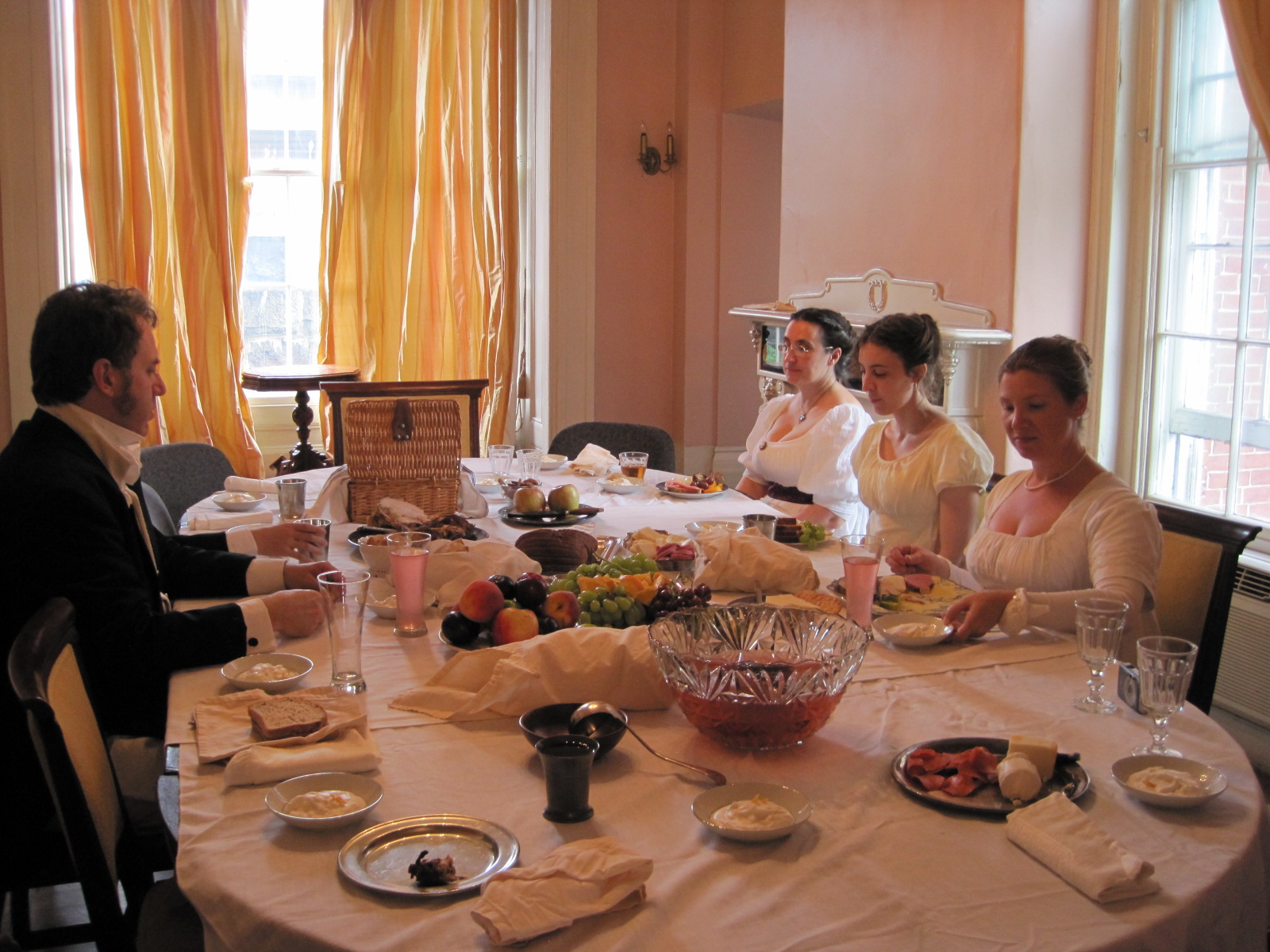
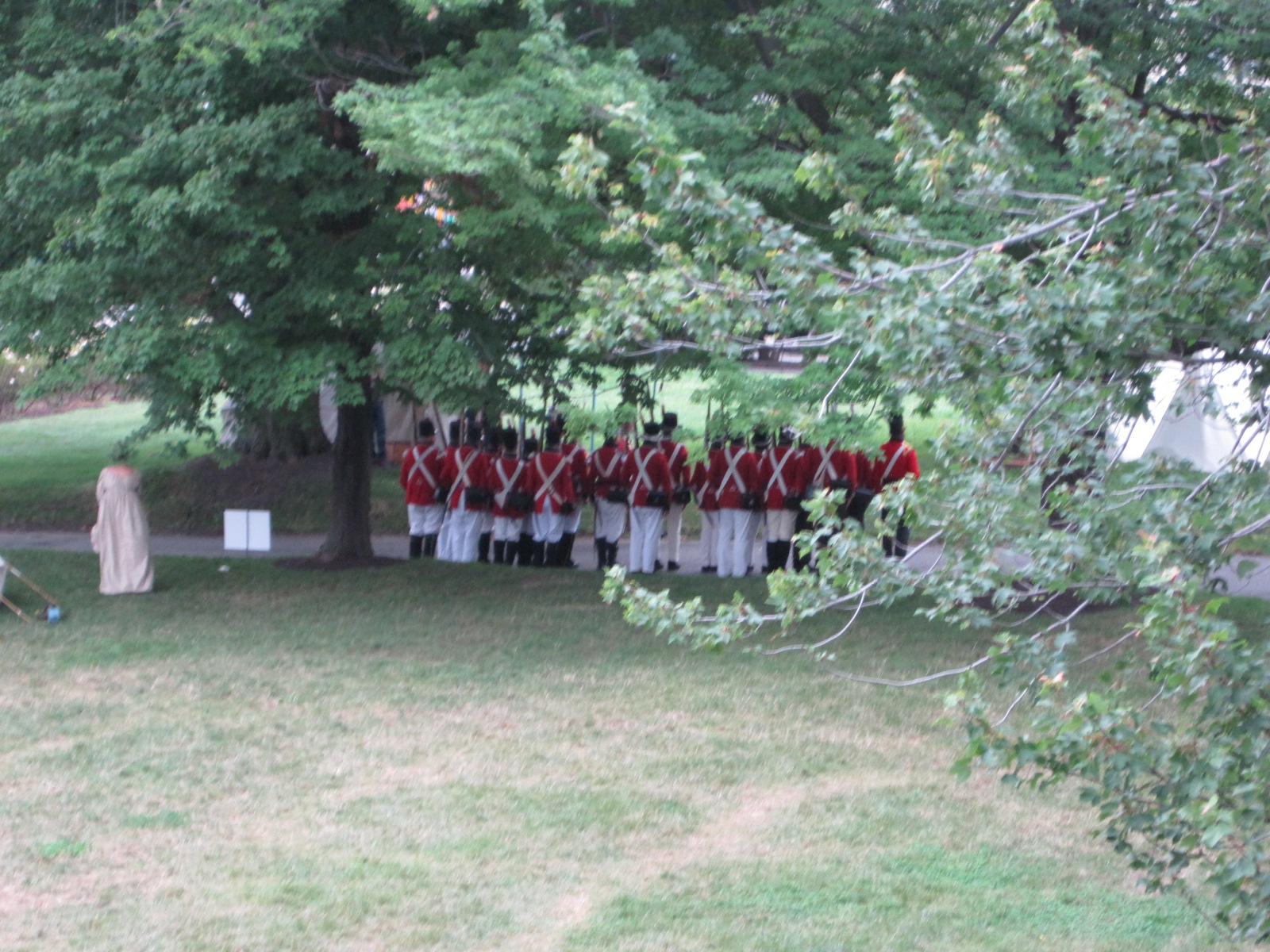
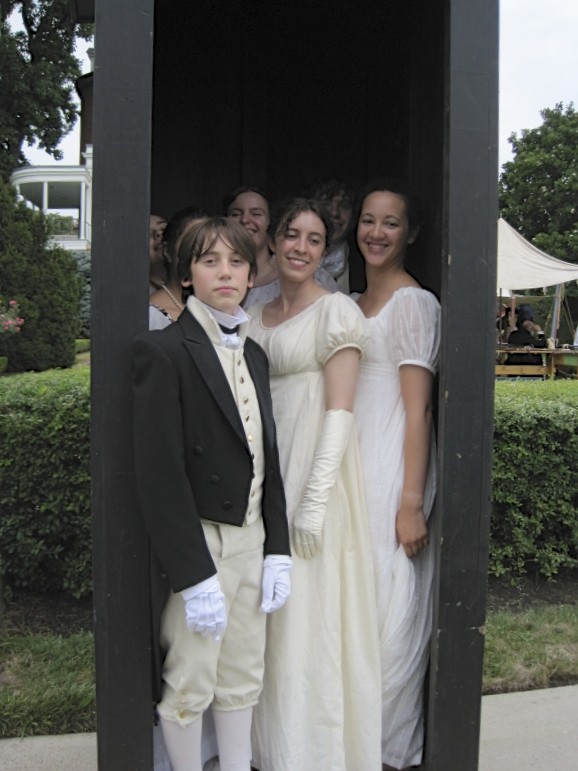
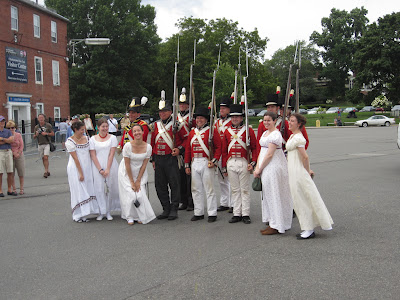
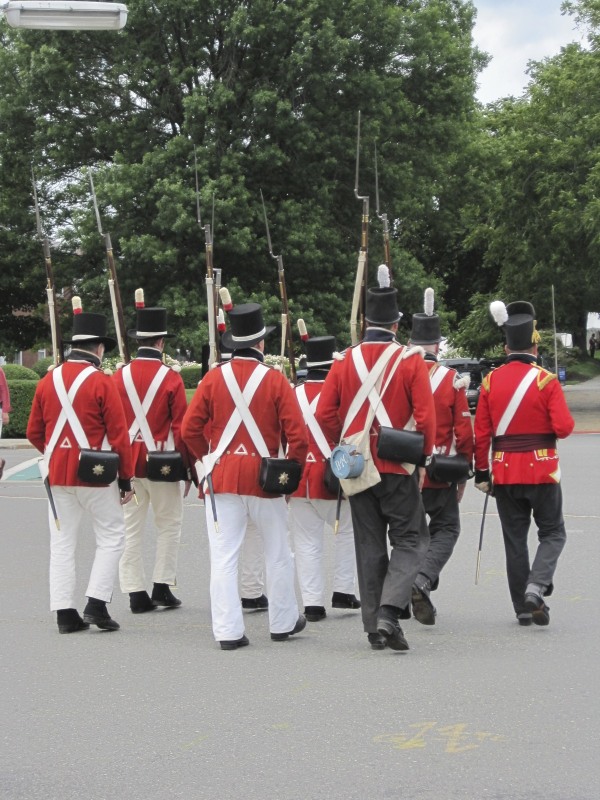
You know us TNG-ers. We like pictures of us running around. In this picture, we’re running up the walk to the Commandant’s House, our hang out for the 1812 weekend.Some CVD performers starting the weekend off with pictures!A little bit of Wilson’s Waltz on Saturday.And some Scotch Reel.It was pretty fabulous that on Saturday we had live music to dance to!Between performances on Saturday we played Regency card games including Palace and… (oh no, my mind is blanking! Someone help me remember the name of that C game! It wasn’t Convergence… or Chance… Eep!)Getting to know a few of the British soldiers while we were preparing for lunch in the dining room.Lunch was a Regency food potluck affair. It looked pretty appetizing and picturesque.I enjoyed looking out of the windows and exclaiming “Look! Dudes are doing drills!”In the afternoon we played Blind Man’s Bluff, which is super fun and works really well on a wooden floor.It’s quite possible that running around and playing this game was more tiring than dancing.The way the game works is that the blindfolded person has to try and catch someone else and then correctly guess who it is. The trouble is that all the un-blindfolded people can either be really quiet or make lots of noise to confuse the blindfolded person.More CVD: this time inside the house in one of the rooms we danced in.British are red. Americans are blue.I think almost everyone had made new clothes for this performance, since Regency isn’t a period CVD usually performs.There was also an unoccupied guard hut in front of the Commandant’s House that begged for pictures.How many people do you think will fit inside?On Saturday evening there was a ball for the reenactors. Sadly, not many of them attended, and even fewer stuck it out until the end of the night. However, the small number of people made for a cosy atmosphere.On Sunday afternoon we had a picnic out on the lawn of the Commandant’s House.And we ran around on the lawn.We also went down to the dock to see the Constitution. The reenactors were also there. Here are the Americans.And here are the British. Isn’t the Boston skyline in the background an interesting contrast to the bayonets?The British soldiers were posing for pictures for the tourists. We took the opportunity to join them, with many cheers from the crowd.British soldiers at ease.There was also this little mini-cannon. Not sure what it was for.This hat beat them all! I love these fur hats! It’s like the guards at Buckingham Palace.The British soldiers certainly made more appearances on my camera. Here they are heading off to create new adventures.
As you might recall from my last post, I have more Regency picnic game pictures to share with you! I’m excited! I hope you are as well… We left off with the four of us playing “Graces” and coming up with innovative methods of playing to keep us amused and challenged… let’s just see where that led us! I had a hard time condensing the photos… I hope you’re not overwhelmed!
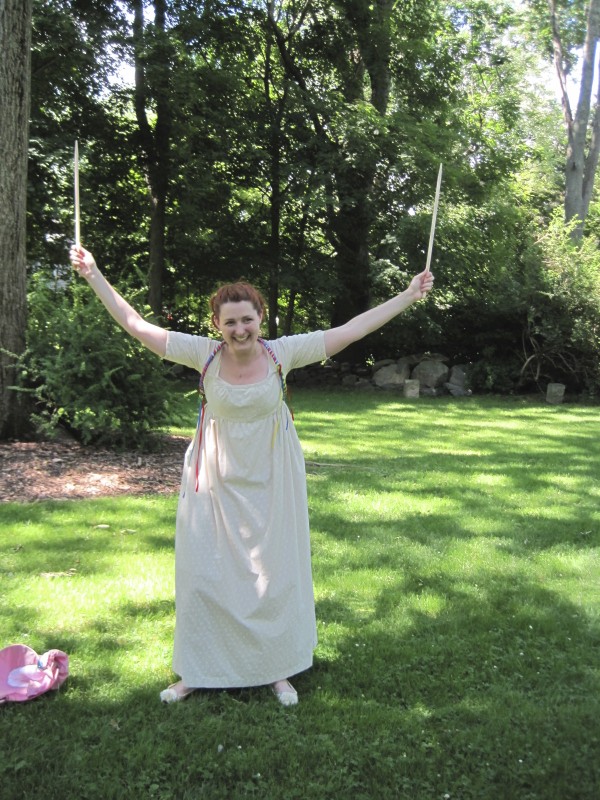
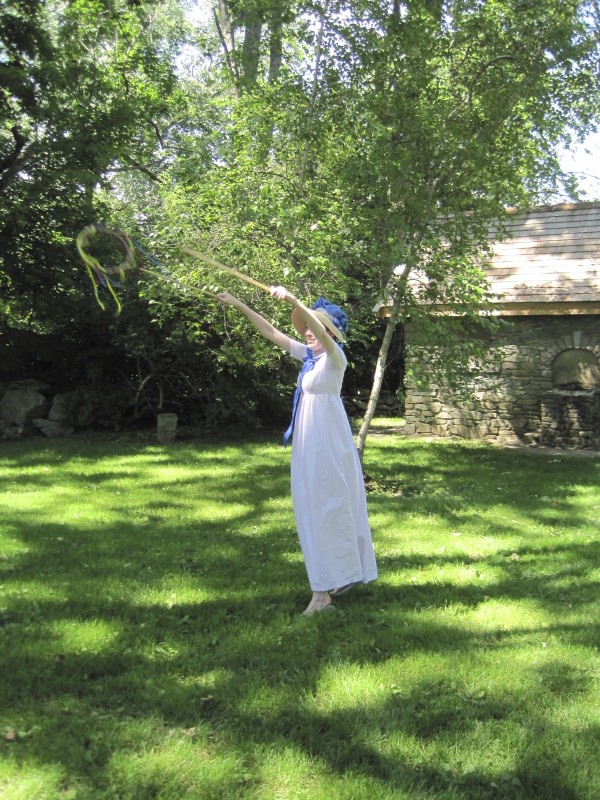
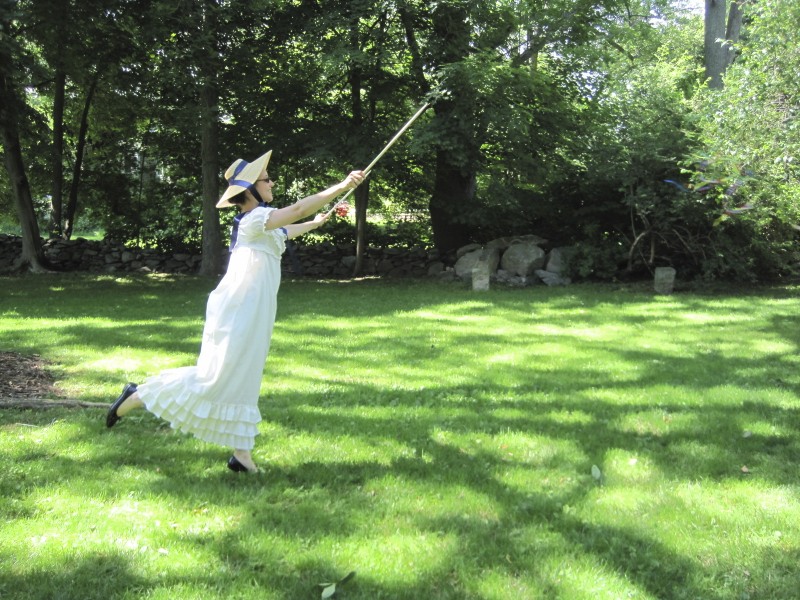
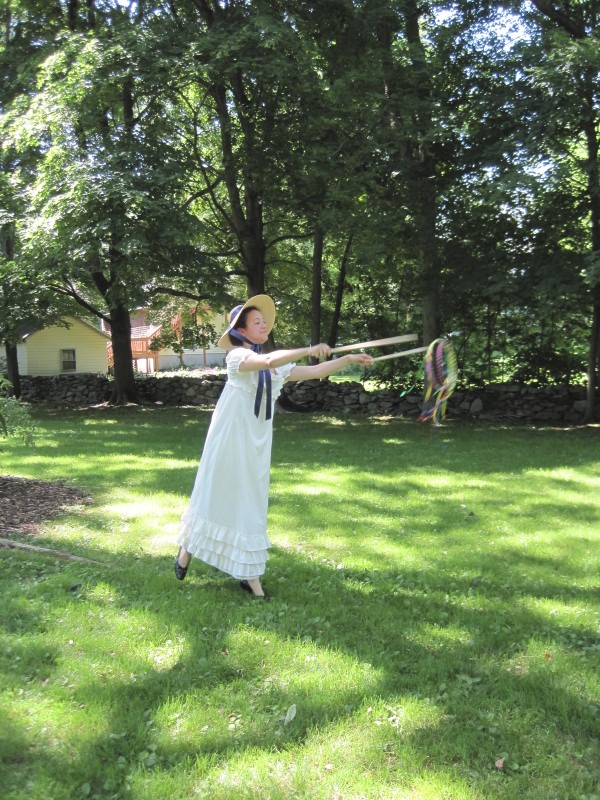
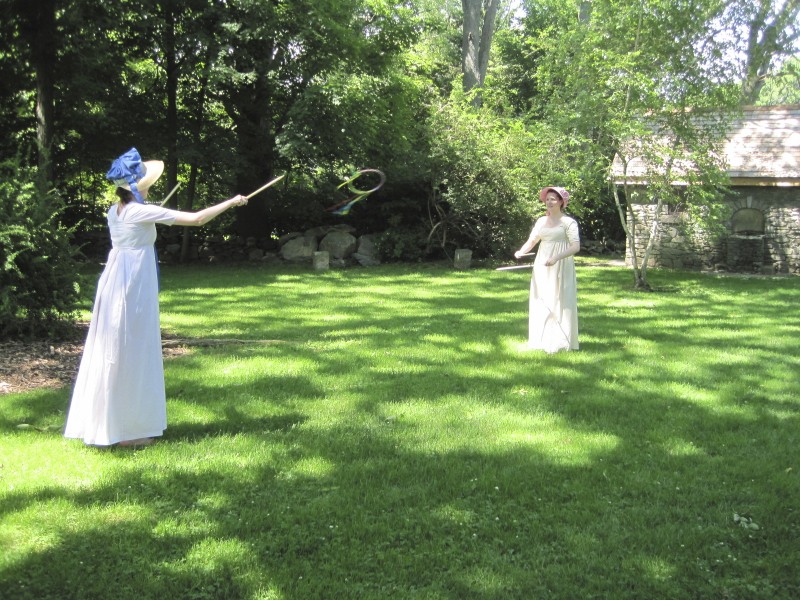
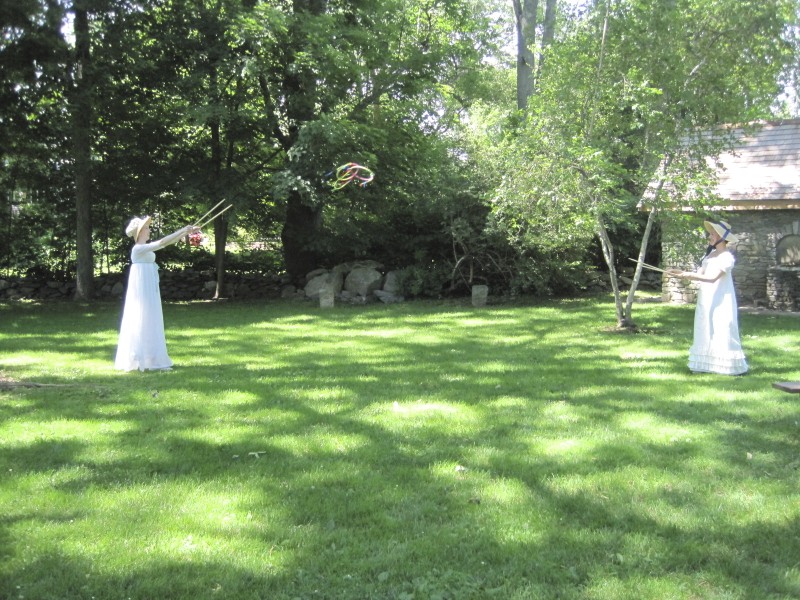
Lost my bonnet, but I caught a hoop on each arm! Success!Yes! Bonnet still on head and two hoops! Wow!Double hoop-age and a silly looking action shot! What could be better?Reach! Somehow, I think this is much more graceful looking than the last photo…
Okay… now we get silly!
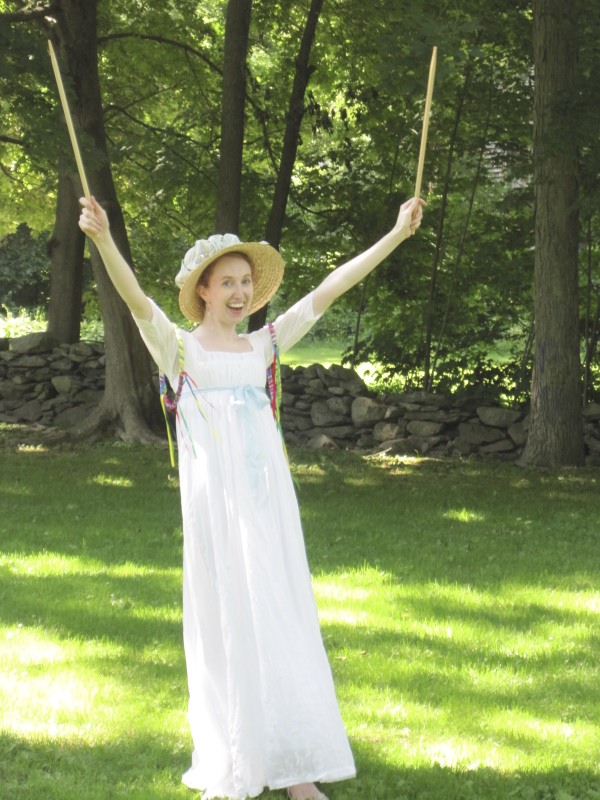
Wand attack pose. Not very Regency-like, but amusing, nonetheless!Strike a pose! Conduct an orchestra! ???
Attempts at being graceful and Regency-like…
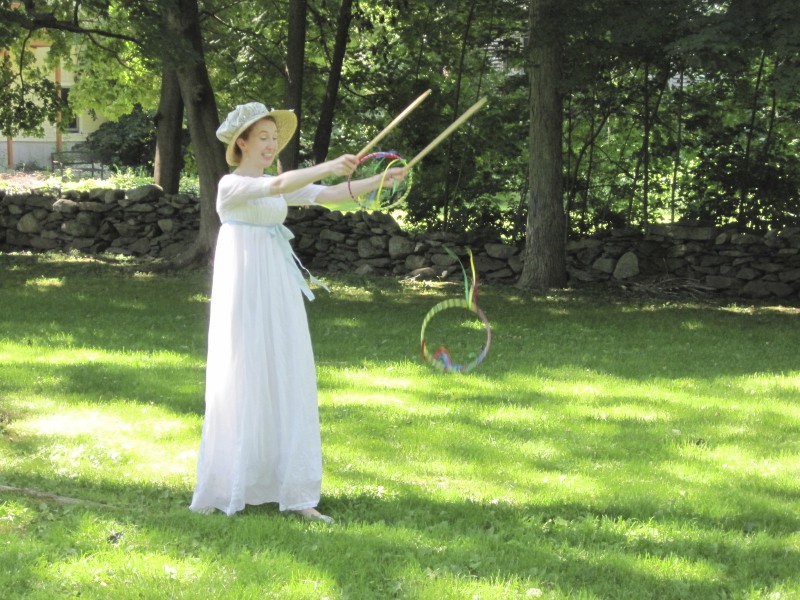
Very graceful hoop catching.Waiting to catch the hoops.Gracefully catching the flung hoop.Another graceful pose. Okay, okay, so I wore my sunglasses for much of the picnic. Shhh!
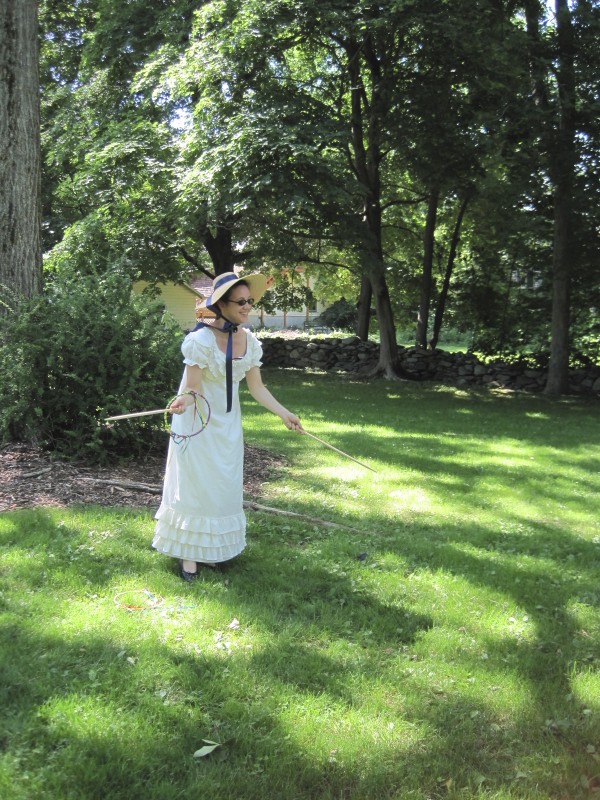
Bloopers?
Graceful, certainly, but I don’t think I caught the hoops that time…This certainly looks like one time when the hoops are going to hit the ground…(More sunglasses… didn’t they have those?)I think I’m confused about why the second hoop is on the ground by my right foot…
Vacationing is lovely while it lasts, but it does seem to make real life a bit overwhelming. I’ve been slow on the posting lately because of my vacationing. And, to be honest, life + vacationing is most likely going to be slowing me down some more over the next month or so. Some of my vacations will generate some really great pictures, though, so stay tuned for those in August!
It’s been roasting-ly hot here in Massachusetts for the last few weeks, but the heat didn’t stop the Massachusetts Costumers from enjoying the annual Regency Picnic. It was toasty, but we tried to spend lots of time in the shade. And despite the heat, we had a marvelous time! Join me in recalling the fun through viewing (just a few of the 300 or so) pictures we snapped that day.
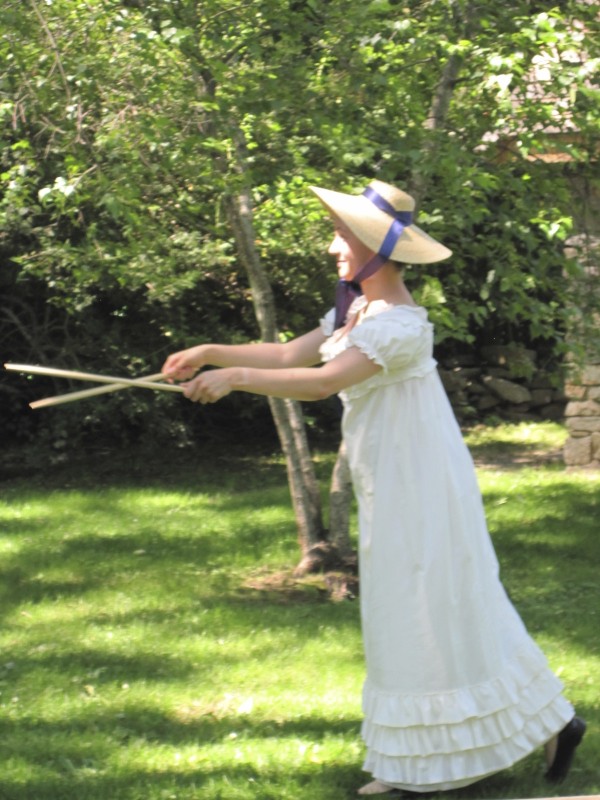
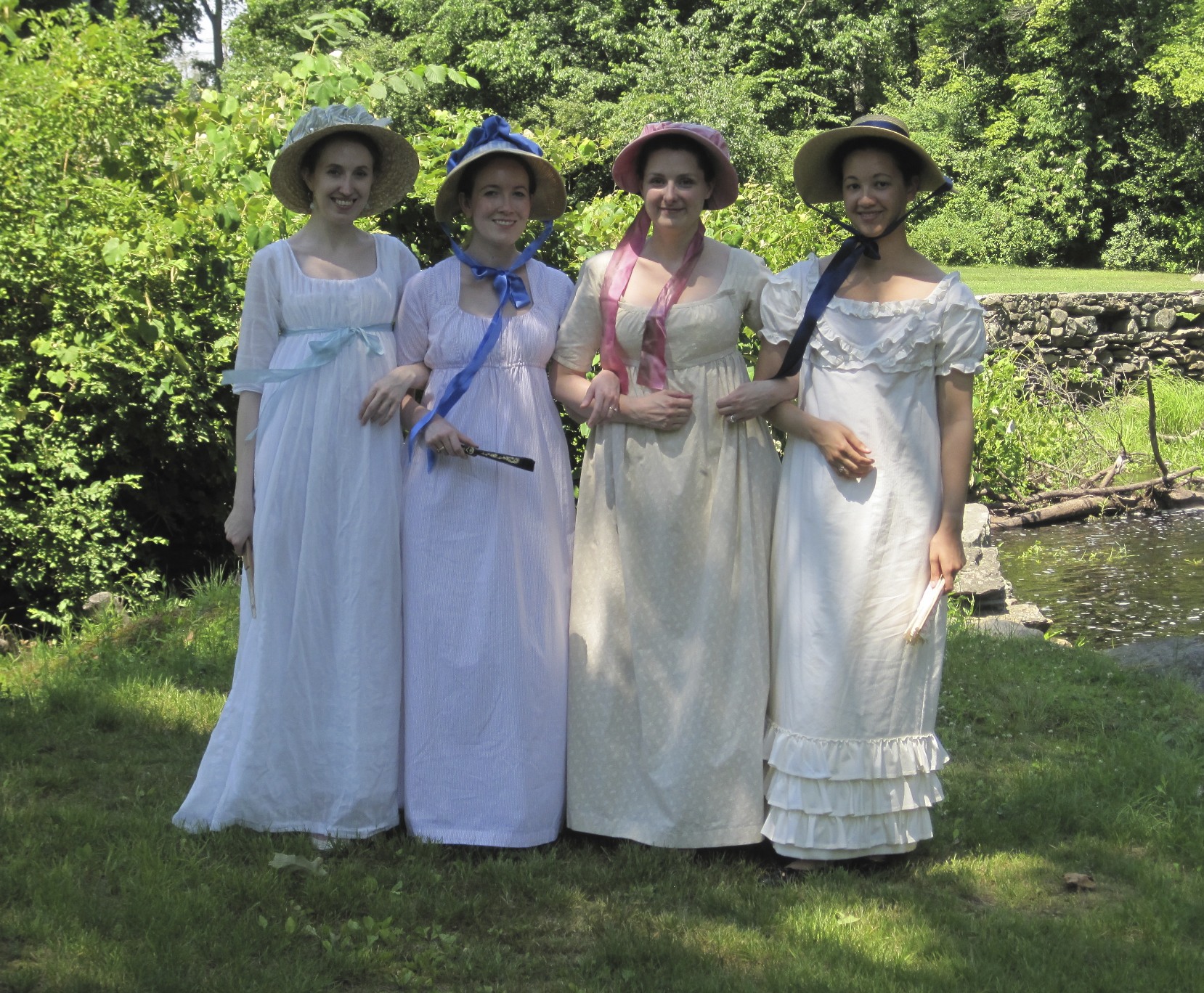
Our idyllic setting at a lovely park in Bridgewater, MA.Okay, so our food and table setting was not historically accurate. But the colors were so nice and summer-y! (And the pink lemonade was quite refreshing.)After eating, we strolled through the park and took pictures (and coerced random passers-by to take photos of us…). Lovely group of ladies, don’t you think?Then we played a Regency game called… “Graces?” (Ack! I can’t remember the name… Jenni, help me!)Basically, each person has two long sticks which they use to fling the be-ribboned hoops at the other player. The second person catches the hoops on their own sticks before flinging them back again.I’ve included pictures where you can see the hoops in midair. Despite the fact that we often seem to be catching the hoops, I also have many pictures where we, um, didn’t catch the hoops…Eventually, we got the hang of it and decided to make it more challenging. In this instance we had two hoops going at once, one flung by each player!It took a little time to get used to the coordination of flinging and catching in quick succession.But we got the hang of it and then we started flinging two hoops at the same time in one direction! That meant the person catching had to catch two at once! Eep!
After that challenge we thought we were finished with the game… but then one of us (I can’t remember who…) had the brilliant idea to attempt to make graceul, Regency-like poses, while playing the game. That kept us going for awhile longer, with some amusing photos and lots of laughs, but you’ll have to wait till my next post for those photos (I don’t want to overload you with too many fun in the sun Regency picnic photos at once, you know!). In the end, the heat wasn’t so bad!
Now that we’ve seen my re-made 1819 dress (woohoo!), let’s look a little closer at my hair. Despite the fact that I have naturally curly hair, Regency hair styles are not as easy for me to achieve as you might think. Many Regency styles have short curls (bangs, really) that surround the face, like the one below.
1813 Ackermann’s fashion plate from EK Duncan’s blog: look at those curls that frame her face!
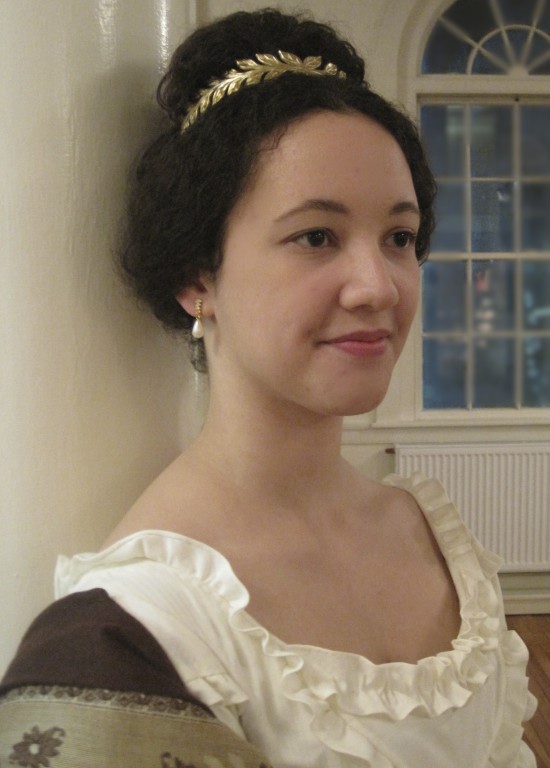
However, in this modern world, curly bangs are just not the thing to have… so thus my regular, un-period hairstyle is long, with no trace of bangs! (So I don’t even have pieces I could curl with a curling iron to get the ringlets at the front.) I dug through my books to look for Regency hair styles that did not have the face framed in curls and I did find some in Cunnington’s English Women’s Clothing in the Nineteenth Century. Luckily, many of the non-face-framed-curly styles were from the same year as my dress: 1819. I also had the good fortune a few months ago to come across a gold laurel leaf headband that fits the Regency period wonderfully. It’s actually plastic, but I think it looks the part. I used it as a tiara.
You'll remember this picture from my last post.
In terms of styling my hair, I wound up trying out a few of the techniques that Lauren (of American Duchess) has been discussing recently in terms of early Edwardian hair styling. The question for me with these sorts of styles is always what to do with the back? Once the top poof has been achieved something has to fill in the back or it just looks weird. Lauren’s posts have been quite illuminating for me in solving this problem.
I started by parting my hair from ear to ear over my head, to separate the front bits: this I parted down the center to form a left and right side, then I clipped these out of the way to save for later. I then took the back section and divided it into a top and bottom section. I put the top section in a super high pony tail and then rolled it to create a poof at the top of my head, to fill in the laurel tiara.
You can see the top poof and rolled up back sections.
Once that section had been pinned, I divided the remaining back section into three sections: one by each ear and one in the middle at the nape of my neck. Each of these was separately rolled up and pinned below the poof on the top of my head, to fill in the back section. Now remember, I didn’t want to curl the area around my face… but I had the left and right front sections still. The image that I used had wings (almost like an 1860s look)… and so that’s what I did with the front sections. Each one swooped over my ear and was pinned in the back bottom section. Big sigh of relief… An hour later, having used 20 bobby pins, and a lot of super duper hair spray (to contain my frizz, you know), Regency hair! I felt very Josephine-like with such an up-do and regal tiara! I’m not totally sold on the wings. I think they were a little too poofy. Maybe next time I can smooth them down more?
Side back view.
Below is a great example of a Regency up-do from a fashion plate. I think I created a similar style, if not more complicated style, although without those face-framing curls…
1813 Ackermann's fashion plate from EK Duncan: a great view of a Regency up-do from the back
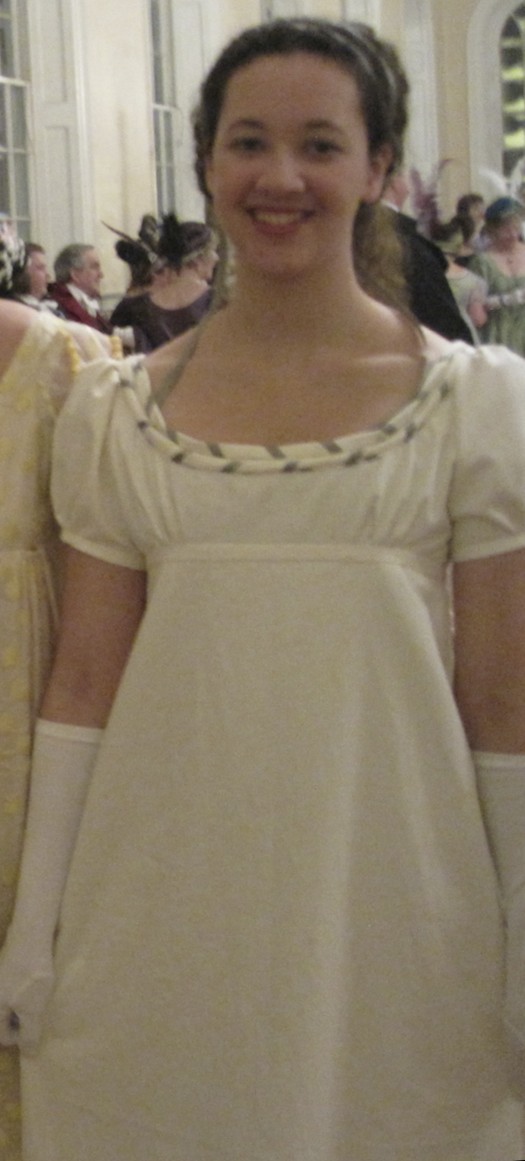
I am so pleased with my re-made 1819 dress. You can get the background here or read the sewing update here! In short, the new style shares only the skirt with its former self. The new ruffles are all hand hemmed and hand sewn on. The dress seams are a mix of machine and hand sewing, depending on if I felt like digging out the sewing machine or not. All of the bodice seams are flat felled by hand. The dress closes in the back with 4 mother of pearl buttons. Oh, and let me not forget that the dress no longer has built in petticoats. Part of the re-make was to create a separate petticoat from one of the two petticoat layers built into the dress. The petticoat ties under the bust and has a single button to close the top of the bust. It is just a sleeveless, simple version of the gown. I’ll have to take pictures sometime so I can share them. But the dress… It fits! It is ruffly! It has so much more style than it did before! Just to compare, the first picture is your first glimpse of its current style, and below that is from before the re-make.
The re-made 1819 dress, with ruffles!The 1819 dress in its first incarnation.
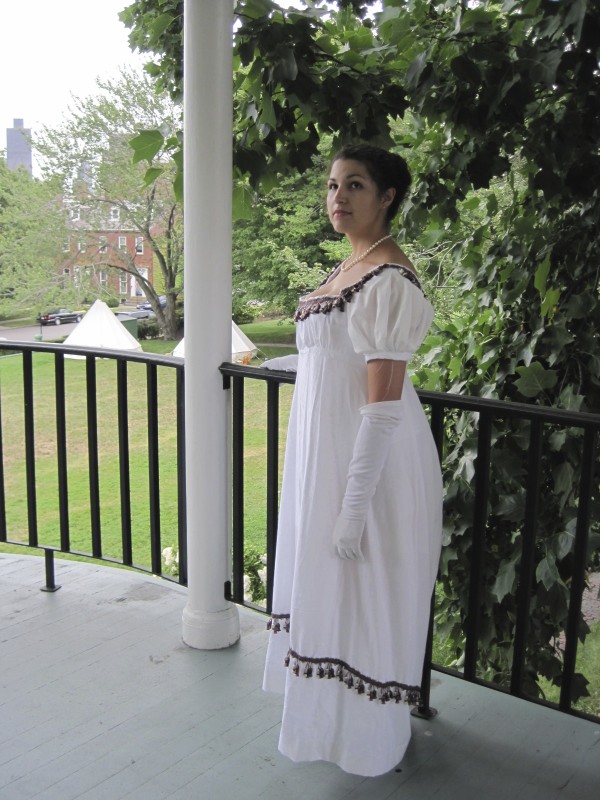
Isn’t it more stunning than it previously was? I wore it to the Commonwealth Vintage Dancers’ 1812 Ball (ok, so my dress was a little forward thinking… maybe I have a time machine?). I had a lovely time, as expected. I made some new acquaintances and renewed some old ones, I was able to wear my recently purchased kid leather opera-length (which means over the elbow) gloves and a beautiful shawl one of my aunts gave me a few years ago, I got to practice my historic hair styling techniques (more to come on that point soon), and I danced! But let me stop writing, because really this post is about sharing pictures.
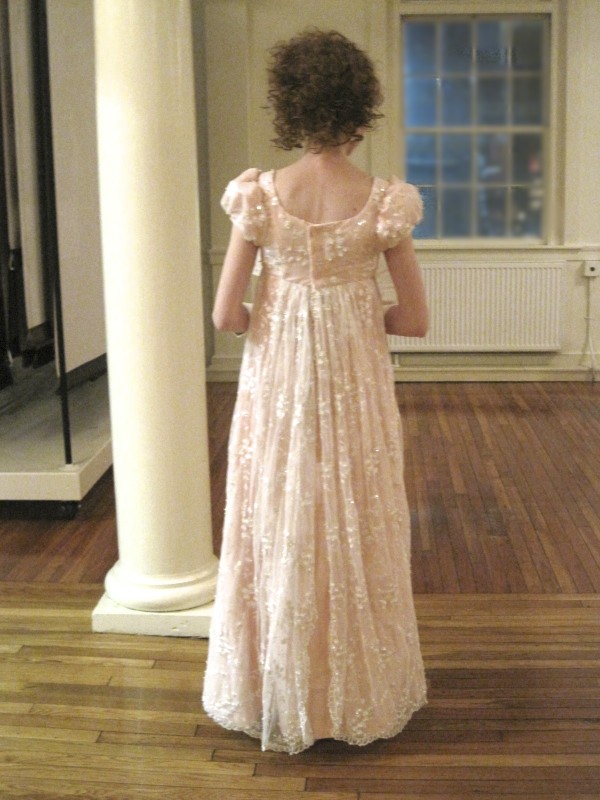
The back view of the re-made dress.Friends: don't we make a lovely group? Ok, wait, but there's a funny face...How about this one? Same group, but now I'm making the funny face. Rather a severe expression, don't you think?
I’d just like to insert a comment here: looking again at these pictures, all the ruffles on the bodice of my dress really manage to make me look much more busty than I actually am… Hm… there are a lot of ruffles going on there!
My friend made this beautiful fan to go with her dress! It's hard to see the detail in this picture, but it's absolutely lovely.Front of her new dress. She also has the super cute tiara, that is much more sparkly in person...Back of her new dress.
I’ll leave you with this image: a teaser for a soon-to-come post about the creation of this hair style!
Quite picturesque, I think. Thanks for taking the photos, Carly (and Mark)!
As with the 1819 ivory gown, the bonnet that is part of my late Regency look has also been remade from its original style. Why re-make it, you might ask?
Though the bonnet was based off of an 1819 illustration in Cunnington’s English Women’s Clothing the Nineteenth Century, it was built for use in the theatre, so the materials used to trim it are nowhere near accurate for off stage use. However, the shape and placement of the trim was accuratly reproduced from the inspiration image and that fact made the re-trimming possible, because the base of the bonnet could remain unchanged!
Before: The bonnet before re-trimming
The original trim was entirely polyester, which stands out when placed with other, more accurate garments and in natural light (rather than stage lighting). The color scheme was pink and peach fabric manipulated in various ways: the flowers were pinked and gathered lengths of polyester fabric, the ribbons were bias cut polyester fabric, the inside of the brim was lined with pink polyester shantung, and the brim was edged with white polyester lace. Aside from the polyester problem, the pink color scheme would not match my darling new spencer, which is brown and green. It’s not that the colors would clash, it’s just that they would look like they were not intended for each other… and I really wanted a coherent, matching look to my ensemble.
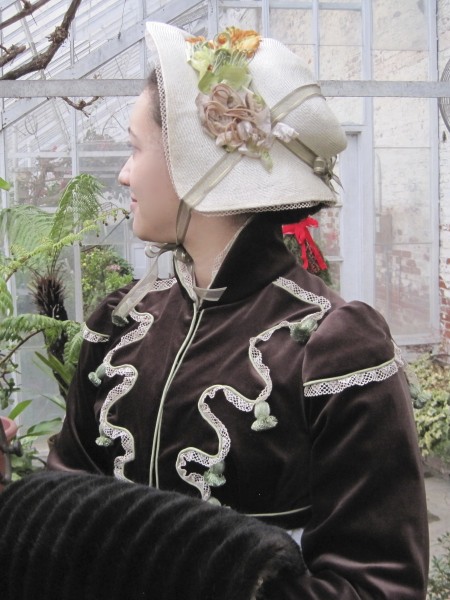
And After: The re-trimmed bonnet with matching spencer
I removed all of the fabric flowers, the bias ribbon trim, the lace edging and the lining. The lining was replaced with green silk shantung to match the new bonnet trimmings and the spencer while the lace edging was changed to light brown vintage cotton lace that matches the lace used on the spencer. The flowers were replaced with millinery flowers in green and light brown from my stash. I decided to use the spark of orangey-brown near the top so that the bonnet wasn’t too matchy-matchy. The ribbon was changed out for a matching green ribbon that has narrow bands of gold along the edges (I confess it is still polyester… but I like the look of it and I didn’t have enough of my matching green silk satin ribbon to use it, nor did I like the shine of the satin with the green of the flowers). And voila! A bonnet that now is the right shape and has the right trimmings to match my Regency ensemble!
I have decided to remake my ivory 1819 cotton gown for an upcoming Regency ball. Originally, my plan was to add trim to the dress as it currently exists, but I realized there were many things about the dress I wanted to change: with my new late Regency corset the neckline tended to sit away from my body in front, the back closure was too tight for comfort, the bust line in front was so high that it was very hard to get it to sit below my bust, the sleeve openings were uncomfortably tight, the sleeves weren’t puffed enough, I wanted to separate all the petticoat layers to be individual layers rather than petticoats built into the dress, and I wanted to add ruffles to the skirt to really bring it up to the years just before the 1820s. Indeed, the things I wanted to change were so numerous that I decided to just remake the dress!
In the end, the only thing that I decided to keep the same is the skirt base fabric… Using just one additional yard of the original fabric, I plan to complete the following changes: constructing an entirely new bodice with ruffled trimming, creating entirely new puffed sleeves with a cute v-shaped detail, making stand alone petticoats out of the original built in petticoats, and adding bias ruffles to the skirt.
From Ackermann's Repository 1822
My dress is from the period just before the 1820s and I felt that I needed to go more in an 1820s direction with the new trimming and adornment. The main feature of trimming in the 1820s is wide sections of trimmings on the skirt, in combination with corresponding trim across the bodice and sleeves. Thus, there two horizontal lines of interest with a simple, unadorned mid-section (as in the fashion plate on the left, from 1822).
Before I had decided to make so many changes, my original intention was to simply add ruffles to the bottom hem, along the lines of the dress (below) from the Kyoto Costume Institute.
c. 1820 Silk Day Dress (Kyoto Costume Institute)Ribbon trim on 1819 dress before the remake
However, as I thought about it I realized that the ruffle style (above) just would not have a corresponding look to the current zig zag ribbon trim on the dress bodice (right). Those two styles did not make sense on one dress.
The logical step was to change the trim on the bodice. But remember that I had other complaints about the bodice as well… So came the decision to remake the bodice. But how to trim it to correspond with the ruffles on the skirt? I was not at all interested in the bodice trimming on the Kyoto dress for my dress, because the fabric doesn’t lend itself to that look. Well, I started researching trimming from the late 18-teens to see if I would be inspired. The image below is one of my favorites that didn’t make the cut, and there are more on my 1819 dress trimming ideas Pinterest board (thank you to Lauren, at American Duchess, for linking to her Pinterest board in a post and sparking my interest in this fabulous organization tool).
From Ackermann's Repository 1819
Many of my Pinterest images come from the same place: the blog “My Fanciful Muse” by EK Duncan. She has a series of posts that contain text and fashion plates from Ackermann’s Repository beginning in 1808 and going through 1828! Here is the link for the post on 1828: if you scroll to the bottom you will see a list of links to all of the previous years. It is absolutely fabulous! If you haven’t seen this yet you MUST visit! (Thank you for sharing, Evelyn!)
In the end, I decided on a combination of the two dresses in the image below: the ruffles on the skirt of the dress on the right (for some reason I really like the idea of ruffles on my skirt!) and the bodice of the dress on the left. The repeated use of ruffles on the skirt and bodice will produce the corresponding style I am aiming for. The sleeves will be a style from the first few pages of the first half of the 19th century Janet Arnold pattern book: a puffed sleeve with a triangular inset coming from the shoulder. I’ve wanted to use that sleeve style for months and now I finally have a way to use it that makes sense!
1820 illustration from Cunnington's English Women's Clothing in the Nineteenth Century (the illustration is based off of contemporary fashion plates)
Despite the long name of this post… Here it is! My (almost) finished 1819 Regency Ensemble! The ensemble includes an early 19th century white linen chemise, 1815-1820 pink cotton corset, 1815-1825 ivory cotton gown, 1819 brown velvet Spencer, 1819 straw bonnet, and mid-19th century fur muff (ok, so it’s not quite as giant and droopy as a Regency muff… but it was cold outside!). You can click on the links to see more about each piece. There is more to come on the gown and bonnet.
Right now I want to focus on the completed Spencer and its details. Please click on the link above to see my research for the Spencer: it is based off a Spencer at the Metropolitan Museum of Art. You can see pictures of the mockup Spencer here. The Spencer is constructed of brown cotton velvet that is flatlined with white cotton. It is trimmed with green cotton cording, vintage brown lace, and green tassels to match (Aren’t the tassels so adorable?).
1819 SpencerBack of the 1819 Spencer
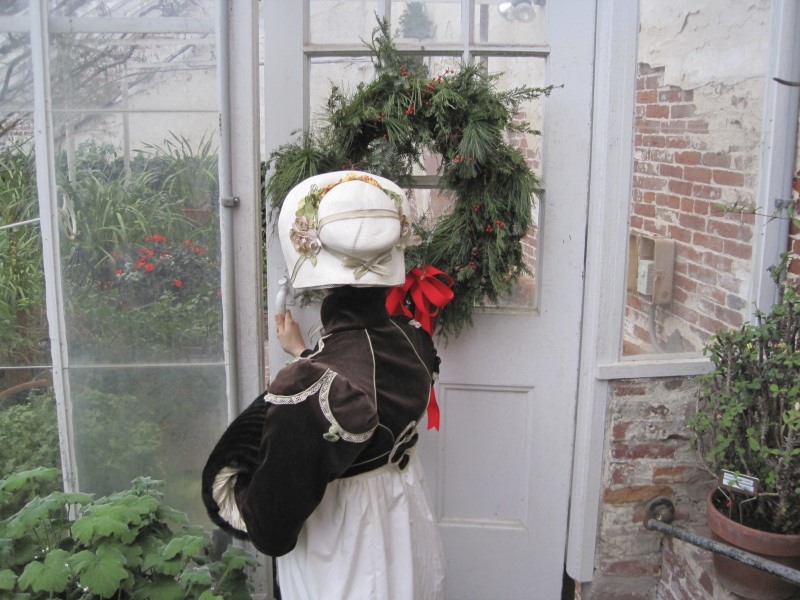
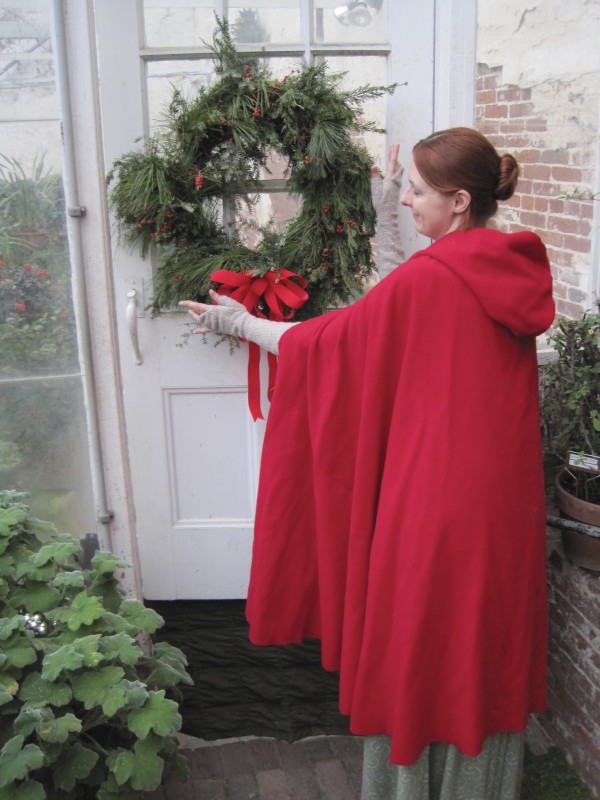
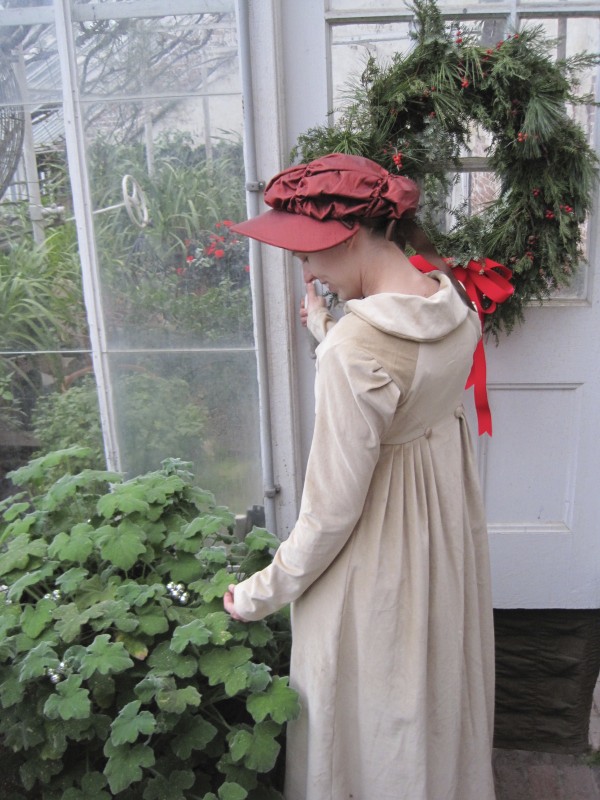
I wore this Spencer to the Massachusetts Costumers annual Regency Holiday Tea. This year, in addition to having tea, we visited the Lyman Estates Greenhouses, which were built in 1804 and added to in 1820, 1840, and 1930.
On to see more of the greenhousesOrnaments hanging from a tree!Picture time!Admiring the decorSo many beautiful things to look at
The tea was lovely and I do believe that my Spencer turned out wonderfully! Spencers are so adorable and varied. I hope to make more in the future… but there are other things to do before I go back to Spencers. The next big push is going to be Edwardian outfits for Titantic evens in April!
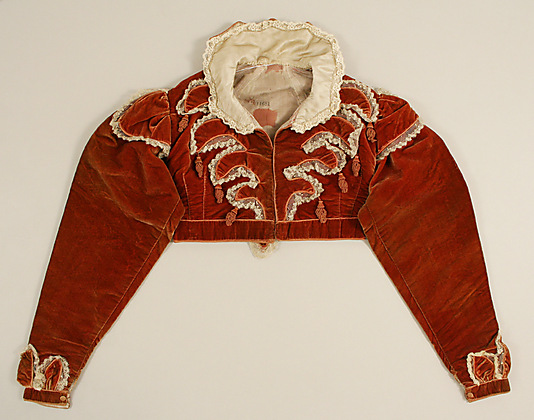
I recently shared with you my research for a Regency Spencer! I found many inspiring images, but below is the one that I chose to reproduce, with some creative license, of course. 1819 is the specific year much of my Regency ensemble is aimed at, so this Spencer fits in perfectly! Aren’t the tassels adorable?
1819-1822 Spencer at the Metropolitan Museum of Art1819-1822 Spencer Back
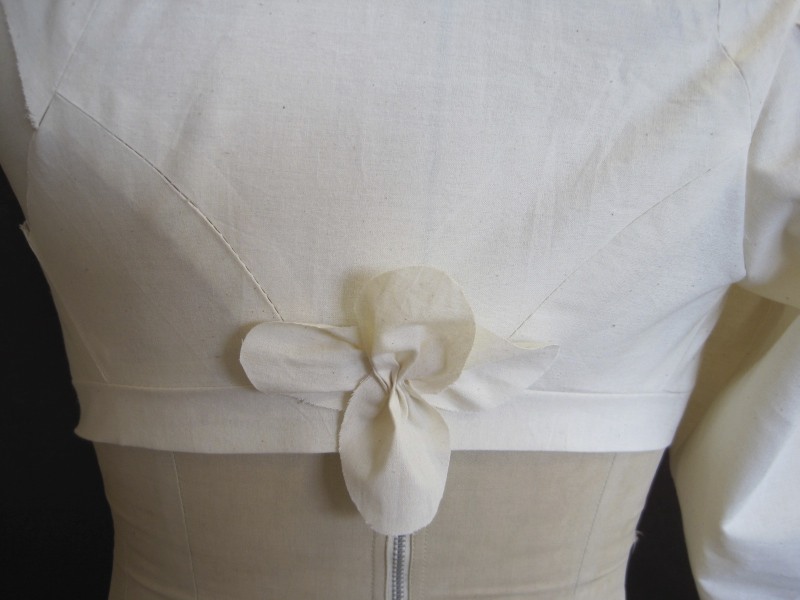
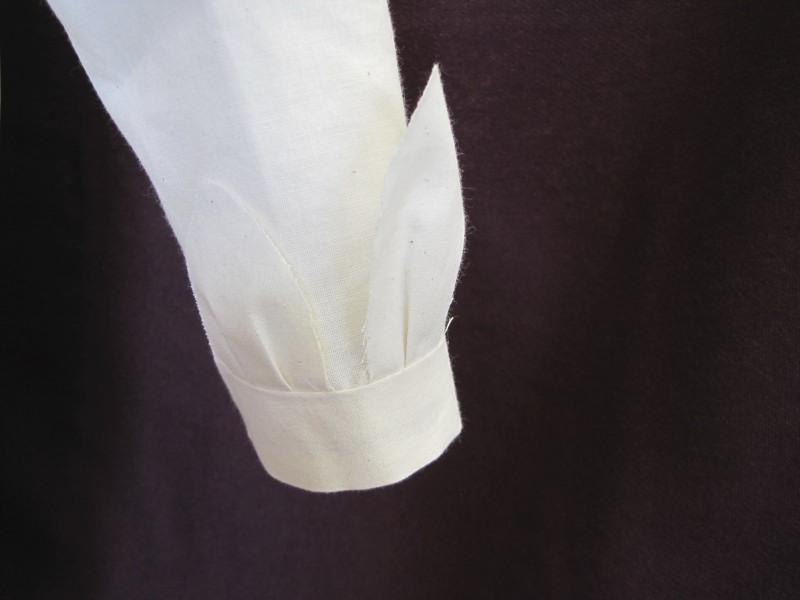
First of all, let me share pictures of the mock-up of this garment!
I draped the pattern and left seam allowance on the draped pieces (to eliminate the step of creating a paper pattern from my muslin) so I could move straight to the mock-up stage. In this case especially, I felt the mock-up to be essential to the fit of the spencer (especially the seams in the back) as well as to reaffirm the scale and placement of the decorative elements. Only after I had fit the Spencer and marked the necessary alterations did I rip open the seams and use the muslin to create a paper pattern.
1819 Spencer Mock-up1819 Spencer MockupBack: close upSleeve: close up
Coming soon will be pictures of the finished garment!
Let me start by explaining my reasoning about adding to my Regency wardrobe. You see, I had two events in mind for which I needed two different Regency looks: the Massachusetts Costumers annual Regency Holiday Tea and the Commonwealth Vintage Dancers 1812 Ball. What to wear???
“Well,” I thought, “I have an 1819 dress that I built last year for the Sense and Sensibility Ball… but I don’t have the right corset to wear under it. Nor do I have any way to make the ball gown into day wear… And, now that I think of it, what will I do with my hair for a day style???”
The first and most foundational step was to build a corset to provide the proper support and shape for the Regency period. You can see my research and construction of the corset in previous posts.
The next step was to turn my ball gown into day wear! Well, Spencers are a classic Regency garment that can perfectly disguise my ball gown by hiding the short sleeves and low neckline, thus turning it into day wear. Perfect! After the Spencer will come the adventure of finding a suitable hair/hat solution.
What is a Spencer? It is a short, waist length jacket from the 18th and 19th centuries first worn by men but quickly adapted into women’s wear. The garment is named after George John, the 2nd Earl of Spencer who was an English politician during the last quarter of the 18th century and the first quarter of the 19th century.
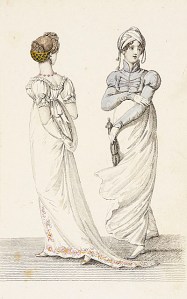
Early 19th Century Fashion Plate at LACMA (Spencer on the right)Fashion Plate, 1807 at LACMA (Spencer on the right)
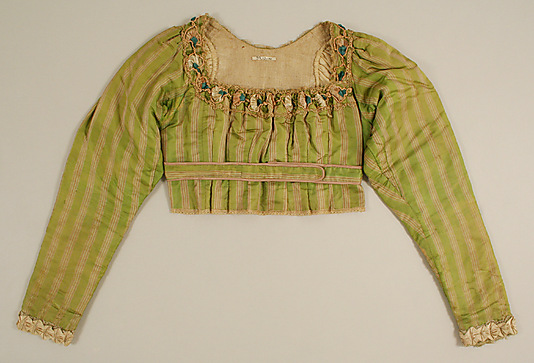
Right now I am interested in the Regency style Spencers, since that is what I will be making, so I will focus my research on that period. Here are some of the Spencers I found most inspirational for my reproduction. These garments are from the Metropolitan Museum of Art’s collection.
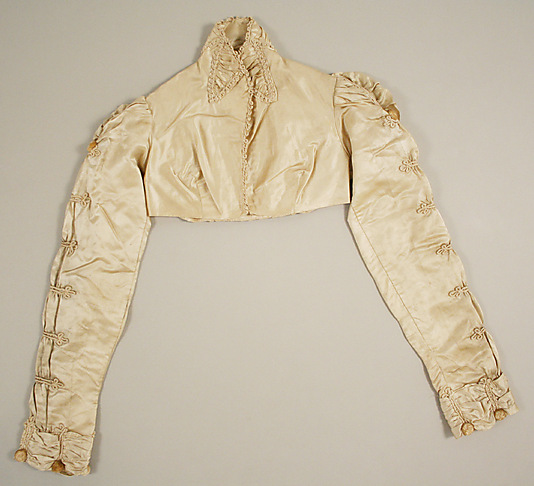
1819-1822 SpencerEarly 19th Century SpencerEarly 19th Century Spencerc. 1815 Spencer1814-1820 Spencerc. 1816 Spencerc. 1818 Spencer1804-1818 Spencer (That is a lot of tassels!)c. 1820 Spencer
Let’s leave the Spencer here, in the research stage, for today. More will be coming soon with mock-up pictures of my reproduction!
While looking for research images I did come across this blog post that shows a reproduction of an 1815 Spencer at the LACMA. The post (and her other posts as well) have great commentary about the research and construction of reproduction garments with lots of pictures included!




































 The Quintessential Clothes Pen